




The name of James William Windsor (1779–1853) is not widely known in scholarly circles today; yet as a pianist, organist and all-round music director, he was instrumental in guiding the musical world of Bath through a turbulent period of economic decline and societal change over the course of a career that spanned nearly six decades.Footnote 1 Much of what may be discovered about his activities is gleaned from his large and important music collection, bequeathed to the Royal College of Music (RCM) in 1890 by his eldest daughter, Elizabeth (1805–1890).Footnote 2 This collection of printed and manuscript music reveals much about its former owner's interests, activities and friendships, and many of its most significant items lend value to modern editions and musicological research.Footnote 3 Of particular relevance to this study is Windsor's own transcription of Bach's Das wohltemperirte Clavier (RCM MS 743, dated 1801), identified by Yo Tomita as being both textually unique and the second earliest known complete English source of this work.Footnote 4
Windsor's interest in Bach marks him out as a member of what was, especially as early as 1801, a small and select group of musicians residing in England who were passionate about not only the music of J. S. Bach specifically (a movement now frequently termed the English Bach Revival or Awakening), but the science and theory of music more generally. Fostered to a large extent by a wave of German-born musicians taking up residence in London in the late eighteenth century – bringing with them both the music of Bach and German-language theoretical works – the cause was soon taken up by English musicians such as Samuel Wesley (1766–1837), Benjamin Jacobs (1778–1829) and John Wall Callcott (1766–1821). Augustus Frederic Christopher Kollmann (1756–1829), a German who was appointed organist of the German Chapel in St James's Palace in 1782,Footnote 5 published widely on such topics as extemporization (1792), harmony (1796) and composition (1799).Footnote 6 Besides putting forward his own theories, Kollmann critiqued and analysed those of German writers who preceded him, such as Johann Mattheson (1681–1764) and Johann Kirnberger (1721–1783), thus introducing these works, often for the first time, to an English audience.
It is fitting to note that many of the aforementioned key figures were organists. Kollmann, discussing in 1812 the state of organ playing in England, observed a natural link between exposure to cathedral music (which he calls ‘good music in parts’) and interest in more advanced (and often contrapuntal) compositional styles.Footnote 7 More recently, Percy Young described how, besides their ‘[taking] the lead in popularizing Bach’,Footnote 8 organists both English and German were responsible for the rapid propagation of keyboard fugues throughout England. Windsor was appointed organist of St Margaret's, a proprietary chapel in Bath, in 1798,Footnote 9 and it is perhaps here where his interest in the science and theory of music (and fugal theory specifically) first began. Although somewhat removed from the geographical centre of these debates, Windsor seems to have kept up with these discussions as much as his residence in Bath would allow. He was known to, and respected by, at least some of the movement's proponents: writing to Vincent Novello in 1814, Samuel Wesley speaks of Windsor as ‘a “sensible” and “modest” man who knows almost as much about harmony as [James] Bartleman’;Footnote 10 and Windsor's friendship with A. F. C. Kollmann is evidenced by gifts of music from Kollmann to Windsor which survive in the Royal College of Music Library.Footnote 11
Windsor's collection bears witness to an intensive period of scientific study of music, beginning in 1798 (the date of his appointment to St Margaret's Chapel) and lasting for around a decade. Pertinent to this essay is Windsor's specific interest in the art of fugal composition, to which numerous collection items from this period attest:
1 RCM H403 (dated 1798), a volume of printed keyboard music including fugues by Charles Frederick Baumgarten and Muzio Clementi;
2 RCM MS 1153 (dated December 1800), a manuscript volume into which Windsor copied and analysed fugues by Joseph Haydn;
3 RCM H376 (dated June 1801), a volume of printed and manuscript keyboard music including fugues by Johann Georg Albrechtsberger, James Nares, Johann Christoph Kellner and Thomas Roseingrave;
4 RCM MS 743 (dated November 1801), mentioned above, Windsor's transcription of Bach's Das wohltemperirte Clavier;
5 RCM MS 1150 (dated 1802), a manuscript volume containing numerous organ fugues in Windsor's hand, mostly by Baumgarten.
In addition to those listed above, Windsor was a subscriber to Kollmann's An Essay on Practical Musical Composition (1799).Footnote 12 It may have been in this work where Windsor first encountered Marpurg's Abhandlung von der Fuge, which Kollmann names as ‘the principal work treating of Fugues hitherto known’, the merit of which ‘has perhaps never been disputed’.Footnote 13 It is to Marpurg's work that our attention shall now turn.
The Abhandlung von der Fuge (1753–1754) by Friedrich Wilhelm Marpurg (1718–1795)Footnote 14 has been described as ‘an encyclopedic work unmatched by anything in its time . . . with an authority equalled by only a few treatises throughout music history’.Footnote 15 Being the first work in any language devoted primarily to fugal theory, its two volumes cover not only fugal composition in its formal sense, but also counterpoint and canon more generally, and include a survey of (and frequent references to) prior literature on these subjects. As Marpurg himself wrote of his treatise, ‘J'ai fait de mon mieux pour ne rien ômettre de tout ce qui concerne la méchanique de la fugue’ (I have done my best to omit nothing which concerns the mechanism of Fugues).Footnote 16 The appeal of such a comprehensive theoretical work to a keen music student such as Windsor is obvious, especially when recommended by German-speaking musicians like Kollmann. Yet German was not widely understood in eighteenth-century England, and even those with a working knowledge of the language would have struggled to follow the intricacies of such a technical treatise. Perhaps aware of the language barrier limiting the Abhandlung's reach, Marpurg himself translated the work into French shortly after its initial release (published as Traité de la fugue et du contrepoint in 1756), despite his misgivings about his own proficiency with the language: ‘Une chose qui m'embarrasse, c'est que j’écris dans une langue qui m'est étrangère. Il est donc très-naturel que j'aie pu faire bien des fautes contre cette langue’ (One thing embarrasses me, which is that I write in a language foreign to me. It is then very natural for me to commit many faults against that language).Footnote 17
Marpurg's target audience for this translation was ‘les François’ themselves,Footnote 18 yet Jamie Croy Kassler has observed that this French translation greatly aided the propagation of the Abhandlung throughout England.Footnote 19 French was not only widely spoken amongst the English upper classes, but, significantly, amongst better-educated musicians. Organists such as Samuel Webbe senior and John Eager, for example, were both noted readers of French.Footnote 20 Indeed, a case can be made that church and cathedral musicians (especially those who had served as choristers) were, generally speaking, more likely to have a working knowledge of this language than their secular counterparts. Deborah Rohr describes the ‘free classical education’ afforded to choristers – akin to that of a fee-paying gentleman's son – as the role's ‘most important benefit’, which typically included enrolment at a school closely associated with the cathedral.Footnote 21 Thus those musicians most likely to be interested in Marpurg's work – that is, organists – were also those most likely to be able to study it, albeit in its French translation.
By 1784, Kassler records, Marpurg's work was sufficiently known in England for a translation into English of ‘what is most excellent and useful in the works of this German’ to be proposed.Footnote 22 This project never came to fruition, nor did a proposed complete translation of Abhandlung von der Fuge from a French edition of 1810.Footnote 23 In fact, the first time any significant portions of the Abhandlung were published in English was in 1958, as part of Alfred Mann's The Study of the Fugue.Footnote 24 Only in 2022 was a complete translation published for the first time.Footnote 25
Thus in England at the outset of the nineteenth century, those wishing to study Marpurg's writings could do so only in German or in French. ‘Marpurg's numerous profound and scientific writings having never been translated into english [sic], his system has been only known here thro’ the medium of the classical compositions which conform to it’, lamented the music writer John Gunn in 1802, although he notes that ‘two eminent German Masters resident here . . . have formed their pupils on its principles’.Footnote 26 Where did this leave the studious J. W. Windsor? He could not read French,Footnote 27 nor did he have the advantage of a German music master. Despite these definite handicaps, it seems Windsor was determined to read the Abhandlung for himself, and by January 1803 he had acquired a copy of its second French edition, published by Imbault in Paris in 1801.Footnote 28 That Windsor had been able to obtain such an item at all may be indicative of his sheer determination, the ongoing Anglo-French war significantly affecting the importation of books into England from France.Footnote 29 Yet determination alone could not overcome the language barrier, and, unsurprisingly, when compared with other theoretical works from Windsor's collection (many of which are heavily annotated), Windsor's copy of the Abhandlung (or Traité) shows little sign of use by its owner.Footnote 30
One wonders why Windsor spent both money and effort to acquire a book he knew he would not be able to read. Far from being a collector for collecting's sake, the evidence from Windsor's music library is that he acquired little for which he had no practical use. As it happened, Windsor did indeed have a use for his French Abhandlung: by 12 March 1803 it had been translated in its entirety into English. ‘A Treatise of Fugue & Counterpoint by Marpourg’ reads the title-page of what is now RCM MS 946, Windsor writing his name and address (5 Abbey Green, an address he vacated by March 1806Footnote 31) below the title (see Figure 1). On its final page, the translator has written, ‘Finis March 12 1803’.
Title-page of ‘A Treatise of Fugue & Counterpoint’, Royal College of Music, London, RCM MS 946. Windsor's ownership inscription and address (in pencil) are visible at the bottom of the page. Reproduced with permission of the Royal College of Music, London

Despite Windsor having acquired this manuscript within (at most) three years of its creation, it does not necessarily follow that Windsor had any involvement in its coming into being. However, there are several strands of evidence to support this conclusion. The title alone indicates that the translator was working from a French edition, ‘A Treatise of Fugue & Counterpoint’ being a literal translation of Traité de la fugue et du contrepoint, rather than the German Abhandlung von der Fuge. The author's name being given as ‘Marpourg’ suggests the same. More conclusively, the translator includes the preface as found in both French editions (yet not in the German), which includes Marpurg's apology for his imperfect French.
Not only this, but comparison of both French editions with ‘A Treatise of Fugue & Counterpoint’ indicates that the translator was working with Imbault's 1801 edition. While Imbault's editorial changes to the 1756 text were very minimal, sufficient were made to discern which edition underlies the present English translation, a selection of which are shown in Table 1.
Selected passages from the two French editions (Berlin: Haude et Spener, 1756; Paris: Imbault, 1801) of Traité de la fugue et du contrepoint compared with the English translation, RCM MS 946

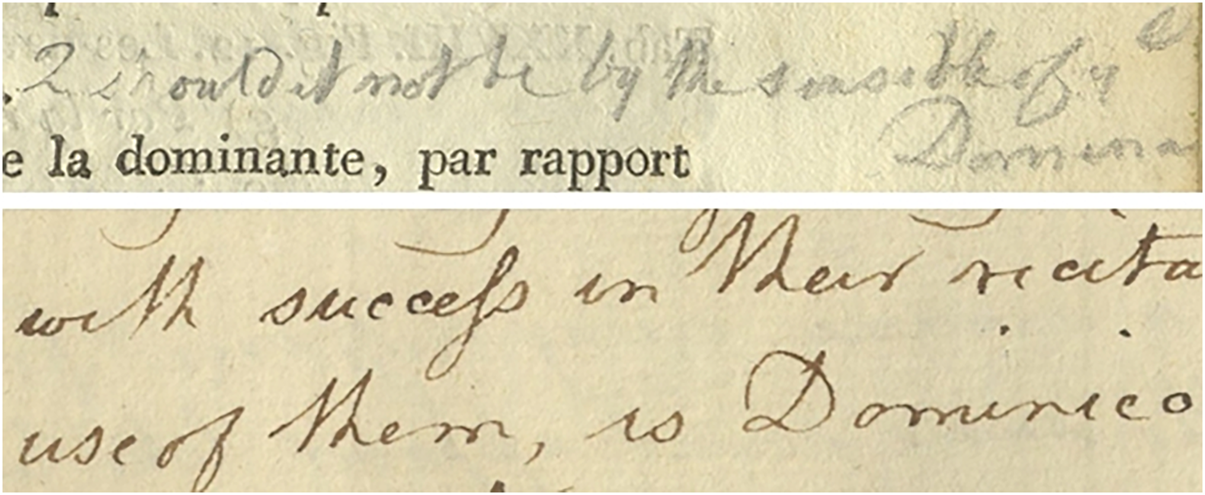
One may assume, for reasons given above, that Imbault's 1801 edition of Traité de la fugue et du contrepoint was not in wide circulation in England as early as 1803; yet this alone seems insufficient to assume that Windsor's own copy was used in the creation of ‘A Treatise of Fugue & Counterpoint’. Only by consulting Windsor's copy itself is this conclusion found to be a safe one. Although entirely free from annotations in Windsor's hand, a single annotation in a different hand remains on page 17 of volume 1. Regarding Example 8 of Marpurg's sixth ‘rule’ from his chapter 3, the second point (‘Sujet répliqué par la Sixte de la dominante’) is annotated, ‘should it not be the sensible [Marpurg's chosen French word to indicate the sharp seventh degree of a scale] of the Dominant?’Footnote 32 Not only is the annotating hand markedly similar to the hand used in ‘A Treatise of Fugue & Counterpoint’ (see Figure 2), but the disputed point becomes one of the only places in the English translation where the translator departs from the French text in order to exercise editorial licence (altered section italicized in Table 2). Whether or not the translator was correct to alter Marpurg's ‘la Sixte de la dominante’ is beyond the scope of this essay. Yet the fact that both the annotator of RCM D376 and the translator of RCM MS 946 dispute Marpurg's argument at this point strongly suggests that the annotator and the translator are one and the same, especially when considered in tandem with the similarity of hand.
Annotating hand on RCM D376 (top) compared with the hand of RCM MS 946 (bottom). Reproduced with permission of the Royal College of Music, London
Example of editorial changes made by the translator of RCM MS 946

The preponderance of evidence so far paints a compelling picture: that ‘A Treatise of Fugue & Counterpoint’ was translated for, or at least in close cooperation with, James William Windsor, using his own printed copy of Traité de la fugue et du contrepoint, to further his personal study in fugal theory. Yet Windsor's role in the creation of this manuscript is minimal when compared to that of the translator himself. Abhandlung von der Fuge is, after all, a highly technical work, taking the form of a long and meticulously structured argument. That the translator accomplished the entire task within the space of fewer than three months is quite admirable. The manuscript being unsigned, the translator has remained hitherto anonymous, yet sufficient clues exist to offer a cautious identification of the translator of the ‘Treatise’.
First, it may be reasoned that the translator was a fellow musician, a background knowledge of the subject at hand being demonstrated in the English text itself. Not only does the translator in places object to Marpurg's points (as demonstrated above), but he occasionally offers an alternative translation based on his own knowledge of the subject (interpolations bold italicized):
4 The Counterpoint (translated by Kollman Counterharmony) which accompanies the first part when the 2d part enters to take up the fugue.
5 The Counterpoint (called by Kollman the intermediate harmony) which fills up the space from one Reply to another.Footnote 33
Secondly, the paper on which the translation is written offers a compelling link to the cathedral city of Wells. A variety of watermarks appear throughout the manuscript, many of which may be found elsewhere in Windsor's collection. A notable outlier, however, is the watermark of Joseph Coles, who produced paper at St Cuthbert's Mill on the River Axe, just outside Wells, from 1788 to 1826.Footnote 34 So far as I can ascertain, this paper is unique to this item in Windsor's collection, strongly implying that it was not in wide circulation in Bath at the time. Indeed, only one other instance of Joseph Coles paper has been recorded outside the Wells area.Footnote 35
While the paper alone offers little in terms of identifying a translator, it brings to mind one of Windsor's acquaintances known to have had a connection to Wells: Henry Cook (1758–1827), vicar choral of Wells Cathedral from 1780 until 1820. Relatively little is known of Cook, but it is fitting to observe that the most thorough study to date of his life and career, by Hilda F. Gervers, was also written in relation to a significant manuscript formerly owned by Windsor.Footnote 36 By 1803 Cook had been a frequent visitor to Bath for at least twenty years. Not having a cathedral of its own, Bath suffered from a want of resident professional singers, with nearby cathedral cities such as Bristol, Salisbury and Wells frequently called upon to supply singers during the Bath winter season. Henry Cook sang for the Bath Catch ClubFootnote 37 and, following the Catch Club's dissolution in 1795,Footnote 38 the Bath Harmonic Society. This is where the connection between Windsor and Cook is made tangible, both being listed as professional members of the Harmonic Society in 1797 and 1799.Footnote 39 Gervers records that the manuscript now known as Drexel Collection MS 5612 bears the inscription ‘Presented by Henry Cook Wells . . . to JW Windsor Bath’,Footnote 40 while two autograph manuscripts by Henry Cook – both containing church service music – survive in the Royal College of Music Library, noted by W. Barclay Squire (the RCM's first Librarian) as having come from the Windsor collection.Footnote 41
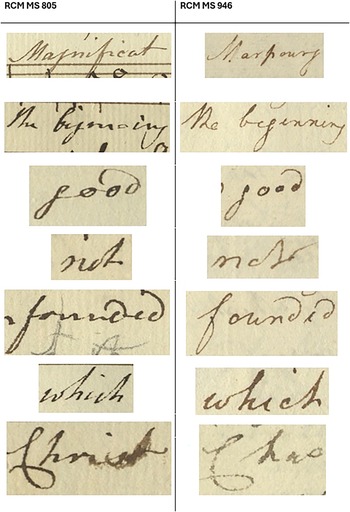
Besides supporting the connection between Windsor and Cook, these latter two manuscripts are of material assistance in assessing the likelihood of Cook having been the translator of ‘A Treatise of Fugue & Counterpoint’. Comparison of the respective scribal hands reveals a close match, as demonstrated in Figure 3: note in particular the distinct formation of the letter ‘t’ at the beginnings and ends of words (‘the’; ‘not’), the near-identical formation of ‘ng’ at the end of ‘beginning’ and a tendency to place the dot on the letter ‘i’ rather far from its body.
Autograph of Henry Cook (1758–1827) in RCM MS 805 compared with scribal hand of RCM MS 946. Reproduced with permission of the Royal College of Music, London

There are places in which the hand does not match with such consistency. Yet even within both RCM MS 805 and MS 946 respectively there are also internal inconsistencies, including the apparently arbitrary alternation between use of the ‘long’ and the ‘short’ ‘s’, inconsistent spelling and inconsistent letter formation. Neither manuscript can be said to be a fair copy; in fact, both appear to have been composed in a hurry. The similarity of hand, therefore, while not offering incontrovertible proof of Cook as translator, may be considered one of several strands of evidence which, when taken together, form a cumulative case for Cook's involvement.
Besides the questions of similarity of hand and the Wells connection, Henry Cook matches the profile of the translator. The close overlap between church musicians and interest in advanced compositional styles has already been noted, while Cook's former ownership of Drexel Collection MS 5612 (a significant seventeenth-century collection of music for the virginals, subsequently given to Windsor by CookFootnote 42) demonstrates that he, like Windsor, sought greater musical knowledge and insights from beyond his day-to-day spheres of performance. Windsor and Cook can even be definitively placed together in Bath just four days after the translation was completed, both performing at a benefit for Arthur Cook (no relation)Footnote 43 on 16 March 1803.Footnote 44
Cook's knowledge of French is, admittedly, otherwise unknown. If he had served as a chorister at Wells prior to his appointment as a vicar choral, he would have received a thorough education at the Collegiate School (now Wells Cathedral School);Footnote 45 unfortunately, records of pupils from Cook's era do not survive.Footnote 46 None the less, the vicars were typically drawn from well-educated stock. Cook himself was responsible for surveying the vicars’ estates and auditing the Cathedral's accounts,Footnote 47 and one of his colleagues, Aaron Foster, was even reported to have operated a school from his stipendiary accommodation.Footnote 48 Vicars also had access to the Cathedral library, which included several French-language theological and historical works, as well as materials for aiding the study of French, including two copies of Randle Cotgrave's A Dictionarie of the French and English tongues (1632).Footnote 49
When we bring together these several strands of evidence, the case for Henry Cook as translator is persuasive. Not only does evidence from the manuscript itself (such as its watermarks and scribal hand) point to Cook as a likely candidate, but Cook himself – as a musician, likely to have been well educated, whose interests extended to historical keyboard music – comes across as one both able and motivated to have tackled the work of translation. When combined with Cook's known friendship with Windsor, their shared bond over the historical study of music and their known convergence in Bath at the time of the manuscript's completion, the cumulative effect is quite overwhelming – especially in the absence of any other candidate.
Despite the obvious significance of RCM MS 946, only in Jamie Croy Kassler's The Science of Music in Britain is ‘A Treatise of Fugue & Counterpoint’ described in any detail.Footnote 50 It has been curiously overlooked in other studies of Marpurg's work. Gerald Krumbholz's PhD dissertation on Abhandlung von der Fuge limits mention of the manuscript to a single footnote; it was apparently not consulted in person:
The Royal College of Music Library (London) owns a complete(?), anonymous English translation of the Abhandlung, still in manuscript (MS946). In a letter to this writer the Library reports that the translation is unsigned and carries the inscription ‘Finis March 12. 1803’ on the final page.Footnote 51
Citing Krumbholz's dissertation, a similar footnote reference in a 2013 facsimile edition of Abhandlung von der Fuge tells the same story: ‘Ob es sich um eine vollständige Übersetzung handelt, ist nicht bekannt’ (It is not known whether this is a full translation).Footnote 52 More surprisingly, despite referring to Krumbholz, Derek Remeš's preface to Jane Hines's 2022 English translation shows no awareness at all of the manuscript's existence, claiming that ‘it [has] taken over two and a half centuries for [Abhandlung] to be translated in its entirety into English’.Footnote 53 Admittedly, being a translation of a translation, ‘A Treatise of Fugue & Counterpoint’ may not meet the modern standard of a scholarly translation, and Hines and Remeš's edition can rightly be claimed to be the first complete English translation from the German; yet the historical significance of ‘A Treatise’ should not go unnoticed, even if it has since been surpassed on a technical level.
Windsor, it would seem, was more than happy with his translated version, which (in contrast to his printed French edition) bears many signs of use. His annotations, informed by his prior study and knowledge of the subject, abound in the manuscript, such as offering alternative words for technical terms (‘reverse’ for ‘contrary motion’, ‘key note’ for ‘tonic’) and replacing ‘French’ note names of ut, re, mi and so forth with the more familiar C, D, E.Footnote 54 His studies come full circle when in one note he refers back to Kollmann's An Essay on Practical Musical Composition, the place where (I suggest) he may have first heard of Marpurg's work: ‘NB. A clearer doctrine of the Answer is in Kollmann's Essay’.Footnote 55 These signs that Windsor treasured and made frequent use of his ‘Treatise’ serve as a reminder that the translation was made for his personal use. This goes some way towards answering the question of why the first English translation of such an important work seemingly had no impact at all upon the propagation of Marpurg's ideas throughout England, despite the obvious demand for an English edition as demonstrated above: the ‘modest’ Windsor (to use Wesley's description) simply had no higher ambitions for his ‘Treatise’ than his own self-improvement. Had he resided in London, the centre of the scientific study of music in England, word of its existence may have spread amongst like-minded acquaintances who would have been equally motivated to study the Abhandlung in English. In Bath, however, despite the city's status as a centre of musical excellence, few seem to have shared Windsor's passion for such matters. This may further explain why Windsor and Cook came to have such a close friendship, as two of the very few in the vicinity with this shared interest.
Having an English version at his disposal, Windsor was not precious about his two-volume French edition (despite the plates contained in volume 2 being necessary for understanding examples referred to in ‘A Treatise of Fugue & Counterpoint’). These two volumes left Windsor's collection at some point during his lifetime, resurfacing in the collection of the Sacred Harmonic Society around 1850,Footnote 56 where they remained until the entire collection of the Sacred Harmonic Society was purchased for the Royal College of Music in 1883.Footnote 57 Windsor's collection followed in 1890; thus, by remarkable coincidence, Windsor's ‘Treatise’ was at the RCM reunited with the very same printed copy from which it had been translated eighty-seven years previously. Only by this fortuitous chain of events has it been possible to uncover the full story of RCM MS 946's creation. The story now told, it is hoped that ‘A Treatise of Fugue & Counterpoint’ may be better known, and the roles of both James William Windsor and Henry Cook in its creation more fully appreciated.




 Open access

