


1. Introduction
With declining fertility and growing life expectancy, population ageing poses significant challenges for developing countries. Ageing is closely linked to cognitive decline, which profoundly impacts critical aspects of older adults’ lives, including financial decisions (Banks and Oldfield, Reference Banks and Oldfield2010), household management (Smith et al., Reference Smith, McArdle and Willis2010), and medication adherence (Ownby, Reference Ownby2006). Progressive cognitive impairment can ultimately lead to dementia and disability, incurring substantial economic and caregiving burdens (Langa et al., Reference Langa, Larson, Crimmins, Faul, Levine, Kabeto and Weir2017; Weir et al., Reference Weir, Lay and Langa2014).
Research in cognitive neuroscience confirms that cognitive abilities naturally deteriorate with age, influenced by genetic predispositions and critical life transitions. Extensive research has explored the cognitive implications of retirement and unemployment during later life stages (Lei and Liu, Reference Lei and Liu2018; Coe et al., Reference Coe, Gaudecker, Lindeboom and Maurer2012; Atalay et al., Reference Atalay, Barrett and Staneva2019; Bonsang et al., Reference Bonsang, Adam and Perelman2012; Mazzonna and Peracchi, Reference Mazzonna and Peracchi2012; Freise et al., Reference Freise, Schmitz and Westphal2022). Widowhood, parallel to retirement, could be another potential trigger for cognitive decline. Spousal bereavement can challenge many aspects of an older adult’s life, including stress, lifestyle, and living environment, which may negatively affect their cognitive ability.
Empirical findings on widowhood and cognitive decline are mixed. Most studies show that widowhood is associated with a decline in cognition (Ward et al., Reference Ward, Mathias and Hitchings2007; Perkins et al., Reference Perkins, Lee, James, Oh, Krishna, Heo, Lee and Subramanian2016; Xavier et al., Reference Xavier, Ferraz, Trentini, Freitas and Moriguchi2002; Aartsen et al., Reference Aartsen, Van Tilburg, Smits, Comijs and Knipscheer2005; Berg et al., Reference Berg, Lindeboom and Portrait2011). However, some find insignificant effect on cognitive function (Rosnick et al., Reference Rosnick, Small and Burton2010; Trentini et al., Reference Trentini, Werlang, Xavier and Argimon2009; Lee et al., Reference Lee, Chi and Palinkas2019). These inconsistent results likely arise from data limitations and methodological differences. Building on panel data, we break through the constraints of viewing widowhood as a static state and delve into the effects and mechanisms of different temporal phases on cognitive abilities after the death of a spouse.
This paper contributes to existing literature in three ways. First, this is the one of few studies to estimate the effect of bereavement with longitudinal data from the China Health and Retirement Longitudinal Study (CHARLS) in developing countries. Most prior studies focus exclusively on developed countries (Yu and Lee, Reference Yu and Lee2022; Zhang et al., Reference Zhang, Liu and Hsieh2023; Jain et al., Reference Jain, Liu, Langa, Farron, Kabeto and Lee2022). The CHARLS is a unique panel data source that allows us to extend our study to developing countries. Our dynamic fixed-effect approach tracks cognitive changes pre- and post-widowhood, providing a detailed understanding of when cognitive decline emerges and facilitating targeted interventions.
Second, we identify key vulnerable populations through study on Hukou (household registration) status and gender heterogeneity, thus allowing for more targeted policy responses. Previous research highlights gender differences in cognitive outcomes linked to educational disparities (Lei et al., Reference Lei, Hu, Mcardle, Smith and Zhao2012; Wörn et al., Reference Wörn, Comijs and Aartsen2020), yet little attention has been given to rural-urban disparities defined by Hukou. Rural and urban elderly differ significantly in income, infrastructure access, social security support, and living arrangements, influencing their ability to cope with bereavement-related stress. From the perspective of public financial inputs, more adequate allocation of public resources and more well-established social security tend to favor urban areas. This results in significant differences in social support among regions for the elderly. Moreover, differences in economic status and centralized versus decentralized residential patterns create differences in the lifestyles of urban and rural residents, resulting in different adaptations in the perceptions of the elderly’s lives in the face of unforeseen shocks. Heterogeneity analyses based on Hukou could therefore better identify vulnerable groups that are in greater need of social support and make policy suggestions more targeted.
Third, we emphasize on providing feasible solutions from a policy perspective. Existing studies have tended to focus only on intra-household dynamics or individual risk factors, and have yet to focus on the impact of neighborhoods on individual encounters. Yet, neighborhood environment is widely recognized as relevant to differences in cognition (Besser et al., Reference Besser, Galvin, Rodriguez, Seeman, Kukull, Rapp and Smith2019; Wu et al., Reference Wu, Prina and Brayne2015; Brown et al., Reference Brown, Perrino, Lombard, Wang, Toro, Rundek, Gutierrez, Dong, Plater-Zyberk, Nardi, Kardys and Szapocznik2018; Finlay et al., Reference Finlay, Esposito, Li, Colabianchi, Zhou, Judd and Clarke2021). Moreover, given that the postulated mechanisms linking widowhood and cognition are social, it seems reasonable to expect that the neighborhood conditions of the bereaved elderly may buffer the social processes that make widowhood a critical risk factor for cognitive function. In developing countries with limited public resources, it is difficult to mitigate the cognitive impact of widowhood through long-chain (root) pathways such as education or holistic social care. The construction of e.g. sports facilities, recreational facilities, health care centers, etc. that we propose in our policy insights have stronger feasibility and faster effectiveness. Our study emphasizes their important role in mitigating the cognitive decline due to widowhood shock. At the same time, it is also hinting to some extent at the underlying mechanisms of the impact on cognitive ability.
The following section reviews relevant literature on bereavement’s cognitive effects, and explores potential underlying mechanisms. We then outline the data and methodology, followed by empirical findings and concluding remarks.
2. Literature review and mechanism
2.1. Literature review
Most studies focus on the effects of widowhood status on the elderly’s health. The consistent findings suggest that the elderly have higher mortality rates (Lillard and Panis, Reference Lillard and Panis1996; Lillard and Waite, Reference Lillard and Waite1995; Hu and Goldman, Reference Hu and Goldman1990; Subramanian et al., Reference Subramanian, Elwert and Christakis2008), lower weight (Umberson et al., Reference Umberson, Liu and Powers2009; Sobal et al., Reference Sobal, Rauschenbach and Frongillo2003), more chronic diseases (Hughes and Waite, Reference Hughes and Waite2009; Zhang and Hayward, Reference Zhang and Hayward2006) and more depression symptoms after becoming widowed (Waite and Hughes, Reference Waite and Hughes1999; Simon, Reference Simon2002; Elwert and Christakis, Reference Elwert and Christakis2016; Li et al., Reference Li, Liang, Toler and Gu2005).
A large part of the literature studying the relationship between spousal loss and cognition is in the developed countries (e.g. US, UK, and Netherlands) and gets mixed results. Most studies show that widowhood negatively affects different aspects of cognition in adults (Ward et al., Reference Ward, Mathias and Hitchings2007; Yu and Lee, Reference Yu and Lee2022; Jain et al., Reference Jain, Liu, Langa, Farron, Kabeto and Lee2022). Whereas some literature finds that widowhood has no significant effect on cognition (Rosnick et al., Reference Rosnick, Small and Burton2010). However, only few studies have examined the association between widowhood and cognition in Asian settings. Fan et al. (Reference Fan, Sun, Lee, Yang, Chen, Lin, Shu-Chien, Ta-Fu and Ker-Neng2015), based on 10,432 residents in Taiwan, both show that bereaved individuals are more likely to encounter an increased risk for dementia. A similar study in South Korea also finds that widowed older Koreans had a higher risk of Alzheimer’s disease than married couples (Bae et al., Reference Bae, Kim, Han, Kim and Kim2015). Zhang et al. (Reference Zhang and Hayward2006), based on 34,807 individuals aged 55 and above in four districts (Beijing, Chengdu, Shanghai, Xi’an) in China, found that widowhood faced a higher risk of Alzheimer’s disease compared to the married.
Cross-sectional data cannot eliminate unobservable heterogeneous characteristics, for example, personality traits (e.g., neuroticism). With data available, more and more studies have tried to use panel data (Aartsen et al., Reference Aartsen, Van Tilburg, Smits, Comijs and Knipscheer2005; Zhang et al., Reference Zhang, Li, Xu and Liu2019; Mousavi-Nasab et al., Reference Mousavi-Nasab, Kormi-Nouri, Sundström and Nilsson2012; Vidarsdottir et al., Reference Vidarsdottir, Fang, Chang, Aspelund, Fall and Jonsdottir2014). Most of the studies mentioned earlier, except Vidarsdottir et al. (Reference Vidarsdottir, Fang, Chang, Aspelund, Fall and Jonsdottir2014), display the adverse effects of spousal loss on cognitive ability over time. Zhang et al. (Reference Zhang, Li, Xu and Liu2019), using 2011 and 2013 CHARLS data, investigate the impact of widowhood on a 2-year change in cognitive function among Chinese adults aged 55 and older. The results show that continuous widows had lower episodic memory than continuously married. However, newly widowed adults were not significantly different from continuously married adults. Though these studies use longitudinal data, most of them use multivariable logistic regressions or Analysis of Covariance (ANCOVA) methods, which cannot eliminate the unobservable heterogeneity effects and solve the reverse causality problem (Vidarsdottir et al., Reference Vidarsdottir, Fang, Chang, Aspelund, Fall and Jonsdottir2014; Mousavi-Nasab et al., Reference Mousavi-Nasab, Kormi-Nouri, Sundström and Nilsson2012). Berg et al. (Reference Berg, Lindeboom and Portrait2011) use LASA longitudinal data, allowing for potential endogeneity of timing of bereavement, and find significant adverse effects of bereavement on cognition. However, this study mainly focuses on the impacts of bereavement on mortality, and analyzing the effect of losing a spouse on cognition is only a secondary product. The recent study by Zhao et al. (Reference Zhao, Inder and Kim2021), using two-way fixed effects with dynamic treatment effects, analyzes the effects of spousal bereavement on the cognitive health of older adults in the United States. They consider gender heterogeneity and potential endogeneity, but their analysis mainly points to the United States.
2.2. Mechanisms
Two predominant theoretical frameworks have been proposed. The “mental-exercise hypothesis” considers cognition a form of human capital maintained through social interaction and mental stimulation. Widowhood disrupts these cognitive stimuli by removing spousal social support, intensifying isolation, and reducing mental engagement (Van Gelder et al., Reference Van Gelder, Tijhuis, Kalmijn, Giampaoli, Nissinen and Kromhout2006; Mazzonna & Peracchi, Reference Mazzonna and Peracchi2012; Feng et al., Reference Feng, Ng, Yap, Li, Lee and Hkansson2014). Alternatively, another hypothesis suggests that cognition is maintained as a result of health investment. Grossman’s (Reference Grossman1972) health capital model argues that cognitive health depends on economic resources allocated to health investments. Widowed individuals, facing reduced household income and resources, typically invest less in healthcare, indirectly contributing to cognitive decline (Waite and Gallagher, Reference Waite and Gallagher2000; Killewald &Gough, Reference Killewald and Gough2013; Liu, Reference Liu2012).
Additional explanatory factors identified include depressive symptoms, loss of broader social networks, and elevated stress (Wörn et al., Reference Wörn, Comijs and Aartsen2020). Zhao et al. (Reference Zhao, Inder and Kim2021) further elaborate on social vulnerability, emphasizing the role of familial proximity and support dynamics.
The aforementioned risk factors – such as stress, negative emotions, and social isolation – are also influenced by neighborhood conditions. Poorly designed environments and limited community resources can exacerbate these stressors. This paper investigates the possible channels from the perspective of neighborhood concentration, categorized into compositional measures (e.g., socioeconomic status, deprivation index) and contextual measures (e.g., built environment features like green spaces and street quality, and social aspects like community organizations and crime rates). Contextual factors have gained prominence due to their objectivity and reduced “same-source bias” (Wu et al., Reference Wu, Prina and Brayne2015). Research consistently links neighborhood environment to cognitive outcomes, with studies finding that infrastructure density (Besser et al., Reference Besser, McDonald, Song, Kukull and Rodriguez2017; Reference Besser, Galvin, Rodriguez, Seeman, Kukull, Rapp and Smith2019), greenery (Brown et al., Reference Brown, Perrino, Lombard, Wang, Toro, Rundek, Gutierrez, Dong, Plater-Zyberk, Nardi, Kardys and Szapocznik2018), park access (Finlay et al., Reference Finlay, Esposito, Li, Colabianchi, Zhou, Judd and Clarke2021), and availability of community centers (Clarke et al., Reference Clarke, Weuve, Barnes, Evans and Mendes de Leon2015) are associated with better cognitive function. This study focuses on ageing infrastructure and support services, examining their potential to buffer the cognitive decline associated with bereavement.
3. Data
Our data come from the China Health and Retirement Longitudinal Survey (CHARLS) and the China Life History Survey (CHARLS-LHS). CHARLS is a nationally representative panel survey targeting individuals aged 45 and above. The baseline survey, conducted in 2011-2012, employed a multistage stratified probability proportional to size sampling strategy, covering 17,708 respondents from 10,257 households across 150 counties in 28 provinces. Subsequent waves were collected in 2013 and 2015, with sample sizes of 18,604 and 19,667 respondents, respectively. Detailed sampling methods and data quality assessments are described in Zhao et al. (Reference Zhao, Strauss, Yang, Giles, Hu, Hu, Lei, Liu, Park, Smith and Wang2013).Footnote 1 The three waves of data span a five-year period, which is generally sufficient to capture the immediate and short-term effects of major life events such as widowhood. Unlike chronic or gradually progressing conditions, widowhood is a sudden and traumatic event that induces an acute shock. Given this nature, its short-term effects are more readily observable. This characteristic strengthens the suitability of our three-wave panel in detecting distinct and measurable changes following widowhood.
In the initial sample of 17,708 respondents to the 2011 survey, 15,417 were married, 1,869 were widowed, 389 were single, and 33 did not report marital status. Of the singles, 159 were never married, 147 were divorced, and 83 were separated. Cognitive impairment is more common among older adults. In this study, we focus on the impact of spousal loss on the cognitive abilities of adults aged 60 and older by looking to capture the dynamics of the sample as they move from being married to experiencing the shock of widowhood. Therefore, our final main estimation sample includes those who were “continuously married” during 2011–2015 and those who experienced widowhood (also referred to as “becoming widowhood”) during 2011–2015.Footnote 2 Footnote 3 The sample of 4010 people who were continuously married and 464 people who experienced widowhood, with 245 people who were widowed in 2011-13 and 219 people who were widowed in 2013–15.
3.1. Becoming widowed
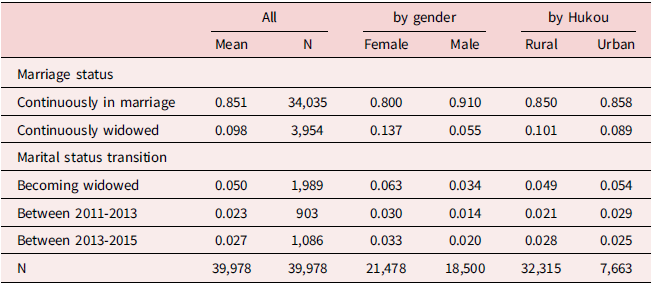
Table 1 presents the probability of becoming widowed between survey waves, which was 2.3% from 2011 to 2013 and 2.7% from 2013 to 2015. The probability of becoming widowed for women was nearly twice that of men.
Distributions of marital status by gender and Hukou

Source: CHARLS 2011, 2013, 2015.
Figure 1 presents the probabilities of becoming widowed, differentiated by gender and Hukou status. The graphs illustrate a consistently higher incidence of widowhood among females compared to males across all age groups, with the gap notably expanding with increasing age. Additionally, individuals with rural Hukou experience a higher probability of becoming widowed than their urban counterparts at most age intervals, particularly in the older age brackets. Moreover, the disparity in widowhood probabilities is more pronounced between genders than between rural and urban Hukou statuses. Overall, the situation at all ages does not contradict the general pattern found in Table 1.
The probability of becoming widowed by gender and Hukou. Note: Data Source: CHARLS 2011, 2013, 2015. The left panel shows the probability of becoming widowed by age and gender; the right panel shows the probability of becoming widowed by age and Hukou status. The x-axis represents age, and the y-axis represents the probability of becoming widowed (in %).

3.2. Cognition
We measure cognitive ability using two widely accepted indicators: episodic memory includes immediate and delayed word recall (Lei et al., Reference Lei, Hu, Mcardle, Smith and Zhao2012). Episodic memory, reflecting fluid intelligence, is assessed via immediate and delayed recall tasks. Participants recall as many words as possible immediately after reading a list of 10 nouns, followed by another recall five minutes later. Scores range from 0 to 20, summing both recall tasks. (McArdle et al., Reference McArdle, Fisher and Kadlec2007; Smith et al., Reference Smith, McArdle and Willis2010).
Mental intactness, reflecting crystallized intelligence, is evaluated through the Telephone Interview for Cognitive Status, comprising serial 7s subtractions, date orientation tasks, and drawing exercises. In the serial 7s test, respondents are asked to subtract 7 from 100 and 7 from each subsequent number. This test is repeated five times, and each correct response is scored as one point (0–5). Following Lei and Liu (Reference Lei and Liu2018), we sum the scores (0–11) to reflect the mental status of the elderly. The mental status reflects crystallized cognition (Smith et al., Reference Smith, McArdle and Willis2010). Fluid intelligence is the innate cognitive ability, while crystallized intelligence is what people learn in their lifetime (using their fluid intelligence). Therefore, when we use word recall and mental status, we can comprehensively measure cognitive function, which is in line with many economic papers (Rohwedder and Willis, Reference Rohwedder and Willis2010; Celidoni et al., Reference Celidoni, Dal Bianco and Weber2017; Mazzonna and Peracchi, Reference Mazzonna and Peracchi2012; Coe et al., Reference Coe, Gaudecker, Lindeboom and Maurer2012).
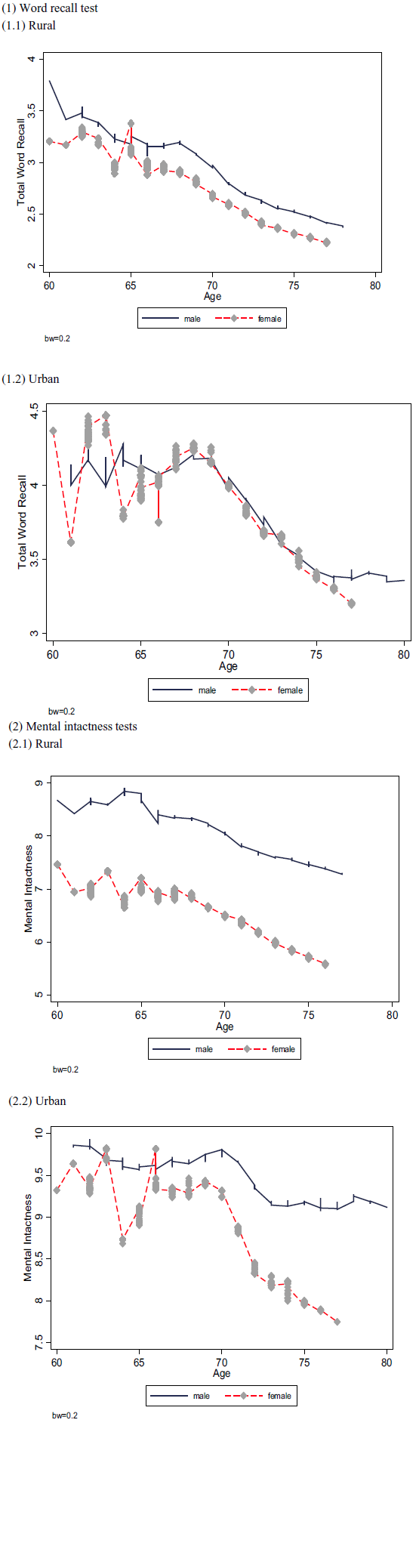
Figure 2 presents cognitive ability trends by age, gender, and urban-rural status. Cognitive performance declines consistently with age across all groups, with a slower decline in mental intactness compared to episodic memory. Women scored lower than men, with the gender gap widening with age, particularly in mental intactness. Urban respondents performed better on cognitive tests than rural respondents, and the gender gap was narrower in urban areas. Cognitive decline appeared smoother among rural individuals, while urban respondents experienced sharper declines around age 70.
Distributions of cognitive tests of the elderly by gender and Hukou properties. Note: Data Source: CHARLS 2011, 2013, 2015. The x-axis represents age, and the y-axis represents the test scores.

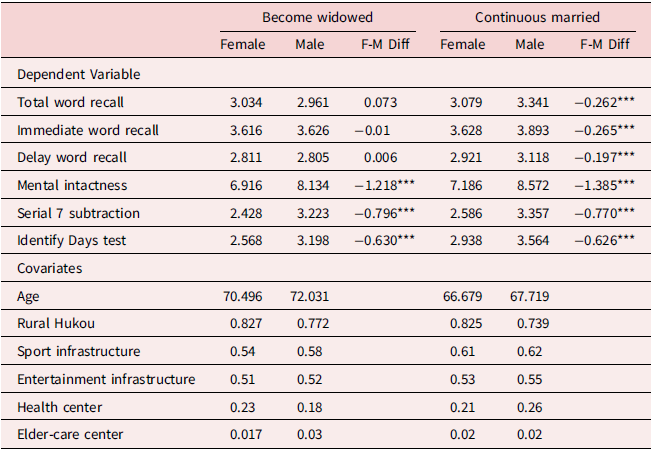
Table 2 presents summary statistics of the key dependent variables and channel variables. Consistent with Figure 2, women generally scored lower than men, and widowed individuals scored lower than continuously married individuals across all cognitive tests. The average age of becoming widowed was 70–72, slightly older than in the continuously married sample.
Summary statistics

Source: CHARLS 2011, 2013, 2015.
We also constructed additional measures using data from the 2011 community questionnaire to capture individuals’ neighborhood environments, which could influence the relationship between widowhood and cognition. These neighborhood measures are categorized into two main dimensions: public infrastructure and social services. Public infrastructure consists of sports and recreational facilities. Sports infrastructure includes amenities such as basketball courts, swimming pools, outdoor exercise equipment, table tennis tables, and spaces designated for dance or exercise groups. Communities with at least one of these amenities are coded as having sports infrastructure. Recreational facilities encompass rooms for card and chess games, clubs for calligraphy and painting, and social organizations specifically catering to the elderly and disabled populations. Communities containing any of these amenities are considered to have recreational infrastructure. Social services are measured by the presence of health care centers and family-based elder-care centers. Health care centers provide essential health services, including monitoring blood pressure and glucose levels, weight management, mental health support, and regular medication assistance. Family-based elder-care centers typically offer services such as senior dining, residential care, and daytime care activities. Communities possessing these centers are indicated accordingly in our analysis.
4. Empirical approach
We first examine the effects of marital status and health outcomes, especially the duration of widowhood, and analyze the results of marital transitions on health outcomes. Losing a spouse is a substantial life change, we then analyze the dynamic impact of marital transitions from a short-term perspective.
We use the fixed-effect model to identify the effect of widowhood. Our baseline health equation is
 $$cognitio{n_{ijt}} = \alpha Widowe{d_{it}} + {\beta _\alpha }\;{A_{it}} + {\beta _\gamma }\;cognitio{n_{i,11}}.t + {\beta _c}\;{C_{j\;}}.t + {u_i} + {\gamma _t} + {\varepsilon _{ijt}}$$
where cognitionijt represents cognitive functioning for individual i in county j year t. Widowedit equals 1 if the individual experienced widowhood. The coefficient α measures the effect of bereavement on cognition. Ait denotes age. ui captures individual-specific fixed effects; and γt is a year effect. εijt is a stochastic error term.
One advantage of the fixed-effect model is that it can control unobserved characteristics that do not vary within individuals over time. For example, factors such as poor local infrastructure or a household’s shared health behaviors—like diet or exercise routines—may influence both the likelihood of spousal death and cognitive outcomes for the surviving partner (Simeonova, Reference Simeonova2013). By using individual fixed effects, we mitigate bias from these time-invariant confounders by effectively differencing them out of the estimation.
To further account for time-varying unobserved heterogeneity, we introduce two interaction terms. First, we interact individuals’ baseline (2011) cognitive status cognition i,11 with a linear time trend tto control for persistent, unobserved traits that might simultaneously influence cognitive decline and the probability of widowhood. Second, we interact county fixed effects Cj with time trends to adjust for changing county-level factors such as evolving healthcare policies or access to services that might affect cognition over time.
Additionally, we consider two potential sources of measurement error in Equation (1). First, widowed individuals may underreport their cognitive ability to justify welfare eligibility, introducing systematic bias. Second, cognitive test scores may suffer from random measurement error, potentially attenuating estimated effects. However, because our cognitive measures are based on objective test performance rather than self-reports, they are less prone to such biases (Lei & Liu, Reference Lei and Liu2018).
To detect the route change of cognitive functioning, we construct the short-term dynamic model:
 $$cognitio{n_{ijt}} = \mathop \sum \nolimits_k {\beta _k}Wi{d_{ik}} + {\beta _\alpha }\;{A_{it}} + {\beta _\gamma }\;cognitio{n_{i,11}}.t + {\beta _c}\;{C_{j\;}}.t + {u_i} + {\gamma _t} + {\varepsilon _{ijt}}$$
k indicates time re-centered around the time of widowhood (when k = 0). Widik is an indicator variable taking value 1 if the person becomes widowed in that year. The coefficient βk captures the effects associated with the year of bereavement. The time skeleton contains two waves before widowhood, the current period of becoming widowhood, and one wave after widowhood (k = −2,−1,0,1). The first wave before widowhood (k = −1) is regarded as the reference and is dropped from the regression. The other variables’ definitions are the same as for Equation (1). Because the CHARLS is biennial, every wave of the CHARLS ranges roughly two years.
5. Results
5.1. Basic results
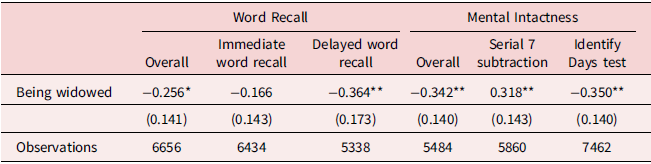
Both OLS and fixed-effects models is used to estimate the effect of widowhood on cognitive function, with fixed-effects models being the primary estimator given that they effectively control for unobserved individual characteristics. Table 3 reports the basic results. The fixed-effects estimates indicate that widowhood significantly decreases the total word recall score by 0.346 points (11.69%). Specifically, delayed recall performance is notably poorer among widowed individuals, decreasing by 0.263 points compared to continuously married individuals at the 1% significance level. The total negative impact on memory is larger than either immediate or delayed recall individually, suggesting cumulative deterioration. Columns four to six report the results of the mental intactness test. Widowhood significantly reduces the total score by 0.425 points at the 1% significance level. On the sub-item tests, both the Serial 7 subtraction and Identify Days subtests show similar declines, with scores falling by 0.412 and 0.464 points respectively.
Short-term effect of widowhood on cognition

Note: ***p < 0.001, **p < 0.01, *p < 0.05; robust standard errors are in parentheses. The sample includes continuously married and becoming widowed people. We also control age, rural Hukou, the interactions of 2011 dependent health condition with time trend, and the interactions of counties dummies with time trend, but not reported.
To enhance interpretability, we standardized the cognitive test scores (Appendix Table A2). Experiencing widowhood had a greater effect on mental integrity than on word recall test. Word recall scores were 0.194 standard deviations lower for the widowed than for the continuously married, which corresponds to a drop in the test scores from the median to about the 42.3% quartile, roughly a 7.7 percentage point drop. On the other hand, the widowed had a test score of 0.264 standard deviations lower on the mental integrity test than the continuously married. This corresponds to a decline in the test scores from the median to the 39.6% quartile, a decline of about 10.4 percentage points. Of all the tests, widowhood hit the Identify Days test the hardest, dropping 0.277 percentage points from those who were continually married.
These findings highlight widowhood’s significant negative effects on both episodic memory and mental intactness, potentially increasing the risk of Alzheimer’s disease (Bae et al., Reference Bae, Kim, Han, Kim and Kim2015). Next, we will use dynamic fixed-effect models to identify at which stage cognition performance declines rapidly so that we can adopt some intervention measures to moderate these adverse effects.
5.2. Dynamic effects
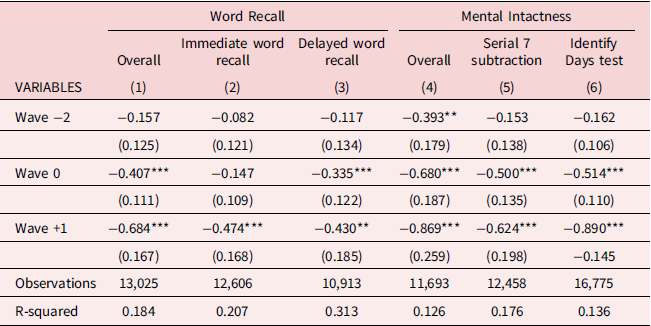
To explore the dynamic effects and validate the parallel trends assumption, we employ fixed-effects event study models, using the first pre-widowhood wave as a reference (Table 4, Appendix Figure A1).
Short-term dynamic effect of widowhood on cognition

Note: ***p < 0.001, **p< 0.01, *p < 0.05; robust standard errors are in parentheses. The sample includes continuously married and becoming widowed people. We also control age, rural Hukou, the interactions of 2011 dependent health condition with time trend, and the interactions of counties dummies with time trend, but not reported.
Overall, results support parallel trends, with insignificant pre-treatment effects and significantly negative cognitive outcomes following widowhood. It should be noted that we have observed a significant negative effect in the pre-2 period in the regression of experiencing widowhood on the mental intactness test, possibly due to caring responsibilities for a sick spouse. Nevertheless, we can observe that the magnitude of the negative effect of the coefficients in both periods after experiencing widowhood is significantly larger than the magnitude in the prior period by about double. This can be considered a reliable shock to mental integrity from experiencing widowhood. For word recall, declines are significant and growing in magnitude over time, with scores dropping by 0.407 immediately and 0.684 two years after widowhood, similar to the findings of Lei et al. (Reference Lei, Hu, Mcardle, Smith and Zhao2012). Immediate recall significantly declines only in the post-widowhood wave, while delayed recall consistently deteriorates in both waves. The negative effect on mental intactness also intensifies over time, particularly for the Identify Days test, declining by 0.514 initially and 0.890 subsequently.
We offer several potential explanations for the decline in cognitive ability. First, widowhood is considered to be a huge life shock that may profoundly affect the individual mentally. Widowed older people tend to be emotionally depressed, which leads to reduced cognitive ability. Second, a spouse is a frequent communicator in relationships and contributes to stimulating the central nervous system (Rauers et al., Reference Rauers, Riediger, Schmiedek and Lindenberger2011). Third, losing a spouse may cause loneliness and is likely to reduce cognitive stimulation. The results show that the cognitive impact of losing a spouse is persistent. Next, we further explore this decline of cognition after widowhood from the perspective of neighborhood concentration and examine whether community support can offset the shock of bereavement.
5.3. Robustness test
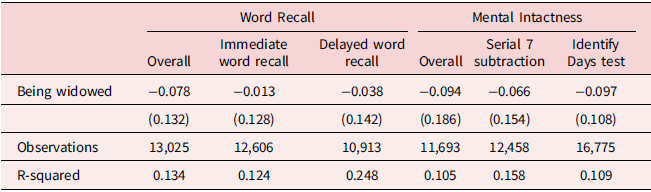
To further validate our findings, we conducted several robustness checks. First, we performed a placebo test to mitigate concerns regarding the potential biases stemming from our relatively short panel. We artificially shifted the timing of widowhood one survey wave earlier (i.e., two years ahead), and re-estimated the model specified in Equation (1). As shown in Table 5, the placebo widowhood effects on cognitive ability are both statistically insignificant and much smaller in magnitude, indicating that the observed decline in cognitive outcomes is not driven by any systematic pre-existing trends unrelated to actual widowhood. These results confirm the validity of the common trends assumption and support the interpretation that the shock captured in the main analysis reflects the exogenous onset of widowhood.
Placebo test: advance the shock by one wave ahead

Note: ***p < 0.001, **p < 0.01, *p < 0.05; robust standard errors are in parentheses. The sample includes continuously married and becoming widowed people.
Next, we employ a matching-based regression approach—specifically, the Doubly Robust Inverse Probability Weighting (DRIPW) method in the Callaway and Sant’Anna Difference-in-Differences framework. First, it calculates propensity scores that balance observed covariates—including age, gender, Hukou status, and baseline cognitive ability—between treated and untreated groups. It then predicts counterfactual outcomes using outcome regression based on these same covariates. Finally, the two steps are combined, ensuring that the estimator remains unbiased as long as either the propensity score model or the outcome model is correctly specified. This doubly robust property makes DRIPW both efficient and reliable for causal inference in staggered DID settings. In Table 6, we show that while the magnitude of the coefficients becomes smaller compared to the main fixed-effects results, the signs and statistical significance remain largely consistent, demonstrating the robustness of our conclusions.
The effect of widowhood on cognition (propensity score weighting approach)

Note: ***p < 0.001, **p < 0.01, *p < 0.05; robust standard errors are in parentheses. The sample includes continuously married and becoming widowed people. All the results are estimated by the Doubly Robust Inverse Probability Weighting (DRIPW) method in the Callaway and Sant’Anna Difference-in-Differences framework.
In addition, we explored more basic regressions, reported in Table 7, to verify that our main results are not unduly driven by additional controls such as baseline cognitive ability or region-specific trends. In Panel A, excluding the control for 2011 cognitive scores yields effect estimates that remain directionally similar to those in the main results (Table 3), although the magnitudes are generally smaller. In Panel B, we replaced county-level time trends with province-level time trends, which yields even more pronounced negative effects of widowhood on cognition. In Panel C, omitting both initial cognitive ability and region-specific time trends in a simpler fixed-effects model produces an even stronger negative impact of widowhood. Overall, the consistency of results across these different model specifications supports the conclusion that the observed impact of widowhood on cognition is not an artifact of model selection.
Robustness test on reduced model

Note: ***p < 0.001, **p < 0.01, *p < 0.05; robust standard errors are in parentheses. The sample includes continuously married and becoming widowed people. In Panel A, we omitted the interactions of 2011 cognition with time trend. In Panel B, we change the region-specific time trend from county level to province level. In Panel C, we omitted the interactions of 2011 cognition with time trend and region-specific time trend. The rest of the setup remains the same as Table 3.
5.4. Heterogeneity test
The results above suggest that the effects of widowhood on cognition are persistent. We next explore whether these effects vary based on individual characteristics, focusing specifically on gender and Hukou status. Literature shows that older women, on average, exhibit lower measured cognitive abilities than men, which may reflect multiple factors, including historical disparities in educational access, life-course socioeconomic experiences, cultural norms, and potentially biological characteristics (Lei et al., Reference Lei, Hu, Mcardle, Smith and Zhao2012). In addition, individuals with different Hukou statuses receive varying levels of social welfare benefits – such as pensions, medical insurance, and other socioeconomic resources – which can also influence cognitive outcomes. Therefore, we estimate the heterogeneous effects of widowhood by gender and Hukou status to determine how these two dimensions may shape the cognitive consequences of spousal loss.
Table 8 shows the results. Panel A examines gender differences. Widowed females score 0.298 points lower on overall cognition, significant at the 10% level, mainly due to poorer performance in immediate word recall. No significant differences are found in delayed recall. In terms of mental intactness, females perform significantly worse than males on the Identify Days test. Panel B analyzes differences by Hukou status. Rural individuals experience significantly greater cognitive decline following widowhood than their urban counterparts. The disparity in memory is driven by immediate word recall, while the difference in mental intactness stems primarily from the Serial 7 subtraction test. Appendix Table A3 further estimates gender interactions within rural and urban subsamples. Significant negative effects are found mainly among rural widowed women, while effects in urban areas are generally insignificant. Taken gender and Hukou attributes together, the most vulnerable group responding to the experience of widowhood is rural women.
Heterogeneous effect of widowhood on cognition

Note: ***p < 0.001, **p < 0.01, *p < 0.05; robust standard errors are in parentheses. The sample includes continuously married and becoming widowed people. We also control age, rural Hukou, the interactions of 2011 dependent health condition with time trend, and the interactions of counties dummies with time trend, but not reported.
Uneven distribution of education across gender and rural-urban groups may confound the observed heterogeneity. To assess whether education confounds the heterogeneous effects of widowhood on cognitive function, we split education at the sample median and included it as a dummy in interaction terms. Results in Appendix Table A4 show that adding education does not significantly alter the widowhood–gender or widowhood–Hukou effects. Moreover, the combined effects of the original interaction terms and the triple interactions are of a similar magnitude to our previous findings (Table 8). This suggests that educational attainment is not a key confounding factor in explaining subgroup differences in the cognitive impact of widowhood.
We can propose some possible explanations for the fact that widowhood hits rural women harder. First, losing a spouse makes the person lose social support. In rural China, many of the elderly and their spouses stay behind in the countryside, with adult children migrating to urban areas. Once widowed, the elderly will lose much of their financial support and spiritual companionship. This will increase economic poverty and lead to a lack of medical resources and health inputs (Foster and Smetherham, Reference Foster and Smetherham2013; McGarry and Schoeni, Reference McGarry and Schoeni2005). Second, losing mental support will make the elderly feel lonely, bored, and stressed, decreasing cognition ability (Zhao et al., Reference Zhao, Inder and Kim2021; Mourao-Miranda et al., Reference Mourao-Miranda, Ecker, Sato and Brammer2009; Andrew and Rockwood, Reference Andrew and Rockwood2010). Third, especially in developing countries, widows are more likely to be discriminated against (Lloyd-Sherlock, Reference Lloyd-Sherlock2000). Thus, they may reduce their social activity, negatively affecting their cognitive ability. Subramanian et al. (Reference Subramanian, Elwert and Christakis2008)pointed out that in the United States, neighborhood structural contexts that provide opportunities for widowed people to interact with others or favor new social engagements can offset the widowhood effects. We will investigate whether neighborhood environments such as public infrastructure and social services can function similarly in China.
5.5. Policy responses: What can we do
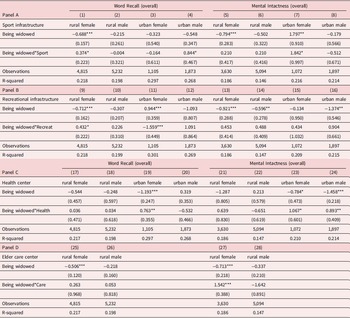
The above findings have shown that the negative impact on the cognition of rural women is significantly higher than other groups. Furthermore, we explore the cognitive impact of widowhood on different subsamples by introducing two policy directions, four ways, of public infrastructure (sports and recreational facilities) and social services (elderly health and care centers) to propose policy responses that effectively mitigate the shock of widowhood. Table 9 shows the regression results for public infrastructure and social services on elderly cognition.
Effect of public infrastructure and services on cognition

Note: Due to the sample of urban residents involved in elder care centers in the survey being too small to regress, we dropped the regressions for the urban sample in Panel D. ***p < 0.001, **p < 0.01, *p < 0.05; robust standard errors are in parentheses. The sample includes continuously married, and becoming widowed people. We also control age, rural Hukou, the interactions of 2011 dependent health condition with time trend, and the interactions of counties dummies with time trend, but not reported.
Panel A and B show the results for public infrastructure, then Panel C and D show the results for social services.Footnote 4 The infrastructure of public facilities appears to have better outcomes than social services for the vulnerable group we are most concerned about – women in rural areas. Sports and recreational infrastructure have a significant positive impact on word recall, improving scores by 0.374 and 0.432, respectively (at a 10% significance level). However, in terms of overall mental intactness performance, there is a significant positive effect of sport infrastructures only on urban females.
Regarding public social service, having an elderly health center in the community significantly improves the word recall of urban women. Health centers in the community, such as regular monitoring of blood pressure and blood sugar or adherence to lifestyle modifications and medicine, can help individuals prevent chronic diseases (Ding et al., Reference Ding, Chen, Yu, Zhong, Hu, Chen, Wang, Xie and Eggleston2021) and correspondingly relieve cognitive decline. On the other hand, having a family-based elder-care center in the community significantly improves the mental intactness of rural women, while not affecting their word recall performance. In addition, the family-based elder-care center often provides free dining tables and daycare for the elderly, which can satisfy nutrition intake and social communication.
6. Conclusions
Using CHARLS data, this paper analyzes the short-term effects of spousal bereavement on cognitive outcomes among older adults in China. Fixed-effects estimates show that widowhood significantly reduces cognitive function, and this decline is persistent over time. We further examine heterogeneous effects and find that rural residents, particularly rural women, experience greater cognitive decline, especially in fluid cognition. These effects may stem from stress, loneliness, and reduced economic security following spousal loss. As such, gender-sensitive interventions – such as grief counseling, targeted subsidies, and cognitive training – should be prioritized for rural widows.
We also explore potential moderating mechanisms from the neighborhood perspective, focusing on public infrastructure and social services. The results show that sports and recreational facilities can buffer the negative cognitive impacts of widowhood, particularly improving word recall. Similarly, health-focused elderly care centers enhance cognitive function, while family-based elder-care centers improve both memory and mental intactness.
By introducing a neighborhood perspective, this study highlights the importance of local environments in shaping cognitive resilience after bereavement. Community infrastructure that facilitates physical activity, social interaction, and healthcare access may help mitigate the adverse cognitive consequences of widowhood. From a policy standpoint, our findings suggest the need to enhance infrastructure and expand public services for the rural elderly. This includes investing in recreational spaces, outdoor exercise facilities, and community care services such as senior dining programs, health check-ups, and in-home nursing support.
Supplementary material
The supplementary material for this article can be found at https://doi.org/10.1017/dem.2025.10006
Competing interests
All authors declare no conflict of interest.





 Open access

