

Introduction
Despite achieving remarkable progress in the first-millennium development goal (MDG) of eradicating extreme poverty globally, food and nutrition security concerns persist in many low-income countries in the post-MDG era. Countries in the Global South are struggling to make substantial progress in sustainable development, especially in countries prone to conflicts, civil wars, and political instability. It is estimated that about 381.4 million of the 650.3 million chronically undernourished people in 2019 originate from countries plagued with conflict, usually aggravated by climate-related shocks (Food and Agriculture Organization [FAO], International Fund for Agricultural Development, United Nations Children’s Fund, World Food Programme, and World Health Organization, 2021). Also, about three-quarters of children aged under five with stunted growth live in war-torn and conflict-ridden countries (FAO et al. 2017, 2021).
Disruptions like political instability, natural disaster, pandemics, or conflicts have significant detrimental impacts on social, economic, and human development (Von Einsiedel et al. Reference Von Einsiedel, Bosetti, Cockayne, Salih and Wan2017; Schillinger et al. Reference Schillinger, Özerol, Güven-Griemert and Heldeweg2020; Qayyum, Anjum, and Sabir Reference Qayyum, Anjum and Sabir2021; Menton et al. Reference Menton, Milanez, Souza and Cruz2021; Hamoodi Reference Hamoodi2021; Okunlola and Okafor Reference Okunlola and Okafor2020; George, Adelaja, and Awokuse Reference George, Adelaja and Awokuse2021). These disruptions also challenge the United Nations’ Sustainable Development Goals regarding “No poverty (goal 1),” “Zero hunger (goal 2),” “Good health and well-being (goal 3),” “Responsible consumption and production (goal 12),” and “Peace, justice, and strong institutions (goal 16),” For example, George, Adelaja, and Awokuse (Reference George, Adelaja and Awokuse2021) revealed that armed conflicts (Fulani ethnic militia) in Nigeria negatively affected farm outputs, areas harvested, and cattle holding. The occurrence of the COVID-19 pandemic in 2020 has exacerbated the ongoing conflicts. A case study by Menton et al. (Reference Menton, Milanez, Souza and Cruz2021) finds that the COVID-19 pandemic intensifies resource conflicts and indigenous resistance in Brazil.
Resource use conflicts between farmers and herders have been on the increase in most countries in the Sahelian African region due to rapid population growth and the escalating effects of climate change (Day and Caus Reference Day and Caus2020). Farmer-herder (FH) conflicts occur when nomadic herders graze their animals (e.g., cattle) in farmers’ cropland, leading to yield and income losses for farmers. Farmers sometimes retaliate by maiming the cattle or forcing herders out of their communities. In response, herders fight back, and FH conflicts occur (Blench Reference Blench2010; Dimelu, Salifu, Chah et al. Reference Dimelu, Salifu, Enwelu and Igbokwe2017). Although conflicts between herders and farmers have been ongoing historically (Mbih Reference Mbih2020), their frequency and intensity are increasing (George et al. Reference George, Adelaja, Vaughan and Awokuse2022). These conflicts directly influence rural households’ food insecurity because of their direct impacts on the ability to cultivate land the herders want to access and/or to access food via markets. There is a dynamic causal relationship between conflicts and food insecurity, as food insecurity can either be an outcome of or a cause of conflicts (D’Souza and Jolliffe Reference D’Souza and Jolliffe2013; Bora et al. Reference Bora, Ceccacci, Delgado and Townsend2011; Messer, Cohen, and Marchione Reference Messer, Cohen and Marchione2001; Teodosijevic Reference Teodosijevic2003; George, Adelaja, and Awokuse Reference George, Adelaja and Awokuse2021; Martin-Shields and Stojetz Reference Martin-Shields and Stojetz2019). As most developing countries are already inundated by hunger and poverty (FAO et al. 2020; Corral et al. Reference Corral, Irwin, Krishnan and Mahler2020), the recent increase in resource use conflicts will invariably have adverse impacts. For example, while the prevalence of extreme poverty has rapidly diminished in many countries since 2000, for countries in conflict-affected areas, poverty rates are stagnant or increasing (Corral et al. Reference Corral, Irwin, Krishnan and Mahler2020). In this study, we focus on FH resource use conflicts. This is because of the dearth of literature empirically examining the food and nutritional consequences of FH conflicts on rural livelihoods.
A growing number of studies have investigated the effects of armed conflicts on the nutritional status of children, as captured by anthropometric measures (Akresh, Lucchetti, and Thirumurthy Reference Akresh, Lucchetti and Thirumurthy2012; Akresh, Verwimp, and Bundervoet Reference Akresh, Verwimp and Bundervoet2011; Minoiu and Shemyakina Reference Minoiu and Shemyakina2014), calorie intake (D’Souza and Jolliffe Reference D’Souza and Jolliffe2013), livestock and crop collections (Rockmore Reference Rockmore2012), food expenditure (Verwimp and Muñoz-Mora Reference Verwimp and Muñoz-Mora2018), and household consumption arrangements (Serneels and Verpoorten Reference Serneels and Verpoorten2015). As discussed in George, Adelaja, and Weatherspoon (Reference George, Adelaja and Weatherspoon2020), households in countries experiencing conflicts also suffer from non-conflict shocks, such as political volatilities, natural disasters, and income uncertainties that lead to reduced food consumption. Given this, households in conflict areas have to adopt short-term, low-risk, and low-yield production strategies to minimize risks from ongoing conflicts (Arias, Ibáñez, and Zambrano Reference Arias, Ibáñez and Zambrano2019; Rockmore Reference Rockmore2012). Yet, there is an obvious lack of studies detailing the process of how conflicts influence food availability and accessibility.
Most of the studies on conflicts and food security have focused on armed and violent conflicts causing deaths (Brück, d’Errico, and Pietrelli Reference Brück, d’Errico and Pietrelli2019; George, Adelaja, and Weatherspoon Reference George, Adelaja and Weatherspoon2020; D’Souza and Jolliffe Reference D’Souza and Jolliffe2013; Jeanty and Hitzhusen Reference Jeanty and Hitzhusen2006; George, Adelaja, and Awokuse Reference George, Adelaja and Awokuse2021). Only three studies have investigated the relationship between armed conflicts and food consumption (Adelaja and George Reference Adelaja and George2019; George, Adelaja, and Awokuse Reference George, Adelaja and Awokuse2021; George, Adelaja, and Weatherspoon Reference George, Adelaja and Weatherspoon2020). These studies used secondary data on fatalities perpetrated by Boko Haram terrorists and the Fulani ethnic militia from Nigeria. To the best of our knowledge, there are no studies that capture how and to what extent ongoing FH conflicts influence rural households’ food insecurity.
The objective of this study is to address this gap by focusing on the incidence and severity of FH conflicts and analyze how they affect food insecurity, measured by the household food insecurity access scale (HFIAS) and the coping strategies index (CSI). Specifically, the HFIAS food insecurity indicator captures household anxiety and uncertainty over insecure access to food, as well as their attitude indicating quality and quantity of food (Maxwell, Coates, and Vaitla Reference Maxwell, Coates and Vaitla2013; Coates, Swindale, and Bilinsky Reference Coates, Swindale and Bilinsky2007). The CSI food insecurity indicator encapsulates households’ behavior when they do not have access to enough food (Maxwell and Caldwell Reference Maxwell and Caldwell2008). These two measures focus on the food availability and accessibility pillars of food security, and they have been used in previous studies (Ike, Jacobs, and Kelly Reference Ike, Jacobs and Kelly2017; Benti, Biru, and Tessema Reference Benti, Biru and Tessema2022; Dompreh, Asare, and Gasparatos Reference Dompreh, Asare and Gasparatos2021). FH conflicts in our context refer to disagreements, fights, and clashes that occur between farmers and herders. Given the rapid population increases in most Sahelian African countries where nomadic herding is still practiced, the impacts of these FH conflicts will continue to increase if the fundamental issues that trigger them are not addressed. Therefore, estimating the impact of FH conflicts on farm households’ food security will allow evidence-based policy formulation in Nigeria and many other countries that are also prone to resource use conflicts. A two-stage predictor substitution (2SPS) approach is employed to address the endogeneity issues of FH conflict variables and to estimate the data collected from rural farming households in Nigeria.
We check the robustness of our empirical results using a conditional mixed process model. To enrich our understanding, we also present and discuss the results estimated for the impacts of FH conflict exposure on food insecurity, as well as the impacts of FH conflicts on food insecurity, measured by the number of months with insufficient food supply and the number of days with limited varieties of food eaten.
We contribute to the literature by developing a conceptual framework to identify causal pathways between the incidence and severity of FH conflicts and food insecurity. We then empirically examine these relationships using farm household data from Nigeria. This issue has been overlooked in the literature, even though FH conflicts have increased in most sub-Saharan African (SSA) countries (ACLED 2019). Previously, most studies on this topic have been descriptive and exploratory (Audu Reference Audu2013; Dary, James, and Mohammed Reference Dary, James and Mohammed2017; Dimelu, Salifu, et al. Reference Dimelu, Salifu, Enwelu and Igbokwe2017; Dimelu, Salifu, and Igbokwe Reference Dimelu, Salifu and Igbokwe2016; Muhammed, Ismaila, and Bibi Reference Muhammed, Ismaila and Bibi2015), with very few studies quantifying the magnitude of the impact on the food insecurity of rural households. The study by George, Adelaja, and Awokuse (Reference George, Adelaja and Awokuse2021) is an exception, which empirically examines the effect of fatalities resulting from armed conflicts perpetrated by the Boko Haram terrorist group on household food security using panel data provided by the Nigerian General Household Survey. However, our analysis differs from George, Adelaja, and Awokuse (Reference George, Adelaja and Awokuse2021) by focusing on primary data collected from rural households in Nigeria and measuring types of FH conflicts differently. Specifically, we consider the incidence and severity of FH conflicts. The incidence of FH conflicts accounts for the number of FH conflicts that occurred in the community in 2018, reported by interviewed farming household heads. The severity of FH conflicts is a weighted index that captures how severe previously occurred FH conflicts were, which is calculated based on survey questions and ranges between 0 and 1. Besides, we consider all FH conflicts, encompassing disagreements and clashes over land resources between farmers and herders, irrespective of whether they result in deaths or not.
Our focus on FH clashes stems from empirical evidence that uncertainties caused by exposure to conflicts prompt farmers to opt for sub-optimal strategies like shifting to lower investment crop portfolios and land use, hiding visible assets, and labor reallocation (Arias, Ibáñez, and Zambrano Reference Arias, Ibáñez and Zambrano2019; Bozzoli and Brück Reference Bozzoli and Brück2009; Brück, d’Errico, and Pietrelli Reference Brück, d’Errico and Pietrelli2019; Gáfaro, Ibáñez, and Justino Reference Gáfaro, Ibáñez and Justino2014). FH clashes negatively influence agricultural production (George et al., Reference George, Adelaja, Awokuse and Vaughan2021b), influencing food availability and accessibility in affected areas. We argue that as rural households are primarily involved in agricultural production, FH clashes will have consequences not just for their livelihoods but also for their production efficiency and, subsequently, their food security. Households that are neither directly involved nor exposed to FH conflicts in their community may also change their production decisions.
Nigeria is an interesting example because, as one of the most affected countries in Africa regarding the occurrence of armed conflicts (Raleigh et al. Reference Raleigh, Linke, Hegre and Karlsen2010), the economic consequences of FH conflicts are severe (Dimelu, Salifu, et al. Reference Dimelu, Salifu, Enwelu and Igbokwe2017). According to the 2019 Global Terrorism Index, violence between Nigerian farmers and herders accounted for about a third of the increase in deaths, resulting in the nearly 300,000 people displaced in 2018. These FH conflicts have adverse economic effects on farming communities and pastoralists, resulting in enormous financial consequences for all involved (Sulaiman and Ja’afar-Furo Reference Sulaiman and Ja’afar-Furo2010). They limit the activities of herders and farmers, and this constitutes a threat to their livelihoods (Dary, James, and Mohammed Reference Dary, James and Mohammed2017). The ongoing FH conflicts also negatively influence agricultural productivity and output, farmers’ cattle holdings, and the harvested land area (George, Adelaja, and Awokuse Reference George, Adelaja and Awokuse2021).
The rest of this paper is structured as follows. The second section provides a background on FH conflicts and food insecurity. We discuss our conceptual framework and estimation strategy in the third section. Next, we describe the data, variable measurements, and descriptive statistics. The “Results and discussion” section presents and discusses the empirical results, while the final section summarizes the results and discusses policy implications.
Farmer-herder (FH) conflicts and food insecurity
Incidences of FH conflicts have been increasing in most parts of SSA. Several reasons attributing to FH conflicts have been discussed in the literature. These include changing climatic conditions (Adano et al. Reference Adano, Dietz, Witsenburg and Zaal2012; Buhaug et al. Reference Buhaug, Benjaminsen, Sjaastad and Theisen2015; Theisen Reference Theisen2012; Hendrix and Salehyan Reference Hendrix and Salehyan2012), unfavorable land zoning, and national agricultural policies affecting herders (Benjaminsen and Ba Reference Benjaminsen and Ba2009; Mertz, Rasmussen, and Rasmussen Reference Mertz, Rasmussen and Rasmussen2016), conflicting national and state government policies leading to diverted use of grazing land (Seter, Theisen, and Schilling Reference Seter, Theisen and Schilling2018; Lenshie et al. Reference Lenshie, Okengwu, Ogbonna and Ezeibe2020), and reallocation of water resources away from grazing land to farming (Clanet and Ogilvie Reference Clanet and Ogilvie2009).
In Nigeria, pastoral activities date back to the inward migration of Fulani clans that have been grazing their cattle for centuries across the Sahelian African region (International Crisis Group [ICG], 2017), with peaceful coexistence with farming communities (Ahmed and Muhammad Reference Ahmed and Muhammad2021; Seddon and Sumberg Reference Seddon and Sumberg1997). The rapid increase in FH conflicts in Nigeria can be attributed to the following factors. First, rising temperatures and the resulting droughts and desertification from climate change stressors have led to increased migration of nomadic herders from Nigeria’s northern region to the central and southern regions (Benjaminsen et al. Reference Benjaminsen, Alinon, Buhaug and Buseth2012; Buhaug et al. Reference Buhaug, Benjaminsen, Sjaastad and Theisen2015). Here, climate and environmental factors prompt herders to graze their animals further south and away from their primary grazing areas in the northern region. This leads to increased competition with farmers in the central and southern regions over scarce land resources, resulting in disagreements and fights between farmers and nomadic herders (Eke Reference Eke2020). Majority of these nomadic Fulani herders being Muslim and sedentary farming communities being Christian also incorporate an ethnoreligious hostility in their interactions (A. Usman Reference Usman2019a). Recently, the situation has been intensified by collective conflicts between sedentary farming communities (mostly mainly Christian and non-Fulani ethnic groups) and non-sedentary herders (mainly Muslim Fulani populace) over land claims, community resource distribution, and control of local administrative authorities (George et al. Reference George, Adelaja, Vaughan and Awokuse2022; Vaughan Reference Vaughan2016). The current land tenure system exampled by communal access to land, insecure private property rights, expensive land administration costs, and the resulting lack of access to formal land titles further exacerbate the situation (Vanger and Nwosu Reference Vanger and Nwosu2020). Second, the increasing terrorist insurgency of Boko Haram in the north-eastern region has led to the forced displacement and increased migration of individuals towards the southern region (George et al. Reference George, Adelaja and Awokuse2021; George et al. Reference George, Adelaja, Vaughan and Awokuse2022). Invariably, this places increased pressure on scarce resources resulting in inadequate land resources. This leads to conflicts between farming communities and nomadic herders in the central and southern regions of the country (Ojo Reference Ojo2020). Finally, ineffective implementation of existing land policies on open grazing and grazing routes fosters nomadic pastoralists’ relegation. In 1965, the grazing reserve law was passed to assign land resources to herders. Yet, some of the land allotted under this law has been commandeered by non-herders for non-grazing activities (Ojo Reference Ojo2020), often expedited by the failure of the government to enforce the law. Fewer than a quarter of the grazing reserves initially allocated for herders are currently being used for grazing purposes (ICG 2017).
We argue that the occurrence of FH conflicts could impact the four main pillars of food security, as reported by the (Food and Agriculture Organization [FAO], 2006), including (1) food availability, (2) food accessibility, (3) food utilization, and (4) food stabilization. For the food availability dimension, the existing literature concludes that conflicts reduce food security through their adverse impacts on agricultural labor supply (Blattman and Miguel Reference Blattman and Miguel2010; Verwimp and Muñoz-Mora Reference Verwimp and Muñoz-Mora2018; Serneels and Verpoorten Reference Serneels and Verpoorten2015), production decisions (Arias, Ibáñez, and Zambrano Reference Arias, Ibáñez and Zambrano2019), and outputs (Adelaja and George Reference Adelaja and George2019; George, Adelaja, and Awokuse Reference George, Adelaja and Awokuse2021). Conflicts affect the food accessibility dimension of food security through their harmful impacts on physical and economic access to food. For example, conflicts may lead to the destruction of infrastructure like roads, markets, and farms (Kah Reference Kah2017). For the food utilization dimension, the adverse impacts of conflicts are usually captured through anthropometric outcomes (Martin-Shields and Stojetz Reference Martin-Shields and Stojetz2019; Akresh, Lucchetti, and Thirumurthy Reference Akresh, Lucchetti and Thirumurthy2012; Tranchant, Justino, and Müller Reference Tranchant, Justino and Müller2014). Finally, for the food stabilization dimension, the adverse effects of conflicts appear to be captured through its impact on variability of food prices and the value of food imports (George, Adelaja, and Weatherspoon Reference George, Adelaja and Weatherspoon2020).
Since FH conflicts are most likely to affect rural food production and market supply, our food insecurity measurements focus on the food availability and accessibility pillars of food security. In the following section, we discuss how FH conflicts affect food insecurity theoretically before we introduce our data and discuss the empirical results.
Conceptual framework and empirical strategy
Conceptual framework
Following George, Adelaja, and Weatherspoon (Reference George, Adelaja and Weatherspoon2020), we define a household food consumption demand model based on a constrained utility maximization problem to explain how FH conflicts influence rural households’ food insecurity. Consider an agricultural household that derives utility from the consumption of its own-produced food ( ${F_o}$
) and market-purchased food (
${F_o}$
) and market-purchased food ( ${F_m}$
). Let
${F_m}$
). Let $F$
be the total consumption demand for food, and then, the equilibrium demand for food consumption can be presented as follows:
$F$
be the total consumption demand for food, and then, the equilibrium demand for food consumption can be presented as follows:
 $$F = {F_o} + {F_m}$$
To facilitate our analysis, we assume that total food consumption demand (including the level of food insecurity) is affected by household income (Y) and production inputs (X). We further assume that FH conflicts ${\rm{\;}}\left( \tau \right)$
have impacts on household income and production inputs, which finally affects household food consumption. Thus, the equilibrium demand for food consumption can be derived as:
${\rm{\;}}\left( \tau \right)$
have impacts on household income and production inputs, which finally affects household food consumption. Thus, the equilibrium demand for food consumption can be derived as:
 $$F = (Y(\tau ),X(\tau ))$$
where $Y$
is household income,
$Y$
is household income, $X$
indicates inputs used in the production process, and
$X$
indicates inputs used in the production process, and $\tau $
denotes FH conflicts.
$\tau $
denotes FH conflicts.
When FH conflicts occur, not all farming households in the community are directly affected. Therefore, we make a case for this by splitting the impact of FH conflicts into two – incidence of FH conflict and severity of FH conflict. Figure 1 depicts the key channels through which the two types of conflicts affect food insecurity.
Conceptual framework capturing the impacts of FH conflicts on food insecurity.
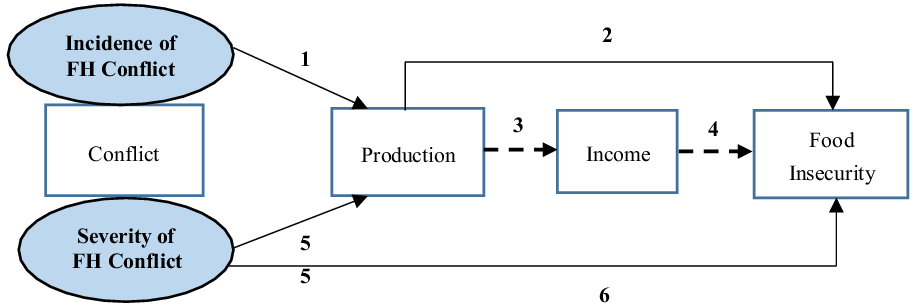
The incidence of FH conflicts can affect food insecurity by directly influencing farm production (arrows 1 and 2) or by directly influencing farm production and then indirectly affecting household income (arrows 1, 3, and 4). The incidence of FH conflicts causes uncertainty and anxiety. Therefore, farmers influenced by the FH conflicts tend to make less efficient production decisions. For example, in agricultural production, farmers affected by conflicts may shift away from high investment activities like perennial cropping to short-term, lower yield seasonal cropping, as depicted by the arrow (1) in Figure 1. This argument is supported by previous studies showing that incidences of terrorist events reduce the availability of hired labor, total outputs, and productivity (Adelaja and George Reference Adelaja and George2019; George, Adelaja, and Weatherspoon Reference George, Adelaja and Weatherspoon2020; Arias, Ibáñez, and Zambrano Reference Arias, Ibáñez and Zambrano2019). Reduced production can directly impact food insecurity in terms of food availability for subsistence farmers (arrow 2). It can also negatively impact sales revenue and household income (arrow 3), increasing food insecurity because of decreased food purchasing power (arrow 4). Brück, d’Errico, and Pietrelli (Reference Brück, d’Errico and Pietrelli2019) also found that violent conflicts reduce households’ adaptive capacity via abridged income stability and diversification, which, in turn, increase food insecurity (arrows 3 and 4).
The severity of FH conflicts can also affect food insecurity either directly (arrow 6) or indirectly (arrows 5, 3, and 4). Violent clashes, which lead to the injury and/or death of household members, loss of crop yield, and destruction of farm property, may directly and immediately affect household food insecurity through a reduction in the immediate availability of food (arrow 6). Farmers severely affected by FH conflicts may also shift their production practices from profitable commercial cultivation to subsistence farming to ensure the food demands of their households, resulting in negative consequences for farm productivity (Arias, Ibáñez, and Zambrano Reference Arias, Ibáñez and Zambrano2019; Adelaja and George Reference Adelaja and George2019) (arrow 5). Similarly, risk-averse farmers may also change from perennial cultivation to less risky and less profitable seasonal cultivation (Arias, Ibáñez, and Zambrano Reference Arias, Ibáñez and Zambrano2019). This will have consequences for their food security through a reduced income trajectory and the subsequent inability to access food through the markets (Deininger Reference Deininger2003; Justino Reference Justino2011) (arrows 3 and 4).
Econometrically, the influence of FH conflicts on food insecurity can be derived from the Kuhn-Tucker condition with respect to τ based on Equation (2). Formally, it can be expressed as follows:
 $${{\partial F} \over {\partial \tau }} = \left( {{{\partial F} \over {\partial Y}}.{{\partial Y} \over {\partial \tau }}} \right) + \left({{\partial F} \over {\partial X}}.{{\partial X} \over {\partial \tau }}\right)$$
where τ denotes the conflict measures – incidence or severity of FH conflicts. Equation (3) indicates that FH conflicts affect food consumption through their impacts on total household income and production inputs demanded.
As indicated earlier, we are focusing on the availability and accessibility pillars of food security in this study. Measures of food insecurity capturing the accessibility and availability of food will have an inverse relationship with household food consumption demands. For the purpose of analytical settings, we introduce ${\rho _j}$
, a food insecurity (FI) shock, related to F such that
${\rho _j}$
, a food insecurity (FI) shock, related to F such that $F{I_j} = {\rho _j}F$
, where
$F{I_j} = {\rho _j}F$
, where $F{I_j}$
is the food insecurity measure (i.e., either the incidence or severity of FH conflicts) and
$F{I_j}$
is the food insecurity measure (i.e., either the incidence or severity of FH conflicts) and ${\rho _j}$
is the coefficient related to the
${\rho _j}$
is the coefficient related to the $j$
-th food insecurity measure. Given the inverse relationship between
$j$
-th food insecurity measure. Given the inverse relationship between $F$
and
$F$
and $F{I_j}$
,
$F{I_j}$
, ${\rho _j}$
is assumed to be negative, that is,
${\rho _j}$
is assumed to be negative, that is, ${\rho _j}$
< 0. The effects of FH conflict on household food insecurity can then be denoted as:
${\rho _j}$
< 0. The effects of FH conflict on household food insecurity can then be denoted as:
 $${{\partial F{I_j}} \over {\partial \tau }} = {\rho _j}[\left( {{{\partial F} \over {\partial Y}}.{{\partial Y} \over {\partial \tau }}} \right) + \left( {{{\partial F} \over {\partial X}}.{{\partial X} \over {\partial \tau }}} \right)]$$
where ${{\partial F{I_j}}}\over{{\partial \tau }}$
captures the impact of FH conflicts on food insecurity.
${{\partial F{I_j}}}\over{{\partial \tau }}$
captures the impact of FH conflicts on food insecurity. ${\rm{}}{{\partial F} \over {\partial Y}}.{{\partial Y} \over {\partial \tau }}$
and
${\rm{}}{{\partial F} \over {\partial Y}}.{{\partial Y} \over {\partial \tau }}$
and ${\rm{}}{{\partial F} \over {\partial X}}.{{\partial X} \over {\partial \tau }}$
are expected to be negative because, as discussed earlier, FH conflicts have negative impacts on household income and farm production. The intensity of food insecurity will vary as
${\rm{}}{{\partial F} \over {\partial X}}.{{\partial X} \over {\partial \tau }}$
are expected to be negative because, as discussed earlier, FH conflicts have negative impacts on household income and farm production. The intensity of food insecurity will vary as ${\rho _j}$
varies. Consequently, this will be reflected in the differential impacts of FH conflicts on various food insecurity measures.
${\rho _j}$
varies. Consequently, this will be reflected in the differential impacts of FH conflicts on various food insecurity measures.
Following our conceptual framework above, we define the indirect and direct effects of FH conflicts as the incidence of FH conflicts ( ${\tau _{in}}$
) and severity of FH conflicts (
${\tau _{in}}$
) and severity of FH conflicts ( ${\tau _{se}}$
) and make the following two hypotheses:
${\tau _{se}}$
) and make the following two hypotheses:
Hypothesis 1: The incidence of FH conflict affects household food insecurity positively ( ${{\partial F{I_j}}}\over{{\partial {\tau _{in}}}}$
> 0).
${{\partial F{I_j}}}\over{{\partial {\tau _{in}}}}$
> 0).
Hypothesis 2: The severity of FH conflict affects household food insecurity positively ( ${{\partial F{I_j}}}\over{{\partial {\tau _{se}}}}$
> 0).
${{\partial F{I_j}}}\over{{\partial {\tau _{se}}}}$
> 0).
Empirical strategy
It is challenging to estimate the impacts of FH conflicts on food insecurity using an ordinary least square regression model because of potential endogeneity issues related to FH conflicts. FH conflicts do not occur randomly (Eberle, Rohner, and Thoenig Reference Eberle, Rohner and Thoenig2020). These conflicts usually break out in agrarian communities with specific institutional and environmental characteristics. When it happens, the severity of an FH conflict is not random either, as households with more assets and access to farmlands may be targeted. Following previous studies (Nie, Ma, and Sousa-Poza Reference Nie, Ma and Sousa-Poza2020; Wan et al. Reference Wan, Small, Bekelman and Mitra2015), we employ a 2SPS approach to account for endogeneity issues.
In the first stage, the incidence and severity of FH conflict variables are regressed as functions of a vector of control variables and instrumental variables. Then, the FH conflict variables are predicted. Formally, the first-stage equations are estimated as follows:
 $$Incidenc{e_i} = {\alpha _i}{X_i} + {\beta _i}IV{1_i} + {\varepsilon _i}$$
 $$Severit{y_i} = {\gamma _i}{X_i} + {\delta _i}IV{2_i} + {\eta _i}$$
where $Incidenc{e_i}$
indicates the incidence of FH conflicts;
$Incidenc{e_i}$
indicates the incidence of FH conflicts; $Severit{y_i}$
indicates the severity of FH conflicts;
$Severit{y_i}$
indicates the severity of FH conflicts; ${X_i}$
represents a vector of the control variables (e.g., age, gender, education, household size, and farm size);
${X_i}$
represents a vector of the control variables (e.g., age, gender, education, household size, and farm size); $IV{1_i}$
and
$IV{1_i}$
and $IV{2_i}$
are the two instrumental variables used for the 2SPS model identification;
$IV{2_i}$
are the two instrumental variables used for the 2SPS model identification; ${\alpha _i}$
,
${\alpha _i}$
, ${\beta _i}$
,
${\beta _i}$
, ${\gamma _i},$
and
${\gamma _i},$
and ${\delta _i}$
are the parameters to be estimated;
${\delta _i}$
are the parameters to be estimated; ${\varepsilon _i}$
and
${\varepsilon _i}$
and ${\eta _i}$
are two error terms.
${\eta _i}$
are two error terms. $IV{1_i}$
refers to a variable (IV1) defined as the time taken when travelling from the household to the closest police station, and
$IV{1_i}$
refers to a variable (IV1) defined as the time taken when travelling from the household to the closest police station, and $IV{2_i}$
refers to a variable (IV2) capturing the distance from the household to the closest police station.Footnote
1
The majority of rural households live in their ancestral homes and so do not choose where to live. Under this condition, the further away a household is from a police station with security operatives in attendance, the higher the likelihood of an incidence of FH conflicts. Thus, the distance variables can be justified as valid IVs. Following previous studies (Di Falco, Veronesi, and Yesuf Reference Di Falco, Veronesi and Yesuf2011; Amadu, McNamara, and Miller Reference Amadu, McNamara and Miller2020; Manda et al. Reference Manda, Alene, Tufa, Abdoulaye, Wossen, Chikoye and Manyong2019), we employ a falsification test to check the validity and effectiveness of the Ivs in this study. The results (Table A1 in the Appendix) show that distance variables are significantly correlated with the FH conflict variables, but they are not significantly associated with the two food insecurity variables. Thus, we can conclude that both IV1 and IV2 can be used as valid Ivs in the 2SPS models.
$IV{2_i}$
refers to a variable (IV2) capturing the distance from the household to the closest police station.Footnote
1
The majority of rural households live in their ancestral homes and so do not choose where to live. Under this condition, the further away a household is from a police station with security operatives in attendance, the higher the likelihood of an incidence of FH conflicts. Thus, the distance variables can be justified as valid IVs. Following previous studies (Di Falco, Veronesi, and Yesuf Reference Di Falco, Veronesi and Yesuf2011; Amadu, McNamara, and Miller Reference Amadu, McNamara and Miller2020; Manda et al. Reference Manda, Alene, Tufa, Abdoulaye, Wossen, Chikoye and Manyong2019), we employ a falsification test to check the validity and effectiveness of the Ivs in this study. The results (Table A1 in the Appendix) show that distance variables are significantly correlated with the FH conflict variables, but they are not significantly associated with the two food insecurity variables. Thus, we can conclude that both IV1 and IV2 can be used as valid Ivs in the 2SPS models.
In the second stage, the food insecurity variable is regressed as a function, in which the predicted conflict variable is used to replace the original conflict variable. Formally, we estimate the following two equations:
 $$Insecurit{y_i} = {\theta _i}Incidence_i^P + {\zeta _i}{X_i} + {\nu _i}$$
 $$Insecurit{y_i} = {\varphi _i}Severity_i^P + {\phi _i}{X_i} + {\omega _i}$$
where $Insecurit{y_i}$
refers to food insecurity indicators.
$Insecurit{y_i}$
refers to food insecurity indicators. $Incidence_i^P$
refers to the predicted variable representing the incidence of FH conflict;
$Incidence_i^P$
refers to the predicted variable representing the incidence of FH conflict; $Severity_i^P$
refers to the predicted variable representing the severity of FH conflict. As shown in previous studies (Mishra and Moss Reference Mishra and Moss2013; Wooldridge Reference Wooldridge2015), the predicted variables control for endogeneity issues and improve the efficiency of model estimations.
$Severity_i^P$
refers to the predicted variable representing the severity of FH conflict. As shown in previous studies (Mishra and Moss Reference Mishra and Moss2013; Wooldridge Reference Wooldridge2015), the predicted variables control for endogeneity issues and improve the efficiency of model estimations. ${X_i}$
is defined earlier.
${X_i}$
is defined earlier. ${\theta _i}$
,
${\theta _i}$
, ${\zeta _i}$
,
${\zeta _i}$
, ${\varphi _{i,}}$
and
${\varphi _{i,}}$
and ${\phi _i}$
are parameters to be estimated.
${\phi _i}$
are parameters to be estimated. ${\nu _i}$
and
${\nu _i}$
and ${\omega _i}$
are error terms capturing the unobserved heterogeneities.
${\omega _i}$
are error terms capturing the unobserved heterogeneities.
Data, variable measurements, and descriptive statistics
Data
The study uses primary farm household data collected between May and June 2019 in Nigeria. The information collected refers to the 2018 planting season. The sample was selected using a multistage sampling approach. First, we purposively selected the North central and Southeast geopolitical zones in Nigeria because they are the most food secure and least food secure zones (Nnaji, Ratna, and Renwick Reference Nnaji, Ratna and Renwick2020). According to the preliminary analysis, the North central zone was found to be the most food secure zone, while the Southeast was food insecure. Other secondary sources also suggest that the North central zone had the most occurrences of FH conflicts, while the Southeast zone had fewer incidences of FH conflicts. The purposive selection of these two regions helps increase the chances of variation in the data collected, making our samples more representative. Second, we purposively selected one state in each zone, then five local government areas (LGAs) in each state, based on the previous occurrences of FH conflicts. Third, two towns from each LGA and then two villages from each town were randomly selected. Finally, approximately ten households in each village were randomly selected to answer the interview questionnaire, contributing to a total of 401 households.
We conducted the survey with the assistance of enumerators who usually help the projects of the International Food Policy Research Institute, Abuja office, Nigeria. The enumerators spoke both English and local dialects so they could control the survey quality. Before the formal survey, we improved the questionnaire based on the feedback collected from the pre-test samples. We also trained the enumerators to make sure they clearly understood the survey objectives and questions covered in the questionnaire, guaranteeing accuracy and efficiency of data collection. The information derived from the survey related to the 2018 planting season and focused on information, such as household, household head, and farm-level characteristics, asset ownership, and land tenure rights. Questionnaires were administered to household heads on behalf of the household. The households in our sample mainly cultivate crops such as cassava, yam, soybean, and maize and raise livestock such as poultry, sheep, and goats for livelihoods.
Variable measurements
Food insecurity
In this study, we employ both the HFIAS and the CSI to proxy food insecurity. These two indicators allow us to capture food insecurity in the form of consumption behaviors that clearly indicate the food availability and accessibility pillars of food security. They also capture the elements of sufficiency, quality, and psychological factors (Maxwell, Vaitla, and Coates Reference Maxwell, Vaitla and Coates2014). Both HFIAS and CSI have been used in previous studies (Belayneh, Loha, and Lindtjørn Reference Belayneh, Loha and Lindtjørn2021; Oldewage-Theron and Egal Reference Oldewage-Theron and Egal2021; Pakravan-Charvadeh et al. Reference Pakravan-Charvadeh, Mohammadi-Nasrabadi, Gholamrezai, Vatanparast, Flora and Nabavi-Pelesaraei2021).
The HFIAS is a behavioral and psychological measure that captures household behaviors that reflect the insufficient quantity and quality of food as well as worry over access to it. It covers a 30-day period and is based on occurrence questions about households’ anxiety and uncertainty regarding food supply, inadequate food quality, insufficient food intake, and its consequences. Responses were collected based on the frequency of the condition (rarely, sometimes, or often) and then used to construct an index that captures the prevalence of household food insecurity. The HFIAS ranges from 0 to 27 – households that are entirely food secure to those that are severely food insecure. The HFIAS not only captures the physical aspects of sufficient quantity and quality of food (availability) but also detects the psychosocial expressions of worry and uncertainty about insecure food access (accessibility) (Castell et al. Reference Castell, Rodrigo, de la Cruz and Bartrina2015).
The CSI is an indirect measure of food insecurity that captures the frequency and severity of households’ behavior when they do not have enough food or funds to buy food. It evaluates what people do when they do not have enough food by assessing the severity and frequency of coping behaviors used to manage food shortages. As with the HFIAS, the CSI is based on a 30-day recall of coping strategies that are then weighted (a household that just changes to a less preferred food is less food insecure than one with members that go a whole day without food) and combined into an index. It has a value ranging between 0 and 93. The CSI captures household behaviors and coping approaches in times of food deficit (Maxwell, Caldwell, and Langworthy Reference Maxwell, Caldwell and Langworthy2008).
FH conflicts
In this study, we use the incidence and severity of FH conflicts to measure FH conflicts. Specifically, the incidence of FH conflict captures the number of FH conflicts in the community in 2018. During our field survey, household heads were asked to answer the question, “How many FH conflicts have occurred in your community in 2018?” Responses were cross-checked with secondary data sources to ensure their validity. The survey showed that the incidence of FH conflicts reported by household heads ranged between 0 and 28. Similarly, to measure the severity of FH conflicts, household heads were asked to answer four questions: (1) “Did FH conflicts lead to injury of livestock?”; (2) “Did FH conflict lead to scarcity of food in the household?”; (3)” Did FH conflicts lead to the destruction of farmland and property?”; and (4) “Did FH conflicts lead to losses of crop yields?,” Responses were used to construct a proportional variable to capture how severe previously occurred FH conflicts were for the household and ranged from 0 to 1. When constructing the severity of the FH conflict variable, each question used was given equal weights in the constructed index. We examine both the incidence and severity of FH conflicts because of the differential impact on rural households’ livelihoods and food insecurity status depending on how adversely they are affected. Not all households are directly affected by occurrences of FH conflicts, while some may be indirectly affected via the FH conflicts’ effects on food availability and accessibility via market access. Similarly, households adversely affected by FH conflicts may be affected through a channel that might not influence their ability to access food. Hence, distinguishing the differential impacts of incidence and severity of FH conflicts is important.
Our measurements of FH conflicts differ from the armed conflicts defined in the Uppsala Conflict Data Program. In particular, the conflicts captured by this program capture armed conflicts with the government as one of the parties and perpetuate the use of armed forces resulting in battle-related deaths (Gleditsch et al. Reference Gleditsch, Wallensteen, Eriksson, Sollenberg and Strand2002). Their definition of conflicts imposes restrictions on the number of fatalities and the types of actors involved; hence, they are not suited for household-level studies. FH conflicts in the context of this study diverged from the armed FH conflict studied in George, Adelaja, and Awokuse (Reference George, Adelaja and Awokuse2021) and captured in the Armed Conflict Location and Event Dataset, which cover only violent FH conflict occurrences that result in fatalities. In our study, we capture both incidences of FH conflicts and the collateral damage from such conflicts. This allows us to specify the severity of conflicts in the number of deaths and injuries, loss of yield, and property. Our comprehensive definitions cover nuances not usually captured by solely a record of the number of battle deaths, and these are integral to addressing our research questions.
Control variables
Food insecurity is affected by a plethora of factors. Hence, in addition to our key variables of interest – incidence and severity of FH conflict, we include control variables selected based on the literature on the determinants of food security (Dasgupta and Robinson Reference Dasgupta and Robinson2022; Delvaux and Paloma Reference Delvaux and Paloma2018; Goli, Rammohan, and Reddy Reference Goli, Rammohan and Reddy2021; Ingutia and Sumelius Reference Ingutia and Sumelius2022; Joshi and Joshi Reference Joshi and Joshi2017; Gallegos et al. Reference Gallegos, McKechnie, McAndrew, Russell-Bennett and Smith2022; Baba and Abdulai Reference Baba and Abdul-Malik2021). Household-level socio-economic characteristics that are most likely to influence household food security are included in our model specification. The household heads’ age, gender, and educational attainment are included to capture the influence of the household heads’ personal characteristics on household food insecurity.
An asset ownership index is included to measure the effect of household wealth on their food insecurity status. The dependency ratio is specified as the number of household members aged between 15 and 65 years to household size. The road quality variable is measured as a dummy indicating household perception of the road quality from their village to their closest farmland. Farm size is total farmland measured in hectares. The household income variable is measured as total income per household member. The formal land title variable is captured as a dummy indicating whether a household has a formal title deed to their largest farmland. Crop diversification is captured as the number of crops cultivated by households, while the land tenure variables measure the total bundle of rights households have on their largest farmland. The land tenure variable captures households’ total bundle of rights to their largest farmland. This measures the exclusive use rights rural households have to their land, which is a proxy for how secure the tenure on their farmland is.
Descriptive statistics
Table 1 provides the summary statistics of the selected variables in the study. The control variables are selected by drawing upon the existing literature on conflicts and food security (Brück and d’Errico Reference Brück and d’Errico2019; Martin-Shields and Stojetz Reference Martin-Shields and Stojetz2019; D’Souza and Jolliffe Reference D’Souza and Jolliffe2013; George, Adelaja, and Weatherspoon Reference George, Adelaja and Weatherspoon2020; Arias, Ibáñez, and Zambrano Reference Arias, Ibáñez and Zambrano2019; Brück, d’Errico, and Pietrelli Reference Brück, d’Errico and Pietrelli2019). The food insecurity measures, HFIAS and CSI, are continuous variables. In particular, the value of HFIAS ranges between 0 and 27 and has a mean of 11.27. The value of CSI ranges from 0 to 93 and has a mean of 22.12. The incidence of the FH conflict variable is continuous, with a mean of about 4 (out of 28). This implies that, on average, FH conflicts occurred about four times in the communities surveyed in 2018. The severity of the FH conflict variable is a proportion that has a mean of 0.59 with a standard deviation of 0.39. The closer the value is to one for a household, the more severe its food insecurity.
Variable definitions and descriptive statistics

Note: a ₦ is Nigerian currency (US$1 = ₦ 380), S.D. refers to standard deviation.
In our sample, the average rural household head is aged about 49, which is very close to the age reported in previous studies (Etowa, Nweze, and Arene Reference Etowa, Nweze and Arene2014; George, Adelaja, and Awokuse Reference George, Adelaja and Awokuse2021; Delvaux and Paloma Reference Delvaux and Paloma2018). The average education is just more than eight years of formal education (Table 1). Twenty-four percent of our sampled household heads are female. On average, the households have around nine members and cultivate around seven different crops on about 1.59 hectares of land. In comparison, Ecker and Hatzenbuehler (Reference Ecker and Hatzenbuehler2021) reported an average farm size of about 2.35 hectares when estimating the Nigerian General Household Survey (GHS) data, and George, Adelaja, and Awokuse (Reference George, Adelaja and Awokuse2021) reported an average farm size of 3.77 hectares when estimating the same data set. The difference is not impossible, given the fact that the GHS captures households in all geopolitical zones in Nigeria, especially zones with higher landmass than the zones captured in this study (North central and Southeast). A quarter of household heads perceive that the quality of the road from their residing village to farmland is good. Only 14% of households have formal land titles. The average household income is 44,800 naira/capita/year (US$1 = 380 naira), which is higher than the income reported by Etowa, Nweze, and Arene (Reference Etowa, Nweze and Arene2014), which is 29,504.06 naira/capita/year. The difference could be attributed to inflation over time.
Results and discussion
Impacts of the incidence of FH conflicts on food insecurity
Table 2 reports the impacts of the incidence of FH conflicts on food insecurity, which are estimated by Equations (5a) and (6a) using the 2SPS model. As discussed earlier, we used the predicted variable representing the incidence of FH conflicts in the two food insecurity equations to address the endogeneity issues.
Impacts of the incidence of FH conflict on food insecurity: 2SPS model estimation

Note: Robust standard errors in parentheses. *, **, *** represent significance at 10%, 5%, and 1% levels, respectively. We used the variance inflation factor to test the multicollinearity between independent variables and did not find the existence of such an issue.
The results of the first-stage estimations (column 2 of Table 2) show that the age and gender of the household head and the perceived road quality to farmland are the main factors that negatively affect the incidence of FH conflicts. For example, the age variable appears to affect the incidence of FH conflicts negatively and significantly, suggesting that households with older heads experience fewer FH conflicts. This indicates that younger farmers may draw more FH conflicts due to a higher probability of them confronting herders and a lack of experience in peaceful coexistence and resolution of grievances. This finding aligns with that of S.G. Usman (Reference Usman2019b), who pointed out that younger farmers are more vicious in handling issues with herders, leading to more occurrence of FH conflicts in the Northern Senatorial District, Kaduna State, Nigeria. On the other hand, household size, crop diversification, land tenure, and the time taken to the closest police station are the main factors that positively influence the incidence of FH conflicts. For example, the variable representing land tenure has a positive and statistically significant coefficient. This finding suggests that the more rights households have to their farmland, the more FH conflicts. This may be explained by the fact that with secure tenure, farming households are less likely to tolerate encroachment onto their land by herders who may be reluctant to obey formal land rights held by farming households leading to more incidences of FH conflicts. This implies that with a higher bundle of rights to their farmland, rural households are more protective of their farm assets which result in more lashes with herders. Our finding is in line with Rugadya (Reference Rugadya2020), who found land tenure to be a cause of tension and a driver of conflict among mining communities in Karamoja, Uganda.
The results of the second-stage estimations (last two columns) show that the predicted variable representing the incidence of FH conflicts has positive and statistically significant coefficients. The findings suggest that a single increase in the incidence of FH conflicts increases food insecurity by 0.07 HFIAS units and 1.97 CSI units. The findings of the positive impacts of the incidence of FH conflicts on food insecurity support Hypothesis 1. Incidences of FH conflicts may increase households’ food insecurity through reduced income resulting from losses of crop yields or the destruction of farm property (as depicted in Figure 1). The finding is similar to that of George, Adelaja, and Weatherspoon (Reference George, Adelaja and Weatherspoon2020), who examined the effect of terrorism and armed conflicts on food insecurity and found that the frequency of terrorist attacks reduced household food consumption scores.
Among other control variables, the asset index variable is negative and statistically significant in column 3 of Table 2. This finding implies that a unit increase in a household’s asset index reduces their food insecurity by 6.54 HFIAS units. The asset index is used as a proxy for wealth. The wealthier households are, the less food insecure they are. This finding agrees with previous studies (Mulwa and Visser Reference Mulwa and Visser2020; Neelakantan et al. Reference Neelakantan, DeFries, Sterling and Naeem2020; Mutisya et al. Reference Mutisya, Ngware, Kabiru and Kandala2016; Chamberlin and Ricker-Gilbert Reference Chamberlin and Ricker-Gilbert2016). The estimated coefficients for the variable representing formal land titles are positive and statistically significant. These findings suggest that having a formal title deed to farmland increases food insecurity. This implies that with formal rights to their farmland, rural households are more likely to protect their farmlands from encroaching herders. This will invariably lead to more occurrences of FH conflicts if herders do not respect the formal land rights of rural households and the subsequent increase in household food insecurity. Additionally, the high costs of obtaining land titles would limit title registration to lands situated in most urban and peri-urban areas, increasing household food insecurity. Our finding is supported mainly by Kehinde et al. (Reference Kehinde, Shittu, Adewuyi, Osunsina and Adeyonu2021) for Nigeria. The household size variable’s negative and statistically significant coefficients suggest that households with more members are negatively associated with food insecurity. A larger household size indicates more labor endowments to some extent; thus, they can benefit more from the farm and off-farm work and increase their food security.
Impacts of the severity of FH conflicts on food insecurity
Table 3 presents the results for the impacts of the severity of FH conflicts on food insecurity. The results are estimated by the 2SPS model using Equations (5b) and (6b). The first-stage estimation results (column 2) reveal that farm size and household size have statistically significant and negative impacts on the severity of FH conflicts. In contrast, crop diversification, road quality, and the distance from the household to the closest police station have statistically significant and positive impacts on the severity of FH conflicts. For example, the significant and negative coefficient of the household size variable suggests that households with more members are less severely affected by FH conflicts compared to households with fewer members. A possible explanation for this is that a larger household size offers more fighting power and hence experiences less severe FH conflicts. This finding agrees with that of Chamo et al. (Reference Chamo, Abdullahi, Tafida, Karaye, Mamman, Kundiri, Sani, Damisa, Galadima and Ja’afar2020). The significant and negative coefficient of the farm size variable indicates that households cultivating larger areas of farmland are less severely affected by FH conflicts. A reason for this may be that households with larger farmlands under cultivation may have other means of protecting themselves in the event of a FH conflict. They may also have means of protecting their farmlands and enforcing their property rights than those cultivating smaller pieces of farmland. The significant and positive coefficient of the crop diversification variable illustrates that households cultivating diverse crops are more severely affected by FH conflicts. Farmlands with diversified crops cultivated may attract grazing animals. The farmers lose more income and fight herders in retaliation, resulting in more severe FH conflicts because of competition. On the other hand, with increased diversified crops, herders may be less able to dissuade their animals from grazing on the farmland, which ultimately results in increased severity of FH conflict. This finding is in agreement with that of D’Errico, Bori, and Campos (Reference D’Errico, Bori and de la O Campos2021), who found crop diversification to increase the likelihood of conflict in Mali.
Impacts of the severity of FH conflict on food insecurity: 2SPS model estimation
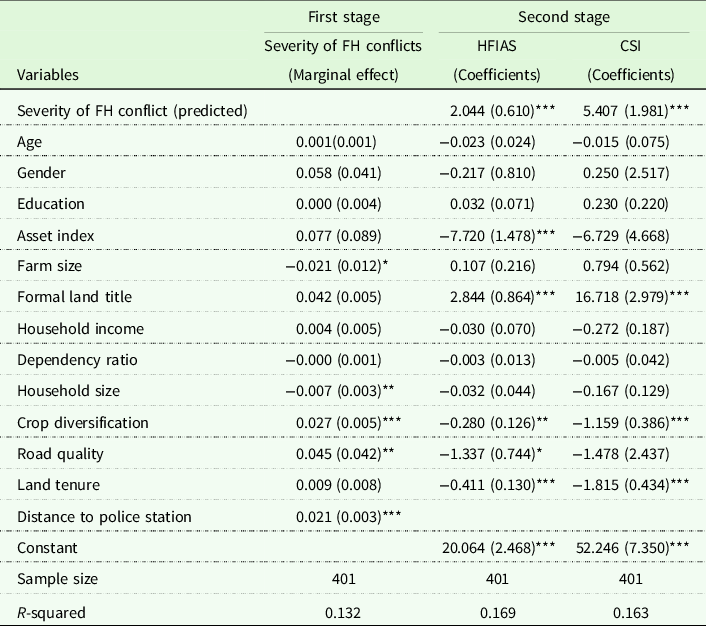
Note: Robust standard errors in parentheses. *, **, *** represent significance at 10%, 5%, and 1% levels, respectively. We used the variance inflation factor to test the multicollinearity between independent variables and did not find the existence of such an issue.
The second-stage results (columns 3–4 of Table 3) show that the estimated coefficients of the predicted variable indicate that the severity of FH conflicts has statistically significant and positive impacts on food insecurity for both the HFIAS and CSI models at the 1% level. These results imply that a unit increase in the severity of FH conflicts increases household food insecurity by 2.04 HFIAS and 5.41 CSI units. Hence, Hypothesis 2, “the severity of FH conflicts positively impacts food insecurity,” is supported. The severity of FH conflicts increases households’ food insecurity through its negative impacts on the scarcity of food and income losses, crop yields, injury to livestock, and the destruction of farm property (as depicted in Figure 1). Our findings are in line with the results of extant studies showing that violent conflicts reduce agricultural production and food security (Arias, Ibáñez, and Zambrano Reference Arias, Ibáñez and Zambrano2019; Brück, d’Errico, and Pietrelli Reference Brück, d’Errico and Pietrelli2019; George, Adelaja, and Weatherspoon Reference George, Adelaja and Weatherspoon2020; George, Adelaja, and Awokuse Reference George, Adelaja and Awokuse2021; Adelaja and George Reference Adelaja and George2019).
Among other factors affecting food insecurity, the estimated coefficients for crop diversification are statistically significant and negative at the 1% level, indicating that increased diversification in crop cultivation reduces food insecurity. The finding is supported by the result of Goshu, Kassa, and Ketema (Reference Goshu, Kassa and Ketema2012), who found a positive association between crop diversification and food security in rural Ethiopia. The finding of the negative relationship between crop diversification and food insecurity may be because areas, where a variety of crops are cultivated, may imply fertile soils with an abundance of crops and foliage for grazing cattle. Hence, those areas are most likely to have increased availability of diverse types of food crops despite facing a higher probability of the incidence and severity of FH conflicts. The significant and negative coefficient of the road quality variable in column 3 shows that good quality roads from villages to farmland decrease food insecurity. Farmers can conveniently transport inputs from the markets to the farmland when the road is of good quality, which helps improve production efficiency and land productivity, contributing to food security. Land tenure affects HFIAS and CSI negatively and significantly, suggesting that land tenure security reduces food insecurity. Higher land tenure security motivates farmers to invest more in their farms, enhancing farm productivity and food security (Rockson, Bennett, and Groenendijk Reference Rockson, Bennett and Groenendijk2013; Ghebru and Holden Reference Ghebru and Holden2013).
Robustness check
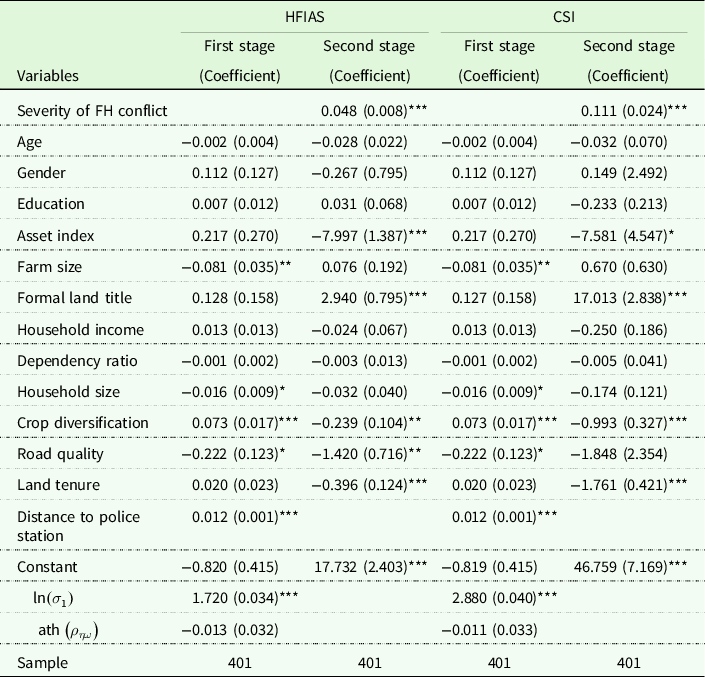
We estimated the impact of FH conflicts on food insecurity using conditional mixed process (CMP) models for robustness check purposes. The CMP model can help address the endogeneity issues of the FH conflict variables (Zhu, Ma, and Leng Reference Zhu, Ma and Leng2020; Baum Reference Baum2016). The results estimated for the impact of the incidence of FH conflicts on food insecurity are presented in Table A2 in the Appendix. Table A3 in the Appendix shows the results for the impact of the severity of FH conflicts on food insecurity. Overall, the estimates in the two tables show that the coefficients of the variables representing the incidence and severity of FH conflicts are positive and statistically significant. The findings suggest that FH conflicts increase food insecurity, which echoes our results from the 2SPS models and confirms the robustness of our estimates.
Additional analyses
To enrich our understanding of the relationship between FH conflicts and food insecurity, we conducted three additional analyses using the 2SPS models. First, we estimate the impacts of FH conflict exposure on food insecurity. Here, FH conflict exposure is measured as a binary variable, which is given the value of one if households have been exposed to FH conflicts and zero otherwise. This variable captures households in communities that have had at least one FH conflict incidence in the preceding year. Exposure to FH conflicts may not directly affect household production and food availability, but it may instill fear in rural people, making them modify their typical production investments and limit their economic activities (Arias, Ibáñez, and Zambrano Reference Arias, Ibáñez and Zambrano2019). The results are presented in Table A4 in the Appendix. We show that FH conflict exposure has a positive and statistically significant impact on HFIAS and CSI. The findings imply that FH conflict exposure also leads to food insecurity.
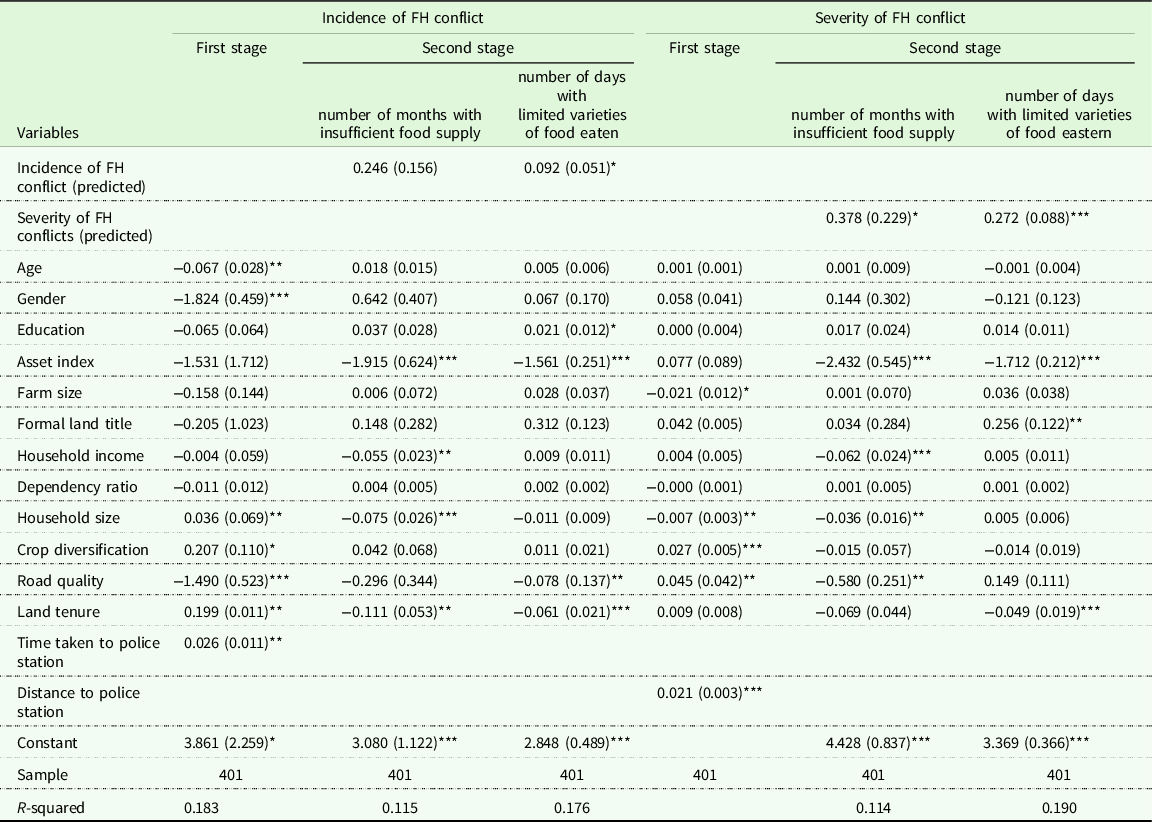
Second, we use two other outcome variables to capture food insecurity: the number of months with insufficient food supply and the number of days with limited varieties of food eaten. The results for the impact of the incidence of FH conflicts on the two outcome variables are presented in columns 2–3 of Table A5 in the Appendix, and the results for the impact of the severity of FH conflicts on them are shown in the last three columns of the table. Our estimates show that the incidence of FH conflicts positively impacts the number of days with limited varieties of food eaten. The severity of FH conflicts significantly increases food insecurity, as measured by the number of months with insufficient food supply and the number of days with limited varieties of food eaten. In general, the results presented in Tables A4 and A5 in the Appendix are largely consistent with our main findings in Tables 2 and 3.
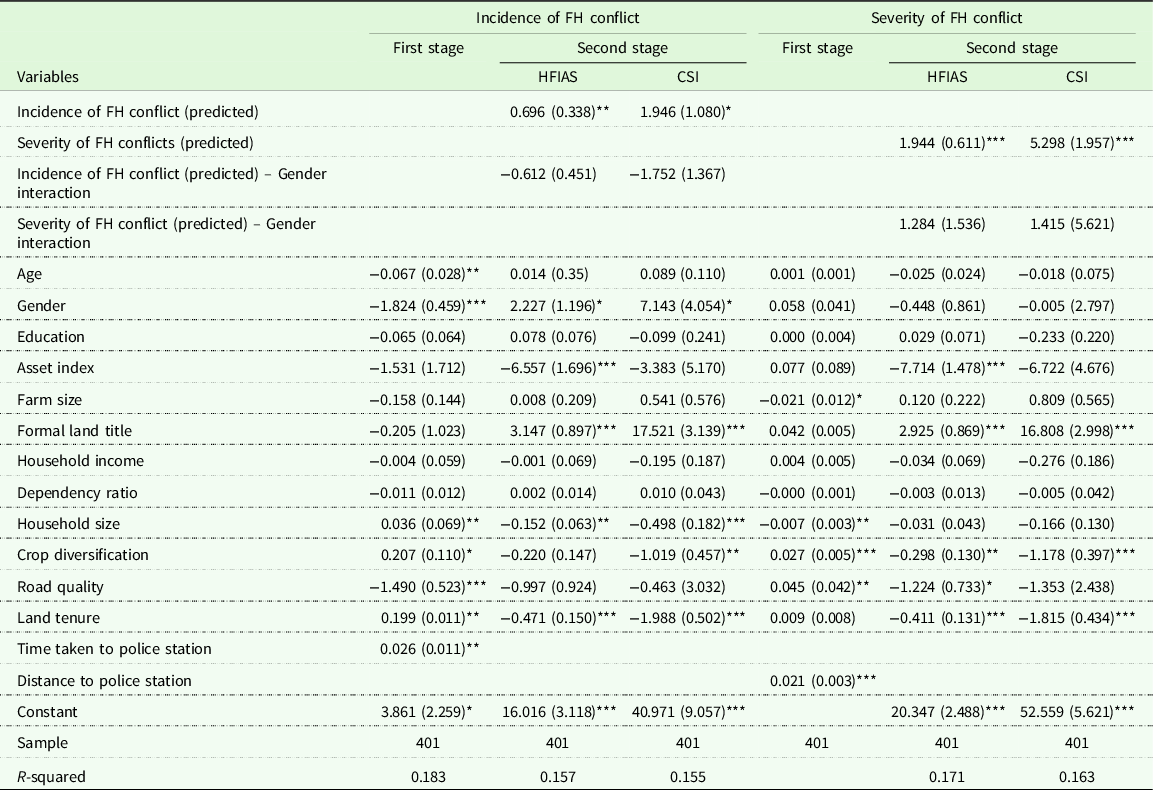
Third, we have re-estimated our food security models by including the interactions between female-headed households and the main conflict variables. This exploration is interesting. Because women cannot inherit land in some tribes in Nigeria, the prevalence of women having access to land and land titles is low. Legally though, women can own land. The results presented in Table A6 in the Appendix show that the coefficients of the interaction terms are insignificant, even at the 10% significance level. The findings suggest that the gendered differentials do not necessarily influence the impact of FH conflict on food insecurity.
Conclusions and policy insights
Although any kind of conflict is detrimental to food security in general, studies on the impact of FH conflicts, the predominant type of conflict in SSA, are scarce in the literature. To fill in the research gap, this study estimated the impacts of the incidence and severity of FH conflicts on rural households’ food insecurity, using data of 401 farm households collected from Nigeria. Food insecurity was captured using the HFIAS and CSI food insecurity measures. The 2SPS model was utilized to address the endogeneity issues of the conflict variables.
Empirical results revealed that both the incidence and severity of FH conflict significantly increase rural households’ food insecurity. The severity of FH conflict has a larger impact on food insecurity than the incidence of FH conflict does. The positive relationship between FH conflicts and food insecurity is further confirmed by our estimates using the CMP model. We found food insecurity is negatively affected by asset index, household size, crop diversification, road quality, and land tenure, but it is positively influenced by formal title to farmland. The additional analysis showed that FH conflict exposure affects food insecurity positively and significantly. We also found that the incidence and severity of FH conflicts increase the number of days with limited varieties of food eaten, while the severity of FH conflicts also increases the number of months with insufficient food supply.
Our findings of the positive relationship between FH conflicts and rural households’ food insecurity highlight the need for policy interventions to help households adversely impacted by ongoing FH conflicts. The results may expedite policy interventions to support households adversely impacted by ongoing FH conflicts. Such policies, for example, can include the provision of immediate safety nets, like food aid, to affected families, and planning post-conflict rehabilitation for both farmers and herders in regions severely affected by FH conflicts. Furthermore, while the above suggestions respond to the conflict symptoms, there is a need to address the root causes. In particular, there is a need to consider policies that encourage more sustainable herding and farming practices. Early warning and alert systems that inform large farms and security forces about impending conflict will assist in preventing the onset of FH conflicts, which, in turn, will reduce their detrimental effect on rural livelihoods.
Additionally, since herders are mostly attracted to small farms in Nigeria establishing a community-wide solution where large farms cooperate with smaller farms would help prevent these conflicts. The need to curb the likelihood of FH conflicts in the future is paramount as the adverse effects of a changing climate are placing increased pressure on the land resources in Nigeria. This could be an interesting area for future research. The finding of the positive relationship between ownership of formal titles to farmland and food insecurity highlights the importance of establishing mechanisms or improving existing mechanisms that enforce formal land rights, aimed at reducing occurrences of these FH conflicts and subsequent food insecurity. This study focuses on the impacts of FH conflicts on the food insecurity of farmers. Future studies may look at how FH conflicts affect herders’ herding behaviors and their food security.
Data availability statement
The data that support the findings of this study are available from the leading author, Amaka Nnaji, upon reasonable request.
Acknowledgements
The authors gratefully acknowledge constructive comments and suggestions from three anonymous reviewers.
Conflicts of interests
There is no conflict of interest.
Appendix
Falsification tests of the instrumental variables
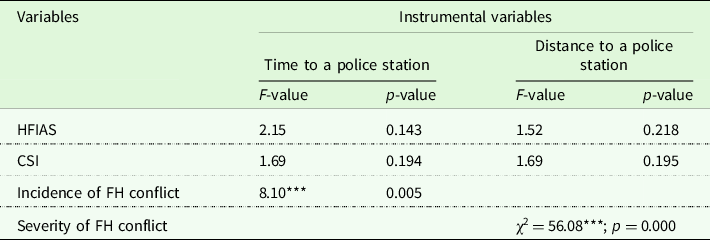
Note: *** denotes the significance level at 1%.
CMP parameter estimates for the impacts of incidence of FH conflict on food insecurity: Robustness check

Note: Robust standard errors in parentheses. *, **, *** represent significance at 10%, 5%, and 1% levels, respectively.
CMP parameter estimates for the impacts of severity of FH conflict on food insecurity
Note: Robust standard errors in parentheses. *, **, *** represent significance at 10%, 5%, and 1% levels, respectively.
2SPS parameter estimates for the impacts of FH conflict exposure on food insecurity

Note: Robust standard errors in parentheses. *, **, *** represent significance at 10%, 5%, and 1% levels, respectively.
2SPS parameter estimates for the impacts of incidence and severity of FH conflicts on alternative food insecurity indicators
Note: Robust standard errors in parentheses. *, **, *** represent significance at the 10%, 5%, and 1% levels, respectively.
2SPS parameter estimates for the impacts of incidence and severity of FH conflicts on food insecurity including gender-conflict interaction
Note: Robust standard errors in parentheses. *, **, *** represent significance at the 10%, 5%, and 1% levels, respectively.


 Open access

