


INTRODUCTION
For the past three decades, leadership scholars and practitioners alike have shown great interest in training organizational leaders to be effective in motivating followers to go beyond their in-role obligations to contribute more to the collective benefit (Avolio, Walumbwa, & Weber, Reference Avolio, Walumbwa and Weber2009; De Cremer & van Knippenberg, Reference De Cremer and van Knippenberg2004). Research suggests that one effective way for leaders to achieve this goal is by exhibiting self-sacrificial behaviors (Choi & Yoon, Reference Choi and Yoon2005). Focusing on this particular behavior, Choi and Mai-Dalton (Reference Choi and Mai-Dalton1998) developed the concept of self-sacrificial leadership and defined it as ‘the total/partial abandonment, and/or permanent/temporary postponement of personal interests, privileges, or welfare in the (a) division of labor, (b) distribution of rewards, and/or (c) exercise of power’ (479). Accumulative empirical findings have shown that self-sacrificial leadership is positively related to employee organizational citizenship behavior (OCB; De Cremer, Reference De Cremer2002; van Knippenberg & van Knippenberg, Reference van Knippenberg and van Knippenberg2005).
Although the positive link between self-sacrificial leadership and follower OCB has been demonstrated in previous research, most of these studies (e.g., De Cremer & van Knippenberg, Reference De Cremer and van Knippenberg2005; van Knippenberg & van Knippenberg, Reference van Knippenberg and van Knippenberg2005; De Cremer, Mayer, van Dijke, & Schouten, Reference De Cremer, Mayer, van Dijke and Schouten2009; Mulder & Nelissen, Reference Mulder and Nelissen2010) have narrowly focused on affiliative citizenship behaviors, which are conceptualized as interpersonal, cooperative, and noncontroversial citizenship behaviors (Van Dyne, Cummings, & McLean Parks, Reference Van Dyne, Cummings and McLean Parks1995). Little is known about the effects of self-sacrificial leadership on followers’ challenging citizenship behaviors that are risky, change-oriented, and that focus more on suggesting and implementing novel and useful ideas at work to improve collective effectiveness (Amabile, Reference Amabile1996; Morrison & Phelps, Reference Morrison and Phelps1999; Van Dyne et al., Reference Van Dyne, Cummings and McLean Parks1995). Thus, the research objective of the present study is to examine whether, why, and when self-sacrificial leadership motivates both affiliative and challenging citizenship behaviors.
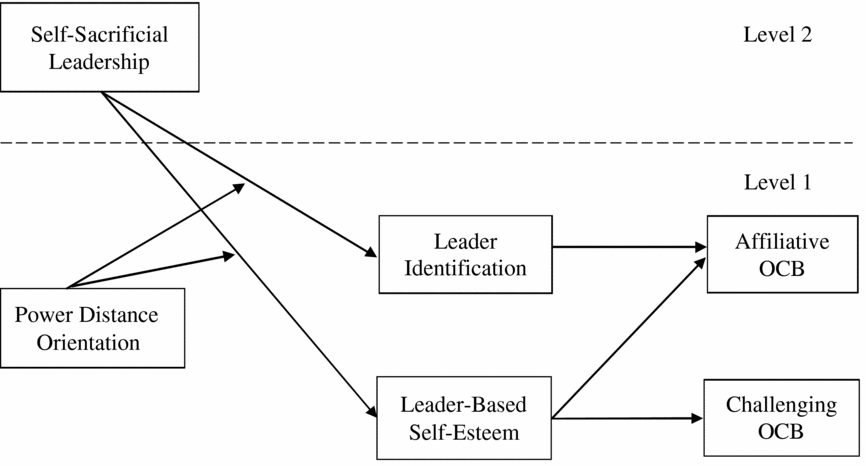
Drawing from self-concept theories (e.g., Brewer & Gardner, Reference Brewer and Gardner1996; Gecas, Reference Gecas1982; Sluss & Ashforth, Reference Sluss and Ashforth2007), we propose a dual-path mediation model linking self-sacrificial leadership with affiliative OCB and challenging OCB through two different aspects of relational self-concept: 1) the content of self-conception at the relational level (i.e., relational identities) as manifested by leader identification, and 2) self-evaluation of the relational identity as manifested by leader-based self-esteem. The role of follower self-concept in understanding leadership effectiveness has been increasingly recognized by recent leadership scholars (van Knippenberg, van Knippenberg, De Cremer, & Hogg, Reference van Knippenberg, van Knippenberg, De Cremer and Hogg2004). We believe it is particularly useful in understanding the influences of self-sacrificial leadership in that self-sacrificial leadership has its root in charismatic leadership, the influences of which are largely based on followers’ self-concept construction (Shamir, House, & Arthur, Reference Shamir, House and Arthur1993). In addition, we focus on self-concept at the relational level because self-sacrificial leadership involves behaviors that give favor to subordinates at the expense of the leaders’ own interests, and such altruistic behaviors tend to shape employees’ self-concept in relation to the source of the sacrifices (i.e., leader) more directly.
We conducted our research in China, and one recommended approach to generalizing the Western developed leadership theories in Asian contexts is to identify cultural moderators of the effects of a universally endorsed leadership construct (Jia, You, & Du, Reference Jia, You and Du2012; Lam, Huang, & Lau, Reference Lam, Huang and Lau2012; Whetten, Reference Whetten2009). We follow this approach and seek to examine the moderating role of individual power distance orientation in the relationships of self-sacrificial leadership with followers’ perceptions of leader identification and leader-based self-esteem, and in turn with their OCB. We focus on power distance because the specific values embedded in this cultural value emphasize one of the most salient traditional Chinese values – obedience to authority (Zhang, Bai, Caza, & Wang, Reference Zhang, Bai, Caza and Wang2014), and prior research has widely demonstrated power distance as a significant cultural contingency affecting the generalizability of Western leadership theories into the Chinese context (e.g., Chen, Zhang, Wang, Reference Chen, Zhang and Wang2014; Kirkman, Chen, Farh, Chen, & Lowe, Reference Kirkman, Chen, Farh, Chen and Lowe2009). Integrating self-concept theories with implicit leadership theory (Eden & Leviatan, Reference Eden and Leviatan1975), we suggest that the mediating relationship between self-sacrificial leadership and follower OCB via their relational self-concept constructs will be more pronounced among individuals with low rather than high power distance orientation. It is because followers high on power distance take for granted the hierarchical inequality and are less likely to associate their self-worth and self-identity with their leaders’ self-sacrificial behaviors.
The overall conceptual model of the current study is depicted in Figure 1. We seek to make three theoretical contributions. First, we contribute to the self-concept based leadership research (e.g., van Knippenberg et al., Reference van Knippenberg, van Knippenberg, De Cremer and Hogg2004) by examining the intervening mechanism of self-conception at the relational level and considering multiple aspects of self-concept (i.e., identify and self-esteem) simultaneously. Second, we extend the self-sacrificial leadership research to the Chinese context by identifying individual power distance orientation as a cultural value restraining self-sacrificial leadership's influences on individual relational self-concept construction, with downstream implications for citizenship behaviors. Finally, our research advances the OCB literature by providing empirical evidence for the differences in the psychological predictions for affiliative OCB and challenging OCB.
Theoretical model
THEORETICAL BACKGROUND AND HYPOTHESES
Self-concept is a product of an individual's reflective process of him/herself, and it is broadly defined as ‘the totality of an individual's thoughts and feelings having reference to himself as an object’ (Rosenberg, Reference Rosenberg1965: 7). According to Gecas's (Reference Gecas1982) influential work on self-concept, self-concept has two core dimensions: 1) self-conception, the content of self-concept (i.e., identity) that gives meaning to an individual for a specific role he/she plays and helps the individual to better define himself/herself (e.g., Who am I?) in such a situation, and 2) self-evaluation, which represents the evaluative and emotional aspects of the self-concept (e.g., How valuable am I in the social context?) and is usually operationalized by the construct of self-esteem. Previous research has demonstrated that these two aspects of self-concept play vital roles in translating leadership behaviors into positive employee outcomes such as affective organizational commitment and task performance (Chen & Aryee, Reference Chen and Aryee2007), OCB (Zhang & Chen, Reference Zhang and Chen2013), and creativity (Qu, Janssen, & Shi, Reference Qu, Janssen and Shi2015).
In the present study, we examine self-concept at the relational level because of our particular focus on self-sacrificial leadership. Specifically, self-sacrificial leadership has its conceptual root in charismatic leadership, and theories of charismatic leadership highlight the motivational mechanisms of emotional attachment to the leader on the part of the followers, emotional and motivational arousal of the followers, and enhancement of follower self-concept in relation to the leader (Shamir et al., Reference Shamir, House and Arthur1993). More directly, some of the behavioral expressions of self-sacrificial leadership are follower-focused, such as standing up for followers’ interests, and helping followers in times of trouble (Choi & Mai-Dalton, Reference Choi and Mai-Dalton1998). These follower-focused altruistic behaviors are likely to affect followers’ self-concept construction in relation to the source of the sacrifices more directly (Brewer & Gardner, Reference Brewer and Gardner1996). Indeed, empirical research has demonstrated that self-sacrificial leadership has a positive effect on followers’ emotional attachment to the leader (De Cremer & van Knippenberg, Reference De Cremer and van Knippenberg2005; De Cremer, Reference De Cremer2006).
In accordance with Gecas's (Reference Gecas1982) explanation for the two dimensions of self-concept, we focus on two different aspects of relational self-concept: 1) relational self-conception as operationalized by leader identification, and 2) relational self-evaluation as operationalized by leader-based self-esteem. Leader identification refers to the extent to which one defines oneself in terms of his/her vertical relationship with the leader (Sluss & Ashforth, Reference Sluss and Ashforth2007), and it is the fundamental dimension of self-concept (i.e., self-conception or the content of self-concept). Self-esteem is the operationalizational manifestation of the self-evaluation dimension of self-concept, and it reflects the extent to which an individual ‘sees him [her]self as a competent, need-satisfying individual’ (Korman, Reference Korman1970: 32) within a certain context. Extending self-esteem to the context of leader-follower dyad, Landry and Vandenberghe (Reference Landry and Vandenberghe2009) developed the construct of leader-based self-esteem to reflect an employee’ self-evaluation of his/her worthiness resulting from this leader-follower dyadic relationship. Drawing from the relational self-concept perspective, we next examine the mediating roles of leader identification and leader-based self-esteem in the relationship between self-sacrificial leadership and follower OCB.
Self-Sacrificial Leadership and Follower Relational Self-Concept
Self-sacrificial leadership refers to leaders’ attempt to maximize collective welfares and benefits at the expense of their own interests (Choi & Mai-Dalton, Reference Choi and Mai-Dalton1998). Self-sacrificial leaders usually give high priority to collective missions and goals (Choi & Mai-Dalton, Reference Choi and Mai-Dalton1999) either by directly engaging in group-oriented self-sacrificial behaviors, such as undertaking personally risky tasks in order to benefit the collective, or by indirectly engaging in follower-oriented self-sacrificial behaviors such as fulfilling followers’ basic psychological and economic needs (De Cremer & van Knippenberg, Reference De Cremer and van Knippenberg2005; De Cremer et al., Reference De Cremer, Mayer, van Dijke and Schouten2009). We suggest that leaders’ self-sacrificial behaviors will be positively related to both leader identification and leader-based self-esteem as perceived by followers.
Leader identification represents the extent to which one defines himself/herself in relation to the leader (e.g., I am the leader's subordinate). It often manifests in terms of the extent to which followers affectively attach to and cognitively commit to the leader (van Knippenberg et al., Reference van Knippenberg, van Knippenberg, De Cremer and Hogg2004; Zhang, Chen, Chen, Liu, & Johnson, Reference Zhang, Chen, Chen, Liu and Johnson2014). According to Sluss and Ashforth (Reference Sluss and Ashforth2007), leader identification is jointly determined by an employee's role-based identity of the leader and his/her person-based identity of the leader. Specifically, the role-based identity of a leader refers to the prototypical values, norms, goals, and behaviors (e.g., assigning tasks, monitoring performance, and providing feedback) associated with the leader role expected by the subordinates (Sluss & Ashforth, Reference Sluss and Ashforth2007), independent of who the leader is and what the leader actually does. Past leadership research (e.g., Judge, Piccolo, & Ilies, Reference Judge, Piccolo and Ilies2004) suggests that the typical role of a leader includes two major responsibilities: initiating structure (i.e., task-focus) and consideration (i.e., person-focus). Thus, leaders’ self-sacrificial behaviors, including both group- and individual-oriented behaviors as explained earlier, can enhance employees’ perceived role-based identity of the leader by fulfilling the two major responsibilities expected from the leader role.
The person-based identity of a leader, on the other hand, refers to the personal qualities of the person who is enacting the responsibilities involved in the role of leader (Sluss & Ashforth, Reference Sluss and Ashforth2007). Typical behaviors of self-sacrificial leadership include undertaking more challenging and risky work than group members, taking less than he/she deserves and giving more to the followers in the group's profit sharing, and abandoning personal benefits and privileges for better development of the whole group or organization (Choi & Mai-Dalton, Reference Choi and Mai-Dalton1998). By displaying those behaviors, self-sacrificial leaders will be perceived as high in personal qualities of morality, altruism, and charisma (Choi & Mai-Dalton, Reference Choi and Mai-Dalton1999). These positive characteristics in turn will make self-sacrificial leaders personally attractive to followers, enhancing followers’ perceptions of person-based identity of the leader (Shamir et al., Reference Shamir, House and Arthur1993). Taken together, we suggest that employees’ leader identification will be increased by self-sacrificial leadership because of the strengthened role- and person-based identities of their self-sacrificial leaders.
Hypothesis 1: Self-sacrificial leadership will be positively related to follower perception of leader identification.
Although followers define themselves in relation to their leaders, they may have different evaluations about their worthiness in the eyes of their leaders. As a specific form of self-esteem in the context of a leader-follower dyad, leader-based self-esteem represents the extent to which an individual believes himself/herself to be valuable, significant, and meaningful as a subordinate of his/her leader (van Knippenberg et al., Reference van Knippenberg, van Knippenberg, De Cremer and Hogg2004). We posit that self-sacrificial leadership will be positively related to followers’ leader-based self-esteem. Specifically, one important behavioral expression of self-sacrificial leadership is to engage in follower-focused behaviors such as using leaders’ personal resources (e.g., time, money, and social network) to satisfy followers’ own needs, and to help them with the difficulties they encountered both at work and at home (Choi & Mai-Dalton, Reference Choi and Mai-Dalton1999). Benefiting directly from self-sacrificial leaders’ individual-focused behaviors, followers will feel significant, valued, appreciated, and trusted by the leader, increasing their self-esteem perceptions (De Cremer, van Knippenberg, van Dijke, & Bos, Reference De Cremer, van Knippenberg, van Dijke and Bos2006). Moreover, when leaders exhibit self-sacrificial behaviors towards followers, followers are likely to experience self-worth through the fulfillment of the psychological needs of competence and relatedness (De Cremer & van Knippenberg, Reference De Cremer and van Knippenberg2002; De Cremer et al., Reference De Cremer, van Knippenberg, van Dijke and Bos2006), giving rise to the leader-based self-esteem more directly. Thus, we propose the following hypothesis.
Hypothesis 2: Self-sacrificial leadership will be positively related to follower perception of leader-based self-esteem.
Self-Sacrificial Leadership and Follower Organizational Citizenship Behavior
A handful of empirical studies have substantiated the positive effect of self-sacrificial leadership on follower OCB (e.g., Choi & Mai-Dalton, Reference Choi and Mai-Dalton1999; De Cremer & van Knippenberg, Reference De Cremer and van Knippenberg2002; De Cremer et al., Reference De Cremer, Mayer, van Dijke and Schouten2009). However, most attention has been given to how self-sacrificial leadership promotes cooperative behaviors in work groups (De Cremer & van Knippenberg, Reference De Cremer and van Knippenberg2002). For instance, high self-sacrificial leadership was found to increase cooperation among followers both in a well-controlled experimental setting (De Cremer & van Knippenberg, Reference De Cremer and van Knippenberg2004) and in a real-work field context (De Cremer et al., Reference De Cremer, Mayer, van Dijke and Schouten2009). Laboratory studies also demonstrated that leaders showing self-sacrificial behavior would significantly increase team members’ contributions to the public good (i.e., choice of cooperation) in a social dilemma situation (De Cremer, Reference De Cremer2002; De Cremer & van Knippenberg, Reference De Cremer and van Knippenberg2002, Reference van Knippenberg and van Knippenberg2005). More generally, through a series of experimental and field studies, De Cremer and his colleagues demonstrated that self-sacrificial leadership increased followers’ self-reported OCB (De Cremer et al., Reference De Cremer, Mayer, van Dijke and Schouten2009; De Cremer & van Knippenberg, Reference De Cremer and van Knippenberg2002).
It is obvious that the above research has a narrow focus on affiliative OCB, the most typical behaviors of which are helping and cooperation (Podsakoff, Mackenzie, Paine, & Bachrach, Reference Podsakoff, Mackenzie, Paine and Bachrach2000). These affiliative citizenship behaviors improve work effectiveness by maintaining and enhancing existing interpersonal relationships and work procedures (Van Dyne et al., Reference Van Dyne, Cummings and McLean Parks1995). Other types of OCB that are promotive, change-oriented, and challenging have received little attention in the literature of self-sacrificial leadership. One typical form of challenging OCB is voice, which refers to the expression of constructive opinions, concerns, or ideas about work-related issues (Van Dyne & LePine, Reference Van Dyne and LePine1998). Although challenging citizenship behaviors may help improve work procedures and effectiveness, they are also likely to disrupt interpersonal relationships by challenging the status quo of the workplace.
Drawing from and extending previous research on self-sacrificial leadership, we suggest that self-sacrificial leadership will have a positive effect on followers challenging OCB. Specifically, leaders who display high moral standards and always forgo personal benefits such as monetary interests, authority, and reputation to contribute to the collective welfare serve as a role model in the workplace (Choi & Mai-Dalton, Reference Choi and Mai-Dalton1999). Inspired by the self-sacrificial leader's high moral standards and group-oriented behaviors, followers may not worry about the risks and negative consequences associated with performing challenging OCB, but focus more on the potential benefits that they can make to the group or the organization by completing such constructive behaviors. In other words, followers are likely to engage in challenging OCB by modeling the leader's self-sacrificial behaviors. In support of our argument, research on ethical leadership suggests that leaders performing ethical conduct in the workplace will give rise to both individual- and group-level citizenship behaviors, including both affiliative and challenging OCBs (Den Hartog, Reference Den Hartog2015). Therefore, we propose the following hypotheses:
Hypothesis 3: Self-sacrificial leadership will be positively related to followers’ (a) affiliative OCB and (b) challenging OCB.
The Mediating Role of Relational Self-Concept
The self-concept based leadership research (c.f. van Knippenberg et al., Reference van Knippenberg, van Knippenberg, De Cremer and Hogg2004) provides us with a strong theoretical basis for proposing a mediating role of relational self-concept in the relationship between self-sacrificial leadership and follower OCB. The core idea of this mediation prediction is that managerial expressions and behaviors associated with self-sacrificial leadership enhance the relational self-concept constructs of leader identification and leader-based self-esteem, and their motivational implications in turn influence follower OCB (Shamir, Reference Shamir1991). Given the conceptual differences between leader identification and leader-based self-esteem, we speculate that they will exert differential mediating roles in the relationships between self-sacrificial leadership and two types of employee OCB (i.e., affiliative OCB and challenging OCB), which are also suggested to be driven by distinct motivational mechanisms (Grant & Mayer, Reference Grant and Mayer2009; Kim, Van Dyne, Kamdar, & Johnson, Reference Kim, Van Dyne, Kamdar and Johnson2013; McAllister, Kamdar, Morrison, & Turban, Reference McAllister, Kamdar, Morrison and Turban2007).
On the one hand, we suggest that followers with high leader identification associated with self-sacrificial leadership are likely to exhibit more affiliative OCB only. According to prior research on relational identification (e.g., Sluss & Ashforth, Reference Sluss and Ashforth2007; Zhang, Lepine, Buckman, & Wei, Reference Zhang, Lepine, Buckman and Wei2014), self-enhancement and belongingness are two major motivational underpinnings of leader identification's influences on employees’ reciprocal behaviors. When employees derive their identities from their high-quality interpersonal relationships with their leaders (i.e., high leader identification), their self-enhancement needs are largely reflected in cooperative work relationships (Sluss & Ashforth, Reference Sluss and Ashforth2007), and their needs for belongingness are primarily expressed in informal, non-work relationships with their leaders, facilitating the development of affective bonds (e.g., preference and individualized concern) between the leader-follower dyads (Zhang et al., Reference Zhang, Bai, Caza and Wang2014). Both motives suggest that high leader identification motivates employees to go the extra mile beyond their prescribed in-role obligations via a supportive and collaborative way, that is, by increasing their affiliative OCBs (Tyler & Blader, Reference Tyler and Blader2003; Zhang & Chen, Reference Zhang and Chen2013). Integrating these arguments with those supporting the positive relationship between self-sacrificial leadership and followers’ leader identification, we predict the following mediation relationship:
Hypothesis 4: Leader identification will mediate the positive relationship between self-sacrificial leadership and affiliative OCB.
On the other hand, we expect that leader-based self-esteem may account for the effects of self-sacrificial leadership on both affiliative and challenging OCBs. According to Gecas (Reference Gecas1982), self-esteem also involves two motivational underpinnings which are self-maintenance motive and self-enhancement motive. The mediating role of leader-based self-esteem in the relationship between self-sacrificial leadership and employee affiliative OCB can be explained by the self-maintenance motive. Specifically, individuals have motivations to perform behaviors that are consistent with their self-evaluations (Gecas, Reference Gecas1982). Thus, for employees with high leader-based self-esteem, performing affiliative OCB that is more harmonious and cooperative is consistent with individuals’ inner perceptions that they are important and valuable people in the group (Pierce, Gardner, Cummings, & Dunham, Reference Pierce, Gardner, Cummings and Dunham1989), and that they have to do more than average to maintain self-worth and image in the eyes of the leader. Indeed, prior research has demonstrated that employees’ perceptions of self-esteem in organizational settings are positively related to affiliative OCB such as altruism (e.g., Chattopadhyay, Reference Chattopadhyay1999; Lee, Reference Lee2003; Tang & Ibrahim, Reference Tang and Ibrahim1998; van Dyne & Pierce, Reference Van Dyne and Pierce2004).
In addition to increasing affiliative OCB, enhanced leader-based self-esteem associated with self-sacrificial leadership will contribute to followers challenging OCB, which requires broader and stronger role perceptions from employees at work (McAllister et al., Reference McAllister, Kamdar, Morrison and Turban2007). Gecas (Reference Gecas1982) posited that unlike the self-enhancement motive associated with leader identification, self-enhancement motive associated with self-esteem emphasizes growth and expansion. Driven by these motivational tendencies, individuals who feel valued and trusted by their leaders may expand their work areas and be more proactive to challenge the status quo and initiate change (van Knippenberg et al., Reference van Knippenberg, van Knippenberg, De Cremer and Hogg2004). Moreover, high self-esteem was found to strengthen individual perceptions of capability, significance, meaningfulness, and intrinsic work motivation (Pierce & Gardner, Reference Pierce and Gardner2004), and these psychological resources are all vital impetuses for individual challenging citizenship behaviors such as voice (Liang, Farh, & Farh, Reference Liang, Farh and Farh2012; Morrison, Reference Morrison2011). Integrating the above arguments with those supporting the positive relationship between self-sacrificial leadership and followers’ leader-based self-esteem explained earlier, we propose the following hypotheses:
Hypothesis 5: Leader-based self-esteem will mediate the positive relationship between self-sacrificial leadership and follower (a) affiliative OCB and (b) challenging OCB.
The Moderating Role of Individual Power Distance Orientation
In the social identity model of leadership effectiveness (SIMOL), van Knippenberg and Hogg (Reference van Knippenberg and Hogg2003) posited that leadership effectiveness via followers’ self-concept enhancement depends not only on the extent to which the leader is perceived to act with the group's best interest (e.g., self-sacrificial leadership behaviors) but also on how prototypical the leadership behaviors are perceived to be. Implicit leadership theory (Brown & Lord, Reference Brown, Lord and London2001; Eden & Leviatan, Reference Eden and Leviatan1975) posits that employees tend to develop a schema (i.e., knowledge representation) of prototypical attributes and behaviors of their leaders. It also suggests that the extent of prototypicality of leadership behavior differs among employees with different personal attributes and values. Drawing from these two theoretical perspectives, we theorize that the mediation relationships between self-sacrificial leadership and employee OCBs via leader identification and leader-based self-esteem are moderated by individual cultural value of power distance orientation.
Hofstede (Reference Hofstede1991) originally conceived of the concept of power distance as one of the five cultural values, reflecting the extent to which power differences within the society, organization, and institutions (like the family) are accepted by the less powerful members. In the organizational behavior literature, individual power distance orientation has been conceptualized as an individual difference variable and defined as the extent to which one accepts power and authority differentials as legitimate in the organization (Farh, Hackett, & Liang, Reference Farh, Hackett and Liang2007; Kirkman et al., Reference Kirkman, Chen, Farh, Chen and Lowe2009). Power distance has been widely demonstrated as a cultural contingency for leadership effectiveness in China (Jia et al., Reference Jia, You and Du2012). For instance, employee power distance orientation was found to moderate the positive relationship between transformational leadership and Chinese employees’ justice perceptions (Kirkman et al., Reference Kirkman, Chen, Farh, Chen and Lowe2009), and affect the positive influences of empowering leadership on Chinese employees’ role breadth self-efficacy and in turn the proactive behavior of taking charge (Li, He, Yam, & Long, Reference Li, He, Yam and Long2015). Drawing from and extending these studies, we expect that individual power distance orientation is likely to moderate the indirect relationships between self-sacrificial leadership and employee OCBs via one's relational self-concept constructs (i.e., leader-based self-esteem and leader identification).
According to Farh et al. (Reference Farh, Hackett and Liang2007), high power distance orientation individuals have strong implicit beliefs that power should be held centrally by the formal leader within a group, and followers should highly respect and follow the leader in all respects. They think and behave strictly following the expectations, responsibilities, and obligations associated with the role of subordinate in the leader-follower relationship (Chen & Aryee, Reference Chen and Aryee2007). In other words, they respect the leader's high authority, status, and privileges, and are highly identified with the leaders independent of who the leaders are and how the leaders treat and interact with them (Zhang et al., Reference Zhang, Bai, Caza and Wang2014). Likewise, they will devaluate themselves and engage in self-descending behaviors in front of their leaders. Thus, employees who have high power distance orientations tend to take for granted hierarchical inequality between the leader and the followers, and are less likely to derive their self-worth and self-identity from their leaders’ sacrificial behaviors. Indeed, these self-descending behaviors of self-sacrificial leaders are in stark contrast to their culture-based expectations of how leaders should behave, thereby hindering the positive influences of self-sacrificial leadership on their self-identity and self-worth constructions in relation to their leaders (van Knippenberg & Hogg, Reference van Knippenberg and Hogg2003).
By weakening the positive relationships between self-sacrificial leadership and followers’ relational self-concept constructs, high power distance orientation will further weaken the indirect relationship between self-sacrificial leadership and follower OCB via the relational self-concept constructs. Partly in support of our arguments, prior research has demonstrated that high power distance individuals were less likely affected by the practice of self-management (Kirkman & Shapiro, Reference Kirkman and Shapiro1997) and reacted less positively to the leader's transformational behaviors (Kirkman et al., Reference Kirkman, Chen, Farh, Chen and Lowe2009). In a similar vein, research on Chinese traditionality – a cultural value with considerable overlaps with power distance orientation (i.e., respect for authority; Farh et al., 1997) – demonstrated that Chinese employees with high traditionality reacted less positively toward their leaders’ integrity (Zhang et al., Reference Zhang, Bai, Caza and Wang2014) and reacted less negatively toward their leaders’ unfair treatment as well (Farh et al., 1997). Taken together, we propose the following hypotheses:
Hypothesis 6: Individual power distance orientation will moderate the mediation relationship between self-sacrificial leadership and follower affiliative OCB via leader identification such that the mediation relationship will be more significant among followers with low power distance orientation than among those with high power distance orientation.
Hypothesis 7: Individual power distance orientation will moderate the mediation relationship between self-sacrificial leadership and follower (a) affiliative OCB and (b) challenging OCB via leader-based self-esteem such that the mediation relationships will be more significant among followers with low power distance orientation than among those with high power distance orientation.
METHOD
Procedures and Samples
Participants were from eighteen different organizations located in Central China. These organizations belong to a variety of industries such as technology, service, electronics, manufacturing, and financial. Our contact person in each organization randomly selected 5–10 work groups (e.g., functional departments) and invited all the employees working in these groups to join our survey. Data were collected from multiple sources. Employees were asked to evaluate self-sacrificial leadership, leader identification, leader-based self-esteem, power distance orientation and group leaders were asked to evaluate their followers’ affiliative and challenging citizenship behaviors. To guarantee data quality, all surveys, which were numerically coded in advance, were conducted anonymously and participants were given 20 Chinese yuan as a reward. The contact person helped us to match the employee-questionnaire with the leader-questionnaire through the survey codes printed on both questionnaires.
In total, we surveyed 83 work groups in these 18 organizations, and 83 group leaders and 329 out of 470 employees participated in the study, resulting in valid response rates of 100% and 70% for leaders and employees, respectively. Of the 329 employees, 51.1% were male. Their averaged age was 32.07 years (SD = 7.44) and averaged tenure with their organizations was 5.10 years (SD = 5.80). In addition, the mean size of the 83 work groups was 6.70, ranging from 4 to 15 (SD = 2.32), and the average within-group employee response rate was 75%, resulting in an averaged valid group size of 4.96, ranging from 4 to 7 (SD = 0.89).
Measures
All scale items underwent a back-translation process (Brislin, Reference Brislin1970) to guarantee the content validity of the Western scales in Chinese context.
Self-sacrificial leadership
Self-sacrificial leadership was measured with a five-item scale developed by De Cremer and van Knippenberg (Reference De Cremer and van Knippenberg2004). Sample items were ‘My team leader is willing to make personal sacrifices in the team's interest’ and ‘My team leader always among the first to sacrifice free time, privileges, or comfort if that is important for the team's mission’ (1 = strongly disagree, 7 = strongly agree; α = 0.80). We aggregated this construct to the group level by calculating the mean level of self-sacrificial leadership reported by each follower of the group. Aggregation indexes indicated that leader self-sacrifice was meaningful at the group level (mean rwg = 0.89; ICC[1] = 0.38; ICC[2] = 0.71), comparing with the commonly accepted cutoff values (Bliese, Reference Bliese, Klein and Kozlowski2000; rwg > 0.70; ICC[1] > 0.12; ICC[2] > 0.70).
Leader identification
Leader identification was measured using Kark, Shamir, and Chen's (Reference Kark, Shamir and Chen2003) eight-item scale. Sample items were ‘I respect my team leader’ and ‘I view the success of my team leader as my own success’ (1 = strongly disagree, 5 = strongly agree). The Cronbach's alpha for this scale was 0.92 in this study.
Leader-based self-esteem
Leader-based self-esteem was measured using four items developed by (Landry & Vandenberghe, Reference Landry and Vandenberghe2009). Sample items were ‘I am important for my team leader’ and ‘I am valuable for my team leader’ (1 = strongly disagree, 5 = strongly agree). The Cronbach's alpha for this scale was 0.89 in this study.
Power distance orientation
Individual power distance orientation was measured with the 6-item scale developed by Dorfman and Howell (Reference Dorfman and Howell1988). Sample items were ‘Managers should make most decisions without consulting subordinates’ and ‘It is frequently necessary for a manager to use authority and power when dealing with subordinates’ (1 = strongly disagree, 7 = strongly agree). The Cronbach's alpha for this scale was 0.89 in our study.
Affiliative citizenship behavior
Affiliative OCB was measured by the Chinese OCB scales developed by Farh, Zhong, and Organ (Reference Farh, Zhong and Organ2004). The nine items of this scale correspond to aspects of OCB-individual, OCB-organization, and OCB-job, respectively (Coleman & Borman, Reference Coleman and Borman2000). Sample items included: ‘Initiates assistance to coworkers who have a heavy workload’ (OCB-individual), ‘Defend company against disasters’ (OCB-organization), and ‘Works diligently and with a great sense of responsibility even when work outcomes will not count toward one's performance evaluation’ (OCB-job). This OCB scale has been demonstrated to have satisfactory reliability and validity (Farh et al., Reference Farh, Hackett and Liang2007). The Cronbach's alpha for this scale was 0.87 in this study.
To test whether the three sub-dimensions could be aggregated into an integrated construct, we conducted a confirmatory factor analysis. The results indicated that a second-order model (one higher-order factor with three lower-level factors) yielded an acceptable fit to the data (χ2 = 32.95, df = 24, χ2/df = 1.37, RMSEA = 0.03, IFI = 0.99, CFI = 0.99). Thus, we aggregated these three dimensions into an overall construct of Affiliative OCB.
Challenging citizenship behavior
In accordance with previous research (Burris, Detert, & Chiaburu, Reference Burris, Detert and Chiaburu2008; Kim et al., Reference Kim, Van Dyne, Kamdar and Johnson2013; Lam & Mayer, Reference Lam and Mayer2014), we measured individual voice behavior to reflect the challenging OCB. Voice was measured with Van Dyne and LePine's (Reference Van Dyne and LePine1998) six-item scale. Sample items were ‘This employee speaks up in this group with ideas for new projects or changes in procedures’ and ‘This employee speaks up and encourages others in this group to get involved in issues that affect the group’. (1 = strongly disagree, 7 = strongly agree). The Cronbach's alpha for this scale was 0.94 in our study.
Control variable
At the individual level, we controlled for demographic variables, including gender, age, job tenure (measured in years), and education level, which have been found to be related to individual citizenship behaviors (e.g., Farh et al., Reference Farh, Hackett and Liang2007). In addition, we controlled for group size and leader tenure in the current position as the group-level control, as prior research suggests that they are related to employee OCB (Yaffe & Kark, Reference Yaffe and Kark2011).
Analytical Strategy
We first conducted a set of confirmatory factor analyses (CFAs) to ensure adequate discriminant validity among the six latent variables (i.e., self-sacrificial leadership, leader identification, leader-based self-esteem, power distance orientation, affiliative OCB, and challenging OCB). Next, to partition the variance at the individual and group levels in testing the research hypotheses and to treat self-sacrificial leadership as a group-level variable, we utilized hierarchical linear modeling (with HLM 6.06; Raudenbush, Bryk, Cheong, & Congdon, Reference Raudenbush, Bryk, Cheong and Congdon2004) via the restricted maximum likelihood estimation method. All of the explanatory variables were standardized with the exception of gender, which was coded as a dummy variable. All of the individual-level variables (except gender, which is a dummy variable, and the moderator of power distance orientation) were grand-mean centered to reduce potential collinearity between the team-level intercept and slope terms (Hofmann & Gavin, Reference Hofmann and Gavin1998). Power distance orientation was group-mean centered to generate more robust results in analyzing the cross-level moderation models (Hofmann & Gavin, Reference Hofmann and Gavin1998).
RESULTS
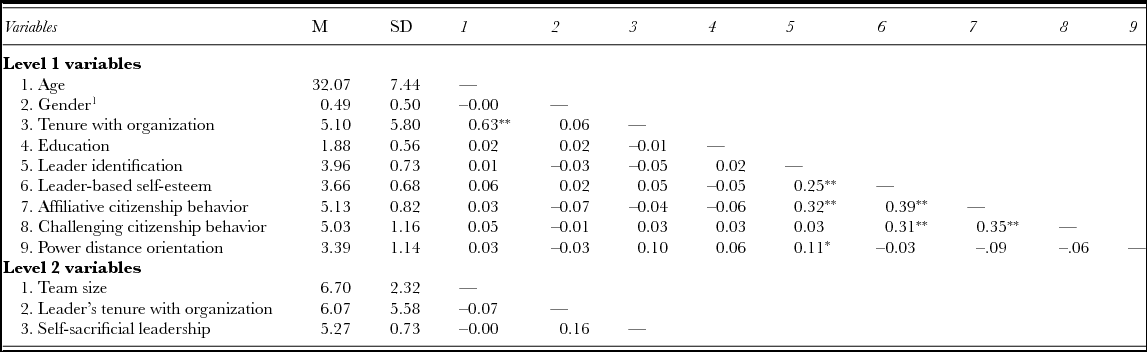
Table 1 shows the means, standard deviations, and correlations among the variables at both individual and group levels.
Means, standard deviations, and correlations of the focal variables
Notes: 1Dummy variable (0 = man, 1 = woman); n = 83 at team level, n = 329 at individual level.
Preliminary analyses
The CFA results indicated that the six-factor model[Footnote 1] had an acceptable fit to the data, χ2 (449) = 862.98; χ2/df = 1.92; RMSEA = 0.05; IFI = 0.93; CFI = 0.93. Chi-square difference tests showed that the six-factor model was superior to a five-factor model in which affiliative and challenging OCBs were combined, Δχ2(5) = 36.45, p < 0.001. The six-factor model was also superior to another five-factor model in which leader identification and leader-based self-esteem were combined, Δχ2(5) = 736.65, p < 0.001. These results indicated satisfactory construct validity of the six latent variables in the Chinese context. Before running the HLM regression, chi-square tests suggested that the between-group variances in leader identification, χ2 (82) = 186.38, p < 0.001, ICC (1) = 0.25, leader-based self-esteem, χ2 (82) =219.04, p < 0.001, ICC (1) = 0.30, affiliative OCB, χ2 (82) = 354.57, p < 0.001, ICC (1) = 0.45, and challenging OCB, χ2 (82) =731.31, p < 0.001, ICC (1) = 0.67, were all significant, thereby justifying the use of HLM to test research hypotheses. In addition, given that employees are nested in groups that are further nested in eighteen organizations, we have examined whether our mediators and dependent variables have significant variances between these organizations. Results suggested that not all of these variables have significant between-organization variances (between-organization variance = 0.03, p < 0.05, for leader identification; 0.02, n.s., for leader-based self-esteem; 0.06, p < 0.01, for affiliative OCB; 0.001, n.s., for challenging OCB), suggesting that there is no strong need to run three-level HLM.[Footnote 2]
Main effects
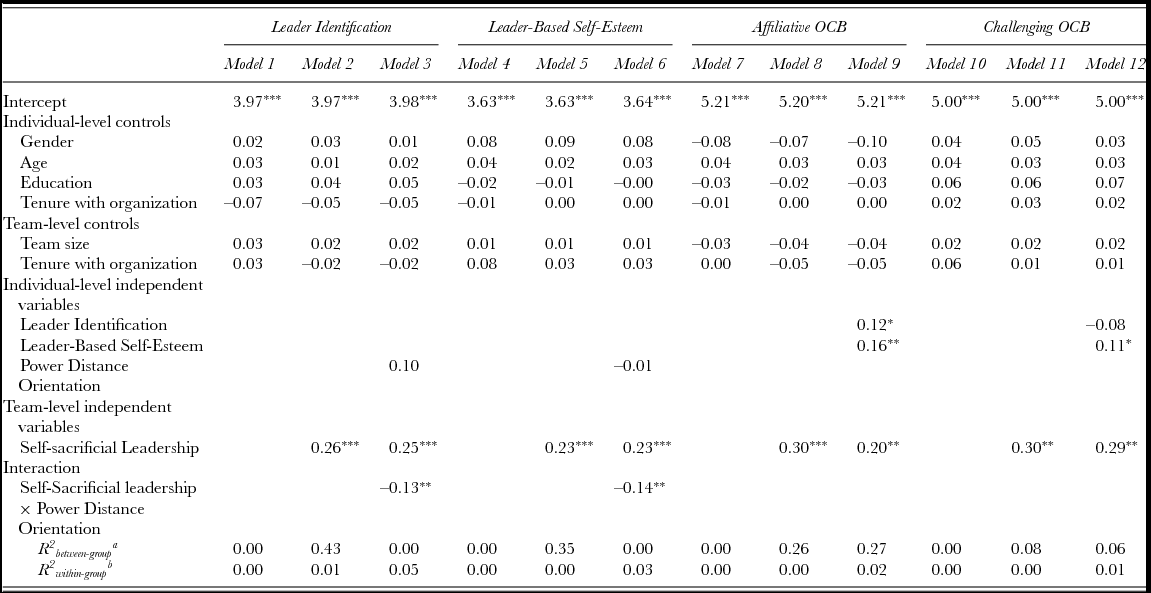
Hypotheses 1–3 proposed the main effects of self-sacrificial leadership on followers’ leader identification, leader-based self-esteem, and two types of OCB. Table 2 shows the HLM regression results. It can be seen from Model 2 that self-sacrificial leadership was positively related to follower leader identification (γ = 0.26, p < 0.001), demonstrating Hypothesis 1. Self-sacrificial leadership was also positively related to follower leader-based self-esteem (γ = 0.23, p < 0.001) as shown in Model 5, supporting Hypothesis 2. For citizenship behaviors, self-sacrificial leadership was not only positively related to affiliative OCB (γ = 0.30, p < 0.001; Model 8), but also positively related to follower challenging OCB (γ = 0.30, p < 0.01; Model 11), thus demonstrating Hypotheses 3a and 3b, respectively.
HLM results: Main and interactive effects of self-sacrificial leadership and power distance orientation on follower affiliative OCB and challenging OCB
Notes: a b These are R-square difference compared to the previous model; n = 83 at team level, n = 329 at individual level; *p < 0.05, **p < 0.01, ***p < 0.001.
Mediating effects
Hypothesis 4 suggested that leader identification mediated the relationship between self-sacrificial leadership and follower affiliative OCB, whereas Hypotheses 5a and 5b proposed that leader-based self-esteem mediated the relationships between self-sacrificial leadership and follower affiliative and challenging OCBs. To test these mediation relationships, we first followed Baron and Kenny's (Reference Baron and Kenny1986) procedure to discern the preconditions of a mediation relationship. First, as demonstrated in Hypotheses 1 and 2, self-sacrificial leadership was significantly and positively related to followers’ relational self-concepts of leader identification and leader-based self-esteem. Second, self-sacrificial leadership was also positively related to followers’ affiliative and challenging OCBs as demonstrated in Hypotheses 3a and 3b. Third, when both self-sacrificial leadership and followers’ relational self-concept constructs were entered into the regression model simultaneously (see Models 9 and 12 in Table 2), the mediator of leader identification was only positively related to affiliative OCB (γ = 0.12, p < 0.05), but not challenging OCB (γ = –0.08, n.s). In contrast, the mediator of leader-based self-esteem was positively related to both affiliative OCB (γ = 0.16, p < 0.01) and challenging OCB (γ = 0.11, p < 0.05). Moreover, compared to the result shown in Models 8 and 11 in Table 2, the coefficients of the relationship of self-sacrificial leadership with affiliative OCB (γ = 0.20, p < 0.01) and challenging OCB (γ = 0.29, p < 0.01) were both diminished. These findings provided initial support for Hypotheses 4 and 5 (Baron & Kenny, Reference Baron and Kenny1986).
Following Preacher, Zyphur, and Zhang's (Reference Preacher, Zyphur and Zhang2010) methods, we conducted a parameter bootstrapping procedure to substantiate a cross-level mediation relationship in a more robust manner. The results, based on 20,000 Monte Carlo replications, showed that the indirect relationship between self-sacrificial leadership and affiliative OCB via leader identification was significant (Indirect Effect = 0.03, 95% CI = [0.01, 0.06]). Thus, Hypothesis 4 was demonstrated. In addition, the indirect relationships between self-sacrificial leadership and affiliative OCB (Indirect Effect = 0.04, 95% CI = [0.02, 0.06]) and challenging OCB (Indirect Effect = 0.03, 95% CI = [0.001, 0.05]) via leader-based self-esteem were both significant. These results along with the above findings demonstrated Hypotheses 5a and 5b.
Moderated mediation effects
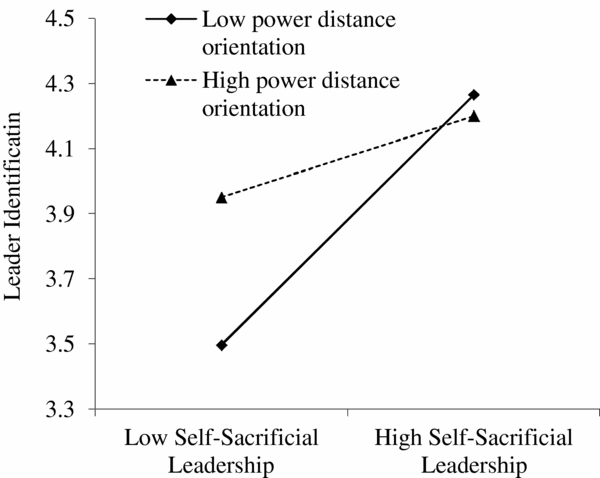
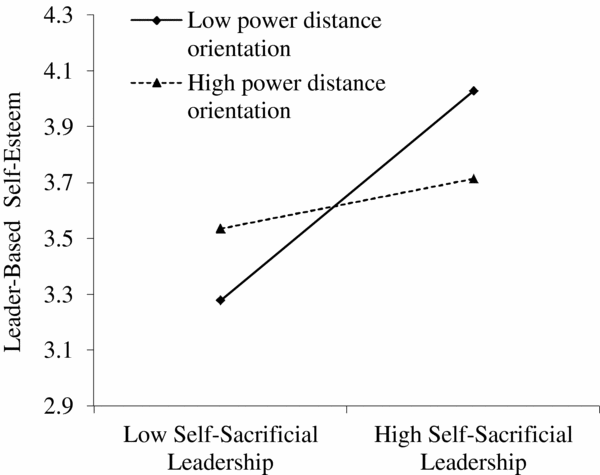
To examine the moderating roles of individual power distance orientation in the mediational relationships demonstrated above (i.e., Hypotheses 6 and 7), we started by examining the simple two-way interaction between self-sacrificial leadership and power distance orientation and the relationship with leader identification and leader-based self-esteem. The results of Model 3 and Model 6 in Table 2 suggested that the interaction term of self-sacrificial leadership with power distance orientation had a significant and negative relationship with followers’ leader identification (γ = –0.13, p < 0.01) and leader-based self-esteem (γ = –0.14, p < 0.01). We then followed Preacher, Curran, and Bauer (Reference Preacher, Curran and Bauer2006) in conducting simple slope tests. Figure 2 depicts the interaction effect on leader identification. It can be seen that the relationship between self-sacrificial leadership and followers’ leader identification was significantly positive only when the power distance orientation was low (γ = 0.38, p < 0.001) rather than when it was high (γ = 0.13, n.s). Figure 3 depicts the interaction effect on leader-based self-esteem. In a similar vein, the relationship between self-sacrificial leadership and followers’ leader-based self-esteem was significantly positive only when the power distance orientation was low (γ = 0.38, p < 0.001) rather than when it was high (γ = 0.09, n.s).
Interactive effect of self-sacrificial leadership and power distance orientation on follower leader identification
Interactive effect of self-sacrificial leadership and power distance orientation on follower leader-based self-esteem
In accordance with prior research (e.g., Zhang, Lepine, Buckman, & Wei, Reference Zhang, Lepine, Buckman and Wei2014), we worked through the following steps to examine our cross-level moderated mediation effect. First, we calculated the simple slopes and the standard errors (Aiken & West, Reference Aiken and West1991; Preacher et al., Reference Preacher, Curran and Bauer2006) for self-sacrificial leadership in predicting followers’ leader identification/leader-based self-esteem (Path a; MacKinnon, Lockwood, Hoffman, West, & Sheets, Reference MacKinnon, Lockwood, Hoffman, West and Sheets2002) under two conditions (high versus low power distance orientation) using data obtained from the asymptotic variance/covariance matrix of the regression coefficients produced by HLM. Second, we calculated Path b (i.e., followers’ leader identification/leader-based self-esteem predicting their citizenship behaviors when controlling for self-sacrificial leadership). Third, we obtained the indirect effect estimates (multiplying Path a by Path b) and then determined their 95% confidence intervals by bootstrapping 20,000 replications. Last, we obtained the confidence intervals of the difference between the two indirect effect estimates by bootstrapping 20,000 replications using the R software (Preacher & Selig, Reference Preacher and Selig2012) to determine the significance of the difference.
Table 3 shows the results obtained from the above analytical procedures. Consistent with our expectations, self-sacrificial leadership was positively and indirectly related to followers’ affiliative OCB (via followers’ leader identification) when the power distance orientation was low (Estimate = 0.05, 95% CI = [0.01, 0.09]). However, this indirect effect was not significant (Estimate = 0.02, 95% CI = [–0.001, 0.04]) when the power distance orientation was high. Further, the result of the Monte Carlo simulation with 20,000 replications suggested that the difference in the magnitude of the two indirect relationships was significant (Difference = –0.03, 95% CI = [–0.07, –0.001]). Taken together, Hypothesis 6 was supported.
A summary of moderated mediation results
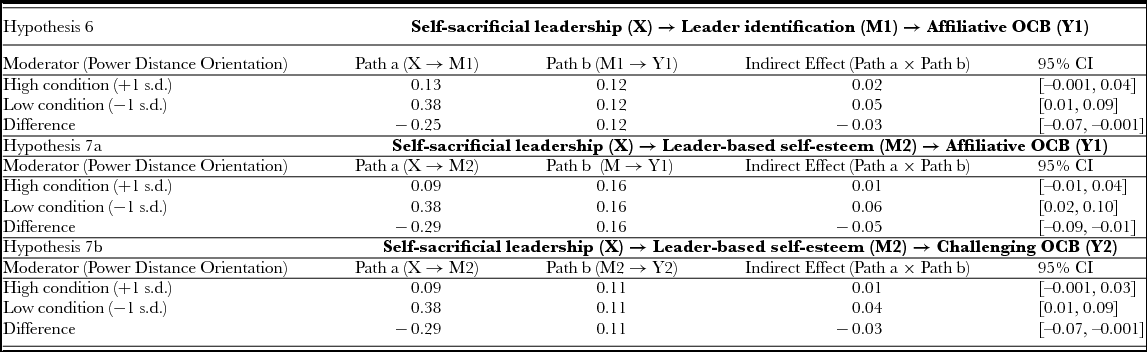
With respect to the indirect relationships via leader-based self-esteem, the results in Table 3 suggested that the indirect relationship between self-sacrificial leadership and followers’ affiliative OCB via leader-based self-esteem was significant only among followers with a low power distance orientation (Estimate = 0.06, 95% CI = [0.02, 0.10]) rather than among followers with a high power distance orientation (Estimate = 0.01, 95% CI = [–0.01, 0.04]). The difference in the magnitude of the two indirect relationships was significant (Difference = –0.05, 95% CI = [–0.09, –0.01]). Thus, Hypothesis 7a was demonstrated. In addition, the indirect relationship between self-sacrificial leadership and followers’ challenging OCB via leader-based self-esteem was found to be significant only among followers with a low power distance orientation (Estimate = 0.04, 95% CI = [0.01, 0.09]) rather than among followers with a high power distance orientation (Estimate = 0.01, 95% CI = [–0.001, 0.03]). The difference in the magnitude of the two indirect relationships was also significant (Difference = –0.03, 95% CI = [–0.07, –0.001]). Thus, Hypothesis 7b was demonstrated.
DISCUSSION
Drawing from the relational self-concept perspective, we theorized a multilevel model regarding whether, why, and when self-sacrificial leadership motivates followers’ affiliative and challenging citizenship behaviors. Data from 329 full-time Chinese employees in 83 work groups provide support for our research model. Specifically, we demonstrated the positive cross-level relationships between self-sacrificial leadership and followers’ relational self-concept constructs of leader identification and leader-based self-esteem, which mediated the positive relationship between self-sacrificial leadership and affiliative OCB. In addition, we found a positive cross-level relationship between self-sacrificial leadership and challenging OCB as mediated by leader-based self-esteem. We further demonstrated individual power distance orientation as one important cultural contingency in the above mediation relationships. The results suggested that the mediation relationships existed only when followers’ power distance orientation was low rather than when it was high. We next discuss the theoretical and practical implications of our findings.
Theoretical Implications
The major contribution of our study is to extend the research on self-sacrificial leadership to the Chinese context by revealing when and why it motivates Chinese followers to engage in OCB. Although previous studies conducted in the Western settings (e.g., De Cremer & van Knippenberg, Reference De Cremer and van Knippenberg2002; De Cremer et al., Reference De Cremer, Mayer, van Dijke and Schouten2009) have revealed convergent findings that self-sacrificial leadership can significantly give rise to followers’ affiliative citizenship behaviors such as collaboration and helping, our findings showed that Chinese followers may respond differently to the leader's self-sacrificial behaviors, depending on the cultural value of power distance orientation. Chinese with lower levels of power distance orientation are more likely than their counterparts to identify with and gain self-esteem from the leaders who display self-sacrificial behaviors, and in turn, more likely to engage in not only affiliative OCB but also challenging OCB (i.e., voice). We are not suggesting that self-sacrificial leadership is less effective in the Chinese context in which people are generally regarded as having higher levels of power distance orientations than people in the Western countries (Hofstede, Reference Hofstede1980). Instead, our focus is purely on the within-country variations in the cultural value of power distance orientation and how these value differences shape the influences of self-sacrificial leadership on individual relational self-concept construction. This focus is rather necessary as recent research has suggested that individual cultural values have been changing in China and the new generation of Chinese may become lower in power distance orientation (c.f., Chen & Aryee, Reference Chen and Aryee2007).
Although our results regarding the moderating role of power distance orientation are consistent with prior empirical findings that high power distance orientation employees react less positively to the leader's decentralized managerial practices such as delegation (Chen & Aryee, Reference Chen and Aryee2007), self-management (Kirkman & Shapiro, Reference Kirkman and Shapiro1997), and transformational behaviors (e.g., Kirkman et al., Reference Kirkman, Chen, Farh, Chen and Lowe2009), some recent studies have observed the opposite. For instance, Chen et al. (Reference Chen, Zhang and Wang2014) found that the effect that management control strengthened the positive relationship between leader power sharing and employee psychological empowerment was more significant among employees with high rather than low levels of power distance orientation. At the team level, higher power distance teams were found to exhibit stronger positive effects of transformational leadership on team potency (Schaubroeck, Lam, & Cha, Reference Schaubroeck, Lam and Cha2007). These conflicting empirical findings may be attributable to the different outcomes of leadership being studied (e.g., self-concept constructs, psychological empowerment, and team potency). Thus, we urge future research to examine more psychological outcomes of leadership in the Chinese context and directly compare the mechanisms underlying the moderating effect of power distance orientation to unravel when and why high power distance orientation strengthens or weakens the leadership effectiveness in the Chinese context. For instance, future studies can extend our empirical findings by directly examining the effects of self-sacrificial leadership on subordinates’ perceived prototypicality, legitimacy, and justice of their leaders among employees with different levels of power distance orientation.
Our second contribution is to the self-concept based leadership research. The prior research has demonstrated individual collective self-concept constructs, such as collective identification, as meaningful mechanisms accounting for the effects of positive leadership behaviors (e.g., self-sacrificial leadership) on follower OCB (e.g., De Cremer & van Knippenberg, Reference De Cremer and van Knippenberg2005). Scholars from the self-concept based leadership research (e.g., Gardner, Avolio, Luthans, May, & Walumbwa, Reference Gardner, Avolio, Luthans, May and Walumbwa2005; Lord & Brown, Reference Lord and Brown2001; van Knippenberg et al., Reference van Knippenberg, van Knippenberg, De Cremer and Hogg2004) encouraged studies examining how leaders influence follower self-concept construction, and how followers’ self-concept in relation to the leader (i.e., relational self-concept) in turn influences their work behaviors. We responded to this call and identified leader identification and leader-based self-esteem as two critical dimensions of relational self-concept that are associated with self-sacrificial leadership, relating to different types of follower OCB in China. Whereas leader identification was positively related to affiliative OCB only, leader-based self-esteem was positively related to both affiliative OCB and challenging OCB. Their differential mediation effects support van Knippenberg et al.’s (Reference van Knippenberg, van Knippenberg, De Cremer and Hogg2004) argument that multiple aspects of self-concept should be considered simultaneously when examining the motivational mechanisms of leadership behaviors.
It is worth noting that although power distance orientation moderates the relationships between self-sacrificial leadership and the two self-concept constructs (i.e., leader identification and leader-based self-esteem) in the similar pattern as shown in Figures 2 and 3, the overall forms of these two interactions differ. Specifically, whereas high power distance orientation employees showed significantly higher levels of leader identification than their counterparts (r = 0.11, p < 0.05; see Table 1), they did not show significantly higher levels of leader-based self-esteem than their counterparts (r = –0.03, n.s., see Table 1). This difference indicates that the reason for high power distance orientation's weakening effect on the link between self-sacrificial leadership and leader identification may be different from the reason for its weakening effect on the link between self-sacrificial leadership and leader-based self-esteem. Whereas high power distance orientation employees’ leader identification may be too high to be further increased by leaders’ self-sacrificial behaviors, their leader-based self-esteem cannot be increased by self-sacrificial leadership because of the incongruence between their implicit beliefs and the leaders’ self-sacrificial behaviors as we explained.
Finally, the differential mediating roles of leader identification and leader-based self-esteem played in the relationships between self-sacrificial leadership and two forms of follower OCB as demonstrated in our study also advance the OCB literature by providing empirical evidence for the distinction between affiliative OCB and challenging OCB. Whereas affiliative OCB was found to be associated with both leader identification and leader-based self-esteem, challenging OCB was found to be associated with leader-based self-esteem only. These findings not only support McAllister et al.’s (Reference McAllister, Kamdar, Morrison and Turban2007) argument that affiliative OCB and challenging OCB have different motivational mechanisms, but also suggest that the can-do motivation derived from the leader (i.e., leader-based self-esteem) is more important than the want-to-do motivation derived from the leader (i.e., leader identification) in soliciting follower challenging OCB, which is unconventional and risky.
Limitations and Future Research Directions
Our research has several limitations that need to be addressed by future research. First, although we collected data from multiple sources and aggregated the independent variable of self-sacrificial leadership into the group-level to avoid the common method bias, the cross-sectional nature of our study precludes us from making strong causal inferences. Therefore, we encourage future researchers to collect longitudinal data to replicate our findings.
Also because of the cross-sectional design, another major limitation of the present study is the endogeneity issue (Antonakis, Bendahan, Jacquart, & Lalive, Reference Antonakis, Bendahan, Jacquart and Lalive2010). Because we did not control for other leadership behaviors that are conceptually similar to self-sacrificial leadership, such as charismatic leadership and transformational leadership, it is possible the effects of self-sacrificial leadership we observed in this study are attributed to the effects of the omitted variables (i.e., similar leadership behaviors). Thus, we encourage future researchers to examine the effect of self-sacrificial leadership by controlling for similar leadership behaviors or by designing experimental studies to address the issue of endogeneity. Conceptually, even though we focused on relational self-concept as the underlying mechanism mediating the relationship between self-sacrificial leadership and follower OCB, the influences of collective self-concept constructs (e.g., group identification and organization-based self-esteem) should be controlled as previous research has validated their roles in linking leadership behaviors to follower outcomes (e.g., De Cremer & van Knippenberg, Reference De Cremer and van Knippenberg2005). Therefore, we agree with van Knippenberg et al. (Reference van Knippenberg, van Knippenberg, De Cremer and Hogg2004) and call for future research examining the mediating role of different aspects of the self from both the collective and relational perspectives simultaneously.
Last, we encourage future researchers to take a deeper examination into the relationship between leader identification and follower's challenging OCB, particularly voice behavior. Although we theorized and observed an insignificant relationship, other research found a significant and positive relationship between leader identification and voice (Liu, Zhu, & Yang, Reference Liu, Zhu and Yang2010). Future research should re-examine this relationship by adopting several new perspectives. For example, it is very likely that followers with high leader identification and those with low leader identification tend to use different tactics to voice. Whereas the former prefers a more moderate and indirect way, the latter may use a more challenging and direct way. Thus, it is interesting to take into account the content of voice and theorize the effects of leader identification on different forms of voice, such as supportive voice and challenging voice (Burris, Reference Burris2012), considerate voice and aggressive voice (Hagedoorn, Van Yperen, Van de Vliert, & Buunk, Reference Hagedoorn, Van Yperen, Van de Vliert and Buunk1999), and promotive voice and prohibitive voice (Liang et al., Reference Liang, Farh and Farh2012).
Practical Implications
Our findings have several important practical implications for Chinese leadership. The first implication is straightforward: to attract follower OCB, leaders should display self-sacrificial behaviors, such as do more and get less in the workplace and abandon privileges associated with the authority power (Choi & Mai-Dalton, Reference Choi and Mai-Dalton1998). In addition to self-sacrificial leadership, leaders can solicit OCB from followers by increasing their perceptions of leader identification and leader-based self-esteem. Specifically, leaders should treat followers as in-group members to make followers regard their leader-follower social relationships as significant and important. Moreover, leaders should enhance follower's self-worth perceptions by recognizing followers’ competence and significance to them during their interactions with the followers.
The third managerial implication is that leaders should learn to recognize the different levels of power distance orientation in their followers and understand that self-sacrificial leadership will be more effective in increasing followers’ leader identification and leader-based self-esteem, which have downstream implications for OCB, among individuals with low rather than high power distance orientation.
CONCLUSION
A growing body of leadership research has focused on leaders’ self-sacrificial behaviors and examined whether or not self-sacrificial leaders can ignite followers’ prosocial fire in the workplace. In this study, we extend this line of research to the Chinese context and demonstrate that Chinese leaders’ self-sacrificial behaviors will be positively related to low power distance orientation followers’ leader identification and leader-based self-esteem, which have differential implications for different types of OCB. Whereas leader identification is found to facilitate affiliative OCB only, leader-based self-esteem is found to facilitate not only affiliative OCB but also challenging OCB from the followers. We hope our research provides insights into the effects of self-sacrificial leadership on Chinese followers’ psychological reactions and organizational behavior.



