


In this introductory part, we elaborate on the capability model and explain why the essence of the model (that people can have the identities they want to have and can do the things that add value to themselves and their environment) and the well-being aspect fit well with ideas about work in which people are not only a means of production, but also values in themselves, with the right to valuable work.
It is argued that the original elaboration of sustainable employability, which looked at capabilities within work for the first time, still provides a solid foundation for involving the capability model in work. A practice-oriented vision, with an eye to the context and diversity of that practice, requires a different view of science. Notably, social justice is a crucial aspect and even a foundational component of the model. We argue that combining contributive justice with the model adds value, both conceptually and in practice.
There are some paradoxes in assessing capabilities. The openness of the capability approach (CA) makes it an integrative approach that is very compatible with other theories of the fields of work, health, and behaviour.
The following chapters are included in this part:
1. The Capability Model for Work: An Introduction
2. Capabilities and Work: New Developments toward Sustainability and Well-Being in Work
3. The Capability Approach in Relation to Contributive Justice
4. The Paradox of Capability Assessment: Investigational Requirements Associated with Adopting Capability as the Informational Focus of a Theory of Justice
5. The Integrative Aspects of the Capability Approach
6. Integrating the Capability Approach with Other Theories of Work and Employee Health and Well-Being
Introduction
To clarify the aims underlying this book, we share a short anecdote with you. Of course, we do not know for sure if this story is entirely true, but it provides excellent food for thought about what this book is about.
The anecdote is about the rebuilding of St Paul’s Cathedral in London. The architect Sir Christopher Wren designed and supervised the construction of more than fifty churches in London following the Great Fire of 1666. The reconstruction of St Paul’s Cathedral was his masterpiece.
The story begins with Sir Christopher walking among the many workers building the cathedral. Apparently, he was not known to many of them. As he surveyed the progress of the building, he stopped and asked three different workers, all of whom were engaged in the same task, what they were each doing. He received three different answers. The first said, while acting a bit irritated, “You can see what I am doing, I am cutting this stone.”
The second answered, “I am earning three shillings, six pennies a day, to support my family.”
The third man straightened up, squared his shoulders, and, overlooking the building site, replied, “I am helping to build the most beautiful cathedral in London.”
This anecdote illustrates that people have different evaluations of the meaning of their work, ranging from work done as imposed labour and experienced as a burden to work as a means to acquire income and an existence to work seen as a means to contribute to something of personal and social value.
The anecdote shapes the aspiration underlying this book that all workers should be seen as builders of cathedrals – cathedrals of flourishing working lives. A second ambition is for workers to see themselves as cathedral builders. To clarify our third ambition, we expand the anecdote slightly.
It is tempting to attribute the three such different answers Sir Christopher obtained to a difference in personality or upbringing. However, we know on theoretical [Reference Bandura1, Reference Hackman and Oldham2, Reference Schein3] and empirical [Reference Amabile, Conti, Coon, Lazenby and Herron4–Reference Lazarus and Folkman7] grounds and from practice that context is often more important than personal characteristics. For example, the three workers might have worked under contracts with three different supervisors.
The first worker’s boss might have said: “Here is a pile of rough stones, and here are your tools. When I come back, I expect a pile of smooth, stackable stones.” The boss of the second worker may have said: “I know that your wife is sick and you need extra money for your family. I have a job for you here; it is hard work, but because of that, it is well paid.” The boss of worker three may have said: “We are responsible with a group of five for that piece of wall of the cathedral that we are building. There are rough materials and tools. It should be carved, carried, stacked and bricked. You are professionals; see for yourself how you organise your work together within this magnificent project.”
Of course, this is a fantasy projected from the present to the past. However, it clarifies our third ambition, which involves how workers’ immediate social conditions should enable them to build great cathedrals of flourishing working lives. In this book, we argue that the CA can serve as a vehicle to achieve these goals. This value-driven approach focuses on normativity, diversity, and contextuality, aligning with the normative views of both the scientific and professional fields of work and health. The ambitions in these fields form an assignment, which means that science and scientific theories should improve the world and not just explain and analyse it. This view is fortunately becoming increasingly common and congruent with the field of occupational practice and the professionals working in that field, who want to create flourishing work environments rather than just understanding why work is often degrading or exclusionary for so many people.
The Capability Approach
To begin our elaboration of the CA, we take as a starting point the questions that have always been central to Amartya Sen, the founder of the approach. These questions concern what is truly important for people in their lives and how to recognise a society that facilitates this. The most general answer to these questions is that people should have a set of capabilities or a set of diverse freedoms. According to Sen, a capability exists when someone has the freedom to do or be what theyFootnote 1 have good reason to value. As stated earlier, our view of this book is that if workers can be who they want to be in their work and do the things that add value for themselves and their working environment, this contributes to well-being and flourishing at work.
Functioning, another important concept in capability theory, is the actual realisation of freedom or capabilities. What people find important in their lives is subjective, and what they are free to do and be is contextual and objectifiable. It is a shared responsibility of the individual and the social context to build and maintain a set of capabilities necessary to realise a valuable life. The extent to which people have the freedom to realise their personal goals can be measured and objectified. This measurability and objectivity are important ambitions of Sen; thus, capabilities transcend the subjectivity of satisfaction or well-being.
By formulating the achievement of personal values and goals as a social goal and as entitlements or rights, the CA is able to realise deontological (virtue) ethics within the consequential (purpose ethics) reality of everyday life that people – and organisations – have and should have goals. However, in our society and economy, all activities and services, especially paid work, are at risk of being reduced to their strictly economic goals. It is a consequential pitfall to promote services aimed at participation and well-being, as if they will always contribute to the efficiency and productivity of employees. That is an economic, not a health and well-being, objective. In many cases, promoting health contributes to the organisation’s economic goals. However, the added ‘deontological’ value of our work as health professionals is precisely that workers have the right to a broader value perspective.
Sen does not find the debate between deontologists and consequentialists very interesting. That is understandable from his broader societal perspective. For us, from the perspective of the (by definition purpose-oriented) work context and work organisation, the debate is indeed interesting. Sen highlights the debate between ‘Niti’ and ‘Nyaya’ as much more relevant ([Reference Sen8]; see next section). In our view, the CA implicitly unites deontology and consequentialism and thus integrates and transcends them. It achieves this synthesis both by introducing deontological values within a purpose-oriented reality and by the vision that the purpose can also lie in a good process of virtuous behaviour.
Niti and Nyaya; Contract Thinkers and Outcome-Realisation Thinkers
To do justice to both positions, we first discuss ‘Niti’ and ‘Nyaya’ and then explain the perspectives mentioned earlier, deontology and consequentialism. In his seminal book The Idea of Justice, Sen identifies two ethical movements that originated from the European Enlightenment that aimed to realise a just society: social contract thinkers versus realisation-oriented thinkers or ‘Niti’ versus ‘Nyaya’ in Old Indian writings [Reference Sen8].
In the view of contract thinkers, often based on an ideal theoretical model, perfectly just social arrangements and institutions are needed, grounded in a so-called social contract. This is an implicit and hypothetical agreement about the distribution of power. It can be inferred that the starting point of contract thinkers is essentially a negative view of men (and women): good behaviour is not a natural choice for people, but policies and regulations must enforce it.
Sen identifies two problems with the contract approach (‘Niti’) [Reference Sen8]. First, there is no accepted agreement about a ‘just society’. Second, this approach does not help solve the fundamental problems of real-world social injustice. Slavery and apartheid, for example, could have existed despite being evident injustices within a social contract framework legitimised by so-called right institutions and regulations.
What Sen argues for institutional concepts of justice also applies to scientific theories. These must be assessed normatively for their effect in practical situations. Bad theories, as we know from experience in diverse fields, can legitimise the dehumanisation of people and cause great violence, resulting in the decimation of people. Sen claims this, for example, with respect to Thomas Malthus’s theory. Malthus argues that when population growth exceeds food production growth, famines are a ‘natural’ consequence of rebalancing population size and food availability [discussed in Reference Drèze and Sen9]. By giving credence to the theory and understanding of famines as a type of natural event, governments did not intervene to curtail mass deaths. In various publications produced jointly with Jean Drèze, Amartya Sen showed how Malthusian theory was conceptually flawed and how measures could have been taken to prevent the deaths of millions of people from starvation [Reference Drèze and Sen9]. If we do not assess theories for their practical effects, they can have severe consequences.
The other movement, driven by outcome-realisation thinkers, ‘Nyaya’ in Old Indian writings, makes comparisons between different ways in which people’s lives can be led, that is, actual realisation. The outcomes are influenced not only by institutions but also by people’s actual behaviour, social interactions, and other factors. Sen, an advocate for ‘Nyaya’ or outcome-realisation approaches, argues that we should focus on removing injustices that most or all of us are likely to agree on and that can be alleviated. Sen is convinced that most people immediately recognise injustice in their immediate environment and want to eliminate it. They do not need a theory for that.
The starting point is that people make rational choices from a broader perspective than only or primarily self-interest. The public interest is, in many cases, a voluntary choice of people and does not have to be regulated or enforced in a contract. This reflects a positive view of humanity, as also advocated by Habermas, who strongly suggests that human communication and rational discourse naturally lead to cooperative and prosocial behaviour under the right conditions [Reference Habermas, Habermas and Habermas10]. In Chapter 3, this is nuanced in the sense that this applies to the vast majority of humanity, but a small percentage abuses the circumstances and the institutional context for malicious purposes. See Chapter 3 for an elaborate discussion of this.
Nomothetic and Ideographic Perspectives
The concepts of ‘Niti’ and ‘Nyaya’ (as indicated by the ancient Indian equivalents of contract thinkers and result realisation thinkers) also resemble the nomothetic and ideographic perspectives. These perspectives play a role in the argumentation in Chapter 2. In short, the nomothetic perspective focuses on discovering general regularities and rules that are widely applicable to greater groups and populations; the ideographic perspective focuses on understanding specific phenomena in their unique context that are directly applicable in a specific practice.
As mentioned, another important philosophical distinction is between deontology and consequentialism. We will briefly explain these concepts now.
Deontology and Consequentialism/Utilitarianism
First, we explain consequentialism, focusing on utilitarianism, as it is the primary contemporary representative of this philosophical approach. Second, we discuss the deontological perspective, with Kantianism as its most important representative.
From the utilitarian perspective, developed in its classic form by Bentham [Reference Bentham11], Mill [Reference Mill12, Reference Mill13], and Sidgwick [Reference Sidgwick14], behaviour is considered right if it accomplishes the best possible outcome: ‘the greatest good for the greatest number of people’. Any action that accomplishes this objective is seen as right, regardless of whether the action violates certain actors’ rights in the process. Note that the utilitarian perspective on justice does not guarantee justice for all, as there is no guarantee for the rights of the few or ‘minorities’ of various kinds. If total happiness outnumbers the unhappiness of a small disadvantaged group, it meets the central premise of utilitarianism.
The Kantian perspective on right behaviour is different in this important respect. Kant takes a duty-ethical perspective in that morality lies in the rightness of the action itself and the obligation one has towards the other and not in the outcome of that action [Reference Kant15]. The starting point is that autonomous human beings can choose rationally and be held responsible for their choice. Kant stated this premise in several formulations of the categorical imperative. The second formulation (also called the formulation of humanity) states that an actor should always see themself or any other actor as a holder of value in themself; literally, ‘act in such a way that you treat humanity, whether in your own person or in the person of any other, never merely as a means to an end, but always at the same time as an end’.
Kantian ethics informed the underpinning theory for the formulation of universal human rights in general and the movement for the abolition of slavery in particular. Women’s rights, labour rights, and the rights and emancipation of minorities can also be founded or justified only deontologically. Consequential reasoning, despite being entrenched in our contemporary ways of thinking, does not provide a solid basis for human rights. Rights are useful for consequentialists, specifically utilitarians, if they lead to an overall good outcome; otherwise, they are not useful.
As indicated earlier, the CA essentially unites both perspectives (virtue ethics and purpose ethics) and thus neutralises them. It is, therefore, logical that Sen finds the distinction less meaningful. However, in our field of work and health, we find the distinction relevant to clarify certain matters. For example, as stated above, the added ‘deontological’ value of work is that workers deserve a broader value perspective than a narrow financial‒economic perspective. As a counterpart, there is also an obligation on the individual to build and maintain the ability to achieve important goals. This duality of entitlements and responsibility is an important aspect of the CA.
Capability Approach Focused on Values within Work
Research shows that for present-day workers, contributing to something valuable at work is an important aspect of their quality of working life and sustainable employability [Reference Gheaus and Herzog16, Reference Jahoda17, Reference Van der Klink, Bültmann, Burdorf, Schaufeli, Zijlstra and Abma18]. Therefore, the challenge in all workplaces is to identify what the important values are and how people are able and enabled to achieve them. Importantly, in the work context, until recently, in the capability tradition, work as such was seen as a capability (i.e., the importance of work in itself for well-being in general). Capabilities (well-being) within work (i.e., of specific aspects of work) have not been investigated. This aspect is elaborated upon in this book. This reflects the focus we have imposed on ourselves in this book: we address the normative aspect of the values people should be able to achieve within their work. Naturally, we also consider the normative nature of the CA regarding the way society and the economy are organised and the extent to which this facilitates, restricts, enables, or prevents the achievement of capabilities at work (see, e.g., Chapters 5 and 12). We are also fully aware of the clear warning by Gloss et al. [Reference Gloss, Carr, Reichman, Abdul-Nasiru and Oestereich19] that important goals and values are often not realised for population groups already living in poverty, where poverty, as Sen also demonstrated, equates to the lack of freedom to achieve important goals and values. Gloss et al., like us, argue that the CA offers the best guarantee against this risk. We discuss Gloss et al.’s article in more detail later on.
Conversion Factors
In the CA, resources – ‘means to achieve’ such as income and wealth but also health or labour conditions – have value only because of what individuals can be and do through ‘converting’ such means into valuable outcomes. This reflects the importance of conversion factors in the model. For Sen, equity in capabilities – ‘equal freedoms to achieve important goals people have/equal opportunities’ – is important and not equal in terms of resources (equal means), as in most economic and political philosophical theories [Reference Sen20] (Figure 1.1).
Equity in resources versus equity in capabilities.
Note: Artist: Bert Cornelius, © by Jac van der Klink. The image might be inspired by a picture of the Interaction Institute for Social Change, Artist: Angus Maguire.


Broad Applications of the Capability Approach
In addition to serving as a guiding model within organisations such as the United Nations, the Organisation for Economic Co-operation and Development, and the World Bank, the CA also has important applications outside the economy, including healthcare and education. In 2016, a consortium of Dutch researchers applied the capabilities approach to work and health [Reference Van der Klink, Bültmann, Burdorf, Schaufeli, Zijlstra and Abma18]. As stated earlier, they hypothesised that, in this practice and scientific domain, increasing work capabilities – the freedom to achieve values at work – contribute to the sustainable employability of employees. Their work is partly the basis of this book. In Chapter 2, they reflect on their work and the spin-off it had.
Adopting the CA implies both rights (entitlements for inclusivity in the work context) and responsibilities. This assumes that the individual worker must be both able and motivated to work. Furthermore, the work context should enable the performance of valued tasks that contribute to goals that are personally important and valued by the organisation.
A Capability Model for Work and Health
In Figure 1.2, the essential elements of the capability model for work are visualised.
The capability model for work and health.
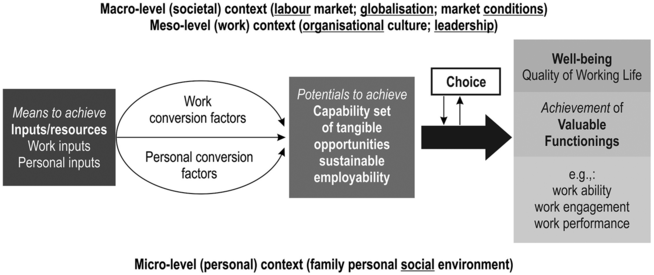
Figure 1.2 Long description
The means to achieve inputs or resources include work and personal inputs. These inputs are then processed through Work conversion factors and Personal conversion factors creating potentials to achieve capability set of tangible opportunities for sustainable employability. A Choice element acts as a mediator before reaching final outcomes which include well-being (Quality of Working Life) and specific achievements of valuable functionings like work ability, engagement, and performance. The macro level or the societal context includes the labour market, globalisation, and market conditions. The meso-level or the work context involves organisational culture and leadership. The micro-level or the personal context covers the family and personal social environment.
Figure 1.2 illustrates that workers possess resources or work inputs, including personal capacity, task structure, and work demands. These work inputs are not determinants of sustainable employability; instead, they are factors that can lead to a set of capabilities and achievable opportunities, provided that appropriate conversion factors are in place. Cutting stone, for example, is a burden in itself but is converted into a lesser burden if it is seen as contributing to building a cathedral.
The capability model, therefore, enables us to shape the ambition that employees see themselves as cathedral builders. Thinking in terms of values also realises the ambition that professionals see workers as cathedral builders. Finally, the contextual nature of the model, with contextual conversion factors translated as entitlements, shapes the third ambition.
Two Complementary Normative Approaches
As mentioned earlier, almost simultaneously with Van der Klink et al.’s [Reference Van der Klink, Bültmann, Burdorf, Schaufeli, Zijlstra and Abma18] article, Gloss et al. [Reference Gloss, Carr, Reichman, Abdul-Nasiru and Oestereich19] published an article that emphasised the importance of fostering environments in which individuals can flourish, not only in terms of performance but also in overall well-being and meaningful work. In both approaches, a normative starting point is used as a vehicle to achieve this ambition. Gloss et al. argue that industrial-organisational psychology has a strong bias towards POSH perspectives – Professionals, Official jobs in the formal economy, groups that are relatively Safe from discrimination, and High-income countries. The authors argue that this bias ignores the experiences and needs of individuals and communities living in multidimensional poverty, which hampers the discipline’s scientific progress, practical effectiveness, and moral responsibility. As mentioned earlier, their article contains a clear warning; in the storyline of the present chapter, this is the warning that the three ambitions mentioned earlier will not be realised for population groups that are already deprived.
In line with this, Gloss et al. [Reference Gloss, Carr, Reichman, Abdul-Nasiru and Oestereich19] pointed to the apparent paradox between the drive to promote work values for disadvantaged population groups on the one hand and the risk of imposing one’s own value system on other groups on the other hand. They rightly refer to the elaboration by Sen himself [Reference Sen20]. Sen argues that, first, justice-based interventions by one group on behalf of another are justified to correct major inequalities in society; second, because of the diversity in conceptualisations of justice that exist among different populations in the world, it is unjust for one group to impose its culturally value-laden conceptualisation of justice on other populations. In Sen’s analysis, the CA is aimed at resolving, or at least providing tools to resolve, the apparent conflict between the two observations described earlier.
Both approaches focus on the fundamental freedom for everyone to freely determine, revise, and pursue their own conception of what is good and just (as long as that right does not infringe on the similar right of another). Sen argues that when faced with the conflicting realities that: 1) injustices exist and must be ended; and that 2) this will inevitably involve imposing one’s culturally based value propositions on others, the best way forward is to intervene up to, but not beyond, the point at which the person whose well-being is being supported is truly free to determine their own destiny [Reference Sen20]. This genuine freedom to determine one’s own destiny (capability) is also the guiding principle within labour and health to work towards decent work in general but for threatened groups in particular, with respect to the value systems of those groups (see Chapters 5 and 12).
Outline of the Book
Part I of the book (Chapters 2–6) outlines the capability model as a foundation for sustainable employability, linking valuable work, social justice, and contributive justice. It also highlights both the challenges of assessing capabilities and the openness of the approach, which makes it compatible with other theories in work, health, and behaviour.
Chapter 2 builds on two previous studies that first introduced and operationalised the concept of sustainable employability (SE) through the CA, resulting in the development of the Capability Set for Work Questionnaire (CSWQ). The chapter summarises these foundational studies. It provides an updated account of how the relationship between SE and the CA has been further refined and extended. The chapter reviews findings from a Delphi survey among experts and addresses critical reflections from the literature. It outlines conceptual and empirical advances since 2016, distinguishing between three strands of research: Reference Bandura1) methodological work on the conceptual and measurement properties of the capability instrument; Reference Hackman and Oldham2) studies targeting specific groups of workers; and Reference Schein3) research on particular contexts and situations. The chapter ends with ongoing debates and proposes directions for future research. Finally, the chapter provides the full text of the CSWQ and a conversation guide to support its application in practice, particularly in consultation settings.
Chapter 3 positions contributive justice as an essential complement to distributive justice in work settings. It argues that contributive justice aligns more closely with the CA, particularly with Sen’s concept of freedom, and adapts Kulkarni’s definition of social justice to “equal freedom of capabilities in contribution” [Reference Kulkarni21]. This chapter emphasises that people are generally inclined towards prosocial behaviour when conditions are supportive and shows how contributive justice, combined with the CA, can foster inclusive and diverse work environments while also addressing the challenges posed by malicious intent.
Chapter 4 examines the role of capability as the central informational focus in Sen’s theory of justice. It highlights the tension between the complexity of assessing capabilities – defined not only by achieved functionings but also by genuine opportunities – and the apparent simplicity in Sen’s writings. By exploring the relationship between capability and human rights, the chapter explains this paradox. Two case studies illustrate methods for capability assessment and provide criteria for evaluating their validity and relevance. The chapter frames the CA as a realist, non-ideal theory of justice, with implications for how assessments should be designed.
Chapter 5 explores the integrative aspects of the CA in two dimensions: across disciplines and in daily practice. It explains how the CA’s openness to diverse knowledge and values has enabled its wide application, including in work and well-being. Ethically, this openness serves both to prevent harm and deprivation and to secure legitimacy for policies and practices informed by the CA. This chapter identifies the core concepts of the CA as a foundation for integration and examines how these concepts can be applied in practice, with particular attention to conversion factors and commodities, encouraging flexibility beyond existing categories.
Chapter 6 examines how the CA relates to and complements existing theories that address human flourishing, such as the International Classification of Functioning, Disability and Health, the job demands–resources model, self-determination theory, and the integrative model of behavioural prediction. It argues that the CA broadens these perspectives by focusing on improving conditions, expanding freedoms, and fostering human agency, thereby offering a more comprehensive understanding of flourishing and the conditions needed to support it.
Part II of the book (Chapters 7–10) explores how the capability model can be applied at three organisational levels: corporate governance, human resource management, and individual work. It demonstrates the model’s integrative power in identifying challenges, improvements, and solutions.
Chapter 7 links corporate governance with contributive justice, drawing on Amartya Sen’s idea of justice to frame organisational justice. It argues that fair governance must reflect stakeholder contributions and develops this through generalised stewardship theory. This model emphasises participation, process accountability, equity, integrity, and collective benefit, moving beyond transparency and distribution towards a contributive understanding of just corporate decision-making.
Chapter 8 applies the CA to human resource management (HRM) through the lens of sustainable employability. It examines strategic HRM, showing how the approach can support both employee and organisational goals, and inclusive HRM, where it serves as a framework for promoting access to decent work for vulnerable groups. The chapter concludes with future research directions for applying the CA to HRM at the individual, organisational, and societal levels.
Chapter 9 examines the CA in relation to decent work and flourishing at work. It highlights how combining these frameworks deepens the understanding of employment quality by linking job security, fair conditions, and rights with well-being, growth, and fulfilment. The chapter shows how integrating capabilities, decent work, and flourishing can guide organisations and policymakers towards promoting dignity, agency, and broader human development beyond minimum labour standards.
Chapter 10 illustrates the practical application of the CA in organisations at the individual, team, and boardroom levels. It presents examples such as supervisor–employee dialogues, workshops, capability counselling, leadership training, and governance support. By showing how the approach can be tailored to diverse contexts, this chapter demonstrates its practical relevance and encourages reflection and collective action in addressing wider societal challenges.
Part III of the book (Chapters 11–15) highlights, among other things, the balance between universal values and contextual diversity, connecting to the central debate between Martha Nussbaum’s call for a universal list of capabilities and Amartya Sen’s value-openness. It links this discussion to cross-cultural perspectives, decolonial approaches, and applications of work capabilities across occupations and countries, as well as themes of leadership and future global challenges. Alongside these conceptual debates, the section stresses the importance of policy implementation in applying the CA.
Chapter 11 examines the universality of the CA, showing how it balances universal principles of well-being with cultural and contextual diversity. Drawing on Sen and Nussbaum, it explores work as a site of self-realisation and justice, highlights the role of grassroots engagement, and emphasises cultural values, relationships, and agency. The chapter argues for a nuanced, inclusive understanding of flourishing that integrates cross-cultural psychology with the CA.
Chapter 12 examines decent work from a Global South perspective, combining the CA with decolonial theory. Using South Africa’s history as a case, it criticises the colonial and structural inequalities that shape labour and dignity. The chapter reframes the CA as relational and emancipatory, advancing a pluriversal view of decent work. Through the ethic of courageous truth-telling, it presents decent work as a transformative path towards justice, inclusion, and dignity.
Chapter 13 applies the CA to examine work capabilities across occupations and countries. It explores how education, labour markets, workplace practices, and policies shape opportunities at work, highlighting differences across contexts. Through cross-national and occupational comparisons, the chapter identifies key capabilities for meaningful work and concludes with recommendations for inclusive, enabling environments. It shows how the CA can expand human capabilities and promote decent, empowering work globally.
Chapter 14 explores how the CA can guide leadership in fostering employee capabilities across changing work contexts. It argues that leaders must create supportive environments that enable employees to achieve valued functions, enhancing their satisfaction, engagement, agility, and well-being. The chapter examines leadership strategies, resource use, and opportunities for employees, concluding with recommendations for promoting capability development in dynamic organisational settings.
Chapter 15 applies the capability model to the challenges of digitalisation, globalisation, and climate change. It explores how organisations can foster resilience, flexibility, and sustainability by enabling employees to adapt and thrive in shifting contexts. The chapter outlines strategies for using digital tools, embracing cultural diversity, and adopting eco-friendly practices.
Introduction
In the previous chapter, the capability approach (CA) formulated by Amartya Sen is presented. This chapter focuses on the application of the CA, with a particular emphasis on sustainable employability (SE). In this context, the emphasis in discussing the CA is on its relevance to the well-being of individuals in their living and working environments and the broader social and societal context [Reference Sen1, Reference Sen2, Reference Sen, Nussbaum and Sen3]. The CA offers a promising and innovative framework for thinking about sustainability, encompassing well-being and flourishing at work, with a focus on the person and the work context.
The CA was originally a theory focused on social justice. A just society offers all people the opportunity to live a good life, that is, a life they value. This implies that they have the freedom or opportunity (capability) to do what they want to do (doings) and to be who they want to be (beings), which contributes to their well-being and quality of life: “beings and doings people have reason to value” [Reference Sen4, Reference Sen5)]. The CA was used to develop a model and operationalisation of SE [Reference Abma, Brouwer, De Vries, Arends, Robroek and Cuijpers6, Reference Van der Klink, Bültmann, Burdorf, Schaufeli, Zijlstra and Abma7]. The idea behind this concept of SE is that people can work throughout their lifetime while safeguarding their health and well-being. Being able to do the things people value in life is important; also, in work settings, people want to add value (for some people’s financial value) to themselves and to society. This was considered a crucial element by the consortium of authors of this chapter when providing a definition and model of SE (see [Reference Van der Klink, Bültmann, Burdorf, Schaufeli, Zijlstra and Abma7]).
The original articles were the first to operationalise capabilities within work in the form of a set of work values/capabilities. Until then, work was seen as an important capability that contributed to well-being. Our article introduces the innovative perspective that distinct characteristics of the job could also be seen as representing values and capabilities. ‘Work’, as a general capability, is thus divided into a number of more specific (value) aspects that can be points of action to improve the quality of work.
If people can realise these more specific value aspects in their work, their contribution will be experienced as more valuable by the work environment and by themselves, resulting in a stronger bond between work and employees and hence more SE.
Referring back to the anecdote with which this book began, a ‘cathedral builder’ is more sustainable and happier in his work than a ‘stonecutter’. Our ambition is that all stonecutters will become cathedral builders (see Chapter 1). The objective of this chapter is to present the views and comments from the academic community on the relevance and feasibility of the model and the definition of SE provided by the consortium, which is presented later.
We report on a Delphi study conducted among international experts from various fields, including capability experts, occupational health psychology experts, and disability studies experts. We invited them shortly after the publication of our articles to evaluate the scientific and practical possibilities of the products described later (the definition, the model, and the work capability set) and to provide recommendations for further research.
After presenting this unpublished Delphi study, we discuss two recent articles that comment on our approach. In the following subsection, we indicate the extent to which theory formation and further research have actually taken place, providing an answer to the formulated recommendations and points of criticism. Finally, we discuss the current state of affairs and provide recommendations for future research.
In addition to the scientific developments described in this chapter, there is an impressive application of the work capability set in practice. It has been used by many professionals, such as occupational physicians, occupational psychologists, occupational nurses, labour experts, and human resource management (HRM) professionals. In Chapter 10, examples of practical applications are described.
A Capability-Based Definition, Model, and Questionnaire of Sustainable Employability
As indicated in Chapter 1 and earlier in this chapter, we formulate a definition of SE based on the capability model (Box 2.1), design a model based on capability models by Sen, Morris, Robeyns, and Welch Saleeby (Figure 2.1), and develop a questionnaire to operationalise values and capabilities at work (Box 2.2; see also Appendix 2.1).
“Sustainable employability (SE) means that throughout their working lives, workers can achieve tangible opportunities in the form of a set of capabilities. They also enjoy the necessary conditions that allow them to make a valuable contribution through their work, now and in the future while safeguarding their health and welfare. This requires, on the one hand, a work context that facilitates this for them and, on the other, the attitude and motivation to exploit these opportunities.”

Figure 2.1 Long description
The means to achieve inputs or resources include work and personal inputs. These inputs are then processed through Work conversion factors being enabled and Personal conversion factors being able to achieve capability set of tangible opportunities for sustainable employability. A Choice element acts as a mediator before reaching final outcomes which include well-being like flourishing at work and maintaining quality of working life and specific achievements of valuable functionings like work ability, engagement, and performance. The societal context includes the labour market, globalisation, and market conditions. The organisational context includes culture and corporate governance. The meso-level covers the work group culture, leadership, and H R M. The micro level includes the personal context, family, and social environment.
1. Using knowledge and skills
2. Developing knowledge and skills
3. Participation in decision-making
4. Developing and maintaining meaningful contacts at work
5. Setting personal goals
6. Having a fair income
7. Contributing to a greater, valuable good
In accordance with this definition and based on the previously mentioned models by Sen and others, we developed the following model for sustainable employment. This model is a slightly modified version of the model in Van der Klink et al. [Reference Van der Klink, Bültmann, Burdorf, Schaufeli, Zijlstra and Abma7].
Based on the definition and model, seven work values were identified [Reference Abma, Brouwer, De Vries, Arends, Robroek and Cuijpers6, Reference Van der Klink, Bültmann, Burdorf, Schaufeli, Zijlstra and Abma7] [see Box 2.2]. To identify this work capability set (i.e., aspects that people value at work), a qualitative study was conducted, consisting of interviews with employees and expert meetings, in addition to a literature review. The interviewees represented as much as possible a cross-section of the Dutch working population in terms of professions and sectors. According to Sen’s assumption, it is important to ask the target group what is important to them and what they value. Such valued aspects can be considered to be a (work) capability for a person if (a) it is an important value for this person in their particular work situation; (b) theyFootnote 1 are enabled by the work context (e.g., an adequate HRM policy; see Chapter 8); and (c) they are able to achieve it. These three elements (a, b, c) are rated on a five-point scale. If a person indicates that they regard a value important and feel enabled and able to realise it, that value is considered to be part of the work capability set. After all, a capability is a value that one deems important and can realise.
The focus on the specific work situation of an individual implies that the actual work capability set is context-dependent, even though most people value similar things. Therefore, in one-on-one situations, such as consultation contacts (with one of the professionals mentioned earlier), one should realise that the work capability set can differ per person and per job. In such practical situations, it is therefore advisable to ask whether there are other important values. Once what people value in their work (or a particular job) has been established, they should be asked to rate the various aspects of the work capability set.
In the next step, the list was validated in a representative sample of 1,100 Dutch employees. Correlation and regression analyses were performed to determine the statistical relationship between items of the potential value set and the indicators of SE. Based on these analyses, a group of experts established the final set of seven key work values (see Box 2.2).
The list of resulting capabilities (which we refer to as the ‘work capability set‘), identified in working people according to the Sen method, features characteristics of work that can also be found in major theories in work and organisational psychology and occupational health models, such as the manifest and psychological needs of Jahoda [Reference Jahoda8], the job characteristics models of Hackman and Oldham [Reference Hackman and Oldham9], and the ‘work vitamins’ of Warr [Reference Warr10]. These theories have been developed, using different perspectives, and have incorporated approximately the same features. This indicates the robustness of our list of work values.
In Appendix 2.1, you will find an English version of the work capability set. It has been translated from Dutch according to the standards of scientific translations (forward and backwards translations).
Consultation of Experts
To gain clarity on how experts assess the scientific and practical possibilities of the definition, model, and work capability set, Meerman conducted a two-round Delphi study on behalf of the consortium. A group of eighteen international experts, nine of whom responded to the second round and thus to both rounds, with backgrounds in occupational health and occupational psychology, disability studies, and the CA, were invited to take part. They were asked to reflect on the following topics: 1) the need for this research and its products; 2) comments on the products; and 3) follow-up research.
Most experts who have observed rapid changes, including new working patterns in developing countries, the ageing of societies, and the introduction of technologies, digitalisation, and globalisation, saw the necessity of a paradigm shift in terms of capabilities. The work capability set was generally well appreciated as operationalising the capability concept in the domain of work and health. Most experts agreed with the procedure for developing the ‘capability set for work’, which uses a combination of qualitative and quantitative methods.
Table 2.1 shows the experts’ recommendations for follow-up research, indicating which studies have been addressed since then. Most recommendations have been researched in several studies; in the third column, we provide some general remarks or comments from the experts.

Table 2.1(a) Long description
The table has 3 columns. The first column lists the experts’ recommendations, followed by Articles addressing the recommendations and remarks in the second and third columns respectively.
The data included in the page are as follows.
Primary prevention. It is specifically addressed in the work of Dollevoet et al. (2022). According to the remarks, primary prevention is an element cited in studies by Meerman et al., Ragadu et al., Rolak et al., Schriemer et al., and Van Casteren et al.
Broader look than on return to work. It is specifically addressed in almost all studies in section “Overview of research using the Capability Approach”. The recommendation is encapsulated by a quote that reads, “Just returning to work isn’t enough!” Many experts agreed that work as a quality of life approach might be beneficial here and that the classical work and health paradigm should be integrated into a capability perspective.
Make research practical and applicable. It is specifically addressed in the next articles explicitly providing actionable recommendations based on the research findings, such as Barnard et al., (Murangi et al., Ragadu and Rothmann, Fleuren et al., De Wet et al., and Van Casteren et al. According to the remarks, practical applications are given in much of the research described in the section “Overview of research using the CA”, chapter 10 of this book.
Reflect on employer and supervisor values. It is specifically addressed in the work of Dollevoet et al, Lewis, Gürbüz et al., Van Casteren et al., and Meerman et al. According to the remarks, a few experts were critical about whether employers would support the notion that work should be valuable. They challenged capability scholars in the field to reflect on employer and supervisor values. See also Chapter 10 of this book for examples of practical interventions on organisational and supervisory values.
Specific assessments for low skilled workers. It is specifically addressed in the work of Muffels and Gielens. According to the remarks, it is developed in the context of the ‘Participation Income’ experiments’.
Application to different levels in the organisation. It is specifically addressed in the work of Meerman et al., Lewis, and Gürbüz et al. According to the remarks, the approach is applicable at the individual level but also relates to, such as management style or organisational culture. See also part 2 of this book (Chapters 7, 8, 9 and 10).

Table 2.1(b) Long description
The data included in the page are as follows.
Valuable slash meaningful work for all. All studies have this focus, the C A for work focuses on well-being, value and meaning in work. According to the remarks, experts emphasised the benefits of including the aspect of ‘value’ with a quote that reads as follows. “If in the end the C A promotes the importance of valuable slash meaningful work for all, and especially for work accommodations, then it is worthwhile”.
Add two additional values. According to the remarks, this is contrary to the way the values were ‘retrieved’.
Values might change over time. It is specifically addressed in the work of Den Brinker.
Prognostic methods. It is specifically addressed in the work of Gürbüz et al.
Significant others. It is specifically addressed in the work of Meerman et al. According to the remarks, Significant others’, such as family and relatives, should be incorporated in the assessment.
Value of triptych in vulnerable groups. It is specifically addressed in the work of Van Gorp et al. According to the remarks, the triptych of the a, b and c questions was appreciated by the experts. Questions b and c might show whether minority groups/vulnerable groups are able to achieve important values.
Mental Health at work. It is specifically addressed in the work of Van der Klink et al. and Gürbüz et al. According to the remarks, the experts were interested in applying the C A to mental health disorders at work, both in research and practice.
Would the C A be able to predict prospectively which employees are sustainably employable and which are not? It is specifically addressed in the work of Gürbüz et al.
Relationship with other models from the Occupational Health domain. It is specifically addressed in the work of Barnard et al., De Wet and Rothmann, Fleuren et al., and De Beer et al. According to the remarks, the C A can easily be combined with other models in the Occupational Health domain. Research into how the approach can be combined with other models is reported below and in Chapter 6.
Work capability set should be validated in general populations, in various context in which employees work and in specific target groups. It is specifically addressed in the section ‘Overview of research using the CA’ is structured in that way.
The experts considered the work capability set promising but also noted that it needs further validation, both psychometrically and in different specific target groups and contexts.
Later, we first discuss the recommendations of the experts, followed by a discussion of some published critical remarks. In the section ‘Overview of Research Using the Capability Approach’, we summarise the research that has been conducted since the experts’ recommendation, following their suggestion for a classification in psychometrics, specific target groups, and specific contexts.
Discussion of the Recommendations of the Experts
Since the expert consultation, the approach has been scientifically investigated at relevant levels in the organisation (see Chapters 7, 8, and 9) and has also been put into practice at these levels (see Chapter 10).
Adding values, as suggested by the experts, is not in accordance with the Sen method we followed, in which values are mainly ‘collected’ from the target group (in our case, by means of interviews; Sen leaves room for expert opinion, and we have applied that). Furthermore, in the meantime, the list has proven its worth. Moreover, ‘the ability to achieve goals’ (as suggested by the experts) is not a value (but a conversion factor in capability terms).
In our 2016 articles [Reference Abma, Brouwer, De Vries, Arends, Robroek and Cuijpers6, Reference Van der Klink, Bültmann, Burdorf, Schaufeli, Zijlstra and Abma7], we argued (and found associations) that the sustainability of work is strongly dependent on the value(s) that employees can realise in their work. We therefore interpreted the experts’ recommendation to research prognostics as a recommendation for research on how values can change over time. Research in this area is still ongoing.
Conceptual and Methodological Comments and Suggestions
In this subsection, we report on comments published by an interdisciplinary group of colleagues. Their comments were published in two papers and are conceptual and methodological in nature [Reference Fleuren, Grip, Jansen, Kant and Zijlstra30, Reference Fleuren, Grip, Jansen, Kant and Zijlstra31]. They note a number of merits but also problems, as they see them, of our approach, which has helped us to sharpen and improve our conceptualisation.
First, Fleuren et al. agree that SE is a multidimensional construct encompassing an individual’s health and well-being, attitudes, and motivation. Second, they agree that SE results from the interaction of individual and work context characteristics and that both employees and employers are responsible for maintaining an individual’s ability to work. Third, they agree that SE is a longitudinal construct, as it refers to ‘throughout a person’s working life’.
They also raise some conceptual issues, such as that it is conceptually problematic that in the CA, SE is a characteristic of both the individual and the job. In their view, employability should be seen as a characteristic of the individual, whereas work characteristics and work contextual factors should be considered facilitators or predictors. SE is the outcome of an interaction between individual, work, and work-context characteristics. In their view, the relationship needs to be better disentangled.
Another point is that, from the CA perspective, achieving value in one’s work predicts SE, and consequently, SE is conceptualised as achieving value in work. However, before such a claim can be made, one should first check if there are statistical relationships between ‘achieving value in work’ and SE, but this is difficult, as SE is seemingly equated with its predictor(s). This reiterates the previous comment, which states that causes and effects need to be more clearly disentangled.
In our view, these points of criticism are rooted in a difference in (scientific) perspective: our CA-based view of SE essentially represents an ideographic perspective, whereas Fleuren et al., in their view, adopt a nomothetic perspective.
Both perspectives were introduced in Chapter 1: ideographic research attempts to understand the depth and complexity of a case in its unique context, which is directly applicable in a specific practice, whereas nomothetic research strives for generalisable knowledge by investigating broad patterns via systematic and standardised methods. This distinction is relevant because it directs the type of questions asked and the way in which results are interpreted.
In our normative, ideographic view, a conception of SE must be action-oriented, with a focus on improving practice (flourishing work and a sustainable working life). It is not primarily about underlying mechanisms and pathways between concepts and constructs, as from a nomothetic perspective from which the criticism arises that it conflates causes and effects. In our ideographic view, there is less need for an exact, fixed positioning of constructs in the model, but for a flexible and realistic, changeable position, depending on the specific situation. Health (important for SE), for example, can be a resource (good health is a valuable resource), a capability (an achievable value), or a meta-capability (a condition for realising other values). Additionally, health can be a realised outcome. This example illustrates that, rather than a fixed a priori position, the position of a particular construct is flexible in our model and is determined a posteriori, depending on the individual’s actual situation.
Fleuren et al. argued that SE, like employability, is an individual characteristic related to health constitution, skills, and competences. We, however, base ourselves on an interactive theory of employability, in which SE is determined by both individual and organisational factors that promote value realisation.
The CA is better suited for developing interventions in individual work situations, whereas the Fleuren et al. approach is better suited for developing generic products, such as professional guidelines. However, the division between the ideographic and nomothetic perspectives is not as sharp as it is suggested here for the sake of argument. In fact, they can complement each other if the strengths of each perspective are used.
In conclusion, both approaches have their own merits and several similarities. For research purposes and for building a scientific model for SE, it is important to know precisely which factors contribute to explaining (or predicting) SE. On the other hand, to develop interventions, it is necessary to know which aspects an individual values in their job.
Overview of Research Using the Capability Approach
In our initial articles, we argued that the CA challenges researchers and practitioners in looking at what people value in their work and whether they are enabled to achieve these values, emphasising both individual and contextual factors [Reference Abma, Brouwer, De Vries, Arends, Robroek and Cuijpers6, Reference Van der Klink, Bültmann, Burdorf, Schaufeli, Zijlstra and Abma7]. The Capability Set for Work Questionnaire (CSWQ), developed for this purpose, uniquely incorporates aspects of work that employees value and includes questions assessing employees’ ability to achieve these values and the extent to which their work environment enables this.
In this section, we present an overview of the research following our initial articles. We focus on three themes: 1) the scientific validity and usability of the CA and the CSWQ; 2) application and validation in specific target groups; and 3) application and validation in specific situations or contexts. This thematic categorisation differs slightly from the issues raised by the experts, as shown in Table 2.1. Both categories are largely covered by the same articles.
Conclusions of the Research Overview
The studies discussed in this overview demonstrate that, in all areas advised by the experts, research has been conducted: longitudinal research for predictive validity [Reference Gürbüz, Bakker, Joosen, Noordik, Kok and Penders23, Reference Gürbüz, Bakker, Demerouti and Brouwers33], research with specific target groups in which significant others were also involved [Reference Meerman, Dewinter, Klink and Glas13], and research in specific contexts, including other cultures and an intergenerational perspective [Reference Lewis22]. The scientific validity and usability of the CA and the CSWQ were demonstrated, not only in Theme 2.1, where it is the subject but also in Theme 2.2 (the studies of Van Gorp [Reference Van Gorp, Van der Klink, Abma, Jongen, Van Lieshout and Arnoldus27] and Vossenaar [Reference Van der Klink, Kooij and Vossenaar28]) and Theme 2.3 (the studies of Ragadu [Reference Ragadu and Rothmann14] and Lewis [Reference Lewis22]). In the other articles within this theme, the CA and/or the capability set was used to answer the research questions. The usability in practice is discussed in Chapter 10.
The summary hereunder describes follow-up research published by Gürbüz et al. in four articles investigating methodological issues.
Measuring Sustainable Employability: Psychometric Properties and Validity
Gürbüz et al. examined the psychometric properties of the CSWQ, confirming its reliability and validity across various organisational contexts [Reference Gürbüz, Joosen, Kooij, Bakker, Van der Klink and Brouwers32]. Their study demonstrated that the CSWQ has predictive power for key work outcomes, including work ability, job satisfaction, and task performance. Furthermore, they emphasised the importance of the capability set as a tool for assessing how individuals realise valued work goals within their work environment.
Inclusive Leadership and Human Resource Management Practices
This study explored the impact of inclusive leadership and human resource management practices on SE [Reference Gürbüz, Van Woerkom, Kooij, Demerouti, Van der Klink and Brouwers24]. The findings indicated that leaders who foster inclusivity and support individual strengths significantly enhance employees’ capability sets. Moreover, HRM practices that promote development opportunities and strengths-based work positively influence SE, underscoring the organisational role in supporting employees throughout their careers.
Longitudinal Associations with Work Outcomes
In a three-wave longitudinal study, Gürbüz et al. investigated the relationship between SE and work engagement [Reference Gürbüz, Bakker, Demerouti and Brouwers33]. The results revealed that employees with a robust capability set demonstrated higher levels of work engagement over time. Additionally, work engagement was identified as a key mediating factor linking SE with work performance, reinforcing the idea that strengthening employees’ capability sets fosters sustained motivation and productivity.
Prospective Analysis of Work Outcomes
In a prospective study, Gürbüz et al. examined the long-term effects of work capabilities on work and well-being outcomes, including work ability, task performance, organisational commitment, and burnout symptoms [Reference Gürbüz, Bakker, Joosen, Noordik, Kok and Penders23]. Their findings highlighted that employees valued a diverse range of work capabilities but faced challenges in realising them. Crucially, the capability set was positively associated with desirable outcomes and a reduction in burnout over two years, underscoring the long-term benefits of supporting employees in achieving their valued work capabilities.
The summary hereunder describes follow-up research investigating the validation and application of the CSWQ in specific target populations.
Workers with Multiple Sclerosis
Van Gorp et al. examined the relationships of the CSWQ with the work and health outcomes of individuals with multiple sclerosis (MS) [Reference Van Gorp, Van der Klink, Abma, Jongen, Van Lieshout and Arnoldus27]. The study revealed that, despite the progressive nature of MS, workers reported a larger capability set and better health outcomes than did the general population. This was possibly due to a reorientation towards wellness rather than illness, the ‘healthy worker effect’, or the positive impact of workplace adjustments. The participants felt more enabled than able, highlighting the need for personalised support that enhances autonomy and mitigates health-related limitations.
Gifted Workers
Van Casteren et al. explored the value orientations, work experiences, and support needs of gifted workers [Reference Van Casteren, Meerman, Brouwers, Van Dam and Van der Klink17]. The study revealed that unmet needs for autonomy, skill development, and ethical integrity often result in frustration, boredom, and disengagement. The findings highlight the importance of organisational awareness, self-knowledge, and adaptability, alongside supportive leadership and access to intellectual peers. Coaching and facilitative leadership styles were suggested to enhance SE in this group. The CSWQ is a valuable communication tool.
Individuals with Spinal Cord Injury
Ferdiana examined quality of life, work participation, and social inclusion among individuals with spinal cord injuries [Reference Ferdiana34]. The study confirmed the CA point of view that disability is not solely a medical issue but results from an interaction between personal factors, available resources, and environmental conditions. The findings highlight the need for employers to identify and leverage employees’ capability sets to create optimal working conditions.
Workers with Depression
Vossenaar et al. investigated the CSWQ and workplace stigma and productivity of workers with a history of depression [Reference Van der Klink, Kooij and Vossenaar28]. The study confirmed that these individuals had a smaller capability set than did the general workforce and encountered more restrictive conversion factors in paid work than in voluntary work. The findings highlight the potential of volunteering as a reintegration strategy and underline the importance of open communication and psychological safety for maintaining employability and engagement.
Young Adults with Autism
Meerman et al. explored the capabilities of young adults with autism and the conditions required for capability realisation [Reference Meerman, Dewinter, Klink and Glas13]. A qualitative study with fourteen participants and their significant others identified eight key themes, including autonomy, psychological growth, and meaningfulness. The findings highlight that capability thinking offers valuable insights beyond therapeutic approaches and supports dialogue between young adults, their families, and professionals.
Workers with Dyslexia
De Beer examined how workers with developmental dyslexia achieve and maintain work participation through a synthesis of lines-of-arguments [Reference De Beer29]. Their findings, translated into the CA framework, identified key work resources (e.g., supervisor and colleague support) and personal resources (e.g., self-perception and coping strategies). The study also highlighted work (workplace awareness, social attitudes), personal (coping, disclosure), and social (disability legislation) conversion factors in shaping employability outcomes (work participation and vocational well-being).
This section summarises studies that examine SE within diverse contexts, highlighting how different conditions shape work capabilities. A number of studies [Reference Sen1, Reference Sen4, and Reference Hackman and Oldham9] also seem to fit into Theme 2.2, but because context is the starting point, they are included in Theme 2.3.
Social Inclusion of Disabled Women and Children in Ethiopia
Nidaw examined the social inclusion of women and children with disabilities, focusing on access to education, employment, and motherhood opportunities [Reference Nidaw35]. The study highlighted that fulfilling basic needs is foundational for broader capabilities and that justice in the CA requires additional support for those facing conversion barriers. Nidaw identified several paradoxes. One of them is that for disabled women, the traditional role of entering into a married life is often not achievable. However, this creates opportunities for some of them to receive an education, find employment, and lead an active and fulfilling life. Moreover, difficult life experiences can be challenging and contribute to the resilience of disabled women in their working lives.
Organisational and Individual Conversion Factors in Dutch Workplaces
Meerman et al. identified conversion factors affecting SE at three levels: organisational (supportive leadership, flexible policies, high levels of experienced autonomy and inclusive culture), work-related (social connections, manageable workload), and personal (resilience, adaptability) [Reference Meerman, Casteren, Brouwers, Dam and Klink12]. Social contacts emerged as a ‘meta-capability’ – essential for value realisation at multiple levels. The study underscored the necessity of tailored interventions addressing these conversion factors to enhance SE.
Hearing Loss in an Educational Context
Schriemer et al. investigated how hearing-impaired educators manage workplace challenges [Reference Schriemer, Roelen, Abma, Rhenen, Klink and Bültmann16]. The study applied the capability framework to explore how tailor-made accommodations, such as assistive technologies and supportive leadership, enhance teachers’ work capability sets. The findings underscore the importance of inclusive practices in fostering SE among workers with disabilities. Effective interventions include enhancing awareness, fostering an inclusive culture, and adapting technology. This underscores the need for systemic changes to ensure equitable access to valued work opportunities.
Sustainable Employability of Teachers in South Africa
Using the CSWQ, De Wet and Rothmann explored SE among secondary school teachers in South Africa [Reference De Wet and Rothmann21]. They found that capabilities related to autonomy, participation in decision-making, and opportunities for professional development were crucial for enhancing teachers’ SE. Teachers thrive in environments offering autonomy, recognition, and growth opportunities. The study underscores the need for organisational policies aimed at supportive work environments that promote the ability to retain and motivate educators.
Special Education Teachers in Namibia
Murangi et al. examined the capabilities and work functioning of Namibian special education teachers [Reference Murangi, Rothmann and Nel19, Reference Murangi, Rothmann and Nel36]. The CSWQ revealed professional development, leadership support, and adequate resources as critical capabilities. Limited resources and societal attitudes were major barriers. The findings underscore the importance of capability-building initiatives to enhance job satisfaction and performance.
Burnout in the Context of Emergency Nurses in South Africa
Barnard et al. investigated the role of job demands, resources, and capabilities in burnout among South African emergency nurses [Reference Barnard, Rothmann, De Beer and Lubbe37]. Using the CSWQ, they discovered that high job demands coupled with limited resources negatively affected nurses’ capabilities, leading to increased burnout. Enhancing capabilities such as autonomy, skill utilisation, adaptability, problem-solving, and supportive relationships, and conversion factors such as training and peer support, mitigate stress and burnout and promote well-being. Addressing systemic challenges and enhancing work environments are critical to preserving SE in high-stress professions.
Decent and Flourishing Work in South Africa
Ragadu and Rothmann examined the relationships among decent work, capabilities, and flourishing at work of early childhood development practitioners [Reference Ragadu and Rothmann14]. Supportive leadership, equitable policies, self-efficacy, and an inclusive organisational culture were key conversion factors. Work environments that support the development of capabilities and systemic enablers foster workplace flourishing, employee well-being, and productivity.
Sustainable Employability in Jamaica’s Service Sector: A Generational Perspective
Lewis explored SE among Jamaican hotel workers across generational cohorts [Reference Lewis22]. Three studies examined work capabilities, job performance, and mental health. The first study revealed different value patterns across generations. The second study identified four capability classes; 35.5 per cent of workers demonstrated a robust work capability set, which is correlated with enhanced well-being, stressing the need for generationally tailored strategies to foster employability. The third study explored the link between work capabilities and mental health. Broader work capability sets were associated with better well-being.
Dyslexia in a Higher Education Context
A study by Rolak et al. focused on capability-enabling factors, such as access to learning tools and supportive policies in higher education, aimed at tailored accommodations and inclusive pedagogy [Reference Rolak, Heerkens, Bakel and Klink15]. This highlights the role of self-advocacy personal resilience and social networks in fostering belonging and engagement. The findings stress the role of conversion factors – educational resources, teaching methods, and peer networks – for equitable academic outcomes for students with disabilities.
Balancing Work and Family: Fathers’ Perspectives
Den Brinker et al. explored how Dutch dual-earner fathers balance paid and unpaid work [Reference Den Brinker, Kooij, Van Engen, Peters and Van der Klink26]. Work-oriented fathers primarily valued income provision and received substantial partner support in caregiving and housework. Work-family fathers valued gender equality in the division of labour sharing with their partners in terms of both earnings and caregiving. The study showed how career decisions were shaped by values, gender norms, and partner support, with implications for work-family policies, and that fathers’ values shaped their time allocation in paid and unpaid work.
Capabilities in Medical Assistants’ Work Contexts
Fleuren et al. examined the factors affecting SE among US medical assistants [Reference Fleuren, Lai and Gruenewald-Schmitz20]. Utilising the CSWQ, they reported that capabilities such as earning a good income, developing knowledge and skills, and fostering meaningful workplace relationships significantly impact outcomes such as job satisfaction and perceived meaningfulness of work, and vice versa, with burnout and the intention to quit. Notably, meaningful relationships were a stronger predictor of retention than salary was, highlighting the importance of social connections in the workplace.
These studies collectively demonstrate the versatility and applicability of the CSWQ in assessing and enhancing SE across various target groups, professions, and cultural contexts. The robustness of the work capability set in different cultures and contexts is remarkable. It has been used in Indonesia, Ethiopia, South Africa, and Jamaica, among other countries, and in different contexts. One would expect it to be adapted and/or supplemented in other contexts and cultures. However, the list was almost universally satisfactory in its original form or with few additions. The questions are apparently so comprehensive and generally valid that they are also valid in other cultures and contexts. However, we do find differences in interpretation. The value of ‘having or building meaningful working relationships with others’ is considered important everywhere. It can differ between (sub)cultures and contexts whether meaning is interpreted as meaningful for someone themself or meaningful for the other. The latter interpretation emerged, among other things, in the interviews conducted in Indonesia by Ferdiana [Reference Ferdiana34]. This interpretation is also observed in professional non-profit contexts, such as healthcare or education.
These studies collectively emphasise the CSWQ as a robust and comprehensive tool for assessing and fostering SE. They highlight the importance of creating environments where employees can achieve valued work outcomes, such as engagement, performance, and well-being. Key factors include inclusive leadership and supportive HRM practices that enable employees to develop and utilise their strengths effectively. SE, grounded in the CA, extends beyond work readiness to ensure long-term workforce participation and meaningful career achievements. These findings provide actionable insights and a solid methodological foundation for assessing SE, well-being at work, and a facilitating work context across diverse populations.
The studies in Theme 2.1 underscore the importance of a work environment that actively supports employees in achieving their valued work goals. The studies in Theme 2.2 demonstrate that work capabilities and their realisation depend on both individual and contextual conversion factors, such as managerial support, workplace adjustments, and social inclusion. This finding reinforces the argument that SE is not solely an individual responsibility but is significantly influenced by the availability and accessibility of resources and opportunities. Additionally, the studies in Theme 2.3 show that systemic changes, such as flexible policies and accessible technologies, can contribute to a more inclusive and equitable labour market.
In summary, the research demonstrates that the CA and the CSWQ provide valuable frameworks for understanding and improving sustainable employability and highlights the need for a holistic approach in which individuals, organisations, and policymakers collaborate to increase work capabilities and reduce conversion barriers. This contributes not only to work performance and well-being but also to a more inclusive and resilient labour market.
This section primarily discusses the scientific spin-off. This is consistent with the fact that the CSWQ was initially developed primarily as a research instrument.
With the conversation guide described in Appendix 2.2, the CSWQ proves to be very suitable for use with individual employees to discuss their capabilities regarding the work they perform and the context in which they do so, with an emphasis on practical implications. The initial development of this conversation guide took place at the Netherlands School of Public and Occupational Health (internal document). This version was further developed for the Knowledge Centre for Labor Expertise [38].
In addition to this practical spin-off, there are other important practical applications. These are discussed in detail in Chapter 10 and concern, in particular, the application of the CA in relation to work and the CSWQ by professionals in the field of work and health.
Discussion
The findings presented in this chapter underscore the importance of adopting CA in the context of SE. The integration of work capabilities as a conceptual framework allows for a comprehensive understanding of how individuals achieve valued work outcomes within specific organisational and socio-economic contexts. Empirical research has demonstrated that the CSWQ is a robust and valid instrument that captures the multifaceted nature of values within work across diverse populations and professional settings.
The expert consultation confirmed the necessity of a paradigm shift in how SE is conceptualised and assessed, acknowledging the interplay between individual, organisational, and contextual factors. The experts were generally very positive about how to conceptualise and operationalise. The research they recommended has largely been carried out. The studies reviewed highlight the importance of enabling work environments, inclusive leadership, and adaptive HR practices in facilitating employees’ ability to achieve work values that are meaningful to them. Furthermore, the application of the CSWQ in various cultural and occupational settings has demonstrated its broad applicability, reinforcing its potential as a global framework for assessing and improving SE.
Despite these promising findings, some conceptual and methodological challenges remain. Notably, the distinction between SE as an individual characteristic and as an outcome of interaction between personal and work-related factors warrants further examination. The research reviewed here suggests that SE is best understood as an interactive construct rather than a static attribute of an individual or workplace. This aligns with the argument that SE should be viewed through a dynamic lens, incorporating longitudinal perspectives to better understand changes over time.
Moreover, the critical perspectives on the CA interpretation of SE suggest that further theoretical refinement is desirable and that it is possible to clarify the relationships among work capabilities, well-being, and job performance. While the CA adopts an ideographic perspective, which allows for a flexible, context-sensitive approach, it is interesting to explore where a complementary nomothetic perspective is possible. It may be valuable to identify generalisable patterns that can influence policy and organisational practices.
A chosen limitation of this article is that we confined ourselves to studies that took our original articles from 2016 as a starting point. Of course, much has been published in parallel with value-giving work (see, e.g., Chapter 9). Notably, Gloss et al. discussed the CA in relation to work [Reference Gloss, Carr, Reichman, Abdul-Nasiru and Oestereich39]. This article is discussed extensively (and referred to) in Chapter 1.
Recommendations for Further Research
Given the complexities of SE in relation to the CA and the evolving nature of work environments, several avenues for future research emerge. First, further validation studies are needed to assess the applicability of the CSWQ across different cultural and economic contexts. While the instrument has demonstrated robustness in various settings, additional studies should explore its sensitivity to diverse work arrangements, including remote and gig economy employment. Second, additional longitudinal studies are needed to investigate how work capabilities evolve over time and their long-term impact on work engagement, health, and career progression. Third, more research should be conducted on the role of conversion factors – both at the individual and organisational levels – that enable or constrain the realisation of work values. This includes examining the influence of digitalisation, workplace automation, and shifting labour market dynamics on SE (see also the chapters in Part III of this book). Fourth, interdisciplinary research should explore the integration of the CA with other occupational health models to provide a more holistic understanding of SE (see Chapter 6). Finally, future research should focus on combining the ideographic and nomothetic perspectives to create a comprehensive framework that is both theoretically rigorous and practically applicable.
Addressing these research gaps contributes to the development of more inclusive and sustainable work environments that enhance well-being and long-term employability.
Introduction
In this chapter, I argue for using contributive justice as a necessary complement to distributive justice and as the preferred form of social justice in work situations in combination with the capability approach (CA).
In line with this, my argument for this chapter focuses on three elements: 1) in work situations, contributive justice is a necessary overarching framework for distributive justice; 2) contributive justice fits the CA better than distributive justice does; and 3) most people are inclined to make prosocial contributions under the right circumstances.
As in the first chapter, we use an anecdote to introduce and support the argument. This anecdote comes from Amartya Sen’s seminal book The Idea of Justice [Reference Sen1]. In the anecdote, three children – Anne, Bob, and Carla – are arguing over who should receive a flute. Anne makes a claim to the flute on the grounds that she is the only one of the three who knows how to play the flute (the others do not deny this). If that’s the only information we have, Anne has a strong case. However, Bob then takes the floor and says that he is the only one of the three who is so poor that he has no toys of his own. The flute would give him something to play with (the other two recognise that they are richer and well-stocked with toys). If we had only heard Bob, he would have a strong point. However, then Carla takes the floor and points out that she has toiled for many months to make the flute (the others confirm this), and therefore she has the right to keep it. If we only heard Carla’s argument, we might have given her the flute in recognition of her claim to something she made herself.
When we hear all three children and their arguments, it is not easy to make a decision. Distributive justice theorists of different persuasions, such as utilitarians, economic egalitarians, or no-nonsense libertarians, will each see one clear and just solution, but the respective solutions will each be completely different and point to a different child getting the flute.
In work situations, contributive justice is a necessary overarching framework for distributive justice.
Contributive Justice as a Necessary Overarching Framework
We can learn from this story that there is no unambiguous perspective on distributive justice, let alone one comprehensive theory that clearly solves all problems. In my view, this problem arises because we start from the idea of distributive justice.
The situation of the children is outlined from the perspective of a distribution problem (who gets the flute) and from the perspective of classical property right theory (who holds use and transfer rights on the flute), which is rooted in the theory of distributive justice. However, there are other theories and perspectives on social justice. One such perspective is that of Kulkarni [Reference Kulkarni2]. He draws on the CA and Amartya Sen’s concept of “justice as freedom (the equal freedom to realise capabilities)” as a normative basis for corporate strategy. Kulkarni focuses on the ability of stakeholders to “have a voice” and the managerial ability to “use the knowledge to give stakeholders a voice and freedom.” This view of social justice allows for a different view of the situation of the three children and thus a completely different framework, not determined by the question “who gets the flute” but by the capability-conform question: “Can the children derive equal freedoms from the situation to realise capabilities?” In the recent concept of contributive justice, the question is: “What equal freedoms, rights and obligations to realise capabilities and well-being do children derive from their participation in and contribution to the situation?” This entails an entitlement to the environment but also an obligation to enable equal freedom of capabilities through contribution. In this way, beyond Kulkarni’s conceptualisation, the question of distribution is placed in the context of a situation in which capabilities are realised through contribution. This context of contribution gives even more voice than does Kulkarni’s conceptualisation. In line with this, we adapt Kulkarni’s definition of social justice as ‘equal freedom of capabilities’ to ‘equal freedom of capabilities in contribution’.
I will now indicate, somewhat simplistically, that distributive justice concerns the question: “Who gets what and how much”, whereas contributive justice can be described as follows: “the right and obligation each of us has to contribute to civil society and to our collective wellbeing”. This is based on the idea that what we do in life has at least as much influence on who we become and the quality of our lives, as does what we get [Reference Sayer3]. These two concepts of justice are not mutually exclusive but can complement each other, certainly also at the meso level of the organisation.
Contributive Justice
To clarify our argument, we explain contributive justice. The perspective of justice in contributive justice is the right to participation of people in all their diversity in terms of background and possibilities. Thus, a different perspective than in distributive justice: not (just) the right to a piece of the pie, but the right and responsibility to participate in decision-making about and in the creation of a pie and in decision-making about how the pie optimally contributes to people’s needs and thus to their well-being. The context in which one participates can vary. In this book, we focus on the work context. The right to participation also entails obligations: the obligation to contribute to business operations to the best of one’s ability. Contribution presupposes a purpose, a goal to which one contributes. The purpose of the context (in this book, the work organisation) is central here; one realises individual goals (capabilities) in accordance with the organisational goal.
Therefore, for this reason, we do not start from individual well-being to arrive at collective well-being, as is usual in standard theories (as in neoliberal theory at the macro level and human relations, human capital, and employee well-being theories at the meso level of the organisation). However, the contribution to collective well-being is the determining context within which the individual position, goal, and well-being (capabilities, rights, and obligations) take shape. In this respect, too, there is a radical reversal of perspective.
By way of illustration, I transform the thought experiment of the three children and the flute into a frame of contributive justice. The question then is not “who gets the flute?” but “how are the children’s rights and responsibilities to contribute to a just situation that leads to the realisation of capabilities (to well-being), respected and guaranteed?”
For the current situation of the children, in a framework of contributive justice, the three children (participants) have the right and responsibility to determine what happens to the flute, within the context in which it was introduced. Therefore, it is important to know what Carla’s motivation was for making the flute. It makes a difference and is even decisive, whether she brought the flute to a music school, an organisation that aims to redistribute toys between poor and rich children, or a company that makes self-build packages for musical instruments on a commercial basis. In the context of a music school, the goal is for the children to practise and learn to play the flute. Within that goal, the children must decide how often each uses the flute. One option is for Anne to teach the other two the basic principles of flute playing. Additionally, within the other goals, the children have to decide how the flute contributes to that goal; the choices will be different there.
This interpretation of the anecdote may be at odds with classical property rights theory. In contributive justice theory, user rights of the means of production are analysed through the lens of 1) fair contribution, 2) ethical responsibility and 3) social responsibility.
1. Equal (fair) access to the means of production prevents monopolies: in contributive justice, participants should have equal opportunities to access the means of production by contribution rather than through competition. This is crucial to prevent monopolised situations, which can lead to exploitation and disparities in power and wealth and to ensure that all individuals can contribute to and benefit from economic activities [Reference Timmermann4]. Gomberg discusses how equal opportunity to contribute is a central aspect of this view, arguing against competitive opportunities that inherently favour the privileged [Reference Gomberg5]. In this argument, Gomberg assumes that perfect competition cannot exist.
2. Ethical stewardship and the responsible use of production resources: ownership of production resources entails significant ethical responsibilities. Owners must use these resources to create value for the broader community of the organisation, not solely for personal gain. This includes fair treatment of all stakeholders and beneficiaries and sustainable practices. Graeber [Reference Graeber6] highlights the need for ethical considerations in how production is managed and the importance of meaningful work in contributing to human dignity [Reference Timmermann4, Reference Gomberg5, Reference Morrison7].
3. Social responsibility: an important aspect of contributive justice is the involvement of workers and community members in decision-making processes related to the use of productive resources. This participatory approach increases inclusivity and fairness in production processes, leading to a more equitable distribution of burdens and benefits [Reference Timmermann4].
The ownership of the means of production should be oriented towards community benefits. This perspective ensures that economic activities contribute to collective well-being and that owners are obliged to use their resources in a sustainable and socially responsible way, reduce inequality, and support the overall development of society [Reference Gomberg5].
These points collectively underscore the central tenets of contributive justice in relation to the ownership and management of the means of production, advocating for fairness, responsibility, and communal benefits for the organisation.
Private Property and Distributive Justice
The deeply rooted idea in our society and economy that private property prevails over communal property has led to distributive justice becoming the most appropriate theory of social justice. The primary interest is how the benefits are distributed. This certainly also applies to companies. In organisational theory, a classic moral hazard is how the interests of shareholders, as providers of risk capital, can be protected against opportunistic behaviour by more knowledgeable managers that could infringe on the residual rights to the profits of shareholders.
This is a narrow view of financial value and partly counterintuitive because a company’s mission almost always falls back on the initial ambition of that company and the broader value perspective associated with it. Making profits in a strictly financial sense (as a reward for shareholders or the company itself) is rarely mentioned in the mission as a main goal, whereas in practice, this often seems to be the main motivation. Additionally, on a personal level, we rarely translate important things in life (such as love, friendship, relationships) into financial benefits.
Despite this counterintuitiveness, many problems have recently arisen in society and the economy that are partly the result of the (too) great influence of financial property rights (think of exploitation in companies such as Amazon, or downright unethical behaviour such as making people addicted to substances or services). Of course, the theory of distributive justice is not responsible for these excesses, but they arise within this concept of justice, especially if it is combined with utilitarianism.
This should not be seen as a plea for a society without private property rights. However, this chapter argues for examining private property rights through the lens of contributive justice in the context of corporations. Now, shareholders, who have a financial claim on the corporation that entitles them to a share of the profits, have exclusive transfer rights. For other stakeholders, such as employees, these rights are limited in contractual agreements such as noncompete clauses. In contributive justice, every contribution to the value of the corporation gives user rights but not necessarily unconditional transfer rights. Inequality in transfer rights is a significant source of injustice in organisations. because residual rights are exclusively allocated to shareholders. In a situation of contributive justice, the decision about transfer rights belongs to the collective. This conditionality of transfer rights is consistent with stewardship theories, which also emphasise the primacy of communal thinking. In contributive justice, the added assumption is that stewardship is extended to all stakeholders (i.e., all stakeholders are regarded as principals). Stewardship theories are gaining popularity and influence (see also Chapter 7). It may sound utopian, but people tend to behave prosocially when they are in a prosocial context (see later in this chapter).
Social Justice as a Combination of Contributive and Distributive Justice
Our introduction of contributive justice is not meant as an argument against distributive justice. However, as we have seen, within the framework of distributive justice, relevant questions remain unanswered, and problems persist that remain unsolved. The concept of distributive justice can undoubtedly have a place in the context of contributive justice; the question of ‘who gets what’ focuses then on what is needed for optimal participation and equal freedom to achieve capabilities. For this relationship between contributive justice and distributive justice, several authors on contributive justice, for example, Dempsey [Reference Dempsey8], Gomberg [Reference Gomberg9], and Timmermann [Reference Timmermann4], identify a hierarchy between the more comprehensive concept of ‘contributive justice’ and ‘distributive justice’ as a narrower form of justice. Contributive justice shapes ‘rightness’ – with its associated entitlements and responsibilities – in, for example, an organisational context, thereby serving as a framework for the application of distributive justice, often denoted as ‘fairness’. The contributive interpretation of the anecdote with the flute shows that the joint contribution to collective well-being using the flute provides the framework for a distribution on the basis of collective needs. Therefore, distribution finds a place within the context of contribution.
The relationship between the two theories of justice does not always have to be hierarchical. It can also be complementary. This depends on the role that justice plays in a specific situation and context.
Contributive Justice Focused on Organisations and Work
Focusing on organisations and in line with what we have said earlier in the chapter, Timmermann states that distributive justice is generally concerned with generating a fair distribution of what is already in existence [Reference Timmermann4]. In contrast, contributive justice is focused on bringing opportunities into existence and thus creating value and shaping the organisational context within which fair distributions can occur. It is about the needs that individuals have for realising that participation, about what one needs and not what one has a distributive right to.
Gomberg argues that contributive justice proposes that each flourishes by advancing the flourishing of others [Reference Gomberg9]. The contributive interpretation of the anecdote illustrates this: by contributing their own talent, the children make the contribution and flourishing of others possible, depending on the context. Zamagni defines contributive justice as “the responsibility each of us has to contribute to civil society, and to our collective well-being. Contributive justice matches a person’s obligations with his or her capabilities and role in society” [Reference Etmanski10, p. 2].
In this book, this translates to work and organisations. Organisations are always goal oriented. As we have seen, goal orientation and, of course, making contributions are also important aspects of contributive justice.
According to Morrison, complex, interesting work allows workers not only to develop and exercise their capacities and gain the associated satisfaction of achieving the internal goods of a practice but also to gain the external goods of recognition and esteem [Reference Morrison7]. It is, according to Morrison, a matter of contributive justice to share these goods and to object to a minority hoarding all the interesting, pleasant tasks and leaving the tedious and unpleasant ones to the rest.
On the basis of the literature, Timmermann identifies six central elements of contributive justice [Reference Timmermann4]. These are:
1. opportunities to participate;
2. opportunities to develop skills that lead to satisfaction and self-esteem;
3. opportunities to learn to be productive, where it may be necessary to transfer property rights for people to be able to secure their livelihoods by their own means (cf. Claassen [Reference Claassen11]);
4. fair evaluation of inputs, where it is vital that people are assured that their contributions will be fairly evaluated – especially for disadvantaged groups, levelling the playing field will not be enough (this is a crucial point in the CA, too);
5. meaningful work and tedious tasks should be evenly distributed; and
6. the duty to do one’s share according to one’s capacities.
The first five of the six elements that Timmermann mentions concern claims or entitlements that one has on the (organisational) context. The sixth element concerns the duty to do one’s part according to one’s capacity. The six aspects together reflect a combination of normativity, contextuality, and a focus on agency.
Contributive Justice Fits the Capability Approach Better than Distributive Justice
In this section, we discuss why contributive justice fits well with the CA. We discuss four important arguments that CA scholars give, without explicitly mentioning contributive justice, in the context of work. We then discuss, in more detail, several points that follow from the conceptualisation of contributive justice and the CA, as we have already described.
The points from the literature are individual agency, diverse values, empowerment, and structural considerations.
Emphasis on Agency and Participation
The CA focuses on what individuals can do and be, emphasising the importance of agency [Reference Sen12]. Contributive justice, which focuses on individuals’ opportunities to contribute meaningfully to society, resonates with this focus. In contrast, distributive justice primarily concerns the allocation of resources or outcomes, overlooking individuals’ roles as active participants.
Recognition of Diverse Work Values
The CA acknowledges that individuals value different aspects of work beyond income, such as autonomy, creativity, and social interaction [Reference Nussbaum13]. Contributive justice accommodates this diversity by emphasising the value of individuals’ contributions, whereas distributive justice does not fully capture these qualitative dimensions.
Focus on Empowerment and Development
By prioritising capabilities, the approach supports the development of individuals’ skills and opportunities to contribute [Reference Robeyns, Gaus, D’Agostino and Muldoon14], aligning with the principles of contributive justice. Distributive justice, with its focus on outcomes, does not adequately address the processes that empower individuals to participate meaningfully in work.
Addressing Structural Inequalities
The CA considers the social and institutional structures that affect individuals’ ability to work and contribute [Reference Robeyns15]. Contributive justice aims to create conditions that enable all members of society to participate, whereas distributive justice takes less account of these structural factors.
The conceptual point is as follows:
First, we saw in the discussion of the story of the three children that the question of what is just is posed differently in the CA – we adhere to Kulkarni’s perspective on the CA – than from the perspective of the distribution of resources (the flute in the anecdote). In the CA and in Kulkarni, it is about equality in freedoms (capabilities) and the entitlements the children have. In contributive justice, it is added that these freedoms and entitlements are in the context of the right (and obligation) to contribute. In the anecdote, the children can derive the right and obligation from their participation in the situation. The CA and contributive justice have in common that they ask different questions and thus arrive at different answers than just the question of who gets the flute.
Second, in both approaches, the freedom of responsibility to realise important goals is central. Sen explicitly develops a concept of freedom in his writings. In the CA, freedom is an essential aspect of capability. In contributive justice, freedom is not explicitly but implicitly an important foundation of the theory.
In Sen’s notion, freedom is essential for realising important values and goals in the context of other people. It is thus not only the freedom to be free from constraints (referred to by Berlin as negative freedom [Reference Berlin and Hardy16]; often interpreted as being free from constraints to perform selfish behaviour) but, in contrast, the positive freedom to realise capabilities, which is bounded by the freedom of others to realise their capabilities.
The theory of contributive justice, which emphasises the rights of individuals to contribute to the community according to their abilities and receiving benefits in proportion to their contributions, does not explicitly address the concept of freedom. However, an implicit concept of freedom can be derived from this theory, which stresses that individuals should have the freedom to develop and exercise their ability to contribute meaningfully to society and/or institutions. This involves having access to education, resources, and opportunities that enable individuals to achieve their potential.
Therefore, for both approaches, freedom is positive freedom aimed at realising important goals or capabilities. Positive freedom is always bounded by the freedom of others to realise their capabilities; in general, the freedom of others is deeply respected. This understanding of freedom gives entitlements in both directions, not only rights to the context that should facilitate the achievement of capabilities but also the obligation and responsibility towards oneself and others to pursue capabilities.
In the CA, important concepts related to the realisation of freedom, such as autonomy and control, are linked to what people find important and valuable. One can score high on lists that measure control or autonomous behaviour, but if this concerns things that one does not find important, a high score contributes little to achieving capabilities and well-being. A pragmatic approach is used on the basis of what is important to people in realising valuable beings.
Third, pragmatism is a common factor between contributive justice and the CA. To illustrate this, we return to the anecdote with the flute with which this chapter began. The anecdote, as indicated, has been adapted to argue that contributive justice yields more inclusive responses, tailored to practical situations, than distributive justice does.
The anecdote and the myriad and deep issues involved are reflected in the title of Sen’s book, in which he is featured: The Idea of Justice. This title is a tip of the hat to John Rawls, who wrote the profound and now classic treatise called A Theory of Justice [Reference Rawls17]. Sen’s title reflects that there is no one comprehensive “ideal” theory of justice; in line with this, the title reflects Sen’s pragmatic view that it is better to start from a real-world or factual situation with an idea of what is just than to pursue a spot on the horizon, which may theoretically be perfect but to which there are no visible roads. Sen argues that it may perhaps even be better to have an idea of what is unjust (because collectively, we can more easily recognise injustice and are generally motivated to redress situations that are clearly unjust).
In line with this, the extent to which contribution-based distribution leads to a fair solution in a factual situation will vary depending on that situation. In the anecdote with the three children and the flute, there is a large difference whether Carla donates the flute to a music school or an organisation that aims to redistribute toys between rich and poor children or in a context where a company offers self-assembly kits for musical instruments on a commercial basis.
This pragmatic and situational approach – ‘Nyaya’, as we saw in Chapter 1 and a starting point for Sen – is thus also characteristic of the situation-dependent realisation in contributive justice.
Fourth, Timmermann’s argument about contributive justice focusing on new values and opportunities parallels the CA [Reference Timmermann4]. This parallel lies, on the one hand, in the aspect of ‘opportunities’; capabilities are, in fact, opportunities or freedoms. On the other hand, it lies in the dynamic and process-oriented character that both approaches share.
In the CA, something that has been realised (a functioning) can create new possibilities. This is called iteration, a term from dynamic systems theory: a repetition in which the previous step influences the next step [Reference van Geert18]. Realising a functioning at a certain moment influences the resources, conversion factors, and capabilities afterwards, whereby the result can lead to more capability (fruitful functioning), or not realising functionings can lead to less capability (corrosive disadvantages according to Wolff and de-Shalit [Reference Wolff and de-Shalit19]). This dynamic, in the case of a fruitful functioning, allows room for creation and not a static view of what is already present.
In line with this, creating conditions rather than making adjustments is a hallmark of real (contributive) justice. Real justice, the real freedom to achieve the ability to contribute, occurs when all stakeholders can participate without personal assistance through systemic measures.
The images in Figure 3.1, at least Figure 3.1(a) and Figure 3.1(b), have already been used in Chapter 1 to illustrate the difference between Equity in resources versus equity in capabilities. In Figure 3.1(a), it is assumed that everyone will benefit from the same support: equality. In Figure 3.1(b), stakeholders are given different support to acquire equal access to the game: equity. In Figure 3.1(c), all three can see the game through a transparenr glass fence without any personal adaptations or accommodations because, on a systemic level, the cause of the inequality and inequity was removed: Justice in which everyone can participate without personal adaptations.
Equality, equity, and justice.Note for (a) and (b): Artist: Bert Cornelius, © by Jac van der Klink. The image might be inspired by a picture of the Interaction Institute for Social Change, Artist: Angus Maguire.



Fifth, multiculturality is a hallmark of both approaches. The CA has, in the person of Amartya Sen, but also, theoretically, Western and non-Western roots and applications. Contributive justice has mainly Western roots, but its emphasis on community thinking rather than individualism has more resonance in non-Western contexts than in Western ones. One of the perspectives with which both CA and contributive justice resonate is the African perspective of Ubuntu. Ubuntu is an important realisation of how people in practice seek justice, in my opinion, contributive justice. The CA and contributive justice might form a basis for a philosophical underpinning of the impressive practice of Ubuntu thinking.
In conclusion, in the important areas of normativity, freedom, inclusivity, contextuality, pragmatism, and multiculturality, there are great similarities between the CA and contributive justice, and as a theory of social justice, contributive justice has greater added value for the CA than distributive justice does.
The Social and Organisational Challenge: Human Ambivalence
In our everyday experience, most people are inclined to make prosocial contributions under the right circumstances. This positive view assumes that, if given the opportunity, people will exhibit prosocial behaviour. To shape this, contributive justice, as well as the CA [Reference Stiglitz, Sen and Fitoussi20], places great value on democratic deliberation. As with Habermas, the quality of the process (i.e., the throughput, in addition to the input and output) is important [Reference Habermas21, Reference Habermas22, Reference Habermas23]. Here, too, a positive view (of humanity) underlies the belief that high-quality deliberation always leads to consensus.
This positive view of humanity, which underlies both the capabilities model and contributive justice, as well as stewardship models, has been criticised for being naive and unworldly. Critics argue that it is not self-evident that autonomous people subordinate their personal interests to the interests of others and to the interests of the community.
In philosophy, the positive view of humanity was challenged, as early as the 1950s and 1960s, by Arendt, who analysed the structures and ideologies that foster human evil and the “banality of evil” when people become thoughtless, obedient, and lack moral reflection [Reference Arendt24, Reference Arendt25]. Moreover, these days, we see all around us that, on the one hand, there are people who use (in fact, abuse) the democratic system to gain power and then secure it in an autocratic manner. On the other hand, there are people who, whether or not led by conspiracy theories, deliberately seek to undermine the system. In the theory of human ambivalence, this spectrum of human behaviour is highlighted (see later).
However, we can maintain a positive image of man because it appears on theoretical and practical grounds that, in a prosocial context, the vast majority of people behave prosocially. It is therefore important to create prosocial environments. In Chapter 7, it is argued that, in the company, corporate governance is an important means for this purpose.
The small percentage of people who want to abuse the circumstances and the institutional context for malicious purposes must be combatted. We argue that if the preventive policy of creating prosocial environments fails, contributive justice provides a structure in which actors with malicious intent can be identified, either before they join the organisation (by asking them whether they endorse the purpose) or at an early stage, when someone’s actions show that theyFootnote 1 does not endorse the purpose. A stakeholder who has not yet joined can be prevented from entering the organisation; if someone is already in, what legal means are available to exclude the stakeholder from the organisation can be investigated.
Next, I first argue that prosocial behaviour does occur in organisations. Then, I will examine theories of ambivalence, and it will be argued that contributive justice might be well suited to handle malicious individuals.
A large amount of literature has developed in the domain of social psychology, which illustrates that human beings generally reciprocate other-regarding behaviour and sometimes even act against their own interest. Research on organisational behaviour indicates that perceived justice has a positive effect on the willingness to cooperate [Reference Cremer and Knippenberg26]. In addition, perceived justice is positively related to the acceptance of and degree of commitment to decisions [Reference Tyler27, Reference Gibson28, Reference Deutsch29], confidence in management [Reference Tyler and Caine30], and innovative capacity in teams [Reference Janssen31]. Employees who perceive high justice in their organisation show more voluntary help and a greater willingness to accomplish tasks [Reference Fields, Pang and Shiu32]. This extra-role behaviour is known as organisational citizenship behaviour (OCB). People who exhibit OCB support collective interests [Reference Moorman33], distinguish themselves by making positive contributions to the work environment, actively support the purpose of the organisation, and agree with the organisational rules [Reference Smith, Organ and Near34, Reference LePine, Erez and Johnson35]. OCB reflects an individual’s willingness to be involved in an organisation [Reference Shore, Barkdale and Shore36, Reference Chen, Lam, Buchtel and Bond37]. Because of this involvement in the organisation, employees will want to put in extra effort, which leads to positive outcomes for the organisation [Reference Ambrose38, Reference Korsgaard, Schweiger and Sapienza39].
Hernandez contrasts OCB with stewardship behaviour [Reference Hernandez40]. According to Hernandez, OCBs are discretionary activities that target other individuals in the workplace with mainly short-term consequences – for example, helping co-workers or communicating changes that affect others – and the organisation itself – for example, actively participating in group meetings or representing the organisation positively to outsiders. In contrast, stewardship behaviours arise from a consideration of the long-term consequences for others and collective welfare [Reference Donaldson and Preston41, Reference Hosmer42].
In addition, research in the domain of sociology has demonstrated that agents disapprove of the favourable treatment of other agents or their own unfavourable treatment [Reference Bosse, Phillips and Harrison43, Reference Harrison, Bosse and Phillips44], which is perceived as unjust. Moreover, human beings find justice important not only for themselves but also for others [Reference Lind and Tyler45]. Thus, individual well-being is affected positively or negatively by the business’s treatment of agents, including other agents [Reference Lange, Bundy and Park46]. People are universally concerned about a lack of justice or a violation of justice in their organisation or community, even if these violations do not directly affect them. They use similar criteria, at least on an abstract level, to estimate what is just [Reference Morris and Leung47], with the indication, as we have seen above, that human beings usually have a better idea of what is unjust because they collectively recognise the unjust better and are more inclined to action to alleviate injustices [Reference Sen1, Reference Lange, Bundy and Park46]. When people experience justice, they are more tolerant of unpleasant decisions [Reference Lind and Tyler45], indicating that the assessment of justice in an organisation is related to the affirmation of one’s own identity within the community [Reference Korsgaard, Schweiger and Sapienza39]. To conclude, the answer to the question of the extent to which autonomous individuals are inclined to act just voluntarily is that agents generally take the needs and interests of other actors into account, and perceived justice is generally reciprocated.
Theories of Human Ambivalence
It is a common prejudice, sometimes even with practical consequences, that people act either selfishly or prosocially. Chrisman claims that it is highly unlikely that pure self-serving and pure other-serving actors exist, making any assumption on the basis of that extreme notion unrealistic and irrelevant to organisational governance [Reference Chrisman48]. Whether individuals behave as one or the other is likely to vary according to the situation and over time. Indeed, as stewardship theorists note [Reference Hernandez40, Reference Davis, Schoorman and Donaldson49], the tendency of individuals to behave in either way can be influenced by the management philosophies of principals (e.g., risk orientation; time frame considered; objectives), psychological mechanisms within individuals (e.g., reward motivations; identification; use of power), and situational mechanisms within organisations and societies (e.g., cultural differences such as power distance and individualism/collectivism). Theories of human ambivalence allow for puzzling and contradictory ethical attitudes in business, such as a simultaneous disposition towards comparatively more self-interest and more charitable behaviour. More specifically, Segal and Lehrer acknowledge that people face tensions with norms and values alternating in their situation, leading to oscillating behaviour over time [Reference Segal and Lehrer50]. Hence, the values of organisational members or stakeholders can be seen as characterised by pluralism [Reference Giddens51]. Organisational participants are subject to mental negotiation processes influencing their personal hierarchies of values. These inner tensions of ambivalence are, among others, influenced by corresponding organisational configurations of control and trust that trigger individual values, norms, and behaviours towards pro-organisational commitment on the one hand or more self-serving intentions and behaviours on the other hand. Aware of this spectrum of organisations, Bridoux and Stoelhorst, assuming that there is a comparable range of individual behaviours on the ‘selfish–prosocial’ continuum, advocate that actors may self-select into organisations that similarly induce selfish or prosocial behaviour [Reference Bridoux and Stoelhorst52]. In our normative view, based on the behavioural perspective and contributive justice, members of organisations should be encouraged and further motivated to opt for just behaviour voluntarily, provided that the institutions themselves demonstrate and facilitate such activities. This dynamic between structures and processes may thus trigger and facilitate personal inclination and agency towards self-serving or pro-organisational behaviour, respectively.
We have thus developed the challenge of just behaviour as a challenge of (corporate) institutional design, among others. Addressing this challenge can be done in both reactive and proactive ways. In the reactive approach, institutions are developed to correct or enforce the right behaviour, assuming that corrections are needed to take away injustice. For instance, institutions help secure fairness in distribution ex post, that is, establish distributive justice or fairness through the (re)allocation of outcomes over actors. In the proactive approach, institutions trigger and facilitate prosocial behaviour ex ante. In a proactive institutional context, people behave (more) prosocially, with an eye to communality. The focus will be more on contributions and the rights and obligations of actors to contribute to justice. To put it differently, the focus will be on creating contributive justice.
A Contributive Perspective and Malicious People
The proactive, preventive approach to achieving prosocial behaviour through the way in which organisations and organisational culture are shaped is strongly preferred and finds a solid basis in the CA and contributive justice. This is in line with the results of McGregor’s famous X and Y experiments, in which he already showed in the 1960s that people behave according to the expectations placed on them [Reference McGregor53]. Many practical situations show that people in environments where selfish behaviour is the norm start to behave selfishly. In a prosocial context, people behave prosocially. Therefore, displaying prosocial behaviour provokes prosocial behaviour in others, and an organisation where prosocial behaviour is the norm triggers prosocial behaviour.
This guiding role of the organisation has its counterpart in the way empathy and inclusivity relate to each other. Empathy is a personal expression that not everyone feels towards everyone else. This can hardly be influenced on a personal level. Inclusion is a policy feature of an institution where everyone, regardless of their specific characteristics, is considered valuable. This can be influenced at the organisational level. In an inclusive organisation, people will feel ‘inclusive-minded’ and, therefore, empathetic in the sense of being open to others. This can be an important aspect in experiencing organisational justice.
In the organisational context, it is crucial not only to connect but also to do so by connecting to the organisational purpose. In contributive justice, contributing presupposes that one contributes to something: a common goal or purpose. This is clearly important for organisations: they always have a mission/purpose. Shaping an organisation in which stakeholders commit to a relevant purpose and shape it in a pro-organisational manner is the responsibility of the management of the organisations. Chapter 7 details the repercussions this has for the organisation’s governance.
Even in a prosocial context, the assumption that all people are good under all circumstances is likely naive and inconsistent with people’s everyday experiences. Indeed, it is a shared experience in which, even in a prosocial context, there are people with malicious intentions: on the one hand, those who use the democratic system to realise autocratic purposes; on the other hand, those who deny any (democratic) authority and want to undermine the system.
I argued earlier that in an environment shaped by contributive justice with a focus on participation directed towards a common goal, destructive or sabotaging behaviour is revealed at an early stage. Where prevention does not work, contributive justice creates a system that guarantees ‘early diagnosis’.
Conclusion
This chapter has argued that many of the questions raised and problems that arise from the perspective of social justice, in which distributive justice is dominant, can be answered and resolved in a framework defined by contributive justice, within which distributive justice can play a role. It was further argued that there is a very good fit between the CA and contributive justice. Finally, contributive justice provides a framework for pro-social behaviour in the organisation.
Introduction
This chapter focuses on capability assessment. By assessment, I mean any mode of inquiry aimed at informing us about an individual’s (or a group of individuals’) capability, and especially if capability is found to be lacking, how this may be explained. Such an inquiry may be conducted for a variety of reasons, for instance, to learn about a programme’s impact, to see whether specific (groups of) individuals are structurally disadvantaged compared with their peers, and, if so, what sort of measures might be enacted to remediate this. Researchers conducting this type of inquiry face several challenges. Normatively, they need to make decisions regarding the content of the capability of their research subjects: what is it, exactly, that they should be able to do or be? Analytically, they need to make decisions regarding the factors that are likely to play a role in the development (or lack thereof) of capability in their research subjects. Finally, they need to make decisions regarding the methods that they are going to employ to collect the relevant empirical information (e.g., surveys, participatory observation, questionnaires, interviews, focus groups, or a combination thereof). The purpose of this chapter is to examine and discuss these challenges, specifically in relation to capability assessment in the workplace.
The chapter proceeds as follows: in the next section, the investigational requirements associated with adopting capability as the informational focus of a theory of justice are discussed. An apparent paradox will be foregrounded: whereas the CA has been dismissed as an unworkable idea by some, Sen himself has stated that capability deprivations can be readily observed by those who are willing to do so. Obviously, the issue is relevant to capability assessment: is it overwhelmingly complex, or fairly straightforward, as Sen himself seems to suggest? On the basis of what Sen has to say about capability deprivations and human rights violations and drawing on insights from policy sciences, I suggest that the apparent paradox can be resolved by distinguishing between two different stages in policymaking processes: listening and structuration. After pointing out that work can both help people develop their capabilities and act as a severe constraint in this regard, two case studies are presented. The first serves to illustrate in more detail the types of decisions that capability researchers need to make, both normatively and analytically as well as methodologically, and how such decisions can be taken into account during a structuration process. The case study is an example of how work can act as a strong promoter of capability. The second case study concerns forced labour and, as such, works as a potential constraint on capability development. It presents some data from globally conducted surveys and some of the critiques that these surveys have engendered. The following section presents an approach that can be used in the structuration process when findings from multiple sources are difficult to reconcile and appear to support different, incompatible actions. In the final section, it is argued that when making decisions in the context of capability assessment, we need to consider the realist and non-idealist nature of Sen’s CA.
Two disclaimers are in order. First, the work of Van der Klink et al. on the development of an instrument to assess workers’ capability (the capability set for work) will not be covered here since it is dealt with thoroughly in Chapter 2 of this volume. Second, this chapter does not intend to provide a systematic review of the literature of empirical studies of the relationship between capability and work, since this information was provided by Lessmann [Reference Lessmann1] and Julhe [Reference Julhe2]. Instead, it follows a case-study approach that is purposively meant to explore some of the challenges associated with applying the capability approach (CA) for empirical research in the area of work.
The Apparent Paradox Associated with Capability Assessment
Capability is the informational focus of the theory of justice developed by Amartya Sen [Reference Sen3]. This means that, according to this theory, people’s relative advantages and disadvantages should be assessed in terms of their capability. Capability refers to the real opportunities that people have to be and do things they have reason to value. The actual outcomes of the opportunities are called functionings. The focus on human capability has been developed by Sen as an alternative to other informational focal points of theories of justice, notably resources and utilities. Sen is critical of utility-based accounts of justice (utilitarianism) for various reasons, including the reduction of everything that can be of value to human beings into a single metric that is not possible or desirable. In his own account, the plurality of diverse values is preserved since the functionings (the doings and beings that people have reason to value) are left unspecified, and no attempt is made at commensuration.
Sen is critical of resource-based accounts of justice, primarily because these theories do not sufficiently acknowledge the substantial variation (“diversity”) across humans and over the life course in their ability to transform resources to achieve something that is of value to them. The focus on resources (usually commodities) without recognising human diversity leads to or further entrenches inequality in what people are supposed to enjoy from using these resources. In his own theory of justice, such human variation is explicitly taken into account by considering capability as a result of the dynamic interplay between the individual’s biopsychological characteristics (“endowments”), the external environment, including resources and conversion factors, and the ultimate functionings. Conversion factors here include how social environments address personal factors (e.g., age, gender, disability, proneness to illness), the physical environment (e.g., environmental conditions such as temperature ranges and flooding), the social climate (e.g., public health and healthcare, public educational arrangements, and the prevalence of crime and violence), and relational perspectives (e.g., the personal resources needed for taking part in the life of a community or to fulfil the elementary requirements of self-respect) [Reference Sen3].
The focus of the CA is not only on what people actually end up doing and being (achieving functionings) but also and primarily on what they are in fact able to do, irrespective of whether they choose to make use of such an opportunity [Reference Sen3]. To illustrate the conceptual and ethical differences, Sen offers the following example:
Consider the freedom of immigrants from non-Western countries to retain parts of the ancestral cultural traditions and lifestyles they value even after they have settled in a European country or in America … A significant argument can be constructed in favour of immigrants having the freedom to retain at least some parts of their ancestral culture … However, the importance of this cultural freedom cannot be seen as an argument in favour of someone pursuing her ancestral lifestyle, whether or not she finds reasons to choose to do this. The central issue, in this argument, is the freedom to choose how to live … and it cannot be turned into an argument in favour of her invariably pursuing those behaviour patterns, irrespective of whether she would like to do these things, or have reason to retain those practices.
This “freedom to choose how to live” aspect of the CA has significant implications for empirical inquiry into people’s capability. Taking the earlier example, an assessment of this specific capability – the ability to retain parts of ancestral cultural traditions and lifestyles – among a group of non-Western migrants in some jurisdictions could plausibly include the following:
An assessment of the arguments for which parts of ancestral culture (if any) would be reasonable for non-Western migrants to retain after they have settled in Europe or America (the ‘significant argument’). This initial part of the inquiry would serve as a justification for deciding which parts of ancestral culture do and which parts do not qualify as doings and beings that people have reason to value.
Second, there would need to be some sort of empirical inquiry into the current level of achievement of such functionings: is there any evidence suggesting that non-Western migrants actually retain or would like to retain such parts of their ancestral cultural traditions and lifestyle after they have settled in Europe or America? Which practices, so to speak, would count as supporting evidence? Equally importantly, is achievement fairly straightforward as a matter of course, or at great pains for individuals, and constantly contested by the new surrounding environment?
Third, it involves empirically exploring the levels and reasons for current non-achievement, specifically the extent to which non-achievement results from individual reasoned choices and the extent to which other factors are at play. In other words, is non-achievement evidence of capability deprivation?
Finally, and particularly if the exercise also aims at remediating observed capability constraints, it would include an inquiry into potential causes of the capability constraints, focusing on resources, conversion factors, functionings, and their interplay to identify potentially effective and appropriate avenues for remediation.
The challenges and complexities associated with such an inquiry can hardly be overstated. For this reason, some authors have dismissed the CA as an “unworkable idea” [Reference Rawls4, p. 13]. However, this apparent complexity in assessing capability is in sharp contrast with what Sen has to say on this matter when discussing the obligations associated with having capabilities: “if someone has the power to make a difference that he or she can see will reduce injustice in the world, then there is a strong and reasoned argument for doing just that” [Reference Sen3, p. 271].
The phrasing suggests that injustices (in terms of capability deprivations) are out there for us to be seen, and if we can do something to make a difference, we should do just that. None of the complexities mentioned in the earlier example seems to be at play here. Rather, it is a matter of acknowledging that having the power to do something about which one can see will reduce injustice in the form of capability deprivation. To be sure, it might require considerable moral courage, stamina, and discernment. However, a complex inquiry along the lines suggested earlier is not needed. There appears to be a paradox here, with capability assessment being tremendously complex and demanding (even ‘unworkable’) on the one hand and surprisingly simple to address on the other hand. This paradox is obviously relevant to the investigational requirements associated with capability assessment: how complex, or simple, may we expect it to be? In the following, I explore this apparent paradox. To this end, I briefly discuss the congruences between capabilities on the one hand and human rights on the other. The reason for this link is that Sen makes several observations regarding the determination of the violation of human rights that, in my view, are quite relevant and transferable to capability assessment as well.
Capabilities, Human Rights, and Investigational Requirements
There are some conceptual congruences between capabilities on the one hand and human rights on the other. International human rights law identifies certain basic human freedoms (e.g., freedom of speech, freedom of worship, freedom from want, freedom from fear) and the corresponding social obligations to promote or safeguard these freedoms [Reference Sen3]. The contents of such freedoms (what is it that humans should be free to be or do?) can arguably be conceived as functionings as defined by Sen (doings and beings that people have reason to value). Since capability is the freedom to achieve certain functionings, a clear parallel between capability and human rights emerges. There are, however, some differences. First, a distinction needs to be made between the opportunity aspect of freedom and the process aspect of freedom [Reference Sen3]. While the former refers to freedom to be or do X, the latter refers to how freedom is exercised. That is, a person forced to do X or doing X because there is no other choice would both be seen the same as someone wilfully doing X if the process aspect is also not recognised as important. Capability would be a good way of formalising the opportunity aspect of freedom and human rights, but as Sen says: “Issues related to the process aspect of freedom demand that we go beyond seeing freedoms only in terms of capabilities” [Reference Sen3, p. 371]. Second, in the CA, freedom is seen to result from the dynamic interplay between personal endowments, resources, conversion factors, and function in a way that is not usually seen in accounts of human rights [Reference Sen3]. Third, while human rights and capability are both linked to the obligations of others, the former can be viewed as levers of political articulation [Reference Critchley5], whereas the latter seems to focus on individual obligations. That is, there is Sen’s earlier quote about individual power and injustice. There is this further quote: “Freedom in general and agency freedom in particular are parts of an effective power that a person has, and it would be a mistake to see capability, linked with these ideas of freedom, only as a notion of human advantage: it is also a central concern in understanding our obligations” [Reference Sen3, p. 271]. In both, Sen seems to focus on individual obligations, whereas human rights are first and foremost obligations of governments towards their citizens.
Because of these parallels between capabilities and human rights and Sen’s own discussion on capabilities as the basis of some moral human rights, it is of interest to the present paper to understand what Sen has to say in the public discourse on human rights. Sen holds that different avenues exist for promoting human rights: “The ethical pronouncements, with distinct political content, that belong to a declaration of human rights may come from persons or institutions, and they may be presented as individual remarks or as social pronouncements” [Reference Sen3, p. 359]. Non-governmental organisations (NGOs) such as Human Rights Watch, Médecins sans Frontières, and Amnesty International, as well as the media and social movements, can play an important role in exposing, advocating for, and informing public discussion. An important question is how moral claims with reference to specific human rights can be tested for their validity and acceptability. For Sen, this would require “an interactive process of critical scrutiny with open impartiality” [Reference Sen3, p. 385]. In the following, some insights from policy sciences are presented that could help shed more light on what such an interactive process might look like.
Listening and Structuration: Two Distinct Stages in the Policymaking Process
Sen distinguishes, then, between, on the one hand, a process where human rights, especially perceived violations of human rights, are brought to the attention of a wider public and, on the other hand, a process where such claims are adopted more formally and transformed into collectively binding policymaking or legislation. In the policy sciences literature, these two processes have been designated ‘listening’ and ‘structuration and decision-making’, respectively [Reference Bächtiger and Parkinson6]. According to these authors, claims and concerns that are voiced in the public sphere belonging to the listening stage of the policymaking process include: 1) narratives and experiences that are considered to have implications for the community at large; 2) statements calling attention to perceived breaches of specific norms; 3) ontological claims as to who and what is being recognised to exist in the world and how; and 4) proposals for collective action or inaction, all of which are bundled with evidence and experience. In a deliberative democracy (Sen mostly uses the term democracy by discussion), it is a relatively wild, open, inclusive, and uncontrolled type of public debate. For such claims to be accepted as the basis for formal and collectively binding policy, some type of channelling of the arguments is needed, testing and filtering them in a structuration process that is both a transmission and a transformation.
Based on the foregoing, I will now make two suggestions. First, because of the parallels between human rights and capability, I suggest that what Sen has to say in the process of articulating and formally adopting human rights also holds for capability. Specifically, all sorts of claims may be made regarding capability and especially capability deprivations as long as they are considered part of the listening stage of the policy process. For such claims to be taken seriously, in the sense of being considered the basis for formal and collectively binding decisions, some sort of structuration is needed. This leads to my second suggestion, to wit that the proposed distinction helps to understand the apparent paradox signalled at the beginning of this chapter. In a deliberative democracy, it is important that claims regarding capability and capability deprivations can be made in relatively uncontrolled, wild, open, and inclusive ways. No specific restrictions or demands should be made, acknowledging that the ability to articulate such claims may differ across citizens and that relatively weak voices in particular may have something to say that is of significant importance to the community at large. However, some mechanisms should be in place, allowing for a publicly observable and defensible way of selecting, with reason, which of the ‘sounds’ that are being heard are to be taken seriously, in the sense of serving as a basis for collectively binding decisions and legislation. Whereas the former may, in a way, be considered relatively simple (even though it requires significant courage and stamina), the latter involves more complex types of inquiry into the validity, consistency, relevance, and coherence of the expressed claims and concerns. In the following, I explore how such critical scrutiny may be conducted by discussing claims or concerns regarding capability and human rights in relation to work.
Capability and Work: Complex Relations
The relationships between capability and work are complex. First, work has been, and continues to be, a battleground of glaring violations of human rights. Forced labour and exploitation are likely to constitute sources of momentous deprivations of people’s capabilities. Indeed, present-day instances of forced labour, exploitation, and unsafe and unhealthy work environments have been designated instances of modern slavery [7]. However, in the absence of structural and overt violence and force, work may also act as a significant constraint on capability development. The late anthropologist David Graeber coined the term ‘bullshit jobs’ for meaningless and numbing work [Reference Graeber8]. More poetically, the Argentinian filmmaker Rodrigo Moreno draws our attention to this phenomenon in his film Los Delincuentes (2023). We meet Morán (Daniel Elias), a bank employee. His days pass by, drab and cheerless. At some point in time, he concludes that the bank is, in fact, robbing him of his time. To settle the bill, he decides to rob, in turn, the bank of its money. He does this in such a way that it is clear that it was he who did the robbing (cameras). After a few days spent in bliss, he turns himself in at a police station. However, the money is gone. Three years, he reckons, will be his sentence. An offering that he is willing to make to regain his freedom. In addition, it seems, to clear his conscience. Time in prison is challenging and not without violence. However, he finds his way, and after his release, we see him relating to the people around him, to the world, and to himself in an entirely different manner.
Tragic (and humorous) this may be, we need to acknowledge, of course, that work can also be a means for people to develop important capabilities [Reference Van der Klink, Bültmann, Burdorf, Schaufeli, Zijlstra and Abma9]. Indeed, the very fact that work is considered a human right [10] may imply that work can be considered a valuable capability as defined by Sen. In the following, I turn to the question of what can be done to assess how work impacts individuals’ capability or human rights.
Two Case Studies: Microcredits and Capability Expansion and Forced Labour and Human Rights
To explore the challenges associated with the assessment of capability in the context of work, I present two case studies. First, the research objective was to determine whether there was any evidence suggesting that a specific intervention (microcredits) had resulted in an expansion of the capability of its beneficiaries. The second case study is more complex and involves two distinct approaches to explore the violation of human rights in the workplace context.
First Case Study: Microcredit for Purchasing Livestock
The following case derives from the work conducted by Sabina Alkire and her team [Reference Alkire11].
Background
In 1995, a local NGO in the village of Arab Solangi (Pakistan) obtained funding from Oxfam to initiate a number of income-generating projects for women. Among the projects was the establishment of a revolving fund, allowing local women to obtain a loan for the purchase of a goat. The beneficiaries were poor women interested in receiving a loan for the purpose of purchasing a goat, were willing to repay within one year, and were willing to take the associated financial risk [Reference Alkire11]. The NGO supported the borrowers in purchasing a goat and provided training in group meetings about issues such as goat care, goat health, goat sales, and financial management. After a period of five years, a total of 140 women participated in the programme. Alkire and her team were commissioned to conduct an evaluation of the project. In addition to social cost‒benefit analysis, they conducted a qualitative inquiry into the impact that the project had on the capability of participating women. The focus here will be on the qualitative capability assessment.
Methodology
The data for this assessment were collected during a meeting (focus group) where beneficiaries were invited to share their reflections on the various impacts that the project had. The meeting started by posing an open question: “what valuable and negative impacts have you noticed?” [Reference Alkire11, p. 225]. Having discussed the various impacts, the research team then tried to relate each of them to one or more of the basic forms of good, as defined by John Finnis [Reference Finnis12]. These include practical reflection, life, knowledge, play, aesthetic experience, sociability (friendship), and religion.
Results
Examples of specific goods that emerged during the meeting included the following. The texts are quotes from the focus group discussion; the relevant putative basic good is represented in capital letters.
“We had a workshop in livestock. I learned about inoculating livestock, about the medicines to be used for worms, and about injections for sick animals”, and “we learned to keep the fodder of sick goats away from that of well goats”, as examples of basic good KNOWLEDGE.
“The goat activity gave very positive help in religion. At first, we were too poor to offer at Qurbani Eid. Now, we are able to offer goats”, as an instance of the basic good RELIGION.
“When we got the first goats, we acted individually. We did not know how to provide their food. Then, we saw we could gather the goats in the morning and graze all together” as an instance of SOCIABILITY. [Reference Alkire11, pp. 250–1]
Conclusions
The authors conclude that goat owners indicated strong impacts on knowledge, relationships, empowerment, religion, and participation [Reference Das, Brandel and Motta13].
Issues That May Be Addressed in the Context of Structuration
Recall that a structuration process, in this context, serves the purpose of determining whether claims and concerns expressed in the public realm regarding a specific issue should be taken seriously, thereby providing a basis for collectively binding decisions. In the case of the study by Alkire and her team, the latter aspect might, for instance, consist of passing legislation aimed at mitigating the risks for loanees or setting up government funding to continue the programme that was set up by Oxfam. In the context of a structuration process, a key question concerns the validity of the study by Alkire. The relevant issues in this regard include the following:
Source of information. The information was obtained primarily by querying the participants in a focus group discussion. Such an approach – just like any approach for that matter – has certain advantages and disadvantages. An advantage is that the task that the research subjects were asked to fulfil was fairly straightforward and close to their own experience, enhancing its face validity. They were asked to reflect on what changes had occurred (retrospectively), what novel things they started to do (or familiar things in novel ways), how they experienced these changes, and what they meant to them. Moreover, they were able to express all this in their own words, in their own language. In addition, organising this as a group meeting probably helped participants make up their own minds and helped researchers gauge the extent to which suggested changes and meanings garnered wider support from the group. A notable disadvantage is the programme’s strong reliance on the reports of those who participated in it. Querying other stakeholders independently or some mode of participant observation could have been used to corroborate (or not) the findings (triangulation).
Realisation of value. There are two reasons why the observed changes may be considered an expansion of participants’ capability. First, it seems reasonable to assume that the changes that the participants reported are, in fact, important to them. Why, after all, would participants in this setting report changes that are unimportant to them? Second, researchers were able to categorise specific changes that were reported under some of the basic goods, as defined by Finnis. Although the complexities associated with such types of translation should not be underestimated [Reference Das, Brandel and Motta13], they do seem to confer wider generality to the findings [Reference Alkire11]. A limitation of the study was that it focused on functionings; extending the inquiry into changes in resources or conversion factors would have contributed to a better understanding of how the capability expansion was achieved. This would have provided more insight into how the programme had resulted in the observed outcomes (through what mechanisms) and what context factors appeared to be critical in this respect, or context–mechanism–outcome configurations [Reference Pawson and Tilley14].
In conclusion, despite some limitations and the fact that the researchers adopted a methodology that is generally considered relatively low quality (i.e., retrospective analysis, qualitative methods, observational design; see, for instance, Pati [Reference Pati15]), this approach may have been appropriate for the purpose of the study.
Second Case Study: Forced Labour
Nationally Representative Survey versus Local Mixed-Method Study
The second example differs from the first one in the sense that it is not about assessing the impact of a programme or intervention but rather about assessing to what extent a specific group of people’s human rights are being violated. Two different approaches for researching this issue are presented: a national survey giving rise to quantitative data and a local, mixed-method study.
Survey
One approach to research in this area is guided by the use of indicators. The United Nations International Labour Organization (ILO) has proposed the following list of indicators that can be used for identifying potential cases of forced labour [16]:
Abuse of vulnerability
Deception
Restriction of movement
Isolation
Physical and sexual violence
Intimidation and threats
Retention of identity documents
Withholding of wages
Debt bondage
Abusive working and living conditions
Excessive overtime
Such indicators have been used, among others, as a basis for calculating the prevalence of forced labour in countries worldwide [7]. Face-to-face interviews with individuals aged 15 years or older were held at their place of residence. In this way, from 2014 to 2016, 71,758 individuals were interviewed globally in 48 countries, providing data on themselves and those of their household (resulting in a total group of 575,310 individuals). The interviewees were asked whether they or their relatives had experienced any form of forced labour and, if so, when it last happened, the duration over the last five years, the country where it happened, the type of work, and the nature of the coercion (e.g., physical violence, threats of violence, withheld wages, withheld identity documents, locked-in living quarters, or obligation to repay debt). In addition, questions were asked about instances of forced marriage. Using statistical techniques such as imputation and regression modelling, national indices were calculated [17]. This has resulted in countries with a prevalence rate of modern slavery (defined as the removal of a person’s freedom – their freedom to accept or refuse a job, their freedom to leave one employer for another, or their freedom to decide if, when, and who to marry – to exploit them for personal or financial gain). The authors of the report reported countries with a prevalence rate of 0.6 per 1,000 or less (Switzerland, Norway, Germany, Netherlands, Sweden, and Denmark) and countries with a prevalence rate ranging from 15.6 per 1,000 (Turkey) to 104.6 per 1,000 (North Korea) [7].
Criticism
As influential as this research initiative may have been, and continues to be, it is not without its critics [Reference LeBaron and LeBaron18]. A major point of critique is that it tends to present modern slavery as an exceptional problem in an otherwise well-functioning global economy that, as such, “can be neatly isolated from broader structural dynamics within the global economy and eradicated without the fundamental transformation of said dynamics” [Reference LeBaron and LeBaron18, p. 9]. Major causes of modern slavery are “the greed and moral shortcomings of individual perpetrators, criminality and corruption, or vague and nebulous notions of poverty and globalisation”. Proposed solutions “tend to focus on awareness raising, criminal justice approaches, and passing legislation … avoiding politically contentious questions about corporate power and profitability, the role of states and their lacking enforcement of labour protections, or national and international political economic policies” [Reference LeBaron and LeBaron18, p. 9]. However, according to those critics, forced labour “is not an easily isolatable and discrete category, but is rather an extreme within a broader landscape of abuse and exploitation” [Reference LeBaron and LeBaron18, p. 13; Reference Quirk and LeBaron19]. The following is a concrete example of a study challenging a number of widely held assumptions about migration and forced labour among children in West Africa.
Mixed Methods Study of the Experiences of Child Migrants along the Abidjan–Lagos Corridor
Background
Within mainstream media and political discourse, children’s work and mobility have often been framed in terms of trafficking, new forms of slavery, or, for girls, sexual exploitation [Reference Howard and LeBaron20]. This framing contrasts with the view that, in times of peace, children who migrate often choose to do so to find work and earn money to access further education and technical training or support their families as part of their journey into social adulthood [Reference Bourdillon, Levison, Myers and White21]. To explore this issue in more depth, Terre des Hommes, Environment and Development Action, and the African Movement of Working Children and Youth commissioned, in 2017, a study to help guide future programming. It was conducted in the context of the child migrants along the Abidjan–Lagos Corridor programme in West Africa [Reference Howard and LeBaron20].
Methodology
With the assistance of a small number of child research assistants, a mixed-methods study was conducted, including a questionnaire, individual interviews, and focus groups. The questionnaire was administered among child migrants and children of migrants at eight research sites (markets located at the centre of major cities and border towns), collecting basic biographical data (age, gender, family, place of birth) and data on education, mobility, daily life, access to utilities and healthcare, work, and income and savings. The same subjects were covered during interviews with child migrants, supplemented with the children’s aspirations and their views of fairness. In addition, interviews and focus groups were held with child protection actors (e.g., state officials, NGO staff, community leaders), covering issues such as the existence of formal and informal child protection institutions, their interrelations, and perceived gaps.
Research Findings
In total, the study included 579 children (median age of 15 years for both boys and girls) and 46 adults (parents, guardians, employers, and protection actors). Researchers have found that the initiative to migrate could come from the person with whom a child travelled, their parent or caregiver, or themselves. Many of them migrated temporarily for work, including earning money to pay for school fees. Motivations to migrate included the desire to grow, learn, adventure, and contribute to one’s family, as well as pride in overcoming and surviving adversity. Apprenticeships were one of the main routes desired out of poverty; apart from transferring skills, they could also provide children with food and boards. However, apprenticeships could also stray into exploitation, requiring children to pay exorbitant fees for their release. Children younger than 12 years of age generally left their place of origin with a parent, sibling, or other relative; older children and adolescents often also moved with an adult or together with peers. Boys could also travel on their own; this was only rarely the case for girls. Some children cited their families as those to whom they would turn when they would find themselves in trouble; in contrast, for other children, fear of punishment and beatings were mentioned as the main reasons for leaving their family home. Although formal and informal support services exist in each area, many street children lack access to safe places to sleep and save money.
Recommendations
On the basis of their findings, researchers have recommended: 1) expanding existing spaces for children to gather, receive formal or informal support, including basic medical care, and sleep safely overnight; 2) setting up a child-led microbanking system, enabling children to safely accumulate from their small-scale economic activities; 3) reforming apprenticeships, rendering them more in line with changing realities of the labour market (e.g., meeting the demand for cellphone repair); and 4) adding literacy components.
Structuration in the Case of Incongruent Evidence: Reconstructing Interpretive Frames
In line with the logic I have set out, if governments were to decide to formally adopt such recommendations, some sort of structuration would be needed. Given the diversity in types of research, findings, and recommendations, this could be a challenging task. On the one hand, there are global research efforts (such as the one producing the Global Slavery Index), revealing and drawing attention to the wide and increasing prevalence of modern slavery while recommending its complete eradication to be achieved, among others, by criminal justice and by making it socially unacceptable. On the other hand, small-scale research efforts suggest that phenomena such as child migration in West Africa should, at least to some extent, be accepted and that the key issue is not complete eradication but rather protection of migrating children from harm as much as possible. The question is what policymakers can do when confronted with such apparently diverging perspectives. One approach could be to appraise the validity of the available evidence critically and determine whether some studies should carry more weight than others do. In such cases, such an approach is unlikely to bring the question close in a satisfactory way. The reason for this is that there is a certain incongruence between the various studies; they do not fit well. The studies do not merely differ in terms of their methods; they also differ in terms of how the problem is conceptualised. On the one hand, forced labour is considered an exceptional problem in an otherwise well-functioning global economy, mainly owing to the greed and moral shortcomings of its perpetrators. Solutions are sought in the area of criminal justice and raising awareness. On the other hand, structural poverty is considered to be the driving force of forced labour, originating from global political‒economic inequity.
In policy sciences, the method of reconstructing interpretive frames has been developed as a means of structuration in the case of incongruent evidence [Reference Fischer22, Reference Dodge and Metze23, Reference Mendoça, Simões, Ercan, Asenbaum, Curato and Mendoça24]. It consists of making explicit the following elements in the available evidence (see Figure 4.1):
The four elements constituting an interpretive frame.
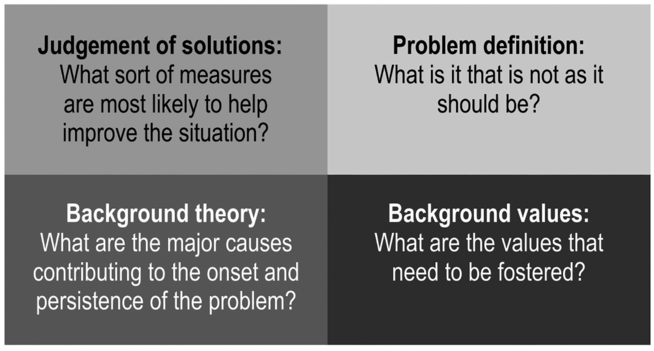
Figure 4.1 Long description
The four quadrants are labelled as follows. Problem Definition asks, What is it that is not as it should be. Judgement of Solutions asks, What sort of measures are most likely to help improve the situation. Background Theory asks, What are the major causes contributing to the onset and persistence of the problem. Background Values ask, What are the values that need to be fostered.
Jointly, these four elements constitute an interpretive frame. By making interpretive frames explicit, the mutual coherence between the various elements comes into view: a judgement of various solutions makes sense in view of how the problem is defined and vice versa; in turn, judgements of solutions and problem definitions are constituted by background theories and values. Stakeholders may reason and act from different interpretive frames; when they do, this will usually give rise to incongruent types of evidence. Importantly, a different approach is required for the process of structuration.
Although the global survey that gives rise to estimates of national rates of modern slavery and a study such as the one by Howard et al. [Reference Howard and LeBaron20] both testify, each in their own way, of a strong commitment to protect humans from the various types of forced labour, the underlying interpretive frames differ in a number of important ways. For example, in the study by Howard et al. [Reference Howard and LeBaron20], the problem is not so much that these children are on the move; the problem is that when they are on the move, they are subject to harm, including physical violence, robbery, and exploitation (problem definition). Potentially effective measures for resolution (judgement of solutions) include ensuring that, on their journey, children are accompanied by a relative and that if they run into trouble, they can continue to rely on their family for support. Additionally, when on the move, children should have easy access to safe and affordable places where they can sleep. Finally, as a journey into adulthood, the quality and relevance of apprenticeships should be enhanced, and there should be easy ways for children to keep their little money safe. In terms of background theory, poverty is considered among the main driving forces, resulting in failure of parents to sustain a family. Poverty itself is considered a result of global political and economic dynamics. Among the background values is a commitment to respect, at least to some extent, local culture: in Western African countries, it is not uncommon for children to leave their family home around the age of 15 as a ‘journey into adulthood’.
Importantly, interpretive frames define what is and what is not relevant evidence. For example, if the problem is not that these migrating children should be better protected but should not occur in the first place, the solutions of the sort proposed earlier are entirely misguided, and the associated background theory is largely irrelevant. Moreover, any research that aims to determine whether proposed solutions are effective is essentially a waste of money. The main lesson here is to resist the tendency to limit structuration to a critical scrutiny of the validity of the various evidentiary elements. Such scrutiny is important but may not be enough. The reason for this is that evidence is always produced in the context of some interpretive frame. As observed by Genevieve LeBaron: “The way that the problem of forced labour is framed and understood – who or what is demonstrated to bear responsibility, the way that data is collected and presented, and especially whether and how its causes are foregrounded or obscured – is shaped by researchers’ choices, whether they are aware of it or not” [Reference LeBaron and LeBaron18, p. 11].
Interpretive frames may, but need not, be widely shared. An important task of researchers in this respect is, then, to determine whether a specific issue (such as child migration and the associated risks of enforced labour and exploitation in Western Africa) is framed in multiple ways and, if so, what implications this might have for the interpretation of the available evidence. Importantly, this means that we should acknowledge that specific evidence is relevant only within a particular interpretive frame. Reconstructing interpretive frames as part of a structuration process is useful for several reasons:
It broadens the scope from a focus on the assessment of the validity of evidence to include an assessment of the relevance of evidence.
It offers the opportunity to assess and discuss the coherence of the interpretive frame in use.
It offers the opportunity to assess and discuss the reasonableness of the way that general notions (background theory and background values) are brought to bear on concrete situations (e.g., practical reasoning).
It offers an opportunity to assess and discuss the plausibility of background theory and support background values.
Finally, it offers an opportunity to suggest how the parties involved might proceed while acknowledging differences in their interpretive frames.
Clearly, this renders the task of the researcher who is conducting and assisting the structuration process more complex and demanding but also more interesting and relevant to the policy process. In fact, it results in a shift away from the authoritative appraisal of evidence towards the promotion of mutual learning among various stakeholders [Reference Fischer25, Reference Grin and Graaf26]. In addition, relevant to the present discussion, the method could be particularly useful in the context of capability assessment. The problem definition would specify the nature of the capability deprivation: what is it that (a group of) individuals are not well able to do or be? Solutions that are considered potentially effective in expanding or restoring capability typically refer to (lack of) resources, (deficits in) conversion factors, or both. Background theory would specify how, in a more general way, capability deprivation or capability expansion work, and background values would include the freedom to aspire and achieve and the associated responsibilities towards others.
Discussion and Conclusion
Starting from the observation that capability is the primary informational focus of the theory of justice developed by Amartya Sen, I have explored some of the investigational requirements that are associated with such choice. I have argued that there seems to be a paradox here, with capability assessment being prohibitively complex (if not unworkable) on the one hand and surprisingly simple on the other. The paradox can be understood, or so I have tried to argue, if we take into account the context in which capability claims or concerns are expressed. Specifically, when capability claims or concerns are intended as a basis for some sort of collective action (that is, politically), they should be able to withstand some test of criticism. I have presented two case studies to illustrate the strategies researchers may adopt to operationalise the capability concept or the related concept of human rights. Such strategies cover a wide range, varying from calculating national indices to questionnaires and focus groups, resulting in a wide diversity of data. I have offered some suggestions as to what may be done in terms of the structuration of such a variegated body of evidence, emphasising the importance of assessing both the validity and relevance of evidence, and I have argued that we may need to go beyond evidence to examine frameworks.
The Capability Model: A Realist and Non-ideal Theory
Capability, as developed by Sen, is a relatively novel concept. As such, it enables us to identify concrete situations as instances of more or less structural capability deprivation and to think through the implications for justice, freedom, and responsibility. Bringing conceptual reality and material reality to bear on each other is a complex and relatively poorly understood process. Which is, in a way, surprising since this is what we, humans, do, all the time. Grasping a concept means, among other things, knowing what needs to be done to determine whether it applies in a concrete situation [Reference Laugier, Brandel and Motta27]. In other words, if someone raises the question ‘is the capability of these people structurally deprived?’, we should know what needs to be done to answer that question. In this chapter, we have seen that there are still some significant challenges in that regard. However, I have also suggested some directions. Here, it is important to acknowledge the realist nature of the CA: Sen is interested in how people’s lives go, in the real opportunities that people have to be and do things they have reason to value. Likewise, with respect to justice, his primary focus is on how things work out in practice (what he refers to as ‘Nyaya’) rather than in devising and setting up ideal ways of organising society (‘Niti’) [Reference Sen3] Chapter 1). Moreover, Sen is critical of utility as an informational focus of a theory of justice because it reflects the mental reaction of people to the situation they find themselves in rather than the features of that situation itself [Reference Sen3]. We should, thus, be careful not to turn capability into ‘some mental construct’ and not to use individuals as the sole source of information regarding their ‘real opportunities’, but rather to try to see what has changed in terms of resources and conversion factors.
I think it is important to also acknowledge the non-ideal nature of Sen’s theory of justice [Reference Moen28, Reference Leopold29, Reference Meshelski30]. Rather than developing a theory for a perfectly just society, Sen is primarily looking for concrete, practical ways of rendering our world slightly less unjust by focusing on the worst cases, which are often clearly visible. Perhaps we should keep this in mind when conducting empirical inquiries that aim to learn about capability in real life. The capability model offers an opportunity for exploring how human (un)freedom, (lack of) resources, (absence of) conversion factors, and (unattainable) functionings are related. Rarely are all these elements of the capability model addressed within a single study. This should not, in my view, be a reason to discard such studies as useless. Instead, it should urge us to use results from multiple studies to load, as it was the formal model of capability. In doing so, we could broaden the evidence base by including studies that did not address the issue of capability in relation to work, at least not explicitly. These might include:
Studies that have examined how work can be of value to humans without explicitly using the CA as a theoretical framework. An example is the study by Ehn et al. [Reference Ehn, Wahlqvist, Möller and Anderzén-Carlsson31], who explored how work can be of value to people who are deaf-blind due to Usher syndrome and what conditions should be met to realise such values. The idea is that such studies could provide important insights into requisite resources and conversion factors, even though the researchers themselves did not use the capability model as a theoretical framework for their study.
Studies that have used the capability framework in domains other than work. An example is the ethnographic study by Visser and Haisma [Reference Visser and Haisma32], which explored the value of having a meal and the associated resources and conversion factors via participant observations and photo-elicitation interviews with children, parents, and grandparents. Such studies could be valuable for at least two reasons: first, they might contain interesting methods to be used for capability assessment in the context of work; second, they may reveal how the achievement of functioning in one domain (e.g., having meals) may support, or conflict with, the achievement of functioning in another domain (e.g., work).
The collected evidence may often be incongruent, as explained earlier. The method of reconstructing interpretive frames may be beneficial to help make sense of the data and support the various parties involved in deliberating and proceeding in a constructive way. This, in my view, is not only a challenge for researchers but also a great opportunity.
Introduction
It is now close to forty-five years since Amartya Sen first proposed reconceptualising human welfare/well-being in terms of what he called ‘human capabilities’ and outlined a related theory called the capability approach (CA), which was initially applied in ethics, welfare economics, and social and political philosophy [Reference Sen1]. Although he initially presented it as a simple conceptual idea and as a modest shift in the focus of the target of equality, it has been developed into a robust approach, with wide applications and what some would call a minimal theory of social justice [Reference Robeyns, Fibieger, Zalta and Nodelman2, Reference Wells3]. The CA has had tremendous influence in various academic disciplines and professional practices that are concerned with human well-being and equity/ethics, such as economics, philosophy, development studies, education, law, health sciences, and well-being in work. The CA has also been used to inform trenchant critiques of or, conversely, helped shape diverse (global) public policies, especially poverty and government welfare programmes, economic evaluation frameworks, United Nations agendas and agreements, and others [Reference Robeyns4]. In many of these efforts, there has been an explicit effort to work across disciplines, bridge academic theory with practice, expand narrow informational frameworks, fill gaps, and break down knowledge silos. All of this was motivated to realise the CA’s promise of doing more justice for our fellow human beings with regard to their well-being. To complement the diverse chapters in this volume exploring and applying the CA, this chapter focuses largely on the ‘integrative’ nature or powers of the CA in two dimensions.
The first aspect is that the CA as a conceptual framework has both enough core ideas and openness for integrating with a diverse range of academic and professional disciplinary knowledge (e.g., economics, philosophy, epidemiology, education, law, work and health, etc.) (‘informational openness’). It is also open to integrating different kinds of social values and ethics rather than being narrow or dogmatic (‘value openness’). There are advocates and academic scholars of the CA that would like the CA to be more fixed with more or particular content everywhere and all the time [Reference Nussbaum5]. However, the relative balance of openness and fixity of core content has allowed many individuals from diverse disciplines and professions and, importantly, across the world from diverse social contexts to find the CA accessible and useful when integrated into their paradigms, or vice versa.
In addition to the possibility of integration into extant paradigms and practices, the CA’s clarity and openness can also help individuals in diverse professional or practical fields seek to clarify and elevate their activities through grounding them in the CA’s rich conceptual and ethical resources. That is, as new kinds of labour develop (e.g., gig workers, digital nomads) or as new group identities form (e.g., same-sex parents) or professionalisation of certain human activities develops (e.g., domestic servants), the CA can provide a framework to assess the well-being of the doers, articulate moral claims regarding their well-being, and identify their contributions to the well-being of others. The CA can help ground new or hitherto undervalued human activities (and human beings) into a robust theory of well-being and related ideas about social equity and justice.
The second integrative aspect is that the CA perspective can be profoundly productive when integrated into daily practice in a variety of spaces. For example, the focus on human agency in the CA demands that various kinds of individual and community development programmes, or the practice of healthcare at worksites, must seek people’s views and engender agency rather than just treat people as recipients, objects to be moved, or outcome producers. Similarly, the CA’s assertion that well-being is multidimensional and not just one narrow thing (e.g., happiness, wealth) provides professionals with ethical justification and conceptual support to expand pathways and outcome measures such as those periodically used for evaluating students, employee well-being, child development, personal empowerment, and so forth.
Considering these two integrative aspects, it is worth noting that the novel CA framework, which offers the possibility of day-to-day implementation of a fundamental moral idea (i.e., human well-being as capabilities), has by now been scrutinised in robust discussions for decades across various disciplines through the most complex quantitative analyses to the most abstract meta-ethical philosophical debates and has been applied at the micro to the macro levels. The breadth, depth, and scale of applications and scrutiny or stress testing of this fairly new ethical and practical idea has very few modern comparisons. If this statement sounds doubtful, try to identify a new ethical concept that is less than forty years old and has had similar scrutiny and global impact.
The non-dogmatic and open approach to diverse forms of knowledge from the natural and social sciences and humanities as well as professional practices and the relative ease with which the CA can be integrated into daily practice addressing human well-being make the integrative aspects of the CA extremely interesting, productive, and appealing. However, there are also weaknesses in both the empirical and value openness and the ease of practical application.
There is the familiar problem of any new conceptual or social theory losing its accuracy and validity, as it is transmitted over time and space far from original sources. It is similar to a new design product or fashion item that is reverse engineered and mass produced to the point where the original creator and context are unknown and where the products look only superficially like the original thing. Moreover, as history shows, over time, even the most radical or bold theory or ideas often become diluted and used to make superficial dressing up of the status quo.
Putting aside these familiar problems of transmission over time and space, two immediate weaknesses of the openness of the CA are that it is easily misinterpreted and misused. For example, as the CA focuses on the supporting conditions for freedom and agency, it has sometimes been misunderstood as a libertarian philosophy – that it is a theory about absolute freedoms to do and be whatever anyone wants. Second, in trying to take advantage of the insights, intellectual depth, and momentum behind the CA, some of the concepts are cannibalised and inserted into other prevailing frameworks, often contradicting the CA’s basic motivations and aims. For example, efforts have been made to integrate the capability concept into existing economic utilitarian paradigms. The resulting calculations are presented as maximising capabilities, or a new metric, such as the capability-adjusted life years, is proposed [Reference Mansdotter, Ekman, Feldman, Hagberg, Hurtig and Lindholm6]. If we are in support of human capabilities, then surely, we must be for maximising or indexing capabilities, right? No, not always.
While some of the early and new followers of the CA might steadfastly keep teaching its original tenets, there is another reason to protect and keep reasserting its original conceptual foundations. Regular people, academics, policymakers, and implementers around the world are becoming increasingly vocal about and resisting the long-standing epistemic domination of Anglo-Euro-American knowledge systems, values, theories, and practices in various fields and institutions. Whether through decolonisation (see Chapter 12) or other language and efforts, there is growing resistance to both the imposition of certain epistemological perspectives and the unquestioned or facile universalisation of certain perspectives. The CA having global informational origins from the start rather than originating in the West/G8 and exported, its plausible relevance to every human being on the planet, and its intrinsic informational and ethical openness will likely be even more valuable, necessary, and useful in the coming years.
To that end, the discussion to follow is aimed at readers interested in the CA’s applications generally or in integrating it into their own respective discipline or professional practice, such as the aim of this book on work and health. It is not an introduction to or survey of the CA, as there are many good texts on that by now. Rather, the discussion focuses on integrating it into different disciplines and into daily practice. The use of the term integration rather than application is purposeful. While some may find it easier or best to think of the CA as a robust template to apply to a problem or project, the more substantial and far-reaching impacts come from integrating core ideas into disciplines, practices, and ways of thinking. There is no single definitive methodology for applying or integrating the CA with an academic discipline or professional practice. As the discussion that follows proceeds, it will become clear how there are numerous aspects or entry points to the CA that can be appealing to different scholars and practitioners depending on what limitations, gaps, silos, or problems they seek to address in their current work or primary discipline (Chapter 10 is an example of this type of application). The chapter is organised as follows. The next section sketches the CA and discusses why and how the CA is open to both empirical information and ethical values. The following section focuses on conceptual issues in practical applications, with a focused discussion of conversion factors and commodities. Finally, a conclusion closes the chapter.
Integrative Properties: Openness
The intrinsic and purposeful informational openness in the CA, which has been present from the beginning, is due to important ethical reasons. The primary concern of the CA is human beings and their well-being, welfare, or quality of life. While many of the analyses by Sen and other advocates of the CA may be conceptually abstract or even quantitatively complex, it should never be forgotten that all of it is driven by ethical concerns to improve human well-being through social action, with a consistent focus on identifying and addressing inequity or injustice. Much of the inequity and injustice comes from poor reasoning and arbitrary constraints on information, such as disciplinary silos. The ease with which the CA can be integrated into different paradigms and into daily practice is undoubtedly a result of Sen being a polymath. He draws on and synthesises across his research in different fields as well as insights from different disciplines and thinkers, both modern and historical, from around the world [Reference Paxman7]. Equally important, the CA has been developed in such a way that it is accessible and, through illustrations, it has been shown how the CA is useful to help realise real-world justice at many levels, from the micro-individual and household up to macro-global agendas [Reference Basu, Kanbur and Sen8].
Before discussing how the CA has conceptual openness for integration into diverse paradigms and practices, it may be helpful to further explore why the CA was purposefully developed in this particular way. We can find at least two significant ethical motivations: first, to avoid the violence (destruction or deprivation of human well-being) resulting from the informationally narrow or dogmatic nature of other approaches; second, to enable proper justification and legitimacy of important socio-ethical values when they are applied in CA-informed policies and practice.
The CA in Brief
The CA can be described very simply in the following way. Human well-being should be conceptualised in terms of what individuals are capable of being and doing in their daily lives in the immediate and long term. For a person to be capable to be or do A, B, or C, there is a good match between their internal features, including biology, knowledge, and skills, and the surrounding external environment, including the physical and social environments, from the local to the global level. The constraints on an individual’s capability/(ties) can be from diverse and multiple sources ranging from internal constraints (e.g., biological impairments) to social practices (e.g., restrictions on the movement of females or non-binary individuals outside the home) to global trade dynamics (e.g., commodity price collapses). The worst social injustices and deprivations occur where many capabilities of individuals are constrained as well as where many factors constrain capabilities.
A person ‘being capable’ to be or do A, B, or C is conceptually distinct from the person actually doing or achieving A, B, or C – which is called a ‘functioning’ in the CA. Capability is a real, practical possibility in contrast to the actual doing or achieving something that is an outcome. The distinction between practical possibility and outcome is conceptually helpful when various kinds of analyses are conducted, and it has important ethical significance. Two people might have the same outcome, such as being malnourished. However, imagine that one person is undertaking a long-term fast for religious or political reasons, whereas another person does not have money to buy any food. How we, as policymakers or problem-solvers, assess and respond to each outcome should differ, and this requires information about the antecedent practical possibilities. Indeed, it may be accepted worldwide that being well nourished is a valuable state of being. However, many harmful consequences follow when this global social value or fact leads to a metric or policy goal that focuses only on nourishment outcomes. Generalising from this example means that only looking at well-being outcomes or being fixated on achieving outcome metrics, rather than seeking information about what people are realistically capable of being or doing, blinds us to important problems and ethical differences in people’s lives. This leads to bad responses. The lesson here is not to ignore outcomes but rather to expand our scope of information gathering and analyses.
The ethical significance of this distinction is that in societies that value human freedoms, the capability space is the best place to assess these freedoms. Rather than looking at only outcomes or even the formal institutions of freedoms (e.g., legal rights, school buildings, functioning press), we should look at what people are actually capable of being and doing in their daily lives. In liberal democratic societies, the purpose of good government and public policies is to ensure that every individual is able to plan, pursue, and revise their diverse plans of life. According to the CA, this ‘ensuring’ is best done through protecting, expanding, mitigating decline, restoring capabilities, and so forth. Importantly, in the CA, freedoms are not only being capable of achieving A, B, or C but also of people choosing which capabilities or bundle of capabilities they want to have (e.g., B, G, L, Y) and choosing which of those capabilities to pursue towards the functioning outcomes. However, any capabilities the person wants are not valuable from the CA perspective, but rather those that are considered central or core to decent work or good quality of life. The societal selection and provision of support for such core capabilities, whether at the national or global level, is where the importance of legitimacy and justification comes in. This will be discussed further in the subsection ‘Proper Justification and Legitimacy’.
While capabilities seem like a simple idea, the CA places great demands or duties on social choice and public policymakers to provide supportive conditions for capabilities and to constantly monitor social conditions and their impact on the daily lives of people. Moreover, monitoring needs to be conducted not only at the group or population level but also at the individual level so that no one is left behind. The ethical obligations to provide such supportive conditions and the need to be concerned with every individual’s well-being are derived from the moral force of the CA and the ‘demands of social justice.’ Academic philosophers of social justice and ethics are accustomed to thinking that strong philosophical arguments should be enough to provide such moral force or adherence, but our modern reality is clearly far removed from that perspective. Different disciplines and professions have different sources that motivate the translation of knowledge into practice or the practice of good ethics. Moreover, moral psychology/social psychology, which is grounded in human biology, plays a significant role in our adherence to some moral principles but not others [Reference Hauser9]. While that research is well beyond the scope of this chapter, it is important to acknowledge in the chapter and book about the application of the CA that there are still open questions about the moral psychology needed for the CA (or any ethics) to be well received by policy implementors or, conversely, the sources that give moral force to the CA. While an accurate understanding of the CA and coherent plans and strategies for integration are important, they are still a few stops short of guaranteeing real-world justice.
Violence of Narrow
In the earlier brief sketch of the CA, the crucial thing to recognise is that the capabilities concept is not just a nice or clever idea but also a militant rejection of the violence tolerated and perpetuated through the informationally narrow, fixed, or dogmatic nature of some other dominant theories, whether in political philosophy, economics, development, or other areas. For example, utilitarian philosophical theories produce and tolerate great amounts of violence against human beings, and other things, such as nature, in the pursuit of maximisation of a narrow, anthrocentric, utility-based outcome or a proxy (happiness, quality-adjusted life years, money, etc.). Violence can range from directly sacrificing one or a large number of people or their freedoms for the greater good all the way to the persistent neglect of ‘few’ people because addressing their well-being needs is not cost-efficient.
Even with the case of John Rawls’s profound and elegant Kantian, social-contract theory and its use of primary goods, there is great violence caused by erasing inherent diversity in human beings and across our life course. While he is highly concerned with well-being equity, the inherent diversity of human beings profoundly affects how well or poorly each of us will be able to transform Rawlsian primary goods into well-being. While Rawls rejects utilitarian violence, the erasure of human diversity and focus on the equity of primary goods leads to causing, tolerating, or obfuscating avoidable inequities in well-being in his ideal just society. On a related point, Rawls, like many other great philosophers, did not benefit from our twenty-first-century knowledge about the causation and distribution of disease and mortality. Rawls thought health/disease was largely a matter of luck and personal behaviours and best dealt with through healthcare, which people can purchase on the basis of their personal preferences. While the majority of people might do well under the Rawls system, there are enormous amounts of preventable well-being deprivation that would be caused or tolerated in Rawls’s ideal just society.
There is also violence that is tolerated or perpetuated in libertarian theories. As Sen discussed in a famous essay, under libertarianism, we would not be able to violate the right to property of one person even if that is the only way to save the life, the right to life, of another person [Reference Sen10]. A system that presents itself as protecting the absolute freedoms of every individual actually produces suboptimal well-being. This specific example shows that while many might recognise Sen’s critiques of various philosophical, economic, and other theories as perceptive and insightful, Sen’s motivation seems to always search for and reveal the real and possible violence being done to human beings through misconceived ideas and poor reasoning. The militant anti-violence perspective in the CA and the related demand for the inclusion of everyone within the scope of justice and equity are often unrecognised or minimised even by CA advocates. The erasing of its militant anti-violence dimension is also what makes it possible for the CA to be misused or cannibalised into other arguments or frameworks. Or, why it is easily dismissed, such as when it is sometimes described as being very simple or essentially an argument for multidimensional well-being.
Proper Justification and Legitimacy
Aside from being vigilant to the violence that various prevailing theories and frameworks can cause or tolerate through informationally narrow, fixed, or dogmatic principles and perspectives, an equally important CA concern is the proper justification and legitimacy of the social and ethical values being endorsed in policies and practice. Sen’s long-standing interest in social choice theory and democracy, his debates on the different development paths of China versus India, first-hand familiarity with the impacts of utilitarian colonial policies in India, and so forth likely inform his strong advocacy for the proper justification and legitimacy of policies and democratic governance more generally. Such concern for legitimacy is also core to the CA. Therefore, while the critique or outright rejection of many theories may be due to their direct cause or toleration of violence, certain other theories are rejected because of their poor ethical justification and illegitimacy. The rejection of the ‘basic needs’ approach to development that was popular in the 1970s is one good example. This approach to basic needs can also be seen in the evolution of discussions on decent work, both within rich countries and in global policy discussions about low- and middle-income countries.
The basic needs approach was well-intentioned, seeking to identify the minimum amount of various goods and services that every human being needs for a minimally decent life [Reference Ghai, Khan, Lee and Alfthan11]. This explicit list (and amounts) of things was aimed at helping or cajoling governments and foreign aid agencies to better focus, rationalise, and prioritise their policies. In the face of mass starvation deaths in various countries, high infant mortality, and other severe deprivations due to pervasive poverty in most countries worldwide in the 1970s, it seems understandable that international policymakers and scholars wanted to identify and establish a minimum threshold or safety net that every human being should be above. If such a line was established, then it might be possible to hold governments accountable to provide individuals and household resources up to that line and cajole governments to make faster progress. (It seems that they also assumed that ethical ideas would be enough to motivate action.)
The ethical problem, however, is that the list of basic needs (or minimally decent work) is derived from a conception of a minimally decent human life. It is not based on purely natural or objective facts about human beings but rather on a conception produced through reasoning about what constitutes a minimally decent human life. However, whose reasoning produced that conception? On what grounds is that conception legitimate to be imposed upon the world, particularly the poorest and most vulnerable people? No matter how well intentioned or urgent, there are real risks that such reasoning is infected with such attitudes as ‘beggars can’t be choosers’, ‘something is better than nothing’, ‘good enough for them but not for us’, and other such pernicious views. Even if basic needs programmes and policies are implemented with sincere virtues, the domination of ethical values by one group over another, particularly domination of those who are vulnerable, is a great moral harm.
Partly in direct response to this kind of ‘benevolent dictator’ approach, the CA restrains from presuming or enforcing an idea of a good human life and proposes ‘only’ the abstract or general concept of basic capabilities. Moreover, Sen has vehemently maintained that the specification of capabilities – which capabilities constitute decent quality of life – should be done by the people being affected by the policies and through public deliberation. The basic needs approach example, hopefully, shows why the CA has clear and minimal core content while also being open to all relevant empirical and ethical information to both avoid violence and engender legitimacy.
There is another ‘high philosophy’ reason to consider. Modern political philosophy in Anglo-Euro America has focused strongly on the conflict of two ethical values, namely liberty and equality. Despite decades of both philosophical and real-world political debates and even violent wars, there is still no widely accepted way to reconcile the conflict between these two important foundational liberal values. This specific value conflict has also led to a large body of twentieth-century philosophical literature that considers more generally the questions of what the rock-bottom or foundational liberal values are and how we may be able to build ethics or theories of social justice with multiple values (‘value pluralism’). Modern thinkers, including John Rawls, Jurgen Habermas, Thomas Scanlon, Bernard Williams, and others, have all sought to provide reasoning for how to reason about and through conflicts of fundamental values. Sen has also engaged in these debates and argued for different ways to address them.
Remember that his initial presentation of the CA focused on redefining the target of equality [Reference Sen1]. He then purposefully frames capabilities as freedoms a decade or two later [Reference Sen12]. Therefore, it is not equality versus freedoms but rather the equality/equity of freedoms. In considering the conflict between different kinds of freedoms or other values, Sen suggested the possibility of ‘partial comparability’ or ‘partial orderings’. That is, rather than full agreement, no agreement, or no optimal agreement, there may still be forward progress through identifying overlap across parts of different orderings or value priorities [Reference Sen13, Reference Sen14]. Aside from showing the possibility of progress during value conflicts, Sen offers a separate and distinct philosophical argument regarding value pluralism, conflicts, and social decision-making.
Sen argues that the process of ‘public reasoning’ itself provides justification and legitimacy for the ideas and values that eventually survive. Rather than one philosopher’s arguments about which values are most important or experts handing down or imposing their wise views involving values, Sen advocates real-world public discussion as the source of justification of value choices. This is why he argues for the CA to be open to specification and ordering of capabilities, which are essentially socio-ethical values. The CA, which specifies which capabilities constitute a decent life for all human beings or even just poor human beings around the world, would risk the same illegitimacy and justification problems of the basic needs approach. However, Sen argues that what survives good public deliberation, whether at the local or global level (e.g., basic human rights), becomes justified. By public reasoning, Sen does not intend to mean that whatever people say goes. There are various requirements for good public deliberation, such as ‘impartiality’ or the ‘impartial spectator’ perspective and the inclusivity of diverse perspectives [Reference Sen12]. A recent assessment of Sen’s understanding of such deliberative processes in modern times was provided by Gasper [Reference Gasper15].
To summarise the discussion thus far, we can identify two significant ethical reasons for informational openness in the CA, which gives it integrative powers and makes it easy to use. First, it aims to avoid the violence that can occur from informationally narrow and fixed concepts and explains why there was rejection of other dominant approaches to social justice as well as theories and paradigms in different fields. Second, openness can ensure legitimacy and proper justification of theories, policies, and practices informed by the CA. Both reasons show how the CA is an open framework for ethical reasons. Importantly, it is also open to diverse ethical values while also holding some core ethical content. Always keeping these two reasons in mind would be prudent in working with the CA either in theoretical work or in trying to integrate the CA into a discipline or practice. Let us move on now to the practicalities of how the CA is integrated through informational openness.
Informational Openness
Sen’s early interest in mathematics and then economics and related areas of social choice theory and social justice philosophy, as well as interest in informing and shaping public policy, likely informed his interest in intertheoretical coherence across disciplines and fields of practice. Aside from important single-discipline contributions, Sen’s work also reflects what is called transdisciplinarity. This certainly shows in the construction and development of the CA. Despite working with different disciplinary paradigms, each with different starting assumptions, methodologies, and basic questions or aims, the core components of the CA were presented in ways that are understandable and relevant to contextual issues and discussions and, importantly, convincing to various disciplines. Other CA scholars have also attempted to explore Sen’s intertheoretic coherence strategies within and across various disciplines and practices. The important anchor or common unit across different discussions is human well-being and related ethical values such as anti-violence, equity, and centring on and prioritising the worst off. As many CA advocates have observed and written, how you use the CA depends on what questions you are asking and what you want to achieve.
One way to engage with CA’s informational openness and understand how it can and has been integrated into various disciplines and policy analyses is to consider its core concepts, aims, and motivations as entry points or points of shared concerns across fields. We have already discussed the anti-violence stance, legitimacy, and justification and identified several core concepts, such as capabilities, functioning, agency, freedoms, multidimensional well-being, social justice, human rights, and equity. These concepts have been mentioned only quickly, and there are many more concepts, such as conversion factors, global justice, comparative justice, and comprehensive consequentialism. One or some of these ideas may look like shared concerns and promising avenues to solve a problem or introduce novel thinking into an existing discipline or practice. Most often, the CA initially interests people because of its basic ideas of multidimensional well-being, capabilities, social justice, rights, and interest in poverty alleviation or more ethical economics. Researchers and policymakers may be searching for ways to expand their existing narrow concept of well-being, understand the causes better, or seek more explicit ethical resources to motivate better or more comprehensive responses to human deprivations (i.e., violence and injustice).
Cause and Effect: Means and Ends
Many disciplines, particularly the natural and social sciences, study cause-and-effect relationships. Various professional practices seek to understand how to produce or improve various outcomes. The CA, as Sen states, asserts that capabilities are both the ends and means of human well-being. That is, human well-being is best understood as being composed of capabilities as well as being created through the development and expansion of capabilities; they are both causes and effects, often iterative, interrelated, and progressive. Therefore, many of the applications/integrations of the CA in various disciplines and practices attempt to align the cause‒effect story in the CA with the cause‒effect story in the user’s domain of interest. For example, as reflected in the focus of this book, many working in economics or other public policy domains are interested in expanding the focus of well-being, or decent work, from a commodity or some other thing (e.g., the effect or outcome) to the broader value space of multiple capabilities and functionings. Similarly, in health policy or well-being at work programmes, we seek to expand focus from only healthcare (often confused as being the cause of health) to the conditions that enable people to be healthy over the life course. We are also seeking to measure, understand the causes, and address the population distribution of health (capability) inequalities. In education, we are interested in expanding our scope from just standardised outcome metrics to helping each individual develop basic capabilities and specific capabilities such as autonomy, critical thinking, problem-solving, self-respect, and aspiration.
For some seeking to apply the CA, the abstract concept of a capability, which is an ethical concept related to well-being, helps to reimagine and elevate the moral nature of the causes and effects of human well-being in their discipline or practice. The CA energises what might be a staid or highly technical discipline (e.g., occupational health, rehabilitation, surgery) with renewed ethical significance. Furthermore, once we accept the use of the capability concept, the CA does not limit the scope of the type of causes or their dynamics when their effects on capabilities/human well-being are examined. It is open to all causes that are natural and social, micro to macro, sociological or political, and so forth. What matters is the context of the human beings that are of concern and the questions being asked to best capture the phenomenon regarding well-being. As a result, we are able to study diverse causes and their dynamics and their impacts on capabilities at the individual and household levels, at the group or national population level, or at the global level. Expanding the scope of causes and effects can have a profound impact on different disciplinary practices and paradigms that are currently limited to narrow informational inputs [Reference Venkatapuram and Marmot16].
By demanding all relevant information regarding capabilities and equity, the CA asserts that addressing human well-being has to be interdisciplinary. The CA inherently contains ethical and philosophical reasoning and, to some extent, economics. Therefore, any use of CA outside philosophy or economics could claim to be doing interdisciplinary work. However, instead of just cannibalising concepts, truly integrating the CA requires understanding and aligning with the ethical concepts, aims, and motivations. The ethical grounding of the CA provides justification or valid reasons for some disciplines to break out of limiting paradigms. The aim of improving human well-being with a focus on equity extends beyond looking at just natural facts or just social causes, expanding well-being outcome concepts, or going below or even above a group-level analysis. While some disciplines, such as development economics, welfare economics, health and healthcare policy, and education, have been amenable to CA applications and analyses, other fields have been more resistant or less interested (see earlier regarding the moral psychology needed).
One important but underrecognised power of the CA’s applications is its ability to help analyse the long causal chain over time and impacts on human well-being/capabilities. This power is because of its open structure but also because of Sen’s many insightful illustrations using the CA to assess historical cause-and-effect relationships. Individuals and disciplines might be interested in the CA for its promise of improving the well-being of people here and now and in their future. However, the CA can also help with the study of historical causes or establish explanations or causal stories of important social problems. This can be of significant consequence and differentiates CA from other social justice theories. One important example is the study of the causes of famines.
Sen and Jean Drèze showed that most famines or mass starvations in modern times did not occur because of the lack of food availability, which was the dominant view [Reference Drèze and Sen17]. Instead, modern mass starvations have occurred because of a variety of social and economic dynamics that constrain people’s ability to purchase food. What was previously thought to be a natural, causal story was fundamentally rejected and changed to a social, political, and economic causal story. Sudden decreases in wages, increases in food prices, grain hoarding, food exports, and other factors better explained mass starvations as a process of capability/entitlement failure than the sudden reduction in food due to natural events or a population size outstripping the food supply. Capability analysis also better explained the distribution patterns of starvation as well as low-level endemic malnutrition (i.e., why some starve while others do not). This study of historical and long-term causes of mass starvation was powerful in changing modern policy approaches to address global hunger. It also overthrew Malthus’s theory of population dynamics, which produced and tolerated enormous violence against human beings (i.e., millions of deaths) worldwide for centuries.
Sen has applied such CA analysis to other historical causal stories, such as in the debates about the relationship between national wealth and health outcomes, the East Asian miracle, India versus China development trajectories, and health and mortality inequalities in the USA and worldwide. Of course, not every analysis Sen has done is about capabilities, but much of it can be understood that way. The possibilities of historical analysis of cause–effect stories via the CA show that it can both be the source of simple ideas and a powerful apparatus that can overthrow paradigms and theories that have held sway for centuries.
Practical Integration
Let us now turn to the CA’s productivity and ease of integration in daily professional practice. The CA can be valuable for professionals who are concerned with human well-being daily (e.g., health and social care, education, and vulnerable group services). It can help professionals expand the scope of well-being frameworks and metrics being used as well as help professionals think more openly about the capabilities and internal and external constraints on the capabilities of concern. The CA can also be very helpful for individuals who are seeking to assess their own personal quality of life and how to improve it. It is also helpful for the delivery of community-level programmes or indeed for social organisers and activists. As already discussed, many academic disciplines and professional practices are focused on certain cause-and-effect pathways. The CA helps, in some cases, expand the scope of the effect or outcome, expand the understanding of the causes and constraints, understand the distribution patterns, and much more.
Case Studies: Well-Being at Work and Healthcare
To illustrate, two examples are discussed here: reintegration into work and healthcare. Reintegration into work often involves three parties and perspectives: the employer, the health professional, and the worker. For the employer, concern about loss of productivity may be central; for the health professional, the value of social participation, and for the worker, it is meaningful work. In healthcare, disease control or management may be the primary and valued outcome of healthcare professionals, while patients may also value other related aspects, such as duration, experience, and dignity.
When professionals and clients fail to act from a shared value system, this can lead to mutual frustration with each other’s perceived lack of commitment, concern, or understanding. When the process and outcomes of healthcare seem indifferent to patients’ desires, aspirations, and broader well-being, some patients and professionals may seek out additional resources that address these frustrations. However, each person’s value perspective may be valid and legitimate in these two examples; the dissatisfaction with sacrificing, excluding, or deprioritising valued dimensions of the well-being of the primary individual may motivate the seeking out of other resources or starting points. Not addressing the different values means that the primary person suffers violence, the deprivation of well-being.
In such situations, the CA offers a comparatively more robust framework and tools, both conceptually and ethically, than other models do. In the individual case, but also in general, it helps people rethink the means and ends of daily work and healthcare practice generally. The CA also helps validate and motivate the recognition of the multiple dimensions of human well-being, of capabilities versus only outcomes, of freedoms and choice in being the author of one’s own life, and to help agency. From a perspective internal to employee well-being or healthcare professionals, the CA helps motivate and justify expanding the focus from economic productivity and disease management to human well-being. From an external perspective, such as worker or patient group advocacy, the CA motivates and justifies demanding that employers and healthcare professionals recognise patients as active agents who have conceptions of a good life with multiple dimensions.
The CA also opens the possibility of researching which capabilities are important to people. In healthcare, we can ask which capabilities are valuable for people with specific kinds of impairments or disease conditions, which outcomes are valuable, or what is valued in the experience of receiving care and treatment. Building on this, the CA can help identify the diversity of people with the same disease or impairment value across countries as well as even within countries. The use of the CA in this contextual way offers the possibility of healthcare that is more human-centred, not professional and disease-centred. It also helps provide healthcare that reflects local contexts and values rather than providing treatment protocols on the basis of the biology or social values and contexts of a study population from distant countries.
The ease with which the CA can elicit from people what is important to them about their activities, experiences, desires, aims, and aspirations can be powerful in addressing or readdressing the immediate constraints and injustices in people’s lives. In many professions, there is sometimes an active effort to restrict information so as not to become overwhelmed by the scale of injustices that people are experiencing. In the specific cases of both work and healthcare, they are both important places where the basic foundations for well-being, as well as justice claims to well-being, can be realised. Improving work and healthcare via the CA can achieve more justice or repair through rejecting violence, seeking legitimacy, and realising the well-being claims of every person. While these illustrations are largely practical uses of CA in healthcare and well-being at work, the potential for similar use and engagement with contextually specific concerns in the daily practices of other professional practices is enormous and can be productive.
Challenges: Conversion Factors and Commodities
There is a growing body of CA literature on practical applications of the CA in different contexts as well as the development of individual-level capability measurement tools for various contexts. Much of this literature discusses practical efforts to move beyond single-dimensional outcomes, procedures for specifying capabilities, empowering individuals and communities, and so forth. In these practical applications, one aspect is relatively underexamined and is linked to the demand for informational openness: the process where a person’s internal features and external conditions match to create capabilities. See Chapter 10 for examples of practical applications.
In Sen’s early work advocating for focusing on what capabilities individuals have, or their ability to live the kind of lives they want to pursue, he highlights the important economic concept of commodities. While many economists, particularly development economists, focus on the income or commodity holdings of people in assessing poverty or wealth, Sen made the important point – to this audience in particular – that different factors influence a person’s ability to convert commodities into capabilities and functionings. The point being that the concern for economic inequality and deprivation should not be focused on commodity holdings but, more correctly, on capability inequality. Moreover, these influencing factors create capability inequalities, which he termed ‘conversion factors.’ See Chapters 1 and 2 in this book for a short description of conversion factors. In light of the unique diversity of every individual human being’s life context and life path, any assessment of capabilities has to be actively open to all information regarding what is affecting an individual’s capabilities, whether positive or negative. Sen initially focused on examples such as biological diversity (pregnancy, age, disability, etc.), social and cultural practices (female mobility, clothing norms, etc.), and the physical environment (stagnant water pools, etc.). The process of the formalisation of concepts into an approach or theory has led to the categorisation and specification of these diverse conversion factors.
In the Idea of Justice, Sen identifies five categories: personal heterogeneities; environmental diversities; variations in social climate; differences in relational perspectives; and distribution within the family [Reference Sen18]. While one might expect to take these as pillars set forth by the founder of the approach, a closer look shows that there is no clear line between some categories, and some things look odd under the heading being given. For example, Sen suggested that the prevalence of malaria and cholera and the prevalence of HIV/AIDS are environmentally diverse. However, unlike malaria, HIV/AIDS is very much transmitted person to person and falls better under ‘variations in social climate’. In addition, he states that pollution comes under both ‘environmental diversities’ and ‘variations in social climate’. This should not be understood as absentmindedness or mistakes. The error is related to understanding the five categories as a comprehensive and coherent classification of all the conversion factors in the world. Rather, the important thing here is to use the categories as a guide to examine possible conversion factors, from simple to sociological and abstract. See the practical applications described in Chapter 10 of this book as examples.
If a conversion factor is found that does not clearly fall into the five categories, Sen would likely be curious and pleased that we are learning more about constraints on human well-being. The main thing of value is human well-being, which necessitates keeping the concepts of conversion factors open to allow us to be constantly curious for more information about causes as well as possible interventions. To dismiss, obfuscate, ignore, or be wilfully blind to conversion factors because they do not fit the categories tolerates or perpetuates violence and injustice in the form of constrained capabilities. Therefore, a certain kind of grounded-openness – grounded in the theory and open to reality of the context – is important to the CA for both informational reasons and foundational ethical values such as freedom, equity, and justice.
Such reasoning is shown in this book. In the Capability Set for Work Questionnaire (CSWQ), introduced and described in Chapters 1 and 2, clients are presented with seven work values. Each value is rated in three categories: a) the importance of each value; b) whether the client feels empowered by the work environment to achieve the value; and c) whether the client can truly achieve the value. The answers to the b and c categories elicit information on contextual and personal conversion factors and reflect the openness that Sen advocates.
However, there is also another underlying issue. The conversion factors are about converting some commodities into a capability. What commodity is affected by the HIV/AIDS conversion factor, and which capability is that commodity useful for? The underlying issue here is that someone new to the CA could easily think that there are conversion factors affecting every capability, and there is centrality of a commodity to every capability. This is simply not true. Many, but not every, valuable human activity or capability entail a commodity. Or, finding a commodity related to a capability (e.g., healthcare qua health) and making it the centre of analysis may lead us astray. This, indeed, was a mistake of some of the earlier CA and health literature. They thought that every capability had a central commodity, so they focused on healthcare when they thought about health capability. To take a different example, an infant crucially needs food, a commodity. The infant also needs a carer’s love and stimulation for the development of various capabilities. It is misconceived to focus only on food or reframing love and stimulation as commodities to follow the CA model which was initially meant for economics audiences. In the case that commodities are central to capabilities, then the use of conversion factors may be very helpful. However, where there is no commodity but capabilities are constrained by factors such as interpersonal relations or structural oppression (e.g., exploitation, marginalisation, violence), we skip the commodities and conversion factors and focus on the constraints (see the case of Laura in Chapter 10; see also Chapter 12).
To summarise this section on practical integration of the CA, using it in daily practice helps to envision individuals as active agents and authors of their lives and their well-being as being constituted by multiple dimensions, each valuable. This helps to reinforce the idea that freedoms are important to human life. The CA motivates and helps justify expanding narrow and sometimes misguided outcome goals and metrics which can tolerate violence and avoidable deprivations in well-being, or forego better human well-being. The informational openness of the CA has aspects that become more obvious when it is used in daily practice. On the one hand, it allows for the incorporation of different kinds of information, both factual and value-based, to increase well-being. On the other hand, once in use, the CA demands pursuing such information because the person in front of us, here and now, has a moral claim to multidimensional well-being arising from our widely shared fundamental values of freedom and equality.
Conclusion
This chapter has discussed the integrative nature or powers of the CA in two dimensions and its practical application. The argument is that the CA has had tremendous reach and influence in a relatively short period of time because of its ability to be integrated into a wide range of academic disciplines and professional practices. This integration is largely possible due to its informational openness to diverse forms of knowledge, both facts about the world and the diverse values of people. This informational openness of the CA, it was argued, is due to at least two ethical reasons: to avoid violence, in the form of causing or tolerating deprivations of well-being and inequity, and to engender the legitimacy of any policies and programmes informed by the CA. The CA’s militant anti-violence stance and concern for legitimacy are underrecognised. In terms of how integration is performed, the discussion focused on identifying the core components and concepts of the CA and looking for overlap as the starting point. Another avenue is to look for the cause-and-effect story operating in a particular discipline or practice, such as well-being at work and healthcare, and explore how the CA might help to reorient, clarify, or expand the understanding ends and means.
The second part of the chapter discussed the productive nature of the integration of the CA in daily practice, where individuals deal directly with the well-being of individuals. It helps to reorient daily practice to focus on human beings and their well-being and helps bring in profound ethical values such as freedom, equality, and agency. There has been some discussion on the underexamined topic of conversion factors. Chapters 1 and 2 discuss this in more detail, and Chapter 10 presents examples of practical applications. It was argued that conversion factors in relation to commodities are an insightful part of the CA. The identification of particular categories of conversion factors in the current CA literature should not limit our analysis of many other possible conversion factors that affect the individuals of concern. (In the CSWQ, categories b and c offer opportunities for such a broad, open approach.) At the same time, it was argued that, in the practical integration and theoretical use of the CA, it would be a mistake to look for commodities linked to capabilities where there are none. The important thing to ascertain through the practical integration of the CA is an understanding of the most influential constraints and enablers of capabilities to identify and deliver an appropriately just response, policy, or care.
Introduction
Work is an important part of human life and significantly influences well-being (or flourishing) [Reference Blustein1, Reference Clifton and Harter2]. The capability approach (CA), pioneered by Amartya Sen and further refined by philosophers such as Martha Nussbaum, provides a comprehensive framework for understanding how work contributes to human flourishing. Rather than focusing solely on resources or utilities, the CA emphasises individuals’ substantive freedoms, meaning what people can actually do and be. It also highlights capabilities, which are the real opportunities individuals have to lead lives they value, reflecting their freedom to achieve desired functionings [Reference Robeyns3, Reference Sen4]. This chapter explores the integration of the CA with four well-established theoretical models: the International Classification of Functioning, Disability, and Health (ICF), the job demands-resources (JD-R) model, self-determination theory (SDT), and the integrative model of behavioural prediction (IMBP).
These frameworks were selected for their strong empirical foundations, widespread use in work and health (psychology) research, and complementary coverage of critical elements related to flourishing at work. Specifically, they each address key components of the CA’s conversion chain: contextual conditions (ICF), job demands and resources (JD-R), motivational processes (SDT), and behavioural determinants (IMBP). Together, they provide mature, evidence-based models that enable a deeper analysis of the factors that shape individual opportunities and outcomes across diverse settings. In this chapter, we demonstrate how integrating these theories with the CA can create a more comprehensive framework: the CA broadens their normative scope by emphasising individual capabilities and the real freedoms necessary for human flourishing, whereas these theories complement the CA by providing explanatory mechanisms that link contextual factors, motivation, and behaviour. Taken together, these perspectives offer a richer understanding of how to foster environments that support individuals – whether they are in work, seeking employment, or striving to return to work – by expanding freedoms and promoting sustainable well-being.
Overview of the CA
The CA initiated a paradigm shift in understanding human development and social justice [Reference Robeyns3]. This conceptual framework (see Chapter 1 for a more detailed description of it) differs from traditional utilitarian and resource-based approaches by emphasising individuals’ substantive freedoms to lead lives they value. According to this framework, the assessment of well-being should focus on people’s actual opportunities to undertake actions and activities they wish to engage in and be who they want to be [Reference Sen4, Reference Sen5].
Central to the CA is the concept of value-neutral functionings and capabilities. Indeed, the notion of ‘value-neutral’ is nuanced: while the framework itself is analytically value-neutral (meaning it does not prescribe which specific capabilities or functionings are inherently valuable), it allows individuals or societies to determine what they have reason to value within their contexts. A functioning is defined as any state of being or doing that a person can attain [Reference Sen5], such as being well nourished, employed, or engaging in community activities [Reference Robeyns3]. Capabilities, on the other hand, represent those valuable functionings that a person has the freedom to access effectively – that is, “what people have the opportunity to be and do” [Reference Sen5, p. 38]. This distinction highlights (opportunity for) freedom and choice within the CA framework and is central to understanding and comparing interpersonal advantages [Reference Robeyns3, Reference Robeyns6, Reference Van der Klink, Bültmann, Burdorf, Schaufeli, Zijlstra and Abma7]. For instance, in the work context, securing meaningful employment encompasses being employed and choosing among job opportunities that align with one’s skills, values, and aspirations.
The CA’s emphasis on human diversity and factors affecting well-being makes it particularly useful when dealing with complex work-related issues. Individuals differ in their ability to convert resources into functioning due to personal, social, and environmental influences [Reference Robeyns3, Reference Robeyns6, Reference Sen8], which means that employees or job seekers may require different types and levels of support to attain similar outcomes [Reference Alkire9]. For example, a worker with a disability may require specific accommodations (e.g., an ergonomic workspace), whereas another worker may need flexible working hours to balance both work and family responsibilities to perform their job effectively (see Chapter 3).
The CA is distinguished from purely descriptive or explanatory theories by its normative and practice-oriented (‘Nyaya’) [Reference Sen5] and ideographic (see Chapters 1 and 2) foundation, which emphasises the intrinsic values that each individual holds. According to this stance, social arrangements should be evaluated according to how free people are in pursuing and attaining functions they consider valuable, reflecting the importance of valuing each person as an end in themselves [Reference Nussbaum10]. This normative perspective has significant ramifications for organisational policies and practices: it suggests that workplaces not only offer fair compensation and safe working conditions for their employees but also cultivate environments that expand employees’ capabilities to pursue diverse goals (as ultimate ends) [Reference Robeyns3, Reference Robeyns11]. By cultivating environments that allow for a plurality of values [Reference Sen12], organisations enable individuals to pursue their unique aspirations. Thus, the CA encourages workplaces to create environments where employees not only have the resources they need but also the freedom to achieve meaningful outcomes in their lives (see Chapter 3 for an argument that contributive justice can serve this goal in connection with the CA), emphasising the evaluative properties of capabilities and functionings [Reference Robeyns3].
The CA’s focus on human diversity, individual capabilities, and the contextual factors influencing well-being provides a foundation for comparing the CA with other theoretical models. By exploring similarities and differences, we are able to understand how the CA’s multifaceted perspective aligns with existing approaches to work-related well-being. As Robeyns noted, the CA is particularly well suited to encompass other theoretical concepts, provided that they meet certain criteria (e.g., compatibility with the CA’s emphasis on individual agency, diversity, and valued functionings) [Reference Robeyns3, Reference Robeyns6]. Building on this, we offer insights into how the CA and these other approaches can connect and enrich each other.
Comparative Analysis of the CA with Other Theoretical Models
The following sections present the comparative analyses in the following order: 1) ICF; 2) the JD-R model; 3) SDT; and 4) the IMBP.
International Classification of Functioning, Disability, and Health
Summary of the ICF
The International Classification of Functioning, Disability, and Health (commonly referred to as the ICF) is a comprehensive framework and classification developed by the World Health Organization for describing the complex consequences of health conditions. The ICF is recognised worldwide for offering a multifaceted system to describe the full range of functioning, which is defined as the dynamic interaction between an individual’s health condition and contextual factors [13].
Principal components in the ICF include body functions, body structures, activities, and participation along with contextual factors (see Figure 6.1). Body functions refer to the physiological functions of body systems (e.g., the ability to see). Body structures refer to anatomical parts of the body (e.g., the structure of the eye). Activities are the execution of a task or action (e.g., performing tasks required of an apprenticeship), whereas participation is considered involvement in a life situation, such as maintaining a specific job. Contextual factors include personal factors, such as age, which may affect an individual’s ability to work (e.g., the minimum age required to work), and environmental factors, including the availability of jobs in a geographical location and appropriate conditions in the workplace.
There are several important points to note about the ICF system. First, activities and participation are grouped together in domains covering a full range of life areas. Qualifiers are used to differentiate them, namely, the capacity to describe an individual’s ability to complete the task or action and performance to describe what an individual does in their current environment. Second, capacity and performance can be measured with and without assistive technology or personal assistance (environmental factors).
ICF framework.

Comparing the ICF and the CA
The ICF framework has often been compared with the CA framework to better understand disability and functioning. For details, see the works of scholars, including Bickenbach [Reference Bickenbach14], Mitra [Reference Mitra15], Mitra and Shakespeare [Reference Mitra and Shakespeare16], and Welch Saleeby [Reference Welch Saleeby17, Reference Welch Saleeby18]. This section summarises the salient points of these published comparisons.
Theoretical basis. Both frameworks are multidimensional and useful for understanding well-being. The CA is normative in nature, emphasising individual freedoms and potential opportunities as a mechanism for evaluating individual well-being. As Sen indicated, what an individual values in terms of their capability to achieve functionings provides the general approach to determining social arrangements [Reference Sen8]. In contrast, the ICF is not an evaluative instrument, although assessment tools based on the ICF are available. Instead, the ICF is a robust descriptive framework with an in-depth corresponding classification focused only on the individual’s actual lived experience, summarised by relevant ICF components.
Terminology. Differences in terminology can be confusing. In the CA, functionings are broadly defined as realised doings and beings, whereas in the ICF, functioning is a broader, all-encompassing umbrella term for its key components. A lack of consensus among ICF scholars on how to remedy such differences in terminology is evident. However, if we consider that capabilities represent potential and their actual materialisation is defined as functionings, the focus shifts to examining the significance of what individuals are actually doing in their everyday lives, including aspects related to work.
Conversion and contextual factors. In the CA, conversion factors – personal, social, and environmental – shape how resources translate into real opportunities and outcomes [Reference Robeyns6, Reference Ribeiro, Huisman and Tight19]. These factors are conceptually similar to the contextual factors in the ICF that can influence an individual’s activities and participation. Indeed, the value of both frameworks lies in describing interpersonal variations that enable a greater understanding of individual circumstances independently. In essence, the conversion factors in the CA account for human diversity and contextual specificity [Reference Ribeiro, Huisman and Tight19], and the contextual factors in the ICF are the same [Reference Welch Saleeby18]. Personal conversion factors, for example, include intelligence or gender; social conversion factors may be workplace norms or employment policies; and environmental conversion factors may be related to the physical or built climate, such as the accessibility of a work site.
Using the CA with the ICF
Some scholars [Reference Nussbaum10] have critiqued Sen’s CA for lacking a defined list of capabilities (for a comprehensive discussion of the debate between Sen and Nussbaum, see Robeyns [Reference Robeyns6]), arguing that this approach leaves no clear standard for evaluating well-being or social justice. While this openness was intentional, others – most notably Nussbaum – have proposed lists to fill the gap. With respect to work capabilities, Nussbaum briefly mentions “control over one’s environment” as one of the basic capabilities and includes “having the right to seek employment” and “in work, being able to work as a human being” [Reference Nussbaum10]. Although Nussbaum’s list is intended to bridge the gap in the CA, the practicality of using it to fully capture the complexity of work is not feasible. More recently, Van der Klink et al. [Reference Van der Klink, Bültmann, Burdorf, Schaufeli, Zijlstra and Abma7] proposed a set of seven work-related capabilities aimed specifically at operationalising sustainable employability. This adaptation offers a more targeted approach, although practical challenges remain (see almost all other chapters of this book for elaboration and specification of this remark).
In contrast, the ICF classification provides a systematic way to operationalise the CA by its ability to organise a wide range of information around what individuals are actually doing and the context in which they are doing it. The ICF has already been used to support the CA in social care [Reference Welch Saleeby18] and healthcare [Reference Van der Veen, Evans, Huisman, Welch Saleeby and Widdershoven20] settings. Bringing the CA and the ICF together to examine work capability enhances both frameworks. For example, the ICF can help identify barriers to performing a specific job (e.g., lack of accessible tools), guiding interventions such as assistive technology. This improves actual functioning in a role and expands a person’s capability set – their options for valued work outcomes – by increasing both the number and quality of achievable job functionings.
Job Demands-Resources Model
A Brief Summary of the JD-R Model
The job demands-resources (JD-R) model is a widely recognised framework in occupational health psychology that explains how job characteristics impact employee well-being, motivation, and performance [Reference Galanakis and Tsitouri21, Reference Crawford, LePine and Rich22]. Introduced in the early 2000s [Reference Demerouti, Bakker, Nachreiner and Schaufeli23] and refined in later years [Reference Bakker, Demerouti and Sanz-Vergel24], the model centres on two key aspects: job demands and job resources [Reference Demerouti, Bakker, Nachreiner and Schaufeli23, Reference Bakker, Demerouti and Sanz-Vergel24].
Job demands refer to the physical, psychological, social, or organisational aspects of a job that require sustained effort. These include high work pressure, emotionally demanding interactions, complex tasks, or tight deadlines. While not inherently harmful, excessive or prolonged demands can lead to stress, burnout, and absenteeism as well as reduced job satisfaction and performance [Reference Schaufeli, Taris, Bauer and Hämmig25]. In contrast, job resources are the physical, psychological, social, or organisational factors that help employees meet their job demands, achieve work goals, and stimulate personal growth. These resources can include supportive management, opportunities for development, autonomy, and feedback. These resources buffer the impact of job demands and are linked to engagement, motivation, and well-being [Reference Mazzetti, Robledo, Vignoli, Topa, Guglielmi and Schaufeli26].
The JD-R model outlines two processes: the health impairment process, where high demands lead to strain and health issues, and the motivational process, where resources increase engagement and performance [Reference Demerouti and Bakker27]. For organisations, the JD-R model offers a practical tool for promoting well-being and performance by addressing job demands and enhancing resources. It also guides interventions aimed at preventing burnout and fostering employee engagement [Reference Nielsen, Nielsen, Ogbonnaya, Känsälä, Saari and Isaksson28].
Similarities and Differences
Table 6.1 concisely compares the JD-R model and the CA, highlighting their similarities and differences across various aspects.
| Aspect | CA | JD-R model | Similarities |
|---|---|---|---|
| Theoretical origin | Economics and philosophy. | Occupational health psychology. | Both focus on improving well-being and personal outcomes. |
| Normative vs empirical approach (for ideographic vs nomothetic, refer to Chapter 1 or Chapter 2) | Normative, providing a framework for evaluating social justice and well-being. | Empirical, focused on diagnosing and improving workplace conditions. | Both provide frameworks for understanding and improving well-being, although from different angles. |
| Scope | Broad, applicable across all areas of life, including education, health, and social justice. | Focused specifically on the workplace and organisational settings. | Both are adaptable and can be applied in various contexts. |
| Focus on well-being | Emphasises capabilities (freedoms) and the ability to achieve valued functionings (states of being). | Focuses on balancing job demands and resources to impact well-being, engagement, and burnout. | Both prioritise well-being and positive individual outcomes. |
| Role of resources | Resources are important as means to expand capabilities, but the focus is on the freedoms they enable. | Job resources are key in buffering demands and enhancing motivation and engagement. | Both recognise the importance of resources in achieving positive outcomes. |
| Individual agency | Strong emphasis on individual freedoms and choices, empowering people to pursue the lives they value. | Highlights the role of job resources in empowering employees to manage demands effectively. | Both frameworks emphasise individual agency and empowerment. |
| Context sensitivity | Takes into account individual and environmental factors that affect capability development. | Recognises the influence of job context and individual differences on the impact of demands and resources. | Both are sensitive to the context in which individuals operate. |
| Aspect | CA | JD-R model | Similarities |
|---|---|---|---|
| Focus on individual vs organisational factors | Primarily individual-centric, focusing on personal freedoms and capabilities. | Combines individual and organisational perspectives, focusing on how job factors influence employee outcomes. | Both consider individual experiences but differ in their primary focus. |
| Outcome measurement | Evaluates well-being based on the expansion of capabilities and freedoms. | Measures specific outcomes like burnout and engagement. | Both are concerned with well-being, although they measure it differently. |
| Operationalisation | Abstract and challenging to measure; focuses on seven work capabilities. | More concrete, with measurable job demands, resources, and work-related well-being. | Both require context-specific adaptation for practical use. |
| Application | Used in policymaking, social justice, and development studies. | Applied in organisational settings to improve employee well-being and productivity. | Both frameworks can inform interventions to improve well-being. |
The JD-R model and the CA focus on well-being but differ in scope and emphasis. The JD-R model centres on balancing job demands and resources to manage stress and enhance engagement in work settings [Reference Schaufeli, Taris, Bauer and Hämmig25, Reference Mazzetti, Robledo, Vignoli, Topa, Guglielmi and Schaufeli26], thereby focusing on work-related well-being. In contrast, the CA emphasises broader individual freedoms and opportunities [Reference Robeyns3, Reference Sen4], considering many aspects of life beyond work.
The primary distinction lies in their orientation: the JD-R model is descriptive, focusing on the current or actual state of job demands and resources and their effects on well-being (‘ist’ situation – the situation that is). In contrast, the CA is normative, focusing on the desired or targeted state (‘soll’ situation – the situation as it should be). This implies that values play an explicit and fundamental role in the CA by shaping what individuals consider important in their lives and, consequently, influencing their choices. According to the CA, values help individuals identify which functionings are important to them [Reference Robeyns3, Reference Sen4]. For example, one person may place high value on workplace autonomy, but another may place high value on bonding with colleagues. The CA respects these individual differences, emphasising that well-being is subjective and should be based on personal values [Reference Robeyns3, Reference Sen4]. In contrast, in the JD-R model, values implicitly shape how employees perceive and respond to job demands and resources. For example, an employee who values achievement and career growth may see challenging tasks (a job demand) as opportunities for development. In contrast, someone who values work‒life balance might perceive the same tasks as burdensome.
Integrating the JD-R Model and the CA
Integrating the JD-R model and the CA involves combining the strengths of both frameworks to create a more comprehensive understanding of well-being in the workplace. There are eight ways to achieve this.
Expanding the definition of resources. In the CA, resources are means to expand capabilities – the freedoms to achieve various functionings [Reference Robeyns3, Reference Sen4, Reference Robeyns6]. The job resources of the JD-R (such as autonomy, social support, and feedback) can be integrated into the CA by viewing these resources as essential elements that enable workers to develop and exercise their capabilities at work. For example, job resources can be considered crucial for expanding capabilities such as being productive, maintaining work‒life balance, and achieving personal and professional growth.
Linking job demands to capability constraints. Job demands (e.g., work overload, emotional demands, and role conflict) can be interpreted in the CA as constraints on an individual’s capabilities. High job demands can limit an individual’s ability to achieve desired functionings, such as maintaining good health or participating in family life. By framing job demands as potential barriers to capability expansion, organisations can focus on reducing these barriers to enhance employees’ overall well-being.
Enhancing individual agency in the workplace. The CA strongly emphasises individual agency – the freedom to make choices and act upon them [Reference Robeyns3, Reference Sen4, Reference Robeyns6]. Integrating the JD-R model can strengthen this focus by ensuring that job resources are aligned with enhancing employees’ agency at work. For example, providing autonomy and opportunities for skill development (job resources) can empower employees to make decisions that align with their personal and professional goals, thus enhancing their capabilities and overall well-being.
a. Development of a holistic well-being framework. Combining the CA and the JD-R model allows for the development of a holistic framework that considers both the work-specific aspects of well-being (from the JD-R model) and broader life capabilities (from the CA). This integrated framework can be used to assess how work environments contribute to or detract from an individual’s overall capabilities, including those related to health, education, social participation, and personal fulfilment.
b. Designing interventions that promote capabilities. By integrating the JD-R model into the CA, interventions can be designed not only to address job demands and resources but also to promote capabilities. For example, an intervention aimed at reducing burnout might include increasing job resources such as social support and training (JD-R model) while ensuring that these resources contribute to expanding capabilities such as lifelong learning, maintaining health, and achieving work‒life balance (CA).
c. Contextualising job demands and resources. The CA’s sensitivity to context can enhance the JD-R model by ensuring that job demands and resources are evaluated within the broader life context of the individual. This means considering how factors outside of work, such as family responsibilities or social networks, interact with job demands and resources to affect an individual’s capabilities. For example, flexible working arrangements could be seen as a job resource that not only reduces job demands but also expands the capability to care for family members.
d. Focusing on social and organisational justice. Integrating the JD-R model into the CA can help address social and organisational justice issues. The CA’s emphasis on fairness and equity [Reference Sen5] can guide the design of job resources and the management of job demands to ensure that all employees have equal opportunities to develop and exercise their capabilities. This might involve policies that warrant access to training, fair workload distribution, and inclusive decision-making processes.
e. Evaluating work-related outcomes through the lens of capabilities. Outcomes traditionally measured by the JD-R model, such as engagement, burnout, and job satisfaction, can be reinterpreted through the capability lens. For instance, engagement can be seen as a functioning that reflects the successful exercise of capabilities related to meaningful work. Moreover, burnout might indicate a failure to maintain essential capabilities such as mental health or work‒life balance.
Integrating the JD-R model into the CA provides a more comprehensive framework for understanding and improving well-being in the workplace. It allows organisations not only to manage job demands and enhance resources but also to focus on expanding the capabilities and freedoms of employees. This integration supports a more holistic approach to employee well-being, aligning workplace practices with broader human development and social justice goals.
Self-Determination Theory
A Brief Summary of SDT
SDT is a comprehensive theory of human motivation that asserts that individuals possess inherent tendencies for psychological growth, integration, and well-being [Reference Ryan and Deci29, Reference Vansteenkiste, Ryan and Soenens30]. At its core, SDT theorises about three essential psychological needs – autonomy, competence, and relatedness – and their role in fuelling these tendencies. These basic psychological needs are considered innate and universal across individuals. Autonomy refers to the need for individuals to experience volition and choose freely among various actions they undertake. Competence refers to feeling effective and capable of dealing with challenges. Relatedness involves feeling connected to and cared for by others [Reference Vansteenkiste, Ryan and Soenens30]. SDT employs a broad and multifaceted approach, encompassing several mini-theories. Each targets different aspects of motivation and psychological functioning [Reference Ryan and Deci29]. This chapter will focus on one of the widely implemented theories of SDT: basic psychological needs theory. SDT examines the psychological processes that foster or hinder motivation and well-being by analysing how social-contextual factors (e.g., leadership, job design, and organisational culture) affect motivation through these basic psychological needs [Reference Gagné and Deci31, Reference Deci, Olafsen and Ryan32]. In other words, when these needs are supported, individuals are more likely to internalise motivation, experience well-being, and engage meaningfully in their work. Conversely, when these needs are thwarted, motivation tends to become controlled or even absent (amotivation), often resulting in disengagement or strain [Reference Gagné and Deci31, Reference Ryan, DeHaan and Ryan33].
Understanding Human Flourishing: A Comparison of SDT and CA
The CA and SDT offer solid frameworks for understanding human flourishing, but each emphasises different aspects of the process. SDT posits that these three basic psychological needs are the keys to personal growth and optimal functioning. These needs are shaped by immediate social environments (e.g., leadership or collegial interactions), directly affecting motivation and/or well-being [Reference Gagné and Deci31, Reference Deci, Olafsen and Ryan32]. In contrast, the CA offers a broader, normative framework, focusing on what should be done to improve well-being and social justice. The CA emphasises capabilities and shifts the focus from internal motivational processes to external societal, political, economic, and institutional elements that determine whether individuals have opportunities to convert resources (e.g., organisational support) into meaningful functionings, such as being healthy or employed [Reference Robeyns3, Reference Sen4].
Similarities
Despite emphasising different aspects, SDT and the CA share several core principles. Both theories emphasise the importance of autonomy (or agency) in shaping individual well-being. In SDT, autonomy refers to the need to make self-determined choices, a fundamental element of motivation [Reference Ryan and Deci29, Reference Vansteenkiste, Ryan and Soenens30]. Similarly, the CA’s concept of agency highlights the importance of individuals being active agents in shaping their lives. The CA goes a step further by considering the broader societal structures that enable or hinder an individual’s ability to exercise autonomy [Reference Robeyns3], including in the workplace. Furthermore, the need for competence, as outlined in SDT, refers to the feeling of being effective and capable of mastering one’s environment [Reference Ryan and Deci29, Reference Vansteenkiste, Ryan and Soenens30]. This need aligns with the CA’s emphasis on social structures, such as educational systems and workplace training programmes, that support the development and application of individuals’ capabilities [Reference Robeyns3, Reference Ryan, DeHaan and Ryan33]. Both theories recognise that feeling competent is essential for individual well-being. Finally, both SDT and the CA underscore the importance of social connections. SDT’s focus on relatedness [Reference Ryan and Deci29, Reference Vansteenkiste, Ryan and Soenens30] resembles the CA’s focus on the social structures [Reference Robeyns3] that facilitate or hinder these connections. Both frameworks highlight the role of socio-contextual support in fostering relationships, which are vital for well-being.
Differences
While both SDT and the CA are concerned with human well-being, they differ significantly in their scope and approach. These differences in scope and approach are highlighted in Table 6.2.

Table 6.2 Long description
The table includes three columns labeled Dimension, S D T, and C A.
Scope. S D T is primarily a descriptive framework explaining how the satisfaction of psychological needs influences motivation and well-being. It focuses mainly on individual-level processes and the immediate social environments, such as work settings, that directly affect need fulfilment, whereas, C A is a normative framework that goes beyond individual processes to address the broader social, political, and economic structures that shape an individual’s opportunities. It looks at how these structures create or restrict capabilities, enabling people to achieve valuable functioning in their lives.
Opportunities versus psychological needs. S D T focuses on the satisfaction of psychological needs within specific contexts, examining how environmental factors like leadership or colleague communication influence an individual’s motivation and functioning, whereas, C A emphasizes capabilities, the real freedoms and opportunities people have to pursue the functioning they value. It addresses how societal institutions and policies either support or limit individuals’ ability to achieve meaningful goals, such as being healthy or successful.
Normative versus descriptive (Idiographic versus nomothetic, refer to Chapters 1 or 2). S D T is more descriptive and explanatory, providing insights into the psychological conditions that foster or hinder motivation and growth, whereas C A is explicitly normative, focusing on what should be done to ensure that individuals have the freedoms and opportunities to achieve well-being. It concerns the structural conditions that enable or inhibit an individual’s ability to convert resources into meaningful functioning.
Integration of SDT and the CA: A Holistic View of Human Flourishing
Integrating the CA with SDT provides a more holistic understanding of human motivation and well-being by addressing internal psychological needs and external structural opportunities. SDT provides a detailed understanding of how need satisfaction leads to motivation and well-being. Moreover, the CA adds a broader framework for understanding the external conditions necessary for individuals to exercise autonomy, develop competence, and foster relatedness. This integration is visually depicted in Figure 6.2.
Integrated framework of the SDT and the CA for enhancing well-being and performance.
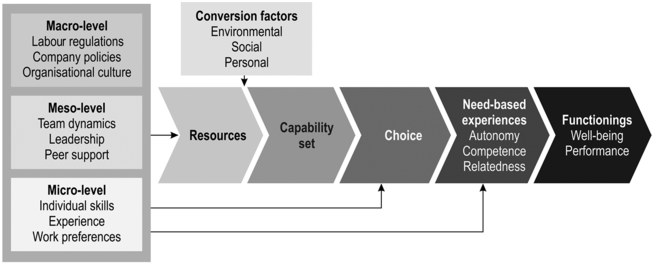
The figure shows how macro-level (e.g., national labour policies and organisational culture), meso-level (e.g., team dynamics, leadership styles), and micro-level (e.g., individual skills and experiences) factors [Reference Van der Klink, Bültmann, Burdorf, Schaufeli, Zijlstra and Abma7, Reference Ryan, DeHaan and Ryan33, Reference Meerman, Van Casteren, Brouwers, Van Dam, Van der Klink and Wiśniewska34] influence the availability of resources, which shapes the capabilities – or real freedoms – individuals can use to achieve valuable functionings. Furthermore, conversion factors (social, environmental, and personal) determine how effectively resources are transformed into capabilities [Reference Robeyns3, Reference Van der Klink, Bültmann, Burdorf, Schaufeli, Zijlstra and Abma7, Reference DeHaan, Hirai and Ryan35]. From this capability set, individuals make choices that affect their need-based experiences, particularly in relation to autonomy, competence, and relatedness. The satisfaction of these needs influences functionings [Reference DeHaan, Hirai and Ryan35], such as well-being and job performance.
For example, labour market policies that promote flexible working arrangements or offer training programmes enable individuals to exercise their autonomy and competence in a work context. These policies expand employees’ capabilities, allowing them to pursue meaningful goals and engage with work in ways that enhance their well-being. Social norms that support work‒life balance or inclusive workplace cultures also ensure that individuals can meet their psychological need for relatedness, enabling them to connect with others and build meaningful relationships at work.
Despite the clear synergies, several challenges exist in integrating the CA and SDT. One key difficulty is their differing levels of analysis. SDT centres on psychological processes and immediate social contexts influencing need-based experiences and motivation. In contrast, the CA operates at a broader level, addressing socio-economic structures and institutional factors that affect capabilities. Bridging these factors requires considering how macro-level factors (e.g., national policies or social norms) translate into micro-level experiences of need satisfaction and well-being. Therefore, one promising avenue is to focus more on how specific labour policies or organisational structures and practices influence employees’ capability to make autonomous choices, develop competence, and foster meaningful relationships. Another challenge is measuring capabilities (see Chapter 4). SDT benefits from well-established measures for psychological need satisfaction and motivation, whereas the CA’s multidimensional and context-specific capabilities are harder to measure consistently across different contexts. The complexity of assessing capabilities, particularly in ever-changing work environments, poses methodological challenges for empirical research. Nevertheless, Van der Klink et al.’s capability set for work, which outlines seven core work-related capabilities, offers promising ways to make the CA more empirically accessible [Reference Van der Klink, Bültmann, Burdorf, Schaufeli, Zijlstra and Abma7].
In conclusion, the integration of the CA and SDT allows for a more comprehensive framework for enhancing well-being at work and beyond. SDT sheds light on the psychological needs that drive motivation and growth, whereas the CA emphasises the societal structures that shape individuals’ real opportunities. Together, they inform practices and policies that support both the need for satisfaction and the freedom to pursue valued lives. This integration urges organisations and policymakers to address both psychological and structural barriers, promoting strategies that are both normatively grounded and psychologically sound to foster human flourishing across contexts.
The Integrative Model of Behavioural Prediction as Illustrated through the Guidance of Unemployed Individuals
A Brief Overview of the IMBP and Its Development
In addition to the other theories discussed in this chapter (e.g., ICF, JD-R, and SDT), the IMBP is a key framework for understanding and influencing human behaviour in contexts such as health, sustainable employability, and long-term unemployment. The IMBP and its predecessors have guided interventions across domains, from preventive health behaviour to job seeking [Reference Van Hooft, Born, Taris and Van der Flier36, Reference Van Hooft, Born, Taris, Flier and Blonk37, Reference Boermans, Van de Logt and Blonk38]. In our research, we use this model to support unemployed and sicklisted individuals in returning to work. While our examples are drawn from these areas, the IMBP applies to any behaviour.
The IMBP is the latest development in what is known as the reasoned action approach (RAA) [Reference Fishbein and Ajzen39]. The RAA, which started more than half a century ago, encompasses several theories that have developed over time, such as expectancy-value theories (EVT), the theory of reasoned action (TRA), the theory of planned behaviour (TPB), and, more recently, the IMBP. Our goal is not to provide a comprehensive overview of the five to six decades of research that led to the development of the IMBP. For those interested in deeper exploration, we recommend Ajzen’s essay on the legacy of Martin Fishbein’s work and other supporting literature [Reference Fishbein and Ajzen39, Reference Ajzen, Van Lange, Kruglanski, Tory Higgins and Ajzen40].
Among the precursors of the IMBP, both the TRA and the EVT emphasise the importance of attitudinal beliefs (values). The theories differ in the outcomes of these beliefs. In EVT, beliefs are related to the importance of a specific goal for an individual (e.g., the value of having a job) and personal beliefs about the likelihood of successfully pursuing that goal. In TRA, the beliefs (e.g., functional, useful, pleasant, fun) focus on performing a specific behaviour (e.g., job search) rather than the goal that the behaviour aims to achieve. While this difference seems minor, it helps us better understand the varying effectiveness of interventions and what drives unemployment: is it a matter of belief (motivational), behavioural issues, goal setting, or a mix of these and perhaps other factors not yet included in the model? As such, extending the TRA to include beliefs about perceived control is a small but significant step.
This extension draws on the social cognitive theory [Reference Bandura41]. To some extent, self-efficacy resembles the expectancy concept in the EVT, ultimately transforming the TRA into the TPB, which Ajzen describes as the premier reasoned action approach [Reference Ajzen, Van Lange, Kruglanski, Tory Higgins and Ajzen40]. Beliefs about perceived control refer to resources and obstacles that may foster or hinder a specific behaviour. Perceived behavioural control, or self-efficacy, encompasses beliefs about effectively conducting a required behaviour. This includes knowing what to do, having and managing resources, and dealing with obstacles. Applied to the job search process, these beliefs involve being confident in one’s ability to engage in effective job search behaviours, such as asking for help when needed and dealing with inevitable setbacks.
Until now, these models have focused primarily on factors that facilitate or hinder the intention or motivation to perform a specific behaviour. However, intentions are not enough; one also needs the skills and knowledge to perform the necessary behaviours (e.g., job search) to attain the goal (e.g., acquiring a job) and the opportunity to do so (e.g., job vacancies, inclusive labour employer behaviour). Fishbein and Ajzen extended the TPB into the IMBP by adding actual skills and environmental constraints as predictors to the model. By integrating these additional components, the RAA moved from centralising the intention and motivation in the TRA and TPB to centralising both motivation and behaviour in the IMBP. As such, the resulting IMBP framework provides a comprehensive approach to understand and predict behaviour and to develop effective interventions (see Figure 6.3).
A dynamic model combining the IMBP with the CA.
From: Predicting and changing behavior: The reasoned action approach by M. Fishbein and I. Ajzen, figure 1.1, page 22. Copyright (2010) by Psychology Press. Reproduced by permission of Taylor & Francis Group.

Figure 6.3 Long description
Distal variables like Personal characteristics, Demographics and culture, and other individual differences feed into three respective core cognitive pillars, Attitude slash value, Social norm, and Self-efficacy driving a reciprocal relationship between Intention slash Motivation and behaviour. The reciprocal relationship is supported by two external factors like Skill acquisition and Dealing with constraints leading to a step-wise goal attainment. The step-wise goal attainment features two major feedback loops, Person-centered guidance and Capability set.
This integrated framework coincides with the results of a meta-analysis on the effects of job search interventions conducted by Liu et al. [Reference Liu, Huang and Wang42]. Based on forty-seven studies that met the quality criteria of at least a quasi-experimental design, Liu and colleagues showed that job search interventions increased the likelihood of finding a job by a factor of 2.67 compared with no-treatment control groups. Liu et al. then conducted an in-depth analysis of the content of these job search interventions, revealing two main components: interventions aimed at enhancing motivation (e.g., improving job search self-efficacy) and those focused on developing specific skills needed to apply for a job (e.g., self-presentation). Their subsequent analysis revealed that interventions were only effective when they addressed both skill development and motivation enhancement [Reference Liu, Huang and Wang42]. This finding supports the notion that interventions based on models such as the IMBP should centralise motivation and behaviour in predicting outcomes.
The IMBP has proven flexible in incorporating additional insights. For example, the IMBP connects seamlessly with the SDT, and many of the factors in the ICF are reflected within the subconcepts of the IMBP. As the IMBP becomes more detailed and expands, researchers may debate its subconcepts’ specific content, relationships, and relative order. However, in our experience, complexity is reduced when this technique is applied as a diagnostic tool and as a foundation for designing interventions.
Combining the IMBP with the CA
Given its history and development, it is not surprising that the IMBP is open to the CA. The connection between these two approaches can be understood or established on four levels. First, the CA focuses on values – specifically, the aspects (beings and doings) that people have reason to value. This is also the case in the IMBP, which, with its roots in EVT, highlights the importance of the values people assign to their goals as key aspects of motivation and perseverance.
Second, the concept of agency is important in Sen’s work, which resonates with the notion of self-efficacy (akin to SDT’s notion of competence). Even though Sen has a much broader and deeper notion of agency, the development of an individual’s sense of self-efficacy can be understood as a process of the social construction of meaning in which relationships with case managers, as well as collective systems such as social services or team dynamics, play an important role in shaping an individual’s sense of self-efficacy. For example, the most influential source of self-efficacy beliefs is an individual’s interpretation of one’s performance or mastery experience. As such, recognising and affirming experiences or providing support when confronted with setbacks may work to encourage and empower individuals in their job search, while downplaying can work to defeat and weaken self-efficacy beliefs.
Third, the IMBP describes the role of environmental and individual constraints or hindrances that may impede behaviour and goal attainment. These constraints can include not only physical or mental disabilities but also factors such as stigma, discrimination, and reduced access to resources. When applied to guiding the unemployed (back) to work, the IMBP does not differ from the CA in these aspects. However, unlike the CA, the IMBP is not a normative model. It merely describes the factors related to the model’s central aspects, thus contributing to its predictive quality.
In line with the ICF, JD-R, and SDT, this normative nature also extends the IMBP on a different level that encompasses all aspects of the model. This extension arises from the CA’s focus on the quality of the goals being pursued and the personal agency to pursue them. For example, in the context of guiding unemployed individuals, the CA emphasises that work should be something people have reason to value. In some cases, especially when social benefits are at stake, the focus of employment guidance may shift from helping the job seeker find meaningful work to minimising costs for society. While this shift does not always lead to lower-quality outcomes, it increases the risk of steering individuals into jobs that might negatively impact their health or other long-term outcomes.
Therefore, the fourth point is that combining the CA with the IMBP would advocate for person-centred employment guidance, with a focus on sustainable outcomes (see Chapter 2, Appendix 2.1 for a start on this). Where the IMBP explains a person’s behaviour in pursuing a job, CA can help translate insights into effective strategies for behaviour change based on the IMBP into normative principles for employment guidance or the development of labour market policies. For example, strategies that encourage the pursuit of personal career ambitions (attitude/value), boost self-efficacy to achieve these ambitions, and reduce environmental constraints (see Figure 6.4). Such an approach would use the IMBP but view and apply its aspects through the lens of CA, ensuring that the guidance process is aligned with meaningful, long-term benefits for the individual.
Foci of combining the IMBP and the CA.

Figure 6.4 Long description
Behavioural beliefs influencing an individual's attitude or value, Normative beliefs influencing the social norm, and Control beliefs determining an individual's level of Self-efficacy converge to form an individual's Intention or Motivation moderated by Actual skills and Environmental Constraints thereby leading to behavioural action and Goal attainment.
Discussion
This chapter explored how integrating the CA with other prominent models enhances our understanding of flourishing and sustainable employment. By examining these synergies, we sought to demonstrate how each model complements the CA, and vice versa, to offer a more holistic view of well-being in work and social contexts.
A key takeaway of these integrations creates a more comprehensive foundation for promoting well-being. The ICF [13] helps operationalise the CA by illustrating how contextual factors shape functioning. The JD-R model adds insight into job demands and resources [Reference Demerouti, Bakker, Nachreiner and Schaufeli23, Reference Bakker, Demerouti and Sanz-Vergel24], which, when integrated with the CA, extends the focus to capability expansion and workplace agency. SDT, with its focus on innate psychological needs, provides a detailed understanding of the connection between need-supportive environments and well-being [Reference Ryan and Deci29], which the CA enhances by considering broader or more distal external opportunities and conditions for need support. Finally, the IMBP complements the CA by providing insights into how behavioural intentions and determinants translate into realised functionings, addressing a gap in the CA’s explanation of how opportunities are converted into actions. Together, these integrations enrich the CA’s practical and explanatory relevance. While the CA is normative rather than explanatory [Reference Robeyns3, Reference Sen5], integrating it with empirical theories strengthens the link between determinants and outcomes such as behaviour and well-being [Reference O’Brien and Cooper44].
Another important lesson is the CA’s distinctive normative orientation. Unlike fixed models, the CA avoids assigning universal meanings to concepts such as ‘health’ or ‘employment’. Instead, their significance is defined by individuals’ values and circumstances, enabling more tailored assessments of well-being and personalised interventions, as shown in Chapters 2 and 10.
These insights point to promising directions for future research. Studies could evaluate health-promoting interventions that blend CA and JD-R model elements and examine how CA–SDT integration facilitates both behavioural internalisation and the high-level external conditions necessary for this beyond organisational settings. Further work could also investigate how macro-level policies and micro-level practices interact to shape individual capabilities, need-based experiences, and motivation, bridging the gap between broader societal structures and individual well-being. Advancing measurement tools, such as those developed by Van der Klink et al. [Reference Van der Klink, Bültmann, Burdorf, Schaufeli, Zijlstra and Abma7] and Abma et al. [Reference Abma, Brouwer, De Vries, Arends, Robroek and Cuijpers45], can also enhance the operationalisation of capabilities in dynamic work contexts. Additionally, aligning (re)employment strategies with individuals’ values and capabilities could ensure that work meaningfully contributes to long-term flourishing.
Finally, we call on theorists and practitioners to embrace the CA’s empowerment-focused perspective. While many traditional models provide descriptive insights into human behaviour, the CA offers a unique perspective by emphasising what individuals should be able to achieve based on what they have reason to value. This normative focus encourages a shift from merely addressing current states to actively expanding opportunities for valued functionings [Reference Robeyns3, Reference Sen4]. By integrating normative evaluation with explanatory mechanisms, theorists and practitioners can move beyond understanding behaviour and well-being to foster environments that prioritise human flourishing across diverse settings.
Conclusion
In conclusion, this chapter highlights the value of integrating the CA with four other established theoretical models to provide a more holistic understanding of well-being. The combined frameworks offer valuable insights for improving individual and organisational outcomes by emphasising both internal psychological processes and external enabling factors. Future research should continue to explore these integrations, focusing on practical applications that align with the normative, improvement-focused nature of the CA, ultimately contributing to more inclusive and supportive workplaces for all.


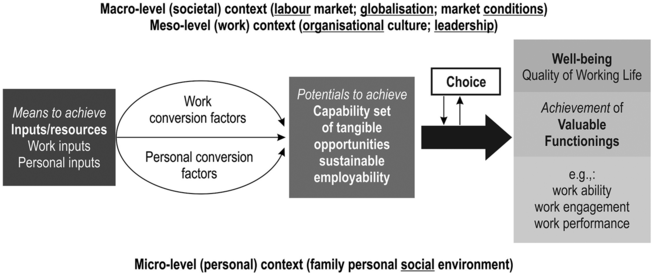
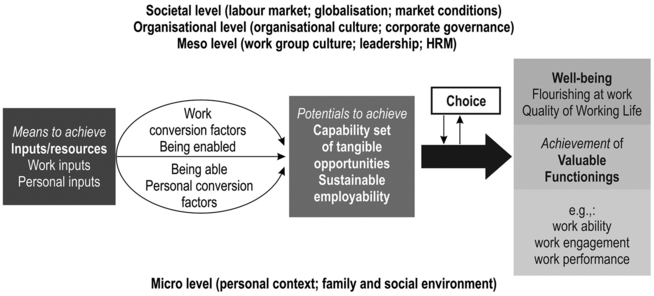
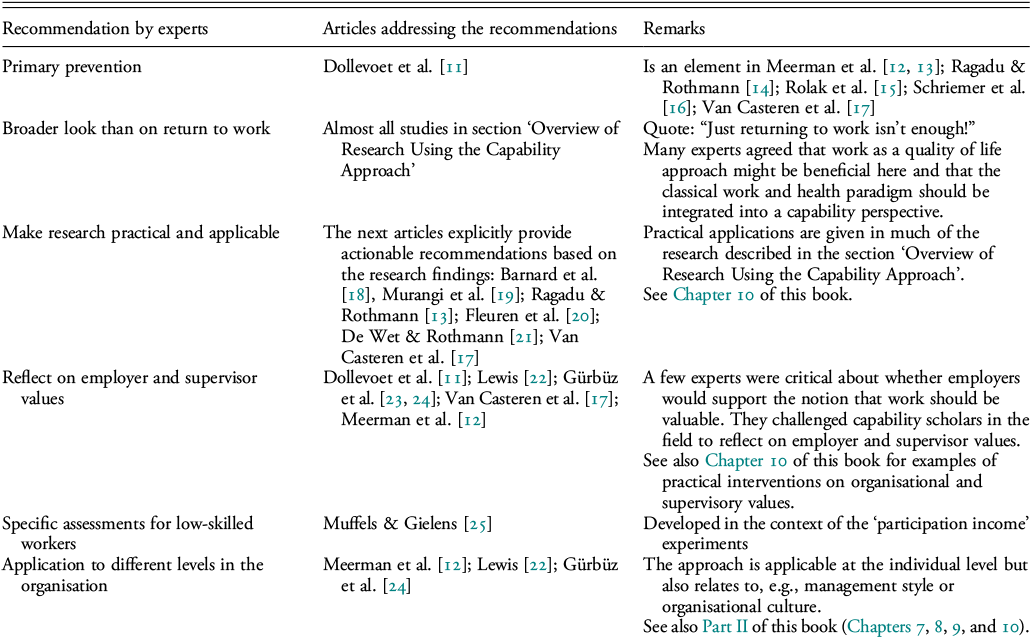
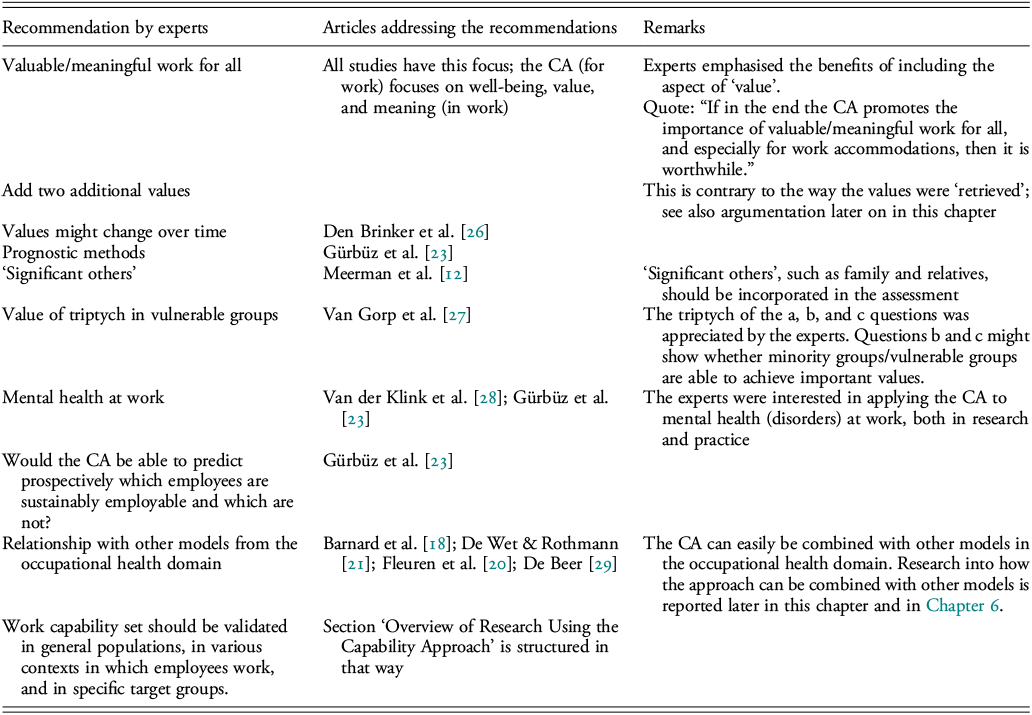
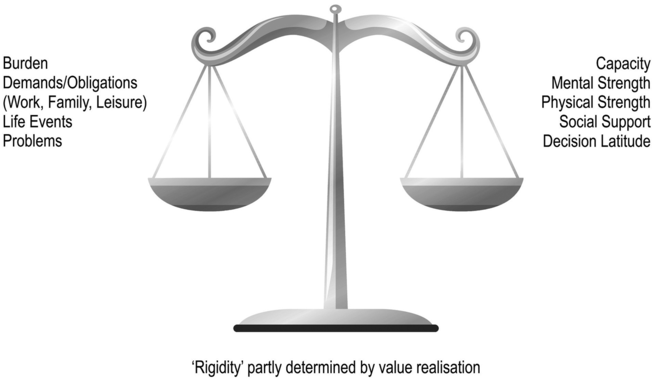
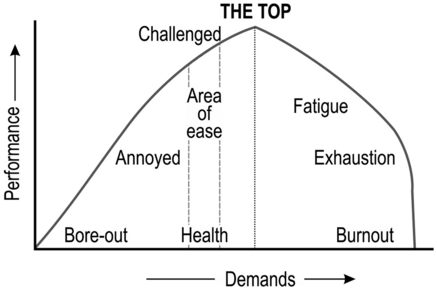
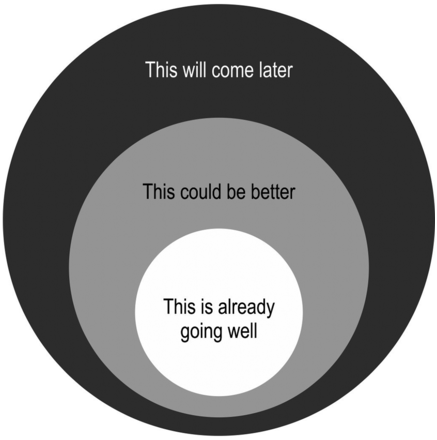



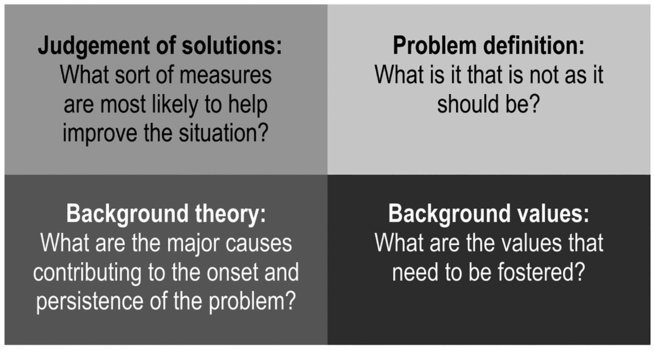
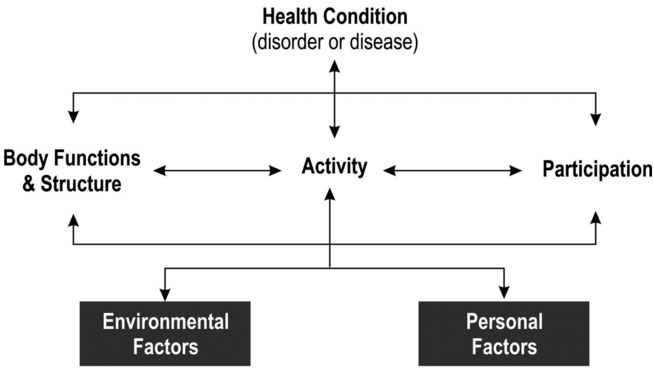

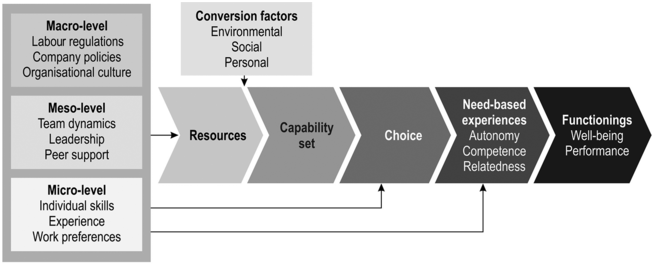
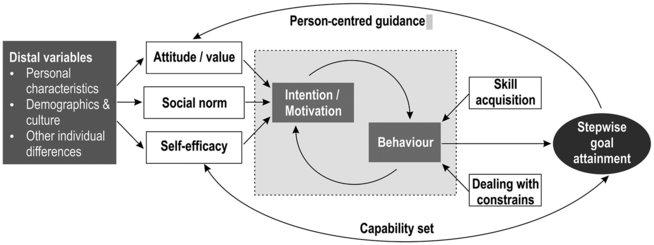
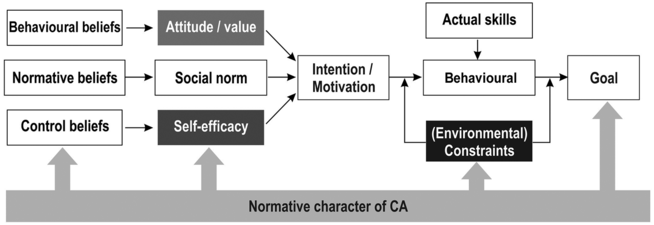

 Open access