


Part I of the book laid the foundation for understanding how globalization affects democratic representation. Armed with information about the mechanics of promissory representation and the ways in which globalization constrains national policymaking, we now shift the focus to the ways in which globalization affects the ability of governing parties to keep their campaign promises and how voters respond to the effects of these constraints.
We argue that globalization exerts its influence on promise keeping primarily through three of the four constraints discussed in the previous chapter: international legal obligations, market actors, and economic uncertainty.Footnote 1 These forces make it difficult for parties to implement their promised policies, particularly those that conflict with global market constraints. While right-leaning parties are better positioned to navigate these constraints due to their alignment with market-friendly policies, left-leaning parties face greater challenges as their agendas often involve regulation and welfare expansion that clash with global economic priorities. We also discuss a fourth constraint in the previous chapter in the form of citizens’ changing expectations of their governments. We argue that these changing expectations primarily affect the content of what (some) parties promise, particularly parties on the center-right. These expectations do not have as significant a bearing on promise keeping compared with the other three constraints, as discussed in this chapter.
We find support for this argument using evidence from comparative data on pledge fulfillment concerning over 7,000 election pledgesFootnote 2 of fifty-seven political parties that gained executive power across twelve countries. The main finding is that countries’ exposure to economic globalization reduces the likelihood that governing parties keep the election pledges they previously made. This effect is particularly marked for parties to the left of the left–right dimension. Another important finding relates to the difference between de jure and de facto globalization. De jure globalization refers to the extent to which national legal frameworks, including tariffs and regulations, are conducive to free trade, while de facto globalization refers to actual flows of goods, services, and finance. The evidence indicates that de facto globalization exerts a stronger negative impact on promise keeping due to the direct pressures it imposes on governments to align with market forces. The chapter also presents and discusses the finding that parties do not significantly adjust the number or types of promises they make in response to globalization. In other words, parties do not promise less when their countries are more exposed to globalization, in the knowledge that globalization’s constraints may prevent them from delivering on those commitments. Instead, partisan ideology remains the dominant factor in shaping pledge-making behavior, with left-wing parties more likely to make expansionary promises and right-wing parties focusing on cuts.
How Globalization Constraints Lead to Broken Promises
There are two very general reasons why we believe politicians make promises they cannot keep due to the constraints of globalization. The first is unintentional; parties have imperfect information on the precise implications of globalization constraints for the feasibility of their election pledges and therefore make promises that they find impossible to keep. This argument aligns with realistic models of economic policymaking that recognize that policymakers have imperfect information regarding economic business cycles (Dubois Reference Dubois2016; Sargent and Wallace Reference Sargent and Wallace1975). Similarly, parties are often simply unable to anticipate the full consequences of globalization constraints when they formulate their campaign promises. This is apparent when we consider the ways in which parties typically formulate their election programs, which contain their most considered and definitive campaign commitments (see Naurin, Royed, and Thomson Reference Naurin, Royed and Thomson2019 for a review). Parties take different approaches to formulating their programs; some are drafted by party elites and presented to party conferences as fait accompli, while others involve more active participation from grassroots party activists and even ordinary members. Notwithstanding these important differences in processes, few party elites or activists have deep insights into the complexities of international law, the realities of the influence of market actors, or the vicissitudes of economic uncertainties.
The second reason is intentional. Parties face trade-offs between the benefits of making clear and ambitious promises and the costs of not being able to keep those promises. On the one hand, parties gain votes from making clear promises in line with their supporters’ policy preferences. If they are incumbents, they may gain additional votes from fulfilling their previous promises. On the other hand, they bear costs in the form of lost votes when they compete in an election as an incumbent governing party with a record of breaking the promises they made during the previous election campaign. These costs in the form of lost votes are called retrospective sanctions by voters. Theoretically, parties could avoid retrospective sanctions by making no substantive promises whatsoever or only promises that they were certain they could keep when in government, but such vacuous and unambitious election programs would not appeal to many voters. Moreover, crafty politicians may reckon on voters having imperfect information about both promise breaking and the complex constraints of globalization, which might take the edge off electoral punishment for broken promises. This second reason implies that globalization leads to broken promises because parties knowingly decide not to anticipate the effects of globalization on broken promises.
International Legal Constraints on the Fulfillment of Campaign Promises
If international laws are indeed a constraint that leads to broken promises, we would expect to see a range of things happening, not necessarily in every case of promise breaking, but with some regularity. The starkest manifestation of this effect would be the initiation of legal proceedings against governments for breaching international laws when they attempt to fulfill their campaign promise. These may take the form of individuals or corporate actors initiating proceedings in domestic or international courts that invoke the national government’s international legal obligations. There are many cases in which governments have attempted to formulate popular policies, for instance in relation to the health concerns induced by smoking and climate change, only to be legally challenged by firms claiming that those policies violate international investment commitments these governments made (Berge and Berger Reference Berge and Berger2021; Foster Reference Foster2021; Moehlecke Reference Moehlecke2019). In some cases, informal legal proceedings may be sufficient to stop governments from pursuing a policy that contravenes its international commitments. In more than half of United Nations General Agreement on Tariffs and Trade/WTO cases a formal panel is never established, but cases are resolved through an informal process where states receive clarity about whether and how their policies comply with international law and then act upon this new information (Busch and Reinhardt Reference Busch and Reinhardt2000).
In addition, we would expect to observe that international legal obligations feature prominently in political discourse if they are indeed a constraint on promise keeping. Governing politicians who made promises they find unable to keep may refer to international law as an unwelcome “excuse” for promise breaking. In some cases, the promise makers demonize international actors as standing in the way of the will of the people. Such rhetoric is not uncommon in national policy debates of European Union (EU) member states, in which Brussels bureaucrats and EU laws are questionably portrayed as undemocratic (De Vries, Hobolt, and Walter Reference De Vries, Hobolt and Walter2021; Hobolt and De Vries Reference Hobolt and De Vries2016; Hobolt and Tilley Reference Hobolt and Tilley2014; Schlipphak and Treib Reference Schlipphak and Treib2017; Schneider Reference Schneider2019). This can include increased populist rhetoric, which characterizes international elites having undue influence over national governments to the detriment of citizens. Moreover, the promise-making politicians downplay the possibility that they could have anticipated these constraints at the time they made the promises. Instead, they highlight the fact that international laws are open to interpretation and that working through the legalities is a highly complex process. Governing parties may try to frame legal constraints not as a certainty, but as a negotiation with officious international institutions.
Other actors with interests in the relevant policy issues include opposition parties, national and international bureaucratic agencies, and market actors. These actors may voice more specific concerns about the extent to which campaign promises conform to international laws, typically in ways that are less politicized in the party-political sense. Opposition parties generally welcome governing parties’ failure to fulfill their campaign promises as a political opportunity. In addition to opposing the substance of what the governing parties are attempting to do, opposition parties criticize governing parties for failing to anticipate the legal constraints. In contrast to the promise-breaking governing parties, opposition parties contend that the international legal constraints were clear. This enables opponents to portray governing parties as incompetent. Opponents question the competence of a party that was apparently unable to formulate a realistic and implementable election program. Political opponents also use broken promises as opportunities to question the trustworthiness of governing parties and individual party leaders.
Inside national bureaucracies, government officials are charged with preparing policy and legislative proposals that fulfill governing parties’ campaign promises. At this stage, government officials who are generally more knowledgeable about the intricacies of international laws than politicians may raise concerns about the compatibility of campaign promises with the state’s international obligations. Government officials, certainly career officials rather than political appointees, may face a dilemma between assisting their democratically elected political masters to realize their policy intentions and ensuring that the government meets its international legal obligations. Furthermore, career civil servants are not entirely neutral public servants devoid of policy preferences of their own. Rather, they are highly skilled professionals who naturally develop opinions about which policies and practices work best as they accumulate extensive experience of the policy areas in which they work. In policy areas that involve international cooperation, national officials are members of policy communities that develop common ways of framing problems and formulating policies. These policy preferences are often aligned with existing policies, which are compatible with states’ international legal obligations. Therefore, government officials’ policy preferences can be an additional reason why governing parties find it impossible to keep campaign promises that challenge the state’s international legal obligations.
Market actors and international organizations may also voice concerns about campaign promises that appear to contravene states’ international legal obligations. We present the empowerment of market actors as a distinct constraint. That is indeed true, as market actors will use all means at their disposal, not only legal arguments and proceedings, in pursuit of their interests. In practice, the constraints of globalization may become intertwined. Like bureaucratic agencies and officials, market actors often have more technical expertise in relation to the relevant legal provisions than career politicians. Market actors are obviously also more specialized in the issues that concern their operations, while governing party elites must contend with the full breadth of issues on their governments’ agendas. This combination of specialist legal expertise and high levels of issue salience means that when market actors raise concerns about legal conformity of government proposals, they can do so with compelling force. Similarly, as international organizations are the guardians of the treaties and provisions that constitute those organizations, they are well placed to marshal legal arguments if their interests, which depend on states complying, are threatened. For EU member states, the European Commission keeps a close watch on national governments’ policy proposals with a view to ensuring compliance with EU laws.
On balance, international legal constraints are generally more significant constraints on campaign promises made by center-left parties than center-right parties. In relation to policy decisions concerning the extent of state intervention in the economy, the left generally favors more intervention than the right. For instance, in relation to employment rights, environmental protection standards, and product standards, center-left parties generally favor stronger regulation than center-right parties, which favor more market-led policies. Moreover, economic globalization has been associated with the prioritization of liberal market regimes, and these regimes have been embodied in the contents of trade agreements that states have signed up to. Consequently, when national policy proposals – such as those that follow from left-wing parties’ campaign promises – intend to introduce higher levels of regulation of markets, these can come into conflict with established international laws.
Although we expect international legal constraints to be more of a constraint on center-left than center-right parties, there are numerous exceptions to this general tendency. First, international legal constraints are not only regulatory ceilings above which states cannot introduce higher standards. They also include floors or minimum standards above which states commit themselves to remaining. Consequently, progressive left-wing initiatives to improve standards do not always meet with resistance from established international legal commitments. Likewise, market-motivated policy initiatives proposed by center-right parties to lower standards may not be compatible with international laws in some contexts. EU laws include minimum standards, for instance, to ensure that states do not engage in unfair competition with others. Second, center-right parties sometimes make proposals that are impossible to reconcile with international obligations that safeguard elements of free markets. For example, in the next chapter we discuss a famous campaign promise by the UK Conservative Party to cut net migration. When the party took office and attempted to fulfill this promise, it soon found that constraints of the United Kingdom’s legal commitment to freedom of movement of EU citizens was one of the key impediments to doing so. Third, there are many electorally salient policy areas in which international legal commitments do not pose significant constraints to governing parties delivering what they promised. For these reasons, while the negative effect of economic globalization on promise keeping may be greater for parties of the center-left than for parties of the center-right, we do not expect the difference to be very large.
Market Actors and the Fulfillment of Campaign Promises
The second constraint of globalization on promise keeping is the empowerment of market actors such as multinational corporations and national industries with significant interests in free flows of labor, capital, goods, and services. If this is indeed a significant constraint, we would expect to observe such actors being prominent opponents of some policy proposals that were inspired by parties’ campaign promises. As noted, market actors may make references to the state’s international legal commitments if these commitments strengthen their opposition to the government’s proposals. Beyond this, market actors argue that proposals are likely to undermine their competitiveness. This lack of competitiveness may, they argue, lead to declining turnover, profits, employment, and contributions to public finances in the form of taxes. Depending on the industry concerned, companies may threaten to relocate their economic activities overseas to countries with more favorable regulatory regimes. The credibility of such threats depends on the costs and feasibility of relocating. Market actors generally represent concentrated interests with highly specialized knowledge. These characteristics are conducive to lobbying styles that prioritize direct access to policymakers, as distinct from broad public lobbying campaigns that may be more suitable for actors that represent diffuse interests. To some extent, this may make it more difficult to observe lobbying by market actors directly. Nonetheless, market actors also lobby in public through such avenues as public statements and submissions to public consultations and legislative committee hearings.
As with international legal constraints, market actors are more of a constraint on the fulfillment of campaign promises made by parties on the center-left of the socioeconomic left–right dimension than by parties on the center-right. Center-right parties are generally more closely aligned with the interests of market actors than are parties of the left. When social democratic parties propose higher standards in terms of employment protections for workers, internationally oriented firms may claim that this undermines their competitive positions compared with firms in jurisdictions with lower standards. Center-right parties are usually less inclined to introduce such initiatives and therefore their policies are less likely to be opposed by market actors when they govern.
While the constraint of market actors weighs more heavily on center-left than center-right governing parties, there are several mitigating factors. One is that in some countries, market actors are broadly supportive of relatively high labor standards and social welfare protections that are typically supported by the center-left. According to the varieties of capitalism thesis, coordinated market systems such as Sweden, Denmark, and (arguably until recently) Germany, are known for market actors that broadly support high standards (Hall and Soskice Reference Hall and Soskice2001). These protections enable firms to mitigate the risks associated with high value-added products and services that require firms and workers to invest in skills that are transferable to a limited extent only when market conditions change. By contrast, economic elites in liberal market economies such as the United Kingdom and United States are generally less supportive of such policies. Another mitigating factor is that parties of the center-right often find it politically expedient to support policies that raise concerns among sections of the business community. Finally, at least in the short term, some social democratic parties have embraced liberalizing reforms to labor markets and welfare systems, such as the reforms introduced by Gerhard Schröder’s Social Democratic Party in Germany between 1998 and 2005. Consequently, while market actors are typically a more significant constraint on center-left governing parties, this effect may be muted in some contexts.
Uncertainty and the Fulfillment of Campaign Promises
Uncertainty is the third constraint of globalization that leads to broken campaign promises. In the last chapter we define uncertainty as the presence of unforeseeable and significant changes in conditions that are largely outside the control of national policymakers and that negatively affect the feasibility and desirability of policy options. Here, the passage of time between the points at which parties formulate their campaign promises prior to elections and the subsequent points at which those parties, as governing parties, may be expected to fulfill those promises is crucial. The time between the formulation of campaign promises and related government decisions could be up to several years; campaign promises may be formulated months prior to the election and relevant government decisions may be taken anytime during the subsequent governing period, which could typically last up to four years after the election. During that passage of time, national economic conditions may change significantly as a consequence of countries’ embeddedness in the international economic system, making what was promised unfeasible or undesirable even to the parties that made the promises. As an elevated level of uncertainty may be a consequence of a country’s exposure to the international economic system, we can think of uncertainty as an intervening variable. Exposure to economic globalization causes uncertainty, which in turn leads to promise breaking.
Where uncertainty is a relevant factor in broken campaign promises, we would expect to see this feature prominently in public discourse. Governing parties’ representatives are expected to refer to unforeseeable changes in conditions when justifying their actions. In many cases, governing parties do not explicitly acknowledge their broken promises, but instead highlight their efforts to pursue policies that align with their election appeals despite challenges being posed by conditions outside their control. In some cases, governing parties may acknowledge that their actions amount to broken promises, but when doing so highlight that they are prioritizing responsible policymaking in the face of adverse conditions. Conversely, opposition parties are likely to argue that competent governing parties should be able to anticipate changes in conditions.
A quintessential example of a broken promise due to the constraints of uncertainty played out in Australia. The Australian Labor Party, which belongs to the social democratic tradition, entered the May 2022 national election with a clear election pledge to keep the tax cuts that the incumbent governing parties had legislated. These included the so-called stage-three tax cut, which would come into effect in July 2024 and would benefit mainly higher income earners. The Australian Labor Party took office after the 2022 election. Throughout 2023, inflation continued to rise, prompting the Australian Central Bank to increase interest rates. In response, commercial banks raised mortgage rates, affecting many borrowers in Australia who are on variable-rate mortgages. A cost-of-living crisis ensued for many lower and middle-income Australians, putting pressure on the government to provide relief. In January 2024, following protracted internal party discussions, the government announced that it would change the planned stage-three tax cuts to distribute them more evenly. Higher earners would receive roughly half of the tax cut they would have received under the original plan, and the savings would be reallocated to tax cuts for lower and middle-income earners.
As we would expect, Australian Prime Minister Anthony Albanese emphasized that the change in circumstances was largely beyond the government’s control and due to factors that originated overseas. The global pandemic and the war in Ukraine were singled out as factors linked to the change in policy by the prime minister when he spoke at the National Press Club to defend the change in policy in January 2024. While the pandemic and the war in Ukraine were known at the time of the 2022 election, he argued that their effects could not have been anticipated accurately. With respect to the COVID pandemic the prime minister said:
The impact of the pandemic didn’t end. Of course, people are still getting COVID, we are still dealing with the consequences, but the aftershock has been much greater than what was anticipated.
With respect to the war in Ukraine, he said:
The other thing that was not envisaged in 2022 … [was that] … the Russian war on Ukraine and the invasion would be ongoing over such a long period of time, that impact on energy prices that then flows through, to the logistics industry, to supermarket shelves, was very significant indeed. No-one in 2022 at the election, I don’t think was pointing towards those factors at all.
He also insisted “that when economic circumstances have changed, it is a responsible thing to do to change our policy” (Prime Minister of Australia 2024). Moreover, as would be expected, critical journalists and the opposition party attempted to frame the change in policy as an indication of the lack of competence and trustworthiness of the Labor Party and the Prime Minister in particular.
Like the constraints of international legal commitments and market actors, we expect economic uncertainty to weigh somewhat more heavily on the fulfillment of promises made by center-left than by center-right parties. Economic uncertainty leads to broken promises primarily through the reduction in available or expected public revenue with which to fund campaign promises. Traditionally, center-left parties’ campaign promises require expenditure of substantial public funds, such as promises to invest in public education, health care, and social services. When public revenues decline due to global economic downturns and the resulting lower national tax intakes, such promises must be funded by either deficit spending or increases in tax rates. The extent to which deficit spending is practically possible is limited by the state’s international commitments – as is the case for Eurozone members that committed themselves to limiting deficit spending – or by the extent to which international investors influence governments through their investment decisions. Increasing taxes may also be infeasible due to the political opposition they provoke. Nevertheless, not all center-left parties’ campaign promises require the allocation of government revenues. Likewise, center-right parties commonly make promises, including promises to cut taxes, that require substantial public funds and are therefore not immune to the effects of economic uncertainty of promise breaking.
Taken together, these globalization constraints present significant challenges to the ability of governments to fulfill their campaign promises. Our theoretical argument suggests that (1) political parties in executive power are less likely to fulfill their campaign promises in countries and during time periods where governments are more exposed to economic globalization. In addition, we hypothesize that (2) this effect is weaker for center-right parties, whose campaign promises tend to converge with market interests.
Data and Variables
We now test our argument using large-n observational data, examining how globalization impacts the ability of governing parties to deliver on their promises and whether parties’ ideological positions mitigate these constraints. The information on the fulfillment of campaign promises that we use for the analyses in this chapter comes from the Comparative Pledges Project (CPP) dataset (Naurin, Royed, and Thomson Reference Naurin, Royed and Thomson2019; Thomson et al. Reference Thomson, Marsh, Farrell and McElroy2017). The CPP is a network of researchers that study campaign promises in democracies around the world. They coordinate their efforts by developing and following common ways of defining key concepts and measures, notably how to define campaign promises and their fulfillment. The dataset we examine has been subject to peer review and examined extensively in previous research. It includes information on over 20,000 campaign promises made by political parties in twelve countries prior to the formation of fifty-seven governments. The countries covered are Austria, Bulgaria, Canada, Germany, Ireland, Italy, the Netherlands, Portugal, Spain, Sweden, the United Kingdom, and the United States. The time period ranges from the 1970s to the 2010s, with the data on some countries covering longer time periods than others. The dataset includes information on campaign promises made by parties that did and did not go on to hold executive power after the election campaigns in which they made the promises. For the purposes of testing our main argument, we focus on the promises made by parties that went on to hold executive office. This refers to the fulfillment (or nonfulfillment) of 7,770 promises made in eighty-one election programs. When we explore the possible impact of globalization on the number and type of promises that political parties make, we examine the full dataset, including promises made in the election programs of parties that did not hold executive power after the election.Footnote 3
The Dependent Variable: The Fulfillment of Campaign Promises
Our main dependent variable is the fulfillment of campaign promises by political parties in government. A crucial question concerns the appropriate “level of analysis” at which we measure the variables and conduct the analyses. Here, we treat each election program (also called manifestos or platforms) as the unit of analysis and focus on the proportion of promises made in each program that were at least partially fulfilled as the operationalization of the dependent variable. There is a strong argument for treating election programs as the main unit of analysis as we do here. Because economic globalization varies across countries and years, all parties competing in the same election are exposed to the same level of economic globalization.
There are also arguments for treating individual promises as the unit of analysis, and that is the approach we used in a previous study on which the following analyses build (Schneider and Thomson Reference Schneider2024). An argument for treating individual campaign promises as the unit of analysis is that other factors that explain promise keeping (and breaking) have different values for promises found in the same election platform, and we should control for these alternative explanations too. Against this, treating individual promises as the units of analysis may artificially inflate the number of observations and therefore the statistical power, making it possible to “find” an effect of globalization that may in fact not exist. Treating election platforms as the units of analysis is a more conservative research design decision. Fortunately, we find that the results of the program-level and promise-level analyses are largely similar, which further increases our confidence in the findings we present here.
The decision to focus on election programs as the main source for gathering information on parties’ campaign promises is also worth justifying. While election programs may not encompass the entire range of parties’ electoral appeals, they are the most authoritative statements of parties’ positions. These documents are used in a wide range of comparative research on parties and are the main source for researchers and citizens to understand what parties promised during election campaigns (Naurin, Soroka, and Markwat Reference Naurin, Soroka and Markwat2019; Thomson et al. Reference Thomson, Marsh, Farrell and McElroy2017). The comparative politics literature also demonstrates that the fulfillment (or breaking) of promises contained in election programs has significant impacts on voters’ retrospective sanctioning of governing parties (Matthieß Reference Matthieß2020). Manifesto data have also been used to evaluate party policy positions and to relate those positions with tangible outcomes; for instance, to study how party polarization relates to citizen polarization (Moral and Best Reference Moral and Best2022), how declining turnout leads to manifesto adaptation (Ezrow and Krause Reference Ezrow and Krause2023), or how positions expressed in national manifestos toward the EU affect EU-level negotiations (Mariano and Schneider Reference Mariano and Schneider2022). The fact that manifesto positions, and the breaking or keeping of pledges made in manifestos, affect policy and electoral outcomes is a clear indication that they matter.
The following analyses are based on the narrow definition of campaign promises proposed by CPP researchers. A campaign promise is “a statement committing a party to one specific action or outcome that can be clearly determined to have occurred or not” (Royed, Naurin, and Thomson Reference Naurin, Royed and Thomson2019: 24). Moreover, the narrow definition of campaign promises holds that the “criteria used to judge the fulfilment of pledges are in principle provided by the writers of election programmes, not by the researcher” (Thomson Reference Thomson2001: 180). The advantage of this narrow definition is that it enables us to compare rates of promise keeping and breaking across countries and time periods with comparable measures of the key concepts of campaign promises. Some researchers in the CPP prefer a somewhat broader definition and measure of campaign promises, one that includes commitments that might be fulfilled in a range of different ways without specifying which way the party intends to take. The broader definition requires even more judgment by researchers when assessing fulfillment. This broader definition of campaign promises may be appropriate in some contexts and for some research purposes, but it does not suit the kind of broad comparative analyses we conduct here. Instead, we want to know that the data we examine from different countries and time periods – which were subject to different degrees of economic globalization – are as comparable as possible. This is the case when applying the CPP’s narrow definition. The CPP builds on a long tradition of research on specific campaign promises that typically focused on single-country case studies (Barrett Reference Barrett1960; Pomper Reference Pomper1968). The main differences between the CPP and these previous studies are that the CPP studies are comparative across countries and specify definitions of campaign promises and promise fulfillment more explicitly.
CPP researchers gathered evidence to assess fulfillment, categorizing promises as unfulfilled, partially fulfilled, or fully fulfilled. A campaign promise is considered partially fulfilled if some action is taken in the direction of the promise that falls short of complete fulfillment, such as reducing a tax rate from 25 to 23 percent when a cut to 20 percent was promised. The evidence gathered to assess fulfillment depends on the substance of what was promised, including changes to legislation, budget allocations, or certain socioeconomic outcomes. Fulfillment is assessed within the lifetime of the government that took office after the election campaign in which the promise was made. When a new election takes place, the mandate for the previous government has ended, and new promises are made.
The data collection procedure involves human coding of parties’ election programs to identify statements that qualify as campaign promises. Then, researchers must investigate whether the promises were fulfilled by consulting various sources of information relevant to whatever was promised. This is a labor-intensive process involving detailed qualitative work and the exercise of judgments by country specialists who are familiar with the parties, their election programs, parties’ promises, and relevant government actions and outcomes. CPP researchers have reported that their coding decisions are reliable. In the most comprehensive reliability test reported to date, an international group of nine researchers independently coded parts of a Canadian Conservative Party manifesto, a document that contained ninety-nine pledges identified by at least one coder. The average paired reliability was 0.74, which was calculated as x/n, where x was the number of statements both coders identified as a pledge and n was the number of statements at least one coder identified as a pledge (Royed, Naurin, and Thomson Reference Naurin, Royed and Thomson2019). Somewhat higher levels of reliability, in the eighty percentiles, have been reported in separate country studies. Intercoder reliability of fulfillment is generally higher, the most definitive test reporting an average 93 percent agreement between each pair of seven independent coders (Royed, Naurin, and Thomson Reference Naurin, Royed and Thomson2019). We are therefore satisfied that the data we examine on campaign promises are sufficiently comparable and reliable and currently the best available data for our purposes.
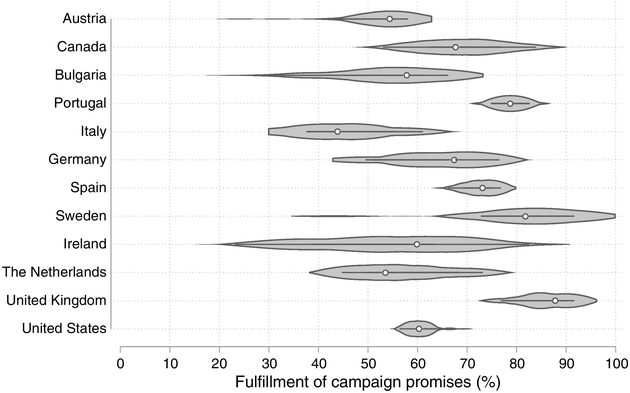
Figure 4.1 summarizes the quantitative evidence on pledge fulfillment that we examine at an aggregate level, comparing countries with each other. Following the practice of previous research, we compare the percentages of pledges that were either partially or fully fulfilled (as distinct from not fulfilled). This approach is appropriate given that the possibility of a pledge being partially fulfilled arguably depends partly on the way in which the promise itself is formulated.
Comparing the fulfillment of campaign promises across countries
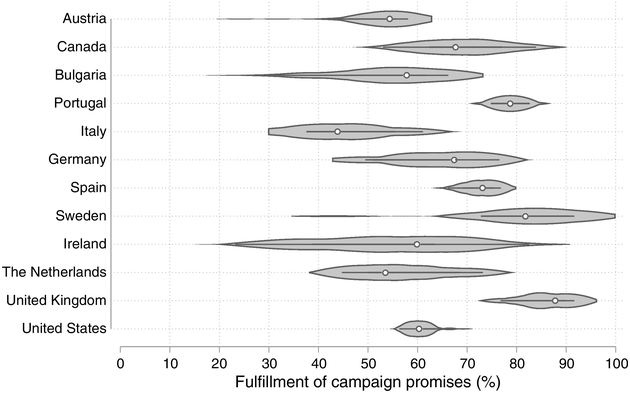
The figure depicts the aggregate performance of governments in terms of promise fulfillment across twelve countries. This broad cross-national comparison reveals some of the main findings that have featured prominently in previous comparative analyses. First, parties make many testable promises during election campaigns and fulfill what many observers consider to be substantial proportions of those promises. Of the promises made by parties that went on to hold executive power after elections, 61 percent were classified as at least partially fulfilled by researchers. The fact that governing parties fulfilled a clear majority of pledges at least partially and in many contexts fulfilled substantially higher percentages of promises, contrasts with the conventional wisdom that political parties are habitual promise breakers.
Governing parties differ significantly from each other in the extent to which they fulfill their campaign promises. The cross-country comparisons show higher rates of promise fulfillment for governing parties in countries where single-party governments are the norm, and lower rates where coalitions and other forms of power sharing are common. The United Kingdom’s single-party majority governments exhibit comparatively high levels of pledge fulfillment, as do the mostly single-party governments of Sweden and Portugal. Parties that formed single-party governments in the United Kingdom fulfilled 86 percent of their promises at least partially. Lower levels of pledge fulfillment are found in coalition governments, such as those found in the Netherlands, Germany, and Austria. Dutch parties that entered governing coalitions fulfilled 57 percent of their promises partially or fully.
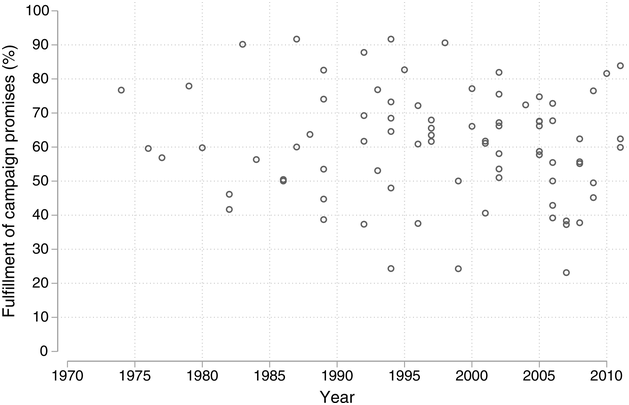
Figure 4.2 breaks down the information about the fulfillment of campaign promises by party manifesto. The figure shows that there is no clear trend over time. It does not look like parties are becoming less able to keep their campaign promises in more recent years. At first sight, this seems contrary to our main expectation. We know that globalization has increased over time. If globalization is exerting a negative effect on promise keeping, we might expect to see more broken promises in more recent years. This would, however, be a vast oversimplification. We know from previous research on promise fulfillment that many other factors matter too, including the existence of power-sharing arrangements, whether the party holds the chief executive post in coalition governments, parties’ previous government experience, the general state of the economy, and characteristics of the promises themselves. Therefore, a proper analysis of our theoretical expectations requires that we consider these other explanations of promise keeping and breaking.
The fulfillment of election promises in election programs
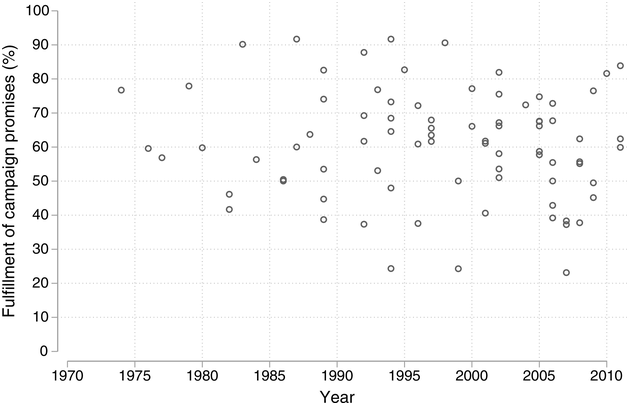
The main dependent variable in the following analyses is the fulfillment of campaign promises:
Principal Explanatory Variable and Control Variables
The data include cases where parties and governments were exposed to very different levels of globalization, which is our key explanatory variable. We use the authoritative Konjunkturforschungsstelle (KOF) Economic Globalization Index, which is an annual weighted aggregation of information on de facto and de jure trade and financial globalization. The index captures the extent to which a country is integrated into the international economy, incorporating data on trade in goods and services, trade regulations, tariffs and agreements, foreign direct investment, investment restrictions, and capital account openness. This multidimensional structure allows the KOF Index to capture both structural exposure to global flows and formal institutional commitments that may constrain national policymaking:
Globalization is the extent to which a country is integrated into the international economy, including information on trade in goods and services, trade regulations, tariffs and agreements, foreign direct investment, investment restrictions, and capital account openness. Data are from Dreher (Reference Dreher2006).
This index has been validated and widely used in research on the political consequences of globalization, including its effects on democratic governance, public policy, and electoral accountability. It is especially well suited for our purposes, given the book’s theoretical focus on how economic integration creates constraints that undermine promissory representation. While any composite Index necessarily involves trade-offs – such as decisions about weighting, measurement thresholds, and country comparability – the KOF index is the most appropriate for our cross-national analyses due to its consistent methodology, long time series, and comprehensive coverage.Footnote 4
Many studies have used the KOF Index to examine the relationship between globalization and economic growth. For example, Quinn, Schindler, and Toyoda (Reference Quinn, Schindler and Toyoda2011) show that de jure globalization has a stronger positive impact on growth compared with de facto globalization, as policy frameworks create sustainable conditions for economic expansion. Their research emphasizes the role of financial openness in driving growth through institutional mechanisms. The KOF Index has also been applied to explore the effect of globalization on income inequality (Potrafke Reference Potrafke2015). By linking trade liberalization and financial openness to widening wealth gaps, these studies illustrate the socioeconomic trade-offs that come with globalization.
Closely related to the broader interests of our book, researchers have used the KOF Index to assess the relationship between globalization and democratic governance. For example, Milner and Kubota (Reference Milner and Kubota2005) use the KOF Index to examine how globalization affects political institutions and the transition to democracy. They find that increased economic integration is associated with democratization, particularly in developing countries. However, the positive effects of globalization on democratization are more pronounced when globalization is accompanied by strong political institutions that safeguard democratic norms. Milner and Judkins (Reference Milner and Judkins2004) demonstrate that higher levels of economic globalization are associated with more constraints on democratic institutions, as global economic actors often favor policies that limit state sovereignty. Their analysis shows how global market integration influences the autonomy of democratic governments to set policies that align with voter preferences. Potrafke (Reference Potrafke2015) reviews a significant number of studies using the KOF Index to examine how globalization influences democratic governance. He finds that globalization can constrain governments’ policymaking autonomy, particularly in terms of fiscal and regulatory decisions. These constraints often undermine the ability of democratic institutions to fully respond to voters’ preferences, leading to a weakening of democratic responsiveness in highly globalized countries. Additionally, Hafner-Burton and Schneider (Reference Hafner-Burton and Schneider2023) explore how economic globalization has paradoxically provided tools and resources to aspiring autocrats, enabling democratic backsliding. The authors argue that while international integration was expected to strengthen democratic institutions, it has instead been leveraged by antipluralist forces within governments to weaken accountability mechanisms and consolidate executive power. By offering a comprehensive and multidimensional measure, the KOF Economic Globalization Index has become a critical tool in understanding how globalization shapes national policies, governance, and socioeconomic outcomes.
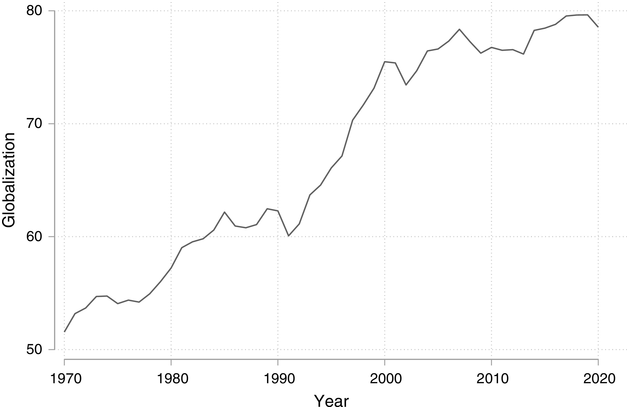
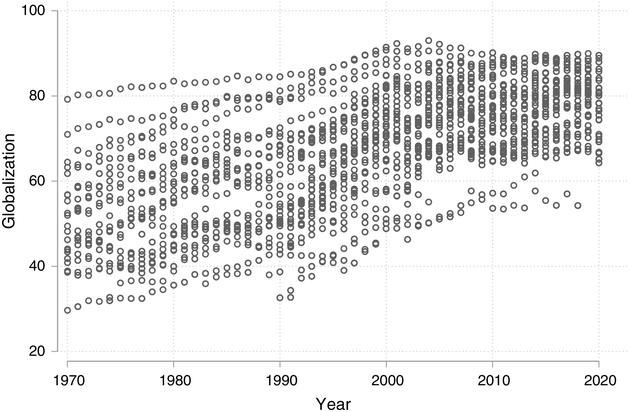
Figure 4.3 graphs average economic globalization across these countries between 1970 and 2020 and shows that economic globalization has steadily increased. Although the average level of globalization across these countries has plateaued since the mid 2000s (even with a slight decline in the most recent period), global economic integration is still at a historical high. This clearly shows that current commentary on deglobalization must be seen in perspective. There have certainly been noteworthy instances of decoupling of certain countries with respect to some sectors, but this does not detract from the historically high levels of international integration that we currently observe. Moreover, the constraints of globalization on national governments in established democracies are not confined to a narrow range of sectoral links with certain countries, such as Western countries’ dependence on China for certain materials or products, a dependence that many Western governments are attempting to reduce. Rather, the arguments set out in the previous chapters refer to the constraining effects of the entirety of international economic integration, which remains at a high level.
Historical trends in economic globalization
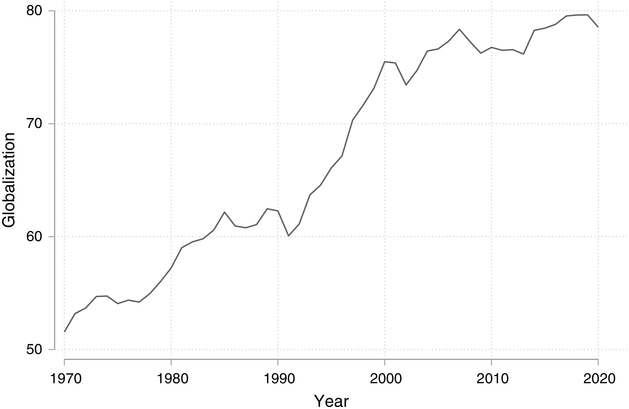
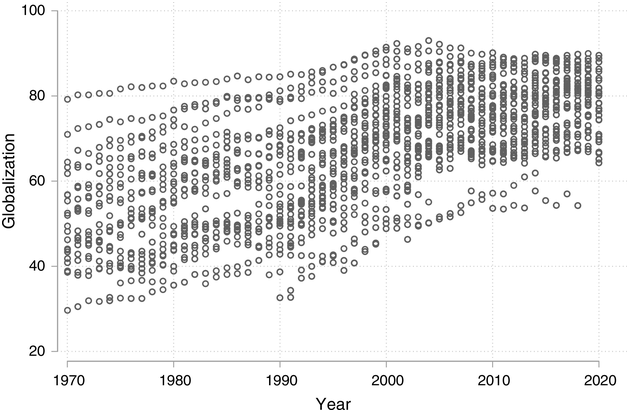
Figure 4.4 further shows that there is great variation in the extent to which these countries are integrated in the global economy, even in the most recent decades of relatively high levels of average economic integration. Although the average level of economic globalization has increased over time, there are and always have been large differences among countries in this respect. Within the group of established Western democracies examined in Figures 4.3 and 4.4, the cases have values on the KOF scale of economic openness ranging from 40 to 91, with a mean of 73.63 and a standard deviation of 11.69. This includes contexts relatively insulated from globalization, such as the United States in the 1970s and 1980s, as well as contexts that are highly exposed, such as Ireland in the late 1990s and 2000s. In subsequent analyses, we standardize the KOF Index to a mean of 0 and a standard deviation of 1 to simplify the interpretation of the coefficients.
Economic globalization across countries
The overall measure of countries’ exposure to economic globalization is included in our main test of the general argument that globalization has a negative effect on promise keeping. We also make the most of the available quantitative indicators that refer to the specific globalization constraints, while noting that these are only part of our investigation of their effects. Quantitative analyses are best suited to establishing the extent to which there is evidence for such general propositions. When it comes to testing and illustrating more detailed mechanisms, such as the effect of different globalization constraints, purely quantitative analyses are more limited. The case study presented in Chapter 5 is the most appropriate way of illustrating the three mechanisms in action, and we therefore reserve our assessment of the mechanisms until we have reviewed both the quantitative and qualitative analyses together.
The separate de jure and de facto components of the economic globalization index capture most closely the mechanisms related to legal constraints and market actors, respectively, and therefore may shed some light on the prevalence of these constraints. These component measures are defined as follows:
De Jure Globalization is the extent of a country’s economic globalization using information on de jure trade and financial globalization, including trade regulations, the prevalence of nontariff trade barriers, compliance costs of importing and exporting, income from taxes on international trade as percentage of revenue (inverted), unweighted mean of tariff rates, and the number of bilateral and multilateral free trade agreements, the prevalence of foreign ownership and regulations to international capital flows, the Chinn–Ito index of capital account openness, and the number of bilateral investment agreements and treaties with investment provisions. Data are from Dreher (Reference Dreher2006).
De Facto Globalization is the extent of a country’s economic globalization, using information on de facto trade and financial globalization, including exports and imports of goods (percentage of gross domestic product [GDP]), exports and imports of services (percentage of GDP), the average of the Herfindahl–Hirschman market concentration index for exports and imports of goods (inverted), the sum of stocks of assets and liabilities of foreign direct investments (percentage of GDP), the sum of stocks of assets and liabilities of international equity portfolio investments (percentage of GDP), the sum of inward and outward stocks of international portfolio debt securities and international bank loans and deposits (percentage of GDP), foreign exchange (excluding gold), Special Drawing Rights holdings and reserve position in the International Monetary Fund (percentage of GDP), and the sum of capital and labor income to foreign nationals and from abroad (percentage of GDP). Data are from Dreher (Reference Dreher2006).
Including separate measures for de jure and de facto globalization allows us to provide additional evidence of the underlying mechanisms. De jure globalization is most closely associated with the constraint of laws and regulations. De facto globalization is most closely associated with the constraint of market actors, as these actors become prominent when actual flows of trade and finance increase. The effects associated with these different measures allow us to explore whether some constraints have a stronger impact on promise breaking.
Aside from legal constraints and market actors, the third globalization constraint that we expect to affect pledge fulfillment negatively is economic uncertainty. This is also a challenging effect to assess in two respects. First, we noted that uncertainty may not exert an independent effect on promise breaking over and above the other globalization constraints. In other words, economic globalization may lead to uncertainty, which in turn leads to promise breaking. If uncertainty is indeed an intervening variable, it is not appropriate simply to include it as another explanatory variable in a regression with a long list of other relevant variables, in what methodologists disparagingly call kitchen-sink regressions. Instead, we must specify a separate model that excludes the explanatory variables that supposedly affect economic uncertainty, in this case our measures of globalization.
The second challenge associated with analyzing the effect of economic uncertainty is measurement. As we define it, uncertainty is the presence of unforeseeable and significant changes in conditions that are largely outside the control of national policymakers and that negatively affect the feasibility and desirability of policy options. As these changes are unforeseeable, they may become apparent only after they emerge, in other words as relevant actors become aware of them. Measuring such concepts is a challenge to say the least. It is with these caveats in mind that we introduce the best available quantitative measure of economic uncertainty, while noting that we pay particular attention to the uncertainty constraint in the case study analysis in Chapter 5, as a qualitative approach may be more appropriate to detect such a mechanism.
The World Uncertainty Index (Ahir, Bloom, and Furceri Reference Ahir, Bloom and Furceri2022) provides measures of the degree of political and economic uncertainty in each country in each year. The index is based on the standardized frequency of words “uncertainty,” “uncertain,” and “uncertainties” in the Economist Intelligence Unit’s quarterly country reports. This measurement approach has the advantage that it is based on standardized reports by country specialists focusing on economic and political developments in each country. Ahir et al. provide a set of validation tests of the uncertainty index, which demonstrate that the index is significantly associated with a range of plausible outcomes including stock market volatility, disagreement among economic forecasters, and lower GDP growth. The face validity of the measure is indicated by the fact that it spikes around events such as the Gulf War, the Euro debt crisis, Brexit, and the COVID pandemic. This new measure of uncertainty has been used by international financial institutions, world governments, and scholars.
Control Variables
Previous studies of the fulfillment of election pledges have identified several important variables that could influence the fulfillment of campaign promises apart from a country’s integration into the global economy, and we control for these alternative explanations here:
Varieties of Capitalism indicates whether the country has a liberal, coordinated, or mixed market economy. Liberal market economies (LMEs) are said to have a comparative advantage in radical innovation, and this is sustained by deregulated labor markets, modestly sized welfare states and relatively low levels of taxation. In coordinated market economies (CMEs), comparative advantage lies in specific skills and high-quality production, which are sustained by institutionalized cooperation between private and governmental stakeholders, highly regulated labor markets, higher taxes, and generous welfare states. Of the twelve countries included in the dataset, Canada, the United Kingdom, the United States, and Ireland have been described as LMEs. Austria, Germany, the Netherlands, and Sweden have been identified as CMEs. The remaining countries in our sample – Bulgaria, Italy, Portugal, and Spain – have been described as mixed systems, in that their institutional and policy arrangements are less coherent. While analysts debate the extent to which several of these countries fit the categories described by the Varieties of Capitalism framework, the countries included provide a range of different contexts in which to examine the effects of internationalization on election pledges. Data are from Hall and Soskice (Reference Hall and Soskice2001).
Executive–Legislative Relations captures whether the country is a parliamentary, presidential, or semipresidential system. Data are from the Comparative Pledges Project.
Federal is a binary variable that takes the value 1 if the country is a federal system and 0 if not. Data are from the Comparative Pledges Project.
Executive Power-Sharing captures whether a single party minority, a single party majority, a coalition majority, or a coalition minority controls the government executive. Data are from the Comparative Pledges Project.
Chief Executive is a binary variable that takes the value 1 if the party holds the chief executive position and 0 if not. Data are from country specialists in the CPP and, where necessary, supplemented with data from the European Journal of Political Research (EJPR) Data Yearbooks.
Ministry indicates, at the pledge level, whether (1) or not (0) the party that made the pledge controlled the relevant ministry. Since we are aggregating the data by election program, the variable refers to the proportion of pledges in the election platform that relate to the ministries held by the party that made the pledges. Data are from country specialists in the Comparative Pledges Project and, where necessary, supplemented with data from the EJPR Data Yearbooks.
Left–Right Position measures partisan ideology on the left–right axis from the Comparative Manifesto Project. We use scores from the so-called Right–Left Scale, which are also derived from parties’ election manifestos or platforms. Data are from Volkens et al. (Reference Volkens, Krause, Lehmann, Matthieß, Merz, Tegel and Wessels2019).
Incumbency captures whether the party is an incumbent party, opposition party with experience, or opposition party without experience. Data are from country specialists in the Comparative Pledges Project and supplemented with data from the EJPR Data Yearbooks.
Economic Growth measures the average economic growth rate of the country over the lifetime of the government. Data are from the World Bank Development Indicators, compiled by the Princeton Niehaus Center for Globalization and Governance World Economics and Politics Dataverse.
Government Duration captures the duration of the government in months. Data are from country specialists in the Comparative Pledges Project and supplemented with data from the EJPR Data Yearbooks.
Agreement on Pledge, at the pledge level, is a binary variable that takes a value of 1 if a pledge was similar to a pledge made by another party and 0 if not. Since we are aggregating the data by election platform, the variable refers to the proportion of pledges in the election program that were similar to pledges made by another party. Data are from the Comparative Pledges Project.
Preelection Agreement is a binary variable that takes value 1 if an interparty coalition agreement existed before the election, and 0 if not. Data from country specialists in the Comparative Pledges Project, supplemented with data from the EJPR Data Yearbooks.
We present descriptive statistics for all variables in the online Supplementary Material. We standardized all continuous control variables to a mean of 0 and a standard deviation of 1 to ease interpretation.
Globalization Undermines Promise Keeping
Since the dependent variable varies between 0 and 1, statistical analysis assuming a normal error structure can produce biased and incorrect estimates. We estimate beta regression models with a logit link function, which use an error structure appropriate for our data (Papke and Wooldridge Reference Papke and Wooldridge1996). All estimations include standard errors that are clustered at the political party level, country fixed effects, and a time trend.
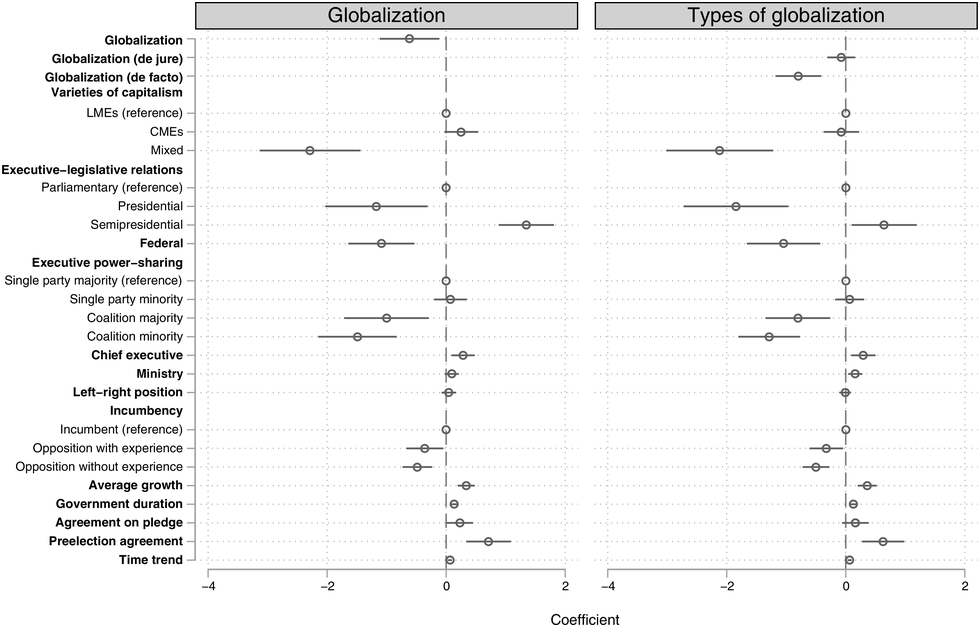
Figure 4.5 summarizes the key findings from two models. The first model includes the overall measure of economic globalization, while the second model includes the separate de jure globalization and de facto measures. Both models control for the explanatory variables that have been examined in previous studies of promise fulfillment. The explanatory variables are arrayed along the vertical axis, with the reference value omitted. The marginal effects are plotted on the horizontal axis. The estimated coefficients are denoted by a dark-gray circle, and their 95 percent confidence intervals are marked by bars of the same color. The dashed vertical line represents a coefficient of 0 or no effect. Full tabular results are presented in the online Supplementary Material.
Globalization and the fulfillment of campaign promises
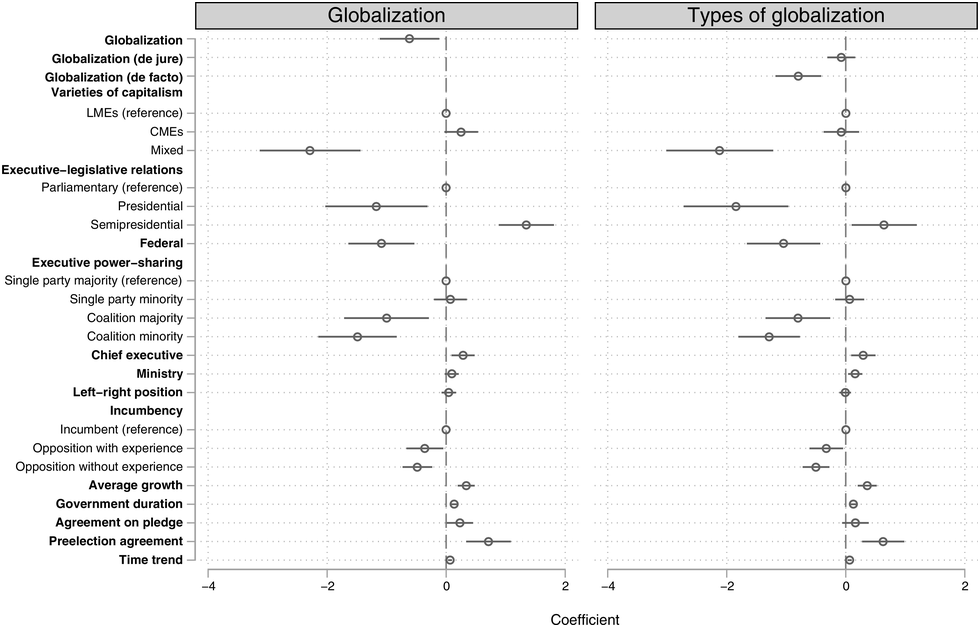
Figure 4.5 Long description
Two dot and whisker plots with similar x-axis display coefficients from negative 4 to 2 with a dashed line at x = 0 and y-axis displaying 29 variables. The variables from top to bottom are labeled globalization, globalization de jure, globalization de facto, varieties of capitalism, L M Es reference, C M Es, mixed, executive legislative relations, parliamentary reference, presidential, semipresidential, federal, executive power sharing, single party majority reference, single party minority, coalition majority, coalition minority, chief executive, ministry, left right position, incumbency, incumbent reference, opposition with experience, opposition without experience, average growth, government duration, agreement on pledge, pre-election agreement, and time trend.
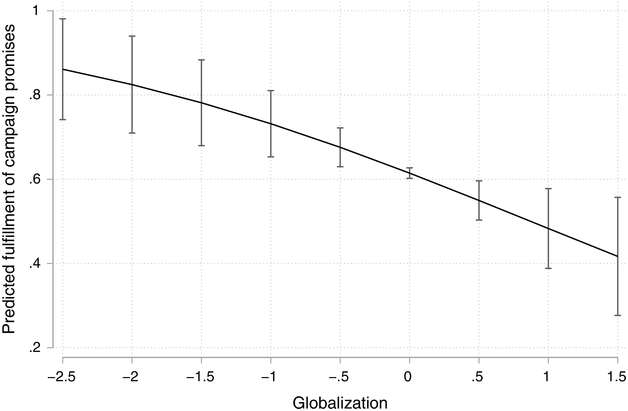
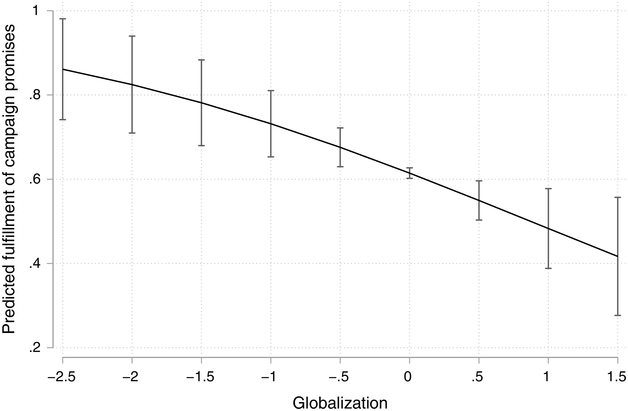
Globalization has a strong and robust negative association with the likelihood of promise fulfillment. The coefficient associated with Globalization is negative and highly significant. A 1 standard deviation increase in the level of Globalization is associated with a decrease of 38 percent in the odds that a campaign promise is fulfilled. Figure 4.6 illustrates the large size of the effect. At relatively low levels of Globalization, corresponding to 2 standard deviations below the average, the probability of fulfillment is 0.81. By contrast, at relatively high levels of Globalization corresponding to 1 standard deviation above the average, the probability of fulfillment is 0.50. This key finding on the negative effect of Globalization does not depend on the inclusion of the relatively internationalized cases with values around 1.5 standard deviations above the average. The coefficient associated with Globalization is almost identical when excluding these cases.
Predicted probabilities for the effect of globalization on promise fulfillment
Notwithstanding the limitations of the quantitative analyses in detecting relationships associated with specific mechanisms, we find quantitative evidence for two of the three mechanisms on international legal commitments and international market actors. The KOF Economic Globalization Index consists of de jure and de facto components, with the former focusing on rules and the latter focusing on actual flows. Crucially for our purposes, these measures are not so highly correlated that they raise concerns about multicollinearity (r=0.31, n=81).
In a model with both de jure and de facto components (right-hand graph in Figure 4.5), the coefficients associated with each of these measures is negative, but only the coefficient on de facto globalization is significant at conventional levels. We noted earlier that a previous analysis of the impact of globalization on promise fulfillment looked at promises as the unit of analysis, rather than election platforms, as we do here (Schneider and Thomson Reference Schneider2024). In that promise-level analysis, de jure globalization was statistically significant, though also somewhat weaker than de facto globalization. We can therefore be reasonably confident that de jure globalization has a constraining effect on promise keeping, but weaker than that of de facto globalization. These findings are consistent with the argument that globalization constrains the fulfillment of campaign promises through the influence of economic actors. Given the somewhat mixed findings in relation to de jure globalization, this may suggest that globalization’s negative effect on promise keeping works mainly, though not exclusively, through the empowerment of market actors.
We do not find significant quantitative evidence that globalization affects promise breaking through uncertainty. In an analysis reported in the online Supplementary Material, we estimated a model including a measure of economic uncertainty, the World Uncertainty Index mentioned previously (Ahir, Bloom, and Furceri Reference Ahir, Bloom and Furceri2022). This model excludes the globalization measures, as we expect globalization to increase uncertainty, which in turn affects promise nonfulfillment. The results show no evidence that uncertainty affects promise keeping. This nonfinding, in combination with the marked effect of uncertainty in the case study presented in the next chapter, suggests that more refined measures are required to detect this mechanism quantitatively.
Right-Wing Parties Are Less Affected by Globalization Constraints
So far, the results suggest that governing parties in countries deeply integrated into the global economy are less able to keep their promises. We hypothesized that this negative effect may be less of a constraint on center-right parties. This is because these parties’ policy preferences are often more aligned with the constraints of globalization, particularly prevailing international commitments and the preferences of market actors (Schleiter et al. Reference Schleiter, Böhmelt, Ezrow and Lehrer2021; Ward, Ezrow, and Dorussen Reference Ward, Ezrow and Dorussen2011).
We test this hypothesis with an interaction term between party ideology and globalization. To measure parties’ ideological positions, we rely on the widely used left–right positions from the Manifesto Project (Volkens et al. Reference Volkens, Krause, Lehmann, Matthieß, Merz, Tegel and Wessels2019), which are also derived from parties’ election programs. This measure of parties’ left–right positions is based on the Manifesto Project’s established thematic coding scheme, into which each sentence or quasi-sentence of the manifesto is allocated to a thematic category. The left–right score of each manifesto is based on the proportion of text it devotes to themes considered right-wing themes minus the proportion of text it devotes to themes considered left-wing themes. One of the advantages of the Manifesto Project’s measures is that they provide estimates of parties’ ideological positions at the same time points as our observations of election pledges. Moreover, it is the only detailed measure of parties’ ideological positions that tracks parties’ ideologies over the same period as the Comparative Pledges Project data on election pledges.
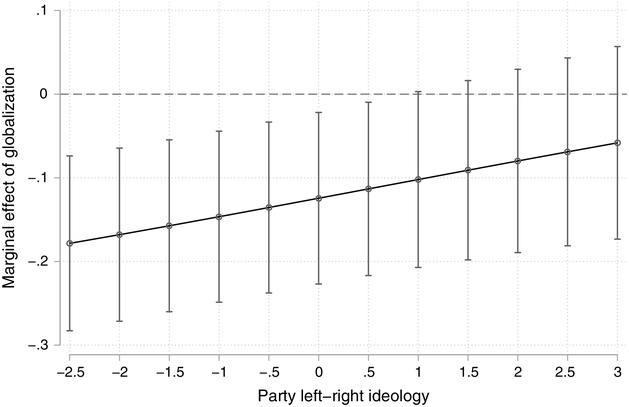
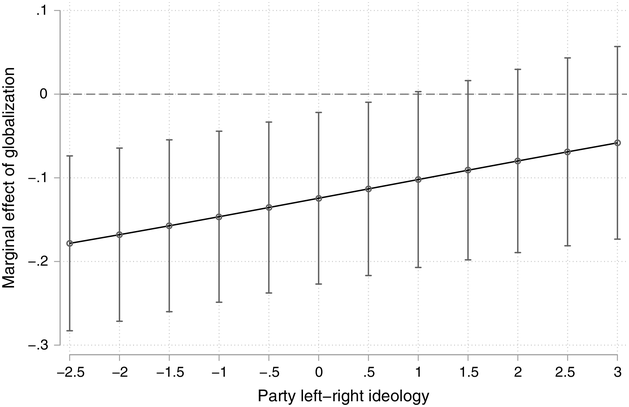
An interaction term between Globalization and Party Left–Right Ideology allows us to examine whether the effect of Globalization depends on the ideological positions of the parties that made the promise. We present the results graphically to ease interpretation.Footnote 5 Figure 4.7 shows that for all left-wing parties, Globalization has a significant negative effect on promise fulfillment. The coefficient associated with Globalization becomes insignificant for parties with Party Left–Right Ideology scores greater than a standard deviation above the mean, which are relatively right wing, but not only “extreme right-wing” parties and account for just over half of our observations; a total of forty-four of the eighty-one manifestos were made by such parties. The parties concerned are, for example, the US Republicans in 1984 and 1988; the UK Conservatives in 1983, 1987, and 1992; the German Christian Democratic Union/Christian Social Union in 2005, and the Conservative Party of Canada in 2011. The findings suggest that the fulfillment of these parties’ campaign promises is not significantly affected by their country’s exposure to international markets. We must, however, nuance this finding by foreshadowing that the next chapter’s case study provides evidence of a center-right party’s promise being unfulfilled due to the constraints of globalization. While center-right parties appear less constrained in keeping their promises than left-wing parties, they too encounter globalization’s constraints when they attempt to fulfill some of their campaign promises.
Effect of globalization on promise fulfillment for different party ideologies
Parties Do Not Avoid Costs by Making Fewer or Different Promises
The expected negative impact of globalization on the fulfillment of campaign promises is troubling not only from the perspective of promissory representation but also from the perspective of political parties themselves. The extent to which governing parties fulfill their campaign promises is a benchmark against which voters assess whether their preferred policies, which partly guided them in their vote choice, were implemented. Voters pay attention to promise fulfillment and punish governments for failing to keep their promises (Matthieß Reference Matthieß2020; Naurin and Oscarsson Reference Naurin and Oscarsson2017; Naurin, Soroka, and Markwat Reference Naurin, Soroka and Markwat2019). Governing parties may break some promises for good reasons, but consistent promise breaking undermines parties’ reputations, hurts their reelection prospects, and undermines public confidence in democracy (Stokes Reference Stokes2001). In Chapter 6, we show that these negative electoral consequences of promise breaking are even more pronounced when governments are more exposed to economic globalization.
We now examine the possibility that parties try to protect themselves from the negative consequences of breaking promises by making fewer promises or promises that are more easily fulfilled. If they did so, this would mitigate any observable effect of globalization on promise fulfillment. To the extent that this happens, the negative effects of globalization on fulfillment, which we observed in the previous analyses, are conservative estimates of the true size of the effect.
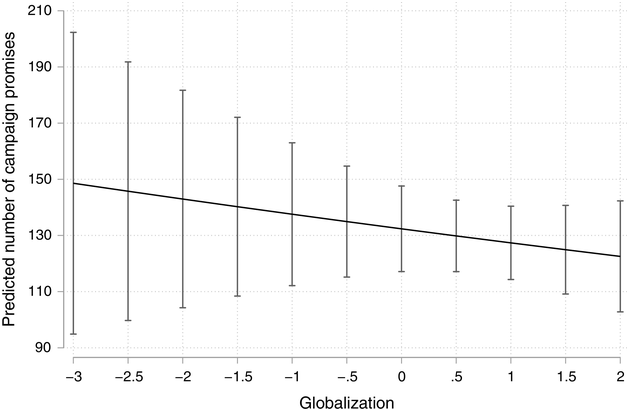
We find that levels of international economic integration have no effect on the number of promises that parties make and only a small effect on the types of pledges that parties make. Parties’ left–right ideological positions are a far more important predictor of the types of pledges that parties make. We examined the 178 election programs from eleven countries on which we have comparable data on the frequency of promises made by each party in each manifesto. Unlike the previous analyses, in which we looked only at election programs of parties that went on to hold executive office after the elections, here we include the programs of parties that did not, which accounts for the larger number of observations in these analyses. We estimated a negative binomial model with the count of campaign promises in each manifesto as the dependent variable and Globalization as one of the explanatory variables. Figure 4.8 presents the predicted number of promises that political parties make at different levels of Globalization.Footnote 6
Predicted effect of globalization on the number of campaign promises
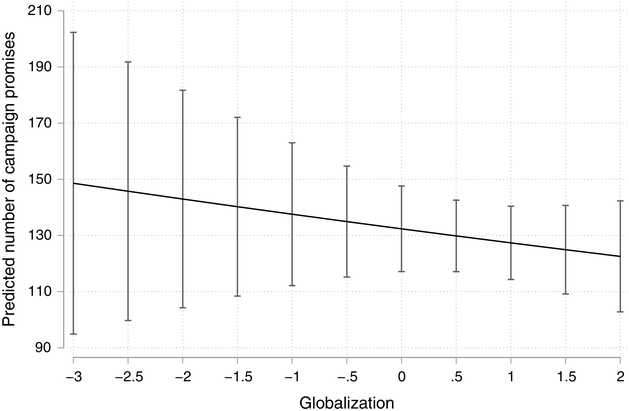
The coefficient associated with the effect of Globalization on the number of promises made is not significant (p=.42), which is also the case for the other explanatory variables included in the model. These nonfindings accord with previous analysis of the frequency of promise making, which conclude that parties make comparable numbers of campaign promises, whether they be left-wing or right-wing parties, incumbents or challengers, or in systems where single-party governments or coalitions are the norm (Naurin, Royed, and Thomson Reference Naurin, Royed and Thomson2019).
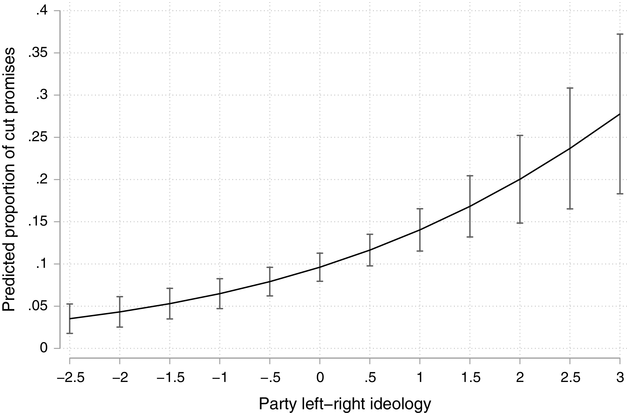
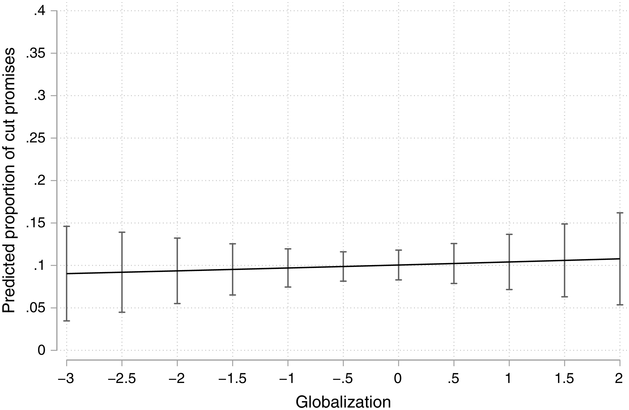
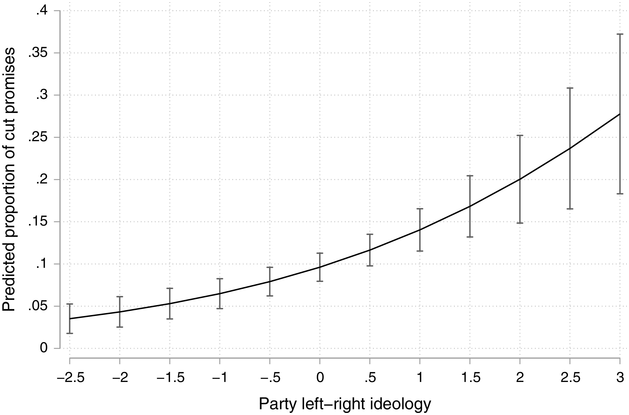
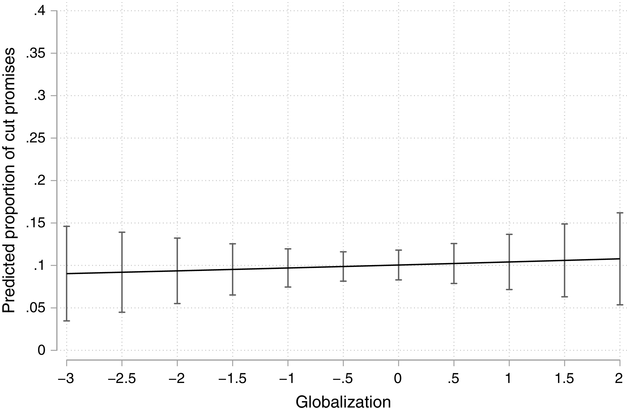
Although we do not find an effect of globalization on the overall numbers of campaign promises, Globalization is weakly related to the types of pledges that parties make. The strength of this relationship is conditional and quite modest in comparison to the relationship between parties’ ideological positions and the types of promises they make. We first estimate a general linear model with the proportion of “cut” promises in each manifesto as the dependent variable and Globalization as one of the explanatory variables. This type of promises includes promises to cut the size of government programs or to cut taxes. They stand for smaller government, and as such are typically associated with parties that are on the right of the left–right dimension. The coefficient associated with Globalization is not significant (p=0.77). By contrast, Partisan Left–Right Ideology has a strong and highly significant association with the proportion of promises to cut programs or taxes that parties make. Figure 4.9 depicts these relationships using predicted values. The expected proportion of promises that involve cuts to government programs or taxes is the same, around 0.10, regardless of the level of Globalization (bottom graph). By contrast, parties further to the right make far higher proportions of promises to cut programs or taxes than do parties to the left (Figure 4.9 top graph).
Left–right ideology, globalization, and promises to cut taxes and programs
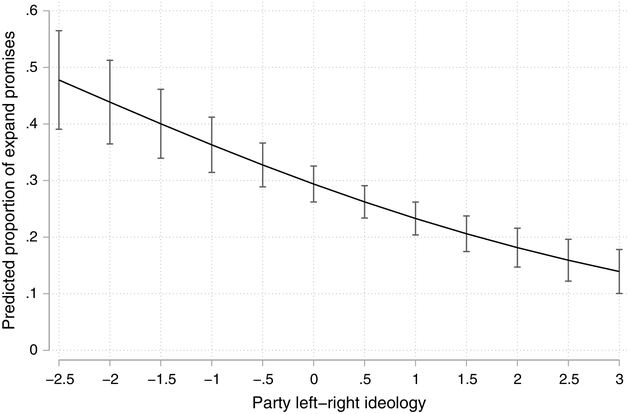
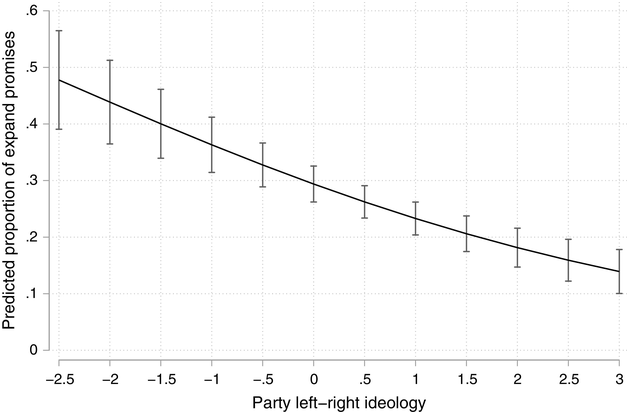
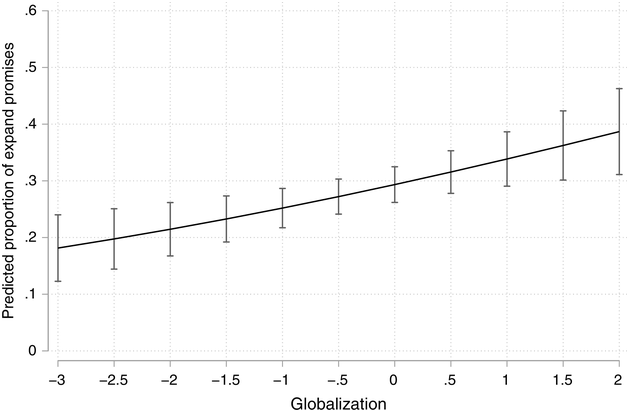
As Figure 4.10 (bottom graph) shows, Globalization is positively, albeit modestly, associated with the proportion of parties’ promises that are expansionary. These are promises to expand government programs, either by committing more public funds to specific programs or by expanding the scale of government programs by changes in rules. For instance, expanding the eligibility criteria for citizens to access public healthcare programs or welfare programs, even if they did not involve a specific promise to spend more money, would be coded as expansionary pledges. Expansionary pledges also include promises to raise taxes. Promises to raise taxes are relatively rare, but they are sometimes made by leftist parties in relation to the need for the rich and corporations to pay their fair share. Again, parties’ ideological positions have a far greater impact than globalization on the proportion of expansionary pledges they make. We estimated a general linear model with the proportion of “expansionary” promises in each manifesto as the dependent variable and Globalization as one of the explanatory variables. The coefficient associated with Globalization is positive and significant (p=0.00). As countries are more exposed to international markets, parties tend to make relatively more expansionary promises.
Left–right ideology, globalization, and promises to expand taxes and programs
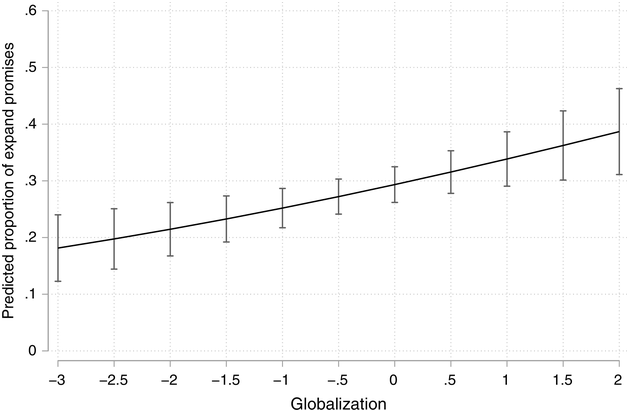
This positive association between globalization and the proportion of promises that are expansionary is consistent with the great expectations argument, which we discussed in Chapter 3. Globalization increases economic risks for citizens, who in turn expect that their governments should do more to protect them from these risks. The positive effect of globalization on expansionary campaign promises suggests that governing parties feel pressure to provide additional safeguards to their citizens. We discuss the effects of globalization on promise making in Part III of this book, and our findings there are consistent with the results in this analysis.
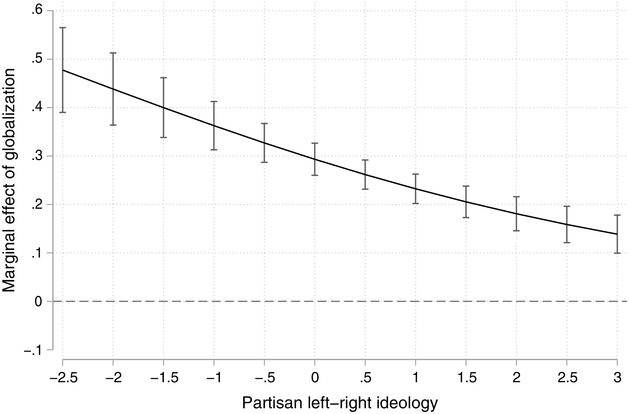
It is very noteworthy that the positive effect of economic globalization on the proportion of expansionary pledges is not driven entirely by center-left parties, as one might expect. Using a model that includes an interaction between Globalization and Partisan Left–Right Ideology, we find that even if left parties react more strongly to globalization than right parties, there is a positive and significant association between globalization and the number of expansionary promises across the entire political spectrum. Figure 4.11 presents the conditional effects.Footnote 7 This indicates that rightist parties face pressure to adopt policies that are traditionally associated with centrist and leftist parties, a topic that we will come back to in Part III of this book.
Globalization positively affects the numbers of expansionary pledges across the political spectrum
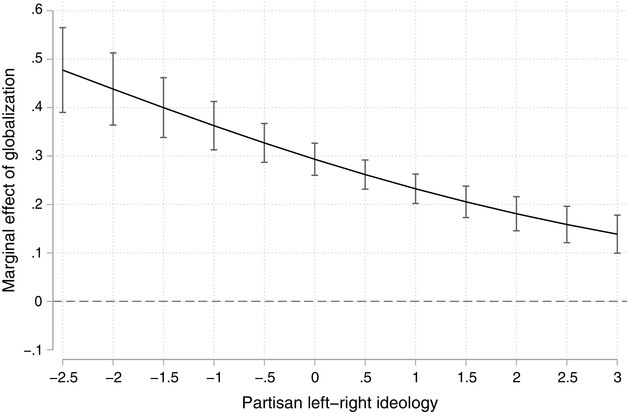
Overall, the evidence indicates that when party leaders are drafting their election programs, the constraints of globalization play a relatively minor role in determining the numbers of promises they make, primarily because of the need to formulate policy appeals that win votes and secure the support of key party factions and supporters. The findings also provide evidence that right-wing parties generally propose policies that are more in line with the preferences of market actors, which makes globalization less constraining for right-wing parties. At the same time, both left- and right-wing parties have strong incentives to make promises that increase welfare protections for their citizens if their country is more deeply integrated into the global economy.
Discussion
This chapter examines how globalization challenges the ability of governing parties to fulfill their campaign promises. As discussed in Chapter 2, promissory representation highlights a key aspect of democratic governance: parties make commitments during campaigns and are then judged by voters on whether they keep these promises while in power. Globalization complicates this process by imposing significant constraints that limit governments’ flexibility, particularly for left-leaning parties whose platforms often conflict with global market interests. These findings underscore that left-wing parties are more likely to break promises in highly globalized environments, where they encounter greater pressure to adapt their policies to market expectations. Despite these constraints, parties continue to make comparable numbers of campaign promises. This is likely because offering minimal promises would fail to attract voters and would lead to unrest among party activists and factions.
Globalization exerts its negative influence on promise keeping through three main channels. First, international legal commitments, such as trade agreements, often restrict governments from pursuing domestic policies that clash with these obligations. Second, market actors like multinational corporations and financial institutions pressure governments to adopt policies that favor economic openness, deregulation, and competitiveness. Lastly, economic uncertainty stemming from the volatility of global markets can significantly alter governments’ fiscal capacities, making it difficult to follow through on campaign promises.
Although our distinction between de facto and de jure globalization provides a rough test of some of our mechanisms, the main limitation of large-n quantitative analysis is its inability to shed light on which underlying mechanism drives the negative relationship between globalization and the fulfillment of campaign promises. The next chapter takes on this task. We complement our large-n observational study with the study of a typical case to explore whether the underlying mechanisms are indeed at work.

 Open access