


1. Introduction
In the field of Human-Computer Interaction (HCI), prototypes are widely adopted not only as validation tools, but also as instruments for exploring speculative futures and sparking critical reflections. Among these, foresight prototypes—a subset of speculative and design fiction practices—are increasingly recognized for their role in stimulating long-term thinking, supporting collective imagination, and provoking discourse around possible futures (Reference CandyCandy, 2010; Reference Candy and DunaganCandy & Dunagan, 2017). Compared to functional or usability-focused prototyping, foresight prototypes foreground narrative engagement, socio-technical critique, and experiential immersion (Reference BleeckerBleecker, 2009).
Recent research emphasizes the creative and inspirational capacity of foresight prototyping. Such prototypes often act as catalytic artifacts—bridging visionary concepts with embodied design practices—and contribute to what we refer to as inspirational prototyping. These forms of prototyping integrate future-oriented speculation with grounded material expression, enabling designers to navigate uncertainties and emerging complexities (Reference Dunne and RabyDunne & Raby, 2013).
However, despite the growing relevance of foresight prototypes in both academic and industry contexts, several gaps persist. First, there remains limited conceptual clarity around the types and characteristics of foresight prototypes deployed in HCI research. Second, there is a lack of structured frameworks to evaluate the creative and anticipatory potential of such prototypes. While speculative design has often been assessed through critical discourse or interpretive methods (Reference CandyCandy, 2010; Reference TonkinwiseTonkinwise, 2015), few studies offer a systematic, empirically grounded framework that connects prototype features with their perceived impact on creativity and foresight thinking (Reference HalesHales, 2013).
To advance current understanding and practice, this paper proposes an evaluation framework for foresight prototypes in HCI, aiming to systematically examine their inspirational and anticipatory potential. Through a systematic literature review, hierarchical coding, and dimensional analysis, we categorize foresight prototypes and identify key evaluative dimensions. Semi-structured interviews and a perceptual rating study further substantiate the framework. Our aim is not only to analyze existing practices, but to construct a transferable strategy for evaluating and guiding foresight-oriented design across both educational and professional settings, where teams often need to compare multiple future-facing concepts, justify selection decisions, and plan iterations under uncertainty.
Specifically, we seek to answer the following research questions:
RQ1: What types/attributes of foresight prototypes are salient in design research?
RQ2: How can the framework be operationalized in HCI design education by student designers and instructors during studio critique and assessment, and inform design review beyond the classroom?
2. Related work: from provocative prototypes to foresight
prototypes
2.1. Provocative prototyping
Provocative prototyping (provotyping) employs artifacts that deliberately disrupt expectations to elicit critical reflection and public discourse, with roots in Mogensen’s provotyping and in Dunne and Raby’s critical design (Reference DunneDunne, 1999). Rather than targeting immediate usability, it surfaces value tensions and alternative imaginaries. Recent work extends this approach to participatory innovation, positioning provotypes as boundary objects between stakeholders (Reference Ozkaramanli and DesmetOzkaramanli & Desmet, 2016), enabling dialogue around latent values and systemic tensions (Reference Boer and DonovanBoer & Donovan, 2012). Gaver (Reference Gaver, Blythe, Boucher, Pennington and WalkerGaver et al., 2013)and DiSalvo (Reference DiSalvoDiSalvo, 2012) likewise emphasize the disruptive aesthetics of provocation in HCI, arguing that ambiguity and discomfort can productively open futures-oriented inquiry. Light (Reference LightLight, 2021) further demonstrate narrative provocation in co-design with human and non-human stakeholders, indicating that storytelling can itself function as a provocative device. Collectively, this stream clarifies how provocation operates methodologically in HCI and design yet offers limited guidance for evaluating longer-term anticipatory effects beyond discourse.
2.2. Foresight prototyping
Foresight prototyping builds on speculative design yet emphasizes scenario building, experiential narration, and systemic implications to make possible futures tangible in situated interactions (Reference Ahmed and ElSabryAhmed & ElSabry, 2024).Foresight design is increasingly regarded as an approach to managing uncertainty and complexity by staging possible futures; however, its evaluation remains contested. The literature largely distinguishes two complementary strands. Process evaluation assesses goal setting, method selection, stakeholder inclusion, resource allocation, and transparency. Impact evaluation examines effects on policy, strategy, capability building, and organizational learning (Reference Gardner, Davies and KellyGardner et al., 2024; Reference Haegeman, Spiesberger and KönnöläHaegeman et al., 2017; Reference Tonn, Gardner and LesieurTonn et al., 2024). Mixed-method designs are common, and expert elicitation (e.g., Delphi) is frequently employed to judge relevance, plausibility, and usability, provided that the expertise base is diverse and the criteria are explicit (Reference Karasev and MukaninaKarasev & Mukanina, 2019). Recent reviews further recommend linking foresight processes to learning outcomes and capability gains rather than prediction accuracy alone (Reference Ko and YangKo & Yang, 2023).
Across studies, frequently cited criteria include transparency, goal attainment and practical validity, stakeholder participation/representation, innovation and adaptability, downstream influence (on agendas, decisions, or programs), and evidence of learning/feedback loops (Reference Poteralska and Sacio-SzymańskaPoteralska & Sacio-Szymańska, 2014). Persistent challenges involve high uncertainty, stakeholder bias and attribution issues, and time-lagged effects that are hard to trace rigorously. These gaps motivate evaluation approaches that (1) fit claims and methods to speculative artifacts, (2) track outcomes and learning alongside participation and process quality, and (3) enable cross-case comparability.
Building on our earlier review of speculative futures in HCI, we proposed a typology along two axes—interaction mode and presentation fidelity—yielding four recurring categories of foresight-oriented prototypes (e.g., high/low fidelity crossed with more affordance-driven vs. ambiguity-driven interaction) (Reference Zhu, Wang and LiZhu et al., 2024). This typology clarified what kinds of foresight prototypes are being used but left a practical question unresolved: how to evaluate them when teams must compare concepts, justify selections, and plan iterations. The present study addresses this need by operationalizing an evaluation rubric for HCI design education. Drawing on how student designers and instructors judge foresight attributes during studio critique and assessment, we develop and empirically validate a multidimensional framework for anticipatory value, structured around four perceptual dimensions—functional visibility, sensory experience, future adaptability, and creative divergence. Definitions of the four dimensions are provided in Section 3.1.
3. Methods
This study extends our prior typology of foresight-oriented prototypes into an evaluative framework. As reported in our prior publication, we conducted a PRISMA-guided review that yielded a corpus of representative HCI design cases. In the present study, this corpus informs stimulus selection and provides the initial vocabulary for construct formation (as shown in Figure 1.). In parallel, semi-structured interviews with first authors from the corpus were conducted to elicit designers’ criteria for judging inspirational and anticipatory value; the resulting themes were used to refine construct definitions. On this basis, we defined four perceptual constructs: Functional visibility, Sensory experience, Future adaptability, and Creative divergence. These constructs were translated into a 19-item Likert instrument. The instrument supports consistent scoring of foresight prototypes and enables comparison across studies and studio contexts, supporting cumulative research on future-oriented design. Although foresight prototypes are often discussed through qualitative critique and interpretation, studio teaching and design reviews also require comparable judgments and actionable feedback. Using a structured instrument makes evaluation explicit and traceable, allowing the internal structure of the constructs to be tested and a parsimonious set of dimensions to be derived for critique and iteration decisions.
Research method and process

Figure 1 Long description
The flowchart illustrates the research method and process for defining foresight prototype factors and designing a strategy for foresight prototypes. The process begins with a research case study involving HCI conference publications, from which 53 representative cases are selected to form a corpus of foresight prototypes. This corpus undergoes corpus coding analysis, including cluster analysis, leading to the classification of foresight prototypes. Authors are interviewed to refine this classification. The next step is to define foresight prototype factors, which are then used in a foresight factors questionnaire survey. This survey data undergoes exploratory factor analysis (EFA) and principal component analysis (PCA) to extract 23 factors for foresight design. These factors contribute to an evaluation framework for foresight design, which is used to develop a design strategy for foresight prototypes.
3.1. Systematic literature review and classification of foresight prototype
We conducted a PRISMA-guided review, screening 1,011 records and retaining 53 representative design cases. We applied a topic-and-date filter: eligible records had to concurrently include the keywords “speculative design,” “foresight,” and “futures” and be published between 2000 and 2023.On this corpus we developed a 20-feature codebook and coded each case. The codebook was organised under three first-level indicators: Intention (the prototype’s purpose and cognitive stance), Making (how the prototype is produced and situated), and Impact (what the prototype effects). Accordingly, we clustered the distribution of codes across the 53 cases yielded a stable four-type typology, as illustrated in Figure 2, the typology is represented on two interpretive axes: the mode of interaction, ranging from ambiguity to affordance-oriented interaction, and presentation fidelity, ranging from low to high fidelity. Accordingly, four categories are distinguished: (1) Reflective speculation, which stimulates people to examine their values and shifting experiences across time; (2) Exploratory speculation, which helps users think through future issues and cultivate prefactual reasoning; (3) Interventional speculation, which encourages changes in usage habits and behavioural patterns; and (4) Heuristic speculation, which invites social or group participation and provokes public discussion.
Typological map of foresight prototypes by mode of interaction and presentation fidelity

3.2. Constructing the foresight-prototype evaluation framework
Building on the classified corpus, we conducted semi-structured interviews with 16 first authors to elicit the criteria by which designers judge the inspirational and anticipatory value of speculative artifacts. The interview protocol covered five topics, including: design intention, creative strategy, material and form, technology use, and user feedback, and transcripts were thematically analysed to surface recurrent perceptual cues and decision logics across projects.
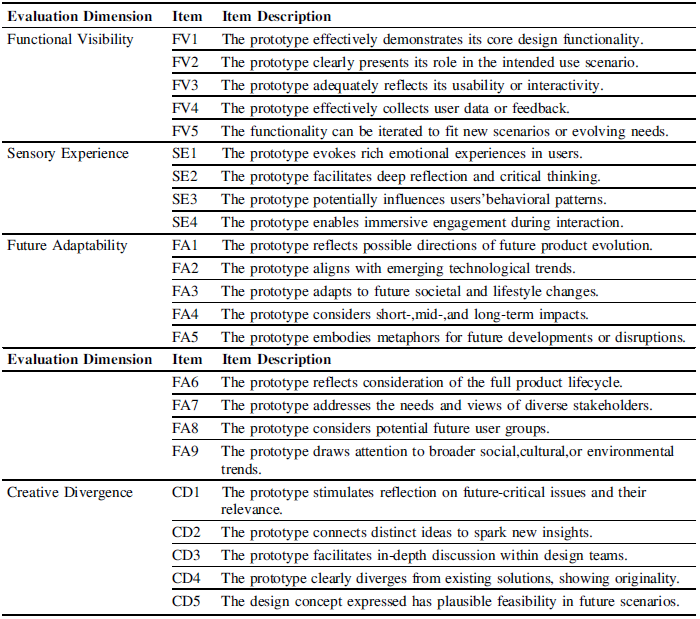
Building on the expert interviews, we first articulated criteria for judging whether a case supports anticipatory reasoning, stimulates reflective and multisensory engagement, adapts to evolving contexts, and generates novel connections in design inquiry. These criteria were then aligned with the coding book developed in Section 3.1. Following this synthesis, we produced an initial semantic bank of 23 evaluation items mapped to four intended constructs: Functional Visibility, Sensory Experience, Future Adaptability, and Creative Divergence. The item set underwent expert review and cognitive pre-testing to remove redundancy and clarify wording (Table 1).
Description framework for foresight prototypes

3.3. Validation of the foresight prototype evaluation framework
Subsequently, we implemented an online questionnaire. We recruited 20 postgraduate design students, each randomly assigned four prototype cases drawn from the curated corpus of 53 foresight design cases to ensure representativeness and diversity. Respondents rated each case using the 23-item five-point Likert scale grounded in the above constructs. The survey was distributed online, with each participant completing their evaluations in approximately 30 minutes.
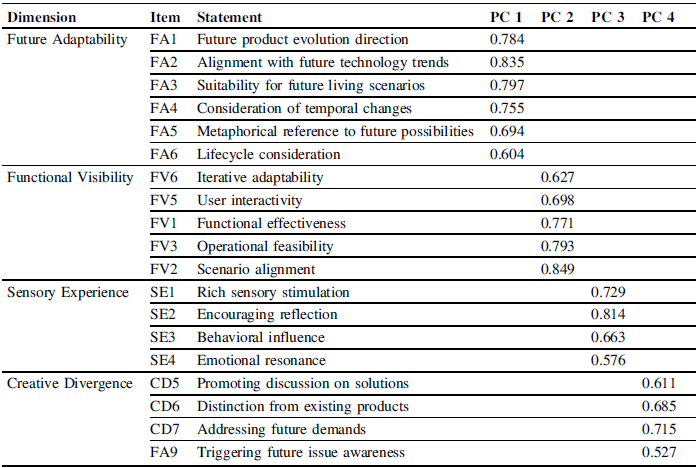
To examine the scale’s internal structure, we conducted an exploratory factor analysis (EFA) on all 23 items. Items with factor loadings below 0.60 or with substantial cross-loadings were removed to improve construct clarity and discriminant validity (e.g., FA7, FA8, FA9 et.al.,). Notably, FA9 (“triggering future issue awareness”) relocated to the creative-divergence factor, reflecting its role in mobilising novel connections and discourse. This refinement yielded a 19-item instrument with a clear four-factor solution corresponding to the proposed dimensions.
Following this refinement, we performed Principal Component Analysis (PCA) to further validate the structure. The Kaiser-Meyer-Olkin (KMO) measure was 0.743, indicating adequate sampling adequacy, and Bartlett’s Test of Sphericity was significant (χ2 = 1234.85, p < 0.001), confirming that the data were suitable for structure detection. PCA extracted four components with eigenvalues > 1, cumulatively explaining 67.08% of the total variance.
The PCA results were rotated using varimax rotation to enhance interpretability. Loadings above 0.5 were used for factor assignment. The components were interpreted and named based on the thematic alignment between item content and the original evaluation model: The following Table 2 summarizes rotated loadings of each item on the four principal components.
To visualize the variable relationships and support naming decisions, we plotted the first two components in a PCA biplot (Figure 3). The distribution of items across the two principal components reveals meaningful structural distinctions. Items associated with Functional Visibility (e.g., “Effectively reflect the usage scenarios”) and Creative Divergence (e.g., “Differentiate from existing products”, “Consider potential future demands”) show strong loadings along the first principal component (PC1). This suggests that PC1 primarily captures the pragmatic and innovative foresight dimensions of the prototypes.
Conversely, items relating to Sensory Experience (e.g., “Rich emotional experience”) and Future Adaptability (e.g., “Consider short/long-term changes”) are oriented along the second principal component (PC2), indicating that PC2 reflects the affective and temporal adaptability aspects of foresight evaluation.
Additionally, the spatial distribution of the four experimental groups (High/Low Fidelity and Affordance/Ambiguity) shows distinct clustering trends. For example, prototypes in the High Fidelity–High Affordance group (orange mark) tend to align with regions dominated by functional and divergent traits, while the Low Fidelity–Ambiguity group (green mark) appears closer to emotional and experiential axes. This pattern suggests that variations in prototype fidelity and interaction modality may influence how users perceive foresight attributes across different dimensions.
Principal component analysis factor loading

Note: Loadings < 0.50 are suppressed for clarity.
Biplot showing variable projections on the first two principal components

4. Core dimensions of the foresight-prototype evaluation framework
Figure 4 presents the Foresight Prototype Evaluation Framework (FPEF). The framework is structured around four supported dimensions: Functional Visibility, Sensory Experience, Future Adaptability, and Creative Divergence—which together organize judgments about a prototype’s anticipatory value.
Functional visibility captures the legibility of purpose and interaction: the extent to which a prototype makes its role, operating logic, and conditions of use intelligible to its audiences. Like “entry-level” competencies in a model, it underpins all subsequent interpretation. High functional visibility reduces cognitive load and enables reviewers to separate “what it does” from “what it is for,” so that attention can move from deciphering the artifact to reasoning about its implications. In evaluation, evidence typically comes from clear scenario alignment, explicit task flows, demonstrable operations, and credible interaction cues.
Sensory experience refers to the depth and quality of embodied, multisensory, and affective engagement that the prototype elicits. It encompasses immersion, tactility, resonance, and the capacity to prompt reflective emotions during and after interaction. This dimension matters because foresight artifacts persuade not only through argument but through felt experience; compelling sensory design helps audiences “live” a possible future long enough to evaluate its desirability, risks, and trade-offs. In practice, raters consider cues such as material expressivity, narrative pacing, interaction dramaturgy, and the memorability of the encounter.
Future adaptability assesses the prototype’s temporal reach and contextual fit—its alignment with emerging technologies and practices, its scalability across scenarios, and its attention to lifecycle and stakeholder diversity. This is not a claim to prediction; rather, it gauges how well the artifact frames pathways for adaptation as conditions evolve. Reviewers look for explicit links to trends or signals, articulation of near-, mid-, and long-term implications, and design moves that enable adjustment (e.g., modularity, policy or infrastructure considerations, reuse and end-of-life).
Creative divergence captures the generative distance from prevailing solutions and the prototype’s capacity to open new connections, questions, and lines of inquiry. It includes distinctiveness, value-laden provocation, metaphoric reframing, and the ability to trigger awareness of future issues or to mobilise discourse among teams and stakeholders. In evaluation, raters consider whether the artifact surfaces neglected actors or relations, recombines domains in productive ways, or catalyses substantive debate and idea generation.
Foresight prototype evaluation framework

5. How to apply the evaluation framework in education and design practice
The foresight prototype evaluation framework (FPEF) supports structured evaluation across both design education and design practice. In educational settings, it can be used to align curricula, scaffold formative studio critique, and support summative assessment. In professional settings, it offers a shared vocabulary and comparable criteria for screening concepts, guiding iteration, and aligning stakeholders. The following sections outline these complementary modes of use.
5.1. Curriculum alignment and outcome mapping
Recent scholarship on speculative and foresight-oriented pedagogy emphasizes that making evaluation dimensions explicit is key to translating “imaginative exercises” into outcomes that are teachable, learnable, and comparable (Reference Bendor and LupettiBendor & Lupetti, 2025). Embedding a structured framework into course syllabi helps clarify task design, articulate assessment rubrics, and align instructor–student expectations. This reduces ambiguity around what constitutes valid evidence of futures thinking and improves assignment consistency—particularly in graduate-level and cross-disciplinary contexts.
Our framework supports backward design by enabling educators to map intended learning outcomes to targeted dimensions, align project briefs and readings accordingly, and develop criterion-referenced rubrics that link speculative intent to demonstrable student performance.
5.2. Evaluation of design teaching practice and formative feedback
Dimension-based rubrics also serve as scaffolds for studio critique. Instructors and peers can anchor feedback in shared criteria, provide short evidence-based rationales for scoring, and use visualised project profiles to surface trade-offs among legibility, experience, and anticipation—making these aspects actionable in subsequent iterations (Reference LiLi, 2024). In practice, such structured feedback systems have been shown to strengthen the cycle between critique and revision, transforming provocation and reflection into concrete design moves. This applies across a range of contexts—from AI literacy and architectural studios to design-engineering classrooms. Our framework operationalises this by offering item-level cues for formative checkpoints during key stages of the design process, including framing, concept development, and prototype review.
5.3. Longitudinal evaluation and programme improvement
This study treats foresight education as a domain that benefits from structured, longitudinal evaluation, aiming to ensure its alignment with future-focused educational paradigms. Such an evaluative approach aligns with international frameworks that connect future-oriented learning with both assessment and institutional capacity building. For instance, the OECD Learning Compass highlights the importance of using shared learning frameworks to foster student agency, co-agency, and the development of transformative competencies. Likewise, UNESCO’s initiatives on evaluating futures literacy stress the importance of embedding anticipatory learning outcomes into formal assessment systems at the institutional level. Our framework reflects these global efforts and aligns with emerging guidance on foresight evaluation (Reference Hughson and WoodHughson & Wood, 2022), positioning speculative design not only as an engaging pedagogical method, but also as a measurable contribution to institutional learning about anticipation.
5.4. Implications for design practice and future validation
Although this study validates FPEF in an educational studio context, the framework is intended to be applicable to professional design review settings where foresight prototypes are assessed for relevance, distinctiveness, and decision value. Future work can examine its use in industry projects as a structured review aid for concept screening, iteration planning, and cross-functional alignment, particularly in settings where evaluative criteria are implicit and difficult to document. Such validation could involve comparing FPEF-guided reviews with existing review routines, testing inter-rater reliability across roles (design, research, product, engineering), and assessing whether dimension profiles improve the traceability and efficiency of selection decisions. Establishing external validity in practice-based contexts would clarify how the four dimensions function under real constraints such as limited review time, competing stakeholder priorities, and domain-specific success criteria.
6. Conclusion
This study contributes to the field of foresight-oriented design research by advancing beyond the conventional practice of typological description towards a more systematic and comparable evaluation approach. The paper introduces and validates the Foresight Prototype Evaluation Framework (FPEF), which captures how foresight prototypes are perceived to generate anticipatory value and provides a structured complement to discourse-based appraisal. The framework establishes a correlation between design features and evaluative evidence through four distinct dimensions. The assessment of a prototype’s efficacy is predicated on its capacity to fulfil its intended function and facilitate effective interaction (functional visibility), to engender a persuasive embodied experience (sensory experience), to reflect temporal reach and contextual fit (future adaptability), and to stimulate novel connections and debate (creative divergence). When considered as a whole, these dimensions facilitate transparent critique and comparison without treating foresight as prediction or reducing speculative work to instrumental utility.
Empirically, the results highlight that evaluative judgments of foresight prototypes are multi-faceted and often shaped by a tension between communicative clarity and speculative depth. The PCA visualisation provided an interpretable projection of the distribution of cases and items across perceptual space, thereby supporting the consolidation of simplified axes for routine critique and iteration decisions.
The primary contribution of this work lies in providing an empirically grounded rubric that can be operationalised in HCI design education, where student designers and instructors require shared criteria for critique, feedback, and assessment. Concurrently, the framework has been designed to extend beyond the confines of the classroom, with subsequent studies to evaluate its external validity in professional review settings.
However, it should be noted that there are several limitations that persist. The validation relied on postgraduate design learners, which may constrain generalisability to expert, interdisciplinary, or stakeholder audiences. In addition, dimensionality reduction necessarily compresses meaning, and the PCA axes should be interpreted as analytic aids rather than exhaustive representations of speculative value. Future work should evaluate FPEF with educators and industry reviewers, examine reliability across roles, and study its use in longitudinal or in-situ prototyping contexts to clarify how foresight prototypes shape decision-making and future-oriented reasoning over time.
Acknowledgement
Project supported by the Young Scientists Fund of the National Natural Science Foundation of China (Grant No. 52405279) and Beijing Digital Education Research General Project (Grant No. BDEC2025619131), and Fundamental Research Funds for the Municipal Universities of Beijing (KJCX251906).




 Open access

