





1. Introduction
Heinz Hopf introduced what is now called the Hopf invariant in his 1931 work on maps between spheres as a way to distinguish homotopy classes of maps that are invisible to homology [Reference Hopf11]. In the 1950s, this notion was generalized by James [Reference James12, pp. 192–193], who defined invariants associated to desuspending maps of based spaces  $\Sigma A \to \Sigma B$. For each positive integer $n$, the $n$th James–Hopf invariant is an operation on homotopy classes
 \begin{equation*}
\gamma_n \colon [\Sigma A,\Sigma B] \longrightarrow [\Sigma A,\Sigma B^{[n]}]
\end{equation*}
\begin{equation*}
\gamma_n \colon [\Sigma A,\Sigma B] \longrightarrow [\Sigma A,\Sigma B^{[n]}]
\end{equation*}which is natural in both  $A$ and $B$, where $B^{[n]}$ denotes the $n$-fold smash product of $B$ with itself.
Boardman and Steer [Reference Boardman and Steer2] instead consider the suspended invariants
 \begin{equation*}
\lambda_n = \Sigma^{n-1}\gamma_n \colon [\Sigma A,\Sigma B] \longrightarrow [\Sigma^n A,\Sigma^n B^{[n]}]
\end{equation*}
\begin{equation*}
\lambda_n = \Sigma^{n-1}\gamma_n \colon [\Sigma A,\Sigma B] \longrightarrow [\Sigma^n A,\Sigma^n B^{[n]}]
\end{equation*}and show that they are axiomatically characterized by certain properties encoded in what they call a Hopf ladder. A Hopf ladder is a collection of such natural transformations satisfying 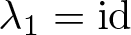 $\lambda_1 = \mathrm{id}$, $\lambda_n(\Sigma f) = 0$ for $n \ge 2$, and the Cartan formula
 \begin{equation*}
\lambda_n (f + g) = \sum_{i+j=n} \lambda_i(f)\cdot \lambda_j(g)\, .
\end{equation*}
\begin{equation*}
\lambda_n (f + g) = \sum_{i+j=n} \lambda_i(f)\cdot \lambda_j(g)\, .
\end{equation*} In the 1970s, the Segal–Snaith Hopf invariants  $h_n$ were introduced using the approximation theorem in combination with the Snaith splitting [Reference Snaith23], [Reference May17], [Reference Cohen, May and Taylor6], [Reference Cohen7], [Reference Segal21]. Consider the infinite loop space $Q(B) = \Omega^\infty \Sigma^\infty B$ for a based space $B$. The Snaith splitting provides a decomposition of the suspension spectrum
 \begin{equation*}
\Sigma^\infty Q(B) \simeq \bigvee_{n \ge 0} \Sigma^\infty D_n(B)\, ,
\end{equation*}
\begin{equation*}
\Sigma^\infty Q(B) \simeq \bigvee_{n \ge 0} \Sigma^\infty D_n(B)\, ,
\end{equation*}where  $D_n(B) := B^{[n]}\wedge_{\Sigma_n} ({E\Sigma_n}_+)$ is the $n$-adic construction, i.e., the reduced homotopy orbits of the symmetric group $\Sigma_n$ acting on the $n$-fold smash product $B^{[n]}$. We will use of a version of the Snaith splitting provided by Goodwillie’s calculus of functors [Reference Goodwillie9] which has the advantage of being natural.‘The argument of [Reference Goodwillie9, ex. 1.20], which is only stated for $\Omega \Sigma X$, also applies to $Q(X)$.’
If we compose the Snaith splitting with projection onto the  $n$th summand and take the adjoint, we obtain a map
 \begin{equation*}
Q(B) \to Q(D_n(B))\, .
\end{equation*}
\begin{equation*}
Q(B) \to Q(D_n(B))\, .
\end{equation*}The latter induces the operation
 \begin{equation*}
h_n : \{A,B\} \to \{A,D_n(B)\}\,
\end{equation*}
\begin{equation*}
h_n : \{A,B\} \to \{A,D_n(B)\}\,
\end{equation*}by applying homotopy classes  $[A,{-}]$. In the display, $\{A,B\} = [A,Q(B)]$ is the abelian of homotopy classes of stable maps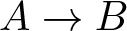 $A \to B$. As far as I am aware, a Hopf-ladder type axiomatic characterization of the invariants $h_n$ is currently unknown.
In this paper, we restrict our attention to the case  $n=2$. In this case, there is a different construction of an operation
 \begin{equation*}
H : \{A,B\} \to \{A,D_2(B)\}
\end{equation*}
\begin{equation*}
H : \{A,B\} \to \{A,D_2(B)\}
\end{equation*}which avoids the Snaith splitting (I first learned of such a construction from Andrew Ranicki). Our main goal is to develop and analyse the fundamental properties of  $H$.
$H$.
Let
 \begin{equation*}
E : [A,B] \to \{A,B\}
\end{equation*}
\begin{equation*}
E : [A,B] \to \{A,B\}
\end{equation*}be the stabilization map, i.e., the passage from unstable homotopy classes to stable homotopy classes. If  $f,g\in \{A,B\}$ then the cup product [Reference Boardman and Steer2]
 \begin{equation*}
f\cup g\in \{A,B \wedge B\}
\end{equation*}
\begin{equation*}
f\cup g\in \{A,B \wedge B\}
\end{equation*}is the stable composition
 \begin{equation*}
A \xrightarrow{\Delta_A} \wedge A \xrightarrow{f \wedge g} B \wedge B\, .
\end{equation*}
\begin{equation*}
A \xrightarrow{\Delta_A} \wedge A \xrightarrow{f \wedge g} B \wedge B\, .
\end{equation*}The symmetrized cup product
 \begin{equation*}
f\cup_2 g \in \{A,D_2(B)\}
\end{equation*}
\begin{equation*}
f\cup_2 g \in \{A,D_2(B)\}
\end{equation*}is the composition
 \begin{equation*}
A \xrightarrow{f\cup g} B\wedge B \to D_2(B)
\end{equation*}
\begin{equation*}
A \xrightarrow{f\cup g} B\wedge B \to D_2(B)
\end{equation*}where the map  $B\wedge B \to D_2(B)$ is the homotopy quotient by the cyclic group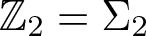 $\mathbb Z_2= \Sigma_2$.
We are now in position to state the main result.
Theorem A. There is an operation
 \begin{equation*}
H : \{A,B\} \to \{A,D_2(B)\}
\end{equation*}
\begin{equation*}
H : \{A,B\} \to \{A,D_2(B)\}
\end{equation*}called the stable Hopf invariant that is natural in both  $A$ and $B$ and which satisfies:
(i) (Normalization). $H(E(f)) = 0$;
(ii) (Cartan formula).
$H(f+g) = H(f) + H(g) + f \cup_2 g$;(iii) (Transfer formula).
$\operatorname{tr} H(f)=f\cup f - \Delta_B \circ f$;(iv) (Composition formula).
$H(g\circ f) = H(g)\circ f + D_2(g) \circ H(f)$.




Remark 1.1. The transfer homomorphism  $\operatorname{tr} : \{A,D_2(B)\} \to \{A , B\wedge B\}$ arises from the regular $\mathbb Z_2$-covering space pair
 \begin{equation*}
((B\times B) \times E\mathbb Z_2, (B \vee B) \times E\mathbb Z_2) \to ((B\times B) \times_{\mathbb Z_2} E\mathbb Z_2, (B \vee B) \times_{\mathbb Z_2} E\mathbb Z_2)
\end{equation*}
\begin{equation*}
((B\times B) \times E\mathbb Z_2, (B \vee B) \times E\mathbb Z_2) \to ((B\times B) \times_{\mathbb Z_2} E\mathbb Z_2, (B \vee B) \times_{\mathbb Z_2} E\mathbb Z_2)
\end{equation*}[Reference Adams1, const. 4.1.1]. For the Segal–Snaith Hopf invariant, the Cartan formula appears in [Reference Caruso, Cohen, May and Taylor5] (for a geometric description, see [Reference Koschorke and Sanderson13, thm. 2.2]; see also [Reference Kuhn14] for additional properties of the Segal–Snaith Hopf invariant). For the geometric Hopf invariant of Crabb and Ranicki, a version of the transfer and composition formulas appear in [Reference Crabb and Ranicki8, prop. 5.33].
Our approach most closely resembles the one taken by Crabb and Ranicki with some key differences: They fix a  $\mathbb Z_2$-representation $V$ and define the geometric Hopf invariant as a natural transformation
 \begin{equation*}
h_V : [S^V \wedge A , S^V \wedge B]_{\mathbb Z_2} \to [\Sigma S(\alpha \otimes V)_+ \wedge S^V \wedge A , S^{(\alpha +1) \otimes V} \wedge B]_{\mathbb Z_2}\, ,
\end{equation*}
\begin{equation*}
h_V : [S^V \wedge A , S^V \wedge B]_{\mathbb Z_2} \to [\Sigma S(\alpha \otimes V)_+ \wedge S^V \wedge A , S^{(\alpha +1) \otimes V} \wedge B]_{\mathbb Z_2}\, ,
\end{equation*}where the domain is the set of homotopy classes of  $\mathbb Z_2$-equivariant maps $S^V \wedge A \to S^V \wedge B$. In the display, $S^V$ denotes the one-point compactification of $V$,
$V$,  $\alpha$ is the sign representation, and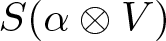 $S(\alpha \otimes V)$ is the unit sphere.
By constrast, the source and target of the operation  $H$ do not involve a choice of representation and are expressed in terms of unequivariant stable homotopy classes. Even though $H$ is phrased in unequivariant language, its actual construction requires passing through the $\mathbb Z_2$-equivariant stable category. The operations $H$ and $h_V$ are related by stabilization by representations and the application of a transfer map.
1.1. Relation to the Segal–Snaith operation
Let 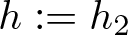 $h := h_2$ be the second Segal–Snaith Hopf invariant.
Theorem B. The operations  $h,H : \{A,B\} \to \{A,D_2(B)\}$ coincide.
Suppose that  $A$ is a CW complex of dimension $s$ and $Y$ is $N$-connected. Then stable range occurs when $s \le 2r+1$; in this case, $E : [A,B] \to \{A,B\}$ is surjective by the Freudenthal suspension theorem. The metastable range occurs when $s\le 3r+1$. It is well known that the Segal–Snaith Hopf invariant is the complete obstruction to destabilization in the metastable range [Reference Milgram18].
Corollary C. Assume  $s\le 3r+1$. Let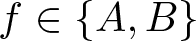 $f\in \{A,B\}$ be a homotopy class. Then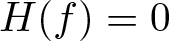 $H(f) = 0$ if and only if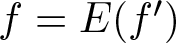 $f = E(f')$ for some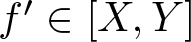 $f'\in [X,Y]$.
A natural transformation is said to possess the EHP propertyif it satisfies the conclusion of corollary C.
1.2. Extension to
$\pi$-spaces

For applications to surgery theory, it is useful to generalize the above to the  $\pi$-equivariant setting, where $\pi$ is any discrete group. Let $A$ and $B$ be based $\pi$-CW complexes such that the action is free away from the basepoint. In this instance, we have an equivariant stable Hopf invariant
 \begin{equation*}
H^\pi : \{A,B\}_\pi \to \{A,D_2(B)\}_\pi
\end{equation*}
\begin{equation*}
H^\pi : \{A,B\}_\pi \to \{A,D_2(B)\}_\pi
\end{equation*}where  $\{A,B\}_\pi := [A,Q(B)]_{\pi}$ denotes the abelian group of homotopy classes of stable equivariant maps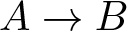 $A\to B$.
Addendum D
The equivariant stable Hopf invariant  $H^\pi$ possesses properties (i)–(iv). Furthermore, the $\pi$-equivariant analogue of corollary C holds: In the metastable range, $f\in \{A,B\}_{\pi}$ destabilizes to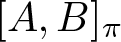 $[A,B]_\pi$ if and only if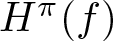 $H^\pi(f)$ is trivial.
1.3. Concerning uniqueness
Suppose that  $\lambda : \{A,B\} \to \{A,D_2(B)\}$ is a natural transformation possessing the following properties:
(a)
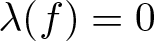
$\lambda(f) = 0$ if
$f$ is represented by an unstable map,(b)
$\lambda$ possesses the Cartan formula, and(c)
$\lambda$ possesses the EHP property.


Let 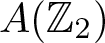 $A(\mathbb Z_2)$ denote the Burnside ring of the group $\mathbb Z_2$ (cf. [Reference Bouc3]). There is an isomorphism
 \begin{equation*}
A(\mathbb Z_2) \cong \mathbb Z[\rho]/(\rho^2-2\rho)\, ,
\end{equation*}
\begin{equation*}
A(\mathbb Z_2) \cong \mathbb Z[\rho]/(\rho^2-2\rho)\, ,
\end{equation*}where  $\rho$ corresponds to $\mathbb Z_2$ considered as a $\mathbb Z_2$-set. Let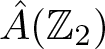 $\hat A(\mathbb Z_2)$ denote the completion of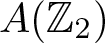 $A(\mathbb Z_2)$ with respect to its augmentation ideal. In §8, we show that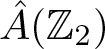 $\hat A(\mathbb Z_2)$ acts on the homotopy classes of natural transformations $D_2({-}) \to D_2({-})$.
Let 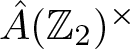 $\hat A(\mathbb Z_2)^{\times}$ denote the group of units of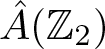 $\hat A(\mathbb Z_2)$, and let $K$ denote the kernel of the split surjective homomorphism $\hat A(\mathbb Z_2)^{\times} \to \hat A(e)^{\times} = \{\pm 1\}$ induced by augmentation. Then
 \begin{equation*}
K \cong \mathbb Z_2\times \mathbb Z^{\wedge}_2,
\end{equation*}
\begin{equation*}
K \cong \mathbb Z_2\times \mathbb Z^{\wedge}_2,
\end{equation*}where  $\mathbb Z^{\wedge}_2$ is the group of $2$-adic integers. The $\mathbb Z_2$-factor is generated by $\rho-1$ and the factor $\mathbb Z^{\wedge}_2$ is topologically generated by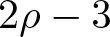 $2\rho-3$.
Theorem E. The set of natural transformations  $\lambda : \{A,B\} \to \{A,D_2(B)\}$ which satisfy (a)–(c) above is a free and transitive $K$-set, i.e., it is a $K$-torsor.
Outline. §2 introduces  $\mathbb Z_2$-equivariant stable homotopy from a low-tech point-of-view. §3 recalls the tom Dieck splitting in the case of the group $\mathbb Z_2$. In §4, we provide a construction of the stable Hopf invariant. §5 concerns the proof of theorem A. The proof of theorem B appears in §6. §7 contains the proof of addendum D. In §8, we prove theorem E.
2.
$\mathbb Z_2$-equivariant stable homotopy

Let  $T$ be the category of compactly generated weak Hausdorff spaces and let $T_\ast$ be the corresponding category of based spaces. We let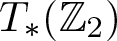 $T_\ast(\mathbb Z_2)$ be the category of based spaces with (left) $\mathbb Z_2$-action. If $X$ is an unbased $\mathbb Z_2$-space, we let $X_+$ denote the corresponding based one obtained from $X$ by taking a disjoint basepoint.
For based  $\mathbb Z_2$-spaces $A,B$, the function space of unequivariant based maps
 \begin{equation*}
\operatorname{map}_\ast(A,B)
\end{equation*}
\begin{equation*}
\operatorname{map}_\ast(A,B)
\end{equation*}is equipped with a preferred  $\mathbb Z_2$-action, where the action is defined by conjugating functions.
Up to isomorphism, there are exactly two irreducible real orthogonal representations of  $\mathbb Z_2$ of positive dimension. These are the trivial representation $1$ and the sign representation $\alpha$. We choose a complete universe $\mathcal U$ for $\mathbb Z_2$ given by the direct sum of countably many copies $1$ and $\alpha$. Then every finite dimensional subrepresentation of $\mathcal U$ is a direct sum of the form
 \begin{equation*}
s\alpha + t \, ,
\end{equation*}
\begin{equation*}
s\alpha + t \, ,
\end{equation*}for non-negative integers  $s$ and $t$.
$t$.
If 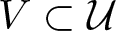 $V\subset \mathcal U$ is a finite dimensional subrepresentation, then we let $S^V$ denote its one-point compactification. The latter is a sphere of dimension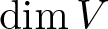 $\dim V$ equipped with a based $\mathbb Z_2$-action.
Suppose that  $Y$ is a based $\mathbb Z_2$-CW complex. We give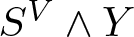 $S^V\wedge Y$ the diagonal action. The based function space
 \begin{equation*}
\Omega^V\Sigma^V (Y) := \operatorname{map}_\ast(S^V,S^V \wedge Y)
\end{equation*}
\begin{equation*}
\Omega^V\Sigma^V (Y) := \operatorname{map}_\ast(S^V,S^V \wedge Y)
\end{equation*}is equipped with a  $\mathbb Z_2$-action. Then the colimit
 \begin{equation*}
Q_{\mathbb Z_2}(Y) := {\operatorname{colim}}_{V\in \mathcal U} \Omega^V\Sigma^V (Y)
\end{equation*}
\begin{equation*}
Q_{\mathbb Z_2}(Y) := {\operatorname{colim}}_{V\in \mathcal U} \Omega^V\Sigma^V (Y)
\end{equation*}is equipped with a  $\mathbb Z_2$-action. The latter is the zeroth space of a $\mathbb Z_2$-equivariant spectrum
 \begin{equation*}
\Sigma^\infty_{\mathbb Z_2}(Y)
\end{equation*}
\begin{equation*}
\Sigma^\infty_{\mathbb Z_2}(Y)
\end{equation*}whose  $V$-th space is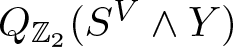 $Q_{\mathbb Z_2}(S^V\wedge Y)$.
Definition 2.1. Let  $X$ be a based $\mathbb Z_2$-CW complex. Set
 \begin{equation*}
\{X,Y\}_{\underline{\mathbb Z_2}} := \mathop{\operatorname{colim}}\limits_{V\subset \mathcal U} \pi_0(\operatorname{map}_\ast(S^V \wedge X,S^V \wedge Y)^{\mathbb Z_2}) \, .
\end{equation*}
\begin{equation*}
\{X,Y\}_{\underline{\mathbb Z_2}} := \mathop{\operatorname{colim}}\limits_{V\subset \mathcal U} \pi_0(\operatorname{map}_\ast(S^V \wedge X,S^V \wedge Y)^{\mathbb Z_2}) \, .
\end{equation*}Remark 2.2. Alternatively,
 \begin{equation*}
\{X,Y\}_{\underline{\mathbb Z_2}} = \pi_0(\operatorname{map}_\ast(X,Q_{\mathbb Z_2}(Y))^{\mathbb Z_2})
\end{equation*}
\begin{equation*}
\{X,Y\}_{\underline{\mathbb Z_2}} = \pi_0(\operatorname{map}_\ast(X,Q_{\mathbb Z_2}(Y))^{\mathbb Z_2})
\end{equation*}where  $\operatorname{map}_\ast(X,Q_{\mathbb Z_2}(Y))^{\mathbb Z_2}$ is the based mapping space of $C$-equivariant maps $X\to Q_{\mathbb Z_2}(Y)$.
Definition 2.3. (
$\mathbb Z_2$-equivariant Stable Maps)

Suppose that  $X$ and $Y$ are based $\mathbb Z_2$-CW complexes. An equivariant stable map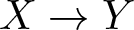 $X \to Y$ is an equivariant map $X\to Q_{\mathbb Z_2}(Y)$.
Equivariant stable maps can be composed and form an  $\infty$-category. If $X$ is finite, then there is a finite dimensional representation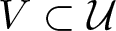 $V\subset \mathcal U$ such that a stable map is represented by an equivariant map $S^V \wedge X \to S^V \wedge Y$, where two such maps agree if they coincide in the colimit of the mapping space.
3. The tom Dieck splitting for
$\mathbb Z_2$

Let  $X$ be a free unbased $\mathbb Z_2$-CW complex of finite type with orbit space $X/\mathbb Z_2$. Then one has an Adams isomorphism [Reference Lewis, May, Steinberger and McClure16, § II.7]
 \begin{equation}
\Sigma^\infty (X/\mathbb Z_2)_+ \xrightarrow{\simeq} (\Sigma^\infty_{\mathbb Z_2}X_+)^{\mathbb Z_2}\, ,
\end{equation}
\begin{equation}
\Sigma^\infty (X/\mathbb Z_2)_+ \xrightarrow{\simeq} (\Sigma^\infty_{\mathbb Z_2}X_+)^{\mathbb Z_2}\, ,
\end{equation}where the target is the genuine fixed points of  $\mathbb Z_2$ acting on the genuine $\mathbb Z_2$-spectrum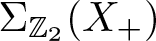 $\Sigma_{\mathbb Z_2}(X_+)$. Note that $X/\mathbb Z_2$ is equipped with the trivial action of $\mathbb Z_2$.
The map of spectra (1) represents an element of the equivariant stable homotopy group
 \begin{equation*}
\{(X/\mathbb Z_2)_+, X_+\}_{\underline{\mathbb Z_2}}
\end{equation*}
\begin{equation*}
\{(X/\mathbb Z_2)_+, X_+\}_{\underline{\mathbb Z_2}}
\end{equation*}and is induced by the stable transfer map for the regular covering space
 \begin{equation*}
p : X \to X/\mathbb Z_2 \, .
\end{equation*}
\begin{equation*}
p : X \to X/\mathbb Z_2 \, .
\end{equation*}Example 3.1. Here is a sketch of the homotopy class of the Adams isomorphism in a special case: Assume that  $X$ is a smooth compact codimension zero $\mathbb Z_2$-submanifold of $V := \mathbb R^{n\alpha}$ for $n$ sufficiently large. Let $e : X\to V$ be the inclusion. Then the embedding $(e,p) : X \to V\times X/{\mathbb Z_2}$ has normal bundle the trivial $G$-bundle $X\times V \to X$. The Pontryagin–Thom construction of $(e,p)$ is therefore a $\mathbb Z_2$-equivariant map
 \begin{equation*}
p^! : S^V \wedge (X/\mathbb Z_2)_+ \to S^V \wedge X_+\,
\end{equation*}
\begin{equation*}
p^! : S^V \wedge (X/\mathbb Z_2)_+ \to S^V \wedge X_+\,
\end{equation*}which defines the desired element of  $\{(X/\mathbb Z_2)_+, X_+\}_{\underline{\mathbb Z_2}}$.
Example 3.2. Let  $X = \{x_-,x_+\} \subset V$ be an equivariant subset of cardinality two, i.e., $x_- = -x_+$. In this case, the Adams isomorphism is an equivalence
 \begin{equation*}
S^0 \xrightarrow{\simeq} (\Sigma^\infty_{\mathbb Z_2} X_+)^{\mathbb Z_2}
\end{equation*}
\begin{equation*}
S^0 \xrightarrow{\simeq} (\Sigma^\infty_{\mathbb Z_2} X_+)^{\mathbb Z_2}
\end{equation*}whose associated homotopy class may be described as follows: Choose an equivariant tubular neighbourhood  $U = U_{x_-} \amalg U_{x_+}$ of $X$. Then the interior of $U$ is identified with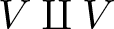 $V \amalg V$. Apply the Pontryagin–Thom construction to obtain an equivariant map
 \begin{equation*}
x_-+_t x_+ : S^V \to S^V \wedge X_+ \, ,
\end{equation*}
\begin{equation*}
x_-+_t x_+ : S^V \to S^V \wedge X_+ \, ,
\end{equation*}where in the above the expression  $+_t$ indicates the dependence on the choice of tubular neighbourhood. The equivariant homotopy class of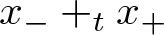 $x_-+_t x_+$ is the desired element of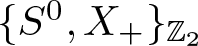 $\{S^0,X_+\}_{\mathbb Z_2}$. whose associated unequivariant homotopy class represents the sum $x_- + x_+\in \{S^0,X_+\}$, where $x_-,x_+ : S^0 \to X_+$ now denote the evident inclusions.
However, the reader should not make the mistake of thinking of 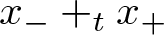 $x_- +_t x_+$ as the result of summing $x$ and $y$, since the latter do not represent elements of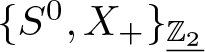 $\{S^0,X_+\}_{\underline{\mathbb Z_2}}$.
Example 3.3. The previous example indicates how to obtain an explicit description of the Adams isomorphism in the general case. Let 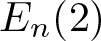 $E_n(2)$ be the second space of the little $n$-cubes operad. A point of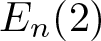 $E_n(2)$ is a rectilinear embedding
 \begin{equation*}
(0,1)^{\times n}\times \{1,2\} \to (0,1)^{\times n}\, .
\end{equation*}
\begin{equation*}
(0,1)^{\times n}\times \{1,2\} \to (0,1)^{\times n}\, .
\end{equation*} Then 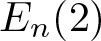 $E_n(2)$ is a free $\mathbb Z_2$-space having the equivariant homotopy type of $S^{n-1}$ with its antipodal action. The quotient map $E_n(2) \to E_n(2)/\mathbb Z_2$ is a regular twofold cover.
Let  $X$ be a free $\mathbb Z_2$-CW complex which for simplicity we take to be finite. If $n$ is sufficiently large with respect to the dimension of $X$, then the twofold cover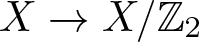 $X\to X/\mathbb Z_2$ is classified by a map
 \begin{equation*}
t : X/\mathbb Z_2 \to E_n(2)/\mathbb Z_2
\end{equation*}
\begin{equation*}
t : X/\mathbb Z_2 \to E_n(2)/\mathbb Z_2
\end{equation*}in the sense that there is a pullback square
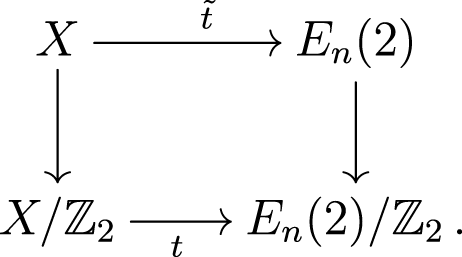
where the top horizontal map  $\tilde t$ is equivariant.
If 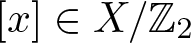 $[x]\in X/\mathbb Z_2$ is a point, then let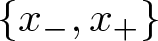 $\{x_-,x_+\}$ denote its preimage in $X$. Then $t(x) \in E_n(2)/\mathbb Z_2$ defines a tubular neighbourhood of the centre of each little cube in the configuration. Identify $x_\pm$ with the centre of the first cube in $\tilde t(x_\pm)$. Then Pontryagin–Thom construction defines an equivariant map
 \begin{equation*}
x_- +_t x_+ : S^V \to S^V \wedge \{x_-,x_+\}_+ \xrightarrow{\subset} S^V \wedge X_+\, ,
\end{equation*}
\begin{equation*}
x_- +_t x_+ : S^V \to S^V \wedge \{x_-,x_+\}_+ \xrightarrow{\subset} S^V \wedge X_+\, ,
\end{equation*}where  $V = \mathbb R^{n\alpha}$ is $\mathbb R^n$ with the antipodal action. We emphasize here that the notation $+_t$ indicates the dependence on the little $n$-cube configuration $t(x) \in E_n(2)/\mathbb Z_2$.
The operation  $[x] \mapsto x_- +_t x_+$ defines a map
 \begin{equation*}
(X/\mathbb Z_2)_+ \to (\Omega^V(S^V \wedge X_+))^{\mathbb Z/2}
\end{equation*}
\begin{equation*}
(X/\mathbb Z_2)_+ \to (\Omega^V(S^V \wedge X_+))^{\mathbb Z/2}
\end{equation*}which passes to the Adams isomorphism upon stabilization.
3.1. The relative case
More generally, suppose that  $Y$ is an arbitrary based $\mathbb Z_2$-CW complex. If we replace $Y$ by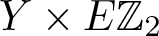 $Y \times E\mathbb Z_2$, then one has a regular covering space pair
 \begin{equation*}
(Y \times E\mathbb Z_2, E\mathbb Z_2) \to (Y \times_{\mathbb Z_2} E\mathbb Z_2,B\mathbb Z_2)
\end{equation*}
\begin{equation*}
(Y \times E\mathbb Z_2, E\mathbb Z_2) \to (Y \times_{\mathbb Z_2} E\mathbb Z_2,B\mathbb Z_2)
\end{equation*}and therefore a relative transfer map of pairs which induces on quotients an equivalence
 \begin{equation*}
\Sigma^\infty(Y_{h\mathbb Z_2}) \xrightarrow{\simeq} \Sigma^\infty_{\mathbb Z_2} (Y \wedge {E\mathbb Z_2}_+)^{\mathbb Z_2}\, ,
\end{equation*}
\begin{equation*}
\Sigma^\infty(Y_{h\mathbb Z_2}) \xrightarrow{\simeq} \Sigma^\infty_{\mathbb Z_2} (Y \wedge {E\mathbb Z_2}_+)^{\mathbb Z_2}\, ,
\end{equation*}where  $Y_{h\mathbb Z_2} := Y \wedge_{\mathbb Z_2} {E\mathbb Z_2}_+$ is the reduced Borel construction of $\mathbb Z_2$ acting on $Y$.
$Y$.
Remark 3.4. The classical transfer map  $\operatorname{tr} : \Sigma^\infty Y_{h\mathbb Z_2} \to \Sigma^\infty Y$ of the above covering space pair of is the composition
 \begin{equation*}
\Sigma^\infty Y_{h\mathbb Z_2} \to (\Sigma^\infty_{\mathbb Z_2} Y)^{\mathbb Z_2} \xrightarrow{\subset} \Sigma^\infty_{\mathbb Z_2}(Y) \simeq \Sigma^\infty (Y)\, .
\end{equation*}
\begin{equation*}
\Sigma^\infty Y_{h\mathbb Z_2} \to (\Sigma^\infty_{\mathbb Z_2} Y)^{\mathbb Z_2} \xrightarrow{\subset} \Sigma^\infty_{\mathbb Z_2}(Y) \simeq \Sigma^\infty (Y)\, .
\end{equation*} With  $Y$ as above, there is always a split cofibre sequence of spectra
 \begin{equation*}
\Sigma^\infty Y_{h\mathbb Z_2} \to (\Sigma^\infty_{\mathbb Z_2}Y)^{\mathbb Z_2} \xrightarrow{\simeq} \Sigma^\infty (Y^{\mathbb Z_2})\, .
\end{equation*}
\begin{equation*}
\Sigma^\infty Y_{h\mathbb Z_2} \to (\Sigma^\infty_{\mathbb Z_2}Y)^{\mathbb Z_2} \xrightarrow{\simeq} \Sigma^\infty (Y^{\mathbb Z_2})\, .
\end{equation*}The first map in the sequence is a composition:
 \begin{equation*}
\Sigma^\infty Y_{h\mathbb Z_2} \xrightarrow{\simeq} (\Sigma^\infty_{\mathbb Z_2}(Y \wedge {E\mathbb Z_2}_+))^{\mathbb Z_2} \to (\Sigma^\infty_{\mathbb Z_2} Y)^{\mathbb Z_2}\, ,
\end{equation*}
\begin{equation*}
\Sigma^\infty Y_{h\mathbb Z_2} \xrightarrow{\simeq} (\Sigma^\infty_{\mathbb Z_2}(Y \wedge {E\mathbb Z_2}_+))^{\mathbb Z_2} \to (\Sigma^\infty_{\mathbb Z_2} Y)^{\mathbb Z_2}\, ,
\end{equation*}where the first map is the Adams isomorphism and the second map is induced by collapsing  $E\mathbb Z_2$ to a point.
The splitting map  $\Sigma^\infty (Y^{\mathbb Z_2}) \to (\Sigma^\infty_{\mathbb Z_2}Y)^{\mathbb Z_2}$ is induced by the inclusion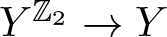 $Y^{\mathbb Z_2} \to Y$; more precisely, it is adjoint to the map
 \begin{equation*}
Y^{\mathbb Z_2} \to (Q_{\mathbb Z_2}Y)^{\mathbb Z_2}
\end{equation*}
\begin{equation*}
Y^{\mathbb Z_2} \to (Q_{\mathbb Z_2}Y)^{\mathbb Z_2}
\end{equation*}which sends a fixed point of 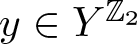 $y\in Y^{\mathbb Z_2}$ to the point represented by the equivariant map $S^0 = S^0 \wedge \{y\}_+ \to S^0 \wedge Y$.
3.2. Specialization
Let  $B$ be a based CW complex. We will be interested in applying the above observation to the based $\mathbb Z_2$-CW complex
 \begin{equation*}
Y = B \wedge B\, ,
\end{equation*}
\begin{equation*}
Y = B \wedge B\, ,
\end{equation*}where the action of  $\mathbb Z_2$ is given by permuting the factors of the smash product. In this case, the split cofibre sequence is
 \begin{equation*}
\Sigma^\infty D_2(B) \xrightarrow{\iota B} (\Sigma^\infty_{\mathbb Z_2} (B\wedge B))^{\mathbb Z_2} \to \Sigma^\infty B \, ,
\end{equation*}
\begin{equation*}
\Sigma^\infty D_2(B) \xrightarrow{\iota B} (\Sigma^\infty_{\mathbb Z_2} (B\wedge B))^{\mathbb Z_2} \to \Sigma^\infty B \, ,
\end{equation*}since  $(B\wedge B)^{\mathbb Z_2} = B$. The splitting map for the cofibre sequence is induced by the reduced diagonal $\Delta_B : B\to B\wedge B$.
Consider the commutative square

in which the vertical maps are twofold coverings and the horizontal maps are induced by the equivariant inclusion  $\mathbb Z_2 \to E\mathbb Z_2$ (i.e., inclusion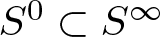 $S^0 \subset S^\infty$).
Using naturality, we infer that there is a homotopy commutative diagram
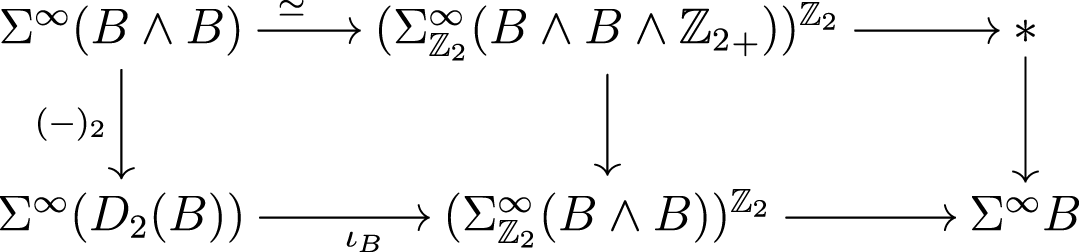
whose rows are the tom Dieck cofibre sequences. The map  $({-})_2$ is induced by the inclusion $\mathbb Z_2 \to E\mathbb Z_2$:
 \begin{equation*}
B \wedge B = (B \wedge B)\wedge_{\mathbb Z_2} {\mathbb Z_2}_+ \rightarrow (B \wedge B)\wedge_{\mathbb Z_2} {E\mathbb Z_2}_+ = D_2(B)\, .
\end{equation*}
\begin{equation*}
B \wedge B = (B \wedge B)\wedge_{\mathbb Z_2} {\mathbb Z_2}_+ \rightarrow (B \wedge B)\wedge_{\mathbb Z_2} {E\mathbb Z_2}_+ = D_2(B)\, .
\end{equation*}4. Definition of the stable Hopf invariant
Given a stable map 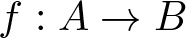 $f : A \to B$, i.e., a map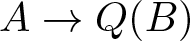 $A\to Q(B)$, we may associate two equivariant stable maps $\Delta_B \circ f, (f\wedge f)\circ \Delta_A : A\to B\wedge B$.
Without loss in generality, we may assume that  $A$ is a finite complex; then $f : S^n \wedge A \to S^n \wedge B$. The map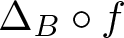 $ \Delta_B\circ f$ is given by the composition
 \begin{equation*}
S^n \wedge A \xrightarrow{f} S^n \wedge B \xrightarrow{\Delta_B} S^n \wedge B \wedge B\,.
\end{equation*}
\begin{equation*}
S^n \wedge A \xrightarrow{f} S^n \wedge B \xrightarrow{\Delta_B} S^n \wedge B \wedge B\,.
\end{equation*} For the second map, take  $f\wedge f$ and shuffle to obtain an equivariant map
 \begin{equation*}
S^n \wedge S^n \wedge A \wedge A \cong S^n \wedge A \wedge S^n \wedge A \xrightarrow{f \wedge f} S^n \wedge B \wedge S^n \wedge B \cong S^n \wedge S^n \wedge B \wedge B \, ,
\end{equation*}
\begin{equation*}
S^n \wedge S^n \wedge A \wedge A \cong S^n \wedge A \wedge S^n \wedge A \xrightarrow{f \wedge f} S^n \wedge B \wedge S^n \wedge B \cong S^n \wedge S^n \wedge B \wedge B \, ,
\end{equation*}where 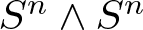 $S^n \wedge S^n$ is given the action that switches factors. Next, note that
 \begin{equation*}
S^n \wedge S^n \cong S^{n\alpha + n}\, ,
\end{equation*}
\begin{equation*}
S^n \wedge S^n \cong S^{n\alpha + n}\, ,
\end{equation*}where  $\alpha$ is the sign representation, and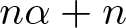 $n\alpha + n$ is notation for the direct sum of $n$-copies of $\alpha$ with $n$-copies of the trivial representation.
Making this identification and taking the composition
 \begin{equation*}
S^{n\alpha + n} \wedge A \xrightarrow{\Delta_A} S^{n\alpha + n} \wedge A \wedge A \xrightarrow{f \wedge f} S^{n\alpha + n} \wedge B \wedge B
\end{equation*}
\begin{equation*}
S^{n\alpha + n} \wedge A \xrightarrow{\Delta_A} S^{n\alpha + n} \wedge A \wedge A \xrightarrow{f \wedge f} S^{n\alpha + n} \wedge B \wedge B
\end{equation*}yields the desired equivariant stable map  $(f\wedge f)\circ \Delta_B$.
By taking adjunctions, we have constructed two maps  $A\to Q_{\mathbb Z_2}(B\wedge B)^{\mathbb Z_2}$. Moreover, it is readily checked that the diagram

commutes, i.e.,  $\eta $ coequalizes the maps $\Delta_B \circ f, (f\wedge f)\circ \Delta_A$. It follows that the homotopy class of the difference
 \begin{equation*}
(f\wedge f)\circ \Delta_A - \Delta_B \circ f \in \{A,B\wedge B\}_{\underline{\mathbb Z_2}}
\end{equation*}
\begin{equation*}
(f\wedge f)\circ \Delta_A - \Delta_B \circ f \in \{A,B\wedge B\}_{\underline{\mathbb Z_2}}
\end{equation*}is in the image of the split injection
 \begin{equation*}
\iota_B : \{A,D_2(B)\} \to \{A,B\wedge B\}_{\underline{\mathbb Z_2}}\, .
\end{equation*}
\begin{equation*}
\iota_B : \{A,D_2(B)\} \to \{A,B\wedge B\}_{\underline{\mathbb Z_2}}\, .
\end{equation*}Definition 4.1. The stable Hopf invariant is the natural transformation
 \begin{equation*}
H : \{A,B\} \to \{A,D_2(B)\}
\end{equation*}
\begin{equation*}
H : \{A,B\} \to \{A,D_2(B)\}
\end{equation*}such that  $H(f) \in \{A,D_2(B)\} $ is the unique element such that
 \begin{equation}
\iota_B H(f) = (f\wedge f)\circ \Delta_A - \Delta_B \circ f\, .
\end{equation}
\begin{equation}
\iota_B H(f) = (f\wedge f)\circ \Delta_A - \Delta_B \circ f\, .
\end{equation}Remark 4.2. The natural transformation 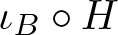 $\iota_B \circ H$ is induced by a map of spaces
 \begin{equation*}
Q(B) \to Q_{\mathbb Z_2}(B\wedge B)^{\mathbb Z_2}
\end{equation*}
\begin{equation*}
Q(B) \to Q_{\mathbb Z_2}(B\wedge B)^{\mathbb Z_2}
\end{equation*}which may be described as follows: Let  $\gamma : S^n \to S^n \wedge B$ represent a point of $Q(B)$. Then $\Delta_B \circ \gamma : S^n \to S^n \wedge B\wedge B$ represents a point of $Q_{\mathbb Z_2}(B\wedge B)^{\mathbb Z_2}$. Likewise, so does $\gamma \wedge \gamma : S^n \wedge S^n \to S^n \wedge B \wedge S^n \wedge B = S^n\wedge S^n \wedge B \wedge B$. For a choice of loop multiplication on $Q_{\mathbb Z_2}(B\wedge B)^{\mathbb Z_2}$, the operation
 \begin{equation*}
\gamma\mapsto \gamma \wedge \gamma - \Delta_B \circ \gamma
\end{equation*}
\begin{equation*}
\gamma\mapsto \gamma \wedge \gamma - \Delta_B \circ \gamma
\end{equation*}induces 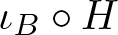 $\iota_B \circ H$.
5. Proof of theorem A
5.1. The cup product again
Let  $A$ and $B$ be CW complexes. For stable maps $f,g : A\to B$, the cup product
 \begin{equation}
f\cup g \in \{A,B\wedge B\}
\end{equation}
\begin{equation}
f\cup g \in \{A,B\wedge B\}
\end{equation}is defined by the composition of the equivariant stable maps  $f\wedge g$ and $\Delta_A$, i.e.,
 \begin{equation*}
f\cup g := (f \wedge g) \circ \Delta_A\, .
\end{equation*}
\begin{equation*}
f\cup g := (f \wedge g) \circ \Delta_A\, .
\end{equation*} If  $A$ is finite, then $f\cup g$ is given as follows: Let $f : \Sigma^j A \to \Sigma^j B$ and $g : \Sigma^j A\to \Sigma^j B$ be representatives. Then $f\cup g$ is given by the composition
 \begin{equation*}
\Sigma^{2j} A \xrightarrow{\Sigma^{2j} \Delta_{A}} \Sigma^{2j} (A \wedge A)= \Sigma^{j} A \wedge \Sigma^j A \xrightarrow{f \wedge g} \Sigma^j B \wedge \Sigma^j B = \Sigma^{2j} (B\wedge B)\, .
\end{equation*}
\begin{equation*}
\Sigma^{2j} A \xrightarrow{\Sigma^{2j} \Delta_{A}} \Sigma^{2j} (A \wedge A)= \Sigma^{j} A \wedge \Sigma^j A \xrightarrow{f \wedge g} \Sigma^j B \wedge \Sigma^j B = \Sigma^{2j} (B\wedge B)\, .
\end{equation*}The cup product induces a pairing
 \begin{equation*}
\cup : \{A,B\}\times \{A,B\} \to \{A,B\wedge B\}\, .
\end{equation*}
\begin{equation*}
\cup : \{A,B\}\times \{A,B\} \to \{A,B\wedge B\}\, .
\end{equation*}The proof of the following result is straightforward and we leave its details to the reader.
Lemma 5.1. The cup product satisfies the following identities:
(i)
$g\cup f = \tau\circ (f\cup g)$, where
$\tau : B\wedge B \to B\wedge B$ is the twist map;(ii)
$(f+f')\cup g = f\cup g + f'\cup g$.



Definition 5.2. For equivariant stable maps  $f,g : A\to B$, the symmetrized cup product
 \begin{equation*}
f\cup_2 g := (f\cup g)_2 \in \{A,D_2(B)\}
\end{equation*}
\begin{equation*}
f\cup_2 g := (f\cup g)_2 \in \{A,D_2(B)\}
\end{equation*}is the stable composition
 \begin{equation*}
A \gt \xrightarrow{f\cup g} B \wedge B \xrightarrow{({-})_2} D_2(B)\, .
\end{equation*}
\begin{equation*}
A \gt \xrightarrow{f\cup g} B \wedge B \xrightarrow{({-})_2} D_2(B)\, .
\end{equation*} Let  $\tau : B\wedge B \to B\wedge B$ the map which permutes factors. Consider the map
 \begin{equation*}
\iota_B : \Sigma^\infty D_2(B) \to (\Sigma^{\infty}_{\mathbb Z_2} (B\wedge B))^{\mathbb Z_2}
\end{equation*}
\begin{equation*}
\iota_B : \Sigma^\infty D_2(B) \to (\Sigma^{\infty}_{\mathbb Z_2} (B\wedge B))^{\mathbb Z_2}
\end{equation*} The for  $f,g\in \{A,B\}$ we may form
 \begin{equation*}
\iota_B (f\cup_2 g) \in \{A,B\wedge B\}_{\underline{\mathbb Z_2}}
\end{equation*}
\begin{equation*}
\iota_B (f\cup_2 g) \in \{A,B\wedge B\}_{\underline{\mathbb Z_2}}
\end{equation*} Notation 5.3. For  $f,g\in \{A,B\}$ we set
 \begin{equation*}
\iota_B \circ (f\cup_2 g) := f\cup g +_t g\cup f \, ,
\end{equation*}
\begin{equation*}
\iota_B \circ (f\cup_2 g) := f\cup g +_t g\cup f \, ,
\end{equation*}cf. example 3.3.
Remark 5.4. The elements  $f\cup g,g\cup f\in \{A,B\wedge B\}$ do not make sense as an elements $\{A,B\wedge B\}_{\underline{\mathbb Z_2}}$. However, it is an elementary exercise involving the transfer to show that forgetful homomorphism
 \begin{equation*}
\{A,B\wedge B\}_{\underline{\mathbb Z_2}} \to \{A,B\wedge B\}
\end{equation*}
\begin{equation*}
\{A,B\wedge B\}_{\underline{\mathbb Z_2}} \to \{A,B\wedge B\}
\end{equation*}sends the element  $f\cup g +_t g\cup f$ to the element
 \begin{equation*}
f \cup g + g\cup f = (1+\tau)(f\cup g)\, .
\end{equation*}
\begin{equation*}
f \cup g + g\cup f = (1+\tau)(f\cup g)\, .
\end{equation*} This observation partially justifies the notation. Note that symbol  $+_t$ exhibits the dependence of the construction on our configuration space model for the Adams isomorphism.
Proof of theorem A
As remarked above,  $\iota_B : \{A,D_2(B)\} \to \{A,B\wedge B)\}_{\underline{\mathbb Z_2}}$ is a split injection. Recall that $H(f)$ is defined using the identity (2). For the Normalization property, it suffices to note that when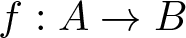 $f : A\to B$ is an unstable map, then the square
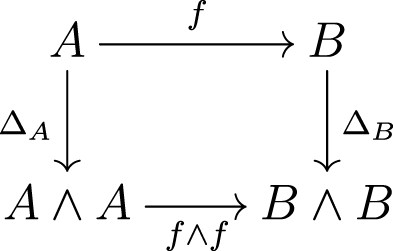
commutes. It follows that the difference  $\iota_B H(f) := (f\wedge f) \circ \Delta_A - \Delta_B \circ f \in \{A,B\wedge B\}_{\underline{\mathbb Z_2}}$ is trivial.
The transfer formula is also an easy consequence of the defining identity (2), since the composition
 \begin{equation*}
\{A,D_2(B)\}\xrightarrow{\iota_B} \{A,B\wedge B)\}_{\underline{\mathbb Z_2}} \to \{A,B\wedge B\}
\end{equation*}
\begin{equation*}
\{A,D_2(B)\}\xrightarrow{\iota_B} \{A,B\wedge B)\}_{\underline{\mathbb Z_2}} \to \{A,B\wedge B\}
\end{equation*}gives the transfer, where the second displayed map is the forgetful homomorphism.
The composition formula also follows from (2): If 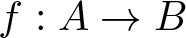 $f : A\to B$ and $g : B \to C$, then
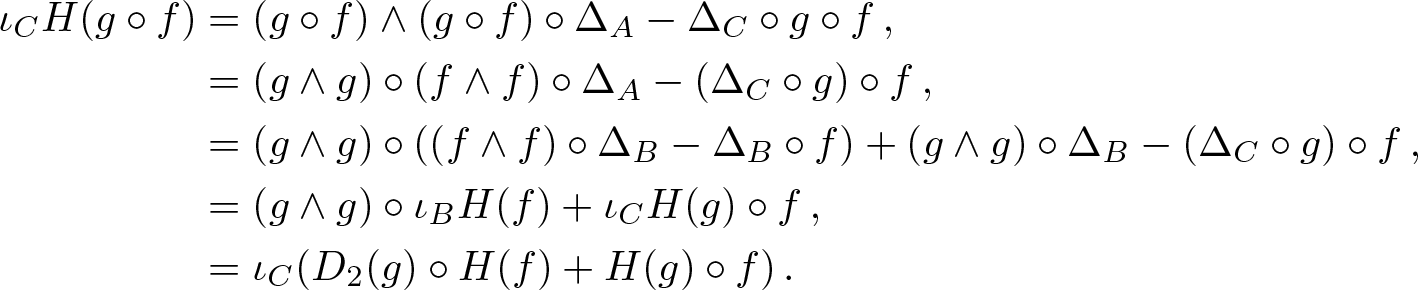 \begin{align*}
\iota_C H(g\circ f) &= (g\circ f) \wedge (g\circ f) \circ \Delta_A - \Delta_C \circ g\circ f \, , \\
&= (g\wedge g)\circ (f\wedge f) \circ \Delta_A - (\Delta_C \circ g)\circ f \, , \\
&= (g\wedge g) \circ ((f\wedge f) \circ \Delta_B- \Delta_B \circ f) + (g\wedge g) \circ \Delta_B - (\Delta_C \circ g)\circ f\, , \\
&= (g\wedge g)\circ \iota_B H(f) + \iota_C H(g) \circ f\, , \\
& = \iota_C ( D_2(g) \circ H(f) + H(g) \circ f )\, .
\end{align*}
\begin{align*}
\iota_C H(g\circ f) &= (g\circ f) \wedge (g\circ f) \circ \Delta_A - \Delta_C \circ g\circ f \, , \\
&= (g\wedge g)\circ (f\wedge f) \circ \Delta_A - (\Delta_C \circ g)\circ f \, , \\
&= (g\wedge g) \circ ((f\wedge f) \circ \Delta_B- \Delta_B \circ f) + (g\wedge g) \circ \Delta_B - (\Delta_C \circ g)\circ f\, , \\
&= (g\wedge g)\circ \iota_B H(f) + \iota_C H(g) \circ f\, , \\
& = \iota_C ( D_2(g) \circ H(f) + H(g) \circ f )\, .
\end{align*}For the Cartan formula, we compute
 \begin{align*}
\iota_B H(f+g) & = ((f+g) \wedge (f+g)) \circ \Delta_A - \Delta_B\circ (f+g)\, , \\
& = (f\wedge f) \circ \Delta_A + ((f\wedge g) \circ \Delta_A +_t (g \wedge f) \circ \Delta_A) \\ & \quad + (g\wedge g) \circ \Delta_A) - (\Delta_B \circ f + \Delta_B \circ g)\, , \\
& = ((f\wedge f) \circ \Delta_A - \Delta_B \circ f)) + ((g\wedge g) \circ \Delta_A - \Delta_B \circ g) \\ & \quad + ((f \wedge g) \circ \Delta_A +_t (g\wedge f) \circ \Delta_A) \, ,\\
& = \iota_B H(f) + \iota_B H(g)+ ( f\cup g +_t g\cup f) \, ,\\
& = \iota_B H(f) + \iota_B H(g) + \iota_B (f\cup_2 g) \, ,\\
& = \iota_B (H(f) +H(g) + f\cup_2 g )\, .
\end{align*}
\begin{align*}
\iota_B H(f+g) & = ((f+g) \wedge (f+g)) \circ \Delta_A - \Delta_B\circ (f+g)\, , \\
& = (f\wedge f) \circ \Delta_A + ((f\wedge g) \circ \Delta_A +_t (g \wedge f) \circ \Delta_A) \\ & \quad + (g\wedge g) \circ \Delta_A) - (\Delta_B \circ f + \Delta_B \circ g)\, , \\
& = ((f\wedge f) \circ \Delta_A - \Delta_B \circ f)) + ((g\wedge g) \circ \Delta_A - \Delta_B \circ g) \\ & \quad + ((f \wedge g) \circ \Delta_A +_t (g\wedge f) \circ \Delta_A) \, ,\\
& = \iota_B H(f) + \iota_B H(g)+ ( f\cup g +_t g\cup f) \, ,\\
& = \iota_B H(f) + \iota_B H(g) + \iota_B (f\cup_2 g) \, ,\\
& = \iota_B (H(f) +H(g) + f\cup_2 g )\, .
\end{align*}6. Proof of theorem B
In this paper, we provided an alternative construction of a stable Hopf invariant using the tom Dieck splitting. Here we will verify that our construction coincides with the Segal–Snaith Hopf invariant.
Recall from [Reference May17] and [Reference Segal21] that there is a homotopy functor on based spaces  $C({-})$ and a natural transformation
 \begin{equation}
C(X) \xrightarrow{\eta} Q(X)\, ,
\end{equation}
\begin{equation}
C(X) \xrightarrow{\eta} Q(X)\, ,
\end{equation}which is a weak equivalence when  $X$ is cofibrant and connected.
The space  $C(X)$ is given by a filtration $C_1(X) \subset C_2(X) \subset \cdots$ and
 \begin{equation*}
{\coprod}_{n\ge 0} (X^{\times n} \times_{\Sigma_n} E(n))/\!\! \sim\, ,
\end{equation*}
\begin{equation*}
{\coprod}_{n\ge 0} (X^{\times n} \times_{\Sigma_n} E(n))/\!\! \sim\, ,
\end{equation*}where  $E(n) := \lim_{k\to \infty} E_k(n)$ is the space of $n$-disjoint little cubes in $\mathbb R^\infty$, in which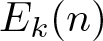 $E_k(n)$ is the space of $n$ little $k$-cubes in $\mathbb R^k$. Note that $E(n)$ is a model for $E\Sigma_n$, i.e., a free contractible $\Sigma_n$-space, and the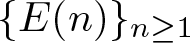 $\{E(n)\}_{n \ge 1}$ collectively form the little $\infty$-cubes operad. In the display, the equivalence relation is generated by two kinds of operations: The first operation identifies a representative $(x,c) \in X^{\times (n-1)} \times E(n)$ with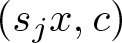 $(s_j x,c)$, where $s_j$ inserts the basepoint in the $j$-factor of $X^{\times n}$ and the second operation identifies $(x,c)$ with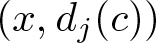 $(x,d_j(c))$, where $d_j(c): E(n) \to E(n-1)$ is given by deleting the $j$th cube.
The Pontryagin–Thom construction defines an equivariant map (4). In particular, if  $[x,y,t] \in X^{\times 2} \times_{\Sigma_2} E(2)$, then
 \begin{equation*}
\eta([x,y,t]) = x+_t y = y +_{-t} x \in Q(X) \, .
\end{equation*}
\begin{equation*}
\eta([x,y,t]) = x+_t y = y +_{-t} x \in Q(X) \, .
\end{equation*}where  $-t$ switches the order of the pair of little cubes defined by $t$.
$t$.
Furthermore, there is a natural equivalence
 \begin{equation*}
\Sigma^\infty C(X) \xrightarrow{\simeq} \textstyle\bigvee\limits_{n\ge 1} \Sigma^\infty D_n(X)
\end{equation*}
\begin{equation*}
\Sigma^\infty C(X) \xrightarrow{\simeq} \textstyle\bigvee\limits_{n\ge 1} \Sigma^\infty D_n(X)
\end{equation*}such that the composition
 \begin{equation*}
\Sigma^\infty ((X^{\times n} \times_{\Sigma_n} {E_n})_+) \to \Sigma^\infty C(X) \xrightarrow{\simeq}\textstyle\bigvee\limits_{n\ge 1} \Sigma^\infty D_n(X)
\end{equation*}
\begin{equation*}
\Sigma^\infty ((X^{\times n} \times_{\Sigma_n} {E_n})_+) \to \Sigma^\infty C(X) \xrightarrow{\simeq}\textstyle\bigvee\limits_{n\ge 1} \Sigma^\infty D_n(X)
\end{equation*}is homotopic to the standard map into the  $n$-summand [Reference Cohen7].
In addition, if we pass to infinite loop spaces, then the diagram of natural transformations
 \begin{equation*}
Q(X) \xleftarrow{\simeq} C(X) \xrightarrow{\simeq} \textstyle\prod \limits_{n\ge 1} Q(D_n(X)) \xrightarrow{\text{project}} Q(D_2(X))
\end{equation*}
\begin{equation*}
Q(X) \xleftarrow{\simeq} C(X) \xrightarrow{\simeq} \textstyle\prod \limits_{n\ge 1} Q(D_n(X)) \xrightarrow{\text{project}} Q(D_2(X))
\end{equation*}induces the second Segal–Snaith Hopf invariant  $h$. Consequently, we may take the above description as a definition of $h$ (see also [Reference Segal22] for Segal’s approach).
Proof of theorem B
By the above discussion, the operations  $h$ and $H$ are induced by natural transformations of spectrum-valued homotopy functors
 \begin{equation*}
{\mathbf h},{\mathbf H} : \textstyle\bigvee\limits_{n\ge 1} \Sigma^\infty D_n(X) \to \Sigma^\infty D_2(X) \, ,
\end{equation*}
\begin{equation*}
{\mathbf h},{\mathbf H} : \textstyle\bigvee\limits_{n\ge 1} \Sigma^\infty D_n(X) \to \Sigma^\infty D_2(X) \, ,
\end{equation*}where  ${\mathbf h}$ is given by projection onto the second summand.
Consequently, for every integer  $n \ge 1$, we have a pair if natural transformations of homotopy functors
 \begin{equation*}
{\mathbf h}_n,{\mathbf H}_n : \Sigma^\infty D_n(X) \to \Sigma^\infty D_2(X)\,
\end{equation*}
\begin{equation*}
{\mathbf h}_n,{\mathbf H}_n : \Sigma^\infty D_n(X) \to \Sigma^\infty D_2(X)\,
\end{equation*}defined respectively by the restrictions of  ${\mathbf h},{\mathbf H}$ to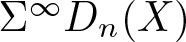 $\Sigma^\infty D_n(X) $. By definition, the natural transformation $\mathbf h_n$ is trivial if $n\ne 2$ and $\mathbf h_2$ is the identity.
Since the functor  $X\mapsto \Sigma^\infty D_n(X)$ is homogeneous of degree $n$, by standard Goodwillie calculus arguments [Reference Goodwillie9], the natural transformations ${\mathbf H}_n$ are trivial for $n \gt 2$. It therefore suffices to show that ${\mathbf H}_1$ is homotopically trivial and that ${\mathbf H}_2$ is homotopic to the identity.
The natural transformation  ${\mathbf H}_1 : \Sigma^\infty X \to \Sigma^\infty D_2(X)$ is trivial since for the identity map $1_X : X\to X$, we have that ${\mathbf H_1} = {\mathbf H}_1 \circ 1_X = {\mathbf H} \circ 1_X$ must necessarily vanish, since $1_X$ is unstable.
It remains to prove that 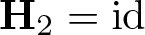 ${\mathbf H}_2 = \text{id}$. This will require some preparation. It will be convenient to redefine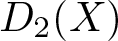 $D_2(X)$ as $X^{[2]} \wedge_{\mathbb Z_2} E(2)_+$. It is well known that the evident map of based spaces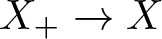 $X_+ \to X$ admits a stable section up to homotopy, i.e., there is a stable map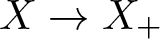 $X\to X_+$ such that the stable composite $X\to X_+ \to X$ is homotopic to the identity. This implies that the induced map $c : D_2(X_+) \to D_2(X)$ also admits a stable section up to homotopy. Then for any infinite loop space $Z$, the induced homomorphism $c^\ast : [D_2(X),Z] \to [D_2(X_+),Z]$ is injective. Furthermore,
 \begin{equation*}
D_2(X_+) = (X_+)^{[2]} \wedge_{\mathbb Z_2} {E(2)}_+ \cong (X^{\times 2} \times_{\mathbb Z_2} {E(2)})_+\, .
\end{equation*}
\begin{equation*}
D_2(X_+) = (X_+)^{[2]} \wedge_{\mathbb Z_2} {E(2)}_+ \cong (X^{\times 2} \times_{\mathbb Z_2} {E(2)})_+\, .
\end{equation*}Consider the composition
 \begin{equation}
D_2(X_+) \xrightarrow{c} D_2(X) \xrightarrow{\hat {\mathbf h}_2} Q(D_2(X)) \xrightarrow{\iota_X} Q_{\mathbb Z_2}(X\wedge X)^{\mathbb Z_2}\, ,
\end{equation}
\begin{equation}
D_2(X_+) \xrightarrow{c} D_2(X) \xrightarrow{\hat {\mathbf h}_2} Q(D_2(X)) \xrightarrow{\iota_X} Q_{\mathbb Z_2}(X\wedge X)^{\mathbb Z_2}\, ,
\end{equation}where  $\hat {\mathbf h}_2$ is the inclusion map.
If  $(x,y,t) \in X^{\times 2} \times E(2)$ is a point, we write $[x,y,t] \in X^{\times 2} \times_{\mathbb Z_2} E(2)$ for the projection of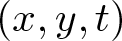 $(x,y,t)$ to its $\mathbb Z_2$-orbit. Then by example 3.3, the map (5) is up to homotopy given by
 \begin{equation}
[x,y,t] \mapsto x\wedge y +_t y\wedge x\, ,
\end{equation}
\begin{equation}
[x,y,t] \mapsto x\wedge y +_t y\wedge x\, ,
\end{equation}where again we write  $x,y : S^0 \to X$ for the based maps defined by the points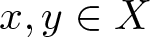 $x,y\in X$ (cf. examples 3.2 and 3.3).
Similarly, using definition of  $H$, we claim that the composition
 \begin{equation}
D_2(X_+) \xrightarrow{c} D_2(X) \xrightarrow{\hat {\mathbf H}_2} Q(D_2(X)) \xrightarrow{\iota_X} Q_{\mathbb Z_2}(X\wedge X)^{\mathbb Z_2}
\end{equation}
\begin{equation}
D_2(X_+) \xrightarrow{c} D_2(X) \xrightarrow{\hat {\mathbf H}_2} Q(D_2(X)) \xrightarrow{\iota_X} Q_{\mathbb Z_2}(X\wedge X)^{\mathbb Z_2}
\end{equation} (in which  $\hat {\mathbf H}_2$ is adjoint to ${\mathbf H}_2$) is given by
 \begin{equation}
[x,y,t] \mapsto (x+_t y) \wedge (x+_t y) - ((x\wedge x) + y\wedge y)) \, .
\end{equation}
\begin{equation}
[x,y,t] \mapsto (x+_t y) \wedge (x+_t y) - ((x\wedge x) + y\wedge y)) \, .
\end{equation} To see this, note that 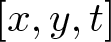 $[x,y,t]$ maps via $\eta$ to the point of $Q(X)$ defined by the composition
 \begin{equation*}
x+ _t y : S^n \xrightarrow{p_{x,y}} S^n \wedge \{x,y\}_+ \xrightarrow{1_{S^n} \wedge i_{x,y}} S^n \wedge X\, ,
\end{equation*}
\begin{equation*}
x+ _t y : S^n \xrightarrow{p_{x,y}} S^n \wedge \{x,y\}_+ \xrightarrow{1_{S^n} \wedge i_{x,y}} S^n \wedge X\, ,
\end{equation*}in which  $p_{x,y}$ is the Pontryagin–Thom construction of the configuration and $i_{x,y} : \{x,y\}_+ \to X$ is the based map induced by the inclusion of subsets. By remark 4.2, it’s enough to identify (8) with the expression ‘ $(x +_t y) \wedge (x +_t y) - \Delta_X \circ (x+_t y)$’. In other words, it suffices to prove that $(1_{S^n} \wedge \Delta_X) \circ (x+_t y) = x\wedge x +_t y \wedge y$.
Since
 \begin{equation*}
\Delta_{X}\circ i_{x,y} := i_{(x,x),(y,y)} : \{(x,x),(y,y)\}_+ \to X\times X\, ,
\end{equation*}
\begin{equation*}
\Delta_{X}\circ i_{x,y} := i_{(x,x),(y,y)} : \{(x,x),(y,y)\}_+ \to X\times X\, ,
\end{equation*}we have
 \begin{align*}
(1_{S^n}\wedge \Delta_X) \circ (x+_t y) &=(1_{S^n} \wedge \Delta_{X}) \circ (1_{S^n} \wedge i_{x,y}) \circ p_{x,y}\,, \\
&= (1_{S^n} \wedge i_{(x,x),(y,y)}) \circ p_{x,y}\, ,\\
& = x\wedge x +_t y \wedge y\, .
\end{align*}
\begin{align*}
(1_{S^n}\wedge \Delta_X) \circ (x+_t y) &=(1_{S^n} \wedge \Delta_{X}) \circ (1_{S^n} \wedge i_{x,y}) \circ p_{x,y}\,, \\
&= (1_{S^n} \wedge i_{(x,x),(y,y)}) \circ p_{x,y}\, ,\\
& = x\wedge x +_t y \wedge y\, .
\end{align*} Observe that as a homotopy class, the map  $[x,y,t] \mapsto x\wedge x +_t y \wedge y$ does not depend on $t$. We have therefore established the claim that (7) is given by (8).
By functoriality of the little cubes operad action with respect to the diagonal, the map  $D_2(X_+) \to Q_{\mathbb Z_2}(X\wedge X)^{\mathbb Z_2}$ defined by $[(x,y),t] \mapsto (x+_t y) \wedge (x+_t y)$ is homotopic to the sum of three maps
 \begin{equation*}
[(x,y),t] \mapsto (x\wedge x) + (x\wedge y +_t y \wedge x) + (y\wedge y) \, ,
\end{equation*}
\begin{equation*}
[(x,y),t] \mapsto (x\wedge x) + (x\wedge y +_t y \wedge x) + (y\wedge y) \, ,
\end{equation*}with each map indicated by parentheses. Therefore, (8) is homotopic to the signed sum of five maps
 \begin{equation}
[(x,y),t] \mapsto (x\wedge x) + (x\wedge y +_t y \wedge x) + (y\wedge y) - (x\wedge x) - (y\wedge y) \, .
\end{equation}
\begin{equation}
[(x,y),t] \mapsto (x\wedge x) + (x\wedge y +_t y \wedge x) + (y\wedge y) - (x\wedge x) - (y\wedge y) \, .
\end{equation} On the level of homotopy classes, we may cancel the diagonal terms appearing in (9), since the group  $\{D_2(X_+), X\wedge X\}_{\underline{\mathbb Z_2}}$ is abelian. Consequently, the map (9) is homotopic to the map (6). We infer that the (5) and (7) are homotopic.
As  $\iota_X$ is a homotopy retract it follows that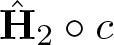 $\hat {\mathbf H}_2 \circ c$ is homotopic to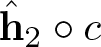 $\hat {\mathbf h}_2 \circ c$, i.e., on homotopy classes $c^\ast(\hat {\mathbf H}_2) = c^\ast(\hat {\mathbf h}_2)$. Since $c^\ast$ is injective, we conclude that ${\mathbf H}_2$ is homotopic to ${\mathbf h}_2$.
7. Proof of addendum D
Let  $T$ be the Quillen model category of compactly generated weak Hausdorff spaces [Reference Daniel19]. A weak equivalence of $T$ is a weak homotopy equivalence. A fibration is a Serre fibration. A cofibration is a map which possesses the left lifting property with respect to the acyclic fibrations.
Let  $T_\ast(\pi)$ be the category based left $\pi$-spaces and $\pi$-equivariant maps; this category has a zero object, i.e., the space $\ast$ consisting of a single point. Declare a map to be a weak equivalence (fibration) if and only if it is a weak equivalence (resp. fibration) upon application of the forgetful functor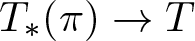 $T_\ast(\pi) \to T$. A map is a cofibration if it possesses the left lifting property with respect to the acyclic fibrations. Then with respect to these choices, $T_\ast(\pi)$ is a model category by application of [Reference Hirschhorn10, thm. 11.6.1]. Note that the cofibrant objects of $T_\ast(\pi)$ are retracts of objects built up from a point by attaching free cells, where a free cell of dimension $j$ is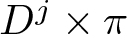 $D^j \times \pi$. In particular, a free $\pi$-CW complex (in the base sense) is cofibrant. Note that every object is fibrant.
For cofibrant objects  $X,Y\in T_\ast(\pi)$, let
 \begin{equation*}
[X,Y]_{\pi} = \hom_{\text{ho}T_\ast(\pi)}(X,Y)\, .
\end{equation*}
\begin{equation*}
[X,Y]_{\pi} = \hom_{\text{ho}T_\ast(\pi)}(X,Y)\, .
\end{equation*} Note that 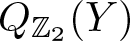 $Q_{\mathbb Z_2}(Y)$ has the structure of an object of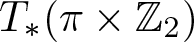 $T_\ast(\pi\times \mathbb Z_2)$. Suppose in addition $X$ has the structure of a based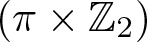 $(\pi\times \mathbb Z_2)$-CW complex which is $\pi$-free after forgetting the $\mathbb Z_2$-action. In this case, we set
 \begin{equation*}
\{X,Y\}_{\pi \times \underline{\mathbb Z_2}} := \pi_0(\operatorname{map}_{T_\ast(\pi)}(X,Q_{\mathbb Z_2}(Y))^{\mathbb Z_2})\, ,
\end{equation*}
\begin{equation*}
\{X,Y\}_{\pi \times \underline{\mathbb Z_2}} := \pi_0(\operatorname{map}_{T_\ast(\pi)}(X,Q_{\mathbb Z_2}(Y))^{\mathbb Z_2})\, ,
\end{equation*}where  $\operatorname{map}_{T_\ast(\pi)}(A,B)$ denotes the mapping space of based equivariant maps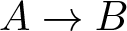 $A\to B$.
Proof of addendum D
With respect to the above conventions, the equivariant stable Hopf invariant is defined in the same way as when  $\pi$ is trivial: For a cofibrant $\pi$-space $Y$, the tom Dieck fibre sequence
 \begin{equation*}
\Sigma^\infty Y_{h\mathbb Z_2} \to (\Sigma^\infty_{\mathbb Z_2} Y)^{\mathbb Z_2} \to \Sigma^\infty Y^{\mathbb Z_2}
\end{equation*}
\begin{equation*}
\Sigma^\infty Y_{h\mathbb Z_2} \to (\Sigma^\infty_{\mathbb Z_2} Y)^{\mathbb Z_2} \to \Sigma^\infty Y^{\mathbb Z_2}
\end{equation*}is a fibre sequence of naive spectra with  $\pi$-action which splits equivariantly making use of the inclusion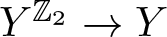 $Y^{\mathbb Z_2} \to Y$. If we set $Y = B \wedge B$ where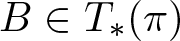 $B\in T_{\ast}(\pi)$ is a cofibrant object, we see then the construction of §4 yields
 \begin{equation*}
H^\pi :\{A,B\}_{\pi} \to \{A,D_2(B)\}_{\pi}\, .
\end{equation*}
\begin{equation*}
H^\pi :\{A,B\}_{\pi} \to \{A,D_2(B)\}_{\pi}\, .
\end{equation*}The proof that properties (i)–(iv) hold is exactly the same as the proof of theorem A, where the maps and homotopy classes are to be interpreted equivariantly.
It remains to show that in the metastable range, a homotopy class  $f\in \{A,B\}_\pi$ destabilizes if and only if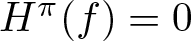 $H^\pi(f) =0$. We will provide a crude sketch of the argument and leave the details to the reader. The Snaith splitting is natural, ‘More precisely, the proofs that appear in [Reference Cohen7] and [Reference Goodwillie9] are natural.’ so the weak homotopy equivalence
 \begin{equation*}
\Sigma^\infty Q(B) \xrightarrow{\simeq} \textstyle\bigvee\limits_{n\ge 1}\Sigma^\infty D_n(B)
\end{equation*}
\begin{equation*}
\Sigma^\infty Q(B) \xrightarrow{\simeq} \textstyle\bigvee\limits_{n\ge 1}\Sigma^\infty D_n(B)
\end{equation*}is also  $\pi$-equivariant. It follows that a $\pi$-equivariant version $h^\pi$ of the second Segal–Snaith Hopf invariant $h$ is defined. Moreover, the sequence
 \begin{equation*}
B \to Q(B) \xrightarrow{h^\pi} Q(D_2(B))
\end{equation*}
\begin{equation*}
B \to Q(B) \xrightarrow{h^\pi} Q(D_2(B))
\end{equation*}is an equivariant fibre sequence in the metastable range by the Blakers–Massey excision theorem, where the map  $h^\pi$ is induced by projection onto the second summand of the Snaith splitting. Then the equivariant stable Hopf invariant $h^\pi$ is the effect of applying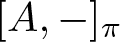 $[A,{-}]_\pi$ to the map of the same name. We infer that $h^\pi$ yields the total obstruction to destabilization in the metastable range. Lastly, the proof we gave that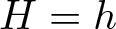 $H = h$ is valid in the equivariant setting, and we conclude that $H^\pi = h^\pi$.
8. Proof of theorem E
Consider a natural transformation
 \begin{equation*}
\lambda : \{A,B\} \to \{A,D_2(B)\}
\end{equation*}
\begin{equation*}
\lambda : \{A,B\} \to \{A,D_2(B)\}
\end{equation*}which satisfies properties (a)–(c).
By naturality and the Snaith splitting,  $\lambda$ is induced by a natural transformation of spectrum-valued functors
 \begin{equation*}
\textstyle\bigvee\limits_{n\ge 1}\lambda_n : \textstyle\bigvee\limits_{n\ge 1} \Sigma^\infty D_n(B) \to \Sigma^\infty D_2(B)\, .
\end{equation*}
\begin{equation*}
\textstyle\bigvee\limits_{n\ge 1}\lambda_n : \textstyle\bigvee\limits_{n\ge 1} \Sigma^\infty D_n(B) \to \Sigma^\infty D_2(B)\, .
\end{equation*} Since the functor  $B\mapsto \Sigma^\infty D_n(B)$ is homogeneous of degree $n$, it follows from standard Goodwillie calculus arguments [Reference Goodwillie9] that the natural transformation $\lambda_n$ is homotopically trivial for $n \gt 2$. Moreover, by property (i), $\lambda_1$ is trivial. Hence, it suffices to determine $\lambda_2$. Note that for the Segal–Snaith Hopf invariant, $h_2$ is the identity [Reference Kuhn15, app. B].
For homotopy functors  $F,G$ from based spaces to spectra, let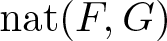 ${\operatorname{nat}}(F,G)$ be the abelian group of homotopy classes of natural transformations from $F$ to $G$; when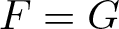 $F = G$, this is a ring with respect to composition. Let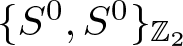 $\{S^0,S^0\}_{\mathbb Z_2}$ be the ring of homotopy classes of equivariant stable self-maps of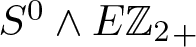 $S^0 \wedge {E\mathbb Z_2}_+$. Again by Goodwillie calculus, the ring homomorphism
 \begin{equation*}
\{S^0,S^0\}_{\mathbb Z_2} \to {\operatorname{nat}}(D_2({-}),D_2({-}))
\end{equation*}
\begin{equation*}
\{S^0,S^0\}_{\mathbb Z_2} \to {\operatorname{nat}}(D_2({-}),D_2({-}))
\end{equation*}induced by  $\alpha\mapsto \alpha \wedge_{\mathbb Z_2} 1$ is an isomorphism. In particular, $\hat A(\mathbb Z_2) = \{S^0,S^0\}_{\mathbb Z_2}$ acts on ${\operatorname{nat}}(D_2({-}),D_2({-}))$.
Let  $\theta\in \{S^0,S^0\}_{\mathbb Z_2}$ correspond to $\lambda_2$; then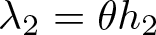 $\lambda_2 = \theta h_2$. I claim that $\theta$ is a unit. To see this, represent $\theta$ by an equivariant self-map $S^0 \wedge {E\mathbb Z_2}_+ \to S^0 \wedge {E\mathbb Z_2}_+$ and let $W_\theta$ be its homotopy fibre. Then the diagram
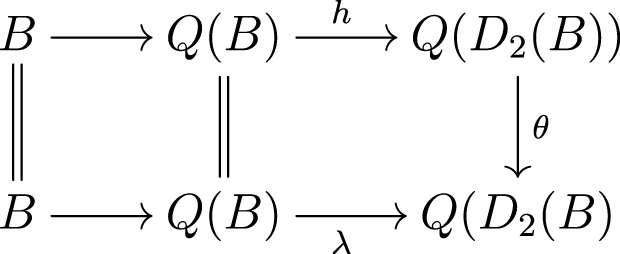
homotopy commutes where the horizontal arrows form the EHP sequences for  $h$ and $\lambda$. The homotopy fibre of the right vertical map is given by the infinite loop space corresponding to the spectrum $W_{\theta} \wedge_{h\mathbb Z_2} (B\wedge B)$. By property (iii), the latter is $(3r)$-connected whenever $B$ is $r$-connected. If we let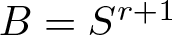 $B = S^{r+1}$ then
 \begin{equation*}
W_{\theta} \wedge_{h\mathbb Z_2} (S^{r+1}\wedge S^{r+1}) \simeq \Sigma^{r+1} W_{\theta} \wedge_{h\mathbb Z_2} S^{(r+1).\alpha}
\end{equation*}
\begin{equation*}
W_{\theta} \wedge_{h\mathbb Z_2} (S^{r+1}\wedge S^{r+1}) \simeq \Sigma^{r+1} W_{\theta} \wedge_{h\mathbb Z_2} S^{(r+1).\alpha}
\end{equation*} Suppose that  $W_\theta$ is $s$-connected. If $r$ is odd, then $\mathbb Z_2$ acts trivially on the reduced homology of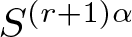 $S^{(r+1)\alpha}$. It follows that $\Sigma^{r+1}W_{\theta} \wedge_{h\mathbb Z_2} S^{(r+1)\alpha}$ is $(s+2r+2)$-connected. Hence $s+2r+2 \ge 3r$ for $r$-odd. Since $r$ is arbitrary, it follows that $W_{\theta}$ is weakly contractible. We infer that $\theta$ is a unit, proving the claim.
By the Segal conjecture [Reference Carlsson4], the ring 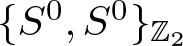 $\{S^0,S^0\}_{\mathbb Z_2}$ is canonically isomorphic to the completed Burnside ring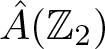 $\hat A(\mathbb Z_2)$. Consider the commutative diagram
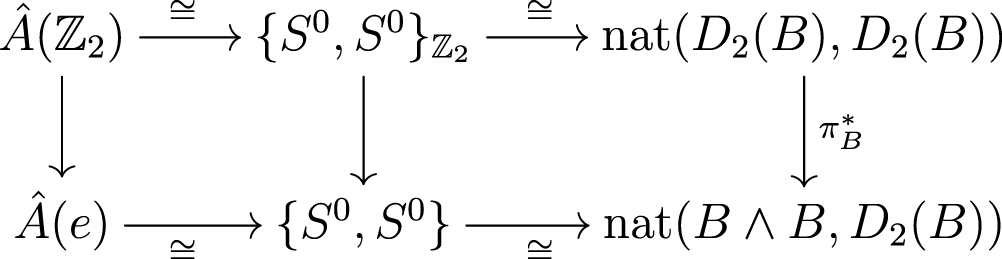
where the right vertical arrow is induced by the evident map  $\pi_B : B\wedge B\to D_2(B)$. The lower right arrow is an isomorphism by Goodwillie calculus since a natural transformation $B\wedge B \to D_2(B)$ is determined by an equivariant map $\Sigma^\infty {\mathbb Z_2}_+ \to S^0$ and the latter is the same as specifying a non-equivariant map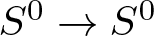 $S^0 \to S^0$. We observe that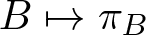 $B\mapsto \pi_B$ corresponds to the identity element of $\{S^0,S^0\} = \mathbb Z$.
Let  $p_i : B_+ \wedge B_+ = (B\times B)_+ \to B$ denote the projections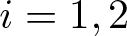 $i=1,2$. Let $q_{B_+} : B_+ \wedge B_+ \to D_2(B)$ be the composition
 \begin{equation*}
B_+ \wedge B_+ \xrightarrow{\pi_{B_+}} D_2(B_+) \to D_2(B)\, .
\end{equation*}
\begin{equation*}
B_+ \wedge B_+ \xrightarrow{\pi_{B_+}} D_2(B_+) \to D_2(B)\, .
\end{equation*} By the Cartan formula for  $\lambda$ and $H$, we have
 \begin{equation*}
q_{B_+} = \lambda(p_1 + p_2) = \theta h(p_1 + p_2) = \theta q_{B_+}\, .
\end{equation*}
\begin{equation*}
q_{B_+} = \lambda(p_1 + p_2) = \theta h(p_1 + p_2) = \theta q_{B_+}\, .
\end{equation*} Since  $\{B\wedge B,D_2(B)\} \to \{B_+\wedge B_+,D_2(B)\}$ is injective, and the image of $q_{B_+}$ is $\pi_B$, we infer that $\pi_B = \theta \pi_B$. Consequently,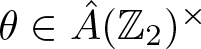 $\theta \in \hat A(\mathbb Z_2)^{\times}$ augments to the identity element. We conclude that $\theta$ lies in the kernel $K$ of the homomorphism $\hat A(\mathbb Z_2)^{\times} \to \hat A(e)^{\times}$.
Conversely, it is clear that any element 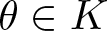 $\theta\in K$ determines a natural transformation $\lambda$ satisfying the properties (a)–(c).
Note Added in Proof. If is not hard to show that the EHP property (c) is a consequence of properties (a) and (b).
Acknowledgements
Andrew Ranicki explained to me the construction of  $H$ about 25 years ago (a chain level version appears in the proof of [Reference Ranicki20, prop. 1.5]). Greg Arone was also aware of such a construction. I am grateful to the referee for a careful reading of the paper, especially for pointing out various errors I made in an earlier draft, as well as the observation that stable Hopf invariants are not necessarily unique.


 Open access

