




Chemical solutions: MSG and vegan soap
In 1908, Kikunae Ikeda 池田菊苗 (1864–1936), a professor of chemistry at the Tokyo Imperial University, identified monosodium glutamate (MSG) as the compound responsible for the distinctive taste of the soup stock dashi, ubiquitous in Japanese cuisine. Working on his own with a single laboratory assistant, Ikeda extracted thirty grams of glutamate from twelve kilograms of a species of kelp (konbu 昆布). From this he produced a very small quantity of tiny crystals that delivered a common but elusive flavor he labeled “umami” 旨味. Ikeda’s discovery had implications for the science of taste—in the early 2000s physiologists claimed to have identified specific umami receptors in the mouth, verifying that Ikeda had in fact discovered a fifth taste to join the standard four: bitter, sweet, sour, and salty. Ever since, innovative gastronomers have explored how better to incorporate umami into their cuisine. Ikeda’s work had significant commercial implications as well which he was quick to act on, securing a patent and founding what was to become a giant in the food industry: the Ajinomoto Corporation, specializing in ajinomoto 味の素, the most common Japanese term for MSG.Footnote 1 Surprisingly, his discovery also played a role in the modern history of vegetarianism. Below I explore the MSG case, efforts to create vegan soap, and the emergence of vegetarian restaurants as examples of the opportunities modernity brought for even conservative religious leaders to advance Buddhist agendas in the world of food.Footnote 2
In the decades following the creation of the first MSG crystals, the Ajinomoto Corporation aggressively marketed their new product not just in Japan, but also in the Japanese colony of Taiwan and, further afield, in Mainland China.Footnote 3 In China, the Ajinomoto Corporation promoted the new flavor supplement as a fashionable marker of the modern bourgeois household, the latest in a string of must-have improving innovations for busy businessmen and savvy housewives, for the private chefs of well-to-do families, and for the discriminating palate of the new socialites—in short, for the sorts of people who read Shanghai newspapers in the early decades of the twentieth century. In one Ajinomoto advertisement, published in the Shanghai paper The China Times (Shishi xinbao 時事新報) in 1914, we see a smartly-dressed young couple with one child, the woman staring out at the reader as if surprised to see us (Figure 1). After explaining in general terms how ajinomoto is made and praising the flavor and convenience of MSG, the final bullet point informs us that “Ajinomoto contains not the slightest whiff of flesh. Pious vegetarians can use it at their convenience.”Footnote 4 Evidently, in 1914, there were enough vegetarians in urban China to warrant the additional hook.
Advertisement for MSG, Shishi xinbao, October 25, 1914.
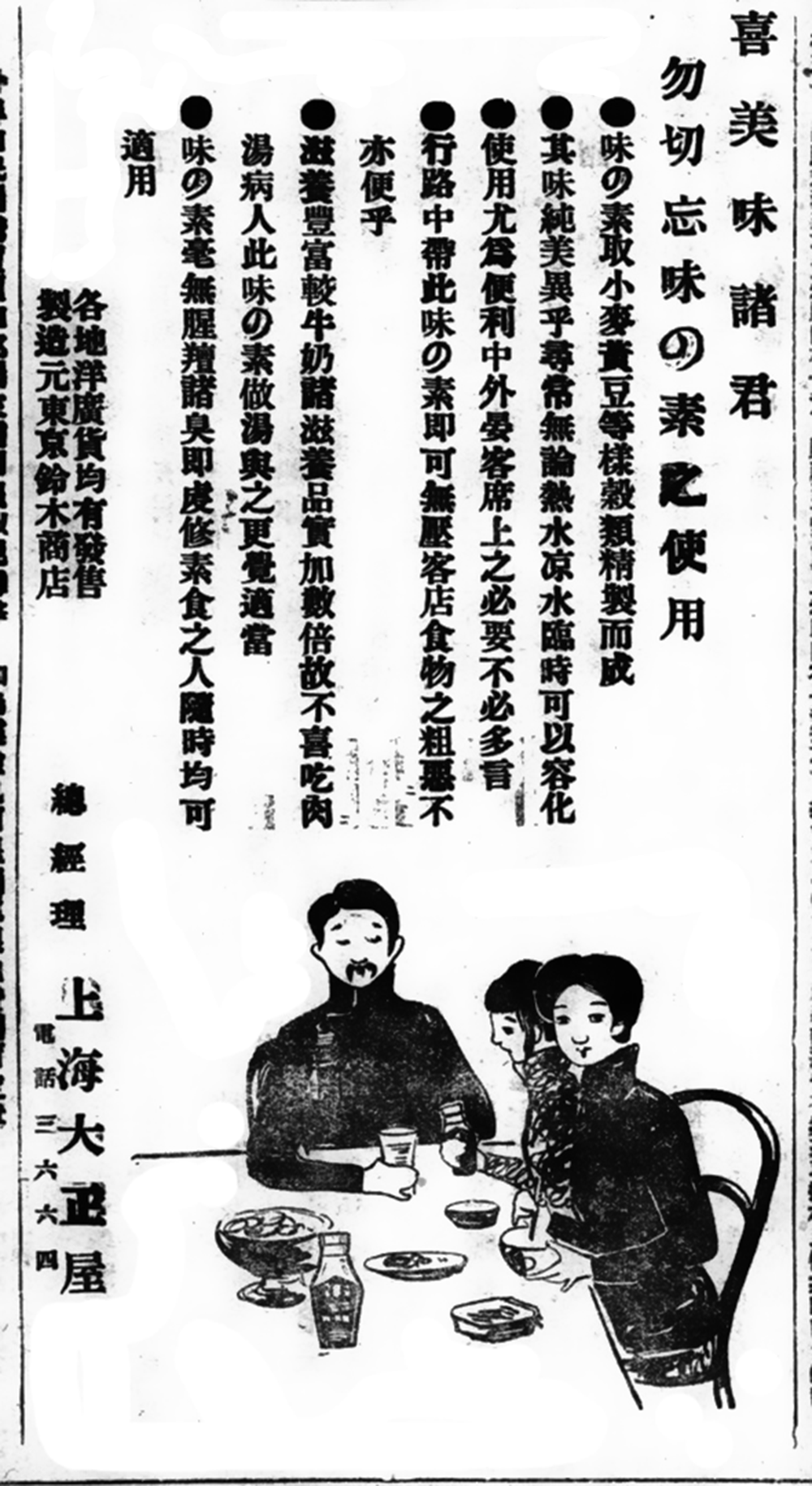
Figure 1. Long description
A vertical print advertisement divided into a textual upper section and an illustrated lower section.
Textual Section (Top to Bottom, Right to Left):
* The main headline on the far right consists of large characters addressing ‘Gourmet Gentlemen’ and urging them not to forget to use ‘Ajinomoto’ (M S G).
* Six bulleted points follow, each marked with a solid black circle. These points describe the product's benefits: its refined production from wheat and soy, its pure taste that dissolves in hot or cold water, its necessity for banquets, its convenience for travelers to improve restaurant food, its high nutritional value compared to milk for those who do not eat meat, and its ability to remove fishy odors for vegetarians.
* To the left of the bullets, smaller text identifies the manufacturer as Suzuki Shoten in Tokyo and mentions availability at various department stores.
Illustration and Contact Section (Bottom):
* A line drawing depicts three people—a man with a mustache and two women—seated at a round dining table. They are dressed in early 20th-century attire.
* On the table are several small bowls, plates, and a distinctively shaped bottle of the product.
* At the bottom left, the text identifies the general agent as the Shanghai Taisho-ya with the telephone number 3 6 6 4.
In 1922, the Chinese entrepreneur Wu Yunchu 吳蘊初 (1891–1953), after several attempts at other businesses, learned the process for making MSG and patented a Chinese name for it: “flavor essence” (weijing 味精). The company he founded, Tien Chu (Tianchu 天廚), like the Ajinomoto Corporation, continues to produce MSG on a grand scale to this day. Back in the 1920s, after winning a lawsuit brought against him by the Ajinomoto Corporation, Wu set his sights on driving the competition out of the Chinese market.Footnote 5 This he did largely through undercutting Ajinomoto’s prices and by marketing his version of MSG as Chinese-made, in this way appealing to his customers’ patriotism during a prolonged period of anti-Japanese sentiment and boycotts of Japanese goods.Footnote 6 He also focused more aggressively than the Ajinomoto Corporation had on exploiting the niche market of vegetarian cooking. The cheerful claim was that, with this new flavor enhancer, vegetarians no longer needed to sacrifice flavor for ethics, taste for health, meat for vegetables. Wu even patented the name “Buddha’s Hand” (Foshou 佛手) for the vegetarian branch of his company.
Mr. Wu’s MSG soon attracted the attention of Yinguang 印光 (1862–1940), one of the most influential monks of the first half of the twentieth century.Footnote 7 Primarily known as a proponent of the traditional practice of Buddha recitation (nianfo 念佛), the prolific and socially energetic Yinguang was also a tireless champion of Buddhist vegetarianism. As he describes it in one of his essays, Yinguang was introduced to MSG by the prominent geologist, businessman, and life-long vegetarian Lin Di’an 林滌庵 (1878–1953). When Lin and his wife visited the master to formally become his disciples (i.e. to “take refuge” under him), the conversation turned to the potential of MSG to promote vegetarianism. A skeptical Yinguang eventually visited Wu Yunchu’s factory and came away convinced not just of the absence of animal flesh in the production of MSG, but also of the capacity of this remarkable new product to finally convert all of China to vegetarianism—the decisive weapon in a campaign Buddhists had waged for centuries. With the invention of MSG, the age-old problem of ethically satiating the innate craving for the powerful flavors released from cooked meat had been solved.Footnote 8 In Yinguang’s essay, no mention is made of Ikeda. Instead, he praises the altruistic motives of Wu Yunchu, founder of the “Buddha’s Hand” brand. Though he notes that the creation and distribution of the new product were no doubt inspired in part by a hunger for profit, “it in fact profits both men and animals.” Now surely “everyone will see fit to become vegetarians,” he gushes. This new discovery is “a contribution of profound significance that will save our country and its people! How great the merit!”Footnote 9
The impact of Yinguang’s endorsement was immediate. In his elegant collection of vegetarian recipes, the scholar-official Xue Baochen 薛寶辰 (1850–1926) does not prescribe MSG in his recipes, but at the back of his book he does note the recent appearance of ajinomoto, commenting, “Those who keep a strict vegetarian diet are suspicious of it. Some say it contains toxins, and so people don’t dare use it.” But recently, Xue tells us, Wu Yunchu has introduced a version of MSG that is not only delicious, but free of any hint of meat. Moreover, it has received the endorsement of the great monk Yinguang.Footnote 10 As late as 1948, a writer in a Buddhist journal continued to praise MSG as having removed the obstacle of taste for reluctant vegetarians, at the same time claiming that MSG increased intelligence.Footnote 11 Idealistic champions of vegetarianism like Yinguang and practical businessmen like Wu saw the benefits of working together. In addition to advertising MSG in the standard urban papers as both a vegetarian and a patriotic product, Wu took out advertisements in the Buddhist journals, proudly proclaiming Yinguang’s endorsement.Footnote 12
The early history of what was termed “vegan soap” (suzao 素皂) tells, with some variations, a similar story of technical innovation and pious promotion.Footnote 13 Individually wrapped bars of soap imported from Europe and America were a popular gift in China from as early as 1850. Supplementing traditional Chinese cleaning powders, sales were driven by a new cosmopolitanism and the craze for “hygiene” among the affluent and an emerging middle class. Factories in China run by European, Japanese, and then Chinese companies sprang up to meet the increasing demand for Western bar-soap.Footnote 14 Unlike traditional Chinese detergents made from ground beans (zaodou 澡豆), the new Western soap was made from animal fat, saponified with caustic lye, supplemented with fragrances, and then molded into the now familiar bar shape.Footnote 15 The process for making soap with animal fat soon became widely known in China, with recipes for manufacturing it at home published in journals and newspapers.Footnote 16 In Lu Xun’s famous 1924 story “Soap,” the new bar soap is a marker of modernity, as the aging, old-fashioned, middleclass protagonist is ridiculed by students in a store when he fusses over which bar of soap to buy, asking an annoyed clerk to unwrap one for him before he finally consents to buy it. In the end of the story, when his wife uses the soap, “smelling like, but not the same as olives,” he notes its lather, vastly superior to her traditional “soap beans” (zaojia 皂莢).Footnote 17 As the new meat-based soap proliferated up and down the social ladder, vegetarians took note with increasing concern.
In 1924, at the bottom of a page announcing a gangland killing, a suicide of an impoverished nineteen-year-old Russian student in Shanghai, and the founding of a women’s bank, the Republic Daily (Minguo ribao 民國日報) reported the activities of a new local business called the Qingming Vegan Soap Company (Qingming suzao gongsi 清明素皂公司). What attracted the attention of the paper wasn’t just the use of coconut and vegetable oils in place of animal fat, but that the company was started by a monk, one Zhiyuan 志圓.Footnote 18 Two other reports from roughly the same period identified the monk as coming from the Yuanjue Hermitage (Yuanjue jingshe 圓覺精舍) on Elgin Road (Aierjin lu 愛而近路), and noted that Zhiyuan had a lay partner named Zhou Wenming 周文明.Footnote 19 Soon thereafter, the Qingming Vegan Soap Company seems to have disappeared, the first in a series of failed vegan soap ventures.
In 1929, Yinguang took a keen interest in the soap problem, as he had in MSG. In a piece he published first as a pamphlet and that was later reproduced in Buddhist journals and in his collected works, he identified both the potential of vegan soap for reducing the number of animals slaughtered and the considerable obstacles standing in the way of a world without animal-based soap. As described in his essay, Yinguang pinned his hopes on a disciple, Fang Yexian 方液仙 (1893–1940), one of a number of restless rags-to-riches Shanghai business barons of the period. Fang was the founder of the China Chemical Industries Company, specializing in the booming new trade in personal hygiene products, especially well known for its toothpaste, but also for its soap.Footnote 20 Yinguang writes:
The number of lives taken to make soap is beyond measure. This is because, in order to clean grease, soap must itself contain fat. As other types of fat do not congeal, or if they do congeal are exorbitantly expensive, it is common to use ox fat. The ox is an animal that has made great contributions to humankind. To kill them in such numbers for the sake of soap is a great pity.Footnote 21 Several years ago, the layman Zhou Wenming and a monk at Putuo created vegan soap. I once spoke on their efforts which I announced to the four assemblies [monks, nuns, laymen, and laywomen]. This was very well received by all pious people. Unfortunately, they had little capital and after a few months the business collapsed. Later, the Nanyang Candle and Soap Factory produced vegan soap, but as the cost was high and the profits low, they too halted production. … In October of last year, the General Manager of Shanghai China Chemical Industries, Fang Yexian, together with his mother and wife, came to me to formally become my disciples. I asked him if he made soap, and he said that he did. After I urged him to make vegan soap, he agreed, but added that the cost is relatively high and that, if they set the price high, people would be unwilling to buy it. This is the reason the companies that manufacture soap refuse to make it.
即如肥皂一事, 由茲殺生者, 亦莫計其數。以肥皂用油, 方能去其油膩。別種油無凝結性。縱有能凝結者, 皆價值昂貴, 以故均以牛油為之。牛為畜之有大功於人者, 因茲所殺無算, 實為一大憾事。數年前, 周文明居士與普陀一僧創做素肥皂, 光曾為說明所以, 用告四眾, 頗為一切善信所贊許。惜資本無幾, 不數月即虧折停止。 … … 去年十月, 上海中國化學工業社總理方液仙與其母、其妻同來皈依。光問做肥皂否? 云做。光囑令做素者。彼應曰諾。但云素皂成本較大, 價若定高, 人不肯用, 以故各皂廠均不肯做。Footnote 22
In other words, Yinguang was well aware both of the use of animal fat in soap and of the commercial challenge of introducing a plant-based alternative. The cost of substituting plant fat for animal fat on a product for daily use with a tight profit margin is the reason that many if not most soaps today continue to rely on animal fat, usually labelled as lard, tallow, or sodium tallowate. Fang, who had made his fortune with a “low margin, high volume strategy,”Footnote 23 knew what he was getting into. But as Yinguang’s disciple, he agreed to his master’s request and in less than a year added vegan soap to his line of Three Star (Sanxing 三星) products.
Arguing for the superiority of the ethical capitalist, Yinguang explained:
As Mencius said, “The arrow-maker fears only that his arrows will not wound, while the maker of armor fears only that his client will be wounded.” Both seek profit, but there is a vast difference in their relative compassion, tolerance, sin, and merit. With this simple measure, how many lives will be spared. Truly this is what is known as a skill that approaches the Way.
《孟子》所謂:「矢人唯恐不傷人, 函人唯恐傷人。」同一求利, 而慈忍罪福大有懸殊。只此一舉, 不知少殺多少生命, 誠所謂藝也而進乎道矣.Footnote 24
Yinguang concludes with what was for him a familiar trope, leaning into his age (he was sixty-two) and declining health in an attempt to win the reader’s sympathy:
My wish is that all fellow human beings will employ this vegan soap, and that all manufacturers of animal-fat based soaps will convert to vegan soap. My hope is that all people, out of a sense of empathy, will not miss the opportunity to improve themselves merely because meat-based soap is cheaper to produce. I am an old man, and my strength wanes by the day. On many days I am obliged to engage in social activities. After autumn, I will retreat into retirement. I worry that Buddhists of every province may not be aware of this [new soap], so I have had this essay printed as a pamphlet in hopes that all may know of it.
所願一切同倫, 悉皆用此素皂, 則凡一切葷皂廠咸皆改做素皂, 以期人皆惠顧, 決不以葷皂成本輕而不肯改良也。光老矣, 精神日減, 應酬日多, 秋後, 當滅蹤長隱。恐各省之佛教同人或有不知, 故令彼印於仿單, 以期咸知云。Footnote 25
In addition to Yinguang’s piece, Fang Yexian, true to his promise to promote the new product, took out advertisements for Sanxing Vegan Soap in Buddhist journals.Footnote 26 Alas, Fang’s initial reservations about the commercial viability proved prescient, and production was halted after a few years. Fang was kidnapped and murdered in 1940, apparently on the orders of Japanese authorities in Shanghai, his body never found.Footnote 27 Yinguang died in the same year, and Sanxing vegan soap seems to have gone the way of other failed vegan soap ventures.
Nonetheless, others carried on the campaign. In 1947 a Buddhist layman named Zhao Chanzhuang 趙禪莊 published a testimonial in the newspaper Rong bao 茸報 explaining that he had been a vegetarian for fifteen years while working in a factory in Shanghai.Footnote 28 Zhao complains of the difficulty of converting others to vegetarianism, and suggests that it may be easier to convince people to change their soap than to change their diet. Nonetheless, he notes, while Yinguang had already promoted vegan soap “more than twenty years ago,” owing to the high cost of production, it had not succeeded. Fortunately, he tells us, the manager of the Nanyang Soap Factory (Nanyang zao chang 南陽皂廠), Zhang Ruchuan 張汝傳, was a Buddhist entrepreneur eager to take up the vexing challenge of replacing animal-based soap. By stockpiling large quantities of “coconut oil and other plant-based products” she was able to produce a vegan soap no more expensive than brands made with animal fat.Footnote 29 The advertisement concludes with pricing and ordering information in Shanghai.Footnote 30 In the same year, the monk Desen 德森, a contemporary of Yinguang, explained his own intrepid role in the vagaries of vegan soap over the course of decades. He was with Yinguang in the early years, “in 1923 or 24” when the master received a request to promote the first vegan soap: the Qingming brand developed by the Shanghai monk Zhiyuan. And he was with Yinguang in 1929 when he was visited by “a certain gentleman” (Fang Yexian, the target of Desen’s most bitter complaints). According to Desen, Fang came to Yinguang primarily because Fang was in poor health, and it is for this reason (in hopes that the good karma and blessings of a famously virtuous monk would return him to health) that he agreed to produce vegan soap. But “three or four years later,” when Fang’s health improved, he betrayed his promise to Yinguang and abandoned promotion of the unprofitable soap. By “1935 or 36,” production stopped entirely. Desen goes on to insist, ungenerously, that Fang’s kidnapping and murder were the karmic consequences of his betrayal of his promise to Yinguang to make vegan soap.Footnote 31 Even after Yinguang’s death, Desen carried on the efforts to stem the rising tide of animal-based soap, using his Buddhist contacts to try to convince other manufacturers to make the switch to vegan soap, but receiving the familiar reply that the profit margin was just too small. After the war, at the end of the forties, Desen was excited to report on the appearance on the scene of Ms. Zhang and the Nanyang Soap Factory, whose products he encourages his readers to purchase. Here it seemed, the thirty-year campaign for vegan soap had finally found the right combination of business savvy and Buddhist piety.
Emerging from the dynamic, cosmopolitan world of Shanghai in the twenties and thirties, the rhetoric surrounding MSG and vegan soap in writings by Buddhist laypeople and by monks like Yinguang discloses a modern enthusiasm for progress, brimming with optimism for the potential of new technologies to change the fate of animals overnight. If so much else could change so quickly—transportation, communication, industry—why not the treatment of animals? At the same time, those in the business world recognized the need for compromise. The MSG that Wu Yunchu promoted as a home-grown product to distinguish it from ajinomoto, was in fact made from Canadian wheat, and for a time he was even obliged to import hydrochloric acid from Japan.Footnote 32 After introducing vegan soap, Fang continued to produce his more profitable soap made from animal fat.Footnote 33 For his part, Yinguang was fully aware of the power of profit to drive products of all sorts. But, as we saw in his evocation of Mencius comparing the motivations of makers of arrows to makers of armor, he hoped to tip the commercial scales towards the ethical through persistent moral suasion.
The new vegetarian restaurants
Newspapers in the 1920s and 30s document the rapid rise of urban vegetarian restaurants—never a match in number for traditional, meat-serving restaurants, but plentiful enough to attract attention.Footnote 34 Monasteries had long made and served vegetarian food; what makes the new urban vegetarian restaurants interesting is that they were founded by groups of committed Buddhist laymen, albeit often with the encouragement of leading monks, as a way of promoting vegetarianism among urban elites. More than profitable ventures, the new vegetarian restaurants were intended as motors for social change. Already in 1914, the Dhyana Bliss Vegetarian Restaurant (Chanyuezhai sucaiguan 禪悅齋素菜館) opened up in Shanghai, boasting cooks brought in from a monastery in Yangzhou.Footnote 35 Even earlier, in 1911, a society of men dedicated to health foods opened the Sensible Food Healthy Vegetarian Restaurant (more prosaically, the “Cautious Consumption Hygienic Vegetarian Restaurant”) (Shenshi weisheng sucaiguan 慎食衛生素菜館).Footnote 36 But by far the most famous and influential Chinese vegetarian restaurant of the modern era was Gongde Lin 功德林, the “Forest of Merit.”Footnote 37
Founded in Shanghai in 1922 on April 8 (the Buddha’s birthday), Gongde Lin included from the outset not just a vegetarian restaurant, but also a Buddhist bookstore. Its manager, Zhao Yunshao 趙雲韶 (1884–1964) was an avowed Buddhist, as were the group of doctors, bankers, and other members of the Shanghai elite who backed the venture—shares in the new restaurant could be purchased for twenty yuan.Footnote 38 The initial announcements of the new restaurant in the papers proclaimed that its intent was “to promote vegetarianism; the goal is not profit.”Footnote 39 Nonetheless, the restaurant catered to the refined tastes of the gentlemen who founded it, and even in the booming gastronomic capital that Shanghai had become, soon gained a reputation for fine dining. Newspaper articles report on meetings between bankers and diplomats at Gongde Lin.Footnote 40 Famous writers like Ye Shengtao 葉聖陶 (1894–1988) and leading monks like Hongyi 弘一 (1880–1942) and Yinguang ate at Gongde Lin.Footnote 41 When Rabindranath Tagore (1861–1941) was in Shanghai in 1924, having won the Nobel Prize for Literature ten years before, he dined at Gongde Lin.Footnote 42 Lu Xun who, in addition to his status as the premier Chinese novelist of his day, was also a great lover of restaurants, notes in his diary a meal shared with friends and their families at Gongde Lin.Footnote 43 The sort of refined dining the restaurant became known for did not sit well with at least one customer, Desen, the monk we met above who campaigned for vegan soap. Describing a lavish, expensive banquet at Gongde Lin he was invited to attend along with other monks and laymen, Desen suggests that for such events a more simple Luohan dish (a potpourri of vegetables) at a monastery kitchen would be more appropriate for committed Buddhists.Footnote 44
While the Shanghai Gongde Lin was the most famous, branch restaurants of the same name soon sprang up in Ningbo (1923), Hangzhou (1924), Suzhou (1926), Shaoxing (1926), Jiaxing (1927), and Guilin (ca.1939).Footnote 45 There was no doubt some regional variation. An article announcing plans to open a Gongde Lin in Shaoxing complains that the vast majority of vegetarians in the city were pious elderly women. “If we look for vegetarians among the youth, we barely find one or two in a hundred,” mostly, the author tells us, because people assumed meat was a necessary part of a healthy diet. Hence, while one could find places selling vegetarian rice and noodle dishes all over, Shaoxing still lacked a high-end vegetarian restaurant like Shanghai’s Gongde Lin.Footnote 46
Nor was Gongde Lin the only brand in vegetarian restaurants. An advertisement for the Fragrant Kitchen Vegetarian Restaurant ca. 1933 relates that it now had four branches, and that while vegetarianism had long been popular in Shanghai, it was beginning to catch on in Hong Kong.Footnote 47 A 1934 piece on the True Vegetarian Hall (Zhensulou 真素樓) claims that it was the oldest vegetarian restaurant in Tianjin, founded already in 1906 on the site of what had been a private garden and frequented by the local literati.Footnote 48 A breezy 1937 article in the Beijing paper Huabei Daily (Huabei ribao 華北日報) relates how one day at noon, the local Forest of Awakening Vegetarian Restaurant (Juelin sushichu 覺林素食處) was “occupied by lively men and women from the aeronautics industry. They conversed enthusiastically about airplane matters—recent trends in aviation, the structure and materials of airplanes and so on, while they waited for the arrival of the female aviator Lin Pengxia 林鵬俠.”Footnote 49 Here we have moved from the serene, austere setting of the monastery kitchen to the bustling buzz of the modern restaurant. Remarkably, in 1940, during some of the darkest days of the war, a new vegetarian restaurant was opened in bombed and battered Chongqing.Footnote 50 And aside from such trendy vegetarian restaurants in the major cities, often founded through the sales of shares to prominent lay businessmen, there were no doubt many smaller vegetarian restaurants and street stalls that left no traces in the historical record.
As we have already seen in the case of the Shanghai Gongde Lin, vegetarian restaurants did more than provide food; many distributed Buddhist books, organized lectures, and at times even held religious services. The great monk Yuanying 圓瑛 (1878–1953) spoke on vegetarianism at the Forest of Awakening vegetarian restaurant in Canton, with the ubiquitous layman and painter Wang Yiting 王一亭 (1867–1938), governor of Canton Zhu Ziqiao 朱子橋 (1874–1941), and the businessman and banker Wang Xiaolai 王曉籟 (1886–1967) among other prominent figures in attendance.Footnote 51 In 1925, the Gongde Lin in Shanghai offered a lecture/banquet series of talks by a monk on the Lotus. Footnote 52 Taixu’s biography notes that he attended an administrative meeting of a Buddhist association held at the Shanghai Gongde Lin.Footnote 53 Many of these events were recorded in the press and in Buddhist journals, and no doubt many more took place without formal announcement. In short, vegetarian restaurants served as organizational centers and public meeting places for formal Buddhist associations. They could also be booked for Buddhist memorial services and wedding banquets.Footnote 54 These were sites as well for organized Buddhist philanthropy. Government officials from disaster-stricken Shaanxi Province came to Shanghai to hold fund-raising events at Gongde Lin.Footnote 55 A meeting to discuss pensions for the indigent elderly was held at a branch of the Forest of Awakening Vegetarian Restaurant in Shanghai in 1934.Footnote 56 On the other end of the age range, a meeting at the Ningbo Gongdelin raised funds to support a local orphanage.Footnote 57
At times, the meatless tertulias in vegetarian restaurants veered into territory only tangentially linked to Buddhism. A meeting in 1931 at the Shanghai Gongde Lin celebrated the Committee for the National Advancement of Mandarin Education, while a meeting at the Ningbo Gongde Lin in 1926 addressed problems in the ferryboat industry, including vessels of dangerously poor quality, unqualified seamen, and extortion.Footnote 58 The “Shanghai Seven” (qi junzi 七君子), eventually jailed for their criticism of Chiang Kai-shek’s policies, met regularly at the Gongde Lin. According to the memoirs of one of the seven, Shi Liang 史良 (1900–1985), “At that time, we often met at the Gongde Lin. Gongde Lin is a vegetarian restaurant in Shanghai. Why did we meet there? It was because we couldn’t find a place to meet, and we knew someone who worked there. It was also relatively cheap to eat at Gongde Lin.”Footnote 59 A new urban energy emanated from these restaurants, reflected in the press. If the birth of the public sphere in Europe was fueled by caffeine in London coffee houses, in Republican-era China a version of civil society with Buddhist characteristics was fueled by MSG and mock meat in Shanghai’s vegetarian restaurants.Footnote 60
More specific to the food itself, the new vegetarian restaurant adapted quickly to changing tastes. One food critic, writing in 1924, praised the variety of dishes at the Shanghai Gongde Lin, noted their free use of MSG (“even more than in Sichuan food”), commented on the creative and delicious incorporation of cream in the dishes, and finally offered a mixed assessment of their famous meat substitutes, that is, vegetarian dishes imitating meat dishes.Footnote 61 The author complains that while the practice may be appealing to vegetarians (“like quenching one’s thirst by looking at plums”), for meat eaters looking for a break from their usual diet, the array of fake duck and chicken dishes is wearisome. Lu Xun had similar misgivings. In his memoirs describing his meetings with the great novelist, the essayist Chuandao 川島 (a.k.a. Zhang Tingqian 章廷謙, 1901–1981) describes taking Lu Xun to a branch of Gongde Lin when he visited Hangzhou. According to Chuandao, Lu Xun disliked vegetarian restaurants, not because he wasn’t fond of vegetables but because:
at that time, the typical vegetarian restaurant often had vegetarian dishes with the names of meat dishes including duck substitutes, fake fish, vegetarian chicken, and mock bacon. Mr. Lu Xun thought that if someone wanted to eat fish or chicken or duck they should eat it. But if they wanted to avoid killing and maintain a vegetarian diet, but couldn’t give up their attachment to chicken, duck, fish, and meat and so labeled vegetarian dishes with meat names, it was all completely unnecessary. For this reason, Mr. Lu Xun normally didn’t care to go to vegetarian restaurants and eat such false fare masquerading as something else.
當時一般的素菜館中, 常有一些偽裝的鴨、假樣的魚、以及素雞、素火腿一類素食葷名的肴菜, 魯迅先生以為如果有人願意去吃魚吃雞鴨, 吃去好了; 既是要戒殺生、吃素持齋, 卻仍不能忘情於雞鴨魚肉, 素菜葷名, 實在太可不必。因之, 魯迅先生在平日就不大喜歡到素菜館中去吃這些以假亂真的東西.Footnote 62
Chuandao goes on to say that when the two went to Gongde Lin, they simply avoided ordering the meat substitutes.
Some vegetarians ventured similar complaints in the Buddhist journals. One letter to the editor of a Buddhist journal circa 1930 lists the dish titles “vegetarian chicken, vegetarian eggs, vegetarian sausage, vegetarian beef and fish,” and argues that “the naming of vegetarian dishes should encourage moral behavior.” But at the level of intention, is tricking the palate into thinking it is eating meat an honorable technique? The troubled author admits that such dishes may be beneficial to the weak-willed, but laments their prevalence in vegetarian restaurants.Footnote 63 A few issues later, in the same journal, another reader returns to the problem, complaining that the practice of naming vegetarian dishes after meat dishes attracted much ridicule, but insisting that the problem lay not with vegetarians but with meat eaters, resistant to fully embracing the vegetarian diet.Footnote 64
Meat substitutes were nothing new.Footnote 65 Unlike MSG and vegan soap, “vegetarian chicken” and other imitation-meat dishes had been around for centuries. Their prevalence in vegetarian cooking does, however, seem to have increased in the early twentieth century, driven by the rise of urban vegetarian restaurants.Footnote 66 The same could be said of the urban vegetarian restaurant itself—it too had existed for centuries. What changed in the first half of the twentieth century was the funding model (multiple donors investing in a restaurant), the promotion and discussion of the restaurants in the press, and their greater role in civil society.
Similar to the venerable tradition of substitute meats, the vegetarian wedding banquet was nothing new when the vegetarian restaurants budded and bloomed in the twenties and thirties. The problems that the vegetarian banquet presented were already clear in an account of the ninth-century official Gao Pian 高駢 (d. ca. 887). A Buddhist vegetarian, Gao relented to the entreaties of relatives on the occasion of his daughter’s wedding and served meat to the guests. “Custom called for the butchering of animals [for the banquet]. At first Gao did not want to go along with the idea, but his relatives said, ‘You may keep this precept, but [if the same strictures are put on the banquet], how will we entertain the guests?’.”Footnote 67 Given the limited reach of vegetarians in China, the pressures on parents to provide meat at banquets were ever present. Status was traditionally at least as important as nutrition and taste in the decision to eat meat. A thousand years after Gao Pian served meat at his daughter’s wedding banquet, a 1916 report relates that the rising cost of meat had driven many to serve vegetarian food at weddings and funerals, confirming the status problem: vegetarian food could be a sign of religious conviction or of frugality, but it was just as likely a mark of stinginess or poverty.Footnote 68 The stylish new vegetarian restaurants provided a new tool in the campaign to normalize the vegetarian wedding banquet. A wedding held at the Shanghai Gongde Lin in 1936 included not just vegetarian food, but also a Buddhist ceremony, with the famous Buddhist layman and artist Wang Yiting acting as the witness for the young couple.Footnote 69 Two years previous, Wang had arranged for a vegetarian banquet at the wedding of one of his own grandsons.Footnote 70 But the fact that the banquets were written about betrays their rarity. The eminent lay Buddhist Fan Gunong 范古農 (1881–1951) praised a layman for bravely insisting on a vegetarian banquet for his daughter over the objections of others.Footnote 71
Yinguang, in addition to promoting MSG and vegan soap, was quick to throw himself into the efforts to finally remove meat from Chinese wedding feasts. In an advertisement he composed himself for the Ningbo Gongde Lin Vegetarian Restaurant, he praises those who host vegetarian wedding banquets, “discarding the petty butcher’s trade for the great act of saving the age.”Footnote 72 Another champion of the vegetarian wedding banquet makes a similar argument for the karmic advantages of meatless matrimony, noting that “whenever the wealthy and prominent celebrate a wedding, in their kitchens the blood of pigs, sheep, chickens, and ducks smear a thousand knives, the mournful cries of animals shaking the earth. They don’t see anything wrong with this. But if a cup or plate happens to break in the hall, they take fright at the inauspicious omen. These are the sorts of opinions that common people share.”Footnote 73
If the wedding banquet remained a hard sell in a society that equated meat-eating with prosperity, the funeral banquet would seem to be a more natural fit for the vegetarian cause. After all, from ancient times, filial children were advised to avoid meat as a sign of mourning. Yinguang, ever the moralizer, warned his disciples against serving meat or wine at funerals. “Wine and meat must never be prepared for funerals. The ancient Confucian rituals forbid the consumption of wine and meat during funerals; to do so was considered a loss of virtue. But today the rites have been lost entirely. People eat meat, drink wine, play music, perform opera—there is nothing they won’t do.”Footnote 74 From Yinguang’s monastic perch, the decision to renounce meat at a funeral seemed obvious, not just for Buddhist, karmic reasons, but also because it was in keeping with a long Confucian tradition of expressing mourning through renunciation. Yet for those with extended families, social obligations, and careers, funerals were a rare opportunity to repay debts, curry favor, and establish social standing. Funerals were also, fundamentally, forms of entertainment, whether for the visible or the invisible attendants, and what one person sees as frugal and respectful, another may see as miserly and thoughtless. Just how entrenched the problem was is evident in an announcement in 1923 in which representatives from both Buddhist and Daoist monasteries in Shanghai complain of the practice of monasteries serving meat during celebrations and funerals, and vowing to prohibit the practice in their own institutions.Footnote 75 If even monasteries couldn’t resist pressures to serve meat on such occasions, what hope did the average lay person have of standing up to the social pressures to serve their guests animal flesh at major public family events.
As in the case of weddings, the most effective avenue for promoting vegetarian food in funerals was through the high-end vegetarian banquet provided by a first-class restaurant.Footnote 76 In other words, whether MSG, vegan soap, or the new urban restaurant, even conservative moralists like Yinguang were eager to explore modern solutions to old problems.
Yinguang died in 1940, and after the establishment of the People’s Republic in 1949 and the series of campaigns that followed, monastics no longer had a platform to promote vegetarianism in China. After 1949, the promotion of the “Socialist Transformation of Capitalist Enterprises” (Ziben zhuyi gongshangye de shehuizhuyi gaizao 資本主義工商業的社會主義改造) and the introduction of the “public-private cooperative model” (gongsi heying 公私合營) in the fifties changed the way restaurants operated.Footnote 77 Wu Yanchu’s attempts to maintain his MSG empire in the PRC failed, and in any event, after his death in 1953, his company eventually began to manufacture meat products, as the connection between MSG and vegetarianism was gradually forgotten: Yinguang’s wager that MSG would render meat superfluous in China proved, of course, to be wrong.Footnote 78 One of the world’s most famous vegetarians, George Bernard Shaw, a frequent subject of Chinese journalists, died in 1950. And Hitler’s vegetarianism, commented on in the Chinese press, shattered the idea that a change in diet could usher in an era of world peace. In a country grappling with the pressing and at times tragic demands of supplying China’s population with an adequate food supply, vegetarianism seems not to have been a part of the discussion.Footnote 79 Whether because so many were de facto vegetarians in a period of poverty and famine, or because vegetarianism was associated with troublesome radicals and pious Buddhists, vegetarianism faded from the scene. It was only decades later, especially with the turning of the next century, that Chinese thinkers, religious figures, chefs, and entrepreneurs would return to the vegetarian question.Footnote 80
Acknowledgements
I want to thank Charlotte Zhu for her work as a research assistant in the early stages of researching this article.
Competing interests
The author declares none.

 Open access

