

Yogurt is a very popular fermented dairy product that is now consumed worldwide (Aryana and Olson, Reference Aryana and Olson2017) and is valued as a healthy food with high nutritional value and health benefits (Li et al., Reference Li, Zhang, Jia, Yuan, Li, Cui and Yu2022). Nonfat yogurt has gained worldwide support for its healthiness (Saleh et al., Reference Saleh, Mohamed, M. Alamri, Hussain, Qasem and Ibraheem2020; Hashim et al., Reference Hashim, Nadtochii, Muradova, Proskura, Alsaleem and Hammam2021) and its nonfat nature is widely accepted as one of the values of yogurt. However, nonfat yogurt has the drawback of being less tasty compared to yogurt that contains fat (Peng et al., Reference Peng, Serra, Horne and Lucey2009), and nonfat set yogurt has a hard texture and high water release, as well as lacking smoothness (Delikanli and Ozcan, Reference Delikanli and Ozcan2014; Soleymanpuori et al., Reference Soleymanpuori, Madadlou, Zeynali and Khosrowshahi2014). Improving the flavor and texture of nonfat set yogurt has thus become an important research task (Aziznia et al., Reference Aziznia, Khosrowshahi, Madadlou and Rahimi2008).
Several methods have been investigated as means of compensating for the texture of nonfat yogurt, including changing the lactobacillus starter to one with a smoother or creamier texture (Sodini et al., Reference Sodini, Remeuf, Haddad and Corrieu2004; Liu et al., Reference Liu, Li and Liu2017) and using additives that improve the smooth texture (Karam et al., Reference Karam, Gaiani, Hosri, Burgain and Scher2013; Say et al., Reference Say, Soltani and Güzeler2020). Although these methods are certainly effective, they are not optimal when the lactic acid bacteria that can be used are fixed or when additives cannot be used.
Lactose hydrolysis is caused by β-galactosidase, which breaks down lactose into glucose and galactose (Venica et al., Reference Venica, Perotti and Bergamimi2014). Lactose hydrolysis is widely used in dairy products, especially in the production of lactose-free products (Capcanari et al., Reference Capcanari, Chirsanova, Covaliov and Siminiuc2021). Epidemiological research concerning lactose intolerance has estimated that approx. 70% of the world's population is affected by lactose malabsorption (Aili et al., Reference Aili, Zheng, Han, Jiang, Yang, Yang, Zhou, Li and Sun2023). Lactose hydrolysis can prevent lactose-intolerant individuals from experiencing problems when they consume dairy products. Lactose hydrolysis is also performed to increase the sweetness of a food product, because the glucose obtained from the hydrolysis is sweeter than lactose. It has been reported that lactose hydrolysis increases the levels of both Lactobacillus delbrueckii subsp. bulgaricus (L. bulgaricus) and extracellular polysaccharide (EPS: Yamamoto et al., Reference Yamamoto, Watanabe, Ichimura, Ishida and Kimura2021). EPS is known to increase the viscosity of yogurt and improve physical properties, such as enhanced mouth thickness and creaminess (Folkenberg et al., Reference Folkenberg, Dejmek, Skriver and Ipsen2006), viscosity (Ramos et al., Reference Ramos, Sesena, Poveda and Palop2023) and reduced water release (Liu et al., Reference Liu, Li and Liu2017). Therefore, we speculated that we could improve the texture of nonfat yogurt by increasing the EPS concentration through lactose hydrolysis.
In previous studies, the rate of lactose hydrolysis was not strictly controlled because β-galactosidase is usually added at the same time as the starter inoculation (Wolf et al., Reference Wolf, Venica and Perotti2015; Venica et al., Reference Venica, Wolf, Bergamimi and Perotti2016). It was also difficult to achieve complete lactose hydrolysis prior to fermentation, with only 93.8% hydrolysis as the highest value achieved (Popescu et al., Reference Popescu, Bulgaru and Siminiuc2022). To our knowledge, there are no published evaluations of the precise physical properties of nonfat set yogurts with different rates of lactose hydrolysis, or of nonfat yogurts with complete lactose hydrolysis prior to fermentation. The relationship between the lactose hydrolysis rate and the EPS concentration in nonfat set yogurt and the relationship between lactose hydrolysis rate and physical properties of nonfat set yogurt are both unknown. To determine optimal production conditions for nonfat set yogurt, it is necessary to set a target hydrolysis rate for lactose. We conducted the present study to clarify the effects of different lactose hydrolysis rates on the physical properties and texture of nonfat yogurt.
Materials and methods
Preparation of skim milk powder solutions with different lactose hydrolyzation rates
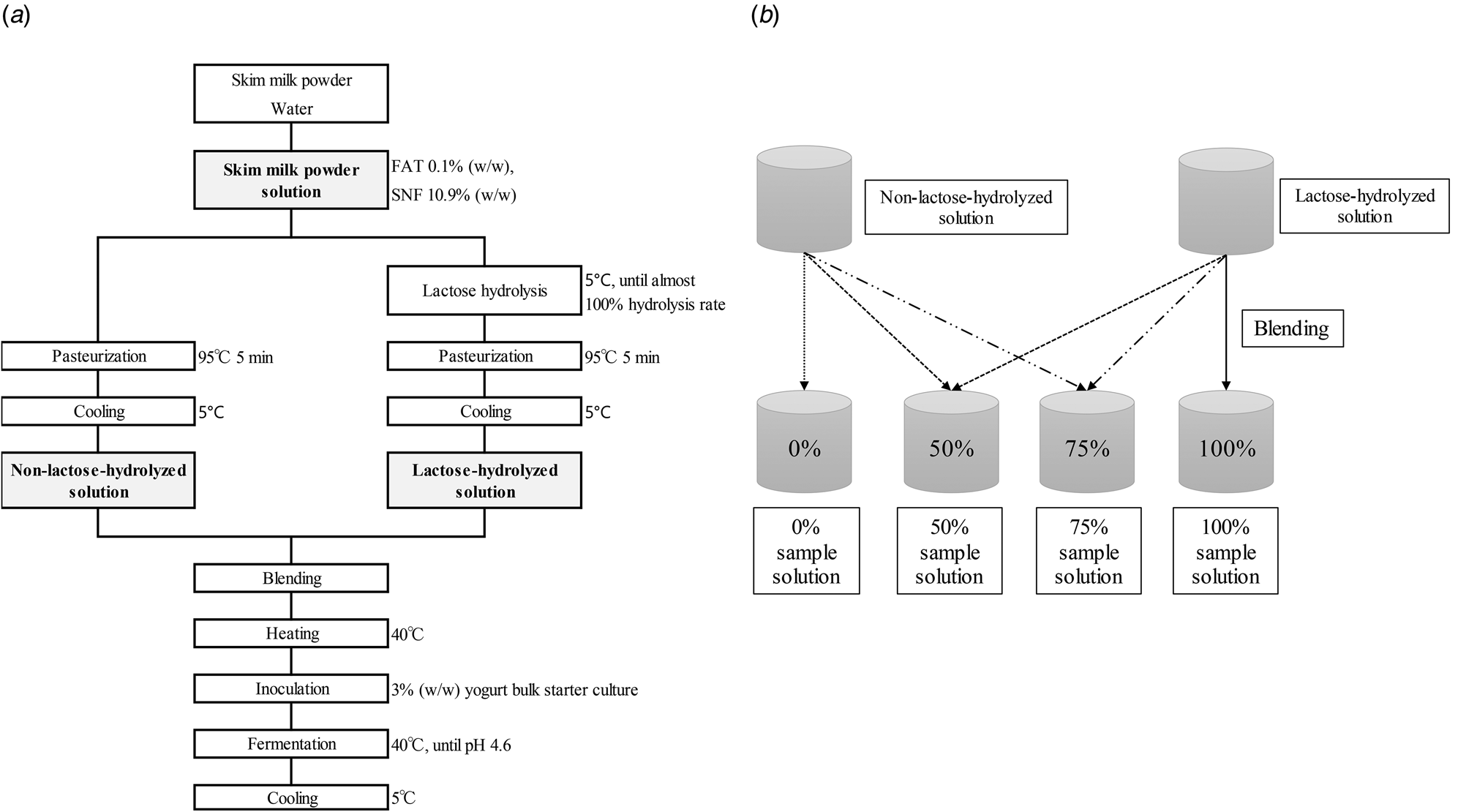
In this experiment, two solutions were prepared and blended in order to adjust the lactose hydrolysis rate in the test area: a non-lactose-hydrolyzed solution and a lactose hydrolyzed solution with almost 100% lactose hydrolysis (Fig. 1A, B). Skim milk powder (Meiji Co., Tokyo) was dissolved in water to make an 11.3% (w/w) skimmed milk powder solution. It contained 0.1% (w/w) fat, 10.9% (w/w) solids-not-fat (SNF), and 6.04% (w/w) lactose. It was obtained by mixing skim milk powder and water at 40°C and 200 rpm for 30 min. The non-lactose-hydrolyzed solution was prepared by pasteurizing the skim milk powder solution at 95°C for 5 min with a VAT heat treatment and immediately cooling it to 5°C. The lactose hydrolyzed solution was obtained by adding 0.0075, 0.015 or 0.03% (w/w) of GODO-YNL lactase (Godo Shusei Co., Tokyo) to the skim milk solution, reacting at 5°C for up to 100% lactose hydrolysis, then pasteurizing at 95°C for 5 min with the VAT heat treatment, and then immediate cooling to 5 ℃ (Fig. 1A). The non-lactose-hydrolyzed solution and the lactose hydrolyzed solution were blended to obtain sample solutions with 0, 50, 75 and 100% lactose hydrolysis (Fig. 1B, online Suppl. Table S1).
Flow of yogurt production.
Set yogurt production
We used a culture called LB81 containing L. bulgaricus 2038 and Streptococcus thermophiles (S. thermophiles) 1131. The yogurt bulk starter culture of LB81 was prepared according to the method of Ichimura et al. (Reference Ichimura, Kusaka and Nakamura2023). Each sample solution was heated to 40°C; the 3% (w/w) LB81 bulk starter culture was added, and 80 g was filled into 100-ml polystyrene cups. The sample solutions were fermented after the dissolved oxygen concentration was reduced to <2 ppm by the blowing of nitrogen into the solutions (Horiuchi et al., Reference Horiuchi, Inoue, Liu, Fukui, Sasaki and Sasaki2009). After fermentation to pH 4.6, the yogurts were stored at 5 ℃. Approximately 24 h later, evaluations of physical properties, sensory properties and the EPS concentration were conducted, and a sugar analysis was performed. The products were then stored at 5°C for 22 d, and the pH transition during storage was evaluated after 8, 13 and 22 d.
Lactose and glucose concentrations
The lactose and glucose concentrations were measured by a high-performance liquid chromatography (HPLC) system (1260 Infinity II Binary LC System, Agilent, Santa Clara, CA). For the removal of milk proteins, 150 μl of 10-fold diluted sample was mixed with 450 μl of 50 mM ZnCl2 (Fujifilm Wako, Osaka, Japan), 50 ml of 20% (w/w) sulfosalicylic acid (Fujifilm Wako) and 850 μl of distilled water. The mixture was centrifuged at 4°C, 12 000 g for 10 min, and the supernatant was filtered through a 0.45-μm membrane (Millex, Millipore, Bedford, MA). Next, 10 μl of filtered supernatant was injected into the chromatograph. Shodex SUGAR SP0810 (Showa Denko, Tokyo) was connected to a guard column (Shodex SUGAR SP-G, Showa Denko), and the eluent consisted of distilled water. The elution flow was set at 0.8 ml/min and the column temperature at 80°C. Detection was performed using a refractive index (RI) detector (G7162A, Agilent, Jasco). Quantitation was performed using a calibration curve for lactose (Fujifilm Wako) and glucose (Fujifilm Wako).
The lactose hydrolysis rate was estimated with the use of the lactose concentration and approximated with the following equation:
 $${\rm Lactose}\;{\rm hydrolysis}\;{\rm rate} = 1 - [ {{\rm L}{\rm C}_{{\rm after}}{\rm \% }( {{\rm w/w}} ) \,{\rm /}\,{\rm L}{\rm C}_{{\rm before}}{\rm \% }( {{\rm w/w}} ) } ] $$
where LCafter is the lactose content of the yogurt mix after lactose hydrolysis, and LCbefore is the lactose content of the yogurt mix before lactose hydrolysis.
Measurement of cell numbers
Live cell counts were enumerated by the pour-plate method using bromocresol purple plate count agar medium (Eiken Chemical, Tokyo). Plates were incubated anaerobically at 37 ℃ for 48 h. Colonies of L. bulgaricus 2038 and S. thermophilus 1131 were identified as rough and smooth forms, respectively. All assays were performed in triplicate.
EPS concentration
Crude EPS was extracted as described by Yamamoto et al. (Reference Yamamoto, Watanabe, Ichimura, Ishida and Kimura2021) with modifications. For the removal of milk proteins, 10 g of sample was mixed with 1 ml of trichloroacetic acid (Fujifilm Wako) and centrifuged at 4°C, 12 000 g for 10 min, and the supernatant was mixed with 20 ml of ethanol (Fujifilm Wako) and centrifuged at 4°C, 12 000 g for 10 min. The precipitate was resuspended in 10 mL of distilled water and analyzed using an HPLC system (Waters Alliance 2695 Separation Module, Waters, Milford, MA). Shodex OHpak SB-806 HQ (Showa Denko) was connected to a guard column (Shodex OHpak SB-G 6B, Showa Denko), and the eluent consisted of 0.2 N NaCl (Fuji Film Wako) in distilled water. The elution flow was set at 0.5 ml/min and the column temperature at 40°C. Detection was performed using an RI detector (Waters 2414, Waters Alliance 2695 separation module, Waters). The standard solution of EPS was prepared as described by Makino et al. (Reference Makino, Sato, Goto, Nakamura, Ogawa, Chiba, Hemmi, Kano, Takeda, Okumura and Asami2016). All measurements were performed in triplicate.
Sensory evaluation
The sensory evaluation test of yogurt was conducted with 12 trained Meiji Co. sensory panelists (eight females, four males, 23–45 years old). The sensory evaluation panelists were selected from a panel of people with a keen sense of five flavors (sweet, salty, sour, bitter and umami). Yogurt in 100-mL polystyrene cups was taken out of the 5°C refrigerator just before the sensory evaluation, which was conducted in a sensory room maintained at 20–23°C. Each yogurt sample was rated on an absolute rating on a 7-point scale (1 = very weak to 7 = very strong) for each evaluation term. The sensory evaluation was conducted using four evaluation items: ‘smoothness’, ‘sourness’, ‘richness’ and ‘overall acceptability.’ Three yogurt samples were provided to each panel member for evaluation.
Physical characterization of the yogurt
The physical properties of the yogurt were evaluated based on the yogurts' curd strength and curd particle size. The curd strength indicates the hardness of the yogurt (Ichimura et al., Reference Ichimura, Kusaka and Nakamura2023). The curd hardness of the yogurt was measured with a CurdmeterMAX ME-500 (Asuka Equipment, Tokyo). The pressure was applied with a yogurt knife. A load of 2.5 g per sec was applied, and the weight when the surface broke was defined as the curd strength.
The curd particle size indicates the smoothness of the yogurt. The curd particle size of the yogurt was measured by a laser diffraction particle size analyzer (SALD-2200, Shimadzu, Kyoto, Japan). The yogurt samples in the cups were shaken 50 times with the lid on to make them liquid. The solvent for the particle size analyzer was deionized water. The yogurt samples were gradually added individually to the cell of the particle size analyzer until the diffraction/scattering light intensity reached ≥40%. After 3 min of sonication, the median diameter of the samples was obtained. Three yogurt samples were used for the evaluation of hardness, and another three samples were used for the evaluation of curd particle size.
Statistical analysis
A one-way repeated measures analysis of variance (ANOVA) and Tukey–Kramer adjustment methods were used to examine the effects of different test conditions on the yogurt properties and sensory evaluation. The data were analyzed using Bellcurve for Excel (ver. 3.10, Social Research and Information, Tokyo) to identify significant differences between samples. Probability (P)-values < 0.05 were considered significant. All analyses were performed in triplicate.
Results and discussion
The effects of lactose hydrolysis on the production of nonfat yogurt
In this experiment, the higher the amount of β-galactosidase added and the longer the reaction time, the higher the lactose hydrolyzation rate was. The lactose in the yogurt mix was >99.5% hydrolyzed in the reaction at the β-galactosidase addition concentration of 0.03% and 5°C for 46 h (online Suppl. Table S1). By blending the non-lactose-hydrolyzed solution and lactose hydrolyzed solution we created a sample solution with 50% lactose hydrolysis and 75% lactose hydrolysis. Online supplementary Table S2 shows the formulation of the sample solutions.
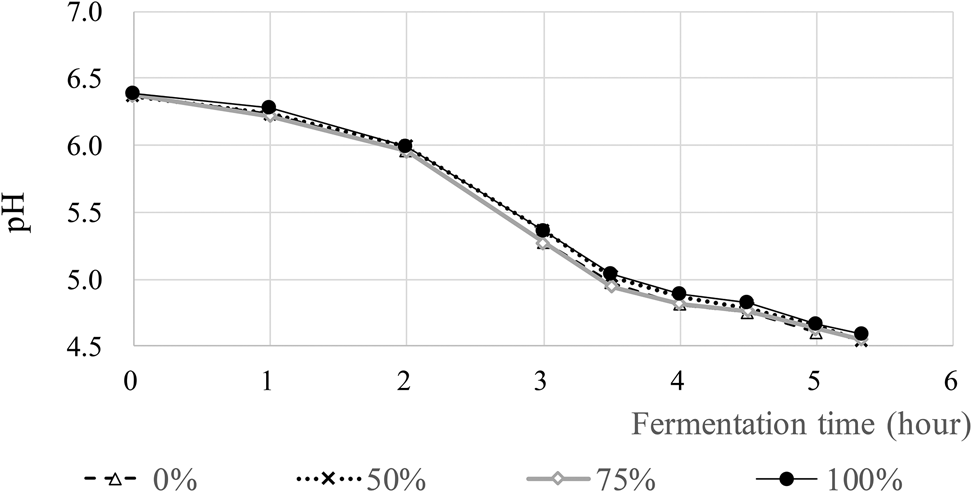
The fermentation time of the yogurt was not affected by the rate of lactose hydrolysis and was similar for all samples (Fig. 2). When the lactose hydrolysis rate was >75%, the amount of lactose remaining in the yogurt was less and became depleted after fermentation (Table 1). Yamamoto et al. (Reference Yamamoto, Watanabe, Ichimura, Ishida and Kimura2021) reported that the fermentation time was slightly longer in a medium containing glucose as the only sugar source compared to a medium containing lactose as the only sugar source. Horiuchi et al. (Reference Horiuchi, Inoue, Liu, Fukui, Sasaki and Sasaki2009) observed that a low dissolved oxygen concentration in the medium shortens the fermentation time even under conditions that delay fermentation, such as at low temperatures. Together these reports and our present findings thus suggest that even when lactose hydrolyzation is performed, lowering the level of dissolved oxygen can prevent fermentation time delays.
Effect of the lactose hydrolysis rate on the fermentation rate.
The lactose content, EPS concentration and physical characterization of the yogurt samples

1Values with different letters in the same column are significantly different (P < 0.05).
Lactic acid bacteria and extracellular polysaccharides
In this study, L. bulgaricus did not show an increase in lactose hydrolysis up to 75%, but did show a significant (P < 0.05) increase at 100% (Table 2). As a result, 100% lactose hydrolysis increased by 1.8-fold in L. bulgaricus compared to 0% lactose hydrolysis. Yamamoto et al. (Reference Yamamoto, Watanabe, Ichimura, Ishida and Kimura2021) reported that in media with lactose hydrolyzation, the progression of a decrease in the dissolved oxygen due to co-fermentation is faster and formic acid is produced faster, which promotes the growth of L. bulgaricus. However, we confirmed that even with a prior reduction of dissolved oxygen, L. bulgaricus increased in the lactose-hydrolyzed samples. As for S. thermophilus, no change in cell counts was observed regardless of lactose hydrolysis rate.
The cell numbers of the yogurt samples
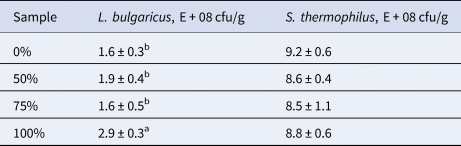
Values with different letters in the same column are significantly different (P < 0.05).
The EPS concentration increased as the lactose hydrolysis rate increased. While there was no significant difference between the 50% lactose hydrolysis and the 0% lactose hydrolysis, there was a significant (P < 0.05) increase in the EPS concentration at approximately 75% lactose hydrolysis and above compared to the 0% lactose hydrolysis (Table 1). With the application of 50% lactose hydrolysis, approximately 3.0% lactose remained, which is an adequate amount compared to the 1.3% lactose concentration used in fermentation. On the other hand, with the 75% lactose hydrolysis, approximately 1.5% of lactose remained, which is almost equal to the amount used in fermentation. L. bulgaricus and S. thermophilus preferentially utilize lactose when lactose and glucose are present simultaneously (Sasaki, Reference Sasaki2015), so at 75% lactose hydrolysis, lactose was almost completely depleted during fermentation and glucose was metabolized later in the fermentation process (Table 1). Since yogurt fermented from milk without lactose from lactose hydrolyzation increased the EPS concentration (Ibrahim, Reference Ibrahim2018), 75% lactose hydrolysis increased the EPS from the middle of the process significantly more compared to 0% lactose hydrolyzation (P < 0.05). Since the number of L. bulgaricus increased with the increase in the lactose hydrolysis rate, we inferred that the increased EPS was derived mainly from L. bulgaricus.
Physical properties and sensory evaluation results
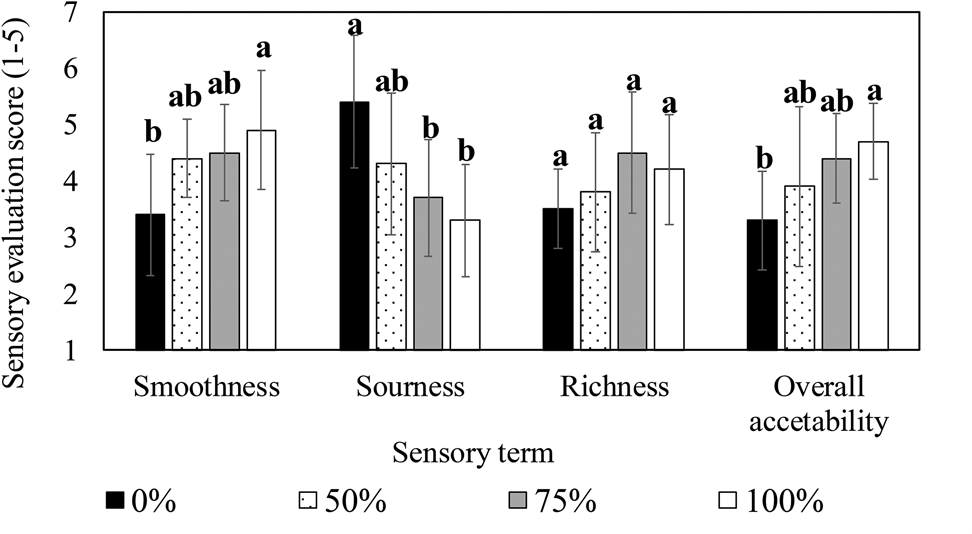
The sensory evaluation results showed that the higher the lactose hydrolysis rate used, the greater was the yogurt's smoothness and overall acceptability and the lower the sourness, while no significant (P > 0.05) difference in richness was observed between the outcomes of the different lactose hydrolysis rates (Fig. 3). The difference in smoothness is thought to be due to the concentration of EPS, since EPS produced by lactic acid bacteria provides viscosity (Folkenberg et al., Reference Folkenberg, Dejmek, Skriver and Ipsen2006; Ramos et al., Reference Ramos, Sesena, Poveda and Palop2023). The highest value of overall acceptability, which was significantly higher than the 0% lactose hydrolysis achieved with the 100% lactose hydrolysis rate (P < 0.05), was inferred to be due to the significantly reduced acidity and significantly increased viscosity and smoothness (both P < 0.05).
Sensory evaluation scores of yogurt with different lactose hydrolysis rates. Plots with different letters on the same sensory term were significantly different (P < 0.05).
As lactose hydrolysis rate increased, the curd hardness decreased, and in addition the particle size after stirring decreased (Table 1). Nguyen et al. (Reference Nguyen, Kravchuk, Bhandari and Prakash2017) reported that nonfat set yogurt tends to have a harder curd and larger curd particles because it does not contain fat, and we thus speculate that the reduction in firmness and post-stirring particle size due to an increased lactose hydrolysis rate would be a useful means of improving the physical properties of nonfat set yogurt. Ramos et al. (Reference Ramos, Sesena, Poveda and Palop2023) reported that the use of EPS increased the smoothness of set yogurt. We speculated that the change in our yogurt's physical properties due to the increased rate of lactose hydrolysis was due to an increase in the amounts of EPS.
Post-acidification
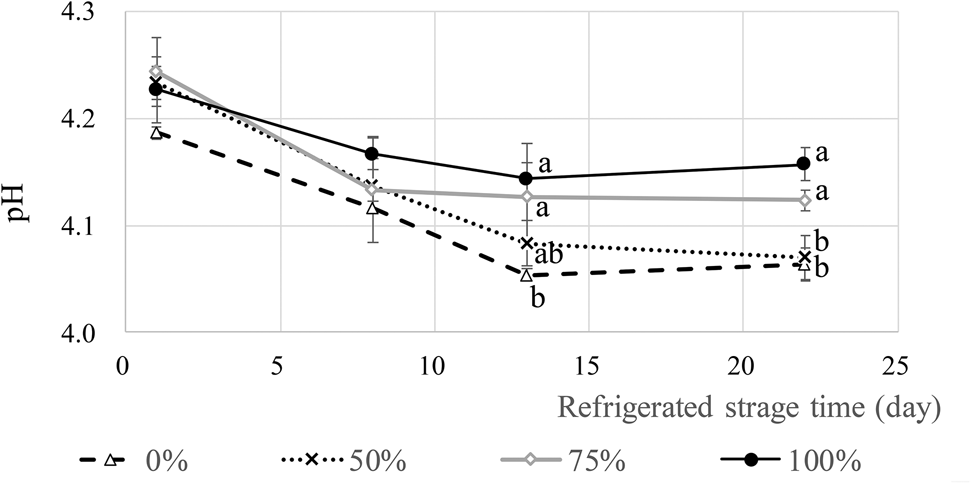
There was no significant difference in pH after the 1-day production for either sample, but we observed a significantly higher pH value after 22 d of storage when the lactose hydrolysis rate was ≥75% compared to ≤50% (P < 0.05: Fig. 4). Normally, L. bulgaricus is known to produce lactic acid during refrigeration, which contributes to the decrease in pH. However, we confirmed that the pH decrease during the storage was slow for those yogurts with high lactose hydrolysis rates, despite the high number of L. bulgaricus. L. bulgaricus had a lower capacity for acid production when glucose was used compared to lactose (Christian et al., Reference Christian, Ehrlich and Maguin2000), resulting in less lactic acid production during refrigerated storage of ≥75% lactose hydrolysis. It is thus apparent that lactose hydrolysis not only increases sweetness by converting lactose to glucose and galactose, it also suppresses the decrease in pH and is thus an effective means of suppressing the increase in acidity during storage.
Effect of the lactose hydrolysis rate on the post-acidification. Plots with different letters on the same sensory term were significantly different (P < 0.05).
Wolf et al. (Reference Wolf, Venica and Perotti2015) reported no change in the decrease in pH during refrigerated storage with or without lactose hydrolysis, whereas Venica et al. (Reference Venica, Wolf, Suarez, Bergamini and Perotti2018) reported that, similar to our present findings, lactose hydrolysis slowed the pH decrease during storage. We speculated that this was because they added β-galactosidase at the same time as the starter inoculation, and the rate of lactose hydrolysis was thus not sufficiently high by the time of the increase in L. bulgaricus or S. thermophilus. Therefore, we concluded that starting fermentation after achieving a 100% lactose hydrolysis rate in advance was effective in obtaining the improvement in the yogurt's physical properties and flavor due to lactose hydrolysis.
In conclusion, we investigated the effects of lactose hydrolysis on nonfat set yogurt. Lactose hydrolysis had no effect on the fermentation time by lowering the dissolved oxygen concentration prior to fermentation. Lactose hydrolysis above 75% significantly increased the EPS concentration. We observed that 100% lactose hydrolysis significantly increased the number of L. bulgaricus and also significantly increased the yogurt's smoothness and overall acceptability, as well as significantly decreasing its acidity. Lactose hydrolysis at >50% significantly reduced the firmness, and lactose hydrolysis >75% significantly reduced the particle size. Lactose hydrolysis >75% significantly reduced the post-acidity during storage. Lactose hydrolysis can thus be considered an effective method in the production of superior nonfat set yogurt. Further research is needed to determine the mechanism by which lactose hydrolysis increases the number of L. bulgaricus and the concentration of EPS, and to determine the impact of EPS on the physical properties and network structure of nonfat set yogurt in order to better understand the effect of EPS on the rheological properties of the product.
Supplementary material
The supplementary material for this article can be found at https://doi.org/10.1017/S0022029925000135
Acknowledgments
We thank Hiroshi Horiuchi and Munenori Fukui for the many useful comments on this subject. We also thank Nao Takagi, Momoka Isetani and Tomoko Miyabe for their assistance with the yogurt samples' preparation and evaluation.


 Open access

