


1 Introduction
Public contracting accounts for almost a third of government expenditure within the OECD, amounting to about 13 per cent of GDP on average (OECD, 2021). Contracts underpin the delivery of health, education, and general public services, which combined account for over two-thirds of public procurement spending (OECD, 2021). Globally, the value of public contracts is estimated at over $13 trillion annually, exclusive of public procurement during the Covid-19 crisis (Reference HuntHunt, 2020; Reference Makgill, Yeung and MarchessaultMakgill, Yeung and Marchessault, 2020).
In countries the world over, governments have transitioned away from directly providing public services to contracting and collaborating with third parties to deliver services on their behalf. Dense, multilevel, and cross-sectoral governance networks typify public service provision in places like the US and the UK (Reference Koliba, Meek, Zia and MillsKoliba et al., 2019), a reality that scholars have variously referred to as the ‘hollow’ state, the ‘contracting’ state, the ‘enabling’ state, and a ‘state of agents’ (Reference HoodHood, 1995; Reference Kirkpatrick and LucioKirkpatrick and Lucio, 1996; Reference MilwardMilward, 1996; Reference Milward and ProvanMilward and Provan, 2000; Reference Heinrich and MarschkeHeinrich, Lynn and Milward, 2010; Reference SainsburySainsbury, 2013). Sometimes, these arrangements are highly formalised – as in public–private partnerships. Other times, they are amalgamations of bilateral agreements with little planned interconnectivity.
While public contracts have long played a major role in industrial development, including innovations in flight and the internet (Reference NagleNagle, 1999, Reference Nagle2012), the ascent of privatisation and shift away from direct bureaucratic provision starting in the 1980s has been hotly debated amongst academics, public managers, the public, and politicians alike. Involving private and nonprofit actors in the business of government means delegating discretion and authority away from the state, forcing ideological and normative argumentation about which activities are inherently governmental and which can be reasonably delivered via the market.
Economists often argue that government involvement is meant to correct for market failures like externalities and collective goods (Reference LazzariniLazzarini, 2022). Using regulations, rewards, and sanctions, governments can curtail bad behaviours – like pollution – and promote good ones – like fair labour practices. Likewise, through taxation, governments can produce an adequate supply of collective goods like national parks or national defence, which if left to market provision would be in short supply due to low-paid demand (Reference LazzariniLazzarini, 2022).
Governments, however, are not without their limitations. In delivering collective goods deemed worthwhile by a majority, governments can struggle to provide support to the minority. The somewhat adversarial nature of electoral democracy likewise means that members of the public face significant hurdles when challenging poor public performance. Government-monopolised public service provision lacks competitive pressure and direct performance indicators, creating concern that states are structurally disposed to expand provision and inflate costs, running counter to public interest as defined by measures of efficiency (Reference WolfWolf, 1979; Reference GrandGrand, 1991; Reference WeberWeber, 2014).
Given the options – the inefficiencies of government or the inequalities of the market – practitioners and academics alike have sought an ideal counterpoise: harnessing the ruthless efficiency of the private sector while enhancing public value considerations of quality, equity, reviewability, and accountability. As the preferred tool of privatisation, the design of public contracts has been a critical mechanism through which states have tried to achieve such a balance (Reference Van SlykeVan Slyke, 2003).
As predicted by Le Grand, the result of government-subsidised intervention through contracts has been mixed (Reference Grand1991). While early rhetoric regarding contracting out was alarmist (Reference SalamonSalamon, 1989), later research focused more so on conceptual clarification and executing ‘empirical tests of the implications of changing governance configurations against various criteria, including equity in access to public goods and services, responsiveness to “customers” (formerly “clients” or “patients”), accountability to elected officials and organized stakeholders, efficiency in service provision, and effectiveness in producing outcomes and results’ (Reference Heinrich and MarschkeHeinrich, Lynn and Milward, 2010, p. i4).
A 2018 systematic review of the economic and quality effects of contracting out showed that the cost savings associated with outsourcing have decreased over time, are greater for technical services (e.g., waste collection, building maintenance, water services, public transit) than for social services (e.g., mental health, nursing homes, employment support, children’s residential care), and have been twice as large in ‘Anglo-Saxon’ countries as compared to those with higher bargaining coverage. The review also highlighted a concerning lack of information on the effects of contracting out on service quality and limited use of measures of transaction costs, making it difficult to assess the influence of outsourcing on the overall cost-effectiveness of service delivery (Reference Petersen, Hjelmar and VrangbækPetersen, Hjelmar and Vrangbæk, 2018). Combined, the findings suggest that ‘generalization of effects from contracting out should be made with caution and are likely to depend, among other things, on the transaction cost characteristics of the service, the market situation, and the institutional/regulatory setting’ (Reference Petersen, Hjelmar and VrangbækPetersen, Hjelmar and Vrangbæk, 2018, p. 130). Other research shows that the decision to contract out can be influenced by ideology, suggesting that social services more so than technical ones ‘are the contemporary ideological battlefield of privatization’ (Reference Petersen, Houlberg and ChristensenPetersen, Houlberg and Christensen, 2015, p. 560).
This Element is an exploration of public contracting mostly in health and social services, representing an authoritative, but not exhaustive, review of relevant public administration, public procurement, and public policy literature from the UK and the US. In it, we situate public contracting as a meso- and micro-level element of macro-level public governance paradigms, building theory and advancing a cross-disciplinary understanding about how the specification of contracts through procurement strengthens or weakens links between policy design and implementation (Reference Howlett, Ramesh and CapanoHowlett, Ramesh and Capano, 2022, Reference Howlett, Ramesh and Capano2023). We also underscore the oft overlooked role of public procurement as a strategic function of government, charged with designing and managing contracts in pursuit of wider policy objectives while upholding fundamental values rooted in public law: transparency, accountability, equal treatment, due process, and fair competition.
It is our contention that public procurement operationalises policy goals and objectives through the delegation of authority, the specification of incentives and monitoring, and the articulation of governance mechanisms within contracts, enabling organisations from across sectors to advance the public interest. To illustrate the argument, we explore opportunities, complexities, and tensions in outcomes-based contracting (OBC), a novel approach to public service contracting which ties payment to the achievement of social outcomes and advances ‘increased and sometimes novel inter-sectoral relationships between governments, nonprofits, and for-profit organisations’ (FitzGerald et al., 2023a, p. 329).
In Section 2, we trace the macro-level evolution of public contracting across public governance paradigms. We describe the history and process of privatisation via contracting, from the bureaucracies of Traditional Public Administration to the reforms of New Public Management and the advent of New Public Governance. We reflect the collaborative turn in contemporary public management which emphasises relational over technical mechanisms to govern the cross-sectoral networks that interdependently deliver health and social services today. The section then tracks changes in approaches to public contracting over time, charting shifts in the specification of incentives and monitoring from efficiency-seeking bipartite fee-for-service contracts to contemporary multilateral outcomes-based contracts ambitiously designed to facilitate collective action and improve public service performance.
In Section 3, we turn to the role of public procurement professionals and their influence on the design, award, and management of public contracts. This section describes procurement professionals as specialised public managers operating in rules-based environments. We distil three layers of rules within which procurement professionals operate: overarching principles; links to wider economic, social, and environmental policies; and rules directly related to contract performance. The section details the growing discretion and responsibility given to procurement professionals to design and manage public contracts that are explicitly linked to wider policy objectives – for example sustainability targets, social equity considerations, and specified social outcomes. We further note that public contracts have traditionally hinged upon management of inputs, activities, and outputs presumed to lead to outcomes and that tensions can arise in OBC when the role of government is limited to approving a fixed payment for their achievement.
Section 4 addresses OBC more directly and details the ways in which outcomes are specified in contracts. In addition to reviewing the evidence on OBC, we frame outcomes-based contracts as tools which determine micro-dimensions of policies – their specifications or ‘on the ground requirements’ and calibrations or ‘ways of delivery’ (Reference Howlett, Ramesh and CapanoHowlett, Ramesh and Capano, 2023). Detailing contractual specifications in light of the policy goals which illuminate them thickens contemporary decompositional approaches to policy studies and forces scholars to consider not just whether a service should be contracted out but also how it has been contracted out. We explore these nuances in the design of two Outcomes Funds, an increasingly popular policy approach to supporting multiple and simultaneous outcomes-based contracts. Using the UK Department for Work in Pensions Innovation Fund and the Department for Digital, Culture, Media and Sport Life Chances Fund, we compare and contrast how the UK central government has specified and calibrated Outcomes Funds in relation to payable outcomes, outcomes validation methods, and the discretion given to other parties in the contract. Using published qualitative and quantitative evaluation material, we then compare their performance against articulated policy goals and objectives.
Finally, in Section 5, we discuss the broader implications for public accountability when the focus of oversight is on outcomes rather than processes. We provide practical commentary on the necessity of having adequate capacity within government to oversee outcomes-based contracts if they are to improve public service delivery and advance of policy objectives. We also underscore important ramifications around a loss of democratic anchorage and the potential for outcomes to enable governments to abscond from their public duties. In closing, we highlight the critical importance of recognising inherently governmental functions even when contracting for social outcomes.
2 The Evolution of Public Contracting
In the pre-war period, states were largely organised into bureaucracies. In an ideal bureaucracy, governments were organised around hierarchical line management of subordinates by supervisors, relationships encapsulated in fixed jurisdictions ordered by rules, laws, or regulations. It was the holding of office, not the individuals themselves, from which the authority to issue commands was tied. Office holders were selected based on expertise and training, rather than patronage, and enjoyed stable, long-term, full-time, decently salaried positions with good pensions. A hallmark of bureaucratic management was record-keeping as a mechanism for ensuring equitable decisions – especially social service access – and preserving organisational memory. Thus, holding public office was characterised as a vocation with its own training, duties, and values (Reference Weber, Gerth and MillsWeber, Gerth and Mills, 1948; Reference PollittPollitt, 2009; Reference Torfing, Andersen, Greve and KlausenTorfing et al., 2020). Structured this way, under a governance paradigm now referred to as Traditional Public Administration (TPA), bureaucracies were seen to function as safeguards against tyranny and protectors of due process according to the constitution. Their advancement throughout the nineteenth and twentieth centuries was largely based on their ‘technical superiority over any other form of organization’, especially in organising and delivering high-volume standardised tasks (Reference Weber, Gerth and MillsWeber, Gerth and Mills, 1948).
In practice, however, bureaucracies had their drawbacks. They were thought to encourage instrumental rationality at the expense of substantive rationality, encouraging rule following over results and emphasising accountability for processes rather than results. This emphasis on process meant that bureaucracies had a penchant for creating more rules to make existing rules less ambiguous, stripping innovation and energy from daily work and removing incentives to encourage higher performance resulting in a lifeless ‘iron cage’ (Reference Weber, Gerth and MillsWeber, Gerth and Mills, 1948). If left unchecked, bureaucracies were thought to grow indefinitely regardless of whether actual workload increased, and they were seen to be poor at coping with uncertain environments, new tasks, and horizontal ways of working: their competence within jurisdictional silos offset by an inability to speak across departments or agencies.
2.1 Privatisation
By the end of the 1970s, the old social democratic order was in crisis and bureaucratic challenge was on the rise. With economic stagflation and widespread strikes by large public sector trade unions, the growing middle classes of the US and UK began to resent high taxation and became disenchanted with large post-war welfare states. Concerns about politicians favouring expansionist public agencies advanced the introduction of public choice theory where government failure was characterised as endless public bloat necessitating continually growing tax levels but poor economic performance (Reference Boston, Christensen and LægreidBoston, 2011; Reference FerlieFerlie, 2017; Reference NiskanenNiskanen, 2017). In the words of the Trilateral Commission, the ‘large public sectors in the Western world were “overloaded” with problems and demands’ and ‘society and the economy were becoming more “ungovernable”’ (Reference Torfing, Andersen, Greve and KlausenTorfing et al., 2020 quoting Reference Crozier, Huntington and WatanukiCrozier et al., 1975).
The solution to the problem of government was to shift the production of welfare to the private sector, ‘increasing the reliance on self-regulating markets and communities’ (Reference Torfing, Andersen, Greve and KlausenTorfing et al., 2020, p. 55). This milieux, combined with small-state political rhetoric, gave birth to a suite of reforms meant to shrink the size of direct government action and introduce the discipline of private markets and management, a public governance paradigm called New Public Management (NPM) (Reference Torfing, Andersen, Greve and KlausenTorfing et al., 2020). NPM reforms are strongly associated with the political rise of the New Right and were famously pursued by UK Prime Minister Margaret Thatcher, who served from 1979 to 1990, and two-term US President Ronald Reagan, first elected in 1980 (Reference FerlieFerlie, 2017).
NPM functioned on the logic that government bureaucracies routinely failed to achieve economic and organisational efficiency (Reference Hefetz and WarnerHefetz and Warner, 2004). Though loosely coupled, NPM reforms promulgated the notion that government failure could be mitigated by shades of market involvement. Large welfare programmes were scaled down, marginal tax rates were slashed, and ‘privatization and contracting out’ were pursued alongside ‘marketization of services still inside the public sector’ and the strengthening of ‘performance management and managerialization’ (Reference Boston, Christensen and LægreidBoston, 2011; Reference FerlieFerlie, 2017, p. 2). In his paper ‘A Public Management for all Seasons?’ Christopher Hood provided a list of seven doctrinal components of NPM, condensing the core logics of the bureaucratic reforms which have dominated OECD countries since the late 1980s (see Table 1) (Reference AucoinAucoin, 1990; Reference PollittPollitt, 1990; Reference HoodHood, 1991). Ewan Ferlie likewise distilled NPM into three ‘M’s: i) markets and quasi-markets; ii) management within agencies; and iii) measurement of performance (Reference FerlieFerlie, 2017).
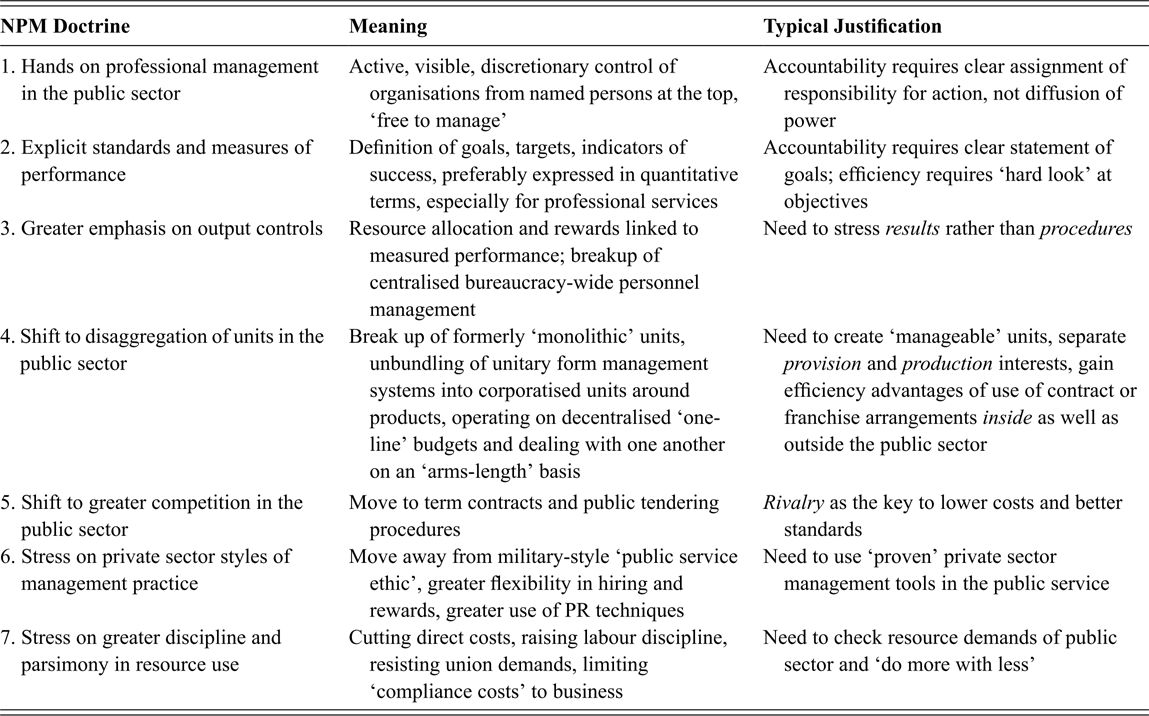
Market reforms included the privatisation of nationalised industries like public utilities, the outsourcing of public services to third parties, and the creation of ‘quasi-markets’ for those services still directly delivered by government. For example, the introduction of the internal market to the National Health Service in 1991 separated purchasers (i.e., health authorities and general practice fundholders) from providers (i.e., hospitals and community health service providers) and charged the former with ‘seeking the most cost-effective forms of care for their local population’ by ‘contracting with hospitals and community health Trusts to provide necessary care’ (Reference Rosen and MaysRosen and Mays, 1998, p. 105) – indicative of doctrines four and five (Reference Ferlie, Ashburner, Fitzgerald and PettigrewFerlie et al., 1996; Reference FerlieFerlie, 2017).
Management reforms focused on disaggregating and downsizing bureaucracies (e.g., Next Steps Initiative), exporting operations into executive agencies that were then performance managed from above by political principals (Reference FerlieFerlie, 2017, p. 2). This marked a purposeful step-change from the security of rule- and duty-bound post-war government and moved the power of trade unions and public servants into the hands of professional managers akin to doctrines one and seven (Reference FerlieFerlie, 2017). Through corporate governance reform, leaner executive boards would enable management by setting performance objectives rather than having them serve representative functions as expressed in doctrines one, two, three, six and seven.
Measurement reforms underscored the role of metrics in enabling management and external accountability; it was the fuel of NPM reforms as in doctrine two. Self-regulation and an emphasis on professional duties were forsaken as accountability mechanisms in favour of new regulatory (e.g., Office for Standards in Education, Children’s Services and Skills (OFSTED)) and audit organisations (e.g., Audit Commission for Local Government (now defunct)). Performance management systems were built to identify poor performers using newly and systematically collected organisational data.
While NPM remains a global phenomenon, countries vary in their approach to reform. New Zealand split purchasers and providers of services into separate specialised organisations with widespread contracting out (Reference Halligan, Christensen and LægreidHalligan, 2011). Sweden downsized their public service on the back of the 1990 fiscal crisis, decentralising service delivery responsibility to local governments who, in turn, looked to ‘responsive’ nonprofits and private firms to deliver services (Reference Hansen, Christensen and LægreidHansen, 2011).
While the UK has perhaps experimented most extensively with NPM reforms, the US is viewed as an ‘idiosyncratic hybrid’ combining ‘pre-, non- or even anti-NPM strands’ characterised by a continuation of efficiency reforms as well as anti-bureaucratic and anti-waste narratives (Reference FerlieFerlie, 2017, p. 8; Reference Pollitt and BouckaertPollitt and Bouckaert, 2017). Instead of trying to move service delivery closer to market models as in the UK with the internal market of the NHS, US practitioners and academics emphasised the role of intraorganisational management in making public programmes more efficient. This stemmed from a fundamental belief that internal administrative processes like strategic planning, process mapping, management-by-objectives, total quality management, and performance management and budgeting were more important tools than market forces for driving improvement (Reference BerryBerry, 1994; Christensen and Laegreid, 2002; Reference Gueorguieva, Accius, Apaza, Bennet, Brownley and CroninGueorguieva et al., 2009; Reference Moynihan, Fernandez, Kim, LeRoux, Piotrowski and WrightMoynihan et al., 2011; Reference Moynihan and KrollMoynihan & Kroll, 2016; Reference SwissSwiss, 1992).
US hybridity is observed in the federal government public management reforms of the 1990s. Led by then Vice President Al Gore, the National Performance Review (NPR) emphasised savings and downsizing – core NPM virtues – while also calling for empowerment and innovation. The NPR was in part inspired by Osborne and Gaebler’s 1992 book Reinventing Government: How the Entrepreneurial Spirit is Transforming the Public Sector from Schoolhouse to Statehouse, City Hall to the Pentagon. Comprised of ten principles, the book largely suggests that government can be transformed the same way that corporations were transformed: by becoming more client-focused, less bureaucratic, more flexible and innovative, and more entrepreneurial (Reference WeissWeiss, 1995). Despite breaking the principal-agent relationship of the legislative branch with the executive, the argument was not to reduce either’s role in contemporary society but rather to fix the systems within which government workers operate, resulting in a ‘smaller but stronger’ organisation: governments should eschew operational delivery in favour of oversight, establishing ‘steering organisations’ that focus on system-wide leadership and policy development with enhanced monitoring and evaluation.
Despite variation in adoption globally, NPM inspired reforms changed the model of state instrumentation and intervention – supplanting direct government for indirect governance. Marketisation through privatisation resulted in a larger move away from direct policy tools including direct spending, payments to individuals, and direct loans towards indirect policy tools such as regulation, vouchers, grants and contracts (Reference SalamonSalamon, 2000). Savas, privatisation’s greatest apostle, described it as ‘changing from an arrangement with high government involvement to one with less’ (1987, p. 88). In practice, privatisation is an umbrella term for the many different policy tools governments use to delegate authority, incentivise organisational effort towards policy goals, and communicate the nature of relationships with third parties. Governments decentralised and deregulated, encouraging private delivery in traditionally public sectors – including natural monopolies like water and transit. Inter-municipal cooperation and cross-sectorial partnering were also popular options as alternative or softer forms of privatisation (Reference Alonso, Clifton and Díaz-FuentesAlonso, Clifton and Díaz-Fuentes, 2015; Reference Koliba, Meek, Zia and MillsKoliba et al., 2019). Governments transferred ownership via the sale of state-owned assets and enterprises. They contracted out public services to reduce state-monopoly delivery and encourage competition.
The strongest proponents of NPM were neoliberal politicians supportive of enhanced public sector efficiency and user-orientation as well as public managers either loyal to these politicians, keen to advance their bureaucratic control, or both. Its critics, meanwhile, have been individuals who oppose the blending of marketisation and managerialism on normative grounds, employees who have experienced the negative impacts of NPM, and researchers who have explored the effects of NPM and found them lacking (Reference Torfing, Andersen, Greve and KlausenTorfing et al., 2020).
In truth, the effects of NPM have been largely context-dependent and difficult to generalise (Reference Torfing, Andersen, Greve and KlausenTorfing et al., 2020). Nevertheless, as they have aged, NPM reforms are largely believed to have failed to make good on their glittering promises and instead have ‘tended to distract middle- and upper- level officials, create massive paperwork, and produce major unintended effects’ by mindlessly pushing the adoption of ‘poorly grounded recipes for institutional design … a commonly observed feature of administrative reform processes’ (Reference Hood and PetersHood and Peters, 2004, p. 278). Hood and Dixon’s assessment of 30 years of NPM reform in the UK showed ‘a darker picture of government costing substantially more and working decidedly worse’ with increased running costs alongside soaring complaints and legal challenges (Reference Hood and DixonHood and Dixon, 2015, Reference Hood and Dixon2016).
2.2 Collaboration
While NPM may have failed to deliver a government that ‘worked better and cost less’, it did spur significant growth in third-party providers of public goods and services (Reference Hood and DixonHood and Dixon, 2015). As the number of provider organisations grew, so too did fragmentation and competition in local systems (Reference Christens and InzeoChristens and Inzeo, 2015). This resulted in a distinct preference for partnership and collaboration from multiple sources, including ‘professionals, foundations, researchers, government agencies, and groups of organizations and volunteers … each perceive[ing] the clear need for greater communication, collaboration, and co-ordination of organizational efforts to achieve desired outcomes in local communities’ (FitzGerald, Rosenbach et al., 2021 quoting Christens and Inzeo, 2015, p. 423).
In addition to reducing the formal size of government and changing the production of public services, privatisation changed the type of work being executed within public agencies (Reference Ferlie, Ashburner, Fitzgerald and PettigrewFerlie et al., 1996). By early 2000s, the environment and practice of public management had fundamentally shifted and public managers increasingly found themselves ‘facilitating and operating in multiorganizational arrangements to solve problems that cannot be solved, or solved easily, by single organisations’ (Reference O’Leary and VijO’Leary and Vij, 2012, p. 509). Governments increasingly partnered with public, private, and nonprofit organisations to implement policies, advancing the practice of collaborative public management.
In 2012, O’Leary and Vij outlined five reasons for the growth in collaborative public management practice and scholarship. First, perennial public challenges required new approaches and were larger than one organisation. Second, outsourcing – itself a ‘collaborative endeavor’ – had increased in ‘volume and dollar amount’. Third, in pursuit of enhanced effectiveness, public officials were seeking new ways of delivering public services. Fourth, technology had enabled ‘integrative and interoperable’ information sharing, ‘with the outcome being a greater emphasis in collaborative governance’. Fifth, citizens were seeking further engagement in governance, resulting ‘in new and different forms of collaborative problem solving and decision-making’ (Reference O’Leary and VijO’Leary and Vij, 2012, p. 509).
This collaborative turn – or ‘move to partner’ – aligns with the emergence of New Public Governance as a public governance paradigm (NPG) (Reference Koliba, Meek, Zia and MillsKoliba et al., 2019; Reference Torfing, Andersen, Greve and KlausenTorfing et al., 2020). Unlike NPM, ‘a child of neo-classical economics’, NPG’s intellectual roots can be found in theories from organisational sociology, institutional theory, network theory, and beyond (Reference OsborneOsborne, 2010, p. 8). NPG assumes a plural and pluralist state characterised by inter-dependent policy-making and policy-implementing networks. Inspired by Elinor Ostrom’s work on the collaborative management of common pool resources and a broader academic search for alternatives to markets and hierarchies, NPG scholarship emphasises ‘the formal and informal processes through which a plethora of public and private actors formulate and achieve joint objectives through collective action’ (Reference Ansell and TorfingAnsell and Torfing, 2016; Reference Torfing, Andersen, Greve and KlausenTorfing et al., 2020, p. 132).
As a public governance paradigm, NPG is somewhat inchoate, concerning itself with the growth and structure of inter-organisational collaborations, the environment and constraints on collaboration, the situation and function of public managers in a network, the governance and decision-making mechanisms collaborations adopt and use, definitions of work, processes and goals, and the impact of collaborations on public policy and the policy process (Reference O’Leary and VijO’Leary and Vij, 2012). Hence, NPG-inspired reforms typically ‘stress service effectiveness and outcomes’ and emphasise ‘the design and evaluation of enduring inter-organizational relationships, where trust, relational capital and relational contracts act as the core governance mechanisms’ rather than intra-organisational progress in competitive environments (Reference OsborneOsborne, 2006, pp. 382, 384).
Through the establishment of co-equal ties, coalitions and networks are understood as ‘the primary vehicle for pluri-centric coordination and interactive governance’ (Reference Torfing, Andersen, Greve and KlausenTorfing et al., 2020, p. 127). This means that at any given time, public managers ‘may be simultaneously involved in managing across governmental boundaries, across organisational and sectoral boundaries, and through formal contractual obligations’ (Reference McGuireMcGuire, 2006, p. 35). Conceptually, however, what constitutes collaboration is highly variable including long-term arrangements ‘encouraged or prescribed by law’; formal ties within specific policy areas as with strategic suppliers; short-term informal partnerships; and even intermittent coordinative exchanges – any of which may use public contracts (Reference McGuireMcGuire, 2006, p. 35). Mandell and Steelman helpfully categorise collaboration along a spectrum where coalitions and networks are situated at either extreme. For them, coalitions are comparatively narrow in scope, participant organisations largely act in isolation, and the arrangement is likely to disband after participant organisations’ tasks are finished or the problem has been resolved. Networks, meanwhile, demonstrate ‘a strong commitment to multiorganizational-level goals’ with interdependent ways of working, risky and extensive resource sharing, and operate indefinitely as the problems they seek to address are long-term or evolve (Reference Mandell and SteelmanMandell and Steelman, 2003; Reference McGuireMcGuire, 2006).
Networks have been identified and studied from a variety of perspectives (Reference Molin and MasellaMolin and Masella, 2016). Networks can be thought of as both structural phenomena and vehicles for exchanging information, developing organisational capacity, and developing administrative capacity to enhance joint-working. Networks are thought to organise collective action by formally adopting ‘network-level courses of action and often delivering services’ (Reference AgranoffAgranoff, 2003). Literature in the network governance tradition treats networks as a mechanism of coordination distinct from hierarchy or markets whereby networks are able to produce outcomes that could not be produced by any member organisation in isolation (Reference Provan and KenisProvan and Kenis, 2008). Focus is thus placed on how network conditions lead to the production of network-level outcomes, including building evidence on which network structures and processes should be adopted based on measures of network effectiveness (Reference Provan and KenisProvan and Kenis, 2008). Consequently, network governance literature focuses on steering or orchestration activities often executed by public authorities charged with governing networks (Reference Sørensen and TorfingSørensen and Torfing, 2009).
NPM-era outsourcing fundamentally cast governments as principals and providers as agents in perpetual competition. With NPG, the role of public authorities is more so that of a steward involved in critical ‘meta-governing processes’ of monitoring and guiding the activities of public service contractors (Reference Baker and StokerBaker and Stoker, 2012, Reference Baker and Stoker2013). Crucially, while contractors have legal obligations – through bilateral agreements with government or as a subcontractor to government – overarching public service networks typically lack their own legal imperative. Because of this, some form of governance is necessary to ensure participants engage in collective action, that conflict is addressed, and that resources are acquired and used effectively (Reference Provan and KenisProvan and Kenis, 2008). Thus, the governance of public service networks has come to include strategic and operational decision-making whereby government is most commonly responsible for defining inter-organisational goals, outlining operational rules, determining membership of the network, and in some instances, retaining responsibility for network administration (Reference Ansell and GashAnsell and Gash, 2008; Reference Koliba, Mills and ZiaKoliba et al., 2011).
Scholars have expressed optimism and hesitance about organising the state through contracts and networks: utilising networks can be a less predictable and weaker form of social action and can complicate coordination and accountability, but at the same time networks provide greater flexibility and adaptability (Reference Milward and ProvanMilward and Provan, 2000, p. 362; Reference FitzGerald, Rosenbach and HameedFitzGerald, Rosenbach, et al., 2021). Contrasted to privatisation – which devolves public responsibility to private actors – network-based partnership promotes shared responsibility and risk, blurring sectoral differences (Reference RosenauRosenau, 2000; Reference Koliba, Meek, Zia and MillsKoliba et al., 2019). With no clear principal or agent, the accountability relationships in networks are thus recognised as being different from those found in the dyadic linkages of public contracts: networks are responsible for more than simply the sum of member organisations’ contract specifications (Reference Agranoff and McGuireAgranoff and McGuire, 2001). In hollow states organised through consociational arrangements structured formally by contracts and informally through relationships across levels of government and amongst stable networks of service providers, public managers are forced to shift their concerns away from organisationally determined accountability to notions of responsibility, responsiveness, and the fostering of democratic ideals: effectiveness, as ‘accountability for’ becomes at least as important as oversight and reporting or ‘accountability to’ (Reference Agranoff and McGuireAgranoff and McGuire, 2001).
TPA, NPM, and NPG represent ‘relatively coherent and comprehensive norms and ideas about how to govern, organize and lead the public administration’ (Reference Torfing, Andersen, Greve and KlausenTorfing et al., 2020). They attempt to capture government experimentation with ‘policies, strategies, programmes and institutional templates that govern the particular manner in which the public sector is structured, functioning and operating’ (Reference Torfing, Andersen, Greve and KlausenTorfing et al., 2020). Explanations for shifts between paradigms depend on historical interpretation. A political lens suggests that paradigmatic shift is the consequence of decisions taken by political elites. An institutional lens finds that governance changes reflect widely held beliefs about what ‘an appropriate way forward’ looks like at a given time in a given context (Reference Torfing, Andersen, Greve and KlausenTorfing et al., 2020).
A functional lens suggests that paradigms ‘provide a plausible answer to specific problems and challenges that are accumulated in relation to the dominant governance paradigm’ (Reference Torfing, Andersen, Greve and KlausenTorfing et al., 2020, p. 152). In this way, NPM can be understood as a response to the inability of bureaucracies – both perceived and real – to respond to policy problems, including attending to economic growth. NPM can be cast as both a governance revolution promoted by neoliberals and neoconservatives trying to challenge ‘central welfare state values’ as well as a strategic response to fiscal stress and an attempt to preserve critical aspects of the post-war welfare state. Similar narratives could be used to explain NPG, but functionally it promotes horizontal coordination through networks and partnerships as a remedy for the dysfunctions of markets and fragmentation wrought by NPM. It likewise combats the assumption of homo economicus promoted by NPM by re-norming value articulation as a governance mechanism and intrinsic incentive (Reference Koliba, Meek, Zia and MillsKoliba et al., 2019; Reference Torfing, Andersen, Greve and KlausenTorfing et al., 2020, p. 155).
2.3 Contracts
A sequential take on governance paradigms is a helpful organisational device, but in practice paradigmatic delineations are less clear. Governance paradigms coexist and compete, producing context-specific hybrids where authority, incentives, and values become difficult to situate within institutions and within the multilevel, multiplex networks which characterise policymaking and policy implementation today – an emerging paradigm Koliba and colleagues refer to as Governance Network Administration (GNA) (Reference Koliba, Meek, Zia and MillsKoliba et al., 2019). Amidst this complexity, and as the preferred tool of indirect government, contracts play a hugely important role as they define what success looks like, set incentives for organisations to achieve it, and describe how parties should work together.
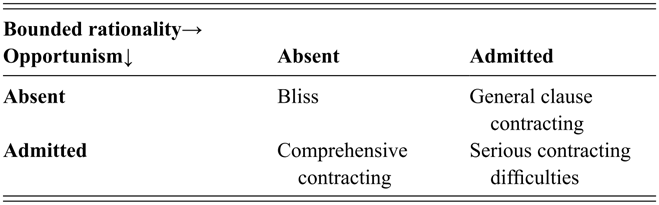
Despite their pre-eminence across post-bureaucratic public governance paradigms, getting contracts to ‘work’ remains challenging for governments. Technocratic fixes to the challenges of public contracting often focus on trying to ‘complete’ contracts. Because no person can design a contract which provides recourse for every eventuality faced by the parties privy to it, all contracts can be viewed as inherently incomplete (Reference CoaseCoase, 1937; Reference HartHart, 1988; Reference Van SlykeVan Slyke, 2007). Often, negative eventualities are caused by missteps in negotiating the relationship between purchasers (or principles) and suppliers (or agents). Transaction cost economics posits that the relationship between a purchaser and supplier is an ‘exercise in reducing the transaction costs of negotiating and managing the relationship, while acknowledging the human characteristics of opportunism and bounded rationality’ (FitzGerald et al., 2019, p. 459 referencing Williamson, 1985). Because purchasers have incomplete knowledge about suppliers, context, and the future, they cannot specify a contract which protects them from the likelihood that suppliers will behave opportunistically to boost their own profitability. For public service providers this could mean reducing costs by sacrificing quality or appropriating value by prioritising less costly populations for support (Reference LazzariniLazzarini, 2020; Reference FitzGerald, Tan, Carter and AiroldiFitzGerald, Tan et al., 2023).
Where purchasers are unaware of their own incomplete information and are not concerned with suppliers’ self-interest, they may opt to arrange a ‘general clause’ contract specifying only that both parties act in good faith. Conversely, where purchasers recognise information asymmetries that may lead to suppliers taking advantage, they can endeavour to move towards comprehensive contracting. The types of contracts expected given opportunism and bounded rationality are shown in Table 2. Notably, Williamson claimed that only the lower-right quadrant ‘accords with reality’ (Reference WilliamsonWilliamson, 1985, p. 67). Because complete contracts are an impossibility, principals are in actual fact tasked with designing a ‘requisite’ contract, one that combats opportunism without over inflating costs (Reference WilliamsonWilliamson, 1985; Reference Brown, Potoski and Van SlykeBrown, Potoski and Van Slyke, 2018; Reference FitzGerald, Carter, Dixon and AiroldiFitzGerald et al., 2019).
The argument is that the involvement of profit-seeking private actors can be beneficial in areas where quality is more straightforwardly monitored, that is, where contracts are more easily completed. Crucially, monitoring the quality of private goods and services is very different than monitoring that of public ones. For the former, the important elements of quality have market proxies, namely price. For public goods and services, important attributes of quality are harder to contract and verify – improvements to quality of life, reductions in homelessness, optimal job placement or improved job retention. Indeed, a perennial problem in public contracting is incentivising service providers to support the full range of programmatic objectives sought by governments rather than simply progressing those which maximise profit (Reference LazzariniLazzarini, 2020).
Efforts to complete contracts can take a variety of different forms many of which emphasise the rather technical specification of incentives through payment of enforceable commitments. Under NPM-inspired approaches, ‘competition supplemented with performance measurement linked to conditional incentives’ was intended to combat opportunism and provide public accountability (Reference Torfing, Andersen, Greve and KlausenTorfing et al., 2020, p. 56). Consequently, contract forms associated with NPM often stipulate prices or methods of calculating payment for the delivery of services: fixed price, cost-reimbursement, cost-plus, time and materials, fee-for-service, unit price. These kinds of contracts leave governments to pay in arrears and are designed principally to control costs, provide oversight of activities, and enhance efficiency. Awarded through procurement processes designed to promote competition at the point of award to secure the lowest price from providers, contracts which focus on the authentication of costs and completion of activities can enable governments to drive down cost, but this can compromise quality (Reference Shiva, FitzGerald, Carter and AiroldiShiva et al., 2024). This ‘tyranny of lowest price’ fundamentally increases the risk of contract failure as suppliers are incentivised to underbid with governments paying regardless of whether contracted services achieve programme objectives and overarching policy goals.
Concern about the growth of government contracting often focused on the degree to which government authority was too ‘dispersed’ and ‘diluted’ to effectively deliver accountability to the public. While early rhetoric regarding contracting out was alarmist (Reference SalamonSalamon, 1989), later research on indirect government sought to refine key concepts and test the effects of ‘changing governance configurations’ on efficiency and effectiveness as well as equity of access, client responsiveness, democratic accountability (Reference Heinrich and MarschkeHeinrich, Lynn and Milward, 2010, p. i4).
The underperformance of early outsourcing encouraged broader experimentation with performance contracting as a way to fix poor quality issues and better align diverse public and private interests, better reflecting ‘the complicated nature and “technology” of public programs’ (Reference BarnowBarnow, 2000; Reference Heckman, Heinrich, Courty, Marschke and SmithHeckman et al., 2011; Reference Heinrich and KabourekHeinrich and Kabourek, 2019, p. 869). ‘Where the 1980s had assumed contractors were greedy criminals, the 1990s recognised that most contractors are industrious resources willing to fulfil the government’s need with ingenious solutions for a fair price’ (Reference NagleNagel, 1999, p. 508). Longer-term contracts that transferred the design and operation of public services to the private sector emerged, creating public–private partnerships across levels of government, in a range of shapes and sizes, and in a variety of policy areas, including innovation partnerships, urban development, infrastructure projects, public services, and policy partnerships (Reference Torfing, Andersen, Greve and KlausenTorfing et al., 2020, p. 127). Governments likewise began designing contracts which paid on the basis of delivering outputs (e.g., a certain number of attendees at a job readiness course) rather than activities (e.g., holding three job readiness courses) as way of bolstering service effectiveness and offsetting risk (see Table 3). These early-term output incentives, however, were found to only loosely and sometimes negatively correlate with longer-term policy goals (Reference BarnowBarnow, 2000; Reference Schochet, Burghardt and McConnellSchochet, Burghardt and McConnell, 2006; Reference Heinrich and MarschkeHeinrich and Marschke, 2010), meaning that while the amount paid by public managers would vary by level of success, a valid link between success as defined by the contract and success in terms of achieving policy goals and objectives was tentative at best.
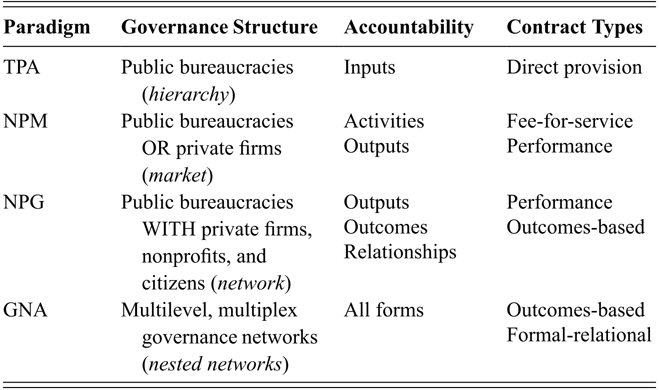
More recent experimentation extends the logic of performance contracting, shifting the focus from outputs to outcomes in an attempt to enhance accountability, reduce opportunism, and further improve service quality through personalisation and innovation (Reference Bovaird and DaviesBovaird and Davies, 2011; Reference FitzGerald, Fraser and KimmittFitzGerald, Fraser and Kimmitt, 2020; Reference FitzGerald, Tan, Carter and AiroldiFitzGerald et al., 2023a; Reference Olson, Painter, Albertson, Fox and O’LearyOlson et al., 2024). Outcomes are increasingly used to promote collaboration and flexibility in service provision and frequently feature in how public bodies are assessed, as definitions of success, as mechanisms for collaboratively designing and prioritising interventions, in deciding who and how to contract with partners, and to incentivise interdependent activity during delivery (Reference Bovaird and DaviesBovaird and Davies, 2011). There exists an array of outcomes-oriented reforms in public contracting, each distinguished by ‘a financial logic’ meant to ‘shape decisions about how to invest public, philanthropic and financial capital in social programmes in deference to expectations about the kinds of returns that can be expected’ (Reference FitzGerald, Tan, Carter and AiroldiFitzGerald et al., 2023a, p. 331).
Outcomes-orientation has four major categories relevant to public contracting. First, outcomes-oriented funding evaluates service provider performance using outcomes but does not explicitly tie the achievement of outcomes to payment as in results-driven contracting (e.g., European Social Fund). Second, outcomes-based funding as in OBC evaluates service provider performance using outcomes and does explicitly tie the achievement of outcomes to payment as in payment-by-results (e.g., UK Work Programme, UK Troubled Families, USAID Financing Ghanaian Agriculture Project). Third, investor-backed OBC where payment is contingent upon outcomes achievement and investors cover the up-front costs of service delivery as in social outcomes contracts (SOCs) – also known as social impact bonds (SIBs), development impact bonds, social benefit bonds, or pay-for-success (PfS) initiatives (Reference FitzGerald, Tan, Carter and AiroldiFitzGerald et al., 2023a). Fourth, where outcomes are additional to the primary policy objective of a contract. Called ‘collateral policies’ (Reference Cibinic and NashCibinic & Nash, 1998), ‘buying social justice’ (Reference McCruddenMcCrudden, 2007), ‘horizontal policies’ (Reference ArrowsmithArrowsmith, 2010), ‘buying social’ (EC, 2011), and ‘social value’ (UK Cabinet Office, 2021), these outcomes feature as additional elements which are built into public contracts to pursue wider economic, social, or environmental policy goals (as in sustainable or green public procurement). These additional outcomes can feature in any public contract, including health and social care, and articulate, for example, explicit preference to contract with small or local businesses, for suppliers to report and minimise carbon emissions, requirements of non-discrimination in employment, or preference for bids which advance job creation.
Crucially, the use of outcomes aligns with a general shift from technocratic to relational mechanisms for completing contracts whereby outcomes are both extrinsic incentives and frameworks to enable collective action amongst service providers. Even as governments have moved to collaborate, their reliance on contracts has not abetted for important reasons explored in Section 3. New ways of contracting have been explored which deemphasise transactional dynamics between purchasers and suppliers in favour of relational mechanisms. While shades of relationalism feature in long-standing contract theories in the form of probity and trust, attempts to design governance mechanisms which advance or accelerate such elements are fairly recent. Applied work on public contracting has thus transitioned from suggesting technocratic remedies for one-off contracts between government and a single provider to describing how contracts might inform ongoing partnerships between governments and provider consortiums by outlining dynamic governance mechanisms that foreground the enabling role of trust between parties. Echoing lessons from collaborative governance and governance network literature, some scholars have noted and called for more ‘braiding’ of formal and information contract mechanisms (Reference Gilson, Sabel and ScottGilson, Sabel and Scott, 2010), framed by others as ‘formal relational contracting’ (Reference Frydlinger, Hart and VitasekFrydlinger, Hart and Vitasek, 2019). While the focus of relational contracting was initially on private contracting, there are more recent expressions of hope that relational contracting approaches will improve public contracting for social outcomes (Reference Carter and BallCarter and Ball, 2021; Reference GibsonGibson, 2023).
3 Public Procurement
We have so far emphasised the political, economic, and managerial dimensions of public contracting. Our conversation on contract specification has thus been informed by theories of incomplete contracts, transaction cost economics, and relationalism, driven by attempts to understand how governments might design contracts and collaborations to boost performance as increasingly measured by the social outcomes they deliver.
In this section, we turn to the legal basis of public contracting by exploring the duties of public procurement professionals and the rules they operate within. Managerialism and legalism are considered distinct and often conflicting intellectual approaches to public management (Reference Christensen, Goerdel and Nicholson-CrottyChristensen, Goerdel and Nicholson-Crotty, 2011; Reference Rosenbloom, Kravchuk and ClerkinRosenbloom, Kravchuk and Clerkin, 2022). Managerialism foregrounds the importance of balancing conflicting values of efficiency and performance. Legalism, meanwhile, emphasises a balance between discretion, innovation, and accountability through legal priorities and processes (Reference Christensen, Goerdel and Nicholson-CrottyChristensen, Goerdel and Nicholson-Crotty, 2011). Scholars have argued that the tension between law and management ‘has grown significantly more visible,’ with the ‘market-based reforms of new public management’ favouring efficiency and performance ‘to an even greater degree relative to legal and democratic mores such as accountability, equality, transparency, representativeness, and value plurality’ (Reference Christensen, Goerdel and Nicholson-CrottyChristensen, Goerdel and Nicholson-Crotty, 2011, p. i125).
Within the academic debate, public law has been characterised as both an essential champion of democratic values and an ‘unwarranted constraint on the effective implementation of public programs’ (Reference Christensen, Goerdel and Nicholson-CrottyChristensen et al., 2011). As it relates to public contracting, scholars have long argued that private provision raises the possibility that democratic values are ignored (Reference Domberger and JensenDomberger and Jensen, 1997; Reference Brown, Potoski and Van SlykeBrown, Potoski and Van Slyke, 2006), with early studies showing that programme recipients in contracted out welfare services ‘enjoy fewer due process protections’ with worsening accountability (Reference BezdekBezdek, 2000; Reference DillerDiller, 2001; Reference Christensen, Goerdel and Nicholson-CrottyChristensen, Goerdel and Nicholson-Crotty, 2011). Still, there are those who suggest that an overly legalistic view inherently undervalues privatisation because it seeks to constrain ‘the private role in public governance’ rather than working to ‘facilitate and direct it’ (Reference FreemanFreeman, 2000; Reference Christensen, Goerdel and Nicholson-CrottyChristensen, Goerdel and Nicholson-Crotty, 2011).
We suggest, as others have, that contemporary public management combines managerialism and legalism with a focus on efficiency and performance as well as the values expressed in public law – ‘increasing representation, facilitating citizen participation, and building collaborative relationships that ensure value plurality in the administrative process’ (Reference Christensen, Goerdel and Nicholson-CrottyChristensen, Goerdel and Nicholson-Crotty, 2011, p i132). We likewise advance the notion that public procurement professionals are expected to deploy a combination of legal and managerial skills to ensure that public contracts are well-implemented, high-performing, and reflective of democratic values.
In this section, we first discuss public procurement professionals as specialised public managers charged with unique duties and skills that are beyond those required in other sectors. For example, we expect public procurement professionals to translate and implement broad public policy aims through relatively narrow and short-term public contracts while being transparent and accountable to political oversight bodies, competing businesses, and civil society. The discussion of public procurement professionals as specialised public managers details the international movement to professionalise public procurement by increasing discretion and developing competencies that blend the public policy and business elements of their role. This section highlights the risk that limiting this professional role to the setting and approval of outcomes payments reduces the focus on wider issues of public integrity, public standards, and public policy aspects of public service delivery.
We then turn to the public law rules that constrict or dilate what can be done on any public contract. These can include international trade, anticorruption, and competition rules and regulations as well as further rules that implement policy priorities of the applicable legislative body. We describe three layers of rules within which public procurement professionals must operate: overarching procurement principles, the contracting organisation’s wider policies, and transaction-level rules. This section also highlights the challenges that OBC can introduce.
Finally, we address tensions in the shift towards the public procurement of outcomes within OBC whereby changes to contract forms can frustrate the standard use of contract templates and implied terms, especially when the role of the government is limited to approving a fixed payment for achievement of an outcome. Here, we use a logic model framework to differentiate the commitments found in standard procurements with those expressed in OBCs to underscore those elements of a contract that government staff is likely to find difficult or impossible to give up in pursuing outcomes – especially in a social programme supporting vulnerable or protected populations.
3.1 Specialised Public Managers
Public procurement professionals are specialised public managers charged with awarding and managing government contracts. As noted by the OECD, public procurement is ‘recognised as a strategic instrument for achieving government policy goals aligned with the 2030 Agenda for Sustainable Development, including promoting a circular and green economy, stimulating innovation, supporting small and medium-sized enterprises, and promoting ethical behaviour and responsible business conduct’ (OECD, 2023, p. 6). In the US, Europe, and elsewhere, these public managers have a wide range of discretion in the expenditure of huge sums of public money and the delivery of essential public services. This discretion includes contract design – selecting the right contract type or a blend of contracts, considering issues of pricing, risk, and incentives – and then working with contractors throughout contract performance.
In the US federal procurement system, a highly specialised public manager role is prescribed in regulations – along with subordinate functions to which some authority is delegated. The authority to ‘enter into, administer, or terminate’ a government contract is given only to the role of ‘Contracting Officers’ (FAR Subsection 1.602-1). The Federal Acquisition Regulation (FAR) also provides that ‘[c]ontracting officers are responsible for ensuring performance of all necessary actions for effective contracting, ensuring compliance with the terms of the contract, and safeguarding the interests of the United States in its contractual relationships. To perform these responsibilities, Contracting Officers should be allowed wide latitude to exercise business judgment’ (FAR Subsection 1.602-2 Responsibilities). The Contracting Officer has an important discretionary role when making any contract award. The FAR provides that contracts can only be awarded to ‘responsive prospective contractors’ and that, after the procurement procedure and before the award of a contract, the Contracting Officer must make ‘an affirmative determination of [contractor] responsibility’ (FAR Section 9.103). The Contracting Officer must thereby determine that the prospective contractor meets various standards, including ‘a satisfactory record of integrity and business ethics’ (FAR Subsection 9.104-1). For contract management and administration, the Contracting Officer delegates authority to a Contracting Officer’s Representative (COR), who must be trained and experienced, but the authority to make changes to the contract is not delegated to the COR (FAR 1.602-2).
The structure size of the procurement workforce in the US government has received regular attention from the US Congress, including through various commissions, legislation, and numerous reports from the US Government Accountability Office (GAO). Examples include the President’s Blue-Ribbon Commission on Defense Management (the Packard Commission) in the 1980s, the Defense Acquisition Workforce Improvement Act in the early 1990s, and related reforms established acquisition career paths for military and civilian personnel and a Defence Acquisition University. The strengthening of individual managers at the level of contracting entities and the contract was clearly framed as consistent with the then President Regan’s distrust of government and the quest to be more like the private sector. The Chairman, David Packard (co-founder of computer giant Hewlett-Packard or HP), noted in his foreword to the report:
Innovations in American industrial management, yielding products of ever higher quality and lower cost, have provided a key insight: human effort must be channeled to good purpose through sound centralized policies, but free expression of people’s energy, enthusiasm, and creativity must be encouraged in highly differentiated settings. … Excellence in defense management will not and can not emerge by legislation or directive. Excellence requires the opposite – responsibility and authority placed firmly in the hands of those at the working level, who have knowledge and enthusiasm for the tasks at hand.
The EU, meanwhile, does not prescribe roles in the Procurement Directive – this is a matter for member states. Nonetheless, the European Commission has taken steps to clarify and strengthen public procurement roles, including the publication in 2020 of a ‘European competency framework for public buyers (ProcurCompEU)’ pursuant to the 2017 adoption of ‘Recommendation on the professionalisation of public procurement as one of the priorities of EU public procurement strategy’ (European Commission, 2017, 2020). The ProcureComEU materials summarise practical challenges in public procurement, namely that it is ‘not a clearly defined organisational function with a corresponding training, recruitment and career path’ and is ‘frequently conducted as an additional task by civil servants that may lack specific procurement-related skills’. Furthermore, ‘business-related skills are often underrated in the public administration resulting in an overly legalistic, compliance-focused approach’ (European Commission, 2020, p. 12). In ProcureCompEU, public contracting activities and responsibilities are described and structured in thirty competencies divided into procurement-specific competencies and soft competencies. Many of these competencies might feature in any private sector organisation, but some highlight the public nature of the role. Perhaps the clearest example is ‘Competence 3, Legislation,’ which provides:
Public procurement professionals need to understand and be able to apply the relevant national and EU level legal frameworks and the principles of non-discrimination, equal treatment, transparency, proportionality and sound financial management. This includes adjacent areas of law and policy, e.g.: Competition, administrative, contract, environmental, social and labour laws, accessibility obligations and Intellectual Property Rights; EU funding, budgetary and accounting rules; Remedies; Anti-corruption and anti-fraud measures; Any relevant international obligations.
There has been a long trend in growing the discretion of public managers involved in public procurement. To address problems in US government procurement of computing technology in the 1980s, Steve Kelman called for greater public manager discretion, suggesting that its absence ‘extracted a terrible cost in the poorer performance of contractors selling computer systems to the government (and in other areas of procurement as well)’ (Reference KelmanKelman, 1990). At the turn of the millennium, Sue Arrowsmith noted a trend in the UK, US, and other states towards more discretion rather than detailed legally enforceable transparency requirements (Reference Arrowsmith and TrybusArrowsmith and Trybus, 2002). However, the ‘right’ amount of discretion and transparency around procurement remains unclear. For instance, recent quantitative studies based in Europe find that discretion is associated with the section of politically connected firms (Reference SzucsSzucs, 2023), especially by less transparent public authorities (Reference Baltrunaite, Giorgiantonio, Mocetti and Tommaso.Baltrunaite et al., 2021). Similarly, research has found that discretion is associated with more frequent awards to the same organisations, although this does not necessarily negatively affect procurement (Reference Coviello, Guglielmo and SpagnoloCoviello et al., 2017).
The ongoing international movement to professionalise public procurement is focused on more discretionary and strategic functions rather than administrative functions. Professionalisation includes setting certification and training standards to encourage the development of competencies that blend the public policy and business elements of the role. Reforms related to the training of public managers in the procurement workforce have continued through the present day and the priorities of different administrations have been reflected. This is illustrated by a recent (2023) White House memorandum on the ‘Federal Acquisition Certification in Contracting (FAC-C) Modernization’, which states:
Contracting professionals are the most important part of the Federal acquisition system. Their training and development are critical to the success of important public priorities, such as advancing equity, promoting sustainability, increasing domestic sourcing, and ensuring our supply chains and cyber assets are secure. … Today’s professionals are highly trained and skilled in exercising business judgment, being innovative, and gaining efficiencies, all while being effective stewards of taxpayer dollars.
The reference to equity in the memorandum above is consistent with an executive order issued by President Biden in 2021 on his first day in office, titled Advancing Racial Equity and Support for Underserved Communities Through the Federal Government (Office of Management and Budget, 2021, Executive Order 13985). This executive order specifically references public procurement and required agency heads to submit a plan for addressing ‘any barriers to full and equal participation in agency procurement and contracting opportunities’.
3.2 Procurement Rules
The specialised duties and skills expected of public procurement professionals are conveyed across three layers of rules, as expressed in Table 4: overarching procurement principles; ties to wider economic, social, and environmental policy goals; and rules directly related to the transaction or collaboration.
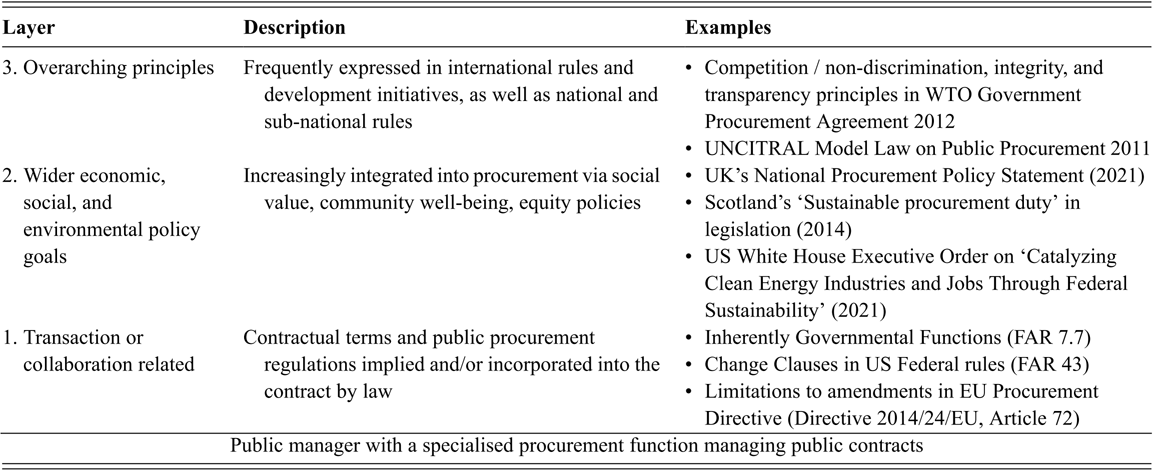
Furthest from the transaction, overarching procurement principles embody commitments to public values like transparency, integrity, and competition (Reference SchoonerSchooner, 2011, Reference Schooner2002). These principles are evident in international trade and international development, including anticorruption mechanisms and the strengthening of national and local public financial management systems. For example, twenty-one parties are subject to the World Trade Organisation’s Government Procurement Agreement (GPA), including the US, EU, and UK (with the EU’s twenty-seven countries counted as one party). The GPA includes commitments regarding non-discrimination and the conduct of procurement. Another example is found in the Model Law on Public Procurement adopted by the United Nations Commission on International Trade Law (UNCITRAL), which reflects international procurement best practices that balance efficiency and performance alongside legal and democratic values of accountability, transparency, fairness, and equality (Reference Yukins and NicholasYukins and Nicholas, 2023). The preamble describes objectives:
(a) Maximizing economy and efficiency in procurement; (b) Fostering and encouraging participation in procurement proceedings by suppliers and contractors regardless of nationality, thereby promoting international trade; (c) Promoting competition among suppliers and contractors for the supply of the subject matter of the procurement; (d) Providing for the fair, equal and equitable treatment of all suppliers and contractors; (e) Promoting the integrity of, and fairness and public confidence in, the procurement process; (f) Achieving transparency in the procedures relating to procurement.
Significantly, these overarching principles do not focus on getting the lowest price, suggesting that the role of the modern procurement professional is more about getting value and effectiveness from contractors than pushing them to lower prices. The EU’s Procurement Directive provides that awards will be based on the most economically advantageous tender, often referred to as ‘MEAT’, and this ‘shall be identified on the basis of the price or cost, using a cost-effectiveness approach … and may include the best price-quality ratio, which shall be assessed on the basis of criteria, including qualitative, environmental and/or social aspects, linked to the subject-matter of the public contract in question’ (EU Directive 2014/24, Article 67). In the US, FAR provides a commonly used process for negotiating contracts to achieve the best value and allows the Contracting Officer to ‘trade-off’ cost and non-cost factors, such as the quality of the approach or past performance.
The middle layer of rules relates to leveraging public spending through government contracts to help achieve wider economic, social, and environmental goals. Issues of effectiveness and equity in areas such as sustainability and local economic development are being considered at the point of contract award and during contract delivery (Reference Schooner and SpeidelSchooner and Speidel, 2020). Akin to the fourth form of outcomes-orientation outlined in Section 2, these rules often allow for the inclusion of outcomes that are additional to the primary policy objective of a contract. For instance, a government contractor engaged to build a school may also be required to report carbon emissions during construction, commit to hiring local apprentices to work on the project, or engage small businesses or social enterprises.
McCrudden labels attempts to tie policy goals and contracting policy as ‘procurement linkages’ exemplified in disabled workers’ rights after the Second World War as well as civil rights and anti-discrimination laws in the US, Europe, Canada, and Australia resulting in selective purchasing and boycotts for different categories of business (e.g., ‘set-asides’ in the US) (Reference McCruddenMcCrudden, 2007). In the UK, the practice of implementing wider economic, social, and/or environmental policies through public contracts is labelled ‘social value’ by the Public Services (Social Value) Act 2012 and is advanced by various Public Procurement Notices (PPNs). Social value is also promoted in the current UK National Procurement Policy Statement, a publication that now has a legal basis in the UK’s new Procurement Act (2023). The Statement provides: ‘All contracting authorities should consider the following national priority outcomes alongside any additional local priorities in their procurement activities: creating new businesses, new jobs and new skills; tackling climate change and reducing waste, and improving supplier diversity, innovation and resilience’ (UK Cabinet Office, 2021, p. 3).The various UK social value policy statements provide a similarly broad framework with a wide range of policies that may be included in any public procurement (Cabinet Office, 2021). In Scotland, the Procurement Reform (Scotland) Act 2014 creates a sustainability duty and requirements to include ‘community benefits’ in contracts over a certain threshold or provide an explanation of why these are not applicable.
Crucially, this category of outcomes orientation is growing – especially in green public procurement and the pursuit of carbon emission targets (i.e., Net Zero goals) through government contracts (Reference SchoonerSchooner, 2021; Reference Dimand and ChengDimand and Cheng, 2023; Reference Janssen and CarantaJanssen and Caranta, 2023). In the UK, PPN 06/21 requires contractors over a certain size to produce Carbon Reduction Plans setting out how the organisation intends to achieve ‘net zero’ carbon emissions by the year 2050. The US now has a ‘Buy Clean Initiative’ and recently proposed a new rule for the FAR that would require Federal contractors (over certain sizes) to disclose emissions, disclose climate-related financial risk, and set targets to reduce greenhouse gas emissions (US Gov, 2022). The EU also has developed various materials and tools to support green public procurement. Notably, the pursuit of Net Zero goals is not only a top-down policy issue. The 2015 Paris Agreement shifted carbon reduction from being a regulatory issue to a multilateral issue for many levels of subnational government and non-state actors (Reference HaleHale, 2016). This means that in addition to national-level targets, many contracting authorities have their own Net Zero targets and many try to implement these targets through their own contract spending. As climate change challenges grow, this area is likely to continue growing at all levels of government. Notably, concerns have been raised about accountability and the extent to which social value policy choices within contracts meaningfully reflect the priorities of nationally and locally elected offices or legislative bodies (Reference Davies, Buys and MacdonaldDavies, Buys and Macdonald, 2023).
Finally, public procurement professionals are constrained and enfranchised by terms within contracts as well as rules which stipulate how to enter and amend contracts. In a private contract, parties can focus on each other and their commitments to each other. Generally, they are the only party who can enforce those commitments. In contrast, external actors have a greater role in public contracts as they may dispute the award or performance of the contract based on failure of the public contracting authority to follow public law rules. Likewise, depending on the jurisdiction, other public law bodies may be involved in enforcing or monitoring the implementation of public law rules. The public nature of the contract can also limit the flexibility the parties have to change the contract. Changes in governmental requirements are often privileged above those of private parties. This privilege constitutes another source of risk for contractors and can undermine the ability of both parties to remain committed to firm prices longer term, especially over periods of volatility. Unlike a contract between private parties, where the parties can easily arrive at a new agreement and amend their contract, public parties must also consider whether the change requires a new procurement altogether.
The FAR provides detailed standard clauses for US government contracts which impact contract management, including clauses to make changes relatively easy for the government. In the US federal procurement system, the FAR gives the Contracting Officer significant power to unilaterally change the public contract and the contractor will have to comply (FAR Part 43). If an agreement about adjusting the contractor’s price cannot be reached, the contractor will be paid for the change based on their costs. In terms of any contracts involving a fixed price for outcome, this may mean that a change to the outcome may change the contract from fixed price to costs (i.e., from paying for an outcome to paying for inputs and activities). However, while the government’s power to make unilateral changes is very wide, it is not unlimited – US courts have decided the government cannot make a ‘cardinal change’ that would be a ‘drastic modification’ beyond the scope of the contract, though this will differ under circumstances of a specific contract (e.g., see US Court of Federal Claim decision in Air–A–Plane Corp. v. United States, 187 Ct.Cl. 269, 408 F.2d 1030,(1969)).
The EU’s Directive does not try to provide standard clauses for the contracts – this is for member states’ own contracting rules – but does provide some limitations on the changes that can be made. This area of public contracting has been called ‘dark side of EU procurement law’ due to the lack of transparency and research in the performance of government contracts when compared to the award of government contracts (Reference Dragos, Halonen and TreumerDragos et al., 2023 p. 1). The 2014 Directive does not give the relevant public manager this unilateral power. The EU Directive does provide for modification of contracts during their term (Article 72), under various circumstances, including the provision for amendments in the original published documents or changes that do not modify the contract for 50 per cent of the value of the original contract (Article 72). The European Court of Justice has emphasised that these changes cannot make the contract ‘materially different’ from the contract described in procurement notices.
3.3 Contract Design
At the nexus of the three layers of public rules described, public procurement professionals exercise their discretion directly in the award, design, and management of public contracts (Reference DaviesDavies, 2008). A central design consideration is the type of government contract awarded categorised according to the way that the enforceable commitments are priced. In the US, the FAR provides definitions and detailed clauses for different types of contracts, including fixed price contracts (i.e., payment as a predetermined value for services provided), cost reimbursement contracts (i.e., payment as allowable incurred costs of service provider), and time and material contracts (i.e., payment based on time and materials spent by service providers to fulfil agreed scope of work) – any of which may have a performance incentive element (See FAR Part 16). In the EU, the 2014 Directive does not provide such detail but leaves this up to member states. For example, the UK’s model services agreement provides for different pricing mechanisms, including fixed price contracts, time and materials, volume pricing, and a cost-based pricing called Guaranteed Maximum Price with Target Cost.
In the US, the selection of contract type is at the discretion of the Contracting Officer as a matter of ‘negotiation and requires the exercise of sound judgement’ (FAR 16.103). The FAR provides considerations for selecting contract types that are helpful for understanding incentives and encourage a blended approach or evolving blend of contract type during the course of service delivery and performance. For instance, an acquisition programme or even a contract may go through ‘changing circumstances’ where a different type of contract becomes appropriate in later periods than was used at the outset of the project (FAR 16.103-4). According to regulations, fixed price contracts are more suitable for less complex and less ‘governmental’ contracts:
Complex requirements, particularly those unique to the Government, usually result in greater risk assumption by the Government. This is especially true for complex research and development contracts when performance uncertainties or the likelihood of changes makes it difficult to estimate performance costs in advance. As a requirement recurs or as quantity production begins, the cost risk should shift to the contractor, and a fixed-price contract should be considered.
In essence, the skill of public procurement professionals lies in their ability to specify and price enforceable commitments as well as articulate how their delivery will be verified. Fundamental to OBC is that the definitive enforceable commitment of the contractor will occur further into the delivery period than is traditionally the case. To illustrate this point, we use a generic logic model which represents the presumed path of converting resources into activities which generate priority outputs and outcomes. Historically, public contracts have worked to specify inputs and activities presumed to lead to outputs and outcomes. With OBC, the emphasis of those enforceable commitments shifts to the right – and a purely outcomes-based approach would effectively include a fixed price for outcomes – but in practice, a mix is often used (see Table 5 for further detail on enforceable commitments).
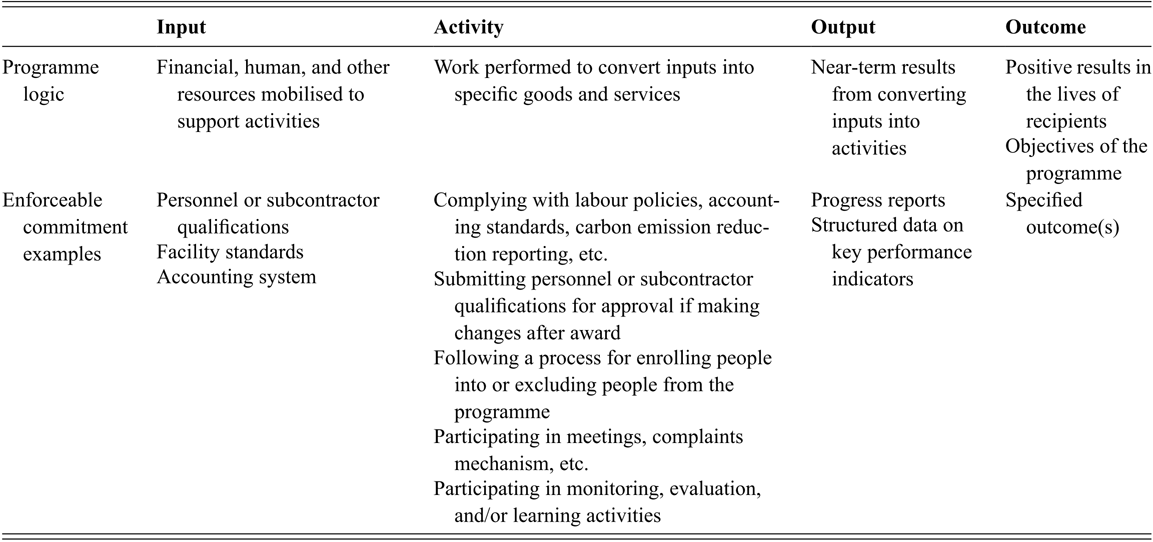
Inputs that the government may need to make enforceable in the contract include personnel and facilities involved in contract performance. For example, the government may consider that the qualifications or experience of key personnel is an important criterion for awarding the contract and wants to approve key personnel changes. Similarly, the government may require that personnel working with vulnerable people have security clearance or background checks and that facilities meet relevant industry standards, all of which may be subject to change. For some activities, the government may need to require contractor compliance with a wide range of rules regarding safe workplaces, fair employment rules, environmental practices, accounting standards, anticorruption measures, conflict of interest rules, subcontracting rules, and beyond. More directly related to the programme, the government may want participation in regular monitoring meetings, a role in deciding who is eligible or ineligible for (or otherwise excluded from) programme participation, and a role in resolving complaints or emergency situations. The government may also need the contractor to participate in an evaluation or other third-party procedures to validate the achievement of enforceable commitments, especially outcomes. Meanwhile, contractors may also want enforceable terms around the government’s role in promoting or referring people into the social programme so that the outcomes can be achieved. Outputs that the government may need during the programme’s activities include periodic information on progress towards outcomes, whether as regular updates or detailed data to monitor progress or to comply with public information rules. The government may also want to understand how outcomes are being achieved and to secure learning outputs, technical guides, or other programme documents.
Still, as we describe in Section 4, the promises of OBC are principally advanced by tinkering with only one aspect of the contractual form: the enforceable commitment. The tension between a simple contract document that focuses on outcomes and a more complex contract that incorporates other rules is highly salient in outcomes contracting, and beyond. Practitioner advocates of outcomes contracts have emphasised that an outcomes contract should focus on fixed prices for the outcomes and avoid over specification of inputs or activities (Government Outcomes Lab, 2019). However, public rules compel public procurement professionals to further specify inputs, activities, and outputs so that they might discharge their duties rooted in the advancement of democratic values. This means that the contracts which structure outcomes-based contracts (OBCs) also require clauses about how human resources are to be managed, corruption is to be avoided, environmental sustainability is to be advanced, safety is to be ensured, and vulnerable populations are to be protected.
4 Outcomes-Based Contracting
Heralded as a mechanism to drive solutions to some of the most complex and expensive social problems, OBC emphasises monetised social outcomes to guide public service implementation and oversight amongst novel, inter-sectoral partnerships that coordinate the funding, management, and service provision (Reference RobertsRoberts, 2013; Reference CarterCarter, 2021, p. 79; Reference FitzGerald, Tan, Carter and AiroldiFitzGerald et al., 2023a). As an approach which bundles multiple modern public service reforms – public–private partnerships, performance management, evidence-based policymaking, and outcomes-orientation (Reference Heinrich and KabourekHeinrich and Kabourek, 2019) – OBC has proliferated over the past decade to include a host of differently branded contract and collaboration approaches, including results-based finance, pay-for-performance, payment-by-results, PfS, SOCs, SIBs, social outcomes partnerships (SOPs), social benefit bonds, and beyond. Key areas of variation in OBC include the degree to which payment is tied to long-term outcomes and whether external private investment is leveraged to cover the upfront costs of service delivery as in SIBs – now more commonly called SOCs or SOPs (Reference CarterCarter, 2020; Reference FitzGerald, Tan, Carter and AiroldiFitzGerald et al., 2023).
By positioning outcomes as the key enforceable commitment in public contracts, OBCs promise to mitigate two perennial challenges in public service contracting. First, a focus on measuring and managing shared outcomes is meant to help bring entities together, advancing coordinated holistic support for individuals beyond what any one organisation could achieve in isolation. In services for vulnerable populations, the interdependencies and need for well-orchestrated collective action is heightened as these cohorts require an array of health and human services which are delivered by several organisations (Reference Johnston and RomzekJohnston and Romzek, 2008; Carter et al., 2024). Second, OBC attempts to address the problematic aspects of incompleteness in public contracts to moderate the ill effects of opportunistic providers and enhance public accountability (Reference LazzariniLazzarini, 2022). Viewed through transaction-cost economics, the use of longer-term outcome measures validated by robust evaluation methods can be viewed as an attempt to ‘complete’ the contract.
The nature of OBC conveys that outsourcing decisions do not simply end with contract award. Instead, public procurement professionals are tasked with determining how to design and manage service contracts over time and in partnership with multiple actors, suggesting that the procurement task at hand is to weight the costs and benefits of contracting in a particular way (Shiva et al., 2024). When designed well, OBC offers assurance to policymakers and public managers that the public services delivered today generate the positive outcomes of tomorrow. By specifying outcomes, OBC is geared at improving the links between policy design and policy implementation, representing what Peters calls a ‘deliberate endeavour to link policy tools with clearly articulated policy goals … based on the systematic effort to analyse the impacts of policy instruments on policy targets’ (Reference Peters, Capano and HowlettPeters et al., 2018, p. 4). By expanding monitoring functions and situating robust evaluation methods within the payment mechanisms of contracts, OBCs can de-risk government spending, incentivise collective action, and build evidence on ‘what works’ in complex health and human services (Reference Carter, FitzGerald and DixonCarter et al., 2018; Reference LazzariniLazzarini, 2022).
OBCs require public procurement professionals to contractualise the who, what, and when aspects of policy targets – the treatment cohort, the expected outcomes of the intervention, and the period over which outcomes can be achieved. OBCs also include elements of policy calibration by identifying implementing agencies and their roles, for example, as service providers, project managers, funders, and evaluators. In addition, OBC often stipulates monitoring and accountability rules designed to course correct underperformance during contract delivery (Reference FitzGerald, Rosenbach and HameedFitzGerald et al., 2021; Reference Ronicle, Stanworth and WooldridgeRonicle, Stanworth and Wooldridge, 2022; Reference Howlett, Ramesh and CapanoHowlett, Ramesh and Capano, 2023). By design, OBC makes explicit the micro-level policy components that calibrate macro-level public governance paradigms and meso-level policy tool preferences for implementation. OBC attempts to align general goals and governance approaches at the macro-level with meso-level programmatic objectives and tools and micro-level incentive schemes and management routines all while creating a strategically flexible operational environment (Reference Peters, Capano and HowlettPeters et al., 2018; Reference Howlett, Ramesh and CapanoHowlett, Ramesh and Capano, 2023, p. 5). In such a way, outcomes can be thought of as a mechanism for establishing a ‘golden thread’ between macro-level policy goals and micro-level policy specifications in a public service environment characterised by networks.
Public governance paradigms occur at the macro-level, and public contracting is an embedded meso-level policy tool within those paradigms. Meso-level work commonly features studies of the interplay between governance capacities enacted through policy tools and instruments such as subsidy, regulation, contracting (Reference HoodHood, 1986; Reference SalamonSalamon, 2000; Reference Hood and MargettsHood and Margetts, 2007). It is widely recognised that scholarship has addressed the macro- and meso-level components of public policies – paradigms, governance arrangements, objectives and tools – but significant shortcomings exist related to micro-level components, where policy goals, programmes, and instruments are implemented in the form of ‘policy targets and tool calibrations’, as expressed in Table 6 (Reference Cashore and HowlettCashore and Howlett, 2007; Reference Howlett, Ramesh and CapanoHowlett, Ramesh and Capano, 2022). Howlett, Ramesh, and Capano suggest that ‘a key challenge to real-world policy making is determining how to match policy goals with the means available to implement them’ (Reference Howlett, Ramesh and CapanoHowlett, Ramesh and Capano, 2023, p. 1).
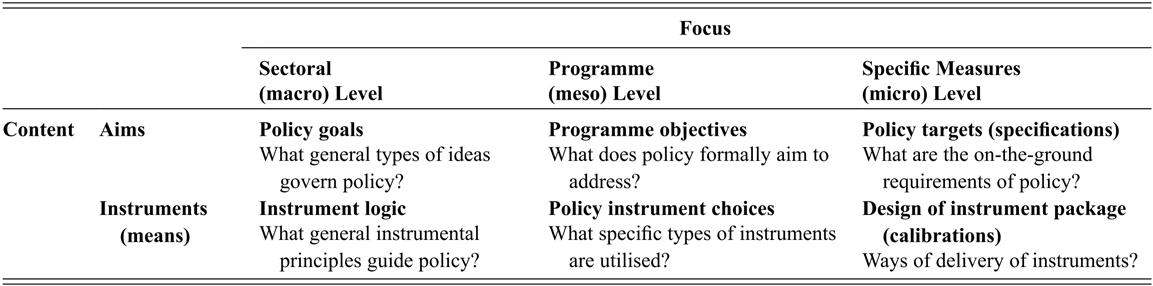
As the evidence on OBCs shows, these targets and calibrations are of critical importance: as macro-level policy goals expressed in governance paradigms become operationalised for implementation through public procurement, their internal mechanisms for change can decouple at the meso- and micro-level (Reference Torfing, Andersen, Greve and KlausenTorfing et al., 2020; Reference Howlett, Ramesh and CapanoHowlett, Ramesh and Capano, 2023). When this happens, the quality of implementation can suffer, the efficacy of interventions can be eroded, unintended effects can emerge, and failure can be more likely – as when OBCs maximise payment to suppliers but leave policy problems unaddressed (Reference FitzGerald, Tan, Carter and AiroldiFitzGerald, Tan et al., 2023; Reference Hevenstone, Fraser, Hobi, Przepiorka and GeukeHevenstone et al., 2023).
OBCs, particularly SOCs, merge NPM narratives of market discipline, privatisation, and managerialism with the collaborative and relational narratives associated with NPG (Reference Heinrich and KabourekHeinrich and Kabourek, 2019; Reference Fraser, Knoll and HevenstoneFraser, Knoll and Hevenstone, 2022; Reference French, Kimmitt, Wilson, Jamieson and LoweFrench et al., 2022; Reference FitzGerald, Tan, Carter and AiroldiFitzGerald et al., 2023). In blending marketisation thorugh contracting, managerialism in pursuing outcomes, measurement through validating attributable outcomes, and relationalism by enabling partnership working, proponents suggest that OBCs can simultaneously balance the managerial values of efficiency and performance with the legal requirement of accountability (Reference Christensen, Goerdel and Nicholson-CrottyChristensen, Goerdel and Nicholson-Crotty, 2011; Reference Mulgan, Reeder, Aylott and Bo’sherMulgan et al., 2011; Reference FitzGerald, Tan, Carter and AiroldiFitzGerald, Tan et al., 2023). By this logic, outcomes allow governments to provide strategic direction to service providers and promote innovation and flexibility at the frontline, at once aligning ‘financial incentives and social goals’ to improve cross-sector collaboration and ultimately outcomes for service users. Accountability is likewise ensured as governments notionally do not pay for services unless they generate valid outcomes.
In the US and UK, forms of OBCs – namely SOCs and PfS – have targeted multiply disadvantaged cohorts who experience several touch points with the state, including homeless individuals trying to secure housing alongside substance misuse treatment and enrolment into entitlement programmes (e.g., Santa Clara County Project Welcome Home); older people whose loneliness is causing health problems and placing unnecessary burden on primary and urgent care facilities (e.g., Worcester Reconnections); and families with children at risk of being taken into foster care in need of therapeutic support (e.g., Oklahoma Intensive Safety Services). In both national contexts, private and nonprofit providers are prevalent, delivering specialised services under an array of disjointed, bilateral public contracts overseen by different units within and across governments. Where people require multiple services paid for by multiple government departments, ‘synergies and connections across the ultimate objectives of provision are difficult to manage’ … resulting in support gaps for services users, duplication of effort, and individuals being ‘buffeted between several different agencies or service providers’ (Reference Carter, FitzGerald and DixonCarter et al., 2018, p. 10).
OBC frequently attempts to pull these parties together. While they can vary greatly in partner form, OBCs minimally involve a party that pays for outcomes and a party that delivers services. Depending on the complexity of the project, OBCs may also include a party that verifies the achievement of outcomes to trigger payment and a party that manages the day-to-day operations of the project – this can be either an intermediary or a prime contractor. In SOCs, there is also a party that provides up-front investment capital to cover the costs of service delivery. In UK SOCs, the outcomes payer is almost always government, the service provider is typically a nonprofit, the project manager is often aligned with investors, and the capital comes from socially motivated private investors. UK SOCs do not often include an independent evaluator to validate outcomes. Instead, that role is frequently left to government who pays based on administrative data or self-reported data from project partners, usually the project manager. In the US, project managers are more likely to be independent from investors, the evaluators are more likely to be present and tasked with running at least quasi-experimental evaluations to validate outcomes and trigger payment, and the capital comes from a blend of philanthropic and institutional investors alike (Reference Economy, Carter and AiroldiEconomy, Carter and Airoldi, 2022).
SOCs, in particular, have been the subject of very polarised debate, with an optimistic ‘narrative of promise’ promoting them as the solution to a lack of public sector innovation and entrepreneurship, and a ‘narrative of caution’ where through financialisation, they advance investor profit seeking over public and voluntary efforts. (Reference WarnerWarner, 2013; Reference LakeLake, 2015; Reference Fraser, Tan, Lagarde and MaysFraser et al., 2018; Reference Tse and WarnerTse and Warner, 2020b). The supposed benefits of the SOC model of OBC are multitudinous. They purport to ‘enhance innovation at the front-line due to increased freedom to providers brough about by a focus on outcomes’ (Reference Gustafsson-Wright, Gardiner and PutchaGustafsson-Wright, Gardiner and Putcha, 2015); ‘transfer risk to the private sector by placing new services upstream of negative social outcomes without government having to pay for both prevention and crises services simultaneously’ (Reference Gustafsson-Wright, Gardiner and PutchaGustafsson-Wright, Gardiner and Putcha, 2015); ‘scale promising social interventions’ (Reference Kohli, Besharov and CostaKohli et al., 2012); ‘spur collaboration across levels of government and between service-providing organizations by creating a mechanism for pooling resources toward outcomes rather than service streams’ (Roman et al., 2014); ‘yield cashable savings for the public sector’ (Reference Liebman and SellmanLiebman and Sellman, 2013); and ‘diversify the public service supply chain by enabling smaller and voluntary sector organizations to take on government contracts, particularly payment-by-results contracts, as investors bear performance risks’ (HM Government, 2012; FitzGerald et al. 2020, p. 87–88).
After over a decade of experimentation, however, and despite promises of improved collaboration and service quality, it remains unclear whether OBC and SOCs are more effective than other policy instruments for delivering public services (Reference Dayson, Fraser and LoweDayson, Fraser and Lowe, 2020; Reference Hajer and LoxleyHajer and Loxley, 2021). Some have argued that the NPM-inspired performance management routines of SOCs have actually damaged partner relationships as compared to traditionally financed projects (Reference Dayson, Fraser and LoweDayson, Fraser and Lowe, 2020) and that SOCs increase costs, creating ‘pecuniary advantage’ to their lead stakeholders, ‘potentially at the expense of the broader public interest’ (Reference HajerHajer, 2020). Studies have also shown that very few SOCs have ‘delivered broader system changes’ chiefly because they do not attempt to alter the behaviour of ‘powerful actors that create societal and market failures that cause social problems’ (Reference Tse and WarnerTse and Warner, 2020a). Tse and Warner’s analysis of thirteen SIBs in early childhood services shows that even when projects endeavour to target meso-level institutions, they pay for micro-level outcomes, ‘applying market discipline to weaker actors like public institutions and vulnerable clientele’ (FitzGerald, Fraser and Kimmit, 2020, p. 93 referencing Tse and Warner, 2020a). Critics suggest that it is precisely the process of operationalising outcomes into enforceable commitments within contracts that forces a shift towards narrow, financialised concepts of social value (Reference Tse and WarnerTse and Warner, 2020a, Reference Tse and Warner2020b; Golka, 2022).
This means that purchasers in OBC have a difficult balance to strike. With outcomes as a critical enforceable commitment in the contract, the ‘traditional routes of completing a contract are less applicable: purchasers cannot simultaneously dictate a detailed means of delivery and then insist on holding suppliers responsible for the outcomes those requirements produce’ (Reference FitzGerald, Tan, Carter and AiroldiFitzGerald, Tan et al., 2023, p. 1799). The task for purchasers is then to specify outcomes such that they curtail opportunism while allowing for flexibility. In OBC, opportunism broadly comes in two forms. Suppliers can economise on non-contractible service elements (i.e., reduce costs) or they can focus on more profitable service users (i.e., cherry-pick, cream, or park) (Reference FitzGerald, Tan, Carter and AiroldiFitzGerald, Tan et al., 2023).
Given the heterogeneous nature of social service cohorts supported by OBCs and the possibility of service providers and investors behaving opportunistically, ideal-type outcomes specifications (or ‘requisite’ contracts (Reference FitzGerald, Carter, Dixon and AiroldiFitzGerald et al., 2019)) are those that incentivise providers to ‘support all programme participants effectively considering their differing support costs and varied likelihoods of realizing specified social outcomes and thus triggering payment’, and constrain providers’ ability to ‘appropriate economic rents’ while retaining OBC’s perceived benefits of flexibility and relational working (FitzGerald, Tan et al., 2023, p. 1797 referencing Newhouse, 1984, van de Ven and van Vliet, 1992; Carter and Whitworth, 2015).
Guidance on the specification of outcomes in SOCs suggests that to mitigate the ill effects of supplier opportunism, purchasers should include (i) clear eligibility criteria for cohorts; (ii) outcomes that are logically and empirically linked to overarching policy goals; and (iii) an estimate of deadweight in the outcomes price (Reference FitzGerald, Carter, Dixon and AiroldiFitzGerald et al., 2019; Reference FitzGerald, Tan, Carter and AiroldiFitzGerald, Tan et al., 2023). To prevent suppliers from prioritising more profitable subpopulations at the point of referral (i.e., cherry-pick), contracts should include mechanisms which protect independence in the referral process. This could mean identifying a treatment cohort using independently held data, setting up neutral third-party referral boards, or arranging for post-referral audits. To prevent suppliers from prioritising more profitable subpopulations within the referred cohort (i.e., creaming-and-parking), purchasers could undertake advanced population segmentation to identify and personalise support offers ex ante or differentiate payment, stipulate minimum service requirements, or implement caps on the number of payable outcomes by type. To ensure that payable outcomes demarcate meaningful changes in the lives of service users, public managers should select outcomes measures which are conceptually aligned to overarching policy and represent causally valid improvement. This suggests minimal use of shorter-term activity or outcome payments which are sometimes negotiated into OBCs to rebalance risk across stakeholders. Finally, on deadweight estimates, including a method of ensuring attribution of outcomes to contracted services prevents public managers from paying for outcomes which could have occurred without the OBC (i.e., comparing performance against the so-called counterfactual). This means estimating deadweight through the inclusion of a counterfactual within the payment mechanism: an expression of what could or would have happened in the absence of OBC provision. From less to more robust methods, this could include benchmarked self-reported data, baselined administrative data, or even quasi-experimental or experimental impact evaluations with statistically estimated treatment effects (Reference FitzGerald, Carter, Dixon and AiroldiFitzGerald et al., 2019; Reference FitzGerald, Fraser and KimmittFitzGerald, Fraser and Kimmitt, 2020; Reference FitzGerald, Tan, Carter and AiroldiFitzGerald et al., 2023).
Consider the world’s first SOC, SIB at the time, launched in 2010 at Her Majesty’s Prison Peterborough. Designed by the UK Ministry of Justice in consultation with Social Finance UK, a nonprofit intermediary organisation (and subsequent programme manager), the SIB sought to reduce reoffending amongst a cohort of 3,000 short-term prisoners over a six-year period. Using a network of differently specialised nonprofit organisations, the SIB offered wrap-around support to individuals leading up to and after their release from prison, including accommodation, substance misuse, job training, family support, and benefits and financial advice. Ten different investor organisations provided up-front capital to fund services, and if re-convictions fell by more than 7.5 per cent across the cohort over the life of the project, validated by an independently executed quasi-experimental impact evaluation, their principle would be repaid plus a return. In 2017, after some changes to the project specification due to broader shifts in probation services within the sector, the 7.5 per cent reduction was achieved and the Ministry of Justice released outcomes payments but did not pay out at the maximum possible contracted value (Reference Disley, Giacomantonio, Kruithof and SimDisley et al., 2016; Reference Anders and DorsettAnders and Dorsett, 2017; Reference FitzGerald, Carter, Dixon and AiroldiFitzGerald et al., 2019; Reference FitzGerald, Tan, Carter and AiroldiFitzGerald, Tan et al., 2023).
In other words, recommended routes for specifying outcomes include enforceable commitments tied to inputs (e.g., mandating external evaluation or credentialled personnel to make service referrals), activities (e.g., defining referral processes or requiring data sharing and participation in learning and evaluation), as well as outcomes. In Peterborough, the referred cohort was tightly defined and everyone eligible was referred although participation was voluntary. The payable outcome was likewise directly proximate to the policy objective – payment for reductions in reconvictions as a proxy for reoffending. Finally, a real-time deadweight estimate in the form of an externally executed impact evaluation featuring propensity-score-matched national sample comparison group meant that outcomes payments were for reductions in reconvictions over and above what would have occurred in the absence of the service (Reference FitzGerald, Carter, Dixon and AiroldiFitzGerald et al., 2019).
4.1 UK Outcomes Funds
We can explore further attempts to align policy design and implementation using OBC in two UK outcomes funds: the Department for Work and Pensions (DWP) Innovation Fund and the Department for Digital Culture Media and Sport (DCMS) Life Chances Fund.
Outcomes funds are formal processes for developing, approving, and funding multiple and simultaneous OBCs (Reference Savell, Carter and AiroldiSavell et al., 2022). Outcomes funds have been integral in solidifying the UK’s pre-eminence in OBCs globally, quickening the development of the social investment market and driving up the number of OBCs, particularly SOCs, domestically. The UK is home to 98 of the world’s 288 SOCs, 91 of which have been at least partially supported by an outcomes fund. Collectively, UK SOCs deliver a range of health and human services to over 116,000 individuals primarily in England (INDIGO, 2023).
Outside of the UK, outcomes funds are active in Africa with the 2018 establishment of the Education Outcomes Fund for Africa and the Middle East now active in Sierra Leone and Ghana as well as two outcomes funds in South Africa: the 2020 South Africa Green Outcomes Fund and the 2023 Jobs Boost Outcomes Fund; in Australia with the 2022 New South Wales Social Impact Outcomes Fund ($30 million (ASD) available for outcomes payments); in Latin America with the Logra Outcomes Fund in Colombia (Col$ 17.56 billion available for outcomes payments); and in Europe with Portugal Inovação Social (€15 million), the Dutch Brabant Outcomes Fund (€1 million), and two French outcomes funds: Economie circulaire (€10 million) and Egalité des chances économiques (€10 million) (Reference Savell, Carter and AiroldiSavell et al., 2022; INDIGO, 2023). In the US, the 2018 Social Impact Partnerships to Pay for Results Act passed through Congress, allocating up to $100 million USD for outcomes payments validated through independent experimental or quasi-experimental methods (Reference Savell, Carter and AiroldiSavell et al., 2022). Outcomes-based contracts are being increasingly launched in lower- and middle-income countries and are increasingly considered by international development agencies and financial institutions when they contract international development interventions (Reference Elsby, Smith, Monk and RonicleElsby et al., 2022).
One of the defining features of the UK SOC market is the role of central government, especially the 2010–2015 Conservative coalition government, which took up SOCs as a way to off-set austerity cuts in the wake of the global financial crisis by crowding in new forms of investment to the social sector (Reference WilliamsWilliams, 2020). In 2012, UK central government focused their efforts on building the supply side of the SOC market, establishing a pipeline of social investment capital from dormant bank accounts through the creation of Big Society Capital, a social investment wholesaler who has since seeded three SOC investment funds managed by Big Issue Invest and Bridges Fund Management (Reference WilliamsWilliams, 2020, p. 8). To build the demand side of the social investment market, UK central government has designed and launched ten outcomes funds, committing over £220 million to outcomes payments (Reference Savell, Carter and AiroldiSavell et al., 2022).
Generally, outcomes funds follow four key stages. The first is an initial designation of outcomes funding by one or more public, private, or philanthropic organisations. This designation of funding is often also publicised with set overarching objectives which might include the targeted number of OBCs to be supported, priority outcome areas, and indicative metrics for use in outcomes validation. The second phase is a call for proposals or invitation to tender where service providers, investors, intermediaries, public actors, and even pre-established partnerships are invited to submit bids in the hope of securing funding for outcomes which align with the articulated aims (e.g., supporting priority cohorts, promoting activity in specific policy areas) and means (e.g., agreeable outcomes prices, inclusion of essential stakeholders (i.e., co-funders of outcomes, investors, or evaluators), and participation in the outcomes verification process this is a floating) of the fund. The third phase involves an adjudication of bids by the funders or their agents. Where the outcomes funder is government, selection at this stage will likely kick off a more formal public procurement contract award process to formalise and mobilise the partnership. The final phase includes executing the process of validating and paying for outcomes as ascribed by the outcomes fund (Reference Savell, Carter and AiroldiSavell et al., 2022).
4.1.1 The Innovation Fund
The world’s first outcomes fund, the Innovation Fund, was led by the UK central government DWP. Part of a £60 million support package to improve outcomes for young people aged fourteen to twenty-four years who were or were at risk of becoming not in employment, education, or training (NEET), the Innovation Fund made £30 million available to provide support to SIBs (as they were then called) to test the effectiveness of social investment models for this cohort (Reference Savell, Carter and AiroldiSavell et al., 2022). The DWP expressed three overarching policy objectives for the Fund: (1) to deliver support to young people and improve their employability; (2) to test whether cashable savings can be realised alongside other fiscal and social benefits; and (3) to develop the social investment market, the capacity of smaller delivery organisations, and the evidence base for social investment arrangements. To structure the fund, the DWP set out general eligibility criteria and outcomes specifications based on a rate card included in the invitation to tender (see Table 7). On the back of this, SIB partnerships – which could include local authorities – were invited to submit bids to the DWP over two procurement rounds. The first, in April of 2012, resulted in six SIBs. The second round, in November of the same year, resulted in four.
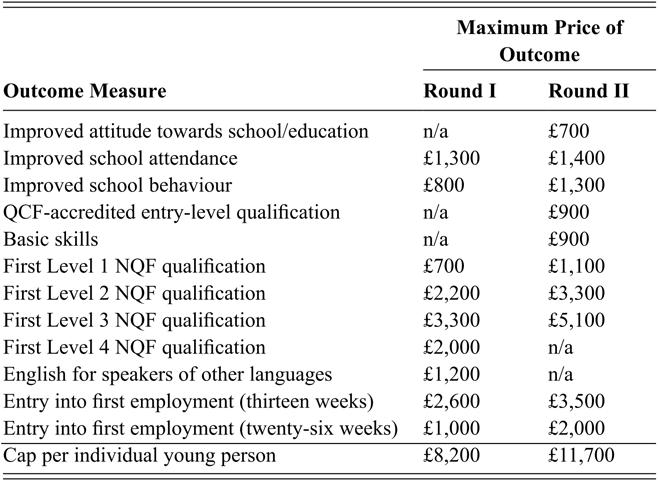
In these bids, SIB-providers tendered for targeted numbers of outcomes at specified unit prices. In the bid specification and application documentation for each round, the DWP outlined its maximum willingness to pay for particular social outcomes, allowing SIB-providers to define their intervention model, referral criteria, numbers, and mechanisms, and their preferred mix of outcomes at discounted unit prices from the rate card. The DWP did cap the total amount payable to SIB-providers on each project using the sum of the tendered number of outcomes multiplied by their unit prices (the ‘contract cap’) with the maximum amount payable per individual set first at £8,200 in round one and then climbing to £11,700 in round two. Policy documents have suggested that these individual payment caps were derived from three years of annually managed expenditure savings per capita – the value of avoided job seekers allowance for each individual (DWP, 2012; Reference Griffiths, Thomas and PembertonGriffiths, Thomas and Pemberton, 2016; Reference Thomas, Griffiths and PembertonThomas, Griffiths and Pemberton, 2016). All ten projects ran for three years, with outcomes monitored for an additional six months. To trigger payment from DWP, projects self-reported their achievement of outcomes using administrative data (Reference FitzGerald, Carter, Dixon and AiroldiFitzGerald et al., 2019).
4.1.2 The Life Chances Fund
Announced in 2016 as an £80 million Outcomes Fund, the UK central government Department for Digital, Culture, Media and Sport (DCMS) Life Chances Fund made three rounds of funding available across six themes: drug and alcohol dependency, children’s services, young people, early years, healthy lives, and older people’s services. Applicants with proposals outside of these themes could still be considered for Life Chances Fund funding if proposals proved innovative, well-designed, and good value-for-money (UK DCMS, 2016). In policy documents, DCMS expressed the overarching aim of the Life Chances Fund as ‘help[ing] people in society who face the most significant barriers to leading happy and productive lives’ (UK DCMS, 2016, p. 1) but articulated seven objectives which would enable this to occur:
i) increasing the number and scale of SOCs in England; ii) making it easier and quicker to set up a SOC; iii) generating public sector efficiencies by delivering better outcomes and using this to understand how cashable savings are; iv) increasing social innovation and building a clear evidence base of what works; v) increasing the amount of capital available to a wider range of voluntary, community and social enterprise (VCSE) sector providers to enable them to compete for public sector contracts; vi) providing better evidence of the effectiveness of the SOC mechanism and the savings that are being accrued; vii) growing the scale of the social investment market.
To structure the fund, DCMS opted for a locally led funding model, where the £80 million Life Chances Fund envelope is used to pay for a percentage of the outcomes specified in and delivered via local procurement. In policy documents this top-up is capped at less than 50 per cent of the outcomes payments for any individual project, with a goal to average top-up payments at 20 per cent for the Fund overall. The Life Chances Fund did not stipulate particular interventions to be commissioned nor did it set out a rate card. Application materials did, however, outline what kinds of projects would be given preference for funding. Since the Life Chances Fund aimed to scale the size and number of SOCs, the articulated preference was for bids that ‘(i) improve or re-align provision, (ii) co-ordinate multiple stakeholders to tackle complex issues, (iii) scale to unlock future savings and (iv) seek innovative solutions’ (Cabinet Office, 2016, p. 2). Beyond that, to receive Life Chances Fund funding, bids had to demonstrate that a local commissioner(s) was committed to paying for measurable outcomes which would not be covered by the Life Chances Fund in a deal that was capable of attracting external social investment (UK DCMS 2016). There was also a general requirement for local evaluation to be undertaken but that evaluation did not have to feature in the payment mechanism.
The design of the Life Chances Fund supported local actors – local authority commissioners and/or service providers – to develop projects. The process for this started with a call for expressions of interest from projects. Expressions of interest were then screened by TNLCF, who were hired by DCMS to administer the Fund. Any bids that met these criteria were invited to submit a full application and, if additional financial support was required for technical expertise to develop the proposal (e.g., financial modelling, service and outcomes definition, and theory of change), apply for a development grant, a small pool of money available in addition to the £80 million allocated for outcomes payments. Upon completing a full application, bids were then reviewed by an expert panel who made in-principle decisions on which bids would receive funding. The Life Chances Fund also included non-pecuniary support for applicants delivered by TNLCF, the newly launched academic research centre and official evaluator of the Fund, the Government Outcomes Lab (GO Lab) at the University of Oxford, and Traverse, a consultancy group. During the early stages of the Life Chances Fund, these delivery partners offered guidance to applicants on procurement, contract design, evaluation, and stakeholder management.
At the conclusion of the applications process, thirty-one SOCs received Life Chances Fund funding representing six policy areas: child and family welfare (ten), employment and training (eight), health and well-being (five), homelessness (four), education and early years (three), and criminal justice (one). Local governments then moved to procure and contract services for their SOCs. In this regard, the Life Chances Fund did not attempt to limit local discretion, simply stating:
We expect your contracting arrangements to offer good value for money, selecting any new providers through open procurement involving consideration of at least three potential suppliers. Use of pre-qualification questionnaires, drawing from a pool of experienced potential suppliers, Voluntary Ex-Ante Transparency (VEAT) notices and similar arrangements are all acceptable provided they are compliant with the commissioner’s financial standing orders and national contract law.
In practice, Life Chances Fund contractors used a variety of procedures, but evaluation material suggests that they varied widely in their ability to use flexibilities afforded to them in law, whereby in some areas the procurement process was ‘a very process-oriented, risk-averse function’ (Reference FitzGerald, Rosenbach and HameedFitzGerald, Hameed et al., 2021, p. 28). Local procurement procedures were cited as an ‘important source of significant cost and frustration’ for LCF [Life Chances Fund] applicants with the ‘novelty of commissioning outcomes, and the involvement of investors mean[ing] that standard market engagement and procurement procedures were not always fit-for-purpose’ (Reference FitzGerald, Rosenbach and HameedFitzGerald, Hameed et al., 2021, p. 11).
4.2 Discussion
As policies, the Innovation Fund and the Life Chances Fund are consistent at the macro- and meso-levels. Broadly, they seek to improve outcomes for people while saving or avoiding costs. They also aim to build the social investment market by boosting the capacity of actors within that market to participate in OBC, and they attempt to create evidence on the efficacy of OBC particularly SOCs. They prescribe cross-sector partnerships involving investors structured via OBCs. At the micro-level, however, they convey considerable variance in policy targets and calibrations seemingly driven by diverging approaches to the level of discretion granted to project partners.
In the Innovation Fund, the DWP maintained direct discretion over policy targets and calibrations through the rate card, defining the core policy issue, providing outcomes definitions, and calculating maximum prices. The Fund also provided clear direction as to the process through which projects are expected to evidence their outcomes for payment. While local actors still assumed responsibility for fulfilling bid requirements, the design complexities of identifying and prioritising the service cohort, defining payable outcomes and providing for their validation, and securing additional outcomes funding do not feature. The Life Chances Fund does nearly the exact opposite by delegating substantial discretion to local actors. In setting up the Fund, DCMS provided very general guidelines around priority service cohorts and outcome definitions by identifying thematic policy areas and stipulating that bidders must evidence how cost savings accrue. In the absence of greater specification centrally, local actors were given the discretion to identify and prioritise service cohorts and viable interventions in addition to contractualising outcomes capable of accruing savings to local and central governments. Local governments are likewise left to procure and contract their projects as well as validate outcomes achievement through whatever means they see fit.
Neither the Innovation Fund nor the Life Chances Fund prescribe intervention models nor referral pathways, allowing projects to determine their mechanisms for connecting individuals to contracted services. In the Innovation Fund, the logic of the rate card presumes progression from improved behaviour to further qualifications and employment, but in practice projects were paid for any mix of outcomes subject only to an individual cap on total outcomes payments (DWP, 2012, p. 15). In the Life Chances Fund, these particularities are instead negotiated on a project-by-project basis, with deviations from submitted project plans addressed through discussion with TCLF, DCMS, and project partners. Where a project undertakes a major amendment, there is a formal approval process, but limited information is available publicly on the nature of these changes. While project performance data is being released on Life Chances Fund projects, wide variation in the definitions of payable outcomes prevents comparative analysis across projects like that undertaken on projects in the Innovation Fund. External evaluation does not feature in the payment mechanisms of Innovation Fund nor Life Chances Fund projects. Instead, payment is based on the submission of predetermined administrative data by local actors that is further scrutinised by the DWP directly or by TNLCF on behalf of DCMS (see Table 8).
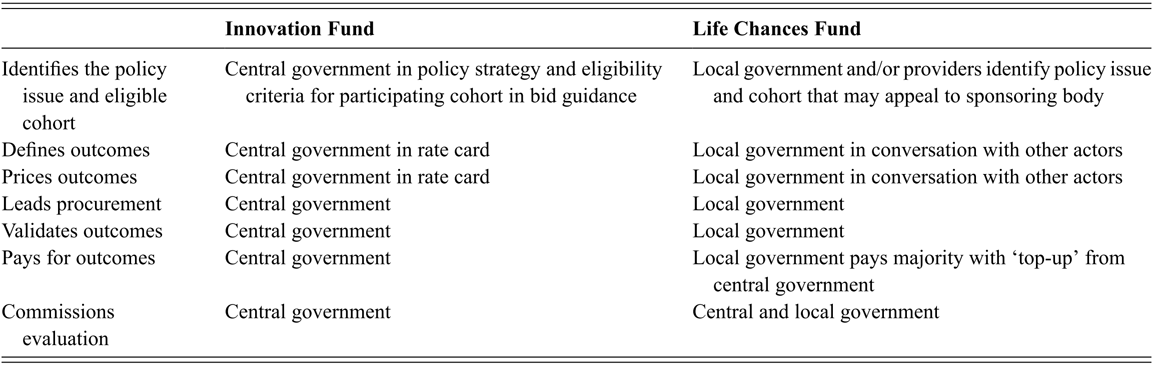
The Innovation Fund somewhat reduced capacity requirements on local actors by specifying the rate card and eligibility criteria. While local actors still assume responsibility for preparing bid documents and fulfilling requirements set by central government during delivery, for example project monitoring, the complexities of identifying and prioritising a service cohort and payable outcomes as well as negotiating who pays for those outcomes locally is not required of projects. The Life Chances Fund increases capacity requirements for local actors as they are left to specify and calibrate SOCs in accordance with the policy objectives of central government as well as engage with a more complex stakeholder network, including other project partners – fellow outcomes payors, providers, intermediaries, and investors – as well as the delivery partnership of the Fund – DCMS, GO Lab, TNLCF, and Traverse. Affiliative network maps (see Figures 1 and 2) visualise the contractual relationships galvanised by each outcomes fund. Funded SOC projects are indicated by blue circles which are scaled according to the financial size. Lines represent membership in projects and member organisations are represented by circles colour coded according to their function: pink circles indicate outcomes payors, yellow circles indicate service providers, green circles indicate investors, and teal circles indicate intermediary organisations. Member circles are scaled according to the number of projects in which they participate, hence the pink circle in the centre of each network represents central government – DWP in the Innovation Fund and DCMS in the Life Chances Fund. The result of granting greater discretion to local actors to design projects and bring in additional outcomes payors is a larger and denser network in the Life Chances Fund. For DCMS, this means needing to manage relationships and provide oversight to a greater number of projects and project partners to ensure that the fund-level collaboration makes progress towards their overarching fund-level objectives.
DWP Innovation Fund network.

DCMS Life Chances Fund network.

In terms of delivering against stated policy objectives (as in Table 9), the picture is somewhat mixed. Innovation Fund did deliver support to young people, test the evidence base for social investment and its ability to generate cashable savings, and helped to develop the social investment market. For longer-term objectives, however, the Fund does not deliver. Employment opportunities for participating young people did not improve, and while the fund did test whether social investment generated savings and improved outcomes, the results were not favourable: the benefits of social investment were not outweighed by the costs involved in designing and managing Innovation Fund projects according to the impact evaluation (Reference Salis, Wishart and McKaySalis, Wishart and McKay, 2018).
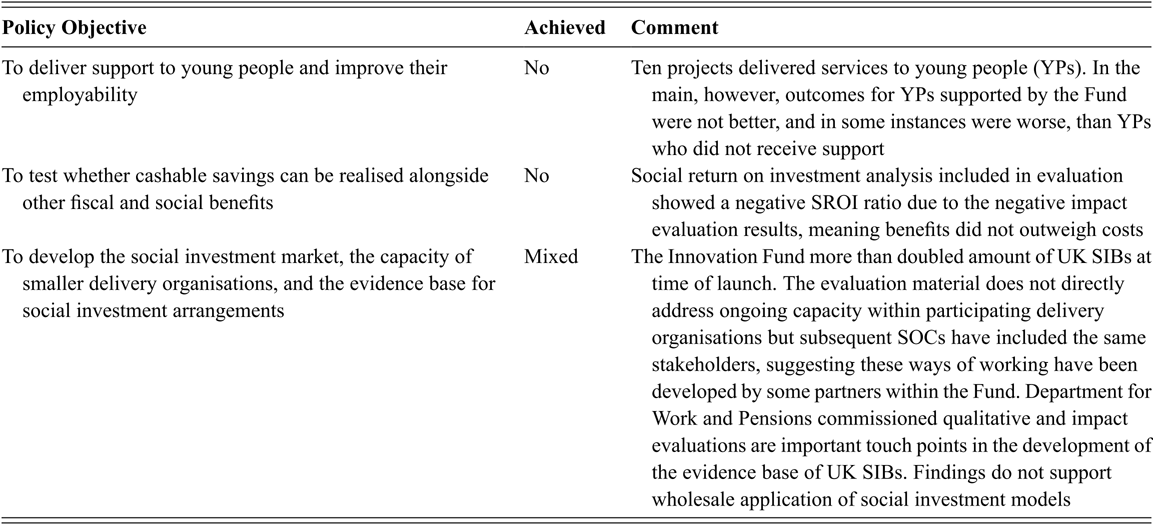
Interim qualitative evaluation of the Innovation Fund highlighted that most projects experienced delays in the initial stages of implementation, reducing the number of referrals and intervention starters, and consequently resulting in a remodelling and re-profiling of targeted outcomes. With this remodelling, initial intervention differences between projects diminished, resulting in a more uniform focus on younger age groups, on working within schools, and offering more time-limited interventions. Thus, projects identified as performing the ‘best’ in the early stages of the fund were those that targeted pre-NEET young people through schools, included a high number of intermediate or shorter-term outcomes, had a rolling and sufficiently large intake of referrals, and providing differentiated but time-limited support to young people (Reference Griffiths, Thomas and PembertonGriffiths, Thomas and Pemberton, 2016).
The final qualitative evaluation of the Innovation Fund showed that all parties perceived the projects to ‘have been a great success, with targeted numbers of outcomes met or exceeded’ and most agreed that ‘projects had achieved better results than they would have done if commissioned using more traditional methods’ (Reference Griffiths, Thomas and PembertonGriffiths et al., 2016; Reference Thomas, Griffiths and PembertonThomas et al., 2016, p. 1). Participating young people described experiencing ‘changes in their attitudes and approach to issues in their lives; improvements in social and familial relationships; and a broadening of their employment and career horizons’ (Reference Thomas, Griffiths and PembertonThomas et al., 2016, p. 3). The final quantitative evaluation – executed solely to generate evidence rather than trigger payment – was not so positive (Reference Salis, Wishart and McKaySalis, Wishart and McKay, 2018; Reference De Pieri, Chiodo and GerliDe Pieri, Chiodo and Gerli, 2022). Findings of the quasi-experimental impact evaluation showed that Innovation Fund participants aged fourteen to eighteen were less likely to be in education and employment than those in the comparator group, while more were in training; that fourteen- to fifteen-year-old participants were less likely to achieve NQF level 2 and 3 qualifications than young people in the comparator group; and that fourteen- to fifteen-year-old participants were more likely to be truant or experience school exclusion. Overall, the Fund was not shown to achieve value-for-money as many of the outcomes would have been achieved regardless (Reference Salis, Wishart and McKaySalis et al., 2018). As ‘projects realised that projected numbers of outcomes per young person would be lower than anticipated’, they increased recruitment, with the ‘numbers of discreet outcomes achieved per young person’ often being ‘quite low’. The time frame of the programme also meant that longer-term employment and education outcomes were all but abandoned by some projects (Griffiths, Thomas and Pemberton, 2016, p. 40). The outcomes specification choices set out by DWP meant that projects could overrefer easier-to-treat individuals into support services and then generate payment by overdelivering on earlier-term output measures at the expense of longer-term outcomes (Reference FitzGerald, Tan, Carter and AiroldiFitzGerald et al., 2023). Recent analysis from across the Innovation Fund shows that outcomes payments in eight of the ten funded projects hit their maximum contracted value with returns paid to investors.
For the Life Chances Fund, the full picture of performance is not yet known as some projects are contracted to pay for outcomes into 2026 (see Table 10). The Covid-19 pandemic also created substantial complications for projects, forcing some to deviate from their pre-specified outcomes, others to completely change their method and scope of service delivery, some to delay their launch, and a small number to terminate (Reference FitzGerald, Rosenbach and HameedFitzGerald, Hameed et al., 2021). While support is being offered to service users, a detailed account of how well each funded project performs against its initial and renegotiated payable outcomes will be required to comment on whether the Fund has supported individuals to lead happy and productive lives. The lack of standardised outcome measures as in the Innovation Fund rate card or minimum required evaluation approaches embedded into project payment mechanisms likewise means that assessing overall fund performance will remain challenging. While projects are delivering support to individuals throughout England, the degree to which that support will lead to durable improved outcomes will be challenging to assess even once final outcomes payments have been made.
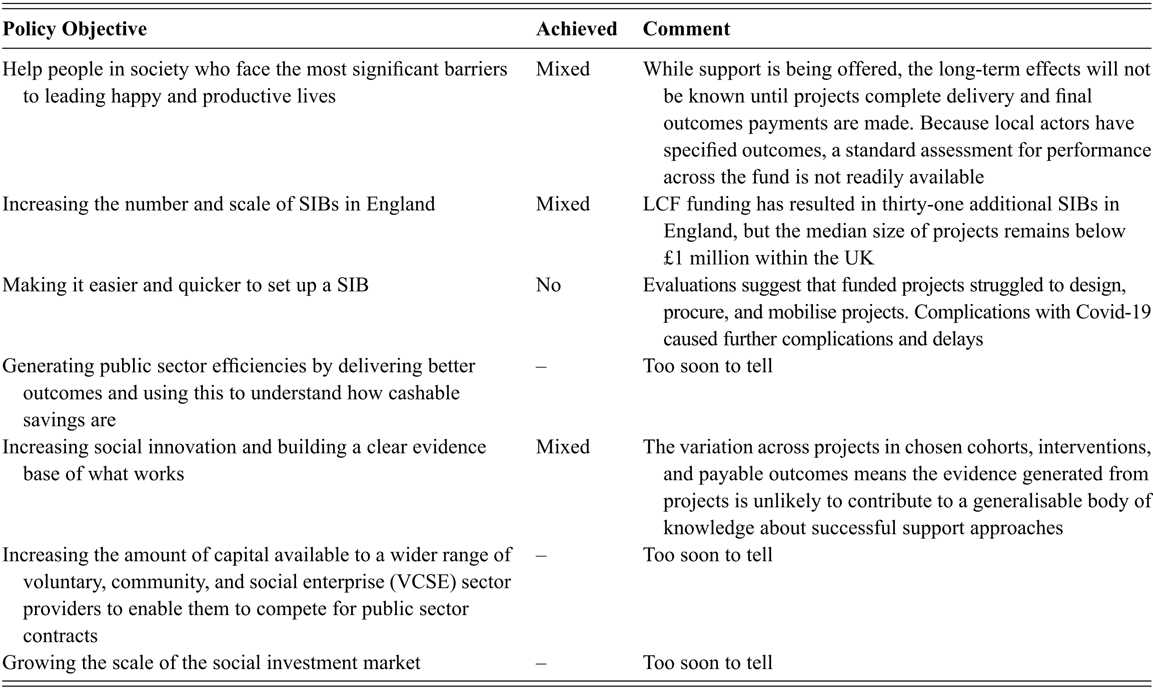
5 Conclusion
After their experience with the Innovation Fund, the DWP improved their rate card, tweaking it for use in two subsequent outcomes funds: the Youth Engagement Fund and the Fair Chance Fund. They specifically bore down on defining referral pathways so as to mitigate the potential for cherry-picking and included caps on outcome types such that providers could not cream-and-park users in order to overdeliver on earlier-term metrics at the expense of longer-term outcomes. Published evaluation material falls short of making strong attributional claims about the benefits of both funds but does highlight an improved balance between outcomes delivered and financial reward (ICF, 2019; Reference Ronicle and SmithRonicle and Smith, 2020; Reference FitzGerald, Tan, Carter and AiroldiFitzGerald et al., 2023b).
As we have argued in this Element, so much of the success or failure of public contracts is determined by the skill with which their enforceable commitments are negotiated and defined. Now over a decade into experimentation, the evidence on OBC suggests that the degree to which they allow governments to pay for outcomes of questionable value is significantly dilated or constrained by how they are specified, with careful consideration needed for how cohorts are identified and connected to services, how well evidenced and firm the links between payable outcomes and long-term policy objectives are, and how integrated counterfactual thinking is in pricing (Reference FitzGerald, Carter, Dixon and AiroldiFitzGerald et al., 2019; Reference FitzGerald, Tan, Carter and AiroldiFitzGerald, Tan et al., 2023).
On the one hand, outcomes orientation is consistent with a more strategic role for public procurement by granting an expanded pool of professionals the discretion to concretely operationalise public policy aims through public contracts. On the other hand, practically or even notionally reducing the role of the government in contract management to simply approving outcomes payments clashes with the legal obligations of public procurement professionals to protect the public interest throughout contract performance. As such, outcomes are at once a solution to and embodiment of the managerial and legal tensions within public administration as they promise to enhance efficiency and performance as well as buttress public duties when contracting for service delivery. Even with careful specification, however, doing the business of government through outcomes carries inherent risk, especially when the business in question includes the outsourcing of complicated and essential services.
In this concluding section, we distil the risks and challenges of OBC in two ways. First, we suggest that governments may lack the necessary capacity to succeed at the procurement and management of OBC, and as such, use it as a way of contracting-out their responsibility for regular involvement in outsourced provision. Second, we highlight that OBC may enable governments to circumvent their legal duties of accountability and reviewability as a way of contracting out their liability. We then close with a brief commentary on the continued necessity of government involvement in contracted services, even those guided by social outcomes.
5.1 Contracting Responsibility
On a public management level, it may be tempting to think of OBC as an opportunity to set outcomes, find a contractor or a team of contractors, agree on a price, and let folks ‘get on with it’. This may be even more tempting if the agency adopting such a ‘set-and-forget’ model has limited capacity to perform the management that might be required in more traditional contracting. But there is little evidence to suggest that OBCs require less capacity than other contracts to manage. On the contrary, the inclusion of wider policy outcomes in contracts and management approaches likely requires more capacity. Outcomes take time to set and may need careful revision during delivery. This is especially the case for high-powered incentive contracts like SOCs that require significantly more time to procure and attention to manage than other types of contracts (Reference FitzGerald, Carter, Dixon and AiroldiFitzGerald et al., 2019). Simultaneously, the task of public procurement is increasingly a more complex strategic function for government as it is seen to be an important lever for achieving public policy goals with a wide range of economic, environmental, and social outcomes being included in public contracts. This, combined with the realities of getting public contracts to deliver in increasingly networked and dynamic social programme environments, likely means that more involvement of procurement professionals is needed during contract performance.
In the US, there has been both a push towards performance incentives and a realisation of the importance of capacity in procurement. In the US, Congress recently established the independent Advisory Panel on Streamlining and Codifying Acquisition Regulations (the Section 809 Panel), which highlighted that the ‘DoD’s acquisition workforce is the lynchpin to achieving successful acquisition reform’ and made recommendations focusing on the hiring, training, development, and retention of the acquisition workforce, precisely those public managers who are responsible for procurement and contract management (Section 809 Panel, 2019, p. 15). In the UK, there has been reduction in public procurement staff in the public sector overall, but an increase in the staff in Crown Commercial Services (CCS). This serves to underscore the effect of hollowing out procurement and contracting capacity particularly in UK local governments.
In recent years, the UK’s procurement workforce has experienced two cross-cutting trends. On the one hand, the austerity policy put in place in the aftermath of the economic crisis has resulted in significant headcount reduction across government agencies, including in their procurement departments. Between 2010 and 2012, the number fell 17% from approximately 3,900 to 3,200, although over the same period, the number of staff holding Chartered Institute of Purchasing and Supply (CIPS) qualifications has increased. At the same time, the move toward greater centralisation in the CCS is increasing the professionalisation of procurement.
In the EU, the European Commission has a ‘Public Procurement Action Plan’ that includes a 2016 ‘stock-taking study’ on member state’s administrative capacity in public procurement. This study articulated four areas of administrative capacity: ‘human resources dedicated to procurement, training and capacity building structures that ensure the proper qualification of procurement practitioners, trainings offered to procurement practitioners and economic operators, and existing systems and tools aimed at improving the way procurements are handled’ (European Commission, 2016). The study found low levels of participation in skills trainings on topics such as green public procurement and social public procurement, with the cost or lack of funding being the greatest barrier to attendance.
From an oversight and monitoring perspective, beyond personnel bandwidth, the system in place for capturing and tracking contract performance and delivery of outcomes as enforceable commitments remains underengineered, particularly in the UK. Ongoing performance data for OBCs to guide day-to-day operations is often held by project managers rather than civil servants and can differ from reported key performance indicators – and indeed outcomes – across projects. As it relates to social value, the transparency notices that are required under EU directives and current UK regulations are designed to describe the core requirements of a procurement, but do not capture horizonal or collateral requirements. There is no systematic reporting or comprehensive public data on social value priorities, requirements, contracted commitments, or implementation. Without an effort to capture and publish the achievement of social value clauses, we will have no way of knowing whether the specifications and calibrations in contracts relate to the successful delivery of social outcomes.
5.2 Contracting Liability
There is also the risk that contracting authorities may outsource outcomes to avoid directly making decisions or performing activities that subject them to being accountable to democratic representatives or are reviewable by courts at the request of service users and other members of the public. In other words, authorities may view outcomes as a way to contract liability. Public authorities have duties related to public services, including those services that have been contracted out. This is a matter of concern in individual situations but is also as a wider constitutional issue. As explained by Davies: ‘Public Law is not just concerned with the outcomes of cases. It is also concerned with the allocation of public powers and duties. This reflects its role in ‘constituting’ government. Contractualisation gives rise to difficulties in this regard because public powers or duties which are allocated to the government by statute may be exercised or performed by contractors’ (Reference DaviesDavies, 2008).
In the UK, public authorities have a wide range of legal duties. A guide to lawful decision-making for UK local authorities describes duties to declare interests, follow correct procedures, engage in consultations, stay within remit, be rational and evidence-based, include all relevant considerations, act with proper purpose, comply with the European Convention of Human Rights, be proportionate, and properly reasoned (Smith and PracticalLawPublicSector, 2022). However, it is not always clear whether an entity is a public authority exercising a public function giving rise to public duties.
In the 2003 Aston Cantlow case, the House of Lords (the highest court in UK at that time) was considering ‘publicness’ under the Human Rights Act and the European Convention of Human Rights. It emphasised that there was ‘no single test of universal application’ and provided some factors to be considered when assessing when public duties arose: ‘the extent to which in carrying out the relevant function the body is publicly funded or is exercising statutory powers, or is taking the place of central government or local authorities, or is providing a public service’ (Lord Nicholls of Birkenhead in Aston Cantlow and Wilmcote with Billesley Parochial Church Council v Wallbank [2003] UKHL 37).
However, even when it established that a contracting authority has a public duty, it is not aways the case in the UK that a contractor performing the service under a public contract will also have the duty. Duties do not automatically extend to contractors. Their extension depends on factors laid out by Court of Appeal in the Donoghue case (regarding homelessness), applied again by Court of Appeal in Leonard Cheshire (regarding elderly care, where there was no public duty applied to the contractor). Both these cases were cited favourably by the House of Lords in Aston Cantlow.
In the Donoghue case, Donoghue argued that a housing association, Poplar, had a particular duty because Poplar was a contractor to a public authority, Tower Hamlets council. The Court of Appeal found that Polar did have the duty. The Court of Appeal also stated:
66. It is desirable to step back and look at the situation as a whole. As is the position on applications for judicial review, there is no clear demarcation line which can be drawn between public and private bodies and functions. In a borderline case, such as this, the decision is very much one of fact and degree. Taking into account all the circumstances, we have come to the conclusion that while activities of housing associations need not involve the performance of public functions in this case, in providing accommodation for the defendant and then seeking possession, the role of Poplar is so closely assimilated to that of Tower Hamlets that it was performing public and not private functions. Poplar therefore is a functional public authority, at least to that extent. We emphasise that this does not mean that all Poplar’s functions are public. We do not even decide that the position would be the same if the defendant was a secure tenant. The activities of housing associations can be ambiguous. For example, their activities in raising private or public finance could be very different from those that are under consideration here. The raising of finance by Poplar could well be a private function.
The reasoning here has been criticised. Craig has argued that ‘rights-based protections should not depend on the method of service delivery. … It is difficult to see why the nature of a function should alter if it is contracted out, rather than being performed in house. If it is a public function when undertaken in house, it should be equally so when contracted out’ (Reference CraigCraig, 2002). Davies has suggested that ‘any gap in the availability of duties or remedies is particularly concerning because it gives rise to inequality in the treatment of different claimants depending on the arrangements a public authority has made for service delivery’ (Reference DaviesDavies, 2008, p. 233). In circumstances where wider public policy goals are included as outcomes in public contracts, perhaps the performance of those contracts is less of a private matter between the contracting authority and the contractor. In the UK, this will likely be very fact-specific in any individual case – despite any wider constitutional concerns.
5.3 Inherently governmental
In 2018, UK construction and services giant Carillion collapsed under £1.3 billion of debt (Reference MorMor, 2018). At the time of its collapse, Carillion was contracted to deliver a wide range of services to the Ministry of Defence, the Ministry of Justice, major public transportation systems, hospitals, local councils, and schools. In the aftermath of its collapse, the House of Commons Public Administration and Constitutional Affairs Committee asked three key questions (2018): (i) how appropriate is it for particular public sector projects or services to be run by the private sector?; (ii) is the government just the customer or does it have wider responsibilities as the steward of these markets?; and (iii) what capability does the government still lack in letting and managing contracts?
The Committee report did not arrive at a clear answer to on what should remain within government and what should be contracted for:
At different times, private, charitable, and public providers have both succeeded and failed to contribute to successful public services. All the witnesses to our inquiry accepted that the public sector should buy in some goods or services from the private sector, and should insist on providing others internally. The public sector should not contract out the final decision making about policy. The public sector always retains responsibility for the entitlement of individuals to benefits or services. Whether ordinary services should be outsourced though will depend upon the capacity of the public sector, private sector or voluntary sector to deliver them, the comparative cost, and ultimately, the value that each provider can produce.
However, the Committee was very conscious of the government’s role as superior holder of risk and was very concerned about whether contractors should take on risks that should remain with the government. The Committee was especially concerned about contract models that tie payment to outcomes:
UK governments have often transferred risks to contractors that they cannot possibly manage. This is driven, in part, by the decision to use contractual models such as payment by results which involve risk transnfer on a huge scale. The transfer of large amounts of risk is often counter-productive: leading to more conservative approaches to service delivery. This situation has been made worse by the fact that governments have often not understood fully the services or projects they have wanted the private sector to manage and without any understanding or data about the assets being handed over.
The US federal government is prohibited from using contracts to perform ‘inherently government functions’, which it defines as ‘a function that is so intimately related to the public interest as to mandate performance by government employees’ (FAR 7.5). The FAR goes on to underscore that ‘this definition is a policy determination, not a legal determination’, whereby inherently governmental functions include ‘the exercise of discretion in applying Government authority’ or the ‘act of governing’, and ‘the making of value judgements in making decisions for the Government’ as in monetary transactions and entitlements (FAR Part 2).
A 2011 White House policy letter highlights the management and capacity issues related to inherently governmental functions, requiring agencies to ‘take special care to retain sufficient management oversight over how contractors are used to support government operations and ensure that Federal employees have the technical skills and expertise needed to maintain control of the agency mission and operations’ (OMB, 2011). The same policy letter also highlights management and capacity issues related to contact performance of functions that are closely related to inherently governmental functions, are critical functions, or ‘where, due to the nature of the contract services provided, there is a potential for confusion as to whether work is being performed by government employees or contractors’ (OMB, 2011). In these circumstances, the policy letter states: ‘Contract management should be appropriate to the nature of the contract, ensure that government officials are performing oversight at all times, and make clear to other government organizations or to the public when citizens are receiving service from contractors’ (OMB, 2011).
We maintain that identifying what is inherently governmental or deciding where to retain democratically legitimated decision-making procedures, accountability mechanisms, and safeguards is not straightforward, especially when contracting for outcomes. As we have detailed throughout this Element, the emphasis of applied public administration and public policy scholarship tends to be on estimating the efficiency and performance of contracting out. A problem with these kinds of analyses is that in any individual scenario before a public manager, the procedures, accountability mechanisms, and safeguards we value in a democratic society look like costs. Such economic arguments are limited in that they conceive of public good as an aggregation of private interest (Reference MazzucatoMazzucato, 2023) rather than recognising the unique ability the state to deliver public value. Hence, the benefits of oversight functions are best viewed with an orientation that understands that the continued legitimacy of civil servants and government action is inexplicably tied to their ability to account for decisions in policy design and implementation (Reference StoneStone, 1983).
The law cannot provide us with a list of inherently governmental functions or lists of services where we want or do not want democratically informed decision-making procedures, accountability mechanisms, and safeguards. Likewise, managerial sciences and applied economics cannot fully calculate the costs and benefits of including such oversight and safeguards. Hence, the big challenge of linking policy designs to implementation via outcomes-based contracts is the risk that public managers set outcomes as a way of circumventing meaningful government presence during service delivery or assume that an illusory ‘perfect contract’ will make services self-implementing and outcomes automatically achievable.
Acknowledgements
The authors are very grateful to the editors of the Elements in Public Policy Series, especially Judith Clifton, as well as to the two anonymous reviewers for their incisive feedback and recommendations; your collective input has greatly improved the piece. Further acknowledgement is owed to several generous colleagues – Alec Fraser, Anne Davies, Britt Regal, Carolyn Heinrich, Eleanor Carter, Ewan Ferlie, Mara Airoldi, Thomas Elston, and Mildred Warner – conversations with whom have illuminated and clarified many of the concepts discussed in this Element. Special dedication goes to our partners, Gregory and Hazel, and pets, Puffin and Marshmallow, for love and support throughout. This Element has been published open access with the support of King’s Business School.
Dr FitzGerald led the development, drafting, and editing of this Element. Dr Macdonald contributed expertise on the legal foundations and practices in public procurement and their broader relevance to public administration. Any errors or misinterpretations are our own.
M. Ramesh
National University of Singapore (NUS)
M. Ramesh is UNESCO Chair on Social Policy Design at the Lee Kuan Yew School of Public Policy, NUS. His research focuses on governance and social policy in East and Southeast Asia, in addition to public policy institutions and processes. He has published extensively in reputed international journals. He is co-editor of Policy and Society and Policy Design and Practice.
Michael Howlett
Simon Fraser University, British Columbia
Michael Howlett is Burnaby Mountain Professor and Canada Research Chair (Tier1) in the Department of Political Science, Simon Fraser University. He specialises in public policy analysis, and resource and environmental policy. He is currently editor-in-chief of Policy Sciences and co-editor of the Journal of Comparative Policy Analysis, Policy and Society and Policy Design and Practice.
Xun WU
Hong Kong University of Science and Technology (Guangzhou)
Xun WU is currently a Professor at the Innovation, Policy and Entrepreneurship Thrust at the Society Hub of Hong Kong University of Science and Technology (Guangzhou). He is a policy scientist with a strong interest in the linkage between policy analysis and public management. Trained in engineering, economics, public administration, and policy analysis, his research seeks to make contribution to the design of effective public policies in dealing emerging policy challenges across Asian countries.
Judith Clifton
University of Cantabria
Judith Clifton is Professor of Economics at the University of Cantabria, Spain, and Editor-in-Chief of Journal of Economic Policy Reform. Her research interests include the determinants and consequences of public policy across a wide range of public services, from infrastructure to health, particularly in Europe and Latin America, as well as public banks, especially, the European Investment Bank. Most recently, she is principal investigator on the Horizon Europe Project GREENPATHS (www.greenpaths.info) on the just green transition.
Eduardo Araral
National University of Singapore (NUS)
Eduardo Araral specializes in the study of the causes and consequences of institutions for collective action and the governance of the commons. He is widely published in various journals and books and has presented in more than ninety conferences. Ed was a 2021–22 Fellow at the Center for Advanced Study of Behavioral Sciences, Stanford University. He has received more than US$6.6 million in external research grants as the lead or co-PI for public agencies and corporations. He currently serves as a Special Issue Editor (collective action, commons, institutions, governance) for World Development and is a member of the editorial boards of Water Economics and Policy, World Development Sustainability, Water Alternatives and the International Journal of the Commons.
About the Series
Elements in Public Policy is a concise and authoritative collection of assessments of the state of the art and future research directions in public policy research, as well as substantive new research on key topics. Edited by leading scholars in the field, the series is an ideal medium for reflecting on and advancing the understanding of critical issues in the public sphere. Collectively, the series provides a forum for broad and diverse coverage of all major topics in the field while integrating different disciplinary and methodological approaches.


 Open access