


1. Introduction: organising concepts and techniques
Over the past two decades, there has been a notable increase in the integration of connectivity and digital technologies into products. The resulting development is organised around multidisciplinary teams combining mechanical, electrical, electronic and software engineering. For companies, this implies a significant technical and organisational complexity, which has an impact on all stakeholders of the extended enterprise (Reference Zhang and ThomsonZhang & Thomson, 2016). In this context, it may be necessary for companies to adapt or evolve their product development practices. This adaptation or evolution can be conducted at different levels of product development (Reference Guérineau, Rivest, Bricogne, Durupt, Eynard, Marjanović, Štorga, Škec and BojčetićGuérineau et al., 2018), while ensuring coherence across them. In order to support companies in their multidisciplinary product development (MPD), several researchers have conceptualised a “toolbox”, a “collection”, a “catalogue”, or a “repository” of methods and tools, some of which are positioned along a product development process model (Reference BöhmerBöhmer, 2018; Reference Goevert, Lindemann, Marjanović, Štorga, Škec and BojčetićGoevert & Lindemann, 2018; Reference Miranda, Pérez-Rodríguez, Borja, Wright and MolinaMiranda et al., 2017). Amongst the most recent ones, Reference Guérineau, Bricogne, Rivest and DuruptGuérineau et al. (2022) proposed three “maps”, each one respectively organising a variety of concepts and techniques from the scientific literature for mechatronics (Reference Bradley, Hehenberger, Hehenberger and BradleyBradley & Hehenberger, 2016), cyber-physical systems (Reference Baheti and GillBaheti & Gill, 2011), and “smart” products (Reference Kortuem, Alford, Ball, Busby, Davies, Efstratiou, Finney, White, Kinder, Krumm, Abowd, Seneviratne and StrangKortuem et al., 2007) development. In the context of this article, the expression “concepts and techniques” groups the variety of approaches, processes, methods and tools for product development. The three maps are organised on the basis of a four-level model from the same authors (Reference Guérineau, Rivest, Bricogne, Durupt, Eynard, Marjanović, Štorga, Škec and BojčetićGuérineau et al., 2018), providing a hierarchical structure for organising the concepts and techniques. Each level, namely Approach, Process, Method and Tool, plays a specific role in guiding and supporting product development.
The maps from Reference Guérineau, Bricogne, Rivest and DuruptGuérineau et al. (2022) offer a comprehensive view on the multiple concepts and techniques discussed by the scientific literature for MPD and their associations. Through this visual representation, researchers and industry practitioners can navigate and understand the relationships between them, especially their combinations and joint use. However, the authors acknowledged the static nature of the representation and its associated limitations. Primarily, these limitations involve the filtering of maps and the updating of information over time. To address these two limitations, the necessity for a “dynamic and navigable representation” and a “community-based and maintained database” has been emphasised (Reference Guérineau, Bricogne, Rivest and DuruptGuérineau et al., 2022). It is anticipated that these two directions will resonate with both the scientific community and the industry. Accordingly, the main objectives of this project are (1) to develop a dynamic graphical representation that will enable researchers and industry to navigate, visualise, and analyse the associated links established between the concepts and techniques identified in the research papers, and (2) to enable the community to contribute actively by adding and updating concepts and techniques, their links and the associated scientific references.
The article builds on previous research and addresses two of its main limitations, while reusing the underlying codes and semantics. The next section outlines the sub-objectives and criteria for comparing three potential dynamic representations: ontologies, graph databases, and relational databases, leading to the selection of the graph database. Section 4 presents the design of the proposed dynamic database using Unified Modeling Language (UML) models, along with its core functionalities. The discussion section covers the implications of the proposed database, and future work, leading to the conclusion.
2. Design criteria for evaluating dynamic representations
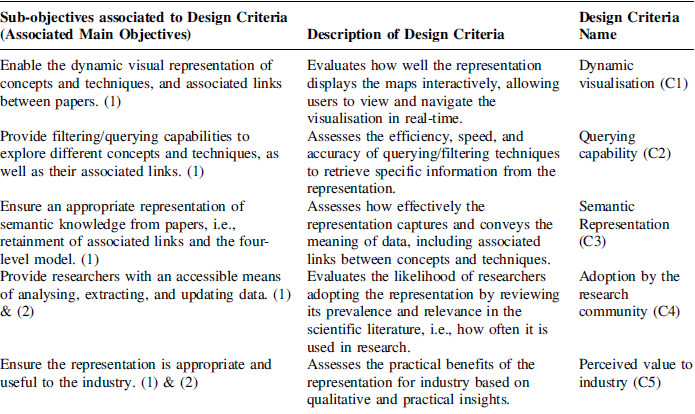
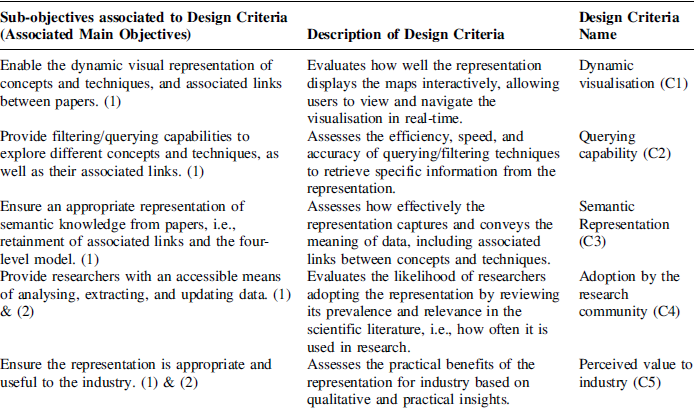
To ensure the project's alignment with the two main objectives outlined above, these are refined into five sub-objectives. The latter address specific facets of the project, formalising the need for a dynamic representation, capturing and representing the semantics of the initial maps, and providing filtering and querying capabilities with the possibility of further analysis and extraction of query results. In addition, the updating of the maps' data and the usefulness of the representation for both industry and researchers are specified. The relationship between the sub-objectives and the main objectives is presented on the left side of Table 1 with the corresponding main objective number in brackets. Then, each sub-objective is derived into a design criterion. Each design criterion and its description are given on the right-hand side of Table 1. The adoption of a structured modus operandi, whereby the main objectives are broken down into sub-objectives, which in turn are paired with design criteria, ensures that the selected representation will support each individual facet of the project. This selection is discussed in the next section.
Criteria used for the comparison and analysis of representations
3. Comparison and analysis of representations
Based on the design criteria defined in the previous section, a comparison and analysis of the potential dynamic representations are presented below. The next sections give an overview of each of them, i.e., ontologies, graph databases and relational databases, before discussing the one that best meets the defined design criteria. Representations were chosen based on their similarity to the intended static structure. Other representations like Resource Description Format (RDF) were considered but deemed unsuitable due to its deviation from simple node-link structures (Reference Ravat, Song, Teste, Trojahn and SantosRavat et al., 2020). Each design criterion is evaluated on a qualitative basis, with equal weightage given to each.
3.1. Ontologies
Ontologies are widely adopted in research for knowledge representation and semantic modelling (C4) (Reference Martinez-Cruz, Blanco and VilaMartinez-Cruz et al., 2012; Reference Sir, Bradac and FiedlerSir et al., 2015). Indeed, ontologies excel in capturing and conveying semantic information (C3) (Reference Martinez-Cruz, Blanco and VilaMartinez-Cruz et al., 2012) effectively representing complex relationships between entities. They also facilitate sophisticated querying using semantic query languages like SPARQL, which allows for advanced searches and filtering based on semantic relations (C2). As noted by Reference Figueres-Esteban, Hughes, Rashidy and van GulijkFigueres-Esteban et al. (2018), ontologies are more suited for static representations and may struggle with dynamic visualisation (C1). To address this limitation Reference Figueres-Esteban, Hughes, Rashidy and van GulijkChen & Xing (2022) suggest that visualisation tools may be necessary to create interactive views. Finally, their use in specific industry applications is primarily limited to scenarios that require structured knowledge representation (C5).
3.2. Graph databases
Graph databases perform well in dynamic visualisation (C1) by representing data as nodes and relationships, supporting interactive exploration and real-time navigation effectively (Reference Ravat, Song, Teste, Trojahn and SantosRavat et al., 2020). They can also provide fast, efficient and flexible querying capabilities (C2). Their ability to efficiently traverse relationships makes them well suited to handle interconnected data (Reference Chen and XingChen & Xing, 2022). Graph databases face practical limitations, including limited declarative querying, which hampers optimisation and performance on large-scale data. Additionally, poor data partitioning can slow queries and create visualisation bottlenecks due to inadequate horizontal scalability (Reference Pokorný, Saeed and HomendaPokorný, 2015). Although they do not offer the same formal semantics as ontologies, graph databases are still quite effective for visualising meaningful insights (C3). In addition, graph databases have an increasing utilisation in both academic and industry settings (C4, C5) (Reference Figueres-Esteban, Hughes, Rashidy and van GulijkFigueres-Esteban et al., 2018). Providing scalable and flexible solutions for representing and analysing complex relationships, graph databases prove to be the front-runner in the industry for various software and solutions (C5) (Reference Stanescu, Ganzha, Maciaszek, M. Paprzycki and ŚlęzakStanescu, 2021).
3.3. Relational databases
Relational databases are widely used for data management in both industry and academia (C4, C5) (Reference Lazarska and Siedlecka-LamchLazarska & Siedlecka-Lamch, 2019). This is due to their efficient data storage and retrieval capabilities (Reference Ravat, Song, Teste, Trojahn and SantosRavat et al., 2020). Although they can handle structured data queries well (C2) (Reference Ferrer, Mohammed, Ahmad, Iarovyi, Zhang, Harrison and Martinez LastraRamis Ferrer et al., 2021), relational databases face challenges in dynamic visualisation (C1) due to their tabular structure and reliance on complex joins (Reference Lazarska and Siedlecka-LamchLazarska & Siedlecka-Lamch, 2019). Moreover, visualisation tools may struggle with real-time interactive representations (C1). Relational databases excel in querying with Structured Query Language (SQL), allowing efficient data retrieval and manipulation (C2). However, they lack depth in semantic representation (C3), focusing more on data storage and retrieval rather than complex semantic relationships (Reference Martinez-Cruz, Blanco and VilaMartinez-Cruz et al., 2012). Ultimately, of the three different representations, relational databases seem less suitable for the proposed dynamic database.
3.4. Synthesis
Drawing on the description of each potential representation and the design criteria set out in Table 1, graph databases appear to be the preferred data representation model for the proposed database, given their relatively strong performance across multiple criteria. The main driving force for this decision is the dynamic visualisation this representation provides, allowing for interactive and real-time navigation (Reference Figueres-Esteban, Hughes, Rashidy and van GulijkFigueres-Esteban et al., 2018). This will enable users to study and analyse links between research papers. Graph databases are also sufficient in terms of scalability, speed, efficiency and flexibility. They provide a satisfactory output in this regard due to them being well-suited for interconnected data. Whilst ontologies are preferred for semantic representation, graph databases are preferred as the proposed database focuses more on functionality rather than exclusively on semantics. Indeed, the implementation provided by graph databases appears to be sufficient given the scoped semantic needs in the initial maps from Reference Guérineau, Bricogne, Rivest and DuruptGuérineau et al. (2022).
4. Design and functionality of the proposed Dynamic Database
Based on the selected representation of graph databases, the proposed community-driven database for the dynamic representation, “Dynamic Database” in short, is detailed in this section. Design-wise, its architecture and its constituents need to be defined to reflect the ones from the initial maps. To this end, the next section presents two UML diagrams, before delving into offered functionalities.
4.1. UML diagrams: representing the Dynamic Database architecture
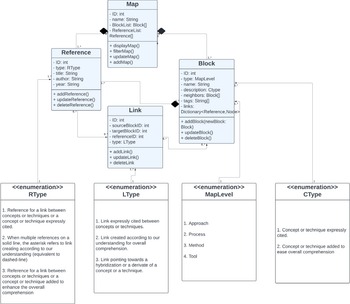
The initial maps from Guérineau et al. (Reference Guérineau, Bricogne, Rivest and Durupt2022) depict a collection of blocks representing concepts or techniques, often interconnected with links denoting associations between them. The blocks and the links are supported by references identified from the scientific literature. To transfer this formalism, a Class Diagram UML model is presented hereafter in Figure 1. A second UML model, a Use Case diagram, defines the different usage and expected functionalities. These UML models elaborate upon the structure of the proposed Dynamic Database. These two diagrams can provide an ease of comprehension regarding what the database entails, and why it may be needed.
UML Class Diagram of the Dynamic Database
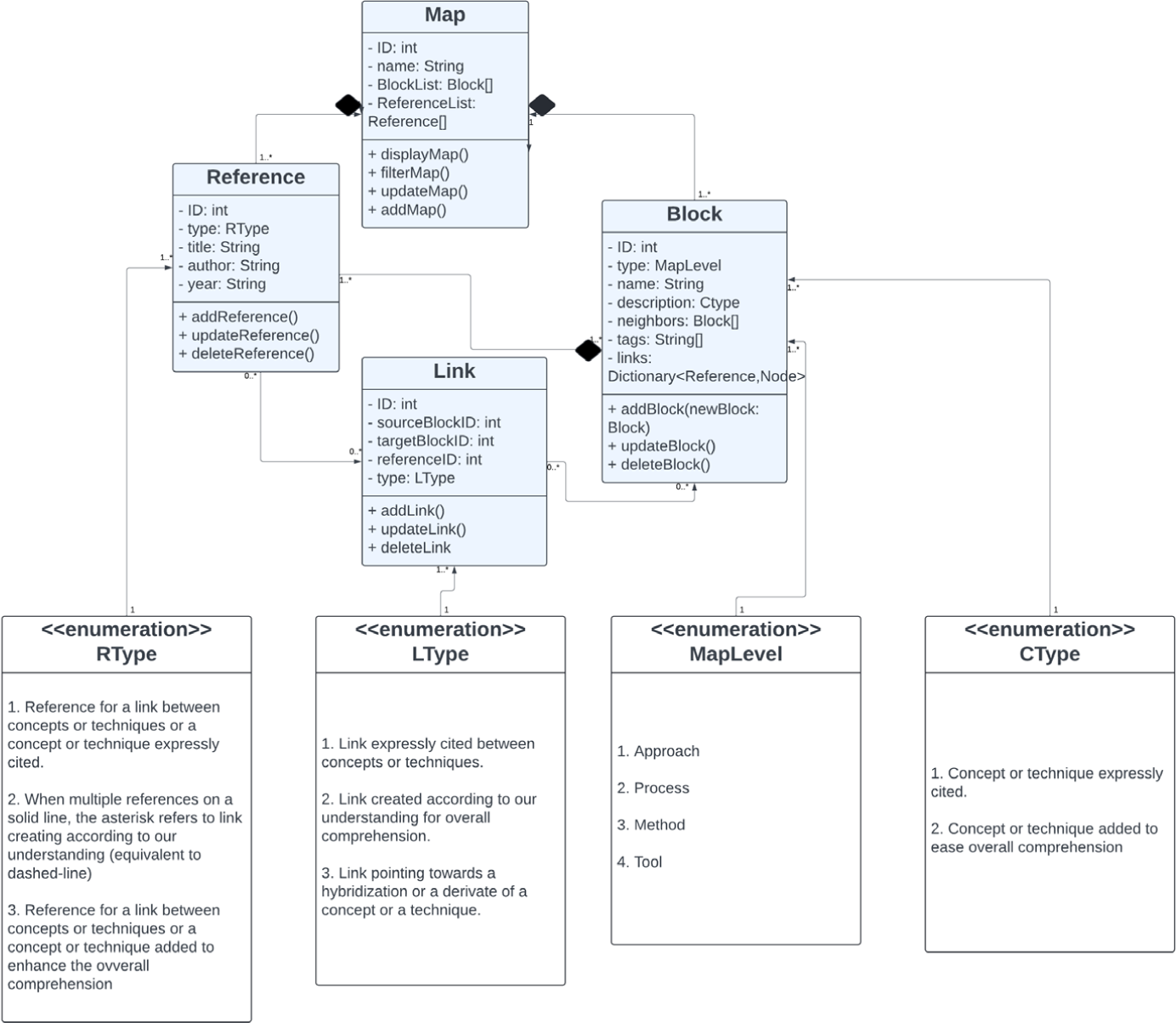
The Class Diagram, shown in Figure 1, illustrates the structural elements of the Dynamic Database, modelled according to UML standards. It includes several key classes – Map, Block, Reference, and Link – which form the core building blocks of the database. These classes are supplemented by four enumerations: RType, LType, MapLevel, and CType. Each of these four enumerations representing different types of relationships or categorisations from the initial maps.
The Map class represents the overarching container for the entire map representation, functioning as a central point for managing both blocks and references. Its main attributes include a list of blocks, stored in the BlockList attribute, and a list of references, stored in the ReferenceList. The Map class is equipped with functions to display, filter, and update the map, ensuring dynamic visualisation and interaction.
Moving on to the Block class, this represents the core unit within the map – each block corresponds to an individual concept or technique. Blocks can be connected to other blocks, reflecting the relationships between different concepts and techniques, and these connections are managed through the Link and Reference classes. The Block class supports several functions, including the ability to add, update, and delete blocks, making it adaptable for real-time modifications in the Dynamic Database. The Reference class, on the other hand, manages the bibliographic elements tied to these blocks, including attributes such as “title”, “author”, and “year”. It similarly allows for references to be added or updated as needed. The Link class plays a vital role in connecting the blocks, representing relationships through a triplet structure, namely “source”, “reference”, “target”. This allows for advanced querying and filtering features in the database. The UML links in the Class Diagram ensure structure and flexibility by establishing clear relationships between the Link, Reference, and Block classes. The Link class connects blocks via references, while the Block class organises and categorises these connections into a navigable map. The Reference class provides context for the connections, allowing for the integration of relevant sources. This allows support for a structured system that can dynamically update and adapt, making it easier to navigate and change map content.
These classes and their relationships ensure that the Dynamic Database reflects the initial maps' formalism and semantics while allowing it to evolve and scale. By utilising enumerations such as RType and LType, the database ensures consistency in how links and references are categorised, making it easier for users to filter maps. The following paragraphs elaborate on these features.
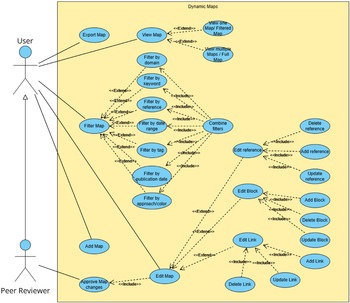
The Use Case diagram, on Figure 2, highlights the interaction between two primary actors, namely the User and the Peer Reviewer. The Peer Reviewer inherits all use cases from the User, as depicted by the arrow between them. This means that the Peer Reviewer shall have all the capabilities mentioned in for the User, with the added capability of reviewing changes made to the existing representation.
Use Case diagram for the Dynamic Database
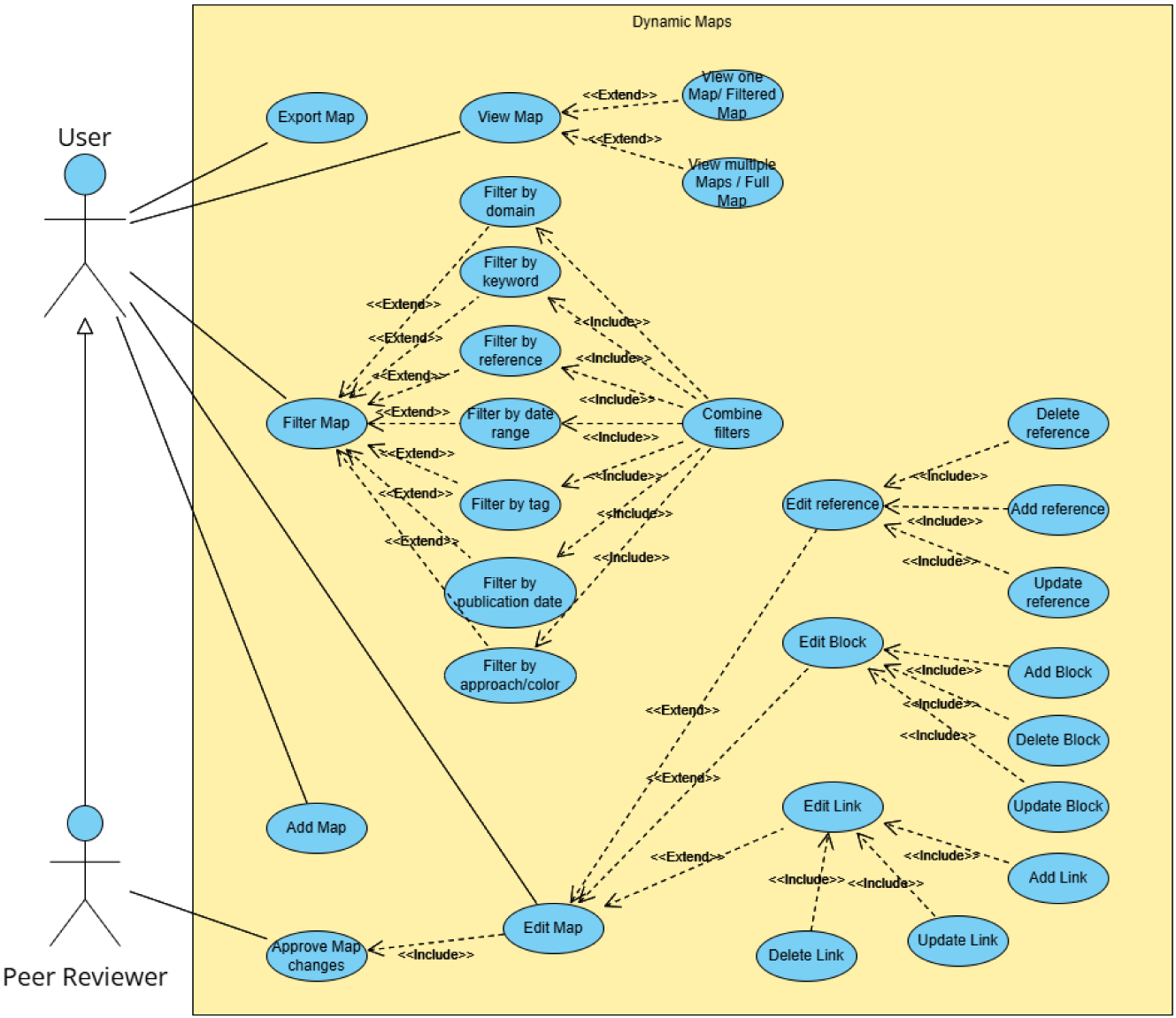
The Dynamic Database offers various functionalities related to the management of dynamic maps, which are grouped under functions like filtering, editing, and map management. The User interacts with the database primarily through functions such as viewing, filtering, and editing maps. The ability to filter the maps by different criteria – such as domain, keyword, or publication date – allows users to tailor the visualisation according to their needs. This flexibility is extended through combinations of filters, giving users the possibility to refine their queries and focus on specific subsets of the map.
On the other hand, the Peer Reviewer engages with the database from a different perspective, primarily focusing on the approval and validation of changes made by the user. This includes approving updates to maps, references, blocks, and links. The Peer Reviewer ensures that any changes made to the Dynamic Database align with predefined standards and contribute positively to the repository. Both actors benefit from the database's dynamic architecture, which supports real-time updates and visualisations. The Use Case diagram not only shows how these interactions occur but also clarifies the extensibility of the database, indicating that new functionalities can be added as the database evolves. The diagram effectively communicates the processes by which maps can be manipulated, filtered, and refined, emphasising the database’s capacity to adapt to the needs of its users while maintaining academic rigour. By presenting these UML diagrams, readers can better understand how the database is structured – through the Class Diagram – and how it operates – through the Use Case diagram. Each figure complements the other, providing a comprehensive view of both the database’s architecture and its user interactions. The next section expands on the core functionalities in line with the UML design.
4.2. Core functionalities of the Dynamic Database
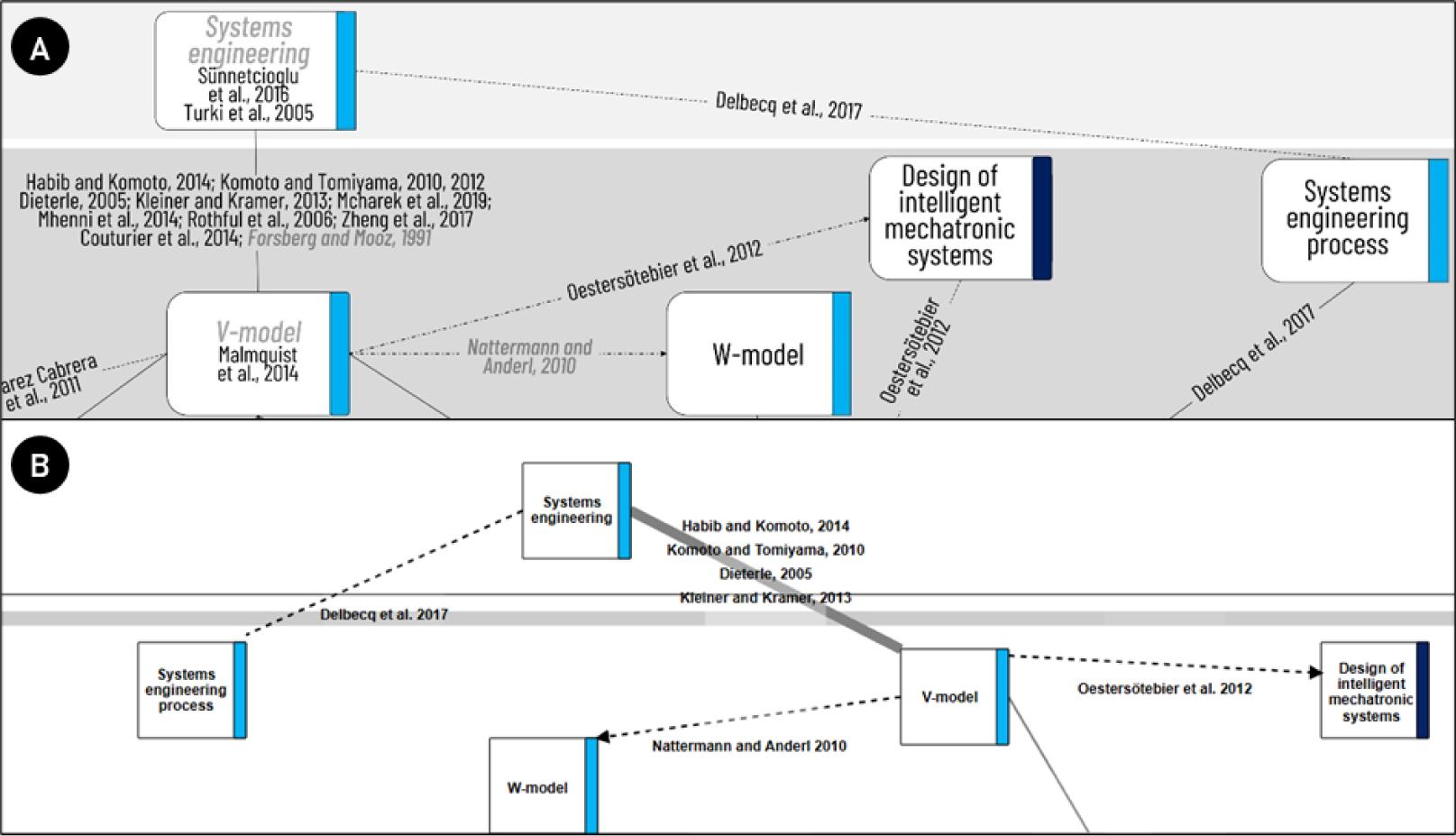
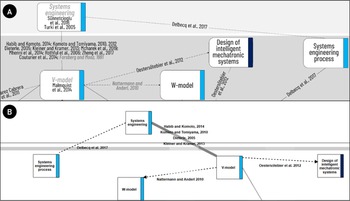
As represented on Figure 2, the core functionalities of the database aim to provide a filterable and modifiable representation that fetches data in real-time and updates according to the User's inputs. These functionalities propose a solution to satisfy the design criteria and, by extension, the main objectives of the research project. The View, Filter and Edit functionalities are described in the following paragraphs. The View Map use case (Figure 2) outlines the ability of the database to correctly visualise all concepts and techniques, grouping them into their correct level (i.e., approach, process, method or tool), with their associated links and references. A side-by-side comparison of how the initial representation compares to the database's visualisation is shown in Figure 3. The emphasis is on the lossless association of information from the initial representation to the dynamic representation.
Comparison of initial representation in Guérineau et al. (Reference Guérineau, Bricogne, Rivest and Durupt2022) (A) with the proposed representation in the developed Dynamic Database interface (B)
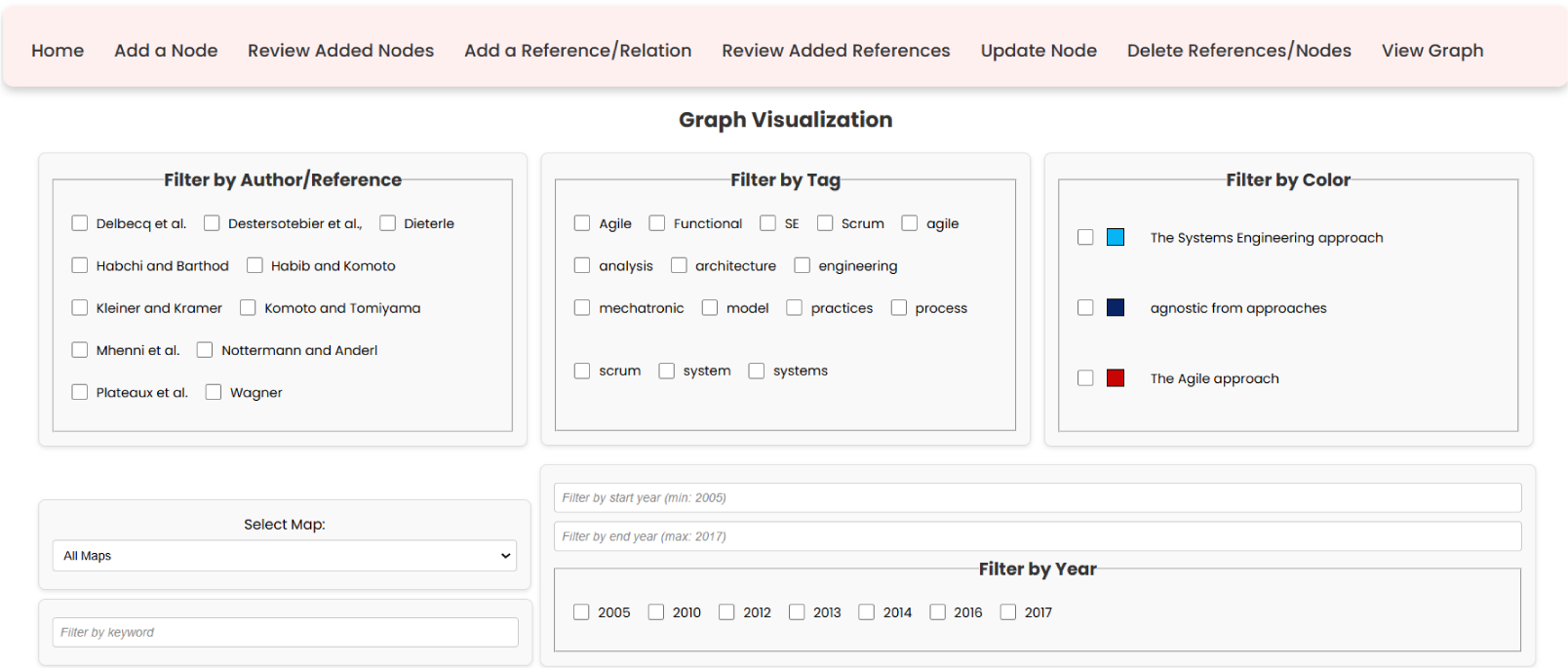
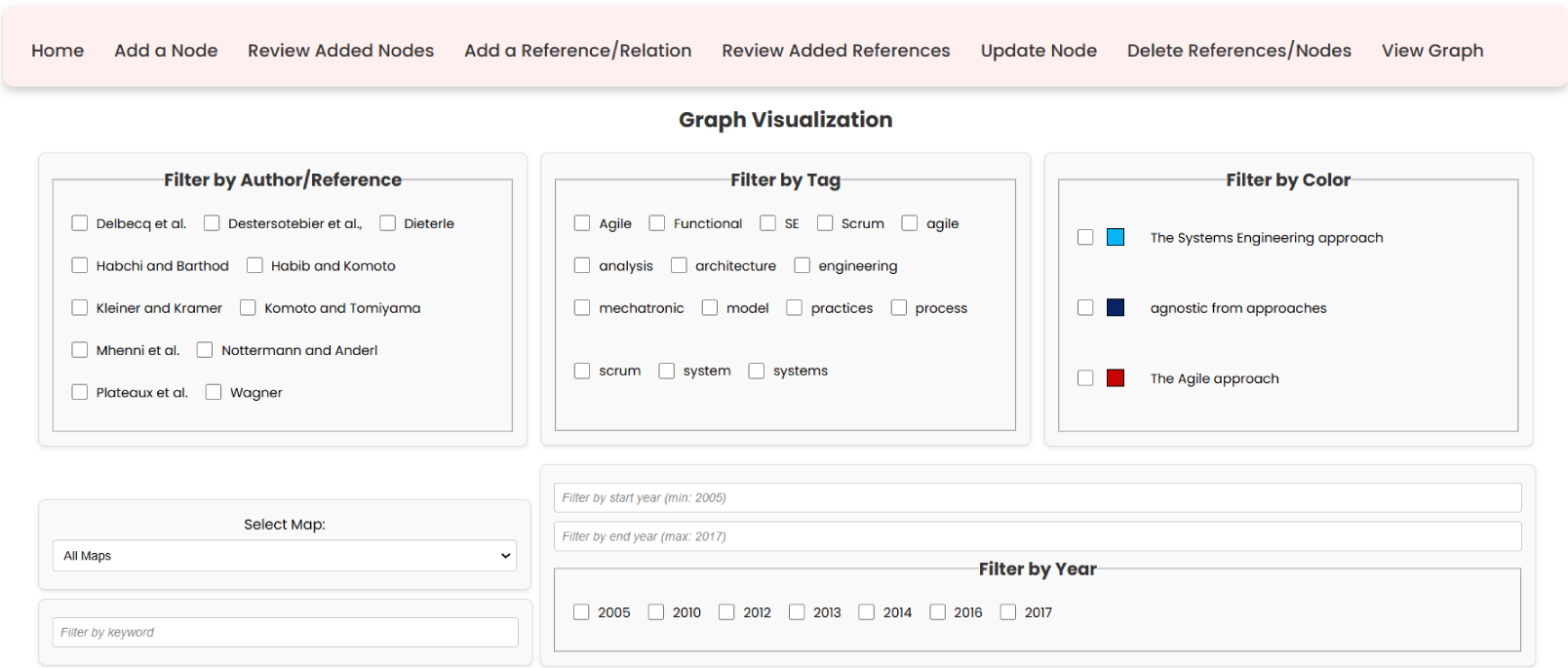
The Filter Map use case outlines the filtration of the concepts and techniques, their links and associated references inside the selected map (see Figure 4). Unlike taxonomy-based classification systems, which rely on predefined hierarchical categories and top-down filtering mechanism, the proposed one allows the User to select multiple criteria and customise their searches. This functionality enables users from both academia and industry to express their idea more thoroughly without the need to manually scan through every single concept or technique given. Instead, one can utilise the filtration capabilities of the database to extract a subset of concepts and techniques. Said capabilities are shown in Figure 4, allowing for a user-friendly way to filter the maps. The Filter by Author/Reference option allows selection of specific authors or references, while the Filter by Tag enables narrowing down by community-defined topics, e.g., analysis, or system architecture. Filter by Color visually distinguishes between different product development approaches (Systems Engineering, Agile, agnostic, etc.). The Filter by Year and by Keyword options further refine results by time and specific terms extracted from the papers. The different filters can be combined, allowing the users to narrow down their search, navigate and export the resulting maps. Finally, the Navigation Bar, at the top of Figure 4, in light red, offers the possibility to add, delete, and modify blocks and references, which are key functionalities to the Edit Map use case discussed in the next paragraph.
Screen shot of the Dynamic Database showing all filtration options available
The Edit Map use case (Figure 2) outlines the intent to create an updateable repository of concepts and techniques, in line with the second main objective. To reflect the evolution of the domain and the new literature pertaining to MPD, the database needs to be maintained and sustained for the long-term benefit of academia and industry. In this regard, a peer-reviewing system that would allow Users of the database to propose additions and modifications to concepts and techniques, their links and references is proposed. These changes will then go through a “review” process. The purpose of this review is to ensure that all references are valid and correctly cited, and that the proposed changes are consistent with the original content of the referenced papers, accurately reflecting the concepts and techniques discussed, and the associated links. Such a review process is intended to minimise conflicting contributions. This review process will involve a Peer Reviewer (Figure 2), for instance, an “expert” user such as a researcher with the relevant expertise. Said Peer Reviewer will have access to this set of reviewable blocks and references, and will have the additional capability of approving or denying such changes. The Peer Reviewer will also be able to modify and delete existing blocks and references to eliminate any discrepancies they may find. To ensure only trusted users are provided with such sensitive permissions, and to avoid any unnecessary changes to the representation, user authentication is divided into two separate streams. A first stream, relying on a Firebase user authentication, will be for the general public, allowing them to create an account. Such Users shall gain access to display, filter and export the map. However, these Users may only be allowed to propose changes to the existing maps with no power to modify the real-time representation in the repository. Accordingly, these proposed changes will not be visible in the current real-time representation of the map and will be temporarily stored until verified by a Peer Reviewer. The latter is identified thanks to an ORCID account that will be used to login via the second stream. Any approved changes by the Peer Reviewer will be committed into the database, and the changes will be visible and live to every other user that accesses the database. This set of functionalities provides a database that can benefit the research community, and aid in the industry.
5. Discussion and perspectives
Previous sections presented the proposed Dynamic Database through its architecture, its uses cases and core functionalities. This section discusses the positioning relative to existing repositories, as well as the design choices and implications for research and industry, before addressing the opportunities for improvement.
5.1. Relation to other repositories and initiatives
The Dynamic Database differs from repositories discussed by Reference Mayookh, Srinivasan, Chakrabarti and SinghMayookh & Srinivasan (2023). Notably, it is both community-driven and web-based, whilst also integrating peer-review and multi-criteria filtering mechanisms. Furthermore, it aims to cover a broader range of concepts and techniques, organised from approach to tool level, with a focus on MPD. In contrast, the identified repositories tend to focus on specialised design methods, such as human-centred design methods or usability (Reference Gericke, Kramer and RoschuniKramer et al., 2017; Reference Mayookh, Srinivasan, Chakrabarti and SinghMayookh & Srinivasan, 2023). Another distinctive feature is the emphasis on the graphical representation of concepts and techniques and their links from peer-reviewed papers from the scientific literature. In this respect, and to the authors' knowledge, this is an original direction. However, some of the limitations highlighted by Reference Gericke, Kramer and RoschuniGericke et al. (2016) remain unaddressed at this stage. Complementarily, other features included in the identified repositories such as the integration of empirical data, support for the application of concepts and techniques, or glossaries, also stand out as future opportunities.
5.2. Design choices: selecting graph database over ontology
Whilst the comparison tends to favour the performance of graph databases for this project, the opportunity cost of preferring said representation over ontology needs to be discussed as well. The decision to prioritise query performance, dynamic representation, and scalability by choosing a graph database comes at the cost of the advanced semantic reasoning and in-depth knowledge representation that ontologies can offer. This trade-off may impact the richness of data representation, which could be a concern for certain research applications. However, the scalability and flexibility of graph databases make them better suited for handling large volumes of data. In future work, the integration of ontologies into the Dynamic Database (Reference Ben Mahria, Chaker and ZahiBen Mahria et al., 2021) could create a hybrid solution that combines the semantic insights of ontologies with the powerful capabilities of graph databases, addressing the limitations of both representations. Such an integration could lead to a more complete solution, benefiting both research and industry by providing rich semantic data along with enhanced performance and scalability.
5.3. A research perspective: importance of the researchers' contribution
From a research perspective, the proposed Dynamic Database can be envisioned as a proof of concept for graphically organising and sharing knowledge on concepts and techniques and how they can be linked. These links are manually extracted from the research papers. Therefore, the role of researchers in contributing, maintaining and evolving the proposed Dynamic Database is critical for its long-term viability and remains a major limitation to the proposed work. Indeed, the Dynamic Database requires the collaboration and willingness of researchers to adopt this database, and contribute to it. In turn, this up-to-date database can be utilised by the same community as a collaborative database for searching, filtering, analysing and exporting query results. The latter could help the research community to identify research gaps, trends or consensus on the use of concepts and techniques. Concurrently, further work is required to investigate the researchers' willingness to adopt it, and collaborate around it, which could be done through workshops and focus groups (Reference Caillaud, Rose and GoeppCaillaud et al., 2016). This collaboration could eventually be consolidated through institutional partnerships and endorsed by a community of practice. A similar investigation should be concurrently considered with the industry, which might have different interests for the project, as discussed below.
5.4. An industry perspective: the selection mechanism
Part of the interest for the industry to use the Dynamic Database would be to support them in the selection of the concepts and techniques to be used for their MPD. The proposed database currently relies on the user’s expertise to that extent. In that sense, a potential improvement would be to implement one of several selection mechanisms to elevate the usability. For instance, the selection mechanisms through designers' needs (Reference López-Mesa, Thompson, Folkeson, Gralen, Norell and SellgremLópez-Mesa & Thompson, 2003), or through project and organisational context (Reference Hollauer, Becerril, Kattner, Weidmann, Chucholowski, Lindemann, Chakrabarti and ChakrabartiHollauer et al., 2017) could be implemented in future work. For the moment, an alternative solution is using the tag-based filtration.
5.5. Limitations and future steps
In addition to the points discussed above, several key steps are considered for future work. From a technical standpoint, over time, as the volume of data in the repository is expected to grow, ensuring horizontal scalability will be crucial. To address horizontal scalability as the database grows, future work should focus on optimising query performance and expanding database architecture.
The UML class and use case diagrams outlined the technical design of the Dynamic Database and its core functionalities, reflecting the initial vision of the research team. Future steps include evaluation and design iterations in collaboration with future users. For instance, the user-interface (UI) and the user-experience (UX) remain limited at this stage, and their improvement will certainly contribute to a better usability and adoption from both research and industry. Users' feedback can be obtained through pilot testing and focus groups, ensuring that the project evolves to meet the needs of its intended users. Finally, the integration of artificial intelligence is a natural future step to enhance the filtration.
6. Conclusion
The project is a preliminary step towards establishing a foundation for a community-driven database to represent concepts and techniques for MPD. First, three data representations, namely ontologies, graph databases and relational databases are compared. This comparison is supported by criteria derived from the sub-objectives, which in turn support the two main objectives of the project. The comparison highlighted the suitability of graph databases for the project criteria. To illustrate this, a UML Class Diagram and a Use Case diagram are presented to outline the architecture and core functionalities of the Dynamic Database. These include features such as viewing, filtering, and updating maps to enhance data exploration and analysis, thereby supporting further insights. Some of these functionalities are illustrated through various screenshots of the Dynamic Database in parallel with its original representation, showing improvements in usability and enhanced filtering capabilities. These visual examples serve as a proof of concept, demonstrating the feasibility and potential of the community-driven database. In line with this community aspect, the importance of researchers in participating in and maintaining the database is emphasised. Indeed, their contributions, through peer-reviewed additions, will help the database to follow the evolution of the research work proposed by the community, enabling a greater impact on both research and industry.
Acknowledgments
The authors are grateful to Professors Matthieu Bricogne and Louis Rivest for their valuable contributions to the development of ideas and concepts. This work has been funded by Mitacs Globalink Research Internship (GRI) program.
Supplementary material
The code of the proposed Dynamic Database, its associated technical documentation and a demonstration video are publicly available on GitHub (Reference Bilal and GuérineauBilal & Guérineau, 2025).

 Open access

