


1 Introduction
Having however many children you want should have been an individual’s right … But still, the one-child policy does have more benefits: Without it, women face much greater troubles at the workplace. Repealing [the one-child policy] intensifies the troubles.”
With the universal two-child policy, we women are now in trouble.
Childless women are already facing a lot of obstacles when we try to get hired. Now that there is the universal two-child policy, our troubles grow. The new [universal two-child] policy is even more hostile toward woman.
The universal two-child policy took away women’s most basic right of not being discriminated against at work.
Each from her own perspective, Yunfan, Shali, Dian, and Aijia described how the cessation of China’s decades-long one-child policy had impacted them. In October 2015, during the fifth plenary session of the eighteenth Chinese Communist Party Central Committee – a four-day, high-level strategy meeting – the Chinese party-state leadership announced a major transition in China’s population control program: Starting January 2016, a universal “two-child policy” would go into effect, permitting all married couples in mainland China to have a maximum of two children. In 2021, the birth quota was again increased to three. In our conversations, Yunfan, Shali, Dian, and Aijia, despite their differences in marital and childbearing status, all saw themselves as firm believers in gender egalitarianism and proponents for women’s autonomy and advancement. All four women also favored the highly draconian, state-imposed one-child birth quota, viewing its repeal as profoundly detrimental to women. Why?
The tension between employment and motherhood – and its myriad political implications – has remained a central focus of the gender inequality scholarship. Globally, as women’s labor force participation continues to trail that of men, a robust literature foregrounds the gendered work–family conflict as a key driver of such gap. Here, the gendered work–family conflict has primarily been conceptualized and operationalized as an incompatibility of commitments: Modern-day professional work and motherhood are both “greedy institutions” that demand intensive involvement and constant availability (Coser Reference Coser1974; Hays Reference Hays1996; Percheski Reference Percheski2008). Numerous studies have documented how women navigate time and flexibility constraints that stem from the competing norms and demands of “ideal worker” and intensive mothering (e.g., Blair-Loy Reference Blair-Loy2003; C. Collins Reference Collins2019; Correll et al. Reference Correll, Kelly, O’Connor and Williams2014; Damaske Reference Damaske2011; Gerson Reference Gerson1985, Reference Gerson2010; Hays Reference Hays1996; Hochschild Reference Hochschild1989, Reference Hochschild1997; Stone Reference Stone2007). Yet, as the vignettes at the opening of this Element suggest, there seemed to be something else – beyond commitments, demands, and tasks – at odds, as these young Chinese women narrated the tension they felt in employment and motherhood.
This monograph uncovers a second – distinctly political yet under-theorized – dimension of the gendered work–family conflict, which I term an incompatibility of rights. By explicitly connecting individuals’ lived experiences on the micro level to macro-level political forces and socioeconomic currents, I unpack women’s work–family experiences to reveal not only the juggling of commitments, but also the presence of a trade-off between the right to gender-equal employment and the “right to mother.” My use of the term “right” encompasses both its legal and moral dimensions (see Somers & C. Roberts Reference Somers and Roberts2008): By the right to gender-equal employment and the right to mother, I refer both to women’s civil rights in employment and reproduction as codified by the state (see e.g., Albiston Reference Albiston2005; Fox Reference Fox2019), as well as to what women, on the ground, experience and regard to be their entitlements as morally equal members of a society (see Somers Reference Somers2008).
To establish the incompatibility of rights as a meaningful concept for more fully capturing women’s work–family struggle and its political ramifications, I capitalize on China’s universal relaxation of the one-child policy since 2016. I marshal 115 in-depth interviews with young urban Chinese women and men who are making employment and childbearing decisions in the context of the state’s shifting birth planning policies.Footnote 1 I find that women who espouse gender egalitarian beliefs strongly support the state’s imposition of stringent birth restrictions. To understand such support, my analysis demonstrates that these young urban Chinese women have reported experiencing the expansion of their civil right to mother, via birth quota relaxation, as intensifying labor market gender discriminations and thus undermining the realization of their civil right to equal employment. My analysis further reveals that as coping strategies, these women have turned to what I call rights-trading – forfeiting the moral claim to one (either employment or motherhood) in their efforts to secure the other. As such, before even arriving at the tightrope walk between the competing commitments of employment and motherhood, these women see themselves as first confronted with a choice between prioritizing their right to equal employment or the right to mother. That is, these young urban Chinese women have come to perceive and experience their civil rights in employment and reproduction as two incompatible moral claims that are subject to a trade-off: Some women, especially those who hold gender egalitarian views and reject the male-breadwinning/female-caregiving labor division, have reached the point of supporting draconian state policy that limits childbearing, in the hope that women’s equal employment can be better realized under a more restrictive birth quota.
Articulating the dimension of incompatible rights contributes to gender inequality research by further clarifying what exactly is experienced as in conflict – and why – as women navigate their work–family lives. Doing so enables deeper examination of the political implications of women’s lived experiences as they negotiate the tension in the employment–motherhood nexus. In recent years, work–family scholars have begun to note the insufficiency when work–family issues are reduced in analyses to an incompatibility of commitments rooted in time and flexibility scarcity: Studies across national contexts, time and again, have found that even when flexible work arrangements are available, these workplace-level measures often still have limited impacts on enhancing work–family reconciliation (see e.g., Correll et al. Reference Correll, Kelly, O’Connor and Williams2014; Oh & Mun Reference Oh and Mun2022). Searching for solutions beyond the workplace, some work–family scholars have therefore called for placing the gendered work–family conflict more centrally into an analysis of politics and the state (e.g., C. Collins Reference Collins2019; J. Williams Reference Williams2010).
Indeed, the question of “why women still can’t have it all”Footnote 2 is as much a question of time and task management as it is of politics and policy: Across national contexts, feminist analyses of the state have sought to illuminate how various configurations of family and labor laws, policies, and policy-making may differentially promote or hinder maternal employment (e.g., Budig et al. Reference Budig, Misra and Boeckmann2012; Gornick et al. Reference Gornick, Meyers and Ross1997; Lewis Reference Lewis1992, Reference Lewis2009; Orloff Reference Orloff2017). Gender-inflected analyses by scholars of politics have consistently explored whether and how female labor force participation may, in turn, shape women’s political participation, representation, and attitudes (e.g., Andersen Reference Andersen1975; Andersen & Cook Reference Andersen and Cook1985; Burns et al. Reference Burns, Schlozman and Verba2001; Inglehart & Norris Reference Inglehart and Norris2003; Iversen & Rosenbluth Reference Iversen and Rosenbluth2006, Reference Iversen and Rosenbluth2008; M. Ross Reference Ross2008; Stockemer & Byrne Reference Stockemer and Byrne2012; Togeby Reference Togeby1994; Verba et al. Reference Verba, Burns and Schlozman1997). Underscoring the political consequences of women’s unpaid labor in the private sphere, scholars have demonstrated that the gender gap in political participation and representation is, in part, attributable to the unequal burdens of parenthood and caregiving that fall on women versus men (Iversen & Rosenbluth Reference Iversen and Rosenbluth2008, Reference Iversen and Rosenbluth2010).
However, despite having hinted at the inadequacy of overwhelmingly focusing on incompatible work–family commitments, the current literature has yet to systematically explicate any additional dimension of the gendered work–family conflict. This Element fills this gap. I ask: What, beyond competing commitments, do women experience as incompatible in their work–family lives – and why? To this end, I draw on insights from the gender and politics scholarship that disaggregate the state’s multiple logics, many roles, and uneven institutional changes in (re)configuring the sexual division of labor (Htun & Weldon Reference Htun and Weldon2017, Reference Htun and Weldon2018; K. Morgan & Orloff Reference Orloff2017; Orloff Reference Orloff2017). I situate the present study within the theoretical tradition that has endeavored to see gender, when tracing the relations between the state, market, and the citizenry (Folbre Reference Folbre1994; Orloff Reference Orloff1993, Reference Orloff2017; Young Reference Young2005). From the vantage point of post-one-child-policy China, I theorize two generalizable conditions. These two conditions, I argue, have undergirded women’s work–family experiences as an incompatibility between the right to gender-equal employment and the right to mother.
Condition 1: The state upholds gender essentialist family and labor policies that feminize care work and entrench women’s primary roles as caregivers, while actively regulating women’s reproduction. Women feel unable to effectively call on the state for rights protection, when faced with labor market discriminations and exclusions.
Condition 2: Seemingly neutral market mechanisms of exchange and market principles of efficiency and profit, promoted by the state, take on a normative primacy as individuals make sense of their lifeworld.
These two conditions speak to the gender logic that organizes the state’s family–labor and reproductive policies and the entwinement between the state and market. In the pages ahead, I will demonstrate how these two conditions manifest in young urban Chinese women’s quotidian lives, structuring the ways in which they make work–family choices at the micro level. I will illustrate how, in contemplating the prospect of “having it all,” these women have come to see themselves in relation to the state and the market order, all the while envisioning the possibility and pathways toward a gender-equal future.
Throughout, I pay special attention to the macro-micro linkage that connects political and institutional forces, on the one hand, and women’s day-to-day constraints, negotiations, and decision-making at home and at work, on the other (see also Iversen & Rosenbluth Reference Iversen and Rosenbluth2010). In her influential essay, Iris Young (Reference Young2005) called for closer considerations of the relationship between lived bodies and social structures – as “a way of articulating how persons live out their positioning in social structures along with the opportunities and constraints they produce” (Young Reference Young2005: 13). In excavating the incompatibility of rights as a distinct dimension of the gendered work–family conflict – and theorizing these two conditions – from the lived experiences of young women confronting authoritarian China’s pro-natalist turn, I attempt to take up Iris Young’s call.
Major population policy change in contemporary China, an autocracy with neoliberal features (see e.g., Naughton & K. Tsai Reference Basu2015), provides a context in which the above two conditions have become highly salient, thereby making the incompatibility of rights – the often-obscured political dimension in women’s lived work–family experiences – more readily observable. As the subsequent analysis will show, the incompatibility of rights, as a theoretical concept and an analytical category, is relevant beyond authoritarian China. I will demonstrate the concept’s portability and usefulness for analyzing (the politics of) gendered work–family experiences, particularly among marginalized groups, in high-income democracies like the United States.
2 Theorizing the Gendered Incompatibility of Rights
I begin with a consideration of the recent development, as well as the remaining gap, in the work–family literature: Work–family scholars’ empirical analyses of the flexibility stigma and workplace pregnancy discrimination have alluded to, but stopped short of establishing, the rights dimension of the gendered work–family conflict. To this end, insights from the gender and politics scholarship provide useful theoretical infrastructure for explicating the gendered incompatibility of rights and its conditions of possibility. At the end of this section, before turning to the empirical case, I define my use of the term “right.”
2.1 Work–Family Conflict: From Commitments to Rights
Extensive work–family analyses, across national contexts, have approached the tension between modern-day employment and contemporary motherhood as an “overload” of competing demands (Kelly & Moen Reference Kelly and Moen2020). On the one hand, to be an “ideal worker” (Acker Reference Acker1990) in the modern workplace requires one to prioritize work above all else, devote long hours, and be always available (Correll et al. Reference Correll, Kelly, O’Connor and Williams2014; J. Williams Reference Williams2000). On the other hand, the prevailing normative expectation of intensive mothering means that motherhood too demands a woman’s perpetual availability, undivided attention, and unwavering, sacrificial devotion (Hays Reference Hays1996). Writing on contemporary East Asia, scholars have similarly documented the highly salient and durable workplace norms that treat overwork as a marker of an employee’s efforts and loyalty (Brinton & Oh Reference Brinton and Oh2019; Choe et al. Reference Choe, Bumpass and Tsuya2004; Yashiro Reference Yashiro2011). Gender scholars on East Asia have consistently demonstrated that the ethos of intensive mothering figures prominently in the expectations of contemporary East Asian motherhood (Ochiai & Molony Reference Ochiai and Molony2008; Oh Reference Oh2018; Zhou Reference Zhou2020). With women caught between these two irreconcilable norms of ideal worker and intensive mothering, scholars have identified one of the key push factors underlying highly educated women’s retreat from professional work: workplace conditions that demand long hours and offer little flexibility (Brinton & Oh Reference Brinton and Oh2019; Cha Reference Cha2013; Stone Reference Stone2007).
However, if the gendered work–family conflict is indeed reducible to an issue of incompatible commitments, driven by time and flexibility shortages, we might expect measures that offer workplace flexibility accommodations and family leaves to substantially alleviate, if not solve, the problem. And yet, drawing on single-country and comparative cases, work–family researchers have repeatedly demonstrated that provisions of flexible work arrangements and family leaves are often still insufficient (e.g., Brinton & Oh Reference Brinton and Oh2019; Correll et al. Reference Correll, Kelly, O’Connor and Williams2014).
One major hindrance is the flexibility stigma (Cech & Blair-Loy Reference Cech and Blair-Loy2014; J. Glass Reference Glass2004; J. Williams Reference Williams2000). That is, even when work–family policies are available, many workers are still reluctant to seek these accommodations because using such policies often results in organizational penalties (Blair-Loy & Wharton Reference Blair-Loy and Wharton2002; Jacobs & Gerson Reference Jacobs and Gerson2004; Munsch et al. Reference Munsch, Ridgeway and Williams2014). For example, extensive evidence from the United States has shown that workers who utilize work–family accommodations are more likely to encounter poorer performance evaluations (Wharton et al. Reference Wharton, Chivers and Blair-Loy2008), experience slower wage growth (Blair-Loy & Wharton Reference Blair-Loy and Wharton2002; Budig & England Reference Budig and England2001; Coltrane et al. Reference Coltrane, Miller, DeHaan and Stewart2013; J. Glass Reference Glass2004), receive fewer promotions (Cohen & Single Reference Cohen and Single2001), and be perceived as less driven, committed, and professional (Cech & Blair-Loy Reference Cech and Blair-Loy2014; Epstein et al. Reference Epstein, Seron, Oglensky and Saute1999). Turning to East Asia, studies have similarly documented the prevailing workplace norms of face time and long work hours, which effectively deter employees’ utilization of available leaves and accommodations (e.g., Brinton & Mun Reference Brinton and Mun2016; Brinton & Oh Reference Brinton and Oh2019; Choe et al. Reference Choe, Bumpass and Tsuya2004; Yashiro Reference Yashiro2011). Recent research further found that women workers, in particular, often feel the need to prove their “deservingness” when accessing parental leaves, and they do so by showing even greater work devotions (Oh & Mun Reference Oh and Mun2022).
Moreover, the tension between employment and motherhood is not solely confronted by women who are already mothers with caregiving responsibilities. A case in point is the persistent and prevalent workplace pregnancy discrimination documented across countries, often despite its illegality (Bornstein Reference Bornstein2011; Byron & Roscigno Reference Byron and Roscigno2014; Edwards Reference Edwards1996; C. Glass & Fodor Reference Glass and Fodor2011). For example, studies from the United States have shown that despite laws on paper such as the Pregnancy Discrimination Act, women remain vulnerable to pregnancy-based firing, as employers deploy ostensibly meritocratic logics in order to undermine pregnant women’s competencies at work: Employers justify such discriminatory practices by painting pregnant workers (and their bodies) as hormonal, unmanageable, and disruptive – pitting these workers’ benefits against organizational goals and business profits (Byron & Roscigno Reference Byron and Roscigno2014).
Flexibility stigma and pregnancy discrimination both point to what scholars of politics and law have long been concerned with: the disjuncture between the rights available on paper versus accessible in practice (Albiston Reference Albiston2005). Flexibility stigma highlights that despite formal work–family policies and legally defined parental benefits, workers often still need to establish their moral entitlements and/or navigate insidious consequences when accessing these provisions (e.g., Cech & Blair-Loy Reference Cech and Blair-Loy2014; Oh & Mun Reference Oh and Mun2022). Pregnancy discrimination demonstrates that even with anti-discrimination legislation, pregnant workers have remained vulnerable to workplace discriminations that are largely undergirded by entrenched ideal worker norms (e.g., Byron & Roscigno Reference Byron and Roscigno2014; Gatrell Reference Gatrell2011). Taken together, both cases suggest the necessity of a rights-inflected analysis of the gendered work–family conflict, one that moves beyond compressing women’s lived experiences and decision-making in employment and motherhood into a single-dimensional negotiation of incompatible commitments.
The state plays crucial roles in delineating women’s rights and entitlements – or the lack thereof – in production and reproduction (Brulé Reference Brulé2023; Htun & Weldon Reference Htun and Weldon2018). In recent years, work–family researchers have begun to more seriously engage with the gendered analyses of politics and the state (see e.g., C. Collins Reference Collins2019, Reference Collins2020; J. Williams Reference Williams2010). For example, writing on the United States, Joan Williams (Reference Williams2010) opened with the following argument:
Work-family issues have not been placed at the center of an analysis of U.S. politics, but it is time to rethink the assumption that they do not belong there.
To systematically excavate the rights dimension in women’s lived experiences of the gendered work–family conflict, I thus turn to insights from the gender and politics scholarship in order to theorize its conditions of possibility.
2.2 Bringing the State Back in Work–Family
How a woman experiences the work–family conflict – and what options and recourse are available to her while navigating it – depends on the opportunities and constraints that are shaped by the institutional and policy conditions of her inhabited world (C. Collins Reference Collins2019; Folbre Reference Folbre1994; Iversen & Rosenbluth Reference Iversen and Rosenbluth2010). Bringing gender to bear on the analyses of political and economic institutions, social scientists have devoted considerable efforts to deciphering how different family and labor regimes, mostly those of democratic welfare states, produce macro-level variations in women’s employment outcomes, from income and gender wage gap to trends of female labor force participation and patterns of gender-based occupational segregation (e.g., Anttonen & Sipilä Reference Anttonen and Sipilä1996; Budig et al. Reference Budig, Misra and Boeckmann2012; Daly & Lewis Reference Daly and Lewis2000; Gangl & Ziefle Reference Gangl and Ziefle2009, Reference Gangl and Ziefle2015; Korpi Reference Korpi2000; Leira & Saraceno Reference Leira and Saraceno2002; Lewis Reference Lewis1992, Reference Lewis2009; Orloff Reference Orloff1993, Reference Orloff2009, Reference Orloff2017; Pedulla & Thébaud Reference Pedulla and Thebaud2015; Sainsbury Reference Sainsbury1999).
In particular, empirical studies have recurrently debated whether there exists a “welfare state paradox”: that is, generous family policies may in fact negatively impact women’s employment outcomes at the aggregate level, marking women as the less productive workers distracted by family responsibilities and relegating women to female-typed occupations with low prestige and authority (Hegewisch & Gornick Reference Hegewisch and Gornick2011; Mandel Reference Mandel2012; Mandel & Semyonov Reference Mandel and Semyonov2006; Mun & Jung Reference Mun and Jung2018). Envisioning the “real utopias” of gender equality, feminist scholars have contended with whether lengthy care leaves may indeed further exacerbate women’s unequal burdens and time at home, thereby weakening their labor market attachment and limiting their career advancement prospects (see e.g., Bergmann Reference Bergmann2009 in response to Gornick & Meyers Reference Gornick, Meyers, Gornick and Meyers2009).
To scholars of gender and politics, women’s equal access to employment is an important benchmark of women’s inclusion into public life as full rights-bearers (Hobson Reference Hobson1990, Reference Hobson1994; Htun & Weldon Reference Htun and Weldon2017; Orloff Reference Orloff1993, Reference Orloff2017). As a case in point: Gender-inflected analyses by political scientists, over the past several decades and across national contexts, have increasingly crystallized the significance of female employment in shaping women’s power and empowerment in the political arena, impacting a broad spectrum of outcomes such as women’s political preference and voting behavior (e.g., Abendschön & Steinmetz Reference Abendschön and Steinmetz2014; Inglehart & Norris Reference Inglehart and Norris2000; Iversen & Rosenbluth Reference Iversen and Rosenbluth2006; Verba et al. Reference Verba, Burns and Schlozman1997), political participation and female political representation (e.g., Chhibber Reference Chhibber2002; Jardina & Burns Reference Jardina and Burns2016; Rosenbluth et al. Reference Rosenbluth, Salmond and Thies2006; Schlozman et al. Reference Schlozman, Burns and Verba1999; Stockemer & Byrne Reference Stockemer and Byrne2012), and public opinions about gender (e.g., Burns et al. Reference Burns, Jardina, Kinder and Reynolds2015; J. Morgan & Buice Reference Morgan and Buice2013). Female employment produces, reflects, and is reinforced by societal-level cultural and norm changes with respect to gender roles (see e.g., Inglehart & Norris Reference Inglehart and Norris2000; M. Ross Reference Ross2008), while endowing women with the human capital, civic skills, and household bargaining power necessary for political engagement (e.g., Iversen & Rosenbluth Reference Iversen and Rosenbluth2010; Schlozman et al. Reference Schlozman, Burns and Verba1999).
As such, an adequate explication of the gendered work–family conflict must recognize its inherently political tenor, as well as the fundamental roles the state plays in setting “the rules of the game” in employment, family, reproduction, and parenthood. I therefore draw on the following two lines of theoretical insights from the gender and politics scholarship, both of which are especially illuminating for elucidating the rights dimension in women’s lived experiences of the gendered work–family conflict.
First, scholars of gender and politics have underscored the necessity of disaggregating the state’s “many hands” and varying logics in (re)configuring the gender system and women’s roles (see K. Morgan & Orloff Reference Orloff2017). Joyce Gelb and Marian Lief Palley (1996) made the crucial distinction between the state’s gender policies that are aimed at role change vis-à-vis those promoting “role equity.” While role equity policies may seek to extend certain rights and privileges now also to women, these policies do not challenge, nor do they intend to transform, the underlying institutional and normative underpinning that typecasts women’s roles as wives, mothers, and caregivers (Gelb & Palley Reference Gelb and Palley1996; Palley Reference Palley1982). In a similar vein, feminist legal scholars have collectively revealed that when legal efforts to overturn discriminations are rooted in the logic of gendered “legal protection,” womanhood is still imbued with an imagined, gender essentialist fragility deemed incompatible with full rights and subjectivity (e.g., Basu Reference Basu2015; Bumiller Reference Bumiller1987). One prime example in this regard is laws and workplace rules that “safeguard” women, especially women’s reproduction, from “dangerous” occupations (see Basu Reference Basu2015). Along the same line, writing on how the state may (re)shape the sexual division of labor, Ann Orloff (Reference Orloff2017) theorized that the state’s transformation of gender essentialist labor division consists of two processes: on the one hand, a destructive process that undermines laws and policies foundational to the male-breadwinning/female-caregiving role and labor division (i.e., what Gelb and Palley would describe as role change); and on the other hand, a constructive process that strengthens support for maternal employment (Orloff Reference Orloff2017: 133).
Taken together, in theorizing the gendered incompatibility of rights from young urban women’s lived experiences in contemporary China, I thus pay special attention to explicitly articulating the gender logic and imaginary with respect to women’s roles and bodies – be it gender essentialist, pro- (women’s) work, gender protectionist, or any of the combinations – that are enshrined in the state’s legal apparatus governing employment, family, and reproduction. I demonstrate how such gender logic, on the macro level, may undergird the challenges and obstacles that these young women confront in their work–family lives, shaping the conditions and constraints within which these women, on the micro level, make decisions about employment and motherhood.
Second, scholars of gender and politics have highlighted that the way in which the state may (re)shape the gender order both depends on and has the capacity to alter the various configurations of the relations between the state, on the one hand, and a multitude of institutions (e.g., market, church, family, etc.), on the other. For example, in delineating how the state may advance women’s rights from a global comparative perspective, Mala Htun and S. Laurel Weldon (Reference Htun and Weldon2010, Reference Htun and Weldon2017) constructed a particularly useful typology of the state’s gender-related policies. Here, a key dimension is whether these policies seek to empower all women as a status group, or address gender inequality as inflected by class inequality (Htun & Weldon Reference Htun and Weldon2017: 160). According to this schema, gender-status policies, such as laws targeting violence against women, advance women’s rights by providing reliefs and remedies for sexist harms: that is, injustices inflicted upon women as a status group – “particular kind of bodies” that are devalued and rendered as “other.” Class-based policies, such as government-funded childcare, advance women’s – especially economically disadvantaged women’s – equality by way of (re)shaping the relationship between the state and market (see Htun & Weldon Reference Htun and Weldon2017: 163–164).
As Htun and Weldon (Reference Htun and Weldon2010) succinctly noted, “gender policy involves not one issue but many and each issue involves different actors and conflicts” (p. 208). In particular, on the politics of care and sexual division of labor, a rich and long lineage of scholarship has collectively centered the state-market relation – articulating the varied implications for gender (in)equality that arise from its different arrangements across time and place (see Hearn & Hobson Reference Hearn, Hobson, Janoski, de Leon, Misra and Martin2020 for a review). Within the scope of this monograph, I emphasize the entwinement between state- and market forces. I seek to concretize how the entanglement between the state and market plays out in women’s quotidian lives negotiating employment and motherhood.
Motivated by these two lines of theoretical insights, I have arrived at the following two conditions. These two conditions, I argue, undergird women’s lived experiences of the gendered work–family conflict along the dimension of incompatible rights:
Condition 1: The state upholds gender essentialist family and labor policies that feminize care work and entrench women’s primary roles as caregivers, while actively regulating women’s reproduction. Women feel unable to effectively call on the state for rights protection, when faced with labor market discriminations and exclusions.
Condition 1 explicitly considers the gender logic – and the imaginary of women’s roles and bodies – underlying the state’s family–labor and reproductive policies. When the state’s family and labor policies are organized around the logic of gender essentialism, the state sees women primarily as caregivers, and what women face in the labor market becomes a secondary concern. As this Element will later demonstrate, even with laws on paper that have ostensibly formalized Chinese women’s civil right to equal employment, the state’s gender essentialist family and labor policies provide incentives and have become justifications that employers readily draw on, with great impunity, for their gender exclusionary practices. Meanwhile, the state’s intervention into women’s reproduction, rooted in similarly essentialist conceptualization of women as mere reproducing bodies, has simultaneously engendered a sense of pervasive precarity among young Chinese women. That is, these women have come to see their rights as tenuous and revocable, subject to the state’s will and whim. Feeling that they have little real, effective recourse for rights protection from the state, these young Chinese women thus turn to individualistic strategies of rights-trading: for instance, promising to delay and limit childbearing in the hope of securing employment. As a result, women, including those who are not already mothers, have reported experiencing the gendered work–family conflict as an incompatibility between realizing their civil right to equal employment vis-à-vis exercising their civil right to mother.
Condition 2: Seemingly neutral market mechanism of exchange and market principles of efficiency and profit, promoted by the state, take on a normative primacy as individuals make sense of their lifeworld.
Condition 2 considers the state-market relation, highlighting its micro-level manifestation and implications: Work–family scholars have firmly established that the gendered conflict in employment-motherhood commitments is a product of the contemporary neoliberal workplace, where business profits are prioritized, “ideal workers” are expected, and social provisions are distributed by the market and based on market principles (see C. Williams Reference Williams2013). As my data and analysis will soon demonstrate, when the state actively endorses and promotes such market principles of efficiency and profit, market mechanisms and principles are elevated to a normative primacy – becoming a touchstone that individuals use to make sense of, and make judgements about, their social realities. For example, I will show that my respondents, on both the labor supply and demand sides, largely regard using a woman’s childbearing intention to make hiring decisions as “the right thing to do” because doing so is “good for business;” and newly hired women who soon move on to childbearing are often chastised for “being selfish and deceptive.” In this sense, the gendered incompatibility of rights exists at two registers: As women experience the trade-off between realizing their civil right to equal employment and the civil right to mother, they have further come to regard employment and motherhood as two incompatible moral claims of entitlement that are subject to an exchange.
2.3 Beyond Wealthy Democracies: Why Theorize from the Chinese Case?
In the pages to follow, I will introduce the Chinese context in greater details. In many ways, China presents an important empirical case in itself: With a remarkably resilient authoritarian system and a socialist legacy, contemporary China, at the same time, is deeply embedded within the global capitalist order. Despite the dramatic socioeconomic transformations that have unfolded across China over the past several decades, the world’s second largest economy (and the largest manufacturing country) is now embroiled in mounting challenges of population ageing, labor shortage, and possible economic stagnation. Against this backdrop, examining the contours and rhythms of contemporary Chinese young adults’ work–family lives – understanding, with greater nuance, the choices they make and the constraints they face – is significant in its own right.
Moreover, the Chinese case further provides a fruitful ground for theory generation, filling the lacuna left by current literature’s overwhelming focus on wealthy democracies. Extant micro-level work–family research has long privileged the experiences of middle-class, professional, married, heterosexual (White) mothers in the democracies of the Global North (Dow Reference Dow2019). Meanwhile, macro-level feminist analyses that seek to typologize various family and labor regimes – and their varied implications for motherhood and female employment – have also largely coalesced around the cases of high-income democratic (welfare) states.
However, what the state can do for and unto women – for example, the extent to which women can rely on the state for protections from (employment) discriminations – not only varies by regime types (see e.g., Gallagher Reference Gallagher2017), but is also shaped by power structures within a society that are often raced and classed (see e.g., Berrey et al. Reference Berrey, Nelson and Nielsen2017). Indeed, while married professional White mothers in rich democracies may well be seen as the frontline “miners’ canary” indicating troubles at many workplaces (Stone Reference Stone2007: 19), for these women, their right to mother per se is comparatively much less precarious and contested (Fox Reference Fox2019; D. Roberts Reference Roberts1997, Reference Roberts2002; L. Ross & Solinger Reference Ross and Solinger2017). As the following section will elaborate, authoritarian China provides a window into the kinds of work–family tension that women experience and negotiate, when the state’s actual protection of women’s civil rights in employment and motherhood cannot be assumed at face value. Studying China thus more saliently reveals the incompatibility of rights as a distinct dimension in women’s lived experiences of the gendered work–family conflict.
Establishing this rights dimension has implications that travel well beyond China. Analyzing the gendered work–family conflict primarily through the prism of incompatible employment-motherhood commitments takes for granted that women can already become mothers and workers. Yet, as reproductive justice scholars have pointed out, the right to mother has never been universally inalienable, even within democracies (L. Ross & Solinger Reference Ross and Solinger2017). For example, writing on poor and Black motherhood in the United States, scholars have shown that these historically disenfranchised women face great precarity and exclusion in exercising their right to mother, as a result of reproductive policies and anti-poverty programs that are shrouded in eugenicist and white supremacist logics (P. Collins Reference Collins1994; D. Roberts Reference Roberts1997, Reference Roberts2002; L. Ross & Solinger Reference Ross and Solinger2017). Turning to women’s right to equal employment, scholars of labor market discriminations have documented the prevalent hostility, harassments, and denials of legal rights of caregiving that women, especially women of color and low wage workers, encounter in workplaces upon getting pregnant (see Bornstein Reference Bornstein2011). Thus, for a more complete understanding of the gendered work–family conflict, it is critical to examine how women – including those who are not mothers and mothering – confront and navigate the tension between employment and motherhood as an issue of (claiming, exercising, and realizing) rights.
Writ large, by explicating the rights dimension in women’s lived experiences of the gendered work–family conflict, from the empirical case of contemporary urban China, this monograph highlights how politics shapes women’s views and decision-making in one of the most intimate realms of their lives; and how women’s seemingly personal and private work–family experiences and strategizing, in turn, tangibly illuminate the often-elusive relations between women, market, and the state.
2.4 Talking about Rights
Margaret Somers and Christopher Roberts (Reference Somers and Roberts2008) incisively noted that “talking about rights is especially difficult because rights exist at multiple registers – that of normative moral aspiration, that of codification and doctrine, and that of the mechanisms and institutions of enforcement” (p. 388). Throughout this Element, I use the concept “right” in relation to both its legal and moral dimensions, in order to fully capture women’s lived experiences navigating employment and motherhood.
On the legal dimension, the right to gender-equal employment and the right to mother, in my usage, refer to Chinese women’s civil rights in employment and reproduction that are codified by the Chinese state’s laws and policies, on the one hand, and are rooted in the authority of the state, on the other (see Berrey et al. Reference Berrey, Nelson and Nielsen2017). China’s labor laws (at least on paper) explicitly provide women with a civil right to gender-equal employment (S. Yang & Li Reference Yang and Li2009). Similarly, after the universal repeal of the one-child birth quota, Chinese women’s civil right to mother has been expanded under the state’s new birth planning policies, which now sanction higher-order births (Scharping Reference Scharping2019).
Even in the absence of legal recognition, individuals often still draw upon rights (and the language of rights) when constructing and staking claims of their moral entitlements (see e.g., Levitsky Reference Levitsky2008; Polletta Reference Polletta2000). On this moral dimension, the right to gender-equal employment and the right to mother capture how my respondents themselves experience, perceive, and speak of employment and motherhood in their quotidian lives: for example, what they believe women are entitled to have in the first place, how they distinguish and draw boundaries around who are deserving, and what they regard and experience as the rightful ways of making the ask.
Throughout this monograph, I foreground individuals’ lived experiences – centering their own voices and narratives as they describe and make sense of their lifeworld. A treatise on the ontology and properties of rights as an entity – and whether there can be immutable, essential conflicts in rights in the abstract – is beyond the scope of this Element. Instead, here I seek to elucidate the gendered incompatible of rights as a distinct dimension in women’s lived experiences of the gendered work–family conflict. From the empirical case of post-one-child-policy China, I highlight how these young women are living out the expansion of their right to mother (through the state’s birth quota relaxations), especially when it comes to the implications for gender-equal employment. I illustrate how these women strategize, cope, and make labor market and motherhood decisions, charting a course through macro-level socioeconomic and political currents. I demonstrate how, in this process, these young Chinese women have come to see their moral entitlements in employment and motherhood, understand their places in relation to the state and the market order, and envision the possibility and pathways to their own versions of a gender-equal future.
3 Studying Employment and Motherhood in Authoritarian China
3.1 The Politics of Work, Family, and Reproduction in Contemporary China
During the heydays of China’s post-1949 socialist construction, the party-state called on women to join the labor force and “hold up half of the sky” (Honig Reference Honig2000; Short et al. Reference Short, Chen, Entwisle and Zhai2002). This early clarion call took a sharp turn as China marketized, starting with the reform in 1978. Since then, the party-state gradually shifted its emphasis from the socialist dogma of equity to the market principle of efficiency (Nee Reference Nee1989; Shirk Reference Shirk1993), prioritizing employers’ autonomy in allocating job opportunities and determining wage structures (Cao & Hu Reference Cao and Hu2007; Davis Reference Davis1995; Gallagher Reference Gallagher2005; Lee Reference Lee1995). While women’s civil right to equal employment (and equality between women and men) had been written into China’s constitution and labor laws,Footnote 3 compliance mechanisms for gender-equal employment have been lacking, if not actively pushed aside, following the market reform (Cao & Hu Reference Cao and Hu2007; Lee Reference Lee1995; Robinson Reference Robinson1985). Writing on Chinese women’s labor market outcomes in the early reform years, Jean Robinson (Reference Robinson1985) keenly observed that employers “believe the Party is not serious about equal employment” (p. 36). Rather, faced with growing concerns about China’s post-reform urban unemployment, the first-line response defaulted to calls for women to give up work and “go back home” (Robinson Reference Robinson1985; Z. Wang Reference Wang, Perry and Selden2003).
In recent years, to the extent that there have been developments in China’s labor laws to promote rights protection, the overarching aim is to bring workers, particularly migrant workers, into formal employment so as to sustain China’s urbanization and economic growth (Gallagher Reference Gallagher2017). As Mary Gallagher (Reference Gallagher2017) pointed out, the “imagined worker” in China’s labor rights reform is rural, young, and male. By contrast, when it comes to women’s labor rights protection, mainstream state-endorsed gender messaging frames women’s “individual choice and responsibility” as the solution to labor market gender discriminations (Sun & Chen Reference Sun and Chen2015). Feminist activism and activists, including those calling for gender-equal employment, are increasingly facing relentless crackdowns (Z. Wang Reference Wang2015).
Instead, post-reform family and labor policies concertedly promote Chinese women’s primary roles in caregiving, entrenching a gender essentialist division of labor. First, childcare leave is generous yet gendered. The Chinese State Council first issued the Provisions on the Labor Protection of Female Employees in 1988, with a later revision in 2012. The 1988 Provisions formalized a maternity leave of at least ninety days, which has since seen further extensions.Footnote 4 By contrast, paternity leave remains largely at the discretion of provincial governments, with varied durations ranging from seven to thirty days (Zhou Reference Zhou2019). Second, female reproduction is “guarded.” The 1988 Provisions and its 2012 revision both maintain categories of “dangerous” occupations – for example, mining, heavy construction, and cold-water operations – in which women, especially while menstruating, pregnant, or breastfeeding, are prohibited to work.Footnote 5 Third, pension policies have codified a gender gap in statutory retirement ages.Footnote 6 Modeled after the former Soviet Union, China’s earlier retirement age for women (typically by five years) is based on the notion that older women (i.e., grandmothers) are needed in childcare work (Whyte & Parish Reference Whyte and Parish1984). Moreover, the current Chinese Communist Party (CCP) leadership under Xi Jinping has been exhorting women to “actively shoulder the responsibilities of caring for the old and the young at home, and rearing children.”Footnote 7
Social scientists have documented enduring gender gaps in China’s post-reform labor market. Over the past three decades, China’s female labor force participation rate has consistently lagged behind men’s participation (World Bank 2023). Occupational sex segregation has persisted after marketization, while the gender wage gap has increased (Hauser & Xie Reference Hauser and Xie2005; He & Wu Reference He and Wu2017; Xie Reference Xie2013; Zhang & Hannum Reference Zhang and Hannum2015). Despite narrowing and reversing gender gaps in educational attainment (Hannum & Xie Reference Hannum and Xie1994; Mu & Xie Reference Mu and Xie2014; World Bank 2023), there remains a gender gap in employability after college graduation (Zhong & Guo Reference Zhong, Guo and Eggins2017). Men occupy more middle- and higher-level managerial positions (Li & Xie Reference Xie2013), while women are more likely to experience limited occupational mobility (Cao & Hu Reference Cao and Hu2007; Robinson Reference Robinson1985).
Turning to reproduction, the Chinese party-state, via decades of population control efforts, has left an indelible mark on Chinese women’s reproductive autonomy. After 1949, the CCP leadership had initially regarded China’s large population as a “blessing” – a much-needed labor reservoir for the new regime. However, challenges arising from feeding and managing a mostly rural and poor population soon tempered this view (Whyte et al. Reference Whyte, Wang and Cai2015). Throughout the 1970s, mandatory birth planning – in the form of the “Later (first marriage), Longer (birth interval), Fewer (children)” campaign – led to a substantial decrease in China’s total fertility rate (TFR). China’s TFR dropped from above six at the beginning of the 1970s to around 2.7 just ten years later (see World Bank 2022). Despite the nosedive, the Chinese party-state formally instituted the even more restrictive one-child policy in 1980 (Greenhalgh Reference Greenhalgh2008; Whyte et al. Reference Whyte, Wang and Cai2015).
The one-child policy is part and parcel of the CCP leadership’s efforts to jumpstart China’s economic development, measured by per capita GDP growth, in order to re-establish its political legitimacy after the tumultuous Cultural Revolution (Greenhalgh Reference Greenhalgh2008; F. Wang et al. Reference Wang, Cai and Gu2013). Based on deeply flawed demographic projections,Footnote 8 the stringent one-child birth quota was believed to be the best solution, if not the only hope, for achieving the party-state’s development agenda (Greenhalgh Reference Greenhalgh2001, Reference Greenhalgh2008). During the enforcement of the one-child policy, the brunt of the abusive measures – to the point of unconsented sterilization and forced abortion – targeted women (Greenhalgh Reference Greenhalgh1994; Hesketh & Zhu Reference Hesketh and Zhu1997; Whyte et al. Reference Whyte, Wang and Cai2015). Such practices severely curtailed Chinese women’s civil right to mother, treating them as mere reproducing bodies that must be managed as “vehicles for the achievement of urgent demographic targets” (Greenhalgh Reference Greenhalgh2001: 854).
Demographers estimate that China’s TFR has stayed below the replacement level since the early 1990s (Cai Reference Cai2008). Increasingly concerned about China’s rapidly ageing population and diminishing demographic dividend, the CCP leadership formally replaced the one-child policy in 2016 with a universal two-child policy (Alpermann & Zhan Reference Alpermann and Zhan2019; Scharping Reference Scharping2019). Since then, second births among married heterosexual couples have received sustained and eager encouragement from local governments.Footnote 9 In May 2021, the CCP leadership announced the universal three-child policy, further upping the birth limit to three children for all married heterosexual couples (Zhou Reference Zhou2021). The universal two- and three-child policies are similarly driven by the party-state’s consistent desire and playbook of managing China’s population size as “part of the political calculation for achieving political goals” (F. Wang et al. Reference Wang, Cai and Gu2013: 119). As with the enforcement of the one-child policy, recent birth-incentivizing initiatives have also mostly focused on women, including substantial extensions of (already generous yet gender asymmetric) maternity leaves across provinces (see Zhou Reference Zhou2019).
Meanwhile, large-scale, national surveys in China since the 2010s put the average fertility ideal – the number of children a person would like to have in an ideal setting absent of obstacles and constraints – at around 1.8 to 1.96, revealing that a substantial proportion of urban Chinese women (and men) continue to express the “two-child family ideal” (Kan et al. Reference Kan, Hertog and Kolpashnikova2019; Zhou Reference Zhou2021; Zhuang et al. Reference Zhuang, Jiang and Li2020).Footnote 10 In this sense, relaxing the one-child limit to allow higher-order births has indeed also expanded Chinese women’s civil right to mother, now offering some the possibility of fulfilling previously unmet fertility desires.
In short, the Chinese party-state perpetuates a gender essentialist logic in its family and labor policies, emphasizing care work as “women’s work” and entrenching women’s primary roles as wives and mothers in the heteronormative family system. Along this line, the party-state’s intervention into women’s reproduction is similarly rooted in a gender essentialist vision and treatment of women as childbearing bodies, whom are to be variously surveilled and steered, based on the state’s evolving needs. Chinese women – their bodies and reproduction – were severely constrained when the party-state had deemed China’s population to be too large. As soon as such needs changed, the CCP leadership sharply shifted to permitting and promoting higher-order births. At the same time, as China marketized, the party-state began to prioritize market principles and ally with autonomous employers. Championing the market-based ethos of efficiency and profit, the post-reform party-state privileges employers’ autonomy in managing labor, on the one hand, and places few checks on gender discriminatory labor market practices, on the other. Against this backdrop, as the universal relaxation of the one-child birth quota reconfigures Chinese women’s right to mother, contemporary urban China thus presents a fertile ground for excavating the rights dimension in women’s lived experiences of the gendered work–family conflict.
3.2 Foregrounding Lived Experiences Through In-depth Interviews
Qualitative in-depth interviews are especially well-equipped to uncover individuals’ deeply held beliefs, life histories, and lived experiences. Between January 2016 and July 2017, I conducted 115 interviews with women (N = 70) and men (N = 45) living in two Chinese metropolitan areas. For the analysis presented in this monograph, I rely primarily on the female sample and utilize the male sample for supplemental evidence.
Major life course events, such as marriage and childbirth, are important milestones that shape the gendered work–family experiences. Therefore, I stratified my sample across three life course stages: (1) never married, (2) in her/his first marriage and without children, and (3) in her/his first marriage with one biological child. Partnered participants in this study were not in relationships with each other.
When recruiting interviewees, I had imposed strict sample selection criteria in order to avoid over-fragmentation of the qualitative sample, while ensuring adequate data variability. With a small-N non-random design, if the respondents were to differ on too many sociodemographic attributes, the size of each “cell” risks being too small for reliably identifying themes and making comparisons. To be eligible for inclusion, interview participants had to be aged between twenty-two and thirty-eight (i.e., born after China’s 1978 market reform), cisgender and heterosexual-identified, and have completed some form of tertiary education. Table 1 summarizes the sociodemographic characteristics of the sample.Footnote 11
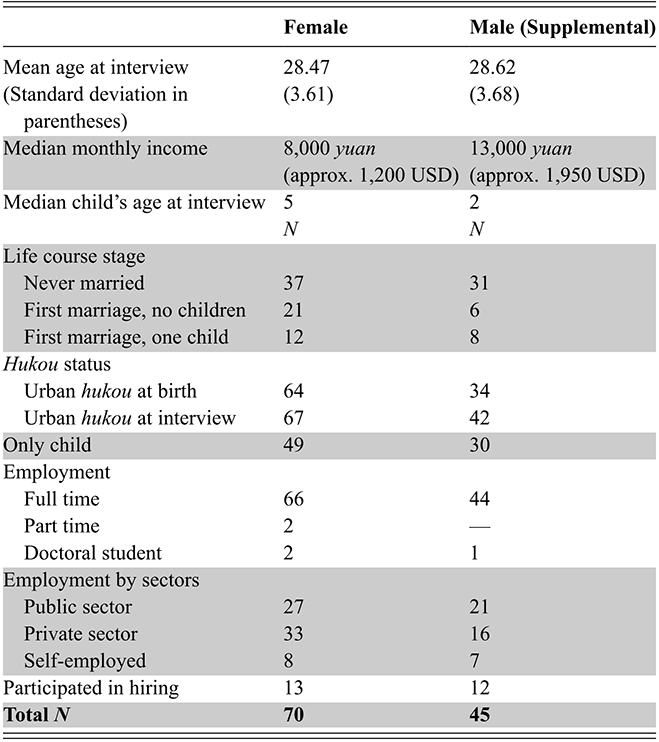
Table 1 Long description
The table introduces the sociodemographic characteristics of the interview respondents (70 women and 45 men). The mean age at interview is 28.47 for the female sample (standard deviation 3.61), and 28.62 for the male sample (standard deviation 3.68). The median monthly income is 8,000 Chinese yuan (approximately 1,200 in 2016 US dollars) for the female sample, and 13,000 Chinese yuan (approximately 1,950 in 2016 US dollars) for the male sample. 37 female interviewees and 31 male interviewees are never married. 21 female interviewees and 6 male interviewees are in their first marriage and without children. 12 female interviewees and 8 male interviewees are in their first marriage and have one biological child. The median offspring age is 5 for the female sample, and 2 for the male sample. 64 out of the 70 female interviewees and 34 out of the 45 male interviewees have held urban hukou status since birth. 67 female interviewees and 42 male interviewees hold urban hukou status at the time of interview. 49 female respondents and 30 male respondents are singleton children. Among the 70 female respondents, 66 are in full-time employment, 2 are in part-time employment, and 2 are students in doctoral programs. Among the 45 male respondents, 44 are in full-time employment and 1 is a doctoral student. Among the working women, 27 are employed in the public sector, 33 are employed in the private sector, and 8 are self-employed. Among the working men, 21 are employed in the public sector, 16 are employed in the private sector, and 7 are self-employed. 13 women and 12 men have participated in hiring and recruitment at their workplaces.
This sample composition is appropriate for examining the gendered work–family conflict under China’s changing birth planning policies. Participants in this age group are often in the midst of making decisions and transitions in marriage, parenthood, and employment. Unlike older individuals who have aged out of their childbearing years, the women and men in my sample experienced the 2016 universal relaxation of the one-child policy as urgently relevant for their home lives and experiences in the labor market.
Although all interviewees have completed tertiary education, they span from associate degree holders and graduates of non-selective four-year universities to those who attended elite (and sometimes overseas) schools. China has undergone tremendous educational expansion since the mid-1990s. As a result, obtaining some form of tertiary education has become increasingly common, particularly in urban areas.Footnote 12 Aside from three doctoral students, all participants were engaged in paid employment. They worked in a range of entry- and mid-level professional jobs in both the public and the private sector, such as schoolteacher, civil servant, human resources manager, small business owner, financial analyst, and the like. The interview sample includes those who have not experienced any disruptions or gaps in their work histories, as well as those who have. Additionally, twenty-five interviewees (thirteen women and twelve men) have participated in recruitment activities and/or made hiring decisions at their workplaces.
I recruited my interviewees via snowball sampling. Initial recruitment relied on my own various networks. After each interview, I asked my participants to circulate the recruitment flyer in their own networks. To alleviate any concerns of excessive network clustering, I interviewed three participants at most from each “seed” in the referral chain.
The semi-structured interview protocol includes a wide range of open-ended questions, with respect to participants’ day-to-day lives at work and at home. I asked all participants about their work and workplace: work routine and hours, business trip schedule, job satisfaction, workplace personnel composition, and norms surrounding face time, overwork, and work–family policy usage. I asked all participants about their work histories and their job search experiences. We talked about the rhythm of home life – for example, how leisure time was spent, how housework and/or childcare was divided, and whether they relied on any outsourcing and/or intergenerational support for household labor. I asked all participants about their marriage and fertility ideals and intentions, how they made decisions about partnership and childbearing, and what expectations they faced from parents, extended family members, friends, coworkers, and when applicable, partners and in-laws.
Moreover, I directly asked my interviewees for their views on the one-child policy and its relaxation. Specifically, I focused on whether the universal ending of the one-child policy had impacted the participants personally, and, if so, how.
In addition, I gathered information on interviewees’ gender-related beliefs. The interview protocol has incorporated the gender role attitudes items from the World Values Surveys (WVS) gender module.Footnote 13 After reading aloud each item, I asked each participant whether they agreed or disagreed with the statement. I then probed into the reasoning underlying their stated attitudes. Doing so allowed me to further situate a participant’s narrative of her/his work–family experience alongside their beliefs about women’s and men’s inherent rights, expected roles, and acceptable behavior in production and reproduction.
I interviewed all participants in Mandarin Chinese. Interviews typically lasted for 1.5 to two hours. All interviews were recorded with consent, and were later anonymized in compliance with the study’s ethics review (IRB) protocol.
I took notes during each interview and wrote short memos immediately afterward. These notes and memos documented my first impressions of each interview’s flow and focus. I transcribed the interviews over multiple listening sessions. Repeatedly listening to every interview recording enabled me to stay attuned to the emotional cadence of the conversations. As I listened and transcribed, I wrote analytical memos that inductively identified salient themes emerging from the data. Based on the analytical memos, I developed a series of theoretical codes and coded the transcriptions. All interview excerpts presented in this monograph are translated by me from verbatim quotes. I stopped data collection when no new major theme emerged with each additional interview (see Guest et al. Reference Guest, Bunce and Johnson2006).
In the sections to follow, I foreground the voices and lived experiences of my respondents, centering their desires, strategies, decisions, and sacrifices as they navigate work–family lives under China’s evolving reproductive politics. From these rich qualitative data, I start by uncovering and establishing the existence of the gendered incompatibility of rights as a phenomenon. I then distill the two conditions and elucidate how these two conditions have undergirded the rights dimension in women’s lived experiences of the gendered work–family conflict. In so doing, I further highlight the political implications and significance of the gendered incompatibility of rights.
4 Between Scylla and Charybdis
A key pattern emerged from women’s accounts of their work–family experiences, gender ideology, and attitudes toward birth quota relaxation: Urban Chinese women who espoused gender egalitarian views strongly favored the more restrictive one-child birth limit. Specifically, forty-eight of my seventy female interviewees adamantly supported women’s equal employment, rejecting statements that depicted the male-breadwinning/female-caregiving labor division or that suggested men should have a greater right to paid employment than women. For thirty-one out of these forty-eight women, the universal repeal of the one-child policy has ignited feelings of ambivalence, anxiousness, and even outright anger. In contrast, such intense negative emotions were largely absent among the twenty-two women who believed in gender essentialist labor division and supported privileging employment for men over women. Of these twenty-two women, fourteen approached the relaxation of birth quota with unadulterated anticipation and appreciation. In their eyes, the policy change ushered in newfound freedom – a much-cherished chance for women now to have more than one child. Table 2 summarizes the pattern described here.
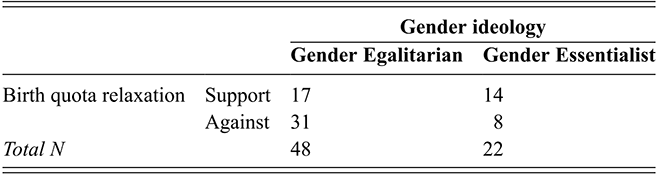
Table 2 Long description
Among the 70 women, 48 hold egalitarian views on gender, while the remaining 22 hold gender essentialist beliefs. Among the 48 gender egalitarian women, 17 support the relaxation of birth quota, while the remaining 31 hold negative views toward birth quota relaxation. Among the 22 women with gender essentialist beliefs, 14 support the relaxation of birth quota, while the remaining 8 hold negative views toward birth quota relaxation.
Why do women who support gender egalitarianism and women’s equal employment favor more restrictive state-imposed birth quotas? The underlying reasoning is consistent across interviewees. Drawing on their first-hand encounters in the urban Chinese labor market, these women connected the relaxation of birth quota with intensified gender discrimination in hiring practices. Leda, a twenty-five-year-old never married woman, offers a compelling example. Not long before our interview, Leda, a book editor, switched jobs. Leda was assertive and quick with her answers. Statements about male primacy in higher education, employment, and leadership drew strings of rapid-fire disagreements. Leda saw herself as a resolute supporter of gender egalitarianism and of women’s advancement. At the same time, Leda felt deeply uneasy about the 2016 universal two-child policy, given what had happened in her recent job search. Leda stated:
Of course there should be freedom in having however many children you want. But compared with before, I’m more afraid of the new two-child policy. When I was looking to change jobs, at all places, I was asked in job interviews if I had a boyfriend or if I planned to get married soon. Now women are even more discriminated against when they look for jobs, particularly if they are of marriage and childbearing ages.
Leda was not alone in her experience. Among the sixty full-time working and non-self-employed female interviewees, thirty-four described having been explicitly grilled about their relationship/marital status and childbearing plans during job searches.Footnote 14 What Leda described was also corroborated by interviewees who had participated in hiring themselves. Consider the case of Nan, for example, a twenty-eight-year-old never married woman. At the time of the interview, Nan had been working as a human resources manager in a large private firm for three years. When describing her responsibilities and daily work routine, Nan was forthright about the hiring protocol at her firm: Men were consistently chosen over women, and women applicants were screened on the basis of their age and marital/childbearing status from the get-go. Such hiring practices had led Nan to stop recommending women candidates to her employer for consideration altogether. As Nan explained to me:
When I used to recommend women candidates to my supervisor, every time he would emphasize, ‘but you know, this is a woman,’ and I’d know what he meant without him actually having to say it … so now I don’t recommend women candidates anymore, especially not women between twenty-five and thirty years old. Those women could get married, have a child, and take a long maternity leave while working here.
According to Nan, men received even greater preferential treatment in hiring after the universal two-child policy went into effect:
For women, we also need to ask during the phone interviews [about their marriage and childbearing plans]. Now with the two-child policy, if a woman [job] applicant has a kid already, we’d still need to look at her age. If she is still within that [childbearing] window, we will have much higher standards for her.
Revealing two sides of the same coin, Leda and Nan illustrated the tension between a relaxed birth quota and gender-equal employment opportunities. To some, this tension was even more visceral. Pei grew up as the youngest daughter in a rural family with five daughters and no sons. Sitting in a sun-dappled cafe, Pei – now a thirty-three-year-old married mother with a newborn son and a well-regarded job in publishing – recounted vivid stories told during her childhood days about the cat-and-mouse game between her pregnant mother and the local family planning officials. And some years ago, upon giving birth at their county hospital, Pei’s eldest sister was compelled to have an intrauterine device (IUD) inserted, without adequate medical consultation or her informed consent. It was a common measure used to enforce the one-child birth quota. Extensive scholarship and journalistic accounts have documented the abuse inflicted on women, like Pei’s mother and sister, as the one-child policy campaigns swept across China (Greenhalgh Reference Greenhalgh1994; Hesketh & Zhu Reference Hesketh and Zhu1997; Whyte et al. Reference Whyte, Wang and Cai2015). One might expect, therefore, that the formal repeal of the one-child policy would have brought Pei a sense of relief. However, reflecting on the relaxation of birth quota, Pei only felt torn:
My body may be freer without the one-child policy. But now it’s also more difficult to be a young woman. Without the one-child policy, it’s harder and harder for young women to get jobs.
Across interviews, other women, just like the ones I have introduced here, have also repeatedly narrated their lived experiences of rights at odds – a sharply felt conflict in their work–family lives between realizing their right to gender-equal employment and their right to mother. Yue, twenty-eight-year-old and never married, worked as a market researcher in a start-up company. When asked how she felt about the ending of the one-child policy, Yue wearily responded:
Of course I agree that the one-child policy violates human rights, but I have to care more about the limitations we women face in the workplace.
The universal repeal of the one-child policy has crystallized these women’s sense of incompatible rights, as they experienced the expansion of the civil right to mother after the relaxation of birth quota as simultaneously dealing a blow to the realization of women’s civil right to gender-equal employment. In the words of Tian, a twenty-seven-year-old, soft-spoken university lecturer who had never been married, “now without the one-child policy, employers are even more hesitant about hiring women.” As Suli, a twenty-six-year-old never married woman working in contract compliance, put it, “compared with before, the universal two-child policy may be more liberal … [and there is] some more freedom in childbearing, but the negative impacts for women at work are huge.” Aijia, a twenty-three-year-old never married choir conductor with an infectious, vivacious energy, somberly remarked:
The universal two-child policy took away women’s most basic right of not being discriminated against at work.
To be sure, these young Chinese women desired the right to mother without limits. Leda believed that having however many children one wants should be a “freedom.” With great warmth, Pei recalled the joy of a girlhood spent alongside her close-knit sisters. Pei wished that she, too, could have multiple children without the state’s interference, so that her son might also experience the bonds of sibling love. Yue and Suli were acutely aware of the illiberality of the one-child policy. Even so, as these women contemplated their labor market prospects without the one-child birth quota, their desire for being able to freely have multiple children quickly receded, replaced by a palpable unease about hiring discrimination and fear of being unable to realize their right to equal employment.
Labor market gender discriminations and state-imposed restrictive birth quotas thus resemble Scylla and Charybdis. As these young urban Chinese women sailed the treacherous strait in between, they experienced the right to gender-equal employment and the right to mother as zero-sum – and a choice must be made, because exercising both seemed beyond their reach. For women who believed in gender egalitarianism and emphasized women’s equal employment, they settled on the side of favoring a stricter state-imposed birth limit: To them, the right to mother had to be forfeited – and they were willing to do so – in order to safeguard women’s right to equal employment.
In contrast, among the twenty-two female participants who supported gender essentialist labor division and agreed with prioritizing men’s right to paid employment over women’s, the majority of them have greeted the ending of the one-child birth quota with much alacrity. Liran, a thirty-seven-year-old married mother and middle school teacher, presents a typical example. Liran’s ideal family arrangement is one where husbands work, wives take care of the household, and mothers stay at home full time with young children. Liran saw the universal relaxation of the one-child policy in an uncomplicatedly positive light. According to Liran:
If my health permits, I’d like to have another child. For women younger than me, this policy is even better, so beneficial.
Hebe, a twenty-eight-year-old married and childless civil servant, may be one such “younger woman” Liran imagined. As Hebe envisioned an ideal family, she firmly believed that the husband should be the breadwinner, leaving housework and childcare in the charge of the wife. Moreover, to Hebe, men were better equipped to be leaders in business and in politics because, in her words, “men are more rational and better at decision-making; women should have detail-oriented jobs because women are naturally more patient and careful.” Hebe intended to have two children in the near future, although ideally, she would like to have three. Hebe was over the moon about the relaxation of the one-child birth quota:
Of course, removing the one-child policy is of course a good thing! There should never have been limits on births like this!
The above accounts illustrate a pattern that is consistent with recent quantitative findings based on large-scale, nationally representative surveys in urban China: that is, those who support gender egalitarianism and women’s right to equal employment more strongly favor restrictive state-imposed birth quotas (Zhou Reference Zhou2021). Together, these qualitative accounts from young urban Chinese women about their work–family lives have unveiled a gendered experience of rights at odds. For these women – both married and unmarried, mothers and non-mothers – the tension between employment and motherhood runs much deeper than, and exists before, a single-dimensional struggle of reconciling the tasks and commitments of employment and motherhood. Rather, the conflict between work and family has manifested as an incompatibility between realizing the right to gender-equal employment and exercising the right to mother.
5 Making Rights Incompatible
The preceding section establishes the incompatibility of rights as a distinct dimension in young urban Chinese women’s lived experiences of the gendered work–family conflict. What, then, have engendered such experiences of rights at odds? I now turn to this why question: I situate my respondents’ narratives within the macro-level institutional forces and socioeconomic currents of post-reform China, paying special attention to the gender logic enshrined in the party-state’s family–labor policies and reproductive governance. In so doing, I arrive at the two conditions that have undergirded the gendered incompatibility of rights.
5.1 “To the Government, We Are Just Tools”: Rights-Trading in a Gender Essentialist Autocracy
Among my 115 interviewees, nearly a quarter – both women and men – have at some point participated in the recruitment activities or made hiring decisions at their workplaces. Time and again, often nonchalantly and without inhibitions, these interviewees told me how China’s family policy set-up loomed large in their decision-making. Hejia, a thirty-three-year-old married mother, typifies these respondents. After obtaining her master’s degree, Hejia was now a lecturer in a local public college. Over the last few years, Hejia had sat on her department’s hiring committee several times. In this role, Hejia witnessed consistent preferential treatment of male candidates:
Hejia: One year we interviewed a woman candidate with a doctorate and a man with a master’s degree, and my colleagues all leaned toward hiring the man, whom we did hire. He is not doing so well [on the job] after he got here, but the following year, the same preference [for hiring men] remained.
Author: How come?
Hejia: Men don’t take long childcare leaves.
Hejia attributed her department’s preference for male candidates to parental leaves that, by the Chinese party-state’s design, are gender asymmetric. Indeed, whereas the majority of the female interviewees reported routine probing during job searches about their relationship/marital status and childbearing plans, only five out of the thirty-seven full-time working and non-self-employed male respondents encountered similar questions when seeking employment. Even then, the men in my sample dismissed such inquiries as mere small talks of little significance. As Leo, a thirty-one-year-old married and childless male researcher, jovially quipped:
After all we are talking about men here. This [a male job seeker’s relationship/marital status and childbearing plans] is a non-issue for employers.
Extensive research has traced the motherhood penalty – disadvantages and discriminations that mothers face in the labor market for being mothers that are most saliently reflected in persistent wage gaps (for representative studies, see e.g., Budig & England Reference Budig and England2001; Correll et al. Reference Correll, Benard and Paik2007; J. Glass Reference Glass2004; Ishizuka Reference Ishizuka2021). Correspondingly, scholars across national contexts have also sought to document the fatherhood premium – wage gains associated with fatherhood that are similarly rooted in the gendered system of power, privilege, and labor division (see e.g., Killewald Reference Killewald2013; Mari Reference Mari2019). Against this backdrop (and given extant literature’s primary focus on mothers and fathers), one especially striking finding here is that the childless women in contemporary urban China felt that they were at a particular kind of employment disadvantage, especially during the hiring stage, as they compared themselves not only to men, but also to other women who have already had children and were thus seen as “done with” taking long maternity leaves.
Twenty-eight-year-old Mabel, who was married and childless, presents a typical case in this regard. Since graduating from her master’s program, Mabel has been working in the human resources department of a prominent state-owned enterprise. Drawing on her experiences both as a job seeker and now as a recruiter, Mabel observed that when a hiring decision came down to a choice between two women, the preferred candidate would almost always be the woman who has “finished childbearing.” Similarly, Faye, a thirty-year-old never married lecturer in music education, meticulously described the rigid hiring hierarchy at her small college, in which childless women were routinely relegated to the bottom tier:
At our school, if it’s between a male job candidate and a female job candidate, then no brainer, it’s going to be the man [that is hired]. Between two women, then our thinking goes: Is she married or not? OK, married; then, has she had a child yet? Is she going to have one on the job? Who is going to cover for her when she goes on her maternity leave?
This form of labor market gender discrimination has escalated with the repeal of the one-child policy, because employers believe that women are now likely to take not just one, but two or more, long maternity leaves. As an illustrative example, consider Shali, a thirty-five-year-old female entrepreneur. Ambitious and passionate about her own career, during our conversation Shali repeatedly expressed her desire to instill a strong work ethic in her almost-four-year-old daughter. Nonetheless, for her own start-up, Shali did not recruit from the pool of women job applicants. Her hesitancy to hire women only intensified after the universal relaxation of the one-child policy. Shali was candid about her hiring practice and rationale:
When I hire, I have to think: What if she gets pregnant and takes a long leave? With the one-child policy gone, what if after having one kid, she goes on to have another one?
Likewise, Yue, the twenty-eight-year-old market researcher, described a similar situation when she recruited for her employer and had to decide on a particular female candidate:
If a woman is hired and then she has a child on the job … that is a three-to-six months leave, a cost that we just couldn’t shoulder. A resume came to me a while back, she was really just perfect on paper. But then I called her for a phone interview. She was honest on the phone that she was about to get married, and they planned to have a child next … then that became a dilemma.
Yue ultimately turned down this woman job seeker, whom she described as “perfect on paper.”
From these women’s accounts, so far, we can observe how the Chinese state’s gender essentialist family and labor policies incentivize (and are used as justifications for) employers’ gender discriminatory practice during the hiring stage. Such discriminatory practice has since further intensified in light of birth quota relaxation. Here, a strong sense – on the part of both employers and female job seekers – that women’s (labor) rights are robustly protected might have mitigated such a situation. However, when faced with labor market discriminations and exclusions, female job seekers largely feel that they have nowhere to turn, believing that there is little real, meaningful recourse for claims-making. Shanhu, a thirty-one-year-old married woman and digital media editor, exemplifies these women job seekers.
After almost four years of marriage, and without children, Shanhu and her husband recently changed jobs at the same time. The couple had graduated together from the same, selective university. They had subsequently enjoyed comparable, uninterrupted work histories in similar fields. However, their job search experiences this round were starkly different. Shanhu’s husband quickly landed a new (and much better) job, while Shanhu struggled in one job interview after another:
Shanhu: It was really hard for me. I was asked a lot: What’s your plan for children? They [potential employers] worried that I’d get pregnant as soon as I was hired, and then immediately need a long leave.
Author: Was it the same for your husband?
Shanhu: No, he had a much easier time than me. A lot of times I just didn’t hear back after the job interview.
Author: So what happened [in the interview] for your current job?
Shanhu: My [new] boss didn’t ask me those questions when she interviewed me. For that I’m deeply thankful to her.
Despite all the silent rejections she encountered, when reflecting on her job search ordeal, above all, Shanhu felt grateful. Shanhu considered herself lucky for finally catching a break – meeting a benevolent recruiter who did not ask about her childbearing plans.
Like Shanhu, none of the women in my sample contested the legitimacy of employers’ questions about their relationship and childbearing. Nor did they challenge how such information was used against them in job searches. Many of these young urban Chinese women had entered the labor market in a time of both heightened government crackdowns on feminist activism, as well as renewed clarion calls for women to shoulder more domestic responsibilities. To them, viable channels for making complaints appeared elusive, if not altogether nonexistent. These young women have experienced and internalized the notion that the party-state simply does not take women, nor the labor market discriminations they face, seriously. Lingshan, a thirty-one-year-old never married woman working in agricultural research, noted with resigned frustration:
The roles our government has in mind for us women are just good wives and nurturing mothers.
Hualing, a twenty-eight-year-old married and childless woman working in finance, flatly remarked:
The party and the government don’t see us women as humans. We are merely human resources.
This distinction made by Hualing between humans versus human resources powerfully illustrates that these young urban Chinese women felt unable to effectively make claims to the authoritarian state in order to ensure their civil rights protection in the labor market. Meanwhile, the Chinese party-state’s intervention into women’s reproduction has simultaneously left indelible imprints on what women collectively remember, experience, perceive to be real, and imagine as possible, when it comes to their rights in motherhood. For example, reflecting on the relaxation of birth quota and China’s legal protection of women’s rights in general, Guli, a twenty-seven-year-old married and childless journalist, had little faith. In Guli’s words,
How much can you really trust any new policy? Policy can be issued in the morning, and the government can change it on a whim at night.
Huiwen, a twenty-four-year-old, never married, and self-employed woman, expressed a familiar sense of dejection:
I feel that to the government, we are just tools.
Confronted with hiring discriminations prompted by the state’s gender essentialist family policies while feeling unable to call on the state for dependable labor rights protection, these young women are left to their own devices as they fight for a chance of getting hired. At the same time, the lifeworld engendered from China’s decades-long population control efforts is one in which women have ever only experienced the right to mother as tenuous and contingent in the first place. As such, in their efforts to secure employment, we see one set of rights-trading strategies on full display.
To start, at the job search stage, women job seekers must convincingly assuage employers’ concerns over female employees’ perceived lack of productivity and dedication as a result of (potential) motherhood and asymmetric parental leaves. These concerns are thinly veiled behind pointed questions about women job seekers’ marital/relationship status and childbearing plans. To signal that they too can be “ideal workers,” the successful ones have done so by promising to delay or limit childbearing. Luna, a twenty-nine-year-old married and childless lawyer, exemplifies these women. When Luna searched for jobs as a fresh law school graduate with a committed boyfriend, she was frequently grilled about her marriage and childbearing plans. Each time, Luna verbally promised to not have a child during the first few years on the job. Additionally, Luna described a similar instance when she recently helped another law school friend, who was also married and childless, in her job search:
I put her in touch with a law firm I know. She verbally promised them that she wouldn’t have a child too soon after starting. They only gave her the job after that.
Moreover, the promise to delay or limit childbearing is more than a token gesture made just to gain employment. Rather, after successfully getting the job, such promises are expected to be kept. Like Luna, thirteen out of the twenty-one married and childless female interviewees explicitly described feeling beholden to employers for the promises they made not to have a child too soon after getting hired. Ruwen, a thirty-two-year-old married and childless tutor, is a prime example. At the time of the interview, Ruwen was working in China’s then-thriving private after-school tutoring industry, teaching middle school-level English. Ruwen described a routinized end-of-semester planning at her agency, when female tutors’ pregnancy intentions in the new semester were methodically managed, in the same fashion as their teaching positions and class schedules:
At the end of each term, our supervisor has one-on-one meetings with all the female teachers … to plan for pregnancies … For the core positions in the coming semester, he would only assign you to one of those after making sure that you are not going to [get pregnant].
Hanna, a thirty-year-old married and childless researcher, noted that it was her most supportive colleagues who often warned her against “having a baby early on the job,” lest she be judged negatively for not keeping her word. Similarly, consider Linsu, a thirty-year-old married mother working in a local television station. According to Linsu, her “supervisors always made it clear that [she] should not get pregnant within the first two or three years after starting.”
Linsu gave birth in her fourth year at the station.
The accounts presented here have jointly revealed the first condition underlying women’s work–family experiences along the dimension of the gendered incompatibility of rights: The state upholds gender essentialist family and labor policies, such as gender-asymmetric parental leaves, which both incentivize and provide justification for employers’ gender discriminatory and exclusionary practices. At the same time, the state’s intervention into women’s reproduction – rooted in a similarly gender essentialist treatment of women as mere reproducing bodies that shall be variously managed – has created a sense of profound precarity, as these young urban Chinese women experience and perceive their civil rights in motherhood as provisional and rescissible. Employers, worried about the (potential) disruptions from lengthy maternity leaves, regard hiring and managing women workers as both costly and troublesome – so much so that even when women are hired, some have further tried to monitor, both implicitly and explicitly, these female employees’ reproductive timing and behavior. Young urban Chinese women, on the other hand, find themselves unable to effectively call on the state for civil rights protection when faced with such labor market discriminations and exclusions, believing that the state cares little about women’s equal rights protection.
In order to secure employment, these young women have thus turned to a particular set of individualistic rights-trading strategies. Depending on each woman’s circumstance, such coping encompasses a combination of carefully navigating employers’ questions, during job searches, about one’s relationship/marital status and childbearing plans; promising to delay or limit childbearing in order to get hired; and later, being subjected to and submitting to workplace policing of their pregnancies. Simply put, as these young women resort to relinquishing control over their own childbearing in an effort to secure employment, they have experienced the right to gender-equal employment and the right to mother – despite the codification on paper – as effectively incompatible in practice.
5.2 “A Business is Not a Charity”: Market Primacy and the Incompatible Moral Claims of Motherhood and Employment
How do these young urban Chinese women feel about their rights-trading efforts, and the necessity of such a way of coping? As the women in my sample confront the incompatibility between their civil right to equal employment and the civil right to mother, many have further come to experience employment and motherhood as two incompatible moral claims of entitlement that shall be subject to a trade-off. Their narratives bring into sharp relief the normative primacy of market principles and logics, which has come to structure people’s quotidian lives in contemporary urban China.
As a pair of illustrative examples, consider the cases of Muzi and Huan. At the time of our interview, Muzi, an advertising manager, was twenty-eight years old and had never been married. Working in an industry known for its grueling schedule and cutthroat competitions, Muzi’s job search was plagued with questions about her plans for marriage and childbearing. Like the women introduced above who relied on rights-trading strategies that prioritized employment, Muzi always responded to such grilling and probing by fiercely renouncing any desire to have children. As she recounted her experiences to me, Muzi eagerly doubled down and embraced such questions from potential employers:
Yes, I was asked [about my marital status and childbearing plans], but I can totally understand why. If a company hires you and you then have a child on the job, you are a loss in profits for them. They failed [by hiring you]. The discrimination women face, at the end of the day, it’s still because you are not good enough, you don’t show strength, you give the impression you are all about marriage and children. Then of course you are discriminated against. (Italicized phrases reflect interviewee’s emphasis)
To Muzi, women’s equal employment seemed more than a codified civil right. It was also a moral entitlement that needed to be individually earned and achieved. Muzi believed that if a woman was truly serious about paid employment, she herself should proactively ameliorate employers’ concerns by rejecting the possibility of childbearing. In Muzi’s mind, failing to engage in such rights-trading efforts that prioritized employment (what she chided as being “all about marriage and children”) reflected a woman’s own lack of merit and drive. When Muzi pointedly declared that “they failed [by hiring you],” she saw such women as, in her words, “a loss in profits” and therefore underserving of equal employment in the first place.
Of course, not all young urban Chinese women choose to prioritize employment. In contrast to Muzi, Huan, a thirty-six-year-old senior lecturer in a public university, has chosen to prioritize motherhood. A married mother to a nine-year-old daughter, Huan has been actively trying for a second child ever since the one-child policy ended. Not long before our interview, Huan was passed over for promotion to a leadership position within her department. Huan saw herself as “the most suitable and qualified choice.” However, when asked how she felt about the promotion result, Huan did not think she was wronged. Instead, she believed that the lack of promotion was a reasonable reflection of her own choices and priorities. Waving off my question, her voice poised and insouciant, Huan explained:
Oh the heads of the school and the department did consult me first. They called me to a meeting and asked me: Would you like to have another child right now or would you like to have this [leadership] job? I told them that I planned to have a second child.
Huan saw neither unfairness nor others to fault. To Huan, losing out on the promotion was a situation of her own making: an appropriate consequence of her intentional decision in the rights-trading calculations to prioritize her newly expanded right to mother. For both Muzi and Huan, their respective choices and outcomes notwithstanding, employment and motherhood thus constitute a trade-off between two moral entitlements – a trade-off that, in their eyes, women not only have to, but also, should enter.
Muzi and Huan are not unique. Twenty-three out of the seventy women in my sample have explicitly remarked that it was a woman’s personal responsibility to earn employment through the corresponding rights-trading efforts that renounced motherhood, because, according to these women, it was only natural and legitimate that employers shall first and foremost care about profits and productivity. Just like Muzi having described newly hired women who soon became pregnant as “a loss in profits,” these female interviewees, on both sides of the hiring process, frequently invoked the notions of “profit” and “efficiency.” As a telling example, consider Heping, a twenty-five-year-old never married software developer. Heping modelled herself on “independent career women.” Envisioning her ideal life in a few years’ time, Heping exclaimed, “I would never allow myself to not work!” However, when our conversation segued into her employer’s preference for hiring men, Heping grew defensive – of her employer:
Women can take months of maternity leaves. Now, if she has two children, then that number just got multiplied by two. It’s only understandable that employers are the way they are. A company’s purpose is to turn a profit. A business is not a charity.
Echoing across interviews, Heping’s sentiment that “a business is not a charity” has repeatedly surfaced. For example, in our conversation, Maya, a thirty-year-old never married barista and small business owner, rhetorically asked, “how can women think that businesses and firms should owe them maternity leaves?” And consider Ruwen again, the tutor I introduced above. Reflecting on the end-of-semester meetings her supervisor held to monitor women teachers’ pregnancies and distribute their teaching assignments, Ruwen said evenly:
Naturally, bosses and supervisors, they are doing their appropriate jobs to care about maximizing profits for companies.
Scholars of China’s political economy have written extensively about the existential dependency on capitalist development, which has become fundamental to the Chinese party-state’s survival (e.g., Gallagher Reference Gallagher2005; Huang Reference Huang2008; Naughton & K. Tsai Reference Basu2015). “Prioritizing efficiency,” the mores of China’s market reform over the last four decades, has trickled into and permeated these women’s narratives. As my interviewees voiced impassioned support for others’ rights-trading efforts that prioritized employment over motherhood, or proudly described similar strategies of their own, in their accounts employers had largely been exculpated as merely behaving “naturally” (or, as Ruwen put it, “doing their appropriate jobs”) by responding to businesses’ raison d’être of making money and maximizing profits. In the words of Milly, a twenty-four-year-old never married operations specialist in a start-up company, “our firm is still in its early stage; it just couldn’t afford for its women workers to have children and leave work for a long time.” For Ouyang, a twenty-eight-year-old never married financial analyst, “it’s about the company’s bottom line and justifiably so.” Wenqi, who was twenty-seven years old, never married, and working in marketing, declared with a great deal of candor:
If I were the boss, I would also give men the priority when I hire.
The ethos of the market – maximizing profits and efficiency – not only provides the lingua franca but has also emerged as the primary frame and touchstone for these women, as they make sense of their social realities, articulate judgements about fairness, and allocate responsibilities and blame. As a case in point, consider Jiaqi, a thirty-one-year-old married and childless acquisitions editor working for a small publisher. After a trying job search process, Jiaqi settled for a press that was, in her words, “second tier in both prestige and pay.” Yet, as she and I discussed the treatment of women in China’s urban labor market, Jiaqi believed that gender discrimination was “understandable,” given what she saw as employers’ rightful, if not righteous, concerns for profits:
It’s understandable why employers discriminate against women. They have to care about their own interests and profits. A lot of the places that discriminate … it’s because they have been tricked in the past by women who, after getting hired, immediately go on to get pregnant, have a child, and take a long leave. (Italicized phrases reflect interviewee’s emphasis)
In short, as the transactional logic of the market ascends to a normative primacy in these women’s daily lives, rather than employers’ gender discriminatory practices (or the lack of dependable labor rights protection from the state), other women are being held chiefly responsible: Women who seek to “have it all” instead of engaging in rights-trading efforts that prioritize employment (whether by giving births “too soon” after getting hired or by not renouncing their childbearing desires strongly enough) are admonished as if they are violating the rules and expectations of a “fair” market exchange. Or, as Jiaqi put it, these women have “tricked” the employers. Such women are castigated for what is perceived as setting bad precedents and selfishly damaging fellow women’s chances of future employment. For example, Shelly, a twenty-seven-year-old never married woman working in a government agency, attributed women’s workplace disadvantages as follows:
It’s because of a lot of those women, especially those who start a family [soon after getting the job], they just completely shift the focus to their home life and lose all their drive at work. (Italicized phrase reflects interviewee’s emphasis)
Mabel, the human resources manager I introduced above, had deliberately delayed her own marriage and childbearing. Mabel did so precisely to avoid being perceived as one of “those women” that Shelly described. In Mabel’s words:
At that time, I was just hired … to get married and have children so soon afterward, that’s just not the right thing one should do … it leaves a bad impression on your boss.
Like Mabel’s mirror image, consider Suhang, a thirty-one-year-old married and childless woman working in marketing. As we discussed her childbearing intention for the immediate future, Suhang assessed that she should now be able to have a child whenever she desired because as Suhang put it, a subtle pride glimmering in her voice:
I myself am very good at what I do. I will not cause my employer to lose profits just because I go have a child.
In other words, Suhang also subscribed to the yardstick based on market principles. And now, by its measure, Suhang reckoned that she had earned her right to mother.
Together, these accounts illustrate that as the logics of the market take center stage in these interviewees’ lifeworld, women’s civil right to equal employment is viewed and experienced as a moral entitlement that must be earned through personal grit and merit. Here, opting to forsake the right to mother is considered by many as the right way to demonstrate such worthiness. As a result, some respondents have further come to regard the exclusion of women from equal employment to be “for women’s own good,” insofar as women would not have to trade away their “innate motherly calling.” Male interviewees, in particular, emphasized this line of reasoning. While some acknowledged the preferential treatment of men they themselves doled out or received in hiring and at work, almost all emphasized how intense their jobs were, remarking that job requirements like long hours and frequent work trips were not “agreeable” for women and “their nature as mothers.” Shawn, a twenty-eight-year-old never married male entrepreneur, typifies these men. A hardware engineer by training, Shawn viewed the exclusion of women from various engineering jobs as “well-intentioned.” He stated:
You can call that gender inequality, but it comes from a good place, not with a bad heart. In civil engineering or electrical engineering, when jobs require a lot of time at construction sites or are really demanding, then surely [these roles] are too harsh [for women].
With near-identical reasoning, Mason, a twenty-five-year-old never married man working for an internet start-up, vociferously defended the hiring practices that consistently selected men over women:
Companies are just taking into consideration women’s immutable condition … that they inevitably will wish to become mothers, and will need maternity leaves. It’s only natural to discriminate a bit.
Time and again, the market principles of efficiency and profit dominated these interviewees’ remarks, as male respondents grappled with the preferential treatment of men in China’s urban labor market. For example, Clay, a twenty-six-year-old never married journalist, repeatedly called upon the notion of “efficiency,” as he tried to make the case that those employers who preferred hiring men, his own workplace included, had “nothing against women.” With great obstinacy in his voice, Clay exclaimed:
Discrimination has nothing against women. It’s a simple fact that women will be mothers and take long maternity leaves, so it’s about efficiency, it’s about taking into account the efficiency for companies. We have nothing against women. It’s just that for a company to achieve efficiency, men are preferred.
Similarly, consider Chase, a twenty-nine-year-old married father and news editor. Throughout our conversation, Chase argued fiercely that companies should always prioritize hiring men. His statements epitomized the spirit of market primacy:
Companies need to make profits. They need workers to work. You get pregnant with one child, then you get pregnant with a second child, what do you expect bosses to do? Their hands are tied.
Collectively, the accounts presented here have unveiled the second condition that undergirds women’s work–family experiences as rights at odds: As the post-reform Chinese party-state tied its survival to capitalist development, seemingly neutral market mechanisms of exchange and market principles of efficiency and profit now reverberate through ordinary people’s everyday lives, ascending to a normative primacy. Such market mechanisms and market principles have become a universal touchstone, providing the lingua franca for individuals to make sense of, and react to, their social realities. Under such market primacy, gender discriminatory labor market practices are frequently absolved – often by job seekers themselves – because the pursuit of profits and productivity is believed to be not only economically rational but also morally just.
These findings resonate with what Marc Blecher (Reference Blecher2002) described as “[Chinese] workers’ hegemonic acceptance of the core values of the market and the state” (p. 283). Based on interviews conducted with Chinese workers in the latter half of the 1990s, Blecher (Reference Blecher2002) found that even those who had become worse off post-marketization still largely embraced the logics and norms of the market as legitimate, as these workers came to understand China’s post-reform landscape of social inequality and their own place within.
In this sense, the gendered incompatibility of rights exists at two registers. At one level, young urban Chinese women have experienced the expansion of their civil right to mother, through the relaxation of birth quota, as further undermining the realization of their civil right to gender-equal employment. At another level, these interviewees have also learned to see employment and motherhood as two incompatible moral claims of entitlement that are and should be subject to a trade-off. Rather than raising the prospect of “having it all,” rights-trading – forfeiting the moral claim to employment or motherhood through a transactional logic – is regarded and experienced, by these young women, as not only the necessary but also the rightful means of securing either one of the two.
6 The Political Implications of Navigating Rights at Odds
What are the political implications of having to navigate the gendered work–family conflict as an incompatibility of rights? Here, I show that these women’s individualistic strategies of rights-trading are fraught with precarity under China’s new reproductive politics. Despite each woman’s personal resolve and acumen, their rights-trading efforts can quickly sour, as soon as the state derails the context of such a “trade.” For these young urban Chinese women, their experiences of negotiating employment and motherhood as rights at odds thus further hold important ramifications when it comes to their political ideations – how they grapple with women’s place in power structures, understand their own relations with the state and the market order, and envision the possibility and pathways of achieving gender equality.
6.1 The Fragility of Rights-Trading under Changing Politics of Reproduction
Writing on the patriarchal power dynamics of contemporary China, scholars have consistently documented deeply entrenched social norms that treat timely marriage and childbearing as paramount issues in Chinese women’s lives (e.g., Fincher Reference Fincher2016; Greenhalgh Reference Greenhalgh2001, Reference Greenhalgh2008; Ji Reference Ji2015). As the women in my sample turned to rights-trading strategies that prioritized employment, many were simultaneously confronting familial expectations that exhorted and demanded them to promptly get married and have children. As an illustrative example, consider Anya, a thirty-year-old staff administrator working in a research institute. At the time of our interview, Anya was newly married. Almost immediately after the nuptials, pressure – from both Anya’s own parents and her husband’s family – began to mount for the couple to have a child. Anya was extremely anxious and reluctant about entering motherhood, so much so that her voice broke when talking about her “childbearing timeline.” Yet, Anya’s own trepidations notwithstanding, she and her husband had been actively trying to conceive. Resigning herself to the tremendous familial insistence, Anya described childbearing as “a duty [she] just cannot escape after marriage.”
With the relaxation of the one-child birth quota, the Chinese party-state has further regained consonance with such gendered familial expectations that demand childbearing from women. To illustrate how this consonance manifests on the micro level in everyday interactions, a particularly telling example is Lang, a thirty-seven-year-old married father working in a government agency. Hopeful for a second child, Lang believed that the universal relaxation of the one-child policy was steering China in the right direction. At the same time, Lang acknowledged that his wife was much more hesitant about another pregnancy. Even so, Lang was certain now that the one-child policy had ended, his reluctant wife would sooner or later come around to the prospect of another child, yielding to normative expectations and peer pressure. As Lang confidently contemplated:
When more and more people start to have two children … my wife doesn’t want two children now, but seeing the change around us, when everybody is doing it, surely she will change her mind.
Lang (and his wife) is not unique. Indeed, female interviewees, across martial and childbearing status, have consistently reported facing such creeping pressure. Consider Hualing again, the twenty-eight-year-old married and childless financial analyst I introduced above. Describing her own encounters with the normative expectations of motherhood, Hualing felt that, with the ending of the one-child policy, the “goalpost” of childbearing had been moved:
It used to be that you get married and have one kid, you are all set. Now having two children becomes the new standard, and having just one child is like a failing grade.
Yanran, a twenty-four-year-old never married woman working in financial technology, expressed similar frustrations. To Yanran, the relaxation of the one-child birth quota took away what she saw as the guardrail, which had previously protected Chinese women from the patriarchal family system and its childbearing demands. As Yanran put it:
Some women don’t want to have more children, but now they no longer have an excuse. Now, others say: The government already permits you to [have more than one], why don’t you?
In this sense, as the Chinese party-state universally relaxed the one-child birth quota, the context of these young urban women’s “trade” – between the right to gender-equal employment and the right to mother – has since been disrupted. In the face of a renewed gendered alliance between the party-state and the patriarchal family system, women’s individualistic strategies of rights-trading are rapidly being rendered ineffective. That is, well aware of the deeply rooted familial expectations that prioritize women’s childbearing, and now with the state-enforced one-child birth limit gone, many employers have begun to assume that any female job seeker of childbearing ages would eventually have multiple children (and therefore need multiple long leaves). Such assumption is being made, regardless of a woman’s actual motherhood desires, stated fertility plans, or promises to delay or limit childbearing. Indeed, after the universal repeal of the one-child policy, my respondents with hiring authority (like Nan, Shali, and Mabel) have all made the blanket decision to altogether screen out female candidates of childbearing ages – including those who’d already had one child (that is, the group formerly considered to be “done with childbearing”).
To fully demonstrate the fragility of these young urban women’s individualistic rights-trading efforts under the Chinese party-state’s new reproductive politics, consider the experience of Mina, a twenty-five-year-old never married woman.
With bright-eyed idealism, Mina had long aspired to a career in nonprofit organizations. In her job searches, Mina frequently encountered questions about her marriage and childbearing plans. Mina always responded by way of presenting herself as someone who’d prefer not to have children at all. Mina, who saw herself as a feminist and in principle supported women’s right to mother without limits, felt deeply conflicted about the universal relaxation of the one-child policy. Staring down into the long, murky journey of job hunting, Mina described a swelling sense of dread that she had begun feeling. Although she still defaulted to verbally renouncing any childbearing desires in job interviews, such efforts seemed increasingly futile:
The government should not place limits on birth. If some woman wants ten children, she should be able to have ten children. But then again, ending the one-child policy affects all women, so it also affects me no matter what. I still say I truly don’t want children [in job interviews] … [But] how much can I really sell an employer this promise, while they decide whether or not to hire me?
Mina’s account epitomizes young urban Chinese women’s experiences of the work–family conflict as rights – not just commitments – at odds. Moreover, it provides a vivid illustration of the perils and uncertainty inherent to these women’s individualistic rights-trading, when the state has the capacity to capriciously disrupt the context and terms of such “trade.” As the relaxation of the one-child birth quota has again galvanized entrenched and powerful gendered familial expectations, these young urban Chinese women’s strategies and efforts are derailed and fast becoming ineffectual.
6.2 Imagining a Gender-Equal Future: How Navigating Incompatible Rights Shapes Women’s Political Ideations
For these young urban Chinese women, their lived experiences of navigating the work–family conflict as an incompatibility of rights – undertaking various individualistic rights-trading efforts and confronting the ultimate ineffectuality of such strategies – bear meaningful political implications. A robust literature has sought to unravel whether, and how, women’s participations in the public sphere may shape their political attitudes and ideations (e.g., Burns et al. Reference Burns, Schlozman and Verba1997; Gidengil et al. Reference Gidengil, Giles and Thomas2008; Wolak Reference Wolak2020): that is, to what extent having cultivated identities outside the household matters for women’s sense of their own competency, political interests, and knowledge, as they contemplate their places in public life (e.g., Burns et al. Reference Burns, Schlozman and Verba2001; Chhibber Reference Chhibber2002).
At the end of every conversation, I concluded by asking all my female respondents the same two questions: First, based on her own lived experience, how would she rate the level of gender equality in China; and second, in her eyes, how shall the advancement of women be achieved? Unfailingly, these two questions elicited deep, expansive yet intimate responses from the women I interviewed. Their narratives, in turn, have enabled me to further gauge these young urban Chinese women’s sense of efficacy, trust, and outlook, as they reflected on women’s status in power structures, imagined the possibility and pathways to a gender-equal future, and perceived their own places within such visions of women’s advancement.
Perhaps unsurprisingly, forty-five of the seventy women in my sample issued a failing score for China’s gender equality level. To these women, gender relations in contemporary China have remained deeply unequal, and such inequality seemed both highly visible and troublingly durable across many areas – from politics (e.g., who occupy top leadership positions like seats on the politburo) to the labor market (e.g., who could more easily find jobs and land promotions) to everyday lives at home (e.g., who must brace for greater onus in marriage and childbearing).
Yet at the same time, when envisioning the potential routes to women’s advancement, across interviews, the overwhelming majority of these female respondents argued that the possibility of gender equality largely rested upon individual women – hinging on each woman’s own personal, bootstrapping efforts. Vivian, a twenty-six-year-old never married illustrator, typifies these women. When asked how she thought greater gender equality may be achieved, Vivian answered, “of course, you yourself have to work hard for it,” sounding slightly bemused, as if it were possible to suggest any alternative way. Likewise, consider Rose, a twenty-eight-year-old never married elementary school teacher. To Rose,
Women’s status, at home or out there, it depends on women themselves, taking matters into your own hands.
Raina, a twenty-six-year-old never married market analyst, provides a complementary example. Raina rated the level of gender equality in China as three out of ten (with ten representing satisfactory gender parity by her own scale). When describing what she saw as the most effective remedy, Raina, in parallel with Vivian and Rose, believed that “[the inequality is because] I think a lot of women, they self-objectify, infantilize themselves … they willingly lower the standards for themselves.” Hualing, the twenty-eight-year-old married and childless financial analyst I introduced above, expressed almost identical views. Hualing regarded gender relations in China as “increasingly unequal.” Meanwhile, contemplating how gender equality could be achieved, Hualing stated:
The problem is many women have relaxed the demands on themselves.
The response from Yilan, a thirty-six-year-old married and childless project manager, may further shed some light on what these female respondents had perceived to be the lack of individualistic effort. In Yilan’s eyes, in order to achieve greater gender equality in contemporary China:
Yilan: It’s important women don’t over-rely on their identity as women.
Author: What do you mean by that?
Yilan: (mimicking a mewling, petulant tone): It’s like, oh I am a girl, come help me.
The road to a gender-equal future, as envisioned by these young urban Chinese women, is seemingly apolitical: On the one hand, it echoes these women’s belief – steeped in the primacy of market logics and principles – when they advocated that personal rights-trading efforts are to be the way of proving one’s worthiness, in order to earn gender equal employment. On the other hand, such imagined path to gender equality, as well as its highly individualistic ethos, also reflects these young women’s internalized notion that the party-state simply cannot be counted on for Chinese women’s equal rights protection. As illustrated previously, across interviews, these young urban Chinese women have time and again revealed that they felt the party-state hardly cared about women and gender equality issues, and that any viable recourse for mobilization and claims-making seemed beyond their reach.
Indeed, the Chinese party-state’s family and labor policies have emphasized a vision of women’s primary roles as caregivers, casting the discriminations and exclusion they encounter in the post-reform labor market as secondary concerns. At the same time, decades of population control efforts, from the highly restrictive one-child policy to its relaxations, have long been rooted in the gender essentialist treatment of Chinese women as mere reproducing bodies, whose reproduction must be tightly managed based on evolving articulations of the party-state’s sociopolitical and economic goals. As Vera, a thirty-one-year-old married and childless doctoral student, put it, “the government … all it wants is to march women back home.” In the eyes of Leda, the twenty-five-year-old never married book editor,
The government only carries out policies that benefit itself alone, never us [women].
Similarly, consider again Guli, the twenty-seven-year-old married and childless journalist. Talking about what was happening in women’s lives amidst changes in China’s population governance, Guli’s voice grew heavy with a deeply emotional note of disappointment and distrust:
If I answer your [the government’s] call now, what if in the future, the government reneges yet again? It [the government] will not care about you, or your family, at all.
As such, among these young urban Chinese women, the solution for gender inequality that they have arrived at is one of paradoxical contradictions: The emphasis, if not exaltation, of individualistic efforts and bootstrapping spirit simultaneously betrays a stark sense of powerlessness to mobilize politically and to call on the state – through institutionalized claims-making channels – for equal rights protection. In other words, precisely because, as demonstrated again by the relaxation of the one-child birth quota, that the party-state can quickly render ineffective young women’s individualistic rights-trading efforts made to secure employment, these women have thus placed little trust in the state as a genuine champion of gender equality. Yet at the same time, this also means that these young urban Chinese women, in turn, have become further convinced that only their own individualistic efforts shall be relied upon for achieving women’s advancement. To fully illustrate such contradictions, consider the lived experience of Huiwen, a twenty-four-year-old, never married, and self-employed woman.
At the time of the interview, Huiwen was operating a small studio that offered art classes to preschool-aged children. Huiwen was highly critical of the treatment of women in China’s urban labor market, describing the hiring process as “intensely discriminatory.” As a result, Huiwen believed that having her own small business was her only way out. Huiwen poured her heart into the studio, which, according to her, was “the source of [her] freedom.” Not long before our conversation, Huiwen had separated from her boyfriend. Huiwen revealed that the couple had clashing differences over their labor division:
He wanted someone just like his mom, who’d prioritize the family, take care of the household; but I believe we should both contribute to making money and doing housework.
Meanwhile, from Huiwen’s parents, pressure was intensifying for her to get married promptly so that she could move on to motherhood. As Huiwen put it, “I told my mom I’d prefer having a child when I’m around thirty, my mom went totally berserk.”
Throughout the interview, Huiwen repeatedly stated, with great conviction, that “women must take responsibility for themselves.” Huiwen was resolute that when work and family conflicted, she’d prioritize her own career “in a heartbeat.” Deep into our conversation, as the discussion turned to how she felt about the party-state’s gender and family policies, Huiwen sounded dispirited. Reflecting on what the relaxation of the one-child birth quota meant for women, Huiwen stated:
All the messaging and directives from the government [about women’s issues] are terrible. And it is so terrifying. The government does not want to put in any efforts for gender equality … Then some women think it’s beneficial to be the weaker sex, like ‘oh I don’t have to take responsibility, I don’t have to work hard, I don’t have to make money and provide for the family.’ They think it’s a good thing.
Extant studies, situated in democratic settings, have puzzled over the enduring gender gap in subjective political competence – beliefs that one can be efficacious and influential in politics – despite the significant progress in women’s education and labor force participation (see Wolak Reference Wolak2020). Here, research has repeatedly found that the gender difference in socioeconomic resources offers only limited explanatory power for understanding such a gap (e.g., Burns et al. Reference Burns, Schlozman and Verba2001; Thomas Reference Thomas2012). The findings of this study present a mirror image of sorts: For these young urban Chinese women, their lived experiences of navigating the gendered work–family conflict as an incompatibility of rights have left a deep imprint on their political ideations. Through the lens of their work–family struggles, we observe a palimpsest of atomized individuals – each holding little trust in the party-state’s family and labor policies and feeling resigned about the possibility of political mobilization and claims-making, all the while still believing in and hoping for the efficacious power of individualistic efforts guided by market-centric logics and principles.
Collectively, the accounts from these young urban Chinese women illustrate that employment impacts women’s political ideations beyond just as a binary predictor of working or not working, and more than in terms of quantified socioeconomic resources. Rather, the visceral, day-to-day lived experiences of navigating the gendered work–family conflict – the many struggles, sacrifices, strategizing, and sorrows in confronting a gender essentialist state, discriminatory labor market conditions, and patriarchal familial demands – have profoundly shaped these women’s sense of powerlessness vis-à-vis efficacy.
At the same time, as we consider these young urban Chinese women’s lived experiences navigating the work–family nexus and the implications for their political ideations, it must also be noted that young women of contemporary urban China are neither inherently nor essentially lacking the potential and capability for feminist collective mobilization. The young women of my sample, by and large, desire gender equality in public and private spheres. Most of these women believe in women’s equal abilities and advancement, adamantly rejecting the notion of male primacy. The majority of my female respondents, in their own words, described themselves as gender egalitarian, who had long aspired to “a life of one’s own” without gendered constraints. Some have further embraced the label of “feminist.”
Although these young urban Chinese women have indeed primarily drawn on individualistic strategies – often locating blame and responsibilities onto the individual level – it bears repeating the macro-level conditions and constraints within which these young women live out their quotidian lives: Much has been written about China’s increasingly autocratic turn over the last decade under Xi Jinping. Whereas scholars have documented the relative robustness of Chinese workers’ mobilization in the 2000s and early 2010s, the Chinese party-state leadership, in recent years, has suppressed labor movements and dismantled labor organizations with an ever-tightening iron fist (Crothall Reference Crothall2018; Gallagher Reference Gallagher2014). Concurrent with the party-state’s sharp pro-natalist turn, feminists and feminist activism in China have faced ever more punitive clampdown in the past decade (Z. Wang Reference Wang2015). Attuning to such macro-level context enables us to – with greater nuance and empathy – make sense of young urban Chinese women’s embrace of individualistic strategies and ethos in work–family negotiations, as well as how they have arrived at their atomized solutions for materializing a gender-equal future: As these young urban Chinese women navigate work–family lives within the profoundly gender essentialist and market-centric structure of a hardening autocracy, in their eyes, it has indeed seemed that what they can count on is only themselves.
7 Bringing the State Back In; Bringing Work–Family Back In
I consider two implications of the findings presented in previous pages – one concerning work–family studies and another concerning the scholarship on gender and politics. In so doing, I further address the portability of the incompatibility of rights as a theoretical concept. I demonstrate its analytical applicability, beyond authoritarian China, for understanding the politics of women’s lived experiences in work–family struggles.
7.1 Bringing the State into Work–Family Research: Centering Rights
Seminal studies on labor market gender inequality have foregrounded the motherhood penalty and fatherhood premium in hiring and wage (e.g., Budig & England Reference Budig and England2001; Correll et al. Reference Correll, Benard and Paik2007; J. Glass Reference Glass2004; Killewald Reference Killewald2013). Scholars have documented the discriminations that mothers experience in the labor market as mothers, as well as the advantages afforded to fathers, which are rooted in systems of gender essentialist beliefs about status, role, and labor division (see Correll et al. Reference Correll, Benard and Paik2007; Killewald Reference Killewald2013).
However, drawing on their own lived experience, the women and men in my sample – both parents and non-parents – have consistently reported that rather than mothers who are “done with” childbearing and taking maternity leaves, it is the childless women that seem to encounter even harder times in the urban Chinese labor market: These “potential mothers” must confront intense hiring discriminations, brave intrusive workplace scrutiny of their marriage and childbearing plans, and navigate employers’ concerns over their possible future use of China’s gender-asymmetric parental leaves.
Moreover, while the partnered women in my sample indeed performed more domestic labor than their male counterparts, my interviewees have simultaneously reported significant housework outsourcing and intergenerational support in childcare. Of the twenty interviewees with one child, all had received significant childcare support from their parents and/or parents-in-law. These grandparents, sometimes travelling from afar to live with the couples, helped with all aspects of childcare and housework – from daytime care at home to school drop-off and pick-up to grocery shopping, cooking, and laundry. Of the ninety-five childless respondents, regardless of their marital status and fertility intentions, nearly all anticipated receiving a similar level of intergenerational support if/when they become parents in the future. Additionally, if they were not already doing so, most of my interviewees planned to outsource some housework; and cleaning was the task most frequently mentioned as something to be outsourced.
In short, against the backdrop of gender essentialist family and labor policies, on the one hand, and the prevailing availability of intergenerational childcare support and housework outsourcing, on the other, employers in contemporary urban China seem especially concerned about the lengthy maternity leaves – generous yet gender asymmetric by the state’s design – that young, childless women may someday use while on the job, even more than the demands mothers are facing at home. Congruently, (childless) young urban Chinese women’s accounts of their labor market strategizing and struggles have consistently illustrated a zero-sum choice between employment and motherhood – in the form of an experienced incompatibility of rights – that exists both before and beyond the attempts to reconcile the competing commitments of these two realms.
The findings of this Element thus highlight the crucial roles of the state in shaping women’s day-to-day work–family experiences. These findings call for closer micro-meso-macro linkages that “bring the state back in” work–family analyses. When examining women’s work–family negotiations and outcomes, extant studies from gender and work–family scholars have overwhelmingly focused on the determinants and mechanisms unfolding on the micro- or meso level, such as household division of labor or firm-level “overwork” practice and norms. Scholars of gender and politics, on the other hand, have highlighted how the state’s gender-related policies and politics may impact a wide range of aggregate maternal employment outcomes on the macro level. Yet, so far, these two lines of inquiries have remained relatively disconnected from each other (see Iversen & Rosenbluth Reference Iversen and Rosenbluth2010 for similar critiques). Bringing the insights from the gender and politics scholarship to bear on the analysis of women’s quotidian work–family lives, the findings of this monograph demonstrate that women’s work–family experiences – their everyday constraints and decision-making – cannot be analyzed in isolation from the political environ within which these experiences unfold. Simply put, it is imperative to explicitly consider the policy context, especially the gender logic encoded in a particular family–labor and reproductive policy regime, in order to fully elucidate the contours, causes, and consequences of the gendered work–family conflict.
Along this line, to better achieve such micro-meso-macro linkage, it is fruitful to recognize the roles of the state playing out through relational experiences in women’s quotidian work–family lives: that is, how women come to see themselves (whether as “tools” and “human resources” or as citizens empowered to mobilize for rights protection) in their relations to the state; what women believe the state can or cannot do for and unto them; and how such beliefs and perceptions not only guide but are also repeatedly reified by the everyday strategies that these women turn to, when navigating their entry into the labor market and/or motherhood. Specifically, the individualistic rights-trading efforts described in this Element have illustrated that, as these young urban Chinese women feel disempowered to call on the state for dependable rights protection, the gendered dilemma of “having it all” has firstly become a question of whether one can securely exercise the civil rights and fully make the moral claims of equal employment and motherhood. In this sense, attuning to the roles of the state in work–family analyses – linking micro-level individual women’s day-to-day experiences, meso-level labor market dynamics, and macro-level family–labor and reproductive policy arrangements – thus more readily reveals the incompatibility of rights as a conceptually distinct, inherently political dimension in women’ lived experiences navigating the gendered work–family conflict. In so doing, I seek to concretely elucidate how policies are experienced in everyday lives, thereby taking up Iris Young’s call to more closely consider the relationship between lived bodies and social structures (Young Reference Young2005).
What does excavating the rights dimension in women’s lived work–family experiences bring to the table for work–family researchers? Empirically, doing so illuminates previously unnamed challenges that women, both those who have become mothers and those who have not, confront in their work–family lives. Explicating the rights dimension of the gendered work–family conflict also uncovers once overlooked strategies and calculations that women draw upon when navigating employment and parenthood.
Theoretically, delineating the incompatibility of rights could create space for new questions to be asked – questions that may enrich existing concepts and articulations in work–family studies: For example, beyond the more-or-less binary motherhood penalty, is there a gradational penalty in women’s hiring and wage for the probabilities of motherhood, one that is distinguishable from other forms of gender-based discriminations; and how might such a gradational penalty be measured? Moreover, as women encounter the trade-off between employment and motherhood not only in tasks and commitments but also as competing moral claims of entitlement, how will the moral dimension of ideal worker norms and intensive mothering expectations further manifest and evolve, reinforcing and reconfiguring inequality patterns and symbolic boundaries by gender and parenthood status?
7.2 Bringing Work–Family into Feminist Analyses of States
What implications does the gendered incompatibility of rights, as a theoretical concept and an analytical category, hold for gender-inflected analyses of states? In formally establishing the rights dimension in women’s lived experiences of the gendered work–family conflict, I argue that work–family studies could bring to feminist analyses of states a generative and concrete site to engage with questions and theories of citizenship.
On the one hand, as young urban Chinese women turn to individualistic strategies of rights-trading, they have come to understand their civil rights in employment and motherhood as two incompatible moral claims of entitlement that must be individually earned and traded for. Their rationale for, and strategies of, rights-trading illustrate how market principles – for instance, not “costing profits” for one’s employer – have emerged as the primary benchmark for judging not only the “correct” timing but also the deservingness of motherhood. Correspondingly, childbearing without such “earned” deservingness (for example, becoming pregnant soon after getting hired) is moralized as a selfish and deceptive act – a moral failure of “tricking the employer” and disregarding the script of a “fair” market exchange. In this sense, these Chinese women’s work–family experiences and decision-making, alongside their conceptions of rights, further echo what Margaret Somers (Reference Somers2008) has theorized as the contractualization of citizenship in market fundamentalist societies. When the state and market are pitted against the citizenry, the right to have rights becomes conditional upon market exchange and subject to the “personal responsibility” of each individual, whose worth is based on her market value (Somers Reference Somers2008: 91–92).
On the other hand, in her work that brought gender to theorizing citizenship, Ann Orloff (Reference Orloff1993) has illuminated the insufficiency of considering the roles of the (welfare) state solely in its relation to the market and only through the lens of decommodification: that is, the extent to which state social provisions could release individuals from the reliance on the market for his livelihood. Gender-inflected analyses of states have therefore consistently called attention to the gendered dependence on the family for livelihood that unequally constrains women, emphasizing the roles of the state in shaping women’s equal access to paid work in the market. Likewise, time and again, the young urban Chinese women in my sample, especially those who believed in gender egalitarianism and rejected the male-breadwinning/female-caregiving labor division, have made the choice of forfeiting their right to mother in the hope of securing employment – to the point that they viewed the state, when it severely and abusively limited births, more as a friend rather than a foe. To these Chinese women, the market has seemed like a solution, however imperfect, to the subjugation of women at the hands of the patriarchal family (and its likely alliance with a pro-natalist state).
In this sense, work–family research holds the theoretical potential of advancing the synergy between Somers (Reference Somers2008) and Orloff (Reference Orloff1993), providing an empirical vantage point to concretely observe and trouble the inherently gendered nature of – and the gendered tensions within – the in-flux state-market-citizenry triad. For example, when women’s work–family navigations manifest not only as a balancing act of competing commitments but also as rights-trading, how does the “right to be commodified” (Orloff Reference Orloff1993: 318) – to be free from the gendered dependence on the patriarchal family – in turn reinforce the hegemony of market fundamentalism under which individuals become “a measure of human capital whose worth is conditional upon her market value” (Somers Reference Somers2008: 91)? In this sense, examining young urban Chinese women’s work–family encounters – articulating what have undergirded their experiences as rights at odds and what have made individualistic rights-trading their necessary coping – propels us to ask: What configurations of family and labor policies and state-market relations could make it possible for women’s citizenship and worth to be neither dependent on market fundamentalist exchange, nor subsumed into the patriarchal emphasis of her reproductive value?
Attempting to answer this question, writ large, is also to take up seriously the call to place work and family more centrally in political theory (Appiah Reference Appiah2021). At the start of his treatise on the political philosophy of work, Kwame Anthony Appiah (Reference Appiah2021) laid out the following concerns:
How does work or a job fit into the good life? … How should law and other sources of normative authority be configured to allow work to contribute to the flourishing of workers, and how should the opportunities and rewards of work be shared?.
Empirical research in political sociology and political science has consistently highlighted that employment matters for women’s political action (e.g., Hansen Reference Hansen1985; Iversen & Rosenbluth Reference Iversen and Rosenbluth2008, Reference Iversen and Rosenbluth2010; Jardina & Burns Reference Jardina and Burns2016; M. Ross Reference Ross2008; Schlozman et al. Reference Schlozman, Burns and Verba1999; Togeby Reference Togeby1994). Scholars have also considered how parenthood, as an identity category, matters politically by way of shaping (working) mothers’ (and fathers’) policy preferences (e.g., Burlacu & Lühiste Reference Burlacu and Lühiste2021; Greenlee Reference Greenlee2014; Klar et al. Reference Klar, Madonia and Schneider2014; Sharrow et al. Reference Sharrow, Rhodes, Nteta and Greenlee2018; Thomas & Bittner Reference Thomas and Bittner2017). For example, studies in the United States and European contexts have demonstrated that mothers, more so than childless individuals and fathers, show stronger support for the welfare state (e.g., Banducci et al. Reference Banducci, Elder, Greene and Stevens2016; Elder & Greene Reference Elder and Greene2012; see also Burlacu & Lühiste Reference Burlacu and Lühiste2021). Yet so far, in these studies, employment and parenthood have largely been conceptualized and modelled as binary predictors (i.e., employed or not employed; parent or non-parent; mother or father). To fully engage with some of the questions posed by Appiah (Reference Appiah2021) – the place of work in just human flourishing and the roles of the state in this process – calls for an understanding of people’s work–family lives that expands beyond a variable-based approach: that is, it requires finer-grained and holistic examinations of how individuals’ day-to-day experiences and interactions at home and at work shape, and are shaped by, deeply held beliefs about the meanings of work and parenthood vis-à-vis one’s personhood and place in the socio-political world. In this regard, rights-inflected work–family analyses with rich qualitative data, by grounding individuals’ work–family struggles and decision-making within the gendered policies and normative scripts of their lifeworld, may provide fruitful inroads into clearly articulating the political conditions necessary for individuals – especially women – to make claims as moral equals in work and family, in public and private spheres.
7.3 A Note on Conceptual Transferability Beyond Authoritarian China
The incompatibility of rights – as a conceptually distinct dimension in women’s lived experiences of the gendered work–family conflict – is not an idiosyncratic artifact of contemporary urban China. Nor is it simply reducible to the distinction between authoritarianism and democracy. As we observe the troubling rise of gender inegalitarianism and retrenchment of women’s reproductive autonomy across national contexts, I now turn to two illustrative examples, both located in democracies, in order to demonstrate the theoretical transferability and analytical usefulness of this concept across regime types.
First, in June 2015, Republicans in the US House of Representatives introduced the First Amendment Defense Act (FADA). Under the guise of religious liberty, FADA would protect a person, defined in the bill to include for-profit companies, to act based on the belief that “marriage is or should be recognized as the union of one man and one woman, or that sexual relations are properly reserved to such a marriage.”Footnote 15 Reproductive justice scholars have since pointed out that in addition to infringements upon LGBT rights, FADA would undermine the Equal Employment Opportunity Commission (EEOC) and protect employers’ discriminations against single mothers, should employers claim, on religious grounds, that they believe sexual relations shall be limited to heterosexual marriages (L. Ross & Solinger Reference Ross and Solinger2017, see also ACLU 2018). Moreover, the introduction of FADA falls within the long arc of reproductive governance in the United States, which has historically sought to define and defend “legitimate” motherhood based on the White, middle-class, heterosexual nuclear family, while pathologizing – sometimes to the point of criminalizing – reproduction among unmarried women, queer women, poor women, and/or women of color (D. Roberts Reference Roberts1997; L. Ross & Solinger Reference Ross and Solinger2017).
Second, scholars have documented persistent pregnancy-based workplace discriminations in contexts such as the United States, Australia, and Europe (Bornstein Reference Bornstein2011; Byron & Roscigno Reference Byron and Roscigno2014). In the United States, claims filed under the new Pregnant Workers Fairness Act, which went into effect in June 2023, accounted for 3.1 percent of all claims filed with the EEOC in 2024.Footnote 16 Additionally, over the years, the overwhelming majority of the pregnancy-related discrimination complaints filed with the EEOC involved firing (Jackson et al. Reference Jackson, Gardner and Torres2015). In response, some prenatal care providers have now devised guidelines for writing employment notes that would not jeopardize their patients’ employment (see e.g., Jackson et al. Reference Jackson, Gardner and Torres2015). Still, legal scholars have consistently demonstrated that pregnant workers, particularly women of color and low wage workers, continue to face greater obstacles in making claims to the state for equal protection of their civil right to equal employment (Berrey et al. Reference Berrey, Hoffman and Nielsen2012; Byron & Roscigno Reference Byron and Roscigno2014; Hirsh Reference Hirsh2008). Such pregnancy-based workplace discriminations unfold within a legal system that offers incomplete, patchwork protection of caregivers, where the shadows of a gender essentialist conceptualization of work, care, and workplace stretch long (Hirsh et al. Reference Hirsh, Treleaven and Fuller2020; Kessler Reference Kessler2000; J. Williams & Bornstein Reference Williams and Bornstein2006).
Earlier in this Element, theorizing from the lived experiences of young urban women in contemporary China, I laid out two conditions that underpin the gendered work–family conflict as an incompatibility of rights. The introduction of FADA and the persistent pregnancy-based discrimination in high-income democracies present additional cases where we can also observe these two conditions. First, amidst the state’s gender essentialist family–labor policies and intervention into women’s reproduction, women – here they are single mothers, poor women, and/or women of color – face great precarity and cannot rely on the state for dependable civil rights protection. Second, the primacy of the market manifests via the state aligning with for-profit organizations, as epitomized by the personification and continued expansion of corporate rights. In other words, when single mothers and pregnant women must navigate heightened risks of workplace dismissal, they are similarly confronting a lived incompatibility between their right to equal employment and the right to mother. In this sense, the two conditions I have outlined in this monograph, when present in democracies, similarly give rise to women’s work–family experiences along the dimension of rights at odds.
Recognizing the rights dimension of the gendered work–family conflict – one that is relevant beyond the immediate case of contemporary authoritarian China – opens up additional space for discovering and examining women’s potential rights-trading strategies across contexts. Doing so may further reveal women’s gendered relational experiences with varying configurations of states, markets, and institutions of family.
Epilogue
“Why women still can’t have it all” – Anne-Marie Slaughter famously asked in a 2012 article in the Atlantic.Footnote 17 A decade on, this question continues to resonate across societies, capturing the attention of both scholars and the public. But what does “having it all” entail? Extensive research has focused on how mothers navigate the competing commitments of employment and motherhood. This monograph excavates another theoretical dimension in women’s lived experiences of the gendered work–family conflict, one that is distinctly political: an experienced incompatibility between women’s right to equal employment and the right to mother.
The universal repeal of China’s one-child policy since 2016 provides an opportune window for uncovering this gendered incompatibility of rights. Young urban women in contemporary China have experienced the expansion of their civil right to mother, through birth quota relaxation, as simultaneously undermining the realization of their civil right to equal employment. As these young urban Chinese women traverse an intensely discriminatory labor market, feeling unable to call on the state for adequate and dependable labor rights protection, they instead have turned to a range of individualistic rights-trading strategies. These strategies include renouncing any childbearing desires so as to secure employment, as well as submitting to workplace monitoring and policing of their fertility timing. In this process, these young urban Chinese women have further come to experience and perceive employment and motherhood as two incompatible moral claims of entitlement, which, in their eyes, are to be personally earned and traded for, based on the logics and scripts of the market.
Such work–family experiences, in the form of rights at odds, further bear meaningful implications for these young urban Chinese women’s political ideations. And the impact is not always linear. For instance, on the one hand, explicating the gendered incompatibility of rights helps to explain why it is those young women who strongly believed in gender egalitarianism and desired women’s autonomy and advancement that also hoped for more draconian, state-imposed birth restrictions. On the other hand, the day-to-day lived experiences of navigating the work–family conflict along the dimension of incompatible rights have simultaneously reinforced these young women’s deeply held beliefs that they cannot call on the state for adequate rights protection, thereby further calcifying the primacy of individualistic efforts rooted in market-centric logics and principles. Taken together, through these young urban Chinese women’s nuanced negotiations, in this monograph, I show that employment matters for understanding women’s political ideations more than simply as a binary predictor (i.e., employed or not employed). Rather, the visceral, quotidian navigation of – and struggles over – the work–family nexus is closely intertwined with how these women perceive their own sense of efficacy, contemplate their place in power structures in relation to political and economic institutions, and envision the pathways to gender-equal futures.
The gendered incompatibility of rights is by no means a peculiar phenomenon limited to autocracies. As demonstrated by the examples of the US First Amendment Defense Act and the prevalent workplace pregnancy discrimination in high-income democracies, the incompatibility of rights, as a conceptually distinct dimension in women’s lived work–family experiences, is applicable beyond authoritarian China. Moreover, as a broad range of countries, from East Asia to Southern Europe, become increasingly concerned over plummeting fertility, the findings of this Element further hold population policy implications beyond the Chinese context.
In recent years, social demographers have also turned to the gendered work–family conflict in order to better understand patterns of low fertility across postindustrial societies, which persist often despite governments’ ardent birth-incentivizing efforts (Goldscheider et al. Reference Goldscheider, Bernhardt and Lappegard2015; McDonald Reference McDonald2000, Reference McDonald2013). In January 2023, China reported its first population decline in more than six decades – the first since 1961, when the country was three years into the Great Leap Forward famine (Singh & Zhou Reference Singh and Zhou2023). And despite the party-state’s ever-intensifying pro-natalist push, China’s official population data release in January 2024 again documented a sustained drop in the number of new births. In January 2025 and 2026, China reported a population decline for a third and a fourth consecutive year. As I have illustrated in this monograph, young urban Chinese women have experienced the state’s birth quota relaxation as profoundly damaging to their right to equal employment. These findings firmly demonstrate that, in the absence of unequivocal commitments and effective measures to safeguard women’s equal rights in the public sphere, birth-incentivizing measures reinforce, if not exacerbate, existing patterns of gender inequality, flattening agentic women’s full personhoods into gender essentialist birth-giving bodies and child-caring roles.
I close with a consideration of the limitations of this study, while reflecting on some remaining issues that may lead to future research projects. To start, from young urban Chinese women’s narratives of their work–family lives, I have distilled two generalizable conditions that undergird the gendered incompatibility of rights. These two conditions each address the gender logic encoded in the state’s family–labor and reproductive policies and the entwinement between the state and market. Additional case studies are needed so as to discover possible variations in the configurations of these two conditions: for example, a scenario where market principles and logics occupy the normative primacy in individuals’ lifeworld, but the state’s family–labor and reproductive policies are not organized around a gender essentialist logic that entrenches women’s primary roles as caregivers and reduces women into reproducing bodies; or a scenario where the normative primacy of the market is absent, while the credo of gender essentialism is enshrined in the state’s family–labor policies and reproductive governance. Doing so may further reveal additional forms and features of the gendered work–family conflict, ones that arise from these different configurations of gender logics and state–market relations.
Second, the myriad impacts of the COVID-19 pandemic on the global economy and work arrangements have again highlighted the struggle of “having both” for working parents, particularly for working mothers.Footnote 18 The pandemic has brought to the fore questions and debates surrounding essential work and the right to care provisions. At the same time, having popularized remote work and virtual meetings, the pandemic may have also fundamentally transformed contemporary workplace practices and norms. Examining the post-pandemic landscape of the gendered incompatibility of rights may present another productive direction for future research. Specifically, doing so may lead to additional opportunities to theorize issues like deservingness and rights consciousness in relation to employment and motherhood.
Third, the data presented in this Element come from a larger project of mine that examines individuals’ fertility decision-making under authoritarian China’s pro-natalist turn. At the project’s inception, I did not set out to interview employers. As I began recruiting and interviewing participants, I repeatedly heard detailed, candid descriptions of the hiring discriminations that young Chinese women endured, often while my respondents mused about the cessation of the one-child policy and what it meant for themselves and their everyday lives. Looking for additional corroborative evidence, I thus started to recruit interviewees who also engaged in hiring activities and made workplace personnel decisions: These included human resources managers in both private and state-owned enterprises (like Nan and Mabel), entrepreneurs and small business owners (like Shali and Shawn), and people who have screened resumes and interviewed candidates (like Hejia and Yue). Although these interviews have indeed produced consistent and reliable results, future studies are needed so as to focus more systematically on such demand-side perspectives, across employers of varying types and sizes.
Along the same line, the data of this study are suitable for examining how young urban Chinese women, on the ground, experience and perceive their relationship with the state. In particular, these in-depth interviews have illuminated the extent to which these women feel they can effectively call on the state for dependable and equal rights protection. The interview data are also equipped to reveal how hiring decisions, as well as the rationales behind them, are made and articulated in light of the state’s family–labor policies and reproductive politics. While such accounts, as presented in this Element, can indeed shed some light on the state’s enforcement (or the lack thereof) of women’s labor rights protection in contemporary urban China, additional kinds of empirical evidence are needed in order to more fully capture whether, how, and to what extent the state enforces women’s workplace rights. For instance, observational data that trace labor disputes or data collection that includes frontline bureaucrats may be particularly generative (see e.g., Gallagher Reference Gallagher2017). Future studies, especially those utilizing a comparative design, may further illustrate the heterogeneity within government enforcement of women’s labor rights protection, thereby elucidating the varied aftermath as it manifests in women’s everyday work–family experiences across time and space.
Furthermore, I have limited the scope of this Element to cisgender, heterosexual women and men in contemporary urban China. Gender intersects with a multitude of attributes, such as urban/rural status, sexuality, social class, race/ethnicity, and nativity, in demarcating rights, shaping the labor market and reproductive conditions individuals encounter, and entailing the strategies and resources that are available to these differently situated bodies and personhoods. Future work is needed in order to examine how the gendered incompatibility of rights manifests across educational differences, class differences, or the rural-urban divide, both within and beyond contemporary China.
Lastly, in this monograph, I have articulated a gendered incompatibility of rights in women’s lived experiences negotiating the work–family nexus. Capitalizing on China’s universal relaxation of the one-child policy, I have demonstrated that young urban Chinese women who espouse gender egalitarian views strongly favor the more draconian, state-imposed birth restrictions. Those who emphasize women’s equal rights in employment are more willing to support the state’s stringent limitation of the right to mother. A question remains: is such experienced rights incompatibility specific to the context of the gendered work–family conflict, or can it be generalizable to understanding other aspects of social life, either in China or beyond?
Here, I offer a few open-ended reflections: Based on analyses of the China General Social Survey, a cross-sectional survey with nationally representative samples, Zhou (Reference Zhou2021) found that, after controlling for a host of sociodemographic characteristics, individuals with more egalitarian gender role ideology indeed show significantly stronger support for the state’s restrictive birth limitations. However, such an association – and the strong support for the state’s interference in general – is absent, when looking at public attitudes toward the state’s reach into other areas of private life, namely free speech and internal migration (Zhou Reference Zhou2021). These findings suggest that the gendered incompatibility of rights, as described in this Element, may indeed be specific to the work–family context. On the other hand, a growing literature has sought to explain the resilience of authoritarian regimes and the popularity of autocrats (see e.g., L. Tsai Reference Tsai2021). Here, scholars have offered varied explanatory accounts – notably, that an authoritarian regime may be able to forge “performance legitimacy” via maintaining economic growth and public goods provision; or that autocrats may offer a sense of “retributive justice,” thereby satisfying a need for moral order (see e.g., L. Tsai Reference Tsai2021; H. Yang & Zhao Reference Yang and Zhao2014; Zhao Reference Zhao2009). These accounts seem to allude to the presence of a (willing) trade-off, on the part of the people, between political rights, on the one hand, and moral claims to a secure place in the social and economic order, on the other. Future studies, both theoretical and empirical, are needed in order to carefully elucidate any potential transferability of the lived incompatibility of rights, in people’s quotidian experiences on the micro level, beyond the work–family arena.
Acknowledgements
I owe many thanks in the writing of this monograph. Margaret Somers and Sandra Levitsky read drafts, engaged me in conversations, and offered encouragement as I – a demographer – ventured into the fields of political economy, law, and citizenship. Their insights were indispensable as I worked to deepen my thinking on rights. From Mary Gallagher I have learned a great deal about Chinese politics in general and labor dynamics in particular. Wang Zheng has provided a model for doing engaged feminist research. Mary Brinton, Martin Whyte, Alexandra Killewald, Ya-Wen Lei, Susan Short, and Zhenchao Qian saw this project at its inception. Jundai Liu read every version through to the final draft.
I am grateful to colleagues at the University of Michigan, who provided invaluable suggestions as my writing shifted, meandered, ballooned, and eventually took shape. I thank Elizabeth Popp Berman, Erin Cech, Roi Livne, Karin Martin, Jeffrey Morenoff, Silvia Pedraza, Fabian Pfeffer, participants of the Economic Sociology & Organizations Workshop, and participants of the Gender & Sexuality Workshop for their feedback on earlier iterations. I thank Barbara Anderson and Pamela Smock for many enriching discussions on all aspects of family demography. I am grateful to Elizabeth Armstrong, Sarah Burgard, Margaret Frye, and Alford Young for generously sharing their time and mentorship.
This monograph would not have been possible without the guidance from Tiffany Barnes and Diana O’Brien, editors for the Elements series on Gender & Politics at Cambridge University Press. Incisive comments from the anonymous readers further sharpened my analysis and argument. I thank Nithya Elumalai, Jadyn Fauconier-Herry, Carrie Parkinson, and Sowmya Singaravelu at Cambridge University Press for their efforts and support. Publishing grant from the Lieberthal-Rogel Center for Chinese Studies at the University of Michigan enabled this Element to be published open access.
Production for this monograph began just before January 1, 2026, the tenth anniversary of the one-child policy’s universal ending. In the span of these ten years, China’s population saw its first decline in more than sixty years; and the country’s sharp turn to pro-natalism is reconfiguring the landscape of gender equality as young Chinese women search for “a life of one’s own.” This monograph hopes to bear witness to their striving and struggle, strength and sorrow. Above all, I thank my respondents, who so openly allowed me into their worlds.
University of Texas at Austin
Tiffany D. Barnes is Professor of Political Science at the University of Texas at Austin. She is the author of Women, Politics, and Power: A Global Perspective (Rowman & Littlefield, 2007) and, award-winning, Gendering Legislative Behavior (Cambridge University Press, 2016). Her research has been funded by the National Science Foundation (NSF) and recognized with numerous awards. Barnes is the former president of the Midwest Women’s Caucus and founder and director of the Empirical Study of Gender (EGEN) network.
Washington University in St. Louis
Diana Z. O’Brien is the Bela Kornitzer Distinguished Professor of Political Science at Washington University in St. Louis. She specializes in the causes and consequences of women’s political representation. Her award-winning research has been supported by the NSF and published in leading political science journals. O’Brien has also served as a Fulbright Visiting Professor, an associate editor at Politics & Gender, the president of the Midwest Women’s Caucus, and a founding member of the EGEN network.
About the Series
From campaigns and elections to policymaking and political conflict, gender pervades every facet of politics. Elements in Gender and Politics features carefully theorized, empirically rigorous scholarship on gender and politics. The Elements both offer new perspectives on foundational questions in the field and identify and address emerging research areas.
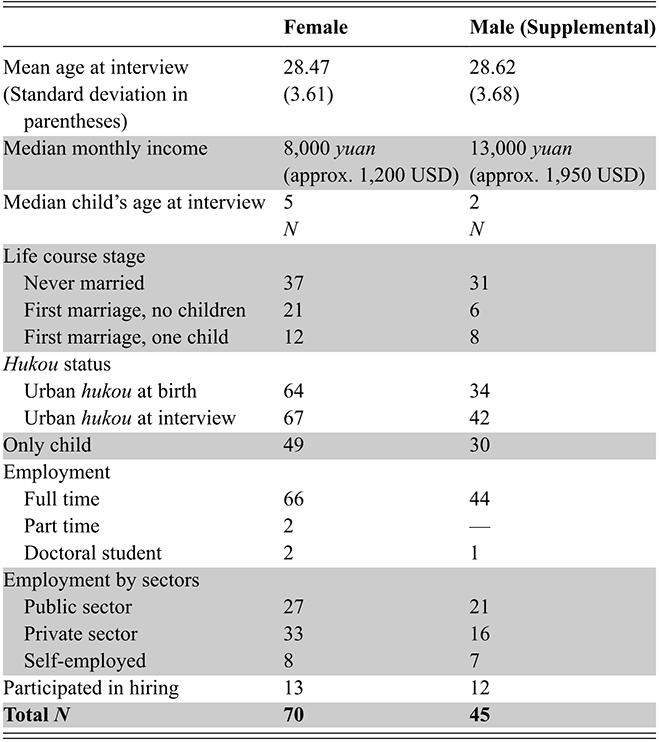
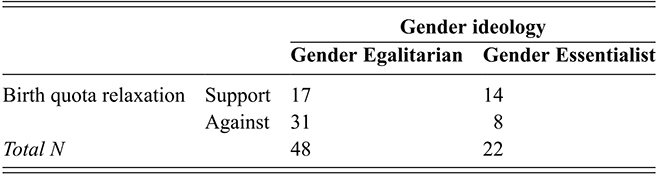

 Open access