





1 Introduction
Let k be a field, R a commutative ring (with $1$
), and
$1$
), and $\mathfrak {Chow} (k,R)$
the category of Chow motives over k with coefficients in R. One says that Rost nilpotence holds for a motive M in
$\mathfrak {Chow} (k,R)$
the category of Chow motives over k with coefficients in R. One says that Rost nilpotence holds for a motive M in $\mathfrak {Chow} (k,R)$
if for all field extensions
$\mathfrak {Chow} (k,R)$
if for all field extensions $E\supseteq k,$
the kernel of the restriction morphism
$E\supseteq k,$
the kernel of the restriction morphism
 $$ \begin{align*}{\mathcal I}_{E/k}^{R}(M)\, :=\;\operatorname{\mathrm{Ker}}\big(\operatorname{\mathrm{End}}_{\mathfrak{Chow} (k,R)}(M)\,\longrightarrow\,\operatorname{\mathrm{End}}_{\mathfrak{Chow} (E,R)}(E\times_{k}M)\big) \end{align*} $$
is a nil ideal. This property has been proven for motives of smooth projective quadrics by Rost [Reference Rost15]. Its main application is Rost’s decomposition of the splitting quadric of a symbol in Milnor K-theory modulo $2$
, which in turn is crucial for Voevodsky’s [Reference Voevodsky19] proof of the Milnor conjecture.
$2$
, which in turn is crucial for Voevodsky’s [Reference Voevodsky19] proof of the Milnor conjecture.
Using Voevodsky’s theory of motives Vishik has proven another (kind of) nilpotence theorem for quadrics over fields of characteristic zero. In [Reference Vishik17, Chapter 3, in particular the Remark after Corollary 3.11], it is shown that for a projective quadric X over such a field k one has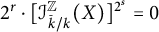 $2^{r}\cdot [{\mathcal I}_{\bar {k}/k}^{\mathbb {Z}}(X)]^{2^{s}}=0$
if
$2^{r}\cdot [{\mathcal I}_{\bar {k}/k}^{\mathbb {Z}}(X)]^{2^{s}}=0$
if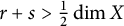 $r+s>\frac {1}{2}\dim X$
.
$r+s>\frac {1}{2}\dim X$
.
Later Rost nilpotence has been verified for other smooth projective schemes, including surfaces and projective homogeneous varieties. It is believed to hold for all Chow motives, but right now a proof of this conjecture seems to be out of reach. We observe, however, that if Rost nilpotence is invariant under blow-ups, then it holds for all motives. In fact, let $X\subseteq \mathbb {P}^{N}_{k}$
be a smooth projective k-scheme and Y its blow-up in
$X\subseteq \mathbb {P}^{N}_{k}$
be a smooth projective k-scheme and Y its blow-up in $\mathbb {P}^{N}_{k}$
. Then, by Manin’s blow-up formula [Reference Manin12, Section 9, Corollary], we know that
$\mathbb {P}^{N}_{k}$
. Then, by Manin’s blow-up formula [Reference Manin12, Section 9, Corollary], we know that $X\otimes \underline {\mathbb {Z}} (1)$
, where
$X\otimes \underline {\mathbb {Z}} (1)$
, where $\underline {\mathbb {Z}} (1)$
is the Tate motive, is a direct summand of Y, and so if Rost nilpotence holds for
$\underline {\mathbb {Z}} (1)$
is the Tate motive, is a direct summand of Y, and so if Rost nilpotence holds for $Y,$
it holds for X. On the other hand, Rost nilpotence is trivially true for projective spaces. Hence, if it is invariant under blow-ups, the smooth projective variety X also satisfies Rost nilpotence.
$Y,$
it holds for X. On the other hand, Rost nilpotence is trivially true for projective spaces. Hence, if it is invariant under blow-ups, the smooth projective variety X also satisfies Rost nilpotence.
These considerations lead to the following question.
Let M,N be motives in $\mathfrak {Chow} (k,R)$
satisfying Rost nilpotence. Does then Rost nilpotence hold for the direct sum
$\mathfrak {Chow} (k,R)$
satisfying Rost nilpotence. Does then Rost nilpotence hold for the direct sum $M\oplus N$
as well?
$M\oplus N$
as well?
In case the Köthe conjecture is true, the answer to this question is “yes” (see Remark 3.4). However, most ring theorists seem to believe that Köthe’s conjecture is wrong as pointed out by Rowen in his book on ring theory [Reference Rowen16, top of page 210].
But there is at least one well-known class of varieties for which the answer to this question is positive: If M and N are motives of projective homogeneous varieties, Chernousov and Merkurjev [Reference Chernousov and Merkurjev4, Theorem 25] have shown that Rost nilpotence also holds for their sum $M\oplus N$
. This is however a special case of a more general result which we will prove here. We show in the last section that in almost all cases, where Rost nilpotence is known, a stronger “version” of it holds: A motive M in
$M\oplus N$
. This is however a special case of a more general result which we will prove here. We show in the last section that in almost all cases, where Rost nilpotence is known, a stronger “version” of it holds: A motive M in $\mathfrak {Chow} (k,R)$
satisfies strong Rost nilpotence if for every field extension
$\mathfrak {Chow} (k,R)$
satisfies strong Rost nilpotence if for every field extension $E\supseteq k,$
the kernel ideal
$E\supseteq k,$
the kernel ideal ${\mathcal I}_{E/k}^{R}(M)$
is nilpotent.
${\mathcal I}_{E/k}^{R}(M)$
is nilpotent.
If now M and N satisfy strong Rost nilpotence, then it follows from an old ring theoretic result of Kegel [Reference Kegel10] that $M\oplus N$
also satisfies strong Rost nilpotence (see Theorem 3.3). Actually, we also prove that a weaker property is enough: A motive M in
$M\oplus N$
also satisfies strong Rost nilpotence (see Theorem 3.3). Actually, we also prove that a weaker property is enough: A motive M in $\mathfrak {Chow} (k,R)$
satisfies Rost nilpotence with bounded exponent if for every field extension
$\mathfrak {Chow} (k,R)$
satisfies Rost nilpotence with bounded exponent if for every field extension $E\supseteq k,$
there exists an integer
$E\supseteq k,$
there exists an integer $N\geq 1$
(depending on E), such that
$N\geq 1$
(depending on E), such that $x^{N}=0$
for all
$x^{N}=0$
for all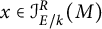 $x\in {\mathcal I}_{E/k}^{R}(M)$
. This implies that
$x\in {\mathcal I}_{E/k}^{R}(M)$
. This implies that ${\mathcal I}_{E/k}^{R}(M)$
is a PI-algebra (without
${\mathcal I}_{E/k}^{R}(M)$
is a PI-algebra (without $1$
) over R, and we use PI-theory to verify that given another motive N satisfying Rost nilpotence with bounded exponent then the direct sum
$1$
) over R, and we use PI-theory to verify that given another motive N satisfying Rost nilpotence with bounded exponent then the direct sum $M\oplus N$
has the same property.
$M\oplus N$
has the same property.
2 Chow motives
We briefly recall the definition of the category of Chow motives referring to Fulton’s book [Reference Fulton7, Chapter16] and Manin [Reference Manin12] for details and more information.
We fix a ground field k (of any characteristic) and denote by $\bar {k}$
its algebraic closure. For a k-scheme
$\bar {k}$
its algebraic closure. For a k-scheme $X,$
we denote by
$X,$
we denote by $k(x)$
the residue field of
$k(x)$
the residue field of $x\in X$
and by
$x\in X$
and by $k(X)$
the function field if X is integral. Given a field extension
$k(X)$
the function field if X is integral. Given a field extension $E\supset k,$
we set
$E\supset k,$
we set $X_{E}:=E\times _{k}X$
. We denote by
$X_{E}:=E\times _{k}X$
. We denote by ${\mathrm {CH}}_{i}(X)$
the Chow group (modulo rational equivalence) of dimension i cycles of X. If X is a pure-dimensional k-scheme in the sense of [Reference Fulton7, Appendix B.1.3], one sets
${\mathrm {CH}}_{i}(X)$
the Chow group (modulo rational equivalence) of dimension i cycles of X. If X is a pure-dimensional k-scheme in the sense of [Reference Fulton7, Appendix B.1.3], one sets ${\mathrm {CH}}^{i}(X):={\mathrm {CH}}_{\dim X -i}(X)$
.
${\mathrm {CH}}^{i}(X):={\mathrm {CH}}_{\dim X -i}(X)$
.
2.1 Correspondences of degree $0$
$0$

Let ${\mathrm {PSm}}_{k}$
be the category of smooth and projective k-schemes. Given two such schemes X and Y, a correspondence of degree 0 between X and Y is an element
${\mathrm {PSm}}_{k}$
be the category of smooth and projective k-schemes. Given two such schemes X and Y, a correspondence of degree 0 between X and Y is an element $\alpha $
in
$\alpha $
in
 $$ \begin{align} \bigoplus\limits_{i=1}^{l}{\mathrm{CH}}_{\dim X_{i}}(X_{i}\times_{k} Y)\, =\, \bigoplus\limits_{i=1}^{l}\bigoplus\limits_{j=1}^{m}{\mathrm{CH}}^{\dim Y_{j}}(X_{i}\times_{k}Y_{j}), \end{align} $$
where $X_{1},\ldots ,X_{l}$
are the connected components of X and
$X_{1},\ldots ,X_{l}$
are the connected components of X and $Y_{1},\ldots ,Y_{m}$
the ones of Y. We write then
$Y_{1},\ldots ,Y_{m}$
the ones of Y. We write then $\alpha :X\leadsto Y$
. Given
$\alpha :X\leadsto Y$
. Given $\alpha :X\leadsto Y$
and
$\alpha :X\leadsto Y$
and $\beta :Y\leadsto Z,$
their composition is defined as
$\beta :Y\leadsto Z,$
their composition is defined as
 $$ \begin{align*}\beta\circ\alpha\, :=\; p_{XZ\,\ast}\big(\, p_{XY}^{\ast}(\alpha)\cdot p_{YZ}^{\ast}(\beta)\,\big), \end{align*} $$
where $p_{XY},p_{XZ}$
, and
$p_{XY},p_{XZ}$
, and $p_{YZ}$
are the respective projections from
$p_{YZ}$
are the respective projections from $X\times _{k}Y\times _{k}Z$
to
$X\times _{k}Y\times _{k}Z$
to $X\times _{k}Y$
,
$X\times _{k}Y$
, $X\times _{k}Z$
, and
$X\times _{k}Z$
, and $Y\times _{k}Z$
. This product is associative and the class of the image of the diagonal morphism acts as identity. Hence, we have an additive category of correspondences of degree 0 over k, denoted
$Y\times _{k}Z$
. This product is associative and the class of the image of the diagonal morphism acts as identity. Hence, we have an additive category of correspondences of degree 0 over k, denoted ${\mathrm {Corr}}^{0}(k)$
, whose objects are the smooth projective k-schemes, the morphisms are correspondences of degree
${\mathrm {Corr}}^{0}(k)$
, whose objects are the smooth projective k-schemes, the morphisms are correspondences of degree $0$
, and the direct sum is the disjoint union.
$0$
, and the direct sum is the disjoint union.
2.2 Chow motives
The idempotent completion of ${\mathrm {Corr}}^{0} (k)$
is the category of (effective) Chow motives over k, denoted
${\mathrm {Corr}}^{0} (k)$
is the category of (effective) Chow motives over k, denoted $\mathfrak {Chow} (k)$
. The objects of
$\mathfrak {Chow} (k)$
. The objects of $\mathfrak {Chow} (k)$
are pairs
$\mathfrak {Chow} (k)$
are pairs $(X,p)$
, where
$(X,p)$
, where $p:X\leadsto X$
is a correspondence of degree
$p:X\leadsto X$
is a correspondence of degree $0$
satisfying
$0$
satisfying $p\circ p=p$
, i.e., p is an idempotent morphism in
$p\circ p=p$
, i.e., p is an idempotent morphism in ${\mathrm {Corr}}^{0} (k)$
, and the morphisms are given by
${\mathrm {Corr}}^{0} (k)$
, and the morphisms are given by
 $$ \begin{align*}\operatorname{\mathrm{Hom}}_{k}\big( (X,p),(Y,q)\big)\, :=\; q\circ\operatorname{\mathrm{Mor}}_{{\mathrm{Corr}}^{0}(k)}(X,Y)\circ p\;\;\subseteq\operatorname{\mathrm{Mor}}_{{\mathrm{Corr}}^{0}(k)}(X,Y). \end{align*} $$
If X is a smooth projective k-scheme, we denote by the same symbol X its motive in $\mathfrak {Chow} (k)$
. We also set
$\mathfrak {Chow} (k)$
. We also set $\operatorname {\mathrm {End}}_{k}(X,p):=\operatorname {\mathrm {Hom}}_{k}((X,p),(X,p))$
. The Cartesian product induces a “tensor product” on
$\operatorname {\mathrm {End}}_{k}(X,p):=\operatorname {\mathrm {Hom}}_{k}((X,p),(X,p))$
. The Cartesian product induces a “tensor product” on $\mathfrak {Chow} (k)$
, denoted
$\mathfrak {Chow} (k)$
, denoted $(X,p)\otimes (Y,q)$
.
$(X,p)\otimes (Y,q)$
.
There is a covariant functor ${\mathrm {PSm}}_{k}\longrightarrow \mathfrak {Chow} (k)$
, which is the identity on objects and sends a morphism
${\mathrm {PSm}}_{k}\longrightarrow \mathfrak {Chow} (k)$
, which is the identity on objects and sends a morphism $f:X\longrightarrow Y$
to the class of its graph
$f:X\longrightarrow Y$
to the class of its graph $\Gamma _{f}$
.
$\Gamma _{f}$
.
The Tate motive and its (nonnegative) twists are denoted by $\underline {\mathbb {Z}} (i):=(\underline {\mathbb {Z}}(1))^{\otimes i}$
,
$\underline {\mathbb {Z}} (i):=(\underline {\mathbb {Z}}(1))^{\otimes i}$
, $i\in \mathbb {N}\cup \{ 0\}$
, and if X is a smooth projective k-scheme, we set
$i\in \mathbb {N}\cup \{ 0\}$
, and if X is a smooth projective k-scheme, we set $X(i):=X\otimes \underline {\mathbb {Z}}(i)$
. Recall that the Tate motive is the complement of the motive of the point in the projective line:
$X(i):=X\otimes \underline {\mathbb {Z}}(i)$
. Recall that the Tate motive is the complement of the motive of the point in the projective line: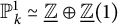 $\mathbb {P}^{1}_{k}\simeq \underline {\mathbb {Z}}\oplus \underline {\mathbb {Z}}(1)$
in
$\mathbb {P}^{1}_{k}\simeq \underline {\mathbb {Z}}\oplus \underline {\mathbb {Z}}(1)$
in $\mathfrak {Chow} (k)$
.
$\mathfrak {Chow} (k)$
.
A motive is called split if it is a direct sum of twists of Tate motives, and geometrically split if this is the case over the algebraic closure of the base field. Examples of geometrically split motives are the motives of projective quadrics, or more generally of projective homogeneous varieties, see Köck [Reference Köck11], and the motives of geometrically rational surfaces, see, e.g., [Reference Gille8].
Replacing ${\mathrm {CH}}_{i}(\, -\, )$
by
${\mathrm {CH}}_{i}(\, -\, )$
by ${\mathrm {CH}}_{i}(\, -\, )_{R}:=R\otimes _{\mathbb {Z}}{\mathrm {CH}}_{i}(\, -\, )$
for a commutative ring R (with
${\mathrm {CH}}_{i}(\, -\, )_{R}:=R\otimes _{\mathbb {Z}}{\mathrm {CH}}_{i}(\, -\, )$
for a commutative ring R (with $1$
) we get Chow motives with R as ring of coefficients, which we denote by
$1$
) we get Chow motives with R as ring of coefficients, which we denote by $\mathfrak {Chow} (k,R)$
. In this case, we use
$\mathfrak {Chow} (k,R)$
. In this case, we use $\operatorname {\mathrm {Hom}}_{k}((X,p),(Y,q))_{R}$
and
$\operatorname {\mathrm {Hom}}_{k}((X,p),(Y,q))_{R}$
and $\operatorname {\mathrm {End}}_{k}(X,p)_{R}$
for the homomorphism groups and the endomorphism rings, respectively, which are R-modules, respectively, R-algebras. The Tate motives and its twists will then be denoted by
$\operatorname {\mathrm {End}}_{k}(X,p)_{R}$
for the homomorphism groups and the endomorphism rings, respectively, which are R-modules, respectively, R-algebras. The Tate motives and its twists will then be denoted by $\underline {R}$
and
$\underline {R}$
and $\underline {R}(i)$
, and we set
$\underline {R}(i)$
, and we set $X(i)=X\otimes \underline {R}(i)$
for
$X(i)=X\otimes \underline {R}(i)$
for $i\geq 0$
.
$i\geq 0$
.
We fix in the following a commutative coefficient ring R with $1$
.
$1$
.
2.3 The restriction functor
Let $E\supseteq k$
be a field extension. Then,
$E\supseteq k$
be a field extension. Then, $X\mapsto X_{E}$
and
$X\mapsto X_{E}$
and $\alpha \mapsto \alpha _{E}$
induce a restriction morphism
$\alpha \mapsto \alpha _{E}$
induce a restriction morphism
 $$ \begin{align*}{\mathrm{res}}_{E/k}\, :\;\operatorname{\mathrm{Hom}}_{k}(M,N)_{R}\,\longrightarrow\operatorname{\mathrm{Hom}}_{E}(M_{E},N_{E})_{R} \end{align*} $$
for $M,N\in \mathfrak {Chow} (k,R)$
. This defines a contravariant functor
$M,N\in \mathfrak {Chow} (k,R)$
. This defines a contravariant functor $\mathfrak {Chow} (k,R)\longrightarrow \mathfrak {Chow} (E,R)$
, called restriction, mapping a motive M in
$\mathfrak {Chow} (k,R)\longrightarrow \mathfrak {Chow} (E,R)$
, called restriction, mapping a motive M in $\mathfrak {Chow} (k,R)$
onto
$\mathfrak {Chow} (k,R)$
onto $M_{E}\in \mathfrak {Chow} (E,R)$
. As in the introduction, we denote the kernel of
$M_{E}\in \mathfrak {Chow} (E,R)$
. As in the introduction, we denote the kernel of
 $$ \begin{align*}{\mathrm{res}}_{E/k}\, :\;\operatorname{\mathrm{End}}_{k}(M)_{R}\,\longrightarrow\,\operatorname{\mathrm{End}}_{E}(M_{E})_{R} \end{align*} $$
by ${\mathcal I}_{E/k}^{R}(M)$
for all
${\mathcal I}_{E/k}^{R}(M)$
for all $M\in \mathfrak {Chow} (k,R)$
and all field extensions
$M\in \mathfrak {Chow} (k,R)$
and all field extensions $E\supseteq k$
.
$E\supseteq k$
.
2.4 Chow motives relative to a base
In Section 4.4, we make use of the following generalization of Chow motives over a field, which has been introduced by Vishik and Zainoulline [Reference Vishik and Zainoulline18].
Let V be an essentially smooth scheme over k, i.e., a localization of a smooth k-scheme. The objects of the category of relative correspondences over V with coefficients in R are smooth and projective morphisms $X\longrightarrow V$
. The R-module of morphisms between two objects
$X\longrightarrow V$
. The R-module of morphisms between two objects $X\longrightarrow V$
and
$X\longrightarrow V$
and $Y\longrightarrow V$
is defined as
$Y\longrightarrow V$
is defined as
 $$ \begin{align*}\bigoplus\limits_{j=1}^{m}{\mathrm{CH}}^{d_{j}}(X\times_{V}Y_{j})_{R}, \end{align*} $$
where $Y_{1},\ldots ,Y_{m}$
are the irreducible components of Y and
$Y_{1},\ldots ,Y_{m}$
are the irreducible components of Y and $d_{j}$
is the relative dimension of
$d_{j}$
is the relative dimension of $Y_{j}$
over V for all
$Y_{j}$
over V for all $1\leq j\leq m$
. As in
$1\leq j\leq m$
. As in ${\mathrm {Corr}}^{0}(k),$
the composition of two morphisms
${\mathrm {Corr}}^{0}(k),$
the composition of two morphisms $\alpha : [X\longrightarrow V]\leadsto [Y\longrightarrow V]$
and
$\alpha : [X\longrightarrow V]\leadsto [Y\longrightarrow V]$
and $\beta :[Y\longrightarrow V]\leadsto [Z\longrightarrow V]$
is defined by
$\beta :[Y\longrightarrow V]\leadsto [Z\longrightarrow V]$
is defined by
 $$ \begin{align*}\beta\circ\alpha\, :=\, p_{XZ\,\ast}\big( p_{XY}^{\ast}(\alpha)\cdot p_{YZ}^{\ast}(\beta)\big), \end{align*} $$
where $p_{XY}$
,
$p_{XY}$
, $p_{XZ}$
, and
$p_{XZ}$
, and $p_{YZ}$
are the projections from
$p_{YZ}$
are the projections from $X\times _{V}Y\times _{V}Z$
to
$X\times _{V}Y\times _{V}Z$
to $X\times _{V}Y$
,
$X\times _{V}Y$
, $X\times _{V}Z$
, and
$X\times _{V}Z$
, and $Y\times _{V}Z$
, respectively.
$Y\times _{V}Z$
, respectively.
The idempotent completion of this additive category is the category of Chow motives relative to V, denoted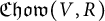 $\mathfrak {Chow} (V,R)$
. Clearly, if
$\mathfrak {Chow} (V,R)$
. Clearly, if $V=\operatorname {\mathrm {Spec}} k,$
we get back the category
$V=\operatorname {\mathrm {Spec}} k,$
we get back the category $\mathfrak {Chow} (k,R)$
of Chow motives over k with coefficients in R, see (2.1) for the agreement of the groups of morphisms.
$\mathfrak {Chow} (k,R)$
of Chow motives over k with coefficients in R, see (2.1) for the agreement of the groups of morphisms.
We denote the R-module of morphism in $\mathfrak {Chow} (V,R)$
between
$\mathfrak {Chow} (V,R)$
between $[X\longrightarrow V]$
and
$[X\longrightarrow V]$
and $[Y\longrightarrow V]$
by
$[Y\longrightarrow V]$
by $\operatorname {\mathrm {Hom}}_{V}([X\longrightarrow V],[Y\longrightarrow V])_{R}$
, and the R-algebra of endomorphisms of
$\operatorname {\mathrm {Hom}}_{V}([X\longrightarrow V],[Y\longrightarrow V])_{R}$
, and the R-algebra of endomorphisms of $[X\longrightarrow V]$
by
$[X\longrightarrow V]$
by $\operatorname {\mathrm {End}}_{V}([X\longrightarrow V])_{R}$
.
$\operatorname {\mathrm {End}}_{V}([X\longrightarrow V])_{R}$
.
If $f:W\longrightarrow V$
is a morphism of essentially smooth k-schemes, the map
$f:W\longrightarrow V$
is a morphism of essentially smooth k-schemes, the map
 $$ \begin{align*}[X\longrightarrow V]\,\longmapsto\, [X\times_{V}W\longrightarrow W] \end{align*} $$
induces a restriction functor $\mathfrak {Chow} (V,R)\longrightarrow \mathfrak {Chow} (W,R)$
, which maps a correspondence
$\mathfrak {Chow} (V,R)\longrightarrow \mathfrak {Chow} (W,R)$
, which maps a correspondence $\alpha : [X\longrightarrow V]\leadsto [Y\longrightarrow V]$
onto
$\alpha : [X\longrightarrow V]\leadsto [Y\longrightarrow V]$
onto
 $$ \begin{align*}(\operatorname{\mathrm{id}}_{X\times_{V}Y}\times f)^{\ast}(\alpha)\in\operatorname{\mathrm{Hom}}_{W}([X_{W}\longrightarrow W],[Y_{W}\longrightarrow W])_{R}. \end{align*} $$
Here, we have (following [Reference Vishik and Zainoulline18]) identified $(X\times _{V}W)\times _{W}(Y\times _{V}W)\simeq X\times _{V}Y\times _{V}W$
.
$(X\times _{V}W)\times _{W}(Y\times _{V}W)\simeq X\times _{V}Y\times _{V}W$
.
In particular, we have for every $[X\longrightarrow V]\in \mathfrak {Chow} (V,R),$
an R-algebra homomorphism
$[X\longrightarrow V]\in \mathfrak {Chow} (V,R),$
an R-algebra homomorphism
 $$ \begin{align*}{\mathrm{res}}_{W/V}\, :\;\operatorname{\mathrm{End}}_{V}([X\longrightarrow V])_{R}\,\longrightarrow\,\operatorname{\mathrm{End}}_{W}([X_{W}\longrightarrow W])_{R}, \end{align*} $$
whose kernel is denoted by ${\mathcal I}_{W/V}^{R}([X\longrightarrow V])$
.
${\mathcal I}_{W/V}^{R}([X\longrightarrow V])$
.
The following lemma is due to Vishik and Zainoulline [Reference Vishik and Zainoulline18, Section 3].
Lemma 2.1 Let V be an essentially smooth scheme over the field k, $X\longrightarrow V$
a smooth projective k-morphism with X integral, and
$X\longrightarrow V$
a smooth projective k-morphism with X integral, and $U\subseteq X$
an open subscheme. Then, we have:
$U\subseteq X$
an open subscheme. Then, we have:
-
(i)
${\mathrm {res}}_{X/k}:\operatorname {\mathrm {End}}_{k}(X)_{R}\longrightarrow \operatorname {\mathrm {End}}_{X}([X\times _{k}X\xrightarrow {\pi _{2}} X])_{R}$
is a monomorphism, where
$\pi _{2}$
is the projection onto the second factor. -
(ii) There exists an integer
$1\leq d\leq 1+\dim X$
, such that
$$ \begin{align*}\big[{\mathcal I}_{U/X}^{R}([X\times_{k}X\xrightarrow{\pi_{2}} X])\big]^{d}\, =\, 0.\\[-24pt] \end{align*} $$


Proof (i) Identifying $\operatorname {\mathrm {End}}_{X}([X\times _{k}X\xrightarrow {\pi _{2}} X])_{R}\simeq {\mathrm {CH}}^{\dim X}(X\times _{k}X\times _{k}X)_{R}$
the morphism
$\operatorname {\mathrm {End}}_{X}([X\times _{k}X\xrightarrow {\pi _{2}} X])_{R}\simeq {\mathrm {CH}}^{\dim X}(X\times _{k}X\times _{k}X)_{R}$
the morphism ${\mathrm {res}}_{X/k}$
is equal to
${\mathrm {res}}_{X/k}$
is equal to
 $$ \begin{align*}\pi_{12}^{\ast}\, :\;{\mathrm{CH}}^{\dim X}(X\times_{k}X)_{R}\,\longrightarrow\,{\mathrm{CH}}^{\dim X}(X\times_{k}X\times_{k}X)_{R}, \end{align*} $$
where $\pi _{12}:X\times _{k}X\times _{k}X\longrightarrow X\times _{k}X$
is the projection onto the first two factors. This morphism is split by the pullback along
$\pi _{12}:X\times _{k}X\times _{k}X\longrightarrow X\times _{k}X$
is the projection onto the first two factors. This morphism is split by the pullback along $\operatorname {\mathrm {id}}_{X}\times \Delta _{X}$
, where
$\operatorname {\mathrm {id}}_{X}\times \Delta _{X}$
, where $\Delta _{X}:X\longrightarrow X\times _{k}X$
is the diagonal morphism.
$\Delta _{X}:X\longrightarrow X\times _{k}X$
is the diagonal morphism.
Part (ii) is essentially a special case of Vishik and Zainulline [Reference Vishik and Zainoulline18, Lemma 3.2], which does not assert but proves that ${\mathcal I}_{U/X}^{R}([X\times _{k}X\xrightarrow {\pi _{2}} X])$
is a nil ideal of bounded exponent d, where
${\mathcal I}_{U/X}^{R}([X\times _{k}X\xrightarrow {\pi _{2}} X])$
is a nil ideal of bounded exponent d, where $d-1$
is the largest integer
$d-1$
is the largest integer $\leq \frac {\dim X}{{\mathrm {codim}}_{X} (X\setminus U)}$
.
$\leq \frac {\dim X}{{\mathrm {codim}}_{X} (X\setminus U)}$
.
However, the argument in [Reference Vishik and Zainoulline18, Proof of Lemma 3.2] actually shows even more, namely, that we have
 $$ \begin{align*}\big[{\mathcal I}_{U/X}^{R}([X\times_{k}X\xrightarrow{\pi_{2}} X])\big]^{d}\, =\, 0. \end{align*} $$
In fact, instead of considering only one element $\phi $
in
$\phi $
in ${\mathcal I}_{U/X}^{R}([X\times _{k}X\xrightarrow {\pi _{2}} X]),$
one takes d elements
${\mathcal I}_{U/X}^{R}([X\times _{k}X\xrightarrow {\pi _{2}} X]),$
one takes d elements $\rho _{1},\ldots ,\rho _{d}$
in this kernel (using the notation of [Reference Vishik and Zainoulline18, Proof of Lemma 3.2]), and sets
$\rho _{1},\ldots ,\rho _{d}$
in this kernel (using the notation of [Reference Vishik and Zainoulline18, Proof of Lemma 3.2]), and sets $\phi _{i}:=\pi _{i,i+1}^{\ast }(\rho _{i})$
, where
$\phi _{i}:=\pi _{i,i+1}^{\ast }(\rho _{i})$
, where $\pi _{i,i+1}:X^{\times _{k}\, (d+1)}\longrightarrow X\times _{k}X$
is the projection onto the ith and
$\pi _{i,i+1}:X^{\times _{k}\, (d+1)}\longrightarrow X\times _{k}X$
is the projection onto the ith and $(i+1)$
th coordinates. Following then word by word, the rest of the proof gives
$(i+1)$
th coordinates. Following then word by word, the rest of the proof gives $\rho _{1}\circ \,\dots \,\circ \rho _{d}=0$
.
$\rho _{1}\circ \,\dots \,\circ \rho _{d}=0$
.
3 Rost nilpotence
3.1
Definition 3.1 Let k be a field, R a commutative ring, and $M\in \mathfrak {Chow} (k,R)$
.
$M\in \mathfrak {Chow} (k,R)$
.
-
(a) We say that Rost nilpotence (respectively Rost nilpotence with bounded exponent) holds for M in
$\mathfrak {Chow} (k,R)$
if for all field extensions
$E\supseteq k,$
the kernel
${\mathcal I}_{E/k}^{R}(M)$
of
${\mathrm {res}}_{E/k}$
is a nil ideal (respectively a nil ideal with bounded exponent). -
(b) We say that strong Rost nilpotence holds for M in
$\mathfrak {Chow} (k,R)$
if for every field extension
$E\supseteq k,$
the ideal
${\mathcal I}_{E/k}^{R}(M)$
is nilpotent.


Remark 3.1
-
(i) If M is split, then
${\mathcal I}_{E/k}^{R}(M)$
is trivial for all field extensions
$E\supseteq k$
. -
(ii) If
$\operatorname {\mathrm {End}}_{k}(M)_{R}$
is
$\mathbb {Z}$
-torsion free, e.g., if R is a field of characteristic
$0$
, then
${\mathcal I}_{E/k}^{R}(M)$
is trivial as well for all field extensions
$E\supseteq k$
. In fact, for a purely transcendental extension
$E/k,$
we know that the base change morphism
${\mathrm {CH}}_{i}(Y)\longrightarrow {\mathrm {CH}}_{i}(Y_{E})$
is an isomorphism, see, e.g., [Reference Flenner, O’Carrol and Vogel6, Proposition 2.1.8], and for
$E/k$
a finite extension, the kernel of
${\mathrm {CH}}_{i}(Y)\longrightarrow {\mathrm {CH}}_{i}(Y_{E})$
is annihilated by the degree
$[E:k]$
. -
(iii) If C is a curve, i.e., a smooth projective k-scheme of dimensions one, then
$\operatorname {\mathrm {End}}_{k}(C)_{R}={\mathrm {CH}}_{1}(C\times _{k}C)_{R}\simeq R\otimes _{\mathbb {Z}}{\mathrm {Pic}} (C\times _{k}C)$
, and so by the Hochschild–Serre spectral sequence, we have in case
$\operatorname {\mathrm {char}} k=0$
and R is a flat
$\mathbb {Z}$
-algebra that
${\mathrm {res}}_{E/k}:\operatorname {\mathrm {End}}_{k}(C)_{R}\longrightarrow \operatorname {\mathrm {End}}_{E}(C_{E})_{R}$
is injective for all fields
$E\supseteq k$
.


Most proofs of Rost nilpotence rely on a lemma due to Rost [Reference Rost15, Proposition 1], which we recall here in a seemingly more general version. However, this is what is actually proven in [Reference Rost15] as we explain now.
Lemma 3.2 (Rost’s Lemma)
Let X and Y be smooth and projective k-schemes with Y connected, and $\alpha _{0},\ldots ,\alpha _{d}\in \operatorname {\mathrm {End}}_{k}(X)_{R}$
, where
$\alpha _{0},\ldots ,\alpha _{d}\in \operatorname {\mathrm {End}}_{k}(X)_{R}$
, where $d=\dim Y$
. Assume that
$d=\dim Y$
. Assume that
 $$ \begin{align*}(\alpha_{i\,k(y)})_{\ast}\big(\,{\mathrm{CH}}_{i}(k(y)\times_{k}X)_{R}\,\big)\; =\, 0 \end{align*} $$
for all $y\in Y$
and
$y\in Y$
and $0\leq i\leq \dim X$
. Then,
$0\leq i\leq \dim X$
. Then,
 $$ \begin{align*}(\alpha_{0}\circ\alpha_{1}\circ\,\dots\,\circ\alpha_{d-1}\circ\alpha_{d})_{\ast}\big(\,{\mathrm{CH}}_{j}(Y\times_{k}X)_{R}\big)\, =\, 0 \end{align*} $$
for all $0\leq j\leq \dim X+\dim Y$
. In particular, if
$0\leq j\leq \dim X+\dim Y$
. In particular, if $X=Y$
, we have
$X=Y$
, we have
 $$ \begin{align*}\alpha_{0}\circ\alpha_{1}\circ\,\dots\,\circ\alpha_{d-1}\circ\alpha_{d}\, =\, 0. \end{align*} $$
Proof Let $\pi :Y\times _{k}X\longrightarrow Y$
be the projection onto the first factor. Define for
$\pi :Y\times _{k}X\longrightarrow Y$
be the projection onto the first factor. Define for $0\leq j\leq \dim X+\dim Y$
a filtration on the Chow group
$0\leq j\leq \dim X+\dim Y$
a filtration on the Chow group ${\mathrm {CH}}_{j}(Y\times _{k}X)_{R}$
by setting
${\mathrm {CH}}_{j}(Y\times _{k}X)_{R}$
by setting
 $$ \begin{align*}F_{-1}{\mathrm{CH}}_{j}(Y\times_{k}X)_{R}\, =\, 0 \end{align*} $$
and letting $F_{p}{\mathrm {CH}}_{j}(Y\times _{k}X)_{R}$
be the subgroup generated by the classes of j-dimensional subvarieties V of
$F_{p}{\mathrm {CH}}_{j}(Y\times _{k}X)_{R}$
be the subgroup generated by the classes of j-dimensional subvarieties V of $Y\times _{k}X$
with
$Y\times _{k}X$
with $\dim \pi (V)\leq p$
for
$\dim \pi (V)\leq p$
for $0\leq p\leq d=\dim Y$
.
$0\leq p\leq d=\dim Y$
.
Now, Rost [Reference Rost15, Proof of Proposition 1], or Brosnan [Reference Brosnan1] for a more geometric argument, show that if $\alpha \in \operatorname {\mathrm {End}}_{k}(X)_{R}$
satisfies
$\alpha \in \operatorname {\mathrm {End}}_{k}(X)_{R}$
satisfies
 $$ \begin{align*}\alpha_{k(y)\,\ast}\big(\,{\mathrm{CH}}_{i}(k(y)\times_{k}X)_{R}\,\big)\, =\, 0 \end{align*} $$
for all $y\in Y$
and all
$y\in Y$
and all $0\leq i\leq \dim X,$
then we have
$0\leq i\leq \dim X,$
then we have
 $$ \begin{align*}\alpha_{\ast}\big(\,F_{p}{\mathrm{CH}}_{j}(Y\times_{k}X)_{R}\,\big)\,\subseteq\, F_{p-1}{\mathrm{CH}}_{j}(Y\times_{k}X)_{R} \end{align*} $$
for all $d\geq p\geq 0$
. Hence, the assumption on the
$d\geq p\geq 0$
. Hence, the assumption on the $\alpha _{i}$
’s implies that
$\alpha _{i}$
’s implies that
 $$ \begin{align*}\alpha_{0\,\ast}\Big(\,\alpha_{1\,\ast}\big(\,\ldots\,\alpha_{d\,\ast}({\mathrm{CH}}_{j}(Y\times_{k}X)_{R})\,\ldots\,\big)\,\Big) \;\subseteq\; F_{-1}{\mathrm{CH}}_{j}(Y\times_{k}X)_{R}\, =\, 0 \end{align*} $$
as claimed.
The strong version of Rost nilpotence is “additive.” More precisely, we have the following fact.
Theorem 3.3 Let $M_{1},\ldots ,M_{d}$
be motives in
$M_{1},\ldots ,M_{d}$
be motives in $\mathfrak {Chow} (k,R)$
satisfying strong Rost nilpotence. Then, the direct sum
$\mathfrak {Chow} (k,R)$
satisfying strong Rost nilpotence. Then, the direct sum $\bigoplus \limits _{i=1}^{d}M_{i}$
satisfies strong Rost nilpotence.
$\bigoplus \limits _{i=1}^{d}M_{i}$
satisfies strong Rost nilpotence.
Proof By induction, it is enough to show this for $d=2$
. Let for this
$d=2$
. Let for this $M,N\in \mathfrak {Chow} (k,R)$
satisfy strong Rost nilpotence, and
$M,N\in \mathfrak {Chow} (k,R)$
satisfy strong Rost nilpotence, and $E\supseteq k$
a field extension. We set for brevity of notation
$E\supseteq k$
a field extension. We set for brevity of notation ${\mathcal I}_{M}:={\mathcal I}_{E/k}^{R}(M)$
and
${\mathcal I}_{M}:={\mathcal I}_{E/k}^{R}(M)$
and ${\mathcal I}_{N}:={\mathcal I}_{E/k}^{R}(N)$
. Let further B and C be the kernels of
${\mathcal I}_{N}:={\mathcal I}_{E/k}^{R}(N)$
. Let further B and C be the kernels of ${\mathrm {res}}_{E/k}:\operatorname {\mathrm {Hom}}_{k}(N,M)_{R}\longrightarrow \operatorname {\mathrm {Hom}}_{E}(N_{E},M_{E})_{R}$
and of
${\mathrm {res}}_{E/k}:\operatorname {\mathrm {Hom}}_{k}(N,M)_{R}\longrightarrow \operatorname {\mathrm {Hom}}_{E}(N_{E},M_{E})_{R}$
and of ${\mathrm {res}}_{E/k}:\operatorname {\mathrm {Hom}}_{k}(M,N)_{R}\longrightarrow \operatorname {\mathrm {Hom}}_{E}(M_{E},N_{E})_{R}$
, respectively.
${\mathrm {res}}_{E/k}:\operatorname {\mathrm {Hom}}_{k}(M,N)_{R}\longrightarrow \operatorname {\mathrm {Hom}}_{E}(M_{E},N_{E})_{R}$
, respectively.
Identifying
 $$ \begin{align*}\operatorname{\mathrm{End}}_{k}(M\oplus N)_{R}\,\simeq\,\left( \begin{array}{c@{\;\;\;}c} \operatorname{\mathrm{End}}_{k}(M)_{R} & \operatorname{\mathrm{Hom}}_{k}(N,M)_{R} \\[3mm] \operatorname{\mathrm{Hom}}_{k}(M,N)_{R} & \operatorname{\mathrm{End}}_{k}(N)_{R} \end{array}\right), \end{align*} $$
we have
 $$ \begin{align*}{\mathcal I}_{E/k}^{R}(M\oplus N)\, =\,\left( \begin{array}{c@{\;\;\;}c} {\mathcal I}_{M} & B \\[3mm] C & {\mathcal I}_{N} \end{array}\right)\, =\, \left( \begin{array}{c@{\;\;\;}c} {\mathcal I}_{M} & 0 \\[3mm] C & 0 \end{array}\right)\, +\, \left( \begin{array}{c@{\;\;\;}c} 0 & B \\[3mm] 0 & {\mathcal I}_{N} \end{array}\right). \end{align*} $$
By assumption, both ${\mathcal I}_{M}$
and
${\mathcal I}_{M}$
and ${\mathcal I}_{N}$
are nilpotent ideals, and so
${\mathcal I}_{N}$
are nilpotent ideals, and so
 $$ \begin{align*}A_{M}:=\left(\begin{array}{c@{\;\;\;}c} {\mathcal I}_{M} & 0 \\[3mm] C & 0 \end{array}\right)\qquad\mbox{and}\qquad A_{N}:=\left(\begin{array}{c@{\;\;\;}c} 0 & B \\[3mm] 0 & {\mathcal I}_{N} \end{array}\right) \end{align*} $$
are nilpotent subrings (without $1$
) of the ring
$1$
) of the ring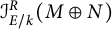 ${\mathcal I}_{E/k}^{R}(M\oplus N)$
. Hence, by the main theorem of Kegel [Reference Kegel10], their sum
${\mathcal I}_{E/k}^{R}(M\oplus N)$
. Hence, by the main theorem of Kegel [Reference Kegel10], their sum $A_{M}+A_{N}$
, which is the kernel ideal
$A_{M}+A_{N}$
, which is the kernel ideal ${\mathcal I}_{E/k}^{R}(M\oplus N)$
, is nilpotent as well.
${\mathcal I}_{E/k}^{R}(M\oplus N)$
, is nilpotent as well.
Remark 3.4 If ${\mathcal I}_{M}$
and
${\mathcal I}_{M}$
and ${\mathcal I}_{N}$
are “only” nil, then
${\mathcal I}_{N}$
are “only” nil, then $A_{M}$
and
$A_{M}$
and $A_{N}$
are nil left ideals (we use the above notation). In this case, (an equivalent form of) Köthe’s conjecture, see, e.g., [Reference Rowen16, 2.6.35(ii)], would imply that their sum
$A_{N}$
are nil left ideals (we use the above notation). In this case, (an equivalent form of) Köthe’s conjecture, see, e.g., [Reference Rowen16, 2.6.35(ii)], would imply that their sum ${\mathcal I}_{E/k}^{R}(M\oplus N)$
is nil as well.
${\mathcal I}_{E/k}^{R}(M\oplus N)$
is nil as well.
Corollary 3.5 Let Y be a smooth closed subscheme of $X\in {\mathrm {PSm}}_{k}$
of pure codimension r, and Z the blow-up of X along Y. Then, in
$X\in {\mathrm {PSm}}_{k}$
of pure codimension r, and Z the blow-up of X along Y. Then, in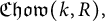 $\mathfrak {Chow} (k,R),$
strong Rost nilpotence holds for Z if and only if it holds for X and Y.
$\mathfrak {Chow} (k,R),$
strong Rost nilpotence holds for Z if and only if it holds for X and Y.
Proof By the blow-up formula, see Manin [Reference Manin12, Section 9, Corollary] or [Reference Fulton7, Chapter 6], we have
 $$ \begin{align*}Z\,\simeq\, X\oplus\;\bigoplus\limits_{i=1}^{r-1}Y(i) \end{align*} $$
in $\mathfrak {Chow} (k,R)$
and so the corollary follows from Theorem 3.3 above.
$\mathfrak {Chow} (k,R)$
and so the corollary follows from Theorem 3.3 above.
3.1 The case of bounded exponents
We show now that Rost nilpotence with bounded exponents is also “additive,” i.e., the analog of Theorem 3.3 holds for this slightly weaker version of Rost nilpotence.
Let $M,N$
be motives in
$M,N$
be motives in $\mathfrak {Chow} (k,R)$
, which satisfy Rost nilpotence with bounded exponent, and
$\mathfrak {Chow} (k,R)$
, which satisfy Rost nilpotence with bounded exponent, and $E\supseteq k$
a field extension. Let further
$E\supseteq k$
a field extension. Let further $r=r(E)$
and
$r=r(E)$
and $s=s(E)$
be integers
$s=s(E)$
be integers $\geq 1$
, such that
$\geq 1$
, such that $x^{r+1}=0$
and
$x^{r+1}=0$
and $y^{s+1}=0$
for all
$y^{s+1}=0$
for all $x\in {\mathcal I}_{E/k}^{R}(M)$
and all
$x\in {\mathcal I}_{E/k}^{R}(M)$
and all $y\in {\mathcal I}_{E/k}^{R}(N)$
, respectively. In particular, this means that the R-algebras (without
$y\in {\mathcal I}_{E/k}^{R}(N)$
, respectively. In particular, this means that the R-algebras (without $1$
)
$1$
) ${\mathcal I}_{E/k}^{R}(M)$
and
${\mathcal I}_{E/k}^{R}(M)$
and ${\mathcal I}_{E/k}^{R}(N)$
are PI-algebras.
${\mathcal I}_{E/k}^{R}(N)$
are PI-algebras.
We aim to show that then ${\mathcal I}_{E/k}^{R}(M\oplus N)$
is also a nil ideal with bounded nilpotence index, i.e., there exists
${\mathcal I}_{E/k}^{R}(M\oplus N)$
is also a nil ideal with bounded nilpotence index, i.e., there exists $t=t(E)\geq 1$
, such that
$t=t(E)\geq 1$
, such that $\alpha ^{t}=0$
for all
$\alpha ^{t}=0$
for all $\alpha $
in
$\alpha $
in ${\mathcal I}_{E/k}^{R}(M\oplus N)$
.
${\mathcal I}_{E/k}^{R}(M\oplus N)$
.
Given $\alpha \in {\mathcal I}_{E/k}^{R}(M\oplus N),$
we can write
$\alpha \in {\mathcal I}_{E/k}^{R}(M\oplus N),$
we can write
 $$ \begin{align} \alpha\, =\,\left( \begin{array}{c@{\;\;\;}c} x & b \\[2mm] c & y \end{array}\right) \end{align} $$
with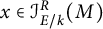 $x\in {\mathcal I}_{E/k}^{R}(M)$
,
$x\in {\mathcal I}_{E/k}^{R}(M)$
, $y\in {\mathcal I}_{E/k}^{R}(N)$
, and
$y\in {\mathcal I}_{E/k}^{R}(N)$
, and $b\in \operatorname {\mathrm {Hom}}_{k}(N,M)_{R}$
and
$b\in \operatorname {\mathrm {Hom}}_{k}(N,M)_{R}$
and $c\in \operatorname {\mathrm {Hom}}_{k}(M,N)_{R}$
satisfying
$c\in \operatorname {\mathrm {Hom}}_{k}(M,N)_{R}$
satisfying $b_{E}=c_{E}=0$
.
$b_{E}=c_{E}=0$
.
Let ${\mathcal I}_{M}$
be the
${\mathcal I}_{M}$
be the $\mathbb {Z}$
-subalgebra (without
$\mathbb {Z}$
-subalgebra (without $1$
!) of
$1$
!) of ${\mathcal I}_{E/k}^{R}(M)$
generated by the elements
${\mathcal I}_{E/k}^{R}(M)$
generated by the elements $x,x^{2},\ldots ,x^{r}$
,
$x,x^{2},\ldots ,x^{r}$
, $bc,byc,by^{2}c,\ldots ,by^{s}c$
, and
$bc,byc,by^{2}c,\ldots ,by^{s}c$
, and ${\mathcal I}_{N}$
be the
${\mathcal I}_{N}$
be the $\mathbb {Z}$
-subalgebra (without
$\mathbb {Z}$
-subalgebra (without $1$
!) of
$1$
!) of ${\mathcal I}_{E/k}^{R}(N)$
generated by the elements
${\mathcal I}_{E/k}^{R}(N)$
generated by the elements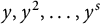 $y,y^{2},\ldots ,y^{s}$
,
$y,y^{2},\ldots ,y^{s}$
, $cb,cxb,cx^{2}b,\ldots ,cx^{r}b$
. Both
$cb,cxb,cx^{2}b,\ldots ,cx^{r}b$
. Both ${\mathcal I}_{M}$
and
${\mathcal I}_{M}$
and ${\mathcal I}_{N}$
are finitely generated subalgebras of the PI-algebras
${\mathcal I}_{N}$
are finitely generated subalgebras of the PI-algebras ${\mathcal I}_{E/k}^{R}(M)$
and
${\mathcal I}_{E/k}^{R}(M)$
and ${\mathcal I}_{E/k}^{R}(N)$
, respectively, and therefore by [Reference Procesi14, Chapter VI, Theorem 2.13], there exist integers
${\mathcal I}_{E/k}^{R}(N)$
, respectively, and therefore by [Reference Procesi14, Chapter VI, Theorem 2.13], there exist integers $u,v\geq 0$
, such that
$u,v\geq 0$
, such that ${\mathcal I}_{M}^{u}=0$
and
${\mathcal I}_{M}^{u}=0$
and ${\mathcal I}_{N}^{v}=0$
. The integers u and v do not depend on
${\mathcal I}_{N}^{v}=0$
. The integers u and v do not depend on $x,y,b$
, and c but only on the number of generators of
$x,y,b$
, and c but only on the number of generators of ${\mathcal I}_{M}$
and
${\mathcal I}_{M}$
and ${\mathcal I}_{N}$
, respectively, and the nilpotence indices r and s, hence on r and s only.
${\mathcal I}_{N}$
, respectively, and the nilpotence indices r and s, hence on r and s only.
We define now two abelian groups. Let for this $b,c$
be as in (3.1). The first abelian group, denoted B, is the subgroup of
$b,c$
be as in (3.1). The first abelian group, denoted B, is the subgroup of $\operatorname {\mathrm {Hom}}_{k}(N,M)_{R}$
generated by the set of morphisms
$\operatorname {\mathrm {Hom}}_{k}(N,M)_{R}$
generated by the set of morphisms
 $$ \begin{align*}\Big\{\, b,\, fb,\, bg,\, fbg\;\big|\; f\in{\mathcal I}_{M}\, ,\; g\in{\mathcal I}_{N}\,\Big\}, \end{align*} $$
and the second one, denoted C, is the subgroup of $\operatorname {\mathrm {Hom}}_{k}(M,N)_{R}$
generated by the set of morphisms
$\operatorname {\mathrm {Hom}}_{k}(M,N)_{R}$
generated by the set of morphisms
 $$ \begin{align*}\Big\{\, c,\, cf,\, gc,\, gcf\;\big|\; f\in{\mathcal I}_{M}\, ,\; g\in{\mathcal I}_{N}\,\Big\}. \end{align*} $$
Given motives $M_{i}$
,
$M_{i}$
, $i=1,2,3$
, in
$i=1,2,3$
, in $\mathfrak {Chow} (k,R)$
and subsets
$\mathfrak {Chow} (k,R)$
and subsets $X\subseteq \operatorname {\mathrm {Hom}}_{k}(M_{1},M_{2})_{R}$
and
$X\subseteq \operatorname {\mathrm {Hom}}_{k}(M_{1},M_{2})_{R}$
and $Y\in \operatorname {\mathrm {Hom}}_{k}(M_{2},M_{3})_{R}$
, we write
$Y\in \operatorname {\mathrm {Hom}}_{k}(M_{2},M_{3})_{R}$
, we write $YX$
for the abelian subgroup of
$YX$
for the abelian subgroup of $\operatorname {\mathrm {Hom}}_{k}(M_{1},M_{3})_{R}$
generated by all
$\operatorname {\mathrm {Hom}}_{k}(M_{1},M_{3})_{R}$
generated by all $y\cdot x$
with
$y\cdot x$
with $x\in X$
and
$x\in X$
and $y\in Y$
.
$y\in Y$
.
Sublemma 3.6 We have:
-
(i)
${\mathcal I}_{M}B\subseteq B$
,
$B{\mathcal I}_{N}\subseteq B$
,
$C{\mathcal I}_{M}\subseteq C$
, and
${\mathcal I}_{N}C\subseteq C$
; -
(ii)
$B{\mathcal I}_{N}^{h}C\,\subseteq \, B{\mathcal I}_{N}C\,\subseteq \, BC\,\subseteq \,{\mathcal I}_{M}$
for all integers
$h\geq 1$
; -
(iii)
$C{\mathcal I}_{M}^{h}B\,\subseteq \, C{\mathcal I}_{M}B\,\subseteq \, CB\,\subseteq \,{\mathcal I}_{N}$
for all integers
$h\geq 1$
.


Proof Part (i) is by definition of B and C. For (ii) and (iii), we note that an element of ${\mathcal I}_{M}$
is a sum of elements of the form
${\mathcal I}_{M}$
is a sum of elements of the form
 $$ \begin{align} x^{i_{1}}\,\cdot\,(\prod\limits_{l=1}^{m_{1}}by^{i_{1l}}c)\,\cdot\, x^{i_{2}}\,\cdot\, (\prod\limits_{l=1}^{m_{2}}by^{i_{2l}}c)\,\cdot\,\ldots\,\cdot\, (\prod\limits_{l=1}^{m_{m}}by^{i_{ml}}c)\,\cdot\, x^{i_{m+1}}, \end{align} $$
where $m,m_{l}\geq 1$
are integers and
$m,m_{l}\geq 1$
are integers and $i_{l}$
and
$i_{l}$
and $i_{hl}$
are integers
$i_{hl}$
are integers $\geq 0$
. Analogously, an element of
$\geq 0$
. Analogously, an element of ${\mathcal I}_{N}$
is a sum of elements of the form
${\mathcal I}_{N}$
is a sum of elements of the form
 $$ \begin{align} y^{j_{1}}\,\cdot\,(\prod\limits_{l=1}^{n_{1}}cx^{j_{1l}}b)\,\cdot\, y^{j_{2}}\,\cdot\, (\prod\limits_{l=1}^{n_{2}}cx^{j_{2l}}b)\,\cdot\,\ldots\,\cdot\, (\prod\limits_{l=1}^{n_{n}}cx^{j_{nl}}b)\,\cdot\, y^{i_{n+1}}, \end{align} $$
where $n,n_{l}\geq 1$
are integers and
$n,n_{l}\geq 1$
are integers and $j_{l}$
and
$j_{l}$
and $j_{hl}$
are integers
$j_{hl}$
are integers $\geq 0$
.
$\geq 0$
.
If now $a\in {\mathcal I}_{M}$
is of the form (3.2), then
$a\in {\mathcal I}_{M}$
is of the form (3.2), then $c\cdot a\cdot b$
is an element of the form (3.3) and so in
$c\cdot a\cdot b$
is an element of the form (3.3) and so in ${\mathcal I}_{N}$
, and analogous if
${\mathcal I}_{N}$
, and analogous if $d\in {\mathcal I}_{N}$
is an element of the form (3.3), then
$d\in {\mathcal I}_{N}$
is an element of the form (3.3), then $b\cdot d\cdot c$
is of the form (3.2) and so in
$b\cdot d\cdot c$
is of the form (3.2) and so in ${\mathcal I}_{M}$
. From these two observations, the sublemma follows.
${\mathcal I}_{M}$
. From these two observations, the sublemma follows.
We come back to the element $\alpha $
in
$\alpha $
in ${\mathcal I}_{E/k}^{R}(M\oplus N)$
(see (3.1)). We want to show that there exists an integer
${\mathcal I}_{E/k}^{R}(M\oplus N)$
(see (3.1)). We want to show that there exists an integer $t=t(E)\geq 0$
depending only on the nilpotence indices u and v of
$t=t(E)\geq 0$
depending only on the nilpotence indices u and v of ${\mathcal I}_{M}$
and
${\mathcal I}_{M}$
and ${\mathcal I}_{N}$
, respectively, such that
${\mathcal I}_{N}$
, respectively, such that $\alpha ^{t}=0$
.
$\alpha ^{t}=0$
.
We claim that $t:=2^{1+\max \{ u,v\}}$
does the job. To this end, we compute first
$t:=2^{1+\max \{ u,v\}}$
does the job. To this end, we compute first
 $$ \begin{align*}\alpha^{2}\, =\,\left( \begin{array}{c@{\;\;\;}c} x & b \\[2mm] c & y \end{array}\right)^{2}\, =\,\left( \begin{array}{c@{\;\;\;}c} x^{2}+bc & xb+by \\[2mm] cx+yc & cb+y^{2} \end{array}\right), \end{align*} $$
from which we conclude that
 $$ \begin{align*}\alpha^{4}\;\,\in\;\left( \begin{array}{c@{\;\;\;}c} {\mathcal I}_{M}^{2}+B{\mathcal I}_{N}^{2}C & {\mathcal I}_{M}^{2}B+B{\mathcal I}_{N}^{2}+{\mathcal I}_{M}B{\mathcal I}_{N}\\[2mm] C{\mathcal I}_{M}^{2}+{\mathcal I}_{N}^{2}C +{\mathcal I}_{N}C{\mathcal I}_{M}& C{\mathcal I}_{M}^{2}B+{\mathcal I}_{N}^{2} \end{array}\right). \end{align*} $$
Now, a straightforward induction using the identities of Sublemma 3.6 shows that
 $$ \begin{align*}\alpha^{2^{l}}\;\,\in\left( \begin{array}{c@{\;\;\;}c} {\mathcal I}_{M}^{l}+B{\mathcal I}_{N}^{l}C & {\mathcal I}_{M}^{l}B+B{\mathcal I}_{N}^{l}+{\mathcal I}_{M}^{l-1}B{\mathcal I}_{N}^{l-1}\\[2mm] C{\mathcal I}_{M}^{l}+{\mathcal I}_{N}^{l}C +{\mathcal I}_{N}^{l-1}C{\mathcal I}_{M}^{l-1}& C{\mathcal I}_{M}^{l}B+{\mathcal I}_{N}^{l} \end{array}\right) \end{align*} $$
for all $l\geq 2$
. Therefore, we have
$l\geq 2$
. Therefore, we have $\alpha ^{2^{l}}=0$
for all
$\alpha ^{2^{l}}=0$
for all $l\geq 1+\max \{ u,v\}$
, as claimed.
$l\geq 1+\max \{ u,v\}$
, as claimed.
We have shown that ${\mathcal I}_{E/k}^{R}(M\oplus N)$
is a nil ideal with bounded exponent. By another induction on the number of summands, this gives the next result.
${\mathcal I}_{E/k}^{R}(M\oplus N)$
is a nil ideal with bounded exponent. By another induction on the number of summands, this gives the next result.
Theorem 3.7 Let R be a ring and $M_{1},\ldots ,M_{d}$
be motives in the category
$M_{1},\ldots ,M_{d}$
be motives in the category $\mathfrak {Chow} (k,R)$
satisfying Rost nilpotence with bounded exponent. Then, Rost nilpotence with bounded exponent holds also for the direct sum
$\mathfrak {Chow} (k,R)$
satisfying Rost nilpotence with bounded exponent. Then, Rost nilpotence with bounded exponent holds also for the direct sum $\bigoplus \limits _{i=1}^{d}M_{i}$
.
$\bigoplus \limits _{i=1}^{d}M_{i}$
.
Corollary 3.8 Let M be a motive in a pseudo-abelian subcategory of $\mathfrak {Chow} (k,R)$
generated by motives which are geometrically split and satisfying Rost nilpotence with bounded exponent, as, for instance, the subcategory generated by the motives of projective homogeneous varieties (see Section 4.1).
$\mathfrak {Chow} (k,R)$
generated by motives which are geometrically split and satisfying Rost nilpotence with bounded exponent, as, for instance, the subcategory generated by the motives of projective homogeneous varieties (see Section 4.1).
Then, $\operatorname {\mathrm {End}}_{k}(M)_{R}$
is an integral PI-algebra of bounded degree over R, which is locally finite if R is noetherian.
$\operatorname {\mathrm {End}}_{k}(M)_{R}$
is an integral PI-algebra of bounded degree over R, which is locally finite if R is noetherian.
Proof Recall first that an R-algebra A is said to be integral of bounded degree if there exists an integer $u\geq 1$
, such that for every
$u\geq 1$
, such that for every $a\in A$
exists a monic polynomial
$a\in A$
exists a monic polynomial $f(T)\in R[T]$
of degree
$f(T)\in R[T]$
of degree $\leq u$
with
$\leq u$
with $f(a)=0$
.
$f(a)=0$
.
We now prove the corollary. By assumption, there exist geometrically split motives $N_{i}$
,
$N_{i}$
, $1\leq i\leq l$
, which satisfy Rost nilpotence with bounded exponent, such that M is direct summand of
$1\leq i\leq l$
, which satisfy Rost nilpotence with bounded exponent, such that M is direct summand of $N:=\bigoplus \limits _{i=1}^{l}N_{i}$
. Since
$N:=\bigoplus \limits _{i=1}^{l}N_{i}$
. Since $N_{\bar {k}}$
is split, its endomorphism ring is isomorphic to a product of matrix rings over R, say
$N_{\bar {k}}$
is split, its endomorphism ring is isomorphic to a product of matrix rings over R, say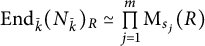 $\operatorname {\mathrm {End}}_{\bar {k}}(N_{\bar {k}})_{R}\simeq \prod \limits _{j=1}^{m}{\mathrm {M}}_{s_{j}}(R)$
for some integer
$\operatorname {\mathrm {End}}_{\bar {k}}(N_{\bar {k}})_{R}\simeq \prod \limits _{j=1}^{m}{\mathrm {M}}_{s_{j}}(R)$
for some integer $m\geq 1$
and positive integers
$m\geq 1$
and positive integers $s_{j}$
,
$s_{j}$
, $1\leq j\leq m$
. Therefore, by the Cayley–Hamilton theorem, there exists, for every
$1\leq j\leq m$
. Therefore, by the Cayley–Hamilton theorem, there exists, for every $a\in \operatorname {\mathrm {End}}_{\bar {k}}(N_{\bar {k}})_{R}$
, a monic polynomial
$a\in \operatorname {\mathrm {End}}_{\bar {k}}(N_{\bar {k}})_{R}$
, a monic polynomial $f(T)\in R[T]$
(depending on a) with
$f(T)\in R[T]$
(depending on a) with $f(a)=0$
and
$f(a)=0$
and $\deg f(T)\leq \sum \limits _{j=1}^{m}s_{j}=:v$
.
$\deg f(T)\leq \sum \limits _{j=1}^{m}s_{j}=:v$
.
By assumption and the theorem above, the kernel ${\mathcal I}_{\bar {k}/k}^{R}(N)$
of
${\mathcal I}_{\bar {k}/k}^{R}(N)$
of
 $$ \begin{align*}{\mathrm{res}}_{\bar{k}/k}\, :\;\operatorname{\mathrm{End}}_{k}(N)_{R}\longrightarrow\operatorname{\mathrm{End}}_{\bar{k}}(N_{\bar{k}})_{R} \end{align*} $$
is nil of bounded exponent, say u, and so for every $x\in \operatorname {\mathrm {End}}_{k}(N)_{R}$
, there is a monic polynomial
$x\in \operatorname {\mathrm {End}}_{k}(N)_{R}$
, there is a monic polynomial $f(T)$
with R-coefficients of degree
$f(T)$
with R-coefficients of degree $\leq uv$
, such that
$\leq uv$
, such that $f(x)=0$
. Hence,
$f(x)=0$
. Hence, $\operatorname {\mathrm {End}}_{k}(N)_{R}$
and so also its R-subalgebra
$\operatorname {\mathrm {End}}_{k}(N)_{R}$
and so also its R-subalgebra $\operatorname {\mathrm {End}}_{k}(M)_{R}$
are integral R-algebras of bounded degree. Now, [Reference Procesi14, Chapter I, Theorem 3.22 and Chapter VI, Corollary 2.8(1)] implies that these algebras are PI-algebras over R, which are locally finite if R is noetherian.
$\operatorname {\mathrm {End}}_{k}(M)_{R}$
are integral R-algebras of bounded degree. Now, [Reference Procesi14, Chapter I, Theorem 3.22 and Chapter VI, Corollary 2.8(1)] implies that these algebras are PI-algebras over R, which are locally finite if R is noetherian.
Remark 3.9 Let k and R be as above.
-
(i) If M is geometrically split, then
${\mathcal I}_{E/k}^{R}(M)$
is nil, nil with bounded exponent, respectively, nilpotent, for all field extensions
$E\supseteq k,$
if and only if
${\mathcal I}_{\bar {k}/k}^{R}(M)$
is so. -
(ii) In the proof of Theorem 3.7 above, one cannot rely on Köthe’s conjecture, which is true for PI-algebras, see [Reference McConnell and Robson13, 13.2.5], as a priori, it is not known that
${\mathcal I}_{E/k}^{R}(M\oplus N)$
is a PI-algebra.


We close this section with a technical lemma needed in the next one.
Lemma 3.10 Let R be a noetherian ring. Assume that strong Rost nilpotence holds for the geometrically split motive M in $\mathfrak {Chow} (k)$
, and that Rost nilpotence holds for M in
$\mathfrak {Chow} (k)$
, and that Rost nilpotence holds for M in $\mathfrak {Chow} (k,R)$
. Then, strong Rost nilpotence holds for M in
$\mathfrak {Chow} (k,R)$
. Then, strong Rost nilpotence holds for M in $\mathfrak {Chow} (k,R)$
.
$\mathfrak {Chow} (k,R)$
.
Proof By Remark 3.9 (i) above, it is enough to show that ${\mathcal I}_{\bar {k}/k}^{R}(M)$
is a nilpotent ideal.
${\mathcal I}_{\bar {k}/k}^{R}(M)$
is a nilpotent ideal.
By assumption, we have ${\mathcal I}_{\bar {k}/k}^{\mathbb {Z}}(M)^{t}=0$
for some
${\mathcal I}_{\bar {k}/k}^{\mathbb {Z}}(M)^{t}=0$
for some $t\geq 1$
and there is a short exact sequence
$t\geq 1$
and there is a short exact sequence
 $$ \begin{align*}0\longrightarrow\,{\mathcal I}_{\bar{k}/k}^{\mathbb{Z}}(M)\,\longrightarrow\,\operatorname{\mathrm{End}}_{k}(M)\,\xrightarrow{\;\iota\;}\,\overline{\operatorname{\mathrm{End}}_{k}(M)}\,\longrightarrow 0, \end{align*} $$
where $\overline {\operatorname {\mathrm {End}}_{k}(M)}$
denotes the image of
$\overline {\operatorname {\mathrm {End}}_{k}(M)}$
denotes the image of ${\mathrm {res}}_{\bar {k}/k}:\operatorname {\mathrm {End}}_{k}(M)\longrightarrow \operatorname {\mathrm {End}}_{\bar {k}}(M_{\bar {k}})$
. Tensoring above exact sequence with
${\mathrm {res}}_{\bar {k}/k}:\operatorname {\mathrm {End}}_{k}(M)\longrightarrow \operatorname {\mathrm {End}}_{\bar {k}}(M_{\bar {k}})$
. Tensoring above exact sequence with $R,$
we get an exact sequence
$R,$
we get an exact sequence
 $$ \begin{align} R\otimes_{\mathbb{Z}}{\mathcal I}_{\bar{k}/k}^{\mathbb{Z}}(M)\,\longrightarrow\,R\otimes_{\mathbb{Z}}\operatorname{\mathrm{End}}_{k}(M)\,\xrightarrow{\;\operatorname{\mathrm{id}}_{R}\otimes\,\iota\;} \, R\otimes_{\mathbb{Z}}\overline{\operatorname{\mathrm{End}}_{k}(M)}\,\longrightarrow 0, \end{align} $$
and consequently the kernel of $\operatorname {\mathrm {id}}_{R}\otimes \,\iota $
is a nilpotent ideal. We are reduced to prove that the kernel of
$\operatorname {\mathrm {id}}_{R}\otimes \,\iota $
is a nilpotent ideal. We are reduced to prove that the kernel of
 $$ \begin{align*}\operatorname{\mathrm{id}}_{R}\otimes j\, :\; R\otimes_{\mathbb{Z}}\overline{\operatorname{\mathrm{End}}_{k}(M)}\,\longrightarrow\, R\otimes_{\mathbb{Z}}\operatorname{\mathrm{End}}_{\bar{k}}(M_{\bar{k}}) \end{align*} $$
is a nilpotent ideal, where j denotes the inclusion map $\overline {\operatorname {\mathrm {End}}_{k}(M)}\hookrightarrow \operatorname {\mathrm {End}}_{\bar {k}}(M_{\bar {k}})$
.
$\overline {\operatorname {\mathrm {End}}_{k}(M)}\hookrightarrow \operatorname {\mathrm {End}}_{\bar {k}}(M_{\bar {k}})$
.
Since M is geometrically split, the ring $\operatorname {\mathrm {End}}_{\bar {k}}(M_{\bar {k}})$
is a free abelian group of finite rank and so the subgroup
$\operatorname {\mathrm {End}}_{\bar {k}}(M_{\bar {k}})$
is a free abelian group of finite rank and so the subgroup $\overline {\operatorname {\mathrm {End}}_{k}(M)}$
is free abelian of finite rank as well. Hence,
$\overline {\operatorname {\mathrm {End}}_{k}(M)}$
is free abelian of finite rank as well. Hence, $R\otimes _{\mathbb {Z}}\overline {\operatorname {\mathrm {End}}_{k}(M)}$
is a free R-module of finite rank and therefore a noetherian R-algebra. Hence, by Levitzki’s theorem, see, e.g., [Reference Rowen16, Theorem 2.6.23], it is enough to show that the kernel of
$R\otimes _{\mathbb {Z}}\overline {\operatorname {\mathrm {End}}_{k}(M)}$
is a free R-module of finite rank and therefore a noetherian R-algebra. Hence, by Levitzki’s theorem, see, e.g., [Reference Rowen16, Theorem 2.6.23], it is enough to show that the kernel of $\operatorname {\mathrm {id}}_{R}\otimes j$
is a nil ideal. To verify this, let
$\operatorname {\mathrm {id}}_{R}\otimes j$
is a nil ideal. To verify this, let $\alpha \in \operatorname {\mathrm {Ker}} (\operatorname {\mathrm {id}}_{R}\otimes j)$
. We have by the exact sequence (3.4) that
$\alpha \in \operatorname {\mathrm {Ker}} (\operatorname {\mathrm {id}}_{R}\otimes j)$
. We have by the exact sequence (3.4) that $\alpha =(\operatorname {\mathrm {id}}_{R}\otimes \,\iota )(\beta )$
for some
$\alpha =(\operatorname {\mathrm {id}}_{R}\otimes \,\iota )(\beta )$
for some $\beta $
in the endomorphism ring
$\beta $
in the endomorphism ring $\operatorname {\mathrm {End}}_{k}(M)_{R}=R\otimes _{\mathbb {Z}}\operatorname {\mathrm {End}}_{k}(M)$
.
$\operatorname {\mathrm {End}}_{k}(M)_{R}=R\otimes _{\mathbb {Z}}\operatorname {\mathrm {End}}_{k}(M)$
.
But $\beta $
is in the kernel of the restriction homomorphism
$\beta $
is in the kernel of the restriction homomorphism
 $$ \begin{align*}R\otimes_{\mathbb{Z}}\operatorname{\mathrm{End}}_{k}(M)\,\longrightarrow\, R\otimes_{\mathbb{Z}}\operatorname{\mathrm{End}}_{\bar{k}}(M_{\bar{k}}), \end{align*} $$
and so nilpotent by our assumption. It follows that $\alpha $
is nilpotent as well.
$\alpha $
is nilpotent as well.
4 Examples
4.1 Projective homogenous varieties
Let X be a projective homogenous variety over k. In [Reference Chernousov, Gille and Merkurjev3], see also Brosnan [Reference Brosnan2], it is shown that Rost nilpotence with bounded exponent holds for the motive of X in $\mathfrak {Chow} (k,R)$
(any coefficient ring R). But the argument there shows that in fact strong Rost nilpotence holds for X. For the sake of completeness, we recall the details.
$\mathfrak {Chow} (k,R)$
(any coefficient ring R). But the argument there shows that in fact strong Rost nilpotence holds for X. For the sake of completeness, we recall the details.
Note that since the motive of X is geometrically split, it is enough to show that the ideal ${\mathcal I}_{\bar {k}/k}^{R}(X)$
is nilpotent (see Remark 3.9 (i)).
${\mathcal I}_{\bar {k}/k}^{R}(X)$
is nilpotent (see Remark 3.9 (i)).
By the main result of [Reference Chernousov, Gille and Merkurjev3], we have
 $$ \begin{align} X\,\simeq\,\bigoplus\limits_{i=1}^{l}Y_{i}(n_{i}) \end{align} $$
in $\mathfrak {Chow} (k,R)$
for anisotropic projective homogeneous varieties
$\mathfrak {Chow} (k,R)$
for anisotropic projective homogeneous varieties $Y_{i}$
of dimension strictly less than
$Y_{i}$
of dimension strictly less than $\dim X$
if
$\dim X$
if $l\geq 2$
, and integers
$l\geq 2$
, and integers $n_{i}\geq 0$
.
$n_{i}\geq 0$
.
We claim that given a field k and a projective homogeneous k-variety X for some semisimple algebraic group G over $k,$
then
$k,$
then ${\mathcal I}_{\bar {k}/k}^{R}(X)$
is a nilpotent ideal with nilpotence exponent only depending on
${\mathcal I}_{\bar {k}/k}^{R}(X)$
is a nilpotent ideal with nilpotence exponent only depending on $\dim X$
and the number l of summands in (4.1). We prove this by descending induction on l.
$\dim X$
and the number l of summands in (4.1). We prove this by descending induction on l.
If l is maximal, then X is split and so a sum of twists of Tate motives. Otherwise, let $1\leq i\leq l$
and
$1\leq i\leq l$
and $y\in Y_{i}$
. Then,
$y\in Y_{i}$
. Then, $Y_{i,k(y)}$
is isotropic and therefore splits into a direct sum of at least two twists of motives of projective homogeneous varieties. The induction assumption gives then
$Y_{i,k(y)}$
is isotropic and therefore splits into a direct sum of at least two twists of motives of projective homogeneous varieties. The induction assumption gives then ${\mathcal I}_{\overline {k(y)}/k(y)}^{R}(X_{k(y)})^{\, t}=0$
, where
${\mathcal I}_{\overline {k(y)}/k(y)}^{R}(X_{k(y)})^{\, t}=0$
, where $\overline {k(y)}$
is an algebraic closure of the residue field
$\overline {k(y)}$
is an algebraic closure of the residue field $k(y)$
, for some integer
$k(y)$
, for some integer $t\geq 0,$
which depends only on
$t\geq 0,$
which depends only on $\dim X$
and the number of summands in the motivic decomposition of
$\dim X$
and the number of summands in the motivic decomposition of $X_{k(y)}$
into twists of motives of projective homogeneous varieties. In particular, we can find
$X_{k(y)}$
into twists of motives of projective homogeneous varieties. In particular, we can find $t_{i}>0$
which works for all
$t_{i}>0$
which works for all $y\in Y_{i}$
, and which depends only on
$y\in Y_{i}$
, and which depends only on $\dim X=\dim X_{k(y)}$
and the (minimal) number of summands in the motivic decompositions of
$\dim X=\dim X_{k(y)}$
and the (minimal) number of summands in the motivic decompositions of $X_{k(y)}$
,
$X_{k(y)}$
, $y\in Y_{i}$
. Rost’s Lemma 3.2 then implies
$y\in Y_{i}$
. Rost’s Lemma 3.2 then implies
 $$ \begin{align*}{\mathcal I}_{\bar{k}/k}^{R}(X)^{t_{i}\cdot (1+\dim Y_{i})}_{\ast}\big({\mathrm{CH}}_{j}(Y_{i}\times X)_{R}\big)\; =\, 0 \end{align*} $$
for all $0\leq j\leq \dim X+\dim Y_{i}$
.
$0\leq j\leq \dim X+\dim Y_{i}$
.
Finally, setting $\ell :=\max \limits _{1\leq i\leq d}\big [ t_{i}\cdot (1+\dim Y_{i})\big ]$
, we get
$\ell :=\max \limits _{1\leq i\leq d}\big [ t_{i}\cdot (1+\dim Y_{i})\big ]$
, we get ${\mathcal I}_{\bar {k}/k}^{R}(X)^{\ell }=0$
by (4.1).
${\mathcal I}_{\bar {k}/k}^{R}(X)^{\ell }=0$
by (4.1).
4.2 Geometrically rational surfaces
Let S be a geometrically rational surface over k. We claim that strong Rost nilpotence holds for S in $\mathfrak {Chow} (k,R)$
for R either the ring of integers
$\mathfrak {Chow} (k,R)$
for R either the ring of integers $\mathbb {Z}$
or integers modulo
$\mathbb {Z}$
or integers modulo $m\geq 2$
, denoted
$m\geq 2$
, denoted $\mathbb {Z}/m$
. Note that the motive of S is geometrically split.
$\mathbb {Z}/m$
. Note that the motive of S is geometrically split.
We first assume that $R=\mathbb {Z}$
. By the Hochschild–Serre spectral sequence, we know that
$R=\mathbb {Z}$
. By the Hochschild–Serre spectral sequence, we know that ${\mathrm {Pic}} (S_{k(s)})\simeq {\mathrm {CH}}_{1}(S_{k(s)})$
is torsion free for all
${\mathrm {Pic}} (S_{k(s)})\simeq {\mathrm {CH}}_{1}(S_{k(s)})$
is torsion free for all $s\in S$
and the same holds for
$s\in S$
and the same holds for ${\mathrm {CH}}_{2}(S_{k(s)}),$
since S is geometrically integral. Hence, if
${\mathrm {CH}}_{2}(S_{k(s)}),$
since S is geometrically integral. Hence, if $\alpha $
is in
$\alpha $
is in ${\mathcal I}_{\bar {k}/k}^{\mathbb {Z}}(S),$
then
${\mathcal I}_{\bar {k}/k}^{\mathbb {Z}}(S),$
then $\alpha _{k(s)}$
acts trivial on both
$\alpha _{k(s)}$
acts trivial on both ${\mathrm {CH}}_{1}(S_{k(s)})$
and
${\mathrm {CH}}_{1}(S_{k(s)})$
and ${\mathrm {CH}}_{2}(S_{k(s)})$
for all
${\mathrm {CH}}_{2}(S_{k(s)})$
for all $s\in S$
. Hence, to apply Rost’s lemma, we are left to study the action of
$s\in S$
. Hence, to apply Rost’s lemma, we are left to study the action of $\alpha _{k(s)}$
on
$\alpha _{k(s)}$
on ${\mathrm {CH}}_{0}(S_{k(s)})$
for all
${\mathrm {CH}}_{0}(S_{k(s)})$
for all $\alpha \in {\mathcal I}_{\bar {k}/k}^{\mathbb {Z}}(S)$
and all
$\alpha \in {\mathcal I}_{\bar {k}/k}^{\mathbb {Z}}(S)$
and all $s\in S$
.
$s\in S$
.
To this end, we denote for a field extension $E\supseteq k$
by
$E\supseteq k$
by ${\mathrm {A}}_{0}(S_{E})$
the kernel of the degree map
${\mathrm {A}}_{0}(S_{E})$
the kernel of the degree map $\deg \, :\;{\mathrm {CH}}_{0}(S_{E})\longrightarrow \mathbb {Z}$
. By the main result of Coombes [Reference Coombes5], the surface S is rational over the separable closure
$\deg \, :\;{\mathrm {CH}}_{0}(S_{E})\longrightarrow \mathbb {Z}$
. By the main result of Coombes [Reference Coombes5], the surface S is rational over the separable closure $k_{\mathrm {{sep}}}$
of k and so its motive is split in
$k_{\mathrm {{sep}}}$
of k and so its motive is split in $\mathfrak {Chow} (k_{\mathrm {{sep}}})$
. Hence, there exists for a field extension
$\mathfrak {Chow} (k_{\mathrm {{sep}}})$
. Hence, there exists for a field extension $E\supseteq k$
a Galois extension
$E\supseteq k$
a Galois extension $L\supseteq E$
, such that
$L\supseteq E$
, such that $(\alpha _{E})_{L}=0$
. If
$(\alpha _{E})_{L}=0$
. If $S(E)\not =\emptyset ,$
the subgroup
$S(E)\not =\emptyset ,$
the subgroup ${\mathrm {A}}_{0}(S_{E})$
is the torsion part of
${\mathrm {A}}_{0}(S_{E})$
is the torsion part of ${\mathrm {CH}}_{0}(S_{E})$
.
${\mathrm {CH}}_{0}(S_{E})$
.
This implies that given $\alpha \in {\mathcal I}_{\bar {k}/k}^{\mathbb {Z}}(S),$
we have
$\alpha \in {\mathcal I}_{\bar {k}/k}^{\mathbb {Z}}(S),$
we have $\alpha _{k(s)\,\ast }\big ({\mathrm {CH}}_{0}(S_{k(s)})\big )\subseteq {\mathrm {A}}_{0}(S_{k(s)})$
. and by [Reference Gille8, Corollary 4.9] (see [Reference Gille9, Section 2.4] if the base field is not perfect), we have
$\alpha _{k(s)\,\ast }\big ({\mathrm {CH}}_{0}(S_{k(s)})\big )\subseteq {\mathrm {A}}_{0}(S_{k(s)})$
. and by [Reference Gille8, Corollary 4.9] (see [Reference Gille9, Section 2.4] if the base field is not perfect), we have $\alpha _{k(s)\,\ast }\big ({\mathrm {A}}_{0}(S_{k(s)})\big )=0$
.
$\alpha _{k(s)\,\ast }\big ({\mathrm {A}}_{0}(S_{k(s)})\big )=0$
.
Given now $\alpha ,\beta \in {\mathcal I}_{\bar {k}/k}^{\mathbb {Z}}(S)$
then
$\alpha ,\beta \in {\mathcal I}_{\bar {k}/k}^{\mathbb {Z}}(S)$
then $(\alpha \circ \beta )_{k(s)\,\ast }\big ({\mathrm {CH}}_{0}(S_{k(s)})\big )=0$
and so by Rost’s Lemma 3.2, we have
$(\alpha \circ \beta )_{k(s)\,\ast }\big ({\mathrm {CH}}_{0}(S_{k(s)})\big )=0$
and so by Rost’s Lemma 3.2, we have
 $$ \begin{align*}\alpha_{1}\circ\alpha_{2}\circ\alpha_{3}\circ\alpha_{4}\circ\alpha_{5}\circ\alpha_{6}\, =\, 0 \end{align*} $$
for all $\alpha _{1},\ldots ,\alpha _{6}\in {\mathcal I}_{\bar {k}/k}^{\mathbb {Z}}(S)$
. Hence,
$\alpha _{1},\ldots ,\alpha _{6}\in {\mathcal I}_{\bar {k}/k}^{\mathbb {Z}}(S)$
. Hence, ${\mathcal I}_{\bar {k}/k}^{\mathbb {Z}}(S)^{6}=0$
.
${\mathcal I}_{\bar {k}/k}^{\mathbb {Z}}(S)^{6}=0$
.
Let now $R=\mathbb {Z}/m$
for some integer
$R=\mathbb {Z}/m$
for some integer $m\geq 2$
. In [Reference Gille9, Theorem 15], it is shown that Rost nilpotence holds for S in
$m\geq 2$
. In [Reference Gille9, Theorem 15], it is shown that Rost nilpotence holds for S in $\mathfrak {Chow} (k,\mathbb {Z}/m)$
. Hence, by Lemma 3.10 above, we get that strong Rost nilpotence holds for S in
$\mathfrak {Chow} (k,\mathbb {Z}/m)$
. Hence, by Lemma 3.10 above, we get that strong Rost nilpotence holds for S in $\mathfrak {Chow} (k,\mathbb {Z}/m)$
.
$\mathfrak {Chow} (k,\mathbb {Z}/m)$
.
4.3 Surfaces
Assume that $\operatorname {\mathrm {char}} k=0$
and
$\operatorname {\mathrm {char}} k=0$
and $R=\mathbb {Z}$
. Let S be a k-surface, i.e., a smooth projective integral k-scheme of dimension
$R=\mathbb {Z}$
. Let S be a k-surface, i.e., a smooth projective integral k-scheme of dimension $2$
. We claim that strong Rost nilpotence holds for S in
$2$
. We claim that strong Rost nilpotence holds for S in $\mathfrak {Chow} (k)$
. Again the proof is only a slight modification of the verification of Rost nilpotence for surfaces in [Reference Gille9, Section 2.5]. We briefly sketch the details.
$\mathfrak {Chow} (k)$
. Again the proof is only a slight modification of the verification of Rost nilpotence for surfaces in [Reference Gille9, Section 2.5]. We briefly sketch the details.
Let for this $E\supseteq k$
be a field extension and
$E\supseteq k$
be a field extension and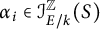 $\alpha _{i}\in {\mathcal I}_{E/k}^{\mathbb {Z}}(S)$
,
$\alpha _{i}\in {\mathcal I}_{E/k}^{\mathbb {Z}}(S)$
, $i=1,2,3$
. We have a tower of fields
$i=1,2,3$
. We have a tower of fields $E\supseteq F\supseteq k$
with F a purely transcendental extension of k and E an algebraic extension of F. Since
$E\supseteq F\supseteq k$
with F a purely transcendental extension of k and E an algebraic extension of F. Since ${\mathrm {res}}_{F/k}:\operatorname {\mathrm {End}}_{k}(S)\longrightarrow \operatorname {\mathrm {End}}_{F}(S_{F})$
is an isomorphism, see, e.g., [Reference Flenner, O’Carrol and Vogel6, Proposition 2.1.8], replacing k by
${\mathrm {res}}_{F/k}:\operatorname {\mathrm {End}}_{k}(S)\longrightarrow \operatorname {\mathrm {End}}_{F}(S_{F})$
is an isomorphism, see, e.g., [Reference Flenner, O’Carrol and Vogel6, Proposition 2.1.8], replacing k by $F,$
we can assume that
$F,$
we can assume that $E\supseteq k$
is algebraic.
$E\supseteq k$
is algebraic.
Let $s\in S$
. Since
$s\in S$
. Since $\alpha _{i\, E(s)}=0$
and
$\alpha _{i\, E(s)}=0$
and $\operatorname {\mathrm {char}} k=0,$
there is a Galois extension
$\operatorname {\mathrm {char}} k=0,$
there is a Galois extension $L\supseteq k(s)$
, such that
$L\supseteq k(s)$
, such that $\alpha _{i\, L}=0$
for all
$\alpha _{i\, L}=0$
for all $1\leq i\leq 3$
. It follows from [Reference Gille9, Theorem 4] that we have then
$1\leq i\leq 3$
. It follows from [Reference Gille9, Theorem 4] that we have then
 $$ \begin{align*}(\alpha_{1}\circ\alpha_{2}\circ\alpha_{3})_{k(s)}\, =\, 0. \end{align*} $$
Taking into account Rost’s Lemma 3.2, this implies
 $$ \begin{align*}\alpha_{1}\circ\alpha_{2}\circ\,\dots\,\circ\alpha_{8}\circ\alpha_{9}\, =\, 0 \end{align*} $$
for all $\alpha _{1},\ldots ,\alpha _{9}\in {\mathcal I}_{E/k}^{\mathbb {Z}}(S)$
, and so
$\alpha _{1},\ldots ,\alpha _{9}\in {\mathcal I}_{E/k}^{\mathbb {Z}}(S)$
, and so $[{\mathcal I}_{E/k}^{\mathbb {Z}}(S)]^{9}=0$
.
$[{\mathcal I}_{E/k}^{\mathbb {Z}}(S)]^{9}=0$
.
4.4 Varieties whose motives split generically
Let k be again an arbitrary field and X a smooth projective and integral k-scheme. We say that the motive of X is generically split in $\mathfrak {Chow} (k,R)$
if it is split in
$\mathfrak {Chow} (k,R)$
if it is split in $\mathfrak {Chow} (k(X),R)$
. Vishik and Zainoulline [Reference Vishik and Zainoulline18] have shown that for such schemes Rost nilpotence holds (for any coefficient ring R). But their argument shows that actually strong Rost nilpotence holds in this case.
$\mathfrak {Chow} (k(X),R)$
. Vishik and Zainoulline [Reference Vishik and Zainoulline18] have shown that for such schemes Rost nilpotence holds (for any coefficient ring R). But their argument shows that actually strong Rost nilpotence holds in this case.
Let for this $E\supseteq k$
be a field extension. Since by assumption, the motive of
$E\supseteq k$
be a field extension. Since by assumption, the motive of $X_{k(X)}$
is split,
$X_{k(X)}$
is split, ${\mathrm {res}}_{E(X)/k(X)}:\operatorname {\mathrm {End}}_{k(X)}(X_{k(X)})_{R}\longrightarrow \operatorname {\mathrm {End}}_{E(X)}(X_{E(X)})_{R}$
is injective, cf. Remark 3.1 (i), and hence it is enough to show that
${\mathrm {res}}_{E(X)/k(X)}:\operatorname {\mathrm {End}}_{k(X)}(X_{k(X)})_{R}\longrightarrow \operatorname {\mathrm {End}}_{E(X)}(X_{E(X)})_{R}$
is injective, cf. Remark 3.1 (i), and hence it is enough to show that ${\mathcal I}_{k(X)/k}^{R}(X)$
is nilpotent.
${\mathcal I}_{k(X)/k}^{R}(X)$
is nilpotent.
That ${\mathcal I}_{k(X)/k}^{R}(X)$
is nilpotent is true for all integral
${\mathcal I}_{k(X)/k}^{R}(X)$
is nilpotent is true for all integral $X\in {\mathrm {PSm}}_{k}$
and not only for smooth projective and integral schemes whose motive is generically split in
$X\in {\mathrm {PSm}}_{k}$
and not only for smooth projective and integral schemes whose motive is generically split in $\mathfrak {Chow} (k,R)$
. In fact, given an integral smooth and projective k-scheme
$\mathfrak {Chow} (k,R)$
. In fact, given an integral smooth and projective k-scheme $X,$
the morphism
$X,$
the morphism ${\mathrm {res}}_{k(X)/k}:\operatorname {\mathrm {End}}_{k}(X)_{R}\longrightarrow \operatorname {\mathrm {End}}_{k(X)}(X_{k(X)})_{R}$
factors
${\mathrm {res}}_{k(X)/k}:\operatorname {\mathrm {End}}_{k}(X)_{R}\longrightarrow \operatorname {\mathrm {End}}_{k(X)}(X_{k(X)})_{R}$
factors
 $$ \begin{align*}\operatorname{\mathrm{End}}_{k}(X)_{R}\xrightarrow{{\mathrm{res}}_{X/k}}\operatorname{\mathrm{End}}_{X}([X\times_{k}X\longrightarrow X])_{R}\xrightarrow{{\mathrm{res}}_{U/X}} \operatorname{\mathrm{End}}_{U}([X\times_{k}U\longrightarrow U])_{R}\quad \end{align*} $$
 $$ \begin{align} \qquad\qquad\qquad\qquad\xrightarrow{{\mathrm{res}}_{k(X)/U}}\operatorname{\mathrm{End}}_{k(X)}(X_{k(X)})_{R} \end{align} $$
for every open $U\subseteq X$
. The map
$U\subseteq X$
. The map ${\mathrm {res}}_{X/k}$
is injective by Lemma 2.1 (i), and by part (ii) of this lemma, we have
${\mathrm {res}}_{X/k}$
is injective by Lemma 2.1 (i), and by part (ii) of this lemma, we have $\big [\operatorname {\mathrm {Ker}} ({\mathrm {res}}_{U/X})\big ]^{1+\dim X}=0$
. Now,
$\big [\operatorname {\mathrm {Ker}} ({\mathrm {res}}_{U/X})\big ]^{1+\dim X}=0$
. Now,
 $$ \begin{align*}\operatorname{\mathrm{End}}_{k(X)}(X_{k(X)})_{R}\,\simeq\,{\mathrm{CH}}^{\dim X}(X\times_{k}X\times_{k}k(X))_{R} \end{align*} $$
is isomorphic to the direct limit
 $$ \begin{align*}\lim\limits_{\begin{array}{c} U\subseteq X \\ \mbox{open}\end{array}}{\mathrm{CH}}^{\dim X}(X\times_{k}X\times_{k}U)_{R}. \end{align*} $$
Since ${\mathrm {CH}}^{\dim X}(X\times _{k}X\times _{k}U)\simeq \operatorname {\mathrm {End}}_{U}([X\times _{k}U\longrightarrow U])_{R}$
, we conclude from (4.2) the following remarkable fact.
${\mathrm {CH}}^{\dim X}(X\times _{k}X\times _{k}U)\simeq \operatorname {\mathrm {End}}_{U}([X\times _{k}U\longrightarrow U])_{R}$
, we conclude from (4.2) the following remarkable fact.
Theorem 4.1 (Vishik–Zainoulline)
Let X be an integral scheme in ${\mathrm {PSm}}_{k}$
. Then,
${\mathrm {PSm}}_{k}$
. Then, ${\mathcal I}_{k(X)/k}^{R}(X)$
is a nilpotent ideal for all coefficient rings R. More precisely, we have
${\mathcal I}_{k(X)/k}^{R}(X)$
is a nilpotent ideal for all coefficient rings R. More precisely, we have
 $$ \begin{align*}\big[{\mathcal I}_{k(X)/k}^{R}(X)\big]^{1+\dim X}\, =\, 0. \end{align*} $$
If moreover the motive of X is generically split in $\mathfrak {Chow} (k,R),$
then strong Rost nilpotence holds for X.
$\mathfrak {Chow} (k,R),$
then strong Rost nilpotence holds for X.
Acknowledgements
A special thanks to Sasha Vishik for many valuable discussions about Rost nilpotence. The author further thanks Ofer Gabber for pointing out that it is not necessary to assume “geometrically split” in Theorem 3.7.


 Open access

