




The Médina throbbed like an enormous heart experiencing love at first sight. Life poured out of this working-class neighborhood from every pore; and that overflow of voices, quarrels, laughter, car horns, bleating sheep, religious songs, smells of garbage, grilled meat, exhaust, that overflow in all of its splendor and misery had ended up saturating every available space, whether visible or invisible. Then, not knowing where else to go, it spread out and presented itself, waiting to catch or be caught.Footnote 1
The political earthquake came first. On May 10, 1914, Blaise Diagne was elected as the representative of the four communes of Senegal, the first Black African to be seated in the French national assembly. This was a watershed moment, up there with the Haitian Revolution in terms of its reverberations in imperial circles. Many Senegalese would have awoken feeling that they were living in a new era—and in many ways they were. But 1914 was one of those years where the world-historical events do not stop coming. Just three days after Diagne’s election, an outbreak of bubonic plague was declared in Dakar. The panicked French colonial administration blamed the native population and evicted indigenous Africans from the city center before burning their homes. The Dakarois fought back through a general strike, political maneuvering, and, finally, by taking to the streets. Out of this year of disease, politics, racism, and resistance came the new, segregated neighborhood of Médina, which was created to house the displaced African population of Dakar. Over the twentieth century, as Dakar swelled into a metropolis around it, Médina was a unique space in the Senegalese capital—a hotbed of cultural creativity, a crossroads for waves of migrants, and a potent and enduring contrast with the nearby downtown, known as the Plateau.
This article explores the ways in which the plague of 1914 reshaped Dakar and left a lasting impression on a century of Senegalese cultural production. The first half of this piece offers a political history of Dakar’s plague year. The second traces the aesthetic echoes of 1914 across a variety of works in French and Wolof, from literary texts including novels and poems to films and memoirs to newspaper articles and radio broadcasts. As the reader will already suspect, this research took shape in the shadow of that other pandemic through which we are still living and dying—albeit in very different circumstances. In retelling the story of the Dakar outbreak and tracing its aftershocks in Senegalese literature and film, I offer a history of the present. I show how the management of an epidemic works within existing and emergent political conditions to generate material and temporal effects that endure long after the outbreak itself is declared over. In attending to the aesthetic refractions of the 1914 plague, then, my aim is twofold: to draw out the ways in which that which takes shape in a time of crisis persists and to emphasize how the aesthetic serves as a space from which to reflect, refract, and perhaps transform what the epidemic leaves in its wake.
Bubonic plague holds a special place in the Western imagination, mainly because of the second wave of pandemic, which killed between 25 and 50 percent of the population of western Europe in the late Middle Ages. What struck Senegal in 1914 was the third wave of plague pandemic. Strikingly but not surprisingly, this pandemic has largely vanished from popular memory in the Global North, probably because most of those who died in it were neither white nor European. The third wave began in the mid-nineteenth century but exploded in the twentieth, killing roughly 13 million people worldwide. Although quite deadly, this pandemic came to be overshadowed by the Spanish flu, which killed 50 million. To put both of those numbers in perspective, as I write these words COVID-19 has so far killed 6.3 million worldwide.
The third wave of bubonic plague coincided with the height of Western imperial expansion. As infections caused by the Yersinia pestis bacilli appeared in port cities across the globe, colonial and medical authorities prescribed the surveillance and segregation of diverse racialized communities whose bodies and living conditions were (almost without exception) stigmatized as circulating a contagion that had in fact been spread by the expansion of trans-imperial trade. Across colonial contexts, plague outbreaks exacerbated existing tensions. In San Francisco in 1900, the arrival of plague in a Chinatown still reeling from the Chinese Exclusion Acts led to a vicious quarantine (no food or persons allowed in or out) that provoked residents to riot and hide their sick and dying from the city’s “wolf doctors” (health inspectors).Footnote 2 The arrival of the plague was also an occasion for the slum clearances and redevelopment schemes that reshaped the built environments of many imperial cities. The outbreak in Bombay in the closing years of the nineteenth century prompted the creation of the Bombay Improvement Trust. In addition to rendering many people homeless by demolishing denser housing to make room for new, wider streets, the Trust implemented precise rules about the distance between a building and its boundary wall (the so-called 63.5 degree light angle rule), which aimed to prevent future epidemics by improving ventilation.Footnote 3
The pandemic was above all an alibi for the reorganization of urban space along racially segregated lines. The 1902 outbreak in Cape Town was the proximate cause for the creation of Ndabeni, the first township that presaged apartheid—although the Cape Times was already declaring in 1897 that the city “almost needs a plague visitation to apply the needed brooms to sweep away the slums.”Footnote 4 Public health responses to the pandemic frequently operated in a self-consciously imperial framework. When plague appeared in Accra in 1908, the Colonial Office dispatched experts in infectious disease who had “managed” the earlier 1896 outbreak in Calcutta to implement quarantines, a pass system, and put in place plans for segregation.Footnote 5
These responses to the pandemic were present in all their coloniality in the Senegalese outbreak of 1914.Footnote 6 The plague pathogen was likely introduced by flea-infested cargo at the port of Dakar, which had been modernized in the first decade of the twentieth century and was seeing greatly increased shipping traffic.Footnote 7 Dakar itself is located on the Cap-Vert peninsula, an area that was settled by the Lébu people by at least the fourteenth century (fig. 1). The Lébu, who speak a language similar to modern Wolof, were living primarily in fishing communities by the time the Portuguese first arrived in the fifteenth century. The Portuguese established a presence on Gorée island across from Ndakaaru (the Lébu village on the peninsula that would become Dakar). For centuries, Gorée was the base of European operations in the region (which consisted primarily of slave trading). Ndakaaru was eventually annexed by France in 1857, a prelude to the far more violent conquest of the interior. Dakar became the capital of the federation of French West Africa in 1902, but even then it was still a small city. Over the ensuing century, of course, Dakar has grown enormously. Today it is the capital of Senegal with a population of about 1.5 million, almost 4 million when including its sprawling periphery. In 1914, though, the city had a population of just 6,000, or 24,500 if one includes the rest of the peninsula. Although total mortality was greater elsewhere in the pandemic, Dakar was among the worst hit cities proportionally to its population. Senegal also had the highest case rates in Africa. In his indispensable survey of the outbreak, Myron Echenberg estimates that 5 percent of the total population of Dakar died of plague in 1914.Footnote 8
Cap-Vert Peninsula, Late 19th Century. (Gallica / Bibliothèque nationale de France)

To understand what happened in 1914 and why, it is vital to grasp the special status of Senegal in the French empire. After 1887, the inhabitants of the four communes of Senegal—Saint Louis, Gorée, Dakar, and Rufisque—were French citizens, and enjoyed political rights similar to hexagonal Frenchmen. Known as originaires, these communities were entitled to send one deputy to the French parliament, elected by male suffrage. Even with the privileges of the originaires, the political scene in Dakar remained under the hegemony of métis and white business interests at the turn of the century. This is what made Diagne’s election so shocking.
On May 14, 1914, four days after the election and one after the plague declaration, the burning started. Sanctioned by an emergency municipal decree, a sanitary brigade burned twenty-three Lébu dwellings where plague cases had been found. Over the next few days, hundreds more homes were burned. Thatched huts were targeted because they were thought to be especially susceptible to the conditions that bred plague. The decree also enforced changes to burial practices, confiscating the bodies of the deceased from their communities and effectively prohibiting common Muslim mourning practices.Footnote 9 Two cordons sanitaires (sanitary belts or enforced quarantine zones) were also established in the following weeks, although Africans who needed to travel through them for economic reasons were exempted, as were all Europeans.Footnote 10 When the first burnings took place, there was no provision for even temporary resettlement. With nowhere to go, the Lébu who lost their homes, some of whom may have been incubating the disease, were forced to relocate to other African neighborhoods, increasing density and thus chances of transmission.Footnote 11
The Dakarois fought back. On May 20, a crowd of 1,500 protested in front of City Hall. After tense but unfruitful negotiations, a general strike was called in Dakar from May 21 through 25 in response to the brutal measures being taken against African communities in the name of suppressing the plague. There would be no selling of vegetables and other products in the European zone of the city center, known locally as the Plateau. Fishermen, market women, poultry sellers, and vegetable farmers joined together to shut down Dakar’s central market. Even Governor Ponty had to admit that it worked: “The market stayed deserted and the Blacks in the villages refused to sell their vegetables, eggs and chickens, or their fish to Europeans or to their employees. This strike was extremely well organized, and was a complete success. It is the first manifestation of this type which I in my experience had ever witnessed in these regions.”Footnote 12 Calm reemerged only when Ponty had promised not to confiscate lands and to reimburse those whose homes had been burned and to build new ones with government help in different materials.Footnote 13
One of the puzzles of this episode is where Blaise Diagne was. He had made an appearance in Dakar the day after his election, but then was strangely silent before eventually resurfacing in France. There is no definitive account of this episode, but one of the more lurid hypotheses cited by Echenberg reveals much about the political climate. Diagne was in hiding because there was a legal challenge to his election and possibly threats to his safety. His opponents (powerful European and métis business interests) disputed whether he, the first African elected to the national assembly, was really a French citizen. Some say Diagne fled Senegal under cover of night to a waiting steamship because he was concerned he would be assassinated with a plague-infected syringe. In any case, in France he was able to more effectively lobby the committee that confirmed his election, allowing him to eventually advocate for the Lébu.Footnote 14
Over the summer, though, burnings continued as tensions and deaths continued to rise. The government began resettling displaced Africans. After weeks of unsuccessful petitions and negotiations, the situation reached a breaking point on November 9, when a crowd of approximately 4,000 Dakarois, many of them armed, confronted a sanitary squad backed up by a detachment of soldiers who intended to burn more than 200 Lébu homes in the African neighborhood of Parc à Fourrages. Faced with this fierce resistance, colonial authorities tabled the burning, although there were grumblings of declaring martial law. Ultimately, geopolitical concerns intruded. In June, Archduke Ferdinand had been assassinated, precipitating the First World War. Fearful that any bloody confrontation in the colonies would be exploited by France’s adversaries, Ponty backed down and entered into negotiations with Diagne, who was becoming an enthusiastic proponent of African conscription, which he viewed as essential for guaranteeing that the rights and privileges of the originaires were forever enshrined in law. In effect, the burning of homes in Dakar ceased because France needed colonial conscripts to fight and die in its wars.
One of the most enduring consequences of the plague was the segregation of the Cap-Vert peninsula. Segregation, of course, is a constitutive factor of colonial cities. As Frantz Fanon observed, a colonial city is a compartmentalized world, a world cut in two. The settlers’ town is “well-built … all made of stone and steel … brightly-lit … the streets covered with asphalt … well-fed … easygoing … its belly always full of good things … a town of white people, of foreigners.” The colonized people’s town, “or the native town, the Negro village, the medina, the reservation,” is a place “of ill repute … One is born there, anyhow and anywhere; one dies there, anyhow and anywhere … a world with no space … a hungry town, starved of bread, of meat, of shoes, of coal, of light.”Footnote 15 This famous passage from The Wretched of the Earth has the trenchant force of an archetype and continues to offer an indispensable critique of the urbanisms of racial capitalism. But it is also important to note that turn-of-the-century Dakar was not yet the bifurcated space Fanon describes. Segregationist projects had been discussed there by 1900, but not yet put into effect.Footnote 16 Dakar at the time of the plague was divisible into three zones: a wealthy European area, an African town, and a more mixed quarter of European workers and middle-class Africans.Footnote 17 The pressing question was who owned much of the land in central Dakar.Footnote 18 The French claimed it by right of conquest. But the Lébu lived there. By the time the plague hit, a significant amount of segregation was already occurring, displacing some Lébu through annexation and expropriation by the state as well as through private purchases (from which, it must be said, some Lébu were benefiting financially at the expense of others).Footnote 19
The 1914 plague was clearly a pretext to clear the Lébu from central Dakar—a global phenomenon in colonial cities during this pandemic. In the name of anti-plague measures, some 1,594 dwellings were burned that year.Footnote 20 Echenberg cites evidence that even within African neighborhoods these burnings were done selectively on racial guidelines, with structures owned by French proprietors being spared while those owned by Africans or Lebanese were not. Eventually, compensation was planned for owners, as long as they could demonstrate proper title. Meanwhile, the Municipal Council came up with a plan to move Africans displaced by these measures into a new site nearby. Footnote 21 Created in the summer of 1914, the “segregation village” received its first inhabitants on August 25.Footnote 22 In months, several thousand Africans had been transferred.Footnote 23
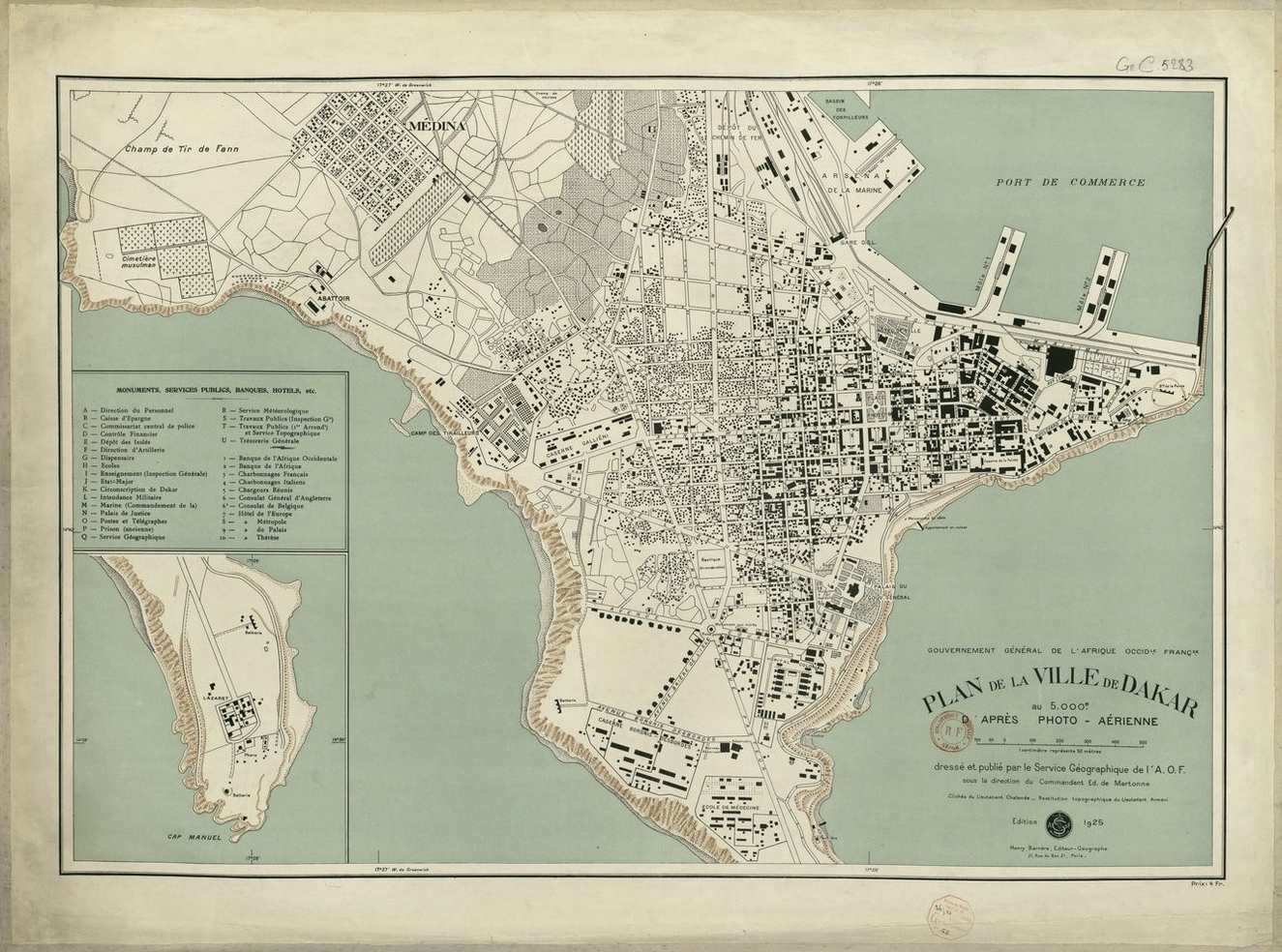
The area that would later take the name of Médina was not unknown to the Lébu, which helps explain some of their understandable resistance to resettlement. The Lébu called the region Tilène (a place frequented by jackals, in many etymologies). Older generations indicated that the Lébu had tried to live there long ago but had found it unhealthy and prone to disease.Footnote 24 The ground was sandy and infertile, and the relatively low terrain level meant it flooded regularly in the rainy season.Footnote 25 The site was located about four kilometers away from central Dakar, separated by a space that at the time was largely uninhabited.Footnote 26 In effect, this empty space served as a further cordon sanitaire that would become a barrier between Dakar-ville and Médina for many decades, long after the plague itself wound down.Footnote 27 It was still visible ten years later, as an aerial map clearly shows (fig. 2). As one can see clearly from this same chart, the Médina of Dakar (top left) was laid out on a grid plan—quite differently from the médinas of Northern African cities, which tended to be the oldest parts of the city and have narrow, medieval streets. Dakar’s Médina has a checkerboard pattern that was partly a modernizing project and partly a matter of policing. As one official noted, a single armored car at an intersection could control the length of two streets, making it easier to recapture deserters from forced labor or conscription.Footnote 28 Despite this grid plan, infrastructure lagged in Médina compared to the city center, then known as Dakar-Ville. Basic services such as electricity and water would only become widely available in all areas of the Médina in the mid-twentieth century.Footnote 29 But while Médina may have entered into existence as a “village of segregation,” the residential segregation of Dakar was never totally completed. Although many Dakarois were resettled in Médina, a good number remained in Dakar-ville. Some twenty years later, it was estimated that there were still more than 20,000 natives, mostly Lebu, who “were still living in Dakar-ville on land they refused to sell.”Footnote 30
Aerial Map of Dakar, 1925. (Gallica / Bibliothèque nationale de France)
In the first half century of its existence, Médina was the quintessentially African space in Dakar, first the capital of French West Africa and, later, of independent Senegal. Populated first by the Lébu driven out of what would become the Plateau, Médina quickly became home to waves of migrants whom the Lébu pejoratively called the doxandem, or outsiders. As Dakar’s population swelled like that of many African cities in the twentieth century, the Médina became a crossroads, attracting people from all over Senegal and French West Africa looking for a toehold in the capital.Footnote 31 This was still palpable in the late 1960s, when the Senegalese sociologist Assane Seck undertook a survey of Dakar. Seck identified what he called “une grande Médina” (a greater Médina) comprising the original “segregation village” built to house the refugees of 1914 as well as the nearby neighborhoods of Gueule-Tapée, Fass-Cité, and Colobane, which were created over the years to accommodate all those who could no longer fit in Médina.Footnote 32 This “Greater Médina” was the African section of the city; in practice it was Dakar’s second urban core, separated from central Dakar by the remnants of the old cordon sanitaire, which only filled in during the population explosion of the postwar decades.Footnote 33 In the 1960s, this Greater Médina was still a mix of concrete houses and rickety shacks, with some areas with robust infrastructure and others where electricity was rare and women had to wait hours to get water from public fountains.Footnote 34 Through all this, and thanks to its proximity to the center, Médina remained a melting pot for new arrivals, many of them from rural areas. This gave it a distinctive character common to many growing African cities—at once thoroughly urban, but also populated and built by people coming from rural areas.
For much of the last century, Médina was also a site of artistic ferment and source of many of the cultural forms that came to be distinctive of Senegal. For example, it was at the Miami Club in the 1970s that Star Band de Dakar gave a chance to a scrawny, Médina kid who hoped to become a singer, a young man named Youssou Ndour. Decades later, the young people of Médina were among the first to paint their walls and launch the Set-Setal movements of 1988–1989, organizing themselves to clean up the garbage from their own streets because the state no longer did so.Footnote 35 Alongside the social, historical, and cultural importance of the actual Médina, the figure of the neighborhood—what its history represents, the contrasts it presents with central Dakar—has left a deep impression on Senegalese cultural production. In the second half of this article, I explore what this Médina of the mind has meant to filmmakers, poets, novelists, and presidents.
From the beginning, the Médina was puzzling to outsiders, policymakers, and visitors. This was especially true from the 1920s onward, as the French colonial state tried to reorient many of its policies to focus on rural Africans. Blaise Diagne’s shock election win convinced some colonists that the cultivation of an assimilated elite had been a mistake, and the colonial education system ought to be reoriented around “rural schools” and agricultural training in order to teach Africans how to be proper peasants again. Where did Médina fit in all this, some wondered? Was it rural or urban? And what of its denizens, the many Africans who were neither rural villagers nor French-educated elites? Léopold Sédar Senghor, Senegal’s future first president, wondered as much in his first public speech, given in 1937 to a packed audience at the Dakar Chamber of Commerce (located in the Plateau): “It has been asked whether Médina was a city or a suburb, and whether the black peasant knew how to farm. It would have been better to ask whether the black peasant was a peasant, and whether the inhabitant of Médina has the spirit and occupation (métier) of the city-dweller.”Footnote 36 Senghor positioned the “inhabitant of Médina” as a figure who stood in for the many newly urban Africans in the mid-twentieth century, those who were somewhere in between their rural origins and the cities in which they found themselves.
This paradox was still tangible to a later visitor, none other than Simone de Beauvoir, who visited West Africa in 1950 with Jean-Paul Sartre at the urging of Michel Leiris. By the time the pair arrived in Dakar, Sartre was having a sulk because he had yet to be contacted by a single member of the Rassemblement Démocratique Africaine political party on whose behalf he had hoped to write an anticolonial exposé. Unable to be politically useful, Sartre and Beauvoir explored Dakar as reluctant tourists. Nearly four decades after 1914, what struck Beauvoir most about Dakar was its segregation. Her interest was peaked only when they left the city center for what they called the faubourgs (suburbs). These areas intrigued Sartre and Beauvoir because they seemed somewhere between their image of an African village and their experience of a European suburb. In the third volume of her autobiography, Beauvoir writes:
At the hotel, we abandoned our helmets and left for the streets. We saw no Blacks in the terraces outside the cafés, no Blacks in the luxurious air-conditioned restaurant where we ate lunch; officially, segregation did not exist; the economic cleavage of society did just as well; no Black person had the means to frequent the establishments that whites do. The European city was banal and the coast, which we drove along in a taxi for several kilometers, was shabby, despite the splendor of the ocean: spindly palm trees, cheerless huts, ground strewn with vegetable detritus…. But our interest was only really stirred in the evening, when we took a walk in the suburbs; this was our first contact with native proletarians; the muddy streets were lined with thatched huts that had a rustic village character, but they were large, long and straight; the black crowd that thronged there was composed of workers and it evoked—for us in a paradoxical manner—at once the bush and Aubervilliers. We couldn’t imagine what was going on behind those mostly beautiful, calm but closed faces … these men belonged to two civilizations: how were they reconciled in them?Footnote 37
Beauvoir perceived Dakar’s African neighborhoods to be as a kind of neither/nor space—between two civilizations, at once proletarian and rural. Although she does not specify where she went, it is reasonable to infer from the description that this is Médina or environs. Although these are just a visitor’s notes, they echo Senghor from the 1930s: What was the Médina? Urban, rural, neither, both? Or something different and more?
This ambiguity persisted into the independence era, when the existence of Médina became inconvenient for now-President Senghor as his administration hosted the First World Festival of Black Arts. This landmark Pan-African gathering in 1966 brought talent from across the African continent and diaspora to Dakar. But Médina was literally hidden from view, as the correspondent for the New York Times observed ruefully.
Dakar itself seemed strangely un-African…. Planners bestowed on this city marble Government buildings, wide boulevards and parks and gardens. Many visitors wondered just where were the thatched huts and the throbbing tomtoms at night. Was this really Africa? In some respects, no. President Leopold Senghor had erected a kind of wall of aluminum sheeting that shielded from the foreign eye the tin-roofed shacks of the medina, the city’s teeming haven for the unemployed. For the benefit of the tourists, the Government erected a “typical” African village. It was neater than neat, cleaner than clean, and projected an image of the “real” Africa as accurate as a reel from an old Tarzan film.”Footnote 38
Hiding urban poverty from international visitors is of course nothing new. But the gesture also speaks to something fundamental about the perception of Médina by outsiders—a space apart, and yet within, the city. This helped make the Médina a target for redevelopment, again under Senghor, who in 1967 floated a modernization plan for the area. The plan was controversial, and rumors flew that Senghor wanted to displace the population of Médina once more in favor of white Europeans (known locally as Toubabs). Senghor had to deny these allegations in a radio address:
It is a question of transforming what is a comfortable district that was created in colonial times as a zone of summary resettlement for indigenous people into a modern sector of a large African capital … [The plan is to] provide healthy and comfortable accommodation to all the inhabitants of the Medina and, possibly, to newcomers. But there is no question of installing Toubabs there; it is a question of giving the current inhabitants dwellings worthy of the citizens of a country that is independent and has come of age. To achieve that goal, shacks and buildings in poor condition must be removed … In their place, the H.L.M. office will build modern housing units.Footnote 39
For all Senghor’s ambitions, very little came of the project. Aly Ndaw estimates that only about 5 percent of the redevelopment that the neighborhood underwent in the twentieth century actually came from the Senegalese state.Footnote 40
Fantasies of modernization were in the air in 1960s Dakar, though, and many centered on Médina. Malick Fall, better known for his novel La Plaie (The Wound), cuttingly satirized the frenzy around redevelopment in his 1964 poem “Intentions.” Its speaker dreams of building a shack with all the modern amenities but only after all the other shacks around it are razed.
I will build a shack
An elevator in the corner
Walls of cow dung
Carpets of Kairouan
A salon with seven rooms
A room for caviar tasting
Hot water cold water
Warm water
An electric stove
An air conditioner fit for a palace
I will raze all the huts
Nearby
…
I will install Radio-Luxembourg
On my straw pylon
Next to the gris-gris
And I will say to you Sir
Have a seat
In the deranged kingdom
Of village madmen.Footnote 41
An unmistakable pointedness nestles in the humor of Fall’s poem, perhaps echoing earlier slum clearances. All the verbs here are in the future tense of the first person singular (édifierai, raserai), and yet this assertive temporality finds itself undercut by the title itself (intentions). The speaker’s modernizing agenda belongs more to what might be than what will.
One of the loudest signals in Senegalese cultural production on Dakar is directly related to this modernizing imaginary: this is the stark, enduring contrast between the Médina and the Plateau, between the old African and European sections of the city. This opposition was experienced and lived differently by those who grew up in the capital, by those who came from elsewhere and settled there, and by from those who were merely visitors. For example, Abdoulaye Sadji’s 1953 novel, Maimouna, evokes a common experience—that of the rural migrant arriving wide-eyed in Dakar:
Outside … stretched Dakar, capital of the tropics with buildings that seemed to be refashioned each day with new designs. How far this felt from N’Diambour with its large savannas … Here, the ancestral bedrock had vanished under concrete, tar and asphalt. The crowds that flowed through its streets flew by instead of merely walking. Danger hovered in the sky here in the roar of airplanes, it watched the dazed passer-by who lingered at the corners, and it was even present in the anonymity which seemed to cover all things and all people. Such was the stronghold of civilization which had seduced and attracted little Maimouna like so many other dreamers from the Senegalese bush. On the edge of this stone city, the indigenous towns were sprawled, red and dusty. Compared to the new, laughing and picturesque neighborhoods that mushroomed in the center and on the plateau, the sordid poverty of these agglomerations evoked the decrepitude that pervaded the interior of the country. They were like a belt of garbage that widened as the roaring tide of urbanism swept outward.Footnote 42
Maimouna is an archetype of a certain kind of modern African story—that of a rural person who arrives in the big city with big dreams. Central Dakar inspires an urban sublime for this newcomer—terror and awe in equal measure. The surrounding African neighborhoods are dusty, miserable, and decrepit and evoke the difficult rural life left behind. In a remarkable final image, they swell outward like a tide of filth overtaking the peninsula.
Nafissatou Diallo’s 1975 memoir, Du Tilène au Plateau, invokes a different experience of Dakar—that of someone who was born and grew up there. For Diallo, the entire arc of her sentimental education is expressed in spatial terms as a move away from her native Tilène (a section of Greater Médina and the original Lébu name for the whole area) and toward the Plateau. Diallo was born in 1941 in what was then a police barracks, which housed the families of the policemen whose job it was to “watch over the Medina and its surroundings.”Footnote 43 Diallo describes her compound with pride. There was “space everywhere” inside:
Everything was order and harmony…. My uncles, cousins and brothers all helped in the construction of the house and gave our home a personality. There was not one inch of floor that had not been cemented by them; not a single door that they had not made with their own hands. We were very attached to our house because it was our own little universe in the great wide world.Footnote 44
A wall separated this concrete universe of order from the neighborhood around it, which, Diallo writes, “consisted of huts and shacks … chaotically grouped together” and “narrow sandy streets swarming with people and domestic animals.”Footnote 45 Elsewhere Diallo describes the heart of the Médina: “dirty, winding alleys with dilapidated houses, tumbledown hovels and drains that gave off a pestilential stench.”Footnote 46 Note the use of pestilentiel—from peste, or plague.
For Diallo, one escapes Médina, to the Plateau first, then preferably abroad. For many Senegalese, though, central Dakar was the danger. We see this clearly in Boubacar Boris Diop’s 1987 novel, Les Tambours de la mémoire, where the character Ndella finds herself surrounded by street vendors in the city center. As she tries to avoid any interaction, her mind wanders to Dakar itself:
Ndella raised her head to look straight ahead, as far as possible, a touching and pathetic attempt to appropriate the City in its entirety for a moment. In vain. To her, the City meant nothing. It was a massive, tentacular, elusive monster. Dusty and dirty embankments, the deafening noise of vehicles and above all this haunting smell of gasoline … People were so trapped in their mundane daily life and the imperatives of their survival that they could go for years without seeing the sea or even remembering that they had not seen it for a long time. As soon as they left their offices, everyone rushed into the buses or car rapides to take refuge in the outlying neighborhoods. It was as if, between certain hours, they were no longer allowed to be in the Plateau district. From the top of their buildings, like fierce sentries on their watchtowers, the Lebanese-Syrians and the Europeans contemplated the City they had conquered without anyone realizing it or being able to say how it had come to this. Only her native Medina still resisted, but for how long … ?Footnote 47
This “deafening” (“assourdissant”) city conjures Baudelaire’s “A une passante” for a Francophone reader, but Ndella is seeking to avoid any human contact amid the tumult. The connection she seeks is with the City itself, but this allegorized figure is a totality that she cannot grasp. Dakar is a massive, tentacular, and ungraspable monster from which the African population seems to flee each evening. For Ndella, only the Médina still holds out, for now.
Ndella’s sense that the African population of Dakar “does not have the right” to be found in the Plateau is a common motif. Senegalese literature and cinema are replete with scenes of unauthorized presence or circulation, particularly in the central spaces of the capital. Merely being in the Plateau is precarious for certain characters, who at any moment might be the target of arbitrary and violent police power. Probably the most famous example of this dynamic is Ousmane Sembène’s first film, Borom Sarret (1963). Sembène’s film is the story of a horse cart driver (a borom sarret, in Wolof) who lives in one of the neighborhoods of the old native quarter and plies his precarious trade in Dakar in the early independence years. The film follows him as he ferries people and goods around Dakar. Sembène’s camera is interested in the superimposition of new and old Dakars, which we see in a sequence in which a horse-cart disappears behind a racing automobile (figs. 3 and 4), as well in the rectangular, modern concrete blocks that the borrom sarret carries about in his dilapidated cart (fig. 5).Footnote 48 Things take a bad turn for the protagonist when a young man in a suit asks him to travel to the Plateau, a place of fear and danger in this film. In a series of remarkable shots, the built environment of Dakar-ville encroaches into each frame. Looming apartment complexes glare downward, offering a strange visual echo of the concrete blocks our protagonist had been transporting (figs. 6 and 7). The borom sarret is confronted by a policeman and arrested (no horse carts in the Plateau) (fig. 8). The young man in the suit slips away without paying, and the borom sarret must return home with just his horse. A private property sign hangs prominently from a fence in the background as the horse cart driver is expelled from the Plateau, a reminder of earlier expropriations (fig. 9).
Borrom Sarret.

Borrom Sarret.

Borrom Sarret.

Borrom Sarret.

Borrom Sarret.

Borrom Sarret.

Borrom Sarret.

Sembène’s parable is stark and powerful, but Djibril Diop Mambéty is the filmmaker who most incisively explored the spatiality of twentieth-century Dakarois urban inequalities. Mambéty was born to Lébu parents in 1945 in Colobane, one of the original African neighborhoods that adjoins Médina. Many of his films are at once affecting tributes to Colobane and highly critical explorations of the stratified city around it. Among these, his first film, 1968’s Contras’ City, stands out. A study of Dakar in the 1960s, the short film is presented largely without plot but with wry narration and soundtrack. Like Sembène did before him, Mambéty documents the alienating French-ness of the Plateau in post-independence Dakar—government buildings are blindingly white and garishly neoclassical despite the Senegalese flag that adorns them. But Mambéty is more interested in outlying African neighborhoods and the hybrid cultural forms he finds there. His camera pauses on material and human details: wax textiles shifting in the breeze, produce and commodities in markets, a structure that looks like Sudanese architecture but is actually a gas station. He also captures bits and pieces of the French presence that have been cannibalized by the inhabitants of the city and made into something new.
One of the more enigmatic sequences in Contras’ City occurs toward the end, when the camera moves toward the Marché Kermel, or Kermel Market. The camera does not enter, just lingers on the baroque facade (fig. 10).Footnote 49 Although located in the Plateau, Marché Kermel is a strange structure with a complex history. It is the oldest covered market in the city and the main one in Dakar until it was overtaken by Sandaga in the 1930s. The building itself is an admixture of the prefabricated iron-and-glass arcade-type structures built in nineteenth-century Europe that so haunted Walter Benjamin and a synthetic neo-Moorish style that was in vogue at the turn of the century.Footnote 50 Most consequentially, Marché Kermel was also the target of the Lébu’s general strike of 1914 against the clearing of Africans from the Plateau. It was here that Europeans or their servants went to buy food, and where Lébu fisherman and market women shut down the Plateau in response to the burnings (fig. 11). Marché Kermel is a haunting presence in Mambéty’s films.Footnote 51 The sequence that features the market in Contras’ City invokes (without naming directly) the sufferings of the plague year and the displacement of the Lébu that followed, but also conjures the memory of how the Lébu fought back.Footnote 52
Marché Kermel in Contras’ City.

Marché Kermel, 1910s. Reproduced in Bigon and Sinou, “(Re-)Producing the Marché Kermel. ”

The Médina served as the stage for many more groundbreaking Senegalese artworks—notably the first novel written in Wolof, Cheikh Aliou Ndao’s 1967 Buur Tilleen, later translated into French as Buur Tilleen: Roi de la Médina by the author. Ndao’s title, which means “king of Tilleen,” merits a gloss. The plot explores the ways in which Gorgui Dieng, the novel’s main character, is out of step with the new urban world in which he finds himself. Dieng is of noble (géer) origins, but finds himself living in Tilleen with his wife and daughter in the early independence era. Despite being in desperate financial straits, he is stubborn and proud, and refuses to change his behavior or views in the new Dakar. This leads some of his neighbors to refer to him as the “king of Tilleen”—an ironic sobriquet because there are not nor have there ever been any kings of Médina. A man out of place and time, Gorgui refuses to accept that older identities can be discarded or reshaped in Médina.
Although Gorgui was not living there at the time of the neighborhood’s founding, the Médina of Ndao’s novel is still full of echoes of its fraught origins. We see this from the very first page, where Gorgui’s wife, Maram, lies awake at night in their shack listening for his returning footsteps. Note here the emphasis on details in the built environment that recall disease: the couple’s home is not merely falling down, but full of fleas (a prime vector for Yersinia pesti); as the wind whistles through the walls, the shack itself is personified as a diseased body.
Wolof:
Maram goes to bed earlier than usual, tossing and turning in bed. She cannot sleep. It is as if the fleas and lice [fel yi ak màtt yi] were only waiting for tonight. At times, the hut howls in the wind which shakes it, or coughs like someone suffering from a violent coughing fit [ni ku ànd ak jàngoroy séqët].Footnote 53
French:
The old hut, made of disjointed planks, moves, creaks, bows, meows, whipped by the wind. Every now and then Maram hears him moan like a man eaten up by the years, a sick man having a violent coughing fit [comme un homme rongé par les ans, un malade pris par une violente quinte de toux].Footnote 54
The importance of Médina to the first Wolof novel becomes clearest several pages later, when Gorgui wanders around the neighborhood at night after receiving some devastating news. The itinerary Ndao gives for his character’s peregrinations is detailed, and it is still possible to retrace Gorgui’s steps although some landmarks are gone and others have new names. The Cité Police, for example, would have been the walled police barracks (now demolished) where Nafissatou Diallo grew up.
Góorgi left the house, heading toward Tilleen, walking—poor man!—and not knowing where he was going. He kept walking all the way to the Cité Police, paused for a while, then turned to his right, heading toward the cemetery; when he reached it, he kept going. As he walked, he thought of nothing, did not blame or reproach anyone, not even Maramm nor Rakki, just kept walking and not knowing why. He arrived at the bridge of Gueule Tappée, turned again, went as far as the gate of Serigne Abdou and stopped. Góorgi indeed walked and walked till he suddenly found himself in front of the Tilleen post office and he had no idea how he had got there. Poor man, he was tired, and sat down, exhausted, on the steps. As Góorgi sat there, his whole mind rushed back to the past, and he could see his life, from childhood to the present, and every single thing he had been through.Footnote 55
As I argue elsewhere, this is not a simple nighttime walk—this passage signals the beginning of the first instance of novelistic free indirect discourse in Wolof.Footnote 56 Just after the aforementioned citation, the text is flooded with Gorgui’s reminiscences of his youth, which are jarringly cut short by a policeman, who arrests Gorgui for not having his papers. This is an important moment in the first Wolof novel, and it takes place both because of Médina and in spite of it: it is the neighborhood itself that launches this remarkable narrative excursion, but it is also by virtue of forgetting where and who he is that Gorgui’s narrative vision is ultimately cut short. Médina is the grounds of something new here, but it is also a reminder of things that still constrain. In a striking choice of words that echoes the neighborhood’s origins in the French version, the cop who arrests Gorgui yells: “Vagrant? No home in Dakar? Another one of those thieves who plague [empestent] the city. On your feet! You’re going to spend the night in the slammer; tomorrow the commissioner will decide what becomes of you.”Footnote 57
I will conclude with a reading of one of the most extensive yet oblique aesthetic reflections on the Médina, from a more recent Wolof novel. Boubacar Boris Diop’s 2003 Doomi Golo, translated into French by the author as Les Petits de la guénon [The Monkey’s Offspring], is a difficult text to summarize efficiently, but for my reading here this is what matters. The text is structured as a series of notebooks written by an old man named Nguiraane Faye who is writing about his neighborhood, called Niarela. The notebooks are meant for Nguiraane’s grandson Badou, who has emigrated from this semi-fictionalized Senegal and lost touch. Nguiraane’s notebooks are a dense weave of the personal and collective past, alongside many dreams and nightmares. What gives these threads (and, indeed, the novel) a center of gravity is the neighborhood of Niarela itself. An attentive reading of Doomi Golo/Les Petits suggests that Niarela is in fact a fictionalized version of Médina. Diop’s narrator suggests that, like the real Médina, Niarela was the residential quarter of Dakar’s displaced African population in the colonial era.
With its rickety old shacks and the smell of beer, urine and marijuana, Niarela does not look like much. At the slightest rain, all the sewers are blocked and we have a hard time getting out of our flooded homes. Niarela sometimes reminds me of one of those drunkards devastated by alcohol but who try to hide their degradation under their impeccable dress. Very often, lost in all this chaos, I find myself wondering: what happened to the Niarela of old? Today only vague memories remain of the neighborhood in its heyday. In the time of the Toubabs, Niarela was the residential district of the Africans. Many of our greatest artists and our best athletes … were born here. But in a century … of the existence our district—one of the oldest in Dakar—things have turned out rather badly. I was alive at the time when, beyond the last houses of Niarela, the forest began, with its wild animals—snakes, jackals and squirrels. Perhaps that’s why, no matter what jealous mouths say, we have always set the tone, not only in the capital, but across the country as well. Nothing has ever entered Senegal that has not first passed through Niarela.Footnote 58
Nguiraane goes on to suggest that although the Europeans displaced the African population from the Plateau, they kept them nearby in Niarela because they depended on their labor.
In that time the Toubabs were already the masters of our lives. You know what those people are like: they wanted to keep the sweetness of the sea air all to themselves. So they started pushing us out of Dakar to build villas, offices and factories on the Plateau. They couldn’t push us too far, however, because they also needed us to cook and clean them for them, or for us to be their employees and workers.Footnote 59
Niarela stands in for what Assane Seck once called “Greater Médina.” Once this connection is made, the stakes of place and memory in Doomi Golo/Les Petits open up: the novel as a whole is about the neighborhood of Niarela (to the extent that it is about any one thing), but the interpretation that emerges from that thought is complex. This is a book enraptured with collectivity and with memory, but not with collective memory in a nationalist mode. There is indeed a community at the center of the story, but it is not the nation but rather the quartier, the neighborhood.
You must miss Niarela. This is where you were born…. How does one emigrate so young? Times have changed. I never could have done it. Even here in Senegal, I can’t imagine living anywhere other than Niarela…. Yes, I don’t know anything about the big world out there, Niarela is the only place on this earth that I can brag about knowing. But how well I do know it, my neighborhood! Even with my eyes closed I can see its life all around me, feel its innermost rhythms. All I have to do is listen for certain familiar noises.Footnote 60
The portrait of Niarela is tender but candid. The episodes set there abound in fondness, solidarity, everyday beauty. And yet cruelty and complicity are abundantly on display as well. Those who can speak in Niarela’s name are often among the most marginalized. Their feelings for this place are a mix of powerful affection and attachment, tempered by a note of bitterness. Doomi Golo/Les Petits is not an attempt to reconstruct a heroic account of Médina as a community that bravely resisted the forces of imperialism and neocolonialism. Instead, Diop offers something more multifaceted and searching: a portrait of a neighborhood that is still becoming, a place overflowing with life and history that cannot be easily reduced or ventriloquized.
This fictionalized Médina resonates with what the urbanist AbdouMaliq Simone has called the surrounds: those extensions of the “real city” where “nothing fits according to design” and where “forgotten and marginalized populations invent new relations and ways of living and being, continuously reshaping what individuals and collectives can do.”Footnote 61 Rather than thinking geographically in terms of core and periphery, Simone invites us to understand the surrounds as a relational concept: “an interstice of momentary possibility” where one finds rehearsals of “experimental ways of living” that can temporarily circumvent modes of extraction, surveillance, and capture.Footnote 62 Simone contends that the surrounds offer a provisional response to Achille Mbembe’s enduring question: “Who does the city belong to?” To a continuously experimental we, Simone suggests.Footnote 63 Boris Diop’s Doomi Golo would tend to agree—as would many of the other aestheticized reverberations of the Médina that I have been following.
In this article I have explored how changes wrought by an epidemic continue to be felt more than a century later. In attending to this persistence, I draw inspiration from Ann Stoler, who offers the concept of duress as a figure for the ways in which coloniality endures. For Stoler, “duress” evokes three features of colonial histories of the present:
The hardened, tenacious qualities of colonial effects; their extended protracted temporalities; and … their durable, if sometimes intangible constraints and confinements. Duress, durability, and duration … all share a politically inflected and afflicted historical etymology. But endurance figures here, as well, in the capacity to “hold out” and “last,’ especially in its activated verb form, “to endure,” as a countermand to “duress” and its damaging and disabling qualities.Footnote 64
The refracted receptions of Senegal’s plague year that I have sketched in these pages gesture toward some of the ways an epidemic persists—as duress, durability, duration, but also in forms of endurance. Stoler’s cluster of cognates helps trace the ways in which a plague’s afterlives stretch and bend, revealing how the infrastructural racism of a state of emergency hardens to produce new temporalities and long-lasting constraints on life. But this constellation of aesthetic aftershocks also signifies beyond a framework of duress, illuminating how the impacts of epidemics past are there not only to be endured but also outlasted and transformed.
Acknowledgments
The author wishes to thank Michelle Bumatay and Vincent Joos for their kind invitation to give a lecture at the Winthrop-King Institute for Contemporary French and Francophone Studies in its Global Africas series. Colleagues and students at the University of California, Davis, were a generous audience as well.


 Open access

