


1 Introduction
Imagine that you and your friend are colleagues in similar positions, and it is hard to tell which one of you has better performance. Now there is a chance of promotion. Either you or your friend, but not both of you, can be promoted. What will you think if only you (or your friend) get promoted? Would you rather that you and your friend remain in the same position? If one of you gets promoted, you two will have better joint outcome, but the equality is broken. To maintain equality, however, joint outcome has to be sacrificed. Individuals may have diverse preferences and tend to make different choices in such circumstances.
The vignette demonstrates that, when distributing resources among people, equality is not always synonymous with a maximum joint outcome for all. Indeed, the conflict between equality and joint outcome exists in a larger sphere. For instance, in a society, the pursuit of equality may inevitably interfere with efficiency (Reference OkunOkun, 2015). Minimizing the discrepancies in income may discourage the efforts of those who are the most productive, thereby reducing the total amount of resources that can be shared by all. Embracing equality when it yields non-optimal joint outcome may still be seen as prosocial since individuals tend to value equality for morality’s sake (Reference BaronBaron, 2008). However, it nevertheless inflicts costs on one or all parties. Individuals in every society tend to value and reciprocate prosocial behaviors, but not always (Reference Klein and EpleyKlein & Epley, 2014; Reference Newman and CainNewman & Cain, 2014; Reference VanLange and KuhlmanVan Lange & Kuhlman, 1994). To the best of our knowledge, no existing study has examined whether individuals would react differentially to a partner’s pro-equality behaviors in situations where such actions lead to maximum joint outcome and where not. Hence, we explored this question with two studies.
Our studies were based on the theoretical development and empirical research on social value orientations (SVO). SVO captures the degrees to which individuals concern for the outcomes for themselves and others when allocating resources. Although individuals may vary continuously in their preferences, they are usually classified into three archetypes in the tradition of SVO: prosocialsFootnote 1, individualists, and competitors (Reference Kuhlman and MarshelloKuhlman & Marshello, 1975; Reference VanLange, DeBruin, Otten and JoiremanVan Lange, De Bruin, Otten & Joireman, 1997). Individualists seek to maximize their own outcome with little or no concern paid to the outcome of others. Competitors are motivated to maximize their own outcome relative to others’ outcome. The motives of prosocials, however, tend to be more heterogeneous. Van Lange (1999) proposed that prosocials pursue both a maximum joint outcome and equality in outcomes, whereas Eek and Gärling (2006) contended that a prosocial orientation is more strongly linked to inequality aversion rather than to joint outcome maximization.
The most widely used measure of SVO is the 9-item triple-dominance scale (Reference Kuhlman and MarshelloKuhlman & Marshello, 1975; Reference VanLange, DeBruin, Otten and JoiremanVan Lange et al., 1997). In this measure, individuals are asked to imagine that they are playing a game with a person known as the “other”. They should choose the number of points they and the “other” would receive. Each item consists of three alternative options: a competitive option which maximizes their own outcome relative to the other’s outcome (e.g., I got 500 points, the “other” got 100 points), an individualistic option which maximizes their own outcome with no regard for the other’s outcome (e.g., I got 550 points, the “other” got 300 points), and a prosocial option which maximizes both joint payoff and equality in distribution (e.g., I got 500 points, the “other” got 500 points). Individuals who consistently choose a particular category (at least 6 out of 9) are assigned to that type. Obviously, this measure cannot distinguish between individuals who prefer joint outcome and those who prefer equality, because both of them would choose the prosocial options.
In order to distinguish the motive to enhance equality from the motive to maximize joint outcome, Eek and Gärling (2006) modified the payoff matrix in the triple-dominance scale. Specifically, they set up competing options which afforded either equal distribution or maximum joint payoff, but not both (e.g., I got 500 points, the “other” got 500 points, vs. I got 600 points, the “other” got 500 points). Results from their studies clearly showed that prosocials preferred equality in distribution to joint outcome maximization. Indeed, prosocials chose to distribute the points equally even at the cost of reducing both their own and the other’s outcomes. This finding resonates with other studies demonstrating that prosocials tended to evaluate a situation where all received equally unjust treatments (i.e., all were denied voice) more positively than proselfs (i.e., individualists and competitors) (Reference van Prooijenvan Prooijen, Ståhl, Eek & van Lange, 2012). Nevertheless, favoring equality does not mean that prosocials never consider joint outcome. With a more refined instrument, the SVO slider measure (Reference Murphy, Ackermann and HandgraafMurphy, Ackermann & Handgraaf, 2011), we can still observe that the motives to achieve equality vs. maximum joint outcome vary among prosocials.
One question that follows is how individuals would respond to decision makers who choose to enhance equality even when doing so means incurring costs in terms of joint outcomes. In traditional investigations of social dilemmas, self-interest is pitted against others’ or collective interest, and prosocial choices always lead to both maximum joint outcomes and equality in outcomes (Reference Komorita and ParksKomorita & Parks, 1994). For instance, in the prisoners’ dilemma, both partners would have equal payoff and the pair would have the best joint payoff if both of them choose to cooperate. It is no surprise that in such circumstances, even proselfs are more likely to value and reward a prosocial partner than a selfish one (Reference Liebrand, Jansen, Rijken and SuhreLiebrand, Jansen, Rijken & Suhre, 1986). However, if equality harms rather than enhances joint outcome, and unequal distribution instead leads to maximum joint outcomes, individuals’ evaluations of and responses to pro-equality/individualistic partners should be less unequivocal.
As in the vignette at the beginning of this article, the conflict between equality and joint outcome creates a dilemma. It differs from traditional social dilemmas in that what seems to be prosocial (i.e., choosing equal distribution) now cannot achieve the best outcome for the whole union. Therefore, unlike in traditional social dilemmas, there may not be clearly “right” or “wrong” answers in such situations. Given the prevalence of real-life problems where equality and maximum joint outcome cannot be simultaneously attained, we believe that it is important to understand how individuals would evaluate and react to individuals whose pro-equality choices do not lead to maximum joint outcome. Therefore, we conducted two experiments to examine how joint outcome would influence individuals’ evaluations of pro-equality/individualistic partners and their own tendencies to choosing equal distributions.
We created different experimental conditions based on the 9-item triple dominance scale (Reference Kuhlman and MarshelloKuhlman & Marshello, 1975; Reference VanLange, DeBruin, Otten and JoiremanVan Lange et al., 1997). In the original scale, equality leads to maximum joint outcome. To establish a condition where equality conflicts with maximum joint outcome, following Eek and Gärling (2006), we lowered the payoffs in the equal options so that the joint outcomes were worse than those in the individualistic options. In both studies, we asked participants to evaluate and respond to partners’ making either pro-equal or individualistic choices in the two conditions. Moreover, in Study 2, we further explored whether individuals’ SVO (both general SVO and preferences for equality vs. maximum joint outcome) would moderate their judgments of and reactions to pro-equality (vs. individualistic) partners in different conditions. Across these studies, we aimed to shed some light on how a manipulation of joint outcome would affect individuals’ perceptions and behaviors in mutually dependent tasks.
2 Study 1
In this study, participants were told that they would be paired with another participant to perform a task in which the decisions of both parties influenced each other’s outcome. After being exposed to their partners’ choices, participants evaluated their partners and provided their own choices in the same task. This was a 2 (Joint outcome: whether equality yielded maximum joint outcome or not) * 2 (Partner pro-equality: partner always chose equal options vs. individualistic options) between-subjects study. Evaluations of partner were measured along the two basic dimensions underlying social cognition, warmth and competence (Reference Fiske, Cuddy and GlickFiske, Cuddy & Glick, 2007; Reference Judd, James-Hawkins, Yzerbyt and KashimaJudd, James-Hawkins, Yzerbyt & Kashima, 2005).
When equality yields maximum joint outcome (hereafter denoted as the MaxJoint condition), a partner’s pro-equality choices maximize joint outcome, equality, and the other partner’s outcome at the same time. Therefore, individuals should judge a partner who chose equal distribution (vs. those who chose individualistic options) as more positive and be more likely to choose equality themselves. When equality does not lead to maximum joint outcome (hereafter denoted as the Non-optimal condition), a partner’s pro-equality choices maintain equality and maximize the other partner’s outcome, but fail to achieve maximum joint outcome. We believe that in such situations individuals’ reactions towards the partner should be less extreme. Therefore, we expected that the effects of partner pro-equality on evaluations of partner warmth and self pro-equality would be larger in the MaxJoint condition than in the Non-optimal condition. Specifically, participants would evaluate a pro-equality partner as warmer, and an individualistic partner as less warm, when equality afforded maximum joint outcome than when it did not. They would also be more likely to reciprocate a pro-equality partner when both equality and maximum joint outcome can be achieved simultaneously than when not. Some studies have showed that individuals tend to link acts of kindness to incompetence (Reference Judd, James-Hawkins, Yzerbyt and KashimaJudd et al., 2005), but others failed to find this association (Reference Klein and EpleyKlein & Epley, 2014). Therefore, we had no specific hypothesis in terms of evaluations of competence.
2.1 Method
2.1.1 Participants
One hundred and seventy-five undergraduate students (76 men, 99 women) from a Chinese university participated in this study. The mean age was 21.80 (SD = 3.00). Participants were recruited from a large subject pool. We paid them according to the points they obtained in the experimental task. Details of the payment rule are provided in the next section.
2.1.2 Materials and Procedure
Participants were seated in semi-separated cubicles in our laboratory. After signing the informed consent form, they received instructions about the experimental task. Specifically, they were told that they would be randomly paired with another participant, who had already completed the task in previous experimental sessions and was waiting to get paid. The task consisted of a series of choices. To familiarize participants with the task, an exemplar was shown, with the following three alternatives to select from: a) “I get 500, the ’other’ gets 100”, b) “I get 500, the ’other’ gets 500”, and c) “I get 550, the ’other’ gets 300”. They were told that before giving their own choices, they would firstly learn their partners’ choices. Their payments would be in proportion to the sum of points they gained from their partners’ choices plus those they allocated to themselves. Accordingly, the payments their partners would receive were also proportional to the sum of points the partners gained from both parties’ decisions.
We handed each participant a completed questionnaire, which was allegedly filled out by the partner. The questionnaire contained 10 items. In the MaxJoint condition, nine of the items were exactly from the triple-dominance scale (Reference VanLange, DeBruin, Otten and Joiremanvan Lange et al., 1997). We added one item, which consists of three alternatives: “I get 520 points, the ’other’ gets 300 points” (i.e., the individualistic option), “I get 470 points, the ’other’ gets 470 points” (i.e., the prosocial option), and “I get 470 points, the ’other’ gets 170 points” (i.e., the competitive option). In the Non-optimal condition, we reduced the amount of points the two parties received in each prosocial option so that the joint outcome was lower than that in the individualistic option (e.g., “I get 370 points, the ’other’ gets 370 points” instead of 470 in the 10th item).Footnote 2 The whole questionnaire can be found in Appendix 1.
The completed questionnaires participants received were prepared by the experimenter in advance. In the pro-equality condition, all the equal options were circled. In the individualistic condition, all the individualistic options were circled.Footnote 3Footnote 4 After learning their partner’s choices, participants rated their partner in terms of warmth and competence, and then completed the same triple-dominance scale as they had received; thus, participants in different outcome conditions received different versions of the scale.
The minimum number of points a participant could receive was 7960 (when the partner always chose the individualistic options and the self always chose the equal options) in the MaxJoint condition and 6700 in the Non-optimal condition, and the maximum was 10500 (when the partner always chose the equal options and the self always chose the individualistic options) and 9240, respectively. The amount of points was converted to payments that ranged between US$ 2 and 5.
2.1.3 Measures
Evaluations of partner warmth and competence. Partner warmth and competence were measured with the same items as those used in Judd et al. (2005). Specifically, evaluations of partner warmth were made according to the four characteristics sociable, caring, unfriendly (reversed), and insensitive (reversed). Evaluations of partner competence were made according to the four characteristics capable, skilled,lazy (reversed) and disorganized (reversed). Participants rated the extent to which they thought their partners possessed each characteristic on a 7-point Likert scale ranging from 1-"not at all" to 7-"very much". Internal consistencies for these items were adequate (Cronbach’s αs = .81 and .67, for warmth and competence respectively).
2.2 Results
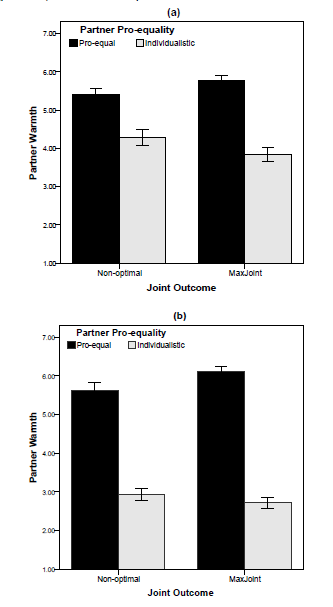
Partner pro-equality strongly affected participants’ evaluations of partner warmth (F(1, 171) = 76.05, p < .001, ηp2 = .31). Moreover, joint outcome moderated the effect of partner pro-equality on evaluations of partner warmth (F(1, 171) = 5.26 for the interaction, p = .023, ηp2 = .030; Figure 1). Simple effects tests indicated that whereas pro-equality partners were rated as warmer in the MaxJoint condition than in the Non-optimal condition, (F(1, 171) = 3.98, p = .048), individualistic partners were rated as marginally less warm in the MaxJoint condition than in the Non-optimal condition (F(1, 171) = 3.01, p = .084). Therefore, it may be concluded that evaluations of partner warmth depended more on partners’ pro-equality/individualistic choices when equal distribution yielded maximum joint outcome than when it did not.
Evaluations of partner warmth as a function of joint outcome and partner pro-equality in Studies 1 (panel a) and 2 (panel b). Error bars represent ±1 SE.
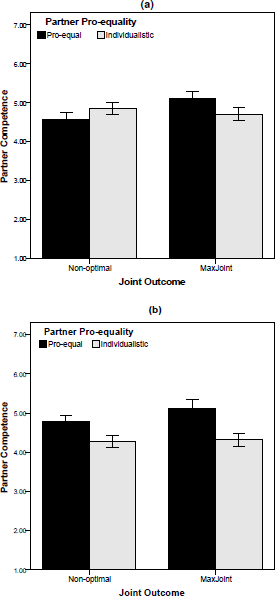
We also found a significant interaction between joint outcome and partner pro-equality on evaluations of partner competence (F(1, 171) = 4.12, p = .044, ηp2 = .024; Figure 2). Simple effects tests showed that participants in the MaxJoint condition (vs. those in the Non-optimal condition) rated pro-equality partners as more competent (F(1, 171) = 5.49, p = .020). However, the competence evaluations of individualistic partners were not significantly different in the two conditions (F(1, 171) = .46, p = .50).
Evaluations of partner competence as a function of joint outcome and partner pro-equality in Studies 1 (panel a) and 2 (panel b). Error bars represent ±1 SE.
Significant main effects of both joint outcome and partner pro-equality were found on participants’ own tendencies to choose equal options (F(1, 171) = 9.90, ηp2 = .002, p = .055), and (F(1, 171) = 32.58, p < .001, ηp2 = .16, for joint outcome and partner pro-equality respectively). However, the interaction between joint outcome and partner pro-equality was non-significant (F(1, 171) = .047, p = .83, ηp2 < .001; Figure 3). Participants were more likely to choose equal distribution when paired with a pro-equality partner than with an individualistic partner, and in the MaxJoint condition than in the Non-optimal condition.
Participants’ equality choices as a function of joint outcome and partner pro-equality in Studies 1 (panel a) and 2 (panel b). Error bars represent ±1 SE.

The results on choosing individualistic options just mirrored those on choosing equal options. Specifically, the main effects of joint outcome (F(1, 171) = 8.77, p = .004, ηp2 = .049) and partner pro-equality (F(1, 171) = 22.68, p < .001, ηp2 = .12) were both significant, but not the interaction between them (F(1, 171) = .16, p = .69).
2.3 Discussion
This study showed that whether equality led to maximum joint outcome influenced individuals’ evaluations of and reactions to pro-equality vs. individualistic partners. First, as predicted, joint outcome moderated evaluations of partner warmth, in that evaluations of partner warmth were more polarized when equality led to joint outcome than when not. Second, participants tended to evaluate those choosing equality to be less competent in the Non-optimal condition than in the MaxJoint condition, suggesting that individuals may attribute less competence to those whose prosocial behaviors did not yield optimal outcomes. Third, inconsistent with our hypothesis, individuals chose equality more in the MaxJoint condition than in the Non-optimal condition, even when paired with an individualistic partner. That means, although participants tended to evaluate individualistic partners as less warm when equality maximized joint outcome than when it did not, they nevertheless were more likely to distribute resources equally with individualistic partners in the former condition.
These results clearly showed that individuals’ evaluations of their partners and tendencies to make equal distribution depended not only on whether their partners had chosen equal distribution, but also on the structure of mutual payoffs. A lower joint outcome reduced individuals’ evaluations of pro-equality partners, and their own tendencies to choose equal distribution. In Study 2, we assessed participants’ SVO and examined whether it would moderate their reactions to partners high or low in pro-equality in different joint outcome conditions.
3 Study 2
The aim of Study 2 was twofold. First, we attempted to replicate the findings from Study 1 showing that partner evaluation and reciprocity varied according to both partner pro-equality and joint outcome. Second, we examined whether participants’ SVO would moderate their evaluations and responses to pro-equality/individualistic partners in different outcome conditions. We measured two indexes of SVO with the SVO slider measure (Reference Ackermann, Fleiß and MurphyAckermann, Fleiß & Murphy, 2016), one was general SVO indicating the degree of prosociality, and the other was preference for joint outcome over equality (among those who were classified as prosocials).
Based on previous studies showing that prosocials value equality to a larger extent than proselfs (Reference De Cremer and VanLangeDe Cremer & Van Lange, 2001; Reference Eek and GärlingEek & Gärling, 2006; Reference Liebrand, Jansen, Rijken and SuhreLiebrand et al., 1986; Reference VanDijk, De Cremer and HandgraafVan Dijk, De Cremer, & Handgraaf, 2004), we hypothesized that participants higher in prosociality (vs. lower in prosociality) should base their warmth evaluations of partners more on partner pro-equality, and be more likely to choose equality regardless of what their partners choose. We also hypothesized that, in the Non-optimal condition, participants who preferred maximum joint outcome to equal distribution should be less likely to value and reciprocate their partners’ pro-equality behaviors, and be more likely to value and reciprocate their partners’ individualistic choices, than those who preferred equality in distribution. Phrased differently, participants who preferred maximum joint outcome to equal distribution should evaluate an individualistic partner more positively, and a pro-equality partner less positively in the Non-optimal condition than in the MaxJoint condition.
3.1 Method
3.1.1 Participants
One hundred and sixty-four undergraduate students from a Chinese university participated in this study. Six participants did not pass the probing test examining whether they understood which part of the experimental task was linked to their payments and were removed from analysis. Among the remaining participants, 59 were men and 99 were women. The mean age was 21.49 (SD = 2.32). Participants were recruited from a large subject pool. The rule to decide the payments was the same as that in Study 1.
3.1.2 Materials and Procedure
Study 2 was identical to Study 1, with one exception. Specifically, we assessed participants’ own SVO before exposing them to their partners’ choices. Participants’ choices in the SVO measure would not affect the payments they would receive. To make sure that participants clearly understood the payment rule, one probing question asking which part of the task was linked to their payments was attached at the end of the informed consent sheet.
3.1.3 Measures
SVO. Participants’ social value orientation was measured with the SVO slider measure (Reference Ackermann, Fleiß and MurphyAckermann, Fleiß & Murphy, 2016; Reference Murphy, Ackermann and HandgraafMurphy et al., 2011). This measure contains six primary and nine secondary items. In each item, participants should choose among 9 pairs of payoffs for the self and the "other" the one they prefer. The set of six primary items assesses individuals’ general SVO. It yields a continuous value in terms of an angle, which can be conveniently converted to the three traditional SVO archetypes. The larger the angle, the more prosocial an individual is. The set of nine secondary items assesses tendencies of inequality aversion vs. joint outcome maximization among prosocials. It yields an inequality aversion (IA) index between 0 and 1. The larger the IA index, the more an individual prefers maximum joint outcome to equality in distribution. In Appendix 2, we provide detailed information on how the scale is scored.
Other measures were all identical to those used in Study 1.
3.2 Results
We first examined whether the pattern of results in Study 1 can be replicated. Then, we examined the moderating roles of SVO in partner evaluation and choices of equal/individualistic options.
3.2.1 Effects of Joint Outcome and Partner Pro-equality on Partner Evaluations and Self Pro-equality
Partner pro-equality had a large effect on evaluations of partner warmth (F(1, 154) = 332.18, p < .001, ηp2 = .68). Moreover, evaluations of partner warmth also varied as a function of the interaction between joint outcome and partner pro-equality (F(1, 154) = 4.52, p = .035), ηp2 = .029 (Figure 1). Simple effects tests indicated that pro-equality partners were rated as warmer in the MaxJoint condition than in the Non-optimal condition (F(1, 154) = 4.24, p = .041). However, warmth evaluations for individualistic partners were not significantly different across the two conditions (F(1, 154) = .90, p = .34).
Pro-equality partners were evaluated as more competent than individualistic ones in general (F(1, 154) = 13.83, p < .001, ηp2 = .081). However, neither the main effect of joint outcome nor the interaction between joint outcome and partner pro-equality on evaluations of partner competence was significant (Fs(1, 154) < 1.18, ps > .28; Figure 2).
For the tendency to choose equal options, we found significant main effects of both partner pro-equality (F(1, 154) = 17.33, p < .001, ηp2 = .10), and joint outcome (F(1, 154) = 7.43, p = .007, ηp2 = .05), but the interaction was non-significant (F(1, 154) = 2.12, p = .15; Figure 3).
For the tendency to choose individualistic options, in addition to significant main effects of both partner pro-equality, (F(1, 154) = 11.59, p = .001, ηp2 = .070), and joint outcome (F(1, 154) = 7.04, p = .009, ηp2 = .044), we also found an almost significant interaction between the two variables (F(1, 154) = 3.70, p = .056, ηp2 = .023). Simple effects tests indicated that when paired with an individualistic partner, participants were more likely to choose individualistic options in the Non-optimal condition than in the MaxJoint condition (F(1, 154) = 10.48, p = .001), but this effect disappeared when paired with a pro-equality partner (F(1, 154) = .27, p = 61).
3.2.2 The Moderating Roles of SVO
The average SVO angle (i.e., the indicator of prosociality) as generated from the primary items of the SVO slide measure was 28.78° (SD = 13.13°, ranged from –16.26° to 49.01°). According to Murphy et al. (2011), 119 participants (with angles larger than 22.45°) can be classified as prosocial, 37 (with angles smaller than 22.45° but larger than –12.04°) were individualistic, and 2 (with angles smaller than –12.04°) were competitive. Preferences for equality vs. joint outcome were calculated among the 119 prosocial participants. Specifically, answers to the secondary items of the slider measure showed that on average, prosocial participants tended to prefer equality over joint outcome maximization, M = .38, SD = .29.
First, we asked whether the level of prosociality would influence individuals’ evaluations of and responses to pro-equality/individualistic choices. Since prosociality was a continuous variable, we conducted hierarchical regressions. In the first block, we entered the main effects of the two experimental conditions (i.e., partner pro-equality and joint outcome, dummy coded), and the main effect of prosociality. In the second block, we entered the three two-way interactions among the three variables. In the third block, we entered the three-way interaction. We found that prosociality did not significantly affect participants’ evaluations of pro-equality/individualistic partners in both the MaxJoint and Non-optimal conditions, all βs < .19, ts(151) < 1.13, ps > .26. However, we found a significant main effect of prosociality on participants’ tendencies to choose equal distribution, β = .36, t(151) = 4.88, p < .001. Moreover, the two-way interaction between prosociality and partner pro-equality on choosing equal distribution was also significant, βs = –.24, t(151) = –3.24, p = .001. The interaction may be removable because of ceiling effects, since participants who scored high on prosociality seemed to always reciprocate a pro-equality partner, regardless of the joint outcome. Nevertheless, we were sure that prosocial participants were more likely to choose equality than those who were less prosocial when paired with an individualistic partner.
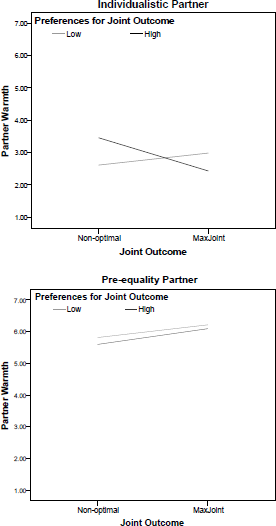
We then asked whether preferences for joint outcome (vs. equality) moderated participants’ evaluations of and responses to their partners, using hierarchical regression analyses. A significant three-way interaction among partner pro-equality, joint outcome and preferences for joint outcome to equality emerged on evaluations of partner warmth, β = .10, t(111) = 2.03, p = .045. Further analyses showed that the interaction between joint outcome and preferences for joint outcome was non-significant on evaluations of pro-equality partners, β = .022, t(53) = 0.16, p = .88. However, it was significant on the evaluations of individualistic partners, β = –.36, t (60)= –2.82, p = .007.
Simple slopes tests indicated that among those who preferred joint outcome to equality (with IA indexes 1 SD above mean), individualistic partners was evaluated as less warm in the MaxJoint condition than in the Non-optimal condition, β = –.31, t(60) = –2.36, p = .022. Among those who preferred equality to joint outcome (with IA indexes 1 SD below mean), the association between joint outcome and warmth evaluations of individualistic partners was non-significant, β = .11, t(60) = .59, p = .56 (Figure 4). The interaction can also be described for the Non-optimal condition, where those who preferred maximum joint outcome evaluated individualistic partners as warmer than those who preferred equality, β = .41, t(60) = 2.08, p = .042, whereas in the MaxJoint condition, the pattern tended to be reversed, β = –.30, t(60) = –1.95, p = .057. Hence, we can conclude that the individual difference in preferences for joint outcome mitigated the negative evaluations of partners who made individualistic choices in the Non-optimal condition.
Evaluations of partner warmth as a function of the three-way interaction among partner prosociality, joint outcome, and preferences for joint outcome (Study 2).
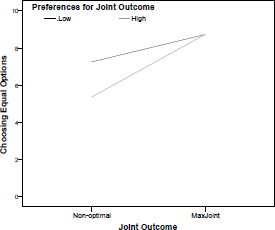
Participants’ preferences for joint outcome moderated their choices in the MaxJoint and Non-optimal conditions, β = .39, t(116) = 2.25, p = .027 (Figure 5). Ceiling effects seemed to occur in that all participants in the MaxJoint condition tended to always choose equal distribution, rendering this interaction uninterpretable. Nevertheless, we can say for sure that, in the Non-optimal condition, those who preferred joint outcome were less likely to choose equal options than those who preferred equality.
Choosing equality as a function of the interaction between joint outcome, and preferences for joint outcome (Study 2).
3.3 Discussion
Several findings from Study 1 were replicated. First, the discrepancies in warmth evaluations of pro-equality and individualistic partners were larger in the MaxJoint condition than in the Non-optimal condition. Second, participants were more inclined to choose equal options when paired with pro-equality partners (vs. individualistic partners) and in the MaxJoint condition (vs. the Non-optimal condition). However, results on evaluations of partner competence were inconsistent across the two studies. In addition, we found an almost significant interaction between joint outcome and partner pro-equality on choosing individualistic options, which may have stemmed from the fact that participants in the MaxJoint condition showed very low tendencies to choose the individualistic options even when paired with an individualistic partner.
Evaluations of partner warmth did not vary significantly according to the interaction between prosociality and partner pro-equality. However, as predicted, preferences for joint outcome moderated participants’ evaluations of individualistic partners. Those who preferred joint outcome to equality were more lenient towards partners who chose individualistic options that produced maximum joint outcome. Inconsistent with our hypothesis, participants’ evaluations of pro-equality partners did not vary according to their preferences for equality (vs. maximum joint outcome). We will discuss more on this point in general discussion.
4 General Discussion
The central question investigated in the current studies was whether individuals’ evaluations of, and reactions to, a partner in a dyadic task would be affected by whether the partner’s choice of equality in distribution led to maximum joint outcome or not. In both studies, pro-equality partners were evaluated as less warm when equal distribution did not lead to maximum joint outcome than when it did. Pitting equality against maximum joint outcome may have elicited conflicting feelings thus compromising participants’ positive evaluations of pro-equality partners. Hence, mere exposure to alternatives that can generate better joint outcome than equal distribution reduced positive evaluations of a pro-equality partner. It is interesting to note that individuals would have the best outcome if their partner chose equal distribution but they themselves chose individualistic options. However, they may feel obligated to reciprocate a pro-equality partner. Indeed, we found that the reciprocation rate with a pro-equality partner was very high even in the Non-optimal condition. Hence, one reason that warmth evaluations of pro-equality partners were lower in the Non-optimal than in the MaxJoint condition might be that individuals were less satisfied with the outcome they received in the former than latter condition.
Nevertheless, pro-equality partners were evaluated as warmer than individualistic partners even in the Non-optimal condition; most individuals, even those who preferred joint outcome over equality, evaluated pro-equality partners as much warmer than individualistic partners. It corroborates the idea that individuals do place a moral value on equality (Reference BaronBaron, 2008). Indeed, previous studies have shown that individuals would experience negative emotions when the rule of equality is violated, and tend to punish those who violated this rule (Reference Fehr and SchmidtFehr & Schmidt, 1999; Reference Stouten, De Cremer and van DijkStouten, De Cremer & van Dijk, 2006; 2007). In these studies, however, it has always been assumed that equality leads to best joint outcome. Our studies suggest that even when equality conflicts with maximum joint outcome, individuals still prefer those who choose equal distribution to those who choose individualistic options. Remember that, in the current studies, a decision maker would always let the partner have the best outcome when choosing equal distribution. Different results may be obtained if to achieve equality, pro-equality partners not only sacrifice their own interest, but also sacrifice their partners’. Future studies further lowering the payoffs in the equal options may help to test this possibility.
Violating the equality rule may to some extent be excused, however, by those who attach more weight to joint outcome than to equality, in the circumstance when equality does not afford maximum joint outcome. Specifically, we found that those who preferred joint outcome (but not those who preferred equality) evaluated individualistic partners as warmer in the Non-optimal condition than in the MaxJoint condition, suggesting that their evaluations of individualistic partners did rely on whether individualistic behaviors harmed or benefited joint outcome. In sum, it may be concluded from these results that, whereas equality is uniformly valued by all (though to a less extent when it is not congruent with maximum joint outcome), evaluations of acts maximizing joint outcome depends more on individuals’ preferences.
Inconsistent with what has been found by Eek and Gärling (2006) but consistent with other findings (Reference Charness and RabinCharness & Rabin, 2002; Reference VanLangeVan Lange, 1999), prosocials were not uniformly inclined to choose equality. Prosocial individuals who preferred maximum joint outcome relative to equality in distribution were less likely to choose equal distribution than those who preferred equality in the Non-optimal condition. This difference suggests that the extent to which prosocials would choose equality depends on whether the payoffs match their own preferences. This heterogeneity in motive may lead to seemingly contradictory behaviors among "nice" people when equality does not afford maximum joint outcome, which may bring about misunderstandings and conflicts.
To the best of our knowledge, the current research represents the first attempt to disentangle individuals’ reactions to equality and maximum joint outcome. These studies enrich research on both social cognition and prosocial behaviors, by providing a nuanced understanding of how evaluations of and reactions to a particular partner may be shaped by the interaction between payoff matrix and individuals’ own preferences. Moreover, these findings also have significant practical implications. The Non-optimal condition resembled real-life situations in which all would be better off when everybody attempts to maximize his/her own interest (without deliberately hurting others’) rather than to distribute resources equally. One prototype of such situations is the trade-off between equality and efficiency. The pursuit of equality may inevitably interfere with efficiency (Reference Johansson, Eek, Caprali and GärlingJohansson, Eek, Caprali & Gärling, 2010). However, with efficiency increased, everybody would benefit (though not equally) from an increased volume of resources. We believe that this kind of situation may be at least as common as situations where equal distribution generates best joint outcome for all. Results from the current studies inform that individuals’ perceptions and behaviors would be more diverse when equality does not yield maximum joint outcome than when it does, even among those high in prosociality. Strategies may be taken to balance equality and joint outcome, as well as to reduce conflicts among people with good intentions.
It should be noted that in our studies, the payoffs of pro-equality/individualistic choices were very clear. However, in real life, people may disagree about whether equality benefits or harms joint outcome. Therefore, individuals may behave "selfishly" not because they concern only their own outcomes, but because they believe that being individualistic leads to best joint outcome for all. It may be worthwhile assessing such beliefs behind individuals’ prosocial or selfish behaviors in studies examining real-life problems.
There are several limitations to these studies. First, participants were all undergraduates, and they were led to believe that they were playing the game with another student from the same university. Different levels of prosociality may be observed if other samples were investigated, or if participants were led to think they were paired with an out-group member. Nevertheless, the studies should bear some ecological validity since the points participants received were actually linked to their payments. Second, in Study 2, participants’ SVO was measured right before the dyadic task. It may have contributed to the apparently larger discrepancies in participants’ evaluations of pro-equality and individualistic partners than those in Study 1. Moreover, it should be noted that evaluations of partner competence were not consistent across the two studies. Future studies may investigate the boundary conditions under which individuals evaluate a prosocial/individualistic partner as more or less competent. We suspect that further reducing the payoffs in the pro-equality alternatives may lower individuals’ competence evaluations of a pro-equality partner.
Future studies may also examine why pro-equality partners were evaluated as less warm in the Non-optimal condition than in the MaxJoint condition. This discrepancy cannot be totally explained by individual differences in prosociality or preferences for joint outcome. We suspect that the conflict between equality and joint outcome may itself produce ambivalent feelings, thus lowering evaluations of pro-equality partners. Future studies may assess individuals’ cognitive and emotional reactions in situations where mutual pro-equality results in different levels of joint outcome relative to individualistic behaviors. Moreover, as mentioned above, the payoff for each choice in the current studies was very clear. This may not be the case in real-life situations. Future studies may assess or manipulate individuals’ beliefs about whether equal distribution leads to maximum joint outcome, and examine potential consequences. In addition, we used only one type of task to delineate the effects of joint outcome and equality. Future studies may make use of various protocols of social dilemma (e.g., the Dictator game) to generalize the findings.
In conclusion, across two studies, we found that individuals would evaluate a pro-equality partner as less warm, and were less likely to choose equal options, when equality did not yield maximum joint outcomes than when it did. We also found that prosocials who preferred maximum joint outcomes to equality would be less likely to choose equal distribution than those who preferred equality when equal distribution did not maximize joint outcome. Moreover, those who preferred joint outcome also tended to evaluate individualistic partners as warmer when equal distribution did not led to maximum joint outcomes than when it did. These studies suggest that when studying behaviors in dyadic tasks, it would be helpful to adopt an interactive perspective, taking into consideration all three sources of influences: individuals’ own SVO, partners’ behaviors, and mutual payoffs.
Appendix 1
The adapted triple-dominance scales used in Studies 1 and 2 (adapted from van Lange et al., 1997).
For each of the ten choice situations, participants were asked to circle the option A, B, or C they prefer most. The values in bold in the prosocial options are used in the Non-optimal condition. Other parts are the same in the MaxJoint and the Non-optimal conditions.

Appendix 2
The six primary SVO slider items used to calculate general SVO (from Reference Murphy, Ackermann and HandgraafMurphy, Ackermann, & Handgraaf, 2011).

Appendix 3
The nine secondary SVO slider items used to calculate preferences for joint outcome vs. equality among prosocials (from Reference Murphy, Ackermann and HandgraafMurphy, Ackermann, & Handgraaf, 2011).


 Open access

