


Global health care emergencies have had devastating effects on communities around the world. The COVID-19 pandemic (coronavirus disease 2019) emerged as the sixth public health emergency of international concern (PHEIC) emergency since 2007,1 following H1N1 influenza (2009), polio (2014), Ebola outbreak in West Africa (2014), Zika (2016), and Ebola outbreak in the Republic of Congo (2019).Reference Wilder-Smith and Osman2
After WHO declared COVID-19 a pandemic on March 11, 2020,3 the capacity of health care workers to respond to this unprecedented public health emergency was also put to the test. A study conducted in PortugalReference Leão, Duarte and Gonçalves4 showed that despite their willingness, 40% of HCWs felt they didn’t have enough knowledge, and approximately 30% of the frontline workers did not have enough training. A multicenter, multinational cross-sectional survey from 371 hospitals across 57 countries showed a high level of awareness and preparedness among HCWs who participated in COVID-19 training courses.Reference Huy, Chico and Huan5 In a low- and middle-income country (LMIC) like Pakistan, with an already overburdened health care system – with only 0.98 physicians per 1000 people – managing the pandemic proved to be an extremely difficult challenge.Reference Khan6
Incidents of violence and aggression against HCWs in Pakistan, like many other countries, were perpetrated by the patient’s family members, and police/armed forces in health care settings overwhelmed the already burdened HCWs,Reference Bhatti, Rauf and Aziz7 exerting further stress on an already resource-constrained health care setting.
Willingness to Respond (WTR) is an important attribute reflecting the attitudinal domains of health crisis management, in contrast to “ability” or “skill set.” Having a willing attitude to respond to public health emergencies such as disasters and pandemics are essential for an effective health care system.Reference Mehmood, Barnett and Kang8 Past research shows self-efficacy, amongst other factors, as an important determinant of WTR. Bandura9 defined self-efficacy as “the belief in one’s capabilities to organize and execute the courses of action required to manage prospective situations.”
A major gap especially in the context of LMICs is the lack of investment in the capacity-building human resources to manage pandemics and other public health emergencies and disasters. In Pakistan, there’s limited literature regarding health care professionals’ willingness and related attitudes toward respond during a pandemic, including among personnel in emergency departments (EDs).Reference Khalid, Khalid and Bhimani10 There remain gaps in evidence regarding approaches to employing innovative models for capacity-building among frontline HCWs focusing on fostering their self-efficacy and WTR in disasters and public health emergencies.Reference Ogedegbe, Nyirenda, Delmoro, Yamin and Feldman11–Reference Barnett, Thompson and Semon13
Considering the rise of health emergencies and disasters in Pakistan, such as recent catastrophic floods, earthquakes, recent pandemics, and terrorist attacks, it is critical to assess WTR among HCWs in the country. This paper reports the results of survey on HCWs’ WTR to pandemics in Pakistan.
Methods
Study Design
A cross-sectional survey of HCWs in the ED at Aga Khan University Hospital (AKUH) and Jinnah Postgraduate Medical Centre (JPMC) in Karachi, Pakistan was conducted. This quantitative survey assessed WTR toward 3 disaster scenarios: weather relatedReference Kang, Barnett and Chhipa14 (published), pandemic influenza, and radiological ‘dirty’ bomb. We aimed to examine how self-efficacy and other behavioral factors are associated with WTR – a critical attitudinal dimension of the health care workforce in the context of pandemic situations.
Details of the methodology, including participant recruitment, inclusion-exclusion criteria, and data analysis methods, have been described elsewhere.Reference Kang, Barnett and Chhipa14 This paper documents findings related to WTR in pandemic situations using a modified survey questionnaire (Hospital Infrastructure Response Survey Tool), including embedded questions from the General Self-Efficacy Scale.Reference Mehmood, Barnett and Kang8
In this study, “WTR if asked” refers to a health care worker (HCW) who is off duty but willing to respond if called by the hospital, while “WTR if required” denotes that all HCWs are on duty and required to respond.
Ethical Review
Research ethics approvals were received from the Johns Hopkins Bloomberg School of Public Health Institutional Review Board (IRB00019662), the JPMC Institutional Review Board (f.2-81/2022-GEN/133/JPMC), and the AKUH Ethics Review Committee (6959).
Results
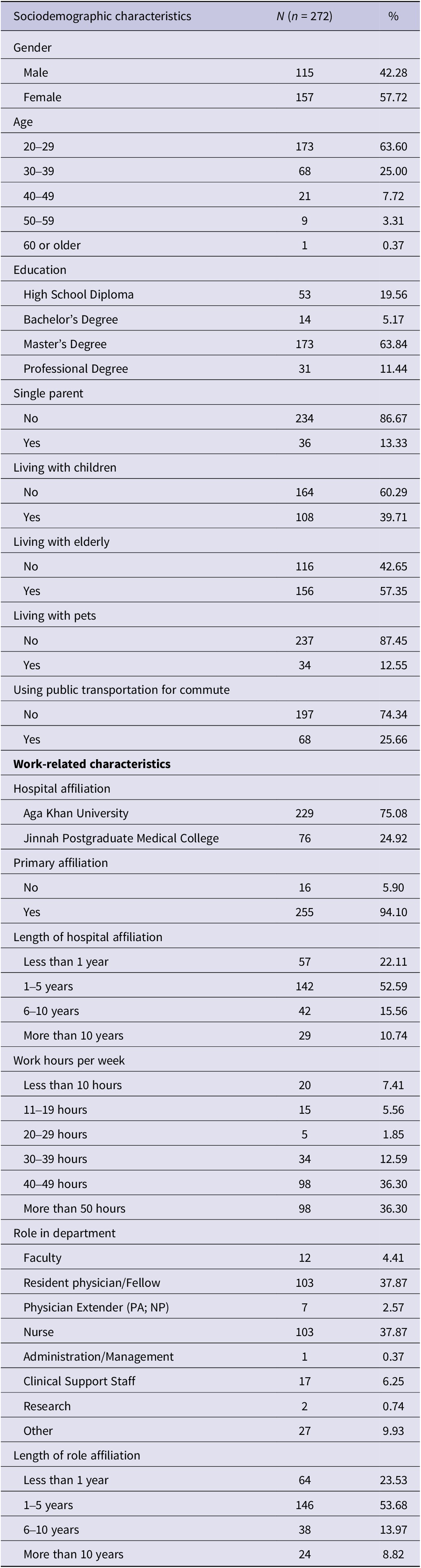
A total of 370 ED health workers from AKUH and JPMC were invited, with 362 of them responding to the survey request. Responses from 272 ED health workers were analyzed after excluding 90 responses of those who provided only “don’t know” responses or did not respond to any WTR or belief statements in pandemic emergencies (Table 1). A total of 157 (57.72%) participants were females and 115 (42.28%) were males. More than half of the participants (n = 173, 63.60%) were ages 20-29, and more than a quarter of them (n = 68, 25.00%) were ages 30-39. Most respondents had a master’s degree (n = 173, 63.84%), and approximately one-fifth of respondents had a high school diploma (n = 53, 19.56%). Most participants were living with spouses (n = 234, 86.67%); 108 (39.71%) and 156 (57.35%) health workers were living with children and elderly dependents, respectively. Approximately one-third 98(36.30%) of participants reported working from 40-49 hours a week, and the same number of people worked over 50 hours a week on average. Most participants were either resident physicians (n = 103, 37.87%) or nurses (n = 103, 37.87%).
Demographic characteristics of emergency department health workers in Karachi, Pakistan

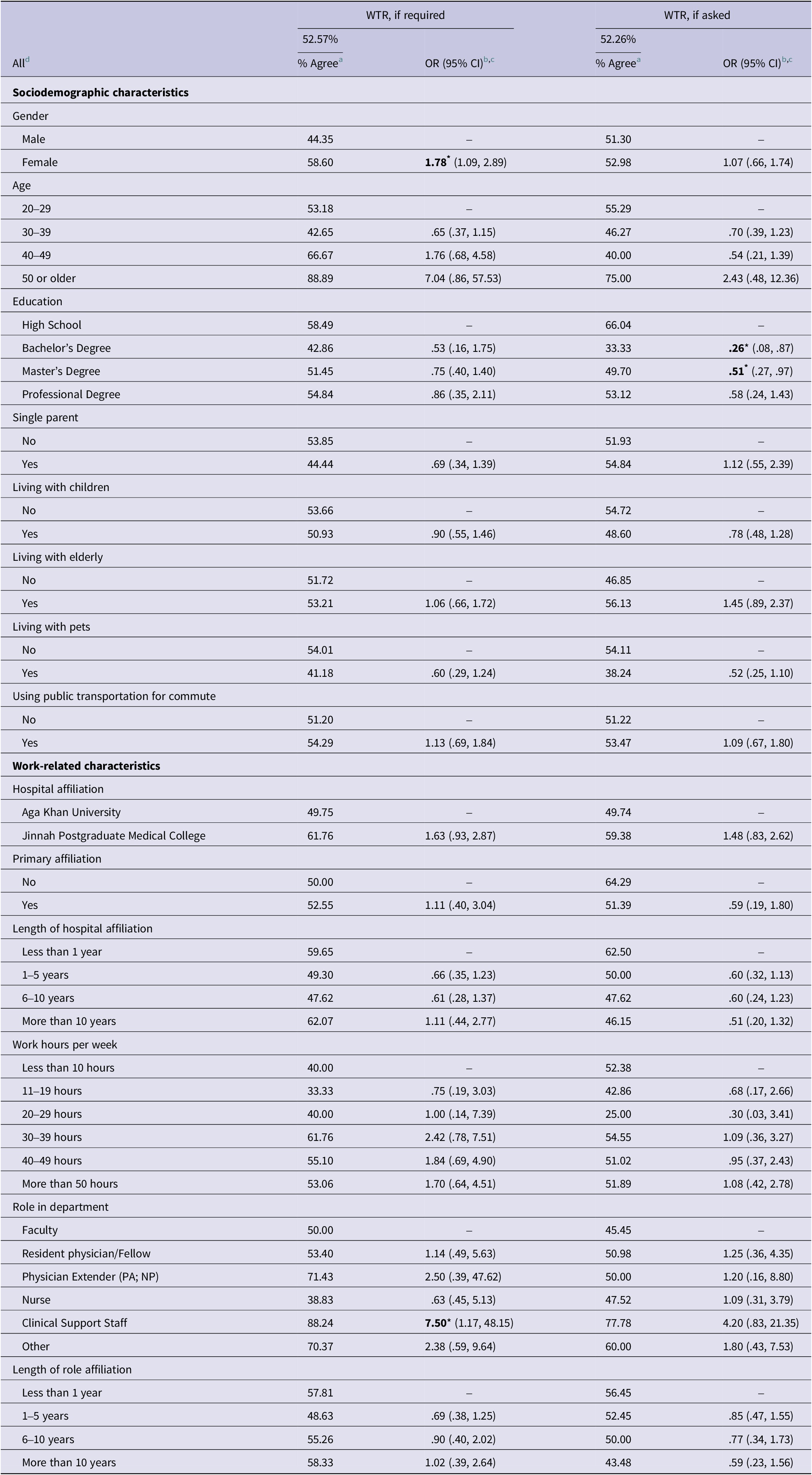
Associations between demographic characteristics and willingness to respond to pandemic influenza emergencies are described in Table 2. Health workers’ overall willingness to respond was 52.57% if required and 52.26% if asked. Female health workers showed 1.78 greater odds of WTR if required, compared to male health workers (odds ratio [OR]1.78, 95% CI 1.09-2.89). WTR between female and male participants was not significantly different if asked but not required. WTR to pandemics varied by health workers’ role in the ED. Clinical support staff (nursing assistance/health care assistance who help nurses in patient management) were 7.5 times more likely to respond than faculty (academic rank, physicians) if required (OR 7.5, 95% CI 1.17-48.15) maintaining the highest WTR than other roles; however, the association between hospital role and WTR if asked was not statistically significant. When asked about WTR if asked, participants’ education was negatively significantly associated with WTR. Participants with a bachelor’s degree were 74% less likely to respond (OR .26, 95% CI .08-.87), followed by master’s degree (49% lower WTR; OR .51, 95% CI .27-.97) compared with high school diploma holders.
Associations between participant demographics and willingness to respond to a pandemic emergency (n = 272)

a Percent agreeing with WTR statement.
b Odds ratios represent the odds of stating a positive WTR for the respective positive attitude/belief response compared to the negative response.
c *P <0.05, **P <0.01, ***P <0.001.
d Percent pertaining to all survey respondents.
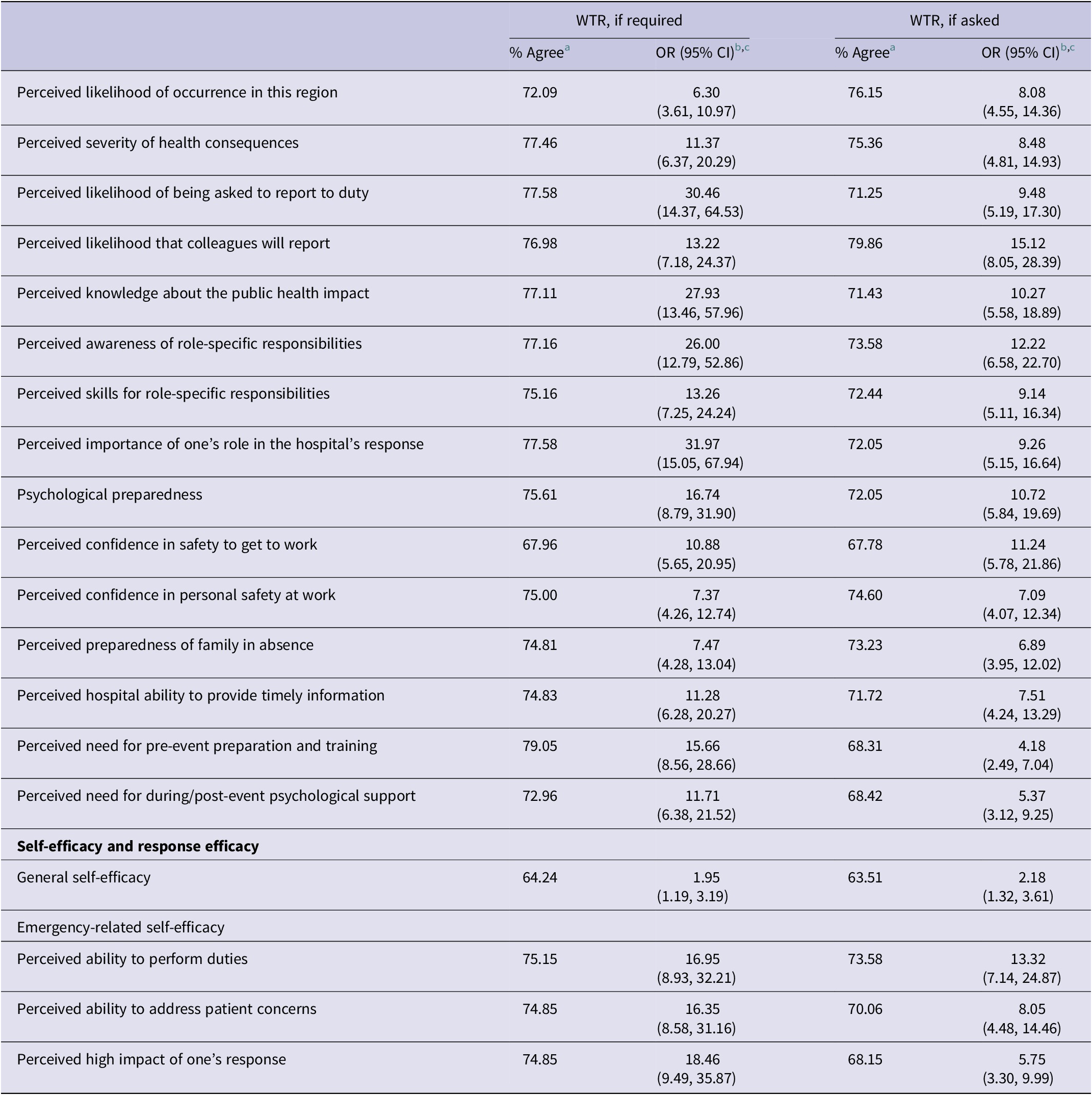
Table 3. shows associations between WTR and attitudes/beliefs about pandemic response. Education level and age were found to be independently associated with both WTR if required and WTR if asked in a multivariate analysis and were controlled in the logistic regression analyses. After adjusting for these factors, most attitudes/beliefs were significantly associated with WTR if required. Participants who believed that they had knowledge about the public health impact of pandemic response were 30 times more likely to show WTR than those who did not (OR 30.46, 95% CI 14.37-64.53). Health workers who reported being aware of their role-specific responsibilities and knowing how important their roles are in the hospital showed 26 and 32 greater odds of responding to a pandemic than their counterparts, respectively (OR26.00, 95% CI12.79, 52.86; OR31.97, 95% CI 15.05, 67.94). Emergency preparedness was significantly positively associated with WTR, as participants who reported being psychologically prepared (OR16.74, 95%CI8.79, 31.90) and in need of pre-event preparation and training (OR15.66, 95%CI8.56, 28.66) showed higher response willingness than those who did not. Pandemic-specific self-efficacy (both abilities to perform duties [OR16.95, 95%CI8.93-32.21] and response efficacy [OR18.46, 95%CI9.49, 35.87]), as well as general self-efficacy (OR1.95, 95%CI1.19-3.19), were significantly associated with WTR.
Associations between attitudes/beliefs and self-reported willingness to respond to a pandemic emergency

a Percent agreeing with WTR statement.
b Odds ratios represent the odds of stating a positive WTR for the respective positive attitude/belief response compared to the negative response.
c All associations were statistically significant at P<0.001, except for general self-efficacy. General self-efficacy was significantly associated with willingness-to-respond if required and if asked at P<0.01.
Most attitudes/beliefs were significantly associated with WTR if asked, but with lower odds ratios than WTR if required. Those who perceived that their colleagues would report to work in pandemic emergencies were 15 times more likely to be willing to respond than those who did not (OR 15.12, 95% CI 8.05, 28.39). Health workers who had awareness of role-specific responsibilities were 12 times more likely to report for duty than those who did not have awareness (OR 12.22, 95% CI 6.58, 22.70). Further, participants who reported having confidence in their ability to perform duties (i.e., self-efficacy) showed 13 times greater odds of having response willingness than those who did not (OR 13.32, 95% CI 7.14, 24.87). Additionally, general self-efficacy was significantly positively associated with WTR if asked (OR 2.18, 95%CI 1.32, 3.61), showing a higher association than when a response was required.
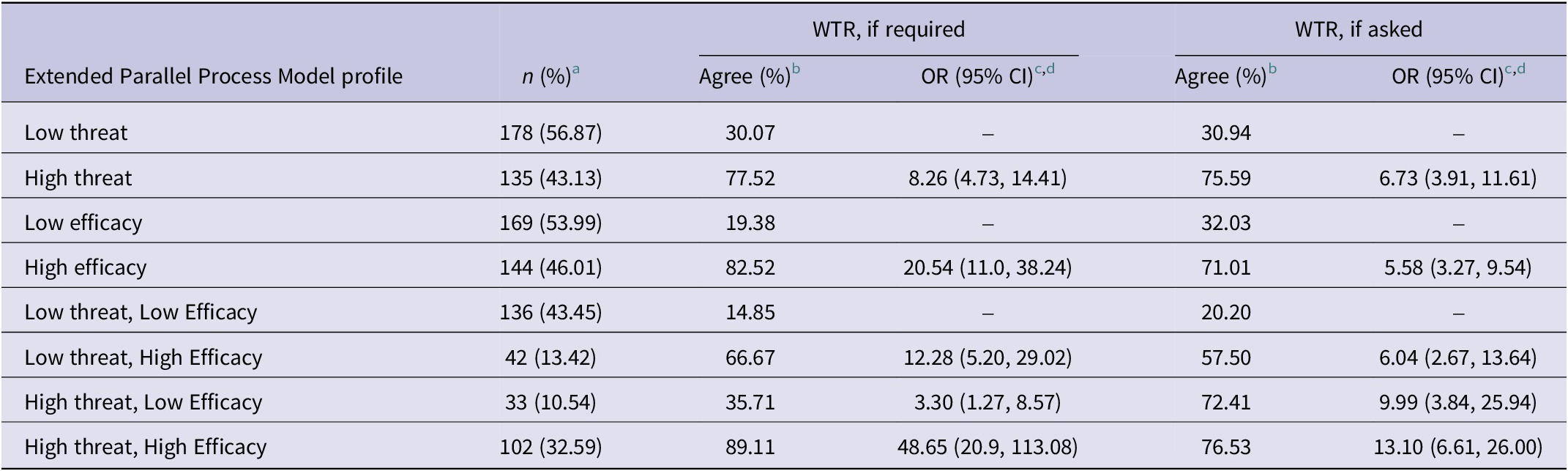
Participants’ Extended Parallel Process Model (EPPM) profile and its association with WTR are described in Table 4. 56.87% of participants showed low perceived threat, while 43.13% showed high perceived threat toward pandemic emergencies. Having higher perceived threat was significantly associated with WTR if required (OR 8.26, 95% CI 4.73-14.41) and if asked (OR 6.73, 95% CI 3.91, 11.61). Slightly over half (53.99%) of participants had low efficacy, and 46.01% of participants showed high efficacy toward responding to pandemics. Health workers who reported having high efficacy were 21 times more likely to report to work during pandemics when required (OR 20.54, 95%CI 11.0-38.24) and nearly 6 times more likely to report if asked (OR 5.58, 95% CI 3.27-9.54), compared to those who had low efficacy.
Associations between EPPM categories and self-reported willingness to respond (WTR) to a pandemic emergency

a Frequencies and percent of respondents in each respective threat and efficacy category.
b Percent agreeing with WTR statement
c Odds ratios represent the odds of stating a positive WTR for the respective positive attitude/belief response compared to the negative response.
d All associations were statistically significant at P<0.001, except for the relationship between high threat/low efficacy and willingness-to-respond if required (P<0.05).
Regarding EPPM-based profiles, approximately one-third of participants (32.59%) were in the high threat/high efficacy profile, while 43.45% of participants were in the low threat/low efficacy profile. Health workers in the high threat/high efficacy profile were approximately 49 times more likely to be willing to respond to pandemics than those in the low threat/low efficacy profile if required (OR 48.65, 95%CI 20.9, 113.08), and those in the low threat/high efficacy profile were 12 times more likely to show WTR (OR 12.28, 95%CI 5.20, 29.02); and those in the high threat/low efficacy category were 3 times more likely to show WTR if required (OR3.30, 95%CI 1.27, 8.57) compared with participants in the low threat/low efficacy group. Similarly, participants with high perceived threat and high efficacy were more likely to respond to pandemics if asked (OR 13.10, 95% CI 6.61, 26.00) compared with the low threat and low efficacy group. In contrast with WTR if required, those in the high threat/low efficacy profile (OR 9.99, 95%CI 3.84, 25.94) showed greater odds of being willing to respond than the low threat/high efficacy profile (OR6.04, 95%CI2.67, 13.64) during pandemic emergencies.
Discussion
Survey findings showed strong associations between WTR in a pandemic and behavioral factor, such as perceived importance of one’s role, perceived knowledge, role-specific responsibilities, disaster-specific self-efficacy, and response efficacy (perceived effectiveness of one’s response) if emergency department HCWs were required to report. Similarly, if asked, the perceived likelihood of colleagues’ involvement, knowledge about role-specific duties, self-efficacy, and response efficacy were strongly associated with WTR. General self-efficacy (GSE) was also significantly associated with WTR, with higher levels of WTR reported when asked to respond compared with when required to respond.
Consistent with the EPPM theory, individuals with a high perception of threat and efficacy were more likely to be willing to respond to a pandemic. Interestingly, the group with high threat and low efficacy showed higher WTR if asked compared to the group with low threat and high efficacy, suggesting that increasing one’s risk perception will be effective in boosting emergency response, particularly among HCWs showing voluntary absenteeism. Previous literature from the US exploring willingness to respond to an influenza pandemic using a threat- and efficacy-based assessment framework points to the importance of risk perception as positive driver of WTR.Reference Barnett, Levine and Thompson15 During the recent COVID-19 pandemic, the government’s focus on emergency training and courses for HCWs was mainly on enhancing their efficacy and capability to tackle the challenges, but these findings highlight the importance of focusing on the other behavioral aspects of disaster response in the training, such as perceived risks, to improve their willingness in turn to ensure preparedness in the future.16, 17 It is important to emphasize that risk perception can be challenging especially when the duration of a health emergency gets protracted as in the case of the COVID-19 pandemic. It is recommended to engage trusted figures from hospitals and other health authorities to deliver consistent and transparent messages about the severity and susceptibility of infectious diseases to sustain risk perception among HCWs.
Meanwhile, several studies revealed higher HCWs’ WTR compared with our findings. ICU staff in China revealed a high willingness to care during an H1N1 influenza pandemic (82.3%)Reference Shi, Wang and Yang18, and similarly, 61% of nurses in Australia exhibited WTR during pandemic-related emergencies.Reference Lord, Loveday, Moxham and Fernandez19 A potential reason for lower HCWs response in our LMIC-based study could relate to lack of preparedness for pandemics, which can call for structured in-service training for preparedness. Other potential reasons for gaps in WTR in our study could be that financial security and health coverage are limited in Pakistan, coupled with high communicability of a pandemic strain and fear of infecting family members.
Among the various attitude and belief factors assessed in this study, perceived knowledge about the public health impact of one’s performance and role-specific responsibilities showed particularly strong associations with WTR during a pandemic event. This aligns with prior evidence that HCWs’ sufficient knowledge subsequently resulted in their positive attitudes toward responding to COVID-19.Reference Arbon, Ranse and Cusack20 Despite the urgent need to enhance WTR among the workforce, training opportunities in disaster medicine and public health preparedness in many LMIC settings, including Pakistan, have been inadequate. Educational materials must include clear information about how disaster response responsibilities vary by HCW role, and how each HCW’s contribution can generate positive health and social impacts. It is also worth noting that the WTR was relatively lower when HCWs are asked to report compared to when they are required. Our data draw attention to the salience of HCWs’ perceived norms. If they perceive their colleagues are reporting to work during emergencies, they are also likely to do so even when an organizational demand for reporting is absent. This provides critical implications for establishing strategies for strengthening a collective sentiment and shared responsibilities among emergency response personnel within a hospital.
The interpretation of our findings also merits reflecting on other disaster scenarios. Previous research in high-income settings showed that HCWs demonstrated lower WTR during an influenza pandemic compared to weather crises.Reference Huber and Wynia21 Also, a study in the US indicated that 80% of participants were willing to report to work during a natural disaster (snow storm), whereas only 48.4%-61.1% were willing to report to work during an outbreak of smallpox or SARS, respectively.Reference Qureshi, Gershon and Sherman22 Similarly, other studies have revealed that WTR is higher during earthquakes than during pandemic influenza.Reference Barnett, Levine and Thompson15, Reference Musharraf, Bauman, Anis-Ul-Haque and Malik23–Reference Ehrenstein, Hanses and Salzberger25 Indeed, previous literature also reflects a decreased sense of duty among HCWs to respond to patient care during infectious crises, leading to a lower willingness to respond during pandemics.Reference Arbon, Ranse and Cusack20, Reference Ehrenstein, Hanses and Salzberger25–Reference Reid29 This very pattern is also evidenced by our earlier study demonstrating HCWs’ higher willingness 71.3% if required and 67.1% if asked in weather disasters in Pakistan.Reference Kang, Barnett and Chhipa14 It may be perhaps derived from the innate attribute of communicable diseases so that the fear of getting infected and infecting others serves as a strong deterrent for WTR in a pandemic setting.Reference Malik, Ullah and Irfan30, Reference Patwary, Bardhan and Disha31 Particularly in Pakistan, where strong familial bonds and the well-being of community are prioritized, the fear of transmission may be intertwined with these underlying cultural values to jointly manifest as a barrier to WTR during pandemics. As such, training materials for HCWs can highlight that their presence at work would not only fulfill their responsibilities in the workplace, but also foster the health of their families and community.
In addition to the salience of didactic approaches to WTR, the role of hospitals and health sectors in providing HCWs with necessary supplies and administrative support during a pandemic should be highlighted. Further, responding to public health emergencies involving an infectious disease outbreak presents many ethical and logistical challenges and can pose serious physical and psychological risks to the health workforce. A study conducted in Bangladesh during the early COVID-19 lockdown reported that approximately 43% of students and professionals experienced anxiety.Reference Patwary, Bardhan and Disha31 A study of Karachi, Pakistan-based health care professionals revealed that 51.3% of physicians were willing to work during the COVID-19 pandemic if personal protective equipment (PPE) was available to them, whereas only 34.8% of them were willing if they believed they had sufficient knowledge and skills.Reference Khalid, Khalid and Bhimani10 A qualitative study in South Korea revealed that COVID-19 frontline health workers without protective equipment and necessary organizational support suffered from increased psychological stress, resulting in reduced motivation in the workplace.Reference Kang, Kwon, You and Lee32 Additionally, a study in China showed that the inadequacy of protection in the hospital affected motivation for work among frontline workers.Reference Ke, Chan and Kong33 This strongly suggests that organizational preparedness and hospitals’ timely and flexible response to HCWs’ needs during health emergencies can further enhance WTR among the workforces.
Furthermore, the results on sociodemographic factors raise some critical points of consideration. Female HCWs had 1.78 times greater odds of WTR if required compared to male workers, contradicting previous literature.Reference Goodhue, Burke, Ferrer, Chokshi, Dorey and Upperman34–Reference Charney, Rebmann and Flood39 This discrepancy in the association of gender and WTR requires further study.
Also, clinical support staff were more likely to respond than faculty if required (maintaining the highest WTR versus other ED professionals). A potential explanation could be that most of the support staff might be working on daily wages, hence their need to work despite the fear of infection was unavoidable. The evidence on varying WTR across sociodemographic and work-related characteristics alludes to the need of tailoring support strategies to optimize response willingness for all HCWs across the hospitals.
Limitations
There are several limitations in this study. Although this survey showed a high response rate, the participation rate was unequally distributed between the 2 facilities. One possible explanation is that 1 of the hospitals was a public hospital, where HCWs often face higher patient demands. We have less responses for the pandemic scenario because we placed the weather-related questionnaire prior to the pandemic questionnaire. It is recommended that future studies take account of this issue and employ appropriate sampling strategies. Also, although this survey attempted to gauge HCWs’ attitudes and WTR across general influenza pandemic contexts, participants’ responses are likely to be based on the COVID-19 pandemic due to their most recent experiences. However, these findings offer critical insights into disaster preparedness and corresponding organizational needs relevant to other disease outbreaks. As the study was conducted in Karachi, the capital city of Pakistan, the findings may have limited generalizability. The findings and recommendations on the improvement of training and organizational support systems are nonetheless widely applicable to HCWs in other regions of the country.
Conclusions
In this study, only half of the respondents expressed a willingness to respond in the event of an influenza pandemic. Notably, respondents identifying as female and working in clinical staff roles demonstrated a higher likelihood of expressing a positive WTR. Also, perceived skills and knowledge, self-efficacy, risk perception, and norms were strongly associated with the WTR. These findings underscore the importance of considering various demographic and professional variables along with their attitudes and beliefs in disaster response when enhancing the preparedness of individuals to respond to pandemics. Training aimed at increasing knowledge about role-specific responsibilities, self-efficacy, and a sense of collegiality, together with proper organizational support, can result in better response during future pandemic emergencies.
Author contribution
NA, BA conceptualized and revised the manuscript, UC drafted the manuscript and facilitated data collection, and BAK analyzed and interpreted the data. DB obtained research funding, AA, DB, AM, JD, and JR contributed substantially to its revision and provided final approval of the manuscript for publication.
Acknowledgments
The authors acknowledge the support of Dr. Saima Mushtaque at Jinnah Postgraduate Medical Centre for providing their technical assistance. The authors wish to thank the health workers who participated in the survey.
Funding statement
This study was supported by the National Institutes of Health Fogarty International Center (Award 1R21TW012210-01).
Competing interest
None.

 Open access

