





The year is 2013. I am a young, underpaid writer working for a local website in Lebanon that did not declare its employees in order to avoid paying taxes, employee benefits, and social security contributions. I just published a blog post titled Literal Piece of Shit on Display at Beirut Art Center, in which I critique the artwork of a French renowned artist, on exhibit that month at Beirut Art Center.Footnote 1 My blog post provoked the center’s directors to such an extent that they commissioned Lebanon’s most established art critic (an American writer and academic) to publish an essay attacking my supposedly poor critical skills and highlighting my ignorance.Footnote 2 The piece appeared in one of the world’s most prominent contemporary art and culture magazines, Frieze. Thirteen years later, I find myself, ironically, writing about crap again, this time in academia. The two pieces share many similarities, but perhaps most notably my rage against elitist modes of communication, the elites’ complete disconnect from the rest of us, and the hypocrisy of both the art world and academia, which continue to claim to speak in our name. Regimes (colonialism included) and their institutional tools—museums and universities alike—seem to be the common thread between both pieces.
I am a scholar and practitioner from the global South. I use Public History and Artistic Research to document absence and silence in political violence settings and I am here to say that any institutional public history project that claims to reclaim our history, our rights, our voice that has been violently stripped away from us, is not doing any of that (or is not doing that effectively). That is because the inherently exclusionary, authoritarian, and exploitive academic institution and/or museum will never allow for such a thing to truly happen. But the good news is, we will not wait for their approval to reclaim our histories.
1. Round 1: Myriam versus Oligartists Footnote 3
In a shady apartment turned office, four of us worked full time in an undisclosed location on one of Beirut’s vibrant cultural streets. In my review of that infamous exhibition, I wrote that the work of French conceptual artist Jean-Luc Moulène was largely inaccessible to most audiences. The blog was based on one of the artist’s photographs titled Digest Sound, which depicted a piece of shit on the street wrapped in cassette tape, as emblematic of what the contemporary art world had become: too conceptual to be understood, too illustrative to be creative, too insignificant to matter, and too complex to be questioned.
Looking back, I think what enraged the cultural elite (or what I call the Oligartists) the most was how a “presumed” peasant like myself dared to speak the everyday Lebanese person’s words, and how “grotesque” I was in showing the clear disconnect between the contemporary art world and us, the public.
1.1. Where did all the war images go?
Fast forward to 2016: I embarked on an investigative PhD, initially in the field of Arts and Sciences of Art. I turned to the photojournalistic archives of the Lebanese civil war to ask why so many people in Lebanon have such limited access to these images, and what it means for a society to have access to so little visual evidence of its own violent recent history. Between 2017 and 2018, I conducted oral history interviews with 12 Lebanese photojournalists who covered the 15-year war, focusing on the aesthetic decisions behind what came to be considered its “iconic” images. I analyzed these interviews to understand the photographers’ technical knowledge and lived experience, and to compare their practices with coverage of other conflicts and other photographers. In parallel, I carried out in-depth research into preexisting institutional archives of the Lebanese war, examining the political power, editorial decisions, and institutional structures that govern these collections. This work further revealed how political and financial interests often intersect within photographic agencies and print media, shaping which images were published (and which were not).
It became clear that the photojournalistic record of the Lebanese civil war was curated through multiple layers of elimination, with funding playing a decisive political role in what circulated during the 1970s and 1980s. It was a carefully constructed curation of the past.
But separate from this, I was very happy to learn that a lot of the photographic records were still there (albeit kept in either private collections or behind institutional pay walls). The collections that were digitized, preserved, and made available were therefore scattered and fragmented. This meant that we could bring those images back to life, and most importantly, we can bring them back to people. We just needed to come up with a more comprehensive curation (a less exclusionary one), and we needed to make these archives publicly accessible.
1.2. Down with contemporary art
Should we start collecting the photojournalists’ “rejected” images of the war and donate them to a museum? A gallery? An archive? An art foundation? Or should we create our own center? These questions kept circling in my head while I was still working in Lebanon’s arts and culture sector. At the time, I juggled several roles: managing projects at a local photography foundation, running cultural grants within a foreign embassy’s cultural liaison team, and teaching photography and art to wealthy private university students. I had the network (and the naïve confidence) to believe I could set things in motion.
My theoretical PhD in France did not demand solutions, but discovering the problem and stopping there, that is, performing insight without action felt both hollow and absurd.
Then, the October 2019 uprising/revolution in Lebanon happened and it made everything explicit all at once.Footnote 4 During that time, we learned that the banks and the political elite had effectively and irreversibly looted the country, leaving a gap of nearly one hundred billion dollars. And it just so happened that these were the same banks that had funded art exhibitions since the late 1990s: running galleries, building private collections, awarding prizes, and sponsoring major shows.Footnote 5
For the civil war archives project that I was still hoping to materialize, this meant that I should forget about any of those funding opportunities if I wanted to ensure that I did not serve any political agenda that the ruling elite might have. And, separate from the questionable funding, it was also very clear to me that museums, foundations, and galleries were never designed for us and would never truly make space for us. After all, the most recent definition of the museum (which has changed for the first time in 50 years), speaks volumes about who was considered to be the museum’s public, prior to 2022, how much “negotiation” it took to include phrases like “inclusivity,” “accessibility,” “sustainability,” and “ethics,” and why phrases such as decolonization, repatriation, and restitution remain absent from this new definition.Footnote 6
In my thesis, I had already cited Pierre Bourdieu, Raymonde Moulin, and others to describe art as an elite-driven system. But the Lebanese uprising made any theory redundant as I was witnessing its mechanisms unfold in the streets. Lebanon’s case was particular though: it is a small, highly politicized country, with a cultural sector largely outsourced due to the state’s chronic absence. It was the ideal terrain for soft diplomacy and culture washing. Thankfully and throughout the uprising, Lebanese art critic Roger Outa was documenting these playing dynamics in Almodon’s weekly newspaper columns, providing the local intellectual anchor that my thesis needed. In one particular piece, I remember how Outa showed us what we were seeing in the streets of Beirut, writing: the people had spoken, and the tagged walls were saying Down with Contemporary Art (Figure 1).Footnote 7
A tag on the walls in Beirut reads “Down with Contemporary Art.” Source: Al Jumhuriya newspaper; Salim Reference Salim2019.

It was my lived experience, what I learned during my PhD, and what the country was going through that led me to discover Public History as a field of study and practice.
1.3. A participatory mobile archival tool: Let us call it Mémomaton
I defended my thesis, Incomplete Collective Visual Memory—Lebanon (1975–1990): Overlooked Iconic Images, in 2022.Footnote 8 In it, I proposed a methodology for building a participatory photographic archive. I detailed where the archive would be based, who would have access, and how these materials could be shared with the Lebanese public. My main idea, which I mirrored in the design of the Mémomaton (Figure 2), was to bring the photographic archives of violence closer to the people. And what better place than the streets for such an initiative? The Mémomaton also served a practical function: families of the 17,000 missing persons from the civil war are still searching for evidence, often acting as investigators themselves.Footnote 9 The archive therefore included a participatory dimension, allowing the public to engage actively by contributing information that could help locate remains or document last known whereabouts. Additionally, participants could remain anonymous if they wished, and all contributions were verified by a board of historians. Once validated, they were incorporated into the archival descriptions, enriching both the documentation and the meaning of each image.
A 3D reconstruction of the Mémomaton mobile archival machine, showing people interacting with the tool at the Corniche in Beirut, Myriam Dalal, 2020.

It was these families’ histories and they were finally able to tell their version of it.
Drawing inspiration from the Kaak street vendors in Lebanon, the Mémomaton became a mobile, interactive, participatory archiving tool, created to address a concrete problem.Footnote 10 It offered a tangible solution, with a clear deliverable and visible outcome. In doing so, it made history more public, so could this kind of work and research be considered public history?
1.4. Am I doing public history?
Thomas Cauvin, who wrote the first comprehensive textbook on public history, explains that public history is fundamentally about making history more public.Footnote 11 Its primary objective is to communicate historical knowledge to the public.Footnote 12 In simple terms, public history operates as a twofold public field: first, it involves participatory research with the public to co-create history; then, it presents this history to the public. Framed this way, participatory research in public history lacks an “action” component. That is, because its methodology focuses on communication rather than intervention, which means it does not inherently drive change. Without action, the practitioner’s role ends at explanation, with no obligation to move beyond presenting history to actively shaping or impacting the world.
But I have been doing more than that ever since I entered academia. I have used public history and action research to document absence and silence in settings of political violence, and documentation was never the sole objective of my work. During my PhD in France, the Mémomaton aimed to help locate the missing of Lebanon’s 15-year civil war. Later, during my postdoc in Luxembourg, projects like Lovó and Ya Bayti were designed to support changes in Luxembourg’s racist immigration laws.Footnote 13 Today, with my new postdoc at the Migrant Futures Institute, and the Virtual House of the Rejected project, my aim is to bring the European Union to court for their crimes against humanity. Specifically, I want us to challenge their policies that, through the illegal operations of Frontex, have caused the deaths of over 30,000 people in the Mediterranean over the past decade.
1.5. Is it participatory action research then?
Participatory research is central to public history because it seeks to produce knowledge with people, rather than “on behalf of” them. When participation incorporates Action Research, the project gains an explicit dimension of social and political engagement.Footnote 14 In other words, combining Public History with Participatory Action Research ensures that the co-creation of history can have a tangible sociopolitical impact in the present. And thanks to Brazilian educator Paulo Freire, an emancipatory dimension elevated participatory action research, by driving the research process with four guiding wheels: purpose, power, voice, and agency.Footnote 15
1.6. It is time to claim back the publicness
Art and public history have a lot more in common than we think. First, they both share a common goal which is to communicate to the public. In recent years, I also learned how both fields of practice became more and more politicized and framed as “emancipatory,” “dissident,” and “critical” fields. And when looking at where these fields of practice are hosted and practiced, and which funding mechanisms allow both of them to exist, get visibility, flourish, and grow, it also becomes very clear how they were both hijacked and why we need to stop expecting them to do anything other than perform opposition.
Perhaps the most excruciating recent example of this entanglement between academia and power (colonialism included) and its role in silencing dissent, and similarly in the arts and culture sector, is that of Palestine since the start of the genocide. From scholasticide and archival suppression, to funding restrictions and censorship to Palestine shows, talks, book signings, and concerts, to pro Palestine students being jailed and faculty getting fired, the empire showed us its full face, with all its powers, and once you see it, you cannot unsee it.Footnote 16 And if you were still wondering whether there is still room to truly reclaim history of the oppressed within the global North institutions, just look at who voted against and who abstained from voting in favor of Ghana’s recent resolution at the United Nations, which called for the declaration of the trafficking and racialized chattel enslavement of Africans to be considered “the gravest crime against humanity,” urging steps including formal apologies, reparatory justice, and the return of looted cultural property.Footnote 17
1.7. To become Muchtabek
In Arabic, and before the relatively recent addition of the word activist from English to our language (spelled Nachet in Arabic), the word that was commonly used was Munadel which originates from Nidal. Both the words Nidal and Kifah’ translate to struggle in English and while struggle in English tends to have a pejorative connotation, its Arabic equivalents have always been positively perceived. These words became more tied to the Palestinian cause and used in public discourse, ever since 1948 and the establishment of liberation movements, which were accompanied by a substantial cultural, artistic, and literary production in a variety of mediums and across Arabic speaking geographies. Similarly, the Palestinian struggle for liberation defined the meaning of a dedicated intellectual. In Arabic, we called it al Muchtabek (in English it translates as something between entanglement and clash) and the Arab intellectual was meant to be just that: someone who does not shy away from a clash and who is ready to get entangled when dealing with liberation and oppression. So how can this be translated in reclaiming history today?
1.8. How about we call it Guerrilla public history?
The term “Guerrilla Research” has mostly appeared in marketing, online user strategies, urbanism studies, and other fields where people test products or provide feedback that shapes their interaction with the city. In these contexts, I feel like the term “guerrilla” is deliberately stripped of its political and violent connotations. And from my perspective, yes, guerrilla practices remain street based, but they are also much more than that:
-
1. They refer to a people’s led resistance movement;
-
2. They run on self/collective funds and operate at low cost;
-
3. They have a political motivation;
-
4. They use resistance and fighting strategies/techniques to attain their goals;
-
5. Depending on the intensity of the threat, they use hiding/concealing as a survival strategy.
Based on all of these principles, we, practitioners and theorists of public history, dedicated to reclaiming the silenced histories of dehumanized peoples, whose rights and voices were taken through violence, must practice Guerrilla Public History. For clarity, what I mean is that our work needs to happen in the streets, that is, the histories need to be accessible to the people who are connected to them. They must also be done with the people affected by them. And, regardless of how many may disagree, our work must also acknowledge and accept the anger that can turn into violence: the revolutionary violence that “binds us together and which surged in reaction to the settler’s violence,” in the words of West Indian psychoanalyst and philosopher Frantz Fanon.Footnote 18
I have seen time and time again how academic and cultural practitioners reclaiming violently silenced histories, whether reclaiming land, or demanding reparations or holding perpetrators accountable, become bound by institutions that commodify, tokenize, and appropriate their work. In these spaces, radical critique ends up being absorbed as institutional content. It dies in the halls of funding structures, evaluative metrics, and representational frameworks. And this is why when the institution tries to discipline dissent and preserve its authority, we, practitioners, should not act as the police of the participants’ anger even if and when it turns into violence.
Guerrilla public history is about presenting an alternative to public history: one that is based on Paulo Freire’s action research coupled with Frantz Fanon’s fight for liberation. This methodology will serve in contexts where history has been stolen by violence. It can be practiced by combatants and noncombatants alike. It can also be practiced by insurgents from within the institutions who support and sustain the work of their comrades. Because for it to be successful, it should rely on an ecosystem which supports it with not only cultural production and theorization but also funding and training. This piece is not meant to tell the combatants how and when to clash or resort to violence. They do not need my guidance nor will they refer to this piece of writing. This is for those of us, still based within the institution who want to be part of the struggle to reclaim history.
2. Round 2: Guerrilla versus Academia
I do not want to use participation as a “nice to have” and I do not want to preach either. I know from working within the academic institution that guerrilla public history is very difficult to implement when funding is involved, and academics need funding to carry out these projects. Money put in research is politically motivated. Practically speaking, funding is the empire’s tool to wash its filth.
But to answer this challenge, I am proposing once again to go back to guerrilla practices. I am calling radical practitioners to use the preexisting landscape, build on it, benefit from it, but work outside of it. In doing so, I am calling for the creation of noninstitutional initiatives that are smaller in scale and driven by the people for the people. These projects’ will not have hidden agendas, will not be whitewashing anything, and definitely will not have restrictions nor censorship.
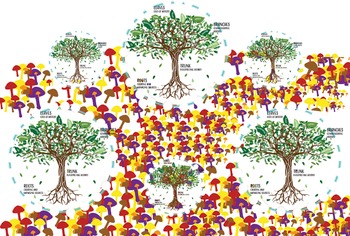
I am calling it the “fungi model” of doing public history, and I am basing my visual representation of it on Thomas Cauvin’s Public His’Tree model, which he uses to visually explain public history (Figure 3).
The Public His’Tree illustration, designed by Thomas Cauvin. Source: Cauvin Reference Cauvin2025.

Figure 3. Long description
Starting at the bottom of the tree, the roots are labeled ‘creating and managing sources’ and include terms like ‘archives’, ‘oral history’, ‘sources’, ‘records’, ‘documents’, ‘collections’, ‘objects’, ‘media’, and ‘witnesses’. The trunk, labeled ‘interpreting history’, connects roots to branches and contains terms such as ‘fiction’, ‘video game’, ‘podcast’, ‘blog’, ‘museum’, ‘book’, ‘re-enactment’, ‘school’, ‘social media’, and ‘exhibit’. Branches, labeled ‘communicating history’, extend outward and are labeled with ‘education’, ‘identity’, ‘social justice’, ‘marketing’, ‘politics’, ‘reconciliation’, ‘tourism’, and ‘empowerment’. The leaves, labeled ‘uses of history’, are distributed at the outermost layer and include ‘fun’, ‘radio’, ‘empowerment’, ‘tourism’, ‘reconciliation’, ‘politics’, ‘marketing’, ‘identity’, ‘education’, and ‘social justice’. The entire tree is encircled by a blue ring with arrows indicating cyclical movement.
Cauvin’s His’Tree here is used to represent institutional public history, in the sense that the tree is used to represent something that has been intentionally planted, taken care of, maintained, and kept in good condition. But this tree does not operate on its own, and its protective blue circle/shield will need to be infiltrated to better communicate with other “trees,” that is, other projects, research programs, and preexisting public history initiatives (Figure 4).
Illustration showing multiple Public His’Trees of different sizes, with their blue circular shields’ perforated, Myriam Dalal, 2026.

Figure 4. Long description
There are six tree diagrams arranged in a loose circle, with the largest trees at the bottom left and bottom right, medium trees at the top left and top right, and the largest tree at the top center. Each tree is encircled by a dashed blue line. For every tree, the roots at the base are labeled ‘Roots: Creating and managing sources.’ The trunk above is labeled ‘Trunk: Interpreting history.’ The branches extending from the trunk are labeled ‘Branches: Communicating history.’ The leaves at the outermost layer are labeled ‘Leaves: Uses of history.’ Additional smaller labels on the leaves include ‘Movement,’ ‘Identity,’ ‘Diversity,’ and ‘Empathy.’ The trees are visually similar but vary in size, with the largest trees containing more detailed leaf labels. The overall structure emphasizes a conceptual framework for understanding history, with each tree representing the same categories but at different scales.
Now, in between these institutional His’Trees, the fungi model will sporadically grow and thrive, thus creating a sustainable ecosystem of participatory action research projects, both in and outside of academia. This is where Guerrilla Public History initiatives will also grow and take shape. So, the institutional public history model will stay, it just needs to work collaboratively and communicate in and outside of academia. Some of these institutional public history entities will want to help, knowing very well that they cannot carry such work within their walls, and it is with these allies that we will create our connections. This is where we will be able to channel some funding outside of their scope, to put together events, to speak at conferences, to conduct specific consultancies, or to create engagement activities. These funds will feed into our Guerrilla Public History projects (Figure 5).
Illustration showing fungi sporadically growing between the Public His’Trees, in all shapes and colors, Myriam Dalal, 2026.

Figure 5. Long description
There are six tree diagrams arranged in a loose grid, each labeled with four main sections: roots at the base labeled ‘creating and managing sources’, trunk labeled ‘interpreting history’, branches labeled ‘communicating history’, and leaves labeled ‘uses of history’. The trees vary in size but share the same structure. Surrounding and interspersed between the trees are clusters of fungi in red, yellow, purple, and brown, with caps of different shapes and sizes. The fungi are densest in the spaces between the trees, overlapping the lower branches and roots, and thinning out near the tops of the trees. The overall layout emphasizes the sporadic and varied presence of fungi among the trees, visually connecting the labeled parts of the trees with the organic, chaotic spread of the fungi.
And it is not just about the money, though funding is THE biggest challenge that grassroots initiatives, refugee led organizations, community-based collectives face. This ecosystem will also circulate research outcomes, reports, publications, and other resources meant for theoretical reflections. These resources can also constitute our starting point to challenge, destroy, rebuild, or put into practice.
This strategic positioning of the “Robin Hoods” inside the institution while facilitating the liberation outside, might be critiqued, especially by those who know little to nothing about how guerrillas operate and sustain their work. This also mirrors what Perugini calls the general language advanced in the International Humanitarian Law, which imposes a clear distinction between civilian/passive and noncivilian/combatant, as a way to shape and legalize participation in the struggle. And as Perugini argues, such a framework does not apply in the case of anticolonial movements.Footnote 19
I am learning as I go, and while my PhD’s dream project (the Mémomaton ) had to stop, I now look at it as another permissible guerrilla protection strategy. I hope it will resurface when it is ready and safe again. During my postdoc, I also learned that a project like Ya Bayti should not be led at the University, and that dehumanized refugees and asylum seekers will claim their history, and strike back at the empire, somewhere else, someplace else. As Parvati Raghuram and Gunjan Sondhi argued, decolonial knowledge through research also means we need to ensure the participants’ right to refusal.Footnote 20
This past year, and as a research and outreach consultant for the public history axis at the University of Luxembourg, I was able to test this fungi approach, connecting the institution I worked for, with noninstitutional partners in Egypt, Kenya, Martinique, and Lebanon. These experiences showed me concretely why and how such a model can be useful, and I hope I can put it into practice again with the Virtual House of the Rejected, at Goldsmiths. I also hope other people can test these methods too, and for us thinkers and practitioners in the global South to collectively shape it into what we want it to be: a way for us to speak our truth, to claim our seat at the table, to be compensated for the injustice we have lived, and to take back our land/right/dignity/voice.
As for Palestine, and following the recent manifesto “Toward a Revolutionary Charter for Total Liberation: A Critique of Epistemological Comradely and a Rejection of Surrender as a ‘Struggle’ Strategy for the Day After” published by a group of Palestinian writers and thinkers, in which they call for the comeback of the intellectual Muchtabek and a “return to the public”:
When Amílcar Cabral, the founding leader of the “African Party for the Independence of Guinea and Cape Verde,” introduced the concept of “returning to one’s roots,” he did not mean it as a museum-like act of heritage preservation, nor as a retreat into primitive nostalgia, as some Westerners deliberately misinterpret in their reductive readings; rather, he proposed it as a conscious re-rooting of the liberation struggle within the lived reality of the people. For him, the masses—with their authentic culture and, as he rightly saw it, their extraordinary willingness to sacrifice—constituted the first and most important line of defense for the resistance.Footnote 21
It sounds like the Guerrilla Public History methodology might be one of the practical applications of such a call.
Let us cut the crap and let us do it together.
Author contribution
Conceptualization: M.D.; Formal analysis: M.D.; Investigation: M.D.; Methodology: M.D.
Funding statement
This work received no specific grant from any funding agency, commercial, or not-for-profit sectors.
Conflict of interests
The author declares none.



 Open access

