


1 Introduction
Fairness is a fundamental concern in people’s interactions influencing many aspects of daily life, from how children share toys with classmates to how legislators shape complex tax policies. Much of the literature on these putative fairness concerns in psychology and economics has focused on fairness being rooted in inequity aversion — people’s negative response to unequal pay for equal work (for reviews, see Adams, 1965; Reference Bolton and OckenfelsBolton & Ockenfels, 2000; Reference Cook and HegtvedtCook & Hegtvedt, 1983; Reference Cooper and KagelCooper & Kagel, 2009; Reference DamonDamon, 1977; Reference Bolton and OckenfelsFehr & Schmidt, 1999; Reference Hook and CookHook & Cook, 1979; Reference LernerLerner, 1974). This body of research has demonstrated that people often respond negatively to receiving less than others (i.e., they experience disadvantageous inequity aversion, or DIA) as well as to receiving more than others (i.e., they experience advantageous inequity aversion, or AIA). Traditionally, each of these reactions, DIA and AIA, have been argued to provide evidence for concern with fairness (for reviews, see Brosnan & de Waal, 2014; Reference Smith and KimSmith & Kim, 2007).
Whereas the literature has considered both of these concerns to be connected to fairness, it has not asked whether these two putative fairness concerns match people’s lay intuitions about what it means to truly be concerned with fairness. Here we examine whether people believe that DIA and AIA in isolation provide convincing evidence that one is concerned with fairness, predicting people do believe the latter is sufficient, but not the former. Given that the current literature often connects DIA and AIA to fairness, it is interesting to know whether people intuitively do the same or not. We start by reviewing previous research on fairness and inequity aversion, and then focus on people’s lay intuitions regarding these concepts.
1.1 Two types of inequity aversion
Two broad classes of evidence have been used to demonstrate that people are averse to inequity: their negative reactions to inequity and their costly rejections of it. First, a large number of studies have demonstrated that people respond negatively to being paid less than others for similar work (DIA: Reference Boyce, Brown and MooreBoyce, Brown & Moore, 2010; Reference Goodman and FriedmanGoodman & Friedman, 1971; Reference Hook and CookHook & Cook, 1979; Reference LawlerLawler, 1968; Reference Loewenstein, Thompson and BazermanLoewenstein, Thompson & Bazerman, 1989; Reference Messick and SentisMessick & Sentis, 1985) and also to being paid more than others (AIA: Sweeney, 1990; Reference Sweeney and McFarlinSweeney & McFarlin, 2004). Second, in addition to reporting having negative reactions to inequity, people will also pay costs to reduce it. People avoid disadvantageous inequity by engaging in the costly rejections of offers that place them in an unfavorable position (Reference Bazerman, Loewenstein and WhiteBazerman, Loewenstein & White, 1992; Reference Güth, Schmittberger and SchwarzeGüth, Schmittberger & Schwarze, 1982; Reference RothRoth, 1995; Reference Weg and ZwickWeg & Zwick, 1994). They also avoid advantageous inequity by giving money to others in situations where they currently have more than them (Reference CamererCamerer, 2003; Reference Forsythe, Horowitz, Savin and SeftonForsythe, Horowitz, Savin & Sefton, 1994). These concerns with fairness can even lead people to waste useable resources (Choshen-Hillel, Shaw & Caruso, 2015; Gordon-Hecker, Rosensaft-Eshel, Pittarello, Shalvi & Bereby-Meyer, in press; Shaw, 2013; Reference Shaw and KnobeShaw & Knobe, 2013; for review see Gordon-Hecker, Choshen-Hillel, Shalvi & Bereby-Meyer, in press).
Researchers have referred to AIA as unambiguous evidence that one is concerned with fairness (why else would someone strive for equity, when it hurts them? For an in depth answer to this question, see Reference Shaw and OlsonShaw & Olson, 2012). Many authors further argue that DIA also provides evidence that one is concerned with fairness (Reference AdamsAdams, 1965; Reference Andre and BaumardAndre & Baumard, 2011; Reference Brosnan and de WaalBrosnan & de Waal, 2014; Reference Bolton and OckenfelsFehr & Schmidt, 1999; Reference ForresterForrester, 1997; Reference RussellRussell, 1930; Reference SmithSmith, 1991; Reference Smith, Parrott, Ozer and MonizSmith, Parrott, Ozer & Moniz, 1994). Indeed, rejections of unfavorable offers in the ultimatum game, driven entirely by DIA, are the quintessential test in behavioral economics for measuring fairness concerns (Halali, Bereby-Meyer & Ockenfels, 2013, for extensive reviews, see Camerer, 2003; Reference Cooper and KagelCooper & Kagel, 2009). Even if these researchers might agree that AIA is better evidence in favor of someone being concerned with fairness, they still regard manifestations of DIA by itself as evidence for people’s concern with fairness (for review see, Reference Smith and KimSmith & Kim, 2007).
In contrast to the traditional view of inequity aversion, some researchers have argued that DIA by itself does not provide sufficient evidence that one has a sense of fairness. According to this argument, people’s negative response to having less than others is over-determined — they could be motivated by either fairness or envy — and so it is hard to know what is motivating them. This argument was made prominent by Rawls (1971), who argued that calls for equality by those who receive less can be motivated by resentment of the overall injustice (i.e., unfairness) of the unequal situation, but also by simple envy of others’ better outcomes. Such envy is focused on social comparison, and consists of resentment to the other’s better outcome. It is often unrelated to justice, but simply reflects one’s desire to have what someone else has (Reference Smith, Parrott, Ozer and MonizSmith et al., 1994). Because both fairness and envy lead to negative reactions to DIA in interpersonal situations, it can be difficult to know if a person’s particular experience of DIA reflects a concern based in fairness or social comparison, because human beings have both concerns (Reference Feather and ShermanFeather & Sherman, 2002; Reference NicholsNichols, 2010; Reference Shaw, Choshen-Hillel and CarusoShaw, 2016; Reference Shaw and OlsonShaw & Olson, 2012; Reference Yamagishi, Horita, Mifune, Hashimoto, Li, Shinada and SimunovicYamagishi et al., 2012). Any individual instance of DIA could be motivated by a combination of fairness and social comparison or it could be motivated by social comparison in the absence of fairness.
While AIA and DIA are both present in adult humans, they need not always co-occur. DIA has been found in capuchins, macaques, chimpanzees, domestic dogs, crows, rats, and ravens (Reference Brosnan and de WaalBrosnan & de Waal, 2003; Reference HorowitzHorowitz, 2012; Reference Oberliessen, Hernandez-Lallement, Schäble, van Wingerden, Seinstra and KalenscherOberliessen et al., 2016; Reference Range, Horn, Viranyi and HuberRange, Horn, Viranyi & Huber, 2009; Reference Van Leeuwen, Zimmermann and Davila RossVan Leeuwen, Zimmermann & Davila Ross, 2011; Reference Takimoto, Kuroshima and FujitaTakimoto, Kuroshima & Fujita, 2010; Reference Wascher and BugnyarWascher & Bugnyar, 2013; for review, see Brosnan & de Waal, 2014)Footnote 1. However, there is almost no evidence for advantageous inequity aversion outside of human beings (with possibly the exception of chimpanzees: Reference Brosnan, Talbot, Ahlgren, Lambeth and SchapiroBrosnan, Talbot, Ahlgren, Lambeth & Schapiro, 2010). If both types of inequity aversion are focused on avoiding inequity or unfairness, why would these species have one without the other? Maybe, they care about fairness based in principles of equity, but some other preference is preventing them from showing dissatisfaction at advantageous inequity. Alternatively, maybe these negative reactions to receiving less are not rooted in a sense of fairness, but instead in a sense of envy toward others’ better results.
In addition to this evidence from comparative psychology, there is also evidence from developmental psychology that demonstrates a person can have DIA without AIA. Negative reactions to disadvantageous inequity appear relatively early; 3- to 4-year-olds react negatively to receiving less than others and make costly rejections of disadvantageous unequal offers (Reference Blake and McAuliffeBlake & McAuliffe, 2011; Reference LoBue, Nishida, Chiong, DeLoache and HaidtLoBue, Nishida, Chiong, DeLoache & Haidt, 2011; Reference Sheskin, Bloom and WynnSheskin, Bloom & Wynn, 2014; Reference Takagishi, Kameshima, Schug, Koizumi and YamagishiTakagishi, Kameshima, Schug, Koizumi & Yamagishi, 2010). Yet, it is only at about the age of 7 or 8 that children show robust evidence of AIA, and will sacrifice their own resources to avoid inequity between themselves and others (Reference Blake and McAuliffeBlake & McAuliffe, 2011; Reference KogutKogut, 2012; Reference Shaw, Choshen-Hillel and CarusoShaw, Choshen-Hillel & Caruso, 2016; Reference Shaw and OlsonShaw & Olson, 2012; 2014). Why do young children have one type of inequity aversion, but not the other? Is their early DIA driven by concern for fairness, or rather with social comparison rooted in envy?
1.2 Folk intuitions about inequity aversion and fairness
The theoretical arguments and empirical findings reviewed here provide some reason to question the connection between DIA and fairness. Here we take no stand on the connection itself. Instead we suggest that these findings prompt an interesting question about people’s folk intuitions about fairness: do people think DIA or AIA in isolation provide good evidence that an organism cares about fairness? For example, if they heard about one of the non-human species mentioned above, who show DIA but lack AIA, would they think that species is driven by fairness concerns? We predict that the answer will be ‘no,’ that is, that lay people will assume that the organism in question is not motivated by fairness. However, we predict that when an organism has AIA, but lacks DIA, lay people will assume that the organism does have a sense of fairness. We make these predictions because we expect that lay people will intuitively understand that one needs a sense of fairness to explain behavior rooted in AIA (why else would one be upset at getting more than others), but DIA could be explained by either fairness or envy. In the latter case, when they receive evidence that the organism in question does not have AIA, they will take this as evidence against a concern for fairness. We further predict that when participants receive evidence that an organism is concerned with DIA, but not AIA, they will assume that this organism is motivated by envy, having ruled out the notion that this organism cares about fairness.
We are interested in this question about people’s folk intuitions because, as researchers, if we use terms like “fairness” in describing lay people’s motivations, it would be informative to know if the words we use are the same or radically different from lay conceptions. A similar approach of understanding people’s folk intuitions about psychological concepts has led to substantial progress in understanding morality, intentional action, and free will (Reference Knobe, Buckwalter, Nichols, Robbins, Sarkissian and SommersKnobe et al., 2012; Reference Knobe and NicholsKnobe & Nichols, 2013; Reference Nahmias, Morris, Nadelhoffer and TurnerNahmias, Morris, Nadelhoffer & Turner, 2005; Reference NicholsNichols, 2004; Reference Phillips and ShawPhillips & Shaw, 2015). We hope to make similar progress. If we were to find that DIA in isolation does not accord with people’s intuitions about what it means to have a sense of fairness, and continues to be referred to by researchers as tapping into fairness, this will yield conceptual confusion. Of course, there may be valid theoretical or empirical reasons to still consider DIA as being about “fairness” even if this contradicts lay intuitions; we return to this issue in the General Discussion.
1.3 The Current Studies
In the following studies, we attempt to assess people’s lay intuitions about the putative relation between the two forms of inequity aversion and fairness. We attempt to answer the question: is having only one type of inequity aversion sufficient evidence for lay people to conclude that an organism cares about fairness? Specifically, we describe imaginary aliens who show evidence that they have either only DIA (they get upset when they receive less than others, but not more than others — i.e., just like non-human animals and young children) or only AIA (they get upset when they receive more than others, but not less than others). We then ask participants whether or not such a species really cares about fairness. Referring to an alien species allows us to minimize people’s projection of their knowledge about animals or human beings onto our stimuli. Our main prediction was that people would think that an organism that only had AIA would be said to really care about fairness whereas an organism that only had DIA would not be said to really care about fairness. We examine our prediction in situations involving dissatisfaction with each type of inequity aversion (Experiments 1 and 3) as well as situations involving costly rejections based on DIA or AIA (Experiments 2 and 4). We further predicted that people would think that a species with only DIA has envy rather than fairness (Experiment 4).
2 Experiment 1
The goal of the first experiment was to measure people’s folk intuitions about a species that has only DIA or AIA. To examine participants’ beliefs, we told them about an alien species called the Knobies. We told participants that Knobies do jobs like human beings and then described the types of inequity to which this species responds. Participants were randomly assigned to hear about Knobies who have DIA but not AIA (DIA Condition) or who have AIA but not DIA (AIA Condition). Participants were then asked whether or not they thought this alien species truly cared about fairness. We predicted that people would agree that the species in the AIA Condition cared about fairness but would be less likely to agree that the species in the DIA Condition cared about fairness.
2.1 Method
Participants.
Participants were recruited online using the Amazon Mechanical Turk website (Reference Buhrmester, Kwang and GoslingBuhrmester, Kwang & Gosling, 2011; Reference FestingerHorton, Rand & Zeckhauser, 2011); participation was restricted to participants from the United States. Participants in all experiments earned 25 cents for completing the study (~five minutes). Participants who failed a comprehension test described below (n = 11) were excluded yielding a final sample of N = 103 (77% female, M = 28.26 years old, SD = 9.26) — the pattern of results below remains the same if we include the participants who failed the comprehension check.
Procedures and Stimuli.
The task was presented online using Qualtrics survey software. Participants read instructions explaining that they would read a vignette and be asked to make a judgment. They were also told they would be asked a comprehension question. Participants were then randomly assigned to read one of the following vignettes (in each set of brackets, the wording for the DIA Condition appears first and the wording for the AIA Condition appears second):
Imagine there is an alien species on another planet called Knobies. Knobies work jobs very similar to human beings. Knobies get very upset when they are paid [less/more] than someone else for doing the same type and amount of work. However, they do not get upset when they are paid [more/less] than others for doing the same type of and amount work. Knobies claim that fairness is important to them.
After the vignette, participants were all asked to rate their disagreement or agreement with the following statement “Knobies really care about fairness.” The scale ranged from 1 (strongly disagree) to 4 (neither agree nor disagree) to 7 (strongly agree). After making their judgment, participants were taken to a new page without the vignette and were asked the following comprehension question: “Which things make the Knobies upset?” They could check as many of the following boxes: “Getting paid less than others for doing the same work,” “getting paid more than others for doing the same work,” or “neither of these upsets the Knobies” Participants in the DIA Condition were expected to answer “getting paid less” and participants in the AIA Condition, “getting paid more.” Participants were then asked to explain why they made their decision, and were finally asked to report their age and gender.
2.2 Results and Discussion
We first conducted an independent samples t-test on the fairness measure, which revealed that participants thought the Knobies who had only AIA (M = 5.32, SD = 1.86) cared about fairness more so than those who had only DIA (M = 3.48, SD = 1.67), t(101) = 5.28, p < .001, d = 1.05 (Figure 1). This result demonstrates that people think that AIA in isolation is much more indicative of concern for fairness than DIA in isolation.
Violin (density) plot of judgments about whether or not Knobies really care about fairness in Experiments 1 and 2, by condition. Experiment 1 involved evaluations of negative reactions to inequity, whereas Experiment 2 involved evaluations of costly rejections of inequity. The central dot shows the mean; the horizontal lines separate quartiles.
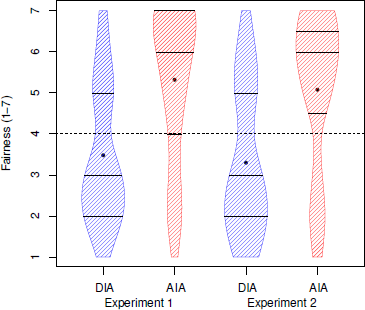
We additionally conducted one-sample t-tests, with 4 specified as the midpoint of the scale. This one-sample t-test revealed that participants in the AIA Condition were above the midpoint in their agreement that Knobies have a sense of fairness, t(52) = 4.23, p < .001. This indicates that, on average, people agree that a species who has only AIA, but not DIA, does really care about fairness. Participants in the DIA Condition were significantly below the midpoint in their agreement that Knobies have a sense of fairness, t(49) = 2.20, p = .032. This result suggests that, on average, people disagree that a species that possesses DIA, but not AIA, really cares about fairness. Taken together, these results support our hypothesis that participants think that having AIA alone indicates that a species cares about fairness, but having DIA alone does not seem to provide positive evidence that the organism cares about fairness. Indeed, participants on average disagree with the idea that DIA alone is about fairness.
3 Experiment 2
Experiment 1 provided evidence that people find negative reactions to receiving more than others (experiencing AIA) to be sufficient evidence for fairness while they do not find getting upset about having less than others (experiencing DIA) to provide such sufficient evidence. One could argue that this difference stems from the different costs associated with the two types of inequity aversion. Specifically, showing aversion to receiving more is likely to be costly, because it might result in redistribution that is unfavorable for the self (restoring equity by eliminating one’s advantage). Having an aversion to receiving less than others is likely to have the opposite effect, resulting in potential benefit to the self, rather than cost. Therefore, people might conclude that AIA but not DIA is sufficient evidence for fairness, because the former involves the actor potentially paying some cost to fulfill that preference whereas the latter does not. In line with this idea, we know that costly rejections of any type of inequity are rare in non-human animals. For example, recent research suggests that capuchins may often be reluctant to make costly rejections, even to avoid disadvantageous inequality (Reference McAuliffe, Chang, Leimgruber, Spaulding, Blake and SantosMcAuliffe et al., 2015). Perhaps people think that DIA is sufficient evidence to presume that a species has a sense of fairness only when it involves the agent taking some cost to express this preference (e.g., a costly rejection of inequity).
In Experiment 2, we investigate the same question as in Experiment 1, but this time using a costly rejection paradigm. In the DIA condition, participants were told that Knobies make costly rejections only when they receive less than others, but not when they receive more than others. In the AIA condition, participants were told that Knobies make costly rejections only when they receive more than others, but not when they receive less than others. In both conditions, the cost of rejection was the same. We ran this costly rejection paradigm to investigate whether or not a costly rejection of DIA, in the absence of AIA, would be regarded as sufficient evidence that an organism cares about fairness. If so, then we should see a smaller difference between the DIA and AIA conditions in Experiment 2 and we should see participants agreeing that DIA is sufficient for a species to truly care about fairness. However, we expected the same pattern of results as in Experiment 1, with DIA alone not being seen as sufficient for agreeing that an organism cares about fairness and AIA alone being sufficient.
Note that we developed a costly rejection paradigm that was not the ultimatum game in order to eliminate any animus toward the other recipient for creating the distribution in question — in a normal ultimatum game one can respond negatively to the inequity, but also to the intentions of the other player (Reference Falk, Fehr and FischbacherFalk, Fehr, & Fischbacher, 2008).
3.1 Method
Participants.
We recruited participants the same way as in Experiment 1. Participants who failed a comprehension test (n = 10) were excluded yielding a final sample of N = 101 (60.4% female, M = 32.33 years old, SD = 12.44) — the pattern of results below remains the same if we include the participants who failed the comprehension check.
Procedures and Stimuli.
Participants were presented with a scenario like the one used in Experiment 1 except that the Knobies’ inequity aversion involved costly rejections. Note that the rejection made by the species involved the same sacrifice of personal resources in both conditions ($2), but different total resources. (See the Appendix for another version of this study where we control for the total amount of resources sacrificed, rather than the personal amount sacrificed, obtaining the same results). Participants were randomly assigned to one of the following conditions:
DIA
Imagine there is an alien species on another planet called Knobies. Knobies work jobs very similar to human beings. When Knobies are presented with a decision in which (A) they can get $2 but someone else will get $8 or (B) they can make sure both people get $0, they choose (B) making sure both people get zero because that is fair. However, when they are presented with a decision in which (A) they can get $2, but someone else will get $1 or (B) they can make sure both people get $0, they choose (A) to make sure they get $2 and the other person gets $1. Knobies claim that fairness is important to them.
AIA
Imagine there is an alien species on another planet called Knobies. Knobies work jobs very similar to human beings. When Knobies are presented with a decision in which (A) they can get $2 but someone else will get $1 or (B) they can make sure both people get $0, they choose (B) to make sure both people get zero because that is fair. However, when they are presented with a decision in which (A) they can get $2, but someone else will get $8 or (B) they can make sure both people get $0, they choose (A) to make sure they get $2 and the other person gets $8. Knobies claim that fairness is important to them.
Participants were then asked if they agreed or disagreed that “Knobies really care about fairness.” After making their judgment, participants were taken to a new page without the vignette and were asked the following comprehension question: “According to the scenario you read, when Knobies are presented with a decision in which they can get $2 but someone else will get $1 or they can make sure both people get $0, what will they decide?” Participants in the DIA Condition were expected to answer, “Make sure they get $2 and someone else gets $1” and in the AIA Condition, “Make sure both get $0.” Participants were then asked to explain why they made their decision and to report their age and gender.
3.2 Results
Participants thought the Knobies who had only AIA cared more about fairness (M = 5.08, SD = 1.91) than the Knobies who had only DIA (M = 3.30, SD = 1.81) t(99) = 4.81, p < .001, d = 0.96 (Figure 1). We replicate the finding from the previous experiment that people think AIA is much better evidence that one cares about fairness than DIA, despite the fact that the Knobies in the currents vignettes sacrificed the same number of resources in the name of DIA and AIA in the respective conditions.
Additionally, a one-sample t-test reveals that participants in the AIA Condition responded at above the midpoint to the fairness measure (4), t(50) = 4.04, p < .001, indicating that they agreed that a species with only AIA cares about fairness. Participants in the DIA Condition responded below the midpoint on the fairness measure, t(49) = 2.74, p = .009, indicating that participants disagree that a species with only DIA cares about fairness.
3.3 Discussion
Again, we found that AIA by itself is enough to evidence that a species truly cares about fairness, while DIA by itself is not. Furthermore, this experiment demonstrates that even costly rejections in the name of DIA are not sufficient evidence that an organism cares about fairness if that organism does not exhibit AIA.
4 Experiment 3
If our first two experiments do in fact tap into participants’ intuitions about DIA and AIA, then why would the idea that DIA is sufficient for concluding that an organism has fairness seem somewhat plausible? One reason for this discrepancy might be that people misapply what they know about human beings to other species. People know that human beings express both DIA and care about fairness, and may therefore use this knowledge about human beings and assume that if a species has DIA, then that species also has other related fairness concerns (e.g., concerns with unfairness when they are third parties). In Experiments 1 and 2 we explicitly specified that the species who had DIA, lacked AIA. What would happen if we just told people about a species with DIA without specifying that the species lacked AIA?
We attempt to answer this question in Experiment 3 by either specifying or not that a species lacks DIA or AIA. The Specified conditions provide a replication of Experiment 1, in which we specified that the species that had DIA lacked AIA and that the species who had AIA lacked DIA. In the Non-Specified conditions, participants are told only that Knobies have DIA or AIA and are not told that they lack AIA or DIA. We expected that the specified conditions would replicate the pattern of results of our previous experiments, but that the non-specified conditions would indicate more correspondence between fairness evaluations of DIA and AIA because the participants would simply assume that a species that has one type of inequity aversion would also have the other. Thus, when they hear that an organism has DIA, they would assume it cares about fairness, unless we specified that it lacks some fairness relevant concern.
4.1 Method
Participants.
Participants were recruited as before. Participants who failed a comprehension test (n = 15) were excluded, yielding a final sample of N = 208 (70% female, M = 28.5 years old, SD = 8.5) — all results below remain the same if we include the participants who failed the comprehension check.
Procedures and Stimuli.
Participants were randomly assigned to one condition in a 2 Inequity Type (DIA or AIA) x 2 Specification (Specified or Not Specified) between participants design. The scenarios for the DIA and AIA Specified conditions were exact replications of the DIA and AIA conditions from Experiment 1. The scenarios in the DIA and AIA Not Specified conditions were similar to the DIA and AIA conditions in Experiment 1, except that the sentence “However, they do not get upset when they are paid [more/less] than others for doing the same type of and amount work” was deleted. That is, the information that made it clear that the Knobies did not possess either AIA or DIA was excised. Participants answered the same fairness measure from previous experiments in all conditions: they were asked if they agreed or disagreed with the statement “Knobies really care about fairness” (Fairness Measure). We also added a new fairness measure: participants were asked if they agreed or disagreed with the statement “Knobies likely get upset when they see that others are paid unequally for equal work” (Fairness Third Party Measure). This measure was added to assess people’s perception of more objective fairness concerns in third party cases, where they are not one of the potential recipients (e.g., Reference Hook and CookHook & Cook, 1979; Reference Shaw and KnobeShaw & Knobe, 2013). We assumed the new measure would accord with the original fairness measure, but wanted to verify that the two overlapped.
In all conditions, participants were asked a comprehension question similar to Experiment 1, “According to the vignette you read, does getting paid more or less than others make Knobies upset?” They then could answer with a yes or a no. Participants were finally asked to explain why they made their decision and to report their age and gender.
4.2 Results
Fairness Measure.
We first conducted a 2 Inequity type (DIA or AIA) x 2 Specification (Specified or Not Specified) ANOVA on the fairness measure, which revealed a main effect of Inequity Type, such that participants in the DIA Conditions saw the Knobies as less fair (M = 4.83, SD = 2.21) than participants in the AIA Conditions (M = 5.81, SD = 1.69), F(1,204) = 19.79, p < .001, ηp2 = .088, which replicates our previous results. We also found a main effect of Specification, F(1,204) = 83.60, p < .001, ηp2 = .291. This result indicates that participants thought the Knobies were less fair when we specified they lacked one aspect of inequity (M = 4.25, SD = 2.26) than when we did not specify this (M = 6.32, SD = 1.06). However, there was also an Inequity Type by Specification interaction, F(1,204) = 21.06, p < .001, ηp2 = .094 (Figure 2).
Violin plot of judgments about whether or not Knobies really care about fairness in Experiment 3, by condition. In the “specified” conditions we specified that species had one type of inequity aversion but lacked the other (e.g., in AIA specified, they had AIA but lacked DIA). In the “non-specified” conditions we did not specify that they lacked a type of inequity aversion.

To follow up on this interaction, we conducted planned contrast t-tests that compared the DIA Specified Condition to our other three conditions. We found that participants rated the fairness of the Knobies significantly lower in the DIA Specified Condition (M = 3.27, SD = 2.06) than in the DIA Not Specified Condition (M = 6.33, SD = 0.97, t(72.02) = 9.74, p < .001), and AIA Specified Condition (M = 5.29, SD = 2.0, t(99) = 4.99, p < .001). Participants also rated fairness lower in the AIA Specified Condition than in the AIA Not Specified Condition (M = 6.30, SD = 1.15, t(75.47) = 3.11, p = .003). The fact that participants thought that a species who had AIA but lacked DIA cared less about fairness than a species with AIA, with no lack of DIA specified, indicates that people think that DIA does provide some evidence for a concern with fairness. There was no difference between the ratings of fairness in the DIA Not Specified and the AIA Not Specified conditions (t(105) = 0.153, p = .88). That is, when we did not specify that the organism lacked one of the types on inequity aversion, there were no longer any differences between the fairness ratings for the organism that displayed DIA and the organism that displayed AIA.
We additionally conducted one-sample t-tests on the fairness measures, with 4 specified as the midpoint of the scale (where participants neither agreed nor disagreed). Participants responded at above the midpoint on the fairness measure in the AIA Specified (t(48) = 4.50, p < .001), AIA Not Specified (t(52) = 14.53, p < .001) and DIA Not Specified Condition (t(53) = 17.65, p < .001). In the DIA Specified Condition, participants responded at below the midpoint on the fairness measure (t(51) = 2.56, p = .013). We again replicate the fact that people, on average, disagree with the notion that DIA alone is sufficient evidence for fairness.
Fairness Third Party Measure.
In line with our expectations, the results from the Fairness Third Party Measure showed the same pattern as we found for the Fairness Measure. The two measures were highly correlated r(208) = .64, p < .001. We conducted a 2 inequity type (DIA or AIA) by 2 specification (Specified or Not Specified) ANOVA on the Fairness Third Party Measure (in which participants were asked to make predictions about whether the Knobies cared about fairness when they were third parties), which revealed a main effect of specification, F(1,204) = 53.62, p < .001, ηp2 = .208. This result indicates that participants thought the species was less likely to show third party concerns with fairness when we specified they lacked one aspect of inequity aversion (M = 4.65, SD = 1.80) than when we did not specify this (M = 6.06, SD = 1.04). We also found a main effect of condition, such that participants in the DIA Conditions were thought to have less of a third party fairness concern (M = 4.94, SD = 1.84) than participants in the AIA conditions (M = 5.81, SD = 1.21), F(1,204) = 22.12, p < .001, ηp2 = .098. However, this main effect was primarily driven by a large Inequity by Specification interaction, F(1,204) = 13.73, p < .001, ηp2 = .063.
To follow up on this interaction we conducted planned contrast t-tests that compared the DIA Specified Condition to our other three conditions. We found that participants rated the fairness significantly lower in this condition (M = 3.88, SD = 1.83) than in the DIA Not Specified Condition (M = 5.96, SD = 1.14, t(85.16) = 6.97, p < .001) and AIA Specified (M = 5.47, SD = 1.37 t(94.24) = 4.94, p < .001). Participants also rated fairness lower in the AIA Specified Condition than in the AIA Not Specified Condition (t(83.47) = 2.92, p = .005). This result indicates that participants found DIA as providing some evidence for a concern with fairness, because when they were told that a species had AIA but lacked DIA they thought they were a bit less likely to care about third party fairness considerations than when they were told the species had AIA, but were not told that it lacked DIA. There was no difference between DIA Not Specified and AIA Not Specified conditions, (t(105) = 0.93, p = .35).
We additionally conducted one-sample t-tests on the Fairness Third Party Measure, with 4 specified as the midpoint of the scale (where participants neither agreed nor disagreed). Participants responded at above the midpoint on the Fairness Third Party measure in the AIA Specified (t(48) = 7.50, p < .001), AIA Not Specified (t(52) = 16.87, p < .001) and DIA Not Specified conditions (t(53) = 12.56, p < .001). Participants in the DIA Specified Condition were not different from the midpoint (t(51) = .45, p = .65), suggesting that participants do not think DIA is sufficient evidence to think a species will show third party fairness concerns. Thus, we see that our findings with the fairness measure are replicated with the Fairness Third Party measure.
4.3 Discussion
The results of Study 3 suggest that, in the absence of information regarding a species’ lack of AIA or DIA, people do think that both DIA and AIA signal that a species cares about fairness. However, this seems to be happening because people infer that, when a species has DIA, then it will have corresponding concerns with fairness. Specifically, our third party inequity aversion measure demonstrated that people thought that the species will become upset when others are paid unequally (i.e., evidence third party fairness concerns) if they are told only that the species has DIA as long as we did not specify that the species with DIA lacked AIA. When most people hear about a new finding in non-human animals showing DIA they are basically in this DIA Not Specified Condition — the findings that are often reported and emphasized are that the species has DIA and there is often less mention of (or less conclusive proof for the fact) that the species lacks AIA. Thus, it is not surprising that people think that these findings are about fairness. However, as we noted in the introduction, multiple lines of research have indicated that there are several non-human animals that possess DIA, but have no AIA reaction (for a review, see Brosnan & de Waal, 2014). Of course, the absence of evidence is not the evidence of absence and researchers may continue to look for evidence of AIA in non-human animals. However, our results indicate that many lay people will simply assume that such species with DIA have related fairness concerns until they are provided with evidence that the species lacks AIA.
We also found that participants think that a species that has AIA but lacks DIA (i.e., AIA Specified Condition) is less concerned with fairness than a species that has AIA, but where we have not specified a lack of DIA. Because fairness concerns are often tied to concerns with equity (i.e., Adams, 1965), it seems plausible that telling participants that someone lacks an equity concern (either DIA or AIA) should make them think that organism is less concerned with fairness than if they think that the organism has both concerns. It is notable that AIA by itself still seems sufficient for many to agree that the organism is motivated by fairness whereas DIA by itself is not.
5 Experiment 4
In Experiment 4, we attempt to replicate our findings from Experiment 3 using a different paradigm (costly rejection paradigm from Experiment 2) and, importantly, answer a new question: if DIA alone is not regarded as being really about fairness, then what do people think is driving Knobies’ reactions when a species has DIA, but lacks AIA? According to our explanation above, in these cases participants may infer that people’s reactions are actually driven by envy based in social comparison (Reference FestingerFestinger, 1954). We know that envy exists in many facets of human life. Therefore, when people respond negatively to inequality that disadvantage themselves, this reaction is over-determined — it could be fairness that is driving their judgment, but it could just as easily be envy (Reference NicholsNichols, 2010; Reference Shaw and OlsonShaw & Olson, 2012).
Therefore, we predict that when we specify that a species in question does not show AIA, but does show DIA, participants will no longer think the species has a sense of fairness and will correspondingly view DIA as evidence for envy. We test this prediction in Experiment 4 using a design similar to the previous experiments, except we added a measure of envy. We expected that participants would think the Knobies lack fairness and that their behavior is better explained by envy than fairness when they are said to have DIA, but lack AIA.
5.1 Method
Participants.
Participants were recruited as in previous experiments and included 203 participants (68% female, M = 29.5 years old, SD = 8.5). We decided before running this study that we would now include all participants in this study to avoid any selection issues (only including the most attentive participants, as we did in the previous studies). The exclusion of the participants who failed the comprehension check does not change the reported pattern of results.
Procedures and Stimuli.
Participants were randomly assigned to a condition in a 2 Inequity Type (DIA or AIA) x 2 Specification (Specified or Not Specified) between-participants design. The scenarios for the DIA and AIA Specified conditions were exact replications of the DIA and AIA conditions from Experiment 2 — they thus utilized the costly rejection paradigm. The scenarios for the DIA and AIA Not Specified conditions were also the same, except that we deleted the sentence specifying that the Knobies did not have the other type of inequity aversion. For all conditions, we added an additional measure of envy. In addition to being asked if they agreed or disagreed with the statement “Knobies really care about fairness” (fairness measure) they were also asked if they agreed or disagreed with the statement “Knobies have a sense of envy” (envy measure). The scales for both measures ranged from 1 (strongly disagree) to 7 (strongly agree). Because the Fairness Measure and Fairness Third Party Measure from Experiment 3 were correlated and were similarly affected by our manipulations, we dropped the Fairness Third Party Measure in Experiment 4.
5.2 Results
Fairness Measure.
We first conducted a 2 Inequity type (DIA or AIA) x 2-Specification (Specified or Not Specified) ANOVA on the fairness measure, which revealed a main effect of Inequity Type, such that participants in the DIA Conditions were seen as less fair (M = 4.44, SD = 1.99) than participants in the AIA Conditions (M = 5.19, SD = 1.86), F(1,199) = 8.57, p = .004, ηp2 = .041, again replicating our previous effects. We also found a main effect of Specification, F(1,199) = 9.16, p = .003, ηp2 = .044. This result indicates that participants thought the species was less concerned for fairness when we specified that it lacked one aspect of inequity (M = 4.41, SD = 2.03) than when we did not specify this (M = 5.21, SD = 1.82). However, this main effect was primarily driven by an Inequity Type by Specification interaction, F(1,199) = 17.91, p < .001, ηp2 = .083 (Figure 3). To follow up on this interaction, we conducted planned contrast t-tests that compared the DIA Specified Condition to the other three conditions. We found that participants rated the fairness significantly lower in this condition (M = 3.52, SD = 1.94) than in the DIA Not Specified Condition (M = 5.37, SD = 1.59, t(97.94) = 5.32, p < .001), AIA Not Specified (M = 5.04, SD = 2.03, t(101) = 3.89, p < .001), and AIA Specified (M = 5.35, SD = 1.68, t(99) = 5.06, p < .001). There were no differences between the other conditions, all p’s > .41. Note that here we did not replicate the difference between the AIA Specified and AIA Not Specified Conditions that was found in Experiment 3. This could be because of the different paradigms used in Experiment 3 and 4. Still, we believe that receiving some evidence that an organism does not care about equity (even disadvantageous inequity) should slightly reduce people’s attributions of fairness.
Violin plots of judgments about whether or not Knobies have a sense of fairness, and whether they feel envy, in Experiment 4, by measure and condition. In the “specified” conditions we specified that species had one type of inequity aversion but lacked the other (e.g., in AIA specified, they had AIA but lacked DIA). In the non-specified conditions we did not specify that they lacked a type of inequity aversion.

We additionally conducted one-sample t-tests on the fairness measure, with 4 being the midpoint of the scale (where participants neither agreed nor disagreed). Participants responded at above the midpoint on the fairness measure in the AIA Specified (t(48) = 5.62, p < .001), AIA Not Specified (t(50) = 3.66, p = .001) and DIA Not Specified Condition (t(48) = 6.17, p < .001). In the DIA Specified Condition, participants were marginally below the midpoint on the fairness measure (t(51) = 1.79, p = .08). We again replicate the finding that, on average, people thought that AIA alone indicated that a species would care about fairness, but did not think this was true for a species who only possessed DIA.
Envy Measure.
Next, we conducted a 2 Inequity Type (DIA or AIA) by 2 Specification (Specified or Not Specified) ANOVA on the Envy Measure. There was a main effect of Inequity Type, such that Knobies in the DIA Conditions were thought to have more envy (M = 4.36, SD = 1.73) than Knobies in the AIA conditions (M = 2.96, 1.74), F(1,204) = 41.03, p < .001, ηp2 = .171. There was no main effect of Specification, F(1,204) = 1.54, p = .22, ηp2 = .008. There was also an Inequity Type by Specification interaction, F(1,204) = 45.72, p < .001, ηp2 = .187 (Figure 3).
To follow up on this interaction, we conducted planned contrast t-tests that compared the DIA Specified Condition to the other three conditions. We found that participants rated the envy significantly higher in this condition (M = 4.96, SD = 1.66) than in the DIA Not Specified Condition (M = 3.75, SD = 1.60, t(101) = 3.79, p < .001), AIA Not Specified (M = 3.82, SD = 1.77 , t(101) = 3.42, p < .001), and AIA Specified (M = 2.06, SD = 1.16, t(93.19) = 10.48, p < .001). Participants rated envy lower in the AIA Specified Condition than in the DIA Not Specified Condition (t(89.72) = 5.90, p < .001) and the AIA Not Specified Condition (t(86.62) = 5.90, p < .001). There was no difference between DIA Not Specified and AIA Not Specified, (t(100) = 0.23, p = 0.82). These results indicate participants thought that the Knobies cared more about envy in the DIA Specified Condition than in the other conditions and that they thought that the Knobies cared less about envy in the AIA Specified Condition than in all other conditions.
We also conducted one-sample t-tests on the envy measure, where 4 specified the midpoint of the scale. Participants responded at below the midpoint on the envy measure in the AIA Specified Condition (t(48) = 11.68, p < .001). That is, participants disagreed that a species that had AIA, but lacked DIA, had envy. Participants were not different from the midpoint in the AIA Not Specified Condition (t(50) = 0.71, p = .48) or the DIA Not Specified Condition (t(50) = 1.10, p = .28). Importantly, in the DIA Specified Condition, participants were above the midpoint point on the envy measure (t(51) = 4.34, p < .001).
Envy-fairness correlation.
The ratings of fairness and envy were strongly negatively correlated with one another across all conditions r(203) = –.423, p < .001, meaning that the more participants attributed fairness, the less likely they were to think that the organism had envy. This correlation held even when partialing out inequity type, specification, and their interaction, r(198) = –0.33, p < .001. Thus, even within condition, participants who thought the species was more motivated by envy were less likely to think that they were motivated by fairness.
5.3 Discussion
In Experiment 4, we replicated most of our findings from Experiment 3 using a different scenario (costly rejections), finding again that participants think that DIA by itself is not sufficient evidence for fairness when you make it clear that the species lacks AIA (though see our discussion about AIA Specified and AIA Not Specified). Indeed, Table 1 summarizes this effect across the four experiments. However, when participants see evidence of DIA and are not told that the species lacks AIA, they do assume the species has a sense of fairness. In all cases, participants think that AIA by itself is sufficient evidence for fairness. We also extended our results and found that people form inferences about envy. Participants thought that a species was “really envious” (at above the midpoint on envy) only when it was specified that the species had DIA, but lacked AIA. These results suggest that when a species lacks AIA and has DIA, participants think this species is better described as envious rather than fair. We found that participants strongly disagreed that a species who had AIA but lacked DIA had a sense of envy.

One possible explanation of the pattern of results in the fairness and envy conditions is causal discounting (Reference Morris and LarrickMorris & Larrick, 1995): participants judge DIA to not be motived by fairness, they then give more weight to another factor that could motivate that behavior — envy, or vice versa. While this effect is certainly possible, our findings at least suggest that people do not conceive of the relationship between fairness and envy as completely hydraulic — e.g., a decrease in envy need not correspond to an increase in fairness. Specifically, participants in the AIA Specified, AIA Not Specified, and DIA Not Specified conditions all gave similar fairness evaluations, but they gave different evaluations of envy. While AIA and DIA Not Specified were about at the midpoint in attributions of envy, AIA Specified was significantly below this midpoint. This fact demonstrates that participants did not balance their envy attributions and their fairness evaluations completely.
The envy results are also informative because they help us deal with an alternative account of participants’ responses to the fairness measure. One possible concern is that, when participants were asked whether a species that exhibited DIA in the absence of AIA “really cared about fairness,” they said that the species did not care about fairness not because they thought it did not care about fairness at all, but because it was not the most ideal form of fairness. For example, Japanese people might encounter sushi at an American supermarket and say: “That is not sushi!” They do not really mean that the product on sale is not sushi, but that it does not fit their minimal threshold for what they think sushi should be. The envy data provide some reason to doubt such an account. Indeed, in Experiment 4 we found that not only do participants deny that DIA alone is motivated by fairness, they also think it is motivated by envy. An account based on people not wanting to endorse a non-ideal form of fairness does not make this predication. Indeed, the person who would deny that the sushi in the supermarket is sushi would presumably not agree it is a taco, or any other type of food. Thus, we believe that participants actually thought that DIA by itself does not, on its own, correspond to fairness.
6 General Discussion
The results of Experiments 1–4 provide support for our prediction that advantageous inequity aversion (AIA), but not disadvantageous inequity aversion (DIA), meets people’s common sense intuitions about what it means to have a concern with fairness. Our results demonstrate that when participants imagine an alien species that behaves like some non-human animals (and young children), reacting negatively to disadvantageous but not to advantageous allocations, they do not view such a species as having a sense of fairness (Experiment 1 and 3). They do, however, think that a species cares about fairness if it is concerned with advantageous, but not with disadvantageous allocations. We replicated this pattern of results in a situation where participants were told about a species that engaged in costly rejections of only disadvantageous or advantageous inequity. We found that participants disagreed, on average, that a species that responded negatively only to disadvantageous inequity had a sense of fairness, yet they agreed that a species that only reacted negatively to advantageous inequity had a sense of fairness.
Our findings may also explain why people often find aversion to disadvantageous inequity to be convincing and sufficient evidence for fairness: when we told participants in Experiments 3 and 4 about a species with DIA and did not make it clear that this species did not have advantageous inequity aversion, participants assumed that the species did care about fairness. We also found that, while disadvantageous inequity is not necessary or sufficient for participants to agree that an organism cares about fairness, it is not irrelevant to fairness concerns: participants were a bit less likely to agree that a species cared about fairness when they were told that the organism did not respond negatively to disadvantageous inequity (in Experiment 3, but not in Experiment 4). Finally, we showed that, whereas participants did not interpret having DIA alone as sufficient evidence for concern about fairness, they did interpret this as sufficient evidence for envy (Experiment 4).
Our results suggest that what the literature refers to as DIA does not accord with people’s folk intuitions about what it means to actually care about fairness. Canonical evidence used to demonstrate a concern with fairness (i.e., the prominent example of costly rejections as in the ultimatum game), does not, by itself, fully capture people’s idea of what it means to care about fairness. These results on people’s lay intuitions of course do not mean that DIA is never motivated by concerns with fairness. However, they do indicate that people are much less likely to see DIA alone as motivated by fairness.
6.1 The relationship between folk intuitions about fairness and research on fairness
Of course, people’s intuitions are not reason enough to stop referring to DIA as being connected to fairness. Although we think there are reasons that researchers should be interested in knowing whether or not DIA corresponds with people’s lay intuitions, the researchers are more interested in understanding how these putative concerns influence people’s behavior and judgments, not if they happen to correspond to people’s lay intuitions. Indeed, DIA should still be conceptualized as part of the fairness concept, along with AIA, if there are theoretical reasons or empirical justifications for considering them as one unified system.
However, there are pieces of evidence in the literature indicating that lay people’s intuitions may be on the mark in this case – AIA and DIA seem to involve different psychological mechanisms. Indeed, the two types of inequity aversion have different developmental trajectories (Reference Blake and McAuliffeBlake & McAuliffe, 2011; Reference LoBue, Nishida, Chiong, DeLoache and HaidtLoBue et al. 2011; Reference Shaw, Choshen-Hillel and CarusoShaw et al., 2016; Reference Sheskin, Bloom and WynnSheskin et al., 2014; Reference Takimoto, Kuroshima and FujitaTakimoto, et al., 2010) and are differentially prevalent across cultures (Reference Blake, McAuliffe, Corbit, Callaghan, Barry, Bowie and WarnekenBlake et al., 2015). The two respond differently to observational cues; people are more likely to reject an allocation that gives them more than others (AIA), when they are being publicly watched; yet their likelihood to reject an allocation that gives them less than others (DIA) is not affected by being watched (Reference Bolton and ZwickBolton & Zwick, 1995; Reference Franzen and PointnerFranzen & Pointner, 2012; Reference Hoffman, McCabe, Shachat and SmithHoffman, McCabe, Shachat & Smith, 1994; Reference Hoffman, McCabe and SmithHoffman, McCabe & Smith, 1996; Reference KurzbanKurzban, 2001; Reference Shaw, Montinari, Piovesan, Olson, Gino and NortonShaw et al., 2014). Further, AIA and DIA respond differently to competition; when people compete with others, they want to have more than others (show less AIA) and do not want to have less than them (they show more DIA) (Reference Fershtman, Gneezy and ListFershtman, Gneezy & List, 2012; Reference Shaw, DeScioli and OlsonShaw, DeScioli & Olson, 2012). Finally, the two respond differently to agency; when people have a sense of agency in creating an allocation, they are more likely to show aversion to having more than others (AIA), but less likely to show aversion to having less than others (DIA) (Reference Andreoni and BernheimAndreoni & Bernheim, 2009; Reference Choshen-Hillel, Shaw and CarusoChoshen-Hillel et al., 2015; Reference Choshen-Hillel, Shaw and CarusoChoshen-Hillel, Shaw & Caruso, 2017; Choshen-Hillel & Yaniv, 2011, 2012; Reference Shaw, Choshen-Hillel and CarusoShaw et al., 2016). Thus, taken together, existent findings from the literature provide theoretical reasons for believing that DIA and AIA may actually not be part of one unified concern with “equity” or fairness.
Folk intuitions in these experiments accord with a recent argument proposed by Reference Shaw and OlsonShaw and Olson (2012), whereby DIA can be motivated by social comparison and envy, rather than a concern with fairness. The reason is that equity is usually the best thing that one can hope for when one is disadvantaged, and so one settles for equity despite that fact that one might actually be happier if one could have more than another person. That is, although DIA or social comparison often leads to “Keeping up with the Joneses,” people may be even happier to be way ahead of the Joneses rather than equal to them (Reference FrankFrank, 1985). Thus, many seemingly negative reactions to inequity or unfairness may be motivated by simple envy. Our results demonstrate that this theoretical conception of DIA appears to accord with lay people’s notions of fairness, providing evidence that there may be some face validity to such an account. What does this theoretical account of DIA predict that would not be predicted by a view of DIA that imagines it to be rooted in concerns with equity or fairness?
If disadvantageous inequity aversion is often the result of social comparison or envy, then it should be possible to find that individuals will sometimes pay costs to make sure they have relatively more than others, even when this increases inequity. Indeed, people appear to be “equity averse” in many domains — striving to make sure that they have more than others (Reference FrankFrank, 1985; Reference Loewenstein, Thompson and BazermanLoewenstein et al., 1989; Reference Shaw and OlsonShaw et al., 2012; Reference Sheskin, Bloom and WynnSheskin et al., 2014; Reference VeblenVeblen, 1922). If such negative reactions to having less than others were really focused only on a concern with equity per se, then one should not observe such results.
A related final question is how human beings developed, either ontogenetically or phylogenetically, AIA and related third party fairness concerns. Specifically, is DIA an essential ingredient in developing AIA? Although we find that people will attribute fairness to an organism that lacks DIA, but has AIA, DIA might actually be a necessary step in the development of AIA or third party fairness concerns. Some authors have argued that DIA might be a pre-requisite for developing other fairness concerns (e.g., Brosnan, 2013).Footnote 2 Indeed, it might be telling that no known species have AIA but not DIA. DIA might be an important stepping stone to reaching AIA, especially if the distributor in question understands that others experience DIA. That is, developing AIA may require that others react negatively to DIA and that the distributor has the perspective taking capabilities to understand these others will react negatively (Shaw, 2013, 2016; Reference Takagishi, Kameshima, Schug, Koizumi and YamagishiTakagishi, et al., 2010). This idea is consistent with two broad accounts of how AIA develops. One account is that people experience AIA and are motivated to be fair to avoid hurting others’ feelings (e.g., Adams, 1965). Another account is that people experience AIA in order to avoid condemnation from others (Reference Andreoni and BernheimAndreoni, & Bernheim, 2009) for being partial (Reference Shaw and OlsonShaw, 2013). Both of these accounts suggest that AIA will be more likely to develop when recipients react negatively to inequity and the distributor appreciates this fact.
6.2 Conclusion
We have demonstrated that DIA, without AIA, is not regarded by lay people as being motived by fairness and instead appears to be more related to envy and social comparison. These lay intuitions appear consistent with some recent empirical findings that suggest that DIA and AIA may be separate psychological entities, with different behavioral, comparative and developmental trajectories. We suggest that the literature on fairness might benefit from a careful consideration of the relations of DIA, AIA and fairness.
Appendix: Supplemental study
Our supplemental study replicates Experiment 2 in a situation where the total number of resources distributed is equal ($10) — our Experiment 2 equated the amount sacrificed by the decision maker, which meant that the total number of resources differed between conditions.
6.3 Method
Participants.
We recruited participants the same way as in Experiment 1. Participants who failed a comprehension test (n = 12) were excluded yielding a final sample of N = 100 (58% female, M = 32 years old, SD = 11.5) — the pattern of results remain the same if we include the participants who failed the comprehension check.
Procedures and Stimuli.
Participants were presented with a scenario similar to the one used in Experiment 1 except that now the Knobies’ inequity aversion involved costly rejections. Participants were randomly assigned to one of the following conditions:
DIA
Imagine there is an alien species on another planet called Knobies. Knobies work jobs very similar to human beings. When Knobies are presented with a decision in which (A) they can get $1 but someone else will get $9 or (B) they can make sure both people get $0, they choose (B) making sure both people get zero because that is fair. However, when they are presented with a decision in which (A) they can get $9, but someone else will get $1 or (B) they can make sure both people get $0, they choose (A) to make sure they get $9 and the other person gets $1. Knobies claim that fairness is important to them.
AIA
Imagine there is an alien species on another planet called Knobies. Knobies work jobs very similar to human beings. When Knobies are presented with a decision in which (A) they can get $9 but someone else will get $1 or (B) they can make sure both people get $0, they choose (B) to make sure both people get zero because that is fair. However, when they are presented with a decision in which (A) they can get $1, but someone else will get $9 or (B) they can make sure both people get $0, they choose (A) to make sure they get $1 and the other person gets $9. Knobies claim that fairness is important to them.
Participants were then asked if they agreed or disagreed that “Knobies really care about fairness,” using the same scale from Experiment 1. After making their judgment, participants were taken to a new page without the vignette and were asked the following comprehension question: “According to the scenario you read, when Knobies are presented with a decision in which they can get $9 but someone else will get $1 or they can make sure both people get $0, what will they decide?” Participants in the DIA Condition should have answered “Make sure they get $9 and someone else gets $1” and participants in the AIA Condition should have answered, “Make sure both get $0.” Participants were then asked to explain why they made their decision and to report their age and gender.
6.4 Results and Discussion
Participants thought the Knobies who had only AIA (M = 4.88, SD = 1.83) cared about fairness more so than those who had only DIA (M = 2.72, SD = 1.65), t(98) = 6.20, p < .001, d = 1.24.
Participants in the AIA Condition responded at above the midpoint (4) on the fairness measure, as indicated by a one-sample t-test, t(49) = 3.41, p = .001. As in Experiment 1, we find that AIA alone is sufficient evidence that a species cares about fairness. Participants in the DIA Condition responded below the midpoint (4) on the fairness measure, t(49) = 5.47, p < .001. Thus we again replicate the finding that people tend to disagree with the notion that DIA alone evidences fairness.
These results, taken together with the results from Experiment 2, suggest that costly rejections of disadvantageous inequity are not sufficient for people to think that a species has a sense of fairness. Instead, people only thought the Knobies had a sense of fairness when they made costly rejections of advantageous inequity.


 Open access

