




1 Introduction
Truthmaker semantics (henceforth, TMS) is a formal semantic framework that in the last decade has attracted an ever growing amount of interest, mainly due to the fact that it allows one to assign distinct semantic contents to classically equivalent sentences.Footnote 1 More precisely, TMS assigns to each sentence A a positive content, a set of exact verifiers (states that make the sentence true and are wholly relevant to its truth), and a negative content, a set of exact falsifiers (states that make the sentence false and are wholly relevant to its falsity). Since classically equivalent sentences may differ with respect to which states are wholly relevant to their truth and falsity, both positive and negative contents are individuated hyperintensionally. Hence, TMS allows for models in which distinct semantic contents are assigned to classically equivalent sentences.Footnote 2
Once we adopt the TMS framework, a question naturally arises: when do two sentences of a given language have the same positive or negative content?Footnote
3
For the language of propositional logic, this question has been answered by Correia [Reference Correia1], who provided a sound and complete axiomatization of the propositional logic of exact equivalence, i.e., sameness of exact verifiers.Footnote
4
Correia’s results were subsequently generalized by Fine and Jago [Reference Fine and Jago9],Footnote
5
who offered a sound and complete axiomatization of the propositional logic of exact consequence (where a formula A is an exact consequence of a set of premises $\Gamma $
just in case every exact verifier of each member of
$\Gamma $
just in case every exact verifier of each member of $\Gamma $
is also an exact verifier of A). Despite these successes, however, it is not entirely clear how Correia’s and Fine and Jago’s results can be extended to more expressive and interesting languages, such as those of first-order logic and propositional modal logic. This seems to deprive proponents of TMS of a hyperintensional account of propositional identity that applies to both generalizations (i.e., propositions expressed by quantified sentences) and modal propositions.
$\Gamma $
is also an exact verifier of A). Despite these successes, however, it is not entirely clear how Correia’s and Fine and Jago’s results can be extended to more expressive and interesting languages, such as those of first-order logic and propositional modal logic. This seems to deprive proponents of TMS of a hyperintensional account of propositional identity that applies to both generalizations (i.e., propositions expressed by quantified sentences) and modal propositions.
In this article, I take some initial steps towards such an account. In particular, I focus on the modal case, and present a sound and complete axiomatization of the modal logic of exact equivalence, thereby settling the question of which sentences of the language of propositional modal logic are exactly equivalent by virtue of their logical form. The discussion will be structured as follows. In §2 I present my background semantic framework: a slightly modified version of Kim’s [Reference Kim12] exact TMS for modal logic. In §3 I introduce $\mathbf {E}_\lozenge $
, a modal extension of Correia’s [Reference Correia1] propositional logic of exact equivalence, and establish that the system is sound with respect to exact equivalence in the class of all modal models. In §4 I show that every sentence of the language of propositional modal logic is provably equivalent in
$\mathbf {E}_\lozenge $
, a modal extension of Correia’s [Reference Correia1] propositional logic of exact equivalence, and establish that the system is sound with respect to exact equivalence in the class of all modal models. In §4 I show that every sentence of the language of propositional modal logic is provably equivalent in $\mathbf {E}_\lozenge $
to a normal form, as defined by Fine [Reference Fine2]. Finally, in §5 I use this normal form theorem to establish
$\mathbf {E}_\lozenge $
to a normal form, as defined by Fine [Reference Fine2]. Finally, in §5 I use this normal form theorem to establish $\mathbf {E}_\lozenge $
’s completeness and decidability.
$\mathbf {E}_\lozenge $
’s completeness and decidability.
2 Semantics
To determine when two sentences of the language of propositional modal logic have the same exact verifiers, we must first provide an exact semantics for said language. I shall proceed by adopting a slightly modified version of Kim’s [Reference Kim12] TMS for modal logic, in which Kim’s non-inclusive exact verification and falsification clauses are replaced by their inclusive counterparts (in adopting the inclusive clauses, I follow Correia [Reference Correia1] and Fine and Jago [Reference Fine and Jago9]).Footnote
6
Accordingly, we will work with modal state spaces:Footnote
7
standard TMS state spaces augmented with two primitive state-to-state relations of exact permission ( $\mathrel {{\vartriangleright }}$
) and exact preclusion (
$\mathrel {{\vartriangleright }}$
) and exact preclusion ( $\mathrel {{\blacktriangleright }}$
). Intuitively, a state s exactly permits another state t just in case s sees t as possible and is wholly relevant to t’s possibility. Conversely, s exactly precludes t just in case s sees t as impossible and is wholly relevant to its impossibility.Footnote
8
$\mathrel {{\blacktriangleright }}$
). Intuitively, a state s exactly permits another state t just in case s sees t as possible and is wholly relevant to t’s possibility. Conversely, s exactly precludes t just in case s sees t as impossible and is wholly relevant to its impossibility.Footnote
8
To better understand what it means for a state to see another state as possible or impossible, we may think of some states as representing laws.Footnote 9 For example, we may let e be the state of the law of conservation of energy holding (i.e., the state reality is in just in case the law of conservation of energy holds). It is then natural to claim that e sees certain states as impossible. Consider, for instance, any state t in which two billiard balls, moving towards each other at equal and opposite velocities, come to rest upon impact. Since t involves a violation of the law of conservation of energy, it is reasonable to claim that e sees t as impossible. Similarly, we can say that e sees as possible any state that explicitly complies with the law of conservation of energy.Footnote 10 Exact permission and exact preclusion can then be understood as the exact counterparts of “seeing as possible” and “seeing as impossible.” More precisely, a state s will exactly permit (preclude) another state t just in case s sees t as possible (impossible) and is wholly relevant to the modal status of t. Hence, whenever s sees a certain state as possible/impossible but contains material that is not relevant to the modal status of that state, we will not count it as one of that state’s exact permitters or precluders.
With exact permission and preclusion in place, we can follow Kim [Reference Kim12] in taking a state s to be an exact falsifier of a sentence of type $\lozenge A$
just in case s is the fusion of a set of states X such that (i) every exact verifier of A is precluded by some state in X and (ii) every state in X precludes some exact verifier of A. Thus, an exact falsifier of “Possibly, A” will be a fusion of some states each of which precludes some way for A to be true and that, collectively, preclude all ways in which A can be true. Conversely, we will take s to exactly verify a sentence of type
$\lozenge A$
just in case s is the fusion of a set of states X such that (i) every exact verifier of A is precluded by some state in X and (ii) every state in X precludes some exact verifier of A. Thus, an exact falsifier of “Possibly, A” will be a fusion of some states each of which precludes some way for A to be true and that, collectively, preclude all ways in which A can be true. Conversely, we will take s to exactly verify a sentence of type $\lozenge A$
just in case s is the fusion of some states each of which exactly permits some way for A to be true. This represents a slight departure from Kim’s original semantics, since under Kim's exact verification clause only states that permit some verifier of A count as verifiers of
$\lozenge A$
just in case s is the fusion of some states each of which exactly permits some way for A to be true. This represents a slight departure from Kim’s original semantics, since under Kim's exact verification clause only states that permit some verifier of A count as verifiers of $\lozenge A$
. By contrast, we also count arbitrary fusions of exact permitters of A as exact verifiers of
$\lozenge A$
. By contrast, we also count arbitrary fusions of exact permitters of A as exact verifiers of $\lozenge A$
, thereby ensuring the exact equivalence of
$\lozenge A$
, thereby ensuring the exact equivalence of $\lozenge A$
and
$\lozenge A$
and $\lozenge A \land \lozenge A$
. Thus, the exact verification clause we adopt for
$\lozenge A \land \lozenge A$
. Thus, the exact verification clause we adopt for $\lozenge A$
may be seen as the inclusive counterpart of Kim’s original non-inclusive clause.
$\lozenge A$
may be seen as the inclusive counterpart of Kim’s original non-inclusive clause.
Having presented the main ideas behind the exact semantics we will adopt, let us now introduce the framework more rigorously. First, we define as usual the language of propositional modal logic (for simplicity, we work with a language containing only negation, conjunction, disjunction and a possibility operator).
Definition 1 (Language)
Let $Var = \{p_i\}_{i \in \mathbb {N}}$
be a countable set of propositional variables. Then, the language
$Var = \{p_i\}_{i \in \mathbb {N}}$
be a countable set of propositional variables. Then, the language $\mathcal {L}_\lozenge $
of propositional modal logic is defined inductively by the following grammar:
$\mathcal {L}_\lozenge $
of propositional modal logic is defined inductively by the following grammar:
-
• $\mathcal {L}_\lozenge {:=}q p_i \ \vert \ \neg A \ \vert \ A \land B \ \vert \ A \lor B \ \vert \ \lozenge A$

We use $\Box A$
as a metalinguistic abbreviation for
$\Box A$
as a metalinguistic abbreviation for $\neg \lozenge \neg A$
.
$\neg \lozenge \neg A$
.
Then, we define modal state spaces and modal models.
Definition 2 (Modal state spaces)
A modal state space is a tuple $\mathcal {S}=\langle S, \sqsubseteq , \mathrel {{\vartriangleright }}, \mathrel {{\blacktriangleright }} \rangle $
such that:
$\mathcal {S}=\langle S, \sqsubseteq , \mathrel {{\vartriangleright }}, \mathrel {{\blacktriangleright }} \rangle $
such that:
-
(i)
$S\neq \emptyset .$
-
(ii)
$\sqsubseteq $
is a partial order on
$S.$
-
(iii) Every
$X\subseteq S$
has a least upper bound under
$\sqsubseteq $
. -
(iv)
$\mathrel {{\vartriangleright }}$
and
$\mathrel {{\blacktriangleright }}$
are binary relations on
$S.$


Given any $X\subseteq S$
, we denote the least upper bound of X under
$X\subseteq S$
, we denote the least upper bound of X under $\sqsubseteq $
(i.e., the fusion of X) by
$\sqsubseteq $
(i.e., the fusion of X) by $\bigsqcup X$
. We use
$\bigsqcup X$
. We use $s\sqcup t$
as an abbreviation for
$s\sqcup t$
as an abbreviation for $\bigsqcup \{s, t\}$
, and
$\bigsqcup \{s, t\}$
, and $X\sqcup Y$
as an abbreviation for
$X\sqcup Y$
as an abbreviation for $\{s\in S: \exists x,y (x\in X$
and
$\{s\in S: \exists x,y (x\in X$
and $y\in Y$
and
$y\in Y$
and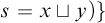 $s=x\sqcup y)\}$
. Additionally, given any
$s=x\sqcup y)\}$
. Additionally, given any $X, Y\subseteq S$
, we say that X is a preclusion on Y just in case (i) for all
$X, Y\subseteq S$
, we say that X is a preclusion on Y just in case (i) for all $x\in X$
, there is a
$x\in X$
, there is a $y\in Y$
such that
$y\in Y$
such that $x\mathrel {{\blacktriangleright }} y$
and (ii) for all
$x\mathrel {{\blacktriangleright }} y$
and (ii) for all $y\in Y$
, there is an
$y\in Y$
, there is an $x\in X$
such that
$x\in X$
such that $x\mathrel {{\blacktriangleright }} y$
.
$x\mathrel {{\blacktriangleright }} y$
.
Definition 3 (Modal models)
A modal model is a tuple $M=\langle S, \sqsubseteq , \mathrel {{\vartriangleright }}, \mathrel {{\blacktriangleright }}, \mathbf {tm}, \mathbf {fm}\rangle $
such that:
$M=\langle S, \sqsubseteq , \mathrel {{\vartriangleright }}, \mathrel {{\blacktriangleright }}, \mathbf {tm}, \mathbf {fm}\rangle $
such that:
-
(i)
$M=\langle S, \sqsubseteq , \mathrel {{\vartriangleright }}, \mathrel {{\blacktriangleright }} \rangle $
is a modal state space. -
(ii)
$\mathbf {tm}: Var\to \mathcal {P}(S)$
and
$\mathbf {fm}: Var\to \mathcal {P}(S)$
are two valuation functions that assign to each
$p_i\in Var$
a subset X of S such that for all
$s,t \in X$
,
$s\sqcup t\in X.$





Exact verification and falsification by a state in a model are defined as follows (we adopt the standard inclusive clauses, together with the two clauses for sentences of type $\lozenge A$
discussed above).
$\lozenge A$
discussed above).
Definition 4 (Exact verification and falsification)
Exact verification and falsification by a state in a model M are defined inductively via the following verification ( $\Vdash _M$
) and falsification (
$\Vdash _M$
) and falsification ( ${\Vdash_M}$
) clauses:Footnote
11
${\Vdash_M}$
) clauses:Footnote
11
-
1.
$s\Vdash p_i$
iff
$s\in \mathbf {tm}(p_i)$
$s{\Vdash}
p_i$
iff
$s\in \mathbf {fm}(p_i)$
-
2.
$s\Vdash \neg A$
iff
$s{\Vdash}
A$
$s{\Vdash}
\neg A$
iff
$s\Vdash A$
-
3.
$s\Vdash A\land B$
iff
$s=t\sqcup u$
for some
$t, u\in S$
such that
$t\Vdash A$
and
$u\Vdash B$
$s{\Vdash}
A\land B$
iff
$s{\Vdash}
A$
or
$s{\Vdash}
B$
or
$s{\Vdash}
A\lor B$
-
4.
$s\Vdash A\lor B$
iff
$s\Vdash A$
or
$s\Vdash B$
or
$s\Vdash A\land B$
$s{\Vdash}
A\lor B$
iff
$s=t\sqcup u$
for some
$t, u\in S$
such that
$t{\Vdash}
A$
and
$u{\Vdash}
B$
-
5.
$s\Vdash \lozenge A$
iff
$s=\bigsqcup X$
for some non-empty
$X\subseteq S$
such that
$\forall x\in X(\exists t\in S(x\mathrel {{\vartriangleright }} t$
and
$t\Vdash A))$
$s{\Vdash}
\lozenge A$
iff
$s=\bigsqcup X$
for some
$X\subseteq S$
such that X is a preclusion on
$\{t\in S : t\Vdash A\}$






Given any model M, I will denote the set of exact verifiers/falsifier of a given formula A by $[A]_{t/f}^M$
.Footnote
12
Finally, we define exact equivalence as follows.
$[A]_{t/f}^M$
.Footnote
12
Finally, we define exact equivalence as follows.
Definition 5 (Exact equivalence)
Let $A, B\in \mathcal {L}_\lozenge $
be two formulas. Then, A is exactly equivalent to B iff, for all models M,
$A, B\in \mathcal {L}_\lozenge $
be two formulas. Then, A is exactly equivalent to B iff, for all models M, $[A]_t^M=[B]_t^M$
.
$[A]_t^M=[B]_t^M$
.
With this definition in place, we are now in a position to investigate the logic of exact equivalence.
3 Soundness
We start by introducing a Hilbert-style axiomatic system, $\mathbf {E}_\lozenge $
.
$\mathbf {E}_\lozenge $
.
Definition 6 (System
$\mathbf {E}_\lozenge $
)
 $\mathbf {E}_\lozenge $
is the smallest set of formulas of type
$\mathbf {E}_\lozenge $
is the smallest set of formulas of type $A\approx B$
(where
$A\approx B$
(where $A, B\in \mathcal {L}_\lozenge $
) that contains all instances of the following axioms, and is closed under the following rules:
$A, B\in \mathcal {L}_\lozenge $
) that contains all instances of the following axioms, and is closed under the following rules:
-
(i) Axioms:
-
(A1)
$A\approx A$
-
(A2)
$A\approx A\land A$
-
(A3)
$A\approx A\lor A$
-
(A4)
$(A\land B)\land C\approx A\land (B\land C)$
-
(A5)
$(A\lor B)\lor C\approx A\lor (B\lor C)$
-
(A6)
$A\land B\approx B\land A$
-
(A7)
$A \lor B\approx B\lor A$
-
(A8)
$\neg (A\land B)\approx \neg A\lor \neg B$
-
(A9)
$\neg (A\lor B)\approx \neg A\land \neg B$
-
(A10)
$A\land (B\lor C)\approx (A\land B)\lor (A\land C)$
-
(A11)
$\lozenge (A\lor B)\approx \lozenge A\lor \lozenge B\lor \lozenge (A\land B)$
-
(A12)
$\neg \lozenge (A\lor B)\approx \neg \lozenge A\land \neg \lozenge B\land \neg \lozenge (A\land B)$
-
-
(ii) Rules:
-
(R1) From
$A\approx B$
, infer
$B\approx A$
-
(R2) From
$A\approx B$
and
$B\approx C$
, infer
$A\approx C$
-
(R3) From
$A\approx B$
, infer
$A\land C\approx B\land C$
-
(R4) From
$A\approx B$
, infer
$A\lor C\approx B\lor C$
-
(R5) From
$A\approx B$
, infer
$\lozenge A\approx \lozenge B$
-
(R6) From
$A\approx B$
, infer
$\neg \lozenge A\approx \neg \lozenge B$
-

















If $A\approx B\in \mathbf {E}_\lozenge $
, we say that A is provably equivalent to B in
$A\approx B\in \mathbf {E}_\lozenge $
, we say that A is provably equivalent to B in $\mathbf {E}_\lozenge $
(in symbols,
$\mathbf {E}_\lozenge $
(in symbols, $A\approx _{\mathbf {E}_\lozenge } B$
).
$A\approx _{\mathbf {E}_\lozenge } B$
). $\mathbf {E}_\lozenge $
is a modal extension of Correia’s [Reference Correia1] logic of exact equivalence. It is obtained by adding to Correia’s system axioms (A11) and (A12), as well as rules (R5) and (R6). Let us examine these new axioms and rules in more detail. (A11) and (A12) govern how the modal operators
$\mathbf {E}_\lozenge $
is a modal extension of Correia’s [Reference Correia1] logic of exact equivalence. It is obtained by adding to Correia’s system axioms (A11) and (A12), as well as rules (R5) and (R6). Let us examine these new axioms and rules in more detail. (A11) and (A12) govern how the modal operators $\lozenge $
and
$\lozenge $
and $\neg \lozenge $
interact with the classical connectives
$\neg \lozenge $
interact with the classical connectives $\lor $
and
$\lor $
and $\land $
. Specifically, (A11) guarantees the equivalence of
$\land $
. Specifically, (A11) guarantees the equivalence of $\lozenge (A\lor B)$
and the disjunction
$\lozenge (A\lor B)$
and the disjunction $\lozenge A\lor \lozenge B\lor \lozenge (A\land B)$
, while (A12) guarantees the equivalence of
$\lozenge A\lor \lozenge B\lor \lozenge (A\land B)$
, while (A12) guarantees the equivalence of $\neg \lozenge (A\lor B)$
and the conjunction
$\neg \lozenge (A\lor B)$
and the conjunction $\neg \lozenge A\land \neg \lozenge B\land \neg \lozenge (A\land B)$
.Footnote
13
(A11) may be justified by appealing to the idea that there are exactly three ways to make a disjunction possible: (i) making the first disjunct possible, (ii) making the second disjunct possible, and (iii) making the corresponding conjunction possible. Similarly, we may justify (A12) by appealing to the idea that to make a disjunction impossible, a state must make both disjuncts and their conjunction impossible as well.Footnote
14
Finally, we move to (R5) and (R6). These two rules together guarantee that modal sentences (i.e., sentences of type
$\neg \lozenge A\land \neg \lozenge B\land \neg \lozenge (A\land B)$
.Footnote
13
(A11) may be justified by appealing to the idea that there are exactly three ways to make a disjunction possible: (i) making the first disjunct possible, (ii) making the second disjunct possible, and (iii) making the corresponding conjunction possible. Similarly, we may justify (A12) by appealing to the idea that to make a disjunction impossible, a state must make both disjuncts and their conjunction impossible as well.Footnote
14
Finally, we move to (R5) and (R6). These two rules together guarantee that modal sentences (i.e., sentences of type $\lozenge A$
and
$\lozenge A$
and $\neg \lozenge A$
) with provably equivalent prejacents are themselves provably equivalent. As we shall see, they correspond to the intuitive idea that the positive content of sentences of type “Possibly, A” and “It is not possible that A” should be a function of the positive content of A (i.e., of the set of ways in which A can be true).Footnote
15
$\neg \lozenge A$
) with provably equivalent prejacents are themselves provably equivalent. As we shall see, they correspond to the intuitive idea that the positive content of sentences of type “Possibly, A” and “It is not possible that A” should be a function of the positive content of A (i.e., of the set of ways in which A can be true).Footnote
15
Having examined the characteristic axioms and rules of $\mathbf {E}_\lozenge $
, we now show that provable equivalence in
$\mathbf {E}_\lozenge $
, we now show that provable equivalence in $\mathbf {E}_\lozenge $
is sound with respect to exact equivalence. In particular, we prove soundness by first establishing the following auxiliary lemma.
$\mathbf {E}_\lozenge $
is sound with respect to exact equivalence. In particular, we prove soundness by first establishing the following auxiliary lemma.
Lemma 1. Let M be a model and $s,t$
any two states in M. Then, (i) if
$s,t$
any two states in M. Then, (i) if $s\Vdash A$
and
$s\Vdash A$
and $t\Vdash A$
, then
$t\Vdash A$
, then $s\sqcup t\Vdash A$
and (ii) if
$s\sqcup t\Vdash A$
and (ii) if
 $s{\Vdash}
A$
and
$s{\Vdash}
A$
and
 $t{\Vdash}
A$
, then
$t{\Vdash}
A$
, then
 $s\sqcup t{\Vdash}
A$
.
$s\sqcup t{\Vdash}
A$
.
Proof. Assume the hypotheses. Then, we prove that both (i) and (ii) hold by induction on the degree of complexity of A.
-
(a) The proofs for
$A=p_i$
,
$A=\neg B$
,
$A=B\land C$
and
$A=B\lor C$
are standard (see [Reference Fine and Jago9, lemma 3.3, p. 541]). -
(b)
$A=\lozenge B$
. We prove both (i) and (ii) separately.-
(i) Suppose that
$s\Vdash \lozenge B$
and
$t\Vdash \lozenge B$
. Then,
$s=\bigsqcup X$
and
$t=\bigsqcup Y$
for two non-empty sets of states X and Y such that every state in X or Y exactly permits some exact verifier of B. Hence,
$X\cup Y$
is a non-empty set of states, each of which exactly permit some exact verifier of B. Also,
$s\sqcup t=(\bigsqcup X)\sqcup (\bigsqcup Y)=\bigsqcup (X\cup Y)$
. Hence,
$s\sqcup t\Vdash \lozenge B$
. -
(ii) Suppose that
$s{\Vdash}
\lozenge B$
and
$t{\Vdash}
\lozenge B$
. Then,
$s=\bigsqcup X$
and
$t=\bigsqcup Y$
, for two sets of states X and Y which are preclusions on
$[B]_t$
. So, consider
$X\cup Y$
. Since every
$u\in [B]_t$
is exactly precluded by some
$x\in X$
, every
$u\in [B]_t$
is also precluded by some
$x\in X\cup Y$
. Furthermore, since every state in X or Y exactly precludes some exact verifier of A, every state in
$X\cup Y$
exactly precludes some exact verifier of B. Thus,
$X\cup Y$
is an exact preclusion on
$[B]_t$
. Also,
$s\sqcup t=(\bigsqcup X)\sqcup (\bigsqcup Y)=\bigsqcup (X\cup Y)$
. Hence,
$s\sqcup t{\Vdash}
\lozenge B$
.
-







With Lemma 1 in place, we can easily establish the following soundness result (we shall say that a sentence of type $A\approx B$
is valid just in case A is exactly equivalent to B).
$A\approx B$
is valid just in case A is exactly equivalent to B).
Theorem 1 (Soundness)
If $A\approx _{\mathbf {E}_\lozenge } B$
, then A is exactly equivalent to B.
$A\approx _{\mathbf {E}_\lozenge } B$
, then A is exactly equivalent to B.
Proof. It suffices to show that all axioms of $\mathbf {E}_\lozenge $
are valid, and that all rules of
$\mathbf {E}_\lozenge $
are valid, and that all rules of $\mathbf {E}_\lozenge $
preserve validity. The proofs for axioms (A1)–(A10) and rules (R1)–(R4) are standard (the proof for (A2) relies on Lemma 1). Thus, we focus on axioms (A11) and (A12) and on rules (R5) and (R6). We proceed in order:
$\mathbf {E}_\lozenge $
preserve validity. The proofs for axioms (A1)–(A10) and rules (R1)–(R4) are standard (the proof for (A2) relies on Lemma 1). Thus, we focus on axioms (A11) and (A12) and on rules (R5) and (R6). We proceed in order:
-
(A11) It suffices to show that
$s\Vdash \lozenge (A\lor B)$
iff
$s\Vdash \lozenge A\lor \lozenge B\lor \lozenge (A\land B)$
. We prove both directions of this biconditional separately:-
(⇒) Suppose that
$s\Vdash \lozenge (A\lor B)$
. Then,
$s=\bigsqcup X$
for some non-empty set of states X such that all
$x\in X$
exactly permit some
$t\in [A\lor B]_t$
. Now, let
$X_A$
be the set of states
$x\in X$
that exactly permit some
$t\in [A]_t$
,
$X_B$
be the set of states
$x\in X$
that exactly permit some
$t\in [B]_t$
, and
$X_{A\land B}$
be the set of states
$x\in X$
that exactly permit some
$t\in [A\land B]_t$
. Since
$[A\lor B]_t=[A]_t\cup [B]_t \cup [A\land B]_t$
,
$X=X_A\cup X_B\cup X_{A\land B}$
. Additionally, since X is non-empty, at least one between
$X_A$
,
$X_B$
and
$X_{A\land B}$
must be non-empty. We assume, for simplicity, that all three sets are non-empty (the cases in which some are empty are entirely analogous). Then, it is easy to check that
$\bigsqcup X_A\Vdash \lozenge A$
,
$\bigsqcup X_B\Vdash \lozenge B$
and
$\bigsqcup X_{A\land B}\Vdash \lozenge (A\land B)$
. So, since
$s=\bigsqcup (X_A\cup X_B\cup X_{A\land B})=(\bigsqcup X_A)\sqcup (\bigsqcup X_B)\sqcup \bigsqcup (X_{A\land B})$
,
$s\Vdash \lozenge A\land \lozenge B\land \lozenge (A\land B)$
. Hence,
$s\Vdash \lozenge A\lor \lozenge B\lor \lozenge (A\land B)$
. -
(⇐) Suppose that
$s\Vdash \lozenge A\lor \lozenge B\lor \lozenge (A\land B)$
. Then,
$(i) s\Vdash \lozenge A$
, or
$(ii) s\Vdash \lozenge B$
, or
$(iii) s\Vdash \lozenge (A\land B)$
, or
$(iv) s\Vdash \lozenge A\land \lozenge B$
, or
$(v) s\Vdash \lozenge A\land \lozenge (A\land B)$
, or
$(vi) s\Vdash \lozenge B\land \lozenge (A\land B)$
, or
$(vii) s\Vdash \lozenge A\land \lozenge B\land \lozenge (A\land B)$
. We assume, for simplicity, that
$(vii)$
is the case (the other cases are entirely analogous). Then,
$s=(\bigsqcup X_A)\sqcup (\bigsqcup X_B)\sqcup (\bigsqcup X_{A\land B})$
, for some non-empty sets of states
$X_A$
,
$X_B$
and
$X_{A\land B}$
such that (i) all states
$x_A\in X_A$
exactly permit some
$t\in [A]_t$
, (ii) all states
$x_B\in X_B$
exactly permit some
$t\in [B]_t$
, and (iii) all states
$x_{A\land B}\in X_{A\land B}$
exactly permit some
$t\in [A\land B]_t$
. Now, consider
$X=X_A\cup X_B\cup X_{A\land B}$
. Clearly, all states
$x\in X$
permit some
$t\in [A\lor B]_t$
. Also,
$s=(\bigsqcup X_A)\sqcup (\bigsqcup X_B)\sqcup (\bigsqcup X_{A\land B})= \bigsqcup X$
. Hence,
$s\Vdash \lozenge (A\lor B)$
.
-
-
(A12) It suffices to show that
$s\Vdash \neg \lozenge (A\lor B)$
iff
$s\Vdash \neg \lozenge A\land \neg \lozenge B\land \neg \lozenge (A\land B)$
. We prove both directions of this biconditional separately:-
(⇒) Suppose that
$s\Vdash \neg \lozenge (A\lor B)$
. Then,
$s=\bigsqcup X$
for some X which is an exact preclusion on
$[A\lor B]_t$
. Now, let
$X_A$
be the set of states
$x\in X$
that exactly preclude some
$t\in [A]_t$
,
$X_B$
be the set of states
$x\in X$
that exactly preclude some
$t\in [B]_t$
, and
$X_{A\land B}$
be the set of states
$x\in X$
that exactly preclude some
$t\in [A\land B]_t$
. Then, for all
$x_A\in X_A$
, there is a
$t\in [A]_t$
such that
$x_A$
precludes t. Also, since
$[A]_t\subseteq [A\lor B]_t$
, for all
$t\in [A]_t$
there is an
$x\in X$
such that x exactly precludes t. Hence, for all
$t\in [A]_t$
there is an
$x_A\in X_A$
such that
$x_A$
exactly precludes t. So,
$X_A$
is an exact preclusion on
$[A]_t$
. Similarly, we can show that
$X_B$
is an exact preclusion on
$[B]_t$
and that
$X_{A\land B}$
is an exact preclusion on
$[A\land B]_t$
. Thus,
$\bigsqcup X_A\Vdash \neg \lozenge A$
,
$\bigsqcup X_B\Vdash \neg \lozenge B$
and
$\bigsqcup X_{A\land B}\Vdash \neg \lozenge (A\land B)$
. So, since
$s= \bigsqcup X= \bigsqcup (X_A\cup X_B\cup X_{A\land B})=(\bigsqcup X_A)\sqcup (\bigsqcup X_B)\sqcup (\bigsqcup X_{A\land B})$
,
$s\Vdash \neg \lozenge A\land \neg \lozenge B\land \neg \lozenge (A\land B)$
. -
(⇐) Suppose that
$s\Vdash \neg \lozenge A\land \neg \lozenge B\land \neg \lozenge (A\land B)$
. Then,
$s=(\bigsqcup X_A)\sqcup (\bigsqcup X_B)\sqcup (\bigsqcup X_{A\land B})$
for three sets of states
$X_A$
,
$X_B$
and
$X_{A\land B}$
that are exact preclusions on, respectively,
$[A]_t$
,
$[B]_t$
and
$[A\land B]_t$
. Now, consider
$X=X_A\cup X_B\cup X_{A\land B}$
. Since
$[A\lor B]_t=[A]_t\cup [B]_t\cup [A\land B]_t$
, every
$x\in X$
exactly precludes some
$t\in [A\lor B]_t$
. Also, since
$X_A$
,
$X_B$
and
$X_{A\land B}$
are exact preclusions on
$[A]_t$
,
$[B]_t$
and
$[A\land B]_t$
, every
$t\in [A\lor B]_t$
is exactly precluded by some
$x\in X$
. So, X is an exact preclusion on
$[A\lor B]_t$
. Hence, since
$s=\bigsqcup (X_A\cup X_B\cup X_{A\land B})=\bigsqcup X$
,
$s\Vdash \neg \lozenge (A\lor B)$
.
-
-
(R5) Suppose that A and B are exactly equivalent. Then, for all non-empty sets of states X, every state in X permits some
$t\in [A]_t$
iff every state in X permits some
$t\in [B]_t$
. So,
$\lozenge A$
and
$\lozenge B$
are also exactly equivalent. So, (R5) preserves exact equivalence. -
(R6) The proof is analogous to that for (R5), since the negative content of
$\lozenge A$
is always a function of the positive content of A.
























































Thus, we conclude that $\mathbf {E}_\lozenge $
is sound with respect to exact equivalence. In the next two sections, I show that
$\mathbf {E}_\lozenge $
is sound with respect to exact equivalence. In the next two sections, I show that $\mathbf {E}_\lozenge $
is also complete (i.e., that all valid sentences of type
$\mathbf {E}_\lozenge $
is also complete (i.e., that all valid sentences of type $A\approx B$
are derivable in
$A\approx B$
are derivable in $\mathbf {E}_\lozenge $
). In order to establish this completeness result, I first prove a normal form theorem for
$\mathbf {E}_\lozenge $
). In order to establish this completeness result, I first prove a normal form theorem for $\mathbf {E}_\lozenge $
, which will allow us to generalize to languages containing a modal operator the standard techniques used to prove completeness for the propositional logic of exact equivalence developed by Correia [Reference Correia1] and Fine and Jago [Reference Fine and Jago9].Footnote
16
$\mathbf {E}_\lozenge $
, which will allow us to generalize to languages containing a modal operator the standard techniques used to prove completeness for the propositional logic of exact equivalence developed by Correia [Reference Correia1] and Fine and Jago [Reference Fine and Jago9].Footnote
16
4 Normal forms
In this section, I show that every formula $A\in \mathcal {L}_\lozenge $
is provably equivalent to a normal form, in Fine’s [Reference Fine2] sense, of the same modal degree (where the modal degree of a formula A is defined inductively as follows:
$A\in \mathcal {L}_\lozenge $
is provably equivalent to a normal form, in Fine’s [Reference Fine2] sense, of the same modal degree (where the modal degree of a formula A is defined inductively as follows: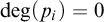 $\deg (p_i)=0$
,
$\deg (p_i)=0$
, $\deg (A\land B)= max(\deg (A), \deg (B))$
,
$\deg (A\land B)= max(\deg (A), \deg (B))$
, $\deg (A\lor B)= max(\deg (A), \deg (B))$
,
$\deg (A\lor B)= max(\deg (A), \deg (B))$
, $\deg (\neg A)=\deg (A)$
, and
$\deg (\neg A)=\deg (A)$
, and $\deg (\lozenge A)=\deg (A)+1$
).Footnote
17
We begin by introducing rigorously the notion of normal form, via a series of definitions.Footnote
18
$\deg (\lozenge A)=\deg (A)+1$
).Footnote
17
We begin by introducing rigorously the notion of normal form, via a series of definitions.Footnote
18
Definition 7 (Literals and state descriptions)
Let A be any formula in $\mathcal {L}_\lozenge $
. Then:
$\mathcal {L}_\lozenge $
. Then:
-
(i) A is a literal of degree
$0$
iff, for some
$p_i\in Var$
,
$A=p_i$
or
$A=\neg p_i$
. -
(ii) A is a state description of degree
$0$
iff A is a conjunction of literals of degree
$0$
. -
(iii) A is a literal of degree
$n+1$
iff
$A=\lozenge \pi $
or
$A=\neg \lozenge \pi $
for some state description
$\pi $
of degree n. -
(iv) A is a state description of degree
$n+1$
iff A is a conjunction of literals of degree
$m\leq n+1$
. -
(v) A is a literal iff, for some n, A is a literal of degree n. Similarly, A is a state descriptions iff, for some n, A is a state description of degree n.


We let $\lambda $
be a variable ranging over literals, and
$\lambda $
be a variable ranging over literals, and $\pi $
be a variable ranging over arbitrary state descriptions. Additionally, we note that the following inductive definition of
$\pi $
be a variable ranging over arbitrary state descriptions. Additionally, we note that the following inductive definition of $\mathcal {L}_\lozenge $
is equivalent to Definition 1 (where
$\mathcal {L}_\lozenge $
is equivalent to Definition 1 (where $\lambda ^0$
is a variable ranging over literals of degree
$\lambda ^0$
is a variable ranging over literals of degree $0$
):
$0$
):
-
•
$\mathcal {L}_\lozenge {:=}q \lambda ^0 \ \vert \ A\land B \ \vert \ A\lor B \ \vert \ \neg \neg A \ \vert \ \neg (A\land B) \ \vert \ \neg (A\lor B) \ \vert \ \lozenge A \ \vert \ \neg \lozenge A.$

It will sometimes be convenient, especially in proofs by induction on the degree of complexity of formulas, to work with this alternative definition of $\mathcal {L}_\lozenge $
.
$\mathcal {L}_\lozenge $
.
With the notion of state description in place, we can finally introduce the following definition.
Definition 8 (Normal forms)
A formula $A\in \mathcal {L}_\lozenge $
is a normal form of degree n iff it is a disjunction of state descriptions of degree n. A formula A is a normal form iff, for some n, it is a normal form of degree n.
$A\in \mathcal {L}_\lozenge $
is a normal form of degree n iff it is a disjunction of state descriptions of degree n. A formula A is a normal form iff, for some n, it is a normal form of degree n.
It is easy to check that the modal degree of a state description $\pi $
is identical to the least n such that
$\pi $
is identical to the least n such that $\pi $
is a state description of degree n, and that the modal degree of a normal form D is the least n such that D is a normal form of degree n.
$\pi $
is a state description of degree n, and that the modal degree of a normal form D is the least n such that D is a normal form of degree n.
We may now show that every $\mathcal {L}_\lozenge $
-formula is provably equivalent in
$\mathcal {L}_\lozenge $
-formula is provably equivalent in $\mathbf {E}_\lozenge $
to a normal form of the same degree. This will allow us to establish that
$\mathbf {E}_\lozenge $
to a normal form of the same degree. This will allow us to establish that $\mathbf {E}_\lozenge $
is complete with respect to exact equivalence.
$\mathbf {E}_\lozenge $
is complete with respect to exact equivalence.
Theorem 2 (Normal forms)
Let A be any formula whose modal degree is n. Then, there is a formula $A'$
such that (i)
$A'$
such that (i) $A'$
is a normal form of modal degree n and (ii)
$A'$
is a normal form of modal degree n and (ii) $A\approx _{\mathbf {E}_{\lozenge }} A'$
Proof. We prove that the claim holds for all formulas A by induction on the modal degree n of A.
-
(i) Base case: If
$n=0$
, then there are no occurrences of
$\lozenge $
in A. So, we can use the standard proof of the disjunctive normal form theorem for propositional logic to show that
$A\approx _{\mathbf {E}_\lozenge } A'$
for some normal form
$A'$
of degree
$0$
(note that
$\mathbf {E}_\lozenge $
contains all instances of the distribution of conjunction over disjunction, and this is the only distribution axiom required by the standard proof of the disjunctive normal form theorem). -
(ii) Inductive step: We suppose that
$n=m+1$
and that the claim holds for all formulas of modal degree m, and we show by induction on the degree of complexity of A that the claim also holds for all formulas of modal degree n.-
(i) The proofs for
$A= B\land C$
,
$A=B\lor C$
,
$A=\neg (B\land C)$
and
$A=\neg (B\lor C)$
are analogous to the proofs for the corresponding cases in the standard proof of the disjunctive normal form theorem for propositional logic. The proof for
$A=\neg \neg B$
is trivial. -
(ii)
$A=\lozenge B$
. We assume as inductive hypothesis that the claim holds for B. Then, since
$A=\lozenge B$
and A is of modal degree
$n=m+1$
, B is of modal degree m. So, by inductive hypothesis, there is a normal form
$B'=\bigvee _{1\leq i\leq k} \pi _i$
of modal degree m such that
$B\approx _{\mathbf {E}_{\lozenge }}B'$
. We now show by induction on k, the number of disjuncts of
$B'$
, that
$A\approx _{\mathbf {E}_\lozenge } A'$
for some normal form
$A'$
of degree
$n=m+1$
.-
(a) Base case: If
$k=0$
, then
$B'=\pi _1$
for some state description
$\pi _1$
of degree m. So, by (R5),
$\lozenge B\approx _{\mathbf {E}_\lozenge } \lozenge \pi _1$
. Hence,
$A=\lozenge B$
is provably equivalent to a literal of degree
$m+1$
(namely,
$\lozenge \pi _1$
). So, A is provably equivalent to a normal form
$A'$
of degree
$n=m+1$
. -
(b) Inductive step: We suppose that
$k=j+1$
and that for all C which are provably equivalent to a normal form
$C'$
which has j disjuncts,
$\lozenge C$
is provably equivalent to a normal form of degree
$m+1$
. Then, the following are all derivable equivalences: $$ \begin{align*} \hspace{-23pt}\begin{array}{ll} 1. & \lozenge B\approx \lozenge \bigvee_{1\leq i\leq k} \pi_i \\& \qquad\text{ by (R5)} \\ 2. & \lozenge \bigvee_{1\leq i\leq k} \pi_i\approx \lozenge \pi_1\lor \lozenge (\bigvee_{2\leq i\leq k} \pi_i)\lor \lozenge(\pi_1\land \bigvee_{2\leq i\leq k} \pi_i)\\ &\qquad \text{ by (A11)}\\ 3. & \pi_1\land \bigvee_{2\leq i\leq k} \pi_i\approx\bigvee_{2\leq i\leq k} (\pi_1\land\pi_i) \\ &\qquad \text{ by (A10) and (R2)} \\ 4. & \lozenge(\pi_1\land \bigvee_{2\leq i\leq k} \pi_i)\approx \lozenge (\bigvee_{2\leq i\leq k} \pi_1\land\pi_i) \\ &\qquad \text{ by 3 and (R5)} \\ 5. & \lozenge \bigvee_{1\leq i\leq k} \pi_i\approx \lozenge \pi_1\lor \lozenge (\bigvee_{2\leq i\leq k} \pi_i)\lor \lozenge( \bigvee_{2\leq i\leq k} \pi_1\land \pi_i)\\ & \qquad\text{ by 2, 4 and (R4)} \\ 6. & \lozenge B\approx \lozenge \pi_1\lor \lozenge (\bigvee_{2\leq i\leq k} \pi_i)\lor \lozenge( \bigvee_{2\leq i\leq k} \pi_1\land \pi_i)\\ &\qquad \text{ by 1, 5 and (R2)}. \\ \end{array} \end{align*} $$
Hence,
$A=\lozenge B$
is provably equivalent to
$\lozenge \pi _1\lor \lozenge (\bigvee _{2\leq i\leq k} \pi _i)\lor \lozenge ( \bigvee _{2\leq i\leq k} \pi _1\land \pi _i)$
. Now, by inductive hypothesis,
$\lozenge (\bigvee _{2\leq i\leq k} \pi _i)$
and
$\lozenge ( \bigvee _{2\leq i\leq k} \pi _1\land \pi _i)$
are both provably equivalent to some normal forms
$D_1$
and
$D_2$
of degree
$n=m+1$
. Hence, by (R2) and (R4),
$A\approx _{\mathbf {E}_{\lozenge }} \lozenge \pi _1\lor D_1\lor D_2$
for some normal forms
$D_1$
and
$D_2$
of degree n. Hence, since all disjunctions of normal forms are normal forms, A is provably equivalent to a normal form of degree n.
-
-
(iii)
$A=\neg \lozenge B$
. We assume as inductive hypothesis that the claim holds for B. Then, since
$A=\neg \lozenge B$
and A is of modal degree
$n=m+1$
, B is of modal degree m. So, by inductive hypothesis, there is a normal form
$B'=\bigvee _{1\leq i\leq k} \pi _i$
of modal degree m such that
$B\approx _{\mathbf {E}_{\lozenge }}B'$
. We now show by induction on k that
$A\approx _{\mathbf {E}_\lozenge } A'$
for some normal form
$A'$
of degree
$n= m+1$
.-
(a) Base case: If
$k=0$
, then
$B'=\pi _1$
for some state description
$\pi _1$
of degree m. So, by (R6),
$\neg \lozenge B\approx _{\mathbf {E}_\lozenge } \neg \lozenge \pi _1$
. Hence,
$A=\neg \lozenge B$
is provably equivalent to a literal of degree
$m+1$
(namely,
$\neg \lozenge \pi _1$
). So, A is provably equivalent to a normal form
$A'$
of degree
$n=m+1$
. -
(b) Inductive step: We suppose that
$k=j+1$
and that for all C which are provably equivalent to a normal form
$C'$
which has j disjuncts,
$\neg \lozenge C$
is provably equivalent to a normal form of degree
$m+1$
. Then, the following are all derivable equivalences:
$$ \begin{align*} \begin{array}{ll} 1. & \neg\lozenge B\approx \neg\lozenge \bigvee_{1\leq i\leq k} \pi_i\\ &\qquad \text{ by (R6)} \\ 2. & \neg\lozenge \bigvee_{1\leq i\leq k} \pi_i\approx \neg\lozenge \pi_1\land \neg\lozenge (\bigvee_{2\leq i\leq k} \pi_i)\land \neg\lozenge(\pi_1\land \bigvee_{2\leq i\leq k} \pi_i)\\ &\qquad \text{ by (A12)} \\ 3. & \pi_1\land \bigvee_{2\leq i\leq k} \pi_i\approx\bigvee_{2\leq i\leq k} (\pi_1\land\pi_i)\\ &\qquad \text{ by (A10) and (R2)} \\ 4. & \neg\lozenge(\pi_1\land \bigvee_{2\leq i\leq k} \pi_i)\approx \neg\lozenge (\bigvee_{2\leq i\leq k} \pi_1\land\pi_i) \\ &\qquad \text{ by 3 and (R6)} \\ 5. \qquad& \neg\lozenge \bigvee_{1\leq i\leq k} \pi_i\approx \neg\lozenge \pi_1\land \neg\lozenge (\bigvee_{2\leq i\leq k} \pi_i)\land \neg\lozenge( \bigvee_{2\leq i\leq k} \pi_1\land \pi_i)\\ & \qquad\text{ by 2, 4 and (R3)} \\ 6. & \neg\lozenge B\approx \neg\lozenge \pi_1\land \neg\lozenge (\bigvee_{2\leq i\leq k} \pi_i)\land \neg\lozenge( \bigvee_{2\leq i\leq k} \pi_1\land \pi_i)\\ & \qquad\text{ by 1, 5 and (R2)}. \\ \end{array} \end{align*} $$
Hence,
$A=\neg \lozenge B$
is provably equivalent to
$\neg \lozenge \pi _1\land \neg \lozenge (\bigvee _{2\leq i\leq k} \pi _i)\land \neg \lozenge ( \bigvee _{2\leq i\leq k} \pi _1\land \pi _i)$
. Now, by inductive hypothesis,
$\neg \lozenge (\bigvee _{2\leq i\leq k} \pi _i)$
and
$\neg \lozenge ( \bigvee _{2\leq i\leq k} \pi _1\land \pi _i)$
are both provably equivalent to some normal forms
$D_1$
and
$D_2$
of degree
$n=m+1$
. Hence, by (R2) and (R3),
$A\approx _{\mathbf {E}_{\lozenge }} \neg \lozenge \pi _1\land D_1\land D_2$
for some normal forms
$D_1$
and
$D_2$
of degree n. Hence, since all conjunctions of normal forms are provably equivalent to normal forms, A is provably equivalent to a normal form of degree n.
-
-





















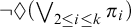






With Theorem 2 in place, we are now in a position to show that whenever A is exactly equivalent to B, then $A\approx B$
is derivable in
$A\approx B$
is derivable in $\mathbf {E}_\lozenge $
. Before turning to completeness, however, we introduce a closure operation on normal forms, and establish two simple lemmas concerning the relation between a normal form and its closure. These will play a role in the completeness argument that follows.
$\mathbf {E}_\lozenge $
. Before turning to completeness, however, we introduce a closure operation on normal forms, and establish two simple lemmas concerning the relation between a normal form and its closure. These will play a role in the completeness argument that follows.
Definition 9 (Closure)
Let D be any normal form, and let $\Delta (D)$
be the set of disjuncts of D. Then, the closure of D (in symbols,
$\Delta (D)$
be the set of disjuncts of D. Then, the closure of D (in symbols, $cl(D)$
) is the formula
$cl(D)$
) is the formula $\bigvee _{\emptyset \subset \Gamma \subseteq \Delta (D)}(\bigwedge _{\pi \in \Gamma } \pi ))$
. That is,
$\bigvee _{\emptyset \subset \Gamma \subseteq \Delta (D)}(\bigwedge _{\pi \in \Gamma } \pi ))$
. That is, $cl(D)$
is the normal form whose disjuncts are exactly the state descriptions
$cl(D)$
is the normal form whose disjuncts are exactly the state descriptions $\pi $
such that either
$\pi $
such that either $\pi \in \Delta (D)$
or
$\pi \in \Delta (D)$
or $\pi $
is a conjunction of state descriptions in
$\pi $
is a conjunction of state descriptions in $\Delta (D)$
.
$\Delta (D)$
.
Lemma 2. Let D be any normal form. Then,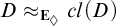 $D\approx _{\mathbf {E}_\lozenge } cl(D)$
.
$D\approx _{\mathbf {E}_\lozenge } cl(D)$
.
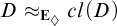
Proof. The result follows from Lemmas 4.3 and 4.4 of Correia [Reference Correia1].
Lemma 3 Let M be any model, D any normal form, $cl(D)$
the closure of D and
$cl(D)$
the closure of D and $\Delta (cl(D))$
the set of disjuncts of
$\Delta (cl(D))$
the set of disjuncts of $cl(D)$
. Then,
$cl(D)$
. Then, $[cl(D)]^M_t=\{s\in S : \exists \pi \in \Delta (cl(D))(s\Vdash \pi ) \}$
.
$[cl(D)]^M_t=\{s\in S : \exists \pi \in \Delta (cl(D))(s\Vdash \pi ) \}$
.




5 Completeness and decidability
In order to establish completeness, we adapt standard techniques developed by Correia [Reference Correia1] and Fine and Jago [Reference Fine and Jago9]. Specifically, we will first construct a canonical model, and then show that if $A\approx B$
is not derivable in
$A\approx B$
is not derivable in $\mathbf {E}_\lozenge $
, then there is a state in the canonical model that either exactly verifies A but not B, or exactly verifies B but not A.
$\mathbf {E}_\lozenge $
, then there is a state in the canonical model that either exactly verifies A but not B, or exactly verifies B but not A.
We begin by associating each literal $\lambda $
and each state description
$\lambda $
and each state description $\pi $
with their canonical representative and canonical representation, respectively. States in the canonical model are then identified with canonical representations (i.e., with sets of canonical representatives). Formally, the notions of canonical representative and canonical representation are defined as follows.
$\pi $
with their canonical representative and canonical representation, respectively. States in the canonical model are then identified with canonical representations (i.e., with sets of canonical representatives). Formally, the notions of canonical representative and canonical representation are defined as follows.
Definition 10 (Canonical representatives and canonical representations)
For all state descriptions $\pi $
, let
$\pi $
, let $Conj(\pi )$
be the set of literals that occur as conjuncts in
$Conj(\pi )$
be the set of literals that occur as conjuncts in $\pi $
. Then, given any literal
$\pi $
. Then, given any literal $\lambda $
and any state description
$\lambda $
and any state description $\pi $
, the canonical representative of
$\pi $
, the canonical representative of $\lambda $
and the canonical representation of
$\lambda $
and the canonical representation of $\pi $
(in symbols,
$\pi $
(in symbols, $cr(\lambda )$
and
$cr(\lambda )$
and $|\pi |$
) are defined by simultaneous induction on the degree of
$|\pi |$
) are defined by simultaneous induction on the degree of $\lambda $
and
$\lambda $
and $\pi $
, as follows:
$\pi $
, as follows:
-
(i) If
$\lambda $
is a literal of degree
$0$
, then
$cr(\lambda )=\lambda $
. -
(ii) If
$\pi $
is a state description of degree
$0$
, then
$\vert \pi \vert =\{cr(\lambda ) : \lambda \in Conj(\pi )\}$
. That is,
$|\pi |$
is the set of canonical representatives of the literals
$\lambda $
in
$Conj(\pi )$
. -
(iii) If
$\lambda $
is a literal of degree
$n+1$
, then there is a unique state description
$\pi $
of degree n such that
$\lambda =\lozenge \pi $
or
$\lambda =\neg \lozenge \pi $
. Let it be
$\pi _\lambda $
. Then,
$cr(\lambda )$
is the ordered pair
$(\lozenge , |\pi _\lambda |)$
if
$\lambda =\lozenge \pi _\lambda $
, and
$cr(\lambda )$
is the ordered pair
$(\neg \lozenge , |\pi _\lambda |)$
otherwise. That is,
$$\begin{align*}cr(\lambda)= \begin{cases} (\lozenge, \vert\pi_\lambda\vert), & \mathrm{if}\ \lambda=\lozenge\pi_\lambda \\ (\neg\lozenge, \vert\pi_\lambda\vert), & \mathrm{otherwise.} \end{cases} \end{align*}$$
-
(iv) If
$\pi $
is a state description of degree
$n+1$
, then
$\vert \pi \vert =\{cr(\lambda ) : \lambda \in Conj(\pi )\}$
.






With these notions in place, we can now define the canonical model as follows.
Definition 11 (Canonical model)
Let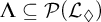 $\Lambda \subseteq \mathcal {P}(\mathcal {L}_\lozenge )$
be the set of all literals, and
$\Lambda \subseteq \mathcal {P}(\mathcal {L}_\lozenge )$
be the set of all literals, and $cr(\Lambda )=\{cr(\lambda ) : \lambda \in \Lambda \}$
be the set of all canonical representatives. Then,
$cr(\Lambda )=\{cr(\lambda ) : \lambda \in \Lambda \}$
be the set of all canonical representatives. Then, $M_c=\langle S_c, \sqsubseteq _c, \mathrel {{\vartriangleright }}_c, \mathrel {{\blacktriangleright }}_c, \mathbf {tm}_c, \mathbf {fm}_c\rangle $
is the unique modal model satisfying the following constraints:
$M_c=\langle S_c, \sqsubseteq _c, \mathrel {{\vartriangleright }}_c, \mathrel {{\blacktriangleright }}_c, \mathbf {tm}_c, \mathbf {fm}_c\rangle $
is the unique modal model satisfying the following constraints:
-
(i)
$S_c=\mathcal {P}(cr(\Lambda )).$
-
(ii)
$\sqsubseteq _c = \subseteq \vert _{\mathcal {P}(cr(\Lambda )).}$
-
(iii) For all
$s, t\in S_c$
,
$s\mathrel {{\vartriangleright }}_c t$
iff
$s=\{ (\lozenge , t)\}.$
-
(iv) For all
$s, t\in S_c$
,
$s\mathrel {{\blacktriangleright }}_c t$
iff
$s=\{(\neg \lozenge , t)\}.$
-
(v)
$\mathbf {tm}_c(p_i)= \{\{p_i\}\}.$
-
(vi)
$\mathbf {fm}_c(p_i)= \{\{\neg p_i\}\}.$







We can now establish two lemmas that relate state descriptions and normal forms to their exact verifiers in the canonical model.
Lemma 4. Let $\pi $
be any state description and
$\pi $
be any state description and $s\in S_c$
any state in the canonical model. Then,
$s\in S_c$
any state in the canonical model. Then, $s\Vdash \pi $
iff
$s\Vdash \pi $
iff $s=\vert \pi \vert $
.
$s=\vert \pi \vert $
.
Proof. Assume the hypotheses. Then, we prove that $s\Vdash \pi $
iff
$s\Vdash \pi $
iff $s=\vert \pi \vert $
by induction on the modal degree n of
$s=\vert \pi \vert $
by induction on the modal degree n of $\pi $
.
$\pi $
.
-
(i) Base case: If
$n=0$
, then
$\pi $
is a conjunction of literals of degree
$0$
. Now, let
$\Gamma ^+$
be the set of propositional variables
$p_i$
that occur as conjuncts in
$\pi $
, and
$\Gamma ^-$
be the set of propositional variables
$p_i$
such that
$\neg p_i$
occurs as a conjunct in
$\pi $
. Then,
$s\Vdash \pi $
iff there is a function
$f:(\Gamma ^+\cup \Gamma ^-)\to S_c$
such that
$(i) \forall p_i\in \Gamma ^+(f(p_i)\in \mathbf {tm}_c(p_i))$
,
$(ii) \forall p_i\in \Gamma ^-(f(p_i)\in \mathbf {fm}_c(p_i))$
, and
$(iii) s=\bigsqcup f(\Gamma ^+\cup \Gamma ^-)$
. So,
$s\Vdash \pi $
iff there is a function
$f:(\Gamma ^+\cup \Gamma ^-)\to S_c$
such that
$(i) \forall p_i\in \Gamma ^+(f(p_i)=\{p_i\})$
,
$(ii) \forall p_i\in \Gamma ^-(f(p_i)=\{\neg p_i\})$
, and
$(iii) s=\bigcup f(\Gamma ^+\cup \Gamma ^-)$
. Hence,
$s\Vdash \pi $
iff
$s=\bigcup \{t\in S_c: \exists p_i\in \Gamma ^+(t=\{p_i\}) \lor \exists p_i\in \Gamma ^-(t=\{\neg p_i\})\}$
. Thus,
$s\Vdash \pi $
iff
$s=\{\lambda \in \Lambda : \exists p_i\in \Gamma ^+(\lambda =p_i)\lor \exists p_i\in \Gamma ^-(\lambda =\neg p_i)\}=\vert \pi \vert $
. -
(ii) Inductive step: We suppose that
$n=m+1$
and that the claim holds for all state descriptions of modal degree m, and we show that the claim also holds for any state description
$\pi $
of degree n that is not also a state description of degree m. Since
$\pi $
is a state description,
$\pi =\bigwedge _{1\leq i\leq k} \lambda _i$
. So, we show by induction on k, the number of conjuncts of
$\pi $
, that
$s\Vdash \pi $
iff
$s=\vert \pi \vert $
.-
(i) Base case: If
$k=0$
, then
$\pi =\lozenge \tau $
or
$\pi =\neg \lozenge \tau $
for some state description
$\tau $
, since
$\pi $
is a state description of degree
$m+1$
which is not also a state description of degree m. We assume, for simplicity, that
$\pi =\lozenge \tau $
(the case in which
$\pi =\neg \lozenge \tau $
is entirely analogous). Now, by inductive hypothesis,
$[\tau ]_t^{M_c}=\{\vert \tau \vert \}$
. So,
$s\Vdash \pi $
iff
$s\mathrel {{\vartriangleright }}_c \vert \tau \vert $
. But, by definition of
$\mathrel {{\vartriangleright }}_c$
,
$s\mathrel {{\vartriangleright }}_c \vert \tau \vert $
iff
$s=\{(\lozenge ,\vert \tau \vert )\}$
. Hence, by Definition 10,
$s\Vdash \vert \tau \vert $
iff
$s=\{(\lozenge , \vert \tau \vert )\}=\vert \lozenge \tau \vert =\vert \pi \vert $
. -
(ii) Inductive step: We suppose that
$k=j+1$
and that
$s\Vdash \tau $
iff
$s=|\tau |$
for all state descriptions of degree n that have no more than j conjuncts. Then, since
$k=j+1$
, there are a state description
$\tau $
with j conjuncts and a literal
$\lambda $
such that
$\pi =\lambda \land \tau $
. Now, by inductive hypothesis,
$[\lambda ]^{M_c}_t=\{\vert \lambda \vert \}$
and
$[\tau ]^{M_c}_t=\{\vert \tau \vert \}$
. So,
$s\Vdash \pi $
iff
$s=\vert \lambda \vert \cup \vert \tau \vert =\vert \pi \vert $
.
-






















Lemma 5. Let D be any normal form, let $cl(D)$
be its closure, and let
$cl(D)$
be its closure, and let $\Delta (cl(D))$
be the set of disjuncts of
$\Delta (cl(D))$
be the set of disjuncts of $cl(D)$
. Then,
$cl(D)$
. Then, $[D]^{M_c}_t=[cl(D)]^{M_c}_t=\{\vert \pi \vert \subseteq cr(\Lambda ) : \pi \text { occurs as a disjunct in cl(D)}\}$
.
$[D]^{M_c}_t=[cl(D)]^{M_c}_t=\{\vert \pi \vert \subseteq cr(\Lambda ) : \pi \text { occurs as a disjunct in cl(D)}\}$
.
Proof. Assume the hypotheses. Then, by Lemma 3, $[D]^{M_c}_t=[cl(D)]^{M_c}_t=\bigcup _{\pi \in \Delta (cl(D))} ([\pi ]^{M_c}_t)$
. Now, by Lemma 4, for all
$[D]^{M_c}_t=[cl(D)]^{M_c}_t=\bigcup _{\pi \in \Delta (cl(D))} ([\pi ]^{M_c}_t)$
. Now, by Lemma 4, for all $\pi \in \Delta (cl(D))$
,
$\pi \in \Delta (cl(D))$
, $[\pi ]^{M_c}_t=\{\vert \pi \vert \}$
. So,
$[\pi ]^{M_c}_t=\{\vert \pi \vert \}$
. So, $[D]^{M_c}_t=[cl(D)]^{M_c}_t=\{\vert \pi \vert \subseteq cr(\Lambda ) : \pi $
occurs as a disjunct in
$[D]^{M_c}_t=[cl(D)]^{M_c}_t=\{\vert \pi \vert \subseteq cr(\Lambda ) : \pi $
occurs as a disjunct in $cl(D)\}$
.
$cl(D)\}$
.
Additionally, we state the following lemma without proof (see footnote 19 for a proof sketch).Footnote 19
Lemma 6. Let $D_1$
and
$D_1$
and $D_2$
be two normal forms, and let
$D_2$
be two normal forms, and let $\Delta (D_1)$
and
$\Delta (D_1)$
and $\Delta (D_2)$
be the set of disjuncts of
$\Delta (D_2)$
be the set of disjuncts of $D_1$
and
$D_1$
and $D_2$
, respectively. Additionally, suppose that (i) for all
$D_2$
, respectively. Additionally, suppose that (i) for all $\pi \in \Delta (D_1)$
there is a
$\pi \in \Delta (D_1)$
there is a $\tau \in \Delta (D_2)$
such that
$\tau \in \Delta (D_2)$
such that $\vert \pi \vert =\vert \tau \vert $
and (ii) for all
$\vert \pi \vert =\vert \tau \vert $
and (ii) for all $\tau \in \Delta (D_2)$
there is a
$\tau \in \Delta (D_2)$
there is a $\pi \in \Delta (D_1)$
such that
$\pi \in \Delta (D_1)$
such that $\vert \tau \vert =\vert \pi \vert $
. Then,
$\vert \tau \vert =\vert \pi \vert $
. Then, $D_1\approx _{\mathbf {E}_\lozenge } D_2$
.
$D_1\approx _{\mathbf {E}_\lozenge } D_2$
.
With these three lemmas in place, we can now easily establish $\mathbf {E}_\lozenge $
’s completeness by showing that whenever
$\mathbf {E}_\lozenge $
’s completeness by showing that whenever $A\not \approx _{\mathbf {E}_\lozenge } B$
, there is a state s in the canonical model such that either
$A\not \approx _{\mathbf {E}_\lozenge } B$
, there is a state s in the canonical model such that either $s\Vdash A$
and
$s\Vdash A$
and $s\not \Vdash B$
, or
$s\not \Vdash B$
, or $s\Vdash B$
and
$s\Vdash B$
and $s\not \Vdash A$
.
$s\not \Vdash A$
.
Theorem 3 (Completeness)
If A is exactly equivalent to B, then $A\approx _{\mathbf {E}_\lozenge } B$
.
$A\approx _{\mathbf {E}_\lozenge } B$
.
Proof. We prove the contrapositive. So, suppose that $A\not \approx _{\mathbf {E}_\lozenge } B$
. By Theorem 2, we may let
$A\not \approx _{\mathbf {E}_\lozenge } B$
. By Theorem 2, we may let $A'$
and
$A'$
and $B'$
be two normal forms such that A is provably equivalent to
$B'$
be two normal forms such that A is provably equivalent to $A'$
and B is provably equivalent to
$A'$
and B is provably equivalent to $B'$
. So, by Lemma 2,
$B'$
. So, by Lemma 2, $A\not \approx _{\mathbf {E}_\lozenge } B$
and
$A\not \approx _{\mathbf {E}_\lozenge } B$
and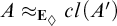 $A\approx _{\mathbf {E}_\lozenge } cl(A')$
and
$A\approx _{\mathbf {E}_\lozenge } cl(A')$
and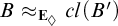 $B\approx _{\mathbf {E}_\lozenge } cl(B')$
. Thus,
$B\approx _{\mathbf {E}_\lozenge } cl(B')$
. Thus, $cl(A')\not \approx _{\mathbf {E}_\lozenge } cl(B')$
. Now, let
$cl(A')\not \approx _{\mathbf {E}_\lozenge } cl(B')$
. Now, let $\Delta (cl(A'))$
and
$\Delta (cl(A'))$
and $\Delta (cl(B'))$
be the set of disjuncts of
$\Delta (cl(B'))$
be the set of disjuncts of $cl(A')$
and
$cl(A')$
and $cl(B')$
, respectively. Then, by Lemma 6, either (i) there is a
$cl(B')$
, respectively. Then, by Lemma 6, either (i) there is a $\pi \in \Delta (cl(A'))$
such that for all
$\pi \in \Delta (cl(A'))$
such that for all $\tau \in \Delta (cl(B'))$
,
$\tau \in \Delta (cl(B'))$
, $\vert \pi \vert \neq \vert \tau \vert $
or (ii) there is a
$\vert \pi \vert \neq \vert \tau \vert $
or (ii) there is a $\pi \in \Delta (cl(B'))$
such that for all
$\pi \in \Delta (cl(B'))$
such that for all $\tau \in \Delta (cl(A'))$
,
$\tau \in \Delta (cl(A'))$
, $\vert \tau \vert \neq \vert \pi \vert $
. Suppose, without loss of generality, that (i) is the case. Then, there is a
$\vert \tau \vert \neq \vert \pi \vert $
. Suppose, without loss of generality, that (i) is the case. Then, there is a $\pi \in \Delta (cl(A'))$
such that for all
$\pi \in \Delta (cl(A'))$
such that for all $\tau \in \Delta (cl(B'))$
,
$\tau \in \Delta (cl(B'))$
, $\vert \pi \vert \neq \vert \tau \vert $
. So, there is a
$\vert \pi \vert \neq \vert \tau \vert $
. So, there is a $\pi \in \Delta (cl(A'))$
such that
$\pi \in \Delta (cl(A'))$
such that $\vert \pi \vert \notin \{\vert \tau \vert \subseteq \Lambda : \tau $
occurs as a disjunct in
$\vert \pi \vert \notin \{\vert \tau \vert \subseteq \Lambda : \tau $
occurs as a disjunct in $cl(B')\}$
. Hence, by Lemma 5, there is a
$cl(B')\}$
. Hence, by Lemma 5, there is a $\pi \in \Delta (cl(A'))$
such that
$\pi \in \Delta (cl(A'))$
such that $\vert \pi \vert \notin [cl(B')]^{M_c}_t$
. Thus, by Lemma 4,
$\vert \pi \vert \notin [cl(B')]^{M_c}_t$
. Thus, by Lemma 4, $\vert \pi \vert $
is a state
$\vert \pi \vert $
is a state $s\in S_c$
such that
$s\in S_c$
such that $s\Vdash cl(A')$
and
$s\Vdash cl(A')$
and $s\not \Vdash cl(B')$
. Hence,
$s\not \Vdash cl(B')$
. Hence, $cl(A')$
and
$cl(A')$
and $cl(B')$
are not exactly equivalent. But, by Soundness (Theorem 1), A is exactly equivalent to
$cl(B')$
are not exactly equivalent. But, by Soundness (Theorem 1), A is exactly equivalent to $cl(A')$
, and B is exactly equivalent to
$cl(A')$
, and B is exactly equivalent to $cl(B')$
. Therefore, A and B are not exactly equivalent, as desired.
$cl(B')$
. Therefore, A and B are not exactly equivalent, as desired.
Thus, $\mathbf {E}_\lozenge $
is complete with respect to exact equivalence in the class of all models.
$\mathbf {E}_\lozenge $
is complete with respect to exact equivalence in the class of all models.
We conclude by noting that a construction entirely analogous to the one just used for completeness may be used to establish that the modal logic of exact equivalence, $\mathbf {E}_\lozenge $
, is decidable. More precisely, we may first associate each state description
$\mathbf {E}_\lozenge $
, is decidable. More precisely, we may first associate each state description $\pi $
to the set of
$\pi $
to the set of $\pi $
-literals,
$\pi $
-literals, $lit(\pi )$
, by defining the function
$lit(\pi )$
, by defining the function $lit$
by induction on the degree n of
$lit$
by induction on the degree n of $\pi $
as follows:
$\pi $
as follows:
-
(i) If
$n=0$
, then
$lit(\pi )$
is the set of literals that occur as conjuncts in
$\pi $
. -
(ii) If
$n=m+1$
, then
$\pi =\bigwedge _{1\leq i\leq k}\lambda _i$
, and
$lit(\pi )$
is the set of literals that either occur as conjuncts in
$\pi $
, or are in
$lit(\tau )$
for some state description
$\tau $
such that
$\lozenge \tau $
or
$\neg \lozenge \tau $
occurs as a conjunct in
$\pi $
.





Then, given a normal form D, we define $lit(D)$
as
$lit(D)$
as $\bigcup _{\pi \in \Delta (D)} lit(\pi )$
(where
$\bigcup _{\pi \in \Delta (D)} lit(\pi )$
(where $\Delta (D)$
is the set of disjuncts of D). Finally, given any sentence of type
$\Delta (D)$
is the set of disjuncts of D). Finally, given any sentence of type $D_1\approx D_2$
, we let the canonical model for
$D_1\approx D_2$
, we let the canonical model for $D_1\approx D_2$
be the unique model
$D_1\approx D_2$
be the unique model $M=\langle S, \sqsubseteq , \mathrel {{\vartriangleright }}, \mathrel {{\blacktriangleright }}, \mathbf {tm}, \mathbf {fm}\rangle $
such that (i)
$M=\langle S, \sqsubseteq , \mathrel {{\vartriangleright }}, \mathrel {{\blacktriangleright }}, \mathbf {tm}, \mathbf {fm}\rangle $
such that (i) $S=\mathcal {P}(cr(lit(D_1)\cup lit(D_2)))$
Footnote
20
and (ii) M satisfies constraints (ii)–(vi) of Definition 11. We may then easily show that if
$S=\mathcal {P}(cr(lit(D_1)\cup lit(D_2)))$
Footnote
20
and (ii) M satisfies constraints (ii)–(vi) of Definition 11. We may then easily show that if $D_1\approx D_2$
is not derivable in
$D_1\approx D_2$
is not derivable in $\mathbf {E}_\lozenge $
, the canonical model for
$\mathbf {E}_\lozenge $
, the canonical model for $D_1\approx D_2$
is a countermodel to the exact equivalence between
$D_1\approx D_2$
is a countermodel to the exact equivalence between $D_1$
and
$D_1$
and $D_2$
(i.e., it is a model in which
$D_2$
(i.e., it is a model in which $D_1$
and
$D_1$
and $D_2$
do not have the same exact verifiers). Thus,
$D_2$
do not have the same exact verifiers). Thus, $D_1\approx D_2$
will be derivable in
$D_1\approx D_2$
will be derivable in $\mathbf {E}_\lozenge $
if, and only if,
$\mathbf {E}_\lozenge $
if, and only if, $D_1$
and
$D_1$
and $D_2$
have the same exact verifiers in the canonical model for
$D_2$
have the same exact verifiers in the canonical model for $D_1\approx D_2$
. Since the set of states of a canonical model for a sentence of type
$D_1\approx D_2$
. Since the set of states of a canonical model for a sentence of type $D_1\approx D_2$
is always finite, we have an effective procedure to check whether
$D_1\approx D_2$
is always finite, we have an effective procedure to check whether $D_1$
and
$D_1$
and $D_2$
have the same exact verifiers in the canonical model for
$D_2$
have the same exact verifiers in the canonical model for $D_1\approx D_2$
. Thus, we have an effective procedure to determine whether a sentence of type
$D_1\approx D_2$
. Thus, we have an effective procedure to determine whether a sentence of type $D_1\approx D_2$
(where
$D_1\approx D_2$
(where $D_1$
and
$D_1$
and $D_2$
are normal forms) is derivable in
$D_2$
are normal forms) is derivable in $\mathbf {E}_\lozenge $
. Since we also have an effective procedure that associates each formula
$\mathbf {E}_\lozenge $
. Since we also have an effective procedure that associates each formula $A\in \mathcal {L}_\lozenge $
to a provably equivalent normal form, this suffices to guarantee that
$A\in \mathcal {L}_\lozenge $
to a provably equivalent normal form, this suffices to guarantee that $\mathbf {E}_\lozenge $
is decidable.Footnote
21
$\mathbf {E}_\lozenge $
is decidable.Footnote
21
6 Conclusion
I conclude by briefly reviewing the main results. In §2, I presented an inclusive exact TMS for the language of propositional modal logic, obtained by replacing some of the clauses adopted in Kim’s [Reference Kim12] semantics with the appropriate inclusive counterparts. Then, in §3, I introduced $\mathbf {E}_\lozenge $
, an axiomatic system for exact equivalence, and I showed that this system is sound with respect to the semantics presented in §2. In §4, I showed that
$\mathbf {E}_\lozenge $
, an axiomatic system for exact equivalence, and I showed that this system is sound with respect to the semantics presented in §2. In §4, I showed that $\mathbf {E}_\lozenge $
supports a generalization of the disjunctive normal form theorem, reminiscent of Fine’s [Reference Fine2] normal form theorems for systems of normal modal logic. Finally, in §5, I used this normal form theorem to establish
$\mathbf {E}_\lozenge $
supports a generalization of the disjunctive normal form theorem, reminiscent of Fine’s [Reference Fine2] normal form theorems for systems of normal modal logic. Finally, in §5, I used this normal form theorem to establish $\mathbf {E}_\lozenge $
’s completeness and decidability, by adapting the standard techniques used to prove completeness for the propositional logic of exact equivalence developed by Correia [Reference Correia1] and Fine and Jago [Reference Fine and Jago9].
$\mathbf {E}_\lozenge $
’s completeness and decidability, by adapting the standard techniques used to prove completeness for the propositional logic of exact equivalence developed by Correia [Reference Correia1] and Fine and Jago [Reference Fine and Jago9].
Despite the present results, much work remains to be done. In particular, I have said nothing on how the axiomatization of the modal logic of exact equivalence we presented may be extended to an axiomatization of the modal logic of exact consequence (i.e., preservation of exact verifiers). Moreover, we have dealt exclusively with exact equivalence between modal sentences, leaving open the question of how to extend Correia’s [Reference Correia1] results to languages containing quantifiers. For these reasons, the present work should be considered part of a broader project, whose aim is to develop a satisfactory hyperintensional account of propositional identity that applies to both modal propositions and generalizations. I plan to develop this broader project in future work.
Acknowledgments
I would like to express my special thanks to Kit Fine for conversations on this material and for suggestions that led to the results here presented. I am also grateful to Fabrice Correia and two anonymous reviewers for their helpful comments and for noticing a mistake in the completeness argument given in an earlier draft.
Funding
I gratefully acknowledge the support of the Swiss National Science Foundation project “Higher-Order Metaphysics: Foundations, Applications, and Hyperintensional Developments” (Grant No. 10005133).





















































 Open access

