


Introduction
Niemeyer et al. (Reference Niemeyer, Veri, Dryzek and Bächtiger2024) recently shed light on the dynamics of deliberative reasoning within minipublics. Of their findings, the effect of conducting group-building activities at the beginning of deliberation significantly fosters participants’ abilities to reason effectively. Group building is not just about social bonding; it is also a condition for the group to self-generate deliberative norms and set the cognitive stage for better engagement with and shared understanding of complex issues. Their finding that such activities are crucial for activating latent deliberative potential among citizens yields important implications for both deliberative design as well as highlighting the importance of non-procedural settings for deliberative quality. The ability to draw findings such as this was facilitated by the use of the Deliberative Reason Index (DRI), which provides a substantive (as opposed to procedural) measure of how humans collectively recognize and integrate reasons that are identified as relevant for a shared decision-making process. In this respect, the DRI captures the argumentative nature of human reasoning, aligning with Mercier and Sperber’s (Reference Mercier and Sperber2011) view that reasoning is inherently an intersubjective process. This process involves building and updating mutual understanding, where group dynamics help correct individual judgement under deliberative conditions by creating a shared representation of the issues at stake.
Niemeyer et al. (Reference Niemeyer, Veri, Dryzek and Bächtiger2024) focus their study on the dynamics of how deliberation improved, overlooking factors potentially leading to counter-deliberation. This aspect is critical, as such factors often intrinsic to representative democracy might play a pivotal role in shaping the deliberative process.
The examples of deploying voting procedures and deliberation among groups with higher issue stakes are relevant here. Voting and deliberation are often considered compatible, particularly when following the ‘deliberate, then vote’ sequence. Yet, voting, at its core, is a mechanism for aggregating individual preferences to reach a collective decision. When it carries a substantial decision-making impact, it can enhance engagement with the topic at hand (Carreras, Reference Carreras2016; Franklin, Reference Franklin1996). However, because it relies on preference aggregation rather than the exchange and integration of reasons, it remains intrinsically non-deliberative. Additionally, voting may concentrate engagement within a smaller subset of highly engaged participants, particularly among individuals who perceive a sense of personal control (Britt, Reference Britt2003) or perceived individual effect (Franklin, Reference Franklin1996), potentially limiting broader deliberative involvement. Thus, while voting’s engagement potential is acknowledged, from a deliberative standpoint, if voting becomes the primary focus of deliberation, this may unintentionally narrow issue framing, reduce incentives for reasoned deliberation, and allow pathologies such as motivated reasoning (e.g., Kunda, Reference Kunda1990), where individuals favour information aligning with their personal pre-existing beliefs, to dominate, ultimately neglecting perspectives that challenge these biases. Similarly, deliberation among stakeholders (defined broadly here as participants who have a particular interest, proximity, or stake in the issue being considered) risks shared reason is based on a narrower set of considerations – from strategic considerations among those with particular interests (similar to concerns raised by Kahane et al., Reference Kahane, Loptson, Herriman and Hardy2013) to technical considerations among experts at the expense of collective normative judgements. These situations risk limiting mutual problem-solving to pursuing particular agendas based on a narrow range of considerations, leading to discordance and paralysis rather than mutual understanding, integration, and synthesis.
Although these liberal factors could significantly explain differences in deliberative reasoning across minipublics, Niemeyer et al. (Reference Niemeyer, Veri, Dryzek and Bächtiger2024) did not include them in their analysis. This omission was likely due to the low variability of these traits in their sample. Specifically, only two out of nineteen minipublics in their study were composed of stakeholder groups. With such limited representation, there wasn’t enough variability to reliably estimate the corresponding regression coefficients, leading to potential estimation bias. This issue is discussed in their appendix, where they also identify significant multicollinearity between variables related to voting procedures and group-building activities in their dataset.
Here we set out to overcome these constraints to conduct a targeted exploration of dynamics determining the absence and the presence of improving deliberative reason in minipublics. Our enquiry incorporates 22 distinct cases, broadening the scope of the investigation by Niemeyer et al. (Reference Niemeyer, Veri, Dryzek and Bächtiger2024). Our expanded lens incorporates liberal elements in deliberation, particularly emphasizing the potential causal impact of anticipated voting procedures and deliberation by stakeholder groups in minipublic settings. To systematically dissect complex dynamics, we employ the Configurational Comparative Meta-Analysis (CCMA) method (Veri and Barrowman, Reference Veri and Barrowman2022), which converts effect sizes of a dependent variable (specifically standardized mean differences like Hedges’ G) into a fuzzy set format (Veri and Barrowman, Reference Veri and Barrowman2022). The approach facilitates the exploration of context-specific causal relationships associated with particular treatments or exposures through qualitative comparative analysis (QCA) (Ragin, Reference Ragin2000; Rihoux and Ragin, Reference Rihoux and Ragin2008). CCMA extends the scope of standard quantitative analysis via the identification of common causal pathways across cases and then examining the specific details within each case.
Core concepts: deliberative reasoning
Minipublics are designed around dialogical and discursive principles, which emphasize the importance of discussion, argumentation, and mutual engagement among participants. These deliberative settings aim not only to generate outcomes but also to foster shared and reasoned representations of the issues at stake. In this process, reasoning is not simply an individual cognitive exercise but an inherently social, argumentative one, as per Mercier and Sperber’s (Reference Mercier and Sperber2011) argumentative theory of reasoning. According to their model, human reasoning is most effective in a social context where individuals present and defend arguments and where group dynamics play a crucial role in correcting biases, errors, and individual judgments. Under deliberative contexts, participants engage in a dialogue where the exchange of arguments helps refine and improve their understanding of the issues. Group deliberation serves to update and enhance shared representations of the issues, creating a more reasoned, collective outcome. In this context, deliberative reasoning is defined as a collaborative process in which individuals engage in two core activities: first, they reciprocally acknowledge the relevance of others’ considerations (reasons reciprocity), and second, they integrate these considerations into a coherent decision (reasons integration). This process involves more than merely sharing reasons; it builds an argumentative framework where participants mutually recognize and validate each other’s perspectives (aligned with Arendt’s concept of enlarged mentality) and work together to form a decision that reflects a collective reasonable consistency. A key feature of deliberative reasoning is, therefore, metaconsensus – the capacity of participants to incorporate a diversity of viewpoints into a shared understanding of relevant considerations and their implications for collective decision-making (Dryzek and Niemeyer, Reference Dryzek and Niemeyer2006).
The realization of these conditions creates intersubjective regularities within the group, aligning values and beliefs with the preferences shaped by those shared considerations. Empirically, these regularities can be measured through surveys designed to capture individuals’ reasons and evaluate the consistency with which these reasons inform preferences (Niemeyer and Veri, Reference Niemeyer, Veri, Ercan, Asenbaum, Mendonça and Curato2022). Such surveys can reveal the extent to which shared beliefs align with decision-making preferences within the group, resulting in what is termed intersubjective consistency. This is measured by examining how consistently pairs of individuals agree or disagree on their responses to key considerations and rank their preferences for possible actions. These pairwise results are then aggregated to produce the DRI. According to Niemeyer et al. (Reference Niemeyer, Veri, Dryzek and Bächtiger2024), this approach uniquely represents a substantive measure of deliberative quality grounded in deliberative theory, emphasizing intersubjective quality as an emergent property that does not rely on predetermined judgements of outcomes.
The complexity of deliberative reason
The use of regression analysis as a multilevel modelling technique in Niemeyer et al. (Reference Niemeyer, Veri, Dryzek and Bächtiger2024) allowed for the discovery of both the magnitude of the linear net effect of each variable on DRI levels and the additive relationships between variables, including interactive terms. In particular, they found significant positive effects associated with group building and negative effects associated with increasing issue complexity. Their analysis also found significant interactions between variables, with group building, overcoming the negative impact of complexity and enhancing participants’ capacity for effective deliberative reasoning, even under challenging conditions (Niemeyer et al., Reference Niemeyer, Veri, Dryzek and Bächtiger2024). This approach made it possible to estimate how each variable affected DRI levels, providing a comprehensive understanding of their impact. However, while linear models are effective in identifying cross-case variation and additive interaction effects by controlling all factors, they are inherently inadequate in asymmetrically modelling multiple causal path processes and isolating the specific causal role of each factor in an outcome (e.g., Gerrits and Pagliarin, Reference Gerrits and Pagliarin2021). Referring to our research goal, the analysis suggested by Niemeyer et al. (Reference Niemeyer, Veri, Dryzek and Bächtiger2024) does not directly pinpoint the respective qualitative, complex causal relationship in-between each variable. Given this concern, it is important to remain open to the possibility that deliberative reason levels may rely on the configuration of different factors.
In general, social reality emerges from a complex web of interconnected factors that collectively produce specific outcomes, making it difficult to pinpoint a single cause (Mackie, Reference Mackie1980). Each factor contributes to a distinct causal role, influencing others within a shared context. Mahoney and Snyder (Reference Mahoney and Snyder1999) emphasize that actors’ roles in generating outcomes depend on their integration within a particular context, highlighting the importance of an actor-based, process-oriented approach to understanding causal structures. Yet, each factor – such as group building activities, issue complexity, duration, decision-impact, voting procedure, and stakeholders’ presence – may decrease or increase deliberative reasoning depending on how they are configured within each other. In this regard, factors may have specific causal roles that are triggered only when combined with other factors, meaning that one cause alone may not be sufficient to lead to higher (or lower) deliberative reason changes. As detailed in Table 1, each factor can be categorized based on its actor, structural, and functional relationships, aligning with the frameworks proposed by Mahoney and Snyder (Reference Mahoney and Snyder1999).
Factors and potential causal role

From earlier discussion, actor-centered factors in the model pertain to the type of participants that constitute the deliberative group – – stakeholder or lay citizens – – with each type responding differently, for example, to the extent of causal influence on the policy outcome. This may be particularly true for primary stakeholders, whose stakes are directly tied to the outcomes of the deliberation. In our cases, the primary stakeholders – members of genetic conditions support groups in the Australian Biobanking initiative and regional stakeholders directly affected by the process as government agencies or landowners for the North-Central New Mexico Landscape Assessment (ForestERA) process – may focus primarily on the aspects that most immediately affect their well-being or responsibilities, potentially overlooking broader concerns that fall outside their direct interests. Nonetheless, citizens are undoubtedly subject to cognitive biases, as evidenced by studies like Downs (Reference Downs1959) on rational ignorance, Abramowitz and Saunders (Reference Abramowitz and Saunders2008) on polarization, and Kunda (Reference Kunda1990) as well as Druckman et al. (Reference Druckman, Peterson and Slothuus2013) on motivated reasoning. On the one hand, biases can entrench participants’ views, shaping their engagement within the deliberative process. On the other hand, deliberation can enable citizens to engage in broader reasoning beyond narrow self-interest. This potential for open-mindedness is more likely to be activated in purely dialogical settings, under ideal conditions highlighted by group-building (e.g., Niemeyer et al., Reference Niemeyer, Veri, Dryzek and Bächtiger2024). This is also sustained by Veri (Reference Veri2025), who emphasizes that such settings are particularly advantageous for individuals with low stakes in the discussion or limited political motivation, as they create an environment conducive to broader engagement and integrative reasoning.
As alluded to above, the behaviour of these actors may vary depending on the contextual-structural settings, such as the positive effect of group building identified by Niemeyer et al. (Reference Niemeyer, Veri, Dryzek and Bächtiger2024). In this respect, we can also reasonably hypothesize that longer deliberative processes (measured in days) might be supposed to count for deliberation as outlined by Curato et al. (Reference Curato, Dryzek, Ercan, Hendriks and Niemeyer2017), permitting exploration of the issue and increasing the prospect of intersubjective understanding. Participants have more time to reflect, absorb information, and develop well-considered viewpoints, contributing to a more informed and nuanced discussion. Conversely, the structuring of deliberation according to anticipated output or (in formal terms) end rule (as voting) may also impact deliberative reason. Deliberative outputs via group reports documenting reasoning – akin to Citizens’ Initiative Reviews (e.g., Gastil, Reference Gastil2014) – – might better incentivize deliberative reason than voting and aggregation. The former is inherently deliberative, albeit demanding. That latter is straightforward. However, the structure of voting processes within deliberation can have a contrasting effect. When deliberations are overly focused on reaching a vote, it can lead to a narrowing of the discussion, where participants might prioritize their preferences over in-depth reasoning. The outcome focusing on voting may even induce strategic behaviour, particularly where high-stakes direct influence on the decision is involved; here, deliberators with strong views might be partisan for one specific outcome, narrowing down the integration of other reasons.
The influence on a decision represents a functional factor – – i.e., the role a factor plays in contributing to an outcome. The legitimacy of the decision-making impact of minipublics is much in focus (Lafont, Reference Lafont2015), but here we are concerned with the distorting effects on internal deliberative reason. Based on Jennstål (Reference Jennstål2018), higher stakes may encourage self-selection among those motivated to seek influence and de-selection among conflict-averse individuals, suggesting that traits like extraversion and openness increase the likelihood of engaging in deliberation when an instrumental benefit, such as policy influence, is perceived. As a consequence, self-selection may pose great challenges in deliberative settings by shaping individual instrumental dynamics within the deliberation process. Finally, issue complexity provides a functional context for reasoning. However, as mentioned previously, in isolation, it produces lower levels of DRI, which are counterbalanced by group-building activities (Niemeyer et al., Reference Niemeyer, Veri, Dryzek and Bächtiger2024). It can be expected that this relationship is symmetrically inverted, with low levels of complexity leading to higher DRI.
Sample and analyses
Our study extends the groundwork laid by Niemeyer et al. (Reference Niemeyer, Veri, Dryzek and Bächtiger2024) by incorporating their dataset along with data from three recent minipublic experiments in Switzerland. In total, we analysed 22 minipublics, involving 427 participants. This number represents the full range of minipublics where the DRI has been measured to date (refer to Table 2 for a detailed breakdown).
Study cases and participants’ numbers
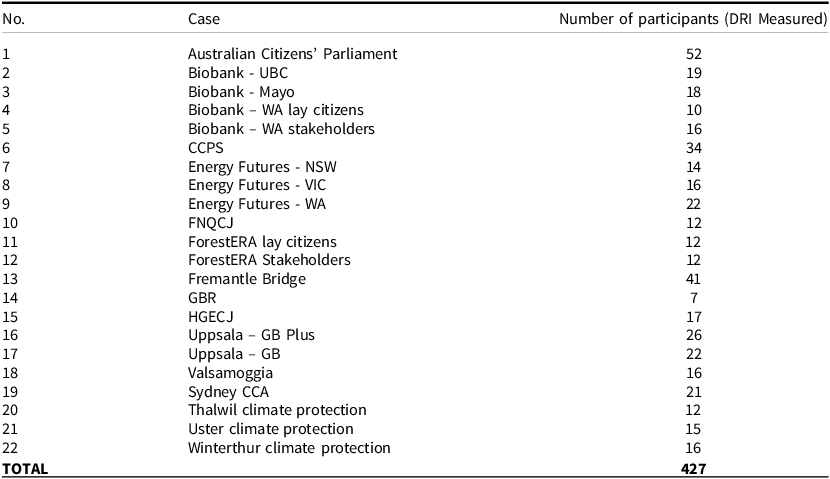
The analysis is divided into two parts. Initially, the procedure entails the computation of standardised mean differences, employing specifically Hedges’ G (Hedge, Reference Hedges1981) as a metric, supplemented by the examination of their corresponding levels of statistical significance. This allows us to assess the magnitude and statistical significance of DRI effects in minipublics while accounting for variations in the number of participants. Crucially, it also addresses potential biases arising from small sample sizes. Consequently, this enhances both the reliability and validity of our findings, ensuring a more accurate representation of the effects we are investigating.
The resulting effect size will serve as a dependent outcome for our subsequent CCMA-QCA analytical stage. QCA represents the second step in our analysis, aimed at identifying the conditions under which we observe significant positive effects in DRI. Following from earlier discussion, the use of QCA overcomes the limitations of covariational approaches as meta-regression alluded to above (and detailed in the online Appendix) in three keyways:
-
(1) Firstly, the decision to utilize QCA is informed by the specific characteristics of our data set. We are dealing with low-frequency variables, such as the participation of stakeholders (STAKEHOLDER), and, in the meta-regression analysis, noted substantial multicollinearity (Table A1 – Appendix), particularly between variables like GROUP BUILDING and VOTING (showing Variance Inflation Factor (VIF) values of 3.2 and 3.4, respectively). QCA is well-suited for this scenario, effectively addressing low-frequency variables and multicollinearity through its case-based Boolean approach, which identifies causal differences and overcomes limitations of traditional statistical methods reliant on covariational dependency (Baumgartner, Reference Baumgartner2009).
-
(2) Secondly, our analytical objective extends beyond statistical correlation to understanding nuanced changes in DRI. In line with Gerrits and Pagliarin (Reference Gerrits and Pagliarin2021), QCA is a diversity-oriented methodology that treats each case as a unique configuration of factors and outcomes, enabling the analysis of contingent causal structures. Applied at a meta-level (Veri and Barrowman, Reference Veri and Barrowman2022), this approach explains effect size heterogeneity by examining actor-based, structural-based, and functional-based factors in context. It identifies equifinal configurations – diverse combinations of factors leading to the same outcome – revealing multiple pathways contributing to positive changes in DRI.
-
(3) Finally, our analytical target is to delve into a deeper understanding of changes in deliberative reasons with a particular interest in exploring not just positive effects but also the negative or absence of effects. QCA’s asymmetrical approach allows us to examine these dimensions comprehensively and explore the possible negative role of non-deliberative features within deliberative processes.
Deliberative reasoning changes magnitude
The magnitude of the effect size is calculated using Hedges’ G (Hedges, Reference Hedges1981), representing the standardized mean difference that accounts for sample size bias between pre- and post-deliberative DRI across the 22 cases. Restricted Maximum Likelihood Estimation (REML) is used due to the relatively small sample size and high effect size. Figure 1 shows the results, including an overall average positive and significant effect size of 0.89. As for Niemeyer et al. (Reference Niemeyer, Veri, Dryzek and Bächtiger2024), deliberation has a strong positive impact on DRI before considering specific design effects.
Standardised mean difference between pre- and post-deliberation DRI (22 Cases).
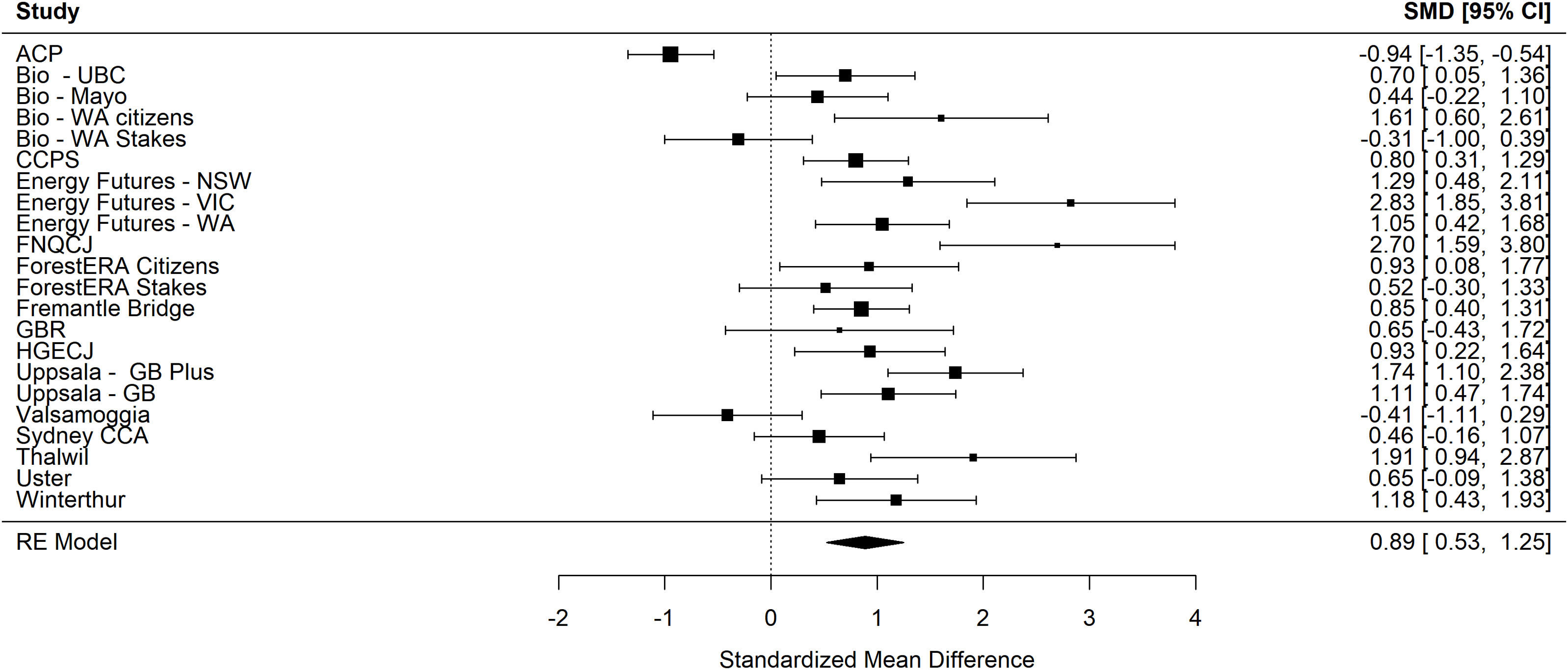
There is, however, considerable variability of effect in Figure 1, with the majority of cases (14 out of 22) showing a significant and positive effect size; others showing a positive but not significant effect size (5 out of 22), non-significant negative (2 out of 22), or significant negative (1 out of 22). The variability is confirmed by the estimated model parameters (τ 2 = 0.6115) reflecting the dispersion of effect sizes between cases; and I2 (83.67%) measuring the percentage of observed variance, with values above 75% considered high. The Q value (Q = 139.61) similarly indicates significant effect size heterogeneity – i.e., that the DRI change effect is not consistent, reflecting potential variability due to factors like those indicated in Table 1 or a combination thereof.
Configurational comparative meta-analysis - qualitative comparative analysis
To begin CCMA-QCA analysis, we calibrated all factors specified in Table 1, along with the effect size magnitude, into fuzzy sets as a preliminary step. The calibration process facilitates the transformation of diverse types of data into comparable sets, thereby enabling the identification of complex causal structures that rely on the unique causal role of each factor rather than their additive power. Data is calibrated into fuzzy sets (0 to 1), which are inserted into truth tables and minimized into Boolean expressions.
Calibration details are provided in the Appendix (Table B1), following the guidelines from Niemeyer et al. (Reference Niemeyer, Veri, Dryzek and Bächtiger2024) and other relevant sources. For example, we calibrated the complexity level using Niemeyer et al.’s (Reference Niemeyer, Veri, Dryzek and Bächtiger2024) complexity coding, which aggregates a 1–4 ordinal scale based on three attributes: remit breadth, informational burden, and geographical scale. Additionally, the Hedges’ G effect size was transformed according to Veri and Barrowman (Reference Veri and Barrowman2022) and Dunlop et al. (Reference Dunlop, Maggetti, Radaelli and Russel2012). Another example includes setting a threshold for short duration, and defining minipublics shorter than the median length of three days, as found in the OECD minipublic dataset (OECD, 2020).
Truth table minimization strategies are conducted according to Enhanced Standard Analysis (ESA) (Schneider and Wagemann, Reference Schneider and Wagemann2013) procedures, which exclude contradictory simplifying assumptions from the minimization procedure. The complete suite of QCA is documented in the Appendix. This includes the calibration process and an analysis of necessity, revealing that, in our case, there are no necessary conditions. Additionally, both the parsimonious and conservative solution terms are detailed therein, ensuring a thorough and transparent presentation of the analytical process.
Table 3 shows the different configurations of factors that are causally associated with high levels of DRI effect size, as well as their consistency scores (i.e., Cons), which provide insight into the strength of the causal relationship of sufficiency; the product in reduction in consistency score (PRI) (Schneider and Wagemann Reference Schneider and Wagemann2012), which is a parameter to check the logical robustness of the solution formula; the coverage score (CovS and CovU), which indicate the empirical relevance of the solution formula (Veri Reference Veri2018), and the two-sample test for ambivalent subset relationships (Veri, Reference Veri2024) which check for presence of false-positive results. While the coverage score is mainly indicative of which cases are included within the solution formula, consistency, and a PRI above 0.75 (or as in our case above 0.83) usually indicate very strong sufficient relationships.
Solution terms for significant and high levels of DRI effect sizes

Note: Frequency threshold: 1; Consistency threshold: 0.7; PRI threshold: 0.65; two-sample test: P = 0.017* and P = 0.005***
QCA solution terms for strong positive effects of DRI suggest that a deliberative process involving lay citizens (∼STAKEHOLDER), low complexity of the issue (∼COMPLEXITY), and high decision-making impact (DECISION) is sufficient for improving DRI. More specifically, the results indicate that deliberative reason improves among lay citizens where issue complexity is low, and decision impact is high, consistent with our expectations. The cases covered by this solution formula typically involve pragmatic and less ideologically driven issues, such as infrastructure projects like building a bridge (e.g., the Fremantle case). These types of projects presumably involve lower levels of polarising deselection or self-selection mechanisms.
A second causal path highlights that to have positive and significant levels of DRI effects, a deliberative process should involve lay citizens (∼STAKEHOLDER), high levels of group building (GROUP), a long duration of the deliberative process (LENGTH), absence of voting procedures (∼VOTING), and low decision-making impact (∼DECISION). This path elaborates on the roles of duration and group building as highlighted in Niemeyer and colleagues’ study. Our analysis clarifies that while high levels of group building are crucial, they must be complemented by sufficient time. Conversely, the duration of the deliberative process alone is not enough to enhance deliberative reasoning unless paired with effective group-building activities. The optimal environment for enhancing the deliberative skills of lay citizens is created through extended durations, which amplifies the impact of group-building activities. This setup presumably enables participants, particularly those who are less educated or informed, to become more confident in the deliberative process, in their interactions with peers, and in their engagement with the subject matter. Interestingly, the absence of voting procedures and decision-making impact does not negate the positive influence of extended duration and group building. This suggests that voting procedures might, in fact, contradict group-building efforts by funnelling reasoning into strategic, often binary, decision-making functions.
Absence of positive DRI effect size
QCA is a non-linear analytical technique that allows for the isolation of asymmetric causal relationships between the conditions and the absence of the outcome of interest. In our case, as displayed by Table 4, QCA enables us to find under which configuration of conditions deliberative reason effects are not positive or not significant.
QCA analysis for low levels of DRI change

Note: Frequency threshold: 1/Consistency threshold: 0.7/PRI threshold: 0.65; two-sample test: P < 0.001*** and P < 0.0001***
Low, non-significant, or negative levels of DRI effect size happen to occur in situations where deliberative processes involving stakeholders (STAKEHOLDER) intersect with high-impact decision-making (DECISION). However, while decision impact has been shown to positively influence DRI effect size in cases where issues are not particularly complex, the same condition in conjunction with stakeholder participation has been found to have a negative effect on deliberative reason.
Existing literature has already suggested that stakeholders tend to exhibit a lower level of discursive respect, which could indirectly contribute to this negative outcome (Pedrini, Reference Pedrini2014). Our analysis further highlights a tendency among stakeholders to exhibit a lack of propensity for deliberative reason, particularly in cases where the issue at hand has a significant direct implication for the polity. This indicates that stakeholders’ reasoning tends to become particularly non-deliberative in decision-making contexts where their choices have a tangible impact and involve personal interests, especially when they are directly affected by the outcomes.
A second causal pathway highlights the role of voting procedures (VOTING) in conjunction with short deliberative processes (∼LENGTH), the absence of group-building procedures (∼GROUP), and decision-making (∼DECISION). This path may suggest that this particular configuration of conditions is especially challenging, as participants working within a short timeframe and relatively low level of decision impact complexity may be inclined to rely on pre-formed preferences as a shortcut rather than fostering a thorough exchange and integration of reasons, which a longer deliberation might otherwise encourage. This reliance on pre-formed preferences can inhibit comprehensive deliberation, as voting in such settings tends to discourage justification and intersubjective reasoning. In these contexts, preferences are funneled into limited choices without the need for deeper reflection.
Yet, as illustrated in the case of Valsamoggia, an improvised vote within a short-duration deliberative process can disrupt dialogic exchange, transforming participants into strategic partisans who narrow their reasoning to symbolic stances. This shift, as Felicetti et al. (Reference Felicetti, Niemeyer and Curato2016) suggest, constrains the deliberative potential of minipublics by imposing an aggregative logic that oversimplifies nuanced positions. In Valsamoggia, the goal of deliberation shifted from fostering open dialogue to swiftly achieving a predetermined vote. This shift pushed participants into rapidly directing their reasoning towards fixed positions, ultimately undermining the deliberative quality of the process.
Limitations
This study presents configurations that influence DRI levels, highlighting causal paths associated with both high and low deliberative quality. However, two main limitations should be acknowledged.
First, although the sample includes all cases where the DRI was measured, the range of configurations examined may still be insufficiently comprehensive. Indeed, despite the study’s attempt to map out various causal paths, the sample lacks cases where certain factors coexist, such as voting procedures alongside group-building activities. This absence limits our understanding of potentially significant configurations, as we cannot ascertain how these combined elements might influence DRI outcomes. Future studies would benefit from incorporating more cases with diverse combinations of liberal democratic practices to better generalize these findings. Yet, on the other hand, it is also true that QCA is a case-based approach, which makes the findings valid specifically for this set of cases.
Second, while this analysis identifies causal paths primarily linked to low issue complexity levels, complexity itself does not emerge as a driver for DRI levels. Although Niemeyer et al. (Reference Niemeyer, Veri, Dryzek and Bächtiger2024) noted that group-building activities can mitigate the challenges associated with complex issues, our findings indicate that complexity does not consistently explain high (or low) DRI levels. This is primarily because cases with high complexity show considerable variance across DRI outcomes. This variability suggests that complexity may serve as a causally redundant factor within our configurations, hinting at the potential influence of other, perhaps unanticipated, factors associated with it.
Conclusion
In summary, our analysis highlights the complex interplay of factors influencing deliberative reasoning effect size, with primary stakeholder participation and voting procedures emerging as particularly salient in leading to negative or negligible effects on deliberative reasoning within deliberative processes. Conversely, examining positive effects underscores the importance of group-building procedures and extended deliberative durations to effectively trigger and stimulate deliberative reasoning.
A notable and intriguing outcome of our study is the observed potential for lay citizens to exhibit higher levels of deliberative reason than those who are directly affected by the issues at hand and therefore presumed to be better informed – commonly regarded as primary stakeholders in decision-making. These findings challenge conventional assumptions about the advantage of direct involvement in political discourse and highlight the intrinsic value that diverse, less directly invested perspectives can bring to deliberative quality. As discussed earlier, deliberative processes that exclude certain liberal elements, such as voting mechanisms or the involvement of stakeholders with direct stakes, tend to create optimal conditions for lay citizens to express their full reasoning potential. Without these non-liberal settings, lay citizens are less likely to engage in the reciprocal recognition and integration of relevant reasons, which are key characteristics of the DRI and essential to effective decision-making.
This analysis highlights the significant role those deliberative intermediaries or ‘meaning-making’ institutions can play. These entities could act as facilitators to lessen the cognitive load on individuals, thereby enhancing the quality of political judgment. This aligns with Warren and Gastil’s (Reference Warren and Gastil2015) proposition, suggesting that such intermediaries can be instrumental in distilling complex information, making it more accessible and comprehensible.
Supplementary material
The supplementary material for this article can be found at https://doi.org/10.1017/S1755773925000050.
Acknowledgments
NA.
Competing interests
The authors declare not potential conflicts of interest with respect to the research, authorship and/or publication of this article.


 Open access

