

1. Introduction
Tropical geometry studies algebraic varieties through their combinatorial shadows – tropical varieties (defined by tropical polynomials) – thus allowing for the use of a broader range of (combinatorial) tools. Some applications of tropical methods include computing Gromov-Witten invariants due to Mikhalkin in [ Reference Mikhalkin20 ], tropical proof of the Brill–Noether Theorem [ Reference Cools, Draisma, Payne and Robeva5 ], Brill–Noether theory for curves of a fixed gonality [ Reference Jensen and Ranganathan10 ], developing a strategy to attack the Riemann hypothesis [ Reference Connes and Consani4 ], the Gross-Siebert program in mirror symmetry [ Reference Gross8 ], and studying toric degenerations [ Reference Kaveh and Manon15 ].
In tropical geometry most algebraic computations are done on the classical side by using the algebra of the original variety. The theory developed so far has explored the geometric aspect of tropical varieties as opposed to the underlying (semiring) algebra. There are still many commutative algebra tools and notions without a tropical analogue. Understanding the underlying algebraic structures can complement the existing tropical methods. For instance, the algebraic data associated to a tropical variety is often the only way to determine if a geometric object with the combinatorial properties of a tropical variety arises from an algebraic variety. The fact that this is not always the case can be a major obstruction to using tropical methods to solve enumerative problems.
In the recent years, there has been a lot of effort dedicated to developing the necessary tools for commutative algebra using different frameworks. Among these are the arithmetic and scaling cite [
Reference Connes and Consani2, Reference Connes and Consani3
], blueprints [
Reference Lorscheid13
], tropical ideals [
Reference Maclagan and Rincón16, Reference Maclagan and Rincón17
], tropical schemes [
Reference Giansiracusa and Giansiracusa7
], super-tropical algebra [
Reference Izhakian and Rowen9
], systems [
Reference Rowen21
], and prime congruences [
Reference Joó and Mincheva11
]. These approaches aim for the exploration of the properties of tropicalised spaces without tying them up to the original varieties and working with geometric structures inherently defined in characteristic one, that is, over additively idempotent semifields. We are mostly interested in the case when the underlying semifield is the tropical semifield ${\mathbb{T}}$
. It is the set
${\mathbb{T}}$
. It is the set $\{ \mathbb{R} \cup \{-\infty\}\}$
with two operations: maximum playing the role of addition and addition acting as multiplication.
$\{ \mathbb{R} \cup \{-\infty\}\}$
with two operations: maximum playing the role of addition and addition acting as multiplication.
In the polynomial semiring and the Laurent polynomial semiring over ${\mathbb{T}}$
, there is no bijection between ideals and congruences, equivalence relations that respect the operations. For this reason we often need to work with both ideals and congruences. To an ideal, in fact to any set, one can associate a congruence relation, having geometric meaning, called a bend congruence. These congruences were originally introduced in [
Reference Giansiracusa and Giansiracusa7
], see Definition 2·2. Bend congruences are generated by the so called bend relations of all polynomials in the ideal (or set). Conversely, to a congruence C, one can associate the ideal
${\mathbb{T}}$
, there is no bijection between ideals and congruences, equivalence relations that respect the operations. For this reason we often need to work with both ideals and congruences. To an ideal, in fact to any set, one can associate a congruence relation, having geometric meaning, called a bend congruence. These congruences were originally introduced in [
Reference Giansiracusa and Giansiracusa7
], see Definition 2·2. Bend congruences are generated by the so called bend relations of all polynomials in the ideal (or set). Conversely, to a congruence C, one can associate the ideal $\mathcal{I}_{C}$
of all polynomials, whose bend relations are contained in the congruence. If
$\mathcal{I}_{C}$
of all polynomials, whose bend relations are contained in the congruence. If $\mathcal{I}_{Bend(I)} = I$
then we say that the ideal I is
$\mathcal{I}_{Bend(I)} = I$
then we say that the ideal I is ${\it{closed}}$
. Examples of closed ideals are the tropical ideals as shown in [
Reference Maclagan and Rincón16
]. Tropical ideals are arguably the most important class of ideals as they fully capture the algebra of tropical varieties. However, tropical ideals often cannot be described by a finite amount of data which makes working with them hard.
${\it{closed}}$
. Examples of closed ideals are the tropical ideals as shown in [
Reference Maclagan and Rincón16
]. Tropical ideals are arguably the most important class of ideals as they fully capture the algebra of tropical varieties. However, tropical ideals often cannot be described by a finite amount of data which makes working with them hard.
In our first two results we classify prime tropical ideals and the varieties of all prime ideals. We use the relation between ideals and the associated bend congruences, and the theory of prime and geometric prime congruences developed in our previous work [
Reference Joó and Mincheva11
]. A prime congruence C on ${\mathbb{T}[x_1, \dots, x_n]}$
(resp.
${\mathbb{T}[x_1, \dots, x_n]}$
(resp.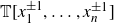 ${\mathbb{T}[x_1^{\pm 1}, \dots, x_n^{\pm 1}]}$
) is an equivalence relation that respects the operations and the quotient
${\mathbb{T}[x_1^{\pm 1}, \dots, x_n^{\pm 1}]}$
) is an equivalence relation that respects the operations and the quotient ${\mathbb{T}[x_1, \dots, x_n]}/C$
(resp.
${\mathbb{T}[x_1, \dots, x_n]}/C$
(resp. ${\mathbb{T}[x_1^{\pm 1}, \dots, x_n^{\pm 1}]}/C$
) is a totally ordered cancellative semiring. A prime congruence is a geometric prime if this quotient is isomorphic to
${\mathbb{T}[x_1^{\pm 1}, \dots, x_n^{\pm 1}]}/C$
) is a totally ordered cancellative semiring. A prime congruence is a geometric prime if this quotient is isomorphic to ${\mathbb{T}}$
.
${\mathbb{T}}$
.
Theorem A. Every closed prime ideal in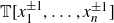 ${\mathbb{T}[x_1^{\pm 1}, \dots, x_n^{\pm 1}]}$
is of the form
${\mathbb{T}[x_1^{\pm 1}, \dots, x_n^{\pm 1}]}$
is of the form $\mathcal{I}_{P}$
for a prime congruence P.
$\mathcal{I}_{P}$
for a prime congruence P. $\mathcal{I}_{P}$
is the zero ideal if and only if P is a minimal prime. The maps
$\mathcal{I}_{P}$
is the zero ideal if and only if P is a minimal prime. The maps $I \rightarrow Bend(I)$
and
$I \rightarrow Bend(I)$
and $P \rightarrow \mathcal{I}_{P}$
establish a one to one correspondence between the non-zero closed prime ideals and the non-minimal prime congruences of
$P \rightarrow \mathcal{I}_{P}$
establish a one to one correspondence between the non-zero closed prime ideals and the non-minimal prime congruences of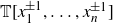 ${\mathbb{T}[x_1^{\pm 1}, \dots, x_n^{\pm 1}]}$
. The closed prime ideal
${\mathbb{T}[x_1^{\pm 1}, \dots, x_n^{\pm 1}]}$
. The closed prime ideal $\mathcal{I}_{P}$
is a tropical ideal if and only if P is a geometric prime congruence.
$\mathcal{I}_{P}$
is a tropical ideal if and only if P is a geometric prime congruence.
If I is an ideal of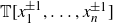 ${\mathbb{T}[x_1^{\pm 1}, \dots, x_n^{\pm 1}]}$
(resp.
${\mathbb{T}[x_1^{\pm 1}, \dots, x_n^{\pm 1}]}$
(resp. ${\mathbb{T}[x_1, \dots, x_n]}$
) we define the variety
${\mathbb{T}[x_1, \dots, x_n]}$
) we define the variety $\mathbb{V}(I)$
of I as the set of all points in
$\mathbb{V}(I)$
of I as the set of all points in ${\mathbb{R}}^n$
(resp.
${\mathbb{R}}^n$
(resp. ${\mathbb{T}}^n$
) where every polynomial
${\mathbb{T}}^n$
) where every polynomial $f\in I$
tropically vanishes, i.e., its maximum as a function is attained at two or more different terms.
$f\in I$
tropically vanishes, i.e., its maximum as a function is attained at two or more different terms.
Theorem B. If I is a non-zero prime ideal of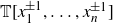 ${\mathbb{T}[x_1^{\pm 1}, \dots, x_n^{\pm 1}]}$
or
${\mathbb{T}[x_1^{\pm 1}, \dots, x_n^{\pm 1}]}$
or ${\mathbb{T}[x_1, \dots, x_n]}$
then
${\mathbb{T}[x_1, \dots, x_n]}$
then $\mathbb{V}(I)$
is at most a point. In particular, the varieties of prime tropical ideals are just points as only tropical prime ideals are the tropicalisations of maximal ideals.
$\mathbb{V}(I)$
is at most a point. In particular, the varieties of prime tropical ideals are just points as only tropical prime ideals are the tropicalisations of maximal ideals.
We also relate the dimension of an affine tropical variety (of a tropical ideal) and the dimension of its “coordinate ring”. The results can be summarised as follows:
Theorem C.
Footnote
1
Let I be a tropical ideal in ${\mathbb{T}[x_1, \dots, x_n]}$
such that
${\mathbb{T}[x_1, \dots, x_n]}$
such that $\mathbb{V}(I)$
has dimension d as a polyhedral complex. Then
$\mathbb{V}(I)$
has dimension d as a polyhedral complex. Then
 $$\dim {\mathbb{T}[x_1, \dots, x_n]}/Bend(I) = d + 1,$$
where $\dim {\mathbb{T}[x_1, \dots, x_n]}/Bend(I)$
is the number of strict inclusions in the longest chain of prime congruences.
$\dim {\mathbb{T}[x_1, \dots, x_n]}/Bend(I)$
is the number of strict inclusions in the longest chain of prime congruences.
Intuitively this result states that the (Krull) dimension of the tropical “coordinate ring” is the same as the geometric dimension, corrected for the dimension of $\mathbb{T}$
, which is 1. Theorem B can be seen as an algebraic way to compute the dimension of the tropicalisation of an affine variety.
$\mathbb{T}$
, which is 1. Theorem B can be seen as an algebraic way to compute the dimension of the tropicalisation of an affine variety.
2. Preliminaries
In this paper by a semiring we mean a commutative semiring with multiplicative unit, that is a nonempty set R with two binary operations $(+,\cdot)$
satisfying:
$(+,\cdot)$
satisfying:
-
(i) $(R,+)$
is a commutative monoid with identity element
$0_R$
;
$(R,+)$
is a commutative monoid with identity element
$0_R$
; -
(ii)
$(R,\cdot)$
is a commutative monoid with identity element
$1_R$
; -
(iii) for any
$a,b,c \in R$
:
$a(b+c) = ab+ac$
; -
(iv)
$1_R \neq 0_R$
and
$a\cdot 0_R = 0_R$
for all
$a \in R$
.





A semifield is a semiring in which all nonzero elements have multiplicative inverse. We will denote by ${\mathbb{B}}$
the semifield with two elements
${\mathbb{B}}$
the semifield with two elements $\{1,0\}$
, where 1 is the multiplicative identity, 0 is the additive identity and
$\{1,0\}$
, where 1 is the multiplicative identity, 0 is the additive identity and $1+1 = 1$
. The tropical semifield
$1+1 = 1$
. The tropical semifield ${\mathbb{T}}$
is defined on the set
${\mathbb{T}}$
is defined on the set ${\mathbb{R}} \cup \{-\infty\} $
, by setting the
${\mathbb{R}} \cup \{-\infty\} $
, by setting the $+$
operation to be the usual maximum and the
$+$
operation to be the usual maximum and the $\cdot$
operation to be the usual addition, with
$\cdot$
operation to be the usual addition, with $-\infty = 0_{\mathbb{T}}$
. By a
$-\infty = 0_{\mathbb{T}}$
. By a ${\mathbb{B}}$
-algebra A we simply mean a commutative semiring with idempotent addition (that is
${\mathbb{B}}$
-algebra A we simply mean a commutative semiring with idempotent addition (that is $a + a = a, \forall a \in A$
). Note that the idempotent addition defines an ordering via
$a + a = a, \forall a \in A$
). Note that the idempotent addition defines an ordering via $a \geq b \iff a+b = b$
. We will call a
$a \geq b \iff a+b = b$
. We will call a ${\mathbb{B}}$
-algebra totally ordered if its addition induces a total ordering.
${\mathbb{B}}$
-algebra totally ordered if its addition induces a total ordering.
A polynomial (resp. Laurent polynomial) semiring with variables $x_1,\dots,x_n$
over a semifield F is denoted by
$x_1,\dots,x_n$
over a semifield F is denoted by $F[x_1,\dots,x_n]$
(resp.
$F[x_1,\dots,x_n]$
(resp.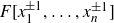 $F[x_1^{\pm 1},\dots,x_n^{\pm 1}]$
). Its elements are formal linear combinations of the monomials
$F[x_1^{\pm 1},\dots,x_n^{\pm 1}]$
). Its elements are formal linear combinations of the monomials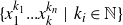 $\{x_1^{k_1}...x_k^{k_n}\mid\;k_i \in {\mathbb{N}}\}$
(resp.
$\{x_1^{k_1}...x_k^{k_n}\mid\;k_i \in {\mathbb{N}}\}$
(resp.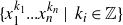 $\{x_1^{k_1}...x_n^{k_n}\mid\;k_i \in {\mathbb{Z}}\}$
) with coefficients in F, with addition and multiplication being defined in the usual way. By a term in
$\{x_1^{k_1}...x_n^{k_n}\mid\;k_i \in {\mathbb{Z}}\}$
) with coefficients in F, with addition and multiplication being defined in the usual way. By a term in $F[x_1,\dots,x_n]$
(resp.
$F[x_1,\dots,x_n]$
(resp.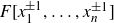 $F[x_1^{\pm 1},\dots,x_n^{\pm 1}]$
) we will mean a monomial with a coefficient.
$F[x_1^{\pm 1},\dots,x_n^{\pm 1}]$
) we will mean a monomial with a coefficient.
As usual, an ideal of a semiring R in additive submonoid that is closed under multiplication by any element of R.
Definition 2·1. A congruence C of the semiring R is a subset of $R \times R$
, such that it is an equivalence relation that respects the operations on R. In other words:
$R \times R$
, such that it is an equivalence relation that respects the operations on R. In other words:
-
(i) for
$a \in R$
,
$(a,a) \in C$
; -
(ii)
$(a,b) \in C$
if and only if
$(b,a) \in C$
; -
(iii) if
$(a,b) \in C$
and
$(b,c) \in C$
then
$(a,c) \in C$
; -
(iv) if
$(a,b) \in C$
and
$(c,d) \in C$
then
$(a+c,b+d) \in C$
; -
(v) if
$(a,b) \in C$
and
$(c,d) \in C$
then
$(ac,bd) \in C$
.





The unique smallest congruence is the diagonal of $R \times R$
, also called the trivial congruence. It often plays the role of the zero ideal.
$R \times R$
, also called the trivial congruence. It often plays the role of the zero ideal. $R \times R$
itself is the improper congruence the rest of the congruences are called proper. Elements of
$R \times R$
itself is the improper congruence the rest of the congruences are called proper. Elements of $R \times R$
are called pairs.
$R \times R$
are called pairs.
Definition 2·2. (adapted from [
Reference Giansiracusa and Giansiracusa7
, definition 5.1.1]). Let A be a ${\mathbb{B}}$
-algebra and
${\mathbb{B}}$
-algebra and $f \in R[x_1, \ldots, x_n]$
. For i in the support of f denoted by supp(f), we write
$f \in R[x_1, \ldots, x_n]$
. For i in the support of f denoted by supp(f), we write $f_{\hat \imath}$
for the result of deleting the i term from f. Then the bend relations of f is the set of pairs
$f_{\hat \imath}$
for the result of deleting the i term from f. Then the bend relations of f is the set of pairs
 $$bend(f) = \{(f , f_{\hat \imath})\}_{i\in supp(f)}.$$
The bend congruence is the congruence generated by the bend relations of a set I of polynomials in $A[x_1, \ldots, x_n]$
, denoted Bend(I). We will be mostly interested in the case when I is an ideal.
$A[x_1, \ldots, x_n]$
, denoted Bend(I). We will be mostly interested in the case when I is an ideal.
Let R be a semiring. The twisted product of the pairs $\alpha = (\alpha_1, \alpha_2)$
and
$\alpha = (\alpha_1, \alpha_2)$
and $\beta = (\beta_1, \beta_2)$
of
$\beta = (\beta_1, \beta_2)$
of $R \times R$
is
$R \times R$
is
 $$\alpha\beta=(\alpha_1\beta_1+\alpha_2\beta_2,\alpha_1\beta_2+\alpha_2\beta_1).$$
Note that the twisted product is associative. The set of pairs is a monoid under this operation, with the pair (1,0) being the identity element. For the rest of the paper in any formula containing pairs the product is always the twisted product, so the twisted product of $\alpha$
and
$\alpha$
and $\beta$
is simply denoted by
$\beta$
is simply denoted by $\alpha\beta$
. Similarly
$\alpha\beta$
. Similarly $\alpha^n$
denotes the twisted n-th power of the pair
$\alpha^n$
denotes the twisted n-th power of the pair $\alpha$
, and we use the convention
$\alpha$
, and we use the convention $\alpha^0 = (1,0)$
. For an element a and a pair
$\alpha^0 = (1,0)$
. For an element a and a pair $\alpha$
we define their product as
$\alpha$
we define their product as $a(\alpha_1,\alpha_2)=(a\alpha_1,a\alpha_2)$
which is the same as the twisted product
$a(\alpha_1,\alpha_2)=(a\alpha_1,a\alpha_2)$
which is the same as the twisted product $(a,0)\alpha$
.
$(a,0)\alpha$
.
We recall some definitions and results from [ Reference Joó and Mincheva11 ].
Proposition 2·3 [
Reference Joó and Mincheva11
, proposition 2.2]. Let C be a congruence of a ${\mathbb{B}}$
-algebra A, for
${\mathbb{B}}$
-algebra A, for $\alpha \in C$
and an arbitrary pair
$\alpha \in C$
and an arbitrary pair $\beta$
we have
$\beta$
we have $\alpha\beta \in C$
.
$\alpha\beta \in C$
.
Definition 2·4. A congruence C on a ${\mathbb{B}}$
-algebra R is called:
${\mathbb{B}}$
-algebra R is called:
-
(i) quotient cancellative if
$R/C$
is a cancellative semiring, namely if
$ac = bc \in R/C$
then either
$a=b$
or
$c = 0_{R/C}$
; -
(ii) prime if it is proper and for every
$\alpha, \beta \in R \times R$
such that
$\alpha\beta \in C$
either
$\alpha \in C$
or
$\beta \in C$
; -
(iii) radical if C is equal to the intersection of all prime congruences containing it, which we denote by Rad(C).




Proposition 2·5 [
Reference Joó and Mincheva11
, proposition 2.10]. Let A be a ${\mathbb{B}}$
-algebra. If A is totally ordered then the trivial congruence of A is prime if and only if A is cancellative.
${\mathbb{B}}$
-algebra. If A is totally ordered then the trivial congruence of A is prime if and only if A is cancellative.
We will often refer to the following immediate consequences of the above:
Corollary 2·6. Let A be a ${\mathbb{B}}$
-algebra and C a congruence on A.
${\mathbb{B}}$
-algebra and C a congruence on A.
-
(i) The congruence C is prime if and only if
$A/C$
is cancellative and totally ordered. -
(ii) In the special case when every element of A is a sum of invertible elements, C is prime if and only if
$A/C$
is totally ordered. -
(iii) Each prime congruence of A is generated by pairs of the form
$(a, a+b),$
for
$a, b \in A$
.


Proof. Applying Proposition 2·5, it remains to be seen that the quotient of a prime congruence P is totally ordered. Indeed for arbitrary elements $a,b \in A$
, the twisted product
$a,b \in A$
, the twisted product
 $$(a + b, a)(a + b, b) = (a^2 + b^2 + ab, a^2 + b^2 + ab),$$
lies in the diagonal, hence every prime contains at least one of $(a + b, a)$
and
$(a + b, a)$
and $(a + b, b)$
, implying that in the quotient we have
$(a + b, b)$
, implying that in the quotient we have $b \geq a$
or
$b \geq a$
or $a \geq b$
.
$a \geq b$
.
For part (ii), consider that if every element of A is sum of invertibles, then the same holds in the quotient $A/C$
. Moreover since
$A/C$
. Moreover since $A/C$
is totally ordered every sum equals one of its summands, hence every element of
$A/C$
is totally ordered every sum equals one of its summands, hence every element of $A/C$
is invertible. In particular
$A/C$
is invertible. In particular $A/C$
is a semifield and the claim follows from part (i).
$A/C$
is a semifield and the claim follows from part (i).
Part (iii) follows from (i) and the fact that $(a+b, a) \in C \iff a \geq b$
with respect to the order defined by C.
$(a+b, a) \in C \iff a \geq b$
with respect to the order defined by C.
In view of the previous result we introduce the following notation.
Notation 2·7. Let A be semiring and let P be a prime on A. For two elements $r_1, r_2 \in A$
we say that
$r_1, r_2 \in A$
we say that $r_1 \leq_P r_2$
(resp.
$r_1 \leq_P r_2$
(resp. $r_1 \lt_P r_2$
, resp.
$r_1 \lt_P r_2$
, resp. $r_1 \sim_P r_2$
) whenever
$r_1 \sim_P r_2$
) whenever $\overline{r_1} \leq \overline{r_2}$
(resp.
$\overline{r_1} \leq \overline{r_2}$
(resp. $\overline{r_1} \lt \overline{r_2}$
, resp.
$\overline{r_1} \lt \overline{r_2}$
, resp. $\overline{r_1} = \overline{r_2}$
) in
$\overline{r_1} = \overline{r_2}$
) in $A/P$
. Here by
$A/P$
. Here by $\overline{r}$
we mean the image of r in
$\overline{r}$
we mean the image of r in $A/P$
.
$A/P$
.
Lemma 2·8. Let A be a ${\mathbb{B}}$
-algebra and let every element of A be a sum of invertibles. Let P and Q be congruences on A such that
${\mathbb{B}}$
-algebra and let every element of A be a sum of invertibles. Let P and Q be congruences on A such that $P \subseteq Q$
. Then if P is prime then so is Q.
$P \subseteq Q$
. Then if P is prime then so is Q.
Proof. Since P is prime then $A/P$
is totally ordered. However, via the semiring morphism
$A/P$
is totally ordered. However, via the semiring morphism $A/P \twoheadrightarrow A/Q$
so is
$A/P \twoheadrightarrow A/Q$
so is $A/Q$
. Now Corollary 2·6 (ii) implies that Q is prime.
$A/Q$
. Now Corollary 2·6 (ii) implies that Q is prime.
In this paper the only ${\mathbb{B}}$
-algebras we will consider will be
${\mathbb{B}}$
-algebras we will consider will be ${\mathbb{T}[x_1, \dots, x_n]}$
,
${\mathbb{T}[x_1, \dots, x_n]}$
,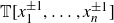 ${\mathbb{T}[x_1^{\pm 1}, \dots, x_n^{\pm 1}]}$
and their quotients.
${\mathbb{T}[x_1^{\pm 1}, \dots, x_n^{\pm 1}]}$
and their quotients.
Definition 2·9. We call a prime congruence P of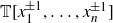 ${\mathbb{T}[x_1^{\pm 1}, \dots, x_n^{\pm 1}]}$
a geometric prime whenever
${\mathbb{T}[x_1^{\pm 1}, \dots, x_n^{\pm 1}]}$
a geometric prime whenever ${\mathbb{T}[x_1^{\pm 1}, \dots, x_n^{\pm 1}]}/P \cong {\mathbb{T}}$
. In particular, the points of
${\mathbb{T}[x_1^{\pm 1}, \dots, x_n^{\pm 1}]}/P \cong {\mathbb{T}}$
. In particular, the points of ${\mathbb{R}}^n$
are in bijection with the geometric prime congruences of
${\mathbb{R}}^n$
are in bijection with the geometric prime congruences of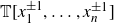 ${\mathbb{T}[x_1^{\pm 1}, \dots, x_n^{\pm 1}]}$
. We call a prime congruence P of
${\mathbb{T}[x_1^{\pm 1}, \dots, x_n^{\pm 1}]}$
. We call a prime congruence P of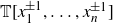 ${\mathbb{T}[x_1^{\pm 1}, \dots, x_n^{\pm 1}]}$
a minimal prime if there are no prime congruences contained in it. We define geometric and minimal primes on
${\mathbb{T}[x_1^{\pm 1}, \dots, x_n^{\pm 1}]}$
a minimal prime if there are no prime congruences contained in it. We define geometric and minimal primes on ${\mathbb{T}[x_1, \dots, x_n]}$
analogously.
${\mathbb{T}[x_1, \dots, x_n]}$
analogously.
Proposition 2·10. Let P be a minimal prime congruence on ${\mathbb{T}[x_1, \dots, x_n]}$
or
${\mathbb{T}[x_1, \dots, x_n]}$
or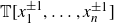 ${\mathbb{T}[x_1^{\pm 1}, \dots, x_n^{\pm 1}]}$
then each equivalence class of P contains exactly one monomial.
${\mathbb{T}[x_1^{\pm 1}, \dots, x_n^{\pm 1}]}$
then each equivalence class of P contains exactly one monomial.
Proof. Follows directly form [ Reference Joó and Mincheva11 , theorem 4·14(b)].
In [
Reference Joó and Mincheva11
, section 4] a complete description of the prime congruences of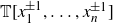 ${\mathbb{T}[x_1^{\pm 1}, \dots, x_n^{\pm 1}]}$
and
${\mathbb{T}[x_1^{\pm 1}, \dots, x_n^{\pm 1}]}$
and ${\mathbb{T}[x_1, \dots, x_n]}$
was given. In the quotients each element can be represented by a monomial
${\mathbb{T}[x_1, \dots, x_n]}$
was given. In the quotients each element can be represented by a monomial $t{\boldsymbol{{x}}}^{\boldsymbol{{u}}}$
, hence primes correspond to semigroup orderings on quotients of the multiplicative semigroup of monomials. Similarly to term orders for polynomial rings, each such ordering can be defined by a matrix U with real entries and
$t{\boldsymbol{{x}}}^{\boldsymbol{{u}}}$
, hence primes correspond to semigroup orderings on quotients of the multiplicative semigroup of monomials. Similarly to term orders for polynomial rings, each such ordering can be defined by a matrix U with real entries and $n+1$
columns, setting
$n+1$
columns, setting $t_1{\boldsymbol{{x}}}^{\pmb{u_1}} \geq t_2{\boldsymbol{{x}}}^{\pmb{u_2}}$
if and only if the first non zero element of
$t_1{\boldsymbol{{x}}}^{\pmb{u_1}} \geq t_2{\boldsymbol{{x}}}^{\pmb{u_2}}$
if and only if the first non zero element of $U((t_1, \pmb{u_1}) - (t_2, \pmb{u_2}))$
is positive. As U must respect the order on the elements of
$U((t_1, \pmb{u_1}) - (t_2, \pmb{u_2}))$
is positive. As U must respect the order on the elements of ${\mathbb{T}}$
, the first column of U is either zero or its first non-zero entry is positive. A matrix that satisfies this condition and that each of its rows are non redundant in the sense that they further refine the ordering is called admissible. It was shown in [
Reference Joó and Mincheva11
, theorem 1·1] that every prime congruence P of
${\mathbb{T}}$
, the first column of U is either zero or its first non-zero entry is positive. A matrix that satisfies this condition and that each of its rows are non redundant in the sense that they further refine the ordering is called admissible. It was shown in [
Reference Joó and Mincheva11
, theorem 1·1] that every prime congruence P of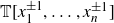 ${\mathbb{T}[x_1^{\pm 1}, \dots, x_n^{\pm 1}]}$
is defined by an admissible matrix U with rank
${\mathbb{T}[x_1^{\pm 1}, \dots, x_n^{\pm 1}]}$
is defined by an admissible matrix U with rank $r(U) = \dim({\mathbb{T}[x_1^{\pm 1}, \dots, x_n^{\pm 1}]} / P)$
. Moreover that the primes of
$r(U) = \dim({\mathbb{T}[x_1^{\pm 1}, \dots, x_n^{\pm 1}]} / P)$
. Moreover that the primes of ${\mathbb{T}[x_1, \dots, x_n]}$
which do not identify any variables with
${\mathbb{T}[x_1, \dots, x_n]}$
which do not identify any variables with $0_{{\mathbb{T}}}$
are in bijection with the primes of
$0_{{\mathbb{T}}}$
are in bijection with the primes of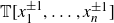 ${\mathbb{T}[x_1^{\pm 1}, \dots, x_n^{\pm 1}]}$
, and the primes that do identify any variables with
${\mathbb{T}[x_1^{\pm 1}, \dots, x_n^{\pm 1}]}$
, and the primes that do identify any variables with $0_{{\mathbb{T}}}$
hence correspond to a prime of a polynomial semiring in less variables.
$0_{{\mathbb{T}}}$
hence correspond to a prime of a polynomial semiring in less variables.
Every point of $P \in {\mathbb{R}}^n$
defines a congruence by identifying polynomials that are equal on that point. These congruences are prime, and the congruence corresponding to the point
$P \in {\mathbb{R}}^n$
defines a congruence by identifying polynomials that are equal on that point. These congruences are prime, and the congruence corresponding to the point $(a_1, \dots, a_n) \in {\mathbb{R}}^n$
is defined by the matrix
$(a_1, \dots, a_n) \in {\mathbb{R}}^n$
is defined by the matrix $U = (1, a_1, \dots, a_n)$
. These are exactly the geometric primes, and for a polynomial f and the geometric prime congruence P we write f(P) for the value of f on the corresponding point.
$U = (1, a_1, \dots, a_n)$
. These are exactly the geometric primes, and for a polynomial f and the geometric prime congruence P we write f(P) for the value of f on the corresponding point.
If $f = \sum_{u \in \mathbb{Z}^n} {a_u}{\boldsymbol{{x}}}^{\boldsymbol{{u}}} \in {\mathbb{T}[x_1^{\pm 1}, \dots, x_n^{\pm 1}]}$
, then we say that f tropically vanishes at a point
$f = \sum_{u \in \mathbb{Z}^n} {a_u}{\boldsymbol{{x}}}^{\boldsymbol{{u}}} \in {\mathbb{T}[x_1^{\pm 1}, \dots, x_n^{\pm 1}]}$
, then we say that f tropically vanishes at a point $P \in {\mathbb{R}}^n$
if f attains its maximum at P at least twice, where
$P \in {\mathbb{R}}^n$
if f attains its maximum at P at least twice, where $f(P) = \text{max}\{ a_u + u\cdot P \;:\; u\in supp(f) \}$
. Note that
$f(P) = \text{max}\{ a_u + u\cdot P \;:\; u\in supp(f) \}$
. Note that $+$
denotes the usual addition of real numbers. With some care this definition can be extended to polynomials of
$+$
denotes the usual addition of real numbers. With some care this definition can be extended to polynomials of ${\mathbb{T}[x_1, \dots, x_n]}$
as shown in [
Reference Maclagan and Sturmfels19
].
${\mathbb{T}[x_1, \dots, x_n]}$
as shown in [
Reference Maclagan and Sturmfels19
].
Now let I be an ideal of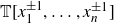 ${\mathbb{T}[x_1^{\pm 1}, \dots, x_n^{\pm 1}]}$
,
${\mathbb{T}[x_1^{\pm 1}, \dots, x_n^{\pm 1}]}$
, $H \subseteq {\mathbb{R}}^n$
, and C is a congruence on
$H \subseteq {\mathbb{R}}^n$
, and C is a congruence on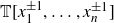 ${\mathbb{T}[x_1^{\pm 1}, \dots, x_n^{\pm 1}]}$
. In this paper we will consider the following sets:
${\mathbb{T}[x_1^{\pm 1}, \dots, x_n^{\pm 1}]}$
. In this paper we will consider the following sets:
 \begin{equation*}\begin{split}\mathbb{V}(I) &= \{P \in {\mathbb{R}}^n \;:\; \forall f \in I, f \text{ tropically vanishes at } P\} \\ & = \{P \text{ geometric prime congruence} \;:\; \forall f \in I, bend(f) \subseteq P\} \\ \mathbb{I}(H) &= \{f \;:\; f \text{ tropically vanishes on } H\} \\ &= \{f \;:\; bend(f) \in P,\ \forall \text{ prime congruences } P \in H\} \\ \mathbb{V}(C) &= \{ a \in {\mathbb{R}}^n \;:\; f(a) = g(a), \forall (f,g) \in C\} \\ &= \{P \text{ geometric prime congruence } \;:\; P \supseteq C\}.\end{split}\end{equation*}
We refer to the first of these sets as the tropical variety of I, or tropical vanishing locus of I. We can similarly define these sets for ideals and congruences of ${\mathbb{T}[x_1, \dots, x_n]}$
and subsets and points on
${\mathbb{T}[x_1, \dots, x_n]}$
and subsets and points on ${\mathbb{T}}^n$
.
${\mathbb{T}}^n$
.
We will often want to know if there is geometric prime congruence containing a prime congruence P on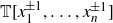 ${\mathbb{T}[x_1^{\pm 1}, \dots, x_n^{\pm 1}]}$
or
${\mathbb{T}[x_1^{\pm 1}, \dots, x_n^{\pm 1}]}$
or ${\mathbb{T}[x_1, \dots, x_n]}$
. If P has a geometric prime lying over it then P does not collapse the coefficient semifield to
${\mathbb{T}[x_1, \dots, x_n]}$
. If P has a geometric prime lying over it then P does not collapse the coefficient semifield to ${\mathbb{B}}$
. This condition is also equivalent to having the (1,1) entry of the defining matrix of P not equal to 0.
${\mathbb{B}}$
. This condition is also equivalent to having the (1,1) entry of the defining matrix of P not equal to 0.
Remark 2·11. The variety $\mathbb{V}(P) \subseteq {\mathbb{R}}^n$
of a prime congruence P contains at most one point. Note that
$\mathbb{V}(P) \subseteq {\mathbb{R}}^n$
of a prime congruence P contains at most one point. Note that $\mathbb{V}(P)$
is empty when P is not contained in a geometric prime congruence. Assume for contradiction that there are two distinct points a, b in
$\mathbb{V}(P)$
is empty when P is not contained in a geometric prime congruence. Assume for contradiction that there are two distinct points a, b in $\mathbb{V}(P)$
. Consider the congruence
$\mathbb{V}(P)$
. Consider the congruence $C = \{ (f,g)\ :\ f(a)=g(a) \text{ and } f(b) = g(b)\}$
. Notice that
$C = \{ (f,g)\ :\ f(a)=g(a) \text{ and } f(b) = g(b)\}$
. Notice that $P \subseteq C$
and that there is a surjective semiring morphism
$P \subseteq C$
and that there is a surjective semiring morphism ${\mathbb{T}[x_1^{\pm 1}, \dots, x_n^{\pm 1}]}/P \rightarrow {\mathbb{T}[x_1^{\pm 1}, \dots, x_n^{\pm 1}]}/C$
. Moreover, since
${\mathbb{T}[x_1^{\pm 1}, \dots, x_n^{\pm 1}]}/P \rightarrow {\mathbb{T}[x_1^{\pm 1}, \dots, x_n^{\pm 1}]}/C$
. Moreover, since ${\mathbb{T}[x_1, \dots, x_n]}/P$
is totally ordered, so is
${\mathbb{T}[x_1, \dots, x_n]}/P$
is totally ordered, so is ${\mathbb{T}[x_1^{\pm 1}, \dots, x_n^{\pm 1}]}/C$
. However, this cannot be the case since
${\mathbb{T}[x_1^{\pm 1}, \dots, x_n^{\pm 1}]}/C$
. However, this cannot be the case since ${\mathbb{T}[x_1^{\pm 1}, \dots, x_n^{\pm 1}]}/C$
is isomorphic to
${\mathbb{T}[x_1^{\pm 1}, \dots, x_n^{\pm 1}]}/C$
is isomorphic to ${\mathbb{T}} \times {\mathbb{T}}$
via the map
${\mathbb{T}} \times {\mathbb{T}}$
via the map $f \mapsto (f(a), f(b))$
. The same is true for the varieties of prime congruences on
$f \mapsto (f(a), f(b))$
. The same is true for the varieties of prime congruences on ${\mathbb{T}[x_1, \dots, x_n]}$
.
${\mathbb{T}[x_1, \dots, x_n]}$
.
Example 2·12. Let P be a prime congruence with defining matrix U, such that the first row of U is $(1, a_1, \dots, a_n)$
, then
$(1, a_1, \dots, a_n)$
, then $\mathbb{V}(P) = (a_1, \dots, a_n)$
.
$\mathbb{V}(P) = (a_1, \dots, a_n)$
.
One can define (Krull) dimension for semirings, analogously to the Krull dimension of rings, measured by the number of strict inclusions in the longest chain of prime ideals. As shown in [ Reference Alarcón and Anderson1 ], with this definition, the dimension of any polynomial semiring is infinite. In [ Reference Joó and Mincheva11 ] we propose the following definition for the Krull dimension of a semifield.
Definition 2·13. Let R be a ${\mathbb{B}}$
-algebra. The Krull dimension of R is the number of strict inclusions in the longest chain of prime congruences in R.
${\mathbb{B}}$
-algebra. The Krull dimension of R is the number of strict inclusions in the longest chain of prime congruences in R.
Classically, the dimension of an irreducible affine variety is equal to the Krull dimension of its coordinate ring. Tropically, we need to replace the notion of the coordinate ring with the “coordinate semiring” of the affine tropical scheme associated to this tropical variety as defined in [ Reference Giansiracusa and Giansiracusa7 ].
Definition 2·14. If X is a tropical variety defined by an ideal $I \in {\mathbb{T}[x_1, \dots, x_n]}$
, the coordinate semiring of the tropical scheme associated to X is
$I \in {\mathbb{T}[x_1, \dots, x_n]}$
, the coordinate semiring of the tropical scheme associated to X is ${\mathbb{T}[x_1, \dots, x_n]}/Bend(I)$
.
${\mathbb{T}[x_1, \dots, x_n]}/Bend(I)$
.
3. Results
3·1. Tropical ideals
Definition 3·1. An ideal $I \subseteq {\mathbb{T}[x_1, \dots, x_n]}$
is a tropical ideal if for each degree
$I \subseteq {\mathbb{T}[x_1, \dots, x_n]}$
is a tropical ideal if for each degree $d \geq 0$
the set
$d \geq 0$
the set $I_{\leq d}$
of polynomials in I of degree at most d is a tropical linear space, or equivalently,
$I_{\leq d}$
of polynomials in I of degree at most d is a tropical linear space, or equivalently, $I_{\leq d}$
is the set of vectors of a valuated matroid. More precisely, the ideal I satisfies a monomial elimination axiom which can be stated in the following way:
$I_{\leq d}$
is the set of vectors of a valuated matroid. More precisely, the ideal I satisfies a monomial elimination axiom which can be stated in the following way:
For any $f, g \in I_{\leq d}$
and any monomial
$f, g \in I_{\leq d}$
and any monomial ${\boldsymbol{{x}}}^{\boldsymbol{{u}}}$
, which appears in both f and g with the same (
${\boldsymbol{{x}}}^{\boldsymbol{{u}}}$
, which appears in both f and g with the same ( $\neq 0_{{\mathbb{T}}}$
) coefficient then there exists a polynomial
$\neq 0_{{\mathbb{T}}}$
) coefficient then there exists a polynomial $h \in I_{\leq d}$
, such that the coefficient
$h \in I_{\leq d}$
, such that the coefficient $c_u(h)$
of
$c_u(h)$
of ${\boldsymbol{{x}}}^{\boldsymbol{{u}}}$
in h is
${\boldsymbol{{x}}}^{\boldsymbol{{u}}}$
in h is $0_{{\mathbb{T}}}$
and for the coefficient
$0_{{\mathbb{T}}}$
and for the coefficient $c_v(h)$
of any other monomial
$c_v(h)$
of any other monomial ${\boldsymbol{{x}}}^{\boldsymbol{{v}}}$
of h we have that
${\boldsymbol{{x}}}^{\boldsymbol{{v}}}$
of h we have that $c_u(h) \leq \max (c_v(f), c_v(g))$
with equality holding whenever
$c_u(h) \leq \max (c_v(f), c_v(g))$
with equality holding whenever $c_v(f) \neq c_v(g)$
.
$c_v(f) \neq c_v(g)$
.
Example 3·2. Consider a polynomial $f \in K[x_1, \dots, x_n]$
, where K is a valued field. We will denote by trop(f) the polynomial in
$f \in K[x_1, \dots, x_n]$
, where K is a valued field. We will denote by trop(f) the polynomial in ${\mathbb{T}[x_1, \dots, x_n]}$
obtained from f by valuating all coefficients of f and replacing the operations multiplication and addition with their tropical counterparts. Let
${\mathbb{T}[x_1, \dots, x_n]}$
obtained from f by valuating all coefficients of f and replacing the operations multiplication and addition with their tropical counterparts. Let $J \subseteq K[x_1, \dots, x_n]$
, then the ideal
$J \subseteq K[x_1, \dots, x_n]$
, then the ideal $trop(J) = \{ trop(f) \ : \ f\in J \}$
is a realisable tropical ideal.
$trop(J) = \{ trop(f) \ : \ f\in J \}$
is a realisable tropical ideal.
Proposition 3·3. There exits a bijection $\varphi$
from the set of prime tropical ideals of
$\varphi$
from the set of prime tropical ideals of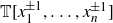 ${\mathbb{T}[x_1^{\pm 1}, \dots, x_n^{\pm 1}]}$
to set of prime tropical ideals of
${\mathbb{T}[x_1^{\pm 1}, \dots, x_n^{\pm 1}]}$
to set of prime tropical ideals of ${\mathbb{T}[x_1, \dots, x_n]}$
, defined as
${\mathbb{T}[x_1, \dots, x_n]}$
, defined as $\varphi(I) = I\cap {\mathbb{T}[x_1, \dots, x_n]}$
and
$\varphi(I) = I\cap {\mathbb{T}[x_1, \dots, x_n]}$
and $\varphi^{-1}(J) = J{\mathbb{T}[x_1^{\pm 1}, \dots, x_n^{\pm 1}]}$
.
$\varphi^{-1}(J) = J{\mathbb{T}[x_1^{\pm 1}, \dots, x_n^{\pm 1}]}$
.
Proof. Let $I \subseteq {\mathbb{T}[x_1^{\pm 1}, \dots, x_n^{\pm 1}]}$
be a tropical prime ideal and
$I \subseteq {\mathbb{T}[x_1^{\pm 1}, \dots, x_n^{\pm 1}]}$
be a tropical prime ideal and $J = I \cap {\mathbb{T}[x_1, \dots, x_n]}$
. Note that J is a proper ideal and can not contain a monomial. We will show that J is also prime and tropical. Assume it is not prime, that is, there are
$J = I \cap {\mathbb{T}[x_1, \dots, x_n]}$
. Note that J is a proper ideal and can not contain a monomial. We will show that J is also prime and tropical. Assume it is not prime, that is, there are $f, g \in {\mathbb{T}[x_1, \dots, x_n]}$
such that
$f, g \in {\mathbb{T}[x_1, \dots, x_n]}$
such that $fg \in J$
but neither f nor g is in J. But since
$fg \in J$
but neither f nor g is in J. But since $J \subseteq I$
then
$J \subseteq I$
then $fg \in I$
and since I is prime then without loss of generality
$fg \in I$
and since I is prime then without loss of generality $f \in I$
. However, since
$f \in I$
. However, since $f \in {\mathbb{T}[x_1, \dots, x_n]}$
so
$f \in {\mathbb{T}[x_1, \dots, x_n]}$
so $f \in J$
, contradicting the assumption that J is not prime.
$f \in J$
, contradicting the assumption that J is not prime.
Since I is a tropical ideal, for any $f, g \in J \subseteq I$
there exists some
$f, g \in J \subseteq I$
there exists some $h \in I$
which satisfy the property in Definition 3·1. Since f, g are polynomials, so is h in the definition. So J satisfies the conditions of Definition 3·1 and hence J is tropical.
$h \in I$
which satisfy the property in Definition 3·1. Since f, g are polynomials, so is h in the definition. So J satisfies the conditions of Definition 3·1 and hence J is tropical.
Now consider $J \subseteq {\mathbb{T}[x_1, \dots, x_n]}$
and let
$J \subseteq {\mathbb{T}[x_1, \dots, x_n]}$
and let $I = J{\mathbb{T}[x_1^{\pm 1}, \dots, x_n^{\pm 1}]}$
. Note that I is a proper ideal if and only if J does not contain a monomial. Let
$I = J{\mathbb{T}[x_1^{\pm 1}, \dots, x_n^{\pm 1}]}$
. Note that I is a proper ideal if and only if J does not contain a monomial. Let $fg \in I$
, then there exists a monomial
$fg \in I$
, then there exists a monomial $m \in {\mathbb{T}[x_1, \dots, x_n]}$
such that mf and mg are both polynomials. Then
$m \in {\mathbb{T}[x_1, \dots, x_n]}$
such that mf and mg are both polynomials. Then $mfmg \in I$
but it is also in J. Now without loss of generality let
$mfmg \in I$
but it is also in J. Now without loss of generality let $mf \in J$
and since
$mf \in J$
and since $m \not\in J$
by assumption, then
$m \not\in J$
by assumption, then $f \in J$
and so
$f \in J$
and so $f \in I$
. Similarly, I is tropical, since the circuits of I are circuits of J multiplied by monomials.
$f \in I$
. Similarly, I is tropical, since the circuits of I are circuits of J multiplied by monomials.
3·2. Relating prime ideals and prime congruences
In view of Proposition 3·3 we will state all results for the Laurent polynomials. We describe a relation between ideals and congruences in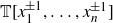 ${\mathbb{T}[x_1^{\pm 1}, \dots, x_n^{\pm 1}]}$
. Let C be a congruence on
${\mathbb{T}[x_1^{\pm 1}, \dots, x_n^{\pm 1}]}$
. Let C be a congruence on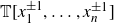 ${\mathbb{T}[x_1^{\pm 1}, \dots, x_n^{\pm 1}]}$
. Consider the set
${\mathbb{T}[x_1^{\pm 1}, \dots, x_n^{\pm 1}]}$
. Consider the set
 $$\mathcal{I}_{C} = \{f \in {\mathbb{T}[x_1^{\pm 1}, \dots, x_n^{\pm 1}]} \;:\; bend(f) \subseteq C\}.$$
One can define this similarly in the ${\mathbb{T}[x_1, \dots, x_n]}$
case.
${\mathbb{T}[x_1, \dots, x_n]}$
case.
Proposition 3·4. Let C be any congruence on ${\mathbb{T}[x_1^{\pm 1}, \dots, x_n^{\pm 1}]}$
then the set
${\mathbb{T}[x_1^{\pm 1}, \dots, x_n^{\pm 1}]}$
then the set $\mathcal{I}_{C}$
is an ideal.
$\mathcal{I}_{C}$
is an ideal.
Proof. Let $f, g \in \mathcal{I}_{C}$
, i.e.,
$f, g \in \mathcal{I}_{C}$
, i.e., $bend(f), bend(g) \subseteq C$
. Consider the pair
$bend(f), bend(g) \subseteq C$
. Consider the pair $(f+g, (f+g)_{\hat \imath})$
for each
$(f+g, (f+g)_{\hat \imath})$
for each $i \in supp(f+g)$
. If i is in the support of both summands, then
$i \in supp(f+g)$
. If i is in the support of both summands, then $(f+g, (f+g)_{\hat \imath}) = (f, f_{\hat \imath}) + (g, g_{\hat \imath}) \in C$
, since
$(f+g, (f+g)_{\hat \imath}) = (f, f_{\hat \imath}) + (g, g_{\hat \imath}) \in C$
, since $bend(f), bend(g) \subseteq C$
. In the case when i is only in the support of one of the summands, say f, then
$bend(f), bend(g) \subseteq C$
. In the case when i is only in the support of one of the summands, say f, then $(f+g, (f+g)_{\hat \imath}) = (f, f_{\hat \imath}) + (g, g) \in C$
. This shows that
$(f+g, (f+g)_{\hat \imath}) = (f, f_{\hat \imath}) + (g, g) \in C$
. This shows that $bend(f+g) \subseteq C$
and thus
$bend(f+g) \subseteq C$
and thus $f+g \in \mathcal{I}_{C}$
.
$f+g \in \mathcal{I}_{C}$
.
Let $f \in \mathcal{I}_{C}$
and
$f \in \mathcal{I}_{C}$
and $h \in {\mathbb{T}[x_1^{\pm 1}, \dots, x_n^{\pm 1}]}$
. We will show that
$h \in {\mathbb{T}[x_1^{\pm 1}, \dots, x_n^{\pm 1}]}$
. We will show that $fh \in \mathcal{I}_{C}$
, by showing that
$fh \in \mathcal{I}_{C}$
, by showing that $bend(fh) \subseteq C$
. Consider the pair
$bend(fh) \subseteq C$
. Consider the pair $(fh, (fh)_{\hat k})$
for each
$(fh, (fh)_{\hat k})$
for each $k \in supp(fh)$
. Let
$k \in supp(fh)$
. Let $k = (i, j)$
, i.e.,
$k = (i, j)$
, i.e., $(fh)_k = f_ih_j$
. If
$(fh)_k = f_ih_j$
. If $f_ih_j \neq af_sh_r$
, for all
$f_ih_j \neq af_sh_r$
, for all $(i,j) \neq (s,r)$
and
$(i,j) \neq (s,r)$
and $a\in {\mathbb{T}}$
, then by direct computation we see that
$a\in {\mathbb{T}}$
, then by direct computation we see that $(fh, (fh)_{\hat k}) = (f, f_{\hat\imath})(h, h_{\hat\jmath})$
.
$(fh, (fh)_{\hat k}) = (f, f_{\hat\imath})(h, h_{\hat\jmath})$
.
Now let $f_ig_j = af_sg_r$
for some
$f_ig_j = af_sg_r$
for some $(i,j) \neq (s,r)$
and
$(i,j) \neq (s,r)$
and $a\in {\mathbb{T}}$
. Assume without loss of generality that the coefficient of
$a\in {\mathbb{T}}$
. Assume without loss of generality that the coefficient of $f_sg_r$
is bigger than that of
$f_sg_r$
is bigger than that of $f_ig_j$
. Then we can write
$f_ig_j$
. Then we can write $(fh, (fh)_{\hat k}) = (f, f_{\hat s})(h_{\hat\jmath}, 0) + (d, d),$
where d is the polynomial
$(fh, (fh)_{\hat k}) = (f, f_{\hat s})(h_{\hat\jmath}, 0) + (d, d),$
where d is the polynomial
 $$d = \sum_{\substack{l\in supp(f), \\l\neq i}}f_lh_j + \sum_{\substack{l\in supp(h), \\l\neq r}}f_sh_l.$$
Now $(f, f_{\hat s})(h_{\hat\jmath}, 0)$
is in C by Proposition 2·3. The pair (d,d) also in C since the diagonal is contained in every congruence and so we conclude that
$(f, f_{\hat s})(h_{\hat\jmath}, 0)$
is in C by Proposition 2·3. The pair (d,d) also in C since the diagonal is contained in every congruence and so we conclude that $(fh, (fh)_{\hat k}) \in C$
.
$(fh, (fh)_{\hat k}) \in C$
.
If I an ideal of ${\mathbb{T}[x_1^{\pm 1}, \dots, x_n^{\pm 1}]}$
and
${\mathbb{T}[x_1^{\pm 1}, \dots, x_n^{\pm 1}]}$
and $C = Bend(I)$
then
$C = Bend(I)$
then $\mathcal{I}_{C} \supseteq I$
. In fact, equality rarely holds. This is illustrated in the following example:
$\mathcal{I}_{C} \supseteq I$
. In fact, equality rarely holds. This is illustrated in the following example:
Example 3·5. Let I be the ideal of ${\mathbb{B}}[x^{\pm 1},y^{\pm 1}]$
generated by the set
${\mathbb{B}}[x^{\pm 1},y^{\pm 1}]$
generated by the set $\{x+y, x+z\}$
. Observe that
$\{x+y, x+z\}$
. Observe that $bend(y+z) \subseteq Bend(I)$
and so
$bend(y+z) \subseteq Bend(I)$
and so $y+z \in \mathcal{I}_{Bend(I)}$
but
$y+z \in \mathcal{I}_{Bend(I)}$
but $y+z \not\in I$
.
$y+z \not\in I$
.
This example justifies the following definition.
Definition 3·6. An ideal I of ${\mathbb{T}[x_1^{\pm 1}, \dots, x_n^{\pm 1}]}$
or
${\mathbb{T}[x_1^{\pm 1}, \dots, x_n^{\pm 1}]}$
or ${\mathbb{T}[x_1, \dots, x_n]}$
is
${\mathbb{T}[x_1, \dots, x_n]}$
is $\textit{closed}$
if
$\textit{closed}$
if $\mathcal{I}_{Bend(I)} = I$
.
$\mathcal{I}_{Bend(I)} = I$
.
Proposition 3·7. The intersection of ${\it{closed}}$
ideals is a
${\it{closed}}$
ideals is a ${\it{closed}}$
ideal.
${\it{closed}}$
ideal.
Proof. For ${\textrm{closed}}$
ideals J, L assume that
${\textrm{closed}}$
ideals J, L assume that $f \in \mathcal{I}_{Bend(J \cap L)}$
. Then we have
$f \in \mathcal{I}_{Bend(J \cap L)}$
. Then we have $f \in \mathcal{I}_{Bend(J)}$
and
$f \in \mathcal{I}_{Bend(J)}$
and $f \in \mathcal{I}_{Bend(L)}$
. Since
$f \in \mathcal{I}_{Bend(L)}$
. Since $\mathcal{I}_{Bend(J)} = J$
and
$\mathcal{I}_{Bend(J)} = J$
and $\mathcal{I}_{Bend(L)} = L$
we conclude that
$\mathcal{I}_{Bend(L)} = L$
we conclude that $f \in J \cap L$
.
$f \in J \cap L$
.
Example 3·8.
-
(i) All tropical ideals are
${\textrm{closed}}$
by [
Reference Maclagan and Rincón16
, theorem 1·1]. -
(ii) While the intersection of tropical ideals is not necessarily tropical, it is a
${\textrm{closed}}$
ideal. -
(iii) The unique maximal ideal of
${\mathbb{T}[x_1, \dots, x_n]}$
consisting of every non-constant polynomial is
${\textrm{closed}}$
.


Remark 3·9. To every congruence C one can associate at most one ${\textrm{closed}}$
ideal I such that
${\textrm{closed}}$
ideal I such that $C=Bend(I)$
and this
$C=Bend(I)$
and this ${\textrm{closed}}$
ideal is
${\textrm{closed}}$
ideal is $\mathcal{I}_{C}$
by definition.
$\mathcal{I}_{C}$
by definition.
Example 3·10. Let P be a geometric prime corresponding to the point $(b_1,\ldots,b_n)\in{\mathbb{T}}^n$
. Fix a field k with a surjective valuation
$(b_1,\ldots,b_n)\in{\mathbb{T}}^n$
. Fix a field k with a surjective valuation $v:k\to{\mathbb{T}}$
and pick
$v:k\to{\mathbb{T}}$
and pick $a_1,\ldots,a_n\in k$
such that
$a_1,\ldots,a_n\in k$
such that $v(a_i)=b_i$
. Let
$v(a_i)=b_i$
. Let $\mathfrak{m}$
be the maximal ideal of
$\mathfrak{m}$
be the maximal ideal of $k[x_1\ldots,x_n]$
corresponding to the point
$k[x_1\ldots,x_n]$
corresponding to the point $(a_1,\ldots,a_n)\in k^n$
. Now
$(a_1,\ldots,a_n)\in k^n$
. Now $\mathcal{I}_{P}$
is the tropicalisation of
$\mathcal{I}_{P}$
is the tropicalisation of $\mathfrak{m}$
, and is therefore a tropical ideal. In particular,
$\mathfrak{m}$
, and is therefore a tropical ideal. In particular, $\mathcal{I}_{P}$
consists of those polynomials which attain their maximum at least twice at P. then by Proposition 2·10 each equivalence class of the congruence P contains a single term, i.e., no polynomial will attain its maximum twice with respect to the order induced by P, hence
$\mathcal{I}_{P}$
consists of those polynomials which attain their maximum at least twice at P. then by Proposition 2·10 each equivalence class of the congruence P contains a single term, i.e., no polynomial will attain its maximum twice with respect to the order induced by P, hence $\mathcal{I}_{P}$
is the zero ideal.
$\mathcal{I}_{P}$
is the zero ideal.
We are ready to state the first main result of this paper.
Theorem 3·11.
-
(i) Every closed prime ideal in
${\mathbb{T}[x_1^{\pm 1}, \dots, x_n^{\pm 1}]}$
is of the form
$\mathcal{I}_{P}$
for a prime congruence P. -
(ii)
$\mathcal{I}_{P}$
is the zero ideal if and only if P is a minimal prime. -
(iii) The maps
$I \rightarrow Bend(I)$
and
$P \rightarrow \mathcal{I}_{P}$
establish a one to one correspondence between the non-zero closed prime ideals and the non-minimal prime congruences of
${\mathbb{T}[x_1^{\pm 1}, \dots, x_n^{\pm 1}]}$
. -
(iv) The closed prime ideal
$\mathcal{I}_{P}$
is a tropical ideal if and only if P is a geometric prime.


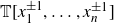

The rest of the section is dedicated to the technical statements needed to prove this result.
Proposition 3·12. The ideal $\mathcal{I}_{P} \subseteq {\mathbb{T}[x_1^{\pm 1}, \dots, x_n^{\pm 1}]}$
is prime whenever P is a prime congruence on
$\mathcal{I}_{P} \subseteq {\mathbb{T}[x_1^{\pm 1}, \dots, x_n^{\pm 1}]}$
is prime whenever P is a prime congruence on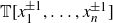 ${\mathbb{T}[x_1^{\pm 1}, \dots, x_n^{\pm 1}]}$
.
${\mathbb{T}[x_1^{\pm 1}, \dots, x_n^{\pm 1}]}$
.
Proof. If P is a minimal prime congruence on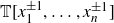 ${\mathbb{T}[x_1^{\pm 1}, \dots, x_n^{\pm 1}]}$
, then as noted in Example 3·10 the ideal
${\mathbb{T}[x_1^{\pm 1}, \dots, x_n^{\pm 1}]}$
, then as noted in Example 3·10 the ideal $\mathcal{I}_{P}$
is the zero ideal so the statement is true because the zero ideal in
$\mathcal{I}_{P}$
is the zero ideal so the statement is true because the zero ideal in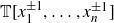 ${\mathbb{T}[x_1^{\pm 1}, \dots, x_n^{\pm 1}]}$
is prime. Let f, g be two polynomials,
${\mathbb{T}[x_1^{\pm 1}, \dots, x_n^{\pm 1}]}$
is prime. Let f, g be two polynomials, $f = \sum f_l$
and
$f = \sum f_l$
and $g = \sum g_q$
, such that
$g = \sum g_q$
, such that $f, g\not\in \mathcal{I}_{P}$
but
$f, g\not\in \mathcal{I}_{P}$
but $fg \in \mathcal{I}_{P}$
and so
$fg \in \mathcal{I}_{P}$
and so $bend(fg) \subseteq Bend(\mathcal{I}_{P}) \subseteq P$
. If in the formal expression
$bend(fg) \subseteq Bend(\mathcal{I}_{P}) \subseteq P$
. If in the formal expression $fg_{\hat \jmath}+f_{\hat \imath}g$
none of the terms
$fg_{\hat \jmath}+f_{\hat \imath}g$
none of the terms $f_ig_j$
and
$f_ig_j$
and $f_sg_r$
for all pairs
$f_sg_r$
for all pairs $(i,j) \neq (s,r)$
have the same exponent vector, then we can write
$(i,j) \neq (s,r)$
have the same exponent vector, then we can write
 \begin{equation} (f, f_{\hat \imath})(g, g_{\hat \jmath}) = (fg + f_{\hat \imath}g_{\hat \jmath}, fg_{\hat \jmath}+f_{\hat \imath}g) = (fg, fg_{\hat \jmath}+f_{\hat \imath}g) = (fg, (fg)_{\hat k}),\end{equation}
where i and j are in the support of f and g respectively, $(fg)_k = f_ig_j$
, and
$(fg)_k = f_ig_j$
, and $f_{\hat \imath}$
denotes f with the term i omitted. In particular, since
$f_{\hat \imath}$
denotes f with the term i omitted. In particular, since $(fg, (fg)_{\hat k}) \in bend(fg) \subseteq P$
and P is prime, either
$(fg, (fg)_{\hat k}) \in bend(fg) \subseteq P$
and P is prime, either $(f, f_{\hat \imath}) \in P$
or
$(f, f_{\hat \imath}) \in P$
or $(g, g_{\hat \jmath})\in P$
.
$(g, g_{\hat \jmath})\in P$
.
Now assume that for two pairs $(i,j) \neq (s,r)$
the terms
$(i,j) \neq (s,r)$
the terms $f_ig_j$
and
$f_ig_j$
and $f_sg_r$
have the same exponent vector. Without loss of generality let
$f_sg_r$
have the same exponent vector. Without loss of generality let $f_sg_r \geq f_ig_j \;=\!:\;d$
. Then
$f_sg_r \geq f_ig_j \;=\!:\;d$
. Then
 $$(fg, (fg)_{\hat k}) + (d,d) = (f, f_{\hat \imath})(g, g_{\hat \jmath}).$$
Since both summands on the left hands side are in P then the sum is in P, and so either $(f, f_{\hat \imath}) \in P$
or
$(f, f_{\hat \imath}) \in P$
or $(g, g_{\hat \jmath})\in P$
. Note that when
$(g, g_{\hat \jmath})\in P$
. Note that when $f_sg_r = f_ig_j$
, then
$f_sg_r = f_ig_j$
, then $(f, f_{\hat \imath})(g, g_{\hat \jmath}) = (fg, fg)$
which is also in P.
$(f, f_{\hat \imath})(g, g_{\hat \jmath}) = (fg, fg)$
which is also in P.
Since this holds for each pair i, j, it follows that either f or g has all their bend relations in P, or equivalently $f \in \mathcal{I}_{P}$
or
$f \in \mathcal{I}_{P}$
or $g \in \mathcal{I}_{P}$
.
$g \in \mathcal{I}_{P}$
.
The following example shows that not all prime ideals are of the form $\mathcal{I}_{P}$
, in particular, not all prime ideals are
$\mathcal{I}_{P}$
, in particular, not all prime ideals are ${\textrm{closed}}$
:
${\textrm{closed}}$
:
Example 3·13. Consider the ideal $I \subseteq {\mathbb{T}}[x^{\pm 1},y^{\pm 1}]$
that consists of all polynomials that are not homogeneous with respect to x. This is a prime ideal since the product of homogeneous polynomials is homogeneous. Consider
$I \subseteq {\mathbb{T}}[x^{\pm 1},y^{\pm 1}]$
that consists of all polynomials that are not homogeneous with respect to x. This is a prime ideal since the product of homogeneous polynomials is homogeneous. Consider $f, g \in I$
, where
$f, g \in I$
, where $f = x+1$
and
$f = x+1$
and $g = xy+1$
and so
$g = xy+1$
and so $bend(f) = (x,1)$
and
$bend(f) = (x,1)$
and $bend(g) = (xy,1)$
are elements of Bend(I). Since Bend(I) is a congruence, in particular it is transitively closed, we get that
$bend(g) = (xy,1)$
are elements of Bend(I). Since Bend(I) is a congruence, in particular it is transitively closed, we get that $(x, xy) \in Bend(I)$
. However,
$(x, xy) \in Bend(I)$
. However, $x + xy \not\in I$
since it is homogeneous with respect to x.
$x + xy \not\in I$
since it is homogeneous with respect to x.
Proposition 3·14. Let P be a non-minimal prime congruence of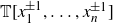 ${\mathbb{T}[x_1^{\pm 1}, \dots, x_n^{\pm 1}]}$
, then
${\mathbb{T}[x_1^{\pm 1}, \dots, x_n^{\pm 1}]}$
, then $P = Bend(\mathcal{I}_{P})$
.
$P = Bend(\mathcal{I}_{P})$
.
Proof. The inclusion $Bend(\mathcal{I}_{P}) \subseteq P$
is always true. For the other direction, first note that P is generated by pairs of the form
$Bend(\mathcal{I}_{P}) \subseteq P$
is always true. For the other direction, first note that P is generated by pairs of the form $(m_1 + m_2, m_1)$
, where
$(m_1 + m_2, m_1)$
, where $m_1$
and
$m_1$
and $m_2$
are terms, since every element of its quotient can be represented by a term. Since P is not a minimal prime there must be distinct terms a, b such that
$m_2$
are terms, since every element of its quotient can be represented by a term. Since P is not a minimal prime there must be distinct terms a, b such that $a \neq b$
and
$a \neq b$
and $(a,b) \in P$
. Now for any
$(a,b) \in P$
. Now for any $m_1, m_2$
, such that
$m_1, m_2$
, such that $(m_1 + m_2, m_1) \in P$
, equivalently written
$(m_1 + m_2, m_1) \in P$
, equivalently written $m_1+m_2 \sim_P m_1$
, we have:
$m_1+m_2 \sim_P m_1$
, we have:
 \begin{equation}am_1 + am_2 \sim_P am_1 + bm_1 \sim_P am_2 + bm_1 \Rightarrow am_1 + am_2 + bm_1 \in \mathcal{I}_{P}\end{equation}
and
 \begin{equation}am_1 \sim_P bm_1 \Rightarrow am_1 + bm_1 \in \mathcal{I}_{P}.\end{equation}
Taking the bend relations of the polynomials in Equations (3·2) and (3·3) we obtain:
 \begin{equation}am_1 + am_2 \sim_P am_1 + bm_1 \sim_P am_1 \in Bend(\mathcal{I}_{P}).\end{equation}
Since $a \in {\mathbb{T}[x_1^{\pm 1}, \dots, x_n^{\pm 1}]}$
it is invertible and we can divide the pairs in Equation (3·4) by a and we obtain that
$a \in {\mathbb{T}[x_1^{\pm 1}, \dots, x_n^{\pm 1}]}$
it is invertible and we can divide the pairs in Equation (3·4) by a and we obtain that $(m_1 + m_2, m_1) \in Bend(\mathcal{I}_{P}).$
Proposition 3·15. Every non-zero prime ideal I of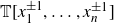 ${\mathbb{T}[x_1^{\pm 1}, \dots, x_n^{\pm 1}]}$
contains a binomial.
${\mathbb{T}[x_1^{\pm 1}, \dots, x_n^{\pm 1}]}$
contains a binomial.
Proof. Consider the polynomial $f \in I$
, and write it as
$f \in I$
, and write it as $f = a + b + c$
, where a, b are terms and
$f = a + b + c$
, where a, b are terms and $c = m_1 + \dots + m_n$
and
$c = m_1 + \dots + m_n$
and $m_i$
are terms. If
$m_i$
are terms. If $n = 0$
then we are done. Assume
$n = 0$
then we are done. Assume $n \gt 0$
and observe that
$n \gt 0$
and observe that $(a+b+c)(ab + bc + ac) = (a + b)(a+c)(b+c)$
and since I is prime then one of
$(a+b+c)(ab + bc + ac) = (a + b)(a+c)(b+c)$
and since I is prime then one of $a + b, a+c$
and
$a + b, a+c$
and $b+c$
is in I. If
$b+c$
is in I. If $a+b \in I$
we are done. Otherwise, without loss of generality let
$a+b \in I$
we are done. Otherwise, without loss of generality let $a+c \in I$
. We can now apply the same argument to
$a+c \in I$
. We can now apply the same argument to $a + c$
, noticing it has one less term than f. Iterating the procedure we reduce to the case
$a + c$
, noticing it has one less term than f. Iterating the procedure we reduce to the case $n = 0$
.
$n = 0$
.
Proposition 3·16. Let I be a non-zero prime ideal of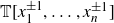 ${\mathbb{T}[x_1^{\pm 1}, \dots, x_n^{\pm 1}]}$
. Then Bend(I) is a prime congruence.
${\mathbb{T}[x_1^{\pm 1}, \dots, x_n^{\pm 1}]}$
. Then Bend(I) is a prime congruence.
Proof. To show that Bend(I) is a prime congruence it is enough to check that the quotient by it is totally ordered in view of Corollary 2·6 (ii). In other words, we need to see that for any two terms $m_1$
and
$m_1$
and $m_2$
one of the pairs
$m_2$
one of the pairs $(m_1 + m_2, m_1)$
and
$(m_1 + m_2, m_1)$
and $(m_1 + m_2, m_2)$
is in Bend(I).
$(m_1 + m_2, m_2)$
is in Bend(I).
Let $f = a+b$
be a binomial in I, which exists by Proposition 3·15 and hence
$f = a+b$
be a binomial in I, which exists by Proposition 3·15 and hence $(a, b) \in Bend(I)$
. Now let
$(a, b) \in Bend(I)$
. Now let $m_1$
and
$m_1$
and $m_2$
be two terms and consider the product
$m_2$
be two terms and consider the product
 $$((a+b)m_1 + am_2)((a+b)m_2 + b m_1) = (a+b)((a+b)m_1m_2 + b m_1^2 + a m_2^2) \in I.$$
Since I is prime, then one of $(a+b)m_1 + am_2$
and
$(a+b)m_1 + am_2$
and $(a+b)m_2 + b m_1$
is in I. Without loss of generality
$(a+b)m_2 + b m_1$
is in I. Without loss of generality $(a+b)m_1 + am_2 \in I$
and so
$(a+b)m_1 + am_2 \in I$
and so $(am_1 + am_2, am_1 + bm_1) \in Bend(I)$
. But since
$(am_1 + am_2, am_1 + bm_1) \in Bend(I)$
. But since $(a,b) \in Bend(I)$
by assumption, we have that
$(a,b) \in Bend(I)$
by assumption, we have that $(am_1 + bm_1, am_1) \in Bend(I)$
and we conclude by transitivity that
$(am_1 + bm_1, am_1) \in Bend(I)$
and we conclude by transitivity that $(am_1 + am_2, am_1) \in Bend(I)$
. Since a is a non-zero Laurent term it is invertible and so
$(am_1 + am_2, am_1) \in Bend(I)$
. Since a is a non-zero Laurent term it is invertible and so $(m_1 + m_2, m_1) \in Bend(I)$
.
$(m_1 + m_2, m_1) \in Bend(I)$
.
The converse is not necessarily true as shown in the following example.
Example 3·17. Consider the ideal $I \subseteq {\mathbb{T}}[x^{\pm 1}, y^{\pm 1}]$
given as the intersection of the set of all polynomials not homogeneous in x and the set of all polynomials not homogeneous in y. Observe that I is not a prime ideal because
$I \subseteq {\mathbb{T}}[x^{\pm 1}, y^{\pm 1}]$
given as the intersection of the set of all polynomials not homogeneous in x and the set of all polynomials not homogeneous in y. Observe that I is not a prime ideal because $(x+xy)(y+xy) \in I$
but neither of the factors is an element of I. On the other hand, since
$(x+xy)(y+xy) \in I$
but neither of the factors is an element of I. On the other hand, since $f = x+y$
and
$f = x+y$
and $g = x+y^2$
are both elements of I, then
$g = x+y^2$
are both elements of I, then $(x, y), (y,1) \in Bend(I)$
. Thus
$(x, y), (y,1) \in Bend(I)$
. Thus
 $${\mathbb{T}}[x^{\pm 1}, y^{\pm 1}]/Bend(I) \cong {\mathbb{T}},$$
and since ${\mathbb{T}}$
is a totally ordered semifield by Corollary 2·6 we conclude that Bend(I) is a prime congruence.
${\mathbb{T}}$
is a totally ordered semifield by Corollary 2·6 we conclude that Bend(I) is a prime congruence.
We can now give a characterisation of the ${\textrm{closed}}$
prime ideals of
${\textrm{closed}}$
prime ideals of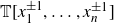 ${\mathbb{T}[x_1^{\pm 1}, \dots, x_n^{\pm 1}]}$
and identify the tropical ideals among them.
${\mathbb{T}[x_1^{\pm 1}, \dots, x_n^{\pm 1}]}$
and identify the tropical ideals among them.
Lemma 3·18. Let P be a prime congruence on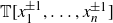 ${\mathbb{T}[x_1^{\pm 1}, \dots, x_n^{\pm 1}]}$
and let
${\mathbb{T}[x_1^{\pm 1}, \dots, x_n^{\pm 1}]}$
and let $m_1 = c_1\boldsymbol{{x}}_{\boldsymbol{{1}}^{\boldsymbol{{u}}}_{\boldsymbol{{1}}}}$
, and
$m_1 = c_1\boldsymbol{{x}}_{\boldsymbol{{1}}^{\boldsymbol{{u}}}_{\boldsymbol{{1}}}}$
, and $m_2 = c_1\boldsymbol{{x}}_{\boldsymbol{{2}}^{\boldsymbol{{u}}}_{\boldsymbol{{2}}}}$
be monomials in
$m_2 = c_1\boldsymbol{{x}}_{\boldsymbol{{2}}^{\boldsymbol{{u}}}_{\boldsymbol{{2}}}}$
be monomials in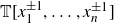 ${\mathbb{T}[x_1^{\pm 1}, \dots, x_n^{\pm 1}]}$
, such that
${\mathbb{T}[x_1^{\pm 1}, \dots, x_n^{\pm 1}]}$
, such that $\boldsymbol{{u}}_{\boldsymbol{{1}}} \neq {\boldsymbol{{u}}}_{\boldsymbol{{2}}}$
. If we have that
$\boldsymbol{{u}}_{\boldsymbol{{1}}} \neq {\boldsymbol{{u}}}_{\boldsymbol{{2}}}$
. If we have that $m_1 \sim_P m_2$
and
$m_1 \sim_P m_2$
and $cm_1 \gt_P 1$
for all
$cm_1 \gt_P 1$
for all $c \in {\mathbb{R}}$
, then
$c \in {\mathbb{R}}$
, then $\mathcal{I}_{P}$
is not a tropical ideal.
$\mathcal{I}_{P}$
is not a tropical ideal.
Proof. Indeed, assume for contradiction that $\mathcal{I}_{P}$
is tropical. Let
$\mathcal{I}_{P}$
is tropical. Let $m_3$
be a term such that in we have
$m_3$
be a term such that in we have $1 \gt_P m_3$
. Note that such
$1 \gt_P m_3$
. Note that such $m_3$
exists – for example
$m_3$
exists – for example $m_1^{-1}$
– and it must have a distinct exponent from
$m_1^{-1}$
– and it must have a distinct exponent from $m_1$
and
$m_1$
and $m_2$
. Now the polynomials
$m_2$
. Now the polynomials $m_1 + m_2 + m_3$
and
$m_1 + m_2 + m_3$
and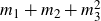 $m_1 + m_2 + m_3^2$
attain their maximum twice at P hence they are in
$m_1 + m_2 + m_3^2$
attain their maximum twice at P hence they are in $\mathcal{I}_{P}$
. By the monomial elimination axiom of tropical ideals we can eliminate
$\mathcal{I}_{P}$
. By the monomial elimination axiom of tropical ideals we can eliminate $m_1$
, but the resulting polynomial
$m_1$
, but the resulting polynomial $c m_2 + m_3 + m_3^2$
can not attain its maximum twice at P as
$c m_2 + m_3 + m_3^2$
can not attain its maximum twice at P as $m_3 \gt_P m_3^2$
and we either have
$m_3 \gt_P m_3^2$
and we either have $c = 0$
or
$c = 0$
or $c m_2 \gt_P m_3$
.
$c m_2 \gt_P m_3$
.
Remark 3·19. A non-minimal prime congruence P whose matrix has more than one row is not finitely generated. Moreover, the variety of P is not determined by finitely many pairs in P as shown in [
Reference Mincheva14
, example 6·3·4]. Note that for any P, by definition $\mathbb{V}(P) = \mathbb{V}(\mathcal{I}_{P})$
. Thus the ideal
$\mathbb{V}(P) = \mathbb{V}(\mathcal{I}_{P})$
. Thus the ideal $\mathcal{I}_{P}$
corresponding to a prime P with rank greater than one is not tropical because it will not have a finite tropical basis.
$\mathcal{I}_{P}$
corresponding to a prime P with rank greater than one is not tropical because it will not have a finite tropical basis.
Proof of Theorem
3·11. For (i) if I is a non-zero closed prime then by Proposition 3·16 Bend(I) is a prime congruence, and since I is closed we have that $I = \mathcal{I}_{Bend(I)}$
. As it was explained in Example 3·10 the zero ideal can be written as
$I = \mathcal{I}_{Bend(I)}$
. As it was explained in Example 3·10 the zero ideal can be written as $\mathcal{I}_{P}$
for any minimal prime P. This also proves one direction of (ii) and the other follows from Proposition 3·14. For (iii) again by Proposition 3·16 we have that for a non-zero closed prime I the congruence Bend(I) is prime and for a non-minimal prime congruence P the ideal
$\mathcal{I}_{P}$
for any minimal prime P. This also proves one direction of (ii) and the other follows from Proposition 3·14. For (iii) again by Proposition 3·16 we have that for a non-zero closed prime I the congruence Bend(I) is prime and for a non-minimal prime congruence P the ideal $\mathcal{I}_{P}$
is prime by Proposition 3·12, non-zero by (ii) and closed by Remark 3·9. Moreover, for a closed ideal I we have that
$\mathcal{I}_{P}$
is prime by Proposition 3·12, non-zero by (ii) and closed by Remark 3·9. Moreover, for a closed ideal I we have that $I = \mathcal{I}_{Bend(I)}$
and for a non-minimal prime P by Proposition 3·14 we have that
$I = \mathcal{I}_{Bend(I)}$
and for a non-minimal prime P by Proposition 3·14 we have that $P = Bend(\mathcal{I}_{P})$
, showing that the two maps are indeed inverses of each other.
$P = Bend(\mathcal{I}_{P})$
, showing that the two maps are indeed inverses of each other.
For (iv) we have already seen in Example 3·10 that if P is a geometric prime then $\mathcal{I}_{P}$
is tropical. We will show that if P is not geometric, then
$\mathcal{I}_{P}$
is tropical. We will show that if P is not geometric, then $\mathcal{I}_{P}$
is not tropical. If the defining matrix U of P consists of multiple rows, then by Remark 3·19 the ideal
$\mathcal{I}_{P}$
is not tropical. If the defining matrix U of P consists of multiple rows, then by Remark 3·19 the ideal $\mathcal{I}_{P}$
is not tropical. Remains to consider non-geometric primes whose matrices have a single row. Recall that a single row matrix corresponds to a geometric prime if the (1, 1) entry is non-zero and let us assume that the (1,1) entry of U is zero, or equivalently that P identifies the elements of
$\mathcal{I}_{P}$
is not tropical. Remains to consider non-geometric primes whose matrices have a single row. Recall that a single row matrix corresponds to a geometric prime if the (1, 1) entry is non-zero and let us assume that the (1,1) entry of U is zero, or equivalently that P identifies the elements of ${\mathbb{T}}$
with 1. By Proposition 3·15 there is a binomial
${\mathbb{T}}$
with 1. By Proposition 3·15 there is a binomial $m_1 + m_2 \in \mathcal{I}_{P}$
. By multiplying both with a monomial whose exponent vector is a sufficiently large multiple of the first row of U we can assume that
$m_1 + m_2 \in \mathcal{I}_{P}$
. By multiplying both with a monomial whose exponent vector is a sufficiently large multiple of the first row of U we can assume that $m_1 \sim_P m_2 \gt_P 1$
, and as we assumed that P identifies
$m_1 \sim_P m_2 \gt_P 1$
, and as we assumed that P identifies ${\mathbb{T}}$
with 1 we also have that
${\mathbb{T}}$
with 1 we also have that $c m_1 \gt_P 1$
for all
$c m_1 \gt_P 1$
for all $c \in {\mathbb{R}}$
. Hence we can apply Lemma 3·18, and conclude that
$c \in {\mathbb{R}}$
. Hence we can apply Lemma 3·18, and conclude that $\mathcal{I}_{P}$
is not a tropical ideal.
$\mathcal{I}_{P}$
is not a tropical ideal.
3·3. Varieties of congruences and ideals
We use the results of the previous section to describe the varieties of prime ideals.
Proposition 3·20. Let I be a prime ideal of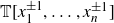 ${\mathbb{T}[x_1^{\pm 1}, \dots, x_n^{\pm 1}]}$
or
${\mathbb{T}[x_1^{\pm 1}, \dots, x_n^{\pm 1}]}$
or ${\mathbb{T}[x_1, \dots, x_n]}$
then
${\mathbb{T}[x_1, \dots, x_n]}$
then $\mathbb{V}(I)$
is at most a point.
$\mathbb{V}(I)$
is at most a point.
Proof. For the case of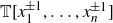 ${\mathbb{T}[x_1^{\pm 1}, \dots, x_n^{\pm 1}]}$
from Proposition 3·16 we know that Bend(I) is prime and so
${\mathbb{T}[x_1^{\pm 1}, \dots, x_n^{\pm 1}]}$
from Proposition 3·16 we know that Bend(I) is prime and so $\mathbb{V}(Bend(I))$
consists of at most a point by Remark 2·11. The theorem follows as
$\mathbb{V}(Bend(I))$
consists of at most a point by Remark 2·11. The theorem follows as $\mathbb{V}(I) = \mathbb{V}(Bend(I))$
which is true by definition of the sets. For
$\mathbb{V}(I) = \mathbb{V}(Bend(I))$
which is true by definition of the sets. For ${\mathbb{T}[x_1, \dots, x_n]}$
, if I is a prime ideal containing a monomial, then it also contains at least one of the variables appearing in that monomial hence its tropical vanishing locus is in bijection with that of a tropical prime ideal in less variables. If I does not contain monomials then the statement follows from Proposition 3·3 and the
${\mathbb{T}[x_1, \dots, x_n]}$
, if I is a prime ideal containing a monomial, then it also contains at least one of the variables appearing in that monomial hence its tropical vanishing locus is in bijection with that of a tropical prime ideal in less variables. If I does not contain monomials then the statement follows from Proposition 3·3 and the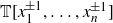 ${\mathbb{T}[x_1^{\pm 1}, \dots, x_n^{\pm 1}]}$
case.
${\mathbb{T}[x_1^{\pm 1}, \dots, x_n^{\pm 1}]}$
case.
Example 3·21. We give an example of a tropical ideal whose variety is a line, explicitly showing it is not prime. Consider the ideal $J = (x-y) \subseteq k[x,y]$
, where k is a trivially valued field. Let
$J = (x-y) \subseteq k[x,y]$
, where k is a trivially valued field. Let $I = trop(J) \subseteq {\mathbb{B}}[x,y]$
, which is a realisable tropical ideal. Notice that
$I = trop(J) \subseteq {\mathbb{B}}[x,y]$
, which is a realisable tropical ideal. Notice that $(x+y+1)(x+y+xy)=(x+y)(x+y+xy+1) \in I$
, but neither
$(x+y+1)(x+y+xy)=(x+y)(x+y+xy+1) \in I$
, but neither $(x+y+1)$
nor
$(x+y+1)$
nor $(x+y+xy)$
are in I, hence I is not prime.
$(x+y+xy)$
are in I, hence I is not prime.
Remark 3·22. Not every ${\textrm{closed}}$
ideal of
${\textrm{closed}}$
ideal of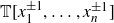 ${\mathbb{T}[x_1^{\pm 1}, \dots, x_n^{\pm 1}]}$
satisfies the strong Nullstellensatz, that is, it is not true that f is in every
${\mathbb{T}[x_1^{\pm 1}, \dots, x_n^{\pm 1}]}$
satisfies the strong Nullstellensatz, that is, it is not true that f is in every ${\textrm{closed}}$
prime containing a
${\textrm{closed}}$
prime containing a ${\textrm{closed}}$
ideal I if and only if some power of f is in I.
${\textrm{closed}}$
ideal I if and only if some power of f is in I.
Proof of Remark
3·22. Let I be the closure of the ideal generated by the polynomials $(1 + x + x^2)y + z, (1 + x + x^2)y + zx, (1 + x + x^2)y + zx^2, (1 + x + x^2)z + y, (1 + x + x^2)z + yx, (1 + x + x^2)z + yx^2$
. From the first three polynomials we conclude that
$(1 + x + x^2)y + z, (1 + x + x^2)y + zx, (1 + x + x^2)y + zx^2, (1 + x + x^2)z + y, (1 + x + x^2)z + yx, (1 + x + x^2)z + yx^2$
. From the first three polynomials we conclude that
 $$(1 + x + x^2)y \sim (1 + x + x^2)y + (1 + x + x^2)z \in Bend(I).$$
Similarly, from the other three generators we obtain that
 $$(1 + x + x^2)z \sim (1 + x + x^2)y + (1 + x + x^2)z \in Bend(I).$$
By transitivity we obtain that the pair $(1 + x + x^2)y \sim (1 + x + x^2)z$
is also in Bend(I) and so
$(1 + x + x^2)y \sim (1 + x + x^2)z$
is also in Bend(I) and so $(1 + x + x^2, 0) (y, z)$
in Bend(I). Every prime congruence P over Bend(I) contains
$(1 + x + x^2, 0) (y, z)$
in Bend(I). Every prime congruence P over Bend(I) contains $(1 + x + x^2, 0) (y, z)$
hence it contains one of the factors. Assume
$(1 + x + x^2, 0) (y, z)$
hence it contains one of the factors. Assume $(1 + x + x^2,0) \in P$
. Since P is a prime congruence on
$(1 + x + x^2,0) \in P$
. Since P is a prime congruence on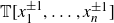 ${\mathbb{T}[x_1^{\pm 1}, \dots, x_n^{\pm 1}]}$
, in the quotient of
${\mathbb{T}[x_1^{\pm 1}, \dots, x_n^{\pm 1}]}$
, in the quotient of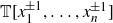 ${\mathbb{T}[x_1^{\pm 1}, \dots, x_n^{\pm 1}]}$
by P each polynomial is congruent to its leading term; denote the leading term of
${\mathbb{T}[x_1^{\pm 1}, \dots, x_n^{\pm 1}]}$
by P each polynomial is congruent to its leading term; denote the leading term of $1 + x + x^2$
by m. So we have
$1 + x + x^2$
by m. So we have $1 + x + x^2 \sim_P m \sim_P 0$
. Multiplying by
$1 + x + x^2 \sim_P m \sim_P 0$
. Multiplying by $m^{-1}$
tells us that that
$m^{-1}$
tells us that that $(1_{\mathbb{T}}, 0_{\mathbb{T}}) \in P$
, which makes P not proper and hence not prime. Hence (y, z) is in every prime congruence containing Bend(I). Moreover,
$(1_{\mathbb{T}}, 0_{\mathbb{T}}) \in P$
, which makes P not proper and hence not prime. Hence (y, z) is in every prime congruence containing Bend(I). Moreover, $y+z$
is in every
$y+z$
is in every ${\textrm{closed}}$
prime containing I. However, no power of
${\textrm{closed}}$
prime containing I. However, no power of $y + z$
is in I.
$y + z$
is in I.
Remark 3·23. Maclagan and Rincón have announced that tropical ideals satisfy the strong Nullstellensatz; at time of writing, the result is still unpublished.
3·4. Dimension
In this section we will compute the dimension of the “coordinate semiring”, i.e., the semiring ${\mathbb{T}[x_1^{\pm 1}, \dots, x_n^{\pm 1}]}/Bend(I)$
.
${\mathbb{T}[x_1^{\pm 1}, \dots, x_n^{\pm 1}]}/Bend(I)$
.
In [ Reference Maclagan and Rincón17 , theorem∼3·11] the authors prove that tropical ideals satisfy the ascending chain condition. Part (iv) of Theorem 3·11 implies that in a chain of tropical ideals there would be at most one prime ideal and in a chain of prime ideals there would be at most one tropical ideal. Thus we cannot define Krull dimension in terms of chains of prime tropical ideals. In what follows, Krull dimension is defined in terms of prime congruences as stated in Definition 2·13.
By the Structure Theorem for tropical varieties [
Reference Maclagan and Sturmfels19
, theorem 3·3·5] the set-theoretic tropicalisation trop(X) of a d-dimensional subvariety X of $(K^*)^n$
or
$(K^*)^n$
or $K^n$
is a polyhedral complex of pure dimension d. Here we relate the dimension of X, or rather trop(X), to the Krull dimension of the coordinate ring of the corresponding affine tropical scheme.
$K^n$
is a polyhedral complex of pure dimension d. Here we relate the dimension of X, or rather trop(X), to the Krull dimension of the coordinate ring of the corresponding affine tropical scheme.
Theorem 3·24. Let I be a tropical ideal in ${\mathbb{T}[x_1, \dots, x_n]}$
whose variety
${\mathbb{T}[x_1, \dots, x_n]}$
whose variety $X = \mathbb{V}(I)$
has dimension d. Then
$X = \mathbb{V}(I)$
has dimension d. Then
 $$\dim {\mathbb{T}[x_1, \dots, x_n]}/Bend(I) = d + 1.$$
We will give an upper and lower bound for the dimension of this quotient which will imply the statement of the theorem. We first remind the reader the following terminology.
Definition 3·25. An $\mathbb{R}$
-rational polyhedron is
$\mathbb{R}$
-rational polyhedron is $P = \{x\in \mathbb{R}^n \;:\; Ax \leq b\}$
, where A is a
$P = \{x\in \mathbb{R}^n \;:\; Ax \leq b\}$
, where A is a $d\times n$
matrix with entries in
$d\times n$
matrix with entries in $\mathbb{Q}$
and
$\mathbb{Q}$
and $b\in \mathbb{R}^d$
.
$b\in \mathbb{R}^d$
.
Remark 3·26. In a series of papers [
Reference Maclagan and Rincón16–Reference Maclagan and Rincón18
] Maclagan and Rincón prove that the varieties of tropical ideals are finite balanced $\mathbb{R}$
-rational polyhedral complexes. Moreover, in [
Reference Maclagan and Rincón17
, theorem 1·4] they show that the only tropical ideal whose variety is empty is the polynomial semiring
$\mathbb{R}$
-rational polyhedral complexes. Moreover, in [
Reference Maclagan and Rincón17
, theorem 1·4] they show that the only tropical ideal whose variety is empty is the polynomial semiring ${\mathbb{T}[x_1, \dots, x_n]}$
. Thus every non-trivial tropical ideal has a non-empty variety.
${\mathbb{T}[x_1, \dots, x_n]}$
. Thus every non-trivial tropical ideal has a non-empty variety.
Proposition 3·27. Let I be an ideal in ${\mathbb{T}[x_1, \dots, x_n]}$
such that
${\mathbb{T}[x_1, \dots, x_n]}$
such that $X = \mathbb{V}(I)$
is a finite dimensional
$X = \mathbb{V}(I)$
is a finite dimensional $\mathbb{R}$
-rational polyhedral complex of dimension d. Then
$\mathbb{R}$
-rational polyhedral complex of dimension d. Then
 $$\dim {\mathbb{T}[x_1, \dots, x_n]}/Bend(I) \geq d + 1.$$
Proof. Recall that if P is a prime congruence with defining matrix U then $\dim {\mathbb{T}[x_1, \dots, x_n]}/P $
is equal to the rank of U, denoted r(U). We first observe that if C is a congruence on
$\dim {\mathbb{T}[x_1, \dots, x_n]}/P $
is equal to the rank of U, denoted r(U). We first observe that if C is a congruence on ${\mathbb{T}[x_1, \dots, x_n]}$
then
${\mathbb{T}[x_1, \dots, x_n]}$
then
 $$\dim {\mathbb{T}[x_1, \dots, x_n]}/C = \dim {\mathbb{T}[x_1, \dots, x_n]}/P,$$
where P is a prime congruence over C of maximal rank, in particular, P is a minimal prime over C. Thus, if P is a prime of maximal rank over Bend(I) it suffices to show that P has rank at least $d+1$
.
$d+1$
.
We will show that there always exists a prime congruence P of rank $d+1$
containing Bend(I), such that P has a geometric prime lying over it. Let
$d+1$
containing Bend(I), such that P has a geometric prime lying over it. Let $\mathcal{F}$
be a maximal cell (of maximal dimension) of the polyhedral complex X and let
$\mathcal{F}$
be a maximal cell (of maximal dimension) of the polyhedral complex X and let $\omega$
be a point in the relative interior of
$\omega$
be a point in the relative interior of $\mathcal{F}$
. The affine span of
$\mathcal{F}$
. The affine span of $\mathcal{F}$
has dimension equal to the dimension of X which is d. Since X is
$\mathcal{F}$
has dimension equal to the dimension of X which is d. Since X is $\mathbb{R}$
-rational there exist
$\mathbb{R}$
-rational there exist $u_1, \dots, u_d \in \mathcal{F}$
such that
$u_1, \dots, u_d \in \mathcal{F}$
such that $\omega, u_1, \dots, u_d$
are affine independent and
$\omega, u_1, \dots, u_d$
are affine independent and $u_1 - \omega, \dots, u_d - \omega$
are rational. Now consider the matrix
$u_1 - \omega, \dots, u_d - \omega$
are rational. Now consider the matrix
 $$U = \begin{pmatrix} 1\;\;\;\; & \omega \\ 1\;\;\;\; & {u_1} \\ \vdots\;\;\;\; & \vdots\\ 1\;\;\;\; & {u_d}\end{pmatrix}.$$
Since $\omega, u_1, \dots, u_d$
are affine independent then the rows of U are linearly independent and thus
$\omega, u_1, \dots, u_d$
are affine independent then the rows of U are linearly independent and thus $r(U) = d+1$
. Furthermore, U defines the same order as
$r(U) = d+1$
. Furthermore, U defines the same order as
 $$U' = \begin{pmatrix} 1\;\;\;\; & \omega \\ 0\;\;\;\; & {u_1 - \omega} \\ \vdots\;\;\;\; & \vdots\\ 0\;\;\;\; & {u_d - \omega}\end{pmatrix}.$$
Since the $u_1 - \omega, \dots, u_d - \omega$
are rational and linearly independent, each row of
$u_1 - \omega, \dots, u_d - \omega$
are rational and linearly independent, each row of $U^{\prime}$
further refines the ordering hence
$U^{\prime}$
further refines the ordering hence $U^{\prime}$
, and consequently U, defines a prime of rank
$U^{\prime}$
, and consequently U, defines a prime of rank $d + 1$
. To see that P contains Bend(I), note that for every
$d + 1$
. To see that P contains Bend(I), note that for every $f\in I$
and
$f\in I$
and $v\in \mathbb{V}(I)$
we have that f(v) attains its maximum twice. Since U orders monomials by evaluating them at the points
$v\in \mathbb{V}(I)$
we have that f(v) attains its maximum twice. Since U orders monomials by evaluating them at the points $\omega, u_1, \dots, u_d \in \mathbb{V}(I)$
it follows that
$\omega, u_1, \dots, u_d \in \mathbb{V}(I)$
it follows that
 $$bend(f) = \{(f , f_{\hat \imath})\}_{i\in supp(f)} \subseteq P,$$
for all $f \in I$
, hence
$f \in I$
, hence $Bend(I) \subseteq P.$
Proposition 3·28. Let I be a tropical ideal in ${\mathbb{T}[x_1, \dots, x_n]}$
such that
${\mathbb{T}[x_1, \dots, x_n]}$
such that $X = \mathbb{V}(I)$
has dimension d. Then
$X = \mathbb{V}(I)$
has dimension d. Then
 $$\dim {\mathbb{T}[x_1, \dots, x_n]}/Bend(I) \leq d + 1.$$
Proof. We will show that every prime congruence over Bend(I) has rank at most $d+1$
. We first see this in the case when every maximal rank prime P has a geometric prime over it. Let W be the defining matrix of P. Denote the rows of W by
$d+1$
. We first see this in the case when every maximal rank prime P has a geometric prime over it. Let W be the defining matrix of P. Denote the rows of W by $w_1, \dots , w_{r(W)}$
. Note that they are linearly independent by definition of the defining matrix of a prime. Consider the vectors
$w_1, \dots , w_{r(W)}$
. Note that they are linearly independent by definition of the defining matrix of a prime. Consider the vectors $w_1^{\prime} = w_1,\ w_2^{\prime} = w_1 + \epsilon_1^{\prime}w_2,\ \dots ,\ w_{r(W)}^{\prime} = w_1 + \dots + \epsilon_{r(W)}^{\prime}w_{r(W)}$
which are also linearly independent. We can scale each of the vectors
$w_1^{\prime} = w_1,\ w_2^{\prime} = w_1 + \epsilon_1^{\prime}w_2,\ \dots ,\ w_{r(W)}^{\prime} = w_1 + \dots + \epsilon_{r(W)}^{\prime}w_{r(W)}$
which are also linearly independent. We can scale each of the vectors $w_1', \dots , w_{r(W)}'$
so that the first entry is 1. Now consider the re-scaled vectors without the first entry and call them
$w_1', \dots , w_{r(W)}'$
so that the first entry is 1. Now consider the re-scaled vectors without the first entry and call them $w_1'', \dots, w_{r(W)}''$
. Note that the vectors
$w_1'', \dots, w_{r(W)}''$
. Note that the vectors $w_1'', \dots, w_{r(W)}''$
are affine independent and lie on the same face of X. Since we know that the dimension of X is at most d, we know that
$w_1'', \dots, w_{r(W)}''$
are affine independent and lie on the same face of X. Since we know that the dimension of X is at most d, we know that $r(W) \leq d+1$
. Remains to investigate the case when a maximal rank prime P containing Bend(I) has no geometric prime over it. Denote by U the defining matrix of P. If there is no geometric prime over P then the first entry of the first row of U is zero. If the first entry of any other row is not zero, we can add a suitable multiple of this row to the first one. This way we obtain the matrix of a different prime of the same rank, which still contains Bend(I) but has a geometric prime over it. In this case we are done by the previous discussion. Thus we can assume that the first column of U is the zero vector. Consider the prime
$r(W) \leq d+1$
. Remains to investigate the case when a maximal rank prime P containing Bend(I) has no geometric prime over it. Denote by U the defining matrix of P. If there is no geometric prime over P then the first entry of the first row of U is zero. If the first entry of any other row is not zero, we can add a suitable multiple of this row to the first one. This way we obtain the matrix of a different prime of the same rank, which still contains Bend(I) but has a geometric prime over it. In this case we are done by the previous discussion. Thus we can assume that the first column of U is the zero vector. Consider the prime $P^{\prime}$
with matrix
$P^{\prime}$
with matrix $U^{\prime}$
, where
$U^{\prime}$
, where
 $$U' = \begin{pmatrix} 1\;\;\;\; & \boldsymbol{0} \\ \boldsymbol{0}\;\;\;\; & U\end{pmatrix}.$$
Then there are two cases. First, if $I \subseteq {\mathbb{B}}[x_1, \dots, x_n]$
, then the prime P
′ lies above Bend(I) and clearly
$I \subseteq {\mathbb{B}}[x_1, \dots, x_n]$
, then the prime P
′ lies above Bend(I) and clearly $r(U')\gt r(U)$
. So P is not a maximal rank prime over Bend(I). If
$r(U')\gt r(U)$
. So P is not a maximal rank prime over Bend(I). If $I \not\subseteq {\mathbb{B}}[x_1, \dots, x_n]$
, consider the prime P
′ as before. Since the (1, 1) entry of U
′ is 1, there exists a geometric prime over P
′. We can infer from [
Reference Maclagan and Rincón18
, proposition∼2·12], that
$I \not\subseteq {\mathbb{B}}[x_1, \dots, x_n]$
, consider the prime P
′ as before. Since the (1, 1) entry of U
′ is 1, there exists a geometric prime over P
′. We can infer from [
Reference Maclagan and Rincón18
, proposition∼2·12], that $\dim \mathbb{V}(I) = \dim \mathbb{V}(\phi(I)) = d+1$
where the map
$\dim \mathbb{V}(I) = \dim \mathbb{V}(\phi(I)) = d+1$
where the map $\phi\;:\; {\mathbb{T}[x_1, \dots, x_n]} \rightarrow {\mathbb{B}}[x_1,\dots,x_n]$
. Notice that P
′ is a prime over
$\phi\;:\; {\mathbb{T}[x_1, \dots, x_n]} \rightarrow {\mathbb{B}}[x_1,\dots,x_n]$
. Notice that P
′ is a prime over $Bend(\phi(I))$
. Then by the earlier argument
$Bend(\phi(I))$
. Then by the earlier argument $\dim {\mathbb{T}[x_1, \dots, x_n]}/P'$
is at most
$\dim {\mathbb{T}[x_1, \dots, x_n]}/P'$
is at most $d + 1$
. Now since
$d + 1$
. Now since $r(U')= r(U) + 1 \gt r(U)$
, then
$r(U')= r(U) + 1 \gt r(U)$
, then $r(U) \lt d+1$
and hence P is not a maximal rank prime. So we conclude that if P is a maximal rank prime with matrix U, then
$r(U) \lt d+1$
and hence P is not a maximal rank prime. So we conclude that if P is a maximal rank prime with matrix U, then $r(U) \leq d+1$
.
$r(U) \leq d+1$
.
Proof of Theorem 3·24. The theorem follows immediately from Proposition 3·27, Remark 3·26, and Proposition 3·28.
Remark 3·29. Recently, in [
Reference Maclagan and Rincón18
] the authors show that if I is a non-necessarily realisable tropical ideal the dimension of V(I) is equal to the degree of the Hilbert polynomial of I. Their result agrees with our computation of the Krull dimension of ${\mathbb{T}}[x_1, \dots, x_n]/Bend(I)$
.
${\mathbb{T}}[x_1, \dots, x_n]/Bend(I)$
.
Acknowledgements
The authors thank Diane Maclagan and Nati Friedenberg for their insightful comments on earlier versions of this paper. K.M. acknowledges the support of the Simons Foundation, Travel Support for Mathematicians.

 Open access

