





Impact Statements
This study investigated the traditional Bedouin rangeland management and conservation system known as Al-Hima, with a focus on its practice in Jordan. It systematically reviewed published literature on traditional rangeland management systems around the world, documented historical and contemporary Hima practice in Jordan through analysis of published literature and recent interviews with herding practitioners, and drew lessons from this system that are relevant to the wider environmental management and international development communities. While previous studies have examined Al-Hima as a historical system, this is the first study to thoroughly document its modern practice in Jordan and analyze how it relates to other traditional rangeland management practices, both in the Middle East and North Africa (MENA) region and globally. Contributions from this study may thus offer insights into the relationship between traditional systems and modern rangeland management more broadly, both in Jordan and in other development contexts.
Introduction
Humans have been actively managing rangelands for thousands of years through diverse means such as controlled grazing and prescribed fire (Roberts, Reference Roberts2002; Middleton, Reference Middleton2013). Traditional practices have co-evolved alongside rangeland ecology to create complex socio–ecological systems characterized by resilience, adaptability and transformability, which can be highly resistant to environmental shocks or susceptible to degradation, depending on management practices (Hruska et al., Reference Hruska, Huntsinger, Brunson, Li, Mashall, Oviedo, Whitcomb and Briske2017). Rangelands constitute the most widespread land use type in the world, supporting the livelihoods of between 200 million and 500 million people, and many rangelands are under some form of common-resource management with roots going back millennia (Reid et al., Reference Reid, Fernández-Giménez and Galvin2014; Mbow et al., Reference Mbow, Rosenzweig, Barioni, Benton, Herrero, Krishnapillai, Liwenga, Pradhan, Rivera-Ferre, Sapkota, Tubiello and Xu2019). These traditionally managed rangelands are classic examples of common-pool resources, which Ostrom (Reference Ostrom2010a) and others have shown can be effectively managed by bottom-up, polycentric systems without the need for external intervention, avoiding the “tragedy of the commons” scenario where resources are used unsustainably until they dry up (Ostrom, Reference Ostrom2010a; Moritz et al., Reference Moritz, Scholte, Hamilton and Kari2013; Undargaa, Reference Undargaa2016).
These traditional rangeland management systems, constituted by policies, institutions and practices that define how rangeland resources are governed, exploited and conserved, are often highly adapted to local environmental conditions through thousands of years of local development and a strong tradition of local governance (Fuhlendorf et al., Reference Fuhlendorf, Engle, Elmore, Limb and Bidwell2012). The techniques used in these systems are variable, ranging from herd rotation or nomadism to the protection of rangeland reserves, to water conservation and managed fire (Weber and Horst, Reference Weber, Horst, Weber and Davis2009; Seid. et al., Reference Seid., Kuhn and Fikre2016). However, a common thread among many traditional systems is that they consider whole-system sustainability and a range of ecosystem services, rather than optimizing for maximum economic output (Niamir, Reference Niamir1991; Gharibvand et al., Reference Gharibvand, Azadi and Witlox2015).
They also often involve an element of mobility in which individual herders are able to make decisions about where and when to take livestock based on personal observations and experience, allowing for decentralized management through a network of individual experts (Niamir-Fuller, Reference Niamir-Fuller2005; Samuels et al., Reference Samuels, Allsopp and Hoffman2013). While pastoralist decision-makers in these systems have historically been described as primarily avoiding risk in a highly uncertain landscape, other scholarship has raised the model of pastoralists constructing reliability through exploiting rangelands’ high variability, highlighting the high level of knowledge and analysis utilized by livestock managers in many systems (Roe et al., Reference Roe, Huntsinger and Labnow1998; Scoones, Reference Scoones2023). The expertise necessary to thrive in this environment is typically perpetuated and developed through orally transmitted knowledge from experienced practitioners, alternatively known as Traditional Ecological Knowledge (TEK), Local Ecological Knowledge (LEK) or Indigenous Knowledge (IK) (Oba, Reference Oba2012). TEK has been widely recognized as a critical component in the effort to fairly and sustainably maintain biodiversity and build resilience to climate change (Gómez-Baggethun et al. Reference Gómez-Baggethun, Corbera and Reyes-García2013; Saylor et al., Reference Saylor, Alsharif and Torres2017).
There are significant overlaps between the techniques used by many traditional rangeland management systems and those recommended by modern range science, but a serious consideration of traditional systems in their own right remains valuable for managers. For one, highly context-specific technical solutions that take into account local environmental and social factors may exist in some traditional systems that could be overlooked by more widely applicable recommendations, a phenomenon that has been well-documented in the study of Traditional Ecological Knowledge (Berkes et al., Reference Berkes, Colding and Folke2000; Reyes-Garcia, Reference Reyes-Garcia, Martinez-Alier and Muradian2015). Second, casting management interventions in alignment with existing traditional practices rather than as top-down impositions from outside scientists can greatly increase local buy-in and a management strategy’s chance of success. This is particularly relevant to Global South contexts where central governance is weak and widespread support from herders is a critical factor in successful management. The agreement of local communities or lack thereof has been shown to play a major role in the success of rangeland management implementations across the developing world, and understanding how traditional practices interface with modern science is key to successfully utilizing the advantages of both (Abolhassani et al., Reference Abolhassani, Oesten, Rajmis and Azadi2013; Wu et al., Reference Wu, Liao and Yu2025). Furthermore, the decentralized nature of rangeland systems in the Global South makes them particularly attuned to models of collective social action that have been shown to lead to effective resource management when certain conditions, such as repeated face-to-face communication and shared benefits, are met (Ostrom, Reference Ostrom2010b).
Traditional rangeland management systems are threatened by a range of political, economic and climate change-related factors, and in many places the knowledge that dictates these practices has already been lost (Muhammad et al., Reference Muhammad, Mohammad, Abdullah, Mehmet, Ashfaq and Wajid2019). This represents a reduction in the collective understanding of Earth’s biophysical environment, especially in the face of rapid and unpredictable environmental change, and preserving traditional knowledge of rangelands has been highlighted as a key priority in rangeland management (Briske, Reference Briske2011).
Recent work on rangeland transitions in the Arabian Peninsula has emphasized the need to reintegrate traditional pastoral systems such as Al-Hima into contemporary management frameworks (Eldridge et al., Reference Eldridge, Davies, Squires and Maestre2026). While these studies provide important regional and policy-level perspectives, there remains a need for a detailed analysis of how such systems function historically and how they are being adapted in practice today. This study addresses this gap by focusing specifically on Al-Hima as both a traditional institution and an evolving contemporary management approach.
This paper discusses Al-Hima, a traditional rangeland management practice originating from Bedouin Arab societies in the North Arabian desert, which is poorly documented in the English-language scientific literature. Al-Hima demonstrates key similarities with other traditional rangeland practices, and has been shown to have positive effects on ecosystem health and local livelihoods in places where it is practiced, while also exhibiting highly localized adaptations typical of traditional systems (Al-Tabini and Al-Khalidi, Reference Al-Tabini and Al-Khalidi2022). This article summarizes the benefits of and threats to traditional rangeland management globally, describes Al-Hima and how it fits in the global context of traditional practices and offers lessons from Al-Hima that can be used in modern rangeland management practice, in order to demonstrate how traditional systems like Al-Hima uphold many of the same principles as scientific rangeland management, and can be used by managers to bolster local trust and improve the local relevance of management policy.
Methodology
A full review of published literature pertaining to traditional rangeland management techniques, including studies of Al-Hima in Jordan, similar systems in the Middle East and North Africa region, and traditional range management more broadly worldwide, was conducted. This review searched the English-language peer-reviewed literature for case studies that focused on documenting the effects of traditional rangeland management systems, as well as the effects of the breakdown of these systems in contexts where they have been lost. We extracted qualitative and quantitative results from each study and analyzed them for similarities and differences between the studied system and Al-Hima. Case studies were assessed according to social and environmental outcomes documented in the literature, with success defined as positive ecological assessments of rangeland health and positive stakeholder reports, while failure was defined as ecological degradation and the loss of livelihoods. We then used this analysis to identify factors associated with the successful integration of traditional management structures in modern management, and to identify how Al-Hima fits into the larger background of traditional rangeland management around the world.
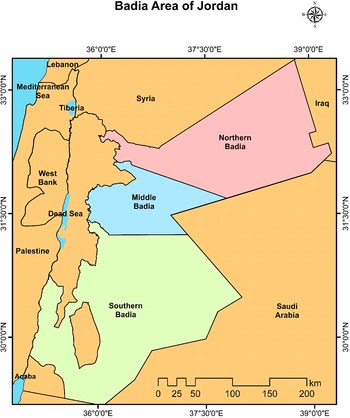
In addition to the literature review, qualitative data were obtained from semi-structured interviews with 15 Jordanian livestock owners and herders in the Jordanian Badia in 2024. The Badia consists of semi-arid and arid desert landscapes and makes up 80% of Jordan’s area, and subsistence livestock herding makes up the primary land use. The selected study participants were all community elders who either practiced Al-Hima themselves or knew about Al-Hima practice from their fathers (as Al-Hima is predominantly practiced by men). They were all local experts known amongst their tribes for their knowledge in livestock management and rangeland degradation, and they came from all three regions of the Jordanian Badia. Figure 1 shows a map of the three Badia regions of Jordan where interviews took place. All participants gave permission for their names to be shared in research publications. In these interviews, researchers asked practitioners questions about the following aspects of Hima practice:
-
1. How have they practiced Al-Hima, and how has it shaped relationships between people and land?
-
2. What community norms and customary laws were and are used as part of the Hima system?
-
3. How have other forms of land protection (including governmental rangeland reserves and wildlife reserves) affected their livestock and livelihoods?
-
4. Whether reviving and expanding the Hima system was possible and desirable given current challenges, and how it would need to change to fit the contemporary context?
Map of Jordanian Badia. Hashemite fund for development of Jordan Badia (HFDB), research and studies department, GIS division, 2025.

We recorded the conversations that resulted from these interviews and translated them into English, and extracted common themes and ideas describing Al-Hima as it is currently practiced in Jordan. We then combined these data with results from the literature review to determine key takeaways from Al-Hima that could be of use in other traditional rangeland management contexts.
Literature review
Rangeland management, past and present, is based on collecting information about ecological and abiotic factors in a rangeland system, identifying specific behaviors or policies to enhance the production or conservation of the rangeland and implementing these behaviors through social structures. Critically, rangeland dynamics are complex, often poorly understood, and highly context-dependent, meaning that behaviors and policies relevant in one ecosystem and society may not be applicable in another (Boyd and Svejcar, Reference Boyd and Svejcar2009). However, many traditional rangeland management systems share a focus on reducing grazing pressure on certain areas of land during certain times in order to give vegetation the opportunity to recover from grazing pressure and resulting in more robust grazing resources in the future (Niamir, Reference Niamir1991).
The effectiveness of traditional systems has been particularly well-documented by the published literature in northern Iran, where a complex social system of shared herd management has remained in place for centuries, and only recently been recorded in a Western scientific context (Abolhassani, Reference Abolhassani2011). In the Taleqan region, multiple community members’ livestock are ranged together for 9 months out of the year by specialized herd managers known as Pishkar. Herds are rotated between different ecological zones according to a strict traditional calendar, and Pishkar exhibit deep knowledge of native plants, including their phenology and palatability for livestock (Mahdavi et al., Reference Mahdavi, Shahraki and Sharafatmandrad2023). Pishkar also estimates grazing capacity based on vegetation growth and composition, and their estimates are very similar to those produced by the District Office for Natural Resources using modern ecological assessments of forage production accessibility for livestock, rangeland area and the grazing period. (Ghorbani et al., Reference Ghorbani, Azarnivand, Mehrabi, Jafari, Nayebi and Seeland2013). This Indigenous system uses methods similar to those used by modern scientists, but the practitioners of the management are different: local leaders trained from childhood by their elders, rather than in a university setting. Nonetheless, the Pishkar system achieves the same goal of scientific land managers: setting sustainable stocking rates. The rates set by Pishkar tend to match or fall below scientific ones (in one instance, Pishkar estimated a maximum stocking rate of 3465 animals, while the District Office allowed 3535), potentially because some longer-term ecosystem services remain overlooked by modern methods (Ghorbani et al., Reference Ghorbani, Azarnivand, Mehrabi, Jafari, Nayebi and Seeland2013).
Traditional land protection that uses local expertise to determine optimal stocking rates and rotate livestock exists elsewhere in historically managed rangelands as well. Among the Sukuma people of northwest Tanzania, for example, the traditional ngliti system involves protecting areas of standing vegetation during the rainy season to act as reserves during the dry season, both for livestock grazing and other resource harvests like woodcutting (Kamwenda, Reference Kamwenda2002). These reserves can be owned privately or communally and are managed by local communities through community assemblies (dagashidaa) and traditional guards (sungusungu) (Selemani, Reference Selemani2012; Selemani et al., Reference Selemani, Eik, Holand, Ådnøy, Mtengeti and Mushi2013). This system has been shown to prevent ecological degradation and promote biodiversity (Safari et al., Reference Safari, Singu, Masanyiwa and Hyandye2019). In Ethiopia, Boroma pastoralists widely use grazing reserves known as kaloo, in which specific enclosures are reserved for dry season grazing (Abate, Reference Abate2016). Herders also protect feed in standing hay fields protected by thorny bush fences known as hogga, and herds are split depending on livestock age, sex and productivity, and are rotated through different areas to preserve important plant species (Abate et al., Reference Abate, Ebro and Gebreyes2010; Dika, Reference Dika2016). Disputes over the use of rangeland usage are adjudicated by village elders according to customary law, which has been shown to be more effective at distributing resource access than government policies focused on private ownership (Kenee et al., Reference Kenee, Tesfaye and Teshome2012). These systems reflect many of the same recommendations made by modern range science, but emerge not from the bottom-up application of local traditions, but rather from the top-down impositions of national governments. Diverse case studies from around the world show how this model can achieve strong sustainability and justice outcomes, despite being historically overlooked by much of the range science community (Brunson et al., Reference Brunson, Huntsinger, Meredith and Sayre2022).
For every case study of traditional management proving effective, however, there are examples of these systems breaking down and falling out of use due to modern social, political and economic pressures, often contributing to ecological degradation. In Central Asia, for example, nomadic pastoralism has a long history, but a Soviet era focus on wheat production combined with the decline of nomadism after the enforcement of post-Soviet international borders has resulted in the steep decline of nomadic migration and consequent degradation of many Central Asian rangelands (Suleimenov, Reference Suleimenov, Mueller, Saparov and Lischeid2014; Mirzabaev et al., Reference Mirzabaev, Ahmed, Wener, Pender and Louhaichi2016). Restoring community-based stewardship of rangelands has been a primary recommendation for sustainable management (Coughenour et al., Reference Coughenour, Behnke, Lomas, Price and Behnke2008).
Problems in rangeland management have also been documented in Nigeria, where rapid population growth and the expansion of farming and urban areas have increased demand for land, leading to violent conflicts that drive herders off their traditional lands (Murtala, Reference Murtala2023). A lack of governmental commitments has inhibited the establishment of grazing preserves and changing weather patterns due to climate change have made marginal rangelands less productive (Al-Tabini and Madison, Reference Al Tabini and Madison2024; Abdullahi et al., Reference Abdullahi, Daneyel and Aliyara2015). As a result, rangelands are largely overstocked and overgrazed (Muhammad et al., Reference Muhammad, Abdurrahaman, Umar, Muhammad, Dahiru, Kabir and Alhassan2024). And in northern Norway, Sweden and Finland, the Sami people traditionally maintained a system of nomadic reindeer herding which now faces significant challenges. Declining pasture conditions due to climate change, historical policies aimed at sedentarization, and modern economic pressures for maximum production have resulted in the loss of approximately 70% of traditional lichen pastures in the region (Eira et al., Reference Eira, Magga, Bongo, Sara, Mathiesen and Oskal2008; Axelsson-Linkowski et al., Reference Axelsson-Linkowski, Fjellström, Sandström, Westin, Östlund and Moen2020). Experts point to the restoration of Indigenous land rights and knowledge systems as important factors in both natural and cultural preservation in the Arctic (Uboni et al., Reference Uboni, Åhman and Moen2020).
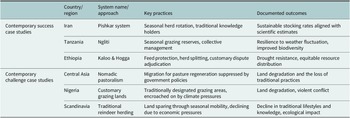
The examples discussed here (summarized in Table 1) illustrate how the loss of traditional ecological knowledge can be implicated in larger rangeland degradation. While a range of political and social factors are at play in these situations, the association between the breakdown of traditional systems and the failure to achieve sustainability and justice outcomes (and, conversely, the strength of these outcomes in contexts where traditional rangeland management remains strong) should be salient to rangeland managers seeking these outcomes in developing world contexts. A deeper dive into another traditional system, Al-Hima, illustrates how the loss of traditional knowledge can be a driver of rangeland degradation, and how reviving it can reverse this trend.
Overview of traditional rangeland management case studies

Results: Al-Hima in Jordan
Al-Hima represents one such traditional rangeland management system at risk of being lost. This system, which originated in pre-Islamic Arabia, has been used for more than 1400 years to sustainably manage arid rangelands and their resources in the Arabian desert region that is today covered by Yemen, Oman, Saudi Arabia, Egypt, Jordan, Syria, Lebanon and Iraq (Draz, 1969, as cited in Zahran and Younes, Reference Zahran and Younes1990; Chehod, Reference Chehod, Lewis, Ménage, Pellat and Schacht1971). The word Hima in Arabic refers to a protected area determined by local leaders and community experts in which grazing is limited in some capacity (Chehod, Reference Chehod, Lewis, Ménage, Pellat and Schacht1971; Kilani et al., Reference Kilani, Serhal and Llewlyn2007). The system focuses on the sustainable and equitable use of natural resources and the preservation of ecosystems (Qaqish, Reference Qaqish2016).
The concept of Al-Hima can be found in pre-Islamic Arabic texts, in which it generally refers to private grazing lands belonging to an individual tribe or local leader (Draz, 1969, as cited in Zahran and Younes, Reference Zahran and Younes1990; Chehod, Reference Chehod, Lewis, Ménage, Pellat and Schacht1971; Kilani et al., Reference Kilani, Serhal and Llewlyn2007). With the arrival of Islam, the concept developed into a public resource, with public Himas being established for entire communities by the early Caliphs (Foltz et al. 1991; Gari, Reference Gari2006; Qaqish, Reference Qaqish2016). The opening of Hima for the common good is cited as the origin of the saying “There is no Hima but God and his Prophet,” and today the concept remains closely tied with Islam, particularly the Hadith (Sahih al-Bukhari, 52).
In more recent history, the system was integrated into the taxation system of the Ottoman Empire, in which taxes were calculated based on the number of livestock distributed among different Hima areas (Gari, Reference Gari2006; Qaqish, Reference Qaqish2016). After the fall of the Ottoman state and the rise of tribal monarchies in the region, the system flourished further, to the point where there were an estimated 3000 Hima areas in Saudi Arabia until the 1960s (Gari, Reference Gari2006). However, the usage of Al-Hima declined in the latter half of the 20th century as international borders were enforced, nomadic groups sedentarized and tribal lands put under government control, which has resulted in the loss of traditional knowledge and ecological degradation across much of the region (Blench, Reference Blench1999; Kilani et al., Reference Kilani, Serhal and Llewlyn2007; Qaqish, Reference Qaqish2016). As an interview participant, Sheikh Hayel Al-Fawaz, explained:
In the past, moving from one area to another – or even from one country to another – was itself a form of Hima. It allowed the land to rest, the vegetation to recover, and the herds to thrive without exhausting any single area.
This form of nomadism is almost completely absent today for a range of reasons, primary among them being the enforcement of international borders that prevent herders from ranging across their historic territories spanning Jordan, Syria, Iraq and Saudi Arabia (Hiatt, Reference Hiatt1984). The transition to a modern globalized economy and government requirements for receiving healthcare and education also contribute to this trend, with the result being that while many herders in Jordan know about traditional thought in rangeland management, they do not practice it today in the same way as their recent ancestors did (Bocco, Reference Bocco and Chatty2006).
Nevertheless, the concept of Al-Hima remains in multiple forms in the modern context, although typically within the framework of government reserves. In Jordan, for example, grazing reserves such as the Surra Reserve or the Wadi Umm Qusayr Reserve, managed by the Jordanian Ministry of Agriculture, limit grazing during specific periods to promote grazing resources (McEachern, Reference McEachern1991). Stricter nature reserves, such as the Shaumari Reserve managed by the Royal Society for the Conservation of Nature prohibit livestock grazing and preserve space for wild grazers like the Arabian oryx (Burnett and Schneider, Reference Burnett and Schneider1999). While these areas are managed from the top down in the same style as other reserves outside the region, they maintain the same spirit for land preservation that has been practiced in the form of Al-Hima for centuries (Al-Tabini and Al-Khalidi, Reference Al-Tabini and Al-Khalidi2022). Furthermore, these protected areas are recognized by herders as having similar benefits to Al-Hima protection when livestock are allowed to return. Another interview participant, Arif Agiath, said:
The protected areas managed by the army have proven to be some of the most productive lands we’ve seen. When grazing is allowed, the pastures are rich and full, and our livestock thrive. We’re always happy when access is granted – it reminds us of how effective protection can be, and how much we need similar systems in our everyday grazing lands.
It is notable that both top-down protection from the government and bottom-up protection through traditional systems are recognized by herders as having positive impacts on both livestock and land, illustrating that the benefits of periodic grazing and rest are tangible observations of ecological realities, rather than imagined associations with a particular governance structure. The recognition among herders of the need for land protection outside of formal reserves also lays the groundwork for the preservation and expansion of traditional management systems.
Some of these traditional forms of Al-Hima do remain in Jordan, such as the “Agricultural Hima” documented in the town of Al-Mansoura in northwestern Jordan by Al-Tabini et al. (Reference Al-Tabini, Al-Khalidi and Al-Shudiefat2012). In this practice, livestock owners plow a perimeter around prime grazing lands and plant the perimeter with barley, effectively enclosing the pastureland. Customary law dictates that herders should not graze their livestock on or pass through cultivated land, resulting in a private pasture that the landowner can preserve and allow to regenerate from heavy grazing, after which he can graze his livestock on the restored land. The system is cited by locals as having been passed down by their fathers and grandfathers and makes a point to ensure natural plant propagation by only grazing livestock after plants have been pollinated and seeds have been dispersed (Al-Tabini and Al-Khalidi, Reference Al-Tabini and Al-Khalidi2022). Two interview participants noted that this form of Al-Hima had been practiced in their families for generations, and that it was a highly effective method for protecting rangeland health in the long term. Although traditional tribally governed Himas no longer exist in his region, the persistence of the Agricultural Hima shows how customary systems persist amid political change, and how close ecological relationships between people and land are preserved in new forms.
Al-Hima is also re-emerging as a modern practice in the field of international development, where strong local participation has long been shown to yield better results for both people and the environment (Bruce, Reference Bruce1999; Chirenje et al., Reference Chirenje, Giliba and Musamba2013). One such project was implemented at Tal Al-Ramah in Jordan starting in 2002 by the Jordanian Badia Research and Development Program. For this project, a local landowner donated an area of pasture to be used as an experimental restoration area, where project managers worked closely with local community members to implement water conservation and reseeding efforts, while also actively protecting the area from livestock grazing with local guards. This project was specifically designed by the Badia Research and Development Program as a revival of Al-Hima, and pitched to community members as such. This was integral in local buy-in to grazing restrictions, as the project explicitly associated itself with ancient cultural practices that the herders trusted, rather than erecting a fence and imposing strict punishments like previous rangeland reserves in Jordan had done (Al-Tabini and Al-Khalidi, Reference Al-Tabini and Al-Khalidi2022).
These activities yielded a significant increase in productivity and biodiversity, with saltbush productivity rising from 17 grams per bush to 196 grams per bush in just 4 years, and total species abundance rising from 21 to 55 in the same timeframe (Saub et al., Reference Saoub, Al-Tabini, Al-Khalidi and Ayad2011). Local herders were quoted as saying “their pastures had returned to an excellent condition that they had not seen in decades,” and the local support for the project, combined with its strong ecological outcomes, resulted in it being widely celebrated among the regional rangeland management community. This is in stark contrast to other rangeland reserves in Jordan, which have faced serious challenges from a lack of local trust and cooperation, and have not yielded the same ecological or social outcomes (Al-Tabini and Al-Khalidi, Reference Al-Tabini and Al-Khalidi2022).
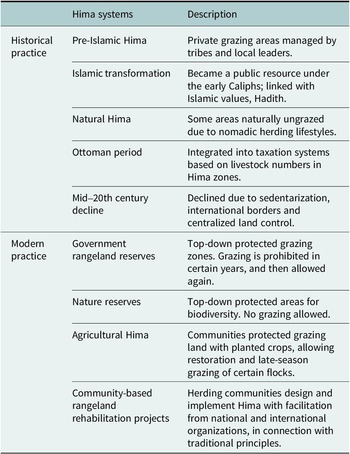
Hima initiatives have also been started in Lebanon, Egypt and Qatar, largely surrounding the 2014 “Amman Declaration on Innovating Hima,” which highlighted the concept as a source of social and environmental benefits, and called for the strengthening of land stewardship, communal tenure and international partnerships to promote Hima across the region (IUCN, 2014). Al-Hima has thus evolved from an ancient practice to a new direction for sustainable development. Table 2 shows the summary of the history of Al-Hima practice, from its origins to its modern implementations.
Overview of evolution, forms and functions of Hima rangeland management in Jordan

Discussion
Sustainably managing rangelands is a critical challenge in the face of destabilizing factors like economic globalization and climate change, and traditional management systems like Al-Hima can offer an important component in the pursuit to address these issues. Al-Hima’s continuous development from an ancient traditional practice to one rooted in Islam, to an aspect of imperial and tribal governance, to a model of sustainable international development illustrates how traditional practices can inform modern management, not just in Jordan but in other areas around the world where traditional management comes into conflict with rapid socioeconomic change. This is particularly relevant in the context of the Kunming-Montreal Global Biodiversity Framework, especially target 3 of this framework, which aims to conserve 30% of land, waters and seas by 2030. The express inclusion in this target of “other effective area-based conservation measures, recognizing indigenous and traditional territories, where applicable” opens the door for Al-Hima and other traditional rangeland management systems to be included in countries’ national plans to meet these targets and represents a unique opportunity to revive and promote these systems (CBD, 2022).
The loss of local knowledge and practice surrounding Al-Hima in the last 60 years shows how fragile ancient systems can be in the face of modern pressures, and how critical it is to document and revitalize these practices before the last local experts with knowledge of them die. At the same time, however, the steady persistence of the Hima concept on the local level, as shown by the practice of Agricultural Hima in northern Jordan despite the breakdown of traditional governance structures, shows that these systems still have relevance even if the current political and social contexts are different from those in which the system developed.
These trends of local systems resulting in positive management outcomes but declining in recent decades due to external factors can be seen in other case studies of traditional management as well. The modern relevance of traditional systems, for example, is shown both by the Tal al-Ramah Hima project in Jordan and by research into herding practices in the Taleqan region of Iran (Saub et al., Reference Saoub, Al-Tabini, Al-Khalidi and Ayad2011; Ghorbani et al., Reference Ghorbani, Azarnivand, Mehrabi, Jafari, Nayebi and Seeland2013). Threats to these systems driven by political forces are evident from the recent sedentarization of nomads in both the Arab World and Central Asia, two regions that have faced similar issues of land degradation and desertification as a result of government policy (Suleimenov, Reference Suleimenov, Mueller, Saparov and Lischeid2014; Qaqish, Reference Qaqish2016). From these studies and interviews, some lessons emerge from both Al-Hima and traditional rangeland management in general that are applicable to modern global practice:
-
1. Managing for maximum production risks introduces harmful externalities in the form of reduced sustainability or the degradation of other ecosystem services. Traditional practices like Al-Hima offer an example of more holistic management methods that consider both economic viability and overall ecosystem health, allowing individual herders with the most relevant expertise to make decisions to promote the resilience of their herds within mutually accepted rules. Other traditional rangeland management practices have a similar focus on long-term resilience, and the widespread nature of this idea illustrates its importance in global rangeland systems.
-
2. Local buy-in to any rangeland management system is key. Traditional practices like Al-Hima emphasize the roles and responsibilities of community members, from local knowledge holders who make regular land use decisions to individual herders who submit their livelihoods to customary laws. Without support for these rules on the part of land users, any management strategy is destined to fail, and local support can be particularly strong when the principles that underpin management decisions are rooted in local culture and tradition. This lesson applies beyond Al-Hima to any rangeland context where a strong local pre-modern management system exists or existed in the past, such as across much of Asia and Africa.
-
3. Management practices evolve with time but remain highly dependent on local context. Even within a single, small country like Jordan, the specificities of Al-Hima practice look different depending on local ecology and social structures (e.g. some may focus on water conservation, others on protecting key species). Reflecting this heterogeneity of environment with heterogeneity of management is key to producing reliability in an unpredictable landscape, and recognition of this is a common theme in places with a long history of subsistence herding. Understanding these localized differences alongside common goals is crucial to developing effective management policies, as is adapting practice to respond to new challenges.
-
4. Documenting, preserving and promoting traditional management practices is a pressing concern amid rapid global change, especially because the details of these systems are typically not written down and so are susceptible to loss as practitioners age. While traditional systems do exhibit resilience, the rapid decline of Al-Hima over the last few decades, as well as similar trends around the world, show how quickly valuable environmental knowledge can be lost. Taking active steps to restore these systems in a modern context should thus be a priority for rangeland management institutions both in the MENA region and globally, as they offer a highly effective but endangered tool in the effort to balance social prosperity and environmental sustainability.
As a traditional rangeland management practice, Al-Hima incorporates many of the same sustainability strategies as other rangeland management systems, both ancient and modern. However, its evolution in response to drastic social and environmental change and continued effectiveness in Jordan highlight the advantages that understanding and promoting traditional systems can have over other approaches. The success of Hima implementation in places such as Tal al-Ramah shows how appealing to tradition and collaborating with local knowledge holders can make practitioners more supportive of management interventions, thereby improving chances of success and achieving greater sustainability and justice outcomes. These lessons taken from Al-Hima thus have relevance for many global contexts, particularly in the Global South, where traditional practices are historically or currently strong.
Conclusion
Lessons from traditional rangeland management are abundant and diverse, and more work remains to be done to fully understand systems like Al-Hima. While some studies have been conducted, more scientific assessments of the ecological effects of both Hima management and other traditional management systems around the world would improve our understanding of these systems and inform the ways they can be advanced and adapted. Furthermore, social science must play an equally important role in investigating how traditional practices improve local trust in rangeland management and result in more effective policy. More experimental implementations of traditional systems in a modern context will also provide valuable insights into the ways that lessons from these systems can be integrated into contemporary practice. Ultimately, a more robust understanding of traditional practices across the scientific community, management authorities and local rangeland users themselves will improve the sustainability of rangeland livelihoods at all levels by incorporating expertise from local experts into the larger corpus of rangeland knowledge and improving local trust in interventions in developing world contexts. Lessons from robust existing systems like Al-Hima, both in terms of the knowledge that has been lost and the ways in which this knowledge has been preserved and adapted for modern practice, are applicable for sustainable and locally relevant rangeland management not only in Jordan but in many rangeland contexts around the world.
Traditional rangeland management techniques can contribute to effective and equitable natural resource management in a range of contexts, and the Hima system represents a clear example of both the benefits these systems can yield and how fragile they can be in the face of social and economic pressures and knowledge loss. Sustainability-oriented resource use, a focus on suitability with local context and a strong connection with local culture are important in the success of Hima and other traditional resource management systems. Rangeland managers can draw important lessons from studying traditional management like Hima, such as the effectiveness of land sparing for conservation when these practices are explicitly tied to local traditions. At the same time, understanding these systems highlights how political, economic and environmental pressures such as globalization, climate change and ill-suited government policies represent serious risks that threaten both the social and ecological dimensions of rangelands.
To stem the decline of traditional rangeland management systems and the ecological and social degradation that they are associated with, major public stakeholders like governments and NGOs can prioritize preserving these systems and consulting with local experts and practitioners when they design larger rangeland governance structures. The incorporation of traditional systems like Hima into broader policy would not only yield benefits for cultural heritage but also allow learning from the long historical and cultural development of these systems to benefit the sustainability, ecological health and economic productivity of modern rangelands. Future research could focus on identifying factors that have facilitated the survival and resurgence of Al-Hima in some areas over others, generating lessons for the revival of similar structures elsewhere in the world. Further analysis of different land tenure frameworks and their influence in promoting or hindering Al-Hima and other traditional systems will also likely be key in improving policymakers’ understanding of how best to preserve and promote these structures. Finally, continuing to document the techniques and impacts of these systems and how they evolve in a contemporary context may yield further benefits for the entire community of global rangeland stakeholders.
Open peer review
For open peer review materials, please visit http://doi.org/10.1017/dry.2026.10036.
Data availability statement
Access to the data used in this study is available from the corresponding author upon reasonable request.
Acknowledgements
We also acknowledge the many livestock owners and expert knowledge holders who contributed their expertise to this project, including Sheikh Hayel Al-Fawaz, Sheikh Talal Al-Madi, Jazi Al-Tabini, Dr. Odeh Al-Mishan, Khalid Al-Khalidi, Sheikh Hussein Abu Nuwair, Sheikh Khalaf Ilwain Al-Sibeeh, Sheikh Mazen Al-Dmani, Abu Ali Mashoor Al-Fawaz, Sheikh Fares Misned Abu Tayeh, Dr. Eid Nowaiqa Al-Sardyah, Arif Agaith, Dr. Jazi Al-Ajarmah, Suliman Shurufat and Abu Ibrahim Al-Masaied.
Author contribution
Raed Al-Tabini designed and coordinated this research, and conducted primary interviews and secondary research on Hima practice in Jordan. RB Smith conducted the literature review of practices outside of Jordan and drafted the manuscript. Both authors read and approved the final manuscript.
Financial support
This work was supported by the Fulbright U.S. Student Program, which is sponsored by the U.S. Department of State and the Binational Fulbright Commission in Jordan.
Competing interests
The authors declare that they have no conflicts of interest.

 Open access


Comments
Dear Dr. Eldridge and Dr. Sala,
I am pleased to submit our manuscript entitled, “Reviving Al-Hima: Traditional Knowledge and Modern Applications in Dryland Resource Management” for consideration for publication in Cambridge Prisms: Drylands This paper presents a novel assessment of Al-Hima, a traditional rangeland management system important across the Middle East and North Africa, in the context of global traditional dryland management.
Our study addresses how range managers can integrate and learn from traditional management structures, which we believe aligns closely with the aims and scope of Cambridge Prisms: Drylands, particularly in relation to the journal’s interest in social, cultural and policy influences on global drylands.
This manuscript is original and based on interviews with landowners, livestock managers and traditional knowledge holders in Jordan, as well as a literature review relating Hima practice in Jordan to other traditional management practices around the world. It emerges from a collaboration between myself and a Fulbright student researcher who spent the last year in Jordan, and it has not been published or submitted elsewhere.
We believe this work will be of interest to the journal’s readership because the preservation of traditional knowledge and its integration into contemporary dryland management has been a topic of increasing interest to scientists and land managers alike. This research represents a unique contribution to this ongoing conversation.
I should also note that although this was originally envisioned as a research article, we are open to reworking it into a case study if the editors believe the subject matter is better suited to this shorter, more focused format.
Thank you for considering our manuscript. We appreciate your time and look forward to your response.
Sincerely,
Dr. Raed Al-Tabini