


Bluetongue virus (BTV) is an arthropod-borne pathogen that is transmitted almost exclusively by the bites of Culicoides midges, which act as vectors for the virus between its ruminant hosts. There are currently 24 recognized serotypes of BTV worldwide. The virus can infect most species of domestic and wild ruminants although the clinical signs are most common in sheep and some species of deer [Reference Verwoerd, Erasmus, Coetzer and Tustin1]. Bluetongue disease (BT) also occurs in cattle infected with some strains, such as the BTV-8 strain currently circulating in Northern and Western Europe [Reference Darpel2].
In recent years the distribution of BTV in Europe has changed considerably. Until recently, only transient incursions of single serotypes of BTV had occurred in Europe but, since 1998, at least eight different serotypes of BTV have emerged and persisted in Europe. These viruses have caused substantial economic losses through mortality and reduced productivity of affected animals resulting in the requirement for mass vaccination of susceptible livestock and very expensive restrictions on the movement and trade of animals from affected regions [Reference Wilson and Mellor3]. Five of the BTV serotypes (1, 2, 4, 9, 16) initially invaded the Mediterranean basin by extension from adjacent regions of either North Africa or the Middle East and of these five serotypes only BTV serotype 1 (BTV-1) has since spread to Northern Europe [Reference MacLachlan and Guthrie4].
The route of introduction of the strain of BTV-8 that has recently caused such devastation in many countries across Europe remains unknown. However, it is clear that this virus was likely to have been transported a long distance and there has been much speculation as to how this may have occurred. Theories include the possibility that infected midges may have been transported from BTV-endemic areas with cut flowers. An alternative theory is that BTV was transported with zoo animals, including possibly carnivores; however, no evidence was found that this had occurred in the affected European countries. However, many thousands of dogs are transported annually into the UK and Europe from BTV-endemic countries in Africa and Asia without any pre- or post-import movement testing for BTV. If these dogs were capable of being infected with BTV and became viraemic for a significant period of time, it is possible that they could carry BTV with them when transported from endemic to non-endemic countries. If the climatic conditions were favourable upon arrival it is possible that Culicoides midges in the country of destination could feed off these viraemic imported dogs and in turn pass on the virus to the domestic ruminant population.
With 18 million sheep and five million goats, livestock represents the main livelihood for the majority of the rural population in Morocco. BT was considered as an exotic disease in Morocco until September 2004, when several outbreaks of disease due to BTV-4 were declared in the northwest of the country. In autumn of 2006, cases of BTV-1 were notified in eastern Morocco near the Algerian border. The epidemic continued during the winter and summer of 2007 and lasted until November 2007, after a compulsory mass vaccination campaign of all the small ruminant population in the country had been successfully completed. In 2008, no clinical disease was detected in the country; however, three sentinel bovine flocks tested positive by RT–PCR for BTV-1 during an active surveillance programme, thus proving that BTV-1 was still circulating in the country. No mass vaccination campaign was conducted in 2009 and cases of clinical disease due to BTV-1 were again detected in sheep in the northwest of the country and, curiously, BTV-4 re-emerged after five silent years in both Marrakech and the southern part of the country (Fig. 1).
The location of domestic dog sampling carried out in February 2010 in Morocco (black cross,
 ). Notified outbreaks of BTV in ruminants during 2009 are shown in grey (BTV-1) and in black (BTV-4).

The aim of this study was to investigate the levels of BTV antibodies in domestic dogs in an area of Morocco in which BTV had recently circulated in the ruminant population. The dog population in Morocco is estimated to be around 2 million and most of these dogs live in rural areas close to livestock species. In this study 187 dogs from the Rabat/Casablanca district of Morocco were sampled. The location of the dogs in relation to the previous outbreak areas for BTV-1 and BTV-4 is shown in Figure 1. In the sampling area, outbreaks of BTV-1 were reported during 2009, but there had been no reported cases of BTV-4 in the region since November 2004. All the sampled dogs were stabled outside. One hundred and fifty-eight of the dogs were owned dog's from the Casablanca region and 29 of the dogs were from the ‘Société de Protection des Animaux’ or Veterinary School in Rabat, Morocco. The dogs in the study were of mixed ages, born between 1998 and 2009, were both male and female and were fed commercially produced tined food and did not have any access to potentially infected meat or meat products. The dog sampling took place in February 2010.
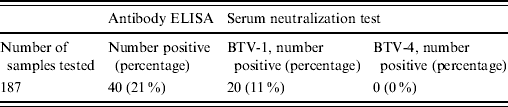
Of the 187 serum samples tested 40 (21%) tested positive for the presence of anti-BTV antibodies with a competitive ELISA (cELISA) (VMRD, USDA product). The 40 cELISA-positive samples were then tested by a serum neutralization test (SNT) against the two recently circulating serotypes in Morocco (BTV-1 and BTV-4). Of the 40 ELISA-positive samples 20 showed a significant neutralization titre (1–2 logs) to BTV-1, whereas none of the 40 samples showed a neutralization titre to BTV-4. Results of the testing are summarized in Table 1. This is consistent with recent BTV epidemiological patterns in ruminants in Morocco as the dogs sampled were from a region in Morocco in which ruminants were severely affected by BTV-1 in 2009. It is possible that the 20 cELISA-positive but SNT-negative (BTV-1 and BTV-4) dogs had been previously infected with BTV-1; however, the neutralizing antibodies (raised against the VP-2) had waned, whereas the cELISA antibodies (raised against VP-7) were still present. Alternatively, these dogs could have been infected previously with another BTV serotype, although this is extremely unlikely as BTV-1 and BTV-4 are the only BTV serotypes to have been identified in Morocco.
Seroprevalence of BTV-specific antibodies in domestic dogs in Morocco
There is strong evidence that BTV is capable of infecting and killing carnivores including domestic dogs; however, the role of these species in the epidemiology of the disease is currently not well understood and their capacity to spread disease remains unknown. Recently two Eurasian lynx, held in the same cage in a zoo in Belgium, died showing BTV-like symptoms and exhibited necropsy findings consistent with BTV infection. The lynx had been recently fed aborted BTV-infected fetal material and BTV was isolated from the lung of one of the animals [Reference Jauniaux5]. The infection and subsequent deaths of domestic dogs in the USA as a result of injection with BTV-contaminated canine distemper vaccine has also been reported [Reference Akita, Ianconescu and MacLachlan6]. Two dogs were vaccinated during pregnancy and both aborted and died with signs of heart failure and respiratory distress. This particular case is disturbing since the contaminating BTV apparently replicated in a canine cell line used in the vaccine manufacture without causing a cytopathic effect, which suggests that, in similar situations, BTV could occur as a silent infection in other cell cultures used in the production of vaccines. In a further study six dogs (four pregnant and two non-pregnant) were experimentally inoculated with the BTV-11 virus that was isolated from the contaminated vaccine. The non-pregnant animals showed no clinical signs; however, it was not reported whether they exhibited a viraemia. Three of the four pregnant dogs aborted, two of the dogs died at 5 and 10 days post-infection, one dog became severely dyspnoeic at 8 days post-infection and was euthanized on humane grounds and the fourth dog was febrile for 3 days and then appeared clinically normal [Reference Brown, Rhyan and Grubman7].
In a comprehensive study [Reference Alexander, MacLachlan and Kat8] serum samples were collected from nine species of wild and two species of domestic (dogs and cats) carnivores in Africa. Of these carnivores, specific antibodies to a wide range of BTV serotypes were identified in individuals among most of the free-ranging species sampled including cheetahs, lions, wild dogs, jackals, hyenas, large-spotted genets and domestic dogs and cats. Variable levels of seroprevalence were noted among the species with jackals and cheetahs having low numbers of positive individuals while lions and hyenas had the highest levels. No seropositive individuals were detected among Ethiopian wolves, marsh mongooses or white-tailed mongooses. The authors of that study suggested that, because of the high titres of BTV-specific antibodies detected, the virus had replicated in at least some of the carnivores; however, no information was available to determine whether or not these animals mounted a viraemia and could therefore have been involved in the onward transmission of the virus. Due to the high BTV seroprevalence rates in different carnivores as well as in their various prey species these authors suggested that infection of the carnivores was probably via the oral route (i.e. by eating contaminated meat) rather than by vector transmission. A serological study performed in Georgia, USA [Reference Howerth9] revealed that only one out of 130 dogs sampled had antibodies to BTV; however, the levels of natural and oral exposure of dogs to BTV in Georgia is likely to be lower than in Africa.
Another closely related orbivirus, African horse sickness virus (AHSV) has also been shown to be capable of causing a highly fatal form of disease [Reference Haig, McIntosh and Cumming10,Reference Theiler11]. As with BT, whether dogs play a role in the epidemiology of African horse sickness (AHS) and are capable of transmitting the disease is not well understood, although some studies have concluded that it is doubtful that dogs play a role [Reference Mcintosh12]. As with BT, up to now all reported clinical cases of AHS in dogs are thought to have resulted from the ingestion of infected carcass material from animals that have died from the disease [Reference Bevan13,Reference Piercy14]. One key point to address is whether Culicoides midges preferentially feed off dogs and whether BTV-infected midges are capable of transmitting the virus, through feeding, to dogs. A study performed, albeit with Culicoides impunctatus from Scotland, revealed that these midges showed a clear preference for feeding off dogs, which was not as high as the preference for feeding off cattle or deer but was higher than sheep [Reference Blackwell, Brown and Mordue15].
The current study adds to existing evidence showing that domestic dogs are capable of being infected with BTV. A high percentage of the domestic dogs sampled were antibody positive for BTV-1 when tested after an outbreak of this serotype had spread through the ruminant population in the region. This shows that dogs are capable of being infected with BTV; however, no data were available to determine whether the dogs mounted a viraemia in response to a BTV infection that would enable the onward transmission of the virus by vector insects. It is vital that further work is conducted in order to determine the extent and length of viraemia in dogs infected with BTV and to prove conclusively if they are likely to play a significant role in the spread of this virus. Additionally the role of Culicoides vectors in the transmission process should be addressed as we are currently unsure of biting rates on dogs and whether midges are capable of transmitting BTV through feeding off viraemic dogs.
Alternative transmission mechanisms for BTV have attracted much attention since BTV-8 arrived unexpectedly in northern Europe in 2006. How BTV-8 entered Northern Europe remains unknown but one theory is that it may have arrived through the importation of the virus with domestic dogs. It has been known for some time that dogs are capable of being infected with BTV, although certain questions remain unclear, such as the mechanism by which dogs are infected with the virus. Current opinion is that dogs are infected only through the ingestion of BTV-infected meat rather than through infected midges. We have shown in this study, in which we targeted dogs that could not have been infected by the oral route, that BTV is highly likely to be able to infect dogs through midge feeding, and a high percentage of dogs (21%) were infected. This changes current thinking and increases the chances of dogs becoming infected with BTV during an outbreak. The only questions that remain unanswered concern the length and extent of viraemia in dogs and whether the onward transmission of BTV from dogs to midges is possible. If it could be established that dogs play a role in BTV transmission it would be possible to implement measures, such as testing regimens, in order to avoid the spread of this economically devastating virus though the long-distance movement of BTV-infected dogs.
ACKNOWLEDGEMENTS
This collaborative study was between the laboratories of Biopharma (Morocco) and the Institute of Animal Health of Pirbright (UK) within the framework of an ongoing OIE twinning project. The authors acknowledge the OIE for financial support.
DECLARATION OF INTEREST
None.



