


1. Introduction
Where design and prototyping has historically been situated primarily in either the physical or digital domains (Reference Camburn, Viswanathan, Linsey, Anderson, Jensen, Crawford, Otto and WoodCamburn et al., 2017), with designers choosing the media that they determine best suits their activity (i.e. physical: prototyping; digital: CAD modelling, simulation), the recent emergence of Immersive Reality (XR) technologies provides new opportunity to intelligently combine domains (Reference Kent, Snider, Gopsill and HicksKent et al., 2021a; Reference Snider, Kukreja, Cox, Gopsill and KentSnider et al., 2024). Research has spanned sectors ranging from education (Reference Hallmann, Stechert and AhmedHallmann et al., 2023), to architecture (Reference Kim and HyunKim & Hyun, 2022), and design (Reference Horvat, Kunnen, Štorga, Nagarajah and ŠkecHorvat et al., 2022; Reference Verlinden and HorváthVerlinden & Horváth, 2009) Contained concepts such as Virtual, Augmented, and Mixed reality are viewed by many as holding potential to revolutionise the world of work as an $1.5Tn industry by 2030 (PwC, 2020), with Deloitte, PwC, Accenture, and Gartner all highlighting the importance of the technology.
Sitting in the broader field of Spatial Computing (Reference CaoCao, 2024; Reference Snider, Kukreja and CoxSnider et al., 2025) these technologies have already shown industry-facing value, typically in operational and logistic workflows. While design-focused implementations are fewer the body of work is growing, with examples in ideation (Reference Van Goethem, Watts, Dethoor, Van Boxem, van Zegveld, Verlinden and VerwulgenVan Goethem et al., 2020), design review (Reference Horvat, Martinec, Uremović and ŠkecHorvat et al., 2024), design exploration (Reference Nandy, Smith, Jennings, Kuniavsky, Hartmann and Goucher-LambertNandy et al., 2023), design communication (Reference Sopher, Milovanovic and GeroSopher et al., 2022), visualisation (Reference Zhang, Ranscombe, Piumsomboon and MallyaZhang et al., 2023), CAD modelling (Reference Kukreja, Cox, Gopsill and SniderKukreja et al., 2024), environment recreation (Reference Kukreja, Trombini, Cox and SniderKukreja et al., 2025) and for functional analysis (Reference Steinhauser, Zimmerer, Grauberger, Nelius and MatthiesenSteinhauser et al., 2023).
However, design-focused implementations typically remain in the research domain as single-purpose demonstrators. There remains a lack of specific knowledge of the affordances that such systems offer when applied to differing design activities. With a general lack of industry-facing study for design-focused systems, there is question of the degree to which design industry agrees that value exists, as well as way in which benefit or issues may manifest.
This work presents results from a workshop with a UK Design Consultancy, in which a mix of engineers, designers, and analysts were exposed to a breadth of targeted XR design systems. By collecting and comparing their perceptions across system types, it aims to extract [A] perception of the benefit and detriment that such systems offer in day-to-day workflow, and [B] specific analysis of the affordances that generate that benefit or detriment. Outputs then present expert perceptions of the value of XR in design, and with specific discussion of affordances that enable benefit, detriment, and should be considered in ongoing work.
2. Value of Immersive Reality design
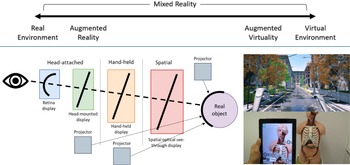
Typically described via location on the Virtual Reality Continuum of Milgram (Reference Milgram, Takemura, Utsumi and KishinoMilgram et al., 1994), see Fig. 1, Mixed Reality refers to the merging of physical and digital into a single combined workflow, in which virtual elements are represented in the spatial reference frame of the user (typically via headset technology), often in context of the user’s real world environment. This merging offers designers new cross-domain capability (Reference Cox, Hicks and GopsillCox et al., 2022), and has even been directly linked to fundamental change in neurocognitive processes (Reference Dybvik, Cox, Ormerod, Aalto and SniderDybvik et al., 2025).
(Above) The Virtual Reality Continuum (Reference Milgram, Takemura, Utsumi and KishinoMilgram et al., 1994); (Below) Immersive Reality types, adapted from Reference Bimber and RaskarBimber and Raskar (2006)

Figure 1 Long description
A diagram illustrating the spectrum of immersive reality technologies from real environment to virtual environment. Panel A: The diagram shows a continuum from real environment to virtual environment, passing through augmented reality and augmented virtuality. It includes different types of displays such as retina display, head-mounted display, hand-held display, and spatial optical see-through display. Arrows indicate the flow from real environment to virtual environment. Panel B: The diagram includes images demonstrating augmented reality applications, such as a virtual object overlaid on a real-world scene and an anatomical model displayed on a handheld device.
Recently, numerous benefits and challenges have been linked to XR design systems, such as improved spatial reasoning and design review decision making (Reference Horvat, Martinec, Uremović and ŠkecHorvat et al., 2024), improved creativity (Reference Sopher, Milovanovic and GeroSopher et al., 2022), improved confidence in outputs (Reference Kim and HyunKim & Hyun, 2022), and improved communications (Reference Bisson, Mahdjoub, Zare, Goutaudier, Ravier and SagotBisson et al., 2023). Equally challenges have been noted, such as in maintaining synchronicity during implementation (Reference Kent, Snider and HicksKent et al., 2021b), and practical adoption barriers (Reference Piñones, Cascini, Caruso and MorosiPiñones et al., 2021).
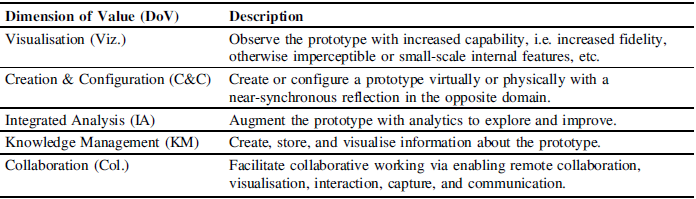
At a general level, value of XR in prototyping can be understood as falling within the Dimensions of Value (DoV) proposed by Kent et al. (Reference Kent, Snider, Gopsill and HicksKent et al., 2021a), defined in Table 1, which present a non-exclusive categorisation of system purposes from literature. Loosely, these may be split into dimensions that directly focus on design activity support (Viz., C&C, IA), those that provide further context and operations (KM), and those that enhance co-working (Col.).
Dimensions of value of XR prototyping, from Reference Kent, Snider, Gopsill and HicksKent et al. (2021a)

However, there is scant investigation of the actual industry view. XR has proven capability in controlled scenarios and at a theoretical level, but without clear industry steering risks a lack of direction and business case that will lead to realising the benefits that XR purports to create. In this setting, this work reports on real industry perceptions of a broad range of XR design systems, gathering informed views from a range of roles on a range of systems.
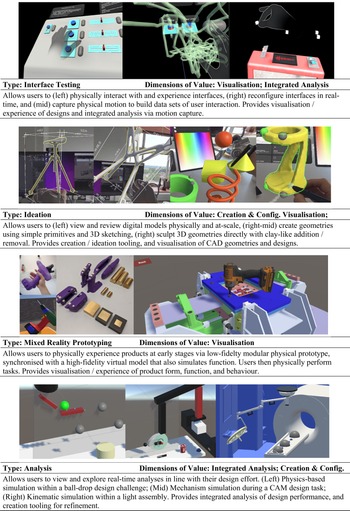
XR systems developed for the workshop, also indicating Type and Dimension of Value; multiple systems were developed for each, as shown via images

3. Methodology
A day-long workshop was held with a UK design consultancy specialising in product design and development from ideation to client hand-over when production-ready.
3.1. Developed systems
To allow investigation of broad value across activities several systems were developed, summarised in Fig. 2. All operated on Meta Quest 3 headsets via Unity, controlled via hand tracking, controller, or Logitech MX Ink pen. All demonstrators were developed by researchers in their entirety, and are openly available through contact with the authors. Demonstrator capabilities were chosen through an iterative process in collaboration with the company to ensure relevance, and to target the DoV of Viz., C&C, and IA. Final capabilities and corresponding types/DoV are given in Fig. 2, with multiple systems providing each Type/DoV. Participants were provided with simplistic activities when using demonstrators to provide context (i.e. ‘refine the geometry of the CAM’, ‘test the ease-of-use of the interface’), but were also requested to perform activities that mimicked their typical day-to-day working where possible.
3.2. Recruitment and procedure
Participants were recruited via company-wide email. All roles and expertise levels were encouraged to attend, but participation was completely voluntary. Groups of four participants were recruited to hour time-slots. On arrival they were briefed on purpose of the workshop and were given a written overview of all systems. They were requested to state the system(s) that they felt were most relevant to their expertise, and were given a live demonstration and opportunity to test each. Participants were aware that performance was not being captured. Following testing, participants completed a questionnaire for each tested system if they felt their expertise allowed them to give an informed opinion. Otherwise, they were free to experience systems without providing responses. Questions concerned:
-
1. Perceived benefit and detriment of tested systems. (Questions: ‘To what degree does the system provide (value/detriment)?’; ‘To what degree does this (value/detriment) exceed that of ‘typical’ approaches for similar activities?’ (1: Low - 5: High))
-
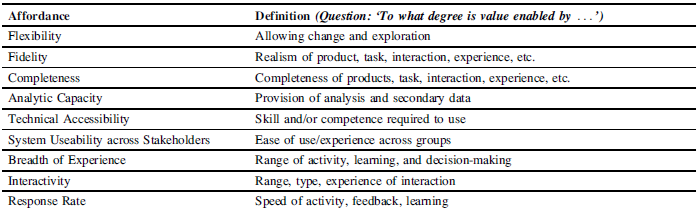
2. Affordances linked to those perceived benefits and detriments, see Table 2.
-
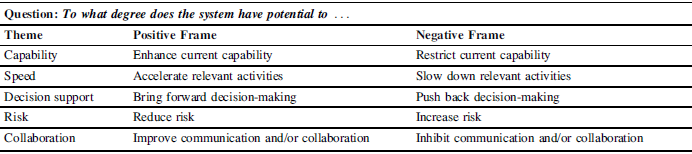
3. Emergent impact of the systems in context of their associated activity, see Table 3.
-
4. The NASA Task-Load Index (NASA, 1986) to assess perceived workload of each tested system.
Affordances (point 2) refer to the inherent properties of the system that they offer the user and their process, via the relationship between the system and the user’s capabilities (Reference Snider, Goudswaard, Ranscombe, Hao, Gopsill and HicksSnider et al., 2023).
Questions relating to system affordances (Rate 1: Low - 5:High)

Questions concerning emergent impact of the systems (Rate 1: Low - 5:High)

4. Results
16 participants took part in the workshop over a period of 8 hours within a single day. Average age was 30 (range 20 - 57), with 5 female and 11 male participants. Stated expertise included mechanical design (7 people), software and electronics (3), industrial design (2), human factors (2), and digital interface design (1). Average expertise was 7.2 years (range 1 - 25). 2 people had never used XR previously, 12 once or twice, and 2 up to 10 times. For analysis systems are grouped into Type and Dimension of Value, see Fig. 2. Participants chose systems to test, giving varying numbers of data point per system type and DoV. Quantities are given in Table 4; noting that systems could belong to multiple categories.
Datapoints per type and dimension of value, each indicating a test by a participant

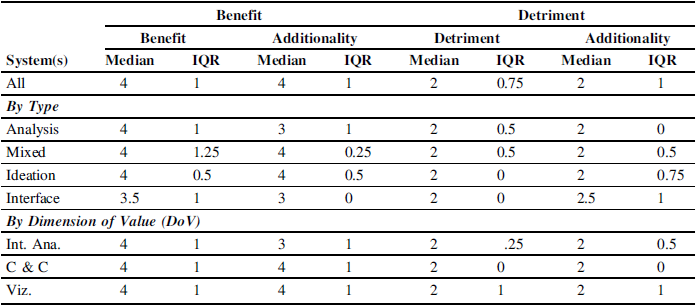
Perceived benefit and detriment of systems; Additionality indicates benefit or detriment stated as beyond that provided by current workflows

Perceived Benefit and Detriment: Table 5 shows perceived benefit and detriment of the systems across all participants, by system type and DoV. ‘Additionality’ refers to perception of value beyond that of current toolchains, see Section 3.3. In all cases participants considered the systems to provide value, typically strongly above that of their current tooling. Little differentiation between systems can be discerned suggesting broad value, with Mixed and Ideation systems perhaps showing higher agreement of high value (via lower IQR). Detriment scores are low and very similar in all categories, suggesting that participants recognised that although systems do bring problems they are consistently minimal, and that they aren’t atypical or strongly larger than those present in current toolchains.
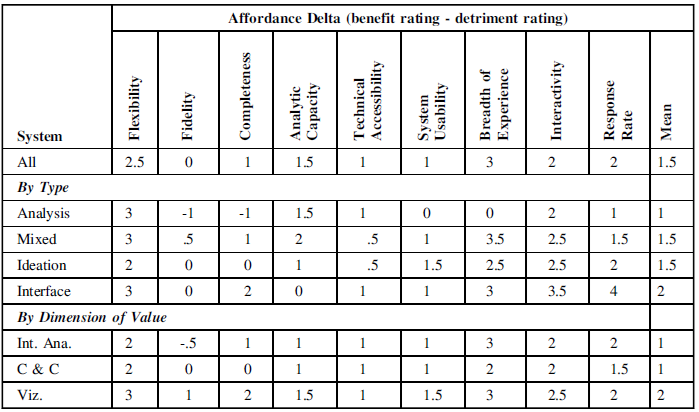
Perceived Affordances: Table 6 shows the affordance categories to which benefit and detriment were assigned, across system types and dimensions of value. Scores are given as the delta between benefit and detriment, i.e. positive indicates more perceived benefit, and negative more perceived detriment.
Overall, affordances were all linked to benefit to some degree (range 3 - 5). Flexibility, Breadth of experience, Interactivity, and Response rate all received a high positive delta between benefit and detriment, indicating the strongest areas of perceived value. These indicate positivity in experts in the ability to explore, edit, and respond to the digital and physical artefacts before them, in a way that suited their preferred working processes. Fidelity was the only affordance to receive a neutral score, and received the most negatives across systems. With achieving higher fidelity a more difficult task and implementation effort, this underlines a core challenge of XR systems at present. System Useability, Completeness, and Technical Accessibility also received a closer set of scores, indicating slightly lower benefit or higher detriment. These refer primarily to the useability and system implementation, in terms of skill, understanding, and challenge of creating a whole-system experience.
Individual scores per-type or DoV show some patterns but are likely influenced by the specific implementations. Of note is that the MR system, in which users interacted with a physical object synchronised with digital models, experts found benefit in all affordances and particularly in the breadth of experience that the MR prototype provided. The interface system, which tracked user action while completing user testing, received highest interactivity scores, reflecting the realism of the interaction provided. The analysis systems, which were focused on narrower tasks to enable the simulations they provided, received lower scores on fidelity, usability, and breadth. This highlights that the losses concomitant with higher focused system capability need to be considered, as they may introduce other issues. In fact, the analysis type and IA DoV systems received the lowest mean scores.
Affordances linked to perceived benefit and detriment; M: Median, IR: Interquartile range; Int.Ana: Integrated Analysis, C&C: Creation & Configuration, Viz: Visualisation

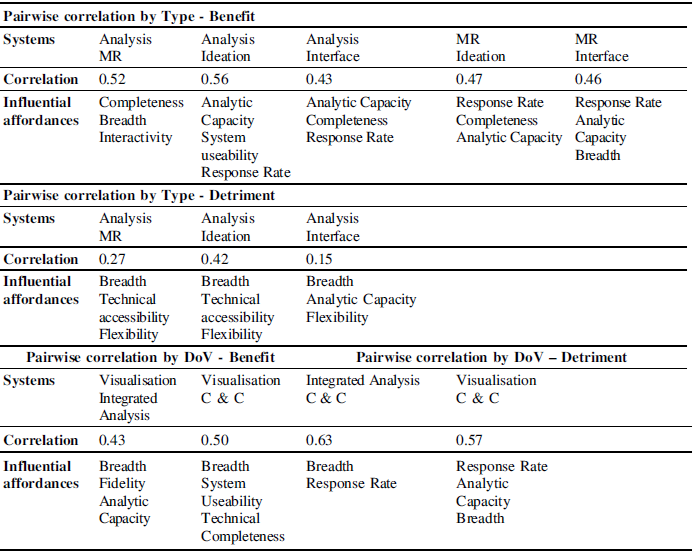
Influential Affordances: To investigate specific affordances of importance within system types or DoV, Pearson correlation was calculated on expert ratings across pairs of Types/DoV. Where correlations were lower it indicates that affordances participants believed were responsible for benefit/detriment for that type/DoV were different. Rank-Sum was calculated (i.e. identifying most-prominent affordances for each system type/DoV) to determine most influential affordances for that difference. Table 7 presents comparisons with correlation less than 0.7, indicating larger differences in prominence of affordances across presented pairwise comparisons.
By Type, results show that benefits were largely viewed as drawing from different sources, with most systems seen as varying in affordance to a medium degree (r∼0.5). This implies that different affordances create the perceived benefit when XR is used for different purposes rather than a single XR-driven form of value. Common sources of difference were Completeness (with MR and Interface systems highlighting benefit of provision of more complete representations) and Response Rate (Ideation and Interface praising quick response to user action). Analytic Capacity is also present, but as this aligns with the core purpose of some of the systems should be considered a factor confirming development success only. Differences in detriment affordances were prominent only for Analysis systems, with users highlighting a narrower breadth of experience (i.e. only analysis-focused), higher skill requirements to use, and lower flexibility. With these systems specifically designed to focus on more complex technical integration of knowledge this is not surprising, but does highlight that core affordances of technology may be undone depending on implementation. Fewer differences were present when correlating between DoV groups, with those for beneficial affordances driven by a lower rating for visualisation systems in breadth of experience, and for detrimental affordances by good ratings for Creation & Configuration.
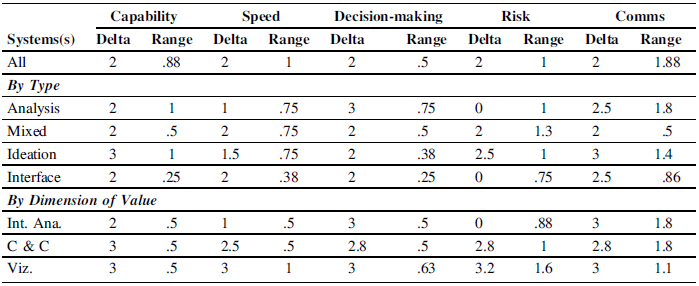
Perceived Emergent Value: Table 8 shows participant perceptions on the emergent value of each system type and DoV. As-per previous results, participants consistently scored positive framing of each question higher, highlighting their general view of benefit significantly overcoming detriment. While overall differences are small, highest ratings with smallest ranges appeared in the Capability, Decision-making, and Communications categories. While participants did believe that tools would increase speed of designing and reduce risk, this was to a lower degree.
Pairwise correlation between system types, and influential affordances within that comparison

Perceived emergent value of systems on process and activity; delta = (positive rating - negative rating), i.e. positive score indicates more favourable than negative

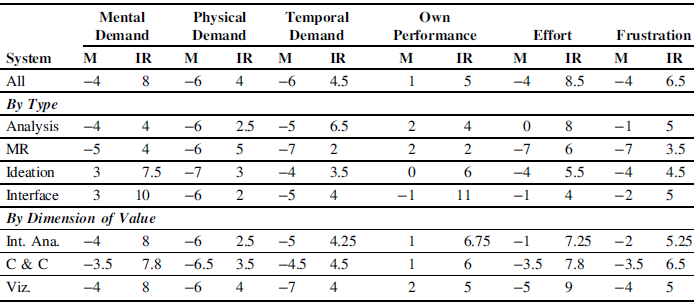
System Implementation via NASA Task Load Index: Participants also rated each system using the NASA Task Load Index, see Table 9. This is inherently tied to the specific implementation of each system, and so should be expected to change in future systems.
Results do show substantial variance across systems and participants, with many categories showing high IQR. Of interest is that participants consistently rated systems as of low physical and temporal demand, and low effort and frustration. This suggests that such systems can comfortably integrate into their workflow with low friction from a personal operational perspective. Methodologically, this indicates that system interface was not perceived as negatively affecting their experience. Their perception of their own performance was neutral, perhaps reflecting that a learning curve does exist with these systems, and mental demand was mixed, perhaps a reflection on the specific implementations, or on the tasks that they were requested to complete.
Median NASA-TLX ratings for each tested system; ratings occur on 21-point scale with higher = more, i.e. +10 is highest possible, -10 is lowest possible

5. Discussion
Overall Value: Across all systems and categorisations experts consistently rated the XR systems positively, showing more benefit than detriment. For all types this also included claims of benefit and capability above and beyond that of their typical daily toolchains – not only did experts believe the XR systems provide value, they believed they provided value that could not otherwise be achieved by current workflow (see Table 5). That this consistent trend existed regardless of the system, type, or related DoV underlines the opportunity that XR design systems provide – in all tested cases and across activities, experts rated the systems as in some way improving capability over their daily operation. Detriment was however consistently present and also rated as beyond that present in typical toolchains, indicating either that systems exacerbated issues already present or introduced new ones of their own. Given the divergence from traditional workflows that such systems propose this is perhaps not surprising, but must be carefully considered before either development or implementation.
This is reinforced when considering ratings for emergent values. Experts noted benefit in increased capabilities presented by the systems, earlier decision-making, and improved communications. While accelerated processes and reduced risk were also noted, lower ratings (or even neutral, for risk) may indicate areas of investigation for future improvement – i.e. whether XR systems reduce overall cycle time, or shift time to other activities, and whether they reduce risk through improved understanding or transfer risk to other facets of problem solving.
Affordances: Across all systems, the key areas in which benefit was claimed were flexibility, breath of experience, interactivity, and response rate. These all concern the capability of systems and the way in which users are able to experience them. With design often described as an explorative learning activity (Reference Goudswaard, Real, Snider, Camargo, Zamora and HicksGoudswaard et al., 2023), and a key affordance of physical paper and pen being its near-thinking-speed usage, it is interesting that XR systems pose benefit with this alignment. This also perhaps creates an alignment with new major priorities such as Industry 5.0 where human-centricity is a core tenet (Reference Nasir, Hosseini, Binfield, Hasani, Ghotb, Diederichs, Fox, McCann, Riggio, Chandler and HansenNasir et al., 2025), here represented by the ability of users to experience, interact with, and explore the designed artefact in a way that suits them. Across all systems detriment was most observed in affordances concerned with specific implementation and usage challenges. Users identified technical difficulty of operation, system usability across stakeholder training, completeness of the represented artefact, and its fidelity as least positive. XR systems present a new way of working reliant on spatial interaction (Reference Snider, Kukreja, Cox, Gopsill and KentSnider et al., 2024). While they create new ways to experience comprehensive prototype representations (i.e. the physical/digital form shown in the MR systems), creating high fidelity is perceived as a significant technical undertaking, as is creating ‘complete’ representations of every aspect of the artefact itself. While it should be noted that experts still rated these affordances as more positive than negative, the challenges associated with creating detailed, ‘complete’ representations and intuitive, easy-to-use systems must be noted.
At a local per-system level affordances are likely more influenced by specific implementation, although the range of systems present across categories will mitigate this to some extent. It is interesting however that of the affordances that caused a difference between systems, breadth of experience and response rate appeared frequently due to either strong rating for one system or poor for another, and that for detrimental affordances a relative lack of flexibility for analysis systems was prominent when compared to others. For breadth and response rate, which were also rated as most beneficial at a global level, this may indicate an importance to ensuring that these affordances are maintained to also maintain value at a global level. For flexibility, it may highlight that a system type that focuses on specific capabilities (here on analysis) may concurrently suffer in others. Care should then be taken to ensure that the core benefits of XR systems is appropriately managed.
Limitations and Future Outlook: This work presents a single workshop with a single company, from a single sector. Perceptions are likely to vary dependent on sector, not least due to the different activities and requirements that they present (i.e. high precision and fidelity in high-value may be harder to achieve, indicated by poorer ratings for fidelity seen here). Further, while many participants had experienced XR before there remains potential for novelty effects, where perceived benefit is increased due to the novelty of the technology. This will be mitigated to some degree by the expert-level of participants and the activity-relevant systems and tasks, but may have created some rating inflation. The UI and implementation quality may impact perceptions, although this is mitigated by positive NASA-TLX ratings and that multiple demonstrators are considered in each type/DoV. The expert opinions presented in this work set a strong case for research and development of XR systems and application to the design domain, reinforcing the generally held perception of their applicability. Where here value is determined through rating and perception, further work should continue to more precisely measure actual value through, initially targeting those affordances and emergent values here highlighted as of highest benefit and importance. Further, where detriment was claimed, this should be investigated both as an area of potential improvement (i.e. build better systems), and as a factor of existing system implementation (is the issue generally held, or due to the systems here developed?).
6. Conclusions
Through a comprehensive workshop comprising several, broad-in-scope XR design systems, this work has presented industry perceptions on value, benefit, and detriment of the technology and its usage in design activity. It has specifically highlighted that benefit falls on human-centric properties, where XR systems allow users to interact in an explorative and responsive way with artefacts under design, and provide new capabilities beyond those present in existing toolchains, believed by users to enable earlier decision making. Challenges include technical implementation and presenting a high-fidelity and complete system - both potentially factors of the state of technological maturity, extant system development, and a lack of best practice from which to draw.
Acknowledgement
This work was performed in the Design and Manufacturing Futures Lab at the University of Bristol, and supported by EPSRC grants EP/W024152/1, EP/W037009/1, and EP/W020564/1.


 Open access

