


Introduction
Bullying during childhood and adolescence is a significant public health issue in Australia. Contemporary prevalence estimates indicate that approximately 15% of children and adolescents (at least one in seven) have experienced bullying victimisation within the previous 12 months (Thomas et al., Reference Thomas, Connor, Lawrence, Hafekost, Zubrick and Scott2017; Jadambaa et al., Reference Jadambaa, Thomas, Scott, Graves, Brain and Pacella2019). Bullying by definition is a negative action on the part of one or more individuals that includes three components: intention to harm, repetition and a power imbalance between a victim and the perpetrator(s) (Olweus, Reference Olweus1993; Olweus, Reference Olweus2013). There is now a strong body of evidence that suggests experiences of bullying victimisation (being bullied) precedes the later development of mental illness (Moore et al., Reference Moore, Norman, Sly, Whitehouse, Zubrick and Scott2014; Moore et al., Reference Moore, Norman, Suetani, Thomas, Sly and Scott2017). The negative consequences of bullying victimisation are not limited to childhood and adolescence and can persist into adulthood. Victims have been consistently found to be at an increased risk of internalising problems, in particular diagnoses of later anxiety and depressive disorders in adulthood (Hemphill et al., Reference Hemphill, Kotevski, Herrenkohl, Bond, Kim, Toumbourou and Catalano2011; Copeland et al., Reference Copeland, Wolke, Angold and Costello2013; Stapinski et al., Reference Stapinski, Bowes, Wolke, Pearson, Mahedy, Button, Lewis and Araya2014; Takizawa et al., Reference Takizawa, Maughan and Arseneault2014). Not only is bullying victimisation associated with an increased risk of these common mental disorders, but it also results in substantial costs for individuals, their families and society at large (Wolke and Lereya, Reference Wolke and Lereya2015; Moore et al., Reference Moore, Scott, Thomas, Sly, Whitehouse, Zubrick and Norman2015b).
Researchers have undertaken systematic reviews and meta-analyses examining the association between bullying victimisation and a range of health outcomes. Ttofi et al. (Reference Ttofi, Farrington, Lösel and Loeber2011) conducted the first systematic review and meta-analysis of longitudinal studies and concluded that children who were bullied at school were twice as likely to develop depression compared to those who had not experienced bullying. This study focused on the later development of depression only. Another systematic review and meta-analysis (studies from inception until February 2015) identified mental disorders and substance use as the main consequences of bullying victimisation (Moore et al., Reference Moore, Norman, Suetani, Thomas, Sly and Scott2017). This analysis summarised the cross-sectional as well as longitudinal evidence separately in order to examine the dimension of time. The review concluded there was convincing evidence for a causal relationship between bullying victimisation and anxiety and depressive disorders in particular.
According to the most recent national survey, approximately one in five Australians aged 16–85 years meet the criteria for a mental disorder in the previous 12 months, which is the equivalent of 3.2 million Australians (Slade et al., Reference Slade, Teesson and Burgess2009). Overall, anxiety and depressive disorders (14.7 and 6.2%, respectively) were among the most commonly diagnosed (Slade et al., Reference Slade, Teesson and Burgess2009). The most recent Global Burden of Disease Study (GBD 2017) estimated that mental disorders ranked sixth in terms of overall disability-adjusted life years (DALYs) globally, and ranked fourth in Australia. Within the mental disorders group, depressive disorders (major depressive disorder and dysthymia) followed by anxiety disorders accounted for the most DALYs in Australia (Kyu et al., Reference Kyu, Abate, Abate, Abay, Abbafati, Abbasi, Abbastabar, Abd-Allah, Abdela and Abdelalim2018).
In GBD 2017, the burden of disease attributable to bullying victimisation was assessed for the first time. Overall, 0.16% of total DALYs for all disease causes for both sexes and all ages in Australia were attributable to bullying victimisation (Stanaway et al., Reference Stanaway, Afshin, Gakidou, Lim, Abate, Abate, Abbafati, Abbasi, Abbastabar, Abd-Allah, Abdela, Abdelalim, Abdollahpour, Abdulkader, Abebe, Abebe, Abera, Abil, Abraha, Abrham, Abu-Raddad, Abu-Rmeileh, Accrombessi, Acharya, Acharya, Adamu, Adane, Adebayo, Adedoyin, Adekanmbi, Ademi, Adetokunboh, Adib, Admasie, Adsuar, Afanvi, Afarideh, Agarwal, Aggarwal, Aghayan, Agrawal, Agrawal, Ahmadi, Ahmadi, Ahmadieh, Ahmed, Aichour, Aichour, Aichour, Akbari, Akinyemiju, Akseer, Al-Aly, Al-Eyadhy, Al-Mekhlafi, Alahdab, Alam, Alam, Alam, Alashi, Alavian, Alene, Ali, Ali, Alijanzadeh, Alizadeh-Navaei, Aljunid, Alkerwi, Alla, Alsharif, Altirkawi, Alvis-Guzman, Amare, Ammar, Anber, Anderson, Andrei, Androudi, Animut, Anjomshoa, Ansha, Antó, Antonio, Anwari, Appiah, Appiah, Arabloo, Aremu, Ärnlöv, Artaman, Aryal, Asayesh, Ataro, Ausloos, Avokpaho, Awasthi, Ayala Quintanilla, Ayer, Ayuk, Azzopardi, Babazadeh, Badali, Badawi, Balakrishnan, Bali, Ball, Ballew, Banach, Banoub, Barac, Barker-Collo, Bärnighausen, Barrero, Basu, Baune, Bazargan-Hejazi, Bedi, Beghi, Behzadifar, Behzadifar, Béjot, Bekele, Bekru, Belay, Belay, Bell, Bello, Bennett, Bensenor, Bergeron, Berhane, Bernabe, Bernstein, Beuran, Beyranvand, Bhala, Bhalla, Bhattarai, Bhutta, Biadgo, Bijani, Bikbov, Bilano, Bililign, Bin Sayeed, Bisanzio, Biswas, Bjørge, Blacker, Bleyer, Borschmann, Bou-Orm, Boufous, Bourne, Brady, Brauer, Brazinova, Breitborde, Brenner, Briko, Britton, Brugha, Buchbinder, Burnett, Busse, Butt, Cahill, Cahuana-Hurtado, Campos-Nonato, Cárdenas, Carreras, Carrero, Carvalho, Castañeda-Orjuela, Castillo Rivas, Castro, Catalá-López, Causey, Cercy, Cerin, Chaiah, Chang, Chang, Chang, Charlson, Chattopadhyay, Chattu, Chee, Cheng, Chew, Chiang, Chimed-Ochir, Chin, Chitheer, Choi, Chowdhury, Christensen, Christopher, Chung, Cicuttini, Cirillo, Cohen, Collado-Mateo, Cooper, Cooper, Coresh, Cornaby, Cortesi, Cortinovis, Costa, Cousin, Criqui, Cromwell, Cundiff, Daba, Dachew, Dadi, Damasceno, Dandona, Dandona, Darby, Dargan, Daryani, Das Gupta, Das Neves, Dasa, Dash, Davitoiu, Davletov, De la Cruz-Góngora, De La Hoz, De Leo, De Neve, Degenhardt, Deiparine, Dellavalle, Demoz, Denova-Gutiérrez, Deribe, Dervenis, Deshpande, Des Jarlais, Dessie, Deveber, Dey, Dharmaratne, Dhimal, Dinberu, Ding, Diro, Djalalinia, Do, Dokova, Doku, Doyle, Driscoll, Dubey, Dubljanin, Duken, Duncan, Duraes, Ebert, Ebrahimi, Ebrahimpour, Edvardsson, Effiong, Eggen, El Bcheraoui, El-Khatib, Elyazar, Enayati, Endries, Er, Erskine, Eskandarieh, Esteghamati, Estep, Fakhim, Faramarzi, Fareed, Farid, Farinha, Farioli, Faro, Farvid, Farzaei, Fatima, Fay, Fazaeli, Feigin, Feigl, Fereshtehnejad, Fernandes, Fernandes, Ferrara, Ferrari, Ferreira, Filip, Finger, Fischer, Foigt, Foreman, Fukumoto, Fullman, Fürst, Furtado, Futran, Gall, Gallus, Gamkrelidze, Ganji, Garcia-Basteiro, Gardner, Gebre, Gebremedhin, Gebremichael, Gelano, Geleijnse, Geramo, Gething, Gezae, Ghadimi, Ghadiri, Ghasemi Falavarjani, Ghasemi-Kasman, Ghimire, Ghosh, Ghoshal, Giampaoli, Gill, Gill, Gillum, Ginawi, Giussani, Gnedovskaya, Godwin, Goli, Gómez-Dantés, Gona, Gopalani, Goulart, Grada, Grams, Grosso, Gugnani, Guo, Gupta, Gupta, Gupta, Gutiérrez, Gutiérrez-Torres, Haagsma, Habtewold, Hachinski, Hafezi-Nejad, Hagos, Hailegiyorgis, Hailu, Haj-Mirzaian, Haj-Mirzaian, Hamadeh, Hamidi, Handal, Hankey, Hao, Harb, Harikrishnan, Haro, Hassankhani, Hassen, Havmoeller, Hawley, Hay, Hedayatizadeh-Omran, Heibati, Heidari, Heidari, Hendrie, Henok, Heredia-Pi, Herteliu, Heydarpour, Heydarpour, Hibstu, Higazi, Hilawe, Hoek, Hoffman, Hole, Homaie Rad, Hoogar, Hosgood, Hosseini, Hosseinzadeh, Hostiuc, Hostiuc, Hoy, Hsairi, Hsiao, Hu, Hu, Huang, Hussen, Huynh, Iburg, Ikeda, Ilesanmi, Iqbal, Irvani, Irvine, Islam, Islami, Jackson, Jacobsen, Jahangiry, Jahanmehr, Jain, Jakovljevic, James, Jassal, Jayatilleke, Jeemon, Jha, Jha, Ji, Jonas, Jonnagaddala, Jorjoran Shushtari, Joshi, Jozwiak, Jürisson, Kabir, Kahsay, Kalani, Kanchan, Kant, Kar, Karami, Karami Matin, Karch, Karema, Karimi, Karimi, Kasaeian, Kassa, Kassa, Kassa, Kassebaum, Katikireddi, Kaul, Kawakami, Kazemi, Karyani, Kefale, Keiyoro, Kemp, Kengne, Keren, Kesavachandran, Khader, Khafaei, Khafaie, Khajavi, Khalid, Khalil, Khan, Khan, Khan, Khang, Khater, Khazaei, Khazaie, Khoja, Khosravi, Khosravi, Kiadaliri, Kiirithio, Kim, Kim, Kim, Kim, Kimokoti, Kinfu, Kisa, Kissimova-Skarbek, Kivimäki, Knibbs, Knudsen, Kochhar, Kokubo, Kolola, Kopec, Kosen, Koul, Koyanagi, Kravchenko, Krishan, Krohn, Kromhout, Kuate Defo, Kucuk Bicer, Kumar, Kumar, Kuzin, Kyu, Lachat, Lad, Lad, Lafranconi, Lalloo, Lallukka, Lami, Lang, Lansingh, Larson, Latifi, Lazarus, Lee, Leigh, Leili, Leshargie, Leung, Levi, Lewycka, Li, Li, Liang, Liang, Liao, Liben, Lim, Linn, Liu, Lodha, Logroscino, Lopez, Lorkowski, Lotufo, Lozano, Lucas, Lunevicius, Ma, Macarayan, Machado, Madotto, Mai, Majdan, Majdzadeh, Majeed, Malekzadeh, Malta, Mamun, Manda, Manguerra, Mansournia, Mantovani, Maravilla, Marcenes, Marks, Martin, Martins, Martins-Melo, März, Marzan, Massenburg, Mathur, Mathur, Matsushita, Maulik, Mazidi, McAlinden, McGrath, McKee, Mehrotra, Mehta, Mehta, Meier, Mekonnen, Melaku, Melese, Melku, Memiah, Memish, Mendoza, Mengistu, Mensah, Mensink, Mereta, Meretoja, Meretoja, Mestrovic, Mezgebe, Miazgowski, Miazgowski, Millear, Miller, Miller-Petrie, Mini, Mirarefin, Mirica, Mirrakhimov, Misganaw, Mitiku, Moazen, Mohajer, Mohammad, Mohammadi, Mohammadifard, Mohammadnia-Afrouzi, Mohammed, Mohebi, Mokdad, Molokhia, Momeniha, Monasta, Moodley, Moradi, Moradi-Lakeh, Moradinazar, Moraga, Morawska, Morgado-Da-Costa, Morrison, Moschos, Mouodi, Mousavi, Mozaffarian, Mruts, Muche, Muchie, Mueller, Muhammed, Mukhopadhyay, Muller, Musa, Mustafa, Nabhan, Naghavi, Naheed, Nahvijou, Naik, Naik, Najafi, Nangia, Nansseu, Nascimento, Neal, Neamati, Negoi, Negoi, Neupane, Newton, Ngunjiri, Nguyen, Nguyen, Nguyen, Nguyen, Nguyen, Nguyen, Nguyen, Nichols, Nie, Ningrum, Nirayo, Nishi, Nixon, Nojomi, Nomura, Norheim, Noroozi, Norrving, Noubiap, Nouri, Nourollahpour Shiadeh, Nowroozi, Nsoesie, Nyasulu, Obermeyer, Odell, Ofori-Asenso, Ogbo, Oh, Oladimeji, Olagunju, Olagunju, Olivares, Olsen, Olusanya, Olusanya, Ong, Ong, Oren, Orpana, Ortiz, Ota, Otstavnov, Øverland, Owolabi, Mahesh, Pacella, Pakhare, Pakpour, Pana, Panda-Jonas, Park, Parry, Parsian, Patel, Pati, Patil, Patle, Patton, Paudel, Paulson, Paz Ballesteros, Pearce, Pereira, Pereira, Perico, Pesudovs, Petzold, Pham, Phillips, Pillay, Piradov, Pirsaheb, Pischon, Pishgar, Plana-Ripoll, Plass, Polinder, Polkinghorne, Postma, Poulton, Pourshams, Poustchi, Prabhakaran, Prakash, Prasad, Purcell, Purwar, Qorbani, Radfar, Rafay, Rafiei, Rahim, Rahimi, Rahimi-Movaghar, Rahimi-Movaghar, Rahman, Rahman, Rahman, Rai, Rajati, Rajsic, Raju, Ram, Ranabhat, Ranjan, Rath, Rawaf, Rawaf, Reddy, Rehm, Rehm, Reiner, Reitsma, Remuzzi, Renzaho, Resnikoff, Reynales-Shigematsu, Rezaei, Ribeiro, Rivera, Roba, Rodríguez-Ramírez, Roever, Román, Ronfani, Roshandel, Rostami, Roth, Rothenbacher, Roy, Rubagotti, Rushton, Sabanayagam, Sachdev, Saddik, Sadeghi, Saeedi Moghaddam, Safari, Safari, Safari-Faramani, Safdarian, Safi, Safiri, Sagar, Sahebkar, Sahraian, Sajadi, Salam, Salamati, Saleem, Salimi, Salimzadeh, Salomon, Salvi, Salz, Samy, Sanabria, Sanchez-Niño, Sánchez-Pimienta, Sanders, Sang, Santomauro, Santos, Santos, Santric Milicevic, Sao Jose, Sardana, Sarker, Sarmiento-Suárez, Sarrafzadegan, Sartorius, Sarvi, Sathian, Satpathy, Sawant, Sawhney, Saylan, Sayyah, Schaeffner, Schmidt, Schneider, Schöttker, Schutte, Schwebel, Schwendicke, Scott, Seedat, Sekerija, Sepanlou, Serre, Serván-Mori, Seyedmousavi, Shabaninejad, Shaddick, Shafieesabet, Shahbazi, Shaheen, Shaikh, Shamah Levy, Shams-Beyranvand, Shamsi, Sharafi, Sharafi, Sharif, Sharif-Alhoseini, Sharifi, Sharma, Sharma, Sharma, She, Sheikh, Shi, Shibuya, Shiferaw, Shigematsu, Shin, Shiri, Shirkoohi, Shiue, Shokraneh, Shoman, Shrime, Shupler, Si, Siabani, Sibai, Siddiqi, Sigfusdottir, Sigurvinsdottir, Silva, Silva, Silveira, Singh, Singh, Singh, Sinha, Skiadaresi, Skirbekk, Smith, Smith, Sobaih, Sobhani, Somayaji, Soofi, Sorensen, Soriano, Soyiri, Spinelli, Sposato, Sreeramareddy, Srinivasan, Starodubov, Steckling, Stein, Stein, Stevanovic, Stockfelt, Stokes, Sturua, Subart, Sudaryanto, Sufiyan, Sulo, Sunguya, Sur, Sykes, Szoeke, Tabarés-Seisdedos, Tabuchi, Tadakamadla, Takahashi, Tandon, Tassew, Tavakkoli, Taveira, Tehrani-Banihashemi, Tekalign, Tekelemedhin, Tekle, Temesgen, Temsah, Temsah, Terkawi, Tessema, Teweldemedhin, Thankappan, Theis, Thirunavukkarasu, Thomas, Thomas, Thomas, Thurston, Tilahun, Tillmann, To, Tobollik, Tonelli, Topor-Madry, Torre, Tortajada-Girbés, Touvier, Tovani-Palone, Towbin, Tran, Tran, Truelsen, Truong, Tsadik, Tudor Car, Tuzcu, Tymeson, Tyrovolas, Ukwaja, Ullah, Updike, Usman, Uthman, Vaduganathan, Vaezi, Valdez, Van Donkelaar, Varavikova, Varughese, Vasankari, Venkateswaran, Venketasubramanian, Villafaina, Violante, Vladimirov, Vlassov, Vollset, Vos, Vosoughi, Vu, Vujcic, Wagnew, Waheed, Waller, Walson, Wang, Wang, Wang, Weiderpass, Weintraub, Weldegebreal, Werdecker, Werkneh, West, Westerman, Whiteford, Widecka, Wijeratne, Winkler, Wiyeh, Wiysonge, Wolfe, Wong, Wu, Xavier, Xu, Yadgir, Yadollahpour, Yahyazadeh Jabbari, Yamada, Yan, Yano, Yaseri, Yasin, Yeshaneh, Yimer, Yip, Yisma, Yonemoto, Yoon, Yotebieng, Younis, Yousefifard, Yu, Zaidi, Zaman, Zamani, Zavala-Arciniega, Zhang, Zhang, Zhang, Zhou, Zimsen, Zodpey and Murray2018). When the estimates were further disaggregated by age group and disease cause, 12.2% of total DALYs for anxiety disorders, and 9.7% of total DALYs for depressive disorders were attributable to bullying victimisation for both sexes within the age group 10–24 years in Australia (Stanaway et al., Reference Stanaway, Afshin, Gakidou, Lim, Abate, Abate, Abbafati, Abbasi, Abbastabar, Abd-Allah, Abdela, Abdelalim, Abdollahpour, Abdulkader, Abebe, Abebe, Abera, Abil, Abraha, Abrham, Abu-Raddad, Abu-Rmeileh, Accrombessi, Acharya, Acharya, Adamu, Adane, Adebayo, Adedoyin, Adekanmbi, Ademi, Adetokunboh, Adib, Admasie, Adsuar, Afanvi, Afarideh, Agarwal, Aggarwal, Aghayan, Agrawal, Agrawal, Ahmadi, Ahmadi, Ahmadieh, Ahmed, Aichour, Aichour, Aichour, Akbari, Akinyemiju, Akseer, Al-Aly, Al-Eyadhy, Al-Mekhlafi, Alahdab, Alam, Alam, Alam, Alashi, Alavian, Alene, Ali, Ali, Alijanzadeh, Alizadeh-Navaei, Aljunid, Alkerwi, Alla, Alsharif, Altirkawi, Alvis-Guzman, Amare, Ammar, Anber, Anderson, Andrei, Androudi, Animut, Anjomshoa, Ansha, Antó, Antonio, Anwari, Appiah, Appiah, Arabloo, Aremu, Ärnlöv, Artaman, Aryal, Asayesh, Ataro, Ausloos, Avokpaho, Awasthi, Ayala Quintanilla, Ayer, Ayuk, Azzopardi, Babazadeh, Badali, Badawi, Balakrishnan, Bali, Ball, Ballew, Banach, Banoub, Barac, Barker-Collo, Bärnighausen, Barrero, Basu, Baune, Bazargan-Hejazi, Bedi, Beghi, Behzadifar, Behzadifar, Béjot, Bekele, Bekru, Belay, Belay, Bell, Bello, Bennett, Bensenor, Bergeron, Berhane, Bernabe, Bernstein, Beuran, Beyranvand, Bhala, Bhalla, Bhattarai, Bhutta, Biadgo, Bijani, Bikbov, Bilano, Bililign, Bin Sayeed, Bisanzio, Biswas, Bjørge, Blacker, Bleyer, Borschmann, Bou-Orm, Boufous, Bourne, Brady, Brauer, Brazinova, Breitborde, Brenner, Briko, Britton, Brugha, Buchbinder, Burnett, Busse, Butt, Cahill, Cahuana-Hurtado, Campos-Nonato, Cárdenas, Carreras, Carrero, Carvalho, Castañeda-Orjuela, Castillo Rivas, Castro, Catalá-López, Causey, Cercy, Cerin, Chaiah, Chang, Chang, Chang, Charlson, Chattopadhyay, Chattu, Chee, Cheng, Chew, Chiang, Chimed-Ochir, Chin, Chitheer, Choi, Chowdhury, Christensen, Christopher, Chung, Cicuttini, Cirillo, Cohen, Collado-Mateo, Cooper, Cooper, Coresh, Cornaby, Cortesi, Cortinovis, Costa, Cousin, Criqui, Cromwell, Cundiff, Daba, Dachew, Dadi, Damasceno, Dandona, Dandona, Darby, Dargan, Daryani, Das Gupta, Das Neves, Dasa, Dash, Davitoiu, Davletov, De la Cruz-Góngora, De La Hoz, De Leo, De Neve, Degenhardt, Deiparine, Dellavalle, Demoz, Denova-Gutiérrez, Deribe, Dervenis, Deshpande, Des Jarlais, Dessie, Deveber, Dey, Dharmaratne, Dhimal, Dinberu, Ding, Diro, Djalalinia, Do, Dokova, Doku, Doyle, Driscoll, Dubey, Dubljanin, Duken, Duncan, Duraes, Ebert, Ebrahimi, Ebrahimpour, Edvardsson, Effiong, Eggen, El Bcheraoui, El-Khatib, Elyazar, Enayati, Endries, Er, Erskine, Eskandarieh, Esteghamati, Estep, Fakhim, Faramarzi, Fareed, Farid, Farinha, Farioli, Faro, Farvid, Farzaei, Fatima, Fay, Fazaeli, Feigin, Feigl, Fereshtehnejad, Fernandes, Fernandes, Ferrara, Ferrari, Ferreira, Filip, Finger, Fischer, Foigt, Foreman, Fukumoto, Fullman, Fürst, Furtado, Futran, Gall, Gallus, Gamkrelidze, Ganji, Garcia-Basteiro, Gardner, Gebre, Gebremedhin, Gebremichael, Gelano, Geleijnse, Geramo, Gething, Gezae, Ghadimi, Ghadiri, Ghasemi Falavarjani, Ghasemi-Kasman, Ghimire, Ghosh, Ghoshal, Giampaoli, Gill, Gill, Gillum, Ginawi, Giussani, Gnedovskaya, Godwin, Goli, Gómez-Dantés, Gona, Gopalani, Goulart, Grada, Grams, Grosso, Gugnani, Guo, Gupta, Gupta, Gupta, Gutiérrez, Gutiérrez-Torres, Haagsma, Habtewold, Hachinski, Hafezi-Nejad, Hagos, Hailegiyorgis, Hailu, Haj-Mirzaian, Haj-Mirzaian, Hamadeh, Hamidi, Handal, Hankey, Hao, Harb, Harikrishnan, Haro, Hassankhani, Hassen, Havmoeller, Hawley, Hay, Hedayatizadeh-Omran, Heibati, Heidari, Heidari, Hendrie, Henok, Heredia-Pi, Herteliu, Heydarpour, Heydarpour, Hibstu, Higazi, Hilawe, Hoek, Hoffman, Hole, Homaie Rad, Hoogar, Hosgood, Hosseini, Hosseinzadeh, Hostiuc, Hostiuc, Hoy, Hsairi, Hsiao, Hu, Hu, Huang, Hussen, Huynh, Iburg, Ikeda, Ilesanmi, Iqbal, Irvani, Irvine, Islam, Islami, Jackson, Jacobsen, Jahangiry, Jahanmehr, Jain, Jakovljevic, James, Jassal, Jayatilleke, Jeemon, Jha, Jha, Ji, Jonas, Jonnagaddala, Jorjoran Shushtari, Joshi, Jozwiak, Jürisson, Kabir, Kahsay, Kalani, Kanchan, Kant, Kar, Karami, Karami Matin, Karch, Karema, Karimi, Karimi, Kasaeian, Kassa, Kassa, Kassa, Kassebaum, Katikireddi, Kaul, Kawakami, Kazemi, Karyani, Kefale, Keiyoro, Kemp, Kengne, Keren, Kesavachandran, Khader, Khafaei, Khafaie, Khajavi, Khalid, Khalil, Khan, Khan, Khan, Khang, Khater, Khazaei, Khazaie, Khoja, Khosravi, Khosravi, Kiadaliri, Kiirithio, Kim, Kim, Kim, Kim, Kimokoti, Kinfu, Kisa, Kissimova-Skarbek, Kivimäki, Knibbs, Knudsen, Kochhar, Kokubo, Kolola, Kopec, Kosen, Koul, Koyanagi, Kravchenko, Krishan, Krohn, Kromhout, Kuate Defo, Kucuk Bicer, Kumar, Kumar, Kuzin, Kyu, Lachat, Lad, Lad, Lafranconi, Lalloo, Lallukka, Lami, Lang, Lansingh, Larson, Latifi, Lazarus, Lee, Leigh, Leili, Leshargie, Leung, Levi, Lewycka, Li, Li, Liang, Liang, Liao, Liben, Lim, Linn, Liu, Lodha, Logroscino, Lopez, Lorkowski, Lotufo, Lozano, Lucas, Lunevicius, Ma, Macarayan, Machado, Madotto, Mai, Majdan, Majdzadeh, Majeed, Malekzadeh, Malta, Mamun, Manda, Manguerra, Mansournia, Mantovani, Maravilla, Marcenes, Marks, Martin, Martins, Martins-Melo, März, Marzan, Massenburg, Mathur, Mathur, Matsushita, Maulik, Mazidi, McAlinden, McGrath, McKee, Mehrotra, Mehta, Mehta, Meier, Mekonnen, Melaku, Melese, Melku, Memiah, Memish, Mendoza, Mengistu, Mensah, Mensink, Mereta, Meretoja, Meretoja, Mestrovic, Mezgebe, Miazgowski, Miazgowski, Millear, Miller, Miller-Petrie, Mini, Mirarefin, Mirica, Mirrakhimov, Misganaw, Mitiku, Moazen, Mohajer, Mohammad, Mohammadi, Mohammadifard, Mohammadnia-Afrouzi, Mohammed, Mohebi, Mokdad, Molokhia, Momeniha, Monasta, Moodley, Moradi, Moradi-Lakeh, Moradinazar, Moraga, Morawska, Morgado-Da-Costa, Morrison, Moschos, Mouodi, Mousavi, Mozaffarian, Mruts, Muche, Muchie, Mueller, Muhammed, Mukhopadhyay, Muller, Musa, Mustafa, Nabhan, Naghavi, Naheed, Nahvijou, Naik, Naik, Najafi, Nangia, Nansseu, Nascimento, Neal, Neamati, Negoi, Negoi, Neupane, Newton, Ngunjiri, Nguyen, Nguyen, Nguyen, Nguyen, Nguyen, Nguyen, Nguyen, Nichols, Nie, Ningrum, Nirayo, Nishi, Nixon, Nojomi, Nomura, Norheim, Noroozi, Norrving, Noubiap, Nouri, Nourollahpour Shiadeh, Nowroozi, Nsoesie, Nyasulu, Obermeyer, Odell, Ofori-Asenso, Ogbo, Oh, Oladimeji, Olagunju, Olagunju, Olivares, Olsen, Olusanya, Olusanya, Ong, Ong, Oren, Orpana, Ortiz, Ota, Otstavnov, Øverland, Owolabi, Mahesh, Pacella, Pakhare, Pakpour, Pana, Panda-Jonas, Park, Parry, Parsian, Patel, Pati, Patil, Patle, Patton, Paudel, Paulson, Paz Ballesteros, Pearce, Pereira, Pereira, Perico, Pesudovs, Petzold, Pham, Phillips, Pillay, Piradov, Pirsaheb, Pischon, Pishgar, Plana-Ripoll, Plass, Polinder, Polkinghorne, Postma, Poulton, Pourshams, Poustchi, Prabhakaran, Prakash, Prasad, Purcell, Purwar, Qorbani, Radfar, Rafay, Rafiei, Rahim, Rahimi, Rahimi-Movaghar, Rahimi-Movaghar, Rahman, Rahman, Rahman, Rai, Rajati, Rajsic, Raju, Ram, Ranabhat, Ranjan, Rath, Rawaf, Rawaf, Reddy, Rehm, Rehm, Reiner, Reitsma, Remuzzi, Renzaho, Resnikoff, Reynales-Shigematsu, Rezaei, Ribeiro, Rivera, Roba, Rodríguez-Ramírez, Roever, Román, Ronfani, Roshandel, Rostami, Roth, Rothenbacher, Roy, Rubagotti, Rushton, Sabanayagam, Sachdev, Saddik, Sadeghi, Saeedi Moghaddam, Safari, Safari, Safari-Faramani, Safdarian, Safi, Safiri, Sagar, Sahebkar, Sahraian, Sajadi, Salam, Salamati, Saleem, Salimi, Salimzadeh, Salomon, Salvi, Salz, Samy, Sanabria, Sanchez-Niño, Sánchez-Pimienta, Sanders, Sang, Santomauro, Santos, Santos, Santric Milicevic, Sao Jose, Sardana, Sarker, Sarmiento-Suárez, Sarrafzadegan, Sartorius, Sarvi, Sathian, Satpathy, Sawant, Sawhney, Saylan, Sayyah, Schaeffner, Schmidt, Schneider, Schöttker, Schutte, Schwebel, Schwendicke, Scott, Seedat, Sekerija, Sepanlou, Serre, Serván-Mori, Seyedmousavi, Shabaninejad, Shaddick, Shafieesabet, Shahbazi, Shaheen, Shaikh, Shamah Levy, Shams-Beyranvand, Shamsi, Sharafi, Sharafi, Sharif, Sharif-Alhoseini, Sharifi, Sharma, Sharma, Sharma, She, Sheikh, Shi, Shibuya, Shiferaw, Shigematsu, Shin, Shiri, Shirkoohi, Shiue, Shokraneh, Shoman, Shrime, Shupler, Si, Siabani, Sibai, Siddiqi, Sigfusdottir, Sigurvinsdottir, Silva, Silva, Silveira, Singh, Singh, Singh, Sinha, Skiadaresi, Skirbekk, Smith, Smith, Sobaih, Sobhani, Somayaji, Soofi, Sorensen, Soriano, Soyiri, Spinelli, Sposato, Sreeramareddy, Srinivasan, Starodubov, Steckling, Stein, Stein, Stevanovic, Stockfelt, Stokes, Sturua, Subart, Sudaryanto, Sufiyan, Sulo, Sunguya, Sur, Sykes, Szoeke, Tabarés-Seisdedos, Tabuchi, Tadakamadla, Takahashi, Tandon, Tassew, Tavakkoli, Taveira, Tehrani-Banihashemi, Tekalign, Tekelemedhin, Tekle, Temesgen, Temsah, Temsah, Terkawi, Tessema, Teweldemedhin, Thankappan, Theis, Thirunavukkarasu, Thomas, Thomas, Thomas, Thurston, Tilahun, Tillmann, To, Tobollik, Tonelli, Topor-Madry, Torre, Tortajada-Girbés, Touvier, Tovani-Palone, Towbin, Tran, Tran, Truelsen, Truong, Tsadik, Tudor Car, Tuzcu, Tymeson, Tyrovolas, Ukwaja, Ullah, Updike, Usman, Uthman, Vaduganathan, Vaezi, Valdez, Van Donkelaar, Varavikova, Varughese, Vasankari, Venkateswaran, Venketasubramanian, Villafaina, Violante, Vladimirov, Vlassov, Vollset, Vos, Vosoughi, Vu, Vujcic, Wagnew, Waheed, Waller, Walson, Wang, Wang, Wang, Weiderpass, Weintraub, Weldegebreal, Werdecker, Werkneh, West, Westerman, Whiteford, Widecka, Wijeratne, Winkler, Wiyeh, Wiysonge, Wolfe, Wong, Wu, Xavier, Xu, Yadgir, Yadollahpour, Yahyazadeh Jabbari, Yamada, Yan, Yano, Yaseri, Yasin, Yeshaneh, Yimer, Yip, Yisma, Yonemoto, Yoon, Yotebieng, Younis, Yousefifard, Yu, Zaidi, Zaman, Zamani, Zavala-Arciniega, Zhang, Zhang, Zhang, Zhou, Zimsen, Zodpey and Murray2018). The methodology used in global studies is often not well described limiting reproducibility (AbouZahr et al., Reference AbouZahr, Boerma and Hogan2017). As a result, there is a need for a local study to provide understanding of the Australian context to inform policy decisions. The current study sought to better understand how bullying victimisation among Australians influences the burden of the most common mental disorders, anxiety and depression. This study can support priority-setting and resource allocation decisions in the local context. The estimates from this study are the first comparison with those reported in GBD 2017.
The first aim of this study was to summarise the longitudinal evidence of an association between bullying victimisation and the later development of anxiety and depressive disorders. The second aim of this study was to estimate the burden of anxiety and depressive disorders attributable to child and adolescent bullying victimisation in Australia, based on the 12-month point prevalence estimated in a previous systematic review and meta-analytic study (Jadambaa et al., Reference Jadambaa, Thomas, Scott, Graves, Brain and Pacella2019).
Methods
Exposure to bullying victimisation was treated as a risk factor for anxiety and depressive disorders, using counterfactual estimation and comparative risk assessment methods (Stanaway et al., Reference Stanaway, Afshin, Gakidou, Lim, Abate, Abate, Abbafati, Abbasi, Abbastabar, Abd-Allah, Abdela, Abdelalim, Abdollahpour, Abdulkader, Abebe, Abebe, Abera, Abil, Abraha, Abrham, Abu-Raddad, Abu-Rmeileh, Accrombessi, Acharya, Acharya, Adamu, Adane, Adebayo, Adedoyin, Adekanmbi, Ademi, Adetokunboh, Adib, Admasie, Adsuar, Afanvi, Afarideh, Agarwal, Aggarwal, Aghayan, Agrawal, Agrawal, Ahmadi, Ahmadi, Ahmadieh, Ahmed, Aichour, Aichour, Aichour, Akbari, Akinyemiju, Akseer, Al-Aly, Al-Eyadhy, Al-Mekhlafi, Alahdab, Alam, Alam, Alam, Alashi, Alavian, Alene, Ali, Ali, Alijanzadeh, Alizadeh-Navaei, Aljunid, Alkerwi, Alla, Alsharif, Altirkawi, Alvis-Guzman, Amare, Ammar, Anber, Anderson, Andrei, Androudi, Animut, Anjomshoa, Ansha, Antó, Antonio, Anwari, Appiah, Appiah, Arabloo, Aremu, Ärnlöv, Artaman, Aryal, Asayesh, Ataro, Ausloos, Avokpaho, Awasthi, Ayala Quintanilla, Ayer, Ayuk, Azzopardi, Babazadeh, Badali, Badawi, Balakrishnan, Bali, Ball, Ballew, Banach, Banoub, Barac, Barker-Collo, Bärnighausen, Barrero, Basu, Baune, Bazargan-Hejazi, Bedi, Beghi, Behzadifar, Behzadifar, Béjot, Bekele, Bekru, Belay, Belay, Bell, Bello, Bennett, Bensenor, Bergeron, Berhane, Bernabe, Bernstein, Beuran, Beyranvand, Bhala, Bhalla, Bhattarai, Bhutta, Biadgo, Bijani, Bikbov, Bilano, Bililign, Bin Sayeed, Bisanzio, Biswas, Bjørge, Blacker, Bleyer, Borschmann, Bou-Orm, Boufous, Bourne, Brady, Brauer, Brazinova, Breitborde, Brenner, Briko, Britton, Brugha, Buchbinder, Burnett, Busse, Butt, Cahill, Cahuana-Hurtado, Campos-Nonato, Cárdenas, Carreras, Carrero, Carvalho, Castañeda-Orjuela, Castillo Rivas, Castro, Catalá-López, Causey, Cercy, Cerin, Chaiah, Chang, Chang, Chang, Charlson, Chattopadhyay, Chattu, Chee, Cheng, Chew, Chiang, Chimed-Ochir, Chin, Chitheer, Choi, Chowdhury, Christensen, Christopher, Chung, Cicuttini, Cirillo, Cohen, Collado-Mateo, Cooper, Cooper, Coresh, Cornaby, Cortesi, Cortinovis, Costa, Cousin, Criqui, Cromwell, Cundiff, Daba, Dachew, Dadi, Damasceno, Dandona, Dandona, Darby, Dargan, Daryani, Das Gupta, Das Neves, Dasa, Dash, Davitoiu, Davletov, De la Cruz-Góngora, De La Hoz, De Leo, De Neve, Degenhardt, Deiparine, Dellavalle, Demoz, Denova-Gutiérrez, Deribe, Dervenis, Deshpande, Des Jarlais, Dessie, Deveber, Dey, Dharmaratne, Dhimal, Dinberu, Ding, Diro, Djalalinia, Do, Dokova, Doku, Doyle, Driscoll, Dubey, Dubljanin, Duken, Duncan, Duraes, Ebert, Ebrahimi, Ebrahimpour, Edvardsson, Effiong, Eggen, El Bcheraoui, El-Khatib, Elyazar, Enayati, Endries, Er, Erskine, Eskandarieh, Esteghamati, Estep, Fakhim, Faramarzi, Fareed, Farid, Farinha, Farioli, Faro, Farvid, Farzaei, Fatima, Fay, Fazaeli, Feigin, Feigl, Fereshtehnejad, Fernandes, Fernandes, Ferrara, Ferrari, Ferreira, Filip, Finger, Fischer, Foigt, Foreman, Fukumoto, Fullman, Fürst, Furtado, Futran, Gall, Gallus, Gamkrelidze, Ganji, Garcia-Basteiro, Gardner, Gebre, Gebremedhin, Gebremichael, Gelano, Geleijnse, Geramo, Gething, Gezae, Ghadimi, Ghadiri, Ghasemi Falavarjani, Ghasemi-Kasman, Ghimire, Ghosh, Ghoshal, Giampaoli, Gill, Gill, Gillum, Ginawi, Giussani, Gnedovskaya, Godwin, Goli, Gómez-Dantés, Gona, Gopalani, Goulart, Grada, Grams, Grosso, Gugnani, Guo, Gupta, Gupta, Gupta, Gutiérrez, Gutiérrez-Torres, Haagsma, Habtewold, Hachinski, Hafezi-Nejad, Hagos, Hailegiyorgis, Hailu, Haj-Mirzaian, Haj-Mirzaian, Hamadeh, Hamidi, Handal, Hankey, Hao, Harb, Harikrishnan, Haro, Hassankhani, Hassen, Havmoeller, Hawley, Hay, Hedayatizadeh-Omran, Heibati, Heidari, Heidari, Hendrie, Henok, Heredia-Pi, Herteliu, Heydarpour, Heydarpour, Hibstu, Higazi, Hilawe, Hoek, Hoffman, Hole, Homaie Rad, Hoogar, Hosgood, Hosseini, Hosseinzadeh, Hostiuc, Hostiuc, Hoy, Hsairi, Hsiao, Hu, Hu, Huang, Hussen, Huynh, Iburg, Ikeda, Ilesanmi, Iqbal, Irvani, Irvine, Islam, Islami, Jackson, Jacobsen, Jahangiry, Jahanmehr, Jain, Jakovljevic, James, Jassal, Jayatilleke, Jeemon, Jha, Jha, Ji, Jonas, Jonnagaddala, Jorjoran Shushtari, Joshi, Jozwiak, Jürisson, Kabir, Kahsay, Kalani, Kanchan, Kant, Kar, Karami, Karami Matin, Karch, Karema, Karimi, Karimi, Kasaeian, Kassa, Kassa, Kassa, Kassebaum, Katikireddi, Kaul, Kawakami, Kazemi, Karyani, Kefale, Keiyoro, Kemp, Kengne, Keren, Kesavachandran, Khader, Khafaei, Khafaie, Khajavi, Khalid, Khalil, Khan, Khan, Khan, Khang, Khater, Khazaei, Khazaie, Khoja, Khosravi, Khosravi, Kiadaliri, Kiirithio, Kim, Kim, Kim, Kim, Kimokoti, Kinfu, Kisa, Kissimova-Skarbek, Kivimäki, Knibbs, Knudsen, Kochhar, Kokubo, Kolola, Kopec, Kosen, Koul, Koyanagi, Kravchenko, Krishan, Krohn, Kromhout, Kuate Defo, Kucuk Bicer, Kumar, Kumar, Kuzin, Kyu, Lachat, Lad, Lad, Lafranconi, Lalloo, Lallukka, Lami, Lang, Lansingh, Larson, Latifi, Lazarus, Lee, Leigh, Leili, Leshargie, Leung, Levi, Lewycka, Li, Li, Liang, Liang, Liao, Liben, Lim, Linn, Liu, Lodha, Logroscino, Lopez, Lorkowski, Lotufo, Lozano, Lucas, Lunevicius, Ma, Macarayan, Machado, Madotto, Mai, Majdan, Majdzadeh, Majeed, Malekzadeh, Malta, Mamun, Manda, Manguerra, Mansournia, Mantovani, Maravilla, Marcenes, Marks, Martin, Martins, Martins-Melo, März, Marzan, Massenburg, Mathur, Mathur, Matsushita, Maulik, Mazidi, McAlinden, McGrath, McKee, Mehrotra, Mehta, Mehta, Meier, Mekonnen, Melaku, Melese, Melku, Memiah, Memish, Mendoza, Mengistu, Mensah, Mensink, Mereta, Meretoja, Meretoja, Mestrovic, Mezgebe, Miazgowski, Miazgowski, Millear, Miller, Miller-Petrie, Mini, Mirarefin, Mirica, Mirrakhimov, Misganaw, Mitiku, Moazen, Mohajer, Mohammad, Mohammadi, Mohammadifard, Mohammadnia-Afrouzi, Mohammed, Mohebi, Mokdad, Molokhia, Momeniha, Monasta, Moodley, Moradi, Moradi-Lakeh, Moradinazar, Moraga, Morawska, Morgado-Da-Costa, Morrison, Moschos, Mouodi, Mousavi, Mozaffarian, Mruts, Muche, Muchie, Mueller, Muhammed, Mukhopadhyay, Muller, Musa, Mustafa, Nabhan, Naghavi, Naheed, Nahvijou, Naik, Naik, Najafi, Nangia, Nansseu, Nascimento, Neal, Neamati, Negoi, Negoi, Neupane, Newton, Ngunjiri, Nguyen, Nguyen, Nguyen, Nguyen, Nguyen, Nguyen, Nguyen, Nichols, Nie, Ningrum, Nirayo, Nishi, Nixon, Nojomi, Nomura, Norheim, Noroozi, Norrving, Noubiap, Nouri, Nourollahpour Shiadeh, Nowroozi, Nsoesie, Nyasulu, Obermeyer, Odell, Ofori-Asenso, Ogbo, Oh, Oladimeji, Olagunju, Olagunju, Olivares, Olsen, Olusanya, Olusanya, Ong, Ong, Oren, Orpana, Ortiz, Ota, Otstavnov, Øverland, Owolabi, Mahesh, Pacella, Pakhare, Pakpour, Pana, Panda-Jonas, Park, Parry, Parsian, Patel, Pati, Patil, Patle, Patton, Paudel, Paulson, Paz Ballesteros, Pearce, Pereira, Pereira, Perico, Pesudovs, Petzold, Pham, Phillips, Pillay, Piradov, Pirsaheb, Pischon, Pishgar, Plana-Ripoll, Plass, Polinder, Polkinghorne, Postma, Poulton, Pourshams, Poustchi, Prabhakaran, Prakash, Prasad, Purcell, Purwar, Qorbani, Radfar, Rafay, Rafiei, Rahim, Rahimi, Rahimi-Movaghar, Rahimi-Movaghar, Rahman, Rahman, Rahman, Rai, Rajati, Rajsic, Raju, Ram, Ranabhat, Ranjan, Rath, Rawaf, Rawaf, Reddy, Rehm, Rehm, Reiner, Reitsma, Remuzzi, Renzaho, Resnikoff, Reynales-Shigematsu, Rezaei, Ribeiro, Rivera, Roba, Rodríguez-Ramírez, Roever, Román, Ronfani, Roshandel, Rostami, Roth, Rothenbacher, Roy, Rubagotti, Rushton, Sabanayagam, Sachdev, Saddik, Sadeghi, Saeedi Moghaddam, Safari, Safari, Safari-Faramani, Safdarian, Safi, Safiri, Sagar, Sahebkar, Sahraian, Sajadi, Salam, Salamati, Saleem, Salimi, Salimzadeh, Salomon, Salvi, Salz, Samy, Sanabria, Sanchez-Niño, Sánchez-Pimienta, Sanders, Sang, Santomauro, Santos, Santos, Santric Milicevic, Sao Jose, Sardana, Sarker, Sarmiento-Suárez, Sarrafzadegan, Sartorius, Sarvi, Sathian, Satpathy, Sawant, Sawhney, Saylan, Sayyah, Schaeffner, Schmidt, Schneider, Schöttker, Schutte, Schwebel, Schwendicke, Scott, Seedat, Sekerija, Sepanlou, Serre, Serván-Mori, Seyedmousavi, Shabaninejad, Shaddick, Shafieesabet, Shahbazi, Shaheen, Shaikh, Shamah Levy, Shams-Beyranvand, Shamsi, Sharafi, Sharafi, Sharif, Sharif-Alhoseini, Sharifi, Sharma, Sharma, Sharma, She, Sheikh, Shi, Shibuya, Shiferaw, Shigematsu, Shin, Shiri, Shirkoohi, Shiue, Shokraneh, Shoman, Shrime, Shupler, Si, Siabani, Sibai, Siddiqi, Sigfusdottir, Sigurvinsdottir, Silva, Silva, Silveira, Singh, Singh, Singh, Sinha, Skiadaresi, Skirbekk, Smith, Smith, Sobaih, Sobhani, Somayaji, Soofi, Sorensen, Soriano, Soyiri, Spinelli, Sposato, Sreeramareddy, Srinivasan, Starodubov, Steckling, Stein, Stein, Stevanovic, Stockfelt, Stokes, Sturua, Subart, Sudaryanto, Sufiyan, Sulo, Sunguya, Sur, Sykes, Szoeke, Tabarés-Seisdedos, Tabuchi, Tadakamadla, Takahashi, Tandon, Tassew, Tavakkoli, Taveira, Tehrani-Banihashemi, Tekalign, Tekelemedhin, Tekle, Temesgen, Temsah, Temsah, Terkawi, Tessema, Teweldemedhin, Thankappan, Theis, Thirunavukkarasu, Thomas, Thomas, Thomas, Thurston, Tilahun, Tillmann, To, Tobollik, Tonelli, Topor-Madry, Torre, Tortajada-Girbés, Touvier, Tovani-Palone, Towbin, Tran, Tran, Truelsen, Truong, Tsadik, Tudor Car, Tuzcu, Tymeson, Tyrovolas, Ukwaja, Ullah, Updike, Usman, Uthman, Vaduganathan, Vaezi, Valdez, Van Donkelaar, Varavikova, Varughese, Vasankari, Venkateswaran, Venketasubramanian, Villafaina, Violante, Vladimirov, Vlassov, Vollset, Vos, Vosoughi, Vu, Vujcic, Wagnew, Waheed, Waller, Walson, Wang, Wang, Wang, Weiderpass, Weintraub, Weldegebreal, Werdecker, Werkneh, West, Westerman, Whiteford, Widecka, Wijeratne, Winkler, Wiyeh, Wiysonge, Wolfe, Wong, Wu, Xavier, Xu, Yadgir, Yadollahpour, Yahyazadeh Jabbari, Yamada, Yan, Yano, Yaseri, Yasin, Yeshaneh, Yimer, Yip, Yisma, Yonemoto, Yoon, Yotebieng, Younis, Yousefifard, Yu, Zaidi, Zaman, Zamani, Zavala-Arciniega, Zhang, Zhang, Zhang, Zhou, Zimsen, Zodpey and Murray2018). This involved comparing the current local health status with the theoretical minimum risk exposure level assumed to be zero exposure to bullying victimisation. Population attributable fractions (PAFs) were determined by the prevalence of exposure to bullying victimisation in the Australian population and the relative risks (RRs) of disease occurrence given exposure. This methodology has been used to estimate the burden of a related form of interpersonal violence, exposure to child maltreatment (Moore et al., Reference Moore, Scott, Ferrari, Mills, Dunne, Erskine, Devries, Degenhardt, Vos, Whiteford, McCarthy and Norman2015a).
Types of bullying victimisation
Traditional bullying typically occurs face-to-face, and cyber bullying occurs in an online environment (Smith et al., Reference Smith, Mahdavi, Carvalho, Fisher, Russell and Tippett2008). Exposure to bullying victimisation was included in this study where individuals are exposed to bullying in childhood and adolescence as victims only (being bullied – bullying victimisation) or as victim-perpetrators (both being bullied and bullying others – bullying victim-perpetration). Experiences of perpetrators (bullying others – bullying perpetration) were excluded.
Prevalence of exposure
Prevalence estimates from another systematic review and meta-analysis were used (Jadambaa et al., Reference Jadambaa, Thomas, Scott, Graves, Brain and Pacella2019). This study estimated the 12-month prevalence of self-reported bullying victimisation experienced among Australian children and adolescents at 15.17%. This estimate included prevalence data for traditional as well as cyber forms of bullying victimisation (Table 1).
Results of meta-analysis of the prevalence of bullying victimisation in childhood and adolescence in Australia (Jadambaa et al., Reference Jadambaa, Thomas, Scott, Graves, Brain and Pacella2019)

a Where studies reported victimisation only and victim-perpetration estimates, they were combined to give an overall victimisation rate that would be comparable to studies that did not specify the victim-perpetration grouping.
b Where studies reported traditional bullying, cyber bullying, traditional and cyber bullying (included both estimates), and not specified whether cyber or traditional bullying, they were combined to give an overall estimate.
Mental disorders
In this study, mental disorders were classified according to the categories specified by the Diagnostic and Statistical Manual of Mental Disorders (DSM-IV-TR) (APA, 2000) and the International Classification of Diseases 10 (WHO, 1992), which align with the diagnostic tools reported in published cohort studies. Anxiety disorders included generalised anxiety disorder, agoraphobia and panic disorder, and social phobia, specific phobia and anxiety disorders not otherwise specified. Depressive disorders included major depressive disorder and dysthymia.
Relative risk estimates
Search strategy
This study updated a previous systematic review and meta-analysis (Moore et al., Reference Moore, Norman, Suetani, Thomas, Sly and Scott2017) which reported studies identified from inception to January 2015. The processing and reporting of results are based on the recommendations from the Preferred Reporting Items for Systematic Reviews and Meta-Analyses (PRISMA) (Moher et al., Reference Moher, Liberati, Tetzlaff, Altman and Group2010). The complete PRISMA checklist is presented in Appendix 1. The systematic search identified cohort studies that examined the association between bullying victimisation during childhood/adolescence and the later development of anxiety and depressive disorders. A review protocol was developed with search methods and inclusion/exclusion criteria specified in advance (Appendix 2). Four electronic databases (PubMed, EMBASE, ERIC and PsycINFO) were searched between 1 January 2015 and 18 August 2018 using the terms: ‘child*’, adolescen*, ‘bull*’, ‘victim*’, ‘harass*’, ‘outcome’, ‘anxiety’, ‘depress*’, ‘longitudinal’, ‘cohort’, ‘Jan 2015–Aug 2018’. In addition, reference lists of included studies were screened for any other relevant study and authors were contacted to obtain more detailed information, as needed. Articles in languages other than English were translated if they were deemed relevant.
Inclusion and exclusion criteria
This systematic review included studies meeting the following inclusion criteria: (1) published in a peer-reviewed journal, (2) examined an association between exposure to bullying victimisation as a child or adolescent and later development of anxiety and depressive disorders, and (3) the study was longitudinal and population-based. Some studies reported associations for victimisation as well as victim-perpetration; in these cases, both estimates were included. Where available, the unadjusted and adjusted odds ratios (ORs) for bullying victimisation including victim-perpetration for anxiety and depressive disorders were extracted separately. Included studies reported effect sizes and 95% confidence intervals (CIs) comparing those exposed and not exposed. Alternatively, included studies provided the information from which effect sizes and CIs could be calculated. In the few instances where the same sample was reported across different publications, the most informative article was selected: for example, studies reporting sex- or age-specific prevalence estimates were selected over those providing combined estimates. All longitudinal cohort studies previously included by Moore et al. (Reference Moore, Norman, Suetani, Thomas, Sly and Scott2017) were also assessed against inclusion and exclusion criteria.
Data extraction and synthesis
The full text of papers that met inclusion criteria was retrieved and examined. The first author (AJ) independently assessed the articles for eligibility and any uncertainties were resolved through discussion with HT and RP. The following details were extracted for each study: study design, country, sample size, gender, follow-up period, assessment of bullying victimisation and health outcomes (Appendix 3).
There was a significant variation across studies in terms of model adjustments, which meant it was necessary to further explore the effects of adjustment over a series of sub-group analyses. Some studies controlled for demographics only (e.g. gender and age), environmental and/or family factors only (e.g. having a friend and parental social class) or outcomes at baseline only (e.g. anxiety or depression), whereas others controlled for a combination of variables. Also, a few studies reported unadjusted effect sizes. In order to account for different adjustment methods, the extracted data points were grouped so they were analysed in three sub-group analyses: (i) unadjusted, (ii) adjusted for demographic, family and/or environmental factors and (iii) adjusted for mental health outcomes at baseline in addition to demographic, family and/or environmental factors (Table A2, Appendix 3). Similarly, separate subgroup analyses were conducted for victimisation only and victimisation including victim-perpetration.
Quality assessment
Quality of studies was assessed using an adapted version of the Newcastle–Ottawa Scale for cohort studies (Wells et al., Reference Wells, Shea, O'Connell, Peterson, Welch, Losos and Tugwell2000). This tool has been used in a previous systematic review and meta-analysis and described in more detail in Appendix 2 (Norman et al., Reference Norman, Byambaa, De, Butchart, Scott and Vos2012). The quality assessment for each study is presented in Appendix 3. The total quality score for each study was the sum of the scores for individual assessment items. This was converted to a proportional quality score (the total quality score divided by 11, which was the maximum score possible) for use in a tool for meta-analysis in Microsoft Excel namely Meta-XL version 5.3.
Statistical analyses
Relative risk estimates and meta-analyses. Weighted summary measures were computed using MetaXL version 5.3, a plugin package for Microsoft Excel (Barendregt et al., Reference Barendregt, Doi, Lee, Norman and Vos2013). RRs were chosen as the principal summary measure. If ORs were not reported in included studies, ORs and their 95% CIs were calculated based on provided exposed/non-exposed case numbers and exposed/non-exposed non-case numbers using a cohort study OR calculator in STATA 15.0 (StataCorp, 2017). All ORs were then converted to RR estimates using an imputation method which reconstructs fourfold tables and event frequency values from published and estimated ORs and their 95% CIs, given the sample sizes (Di Pietrantonj, Reference Di Pietrantonj2006). The meta-analyses were then carried out using reconstructed RR estimates. In some cases, it was necessary to use reported ORs as an approximation of RR when there was insufficient information to do the OR-to-RR conversion (Davies et al., Reference Davies, Crombie and Tavakoli1998). Specifically, four studies did not report the prevalence of depressive/anxiety disorders in the non-exposed group, and in these instances, the OR = RR assumption was made. Models were later tested with and without these four studies included to ensure there were no significant differences in the RR estimates.
A quality effects meta-analytic model was used to pool the RR estimates. This is a modified version of the fixed-effects inverse variance method that allows giving greater weight to studies of high quality and lower weight to studies of lesser quality by using the quality scores assigned to each study (Doi and Thalib, Reference Doi and Thalib2008; Doi et al., Reference Doi, Barendregt and Mozurkewich2011). Heterogeneity was quantitatively assessed using the Cochran's Q and I 2 statistics to evaluate whether the pooled studies represent a homogeneous distribution of effect sizes. Evidence of publication bias was investigated by means of funnel plots using the standard error on the y-axis.
Calculation of PAFs and attributable burden. The estimated pooled RRs calculated for anxiety and depressive disorders which were adjusted for key cofounders including the presence of mental disorders at baseline were paired with the prevalence estimate for bullying victimisation (Jadambaa et al., Reference Jadambaa, Thomas, Scott, Graves, Brain and Pacella2019) to calculate PAFs using the following formula (Levin, Reference Levin1953):
 $${\rm PAF} = P\lpar {{\rm RR}-1} \rpar /P\lpar {{\rm RR}-1} \rpar + 1.$$
In this formula, ‘P’ is the prevalence of bullying victimisation and ‘RR’ is the relative risk of anxiety and depressive disorders from meta-analyses adjusted for demographic, environmental and family factors as well as anxiety and depression at baseline. PAFs were then applied to estimates of the burden of disease in Australia from GBD 2017 (Kyu et al., Reference Kyu, Abate, Abate, Abay, Abbafati, Abbasi, Abbastabar, Abd-Allah, Abdela and Abdelalim2018) for anxiety and depressive disorders, measured in DALYs [DALY = years of life lost due to premature death (YLL) + years lived with disability (YLD)].
Uncertainty analysis. Macro simulation-modelling techniques and MS EXCEL software were used to calculate uncertainty ranges around pooled point estimates. This interval reflects the main sources of sampling uncertainty in the calculations used (uncertainty in the prevalence of exposure and RRs).
Results
Systematic review, meta-analysis and relative risk estimates for bullying victimisation and health outcomes
A total of 402 articles were identified by the electronic database search, of which 143 were duplicates. Titles and abstracts for 259 unduplicated references were reviewed and a further 217 articles were excluded. Of the 64 studies assessed for eligibility, 22 longitudinal studies satisfied the pre-determined inclusion criteria [including 15 studies from the original published systematic review (Moore et al., Reference Moore, Norman, Suetani, Thomas, Sly and Scott2017), and seven newly identified studies] (Fig. 1, Appendix 4). Length of follow-up time ranged from 6 months to 34 years. Studies were all conducted in high-income regions consisting of Europe (N = 12), North America (N = 7) and Australia (N = 3). Some studies examined the association between bullying victimisation and both depressive and anxiety disorders, while others examined the association between bullying victimisation and anxiety disorders only or depressive disorders only. Characteristics for all included studies are summarised in Appendix 3 (Table A1), along with the quality assessment procedure (Wells et al., Reference Wells, Shea, O'Connell, Peterson, Welch, Losos and Tugwell2000) and the total quality score for each study (Appendix 3, Table A2). Scores ranged from 4.5 to 10 out of 11. The test for heterogeneity was highly significant, with p < 0.001 for all groups. Forest plots and funnel plots to visualise individual analyses as well as pooled estimates are presented in Appendix 4 (Figs 2, 3).
The results of the meta-analysis for RR estimates for bullying victimisation and anxiety disorders are presented in Table 2. Individuals experiencing bullying victimisation including victim-perpetration in childhood and adolescence were found to have twice the risk [RR = 1.98 (95% CI 1.71–2.30)] of later development of anxiety disorders compared to individuals not involved in bullying. When adjusting for baseline anxiety, the pooled RR was reduced to 1.56 (95% CI 1.32–1.85).
Relative risk (RR) estimates for bullying victimisation and anxiety disorders from meta-analysesa

a Odds ratios (ORs) for bullying victimisation and anxiety disorders: ORs from original papers converted to RR estimates (Di Pietrantonj, Reference Di Pietrantonj2006); included studies reported either traditional bullying only, cyberbullying only, traditional bullying and cyberbullying as a single estimate, or traditional bullying and cyberbullying as separate estimates (both estimates included); if studies reported two or more levels of frequency, higher level of frequency included; where studies reported anxiety disorders, general anxiety, social phobia, panic disorders, agoraphobia, anxiety disorder has been chosen as representative estimate of this study.
b Some studies reported estimates for victimisation as well as victim-perpetration, both estimates were included.
c Where studies adjusted for demographic, environmental factors and family factors separately and/or some variables combined, best adjusted estimates were included.
d Pooled RR used for further analyses.
The results of the meta-analysis for RR estimates for bullying victimisation and depressive disorders are presented in Table 3. The pooled RR for depressive disorders for individuals who experienced bullying victimisation (including victim-perpetration) compared to those not involved in bullying was 1.90 (95% CI 1.56–2.32). Those exposed to bullying victimisation including victim-perpetrators had 1.9 times higher risk of later development of depressive disorders. The pooled RRs calculated based on ORs after adjusting for baseline depression was 1.80 (95% CI 1.56–2.08), indicating that those who had been bullied had 1.8 times higher risk of later development of depressive disorders. For both health outcomes, this study pooled RRs with and without OR = RR assumption and there were no significant differences in the RR estimates.
Relative risk (RR) estimates for bullying victimisation and depressive disorders from meta-analysesa

a Odds ratios (ORs) for bullying victimisation and depressive disorders: ORs from original papers converted to RR estimates (Di Pietrantonj, Reference Di Pietrantonj2006); included studies reported either traditional bullying only, cyberbullying only, traditional bullying and cyberbullying as a single estimate, or traditional bullying and cyberbullying as separate estimates (both estimates included); if studies reported two or more levels of frequency, higher level of frequency included.
b Some studies reported estimates for victimisation as well as victim-perpetration, both estimates were included.
c Where studies adjusted for demographic, environmental factors and family factors separately and/or some variables combined, best adjusted estimates were included.
d Pooled RR used for further analyses.
Population attributable fractions and attributable burden
For exposure to bullying victimisation, the calculated PAF for depressive disorders was 10.82% (95% uncertainty interval 5.71–16.05%) and for anxiety disorders was 7.83% (95% uncertainty interval 3.51–12.73%) (Table 4). Overall, bullying victimisation during childhood and adolescence accounted for 0.52% of all DALYs (95% uncertainty interval 0.33–0.72%) for both sexes and all ages (Table 4) in Australia in 2017. For both sexes in the age group 10–24 years, 1.39% of all DALYS in Australia were attributable to bullying victimisation (95% uncertainty interval 0.87–1.90%).
Estimated burden attributable to bullying victimisation, Australia

PAF, population attributable fraction; DALYs, disability-adjusted life years.
GBD 2017 = source data for the number of DALYs for anxiety and depressive disorders (Kyu et al., Reference Kyu, Abate, Abate, Abay, Abbafati, Abbasi, Abbastabar, Abd-Allah, Abdela and Abdelalim2018).
Discussion
The current study assessed the burden of disease attributable to bullying victimisation during childhood and adolescence in Australia. The systematic review identified 22 longitudinal studies reporting an association between bullying victimisation in childhood and later development of anxiety and depressive disorders. Results showed that bullied children are at a significantly increased risk of later developing anxiety and depressive disorders compared with children not involved in bullying. This association remained statistically significant after controlling for demographic, family and other environmental factors, as well as baseline anxiety and/or depression. This result supports a causal relationship between bullying victimisation and the two outcome variables. Anxiety and depressive disorders have a high prevalence and are significant contributors to the burden of disease. The current study estimated that 7.83% of anxiety disorders and 10.82% of depressive disorders are attributable to exposure to bullying victimisation during childhood and adolescence. It is important to understand not only the prevalence of mental disorders, but also the burden of illness that is attributable to their associated disability. This form of evidence informs the allocation of resources aimed at improving the health outcomes of people with mental disorders. Mental disorders are ranked fourth in Australia in terms of overall DALYs, and anxiety and depressive disorders are the most prevalent mental illnesses (Kyu et al., Reference Kyu, Abate, Abate, Abay, Abbafati, Abbasi, Abbastabar, Abd-Allah, Abdela and Abdelalim2018). An estimated 30 656 DALYs (95% uncertainty interval 19 304– 42 260) or 0.52% of DALYs for all causes in both sexes and all ages; and 6578 DALYs (95% uncertainty interval 4129–9018) or 1.39% of DALYs for all causes in both sexes in the age group 10–24 years in Australia were attributable to bullying victimisation during childhood and adolescence.
Recently, GBD 2017 comparative risk assessment added bullying victimisation as a risk factor for anxiety and depressive disorders (Stanaway et al., Reference Stanaway, Afshin, Gakidou, Lim, Abate, Abate, Abbafati, Abbasi, Abbastabar, Abd-Allah, Abdela, Abdelalim, Abdollahpour, Abdulkader, Abebe, Abebe, Abera, Abil, Abraha, Abrham, Abu-Raddad, Abu-Rmeileh, Accrombessi, Acharya, Acharya, Adamu, Adane, Adebayo, Adedoyin, Adekanmbi, Ademi, Adetokunboh, Adib, Admasie, Adsuar, Afanvi, Afarideh, Agarwal, Aggarwal, Aghayan, Agrawal, Agrawal, Ahmadi, Ahmadi, Ahmadieh, Ahmed, Aichour, Aichour, Aichour, Akbari, Akinyemiju, Akseer, Al-Aly, Al-Eyadhy, Al-Mekhlafi, Alahdab, Alam, Alam, Alam, Alashi, Alavian, Alene, Ali, Ali, Alijanzadeh, Alizadeh-Navaei, Aljunid, Alkerwi, Alla, Alsharif, Altirkawi, Alvis-Guzman, Amare, Ammar, Anber, Anderson, Andrei, Androudi, Animut, Anjomshoa, Ansha, Antó, Antonio, Anwari, Appiah, Appiah, Arabloo, Aremu, Ärnlöv, Artaman, Aryal, Asayesh, Ataro, Ausloos, Avokpaho, Awasthi, Ayala Quintanilla, Ayer, Ayuk, Azzopardi, Babazadeh, Badali, Badawi, Balakrishnan, Bali, Ball, Ballew, Banach, Banoub, Barac, Barker-Collo, Bärnighausen, Barrero, Basu, Baune, Bazargan-Hejazi, Bedi, Beghi, Behzadifar, Behzadifar, Béjot, Bekele, Bekru, Belay, Belay, Bell, Bello, Bennett, Bensenor, Bergeron, Berhane, Bernabe, Bernstein, Beuran, Beyranvand, Bhala, Bhalla, Bhattarai, Bhutta, Biadgo, Bijani, Bikbov, Bilano, Bililign, Bin Sayeed, Bisanzio, Biswas, Bjørge, Blacker, Bleyer, Borschmann, Bou-Orm, Boufous, Bourne, Brady, Brauer, Brazinova, Breitborde, Brenner, Briko, Britton, Brugha, Buchbinder, Burnett, Busse, Butt, Cahill, Cahuana-Hurtado, Campos-Nonato, Cárdenas, Carreras, Carrero, Carvalho, Castañeda-Orjuela, Castillo Rivas, Castro, Catalá-López, Causey, Cercy, Cerin, Chaiah, Chang, Chang, Chang, Charlson, Chattopadhyay, Chattu, Chee, Cheng, Chew, Chiang, Chimed-Ochir, Chin, Chitheer, Choi, Chowdhury, Christensen, Christopher, Chung, Cicuttini, Cirillo, Cohen, Collado-Mateo, Cooper, Cooper, Coresh, Cornaby, Cortesi, Cortinovis, Costa, Cousin, Criqui, Cromwell, Cundiff, Daba, Dachew, Dadi, Damasceno, Dandona, Dandona, Darby, Dargan, Daryani, Das Gupta, Das Neves, Dasa, Dash, Davitoiu, Davletov, De la Cruz-Góngora, De La Hoz, De Leo, De Neve, Degenhardt, Deiparine, Dellavalle, Demoz, Denova-Gutiérrez, Deribe, Dervenis, Deshpande, Des Jarlais, Dessie, Deveber, Dey, Dharmaratne, Dhimal, Dinberu, Ding, Diro, Djalalinia, Do, Dokova, Doku, Doyle, Driscoll, Dubey, Dubljanin, Duken, Duncan, Duraes, Ebert, Ebrahimi, Ebrahimpour, Edvardsson, Effiong, Eggen, El Bcheraoui, El-Khatib, Elyazar, Enayati, Endries, Er, Erskine, Eskandarieh, Esteghamati, Estep, Fakhim, Faramarzi, Fareed, Farid, Farinha, Farioli, Faro, Farvid, Farzaei, Fatima, Fay, Fazaeli, Feigin, Feigl, Fereshtehnejad, Fernandes, Fernandes, Ferrara, Ferrari, Ferreira, Filip, Finger, Fischer, Foigt, Foreman, Fukumoto, Fullman, Fürst, Furtado, Futran, Gall, Gallus, Gamkrelidze, Ganji, Garcia-Basteiro, Gardner, Gebre, Gebremedhin, Gebremichael, Gelano, Geleijnse, Geramo, Gething, Gezae, Ghadimi, Ghadiri, Ghasemi Falavarjani, Ghasemi-Kasman, Ghimire, Ghosh, Ghoshal, Giampaoli, Gill, Gill, Gillum, Ginawi, Giussani, Gnedovskaya, Godwin, Goli, Gómez-Dantés, Gona, Gopalani, Goulart, Grada, Grams, Grosso, Gugnani, Guo, Gupta, Gupta, Gupta, Gutiérrez, Gutiérrez-Torres, Haagsma, Habtewold, Hachinski, Hafezi-Nejad, Hagos, Hailegiyorgis, Hailu, Haj-Mirzaian, Haj-Mirzaian, Hamadeh, Hamidi, Handal, Hankey, Hao, Harb, Harikrishnan, Haro, Hassankhani, Hassen, Havmoeller, Hawley, Hay, Hedayatizadeh-Omran, Heibati, Heidari, Heidari, Hendrie, Henok, Heredia-Pi, Herteliu, Heydarpour, Heydarpour, Hibstu, Higazi, Hilawe, Hoek, Hoffman, Hole, Homaie Rad, Hoogar, Hosgood, Hosseini, Hosseinzadeh, Hostiuc, Hostiuc, Hoy, Hsairi, Hsiao, Hu, Hu, Huang, Hussen, Huynh, Iburg, Ikeda, Ilesanmi, Iqbal, Irvani, Irvine, Islam, Islami, Jackson, Jacobsen, Jahangiry, Jahanmehr, Jain, Jakovljevic, James, Jassal, Jayatilleke, Jeemon, Jha, Jha, Ji, Jonas, Jonnagaddala, Jorjoran Shushtari, Joshi, Jozwiak, Jürisson, Kabir, Kahsay, Kalani, Kanchan, Kant, Kar, Karami, Karami Matin, Karch, Karema, Karimi, Karimi, Kasaeian, Kassa, Kassa, Kassa, Kassebaum, Katikireddi, Kaul, Kawakami, Kazemi, Karyani, Kefale, Keiyoro, Kemp, Kengne, Keren, Kesavachandran, Khader, Khafaei, Khafaie, Khajavi, Khalid, Khalil, Khan, Khan, Khan, Khang, Khater, Khazaei, Khazaie, Khoja, Khosravi, Khosravi, Kiadaliri, Kiirithio, Kim, Kim, Kim, Kim, Kimokoti, Kinfu, Kisa, Kissimova-Skarbek, Kivimäki, Knibbs, Knudsen, Kochhar, Kokubo, Kolola, Kopec, Kosen, Koul, Koyanagi, Kravchenko, Krishan, Krohn, Kromhout, Kuate Defo, Kucuk Bicer, Kumar, Kumar, Kuzin, Kyu, Lachat, Lad, Lad, Lafranconi, Lalloo, Lallukka, Lami, Lang, Lansingh, Larson, Latifi, Lazarus, Lee, Leigh, Leili, Leshargie, Leung, Levi, Lewycka, Li, Li, Liang, Liang, Liao, Liben, Lim, Linn, Liu, Lodha, Logroscino, Lopez, Lorkowski, Lotufo, Lozano, Lucas, Lunevicius, Ma, Macarayan, Machado, Madotto, Mai, Majdan, Majdzadeh, Majeed, Malekzadeh, Malta, Mamun, Manda, Manguerra, Mansournia, Mantovani, Maravilla, Marcenes, Marks, Martin, Martins, Martins-Melo, März, Marzan, Massenburg, Mathur, Mathur, Matsushita, Maulik, Mazidi, McAlinden, McGrath, McKee, Mehrotra, Mehta, Mehta, Meier, Mekonnen, Melaku, Melese, Melku, Memiah, Memish, Mendoza, Mengistu, Mensah, Mensink, Mereta, Meretoja, Meretoja, Mestrovic, Mezgebe, Miazgowski, Miazgowski, Millear, Miller, Miller-Petrie, Mini, Mirarefin, Mirica, Mirrakhimov, Misganaw, Mitiku, Moazen, Mohajer, Mohammad, Mohammadi, Mohammadifard, Mohammadnia-Afrouzi, Mohammed, Mohebi, Mokdad, Molokhia, Momeniha, Monasta, Moodley, Moradi, Moradi-Lakeh, Moradinazar, Moraga, Morawska, Morgado-Da-Costa, Morrison, Moschos, Mouodi, Mousavi, Mozaffarian, Mruts, Muche, Muchie, Mueller, Muhammed, Mukhopadhyay, Muller, Musa, Mustafa, Nabhan, Naghavi, Naheed, Nahvijou, Naik, Naik, Najafi, Nangia, Nansseu, Nascimento, Neal, Neamati, Negoi, Negoi, Neupane, Newton, Ngunjiri, Nguyen, Nguyen, Nguyen, Nguyen, Nguyen, Nguyen, Nguyen, Nichols, Nie, Ningrum, Nirayo, Nishi, Nixon, Nojomi, Nomura, Norheim, Noroozi, Norrving, Noubiap, Nouri, Nourollahpour Shiadeh, Nowroozi, Nsoesie, Nyasulu, Obermeyer, Odell, Ofori-Asenso, Ogbo, Oh, Oladimeji, Olagunju, Olagunju, Olivares, Olsen, Olusanya, Olusanya, Ong, Ong, Oren, Orpana, Ortiz, Ota, Otstavnov, Øverland, Owolabi, Mahesh, Pacella, Pakhare, Pakpour, Pana, Panda-Jonas, Park, Parry, Parsian, Patel, Pati, Patil, Patle, Patton, Paudel, Paulson, Paz Ballesteros, Pearce, Pereira, Pereira, Perico, Pesudovs, Petzold, Pham, Phillips, Pillay, Piradov, Pirsaheb, Pischon, Pishgar, Plana-Ripoll, Plass, Polinder, Polkinghorne, Postma, Poulton, Pourshams, Poustchi, Prabhakaran, Prakash, Prasad, Purcell, Purwar, Qorbani, Radfar, Rafay, Rafiei, Rahim, Rahimi, Rahimi-Movaghar, Rahimi-Movaghar, Rahman, Rahman, Rahman, Rai, Rajati, Rajsic, Raju, Ram, Ranabhat, Ranjan, Rath, Rawaf, Rawaf, Reddy, Rehm, Rehm, Reiner, Reitsma, Remuzzi, Renzaho, Resnikoff, Reynales-Shigematsu, Rezaei, Ribeiro, Rivera, Roba, Rodríguez-Ramírez, Roever, Román, Ronfani, Roshandel, Rostami, Roth, Rothenbacher, Roy, Rubagotti, Rushton, Sabanayagam, Sachdev, Saddik, Sadeghi, Saeedi Moghaddam, Safari, Safari, Safari-Faramani, Safdarian, Safi, Safiri, Sagar, Sahebkar, Sahraian, Sajadi, Salam, Salamati, Saleem, Salimi, Salimzadeh, Salomon, Salvi, Salz, Samy, Sanabria, Sanchez-Niño, Sánchez-Pimienta, Sanders, Sang, Santomauro, Santos, Santos, Santric Milicevic, Sao Jose, Sardana, Sarker, Sarmiento-Suárez, Sarrafzadegan, Sartorius, Sarvi, Sathian, Satpathy, Sawant, Sawhney, Saylan, Sayyah, Schaeffner, Schmidt, Schneider, Schöttker, Schutte, Schwebel, Schwendicke, Scott, Seedat, Sekerija, Sepanlou, Serre, Serván-Mori, Seyedmousavi, Shabaninejad, Shaddick, Shafieesabet, Shahbazi, Shaheen, Shaikh, Shamah Levy, Shams-Beyranvand, Shamsi, Sharafi, Sharafi, Sharif, Sharif-Alhoseini, Sharifi, Sharma, Sharma, Sharma, She, Sheikh, Shi, Shibuya, Shiferaw, Shigematsu, Shin, Shiri, Shirkoohi, Shiue, Shokraneh, Shoman, Shrime, Shupler, Si, Siabani, Sibai, Siddiqi, Sigfusdottir, Sigurvinsdottir, Silva, Silva, Silveira, Singh, Singh, Singh, Sinha, Skiadaresi, Skirbekk, Smith, Smith, Sobaih, Sobhani, Somayaji, Soofi, Sorensen, Soriano, Soyiri, Spinelli, Sposato, Sreeramareddy, Srinivasan, Starodubov, Steckling, Stein, Stein, Stevanovic, Stockfelt, Stokes, Sturua, Subart, Sudaryanto, Sufiyan, Sulo, Sunguya, Sur, Sykes, Szoeke, Tabarés-Seisdedos, Tabuchi, Tadakamadla, Takahashi, Tandon, Tassew, Tavakkoli, Taveira, Tehrani-Banihashemi, Tekalign, Tekelemedhin, Tekle, Temesgen, Temsah, Temsah, Terkawi, Tessema, Teweldemedhin, Thankappan, Theis, Thirunavukkarasu, Thomas, Thomas, Thomas, Thurston, Tilahun, Tillmann, To, Tobollik, Tonelli, Topor-Madry, Torre, Tortajada-Girbés, Touvier, Tovani-Palone, Towbin, Tran, Tran, Truelsen, Truong, Tsadik, Tudor Car, Tuzcu, Tymeson, Tyrovolas, Ukwaja, Ullah, Updike, Usman, Uthman, Vaduganathan, Vaezi, Valdez, Van Donkelaar, Varavikova, Varughese, Vasankari, Venkateswaran, Venketasubramanian, Villafaina, Violante, Vladimirov, Vlassov, Vollset, Vos, Vosoughi, Vu, Vujcic, Wagnew, Waheed, Waller, Walson, Wang, Wang, Wang, Weiderpass, Weintraub, Weldegebreal, Werdecker, Werkneh, West, Westerman, Whiteford, Widecka, Wijeratne, Winkler, Wiyeh, Wiysonge, Wolfe, Wong, Wu, Xavier, Xu, Yadgir, Yadollahpour, Yahyazadeh Jabbari, Yamada, Yan, Yano, Yaseri, Yasin, Yeshaneh, Yimer, Yip, Yisma, Yonemoto, Yoon, Yotebieng, Younis, Yousefifard, Yu, Zaidi, Zaman, Zamani, Zavala-Arciniega, Zhang, Zhang, Zhang, Zhou, Zimsen, Zodpey and Murray2018). The methodology used in GBD 2017 combined anxiety and depressive disorders data into a single estimate that pooled the RRs for both disorders together [RR = 1.79 (95% CI 1.63–1.98)]. Although a different type of meta-analytic method was used, this estimate is consistent with estimated RRs for those health outcomes in this study [anxiety disorders RR = 1.56 (95% CI 1.32–1.85) and depressive disorders RR = 1.80 (95% CI 1.56–2.08)]. Furthermore, the global study used adjusted prevalence estimates and reported results for specific age groups. The current study used the pooled prevalence of bullying victimisation and reports attributable DALYs across all age groups and for ages 10–24 years. The overall estimates of attributable DALYs due to bullying victimisation is higher (1.39%) for ages 10–24 years compared to other age groups – a result consistent with GBD 2017. Although these studies reported the burden attributable to bullying victimisation in different ways, they are broadly consistent in finding that bullying victimisation makes a significant contribution to DALYs.
It has been proposed that a reduction in the population prevalence of mental disorders in Australia and other high-income countries could be achieved through a systematic effort to prevent bullying victimisation (Scott et al., Reference Scott, Moore, Sly and Norman2014). A variety of effective intervention programmes have been implemented to address bullying in many countries. A systematic review and meta-analysis evaluating school-based anti-bullying programmes reported that interventions can reduce bullying victimisation by 15–16% and bullying perpetration by 19–20% (Gaffney et al., Reference Gaffney, Ttofi and Farrington2018b). Programmes to specifically address cyberbullying have also been developed, and are reported to reduce cyberbullying victimisation by 14% and cyberbullying perpetration by 10–15% (Gaffney et al., Reference Gaffney, Farrington, Espelage and Ttofi2018a). Using results from this study, a reduction of between 10 and 20% in the prevalence of bullying victimisation among children and adolescents would result in the avoidance of 3000–5000 DALYs due to anxiety and depressive disorders in both sexes and all ages.
The current study illustrates the potential health benefits that could arise from the implementation of programmes to reduce bullying victimisation in Australia. To further support the case for implementation of bullying prevention, there is a need to quantify the costs related to anxiety and depressive disorders associated with bullying victimisation, as well as the value of lost productivity due to consequences of exposure to bullying victimisation during childhood and adolescence.
Strengths and limitations
There are several strengths of this study. The pooled findings from longitudinal cohort studies provide the opportunity to avoid recall bias of bullying victimisation. Also, the quality effects model allows quantifying studies not only according to sample size but also by study quality, giving greater weight to studies of high quality. Furthermore, this study controlled for pre-existing mental health problems by using pooled RRs adjusted for baseline mental health outcomes in order to quantify PAFs. Otherwise, the results would be an overestimate of the burden because the continuation of pre-existing psychopathology would not have been accounted for (Moore et al., Reference Moore, Norman, Sly, Whitehouse, Zubrick and Scott2014). Finally, PAF estimates provide an opportunity to quantify the burden of mental disorders that could be avoided in future by reducing bullying victimisation prevalence through anti-bullying interventions.
The current study also had limitations. Due to the limited number of studies, the RR estimates for bullying victimisation and mental disorders were derived from research where the bullying victimisation was reported from different sources (self-reported, teacher and/or parent reported), while the prevalence estimate of bullying victimisation experience was from meta-analyses which were derived only from studies where bullying victimisation was self-reported. In addition, there was a large variance in the follow-up period of included longitudinal cohort studies. The influence of this variation has not been examined. For some included studies, both the exposure and the outcome occurred within the period of childhood and adolescence (i.e. 18 years or younger). In addition, there is a waning effect on outcomes with effect sizes that likely diminish over time (Stanaway et al., Reference Stanaway, Afshin, Gakidou, Lim, Abate, Abate, Abbafati, Abbasi, Abbastabar, Abd-Allah, Abdela, Abdelalim, Abdollahpour, Abdulkader, Abebe, Abebe, Abera, Abil, Abraha, Abrham, Abu-Raddad, Abu-Rmeileh, Accrombessi, Acharya, Acharya, Adamu, Adane, Adebayo, Adedoyin, Adekanmbi, Ademi, Adetokunboh, Adib, Admasie, Adsuar, Afanvi, Afarideh, Agarwal, Aggarwal, Aghayan, Agrawal, Agrawal, Ahmadi, Ahmadi, Ahmadieh, Ahmed, Aichour, Aichour, Aichour, Akbari, Akinyemiju, Akseer, Al-Aly, Al-Eyadhy, Al-Mekhlafi, Alahdab, Alam, Alam, Alam, Alashi, Alavian, Alene, Ali, Ali, Alijanzadeh, Alizadeh-Navaei, Aljunid, Alkerwi, Alla, Alsharif, Altirkawi, Alvis-Guzman, Amare, Ammar, Anber, Anderson, Andrei, Androudi, Animut, Anjomshoa, Ansha, Antó, Antonio, Anwari, Appiah, Appiah, Arabloo, Aremu, Ärnlöv, Artaman, Aryal, Asayesh, Ataro, Ausloos, Avokpaho, Awasthi, Ayala Quintanilla, Ayer, Ayuk, Azzopardi, Babazadeh, Badali, Badawi, Balakrishnan, Bali, Ball, Ballew, Banach, Banoub, Barac, Barker-Collo, Bärnighausen, Barrero, Basu, Baune, Bazargan-Hejazi, Bedi, Beghi, Behzadifar, Behzadifar, Béjot, Bekele, Bekru, Belay, Belay, Bell, Bello, Bennett, Bensenor, Bergeron, Berhane, Bernabe, Bernstein, Beuran, Beyranvand, Bhala, Bhalla, Bhattarai, Bhutta, Biadgo, Bijani, Bikbov, Bilano, Bililign, Bin Sayeed, Bisanzio, Biswas, Bjørge, Blacker, Bleyer, Borschmann, Bou-Orm, Boufous, Bourne, Brady, Brauer, Brazinova, Breitborde, Brenner, Briko, Britton, Brugha, Buchbinder, Burnett, Busse, Butt, Cahill, Cahuana-Hurtado, Campos-Nonato, Cárdenas, Carreras, Carrero, Carvalho, Castañeda-Orjuela, Castillo Rivas, Castro, Catalá-López, Causey, Cercy, Cerin, Chaiah, Chang, Chang, Chang, Charlson, Chattopadhyay, Chattu, Chee, Cheng, Chew, Chiang, Chimed-Ochir, Chin, Chitheer, Choi, Chowdhury, Christensen, Christopher, Chung, Cicuttini, Cirillo, Cohen, Collado-Mateo, Cooper, Cooper, Coresh, Cornaby, Cortesi, Cortinovis, Costa, Cousin, Criqui, Cromwell, Cundiff, Daba, Dachew, Dadi, Damasceno, Dandona, Dandona, Darby, Dargan, Daryani, Das Gupta, Das Neves, Dasa, Dash, Davitoiu, Davletov, De la Cruz-Góngora, De La Hoz, De Leo, De Neve, Degenhardt, Deiparine, Dellavalle, Demoz, Denova-Gutiérrez, Deribe, Dervenis, Deshpande, Des Jarlais, Dessie, Deveber, Dey, Dharmaratne, Dhimal, Dinberu, Ding, Diro, Djalalinia, Do, Dokova, Doku, Doyle, Driscoll, Dubey, Dubljanin, Duken, Duncan, Duraes, Ebert, Ebrahimi, Ebrahimpour, Edvardsson, Effiong, Eggen, El Bcheraoui, El-Khatib, Elyazar, Enayati, Endries, Er, Erskine, Eskandarieh, Esteghamati, Estep, Fakhim, Faramarzi, Fareed, Farid, Farinha, Farioli, Faro, Farvid, Farzaei, Fatima, Fay, Fazaeli, Feigin, Feigl, Fereshtehnejad, Fernandes, Fernandes, Ferrara, Ferrari, Ferreira, Filip, Finger, Fischer, Foigt, Foreman, Fukumoto, Fullman, Fürst, Furtado, Futran, Gall, Gallus, Gamkrelidze, Ganji, Garcia-Basteiro, Gardner, Gebre, Gebremedhin, Gebremichael, Gelano, Geleijnse, Geramo, Gething, Gezae, Ghadimi, Ghadiri, Ghasemi Falavarjani, Ghasemi-Kasman, Ghimire, Ghosh, Ghoshal, Giampaoli, Gill, Gill, Gillum, Ginawi, Giussani, Gnedovskaya, Godwin, Goli, Gómez-Dantés, Gona, Gopalani, Goulart, Grada, Grams, Grosso, Gugnani, Guo, Gupta, Gupta, Gupta, Gutiérrez, Gutiérrez-Torres, Haagsma, Habtewold, Hachinski, Hafezi-Nejad, Hagos, Hailegiyorgis, Hailu, Haj-Mirzaian, Haj-Mirzaian, Hamadeh, Hamidi, Handal, Hankey, Hao, Harb, Harikrishnan, Haro, Hassankhani, Hassen, Havmoeller, Hawley, Hay, Hedayatizadeh-Omran, Heibati, Heidari, Heidari, Hendrie, Henok, Heredia-Pi, Herteliu, Heydarpour, Heydarpour, Hibstu, Higazi, Hilawe, Hoek, Hoffman, Hole, Homaie Rad, Hoogar, Hosgood, Hosseini, Hosseinzadeh, Hostiuc, Hostiuc, Hoy, Hsairi, Hsiao, Hu, Hu, Huang, Hussen, Huynh, Iburg, Ikeda, Ilesanmi, Iqbal, Irvani, Irvine, Islam, Islami, Jackson, Jacobsen, Jahangiry, Jahanmehr, Jain, Jakovljevic, James, Jassal, Jayatilleke, Jeemon, Jha, Jha, Ji, Jonas, Jonnagaddala, Jorjoran Shushtari, Joshi, Jozwiak, Jürisson, Kabir, Kahsay, Kalani, Kanchan, Kant, Kar, Karami, Karami Matin, Karch, Karema, Karimi, Karimi, Kasaeian, Kassa, Kassa, Kassa, Kassebaum, Katikireddi, Kaul, Kawakami, Kazemi, Karyani, Kefale, Keiyoro, Kemp, Kengne, Keren, Kesavachandran, Khader, Khafaei, Khafaie, Khajavi, Khalid, Khalil, Khan, Khan, Khan, Khang, Khater, Khazaei, Khazaie, Khoja, Khosravi, Khosravi, Kiadaliri, Kiirithio, Kim, Kim, Kim, Kim, Kimokoti, Kinfu, Kisa, Kissimova-Skarbek, Kivimäki, Knibbs, Knudsen, Kochhar, Kokubo, Kolola, Kopec, Kosen, Koul, Koyanagi, Kravchenko, Krishan, Krohn, Kromhout, Kuate Defo, Kucuk Bicer, Kumar, Kumar, Kuzin, Kyu, Lachat, Lad, Lad, Lafranconi, Lalloo, Lallukka, Lami, Lang, Lansingh, Larson, Latifi, Lazarus, Lee, Leigh, Leili, Leshargie, Leung, Levi, Lewycka, Li, Li, Liang, Liang, Liao, Liben, Lim, Linn, Liu, Lodha, Logroscino, Lopez, Lorkowski, Lotufo, Lozano, Lucas, Lunevicius, Ma, Macarayan, Machado, Madotto, Mai, Majdan, Majdzadeh, Majeed, Malekzadeh, Malta, Mamun, Manda, Manguerra, Mansournia, Mantovani, Maravilla, Marcenes, Marks, Martin, Martins, Martins-Melo, März, Marzan, Massenburg, Mathur, Mathur, Matsushita, Maulik, Mazidi, McAlinden, McGrath, McKee, Mehrotra, Mehta, Mehta, Meier, Mekonnen, Melaku, Melese, Melku, Memiah, Memish, Mendoza, Mengistu, Mensah, Mensink, Mereta, Meretoja, Meretoja, Mestrovic, Mezgebe, Miazgowski, Miazgowski, Millear, Miller, Miller-Petrie, Mini, Mirarefin, Mirica, Mirrakhimov, Misganaw, Mitiku, Moazen, Mohajer, Mohammad, Mohammadi, Mohammadifard, Mohammadnia-Afrouzi, Mohammed, Mohebi, Mokdad, Molokhia, Momeniha, Monasta, Moodley, Moradi, Moradi-Lakeh, Moradinazar, Moraga, Morawska, Morgado-Da-Costa, Morrison, Moschos, Mouodi, Mousavi, Mozaffarian, Mruts, Muche, Muchie, Mueller, Muhammed, Mukhopadhyay, Muller, Musa, Mustafa, Nabhan, Naghavi, Naheed, Nahvijou, Naik, Naik, Najafi, Nangia, Nansseu, Nascimento, Neal, Neamati, Negoi, Negoi, Neupane, Newton, Ngunjiri, Nguyen, Nguyen, Nguyen, Nguyen, Nguyen, Nguyen, Nguyen, Nichols, Nie, Ningrum, Nirayo, Nishi, Nixon, Nojomi, Nomura, Norheim, Noroozi, Norrving, Noubiap, Nouri, Nourollahpour Shiadeh, Nowroozi, Nsoesie, Nyasulu, Obermeyer, Odell, Ofori-Asenso, Ogbo, Oh, Oladimeji, Olagunju, Olagunju, Olivares, Olsen, Olusanya, Olusanya, Ong, Ong, Oren, Orpana, Ortiz, Ota, Otstavnov, Øverland, Owolabi, Mahesh, Pacella, Pakhare, Pakpour, Pana, Panda-Jonas, Park, Parry, Parsian, Patel, Pati, Patil, Patle, Patton, Paudel, Paulson, Paz Ballesteros, Pearce, Pereira, Pereira, Perico, Pesudovs, Petzold, Pham, Phillips, Pillay, Piradov, Pirsaheb, Pischon, Pishgar, Plana-Ripoll, Plass, Polinder, Polkinghorne, Postma, Poulton, Pourshams, Poustchi, Prabhakaran, Prakash, Prasad, Purcell, Purwar, Qorbani, Radfar, Rafay, Rafiei, Rahim, Rahimi, Rahimi-Movaghar, Rahimi-Movaghar, Rahman, Rahman, Rahman, Rai, Rajati, Rajsic, Raju, Ram, Ranabhat, Ranjan, Rath, Rawaf, Rawaf, Reddy, Rehm, Rehm, Reiner, Reitsma, Remuzzi, Renzaho, Resnikoff, Reynales-Shigematsu, Rezaei, Ribeiro, Rivera, Roba, Rodríguez-Ramírez, Roever, Román, Ronfani, Roshandel, Rostami, Roth, Rothenbacher, Roy, Rubagotti, Rushton, Sabanayagam, Sachdev, Saddik, Sadeghi, Saeedi Moghaddam, Safari, Safari, Safari-Faramani, Safdarian, Safi, Safiri, Sagar, Sahebkar, Sahraian, Sajadi, Salam, Salamati, Saleem, Salimi, Salimzadeh, Salomon, Salvi, Salz, Samy, Sanabria, Sanchez-Niño, Sánchez-Pimienta, Sanders, Sang, Santomauro, Santos, Santos, Santric Milicevic, Sao Jose, Sardana, Sarker, Sarmiento-Suárez, Sarrafzadegan, Sartorius, Sarvi, Sathian, Satpathy, Sawant, Sawhney, Saylan, Sayyah, Schaeffner, Schmidt, Schneider, Schöttker, Schutte, Schwebel, Schwendicke, Scott, Seedat, Sekerija, Sepanlou, Serre, Serván-Mori, Seyedmousavi, Shabaninejad, Shaddick, Shafieesabet, Shahbazi, Shaheen, Shaikh, Shamah Levy, Shams-Beyranvand, Shamsi, Sharafi, Sharafi, Sharif, Sharif-Alhoseini, Sharifi, Sharma, Sharma, Sharma, She, Sheikh, Shi, Shibuya, Shiferaw, Shigematsu, Shin, Shiri, Shirkoohi, Shiue, Shokraneh, Shoman, Shrime, Shupler, Si, Siabani, Sibai, Siddiqi, Sigfusdottir, Sigurvinsdottir, Silva, Silva, Silveira, Singh, Singh, Singh, Sinha, Skiadaresi, Skirbekk, Smith, Smith, Sobaih, Sobhani, Somayaji, Soofi, Sorensen, Soriano, Soyiri, Spinelli, Sposato, Sreeramareddy, Srinivasan, Starodubov, Steckling, Stein, Stein, Stevanovic, Stockfelt, Stokes, Sturua, Subart, Sudaryanto, Sufiyan, Sulo, Sunguya, Sur, Sykes, Szoeke, Tabarés-Seisdedos, Tabuchi, Tadakamadla, Takahashi, Tandon, Tassew, Tavakkoli, Taveira, Tehrani-Banihashemi, Tekalign, Tekelemedhin, Tekle, Temesgen, Temsah, Temsah, Terkawi, Tessema, Teweldemedhin, Thankappan, Theis, Thirunavukkarasu, Thomas, Thomas, Thomas, Thurston, Tilahun, Tillmann, To, Tobollik, Tonelli, Topor-Madry, Torre, Tortajada-Girbés, Touvier, Tovani-Palone, Towbin, Tran, Tran, Truelsen, Truong, Tsadik, Tudor Car, Tuzcu, Tymeson, Tyrovolas, Ukwaja, Ullah, Updike, Usman, Uthman, Vaduganathan, Vaezi, Valdez, Van Donkelaar, Varavikova, Varughese, Vasankari, Venkateswaran, Venketasubramanian, Villafaina, Violante, Vladimirov, Vlassov, Vollset, Vos, Vosoughi, Vu, Vujcic, Wagnew, Waheed, Waller, Walson, Wang, Wang, Wang, Weiderpass, Weintraub, Weldegebreal, Werdecker, Werkneh, West, Westerman, Whiteford, Widecka, Wijeratne, Winkler, Wiyeh, Wiysonge, Wolfe, Wong, Wu, Xavier, Xu, Yadgir, Yadollahpour, Yahyazadeh Jabbari, Yamada, Yan, Yano, Yaseri, Yasin, Yeshaneh, Yimer, Yip, Yisma, Yonemoto, Yoon, Yotebieng, Younis, Yousefifard, Yu, Zaidi, Zaman, Zamani, Zavala-Arciniega, Zhang, Zhang, Zhang, Zhou, Zimsen, Zodpey and Murray2018). Hence, applying PAFs based on current prevalence in childhood and adolescence and a single RR value to the burden of anxiety and depressive disorders across all ages may overestimate the overall attributable burden. Finally, the focus of this study was on anxiety and depressive disorders only. But there are also other consequences of bullying victimisation including poor general health, non-suicidal self-injury and substance use, which were not included (Moore et al., Reference Moore, Norman, Suetani, Thomas, Sly and Scott2017). However, the evidence-base for a causal relationship for many of these outcomes is limited and no firm conclusions have yet been made.
Conclusion
The quantification of the disease burden attributable to bullying victimisation demonstrates the significant morbidity caused by this exposure during childhood and adolescence. For this reason, the prevention of bullying victimisation should be a priority for public health policy and action. Health and education systems need to respond by implementing evidence-based intervention programmes that reduce bullying in schools. The provision of a more preventive approach has the potential to reduce the burden of disease and improve the mental health of Australians.
Availability of Data and Materials
The datasets used and analysed during the systematic review and meta-analyses are available from the corresponding author on request.
Acknowledgements
The authors would like to acknowledge the support of the Australian Centre for Health Service Innovation (AusHSI) team members, Nicole White and Xing Lee, who provided advice on statistical analyses.
Financial support
This research is part of Amarzaya Jadambaa's PhD project which is funded by the Queensland University of Technology Postgraduate Research Award. JGS is supported by a National Health and Medical Research Council Practitioner Fellowship Grant APP1105807. JGS and HJT are employed by the Queensland Centre for Mental Health Research which receives its core funding from the Queensland Department of Health. The funder had no role in the design of the study and data collection, analysis and interpretation of results and in writing the manuscript or submitting for publication.
Conflict of interest
The author(s) declared no potential conflicts of interest with respect to the research, authorship and/or publication of this article.
Ethical standards
Not applicable.
Appendix 1: PRISMA checklist

Appendix 2: Review protocol
(1) Previous systematic review was conducted using PubMed, EMBASE, ERIC and PsycINFO electronic databases from inception until 28 February 2015 and included longitudinal and cross-sectional studies that examined the association between health and psychological outcome and bullying victimisation (Moore et al., Reference Moore, Norman, Suetani, Thomas, Sly and Scott2017).
(2) Update this systematic review from 1 January 2015 until 18 August 2018 and include longitudinal studies only.
Primary database: Four electronic databases (PubMed, EMBASE, ERIC and PsycINFO)
Search terms:

Additional searching:
• Reference list review (any article pulled for possible inclusion)
• Contact with study authors
• Any article deemed suitable by reviewers is included for closer examination.
Inclusion/exclusion criteria
Inclusion criteria:
Studies were included if they were published in a peer-reviewed journal, reported an association between exposure to bullying victimisation and anxiety disorders or depressive disorders and were population based.
(1) Question of interest: Are individuals who have experienced bullying victimisation in childhood and adolescence at an increased risk of later development of anxiety disorders and depressive disorders compared with those who are not exposed?
Population: General population, children adolescents or adults.
Exposure: Victims of bullying – exposure to negative actions repeatedly and over time from one or more people and involves a power imbalance between the perpetrator/s and the victim.
Exposure measurement: Bullying victimisation could be self-reported, teacher reported, parent reported or clinician reported on either a validated scale or a questionnaire designed specifically for that study.
Age range for exposure: Bullying victimisation occurred between 0 and 18 years but studies also included if age not reported.
Comparison: Individuals not exposed to bullying victimisation.
Outcome: Two main health consequences of bullying: anxiety disorders and depressive disorders.
Outcome measurement: Diagnosed by a health professional or an objective measure, standardised/non-standardised screening instrument or self-reported outcomes also accepted.
(2) Study designs of interest: Prospective and retrospective cohort
No limits on language. Published since January 2015 up to 18 August 2018.
Articles in languages other than English deemed relevant based on its abstract are translated.
Exclusion criteria:
Articles initially excluded if they are duplicates or if the title clearly demonstrates that the exposure and outcome of interest are not the focus of the article. Articles are then excluded based on the following:
• The article does not examine an association between bullying victimisation and depression or anxiety (7).
• The study used cross-sectional data. Subsequently, one paper based on a longitudinal study was excluded because analyses were based on data within one wave, making them essentially cross-sectional in character (3).
• No effect size and uncertainty information reported or cannot be computed from information given (22).
• Bullying is considered as a risk factor/mediator between two other exposure and outcome variables.
• The study investigated the promotive and protective role of environmental, social and family support on the longitudinal relationship between victimisation and health outcomes (1).
• There is no control group or comparison group (just looked at the characteristics of the exposed group).
• The study was not population based.
• The study is a review article, a letter to the editor or a published abstract from a conference.
• The study based on unique population such as youth with disabilities, HIV/AIDS affected children and adolescents, bisexual and lesbian women, adults born at extremely low birth weight (4).
• Where there were multiple papers that reported on the same study population, the study that reported more detailed information was included (2).
• Studies used a dimensional peer nomination indicator (1).
• Studies examined mental and emotional wellbeing predictors of bullying victimisation (1).
• Studies examined bullying victimisation and health outcome at preschool age (1).
Data abstraction form
Identification of the study:
(1) Record the first authors' last name, initials
(2) Record the journal name
(3) Record the year of publication
(4) Record the volume number
(5) Record the page numbers
Characteristics of the study:
(6) Study period
(7) Study design
(8) Sample size and gender
(9) Retrospective/prospective analysis
(10) Country
(11) Type of bullying, frequency of bullying
(12) Assessment of exposure
(13) Outcomes (depression or anxiety)
(14) Assessment of outcome
Other data:
(15) Effect size and 95% confidence interval: converted to relative risk (RR) estimates by Di Pietrantonj's (Reference Di Pietrantonj2006) method.
Quality assessment: Quality of studies was assessed using the tool above which was adapted from a tool for assessing the risk of bias in cohort studies (Newcastle–Ottawa scale for cohort studies) (Wells et al., Reference Wells, Shea, O'Connell, Peterson, Welch, Losos and Tugwell2000). The total quality score for each study is the sum of the scores for individual assessment items, the maximum quality score for this study was 11. This is converted to a proportional quality score for use in Meta-XL version 5.3 (the total quality score divided by the maximum score possible).
Quality assessment tool:

Appendix 3
Summary of study characteristics

Quality assessment

Appendix 4
See Figs 1–3.
PRISMA flow diagram showing the process of study selection for inclusion in systematic review. *Total exceeds 22 because some studies examined association between bullying victimisation and both depression and anxiety. **Seven studies from Moore et al. (Reference Moore, Norman, Suetani, Thomas, Sly and Scott2017).
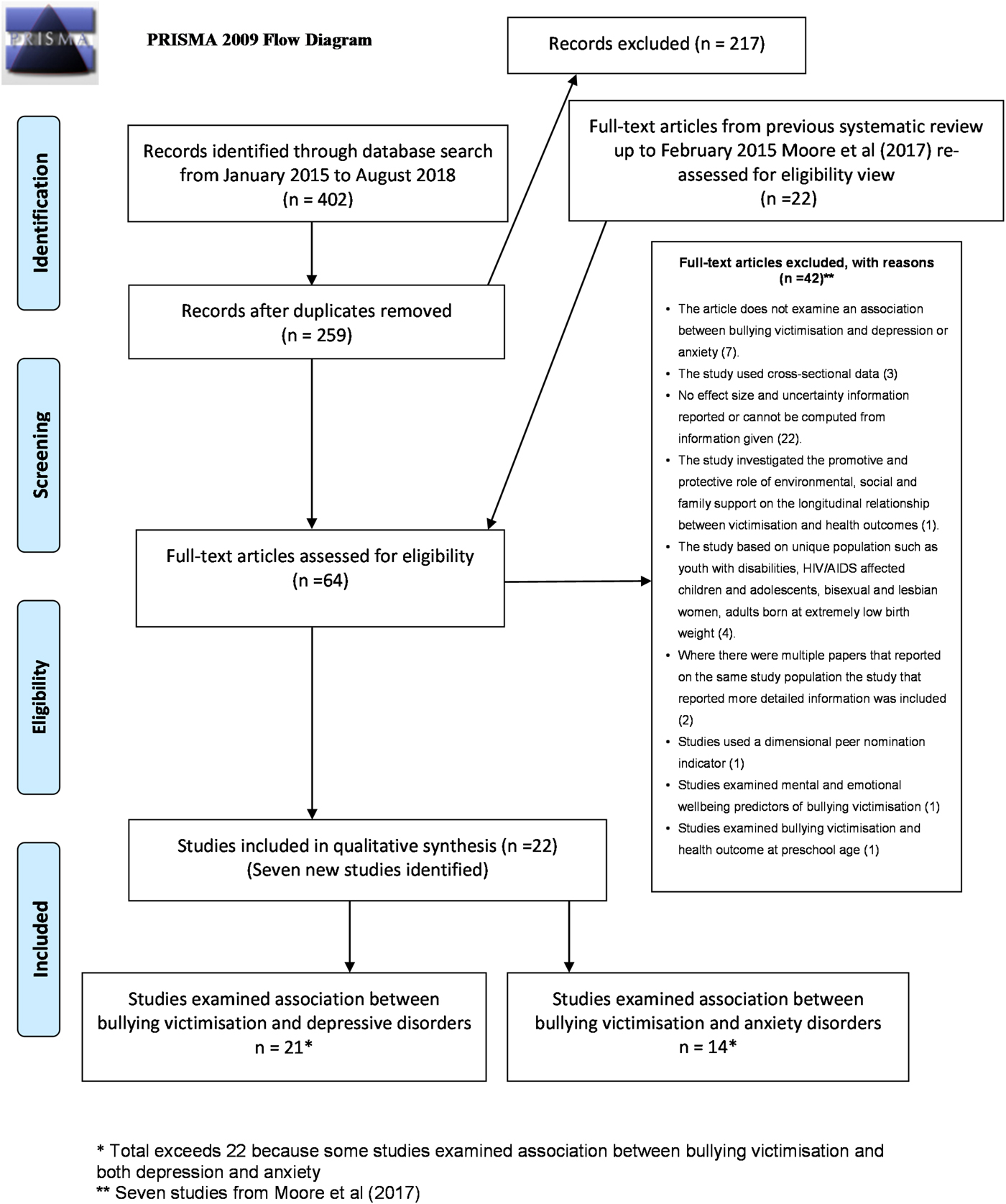
Relationship between bullying victimisation and anxiety disorders (adjusted for baseline anxiety). Individual and combined relative risks.
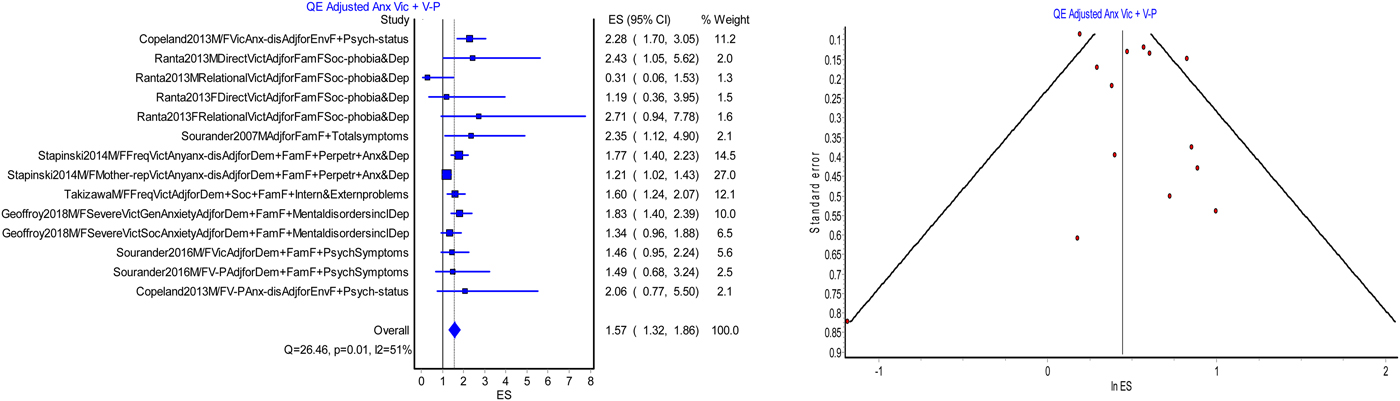
Relationship between bullying victimisation and depressive disorders (adjusted for baseline depression). Individual and combined relative risks.
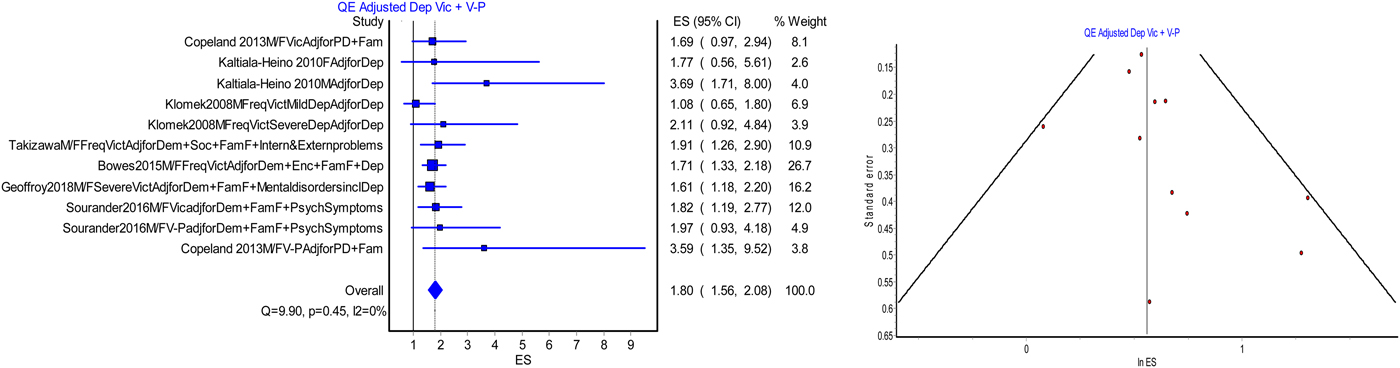


 Open access

