


Introduction
Sometime in the years 400–402, John Chrysostom gave a remarkable sermon.Footnote 1 The location was a martyrium at Drypia in the suburbs of his episcopal see of Constantinople. His audience was an impromptu assembly drawn from every class of people present in the city. The occasion was the end of a procession – led by the empress Eudoxia, the wife of the emperor Arcadius (r. 395–408) – which had brought the relics of an unnamed saint to their new resting place. John spoke at an inflection point in the development of Constantinople as a Christian imperial city. A generation had passed since Arcadius’ father Theodosius I had relocated both his own residence and that of the praetorian prefecture of the East. Constantinople would be the permanent centre of government in the Eastern Mediterranean for the next two centuries, as the shift to a model of static emperorship meant emperors and their households were in almost continuous residence from Arcadius’ accession in 395 until the personal campaigns of Heraclius (r. 610–41) in the 620s.Footnote 2 Amongst the many ways in which the city was reshaped around the needs of the emperor and his household, perhaps the most striking is the impact on its Christian institutions, topography, and liturgical calendar. John Chrysostom’s sermon captures an early experiment in the imperial family’s communication of distinctly Christian virtues through public ceremonial in Constantinople. According to John, the Augusta had removed her imperial regalia and danced barefoot behind the relics.Footnote 3 As numerous studies have demonstrated, Eudoxia’s humble progress to Drypia – and her husband’s more straightforward state visit on the following day – encapsulate forms of pious Christian behaviour that soon became standard parts of the repertoire of imperial ceremonial in the Eastern capital.Footnote 4 Late fourth-, fifth-, and sixth-century imperial regimes increasingly sought to legitimise their rule through processions like this one and, in so doing, shaped the Christian life of the city. Arcadius and Eudoxia’s patronage of this new martyrium is likewise representative of the wider process by which members of the imperial family left their mark on the ecclesiastical topography of the city through church foundations.Footnote 5 As John Chrysostom would discover (to his cost), the bishop of Constantinople himself was to play his part in this redevelopment of the city’s Christian institutions to be fit for imperial purposes. As the court of highest appeal in the empire, the imperial palace now expected to forward ecclesiastical disputes to their local bishop. John’s refusal to work outside his canonical jurisdiction (at least in this case) was one of several offences that made him unacceptable to Arcadius and Eudoxia (and thus) unfit for this most political of episcopal offices.Footnote 6
Eudoxia’s procession and John’s sermon capture another key feature of the transformation of Christian Constantinople. In his effusive enumeration of the crowd before him, John referred (amongst others) to the ‘magistrates’ (tōn archontōn) present.Footnote 7 The bishop later returned to these distinguished attendees as part of his account of how the power of the relics had miraculously subverted the social distinctions and hierarchical relationships that normally structured urban life. As John described it, ‘even magistrates left behind their carriages and staff-bearers and body-guards and rubbed shoulders with the common people’.Footnote 8 The presence of a Roman emperor in the Great Palace on the Bosphorus brought the wider apparatus of state with it. Thousands of elite men and their households came to the city as serving, former, or budding imperial officials and current or potential future members of the Constantinopolitan Senate.Footnote 9 As John’s reference to the magistrates trailing behind Eudoxia implies, the emperor’s service aristocracy contributed to this recasting of the city’s Christian landscape. Their participation in this public performance of humility was not a one-off. In her superlative examination of Chrysostom’s episcopate, Claudia Tiersch has captured how the elites of the capital knitted Christian piety and patronage into their traditional patterns of display and competition.Footnote 10 Late fourth-, fifth-, and sixth-century Eastern senatorial families made their own church foundations, represented a powerful constituency at the Great Church, and patronised clerics and ascetics.Footnote 11 The presence of the imperial bureaucracy and wider senatorial elite played a significant role in making Constantinople a properly (and distinctly imperial) Christian city.
The manner in which the city of Constantinople – and its Christian life in particular – was transformed by the permanent presence of the emperor and his service aristocracy has been traced in detail. Part III of this book considers the same problem from the opposite direction: the impact of serving the state on the religious identities of elite Christian men. This chapter uses attested episodes where officials practised forms of Christian observance in Constantinople to consider the interplay of imperial, episcopal, and domestic communities, loyalties, and norms in forming the religious profile of those who served the state in the Eastern imperial capital. There is surprisingly little evidence for explicit requirements for church attendance despite regimes’ recurring concern to ensure that their appointees were orthodox Christians. Officials seem to have been expected to attend church when the emperor did, but this was likely limited to major festivals and liturgical occasions; this ceremonial presence also seems to have been connected more to political loyalty than desires for religious conformity. Many officials were much more regular attendees at Hagia Sophia, as evinced by reports on their displeasure and withdrawal from communion when controversial bishops of Constantinople were plunged into crisis. Despite this routine presence in the episcopal church, the bishop remained a peripheral figure, not only in growing efforts to regulate the orthodoxy of imperial appointees but also more generally in the discourse around their religious identities. The limited pastoral significance of the bishop seems partly to have pertained to the distinctive topography and forms of Christian community in the imperial capital that encouraged semi-autonomous liturgical choices. Like other members of the city’s power elite, officials engaged in the patronage of churches, clerics, and ascetics. This encouraged a sense of independence amongst an official class over-equipped with putative theological advisers, alternative pastoral relationships, and possible domestic liturgical arrangements. At the same time, their role as representatives of an emperor who acted as the ultimate arbiter of orthodox doctrine encouraged in officials a sense of superiority to the current holder of the episcopal see. This condescension was solidified by their regular receipt of theological and ecclesiastical reports from bishops, clerics, and ascetics, not only in Constantinople but across the Eastern Empire, who petitioned them for aid in ecclesiastical politics. Accounts of episcopal crises suggest an attitude that, in the final instance, it was officials who judged the orthodoxy and moral character of the bishop and not the other way around. From all this, officials emerge as participants in a distinctly imperial Christianity, whose most significant communal manifestations and cultural influences were rooted in the palace and imperial bureaucracy.
6.1 The Palace Goes to Church
Emperors were not avid public churchgoers. In the normative pattern of imperial attendance identified by Neil McLynn, late fourth- and early fifth-century emperors seem to have visited episcopal or other ‘public’ churches only during major Christian festivals and other special occasions like relic translations, baptisms, funerals, and other distinctive moments of liturgical commemoration.Footnote 12 This pattern holds for the later fifth and sixth centuries: when late ancient and early Byzantine historians discuss the emperor’s presence in church, they do so on the occasion of major festivals or dedication ceremonies.Footnote 13 One key indicator is a law in the Justinianic Code dating to the late 520s or early 530s, whereby the quaestor and prefect of the city were enjoined to accompany Justinian on festival days to receive petitions and ensure crowd control (respectively). This law implies that the emperor normally attended the ‘Most Holy Great Church’ and ‘other churches’ only on those days: unless, of course, subjects could be expected not to bother him or start a fracas on an ordinary Sunday.Footnote 14 Of course, the number of such festivals likely increased over the course of fifth and sixth centuries as additional days were added to regular liturgical commemoration at Constantinople.Footnote 15 Reports from the reigns of Anastasius, Justin, Justinian, and Justin II nevertheless suggest the imperial presence in church remained a special occasion.
For the rest of the year, emperors and their families would normally have used appropriate spaces on their own property, mirroring the practices of elite Christians across the Roman world.Footnote 16 There is considerable evidence for imperial foundations built in fifth- and sixth-century Constantinople, including chapels in and attached to various palaces and residences.Footnote 17 There are also tantalising glimpses of routine forms of Christian observance within these palaces and their ecclesiastical spaces. For example, the Church History of the Constantinopolitan Theodore Lector – written under Anastasius and published under Justin I – describes how a supposed autograph copy of the Gospel of Matthew, transferred from Cyprus to Constantinople under Zeno, was read on Maundy Thursday every year in the chapel of St Stephen in the Daphne palace.Footnote 18 Such occasions shaded off into less obviously liturgical observances at court, which were still nevertheless connected to major Christian festivals, as when Justin II held some form of audience there at Easter 571.Footnote 19 According to John Rufus in his Life of Peter the Iberian (written c. 500), it was customary under Theodosius II for senators to pay the emperor a social call at the palace at Epiphany.Footnote 20 Alongside these more formal occasions, late ancient palaces also saw more spontaneous and personal expressions of religious piety, as with Theodosius II’s apparent resolutions to fast on Wednesdays and Fridays and sing responsories with his sisters each morning.Footnote 21 Those who served in the palace at Constantinople were thus exposed to various forms of Christian observance whose nature and frequency were defined both by long-standing traditions and by the character of individual rulers.
Just whom emperors expected to join in this more ‘private’ – or, better, public but domestic – religious observance represents something of a black box.Footnote 22 As with Theodosius II’s family band, the surviving evidence for domestic observance tends to present rulers worshipping alone with family members or priests. But of course rulers were never truly alone.Footnote 23 Such is the implication of the one report on regular palace worship in Constantinople that provides a window on this problem.Footnote 24 The Life of Peter the Iberian portrays its protagonist’s ascetic progress when exposed to the ‘diligence’ of Theodosius II, Eudocia ‘and of the men and women serving them, and especially of the eunuchs, who are called cubicularii. For they were all living in the palace as in a monastery, with prayers, fasts, night services, and the other [exercises] that are pleasing to God.’Footnote 25 John Rufus’ specific frame of reference introduces Peter’s own following amongst the staff of the bedchamber and his lifelong collaboration with one of them, John the Eunuch.Footnote 26 Other aspects of this (later) account might be suspected: not least how close both Theodosius II’s palace and the Georgian royal palace of Peter’s childhood come to becoming real (and not simply metaphorical) monasteries.Footnote 27 It nevertheless seems plausible that the daily or weekly religious observances of the emperor and his family were witnessed by a more restricted group of personal attendants.Footnote 28 Where a broader invitation list appears (in the reports of John Rufus and John of Ephesus), it is once again connected to the main liturgical festivals.
The usual pattern is much clearer for public ceremonial attendance. When Eastern emperors crossed the road from the Great Palace to the Great Church, they brought a substantial retinue with them. Various contemporary texts attest that emperors were accompanied by their bodyguard, although at some point under Theodosius II, the guardsmen started checking their weapons at the door.Footnote 29 Extant reports of imperial processions to and presence at churches also often include the information that specific attendants and officials, or the ‘Senate’ as a collective, accompanied the emperor.Footnote 30 When these (often sixth- or seventh-century) accounts speak of the Senate, they are effectively referring to the emperor’s most important officials and counsellors or past or future imperial servants. The late fifth and early sixth centuries saw an amalgamation of the consistory and Senate and their personnel and functions, codified by Justinian. Even before that point, those senators who were present in Constantinople were most likely current, former, or possible future officials: hence the increasing overlap of terminology and function even in the middle decades of the fifth century.Footnote 31 Some accounts are also explicit that the collective that accompanied the imperial family on their ecclesiastical walkabouts were office-holders.Footnote 32 The ceremonial staging of Christian emperorship in Constantinople routinely involved the presence both of individual office-holders and of the ruling elite as a corporate body.
We can see officials and senators in church with the emperor; the question that remains is whether they had to be there. It might be assumed that Christian emperors would require their officials and attendants to practise forms of collective religious observance with them. Yet unlike moments where rulers forbade attendance at assemblies or with clerics they saw as heretical, explicit orders for the ruler’s appointees to attend a particular church are very rare. I am aware of only one episode where an emperor pronounced this requirement for the purpose of ensuring religious conformity within the state. According to John of Ephesus, Justin II ordered in 571 that no one would be able to greet him on Easter Sunday unless they took communion with him.Footnote 33 Justin was seeking to enforce yet another new doctrinal compromise to unite the Chalcedonian and non-Chalcedonian churches in his empire: a compromise that John had originally signed but now disavowed given the absence of an explicit condemnation of the council of 451.Footnote 34 Before celebrating the constancy of certain pious Miaphysites at the court who refused to join in, John noted that many had been cowed into communion by the emperor’s threats (with the loss of office and access that they entailed).Footnote 35 Divine agency – and discontent at the violent coercion that ensued – eventually led Justin to back down, allowing John’s heroes to attain key posts at court and conduct critical peace negotiations with the Persian shah.Footnote 36 The moral of this story is obviously shaped by the historian’s partisan portrayal of Justin II’s efforts at compromise, which were presented as a persecutory attempt to force John’s pious co-religionists into communion with Chalcedonian traitors. This episode nevertheless demonstrates the potential dangers of such a concrete demand to demonstrate political and ecclesiastical allegiance at a court that was (throughout this period) patterned by various forms of religious diversity. Outside of the context of a nascent (and extremely fragile) doctrinal compromise – an unusual moment requiring public performance of religious uniformity – it is unlikely that regimes felt they had to demand attendance as the price of a continued imperial career and to do so as a test of both orthodoxy and loyalty.Footnote 37
Of course, even without explicit requirements, there was likely significant social pressure to attend public church services when the emperor turned up.Footnote 38 Attendance on the person of the ruler was a tacit assumption for other key moments of imperial ceremonial.Footnote 39 Reports of imperial visits to church in the fifth and sixth centuries articulate the ideal of a carefully choreographed ceremonial occasion where the unanimity of the Senate and people with the emperor or empress was on view.Footnote 40 The (most likely sixth-century) description of the baptism of Theodosius II given by Mark the Deacon in his Life of Porphyry of Gaza waxes particularly eloquent on the serried ranks of senators (he imagined) accompanied the imperial family on their exit from the Great Church.
Once the young Theodosius had been baptized and left the church for the palace, there could at once be seen the nobility of the crowd of those going before him and the brightness of their clothing. For all were dressed in white, so it seemed that the crowd was covered in snow. There went before him patricians, illustres and all the dignitaries, with the military units. All were bearing candles, so it seemed like the stars were appearing on earth. And the emperor Arcadius himself was next to the baby being carried, with a happy countenance brighter than the purple of the clothing he was wearing, and one of the great men carried the baby in his bright clothing.Footnote 41
In this grand procession from the church to the palace, those senators present in Constantinople were ordered (as on other ceremonial occasions) by their particular grade within the hierarchy of status jealously managed by imperial regimes.Footnote 42 When all of these ‘stars’ were supposed to take their correct place within the imperial firmament, it is easy to imagine that the absence of one member of a particular constellation might be noticed. Certainly, that is the situation implied by an overlooked detail in another sixth-century story about early fifth-century Constantinople.Footnote 43 In this piece of court gossip, first recorded by John Malalas, Theodosius II came to believe his wife Eudocia had committed adultery with the magister officiorum Paulinus because of their unfortunate regifting of a massive apple that the emperor had been given on his way to celebrate Epiphany. Theodosius gave this (rather too obviously symbolic) curiosity to the empress, who passed it on to Paulinus, who sent it back to the emperor; Theodosius exiled Eudocia and executed Paulinus. The unfortunate magister was unaware of the emperor’s original receipt of the incriminating apple because foot problems had kept him at home. Malalas’ version of the story (and the later texts dependent upon it) suggest that Paulinus had sent apologies for his absence beforehand. That a prominent official would need to make excuses for non-attendance suggests – by the time of writing in the 530s at the latest – that leading officials and courtiers in Constantinople were normally expected to accompany the emperor on his public visits to church at major festivals. At the same time, the ease of Paulinus’ excuse suggests (once again) a pragmatic approach to the stage management of this public demonstration of the emperor’s Christian polity.
Expectations of attendance and possibilities for flexibility are also suggested by a letter that Severus of Antioch sent during his exile (c. 519–35) to one of his privileged contacts at the imperial court, the patricia Caesaria. Caesaria had asked whether ‘some of the orthodox [i.e. Miaphysites] are doing well in not communicating with the heretics, but listening to the reading of the holy Gospel, or even staying during the time of the mysterious prayers, but not communicating in the rites that are being performed’.Footnote 44 Severus offered a succession of stark Scriptural warnings not to consort with heretics before indicating that his trawl of biblical precedents had identified an important exception.
I find that men who hold ministerial posts or high offices, and are obliged to accompany and attend upon rulers, receive an indulgence if, when they go in with them and hear a lesson and prayers, they keep themselves perfect: I mean if they do not communicate in the communion from which they are divided.Footnote 45
Severus took for granted that officials would have to go to church with the emperor as part of their duties. Yet he also assumed that Miaphysites in imperial service would be able to refrain from communion with a Chalcedonian emperor (whether Justin or Justinian). This is of course precisely the flexibility of liturgical practice in a Christologically divided court that Justin II sought to override at Easter 571. Going to church (if possible) when the emperor did thus seems to have been a normal part of life at the Eastern imperial court in Constantinople. The character of that attendance gave space for contemporaries to interpret it more as an indication of loyalty, and a fulfilment of ceremonial obligations, than an expression of personal religious affiliation.
6.2 Conformity and Churchgoing
Imperial officials had other reasons for regular public church attendance, especially those members of this service aristocracy whose religious affiliations might have been called into question. Eastern regimes from the 390s onwards periodically legislated to prevent members of the imperial service from attending specific heretical or schismatic church assemblies.Footnote 46 Although these laws did not require proof of attendance at (what was seen as) the ‘orthodox’ or ‘Catholic’ church, it is plausible that some officials would have attended to avoid future suspicion. This potential need for communion with the bishop of Constantinople is most obvious in the polarised aftermath of the second deposition of John Chrysostom. In 406, the emperor Arcadius sought to suppress the substantial splinter group of ‘Johannites’ who had stayed loyal to the exiled bishop and continued to avoid the church of Atticus (his replacement-but-one, 406–25). Amongst the various groups within the laity of Constantinople named in this law – as quoted by Palladius in his Dialogue on the Life of John Chrysostom – it included provisions ‘to remove from those in positions of dignity the honour which pertains to their office, and to take the belt of office from those in imperial service’.Footnote 47 John’s advocate does not spell out what precisely these imperial officials would lose their positions for, but given that he goes on to stress that the Johannite laity continued to meet and pray ‘in the open air’ despite this law, it is likely that it simply punished those caught attending these schismatic services.Footnote 48 Palladius’ stress on the significance ascribed to communion with Atticus – a central feature of the regime’s other responses to this crisis – nevertheless suggest that a visible presence in the episcopal church would have been politic for those who had recently been absent.Footnote 49
Such considerations became more pronounced as later fifth- and early sixth-century regimes began to introduce positive requirements for Christianity, framed around baptism, oaths, and witnesses to orthodoxy.Footnote 50 Such laws and administrative protocols introduced a potential need for officials not only to be Christians but to develop a relationship with the episcopal church of the city and a sense of ‘good standing’ through attendance. Certainly, the anxieties over religious insincerity expressed by the laws of Justinian – and episodic show-trials of crypto-pagans in his reign – imply that outward conformity to Christian public religious practice represented an entry-level requirement in mid-sixth-century Constantinopolitan court society.Footnote 51 These anxieties regarding the problems of ensuring inward devotion through external acts had an obvious significance for church attendance. Suspicions around the religious commitment of officials were often expressed through observation of their behaviour in church.Footnote 52 Various sixth-century historians include character assassinations of particular appointees, using their supposed religious insincerity as part of a wider argument about their immorality and unfitness for office. These poisoned pen portraits substantiated that accusation of feigned conformity by the way these individuals acted during Christian observances. So, for example, Procopius of Caesarea claimed that the infamous praetorian prefect John the Cappadocian dressed and acted more like a pagan when he visited Christian sanctuaries.
He was completely without thought of God – if ever he went into a church to pray and to spend the night in vigil there, he did not observe Christian practices, but put on a rough cloak more appropriate for a priest of the old faith, which they now call ‘pagan’, and recited all night long sacrilegious words which he had learnt by heart, so that the emperor’s will might be even more subject to him and that he himself might be immune from harm at the hands of any person.Footnote 53
When John of Ephesus accused Justin II’s quaestor Anastasius of secretly being both a pagan and a Samaritan, he went even further, depicting a vivid scene of discovery at the festival of the Holy Cross in the Great Church in 572 or 573. As Anastasius joined the senators queuing up to venerate the cross, he had some form of fit that required him to be carried out to a private apartment while the service continued. At least according to John, he never fully recovered before his death a year and a half later. This unfortunately timed episode was interpreted by John as a form of demonic possession and divine proof of the quaestor’s religious hypocrisy, revealed by the power of the cross.Footnote 54 Such vivid tableaus suggest that officials in church had to expect observation of their conduct.Footnote 55 At the same time, the nature of these character assassinations suggests that there were particular reasons why these individuals were subject to such scrutiny (and, indeed, that this was more a useful accusation to throw against a political opponent than an everyday feature of life in the churches of Constantinople).Footnote 56 It should be stressed that no (earthly) action was taken against either (supposed) crypto-pagan. Outside of these polemical episodes, there is not a sense that the individual conduct of officials and senators was a subject of consistent focus. Instead, as noted above, our reports tend to sketch their unanimous and neatly ordered collective presence as the backdrop to the pious conduct of the emperor. Turning up to church may have been enough in most cases: part of the reason that contemporaries questioned the religious sincerity of contemporary officials.
6.3 Officials and the Episcopal Church
Some imperial officials and courtiers were regular attendees at the episcopal church without the need for imperial prompting. This routine presence in Hagia Sophia is most clearly visible during crisis moments for late fourth-, fifth- and sixth-century bishops of Constantinople, when the presence or absence of officials and senators became a barometer of the continued viability of their episcopate. Gregory of Nazianzus used his retirement speech in 381 to highlight how his congregation had grown during his time in office. As Neil McLynn has argued, this increased attendance was most likely a result of the arrival of the court of Theodosius I; prominent amongst the categories of late arrivals Gregory listed were ‘rulers’, ‘soldiers’ (i.e. those in imperial service), and ‘nobles’.Footnote 57 Reconstructions of the two depositions of John Chrysostom in 403/4 include imperial officials and the wider senatorial elite amongst the groups who conspired towards his downfall.Footnote 58 As Claudia Tiersch has explored, a number of sermons and several recurring themes in Chrysostom’s preaching provoked anger amongst the senatorial elite: not least, the bishop’s uncompromising denunciation of wealth and its display and attacks on fundamental requirements of public advancement as incompatible with Christian virtue.Footnote 59 As a result of these attacks, according to the (apologetic) account of an unknown supporter of John in his Funerary Speech for the bishop, many of the rich no longer felt welcome to attend his church (implying they were normally present).Footnote 60 The recorded audience response to sermons concerning the praepositus sacri cubiculi Eutropius and the empress Eudoxia likewise suggests that members of the imperial household and consistory were regular attendees.Footnote 61 Similar dynamics can be seen in competing claims made as the controversy over another uncompromising Syrian appointee to the see, Nestorius, came to a head in 430. In a letter to Celestine of Rome from the spring or summer, Cyril of Alexandria noted that he had heard that many of the Senate had stopped going to the episcopal church ‘in fear of being harmed in their faith’.Footnote 62 By contrast, Nestorius claimed in a letter to John of Antioch in November 430 that he had given a sermon by which he had ‘won … yet greater support from the clergy, the people, and those at the imperial court’ (hos qui in imperialibus sunt aulis).Footnote 63 A further episcopal crisis in the reign of Anastasius also highlights this assumption that key imperial officials would be regular congregants. In an extraordinary meeting of the consistory on Sunday, 31 July 511, the emperor informed his courtiers that they should not attend the service held by bishop Macedonius on the next (ordinary) Sunday.Footnote 64 All of these moments of controversy suggest that it was commonplace for officials as Christians to go to the episcopal church.
This routine presence makes sense given the close (if sometimes fraught) relationship between palace and church, symbolised, above all, by mutual expectations of privileged access.Footnote 65 The forms of sociability evident between representatives of the episcopal church and the imperial family also seem to have encapsulated members of the household, court, and administration. So, for example, in speeches to the Cyrilline assembly at Ephesus on 22 June 431, the bishops Theopemptus of Cabasa and Daniel of Darnis, who brought Celestine and Cyril’s final demand for Nestorius’ recantation to Constantinople in November 430, testified that they found the bishop engaged in a liturgical celebration in the episcopal palace. Cyril’s agents noted that almost all of the illustres were present when they handed over this document (presumably to invoke them as potential witnesses to Nestorius’ receipt of a demand to which he had still yet to reply).Footnote 66 The patricius Florentius had similar access to the bishop’s residence after the Home Synod of 448, which condemned Eutyches. Florentius was able to enter Flavian’s upstairs apartment to inform him of an appeal made (quietly) by the archimandrite after the bishop had left the hearing.Footnote 67 Such access was not simply a matter of liturgical occasions or imperial business. Imperial officials appear more broadly as allies of bishops of Constantinople, whom the latter might call upon for favours at court.Footnote 68
Given this regular presence of officials in the episcopal church, and the formation of relationships between bishops and office-holders, we might expect the bishop to play a prominent role in shaping the religious identities of officials whose Christianity was (at least theoretically) subject to state regulation. Pastoral oversight remains a remarkably peripheral feature of both the legal framework and the historiographical discourse around official Christianity. That the compilers of the Justinianic Code included the laws of Leo I and Justinian requiring that appointees prove their Christianity within the section on the episcopal court implies that this problem was, in part, a matter for the bishop of Constantinople.Footnote 69 Yet it is not obvious what precisely his role was, in contrast to other laws in that section that pertain to the bishop’s legal jurisdiction or mark out a specific action item for the patriarch. Oversight over official Christianity in the capital emerges from these laws as an in-house affair. It was up to department heads to ensure the orthodoxy of appointees: oaths would be sworn and witness statements recorded before them; they were to receive punishment in the breach.Footnote 70 It seems telling that reports on misbehaviour in church and accusations of crypto-paganism place weight on the views of observers within the official classs.Footnote 71 The bishop’s care for the souls of the officials in his congregation does not obviously come into the equation. From the perspective of the imperial state, the bishop seems a peripheral figure who could be called upon to help with the necessary bureaucratic processes to ensure officials adhered to a corporate Christianity defined internally.
6.4 Patronage and Praxis: Officials and Domestic Christianity
Part of the reason for this marginalisation of the bishop of Constantinople must be his peculiar position within the ecclesiastical landscape of the imperial capital. The bishop was not the only Christian authority figure with whom officials entered into relationships of reciprocal patronage, and the episcopal church was far from the only site of official Christian agency and piety.Footnote 72 Critical again are the limited expectations of public churchgoing in general and especially of elites for whom domestic worship was standard most of the time. Correspondingly, what we see in fifth- and sixth-century Constantinople is much greater plurality and choice in churchgoing and patronage. As Gilbert Dagron neatly captured, in the absence of anything resembling a medieval parish church, even ordinary Christians in Constantinople had free rein to go to a particular saint’s church for healing because of the timing of their festival in the liturgical calendar or because of a personal sense of dedication to them.Footnote 73 For most of this period, these shrines were rarely founded or controlled – and only partially regulated – by the bishop of Constantinople. From Constantine’s rededication of the city and especially since the arrival of the Theodosian establishment in Constantinople, the prime movers behind church building in the imperial capital had been its major landowners: aristocratic dynasties, the women of the imperial family, and, latterly, the emperors themselves.Footnote 74 These martyria, oratories, and domestic shrines were supported by groups of clerics or monks normally chosen for that purpose by the church’s patron who also, of course, owned the land on which it was sited (and perhaps even lived in the townhouse to which it was attached). Bishops of Constantinople from Chrysostom onwards made recurring attempts to bring the financing, staffing, and liturgical arrangements of these churches under the aegis of the episcopal church, sometimes with the help of their emperors. Tighter canonical and imperial regulation was pursued – most notably, at the Council of Chalcedon (451) and in the reign of Justinian – which increased episcopal oversight. The character of these domestic shrines and their forms of worship nevertheless remained largely at the volition of the communities or clerics attached to them and, more fundamentally, of the patrons on whose property they resided and on whose continuing financial largesse they depended.Footnote 75 In this decentralised ecclesiastical landscape of imperial and elite foundations, the Great Church looms rather smaller on the horizon.
For the Christian residents of Constantinople, even regular religious observance frequently pulled them out of the orbit of the episcopal church. For the richest members of the city’s service aristocracy, the possibilities of alternative foci for the expression and definition of their Christian identities are all the more evident. The most ostentatious elite manifestations of this Christian self-determination come in the form of those very church foundations. Current and former officials were amongst the grandees who constructed churches on their properties in the city and its suburbs. The roll-call of those known to have built churches, founded monasteries, or donated to pre-existing shrines and communities in Constantinople and its environs is a veritable who’s who of the imperial grandees of the late fourth to late sixth centuries. These churches were often set up to house monastic communities. In the mid-390s, the prefect Rufinus brought Egyptian monks to the church of Peter and Paul attached to his palace in Chalcedon to conduct services; seven decades later, the consul Studius transferred members of the community of ‘Sleepless’ monks established by the Syrian ascetic Alexander to his church of St John the Baptist.Footnote 76 If the authors of the Lives of the late fourth-century ascetic Isaac and the late fifth-century stylite Daniel are to be believed, current and former imperial officials and their families competed to house the Syrian ascetics in bespoke churches on their estates; after Isaac’s death, the praetorian prefect Aurelianus built a special shrine in his residence to house the corpse.Footnote 77 Incorporation into their townhouses was not the only domestic feature of these monastic start-ups: the chamberlains Gratissimus (in the 460s) and Narses (in the 560s) were said to have built so that, on retirement, they could join the monastery they had sponsored (although only the former had the chance to execute his plan).Footnote 78
Even when (ex-)officials did not dedicate themselves to their foundations in such a fundamental way, these churches could represent an ongoing investment with the potential to act as a focus for their religious identity. Such was certainly the case for Rufinus’ shrine for the relics of the apostles, which witnessed his baptism. In an account preserved in one manuscript of Palladius’ Lausiac History, the prefect hosted a council of bishops in this domestic martyrium and was baptised in their presence.Footnote 79 The prefect’s use of his church of Peter and Paul to stage his Christianity continued after his death. After his dramatic fall from grace and assassination in 395, Rufinus’ palace was confiscated by the treasury but not before he was buried in his church.Footnote 80 Such post mortem commemoration was clearly a central motive for these constructions.Footnote 81 Of course, as the fate of Rufinus’ martyrium implies, dynastic plans did not always come to fruition. Monastic experiments failed, imperial powerbrokers rose and fell, and properties changed hands. Other elite domestic churches had greater longevity as sites of familial commemoration. The Palatine Anthology records dedication inscriptions for both the construction of the church of Theodore by the comes domesticorum peditum Sporacius and his burial in the same church by his son; the same collection includes several verses commemorating church buildings as the inheritance of, and refurbishments as acts of dynastic piety by, imperial and aristocratic women.Footnote 82 Continued investment in these sites is also implied by later fifth- and early sixth-century imperial regulation of ecclesiastical patronage. Even with attempts to introduce episcopal oversight, donors were heavily involved in the running of churches and monastic communities, not least by choosing abbots, clerics, and administrators, paying salaries, and managing (and sometimes reappropriating) land.Footnote 83 Where domestic churches remained a going concern, it is easy to see how they could become an important locus for the Christian self-expression of an elite family.
Any assertion beyond this has to remain somewhat speculative, not least because it is hard to tell what exactly happened in these domestic churches.Footnote 84 We can rarely actually see current officials worshipping in (as opposed to simply founding) domestic churches in surviving texts, but they presumably represented important sites for their religious observances. Such a function is implied by the prevalence amongst elite Christians of the reserved Eucharist, that is, the delivery of consecrated bread and wine to select congregants to be consumed in private. There is plentiful evidence for both Chalcedonian and non-Chalcedonian senatorial aristocrats securing this privilege in sixth-century Constantinople (wherever in their homes they chose to receive it).Footnote 85 The possibilities of the domestic sphere as a focus for the religious observances of imperial officials are likewise suggested by accounts of those saintly figures who sought to engage in ascetic praxis while serving in the imperial palace, like the Georgian prince Peter the Iberian (in the reign of Theodosius II) and the cubicularii Misael, Theodore, and John (in the reigns of Anastasius and Justinian).Footnote 86 The most startling example, already discussed in Chapter 5, is that of the senator John Vincomalus in the reign of Marcian. According to Theodore Lector, Vincomalus would spend the day in the palace in the guise of a senator, before returning home to the monastery of Bassianus (founded by the former praepositus sacri cubiculi Gratissimus), where he would put on a monastic habit and scrub dishes in the kitchen.Footnote 87 It seems prudent to doubt the veracity of this story, where the moral about these two forms of service hovers rather too obviously over its protagonist.Footnote 88 The ideal combination of imperial office and domestic piety presented by the ecclesiastical historian nevertheless distills a wider set of cultural possibilities that could be practised even by officials whose Christianity was called into question by contemporaries. Another way of reading Procopius’ account of John the Cappadocian’s church attendance (quoted above) is that the praetorian prefect was known to partake of regular nightly vigils at martyr’s shrines; the ‘rough cloak’ he wore could just as easily be seen as a monastic habit.Footnote 89 Imperial officials were part of the wider picture of elite domestic religious praxis that was normative in Constantinopolitan court society from the late fourth to the late sixth centuries.Footnote 90
These forms of domestic piety were rooted in, and helped to cultivate, reciprocal relationships with authority figures and institutions outside the direct remit of the episcopal church. Official patronage of clerics and ascetics went beyond the staffing of domestic churches and establishment of monastic communities. A notable feature of the lives of saints who lived in or visited Constantinople is their recording of the patronage offered by prominent figures at court and amongst the senatorial aristocracy.Footnote 91 Imperial officials provided housing and hospitality and financial, political, and bureaucratic support, while requesting healing and doctrinal and spiritual advice. Polemical writings against doctrinal and clerical opponents similarly attest the significance of elite patronage of wandering monks and visiting clerics (including bishops who should really have been back in their own dioceses).Footnote 92 As Justin Pigott has neatly put it, ‘with an abundance of willing patrons and the draw of the imperial court, Constantinople began to attract a continuous stream of itinerant preachers and monks from throughout the empire seeking lucrative patronage and imperial appointment’.Footnote 93 Bishops of Constantinople sought to bring these unaffiliated Christian authority figures under institutional control, with some success in the aftermath of Chalcedon. (Chalcedonian) bishops and local (Chalcedonian) monastic communities were more closely allied – and the latter less likely to engage in public protest – in the decades following the council. Recurrent doctrinal conflicts and the ongoing influx of clerical and monastic visitors and petitioners nevertheless meant that alternative pastoral and social relationships persisted throughout this period.Footnote 94 The emperor’s appointees were likely members – and occasional or semi-regular attendees – of the episcopal church, but that community and its bishop was only one institutional and social context for their Christianity.
Against this backdrop, Hagia Sophia appears as one of many potential sites of official piety and patronage. Indeed, the Great Church seems as much an ‘imperial’ church as an episcopal one. Neil McLynn has observed the confidence of the regime of Theodosius II in appropriating Hagia Sophia as a space for ceremonial display.Footnote 95 A similar ease within this ecclesiastical space can be seen in brief reports on the actions of officials within it. It seems to have been common practice for palatine dignitaries to visit the church independently to pray. The best evidence for this comes from two dramatic incidents in and around Hagia Sophia. In an entry for 419, the Chronicon Paschale records that the urban prefect Aëtius was stabbed on his way from the church to the palace by an old man pretending to be a petitioner.Footnote 96 (He had hidden the dagger in a scroll.) Again, I am going to skip over what would otherwise be the most exciting bit of the story and focus on the incidental detail: Aëtius had been praying in the Great Church when he was summoned to the palace, and his attempted murderer expected to find him there. This sense of the commonplace nature of official visits to the episcopal church also comes from another incident discussed by John Malalas and the Chronicon Paschale.Footnote 97 In this episode, the emperor Zeno ordered that his praetorian prefect Arcadius be murdered when he arrived at the palace. Once summoned, the prefect avoided this fate by stopping off at Hagia Sophia en route and pretending that he needed to pray but actually staying there to claim asylum. Both stories suggest that this was something imperial officials might normally do on their way to and from the palace.Footnote 98 They also suggest the deliberate visibility of such acts: Aëtius attended ‘with pomp’ (meta tou schēmatos); Arcadius was travelling (as was customary) in his carriage.Footnote 99 Christian piety could be publicly displayed in the Great Church with or without the attendance or intervention of the bishop.Footnote 100
6.5 Overmighty Congregants
In the summer of 511, the episcopal church of Constantinople saw a tumultuous few months as its bishop Macedonius was deposed and exiled at the will of the emperor Anastasius.Footnote 101 As the rift between palace and church began to widen, a group of ‘honourable dignitaries’ visited the bishop’s residence for talks on 20 July 511. A letter of Severus records some of the discussions at this meeting, which the prominent Miaphysite ascetic leader (and future bishop of Antioch) attended. In the surviving sections of the letter, Severus quotes Macedonius accusing the imperial household of causing him trouble, followed by a firm (if not unsympathetic) reply by the patrician and consul Secundinus (the emperor’s brother-in-law): it was the bishop’s own fault, and divine support was on the side of the emperor. Most strikingly, Secundinus made clear his independence of judgement regarding the bishop’s orthodoxy.
I know your heart, as I have said just now, because I know what kind of person you are; for unless I had seen you subscribe to the Henotikon of Zeno, of pious memory, I would not have communicated with you from the beginning; now, again, if you do not assure me, you will not find me communicating with you henceforth.Footnote 102
The patrician turned the tables on the bishop: it was his orthodoxy that was in question and had to be evaluated according to his adherence to the Henotikon: the consensus formula that the regime of Anastasius maintained as the key touchstone for doctrinal rectitude.Footnote 103 Secundinus reserved the right to withdraw communion from Macedonius, just as his brother-in-law would do two days later at the consecration of a martyr’s shrine at the Hebdomon.Footnote 104 Both Anastasius and Secundinus had to be convinced (on an ongoing basis) that the bishop held the imperial line on the true faith.
The limited pastoral significance of the bishop of Constantinople for Christians serving the imperial state can partly be explained by the prevalence of opportunities for domestic religious arrangements and the patronage of clerics and ascetics. It also resulted from the presence of the palace as an alternative locus for the definition of correct doctrine and practice. The central role of the emperor in the definition of orthodoxy in the churches of the East – and, of course, in the appointment of bishops of Constantinople – resulted in a peculiar balance of power that went beyond even the usual destabilising effect of the presence of Christian aristocrats for episcopal authority.Footnote 105 As a result, bishops were as likely to be judged by these officials (in their role as enforcers of the emperor’s doctrinal line) as judges of them (in their pastoral capacity). As discussed above, the best evidence for regular attendance at the Great Church by imperial officials is precisely their withdrawal from communion in times of episcopal crisis.Footnote 106 These references to absenteeism form part of wider reports that depict officials and members of the senatorial elite passing judgement on the bishop’s fitness for office. Such ongoing assessments and audience responses were part and parcel of the often complex relationship between bishops and their congregations. Yet their membership of the imperial state made officials more likely than most to take up such a critical stance regarding the conduct and doctrinal positioning of a bishop. Their receipt of petitions, role as intermediaries and ecclesiastical troubleshooters, presence in the consistory, and patronage of interested parties in the city gave them a much wider framework in which to place themselves as members of the church and (orthodox) Christians. The doctrinal and ecclesiastical discretion of imperial officials was a tacit and often remarkably explicit feature of ecclesiastical controversy. Service to the state in Constantinople inculcated a particular form of Christian whose adherence to an imperial agenda, access to alternative sources of doctrinal and ecclesiastical information, and privileged relationships with (sometimes rival) representatives of the institutional church allowed them to maintain a certain distance from the episcopal community.
Secundinus was far from the only fifth- or sixth-century imperial grandee to decide that they knew better than the current bishop what they should teach or how they should conduct themselves. Members of the palace, consistory, and Senate similarly withdrew from communion with the bishop during other episcopal crises. John Chrysostom’s provocative sermons against the iniquitous behaviour of the rich led members of the senatorial elite to decide they had been (effectively) excluded from his church.Footnote 107 Ps.-Martyrius described this sense of exclusion in the context of Theophilus of Alexandria’s visits to ‘the houses of the wealthy’ in Constantinople to build a coalition to depose the bishop.Footnote 108
Sounding out everyone’s disposition towards the saint and inquiring secretly what sort of man they judged John to be in character, he heard some say that he was harsh, that he was impudent (for bad people call freedom of speech ‘impudence’), that he barred their entry to the church with his sermons by discoursing against greed or avarice and directing the eyes of all to them with a shout.Footnote 109
The preacher portrays these complaints as a reflection of the laxity and self-interest of a ruling class given to land grabs and sexual immorality.Footnote 110 It is nevertheless clear that these senatorial opponents felt they were in a position to judge John’s conduct and suitability for the episcopate. Various reports on his downfall suggest this critical perspective also extended to other confrontational sermons. John’s crowing sermon on the asylum of Eutropius – given with the erstwhile praepositus sacri cubiculi present in the apse – provoked unsurprising dissatisfaction from attendees who might have been clients of the formerly dominant figure in the regime of Arcadius.Footnote 111 Likewise, as McLynn has noted, the hostile (and somewhat tendentious) reports that got back to Arcadius and Eudoxia about a misogynistic sermon – and helped to precipitate their withdrawal of favour – likely stemmed from the presence of courtiers in the congregation.Footnote 112 In his Dialogue on the Life of John Chrysostom, Palladius of Helenopolis suggests that the bishop’s enemies ‘changed his sermons into attacks on … other members of the imperial court’ (heterōn tōn en tē aulē tou Basileōs).Footnote 113 Wolf Liebeschuetz and Claudia Tiersch have neatly captured the distinctive ‘Rezeptionsdynamik’ that formed amongst John’s Constantinopolitan audience, who tended to interpret his abstract criticisms of worldly wealth and power as specific attacks on the current imperial regime and senatorial elite.Footnote 114 If this alleged misprision led to introspection amongst the emperor’s appointees in the congregation, it does not appear in our sources (keen to explain the fall of a prophet and confessor); whatever his supposed pastoral authority, John’s critiques of their behaviour seem to have had limited purchase. When his moral provocations offended them, these senators could simply stop turning up.
Something similar seems to have occurred in the spring or summer of 430 because of divisions in the Constantinopolitan church over the term Theotokos and the reluctance of the bishop Nestorius fully to support its use. Nestorius’ rival Cyril of Alexandria had apparently gleaned intelligence that many senators were no longer coming to church for fear of complicity in heresy.Footnote 115 This is (of course) hardly a neutral report: it comes as part of an attempt to persuade his ally Celestine of Rome that action had to be taken against their episcopal colleague.Footnote 116 Yet given the known doubts and open critiques already expressed by representatives of the imperial state – as well as the numerous allies at court whom Cyril and his faction felt they could count upon a year later – such absenteeism seems plausible.Footnote 117 In both cases, members of the imperial establishment felt able to take a critical stance towards the bishop, whose pronouncements and conduct they were entitled to assess for themselves. Of course, imperial officials and senatorial grandees were not the only individuals who brought such scepticism to their interactions with their local bishop. Late ancient bishops had complex and sometimes difficult relationships with their congregations. Members of the Constantinopolitan power elite were not the only opponents of John, Nestorius, and Macedonius; Cyril was keen also to claim that ‘the people’ as a collective had refused to take the Eucharist because of Nestorius’ supposed pronouncements on Mary.Footnote 118 Yet service in the palace, consistory, and bureaucracy made these men particularly prone to take a critical stance towards claims of episcopal authority and orthodoxy.
Such a mindset seems plausible not least because officials might be appointed to resolve ecclesiastical disputes as special commissioners sent to ecclesiastical councils or particular episcopal churches, or act as the bearers or enforcers of imperial laws on correct religion.Footnote 119 The doctrinal authority of officials in such contexts was (of course) delimited by the generally accepted truism that they, as laymen, could be taught but could not teach.Footnote 120 Even when sticking close to those precepts of non-intervention in doctrinal debate, imperial officials (like emperors) felt able to lecture bishops on the consequences of a failure to live up to their own standards of harmony and consensus.Footnote 121 The comes sacrarum largitionum John was particularly scathing when sent to Ephesus in August 431 to repair the damage done by the rival conciliar meetings of the previous two months. John’s report back to Theodosius II on his first meeting with the conciliar fathers from both sides of the schism included a brief account of a speech where he chastised them for their contentiousness. ‘Because I needed to address the most God-beloved bishops on the subject of peace as well (about the orthodox religion being spared heresies and divisions), I gave myself free rein on this theme.’Footnote 122 It is hardly surprising that representatives of an imperial state that legislated to regulate the membership, conduct, activities, and doctrinal formation of the episcopate as a whole – not to mention specifically intervened in episcopal appointments to major sees – felt that they were above the authority of the bishop of Constantinople.Footnote 123
The work of imperial commissioners in various forms of ecclesiastical mediation went far beyond simple facilitation of dialogue through the maintenance of order and protocol.Footnote 124 Attempts to resolve disputes over doctrine, practice, and ecclesiastical discipline required officials to engage directly with theological issues. As when Secundinus was sent with other dignitaries to negotiate with Macedonius, this involved working with bishops to ensure they aligned with imperial orthodoxy and standards and even judging them for the extent to which they did so. In the context of ongoing disputes over the theological and ecclesiastical settlements at Ephesus (431), Ephesus II (449), and Chalcedon (451), fifth- and sixth-century regimes sent special envoys from the palace to work out doctrinal compromises or persuade recalcitrant bishops and Christian communities to return to communion with the rest of the imperial church.Footnote 125 To effectively carry out these missions required mediators to be familiar with the imperial line on a given dispute as formulated in the consistory. Contemporary accounts sometimes refer to the instructions with which envoys were provided or the degree to which they ‘shared the opinion’ of the emperor on correct doctrine.Footnote 126 At the same time, the discretion enjoyed by those who undertook such roles is evident from discussions over those appointed to represent the emperor, both at the Council of Ephesus in the spring of 431 and in the additional missions that followed its failure. The later (and not entirely reliable) Coptic Acts of Ephesus suggest that the role of imperial envoy was the subject of rival representations by and for pro-Nestorian and pro-Cyrillian candidates: the comes Irenaeus and the cubicularius Lausus.Footnote 127 Some discussion of competing claimants within the consistory is plausible: in his sacra convoking the council, Theodosius II felt the need specifically to state that Irenaeus was travelling to Ephesus to support Nestorius as a private citizen and not as a representative of imperial authority.Footnote 128 The comes would later act as an ambassador to the court for John of Antioch and his synod in August 431. In his missive back to the Eastern bishops, Irenaeus reported back on the manoeuvres he had observed amongst the official class.
There are yet others who do everything and make every exertion in the hope of being sent by the most pious emperor to Ephesus with some decrees and, according to what they observe and can accomplish, as they put it, settle the whole matter – something that those who love you pray may not be realised, knowing as they do the intentions of those exerting themselves and what led them to this plan.Footnote 129
Irenaeus communicated that various officials were canvassing to be sent to Ephesus, with a strong implication, both that they were sympathetic to Cyril and that their allegiances had been bought. Whatever their motivations, those ‘sent with some decrees’ evidently had the authority to shape the doctrinal settlement in the church.Footnote 130
Not every official would be selected to manage an empire-wide ecclesiastical dispute. Yet whether or not they were chosen for (or pursued) such a commission, those who served in the imperial palace and consistory gained a wider perspective from their participation within those institutions. In a context where the policy stances of imperial regimes frequently represented the de facto standard of orthodoxy, bishops implicated in doctrinal disputes sent representations to the court to influence opinion and secure specific imperial decisions and legal enactments. Work on the letters of Theodoret of Cyrrhus (in particular) has shown how key officials in the household, consistory, and central bureaucracy could expect to receive missives (alongside the empress, other members of the imperial family, and anyone else thought to have traction within decision-making circles).Footnote 131 As Fergus Millar put it, ‘[Theodoret’s letters] represent extraordinary testimony to the perceived openness of the ruling elite in Constantinople, and to the conviction that it was possible to bring about change through the medium of the persuasion of individuals who belonged to that elite.’Footnote 132 These written missives are only the textual traces of wider campaigns. Contemporary accounts refer to the attempts of provincial bishops and other ecclesiastical envoys to seek support in person at court; a scenario implied by the physical transportation of letters to Constantinople by carefully chosen couriers. Officials granted hearings to these ecclesiastical representations and were exposed to their arguments if the emperor or empress themselves granted an audience.Footnote 133 Whether or not they themselves received such petitions and visits, the emperor’s closest advisers would have been present for discussions of doctrinal questions. A useful example is provided by another account of the deposition of Macedonius in 511. A letter of an otherwise unknown priest named Symeon present in Constantinople at that time, preserved in Ps.-Zachariah’s Ecclesiastical History, provides a detailed account of the crisis as it unfolded.Footnote 134 It notably reports discussions between Anastasius and his officials in the imperial consistory on 27 and 31 July regarding Macedonius’ orthodoxy and fitness for the episcopate, which, as Geoffrey Greatrex has suggested, likely went back to the regime’s own (rather schematic) representation of the deliberations.Footnote 135 Such discussions in the consistory are only rarely preserved or even alluded to in contemporary texts; they must have been behind countless specific decisions regarding religious policies.Footnote 136 As a result, the imperial palace was a site of ongoing theological discussion and deliberation.
It is not simply that those serving in the palace and consistory were in a position both to internalise a corporate imperial line and to pursue their own independent perspectives on the character of orthodoxy. Bishops, clerics, and ascetics also accepted their doctrinal discretion and sought to secure their favour. Those implicated in ecclesiastical controversy regularly claimed that the majority at court or in the Senate supported their position – or, at the very least, would do so in the absence of constraint or corruption.Footnote 137 As previously discussed, Nestorius was keen to trumpet the success of a sermon in persuading ‘those at the imperial court’ in November 430.Footnote 138 Such opinion forming was also a result of the Christian sociability and elite patronage in the capital discussed in Section 6.4. We know about many of these relationships between officials and ascetics, clerics, and monastic communities precisely because those resident archimandrites and visiting impresarios were also central participants in doctrinal controversies.Footnote 139 The efforts of controversialists did not just aim at winning over particular imperial officials; they also included requests for allies within the imperial establishment to work on their colleagues in the palace, consistory, and Senate.Footnote 140 The most infamous of these attempts to shape opinion at the court from within came in the latter part of the Council of Ephesus in the autumn of 431. A memorandum from Cyril of Alexandria – appended, somewhat unwisely, to a letter sent a year later by his archdeacon Epiphanius – included a schedule of payments that were to be delivered to key members of the imperial households and consistory.Footnote 141 Scholarly attention has largely been devoted to explaining how these ‘blessings’ could be squared with the pious pursuit of orthodoxy (with reference to wider patterns of ecclesiastical economy and imperial governance).Footnote 142 Yet these bribes were only part of the process this document envisaged. The bishop’s ‘blessings’ were to encourage those around the emperor and empress to make representations to them in Cyril’s favour, and the wives and domestici of those prefects, praepositi, cubicularii, and magistri to persuade them to act. The memorandum notably suggests that Cyril and his agents had done the work to identify those officials and attendants who could be trusted to try to make a case on his behalf (the praepositus Paul, the tribunus et notarius Aristolaus, the cubiculariae Marcella and Droseria) and those who would need persuading to abandon entrenched views (the cubicularii Chryseros and Scholasticius). The ready money and luxurious gifts offered would only mean so much if those officials (and those in their households) were unable to put forward accurately and convincingly the Cyrilline view of what should happen after the failure of dialogue at Ephesus (and why).Footnote 143
Cyril and his agents at Constantinople could not know what precise impact their bribes might have; indeed, it has been suggested that the bishop got little return for the money he sent to the emperor’s sister Pulcheria.Footnote 144 The likely volume of such competing requests for aid – and not simply in ecclesiastical politics – should make us wary of suggesting too close a relationship between imperial dignitaries and those who sought their help.Footnote 145 Certain imperial officials do also appear as remarkably trusted allies and agents of particular bishops and ascetics.Footnote 146 A neat example comes from another letter sent by Severus (now bishop of Antioch), to Eleusinius, bishop of Sasima, on the occasion of the appointment of John (II) as bishop of Constantinople in 518. Severus reassured Eleusinius of the new bishop’s credentials by reference to a discussion the silentiary Conon had had with him. ‘The magnificent and believing silentiary Conon, when in conversation with him who now ranks before me, found that with regard to unity and with regard to our meanness he said such things as those who are exceedingly orthodox would say.’Footnote 147 The bishop of Antioch was happy to take the word of a palace attendant that the new bishop of Constantinople was a fellow traveller, if one whose long-term dedication to a Miaphysite formula could not be taken for granted.Footnote 148 The doctrinal expertise and ecclesiastical independence of imperial officials was not only acknowledged by contemporary Christian authority figures; it was also put to use by them.
Conclusion
Imperial officials were not ordinary congregants. They were one of several overlapping groups that helped to make late ancient Constantinople such a peculiar Christian city. In her recent book on the development of this distinctive cultic life, Rebecca Stephens Falcasantos has argued that the reign of Theodosius II established a new religious framework evident in the flattening of a more diverse fourth-century past by fifth-century ecclesiastical histories. As Stephens Falcasantos puts it, ‘When we read this literature, we are witnessing the creation of imperial Christianity as a defined social category dependent upon the person of the emperor and his city.’Footnote 149 This ‘imperial Christianity’ stamped the religious practices of imperial officials and shaped their sense of themselves as Christians. Recent work has stressed the strong sense of collective identity cultivated amongst those in imperial service and within the various institutions of state in which they were embedded – the palace, the Senate, the officia of the central bureaucracy.Footnote 150 The Christian identities of Constantinopolitan officials match up to this wider sense of communal solidarity. Though officials were rarely explicitly ‘required’ to go to church, the expectations of this institutional community played an important role in their choices of religious observance. On key liturgical occasions, officials attended church as part of an identifiable group of ‘senators’ or ‘rulers’. The most obvious disciplinary context for their wider public religious praxis was the oversight and application by their managers and colleagues of requirements for orthodoxy and good standing as a Christian. What they heard their bishop preach in church was, for them, just one version of correct doctrine and Christian conduct; the palace and bureaux represented alternative (and potentially superior) sites for the definition of orthodoxy. Officials were party to (and themselves helped to determine) discussions of doctrine and ecclesiastical discipline in the palace and consistory; those further down the imperial hierarchy would receive and interpret those orders in the main officia of the capital. This participation in the formulation of orthodoxy as ‘policy’ inculcated a critical distance from the episcopal church of the city even as palatine officials may have been some of the most devoted members of the bishop’s congregation. Patterns of both official and domestic patronage gave officials the capacity to choose their own pastoral relationships, doctrinal experts, and liturgical arrangements. This milieu of Christian aristocratic self-determination was one that savvy bishops, clerics, and ascetics embraced or, at a minimum, treated as the cost of doing business in the imperial capital. Those petitioners who sought the aid of imperial officials treated them as potential collaborators whose pretensions to doctrinal and ecclesiastical expertise had (at the very least) to be humoured. The repeated identification of prefects, generals, chamberlains, silentiaries, and notaries as trusted theological allies only underlines the importance of the palace, consistory, and Senate as sites of Christian communal formation. Contemporary discourse around official churchgoing helps to reveal the peculiarly imperial Christianity that shaped the religious practices of those who served the state in Constantinople, with implications for official church structures and the definition of orthodoxy.
Introduction
Take a look at these hands (Figures 7.1 and 7.2).
Interior of Sant’Apollinare Nuovo, Ravenna with the ‘Palatium’ mosaic.
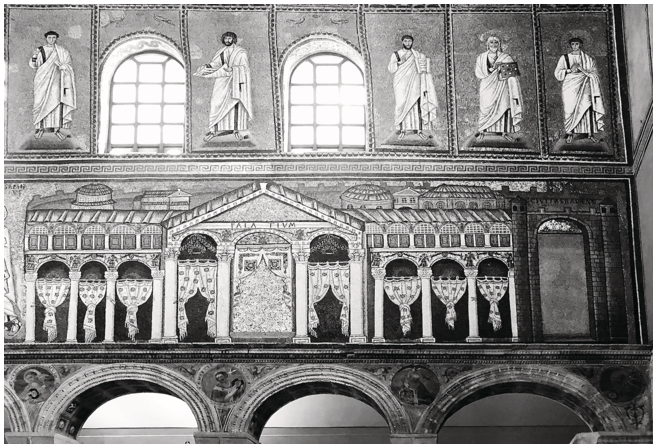
Figure 7.1 Long description
A photograph of mosaic wall decoration in a church arranged in two horizontal registers. The top register shows five saints on a golden background interspersed with two arched windows. Most of the middle register shows an ornate building complex. We see a colonnaded building at the front, with a central pediment and two storey aisles on either side, set on a golden background. We can see the interior of the central pediment building and the lower storeys of the aisles, including curtains hung from marble columns. At the centre of the pedimented building is an empty throne. The pediment is marked with the word Palatium. Behind this building we can see the exterior roofs and upper storeys of five other buildings, including two rotundas. To the right of this complex is a schematic depiction of a fortified city gate, with Civitas Ravenn written at the top. At the bottom, we see the very top of the marble archways of the church, with painted figures in roundels above the capitals.
Detail of ‘Palatium’ mosaic with hands visible across the first, third, fourth, and fifth columns from the left, and the second column from the right.

These are some of the most famous disembodied digits from antiquity (give or take the massive marble hand of Constantine now in the Capitoline Museum in Rome). They can be found in the church of Sant’Apollinare Nuovo in Ravenna. This magnificent basilica almost certainly began life as a church dedicated to Christ by the Ostrogothic king Theoderic; both its location and its mosaic decoration suggest that it acted as the king’s palace church.Footnote 1 The original schema is no longer wholly extant. After Justinian’s reconquest, when the church was rededicated to the stridently anti-Arian Martin of Tours, it was partly redecorated.Footnote 2 Enough of that original design has been preserved for modern scholars to reconstruct a compelling vision of Theoderic’s Christian kingship: one that portrayed his rule as part of God’s good ordering of the cosmos.Footnote 3 The interpretive key is this schematic depiction of the royal palace (on the backdrop of the city of Ravenna) at the west end of the southern wall.Footnote 4 As part of what Arthur Urbano has termed the ‘ritual reidentification’ of the building after Justinian’s reconquest, this section of the mosaic was carefully redone to remove a series of figures from the palace colonnades, while leaving traces of hands superimposed on those columns. These hands almost certainly belonged to images of the king’s attendants before the rest of their bodies were removed so as to efface (but preserve) the memory of Ostrogothic rule.Footnote 5 What exactly these palace attendants were doing with their joyfully upraised hands before they were edited out has been a subject of considerable discussion, with two particularly plausible suggestions raised. It could be that they greeted the (similarly excised) king as he arrived at the gate of the palace. It is also possible that these hands are in the classic orans pose of an individual at prayer and point towards the nave of the church.Footnote 6 On the latter hypothesis, these palace attendants would be taking part in the ritual within this liturgical space. At the very least, it is noteworthy that Theoderic’s household officials were depicted as part of this demonstration of his divinely sanctioned rule, in the very location where the king likely undertook routine Christian observance.
The first post-imperial kings sought to legitimate their power according to late Roman norms. As the decoration of Sant’Apollinare Nuovo suggests, this included appeals to the Christian ideological frameworks that had come to play a significant role in the self-presentation of fifth-century Roman regimes in Ravenna and Rome.Footnote 7 Of course, the problem for Theoderic – as for several of his counterparts across the post-imperial West – was that they were Homoian Christians now ruling largely Nicene provincial Roman populations. On the face of it, the church building that articulated this (widely accepted) understanding of the nature of earthly power was bound up with a form of Christianity perceived by most of those subjects as heretical. It has often been assumed that post-Roman rulers were only able to establish stable relations with those populations – or, in narrower and more justifiable terms, with pre-existing bishops and ecclesiastical institutions – once they had converted to Nicene Christianity.Footnote 8 Recent work (including my own) has shown how Homoian rulers like Theoderic were able to articulate such claims to ideal Christian kingship despite this doctrinal and ecclesiastical difference.Footnote 9 In my previous work, I have explored how regimes and elite subjects (including Nicene bishops) found ways to present these kings as pious Christians and even protectors of true church while glossing their religious affiliation. Moreover, I have argued that the religious (and ethnic) differences between the elites who attended upon or sought out the person of the king were often subsumed in the diplomatic language and polite sociability of post-imperial court societies.Footnote 10 In any case, those doctrinal differences likely mattered much less for the religious identities of provincial aristocrats than it did for their episcopal counterparts.Footnote 11 Considering the problem of official churchgoing has made me return to this picture of doctrinal fluidity and elite Christian consensus.Footnote 12 The negotiation of these differences was not simply a question of careful discursive positioning; it involved ongoing choices about how the king’s appointees would be involved in the Christian liturgical and communal life of these court cities. The routine political life of these courts threw up many occasions on which the specific affiliations of these officials might be activated: going to church with the king, celebrating liturgical festivals in the palace, even receiving petitions from clerics. How regimes, officials, and clerics presented the practical implications of these political and ceremonial acts is critical to our understanding of the interplay of confessional identity and royal service in the first successor kingdoms.
This chapter thus seeks to reconstruct patterns of churchgoing at post-imperial palaces and the character of the relationships between officials and clerics that could result from church membership and political service. Section 7.1 considers when and whether royal officials went to church with post-imperial kings. Routine attendance is easier to reconstruct for Nicene rulers than their Homoian counterparts. Officials and courtiers seem regularly to have gone to church with Burgundian and Merovingian dynasts. Homoian rulers also clearly went to church; whether or not royal officials would go with them is an open question. At the very least, contemporary observers envisaged such attendance as a possibility (while backing away from its potential implications). Whether or not they physically accompanied kings into liturgical spaces, appointees evidently did take part in various forms of Christian observance within royal residences. In this sense, officials and attendants were inevitably embedded within a framework of royal Christianity, albeit one that seems to have prioritised shared faith over requirements of confession or conformity.
Section 7.2 re-evaluates claims on the confessional identities of officials and the pastoral oversight that this entailed. The social realities behind these assertions are difficult to evaluate simply because (unlike in contemporary Constantinople) we cannot get a sense of wider patterns of elite churchgoing in post-imperial political centres. At least from surviving texts, the communal and institutional implications of church membership seem to have been mediated and interrupted by service in the royal palace. Rare cases of ecclesiastical discipline imposed on officials reinforce what we might anyway expect: that judgements on their orthodoxy and morality were, in the final reckoning, a matter for the king. Likewise, claims (by both officials and clerics) regarding the significance of church membership for the most part work to gloss relationships of reciprocal patronage between clerical ‘fathers’ and official ‘sons’. Such contacts may have used the language of Christian community, but they situated royal officials squarely in palace and administration: as individuals well placed to work in the interests of ‘their’ priests and churches. Given the axiomatic necessity for Christians (and even those of ‘the other confession’) to treat priests reverentially and respect their judgements, we should not overrate the affective bonds attached to these rhetorical commonplaces. Distinct Christian loyalties may only have been activated in particular moments such as these (and more neutral frameworks of jurisdiction and protocol were also available through which to understand and present these relationships and processes). These appeals to shared Christian faith and pastoral relationships cannot be used to disentangle royal officials from their overriding corporate identity and institutional location. They remain significant, insofar as they suggest that, when it came to ecclesiastical affairs, appointees at post-imperial palaces could be expected to govern like a member of the church.
7.1 Going to Church with Post-Roman Kings
The palatium mosaic in Sant’Apollinare Nuovo poses an obvious question. Did those who served in Theoderic’s palace in Ravenna accompany him to church in person (as well as pictorial form)?Footnote 13 The public church attendance of the barbarian kings of the post-imperial West is difficult to reconstruct, not least since those Burgundian, Ostrogothic, Vandal, and Visigothic rulers who adhered to Homoian Christianity would not normally turn up to the churches of the (almost exclusively Nicene) bishops whose texts survive.Footnote 14 On those occasions where we do get references to post-imperial kings in Homoian churches, Nicene authors do not care to distinguish too finely between public and domestic forms of observance, whether because of ignorance or a sense that the basic illegitimacy of these churches negated such distinctions. As a result, where we have evidence for patterns of certain public church attendance, it is almost exclusively for Nicene kings. When we see the Burgundian king Sigismund (r. 516–23) in episcopal churches, it is at festivals and dedications (in one case, possibly with his father).Footnote 15 Recorded visits to church from sixth-century Merovingian kings also stem, in the main, from the major liturgical feasts, saints’ days – sometimes moving with their courts to celebrate in a city with a notable shrine to that saint – and other special occasions like episcopal consecrations, baptisms, royal accessions, and funerals.Footnote 16 We can also see more regular public church attendance for the reigns of Theudebert (r. 533–48), Chilperic (r. 561–84), Guntramn (r. 561–92), and Childebert (r. 575–96). Several passages in Gregory of Tours’ Histories and Lives of the Fathers imply that these kings might attend public episcopal mass on ordinary Sundays.Footnote 17 Gregory also twice describes assassination plots against Guntramn in Paris attempted while the king was entering the church for daily matins.Footnote 18 The fundamental premise of these stories is that one of Guntramn’s enemies could expect to find him there, something also suggested (within the logic of Gregory’s history) by Guntramn’s decision to bring an armed guard with him to church in future.Footnote 19 The regular public attendance of these Merovingian kings was not unprecedented; McLynn notes possibilities of more frequent churchgoing on the part of late fourth-century emperors, as well as members of the imperial family in Constantinople.Footnote 20 It nevertheless remains a departure from the broader pattern of imperial and royal churchgoing attested in the fifth and sixth centuries and perhaps an indication of the distinctive relationship between rulers and the church in Merovingian Gaul.Footnote 21
The presence of officials with a ruler in church and their collective implication in his public churchgoing is evident from various post-imperial contexts. Most explicit are the letters of Avitus of Vienne, which eagerly await the arrival of Sigismund with his attendants at Christmas and Easter, as well as conveying acute disappointment when he did not show up. Avitus’ attempts to glean the king’s intentions for Easter from the comes Ansemund assume that the latter would be joining Sigismund in a public episcopal church (in whichever city he had decided upon that year).Footnote 22 Few other contexts provide such clear indications of the ruler’s entourage. Yet even without concrete references to the presence of the court, we would expect rulers to be accompanied to church in this manner, as they were in all public matters. Particularly telling is an incident from late in the Ten Books of Histories of Gregory of Tours, when the Merovingian king Guntramn acceded to the request of his sister-in-law Fredegund that he come to Paris for the baptism of his nephew Chlothar. Guntramn sent ahead several bishops from within his kingdom, as well as a group of key figures from within his court. ‘There would also be at this assembly many from his regime, both bodyguards and counts, to ensure that the necessary preparations were made out of the king’s resources.’Footnote 23 This anecdote makes explicit the role of a ruler’s officials in the stage management of such important ceremonial occasions. Merovingian kings would also have needed their officials to join them in church for the same reasons that Justinian required his quaestor to come with him.Footnote 24 Gregory’s Histories present several scenes where wronged or penitent subjects threw themselves at the king’s feet during mass seeking his judgement or clemency regarding knotty criminal and civil disputes: situations where a ruler might wish to have their advisers on hand.Footnote 25 Rulers were thus likely accompanied by key officials for their public church attendance, even when those handlers staged them – or contemporary authors depicted them – worshipping God in splendid isolation.
Like their Eastern counterparts, post-imperial kings engaged in religious observance within their palace complexes.Footnote 26 As with Sant’Apollinare Nuovo, domestic observance was built into the architectural fabric of post-imperial political centres. Palace churches are attested or plausibly hypothesised at various royal residences. Merovingian kings founded churches attached to various urban residences and rural properties: most notably the dynastic funerary basilicas at Paris and Chalon-sur-Saône.Footnote 27 Members of the Gibichung dynasty dedicated numerous churches in Geneva and Lyon as well as the famous monastery of Saint Maurice at Agaune, although none are obviously connected with their own residences.Footnote 28 A poem preserved in the Latin Anthology describes a church of the Virgin in the palace at Carthage, which may have been used by Vandal kings; it is equally possible that the text post-dates the reconquest and refers to the Justinianic foundation discussed by Procopius in his Buildings.Footnote 29 Possible Visigothic palace churches have been identified in the proximity of the fifth-century royal residence at Toulouse and the late sixth-century new build at Reccopolis; a church of the Holy Apostles and Peter and Paul ‘in the palace’ (praetoriensis) in Toledo is securely attested as the site of church councils from 653 onwards.Footnote 30 Those references are supplemented by repeated discussions of the court bishops and personal priests attached to rulers. In many cases, this was undoubtedly a false accusation designed to cast aspersions on episcopal rivals: general references to coteries of Arian bishops surrounding the king likely flattened the actual institutional profile and religious responsibilities that some of these men undertook. It is also clear that some rulers and members of ruling families did have their own religious attendants whose principal duties were to minister to a ruler’s personal needs.Footnote 31
Our best sighting of a ruler accompanied by his attendants in such routine observance comes from a letter of the mid-fifth-century Gallo-Roman senatorial aristocrat Sidonius Apollinaris. At some point during the reign of the Visigothic king Theoderic II (r. 453–66), Sidonius wrote to his brother-in-law Agricola to give an account of a day in the life of the king’s court at Toulouse.Footnote 32 Sidonius informed this budding courtier to expect Theoderic to attend a matins service with Homoian priests.
If you inquire about his daily routine, which is open to the outside world: before dawn, he attends assemblies of his priests with a minimal retinue (minimo comitatu), and he worships assiduously; although – if we’re talking privately – you might be able to discern that he performs these acts of reverence more out of habit than conviction.Footnote 33
Sidonius presents a small gathering at this early morning ritual. It is difficult to parse exactly how reflective this portrayal was of wider practice in post-imperial palaces. The future bishop of Clermont is doing notable work here to make it seem like this confessional difference would not be a problem for his (presumably Nicene) correspondent, since the king was not overly pious himself. In a similar vein, the reference to a ‘minimal retinue’ could be read as a way of hinting that Agricola might not need to attend himself. Yet the literary conceit of autopsy also assumes Sidonius had been there (to describe the king’s behaviour) and that Agricola would go in future (if he joined the court). Moments of more regular Merovingian royal attendance seem to suggest a similarly small guest list. Gregory implies that Guntramn’s decision to bring an armed guard when he went to church in Paris for daily matins was a new development.Footnote 34 This seems a surprising admission, not least given the security arrangements of eastern emperors;Footnote 35 it is rare to find Merovingian political actors comparatively unconcerned for the possibility of physical violence against their persons. This may indicate that Merovingian kings had a smaller retinue for daily religious observance as against bigger ceremonial occasions. It is certainly plausible that such routine observances might have been the preserve of a select group of attendants, especially when conducted within the palace itself: the king’s family, those whose function was specifically to attend on their persons, and perhaps the closest royal advisers.
Other aspects of religious life at post-Roman courts implicated a much wider group. Christian festivals were accompanied by forms of communal assembly and celebration that brought together the ruler with those who served him at court (and, in some cases, beyond). Easter had long marked a special time in the annual routine of a late ancient palace.Footnote 36 The sense of a self-conscious change in the atmosphere of government is evident from various extant laws from the late 360s onwards, which show late Roman regimes sending out reminders that prisoners should be let out at Easter so long as they had not committed serious crimes. The routine nature of this switch to judicial leniency is apparent, both from contemporary sermons discussing the festival and from the overriding intent of these laws to correct or forestall those judges who might be overly generous in granting amnesty.Footnote 37 A letter of Cassiodorus (from c. 533–38) in his role as praetorian prefect shows that this practice continued in Ostrogothic Italy.Footnote 38 As Ian Wood has noted, Easter also seems to have been an important occasion at the courts of the Gibichung dynasty. Sigismund promulgated a new law code for his kingdom, the Book of Constitutions, at an assembly of Burgundian and Gallo-Roman notables at Easter 517. The judgement in a particularly thorny legal case involving the king’s spatharius was handed down at the court that Easter so as to permit a much more lenient sentence for the offending parties.Footnote 39 The context of this gathering in the royal palace necessarily brought the king’s attendants under the royal aegis at a time when public church attendance was considered especially necessary. The Merovingian king Guntramn likewise scheduled a banquet in the royal residence to follow his presence at an Easter mass in Chalon-sur-Saône in 588 (mentioned by Gregory of Tours because of the episcopal squabbling that broke out during the feast).Footnote 40 Easter was not the only Christian occasion that provoked such assemblies and festivities. When the East Roman army under Belisarius arrived at the (very recently vacated) royal palace in Carthage in September 533 after their victory at Ad Decimum, they discovered the attendants of the Vandal king Gelimer setting up a banquet for the festival of St Cyprian.Footnote 41 The capacity of Nicene and Homoian office-holders to come together for these Christian royal celebrations is plausible given references to the presence of Homoian clerics at other palace banquets.Footnote 42 The fulminations of Nicene clerics against sharing a table with Arian heretics – and occasional punishment miracles that transpired from such commensality – suggest that this was a common occurrence.Footnote 43
Attendants went to church and celebrated festivals with post-imperial kings. It is plausible that their presence stemmed from a similar sense of social obligation to that present in fifth- and sixth-century Constantinople. The same features of collective participation in the ceremonial life of ruler and court were at play; that rulers often seem to have combined public church appearances at major festivals with audiences and assemblies at court might strengthen such a connection.Footnote 44 Once again, the absence of evidence from the capitals of the post-imperial West – and especially regarding regular practice at the courts of barbarian kings who adhered to a Homoian form of Christianity – is an obvious problem. Requirements or expectations of attendance remain unstated, even in the political context where forms of religious compulsion were most readily deployed (and recorded). If palace attendants and key officials had to attend church with the king anywhere in the post-imperial West, it would most likely be Vandal Carthage. That city spent much of the century of Vandal rule in Africa without a Nicene bishop or licit Nicene public church services (c. 440–54, c. 457–78, 483, 484–87, and from the late 490s to 523).Footnote 45 After the appointment of Eugenius to the episcopal see in 478/9 led Nicene Romano-Africans at court to attend the episcopal church, the Vandal king Huneric ordered that anyone going in dressed like a barbarian (in Victor of Vita’s terms) have their hair torn out, with the women then paraded in the streets of the city.Footnote 46 The cause of the king’s order, at least as the Nicene historian reported it, was that many Romano-Africans were dressing like Vandals as part of their service at the royal court; Huneric did not want these courtiers publicly attending a heretical ‘Homoousian’ church. But Victor does not spell out the ideal envisaged in contradistinction to this act of physical punishment and public humiliation. As a result, we cannot know if these courtiers were otherwise supposed to go to church with him or simply to avoid such a public sign of their heterodoxy by (for example) making their own domestic arrangements – nor how such acts and choices were perceived.Footnote 47
The lack of contemporary discourse around royal churchgoing obscures its significance for those who served these rulers: many, if not most, of whom – certainly in Italy, Gaul, and Spain – did not share their precise doctrinal or ecclesiastical affiliations.Footnote 48 It is nevertheless possible to extrapolate from the reports we do have – and the manner in which these confessional differences were otherwise discussed – the ways in which these divisions could have been negotiated. As discussed in Chapter 2, clerics and kings in Burgundian Gaul and Ostrogothic Italy found ways to enter polite dialogue with one another, as well as speaking in neutral terms about the other church whose members met within their respective jurisdictions. When Theoderic could speak of ‘our religion and yours’, and Gelasius of the ‘other communion’ to which the Ostrogothic king and many of his Gothic subordinates adhered, it is possible that attendance with the king was not seen as necessary for those courtiers who did not belong to his ‘religion’ or ‘confession’.Footnote 49 The same could be the case for the palaces of other Homoian kings, especially given the likely predominance of co-religionists amongst the Burgundians, Goths, and Vandals who staffed their bedchambers, commanded their armies, and helped to govern their kingdoms.Footnote 50 In that sense, these palaces would resemble fourth-century contexts where the emperor’s Christian attendants worshipped together (or were imagined to do so), without a necessary implication that all the court were or needed to be present.Footnote 51 Reciprocal recognition of this ongoing and fundamental religious difference may have taken shared churchgoing out of the routine of life at Homoian royal courts.
The recurring tendency of regimes, clerics, and courtiers to play down and obfuscate the character and implications of this disagreement over Christological and Trinitarian doctrine presents alternative possibilities. These efforts could just as easily have determined the forms of religious observance that Homoian rulers and Nicene courtiers and officials shared. It is a necessarily speculative suggestion, but it is easy to see how such qualms might have resulted in the watering down of the sectarian character of a ruler’s occasional ceremonial church attendance. The surviving letters and sermons of the most famous bishops of court cities are often rebarbative and doctrinally exclusionary in their tone and content. But it is easy to forget that the likes of Ambrose, John Chrysostom, and Nestorius were outliers – and, in the case of the latter two, figures whose appointment their imperial backers would come to regret. Many other episcopal appointees seem to have been creatures of the imperial or royal establishment and thus much more willing to pursue and maintain compromise.Footnote 52 It may be that the services that emperors and kings attended were generally conducted in that spirit.Footnote 53 Whatever the tone or content of these assemblies, contemporaries seem to have found ways to compartmentalise attendance at what was (at root) a heretical church. Such possibilities are implied by Gregory of Tours’ account of the visit of a Visigothic envoy named Oppila to his city on Easter Sunday 584.Footnote 54 Given this timing, Gregory posed an obvious question: ‘when this legate arrived in Tours, we asked him whether he was of our religion’. Oppila’s response (in Gregory’s account) is a hedge: ‘he responded that he believed that which Catholics believe’. Leovigild’s envoy then went with the bishop to his church for mass but avoided the kiss of peace and did not take communion. His suspicions aroused, Gregory interrogated his guest over dinner; a stylised dialogue follows in which the bishop reveals and refutes the Arian errors underlying Oppila’s conciliatory claims to shared doctrinal premises. Gregory’s narrative of this episode is obviously structured with polemical intent; the historian used a previous encounter with a Visigothic envoy in 582 similarly to suggest that Homoian Christians under Leovigild took an absurdly laissez-faire approach to questions of religious difference.Footnote 55 This Agila challenged Gregory to a debate over the equality of Father and Son; by the end he was reduced to pleading for mutual respect and toleration.
Do not blaspheme our religion (legem), which you do not worship; for we do not blaspheme what you believe, though we do not believe it, because it is not an offence if both this (religion) and that (religion) are worshipped. For it is a common saying among us that it is not a crime if someone whose affairs take him past the altars of the pagans and the church of God worships both.Footnote 56
To Gregory’s mind, going to a heretical church was a slippery slope that might lead to even more dangerous forms of religious relativism. The historicity of Oppila’s visit to his cathedral for Easter Sunday remains likely; it is the point of departure for the bishop’s detective work (and the foundation of his own claims to heresiological expertise in this encounter).
While Gregory cast aspersions on the cross-confessional attendance of these Visigothic envoys, other contemporary Nicene commentators were less concerned about doctrinal (and potentially heresiological) implications. Our one glimpse of a Nicene courtier in church with a Homoian king specifically waves away such concerns. Sidonius made clear that Theoderic II’s obsequies at matins were ‘more out of habit than conviction’, as part of a letter in which both his correspondent’s and his own daily involvement in this church service is portrayed as entirely unproblematic.Footnote 57 Avitus of Vienne is likewise sanguine when presented with a similar pastoral problem: the attendance of the (now Nicene) prince Sigismund (whom he was seeking to mentor) with his (still Homoian) father Gundobad at a Homoian celebration of Easter in Chalon-sur-Saône. Avitus conveyed his disappointment regarding the prince’s absence at his own Easter service in Vienne but wished to make clear that he understood the reasons for it.
You love your one church equally in both cities, but you cling to your devout father, to the extent that it is expedient, until such a time as he agrees that you may follow whatever church you like. Therefore, as we have been ordered to do, we first discharge our debt to God regarding this feast, and then to Caesar.Footnote 58
Avitus accepted that Sigismund’s loyalty as the son of a king required his presence, even if it meant attending Homoian Easter services – at least until such a time as Gundobad converted or gave his son greater religious freedom.Footnote 59 It is easy to imagine similar explanations being offered by other Nicene Christians attending the same Easter service with Gundobad. Palace attendants, courtiers, and other imperial and royal officials in other contexts across the post-imperial West may have decided that they were simply ‘discharging [their] debt to Caesar’ as his loyal servants when they went to church with him: if, that is, they worried about the theological implications of such an act in the first place.
7.2 Pastoral Politics: Officials between Palaces and Churches
On 1 September 533, Cassiodorus sent a series of letters announcing his appointment by the Ostrogothic king Athalaric as praetorian prefect of Italy.Footnote 60 Amongst the recipients of the prefect’s glad tidings and pronouncements on his fitness for office was the bishop of Rome, John (II). From its first words, the tone of this letter makes a marked contrast to his missive to the Senate as well as the letters from the king himself to Cassiodorus and the Senate.Footnote 61 ‘I must beseech you, most blessed father, that the joy which, by God’s generosity, I have obtained through you, I may know to be preserved for me by your prayers.’Footnote 62 Cassiodorus invited the pastoral oversight of the bishop of Rome: John was to advise him on his conduct and, if necessary, rebuke him. Above all, the prefect signalled the significance of his place in the bishop’s flock for his discharge of political office. ‘I am indeed a palatine judge, but I will not cease to be your disciple.’Footnote 63 Cassiodorus’ letter is a reminder of the alternative hierarchical relationships in which royal officials could be entangled as Christians. Regular public church attendance would place them under the jurisdiction of a bishop. This pastoral figure could feel bound (or entitled) to advise and admonish their elite congregants on a range of moral and doctrinal issues (although recent studies have rightly stressed the care and deference they adopted when so doing).Footnote 64 Certainly, the prefect himself encouraged such episcopal oversight over the provincial governors under his authority in a parallel letter announcing his appointment to a wider group of bishops in the Ostrogothic kingdom.Footnote 65
Cassiodorus’ letter to John gestures towards the practical implications of membership of a Christian community and the pastoral relationship between bishop and official that might ensue. Of course, Cassiodorus was not really in the congregation of his addressee, except insofar as all Christians could be seen as the ‘sons’ of the bishop of Rome in his putative role as head of the church.Footnote 66 The praetorian prefect would not be attending John’s church while serving Athalaric in Ravenna nor would he be directly subject to the bishop of Rome’s disciplinary authority (such as it was). As a Nicene Christian, Cassiodorus theoretically belonged to the public episcopal church of Ravenna under its bishop Urscinus, just as his Homoian counterparts at the royal court would be subject to the bishop who presided at the church of St Theodore (now Santo Spirito).Footnote 67 What sort of relationship he and his fellow officials normally developed with these churches during their time in the royal capital is an open question. The same goes for their colleagues serving in palaces elsewhere in the post-imperial West. The routine attendance of members of palace, consistory, and Senate in the (far better attested) episcopal church of fifth- and sixth-century Constantinople may be a guide.Footnote 68 Victor of Vita’s description of the regular presence of Nicene courtiers at the church of Eugenius of Carthage is also suggestive.Footnote 69 (These ‘men and women in barbarian clothes’ clearly went to his church often enough for Huneric’s agents to know they would be coming on the day appointed for their punishment.) It is plausible that some royal officials were regular attendees at Nicene or Homoian public churches. But we simply do not have the evidence from Burgundian, Merovingian, Ostrogothic, or Visigothic centres to glean a sense of who went to church and how often.
It is also likely that many had their own domestic religious spaces that they might find more amenable than the episcopal cathedral for regular observance. In Chapter 6, we saw how elite men and women in Constantinople were well placed to pursue bespoke arrangements of spiritual and theological guidance through the patronage of favoured clerics and the institution of domestic liturgical arrangements.Footnote 70 It is possible that Cassiodorus did something similar in his private residence at Ravenna, especially in the light of his claims to cultivate an ascetic mindset in office and his later monastic experiment at Vivarium.Footnote 71 In writing to John, Cassiodorus was seeking to establish or maintain just such a relationship of spiritual guidance (if at a distance). There is significant evidence for the construction and use of ‘private’ churches by provincial aristocrats across the fifth- and sixth-century West.Footnote 72 These churches were founded by Homoian as well as Nicene Christian donors, as is evident from the concerns of Nicene bishops in the Burgundian kingdom after the accession of Sigismund. The Council of Épaon (517) bucked wider trends by coming to a strict conclusion preventing the ‘conversion’ of private chapels and oratories for Nicene use in the future.Footnote 73 Again, the problem is the lack of evidence for such foundations – never mind their use by officials – in royal cities themselves. Unlike in contemporary Constantinople, the routine Christian practice of elites during their stays at Carthage, Geneva, Lyon, Paris, Ravenna, Toledo, or Toulouse remains opaque. As a result, we can more easily see rhetorical claims regarding official membership of the church than the practical realities it engendered.
How, when, and where royal officials went to (public or private) church is unclear. A disciplinary episode from Burgundian Gaul nevertheless suggests that those who served in the royal palace could be subject to the pastoral authority of local Christian clerics and communities. This incident from the court of Sigismund in the late 510s, recounted in the canons of the Council of Lyon (c. 518–22) and the much later Life of Apollinaris of Valence, provides a sense of the potential practical implications of notions of episcopal oversight.Footnote 74 The king’s treasurer Stephanus had been accused of incest; after his wife had died, he had married her sister, Palladia. This marriage was a problem because of the strict prohibitions on various incestuous unions issued the previous year, both by Sigismund (in the Book of Constitutions) and by the Nicene bishops of the kingdom (at the Council of Épaon).Footnote 75 A council of Nicene bishops met to discuss the case and handed down a sentence of excommunication; if they followed the precedent of a case decided by Avitus of Vienne the previous year, they will have excluded the pair from the church until they had separated and done penance.Footnote 76 By the time the bishops held a second meeting in Lyon, it seems that the king had not only refused to apply the corresponding secular punishment to the treasurer and his wife but had threatened one or more of the bishops as a result of this disciplinary action.Footnote 77 The collected bishops judged that if Sigismund did not yield, he would thereby effectively excommunicate himself; they signalled their willingness to enter temporary monastic retirement until he changed his mind.Footnote 78 King and bishops eventually came to an agreement by which Stephanus and Palladia could once again attend church until the ‘prayer of the faithful’, which took place after the Gospel reading.Footnote 79 Although the precise church(es) in which this new arrangement was envisaged to hold are not made clear, the location of the synod in a city where Sigismund was often resident, and the threat of a kingdom-wide episcopal ‘strike’, implies that it was public church attendance by the king, the treasurer, and his wife that was at stake.Footnote 80 At the very least, the episode gives a sense of the potential pastoral authority of bishops in royal cities and a concern – both from bishops and court – regarding the membership and standing of royal officials in the public episcopal community.
The disciplinary measures involved in the Stephanus case were those of the church: a sentence of excommunication that was moderated for a compromise agreed with king. They suggest that the Nicene bishop in one of the cities in which Sigismund’s customarily resided saw this key fiscal official as a member of his congregation. At the same time, the ongoing interference of the king – opposing the original judgement, pressuring the bishop(s) concerned, and negotiating an eventual compromise – makes clear that Stephanus was no ordinary congregant. A similar dynamic is apparent in an exemplary story told by Gregory of Tours in his Lives of the Fathers regarding Nicetius, bishop of Trier (c. 525–66).Footnote 81 According to Gregory, Nicetius would regularly admonish ‘those who did not observe the commands of God’, which included the Merovingian King Theudebert. ‘One Sunday the king entered church with people whom the pontiff had excommunicated.’ Nicetius refused to go ahead with mass until these royal attendants left his church. The king demurred until a demonically possessed congregant revealed ‘the virtues of the saint and the crimes of the king’. Nicetius refused a royal order to eject this poor young man until the king directed that the banned courtiers should also be removed. The precise relationship between this stylised confrontation and the actual church visits or political conduct of Theudebert is unknowable.Footnote 82 Gregory used this story for a clear moral purpose: ‘to fortify the censure of priests, either for the instruction of the people or else for the reform of the way of life of kings’. According to Gregory, Theudebert’s conduct improved after this supernatural and intensely public dressing down. Yet it is notable that even in the fabular scenario that Gregory presents, the efficacy of excommunication as an episcopal strategy for dealing with the wrongdoing of royal attendants is reliant on the opinion of the king. Kevin Uhalde has captured the basic dynamic at play. ‘However intrepid he may have been, Nicetius was not powerful enough to excommunicate Theudebert with any real effect …. But he could hold up a mirror for Theudebert, which revealed the king’s own distorted image next to the exemplary one of himself.’Footnote 83 On similar terms, Nicetius had to convince Theudebert to remove the banned courtiers and, in another story told by Gregory, sufficiently to impress the king’s agents with his moral authority for them to take his threats of church sanctions to heart.Footnote 84 As in Constantinople, and indeed in the case of provincial governors in the post-imperial West,Footnote 85 the exercise of episcopal oversight was mediated by the ruler’s authority over his appointees.
Where the disciplinary potential of clerics over palace officials is expressed in other contexts, it is even more directly located within the political spaces of the palace and subordinate to the king’s overall judgement. Victor of Vita’s History include two episodes where Homoian clerics at the royal court are involved in the fall of royal officials accused of (Homoousian) heresy. In the first, from the mid-440s, the comes Sebastian is brought before Geiseric and an assembly of palace officials and Homoian bishops to hear the king’s demand that he convert and undergo a Homoian (re)baptism. According to Victor, after he refused, he was murdered for another reason. This story is almost certainly a fabrication (at least in this presentation): Victor himself backs away from the idea that the murder was result of his non-conversion.Footnote 86 The presence of these bishops on occasions where Vandal kings investigated the orthodoxy of their subordinates remains plausible, not least given the details of the second such narrative. Late in the reign of Geiseric, a Homoian cleric named Marivadus (or possibly Varimadus) brought about the fall of Saturus, the chamberlain of the crown prince Huneric’s household. According to Victor, Saturus had been vocal in his criticisms of Arian heresy and was thus denounced by Marivadus. The latter was well placed to make such an accusation given his position as a favourite of Huneric.Footnote 87 Of course, part of the reason why Saturus suffered royal and not ecclesiastical punishment may be because he was not a member of Marivadus’ church. It is nevertheless striking that, once again, the orthodoxy and good Christian conduct of a royal servant was, in the first place, a matter of the ruler’s jurisdiction.
The Stephanus and Nicetius cases are unusual in granting us glimpses of the relationship between a bishop and a royal official as it was defined in the physical and legal context of the church. Where we can see interactions between officials and clerics in these royal centres, their character is shaped, for the most part, by political spaces and duties. The royal palace was the site of various forms of social interaction between these distinct groups of office-holders. As the History of the Persecution suggests (if in extreme form), those interactions could include deployment of these clerics’ perceived responsibility for the doctrinal and spiritual formation of royal appointees. More often, though, they seem to have been the site of more diplomatic and bureaucratic forms of sociability rooted in the everyday business of royal residences. Palace officials received the petitions and embassies of bishops and clerics, whether they sent one of their agents with a letter or visited themselves.Footnote 88 When bishops came in person, officials played critical roles in the preparation and conduct of such audiences (as they would for any suppliant): conducting them into the royal presence, witnessing and perhaps even acting as intermediaries in the ceremonial dialogue between king and cleric, and dining with them (assuming they were happy to share a table).Footnote 89 Agents were also sent from the palace to inform clerics and churches of particular royal decisions or to investigate ongoing disputes.Footnote 90 Royal officials were critical to the processes by which post-imperial kings and clerics formed and maintained relationships of protection and patronage. This intermediary political role necessarily shapes contemporary discourse around their membership of the church.
The administrative duties of royal officials set them up as patrons of clerics: individuals who could champion their interests, influence the king, and contribute to the formation of royal policy. Both clerics and officials could conceive these patronage relationships in terms of Christian group membership and confessional identities. Cassiodorus’ letter to John (II) on his appointment as praetorian prefect invited precisely such an interpretation of future requests from the bishop of Rome. These dually coded contacts (father/son; client/patron) could result from pre-existing relationships, as with Sidonius Apollinaris and the referendarius Leo at the court of Euric, or Avitus of Vienne and the comes Heraclius at the court of Gundobad.Footnote 91 Less familiar political actors could also be addressed as one’s ‘son’ as a matter of diplomatic protocol; even Homoian Christians could be encouraged to act on that basis.Footnote 92 Such was the case when Gelasius of Rome wrote to a comes named Teia/Zeia seeking his aid to protect two clerics of the church of Grumentium in Lucania against the heir of the dominus who had (apparently) manumitted them. Gelasius’ encouraged his ‘beloved son’ to pursue the case by an appeal to a distinct sense of duty: ‘For Christians, it should always be pleasing to furnish what is asked of their office, since it is right not to deny a favour to the servants of God.’Footnote 93 Such relationships and strategies could allow clerics to gain purchase within the networks of the royal court and pursue their interests: according to Sidonius, Leo helped to bring about his return from exile.Footnote 94 At the same time, it is best not to accord too great a role to these putatively pastoral relationships in shaping the conduct of royal officials. As Gelasius’ letter to Teia/Zeia suggests, political actors were expected to show due deference to reverend bishops and other holy people whatever their previous acquaintance (in contrast to the haughty disdain with which some other petitioners were supposed to be treated).Footnote 95 Above all, just as bishops were just some of the many petitioners who sought the judgement and aid of post-imperial rulers, appeals to Christian (and indeed specifically ‘confessional’) identity were just one of many strategies adopted by those petitioners.
Addresses to post-imperial officials as sons of the church rubbed up against an alternative model of community: as members of palace and administration. The predominance of this communal framework is explicitly recognised by both Sidonius and Avitus when describing their correspondents’ proximity to the king and their involvement in the business of government and life of the court.Footnote 96 This contrast is likewise implicit in the Variae of Cassiodorus, who rarely deploys anything like this model of conduct (‘may public affairs find me such a judge as the Catholic Church sends out as its son’) elsewhere in this collection of administrative letters.Footnote 97 This corporate framework was not simply a ‘secular’ everyday praxis that might be set to one side for occasions that required more overtly pious patronage. A sense of belonging to the palace and loyalty to the king also shaped the dealings of officials with clerics and churches, not least when royal agents received specific instructions or were empowered to facilitate the resolution of disputes on his behalf. As in Constantinople, regular religious observance within the palace and pursuit of particular religious policies may have inculcated a sense of Christian community amongst those who served the king. It could nonetheless be useful for all concerned to characterise these royal interventions and official missions in much more neutral terms. The agents of the Ostrogothic king Theoderic, in particular, characterised the king’s role as that of ensuring the affairs of the (Nicene) church remained matters of ecclesiastical jurisdiction; in part, of course, because of Theoderic’s own doctrinal affiliation.Footnote 98 Particularly telling is a further letter that Gelasius sent Teia/Zeia on a different case: this time, a failed candidate for the episcopacy of Volterra had (rather brazenly) sought a refund from the defensor he had employed to administer a campaign of bribery. Gelasius admonished Teia/Zeia ‘to avoid involving yourself in ecclesiastical cases and affairs, and, ceasing all [your] disturbance, to stop all meddling and permit the rule of religion to be protected – especially since there is no doubt that you are of another communion’; if he did so, he would be acting like Theoderic.Footnote 99 As Sam Cohen has recently argued, it is clear that the bishop of Rome’s concern was less Teia/Zeia’s confessional identity – not a problem when it came to protecting the clerics of Grumentium – than that the comes had questioned Gelasius’ claim to jurisdiction over the case and (to the bishop’s mind) seemed to be showing favour to the wrong side.Footnote 100 Gelasius’ admonition is part of a broader tendency on the part of clerical authors to code representatives of post-imperial regimes as actors external to the church when their interventions were unwelcome.Footnote 101 This sense of a decidedly ‘secular’ jurisdiction of course cut against the reality of overarching royal authority as well as these individuals’ own religious identities as Christians. When construed in more neutral terms, it remained a useful recourse for kings, officials, and clerics alike as they sought safely to delimit the legitimate exercise of authority within the church by Christian officials.
Conclusion
When Victor of Vita discussed the appearance of some of Huneric’s courtiers at the church of Eugenius, he referred to them as ‘people of our religion’. In the terms of his History, the point was clear: these were Nicene Christians and Romans (which amounted to the same thing), not Vandals; their primary loyalty was to their faith, not to the king whom they served. And, to be fair, at the moment at which Victor caught them, these individuals were Nicene Christians first and foremost (at least in retrospect). Attendance on that given day had subjected them to categorisation as heretics and a brutal act of exemplary royal violence, which presumably determined their status and life course from then on.Footnote 102 The church membership of those who served in royal palaces could also be activated through less stark means. Sidonius Apollinaris and Avitus of Vienne appealed to the ecclesiastical affiliation of their men at the Visigothic and Burgundian courts; Cassiodorus indicated a willingness to play a similar dual role as patron and ‘son’ when he wrote to the bishop of Rome. Yet all three wrote in the knowledge that this shared Christian community was a much more consistent point of reference for clerical petitioners than their official contacts. A confessional identity was far from determinative of the conduct of royal officials; in fact, the loyalties it engendered were assumed to represent partial and intermittent considerations even for the (exceptional) Christians who received such missives. This occasional significance was (in part) a matter of a temporary departure from an institutional culture perceived as primarily worldly in its outlook. But the corporate body in which these addressees were embedded was not simply a ‘secular’ administrative framework (even if it sometimes suited both parties to portray it as such).
This chapter has argued that post-imperial palaces were sites of Christian observance and communal formation. The evidence is admittedly lacunose; there are many unanswered questions. These partly result from the ignorance or reluctance of Nicene writers regarding Homoian churches and services. Royal visits to palace chapels and public episcopal basilicas also likely suffer from comparison to the better attested and peculiarly intense Christian political life of Constantinople. As a constant imperial residence, that city was unusual in representing the singular focus of the ecclesiastical benefactions and ceremonial appearances of Christian emperors for two centuries. As the site of palace, prefecture, and Senate, it was likewise the permanent residence of a significant proportion of the Eastern ruling elite and thus represented a uniquely privileged site of elite Christian activity and patronage. The western imperial court of the fifth century represents an instructive point of comparison. Honorius, Valentinian III, and Galla Placidia can be seen in church remarkably rarely; their attendants are almost entirely invisible on such occasions.Footnote 103 As with the innovations of Theodosian dynasts in church ceremonial and patronage at Rome and Ravenna, there is enough to suggest that post-imperial palaces were sites of regular Christian observance in which at least some of the ruler’s appointees were implicated. The evidence is clearest for Nicene Burgundian and Merovingian kings whose regular public and domestic observances involved the accompaniment of key officials. The precise guest list of parallel occasions at the courts of Homoian kings remains an open question. The absence of obvious conflict over (non-)attendance of officials at palace churches suggests that potential doctrinal issues were sidestepped at the courts of Homoian rulers. It is possible that Nicene Christians were not expected to come along; but there are also indications that they did go to church with the king, as well as turning up to less straightforwardly liturgical celebrations that more obviously demanded their presence. The remarkably blasé attitudes of some contemporary Nicene observers imply that the character of these services might be more neutral than the wider heresiological polemic against Arian churches might suggest. Attendance could also be justified as the price of admission to royal service and a routine part of belonging to the palace. Whether they attended with the king, went to the episcopal church, or made their own arrangements, officials came into contact with Christian communities and potential pastors. The evidence is not there to see how these relationships normally worked. The Stephanus case from Burgundian Gaul and Gregory of Tours’ stories about Nicetius of Trier in Merovingian Gaul nevertheless imply that attempts to apply episcopal oversight could be similarly subordinate to royal favour and judgement as they were in other political environments. Royal officials may have developed a similar sense of belonging to a Christian corporate body as their contemporaries in Constantinople. After all, participation at court made them similarly party to (or, to their critics, complicit in) the royal religious policies that they shaped, facilitated, and implemented. Such a perspective can only be glimpsed at the margins of the justifications and representations of contemporaries, for whom the complementary jurisdictions of officials and bishops remained safer territory. Service at these royal courts was also likely less determinative of the religious identities of these men than their Eastern counterparts. The potential implications of that service for those Christian loyalties remain evident.
Introduction
In August 314, Constantine assembled a group of western bishops at Arles.Footnote 1 This council met primarily to decide on the rightful possessor of the see of Carthage. A tribunal in Rome held the previous year had decided in favour of Caecilian against his rival, Donatus, but the supporters of the latter had appealed to the emperor once more. When they were not hearing this case and finding for Caecilian (again), the bishops present took the opportunity to agree on guidelines for how their churches should be governed, which were published as a series of canons and preserved in later collections.Footnote 2 The bishops show an obvious and understandable concern to ensure Christian institutions were properly regulated now that the disruption of the Great Persecution had ended and Constantine’s support had created a more permissive political climate. Amongst the problematic social groups whose integration into Christian communities required legislation, the bishops at Arles considered the question of ‘governors who are baptised Christians and involved in government business’.Footnote 3 The council went against the grain of their previous rulings, which denied communion to charioteers and actors currently engaged in those professions,Footnote 4 by seeking to include serving governors in Christian communities.
It was decided that when they have been appointed, they should receive letters of reference from their churches, so that, wherever they govern, they can be taken care of by the bishop of the place, and if they begin to act against Christian discipline, they should only then be excluded from communion.Footnote 5
The bishops at Arles were concerned to make sure that Christian governors were not automatically deprived of communion.Footnote 6 This ruling may have been a response to qualms around the governor’s inevitable complicity in torture and execution.Footnote 7 It might also have been a simple matter of making sure this prominent newcomer did not fall through the cracks of pastoral provision in his temporary residence.Footnote 8 Whatever the reason, Christian governors were to be members of the public episcopal church of the provincial capital and under the jurisdiction of its bishop.
When the bishops met at Arles in 314, the appointment of Christian governors was an exceptional case that required conciliar deliberation.Footnote 9 By the end of the fourth century, it had become a normal part of imperial governance. Miniature versions of the dynamic between palace and church discussed in Chapters 6 and 7 played out across the Roman world as elite men were appointed to head up the civil administration of individual provinces. These individuals (at least theoretically) became members of the church in the city where they would now temporarily reside. Certainly, bishops and monks across the empire seem to have seen the officials who turned up in their cities and provinces as their problem and a potential target of their pastoral guidance. In fact, many of the most detailed and admonitory texts on the ethics of Christian political service discussed in Part II stem specifically from letters to serving governors. At the same time, the peculiar dynamics of appointment, the interests of governors, and, above all, the development of the bishop into a civic authority figure in his own right made this relationship significantly more complicated than the bishops at Arles envisaged.
This chapter explores how membership of the church affected the conduct and activities of provincial governors by influencing the character of their relationships with Christian institutions and authority figures in the provinces they governed. These interactions between Christian governors and their episcopal subjects have received considerable attention as part of attempts to chart ‘the rise of the bishop’ in late antiquity. Efforts to exercise ecclesiastical jurisdiction over provincial appointees have often been seen as a natural development of the new prominence of bishops as civic leaders. Yet recent revisionist work has rightly questioned the assumption that the moral authority projected by late fourth- and early fifth-century bishops would inevitably work on Christian governors. Acute studies of Augustine’s letters to his imperial correspondents by Neil McLynn and Brent Shaw have neatly delineated the social dynamics that limited the bishop’s influence.Footnote 10 They have shown how provincial bishops were subject to the same requirements and constraints as other petitioners hoping to gain the governor’s ear. The tendency of regimes to appoint outsiders as governors (at least before a pivot to local appointments in the middle decades of the sixth century) meant that a bishop like Augustine could not rely on pre-existing ties of friendship or patronage.Footnote 11 The quick turnover of terms of office – rarely longer than two years, often just one – gave little time to build up a working relationship.Footnote 12 Even when a mutual understanding was developed, there remained a stark gulf between the interests of governors and bishops. Numerous studies of religious intolerance in late antiquity have noted the frustration of emperors and bishops alike at the tendency of governors to dodge issues of religious uniformity.Footnote 13 The need to maintain order, appease local interests, defer to their office staffs – and above all, to protect their future career prospects – led these office-holders to wash their hands of potentially controversial religious disputes. If bishops wanted to ensure the application of laws against heretical bishops or pagan temples, they normally had to go above the governor’s head to secure special envoys from the imperial court.Footnote 14 This combination of social distance and diverging interests meant that governors could, in the words of Brent Shaw, ‘[give] rather short shrift to a person whom they thought had no standing to intervene in the running of the state affairs over which they had authority’.Footnote 15
Recent work on the relations between bishops and governors has rightly brought the former down to size. The normal character of ‘pastoral’ interactions between Christian governors and provincial churches across late antiquity remains to be explored. The continued focus on episcopal self-aggrandisement and its limited practical impact has obscured the ways in which membership of the church and relationships with church communities and institutions could nevertheless affect the conduct of office-holders. Just because these governors did not automatically cave to the demands of the particular provincial bishops whose petitions have been preserved does not mean that they were immune to a Christian and even ecclesiastical presentation of their authority. Likewise, an unwillingness to inflame local tensions through the destruction of a famous temple or the prosecution of a ‘heretical’ bishop cannot be taken as a straightforward indicator of a lack of concern for piety. Indeed, these very letter exchanges and laws suggest that governors were aware of and sometimes sensitive to the distinct claims and expectations of the Christian institutions and authority figures who appealed to them for patronage and judgement.Footnote 16 This chapter proceeds from the premise that we should revisit these interactions from the perspective of Christian governors. It is my contention that we can see, on the part of some fifth- and sixth-century provincial governors, a concern and capacity to stage their governance in Christian terms and to live up to those expectations – and often in collaboration with their episcopal and ascetic subjects.
Section 8.1 revisits the evidence for the implantation of governors in provincial Christian communities. The bishops gathered at Arles in 314 had a straightforward solution to the problem of where Christian governors should go to church and who should keep an eye on them. Even the fleeting surviving references to governors in church suggest that these interlinked problems of church attendance and pastoral oversight played out in different ways in provincial capitals across the late fourth, fifth, and early sixth centuries. Governors can be seen attending the cathedral of the metropolitan bishop and making visits to the churches of prominent bishops and monastic leaders during tours of their provinces. These isolated snapshots do not indicate frequency of attendance, but it is noteworthy that most of these visits are framed by specific occasions and rationales. Governors likely had alternatives to public church attendance in the form of domestic religious observance; some had good reasons to keep the cathedral community at arm’s length given the dangers of association with controversial bishops. When contemporary authors discuss their presence in church, it is presented as a departure from the norm: a representative of an external imperial authority amidst a Christian congregation. These special visits seem principally to have been understood, both by governors and their ecclesiastical counterparts, as opportunities for the cultivation of mutually beneficial relationships. Governors could receive public recognition of their just and divinely sanctioned rule; bishops and ascetics, an entrée into the praetorium. In this sense, even as they addressed the visiting imperial office-holders as members of the church, these preachers had their minds on the real location where they might exercise pastoral authority: the governor’s palace. This premise is substantiated, paradoxically, by the most obvious case of a bishop wielding his ecclesiastical jurisdiction over a Christian governor (discussed in Section 8.2): the conflict between Synesius, bishop of Ptolemais and Andronicus, the governor of Libya Superior in 411/2. As the sole known example of a bishop excommunicating a provincial governor in late antiquity, this case has often been cited as paradigmatic for the rise of the bishop as a new moral authority. The exceptional nature of Synesius’ ecclesiastical sentence and the uncertainties regarding its impact belie such suggestions of epochal aggrandisement. Most significantly, this was an excommunication without obvious pre-existing communion: barring (at most) two meetings at the bishop’s church when this ban was about to be posted, Synesius’ attempts to exercise his oversight took place on the governor’s territory. Even this singular case of the imposition of ecclesiastical jurisdiction suggests that, if bishops and ascetics were to exercise pastoral authority over governors, it would be in the palace.
Bishops and ascetics could address governors as members of the church even if they were not members of their church. Section 8.3 explores the social and political context of these appeals to Christian identity. The late fourth- and early fifth-century bishops and ascetics who went to governor’s palaces could not assume that their putative pastoral authority would have purchase on the decisions of the strangers appointed to govern their provinces. The missives to governors preserved in letter collections nevertheless suggest that petitioners developed relationships of patronage and amicitia with specific governors. The famous exchange between Augustine of Hippo and Macedonius, the vicar of Africa for 414–15, illustrates the dilemmas with which Christian governors could be confronted when petitioned by their ‘fathers’. The vicar sought and gained reassurance that he could continue to practise judicial severity despite the intercessions of bishops like Augustine. Macedonius may have been unusual in his desire to begin a philosophical dialogue on the implications of the nature of human sin for his courtroom. Yet his Christian colleagues likely shared his need to balance the needs of the state and the maintenance of their own authority with respect for the jurisdiction of ecclesiastical authority figures: a jurisdiction in which, as those petitioners reminded them, they too were theoretically encompassed.
If fifth-century bishops and ascetics exercised pastoral authority over their governors, it was mediated and structured by networks of power and patronage in provincial and imperial capitals. Section 8.4 considers how sixth-century regimes sought to translate these informal (if customary) practices into institutional expectations and bureaucratic procedures. The East Roman emperor Justinian, Ostrogothic praetorian prefect Cassiodorus, and Visigothic king Reccared each delegated to bishops the responsibility to oversee the conduct of governors (among other provincial officials). The procedures that they envisaged make sense alongside the central role accorded to the bishop in late fifth- and sixth-century civic governance, the increasingly local patterns of appointment of governors across the Mediterranean world, and, above all, the part played by bishops in the nomination of those appointees. These changes in the respective social profiles of bishops and governors radically shifted the power dynamics between them. In some cases, it may also have changed how notions of pastoral authority and Christian community shaped these relationships. Local appointees chosen, in part, by bishops may have been more likely to attend their churches; Reccared and the Council of Toledo in 589 identified ecclesiastical sanctions as a potential recourse for episcopal overseers against incorrigible official wrongdoers. At the same time, the impact of these changes should not be overrated given the difficulties that bishops had in disciplining even local aristocrats. In this regard, it is notable that when mid- and late sixth-century regimes recognised the pastoral authority of bishops over governors, it was with respect to their performance of their basic administrative duties. These episcopal reports of virtue and malfeasance continued to represent an adjunct to processes centred on the imperial or royal palace. In this sense, the pastoral authority of bishops over provincial officials was still understood by all parties as, in the first place, a matter for the jurisdiction of the state.
8.1 Governors in Church
The bishops at Arles were keen to make sure governors could attend the episcopal church. The evidence for governors’ church attendance in the late fourth, fifth, and early sixth centuries does not suggest they regularly availed themselves of this opportunity. There is one (possible) indication of routine attendance: Gregory of Nazianzus refers to Olympius, the governor of Cappadocia in 382–83, as ‘a nursling of the great shepherd’ Theodore, the bishop of Tyana (both the metropolitan see and the provincial capital). This allusive reference does not give a sense of frequency or practicalities.Footnote 17 Otherwise, recorded episodes of public church attendance – whether in the provincial capital or on their assizes around the province – tend to stem from special occasions:Footnote 18 the governor’s arrival in the province,Footnote 19 the appointment of a new bishop (and promulgation of a new doctrinal settlement),Footnote 20 the dedication of a church,Footnote 21 the day of a martyr’s festival.Footnote 22 Even the occasion for Gregory’s address to Olympius was a carefully stage managed act of reconciliation after a riot in the city of Nazianzus.Footnote 23 These particular rationales for attendance might (again) suggest a pattern of public churchgoing at major festivals and on special occasions. It is noteworthy that governors tend to be presented in descriptions of these episodes as special visitors: figures external to the congregation whose temporary presence was carefully glossed. What we can see suggests that even if governors did (sometimes) turn up, they were not perceived as members of the community in the way that, say, prominent office-holders in Constantinople were.Footnote 24
Governors could have good reasons to keep the episcopal church at an arm’s length. These transient office-holders were notorious for their unwillingness to get involved in religious conflicts and enforce laws on correct religion in case the resulting disorder and complaints of their (elite) subjects jeopardised their capacity to govern. Various local instances of wider Christological and ecclesiastical conflicts in the fifth- and sixth-century East suggest the same qualms could apply to church attendance. Such concerns likely shaped the conduct of the governor of Osrhoene, Chaereas, when confronted with open conflict in the church of his provincial capital, Edessa in 448.Footnote 25 Chaereas was forced to get involved in this dispute over the tenure of the controversial bishop Ibas by the repeated representations of a delegation made up of priests, monks, and civic grandees. His tentative (and rather Plinian) approach to the problem is clear from the covering notes with which he forwarded the complaints and acclamations of the Edessenes to his superiors in Constantinople.Footnote 26 It is notable that Chaereas was not present in ‘the holy church’ when a Sunday service was disrupted by the presentation of charges against Ibas. When the honorary comes and civic grandee Theodosius recalled the events as part of his introduction of the latest petition to Chaereas, he stressed that both he and the governor had had to travel specially to the church to re-establish order.Footnote 27 Chaereas’ absence on an ordinary Sunday could simply follow the normal practice of elite Christians; controversy over Ibas’ legitimacy (and perhaps even foreknowledge of this demonstration) could also have led the governor to stay at home.
If governors visited a particular church, they could be understood as taking sides in a local church conflict. Certainly, that was how Severus of Antioch interpreted the choice of Eutychianus, the praeses of Syria II, to attend the dedication of a new church in Apamea on a martyr’s festival day in autumn 515.Footnote 28 The problem was that the presiding figure was not the (anti-Chalcedonian) incumbent Peter but a former bishop who had been ejected from office: almost certainly one of Peter’s Chalcedonian opponents. Severus was surprised by this decision, not only because it went against imperial policy but also because previous conversations in Constantinople had led him to believe that the governor shared his theological position. The bishop rebuked Eutychianus in no uncertain terms: ‘I will immediately quote to you the actual canon and law of the Spirit, and you will know clearly that for a man who is in servitude to the pious king and is the ruler of a people to do anything of the kind without consideration is not a thing free from danger.’Footnote 29 Of course, the governor may not have seen his presence at this festival as such a clear cut statement of his own ecclesiastical positioning. Eutychianus may have felt unable to reject an invitation or been swayed by the involvement of elite donors in the construction of the church. On the other hand, Peter’s controversial activities in the see may have induced the governor to keep his options open. Under Justin I, Eutychianus would preside over a series of hearings in the winter of 518 and spring of 519 where the clergy and monks of Apamea put forward various complaints about Peter’s conduct.Footnote 30 Attending this dedication may have been a way to demonstrate his own piety without becoming embroiled directly in the politics of the cathedral church. It is notable that Severus did not tell Eutychianus to go to Peter’s church instead. If the praeses had indeed shifted his ecclesiastical allegiances as the bishop of Antioch suspected, such an act might do more harm than good.Footnote 31 As powerful outsiders whose Christian formation had taken place elsewhere, governors could jeopardise the norms and customs of local churches and destabilise the fragile coexistence of rival ecclesiastical institutions and authority figures.Footnote 32 Both parties had good reasons to place governors at a remove from the community of the faithful even when they came to church.
The visits to church presented in surviving texts do not suggest that governors were integrated into local Christian communities. They nevertheless demonstrate the stakes of public churchgoing for these office-holders. Accounts of the presence of governors in church show their interests in staging their rule in Christian terms and forging beneficial relationships with provincial Christian authority figures. The most obvious examples of this collaboration in the presentation of governors as pious members of the church come from the discourses of the Egyptian monastic leader Shenoute of Atripe. On more than one occasion, Shenoute is recorded proudly listing the governors with whom he had conversed.Footnote 33 By the fourth decade of the fifth century, it seems to have been customary for the civil and military governors of the Thebaid to visit the White Monastery with their staffs.Footnote 34 Ariel Lopez has brilliantly captured the dynamics of these exchanges and the concrete benefits for Shenoute of his efforts to claim these governors as his ‘friends’.Footnote 35 The abbot was able to pose as both an intercessor for his community and a figure of pastoral authority over his powerful visitors. In later Discourses that recalled these visits,Footnote 36 Shenoute presented himself as the recipient of their inquiries on correct doctrine and practice, offering (sometimes rather gnomic) guidance on ethical governance and theological difficulties. The abbot boasted of his privileged access to the governor’s palace at Antinoë and the repeated support of imperial office-holders against the accusations of the citizens of Panopolis.Footnote 37 As Lopez puts it, ‘By listing the authorities who, in striking contrast to his rivals, had respectfully asked for his spiritual guidance, Shenoute declared himself to be an “authorized” interlocutor with the powerful.’Footnote 38
Although we might well suspect (with Lopez) that the abbot exaggerated his proximity to power, the potential benefits of this relationship are evident also for the governors themselves. From what survives of Shenoute’s public discussions with them and sermons in their presence, he praised their conduct in the familiar terms of Christian panegyrics on ethical administrators. Now that the empire was Christian, the Thebaid was lucky to have governors who were the opposite of Herod or Pilate; Flavianus and Heraklammon would be incorruptible and fearsome to those who might oppress the poor, for which they would receive benefits in heaven as on earth.Footnote 39 Even as these addresses were clearly invested (to a rather undiplomatic extent) in Shenoute’s own self-fashioning,Footnote 40 they also presented these governors as pious and effective Christian rulers. They did so, not only to the substantial provincial Christian audience that went to the White Monastery to hear Shenoute speak but also, crucially, to the governor’s own staffs who accompanied them to the church (and who more than likely had come before). The support of these experienced subordinates, predominantly drawn from local and provincial elites, was critical to their capacity to administer the province.Footnote 41 In exchange for posing as the abbot’s ‘sons’, these governors could also receive useful cover for their own navigation of the intricacies of local church politics. Most noteworthy here is the visit of the comes Thebaidis Caesarius and the governor Taurinus recorded in the discourse ‘And after a Few Days’. The governors brought up an (unspecified) contemporary dispute in the church of Alexandria and quickly realised that Shenoute would not be drawn on the specifics.
When they saw that there was no profit in what they were thinking, and that they were leading us to say words ill-timed concerning the matters that we had previously spoken about – they were asking whether it was proper to be in communion with all people – I said to them, ‘If I speak with you about that myself, your wisdom is sufficient to understand what you are asking about. So listen. If I am good, be in communion with me. If I am not good, then don’t be in communion. If I am upright, the visit you have paid to us is good and entirely useful. If I am not upright, do not parch yourselves in vain.’Footnote 42
The abbot did not give the governors the easy answer they wanted about whose churches they should or should not attend. His even-handed response – ‘God will judge those who are outside’Footnote 43 – would nevertheless have given them permission to leave such theological or disciplinary quibbles to the professionals.
Given the unusual authority of Shenoute, it is doubtless unwise to extrapolate from the customary pilgrimage of governors and their staffs to the White Monastery. The seemingly routine nature of those visits to receive Shenoute’s advice and admonition and his reciprocal access to the governor’s palace in Antinoë are nevertheless suggestive of the sorts of strategies that appointees might have to adopt. Various saints’ lives suggest that other governors felt a similar need to visit local ascetics and honour prominent provincial bishops. As discussed in Chapter 5, Palladius of Helenopolis’ Lausiac History includes an anecdote on the visit of a governor of the Thebaid named Alypius to the celebrated hermit John of Lycopolis for which he was an eyewitness.Footnote 44 In his Religious History, Theodoret provides a similar account of the rather niche tour that he provided to a newly arrived governor of Euphratensis. The bishop of Cyrrhus arranged introductions with local ascetics including one Polychronius (the subject of the biography) who turned the tables on his visitor by asking for his intercessory prayers.Footnote 45 Praetorian prefects of Gaul seek more urbane forms of sociability in the Lives of Martin of Tours and Germanus of Auxerre: requesting dinner at Martin’s monastery and breaking ceremonial etiquette to greet the visiting Germanus and ply him with gifts.Footnote 46 These anecdotes undoubtedly stem from the forms of wishful thinking standard in saints’ lives. By specially seeking out the protagonist and showing them reverence, governor and prefect characters helped to authorise the posthumous sanctity of these ascetics and bishops. The basic dynamic remains plausible as part of the wider political calculus of these appointees once installed in office. Critical to their success was the formation of relationships with provincial subjects whose collaboration was necessary to carry out even basic functions of the job.Footnote 47 Similar collaborations in the staging of gubernatorial and ecclesiastical authority can be seen in other provincial centres.Footnote 48 While some provincial governors felt able to reject the entreaties of provincial bishops and ascetics out of hand, others seem to have placed them amongst those local grandees whose blessing and co-operation it might be advantageous to secure.
Governors do not generally seem to have been treated as part of provincial Christian communities. They clearly did go to public churches; some may have attended regularly. But they are presented in texts as (in various ways) outside the ordinary congregation: as special visitors and (above all) representatives of imperial authority. It was in the interests of both ecclesiastical and gubernatorial authority figures to treat their communion as temporary and provisional, given the potential harm to both sides of too close an identification. Such a conclusion might seem to reinforce the sense of a gulf between the praetorium and the palace of the metropolitan bishop – never mind the churches of other provincial bishops and ascetics that would inevitably receive even less frequent visits. Reports of church attendance in the provinces nevertheless suggest possibilities of much closer collaboration. Such moments were not simply an opportunity for bishops and ascetics to ‘capture’ the governor as their friend and potential patron and bring his authority to bear within their institutions. They also held the potential to stage the governor’s credentials as an ethical ruler before a provincial Christian audience.
8.2 (Ex-)Communication Strategies: Synesius and Andronicus in Ptolemais, 411/12
The unusual position of the governor in provincial Christian communities is best illustrated (paradoxically) by the one case where a metropolitan bishop sought to use the full potential of his ecclesiastical jurisdiction. Synesius of Cyrene’s excommunication of the governor Andronicus has often been used as a key example of the late Roman bishop’s new civic prominence. Recent work has instead stressed that this decision reflected the unusual position of both bishop and governor and an idiosyncratic series of events. Far from demonstrating the bishop’s new role as a powerful civic functionary, Synesius’ decision seems to have resulted from the failure of the former curial and provincial ambassador’s authority where it really mattered: in navigating civic and court factionalism. In this context, it is notable how little of the conflict between Synesius and Andronicus took place within the cathedral church of Ptolemais. The bishop’s complaints stem from Andronicus’ judicial treatment of civic elites (and thus, proceedings in his courtroom and the public prison). In the bishop’s letters on the subject, he recounts just one or, at most, two penitent visits from Andronicus to the church, undertaken specifically to pre-empt this verdict of excommunication. Otherwise, the closest the governor gets to the cathedral was when his agent nailed an edict preventing asylum to its door. The Andronicus case neatly captures the paradox of the governor: as a recipient of the pastoral authority of clerics without being a member of their communities. Synesius’ letters on the conflict suggest where we should expect to find pastoral oversight in action: not the church but the governor’s praetorium.
Soon after his appointment as bishop of Ptolemais in February 411, Synesius was embroiled in a crisis: a conflict with the new governor of Libya Superior, Andronicus.Footnote 49 The governor’s supposed crimes against the citizens of the province and church of Ptolemais are catalogued by a series of letters from Synesius to his episcopal colleagues in the province and to his contacts at the imperial court.Footnote 50 To summarise briefly: he had bribed his way into a position he could not legally hold (as a Libyan himself), inflicted violence on members of the town council to exact taxation from them, siphoned off their money and property for himself, and imprisoned and tortured others for his own malign purposes. Synesius was particularly dismayed as the governor had previously been his client: he had apparently twice helped Andronicus out of prison in Alexandria.Footnote 51 None of these crimes were the cause of his excommunication, although Synesius lists them anyway in his announcement to his episcopal colleagues.Footnote 52 That sentence resulted from two acts that Synesius presented as ‘blaspheming Christ’. Andronicus had posted an edict on the doors of the church preventing (or limiting?) asylum, which the bishop compared to the placard placed by Pilate’s men above Christ on the cross. The governor had also apparently reacted to an attempt by Synesius to intercede for a prisoner by exclaiming that he would not release anyone whom the church sought from him, ‘even if they grasped the foot of Christ himself’.Footnote 53 The governor forestalled the sentence by communicating his penitence amid promises of better behaviour.Footnote 54 Synesius’ colleagues persuaded him to hold off, but the death a few months later of a decurion named Magnus – during a flogging ordered by Andronicus – led him to post the ban.Footnote 55 What exactly transpired from this sentence is unclear: the next we hear of him from Synesius is in a letter to Theophilus, bishop of Alexandria, from early in 412.Footnote 56 The now former governor was down on his luck and (by the implication of the addressee) possibly in Alexandria; Synesius interceded for Andronicus with his superior. In the process, he both alluded to his reduction of the sentence of excommunication and trumpeted his own role in ensuring the ex-governor could no longer abuse his tribunal.Footnote 57
It has often been assumed that Andronicus was removed from or resigned his office as a result of his excommunication, which was supposed to mean Christians did not do business or interact in any way with him or his associates.Footnote 58 But this is nowhere explicitly stated,Footnote 59 and it is far from clear that an edict against asylum would necessarily provoke imperial censure. A series of laws from the 390s preserved in the Theodosian Code ordered that various individuals should be removed from the sanctuary – by force if necessary – including public debtors and decurions involved in civic accounting.Footnote 60 It is precisely the latter groups who were targeted by Andronicus’ decision to try to prohibit asylum (at least in Synesius’ presentation of his priorities).Footnote 61 As Ana de Francisco Heredero has noted, these actions came against a context of military crisis in the province and imperial demands for taxation due: in these very years, the then-praetorian prefect of the East Anthemius received a series of laws against tax evasion.Footnote 62 It is by no means certain that prefect or emperor would have felt the need to act on an ecclesiastical sentence. Indeed, Francisco Heredero has persuasively suggested that Synesius published his judgement because of the failure of more traditional political strategies.Footnote 63 The bishop sent petitions to his contacts in Constantinople protesting Andronicus’ actions: the influential rhetorician Troilus, an advisor to Anthemius, and Anastasius, who had tutored Arcadius’ children.Footnote 64 In sending these letters, Synesius acted on frequent imperial demands that provincials make reports on the conduct of provincial governors: part of what Jill Harries has characterised as the ‘culture of criticism’ surrounding judges in late antiquity.Footnote 65 Two decades later, Isidore of Pelusium similarly wrote to the praetorian prefect Rufinus to seek the removal of Cyrenius, the governor of his province of Augustamnica, who had also sought to prevent asylum. He also wrote a host of letters to prominent officials in Constantinople to prevent the re-appointment of another governor, Gigantius.Footnote 66 The problem for Synesius was that his complaints seem to have fallen on deaf ears. Andronicus had the patronage of Anthemius and Anastasius: the bishop’s letter to the latter shows his awareness of the favourable reception granted by the praetorian and urban prefects to one of the governor’s agents.Footnote 67 The bishop’s campaign may still have resulted in Andronicus’ removal. It is also perfectly possible, given the timeline and the normal turnover of office-holders, that the governor served out his year in office before being replaced in the spring of 412. He could still have faced accusations from his subjects at the end of his term, whether from Synesius or other citizens of the Pentapolis.Footnote 68 In this context, Synesius’ excommunication of Andronicus seems less an articulation of civic authority than an indication of his relative powerlessness within local and imperial networks of power.Footnote 69
However this ecclesiastical sanction is interpreted, a striking feature of Synesius’ conflict with Andronicus is how few of the reported events take place in the cathedral church of Ptolemais. The only specific event(s) attested there are Andronicus’ indications of his resolve to change his ways when he heard that Synesius had drawn up a notice of excommunication. In his letter to his episcopal colleagues, Synesius described what appear to be one or more face-to-face conversations at his church.Footnote 70 Andronicus pretended to be penitent; Synesius was not convinced, but he was the only one not to buy the governor’s act. Synesius consulted a group of episcopal or priestly colleagues who were present; the inexperienced bishop deferred to the counsel of his elders. Another exchange with Andronicus ensued, which saw the governor providing assurances that (by the time of writing a few months later) seemed bitterly ironic to the bishop. Synesius’ letter suggests that the governor turned up in person; he may even have done so literally in the guise of a penitent.Footnote 71 But this sequence was the only part of this conflict that took place in the context of Synesius’ church. There are no mentions of Andronicus turning up to attend services. This absence is particularly surprising, given that, unusually for fifth-century appointees,Footnote 72 the governor was a resident of the province with previous connections to Synesius.Footnote 73 His origins and eventual sentence might lead us to expect Andronicus to have been a more regular attendee at the cathedral (or indeed, that his presence or absence there would play a role in the case which the bishop made). Instead, the critical place where Synesius’ pastoral authority and ecclesiastical jurisdiction was at stake was precisely the governor’s palace. It was Andronicus’ rebuttal of the bishop’s attempts to present himself as an intercessor in the praetorium that led to an ecclesiastical sentence. In this narrow sense, Synesius’ excommunication does represent a paradigmatic case in the relationships between bishops and governors. When looking for the articulation of pastoral authority in provincial capitals, it is to the governor’s residence that we should turn.
8.3 Pastors in the Praetorium
It should come as no surprise that Andronicus’ excommunication resulted from actions he undertook and things he supposedly said to Synesius in the governor’s palace. Given the irregular presence of governors at the cathedral, the praetorium was the likely context for most of their interactions with metropolitan and provincial bishops and ascetics. These Christian authority figures (and their agents) had many reasons to go to the governor’s palace.Footnote 74 They might head there, as Synesius did, to intercede for those accused before the governor, especially if they had claimed asylum in church. They might seek judgements on their own behalf or that of their church as an institution. Bishops and ascetics might also address the governor for more mundane reasons, like recommendations and introductions for their clients. As the fifth century went on, the bishop of the provincial capital was also increasingly likely to be called upon to discuss civic business as one of the city’s notables.Footnote 75 The praetorium was not just the site where bishops and ascetics (or their agents) were most likely to encounter the governor; it was also the site where they envisaged that they would exercise their putative moral oversight and ecclesiastical jurisdiction.Footnote 76 The application of a pastoral framework to the relationship between bishop and governor has been explored in greatest detail with reference to famous letters of Augustine to proconsuls and vicars of Africa. But it is the point of departure for the letters and sermons of bishops and ascetics across the empire. It could introduce general advice about ethical gubernatorial conduct (as with the sermons of Shenoute and many of the letters of Isidore of Pelusium). It could also support the author’s intervention in a specific case (as with the letters and sermons of Gregory of Nazianzus to governors of Cappadocia). The portrayal of a bishop or ascetic as the governor’s pastor was a useful rhetorical basis on which to introduce various sorts of petitions, from intercessions for prisoners and requests for mercy to demands for severe judgement and punishment of wrongdoers. In this sense, Synesius’ confrontation with Andronicus fits a much broader pattern. When Christian authority figures claimed pastoral authority over governors, they did so with specific reference to the duties and conduct of these office-holders in their role and institutional context.
The careful rhetorical articulation of moral authority and ecclesiastical jurisdiction only got these potential pastors so far. Christian authority figures did not automatically gain special access to the praetorium (unlike other privileged persons).Footnote 77 If they wished to gain favourable judgements, defend their interests, and support their clients, bishops and ascetics had to court the governor’s favour just like the rest of his provincial subjects. Particular dossiers within the letter collections of other bishops and ascetics suggest success stories. Augustine was able to develop these sympathies, above all, in the context of the intense negotiations during the Conference of Carthage of 411.Footnote 78 In the aftermath, Augustine wrote to the proconsul Apringius to tell him he should be merciful and avoid executing certain Donatists who had been arraigned before his tribunal. The bishop’s plea for mercy was specifically and self-consciously shaped by his correspondent’s membership of the church: ‘As a Christian I beg a judge, and as a bishop I warn a Christian.’Footnote 79 Part of what made this approach possible was Augustine’s burgeoning friendship with the proconsul’s brother: the tribunus et notarius Flavius Marcellinus who had presided over the conference. Indeed, Augustine sent the letter to Apringius through Marcellinus.Footnote 80 The relationship that Gregory of Nazianzus built with Olympius, the governor of Cappadocia II for 383–84, is obvious, not only from the string of requests that the former felt able to forward but also from the extraordinarily effusive note that he sent at the end of his tenure (‘You’ll be our governor even after your term of office’).Footnote 81 Isidore of Pelusium seems likewise to have found a sympathetic audience in the corrector Ausonius Dionysius during his term of office in Augustamnica. The later collection of Isidore’s letters contains at least nineteen, and perhaps twenty-two letters to the governor.Footnote 82 Amongst Isidore’s typically generic advice, these letters include three specific cases in which the abbot sought to intercede.Footnote 83 The tone, content, and, above all, the chronological scope of these letters implies an understanding developed between Ausonius and Isidore. The abbot’s missives may go back before the governor’s appointment; they certainly span a period from soon after Ausonius’ arrival in Pelusium, through his receipt of a golden statue from the emperor for his exemplary service, to his decision (in retirement) to exchange ‘earthly’ for ‘heavenly’ orders.Footnote 84
These dossiers do not just substantiate the possibilities of working relationships between governors and the bishops and ascetics who sought their patronage and collaboration. They also suggest the potential receptivity of these governors to such a ‘pastoral’ relationship and a Christian framing of their power. It is worth stressing that the public face of the governor was at stake in these letters – if only for the time it took their bearers to present them and to discuss the details of any specific request or legal case and for the governor and his advisers to draft a response. As James O’Donnell has rightly stressed (regarding one of Augustine’s more challenging gubernatorial missives), ‘It is necessary to see this as a text to be read aloud … in the quasi-public privacy of the magistrate’s residence.’Footnote 85 The routine presence in the governor’s residence, not only of his advisers and staffs but also of assorted civic grandees, made it all the more important to craft an appropriate response: one that neither gave away too much of the governor’s autonomy and judicial authority nor offered contempt to the ‘gray hair and priestly position’ of his correspondent.Footnote 86 Such concerns are neatly illustrated by one of the few epistolary dossiers that preserves the governor’s half of the exchange.
In 413/14, Augustine sent his agent Boniface to seek mercy for an individual convicted in the court of Macedonius, the vicar of Africa. The vicar granted this request but sent back a letter that questioned Augustine’s presentation of its necessity.Footnote 87 Macedonius took issue with Augustine’s suggestion that it resulted from a priestly duty to intercede on behalf of anyone found guilty and that refusal was an insult to that office. ‘Here I have strong doubts that this comes from our religion.’Footnote 88 The vicar was happy to commute sentences for those who seemed penitent but concerned about the ramifications of mercy for recalcitrant sinners. His anxieties went beyond the likelihood of reoffending to the implications both for his own salvation and for his judicial authority. To the former, the judge might be seen as an ‘accomplice’ to the sin of an individual whom he forgave. For the latter, this hiatus in the strict application of the law in his courtroom – traditionally seen as a place of terror for provincial communities – might set a bad precedent.Footnote 89
For I hope to relax for good men who intercede many things that I do not want to be thought as done on my own initiative, for fear that a reduction in severity may arm others for crime. And in that way the pardon I readily grant may be thought to be due to another person’s merit, while severity in judgment is not lost.Footnote 90
Augustine’s (extensive) response makes obvious his delight at the opportunity granted him to pontificate on the nature of sin, penance, and mercy.Footnote 91 The bishop of Hippo stresses that neither he nor Macedonius are complicit in the sins of those who are granted mercy and disentangles the legitimacy of intercession and commutation from the moral status of the accused. Most importantly, the bishop of Hippo stresses the symbiotic relationship between (severe) governor and (religious) intercessor. The legitimacy of the former’s application of imperial laws and power of life and death is defended (so long as it is not personally or financially motivated); Augustine also admits that the governor may know something the intercessor does not.Footnote 92 Macedonius picks up these concessions to judicial autonomy in his next missive, alongside praise for the first volume of City of God (which Augustine had forwarded).
For you do not insist that you obtain whatever you desire out of some concern – something that very many men of this place do. But you advise me of what you think that you should ask for from a judge caught up in so many problems, and you use a respectfulness that among good men is most effective in difficult matters.Footnote 93
Through his original discussion prompt, Macedonius had gained a clarification from Augustine that significantly narrowed what might have seemed like an extraordinarily far-reaching claim for the necessity of granting episcopal intercession. The vicar had received in his praetorium a pair of discourses praising him as an ethical administrator and a pious Christian, as penned by the doyen of the African ‘Catholic’ church (and, most likely, a familiar figure to many of the Christians in his entourage from his role at the conference and previous visits to preach at the church of Carthage).Footnote 94 More than that, Macedonius had received Augustine’s endorsement of his capacity as a Christian to maintain traditional forms of judicial practice.
Macedonius may have been unusual as a provincial appointee keen to invite (and not simply tolerate) a detailed philosophical discussion of the ethics of his position. It is hard to tell if his concern to delineate and reconcile the competing demands of episcopal intercession and judicial severity was more widely shared.Footnote 95 Still, given the customary nature of such interventions, it is likely that his colleagues across the empire would have had to field many such requests. The success of such petitions depended greatly on the nature of the relationship between governor and petitioner, but their appeals to a pastoral rhetorical framework did not. Different petitioners took (and different cases required) varying approaches, but, at least on the unrepresentative sample provided by surviving letter collections, invocations of the priestly responsibility of the petitioner are remarkably consistent. Brent Shaw has rightly stressed the remarkable bravery of Augustine’s challenges to his social and political superiors, however little he knew about their character or likely response.Footnote 96 Isidore’s letter collection similarly presents him as uniformly brusque in the moral strictures that he expressed to a series of correctores in Pelusium.Footnote 97 But it was not just fearless confessors who approached their governors under this aegis. Even more cautious correspondents would be apt to use this rhetorical framework for Christian governors insofar as it established a pre-existing connection (however fictive) and did so in a manner that inverted the asymmetrical relationship between the two parties. As Andronicus discovered, it was unwise to reject this pastoral framework out of hand, not least because bishops and ascetic leaders were increasingly in a position to influence their future career prospects.Footnote 98 In this context, it is hard not to read a sharper edge into references to the potential that these governors might be judged by higher powers and that ‘God’ might provide them earthly benefits.Footnote 99 The manner in which governors responded to these approaches suggests that they could be concerned about how their actions could reflect on their reputation as Christian rulers. Governors like Andronicus may have found episcopal intercessions impertinent and potentially detrimental to the interests of state, province, and their own authority. But disrespecting bishops and ascetics in the praetorium and rejecting the vision of gubernatorial conduct that they presented could mean an equal loss of face before their staffs and subjects. As a result, provincial appointees likely needed to find a way to demonstrate their esteem for the piety and authority of their episcopal and ascetic pastors – and accept the theoretically subordinate role in which they were intermittently placed – whether or not they gave them what they wanted.
8.4 The Bishop as Administrative Overseer in the Sixth Century
Fifth-century bishops and ascetics claimed a pastoral authority that could (on selected occasions) influence the general conduct and specific decisions of their governors. These claims were often rooted in the now customary role of these Christian authority figures as intercessors; they also drew strength from their growing capacity to affect the careers of provincial appointees during and after their terms of office. In the case of bishops, these possibilities for the projection of oversight were recognised by sixth-century legislators across the Roman world. Particular attention has been paid to Justinian’s systematic use of bishops as civic and provincial ‘ombudsmen’ (to borrow Wolf Liebeschuetz’s analogy);Footnote 100 Ostrogothic and Visigothic regimes made similar recourse to their moral and civic authority for their own administrative purposes. The practical impact of such institutional frameworks has been the subject of considerable debate. These arrangements are plausible in the context of longer-term developments in civic governance and specific changes in the structure of provincial governance and character of gubernatorial appointees. The local – and in the West, predominantly civic – governors of the mid- to late sixth century would have been much more likely to possess pre-existing relationships with metropolitan bishops (for good and ill). Taken together, these developments suggest a closer integration of governors into provincial Christian communities from the middle decades of the sixth century. At the same time, it must be stressed that, from the perspective of these emperors, kings, and praetorian prefects, the principal contexts in which the bishop might exercise pastoral authority over governors remained the jurisdiction of the imperial or post-imperial state. The utility of the bishop was to provide an outside (and stereotypically righteous) perspective that could feed into their own political processes.
Sixth-century legislators could envisage a substantial role for metropolitan bishops (in particular) as overseers of governors. Best known in this regard are the various enactments from the late 520s and 530s in which the regime of Justinian co-opted bishops into its attempts to establish tighter central control over provincial office-holders.Footnote 101 The emperor and his advisers envisaged roles for the metropolitan throughout the governor’s term. The bishop was to be present with the leading men of the city for the governor’s oath of office (if he was not appointed in Constantinople) and receive the appointee’s instructions (mandata) with them before they were more widely disseminated.Footnote 102 During the governor’s tenure, he was to be the first port of call for complaints and channel them to the emperor;Footnote 103 once the term of office finished, he was (again) to investigate any outstanding grievances, especially if the appointee had left the province before the prescribed fifty days were up.Footnote 104 The bishop also had a responsibility to make sure that there were not heretics amongst the governor’s staff and to report him to the emperor if he turned a blind eye to their presence.Footnote 105 Similar expectations were set out by Ostrogothic and Visigothic rulers in Italy and Spain. When Cassiodorus communicated his appointment as the praetorian prefect of Italy in 533 to various bishops in the provinces of the Ostrogothic kingdom, he laid out how he saw their jurisdiction dovetailing with the governors who were now his subordinates. These bishops were to ‘be watchful amongst those whom we have sent’ and report back on their conduct; this testimony could lead the prefect to punish wrongdoers.Footnote 106 The Spanish bishops assembled at the Council of Toledo (589) in the presence of the Visigothic king Reccared and his Gothic aristocracy were charged with a similar role in the oversight of royal appointees. Canon 18 of the council established that the bishops should come together for annual synods. The king decreed that judges and fiscal officials should also attend these meetings in November each year ‘that they might learn how they might act piously and justly with their subjects (cum populis)’.Footnote 107 The unrighteous behaviour that these yearly seminars would avert was specifically related to their administrative duties: the placement of undue burdens on subordinates and private citizens. Reccared also admonished the bishops that they were to be ‘watchmen’ and see ‘how the judges act with their subjects’. They should either correct them or report them to the king. If all else failed, they ‘should suspend [the judge] from the church and from communion’ and choose a replacement with the leading men of the province. Regimes across the sixth-century Mediterranean saw the moral and institutional authority of bishops as a potential recourse for the management of provincial governors.
There has been considerable debate as to how far these arrangements simply represented the ‘wishful thinking’ of a centralising regime.Footnote 108 As with most aspects of Justinian’s provincial reform legislation, it is impossible to judge how far these procedures were carried out in practice in the Eastern provinces; the same goes for the territories under the control of Cassiodorus in 533 and Reccared in 589. The routine place of some form of episcopal oversight remains plausible in the context of wider developments in the role of the bishop in his city and the character of provincial government across the fifth and early sixth centuries. Prominent late fourth- and early fifth-century bishops had already used their networks to offer judgement on governors and support or tarnish their career prospects. The decline of the curia as the central institution of civic administration led to a more regular role for the bishop with a less formal group of urban ‘notables’ responsible for the city’s management.Footnote 109 The elevation of the bishop from one of many ‘concerned’ elite citizens who might forward their complaints to the court to the principal individual responsible for the regulation of provincial governors and judges makes sense in terms of this transition in civic administration. Such a role also fits with wider changes in the appointment and jurisdiction of governors, which came to a head in the second half of the sixth century. The iudices whom mid- to late sixth-century bishops were to correct and regulate had a decidedly different profile to the imperial governors petitioned and admonished by Synesius, Augustine, or Isidore. They were much more likely to be from the province that they governed and known to – even appointed by – the bishop of the city where they were based.Footnote 110 This shift can be seen across the mid- to late sixth-century Mediterranean. Eastern regimes granted legal permission for local notables to choose their governors, first to Italy (Justinian’s Pragmatic Sanction of 554) and then to the empire as a whole (Justin II’s Novels 149 and 161 of 569 and 574).Footnote 111 The prosopographical evidence (such as it is) suggests regional variation across the sixth century; a switch to the appointment of locals can already be seen in the reign of Justinian in Egypt.Footnote 112 Both the canon of the Council of Toledo cited above and the letter ‘On the Fisc of Barcelona’ from 592 envisage analogous mechanisms for leading Spanish provincials choosing their own.Footnote 113 Similar processes are visible in Merovingian Gaul, where bishops and civic grandees could be – though were not always – involved in royal appointments and, as Yaniv Fox has recently shown, Roman administrative titles tended to be offered to secure the loyalty of provincial magnates.Footnote 114 The roles of governors and judges in any case seem to have shrunk in later sixth-century Spain and Gaul as late Roman provincial structures were adapted to new needs, and the most significant level of royal administration seems to have shifted from the province to the city. For all these reasons, mid- and late sixth-century governors were likely to have more intensive and less hierarchical relationships with the bishops whose cities they shared.
These interlinked processes may have made it more likely that provincial governors would integrate themselves into public Christian communities in the cities where they resided. The increasing probability that the metropolitan not only knew the appointee but had been involved in his nomination would have made the presence of the latter in church less of a curiosity. Potential reporting of heretical staff members would have encouraged Eastern governors and their apparitores to go to the bishop’s church.Footnote 115 Corresponding expectations of routine churchgoing can be more easily spotted in mid- to late sixth-century texts. In an advice letter to the East Roman dux Reginus, written soon after Justinian’s conquest of Africa in 533–34, Ferrandus of Carthage suggested that military commanders should be regular attendees.Footnote 116 The Merovingian patricii, rectores, iudices, and comites of Gregory of Tours’ History can often be seen in church (and not simply on special occasions).Footnote 117 The semi-regular presence of officials in public churches is likewise implied by Reccared and the Spanish bishops gathered at Toledo in 589. King and council assumed that excommunication would represent an ultimate sanction for judges and officers of the fisc who had failed to respond to episcopal admonition and royal censure.Footnote 118 The distance from Synesius’ conflict with Andronicus is revealing. At Toledo, the use of an ecclesiastical sentence was envisaged not as a failure of political processes to deal with judicial wrongdoing but rather their culmination.
Both the social formation and the ideal conduct of sixth-century provincial appointees brought them closer to the urban churches that they governed. They nevertheless seem to have remained at one remove from these communities. It is noteworthy that the visions of collaboration set out in canonical and imperial legislation continued to stress the separate institutional context of the governor as part of a conception of the complementary jurisdictions and norms of the imperium and sacerdotium.Footnote 119 Opportunities for episcopal oversight had not supplanted the established hierarchical relationship between these two authority figures. Governors were still individuals to whom bishops had to appeal for patronage, judgement, and practical enforcement; in certain situations, they could judge them and exert overarching authority over the local church. Above all, given the frequent problems that bishops had in projecting their pastoral authority over elite members of their congregations,Footnote 120 it seems unwise to suggest that the appointment of local aristocrats allowed for a smoother deployment of their jurisdiction. Even with the lessening of the social gulf between the two parties, the basic calculus likely stayed largely the same: a powerful Christian external to the community. Certainly, Gregory’s vivid depictions of royal agents behaving badly during church services and violating ecclesiastical judgements suggest that a local appointee was not necessarily more likely to submit to episcopal jurisdiction. In fact, the entanglement of both bishop and royal official in the factional politics of the region – and the competing interests that produced – could make collaboration more difficult to achieve.Footnote 121 The greater familiarity and symmetry between sixth-century governors and bishops may have brought some appointees more firmly into the orbit of the public church, but entrenched institutional and personal interests would still have kept them at a remove.
For sixth-century regimes, the state remained the primary institutional context in which the pastoral authority of bishops over governors was to be exercised. It is noteworthy that only Reccared and the Council of Toledo foresaw the possibility that these episcopal overseers might impose distinctly ecclesiastical sanctions. By contrast, Justinian and Cassiodorus did not think about the presence of their gubernatorial subordinates in church when outlining the regulatory responsibilities of bishops. What all these sixth-century legislators encouraged were reports up the chain of command: the forwarding of complaints to emperor, king, or praetorian prefect, who could act accordingly. The information that Justinian, Cassiodorus, and Reccared requested was, for the most part, also rooted in the basic administrative duties of these officials regarding law and taxation. From the perspective of these regimes, episcopal oversight was in support of, and subordinate to, administrative processes controlled by the political centre. This is not to suggest that these rulers treated bishops as just another form of imperial or royal official. As Wolf Liebeschuetz and Claudia Rapp have rightly stressed with respect to Justinian’s laws, the privileges and duties granted to bishops were rooted in a reverence for and appreciation of their distinct institutional ethos and putative moral authority.Footnote 122 Rather, it is to argue that the pastoral authority of bishops over provincial appointees remained, to a substantial degree, a projection onto their role in provincial and imperial or royal networks of patronage and power. The civic leadership of bishops may have brought them greater potential influence in the praetorium, but it did not necessarily mean that governors became meaningfully part of their churches.
Conclusion
At some point in the first decades of the fifth century, Isidore of Pelusium welcomed a new corrector named Simplicius to the province of Augustamnicum.Footnote 123 As with many of the episcopal and ascetic subjects discussed in this chapter, Isidore offered customary praise for the virtues of the new appointee, whom God would help to exercise appropriate discernment in his role as judge. But the abbot did not just write to Simplicius. He also took the liberty of introducing the new governor to the city council of Pelusium. Isidore’s address to the civic grandees used the same providential framework to advertise the possibilities of a mutually beneficial relationship.
To the Bouleuterion
God still takes care of Pelusium. The seed of piety still exists in it. The guardian martyrs of old still watch over it. The marvellous Simplicius has come to take up the reins of office. I bring good news to you of another life. Receive the man gladly, recount all your troubles to him in tragic voice. He has a discerning wisdom, and a pious will, and will give a change to troubles. For he is strengthened by God, from whom the capacity to do good is proffered to many.Footnote 124
Isidore’s letter to the boulē of Pelusium is a reminder that it was not just bishops and ascetics who brought distinctly Christian expectations to the conduct of provincial governors. Civic elites might also look for indications that their appointee understood his responsibilities as a divinely sanctioned representative of imperial authority. Throughout this chapter, I have sought to highlight how provincial aristocrats were significant audiences for, and collaborators in, moments where governors were staged as pious office-holders. Whether they were the ambitious young men who served in their staffs, the ex-officials who used their prerogative to access the governor’s court, the councillors who still deliberated on civic issues in the curia or boulē, or the ‘leading men’ who increasingly took over such responsibilities, these men were crucial partners in provincial governance. They were present when the governor attended public churches and received praise for his piety, divinely inspired justice, and concern for the poor, and sometimes took the opportunity to pose their own dilemmas about doctrine, ethics, and governance.Footnote 125 They took their place in processions led by the governor to escort new bishops to the church and expatiate the sins of the urban populace in times of crisis.Footnote 126 Most notably, honorati and boni took leading roles in petitions demanding that the governor seek imperial intervention in the affairs of the metropolitan church of the city.Footnote 127 When bishops and ascetics sought to play pastor in the praetorium, they did so before elite audiences who were embedded in the Christian institutions and communal life of city and province. As a result, the need for governors to gain the trust and serve the interests of their most important provincial subjects did not necessarily clash with the claims of bishops and ascetics in the manner assumed by imperial legislation on correct religion. Nor was their degree of receptivity to assertions of moral authority and ecclesiastical jurisdiction a simple corollary of the clout that an individual bishop or abbot had accrued in civic and imperial political networks (although that capacity for wider influence was obviously crucial). As Macedonius’ letters to Augustine illustrate, governors had to consider the potential responses of wider provincial audiences, both within and beyond the courtroom, when they responded to the overtures of ecclesiastical and monastic authority figures. Above all, they had to remember that their elite subjects and subordinates might also judge their legitimacy on their capacity to live up to – or, at least, willingness to tolerate – appeals to a ‘son of the church’ or a governor ‘strengthened by God’.
In this sense, the Christian group membership of the governor and putative pastoral authority of the bishop or ascetic worked in service of the formation of a distinctive patronage relationship that would work to the benefit of both gubernatorial patron and ecclesiastical client. For some, this relationship may have been rooted in regular attendance at church, but most recorded visits are presented as special occasions. More broadly, the presence of governors in those spaces was clearly coded (at least in the sources that report it) as ceremonial visits from a representative of imperial or royal authority. In this sense, church attendance was itself part of the same basic political dynamic as the petitions and admonitions recorded in surviving letter collections. The opportunities (and needs) for collaboration between these authority figures only grew as bishops came to possess more significant roles as civic functionaries. The involvement of sixth-century bishops in the appointment and oversight of governors gave the pastoral authority of the former a more concrete social and institutional character. Governors seem nevertheless to have kept a theoretical and practical distance from these bishops and their communities. Even in the expansive framing of sixth-century lawmakers, the role of the bishop remained, for the most part, a matter of helping emperors and kings to ensure the fiscal and judicial probity of their subordinates. At the same time, the significance of this routine translation of ecclesiastical jurisdiction to the context of the state should not be underestimated. Membership of the church entangled governors in distinctive relationships of power with provincial subjects, even if it did not embed them within actual Christian communities.
This book has explored what it meant for post-Constantinian regimes to be not only ruled but also served by Christians. It has demonstrated that late fourth-, fifth-, and sixth-century regimes (eventually) placed new demands on the religious affiliations of office-holders, that contemporaries could envisage approaches to administration shaped by the demands of pious Christian commitment, and that office-holding resulted in participation in distinctive Christian observances and relationships with ecclesiastical authority figures. The preceding chapters have sketched the evolving contours of these Christian requirements, expectations, models, and aspirations for political service and tracked how they shaped the careers of officials across the major political environments of the Roman world in late antiquity. This has not been an attempt to argue that the late Roman state was populated by uniformly pious Christians who shaped their conduct of office around their religious convictions. I have not pressed the case that the religious beliefs and practices of these administrators should be understood as their most significant feature, whether in the eyes of their late ancient contemporaries or for modern historical analysis. Instead, I have argued that late fourth-, fifth-, and sixth-century officials were subject to distinctly Christian expectations of administrative office (whatever their own beliefs, practices, or attitudes). Above all, this book has sought to demonstrate that those Christian expectations of political service formed part of the mainstream of political culture in late antiquity.
Part I considered how developing requirements for (orthodox) Christianity fitted into the cultural norms of political institutions. As Chapter 1 showed, the appointment of co-religionists was rarely a primary consideration for emperors before the accession of Theodosius I. The religious uniformity of the imperial administration only became an explicit goal of Roman regimes once most of the empire’s service aristocracy were Christian. But this was not simply a case of a self-evident aspiration pragmatically deferred. Systematic requirements for orthodoxy within the state emerged as a product of interlinked developments in the perception, categorisation, and proscription of religious difference under the Theodosian dynasty. Pagans, heretics, Jews, and Samaritans ‘discovered’ within the imperial administration were to be dismissed and punished alongside those complicit in their appointment and continued service. Such provisions became standard practice when fifth- and sixth-century regimes legislated against proscribed groups. Although these laws portrayed the whole tenure of heterodox officials as a problem, their solution was essentially reactive. Late fifth- and early sixth-century Eastern regimes went further by putting in place pre-emptive measures to ensure that their appointees had been ‘instructed in the sacrosanct mysteries of orthodox religion’.Footnote 1 Accounts of (supposedly) pagan officials building churches and frequenting martyrs’ shrines in Constantinople suggest the greater standards for conformity that resulted. They also document continuing anxieties over the possibility that the heterodox could obtain a ‘surreptitious jurisdiction’.Footnote 2 Despite (and indeed because of) these anxieties, religious diversity can be seen in political institutions throughout this period. Chapter 2 showed that pursuit of ecclesiastical consensus resulted in similar personnel strategies with respect to ongoing doctrinal disputes in East and West. Eastern regimes were for the most part happy to appoint administrators of varying Christological proclivities so long as they ‘shared the mind’ of the emperor in public. Imperial attempts to formulate compromises acceptable to warring church factions in any case required doctrinal and ecclesiastical flexibility on the part of the emperor’s representatives. In a similar way, Homoian regimes outside of post-Roman North Africa quietly shelved earlier anti-heretical legislation to allow for political service by members of ‘the other confession’. Chapter 3 revisited the presence of (supposed) pagans, heretics, Jews, and Samaritans in imperial and royal service. It built on previous work that has convincingly demonstrated that orthodoxy remained just one consideration for those involved in appointing and evaluating imperial and royal officials. The precise framing of measures excluding ‘enemies of the Catholic sect’ suggests that this was not simply a question of late Roman laws not being enforced. Drafters focused on the potential for pagans, heretics, Jews, and Samaritans to protect their own and do harm to Christians. Recent work on the religious identities of the late Roman aristocracy has shown that this image of naked sectarian animus is a chimera. It is easy to see how those (potentially) heterodox officials who were willing to uphold a Christian political dispensation could be accepted on these terms. All in all, Part I argued that we should not understand demands for orthodox Christian officials as an either/or. Requirements for religious uniformity within the state were contingent and shaped by the policies of specific regimes, the ethos of particular bureaux, and the qualifications and networks of individual office-holders. The religious beliefs, affiliations, and practices of appointees could certainly come into question, and governance by pagans, heretics, Jews, and Samaritans could be painted as inherently inferior. What late ancient regimes seem to have sought above all was active participation in the implementation of their version of correct religion. Again and again, attempts to ensure the appointment of orthodox Christians and exclude nonconformists turned on their capacity to engage in ecclesiastical business, enforce laws against religious error, and deal appropriately with Christian communities and authority figures. When push came to shove, what late ancient political institutions needed were not so much orthodox Christians as individuals who could be trusted to govern the church.
The pronouncements of late ancient regimes provide a remarkably limited view of the religious identities of their appointees. The exception to this broader picture is the legislation of Justinian, which portrayed imperial officials as accountable to God for their political conduct. The Novels of the sixth-century imperial systematiser did little more than codify the conventional wisdom of late ancient churchmen. Part II of this book delineated the much broader set of models upon which late ancient Christians drew to characterise political service. It documented widely shared views of the possibility for pious Christians to engage in worldly government. Revisionist work on religious change in late antiquity has tended to follow rigorist theorists of asceticism and classicising theorists of government in positioning political service as a world apart from the cultural assumptions of committed Christianity. Part II showed that these visions of pious renunciation and ‘secular’ bureaucracy – in both modern and more distinctly late ancient definitions of that termFootnote 3 – are just part of the picture. Chapter 4 traced discourses of pious office-holding across various genres of Christian literature from the late fourth to the late sixth centuries. It showed how the audiences and purposes of these letters, sermons, church histories, and saints’ lives could lead their authors to characterise the authority of administrators in Christian terms. That officials were the implied readers and explicit addressees of many of these texts underlines their potential purchase on how those within the state thought about their authority and wished it to be presented. Chapter 5 aggregated this mass of surviving Christian literature to delineate recurring discursive frameworks regarding Christian political service. In pastoral terms, political service could be portrayed as one of the many ‘gifts’ that members of the church could use to live a good Christian life. Officials could be encouraged to keep doing what they had always done: only now, as morally upstanding Christians, they would be better equipped to traverse the ethical labyrinth of imperial governance. In providential terms, imperial or royal administration could be seen as a context in which to serve God through pious acts. Contemporaries overlaid bureaucratic hierarchies and processes with the workings of the heavenly kingdom. God appointed officials, helped them do their jobs well, scrutinised their conduct, and ensured they got their just rewards both on earth and at the Last Judgement. In ascetic terms, political service could be portrayed as a form of redemptive suffering. Biblical and early Christian advisers to persecuting rulers were adopted as types for service within the ‘fiery furnace’ of the palace and bureaucracy. The imperial state could also be seen as a particularly suitable (because obviously inhospitable) place for exceptional individuals to renounce the world. Christian writers articulated these visions of pious political service in texts written to and about serving imperial and royal officials. In some cases, we can corroborate how these ideas mapped onto these individuals’ attitudes and practices as attested in other sources.Footnote 4 It is also possible to see officials presenting their own political agency according to these Christian cultural resources. In surviving texts, late fourth- and fifth-century officials for the most part pressed these ideas into service in literary and face-to-face exchanges with churchmen. Various sixth-century sources suggest that this frame of reference was increasingly used by imperial officials to characterise their authority to their subjects in general. Their claims to divine appointment, angelic protection, and Marian devotion demonstrate how forms of Christian political legitimation became part of the repertoire of officials, just as much as they came to reshape the public image of the rulers they served. Of course, the ideas of political service traced in these chapters were never separate from or independent of more traditional ways of seeing government (whether we call them ‘classical’, ‘classicising’, or ‘secular’). But then again, neither were the Christian conceptions of the authority of any number of other roles we might care to mention: emperors, kings, empresses, lords, bishops, abbots, ascetics, martyrs (and so on). In that regard, Part II of this book demonstrated that imperial and royal officials formed part of broader developments in late ancient Christian political thinking.
Serving the state brought with it a set of Christian ideas about office-holding that could be taken up by appointees and applied to them by their superiors, subordinates, and subjects. It also conditioned forms of religious practice and relationships with Christian communities and authority figures. Part III showed how service to the state in late antiquity made Christians who were in, but not of, the church. Chapters 6–8 traced patterns of official churchgoing in specific political and institutional contexts. We are on the firmest footing in Constantinople: the best attested and most intensively imperial, aristocratic, and Christian urban environment of the fifth- and sixth-century Mediterranean. Here, palatine attendants, bureaucrats, and the wider senatorial aristocracy were expected to accompany the emperor to church on major festivals and attend certain religious observances within the imperial palace. Similar patterns appear under Nicene rulers in Burgundian and Frankish Gaul, with weekly public attendance at church under certain Merovingian dynasts. Expectations of churchgoing at the courts of Homoian kings are trickier to reconstruct. Attempts to ensure Christian consensus could underpin various hypotheses: Nicene officials ignoring the doctrinal implications of shared observances in the royal palace, let off the hook entirely, or turning up to ‘render unto Caesar’. On the (admittedly limited) surviving evidence, provincial governors seem the most detached from the liturgical routine of local Christian communities. These outsiders had good reason to keep their distance as they sought successfully to navigate complex local politics for their short terms of office. It is important to reiterate that there is only one surviving report of a ruler anywhere in the Roman world actively requiring those who served him to attend a particular church on a specific occasion (as opposed to banning heretical churchgoing). Of course, many of these officials likely went to the episcopal church more often than this. Yet their presence there appears impressively conditional, even given the vagaries of church attendance in this period. The pastoral authority of the bishop was limited, at least until a mid-sixth century shift to episcopal oversight of more localised provincial officials. As Synesius of Cyrene, Nicetius of Trier, and the bishops of the Council of Lyon discovered, church sanctions were applied to imperial and royal officials at the pleasure of the ruler. Those who served the state exercised their own capacity to judge the bishop and could withdraw from his church if they found him personally disagreeable or theologically unsound. Officials had at their disposal alternative pastoral figures, doctrinal experts, and liturgical arrangements. In this context, the public episcopal church was just one of several spaces and contexts in which courtiers, bureaucrats, and governors could seek to cultivate a reputation for piety. Whether they went to the cathedral, received visiting clerics in the capital, or made their own trips to prominent monasteries, officials had multiple recurring opportunities to develop mutually beneficial relationships with holy people. The picture delineated in these chapters fits the image of a self-directed aristocratic Christianity that has emerged from the last generation of scholarship. If anything, the position of officials in these political centres exaggerated the familiar consequences of doctrinal engagement, household patronage, and aristocratic hauteur. Imperial and royal officials could attach themselves to the local episcopal church and its congregation, but they also had the opportunity to identify themselves with an alternative Christian institution, with its own theological premises, liturgical calendar, and corporate ethos. The fifth-century church historian Socrates famously claimed that the East Roman Emperor Theodosius II turned his palace into a monastery.Footnote 5 Part III showed how, throughout this period, the state could be a Christian community.
This book has sought to trace the forms of Christian thought and practice prevalent in late ancient political institutions. It has given the lie to a sense of state agents as straightforwardly ‘secular’ authority figures in late antiquity, or rather, it has recontextualised imperial and royal officials according to more appropriately late ancient Christian ideas of the ‘secular’. Like other laypersons, ‘worldly’ political actors had their own place within the divine economy and were supposed to try their best to be good Christians. This does not mean that officials always considered the implications of Christian commitment or necessarily governed differently because they were Christians. Traditional ideas of ethical practice, invocations of raison d’état, and accusations of self-interest, corruption, and violence (amongst other forms of sharp practice) remained the basic co-ordinates of late ancient politics. But late and post-Roman political regimes and their representatives were also deeply invested in the maintenance of an image of legitimate (because divinely sanctioned) authority. Providential ideas of divine support, involvement in the definition of correct religion, participation in shared rituals, and the wider socialisation of the bureaucratic cadre could inculcate a corporate sense of belonging to an imperial or royal Christianity. In this context, I would suggest it is worth rethinking the positioning of officials and the state within wider developments in the Christianisation of political life. The exercise of pastoral authority by bishops and ascetics has tended to be seen as an attempt to redefine the terms of urban and imperial governance to the benefit of churchmen. Yet that pastoral authority was essentially dependent on a sense within the state that its representatives had to maintain a distinctly Christian legitimacy and that its subjects would expect those who ruled them to be pious Christians. Even antagonistic depictions of essentially worldly political actors worked on the premise that these individuals could be shamed into moral compliance through public acts of confrontation.Footnote 6 Some of those who spurned these invitations appear as enthusiastic proponents, both of a particular line on correct religion and of a Christian approach to governance in general. In that sense, it may be profitable to interpret such confrontations as a result not so much of a clash between Christian demands and worldly politics but rather of differing views on the specific implications of the former for the latter. Likewise, studies of the transformation of rulership and political ceremonial have tended to assume that such developments and occasions were provoked by, or attempts to appeal to, the church and churchmen. This dynamic is particularly obvious in studies of the post-imperial West, where the political self-representation of barbarian regimes is divvied up between ‘Roman’ strategies of legitimation – designed to reassure provincial elites – and ‘Christian’ ones – tailored for the bishops of these new kingdoms. It is equally apparent in Justinianic Constantinople, where officials are generally positioned as a force countervailing the emperor’s ‘liturgification’ of his office.Footnote 7 Yet whether they were advisers in the palace and consistory, the drafters of pronouncements, or simply participants in ceremonial occasions, officials were deeply embedded in the regimes personified by the emperor or king. The foregoing analysis suggests that Christian officials need to be understood as the potential audiences for, and proponents of, such developments in the ideology of rule.Footnote 8 Their position in shaping and reinforcing the thinking of the Christian political ‘establishment’ in late antiquity deserves further study.
This book has sought to trace different sorts of political ‘norms’ across late antiquity. As a result, it has not (primarily) been an account of the agency of individual officials. This reduction of specific texts, events, and interactions to reflections of the normal can (of course) flatten the possibility of the individual and the exceptional. In this regard, it is notable that late ancient writers often portrayed pious Christians as exceptions to the rule within the state, whatever their view on the status of the Roman Empire within an economy of divine providence. Contemporary texts also document individual officials who undertook unusual forms of Christian agency, whether they adopted the rigours of an ascetic life, disbursed their fortunes through church patronage, or became direct participants in doctrinal controversy. These patterns of exceptional Christian commitment within the state were not simply the invention of pious loners; they spread through networks, contacts, and communities within and beyond political institutions.Footnote 9 The social reproduction of official piety – and the transmission of ideas about what constituted it – warrants further treatment than I have been able to provide here. At the same time, I would contend that the foregoing discussions of ‘norms’ are justified, both in terms of wider expectations and more recondite aspirations. Panegyrical prose tended to lead authors to portray an addressee as exceptional while reinscribing conventional or communal expectations. Such rhetorical demands were at play even when ascetic theorists puffed up their official dedicatees. Moreover, texts about individuals were often intended for wider audiences and later preserved as general rules for such people and situations.Footnote 10 By aggregating analogous situations across the Roman world over these centuries, this book has identified common ideas, themes, and patterns across texts and contexts that tend to be treated separately. I hope that future work will pin down more precisely how particular officials, authors, and political environments differed from the norms sketched here.
Last of all, this book could have been, but has not been, a straightforward account of change over time. Part I showed the evolution of legal requirements regarding the religious identities and affiliations of officials. Parts II and III could have tried to sketch a similarly diachronic picture of the significance of Christian ideas of political service and normative patterns of churchgoing. Attention to specific issues has identified granular changes and possible conjunctures. Most notably, early sixth-century shifts in expectations of churchgoing and the audience for Christian official legitimation in the Eastern Roman Empire run alongside pre-emptive imperial demands for orthodox Christian appointees. As ever with the Christianisation of the Roman world, it is tempting to default to a linear narrative of increasing expectations. There is something to be said for this, insofar as Christian beliefs, attitudes, and practices likely kept pace with wider changes in imperial and royal representation, the cultural values of the aristocracy, and the role of the church in urban society. A more geographically limited and chronologically structured account could interrogate the correspondence between these developments in specific places and at certain times. The wider scope of this book has precluded such an investigation, given the danger of reverting to a discredited model of the ‘rising tide’ of Christianisation. Reducing complex discursive changes to a narrative also runs the risk of simply reproducing the uneven shape of the evidence, while placing too firm an emphasis on those periods that are best attested: not least, the reigns of Theodosius I, Theodosius II, and Justinian. Above all, it can work to close off the alternative possibilities that are evident across this whole period. Officials could be presented as decisively Christian authority figures in the middle decades of the fourth century and the guardians of a definitively classicising science of government in the late sixth. The necessity of religious uniformity could be asserted by the regimes of Diocletian, Constantine, or Julian and the need to waive such demands articulated under Justin II. Any straightforward narrative of a rise of official Christianity is disrupted, above all, by the emergence of new problems of religious diversity across the fifth and sixth centuries: the ongoing development of the Christological disputes of the Greek East, and the re-introduction of Homoians and even ‘pagans’ within the political communities of the post-imperial West. Recognition of these plural religious allegiances resulted in a return to something much closer to a fourth-century situation regarding church attendance and demands for orthodoxy in much of the Roman world. Late ancient expectations of Christian officials represented a series of recurring dialectics: between uniformity and diversity, the Christian and the classical, and the organised church and alternative forms of religious observance. These tensions would continue in the Byzantine East and the early medieval West. Rather like recurring calls for ‘reform’ of the medieval church, the contours and fault lines of official Christianity shifted with changes in the political landscape of the early middle ages.Footnote 11 These same tensions can be traced through the militarisation of post-Roman and Byzantine societies, the renegotiation of the ‘public’ and the ‘private’, and the establishment of bishops and abbots as public functionaries and royal officials.Footnote 12 ‘Secular’ officials in the early medieval West and middle Byzantium seem simultaneously to have been subject to much more and much less definitively Christian expectations of their government. In navigating how to perform ministerium and douleia, they were not confronting a new issue, thrown up by the extraordinary integration of church and state in Carolingian or Byzantine imperial formations.Footnote 13 Already in late antiquity, the authority of imperial and royal officials could be seen as part of the Christian God’s ordering of the world. This book has sought to capture what that meant.
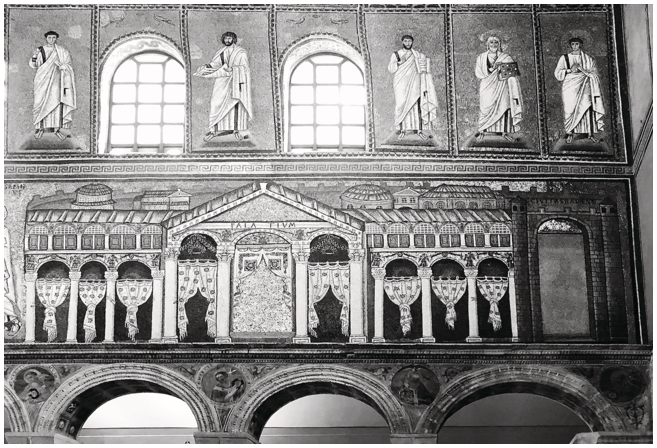


 Open access