




1. INTRODUCTION
Two-argument verbs denoting events in which an animate Agent acts on and causes a change of state in a Patient, such as casser ‘break’, détruire ‘destroy’, and tuer ‘kill’, are consistently transitive across languages: the Agent is expressed as the subject and the Patient as the direct object. Over forty years of scholarship have established this fact: Hopper and Thompson (Reference Hopper and Thompson1980), Tsunoda (Reference Tsunoda1985), Levin (Reference Levin, Billings, Boyle and Griffith1999), Levin and Rappaport Hovav (Reference Levin and Rappaport Hovav2005), among others. Likewise in the diachronic dimension, the argument structure of such verbs appears to be remarkably stable over time. For instance, caused change-of-state verbs (“high transitive verbs” in Hopper and Thompson’s (Reference Hopper and Thompson1980: 252) terms) shift seamlessly from taking accusative objects in Latin to direct objects in French, shown in (1) for dēstruere/détruire ‘to destroy’.

Other two-argument verbs are not so predictable. In the history of French, for instance, some verbs have varied between taking a direct object and a dative indirect object with some stabilizing as a direct object in modern French (aider ‘help’) and others as a dative object (obéir ‘obey’). Despite decades of inquiry, the puzzle of why such objects vary and what determines their different outcomes in modern French still remains. Using a quantitative approach to map the trajectories of all two-place verbs occurring with a dative object (monotransitive dative verbs; henceforth MTDs) during some portion of the historical record including modern French, we identify three classes of verbs:
-
• Type I are stable MTDs, with no significant evidence of dative/accusative variation.
-
• Type II show dative/accusative variation which resolves as dative in modern French.
-
• Type III show a dative/accusative variation which resolves as accusative in modern French.
By combining corpus-driven regression modelling and clustering analysis, we demonstrate that the patterns of change reflect regular linguistic replacements, and a semantic analysis further reveals that modern French MTDs form coherent semantic sub-classes–contrary to the widespread view that they are merely a motley collection of exceptions. The present study proposes a dynamic account of the dative linking rules that govern two-argument verbs, capturing a key historical shift in French: the rule that once marked the objects of both helping and hindering verbs (e.g., aider) and verbs of reacting and resisting (e.g., obéir) with the dative has narrowed, now applying only to the latter in modern French. We thus lay the groundwork for a framework to understand how oblique linking rules evolve over time. Just as phonological rules are central to historical linguistics, tracing the development of linking rules likewise provides descriptive utility and opens new pathways for research in learning theory, child language acquisition, and cross-linguistic comparison.
The remainder of this article is structured as follows. Section 2 introduces the notion of core and non-core transitive verbs and other relevant theoretical assumptions, and section 3 describes MTDs, the set of non-core transitive verbs that is the object of study. Our methodology is described in section 4, followed by the findings in section 5 and the analysis in section 6, drawing on Talmy’s theory of force dynamics. Section 7 discusses some implications of the analysis and concludes by recognizing the key theoretical issue, not addressed in this article, involving the role of acquisition in the change of linking rules over time. The Supplementary Material provides additional details and examples of Type II and Type III French MTDs.
2. TRANSITIVITY: CORE AND NON-CORE TRANSITIVE VERBS
Two-argument change-of-state verbs like détruire ‘destroy’, casser ‘break’, and tuer ‘kill’ are consistently transitive cross-linguistically and diachronically, in striking opposition to other two-argument verbs which do not fit this profile (e.g., ‘sweep’, ‘dance’, ‘touch’) and vary cross-linguistically and language-internally in the expression of their internal argument. Levin (Reference Levin, Billings, Boyle and Griffith1999) dubs such two-argument verbs “non-core transitive verbs” (NCTVs), in contrast with “core transitive verbs” (CTVs) of the ‘destroy’, ‘break’ and ‘kill’ type. The principal difference between these two major verb types is reflected in the complexity of their respective event structures; CTVs are bi-eventive while NCTVs are mono-eventive.


As the argument of the secondary result state (2b), the internal argument of a CTV is structurally licensed within a complex causative event, interpreted as Patient, and expressed as a direct object. We assume accusative case is assigned to the unique internal argument of CTVs by the functional head causative v. In contrast, NCTVs denote simple events in which the internal argument is licensed solely by the verb’s core meaning, not by a structural position (3b). Such objects are traditionally viewed as being selected and assigned case by the selecting head.Footnote 1
This structural distinction formalizes the empirical fact that the internal argument of an NCTV often resists straightforward thematic generalization. As Levin argues, the realization of such arguments results from the interaction between a default linking rule and language-specific oblique linking rules. In modern French, numerous oblique linking rules account for the selectional restrictions of NCTVs. Some are productive; others are limited, applying only to small, semantically diverse sets. These rules determine the case marking of the internal argument of verbs like dépendre de qqn ‘depend on s.o.’, compter sur qqn ‘count on s.o.’, obéir à qqn ‘obey s.o.’, and so forth. The specificity of these oblique linking rules overrides the “elsewhere” condition or default mapping rule (Levin and Rappaport Hovav Reference Levin and Rappaport Hovav2005), which assigns accusative case to the object of other NCTVs such as aider ‘help’, regarder ‘look/watch’, gouverner ‘govern’, etc.
Some research suggests that coherent semantic classes within the NCTVs may be singled out and a particular case distinction favoured in certain languages. For instance, Pinkster (Reference Pinkster2015 §4.24) describes Latin two-place verbs governing a dative object as belonging to four semantic classes: verbs of helping, caring, and their opposites; verbs of ruling, obeying, and serving; verbs of pleasing, flattering, and threatening; verbs of approaching and befalling. Similarly, semantic classes associated with two-place verbs governing an ablative object are also identified (ibid §4.24). Meanwhile, Nichols (Reference Nichols and Plank1984) points to verbs of authority, ruling, or disposition (‘rule’, ‘govern’, command’), which take instrumental case in Russian but dative in Lithuanian, and Blume’s (Reference Blume1998) study argues for a cross-linguistic class of “social interaction verbs” taking a dative object (e.g., verbs meaning ‘help’, ‘follow’, ‘thank’, ‘applaud’, ‘listen’, ‘obey’, ‘serve’, etc.), supported with data from German, Hungarian, Polish, Romanian, Samoan, and Tongan. In like manner, Arad (Reference Arad1998) for Hebrew and Jónsson (Reference Jónsson, Fernández and Etxepare2013) for Icelandic identify convincing semantic underpinnings for dative/accusative patterns while Bilous (Reference Bilous2011) considers such patterns in light of differential object marking in Slavic.
Numerous historical grammars remark on case variation in the history of French, and NCTVs figure prominently in this body of work dating from Clédat (Reference Clédat1887: §432-434), Nyrop (Reference Nyrop1899-1930, vol. 6: §163-190), Brunot (Reference Brunot1966), Brunot and Bruneau (Reference Brunot and Bruneau1969: §272), to Buridant (Reference Buridant2000: §314), Marchello-Nizia et al. (Reference Marchello-Nizia, Combettes, Prévost and Scheer2020: 1012-1045) and Martineau (Reference Martineau2024, §2.5.4.3). For example, the object of aider ‘help’ varies between an indirect object (dative) and a direct object in medieval French (4-5), settling on an accusative object in contemporary standardized French, notwithstanding varieties which continue to use the dative object in certain contexts (6).
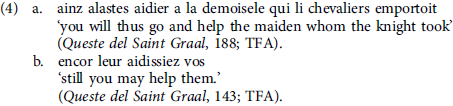
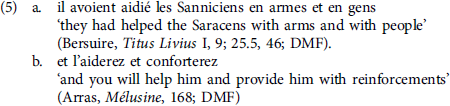
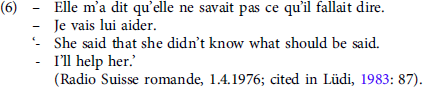
Even the Latin etymon of aider, adjūtāre, alternated between an accusative and dative object (Marchello-Nizia et al., Reference Marchello-Nizia, Combettes, Prévost and Scheer2020: 1030), the conservative dative form patterning with verbs of helping, caring, and their opposites and the innovative accusative form anticipating broader changes to come in Romance.
Why has the dative object of verbs like aider been replaced by a direct object (we count 26 such verbs in French)? In terms of linking rules, the facts can be framed as follows: the case-marking on the object of verbs like aider was formerly determined by an oblique linking rule, whereas in standardized modern French it is determined by the elsewhere condition. The historical variation between a dative and accusative object reflects change in progress. One task is therefore to identify the linking rule that was lost for aider-type verbs and another is to determine the factors that may have contributed to the weakening of evidence for that rule.
A number of studies have puzzled over how to account for this transitivity change, but few consider the dative-taking verbs that do not undergo such a change. Obéir ‘obey’ is one such verb whose object also varied between a direct and indirect object in medieval French (7-8), but unlike the object of aider, it is the dative that prevails in modern French.
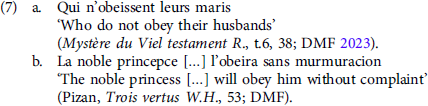
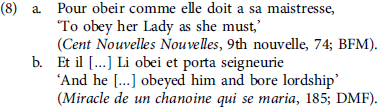
The present study shows that the retention of the dative object in verbs such as obéir provides a crucial piece of the puzzle concerning the change affecting aider-type verbs. We assume that in the pre-history of French, both obéir- and aider-type verbs were originally subsumed under a single oblique linking rule related to the productive rule that accounted for Latin two-place verbs selecting a dative, of which verbs of helping, caring, and their opposites and verbs of ruling, obeying, and serving (Pinkster Reference Pinkster2015 §4.24). In section 6.1, we argue that this original dative rule can be described in terms of the semantic category of force dynamics (Talmy Reference Talmy1988, Reference Talmy2000; Jackendoff Reference Jackendoff1990). By the medieval French period, however, this form-meaning mapping ceased to be learnable, and from the 16th century, evidence points to the emergence of a new linking rule that applies only to a subclass of force-dynamic verbs – the obéir type. While this study identifies the nature of the shift in linking rules, the question of what changed in the child-learner’s input to relegate verbs like aider to the default linking rule awaits future research.
Our analysis of the narrowing of an oblique linking rule is based on a quantitative study that documents and analyses monotransitive dative verbs (MTDs) across 1000 years of textual record. We trace the replacement of dative objects by their accusative counterparts in verbs like aider, the opposite change in verbs like obéir, and the absence of change in other two-place verbs like résister ‘resist’, parler ‘speak’, and plaire ‘please’. The exceptional resource of textual evidence in French offers a rare opportunity to explore language-specific semantic determinants of argument expression through time and provides an empirically grounded perspective on changes in transitivity.
3. MONO-TRANSITIVE DATIVE VERBS IN FRENCH
3.1. Definition of the verb class
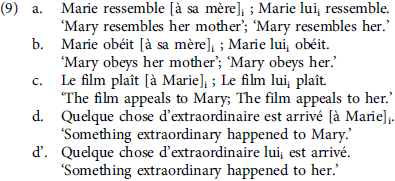
We define monotransitive dative verbs (MTDs) as verbs that select a single internal argument that is realized as a prepositional phrase headed by à and for which the pronominal form is lui or leur. Empirically, they are situated within the broader class of NCTVs (Levin Reference Levin, Billings, Boyle and Griffith1999). These verbs include stative verbs (9a), dynamic verbs (9b), object-experiencer verbs (9c) and verbs of occurrence involving change-of-location verbs (9d).
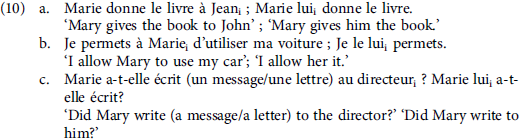
MTDs are formally distinct from verbs that select two internal arguments, one realized as a dative and the other either as a direct object (10a) or as a complement clause that can be pronominalized as an accusative-marked clitic (10b). This distinction includes uses in which the direct object of a ditransitive is implicit (10c).
Similarly, we do not confound the dative object of MTDs with unselected dative arguments such as those in inalienable possession constructions (11).

The distinction between a dative argument and other à-PP arguments follows Herslund (Reference Herslund1988), which is based on the foundational work of the tradition française: Le bon usage, Grevisse (Reference Grevisse2008[1936]: §281-283); Grammaire du français, Wagner and Pinchon (Reference Wagner and Pinchon1973[1962]: §318); Nouvelle grammaire (Larousse) du français, Dubois and Lagane (Reference Dubois and Lagane1986[1973]: ch. 7.1.1 and 24.2.2), and which has culminated in Les verbes français (LVF: Dubois and Dubois-Charlier (Reference Dubois and Dubois-Charlier1997); for the LVF database see also Lapalme and Le Pesant (Reference Lapalme and Le Pesant2020)). Herslund estimates the number of verbs governing an à-PP at about 400. Some of them are locatives, i.e., occurring with locational or directional verbs as in Max habite/va à Paris ‘Max lives in/goes to Paris’ for which the pronominal clitic form of the à-PP is y ‘there’. A relatively small subset are datives in the strict sense, formally defined in Herslund as taking lui/leur as the pronominal form (Herslund, Reference Herslund1988: 6-8). And the third type is neither locative nor dative, but neutral (“usage neutre”, as in Max pense à son examen). While the term “dative” is reserved by many grammarians for case marked elements, and hence restricted to pronouns in French, we follow Herslund in using it for all complements that pronominalize in lui/leur, thus avoiding less precise terms like “indirect object”. We leave aside the cases where lui/leur is constrained by other factors like definiteness; see recurring remarks in Herslund (Reference Herslund1988: 18-27).Footnote 2 Herslund’s classification based on the dative clitic is widely adopted in descriptive grammar (e.g., Riegel et al. Reference Riegel, Pellat and Rioul2009: 403) and his diagnostic is upheld in theoretical analyses (e.g., Abeillé et al. Reference Abeillé, Bonami, Godard, Tseng and Saint-Dizier2006).
3.2 MTDs in the French lexicon
Our analysis is based on the set of MTDs that are attested at some point in the past and that still exist in modern French. The verbs may therefore span the period from Old French to modern French (e.g., aider, obéir) or they may be first attested at some point in between (e.g., applaudir in the 14th century, téléphoner in the 19th century). Excluded are MTDs which have become obsolete (e.g. chaloir ‘to matter’, hucher ‘to yell’) and thus do not show a full trajectory into modern French. Our set was established on the one hand by identifying all MTDs in contemporary French from the database Les verbes français Footnote 3 and on the other by identifying every verb attested historically as a potential MTD. We drew on Troberg’s (Reference Troberg2013) study for this. The intersection of these two lists formed the basis of our analysis.
MTD extraction from Les verbes français involved collecting all verbs taking an à-PP and immediately excluding those having an additional argument (ruling out ditransitives, three-place predicates, reflexives, and impersonals, for example). We then narrowed down the remaining verbs by eliminating step by step:
-
• Local complements, both concrete and metaphorical senses, which do not pronominalize as datives such as la sueur colle au front ‘sweat clings to one’s forehead’ or ils contribuent au cadeau ‘they are contributing to the gift’.
-
• Verbs selecting nonlocal complements and inanimate referents such as rester à un accord ‘stand by an agreement’.
-
• Any other verbs that did not satisfy the constraint of taking a dative clitic, e.g., penser, recourir.
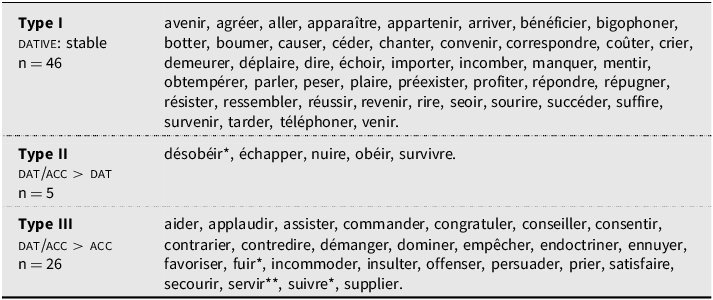
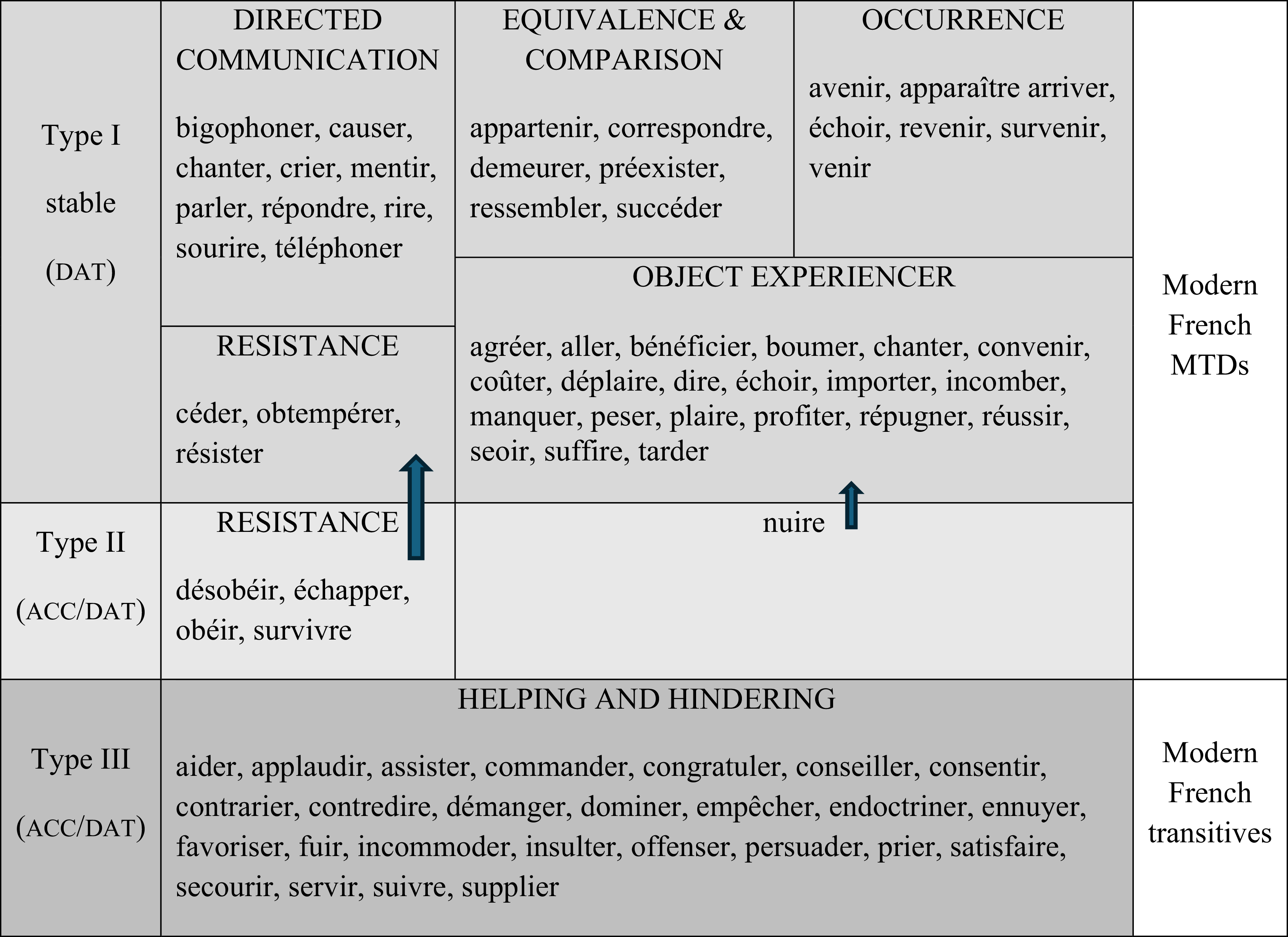
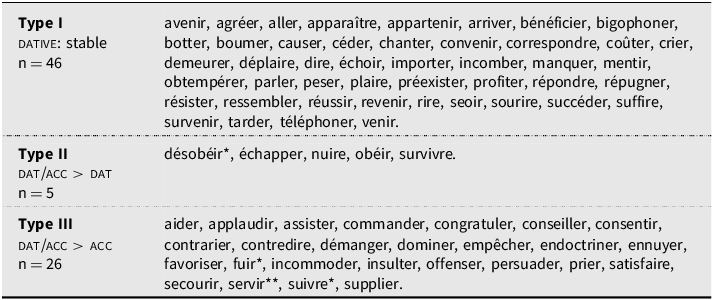
We divided MTDs into three types based on their historical development. Table 1 provides a near comprehensive list of two-argument verbs that currently take or formerly took a dative object in French (see Supplementary Materials S4 for examples of each verb in Type II and III).
-
• Type I (dative: stable): Verbs that consistently take a single dative object throughout the history of French.
-
• Type II (dat/acc > dat): Verbs whose object historically alternated between taking a dative and an accusative object, but which ultimately resolved in favour of the dative.
-
• Type III (dat/acc > acc): Verbs whose object historically alternated between taking a dative and an accusative object, but which ultimately resolved in favour of the accusative.
MTDs in the history of French
Importantly, the case-marking changes in Types II and III were not, to the best of our knowledge, accompanied by a change in meaning.
Of a total of 77 verbs, 46 have only ever occurred with a dative object (Type I verbs). Five occur with a dative object in modern French but they differ from Type I verbs in that they show variation between an accusative and a dative object at some point in the past. The remaining 26 Type III verbs, a third of the MTDs, have also shown variation between an accusative and a dative object, but these take a direct object in modern French.
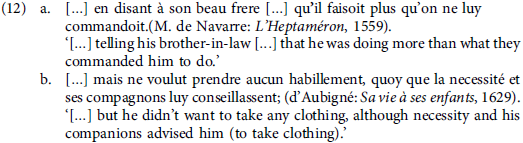
Some remarks: Three Type III verbs occur both in MTD and ditransitive constructions: commander, conseiller, and consentir. This combination introduces possible confounds for the parser, so each had to be manually checked. For example, certain ditransitive uses were parsed as MTDs in the extracted data; we therefore eliminated tokens such as (12a), where the parser failed to mark the second que as a relative pronoun related to the ditransitive use of commander, and (12b) in which the direct object of conseiller is implicit.
Three verbs, désobéir ‘disobey’ (Type II), fuir ‘flee’ (Type III), and suivre ‘follow’ (Type III) appear with an asterisk to indicate that the dative/accusative variation is poorly attested in our corpora but described in other sources and verified in resources such as the DMF. For example, there are only two tokens of désobéir with an accusative clitic (1675, 1816), fuir only occurs twice with a dative clitic (1350, 1555), and suivre only once (1177).
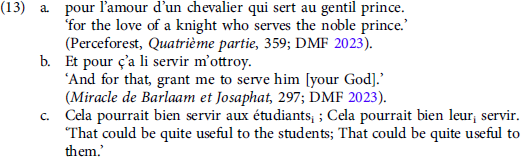
The verb servir ‘serve’ is marked with a double asterisk because it was removed from the analysis due to its complex polysemy as an MTD. In medieval French, servir can occur with a single dative object to mean ‘help, assist, fulfil obligations’ (13a,b). In this dynamic sense, it is an MTD having undergone a change of valence; the internal argument is expressed as a direct object in modern French like other Type III verbs. Additionally, however, servir has a stative MTD meaning: ‘to be useful’ (13c). Interestingly, in this stative meaning, servir does not undergo a change of valence; the dative object is maintained in modern French (as a Type I verb).Footnote 4 These two uses of servir cannot therefore be conflated in the analysis, but since the parser does not distinguish between them, the verb was removed from the analysis. We provide a more detailed description of the polysemy of servir in the Supplementary Materials, section S1.
Finally, we note that historically, ressembler (Type I) could occur with an accusative object. As shown in (14a,b), this transitive use had the attributive meaning ‘seem (like).’
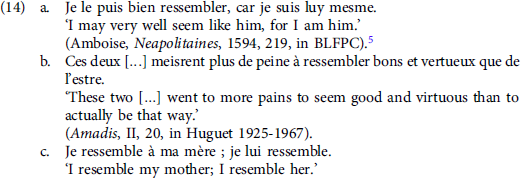
The attributive meaning overlaps but is crucially different from the dative usage (14c), which denotes comparison: ‘be similar to’. The transitive use of ressembler has disappeared from standard use, but the dative has remained stable as a Type I verb.
3.3. MTD Verb classes
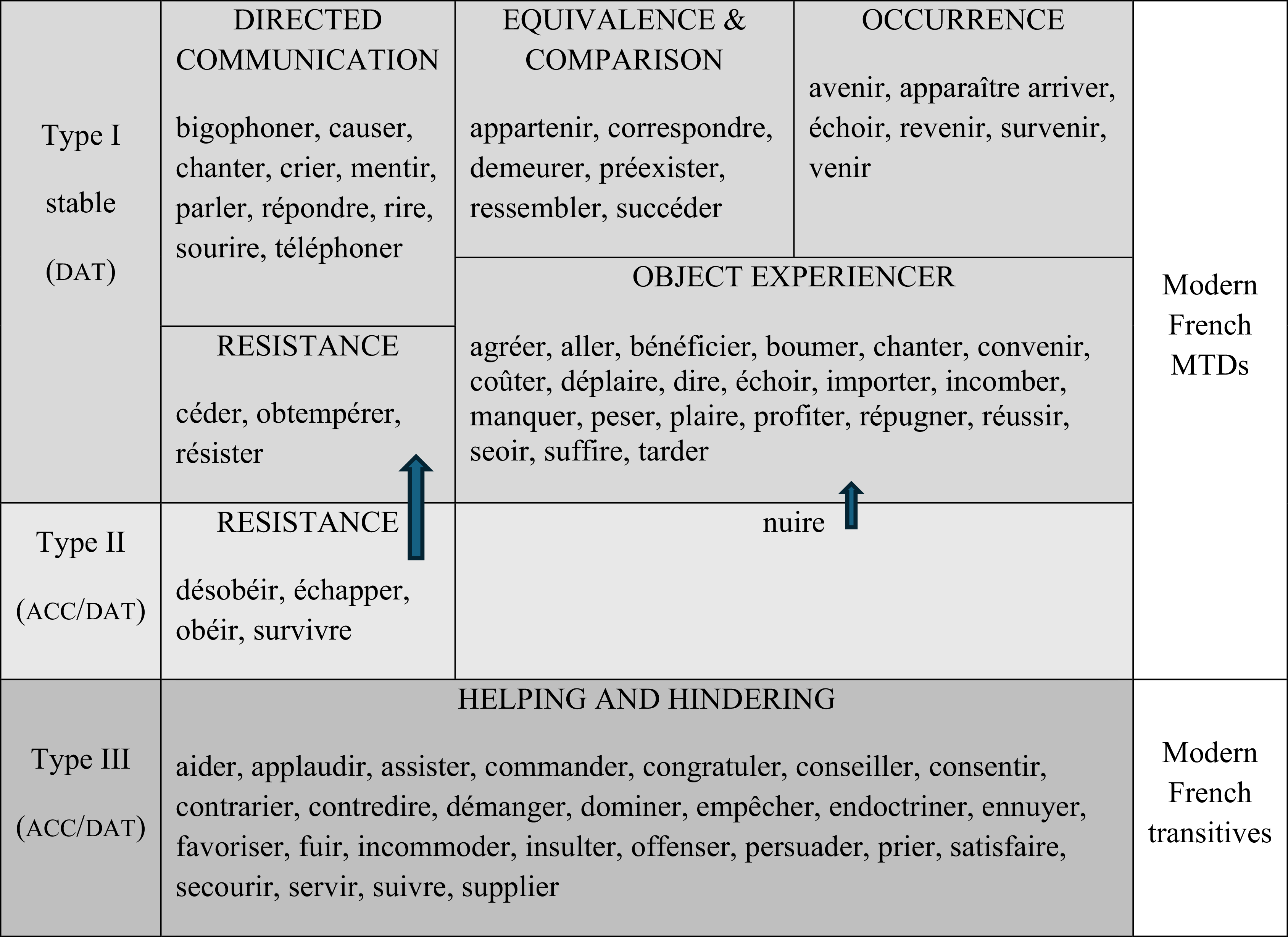
In this section, we show how the MTDs in Table 1 cluster into recognizable verb classes, pointing to semantic factors underlying the relative stability of some dative objects and the instability of others.
3.3.1. Type I non-agentive verbs
The Type I “stable” MTDs contain recognizable subclasses. Object-experiencer verbs (15) (e.g., Ce film leur plaît ‘They like this film’), a type of psych verb, predominate and are productive; indifférer was a relatively recent addition in 1891 (TLFi).
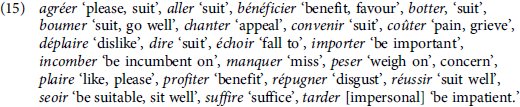
Verbs of appearance and occurrence (e.g., L’Esprit Saint lui est apparu sous la forme d’une colombe ‘The Holy Spirit appeared to her in the form of a dove’), a subclass of object-experiencer verb, are also well represented (16).

Verbs denoting static relations of equivalence in (17) are also stable MTDs throughout the historical record. Correspondence and belonging are represented in correspondre (e.g., Ce récit ne correspond pas à la réalité ‘This story doesn’t correspond to reality’), appartenir, and demeurer. Similarly, verbs denoting a relation of comparison are found in ressembler, and, in the temporal dimension, comparison is found in préexister and succéder; see Mélis (Reference Melis, Van Belle and Van Langendonck1996: 51-54) for insightful discussion of this verb class.

These three subclasses are all non-agentive and have been analysed as unaccusative or lacking an external argument in various frameworks: Legendre (Reference Legendre1989) and Pesetsky (Reference Pesetsky1995) for psych verbs; Levin and Rappaport Hovav (Reference Levin and Rappaport Hovav1995) for unaccusative verbs of occurrence (avenir, apparaître, arriver, etc.); Roberge and Troberg (Reference Roberge and Troberg2007) for verbs of static relation (appartenir, correspondre, etc.). As unaccusatives, the dative argument of these verbs is structurally licensed as an argument of a secondary predicate, likely accounting for the relative stability of their expression in the history of French. On the other hand, the remaining dative objects in Type I are lexically licensed and are “pure constant arguments” in Levin’s terms.
3.3.2. Type I verbs of directed communication
Verbs of directed communication (e.g., Je lui parle ‘I am talking to him/her’) are another salient and highly productive subclass of Type I verbs, new verbs reflecting technological advances like téléphoner ‘to phone’ having recently joined.

3.3.3. Type I verbs of reacting and resisting
Among the Type I verbs are also a set of three dynamic MTDs having in common meanings of reacting (J’ai cédé à mon rival ‘I yielded to my rival’) and resisting. These verbs align with Talmy’s (Reference Talmy1988, Reference Talmy2000) “verbs of resisting” and will be discussed in more detail in Section 6.1.2.

3.3.4. Type II verbs: reacting and resisting
The four Type II verbs obéir ‘obey’, désobéir ‘disobey’, échapper ‘avoid being caught’, and survivre ‘survive: to continue to live after the death of someone’ have meanings aligned with the Type I verbs of reacting and resisting (3.3.3). and differ from them only in so far as their dative object shows variation with an accusative direct object through the 17th century. That the Type I verbs céder, obtempérer, and résister do not show such variation is unsurprising since their first attestations date to the 14th century, and in our corpus, these verbs only appear with 3S/PL clitics from the 16th century.
As later additions to the French lexicon, the Type I verbs of reacting and resisting were used relatively infrequently before the 16th century, and by the time they entered common usage, they had been learned as MTDs. In contrast, Type II échapper, obéir, and survivre are present in the earliest 12th century texts; the dative/accusative variation therefore predates the earliest attestations and lasts through the 17th century. They have the time-depth to show that verbs of reacting and resisting were in flux just as Type III verbs. In other words, were céder, obtempérer, and résister commonly used native verbs like obéir and company, we would expect that their single internal argument might also show dative/accusative variation.
Of the Type II verbs, nuire ‘bother, harm’ is a semantic outlier not being a verb of resistance. There is some evidence that the dative/accusative alternation in this case has a semantic motivation; the transitive variant of nuire appears to have had a slightly different meaning. Troberg (Reference Troberg2013: 86) points out that attestations of nuire with a direct object are always agentive (see Troberg Reference Troberg2013: 86, ex.101a). The loss of this minor alternation could therefore be considered a case of levelling for object experiencer verbs.
3.3.5. Type III verbs: helping and hindering
In Section 6.1.1, we argue that Type III verbs fit the profile of helping and hindering verbs as described in Talmy (Reference Talmy1988, Reference Talmy2000). We note, however, that while our Type III verbs encompass many of the so-called “social interaction” verbs in Blume’s (Reference Blume1998) cross-linguistic study, her class is too broad for the French facts. A sampling includes verbs of communication/social gesture with the sense of ‘listen’, ‘answer’, ‘congratulate’, ‘applaud’, etc.; motion verbs meaning ‘follow’; and what are called ‘obey’ verbs: ‘obey’, ‘serve’, ‘help’, etc. (Blume, Reference Blume1998: 273). Since verbs meaning ‘obey’ and ‘help’ are conflated in Blume’s “social interaction” class, it does not characterize our Type III verbs. Social interaction might conceivably characterize the semantic determinant for dative objects in the prehistory of French, subsuming Type II and Type III verbs, although in section 6, we show that a force-dynamics analysis neatly captures the generalization.
3.3.6. Summary
Our analysis thus far concerning MTDs is summarized in Figure 1.
MTDs in the history of French, with semantic subclasses.
3.4. Previous work
Variation in the expression of verbal arguments – with or without changes in meaning – is documented as early as Vaugelas’ Commentaires and are compiled in French historical grammars such as Brunot and Bruneau (Reference Brunot and Bruneau1969: §272), Colin (Reference Colin1897), Clédat (Reference Clédat1887: §432-434), Étienne (Reference Étienne1980: §328-330), Fournier (Reference Fournier1998: 96-101), Gougenheim (Reference Gougenheim1974: 127-129), Haase (Reference Haase1914: §58-62), and Nyrop (1899-Reference Nyrop1930, vol.6: §163-190). They are noted in historical dictionaries such as the various iterations of the Dictionnaire de l’Académie Française, Furetière’s Dictionnaire Universel, Féraud’s Dictionnaire critique de la langue française, Godefroy’s Dictionnaire de l’ancienne langue française, the Dictionnaire historique de la langue française published by Le Robert, among others.
These phenomena are the unique subject of Colin (Reference Colin1897), and the more recent literature is relatively rich with treatments of dative arguments and their eventual outcomes. Blinkenberg (Reference Blinkenberg1960) situates such changes within a theory of diachronic change and transitivity, while Lüdi (Reference Lüdi1978, Reference Lüdi1983) attributes the change from dative to accusative in the verbs prier ‘beg/pray’, supplier ‘beseech, implore’, requérir ‘request’, and aider ‘help’ to a change in an analogical rule: in medieval French, their dative argument patterned by semantic analogy with dative benefactors (e.g., Jean lui a aidé ‘John helped him/her’ is analogous to Jean lui a ouvert la porte ‘John opened the door for him/her’), while in modern French they are subject to structural analogy with verbs like amener ‘to lead’ which take a direct object followed by an infinitive clause (aider quelqu’un à faire… is analogous to amener quelqu’un à faire… ‘lead someone to do something’).
Goyens (Reference Goyens1998) considers the outcomes of six verbs (obéir ‘obey’, ressembler ‘resemble’, mentir ‘lie’, prévenir ‘prevent, avert’, empêcher ‘trouble, hinder’, and contredire ‘oppose, contradict’), and concludes that they are not predictable. Goyens confers with Herslund (Reference Herslund1980), however, insofar as structural ambiguity of indirect objects (marked both with or without the preposition à for ditransitive verbs in Old French) would have initially caused the variation. Lene Schøsler’s extensive work on the topic (Schøsler, Reference Schøsler, Blumenthal and Tyvaert2003, Reference Schøsler and Thórhallur2008, Reference Schøsler, Baronian and Martineau2009, Reference Schøsler2010) claims that the dative object of verbs such as aider ‘help’, assister ‘assist’, secourir ‘help’, and servir ‘serve’ shifts to a direct object due to the increasing interpretation of single dative objects as having the semantic role of Experiencer (c.f., plaire à quelqu’un ‘to please/appeal to someone’). The claim is couched within a larger proposal that the S-V-IODAT construction itself has become grammaticalized in French, now expressing a psychological relation between the animate object on the one hand and the subject on the other. The claim is that since aider-type verbs do not express a psychological relation, they have shifted toward the default S-V-DO construction, which expresses no particular meaning.
Within a generative framework, Troberg (Reference Troberg2008, Reference Troberg2013) considers a larger set of MTDs, advancing that the shift to a direct object is driven by an abstract change in the prepositional system, and Piñeda (Reference Piñeda2020), in a similar vein to Herslund (Reference Herslund1980) and Goyens (Reference Goyens1998), argues that verbs of the Type III class like aider and applaudir are “hidden ditransitives” reanalysed as transitives. Our view is that previous work has not taken a broad enough perspective of the issue in French, and consequently, no convincing patterns have emerged.
3.5. Research questions
The present study seeks to answer two questions based on our interpretation of Table 1 as Figure 1.
-
1. What can a quantitative analysis of French MTDs reveal about the patterns of change? Our method for pursuing this question and its findings is presented in Sections 4 and 5.
-
2. Can any principled distinction be identified between Type I and II MTDs on the one hand and Type II and III verbs on the other given that in many languages, Type III verbs (aider, empêcher) and Type II verbs (résister, obéir) mark their objects in the same way and have been argued to be members of the same class of verb (e.g., Latin and the languages cited in Blume (Reference Blume1998))? Section 6 presents our proposal for a such a distinction.
4. METHODS
4.1. Corpora
To capture the largest time course of change possible, our study required a corpus that spans as much of the textual record of French as possible. We therefore combined an existing syntactically annotated corpus of Old and Middle French, the MCVF-PPCHF, with the public-domain texts contained in the Frantext database, which covers the modern French period.
MCVF-PPCHF is a collection of historical corpora compiled by Kroch and Santorini (Reference Kroch and Santorini2021). It consists of version 2 of the corpus of historical French Modéliser le changement: les voies du français (MCVF, Martineau et al., Reference Martineau, Hirschbühler, Kroch and Morin2021), plus the Penn Parsed Corpus of Historical French (PPCHF, Kroch and Santorini, Reference Kroch and Santorini2021), with 440 000 words from the Base de Français Médiéval (BFM, Guillot-Barbance et al., Reference Guillot-Barbance, Heiden and Lavrentiev2017) and 323 000 words from additional texts added by the Penn team. With its 64 texts from 842 to 1527 and about 1.6 million words, it currently forms the largest syntactic treebank for Old and Middle French.
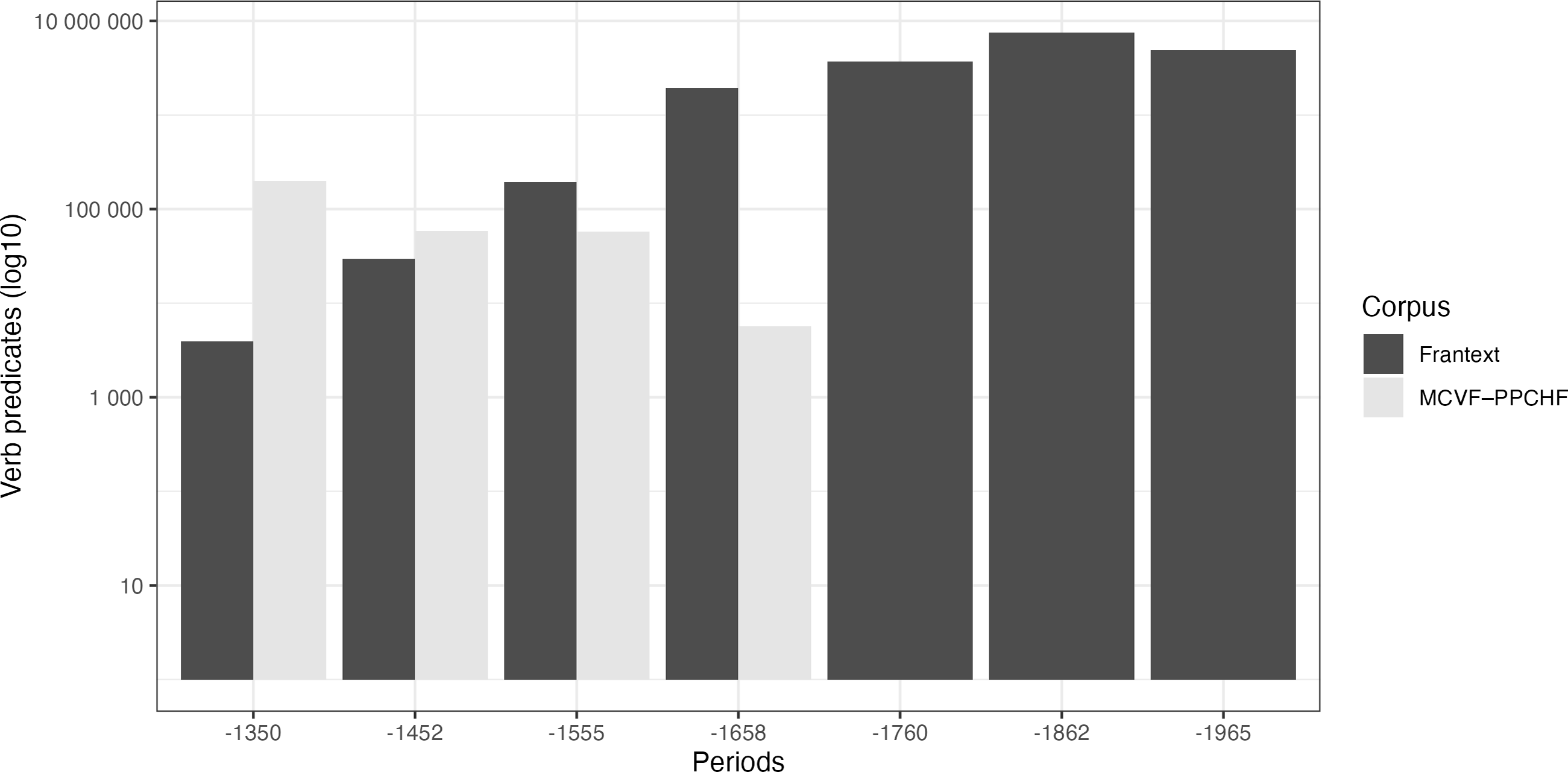
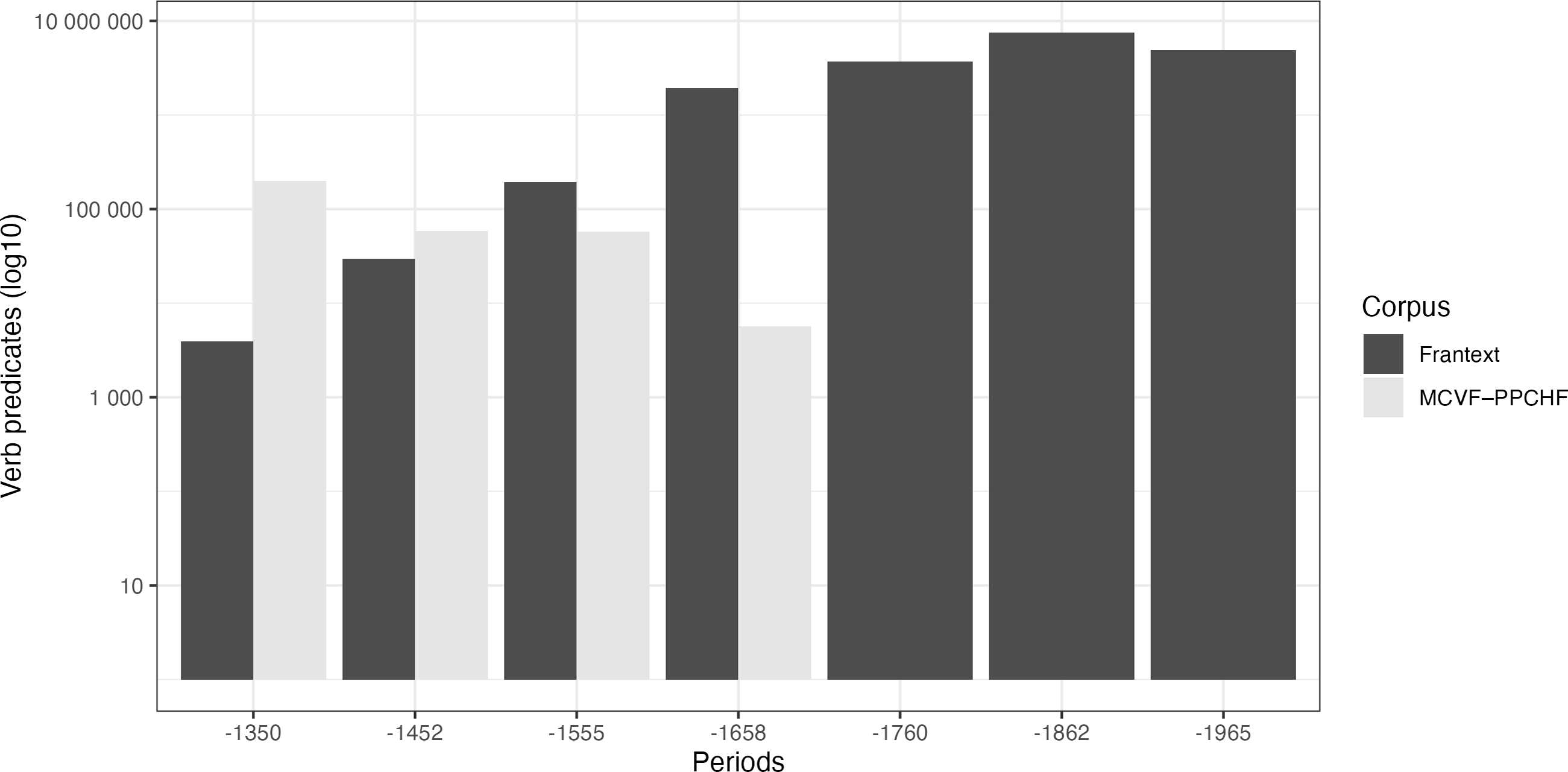
By using the Frantext public-domain texts, we added six other texts for the period 1300-1500 and more than 2600 texts from the 16th to 20th century. These texts had no syntactic annotation. We added an unsupervised automatic annotation using the neural parser HOPS trained with the model Sequoia-FlauBERT (Grobol et al., Reference Grobol, Regnault, Ortiz Suárez, Sagot, Romary and Crabbé2022). Manual verification of the output was done only for verbs under scrutiny. The output of this process was a treebank annotated with Universal Dependencies. In order to analyse the verbal argument structures, both the constituent structures of MCVF-PPCHF and the dependency structures from Frantext were converted, merged into a coding table (for a detailed description of this procedure see Stein (Reference Stein, Neveu, Prévost, Montébran, Steuckardt, Bergounioux, Merminod and Philippe2024)), and explored using statistical tools (R scripts). This method allowed us to maximize our resources for Old and Middle French, and to create an uninterrupted database for MTDs from the 9th to the 20th century. Figure 2 illustrates the distribution of verbal predicate tokens over nearly 1000 years of textual record (sparse data in the early periods was made more visible by using a logarithmic y axis). The data was binned into seven periods, with Old French as the first period followed by six equally long periods. Only Cent Nouvelles Nouvelles is included in both corpora, but each version is written by a different author (M. de Navarre 1465; Philippe de Vigneulles 1515) and both are selections of non-overlapping extracts.
Number of predicates in the MCVF-PPCHF and Frantext corpora.
4.2. Retrieving MTD verbs
To improve the accuracy of our data extraction, we distinguished between lexical and pronominal datives. Lexical dative phrases are introduced by the preposition à. Prepositional à-phrases are however underspecified for dative indirect objects (e.g., Je parle à Marie ‘I speak to Mary’) and locative or directional complements (e.g., Je vais à Paris ‘I go to Paris’). Given the size of our corpus, this overlap makes it impracticable to extract unambiguous instances of lexical datives automatically. In contrast, pronominal datives are realized through the clitic forms lui and leur, which mark only dative objects, ensuring a cleaner mapping between syntactic form and argument structure, avoiding noise from non-dative uses of à. Pronominal datives occur frequently enough in natural language data to provide a solid basis for the research analysis, so the search was performed on these forms alone.
To address a possible important limitation of our analysis arising from the choice to analyse only third-person clitic objects (lui/leur, le/la/les), we compared dative/accusative ratios for clitic and lexical arguments across Type II and III. A paired Wilcoxon signed-rank test (see the published R script for details) revealed no significant difference in the ratios between clitic and lexical objects (p = 0.83), where p > 0.05 rejects the hypothesis that clitic complements reflect a pattern of argument structure change different from lexical ones. The use of clitics as a proxy for tracking the development of case selection with these verbs is therefore justified and also in line with the criteria discussed in Section 3.1 in that they mark case unambiguously. A consequence of this narrower search is that some MTDs are missed. For example, five Type III verbs are not attested with dative clitics: congratuler, dominer, endoctriner, incommoder, offenser.
Finally, since our extraction is based on syntactic annotation, graphical variation or underspecified forms (l’, li) need not be controlled for. Potential errors are limited to annotation errors (in the MCVF-PPCHF) or parser errors (in the Frantext corpus).
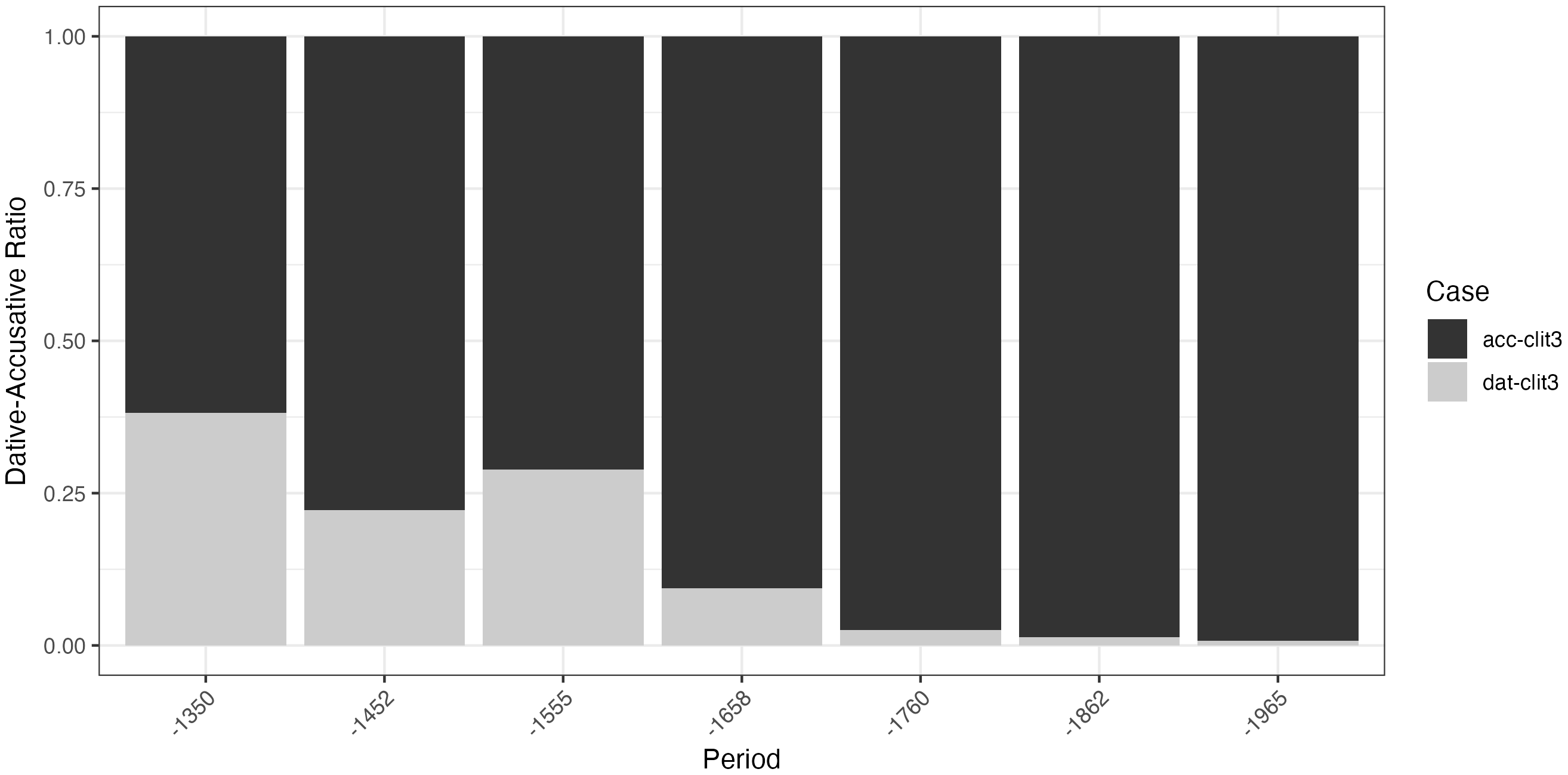
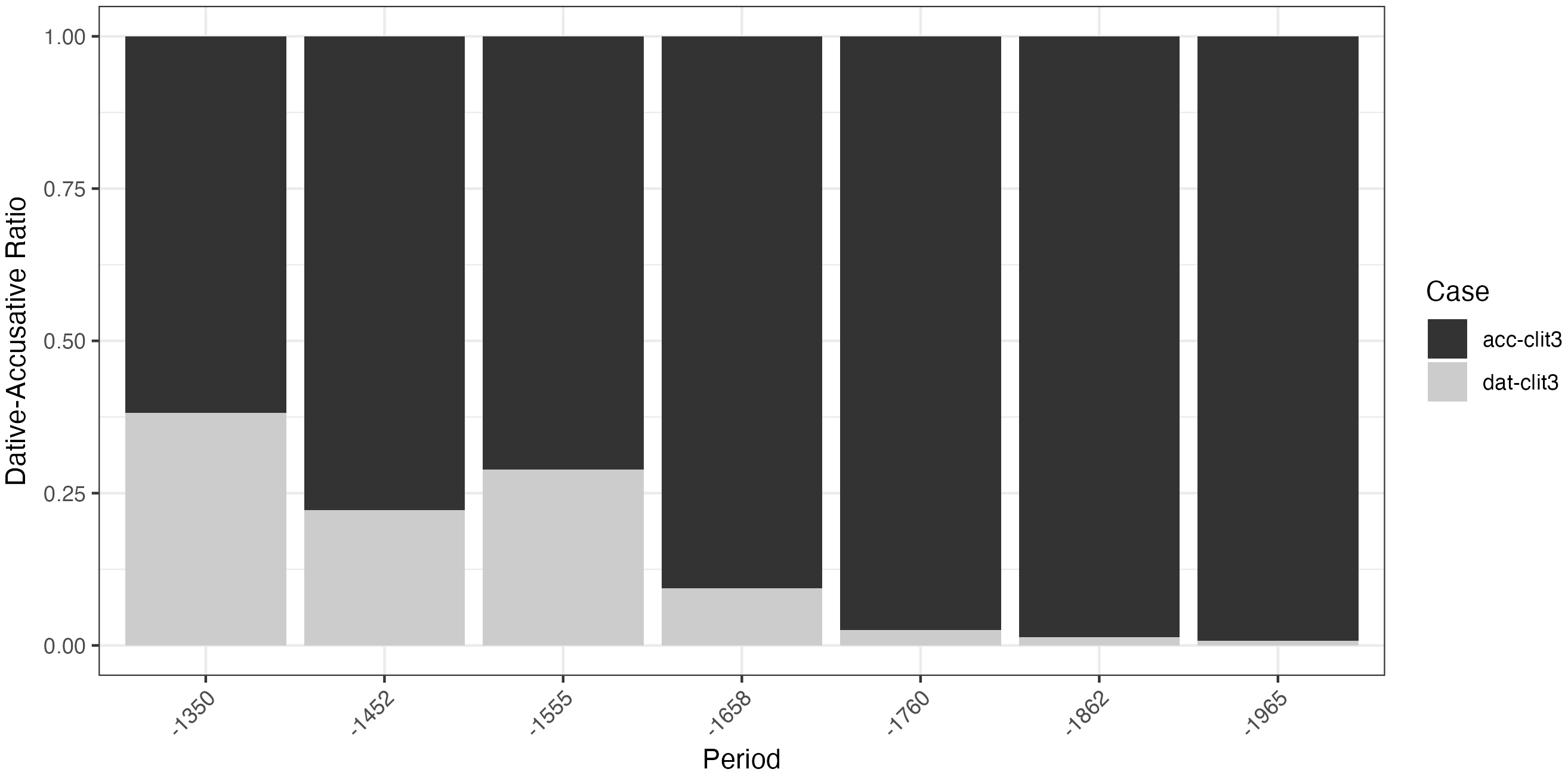
Our database produces both fine-grained and general tendencies. For example, the bar plot in Figure 3 presents the change in overall proportion of dative (grey) versus accusative (black) clitics; until 1550, the proportions are more or less stable, but from the mid-sixteenth century onward, the accusative clitic rather rapidly replaces the dative in monotransitive contexts. This graph was generated by extracting all the occurrences of third-person clitics (both dative and accusative (10 577 in total) for Type III verbs excluding the verb servir (3131 tokens) and binning the results into seven periods (see Supplementary Materials S2 for a fine-grained representation of these proportions, without binning).
Proportion of dative vs accusative clitics per period for Type III (except servir).
Verb-clitic combinations show robust numbers, as shown in (20), where the figures indicate the sum of occurrences with dative and accusative clitics for each Type III verb.

Our choice to exclude servir from the analysis rests on two facts. First, since this verb alone would have comprised a third of all tokens, including it would have skewed the results towards its particular path of change. Second, servir is polysemous as an MTD (see Supplementary Materials S1 for discussion) in a way that must be controlled for and to which our extraction methods are insensitive.
4.3. Modelling change
To analyse the diachronic shift from dative to accusative objects, we use logistic regression modelling, which estimates the probability of a verb selecting a dative or accusative object over time. This approach is particularly useful in historical linguistics because it allows us to track gradual changes in linguistic preference, rather than treating language change as a binary phenomenon (e.g., “accusative replaces dative at time X”). Logistic regression is particularly well-suited for this kind of analysis because it smooths out fluctuations in the data, ensuring that rare or isolated occurrences do not disproportionately affect overall trends. (The materials published online will provide every single occurrence as well as the code we used for the statistical calculations; OSF, doi: https://doi.org/10.17605/OSF.IO/MZJ2A).
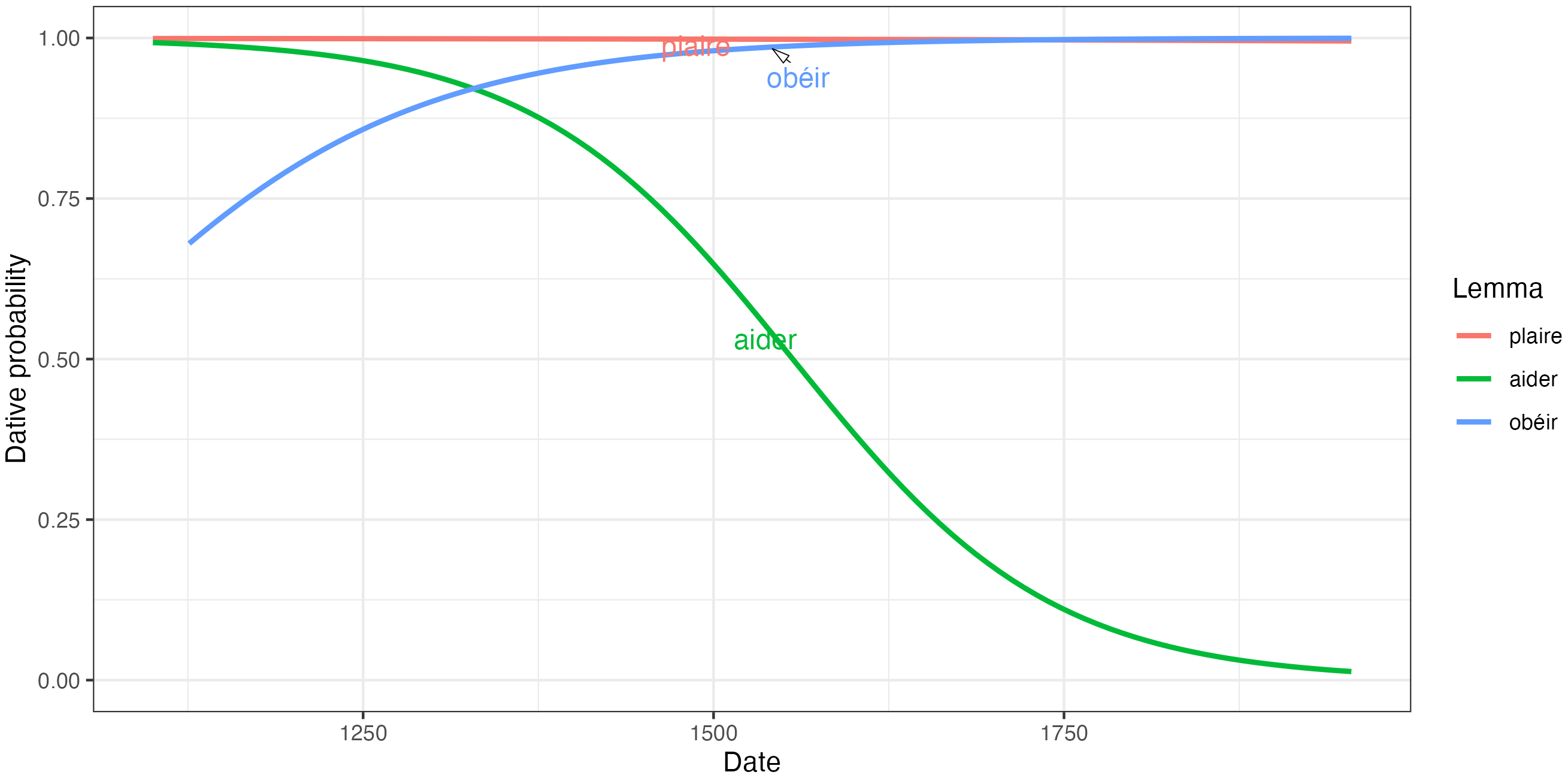
The results are visualized using log-odds curves, which plot the probability of selecting a dative object on a continuous scale. For a given verb and date, points on the log-odds scale visualize the probability of selecting the dative. Increasing or decreasing log-odds values (y-axis) reflect changes in linguistic preferences over time (x-axis). Since the model takes the dative as the reference level, declining log-odds values indicate a decreasing preference for the dative construction. Figure 4 shows the curves for representative verbs of the three types distinguished in Table 1 (Section 3.2): plaire (Type I, stable dative), obéir (Type II, from variation to dative) and aider (Type III, from variation to accusative).
Log-odds curves for Type I, II and III verbs.
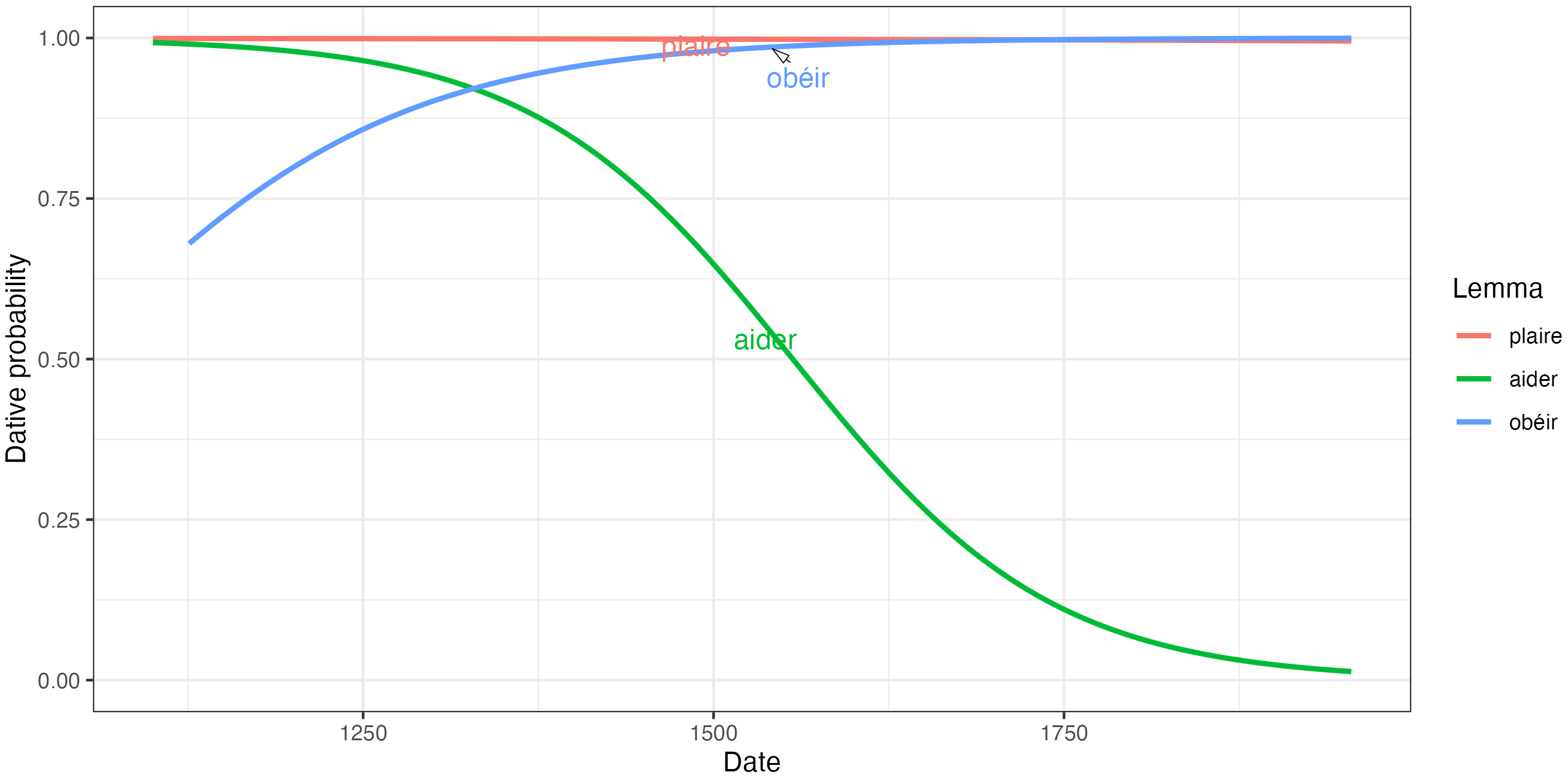
Logistic regression allows us to test whether the loss of dative case in Type III verbal objects and the loss of accusative case in Type II verbal objects follows an S-shaped trajectory. The S-curve, common in domains outside of linguistics, models an innovation as it propagates through a population. Language change often follows an S-shaped trajectory, where an innovation is first slowly adopted, then gains momentum in a period of rapid spread, before eventually stabilizing. This “slow, fast, slow” pattern is a well-documented feature of grammatical change (Kroch, Reference Kroch1989; Croft, Reference Croft2000; Denison, Reference Denison and Hickey2003). Since the diffusion of a linguistic replacement typically follows an S-shaped curve, our data can be assessed in terms of the degree to which each verb reflects a systematic replacement: either by an accusative marked object (Type III aider) or a dative-marked object (Type II obéir).
Modelling the changes in terms of log-odds curves also allows us to easily detect subgroups of verbs that follow similar diachronic trajectories, without relying on predefined linguistic categories. To achieve this, a k-means clustering algorithm was chosen because it is robust in handling gradual transitions, making it ideal for studying change over time, where linguistic shifts do not always follow sharp categorical boundaries. This makes it well-suited for partitioning continuous data, i.e., the log-odds curves representing the case marking shifts. Unlike hierarchical clustering, which builds a nested structure of relationships, k-means efficiently assigns each verb to a distinct group based on how similar its historical trajectory is to others in the dataset. We also used Silhouette scores to determine the optimal number of clusters (see Maechler et al. (Reference Maechler, Rousseeuw, Struyf, Hubert and Hornik2024) and the R script provided on OSF).
Finally, we briefly address two additional methodological considerations regarding data selection and parser accuracy. First, data scope and case marking: our analysis is based exclusively on third-person clitic realizations of dative and accusative complements, as justified in Sections 3.1 and 4.2. While this approach ensures reproducibility, it reduces the overall data size. Additionally, some verbs might exhibit case preferences for clitics that differ from those for lexical complements. However, this distinction is unlikely to affect the overall trajectory of the log-odds curves. Second, parser accuracy: errors in syntactic annotation primarily stem from two recurrent issues. The most frequent involved infinitival complements, particularly in causative constructions where the case of the clitic is not governed by the main verb (Elle le fait demeurer; Elle lui fait faire la vaisselle ‘She makes him stay; She makes him/her do the dishes’). Additionally, the subject pronoun lui(-même) was sometimes misidentified as a dative clitic rather than a strong subject pronoun. Further minor inaccuracies resulted from lemmatization issues. While the automatic syntactic analysis of Frantext could not be fully verified across the entire dataset, we manually validated all extracted data for the MTDs examined in this study, ensuring the robustness of our findings.
5. FINDINGS
5.1. Type I verbs
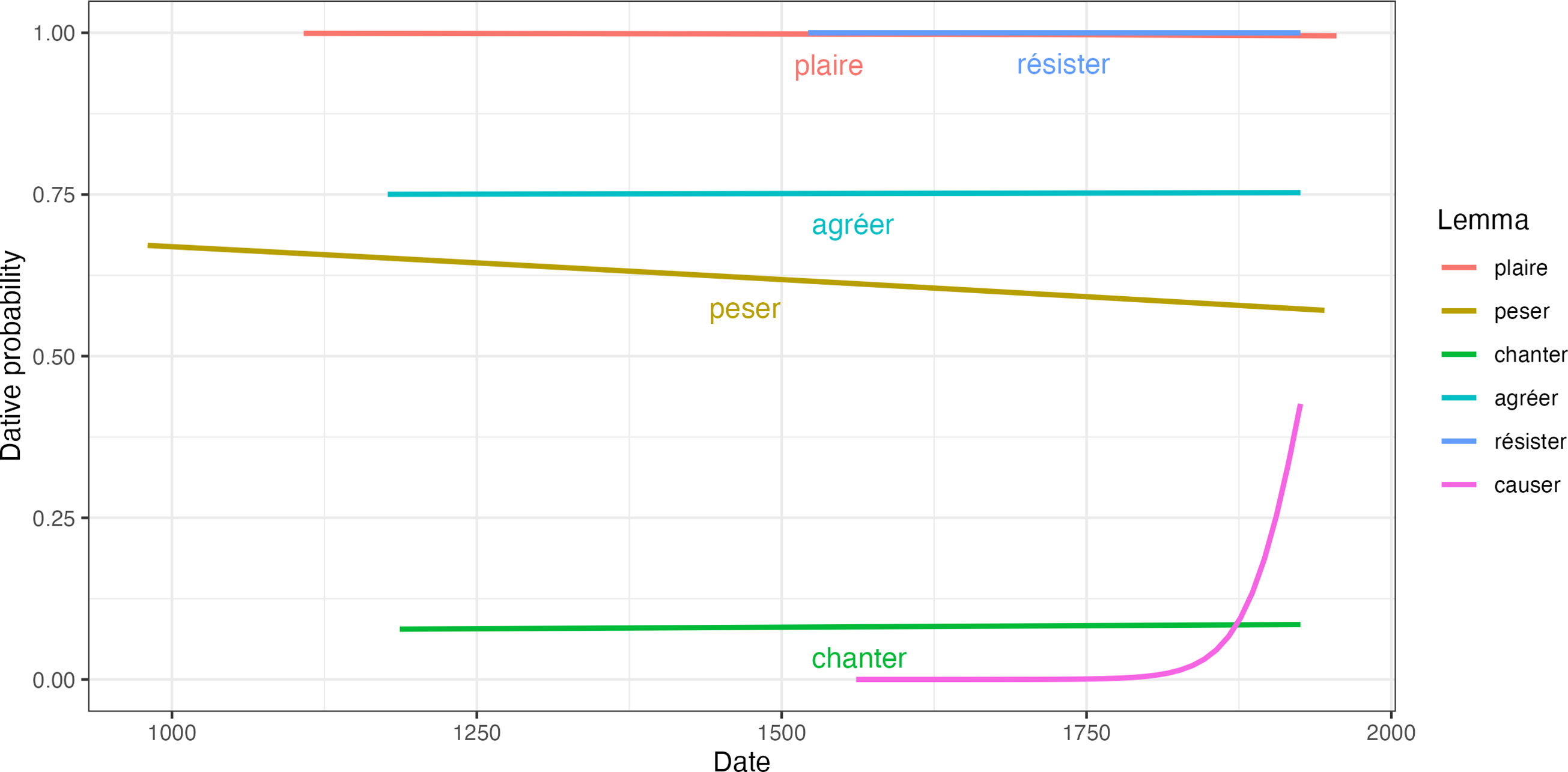
We introduced Type I verbs as “stable”, and this is borne out in our analysis. The plot in Figure 5 represents the probability of dative marking over time for six verbs (plaire, résister, agréer, peser, chanter, causer). As above, the y-axis indicates the likelihood of a dative complement (1.0 = fully dative, 0.0 = fully accusative), while the x-axis spans the historical timeline.
Selected verbs of Type I (unclustered).
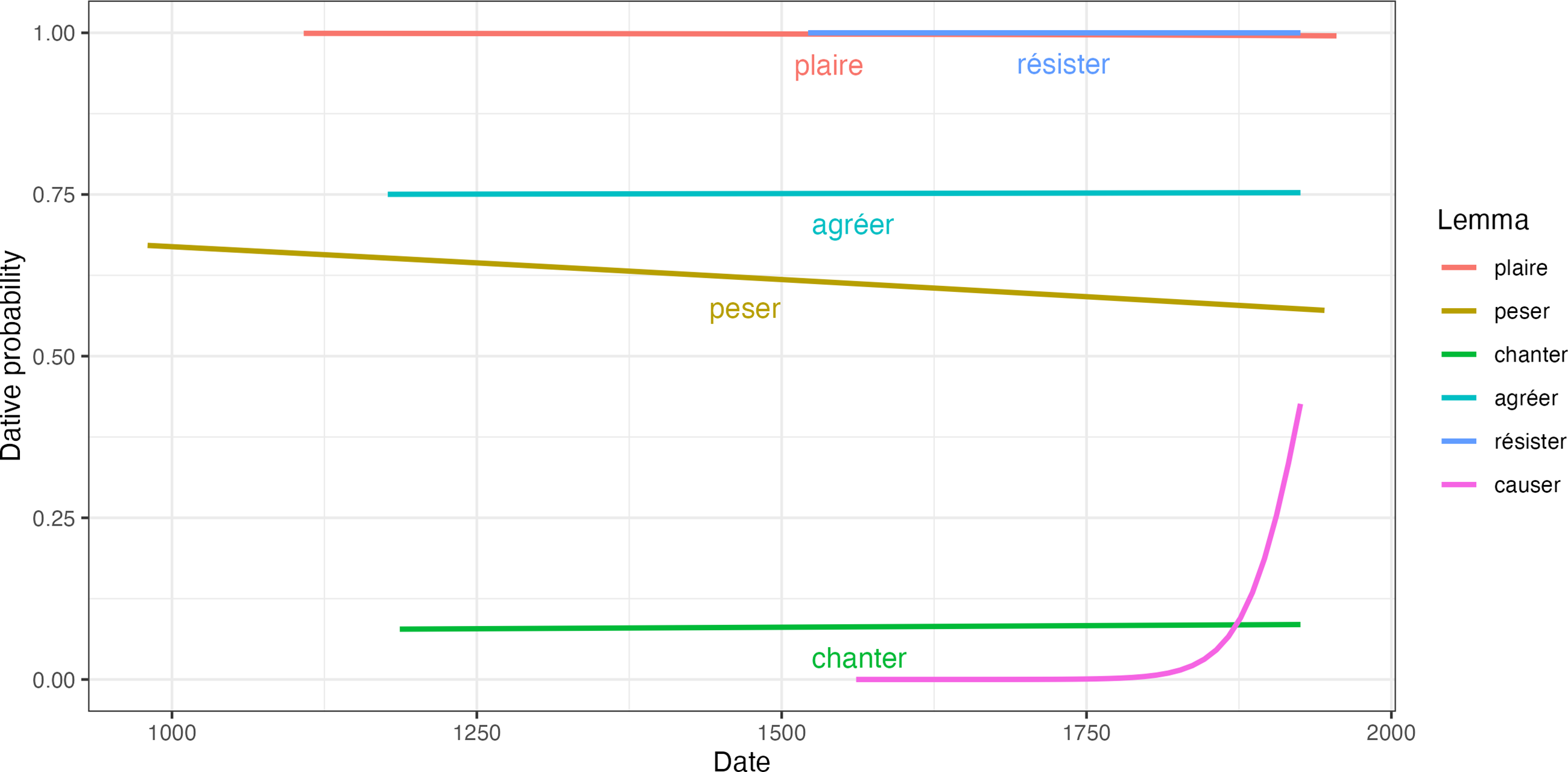
On the top of the graph, plaire and résister represent the majority of the Type I verbs, maintaining a high dative probability throughout the entire period, with no significant shift toward accusative marking. This confirms their status as canonical dative-governing verbs in French.
The slopes of the four remaining verbs require a different interpretation, as their MTD use represents only a subset of their total occurrences. The slightly lower dative probability of agréer ‘please, suit’ reflects the presence of a second, less frequent, meaning ‘approve, authorise’ that has always selected a direct object. The co-existence of these two meanings has remained stable over almost 800 years. A similar case can be seen with chanter except that the rather rare and colloquial dative object-experiencer usage of chanter ‘please’ has a much lower probability over the period.
The downward slope of peser ‘weigh on, concern’ does not indicate a change in case marking as such, but rather a relative decrease in the frequency of its dative object-experiencer meaning ‘weigh on, concern’ vis-a-vis its transitive meaning ‘weigh something’. Likewise, the rising curve for causer ‘chat’ does not indicate a shift in case marking, but rather the emergence of a new colloquial meaning patterning with directed communication verbs like parler ‘talk’, first attested in our corpus in 1862.
5.2. Type II verbs
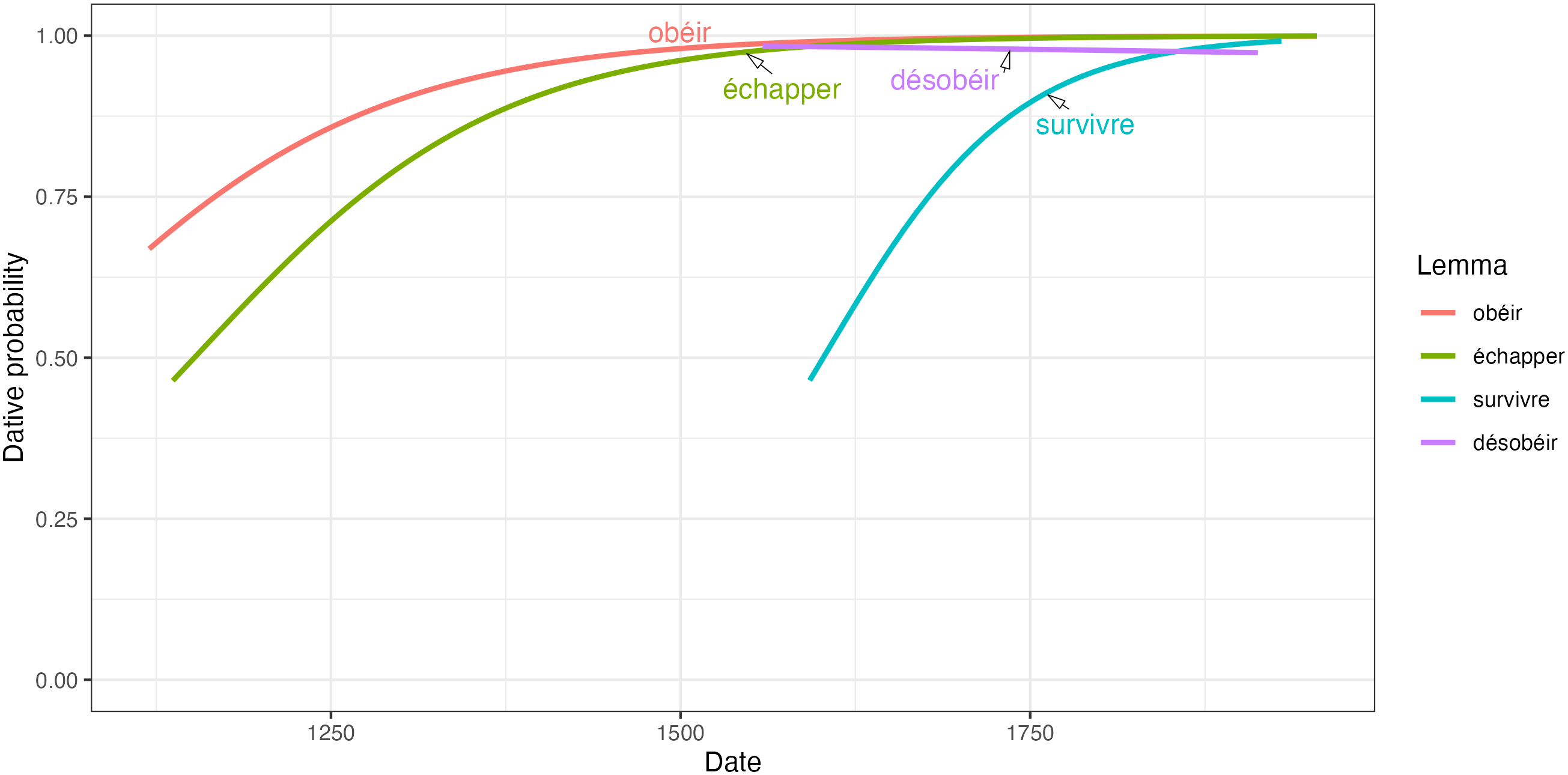
In section 3.3.4, we introduced Type II verbs as having lost their accusative object variant. The direct object of the four verbs of reacting and resisting and that of nuire was replaced by the dative variant. Our analysis confirms this; Figure 6 shows that the selection of a dative object reaches values close to 1.0. The fact that not all the verbs reach 1.0 on the log-odds scale is due to the fact that regression does not output binary results, but rather smoothed probability estimates of a particular form occurring at a given time. Thus, even with a very small number of accusative tokens (e.g., three cases for obéir in 1375, 1634 and 1678), the model does not discard the possibility of variation. The presence of any accusative tokens, even rare, can lead to a long-term low (but not zero) probability of accusative marking.
Type II verbs.

For obéir, échapper, the slopes appear to be S-curves with a truncated actuation, meaning the actuation of change occurred at some point earlier than the earliest texts in our corpus. As for survivre, the first occurrence with an internal argument (dative or accusative) in our corpus only occurs in the 16th century, so once again, the textual record (or our query of it) does not reveal the actuation of change. Nonetheless, the partial S-shaped form suggests that all four verbs underwent a straightforward linguistic replacement (accusative marked object by dative). See Croft (Reference Croft2000: 184-187) for a discussion on innovation and propagation in S-curve representations of change.
5.3 Type III verbs
We introduced Type III verbs as historically alternating between dative and accusative objects but ultimately stabilizing with accusative marking. The results confirm this general trend: most verbs in this class exhibit a gradual replacement of dative objects with accusative ones, following a trajectory consistent with S-shaped diffusion patterns.
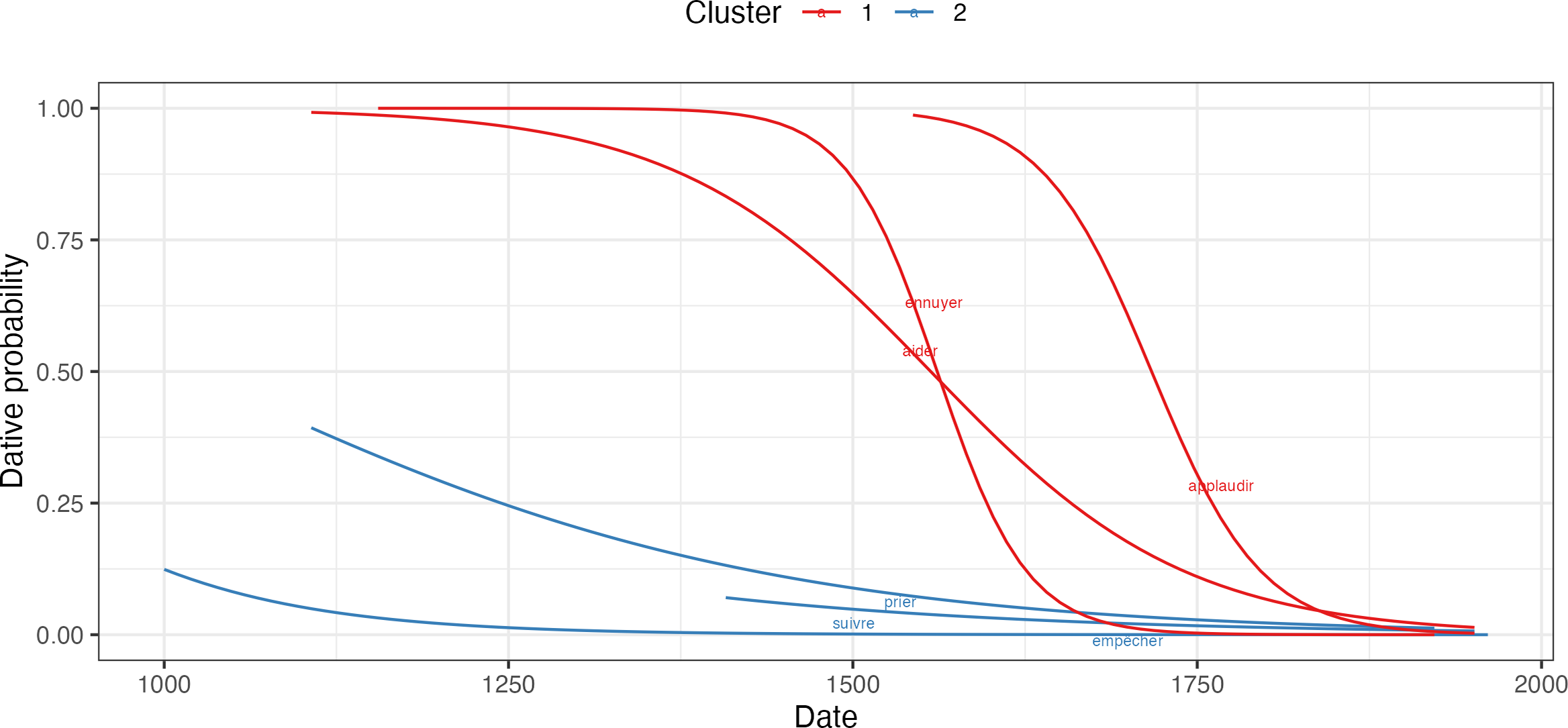
The log-odds curves for a representative subset of verbs (aider, ennuyer, applaudir, suivre, prier, empêcher) illustrate the range of trajectories observed within Type III. The transition from dative to accusative was not uniform across all verbs, with differences in timing, slope steepness, and endpoint probabilities. This is shown in Figure 7.
Selected verbs of Type III.
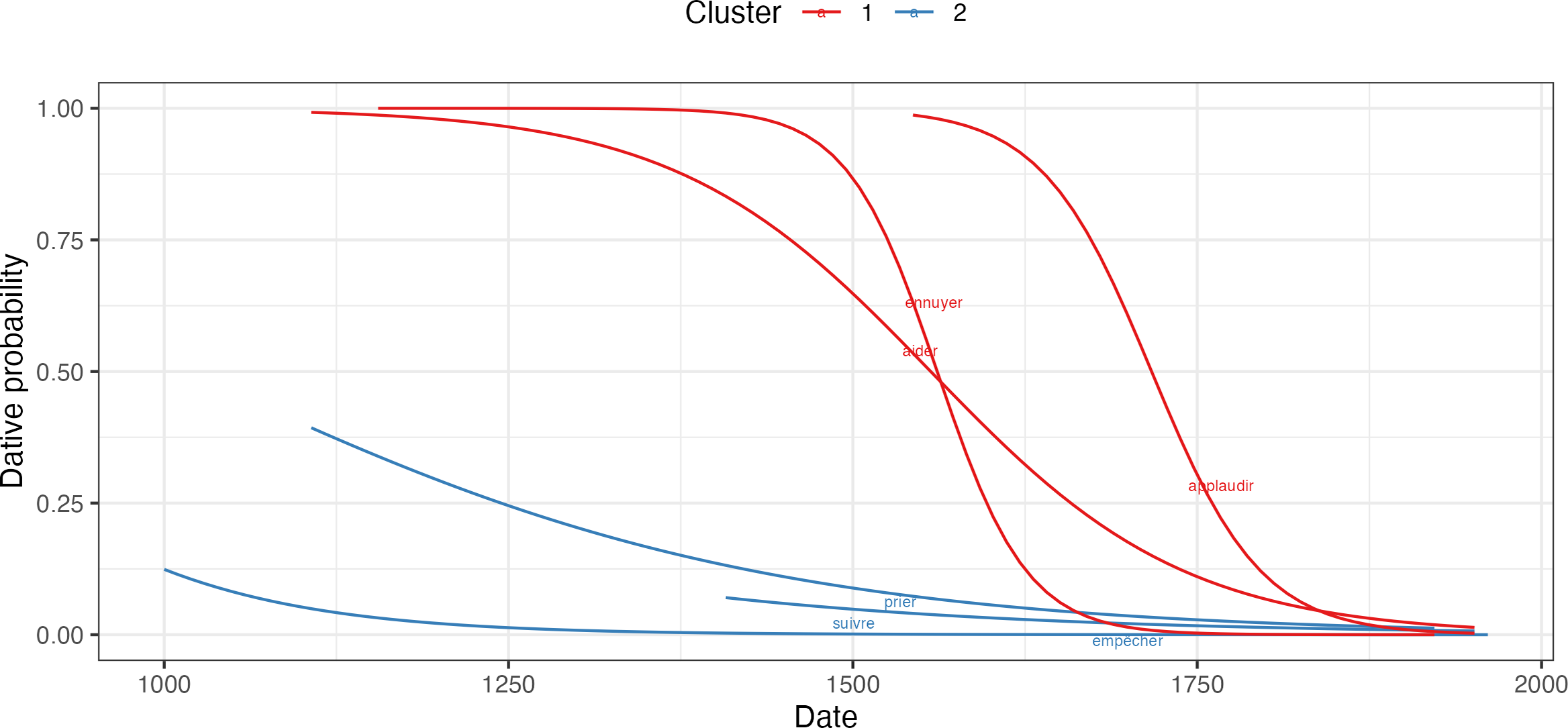
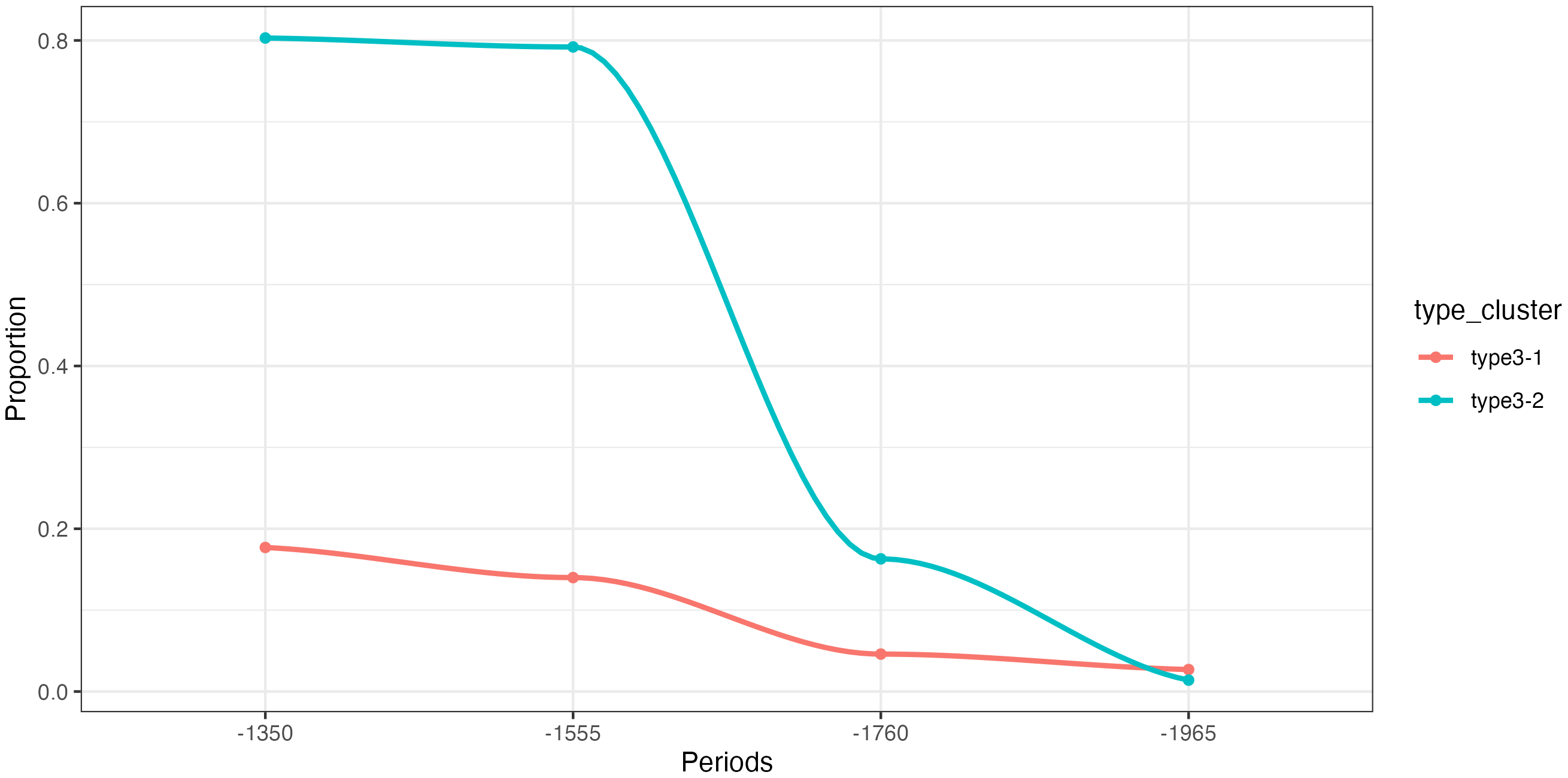
Type III verbs fall into two distinct clusters with an extremely high level of statistical significance (p < 2.8e-09; ***). Cluster 1 consists of eight verbs exhibiting steeper curves (aider, ennuyer, contrarier, assister, démanger, satisfaire, insulter, applaudir). The other Type III verbs are in Cluster 2.
This sharp contrast suggests that the trajectory of change within Type III verbs is not uniform but follows two separate pathways. Early transition verbs like aider and ennuyer display a steep S-curve, indicating the more rapid shift in case selection that is typical for Cluster 1. The transition appears to have been largely complete by the 16th century, with almost no dative attestations afterward. Later transition verbs like applaudir show a similar pattern but shifted to the right on the timeline. Verbs like empêcher, prier, and suivre exhibit more gradual transitions, reflecting weak variation and a strong accusative bias even in earlier periods. Despite these differences, the end-state of the change is clear: all Type III verbs stabilize with accusative marking, reinforcing a broader trend toward the replacement of dative case in monotransitive constructions. While the analysis in this section remains strictly within monotransitive contexts, the section “Supplementary Materials S3” explores further, considering whether the availability of alternative valency patterns for these verbs might have influenced the observed trajectories.
In the previous sections, we analysed verb behaviour through log-odds curves, which modeled the likelihood of selecting a dative rather than an accusative object. However, to understand these results in simpler terms, we briefly return here to the raw data, represented as proportions of datives versus accusatives, shown in Figure 8. This “dative ratio” indicates how frequently verbs appeared with a dative object compared to the total occurrences in monotransitive constructions for each historical period. A dative proportion of 1.0 would indicate that the verbs appeared exclusively with the dative in monotransitive structures. Figure 8 thus confirms the log-odds curves of Figure 7: the dative proportion of Cluster 1 verbs decreases from almost 80% (0.8) in Old French to close to zero, whereas the proportion of Cluster 2 verbs is already below 20% (0.2) in Old French and decreases steadily. The interpretation of this difference is necessarily speculative: The proportions and the log-odds curves of Cluster 2 taken together could be seen as the terminal phase of a change from dative to accusative selection that began prior to the textual record and thus may have also been more S-shaped (see Sections 6.2 and 6.4 for further discussion of this point). For example, the slopes of empêcher, prier and suivre could be interpreted as S-curve end segments.
Dative proportions of the two Type III clusters.

In conclusion, log-odds curves serve as a useful tool for identifying types of linguistic change. The two extreme cases, a straight line and a steep S-curve, allow us to differentiate grammatical change from changes associated with meaning. K-means clustering further refines this analysis by distinguishing potential types of change across the continuum of curve shapes, while significance tests ensure that the observed differences are meaningful. This approach highlights the interplay between individual verb behaviour and grammatical trends and forms the basis of our discussion of grammatical change in the next section.Footnote 6
6. ANALYSIS
6.1. Force dynamics and the aider vs obéir distinction
By far the most striking pattern that emerges from the findings is the counter trend of the four Type II verbs of reacting and resisting (désobéir, échapper, obéir, survivre), overlooked in all previous studies. While the default accusative linking rule absorbs Type III (aider) verbs, these four Type II verbs stabilize as MTDs. The significance of these verbs is that they are formally indistinguishable from Type III verbs until the 16th century. The subsequent reverse course of change exposes an important semantic distinction that must have become grammatically relevant to learners at that time. This distinction is essentially invisible to theories that rely only on semantic roles to describe argument realization, but it is evident in the cognitive linguistic tradition since Talmy’s (Reference Talmy1988) proposal of force dynamics. Force dynamics encompasses the notion of causation and extends it to include concepts of ‘helping’, ‘letting’, ‘hindering’, ‘reacting’, and ‘resisting’. Beyond verbs, this semantic category can also be identified in non-verbal elements not normally considered to be related to causation.
Force dynamics involves the interaction of two event participants: an Agonist and an Antagonist. The Agonist has an intrinsic tendency toward action or toward rest, and, depending on the relative strength of the opposing force (the Antagonist), the Agonist either maintains its intrinsic tendency, or it does not. Example (21) illustrates a typical case of causation: Sam is the Agonist, and his intrinsic tendency is to stay. Harry is the Antagonist, and due to his application of an opposing force, Sam leaves. Example (21) can therefore be paraphrased as ‘Harry caused Sam to go away through force’.

The interest of force dynamics is that it extends standard cases of causation, like that in (21), by applying the same Antagonist-Agonist opposition to events whose outcomes, often implicit, are only potentials. There is no inference that the outcomes took place as there is in (21). Viewing events this way, the Antagonist need not be subject. The use of the verb keep in example (22) demonstrates this point; the subject, the ball, is the Agonist with a natural tendency to roll but finds itself working (successfully) against an opposing force, the stiff grass. In this example, the Antagonist does not occupy an argument position but rather occurs in an adjunct prepositional phrase.

Our implementation of force dynamics draws on Jackendoff’s (Reference Jackendoff1990) sparser adaptation of Talmy’s system, more compatible with approaches involving thematic relations and a lexical semantics framework. While the two opposing forces of Agonist and Antagonist are preserved, Jackendoff reconfigures the dynamic in terms of the Antagonist, which he takes to be agentive: the Antagonist desires an action on the part of the Agonist and is more or less successful.
The choice of semantic representation has, of course, its own theoretical commitments. Talmy’s framework biases physical and psychological causation capturing a level of semantic organization crucial for argument realization missed by theories based uniquely on thematic (proto-)roles like Agent and Patient, which favour oppositions involving volition, sentience, and affectedness.
6.1.1. Type III Antagonist-subject verbs: helping and hindering
Turning to the French MTDs in Table 1, Type III verbs like aider ‘help’ have been given significant consideration within a force-dynamics framework (see Jackendoff, Reference Jackendoff1990, §7.31 and Talmy, Reference Talmy2000, vol.1, ch.7, §2.6). Events of ‘helping’ and ‘letting’ involve the two forces Agonist and Antagonist striving for the same potential outcome. For instance, in (23), the verb aider ‘help’ is construed as Marie (Antagonist) striving to bring about Jeanne’s natural inclination to leave by removing potential obstacles.

A host of Type III verbs lexicalize a similar interaction: assister ‘assist, aid’, servir ‘serve’, secourir ‘help’, satisfaire ‘satisfy, meet, fulfil’, favoriser ‘favour, support’. Both applaudir ‘applaud’ and congratuler, ‘congratulate’ also lexicalize the concept of ‘helping’ or ‘letting’ in the sense that the dynamic is conceptualized as a potential opposition between Agonist and Antagonist, but in which the Antagonist instead strives for the same outcome as the Agonist. Suivre ‘follow’ can be construed in a similar way in the sense of the Antagonist aligning itself with the inclinations of the Agonist.
Type III also includes verbs that lexicalize ‘hindering’ or degrees of ‘not letting’. These verbs contrast with aider in that they lexicalize the Antagonist’s imposition of an opposing force by creating an obstacle, shown in (24) with empêcher ‘prevent’.

Persuader ‘persuade’ lexicalizes a similar force dynamic in that the Agonist’s natural tendency is successfully changed. Other such verbs are contrarier ‘annoy’, contredire ‘contradict’, ennuyer ‘bother’, offenser ‘offend’, incommoder ‘inconvenience’. Unlike ‘prevent’ and ‘persuade’, however, these verbs do not entail that the Agonist’s natural tendency was successfully opposed. In a similar vein, the meanings of prier ‘beg, pray’, supplier ‘beseech, implore’, conseiller ‘counsel, guide’, commander ‘command’ and démanger ‘provoke in someone a strong desire to do something, usually to scratch’ involve an Antagonist who desires an action on the part of the Agonist, whose natural tendency is potentially not to perform such an action.Footnote 7
6.1.2. Type II Agonist-subject verbs: reaction and resistance
Four Type II verbs are the mirror image of Type III verbs; the roles of Agonist and Antagonist are reversed. Notice in (25), for instance, that the dative argument, à la police, is construed as the Antagonist in this interaction. The subject Agonist’s natural tendency is to not be held by the Antagonist. The latter exerts a force to prevent that tendency but is not successful; Marie successfully avoids being caught by the police. This pattern, where the Agonist is realized as the external argument, was introduced in (22).
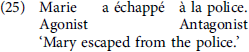
Talmy considers this kind of interaction to be one of the most basic force-dynamic concepts, referring to it generally as one of resistance (Talmy, Reference Talmy2000, vol.1, ch.7, §2), and verbs that align with this concept are described in Jackendoff (Reference Jackendoff1990, §7.33) as “verbs of reaction”.
The three other Type II verbs whose dative object replaced the accusative variant have the same force-dynamic interaction as échapper: désobéir ‘disobey’ has a similar unsuccessful outcome for the Antagonist while obéir ‘obey’ lexicalizes an Antagonist who successfully opposes the subject Agonist’s intrinsic tendency.

Survivre lexicalizes the concept of continuing to live after the death of someone, a clear example of resistance for which the Agonist subject resists the force of death (see Talmy’s related discussion of the modal meaning of keep as a lexicalization of resistance).
The Type II Agonist-subject verbs désobéir, échapper, obéir, and survivre therefore present a reverse interaction vis-à-vis the Type III Antagonist-subject verbs (aider, empêcher, prier, etc.) discussed in 6.1.1, and we propose that it is precisely this semantic difference that underlies their reverse trajectories; as the large set of Type III verbs increasingly aligns with the default accusative linking rule, the four Type II verbs become modern French MTDs now forming a coherent group with other Agonist-subject verbs such as céder ‘yield’, déférer ‘defer’, obtempérer ‘obey’, réagir ‘react’, and résister ‘resist’.
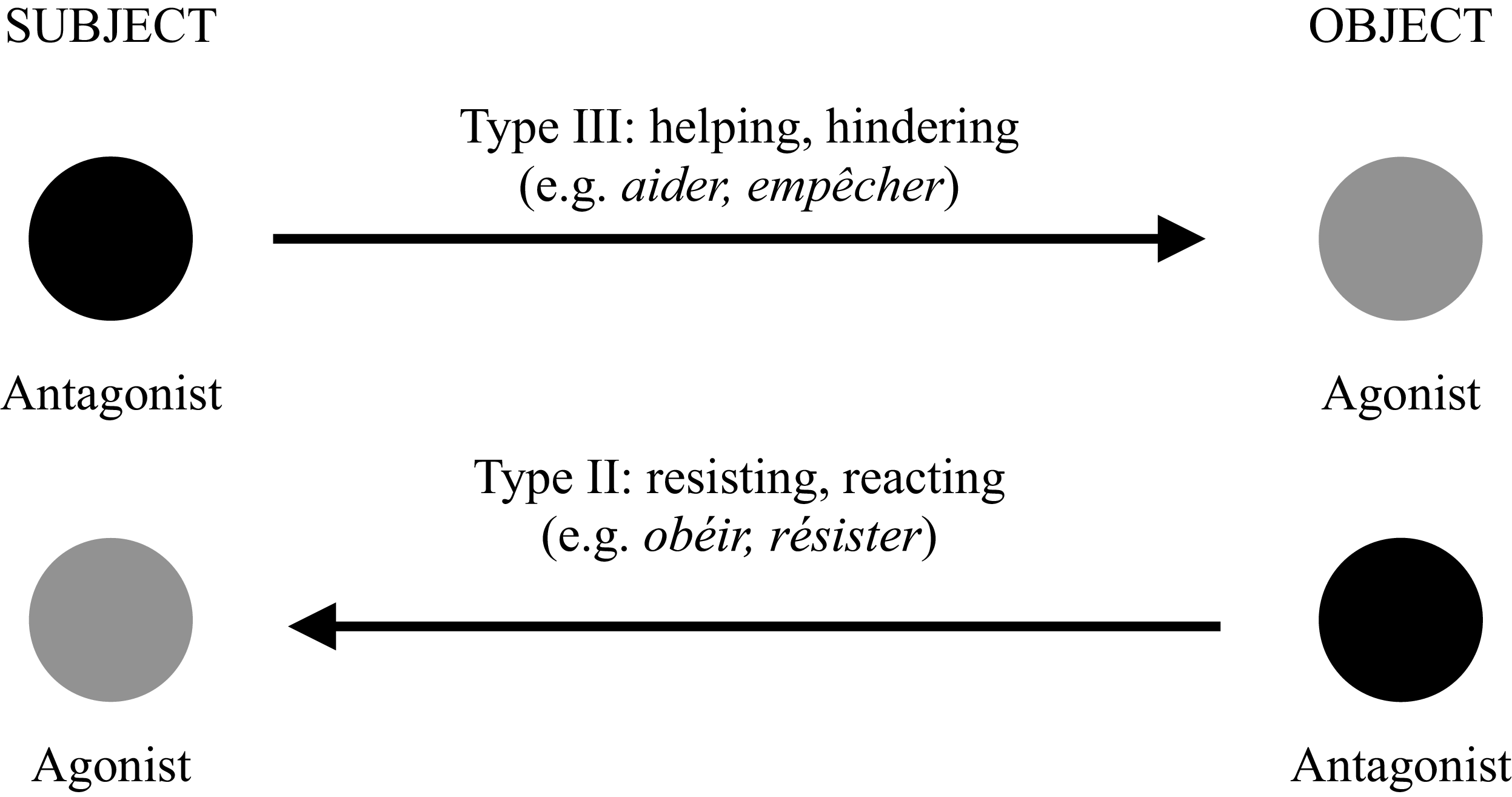
Figure 9 illustrates how Type III and Type II verbs lexicalize two different but closely related kinds of force-dynamic interactions. The arrow represents the direction of force; participants on the left are realized as subject and those on the right as object.
Force dynamics applied to Type II and Type III verbs.

6.1.3. Antagonist vs Agonist: syntactic distribution
In addition to the semantic differences between Antagonist and Agonist event participants, at least two generalizations support the claim that Antagonist-subject verbs (helping and hindering) form a syntactically identifiable class distinct from Agonist-subject verbs (resisting/reacting) as described above. The first generalization is that the internal argument of helping and hindering verbs can serve as the logical subject of a non-finite complement clause (27a), since the clause expresses the Agonist’s natural inclination. In contrast, the internal argument of resisting/reacting verbs never can (27b).

The second points to an asymmetry in the possible interpretations of the two types of subject. Having stronger agentive properties, Antagonist subjects can hold the role of Instrument with helping and hindering verbs (28b), but an Agonist subject cannot (29b, d); see Talmy (Reference Talmy2000, vol.1, §2.5.1) for another–possibly related–asymmetry involving Instruments.

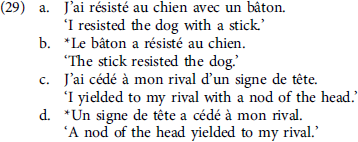
In sum, although Type II and Type III verbs both encode related force-dynamic interactions and tend to mark their internal arguments identically from a cross-linguistic perspective, we have shown that they have distinct semantics and corresponding distinct syntactic distributions. We contend that these differences underlie the split in the history of French.
6.2. Reorganization of the historical MTDs
Our quantitative findings reveal the consolidation of an oblique linking rule for verbs of resisting/reacting—such as obéir ‘obey’, désobéir ‘disobey’, résister ‘resist’, céder ‘yield’, and survivre ‘survive’. This narrow rule is grounded in a force-dynamic interaction uniquely involving Agonist-subject verbs (e.g., obéir, résister) and, crucially, excluding Antagonist-subject verbs (e.g., aider, empêcher), as evidenced by their wholesale shift to default accusative marking.
One question that arises is whether there is a causal relation between these two developments. It is possible, but such interaction effects cannot be demonstrated statistically. A causal explanation would posit the existence of a broader dative linking rule at a much earlier stage of the language, inherited from Latin, that encompassed both Agonist-subject and Antagonist-subject verbs, suggested in section 2. Shifts in lexical inventories and the loss of inflectional case marking likely contributed to the eventual dissolution of this broader linking rule.
Type II verbs, those in flux, gradually align with a dative linking rule targeting Agonist-subject verbs of resisting/reacting. This emerging distinction may have then created the conditions for the remaining former members of the broader linking rule (Antagonist-subject verbs of helping and hindering) to stabilize as default transitive verbs. This latter class of verbs were already semantically well-suited to a transitive pattern favouring a more typical asymmetry between proto-Agent subjects and proto-Patient objects. Relatedly, force-dynamic causative verbs like helping and hindering–but with clear outcomes–appear to have always taken accusative objects in French: forcer ‘force’ and laisser ‘let’ as in forcer/laisser quelqu’un faire quelque chose ‘force/let someone do something’ and arrêter ‘stop’ as in arrêter quelqu’un de faire quelque chose. The similarity in event construal among forcer, laisser, arrêter on the one hand and aider, empêcher on the other should, under the right circumstances, be conducive to similar argument structures.Footnote 8
It may be tempting to liken the split between Type II and Type III verbs to morphological levelling, where Type III verbs level with the dominant accusative-marked objects while Type II remain “irregular” as datives. It is well established that high token frequency can preserve irregular forms from regularization, modelled for English past-tense morphology, for instance, by Hare and Elman (Reference Hare and Elman1995).Footnote 9 We are hesitant however to transfer such purely morphological accounts to the domain of argument structure. In Hare and Elman’s model, irregularities are arbitrary and preserved by strength of memory (frequency). In contrast, the ‘irregular’ Type II obéir dative verbs are not a random collection of frequent items but rather form a semantically coherent class (verbs of resisting/reacting). Moreover, our data show that even lower-frequency verbs within this semantic class resist the accusative drift, such as survivre. This suggests that their stability is not or not exclusively a frequency effect (memorisation) but the result of a semantically grounded linking rule. More recent work on the acquisition of argument structure suggests that formal classes are learned on the basis of types, not token counts (i.e., frequency); see Yang (Reference Yang2016) and Irani (Reference Irani2019).
6.3. Previous accounts held up to the findings
The findings of the quantitative study can now be brought to bear on various previous claims about the changes (section 3.4).
6.3.1. Abstract grammatical change
Most log-odds curves for Type II and III verbs are complete or partial S-curves, suggesting linguistic replacement, but the slopes are different enough to confidently rule out any constant rate effect (Kroch, Reference Kroch1989). This means that the replacements are not driven by an underlying grammatical formative, dispelling, for instance, the hypothesis put forward in Troberg (Reference Troberg2008, Reference Troberg2013).
6.3.2. Randomness, ambiguity, and reanalysis
Based on a small sample of monotransitive verbs whose object alternates between dative and accusative case in medieval French, Goyens (Reference Goyens1998) concludes that there is no apparent pattern to the change. We have demonstrated using quantitative methods that the changes are not random once one controls for MTDs and semantic change.
6.3.3. Analogy
Lüdi (Reference Lüdi1978, Reference Lüdi1983) attributes the change from dative to accusative to a change in an analogical rule: in medieval French, the object of verbs like aider patterned by semantic analogy with dative benefactors while in modern French they are subject to structural analogy with transitive verbs taking infinitival complements like amener quelqu’un à faire ‘lead someone to do something’. This hypothesis cannot account for the full range of verbs, especially the hindering verbs (e.g., empêcher, contrarier, contredire, ennuyer, offenser, incommoder), many of which neither select a benefactor nor allow infinitival complements. Further, Lüdi’s proposal has nothing to say about obéir, désobéir, échapper, and survivre. While we do not rule out analogy as a force of change, it cannot provide a principled account of the systematic reorganization of our French two-argument verbs. Instead, we adopt the view that such analogical effects are not primitives of change, but rather observable epiphenomena of underlying data-driven learning mechanisms (see Kodner Reference Kodner2023 for a derivation of analogical change based on the Tolerance Principle).
6.3.4. Specialization of the object experiencer construction
Schøsler (Reference Schøsler, Blumenthal and Tyvaert2003, Reference Schøsler and Thórhallur2008, Reference Schøsler, Baronian and Martineau2009, Reference Schøsler2010) claims that the Subject-Verb-Indirect Dative Object construction has become specialized in French, now expressing a psychological relation between the animate object on the one hand and the subject on the other. One effect of this is that verbs such as aider ‘help’, which do not fit the semantic profile of the construction, have shifted toward the default Subject-Verb-Direct Object construction, which expresses no particular meaning. Our findings support the essence of Schøsler’s account. Aside from verbs of directed communication (Section 3.3.2), non-agentive MTDs dominate Type I verbs (Section 3.3.1), and since Type III verbs are not consistent with this profile, the default accusative is favoured for the form of their object. An important insight gained from our analysis is that Agonist-subject verbs like obéir and résister, weakly agentive themselves and unaccounted for in Schøsler’s work, pattern with the non-agentive verbs suggesting that weak agentivity may be a general property of modern French dative linking rules.
6.4. A rule for MTDs
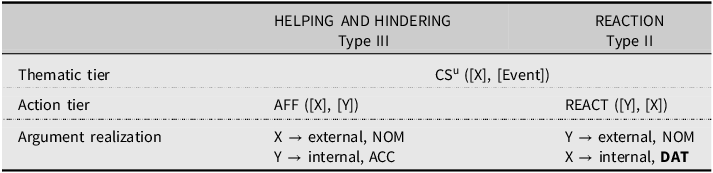
Our results suggest that the reorganization of MTDs in French was not arbitrary but driven by a cognitively relevant semantic distinction captured by force dynamics as proposed in Talmy (Reference Talmy1988, Reference Talmy2000) and reformulated in Jackendoff (Reference Jackendoff1990, 130–133). In this section, we elaborate on the formal treatment of these two classes, relating the force-dynamic semantics of Type II and Type III MTDs to Levin’s event structure of CTVs and NCTVs. Jackendoff subsumes both verbs of helping and hindering and verbs of resisting/reaction under a function CS involving causation and the application of force: CSu ([X], [Event]). This function includes an entity X, the Antagonist, which exerts effort toward the realization of some event [Event] involving an Agonist, which may be implicit. The superscript ‘u’ indicates that the outcome of CS is undetermined in contrast with verbs whose outcome is clear (e.g., let, force, stop, etc.). In Table 2, the CSu function belongs to Jackendoff’s thematic tier, where common event primitives like CAUSE, GO, BE, etc. are also represented; CSu is the primitive relevant to our analysis.
Helping and hindering vs. reaction
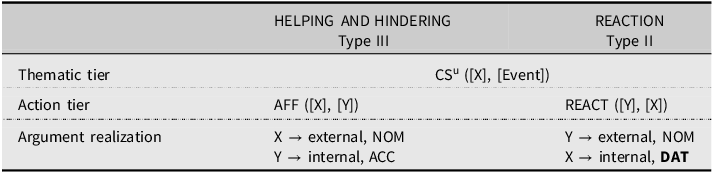
While dyadic interactions such as helping, hindering, and reacting are unified in the thematic tier as causal events with undetermined outcomes, they are differentiated at the action tier level where Actor-Patient relations are encoded and where argument linking is primarily determined. In our case, the action tier defines the central set of oppositions between Type II and Type III verbs. For Type III verbs, the Antagonist (X)–the entity initiating the force–is foregrounded within the function AFF (“affect”). On the other hand, Type II verbs foreground the Agonist (Y)–the reacting participant–within the function REACT. What this formalism shows explicitly is that both AFF and REACT involve the same force-dynamic interaction, CSu ([X], [Event], and differ primarily in terms of viewpoint: events of resisting/reacting, REACT ([Y], [X]) are the mirror image of events of helping and hindering, AFF ([X], [Y]).Footnote 10
Argument realization is subsequently established following the convention that the first argument of the action tier maps to the external argument while the second argument maps to the internal argument. In French, external arguments are assigned nominative case. In the presence of an external argument, the internal argument is assigned accusative case by default unless outranked by an oblique linking rule, which is precisely the case for Type II verbs of resisting/reacting in French.
Applied to Levin’s non-core transitive verbs (NCTVs) as summarized in the introduction, CSu ([X], [Event]) can be seen as a specific type of activity [x ACT<MANNER> y] and crucially distinct from core transitive verbs (CTVs), which are essentially bi-eventive causatives having result semantics: [[x ACT] CAUSE [y BECOME <STATE>]] or [[x ACT] CAUSE [y BECOME IN <PLACE>]].
Mapping to syntax, the Elsewhere mapping rule in (31) is the general default in linking theory (Levin and Rappaport Hovav Reference Levin and Rappaport Hovav2005), covering the AFF function in modern French. However, the specificity of the oblique rule in (30) overrides this default for verbs of resisting/reacting.


The analytical strength of this approach lies in its ability to capture shared semantic properties, define relevant distinctions, and separate the presence of arguments from their specific case marking. The thematic tier captures the causal force-dynamic dependency shared by both verb classes, justifying common cross-linguistic patterns; the action tier captures the difference in point of view (AFF is set from the Antagonist’s point of view while REACT is set from the Agonist’s); and argument realization proceeds according to language-specific mapping rules. As we’ve already suggested, one might infer from the data that at a period pre-dating the French textual record, perhaps a period of Latin, a more encompassing oblique linking rule existed, such as that in (32).

Finally, this tiered model aligns with findings in language acquisition research. While the action tier is a theoretical construct, experimental evidence suggests that the force-dynamic oppositions it encodes (Agonist vs. Antagonist) are highly salient and acquired early (e.g., Pinker Reference Pinker1989, §5.5.11). Furthermore, recent computational work (e.g., Irani Reference Irani2019; Li Reference Li2024) supports the view that learners form productive generalizations over such semantically defined verb classes.
7. DISCUSSION AND CONCLUSION
Our quantitative approach to MTDs in French reveals a systematic reorganization of object case marking characterized by three distinct historical trajectories: stable dative verbs (Type I), verbs shifting from variation with accusative marking to exclusively dative marking (Type II) and in the opposite direction, from variation with dative marking to exclusively accusative marking (Type III). The trajectories align with a force-dynamic account of the verbs, where verbs of reacting and resisting (e.g., obéir, résister) consolidate as dative verbs governed by a rule such as that in (30), and verbs of helping and hindering (e.g., aider, empêcher) shift toward taking the default accusative object. This leads us to assume that there was no longer sufficient evidence of a productive oblique linking rule that would have subsumed both classes, as proposed in (32). The analysis contributes to a growing body of literature demonstrating that force dynamics is a prominent semantic determinant of case and adposition distinctions; see, for example, Huumo (Reference Huumo2007) for the use of directional case with verbs of remaining in Finnish, Zwarts (Reference Zwarts, Evans and Chilton2010) for the denotation of certain locative prepositions and motion verbs, and Svenonius (Reference Svenonius, Filipović and Jaszczolt2012) on uses of the illative case in North Sámi.
As to methodology, this study underscores the importance of quantitative corpus-based research for historical linguistics, especially as concerns valency changes and argument structure changes for which tokens tend to be thin. In this sense, the uniquely rich textual time depth afforded for French makes it ideal for investigating understudied and less-represented properties at the syntax-semantics interface. Indeed, the combination of large-scale diachronic corpora, log-odds regression and clustering analysis has allowed us to track argument structure shifts over ten centuries, revealing patterns that are difficult to detect with a qualitative approach.
Furthermore, the detailed diachronic patterns established here for standard French provide an empirical baseline for future comparative research. Investigating how the linking rules for these semantic verb classes have evolved in other standard and non-standard Romance varieties would be an important next step in understanding the broader dynamics and breadth of semantic determinants involved in argument-structure change.
We also emphasize the descriptive importance of our analysis. The fact that verbs of resisting/reacting (obéir, résister, etc.) have remained stable for over 400 years indicates that the relevant linking rule (30) is learnable despite the small size of the class. The class is clearly real, crucially contrasting with helping and hindering verbs, yet without exception, it has been overlooked as a coherent class in reference grammars and pedagogical materials.
Finally, while this study documents the outcome of this grammatical reorganization, it does not identify a specific external trigger for the change. We contend that a full account requires a formal model of learnability capable of distinguishing between frequency-based exceptions and the maintenance of minority rules based on potentially sparse input. In a companion study, we address this issue by applying Yang’s (Reference Yang2016) Tolerance/Sufficiency Principle to child-produced and child-directed speech data.
Supplementary material
The supplementary material for this article can be found at https://doi.org/10.1017/S0959269525100215.


 Open access

