

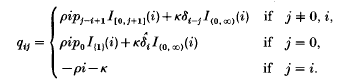
 . Thus X
 . This ensures that the MBP obtained by setting κ = 0 is regular ([1], p. 105) and hence
Crossref Citations

This article has been cited by the following publications. This list is generated based on data provided by Crossref.
Grey, D. R.
1988.
Supercritical branching processes with density independent catastrophes.
Mathematical Proceedings of the Cambridge Philosophical Society,
Vol. 104,
Issue. 2,
p.
413.
Pakes, Anthony G.
1989.
The Markov branching process with density-independent catastrophes. II. The subcritical and critical cases.
Mathematical Proceedings of the Cambridge Philosophical Society,
Vol. 106,
Issue. 2,
p.
369.
Pakes, Anthony G.
1989.
Asymptotic results for the extinction time of Markov branching processes allowing emigration, I. Random walk decrements.
Advances in Applied Probability,
Vol. 21,
Issue. 2,
p.
243.
Pakes, Anthony G.
1989.
Asymptotic results for the extinction time of Markov branching processes allowing emigration, I. Random walk decrements.
Advances in Applied Probability,
Vol. 21,
Issue. 2,
p.
243.
Pakes, Anthony G.
1990.
The Markov branching process with density-independent catastrophes. III. The supercritical case.
Mathematical Proceedings of the Cambridge Philosophical Society,
Vol. 107,
Issue. 1,
p.
177.
Vatutin, V. A.
and
Zubkov, A. M.
1993.
Branching processes. II.
Journal of Soviet Mathematics,
Vol. 67,
Issue. 6,
p.
3407.
Kale, Mandar
and
Deshmukh, S.R.
1995.
Maximum likelihood estimation in birth-death process allowing catastrophes.
Communications in Statistics - Theory and Methods,
Vol. 24,
Issue. 7,
p.
1863.
Kurtz, Thomas G.
and
Rodrigues, Eliane R.
2011.
Poisson representations of branching Markov and measure-valued branching processes.
The Annals of Probability,
Vol. 39,
Issue. 3,
Braun, Georg
2022.
On supercritical branching processes with emigration.
Journal of Applied Probability,
Vol. 59,
Issue. 3,
p.
734.