





Introduction
In the last decade, there has been substantial progress in the Information and Communication Technology (ICT) sector and in the introduction of digital services and facilities across all walks of life. This is true not only in the minority countries but also in majority countries, such as Bangladesh. Digital culture has already begun to take root in the country’s socio-political and economic life. Naturally, research is taking place nationally and internationally to understand how such digitalization is influencing and shaping society, politics, and the economy (Hasan, Reference Hasan and Ahmed2020; Mazumdar & Alharahsheh, Reference Mazumdar and Alharahsheh2020; Rahman, Reference Rahman2016, Reference Rahman2019). Civil society is an important sector that has also undergone digital changes. From a historical perspective, civil society in Bangladesh has contributed significantly to movements to ensure language rights, liberation, and democracy. At the beginning of the new millennium, Bangladeshi CSOs gained international recognition in social development. For the last two decades, national and international scholars have been tracking the development of civil society in Bangladesh (Ahmed, Reference Ahmed2021; Lewis, Reference Lewis2017; Tasnim, Reference Tasnim2021). However, there have been few systematic studies of the new generation of CSOs and their nature, performance, and contributions in recent years. The present article not only focuses on relatively new civil society organizations but also examines the nature of their use of digital platform, exploring the extent to which and in what ways they utilize digital platforms to achieve their goals. The main contribution of the article is to understand the extent to which new CSOs use digital spaces for advocacy and service delivery in Bangladesh, against the backdrop of limited digital infrastructure, the digital divide, and other social and legal restraints.
Most of the CSOs that gained prominence for their activities during the COVID-19 pandemic in 2020 are relatively new. During the first wave of the pandemic, these formal and informal CSOs initiated the primary private response to the needs of the most vulnerable and those in need of medical care. However, their formation, platform building, support expansion, fundraising, and coordination all happened in the virtual network. While these new generation CSOs were already in action, it took several months for the well-established NGOs and other traditional CSOs to come forward during the pandemic. These days, it is said that a Facebook (FB) page is enough to initiate and organize voluntary activities and protests. Nonetheless, this is a global phenomenon that has been true across all countries, whether Majority World or Minority World.
Though digital voluntarism was a common phenomenon in the Western world (Guo & Saxton, Reference Guo and Saxton2014; Lovejoy & Saxton, Reference Lovejoy and Saxton2012) and multiplied during the COVID-19 period, it is not the case for Majority-World countries. Rather, COVID-19 ignited the culture of digital volunteerism, and it particularly developed among the new generation. Despite such triumph, recent literature indicates a mixed situation, especially in the majority world. Some practical social, cultural, regional, institutional, technological, and governance-related variables play a role in the complex phenomenon of digital divide, apathy, and exclusion (Djatmiko et al., Reference Djatmiko, Sinaga and Pawirosumarto2025; Dwi Wahyunengseh et al., Reference Dwi Wahyunengseh, Hastjarjo, Mulyaningsih and G. Suharto2020; Lay & Fietz, Reference Lay and Fietz2023; Lynn et al., Reference Lynn, Rosato, Conway, Curran, Fox, O’Gorman and Lynn2022; Syed et al., Reference Syed, Bandara and Eden2023). With such a complex background, Bangladesh is a prime candidate for investigating the new generation of civil society and the nature of its digital use. Although some CSOs receive public attention for their voluntourism and digital advocacy, it is essential to understand the status of the rest of the new generation of CSOs through a methodical investigation.
The present article has undergone content analysis of the websites and FB pages of the sampled CSOs that have registered from 2011 to 2021. Their digital activities have been analyzed under four broad headings: information and transparency, participation, networking, and mobilization. Although a few CSOs have gained attention for their digital performance, 81% do not have an official website; however, 39% are actively using Facebook. Only 5% and 4% are using Instagram and Twitter, respectively. CSOs that are active in the digital platform are mostly concerned about providing information about themselves rather than doing online advocacy or mobilizing their target groups. Among the different types of CSOs, youth groups have been found to be the most active on Facebook, while service-providing CSOs and environmental CSOs have been observed to be less interested in using digital platforms for advocacy and providing services. The CSOs must go far ahead to utilize the digital facilities they are enjoying.
Theoretical background
Civil Society is generally considered to be a sustained, organized social activity that occurs in groups formed outside the state, market, and family (Schwartz & Pharr, Reference Schwartz and Pharr2003). Thereby, we can understand that the sustained and organized social activities that take place in civil society are carried out by different groups or organizations that we may term civil society organizations (CSOs). CSOs are considered the basic units of a civil society. A variety of organizations may be considered as CSOs, such as clubs, local cooperatives, labor unions, sports associations, religious groups, citizens’ organizations, professional groups, and all sorts of charity and nongovernmental organizations (NGOs). CSOs are active in both service delivery and advocacy. Advocacy refers to negotiating and pursuing the government on various political and social issues, as well as for the particular interests of CSOs themselves (Tasnim, Reference Tasnim2012). Additionally, efforts to ensure transparency and accountability in the government are also part of advocacy.
Moreover, in majority countries, raising public awareness of various socioeconomic issues and providing political education to the general public are also part of civil society advocacy. Service delivery refers to the functions of CSOs through which they offer tangible services, such as microcredit, skill training, adult education, and health support. Often, CSOs provide these services as facilitators of government through joint venture partnerships. Through advocacy and service delivery, CSOs’ outreach to communities and governmental bodies contributes to public policy formulation and implementation, thereby creating avenues for broader citizen participation. In doing so, CSOs are also able to mobilize their members, supporters, and followers around specific issues or causes (Diamond, Reference Diamond1999). While CSOs rarely aim to capture political power, they do engage in political spaces. Often, they come into conflict with the regimes in power in their path to ensure accountability and transparency. Autonomous CSOs are considered indispensable for democratic government. In the majority of states, the regimes prefer CSOs to help them with service delivery while trying to restrict the civic space for advocacy. Civic space is in decline in the majority world, where regimes apply legal and political mechanisms to restrict civil society’s autonomous movements (Ahmed, Reference Ahmed2021; Firmin et al., Reference Firmin, Pousadel and Tiwana2024; Lewis, Reference Lewis2017; Tasnim, Reference Tasnim2021). In response, civil society finds an alternative mechanism through technology.
Since the advent of digital technology, advocacy has undergone a dramatic shift, moving from traditional methods to complex online campaigns. Significant progress has been made in this area by concentrating on the basic attributes and efficacy of social media messaging by using digital platforms such as websites, Facebook, or Twitter (Saxton et al., Reference Saxton, Niyirora, Guo and Waters2015). Such technology helps stakeholder engagement, quality services, low-cost operation, community building, fundraising, and advocacy among the CSOs. Moreover, technology completely changes the approach to how they organize locally, nationally, and worldwide (Guo & Saxton, Reference Guo and Saxton2017; Lovejoy et al., Reference Lovejoy, Waters and Saxton2012; Lynn et al., Reference Lynn, Rosato, Conway, Curran, Fox, O’Gorman and Lynn2022). These digital functions comply with the basic rules of civil society and its relation to democracy, accountability, and democratic government. Even if they are working in the digital platform, the civil society, like other political structures (Foot & Schneider, Reference Foot and Schneider2006), works in basically four dimensions as follows: (1) organizing participation of the people, (2) connecting them and networking with other organizations, (3) mobilizing the people toward a certain cause, and (4) maintaining information and transparency. They do this with the help of different types of digital content and interaction mechanisms.
Research like An and Yu (Reference An and Yu2024), Lovejoy et al. (Reference Lovejoy, Waters and Saxton2012) and Guo and Saxton (Reference Guo and Saxton2014) have successfully shown how CSOs use the digital platforms for advocacy, public participation, and networking. They show that the use of platforms has become popular among CSOs, not at once but gradually. However, these studies were conducted in United States. In majority-world countries where digitalization began late, CSOs’ digital performance and practices vary and are far behind. Here exists individual and institutional hesitancy concerning technology adaptation, which was the case in the initial years in the United States, too (Lovejoy & Saxton, Reference Lovejoy and Saxton2012). Given the digital divide, the expected digitalization is not uniform across the country (Lynn et al., Reference Lynn, Rosato, Conway, Curran, Fox, O’Gorman and Lynn2022). In the majority of countries, the low level of education, limited economic capacity, uneven development, and unequal digital access mostly cause the digital divide. Uneven digital accessibility is forming new social classes.
The primary aim of digitalization in Bangladesh is to bring changes and accomplishments effectively in education, health, poverty, social improvement, and many other areas. Human resource development, connecting citizens, digital government, and many other components are important for digital Bangladesh. The concept and policy framework of digital Bangladesh is based on four pillars. (1) Human resource development, (2) Connecting citizens, (3) Digital governance, and (4) Information, Communication, and Technologies (ICT) business (Hasan, Reference Hasan and Ahmed2020, p. 173). The second and third pillars, that is, connecting citizens and digital governance, align with the objective of integrity in the national ICT policy. It concerns transparency, accountability, responsiveness, and greater efficiency in the delivery of services to citizens (Hasan, Reference Hasan and Ahmed2020, p. 180). This is where the government must rely on other organizations, especially civil society.
Social media adoption is portrayed in Western nonprofit literature as a multiplatform diversification with specialized digital teams (Carboni & Maxwell, Reference Carboni and Maxwell2015, p. 975). As for Bangladesh, the most common social media is Facebook. According to national-level data, in 2022, when the present research was conducted, the total number of internet users was 52.58 million, and the total number of social media users was 49.55 million. Facebook reached almost 44.70 million users in Bangladesh by the end of 2022, making up almost 85.01% of the nation’s internet user base. Conversely, at the same time span, X made up 0.5% of the eligible population, but Instagram reached ~4.45 million members, 2.7% of the total people (Kemp, Reference Kemp2022). These discrepancies imply that Facebook serves as Bangladesh’s main mass communication medium for public interaction, especially among those with limited resources or those who are technologically marginalized. In practice, Facebook is often given priority by CSOs engaged in disaster preparedness and response for community outreach, mobilization, and information sharing (Khan et al., Reference Khan, Khatun, Khan, Hasan and Islam2025). Consequently, Bangladeshi CSOs prioritize platforms based on practical reach and engagement potential, unlike the diversified strategies of the Global North.
Nevertheless, it is worth noting that digital activities and CSO expressions were often controlled and shaped by the infamous Digital Security Act in Bangladesh. The primary goals of the act were national security, safeguarding citizens’ rights, and protecting data. However, certain provisions of the act restricted online freedom of expression and caused the misuse of repressive provisions (Sengupta, Reference Sengupta2023; TIB, 2023). The law had limited the digital space for civil society to act and develop, particularly in terms of advocacy.Footnote 1 Besides the ICT-related laws, the CSOs are bound by a set of laws for registration and regulations. Though the Digital Security Act has been cancelled by the government recently, the CSOs had to abide by the law while the present research was conducted.
Among the changes that may be observed within the CSOs due to digitalization in Bangladesh, we may mention the use of digital management tools and cloud computing services for communication and task management, interaction between CSOs and people through digital tools, collecting funds through digital mechanisms, online advocacy and online services, and digital office and volunteer management, extending outreach beyond geographic barriers.
Now, it is the objective of this article to investigate the extent to which CSOs use these digital facilities to implement their goals and accomplish their functions, both advocacy and service delivery. From our discussion above, it is clear that systematic investigation of digital platforms used by civil society is rare in majority countries, particularly in Bangladesh. The present research basically targets the most common and popular platforms, the websites and Facebook official pages of the sampled CSOs. This is done through analyzing the contents of the websites and Facebook posts, as well as the engagements, for example, likes, comments, and shares. The model for analysis has been developed based on previous research on website and Facebook analysis on different institutions and companies (Ramanadhan et al., Reference Ramanadhan, Mendez, Rao and Viswanath2013; Halpern & Uttam, Reference Halpern and Uttam2013; Grancay, Reference Grancay2014; Harringan et al., Reference Harrigan, Uwana, Morgan and Timothy2017; Peruta & Sheilds, Reference Peruta and Sheilds2016), as well as political parties (Foot & Schneider, Reference Foot and Schneider2006; Tkach-Kawasaki, Reference Tkach-Kawasaki2006) and nonprofit organizations (Guo & Saxton, Reference Guo and Saxton2014; Lovejoy et al., Reference Lovejoy, Waters and Saxton2012; Saxton et al., Reference Saxton, Niyirora, Guo and Waters2015). The revealed data had been classified and analyzed from the point of view of the nature, functions, and interactions of civil society expected in a democratic political system (Alagappa, Reference Alagappa2004; Diamond, Reference Diamond1999). The method section provides details about the sampling, data scraping, and analysis methods.
Methodology
This study follows the content analysis method. The unit of analysis for the proposed research is CSOs. The most formal, active, and updated CSOs may be considered as those that are registered with the Bureau of NGO Affairs in Bangladesh (NGOAB). Because, if an NGO, a think tank, or a citizen group receives foreign funds, it must register with this bureau. Logically, when a CSO receives foreign funds, it strives to stay updated, active, and efficient in all possible ways. That is why the population for this research comprises CSOs registered with the NGOAB in the last 10 years, from 2011 to 2021. The total population of the study consisted of 565 CSOs. However, it has been found that, among these 565 CSOs, 105 CSOs have official websites, 221 CSOs have Facebook pages, only 26 CSOs use Instagram, and only 25 use Twitter in 2022. For further analysis, we have focused on the websites and Facebook platforms.
First, the NGOAB database was used to find the official websites for the 565 CSOs. Subsequently, systematic Google searches were conducted using the phrases “[CSO exact name]” and “CSO Name official website Bangladesh.” The validity of the top three or four organic results per search was personally confirmed by comparing the material with the official status claims made on the “About Us” page and CSOs activities. This is how 105 official websites were identified. Website content analysis of these 105 CSOs was conducted in May 2022.Footnote 2 To analyze website content, first, we prepared a format for 52 types of content that we found in CSO websites. The data were collected in the specified format. We coded publicly available data as present, and if the data are not accessible, we coded it as absent.
In the second phase, another 20 sets of CSOs (10 having websites and 10 not having any official website but only an official FB page) had been selected through stratified random sampling from the 565 population (10 from 105 CSOs and 10 from 460 CSOs) purposively. The number 20 was deliberately chosen, too. The official Facebook posts of the CSOs (from July 2022 to 2023) were manually scraped. As the posts were copied directly from the public page interface, they were already free from irrelevant noise such as advertisements, unrelated comments, or system-generated text. After collection, all posts were reviewed and categorized manually based on their main communication focus (e.g., informational, promotional, advocacy-related, and community engagement). This is the most basic practice (Saxton et al., Reference Saxton, Niyirora, Guo and Waters2015).
Structure for website content analysis
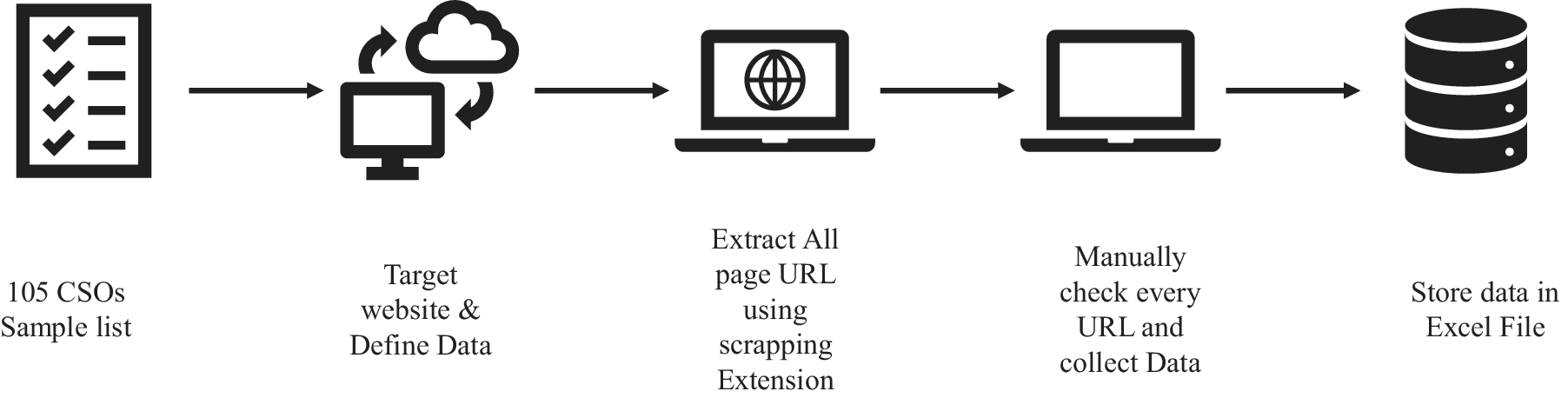
To collect data from a website, we scraped all the URLs within a website and then manually opened and browsed individual URLs. We recorded whether the website provides information and documents related to any category and subcategory items as 1 or 0 if not. We used Google Chrome Browser and URL Escaper Extension to extract URLs (Figure 1). Figure 1 and Table 1 explain the measures taken for website content analysis. For the content analysis of CSOs’ websites, we made a content structure. We made four major dimensions of CSOs’ website content (information and transparency, participation, involving, and mobilizing support and donation) of Website content (Table 1) following Foot and Schneider (Reference Foot and Schneider2006). Foot and Schneider (Reference Foot and Schneider2006) used almost the same types of four dimensions for the case of political party websites; we have applied the names of the four dimensions, but placed actions and contents that are more relevant for civil society organizations.
Website data scraping structure.

Website content analysis structure

Table 1. Long description
The table is organized into five primary functional categories.
1. Informing and transparency: This is split into two sub-columns. The Informing sub-column includes About, Mission and vision, F A Q s, Terms and conditions, News, Executive body, Privacy policy, Project details, Beneficiaries number, Organogram, Future plan, Citizen charter, Publication, Objectives, Core values, and Constitution. The Transparency sub-column includes Annual report, Photo, Video, Certification, Media coverage, Partner org data, and Chairperson speech.
2. Involving (participation): This column includes Projects, R S S feed, News letter, Join/Involve, Account create, Work area/Project, Training, Events, Jobs, and Conference.
3. Connecting (networking): This column includes Contact information, Address, Pop-up messenger, Social media hyperlink, query submission, Target people, Press release, Google map, Blog, and Research paper.
4. Mobilizing support and donation: This is split into two sub-columns. The Mobilizing support sub-column includes Awards, Donor information, Mobile finance, Bank info, Dollar payment, Success story, and Search bar. The Donation sub-column includes a single entry for Donation.
Information and transparency includes the contents that provide necessary information to introduce the CSOs, such as their basic information, mission, vision, FAQ, as well as contents that provide necessary information that clears the public inquiries about CSOs, their activity report, their source of income, pictures, videos of events, and so on (Table 1).
For involvement, we mean the website content through which CSOs try to involve the members and public in their online and offline activities. Often these functions are directly connected to the objectives of the CSOs, for example, account creation, training, joining events, RSS feed, project reports, and so on.
Connecting and networking among people and among authorities is a basic task of any CSO. Here, connecting means the contents that provide contact addresses and email of the CSOs, links to other CSOs and related government ministries, media, development partners, and pop-up messages (Table 1).
CSOs always seek support and require sponsorship or donations. Mobilizing support and donation categories means the website contents through which the concerned CSO is trying to ensure different types of support and donations online, such as providing their success stories, mentioning the awards they have received, making donation appeals, publishing bank account numbers, providing links for mobile banking, and so on (Table 1).
Structure for official Facebook page analysis
However, websites are, in most cases, noninteractive platforms. Social media has radically transformed the nature of advocacy, prompting organizations to shift from static websites to more dynamic social media engagement (Guo & Saxton, Reference Guo and Saxton2014). Scholars have also developed a methodological approach to evaluate instant audience involvement, including likes, comments, and, most importantly, shares, which offers a behavioral, quantitative indicator of a message’s impact (Saxton et al., Reference Saxton, Niyirora, Guo and Waters2015).
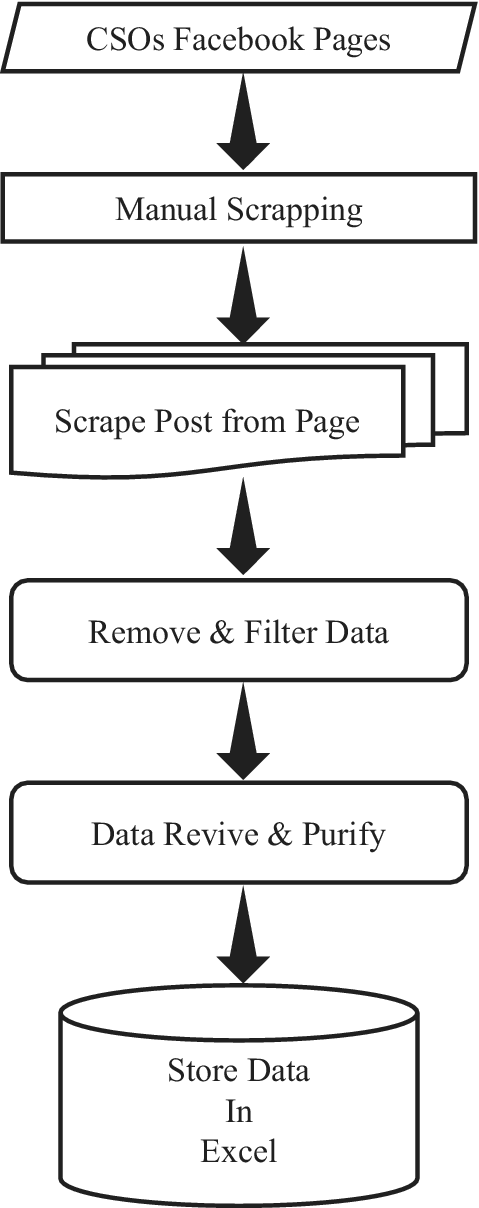
Accordingly, the present article analyzed the official Facebook page contents of 20 selected CSOs. At first, their URLs were collected. The data was scraped manually and transformed into Excel files (Figure 2). After completing the scraping, we filtered and purified the data, saving it for further analysis. The content analysis was first done from the perspective of different types of CSOs. Based on their Facebook content, the CSOs had been classified into five categories: Youth group, Advocacy group, Development group, Environment group, and Health and Disability group. In another table, based on five dimensions of CSO activity-informing and transparency, advocacy and participation, service providing, connecting, networking, and mobilizing support and donations, the content of the FB posts and their engagements have been analyzed (Table 2). The categorization of CSO activities in Table 2 differs slightly from that in Table 1. As Facebook is an interactive platform, and status updates and Facebook posts are changing over time, we have included service delivery as a new activity or dimension and updated the involving category in Table 1 to the advocacy and participation dimension.
Facebook pages data scraping structure.

Facebook page content analysis structure
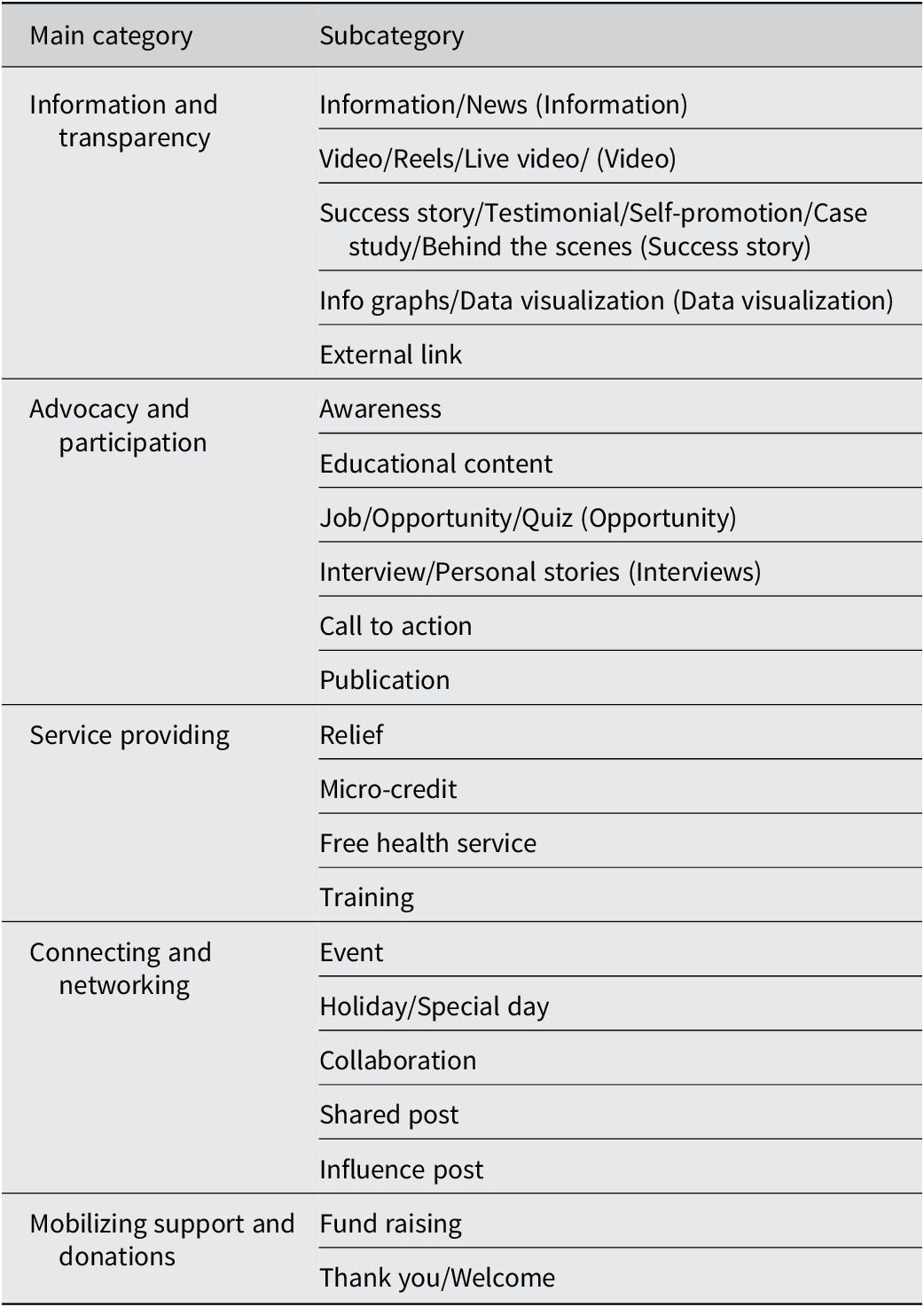
Table 2. Long description
The table is organized into two columns: Main category and Subcategory.
1. Information and transparency: includes Information/News (Information), Video/Reels/Live video/ (Video), Success story/Testimonial/Self-promotion/Case study/Behind the scenes (Success story), Info graphs/Data visualization (Data visualization), and External link.
2. Advocacy and participation: includes Awareness, Educational content, Job/Opportunity/Quiz (Opportunity), Interview/Personal stories (Interviews), Call to action, and Publication.
3. Service providing: includes Relief, Micro-credit, Free health service, and Training.
4. Connecting and networking: includes Event, Holiday/Special day, Collaboration, Shared post, and Influence post.
5. Mobilizing support and donations: includes Fund raising and Thank you/Welcome.
In total, 1,830 posts from the 20 CSOs over the 12 months (July 2022 to June 2023) have been analyzed. Moreover, the Facebook engagements by the clients of the CSOs—citizens, target groups, donors, supporters, or common viewers—have also been counted and analyzed. The engagements have been defined in page likes, post likes, comments, and shares.
Like: A page like occurs when a Facebook user enters the official Facebook page of a CSO and clicks the “Like” button for that page.
Post likes: A like occurs when a Facebook user clicks the like link below a post.
Comments: A comment occurs when a Facebook user clicks the comment link below a post and makes a remark on the original post content.
Shares: A share occurs when a Facebook user clicks the share link below a post and posts this content on their own Facebook timeline or within a group timeline (Peruta & Sheilds, Reference Peruta and Sheilds2016, p. 133).
The following section analyzes the data retrieved and classified, and identifies the pattern of using digital platforms by CSOs.
Data analysis
The data retrieved from the sampled 105 websites and from the Facebook posts of the sampled 20 CSOs show a pattern in the use of digital platforms by the CSOs. Considering the overall situation, it may be said that the CSOs are in their initial years of digitalization and they have hardly been utilizing the digital opportunity they have been blessed with so far.
Website content analysis
We shall begin by analyzing the websites of the 105 CSOs. These are the only CSOs among the 565 CSOs registered between 2011 and 2021 under the Bureau of NGO Affairs that have official websites. So, this means that almost 81% of CSOs did not have any official website in the year 2022. CSOs registered with the Bureau of NGOs are well-structured and organized entities; only 19% of CSOs in the list are working with the most basic and required digital platform, an official website. The content of the 105 CSOs’ websites had been analyzed first by ranking and then following the four dimensions—information and transparency, participation, involving, and mobilizing support and donation.
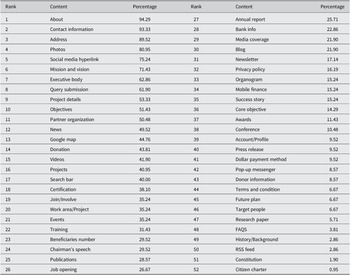
Table 3 lists the top 52 content items the CSOs provided on their websites. The highest number of websites (94%) have content about their organization on their website, and this is mostly for informing people about the basic information of the CSOs. It is obvious that we expected all 105 websites to have the content, even though only 94% did. We observed that 4 out of the top 6 content items on the CSO’s website were related to information dissemination, including contact information (93%), address (89%), photos (81%), mission, and vision (71%). These types of content help CSOs inform people about their work and facilitate connectivity. After analyzing website data and content, we discovered that CSOs are gradually using their website for communication with individuals, in addition to disseminating their information. The study finds that 93% of CSOs provide contact information on their websites, allowing users to reach out directly for regular queries and in the event of emergencies. Social media account links are included on 75% of CSO websites. This means that CSOs are also ready for interaction and engagement online. Moreover, 62% of CSOs’ websites offer query submission and allow users to submit queries for an answer. Additionally, it is noteworthy that, in their first decade of digitalization, 44% of CSOs’ websites feature a donation option, encouraging online donations. This approach is very popular in the Western world and has been utilized extensively to support the needy during the COVID-19 pandemic.
Top 52 content according to the proportion of CSOs’ websites

Table 3. Long description
The table is organized into two side-by-side sections, each with columns for Rank, Content, and Percentage.
Top 10 content types:
* Rank 1: About at 94.29 percent.
* Rank 2: Contact information at 93.33 percent.
* Rank 3: Address at 89.52 percent.
* Rank 4: Photos at 80.95 percent.
* Rank 5: Social media hyperlink at 75.24 percent.
* Rank 6: Mission and vision at 71.43 percent.
* Rank 7: Executive body at 62.86 percent.
* Rank 8: Query submission at 61.90 percent.
* Rank 9: Project details at 53.33 percent.
* Rank 10: Objectives at 51.43 percent.
Middle-tier content examples:
* Rank 11: Partner organization at 50.48 percent.
* Rank 20: Work area/Project at 35.24 percent.
* Rank 27: Annual report at 25.71 percent.
* Rank 33: Organogram at 15.24 percent.
* Rank 40: Press release at 9.52 percent.
Lowest-ranked content types:
* Rank 48: F A Q S at 3.81 percent.
* Rank 49: History/Background at 2.86 percent.
* Rank 50: R S S feed at 2.86 percent.
* Rank 51: Constitution at 1.90 percent.
* Rank 52: Citizen charter at 0.95 percent.
On the other side of the rank table, there are more areas with a lower presence, such as certification (38%), member recruitment (35%), working area (35%), events (35%), beneficiary (29%), and annual report (26%). The gradual penetration of ICT and its wide range of implications in civil society organizations can be traced through these rankings. Overall, CSOs are primarily more concerned with providing their information about the organization than they are with providing additional information about their structure and operation. Only a few CSOs have been forward-looking in becoming transparent and initiating online interaction. Without disregarding the differences, the most important content for CSOs is as follows: About us, Contact information, Photos, Social media link, Project details, Query submission, Partner organization list, Organization address, Certification, Media coverage, and so forth Table 4 analyses the CSOs’ website content from different dimensions of activities expected from such organizations.
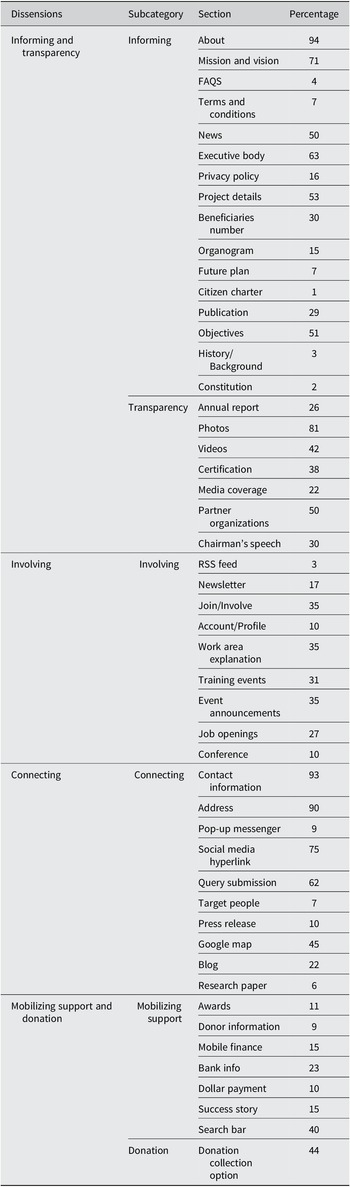
CSO’s website contents from four different dimensions

Table 4. Long description
The table is organized into four columns: Dimensions, Subcategory, Section, and Percentage.
1. Informing and transparency dimension:
- Informing subcategory: Includes About 94 percent, Mission and vision 71 percent, F A Q S 4 percent, Terms and conditions 7 percent, News 50 percent, Executive body 63 percent, Privacy policy 16 percent, Project details 53 percent, Beneficiaries number 30 percent, Organogram 15 percent, Future plan 7 percent, Citizen charter 1 percent, Publication 29 percent, Objectives 51 percent, History/Background 3 percent, and Constitution 2 percent.
- Transparency subcategory: Includes Annual report 26 percent, Photos 81 percent, Videos 42 percent, Certification 38 percent, Media coverage 22 percent, Partner organizations 50 percent, and Chairman’s speech 30 percent.
2. Involving dimension and subcategory:
- Includes R S S feed 3 percent, Newsletter 17 percent, Join/Involve 35 percent, Account/Profile 10 percent, Work area explanation 35 percent, Training events 31 percent, Event announcements 35 percent, Job openings 27 percent, and Conference 10 percent.
3. Connecting dimension and subcategory:
- Includes Contact information 93 percent, Address 90 percent, Pop-up messenger 9 percent, Social media hyperlink 75 percent, Query submission 62 percent, Target people 7 percent, Press release 10 percent, Google map 45 percent, Blog 22 percent, and Research paper 6 percent.
4. Mobilizing support and donation dimension:
- Mobilizing support subcategory: Includes Awards 11 percent, Donor information 9 percent, Mobile finance 15 percent, Bank info 23 percent, Dollar payment 10 percent, Success story 15 percent, and Search bar 40 percent.
- Donation subcategory: Includes Donation collection option 44 percent.
CSOs are now operating a website for some defined purpose. To define their purpose, Table 4 classifies CSOs’ website contents into four dimensions, along with six subcategories. The four main dimensions are Information and transparency, Involving, Connecting, and Mobilizing support and donation. We have to admit that the analyzed 105 websites are quite different from each other in terms of their structure, size, and content. However, there are no standardized criteria to define a website as best. For this research, we may state that when a website effectively serves all four dimensions, it can be considered a standard website for CSOs. This will also vary, depending on the website’s objectives and the nature of its activities.
Table 4 confirms that almost all CSOs are active and busy in disseminating their information and showing their transparency through their website content. All high-ranking contents in Table 3 belong to this category. However, the contents that may be considered symbols of transparency, such as annual report (26%), certification (38%), and mentioning partner organizations (50%), have occurred relatively less frequently than uploading information-related contents. The second most active dimension is Connecting. Under this category, we have found the CSOs’ websites having information for contacting them, like email address, phone number (93%), their postal and physical address (90%), mentioning their social media link for interaction (75%), and options for query submission (62%). The third most active dimension is Involving, noteworthy activities are, project description (41%), mentioning the field/working area (35%), asking to join their programs (35%), sending newsletters through email (17%), and news for providing training (31%). The fourth most active dimension is Mobilizing support, with contents like Bank Account (23%), Search bar (40%), and asking for a Donation (44%).
The CSOs need to give attention to connecting and mobilizing support and enriching content. Additionally, CSOs ought to post involving contents on their website regularly.
Facebook data analysis
CSOs are under growing pressure from the increasing penetration of technology and the increased use of web technology. Most of the CSOs of Bangladesh do not have a website but do have a Facebook page. Now, it is important to understand which types of CSOs are more active on Facebook, what type of content they share, and what type of functions they try to perform using the digital platform. To understand their activity on Facebook (FB), we have retrieved data on their page likes, posts, post likes, post comments, and post shares. All these together have been considered as engagement.
In total, 20 sampled CSOs (10 with official websites and 10 without official websites) registered with the Bureau of NGO Affairs were considered for FB analysis. After analyzing their websites and observing their FB posts (from July 2022 to June 2023) one by one, they have been classified into five groups. Think tanks, gender groups, labor support groups, and CSOs advocating for people’s participation have been grouped under the Advocacy Group (7). The CSOs that are more concerned with providing their development-related services and activities have been brought under the heading of Development Groups (3). Among the sampled CSOs, we found four active CSOs that are mostly concerned with youth; we have termed these four CSOs as the Youth Group (4). Besides these three groups, we have classified two additional sets of CSOs: one as Environment-related (3) and another as Health and Disability-related groups (3). These groups are solely concerned with those issues. Figure 3 analyzes and compares the FB engagement of these five types of CSOs.
Pattern of CSOs’ Facebook pages engagement based on their different types.

Fig. 3 Long description
The figure consists of four bar charts arranged in a two-by-two grid. Each chart shares the same X-axis categories representing C S O types: Advocacy, Development, Environment, Health and Disability, and Youth.
Top-left chart: Average Post. The Y-axis ranges from 0 to 140. Youth has the highest average at 135.5, followed by Development at 130.67, Environment at 90, Advocacy at 80, and Health and Disability at 22.
Top-right chart: Average Like. The Y-axis ranges from 0 to 140. Advocacy has the highest average at 120.28, followed by Youth at 55.88, Development at 50.66, Health and Disability at 24.55, and Environment at 10.23.
Bottom-left chart: Average Comment. The Y-axis ranges from 0 to 25. Youth significantly leads with 24.9. Other categories are much lower: Development at 2.48, Health and Disability at 2, Advocacy at 1.9, and Environment at 0.51.
Bottom-right chart: Average Share. The Y-axis ranges from 0 to 12. Youth leads at 10.6, followed by Health and Disability at 6.52, Advocacy at 2.81, Development at 2.48, and Environment at 1.
Considering the number of CSOs for each variety of CSOs, their average posts, post like averages, comment averages, and share averages, it is the Youth groups (4) that have been found to be most active. Their average likes are 55.88 per post. Their average comment is 24.90 per post, and average share is 10.60 per post, which are not only the highest among the five groups but also far ahead of other groups’ average engagement. As these are youth groups, their target population is young adults who are mostly accustomed to the digital culture on the rise in Bangladeshi society. Naturally, these youth groups have taken advantage of the digital platforms. three out of four of this type of CSOs also have their own official websites.
Advocacy CSOs are the largest group (7) within the sample CSOs, but their average post per organization is only 80, while the average posts for the youth groups is 135.5 per organization. Average like for advocacy groups is also the highest (120.28). However, in consideration of further mobilizations of their posts, this group lags far behind the youth group; the average comment is 1.90, and the average share is only 2.81.
From consideration of all four factors of FB engagement, such as average post (130.67), average likes (50.66), average comments (2.48), and average shares (2.48), the Development CSOs are in a prime position for using and mobilizing digital social media. As these are mostly service-providing CSOs and their target groups are, in most cases, poor citizens who hardly have an FB account, they have not considered much about utilizing the digital platform. It was more about showing their accountability to their donors and partner organizations through the digital content.
The digital application pattern of the environmental and health-related CSOs is more frustrating. The environmental organizations seem to have failed to take advantage of social media for their causes. To bring change in society and build awareness for the environment, their target population should not only be the marginalized people but also the educated youth. From such a point of argument, proper utilization of the digital media can bring the young voter’s opinion for climate protection and preservation. The health and disability CSOs seem to be hardly engaged in social media, though they have some digital platforms. Only 22 average posts per organization in a year for three such CSOs is frustrating. However, compared to Environmental groups, they seem more active in the media, with an average of 2 comments and 6.52 post shares. Both of these groups need to increase their reach on social media, not only for their publicity but also for arranging different functions, advocacy, and fundraising.
Table 5 analyses the FB engagement patterns from the aspect of the five most important dimensions that are related to CSOs’ functions and interactions with society. These dimensions differ slightly from those used for website analysis. A greater variety of activities has been found on Facebook pages compared to websites, due to the platform’s interactive nature. The five dimensions for Facebook page analysis are Information and transparency, Advocacy and participation, Service provision, and Connecting and networking.
FB engagement of CSOs based on their activity dimensions

Table 5. Long description
The table categorizes posts into five main dimensions with specific content types and their engagement metrics.
1. Information and transparency (870 total posts):
* Information (436 posts): 395 likes (0 to 100), 213 comments (0 to 50), 293 shares (0 to 50).
* Video (177 posts): 165 likes (0 to 100), 65 comments (0 to 50), 99 shares (0 to 50).
* Data visualization (15 posts): 10 likes (0 to 100), 5 comments (0 to 50), 9 shares (0 to 50).
* Success story (56 posts): 51 likes (0 to 100), 29 comments (0 to 50), 31 shares (0 to 50).
* External link (186 posts): 132 likes (0 to 100), 29 comments (0 to 50), 60 shares (0 to 50).
2. Advocacy and participation (388 total posts):
* Awareness (108 posts): 96 likes (0 to 100), 44 comments (0 to 50), 68 shares (0 to 50).
* Educational content (44 posts): 37 likes (0 to 100), 15 comments (0 to 50), 24 shares (0 to 50).
* Opportunity (197 posts): 137 likes (0 to 100), 59 likes (100 to 500), 93 comments (0 to 50), 43 comments (301 plus), 115 shares (0 to 50), 29 shares (51 to 100), 20 shares (101 to 300).
* Interview (14 posts): 12 likes (0 to 100), 12 comments (0 to 50), 13 shares (0 to 50).
* Call to action (9 posts): 7 likes (0 to 100), 4 comments (0 to 50), 5 shares (0 to 50).
* Publication (16 posts): 12 likes (0 to 100), 5 comments (0 to 50), 10 shares (0 to 50).
3. Service providing (29 total posts):
* Relief (6 posts): 6 likes (0 to 100), 2 comments (0 to 50), 4 shares (0 to 50).
* Micro-credit (1 post): 1 like (0 to 100), 1 comment (0 to 50), 1 share (0 to 50).
* Health service (3 posts): 3 likes (0 to 100), 0 comments, 2 shares (0 to 50).
* Training (19 posts): 30 likes (0 to 100), 24 comments (0 to 50), 24 shares (0 to 50).
4. Connecting and networking (491 total posts):
* Event (92 posts): 84 likes (0 to 100), 42 comments (0 to 50), 63 shares (0 to 50).
* Collaboration (55 posts): 49 likes (0 to 100), 35 comments (0 to 50), 38 shares (0 to 50).
* Special day (179 posts): 181 likes (0 to 100), 100 comments (0 to 50), 109 shares (0 to 50).
* Shared post (165 posts): 140 likes (0 to 100), 23 comments (0 to 50), 37 shares (0 to 50).
5. Mobilizing support and donation (33 total posts):
* Welcome (4 posts): 4 likes (0 to 100), 4 comments (0 to 50), 3 shares (0 to 50).
* Fundraising (4 posts): 4 likes (0 to 100), 0 comments, 3 shares (0 to 50).
* Gratitude posts (25 posts): 23 likes (0 to 100), 12 comments (0 to 50), 17 shares (0 to 50).
Except for the Service providing and Mobilizing support section, sampled CSOs have been found to be well engaged in more than one or two activities in all other dimensions. In the Information and transparency dimension, each post on information (436) has been followed by 1–100 likes (for 395 posts), and 8 posts received more than 1000 likes. In the same way, upto 50 comments had been received for 213 posts, and 293 posts had been shared by others. The data or numbers found for Video and Success stories about CSOs’ clients, both posts (177 and 56, respectively), and for likes, comments, and shares for this content are optimistic.
Among the functions categorized under Advocacy and Participation, awareness-building activities and information about various opportunities were found to be the most popular, as indicated by the highest number of posts, likes, comments, and shares. There are only a few posts that may be considered as a call to action (only nine posts). However, these very posts had received likes, comments, and shares in a satisfactory proportion.
From Table 5, it can be seen that the CSOs are moving forward with using the digital platform for connecting and networking. For example, the activity posts like announcements about events (92), new collaborations with other institutes (55), posting on special days (179), and sharing other groups’ posts (167) are relatively high. The corresponding FB engagements for these posts are also optimistic. The news of collaboration, though not high, has received proportionate likes, 35 posts received almost 50 comments, and 38 posts of collaboration have been shared. The interaction rate is much higher for Events, Special day celebrations, and Shared posts.
As the CSOs provide services mainly to marginal people in rural and suburban areas, and these service recipients are not accustomed to digital devices, the service-providing functions are yet to reach popularity within the FB framework. The sampled CSOs that we had analyzed hardly use their digital facility for mobilization and support. Another interesting observation is that almost 50% of the posts by the 20 sample CSOs were in English and the rest in the Bangla language. However, most of the CSOs had their objectives, causes, and projects addressed for the Bangladeshi communities. If they use only English version websites, when the target groups not only prefer but understand only Bangla, the level of success and achievements will always seem to be out of reach. It seems that these CSOs registered under the Bureau of NGO Affairs are more interested in attracting and satisfying their donors than in serving the citizens and communities living in Bangladesh.
However, we have to admit that contemporary researches also show that social media accounts focused on marketing or commerce tend to elicit higher levels of dialogic or participatory involvement than do CSOs. Social media is primarily used by CSOs for information sharing rather than engagement driven by marketing. Because they have fewer followers and more advocacy-focused material. Obviously, CSOs’ accounts in Bangladesh generally have lower engagement rates than government or general commercial accounts. Additionally, CSOs typically disseminate updates rather than encouraging engagement (Lovejoy & Saxton, Reference Lovejoy and Saxton2012). Unlike companies that optimize material for algorithmic amplification, charitable organizations mostly focus on providing updates. They increase awareness and publicize events rather than triggering engagement loops, which consistently lead to poorer engagement results at the average post level (Huang et al., Reference Huang, Lin and Saxton2016).
In the US sample studied by Guo and Saxton (Reference Guo and Saxton2014), this tendency toward information dominance is visible with informational updates making up 68.67% (n = 515) of all messages, compared to just 19.73% (n = 148) for community and 11.60% (n = 87) for action, with N = 750 tweets. Our Bangladesh case (N = 1,811 FB posts) both confirms and slightly differs from this argument. Following Guo and Saxton (Reference Guo and Saxton2014), if we re-classify the dimensions in Table 5 as Advocacy and participation and Service providing as Action-oriented mobilization (n = 417), and Connecting and networking and Mobilizing support and donation as Community interaction (n = 524), along with information and transparency (n = 870), as Information, an interesting finding emerges. Here, almost the same as in the United States, informational posts account for the largest share at 48.04%, followed by community interactions at 28.93% and action-oriented mobilization at 23.03%. The rate of posts for community interaction and action-oriented mobilization is higher than in the United States. This finding leads us to an optimistic inference that CSOs in Bangladesh are using social media more multidimensionally than the general trend suggests.
Beyond the numbers and data, our analysis also indicates that digital use by the CSOs in majority-world countries like Bangladesh lags far behind in terms of diversity, specialization, skill, and use. While CSOs in minority countries rely on multiplatforms, diversification, and specialized digital personnel for advocacy and engagement (Carboni & Maxwell, Reference Carboni and Maxwell2015; Huang et al., Reference Huang, Lin and Saxton2016), Bangladeshi CSOs have to concentrate primarily on one platform: Facebook. The reasons behind dependence on FB are not just economic and a lack of strong infrastructure and expertise, but also social, such as limited digital penetration, a digital divide, and fewer digital users, which means fewer clients and audiences on the online platform. Further empirical investigations into these digital issues may reveal an overall understanding in the Global South that differs from that in the Western world.
Discussion and conclusion
Civil society in Bangladesh is aligning with the government’s ICT policy. But to what extent it can move forward and to what extent the CSOs bring digitalization remain matters for discussion and debate. Based on the data analysis of the new generation of civil society, we perceive a mixed situation that cannot be termed either optimistic or pessimistic. Rather, it is going through a transition toward digitalization. However, we are not sure how long the transition will continue.
It has been found that CSOs are primarily interested in providing various information about their institutions to introduce them to others. Such underuse of social media, viewing them as instruments for one-way communication rather than two-way interaction, despite their advantages, was also a fact in the United States in 2012 (Lovejoy et al., Reference Lovejoy, Waters and Saxton2012). Some CSOs have begun practicing online transparency by uploading their yearly reports on their website, others by uploading videos and success stories of their clients as Facebook posts. Online platforms are universally popular for advocacy or mobilizing public opinion for a cause. However, we may find the CSOs under analysis are in their initial stage of using the digital facilities. Though the youth and advocacy CSOs had been found to be most active in the FB engagements, the overall advocacy functions of all the CSOs in Table 5 cannot provide an optimistic picture. However, there are profound opportunities to utilize the digital platforms for advocacy, both at the national and international levels. In the same way, CSOs have begun the functions for involving citizens and ensuring participation of the citizens, like arranging online quiz, online campaign for recruiting new members, volunteers and office holders, or calling for action on certain issue (like online petitions), raising awareness, or politically educating the citizens on their website as well as on their FB pages; however, these are also in their initial stage.
Data about the websites and FB activities of our sample CSOs on fundraising and support mobilization do not give us any enthusiastic picture. In the post-COVID period, CSOs are hardly using digital platforms to raise funds; they prefer to handle their financial functions solely through traditional banks. There may be several reasons for such inactivity. The CSOs are not ready to be transparent about their purse to the public. Moreover, CSOs have to abide by some strict government rules like the Foreign Donation (Voluntary Activities) Regulation Ordinances 2016 (Tasnim, Reference Tasnim2021) and ICT ACT 2006 and 2013, as well as the Digital Security Act 2018 (Riaz, Reference Riaz2021). These acts are also responsible for the limited online advocacy by the civil society in Bangladesh.
The service-providing CSOs, though, may have a well-developed website, but are not active on FB. This is because, as mentioned earlier, the marginal poor people who are the target of these services are still unfamiliar with digital culture. So, we can understand the existence of the well-debated digital divide here in the pattern of CSOs’ digital activities. The CSOs also need to use the local language, Bangla on their digital platforms, to reach out to the people.
From the pessimistic point of view, it seems that these CSOs have developed their website and opened their FB pages just to follow the instructions, conditions, and rules of the government and their foreign donors. They are too careful about using them for fear of strict ICT rules, or they lack the technical know-how to generate an online platform to reach out to the people and realize their objectives. However, from the optimistic outlook, we must admit that whatever development and achievements that have happened using the digital platform should be considered as a beginning of a new journey that has far to go, which will lead to digital democracy, a highly debated term among contemporary scholars.
Nevertheless, we must admit that the sample upon which we conducted our research is the youngest, most active, and updated CSOs that have good connections with foreign donors and the national government. Among the total population, 81% did not have an official website in 2022 (or their domain had expired). Then, we can imagine what the overall situation of all other CSOs, officially registered or not, may be. The reputation of civil society in Bangladesh, particularly in the context of social development, has been well publicized for some time (Lewis, Reference Lewis2017). CSOs and ICT-friendly laws at the policy level and digitalization at the mass level are the two urgent needs of the day. Only when their target groups and clients become participants in the digital environment, and when they feel free to function on digital platforms, CSOs will be able to play a significant role through digital media. And here lies the contribution of the present article: it introduces to policymakers and development practitioners the extent to which these new CSOs are using their digital facilities and platforms for advocacy and services despite the digital divide, limited facilities, and social and legal constraints.
Further research is necessary to investigate the nature of digital adaptation within the management and administrative systems of CSOs, as well as to identify the social, political, and economic challenges to achieving these goals. The present research is a part of a broader project that has focused on these issues with empirical data. Problems of digital literacy among citizens, lack of funds and training, low-quality digital services, and the digital divide between central and peripheral CSOs, as well as among citizens, have been identified as detrimental factors to the digitalization of the new generation civil society. If the donors would like to continue to implement their development projects through CSOs, they also need to come forward with projects for digital skill development and funds for digital appliances for the CSOs. To avoid the IT-generated social problems like the digital divide, soft and digital strategies need to be developed in collaboration with the government, donors, and the CSOs.
Data availability statement
Data can be shared only for research purposes and only upon a reasonable request.
Acknowledgement
For final editing, Grammarly has been utilized to ensure perfection in grammar and spelling.
Funding statement
This article is based on a project titled New Generation of Civil Society Organizations in Digital Bangladesh. The project has been funded by the University Grants Commission, Bangladesh, through the Faculty of Social Science, University of Rajshahi, in the financial year 2021–2022. Number 274/5/52/RU/SaMa-7/2021-2022.
Competing interests
The authors declare none.
Ethical standards
The authors have received ethical permission to conduct the research from the Faculty of Social Science, University of Rajshahi, Rajshahi, Bangladesh.



 Open access

