


1. Introduction
Tropical forests occupy only about 12% of Earth's land surface but provide the last stronghold for numerous, highly threatened species (Watson et al., Reference Watson, Shanahan, Di Marco, Allan, Laurance, Sanderson, Mackey and Venter2016). However, increased natural resource exploitation (e.g. agriculture, grazing, hunting, and timber harvesting) and the rapidly changing climate disrupt ecosystem processes and diminish ecosystem services, radically compromising tropical forest dynamics (Ceballos et al., Reference Ceballos, Ehrlich and Raven2020; Mooney et al., Reference Mooney, Larigauderie, Cesario, Elmquist, Hoegh-Guldberg, Lavorel, Mace, Palmer, Scholes and Yahara2009; UNEP-WCMC, 2011). Catastrophic environmental impacts are forecasted, ranging from the modification of species' life histories across all trophic levels to the breakdown of ecosystem-dependent livelihoods that will likely drive human displacement sooner than expected (Raleigh & Jordan, Reference Raleigh, Jordan, Mearns and Norton2010).
As the adverse effects of climate change increase, long-term species persistence will depend on the ability to adapt to future temporal and spatial patterns. Although shifting phenological events across taxa and habitats are more apparent (Chmura et al., Reference Chmura, Kharouba, Ashander, Ehlman, Rivest and Yang2019), a species ability to shift its range – collapse or expand – will lead to the significant reorganization of ecological communities (Dar et al., Reference Dar, Subashree, Bhat, Sundarapandian, Xu, Saikia, Kumar, Kumar, Khare, Khan, Roychoudhury, Nautiyal, Agarwal and Baksi2020; Prăvălie, Reference Prăvălie2018). Furthermore, given that habitat loss and fragmentation threaten species survival, the connectivity of forest landscapes will promote or hinder the flow of species among potential climatic refugia (safe havens for species to persist) (Keppel et al., Reference Keppel, Van Niel, Wardell-Johnson, Yates, Byrne, Mucina, Schut, Hopper and Franklin2012; Robillard et al., Reference Robillard, Coristine, Soares and Kerr2015). Under these circumstances, a species' ability to shift its range may depend in part on its niche requirements, habitat availability, and connectivity (Robillard et al., Reference Robillard, Coristine, Soares and Kerr2015).
The effects of climate change have also become evident in low-lying island ecosystems. Many island communities inhabited by indigenous groups are on the verge of environmental collapse. Rising sea-levels and extreme weather, coupled with the loss of vital resources, threaten indigenous cultures with displacement from their ancestral lands. On a warming planet, underdevelopment, high population densities, and poverty simultaneously play a dynamic role in promoting human displacement (World Bank, 2018). For indigenous groups, the effects are unique and disproportionate. Indigenous peoples are more vulnerable and may have less adaptive capacity to respond (e.g. social and technical skills and strategies directed toward responding to environmental changes) (Dar et al., Reference Dar, Subashree, Bhat, Sundarapandian, Xu, Saikia, Kumar, Kumar, Khare, Khan, Roychoudhury, Nautiyal, Agarwal and Baksi2020).
Human resettlement from island ecosystems is crucial for adapting to the climate emergency. However, community-driven resettlement to biologically significant areas, such as biodiversity hotspots – typically tropical forests – risk losing ecosystem services (e.g. water regulation, carbon storage, and biodiversity). Paradoxically, the safeguarding of forest ecosystem services, including the maintenance of intact animal communities, is part of the solution to building resiliency and adaptation to climate change (Gardner et al., Reference Gardner, Struebig and Davies2020). Hence, there is an urgent need to build upon current strategies to confront the loss of biological and cultural diversity.
We suggest that successful climate adaptation requires two approaches: (i) an integrated geoecological approach – the relationships between the ecological potential (landscape characteristics), biological exploitation (species diversity), and anthropogenic impacts – (Manoiu et al., Reference Manoiu, Crăciun and Spiridon2015), and (ii) a biocultural conservation approach that recognizes the dynamic interconnectedness of the biophysical and socio-cultural components of conservation actions (Gavin et al., Reference Gavin, McCarter, Mead, Berkes, Stepp, Peterson and Tang2015; McCarter et al., Reference McCarter, Sterling, Jupiter, Cullman, Albert, Basi, Betley, Boseto, Bulehite, Harron, Holland, Horning, Hughes, Jino, Malone, Mauli, Pae, Papae, Rence and Filardi2018).
This review explores, for the first time, the links between the impacts of climate change, indigenous peoples' displacement, and the implications for conserving the iconic, near threatened jaguar (Panthera onca). First, we present the effects of climate and human-driven change on biodiversity and the urgency to address the threats. Then, we present the impacts of climate change on the island ecosystem of the San Blas Archipelago (San Blas), inhabited by the indigenous Guna people (Guna) (Figure 1 and Box 1). Next, we review the socio-cultural and economic consequences of the Guna's move back to their ancestral land, one of Panama's most extensive intact tropical forests. After establishing the role of apex predators (i.e. jaguars) in sustaining ecosystems, we outline the impacts of habitat alteration on jaguar populations (Box 2). Finally, we underscore the importance of combining adaptation strategies with comprehensive planning to build community and forest resiliency simultaneously.
Location of the indigenous Guna Yala territory in eastern Panama. The mainland region consists of a narrow strip of (largely undisturbed) primary forest and the San Blas Archipelago, where most Guna people live. The map also displays the potential area of relocation and the alarming forest loss adjacent to other indigenous territories (Global Forest Watch, 2020).

Guna Yala: the ancestral land
History – The Guna are one of Panama's seven indigenous groups. Initially, the Guna developed their culture in the tropical forests of, what is now, northern Colombia, and the Darien region of Panama. The Guna began moving westward during the mid-15th century due to Spanish influence. By the mid-19th century, the Guna had moved to the islands off the Atlantic coast to be free of the insects and disease found in the forest (Chapin, Reference Chapin2000; Howe, Reference Howe2002). Today, approximately 81,000 people comprise the Guna community; almost 40% still live in the San Blas Archipelago, occupying 49 islands (Figure 1). The Tule Revolution, a deadly uprising in 1925, marked the beginning of their cultural and political autonomy (Chapin, Reference Chapin2000). On February 19, 1953, the Comarca Guna Yala was organized under Panamanian Law 16.
Forestland – The Comarca Guna Yala encompasses ~5400 km2. The mainland portion (~3260 km2) consists of a ~373-km long, thin strip of land along the Atlantic coast of eastern Panama (Figure 1). It stretches northwest from Colombia to Parque Nacional Chagres, forming a band of forest between 10 and 20 km wide, framed by the Caribbean Sea to the north and the Cordillera Serrania de San Blas to the south (Apgar, Reference Apgar2010). This ancestral land represents one of the most extensive remaining stretches of contiguous rainforest in the Tumbes-Choco-Magdalena ecoregion, one of the top ecological hotspots on Earth.
Management – Today, consistent with global values of managed lands by indigenous peoples (Garnett et al., Reference Garnett, Burgess, Fa, Fernández-Llamazares, Molnár, Robinson, Watson, Zander, Austin, Brondizio, Collier, Duncan, Ellis, Geyle, Jackson, Jonas, Malmer, McGowan, Sivongxay and Leiper2018), the Guna have maintained low-intensity land use. Vergara-Asenjo and Potvin (Reference Vergara-Asenjo and Potvin2014) reported that protected areas and indigenous territories constitute 77% of the total mature forest area in Panama, stressing their importance for conserving biodiversity. Despite this level of protection, climate (i.e. a decline of cloud immersion up to 86% in tropical montane cloud forests) and land-use change threaten the unique biodiversity, high endemism, and vital ecosystem services (e.g. water provision and carbon sequestration) that the forests provide (in situ Helmer et al., Reference Helmer, Gerson, Baggett, Bird, Ruzycki and Voggesser2019). As tropical forests struggle to keep pace with climate change and land-use demands from humans, management actions must foster forest resilience to maintain functional, connected habitat, and biodiversity.
2. Effects of climate change: biodiversity and people
Climate change accelerates the global biodiversity crisis and poses new challenges to conservation. The IPCC (2018) report on global warming called for urgent action to prevent further damage to ecosystems and reduce pressure on biodiversity worldwide. Also, the Global Biodiversity Outlook 5 report (CBD, 2020) and the Living Planet Report (WWF, 2020) warned of alarming global declines in biodiversity due to human activity. The living planet index found that global wildlife populations have declined by 68% in less than 50 years, while the Americas' tropical subregions have witnessed a staggering 94% decline (WWF, 2020). However, the extent and speed at which climate change will impact biodiversity, ecosystems, and ecosystem services are uncertain.
The effects of climate change manifest on different timescales, resulting in both short-term (e.g. extreme weather events) and long-term alterations to nature (e.g. sea-level rise and biodiversity decline). The impacts affect all levels of organization including species (e.g. phenology, distribution, and population) and ecosystems (e.g. composition and function) (Bellard et al., Reference Bellard, Bertelsmeier, Leadley, Thuiller and Courchamp2012; Mycoo, Reference Mycoo2018). Consequently, ecosystem services such as provisions (e.g. food and timber), carbon sequestration, water regulation, and disease regulation decline. Moreover, human efforts to mitigate and adapt to climate change (e.g. migrate) further compromises natural ecosystems (e.g. land-use change, increased poaching, and bushmeat consumption) and species' abilities to adapt (e.g. relocate and seek refugia) (Bellard et al., Reference Bellard, Leclerc, Hoffmann and Courchamp2016; Bradley et al., Reference Bradley, Estes, Hole, Holness, Oppenheimer, Turner, Beukes, Schulze, Tadross and Wilcove2012).
The urgency for adaptive strategies to address climate threats grows each year. Heller and Zavaleta (Reference Heller and Zavaleta2009) reviewed strategies for conservation and found that reserve planning (i.e. acquisition, management, and restoration) to provide habitat for species of high conservation value, and improved landscape connectivity was advocated (sensu Heller & Zavaleta, Reference Heller and Zavaleta2009). The report also identified neglect to integrate social aspects but underscored their importance, given the central role of human behavior and preferences in determining conservation outcomes. This finding emphasized the need for a broader discussion of strategies (e.g. consumption, population, and equity) to successfully mitigate the impacts of climate and human-driven change (e.g. range contractions, extinctions, and degradation of ecosystem services) on biodiversity (Blicharska et al., Reference Blicharska, Orlikowska, Roberge and Grodzinska-Jurczak2016; CBD, 2020; Field et al., Reference Field, Raupach, Victoria, Field and Raupach2004; WWF, 2020).
3. Climate change: dimensions and implications for the Guna people
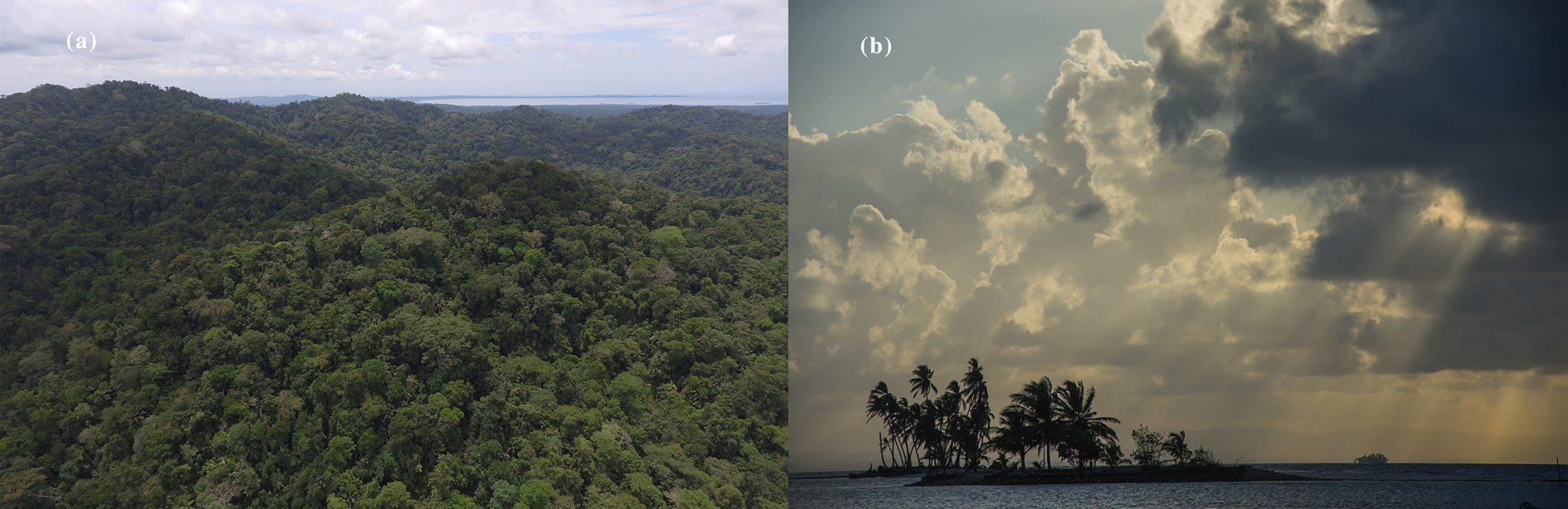
The global mean temperature has reached 1°C above pre-industrial levels and will likely reach 1.5°C by 2040 (IPCC, 2018). As a result, tropical rainforest, coastal, and island communities are on the front line of environmental change associated with increasing temperatures and sea-level rise. Between 1901 and 2010, the global mean sea-level rose 0.19 (0.17–0.21) m. Because of the intrinsic relationship between the Guna (Box 1), the tropical forest (Figure 2a), and the islands (Figure 2b), climate change is expected to have a wide range of detrimental effects, including a loss of ecosystem services and life-sustaining forest, marine, and coastal resources (Displacement Solutions, 2014; 2016; Murray & Oullet-DeCoste, Reference Murray and Ouellet-Décoste2008). The Intergovernmental Panel on Climate Change (IPCC, 2019) noted that small islands and atolls, which rarely exceed 3–4 m above sea level, will be threatened by rising seas, as they are most susceptible to flooding (Murray & Oullet-DeCoste, Reference Murray and Ouellet-Décoste2008).
Images of the indigenous Guna Yala territory: (a) aerial view of intact primary forest in the northwestern section of the mainland territory and (b) an island in the San Blas Archipelago. Photo credits: (a) J. Loreto and (b) E. Coniglio.
Globally, rising sea surface temperatures affect phytoplankton productivity, which is the foundation of the aquatic food web (Hoegh-Guldberg, Reference Hoegh-Guldberg1999). Also, ocean acidification has resulted in the bleaching of coral reefs (IPCC, 2019), which account for one-third of marine biodiversity worldwide (Murray & Oullet-DeCoste, Reference Murray and Ouellet-Décoste2008). Although coral reefs of the Caribbean have been degraded by 80% in just three decades (IPCC, 2019; Pandolfi et al., Reference Pandolfi, Bradbury, Sala, Hughes, Bjorndal, Cooke, McArdle, McClenachan, Newman, Paredes, Warner and Jackson2003), the reef systems of San Blas still provide services for the Gunas. However, with the current projections for global warming, Guna livelihoods (i.e. tourism and food security), cultural expression, and identity are at risk (Elliott & Tanguay, Reference Elliott and Tanguay2006; IPPC, 2018).
Climate change has already created significant and adverse social, cultural, and economic consequences for the Guna community. The adverse effects may reflect the Guna's lack of adaptive capacity to maintain their way of life on the islands in the face of climate change (Displacement Solutions, 2016). Natural disasters and weather-related events have impacted many inhabited islands. Guna's living on the most affected islands (e.g. Gardi Sugdub, Playon Chico, Gardi Maladup, Digir, and Yandub) have initiated their relocation back to the mainland (Displacement Solutions, 2014, 2016).
4. Displacement of the Guna people: an option or a necessity?
According to the World Bank (2020), indigenous peoples account for over 6% of the world's population. Yet, they protect an estimated 22% of the Earth's surface, 80% of remaining biodiversity, and 90% of the planet's cultural diversity (World Bank, 2020). Globally, they are among the poorest and most socially marginalized people (IPCC, 2014; World Bank, 2016). Indigenous peoples tend to be disproportionately affected by climate change, owing to a heavy (sometimes sole) dependence on local ecosystems (e.g. forests and coastal and marine environments) for their livelihoods (IPCC, 2014).
The slow-onset effects of climate change (e.g. sea-level rise) will prompt a significant displacement of the island-based Guna communities. The most likely adaptive strategy is a progressive and permanent relocation. However, Raleigh and Jordan (Reference Raleigh, Jordan, Mearns and Norton2010) suggest that although resettlement may reduce people's physical vulnerability to disaster risk, it may also decrease living standards, increasing economic and social vulnerability. Moreover, ‘socioecological thresholds’ such as high population densities and low levels of available resources may trigger the resettlement process sooner than the physical impacts of climate change itself (Barnett & Adger, Reference Barnett and Adger2003).
Over the past 10 years, severe weather-related events and natural disasters, coupled with overpopulation, have underscored the threat of climate change for the Guna. As an adaptive strategy, island community relocation to the mainland has become an increasingly important agenda item for the Guna General Congress (Displacement Solutions, 2014). However, one of the most challenging obstacles to resettlement is securing a location where the people's livelihoods, traditions, and cultures are not significantly altered (Gavin et al., Reference Gavin, McCarter, Mead, Berkes, Stepp, Peterson and Tang2015). After living for decades on the islands, the Guna are confronting a return to their ancestral land, the tropical forest, which they left more than 200 years ago due to disease (e.g. malaria and yellow fever) (Apgar, Reference Apgar2010; Howe, Reference Howe2002) (Box 1).
5. Trophic dynamics: the impacts and effects of apex predators and people
The impacts of human activities on natural ecosystems are the extrinsic drivers of apex predator extirpation (Estes et al., Reference Estes, Peterson, Steneck, Terborgh and Estes2010, Reference Estes, Terborgh, Brashares, Power, Berger, Bond, Carpenter, Essington, Holt, Jackson, Marquis, Oksanen, Oksanen, Paine, Pikitch, Ripple, Sandin, Scheffer, Schoener and Wardle2011) (Box 2). Research indicates that removing apex predators (trophic downgrading) has far-reaching effects on ecosystem dynamics (e.g. disease, fire, carbon sequestration, and invasive species) (Estes et al., Reference Estes, Terborgh, Brashares, Power, Berger, Bond, Carpenter, Essington, Holt, Jackson, Marquis, Oksanen, Oksanen, Paine, Pikitch, Ripple, Sandin, Scheffer, Schoener and Wardle2011). Colman et al. (Reference Colman, Gordon, Crowther and Letnic2014) stated that we have yet to realize the magnitude, complexity, and extent of apex predators' effects on ecosystems. For example, the extirpation of jaguars carries risks for broader ecosystem degradation, including the irruption (release) of mesopredator prey populations from predatory control (Ripple et al., Reference Ripple, Estes, Beschta, Wilmers, Ritchie, Hebblewhite, Berger, Elmhagan, Letnic, Nelson, Schmitz, Smith, Wallach and Wirsing2014) and successive cascades of trophic interactions (e.g. the irruption of herbivores and depletion of plant biomass) (Schmitz et al., Reference Schmitz, Hamback and Beckerman2000). Despite existing at low densities, apex predators can influence ecosystem structure through multiple food-web pathways, limiting large herbivores through predation and mesocarnivores through intraguild competition (Ripple et al., Reference Ripple, Estes, Beschta, Wilmers, Ritchie, Hebblewhite, Berger, Elmhagan, Letnic, Nelson, Schmitz, Smith, Wallach and Wirsing2014).
Implications of climate change on jaguars: a conservation perspective
As an apex predator and keystone species, the jaguar (P. onca) plays a critical role in trophic cascades and ecosystem regulation in the Neotropics (Estes et al., Reference Estes, Terborgh, Brashares, Power, Berger, Bond, Carpenter, Essington, Holt, Jackson, Marquis, Oksanen, Oksanen, Paine, Pikitch, Ripple, Sandin, Scheffer, Schoener and Wardle2011). Jaguars have been extirpated from more than 50% of their historic geographic range (from the southern USA to northern Argentina) competing with people for space and resources (IUCN, 2017). The ecological nature of jaguars (e.g. low population densities, high trophic level, extensive home range, and wide-ranging distribution) makes them vulnerable to deleterious human-related activities such as habitat loss and fragmentation, depletion of natural prey, and indiscriminate killing (e.g. illegal trade, retaliatory killing for predation on domestic livestock, or fear).
The synergy between the drivers of jaguar extirpation and climate change merits serious consideration for the species' future (Bellard et al., Reference Bellard, Bertelsmeier, Leadley, Thuiller and Courchamp2012). Prehistoric records found jaguars in a diversity of habitats, indicating range shifts and a high degree of environmental plasticity (Rodriguez et al., Reference Rodriguez, Méndez, Soibelzon, Soibelzon, Contreras, Friedrichs, Luna and Zurita2018). Understanding the potential adaptive responses of a species in the face of global climate change is paramount. Current knowledge suggests two possible responses: (1) micro-evolution – the heritable shifts in allele frequency in a population (see Bradshaw & Holzapfel, Reference Bradshaw and Holzapfel2006) and (2) phenotypic plasticity – the ability of individuals to modify their behavior, morphology, or physiology in response to altered environmental conditions (Bellard et al., Reference Bellard, Bertelsmeier, Leadley, Thuiller and Courchamp2012; Fuller et al., Reference Fuller, Dawson, Helmuth, Hetem, Mitchell and Maloney2010; Yacelga & Craighead, Reference Yacelga and Craighead2019). The former is the most likely response available to long-lived species such as the jaguar. However, the current rates of change may outpace such adaptation capacity; particularly in hotspots, where biodiversity is severely threatened (Malcolm et al., Reference Malcolm, Liu, Neilson, Hansen and Hannah2006). Based on prehistoric records of environmental change, the increasing number of threats, and the biological requirements of individual species, one of the most vulnerable cats in the Americas is the jaguar (Arias-Alzate et al., Reference Arias-Alzate, González-Maya, Arroyo-Cabrales and Martínez-Meyer2017).
An essential step toward understanding trophic cascades is to evaluate how anthropogenic impacts affect predator–prey relationships (i.e. trophic cascade strength). However, no published studies on the jaguar's ecology, felid guild, or prey availability have occurred within the Guna's territory – to the best of our knowledge. Recent studies have developed models to predict jaguar occurrence, which revealed the spatial effects of human activities in the region (see Craighead, Reference Craighead2019; Jędrzejewski et al., Reference Jędrzejewski, Robinson, Abarca, Zeller, Velasquez, Paemelaere, Goldberg, Payan, Hoogesteijn, Boede, Schmidt, Lampo, Viloria, Carreño, Robinson, Lukacs, Nowak, Salom-Pérez, Castañeda and Quigley2018). Humans can alter the composition of available prey (by hunting and land-use change), affecting prey selection. From that perspective, jaguars and the Guna people may compete for resources, as they show extensive overlap on prey preferences (e.g. collared peccary, white-lipped peccary, red-brocket deer, and tapir) (Ventocilla et al., Reference Ventocilla, Herrera, Núñez and Roeder1995). The prevalence of such perturbations to predator–prey dynamics can have cascading impacts, altering trophic dynamics that structure the forest community.
Historically, Guna traditional ecological knowledge played an important role in biodiversity conservation (e.g. sustainable hunting) (Apgar et al., Reference Apgar, Allen, Moore and Ataria2015). Practices such as ‘garden hunting’ – opportunistically hunting wildlife in cultivated fields – and ‘sharing meat’ – fostering a sense of collective ownership of game animals – encouraged the sustainable use of wildlife (Ventocilla et al., Reference Ventocilla, Herrera, Núñez and Roeder1995). Unfortunately, the Guna's connection with the natural world and environmental knowledge is rapidly diminishing, threatened by westernization (Elliott & Tanguay, Reference Elliott and Tanguay2006; Ventocilla, Reference Ventocilla1992; Ventocilla et al., Reference Ventocilla, Herrera, Núñez and Roeder1995). Now, the Guna's primary source of sustenance – seafood – is dwindling, and their island livelihoods are changing. The culmination of factors, fueled by an emerging influx of illegal trade in wild cats (Morcatty et al., Reference Morcatty, Macedo, Nekaris, Ni, Durigan, Svensson and Nijman2020), drives locals into the market economy (Ventocilla et al., Reference Ventocilla, Herrera, Núñez and Roeder1995), promoting unsustainable hunting practices focused on commercially attractive species.
6. Mitigation path compatible with climate change: people, forest, and jaguars
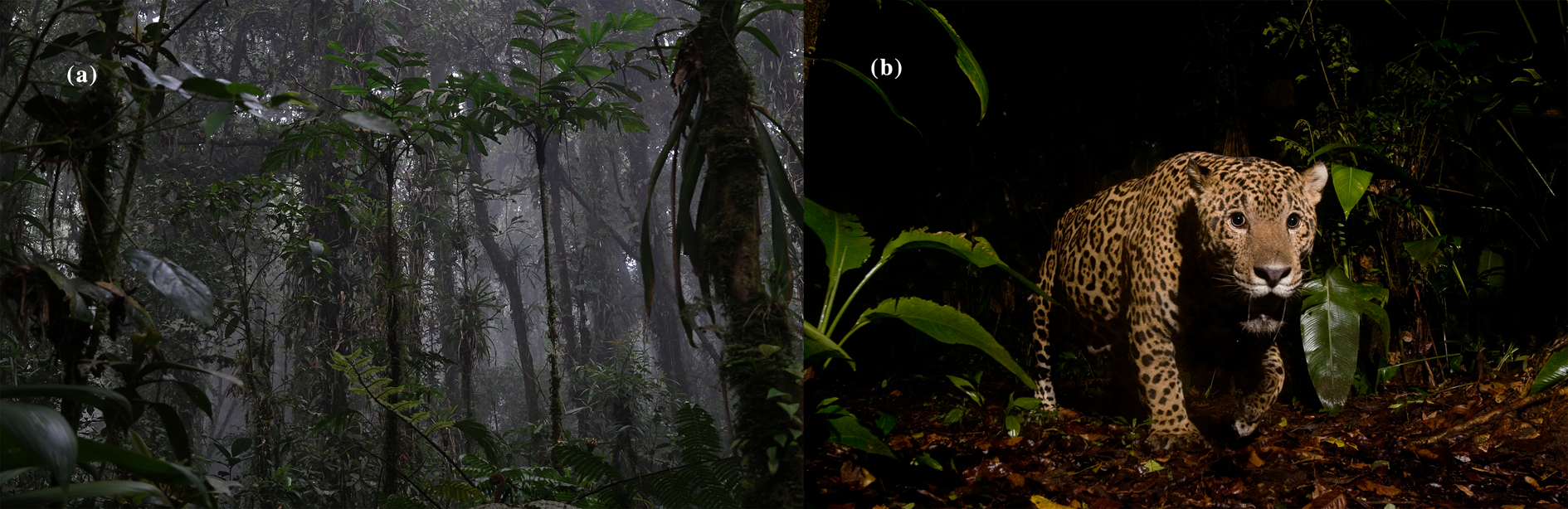
The resettlement of the Guna back to the mainland will initiate social, cultural, and economic change. It may trigger the onset of ecological and damaging alterations to the forest (Figure 3a), exemplified by the jaguar and its long-term conservation (Figure 3b and Box 2). The mainland territory has one of the highest potentials for jaguar conservation in Panama; it is one of the largest strongholds of intact forest, providing connectivity to protected areas. Studies on the links between jaguars and human-altered ecosystems have provided substantial insight into the human–jaguar dynamic (e.g. resource competition and retaliatory killing) (Cavalcanti et al., Reference Cavalcanti, Marchini, Zimmermann, Gese, Macdonald, Macdonald and Loveridge2010; Zanin et al., Reference Zanin, Sollmann, Tôrres, Furtado, Jácomo, Silveira and De Marco2015). Thus, the combined effects of environmental change and anthropogenic activities in a pristine forest will generate new challenges for jaguar survival.
Images from within the mainland Guna Yala territory: (a) ground view of the tropical montane forest and (b) the threatened jaguar (P. onca). Photo credit: (b) S. Kennerknecht.
Pitman et al. (Reference Pitman, Fattebert, Williams, Williams, Hill, Hunter, Robinson, Power, Swanepoel, Slotow and Balme2017) suggested that jaguars may not persist in human-dominated landscapes without connectivity or permeable matrices between natural or protected areas. Projected development and associated infrastructure (i.e. houses, roads, and services) will inexorably increase colonization rates by the Guna, catalyzing changes in land cover and loss of biodiversity (Espinosa et al., Reference Espinosa, Celis and Branch2018). Habitat loss and fragmentation in conjunction with the territory's geo-configuration (Figure 1) may profoundly affect jaguar population dynamics and long-term survival. Reduced access to dispersal corridors could diminish genetic exchange, inhibiting the species' capacity to adapt to climate change or shifts in available resources.
Managing human needs and conserving ecosystems is an intricate balance (Hansen & Defries, Reference Hansen and DeFries2007). Resettlement plans must acknowledge the Guna's autonomy and self-determination, and identify the ecological impacts on one of the most biodiverse ecosystems in the Americas. Displacement Solutions (2014) recommended that the Panamanian government and Guna leaders coordinate with development programs to reduce conflict with conservation objectives, minimize the effects on the ecosystem, and develop community-based strategies for wildlife management.
In this context, management plans must incorporate resettlement designs that meet social goals but not at the environment's expense (Caviglia-Harris & Harris, Reference Caviglia-Harris and Harris2011). For example, plans should consider the constraints of the biophysical landscape (e.g. topography and access to water). Housing designs should maintain the Guna's traditions, tailored to the environment that their communities have known intimately for generations. Other considerations include minimizing the ecological footprint (e.g. commercial crops and overharvesting of wildlife) and anticipating the eventual shift from a subsistence-based to service-based (e.g. intensive commercial fishing to commercial agriculture) economy.
Furthermore, strategies promoting human–jaguar coexistence are essential for sustaining a functional regional ecosystem to increase species resilience to climate change, thereby increasing the forest's capacity to deliver ecosystem services for human well-being (Mooney et al., Reference Mooney, Larigauderie, Cesario, Elmquist, Hoegh-Guldberg, Lavorel, Mace, Palmer, Scholes and Yahara2009). Strategies must address a wide range of socio-cultural and ecological conditions, given the spatiotemporal extent and potential conflict within the Guna's ancestral land. Long-term solutions entail training and capacity building for individuals and organizations at all levels, including Guna community leaders, government officials, and conservation program staff who require the knowledge, tools, and skills to mitigate conflict (Linnell, Reference Linnell2013; Madden, Reference Madden2004). Also key are adaptive management practices to foster an appreciation for jaguars and their conservation value (Gavin et al., Reference Gavin, McCarter, Berkes, Mead, Sterling, Tang and Turner2018; Ruiz-Mallen et al., Reference Ruiz-Mallén, Schunko, Corbera, Rös and Reyes-García2015) and applied research (social and biological) to understand a conflict from both human and jaguar perspectives (Madden, Reference Madden2004). Moreover, communication and information exchange is critical for building trust and empowerment. The successful design and implementation of coexistence strategies hinge upon equitable partnerships based on fundamental values (Tengö et al., Reference Tengö, Brondizio, Elmqvist, Malmer and Spierenburg2014).
Managing ecosystems comprised of ecological and social sub-systems with complex structures and dynamics calls for innovative, interdisciplinary approaches to policy and action – a biocultural approach to conservation (sensu Gavin et al., Reference Gavin, McCarter, Mead, Berkes, Stepp, Peterson and Tang2015). This approach could safeguard indigenous worldviews regarding autonomy, rights, and the looming threats of climate change.
7. Conclusion
The IPCC estimates that by 2040, global mean temperatures will have increased by 1.5°C, threatening the geography, vast coastline, and permanency of Guna communities in the San Blas Islands. Meanwhile, the forthcoming relocation of the Guna from their island homes back to the mainland forest is concerning due to the potential risk to ecosystem services, including carbon storage and biodiversity.
The future resettlement will have significant social, cultural, and economic consequences for the Guna. Proactively planning for the emerging and intrinsically connected issues of climate change, human displacement, and jaguar conservation are complex but essential management tasks. Facilitating human–jaguar coexistence will be most effectively addressed by developing culturally acceptable solutions combined with scientific research to reconcile human and felid needs and reduce conflict (Inskip & Zimmermann, Reference Inskip and Zimmermann2009). Long-term success will require partnerships between the Guna and external organizations founded on trust, open communication, and collaboration. Using multiple tactics, tools, and techniques will strengthen and improve efforts, enabling flexibility as social and ecological conditions change over time. From this perspective, a biocultural approach holds great potential for a successful relocation.
Although the Gunas' traditional ecological knowledge provides the tool for long-term sustainability and resource conservation (Martin et al., Reference Martin, Roy, Diemont and Ferguson2010), science provides biological data to integrate the needs of biodiversity (i.e. jaguar habitat, prey availability, and forest connectivity). An integration of worldviews and resource management frameworks for a multifaceted approach to conservation planning can increase the adaptive capacity of ecological and Guna social systems threatened by climate change.
Acknowledgements
This review resulted from a long-term research project on jaguar habitat use in eastern Panama led by Kaminando Habitat Connectivity Initiative. The authors thank C. Arenas of Displacement Solutions for contributing his expertise on the Guna Yala relocation. L. Cayot, T. Darcey, and L. Alameda for helping to improve an earlier version of the manuscript. The authors would also like to thank two anonymous reviewers for their constructive suggestions improving the quality of the manuscript. We thank R. Vogt for his assistance with GIS; J. Loreto, E. Coniglio, and S. Kennerknecht for providing photos; and the Mamoni Valley Preserve and the Guna Yala Community for granting access to their lands. The opinions expressed and the conclusions argued here are solely of the authors.
Author contributions
KC conceived the idea of the paper. KC and MY contributed equally to writing and editing the final manuscript.
Financial support
This research received no specific grant from any funding agency, commercial, or not-for-profit sectors.
Conflict of interest
None.
Research transparency and reproducibility
There are no data in this paper. All references are publicly available.


 Open access

