

A core region is often the first place where there are visible shifts in archaeological materials before, during, and after significant changes in political complexity. Broadly construed, the core is where states and empires take shape, and it can include cities, monumental architecture, and other edifices that serve to assert the authority of political regimes (Covey Reference Covey2015; Sinopoli and Morrison Reference Sinopoli and Morrison1995). Other characteristics of a core can include centralized and specialized production of both elite and quotidian goods and shifts in the production processes of these items as political control changes. In regions where states and empires developed, previous work has documented pre-/post-changes in raw material procurement (Darras Reference Darras2008; Hayashida Reference Hayashida1999; Rebnegger Reference Rebnegger2010), the standardization of production (Blackman et al. Reference Blackman, Stein and Vandiver1993; Costin and Hagstrum Reference Costin and Hagstrum1995; Fragnoli and Frangipane Reference Fragnoli and Frangipane2022; Roux Reference Roux2003), and the organization of labor forces for agricultural and other extractive activities (Rosenzweig and Marston Reference Rosenzweig and Marston2018; Sinopoli Reference Sinopoli2003).
Although scholars expect to see changes in the periods before and after political consolidation occurs, there are also core regions in which there are limited or more subtle changes in certain aspects of the economy. For example, numerous studies have documented that even when new state and imperial styles were introduced via pottery, existing methods of pottery production often remained unchanged—not only in the political core region but also throughout expanding imperial territories (Barber and Pierce Reference Barber and Pierce2019; Bonomo Reference Bonomo2018; Bray and Minc Reference Bray and Minc2020; Carrano et al. Reference Carrano, Girty and Carrano2009; Cohen Reference Cohen2016; Druc et al. Reference Druc, Giersz, Kałaska, Siuda, Syczewski, Nita, Chyla and Makowski2020; Overholtzer et al. Reference Overholtzer, Pierce and Glascock2020; Williams et al. Reference Williams, Santoro, Speakman, Glascock, Romero Guevara, Valenzuela, Standen and D'Altroy2016). There are practical explanations for continued local pottery production despite political perturbations, including technological constraints and local knowledge; however, additional work is necessary to evaluate what long-term localized production means for core subjects and how or whether states and empires co-opted local production.
Here, we synthesize our recent efforts to address political-economic changes in core regions via geochemical characterization using neutron activation analysis (NAA) in western Mexico (Cohen et al. Reference Cohen, Galaty and Fisher2018, Reference Cohen, Pierce and Fisher2019; Hirshman and Ferguson Reference Hirshman and Ferguson2012). The Purépecha (alternatively P'urhépecha; also called Tarascan in the literature when referring to the political entity) state and then empire (ca. AD 1350–1530) was one of the most powerful kingdoms in the Americas before European arrival, and yet very little is known about communities before and after the sociopolitical developments leading to the empire compared to their peers in central and southern Mexico. Previous studies (Cohen et al. Reference Cohen, Galaty and Fisher2018, Reference Cohen, Pierce and Fisher2019; Hirshman and Ferguson Reference Hirshman and Ferguson2012) focused on different sites in the Lake Pátzcuaro Basin region, all of which were occupied before, during, and after Purépecha state and empire formation in the Postclassic period (ca. AD 900–1530). In this article, we combine our data to examine changes in ceramic production, including raw material sources and paste recipes used to create vessels and other objects. Our analysis indicates that the region experienced long-term and relatively stable ceramic production that was not substantially altered by the emergence of the state and empire. In addition, we find evidence for (1) dispersed, localized production; (2) long-lived compositional ceramic recipes; and (3) a complex ceramic economy with differential community participation. These findings support our previous work in several ways, and here we discuss why documenting local ceramic production and craft production more generally is important for the study of past political economies.
The Lake Pátzcuaro Basin and Political Change
The ceramics from this study come from archaeological investigations at four sites in the Lake Pátzcuaro Basin, located in Michoácan, Mexico (Figure 1). The Lake Pátzcuaro Basin is an intra-drainage, spring-fed freshwater lake situated in the late Quaternary Michoacán-Guanajuato Volcanic Field (Hasenaka and Carmichael Reference Hasenaka and Carmichael1987). The basin itself is 929 km2 (92,890 ha2), with water encompassing approximately 14.6% of the basin surface (13,600 ha2) when the lake was at 2,050 m asl in the early sixteenth century (Pollard Reference Pollard1993:63, 66); at that time, it was considerably larger than its current size (Haskell and Stawski Reference Haskell and Stawski2017). Typical stratigraphy of the region includes eroded andesitic-volcanic and basaltic-andesitic edifices, followed by volcanic materials like ash, sand, gravels, blocks, and lavas, and then various lacustrine deposits (Israde-Alcántara et al. Reference Israde-Alcántara, Garduño-Monroy, Fisher, Pollard and Rodríguez-Pascua2005). Recent overviews of the lake basin environmental history, geology, and clay resources are available elsewhere (Cohen et al. Reference Cohen, Galaty and Fisher2018, Reference Cohen, Pierce and Fisher2019; Haskell and Stawski Reference Haskell and Stawski2017; Hirshman and Ferguson Reference Hirshman and Ferguson2012).
Map showing the extent of the Purépecha Empire during the latter part of the Late Postclassic period and the Lake Pátzcuaro Basin imperial core region discussed in this study (redrawn from Cohen Reference Cohen2021:Figure 1).

Habitation within the lake basin before European contact spans at least the Late Preclassic (50 BC) to the Late Postclassic (AD 1530) periods, with the Purépecha state probably emerging in the latter part of the Middle Postclassic (ca. AD 1100–1350) and the empire forming in the Late Postclassic (ca. AD 1350–1530; Table 1). As discussed later, there are distinctive changes in archaeological materials and population growth in the latter two periods, but there is no clear consensus on when the state and empire coalesced or whether this was a stepwise process. Thus, in this study, we combine the Middle to Late Postclassic cultural periods as a broader unit for understanding sociopolitical developments leading up to and including the Purépecha Empire. This is in contrast with the earlier periods—the Preclassic through Early Postclassic—when Purépecha sociopolitical developments are not as apparent in the archaeological materials or settlement patterns.

In general, occupation in the region can be defined at first by small polities exhibiting internal social inequality via exotic burial goods and long-distance trade, followed by increasing inequality via the consumption of nonlocal elite goods during the Late Classic and Epiclassic periods (Pollard Reference Pollard2008). During the Early to Middle Postclassic periods (AD 900–1350), populations in the region increased, and settlements were established on newly exposed islands and fertile lacustrine soil that were exposed by lake regression. Pollard (Reference Pollard2008) has argued that these settlements were expanded onto islands and defensible upland zones such as lava flows because of population pressure and resource competition. This is similar to the interpretations for contemporaneous archaeological occupations in the nearby Zacapu Basin (Michelet Reference Michelet, Sanders, de Escobar and Cobean2008).
At some time during the fourteenth century, the lake basin served as the political, economic, and ideological core for the development and consolidation of the Purépecha state and then empire. Evidence for state formation includes a growing number of nucleated sites on upland landforms and increasing populations overall, the import and export of goods and services through regional markets and state institutions, and material culture like polychrome ceramic vessels and metal bells, tweezers, and rattles (Hosler and Macfarlane Reference Hosler and Macfarlane1996; Michelet Reference Michelet, Sanders, de Escobar and Cobean2008; Pollard Reference Pollard1993, Reference Pollard2008, Reference Pollard2017; Pulido Méndez Reference Pulido Méndez2006). The transition from state to empire is currently unclear and may have occurred quickly, but interpretations of the archaeological and ethnohistoric data point to two distinct phases of political changes. First, a kin group that migrated from the nearby Zacapu Basin, called the Uacúsecha, formed a powerful settlement in the eastern portion of the lake basin. Later, a second lineage emerged around the capital city of Tzintzuntzan and consolidated power throughout the lake basin and eventually beyond the imperial core region (Cohen Reference Cohen2021; Haskell, Reference Haskell2018, Reference Haskell2008). As contemporaries of the Aztec Triple Alliance, the Purépecha controlled a territory comprising much of the modern state of Michoacán, as well as parts of Guerrero, Jalisco, Colima, and Guanajuato. At its apogee, Purépecha state and imperial material culture involved distinctive keyhole-shaped pyramids called yácatas and associated monumental architecture like plazas and large buildings, fine polychrome spouted vessels, tripod bowls with globular supports, miniature vessels, and intricately carved ceramic pipes (Pulido Méndez Reference Pulido Méndez2006; Figure 2). Pollard (Reference Pollard2008) has argued that local elites shifted from consuming exotic goods to locally produced items, a strategic move that established the region as the political-economic core of the eventual empire. Throughout imperial territories, in excavated ceremonial contexts like yácatas and plazas, imperial-style artifacts such as spouted vessels have been recovered with elite burials, suggesting that regional imperial elites consumed items identical to those from the capital (Lefebvre Reference Lefebvre2011; Macías Goytia Reference Macías Goytia, Serrano and Salas1986, Reference Macías Goytia, Carrión and Cook2005; Ramírez Urrea and Cárdenas Reference Ramírez Urrea, Cárdenas, Liot, Urrea, Reveles and Schöndube2006).
Material characteristics of the Purépecha Empire. (A) Remains of the five yácata pyramids at Tzintzuntzan; (B) ceramic polychrome vessel with globular supports from Angamuco; (C) ceramic polychrome spouted vessel from Angamuco (drawing by D. Salazar Lama); (D) miniature ceramics vessels from Angamuco (all photos by Anna Cohen). (Color online)

An important component of archaeological work into pre-Purépecha and state/imperial period sites is the interpretation of ethnohistoric texts, particularly the Relación de Michoacán (Alcalá Reference Alcalá and Mendoza2000). This text, which was written down between AD 1539 and 1541 from an official oral history of the origins of the Purépecha Empire, is often referenced in archaeological studies of the region. It relays the account of the Uacúsecha migrants and further suggests that these new elites co-opted existing social structures and created centralized, top-down production and tribute systems (Afanador-Pujol Reference Afanador-Pujol2015; Beltrán Reference Beltrán1982; Haskell Reference Haskell2018; Stone Reference Stone2004). Although state control of resources may have occurred in terms of metallurgy, obsidian, and material markers of the empire like polychrome spouted vessels and yácata pyramids (Hirshman Reference Hirshman2008; Maldonado Reference Maldonado2008, Reference Maldonado2009; Pollard Reference Pollard, Williams and Maldonado2016; Rebnegger Reference Rebnegger2010), reorganization of ceramic production in the lake basin is less clear. Previous work has not found a substantial reorganization of raw material procurement and paste recipes at several sites (Cohen Reference Cohen2016; Cohen et al. Reference Cohen, Galaty and Fisher2018, Reference Cohen, Pierce and Fisher2019; Hirshman Reference Hirshman2003, Reference Hirshman2008; Hirshman and Ferguson Reference Hirshman and Ferguson2012; Hirshman and Haskell Reference Hirshman, Haskell, Williams and Maldonado2016), yet certain distinctive styles and symbols clearly appear in association with consolidated political elite control (Cohen Reference Cohen2021; Pollard Reference Pollard, Williams and Maldonado2016). This article uses ceramic materials from sites that were occupied before and during political consolidation to examine production activities vis-à-vis geochemical characterization on a regional scale.
Sample Locations and Methods
Sample Overview and Locations
The ceramic characterization samples come from four sites in the lake basin, located on the southwestern and eastern sides of the lake (Figure 3). The samples consist of fragmented sherds; any information about forms and styles is briefly noted by site later. The majority of ceramics recovered in the basin are sherds; in fact, whole vessels from excavation are quite rare. As a result, in this broader regional discussion, we provide basic information on sherd surface treatment, but we cannot elaborate on forms over time. Because all sites were occupied before and during the emergence of significant social complexity within the basin, we divided the ceramic samples into pre-state (Early Classic through Early Postclassic, ca. AD 250–1100) and state/early imperial to imperial periods (Middle to Late Postclassic, ca. AD 1100–1530; see Table 3). This ensures that our study examples reflect pre-Purépecha and Purépecha occupations in the lake basin region.
Map of the Lake Pátzcuaro Basin showing the sample locations used in this study (map data from the USGS, NASA, and ESRI Living Atlas).
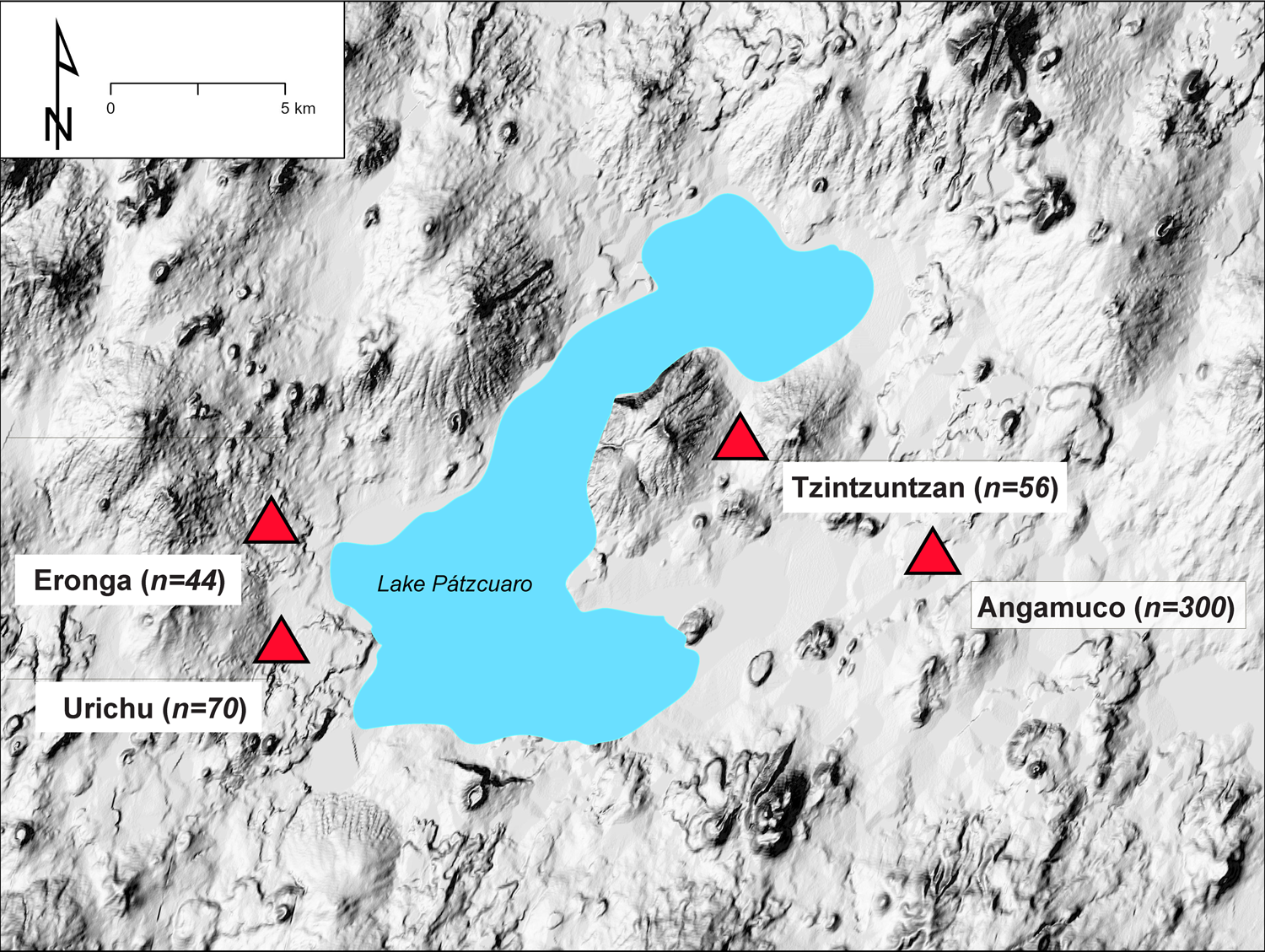
Tzintzuntzan (n = 56). Tzintzuntzan was the imperial capital, though the site was not particularly important prior to emergence of the state, and only a small habitation locale has been noted to the north of the modern community along the lakeshore (Pollard Reference Pollard1993). The sherd samples were recovered in a surface survey of the Purépecha capital in the 1970s, and all likely date to the Late Postclassic period. The samples are all fine wares, representing predominantly elite residential contexts and ritual residential activities (Hirshman and Ferguson Reference Hirshman and Ferguson2012; Pollard Reference Pollard1993). The forms include Purépecha bowls, tripod bowls, and jars; the surface treatment commonly includes slipping with cream or red, as well as red or white paint or both. Ethnohistoric documents indicate that a regular market occurred at the site during the state period (Pollard Reference Pollard1972, Reference Pollard1993).
Erongarícuaro (n = 44). These sherd samples derive from stratigraphic excavations and represent both a Preclassic/Classic period residential context and a Late Postclassic Purépecha elite residential zone associated with a public building (Haskell Reference Haskell2008, Reference Haskell2018). The samples are all fine wares and include both bowls and jars, most of which are slipped; if they are painted, red dominates throughout the time periods, and some Purépecha-period vessels are painted with red, white, or both. The site was a Late Postclassic secondary Purépecha administrative center (Hirshman and Ferguson Reference Hirshman and Ferguson2012; Pollard Reference Pollard, Williams, Weigand, Mestas and Grove2005a, Reference Pollard2005b; Pollard and Haskell Reference Pollard and Haskell2006).
Urichu (n = 70). These sherd samples were also drawn from stratigraphic excavations and represent residential contexts during all time periods at the site from the Preclassic to Late Postclassic, when Urichu was a Purépecha tertiary administrative center (Hirshman and Ferguson Reference Hirshman and Ferguson2012; Pollard et al. Reference Pollard, Hirshman, Neff, Glascock, Williams and Weigand2001, Reference Pollard, Hirshman, Neff, Glascock, Dillon and Boxt2005). Again, fine wares were sampled, including bowls and jars, with cream or red slip; red paint is common throughout all time periods, and red or white or both colors are also common during the Late Postclassic Purépecha period (a description of the overall Urichu assemblage and the range of variation can be found in Hirshman et al. Reference Hirshman, Lovis and Pollard2010). The site was also a canoe-landing location in the protohistoric period (Gorenstein and Pollard Reference Gorenstein and Pollard1983; Pollard Reference Pollard1993).
Angamuco (n = 300). Located approximately 9 km southeast of the imperial capital of Tzintzuntzan, the urban landscape of Angamuco is primarily situated on 26 km2 of lava flows. This site was occupied from at least the Classic through the Late Postclassic periods (ca. AD 250–1530; Cohen Reference Cohen2021). It is presumed to have already been a large civic center before imperial development and may have played a role in regional development and interaction. Sherd samples are from stratified excavations in six areas of Angamuco, including Late Postclassic ceremonial (yácata pyramid) areas and Classic and Early Postclassic ritual and domestic contexts. When identifiable, pre-Purépecha sherds may include fragments of bowls with or without grinding bottoms (molcajetes) and jars; these sherds often have a reddish or cream-colored slip and occasional decoration with red paint. Purépecha state- and empire-period ceramics in this sample consist of forms like bowls, tripod bowls with globular supports, jars, and spouted vessels; decoration includes reddish or cream-colored slip, sometimes with red, black, and white paint and negative resist firing (for further information, see Cohen Reference Cohen2016:165–174). In addition to the 300 archaeological specimens subjected to geochemical analysis, 30 raw clay deposits were sampled from the immediate vicinity to evaluate localized raw material procurement (as reported in Cohen et al. Reference Cohen, Pierce and Fisher2019).
Methods
The samples from Erongarícuaro, Urichu, and Angamuco were analyzed at the University of Missouri Research Reactor (MURR) following established protocols (Glascock Reference Glascock and Neff1992; Glascock and Neff Reference Glascock and Neff2003; Neff Reference Neff and Neff1992, Reference Neff, Cilberto and Spoto2000). The Tzintzuntzan samples were analyzed at the University of Michigan's Ford Nuclear Reactor and Phoenix Memorial Lab. Details of these analyses are available elsewhere (Cohen Reference Cohen2016; Cohen et al. Reference Cohen, Galaty and Fisher2018; Hirshman Reference Hirshman2003; Hirshman and Ferguson Reference Hirshman and Ferguson2012). The materials analyzed at Michigan were previously calibrated with the MURR analysis of the Erongarícuaro and Urichu materials (Hirshman and Ferguson Reference Hirshman and Ferguson2012), so we are confident that these datasets are comparable. In earlier publications, the Angamuco samples were analyzed separately from the Tzintzuntzan/Erongarícuaro/Urichu (TEU) samples. Using MURR Statistical Routines for GAUSS software implementing principal component, cluster, and discriminant analyses; visual inspection of bivariate plots; and Mahalanobis distance measurements, we compared the Angamuco samples to the existing MURR ceramic dataset and to previous groups identified in the TEU analysis. In contrast to earlier publications that only compare results of individual site-specific studies, our current study reanalyzes these data as a single dataset and is the first to assess ceramic production at a regional level.
The first step in our regional analysis was to recalculate the range of variation for shared compositional groups between past studies. To promote clarity and to facilitate a more cohesive regional perspective, we present the different and overlapping NAA groups identified in more localized studies as a combined dataset and subsequently rename the previously published groups (Table 2). Initially, the TEU samples were classified into groups that were identified as Main Pottery Group and Pottery Groups 1, 2, 3, 4, and 5 (Hirshman and Ferguson Reference Hirshman and Ferguson2012). The Angamuco samples, in contrast, were classified as Groups A, B, C, and D (Cohen et al. Reference Cohen, Pierce and Fisher2019). To limit confusion going forward, and because there is overlap between two of the Angamuco groups and the initial dataset, here we present the Lake Pátzcuaro Basin NAA groups as Pottery Group A and Pottery Groups 1–7.
Updated and Corresponding Previous Names of Lake Pátzcuaro Basin NAA Groups.

To assess the validity of previous group identifications and redefine the compositional range of variation to consider a more robust sample at a regional perspective, we started with Pottery Group A (PGA) and Pottery Group 1 (PG1) as identified by Hirshman and Ferguson (Reference Hirshman and Ferguson2012). Because of their clear similarities, we combined these two groups with two others from Cohen and colleagues (Reference Cohen, Pierce and Fisher2019; i.e., Angamuco Group A and C, respectively). Group separation relies on PCA transformation, which was performed using a variance-covariance matrix of the logged data (see Figure 4 and Supplemental Table 1 for the values of the first seven principal components). As discussed later, all other previously identified groups remained distinct: for example, PG1 is generally high in Ta, Th, Hf, Yb, Lu, Rb, Zr, Dy, and Cs, and low in Sc; PG2 is generally high in Cs and low in Cr and Sc; PG3 is low in Hf, Cs, Th, and Ta; PG4 is generally high in Cr and Sc; PG5 is low in Sm and Lu; and PG6 is low in Fe. There is, however, some compositional overlap with certain elements or principal components, such as between PGA, PG4, PG6, and PG7. Yet, despite the overlapping ellipses, the differentiation between the groups is clear (Figure 5).
Bivariate R-Q plot showing the first two principal components demonstrating the significance of each element for those two components.

Bivariate plot illustrating eight distinct geochemical groups from the Lake Pátzcuaro Basin, based on the first two discriminant functions (explaining 76.1% of the discrimination).

To explore the overlapping compositional groups and to determine their conclusive differences, we turned to bivariate plots. Specifically, we considered the overlapping groups individually to parse out any distinctions, element by element. This was done by first removing all groups that have already been established as unquestionably distinct based on previous studies (i.e., Cohen et al. Reference Cohen, Pierce and Fisher2019; Hirshman and Ferguson Reference Hirshman and Ferguson2012) and confirmed by PCA transformation (see Figure 5). Among the remaining groups that featured some compositional overlap, we next focused on more clearly discriminating between PG7 and PG4. Direct comparisons demonstrate, however, that although they are similar in various ways, these two groups consistently differ in a number of elements while also showing individual homogeneity (Figure 6). For example, elements such as Ti, V, K, Ba, Ta, Tb, Th, Sb, Sc, Fe, Hf, Ce, Co, and Cr are consistently lower in PG7 than in PG4, whereas elements such as La, Lu, Nd, Sm, Yb, Eu, Fe, Hf, Sc, Tb, Zn, Al, Dy, Ti, and V are homogeneous with a coefficient of variation (CV) below 0.2 (see also Supplemental Table 1). These observations fulfill the two most critical aspects of the provenance postulate (Weigand et al. Reference Weigand, Harbottle, Sayre, Earle and Ericson1977) suggesting true distinction in paste recipes. Given the similarity between them, however, their distinction may be based on certain aspects of production, rather than on raw materials alone. For example, similar raw materials may have been used but in different proportions (i.e., tempering agents and aplastic inclusions may have varied, resulting in slightly different paste recipes, as discussed for Angamuco by Cohen et al. [Reference Cohen, Galaty and Fisher2018]). However, these two groups do appear to be distinct recipes and likely reflect differential production to some degree.
Bivariate plot demonstrating differentiation of Groups PG4 and PG7 based on Ba and Ta.

Analyzing the overlap between PGA, PG6, and PG7 (in Figure 5), we found that PG6 and PG7 are distinct from each other. However, each independently exhibits small amounts of overlap with PGA. Considering their individual elements, which do overlap to a degree, PG6 and PG7 are consistently clustered (i.e., cohesive homogeneous clusters) yet typically diverge from each other and from PGA (Figure 7A). To confirm the differentiation, we calculated discriminant functions based only on PGA, PG6, and PG7 (Figure 7B). By determining the discriminant functions of these three groups in isolation, we were able to remove the influence of all other groups on the single function(s) that differentiate the dataset as a whole.
Bivariate plot demonstrating differentiation of Groups PGA, PG6, and PG7 based on (A) principal components 1 and 2, and (B) discriminant functions 1 and 2 following reapplication of discriminant analysis.

Finally, the discrimination of groups was further supported through hierarchical cluster analyses including only these three groups. In the produced dendrogram using unweighted elemental concentrations, these three groups do largely cluster independently of each other; Mahalanobis and Euclidean distance calculations also support this interpretation. Not only do these three compositional groups remain distinct when taking a regional perspective but also this analysis brings us to eight distinct groups for the region in total.
Results
Overall, our combined NAA study of the pottery indicates that there are eight compositional groups among the 470 basin samples (Table 3). In this regional assessment, group membership as had been presented by individual site-specific studies in the past changed little. However, very rarely, samples from PGA and PG6 were conservatively switched to the “unassigned” category, because they now fell within the outer margins of compositional hyperspace for more than one group when viewed in a regional perspective. Nonetheless, no samples were switched from one group to another in their identification: the groups remained intact and distinct, confirming not only the adequacy of previous analyses (as evidenced by their replicability in multiscalar approaches) but also the robusticity of the regional approach. At TEU, Pottery Group (PG) A and PGs 1–5 (PG1, PG2, PG3, PG4, PG5) were identified. At Angamuco, in contrast, we identified PGA, PG1, and groups PG6 and PG7, both of which are unique to this site.
Samples by Compositional Group, Time Period, and Site.

Note: The Middle–Late Postclassic periods correspond to the state/early imperial to imperial phases of political development.
The PGA group (n = 210, 45% of the total sample) and PG1 (n = 79, 17% of the total sample) are the two largest compositional groups and are found at all sites in every sampled time period, from the Classic through the Late Postclassic (Cohen Reference Cohen2016; Cohen et al. Reference Cohen, Pierce and Fisher2019). The PGA group is distinguished from PG1 mainly by the enrichment of transition metals and lower concentrations of Rb, K, Th, Cs, U, and Ta. PGA shows some similarities to small groups PG3 and PG5, whereas PG1 shows similarities to PG2 and PG4. Nevertheless, our analysis of the entire Lake Pátzcuaro dataset demonstrates that all groups continue to be stable and that the additional samples from Angamuco do not fall into these four groups.
At Angamuco, PG6 (n = 52) was clearly distinguished from other paste recipes in the PC plot: it was comparatively low in elements such as Sm, Hf, Ce, and Mn and comparatively high in Ca and Sr. This group does not match raw clay samples collected anywhere in the region. The fact that this group is dissimilar to all other samples in the MURR NAA database, including those collected far beyond the lake basin, suggests that it likely represents local materials and production (Cohen et al. Reference Cohen, Pierce and Fisher2019).
The other unique Angamuco group, PG7 (n = 43), is the most heterogeneous of the Angamuco groups in terms of individual elements but is more cohesive in multivariate analysis, such as through a principal components analysis. In general, it is higher in Co, C, and Fe than most of the assemblage. It is also the only Angamuco group that overlaps compositionally with any locally collected clay samples (n = 10; see Cohen et al., Reference Cohen, Pierce and Fisher2019). However, some other clays are more like some of the TEU groups, namely PG3 and PG5, and we anticipate investigating this similarity further as we integrate the results of petrographic analysis from the region (e.g., Cohen et al. Reference Cohen, Galaty and Fisher2018; Hirshman Reference Hirshman2009, Reference Hirshman2017a, Reference Hirshman2018a). The similarity with local clays and the dissimilarity with nonlocal ceramics in the MURR database thus support the conclusion of local production for all regional groups.
Discussion
Intra-Basin Pottery Production in the Purépecha Core
Our intraregional assessment of the lake basin ceramic NAA data yields several key findings. First, this combined dataset reinforces the stability of the NAA groups within the basin over time (Hirshman and Ferguson Reference Hirshman and Ferguson2012). Clearly the addition of the Middle–Late Postclassic Angamuco samples highlight the long-term stability of the PGA and PG1. These two groups are well represented at each site and through time (Table 3). Moreover, Erongarícuaro and Urichu continue to exhibit an increase in the number of NAA groups in the Middle to Late Postclassic—an increase from two and three groups, respectively, to three and six groups—which is concurrent with the onset of increased political complexity in the basin. All four NAA groups identified in the Angamuco samples—including the two groups unique to Angamuco, PG6 and PG7—were also present in both pre-state and state/empire occupations (see Cohen et al. Reference Cohen, Pierce and Fisher2019). The number of groups both over time and at the four lake basin sites supports an interpretation of long-lived compositional recipes, with the addition of new recipes over time (Hirshman and Ferguson Reference Hirshman and Ferguson2012).
Second, the Lake Pátzcuaro Basin NAA data affirms the previously published model of stable, long-term ceramic production, with localized and dispersed community potting traditions within the lake basin (Hirshman Reference Hirshman, Huntington, Arnold and Minich2018b; Hirshman and Ferguson Reference Hirshman and Ferguson2012; Hirshman et al. Reference Hirshman, Lovis and Pollard2010). Although this dataset includes only a small number of pre-state and empire samples for Angamuco, we suggest that PG6 (five samples) and PG7 (two samples) demonstrate a long-term production tradition at this site, which supports previous observations about Angamuco ceramics (Cohen et al. Reference Cohen, Galaty and Fisher2018, Reference Cohen, Pierce and Fisher2019). The addition of PG6 and PG7 at Angamuco, and only at Angamuco in this dataset, and the match between PG7 and local Angamuco clays strongly suggest thriving ceramic production at the site in addition to other locales in the basin. PGA and PG3 occur at Erongarícuaro and Urichu in both time periods, demonstrating long-lived potting traditions beyond Angamuco. Moreover, the increased number of small NAA groups at both western basin sites marks an increase in the number of NAA groups within the lake basin as greater sociopolitical complexity emerges in the Middle to Late Postclassic. The increase in compositional groups indicates that more recipes are in use, which is likely due to more potters, potting locales, or both participating in ceramic production within the basin concurrent with larger political changes, rather than any attempt to control or consolidate production by the political elites.
Third, our combined dataset does not support a significant reorganization of the ceramic economy with the emergence of the Purépecha state and empire. As noted, the two largest NAA groups, PGA and PG1, are important through time and at each site. Their inclusion in Angamuco's ceramic assemblage is especially noteworthy because it demonstrates this site's ceramic—and economic—connection with the larger basin both before and after the Middle Postclassic. In the Late Postclassic period, these groups are associated with undecorated vessels, as well as decorated (i.e., slipped or painted with one color; incised drawings) and polychromes at all the sites, including imperial styles at Angamuco (Cohen Reference Cohen2016:248–254; Hirshman and Haskell Reference Hirshman, Haskell, Williams and Maldonado2016; Hirshman et al. Reference Hirshman, Lovis and Pollard2010). The adoption of new styles within existing production contexts explains a stylistic, but not technological, shift in the assemblage (Hirshman Reference Hirshman, Huntington, Arnold and Minich2018b).
Previous research by Pollard (Reference Pollard, Williams and Maldonado2016, Reference Pollard2017) indicates that only very restricted classes of ceramics (e.g., spouted vessels, a highly decorated vessel form with paint and negative thin strap handles; vertical tubes; and zoomorphic forms; see also Hirshman and Haskell [Reference Hirshman, Haskell, Williams and Maldonado2016:211]) moved via elite networks during the imperial period. Other bichrome, polychrome, and utilitarian vessels seemed to move more freely throughout the basin before and after the state and empire emerged (Hirshman Reference Hirshman and Lopez Varela2017b; Hirshman and Haskell Reference Hirshman, Haskell, Williams and Maldonado2016). This free movement is also apparent at Angamuco: the relative abundance and generally wide distribution of PG7, associated with polychromes within Middle to Late Postclassic contexts, suggest widespread access rather than the exclusivity sometimes associated with access to elite or exotic goods.
Although this evidence affirms the general model of stable and dispersed ceramic production, this research has also complicated our understanding of the larger ceramic and political economy of the lake basin, especially as political complexity increased over time. This is most clearly seen through the inclusion of the Angamuco ceramic assemblage, at least as represented by these NAA samples, which does not seem to be engaged in the same ceramic economy as the more centrally located sites. For example, the lack of representation of the Angamuco-related PG6 and PG7 elsewhere in the lake basin indicates that these ceramics were not being brought into the center of the basin. This may be due to the distance of the site from basin markets; Hirshman and Stawski (Reference Hirshman and Stawski2013:Figure 6) mention that Angamuco is one of the communities that is more distant from a known basin market, and thus Angamuco potters may not have carried their wares into the center (see also Pollard Reference Pollard1993:89, Figure 3.5). Also of interest is the lack of the smaller pottery groups at Angamuco (PG2, PG3, PG4, and PG5) that were identified at the western basin sites of Erongarícuaro and Urichu. This means that Angamuco was selectively receiving ceramics from the lake basin. The local Angamuco potting tradition likely met most of the needs of the community, at least in the Late Postclassic imperial period. Again, the PGA and PG1 are bichromes and polychromes at the western basin sites, and perhaps they were special-purpose ceramics not mimicked by the Angamuco potters. This distinction also implies that vessels made with PGA and PG1 paste recipes were somehow distinguishable, either by decoration (which seems unlikely at this point), by aspects of the ceramic distribution system, or by another mechanism we cannot currently hypothesize. The relative lack of compositional diversity in the Tzintzuntzan ceramics may be another dimension of this question.
All these results highlight an intricate ceramic political economy with differential participation on the part of potters and communities within the lake basin and perhaps with communities outside the basin as well. The PG6, restricted to Angamuco, may represent connections with communities to the east, because the site sat at a key pass out of the lake basin. The region to the east has not been studied archaeologically, and no comparative archaeological or NAA data currently exist.
Long-Term Potting Traditions
What does long-term localized production mean for political core subjects and how states and empires co-opted local production activities? The Lake Pátzcuaro Basin ceramic dataset provides an opportunity to explore the impacts (or lack thereof) of political changes on pottery production and consumption in what became an imperial core region. As discussed earlier, we found that over a thousand-year period, pottery production in the region was relatively stable, localized, and diverse. Other scholars have pointed out that raw materials and pottery production techniques impose technological constraints and can therefore be stable over time (e.g., Sinopoli Reference Sinopoli1991; Womack et al. Reference Womack, Hui Wang and Flad2019). The continuation of paste recipes from the periods before and after the political consolidation of the Purépecha state and empire indicates that, despite shifts in the ceramic forms and decorative styles being produced, the same resources and technologies were being used. Moreover, based on information from Purépecha potting ethnographies, Hirshman (Reference Hirshman, Huntington, Arnold and Minich2018b) found that local potters were at least mimicking Purépecha decorations on their vessels. All this suggests not only that producers were successful in using these techniques and materials but also that social shifts motivating forms and styles were not so extensive that they changed the raw materials selected or the techniques used to prepare clay.
Similar stability has been documented in other state and imperial regions (Davenport Reference Davenport2020; Nichols et al. Reference Nichols, Brumfiel, Neff, Hodge, Charlton and Glascock2002; Overholtzer et al. Reference Overholtzer, Pierce and Glascock2020; Williams et al. Reference Williams, Santoro, Speakman, Glascock, Romero Guevara, Valenzuela, Standen and D'Altroy2016), and greater nuance in understanding ancient political economies and market structures has come to the fore (Berdan Reference Berdan and Plattner1989; Hirth Reference Hirth, Hirth and Pillsbury2013; Huster Reference Huster2018; Smith and Berdan Reference Smith and Berdan2003). This research has implications for how states and empires formed and affected the daily lives of new subjects. Within the Purépecha case specifically, we have growing evidence for a complex economic system. Some dimensions of the economy—notably obsidian importation and distribution (Rebnegger Reference Rebnegger2010) and aspects of metallurgical processing and distribution (Maldonado Reference Maldonado2009, Reference Maldonado2008)—came under firm political control. Using ethnohistoric records, Aguilar González (Reference González, Ricardo and Enkerlin Pauwells2012:Footnote 1) highlights the political control exerted through the tax system but finds that taxes were focused on five main resources: corn, beans, chili, cotton, and firewood (see also Beltrán Reference Beltrán1982). However, although agricultural production intensified with increased elite activity and growing populations within the basin (Fisher et al. Reference Fisher, Pollard and Frederick1999), documentary sources suggest that agricultural products from the basin and beyond moved through both market and tribute mechanisms (e.g., Gorenstein and Pollard Reference Gorenstein and Pollard1983). As demonstrated here, most ceramics seem to be locally produced with long-term and stable recipes. Even when imperial-style ceramic forms, like spouted ceramic vessels and bowls with globular supports, appear, producers used similar paste recipes as in the past. It is still possible that the production of specialized imperial forms, just as their distribution, was under elite control. If so, the political elite actively distinguished among resources and goods that they chose to directly control.
The emerging archaeological data imply pre-state and imperial contexts in which existing settlements were integrated into the emerging regime through various negotiations and potentially bottom-up processes (Cohen Reference Cohen2016; Haskell and Stawski Reference Haskell and Stawski2017; Hirshman Reference Hirshman2008; Rebnegger Reference Rebnegger2013). As such, we can modify our understanding of the complexities of Purépecha development and consolidation. The Relación de Michoácan highlights the tribute that was extracted from lake basin settlements and throughout the territories to Tzintzuntzan, as well as the control over craft production (e.g., Aguilar González Reference González, Ricardo and Enkerlin Pauwells2012), but these political-economic strategies are not immediately apparent within the Lake Pátzcuaro Basin. The Aztec imperial economy might be useful as a point of comparison, because the adjacent contemporary empire used a variety of strategies to ensure that tribute demands could be met by various subjugated populations and that the needs of their population within their political core could also be satisfied (Berdan et al. Reference Berdan, Blanton, Boone, Hodge, Smith and Umberger1996; Nichols et al. Reference Nichols, Brumfiel, Neff, Hodge, Charlton and Glascock2002). In the Basin of Mexico and in other territories, an existing market system was coopted by imperial elites, and goods continued to flow through this system during imperial control (Garraty and Stark Reference Garraty and Stark2002; Huster Reference Huster2018; Minc Reference Minc2009; Skoglund et al. Reference Skoglund, Stark, Neff and Glascock2006; Stoner et al. Reference Stoner, Millhauser, Rodríguez-Alegría, Overholtzer and Glascock2014). However, goods also moved by nonmarket processes, including via tribute payments, large-scale elite gifting, and extended family ties (Fargher et al. Reference Fargher, Blanton and Heredia Espinoza2010; Huster Reference Huster2018). Our case study in the Lake Pátzcuaro Basin suggests that similarly diverse processes likely structured imperial core region ceramic economies.
Conclusion
The study of ancient pottery production is useful for understanding political-economic changes in regions where communities, cities, and states were formulated and reconfigured over time (Bishop Reference Bishop2014; Nichols et al. Reference Nichols, Brumfiel, Neff, Hodge, Charlton and Glascock2002; Rice Reference Rice2009; Sinopoli Reference Sinopoli1988). Geochemical characterization of pottery can help document specific social changes or continuity in the locations of raw material procurement, vessel preparation, and trade and exchange (Hayashida Reference Hayashida1999). Identifying whether there is continuity or change in these practices enriches our understanding of how political regimes came to power and the extent to which these regimes infiltrated daily life vis-à-vis practices like clay collection, mixing, and subsequent vessel production activities. Regional ceramic characterization studies highlight broader trends in ceramic production and consumption activities (Nichols et al. Reference Nichols, Brumfiel, Neff, Hodge, Charlton and Glascock2002; Schachner et al. Reference Schachner, Huntley and Duff2011; Stark et al. Reference Stark, Speakman and Glascock2007), which are especially important in core regions where the impacts of state and empire formation are poorly understood.
The compositional diversity within the Lake Pátzcuaro Basin indicates a geochemical and productive complexity approaching that of the Valley of Mexico (e.g., Crider Reference Crider2013; Nichols et al. Reference Nichols, Brumfiel, Neff, Hodge, Charlton and Glascock2002), a much larger region and one whose underlying geochemistry and structure of ceramic production are better known. This study shows that the lake basin experienced long-term and relatively stable ceramic production before and during Purépecha state and imperial developments. Future work should better integrate local clay samples into the analysis and broadly discuss the role of this data in the Purépecha political economy.
Acknowledgments
The Angamuco analysis was funded by grants from the National Science Foundation (BCS-1344333) and the University of Washington, and an NSF-subsidized grant from MURR (BCS-1415403) awarded to Cohen; samples were exported under Instituto Nacional de Antropología e Historia permit No. 401-3-8010 (8/2014) issued to Cohen. Grants from the NSF (BCS-0818662, BCS-1220016), National Geographic (9138-12), NASA, and Colorado State University awarded to C. Fisher supported the fieldwork. The Fontezuelas community, the Tzintzuntzan Municipal Government, the Tzintzuntzan Community Heritage Council, INAH-Michoacán, and the LORE-LPB field crews between 2009 and 2014 were integral parts of the Angamuco fieldwork. TEU fieldwork was funded by grants awarded to Helen Pollard: the Wenner-Gren and Columbia University Latin American Center for Tzintzuntzan (export permit No. 8/311.42(P)/19-5, Depto de Monumentos Prehispanicos; analysis at the University of Michigan under Leah Minc); the Wenner-Gren, National Geographic, the NSF (SBR 9507673), and the NEH (RK-20087) for Urichu; the Heinz Foundation and the Wenner-Gren for Erongarícuaro (export permit Bo. C.A. 401-36/0677 and Aduanas No. 401-3-3999 [6/2001]). This project was also supported by an NSF grant (BCS-0102325) to MURR. We thank Charlie Kolb and three anonymous reviewers for their suggestions to improve the manuscript. Felipe Valencia kindly looked over the Spanish abstract.
Data Availability Statement
All data are publicly available at the University of Missouri Research Reactor and with the authors.
Supplemental Material
For supplemental material accompanying this article, visit https://doi.org/10.1017/laq.2022.65.
Supplemental Table 1. PCA Values of the First Seven Principal Components.
Competing Interests
The authors declare none.


 Open access

