

Introduction
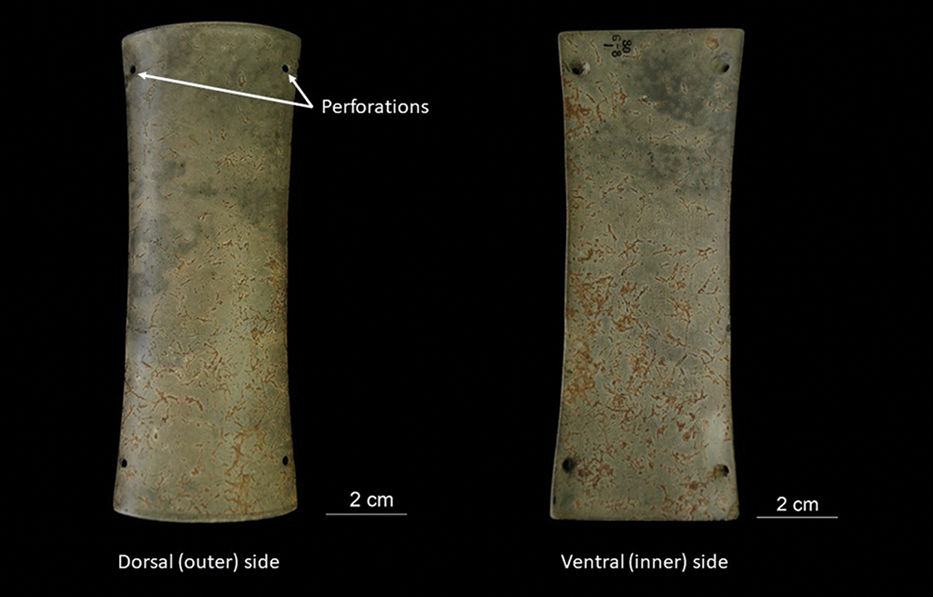
The bracers of the Early Bronze Age remain some of the most fascinating objects of European archaeology (see Figure 1 as an example). Distributed from central Europe to Scotland, they have engendered widespread debate since they were first identified as wristguards, associated with archery, by A.W.H. Ingram in 1867. Archaeologists have returned repeatedly to their function and form, wrestling with what these objects were for and what they represented. Their typologies have been written and rewritten, their associations grouped and discarded. They have been declared to be both entirely unsuitable and eminently employable as archery equipment. This paper explores these objects by interweaving microwear analysis with the philosophy of new materialism. We challenge the idea that what matters is the purpose for which objects were made, that they ever were one thing, or one type. Instead, we embrace the notion that each object is not a singular entity but what we term a process object, a multiplicity that comes together to create non-linear stories that critique our ideas of typology, biography, function and form. This, we propose, has significant implications for how we approach material culture. Before we delve further into these theoretical issues, however, let us introduce the bracers.
The bracer from Calne, Wiltshire (British Museum 1880, 0608.1) showing dorsal and ventral sides. (All figures produced by Christina Tsoraki.)
What are bracers?
Bracers are thin, rectangular stone objects with mainly two or four perforations at their narrow ends. They date to the earliest part of the Bronze Age and are found in a variety of contexts, often in association with Beaker pottery and burials. The Beaker phenomenon represents a period at the start of the European Bronze Age marked by shared practices stretching across much of Europe, often centring around the deposition of ceramic Beaker vessels and single burials accompanied by grave goods, including archery equipment (Carlin Reference Carlin2018; Vander Linden Reference Vander Linden2007). In Britain, Anne Woodward and John Hunter's (Reference Whittle2011) extensive study identified 97 bracers (16 of these are now lost), although the discovery of others in the last decade has raised the number to over 100. In Ireland, Neil Carlin (Reference Carlin2018, 181–5) identified at least 112 bracers, with a limited geographical distribution occurring mostly in the north, particularly in Antrim (cf. Harbison Reference Harbison1976). In central Europe, Nicolas (Reference Nicolas2020) defined a corpus of 297, and Carlin (Reference Carlin2018, 182) noted collections from Portugal (20), France (56) and the Netherlands (50). What seems to define a bracer is its stone materialFootnote 1 and the perforations at each end, but there is a wide variety of forms. Carlin (Reference Carlin2018, 183) sets out different regional styles; for example, in Ireland bracers are often long and narrow with only two holes, whereas in Britain they are often wider with four or more holes. There also appear to be regional preferences for particular colours: red rocks dominate in Ireland, blue/grey and green/grey in Britain, black and red in central Europe and grey on the Atlantic facade (Carlin Reference Carlin2018, 183).
The function of these objects has long been debated. Since Ingram's (Reference Ingram1867) suggestion that they were archers’ wristguards, this has remained the dominant understanding. Where they are found in burials, archaeologists have discussed whether they were located on the inside of the arm (and thus could be a wristguard) or the outside (and thus could not) (Fokkens et al. Reference Fokkens, Achterkamp and Kuijpers2008). Regardless of location, whether they were truly functional or simply symbolic is disputed, and their possible associations with martial identities, status and even perhaps falconry debated (Roe & Woodward Reference Roe, Woodward and Shaffrey2017, 335; van der Vaart Reference van der Vaart2009; Woodward & Hunter Reference Woodward and Hunter2011). Yet bracers come in a variety of forms, shapes and sizes. They have complex histories and were deposited in different contexts. The lack of clarity here has repeatedly drawn archaeologists back to ask what these objects were, and what they were used for. Might they have been whetstones or metalworking tools (Clarke et al. Reference Clarke, Cowie and Foxon1985, 266; Harrison Reference Harrison1980, 53)? At the end of an exhaustive review of bracers from the Netherlands, Fokkens et al. (2008, 124) conclude that, although the archaeological examples match neither historical nor ethnographic examples of wristguards, despite the fact they were more often worn on the outside of the wrist than the inside, bracers they remain—even if primarily ornamental rather than functional. Given this variety, the sceptical reader might ask whether these objects even represent a ‘real’ group at all, or are all these debates simply the consequence of a particular history of research? We too are dubious, as will become clear, as to the reality of the group of objects we label as ‘bracers’; however, their intransigence as an archaeological entity, their repeated patterned appearance in certain kinds of archaeological context (notably Beaker burials) and their centrality to the literature demand a response.
Alongside a concern with function, there are extensive debates about typology (Smith Reference Smith2006). Richard Atkinson divided bracers from Britain into three groups: types A, B and C (see Clarke Reference Clarke1970, 261). Type A are long in shape with two perforations. Type B are rectangular with two or more perforations. Type C are waisted, have a convex profile and always have four perforations. Naturally, this rather simple typology has been complicated by the creation of sub-types; there are European comparisons, and the overall schema has been challenged by alternatives (Smith Reference Smith2006; Woodward & Hunter Reference Woodward and Hunter2011, 4–5).
Typological analysis has often been accompanied by petrological sourcing of bracers. In Britain, Woodward and Hunter (Reference Woodward and Hunter2011, 116–24) identified 24 per cent of their examples as coming from Group VI rock in Langdale, where roughouts for bracers have been recognized at the ‘factory’ site at which Neolithic stone axes were earlier made in large numbers (Woodward & Hunter Reference Woodward and Hunter2011, 36). In Ireland, jasper seems to have been a particularly important rock type (Roe & Woodward Reference Roe and Woodward2009), and it is possible that a source at Lambay Island (another Neolithic axe factory: Cooney Reference Cooney, Topping and Lynott2005) was exploited for this. In the case of Langdale, recent re-dating suggests the peak in Neolithic exploitation occurred at 3955–3384 cal. bc (Edinborough et al. Reference Edinborough, Shennan and Teather2020, 94), meaning the Early Bronze Age use came after a significant hiatus. Nonetheless, it is possible that at both Langdale and Lambay Island the rock sources used to make bracers were of historical importance. These particular rocks also often required particular skill sets to work them. Irish jasper is particularly fragile and other rocks have veins and imperfections that would have made them harder to work. Roe and Woodward (Reference Roe, Woodward and Shaffrey2017, 337) argue that those made of Langdale tuff show exceptionally high levels of skill. In the wake of this study of geological origins, arguments about bracers being symbolically important and connected to ancestors have arisen (Carlin Reference Carlin2018; Roe & Woodward Reference Roe, Woodward and Shaffrey2017, 323).
Microwear of bracers
Into these debates we add the results gained from microwear analysis of 15 bracers drawn from the collections of the British Museum, Wiltshire Museum, Oxford Archaeology, English Heritage, Wessex Archaeology and Martin Green's collection. As we will see, microwear analysis both undermines and sustains the category of ‘bracer’ in unexpected ways. Microwear analysis is a well-established technique that studies the traces left on the surfaces of objects to understand how they have been made, used and handled (Dubreuil et al. Reference Dubreuil, Savage, Degado-Raack, Plisson, Stephenson, De La Torre, Marreiros, Gibaja Bao and Ferreira Bicho2015; van Gijn Reference van Gijn2010). Our work extends beyond that carried out by Woodward and Hunter (Reference Woodward and Hunter2011) by employing both low- and high-power microscopic analysis using a Leica M80 and a Zeiss Stemi 2000-C stereomicroscope with an external, oblique light source (magnifications up to 100×) and a Leica DM1750M and a Zeiss Axioskop 2 MAT metallographic microscopes (at 100× and 200× magnification). Woodward and Hunter (Reference Woodward and Hunter2011, 78–80) used low-power analysis to provide an initial overview of potential uses of bracers from Britain. As they note, at low power microwear can be difficult to detect, but they were able to identify a number of incidents of scratching and wear at the perforations. They approximated overall levels of wear on bracers (Woodward & Hunter Reference Woodward and Hunter2011, 79). Our approach builds on this: we offer a more detailed understanding of how these objects changed through time and reflect on their individual histories and collective narratives.
We undertake microwear analysis within an explicitly new materialist framework (Tsoraki et al. Reference Tsoraki, Barton, Crellin and Harris2020). This means we approach the bracers in relation to the other materials with which they came into contact (and those that they did not) and how these relational connections changed the potentials of these objects. Rather than assuming we know what properties materials have from modern materials science, we look for evidence of their properties in the Bronze Age from how they were treated.
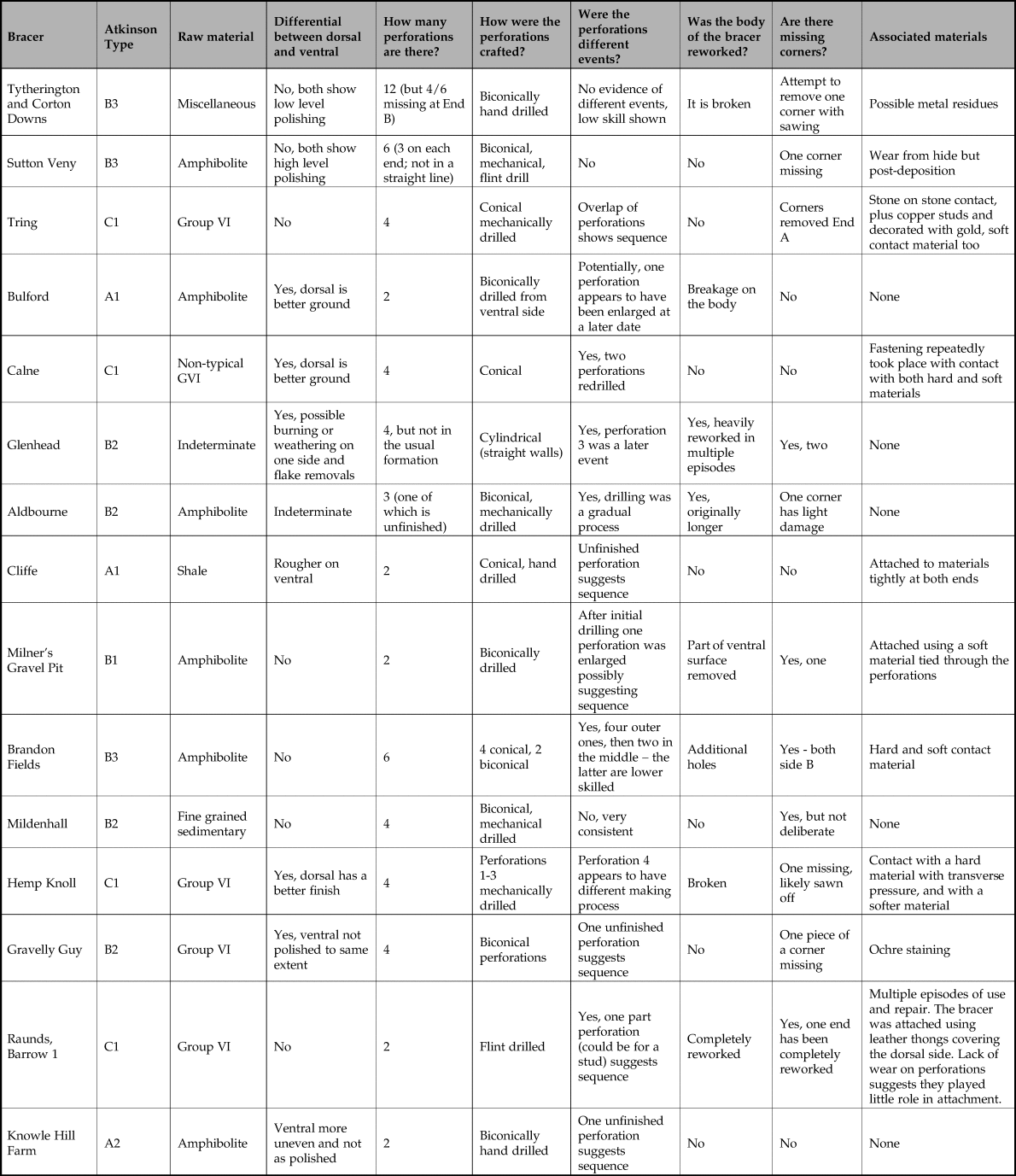
When we completed our analysis of the bracers, we produced: a 11,320-word document describing our observations; a PowerPoint showing photographs and micrographs; and a table that summarized the findings. With the data before us, we began to think about how we could present these objects. We could not map out comprehensive flow diagrams that showed all the events in each object's history because, whilst the analysis had indeed identified a great many events and moments of transformation, these could not always be placed in sequence. Neither could we create a table that, by itself, captured the huge variety of different processes each object had been through because the data were patchy—we might have information about grinding processes for one bracer and not another, or data on residues for one but no detail about the interior of their perforations because the surface of the object had not been appropriate to allow that form of analysis. In the end, we settled on a visual approach to our data where each object would be presented on its own terms rather than inserted into a fixed template (like a flow diagram), accompanied by a simple summary table (Table 1). Our figures capture each individual object's story. The full microwear dataset can be found in the Supplementary Information (SI).
Results summary for the 15 bracers studied for this paper.
Mapping histories of relations: microwear analysis of bracers
The 15 bracers reveal complex histories. Even this small sample shows how varied the objects can be – compare the examples from Cliffe, Kent (Fig. 2), and Calne, Wilts (Figs 1 and 3). As with many British bracers, most of these examples are made from either Group VI stone or amphibolite, so many share an origin. Yet in other ways they differ significantly. The numbers of perforations range from 2 to 12; some were hand drilled, others bow drilled. Sometimes these happened at the same time, other times in sequence, occasionally after the object was reworked. Display clearly mattered in some cases; in six examples the outer side (dorsal) was more polished than the inner (ventral), but in others no difference was apparent. Some were heavily and repeatedly reworked, such as the bracer from Raunds, Northants (Fig. 4) (Harding & Healy Reference Harding and Healy2011), whilst others seem to have been made and deposited quite quickly. People actively intervened in both the making and the breaking of bracers; eight have deliberate alterations after the moment of ‘completion’. Six had at least one corner intentionally removed. Materials joined in these processes: some of the bracers (e.g. Tring, Herts: Fig. 5) came into contact with metals and hard stone; others (e.g. Milner's Gravel Pit, Kent: Fig. 6) only rubbed against soft matter like hide; all were drilled by flints, some showed no wear traces at all.
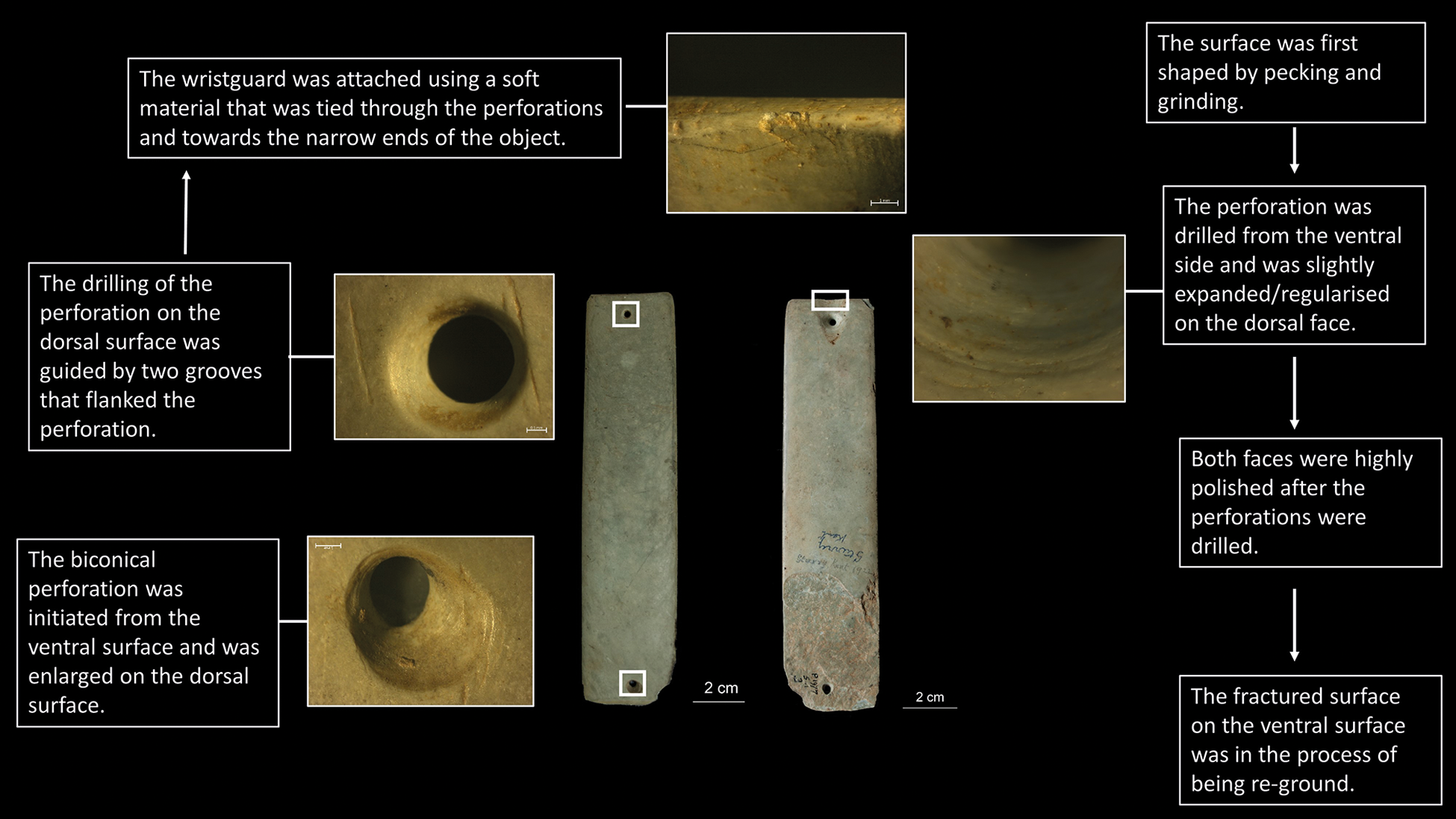
The bracer from Cliffe, Kent (British Museum 1978, 1101.122). End A is at the top of the image, End B at the bottom.

The bracer from Calne, Wiltshire (British Museum 1880, 0608.1). End A is at the top of the image, End B at the bottom. (Solid borders refer to events that can be put in order; dashed borders are for those whose place in a sequence cannot be ascertained.)

The bracer from Raunds, Northamptonshire (English Heritage 35125). End A is at the top of the image, End B at the bottom. (Solid borders refer to events that can be put in order; dashed borders are for those whose place in a sequence cannot be ascertained.)

The bracer from Tring, Hertfordshire (Wiltshire Museum DZSWS:STHEAD.326). End A is at the top of the image, End B at the bottom. (Solid borders refer to events that can be put in order; dashed borders are for those whose place in a sequence cannot be ascertained.)

The bracer from Milner's Gravel Pit, Kent (British Museum 1977, 0501.3). End A is at the top of the image, End B at the bottom.
Processes mattered in each object's history. In some cases, especially as we will see below with Brandon Fields, Suff, and Tring, we can place different events in an order mapping a linear history. In others, such as Calne, the order of events is harder to discern. Here the objects’ histories coil up and interweave; we can see different events, but their sequence remains unclear. Our two ways of presenting the data, as images and as a table, reveal these different levels of certainty; indeed, the decisions they force us to make help foreground aspects of the data. The table imposes a linear sense of one category of data after another, the images emphasise where questions remain as to sequence. Throughout, the different objects we have studied reflect and cascade events; similar and different histories play out. They have much in common yet are radically distinct. They all have stories to tell, but they are often partial. Let us explore this in more detail through five examples.
Stories in stone
Made from Langdale stone, the Tring, Herts, bracer (Wiltshire Museum DZSWS:STHEAD.326) is rectangular and convex/concave in section (Woodward & Hunter Reference Woodward and Hunter2011, 39). It is referred to as a Waisted/Slightly waisted type, Atkinson type C1 (Fig. 5). The Langdale rock was shaped, and four perforations were mechanically drilled from the ventral side. While on the external-facing surface the holes appear reasonably well shaped and positioned, on the reverse they overlap at one end and are not symmetrically placed. Following this, it was polished deliberately in a single direction along the main axis of the object but finished over multiple stages: the last involving polishing with a soft material, probably hide or leather. The perforations were filled with copper studs, and the object shows use-related traces. Contact with another material removed parts of the corners at End A, and other chips along that side suggest repeated encounters with a hard material. There are indications of smoothing and wear on the perforations. The object was also decorated; we can show, for the first time, it bears traces of Bronze Age gold (see SI). The location and form of these traces suggest the object was covered with gold after it had been smoothed, for aesthetic purposes rather than being used for gold working (as other broadly contemporary stone tools were: see Crellin et al. Reference Crellin, Tsoraki, Standish, Pearce, Barton, Morriss and Harris2023). Tensions abound here: the object tells a drawn-out story of different moments, from extraction and shaping to use and decoration. At times great care was employed, at others less so. There is no evidence it ever served as a wristguard in the traditional sense, nor that it was attached to an arm at any stage. The object was probably interred accompanying a body in a Beaker burial, although this is uncertain. Were the decorative transformations for this object always intended to be part of its history?
The Glenhead, Antrim, wristguard (British Museum 1964, 1201.1370) has an irregular shape and was made from an indeterminate rock with a crystalline texture, probably metamorphic in origin (Fig. 7). This object changed shape, and probably function, multiple times. Originally polished on both faces and margins, it is now highly worn. One face has been altered by both flake removal and a process that has weathered the surface, possibly burning. End A is broken and worn and appears to have been completely reshaped. It was originally convex in shape but has been reground with coarse abrasive materials. End B was originally longer and has been intentionally reworked and polished with the narrower end showing traces of a red-coloured residue in the pits that cut through its polished surface. The corner on End B appears to have been sawn off. The two perforations on End A are not symmetrically aligned but both have straight walls, are cylindrical in shape and have worn rims. On End B there are two perforations on the remaining corner: perforation 4 has the same shape and worn rim as the other two, whereas perforation 3 appears to be a later addition. A diagonal groove cuts through perforation 4 and appears to be the result of either an attempt to remove this corner or a particularly tight binding mechanism. It is clear this object changed form many times; its weathered nature means that the application of high-power analysis was not possible but despite this we can identify multiple instances of alteration.
The bracer from Glenhead, Antrim (British Museum 1964, 1201.1370). End A is at the top of the image, End B at the bottom. (Solid borders refer to events that can be put in order; dashed borders are for those whose place in a sequence cannot be ascertained.)

The Calne, Wilts, bracer (British Museum 1880, 0608.1) was made from an unusual type of Group VI rock. It is rectangular in plan with a convex/concave shape in section (Fig. 3). It has four perforations, all drilled from the ventral surface and then enlarged from the dorsal side. At least two of the perforations were redrilled. It is not entirely clear whether the drilling took place before polishing, or if there was a sequence of drilling and polishing events that interwove. Certainly, the polishing was finished after the holes were drilled and was not equally applied: the dorsal side was polished to a higher degree of finish than the ventral surface. The wristguard then appears to have been fastened on several different occasions to a hard material, with a softer material applying pressure in transverse direction. The process of fastening seems to have damaged the bracer's corners, and different patterns of wear may suggest it was fastened in different ways at different times. This history of repetitive use did not fundamentally reshape the object, however. The final event in its Bronze Age story is known—the wristguard was buried alongside an inhumation burial—but prior to this a sense of sequence is hard to tease out from these apparently overlapping events.
The Bulford, Wilts, bracer (SF628 – Wessex Archaeology, Fig. 8) was found in a pit with a complete Low Carinated Beaker (Leivers Reference Leivers2020). The pit is thought to have housed a wooden box-like container, the lid of which collapsed post deposition. The bracer itself is narrow with just two holes: Atkinson type A1. It was made from a green metamorphic amphibolite. The bracer was ground on its body and margins using a range of differently coarse abrasives; the dorsal side is more extensively ground than the ventral. The perforations have a complex relationship with the grinding processes. On the ventral side the perforations were drilled mechanically after grinding had occurred. On the dorsal side, perforation 1a was drilled before the surface had been ground. It was then enlarged with a flint hand-drill and the dorsal surface ground and polished. In contrast, perforation 2a, again on the dorsal side, was drilled after the surface had been ground. No microwear-related traces were identified. This is an object with the form of a bracer but no signs it had the biography of one.
The bracer from Bulford, Wiltshire (SF628 – Wessex Archaeology). End A is at the top of the image, End B at the bottom.

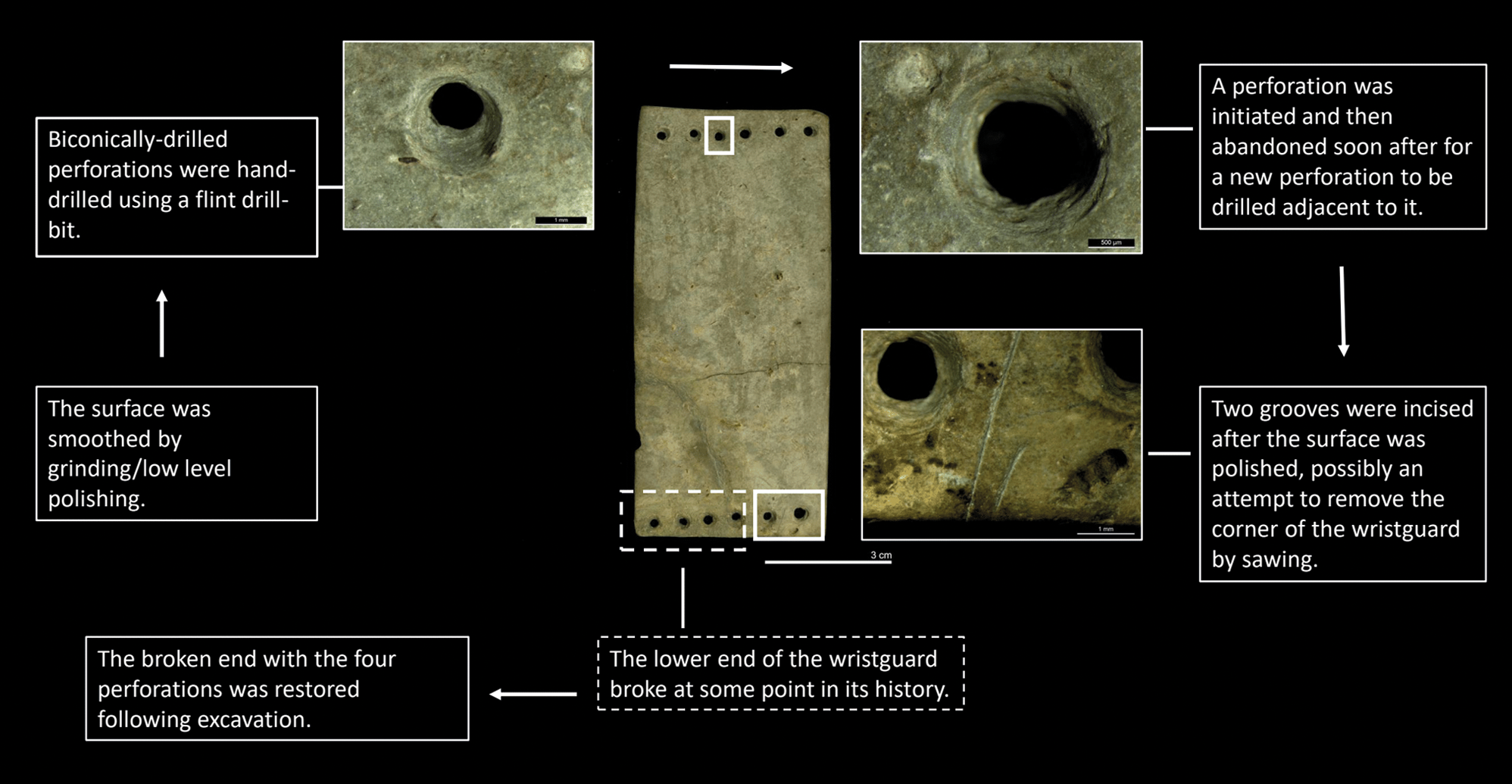
The bracer from Tytherington and Corton Downs, Wilts, held by the Wiltshire Museum (DZSWS:STHEAD.232) (Woodward & Hunter Reference Woodward and Hunter2011, ID 29), is an Atkinson type B3, made from a fine-grained metasediment slate with an olive to greenish grey colour. The rock is suggested to have come from the Devonian killas in Cornubia making its origin far from its find spot (Woodward & Hunter Reference Woodward and Hunter2011, 39). The bracer is rectangular in plan with a flat section and slightly rounded corners (Fig. 9). Irregularities indicate that the surface did not receive a high level of finish. Twelve perforations were biconically drilled with irregular and inconsistent traces indicating the likely use of a flint hand-drill. We might describe the perforations as showing low skill levels: perforation 5 is off-centre, perforation 2 is angled, an unfinished starter perforation is evident next to perforation 3 and the smoothing of the interiors is inconsistent. No wear traces or evidence of contact materials were identified on the bracer's surface. On End B, two grooves were incised between perforations 7 and 8 on the dorsal face. It appears that this was an incomplete attempt to saw off one corner. At some point in its history the bracer broke at End B; a portion of it with four drilled perforations became separated from the main body. The broken part was restored following excavation. This bracer has an intriguing history; was it intended to have a different form?
The bracer from Tytherington and Corton Downs, Wiltshire (Wiltshire Museum DZSWS:STHEAD.232). End A is at the top of the image, End B at the bottom. (Solid borders refer to events that can be put in order; dashed borders are for those whose place in a sequence cannot be ascertained.)
Each of these five objects has its own story. There are moments when we can put sequences of events together and moments when the events remain disconnected from a timeline. There are some bracers which will have looked (and potentially functioned) very differently at specific moments. Yet despite the absence of a clear sequence, and despite all this variability, two of the primary ways in which archaeologists have engaged with these objects is through typology (treating the object as part of a group which determines the form), or through object biographies (which celebrates both social meaning and an individual object's chaîne opératoire). No doubt it is already apparent that the complexity of our narratives challenges both of these approaches. To explore this in more detail, we review both typologies and biographies before setting out an alternative theoretical toolkit.
Reflection on typologies and biography
Typology revisited
Typology is one of the key methodologies of archaeology. It developed as part of the foundation of the discipline as antiquarians and early archaeologists sought to move from accumulating ancient objects towards organizing and understanding their collections. The technique creates categories relying primarily on similarities in form: we might construct typologies of axes, pots, or arrowheads. Form is seen as key to understanding function in the past; Marie-Louise Sørensen (Reference Sørensen, Kristiansen, Šmejda and Turek2015, 88–9) argues that we form typologies based on perceived function. Further divisions are then possible on a morphological basis as we create a more detailed typology. In many cases, these are uncontroversial and form the basic structure of archaeological sequencing. Indeed, how else archaeology could sort the complex assemblages of objects it encounters? Yet, as our bracers demonstrate, traditional approaches to typology raise at least as many problems as they do solutions. The gathering of diverse objects under a single label can sometimes stretch category boundaries up to and beyond breaking point. Compare the bracer from Cliffe, less than 56.45 mm in length and 18.38 mm wide, with two perforations at each end (Fig. 2) and the bracer from Gravelly Guy, Oxon, which has a far more traditional shape and size with four perforations (Fig. 10). These two objects differ substantially and labelling them with a single term hardly helps to explain how they interacted with and shaped Early Bronze Age worlds.
The bracer from Gravelly Guy, Oxfordshire (Oxford South SHGG 86-SF 862). (Solid borders refer to events that can be put in order; dashed borders are for those whose place in a sequence cannot be ascertained.)

The problems with typology rest on the fundamental philosophy that underpins it. First, all typologies posit, implicitly, that there is an ideal version of the object against which examples can be measured (Beck Reference Beck2018, 144; Crellin & Harris Reference Crellin and Harris2021; Crellin et al. Reference Crellin, Cipolla, Montgomery, Harris and Moore2021, 35–40; Harris Reference Harris2021a, 50; Lucas Reference Lucas2012, 197; Van Oyen Reference Van Oyen2015, 63). This ideal object—the perfect bracer, the perfect Beaker—is the standard against which the real objects can be measured. Thus, a bracer can be finely crafted or rough, executed with skill or by a novice. The issue here, of course, is that no such ideal bracer ever exists, nor can we be sure that our perception of skill matches that of people in the past, or indeed of other specialists. No typology-creating archaeologist would deny this, but nonetheless this underlies the central logic upon which typology is based: that a shared identity runs through the types we encounter. This Platonic logic—ideal type and real, lesser, copy—creates an understanding where difference is always perceived as lack (Deleuze Reference Deleuze2004),Footnote 2 where form is stable and where the assignment of a type determines function and history. As Johan Normark (Reference Normark2010, 167) puts it, typologies ‘rely on an essence that is truer than the real object’ and differences are erased in favour of similarities (Normark Reference Normark2010, 140).
Sørensen (Reference Sørensen, Kristiansen, Šmejda and Turek2015) interrogates the long history of the typological method in archaeology and calls into question how it has persisted whilst fading from theoretical examination. She argues that the lack of scrutiny of the concept means that it has become unthinkingly applied: archaeologists typologize without asking why forms differ. Sørensen's challenge has been met by a plethora of theoretical re-appraisals, particularly from relational perspectives (Beck Reference Beck2018; Boozer Reference Boozer, Chapman and Wylie2015; Crellin & Harris Reference Crellin and Harris2021; Crellin et al. Reference Crellin, Cipolla, Montgomery, Harris and Moore2021; Fowler Reference Fowler2017; Harris Reference Harris2021a; Lucas Reference Lucas2012, 195–212; Normark Reference Normark2010; Van Oyen Reference Van Oyen2015).
Notable among these responses are the work of Gavin Lucas and Chris Fowler. Lucas (Reference Lucas2012, 196) argues that typologies are based on real (as opposed to fortuitous) similarities between objects—for him these similarities relate to practices of production. Drawing on the idea of citation (cf. Jones Reference Jones2007), and abandoning the notion of an archetype which later objects work to resemble, he describes types as ‘serial objects’ (Lucas Reference Lucas2012, 196–7). Serial objects are produced through ‘the iteration of technique, where technique is understood as the interaction of gesture and matter’ (Lucas Reference Lucas2012, 198–9).
Fowler (Reference Fowler2017; cf. Crellin et al. Reference Crellin, Fowler and Gamble2020; Fowler & Wilkin Reference Fowler, Wilkin, Crellin, Fowler and Tipping2016) has also developed a relational approach. Whilst appreciating the problems with typologies, he specifically explores what lies ‘behind the patterning we see’ in the archaeological record and aims to explore what causes this (Fowler Reference Fowler2017, 99). Fowler (Reference Fowler2017, 95–6) points out that all typologies are heuristic tools constructed by archaeologists. This approach breaks out of the single object form to look for connections between recurring sets of objects and focuses on assemblages of burial practices, identifying patterns between the forms of burials and the grave goods within them (Fowler Reference Fowler2017).
Lucas's and Fowler's work helps show how traditional forms of typology force bracers to remain such enigmatic objects. We call them bracers, and then struggle to explain how, with all their differences, they might have functioned in the same way. Typology makes us place examples from Knowle Hill Farm, Dorset (Fig. 11) and Sutton Veny, Wilts (Fig. 12) in the same category, declaring them to have the same function. Typological thinking forces archaeologists, having explored all the ways in which these objects vary not only in form but in where they are placed in the ground, and in comparison with historical examples, to argue still that they are bracers (Fokkens et al. Reference Fokkens, Achterkamp and Kuijpers2008). We have lost count of the number of times we have been asked by other archaeologists: ‘oh so what were bracers really for?’. The notion that they are a single type, with a single function, is central to our archaeological construction of them as objects. It ignores their complex histories, their individual stories, or that we might ask not what they were for, or what they were, but rather what they did.
The bracer from Knowle Hill Farm, Dorset (Martin Green Collection KHF16).

The bracer from Sutton Veny, Wiltshire (British Museum 1981, 0301. 2). (Solid borders refer to events that can be put in order; dashed borders are for those whose place in a sequence cannot be ascertained.)

Such an argument is not to say we need to drop the term ‘bracer’, ignore the similarities that exist, or undo archaeological categorizations. Such acts are enabling in that they help to structure our data. It is essential, however, to remember that what we see as a typology is the outcome of a set of interweaving processes and not the playing out of an inevitable imposition of form (Harris Reference Harris2021a, 51; Lucas Reference Lucas2012). How, then, do we move from seeing these objects as frozen examples that, to a greater or lesser extent, fit the preconceptions of the types to which we have assigned them? The answer, as we will see below, is to set these objects in motion, to stop thinking of them as representing a particular fixed category of being, and to see them instead as in a process of becoming.
Biography and itinerary
The second key approach to objects like bracers is the model of biography (Gosden & Marshall Reference Gosden and Marshall1999; Joy Reference Joy2009). Object biographies have proved a useful tool for exploring the stories of individual objects. Often taking a single stellar example, biographies construct a narrative that runs in linear fashion from birth to death. Biography, in many ways, challenges the notion of typology as it celebrates the individual object rather than the generic type, and does not sublimate the particular to the general. However, we might wonder whether the metaphor of biography is sufficient to overcome typology's issues. By their very nature, dwelling on individual objects, biographies emphasize particular, specific and dramatic examples. Biographies do not deal as well with the mundane, the objects that can only tell us about parts of the lives they led. We rarely get biographies of individual pottery sherds or iron nails (cf. Lucas & Robb Reference Lucas and Robb2021). Rather than disrupting typology, therefore, biographies complement them, offering us small-scale narratives that accompany our wider understandings. Biographies also impose a strict form of linear time; as we saw with our example from Calne above (Fig. 3), often we cannot be sure of the order of events in an object's story, but a biography demands we treat them sequentially, not as overlapping or ambiguous. As Joan Gero (Reference Gero2007) and Tim Flohr Sørensen (Reference Sørensen2016) have argued, this ambiguity is central to archaeological objects and something to be celebrated, not denied and suppressed.
More recently, other archaeologists have offered the model of an ‘itinerary’ to explore the journeys objects make (Joyce & Gillespie Reference Joyce and Gillespie2015; cf. Van Oyen Reference Van Oyen2015). The move to itinerary rests partly on a critique of the singular nature of biography and how it forces us to have ‘zombie objects’ which die and are then reborn in archaeological contexts. Their former life over, they live on in museum cases, photographs and archaeological narratives. Itineraries also recognize that objects in their afterlives can have multiple trajectories, moving through images in publications, the internet, museum exhibitions and more. They can exist simultaneously in these different forms, in which they have different effects (Jones et al. Reference Jones, Diaz-Guardamino and Crellin2016).
Beyond typology and biography
Our traditional approaches leave us with two apparent alternatives: typology, which treats objects as static exemplars of a wider class; and biography, which celebrates the individuality of an object, emphasizing its changing history. Either objects as many, or object as one. We do not want to deny the explanatory power of either approach. Typology remains an essential element of the archaeological toolbox. Similarly, biography remains an important technique of storytelling. Both approaches have had relational reappraisals. As discussed above, Fowler (Reference Fowler2017) shifts typology beyond the singular object. However, his approach does not fundamentally destabilize the typologies of particular objects, but rather creates a new way of thinking about emergent scales of relational types. Here, where we consider a more traditional individual class of object, the relational typological approach does not disrupt normative typologies. Lucas's (Reference Lucas2012) emphasis on the process of making objects offers us an important starting point, as we will see below. Similarly, itineraries certainly offer a rejoinder to biographies that treat objects in the here and now as if their lives had ended long ago. Nonetheless, despite their apparent complexity, itineraries still require sequence and order.
In this paper, we have drawn upon both typology and biography. Yet when thinking typologically we have struggled with how the variety of different bracers fits within such strict categories. The relationship between form and function that typology emphasizes constrains and limits our ability to understand these objects. This is not a problem just for us; rather, these objects reveal fundamental tensions at the heart of typologies. In contrast, with biography we have struggled with the partial and open-ended nature of the stories we can tell. Not one thing after another, but rather a series of often non-sequential moments. It is not that order is entirely absent from our bracers; we can often pick out when one event precedes another, as we saw at Tring (Fig. 5), or when an event radically transforms the object, as with the breakage and reworking of the bracer from Glenhead (Fig. 7). But simply selecting moments which fall into a historical sequence would be to miss how the past is present in an object all at the same time. Our analysis reveals competing, overlapping and intersecting engagements with time (Harris Reference Harris2021b).
Both typology and biography are heuristic tools created by archaeologists to solve different kinds of problems. Bracers, and probably many other kinds of objects, present other problems, however, which we need other tools to approach. If we want to understand why bracers are so diverse, why they have such complex histories, or why they do such different things, we cannot simply tell one story at a time (biography), nor fix them as a bounded static type (typology). Not just objects as one, or objects as many—we need something else: process objects.
Process objects
Our starting point for reconsidering bracers as process objects lies in new materialism. This theoretical approach emphasizes the active contribution of matter to the world. Rather than presuming that stone or any other material simply awaits the enlivening hand of a human being, it examines how all kinds of matter, organic and inorganic, interweave in the emergence of landscapes, objects and worlds past and present (Crellin Reference Crellin2020; Harris Reference Harris2021a). New materialism is an excellent example of process philosophy (Gosden & Malafouris Reference Gosden and Malafouris2015; Harris Reference Harris2021b). That is, rather than viewing the world as fundamentally made up of static entities with essential properties, it explores how relational connections come into and out of existence, changing the capacities and properties of the world's different emergent entities. In philosophical jargon, these approaches emphasize that all things are in a process of constant change; they are becoming (Crellin Reference Crellin2020). When Lucas (Reference Lucas2012) describes typologies as serial objects, he takes an important step in rethinking typologies as the outcome of repeated patterns of making, rather than the imposition of a pre-existing template. We can go further than this by emphasizing not just how different objects within a typology are the outcome of repeated processes, but how each individual object is the ongoing outcome of multiple processes that are always in play.
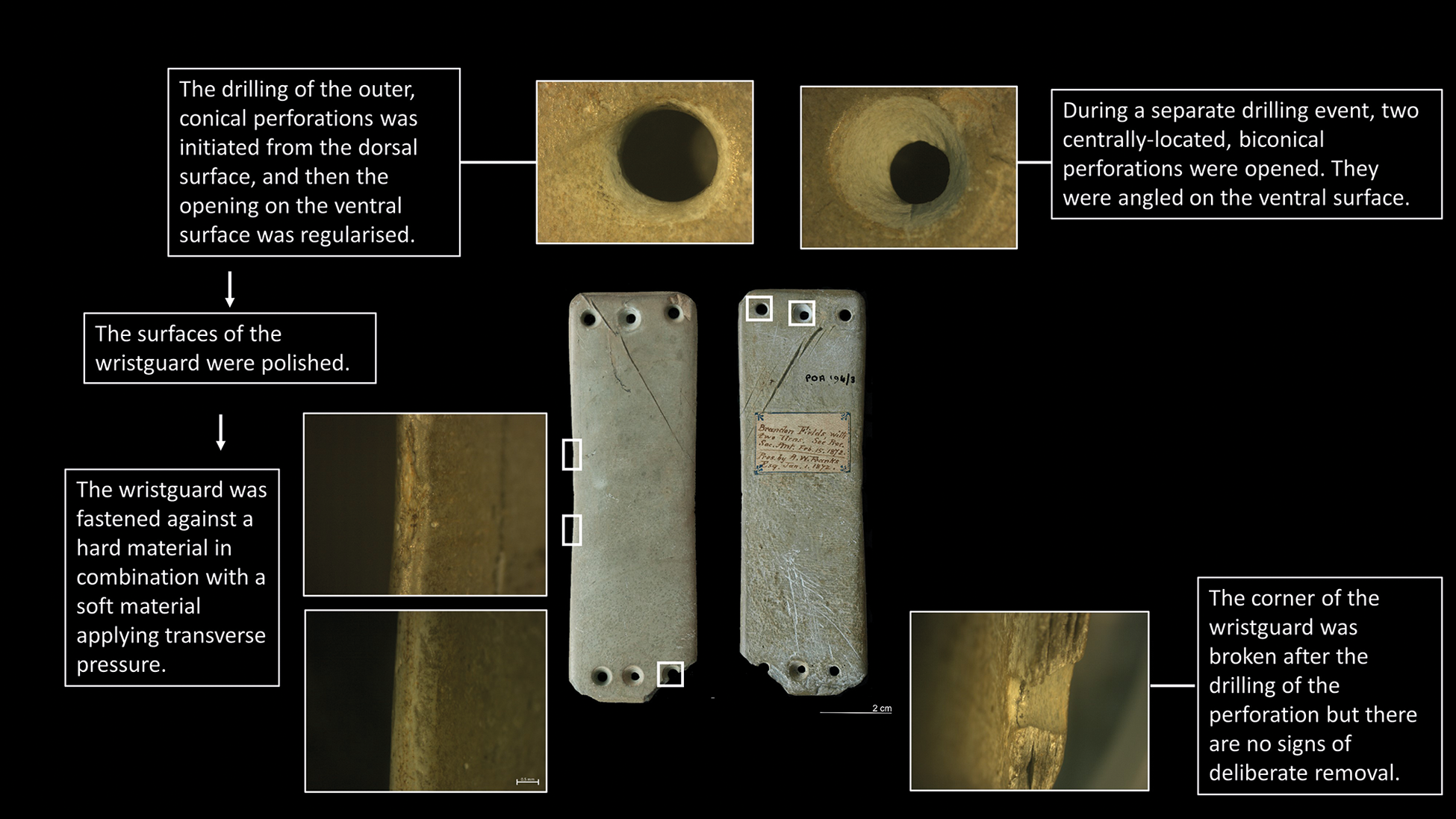
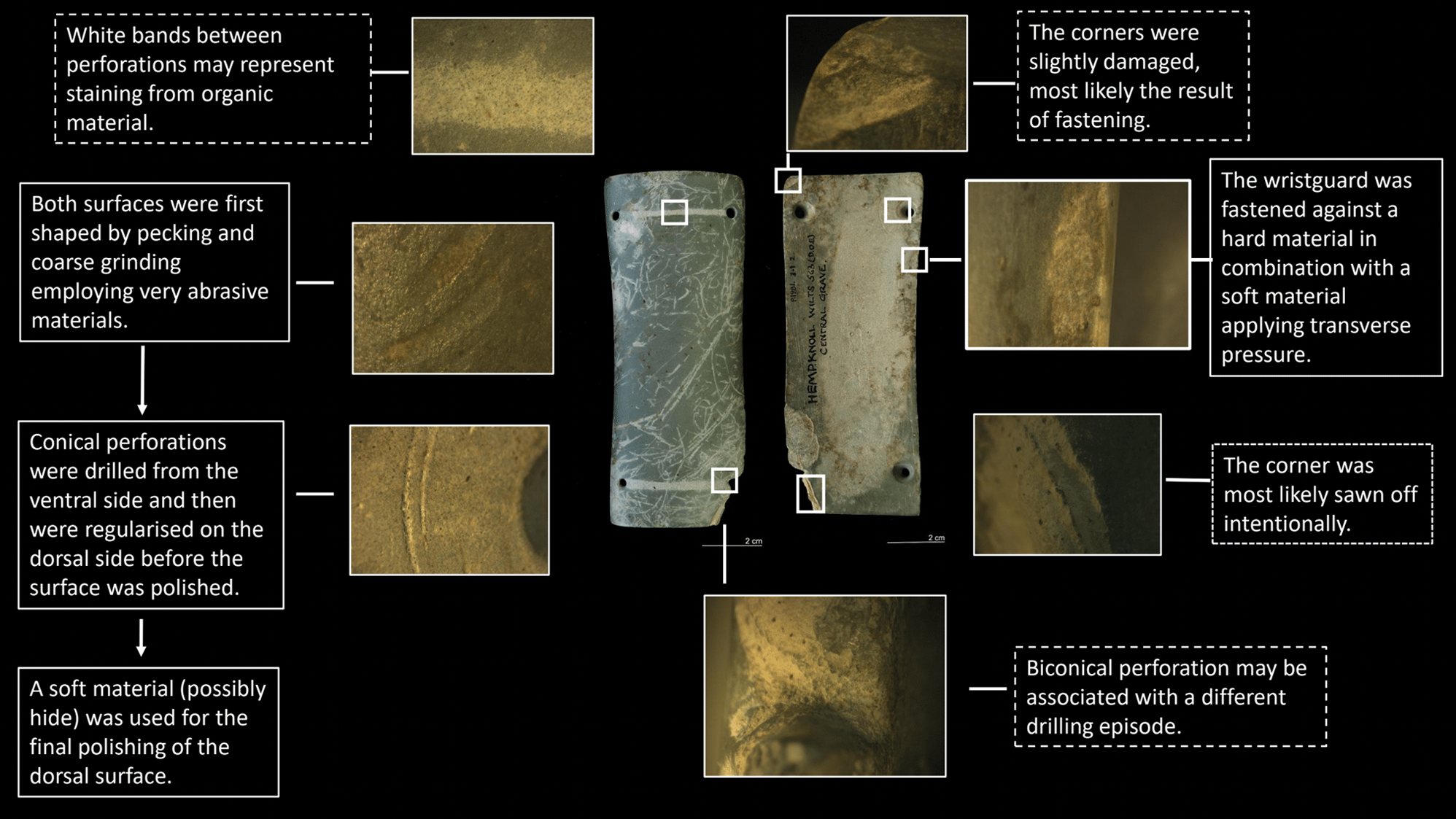
Often when we think about making, we envisage a maker who has a clear design in their head (or perhaps in a plan) that they have produced in advance and then execute. New materialist thinking approaches making quite differently. Rather than assuming that an agentic human sets out to execute their plan, it leaves space for the material itself to play a role in production (cf. Ingold Reference Ingold2013). For example, we might consider how the different fractures, weakness and inclusions in some of the rocks from which the bracers were crafted played a role in shaping their making: the zigzagging veins in the Brandon Fields bracer (Fig. 13); or how the particular colour of the rock used for the bracer from Hemp Knoll, Wilts, might have attracted its makers (Fig. 14). How did the makers of these bracers work with, around and about the textures of the rocks? How did these natural variations come to affect the form of the bracer?
The bracer from Brandon Fields, Suffolk (British Museum POA 194.3). End A is at the top of the image, End B at the bottom.
The bracer from Hemp Knoll, Wiltshire (British Museum 1981, 0301.2). (Solid borders refer to events that can be put in order; dashed borders are for those whose place in a sequence cannot be ascertained.)
We also often think about the maker as working towards a final product that matches the plan and is ready to be used. Again, a new materialist approach offers an alternative because it argues that all things are always in process (cf. McFadyen Reference McFadyen and Last2007; Reference McFadyen, Bille and Sørensen2016). It is not the case that once a bracer is made its form is fixed, but instead it can change time and again (like the Glenhead bracer: Fig. 7)). This is not a case of the maker being slow to finish, but rather the maker never saw the object as ‘finished’ at all. It is for this reason that we approach bracers as what we term process objects.
The term object implies something with a fixed form, one that is shaped by the subjects around it. Our new materialist approach takes us in a different direction. Objects and subjects are not static, they switch places and exist as relational terms to each other. Our object is always in motion, changing time and again as it enters into shifting new relationships. Our bracers, with their changing histories, can be thought of as process objects where final form was less important than the multiple overlapping processes through which these objects went. The aim was not to create a finished perfect bracer, but instead for the bracers to enter different webs of relationships. This is not a case of object as multiple, in the style of Jones et al. (Reference Jones, Diaz-Guardamino and Crellin2016), but objects as multiplicities, neither one nor many. Here we can capture both the importance of the object in its specific thisness, what Deleuze and Guattari (Reference Deleuze and Guattari2004, 288) would call its haecceity, and the way it constantly shifts and changes. A single example like the bracer from Raunds went through multiple moments of making, breaking, shaping and reshaping to produce something very specific, but never static, something different from all the other bracers even as individual processes (e.g. drilling perforations) were shared across objects (Fig. 4).
At this point, you might be thinking that all objects are effectively process objects—you are correct. Whether we are considering an Early Bronze Age bracer, a gravestone or a laptop, all objects are in process. But with our bracers we use the term process object not as mere description, but as a theoretical tool that allows us to think about changing form and function. The histories of bracers, revealed through microwear, ask us to foreground change because of the complex and repeated reworking and reshaping through which many of these objects went, and because of the non-sequential nature of the histories this technique reveals.
When approaching bracers in this way, we can employ different concepts to foreground the complex processes through which they moved. As a first step we can take any individual bracer and map out the different relations that we detect. Microwear is an essential tool here: it is fundamentally a relational technique, seeking to identify moments of contact and contagion between different materials. We can consider how studying one stone object can tell us about other materials implicated in its relational history—the ochre staining on the surface of the Gravelly Guy bracer (Fig. 10) or the unknown soft material that left binding traces on the bracer from Milner's Gravel Pit (Fig. 6). Microwear analysis allows us to map these relationships with other materials that are implicated in the histories of these bracers – the materials are an absent presence. The bracer from Tring reveals relationships between different places, like the Langdale hills and the site in Hertfordshire where it was deposited, and between the specific Langdale tuff from which it was made and the other stones and leather used to shape and polish it (Fig. 5). These materials shaped the capacities that the bracers had. Bringing other materials into our analysis allows us to break our objects of study out of isolation and reconnect them to others. Each of our bracers can be mapped like this, an assemblage of processes that brought multiple materials and events into relation.
Mapping these processes reveals that what bracers were capable of—the capacities they had to be employed in certain ways, the properties invoked at any moment—is not fixed, but relationally emergent. We do not know in advance what a bracer can do (cf. Deleuze Reference Deleuze1988). When people drilled the holes in the Tring bracer, they created new capacities in this piece of stone, for it to be fastened to another object with an organic material, for example (Fig. 5). When those holes were filled with copper studs, that capacity changed, the object gained new properties, but also it could no longer act in the same way it could before. The decoration of the bracer with gold would have changed other capacities, removing some (no more polishing of the surface) and adding others, creating new reflections and aesthetic engagements, new relations with points of origins and techniques of crafting.
We can break down the flow of changes that happened to bracers into a series of different events (Grosz Reference Grosz, Candlin and Guins2009; cf. Deleuze Reference Deleuze2015). Indeed, microwear often reveals histories in this way. On occasion we can use the microstratigraphy of an object to identify sequence—for example, we can think about how we know that perforations on the Mildenhall, Suff, and Aldbourne, Wilts, bracers were mechanically drilled prior to the smoothing and polishing of the main bodies of the bracers (Figs 15 and 16). Sometimes, though, what is revealed to us is a series of events that we cannot order; consider here the Glenhead bracer where we know that both End A was broken and re-shaped and End B was originally longer and was reworked (Fig. 7). We cannot place the changes to End A and End B in order to establish which came first: we just know that they both happened. Or the case of Brandon Fields, where we think the perforations were executed in two different events, but we cannot say in what order this happened, or how far apart in time these events were (Fig. 13).
The bracer from Mildenhall, Suffolk (British Museum Sturge.2305).

The bracer from Aldbourne, Suffolk (British Museum 1879, 1209.1877).

In contrast to the linear nature of biographical time, we need not limit ourselves here to the notion that events have to be placed in a specific sequence to make sense or to help us understand bracers. Where history demands that we specify a particular order, we can instead think here of object memories, rather than biographies. Unlike history, memory does not necessarily place everything in sequence; time emerges through patterns of intensity rather than order (Deleuze Reference Deleuze1991). Just as our human memories may preferentially recall distant but important events over more mundane routines, or be uncertain about whether one event took place before or after another, so the same can be true for the memories of objects which microwear reveals (Tsoraki et al. Reference Tsoraki, Barton, Crellin and Harris2020; cf. Harris Reference Harris2021b). Not every moment in an object's existence is remembered, not every moment is materialized.
This emphasis on events means we can consider how our bracers relate to each other. Few of our bracers have a clear, sequential, biography. What we have instead is a jumble of ‘events’ in their histories that, critically, often overlap between objects. That overlapping is important as it means, unlike biographies or itineraries, our narratives need not settle for singular objects, but can call on memories from one object to tell us about others. For example, we know that in seven cases, corners were removed from bracers. Knowing this helps us to understand the Tytherington and Corton Downs bracer (Fig. 9). On this example, we can see two incision marks on one corner between the perforations. In the light of other bracers this can be understood as an attempt to remove the corner. Wear analysts often work in this way, taking what they know from one object or reference collection and using it to understand another (Tsoraki et al. Reference Tsoraki, Barton, Crellin and Harris2020; van Gijn Reference van Gijn2014). This emerges clearly when our events are allowed to speak across objects, to interweave in the recall of memories from the collective and not the individual, that is, when we work not on individual biographies but across objects to think in the round. This does not mean that we can simply combine the events materialized in our bracers to make a totalizing or complete narrative, somehow filling in all the gaps. Nor does it mean that there is some idealized bracer biography to which we can compare a particular bracer's story. Moving between bracers is instead the mapping of moments of relationships, particular connections which are shared, and which open specific insights, not general, overarching or comprehensive narratives.
Conclusion
For more than 150 years archaeologists have debated the stone objects we have come to term bracers. What was their function? How does it relate to their form? How should we organize their types? What were their biographies? These questions have all rested on a notion that bracers are a singular type, made up of equally singular individual objects, each the product of a human maker, an expression of a culture and a society from which they remain thoroughly alienated. In contrast, in this paper we have attempted to think about bracers from a different perspective. Rather than asking what they were for, we have explored what they could do, how they formed relations with the world and changed through time. Each of these objects is not the product of a singular moment of making, but rather emerges through the intersection of multiple processes, each of which starts and finishes at different times, has their own rhythm, and may have involved multiple people and materials. Approaching bracers in this regard, as process objects, rather than fixed forms, challenges our notions of both biography and typology, without denying either. It allows us to see how, while we can create linear stories for any of the objects, there is much to learn from the events that took place at times we cannot locate, and in a sequence we cannot order. It allows us to see how the types we have held sacred are not the mental templates of human makers, but the outcome of multiple processes. Nothing about this means we cannot group bracers together, that we cannot tell their biographies, but it does suggest they have much more to offer us when we take an approach rooted in new materialism. This approach has enlivened the different events in bracers’ lives, from the multiple reworking of the Glenhead bracer, via the covering of the Tring bracer in gold to the re-use and repair of the Raunds example.
In focusing on the results from microwear analysis, the paper has spent less time considering the contexts in which bracers are found. There can be no denying that in Britain, from where the bracers in this paper mainly originate, these objects are repeatedly found in burial contexts in association with Beaker vessels and archery equipment. In these contexts they are intimately associated with the bodies of the dead, perhaps mirroring the close association they may have had with human bodies who wore them when alive. There is clearly much more to explore about these aspects of bracers, and the experiences of their wearers. Nonetheless, the emphasis we place on the multiplicity of interactions that each bracer went through allows us to understand how this endpoint should not overwrite the complex histories that preceded it. We can see how different bracers took different journeys, mixed with different materials, were shaped in different ways and emerged as different forms in the midst of their complex processes of becoming.
Microwear provides the critical technique for our approach because it attends fundamentally to process and to relationships (Tsoraki et al. Reference Tsoraki, Barton, Crellin and Harris2020). It allows us to interact with the materials, to elicit their memories and to tell their stories. This intersection of theory and technique reveals the fundamentally empirical engagement with materials that our approach calls for. Of course, this is by no means the only way of engaging with materials, but the compatibility of microwear and new materialism is far from coincidental, showing how our traditional division of theory and practice is one more dualism we need to undercut (cf. Webmoor & Witmore Reference Webmoor and Witmore2008). Without microwear analysis and new materialism, we could not have unpicked these complex multi-temporal and multi-material histories.
As we have thought about the different histories revealed through the microwear analysis of bracers it has called to mind archaeology's relationship with sequence. Figuring out the order in which events happened is a key archaeological task. We excavate sites to establish the stratigraphic relationships between events, to work out what happened first and what happened second. We do the same typologically where we aim to place objects in a series. The recent successes with Bayesian modelling of radiocarbon dates have further strengthened our ability to put things in order (Whittle Reference Whittle2018). But there are times when we cannot know the sequence of events: consider the undiagnostic pot sherd or flint tool, or the out-of-context find. These out-of-time objects or events are often perceived as less valuable to the archaeological project. Yet our undiagnostic pot sherd or flint tool still reveals critical processes. We have resisted the temptation to follow a biographical approach with our bracers, because we often could not tell when in a sequence a particular event happened. But we still know that events happened. This is a call to remember that sometimes the desire to tell a linear story with our evidence is one that cannot be fulfilled, but that does not mean that there is no story to tell. Memory forms an essential archaeological counterpart to history; both are critical to our engagements with the past.
So, our sceptical reader might ask, are these objects wristguards or not? Our answer is that guarding a wrist may indeed be one of the many processes through which these objects emerged, and which have shaped their existence through to the present. But it is far from the only, or even the most interesting, element of the memories, histories, and stories of which these process objects have to tell us.
Acknowledgements
This research was funded by the Leverhulme Trust as part of the Beyond the Three Ages System (RPG-2017-375), and we are very grateful to them. The British Museum, Wiltshire Museum, English Heritage, Oxford Archaeology South, Wessex Archaeology and Martin Green allowed us to study their bracers, and in particular Lisa Brown, David Dawson, Josh Pollard and Neil Wilkin facilitated essential access. Chris Standish kindly helped authenticate the Bronze Age gold on the Tring bracer. The paper gained immeasurably from the feedback from the Leicester Material Worlds masterclass: thanks to all those who participated, especially to Ben Jervis and Lesley McFadyen; and from the comments of the CAJ editors and reviewers. As ever, the faults of the paper remain entirely our own.
Supplementary material
Online material may be found at https://doi.org/10.1017/S0959774323000094


 Open access

