

1. Introduction
In recent years, South Korea’s local election law, which grants voting rights to permanent residents, has renewed debate over the principle of reciprocity in electoral participation (Cho, Reference Cho2025). A central point of contention concerns ethnic Korean Chinese migrants, commonly referred to as Joseonjok, who retain foreign citizenship while holding permanent residency in South Korea (hereafter Korea). Critics question whether permanent residents who retain citizenship in an authoritarian state should be granted voting rights, whereas others emphasize the evolving relationship between residency, integration, and political agency in transnational contexts.
Beyond normative disputes over suffrage, the enfranchisement of Korean Chinese residents raises broader analytical questions concerning the relationship between institutional participation and political evaluation. Many Joseonjok were socialized under China’s non-electoral political system yet now participate in Korea’s local elections. This juxtaposition of prior authoritarian socialization and subsequent engagement in competitive electoral procedures creates a setting in which exposure to representative institutions occurs alongside continued ties to a non-democratic regime.
The Korean Chinese community in Korea is characterized by sustained transnational embeddedness (Lee et al., Reference Lee, Chung, Yoo and Kim2006; Koo, Reference Koo2011; Shin, Reference Shin2017; Kim, Reference Kim2023). Cross-border economic activity, circular migration, and ongoing informational and familial networks link migrants to both political environments. Electoral participation therefore takes place within a social context that does not entail complete detachment from prior institutional experiences. The political implications of participation must be situated within this layered institutional configuration rather than interpreted solely through a model of linear host-country assimilation.
Recent scholarship has examined how immigration influences host-country politics, particularly in relation to electoral outcomes and policy preferences (Strausz, Reference Strausz2010; Paterson, Reference Paterson2018; Traunmüller and Helbling, Reference Traunmüller and Helbling2022; Vertier et al., Reference Vertier, Viskanic and Gamalerio2023; Mailhot and Obermeier, Reference Mailhot and Obermeier2025). Less attention has been devoted to how participation within host-country institutions corresponds with migrants’ own evaluative standards. Classic accounts of value change emphasize the formative importance of early socialization in structuring political orientations (Inglehart and Welzel, Reference Inglehart and Welzel2005). However, subsequent research suggests that institutional environments encountered later in life may also be associated with variation in political attitudes.
Drawing on theories of institutional learning (Pateman, Reference Pateman1970), social remittances (Levitt, Reference Levitt1998), and preference adaptation under authoritarian legacies (Pop-Eleches and Tucker, Reference Pop-Eleches and Tucker2011), the present study examines whether cumulative electoral participation in Korea’s local electoral system corresponds with systematic differences in procedural evaluations among Korean Chinese residents. Using original survey data with an embedded vignette experiment, the analysis evaluates how previous voting participation relates to assessments of institutional legitimacy, fairness, trust, and acceptance.
This study contributes to research on authoritarian legacies and migrant political incorporation by shifting attention from participation levels to procedural differentiation. The results indicate that procedural evaluations among migrants vary systematically with cumulative electoral participation in the host society. Specifically, higher levels of participation are associated with sharper differentiation between representative and non-representative authority. These patterns should not be interpreted as evidence of causal resocialization. Rather, they demonstrate that institutional participation in the host context corresponds with variation in evaluative standards among migrants whose formative political experiences occurred under authoritarian rule.
More broadly, the analysis underscores the importance of examining democratic institutions as sites of ongoing evaluative formation that operate across national boundaries. Migrants’ engagement in electoral processes coexists with sustained transnational ties, producing overlapping institutional reference points. Within this context, the enfranchisement of permanent residents represents not only a legal arrangement but also a structured opportunity for institutional contact. Understanding how such contact corresponds with procedural differentiation contributes to the study of political socialization in cross-regime environments.
This article proceeds as follows. The next section develops the theoretical framework. The subsequent section describes the data and research design. The empirical findings are then presented. The final section discusses implications for research on political socialization in transnational settings.
2. Democratic exposure and political socialization
2.1. Institutional learning and democratic socialization
Exposure to democratic institutions has long been understood as a potential source of attitudinal variation. Institutional approaches emphasize that political preferences are not fixed outcomes of early-life socialization but may be structured by repeated interaction with formal procedures. Participation in democratic processes introduces individuals to institutionalized forms of representation, contestation, and accountability. Through sustained engagement with such procedures, individuals may refine the standards they apply when evaluating political authority.
Pateman (Reference Pateman1970) characterized participation as educative, arguing that engagement in democratic decision-making reinforces norms of inclusion and responsiveness. Empirical research supports this view, showing that participatory experiences are associated with higher levels of political efficacy and institutional trust (Bowler and Donovan, Reference Bowler and Donovan2002; Pirralha, Reference Pirralha2017; Devine, Reference Devine2024). These findings suggest that institutional participation relates not only to political behaviour but also to the evaluative criteria individuals employ when assessing decision-making procedures.
Civic engagement, however, is not solely a function of institutional design. Hur (Reference Hur2022) emphasizes that civic duty is embedded in national narratives that shape individuals’ sense of obligation toward political institutions. Participation is interpreted through prior understandings of belonging and membership. Institutional exposure therefore operates within existing normative frameworks. For migrants whose attachments extend across political communities, the meaning of participation may reflect both prior socialization and new institutional contexts.
Research on immigrant political participation further clarifies how institutional and social environments structure engagement. Studies demonstrate that turnout among immigrant populations varies systematically with settlement context, neighbourhood composition, and local networks (Bhatti and Hansen, Reference Bhatti and Hansen2016; Bhatti et al., Reference Bhatti, Danckert and Hansen2017; Bratsberg et al., Reference Bratsberg, Ferwerda, Finseraas and Kotsadam2021). Analyses of immigrant and second-generation voting behaviour in Scandinavia similarly show that participation increases with integration and generational replacement (Bevelander and Hutcheson, Reference Bevelander and Hutcheson2022; Finseraas et al., Reference Finseraas, Kotsadam and Polavieja2022). This literature identifies the determinants of participation but devotes less attention to whether cumulative engagement corresponds with systematic differences in evaluative standards.
Evidence from the United States indicates that institutional arrangements shape citizens’ expectations regarding responsiveness and accountability. Residents of states with institutionalized mechanisms of direct democracy report stronger beliefs in their capacity to influence political outcomes and greater perceptions of governmental accountability (Tolbert et al., Reference Tolbert, Smith and Green2003). Cross-national research extends this perspective. Fuchs-Schündeln and Schündeln (Reference Fuchs-Schündeln and Schündeln2015) show that longer exposure to democratic governance is associated with measurable variation in political attitudes across countries. These findings indicate that regime experience and participatory exposure relate to political evaluations beyond early socialization.
At the same time, exposure does not operate uniformly across institutional contexts. Research on local elections in China demonstrates that participation in non-competitive or tightly controlled procedures does not necessarily correspond with stronger demands for accountability (Shi, Reference Shi1999; Tsai, Reference Tsai2007). The implications of participation depend on the perceived credibility and consequence of institutional arrangements. Engagement in meaningful representative institutions may therefore correspond with different evaluative patterns than engagement in symbolic or constrained mechanisms.
Overall, this literature suggests that repeated participation in consequential democratic procedures may be associated with more differentiated standards of procedural legitimacy and authority. The present study builds on this framework by examining whether cumulative participation in local elections corresponds with systematic variation in procedural evaluations among migrants exposed to contrasting regime environments.
2.2. Adaptation of preferences in authoritarian contexts
In authoritarian and hybrid regimes, participatory institutions are frequently introduced to enhance regime legitimacy without relinquishing substantive political authority. Controlled elections, consultative bodies, and limited forms of local representation may serve to manage dissent or signal stability (Gandhi and Lust-Okar, Reference Gandhi and Lust-Okar2009). Nevertheless, even constrained participation can influence how political authority is evaluated. Landry (Reference Landry2008) demonstrates that participation in competitive village elections in China is associated with increased demands for transparency and accountability, indicating that exposure to institutionalized procedures may correspond with shifts in evaluative standards even under restrictive conditions.
These findings suggest that political preferences are not entirely insulated by authoritarian socialization. Although institutional participation in non-democratic settings may be limited in scope, engagement with rule-bound procedures can shape expectations regarding representation and responsiveness. At the same time, the credibility and perceived consequence of participation remain central. Participation that is widely understood to be symbolic or tightly controlled may not generate the same evaluative implications as participation embedded in competitive and consequential institutional environments (Shi, Reference Shi1999; Tsai, Reference Tsai2007).
International migration introduces an additional layer of institutional exposure. Migrants encounter new electoral systems, legal frameworks, and participatory norms in host societies. Levitt (Reference Levitt1998) conceptualizes ‘social remittances’ as the cross-border circulation of civic norms and expectations, suggesting that political orientations may evolve through transnational experience. Empirical research finds that exposure to democratic institutions is associated with differences in regime preferences and support for accountability (Batista and Vicente, Reference Batista and Vicente2011; Pop-Eleches and Tucker, Reference Pop-Eleches and Tucker2011). While early authoritarian socialization may condition subsequent orientations (Pop-Eleches and Tucker, Reference Pop-Eleches and Tucker2020; Elsayed et al., Reference Elsayed, Hilbig, Riaz and Ziblatt2025), sustained interaction with representative institutions corresponds with measurable variation in political attitudes.
Research on immigrant incorporation further underscores the importance of institutional context. Political engagement among migrants is shaped by legal status, access to rights, and patterns of local integration (Bratsberg et al., Reference Bratsberg, Ferwerda, Finseraas and Kotsadam2021). However, much of this literature focuses on whether migrants participate in elections rather than on how repeated participation relates to the standards they apply when evaluating political authority. The distinction is analytically important. Participation and evaluation are related but conceptually distinct dimensions of political incorporation.
By shifting attention from turnout to procedural differentiation, the present study examines whether cumulative exposure to representative decision-making is associated with sharper distinctions between representative and non-representative authority among migrants whose formative political experiences occurred under authoritarian rule. This focus allows assessment of how institutional participation corresponds with variation in evaluative standards without presuming wholesale transformation of prior political orientations.
2.3. Case study: Ethnic Korean Chinese in Korea
The migration of ethnic Korean Chinese, commonly referred to as Joseonjok, provides an analytically distinctive setting for examining the relationship between institutional participation and procedural evaluations. Joseonjok are descendants of Koreans who migrated to northeastern China in the late nineteenth century (Park, Reference Park, Park and Oh2020). While maintaining linguistic and cultural ties to Korea, they hold Chinese citizenship and were politically incorporated into the institutional framework of the Chinese state. Their formative political experiences therefore occurred within a centralized, non-electoral system characterized by limited contestation and hierarchical authority.
Upon settling in Korea, many Joseonjok encounter a contrasting institutional environment structured around competitive elections, pluralist media, and formalized mechanisms of local representation. Permanent residents who satisfy residency requirements are granted voting rights in local elections but remain excluded from national contests. This arrangement produces a form of partial enfranchisement: migrants participate in subnational representative procedures while remaining outside the national electorate. As Chung’s (Reference Chung2020) comparative study of immigrant incorporation in East Asia demonstrates, access to political rights in the region is often stratified by legal status and shaped by distinct civic legacies. The Korean case reflects such a hierarchy of rights, in which permanent residents are incorporated into local political processes while remaining institutionally bounded at the national level. This positioning defines both the scope and frequency of democratic exposure available to migrants.
As of early 2025, approximately 140,100 permanent residents in Korea possessed foreign voting rights, with Chinese nationals accounting for roughly 81 percent of this group (Cho, Reference Cho2025). A substantial proportion of these voters are Joseonjok. At the same time, the community remains embedded in transnational social and informational networks. Many maintain economic, familial, and media ties to China (Lee et al., Reference Lee, Chung, Yoo and Kim2006; Koo, Reference Koo2011; Shin, Reference Shin2017; Kim, Reference Kim2023; Li et al., Reference Li, Froese and Schmid2023). These connections provide continuing institutional and normative reference points outside the host political context. Electoral participation therefore occurs within a layered environment in which prior authoritarian socialization coexists with repeated exposure to representative institutions.
Patterns of engagement with host-country institutions vary across individuals. Voting experience, duration of residence, and local integration have been associated with differences in political incorporation (Jang and Kang, Reference Jang and Kang2017). Civil society organizations and local networks may mediate access to electoral information and shape how migrants encounter democratic procedures (Chung, Reference Chung2020). Conversely, experiences of exclusion or legal precarity may attenuate identification with host institutions (Li et al., Reference Li, Froese and Schmid2023), and outreach by the Chinese state toward overseas nationals introduces additional institutional cues (Shen, Reference Shen2025). The Joseonjok case therefore does not represent a uniform process of assimilation. Rather, it constitutes a configuration in which cumulative participation in representative procedures can be examined alongside structured hierarchies of rights and enduring ties to a non-democratic regime.
The analytic value of this case lies in the coexistence of prior authoritarian socialization and repeated subnational democratic participation within a single migrant population. This setting allows examination of whether cumulative engagement with representative institutions corresponds with systematic differences in procedural evaluations among individuals whose formative political experiences occurred under a contrasting regime environment.
3. Methods
3.1. Data
This study draws on an original online survey conducted in August 2025 by Embrain, a survey firm based in Korea. The sample consists of 500 permanent residents of Chinese origin, commonly known as Korean Chinese or Joseonjok, who reside in Korea and meet the legal criteria for participation in local elections. Eligibility was verified through screening items related to residency and visa status. The survey employed stratified quota sampling by sex, age group, and residential area type to ensure demographic variation within this migrant population.
To reduce priming and social desirability bias, the survey employed hypothetical, neutrally worded scenarios without naming specific countries or regimes. By varying procedural features, such as decision-making authority and process, the vignettes enabled respondents to evaluate institutional legitimacy and procedural fairness absent overt ideological framing.
First, respondents completed a vignette experiment designed to evaluate how they perceive government decision-making procedures. Each respondent was randomly assigned to read one of three short descriptions that varied the decision-making authority responsible for a hypothetical local government policy (specific questions are presented in Appendix A):
-
• Treatment 1: ‘Elected representatives decide the policy’.
-
• Treatment 2: ‘A committee of government-appointed experts decides the policy’.
-
• Treatment 3: ‘Upper-level government leaders make the decision internally’.
These three sentences constitute the exact text presented to respondents. They represent increasing departures from democratic decision-making, from fully representative procedures (T1), to technocratic delegation (T2), to hierarchical, non-participatory decision-making (T3). After reading their assigned vignette, respondents evaluated the decision-making process along four dimensions central to research on procedural justice and democratic legitimacy. All items used a seven-point Likert scale (1 = ‘strongly disagree’, 7 = ‘strongly agree’).
-
1. Procedural legitimacy: ‘I feel that deciding the welfare budget in this way is legitimate’.
-
2. Procedural fairness: ‘I think the process used to decide the welfare budget in this locality is fair’.
-
3. Trust: ‘I feel that I can trust the institution or leaders who make decisions in this way’.
-
4. Acceptance: ‘I can personally accept this way of making decisions’.
These four outcomes, legitimacy, fairness, trust, and acceptance, serve as the primary dependent variables in the analysis.
Building on prior research (Elsayed et al., Reference Elsayed, Hilbig, Riaz and Ziblatt2025) and context-specific considerations in Korea (Han, Reference Han2025), demographic covariates, including gender, age, income category (eight categories), marital status (living with a spouse or partner vs. otherwise), homeownership (owner vs. non-owner), residential area type (rural town/township, small or medium-sized city, large city), and years of residence, were collected following the vignette module and included as control variables in the regression analyses.
Lastly, to minimize potential priming or bias, questions regarding voting behaviour were placed at the end of the survey. The instrument includes two measures of democratic exposure:
-
1. Vote Experience (binary): whether the respondent has ever voted in a local election.
-
2. Vote Count (continuous): a count measure of cumulative electoral participation.
This measure captures meaningful variation in electoral participation. Some respondents report no prior participation in local elections, whereas others report participation in as many as four electoral cycles. Voting participation predates the survey and the vignette assignment. Accordingly, Vote Count constitutes a pre-treatment characteristic relative to the experimental manipulation and does not involve conditioning on post-treatment variables (Montgomery et al., Reference Montgomery, Nyhan and Torres2018). Additional details regarding measurement are provided in Appendix A.
Local elections in Korea are held every four years and determine positions such as mayors, governors, and local council members. These offices constitute the local governments in which residents live and oversee everyday administrative decisions and public services. For immigrants, local institutions are particularly salient in processes of social integration (Lee et al., Reference Lee, Min and Han2026). Permanent residents who meet residency requirements are eligible to vote in these elections but remain excluded from national contests. This arrangement produces a form of partial enfranchisement, in which foreign residents participate in subnational democratic processes while remaining outside the national electorate. Within this institutional framework, cumulative participation in local elections constitutes a concrete and bounded measure of engagement with representative decision-making procedures.
3.2. Analytical strategy
The empirical analysis proceeds in five steps. Throughout, regression models with heteroskedasticity-robust standard errors are estimated. Interactions with voting exposure exploit naturally occurring variation in respondents’ electoral histories.
-
1. Main effects of decision procedures (Appendix Figure B1). Baseline evaluations of the three decision-making procedures are estimated using the following specification: ${Y_i} = \alpha + {\beta _1}T{2_i} + {\beta _2}T{3_i} + {{X'}_i}\gamma + {\varepsilon _i}$
Y i denotes one of the four procedural outcomes for respondent i: legitimacy, fairness, trust, or acceptance. T2 i and T3 i are indicators for assignment to Treatment 2 (expert committee) and Treatment 3 (upper-level leadership), respectively; Treatment 1 (elected representatives) serves as the omitted category. X′ i γ represents demographic controls (gender, age, income, marital status, homeownership, residential area type, years in Korea). This model establishes the baseline penalties associated with non-democratic procedures relative to elected representative decision-making.
-
2. Moderation by voting experience (Appendix Figure B2). To examine whether having ever voted affects evaluations of decision-making procedures, vignette treatments are interacted with a binary indicator for voting experience (vote_exp): ${Y_i} = \alpha + {\beta _1}T{2_i} + {\beta _2}T{3_i} + {\it\Phi}\, vote\_ex{p_i} + {\lambda _1}(T{2_i} \times vote\_ex{p_i}) + {\lambda _2}(T{3_i}\times vote\_ex{p_i}) + {{X'}_i}\gamma + {\varepsilon _i}$
The interaction terms λ 1 and λ 2 capture whether experienced voters assign stronger penalties to non-democratic procedures than non-voters.
-
3. Moderation by cumulative voting exposure. Cumulative exposure to democratic elections is operationalized as voting participation (vote_count), defined as the number of Korean local elections in which the respondent reports having actually voted since arriving in Korea. The moderating effect of democratic exposure is evaluated using the following specification: $\eqalign{{Y_i} =\;& \alpha + {\beta _1}T{2_i} + {\beta _2}T{3_i} + \delta\, vote\_coun{t_i} + {\theta _1}(T{2_i} \times vote\_coun{t_i}) \cr & + {\theta _2}(T{3_i} \times vote\_coun{t_i}) + {{X'}_i}\gamma + {\varepsilon _i}}$
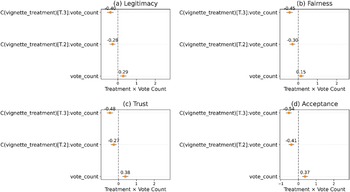
δ captures the association between voting exposure and evaluations under the reference treatment (T1). θ 1 and θ 2 indicate how cumulative voting exposure alters evaluations of expert-based (T2) and hierarchical (T3) decision procedures relative to elected representative decision-making. Negative values of θ imply stronger rejection of non-democratic procedures at higher levels of electoral exposure. Figure 1 displays θ 1 and θ 2 for all four outcomes.
Cumulative electoral participation and procedural evaluations: interaction between decision-making procedure and reported participation.
Note: The reference category is representative decision-making by elected officials. T2 refers to expert-based decision-making by a committee of specialists, and T3 refers to hierarchical decision-making by upper-level government authorities. Coefficients represent the interaction between decision-making procedure and cumulative electoral participation. See Table B3 for full regression results.

-
4. Estimated treatment effects at low vs. high voting exposure. For substantive interpretation, treatment effects are calculated at two meaningful values of electoral exposure: vote_count = 0 (no exposure) and vote_count = 4 (high exposure). The treatment effect of, for example, Treatment 2 at vote_count = 4 is obtained as: $\hat{\beta }_{1}+4\hat{\theta }_{1}.$
Figure 2 plots these estimated effects for all outcomes. Across legitimacy, fairness, trust, and acceptance, greater democratic exposure sharply magnifies negative evaluations of expert-driven and hierarchical decision-making.
Estimated treatment effects by voting exposure.

-
5. Predicted values across participation levels. To facilitate interpretation of the interaction effects, predicted evaluations are computed across the full observed range of cumulative electoral participation, from zero to four elections. Predicted values are generated from the fully specified interaction model, holding control variables at their observed means or modal categories. This approach allows visualization of how evaluations of representative, expert-based, and hierarchical decision-making procedures vary across levels of reported participation. Figure 3 presents these predicted trajectories for all four outcomes.
Predicted procedural evaluations by electoral participation.

Models (1) and (2) are reported in Appendix Figures B1 and B2 and serve primarily to establish baseline differences and simple participation contrasts. The main analysis focuses on Model (3), which incorporates cumulative electoral participation and its interaction with decision-making procedures. This specification directly evaluates whether procedural differentiation varies systematically with the extent of reported participation, which constitutes the central empirical question of the present study. Accordingly, the discussion in the main text concentrates on the interaction framework in Model (3), while the earlier models provide contextual benchmarks.
4. Results
Appendix Figure B1 presents baseline evaluations of the three decision-making procedures. Across all four outcomes, legitimacy, fairness, trust, and acceptance, decisions attributed to elected representatives receive the highest ratings, followed by expert-based procedures, while hierarchical decision-making receives the lowest evaluations. The difference between representative and hierarchical authority typically ranges from approximately one to two points on a seven-point scale. The ordering therefore establishes that respondents differentiate consistently among representative, expert-based, and hierarchical authority.
Appendix Figure B2 reports simple comparisons between respondents with no prior participation in local elections and those who report at least one participatory experience. Respondents with prior participation assign lower evaluations to non-representative procedures than non-participants, while differences in evaluations of representative procedures are comparatively modest. Although these comparisons do not account for cumulative electoral participation or covariates, they indicate that procedural differentiation may vary with electoral engagement. The interaction models reported below incorporate the full participation range and provide a more systematic assessment.
Figure 1 reports the interaction between cumulative electoral participation and decision-making procedure across the four outcome variables. The interaction terms indicate a systematic and statistically robust association between cumulative participation and evaluations of non-representative authority. For the legitimacy outcome, the interaction coefficient equals –0.282 for expert-based decision-making (p < 0.001; 95% CI: –0.439 to –0.125) and –0.402 for hierarchical decision-making (p < 0.001; 95% CI: –0.575 to –0.230). In the fairness outcome, the corresponding interaction coefficients equal –0.299 for expert-based authority (p < 0.001; 95% CI: –0.447 to –0.150) and –0.446 for hierarchical authority (p < 0.001; 95% CI: –0.609 to –0.282). For trust, the interaction equals –0.265 for expert-based decision-making (p = 0.001; 95% CI: –0.420 to –0.110) and –0.478 for hierarchical decision-making (p < 0.001; 95% CI: –0.648 to –0.307). In the acceptance outcome, the interaction equals –0.405 for expert-based authority (p < 0.001; 95% CI: –0.556 to –0.254) and –0.543 for hierarchical authority (p < 0.001; 95% CI: –0.709 to –0.376).
Across all four outcomes, higher levels of electoral participation are associated with larger evaluative penalties applied to non-representative procedures. In each case, the interaction is larger in magnitude for hierarchical decision-making than for expert-based decision-making. The consistency of the coefficients across legitimacy, fairness, trust, and acceptance indicates that the observed pattern is not confined to a single evaluative dimension but reflects a general tendency toward sharper procedural differentiation as participation accumulates.
Figure 2 reports estimated treatment effects at two reference points of cumulative electoral participation, respondents with no prior voting experience and those who report participation in four local elections. The figure displays the total effect of each non-representative procedure relative to representative decision-making, combining the baseline treatment coefficient with the cumulative interaction term.
Across all four outcomes, legitimacy, fairness, trust, and acceptance, the penalty imposed on non-representative procedures increases substantially at higher levels of participation. For example, the estimated penalty associated with hierarchical decision-making in the legitimacy outcome increases from 1.03 among non-participants to 2.64 among those reporting four participatory experiences. Comparable shifts are observed for fairness, from 1.06 to 2.84, for trust, from 1.02 to 2.93, and for acceptance, from 0.78 to 2.95. The trajectory for expert-based decision-making follows a similar pattern, though the magnitude of change is somewhat smaller.
By focusing on two substantively meaningful reference points, Figure 2 illustrates that the gap between representative and non-representative authority expands with accumulated electoral participation. The results indicate that higher levels of cumulative electoral participation are associated with stronger penalties directed at decision-making procedures that lack participatory authorization.
Figure 3 presents predicted values across the full range of cumulative electoral participation, from zero to four elections, for each decision-making procedure. A consistent structure emerges across all four outcomes. Predicted evaluations of representative decision-making increase steadily as reported participation accumulates. In the legitimacy outcome, predicted evaluations of representative procedures rise from 4.61 among non-participants to 5.78 among those reporting four participatory experiences. Similar upward trajectories are observed for fairness, from 4.83 to 5.40, for trust, from 4.39 to 5.92, and for acceptance, from 4.32 to 5.80.
In contrast, predicted evaluations of hierarchical decision-making decline as participation increases. For example, in the fairness outcome, predicted evaluations decrease from 3.75 at zero participation to 2.57 at four participatory experiences. Evaluations of expert-based decision-making remain comparatively stable or exhibit only modest change across the same range. Together, these trajectories indicate that the divergence between representative and non-representative authority widens as electoral participation accumulates.
The substantive implication is a widening separation between representative and hierarchical authority as electoral participation accumulates. In the legitimacy outcome, the difference between representative and upper-level decision-making increases from 1.02 points among non-participants, 4.61 versus 3.59, to 2.64 points among those reporting four participatory experiences, 5.78 versus 3.15. In the fairness outcome, the corresponding difference increases from 1.08 points, 4.83 versus 3.75, to 2.83 points, 5.40 versus 2.57. For trust, the gap expands from 1.03 points, 4.39 versus 3.36, to 2.93 points, 5.92 versus 2.99. In the acceptance outcome, the difference increases from 0.78 points, 4.32 versus 3.54, to 2.95 points, 5.80 versus 2.85. Across all four outcomes, higher levels of cumulative electoral participation correspond with a substantially larger divergence between representative and hierarchical authority. These patterns indicate that greater cumulative electoral participation is associated not with a uniform upward shift in evaluations, but with sharper procedural differentiation between representative and non-participatory forms of authority.
Collectively, Figures 1 to 3 present a coherent set of findings. Figure 1 establishes the statistical interaction between cumulative electoral participation and decision-making procedures. Figure 2 demonstrates that the substantive penalty imposed on non-representative authority increases at higher levels of participation. Figure 3 visualizes the underlying trajectory across the full participation range, showing that representative procedures are evaluated increasingly favourably while hierarchical procedures are evaluated more critically as participation accumulates. Across specifications and outcomes, the pattern is consistent. Greater reported electoral participation corresponds with more pronounced differentiation between representative and non-representative authority, rather than with a uniform shift in overall evaluations.
4.1. Robustness checks
A series of robustness checks was conducted to assess whether the association between cumulative electoral participation and procedural differentiation is sensitive to alternative operationalizations and potential confounding factors. These specifications assess whether the observed pattern depends on a particular functional form of participation or on sample composition, including variation in age at arrival and duration of residence. The purpose of these exercises is to determine whether the main results remain stable under plausible alternative specifications.
First, reported participation was recoded into three categories: 0, 1–2, and 3–4 elections. This specification addresses potential concerns regarding small cell sizes at the upper end of the distribution and relaxes the linearity assumption implicit in the continuous participation measure. Interaction models were re-estimated using treatment-by-category terms. As shown in Appendix Figure B3, the substantive pattern remains consistent. Relative to non-participants, respondents in the highest participation category, 3–4 elections, impose substantially larger penalties on non-representative procedures. Differences between non-participants and those reporting 1–2 elections are smaller and less precisely estimated. This distribution suggests that the association between participation and procedural differentiation may not be strictly linear. Instead, sharper differentiation appears at higher levels of cumulative engagement. The categorical specification therefore confirms that the main results are not driven by a particular functional form of the participation variable.
Second, the analysis was replicated using restricted samples defined by age at arrival. Age at arrival was calculated as the difference between current age and years of residence. Four thresholds were applied. The first restricts the sample to respondents who migrated at age 18 or older, thereby ensuring that formal political socialization occurred under the institutional context of the country of origin. Additionally, more stringent thresholds of age 25, 30, and 35 at arrival were then implemented to capture respondents whose early adulthood political formation also took place outside the host society. These alternative restrictions allow assessment of whether the association between cumulative electoral participation and procedural differentiation depends on the inclusion of individuals who migrated during late adolescence or early adulthood.
Appendix Figures B4, B5, B6, and B7 report the results for these restricted samples. Across all age-at-arrival thresholds, the interaction between decision-making procedure and cumulative electoral participation remains substantively stable. Although the magnitude of the interaction coefficients varies across specifications, their direction and statistical significance remain consistent and comparable to those observed in the full sample. These additional restrictions therefore address whether the main pattern is driven by respondents who migrated at younger ages and were partially socialized within the host context. The persistence of the interaction under both age-at-arrival thresholds indicates that the association between cumulative electoral participation and procedural differentiation is not attributable to generational composition. The widening gap between representative and non-representative authority remains evident among individuals whose formative political experiences occurred outside the host institutional environment.
Lastly, Appendix Figure B8 reports specifications that incorporate interactions between decision-making procedure and years of residence in Korea. This specification evaluates whether the observed procedural differentiation can be attributed to duration of residence rather than to reported participation. If the main pattern were driven primarily by length of residence, treatment-by-residence interactions would be expected to mirror the structure of the treatment-by-participation interactions. Instead, the interaction between treatment and years of residence is generally small in magnitude and inconsistently estimated across outcomes once participation is included in the model. These results indicate that duration of residence alone does not account for the widening gap between representative and non-representative authority observed in the main analysis. Rather, the association between cumulative electoral participation and procedural differentiation remains distinct from residence duration.
5. Conclusion
This study examined whether cumulative electoral participation in electoral institutions is associated with differences in procedural evaluations among individuals who migrated from an authoritarian political environment to a democratic one. Focusing on Korean Chinese residents in Korea, the analysis draws on original survey data and an embedded vignette experiment to assess how prior voting participation relates to attitudes toward alternative modes of policy decision-making.
The results point to a clear pattern: greater experience with democratic procedures is associated with more negative evaluations of decision-making processes that lack participatory legitimacy. Respondents with greater experience of voting in local elections expressed significantly more critical evaluations of expert-led and hierarchical decision-making procedures, particularly in contrast to decisions made by elected representatives. This gradient is consistent with cumulative institutional engagement shaping procedural differentiation. Rather than merely legitimizing representative institutions, democratic exposure is associated with greater sensitivity to the absence of transparency, contestation, and electoral accountability.
Before discussing the broader implications, several limitations merit consideration. The cross-sectional design does not permit causal inference. Reported electoral participation may reflect unobserved differences in political interest, prior normative orientations, or levels of social integration. Although demographic characteristics and years of residence are controlled, these variables cannot fully account for selection into participation. The results should therefore be interpreted as patterned associations consistent with cumulative institutional engagement rather than as evidence of causal transformation.
In addition, the measure of participation captures self-reported voting behaviour but does not isolate the mechanisms linking participation to procedural evaluations. Electoral participation may coincide with broader processes of political or social incorporation, including exposure to campaigns, civic organizations, or local institutions. The analysis does not disentangle these related influences. Finally, the outcomes examined concern procedural differentiation rather than generalized support for democracy. Whether similar associations extend to broader regime attitudes remains an open question.
Future research could address these limitations by employing longitudinal designs that track attitudinal change over time, incorporating richer measures of civic engagement and social networks, and extending the analysis to comparative contexts. Such approaches would allow for a more precise assessment of how institutional participation and prior socialization interact in shaping procedural standards.
These findings carry implications that extend beyond current policy debates over the enfranchisement of permanent residents. At a broader level, they contribute to theoretical discussions concerning the adaptability of political attitudes and the role of institutional environments in shaping them. Specifically, the results offer cautious support for the proposition that democratic institutions, under certain conditions, can encourage democratic orientations even among individuals socialized under authoritarian rule. However, the evidence should not be interpreted as suggesting automatic or uniform transformation. Rather, the effects observed here appear to be gradual and contingent, potentially shaped by the quality and perceived credibility of participatory experiences. This remains an area that warrants closer attention in future research.
At the same time, sustained transnational ties to the country of origin complicate straightforward accounts of democratic resocialization. Participation in host-country democratic procedures may introduce new standards for evaluating authority, but these are likely to coexist with, rather than replace, prior political repertoires. In some cases, democratic engagement may deepen cognitive dissonance or produce ambivalent orientations rather than clear attitudinal realignment.
Together, the results suggest that enfranchisement is not only a legal or administrative measure but also a site of potential normative learning. The extent to which this potential is realized depends on repeated institutional contact, perceptions of procedural legitimacy, and broader patterns of integration within the host society. These considerations underscore the importance of conceptualizing political learning as a conditional and dynamic process, shaped by institutional design and embedded in transnational social contexts.
In this respect, the findings contribute to debates on the diffusion of democratic norms by identifying institutional participation as one context in which procedural standards vary. The results suggest that institutional exposure may be associated with shifts in evaluative criteria. A central empirical question concerns the institutional and social conditions under which such associations emerge and persist.
Supplementary material
The supplementary material for this article can be found at https://doi.org/10.1017/S1468109926100346.
Data availability statement
All data and code used in this study are shared at Harvard Dataverse (https://doi.org/10.7910/DVN/PQIBVP).
Acknowledgements
Not applicable.
Funding statement
This work was supported by the Ministry of Education of the Republic of Korea and the National Research Foundation of Korea (NRF-2025S1A5A8010335).
Competing interests
The author(s) declared no potential conflicts of interest with respect to the research, authorship, and/or publication of this article.
Ethical approval and informed consent statements
The research adheres to the American Political Science Association’s Principles and Guidance for Human Subjects Research. Approval was obtained from the Institutional Review Board at Kyonggi University (Protocols: IRB192/08-03). Informed consent was obtained from all participants included in the study.


 Open access

