

Introduction
The Zhou dynasty (c. 1046–256 bce) is widely studied partly due to its massive and still-growing corpus of inscribed bronzes, among which chime bells are some of the most researched bronze artefacts from this period (e.g. Falkenhausen Reference Falkenhausen1994). Much research has been conducted on the typology, musicology, production and inscriptions of Zhou bells (e.g. Grundmann Reference Grundmann2020; K. Li et al. Reference Li, Liu and Wilson2024; Nagasawa Reference Nagasawa2017), which yield significant insights into their chaîne opératoire, functionality and representation. However, this body of research does not fully capture the alterity of Zhou ontologiesFootnote 1 behind the production and use of bronze vessels, in which bronze bells were ritual media connecting ancestral and living members of a lineage. In other words, we should try to understand these past entities ‘on their own terms’ rather than through our constraining frameworks (sensu Latour Reference Latour2005). A meaningful synergy of archaeology, classical and epigraphical records and posthumanist theories is crucial to achieve this aim.
Nonetheless, this ontological turn in Zhou archaeology faces two significant challenges. Firstly, classical and epigraphical records have not yet been organically integrated into Chinese archaeology. The value of textual materials—many of which were compiled much later than the periods they record—is often either uncritically accepted or categorically denied (e.g. Falkenhausen Reference Falkenhausen2006; F. Li Reference Li2009). Yet ontological statements within these texts remain largely dismissed or misinterpreted in archaeology and sinology. Secondly, recent approaches that are often grouped under posthumanism, such as object agency (e.g. Gell Reference Gell1998; Latour Reference Latour2005) and relational personhood (e.g. Strathern Reference Strathern1988; Wagner Reference Wagner, Godélier and Strathern1991), are not necessarily viable for understanding different worlds. Any unreflective application of these theories risks imposing our understanding of the modern condition onto other ontologies (Bessire and Bond Reference Bessire and Bond2014). Moreover, these theories often offer generalized understandings of the definitions and interrelations of humans and other-than-humans, thus overlooking their nuanced and changing relationship (Dekeyser Reference Dekeyser2024).
This article thus proposes that we should adopt a ‘more-than-literalist’ reading of the pasts. On the one hand, we should not forcefully dovetail artefacts and texts into our etic analytical frameworks, thereby subsuming them under a global, monolithic trend or pattern, or reducing them to mere representations deployed by human agents. Objects and texts also actively engage with and realize their worlds. On the other hand, we should also avoid the pitfalls of the ‘literalist’ or ‘non-representationalist’ approach (Alberti & Marshall Reference Alberti and Marshall2009, 351–2), which claims to recover alternative worlds without mediation.Footnote 2 Since ontological claims by anyone are always made with certain intents and purposes, it is intellectually questionable to take any of those ‘literally’ (Keane Reference Keane2013, 189; Palecek Reference Palecek2022). Furthermore, a world is never an unchanging, hermetic parameter that predetermines its entities, nor do these entities perceive and actualize the world in an identical manner (Deleuze Reference Deleuze1988, 99). A more-than-literalist reading therefore aims to produce a fluid ‘ontography’ tracing variable capacities of different actors, and explore how they differentially actualize and create the potentials of their ontology.
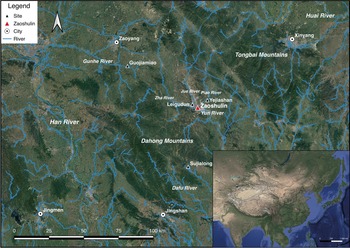
This article first outlines the Zhou ontologies, concerning the capacities of ancestors and chime bells, and the embodiment of personhood during the Spring and Autumn (i.e. Chunqiu) period (c. 771–453 bce). Then, it examines tomb M190 in the Zeng aristocratic cemetery of Zaoshulin, Suizhou, Hubei (Fig. 1), which belonged to Lord Qiu of Zeng (r. c. 675–650/650–625 bce). These dates derive from the calendrical notations of his bronzes, which correspond to two possible date ranges in the current calendrical reconstruction (see P. Zhang Reference Zhang1987). The tomb contained a rich deposit of burial goods, including his chime bell set, the Zeng Gong Qiu bianzhong.Footnote 3 Cast in 677 or 646 bce, this bell set was originally intended to materialize his emulation of numinous ancestors to invoke their power against the Chu state. However, the haphazard deposition of his bells and the intentional disintegration of their bell rack in his tomb around 656 or 625 bce suggest a subsequent derealization of their capacities following the rapprochement between Zeng and Chu. In this funerary context, the personhood of Lord Qiu was re-embodied by a range of human and other-than-human actors during his funeral.
Maps of the Suizao Corridor and major Zeng sites (cemeteries). (Base map: Google Map.)
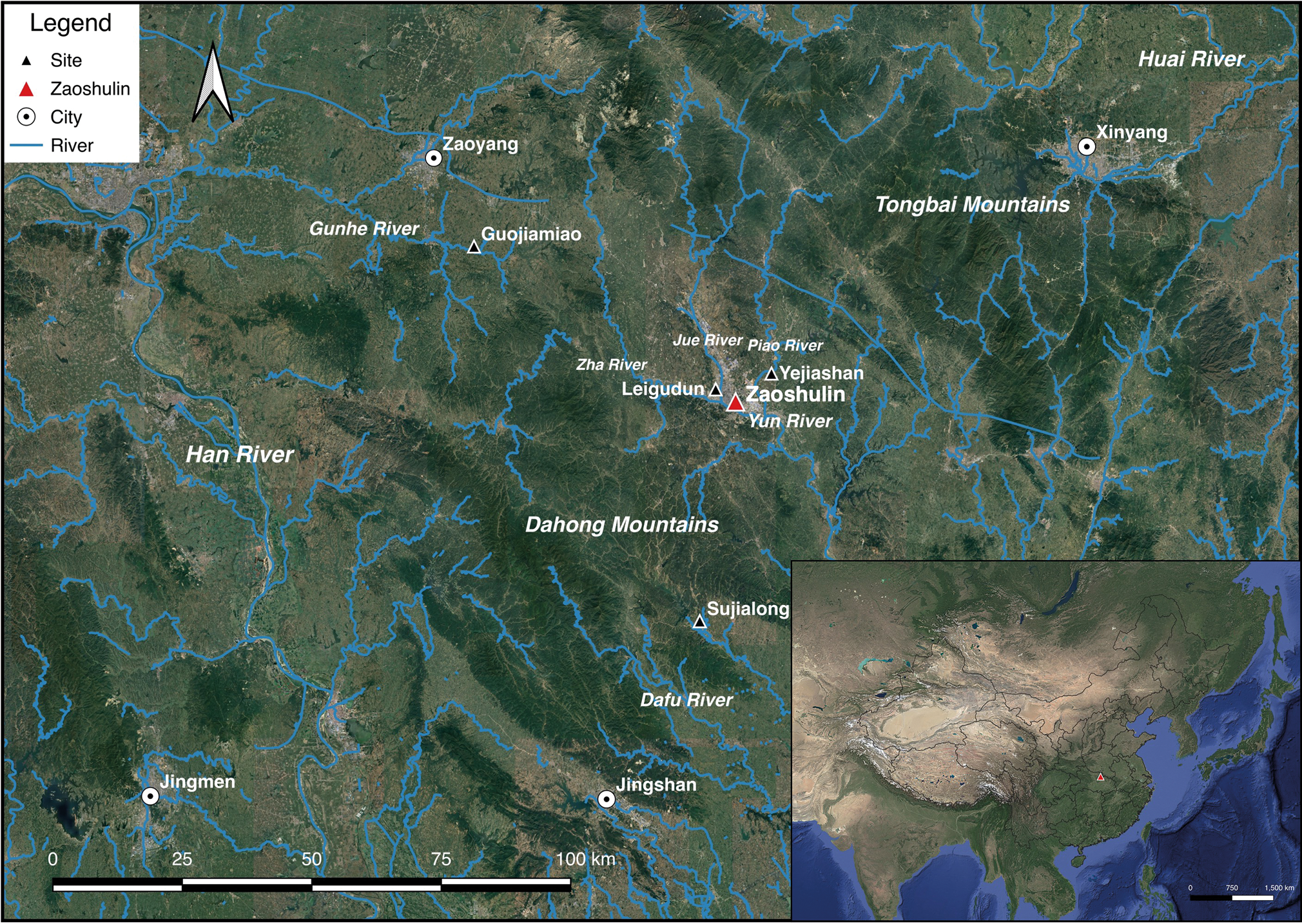
Figure 1 Long description
The map displays the Suizao Corridor and significant Zeng sites, including cemeteries, in China. It features major rivers such as the Han River, Gunhe River, and Huai River, as well as mountain ranges like the Tongbai Mountains and Dahong Mountains. Key cities and sites, including Zaoyang, Xinyang, Jingmen, and Jingshan, are marked. The map uses blue lines to represent rivers and different symbols to denote sites and cities. The inset in the bottom right corner shows the broader geographic context of the region within China.
The Chunqiu period and the Zeng state
In the Zhou dynasty, present-day China was largely controlled by multiple regional states headed by different lineages—most branching out from the Zhou royal house. During the Western Zhou period (c. 1046–771 bce), the Zhou kings adopted various strategies, including public rituals, rhetoric and (symbolic) violence, to incorporate these political entities into a Zhou-centred system (Grundmann Reference Grundmann2019; Vogt Reference Vogt2023). Although many polities were under the nominal rule of Zhou, interstate and interethnic conflicts were common (Y. Sun Reference Sun2021). This Zhou-centred order was further fragmented after the defeat and displacement of the royal house from its western capitals in 771 bce (F. Li Reference Li2006). During the Chunqiu period, while many socio-political institutions such as ancestral ritual and marriage alliance were still maintained (Falkenhausen Reference Falkenhausen2006; Khayutina Reference Khayutina2014), certain states also claimed hegemonic status and conquered other polities. The Chu state was one of the hegemons in southern China: during this period, it expanded into Hubei, eastern Sichuan and northern Hunan, by subjugating numerous states and indigenous groups (Korolkov Reference Korolkov2022, 43–73).
The Zeng state, historically known as Sui, was established in present-day northern Hubei since the early Western Zhou period (Hubei Provincial Institute of Cultural Relics and Archaeology et al. 2020). It was located in a narrow basin known as the ‘Suizao corridor’, where the Central Plain and the Yangtze River are connected (B. Chen Reference Chen2019). In their inscriptions, the leading members of Zeng—who also shared descent with the Zhou royal house—had proclaimed that they were mandated to protect and lead southern China (Tse Reference Tse2026). Zeng’s leading position in the south was challenged by the Chu state soon after the fall of the Zhou royal house, until Zeng was eventually overwhelmed by Chu in 640 bce (Zuo zhuan: Huan 8.2, Huan 11.2, Zhuang 4.1, Xi 20.4).Footnote 4 Nevertheless, at some point during the reign of Lord Qiu of Zeng, the Chu king gave his sister Mi Yu to Qiu in marriage. Archaeological and epigraphical records suggest that the amiable relations of both states were maintained ever since, though Chu had also exerted its influence over the Zeng state (Hubei Provincial Institute of Cultural Relics and Archaeology et al. 2020; 2023).
Although these political events appear to be human-driven historical processes, they were fundamentally situated within the worlds where human and other-than-human actors with varying capacities constantly interacted. It is necessary to reconsider ontology, capacity and personhood in the Chunqiu period in order to explore their interrelation.
Zhou ontologies, other-than-human capacities, and personhood in the Chunqiu period
Ontology in archaeology has often been defined as the ‘world’ or ground upon which agents act and comprehend; it is mainly concerned with ‘what there is’ rather than ‘how we know’ (Alberti & Marshall Reference Alberti and Marshall2009, 344–6). This ontological turn aspires to recover independent, alternative worlds in their own right (Alberti Reference Alberti2016; Viveiros de Castro Reference Viveiros de Castro2004). Nevertheless, such an approach often reproduces and projects the subjectivity and assumptions of modern Western society on to other worlds (Bessire & Bond Reference Bessire and Bond2014, 443). Positioned as omnipresent narrators, ontologists may oversimplify the complexity of other worlds, rendering them as docile, consumable Others within a discourse of multiculturalism (González-Ruibal Reference González-Ruibal2019, 39–40; Nadasdy Reference Nadasdy2021). Furthermore, ontology is often hypostatized as a singular, bounded parameter, hence confining and predetermining the multiplicity within a given ontology and the creativity of entities in actualizing their world (Harris & Robb Reference Harris and Robb2012; Ramos Reference Ramos2012, 489). Therefore, this paper instead approaches ontology as an open-ended field of potentialities that conditions and enables entities to realize themselves innovatively into variable forms of being (Deleuze Reference Deleuze1969, 196; Reference Deleuze1988, 104–7). In this sense, ontography is a cartographic method for capturing a variety of entities and their individualistic trajectories within specific ontologies, rather than reifying our presupposed alterity of other worlds.
As seen in the textual evidence of the Chunqiu period,Footnote 5 the Zhou worlds were co-constructed by the commitments of both the living and their ancestors to the Mandate of Heaven. During this period, the Mandate was often defined as the sovereignty of a state (Luo & Pines Reference Luo and Pines2023, 13–17). Since Heaven would only favour those who manifested de 德, the inheritance of the Mandate was always revocable (Shi jing: ‘Wen wang’ Mao 235).Footnote 6 De, often rendered as mana, power, or virtue (e.g. Boodberg Reference Boodberg and Cohen1979, 32–4; Kern Reference Kern, Lagerwey and Kalinowski2009, 152), was rather a versatile concept roughly referring to moral and behavioural standards or patterns (Q. Wang Reference Wang2025, 128–33). Demonstrating de required descendants to emulate their ancestors’ virtue and behaviour through political actions and ritual performance, thereby legitimizing their claims to the Mandate (Cook Reference Cook2017, 157–62; Kryukov Reference Kryukov1995, 316). Heaven and ancestors might then grant ‘grace’ to the living, though such favour was never guaranteed (Grundmann Reference Grundmann2019, 159–71). At the same time, different human and other-than-human actors could understand the Mandate, grace, de, and its emulation very differently (Luo Reference Luo2012, 14–16). Hence, relationships between descendants and ancestors were never static (Luo Reference Luo2020). Furthermore, what we describe here as Zhou ontologies are not, and perhaps never were, unified and coherent (see note 1). This ontography only serves to outline the enabling conditions of action and capacity—particularly the emulation of de—among human and other-than-human actors; its instantiations must be examined through specific case studies.
Agency—whether understood as capacity of conscious individual or as emerging relational property—is also a contested concept. Some scholars argue that agency should be attributed solely to humans (e.g. Ribeiro Reference Ribeiro2016). But this view is problematic insofar as it assumes an unchanging anthropocentric, ‘canonical definition’ of agency (Sørensen Reference Sørensen2018, 96). It also ethnocentrically presumes that consciousness, activeness and intentionality are the defining properties of agency across different worlds (e.g. Cassaniti Reference Cassaniti2025; Maqsood Reference Maqsood2023). As Ribeiro (Reference Ribeiro2019, 41) has noted, agency is ‘eminently historical’; there is no single model of agency generally applicable in every ontology. Instead, we should attend to the specific modes different entities shape and realise their capacities within a particular ontology; these capacities are variably configured by the same entities over time, who can influence other entities and even the world itself (Deleuze Reference Deleuze1988, 106–11). Thus, what we examine under the term ‘agency’ is how specific capacities are realized by different entities within an ontological field.
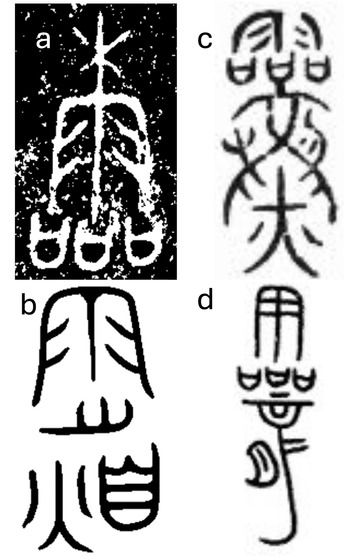
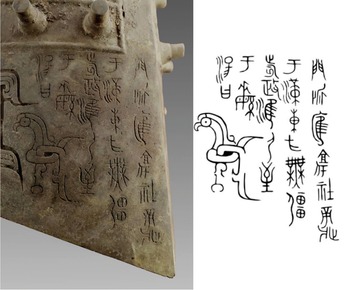
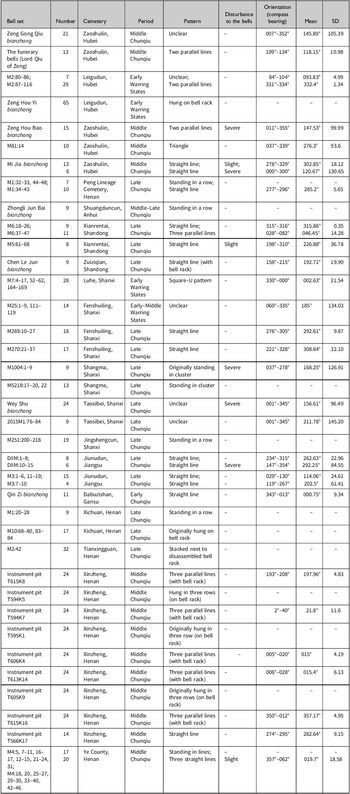
There is no exact equivalence of ‘agency’ in the Chunqiu literature; rather, a range of different capacities is mentioned. For example, the active qualities of potent beings were often described through the notion of ‘numinosity’ (ling 靈) (Fig. 2), which refers to the supreme quality of ancestral spirits or political actors (e.g. Jicheng(hereafter JC)276; cf. Cook & Goldin Reference Cook and Goldin2020, 260–63). Ling denotes a miraculous and positive capacity through which certain entities could influence the course of events (e.g. JC276; Zuo zhuan: Ding 4.3).Footnote 7 To re-enact the ling of their ancestors, descendants were expected to narrate and perform histories shaped by such numinosity, with musical performance as one of the essential media. By contrast, the capacities of bronze bells are described as ‘resonance’ or ‘singing birdsong’ (ming 鳴) (e.g. JC262–70, cf. Cook Reference Cook2017, 174–7). The analogy between bell sound and birdsong (see Fig. 3) was to denote its ability to reach the supernatural sphere inhabited by ancestors, as bird-form creatures were believed to transverse different realms (Falkenhausen Reference Falkenhausen1994, 123–4; Sterckx Reference Sterckx2002, 179). The ming of bells thus served as a sacrificial offering, enticing ancestral spirits and facilitating the invocation of their numinosity (Shi jing: ‘Chu ci’ Mao 209; ‘Ji jui’ Mao 237). At the same time, Zhou bells have to be suspended and arranged in a graduated sequence on a rack in order to be played (Bagley Reference Bagley2005); their ming capacities were thus realized only within such configuration. As reflected in many Eastern Zhou (c. 771–256 bce) tombs (Table 1), considerable care was taken to maintain the ming potential of bronze bells within burials through patterned deposition (see W. Zhang Reference Zhang2019). Then, the patterned burial of bells did not necessarily terminate their ritual function, but could rather sustain their ming capacities in one’s afterlife (see below). This study thus explores two forms of capacities: the ling of powerful persons, which influenced the human realm, and the ming of bronze bells, which mediated relations between living and ancestral persons.
Ling on the chime bells of Lord Qiu of Zeng (a, b), Shu Yi (JC276) (c), and Marquis Yu of Zeng (d). (After Guo et al. Reference Guo, Fang, Chen and Li2020, 15, facsimile 2; Hubei Provincial Institute of Cultural Relics and Archaeology & Suizhou Museum 2014, 20, facsimile 4; IACASS 2001, 245, fig. 276.1b-6.)
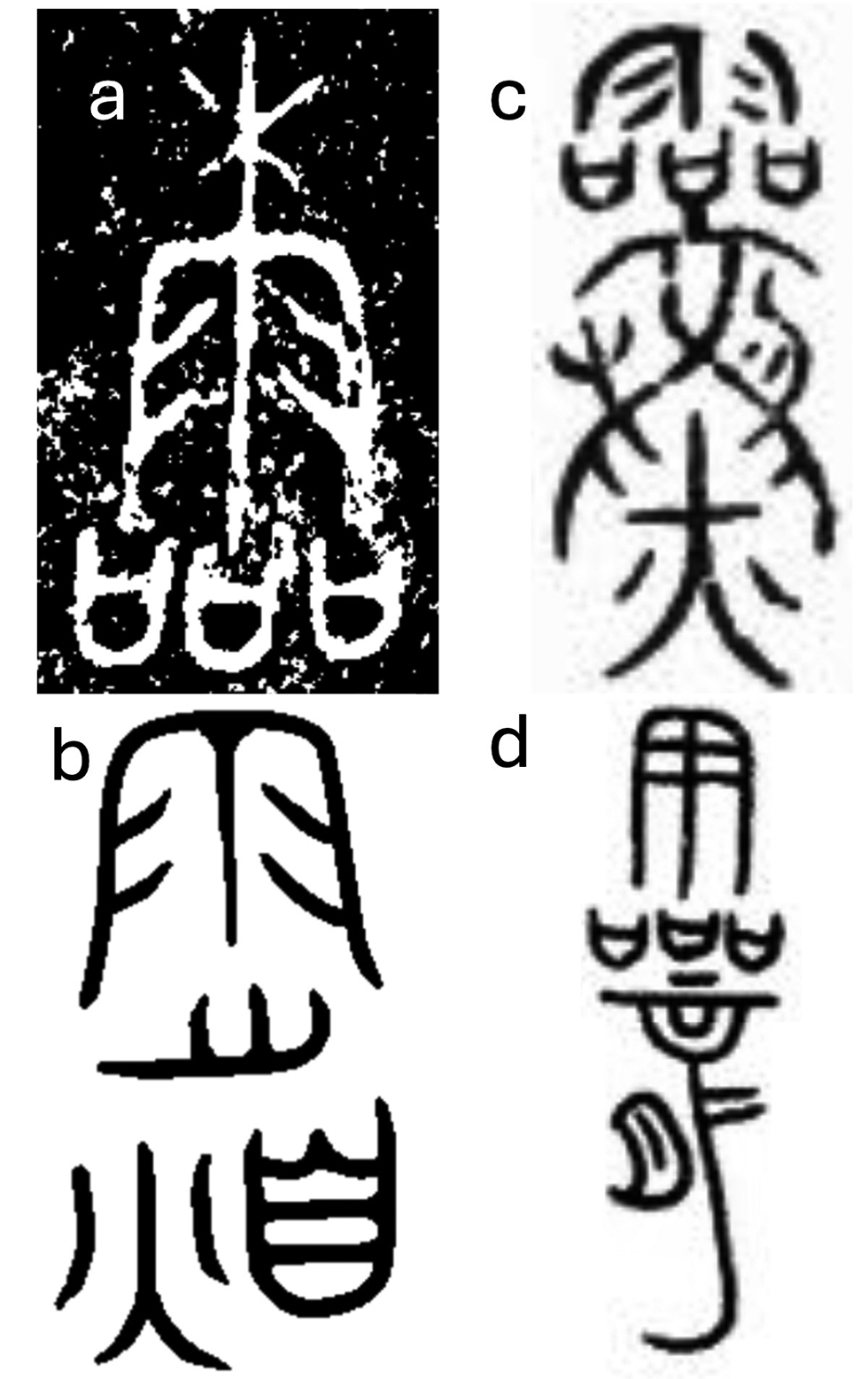
Figure 2 Long description
The image displays four ancient Chinese character, each with distinct inscriptions and designs. The bell labeled ‘a’ features a central vertical line with branching elements, resembling a tree-like structure. The bell labeled ‘b’ shows a similar design but with more pronounced curves and additional details at the base. The bell labeled ‘c’ has a more intricate pattern with multiple curved lines and loops, creating a complex geometric design. The bell labeled ‘d’ presents a vertical structure with horizontal branches and additional decorative elements at the bottom. Each character’s design reflects the diverse manifestations of the concept ‘numinosity’.
Photo (left) and inscriptions (right) on the right striking surface of the chime bell M190:244 from Zaoshulin. A bird mark is inscribed on its striking surface. (Images from Guo et al. Reference Guo, Fang, Chen and Li2020, 16.)
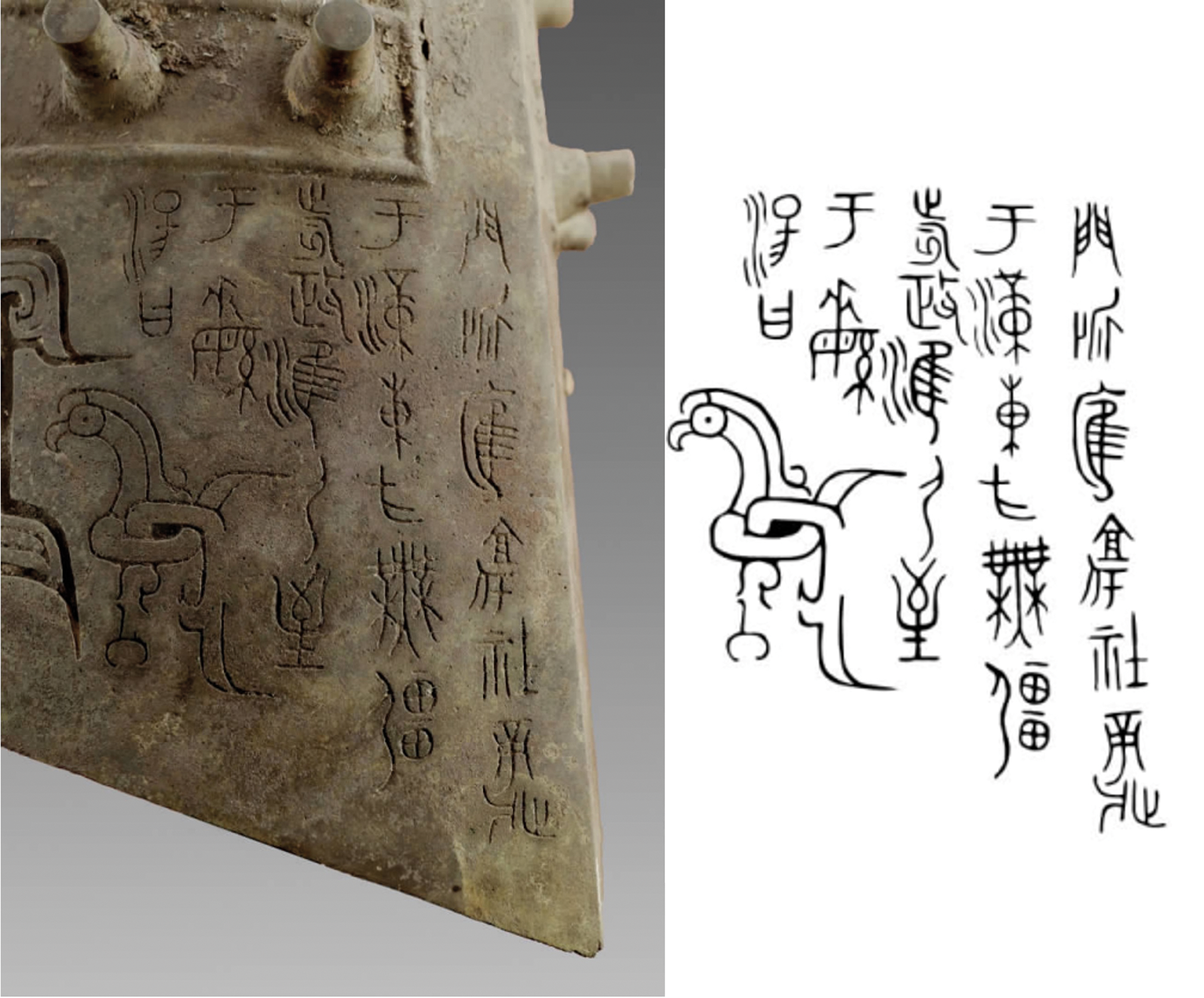
Figure 3 Long description
The image shows a bronze chime bell from the Zhou dynasty, specifically the bell labeled M190:244 from Zaoshulin. The left side of the image displays a photograph of the bell, highlighting its intricate design and the inscriptions etched onto its surface. The right side of the image provides a detailed view of these inscriptions, which include various characters and a distinct bird mark. These inscriptions are significant as they offer insights into the ritual and cultural practices of the Zhou dynasty, particularly in connecting ancestral and living members of a lineage. The bell’s striking surface, where the bird mark is inscribed, is a focal point of the image, emphasizing the artistic and symbolic elements of this historical artifact.
Patterns of bell deposition in the Eastern Zhou period, showing the patterned arrangement required for realizing their ming capacities. Most bell sets were either aligned with a single direction (SD <25) or associated with/suspended on a bell rack, suggesting maintenance of their configuration in burials. For details, see Supplementary Material.
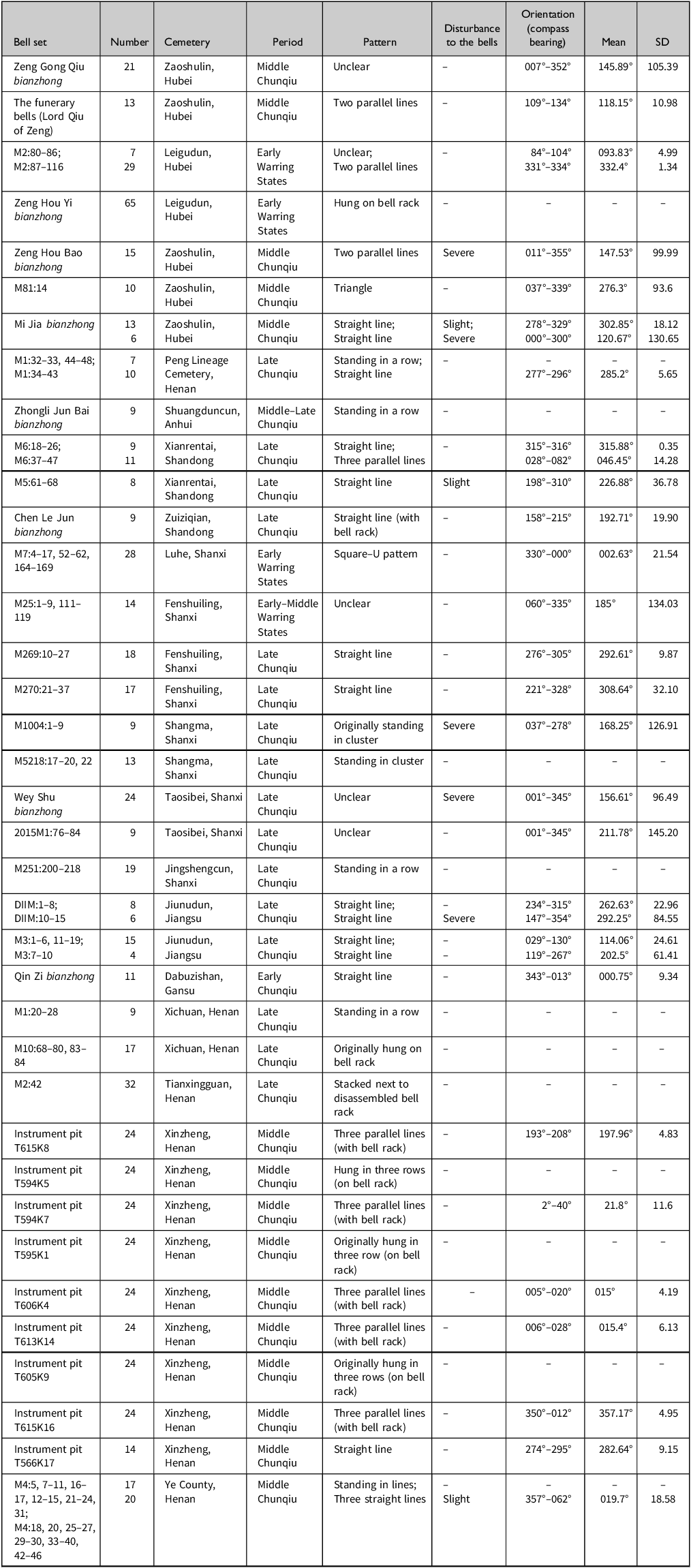
Table 1 Long description
The table lists various bell sets with columns for number, cemetery, period, pattern, disturbance to the bells, orientation with compass bearing, mean, and standard deviation. Each row provides specific data for different bell sets, such as Zeng Gong Qu from Zhaodulun Hubei in the Middle Chunqiu period with an unclear pattern and no disturbance, and M28 from Leigudun Hubei in the Early Warring States period with an unclear pattern and two parallel lines. The table also includes details on the disturbance levels, ranging from slight to severe, and the orientation of the bells, given in compass bearings. Notable patterns include the use of straight lines, parallel lines, and clusters, with some bells originally standing in rows or on bell racks.
In archaeology, personhood is often defined as the social condition or state of ‘being a person’; it is ‘attained and maintained through relationship’ with other entities (Fowler Reference Fowler2004, 4; Reference Fowler2016, 398). Nevertheless, Fowler does not adequately articulate the condition of ‘being’ and ‘person’, nor does he explore the capacities that such personhood might enable. In anthropology, personhood is generally understood as the recognized status or model of a relational being, whose social capacities are realized through culturally specific expressions and participations in social institutions (Appell-Warren Reference Appell-Warren2014, 105–6; Mauss Reference Mauss1938, 268–72; Poole Reference Poole1984, 215). However, this definition also risks conflating two types of personhood commonly discussed in the literature. The first is developmental personhood, which supposes a trajectory through which certain human actors grow or lose capacities following different stages of their lives (e.g. Poole Reference Poole1984; Strathern Reference Strathern1988). The second is other-than-human personhood, which attributes a relatively stable status to non-human or superhuman entities, whose capacities are realized through engagement with human persons on specific occasions (e.g. Bird-David Reference Bird-David1999; Hallowell Reference Hallowell and Diamond1960). Certainly, these are not fixed types of existence, but different configurations of capacities stabilized and stratified in variable ways; it is always possible for a person to transit between them. Personhood can therefore be reconceptualized as a stratified embodiment of particular configuration of capacity: a being is embodied as a person through the relations of stratified ritual expressions and material/social contents such as ritual instruments and other persons within specific settings (e.g. potlatch, funeral), which allows its capacity to be realized in varying degrees (Deleuze Reference Deleuze1969, 39–40; Deleuze & Guattari Reference Deleuze and Guattari1980, 57–64). When circumstances change and an event such as death emerges, it requires the re-embodiment of persons and reconfiguration of their capacities to affirm and transform the event (sensu Deleuze Reference Deleuze1969, 247).
According to the Chunqiu classical and inscriptional records, the personhood of the living—particularly elites—was developmentally constructed through relations with both human and ancestral persons, mediated by ritual bronzes, offerings and performances in ancestral sacrifices (see Cook Reference Cook2017; Kern Reference Kern, Lagerwey and Kalinowski2009; Luo Reference Luo2020). In ritual performance and speech, a person had to assume a ‘figuration’ or ‘persona’ (Mauss Reference Mauss1938), often termed ‘xiao zi’ [little child]—whose de was incomplete and insufficient. Through this figuration, a person could enact his ritual and political capacities,Footnote 8 thereby emulating ancestors’ de and invoking their numinosity (Cook Reference Cook2017, 153–8). This configuration extended into burials: as seen in many Zhou tombs, the deceased would also be figured as a devout little child, with ritual bronzes and ceramics deposited to sustain ancestral rites in the afterlife (Hayashi Reference Hayashi1993). On the other hand, ancestral spirits were embodied in superhuman figurations, though descendants often selectively emphasized particular aspects of these figurations according to their needs (Luo Reference Luo2020; Tse Reference Tse2026). Ancestral spirits were not omnipresent; they resided in either an underground realm (Poo Reference Poo, Olberding and Ivanhoe2011, 18–19) or in Heaven (e.g. Jin Hou Su zhong, cf. Cook & Goldin Reference Cook and Goldin2020, 216),Footnote 9 and had to be summoned to the ancestral hall through ritual practices structured around bronze bells and vessels (Vogt Reference Vogt2023, 229–31). Whichever state was a Zhou person, he/she would always need rituals and ritual bronzes. Neither rituals or bronzes were independently sufficient, as they had to be assembled and stratified in an ancestral ritual assemblage, in which the rituals—mediated by bronze bells and vessels—could embody persons into the figurations of little children and ancestors, thus enabling the re-enactment of numinous capacities.
Tomb M190 at Zaoshulin, Suizhou
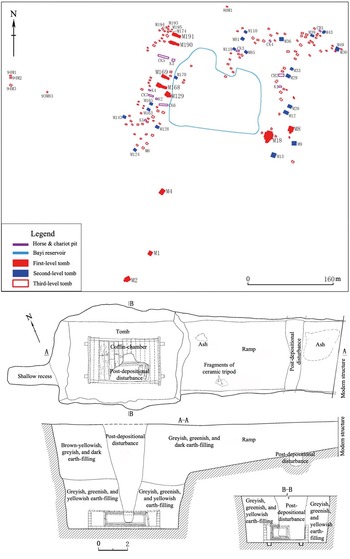
The Zeng aristocratic cemetery at Zaoshulin, Suizhou dates to the middle Chunqiu period (c. 670/650–550 bce). The tomb of Lord Qiu of Zeng (M190) was discovered during the 2018–19 excavation; it was the earliest first-level tomb in the cemetery. Located on a small mound, tomb M190 has the shape of inverted frustum, measuring 5.8–6.8 m in width and 8 m in length at ground level, with narrower dimensions at the bottom, 7 m below ground. A sloped ramp (roughly 5×12 m in size and 1.7-3.6 m in depth) is attached to the southeastern side of the tomb. The coffin-chamber at the centre measures 3.2×5 m in size and 1.2 m in height, while the nested wooden coffins inside measure 1.05–1.4 m width, 2.8–3.1 m length, and 0.75–1.1 m height (Fig. 4). Qiu’s body inside the coffins has been disrupted, but he was likely oriented to the southeast to the ramp.
Site plan of the Zaoshulin cemetery (top) and top view and side view of the tomb M190 (bottom). (Modified after Guo et al. Reference Guo, Li and Chen2024, 70, fig.1; Wuhan University School of History et al. 2023, 31, fig.3.)
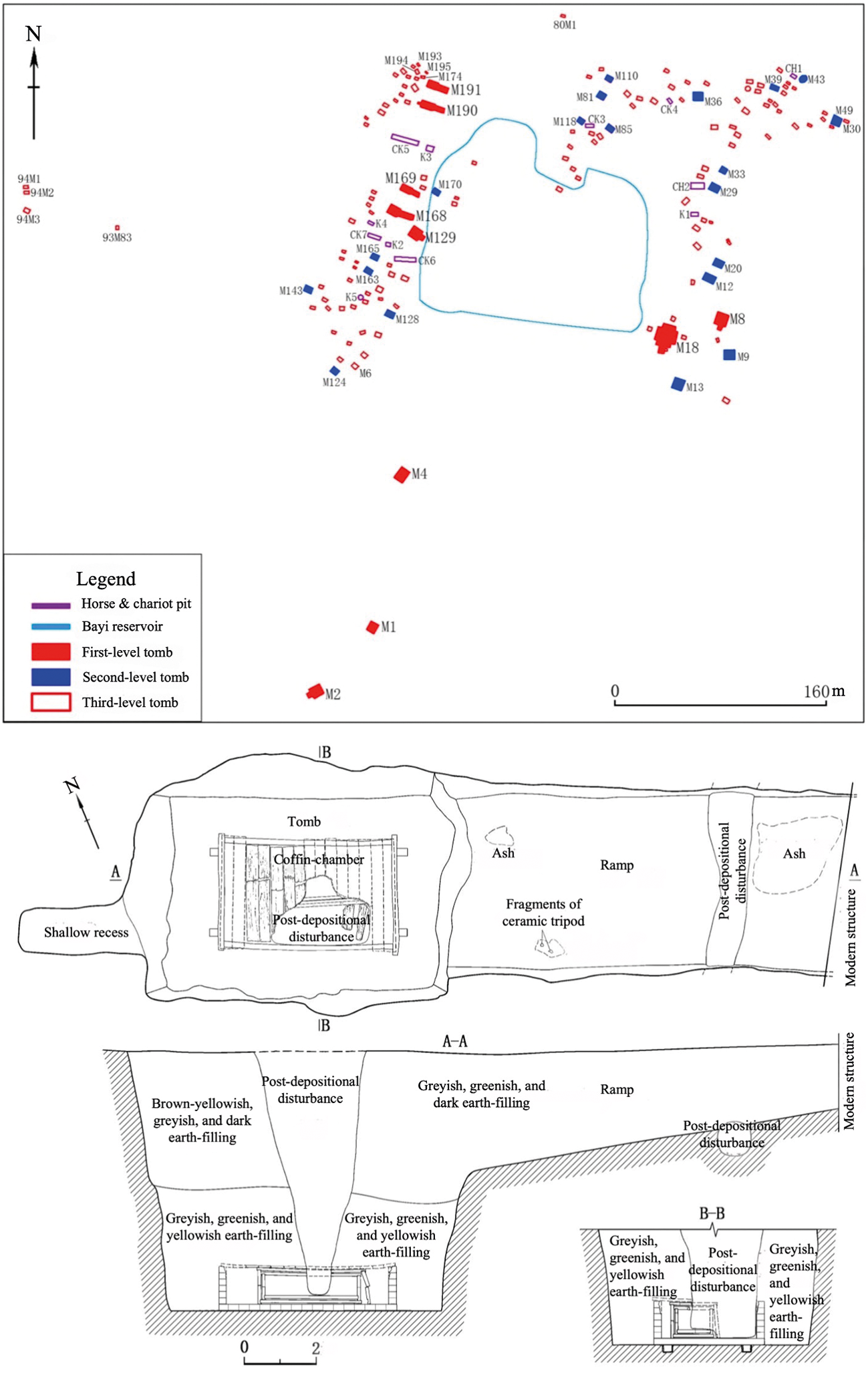
Figure 4 Long description
The top section of the image shows a site plan of the Zaoshulin cemetery. It includes various labeled tombs and features such as horse and chariot pits, a bayi reservoir, and different levels of tombs. The bottom section displays the top view and side view of tomb M190, detailing its structure, including a coffin chamber, post-depositional disturbance, ramp, and fragments of ceramic tripods. The side view sections show different earth-fillings and disturbances within the tomb.
Upon excavation, the structure of M190 was still supported by lacquered wooden planks. Lord Qiu of Zeng was buried with bronze ritual vessels, chime bells and stones, harnesses and chariot parts, jade accessories, lacquerware and golden foils. In the coffin-chamber, the chime bells and stones were deposited in the northwestern quadrant, while food vessels were in the southwest. The bell rack and chime rack were disintegrated; their better-preserved parts suggest that they had been disassembled beforehand. Although the southern portion of M190 was disturbed, the remainder of the coffin-chamber exhibits a compact, intact soil matrix and architectural integrity, which suggests that the observed arrangement largely reflects the original deposition pattern (see Supplementary Material). Therefore, the disordered deposition of bells and the disassembly of their rack cannot be entirely explained by post-depositional disturbance alone.
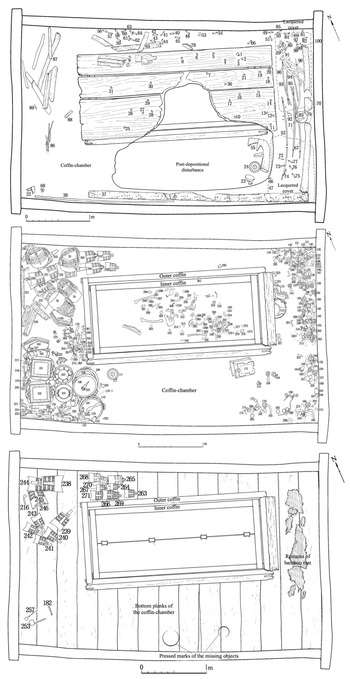
Apart from that, all jades were found inside the coffin, while eight lacquered bows were placed to its east. Other artefacts were distributed without a clear pattern (Fig. 5). The Marquis of Tang also commissioned several bronze vessels for Qiu’s funeral, but they were eventually deposited in the tomb of his wife Mi Yu (M191). Additionally, a sacrificial chariot pit (CK5) and horse pit (K3), containing 12 chariot carts and 20 horses, have been found to the south of M190. All horses were killed before their burial, while chariots were kept intact in the pit before post-depositional disturbance.
Tomb M190, from top to bottom. (Modified after Wuhan University School of History et al. 2023, 33–5, figs 5–7. For full catalogue, see Supplementary Material.)
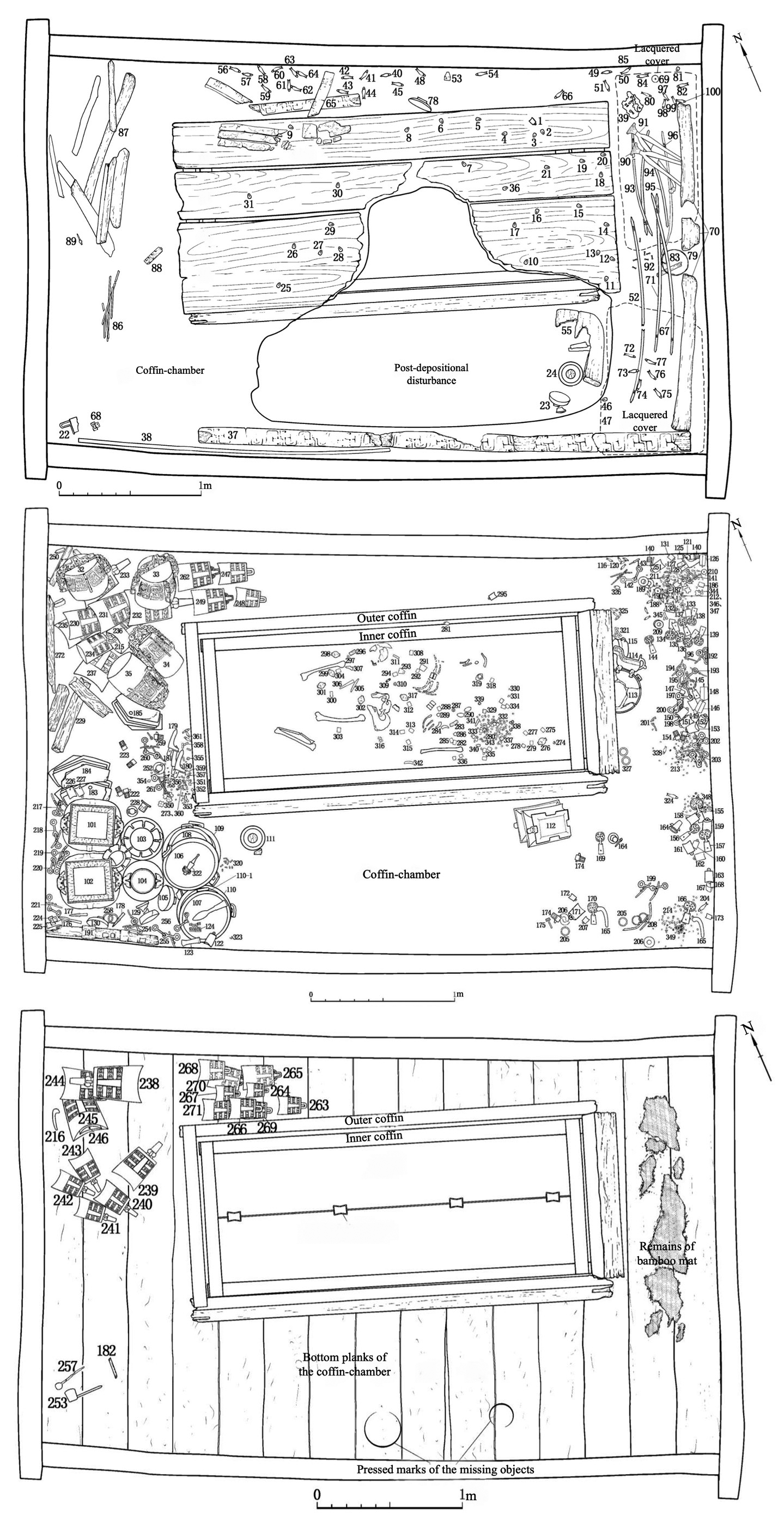
Figure 5 Long description
The image presents a detailed diagram of Tomb M190, divided into three sections from top to bottom. The top section illustrates the coffin chamber with labeled artifacts and post-depositional disturbances. The middle section shows the outer and inner coffins along with a variety of artifacts placed around and within them. The bottom section depicts the bottom planks of the coffin chamber, including pressed marks of missing objects and remnants of bamboo mats. Each section is meticulously labeled with numbers and descriptions, providing a comprehensive view of the tomb’s contents and structure.
The coffin-chamber likely suffered from an episode of post-depositional disturbance during the late Warring States period (c. 300–221 bce), which severely damaged its southern and southeastern parts and the coffin. Upon excavation, the corpse of Qiu and some artefacts were severely disturbed and fragmented, potentially due to looting and/or symbolic disruption prevalent during the Eastern Zhou period (e.g. Shi ji 66.2176, cf. Nienhauser Reference Nienhauser2021, 98–9). Nonetheless, most parts of the coffin-chamber remained undisturbed (Hubei Provincial Institute of Relics and Archaeology et al. 2020; Wuhan University School of History et al. 2023, 29–36).
The first chime bell set of Lord Qiu of Zeng (the Zeng Gong Qiu bianzhong)
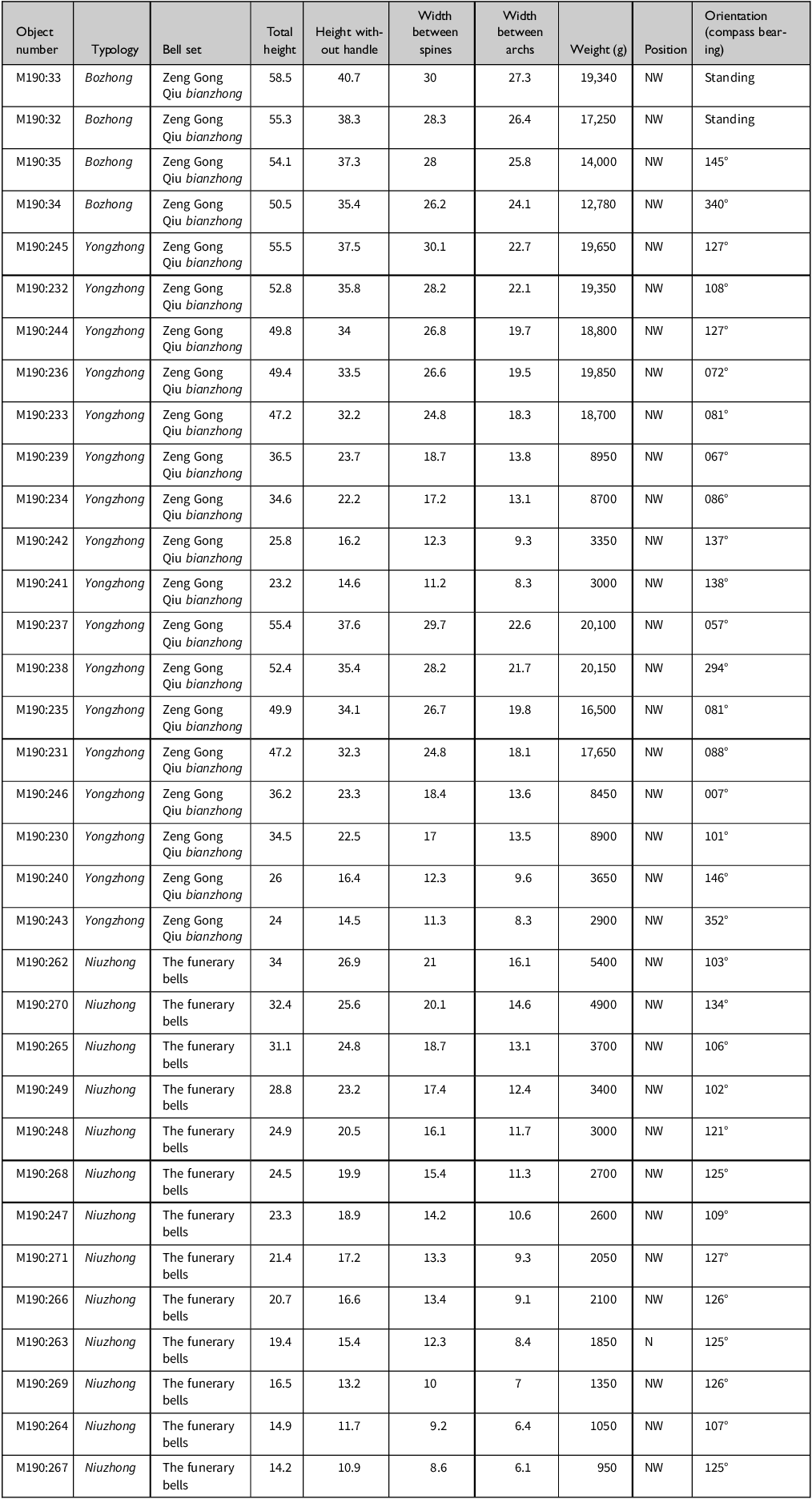
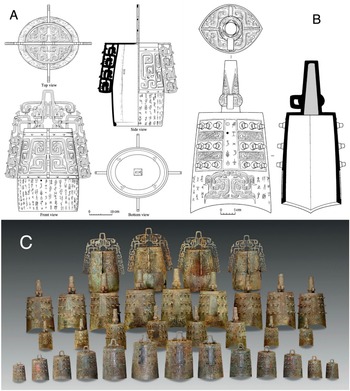
The Zeng Gong Qiu bianzhong was likely the first set of chime bells commissioned by Qiu. Its calendrical notation allows it to be dated to 677 or 646 bce. This bell set is formed with three graduated subsets: four flange-handle bells (bozhong), nine larger shank-handle bells (yongzhong) and eight smaller shank-handle bells (see Table 2). The bozhong (Fig. 6a) are decorated with dragon and dragon-phoenix motifs across the surface, with flange-spines attach to all four sides. The yongzhong (Fig. 6b) are also decorated with dragon motif and bird mark on the striking surface, with three rows of bosses around the spine. Their inscriptions are mostly on the undecorated parts of the striking surface (Wuhan University School of History et al. 2023, 46–66). A recent chemical analysis indicates that the recesses and inscriptions of the yongzhong were originally inlaid with quartz (H. Chen pers. comm., 2026; Gao et al. Reference Gao, Guo, Han, Xu and Yang2024).
Dimensions (cm) and weight (g) of the bronze bells of Lord Qiu of Zeng. (Data from Wuhan University School of History et al. 2023, 46–70.)
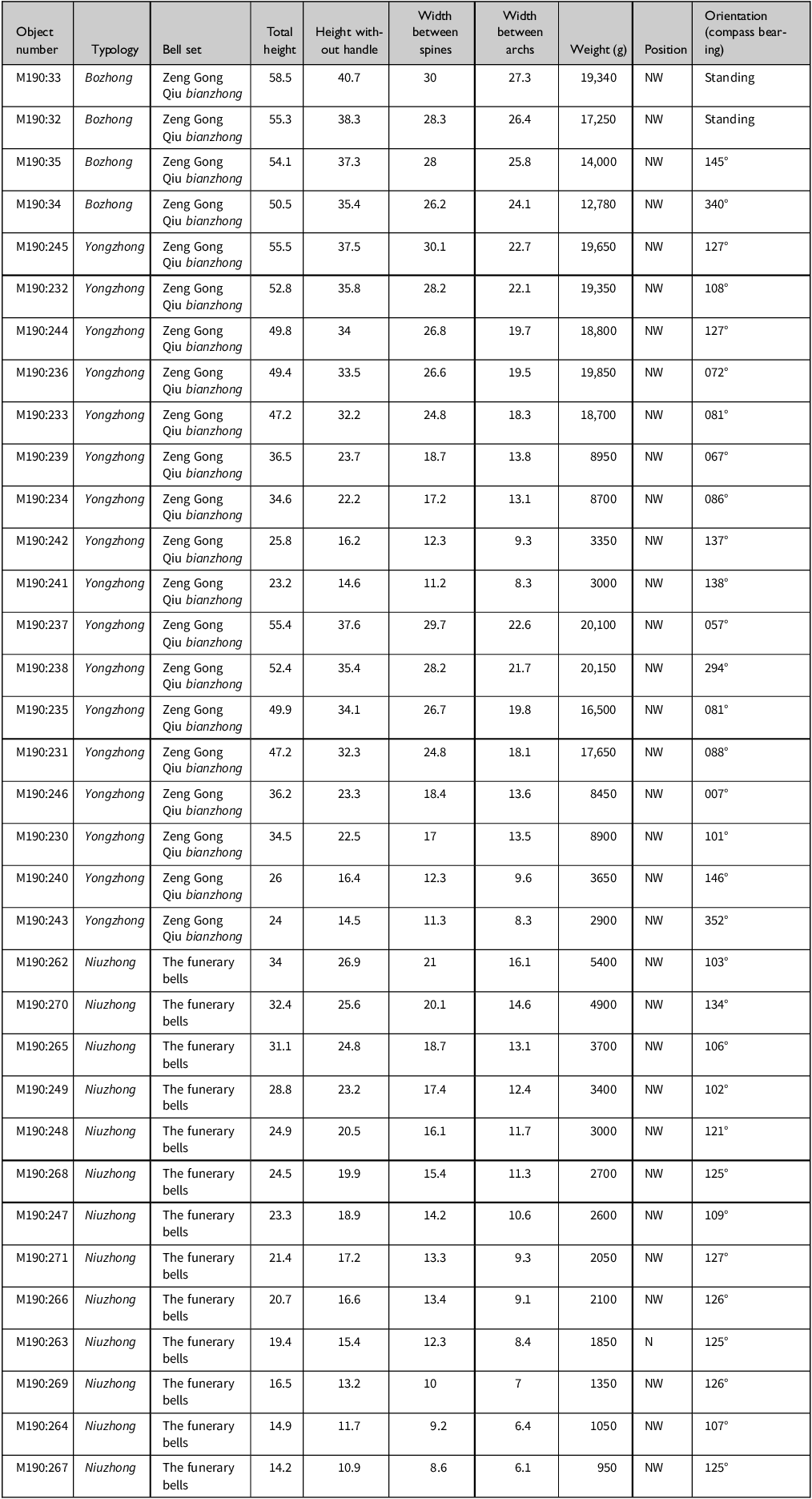
Table 2 Long description
The table presents a detailed comparison of the dimensions and weights of bronze bells from the Zeng Gong Qiu bianzhong set. It includes data for three types of bells: bozhong, yongzhong, and niuzhong. The table has 30 rows and 11 columns, with headers for object number, typology, bell set, total height, height without handle, width between spines, width between arches, weight in grams, position, and orientation (compass bearing). Each row provides specific measurements and weights for individual bells, with notable variations in size and weight across the different types. The bozhong bells are the largest, followed by the yongzhong and niuzhong bells. The data highlights the intricate craftsmanship and the graduated subsets of the bell set, reflecting the calendrical notation and historical significance dated to 677 or 646 BCE.
Bozhong (A) and yongzhong (B) of the Zeng Gong Qiu bianzhong, and the whole bell sets in M190 (C). (After Hubei Provincial Institute of Cultural Relics and Archaeology & Suizhou Museum 2020, 79, fig. 9; Wuhan University School of History et al. 2023, 47, 58, figs 16, 26.)
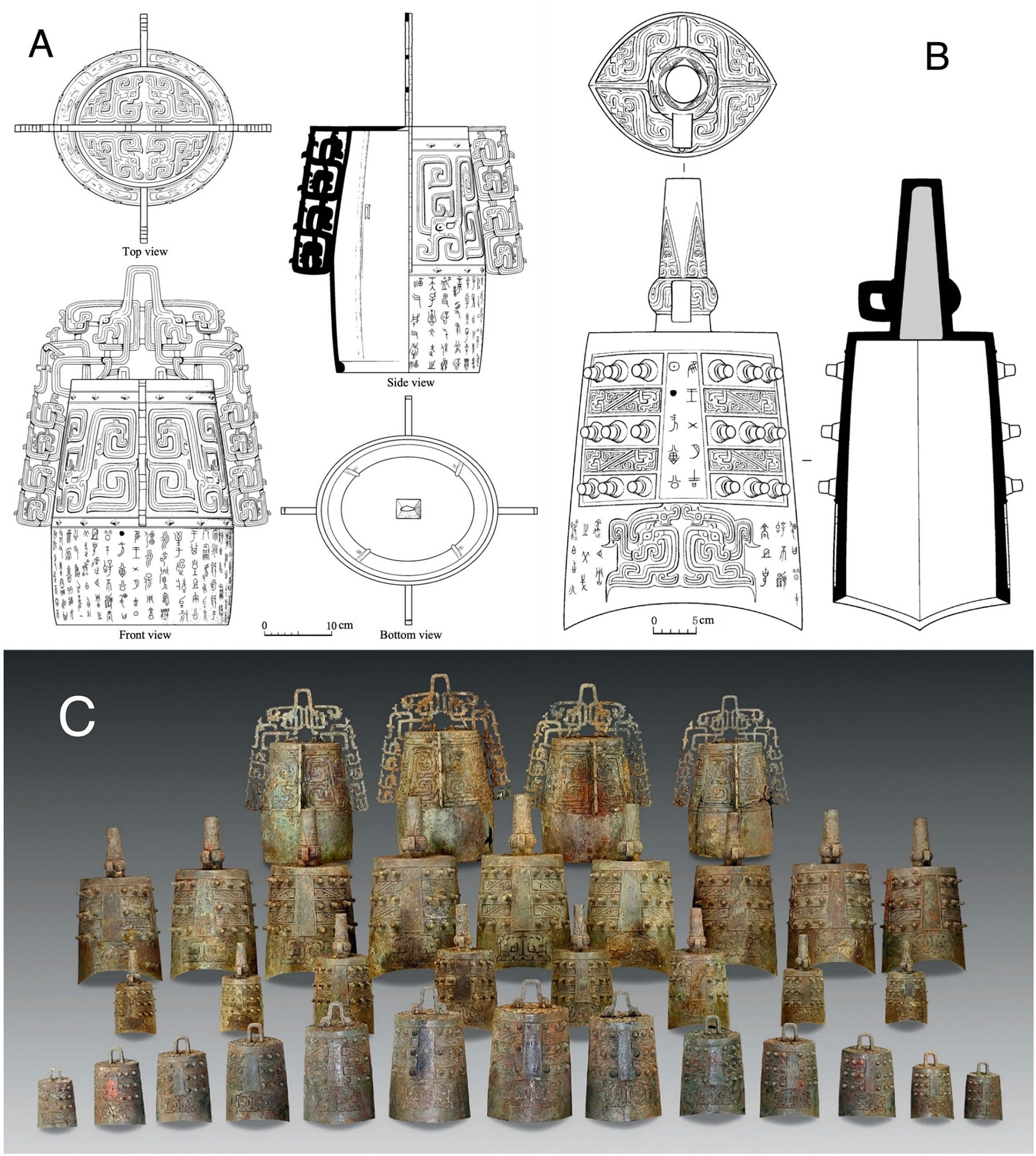
Figure 6 Long description
The image presents detailed illustrations of Bozhong and yongzhong bells from the Zeng Gong Qiu bianzhong set, showcasing various views including top, side, front, and bottom perspectives. The Bozhong bell is depicted with intricate patterns and inscriptions, while the yongzhong bell features a distinct shape and detailed designs. Additionally, the image includes a photograph of a collection of bronze bells from M190, arranged in various sizes and shapes, highlighting their historical and cultural significance.
The following translation of the inscriptional text of the Zeng Gong Qiu bianzhong is adapted from Tse (Reference Tse2026, 11–15):
It was in the King’s fifth month, the auspicious day of Ding Hai (i.e. day 24 in the sexagesimal cycle), Lord Qiu of Zeng said: ‘In the past, my greatly manifest High Ancestor was able to assist and act as a counterpart for Kings Wen and Wu (of Zhou); pure was Bo Kuo, [he] conducted carefully and possessed de, assisting and serving the Deity Above, [thereby he] continued and received manifold blessing, and aiding and assisting the Great Zhou. The Numinous Spirits hear the sound of metal (i.e. bronze bells),Footnote 10 [thereby] receiving such great peace. [I] greatly manifested their numinosity,Footnote 11 and made an all-out effort with reverence.
‘The king hosted us at the Kang Hall, summoned [the Chief Governor, he] commanded the August Ancestor to establish (his state) in the southern land, guard the southern gate of Cai, cautiously build the ancestral hall, and lead the east of Han River. The South [originally] had no boundary, [but my August Ancestor] crossed the river, attacked Huai barbarians, and reached Fanyang.’ [Qiu] said: ‘King Zhao [of Zhou] journey southwards, [he] issued mandates on Zeng: “Fulfill all our decrees/affairs and aid and assist the Great Zhou. [Hereby I] grant you yue-axe to govern the south.” The glory of Nan Gong, is heard/known in the struck sound [of bells];Footnote 12 [he] ascends and descends above and below, protecting and making his descendants prosper.’
[Qiu] said: ‘Alas! Worried am I a young Little Child. I have received no assistance, my conduct/virtue is my great concern. [May my ancestors] grant me boundless graces, making me a match to the Heaven’s magnificent graces. [May] the blessing of Wen and Wu be fulfilled and celebrated. [May] blessing and fortune come day by day, restoring/protecting the boundary of my land. I have selected the auspicious bronze-making copper and smelted hard metal to make myself harmonious bells [as] sacrificial vessels in the ancestral hall. Bright and soothing [they are], the bells are harmonious and resonant/singing birdsong, to make offering to my August Ancestor Nan Gong, extending to Lords Huan and Zhuang, to pray for everlasting life, extended longevity without limit, and [may these bells be] forever treasured and used for offering.’
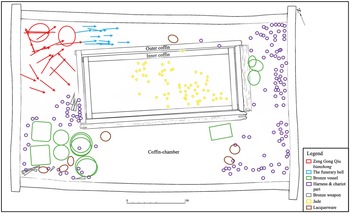
In tomb M190, these bells were oriented to different directions, with two bozhong (M190:32–3) standing upon other yongzhong (Figs 5 & 7). The compass bearings of the non-standing bells range from 007° to 345°, with a sample standard deviation (SD) of 93.73 (Tables 1 & 2). The bell rack was found in fragmentary state upon excavation. The fragments of the bell rack (e.g. M190:37, 87, 250, 272) were scattered all over the coffin-chamber, which did not match the deposition pattern of the bells in M190.
Artefact locations in M190. Colours signify categories: bronze vessels (green), harness and chariot fittings (purple), weapons (grey), jades (yellow), and lacquerware (brown). Bell orientations are shown by arrows; red: Zeng Gong Qiu bianzhong; blue: funerary bells. (Adapted from Wuhan University School of History et al. 2023, 34–5, figs 6–7.)
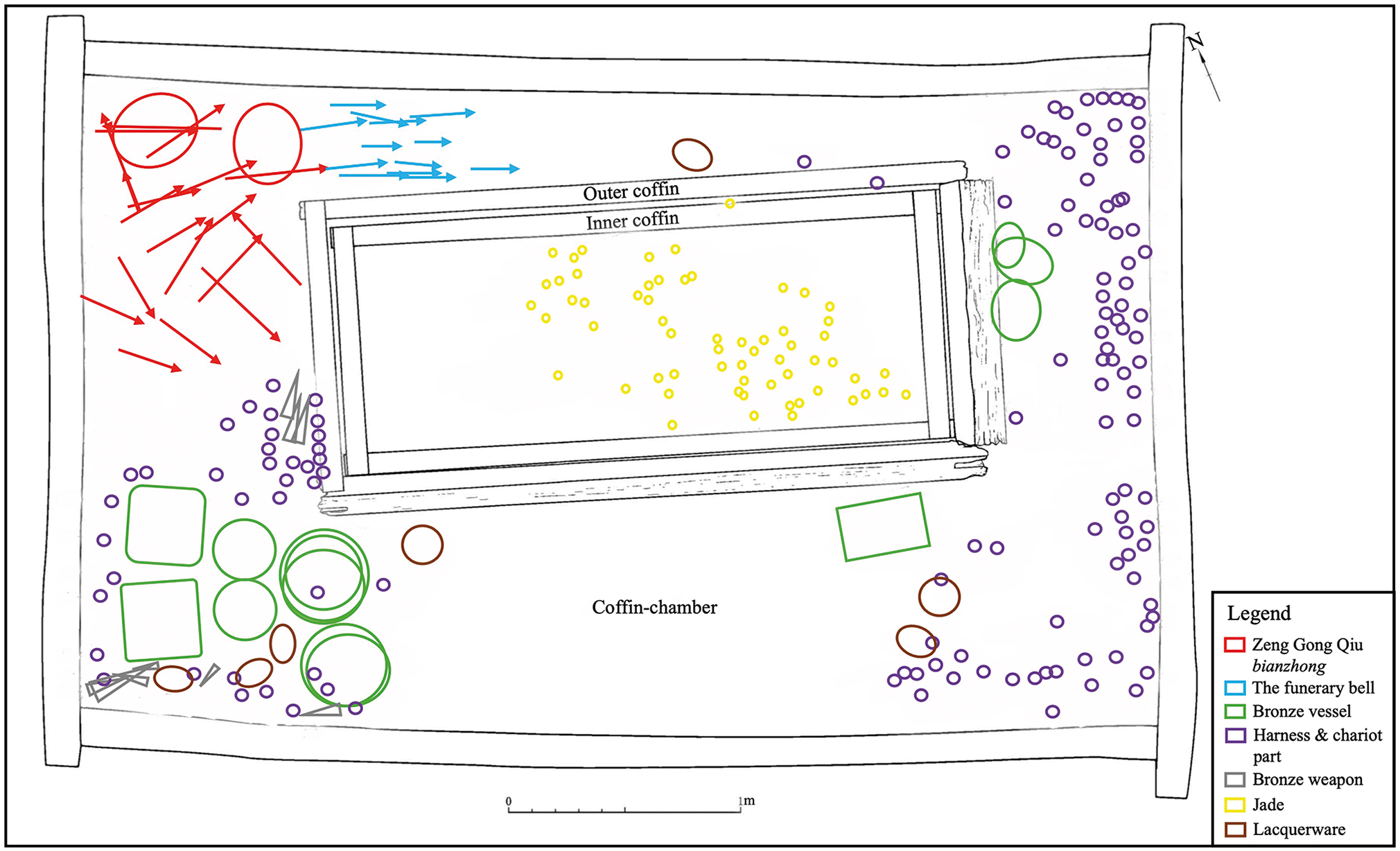
Figure 7 Long description
The diagram illustrates artefact locations within the M190 coffin chamber. Various categories of artefacts are color-coded: bronze vessels in green, harness and chariot fittings in purple, weapons in grey, jades in yellow, and lacquerware in brown. Arrows indicate the orientations of bells, with red arrows representing Zeng Gong Qiu bianzhong and blue arrows representing funerary bells. The outer and inner coffins are centrally located within the chamber, surrounded by scattered artefacts.
Other burial goods from tomb M190 at Zaoshulin
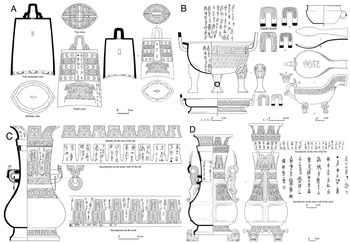
Additionally, Qiu commissioned a funerary bell set consisting of 13 ring-handle bells (niuzhong) (Fig. 8a). The calendrical notation ‘the King’s first month, the first auspicious of Ding Hai’ can date to 656 or 625 bce (cf. P. Zhang Reference Zhang1987, 133, 139). Their inscriptions indicate that these bells were intended for use in his afterlife. Although stylistically similar to the yongzhong, the funerary bells are notably inferior in both size and craftsmanship (Wuhan University School of History et al. 2023, 66–70). In tomb M190, they were consistently oriented southeast, with compass bearings ranging from 109° to 134° and a SD of 10.98 (Table 2; Fig. 7).
Niuzhong (A), cauldron (B, 1), washbasin (B, 2), ring-handle cup (B, 5), ladle (B, 6), hand-washing jug (B, 7), round vase (C); and square vase (D) in M190. (After Wuhan University School of History et al. 2023, 37, 41–2, 67, figs 8, 11–12, 34. For their inscriptions, see Supplementary Material.)
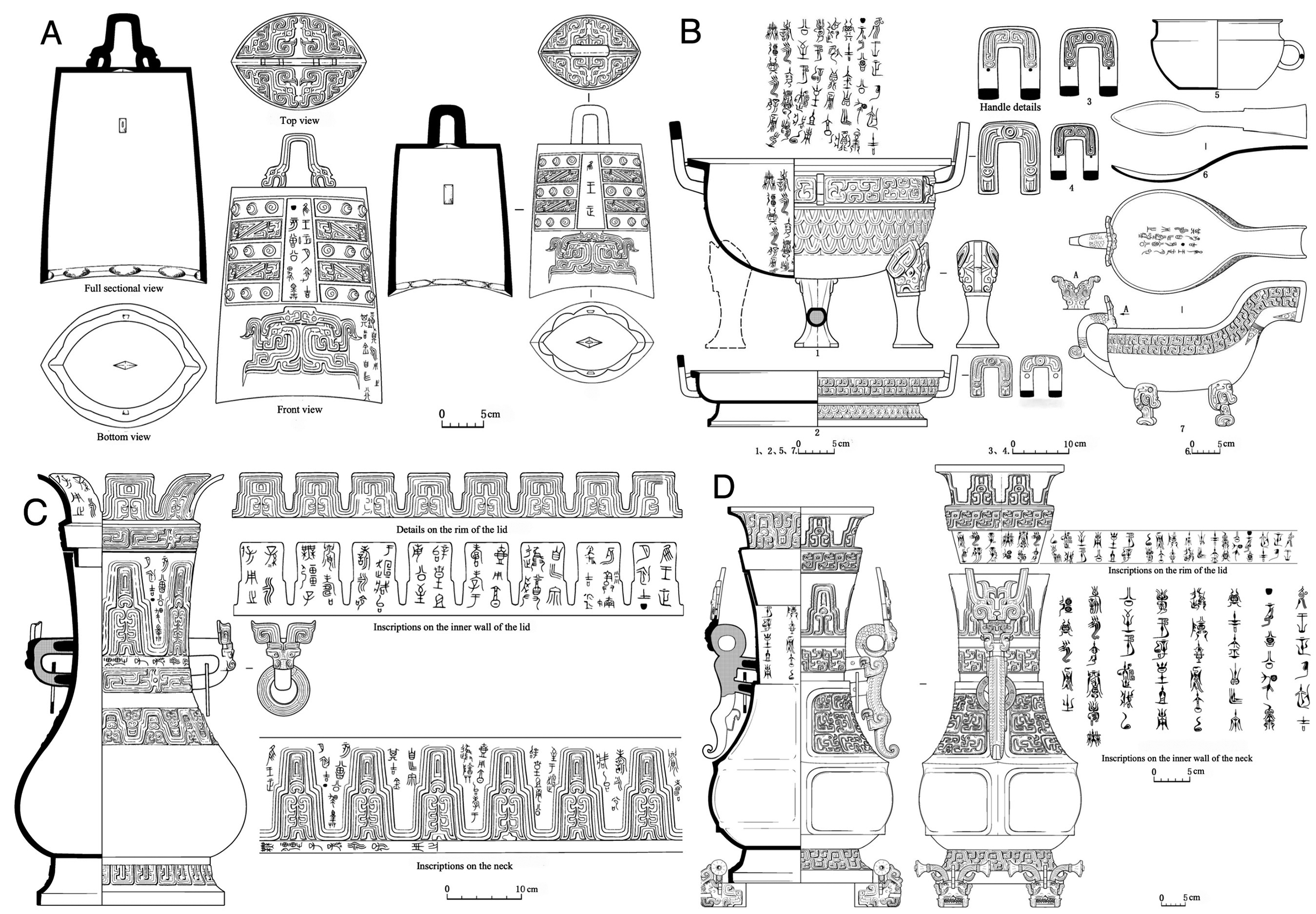
Figure 8 Long description
The image presents detailed illustrations of various ancient Chinese artifacts. Section A shows a Niuzhong from multiple angles, including full sectional view, top view, front view, and bottom view. Section B displays a cauldron with detailed views of its handle, washbasin, ring-handle cup, ladle, and hand-washing jug, each labeled and shown from different perspectives. Section C illustrates a round vase with detailed inscriptions on the rim of the lid, inner wall of the lid, and neck. Section D shows a square vase with inscriptions on the rim of the lid and inner wall of the neck. Each artifact is meticulously detailed, highlighting their unique designs and inscriptions.
Qiu also commissioned at least five cauldrons, two square vases, four round vases, a washbasin, a hand-washing jug and a fu (frustum-shaped vessel) (Fig. 8b–d) at the same time, although the lids of two round vases were commissioned by his wife, Mi Yu. Upon excavation, animal bones, fruit stones and chariot fittings were found in the cauldrons. Most vessels are exquisitely decorated with geometric motifs and chimeric animal forms. The nested cauldrons and vases were arranged in an orderly manner within the tomb and are dedicated to his ancestors, ‘[from] Nan Gong to Lords Huan and Zhuang’, on the ‘the first auspicious [day] of Ding Hai’ (Wuhan University School of History et al. 2023, 36–46).
Discussion
Ancestral de, numinous ancestors, resonant bells and the personhood of Lord Qiu of Zeng
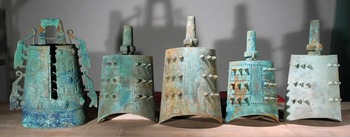
As indicated by its calendrical notation, the bell set of Lord Qiu of Zeng (the Zeng Gong Qiu bianzhong) was cast in 677 or 646 bce. The bells were essentially dedicated to ancestral sacrifice, particularly Bo Kuo (‘Kuo the Elder’) and Nan Gong (‘the Lord of the South’). Their inscriptions, or underlying Urtext, likely served as invocative prayers recited in ritual sacrifice to ‘grasp ancestral de’ (Cook Reference Cook2017; Kern Reference Kern, Lagerwey and Kalinowski2009). While the emulation of ancestral de through incantation and performance was widespread in the Zhou period, Qiu had also extended such emulation into the material form of the bells themselves. His selection of shank-handle (yongzhong) and flange-handle bells (bozhong) might have been intended to replicate the preference of his distant ancestor, Marquis Kuan of Zeng (r. c. 977–957 bce) (Fig. 9),Footnote 13 who can potentially be identified as ‘Nan Gong’ in the inscriptions (Hubei Provincial Institute of Cultural Relics and Archaeology & Suizhou Museum 2020). Through this combined ritual and material emulation, Qiu presented himself as adequately modelling after the illustrious patterns of Zeng’s ancestors, thus demonstrating his moral capability to inherit the mandates—understood here as the right to govern southern China—from the Deity Above and Zhou kings. In the inscriptions, Qiu expresses the expectation that his ancestors and Heaven will grant him ‘graces’, a generic statement across the Zhou worlds (e.g. JC262–70; Jin Hou Su zhong). Nonetheless, he proceeds to direct such anticipated blessings towards the restoration or protection of Zeng. It thus demonstrates that, while political elites such as Qiu operated within established frameworks of rituals and de emulation within the Zhou worlds, they were also empowered by and creatively adapting these rules, through which they could realize new political capacities in response to changing circumstances.
The bells from the tomb of Marquis Kuan of Zeng at Yejiashan, Suizhou. (After Hubei Provincial Institute of Cultural Relics and Archaeology & Suizhou Museum 2020, 54, fig. 56.)
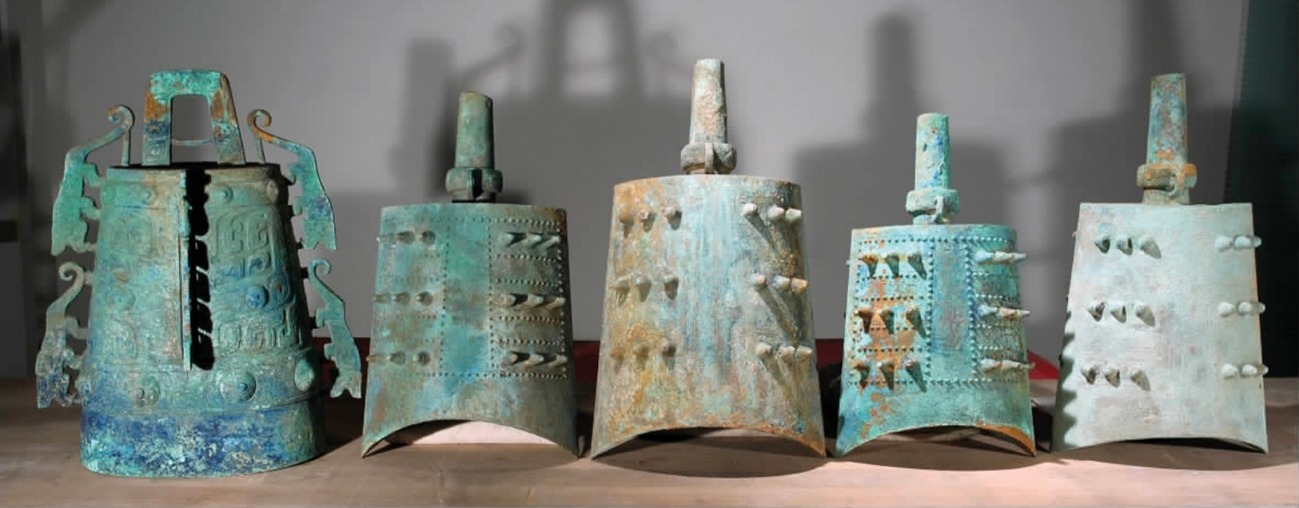
Figure 9 Long description
Five ancient bronze bells are displayed in a row. Each bell has a unique design with intricate patterns and symbols. The bells vary in size and shape, with some featuring handles and others having pointed tops. The surfaces of the bells show signs of aging and patina, indicating their historical significance. The bells are likely part of a ceremonial or ritual set, used in ancient musical performances or religious ceremonies.
The numinous ancestors (i.e. Bo Kuo and Nan Gong) in Qiu’s bell inscriptions are presented as the potent actors at critical junctures of the early Western Zhou period, including the Conquest of Shang (c. 1046 bce) and King Zhao’s southern campaigns (c. 960–957 bce). Here, Qiu positions his ancestors not only as loyal supporters of the Zhou kings, but also as flawless persons who shared the Mandate of Heaven with the kings and exercised their ling [numinosity] to shape the course of history. Although ancestral persons were capable of transcending multiple realms, their presence had to be invoked through ritual performance in the ancestral hall. For Qiu, such invocation relied heavily on the ming [resonance or birdsong] of musical media. To attract and engage these ancestral persons, their histories had to be recounted through the recitation of prayers accompanied by the ornithomorphic sounds of the bells. This may explain why the inscriptional text repeatedly emphasizes sonic qualities rather than the physical form of the bells. Whereas the tonal properties of the bozhong remain unclear, the attuning troughs and bird marks on the yongzhong (Figs 3 & 6) suggest that they functioned as proper musical instruments. The luminous quartz originally inlaid on the yongzhong’s surface, along with the dragon and phoenix motifs on the bells, might facilitate the transmission of music towards the supernatural realm (Sterckx Reference Sterckx2002, 177–81). Notably, the bell inscriptions are only legible under close inspection, as they are inscribed in minuscule size and the wrong order (Škrabal Reference Škrabal2020). This suggests that the inscriptions on the bells were not primarily designed to be readable, but rather to be ‘audible’ to the numinous spirits. Since most of the characters are inscribed on the striking surface of the bells (Fig. 6), the inscribed message might have been able to spread along with the music to another realm (Khayutina Reference Khayutina, Dickhardt and Dorofeeva-Lichtmann2003). It suggests that the ming capacities of bronze bells was closely linked to the invocation of the numinosity of his ancestors.
While the bells had the capacities to resonate with ancestral spirits, they ultimately served as media through which Lord Qiu of Zeng—the ‘speaking’ person of the inscriptional text—relationally constructed his personhood as Lord of Zeng. In the inscriptions, he assumes the figuration of a ‘little child’ to address his ancestors. Curiously, unlike most of his contemporaries (e.g. JC262–70: Jin Gong pen; cf. Cook Reference Cook2017, 180–81), he does not emphasize personal achievements, but presents himself as self-effacing and devout, and bemoans his isolation and helpless situation. His statement could be a realistic or reserved reflection, but it could also be an attempt to model his own person after his numinous ancestors. In his inscriptions, his ancestors are portrayed as pious, obedient and respectful figures who carried out the mandate from the Heaven and Zhou kings, while Qiu fashions himself as a devout, humble, and reverent ‘little child’ striving to secure such mandate. This manner of self-presentation was prevalent in the Western Zhou (see Cook Reference Cook2017, ch. 3), and Qiu’s use of archaizing vocabularies further aligns with this traditional mode of figuration (Tse Reference Tse2026, 15–16). As discussed above, his inscribed bell set was likely a material strategy of emulation recalling the antique bells of his ancestor Nan Gong—though broader trends in bell consumption during the Chunqiu period might have influenced his choice as well (W. Sun Reference Sun2022, 35; Tse Reference Tse2026, 20–21). His emulation was to invoke the numinosity of his accomplished ancestors, one of whom had potentially assisted in King Zhao’s military campaigns against Chu (JC949, cf. Cook & Goldin Reference Cook and Goldin2020, 53–4). By closely modelling his embodiment of personhood with that of his ancestors through the ritual expressions of archaizing prayer, emulative figuration and musical performance within the assemblage of ancestral ritual, Qiu ultimately sought to reconfigure his own capacities after the ling of his ancestors, and channel it against the looming threat posed by the Chu state. It indicates how the embodiment of personhood was inherently connected to the configuration of specific capacities of a person. Such embodiment and configuration were not static, but constantly reworked throughout and after his life.
Becoming ancestor, reconfiguring other-than-human capacities, and re-embodying person in Qiu’s funeral
The inscriptions of other ritual bronzes in tomb M190 indicate that Qiu’s funeral was held around 656 or 625 bce, approximately 21 years after the commissioning of his first bell set. In addition to the bells, Qiu was buried with five cauldrons and four vases, all dedicated to ‘Nan Gong to Lords Huan and Zhuang’. This array of bronze vessels had been deposited in an orderly arrangement, with some still containing food remains. Funeral is commonly understood as the ritual that transforms the personhood of the deceased into ancestorhood. It is likely that these bronzes were first used in sacrifices to the deceased during the funerary processes for facilitating this personhood transformation (Thote Reference Thote, Lagerwey and Kalinowski2009, 124). At the same time, they were also used to re-enact the ritual sacrifice once conducted in ancestral hall within the coffin-chamber, assembling the deceased, ancestors and mourners together in a shared ritual setting (Z. Wang Reference Wang2025, 109–10). Such re-enactment could serve to re-present Qiu as a ‘little child’ within the lineage, allowing him to emulate ancestral de and sustain his personhood in the supernatural realm. But this performance also figured Qiu as a numinous ancestor, whose flawless image fabricated by this ritual paraphernalia would be remembered and modelled after by the participants, particularly subsequent Zeng leaders. Those who contributed bronzes to the funeral might likewise expect reciprocal blessings from Qiu (e.g. M191:7; see Supplementary Material). As reflected in his bronzes in M190 and other tombs, Qiu’s ancestorhood appears to operate in two interconnected modes: on the one hand, he was positioned as a ‘little child’ to his earlier ancestors; on the other hand, he was a numinous ancestor whose blessings were sought and whose de had to be emulated. Ancestorhood in the Chunqiu period was therefore a relational, dynamic state in which the deceased alternated between multiple roles within the lineage.
However, the capacities of Qiu’s former bell set—the Zeng Gong Qiu bianzhong—had likely struck a dissonant note to the otherwise harmonious embodiment of his new personhood. Previously used to invoke ancestral numinosity in opposition to the Chu state, the ming capacities of these bells could be used to re-embody Qiu as a defender of the Zhou order and governor of ‘barbarians’ (including Chu),Footnote 14 a position that became problematic after Zeng’s marital alliance with Chu. As ‘inalienable goods’ tied to the donor and his/her lineage, such bells could neither be easily discarded nor exchanged (Cook Reference Cook1997; Zuo zhuan: Huan 2.4). To resolve this dilemma, Qiu and his mourners appear to have ‘deactivated’ the ming capacities of his bronze bells in two ways. First, the rack of this bell set was disassembled into pieces and dispersed across the coffin-chamber (Wuhan University School of History et al. 2023, 34), while the bells were deposited in a disordered cluster without a clear arrangement. Second, Qiu commissioned an additional set of ritual bronzes, including ring-handle bells (i.e. the funerary bells), which were carefully deposited into two parallel lines and oriented southeast in a coordinated pattern (Table 2; Fig. 7). These new bronzes were cast on ‘the first auspicious [day] of Ding Hai’, which is the same sexagesimal date notated in the Zeng Gong Qiu bianzhong. The bronze vessels were also dedicated to the same group of ancestors, replacing the sacrificial function of his former bell set (see Supplementary Material). Notably, the deposition of funerary bells and vessels had strictly followed certain patterns. In other contemporary cultures, the burial of bronzes often removed them from ritual performance (e.g. Yao Reference Yao2016, 158). However, within the Zhou ontologies, the patterned deposition of bronzes was precisely for continuing their sacrificial function. In this sense, the disordered deposition of the Zeng Gong Qiu bianzhong and the disassembly of its rack could be seen as an attempt to derealize the ming potential of this bell set, while other orderly deposited funerary vessels and bells—cast in the same sexagesimal date and dedicated to the same range of ancestors—were to compensate for the derealization of the former bell set and continue ancestral rituals in his afterlife.
These reconfigured other-than-human capacities were ultimately carried out by the re-embodied person of Qiu in relation to a host of humans and other-than-humans. Funerary practice in the Chunqiu period was not simply a means of reducing the individual to ‘basic ritual dimensions’ (Falkenhausen Reference Falkenhausen2006, 299), nor merely a display of wealth status of the deceased (Cook Reference Cook1997, 258–9). Rather, it was a process in which the ritual expressions and persons—along with material mediations—were mutually realigned in response to a person’s death, transforming the deceased into an ancestor and turning his/her personal, physical death into a public, symbolic event (sensu Deleuze Reference Deleuze1969, 174–9). As discussed above, the derealization of the ming potential of Qiu’s former bell set meant that the numinous capacities of his ancestors could no longer be invoked by musical performance in the afterlife. The inscriptions on his funerary vessels and bells are also more concise, omitting the extended genealogical statement and self-presentation found in the ritual speech represented by the former bell inscriptions. These neutralizing forms of ritual expressions thus embodied a more restrained and flattened figuration of Qiu within the tomb. At the same time, Qiu’s embodiment as a Zeng lineage head and numinous ancestor was rather emphasized in his burial. In fact, many of his bronze vessels (Fig. 8b–d) are of exceptional quality, with finely executed decoration and, in some cases, inscribed with flamboyant ‘bird script’ on their interior surfaces, likely intended for pleasing an ancestral audience. Moreover, other participants such as Mi Yu and the Marquis of Tang had contributed to the bronze paraphernalia in his funeral (C. Chen Reference Chen2022, 97), while weapons, lacquered bows and chariot fittings in his tomb, as well as the chariots and horses in the sacrificial pits, might have been donated by his allies and subordinates, as suggested by the bamboo-slip inventories from other Zeng and Chu tombs (e.g. Habberstad Reference Habberstad2014). Thus tomb M190 and its contents were not simply an extravagant representation of Qiu’s wealth or status, but a ritualized re-embodiment of Qiu’s transformed personhood co-produced by Qiu, his ancestors, mourners from different states, and his burial goods, each enacting specific capacities within this funerary assemblage. Moreover, the presence of his tomb reshaped the surrounding world: his tomb and associated sacrificial pits were referenced by later burials through their spatial alignment and proximity, up until the late Warring States period (Fig. 4) (Guo et al. Reference Guo, Li and Chen2024). Thus, Qiu’s funeral was also the foundational event in the creation of an ancestral landscape, where his person continued to be remembered and engaged by contemporaries and later generations (sensu Graham Reference Graham2009). The funeral was therefore a ritual process through which the personhood of Qiu was re-embodied, allowing reconfiguration of capacities across Qiu himself, his ancestors, present and future lineage members, and ritual objects.
Conclusion: Towards a possible ‘posthumanism’ in Chinese archaeology?
Recent non-anthropocentric and posthumanist theories are immensely valuable in helping us move beyond the anthropocentric and ethnocentric epistemology of our discipline. However, these theories are themselves an assemblage of modern discourses and projects, shaped by particular political agendas and ethical concerns regarding modern Western conditions. When engaging with the archaeology of ancient China or other regions, it is therefore important not to impose these theoretical frameworks uncritically onto different worlds. A more-than-literalist reading offers a helpful alternative: it foregrounds the variable capacities of multiple modes of being within their worlds, and explores how different persons act creatively within specific assemblages and respond to particular events.
This article has revisited the definitions of ontology, agency and personhood, proposing that ontology can be understood as a dynamic field of potentialities, agency as historically configured capacities within this field, and personhood as the embodiment of such capacities. Drawing on Chunqiu classical and epigraphical texts, it has examined the concepts of ling and ming—the former as numinous, positive capacities for reshaping history and the latter as the resonant or birdsong-like capacities of properly arranged bronze bells. Through rituals structured around bronze bells, a human individual, figured as ‘little child’, could relationally reconstruct his/her personhood in connection with ancestral beings.
Building on this framework, this article has investigated the changing capacities of Zeng Gong Qiu bianzhong, the role of Qiu’s ancestors, as well as the shifting personhood of Lord Qiu of Zeng across different historical contexts. The bells were originally cast as media for emulating ancestral de and invoking their history-shaping numinosity against the Chu state. However, in tomb M190, their haphazard deposition and the disassembly of their rack suggest a derealization of their ming capacities, likely in response to the changing political circumstance after Zeng’s rapprochement with Chu. Qiu and his mourners had also commissioned a new set of ritual objects that helped him to be re-embodied as an ancestral person, transforming his capacities in relation to his ancestors, lineage members, contemporaries, and future generations.
This paper draws attention to the other-than-humans that certain Zhou people regarded as the key participants of history. Such an approach does not ‘de-humanize’ the pasts, but ‘humanizes’ what we previously excluded from the category of ‘human’, thus recovering the vibrancy of worlds different from ours. As this analysis is based on a first-level tomb in an aristocratic cemetery, it reflects a highly specific configuration of capacities and embodiment of personhood among Zhou elites. This should be understood as one instantiation within the Zhou ontologies, which were differently expressed and shaped by actors across social strata and cultural groups. How such instantiations varied among non-elite or non-Zhou populations is an important question for future research.
Supplementary material
To view supplementary material for this article, please visit https://doi.org/10.1017/S0959774326100651
Acknowledgements
This article revises and expands my MA dissertation at the Institute of Archaeology, University College London (UCL). I am thankful to Yijie Zhuang, Andrew Gardner, Zhengyuan Wang and Oliver Harris for their comments, and to Chen Hu and his colleagues at the Hubei Provincial Institute of Cultural Relics and Archaeology for their help during my visit to the Suizhou Museum. I also want to thank John Robb and two anonymous reviewers for their suggestions on refining this paper.


 Open access

