

Introduction
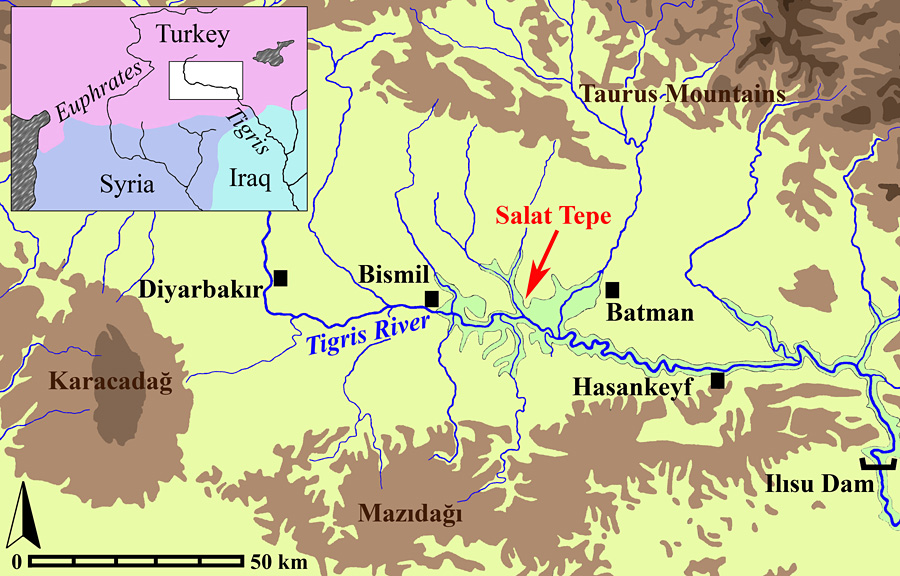
The excavations undertaken in advance of the construction of the Ilısu Dam on the Upper Tigris at Salat Tepe near Bismil/Diyarbakır in south-eastern Turkey (Figure 1) have revealed five building levels dating to the Middle Bronze Age. The walls of the earliest building in Level 5 were reused, in part in the construction of a later building in Level 4. Both settlement levels were damaged by fire, and a later building was established in Level 3. The complex of buildings in Level 2, which suffered from an earthquake, has been previously reported in Antiquity's Project Gallery (Ökse 2006, 2007) (Figure 2). All these levels have produced contexts which are interpreted as evidence for ritual practices performed during the Middle Bronze Age (Ökse et al. in press).
Location map of Salat Tepe in south-eastern Turkey.

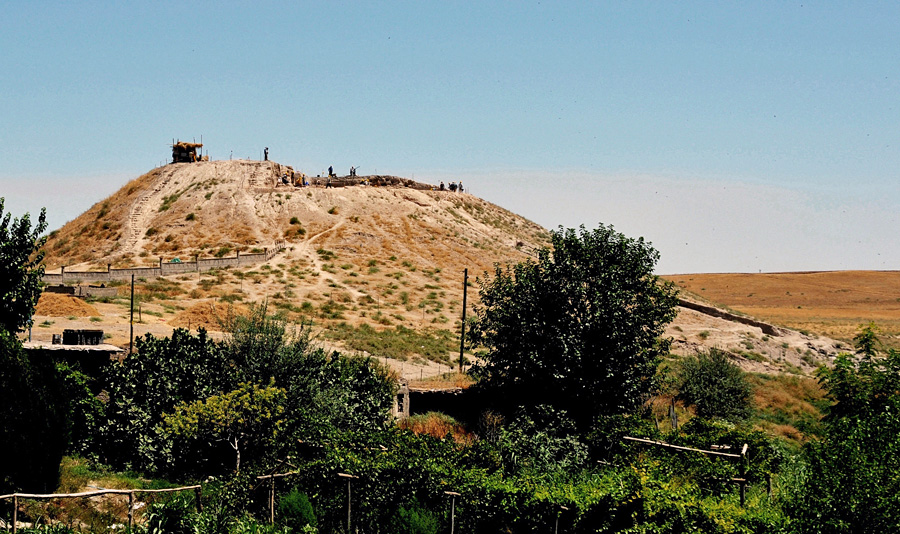
Salat Tepe from the West.

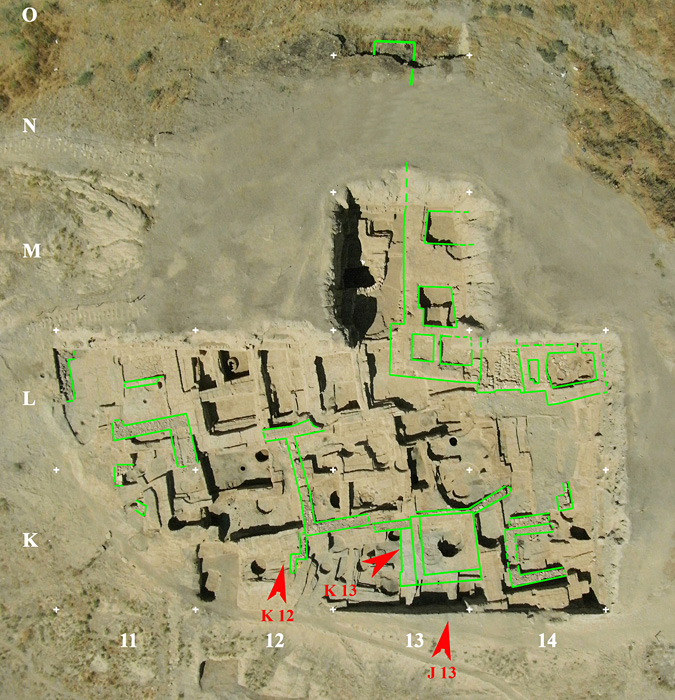
Aerial photograph of Level 4. The red arrows point to ritual deposits K12, K13 and J13.

Context
In 2011 two deposits found in Level 4, which date to the first two centuries of the second millennium BC, and one deposit found on the ruins of Level 2, which dates to the sixteenth century BC, form the basis of the discussion presented here (Figure 3).
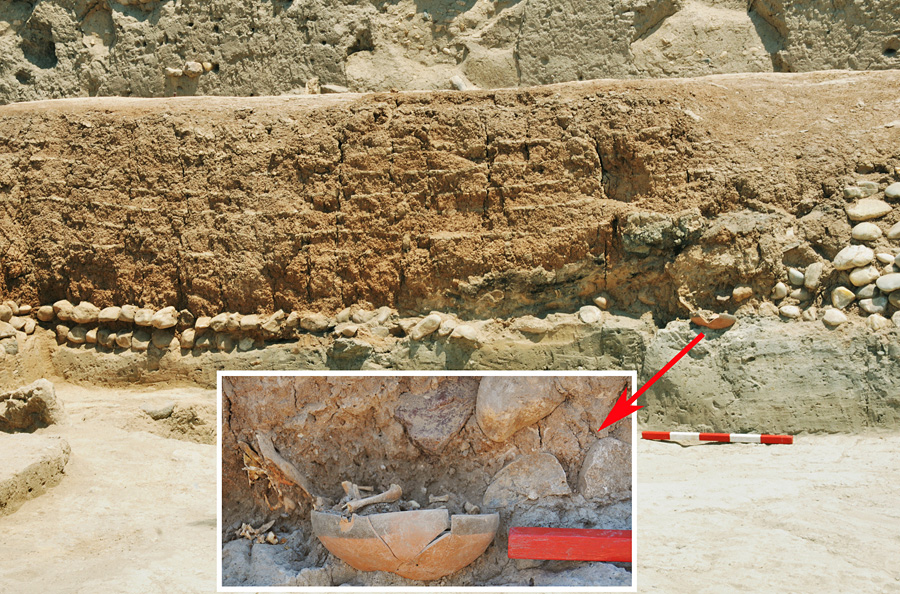
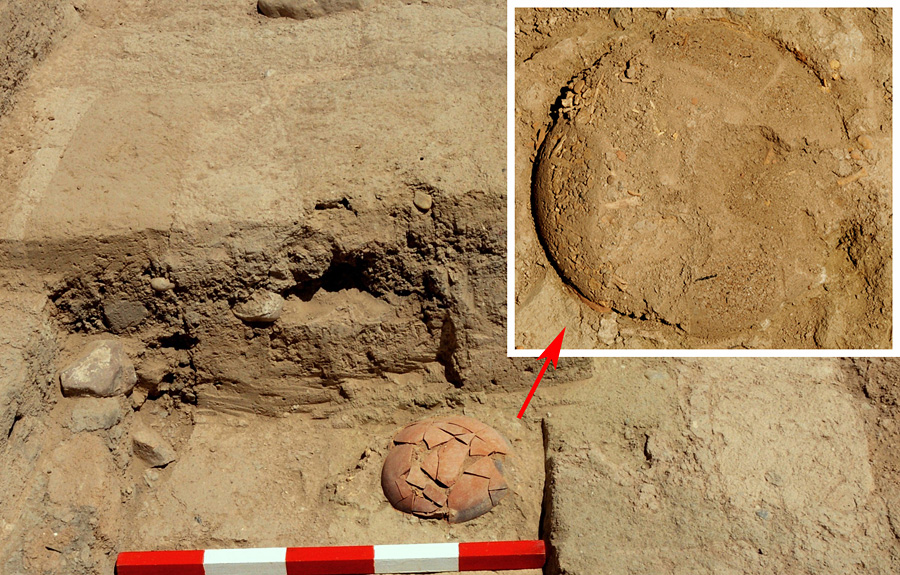
In Trench K13 (see Figure 3, arrow pointing to square K13) a bowl filled with fragments of bones from a young sheep or goat was placed upright among the stones of foundations built by two rows of irregular pebbles (Figure 4). The bones show no traces of burning, suggesting that raw meat was placed in the bowl. In Trench K12 (see Figure 3, arrow pointing to square K12) another bowl filled with delicate rib fragments from a young sheep or goat was placed face down on the debris of the same building (Figure 5).
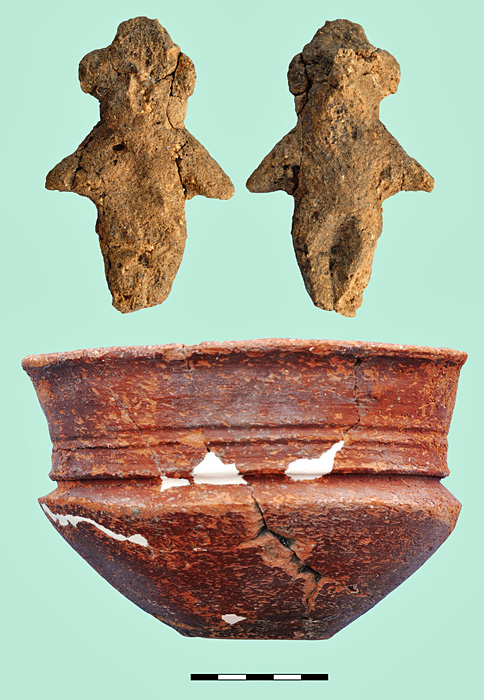
In trench J13 (see Figure 3, lowest arrow) a bowl containing a female figurine made of mud and fragments of thin ribs was placed into an ash-filled pit dug into the collapsed wall of a building in Level 2 (Figure 6). The building had collapsed in an earthquake towards the end of the sixteenth century BC (Ökse & Görmüş 2006: 188–89).
The offering in Trench K13 (Level 4).

The offering in Trench K12 (Level 4).

The offering in Trench J13 (Level 2).

Discussion
In the ancient Near East burying sacrificed animals in pits is a way of getting rid of evil (Reference WilhelmWilhelm 1994: 75). Similarly, walls of temples were smeared with the blood of sacrificed sheep as a means of purification (Reference Beckman, Boda and NovotnyBeckman 2010: 78, 80, 453). Hittites placed objects and sacrificed animals under foundations, and offered animals after the erection of buildings (Reference HaasHaas 1994: 48, 65–66, 256, 261, 266; Frantz-Szabó 2004; Reference Beilke-VoigtBeilke-Voigt 2007: 53–54; Görke 2011: lines 163–64, 223). Bilingual Hattian-Hittite ritual texts mention several offering practices and rituals associated with temples (Ünal 1988a: 97–98, 101, 1988b: 1470, 1473, 1477–78; Reference SchusterSchuster 2002; Süel & Soysal 2007); a foundation ritual describes sacrifices of sheep, libation and magical formulae spoken to ward off evil from the house.
In Mesopotamia slaughtered sheep were used to purify temples (Reference MccarthyMcCarthy 1969: 169; Reference WiggermannWiggermann 1992: 123). A text from Assur records two sheep slaughtered over the foundations of a new room (Reference AmbosAmbos 2004: 71). Skeletons of quadrupeds and birds associated with bowls and other findings were deposited under the doorway to the cella of the Parthian Temple of Inanna at Nippur and under a corridor in Ashurnasirpal's Northwest palace at Nimrud (Reference EllisEllis 1968: 44–45, 130). Ancient Greeks located the cultic deposits and sacrificed animals in gaps in the masonry or in foundation trenches (Reference HuntHunt 2006: 114, 121), similar to the offering in Trench K13 at Salat Tepe.
Conclusion
The offerings of Level 4 belong to the same building; the bowl placed upright into the foundation of the building might have 'purified' the new building, and the bowl placed face down on its ruins might have 'closed' the building before erecting the new one. The offering of Level 2 is placed on the ruins of the collapsed building, probably for 'sealing' the damage caused by the earthquake and fire.