

Introduction
The Natufian archaeological culture (dated c. 15,000 to 11,500 cal. bp years ago) has been explored extensively for at least 80 years. Yet some aspects pertaining to the Natufian remain unclear: e.g. its geographic boundaries and how much of the variability observed reflects regional variants and individual groups comprising the Natufian entity. Indeed, it was suggested that cultural material variations observed in Natufian sites of the Mediterranean area reflect group identity expressed mostly through non-utilitarian evidence, i.e. decorative elements and non-mundane behaviour such as funerary practices (Bar-Yosef Reference Bar-Yosef, Fitzhugh and Habu2002; Belfer-Cohen & Goring Morris Reference Belfer-Cohen, Goring-Morris, Bar-Yosef and Valla2013; Goring-Morris & Belfer-Cohen Reference Goring-Morris, Belfer-Cohen, Bar-Yosef and Valla2013; Grosman & Munro Reference Grosman, Munro, Enzel and Bar-Yosef2017; Valla Reference Valla, Davies and Charles1999; Reference Valla2018; and references therein).
In detecting ‘group identity’ archaeologically, it is essential to account for and understand the evidence of mortuary practices, since those play a crucial social role in human societies at large. It is through these practices that social communication takes place within a community (Bell Reference Bell1997) as well as defining the group in relation to other communities. Funerary practices are performed by the living during burial events (Grosman & Munro Reference Grosman, Munro, Enzel and Bar-Yosef2017) and convey the specific social knowledge which reinforces and renegotiates the group identity of the living (e.g. Bloch & Parry Reference Bloch, Parry, Bloch and Parry1982).
It was already suggested that, in general, Natufian mortuary practices as such share broad similarities in the treatment of the dead, yet they do portray specific, local, sets of traditions vis à vis the particular types and quantities of jewellery and decorative items interred with the dead (Belfer-Cohen Reference Belfer-Cohen, Campbell and Green1995). The local specific characteristics are retained and observed also in the finds recovered from the living areas of the relevant sites, which are more similar to those recovered from the graves on site than to the finds from the living quarters of other contemporaneous Natufian sites (Byrd & Monahan Reference Byrd and Monahan1995). Accordingly, we argue that detailed analyses of the finds retrieved from Natufian graves actually provide discrete markers of specific social group identities within the Natufian entity as a whole.
The test-case detailed herewith is one of the largest graves at Hayonim Cave, the Early Natufian (EN) Grave XVII, the only one excavated during the second series of excavations on site. First we provide the background, namely a short description of the Natufian occupation at the site, and the Natufian burials disclosed therein, including a detailed account of Grave XVII. We endeavour to compare the unique material findings (personal ornaments and decorative motifs) from the decorated burials at Hayonim Cave with decorated EN burials from Eynan (‘Ain Mallaha).
We believe that, besides new data of EN decorated burials from Hayonim Cave, the present study will also add insights on the nature of Natufian decorated burials in general, the cultural markers of a specific EN community, and its associations with other contemporaneous Natufian groups.
Hayonim Cave—the Natufian occupation
The excavations at Hayonim Cave (Western Galilee, Israel) (1969–79; 1992–2000: Bar-Yosef et al. Reference Bar-Yosef, Arensburg, Belfer-Cohen, Henzel and Bar-Yosef2017) revealed a long sequence of prehistoric occupations in the cave, from the Acheulo-Yabrudian to the Natufian (Layer B), the latter occupation extending all over the cave's excavated surface (Fig. 1). The Natufian presence in the cave portrays nearly a complete sequence of the Natufian culture, i.e. its Early and Late stages. The chrono-cultural assignment was based mainly on lithic techno-typological criteria, supported by six 14C dates (Bar-Yosef et al. Reference Bar-Yosef, Arensburg, Belfer-Cohen, Henzel and Bar-Yosef2017). The EN calibrated chronological range is c. 15–13,000 cal. bp, while the Late Natufian (LN) is set at c. 13–11,500 cal. bp (Grosman Reference Grosman, Bar-Yosef and Valla2013). It seems that the EN activity in the cave was quite intensive compared with that of the LN, which was of rather an ephemeral character.
Plan of the Natufian presence within Hayonim Cave (decorated graves marked in light blue). Note the location of Grave XVII and Locus (Structure) 10.

The architectural remains comprise small structures and built graves. The structures are actually a series of rounded/oval rooms built from undressed stones brought in from the immediate surroundings of the cave (for detailed description, see Bar-Yosef et at. Reference Bar-Yosef, Belfer-Cohen, Goldberg, Kuhn, Meignen, Vandermeersch, Weiner and Stiner2005; Reference Bar-Yosef, Arensburg, Belfer-Cohen, Henzel and Bar-Yosef2017; Goring-Morris & Belfer-Cohen Reference Goring-Morris, Belfer-Cohen, Bocquet-Appel and Bar-Yosef2008). Some of them incorporated paved floors, built hearths and plastered walls, as well as a sequence of special activities, e.g. a kiln for burning limestone, a bone-tool workshop, a floor made of incised slabs, etc. (Bar-Yosef et al. Reference Bar-Yosef, Arensburg, Belfer-Cohen, Henzel and Bar-Yosef2017; Belfer-Cohen & Bar-Yosef Reference Belfer-Cohen, Bar-Yosef and Valla2012; Shaham & Belfer-Cohen Reference Shaham, Belfer-Cohen, Borrell, Ibáñez and Molist2013).
The EN phase is represented by small structures and graves, spatially separated from each other (Fig. 1). The LN deposits are represented mainly by graves dug into the sediments of the preceding levels as well as specific activity areas located along the eastern wall of the cave. It was suggested that at this stage the cave functioned primarily as a graveyard.
The Natufian graveyard at Hayonim Cave
The following is an up-to-date picture of the Natufian burials in Hayonim Cave (and see a detailed account as regards construction of the graves, anatomical and anthropometric descriptions of the burials, positions of the individual burials, etc. in Belfer-Cohen Reference Belfer-Cohen1988a; Reference Belfer-Cohen1988b, table 1; Fig. 1).
Grave XVII burial phases. (*Decorated burials.)

The findings comprise 55 burials recovered from 17 graves, though most probably there were more burials as indicated by the large number of isolated human remains (bones and teeth) dispersed throughout the Natufian sequence. The introduction of new burials, some dug into the preceding layers, as well as the rearrangement of older burials in two graves (i.e., Grave VI and Graves VIII–IX) caused some damage, not to mention the Byzantine glass furnace built above and into the Natufian layer which destroyed quite a number of Natufian burials, evident through the bundles of human bones outside the cave near the entrance, most probably tossed out by the Byzantines. More recent damage was caused by the activities of modern herders and their flocks (Bar-Yosef Reference Bar-Yosef, Bar-Yosef and Valla1991; Bar-Yosef et al. Reference Bar-Yosef, Belfer-Cohen, Goldberg, Kuhn, Meignen, Vandermeersch, Weiner and Stiner2005; Reference Bar-Yosef, Arensburg, Belfer-Cohen, Henzel and Bar-Yosef2017; Belfer-Cohen Reference Belfer-Cohen1988a).
The graves differ in depth and were rarely paved with stones (Graves I and IV). Only three graves (V, IX, and XVII: see below) were constructed entirely of limestone slabs and were also stone-covered.
Sometimes graves were marked by stone circles or had small cup marks on one of the stones above or beside them (Graves I, III, IV). None was marked by ‘stone-pipes’ as known from the nearby Hayonim Terrace burials (Valla Reference Valla2012) or at Nahal Oren, Mt Carmel (Stekelis & Yizraeli Reference Stekelis and Yizraely1963), though fragments of such items were discovered in Hayonim Cave in secondary use as building stones in structure walls (Belfer-Cohen Reference Belfer-Cohen1988a).
The graves had been dug into previous layers of occupation, Natufian as well as Kebaran, Aurignacian or Mousterian. Though some of the findings recovered from the graves (i.e. fauna, lithics) could have been part of the sediment which was either dug up or filled in during the construction of the grave, the grave goods recovered clearly belong to the Natufian occupation.
Most of the graves contained more than one individual. Only one of the EN graves (Grave XIII) comprises a single burial, that of H.33, while all other EN burials are group burials, mostly primary ones (e.g. those in Graves VI, VII, XVII). Conversely, the LN multiple burials are usually either secondary or mixed, i.e. one primary burial, and all other burials are represented by dispersed bones or secondary interments. Out of the 17 graves, four EN graves (VI, VII, XIII, XVII) contained only primary burials, two LN graves (V and XIV) contained only secondary burials and nine graves contained both primary and secondary burials. Two graves (II and IV) had been too heavily damaged to be included in either category. One should note that quite a few primary burials were disturbed through the introduction of additional burials, as will be later illustrated by the burials in Grave XVII.
It appears that in the LN burials (either primary or secondary), the skulls are usually absent. Although in secondary burials a missing cranium could result from misplacement or other forms of disturbance, in primary burials the intentional nature of this practice is most obvious, as known from other LN graveyards (and see Nahal Oren: Stekelis & Yizraeli Reference Stekelis and Yizraely1963; Eynan: Perrot & Ladiray Reference Perrot and Ladiray1988; Hayonim Terrace: Valla Reference Valla2012). Interestingly, in Grave VI which was used during both the EN and the LN, all burials retained their skulls.
Primary burials were either extended or, more often, semi-flexed or flexed. All extended burials (= 8) are EN; the rest of the EN burials are semi-flexed or flexed, as are those of the LN. Similar observations as regards the extended burials being typical of the EN are reported from other Natufian sites, e.g. el-Wad (Garrod & Bate Reference Garrod and Bate1937; Weinstein-Evron Reference Weinstein-Evron2009). No correlations could be established between burial position and age or sex. The position of burials varies: supine, on a side, facing another person, facing the cave walls, with arms folded or stretched in different directions, etc. In addition, in several primary burials, the heads were placed on piles of stones (e.g. H.1, EN Grave I; H.4, EN Grave III). The unique squatting position of one individual, H.37 (LN Grave XV), though rare, was reported also from EN Eynan (Perrot & Ladiray Reference Perrot and Ladiray1988) and even earlier, e.g. the Early Epipalaeolithic site of Qassiya (Richter et al. Reference Richter, Stock, Maher and Hebron2010).
No correlations could be observed between the gender of the burials and their age composition. In several graves, the burials seem to have been intimately related, as in Grave IX which contains two male-couple burials: one couple (both adults of similar age) lying side by side, and the second couple, one (adult) on top of the other (an older adult), both in a flexed position. The burials in Grave VII form an intriguing combination: an adult male and a pregnant adolescent female lie side by side with a young child at their feet. Interestingly, both the adult and adolescent skeletons are missing their mandibular third molars, a congenital condition indicating a probable genetic link between these individuals (Smith Reference Smith1973). Similarly intriguing are the burials of Grave XVII, which may also be interpreted as related burials (and see below).
Of the buried, 71 per cent are adults—42 per cent are males, 13 per cent are females and 16 per cent could not be skeletally sexed. Children account for 29 per cent of the interments. It seems that at least two young females died while giving birth. If the burials are regarded as representing the mortality percentages of children at various ages, it is quite obvious that mortality had been highest at the crucial time of weaning (3–6 years) (Belfer-Cohen et al. Reference Belfer-Cohen, Schepartz, Arensburg, Bar-Yosef and Valla1991).
To summarize, it seems that the burials at Hayonim cave portray its use as a graveyard, comprising part of the non-mundane activities taking place on site. It reflects a long-term tradition where, with one exception (the burials in Grave VI), none of the later burials intruded upon the earlier ones (Belfer-Cohen & Bar-Yosef Reference Belfer-Cohen, Bar-Yosef and Valla2012; and see further discussion below). Overall, the burials reflect the general trends observed in other Natufian burial grounds, with extended burials present only in the EN and skull removal appearing only in the LN.
No correlations were found between the burials being primary or secondary, the position of the bodies and the age or gender, or between the mode of burial and the grave's structure.
As in other Natufian cemeteries, also here one can observe stones placed under bodies or heads, most obviously in several burials of the early occupation. In some cases, there were clearly grave markers such as cup-marks or stone circles (e.g. as at el-Wad, Eynan, Nahal Oren, Kebara, Raqefet; and see Bocquentin Reference Bocquentin2003; Rosenberg & Nadel Reference Rosenberg and Nadel2014). Decorated burials were observed only among the EN burials (and see discussion below). The second series of excavations on site revealed a new grave (XVII), presented here.
Grave XVII
The grave is located in the southeastern corner of the cave encompassed by a structure (Locus 10: Fig. 1). The wall of the structure is built of large, undressed, upright-standing stones reaching 1 m in thickness (sitting on their narrow surface: Fig. 2). The complete surface within the structure was excavated all through the Natufian deposits, from the LN surface through the EN levels down to the bed-rock without encountering any other, pre-Natufian layers. The first to appear under the most recent ‘floor’ of Structure 10 were large, tilted slabs unearthed in square O31 (Fig. 2). The orientation of the slabs indicated the existence of a feature confined within the structure walls, and indeed these slabs were part of the construction of Grave XVII, defining the contour of the grave. It is interesting to note that, as the excavation continued, human bones were found scattered all over the EN surface of Structure 10 (c. 5–7 cm thick), yet the main concentration started to appear below, in the area of the slanting slabs (squares O31 and P31), which apparently constituted the sealing of Grave XVII. It seems as if the bones were ‘pushed’ upwards through the intrusion into the burial pit of the slabs which sank under the pressure of the accumulating sediments, part of post-depositional processes.
The burial pit within Structure 10 (left) and large tilted slabs unearthed in square O31 covering the grave (right).

It is difficult to determine the stratigraphic relation between the burial pit and the wall of the structure. Nevertheless, there are only two options: the pit and the wall are contemporaneous, or the pit was dug after the construction of the wall. As shown in Figure 2, the wall-curve follows the arch of the burial pit as if it was constructed for the purpose of encompassing it. The horizontal stony ‘paving’ adjacent to the structures’ wall surrounds the opening of the burial pit, marked by the slanting slabs. Thus it seems that both architectural elements relate to each other. It was already established that the structures in the cave were erected during the EN occupation on site (Belfer-Cohen Reference Belfer-Cohen1988a; Bar-Yosef Reference Bar-Yosef, Bar-Yosef and Valla1991). In addition, the lithic assemblage from within the grave portrays a high percentage of large Helwan retouched lunates (Belfer-Cohen Reference Belfer-Cohen1988a), considered a typical EN marker. Accordingly, we can assume that both the structure and the burial pit belong to the EN presence in Hayonim Cave.
Due to the high density of human remains, endeavours were made to ‘follow the bones’ and unearth the articulated burials. Consequently, the stratigraphic analysis was primarily based on the relations between the skeletal remains, both for identifying the individual burials as well as the sequence of the burial events, i.e. how many times the pit was re-opened. The documentation of the grave was centred on the human bones and their association with the large stones and slabs intermingled within the burial pit, which enabled us to identify the sequence of the burial events. Though most of the bones were quite fragmentary, the overall preservation was good, enabling the retrieval of delicate bones such as parts of the hyoid and ossified ligaments and glands.
Analysis of the stratigraphic units from the grave discloses three burial phases between the breccia floor of the pit and the top tilted slabs (c. 70 cm total depth). The first phase comprises the interment of three decorated individuals—an adolescent, a child and an old woman (H.41, H.45, H.46, respectively). The second phase is represented by a burial of an adult male (H.42), while the third phase comprises three burials, one of them decorated, and represents the top of the grave deposits, sealed by the stone slabs (Table 1).
The filling of the grave occurred sequentially, as evidenced by the stone bedding and the special artifacts which relate to specific individuals. Here we present these three stages from bottom to top.
Phase I
The burial pit's longest dimension is 1.2 m, suggesting that it was not possible to bury most of the individuals in an extended position (except the child H.45) and they were probably twisted and turned around to fit within the pit's dimensions. Many of the human remains were also crushed, probably due to the large number of stones that were inserted during the interment of the bodies. Apparently, many small stones found in between and around various bones were the ‘packing’ material stuffed into the grave, ‘holding’ parts of the bodies in place, e.g. the stones which originally held the skull of the adolescent (H.41) in place at the base of the pit and later collapsed crushing it, or the stones next to the legs of the old woman (H.46), fixing their position in place (Fig. 3).
Phase I: The first burial event in Grave XVII. Plan (bottom); the three burials (H.41, H.45 and H.46) (upper left); H.41 with a straight line of bone pendants along the humerus and ribcage down to the femur (upper right).
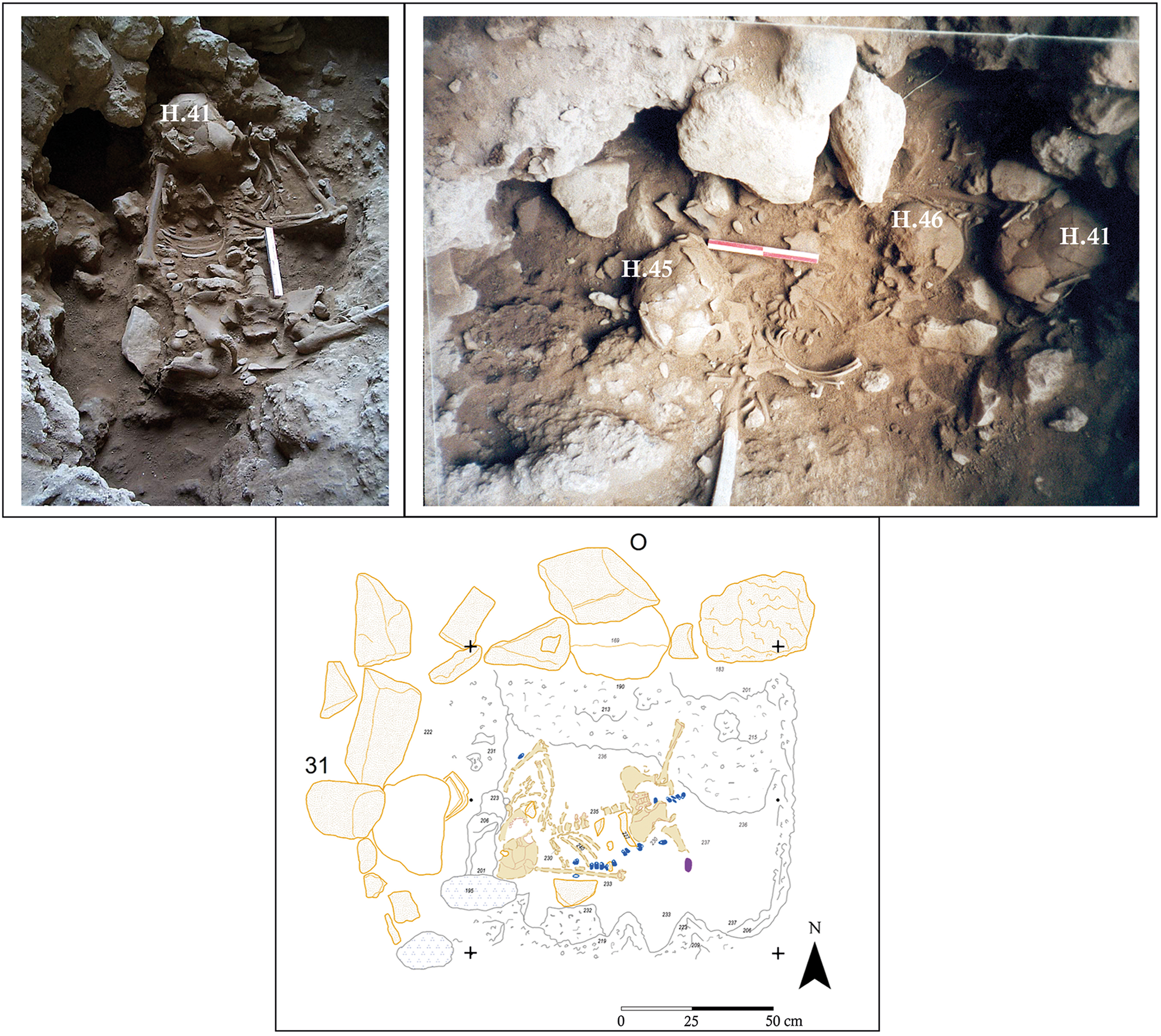
The three burials of phase I are decorated (see a detailed account below) and clearly relate to each other through their interred positions. The woman (H.46) is one of the oldest Natufians recovered (c. 55 years old), evident in the ossification of the ribs, the osteophytes on the manubrium and the ossified thyroid gland. She was lying on her left side, tucked in between the pit's wall and the burial of an adolescent (H.41) about 17–18 years old. Both burials were extended, though the adolescent was seemingly lying on his back, facing in the same direction. A child (H.45, 5–8 years old) was put in between the intentionally spread legs of the adolescent, the head resting in the pelvic region of the latter, the knees bent, facing in the opposite direction to both the elderly woman and the adolescent. The hand of the woman was lying on the upper torso of the child (Fig. 3). Interestingly, there is an admixture of the leg and hand bones of H.41 and H.46. Moreover, the angle of H.41's femur bones, pushed aside to position H.45 between his legs, suggest a pause between the burial of H.41 and the joined burial of H.46 and H.45. Apparently, the grave was re-opened for the latter interment before being covered by a series of stones, some of which are flat, sealing this phase of burial. The orientation of the slabs suggests that they probably collapsed after the graves’ sealing, causing the displacement of several bones of H.41 and H.46.
Phase II
The next interment event entailed the re-opening of the grave and the extension of the pit to the east, enlarging its volume. A single undecorated robust male adult was buried (H.42) therein, lying on his right side in a flexed position on top of the stones that covered the burials of Phase I.
While the earlier phase was primarily dug into the breccia, Phase II was carefully constructed, as evidenced by the curved line of stones that encircle the grave, in line with the large wall of the structure above (Fig. 2 & Fig. 4c). Furthermore, an additional set of stones was used to divide the pit and the single burial was placed in the eastern part of the pit (Fig. 4a–b).
Phase II: (top left) H.42; (top right) The level above H.42 showing slabs covering the burial; (below) Grave XVII in the context of Structure 10.

Phase III
This phase is marked by the interment of a young male, an adolescent and a juvenile (H.40, H.43, H.44, respectively). This last stage of burial is less clear stratigraphically and we could correlate intentional decoration only in the context of the H.40 burial. The articulated bones of the adult (H.40), lying in a flexed position on his right side, were found between three large stones (Fig. 5), placed above H.42 (Phase II). Isolated bones comprising mostly post-crania of two other burials (H.43 and H.44) were scattered around. We were unable to determine their original position and precise location, probably due to later disturbances during the activities within Structure 10. Moreover, the bones were ‘pushed’ upwards after the slabs sunk into the grave, as described above. However, the upper stone cover of the grave stayed more or less in place (Fig. 5).
Phase III: H.40 (top) and the upper stone cover of Grave XVII (bottom).

In sum, Grave XVII comprises three phases. Its decorated burials will be presented in detail below, together with the other decorated burials from Hayonim Cave, in order to provide some insights concerning social identity of Natufian communities.
The decorated burials at Hayonim Cave
In Hayonim Cave, as in other Natufian sites, the decorated burials (N = 8) belong to the EN, and comprise only a small percentage of the burials on-site, similar to that observed in Eynan (c. 30 per cent: Davin Reference Davin2019; Valla et al. Reference Valla and Bocquentin2007), yet they represent the full sex and age range. All derive from multiple burials side by side with non-adorned individuals and their adornments differ from one skeleton to the other, either in type or in quantity of decorations.
Most of the ornaments found in graves without a clear association with a specific burial were also recovered from EN graves (Belfer-Cohen Reference Belfer-Cohen1988a,b). The rare ornaments found in LN graves are usually just a single or a couple of scaphopod (dentalia) beads, most probably being part of the in-filling material rather than an integral part of a burial, and the same applies to the single bone pendants (N = 2). This might be also true for the isolated finds in EN graves, i.e. a single perforated fox tooth from Graves II and IV. As beads are easily dispersed (especially the scaphopod ones), it was very difficult to assign them to a particular burial within the grave. Thus the 103 scaphopod beads and eight bone pendants recovered from Grave VI (which comprises both EN and LN burials) most probably originate from personal jewellery of a particular burial within the grave. It seems that the same can be said concerning two tibio-tarsus partridge beads and 17 scaphopods recovered from Grave III (for details, see Belfer-Cohen Reference Belfer-Cohen1988a,Reference Belfer-Cohenb). Apparently this applies also to Grave XVII, where the re-opening of the grave and the introduction of new burials disrupted and caused admixture of both sediments and finds, making it very difficult to associate some of the jewellery with any particular burial. Thus we cannot associate either the scaphopod beads (c. 300 recovered in the grave) or the other marine molluscs found only herein (and see details below) with any specific burial. This is also the case as regards some of the 147 gazelle metatarsal pendants recovered in the grave sediments and the single gazelle ‘phalange’ bone pendant, the only one deriving from a grave in the cave.
Decorated burials
1. Homo 9 (Grave VII), a pregnant female, 16–19 years old, buried together with a young male (H.11) and a child (H.13). She had a belt and a bracelet (or possibly two) made of bone pendants and scaphopod beads as well as a scaphopod necklace. A perforated hyena tooth was found near her head and a perforated fox tooth between her legs.
2. Homo 17 (Grave VIII/IX), a male, 20–25 years old, with many scaphopod shells (most of the 164 beads recovered from the grave) scattered near his arms, probably the remains of a decorated garment.
3. Homo 25 (Grave VIII/IX) a male, c. 25 years old, one of his arms adorned with a bracelet of 20 partridge tibio-tarsus beads.
4. Homo 33 (Gr. XIII), an adult, younger than 25 years, with scaphopod beads scattered near the neck, and a belt and an armlet of perforated fox teeth. A unique bone (‘dagger’?) artifact was found under the left upper arm.
5. H. 46 (Grave XVII, phase I), an elderly female, >55 years old, lying supine on her side, with gazelle metatarsal bone pendants under her skull—forming part of a headdress or ornaments (at least 8 pendants). There are also broken worked bone items, all perhaps comprising a single special artifact, a ‘scoop’ (?), with no parallels in the Natufian bone tool industry, except perhaps a similar item reported from Eynan (and see below). It is of interest to note that of the five refitted fragments of that artifact, four were recovered from under the skull of H.46, while the fifth fragment was found under the head of H.45 (Fig. 6). The item bears a delicately engraved design, a crosshatch or a net pattern observed on a number of bone artifacts recovered in Hayonim Cave (Bar-Yosef & Belfer-Cohen Reference Bar-Yosef and Belfer-Cohen1999; Bar-Yosef & Tchernov Reference Bar-Yosef and Tchernov1970; Campana Reference Campana1989). There are additional bone fragments which may be either part of the same item or of yet another unique item with no parallels (Fig. 6), parts of which were found associated with the burial of H.45.
6. H.45 (Grave XVII, phase I) is a young child, c. 5–8 years old, lying between the legs of H.41, in the opposite direction to both H.46 and H.41. There were at least 17 bone pendants under and surrounding the skull, perhaps representing some headgear decoration. There was also the engraved bone fragment that was refitted with those recovered from under the skull of H.46. An additional find, mixed with the bones of H.45, was another, broken, ‘mystery’ item, partly refitted (Fig. 7) A single tibio-tarsus bead (Fig. 7) and a complete bone spatula, unique in its decorative element—a series of disordered lines as if hastily executed (Fig. 7)—complete the decorative elements of this burial.
7. H.41 (Grave XVII, phase I) is a male adolescent, c. 17–18 years old, lying supine, side by side with H.46, in the same direction, with H.45 between his legs. It seems that he had a belt comprising bone pendants (at least 16 items) and a dress or a shift adorned by bone pendants in a straight line along his humerus and ribcage down to his femur (at least 20 pendants: Fig. 3). Mixed with his bones was a broken sickle haft, decorated with the same incised net pattern as the ‘scoop’ artifact recovered with H.46 (Fig. 8).
8. H. 40 (Grave XVII, phase III) is a mature, 35–40-year-old male. The ‘grave good’ is a broken spatula decorated with the same incised net pattern as that of the other decorated bone artifacts from this grave (Fig. 8).
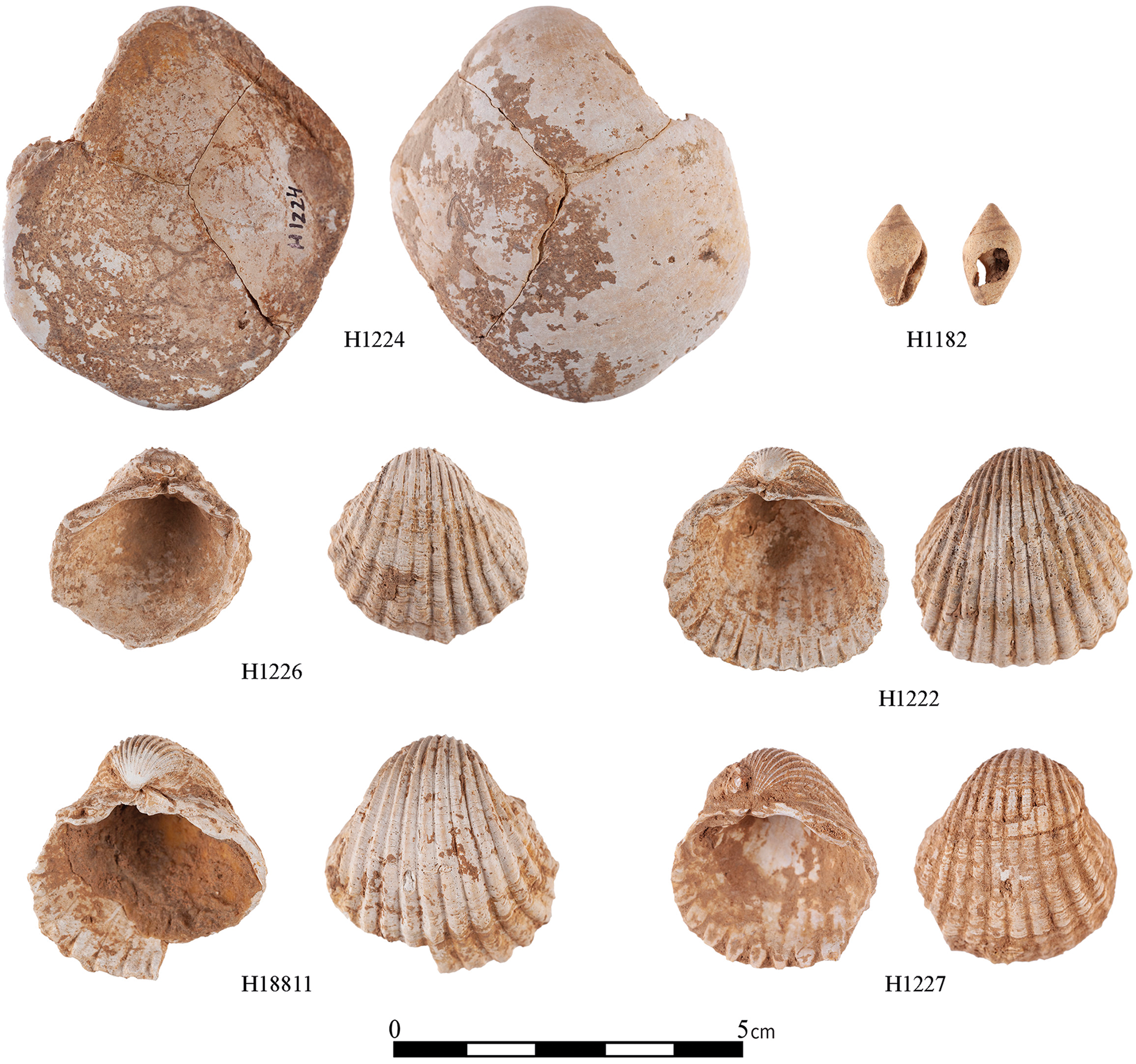
In summary: the most common decorative element found with the adorned burials is the scaphopod shells (Table 2) that are also found in the ‘living areas’ throughout the Natufian sequence in quite a large number, with the largest quantity recovered from the LN levels. Other molluscs—marine and terrestrial—were also recovered in the graves (for detailed account and descriptions, see Belfer-Cohen Reference Belfer-Cohen1988a; Kurzawska Reference Kurzawska2013; Kurzawska et al. Reference Kurzawska, Bar-Yosef Mayer, Mienis, Bar-Yosef and Valla2013). To the above-mentioned shell decoration we now can add the assortment recovered from Grave XVII (Table 2; Fig. 9) to be studied in the future. Interestingly, none of these non-Scaphopoda shell species were found elsewhere in the Natufian occupation of Hayonim Cave, with the exception of one Columbella bead recovered from Grave VI (EN) and a single fragmented mother-of-pearl shell from Grave XIII (EN) (Kurzawska et al. Reference Kurzawska, Bar-Yosef Mayer, Mienis, Bar-Yosef and Valla2013).
Special artifacts retrieved from the burial of H.46.
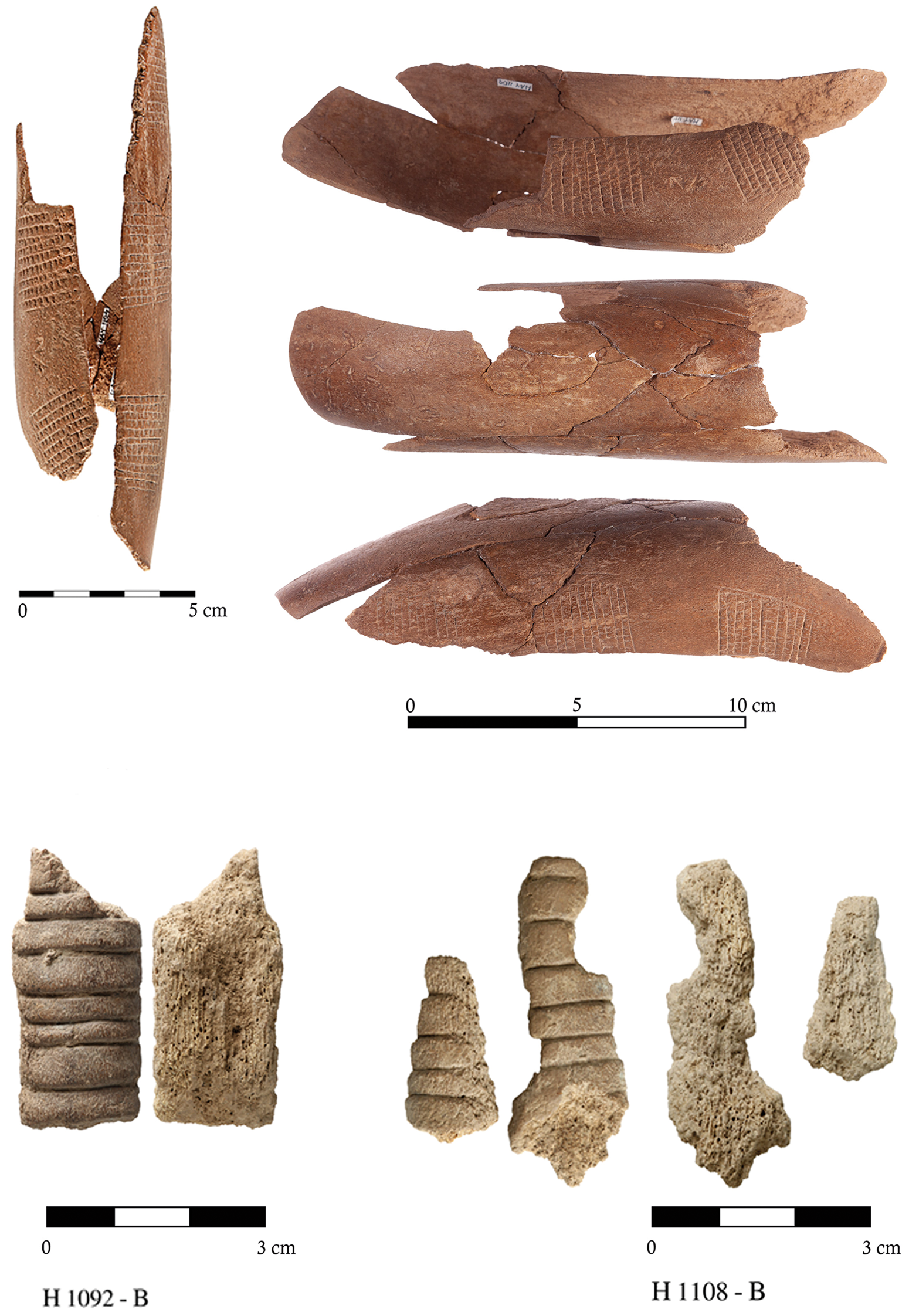
Special artifacts retrieved from the burial of H.45.
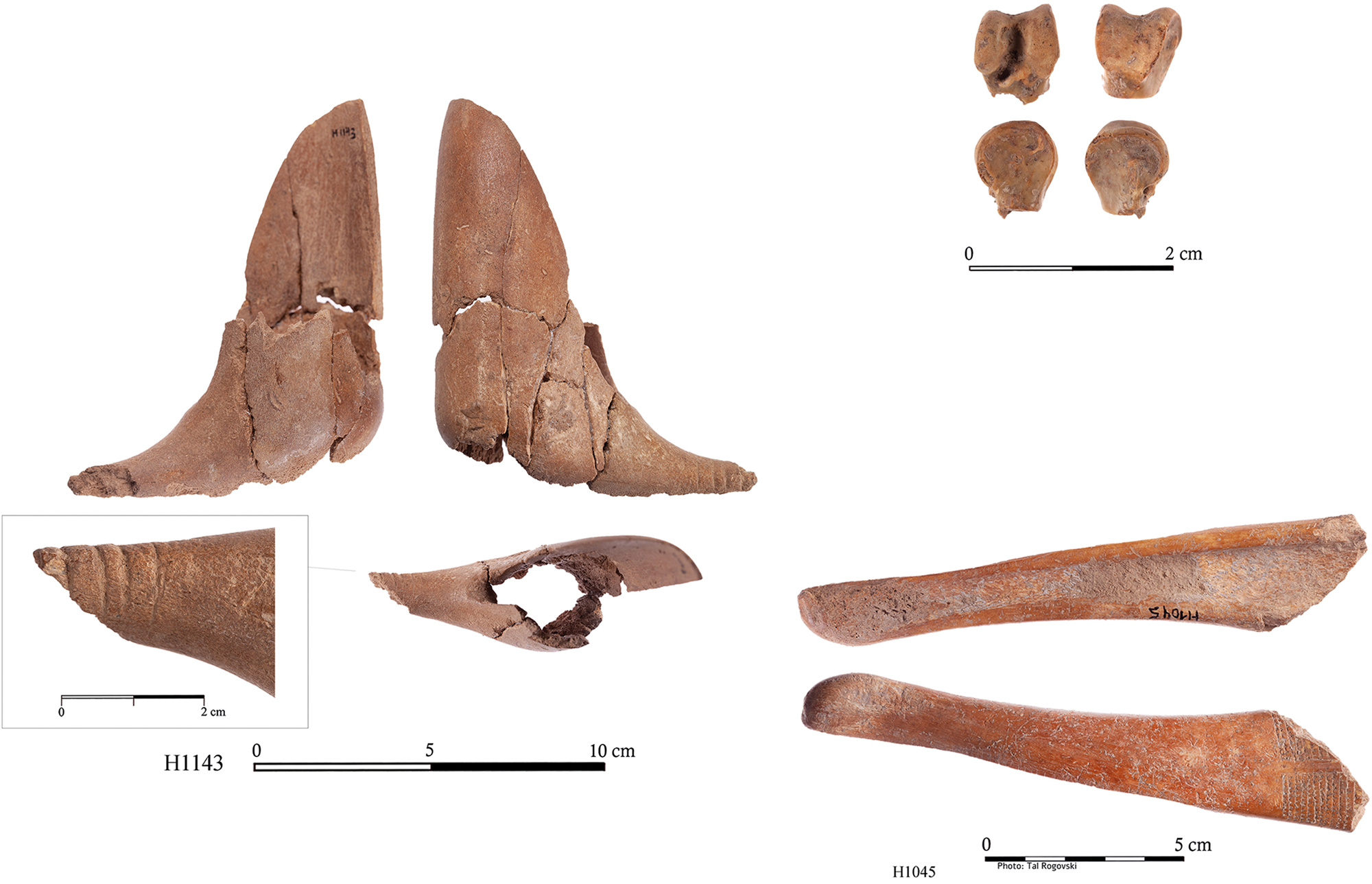
Artifacts decorated with a net pattern.

Shells from Grave VXII (selection).
Ornaments in Grave XVII, Graves I–XVI and the living area.
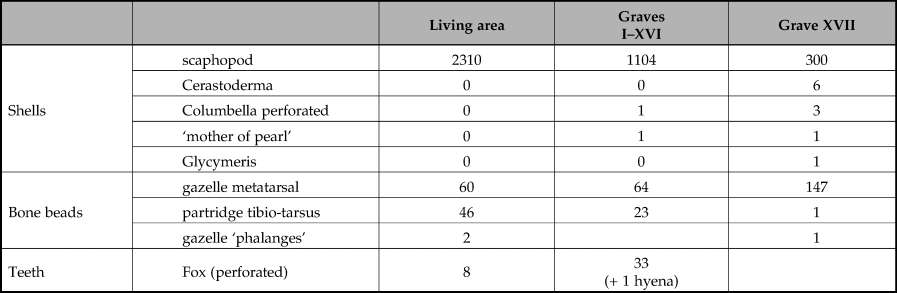
Next in frequency are beads made of gazelle metatarsal bones, associated mostly with decorated burials, as only a few of them were recovered elsewhere on site (Table 2). There were also several larger pendants carved from segments of gazelle ulna bones and at least one is shaped of a rib fragment. Among the personal decorations, we also noted perforated teeth, predominantly those of foxes and one hyena tooth (Table 2).
On the other hand, partridge tibio-tarsus pendants, though found in graves, were mostly recovered from the ‘living areas’ (Table 1). Last but not least are the rare beads made of gazelle ‘phalanges’ (Table 2) common in other sites (e.g. Erq el Ahmar: Neuville Reference Neuville1951; Eynan: Davin Reference Davin2019).
Other decorative items are rare: a boar tusk was found in Grave VIII/IX (EN) within the pelvis of Homo 27 and three other were recovered from the ‘living areas’ assigned to the LN. Bone items bearing a particular net pattern/cross-hatched pattern were recovered in Graves III and XVII (EN) and one in Grave V (LN), while four items with similar decorative patterns were found in the ‘living areas’ (Bar-Yosef & Belfer-Cohen Reference Bar-Yosef and Belfer-Cohen1999). A unique find so far is a large spatula made of a bovine rib, recovered with H.33 (Grave XIII, EN).
The great difference in the frequencies of various ornaments in the EN graves at Hayonim Cave is intriguing (Table 3). Scaphopod beads were found either in the hundreds or in single numbers (see above). A similar picture is provided by the local dominant type of the bone pendants: most of them were recovered from EN graves XVII and VII.
Frequencies of various ornaments in the EN graves at Hayonim Cave.
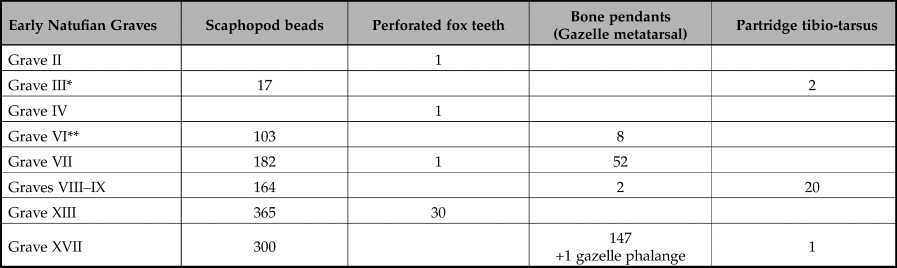
* intermediate, EN–LN
** two phases, EN & LN
Other bead/pendants appear in single numbers, e.g. a gazelle phalange bead recovered in Grave XVII and two bone plaquettes found above Grave VII (Bar-Yosef & Tchernov Reference Bar-Yosef and Tchernov1970, fig. 3:1–2).
Discussion
We do not intend to dwell on the possible reasons for the phenomenon of special treatment of certain dead, ranging from social stratification (e.g. Wright Reference Wright, Redman, Berman and Curint1978) to ceremonial considerations and practices (e.g. Belfer-Cohen Reference Belfer-Cohen, Campbell and Green1995). We would rather like to expand in the following discourse on the decorations themselves as a source of information regarding social-cum-group identity among the Mediterranean Natufian communities. Burials can reveal important information about individual and social identity, especially when they include specific features, such as personal decorations and grave goods. Every excavated burial has the potential to add information on intra-and-inter group relations, revealing webs of kin and non-kin relationships. Accordingly, burials can be considered to some degree as portraying social identities. Mortuary practices accompanying the burial events reflect formation of ‘social memory’, adding shared elements to the ‘social identity’. We would like to explore these issues, referring to the Hayonim Cave decorated burials (with emphasis on Grave XVII) as well as to a comparable dataset from Eynan (‘Ain Mallaha) and draw some implications for the Natufian at large.
The EN settlement at Eynan incorporates 40 burials. Though some are single interments, the majority (N = 32) are buried in three group graves (cemeteries A, B and C.) All decorated individuals (N = 12) are found within those group graves, comprising 30 per cent of the EN burials on site discovered so far (for details, see Bocquentin Reference Bocquentin2003; Bocquentin et al. Reference Bocquentin, Sellier and Murail2001; Davin Reference Davin2019; Perrot & Ladiray Reference Perrot and Ladiray1988; Valla & Bocquentin Reference Valla and Bocquentin2008; Valla et al. Reference Valla, Khalaily and Valladas2007).
There are four decorated burials (out of 11 individuals) in group A: two adults (one of them male), a child and a juvenile. The jewellery includes 482 scaphopods and 10 beads made of gazelle phalanges, a common bead in Eynan, some of those adhering to the skulls.
The jewellery of the decorated burials of group B (4 out of 15 individuals: two adult males, one adult female and a child) comprise 975 scaphopods, eight beads made of gazelle phalanges, one gastropod and one bead/pendant made of a gazelle metatarsal similar to the bead type common in Hayonim Cave. There are only 10 beads like this in Eynan, 6 in funerary context (see below) and 4 in Abri 131 – a structure associated with special activities (Valla Reference Valla1989; Reference Valla, Goldfus, Gruber, Yona and Fabian2019).
Of particular interest are the decorated burials of group C (4 out of 6 individuals) since their decorations are unique in Eynan, yet are very similar to those observed with the decorated burials of Hayonim Cave, especially those of Grave XVII. The burials comprise one foetus, two infants and one adult male. The jewellery incorporates 387 scaphopods, 9 bivalves (5 Glycymeris, 1 Acanthocardia, 3 Cerastoderma), 4 gastropods, 1 tooth pendant, 14 partridge tibio-tarsal beads, 6 gazelle phalange beads and 5 beads/pendants made of gazelle metatarsals similar to the bead-type common in Hayonim Cave but the only ones in Eynan. Moreover, a bone implement found amid the bones of the foetus is very similar to the broken, though much larger item, recovered in Grave XVII of which fragments were found under the skulls of H.45 (child) and H.46 (elderly female) (and see above).
As an addition to this illustrative comparison, recent research by Davin (Reference Davin2019) has provided information on modification techniques (‘scraping’) of scaphopod beads recovered in the burials of group C which differ from those used at Eynan in general, yet similar to those observed in Hayonim Cave, in the rare cases when such a modification was detected.
It seems that Hayonim Cave, unlike the site of Eynan, served first and foremost as a graveyard (and see Belfer-Cohen & Bar-Yosef Reference Belfer-Cohen, Bar-Yosef and Valla2012). There is very little indication of the cave being a habitation site, as most of the actions identified therein pertain either to burials or non-mundane activities. The location and outline of the graves, as well as those of the few small structures which most probably were used for activities related to the burial events, indicate an ongoing awareness of the happenings on site, and it seems that indeed, burials were apparently the first Natufian presence in the cave. This may be the case also for other Natufian sites, e.g. Eynan, where burials have yielded the earliest dates for the Natufian occupation of the site (Davin Reference Davin2019).
The evidence indicates that people were returning again and again (for more than 3000 years, i.e. the EN and LN) to the cave in order to bury their dead, being aware of the location of the preceding graves, apparently retaining a long-term memory of the family/group depositories. We may assume that there was a strong link between specific Natufian group/s and a locality-cum-site.
Moreover, on checking the archaeological record, it seems that we could claim this to be valid for Natufian society at large. For example, at the LN burial ground at Hilazon Tachtit Cave, the community was aware of previous activities that took place on-site, and maintained spatial distinctions among burial locations, and just as in Hayonim Cave, no grave disturbance was observed. The cave had ‘provided’ the settings for groups to create a shared memory and experience (Goldgeier et al. Reference Goldgeier, Munro and Grosman2019).
Regrettably, little research was possible in order to explore the kin relations between Natufian buried individuals. A study of the burials uncovered during the first investigations at Hayonim Cave revealed evidence for endogamy (?) among some of the individuals (Smith Reference Smith1973), based on the congenital absence of M3 in the mandible. As this is a recessive genetic characteristic occurring in relatively low frequencies in normal populations, the high percentage observed at the time in Hayonim Cave was considered as indicating a significant degree of inbreeding. Unfortunately, this hypothesis could no longer be supported as soon as the human sample became larger, as only 20 adult mandibles had the M3 area preserved. This percentage may not be significant enough for any definite conclusions. More studies are needed in order to promote this kind of research.
If we confine ourselves to the phenomenon of decorated burials, known only from the EN phase, we can clearly observe particular local/social signatures. Unfortunately, detailed data are available only from three sites, namely: Hayonim Cave, el-Wad Cave and Eynan, though there is evidence that there are other EN sites with decorated burials (e.g. Erq el-Ahmar: Neuville Reference Neuville1951) which were not explored in detail due to outdated field methodology (e.g. Shukba Cave: Garrod Reference Garrod1942). Interestingly, though the decorated burials stand out being the minority rather than the rule, they do exhibit particular stylistic characteristics typical of their own site, different from those of others, for example, the different frequencies of the same bead types, recovered in all Natufian ‘base-camps’: i.e. the most frequent bone bead/pendant found in Eynan made of gazelle phalanges is found elsewhere, in Hayonim Cave in single numbers, and the opposite is true for the beads/pendants made on gazelle metapodials (for a detailed discussion, see Belfer-Cohen Reference Belfer-Cohen1988a,Reference Belfer-Cohenb; Reference Belfer-Cohen, Bar-Yosef and Valla1991; Belfer-Cohen & Goring-Morris Reference Belfer-Cohen, Goring-Morris, Bar-Yosef and Valla2013).
Still, the same beads or items with similar ‘decorative’/symbolic motives do appear in more than one site. For example, the net pattern on bone items (Fig. 8), so typical and relatively frequent in Hayonim Cave, was recognized in single numbers in other sites, at Kebara Cave (Bar-Yosef & Belfer-Cohen Reference Bar-Yosef and Belfer-Cohen1999; Campana Reference Campana1989), Iraq ed–Dubb (Kuijt et al. Reference Kuijt, Palumbo and Mabry1992) and last but not least, at Eynan (Le Dosseur & Maréchal Reference Le Dosseur, Maréchal, Bar-Yosef and Valla2013). To us, this indicates that there were interactions between the various Natufian groups, expressed through shared stylistic elements and motifs. Unlike the clear evidence for the existence of a Levantine ‘interaction sphere’ in the PPNB (Bar-Yosef & Belfer-Cohen Reference Bar-Yosef, Belfer-Cohen and Hershkovitz1989), the data to claim a Natufian ‘interaction sphere’ are rather fuzzy and the information as regards locations and circumstances of Natufian inter-group meetings is mute. Yet, if we consider the fact that the size of a Natufian group as reflected in the site sizes was still not large enough to sustain an autonomously viable mating system, those groups had to interact at some point, on a regular basis (Santana et al. Reference Santana, Millard and Ibáñez-Estevez2021).
So far, there are no solid indications of Natufian aggregations sites, like those of the preceding Kebaran in Transjordan (Garrard & Byrd Reference Garrard and Byrd2013; Maher & Conkey Reference Maher and Conkey2019; Martin et al. Reference Martin, Edwards and Garrard2010). Still, aggregation sites are just one mechanism (actually a rare one in extant hunter-gatherers: see d'Errico et al. Reference d'Errico, Backwell and Villa2012 and references therein) known to serve and sustain a viable mating network. Another mechanism is the moiety systemFootnote 1 which enables the co-existence at the same site or neighbouring sites of kin-related groups. Perhaps the Natufians sustained a similar system of keeping year-round inter-group ties and burial events were ceremonial occasions for meetings between extended-kin/group members. The mortuary practices do reflect a specific group identity, yet with some input from other related groups, indicating the existence of moieties? Indeed, we can consider the particular group C burials in Eynan described above as an optional candidate for such a relationship, considering the affinities of the decorations therein with those characterizing the burials in Hayonim Cave, especially those of Grave XVII.
It appears that all of the above strengthens the assumption that Hayonim Cave was intensively used as a burial ground, serving as a central place for at least some Natufian groups retaining a tradition of a residential burial ground rooted in their cultural memory. The results of our research indicate that the Natufian presence at the cave started with the interment of the dead. The community/ies using this burial ground were probably inhabiting the area in close proximity to the cave, yet they apparently were in touch with more distant and distinct groups, as illustrated by the observed similarities with Grave C at Eynan.
Apparently, locations such as Hayonim Cave and the burial ground within were imbued with meaning that impacted the beliefs, emotion and life-experience of the participants in the funerary events (Bradley Reference Bradley2002; Van Dyke & Alcock Reference Van Dyke and Alcock2003). The distinct phases of Grave XVII highlight several occasions which were significant not only for the persons who took part in the burial events. The social ties, communication and memory extended far beyond the life-span of those individuals present on site (Croucher Reference Croucher2012). Such locations and instances form a materiality of memory that enabled the communities to connect with their past and cope with the death of group members (Williams Reference Williams2003). In the particular case of Hayonim, the cave provided the settings for individuals and groups to create new, shared and lasting memories and experiences that shaped and consolidated their social identity.
Acknowledgements
Special thanks are due to Hadas Goldgeier for her help with the paper's illustrations and Daniella Meyer Bar-Yosef for her advice on the shell finds. We are grateful to the students who took part in the excavations of Gr. XVII, especially Natalie Munro and Laure Dubreuil.
The authors declare that they have no conflict of interest. This research was supported by the Israel Science Foundation (# 855/03 and # 202/05 to AB-C; #459/11, #1415/14 and 2034/19 to LG).


 Open access

