

1. Introduction
Climate change is expected to alter surface temperatures, rainfall patterns, and regional climate variability (Intergovernmental Panel on Climate Change [IPCC], 2014). In turn, such changes will influence agricultural productivity and water needs, incidence of pests and pathogens, and production costs (as reviewed in Adams et al., Reference Adams, Rosenzweig, Peart, Ritchie, McCarl, Glyer, Curry, Jones, Boote and Allen1990; Chen and McCarl, Reference Chen and McCarl2001; IPCC, 2014; McCarl, Villavicencio, and Wu, Reference McCarl, Villavicencio and Wu2008; Melillo, Richmond, and Yohe, Reference Melillo, Richmond and Yohe2014; Reilly et al., Reference Reilly, Tubiello, McCarl, Abler, Darwin, Fuglie and Hollinger2003; Wolfe et al., Reference Wolfe, Ziska, Petzoldt, Seaman, Chase and Hayhoe2008).
Furthermore, the IPCC (2014) shows that climate change is not only projected but also here now. Effects are being realized with shifts in climate that have been observed (e.g., altering frequency and intensity of hot and cold days, rainfall variability, and extreme events; National Oceanic and Atmospheric Administration, National Centers for Environmental Information [NOAA-NCEI], 2016) and consequent effects on agriculture including shifting crop production zones (Attavanich et al., Reference Attavanich, McCarl, Fuller, Vedenov and Ahmedov2011; Cho, Reference Cho2015).
Agriculture can adapt to such forces by taking actions to reduce the negative effects and to exploit beneficial activities. In fact, agriculture has always adapted to climate conditions, as exhibited by such diverse characteristics as (a) the distribution of livestock and irrigation across arid areas and (b) the incidence of heat-tolerant crops in the lower latitudes and cold-tolerant crops in higher latitudes.
However, increased attention may need to be paid to adaptation in the foreseeable future because of the pace at which the climate is projected to change. Here, we review the agricultural adaptation issue through an economic lens, although we should caution that the literature is vast, with the IPCC reports alone comprising thousands of pages. Thus, we cannot be exhaustive but rather will provide insight and scholarly commentary on the literature. In doing this, we cover the near-term need for adaptation, evidence on current adaptation activities, a sampling of the economic literature on adaptation, potential public/private roles in adaptation, and adaptation project evaluation. We will interject comments on methods used, including their strengths and weaknesses, and then will close with comments on future research.
2. The Adaptation Imperative
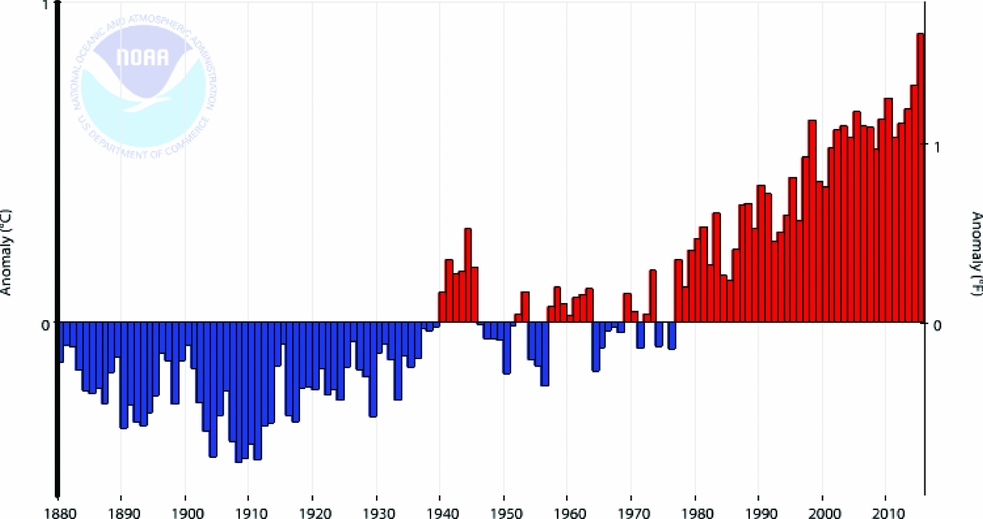
Climate change has progressed rapidly in recent years, and given the climate sensitivity of agriculture, this raises the need for adaptation. Since 1880, global temperature has increased approximately 1°C, with the change accelerating over time (since 1900, temperature has increased by 0.065°C per decade, but since 1990, by 0.136°C per decade; NOAA-NCEI, 2016). Figure 1 reveals that 15 of the 16 warmest years in recorded history have occurred since 2000, and that 2015 was the warmest year ever, with 2014 being next and January–July 2016 being warmer still (NOAA-NCEI, 2016).
Annual Land and Ocean Temperature Anomalies since 1880 (drawn from NOAA's “State of the Climate” web page [NOAA-NCEI, 2016]; the data graphed are differences from the average 20th-century global temperature)
Furthermore, projections of future temperatures portend substantial increases in temperature, raising the need for adaptive action. In particular, the need can be highlighted by referring to the graph from Knutti and Sedláček (Reference Knutti and Sedláček2013) as modified by McCarl (Reference McCarl2015) that appears in Figure 2.
Intergovernmental Panel on Climate Change (IPCC) Graph of Future Temperature Change under Alternative Greenhouse Gas Emission Scenarios (adapted by McCarl [Reference McCarl2015] from Knutti and Sedláček [2013] and republished here with permission from Choices; the global surface warming measure is the projected temperature under the IPCC [2013] Coupled Model Intercomparison Project Phase 5 (CMIP5) scenarios as they differ from the average of global temperatures during 1986–2005; RCP, representative concentration pathway)
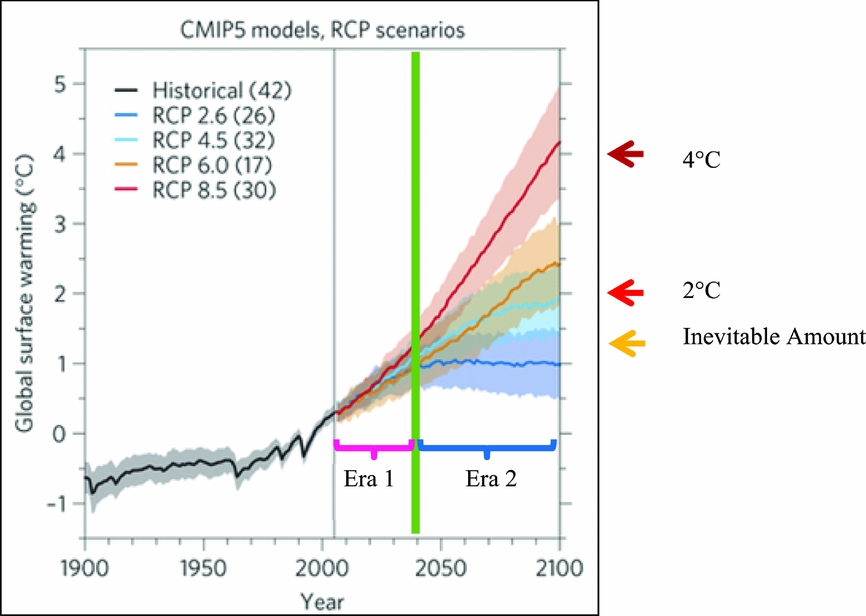
In this figure, two future eras of climate change are portrayed. Era 1 is the period from today until 2040 and was labeled by the IPCC (2014) as the period of committed climate change. Era 2 (2040–2100) is labeled as the era of climate options. Also, note that the black line represents historical observations.
As shown, some amount of climate change is inevitable and raises future adaptation challenges. The various upward sloping colored lines in the figure show scenarios for climate change evolution under different atmospheric representative concentration pathways (RCPs) and represent different degrees of mitigation. During era 1, the temperature change does not vary significantly across the various RCP mitigation scenarios. Thus, during era 1 by 2040 we face a committed amount of climate change of approximately 1°C degree regardless of the mitigation effort. This occurs because future greenhouse gas emissions are primarily affected by the relationship among emissions, energy use, economic growth in many parts of the world, the propensity to consume energy, and slow turnover in fossil fuel–based technology and infrastructure. In turn, this produces a committed amount of global temperature increase in era 1 for which agriculture must prepare—the adaptation imperative. In era 2, the temperature outcomes reflect the amount of mitigation effort and diverge across the RCP scenarios. Neglecting the unrealistic RCP2.6 case (which essentially assumes an immediate cessation of emissions), the era 2 cases illustrate a temperature change spanning between 2°C and 4°C. Additionally, full achievement of the commitments under the Paris Agreement would result in a change of approximately 3°C (United Nations Environment Programme, 2015). Thus, we have the adaptation challenge: How can agriculture prepare itself for temperature changes of 1°C in the next 25 years and 2°C–4°C by the end of the century?
3. Agricultural Sensitivities That May Merit Adaptation
Agriculture is dependent on climate, and a changing climate will have effects (e.g., see reviews in IPCC 2001, 2007, 2014; Melillo, Richmond, and Yohe, Reference Melillo, Richmond and Yohe2014; Reilly et al., Reference Reilly, Hrubovcak, Graham, Abler, Darwin, Hollinger and Izaurralde2002). This literature shows that the geographic and climatic diversity of agricultural production does not permit a broad statement on climate change impacts. For example, there are many areas where agricultural production is limited by cold, and thus climate change may improve yield and production. Meanwhile, there are many other areas where agricultural production is limited by heat, and yields will likely decrease. This has led to findings such as those by Adams et al. (Reference Adams, Rosenzweig, Peart, Ritchie, McCarl, Glyer, Curry, Jones, Boote and Allen1990, Reference Adams, Fleming, Chang, McCarl and Rosenzweig1995, Reference Adams, McCarl, Segerson, Rosenzweig, Bryant, Dixon, Conner, Evenson, Ojima, Mendelsohn and Newmann1999) and Reilly et al. (Reference Reilly, Hrubovcak, Graham, Abler, Darwin, Hollinger and Izaurralde2002, Reference Reilly, Tubiello, McCarl, Abler, Darwin, Fuglie and Hollinger2003) that show climate change is a minimal threat to U.S. agriculture overall, but that it does constitute a threat in some regions, particularly in the South. As an example, McCarl (Reference McCarl, Schmandt, North and Clarkson2011) reports a more than 25% decline in the amount of acreage cropped in Texas under more extreme climate change scenarios. More generally, some argue that it is the poorest regions and communities that will suffer the most from climate change because of location (often in hotter tropical areas), resources, and low coping capacity (Nath and Behera, Reference Nath and Behera2011). The following sections review some of the most important findings related to cropping systems and livestock.
3.1. Cropping
The impact of climate change on crops depends on the combination of temperature, precipitation, extremes, and carbon dioxide (CO2) concentration, along with other climatic factors. Broad findings mainly based on econometric analysis follow with citations of exemplary studies:
-
• Temperatures affect crop growth through their minimum, maximum, and average levels. Maximum temperature and frequency of extremely hot days have been found to influence crop productivity (Schlenker and Roberts, Reference Schlenker and Roberts2009). ECMT.Footnote 1
-
• Responses to changes in temperature have been found to exhibit an inverse U-shaped curve, with extreme cold and heat leading to small yields and a peak in between. The rate of decline in productivity as temperatures increase can be relatively steep (Schlenker and Roberts, Reference Schlenker and Roberts2009). ECMT.
-
• Changes in precipitation have been found to influence crop yield mean and variability (McCarl, Villavicencio, and Wu, Reference McCarl, Villavicencio and Wu2008). ECMT.
-
• Changes in climate extremes have been found to influence yield and variability. This includes increases in precipitation intensity and drought intensity (Attavanich and McCarl, Reference Attavanich and McCarl2014; McCarl, Villavicencio, and Wu, Reference McCarl, Villavicencio and Wu2008). ECMT.
-
• Climate change projections indicate there will be more frequent and stronger extremes (IPCC, 2013, 2014). Incidence of extremes like hurricanes and El Niño Southern Oscillation events have been shown to have negative agricultural effects (Chen and McCarl, Reference Chen and McCarl2009; Chen, McCarl, and Adams, Reference Chen, McCarl and Adams2001). ECMT, PROG.
-
• Increased levels of atmospheric CO2 have varying effects on crops based on their ability to fix carbon during photosynthesis. Higher levels of atmospheric CO2 accumulation have been found to stimulate the growth of C3 crops such as cotton, wheat, and soybeans, whereas C4 crops such as corn and sorghum are largely unaffected, except under drought performance (Attavanich and McCarl, Reference Attavanich and McCarl2014). ECMT.
-
• Crop yield technical progress has been found to decrease under the influence of climate change (Feng, McCarl, and Havlik, Reference Feng, McCarl and Havlik2011; Villavicencio et al., Reference Villavicencio, McCarl, Wu and Huffman2013). ECMT.
-
• Climate change has been found to affect weeds, insects, and diseases including invasive species altering growth, reproduction, and distribution and resulting in agricultural crop yield losses and increased management costs (Chen and McCarl, Reference Chen and McCarl2001; Wolfe et al., Reference Wolfe, Ziska, Petzoldt, Seaman, Chase and Hayhoe2008). ECMT.
-
• The total economic impact of climate change on the net returns for U.S. farmers across a number of studies has been estimated to range from a loss of $1.5 billion per year to a gain of $3.6 billion per year. (Malcolm et al., Reference Malcolm, Marshall, Aillery, Heisey, Livingston and Day-Rubenstein2012). PROG. Global estimates are larger, with adaptation needs approaching $8 billion annually (IPCC, 2014, chap. 17).
-
• Low-lying areas are vulnerable to sea level rise through land loss and saltwater intrusion affecting water supplies. The realization of these threats can cause substantial regional crop productivity and planted area losses (Chen, McCarl, and Chang, Reference Chen, McCarl and Chang2012). PROG.
3.2. Livestock
Climate change has significant consequences for livestock systems. Gaughan et al. (Reference Gaughan, Lacetera, Valtorta, Khalifa, Hahn, Mader, Ebi, Burton and McGregor2009) categorize the changes into (1) feed production, availability and price; (2) pastures and forage crop production and quality; (3) animal health, growth, and reproduction; and (4) disease and pest distributions. Some specific findings are as follows:
-
• Feed availability and quality are altered through effects on crop, pasture, and forage growth and nutritional quality. OBS, EXPR. Butt et al. (Reference Butt, McCarl, Angerer, Dyke and Stuth2005) estimate that under climate change forage yields and livestock weights in Mali would be reduced by 5% to 36% and 14% to 16%, respectively. SIMU.
-
• Changes in forage quality have been found, resulting in altered nutritional value and digestibility (Craine et al., Reference Craine, Elmore, Olson and Tolleson2010). EXPR.
-
• Increased rainfall intensity has been observed to increase range and pasture land soil degradation (Howden, Crimp, and Stokes, Reference Howden, Crimp and Stokes2008). OBS.
-
• Heat waves have been found to decrease animal performance while increasing cattle and poultry deaths (Gaughan et al., Reference Gaughan, Lacetera, Valtorta, Khalifa, Hahn, Mader, Ebi, Burton and McGregor2009; Mader, Reference Mader2014; Vitali et al., Reference Vitali, Felici, Esposito, Bernabucci, Bertocchi, Maresca, Nardone and Lacetera2015). OBS, STAT.
-
• Alterations in animal mortality, illness such as mastitis and ketosis, feed intake, feed conversion rates, rates of gain, milk production, conception rates, and appetite loss have been found (Gaughan et al., Reference Gaughan, Lacetera, Valtorta, Khalifa, Hahn, Mader, Ebi, Burton and McGregor2009). OBS, EXPR.
-
• Mader et al. (Reference Mader, Frank, Harrington, Hahn and Nienaber2009) argue a longer animal feeding period will be needed to obtain the same volume of animal products. OBS.
-
• Reproductive efficiency and appetite have been found to be affected by temperature increase, although the effect depends on the current climate with increases in cold areas and detrimental effects in hot areas (Mader et al., Reference Mader, Frank, Harrington, Hahn and Nienaber2009). EXPR.
-
• Pest and disease incidence has been found to increase, altering animal health, productivity, and fecundity (Gale et al., Reference Gale, Drew, Phipps, David and Wooldridge2009). STAT.
3.3. Land Values
Land values have been found to be sensitive to climate change with differential effects across regions (Mendelsohn, Nordhaus, and Shaw, Reference Mendelsohn, Nordhaus and Shaw1994). Land values capture the inherent productivity of agricultural resources and the value of agricultural production to society, and they embody the effects of adaptations.
3.4. Comments on Methods
There are some inherent strengths, weaknesses, and characteristics that can be pointed out regarding the methods employed. First, many of the studies mentioned previously utilize econometrics and inherently capture implicit farmer adaptations. However, such approaches cannot easily capture reactions to CO2 effects, increased severity and incidence of extreme events, heretofore unused adaptations, and changes in input costs/usage. In addition, they are hampered by a scarcity of data on particular effects and adaptations. Furthermore, it is important to use a functional form that permits inverse U-shaped effects for the climate variables (e.g., increasing temperature has varying effects, including both positive effects when starting from low temperatures and negative ones at high temperatures). It is also important to control for adaptations that may only arise in some areas because of resource availability that reduce climate change influences (e.g., the use of irrigation typically reduces sensitivity to precipitation reductions but is limited by water availability).
Second, those using observations and statistics are again hampered by the ability to capture CO2 effects, enhanced extreme events, heretofore unused adaptations, and a scarcity of data on particular effects and adaptations. Furthermore, it can be difficult to control all factors that vary between observations like use of reduced tillage or irrigation by crop and region.
Third, those using simulations may only model part of the processes. For example, crop models typically do not include estimates of pest damages or the related costs, and this may bias sensitivity estimates.
Fourth, when modeling the impacts of climate change on production or land values, one may bias the results by only considering current enterprises and thus fail to capture the modulating impacts of altering crop and livestock mix or land use change. Fifth, one may not consider turnover times for fixed assets and needed infrastructure adjustments that limit adoption of alternative varieties reflecting too fluid of a market (farmers adopting new crops too quickly) and biasing the results. Sixth, because climate change is global, localized modeling may bias sensitivity results by ignoring market price adjustments.
4. Adaptation Means and Roles
Adaptation may proceed naturally or be carried out by humans. Natural adaptations include birds, pests, and fish moving their geographic range or ecosystems changing in response to a changed climate. Human adaptation possibilities are broadly characterized by the IPCC (2014, chaps. 14 and 17) as alterations of management, infrastructure, technology, information, education, institutions, norms, behavior, emergency response, and public assistance. Human adaptation may be applied to correct natural adaptations if judged desirable.
The IPCC reports classify human adaptation as either autonomous or planned (IPCC, 2014, chaps. 14–17). Autonomous actions are mostly undertaken to enhance private goods and refer to actions taken by individuals or groups in their own best interests (pursuing adaptations that yield private benefits such as shifting crop mix). Planned actions, which from an economic view address public goods and are public actions, refer to adaptation actions by public entities that correct market failures (like building a seawall, developing drought-resistant varieties, or providing subsidized adaptation financing), as discussed by Mendelsohn (Reference Mendelsohn2000) and Osberghaus et al. (Reference Osberghaus, Dannenberg, Mennel and Sturm2010). Private actions face limits to action that may require public action to relax, as will be discussed subsequently.
Public actions pose issues for governmental or international agencies because they generally address public goods problems. The adverse impacts of some adaptations (i.e., building a seawall) are typically nonrivalrous and nonexcludable, and the same is true for their potential benefits. Nonrivalrous applies because individuals living within the seawall-protected area do not affect the benefit gained by other individuals in that area. Nonexcludable applies in the sense that one cannot prevent others from reaping the benefits. In such cases, the implementing party cannot typically capture all the gains, and classical economic theory indicates that such actions will not receive appropriate levels of private investment (Samuelson, Reference Samuelson1954). When the cost of such an activity is less than the collective benefit, planned/public action can be undertaken to avoid underinvestment. Examples in agriculture of possible needed public actions include developing new crop varieties, building a flood control dam, providing extension information, developing subsidized lending programs, and providing subsidized insurance.
A list of possible adaptation categories with an indication of whether the actions will be public or private appears in McCarl (Reference McCarl2015). The agriculturally relevant examples from that list with some augmentation are as follows:
-
• Altered patterns of enterprise management, production facility investment, and resource use. Common examples involve alterations in (a) planting and harvesting dates; (b) crop and livestock varieties; (c) methods of tillage, residue, and moisture management; (d) pest treatment; (e) irrigation extent, use, and management; and (f) new technology adoption (mainly private actions).
-
• Alterations in land use proportions devoted to crops, livestock, pasture/range, and forest (mainly private).
-
• Capital investment in resource supply, product movement, and other infrastructure (e.g., water management and roads) (mainly public).
-
• Research-based development of crop and livestock varieties or new practices that better accommodate the altered climate (e.g., development of drought-resistant varieties or improved irrigation techniques) (mix of private and public).
-
• Altered processing and transportation infrastructure location accommodating regional shifts in product mix (mainly private).
-
• Creation and dissemination of adaptation information on new alternatives, enterprises, management practices, and so forth (through extension or other communication vehicles) (mainly public).
-
• Formal education on adaptation possibilities (private and public).
-
• Redesign of, or development of, institutions to facilitate adaptation (e.g., altered forms of insurance or provision of extreme event early warning) (private and public).
-
• Public assistance implementing adaptation (providing subsidized loans and insurance or adding adaptation aspects to agricultural programs) (mainly public).
-
• Increasing trade with other countries that are differentially affected by climate change (mainly private).
5. Observed Adaptation
Agriculture fundamentally adapts to climate as reflected in the way that production systems vary across the landscape. A number of studies have observed alterations in farming patterns across spatial and temporal variations in climate drawing information on chosen adaptations. Here we review some of those findings for crops and livestock. We will again indicate the methods used.
5.1. Cropping
A sampling of major findings to date is as follows:
-
• Seo and Mendelsohn (Reference Seo and Mendelsohn2008) find that alterations in historic temperature and rainfall cause shifts in crop mixes on South American farms. Cho (Reference Cho2015) finds U.S. evidence of crop mixes shifting northward (increasing latitude) and to higher elevations because of climate change. ECMT.
-
• Mu, McCarl, and Wein (Reference Mu, McCarl and Wein2013) and Cho (Reference Cho2015) find evidence of crop lands being converted into grazing as temperature increases and/or precipitation decreases, especially in hotter areas. ECMT.
-
• Practices such as no-till, residue management, reclamation of degraded lands, and nitrogen management have been found to improve adaptation, offering the potential to ease the severity of water shortages and reduce soil losses (Lal et al., Reference Lal, Delgado, Groffman, Millar, Dell and Rotz2011). EXPR, OBS.
-
• Planting dates have been found to be moved earlier in the year under climate change usually resulting in improved yield (Sacks and Kucharik, Reference Sacks and Kucharik2011). STAT.
-
• Longer growing seasons have been found to result from climate change, and adaptation has been observed in the form of increased double-cropping of certain crops such as wheat and soybeans (Wiatrak et al., Reference Wiatrak, Wright, Marois, Koziara and Pudelko2005). OBS, STAT.
-
• Shifts in crop varieties have been found to allow producers to adapt to the changing climate, including responding to increased drought frequency, altered pest populations, longer growing seasons, and other factors (Harvey et al., Reference Harvey, Chacón, Donatti, Garen, Hannah, Andrade and Bede2014).
-
• Shifts in crop mix have been found to also require changes to infrastructure such as transport facilities and the location of processing (Attavanich et al., Reference Attavanich, McCarl, Ahmedov, Fuller and Vedenov2013). PROG.
5.2. Livestock
Livestock adaptation strategies have been categorized by Gaughan et al. (Reference Gaughan, Lacetera, Valtorta, Khalifa, Hahn, Mader, Ebi, Burton and McGregor2009) into (1) alterations of breeds, species, and genotypes of both animals and forages; (2) adjustment of livestock and feed supply mix; (3) management of livestock grazing intensities; (4) alteration of facilities; and (5) relocation of livestock among regions. Some references to the findings are as follows:
-
• Zhang, Hagerman, and McCarl (Reference Zhang, Hagerman and McCarl2013) find breed adaptation with more heat-tolerant cattle (Bos indicus, e.g., Brahman) is being used in hotter areas with less heat-tolerant (Bos taurus, e.g., Angus) breeds raised elsewhere. OBS, STAT.
-
• Seo et al. (Reference Seo, Mendelsohn, Dinar and Kurukulasuriya2009) and Seo, McCarl, and Mendelsohn (Reference Seo, McCarl and Mendelsohn2010) find shifts in species (e.g., from cattle to goats) under climatic change in Africa and South America. ECMT.
-
• Integrated crop and livestock production systems have been employed to adapt to climate change (Howden et al. Reference Howden, Soussana, Tubiello, Chhetri, Dunlop and Meinke2007). STAT, ECMT.
-
• Animal grazing has been adapted by adjusting stocking rates, varying the season of grazing, shifting grass species, pursuing adaptive management under drought, reorganizing enterprise structure, managing invasive plants and animal parasites, and geographically relocating production enterprises (Joyce et al., Reference Joyce, Briske, Brown, Polley, McCarl and Bailey2013; Mu, McCarl, and Wein, Reference Mu, McCarl and Wein2013; Weindl et al., Reference Weindl, Lotze-Campen, Popp, Müller, Havlík, Herrero, Schmitz and Rolinski2015). OBS, STAT, ECMT.
-
• Producers can manipulate animal rearing conditions to reduce the impact of high solar radiation and temperature by providing shade, ventilation, or misting and altering building design (Renaudeau et al., Reference Renaudeau, Collin, Yahav, de Basilio, Gourdine and Collier2012). OBS.
-
• Producers can adapt by relocating livestock and/or diversifying feedstuff sources between regions and sources in response to seasonal conditions (Thomas et al., Reference Thomas, Wilmot, Kelly and Revell2011). OBS, STAT.
5.3. Comment on Methods
Again, there are inherent strengths, weaknesses, and characteristics of the methods employed in this setting. First, many of the studies previously mentioned have been done with econometrics in efforts designed to identify adaptations and causal factors. Popular econometric approaches include utilizing maximum likelihood estimation (Seo and Mendelsohn, Reference Seo and Mendelsohn2008), panel data using fixed effects (Yu and Babcock, Reference Yu and Babcock2010), multinomial choice models (Seo et al., Reference Seo, Mendelsohn, Dinar and Kurukulasuriya2009), and multivariate probit models (Zhang, Hagerman, and McCarl, Reference Zhang, Hagerman and McCarl2013). Given the uncertainty and inherent error in calculations involving climate change, many studies assume that error takes on a specific distribution, such as Gumbel (Seo and Mendelsohn, Reference Seo and Mendelsohn2008).
Second, oftentimes, in order to carry out an analysis, researchers choose to simplify the decision-making process by only focusing on the most profitable crop (Seo and Mendelsohn, Reference Seo and Mendelsohn2008; Yu and Babcock, Reference Yu and Babcock2010) or excluding potentially relevant but endogenous variables like animal population (Butt et al., Reference Butt, McCarl, Angerer, Dyke and Stuth2005). It should be noted that such approaches potentially omit some types of adaptations. For example, just looking at corn will omit crop switching, causing estimates to overstate vulnerability and understate adaptation potential. These approaches are also limited by factors such as a lagged rate of adaptation caused by fixed capital investments, effects of a lack of adaptation information, an inability to fully represent adaptions to CO2 and increased extremes because of a lack of data, and a lack of data on potential but regionally unexplored adaptations. In general, econometric methods are hampered by data regarding input usage and species adjustments plus the aggregation of data to larger spatial scales. Statistical and observational approaches suffer from many of the same problems.
Third, when using a simulation or programming approach, one typically only gains information on adaptations that were implemented within and run through the model (for a discussion, see Soussana, Graux, and Tubiello, Reference Soussana, Graux and Tubiello2010). For example, if one is using crop simulator models such as Environmental Policy Integrated Climate (EPIC), one will only get adaptations in planting dates by doing multiple simulation cases varying that date and then summarizing effects (Reilly et al., Reference Reilly, Hrubovcak, Graham, Abler, Darwin, Hollinger and Izaurralde2002).
Fourth, simulation and programming models often do not fully model limits to market responses and market mechanisms for important inputs. An example is that of water, for which allocation institutions, regulation, availability, distribution, and price often affect adaptation options.
Fifth, some potential adaptations will not have been observed because the forces that would cause them to be an optimal choice have not sufficiently asserted themselves. For example, crop prices relative to water prices and availability may not cause enhanced irrigation technologies to be observed in a region.
Sixth, some adaptations require technological development. These are generally only developed if they are stimulated by factor prices that induce their development (see the Ruttan and Hayami [Reference Ruttan and Hayami1984] discussion of induced innovation).
6. Current and Projected Benefits of Adaptation
A number of studies have examined the benefits of adaptations as an input to development of efficient adaptation policy strategy planning. We will again indicate methods used. Here we do not separate by crop and livestock because this type of research has been far less common.
-
• Aisabokhae, McCarl, and Zhang (Reference Aisabokhae, McCarl, Zhang, Dinar and Mendelsohn2011) studied changes in crop planting dates and other adaptions using results of model runs developed by crop modelers in the U.S. national assessment (Reilly et al., Reference Reilly, Hrubovcak, Graham, Abler, Darwin, Hollinger and Izaurralde2002). They found crop timing shifts to be the most valuable of the adaptations they studied. PROG.
-
• Shifts in crop varieties have been found to allow producers to adapt to increased drought frequency, altered pest populations, and other factors. Yu and Babcock (Reference Yu and Babcock2010) indicate that research on heat-tolerant crops has mitigated losses of corn and soybean yields in the U.S. Corn Belt. ECMT. Butt, McCarl, and Kergna (Reference Butt, McCarl and Kergna2006) find substantial adaptation value for drought-resistant crop varieties in Mali. PROG.
-
• Adaptation in the form of altered varieties, trade patterns, and crop mix have been found to be valuable in reducing climate change damages and in increasing welfare (Aisabokhae, McCarl, and Zhang, Reference Aisabokhae, McCarl, Zhang, Dinar and Mendelsohn2011; Butt, McCarl, and Kergna, Reference Butt, McCarl and Kergna2006), as well as reducing hunger (Butt, McCarl, and Kergna, Reference Butt, McCarl and Kergna2006). PROG.
-
• Mendelsohn and Dinar (Reference Mendelsohn and Dinar1999) compare the results from crop simulations with realized yields and conclude that farmers in developing countries could reduce the potential damages from climate change by up to one-half through adaptation activities. SIMU, STAT, ECMT.
-
• Increase in technical progress via research and development (R & D) investment along with trade liberalization has been found to mitigate sea level–induced damages in major rice production areas (Chen, McCarl, and Chang, Reference Chen, McCarl and Chang2012). PROG, ECMT.
-
• Huffman and Just (Reference Huffman and Just2000) investigate how incentives to developers of agricultural technologies affect the benefits realized by industry. The research finds that compensation structure influences subsequent industry benefits because of inefficiencies, incentive alignment, risk, and ultimate quality. These findings are applicable to the realized welfare gains generated by climate change adaptation research. STAT.
-
• Adams et al. (Reference Adams, McCarl, Segerson, Rosenzweig, Bryant, Dixon, Conner, Evenson, Ojima, Mendelsohn and Newmann1999) find that adaptation benefits will accrue as a result of increasing irrigated acres and changing regional crop mixes. PROG.
-
• Integrated crop and livestock production systems have been found to be a valuable adaptation option (Howden et al., Reference Howden, Soussana, Tubiello, Chhetri, Dunlop and Meinke2007) and one that greatly reduces income fluctuation (Seo, Reference Seo2010). STAT, ECMT.
-
• Malcolm et al. (Reference Malcolm, Marshall, Aillery, Heisey, Livingston and Day-Rubenstein2012) found that adoption of drought-tolerant varieties of corn will have adaptation benefits, avoiding significant redistribution of production. They also found that alterations to rotations and other management yield adaptation benefits. PROG.
6.1. Comments on Methods
Again there are some inherent strengths, weaknesses, and characteristics of the methods in this context. First, when using programming models, one obviously cannot study adaptation options that have not been built into the model or used in practice as production possibilities (e.g., see the study by Malcolm et al. [Reference Malcolm, Marshall, Aillery, Heisey, Livingston and Day-Rubenstein2012] that omits adaptations in maturity dates, planting, and harvesting times). Omissions cause studies on economic effects to be biased.
Second, across all modeling frameworks, a major challenge is including all the relevant adaptation strategy options (for a discussion, see Soussana, Graux, and Tubiello, Reference Soussana, Graux and Tubiello2010). As discussed previously, adding adaptations to crop simulators such as EPIC requires the researcher to run multiple runs for different planting dates, days to maturity, and other characteristics (Reilly et al., Reference Reilly, Hrubovcak, Graham, Abler, Darwin, Hollinger and Izaurralde2002). The adaptation strategies included should account for changing relationships, despite the difficulties assuming how markets will respond to altering conditions. Rosenberg (Reference Rosenberg1992) argues that linkages between agriculture and the rest of the economy should be considered when exploring adaptation options.
Third, most studies on adaptation benefits omit the information acquisition, machinery turnover, and R & D costs associated with adoption or development of novel practices. Fourth, credible inclusion of adaptation options can be a daunting task. Including effects on crop growth, hydrology, soil, and land quality can be challenging, especially for models with a broad scope and scale. Incorporating such relationships introduces nonlinear properties into already large mathematical problems.
7. Some Realities of Adaptation Efforts
There are a number of adaptation realities that merit discussion. These include the existence of adaptation deficits, adaptation effectiveness, maladaptation, funds competition, coherence with development goals, and coherence with mitigation.
First, decision makers may face a current adaptation deficit (Burton and May, Reference Burton and May2004) when current systems are not in an optimal state of adaptation relative to the current climate. For example, a region facing increased climate change–induced flood incidence may not be well adapted to the current flood incidence (as commonly asserted about pre-Katrina New Orleans). Such a deficit can be argued to be the result of a number of barriers, as listed subsequently.
Second, Parry et al. (Reference Parry, Arnell, Berry, Dodman, Fankhauser, Hope and Kovats2009) argue that adaptation cannot reasonably overcome all climate change effects. This introduces the concept of unavoidable damages. For example, if a glacier melts or a species becomes extinct, this may be practically irreversible; therefore, an adaptation solution does not exist. Such concerns yield residual damages that remain after adaptation actions and will inevitably exist.
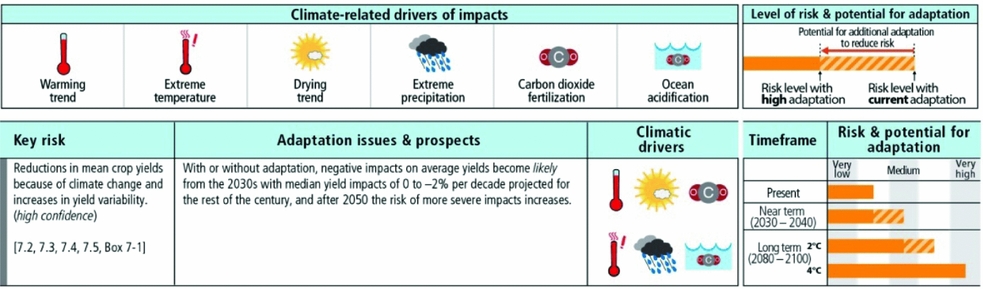
Third, adaptation likely exhibits increasing costs as effort increases, as discussed by Parry et al. (Reference Parry, Arnell, Berry, Dodman, Fankhauser, Hope and Kovats2009). It also likely has diminishing marginal effects as the effects of climate change are realized. For example, Figure 3 illustrates the diminishing effectiveness of adaptation as climate change grows larger in the risk bars on the far right. Damages are also likely to grow as the amount of climate change increases as illustrated in Figure 4 (the so-called burning embers diagram as discussed in Oppenheimer et al. [Reference Oppenheimer, Campos, Warren, Birkmann, Luber, O'Neill, Takahashi, Field, Barros, Dokken, Mach, Mastrandrea, Bilir and Chatterjee2014]).
Key Risks for Food Security and the Potentials for Adaptation in the Near and Long Term (table 7-3 from Porter et al. [Reference Porter, Xie, Challinor, Cochrane, Howden, Iqbal, Lobell, Travasso, Field, Barros, Dokken, Mach, Mastrandrea, Bilir and Chatterjee2014]; note the bars on the right where the striped portion is the appraisal of the benefits from adaptation and shows the benefits diminishing as warming grows)
Key Risks That Increase as Warming Grows (figure 19-4 from Oppenheimer et al. [2014])

Fourth, although adaptation conceivably lowers vulnerability and/or exploits opportunities, there are cases in which the opposite may occur for some parties now or in the future. This possibility is called “maladaptation.” Maladaptation occurs, from an economic viewpoint, when the adaptation actions of one party impose external adaptation-related costs on other parties either in the immediate area, in other areas, or in the future (Barnett and O'Neill, Reference Barnett and O'Neill2010; Glantz, Reference Glantz1988). For example, diverting floodwaters away from a city may result in the flooding of other localities. Also, extensive use of groundwater now can deplete supplies, worsening adaptation in the future. Actions that use substantial resources may also lessen the resources available for other more desirable adaptation projects. Finally, actions that protect vulnerable seacoasts now may cause more people to move to the area, thereby increasing the adaptation action necessary in the future under sea level rise. Note that from an economic and compensation principal viewpoint, maladaptation actions may be rational if the benefits to the adapting party outweigh the losses to others under the maladapted policy.
Fifth, the practical implementation of adaptation often inherently faces barriers and limits (see IPCC, 2014, chaps. 16 and 17). Following Klein and Juhola (Reference Klein and Juhola2014) and IPCC (2014), examples of such limits are as follows: (a) knowledge, awareness, and technology availability; (b) physical and biological constraints that limit basic feasibility; (c) financial constraints such as available funds; (d) human resource constraints such as availability of trained personnel; (e) needed equipment such as major construction machinery; (f) social and cultural constraints such as working days, cultural holidays, cultural norms, and behaviors; (g) governance and institutional constraints such as property rights, zoning, and regulations; (h) economic constraints such as local state of development and regional infrastructure; (i) information constraints on knowledge of alterative adaptations; (j) competing values that lead to other actions being preferred or a lack of belief in the need for adaptation; (k) lack of larger-scale coordination where, for example, local water management adaptation is constrained by multicountry or regional agreements; and (l) competing uses of resources that are judged of a higher priority.
Sixth, the presence of limits can require some type of supporting public action (loans, infrastructure development, education, and technological development/extension) to overcome them. Seventh, adaptation policy and development efforts may be synergistic. Drought-resistant variety adaptations may not only adapt to future climate change but also benefit current income. Construction of water impoundments may bear benefits well beyond the climate adaptation arena. Integrating adaptation policy with more general development policy, also known as mainstreaming, is a desirable action (Dovers and Hezri, Reference Dovers and Hezri2010).
Eighth, some adaptation strategies may yield climate mitigation effects (e.g., no-till adoption also increases sequestration). Ninth, adaptation may have differential returns as climate change progresses and mandate a different degree of attention over time. Wang and McCarl (Reference Wang and McCarl2013) consider optimal investment levels showing adaptation would take a larger share of the funds initially with the mitigation share growing over time as damages increase. This issue also involves discounting because higher discount rates favor adaptation and lower ones mitigation (contrast the results of Nordhaus [Reference Nordhaus2007] with those of Stern [Reference Stern2007]).
Tenth, funding adaptation on a global basis is likely to be an expensive proposition. Global estimates range from $4 billion to $100 billion per year with a bias toward the higher end as reviewed by Chambwera et al. (Reference Chambwera, Heal, Dubeux, Hallegatte, Leclerc, Markandya, McCarl, Mechler, Neumann, Field, Barros, Dokken, Mach, Mastrandrea, Bilir and Chatterjee2014). Furthermore Parry et al. (Reference Parry, Arnell, Berry, Dodman, Fankhauser, Hope and Kovats2009) argue that the estimates are low. In terms of agriculture, forestry, and fisheries, these costs center around $8 billion per year (IPCC, 2014, chap. 17).
Eleventh, adaptation deficits may be rising. An adaptation deficit describes a lack of adaptation to the current climate and occurs if, for example, the investment in adaptation has lagged the need for adaptation. This may be happening, as a 2011 study estimates actual expenditure on agriculture adaptation is $244 million (Elbehri, Genest, and Burfisher, Reference Elbehri, Genest and Burfisher2011), whereas the estimate for total adaptation needed in agriculture is approximately $8 billion (IPCC, 2014, chap. 17). This shortfall portends a growing adaptation deficit.
Twelfth, the cost of adaptation in developing countries is expected to be a higher burden relative to gross domestic product because of the potentially greater vulnerability, limited capital, low research and extension funding, limited investment in infrastructure, and human and institutional capacity. These factors may call for a larger role for international funding (Füssel, Hallegatte, and Reder, Reference Füssel, Hallegatte, Reder, Edenhofer, Wallacher, Lotze-Campen, Reder, Knopf and Müller2012).
Thirteenth, adaptation needs to be dynamically flexible in nature, evolving as the climate changes and as one learns about both adaptation strategy effectiveness and the realized degree of climate change (Mimura et al., Reference Mimura, Pulwarty, Duc, Elshinnawy, Redsteer, Huang, Nkem, Sanchez Rodriguez, Field, Barros, Dokken, Mach, Mastrandrea, Bilir and Chatterjee2014). Finally, one must realize that adaptation must be implemented on a local scale. Strategies must be designed considering the local risk type, adaptation limits, and applicable adaptation alternatives. Failure to tailor and design adaptations to fit the needs of a specific community or location increases the potential for failure and puts the concept of adaptation at risk.
8. Evaluating Projects
Although some adaptation funding will be done by individuals or groups acting autonomously, a public role will be needed to fund many projects given that some are public goods and many will face adaptation limits. To address this, there are adaptation funds in existence or emerging, with some accepting project applications. For example, the Paris Agreement contains a $100 billion per year fund for mitigation and adaptation (United Nations Framework Convention on Climate Change, 2016). As such, it is relevant to discuss some aspects of adaptation project evaluation.
In a climate change context, there has been substantial discussion regarding desirable characteristics of climate mitigation projects, with discussion often centering on additionality, permanence, uncertainty, and leakage (see discussion of these concepts in Willey and Chameides [Reference Willey and Chameides2007]). Such concerns are also relevant in an adaption context as we discuss subsequently. Additionally, we discuss a wider definition of benefits and the correction of adaptation deficits.
In terms of benefits, adaptation decisions affect regional productivity, income, employment, distribution of income, poverty, water quality, ecosystem function, and human health (Chambwera et al., Reference Chambwera, Heal, Dubeux, Hallegatte, Leclerc, Markandya, McCarl, Mechler, Neumann, Field, Barros, Dokken, Mach, Mastrandrea, Bilir and Chatterjee2014). These items are not all easily converted into monetary terms. Generally, this implies that any analysis of project performance be multimetric, with part in monetary terms and other parts not. Many studies argue that all of these benefits should be factored into decision making (e.g., see Brouwer and van Ek, Reference Brouwer and van Ek2004; Viguié and Hallegatte, Reference Viguié and Hallegatte2012). However, this imposes a large burden on fully estimating all of the ancillary benefits for all the considered projects, which may not be practical (e.g., see arguments in Elbakidze and McCarl [Reference Elbakidze and McCarl2007] in the mitigation context).
Additionally, some adaptation projects will address current adaptation deficits and development needs along with future adaptation. This increases the net present value of returns but also raises the issue of whether funds should address current development needs or focus solely on just adaptation. We think that one should be more comprehensive and include the benefits from new adaptation, adaptation deficit correction, and development enhancement, as ignoring the latter two would penalize valuable projects.
Now, suppose we turn to concerns raised in the Kyoto Protocol and commonly addressed for mitigation projects (see discussion in Willey and Chameides, Reference Willey and Chameides2007). Let us consider additionality where there are actually two adaption-related concerns. First, some assert that adaptation funding should not be a retasking of traditional development funds but rather should involve additional funds beyond previous levels of investment (Lemos and Boyd, Reference Lemos, Boyd and Boykoff2010). Additionality also has the meaning that it takes on in the context of evaluating mitigation projects. There, additionality refers to the desire to only fund projects that create benefits that are additional to what would have happened in the absence of funding (those that would not be implemented in the absence of funding). This implies the need for additionality tests that check whether the proposed activities would have happened in the absence of funding. However, one needs to be cautious here because strategies that are already partially adopted may be desirable and one wants to incentivize the best projects, but the “without project” baseline will not generally be known. Project evaluation may involve additionality tests as to whether the project requires a currently unavailable technology, or is currently demonstrably not profitable, or does not exist in any form in the region, along with a more sophisticated baseline establishment and with/without project projection (as discussed in a mitigation context by Willey and Chameides [Reference Willey and Chameides2007]). In terms of incentives, Feng (Reference Feng2012) investigates the additionality issue and indicates that a screening contract method (Laffont and Martimort, Reference Laffont and Martimort2002; Wu and Babcock, Reference Wu and Babcock1995) designed to cope with incomplete information or where the purchaser defines a baseline may be best.
Yet another Kyoto-based issue involves uncertainty in project effectiveness. A lack of previous projects and critical methods to evaluate success, an uncertain future climate, and an inability to separate the impact of the adaptation from other factors yield uncertainty. For a project, providing some measure of the variability, such as a standard deviation, can be used to place a lower confidence interval on adaptation benefits, as done by Kim and McCarl (Reference Kim and McCarl2009) in a mitigation setting. Establishing a method to deal with the inherent uncertainty is a necessary input to project evaluation.
One mitigation project aspect is the concept of leakage, where the institution of a greenhouse gas emission reduction in one place stimulates more emissions elsewhere (Murray, McCarl, and Lee, Reference Murray, McCarl and Lee2004). In the adaptation context, this generally involves maladaptation. In general, one needs to ask whether the adaptation will worsen adaptation elsewhere or in the future. Naturally, maladaptation may be acceptable if the winners gain enough to compensate the losers. Procedures to screen for cases of maladaptation should be a key component of project evaluation.
Finally, there is the concept of permanence, where one needs to consider the duration of the benefits from the adaptation investment and not assume that the result persists forever. Climate change impacts are likely to grow over time causing adaptations to become less effective. This suggests that adaptation strategies may have a limited life and possible declining benefits over time. Therefore, it may be appropriate to account for diminishing effectiveness over time using an approach like the one by Kim, McCarl, and Murray (Reference Kim, McCarl and Murray2008) for mitigation. Development of a procedure for considering this in project design and evaluation would be important. Moving forward, establishing clear objectives and evaluation techniques for adaptation projects should be a priority to avoid poor usage of limited funds.
9. Concluding Comments and Future Research
The momentum of climate change and slow progress of greenhouse gas emission mitigation makes adaptation inevitable. Agricultural sensitivity to climate change has been studied in many settings, but additional work is needed to monitor effects and provide early indications of adaptation needs. Adaptation can improve the quality of life for farmers, farmworkers, consumers, and society as a whole, as well as marginalized groups. As discussed, a wide variety of adaptation actions are possible, and a number of these have been attempted. Adaptation actions and their benefits need to be identified along with indications of public versus private roles. Some adaptation actions have not occurred because of availability of resources, limited incentives for adaptation, or market failures because of their public good nature. Other adaptation actions have been deemed “maladaptation” in that they come at the expense of adaptation elsewhere or in the future. Moving forward, there remains a large need for research into ways to motivate the implementation of adaptation strategies including incentive design, areas for R & D focus, and the best ways to disseminate information. Research into these issues can utilize multiple methods to improve the accuracy of results and properly address issues.
Appraisals of the costs and benefits of adaptation strategies until 2040 may not need to consider mitigation scenarios. Thereafter, consideration of the effectiveness of societal mitigation is imperative.
Knowing that proposed adaptation strategies will require funding and development of a comprehensive evaluation system to accurately prioritize and critique adaptation plans is desirable. Such a system will reduce the chances of maladapted and inefficient projects being funded, in turn increasing the effectiveness of invested resources.
Economists have a role in facilitating effective adaptation by promoting the resolution of market failures and careful project evaluation. Already, maladaptation and limited funding make prioritizing projects difficult, and economists must play a role to ensure adaptation investments that are beneficial and risk reducing without stimulating maladaptation and wasted funds.


 Open access

