

INTRODUCTION
Individuals rely on their advice networks to access useful information and resources possessed by others (Shen & Bian, Reference Shen and Bian2018; Sparrowe, Liden, Wayne, & Kraimer, Reference Sparrowe, Liden, Wayne and Kraimer2001). Prior research has demonstrated that advice-giving centrality or the number of coworkers who seek advice from a focal individual is an important source of social capital (Brass, Reference Brass1984; Brass & Burkhardt, Reference Brass, Burkhardt, Nohria and Eccles1992). Positive associations between one's advice network and individual outcomes such as work performance and trust are well documented in the literature (Luo, Reference Luo2005; Tsai & Ghoshal, Reference Tsai and Ghoshal1998). However, there is growing recognition of the costs and downsides of high advice-giving centrality. A central position in one's advice-giving network is associated with more obligations to respond to requests from colleagues (Cullen, Gerbasi, & Chrobot-Mason, Reference Cullen, Gerbasi and Chrobot-Mason2018). According to Cross, Rebele, and Grant (Reference Cross, Rebele and Grant2016), employees today spend 80% of their time in meetings, on the phone, and responding to emails. These requests and obligations distract individuals from their work tasks (Oldroyd & Morris, Reference Oldroyd and Morris2012). Consequently, high advice-giving centrality may result in less time and attention to completing work tasks.
To reconcile the benefits and costs of maintaining social ties in the workplace, researchers have proposed a curvilinear relationship between individual network centrality and performance (Chen & Gable, Reference Chen and Gable2013). For instance, Paruchuri (Reference Paruchuri2010) finds an inverted U-shaped relationship between R&D inventors’ collaboration networks (exhibited in patents) and their innovative impact. Similarly, Zhou, Shin, Brass, Choi, and Zhang (Reference Zhou, Shin, Brass, Choi and Zhang2009) demonstrate that the number of weak ties enhances individual creativity at a low level and hurts creativity at a high level. This stream of research mainly theorizes and focuses on the information recipients’ perspective (Chen & Gable, Reference Chen and Gable2013). They recognize that individuals benefit from their network through accessing more and varied information and will encounter issues of information overload when their networks grow too large.
As important sources of advice for others (Ibarra & Andrews, Reference Ibarra and Andrews1993), individuals high in advice-giving centrality act as information providers rather than recipients. In addition to the potential overload in processing information, a more crucial concern for them is to trade off the costs of providing advice to requesters against the benefits of receiving reciprocal favors from individuals they helped (Flynn, Reference Flynn2003). Indeed, the process of managing and leveraging advice-giving ties can be characterized as a social exchange (Cropanzano & Mitchell, Reference Cropanzano and Mitchell2005). According to social exchange theory, resource providers gain obligations from recipients to return the favor in the future (Gouldner, Reference Gouldner1960). However, providers’ productivity can be enhanced only when such obligations are indeed transformed into reciprocating actions that benefit the provider (Blau, Reference Blau1964). In line with social exchange theory, Flynn (Reference Flynn2003) demonstrates that employees’ performance reaches the optimal level when they achieve a balance between the favor provided and the favor returned. An imbalance in favor of exchange will lead to either decreasing reputation or a waste of resources and time for the providers, which will ultimately hurt their productivity.
Despite the insights of a dyadic-level perspective of social exchange that highlights the need for balanced patterns of favor exchange to enhance the productivity of the provider (Flynn, Reference Flynn2003), there are at least three theoretical issues that require further investigation. First, a dyadic perspective overlooks the possibility that the marginal cost and benefit of providing advice are not constant. Initially, when an information provider increases their advice-giving centrality, the marginal benefit may exceed the marginal cost of maintaining an additional advice-giving tie. This may be because the provider is efficiently using their resources in exchange for reciprocating actions. However, as advice-giving centrality increases further, there may be a point where the marginal cost of an additional advice-giving tie surpasses its marginal benefit – due to experiences of strain from resource loss, cognitive limits to tracking favors, and the increasing resource redundancy received in others’ reciprocating actions – such that task performance of the information provider suffers. Thus, we need to investigate the impact of the aggregate level of advice-giving centrality on information provider's task performance.
Second, the ʻbottleneck’ effect of central information providers has not been examined in the literature. In addition to individual task performance, contextual performance, which refers to how well employees coordinate and cooperate with others (Borman & Motowidlo, Reference Borman and Motowidlo1997), is also an important component of work performance in contemporary workplaces where employees’ work is highly interdependent (Langfred, Reference Langfred2005). When individuals provide advice to others, they are consuming time and resources at the expense of not only their own tasks but also affect the work that others depend on them for (Flynn, Reference Flynn2003). This means that highly central information providers may not only suffer deteriorating individual task performance but also hinder coworkers who are dependent on them for carrying out their own work. Thus, our study focuses on hindrance – as a type of contextual performance – to capture the extent that a focal individual might be a bottleneck to others (Sparrowe et al., Reference Sparrowe, Liden, Wayne and Kraimer2001).
Third, what is the role of individual ability in mitigating the downsides of a large advice-giving network? Recognizing that advice-giving generates both costs and benefits, we examine how individuals’ interpersonal ability – specifically political skill – helps them to better navigate the challenges of social exchanges and thus achieve better task and contextual performance. Prior research largely focused on how the characteristics of individuals influence their ability to reap positive benefits from their social network (e.g., Baer, Reference Baer2010; Wei, Chiang, & Wu, Reference Wei, Chiang and Wu2012). There has been scant attention on individual abilities to mitigate the negative effects of their advice-giving ties and overcome the difficulties of managing a large informational network (Horak, Afiouni, Bian, Ledeneva, Muratbekova-Touron, & Fey, Reference Horak, Afiouni, Bian, Ledeneva, Muratbekova-Touron and Fey2020). Given that 3–5% of employees contribute 20–35% of all value-added collaborations (Cross et al., Reference Cross, Rebele and Grant2016), it is crucial to understand what skills employees need to remain effective in highly central network positions.
To achieve the research objectives above, we collected data on intraorganizational advice networks from two companies in China. Our analysis demonstrates an inverted U-shaped relationship between individual advice-giving centrality and task performance, reflecting the downsides of highly central advice-giving network positions. Moreover, our findings reveal that political skill moderates the relationship between advice-giving centrality and hindrance, such that the relationship is convex for individuals with low political skills but becomes concave for individuals with high political skills. This may indicate that politically skilled individuals can better leverage their central network position to cope with their cooperative work demands. By revealing the negative impact of advice networks on both task and contextual performance, as well as the mitigating effect of political skill in the context of China, our study also responds to recent calls for more research on the dark side of informal networks in emerging economies (Horak et al., Reference Horak, Afiouni, Bian, Ledeneva, Muratbekova-Touron and Fey2020).
THEORETICAL BACKGROUND AND HYPOTHESES DEVELOPMENT
Advice-Giving Centrality and Social Exchange
Advice-giving centrality refers to the extent that an individual is sought out for advice by others, such that people who have more advice-giving ties are more central in the advice network (Sparrowe et al., Reference Sparrowe, Liden, Wayne and Kraimer2001). Even though providing advice facilitates the work of the recipient rather than the provider, the social exchange perspective suggests that it also confers benefits to the information provider (Flynn, Reference Flynn2003). Social exchange theory emphasizes that providers of resources often expect reciprocation by recipients, and such an expectation is held not only by the providers but also by the recipients due to their feelings of indebtedness (Gouldner, Reference Gouldner1960). Favors are often not reciprocated immediately but may happen in the future when providers require the recipients’ help (Molm, Collett, & Schaefer, Reference Molm, Collett and Schaefer2007). Hence, individuals’ advice-giving ties create indebtedness – in terms of favors that others owe to them, which can be converted into actual support upon request in the future.
Meanwhile, social exchange theory also highlights that advice providers are not only enjoying the benefits but also paying a significant amount of costs, as their advice-giving centrality would constantly bring them inquiries and requests from others (Blau, Reference Blau1964). To deal with an advice request, providers have to interpret the inquiry, communicate with the advice seeker for details and clarification to understand the situation, think of potential solutions, and provide advice and explanations to the advice seeker (Soltis, Agneessens, Sasovova, & Labianca, Reference Soltis, Agneessens, Sasovova and Labianca2013). This requires a remarkable investment of time and effort that could have been allocated to one's own tasks or other cooperative work (Flynn, Reference Flynn2003).
In summary, people high in advice-giving centrality actively trade off the effort and time expended in providing advice for future reciprocated favors that they may receive. These trade-offs determine how individuals are affected by their advice-giving centrality.
Advice-Giving Centrality and Task Performance
Individuals often need to rely on coworkers’ support and assistance (Ren, Chadee, & Presbitero, Reference Ren, Chadee and Presbitero2020), as they may, from time to time, be required to undertake multiple tasks, take on highly demanding tasks, or complete tasks within significant time constraints. Individuals who are central in advice-giving networks can count on strong support from coworkers because their coworkers are indebted to the providers for the advice they receive. On the other hand, those who are not central in advice-giving networks lack such potential support from coworkers (Rapp, Bachrach, & Rapp, Reference Rapp, Bachrach and Rapp2013), which presents significant limits as they cannot leverage a wide range of resources and information to excel in their work.
As individual advice-giving centrality increases from a low to moderate level, it is expected to benefit information providers’ task performance (Brass & Burkhardt, Reference Brass, Burkhardt, Nohria and Eccles1992; Ibarra, Reference Ibarra1993; Sparrowe et al., Reference Sparrowe, Liden, Wayne and Kraimer2001). Advice-giving ties create feelings of indebtedness on the part of recipients, which creates obligations to reciprocate in the future. The more advice-giving ties an information provider has, the more support they can expect from coworkers when they require resources to accomplish their own job (Sparrowe et al., Reference Sparrowe, Liden, Wayne and Kraimer2001). Although advice-giving ties necessitate attention, time, and effort to maintain (Cross et al., Reference Cross, Rebele and Grant2016; Oldroyd & Morris, Reference Oldroyd and Morris2012), a moderate number of ties may not impose too much of a resource loss or burden for the information provider. Accordingly, the distraction effect arising from reduced time and resources available for one's own tasks may not become too excessive. Given a manageable size of advice-giving ties, individuals would have the ability to cope with their tasks while utilizing a portion of their time to provide help and advice to advice seekers. In so doing, individuals are converting spare resources into social credits promising future reciprocations and favors that they can tap on (Rapp et al., Reference Rapp, Bachrach and Rapp2013). Moreover, when providing advice, individuals are also integrating others’ ideas, accessing new perspectives, and reflecting on existing knowledge (Li, Li, Guo, Li, & Harris, Reference Li, Li, Guo, Li and Harris2018), which can help them in their work.
However, as individual advice-giving centrality grows from a moderate to high level, the cost of maintaining additional advice-giving ties would increase exponentially (Mariotti & Delbridge, Reference Mariotti and Delbridge2012). Specifically, individuals will have difficulty finding the time to deal with excessive requests they receive (O'Reilly, Reference O'Reilly1980). These advice requests will start to compete with individual own task demands for their limited attention and time (Jett & George, Reference Jett and George2003). Experiences of resource loss (e.g., lack of time or energy) tend to be non-monotonic in their impact on individual productivity due to ʻloss spirals' from feelings of strain and stress (Hobfoll, Reference Hobfoll2002). Hence, at a high level of advice-giving centrality, the interruption effect would become increasingly salient, resulting in decreased productivity and performance (Cross et al., Reference Cross, Rebele and Grant2016). Furthermore, the marginal benefit of an additional advice-giving tie is much lower when one's advice-giving centrality is already high. With a large advice-giving network, it will be more likely for colleagues in the network to possess duplicative skills or redundant resources. Reciprocation from coworkers with non-unique skills or resources likely generates a lesser value for the information provider (Dodds, Muhamad, & Watts, Reference Dodds, Muhamad and Watts2003; Rodan & Galunic, Reference Rodan and Galunic2004). As advice-giving ties grow to a large size, individuals are likely to lose track of the coworkers in their advice-giving network they can tap on for support and help when called for. We thus expect individuals with high advice-giving centrality to find it increasingly challenging to juggle their task performance while also responding to coworkers’ advice requests.
In summary, while an initial increase in advice-giving centrality enhances individual task performance, the marginal cost of an additional advice-giving tie surpasses its marginal benefit when advice-giving centrality exceeds a certain threshold.
Hypothesis 1: An individual's advice-giving centrality is curvilinearly associated with the individual's task performance such that the association is initially positive but becomes negative as one's advice-giving centrality increases.
Advice-Giving Centrality and Hindrance
Due to task interdependencies in an organization, individuals need to fulfill cooperative roles that other colleagues depend on them for (Ibarra, Reference Ibarra1993). This may include offering assistance necessary for others’ jobs or completing work tasks that are subsequently handed off to another coworker. Unlike informal advice ties that are often driven by informal interpersonal relationships in the workplace, such task interdependencies among coworkers capture a broader range of workplace interactions created by interdependent workflows or the need for intra- or interdepartmental collaborations. Failure to perform cooperative work may not cause significant damage to one's own task accomplishments but could impede or delay the tasks of coworkers who depend on them, decreasing group effectiveness (Sparrowe et al., Reference Sparrowe, Liden, Wayne and Kraimer2001).
Hence, we also examine the information providers’ contextual performance, which refers to the extent to which individuals are cooperating and contributing to collaborations in the workplace (Borman & Motowidlo, Reference Borman and Motowidlo1997). According to Borman and Motowidlo (Reference Borman, Motowidlo, Schmitt and Borman1993) and Van Scotter and Motowidlo (Reference Van Scotter and Motowidlo1996), contextual performance includes both interpersonal elements, such as cooperating with others and interpersonal facilitation, and volitional or motivational elements reflecting job dedication such as volunteering to perform additional tasks. In line with these definitions, researchers have demonstrated that cooperative behavior is an important form of contextual performance (LePine & Van Dyne, Reference LePine and Van Dyne2001).
We examine a particular type of contextual performance – hindrance to others, which denotes the extent to which an individual is perceived to negatively affect others’ task behaviors in the workplace (Sparrowe et al., Reference Sparrowe, Liden, Wayne and Kraimer2001). While prior research has examined extra-role performance, which reflects job dedication or the volitional element of contextual performance (Motowidlo, Reference Motowidlo2000), our focus on hindrance aims to capture the interpersonal facilitation aspects of contextual performance. Recent studies also regard hindrance as an important work outcome and try to investigate its antecedents from different perspectives (Chiu, Balkundi, Owens, & Tesluk, Reference Chiu, Balkundi, Owens and Tesluk2022; Scheuer, Voltan, Kumanan, & Chakraborty, Reference Scheuer, Voltan, Kumanan and Chakraborty2023).
To avoid hindering others, individuals need to accomplish cooperative work important to others, which also demands energy and time from individuals. Individuals must carefully balance the time and effort they allocate to diverse types of work and requests (Cullen et al., Reference Cullen, Gerbasi and Chrobot-Mason2018). More personal resources consumed by the growing requests from one's advice ties are likely to be associated with less time and energy to devote to both their individual work tasks and the cooperative work that others depend on them for (Cross et al., Reference Cross, Rebele and Grant2016). As noted above, advice-giving centrality at a moderate level may not pose a major problem to the information provider because the distraction effect from advice requests is still manageable, leaving needed resources for cooperative tasks. However, when advice-giving centrality of information providers is high, they are likely to encounter more difficulties fulfilling expectations of coworkers whose works are dependent on them. Some coworkers who depend on highly central individuals can experience a longer response time as their cooperative needs are competing with others’ requests for the central individuals’ time and attention (Cullen et al., Reference Cullen, Gerbasi and Chrobot-Mason2018; O'leary, Mortensen, & Woolley, Reference O'leary, Mortensen and Woolley2011). Meanwhile, as explained above, the marginal benefit of advice-giving ties would also diminish and may not help in improving cooperation quality.
In summary, we propose a non-monotonic relationship between individual advice-giving centrality and hindrance toward other coworkers. When individual advice-giving centrality is low, its association with hindrance toward other coworkers will be relatively flat. When advice centrality is high, its association with hindrance becomes more positive and steeper due to its high marginal cost and low marginal benefit.
Hypothesis 2: An individual's advice-giving centrality is curvilinearly associated with the hindrance toward other coworkers such that the association becomes more positive as one's advice-giving centrality increases.
Political Skill as a Moderator
Since advice-giving ties are characterized as social exchanges, we expect that individual interpersonal capability in managing social relationships would help to mitigate the challenges arising from high levels of advice-giving centrality. We focus on political skill, defined as an individual ability to effectively understand others at work and to use such knowledge to influence others to act in ways that enhance one's personal and/or organizational objectives (Ferris et al., Reference Ferris, Treadway, Kolodinsky, Hochwarter, Kacmar, Douglas and Frink2005: 127). It characterizes individuals’ ability to understand and influence others, and individuals’ knowledge and skills at managing interdependencies in the organization.
Specifically, political skill is comprised of social astuteness, interpersonal influence, and network ability (Ferris et al., Reference Ferris, Treadway, Kolodinsky, Hochwarter, Kacmar, Douglas and Frink2005). Socially astute individuals are keen and perceptive observers of others and of social situations and are able to adapt their behaviors based on the interpretations of their observations (Ferris, Treadway, Perrewé, Brouer, Douglas, & Lux, Reference Ferris, Treadway, Perrewé, Brouer, Douglas and Lux2007). Interpersonal influence refers to individuals’ ability to exert influence on others to elicit desired responses by using a subtle yet convincing style (Ferris et al., Reference Ferris, Treadway, Perrewé, Brouer, Douglas and Lux2007). Finally, networking ability refers to individuals’ ability and ease of identifying and developing diverse contacts and networks, which enable individuals to take advantage of their networks (Pfeffer, Reference Pfeffer1992).
Political skill can enhance the benefits and reduce the costs of high advice-giving centrality in several ways. Social astuteness is an important component of political skill that helps individuals to observe and understand others and the situation (Ferris et al., Reference Ferris, Treadway, Perrewé, Brouer, Douglas and Lux2007). This helps individuals to figure out which coworkers possess the skills and resources they need to activate and draw upon. As politically skilled individuals are also high in networking ability, they are able to purposefully build their advice-giving networks constituting coworkers who can reciprocate valuable and nonredundant resources (McAllister, Reference McAllister1995). Moreover, political skill helps individuals to more effectively leverage and coordinate resources from one's social network (Wei et al., Reference Wei, Chiang and Wu2012). Politically skilled individuals are equipped with higher interpersonal influence, which helps them to elicit desirable responses from identified targets in their advice network (Ferris et al., Reference Ferris, Treadway, Perrewé, Brouer, Douglas and Lux2007). Therefore, by enhancing individuals’ efficiency and effectiveness at acquiring resources relevant to their tasks, political skill increases the marginal benefit of advice-giving ties on task performance even when advice-giving centrality is high.
Political skill is also helpful in mitigating the cost of high advice-giving centrality. Rather than passively accepting others’ requests or taking on all obligations that others might impose on them, politically skilled individuals are more capable of negotiating expectations placed on them (Cullen et al., Reference Cullen, Gerbasi and Chrobot-Mason2018). With a deeper understanding of the social environment and coworkers’ demands, politically skilled individuals are more aware of the fitness between their own skill set and others’ requirements. They can avoid maintaining advice-giving ties that may place unrealistic expectations on themselves, while nurturing ties that require less effort to maintain. Therefore, they are less likely to receive requests that they are unable or unsuitable to respond to (Cross, Taylor, & Zehner, Reference Cross, Taylor and Zehner2018), which saves more time and reduces the distraction arising from handling these requests.
Since political skill may help to increase the marginal benefit and decrease the marginal cost of high advice-giving ties, the turning point of the inverted U-shape relationship should be higher for individuals with high political skill. Hence, we propose the following hypothesis:
Hypothesis 3: Political skill moderates the curvilinear relationship between an individual's advice-giving centrality and work performance such that the negative association between high advice-giving centrality and individual performance is weaker for individuals with high political skill.
Similarly, we expect political skill to moderate the relationship between advice-giving centrality and hindrance. Politically skilled individuals are better at reading individuals and identifying their strengths (Ferris et al., Reference Ferris, Treadway, Perrewé, Brouer, Douglas and Lux2007), enabling them to leverage the strengths of individuals in a large advice network. In contrast, less politically skilled individuals are less able to decipher differences in strengths and weaknesses among their coworkers, so there may be a greater tendency for redundant and overlapping ties in their advice network. With enhanced interpersonal influence, politically skilled individuals can better influence recipients to perform reciprocating actions that help them to accomplish cooperative work that others depend on them for (Treadway, Ferris, Duke, Adams, & Thatcher, Reference Treadway, Ferris, Duke, Adams and Thatcher2007). Thus, highly central information providers who are more politically skilled can better identify and convert favors into reciprocating actions to cope with tasks that others depend on them for.
Politically skilled individuals are also better at prioritizing and handling conflicting demands on their time arising from their own work, advice requests, and obligations to perform cooperative work. Different cooperative work and information requests often vary in their importance and urgency (Cross et al., Reference Cross, Rebele and Grant2016). As politically skilled individuals have a deeper understanding of their firm's social and political environment (Ferris et al., Reference Ferris, Treadway, Perrewé, Brouer, Douglas and Lux2007), they can appropriately prioritize requests based on their importance and urgency. This minimizes potential delays caused to others’ interdependent work.
In summary, political skill endows individuals with the interpersonal skills to better manage a large advice-giving network by increasing the marginal benefit and reducing the marginal cost associated with increasing advice-giving ties. The curvilinear relationship between advice-giving centrality and hindrance is thus expected to be less steep for individuals with high political skills.
Hypothesis 4: Political skill moderates the curvilinear relationship between an individual's advice-giving centrality and hindrance toward other coworkers such that the exponential increase in hindrance as individuals' advice-giving centrality increases from moderate to very high is weaker for individuals with high political skill.
METHODS
Research Setting
To test our hypotheses, we collected proprietary primary data from two companies in China: Shanghai Jiejian Civil Defense Architecture Design Co. Ltd. (JJMF) and the TEC Company (Pseudonym). To understand the context of the two companies, we conducted in-depth interviews with employees, including the CEO, 7 senior managers, and 9 employees in JJMF and the CEO, 5 senior managers, and 11 employees in TEC. In addition, we collected survey data from the employees of the two companies and obtained data related to employees’ performance from the HR department.
Overview of JJMF
JJMF, founded in 2004, focuses on civil defense projects in the underground space. It designs underground space, including construction, structural design, piping, ventilation, and electrical wiring. JJMF is a leading solution expert and industry pioneer in the field of underground space design in Shanghai. In addition to sales and support staff, JJMF employs mainly technical staff such as registered architects and engineers.
Overview of TEC
TEC, established in 2000, is a leading global supplier of video, data, and Ethernet fiber optic transmission products. It provides uncompressed video transmission solutions for a wide range of applications, including video monitoring on highways, in airports, for television broadcasting, intelligent transportation systems (ITS), and for a wide range of organizations such as oil fields, banks, government institutions, and other private or public companies in the security sector. The company has three main types of employees: sales and marketing staff; technical staff, which includes R&D, product development, after-sales support, and production staff; and support staff, including accounting, HR, and maintenance staff.
Qualitative Analysis
Our interviews reveal the prevalence and importance of advice networks in both companies. In addition to intradepartmental advice ties such as consultation of seniors in the same specialization, interdepartmental advice ties are also very common, as employees often need to seek advice from coworkers in other departments. For instance, sales staff in both companies noted that they often need to acquire information from designers or R&D staff to respond effectively to customer inquiries.
In addition, our interviews provide preliminary evidence about the benefits of advice ties. While acknowledging the benefits of advice networks to the information receivers, interviewees also highlighted benefits for advice givers, echoing the benefits highlighted by the social exchange perspective. One senior designer, for example, talked about giving advice to junior designers and explained how junior designers who benefited from their advice would reciprocate, ʻfor example, if I have some trivial things on hands, and if I ask for their help, they are usually willing to help … Some of them are more proactive – they might say that they've been relatively free lately, and they can help if there're anything that I need their help with’. Similarly, another interviewee explained how people who benefited from their advice will reciprocate, by noting that ʻif people think you have a track record of producing useful information for them, they will actively respond to you when you require their help’.
At the same time, the qualitative data reveal the cost of advice-giving which echoes the social exchange perspective. Many interviewees described the cost of providing advice and dealing with others’ requests. For instance, when advising junior colleagues, one interviewee noted, ʻThe major challenge is that it takes a lot of time to help [the junior designer] review the blueprint initially, and sometimes you have to do it again yourself even if he has already drawn one’. It is corroborated by another interviewee who commented that ʻWhen [the junior staff] approaches you for something he doesn't know, you need to invest (time and effort), and such investment is not trivial … ’. Interviewees highlighted that dealing with others’ requests results in interruptions and distractions, taking up time and resources that they may have spent on their own work. One interviewee from the R&D department highlighted how handling too many requests became increasingly challenging. He explained how colleagues from the sales departments often approached him for pricing and cost-related inquiries. He noted how he could manage a certain level of inquiries, but ʻwhen they surpass a certain scale, and you still try to deal with all of them, you'll find your energy dragged down by them, and you won't have time to think about other bigger and more important issues’.
The interviews also demonstrate how coworkers may be perceived as a hindrance to others. Specifically, interviewees mentioned experiences when their colleagues are not cooperative and cannot provide the resources they need for their work. As one interviewee noted, ʻIf you approach some people [in other departments], they will treat you like … “What do you want?” They might also not be as cooperative: everything you need from them, you've got to ask a number of times’. Another interviewee in the production team reported hindrance he faced from colleagues in the sales team when they submit last-minute deliveries and expect them to be fulfilled within a very tight timeline. The interviewees also noted that time constraints as well as conflicting priorities might also explain why coworkers become a source of hindrance. One interviewee commented, ʻIt is possible that he is really busy. Another reason could be that he thinks this project is in no hurry, so he feels he can delay the work required for this project and spend his time working on things that he feels are more urgent’. Similarly, another interviewee mentioned, ʻSome designers can be difficult – if you request something from them, they may forget or they may have something else to do, and they end up delaying the work we need from them for quite some time’. In terms of reducing and mitigating hindrance, interviewees highlighted that individuals’ communication skills and ability to empathize with others’ situations made a key difference.
In summary, the qualitative findings from our interviews demonstrate that providing advice and help to coworkers generates both benefit and cost. Our findings are generally in line with our theoretical arguments, and they provide some face validity for the underlying theoretical mechanisms we propose. Moreover, our qualitative findings reveal that one may hinder others who are dependent on them for their work. This could be due to time constraints they face, or the conflicting priorities they have.
Surveys to Employees
We conducted our survey in two waves to collect information on networks and individual characteristics. A total of 104 employees from JJMF and 353 employees from TEC were invited in the first wave. Six months later, we conducted a second wave of data collection and again invited non-respondents in the first wave to obtain a more complete set of data. Based on the total number of responses collected, the final response rate for JJMF is 93% (76% in the first wave), and the final response rate for TEC is 79% (46% in the first wave). We compared the survey data of respondents of the first wave and second wave and found no significant differences between the means of their ratings and outcome variables, which provide evidence of limited non-response bias. The response rate is comparable to prior social network studies (Cullen et al., Reference Cullen, Gerbasi and Chrobot-Mason2018; Sparrowe et al., Reference Sparrowe, Liden, Wayne and Kraimer2001) and sufficient for generating reliable in-degree centrality measures (Costenbader & Valente, Reference Costenbader and Valente2003; Smith & Moody, Reference Smith and Moody2013).Footnote [1] Early the following year, we requested from HR the employees’ performance-related information to construct the year-end performance measure.
After removing observations with missing values, our final sample used for hypotheses testing consists of 287 individuals, among which 74 individuals are from JJMF and 213 individuals are from TEC (Chen, Reference Chen2022). The average tenure of our sample is 3.54 years (SD = 3.04). In terms of gender, 106 of the sample are female (37%), while 181 are male (63%). In terms of departments, 198 participants (69%) are from technical departments (e.g., design, engineering, and R&D), 31 participants (11%) are from the sales and marketing department, while 58 participants (20%) are from support departments.
Measures
Dependent variables
Performance
In both companies, employees from different department types are evaluated by different sets of objective or subjective key performance indicators (KPIs). The extent to which they meet their own KPIs determines the performance bonus they would obtain (detailed KPIs are introduced in Supplementary Material). To ensure their performance is accurate and comparable, we measure individual work performance with objective measures, derived from their bonus and base salary. As the bonus paid by both companies is a multiple or fraction of employees’ monthly base salary, we use employees’ base salary as a reference point for their bonus. Specifically, following an approach proposed by Burt (Reference Burt1997), we measure individual performance as bonus/base salary, as it better mirrors the employees’ performance in our research context. In addition, different organizations and department types may vary in their emphasis on the weightage given to bonus in an employee's overall compensation. For instance, sales personnel usually have a higher proportion of bonus to overall compensation. To minimize this potential problem, we standardize the bonus–salary ratio within each organization and each department type (e.g., sales, tech, and support). Standardized performance scores reflect the relative performance of workers in the same type of department and allow for more rigorous testing of our theoretical arguments.
Hindrance to other coworkers
We collect information on hindrance by adapting Sparrowe et al.'s (Reference Sparrowe, Liden, Wayne and Kraimer2001) measure of hindrance. We asked respondents, ʻwho among the people working for the firm has made it the most difficult for you to acquire resources or carry out your job responsibilities?’ We adapted the hindrance measure based on our interviews, which reveal that hindrance and uncooperativeness among employees often happen when someone fails to provide the resources needed by others to carry out their job responsibilities. Participants nominated coworkers who hindered their work by selecting them from a given list of all employees. We calculate the hindrance score for each focal individual by totaling the number of nominations he or she received from other coworkers and then dividing this by the size of employees working for the organization. Hence, the hindrance score captures the proportion of coworkers who perceived the focal individual as a hindrance in the organization.
Independent variables
Advice-giving centrality
Adapting from Ibarra and Andrews (Reference Ibarra and Andrews1993), we ask participants to consider ʻthe people in their firm who are important sources of professional advice’ (Ibarra & Andrews, Reference Ibarra and Andrews1993: 286). From a list of all employees provided, participants nominated the coworkers to whom they had approached over the past year if they had a work-related problem or when they wanted advice on a decision they had to make. For each person nominated, we ask participants to indicate how frequently they approach the individual for advice according to a scale, which consisted of six levels of frequency from ʻno more than once a year’ to ʻeveryday’. We use the information on communication frequency to ensure consistency in individuals’ definitions of advice ties that is based on their frequency of contact. To calculate the centrality measure of individuals, we dichotomize the advice ties at the cut-off point of ʻ2’. This excludes ties in which the frequency of contact is ʻno more than once a year’ and includes ties in which the frequency of contact is at least ʻseveral times a year’. We use ʻ2’ as the cut-off rather than the midpoint of the scale because we want to capture as a wide range of advice ties as possible since it would provide a more accurate picture of individuals’ information access and requests. As a sensitivity test, we tried two other cut-offs for dichotomizing individuals’ advice ties: (1) the midpoint of ʻ3’ and (2) the value of ʻ1’, which effectively retains all advice ties. These different ways of constructing advice-giving network centrality did not change the results. Following the approach of Sparrowe et al. (Reference Sparrowe, Liden, Wayne and Kraimer2001), we regard advice ties as directional and calculate each participant's advice-giving centrality, which measures the total number of coworkers who seek advice from the focal individual. As our participants are drawn from two organizations of different sizes, we normalize participants’ centrality based on the total number of employees working for their organizations.
Political skill
We adopt the Political Skill Inventory developed by Ferris et al. (Reference Ferris, Treadway, Kolodinsky, Hochwarter, Kacmar, Douglas and Frink2005) to assess participants’ political skills. The measure contains 18 self-report items constituting 4 dimensions of political skill: network ability, interpersonal influence, social astuteness, and apparent sincerity. We remove the three items that measured ʻapparent sincerity’ because its psychometric properties are weak compared to the other three dimensions in political skill, and the authors who created this measure noted that apparent sincerity may be better measured through peer ratings rather than self-report. We include 15 items that measure political skill via the former three dimensions. Participants answered items like ʻI understand people very well’ on a 7-point Likert scale (1 = strongly disagree to 7 = strongly agree). A higher score indicates a high level of political skill. The Cronbach's Alpha for the political skill measure is 0.88.
Control variables
Our analysis also controls for participants’ demographics. First, we control for participants’ firm-specific experience using their tenure (number of years) in the firm, as well as participants’ gender (1 indicates female). To rule out the effect of systematic difference between the two companies, we control for employees’ company (1 represents TEC). As different types of departments are associated with different work tasks and interdependencies, we control for department type with two dummy variables: sales (1 indicates sales department) and tech (1 indicates technical department). To rule out the potential impact of within- or cross-departmental advice ties, we control for the size of department and the proportion of cross-departmental advice ties constituting one's advice-giving centrality. As supervisors may attract more advice ties and have different job responsibilities, we control for whether the respondent is a supervisor (1 indicates supervisor responsible for the appraisal of others). Finally, as individuals with more knowledge of the organization may perform more effectively and attract more advice ties, we control for organizational knowledge, which is measured with items partly adapted from Gupta and Govindarajan (Reference Gupta and Govindarajan2000). For instance, respondents are asked to ʻrate the extent of your understanding on organizational processes and activities (e.g., workflow, business processes, etc.)’ on a 7-point Likert scale (1 = not at all to 7 = very high degree).Footnote [2]
RESULTS
Descriptive statistics and correlations among the variables are shown in Table 1. In the subsequent analysis, we corrected for heteroscedastic-consistent standard errors to test the hypotheses.
Descriptive statistics and correlations

Notes: N = 287; *significance level < 0.05.
Inter-dept Ratio refers to the proportion of inter-department advice ties constituting advice-giving centrality.
Org Knowledge refers to organizational knowledge.
Effect on Work Performance
Table 2 presents the results of the hierarchical linear regression analysis with individual work performance as the dependent variable. The variance inflation factor (VIF) test indicates that the highest VIF is 2.2 for main-effect variables, indicating no multicollinearity (Zhou et al., Reference Zhou, Shin, Brass, Choi and Zhang2009). The highest VIF is 6.59 for the model with quadratic and interaction term of advice-giving centrality (adjusted with a mean-centered score).
Estimation results for work performance

Note: robust standard errors are reported in () under each coefficient.
Model (1) of Table 2 includes only control variables. We include the main effects in model (2). Results reveal that advice-giving centrality is positively associated with individual performance (B = 4.491, p < 0.05), which replicates the findings of prior research (Sparrowe et al., Reference Sparrowe, Liden, Wayne and Kraimer2001). In model (3), we include the squared term of advice-giving centrality to test the hypothesized curvilinear relationship. Results of model (3) show that advice-giving centrality is positively associated with performance (B = 15.373, p < 0.001), while its squared term, Advice-giving Centrality2, is negatively associated with performance (B = −44.353, p < 0.001). This supports Hypothesis 1. We further estimate the turning point at which model (3) will turn from positive to negative (Haans, Pieters, & He, Reference Haans, Pieters and He2016). The estimated result is 0.173, with [0.135, 0.211] as the confidence interval (95%), which is within the effective data range [0, 0.346] of advice-giving centrality. This indicates that the positive association between advice-giving centrality and performance will turn negative when advice-giving centrality is too high. Figure 1 shows the relationship between advice-giving centrality and performance.
Performance and advice-giving centrality

Model (4) of Table 2 includes the interaction of advice-giving centrality and its squared term with political skill. Results show that the the interaction between Political Skill and Advice-giving Centrality2 is non-significant (B = −22.621, p > 0.1). Thus, Hypothesis 3 is not supported.
Effect on Hindrance to Other Coworkers
Table 3 provides the results of the hierarchical linear regression analysis with hindrance as the dependent variable. Similar to the above, model (1) is the base model with only control variables. Model (2) includes the main effects. Results reveal that individuals’ advice-giving centrality (B = 0.231, p < 0.001) is positively associated with their hindrance to other coworkers. Political skill, however, is not significantly associated with hindrance. Model (3) shows that the coefficient for the squared term of advice-giving centrality is non-significant (B = 0.028, p > 0.1), which does not support Hypothesis 2.
Estimation results for hindrance to other coworkers

Note: robust standard errors are reported in () under each coefficient.
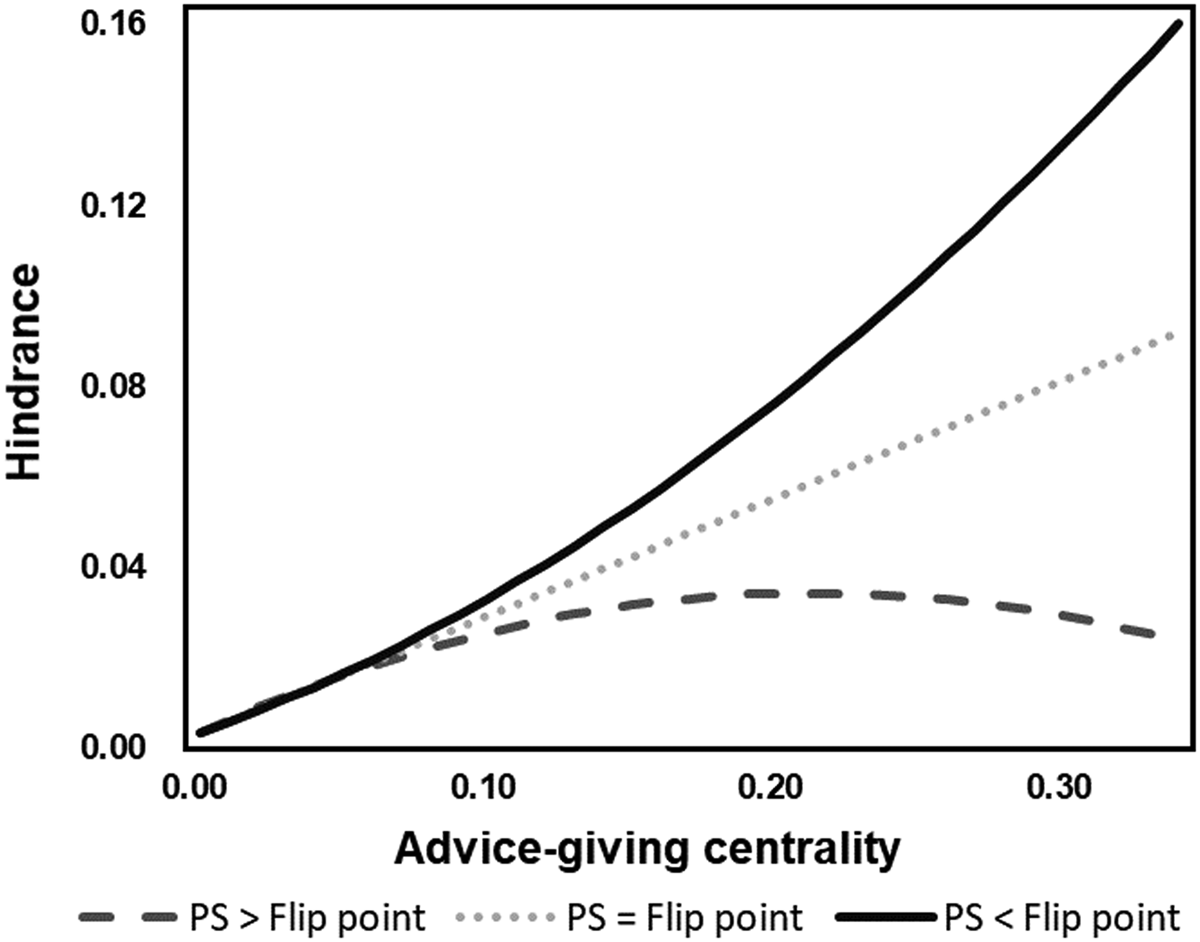
Model (4) of Table 3 includes the interaction of advice-giving centrality and its squared term with political skill. Results of Model (4) reveal that interaction between Political Skill and Advice-giving Centrality2 is negative and significant (B = −0.536, p < 0.01), while Advice-giving Centrality2 is positive and significant (B = 2.21, p < 0.05). Meanwhile, advice-giving centrality is non-significant. This indicates that political skill mitigates the exponentially positive association between advice-giving centrality and hindrance. Specifically, the association is flatter when political skill is high. Thus, Hypothesis 4 is supported.
In addition, the results imply that the relationship between advice-giving centrality and hindrance might change from convex to concave when political skill exceeds a certain threshold. To formally examine whether such a shape-flip indeed occurs as political skill increases within the effective data range of our research settings, we estimate the shape-flip point of political skill with$\;-\beta _{adv\;centrality^2}/\beta _{adv\;centrality^2 \times PS}$ (Haans et al., Reference Haans, Pieters and He2016). Our estimation shows that the shape-flip point of political skill is 4.122, and its 95% confidence interval is [3.582, 4.662], which is within the effective value range of political skill. This shows that the shape of the curvilinear relationship indeed changes as individuals’ political skill increases. For people with political skills lower than the flip point, an increase in advice-giving centrality will result in an exponential increase in hindrance. For people with political skills higher than the flip point, however, advice-giving centrality and hindrance exhibit a concave relationship. These findings are consistent with our arguments that the advantage of high political skill is most salient when advice-giving centrality is sufficiently high because only when the advice network is large and diverse enough can individuals with high political skills adequately leverage their large network. They can better perform their cooperative work so as to prevent themselves from becoming bottlenecks to others who depend on them.
The findings of a shape-flip depending on the level of one's political skill help to explain why we did not obtain results directly supporting Hypothesis 2. The curvilinear relationship between advice-giving centrality and hindrance exhibits only after considering the moderating effects of political skill. It appears that the concave relationship when one has high political skill offsets the convex relationship when one has low political skill, resulting in a linear relationship when the moderating effect of political skill is not considered. Figure 2 shows the relationships between advice-giving centrality and hindrance for those with political skill at, above, and below the shape-flip point.
Hindrance, advice-giving centrality, and political skills
Robustness Check
Endogeneity between advice-giving centrality and performance
Endogeneity may be an issue in our analysis as individuals with high performance are more visible in an organization and might attract more coworkers to seek advice (Oldroyd & Morris, Reference Oldroyd and Morris2012). We address the endogeneity issue in several ways. First, we use employees’ advice network information collected at the beginning of the year to predict their work performance evaluated at the end of the year. Furthermore, we explicitly asked respondents to indicate the advisors they approached in the previous year, ensuring that the advice network was based on the past year. Such a research design reduces endogeneity problems because one's future performance is not likely to affect one's advice-giving network centrality in the past.
In addition, endogeneity can be derived from unobserved individual characteristics that are correlated with both performance and advice-giving centrality. Hence, we apply instrumental variable correction in the estimation via two-stage least squares (2SLS). We select two instrumental variables: coworkers graduated from the same college and coworkers of similar age, which are likely to associate with advice-giving centrality but should not relate to the error term of our performance model. Specifically, coworkers graduated from the same college (CoworkerCollege) refers to the proportion of coworkers who graduated from the same college as the focal participants, while coworkers of similar age (CoworkerAge) refers to the proportion of coworkers whose age difference from the focal participant is no more than 2 years. Prior literature has shown that the formation of social networks is often characterized by homophily (McPherson, Smith-Lovin, & Cook, Reference McPherson, Smith-Lovin and Cook2001), and people tend to seek information from similar others (Klein, Lim, Saltz, & Mayer, Reference Klein, Lim, Saltz and Mayer2004). Hence, individuals with more coworkers who graduated from the same college or of similar age are more likely to be sought out for advice. Such demographic similarities, however, are unlikely to be associated with unobserved individual characteristics that affect performance.
We then conduct 2SLS to estimate the relationship between performance and advice-giving centrality. As our model contains the quadratic term of advice-giving centrality, we also include quadratic and interaction terms of our instrumental variables in the first-stage regression. The models are formulated as follows:


Equation (1) represents the first-stage regression, and equation (2) represents the second-stage regression. Exogenous variables in equation (1) refer to all exogenous variables in equation (2). $\widehat{{AdvGivingCentrality}}$ and $\widehat{{AdvGivingCentrality}}^2$
 in equation (2) represent the predicted value obtained from first-stage regressions. The results of OLS and 2SLS estimators are presented in Table 4.
Results addressing endogeneity with 2SLS

Note: Standard errors are reported in () under each coefficient.
According to the 2SLS estimator in Model (2), advice-giving centrality is positive and significant (B = 32.082, p < 0.05), and the quadratic term of advice-giving centrality is negative and significant (B = −91.987, p < 0.05). It indicates that the curvilinear relationship between advice-giving centrality and performance remains even after ruling out the potential endogeneity between them. We conduct the Sargan test for over-identification to ensure the selected instrumental variables are exogenous to the error $\varepsilon$ in second-stage regression (Sargan, Reference Sargan1958). The test fails to reject the null hypothesis that the instrumental variables are uncorrelated with the second-stage error (χ 2 = 1.329, p > 0.1), which does not violate the assumption that the instrumental variables are exogenous to the error in the second-stage regression. To further examine whether advice-giving centrality is indeed endogenous, we conduct the Hausman test to compare the 2SLS estimators with the OLS estimators. Results of the Hausman test fail to reject the null hypothesis that the coefficients derived from OLS and 2SLS are indifferent (χ 2 = 1.53, p > 0.1). Hence, we can infer that advice-giving network centrality is unlikely to be endogenous in our research. The OLS estimators adopted in our main analysis are efficient and consistent.
Performance measure
We validate our findings with a different performance measure proposed by Burt (Reference Burt1997). It captures an individual performance by comparing individuals’ actual bonus with the bonus predicted based on seniority. Specifically, for individuals from the same company and the same type of department, we regress their bonus on their tenure to predict their bonus. Then, we calculate the z-score of the residual to represent individual performance. A value of 0 indicates that the individual achieves average performance compared to employees working in the same company, for the same department type and tenure, while a value of 1 indicates that the individual performed one standard deviation better than the average. The results of the new performance measure are consistent with our main analysis.
Hindrance to other coworkers
The high correlation between hindrance to other coworkers and advice network giving centrality may raise concerns about whether individuals tend to nominate people they seek advice from a source of hindrance – thus resulting in a lack of discriminant validity between the two constructs. To allay this concern, we compare the participants’ nominations of hindrance with their nominations of people they seek advice from. Results show that 51.4% of the hindrance nominations are not nominated as people to whom they approach for advice, while 85.4% of the nominated advisers are not nominated as a hindrance. This pattern of findings shows that respondents do not necessarily select the same individual as an advisor and as a source of hindrance, thus suggesting that the two constructs are conceptually distinct.
We also calculate the QAP correlation of the hindrance and advice network, which examines the association between the pattern of advice-giving ties and the pattern of hindrance nominations. Results show that the QAP correlations between hindrance and advice network are 0.26 for JJMF and 0.25 for TEC, indicating that the pattern of hindrance is structurally different from the pattern of advice networks. Therefore, the overlap between hindrance nominations and advisor nominations does not explain the high correlation between hindrance and advice-giving centrality, indicating that the two constructs are empirically distinct.
Moreover, another important concern regarding the construct of hindrance to coworkers is that individuals may also nominate coworkers whom they do not depend on as sources of hindrance. Our findings are at risk of being driven by this type of hindrance nominations, which is not aligned with our theorization. To further validate our arguments, we conducted a robustness test that excludes hindrance nominations with little work interdependencies. Given that tasks within the same department are likely to be interdependent, we focus on examining the interdependencies of interdepartmental hindrance nominations. Specifically, our survey also invites participants to evaluate the extent that they rely on each of other departments to accomplish their work, and the extent that each of the other departments relies on them (rated on a 7-level Likert scale). Responses from 224 participants are then used to filter hindrance nominations. We retain hindrance nominations from a certain department when the nominated employees think the reliance of the department on them is at least 4, the midpoint of the evaluation scale. As a result, about 51% of cross-departmental hindrance nominations are excluded. The results of this hindrance measure are consistent with our main analysis.
In addition, we attempt to assess the department-level interdependency by aggregating the evaluations of employees from the same department and filter hindrance nominations based on the department-level interdependency. The interdependency of department A on department B is represented by the mean score of both evaluations from employees in department A and evaluations from employees in department B. If the aggregate interdependency score of department A on department B is lower than 4, the midpoint of the evaluation scale, hindrance nominations from employees in department A to employees in department B will be excluded. Consequently, about 37% cross-departmental hindrance nominations are dropped based on this criterion. Results based on this alternative hindrance measure are consistent with our main analysis, suggesting that high advice-giving centrality is likely to inhibit cooperation and pose hindrance among interdependent employees.
Advice-giving centrality
We calculate advice-giving centrality using the number of employees seeking advice from the focal individual. To validate the robustness of our findings, we use the frequency of contacts as the weight for each advice tie and calculate the weighted advice-giving centrality for each participant. This weighted advice-giving centrality can better capture the intensity or frequency that others seek out the focal individual for advice. Results with the weighted advice-giving centrality are consistent with our main analysis.
Sampling without top management
In the main analysis, our sample includes all participants we are able to access. Since top management may have a strong influence on their own performance evaluation and may not be comparable with other employees, we validate our findings by excluding four participants from top management. Results based on the new sample are consistent with our main analysis.
Detailed results and tables on the robustness tests with the different measures and samples above are included in Supplementary Material.
DISCUSSION
The conventional wisdom is that advice networks bring about benefits and are positively associated with individual performance (Ibarra & Andrews, Reference Ibarra and Andrews1993; Tsai & Ghoshal, Reference Tsai and Ghoshal1998). Our study builds upon recent studies that have shown a curvilinear relationship between network centrality and innovation performance from an information recipient's perspective (Paruchuri, Reference Paruchuri2010; Zhou et al., Reference Zhou, Shin, Brass, Choi and Zhang2009) by focusing on information providers whom others seek out for advice. We find that the inverted U-shaped relationship demonstrated in prior studies also applies to the relationship between advice-giving centrality and individual work performance. However, we fail to find evidence that political skill mitigates the negative effect of high advice-giving centrality on work performance. A possible explanation is that while politically skilled individuals can astutely recognize and differentiate the value of potential reciprocation of various additional advice ties, they may not always have the choice to reject advice ties due to the highly collectivistic culture in China. As a result, individuals are unable to leverage their political skills to increase the benefits and decrease the costs associated with a large advice-giving network as we expected.
In addition to work performance, our study examines another important type of outcome – the extent to which one poses a hindrance to others, which is an important component of contextual performance in the workplace. The study of hindrance in addition to individual work performance provides a more comprehensive examination of employees’ performance, as we take into consideration both their task performance and their contextual performance (e.g., providing assistance to others). As highlighted by Borman and Motowidlo (Reference Borman and Motowidlo1997), contextual performance can be even more crucial than task performance when employees work in teams. Our results indicate that individuals with high advice-giving centrality are more likely to impede coworkers whose work is dependent on them, suggesting that individuals maintaining a high level of advice-giving ties also risk becoming bottlenecks in their organization. Furthermore, by examining the moderating effect of political skill, we show that the impact of advice-giving centrality on hindrance is more nuanced. The relationship between advice-giving centrality and hindrance is curvilinear, and its shape is contingent on individuals’ political skill. Specifically, the relationship is concave for individuals with higher political skills and convex for individuals with lower political skills. This indicates that for individuals with low political skills, the increase of advice-giving centrality indeed brings exponentially increasing challenges to their contextual performance. On the other hand, politically skilled individuals are capable of effectively leveraging their large advice networks to fulfill the cooperative expectations of those interdependent coworkers.
Implications for Research
Our study makes several important contributions to enhance our understanding of performance implications of individuals’ social networks in contemporary firms. First, prior studies that demonstrate an inverted U-shaped relationship between network centrality and individual innovative performance tend to discuss information variety and overload from an information recipient's perspective (e.g., Chen & Gable, Reference Chen and Gable2013; Zhou et al., Reference Zhou, Shin, Brass, Choi and Zhang2009). Focusing on information providers, we highlight that the trade-off between costs and benefits for information providers can be better characterized and explained from a social exchange perspective. Building on the social exchange literature that emphasizes balancing the costs and benefits of favor exchanges at the dyadic level (Flynn, Reference Flynn2003), we examine the impact of aggregate level of advice-giving centrality on information provider's task performance. An aggregate level of analysis tests the argument that the marginal cost and benefit of providing advice are not constant. Our results show an inverted U-shaped relationship between advice-giving centrality and information provider's task performance, thus providing support for the argument. We thus raise awareness that central occupants of the advice network – while enjoying the benefits of having a large and influential network – may inadvertently compromise their own effort in completing their work tasks. By reconciling both the positive and negative impacts of advice-giving ties in the literature, our study highlights the need for future research to pay more attention to the dynamics of marginal benefit and cost associated with growing advice-giving centrality.
Second, we add to the growing body of research that shows the moderating effects of individual characteristics on one's ability to leverage the structural properties of their social networks (Baer, Reference Baer2010; Wei et al., Reference Wei, Chiang and Wu2012; Zhou et al., Reference Zhou, Shin, Brass, Choi and Zhang2009). While the existing literature emphasizes individual characteristics (e.g., openness to novel information) that help individuals to harness resources from their network position, our study focuses on individual interpersonal skills that help them to mitigate the potential downsides arising from their central network position. Building on the recognition that one's advice-giving ties may become a liability when they become too numerous (Oldroyd & Morris, Reference Oldroyd and Morris2012), our study reveals that individuals differ in their ability to turn potential favors into real benefits and to cope with requests from a large advice-giving network. Specifically, political skill plays a key role in helping individuals with a large advice-giving network avoid imposing hindrance on their coworkers. This finding echoes recent literature that examines how individual interpersonal skills mitigate the negative association between network centrality and thriving, a feeling of learning and vitality (Cullen et al., Reference Cullen, Gerbasi and Chrobot-Mason2018). By showing the moderating effect of political skill, we also provide further evidence that supports the use of a social exchange theoretical lens to the management of advice-giving ties.
Empirically, our study contributes to the social network literature by examining the effects of social networks on both objective employee performance and contextual performance. Using objective performance measures, we address the call to avoid using subjective ratings as a performance measure (Sparrowe et al., Reference Sparrowe, Liden, Wayne and Kraimer2001). We also examine the extent to which individuals with high advice-giving centrality may become a hindrance to other coworkers, an important aspect of contextual performance, which is relatively under-examined in the literature. This enhances our understanding of the negative consequences of a large advice-giving network that extends beyond one's task performance to their contextual performance.
Lastly, our study also contributes to the study of informal networks in a collectivistic culture like China (Horak et al., Reference Horak, Afiouni, Bian, Ledeneva, Muratbekova-Touron and Fey2020). Prior research integrating informal networks in China and social exchange theory tends to focus more on guanxi, a highly particular and sentimental type of social ties that facilitates the exchange of favor (Bian, Reference Bian2017). Their discussions on the negative aspects of informal networks are mostly related to favoritism or power abuse (Burzynska & Opper, Reference Burzynska and Opper2020; Chen, Reference Chen2020). Our study complements prior research by examining employee advice networks in Chinese firms, where the content of the tie is more instrumental and less sentimental. Hence, our research reveals another important aspect of the dark side of informal social networks – the dynamically changing marginal benefit and cost of growing network size as well as individuals’ inability to manage large networks.
Implications for Practice
Our study has significant practical implications. Unlike personality traits, which are enduring in nature, one's social network and political skills can be changed and nurtured over time (Wei et al., Reference Wei, Chiang and Wu2012). Since the expansion of advice-giving networks has its downsides, our research suggests that individuals need to consider the optimal size of their advice-giving networks they can manage. Meanwhile, when building and managing advice-giving ties, individuals should consider their interpersonal capabilities (e.g., political skills). Those individuals who already occupy central positions in an intraorganizational advice-giving network may need to develop their political skills intentionally and purposefully, so that they are more adept in managing the expanding interpersonal obligations and tapping on their network.
For organizations, our study has implications for employee recruitment, promotion, and training. Our study shows that individual advice-giving network is associated not only with performance but also with hindrance to others. Organizations should remain alert about whether those key employees whom others are dependent on are posing as a hindrance to others, which can reduce the effectiveness of groups or work units (Sparrowe et al., Reference Sparrowe, Liden, Wayne and Kraimer2001). Furthermore, our findings of such bottleneck effects could be especially important and relevant to China and many other emerging market countries. As the high power distance culture in these societies may inhibit individuals from expressing their difficulties and challenges (Botero & Van Dyne, Reference Botero and Van Dyne2009; Hsiung & Tsai, Reference Hsiung and Tsai2017), employees are negatively affected due to their inability to cope with an excessively large advice network, or hindered by coworkers may not provide timely report of these issues. Therefore, the downsides of a large advice network might be even more imperceptible and serious in China. Organizations should constantly assess if highly central star employees have the requisite interpersonal abilities to cope with their obligations and challenges associated with responding to coworkers’ advice requests and whether they require help to cultivate the necessary political skill.
Limitations and Future Research Directions
Despite the strengths and contributions of our study, there are a few limitations. One limitation is the correlational and cross-sectional nature of our data, which limits our ability to draw definitive conclusions about causality. The constraints and limitations of our data and research design prevent a more comprehensive empirical analysis that allows us to make causal claims for our hypothesized relationships. Hence, an important extension of our research would be to conduct longitudinal studies that allow for more rigorous testing of causality.
A second limitation is that we leveraged the social exchange theory perspective to explain the theoretical mechanisms for our hypotheses, but we did not provide direct empirical tests on the proposed mechanisms of how advice-giving centrality impacts performance due to our data constraints. As a supplement, we provide qualitative evidence from our interview quotes to show the disruptions and distractions derived from one's advice-giving ties. The qualitative evidence indirectly demonstrates the mechanisms, thus supporting the face validity of our hypothesized arguments. Nevertheless, it will be important for future research to test the underlying theoretical mechanisms proposed by social exchange theory.
A third limitation derives from our focus on two organizations, which might limit the generalizability of our findings to other organizations. In mitigation, the focus on a single organization is common in many network studies due to the demanding data collection efforts (e.g., Ferrin et al., Reference Ferrin, Dirks and Shah2006; Mehra et al., Reference Mehra, Dixon, Brass and Robertson2006). Furthermore, the organizational structure of the two organizations in our sample is typical of many other organizations in terms of its division of labor, which suggests that our findings are likely to apply to individuals in a wide range of organizations.
Finally, as our findings do not support the moderating effect of political skill on task performance, an important direction for future research is to explore potential moderators from other perspectives. For instance, the job demand-control theory (Karasek, Reference Karasek1979) suggests that job characteristics affect individuals’ mental strain and job dissatisfaction, which may also potentially moderate how one can effectively leverage one's advice-giving centrality. Hence, one worthwhile direction for future research could be to examine how one's job characteristics related to one's task demand may moderate the impact of one's advice-giving centrality.
CONCLUSION
Our study shows that the relationship between advice-giving centrality and work performance has an inverted U-shape relationship, and we find that an increase in advice-giving centrality also increases the likelihood of individuals becoming a hindrance to others. These findings provide further evidence of the detrimental effect of social capital (Oldroyd & Morris, Reference Oldroyd and Morris2012). We also show that the association between advice-giving centrality and hindrance to others is contingent on employees’ political skill. The findings indicate that one's political skill enables them to better manage the interpersonal challenges as well as gain the advantages associated with a large advice-giving network. In this light, we contribute to a key area that has been hitherto largely unexplored in the literature, which is how individual interpersonal abilities reduce the downsides of large advice-giving networks.
DATA AVAILABILITY STATEMENT
The relevant data (excluding sensitive variables), Stata code, and Supplementary Material (including questionnaire items and robustness tests) are openly available in Open Science Framework at http://doi.org/10.17605/OSF.IO/KFD9T
SUPPLEMENTARY MATERIAL
The supplementary material for this article can be found at https://doi.org/10.1017/mor.2023.6


 Open access

