





1 Introduction
1.1 Prologue
This paper has two goals. Our immediate goal is to prove some new properties of the p-adic Jacquet-Langlands functor defined by Scholze. Unlike the classical Jacquet-Langlands correspondence, which is defined by a simple character identity, Scholze’s functor is defined inexplicitly, and has turned out to be rather difficult to study. Scholze himself proved a basic finiteness theorem, and established a local-global compatibility result in some cases. We reprove Scholze’s finiteness theorem, and prove a duality theorem and a kind of ‘partial’ Künneth formula. As consequences, we deduce bounds on Gelfand-Kirillov dimension and prove some new vanishing and nonvanishing results for Scholze’s functor.
To explain our second goal, let us briefly recall some recent history. The study of the classical local Langlands correspondence has recently been given new life through the geometrization program proposed by Fargues [Reference FarguesFar16]. This program has already seen spectacular success, most notably in the work of Fargues-Scholze [Reference Fargues and ScholzeFS21]. A key technical ingredient in this program is a sufficiently flexible six-functor formalism for $\ell $
-adic étale cohomology of diamonds and v-stacks. This formalism was developed by Scholze [Reference ScholzeSch18a], and then extended further in [Reference Gulotta, Hansen and WeinsteinGHW22].
$\ell $
-adic étale cohomology of diamonds and v-stacks. This formalism was developed by Scholze [Reference ScholzeSch18a], and then extended further in [Reference Gulotta, Hansen and WeinsteinGHW22].
Our second goal is to lay some technical foundations for the geometrization of the p-adic Langlands correspondence. In particular, we extend the p-adic six functor formalism developed in [Reference MannMan22] to allow certain stacky maps, in parallel with the extension provided in [Reference Gulotta, Hansen and WeinsteinGHW22], and show that classifying stacks of p-adic Lie groups fit perfectly into this formalism. This stacky six-functor machinery allows for an elegant formulation of the proof of our main results. With it in hand, one can also begin a meaningful study of p-adic sheaves on $\mathrm {Bun}_G$
.
$\mathrm {Bun}_G$
.
Remark 1.1. We prove p-cohomological smoothness of $\operatorname {Bun}_G$
in [Reference Anschütz, Le Bras and MannABM24], building on the ideas in this paper, and there is some further discussion there on how the mod p Langlands should behave. Moreover, we have recently made advances in the
$\operatorname {Bun}_G$
in [Reference Anschütz, Le Bras and MannABM24], building on the ideas in this paper, and there is some further discussion there on how the mod p Langlands should behave. Moreover, we have recently made advances in the $\ell $
-adic program and hope that some of the ideas there can be carried over to the p-adic world using the formalism built here.
$\ell $
-adic program and hope that some of the ideas there can be carried over to the p-adic world using the formalism built here.
1.2 Context and duality
Let us begin by recalling the classical Jacquet-Langlands correspondence. Fix a finite extension $F/\mathbf {Q}_p$
and an integer
$F/\mathbf {Q}_p$
and an integer $n>1$
. Set
$n>1$
. Set $G=\mathrm {GL}_n(F)$
, and let
$G=\mathrm {GL}_n(F)$
, and let $D/F$
be the central division algebra of invariant
$D/F$
be the central division algebra of invariant $1/n$
.
$1/n$
.
Theorem 1.2 (Jacquet-Langlands, Deligne-Kazhdan-Vignéras, Rogawski)
There is a natural bijection
 $$\begin{align*}\mathrm{JL} : \mathrm{Irr}_{L^2}(G) \overset{\sim}{\to} \mathrm{Irr}(D^\times) \end{align*}$$
from the irreducible essentially square-integrable complex representations of G to the irreducible representations of $D^\times $
, characterized by the requirement that
$D^\times $
, characterized by the requirement that $\chi _{\mathrm {JL}(\pi )}(g')=(-1)^{n-1} \chi _\pi (g)$
for all pairs of matching elliptic elements
$\chi _{\mathrm {JL}(\pi )}(g')=(-1)^{n-1} \chi _\pi (g)$
for all pairs of matching elliptic elements $g\in G$
and
$g\in G$
and $g'\in D^\times $
.
$g'\in D^\times $
.
This bijection is compatible with twisting and passing to contragredient representations.
A very similar statement holds with $\overline {\mathbf {F}_\ell }$
-coefficients instead of complex coefficients, cf. [Reference DatDat12].
$\overline {\mathbf {F}_\ell }$
-coefficients instead of complex coefficients, cf. [Reference DatDat12].
In recent years, a p-adic version of the Langlands program has emerged, many aspects of which are still conjectural. In the context of this program, a candidate for a p-adic Jacquet-Langlands functor has been proposed by Scholze [Reference ScholzeSch18b]. Let us begin by recalling the definition of Scholze’s functor. Set $C=\widehat {\overline {F}}$
, and let
$C=\widehat {\overline {F}}$
, and let $\mathcal {M}_{\infty }$
be the infinite level Lubin-Tate space over
$\mathcal {M}_{\infty }$
be the infinite level Lubin-Tate space over $\mathrm {Spa}\,C$
. Recall that this is a perfectoid space with commuting continuous actions of G and
$\mathrm {Spa}\,C$
. Recall that this is a perfectoid space with commuting continuous actions of G and $D^\times $
, and with a natural surjective period map
$D^\times $
, and with a natural surjective period map $\pi _{\mathrm {GH}}:\mathcal {M}_{\infty }\to \mathbf {P}_{C}^{n-1}$
. The period map
$\pi _{\mathrm {GH}}:\mathcal {M}_{\infty }\to \mathbf {P}_{C}^{n-1}$
. The period map $\pi _{\mathrm {GH}}$
is a G-torsor, and is
$\pi _{\mathrm {GH}}$
is a G-torsor, and is $D^\times $
-equivariant for a suitable action of
$D^\times $
-equivariant for a suitable action of $D^\times $
on projective space.
$D^\times $
on projective space.
Using this geometry, Scholze defines an exact functor, denoted $\pi \mapsto \mathcal {F}_{\pi }$
, from the category
$\pi \mapsto \mathcal {F}_{\pi }$
, from the category $\mathrm {Rep}_{\mathbf {F}_{p}}^{\mathrm {sm}}(G)$
of smooth G-representations towards the category of étale
$\mathrm {Rep}_{\mathbf {F}_{p}}^{\mathrm {sm}}(G)$
of smooth G-representations towards the category of étale $\mathbf {F}_{p}$
-sheaves on
$\mathbf {F}_{p}$
-sheaves on $\mathbf {P}_{C}^{n-1}$
. This functor is defined by a simple and explicit recipe: given any étale map
$\mathbf {P}_{C}^{n-1}$
. This functor is defined by a simple and explicit recipe: given any étale map $U\to \mathbf {P}_{C}^{n-1}$
, one defines
$U\to \mathbf {P}_{C}^{n-1}$
, one defines $\mathcal {F}_{\pi }(U)=\mathcal {C}_{G}(|U\times _{\mathbf {P}_{C}^{n-1}}\mathcal {M}_{\infty }|,\pi )$
. Since
$\mathcal {F}_{\pi }(U)=\mathcal {C}_{G}(|U\times _{\mathbf {P}_{C}^{n-1}}\mathcal {M}_{\infty }|,\pi )$
. Since $\pi _{\mathrm {GH}}$
is
$\pi _{\mathrm {GH}}$
is $D^\times $
-equivariant, the sheaf
$D^\times $
-equivariant, the sheaf $\mathcal {F}_\pi $
is also
$\mathcal {F}_\pi $
is also $D^\times $
-equivariant, and the étale cohomology groups
$D^\times $
-equivariant, and the étale cohomology groups
 $$\begin{align*}\mathcal{J}^{i}(\pi):=H^{i}(\mathbf{P}_{C}^{n-1},\mathcal{F}_{\pi})\end{align*}$$
are naturally smooth $D^\times $
-representations which also carry a natural action of the Weil group
$D^\times $
-representations which also carry a natural action of the Weil group $W_F$
. By general vanishing theorems (e.g. using [Reference HuberHub96, Corollary 2.8.3]), it is easy to see that
$W_F$
. By general vanishing theorems (e.g. using [Reference HuberHub96, Corollary 2.8.3]), it is easy to see that $\mathcal {J}^i(\pi )=0$
for all
$\mathcal {J}^i(\pi )=0$
for all $i>2n-2$
, and it is also easy to compute
$i>2n-2$
, and it is also easy to compute $\mathcal {J}^0(\pi )$
explicitly. However, these are the only obvious properties of
$\mathcal {J}^0(\pi )$
explicitly. However, these are the only obvious properties of $\mathcal {J}^i.$
One of the main results of [Reference ScholzeSch18b] is a highly nonobvious finiteness theorem: if
$\mathcal {J}^i.$
One of the main results of [Reference ScholzeSch18b] is a highly nonobvious finiteness theorem: if $\pi $
is an admissible G-representation, then also each
$\pi $
is an admissible G-representation, then also each $\mathcal {J}^i(\pi )$
is an admissible
$\mathcal {J}^i(\pi )$
is an admissible $D^\times $
-representation. As a key step in the proof of this finiteness result, Scholze also proved a form of the primitive comparison theorem: if
$D^\times $
-representation. As a key step in the proof of this finiteness result, Scholze also proved a form of the primitive comparison theorem: if $\pi $
is admissible, the natural map
$\pi $
is admissible, the natural map
 $$\begin{align*}H^{i}(\mathbf{P}_{C}^{n-1},\mathcal{F}_{\pi}) \otimes \mathcal{O}_C/p \to H^{i}(\mathbf{P}_{C}^{n-1},\mathcal{F}_{\pi} \otimes \mathcal{O}^+ /p) \end{align*}$$
is an almost isomorphism.
Consideration of simple examples shows that in general, $\mathcal {J}^i(\pi )$
can be nonzero for multiple values of i. As such, we prefer to package the individual cohomologies
$\mathcal {J}^i(\pi )$
can be nonzero for multiple values of i. As such, we prefer to package the individual cohomologies $\mathcal {J}^i$
into a single operation on the derived category. More precisely, by the exactness of the association
$\mathcal {J}^i$
into a single operation on the derived category. More precisely, by the exactness of the association $\pi \mapsto \mathcal {F}_\pi $
, it naturally upgrades to a functor
$\pi \mapsto \mathcal {F}_\pi $
, it naturally upgrades to a functor ${\mathcal {D}}(G):={\mathcal {D}}(\mathrm {Rep}_{\mathbf {F}_{p}}^{\mathrm {sm}}(G))\to {\mathcal {D}}(\mathbf {P}^{n-1}_{C,\mathrm {\acute {e}t}},\mathbf {F}_{p})$
, and we write
${\mathcal {D}}(G):={\mathcal {D}}(\mathrm {Rep}_{\mathbf {F}_{p}}^{\mathrm {sm}}(G))\to {\mathcal {D}}(\mathbf {P}^{n-1}_{C,\mathrm {\acute {e}t}},\mathbf {F}_{p})$
, and we write $\mathcal {J}$
for the composite functor
$\mathcal {J}$
for the composite functor
 $$\begin{align*}{\mathcal{D}}(G)\overset{V \mapsto \mathcal{F}_V}{\longrightarrow} {\mathcal{D}}(\mathbf{P}^{n-1}_{C,\mathrm{\acute{e}t}},\mathbf{F}_p)\overset{R\Gamma}{\to}{\mathcal{D}}(D^\times). \end{align*}$$
By the finiteness theorems mentioned above, the functor $\mathcal {J}$
preserves bounded complexes with admissible cohomology.
$\mathcal {J}$
preserves bounded complexes with admissible cohomology.
Now, one would guess that $\mathcal {J}$
intertwines some natural duality operation on G-representations and
$\mathcal {J}$
intertwines some natural duality operation on G-representations and $D^\times $
-representations. However, in stark contrast with the case of complex or
$D^\times $
-representations. However, in stark contrast with the case of complex or $\ell $
-adic representations, the naive functor of passing to smooth duals on mod-p representations of p-adic Lie groups is essentially useless. To remedy this, Kohlhaase has introduced a family of ‘derived’ smooth duality functors
$\ell $
-adic representations, the naive functor of passing to smooth duals on mod-p representations of p-adic Lie groups is essentially useless. To remedy this, Kohlhaase has introduced a family of ‘derived’ smooth duality functors $\mathcal {S}^i_H$
on the smooth mod-p representations of any p-adic Lie group H, which can be packaged into a single endofunctor
$\mathcal {S}^i_H$
on the smooth mod-p representations of any p-adic Lie group H, which can be packaged into a single endofunctor $\mathcal {S}_H: {\mathcal {D}}(H) \to {\mathcal {D}}(H)$
. This functor has excellent properties, which we review in §3.1 below.
$\mathcal {S}_H: {\mathcal {D}}(H) \to {\mathcal {D}}(H)$
. This functor has excellent properties, which we review in §3.1 below.
Our first main result can now be stated as follows.
Theorem 1.3. There is a natural equivalence $\mathcal {S}_{D^\times }\circ \mathcal {J}\cong (\mathcal {J}\circ \mathcal {S}_{G})[2n-2](n-1)$
of functors
$\mathcal {S}_{D^\times }\circ \mathcal {J}\cong (\mathcal {J}\circ \mathcal {S}_{G})[2n-2](n-1)$
of functors ${\mathcal {D}}_{\mathrm {adm}}(G)\to {\mathcal {D}}_{\mathrm {adm}}(D^\times )$
.
${\mathcal {D}}_{\mathrm {adm}}(G)\to {\mathcal {D}}_{\mathrm {adm}}(D^\times )$
.
In other words, Scholze’s functor $\mathcal {J}$
intertwines Kohlhaase’s derived duality on G-representations and
$\mathcal {J}$
intertwines Kohlhaase’s derived duality on G-representations and $D^\times $
-representations, up to an explicit shift and twist. This result was conjectured by the first author, after observing that for certain V’s arising from the completed cohomology of Shimura varieties, both
$D^\times $
-representations, up to an explicit shift and twist. This result was conjectured by the first author, after observing that for certain V’s arising from the completed cohomology of Shimura varieties, both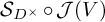 $\mathcal {S}_{D^\times }\circ \mathcal {J}(V)$
and
$\mathcal {S}_{D^\times }\circ \mathcal {J}(V)$
and $(\mathcal {J}\circ \mathcal {S}_{G})(V)[2n-2](n-1)$
can be computed by hand, and turn out to be abstractly isomorphic.
$(\mathcal {J}\circ \mathcal {S}_{G})(V)[2n-2](n-1)$
can be computed by hand, and turn out to be abstractly isomorphic.
In the remainder of this section, we give a detailed sketch of the proof of Theorem 1.3. The first key ingredient is a more conceptual interpretation of Kohlhaase’s derived duality functor.
Proposition 1.4. For any p-adic Lie group G, the functor $\mathcal {S}_G(-): {\mathcal {D}}(G) \to {\mathcal {D}}(G)$
is naturally isomorphic to the functor
$\mathcal {S}_G(-): {\mathcal {D}}(G) \to {\mathcal {D}}(G)$
is naturally isomorphic to the functor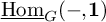 ${\underline {\operatorname {\mathrm {Hom}}}}_G(-,\mathbf {1})$
. Here
${\underline {\operatorname {\mathrm {Hom}}}}_G(-,\mathbf {1})$
. Here ${\underline {\operatorname {\mathrm {Hom}}}}_G$
denotes the natural internal Hom in
${\underline {\operatorname {\mathrm {Hom}}}}_G$
denotes the natural internal Hom in ${\mathcal {D}}(G)$
.
${\mathcal {D}}(G)$
.
Be aware that in this paper, ${\underline {\operatorname {\mathrm {Hom}}}}$
will always denote the derived internal hom (which is often denoted by
${\underline {\operatorname {\mathrm {Hom}}}}$
will always denote the derived internal hom (which is often denoted by $R{\underline {\operatorname {\mathrm {Hom}}}}$
in the literature) – see Section 1.5 for more remarks on that choice. In the case of mod-
$R{\underline {\operatorname {\mathrm {Hom}}}}$
in the literature) – see Section 1.5 for more remarks on that choice. In the case of mod- $\ell $
coefficients with
$\ell $
coefficients with $\ell \neq p$
,
$\ell \neq p$
, ${\underline {\operatorname {\mathrm {Hom}}}}_G(-,\mathbf {1})$
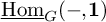
is actually t-exact and therefore restricts to a functor on the hearts, where it coincides with the usual functor of smooth duality (Proposition 3.5). In this light, Proposition 1.4 puts Kohlhaase’s duality on the same footing as classical smooth duality. We also note that Proposition 1.4 was independently discovered by Schneider-Sorensen [Reference Schneider and SorensenSS22].
${\underline {\operatorname {\mathrm {Hom}}}}_G(-,\mathbf {1})$
is actually t-exact and therefore restricts to a functor on the hearts, where it coincides with the usual functor of smooth duality (Proposition 3.5). In this light, Proposition 1.4 puts Kohlhaase’s duality on the same footing as classical smooth duality. We also note that Proposition 1.4 was independently discovered by Schneider-Sorensen [Reference Schneider and SorensenSS22].
Next, we invoke a slightly different formula for the functor $\mathcal {J}$
. For this, we briefly return to the geometry of the Lubin-Tate tower. Along with the surjective period map
$\mathcal {J}$
. For this, we briefly return to the geometry of the Lubin-Tate tower. Along with the surjective period map $\pi _{\mathrm {GH}}:\mathcal {M}_{\infty }\to \mathbf {P}_{C}^{n-1}$
mentioned earlier, there is a second period map
$\pi _{\mathrm {GH}}:\mathcal {M}_{\infty }\to \mathbf {P}_{C}^{n-1}$
mentioned earlier, there is a second period map $\pi _{\mathrm {HT}}:\mathcal {M}_{\infty }\to \Omega _{C}^{n-1}$
, presenting
$\pi _{\mathrm {HT}}:\mathcal {M}_{\infty }\to \Omega _{C}^{n-1}$
, presenting $\mathcal {M}_{\infty }$
as a
$\mathcal {M}_{\infty }$
as a $D^\times $
-torsor over Drinfeld space. Both period maps are
$D^\times $
-torsor over Drinfeld space. Both period maps are $G\times D^\times $
-equivariant, with G (resp.
$G\times D^\times $
-equivariant, with G (resp. $D^\times $
) acting trivially on
$D^\times $
) acting trivially on $\mathbf {P}_{C}^{n-1}$
(resp. on
$\mathbf {P}_{C}^{n-1}$
(resp. on $\Omega _{C}^{n-1}$
). In particular, we can pass to the stack quotient X of
$\Omega _{C}^{n-1}$
). In particular, we can pass to the stack quotient X of $\mathcal {M}_{\infty }$
by the whole
$\mathcal {M}_{\infty }$
by the whole $G\times D^\times $
-action, obtaining a small v-stack X which admits two natural presentations
$G\times D^\times $
-action, obtaining a small v-stack X which admits two natural presentations
 $$\begin{align*}X\cong[\mathbf{P}_{C}^{n-1}/\underline{D^\times}]\cong[\Omega_{C}^{n-1}/\underline{G}].\end{align*}$$
We think of this stack as sitting in a diagram

where f is smooth, and g is smooth and proper, with both maps being of pure relative dimension $n-1$
. Let us call this the fundamental diagram. Now, for any small v-stack X, the formalism in [Reference ScholzeSch18a] defines an associated category
$n-1$
. Let us call this the fundamental diagram. Now, for any small v-stack X, the formalism in [Reference ScholzeSch18a] defines an associated category $\mathcal {D}_{{\mathrm {\acute {e}t}}}(X,{\mathbf {F}}_p)$
of étale
$\mathcal {D}_{{\mathrm {\acute {e}t}}}(X,{\mathbf {F}}_p)$
of étale ${\mathbf {F}}_p$
-sheaves. We will see below (Proposition 3.9) that there is a natural identification
${\mathbf {F}}_p$
-sheaves. We will see below (Proposition 3.9) that there is a natural identification ${\mathcal {D}}(H) = \mathcal {D}_{{\mathrm {\acute {e}t}}}(B\underline {H},{\mathbf {F}}_p)$
of symmetric monoidal categories for any p-adic Lie group H. Under this identification, it is not hard to show that
${\mathcal {D}}(H) = \mathcal {D}_{{\mathrm {\acute {e}t}}}(B\underline {H},{\mathbf {F}}_p)$
of symmetric monoidal categories for any p-adic Lie group H. Under this identification, it is not hard to show that $\mathcal {J}$
is simply given by the operation
$\mathcal {J}$
is simply given by the operation $g_{{\mathrm {\acute {e}t}} \ast } f_{{\mathrm {\acute {e}t}}}^{\ast }$
(where by
$g_{{\mathrm {\acute {e}t}} \ast } f_{{\mathrm {\acute {e}t}}}^{\ast }$
(where by $g_{{\mathrm {\acute {e}t}}\ast }$
we denote the derived pushforward, often denoted
$g_{{\mathrm {\acute {e}t}}\ast }$
we denote the derived pushforward, often denoted $Rg_{{\mathrm {\acute {e}t}}\ast }$
– cf. Section 1.5). At this point, it is heuristically clear how the argument should go: f is smooth and g is proper smooth, so the operation
$Rg_{{\mathrm {\acute {e}t}}\ast }$
– cf. Section 1.5). At this point, it is heuristically clear how the argument should go: f is smooth and g is proper smooth, so the operation $g_{{\mathrm {\acute {e}t}} \ast } f_{{\mathrm {\acute {e}t}}}^{\ast }$
should commute with internal hom towards the monoidal unit, up to an explicit shift and twist. However, it is entirely unclear how to make this heuristic rigorous, because the
$g_{{\mathrm {\acute {e}t}} \ast } f_{{\mathrm {\acute {e}t}}}^{\ast }$
should commute with internal hom towards the monoidal unit, up to an explicit shift and twist. However, it is entirely unclear how to make this heuristic rigorous, because the $!$
-functors associated with the maps f and g are conspicuously absent from the
$!$
-functors associated with the maps f and g are conspicuously absent from the $\mathcal {D}_{{\mathrm {\acute {e}t}}}$
-formalism (Of course, this absence is a special feature of the
$\mathcal {D}_{{\mathrm {\acute {e}t}}}$
-formalism (Of course, this absence is a special feature of the $\ell =p$
setting of the present paper; one of the main points of [Reference ScholzeSch18a] is to construct the
$\ell =p$
setting of the present paper; one of the main points of [Reference ScholzeSch18a] is to construct the $!$
-functors in the
$!$
-functors in the $\mathcal {D}_{{\mathrm {\acute {e}t}}}$
-formalism when the coefficient ring is killed by an integer prime to p.).
$\mathcal {D}_{{\mathrm {\acute {e}t}}}$
-formalism when the coefficient ring is killed by an integer prime to p.).
The key new tool which lets us circumvent this issue is the formalism of solid almost $\mathcal {O}^+/p$
-sheaves recently developed by the second author [Reference MannMan22]. This is a theory which attaches to any small v-stack X over
$\mathcal {O}^+/p$
-sheaves recently developed by the second author [Reference MannMan22]. This is a theory which attaches to any small v-stack X over $\operatorname {\mathrm {Spa}} C$
a symmetric monoidal stable
$\operatorname {\mathrm {Spa}} C$
a symmetric monoidal stable $\infty $
-category
$\infty $
-category ${\mathcal {D}^a_{\square }}(\mathcal {O}^{+}_X/p)$
, whose objects are (to first approximation) complexes of solid quasicoherent almost
${\mathcal {D}^a_{\square }}(\mathcal {O}^{+}_X/p)$
, whose objects are (to first approximation) complexes of solid quasicoherent almost $\mathcal {O}^{+}_X/p$
-sheaves on the étale site of X. There is also a variant
$\mathcal {O}^{+}_X/p$
-sheaves on the étale site of X. There is also a variant 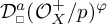 where the objects are equipped with a suitable $\varphi $
-module structure, which comes with an evident forgetful functor
$\varphi $
-module structure, which comes with an evident forgetful functor  . Crucially, the sheaf theories
  and
and 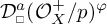 underlie full six functor formalisms, and all six functors are compatible with the operation of forgetting the $\varphi $
-module structure. In particular, for any map of small v-stacks
$\varphi $
-module structure. In particular, for any map of small v-stacks $f:X \to Y$
over
$f:X \to Y$
over $\operatorname {\mathrm {Spa}} C$
, we have functors
$\operatorname {\mathrm {Spa}} C$
, we have functors $f_{\ast }$
and
$f_{\ast }$
and $f^{\ast }$
, and if f is a so-called bdcs (‘p-bounded, locally compactifiable, and representable in locally spatial diamonds’.) map we also have functors
$f^{\ast }$
, and if f is a so-called bdcs (‘p-bounded, locally compactifiable, and representable in locally spatial diamonds’.) map we also have functors $f_!$
and
$f_!$
and $f^!$
with all expected properties. Moreover, there is a notion of p-cohomologically smooth maps, for which
$f^!$
with all expected properties. Moreover, there is a notion of p-cohomologically smooth maps, for which $f^!$
is an invertible twist of
$f^!$
is an invertible twist of $f^\ast $
. Finally, if H is a p-adic Lie group, there is a natural identification
$f^\ast $
. Finally, if H is a p-adic Lie group, there is a natural identification  , where the right-hand side denotes the derived $\infty $
-category of smooth H-representations on complexes of solid almost
$\infty $
-category of smooth H-representations on complexes of solid almost $\mathcal {O}_C / p$
-modules (and similarly with
$\mathcal {O}_C / p$
-modules (and similarly with $\varphi $
-structures).
$\varphi $
-structures).
Returning to the fundamental diagram, we can define a solid variant  of the functor $\mathcal {J}$
by the formula
$\mathcal {J}$
by the formula

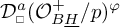
Using the formalism developed in [Reference MannMan22], it is entirely straightforward to prove a solid variant of our goal, i.e. an isomorphism  , where (for any p-adic Lie group H)
  denotes the internal hom towards the monoidal unit in
  . However, we have potentially lost sight of our goal of understanding duality for the functor $\mathcal {J}$
.
$\mathcal {J}$
.
At this point we use another key feature of the formalism developed in [Reference MannMan22], namely the p-torsion Riemann-Hilbert correspondence, which gives a fully faithful embedding  for any small v-stack X. Here the superscripted $\dagger $
denotes the restriction to the full subcategory of overconvergent sheaves. This embedding comes with a right adjoint
$\dagger $
denotes the restriction to the full subcategory of overconvergent sheaves. This embedding comes with a right adjoint $M\to M^\varphi $
which is (morally) the functor of
$M\to M^\varphi $
which is (morally) the functor of $\varphi $
-invariants. Using the basic properties of these functors, it is formal to check that
$\varphi $
-invariants. Using the basic properties of these functors, it is formal to check that $\mathcal {J}$
can be recovered from
$\mathcal {J}$
can be recovered from  , in the sense that
  for any $A \in {\mathcal {D}}(G) = \mathcal {D}_{{\mathrm {\acute {e}t}}}(B\underline {G},{\mathbf {F}}_p)^{\dagger }$
. We now apply a key new result, Proposition 3.26, which gives a practical criterion for an object
$A \in {\mathcal {D}}(G) = \mathcal {D}_{{\mathrm {\acute {e}t}}}(B\underline {G},{\mathbf {F}}_p)^{\dagger }$
. We now apply a key new result, Proposition 3.26, which gives a practical criterion for an object  to arise from a bounded admissible complex in ${\mathcal {D}}(H)$
via the Riemann-Hilbert embedding, and shows that in this case the solid dual
${\mathcal {D}}(H)$
via the Riemann-Hilbert embedding, and shows that in this case the solid dual  is the Riemann-Hilbert embedding of the smooth dual $\mathcal {S}_H$
. It turns out that in order to apply this criterion to
$\mathcal {S}_H$
. It turns out that in order to apply this criterion to  , we only need to know two things:
-
(1)
 preserves discrete objects, and
 -
(2) for any admissible
$A\in {\mathcal {D}}(G)$
, is isomorphic to its solid double dual.
 preserves discrete objects, and
 is isomorphic to its solid double dual.
We now conclude by noting that (1) is formal, and (2) is a consequence of the solid duality theorem. For the details of this argument, see Theorem 4.3 and its proof.
Let us emphasize that in the course of running this argument, we will reprove Scholze’s finiteness and primitive comparison theorems for $\mathcal {J}$
. Just as in Scholze’s proof, the key point here is the properness of
$\mathcal {J}$
. Just as in Scholze’s proof, the key point here is the properness of $\mathbf {P}^{n-1}_{C}$
, or equivalently the properness of the map g. However, Scholze exploits this properness in a very indirect way, by a Cartan-Serre style argument with shrinking covers and an elaborate use of spectral sequences. For us, the properness of g is used entirely through the identification
$\mathbf {P}^{n-1}_{C}$
, or equivalently the properness of the map g. However, Scholze exploits this properness in a very indirect way, by a Cartan-Serre style argument with shrinking covers and an elaborate use of spectral sequences. For us, the properness of g is used entirely through the identification $g_!=g_{\ast }$
.
$g_!=g_{\ast }$
.
1.3 The stacky 6-functor formalism
In the process of proving our main results we also extend the 6-functor formalism from [Reference MannMan22] to ‘stacky’ maps and study the behavior of this extended 6-functor formalism in the setting of classifying stacks. More concretely, we say that a map $f\colon Y \to X$
of small v-stacks is p-fine if it admits a cover
$f\colon Y \to X$
of small v-stacks is p-fine if it admits a cover $g\colon Z \to Y$
such that g admits universal p-codescent and
$g\colon Z \to Y$
such that g admits universal p-codescent and $f \mathbin {\circ } g$
is bdcs (see Definition 2.5). Using the results on abstract 6-functor formalisms in [Reference MannMan22], it is formal that the 6-functor formalism extends to p-fine maps, i.e. to any p-fine map f we get associated functors
$f \mathbin {\circ } g$
is bdcs (see Definition 2.5). Using the results on abstract 6-functor formalisms in [Reference MannMan22], it is formal that the 6-functor formalism extends to p-fine maps, i.e. to any p-fine map f we get associated functors $f_!$
and
$f_!$
and $f^!$
with all the expected properties. The typical example of a map satisfying universal p-codescent is a p-cohomologically smooth cover, but it is important to not restrict to smooth covers in the definition of p-fine maps.
$f^!$
with all the expected properties. The typical example of a map satisfying universal p-codescent is a p-cohomologically smooth cover, but it is important to not restrict to smooth covers in the definition of p-fine maps.
Now, if G is a profinite group which has finite p-cohomological dimension, we prove that the structure map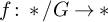 $f\colon */G \to *$
is p-fine and that
$f\colon */G \to *$
is p-fine and that $f_! = f_*$
(see Corollary 3.12). The key point here is to show that the obvious cover
$f_! = f_*$
(see Corollary 3.12). The key point here is to show that the obvious cover $* \to */G$
, which is not p-cohomologically smooth, nevertheless admits universal p-codescent (see Lemma 3.11); the argument for this crucially uses Mathew’s notion of descendability. This result easily implies that for all locally profinite groups G which locally have finite p-cohomological dimension, the map
$* \to */G$
, which is not p-cohomologically smooth, nevertheless admits universal p-codescent (see Lemma 3.11); the argument for this crucially uses Mathew’s notion of descendability. This result easily implies that for all locally profinite groups G which locally have finite p-cohomological dimension, the map $*/G \to *$
is p-fine. Moreover, we provide a precise criterion on G determining whether or not
$*/G \to *$
is p-fine. Moreover, we provide a precise criterion on G determining whether or not $*/G \to *$
is p-cohomologically smooth (see Theorem 3.16). If this is the case then we say that G is virtually p-Poincaré. Using classical results of Lazard [Reference LazardLaz65], we show that every p-adic Lie group G is virtually p-Poincaré (see Theorem 3.18), so that for these groups the associated map
$*/G \to *$
is p-cohomologically smooth (see Theorem 3.16). If this is the case then we say that G is virtually p-Poincaré. Using classical results of Lazard [Reference LazardLaz65], we show that every p-adic Lie group G is virtually p-Poincaré (see Theorem 3.18), so that for these groups the associated map $*/G \to *$
is p-cohomologically smooth. This applies to groups like
$*/G \to *$
is p-cohomologically smooth. This applies to groups like $\operatorname {\mathrm {GL}}_n({\mathbf {Q}}_p)$
and
$\operatorname {\mathrm {GL}}_n({\mathbf {Q}}_p)$
and $D^\times $
. With these results in hand, we deduce a p-adic version of the
$D^\times $
. With these results in hand, we deduce a p-adic version of the $\ell $
-adic smoothness criterion [Reference ScholzeSch18a, Proposition 24.2]:
$\ell $
-adic smoothness criterion [Reference ScholzeSch18a, Proposition 24.2]:
Proposition 1.5 (see Corollary 3.17)
Let G be a locally profinite group which is virtually p-Poincaré (e.g. G could be any p-adic Lie group). Suppose G acts on a small v-stack Y and $f\colon Y \to X$
is a G-equivariant separated bdcs map of small v-stacks, where G acts trivially on X. Then the induced map
$f\colon Y \to X$
is a G-equivariant separated bdcs map of small v-stacks, where G acts trivially on X. Then the induced map $Y/G \to X$
is p-fine, and it is p-cohomologically smooth as soon as f is p-cohomologically smooth.
$Y/G \to X$
is p-fine, and it is p-cohomologically smooth as soon as f is p-cohomologically smooth.
Note that in the $\ell $
-adic case, one proves [Reference ScholzeSch18a, Proposition 24.2] directly, and then deduces that classifying stacks of p-adic Lie groups are
$\ell $
-adic case, one proves [Reference ScholzeSch18a, Proposition 24.2] directly, and then deduces that classifying stacks of p-adic Lie groups are $\ell $
-cohomologically smooth. Such a direct argument seems very unlikely in the p-adic setting, due to the nonexistence of Haar measures.
$\ell $
-cohomologically smooth. Such a direct argument seems very unlikely in the p-adic setting, due to the nonexistence of Haar measures.
The above results on the stacky 6-functor formalism and classifying stacks are useful for proving the crucial Proposition 3.26. However, all we really need in that proof is the more classical statement that smooth group cohomology of p-adic Lie groups satisfies Poincaré duality (as proved by Lazard). The real power of the stacky 6-functor formalism will reveal itself when we apply it to $\mathrm {Bun}_G$
in subsequent papers.
$\mathrm {Bun}_G$
in subsequent papers.
1.4 Applications to representation theory
One of our main motivations for proving the duality theorem is that Kohlhaase’s duality functors are intimately related to the Gelfand-Kirillov dimension $\dim _G \pi $
of an admissible representation
$\dim _G \pi $
of an admissible representation $\pi $
. Recall that this is a nonnegative integer measuring the asymptotic size of
$\pi $
. Recall that this is a nonnegative integer measuring the asymptotic size of $\pi $
; for instance,
$\pi $
; for instance, $\dim _G \pi = 0$
exactly when
$\dim _G \pi = 0$
exactly when $\dim _{{\mathbf {F}}_p} \pi < \infty $
.
$\dim _{{\mathbf {F}}_p} \pi < \infty $
.
Computing the GK dimension of admissible representations arising in nature is generally quite difficult. However, our duality theorem gives a powerful tool for understanding how the functor $\mathcal {J}$
interacts with Gelfand-Kirillov dimension. Our first application in this direction is the following result, which gives a quantitative form of Scholze’s finiteness theorem.
$\mathcal {J}$
interacts with Gelfand-Kirillov dimension. Our first application in this direction is the following result, which gives a quantitative form of Scholze’s finiteness theorem.
Theorem 1.6. Let $\pi $
be an admissible smooth
$\pi $
be an admissible smooth $G=\mathrm {GL}_{n}(F)$
-representation, and let
$G=\mathrm {GL}_{n}(F)$
-representation, and let $N_{\pi }\geq 0$
be the least integer such that
$N_{\pi }\geq 0$
be the least integer such that $\mathcal {J}^{i}(\pi )=0$
for all
$\mathcal {J}^{i}(\pi )=0$
for all $i>N_{\pi }$
. Then
$i>N_{\pi }$
. Then
 $$\begin{align*}\dim_{D^{\times}}\mathcal{J}^{i}(\pi)\leq\dim_{G}(\pi)+N_{\pi} \end{align*}$$
for all i. In particular, since $N_{\pi }\leq 2n-2$
, we have
$N_{\pi }\leq 2n-2$
, we have
 $$\begin{align*}\dim_{D^{\times}}\mathcal{J}^{i}(\pi)\le\dim_{G}(\pi)+2n-2 \end{align*}$$
for all $\pi $
and all i.
$\pi $
and all i.
Note that the possible increase of dimension by $2n-2$
is quite small compared to the maximal Gelfand-Kirillov dimension in this setting, which is
$2n-2$
is quite small compared to the maximal Gelfand-Kirillov dimension in this setting, which is $\dim G = \dim D^\times = n^2[F:\mathbf {Q}_p]$
. Nevertheless, we conjecture that Theorem 1.6 is not optimal, and that in fact one always has an inequality
$\dim G = \dim D^\times = n^2[F:\mathbf {Q}_p]$
. Nevertheless, we conjecture that Theorem 1.6 is not optimal, and that in fact one always has an inequality
 $$\begin{align*}\dim_{D^{\times}}\mathcal{J}^{i}(\pi)\leq\dim_{G}(\pi),\end{align*}$$
cf. Conjecture 4.7 below. This conjecture in turn implies that $\mathcal {J}^{2n-2}(\pi )$
is always a finite-dimensional vector space, which can be computed explicitly (Proposition 4.9).
$\mathcal {J}^{2n-2}(\pi )$
is always a finite-dimensional vector space, which can be computed explicitly (Proposition 4.9).
Under a stronger assumption on $\pi $
, we can also prove a bound in the other direction, namely that for some i the association
$\pi $
, we can also prove a bound in the other direction, namely that for some i the association $\pi \rightsquigarrow \mathcal {J}^i(\pi )$
cannot decrease the GK dimension by very much. Here is a precise statement.
$\pi \rightsquigarrow \mathcal {J}^i(\pi )$
cannot decrease the GK dimension by very much. Here is a precise statement.
Theorem 1.7. Let $\pi $
be an admissible smooth G-representation which is Cohen-Macaulay in the sense that
$\pi $
be an admissible smooth G-representation which is Cohen-Macaulay in the sense that $\mathcal {S}_{G}^i(\pi )$
is nonzero for a single value of i. Then either
$\mathcal {S}_{G}^i(\pi )$
is nonzero for a single value of i. Then either $\mathcal {J}(\pi )=0$
or
$\mathcal {J}(\pi )=0$
or
 $$\begin{align*}\max_i \dim_{D^\times} \mathcal{J}^i(\pi) \geq \dim_G \pi - (2n-2). \end{align*}$$
We note that the Cohen-Macaulay condition is often satisfied in practice, and is preserved by parabolic induction.
The duality theorem is even more useful when combined with nontrivial vanishing theorems for $\mathcal {J}$
. To illustrate this, we now specialize to the case
$\mathcal {J}$
. To illustrate this, we now specialize to the case $n=2$
, but with
$n=2$
, but with $F/\mathbf {Q}_{p}$
still arbitrary. Set
$F/\mathbf {Q}_{p}$
still arbitrary. Set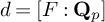 $d=[F:\mathbf {Q}_{p}]$
. Let
$d=[F:\mathbf {Q}_{p}]$
. Let $B\subset G=\mathrm {GL}_{2}(F)$
be the upper-triangular Borel subgroup, with
$B\subset G=\mathrm {GL}_{2}(F)$
be the upper-triangular Borel subgroup, with $T=F^{\times }\times F^{\times }\subset B$
the diagonal maximal torus. For any smooth characters
$T=F^{\times }\times F^{\times }\subset B$
the diagonal maximal torus. For any smooth characters $\chi _1,\chi _2:F^\times \to {\mathbf {F}}_p ^\times $
, we have the usual parabolic induction
$\chi _1,\chi _2:F^\times \to {\mathbf {F}}_p ^\times $
, we have the usual parabolic induction $\pi (\chi _{1},\chi _{2})=\mathrm {Ind}_{B}^{G}(\omega \chi _{1}\otimes \chi _{2})$
, where
$\pi (\chi _{1},\chi _{2})=\mathrm {Ind}_{B}^{G}(\omega \chi _{1}\otimes \chi _{2})$
, where $\omega $
is the mod-p cyclotomic character. We assume that
$\omega $
is the mod-p cyclotomic character. We assume that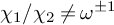 $\chi _1 / \chi _2 \neq \omega ^{\pm 1}$
. Then
$\chi _1 / \chi _2 \neq \omega ^{\pm 1}$
. Then $\pi (\chi _1,\chi _2)$
and
$\pi (\chi _1,\chi _2)$
and $\pi (\chi _2,\chi _1)$
are irreducible, and are exchanged by the functor
$\pi (\chi _2,\chi _1)$
are irreducible, and are exchanged by the functor $\mathcal {S}_G^d(-) \otimes (\chi _1 \chi _2 \omega \circ \det )$
. Moreover,
$\mathcal {S}_G^d(-) \otimes (\chi _1 \chi _2 \omega \circ \det )$
. Moreover, $\mathcal {S}_G^i(-)$
applied to either representation vanishes for all
$\mathcal {S}_G^i(-)$
applied to either representation vanishes for all $i\neq d$
.
$i\neq d$
.
By irreducibility, it is easy to see that $\mathcal {J}^0(\pi (\chi _1,\chi _2))=0$
, and likewise with the characters exchanged. Much less obviously, the main theorem of [Reference Johansson, Ludwig and HansenJLH21] shows also that
$\mathcal {J}^0(\pi (\chi _1,\chi _2))=0$
, and likewise with the characters exchanged. Much less obviously, the main theorem of [Reference Johansson, Ludwig and HansenJLH21] shows also that $\mathcal {J}^2(\pi (\chi _1,\chi _2))=0$
. With these vanishing results in mind, we define
$\mathcal {J}^2(\pi (\chi _1,\chi _2))=0$
. With these vanishing results in mind, we define
 $$\begin{align*}\tau(\chi_1,\chi_2) = \mathcal{J}^1(\pi(\chi_1,\chi_2)). \end{align*}$$
Our duality theorem then implies the following dichotomy.
Theorem 1.8. Notation and assumptions as above, exactly one of the following is true.
i. $\tau (\chi _1,\chi _2)= \tau (\chi _2,\chi _1)=0.$
ii. Both $\tau (\chi _1,\chi _2)$
and
$\tau (\chi _1,\chi _2)$
and $\tau (\chi _2,\chi _1)$
are nonzero, and are exchanged by the functor
$\tau (\chi _2,\chi _1)$
are nonzero, and are exchanged by the functor $\mathcal {S}_{D^\times }^d(-) \otimes (\chi _1 \chi _2 \omega \circ \mathrm {Nm})$
. In particular, they are both of GK dimension d. Moreover,
$\mathcal {S}_{D^\times }^d(-) \otimes (\chi _1 \chi _2 \omega \circ \mathrm {Nm})$
. In particular, they are both of GK dimension d. Moreover, $\mathcal {S}_{D^\times }^i(-)$
applied to either representation vanishes for all
$\mathcal {S}_{D^\times }^i(-)$
applied to either representation vanishes for all $i\neq d$
.
$i\neq d$
.
We conjecture that in fact scenario i. in this theorem never occurs. When $F=\mathbf {Q}_p$
and
$F=\mathbf {Q}_p$
and $p>3$
, this follows from work of Paškūnas [Reference PaškūnasPaš22], who showed by global methods that
$p>3$
, this follows from work of Paškūnas [Reference PaškūnasPaš22], who showed by global methods that $\tau (\chi _1,\chi _2)$
and
$\tau (\chi _1,\chi _2)$
and $\tau (\chi _2,\chi _1)$
cannot both vanish. Combining his results with the previous theorem yields the following corollary.
$\tau (\chi _2,\chi _1)$
cannot both vanish. Combining his results with the previous theorem yields the following corollary.
Corollary 1.9. Maintain the notation and assumptions above, and assume moreover that $F=\mathbf {Q}_p$
and
$F=\mathbf {Q}_p$
and $p>3$
. Then
$p>3$
. Then $\tau (\chi _1,\chi _2)$
and
$\tau (\chi _1,\chi _2)$
and $\tau (\chi _2,\chi _1)$
are nonzero, of GK dimension one, and are exchanged by the functor
$\tau (\chi _2,\chi _1)$
are nonzero, of GK dimension one, and are exchanged by the functor $\mathcal {S}_{D^\times }^1(-) \otimes (\chi _1 \chi _2 \omega \circ \mathrm {Nm})$
. Moreover,
$\mathcal {S}_{D^\times }^1(-) \otimes (\chi _1 \chi _2 \omega \circ \mathrm {Nm})$
. Moreover, $\mathcal {S}_{D^\times }^0(-)$
applied to either representation vanishes.
$\mathcal {S}_{D^\times }^0(-)$
applied to either representation vanishes.
We note that the final vanishing statement here has a more concrete interpretation: it simply means that $\tau (\chi _1,\chi _2)$
does not admit any nonzero H-stable quotient
$\tau (\chi _1,\chi _2)$
does not admit any nonzero H-stable quotient $\sigma $
with
$\sigma $
with $\dim _{{\mathbf {F}}_p} \sigma < \infty $
, for any open subgroup
$\dim _{{\mathbf {F}}_p} \sigma < \infty $
, for any open subgroup $H \subset D^\times $
(and similarly for
$H \subset D^\times $
(and similarly for $\tau (\chi _2,\chi _1)$
). Intuitively, this means that
$\tau (\chi _2,\chi _1)$
). Intuitively, this means that $\tau (\chi _1,\chi _2)$
is ‘maximally non-semisimple’. It would be very interesting to find an explicit construction of one-dimensional admissible representations of
$\tau (\chi _1,\chi _2)$
is ‘maximally non-semisimple’. It would be very interesting to find an explicit construction of one-dimensional admissible representations of $D^\times $
with this property. We also note that a similar but more complicated theorem holds in the setting of reducible principal series representations of
$D^\times $
with this property. We also note that a similar but more complicated theorem holds in the setting of reducible principal series representations of $\mathrm {GL}_2(\mathbf {Q}_p)$
; see §4.3.1 for details.
$\mathrm {GL}_2(\mathbf {Q}_p)$
; see §4.3.1 for details.
Our last result is an intriguing alternative formula for $\mathcal {J}(\pi )$
in the case where
$\mathcal {J}(\pi )$
in the case where $\pi $
is parabolically induced. To state this result, we momentarily change our notation slightly, to emphasize the dependence of the Jacquet-Langlands functor on the chosen integer n. More precisely, we write
$\pi $
is parabolically induced. To state this result, we momentarily change our notation slightly, to emphasize the dependence of the Jacquet-Langlands functor on the chosen integer n. More precisely, we write $\mathcal {J}_n$
for the Jacquet-Langlands functor from
$\mathcal {J}_n$
for the Jacquet-Langlands functor from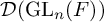 ${\mathcal {D}}(\mathrm {GL}_n(F))$
towards
${\mathcal {D}}(\mathrm {GL}_n(F))$
towards ${\mathcal {D}}(D_{1/n}^{\times })$
. Choose an integer
${\mathcal {D}}(D_{1/n}^{\times })$
. Choose an integer $0<d<n$
, and let
$0<d<n$
, and let $P_{n-d,d}\subset \mathrm {GL}_n(F)$
be the usual upper-triangular parabolic with Levi
$P_{n-d,d}\subset \mathrm {GL}_n(F)$
be the usual upper-triangular parabolic with Levi $\mathrm {GL}_{n-d}(F)\times \mathrm {GL}_d(F)$
. If
$\mathrm {GL}_{n-d}(F)\times \mathrm {GL}_d(F)$
. If $\sigma _1 \boxtimes \sigma _2$
is any smooth representation of the Levi, we write
$\sigma _1 \boxtimes \sigma _2$
is any smooth representation of the Levi, we write $\mathrm {Ind}_{P_{n-d,d}}^{\mathrm {GL}_n(F)}(\sigma _1 \boxtimes \sigma _2)$
for the usual parabolic induction to a smooth representation of
$\mathrm {Ind}_{P_{n-d,d}}^{\mathrm {GL}_n(F)}(\sigma _1 \boxtimes \sigma _2)$
for the usual parabolic induction to a smooth representation of $\mathrm {GL}_n(F)$
. In §5 below, we define a certain auxiliary spatial diamond
$\mathrm {GL}_n(F)$
. In §5 below, we define a certain auxiliary spatial diamond $W_{n,d}$
over
$W_{n,d}$
over $\operatorname {\mathrm {Spd}} C$
, which comes equipped with a natural
$\operatorname {\mathrm {Spd}} C$
, which comes equipped with a natural $D_{1/n}^\times $
-action as well as natural
$D_{1/n}^\times $
-action as well as natural $D_{1/n}^\times $
-equivariant maps
$D_{1/n}^\times $
-equivariant maps $h_1: W_{n,d} \to B\underline {\mathrm {GL}_{n-d}(F)}$
and
$h_1: W_{n,d} \to B\underline {\mathrm {GL}_{n-d}(F)}$
and $h_2: W_{n,d} \to B\underline {D_{1/d}^{\times }}$
. In the special case
$h_2: W_{n,d} \to B\underline {D_{1/d}^{\times }}$
. In the special case $d=1$
,
$d=1$
, $W_{n,1}$
is exactly the quotient
$W_{n,1}$
is exactly the quotient $\mathcal {M}_{P}=\mathcal {M}_\infty / \underline {P_{n-1,1}}$
studied in [Reference Johansson, Ludwig and HansenJLH21].
$\mathcal {M}_{P}=\mathcal {M}_\infty / \underline {P_{n-1,1}}$
studied in [Reference Johansson, Ludwig and HansenJLH21].
Theorem 1.10. Notation as above, there is a natural isomorphism
 $$\begin{align*}\mathcal{J}_n(\mathrm{Ind}_{P_{n-d,d}}^{\mathrm{GL}_n(F)}(\sigma_1 \boxtimes \sigma_2)) \cong R\Gamma(W_{n,d},h_{1, {\mathrm{\acute{e}t}}}^\ast \sigma_1 \otimes h_{2, {\mathrm{\acute{e}t}}}^\ast \mathcal{J}_d(\sigma_2)). \end{align*}$$
We like to think of this as a ‘partial’ Künneth formula. Although this theorem is logically independent of our other main results, the key point in the proof is still the new machinery provided by [Reference MannMan22].
Just as in [Reference Johansson, Ludwig and HansenJLH21], this alternative formula leads to new vanishing results. Here we state the simplest such corollary.
Corollary 1.11. Let $\pi $
be an irreducible admissible representation of
$\pi $
be an irreducible admissible representation of $\mathrm {GL}_3(F)$
which is not supersingular, and whose underlying vector space is infinite-dimensional. Then
$\mathrm {GL}_3(F)$
which is not supersingular, and whose underlying vector space is infinite-dimensional. Then $\mathcal {J}^{4}(\pi )=0$
.
$\mathcal {J}^{4}(\pi )=0$
.
1.5 A word on notation
This paper depends heavily on the mathematics developed in [Reference MannMan22]. However, since DH is less derived than LM, there are some small notational differences between [Reference MannMan22] and the present paper. In particular, we will write $R\mathrm {Hom}$
for the derived external Hom in any sheaf theory, and
$R\mathrm {Hom}$
for the derived external Hom in any sheaf theory, and $R\Gamma $
for derived global sections. These are notated as
$R\Gamma $
for derived global sections. These are notated as $\mathrm {Hom}$
and
$\mathrm {Hom}$
and $\Gamma $
in [Reference MannMan22]. On the other hand, we follow [Reference MannMan22] in writing
$\Gamma $
in [Reference MannMan22]. On the other hand, we follow [Reference MannMan22] in writing ${\underline {\operatorname {\mathrm {Hom}}}}$
for the derived internal Hom,
${\underline {\operatorname {\mathrm {Hom}}}}$
for the derived internal Hom, $f_{\ast }$
for derived pushforward, etc. We hope this does not cause any confusion.
$f_{\ast }$
for derived pushforward, etc. We hope this does not cause any confusion.
We also adapt some general terminology from [Reference MannMan22]: In a derived setting, we use the word ‘static’ to refer to objects that are concentrated in degree $0$
(e.g. a static object in
$0$
(e.g. a static object in ${\mathcal {D}}(\mathrm {Ab})$
is the same as an abelian group). In a condensed setting we use the word ‘discrete’ to indicate that the underlying condensed set comes from a discrete topological space. We sometimes use a subscript
${\mathcal {D}}(\mathrm {Ab})$
is the same as an abelian group). In a condensed setting we use the word ‘discrete’ to indicate that the underlying condensed set comes from a discrete topological space. We sometimes use a subscript $\omega $
to refer to the subcategory of discrete objects. For example, if
$\omega $
to refer to the subcategory of discrete objects. For example, if  denotes the derived category of solid abelian groups, then
  is the derived category of abelian groups.
2 Geometric preparations
In this section we recall the p-adic 6-functor formalism constructed in [Reference MannMan22] and extend it to a context where it can be applied to classifying stacks of p-adic Lie groups. In particular we extend the 6-functor formalism to incorporate shriek functors along ‘stacky’ maps, similar to the stacky extension of the $\ell $
-adic formalism provided in [Reference Gulotta, Hansen and WeinsteinGHW22].
$\ell $
-adic formalism provided in [Reference Gulotta, Hansen and WeinsteinGHW22].
2.1 Recollections on the solid six functors
We recall the p-adic 6-functor formalism on small v-stacks defined in [Reference MannMan22]. Let us first introduce the correct category of geometric objects to work with. In order to make sense of the sheaf ${\mathcal {O}}^+_X/\pi $
on a small v-stack, we need to choose an ‘untilt’
${\mathcal {O}}^+_X/\pi $
on a small v-stack, we need to choose an ‘untilt’ $X^\sharp $
of X (this is automatically chosen if X comes from an adic space over
$X^\sharp $
of X (this is automatically chosen if X comes from an adic space over ${\mathbf {Z}}_p$
) and a pseudouniformizer
${\mathbf {Z}}_p$
) and a pseudouniformizer $\pi $
on
$\pi $
on $X^\sharp $
. To make things more precise, we define an untilted small v-stack
$X^\sharp $
. To make things more precise, we define an untilted small v-stack $X^\sharp $
to be a small v-stack X together with a chosen map
$X^\sharp $
to be a small v-stack X together with a chosen map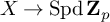 $X \to \operatorname {\mathrm {Spd}}{\mathbf {Z}}_p$
. For every map
$X \to \operatorname {\mathrm {Spd}}{\mathbf {Z}}_p$
. For every map $Y \to X$
from a perfectoid space Y to X, the untilt
$Y \to X$
from a perfectoid space Y to X, the untilt $X^\sharp $
induces an untilt
$X^\sharp $
induces an untilt $Y^\sharp $
(in the sense of perfectoid spaces) of Y. The untilted small v-stack
$Y^\sharp $
(in the sense of perfectoid spaces) of Y. The untilted small v-stack $X^\sharp $
comes equipped with a structure sheaf
$X^\sharp $
comes equipped with a structure sheaf ${\mathcal {O}}_{X^\sharp }$
and an integral structure sheaf
${\mathcal {O}}_{X^\sharp }$
and an integral structure sheaf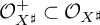 ${\mathcal {O}}^+_{X^\sharp } \subset {\mathcal {O}}_{X^\sharp }$
on
${\mathcal {O}}^+_{X^\sharp } \subset {\mathcal {O}}_{X^\sharp }$
on $X_{\mathrm {v}}$
such that on every affinoid perfectoid
$X_{\mathrm {v}}$
such that on every affinoid perfectoid $Y \in X_{\mathrm {v}}$
we have
$Y \in X_{\mathrm {v}}$
we have ${\mathcal {O}}_{X^\sharp }(Y) = {\mathcal {O}}_{Y^\sharp }(Y^\sharp )$
(and similarly for
${\mathcal {O}}_{X^\sharp }(Y) = {\mathcal {O}}_{Y^\sharp }(Y^\sharp )$
(and similarly for ${\mathcal {O}}^+_{X^\sharp }$
). A pseudouniformizer on
${\mathcal {O}}^+_{X^\sharp }$
). A pseudouniformizer on $X^\sharp $
is a sheaf of ideals
$X^\sharp $
is a sheaf of ideals $\pi \subset {\mathcal {O}}^+_{X^\sharp }$
such that for every affinoid perfectoid
$\pi \subset {\mathcal {O}}^+_{X^\sharp }$
such that for every affinoid perfectoid $Y = \operatorname {\mathrm {Spa}}(B, B^+) \in X_{\mathrm {v}}$
the restriction of
$Y = \operatorname {\mathrm {Spa}}(B, B^+) \in X_{\mathrm {v}}$
the restriction of $\pi $
to Y is a principal ideal and generated by a pseudouniformizer in
$\pi $
to Y is a principal ideal and generated by a pseudouniformizer in $B^{\sharp +}$
. We denote by
$B^{\sharp +}$
. We denote by ${{\rm vStack}^\sharp _\pi }$
the category of pairs
${{\rm vStack}^\sharp _\pi }$
the category of pairs $(X^\sharp , \pi )$
, where
$(X^\sharp , \pi )$
, where $X^\sharp $
is an untilted small v-stack and
$X^\sharp $
is an untilted small v-stack and $\pi $
is a pseudouniformizer on
$\pi $
is a pseudouniformizer on $X^\sharp $
. A map
$X^\sharp $
. A map $(Y^\sharp , \pi _Y) \to (X^\sharp , \pi _X)$
in
$(Y^\sharp , \pi _Y) \to (X^\sharp , \pi _X)$
in ${{\rm vStack}^\sharp _\pi }$
is a map of small v-stacks
${{\rm vStack}^\sharp _\pi }$
is a map of small v-stacks $Y \to X$
over
$Y \to X$
over $\operatorname {\mathrm {Spd}}{\mathbf {Z}}_p$
such that
$\operatorname {\mathrm {Spd}}{\mathbf {Z}}_p$
such that $\pi _X|_Y = \pi _Y$
.
$\pi _X|_Y = \pi _Y$
.
The first main result of [Reference MannMan22] is the following:
Theorem 2.1 (see [Reference MannMan22, Theorem 3.1.27])
There is a unique hypercomplete v-sheaf

such that for every untilted affinoid perfectoid space $X^\sharp = \operatorname {\mathrm {Spa}}(A^\sharp , A^{\sharp +})$
with pseudouniformizer
$X^\sharp = \operatorname {\mathrm {Spa}}(A^\sharp , A^{\sharp +})$
with pseudouniformizer $\pi \in A^{\sharp +}$
, where X is weakly of perfectly finite type over a totally disconnected space, we have
$\pi \in A^{\sharp +}$
, where X is weakly of perfectly finite type over a totally disconnected space, we have

Moreover, the pullback functors in this v-sheaf are induced by the solid base-change functors.
Here $\mathcal Cat_\infty ^\otimes $
denotes the
$\mathcal Cat_\infty ^\otimes $
denotes the $\infty $
-category of symmetric monoidal
$\infty $
-category of symmetric monoidal $\infty $
-categories and
$\infty $
-categories and 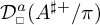 denotes the derived $\infty $
-category of solid almost
$\infty $
-category of solid almost $A^{\sharp +}/\pi $
-modules. The term ‘almost’ refers to the fact that we care about everything only up to
$A^{\sharp +}/\pi $
-modules. The term ‘almost’ refers to the fact that we care about everything only up to ${\mathfrak {m}}_{A^\sharp }$
-torsion. The term ‘solid’ was introduced by Clausen-Scholze in [Reference ScholzeSch19] and roughly means ‘complete topological’. See [Reference MannMan22, §2.2, §2.9] for the precise definition of
${\mathfrak {m}}_{A^\sharp }$
-torsion. The term ‘solid’ was introduced by Clausen-Scholze in [Reference ScholzeSch19] and roughly means ‘complete topological’. See [Reference MannMan22, §2.2, §2.9] for the precise definition of 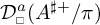 .
.
In the following we abstract a little further in order to simplify notation: We denote ${{\rm vStack}_\Lambda }$
the category of pairs
${{\rm vStack}_\Lambda }$
the category of pairs $(X, \Lambda )$
, where X is a small v-stack and
$(X, \Lambda )$
, where X is a small v-stack and $\Lambda $
is a system of integral torsion coefficients on X (see [Reference MannMan22, Definition 3.2.10]). The main example for
$\Lambda $
is a system of integral torsion coefficients on X (see [Reference MannMan22, Definition 3.2.10]). The main example for $\Lambda $
is
$\Lambda $
is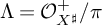 $\Lambda = {\mathcal {O}}^+_{X^\sharp }/\pi $
for an untilt
$\Lambda = {\mathcal {O}}^+_{X^\sharp }/\pi $
for an untilt $X^\sharp $
of X and a pseudouniformizer
$X^\sharp $
of X and a pseudouniformizer $\pi $
on
$\pi $
on $X^\sharp $
– the reader is invited to always assume this case and replace
$X^\sharp $
– the reader is invited to always assume this case and replace ${{\rm vStack}_\Lambda }$
by
${{\rm vStack}_\Lambda }$
by ${{\rm vStack}^\sharp _\pi }$
in the following (note that these two categories are not precisely the same, as the latter captures an untilt while the former only captures the relevant sheaf of coefficients). To every
${{\rm vStack}^\sharp _\pi }$
in the following (note that these two categories are not precisely the same, as the latter captures an untilt while the former only captures the relevant sheaf of coefficients). To every $(X,\Lambda ) \in {{\rm vStack}_\Lambda }$
one can then define the
$(X,\Lambda ) \in {{\rm vStack}_\Lambda }$
one can then define the $\infty $
-category
$\infty $
-category  in the same way as in Theorem 2.1.
The second main result of [Reference MannMan22] is the construction of a 6-functor formalism for the $\infty $
-categories
$\infty $
-categories  . In order to formulate it, let us recall the definition of an abstract 6-functor formalism from [Reference MannMan22, §A.5]: Suppose we are given an $\infty $
-category
$\infty $
-category $\mathcal C$
of geometric objects and a collection of edges E in
$\mathcal C$
of geometric objects and a collection of edges E in $\mathcal C$
which contains all isomorphisms and is stable under composition and pullback. To the pair
$\mathcal C$
which contains all isomorphisms and is stable under composition and pullback. To the pair $(\mathcal C, E)$
one can then associate an
$(\mathcal C, E)$
one can then associate an $\infty $
-operad
$\infty $
-operad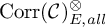 $\operatorname {\mathrm {Corr}}(\mathcal C)_{E,all}^\otimes $
which roughly has the following shape. The underlying
$\operatorname {\mathrm {Corr}}(\mathcal C)_{E,all}^\otimes $
which roughly has the following shape. The underlying $\infty $
-category
$\infty $
-category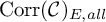 $\operatorname {\mathrm {Corr}}(\mathcal C)_{E,all}$
has as objects the same objects as
$\operatorname {\mathrm {Corr}}(\mathcal C)_{E,all}$
has as objects the same objects as $\mathcal C$
and as morphisms the diagrams of the form
$\mathcal C$
and as morphisms the diagrams of the form $Y \mathbin {\leftarrow } Y' \to X$
such that
$Y \mathbin {\leftarrow } Y' \to X$
such that $[Y' \to X] \in E$
, where the composition of morphisms is given by the obvious pullback diagrams. The operadic structure on
$[Y' \to X] \in E$
, where the composition of morphisms is given by the obvious pullback diagrams. The operadic structure on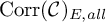 $\operatorname {\mathrm {Corr}}(\mathcal C)_{E,all}$
is roughly given by
$\operatorname {\mathrm {Corr}}(\mathcal C)_{E,all}$
is roughly given by $X \otimes Y = X \times Y$
(if
$X \otimes Y = X \times Y$
(if $\mathcal C$
admits products then this is literally true and
$\mathcal C$
admits products then this is literally true and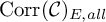 $\operatorname {\mathrm {Corr}}(\mathcal C)_{E,all}$
is a symmetric monoidal
$\operatorname {\mathrm {Corr}}(\mathcal C)_{E,all}$
is a symmetric monoidal $\infty $
-category). With this notation at hand, a pre-6-functor formalism on
$\infty $
-category). With this notation at hand, a pre-6-functor formalism on $(\mathcal C, E)$
is defined to be a map of
$(\mathcal C, E)$
is defined to be a map of $\infty $
-operads
$\infty $
-operads ${\mathcal {D}}\colon \operatorname {\mathrm {Corr}}(\mathcal C)_{E,all}^\otimes \to \mathcal Cat_\infty ^\times $
, where
${\mathcal {D}}\colon \operatorname {\mathrm {Corr}}(\mathcal C)_{E,all}^\otimes \to \mathcal Cat_\infty ^\times $
, where $\mathcal Cat_\infty ^\times $
denotes the cartesian structure on
$\mathcal Cat_\infty ^\times $
denotes the cartesian structure on $\mathcal Cat_\infty $
. Such a functor
$\mathcal Cat_\infty $
. Such a functor ${\mathcal {D}}$
encodes the following data: For every
${\mathcal {D}}$
encodes the following data: For every $X \in \mathcal C$
we get a symmetric monoidal
$X \in \mathcal C$
we get a symmetric monoidal $\infty $
-category
$\infty $
-category ${\mathcal {D}}(X)$
, for every morphism
${\mathcal {D}}(X)$
, for every morphism $f\colon Y \to X$
in
$f\colon Y \to X$
in $\mathcal C$
we get a symmetric monoidal functor
$\mathcal C$
we get a symmetric monoidal functor $f^*\colon {\mathcal {D}}(X) \to {\mathcal {D}}(Y)$
and for every morphism
$f^*\colon {\mathcal {D}}(X) \to {\mathcal {D}}(Y)$
and for every morphism $[f\colon Y \to X] \in E$
we get a functor
$[f\colon Y \to X] \in E$
we get a functor $f_!\colon {\mathcal {D}}(Y) \to {\mathcal {D}}(X)$
such that the functors
$f_!\colon {\mathcal {D}}(Y) \to {\mathcal {D}}(X)$
such that the functors $\otimes $
,
$\otimes $
, $f^*$
and
$f^*$
and $f_!$
satisfy the usual compatibilities. We say that
$f_!$
satisfy the usual compatibilities. We say that ${\mathcal {D}}$
is a 6-functor formalism if the functors
${\mathcal {D}}$
is a 6-functor formalism if the functors $\otimes $
,
$\otimes $
, $f^*$
and
$f^*$
and $f_!$
admit right adjoints.
$f_!$
admit right adjoints.
In the setting of the desired p-adic 6-functor formalism, we take $\mathcal C = {{\rm vStack}_\Lambda }$
and
$\mathcal C = {{\rm vStack}_\Lambda }$
and $E = bdcs$
, the class of those maps
$E = bdcs$
, the class of those maps $f\colon Y \to X$
of small v-stacks which are p-bounded (this roughly means that the map has finite p-cohomological dimension, see [Reference MannMan22, §3.5]), locally compactifiable and representable in locally spatial diamonds. The main result of [Reference MannMan22] now reads as follows:
$f\colon Y \to X$
of small v-stacks which are p-bounded (this roughly means that the map has finite p-cohomological dimension, see [Reference MannMan22, §3.5]), locally compactifiable and representable in locally spatial diamonds. The main result of [Reference MannMan22] now reads as follows:
Theorem 2.2 (see [Reference MannMan22, Theorem 3.6.12])
There is a 6-functor formalism

with the following properties:
-
(i) The symmetric monoidal
$\infty $
-categories and pullback functors
$f^*$
coincide with the version in Theorem 2.1. -
(ii) For every bdcs morphism
$f\colon Y \to X$
in
${{\rm vStack}_\Lambda }$
the functor has the following properties: If f is proper then
$f_! = f_*$
is right adjoint to
$f^*$
. If f is étale then
$f_!$
is left adjoint to
$f^*$
.

 and pullback functors


 has the following properties: If f is proper then


2.2 Six functors for stacky morphisms
In order to efficiently apply the above 6-functor formalism to representation theory, i.e. sheaves on classifying stacks, it is very useful to generalize the definition of the shriek functors $f_!$
and
$f_!$
and $f^!$
to a larger class of maps f. Namely, we need to allow certain ‘stacky’ maps f as well, similar to what is done in [Reference Gulotta, Hansen and WeinsteinGHW22].
$f^!$
to a larger class of maps f. Namely, we need to allow certain ‘stacky’ maps f as well, similar to what is done in [Reference Gulotta, Hansen and WeinsteinGHW22].
Definition 2.3. We say that a bdcs map $f\colon Y \to X$
of small v-stacks admits universal p-codescent if it satisfies the following property: Given any
$f\colon Y \to X$
of small v-stacks admits universal p-codescent if it satisfies the following property: Given any $(X', \Lambda ) \in {{\rm vStack}_\Lambda }$
which admits a map (in
$(X', \Lambda ) \in {{\rm vStack}_\Lambda }$
which admits a map (in ${{\rm vStack}_\Lambda }$
) to some strictly totally disconnected perfectoid space and given any map
${{\rm vStack}_\Lambda }$
) to some strictly totally disconnected perfectoid space and given any map $X' \to X$
with base-change
$X' \to X$
with base-change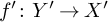 $f'\colon Y' \to X'$
and Čech nerve
$f'\colon Y' \to X'$
and Čech nerve $Y^{\prime }_\bullet \to X'$
the natural functor
$Y^{\prime }_\bullet \to X'$
the natural functor

is an equivalence. Here  denotes the functor
  ,
, $f \mapsto f^!$
.
$f \mapsto f^!$
.
Remark 2.4. The assumption that $(X', \Lambda )$
admits a map to some strictly totally disconnected perfectoid space is not necessary for the abstract theory of universal p-codescent, but it gives us more flexibility when showing that a map has this property, see the proof of Lemma 3.11.
$(X', \Lambda )$
admits a map to some strictly totally disconnected perfectoid space is not necessary for the abstract theory of universal p-codescent, but it gives us more flexibility when showing that a map has this property, see the proof of Lemma 3.11.
Definition 2.5. A map $f\colon Y \to X$
of small v-stacks is called p-fine if there is a map
$f\colon Y \to X$
of small v-stacks is called p-fine if there is a map $g\colon Z \to Y$
such that
$g\colon Z \to Y$
such that $f \mathbin {\circ } g$
is bdcs and g is bdcs and admits universal p-codescent.
$f \mathbin {\circ } g$
is bdcs and g is bdcs and admits universal p-codescent.
Lemma 2.6.
-
(i) The condition of being p-fine is étale local on source and target.
-
(ii) The collection of p-fine maps is stable under composition and base-change.
-
(iii) Every bdcs map is p-fine. In particular every étale map and every map of rigid varieties over a fixed base field is p-fine.
-
(iv) Let
$f\colon Y \to X$
and
$g\colon Z \to Y$
be maps of small v-stacks. If f and
$f \mathbin {\circ } g$
are p-fine, then so is g.


Proof. It follows from [Reference Liu and ZhengLZ17, Lemma 3.1.2.(4)] that bdcs maps admitting universal p-codescent are stable under composition. Part (ii) of the claim follows immediately and part (iii) is obvious (see [Reference MannMan22, Example 3.6.11] for the second claim in (iii)). Part (i) follows from the observation that étale maps admit universal p-codescent.
It remains to prove (iv), so let f and g be given as in the claim. Choose a bdcs map $Y' \to Y$
admitting universal p-codescent such that the composed map
$Y' \to Y$
admitting universal p-codescent such that the composed map $Y' \to X$
is bdcs. Denote
$Y' \to X$
is bdcs. Denote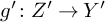 $g'\colon Z' \to Y'$
the base-change of g along
$g'\colon Z' \to Y'$
the base-change of g along $Y' \to Y$
. Since the map
$Y' \to Y$
. Since the map $Z' \to Z$
is bdcs, it follows from (ii) that the composed map
$Z' \to Z$
is bdcs, it follows from (ii) that the composed map $Z' \to X$
is p-fine. We can therefore choose a bdcs map
$Z' \to X$
is p-fine. We can therefore choose a bdcs map $Z" \to Z'$
admitting universal p-codescent such that
$Z" \to Z'$
admitting universal p-codescent such that $Z" \to X$
is bdcs. Note that the map
$Z" \to X$
is bdcs. Note that the map $Z" \to X$
factors as
$Z" \to X$
factors as $Z" \to Y' \to X$
and since
$Z" \to Y' \to X$
and since $Y' \to X$
is bdcs it follows from [Reference MannMan22, Lemma 3.6.10.(iv)] that
$Y' \to X$
is bdcs it follows from [Reference MannMan22, Lemma 3.6.10.(iv)] that $Z" \to Y'$
is bdcs. In particular
$Z" \to Y'$
is bdcs. In particular $Z" \to Y$
is bdcs, so the map
$Z" \to Y$
is bdcs, so the map $Z" \to Z$
shows that g is p-fine.
$Z" \to Z$
shows that g is p-fine.
It is completely formal that the p-adic 6-functor formalism extends to all p-fine maps (in fact a similar extension can be performed in any 6-functor formalism):
Proposition 2.7. The 6-functor formalism in Theorem 2.2 extends uniquely to a 6-functor formalism

where $pfine$
denotes the class of p-fine maps in
$pfine$
denotes the class of p-fine maps in ${{\rm vStack}_\Lambda }$
.
${{\rm vStack}_\Lambda }$
.
Proof. Let $\mathcal C \subset {{\rm vStack}_\Lambda }$
be the full subcategory spanned by those
$\mathcal C \subset {{\rm vStack}_\Lambda }$
be the full subcategory spanned by those $(X,\Lambda )$
which admit a map (in
$(X,\Lambda )$
which admit a map (in ${{\rm vStack}_\Lambda }$
) to some strictly totally disconnected space. Then
${{\rm vStack}_\Lambda }$
) to some strictly totally disconnected space. Then $\mathcal C$
is a basis of
$\mathcal C$
is a basis of ${{\rm vStack}_\Lambda }$
, hence by [Reference MannMan22, Proposition A.5.16] and [Reference MannMan22, Proposition A.3.11. (i)] it is enough to construct the desired extension of the 6-functor formalism on
${{\rm vStack}_\Lambda }$
, hence by [Reference MannMan22, Proposition A.5.16] and [Reference MannMan22, Proposition A.3.11. (i)] it is enough to construct the desired extension of the 6-functor formalism on $\mathcal C$
, i.e. we need to construct a 6-functor formalism
$\mathcal C$
, i.e. we need to construct a 6-functor formalism  extending the one from Theorem 2.2. We now apply [Reference MannMan22, Proposition A.5.14] with $E = bdcs$
,
$E = bdcs$
, $E' = pfine$
and
$E' = pfine$
and $S \subset E$
being the subset of those maps which admit universal p-codescent. Condition (a) requires
$S \subset E$
being the subset of those maps which admit universal p-codescent. Condition (a) requires  to be presentable, which can be achieved by temporarily restricting to $\kappa $
-condensed objects (as in the proof of [Reference MannMan22, Theorem 3.6.12]). Condition (b) follows from the definition of universal p-codescent, condition (c) follows from the definition of p-fine maps and condition (d) follows from [Reference MannMan22, Lemma 3.6.10] (see [Reference MannMan22, Remark A.5.15.(ii)].
$\kappa $
-condensed objects (as in the proof of [Reference MannMan22, Theorem 3.6.12]). Condition (b) follows from the definition of universal p-codescent, condition (c) follows from the definition of p-fine maps and condition (d) follows from [Reference MannMan22, Lemma 3.6.10] (see [Reference MannMan22, Remark A.5.15.(ii)].
Remark 2.8. More concretely, the shriek functor  along a p-fine map $f\colon Y \to X$
in
$f\colon Y \to X$
in ${{\rm vStack}_\Lambda }$
is computed as follows. Via v-descent we can reduce to the case that
${{\rm vStack}_\Lambda }$
is computed as follows. Via v-descent we can reduce to the case that $(X,\Lambda )$
admits a map to some strictly totally disconnected space. Now choose a bdcs map
$(X,\Lambda )$
admits a map to some strictly totally disconnected space. Now choose a bdcs map $g\colon Z \to Y$
such that g admits universal p-codescent and
$g\colon Z \to Y$
such that g admits universal p-codescent and $f \mathbin {\circ } g$
is bdcs. Let
$f \mathbin {\circ } g$
is bdcs. Let $g_\bullet \colon Z_\bullet \to Y$
denote the Čech nerve of g. It follows from the p-codescent property of g that for every
$g_\bullet \colon Z_\bullet \to Y$
denote the Čech nerve of g. It follows from the p-codescent property of g that for every  the natural map $\varinjlim _{n\in \Delta } g_{n!} g_n^! \mathcal M \mathbin {\xrightarrow {\sim }} \mathcal M$
is an isomorphism. Consequently we have
$\varinjlim _{n\in \Delta } g_{n!} g_n^! \mathcal M \mathbin {\xrightarrow {\sim }} \mathcal M$
is an isomorphism. Consequently we have
 $$ \begin{align*} f_! \mathcal M = f_! \varinjlim_{n\in\Delta} g_{n!} g_n^! \mathcal M = \varinjlim_{n\in\Delta} (f \mathbin{\circ} g_n)_! g_n^! \mathcal M. \end{align*} $$
Note that the maps $f \mathbin {\circ } g_n\colon Z_n \to X$
are bdcs, hence
$f \mathbin {\circ } g_n\colon Z_n \to X$
are bdcs, hence $(f \mathbin {\circ } g_n)_!$
was already defined in Theorem 2.2.
$(f \mathbin {\circ } g_n)_!$
was already defined in Theorem 2.2.
In order to make use of Proposition 2.7 we need a good amount of examples of bdcs maps admitting universal p-codescent. Arguably the most important class of such maps is formed by the p-cohomologically smooth maps (see [Reference MannMan22, Definition 3.8.1]). The following is an analog of [Reference Gulotta, Hansen and WeinsteinGHW22, Proposition 3.16]:
Lemma 2.9. Every bdcs and p-cohomologically smooth map of small v-stacks admits universal p-codescent.
Proof. Let $f\colon Y \to X$
be a bdcs and p-cohomologically smooth map in
$f\colon Y \to X$
be a bdcs and p-cohomologically smooth map in ${{\rm vStack}_\Lambda }$
with Čech nerve
${{\rm vStack}_\Lambda }$
with Čech nerve $f_\bullet \colon Y_\bullet \to X$
(i.e.
$f_\bullet \colon Y_\bullet \to X$
(i.e. $Y_0 = Y$
,
$Y_0 = Y$
, $Y_1 = Y \times _X Y$
and so on); we need to show that the natural functor
$Y_1 = Y \times _X Y$
and so on); we need to show that the natural functor  is an isomorphism. This functor admits a left adjoint

Note that $f_\bullet ^!$
is conservative: This follows from the fact that
$f_\bullet ^!$
is conservative: This follows from the fact that $f_0^!$
is conservative, which in turn is implied by the fact that
$f_0^!$
is conservative, which in turn is implied by the fact that $f_0^!$
is just a twist of
$f_0^!$
is just a twist of $f_0^*$
by definition of the p-cohomological smoothness of
$f_0^*$
by definition of the p-cohomological smoothness of $f_0$
. Thus in order to show that
$f_0$
. Thus in order to show that $f_\bullet ^!$
is an equivalence, it is enough to show that
$f_\bullet ^!$
is an equivalence, it is enough to show that $f_{\bullet !}$
is fully faithful (cf. [Reference LurieLur18, Corollary 03UZ]), i.e. for given
$f_{\bullet !}$
is fully faithful (cf. [Reference LurieLur18, Corollary 03UZ]), i.e. for given  we need to see that the natural map $f_\bullet ^! f_{\bullet !} \mathcal M_\bullet \mathbin {\xrightarrow {\sim }} \mathcal M_\bullet $
is an isomorphism. This boils down to showing that the map
$f_\bullet ^! f_{\bullet !} \mathcal M_\bullet \mathbin {\xrightarrow {\sim }} \mathcal M_\bullet $
is an isomorphism. This boils down to showing that the map $f_0^! f_{\bullet !} \mathcal M_\bullet \to \mathcal M_0$
is an isomorphism. Since
$f_0^! f_{\bullet !} \mathcal M_\bullet \to \mathcal M_0$
is an isomorphism. Since $f_0$
is p-cohomologically smooth,
$f_0$
is p-cohomologically smooth, $f_0^!$
preserves small colimits, so we end up with the claim that the natural map
$f_0^!$
preserves small colimits, so we end up with the claim that the natural map
 $$ \begin{align*} \varinjlim_{n\in\Delta} f_0^! f_{n!} \mathcal M_n \mathbin{\xrightarrow{\sim}} \mathcal M_0 \end{align*} $$
is an isomorphism. Let us denote by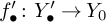 $f^{\prime }_\bullet \colon Y^{\prime }_\bullet \to Y_0$
the base-change of
$f^{\prime }_\bullet \colon Y^{\prime }_\bullet \to Y_0$
the base-change of $Y_\bullet \to X$
along
$Y_\bullet \to X$
along $f_0\colon Y_0 \to X$
. Denote
$f_0\colon Y_0 \to X$
. Denote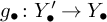 $g_\bullet \colon Y^{\prime }_\bullet \to Y_\bullet $
the natural projections. Then for every
$g_\bullet \colon Y^{\prime }_\bullet \to Y_\bullet $
the natural projections. Then for every $n \ge 0$
the natural morphism
$n \ge 0$
the natural morphism $f^{\prime }_{n!} g_n^! \mathcal M_n \mathbin {\xrightarrow {\sim }} f_0^! f_{n!}\mathcal M_n$
is an isomorphism (by p-cohomological smoothness of
$f^{\prime }_{n!} g_n^! \mathcal M_n \mathbin {\xrightarrow {\sim }} f_0^! f_{n!}\mathcal M_n$
is an isomorphism (by p-cohomological smoothness of $f_0$
and
$f_0$
and $g_n$
this reduces to proper base-change). On the other hand
$g_n$
this reduces to proper base-change). On the other hand $g_\bullet ^! \mathcal M_\bullet $
defines an object of
$g_\bullet ^! \mathcal M_\bullet $
defines an object of  so the above claimed isomorphism reduces to showing that the natural functor
  is an equivalence. This means that we can replace $Y_\bullet \to X$
by
$Y_\bullet \to X$
by $Y^{\prime }_\bullet \to Y_0$
. But the latter augmented simplicial object is split, hence the desired equivalence of
$Y^{\prime }_\bullet \to Y_0$
. But the latter augmented simplicial object is split, hence the desired equivalence of $\infty $
-categories is formal.
$\infty $
-categories is formal.
Let ${\rm vStack}^\sharp _{\pi |p} \subset {{\rm vStack}^\sharp _\pi }$
be the full subcategory spanned by those pairs
${\rm vStack}^\sharp _{\pi |p} \subset {{\rm vStack}^\sharp _\pi }$
be the full subcategory spanned by those pairs $(X^\sharp , \pi )$
such that
$(X^\sharp , \pi )$
such that $\pi | p$
. Recall the definition of the
$\pi | p$
. Recall the definition of the $\infty $
-category
$\infty $
-category 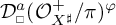 from [Reference MannMan22, Definition 3.9.10. (b)]: Roughly, this is the $\infty $
-category of pairs
$\infty $
-category of pairs $(\mathcal M, \varphi _{\mathcal M})$
where
$(\mathcal M, \varphi _{\mathcal M})$
where  and
and $\varphi _{\mathcal M}$
is an isomorphism
$\varphi _{\mathcal M}$
is an isomorphism $\varphi _{\mathcal M}\colon \varphi ^* \mathcal M \mathbin {\xrightarrow {\sim }} \mathcal M$
; here
$\varphi _{\mathcal M}\colon \varphi ^* \mathcal M \mathbin {\xrightarrow {\sim }} \mathcal M$
; here $\varphi $
denotes the Frobenius
$\varphi $
denotes the Frobenius $x \mapsto x^p$
on
$x \mapsto x^p$
on ${\mathcal {O}}^+_{X^\sharp }/\pi $
. The above constructed 6-functor formalism extends to
${\mathcal {O}}^+_{X^\sharp }/\pi $
. The above constructed 6-functor formalism extends to $\varphi $
-modules:
$\varphi $
-modules:
Proposition 2.10. The 6-functor formalism from Proposition 2.7 extends to a 6-functor formalism

The forgetful functor  preserves all small limits and colimits and commutes with the 6 functors $\otimes $
,
$\otimes $
, ${\underline {\operatorname {\mathrm {Hom}}}}$
,
${\underline {\operatorname {\mathrm {Hom}}}}$
, $f^*$
,
$f^*$
, $f_*$
,
$f_*$
, $f_!$
and
$f_!$
and $f^!$
.
$f^!$
.
Proof. By [Reference MannMan22, Proposition 3.9.13] the same is true for the 6-functor formalism on bdcs maps. To get this result also on p-fine maps, we note that the same extension procedure as in the proof of Proposition 2.7 applies verbatim to the $\varphi $
-module case so that we get the desired 6-functor formalism. By [Reference MannMan22, Proposition 3.9.13] and functoriality of Kan extensions the forgetful functor preserves small limits and colimits and commutes with all the 6 functors except possibly with
$\varphi $
-module case so that we get the desired 6-functor formalism. By [Reference MannMan22, Proposition 3.9.13] and functoriality of Kan extensions the forgetful functor preserves small limits and colimits and commutes with all the 6 functors except possibly with $f^!$
. To see that it also commutes with
$f^!$
. To see that it also commutes with $f^!$
, note first that by the same argument as in the proof of [Reference MannMan22, Lemma 3.9.12. (v)] we can reduce to the case that the target of
$f^!$
, note first that by the same argument as in the proof of [Reference MannMan22, Lemma 3.9.12. (v)] we can reduce to the case that the target of $f\colon Y \to X$
is a strictly totally disconnected space. Choose also a bdcs cover
$f\colon Y \to X$
is a strictly totally disconnected space. Choose also a bdcs cover $g\colon Z \mathrel {\twoheadrightarrow } Y$
such that g admits universal p-codescent and
$g\colon Z \mathrel {\twoheadrightarrow } Y$
such that g admits universal p-codescent and $f \mathbin {\circ } g$
is bdcs. Then by universal p-codescent the functor
$f \mathbin {\circ } g$
is bdcs. Then by universal p-codescent the functor $g^!$
is conservative, hence to check that
$g^!$
is conservative, hence to check that $f^!$
commutes with the forgetful functor it is enough to check that
$f^!$
commutes with the forgetful functor it is enough to check that $g^! f^!$
commutes with the forgetful functor. This follows from the bdcs case.
$g^! f^!$
commutes with the forgetful functor. This follows from the bdcs case.
In the following we will often omit the explicit mention of untilt and pseudouniformizer and simply write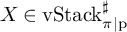 $X \in {\rm vStack}^\sharp _{\pi |\rm p}$
. The main reason for introducing
$X \in {\rm vStack}^\sharp _{\pi |\rm p}$
. The main reason for introducing $\varphi $
-modules is that they have a tight connection to actual étale
$\varphi $
-modules is that they have a tight connection to actual étale ${\mathbf {F}}_p$
-sheaves: The p-torsion Riemann-Hilbert correspondence (see [Reference MannMan22, Theorem 3.9.23]) tells us that for
${\mathbf {F}}_p$
-sheaves: The p-torsion Riemann-Hilbert correspondence (see [Reference MannMan22, Theorem 3.9.23]) tells us that for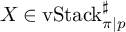 $X \in {\rm vStack}^\sharp _{\pi |p}$
there is a natural fully faithful embedding
$X \in {\rm vStack}^\sharp _{\pi |p}$
there is a natural fully faithful embedding

which induces an equivalence of dualizable objects on both sides. Here ${\mathcal {D}}_{\mathrm {\acute {e}t}}(X,{\mathbf {F}}_p)^{\mathrm {oc}}$
denotes the (derived)
${\mathcal {D}}_{\mathrm {\acute {e}t}}(X,{\mathbf {F}}_p)^{\mathrm {oc}}$
denotes the (derived) $\infty $
-category of overconvergent
$\infty $
-category of overconvergent ${\mathbf {F}}_p$
-sheaves. The Riemann-Hilbert functor admits a right adjoint
${\mathbf {F}}_p$
-sheaves. The Riemann-Hilbert functor admits a right adjoint  .
.
2.3 Cohomologically smooth maps
The notion of p-cohomologically smooth maps of small v-stacks generalizes in a straightforward way from bdcs maps to p-fine maps:
Definition 2.11. A p-fine map $f\colon Y \to X$
of small v-stacks is called p-cohomologically smooth if for every map
$f\colon Y \to X$
of small v-stacks is called p-cohomologically smooth if for every map $X' \to X$
from a strictly totally disconnected perfectoid space
$X' \to X$
from a strictly totally disconnected perfectoid space $X' = \operatorname {\mathrm {Spa}}(A', A^{\prime +})$
there is a pseudouniformizer
$X' = \operatorname {\mathrm {Spa}}(A', A^{\prime +})$
there is a pseudouniformizer $\pi \in A^{\prime +}$
such that the map
$\pi \in A^{\prime +}$
such that the map $f'\colon Y' := Y \times _X X' \to X'$
satisfies the following property: The natural morphism
$f'\colon Y' := Y \times _X X' \to X'$
satisfies the following property: The natural morphism $f^{\prime *} \otimes f^{\prime !}({\mathcal {O}}^{+a}_{X'}/\pi ) \mathbin {\xrightarrow {\sim }} f^{\prime !}$
is an isomorphism of functors
$f^{\prime *} \otimes f^{\prime !}({\mathcal {O}}^{+a}_{X'}/\pi ) \mathbin {\xrightarrow {\sim }} f^{\prime !}$
is an isomorphism of functors  and
and $f^{\prime !}({\mathcal {O}}^{+a}_{X'}/\pi )$
is invertible.
$f^{\prime !}({\mathcal {O}}^{+a}_{X'}/\pi )$
is invertible.
The basic results on bdcs and p-cohomologically smooth maps extend to the p-fine setting, as follows.
Proposition 2.12.
-
(i) Let
$f\colon Y \to X$
be a p-fine and p-cohomologically smooth map in
${{\rm vStack}_\Lambda }$
. Then the natural morphism
$$ \begin{align*} f^* \otimes f^!\Lambda^a \mathbin{\xrightarrow{\sim}} f^! \end{align*} $$
is an isomorphism of functors
and
$f^!\Lambda ^a$
is invertible. -
(ii) Let
be a cartesian square in
${{\rm vStack}_\Lambda }$
.-
(a) Assume that f is p-fine and that either f or g is p-fine and p-cohomologically smooth. Then the natural morphism
$$ \begin{align*} g^{\prime*} f^! \mathbin{\xrightarrow{\sim}} f^{\prime!} g^* \end{align*} $$
is an isomorphism of functors
. -
(b) Assume that g is p-fine and p-cohomologically smooth. Then the natural morphism
$$ \begin{align*} g^* f_* \mathbin{\xrightarrow{\sim}} f^{\prime}_* g^{\prime*} \end{align*} $$
is an isomorphism of functors
.
-
-
(iii) Let
$f\colon Y \to X$
be a p-fine and p-cohomologically smooth map in
${{\rm vStack}_\Lambda }$
. Then for all the natural morphism is an isomorphism.
$$ \begin{align*} f^* {\underline{\operatorname{\mathrm{Hom}}}}(\mathcal M, \mathcal N) \mathbin{\xrightarrow{\sim}} {\underline{\operatorname{\mathrm{Hom}}}}(f^* \mathcal M, f^* \mathcal N) \end{align*} $$


 and
and 


 .
.
 .
.

 the natural morphism
Proof. We first note that part (i) is formal if X is strictly totally disconnected and follows for general X once we have shown (ii).(a) (see the proof of [Reference MannMan22, Proposition 3.8.4. (i)]). Moreover, once we have shown (ii).(a), also (iii) is formal (see the proof of [Reference MannMan22, Proposition 3.8.7]) and (ii).(b) is formal (see the proof of [Reference MannMan22, Proposition 3.8.6.(ii)]. Therefore, the whole claim boils down to showing (ii).(a). By the proof of [Reference MannMan22, Proposition 3.8.6.(iii)] the case that g is p-cohomologically smooth follows formally from the case that f is p-cohomologically smooth. Thus from now on we can assume that we are given a cartesian square as in (ii) with f being p-fine and p-cohomologically smooth and we need to show that the morphism $g^{\prime *} f^! \mathbin {\xrightarrow {\sim }} f^{\prime !} g^*$
is an isomorphism. As in the proof of [Reference MannMan22, Proposition 3.8.4.(ii)] we can formally reduce to the case that X and
$g^{\prime *} f^! \mathbin {\xrightarrow {\sim }} f^{\prime !} g^*$
is an isomorphism. As in the proof of [Reference MannMan22, Proposition 3.8.4.(ii)] we can formally reduce to the case that X and $X'$
are strictly totally disconnected. Then by (i) (which holds unconditionally on (ii).(a) in the strictly totally disconnected case) we are reduced to showing that the natural map
$X'$
are strictly totally disconnected. Then by (i) (which holds unconditionally on (ii).(a) in the strictly totally disconnected case) we are reduced to showing that the natural map $\alpha \colon g^{\prime *} f^! \Lambda ^a \mathbin {\xrightarrow {\sim }} f^{\prime !} \Lambda ^a$
is an isomorphism. We claim that
$\alpha \colon g^{\prime *} f^! \Lambda ^a \mathbin {\xrightarrow {\sim }} f^{\prime !} \Lambda ^a$
is an isomorphism. We claim that $g^{\prime }_*$
is conservative on bounded objects (in the sense of [Reference MannMan22, Definition 3.3.1. (a)]): Pick any cover
$g^{\prime }_*$
is conservative on bounded objects (in the sense of [Reference MannMan22, Definition 3.3.1. (a)]): Pick any cover $Z' \mathrel {\twoheadrightarrow } X'$
such that the composition
$Z' \mathrel {\twoheadrightarrow } X'$
such that the composition $Z \to X$
is bdcs (this can be done by the definition of p-fine maps). Then
$Z \to X$
is bdcs (this can be done by the definition of p-fine maps). Then $Z'$
is a locally spatial diamond, so we can find a pro-étale cover of
$Z'$
is a locally spatial diamond, so we can find a pro-étale cover of $Z'$
by totally disconnected spaces
$Z'$
by totally disconnected spaces $Z_i$
. Letting
$Z_i$
. Letting $W_i := Z_i \times _{X'} Y' = Z_i \times _X X'$
and denoting
$W_i := Z_i \times _{X'} Y' = Z_i \times _X X'$
and denoting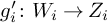 $g_i'\colon W_i \to Z_i$
the base-change of
$g_i'\colon W_i \to Z_i$
the base-change of $g'$
, we note that each
$g'$
, we note that each $W_i$
is a p-bounded affinoid perfectoid space. Hence by [Reference MannMan22, Theorem 3.5.21] each
$W_i$
is a p-bounded affinoid perfectoid space. Hence by [Reference MannMan22, Theorem 3.5.21] each $g^{\prime }_i$
is a forgetful functor of module categories and in particular conservative. Using also bounded base-change (see [Reference MannMan22, Proposition 3.3.7]) we deduce that
$g^{\prime }_i$
is a forgetful functor of module categories and in particular conservative. Using also bounded base-change (see [Reference MannMan22, Proposition 3.3.7]) we deduce that $g'$
is conservative on bounded objects. Now note that
$g'$
is conservative on bounded objects. Now note that $f^! \Lambda ^a$
is bounded: If
$f^! \Lambda ^a$
is bounded: If $\Lambda = {\mathcal {O}}^+_X/\pi $
for some
$\Lambda = {\mathcal {O}}^+_X/\pi $
for some $\pi | p$
then this follows from the Riemann-Hilbert correspondence (see [Reference MannMan22, Theorem 3.9.23]); for general
$\pi | p$
then this follows from the Riemann-Hilbert correspondence (see [Reference MannMan22, Theorem 3.9.23]); for general $\Lambda $
one can make the usual reductions. Similarly
$\Lambda $
one can make the usual reductions. Similarly $f^{\prime !}\Lambda ^a$
is bounded. Thus altogether we deduce that it is enough to show that
$f^{\prime !}\Lambda ^a$
is bounded. Thus altogether we deduce that it is enough to show that $g^{\prime }_*\alpha \colon g^{\prime }_* g^{\prime *} f^! \Lambda ^a \mathbin {\xrightarrow {\sim }} g^{\prime }_* f^{\prime !} \Lambda ^a$
is an isomorphism. The remaining proof of [Reference MannMan22, Proposition 3.8.4.(ii)] applies verbatim.
$g^{\prime }_*\alpha \colon g^{\prime }_* g^{\prime *} f^! \Lambda ^a \mathbin {\xrightarrow {\sim }} g^{\prime }_* f^{\prime !} \Lambda ^a$
is an isomorphism. The remaining proof of [Reference MannMan22, Proposition 3.8.4.(ii)] applies verbatim.
Lemma 2.13.
-
(i) The condition of being p-fine and p-cohomologically smooth is analytically local on both source and target.
-
(ii) Among p-fine maps, the condition of being p-cohomologically smooth is v-local on the target and p-cohomologically smooth local on the source.
-
(iii) p-fine and p-cohomologically smooth maps are stable under composition and base-change.
Proof. This is formal, see [Reference MannMan22, Lemma 3.8.5].
3 Representation-theoretic preparations
In this section, we apply the 6-functor formalism to study representations of p-adic Lie groups. Since a number of categories will appear in what follows, we begin by introducing them. For the moment, we allow G to be any locally profinite group with locally finite p-cohomological dimension (in the sense of [Reference Symonds and WeigelSW00, p. 4.1]).
First of all, we will need the $\infty $
-category of solid G-representations
$\infty $
-category of solid G-representations  , as defined in [Reference MannMan22, Definition 3.4.3]. By definition it is the derived $\infty $
-category of the category of continuous G-representations on solid
$\infty $
-category of the category of continuous G-representations on solid ${\mathbf {F}}_p$
-vector spaces (the latter being defined as the category of modules over the analytic ring
${\mathbf {F}}_p$
-vector spaces (the latter being defined as the category of modules over the analytic ring  – one can equivalently describe this category in terms of solid ${\mathbf {F}}_p$
-vector spaces V together with a map of condensed sets
${\mathbf {F}}_p$
-vector spaces V together with a map of condensed sets $G \times V \to V$
satisfying the unit, associativity and a certain
$G \times V \to V$
satisfying the unit, associativity and a certain ${\mathbf {F}}_p$
-linearity condition). We also have the derived category
${\mathbf {F}}_p$
-linearity condition). We also have the derived category  of smooth G-representations on solid ${\mathbf {F}}_p$
-vector spaces [Reference MannMan22, Definition 3.4.11]. There is a natural functor
${\mathbf {F}}_p$
-vector spaces [Reference MannMan22, Definition 3.4.11]. There is a natural functor  , which is not fully faithful. Most classically, we have the usual derived category ${\mathcal {D}}^{{\mathrm {sm}}}(G,{\mathbf {F}}_p)$
of the abelian category of smooth G-representations on discrete
${\mathcal {D}}^{{\mathrm {sm}}}(G,{\mathbf {F}}_p)$
of the abelian category of smooth G-representations on discrete ${\mathbf {F}}_p$
-vector spaces. There is a natural identification
${\mathbf {F}}_p$
-vector spaces. There is a natural identification  , identifying ${\mathcal {D}}^{{\mathrm {sm}}}(G,{\mathbf {F}}_p)$
as the full subcategory of
${\mathcal {D}}^{{\mathrm {sm}}}(G,{\mathbf {F}}_p)$
as the full subcategory of  consisting of those smooth representations whose underlying ${\mathbf {F}}_p$
-vector space is discrete (in the topological, i.e. condensed, sense), which we will use without comment. We also note that the composite functor
${\mathbf {F}}_p$
-vector space is discrete (in the topological, i.e. condensed, sense), which we will use without comment. We also note that the composite functor  is fully faithful.
Now fix an algebraically closed nonarchimedean field C of residue characteristic p, and a pseudouniformizer $\pi | p$
. Let
$\pi | p$
. Let $B\underline {G} = \operatorname {\mathrm {Spd}}(C)/ \underline {G}$
denote the classifying stack of G. We then have the
$B\underline {G} = \operatorname {\mathrm {Spd}}(C)/ \underline {G}$
denote the classifying stack of G. We then have the $\infty $
-category
$\infty $
-category 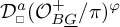 , which (by [Reference MannMan22, Lemma 3.4.26.(ii)]) can be identified with the $\infty $
-category of smooth G-representations on solid almost
$\infty $
-category of smooth G-representations on solid almost $\varphi $
-modules over
$\varphi $
-modules over $\mathcal {O}_C^+/\pi $
. This category can be directly accessed by the 6-functor formalism, as we will see. On the other hand, Proposition 3.9 gives a natural identification
$\mathcal {O}_C^+/\pi $
. This category can be directly accessed by the 6-functor formalism, as we will see. On the other hand, Proposition 3.9 gives a natural identification ${\mathcal {D}}^{{\mathrm {sm}}}(G,{\mathbf {F}}_p) = {\mathcal {D}}_{{\mathrm {\acute {e}t}}}(B\underline {G},{\mathbf {F}}_p)$
. The Riemann-Hilbert functor then gives a natural fully faithful symmetric monoidal embedding
${\mathcal {D}}^{{\mathrm {sm}}}(G,{\mathbf {F}}_p) = {\mathcal {D}}_{{\mathrm {\acute {e}t}}}(B\underline {G},{\mathbf {F}}_p)$
. The Riemann-Hilbert functor then gives a natural fully faithful symmetric monoidal embedding

which factors through the full subcategory 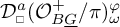 of discrete objects.
3.1 Smooth representations
We continue to fix a locally profinite group G of locally bounded p-cohomological dimension. In this section, we recall some results on the derived $\infty $
-category
$\infty $
-category ${\mathcal {D}}^{{\mathrm {sm}}}(G,{\mathbf {F}}_p)$
. However, to place our results in context, we momentarily allow our coefficients to be any field k (still assuming that G has locally bounded
${\mathcal {D}}^{{\mathrm {sm}}}(G,{\mathbf {F}}_p)$
. However, to place our results in context, we momentarily allow our coefficients to be any field k (still assuming that G has locally bounded $\mathrm {char} k$
-cohomological dimension). Thus, let
$\mathrm {char} k$
-cohomological dimension). Thus, let $\mathrm {Rep}_{k}^{\mathrm {sm}}(G)$
denote the category of smooth G-representations on k-vector spaces, and let
$\mathrm {Rep}_{k}^{\mathrm {sm}}(G)$
denote the category of smooth G-representations on k-vector spaces, and let ${\mathcal {D}}^{\mathrm {sm}}(G,k)$
denote its derived
${\mathcal {D}}^{\mathrm {sm}}(G,k)$
denote its derived $\infty $
-category. When k is clear from context, we just write
$\infty $
-category. When k is clear from context, we just write ${\mathcal {D}}(G)={\mathcal {D}}^{\mathrm {sm}}(G,k)$
. We sometimes write
${\mathcal {D}}(G)={\mathcal {D}}^{\mathrm {sm}}(G,k)$
. We sometimes write $\mathbf {1}\in \mathrm {Rep}_{k}^{\mathrm {sm}}(G)$
for k with the trivial G-action.
$\mathbf {1}\in \mathrm {Rep}_{k}^{\mathrm {sm}}(G)$
for k with the trivial G-action.
The assertions in the following proposition are well-known.
Proposition 3.1.
1. $\mathrm {Rep}_{k}^{\mathrm {sm}}(G)$
is a Grothendieck abelian category. In particular, unbounded complexes have K-injective resolutions.
$\mathrm {Rep}_{k}^{\mathrm {sm}}(G)$
is a Grothendieck abelian category. In particular, unbounded complexes have K-injective resolutions.
2. The derived category ${\mathcal {D}}^{\mathrm {sm}}(G,k)$
is left-complete and has a natural symmetric monoidal structure given by k-linear tensor product of cochain complexes.
${\mathcal {D}}^{\mathrm {sm}}(G,k)$
is left-complete and has a natural symmetric monoidal structure given by k-linear tensor product of cochain complexes.
3. If $H\subset G$
is an open subgroup, the restriction functor
$H\subset G$
is an open subgroup, the restriction functor $r=r_{G}^{H}:{\mathcal {D}}^{\mathrm {sm}}(G,k)\to {\mathcal {D}}^{\mathrm {sm}}(H,k)$
is t-exact and symmetric monoidal.
$r=r_{G}^{H}:{\mathcal {D}}^{\mathrm {sm}}(G,k)\to {\mathcal {D}}^{\mathrm {sm}}(H,k)$
is t-exact and symmetric monoidal.
Let ${\underline {\operatorname {\mathrm {Hom}}}}_{G}(A,B)$
be the internal hom in
${\underline {\operatorname {\mathrm {Hom}}}}_{G}(A,B)$
be the internal hom in ${\mathcal {D}}^{\mathrm {sm}}(G,k),$
defined as a formal adjoint satisfying
${\mathcal {D}}^{\mathrm {sm}}(G,k),$
defined as a formal adjoint satisfying $\mathrm {Hom}_{{\mathcal {D}}(G)}(C\otimes _{k}A,B)=\mathrm {Hom}_{{\mathcal {D}}(G)}(C,{\underline {\operatorname {\mathrm {Hom}}}}_G(A,B))$
.
$\mathrm {Hom}_{{\mathcal {D}}(G)}(C\otimes _{k}A,B)=\mathrm {Hom}_{{\mathcal {D}}(G)}(C,{\underline {\operatorname {\mathrm {Hom}}}}_G(A,B))$
.
Lemma 3.2. If $H\subset G$
is an open subgroup, then there is a natural isomorphism
$H\subset G$
is an open subgroup, then there is a natural isomorphism $r {\underline {\operatorname {\mathrm {Hom}}}}_G(A,B)\cong {\underline {\operatorname {\mathrm {Hom}}}}_H(rA,rB)$
for any
$r {\underline {\operatorname {\mathrm {Hom}}}}_G(A,B)\cong {\underline {\operatorname {\mathrm {Hom}}}}_H(rA,rB)$
for any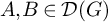 $A,B\in {\mathcal {D}}(G)$
. Here
$A,B\in {\mathcal {D}}(G)$
. Here $r:{\mathcal {D}}(G)\to {\mathcal {D}}(H)$
denotes the restriction functor.
$r:{\mathcal {D}}(G)\to {\mathcal {D}}(H)$
denotes the restriction functor.
Proof. The functor r has a left adjoint, given by the (t-exact) functor $\mathrm {ind}_{H}^{G}(-):=-\otimes _{k[H]}k[G]$
of compact induction. We then compute
$\mathrm {ind}_{H}^{G}(-):=-\otimes _{k[H]}k[G]$
of compact induction. We then compute
 $$ \begin{align*} \mathrm{Hom}_{{\mathcal{D}}(H)}(C,r{\underline{\operatorname{\mathrm{Hom}}}}_G(A,B)) & \cong\mathrm{Hom}_{{\mathcal{D}}(G)}(\mathrm{ind}_{H}^{G}C,{\underline{\operatorname{\mathrm{Hom}}}}_G(A,B))\\ & \cong\mathrm{Hom}_{{\mathcal{D}}(G)}(A\otimes\mathrm{ind}_{H}^{G}C,B)\\ & \cong\mathrm{Hom}_{{\mathcal{D}}(G)}(\mathrm{ind}_{H}^{G}(rA\otimes C),B)\\ & \cong\mathrm{Hom}_{{\mathcal{D}}(H)}(rA\otimes C,rB)\\ & \cong\mathrm{Hom}_{{\mathcal{D}}(H)}(C,{\underline{\operatorname{\mathrm{Hom}}}}_H(rA,rB)) \end{align*} $$
naturally in $C\in {\mathcal {D}}(H)$
, so the result follows from Yoneda.
$C\in {\mathcal {D}}(H)$
, so the result follows from Yoneda.
If $A\in {\mathcal {D}}(G)$
is any object and
$A\in {\mathcal {D}}(G)$
is any object and $H\subset G$
is any open subgroup, we write
$H\subset G$
is any open subgroup, we write
 $$\begin{align*}R\Gamma_{{\mathrm{sm}}}(H,A)=R\mathrm{Hom}_{{\mathcal{D}}(H)}(\mathbf{1},rA)=R\mathrm{Hom}_{{\mathcal{D}}(G)}(\mathrm{ind}_{H}^{G}\mathbf{1},A).\end{align*}$$
To actually compute this, let $A\overset {\sim }{\to }I^{\bullet }$
be a K-injective resolution by injectives in
$A\overset {\sim }{\to }I^{\bullet }$
be a K-injective resolution by injectives in $\mathrm {Rep}_{k}^{\mathrm {sm}}(G)$
; then
$\mathrm {Rep}_{k}^{\mathrm {sm}}(G)$
; then $R\Gamma _{{\mathrm {sm}}}(H,A)\cong (I^{\bullet })^{H}$
. When H is a p-adic Lie group,
$R\Gamma _{{\mathrm {sm}}}(H,A)\cong (I^{\bullet })^{H}$
. When H is a p-adic Lie group,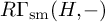 $R\Gamma _{{\mathrm {sm}}}(H,-)$
coincides with continuous group cohomology, by the main result in [Reference FustFus21].
$R\Gamma _{{\mathrm {sm}}}(H,-)$
coincides with continuous group cohomology, by the main result in [Reference FustFus21].
Lemma 3.3. For any $A\in {\mathcal {D}}(G)$
, we have
$A\in {\mathcal {D}}(G)$
, we have $A\cong \mathrm {colim}_{H\subset G\,\mathrm {open}}R\Gamma _{\mathrm {sm}}(H,A)$
.
$A\cong \mathrm {colim}_{H\subset G\,\mathrm {open}}R\Gamma _{\mathrm {sm}}(H,A)$
.
Proof. If $A\overset {\sim }{\to }I^{\bullet }$
is a K-injective resolution by injectives, then
$A\overset {\sim }{\to }I^{\bullet }$
is a K-injective resolution by injectives, then $R\Gamma _{\mathrm {sm}}(H,A)\cong (I^{\bullet })^{H}$
for any H; here we use that restriction along
$R\Gamma _{\mathrm {sm}}(H,A)\cong (I^{\bullet })^{H}$
for any H; here we use that restriction along $\mathrm {Rep}_{k}^{\mathrm {sm}}(G)\to \mathrm {Rep}_{k}^{\mathrm {sm}}(H)$
preserves K-injective complexes of injectives. But then
$\mathrm {Rep}_{k}^{\mathrm {sm}}(G)\to \mathrm {Rep}_{k}^{\mathrm {sm}}(H)$
preserves K-injective complexes of injectives. But then
 $$ \begin{align*} \mathrm{colim}_{H\subset G\,\mathrm{open}}R\Gamma_{\mathrm{sm}}(H,A) & \cong\mathrm{colim}_{H\subset G\,\mathrm{open}}(I^{\bullet})^{H}\cong I^{\bullet}\cong A, \end{align*} $$
using the fact that each $I^{n}$
is a smooth representation.
$I^{n}$
is a smooth representation.
Lemma 3.4. For any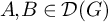 $A,B\in {\mathcal {D}}(G)$
, we have
$A,B\in {\mathcal {D}}(G)$
, we have ${\underline {\operatorname {\mathrm {Hom}}}}_G(A,B)\cong \mathrm {colim}_{H}R\mathrm {Hom}_{{\mathcal {D}}(H)}(A,B).$
Here (and in what follows) we drop the restriction functors r from the notation.
Proof. There are natural isomorphisms
 $$ \begin{align*} \mathrm{colim}_{H}R\mathrm{Hom}_{{\mathcal{D}}(H)}(A,B) & \cong\mathrm{colim}_{H}R\Gamma_{\mathrm{sm}}(H,{\underline{\operatorname{\mathrm{Hom}}}}_H(A,B))\\ & \cong\mathrm{colim}_{H}R\Gamma_{\mathrm{sm}}(H,{\underline{\operatorname{\mathrm{Hom}}}}_G(A,B))\\ & \cong {\underline{\operatorname{\mathrm{Hom}}}}_G(A,B), \end{align*} $$
where the second line follows from Lemma 3.2, and the third line follows from Lemma 3.3.
Proposition 3.5. When G is locally pro-p and $\mathrm {char}k\neq p$
,
$\mathrm {char}k\neq p$
,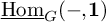 ${\underline {\operatorname {\mathrm {Hom}}}}_G(-,\mathbf {1})$
is the usual exact smooth duality functor, i.e. it sends any
${\underline {\operatorname {\mathrm {Hom}}}}_G(-,\mathbf {1})$
is the usual exact smooth duality functor, i.e. it sends any $\pi \in \mathrm {Rep}_{k}^{\mathrm {sm}}(G)$
to the smooth vectors in
$\pi \in \mathrm {Rep}_{k}^{\mathrm {sm}}(G)$
to the smooth vectors in $\mathrm {Hom}_{k}(\pi ,k)$
.
$\mathrm {Hom}_{k}(\pi ,k)$
.
Proof. Easy, using the previous lemma together with the fact that $\mathbf {1}$
is an injective object of
$\mathbf {1}$
is an injective object of $\mathrm {Rep}_{k}^{\mathrm {sm}}(H)$
for any pro-p open compact
$\mathrm {Rep}_{k}^{\mathrm {sm}}(H)$
for any pro-p open compact $H\subset G$
. (Use that any injective map
$H\subset G$
. (Use that any injective map $V\to W$
in
$V\to W$
in $\mathrm {Rep}_{k}^{\mathrm {sm}}(H)$
admits an H-equivariant retraction, by averaging any k-linear retraction against a k-valued Haar measure.)
$\mathrm {Rep}_{k}^{\mathrm {sm}}(H)$
admits an H-equivariant retraction, by averaging any k-linear retraction against a k-valued Haar measure.)
When G is a p-adic Lie group and $k = {\mathbf {F}}_p$
, the naive smooth duality functor on
$k = {\mathbf {F}}_p$
, the naive smooth duality functor on $\mathrm {Rep}_{{\mathbf {F}}_p}^{\mathrm {sm}}(G)$
is rather useless, because the functor of passage to smooth vectors is no longer exact. To remedy this, Kohlhaase has introduced a family of derived smooth duality functors
$\mathrm {Rep}_{{\mathbf {F}}_p}^{\mathrm {sm}}(G)$
is rather useless, because the functor of passage to smooth vectors is no longer exact. To remedy this, Kohlhaase has introduced a family of derived smooth duality functors $\mathcal {S}_{G}^{i}(-)$
on
$\mathcal {S}_{G}^{i}(-)$
on $\mathrm {Rep}_{{\mathbf {F}}_p}^{\mathrm {sm}}(G)$
, which are essentially the right-derived functors of the functor
$\mathrm {Rep}_{{\mathbf {F}}_p}^{\mathrm {sm}}(G)$
, which are essentially the right-derived functors of the functor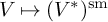 $V\mapsto (V^{\ast })^{\mathrm {sm}}$
. More precisely, Kohlhaase defines
$V\mapsto (V^{\ast })^{\mathrm {sm}}$
. More precisely, Kohlhaase defines
 $$\begin{align*}\mathcal{S}_{G}^{i}(V)=\mathrm{colim}_{H\subset G\,\mathrm{open}\,\mathrm{compact}}\mathrm{Ext}_{{\mathbf{F}}_p[[H]]}^{i}(k,V^{\ast}). \end{align*}$$
Here $V^{\ast }=\mathrm {Hom}_{{\mathbf {F}}_p}(V,{\mathbf {F}}_p)$
denotes the Pontryagin dual of V with its natural pseudocompact
$V^{\ast }=\mathrm {Hom}_{{\mathbf {F}}_p}(V,{\mathbf {F}}_p)$
denotes the Pontryagin dual of V with its natural pseudocompact ${\mathbf {F}}_p$
-module structure; this is naturally a pseudocompact
${\mathbf {F}}_p$
-module structure; this is naturally a pseudocompact ${\mathbf {F}}_p[[H]]$
-module for any open compact
${\mathbf {F}}_p[[H]]$
-module for any open compact $H\subset G$
. We prefer to package the
$H\subset G$
. We prefer to package the $\mathcal {S}^{i}$
’s into a single functor on the derived category. In other words, we consider the endofunctor of
$\mathcal {S}^{i}$
’s into a single functor on the derived category. In other words, we consider the endofunctor of ${\mathcal {D}}^{\mathrm {sm}}(G,{\mathbf {F}}_p)$
defined by
${\mathcal {D}}^{\mathrm {sm}}(G,{\mathbf {F}}_p)$
defined by
 $$\begin{align*}V\mapsto\mathcal{S}_{G}(V)=\mathrm{colim}_{H\subset G\,\mathrm{open}\,\mathrm{compact}}R\mathrm{Hom}_{{\mathbf{F}}_p[[H]]}({\mathbf{F}}_p,V^{\ast}), \end{align*}$$
where $V^{\ast }\in {\mathcal {D}}({\mathbf {F}}_p[[H]]-\mathrm {mod})$
is computed termwise. Here
$V^{\ast }\in {\mathcal {D}}({\mathbf {F}}_p[[H]]-\mathrm {mod})$
is computed termwise. Here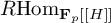 $R\mathrm {Hom}_{{\mathbf {F}}_p[[H]]}$
denotes
$R\mathrm {Hom}_{{\mathbf {F}}_p[[H]]}$
denotes $R\mathrm {Hom}$
in the derived category of
$R\mathrm {Hom}$
in the derived category of ${\mathbf {F}}_p[[H]]$
-modules. Of course,
${\mathbf {F}}_p[[H]]$
-modules. Of course, $H^{i}(\mathcal {S}(V))=\mathcal {S}^{i}(V)$
when V is concentrated in degree zero.
$H^{i}(\mathcal {S}(V))=\mathcal {S}^{i}(V)$
when V is concentrated in degree zero.
The following proposition was noted independently by Schneider-Sorensen [Reference Schneider and SorensenSS22].
Proposition 3.6. As endofunctors of ${\mathcal {D}}^{\mathrm {sm}}(G,{\mathbf {F}}_p)$
, the functor
${\mathcal {D}}^{\mathrm {sm}}(G,{\mathbf {F}}_p)$
, the functor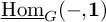 ${\underline {\operatorname {\mathrm {Hom}}}}_G(-,\mathbf {1})$
coincides with Kohlhaase’s derived smooth duality functor
${\underline {\operatorname {\mathrm {Hom}}}}_G(-,\mathbf {1})$
coincides with Kohlhaase’s derived smooth duality functor $\mathcal {S}_{G}(-)$
.
$\mathcal {S}_{G}(-)$
.
Proof. As noted above, $\mathcal {S}_{G}(V)$
is defined by the formula
$\mathcal {S}_{G}(V)$
is defined by the formula
 $$\begin{align*}\mathcal{S}_{G}(V)=\mathrm{colim}_{H\subset G\,\mathrm{open}\,\mathrm{compact}}R\mathrm{Hom}_{{\mathbf{F}}_p[[H]]}({\mathbf{F}}_p,V^{\ast}). \end{align*}$$
To actually compute this, choose a uniformly powerful open pro-p subgroup $G_{0}\subset G$
. By work of Lazard [Reference LazardLaz65, Ch. V, Section 2], we can choose a finite length resolution
$G_{0}\subset G$
. By work of Lazard [Reference LazardLaz65, Ch. V, Section 2], we can choose a finite length resolution $P_{\bullet }\to {\mathbf {F}}_p\to 0$
of
$P_{\bullet }\to {\mathbf {F}}_p\to 0$
of ${\mathbf {F}}_p$
by finite free
${\mathbf {F}}_p$
by finite free ${\mathbf {F}}_p[[G_{0}]]$
-modules. Then we can express
${\mathbf {F}}_p[[G_{0}]]$
-modules. Then we can express $\mathcal {S}_{G}(-)$
more concretely as
$\mathcal {S}_{G}(-)$
more concretely as
 $$\begin{align*}\mathcal{S}_{G}(V)=\mathrm{colim}_{H\subset G_{0}\,\mathrm{open}}\mathrm{Hom}_{{\mathbf{F}}_p[[H]]}(P_{\bullet},V^{\ast}). \end{align*}$$
Set $I^{n}=\mathrm {Hom}_{{\mathbf {F}}_p}^{\mathrm {cts}}(P_{n},{\mathbf {F}}_p)$
, so
$I^{n}=\mathrm {Hom}_{{\mathbf {F}}_p}^{\mathrm {cts}}(P_{n},{\mathbf {F}}_p)$
, so $0\to {\mathbf {F}}_p \to I^{\bullet }$
is a finite resolution of
$0\to {\mathbf {F}}_p \to I^{\bullet }$
is a finite resolution of $\mathbf {1}$
by injective objects in
$\mathbf {1}$
by injective objects in $\mathrm {Rep}_{{\mathbf {F}}_p}^{\mathrm {sm}}(G_{0})$
. Since Pontryagin duality gives an exact anti-equivalence between smooth H-representations over
$\mathrm {Rep}_{{\mathbf {F}}_p}^{\mathrm {sm}}(G_{0})$
. Since Pontryagin duality gives an exact anti-equivalence between smooth H-representations over ${\mathbf {F}}_p$
and pseudocompact
${\mathbf {F}}_p$
and pseudocompact ${\mathbf {F}}_p[[H]]$
-modules, we have natural identifications
${\mathbf {F}}_p[[H]]$
-modules, we have natural identifications
 $$\begin{align*}\mathrm{Hom}_{{\mathbf{F}}_p[[H]]}(P_{\bullet},V^{\ast})\cong\mathrm{Hom}_{\mathrm{Rep}_{{\mathbf{F}}_p}^{\mathrm{sm}}(H)}(V,I^{\bullet})\cong R\mathrm{Hom}_{{\mathcal{D}}(H)}(V,\mathbf{1}). \end{align*}$$
Putting things together, we get
 $$ \begin{align*} \mathcal{S}_{G}(V) & \cong\mathrm{colim}_{H\subset G_{0}\,\mathrm{open}}\mathrm{Hom}_{\mathrm{Rep}_{{\mathbf{F}}_p}^{\mathrm{sm}}(H)}(V,I^{\bullet})\\ & \cong\mathrm{colim}_{H\subset G_{0}\,\mathrm{open}}R\mathrm{Hom}_{{\mathcal{D}}(H)}(V,\mathbf{1})\\ & \cong {\underline{\operatorname{\mathrm{Hom}}}}_G(V,\mathbf{1}), \end{align*} $$
where the last line follows by Lemma 3.4.
In the remainder of this subsection, we continue to assume that G is a p-adic Lie group. Recall that the Gelfand-Kirillov (GK) dimension of an admissible smooth representation $V\in \mathrm {Rep}_{{\mathbf {F}}_p}^{\mathrm {sm}}(G)$
is the quantity
$V\in \mathrm {Rep}_{{\mathbf {F}}_p}^{\mathrm {sm}}(G)$
is the quantity
 $$\begin{align*}\mathrm{dim}_{G}V=\mathrm{dim}\,G\cdot\lim_{n\to\infty}\frac{\log\dim_{{\mathbf{F}}_p}V^{K_{n}}}{\log\,[K_{n}:K_{0}]}=\lim_{n\to\infty}\frac{\log\dim_{{\mathbf{F}}_p}V^{K_{n}}}{n\log p}. \end{align*}$$
Here $K_{0}\subset G$
is a fixed choice of a uniformly powerful open pro-p subgroup, and
$K_{0}\subset G$
is a fixed choice of a uniformly powerful open pro-p subgroup, and $K_{n}=K^{p^{n}}\subset K_{0}$
is the closed normal subgroup generated by the
$K_{n}=K^{p^{n}}\subset K_{0}$
is the closed normal subgroup generated by the $p^{n}$
th powers of elements of K. (One automatically has that
$p^{n}$
th powers of elements of K. (One automatically has that $[K_{n}:K_{0}]=p^{n\cdot \dim G}$
, which explains the second equality above.) By [Reference Emerton and PaškūnasEP20, Proposition 2.18], this limit exists independently of the choice of
$[K_{n}:K_{0}]=p^{n\cdot \dim G}$
, which explains the second equality above.) By [Reference Emerton and PaškūnasEP20, Proposition 2.18], this limit exists independently of the choice of $K_{0}$
, and defines an integer in the interval
$K_{0}$
, and defines an integer in the interval $[0,\dim G]$
. Moreover,
$[0,\dim G]$
. Moreover, $\mathrm {dim}_{G}V=0$
iff
$\mathrm {dim}_{G}V=0$
iff $\mathrm {dim}_{{\mathbf {F}}_p}V<\infty $
. Additionally, if
$\mathrm {dim}_{{\mathbf {F}}_p}V<\infty $
. Additionally, if $0\to V'\to V\to V"\to 0$
is an exact sequence of admissible smooth representations, then
$0\to V'\to V\to V"\to 0$
is an exact sequence of admissible smooth representations, then $\mathrm {dim}_{G}V=\max (\mathrm {dim}_{G}V',\dim _{G}V")$
. In particular, any subquotient W of a given V satisfies
$\mathrm {dim}_{G}V=\max (\mathrm {dim}_{G}V',\dim _{G}V")$
. In particular, any subquotient W of a given V satisfies $\mathrm {dim}_{G}W\leq \mathrm {dim}_{G}V$
.
$\mathrm {dim}_{G}W\leq \mathrm {dim}_{G}V$
.
A key point for us is that $\dim _{G}$
is closely related to the behavior of the functors
$\dim _{G}$
is closely related to the behavior of the functors $\mathcal {S}_{G}^{i}$
.
$\mathcal {S}_{G}^{i}$
.
Proposition 3.7.
-
(i) If V is an admissible smooth G-representation, then each
$\mathcal {S}_{G}^{i}(V)$
is admissible smooth, with
$\mathrm {dim}_{G}\mathcal {S}_{G}^{i}(V)\leq i$
for all i. Moreover, if
$d=\mathrm {dim}_{G}V$
then
$\mathrm {dim}_{G}\mathcal {S}_{G}^{d}(V)=d$
and
$\mathcal {S}_{G}^{i}(V)=0$
for all
$i>d$
. -
(ii) For any
$A\in {\mathcal {D}}^{\mathrm {sm}}(G,{\mathbf {F}}_p)$
whose cohomologies
$H^i(A)$
are all admissible, the complex
$\mathcal {S}_G(A)$
has admissible cohomologies, and the biduality map
$A\to (\mathcal {S}_{G}\circ \mathcal {S}_{G})(A)$
is an isomorphism. -
(iii) If V is an admissible smooth representation with
$\dim _{G}V=0$
, so
$\dim _{{\mathbf {F}}_p}V<\infty $
, then
$\mathcal {S}(V)\cong \mathcal {S}^{0}(V)$
is the naive linear dual of V.













Proof. The first part is essentially a summary of results from [Reference KohlhaaseKoh17]. The second part is Pontryagin-dual to the biduality discussed in the proof of [Reference KohlhaaseKoh17, Theorem 3.5]; see also [Reference Schneider and SorensenSS22, Proposition 3.4]. The third part is immediate from the first part.
Note that part (i) here implies that
$\dim _{G}V=\sup \left \{ i\mid \mathcal {S}_{G}^{i}(V)\neq 0\right \} $
 . We also observe that $\mathcal {S}^{0}(-)$
can be completely understood.
$\mathcal {S}^{0}(-)$
can be completely understood.
Proposition 3.8. Let V be any admissible smooth G-representation. Then $\mathcal {S}_{G}^{0}(V)\neq 0$
if and only if V admits a nonzero G-stable quotient
$\mathcal {S}_{G}^{0}(V)\neq 0$
if and only if V admits a nonzero G-stable quotient $V\twoheadrightarrow W$
with
$V\twoheadrightarrow W$
with $\mathrm {dim}_{{\mathbf {F}}_p}W<\infty $
.
$\mathrm {dim}_{{\mathbf {F}}_p}W<\infty $
.
Proof. ‘If’: Given such a $V\to W$
, we get a nonzero map
$V\to W$
, we get a nonzero map $\mathcal {S}(W)\to \mathcal {S}(V)$
. But the previous proposition shows that
$\mathcal {S}(W)\to \mathcal {S}(V)$
. But the previous proposition shows that $\mathcal {S}(W)=\tau ^{\leq 0}\mathcal {S}(W)=\mathcal {S}^{0}(W)$
, so we get a nonzero map
$\mathcal {S}(W)=\tau ^{\leq 0}\mathcal {S}(W)=\mathcal {S}^{0}(W)$
, so we get a nonzero map $\mathcal {S}^{0}(W)\to \mathcal {S}(V)$
which necessarily factors over a nonzero map
$\mathcal {S}^{0}(W)\to \mathcal {S}(V)$
which necessarily factors over a nonzero map $\mathcal {S}^{0}(W)\to \mathcal {S}^{0}(V)$
.
$\mathcal {S}^{0}(W)\to \mathcal {S}^{0}(V)$
.
‘Only if’: Suppose $\mathcal {S}^{0}(V)\neq 0$
. By the previous proposition, this is zero-dimensional as a G-representation, so
$\mathcal {S}^{0}(V)\neq 0$
. By the previous proposition, this is zero-dimensional as a G-representation, so $\mathcal {S}(\mathcal {S}^{0}(V))\cong \mathcal {S}^{0}(\mathcal {S}^{0}(V))$
. In particular, applying
$\mathcal {S}(\mathcal {S}^{0}(V))\cong \mathcal {S}^{0}(\mathcal {S}^{0}(V))$
. In particular, applying $\mathcal {S}$
to the map
$\mathcal {S}$
to the map $\mathcal {S}^{0}(V)=\tau ^{\leq 0}\mathcal {S}(V)\to \mathcal {S}(V)$
and using biduality, we get a nonzero map
$\mathcal {S}^{0}(V)=\tau ^{\leq 0}\mathcal {S}(V)\to \mathcal {S}(V)$
and using biduality, we get a nonzero map $V\cong \mathcal {S}(\mathcal {S}(V))\to \mathcal {S}(\mathcal {S}^{0}(V))\cong \mathcal {S}^{0}(\mathcal {S}^{0}(V))$
, and
$V\cong \mathcal {S}(\mathcal {S}(V))\to \mathcal {S}(\mathcal {S}^{0}(V))\cong \mathcal {S}^{0}(\mathcal {S}^{0}(V))$
, and $\mathcal {S}^{0}(\mathcal {S}^{0}(V))$
is finite-dimensional over
$\mathcal {S}^{0}(\mathcal {S}^{0}(V))$
is finite-dimensional over ${\mathbf {F}}_p$
.
${\mathbf {F}}_p$
.
We conclude this section by giving a geometric interpretation of ${\mathcal {D}}^{\mathrm {sm}}(G,{\mathbf {F}}_p)$
. Let C be any algebraically closed nonarchimedean field of residue characteristic p.
${\mathcal {D}}^{\mathrm {sm}}(G,{\mathbf {F}}_p)$
. Let C be any algebraically closed nonarchimedean field of residue characteristic p.
Proposition 3.9. Notation as above, there are natural symmetric monoidal equivalences
 $$\begin{align*}{\mathcal{D}}_{{\mathrm{\acute{e}t}}}([\operatorname{\mathrm{Spd}}(C)/\underline G],{\mathbf{F}}_p) \cong {\mathcal{D}}([\operatorname{\mathrm{Spd}}(C)/\underline G]_{{\mathrm{\acute{e}t}}},{\mathbf{F}}_p) \cong {\mathcal{D}}^{\mathrm{sm}}(G,{\mathbf{F}}_p).\end{align*}$$
In particular, the first two categories are left-complete and canonically independent of C.
Proof. This follows from the proof of Theorem V.1.1 in [Reference Fargues and ScholzeFS21], noting that that $[\operatorname {\mathrm {Spd}}(C)/\underline G]_{{\mathrm {\acute {e}t}}}$
locally has uniformly bounded p-cohomological dimension by Lazard-Serre [Reference LazardLaz65, Ch. V, Section 2].
$[\operatorname {\mathrm {Spd}}(C)/\underline G]_{{\mathrm {\acute {e}t}}}$
locally has uniformly bounded p-cohomological dimension by Lazard-Serre [Reference LazardLaz65, Ch. V, Section 2].
3.2 Sheaves on classifying stacks
We now study the stacky 6-functor formalism introduced above in the context of the classifying stack $*/G$
associated to a locally profinite group G. Recall that if G has locally finite p-cohomological dimension then for every totally disconnected space
$*/G$
associated to a locally profinite group G. Recall that if G has locally finite p-cohomological dimension then for every totally disconnected space $X = \operatorname {\mathrm {Spa}}(A, A^+)$
with pseudouniformizer
$X = \operatorname {\mathrm {Spa}}(A, A^+)$
with pseudouniformizer $\pi $
the
$\pi $
the $\infty $
-category
$\infty $
-category 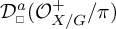 can be identified with the $\infty $
-category of smooth G-representations on solid almost
$\infty $
-category of smooth G-representations on solid almost $A^+/\pi $
-modules (see [Reference MannMan22, Lemma 3.4.26.(ii)]). In the following we will show that if G has locally finite p-cohomological dimension then
$A^+/\pi $
-modules (see [Reference MannMan22, Lemma 3.4.26.(ii)]). In the following we will show that if G has locally finite p-cohomological dimension then $*/G \to *$
is p-fine, and we will deduce a precise criterion for when the map
$*/G \to *$
is p-fine, and we will deduce a precise criterion for when the map $*/G \to *$
is p-cohomologically smooth. In particular, this will hold in all practical situations, see Theorem 3.18 below.
$*/G \to *$
is p-cohomologically smooth. In particular, this will hold in all practical situations, see Theorem 3.18 below.
To start things off, we first translate the finite p-cohomological dimension condition into a vanishing of Ext-groups. Also recall the definition of the p-cohomological dimension $\operatorname {\mathrm {cd}}_p G$
from [Reference MannMan22, Definition 3.4.20] (see [Reference MannMan22, Proposition 3.4.22] to relate this to more classical versions).
$\operatorname {\mathrm {cd}}_p G$
from [Reference MannMan22, Definition 3.4.20] (see [Reference MannMan22, Proposition 3.4.22] to relate this to more classical versions).
Proposition 3.10. Let G be a profinite group and let  be static continuous G-representations on solid ${\mathbf {F}}_p$
-vector spaces. If M is discrete then
${\mathbf {F}}_p$
-vector spaces. If M is discrete then
 $$ \begin{align*} \operatorname{\mathrm{Ext}}^i_G(M, N) = 0 \qquad \text{for } i> \operatorname{\mathrm{cd}}_p G. \end{align*} $$
Proof. The $\infty $
-category
$\infty $
-category  comes naturally equipped with a symmetric monoidal structure such that the forgetful functor
  is symmetric monoidal (e.g. one can construct
  as certain sheaves on the classifying stack $*/G$
in a suitable geometric setup). The forgetful functor
$*/G$
in a suitable geometric setup). The forgetful functor $q^*$
has a left adjoint
$q^*$
has a left adjoint  which is given by
  . It is straightforward to check that $q_\natural $
satisfies the projection formula, i.e. that for all
$q_\natural $
satisfies the projection formula, i.e. that for all  and
and 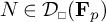 the natural morphism $q_\natural (N \otimes q^* M) \mathbin {\xrightarrow {\sim }} q_\natural N \otimes M$
is an isomorphism. The symmetric monoidal structure on
$q_\natural (N \otimes q^* M) \mathbin {\xrightarrow {\sim }} q_\natural N \otimes M$
is an isomorphism. The symmetric monoidal structure on  is closed, i.e. admits internal hom’s ${\underline {\operatorname {\mathrm {Hom}}}}$
(this is clear if we restrict to
${\underline {\operatorname {\mathrm {Hom}}}}$
(this is clear if we restrict to $\kappa $
-condensed objects for some cardinal
$\kappa $
-condensed objects for some cardinal $\kappa $
and then follows for unrestricted condensed objects by the following computation). It follows formally from the projection formula for
$\kappa $
and then follows for unrestricted condensed objects by the following computation). It follows formally from the projection formula for $q_\natural $
that for all
$q_\natural $
that for all  the natural morphism
 $$ \begin{align*} q^* {\underline{\operatorname{\mathrm{Hom}}}}(M, N) \mathbin{\xrightarrow{\sim}} {\underline{\operatorname{\mathrm{Hom}}}}(q^* M, q^* N) \end{align*} $$
is an isomorphism – in other words, the internal hom in  is computed on the underlying solid ${\mathbf {F}}_p$
-vector spaces. In particular, if M and N are static and M is discrete (and thus
${\mathbf {F}}_p$
-vector spaces. In particular, if M and N are static and M is discrete (and thus $q^* M \cong \bigoplus _I {\mathbf {F}}_p$
for some set I) then
$q^* M \cong \bigoplus _I {\mathbf {F}}_p$
for some set I) then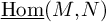 ${\underline {\operatorname {\mathrm {Hom}}}}(M, N)$
is static. Therefore, from
${\underline {\operatorname {\mathrm {Hom}}}}(M, N)$
is static. Therefore, from
 $$ \begin{align*} \operatorname{\mathrm{Ext}}^i_G(M, N) = \pi_0 R\operatorname{\mathrm{Hom}}(M, N[i]) = \pi_0 \operatorname{\mathrm{Hom}}({\mathbf{F}}_p, {\underline{\operatorname{\mathrm{Hom}}}}(M, N[i])) = H^i(G, {\underline{\operatorname{\mathrm{Hom}}}}(M, N)) \end{align*} $$
we immediately deduce the claim.
We will now show that $*/G \to *$
is p-fine. This reduces to showing that the canonical cover
$*/G \to *$
is p-fine. This reduces to showing that the canonical cover $* \to */G$
admits universal p-codescent, which will be established by adapting Mathew’s ideas on descendable algebras [Reference MathewMat16].
$* \to */G$
admits universal p-codescent, which will be established by adapting Mathew’s ideas on descendable algebras [Reference MathewMat16].
Lemma 3.11. Let G be a profinite group with $\operatorname {\mathrm {cd}}_p G < \infty $
. Then the map
$\operatorname {\mathrm {cd}}_p G < \infty $
. Then the map $* \to */G$
of small v-stacks is bdcs and admits universal p-codescent.
$* \to */G$
of small v-stacks is bdcs and admits universal p-codescent.
Proof. It is clear that the map $* \to */G$
is bdcs (e.g. the pullback along itself is
$* \to */G$
is bdcs (e.g. the pullback along itself is $G \to *$
, which is pro-étale). Now pick any
$G \to *$
, which is pro-étale). Now pick any $(X,\Lambda ) \in {{\rm vStack}_\Lambda }$
admitting a map to a strictly totally disconnected space, pick any map
$(X,\Lambda ) \in {{\rm vStack}_\Lambda }$
admitting a map to a strictly totally disconnected space, pick any map $X \to */G$
and denote
$X \to */G$
and denote $q\colon Y \to X$
the base-change of
$q\colon Y \to X$
the base-change of $* \to */G$
. We need to show that q admits p-codescent, i.e. if
$* \to */G$
. We need to show that q admits p-codescent, i.e. if $q_\bullet \colon Y_\bullet \to X$
denotes the Čech nerve of q then the natural functor
$q_\bullet \colon Y_\bullet \to X$
denotes the Čech nerve of q then the natural functor

is an equivalence. To see this we employ Lurie’s Beck-Chevalley condition, see [Reference LurieLur, Corollary 4.7.5.3]. Part (2) of this condition is easily satisfied: Since all the maps in the diagram $Y_\bullet \to X$
are proper, the required left adjointability for the upper shriek functors reduces to proper base-change (by passing to left adjoints). Thus in order to apply Lurie’s result it remains to verify the following:
$Y_\bullet \to X$
are proper, the required left adjointability for the upper shriek functors reduces to proper base-change (by passing to left adjoints). Thus in order to apply Lurie’s result it remains to verify the following:
-
(a) The functor
is conservative. -
(b) The functor
$q^!$
preserves geometric realizations of
$q^!$
-split simplicial objects in .
 is conservative.

 .
.To prove (a) and (b) we apply ideas by Mathew [Reference MathewMat16] (which were also used extensively in the setup of the p-adic 6-functor formalism, cf. [Reference MannMan22, §2.6]). More concretely, we will prove the following claim:
-
(∗) Let
be the full subcategory generated by the endofunctor
$q_*q^!$
under compositions, retracts and finite (co)limits. Then
$\langle q_*q^! \rangle $
contains the identity functor.
 be the full subcategory generated by the endofunctor

Let us first see how ( $\ast $
) implies (a) and (b), so assume that (
$\ast $
) implies (a) and (b), so assume that ( $\ast $
) holds for the moment. To prove (a), let
$\ast $
) holds for the moment. To prove (a), let $\mathcal M \to \mathcal N$
be a given map in
$\mathcal M \to \mathcal N$
be a given map in  such that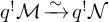 $q^! \mathcal M \mathbin {\xrightarrow {\sim }} q^! \mathcal N$
is an isomorphism. Then also
$q^! \mathcal M \mathbin {\xrightarrow {\sim }} q^! \mathcal N$
is an isomorphism. Then also $q_* q^! \mathcal M \mathbin {\xrightarrow {\sim }} q_* q^! \mathcal N$
is an isomorphism and one deduces easily that
$q_* q^! \mathcal M \mathbin {\xrightarrow {\sim }} q_* q^! \mathcal N$
is an isomorphism and one deduces easily that $F(\mathcal M) \mathbin {\xrightarrow {\sim }} F(\mathcal N)$
is an isomorphism for all
$F(\mathcal M) \mathbin {\xrightarrow {\sim }} F(\mathcal N)$
is an isomorphism for all $F \in \langle q_*q^! \rangle $
; taking
$F \in \langle q_*q^! \rangle $
; taking $F = \operatorname {\mathrm {id}}$
shows that
$F = \operatorname {\mathrm {id}}$
shows that $\mathcal M \mathbin {\xrightarrow {\sim }} \mathcal N$
is an isomorphism, as desired. To prove (b), let
$\mathcal M \mathbin {\xrightarrow {\sim }} \mathcal N$
is an isomorphism, as desired. To prove (b), let $\mathcal M_\bullet $
be a
$\mathcal M_\bullet $
be a $q^!$
-split simplicial object in
$q^!$
-split simplicial object in  . Then $q_*q^! \mathcal M_\bullet $
is a constant
$q_*q^! \mathcal M_\bullet $
is a constant $\operatorname {\mathrm {Ind}}$
-object (i.e. lies in the essential image of
$\operatorname {\mathrm {Ind}}$
-object (i.e. lies in the essential image of  ) and it follows immediately that the same is true for $F(\mathcal M_\bullet )$
for all
$F(\mathcal M_\bullet )$
for all $F \in \langle q_*q^! \rangle $
. Taking
$F \in \langle q_*q^! \rangle $
. Taking $F = \operatorname {\mathrm {id}}$
shows that
$F = \operatorname {\mathrm {id}}$
shows that $\mathcal M_\bullet $
is a constant
$\mathcal M_\bullet $
is a constant $\operatorname {\mathrm {Ind}}$
-object, so that its colimit commutes with any exact functor; in particular it commutes with
$\operatorname {\mathrm {Ind}}$
-object, so that its colimit commutes with any exact functor; in particular it commutes with $q^!$
.
$q^!$
.
It now remains to verify ( $\ast $
). We compute (using [Reference MannMan22, Corollary 3.6.17. (i)])
$\ast $
). We compute (using [Reference MannMan22, Corollary 3.6.17. (i)])
 $$ \begin{align*} q_*q^! = q_* {\underline{\operatorname{\mathrm{Hom}}}}(\Lambda^a, q^!) = {\underline{\operatorname{\mathrm{Hom}}}}(q_! \Lambda^a, -) = {\underline{\operatorname{\mathrm{Hom}}}}(q_* \Lambda^a, -). \end{align*} $$
Therefore ( $\ast $
) can be reduced to showing the following: Let
$\ast $
) can be reduced to showing the following: Let  be the full subcategory generated by $q_*\Lambda ^a$
under tensor product, retracts and finite (co)limits; then
$q_*\Lambda ^a$
under tensor product, retracts and finite (co)limits; then $\langle q_*\Lambda ^a \rangle $
contains the tensor unit
$\langle q_*\Lambda ^a \rangle $
contains the tensor unit $\Lambda ^a$
. By [Reference MathewMat16, Proposition 3.20] this is equivalent to the following claim:
$\Lambda ^a$
. By [Reference MathewMat16, Proposition 3.20] this is equivalent to the following claim:
-
(∗′) The algebra object
admits descent.
 admits descent.
It remains to prove that ( $\ast '$
) is true. We first perform some reductions. By assumption on
$\ast '$
) is true. We first perform some reductions. By assumption on $(X,\Lambda )$
there is a map
$(X,\Lambda )$
there is a map $(X,\Lambda ) \to (Z,\Lambda )$
with
$(X,\Lambda ) \to (Z,\Lambda )$
with $Z = \operatorname {\mathrm {Spa}}(A, A^+)$
being strictly totally disconnected. We thus get an induced map
$Z = \operatorname {\mathrm {Spa}}(A, A^+)$
being strictly totally disconnected. We thus get an induced map $X \to Z \times */G = Z/G$
such that q is the pullback of the projection
$X \to Z \times */G = Z/G$
such that q is the pullback of the projection $q_Z\colon Z \to Z/G$
. The induced pullback functor
$q_Z\colon Z \to Z/G$
. The induced pullback functor  is exact, symmetric monoidal and sends $q_{Z*}\Lambda ^a$
to
$q_{Z*}\Lambda ^a$
to $q_*\Lambda ^a$
(by proper base-change). It is therefore enough to prove that (
$q_*\Lambda ^a$
(by proper base-change). It is therefore enough to prove that ( $\ast $
’) holds for
$\ast $
’) holds for $q_Z$
in place of q, so from now on we assume
$q_Z$
in place of q, so from now on we assume $X = Z/G$
and hence
$X = Z/G$
and hence $Y = Z$
.
$Y = Z$
.
Given a morphism $\Lambda ' \to \Lambda $
of integral torsion coefficients on Z, the induced base-change functor
$\Lambda ' \to \Lambda $
of integral torsion coefficients on Z, the induced base-change functor  preserves tensor products, retracts and finite (co)limits and sends $q_*\Lambda ^{\prime a}$
to
$q_*\Lambda ^{\prime a}$
to $q_*\Lambda ^a$
(by [Reference MannMan22, Proposition 3.6.16]), hence if (
$q_*\Lambda ^a$
(by [Reference MannMan22, Proposition 3.6.16]), hence if ( $\ast '$
) holds for
$\ast '$
) holds for $\Lambda '$
then it also holds for
$\Lambda '$
then it also holds for $\Lambda $
. By definition of integral torsion coefficients we can thus reduce to the case that
$\Lambda $
. By definition of integral torsion coefficients we can thus reduce to the case that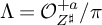 $\Lambda = {\mathcal {O}}^{+a}_{Z^\sharp }/\pi $
for some untilt
$\Lambda = {\mathcal {O}}^{+a}_{Z^\sharp }/\pi $
for some untilt $Z^\sharp $
of Z and some pseudouniformizer
$Z^\sharp $
of Z and some pseudouniformizer $\pi $
on
$\pi $
on $Z^\sharp $
. Pick some pseudouniformizer
$Z^\sharp $
. Pick some pseudouniformizer $\varpi $
on
$\varpi $
on $Z^\sharp $
such that
$Z^\sharp $
such that $\varpi | p$
and some integer
$\varpi | p$
and some integer $n> 0$
such that
$n> 0$
such that $\pi | \varpi ^n$
. By [Reference MathewMat16, Proposition 3.35] the map of discrete rings
$\pi | \varpi ^n$
. By [Reference MathewMat16, Proposition 3.35] the map of discrete rings $A^{\sharp +}/\pi \to A^{\sharp +}/\varpi $
admits descent, which after pullback along
$A^{\sharp +}/\pi \to A^{\sharp +}/\varpi $
admits descent, which after pullback along $Z/G \to Z$
implies that the map
$Z/G \to Z$
implies that the map ${\mathcal {O}}_{Z^\sharp /G}^{+a}/\pi \to {\mathcal {O}}_{Z^\sharp /G}^{+a}/\varpi $
in
${\mathcal {O}}_{Z^\sharp /G}^{+a}/\pi \to {\mathcal {O}}_{Z^\sharp /G}^{+a}/\varpi $
in 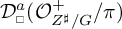 admits descent. Therefore, if we can show that ( $\ast '$
) holds for
$\ast '$
) holds for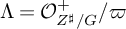 $\Lambda = {\mathcal {O}}^+_{Z^\sharp /G}/\varpi $
then by [Reference MathewMat16, Proposition 3.24] and [Reference Bhatt and ScholzeBS17, Lemma 11.10] it also follows for
$\Lambda = {\mathcal {O}}^+_{Z^\sharp /G}/\varpi $
then by [Reference MathewMat16, Proposition 3.24] and [Reference Bhatt and ScholzeBS17, Lemma 11.10] it also follows for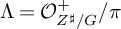 $\Lambda = {\mathcal {O}}^+_{Z^\sharp /G}/\pi $
. Thus from now on we can assume that
$\Lambda = {\mathcal {O}}^+_{Z^\sharp /G}/\pi $
. Thus from now on we can assume that $\pi = \varpi $
, i.e. we now have
$\pi = \varpi $
, i.e. we now have $\pi | p$
.
$\pi | p$
.
Now recall the Riemann-Hilbert functor  from [Reference MannMan22, Definition 3.9.21. (a)] (where we ignore the $\varphi $
-module structure). Then
$\varphi $
-module structure). Then $RH$
is symmetric monoidal and exact and satisfies
$RH$
is symmetric monoidal and exact and satisfies $RH(q_*{\mathbf {F}}_p) = q_*({\mathcal {O}}_{Z^\sharp }^{+a}/\pi )$
. To verify the latter, note that this identity can be checked after applying
$RH(q_*{\mathbf {F}}_p) = q_*({\mathcal {O}}_{Z^\sharp }^{+a}/\pi )$
. To verify the latter, note that this identity can be checked after applying $q^*$
, where we get (using base-change)
$q^*$
, where we get (using base-change)
 $$ \begin{align*} q^* RH(q_* {\mathbf{F}}_p) &= RH(q^*q_* {\mathbf{F}}_p) = RH({\mathcal{C}}(G,{\mathbf{F}}_p)) = {\mathcal{C}}(G, {\mathbf{F}}_p) \otimes_{{\mathbf{F}}_p} A^{\sharp+,a}/\pi = {\mathcal{C}}(G, A^{\sharp+,a}/\pi) \\&= q^* q_*(A^{\sharp+,a}/\pi) \end{align*} $$
(here we implicitly use the identity  ). All in all this means that it is enough to show that $q_*{\mathbf {F}}_p \in {\mathcal {D}}_{\mathrm {\acute {e}t}}(Z/G, {\mathbf {F}}_p)^{\mathrm {oc}}$
is descendable. It follows easily from [Reference MannMan22, Lemma 3.9.18.(iii)] that
$q_*{\mathbf {F}}_p \in {\mathcal {D}}_{\mathrm {\acute {e}t}}(Z/G, {\mathbf {F}}_p)^{\mathrm {oc}}$
is descendable. It follows easily from [Reference MannMan22, Lemma 3.9.18.(iii)] that ${\mathcal {D}}_{\mathrm {\acute {e}t}}(Z/G, {\mathbf {F}}_p)^{\mathrm {oc}} = {\mathcal {D}}^{\mathrm {sm}}(G, {\mathbf {F}}_p(Z))_\omega $
is the derived
${\mathcal {D}}_{\mathrm {\acute {e}t}}(Z/G, {\mathbf {F}}_p)^{\mathrm {oc}} = {\mathcal {D}}^{\mathrm {sm}}(G, {\mathbf {F}}_p(Z))_\omega $
is the derived $\infty $
-category of discrete smooth G-representations on
$\infty $
-category of discrete smooth G-representations on ${\mathbf {F}}_p(Z)$
-modules (use the same argument as in the proof of [Reference MannMan22, Lemma 3.4.26.(iii)]). Our goal is to show that the G-representation
${\mathbf {F}}_p(Z)$
-modules (use the same argument as in the proof of [Reference MannMan22, Lemma 3.4.26.(iii)]). Our goal is to show that the G-representation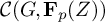 ${\mathcal {C}}(G, {\mathbf {F}}_p(Z))$
admits descent in this
${\mathcal {C}}(G, {\mathbf {F}}_p(Z))$
admits descent in this $\infty $
-category. By considering base-change along
$\infty $
-category. By considering base-change along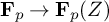 ${\mathbf {F}}_p \to {\mathbf {F}}_p(Z)$
we reduce the claim to the following:
${\mathbf {F}}_p \to {\mathbf {F}}_p(Z)$
we reduce the claim to the following:
-
(∗′′) The algebra object
${\mathcal {C}}(G,{\mathbf {F}}_p) \in {\mathcal {D}}^{\mathrm {sm}}(G, {\mathbf {F}}_p)_\omega $
admits descent.

Note that ${\mathcal {D}}^{\mathrm {sm}}(G,{\mathbf {F}}_p)_\omega $
is equivalent to the full subcategory of
${\mathcal {D}}^{\mathrm {sm}}(G,{\mathbf {F}}_p)_\omega $
is equivalent to the full subcategory of  spanned by the discrete G-representations (e.g. both $\infty $
-categories can be constructed using the same descent diagram), hence by Proposition 3.10 it follows that for all static
$\infty $
-categories can be constructed using the same descent diagram), hence by Proposition 3.10 it follows that for all static $M, N \in {\mathcal {D}}^{\mathrm {sm}}(G,{\mathbf {F}}_p)_\omega $
we have
$M, N \in {\mathcal {D}}^{\mathrm {sm}}(G,{\mathbf {F}}_p)_\omega $
we have $\pi _0\operatorname {\mathrm {Hom}}(M, N[i]) = 0$
for
$\pi _0\operatorname {\mathrm {Hom}}(M, N[i]) = 0$
for $i> d := \operatorname {\mathrm {cd}}_p G$
. Now consider the triangle
$i> d := \operatorname {\mathrm {cd}}_p G$
. Now consider the triangle
 $$ \begin{align*} {\mathbf{F}}_p \to \operatorname{\mathrm{Tot}}_d({\mathcal{C}}(G,{\mathbf{F}}_p)^{\otimes \bullet+1}) \to X \end{align*} $$
in ${\mathcal {D}}^{\mathrm {sm}}(G,{\mathbf {F}}_p)_\omega $
, where
${\mathcal {D}}^{\mathrm {sm}}(G,{\mathbf {F}}_p)_\omega $
, where $\operatorname {\mathrm {Tot}}_d$
denotes the d-truncated totalization of a cosimplicial object (i.e. the limit over
$\operatorname {\mathrm {Tot}}_d$
denotes the d-truncated totalization of a cosimplicial object (i.e. the limit over $\Delta _{\le d}$
). We know that
$\Delta _{\le d}$
). We know that $\operatorname {\mathrm {Tot}}({\mathcal {C}}(G,{\mathbf {F}}_p)^{\otimes \bullet +1}) = {\mathbf {F}}_p$
(by descent) and by the dual version of [Reference LurieLur, Proposition 1.2.4.5] we have
$\operatorname {\mathrm {Tot}}({\mathcal {C}}(G,{\mathbf {F}}_p)^{\otimes \bullet +1}) = {\mathbf {F}}_p$
(by descent) and by the dual version of [Reference LurieLur, Proposition 1.2.4.5] we have $\pi _i \operatorname {\mathrm {Tot}}_d = \pi _i \operatorname {\mathrm {Tot}}$
for
$\pi _i \operatorname {\mathrm {Tot}}_d = \pi _i \operatorname {\mathrm {Tot}}$
for $i> -d$
. It follows that X is concentrated in homological degrees
$i> -d$
. It follows that X is concentrated in homological degrees $\le -d$
, so that by the above vanishing of hom’s the connecting map
$\le -d$
, so that by the above vanishing of hom’s the connecting map $X \to {\mathbf {F}}_p[1]$
must be zero. It follows that
$X \to {\mathbf {F}}_p[1]$
must be zero. It follows that $\operatorname {\mathrm {Tot}}_d({\mathcal {C}}(G,{\mathbf {F}}_p)^{\otimes \bullet +1}) \cong {\mathbf {F}}_p \oplus X$
, which immediately implies that
$\operatorname {\mathrm {Tot}}_d({\mathcal {C}}(G,{\mathbf {F}}_p)^{\otimes \bullet +1}) \cong {\mathbf {F}}_p \oplus X$
, which immediately implies that ${\mathcal {C}}(G,{\mathbf {F}}_p)$
admits descent.
${\mathcal {C}}(G,{\mathbf {F}}_p)$
admits descent.
Corollary 3.12. Let G be a profinite group with $\operatorname {\mathrm {cd}}_p G < \infty $
. Then:
$\operatorname {\mathrm {cd}}_p G < \infty $
. Then:
-
(i) The map
$*/G \to *$
is p-fine. -
(ii) For every
$(X,\Lambda ) \in {{\rm vStack}_\Lambda }$
with associated map
$f\colon X/G \to X$
there is a natural isomorphism
$f_! = f_*$
of functors .




 .
.Proof. Part (i) follows from Lemma 3.11 by using the factorization $\operatorname {\mathrm {id}} = [* \to */G \to *]$
. To prove (ii) let
$\operatorname {\mathrm {id}} = [* \to */G \to *]$
. To prove (ii) let $(X,\Lambda )$
be given and assume first that
$(X,\Lambda )$
be given and assume first that $(X,\Lambda )$
admits a map to some strictly totally disconnected space. Let
$(X,\Lambda )$
admits a map to some strictly totally disconnected space. Let $q\colon X \to X/G$
denote the projection and let
$q\colon X \to X/G$
denote the projection and let $q_\bullet \colon X_\bullet \to X/G$
be the Čech nerve of q. By Lemma 3.11 we have
$q_\bullet \colon X_\bullet \to X/G$
be the Čech nerve of q. By Lemma 3.11 we have  , which means that for all
  the natural map $\varinjlim _{n\in \Delta } q_{n!} q_n^! \mathcal M \mathbin {\xrightarrow {\sim }} \mathcal M$
is an isomorphism. Since both
$\varinjlim _{n\in \Delta } q_{n!} q_n^! \mathcal M \mathbin {\xrightarrow {\sim }} \mathcal M$
is an isomorphism. Since both $f_*$
and
$f_*$
and $f_!$
preserve small colimits (for
$f_!$
preserve small colimits (for $f_*$
this follows from
$f_*$
this follows from $\operatorname {\mathrm {cd}}_p G < \infty $
) and all
$\operatorname {\mathrm {cd}}_p G < \infty $
) and all $q_n$
and
$q_n$
and $f \mathbin {\circ } q_n$
are proper we deduce
$f \mathbin {\circ } q_n$
are proper we deduce
 $$ \begin{align*} f_* = f_* \varinjlim_n q_{n!} q_n^! = \varinjlim_n (f \mathbin{\circ} q_n)_* q_n^! = \varinjlim_n (f \mathbin{\circ} q_n)_! q_n^! = f_!. \end{align*} $$
The case of general $(X,\Lambda )$
can be deduced via descent (more precisely, do the above computation on sections of the cocartesian fibrations over
$(X,\Lambda )$
can be deduced via descent (more precisely, do the above computation on sections of the cocartesian fibrations over $\Delta $
).
$\Delta $
).
Having established that $*/G \to *$
is p-fine in many cases, we now determine criteria for when this map is p-cohomologically smooth. When G has finite p-cohomological dimension, the precise answer is captured by the following definition.
$*/G \to *$
is p-fine in many cases, we now determine criteria for when this map is p-cohomologically smooth. When G has finite p-cohomological dimension, the precise answer is captured by the following definition.
Definition 3.13. Let G be a profinite group with $\operatorname {\mathrm {cd}}_p G < \infty $
. We say that G is p-Poincaré of dimension d if it satisfies the following conditions:
$\operatorname {\mathrm {cd}}_p G < \infty $
. We say that G is p-Poincaré of dimension d if it satisfies the following conditions:
-
(i)
$H^i(G, M)$
is finite for all
$i \ge 0$
and all G-representations M on finite
${\mathbf {F}}_p$
-vector spaces. -
(ii) The solid
${\mathbf {F}}_p$
-vector space is invertible and concentrated in cohomological degree d (i.e. it is isomorphic to
${\mathbf {F}}_p[-d]$
).


 is invertible and concentrated in cohomological degree d (i.e. it is isomorphic to
Note that condition (i) is equivalent to the finiteness of $H^i(H,{\mathbf {F}}_p)$
for all
$H^i(H,{\mathbf {F}}_p)$
for all $i\geq 0$
and all open subgroups
$i\geq 0$
and all open subgroups $H\subseteq G$
. Note also that if G is p-Poincaré of dimension d, then so is every open subgroup of G.
$H\subseteq G$
. Note also that if G is p-Poincaré of dimension d, then so is every open subgroup of G.
Proposition 3.14. Let G be a profinite group with $\operatorname {\mathrm {cd}}_p G < \infty $
.
$\operatorname {\mathrm {cd}}_p G < \infty $
.
-
(i) G satisfies condition (i) of Definition 3.13 if and only if for all strictly totally disconnected spaces
$(X,\Lambda ) \in {{\rm vStack}_\Lambda }$
with associated map
$f\colon X/G \to X$
the morphism
$f^* \otimes f^! \Lambda ^a \mathbin {\xrightarrow {\sim }} f^!$
is an equivalence of functors . -
(ii) G is a p-Poincaré group (of dimension d) if and only if the map
$*/G \to *$
is p-cohomologically smooth (of pure dimension
$d/2$
).



 .
.

Proof. Fix a strictly totally disconnected space $(X,\Lambda ) \in {{\rm vStack}_\Lambda }$
with associated map
$(X,\Lambda ) \in {{\rm vStack}_\Lambda }$
with associated map $f\colon X/G \to X$
. Then
$f\colon X/G \to X$
. Then  is the $\infty $
-category of solid almost
$\infty $
-category of solid almost $\Lambda (X)$
-modules, while
$\Lambda (X)$
-modules, while 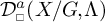 is the $\infty $
-category of smooth G-representations on such modules (see [Reference MannMan22, Lemma 3.4.26]). Moreover,
$\infty $
-category of smooth G-representations on such modules (see [Reference MannMan22, Lemma 3.4.26]). Moreover, $f_*$
computes smooth G-cohomology and
$f_*$
computes smooth G-cohomology and $f^*$
associates to every
$f^*$
associates to every  the trivial G-representation on M.
We first prove (i). By [Reference MannMan22, Lemma 3.4.19] the collection of functors  for open compact subgroups H is conservative. Therefore the natural map $f^* \otimes f^! \Lambda ^a \to f^!$
is an equivalence if and only if for all compact open subgroups
$f^* \otimes f^! \Lambda ^a \to f^!$
is an equivalence if and only if for all compact open subgroups $H \subset G$
the map
$H \subset G$
the map $R\Gamma _{\mathrm {sm}}(H, f^* \otimes f^! \Lambda ^a) \to R\Gamma _{\mathrm {sm}}(H, f^!)$
is an equivalence of endofunctors of
$R\Gamma _{\mathrm {sm}}(H, f^* \otimes f^! \Lambda ^a) \to R\Gamma _{\mathrm {sm}}(H, f^!)$
is an equivalence of endofunctors of  . Let us denote $f_H\colon */H \to *$
the projection, which factors over the finite étale projection
$f_H\colon */H \to *$
the projection, which factors over the finite étale projection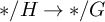 $*/H \to */G$
. Then we see that
$*/H \to */G$
. Then we see that $f^* \otimes f^! \Lambda ^a \to f^!$
is an equivalence if and only if for all compact open subgroups
$f^* \otimes f^! \Lambda ^a \to f^!$
is an equivalence if and only if for all compact open subgroups $H \subset G$
the map
$H \subset G$
the map
 $$ \begin{align*} f_{H*} (f_H^* \otimes f_H^! \Lambda^a) \to f_{H*} f_H^! \end{align*} $$
is an equivalence. By Corollary 3.12 we have $f_{H*} = f_{H!}$
, so in particular
$f_{H*} = f_{H!}$
, so in particular $f_{H*}$
satisfies the projection formula. We compute
$f_{H*}$
satisfies the projection formula. We compute
 $$ \begin{align*} f_{H*} (f_H^* \otimes f_H^! \Lambda^a) &= - \otimes f_{H*} f_H^! \Lambda^a = - \otimes {\underline{\operatorname{\mathrm{Hom}}}}(f_{H*}\Lambda^a, \Lambda^a),\\ f_{H*} f_H^! &= f_{H*} {\underline{\operatorname{\mathrm{Hom}}}}(\Lambda^a, f_H^!) = {\underline{\operatorname{\mathrm{Hom}}}}(f_{H!}\Lambda^a, -) = {\underline{\operatorname{\mathrm{Hom}}}}(f_{H*}\Lambda^a, -). \end{align*} $$
It follows that $f^* \otimes f^! \Lambda ^a \to f^!$
is an equivalence if and only if
$f^* \otimes f^! \Lambda ^a \to f^!$
is an equivalence if and only if $R\Gamma _{\mathrm {sm}}(H, \Lambda (X)^a) = f_{H*} \Lambda ^a$
is dualizable in
$R\Gamma _{\mathrm {sm}}(H, \Lambda (X)^a) = f_{H*} \Lambda ^a$
is dualizable in  for all open compact $H \subset G$
. Now assume that G satisfies condition (i) of Definition 3.13. Then
$H \subset G$
. Now assume that G satisfies condition (i) of Definition 3.13. Then $R\Gamma _{\mathrm {sm}}(H, {\mathbf {F}}_p)$
is dualizable in
$R\Gamma _{\mathrm {sm}}(H, {\mathbf {F}}_p)$
is dualizable in  for all H. If $p = 0$
in
$p = 0$
in $\Lambda (X)$
then the same follows for
$\Lambda (X)$
then the same follows for $R\Gamma _{\mathrm {sm}}(H, \Lambda (X)^a) = R\Gamma _{\mathrm {sm}}(H, {\mathbf {F}}_p) \otimes _{{\mathbf {F}}_p} \Lambda (X)^a$
. For general
$R\Gamma _{\mathrm {sm}}(H, \Lambda (X)^a) = R\Gamma _{\mathrm {sm}}(H, {\mathbf {F}}_p) \otimes _{{\mathbf {F}}_p} \Lambda (X)^a$
. For general $\Lambda $
we can argue as in the proof of [Reference MannMan22, Lemma 3.8.4. (i)]. Conversely, assume that
$\Lambda $
we can argue as in the proof of [Reference MannMan22, Lemma 3.8.4. (i)]. Conversely, assume that $f^* \otimes f^! \Lambda ^a \mathbin {\xrightarrow {\sim }} f^!$
is an isomorphism for all
$f^* \otimes f^! \Lambda ^a \mathbin {\xrightarrow {\sim }} f^!$
is an isomorphism for all $(X,\Lambda )$
. Pick
$(X,\Lambda )$
. Pick $X = \operatorname {\mathrm {Spa}} C$
for some algebraically closed field over
$X = \operatorname {\mathrm {Spa}} C$
for some algebraically closed field over ${\mathbf {Q}}_p$
and
${\mathbf {Q}}_p$
and $\Lambda = {\mathcal {O}}_C/p$
. Then the Riemann-Hilbert correspondence from [Reference MannMan22, Theorem 3.9.23] implies that the base-change functor
$\Lambda = {\mathcal {O}}_C/p$
. Then the Riemann-Hilbert correspondence from [Reference MannMan22, Theorem 3.9.23] implies that the base-change functor $RH\colon {\mathcal {D}}^{\mathrm {sm}}(G,{\mathbf {F}}_p) \mathrel {\hookrightarrow } {\mathcal {D}}^{\mathrm {sm}}(G,{\mathcal {O}}^a_C/p)^\varphi $
is fully faithful and induces an equivalence of dualizable objects. On the other hand, this base-change functor sends
$RH\colon {\mathcal {D}}^{\mathrm {sm}}(G,{\mathbf {F}}_p) \mathrel {\hookrightarrow } {\mathcal {D}}^{\mathrm {sm}}(G,{\mathcal {O}}^a_C/p)^\varphi $
is fully faithful and induces an equivalence of dualizable objects. On the other hand, this base-change functor sends $R\Gamma _{\mathrm {sm}}(H,{\mathbf {F}}_p)$
to
$R\Gamma _{\mathrm {sm}}(H,{\mathbf {F}}_p)$
to $R\Gamma _{\mathrm {sm}}(H,{\mathcal {O}}^a_C/p)$
, hence it follows from the above that
$R\Gamma _{\mathrm {sm}}(H,{\mathcal {O}}^a_C/p)$
, hence it follows from the above that $R\Gamma _{\mathrm {sm}}(H,{\mathbf {F}}_p)$
is dualizable for all open compact subgroups
$R\Gamma _{\mathrm {sm}}(H,{\mathbf {F}}_p)$
is dualizable for all open compact subgroups $H \subset G$
. But every G-representation M on a finite static
$H \subset G$
. But every G-representation M on a finite static ${\mathbf {F}}_p$
-vector space is a finite colimit of the generating representations
${\mathbf {F}}_p$
-vector space is a finite colimit of the generating representations ${\mathbf {F}}_p[G/H]$
, hence also
${\mathbf {F}}_p[G/H]$
, hence also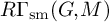 $R\Gamma _{\mathrm {sm}}(G,M)$
is dualizable. In particular all
$R\Gamma _{\mathrm {sm}}(G,M)$
is dualizable. In particular all $H^i(G,M)$
are finite (here we implicitly use
$H^i(G,M)$
are finite (here we implicitly use $R\Gamma (G,M) = R\Gamma _{\mathrm {sm}}(G,M)$
since M is discrete).
$R\Gamma (G,M) = R\Gamma _{\mathrm {sm}}(G,M)$
since M is discrete).
We now prove (ii), so from now on we can assume that G satisfies the equivalent conditions of (i). We then need to see that G is p-Poincaré if and only if for every strictly totally disconnected $(X,\Lambda ) \in {{\rm vStack}_\Lambda }$
with
$(X,\Lambda ) \in {{\rm vStack}_\Lambda }$
with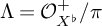 $\Lambda = {\mathcal {O}}^+_{X^\flat }/\pi $
for some pseudouniformizer
$\Lambda = {\mathcal {O}}^+_{X^\flat }/\pi $
for some pseudouniformizer $\pi $
on
$\pi $
on $X^\flat $
the object
$X^\flat $
the object  is invertible. Given $(X,\Lambda )$
, let us denote
$(X,\Lambda )$
, let us denote $q\colon X \to X/G$
the projection. Since invertibility satisfies descent,
$q\colon X \to X/G$
the projection. Since invertibility satisfies descent, $f^! \Lambda ^a$
is invertible if and only if
$f^! \Lambda ^a$
is invertible if and only if $q^* f^! \Lambda ^a$
is invertible. For every compact open subgroup
$q^* f^! \Lambda ^a$
is invertible. For every compact open subgroup $H \subset G$
we denote
$H \subset G$
we denote $f_H\colon */H \to *$
and
$f_H\colon */H \to *$
and $q_H\colon */H \to */G$
the natural maps and we compute (using [Reference MannMan22, Proposition 3.3.9.(iii)] and Corollary 3.12)
$q_H\colon */H \to */G$
the natural maps and we compute (using [Reference MannMan22, Proposition 3.3.9.(iii)] and Corollary 3.12)
 $$ \begin{align*} q^* f^! \Lambda^a = f_* q_* q^* f^! \Lambda^a = \varinjlim_H f_* q_{H*} q_H^* f^! \Lambda^a = \varinjlim_H f_{H*} f_H^! \Lambda^a = \varinjlim_H {\underline{\operatorname{\mathrm{Hom}}}}(f_{H*} \Lambda^a, \Lambda^a). \end{align*} $$
By the proof of (i) we know that $f_{H*} \Lambda ^a = R\Gamma (H, \Lambda (X)^a)$
is dualizable in
$f_{H*} \Lambda ^a = R\Gamma (H, \Lambda (X)^a)$
is dualizable in  and similarly $R\Gamma (H,{\mathbf {F}}_p)$
is dualizable in
$R\Gamma (H,{\mathbf {F}}_p)$
is dualizable in  . It follows that
 $$ \begin{align*} {\underline{\operatorname{\mathrm{Hom}}}}(f_{H*} \Lambda^a, \Lambda^a) = {\underline{\operatorname{\mathrm{Hom}}}}(\Gamma(H,{\mathbf{F}}_p), {\mathbf{F}}_p) \otimes_{{\mathbf{F}}_p} \Lambda(X)^a. \end{align*} $$
Therefore we obtain
 $$ \begin{align*} q^* f^! \Lambda^a = \varinjlim_H {\underline{\operatorname{\mathrm{Hom}}}}(f_{H*} \Lambda^a, \Lambda^a) = (\varinjlim_H {\underline{\operatorname{\mathrm{Hom}}}}(\Gamma(H,{\mathbf{F}}_p), {\mathbf{F}}_p)) \otimes_{{\mathbf{F}}_p} \Lambda(X)^a \end{align*} $$
We have $R\Gamma (H,{\mathbf {F}}_p) = \bigoplus _i H^i(H, {\mathbf {F}}_p)[-i]$
and since there are no higher
$R\Gamma (H,{\mathbf {F}}_p) = \bigoplus _i H^i(H, {\mathbf {F}}_p)[-i]$
and since there are no higher $\operatorname {\mathrm {Ext}}$
-groups between discrete
$\operatorname {\mathrm {Ext}}$
-groups between discrete ${\mathbf {F}}_p$
-vector spaces we even have a decomposition of diagrams
${\mathbf {F}}_p$
-vector spaces we even have a decomposition of diagrams $(R\Gamma (H,{\mathbf {F}}_p)_H = \bigoplus _i (H^i(H,{\mathbf {F}}_p))_H$
. On the other hand, we know that if
$(R\Gamma (H,{\mathbf {F}}_p)_H = \bigoplus _i (H^i(H,{\mathbf {F}}_p))_H$
. On the other hand, we know that if $(M_i)_i$
is any cofiltered system of finite discrete
$(M_i)_i$
is any cofiltered system of finite discrete ${\mathbf {F}}_p$
-vector spaces then
${\mathbf {F}}_p$
-vector spaces then $\varprojlim _i M_i$
is concentrated in degree
$\varprojlim _i M_i$
is concentrated in degree $0$
and
$0$
and ${\underline {\operatorname {\mathrm {Hom}}}}(\varprojlim _i M_i, {\mathbf {F}}_p) = \varinjlim _i {\underline {\operatorname {\mathrm {Hom}}}}(M_i, {\mathbf {F}}_p)$
. Altogether this implies
${\underline {\operatorname {\mathrm {Hom}}}}(\varprojlim _i M_i, {\mathbf {F}}_p) = \varinjlim _i {\underline {\operatorname {\mathrm {Hom}}}}(M_i, {\mathbf {F}}_p)$
. Altogether this implies

We deduce:

In particular, if G is p-Poincaré then $q^* f^! \Lambda ^a$
is invertible. Conversely, assume that
$q^* f^! \Lambda ^a$
is invertible. Conversely, assume that $*/G \to *$
is p-cohomologically smooth. Choosing
$*/G \to *$
is p-cohomologically smooth. Choosing $X = \operatorname {\mathrm {Spa}} C$
for some algebraically closed field C, the Riemann-Hilbert correspondence (see [Reference MannMan22, Theorem 3.9.23]) tells us that the invertibility of
$X = \operatorname {\mathrm {Spa}} C$
for some algebraically closed field C, the Riemann-Hilbert correspondence (see [Reference MannMan22, Theorem 3.9.23]) tells us that the invertibility of $q^* f^! \Lambda ^a$
implies that
$q^* f^! \Lambda ^a$
implies that  is invertible. But then also
  is invertible and thus G is p-Poincaré.
So far we have only dealt with profinite groups of bounded p-cohomological dimension. However, the above results generalize in a straightforward way to locally profinite groups satisfying a much weaker cohomological dimension condition. The precise definition is as follows.
Definition 3.15. Let G be a locally profinite group.
-
(a) We say that G has locally finite p-cohomological dimension if there is some open subgroup
$H \subseteq G$
such that
$\operatorname {\mathrm {cd}}_p H < \infty $
. -
(b) We say that G is virtually p-Poincaré (of dimension d) if there is an open compact subgroup
$H \subset G$
such that
$\operatorname {\mathrm {cd}}_p H < \infty $
and H is p-Poincaré of dimension d in the sense of Definition 3.13.


Theorem 3.16. Let G be a locally profinite group which has locally finite p-cohomological dimension. Then the map $*/G \to *$
is p-fine, and it is p-cohomologically smooth (of pure dimension
$*/G \to *$
is p-fine, and it is p-cohomologically smooth (of pure dimension $d/2$
) if and only if G is virtually p-Poincaré (of dimension d).
$d/2$
) if and only if G is virtually p-Poincaré (of dimension d).
Proof. This follows immediately from Proposition 3.14 by observing that being p-fine and being p-cohomologically smooth can both be checked étale locally on the source (note that if $H \subseteq G$
is an open subgroup then the map
$H \subseteq G$
is an open subgroup then the map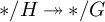 $*/H \mathrel {\twoheadrightarrow } */G$
is an étale cover).
$*/H \mathrel {\twoheadrightarrow } */G$
is an étale cover).
As a formal consequence of Theorem 3.16 we obtain the following p-adic analog of [Reference ScholzeSch18a, Proposition 24.2]:
Corollary 3.17. Let G be a locally profinite group of locally finite p-cohomological dimension acting on a small v-stack Y and let $f\colon Y \to X$
be a G-equivariant separated bdcs map of small v-stacks, where G acts trivially on X.
$f\colon Y \to X$
be a G-equivariant separated bdcs map of small v-stacks, where G acts trivially on X.
-
(i) The map
$f'\colon Y/G \to X$
is p-fine. -
(ii) If f is p-cohomologically smooth and G is virtually p-Poincaré, then
$f'$
is p-cohomologically smooth.


Proof. Factor $f'$
as
$f'$
as $Y/G \to X/G \to X$
. We claim that the first map, i.e.
$Y/G \to X/G \to X$
. We claim that the first map, i.e. $f/G\colon Y/G \to X/G$
, is bdcs: Base-changing this map along the pro-étale cover
$f/G\colon Y/G \to X/G$
, is bdcs: Base-changing this map along the pro-étale cover $X \mathrel {\twoheadrightarrow } X/G$
gives f, hence the map
$X \mathrel {\twoheadrightarrow } X/G$
gives f, hence the map $Y/G \to X/G$
is separated by [Reference ScholzeSch18a, Proposition 10.11.(ii)], compactifiable by [Reference ScholzeSch18a, Proposition 22.3.(iii)] (note that f is automatically compactifiable by [Reference ScholzeSch18a, Proposition 22.3. (v)]), p-bounded by [Reference MannMan22, Lemma 3.5.10.(ii)] and representable in locally spatial diamonds by [Reference ScholzeSch18a, Proposition 13.4.(iv)]. Since
$Y/G \to X/G$
is separated by [Reference ScholzeSch18a, Proposition 10.11.(ii)], compactifiable by [Reference ScholzeSch18a, Proposition 22.3.(iii)] (note that f is automatically compactifiable by [Reference ScholzeSch18a, Proposition 22.3. (v)]), p-bounded by [Reference MannMan22, Lemma 3.5.10.(ii)] and representable in locally spatial diamonds by [Reference ScholzeSch18a, Proposition 13.4.(iv)]. Since $X/G \to X$
is p-fine by Corollary 3.12 we deduce that
$X/G \to X$
is p-fine by Corollary 3.12 we deduce that $f'$
is p-fine. This proves (i).
$f'$
is p-fine. This proves (i).
To prove (ii), assume in addition that f is p-cohomologically smooth and G is virtually p-Poincaré. Then it follows from [Reference MannMan22, Lemma 3.8.5.(ii)] that $f/G$
is p-cohomologically smooth, and it follows from Theorem 3.16 that the map
$f/G$
is p-cohomologically smooth, and it follows from Theorem 3.16 that the map $X/G \to X$
is p-cohomologically smooth. Together this implies that
$X/G \to X$
is p-cohomologically smooth. Together this implies that $f'$
is p-cohomologically smooth, as desired.
$f'$
is p-cohomologically smooth, as desired.
We end this subsection by providing examples of virtual p-Poincaré groups. The key result for applications is the following theorem.
Theorem 3.18. Any p-adic Lie group is virtually p-Poincaré.
By the local nature of Definition 3.15 and standard structural results on p-adic Lie groups, this is an immediate consequence of the following theorem, which is what we shall actually prove.
Theorem 3.19. Any torsion-free compact p-adic analytic group is p-Poincaré.
The proof relies on deep results of Lazard [Reference LazardLaz65], which are in some sense the only ‘non-formal’ input we need. To apply Lazard’s results, we need some general comparison between condensed group cohomology and classical continuous group cohomology, which takes into account a natural topological structure on the latter. To state the relevant result, fix a locally profinite group G. Let V be a continuous representation of G on a Hausdorff locally compact ${\mathbf {F}}_p$
-module. Then
${\mathbf {F}}_p$
-module. Then $\underline {V}$
is a solid
$\underline {V}$
is a solid ${\mathbf {F}}_p$
-vector space with an action by the condensed group G, i.e. an
${\mathbf {F}}_p$
-vector space with an action by the condensed group G, i.e. an  -module. Thus we may form the condensed group cohomology

as considered above.
On the other hand, the classical continuous group cohomology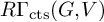 $R\Gamma _{\mathrm {cts}}(G,V)$
is by definition computed by the usual complex
$R\Gamma _{\mathrm {cts}}(G,V)$
is by definition computed by the usual complex
 $$\begin{align*}0 \to V \to \mathcal{C}(G,V) \to \mathcal{C}(G^2,V) \to \cdots \end{align*}$$
of inhomogeneous cochains. Giving each $\mathcal {C}(G^n,V)$
the compact-open topology, this is naturally a complex of Hausdorff locally compact
$\mathcal {C}(G^n,V)$
the compact-open topology, this is naturally a complex of Hausdorff locally compact ${\mathbf {F}}_p$
-modules. In particular, passing termwise to the condensation, we get a complex
${\mathbf {F}}_p$
-modules. In particular, passing termwise to the condensation, we get a complex
 $$\begin{align*}0 \to \underline{V} \to \underline{\mathcal{C}(G,V)} \to \underline{\mathcal{C}(G^2,V)} \to \cdots \end{align*}$$
of solid ${\mathbf {F}}_p$
-vector spaces. Let
${\mathbf {F}}_p$
-vector spaces. Let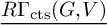 $\underline {R\Gamma _{\mathrm {cts}}(G,V)}$
denote the image of this complex in
$\underline {R\Gamma _{\mathrm {cts}}(G,V)}$
denote the image of this complex in  .
.
Lemma 3.20. There is a natural isomorphism
 $$\begin{align*}R\Gamma(G,\underline{V}) \simeq \underline{R\Gamma_{\mathrm{cts}}(G,V)} \end{align*}$$
in  .
.
Proof of Theorem 3.19
Let G be as in the statement of the theorem. Then condition (i) in Definition 3.13 is classical, see, e.g. [Reference Symonds and WeigelSW00, Theorems 5.1.1 and 5.1.5]. For condition (ii), recall that $R\Gamma _{\mathrm {cts}}(G,{\mathbf {F}}_p[[G]]) \simeq {\mathbf {F}}_p[-\dim G]$
by [Reference LazardLaz65, Ch. V, Sec. 2] and [Reference Symonds and WeigelSW00, Theorem 5.1.9]. Since
$R\Gamma _{\mathrm {cts}}(G,{\mathbf {F}}_p[[G]]) \simeq {\mathbf {F}}_p[-\dim G]$
by [Reference LazardLaz65, Ch. V, Sec. 2] and [Reference Symonds and WeigelSW00, Theorem 5.1.9]. Since  , the conclusion now follows from Lemma 3.20.
Proof of Lemma 3.20
Arguing as in the proof of [Reference MannMan22, Proposition 3.4.6], one sees that $R\Gamma (G,\underline {V})$
is computed as the cohomology of the complex
$R\Gamma (G,\underline {V})$
is computed as the cohomology of the complex
 $$\begin{align*}0 \to \underline{V} \to \underline{\operatorname{\mathrm{Hom}}}(\underline{G},\underline{V}) \to \underline{\operatorname{\mathrm{Hom}}}(\underline{G}^2,\underline{V}) \to \cdots\end{align*}$$
where the internal homs are taken in condensed sets. By the definition of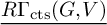 $\underline {R\Gamma _{\mathrm {cts}}(G,V)}$
, it now suffices to show that
$\underline {R\Gamma _{\mathrm {cts}}(G,V)}$
, it now suffices to show that $\underline {\operatorname {\mathrm {Hom}}}(\underline {S},\underline {V})$
identifies with
$\underline {\operatorname {\mathrm {Hom}}}(\underline {S},\underline {V})$
identifies with $\underline {{\mathcal {C}}(S,V)}$
functorially in locally profinite S. This is a special case of the next lemma.
$\underline {{\mathcal {C}}(S,V)}$
functorially in locally profinite S. This is a special case of the next lemma.
Lemma 3.21. Let X be any locally compact Hausdorff space, and let Y be any compactly generated T1 topological space. Equip the space of continuous maps ${\mathcal {C}}(X,Y)$
with the compact-open topology. Then
${\mathcal {C}}(X,Y)$
with the compact-open topology. Then ${\mathcal {C}}(X,Y)$
is compactly generated T1, and
${\mathcal {C}}(X,Y)$
is compactly generated T1, and $\underline {{\mathcal {C}}(X,Y)} = \underline {\operatorname {\mathrm {Hom}}}(\underline {X},\underline {Y})$
, where
$\underline {{\mathcal {C}}(X,Y)} = \underline {\operatorname {\mathrm {Hom}}}(\underline {X},\underline {Y})$
, where $\underline {\operatorname {\mathrm {Hom}}}$
denotes the internal hom in condensed sets.
$\underline {\operatorname {\mathrm {Hom}}}$
denotes the internal hom in condensed sets.
Proof. The claim regarding the topology on ${\mathcal {C}}(X,Y)$
is easy. For the remaining claim, let T be any profinite space. We then compute that
${\mathcal {C}}(X,Y)$
is easy. For the remaining claim, let T be any profinite space. We then compute that
 $$ \begin{align*} \operatorname{\mathrm{Hom}}_{\mathrm{Cond}}(\underline{T}, \underline{\operatorname{\mathrm{Hom}}}(\underline{X},\underline{Y})) &= \operatorname{\mathrm{Hom}}_{\mathrm{Cond}}(\underline{T} \times \underline{X},\underline{Y}) \\ &= \operatorname{\mathrm{Hom}}_{\mathrm{Top}}(T \times X, Y) \\ &= \operatorname{\mathrm{Hom}}_{\mathrm{Top}}(T, {\mathcal{C}}(X,Y)) \\ &= \operatorname{\mathrm{Hom}}_{\mathrm{Cond}}(\underline{T}, \underline{{\mathcal{C}}(X,Y)}) \end{align*} $$
naturally in $T,X,Y$
. The first equality is immediate from the universal property of
$T,X,Y$
. The first equality is immediate from the universal property of $\underline {\operatorname {\mathrm {Hom}}}$
. The second equality follows from the fact that on compactly generated T1 spaces,
$\underline {\operatorname {\mathrm {Hom}}}$
. The second equality follows from the fact that on compactly generated T1 spaces, $S \mapsto \underline {S}$
is fully faithful and commutes with finite products. The fourth equality follows similarly, using the first claim in the lemma. The third equality follows from the assumption that X is locally compact Hausdorff, which is exactly the condition needed to ensure that
$S \mapsto \underline {S}$
is fully faithful and commutes with finite products. The fourth equality follows similarly, using the first claim in the lemma. The third equality follows from the assumption that X is locally compact Hausdorff, which is exactly the condition needed to ensure that ${\mathcal {C}}(X,-)$
with its compact-open topology is right-adjoint to
${\mathcal {C}}(X,-)$
with its compact-open topology is right-adjoint to $- \times X$
. Since T is arbitrary, the result now follows from Yoneda.
$- \times X$
. Since T is arbitrary, the result now follows from Yoneda.
3.3 Admissible representations
Given a locally profinite group G, an important subclass of all smooth G-representations are the admissible ones. Classically, a smooth G-representation on an ${\mathbf {F}}_p$
-vector space V is called admissible if for a basis of compact open subgroups
${\mathbf {F}}_p$
-vector space V is called admissible if for a basis of compact open subgroups $H \subseteq G$
the space
$H \subseteq G$
the space $V^H$
of H-invariants is finite. In the condensed derived world the correct analogue of this definition seems to be the following:
$V^H$
of H-invariants is finite. In the condensed derived world the correct analogue of this definition seems to be the following:
Definition 3.22. Let G be a locally profinite group which has locally finite p-cohomological dimension. A smooth G-representation  is called admissible if for a basis of compact open subgroups $H \subseteq G$
the smooth group cohomology
$H \subseteq G$
the smooth group cohomology  is perfect.
Remarks 3.23.
-
(i) An admissible G-representation
is automatically discrete because all
$R\Gamma _{\mathrm {sm}}(H,V)$
are discrete by assumption and hence so is
$V = \varinjlim _H R\Gamma _{\mathrm {sm}}(H,V)$
(cf. [Reference MannMan22, Lemma 3.4.19]). Thus V admits a representation as a complex of classical smooth G-representations. -
(ii) Suppose that G is a p-adic Lie group. Then by [Reference Schneider and SorensenSS22, Corollary 4.12] a smooth representation
is admissible if and only if it is bounded and discrete and all
$\pi _n V$
are admissible smooth representations in the classical sense.
 is automatically discrete because all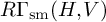

 is admissible if and only if it is bounded and discrete and all
Now suppose we are additionally given an algebraically closed perfectoid field C with pseudouniformizer $\pi | p$
and we consider the classifying stack
$\pi | p$
and we consider the classifying stack $B\underline {G}=\operatorname {\mathrm {Spd}}(C)/\underline {G}$
. Then
$B\underline {G}=\operatorname {\mathrm {Spd}}(C)/\underline {G}$
. Then 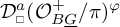 is the $\infty $
-category of smooth G-representations on solid almost
$\infty $
-category of smooth G-representations on solid almost $\varphi $
-modules over
$\varphi $
-modules over ${\mathcal {O}}^a_C/\pi $
and by the p-torsion Riemann-Hilbert correspondence this
${\mathcal {O}}^a_C/\pi $
and by the p-torsion Riemann-Hilbert correspondence this $\infty $
-category contains the
$\infty $
-category contains the $\infty $
-category
$\infty $
-category ${\mathcal {D}}^{\mathrm {sm}}(G,{\mathbf {F}}_p)$
of smooth G-representations as a full subcategory. We make the following definition:
${\mathcal {D}}^{\mathrm {sm}}(G,{\mathbf {F}}_p)$
of smooth G-representations as a full subcategory. We make the following definition:
Definition 3.24. Let G be a locally profinite group which has locally finite p-cohomological dimension. Let C be an algebraically closed perfectoid field with pseudouniformizer $\pi \in {\mathcal {O}}_C$
such that
$\pi \in {\mathcal {O}}_C$
such that $\pi | p$
. A smooth G-representation
$\pi | p$
. A smooth G-representation  is called admissible if it comes from an admissible ${\mathbf {F}}_p$
-representation via the embedding
${\mathbf {F}}_p$
-representation via the embedding

obtained from the Riemann-Hilbert correspondence on the classifying stack $B\underline {G}$
.
$B\underline {G}$
.
One might also consider defining M to be admissible if the smooth group cohomology groups $R\Gamma _{\mathrm {sm}}(H, M)$
are perfect for a basis of open subgroups
$R\Gamma _{\mathrm {sm}}(H, M)$
are perfect for a basis of open subgroups $H \subseteq G$
. In fact, this easily turns out to be equivalent to Definition 3.24, as we will see below. If G is p-Poincaré then there is also a characterization of admissible representations in terms of their behavior under duality. To show this, we need the following characterization of perfect (equivalently, dualizable) objects in terms of their duals:
$H \subseteq G$
. In fact, this easily turns out to be equivalent to Definition 3.24, as we will see below. If G is p-Poincaré then there is also a characterization of admissible representations in terms of their behavior under duality. To show this, we need the following characterization of perfect (equivalently, dualizable) objects in terms of their duals:
Lemma 3.25. Let K be a perfectoid field with pseudouniformizer $\pi \in {\mathcal {O}}_K$
. Then a
$\pi \in {\mathcal {O}}_K$
. Then a $\varphi $
-module
$\varphi $
-module  is dualizable if and only if M is bounded, both M and $M^\vee $
are discrete and the natural map
$M^\vee $
are discrete and the natural map $M \to M^{\vee \vee }$
is an isomorphism.
$M \to M^{\vee \vee }$
is an isomorphism.
Proof. First assume that M is dualizable. Then by [Reference MannMan22, Proposition 3.7.5] both M and $M^\vee $
are discrete. It follows from [Reference MannMan22, Lemmas 3.9.2, 3.9.3] that M is bounded. The isomorphism
$M^\vee $
are discrete. It follows from [Reference MannMan22, Lemmas 3.9.2, 3.9.3] that M is bounded. The isomorphism $M \mathbin {\xrightarrow {\sim }} M^{\vee \vee }$
is clear. This proves the ‘only if’ part of the claim.
$M \mathbin {\xrightarrow {\sim }} M^{\vee \vee }$
is clear. This proves the ‘only if’ part of the claim.
We now prove the ‘if’ part, so assume that M is bounded, M and $M^\vee $
are discrete and
$M^\vee $
are discrete and $M \mathbin {\xrightarrow {\sim }} M^{\vee \vee }$
is an isomorphism. We want to show that M is dualizable, for which we can assume that M is concentrated in homological degree
$M \mathbin {\xrightarrow {\sim }} M^{\vee \vee }$
is an isomorphism. We want to show that M is dualizable, for which we can assume that M is concentrated in homological degree $\ge 0$
. Now consider
$\ge 0$
. Now consider $M_0 := \pi _0 M$
, which is a static discrete
$M_0 := \pi _0 M$
, which is a static discrete ${\mathcal {O}}^a_K$
-module. From the fact that
${\mathcal {O}}^a_K$
-module. From the fact that $M^\vee $
is discrete it follows that
$M^\vee $
is discrete it follows that $\pi _0 M_0^\vee = \pi _0 M^\vee $
is discrete. After choosing a surjection
$\pi _0 M_0^\vee = \pi _0 M^\vee $
is discrete. After choosing a surjection $\bigoplus _I {\mathcal {O}}^a_K/\pi \mathrel {\twoheadrightarrow } M_0$
we get an injection
$\bigoplus _I {\mathcal {O}}^a_K/\pi \mathrel {\twoheadrightarrow } M_0$
we get an injection $\pi _0 M_0^\vee \mathrel {\hookrightarrow } \prod _I {\mathcal {O}}^a_K/\pi $
. Now apply
$\pi _0 M_0^\vee \mathrel {\hookrightarrow } \prod _I {\mathcal {O}}^a_K/\pi $
. Now apply $\pi _0 (-)_*$
to get a submodule
$\pi _0 (-)_*$
to get a submodule
 $$ \begin{align*} M_0' := \pi_0 (\pi_0 M_0^\vee)_* \subseteq \prod_I A, \end{align*} $$
where we abbreviate $A := \pi _0 ({\mathcal {O}}^a_K/\pi )_*$
. Note that
$A := \pi _0 ({\mathcal {O}}^a_K/\pi )_*$
. Note that $M_0'$
is equipped with the subspace topology since it is a kernel of a map
$M_0'$
is equipped with the subspace topology since it is a kernel of a map $\prod _I A \to \prod _J A$
. Moreover, the fact that
$\prod _I A \to \prod _J A$
. Moreover, the fact that $\pi _0 M_0^\vee $
is discrete implies that for every
$\pi _0 M_0^\vee $
is discrete implies that for every $\varepsilon \in {\mathfrak {m}}_K$
the submodule
$\varepsilon \in {\mathfrak {m}}_K$
the submodule $T_\varepsilon \subset M_0'$
of
$T_\varepsilon \subset M_0'$
of $\varepsilon $
-torsion in
$\varepsilon $
-torsion in $M_0'$
is open. In particular there is an open subset
$M_0'$
is open. In particular there is an open subset $U_\varepsilon \subset \prod _I A$
containing
$U_\varepsilon \subset \prod _I A$
containing $0$
such that
$0$
such that $U_\varepsilon \mathbin {\cap } M_0' \subseteq T_\varepsilon $
. In fact we can choose
$U_\varepsilon \mathbin {\cap } M_0' \subseteq T_\varepsilon $
. In fact we can choose $U_\varepsilon $
to be an element of the standard basis for the product topology, i.e.
$U_\varepsilon $
to be an element of the standard basis for the product topology, i.e. $U_\varepsilon = U_\varepsilon ' \times \prod _{I \setminus I_\varepsilon } A$
for some finite subset
$U_\varepsilon = U_\varepsilon ' \times \prod _{I \setminus I_\varepsilon } A$
for some finite subset $I_\varepsilon \subset I$
and some open subset
$I_\varepsilon \subset I$
and some open subset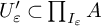 $U_\varepsilon ' \subset \prod _{I_\varepsilon } A$
. This means that if
$U_\varepsilon ' \subset \prod _{I_\varepsilon } A$
. This means that if $(a_i)_i, (b_i)_i \in \prod _I A$
lie in
$(a_i)_i, (b_i)_i \in \prod _I A$
lie in $M_0'$
and
$M_0'$
and $a_i = b_i$
for
$a_i = b_i$
for $i \in I_\varepsilon $
then
$i \in I_\varepsilon $
then $\varepsilon (a_i)_i = \varepsilon (b_i)_i$
. Now let
$\varepsilon (a_i)_i = \varepsilon (b_i)_i$
. Now let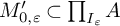 $M_{0,\varepsilon }' \subset \prod _{I_\varepsilon } A$
be the image of
$M_{0,\varepsilon }' \subset \prod _{I_\varepsilon } A$
be the image of $M_0'$
under the projection
$M_0'$
under the projection $\prod _I A \mathrel {\twoheadrightarrow } \prod _{I_\varepsilon } A$
(equipped with the subspace topology). Then there is a natural projection map
$\prod _I A \mathrel {\twoheadrightarrow } \prod _{I_\varepsilon } A$
(equipped with the subspace topology). Then there is a natural projection map $f^{\prime }_\varepsilon \colon M_0' \to M_{0,\varepsilon }'$
. We can also construct a map
$f^{\prime }_\varepsilon \colon M_0' \to M_{0,\varepsilon }'$
. We can also construct a map $g^{\prime }_\varepsilon \colon M_{0,\varepsilon }' \to M_0'$
as follows: Given
$g^{\prime }_\varepsilon \colon M_{0,\varepsilon }' \to M_0'$
as follows: Given $a \in M_{0,\varepsilon }'$
we pick any
$a \in M_{0,\varepsilon }'$
we pick any $a' \in M_0'$
such that
$a' \in M_0'$
such that $f^{\prime }_\varepsilon (a') = a$
. Then we set
$f^{\prime }_\varepsilon (a') = a$
. Then we set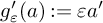 $g^{\prime }_\varepsilon (a) := \varepsilon a'$
, which by the above observation is independent of the choice of
$g^{\prime }_\varepsilon (a) := \varepsilon a'$
, which by the above observation is independent of the choice of $a'$
. Note that
$a'$
. Note that $f^{\prime }_\varepsilon g^{\prime }_\varepsilon = \varepsilon $
and
$f^{\prime }_\varepsilon g^{\prime }_\varepsilon = \varepsilon $
and $g^{\prime }_\varepsilon f^{\prime }_\varepsilon = \varepsilon $
, hence we have
$g^{\prime }_\varepsilon f^{\prime }_\varepsilon = \varepsilon $
, hence we have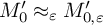 $M^{\prime }_0 \approx _\varepsilon M^{\prime }_{0,\varepsilon }$
. Going back to the almost world we now see that
$M^{\prime }_0 \approx _\varepsilon M^{\prime }_{0,\varepsilon }$
. Going back to the almost world we now see that
 $$ \begin{align*} \pi_0 M_0^\vee \approx_\varepsilon M^{\prime a}_{0,\varepsilon}, \qquad \text{with }M^{\prime a}_{0,\varepsilon} \subseteq \prod_{i=1}^{n_\varepsilon} {\mathcal{O}}^a_K/\pi \text{ a discrete submodule}, \end{align*} $$
where we took the liberty of naming $I_\varepsilon = \{ 1, \dots , n_\varepsilon \}$
. By [Reference MannMan22, Lemma 3.7.15] the discrete dualization functor
$I_\varepsilon = \{ 1, \dots , n_\varepsilon \}$
. By [Reference MannMan22, Lemma 3.7.15] the discrete dualization functor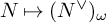 $N \mapsto (N^\vee )_\omega $
is t-exact on discrete N. By applying this functor to
$N \mapsto (N^\vee )_\omega $
is t-exact on discrete N. By applying this functor to $M^\vee $
it follows from the isomorphism
$M^\vee $
it follows from the isomorphism $M \mathbin {\xrightarrow {\sim }} M^{\vee \vee }$
that also
$M \mathbin {\xrightarrow {\sim }} M^{\vee \vee }$
that also $M_0 \mathbin {\xrightarrow {\sim }} ((\pi _0 M_0^\vee )^\vee )_\omega $
is an isomorphism. Letting
$M_0 \mathbin {\xrightarrow {\sim }} ((\pi _0 M_0^\vee )^\vee )_\omega $
is an isomorphism. Letting $M_{0,\varepsilon } := ((M^{\prime a}_{0,\varepsilon })^\vee )_\omega $
we deduce that
$M_{0,\varepsilon } := ((M^{\prime a}_{0,\varepsilon })^\vee )_\omega $
we deduce that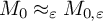 $M_0 \approx _{\varepsilon } M_{0,\varepsilon }$
and there is a surjection
$M_0 \approx _{\varepsilon } M_{0,\varepsilon }$
and there is a surjection $\bigoplus _{i=1}^{n_\varepsilon } {\mathcal {O}}^a_K/\pi \mathrel {\twoheadrightarrow } M_{0,\varepsilon }$
. As this works for all
$\bigoplus _{i=1}^{n_\varepsilon } {\mathcal {O}}^a_K/\pi \mathrel {\twoheadrightarrow } M_{0,\varepsilon }$
. As this works for all $\varepsilon $
, we deduce that
$\varepsilon $
, we deduce that $M_0$
is almost finitely generated as an
$M_0$
is almost finitely generated as an ${\mathcal {O}}^a_K/\pi $
-module. Then it is also almost finitely generated as an
${\mathcal {O}}^a_K/\pi $
-module. Then it is also almost finitely generated as an ${\mathcal {O}}^a_K$
-module (where we equip
${\mathcal {O}}^a_K$
-module (where we equip ${\mathcal {O}}^a_K$
with the discrete topology in this proof), hence by [Reference ScholzeSch13, Theorem 2.5] we have
${\mathcal {O}}^a_K$
with the discrete topology in this proof), hence by [Reference ScholzeSch13, Theorem 2.5] we have
 $$ \begin{align*} M_0 \approx ({\mathcal{O}}^a_K/\pi)^r \oplus {\mathcal{O}}^a_K/I_{\gamma_1} \oplus {\mathcal{O}}^a_K/I_{\gamma_2} \oplus \dots \end{align*} $$
for a series of real numbers $1> \gamma _1 \ge \gamma _2 \ge \dots \ge 0$
converging to
$1> \gamma _1 \ge \gamma _2 \ge \dots \ge 0$
converging to $0$
. Here for a real number
$0$
. Here for a real number $\gamma $
we denote by
$\gamma $
we denote by $I_\gamma \subset {\mathcal {O}}_K$
the ideal generated by
$I_\gamma \subset {\mathcal {O}}_K$
the ideal generated by $\pi ^{\gamma '}$
for all
$\pi ^{\gamma '}$
for all $\gamma '> \gamma $
(see [Reference ScholzeSch13, Example 2.4. (i)]). The
$\gamma '> \gamma $
(see [Reference ScholzeSch13, Example 2.4. (i)]). The $\varphi $
-module structure
$\varphi $
-module structure $\varphi ^* M \mathbin {\xrightarrow {\sim }} M$
induces an isomorphism
$\varphi ^* M \mathbin {\xrightarrow {\sim }} M$
induces an isomorphism $\pi _0 \varphi ^* M_0 \mathbin {\xrightarrow {\sim }} M_0$
. On the other hand for
$\pi _0 \varphi ^* M_0 \mathbin {\xrightarrow {\sim }} M_0$
. On the other hand for $\gamma < 1$
we have
$\gamma < 1$
we have
 $$ \begin{align*} \pi_0 \varphi^*({\mathcal{O}}^a_K/I_\gamma) = \begin{cases} {\mathcal{O}}^a_K/\pi, \qquad &\text{if }\gamma \ge 1/p,\\ {\mathcal{O}}^a_K/I_{p\gamma}, \qquad &\text{else}, \end{cases} \end{align*} $$
as ${\mathcal {O}}^a_K/\pi $
-modules. This forces all
${\mathcal {O}}^a_K/\pi $
-modules. This forces all $\gamma _i = 0$
, i.e. we have
$\gamma _i = 0$
, i.e. we have $M_0 \approx ({\mathcal {O}}^a_K/\pi )^r$
. It follows that
$M_0 \approx ({\mathcal {O}}^a_K/\pi )^r$
. It follows that $M_0$
is dualizable: We need to check that the natural map
$M_0$
is dualizable: We need to check that the natural map $\alpha \colon M_0 \otimes M_0^\vee \to {\underline {\operatorname {\mathrm {Hom}}}}(M_0, M_0)$
is an isomorphism but since the same statement holds for
$\alpha \colon M_0 \otimes M_0^\vee \to {\underline {\operatorname {\mathrm {Hom}}}}(M_0, M_0)$
is an isomorphism but since the same statement holds for $({\mathcal {O}}^a_K/\pi )^r$
in place of
$({\mathcal {O}}^a_K/\pi )^r$
in place of $M_0$
one deduces easily that both kernel and cokernel of
$M_0$
one deduces easily that both kernel and cokernel of $\pi _i \alpha $
are killed by
$\pi _i \alpha $
are killed by $\varepsilon $
for all
$\varepsilon $
for all $i \in {\mathbf {Z}}$
and
$i \in {\mathbf {Z}}$
and $\varepsilon \in {\mathfrak {m}}_K$
(cf. the proof of [Reference MannMan22, Lemma 3.7.17]). In particular
$\varepsilon \in {\mathfrak {m}}_K$
(cf. the proof of [Reference MannMan22, Lemma 3.7.17]). In particular $M_0$
is flat (which can also be seen directly), so that
$M_0$
is flat (which can also be seen directly), so that $\pi _0 \varphi ^* M_0 = \varphi ^* M$
and therefore the
$\pi _0 \varphi ^* M_0 = \varphi ^* M$
and therefore the $\varphi $
-module structure on
$\varphi $
-module structure on $M_0$
restricts to a
$M_0$
restricts to a $\varphi $
-module structure on
$\varphi $
-module structure on $M_0$
. Since the conditions on M are preserved under finite limits, we reduce the claimed dualizability of M to that of
$M_0$
. Since the conditions on M are preserved under finite limits, we reduce the claimed dualizability of M to that of $\tau _{\ge 1} M$
, which satisfies the same assumptions as M. Since M is bounded, we can conclude by induction.
$\tau _{\ge 1} M$
, which satisfies the same assumptions as M. Since M is bounded, we can conclude by induction.
As promised, here come the three equivalent ways of characterizing admissible representations on a classifying stack. The third characterization is very useful for showing that admissible representations are stable under various of the 6 operations, and plays a key role in our analysis of the Jacquet-Langlands functor.
Proposition 3.26. Let C be an algebraically closed perfectoid field with pseudouniformizer $\pi \in {\mathcal {O}}_C$
such that
$\pi \in {\mathcal {O}}_C$
such that $\pi | p$
and let G be a locally profinite p-Poincaré group. Then for
$\pi | p$
and let G be a locally profinite p-Poincaré group. Then for  the following are equivalent:
-
(i) M is bounded and admissible.
-
(ii) M is bounded and for a basis of compact open subgroups
$H \subseteq G$
,
$\Gamma _{\mathrm {sm}}(H,M)$
is dualizable in . -
(iii) Both M and
$M^\vee $
are bounded and discrete and the natural morphism
$M \mathbin {\xrightarrow {\sim }} M^{\vee \vee }$
is an isomorphism.


 .
.

If this is the case then $M^\vee $
is bounded and admissible and this dual can unambiguously be computed in any of the following
$M^\vee $
is bounded and admissible and this dual can unambiguously be computed in any of the following $\infty $
-categories:
$\infty $
-categories: ${\mathcal {D}}^{\mathrm {sm}}(G,{\mathbf {F}}_p)$
,
${\mathcal {D}}^{\mathrm {sm}}(G,{\mathbf {F}}_p)$
,  ,
,  ,
,  .
.
Proof. Note first that (i) implies (ii) because $R\Gamma _{\mathrm {sm}}(H,V) \otimes _{{\mathbf {F}}_p} {\mathcal {O}}^a_C/\pi = R\Gamma _{\mathrm {sm}}(H, V \otimes _{{\mathbf {F}}_p} {\mathcal {O}}^a_C/\pi )$
for all
$R\Gamma _{\mathrm {sm}}(H,V) \otimes _{{\mathbf {F}}_p} {\mathcal {O}}^a_C/\pi = R\Gamma _{\mathrm {sm}}(H, V \otimes _{{\mathbf {F}}_p} {\mathcal {O}}^a_C/\pi )$
for all $V \in {\mathcal {D}}^{\mathrm {sm}}(G,{\mathbf {F}}_p)$
(e.g. by the explicit computation of smooth group cohomology in [Reference MannMan22, Corollary 3.4.17]). Conversely, assume that (ii) is satisfied. Then M is discrete because
$V \in {\mathcal {D}}^{\mathrm {sm}}(G,{\mathbf {F}}_p)$
(e.g. by the explicit computation of smooth group cohomology in [Reference MannMan22, Corollary 3.4.17]). Conversely, assume that (ii) is satisfied. Then M is discrete because $M = \varinjlim _H R\Gamma _{\mathrm {sm}}(H,M)$
, where on the right-hand side H ranges through all compact open subgroups of G (see [Reference MannMan22, Lemma 3.4.19]). We claim that M lies in
$M = \varinjlim _H R\Gamma _{\mathrm {sm}}(H,M)$
, where on the right-hand side H ranges through all compact open subgroups of G (see [Reference MannMan22, Lemma 3.4.19]). We claim that M lies in ${\mathcal {D}}^{\mathrm {sm}}(G,{\mathbf {F}}_p)$
, i.e. that the natural morphism
${\mathcal {D}}^{\mathrm {sm}}(G,{\mathbf {F}}_p)$
, i.e. that the natural morphism $M^\varphi \otimes _{{\mathbf {F}}_p} {\mathcal {O}}^a_C \mathbin {\xrightarrow {\sim }} M$
is an isomorphism. By the colimit property we just used the collection of functors
$M^\varphi \otimes _{{\mathbf {F}}_p} {\mathcal {O}}^a_C \mathbin {\xrightarrow {\sim }} M$
is an isomorphism. By the colimit property we just used the collection of functors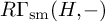 $R\Gamma _{\mathrm {sm}}(H,-)$
, where H ranges through a basis of compact open subgroups of G, is conservative, hence it is enough to show that
$R\Gamma _{\mathrm {sm}}(H,-)$
, where H ranges through a basis of compact open subgroups of G, is conservative, hence it is enough to show that $R\Gamma _{\mathrm {sm}}(H,M^\varphi \otimes _{{\mathbf {F}}_p} {\mathcal {O}}^a_C) = R\Gamma _{\mathrm {sm}}(H,M)$
for all H in the basis. Noting that that
$R\Gamma _{\mathrm {sm}}(H,M^\varphi \otimes _{{\mathbf {F}}_p} {\mathcal {O}}^a_C) = R\Gamma _{\mathrm {sm}}(H,M)$
for all H in the basis. Noting that that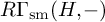 $R\Gamma _{\mathrm {sm}}(H,-)$
commutes with
$R\Gamma _{\mathrm {sm}}(H,-)$
commutes with $(-)^\varphi $
(which is formal) and with
$(-)^\varphi $
(which is formal) and with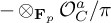 $- \otimes _{{\mathbf {F}}_p} {\mathcal {O}}^a_C/\pi $
(as used above), the claim boils down to showing that for
$- \otimes _{{\mathbf {F}}_p} {\mathcal {O}}^a_C/\pi $
(as used above), the claim boils down to showing that for $M_H := R\Gamma _{\mathrm {sm}}(H,M)$
we have
$M_H := R\Gamma _{\mathrm {sm}}(H,M)$
we have $M_H^\varphi \otimes _{{\mathbf {F}}_p} {\mathcal {O}}^a_C/\pi \mathbin {\xrightarrow {\sim }} M_H$
. But by assumption
$M_H^\varphi \otimes _{{\mathbf {F}}_p} {\mathcal {O}}^a_C/\pi \mathbin {\xrightarrow {\sim }} M_H$
. But by assumption $M_H$
is dualizable, hence the desired equivalence follows from the Riemann-Hilbert correspondence (see [Reference MannMan22, Theorem 3.9.23]). From the Riemann-Hilbert correspondence we also deduce that
$M_H$
is dualizable, hence the desired equivalence follows from the Riemann-Hilbert correspondence (see [Reference MannMan22, Theorem 3.9.23]). From the Riemann-Hilbert correspondence we also deduce that $R\Gamma _{\mathrm {sm}}(H, M^\varphi )$
is dualizable, hence
$R\Gamma _{\mathrm {sm}}(H, M^\varphi )$
is dualizable, hence $M^\varphi $
is admissible, as desired.
$M^\varphi $
is admissible, as desired.
We have now finished the proof that (i) and (ii) are equivalent. To prove that they are also equivalent to (iii) we make the following computation. Let $X = \operatorname {\mathrm {Spa}} C$
,
$X = \operatorname {\mathrm {Spa}} C$
, $\Lambda = {\mathcal {O}}_C/\pi $
,
$\Lambda = {\mathcal {O}}_C/\pi $
,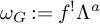 $\omega _G := f^! \Lambda ^a$
and for every compact open subgroup
$\omega _G := f^! \Lambda ^a$
and for every compact open subgroup $H \subset G$
let
$H \subset G$
let $f_H\colon X/H \to X$
be the natural map. Then from Corollary 3.12 and Proposition 3.14 we get:
$f_H\colon X/H \to X$
be the natural map. Then from Corollary 3.12 and Proposition 3.14 we get:
 $$ \begin{align*} f_{H*} M^\vee &= f_{H*} {\underline{\operatorname{\mathrm{Hom}}}}(M, \Lambda^a) = f_{H*} {\underline{\operatorname{\mathrm{Hom}}}}(M \otimes \omega_G, \omega_G) = {\underline{\operatorname{\mathrm{Hom}}}}(f_{H*}(M \otimes \omega_G), \Lambda^a)\\ &= (f_{H*}(M \otimes \omega_G))^\vee. \end{align*} $$
Note also that for small enough H the action of H on $\omega _G$
is trivial, so that
$\omega _G$
is trivial, so that $- \otimes \omega _G$
is just a shift in the
$- \otimes \omega _G$
is just a shift in the $\infty $
-category of H-representations. Consequently for small enough H the functor
$\infty $
-category of H-representations. Consequently for small enough H the functor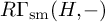 $R\Gamma _{\mathrm {sm}}(H,-)$
preserves duals up to shift. Since the functors
$R\Gamma _{\mathrm {sm}}(H,-)$
preserves duals up to shift. Since the functors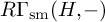 $R\Gamma _{\mathrm {sm}}(H,-)$
are also conservative (for H varying in a basis of compact open subgroups of G) it follows that (iii) is equivalent to the claim that M and
$R\Gamma _{\mathrm {sm}}(H,-)$
are also conservative (for H varying in a basis of compact open subgroups of G) it follows that (iii) is equivalent to the claim that M and $M^\vee $
are bounded and for a basis H of compact open subgroups of G we have that both
$M^\vee $
are bounded and for a basis H of compact open subgroups of G we have that both $M_H := R\Gamma _{\mathrm {sm}}(H,M)$
and
$M_H := R\Gamma _{\mathrm {sm}}(H,M)$
and $M_H^\vee $
are discrete and the natural morphism
$M_H^\vee $
are discrete and the natural morphism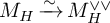 $M_H \mathbin {\xrightarrow {\sim }} M_H^{\vee \vee }$
is an isomorphism. By Lemma 3.25 this implies (ii). Moreover, if (ii) is satisfied then all the conditions in (iii) follow immediately except possibly that
$M_H \mathbin {\xrightarrow {\sim }} M_H^{\vee \vee }$
is an isomorphism. By Lemma 3.25 this implies (ii). Moreover, if (ii) is satisfied then all the conditions in (iii) follow immediately except possibly that $M^\vee $
is also bounded. To see that
$M^\vee $
is also bounded. To see that $M^\vee $
is indeed bounded, note first that
$M^\vee $
is indeed bounded, note first that $M^\vee = \varinjlim _H R\Gamma _{\mathrm {sm}}(H, M^\vee )$
(see [Reference MannMan22, Lemma 3.4.19]) and by the above computation the right-hand side is (up to a constant shift) isomorphic to
$M^\vee = \varinjlim _H R\Gamma _{\mathrm {sm}}(H, M^\vee )$
(see [Reference MannMan22, Lemma 3.4.19]) and by the above computation the right-hand side is (up to a constant shift) isomorphic to $\varinjlim _H M_H^\vee $
. On the other hand, the discrete dualization functor
$\varinjlim _H M_H^\vee $
. On the other hand, the discrete dualization functor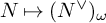 $N \mapsto (N^\vee )_\omega $
is t-exact on discrete objects in
$N \mapsto (N^\vee )_\omega $
is t-exact on discrete objects in  (see [Reference MannMan22, Lemma 3.7.15]). In particular, if $M_H$
is concentrated in homological degrees
$M_H$
is concentrated in homological degrees $[a,b]$
then
$[a,b]$
then $M_H^\vee $
is concentrated in homological degrees
$M_H^\vee $
is concentrated in homological degrees $[-b,-a]$
. The fact that M is bounded implies that we can choose a and b independently of H, which then implies that
$[-b,-a]$
. The fact that M is bounded implies that we can choose a and b independently of H, which then implies that $M^\vee $
is also bounded.
$M^\vee $
is also bounded.
It remains to prove the last part of the claim, so assume that M is admissible and bounded. It follows immediately from (iii) that also $M^\vee $
(computed in
$M^\vee $
(computed in  ) is admissible (and bounded), so in particular it is discrete and comes from an ${\mathbf {F}}_p$
-representation via the Riemann-Hilbert correspondence. It is thus formal that this dual can be computed in any of the claimed
${\mathbf {F}}_p$
-representation via the Riemann-Hilbert correspondence. It is thus formal that this dual can be computed in any of the claimed $\infty $
-categories.
$\infty $
-categories.
Remark 3.27. It follows from the proof that in Lemma 3.25 it is enough to require that there is some isomorphism $M \cong M^{\vee \vee }$
instead of insisting that the natural map
$M \cong M^{\vee \vee }$
instead of insisting that the natural map $M \to M^{\vee \vee }$
is an isomorphism. It follows that in condition (iii) of Proposition 3.26 it is enough to require the existence of some isomorphism
$M \to M^{\vee \vee }$
is an isomorphism. It follows that in condition (iii) of Proposition 3.26 it is enough to require the existence of some isomorphism $M \cong M^{\vee \vee }$
.
$M \cong M^{\vee \vee }$
.
4 Duality and applications
4.1 The main result
Fix a finite extension $F/{\mathbf {Q}}_p$
, let
$F/{\mathbf {Q}}_p$
, let $G := \operatorname {\mathrm {GL}}_n(F)$
, let D be the central division algebra over F of invariant
$G := \operatorname {\mathrm {GL}}_n(F)$
, let D be the central division algebra over F of invariant $1/n$
and let C be the completed algebraic closure of F. In the following we will work with small v-stacks over
$1/n$
and let C be the completed algebraic closure of F. In the following we will work with small v-stacks over $\operatorname {\mathrm {Spd}} C$
, so in particular the final object
$\operatorname {\mathrm {Spd}} C$
, so in particular the final object $*$
will denote
$*$
will denote $\operatorname {\mathrm {Spd}} C$
and
$\operatorname {\mathrm {Spd}} C$
and $B\underline H = \operatorname {\mathrm {Spd}} C/\underline H$
for any locally profinite group H. Recall the fundamental diagram from the introduction:
$B\underline H = \operatorname {\mathrm {Spd}} C/\underline H$
for any locally profinite group H. Recall the fundamental diagram from the introduction:

Here X is obtained from the infinite level Lubin-Tate tower by modding out the commuting actions of G and $D^\times $
, so that in particular we have
$D^\times $
, so that in particular we have $X \cong [\mathbf P^{n-1}_C/\underline {D^\times }] \cong [\Omega _C^{n-1}/\underline {G}]$
, where
$X \cong [\mathbf P^{n-1}_C/\underline {D^\times }] \cong [\Omega _C^{n-1}/\underline {G}]$
, where $\Omega _C^{n-1} = \mathbf P^{n-1}_C \setminus \mathbf P^{n-1}_C({\mathbf {Q}}_p)$
denotes Drinfeld space. It follows that f and g are smooth and that g is proper. Recall also that for every locally profinite group H which has locally finite p-cohomological dimension (e.g.
$\Omega _C^{n-1} = \mathbf P^{n-1}_C \setminus \mathbf P^{n-1}_C({\mathbf {Q}}_p)$
denotes Drinfeld space. It follows that f and g are smooth and that g is proper. Recall also that for every locally profinite group H which has locally finite p-cohomological dimension (e.g. $H = G$
or
$H = G$
or $H = D^\times $
) we have
$H = D^\times $
) we have

and the upper $\infty $
-category embedds fully faithfully into the lower one via the Riemann-Hilbert functor. As explained in the introduction, we can now define the Jacquet-Langlands functor as follows.
$\infty $
-category embedds fully faithfully into the lower one via the Riemann-Hilbert functor. As explained in the introduction, we can now define the Jacquet-Langlands functor as follows.
Definition 4.1. In the above setup, we define the p-adic Jacquet-Langlands functors

where we implicitly use the identifications of sheaves on the classifying stack with smooth representations discussed above.
The functor  is defined in the setting of a full 6-functor formalism and should thus be seen as the ‘actual’ Jacquet-Langlands functor, whereas $\mathcal J$
is a more naively defined shadow of
$\mathcal J$
is a more naively defined shadow of  . In fact, it is completely formal that for all $A \in {\mathcal {D}}^{\mathrm {sm}}(G, {\mathbf {F}}_p)$
we have
$A \in {\mathcal {D}}^{\mathrm {sm}}(G, {\mathbf {F}}_p)$
we have

In other words, $\mathcal J(A)$
remembers the
$\mathcal J(A)$
remembers the $\varphi $
-invariants of the Jacquet-Langlands correspondent
$\varphi $
-invariants of the Jacquet-Langlands correspondent  of A. It turns out that if A is admissible then in fact these $\varphi $
-invariants capture the whole Jacquet-Langlands correspondent. In fact, the Jacquet-Langlands correspondent of an admissible representation is itself admissible and hence lies in the image of the Riemann-Hilbert functor, as is shown in the following result.
$\varphi $
-invariants capture the whole Jacquet-Langlands correspondent. In fact, the Jacquet-Langlands correspondent of an admissible representation is itself admissible and hence lies in the image of the Riemann-Hilbert functor, as is shown in the following result.
Theorem 4.2. In the above setup, let $A \in {\mathcal {D}}^{\mathrm {sm}}(G,{\mathbf {F}}_p)$
be admissible. Then:
$A \in {\mathcal {D}}^{\mathrm {sm}}(G,{\mathbf {F}}_p)$
be admissible. Then:
-
(i)
$\mathcal J(A) \in {\mathcal {D}}^{\mathrm {sm}}(D^\times , {\mathbf {F}}_p)$
is admissible. -
(ii) The natural primitive comparison map
induced by Eq. (1) is an isomorphism.
-
(iii) There is a natural isomorphism
$$ \begin{align*} (\mathcal{S}_{D^\times} \circ \mathcal{J})(A) = (\mathcal{J} \circ \mathcal{S}_G)(A)[2n-2](n-1) \end{align*} $$
in
${\mathcal {D}}^{\mathrm {sm}}(D^\times ,{\mathbf {F}}_p)$
.




Recall that Scholze already proved (i) and (ii). We will prove (i)–(iii) simultaneously, independently of Scholze’s results. In fact, we will see that all (i)–(iii) follow formally from the following unconditional duality for  :
:
Lemma 4.3. In the above setup, there is a natural isomorphism

of functors  . Here $(-)^\vee $
denotes the internal hom towards the monoidal unit.
$(-)^\vee $
denotes the internal hom towards the monoidal unit.
Proof. For every  we get the following chain of natural equivalences (using that g is proper and smooth and that f is smooth):
 $$ \begin{align*} {\underline{\operatorname{\mathrm{Hom}}}}(g_* f^* A, {\mathcal{O}}^{+a}_{B\underline{D^\times}}/p) &= {\underline{\operatorname{\mathrm{Hom}}}}(g_! f^* A, {\mathcal{O}}^{+a}_{B\underline{D^\times}}/p)\\ &= g_* {\underline{\operatorname{\mathrm{Hom}}}}(f^* A, g^!({\mathcal{O}}^{+a}_{B\underline{D^\times}}/p))\\ &= g_* {\underline{\operatorname{\mathrm{Hom}}}}(f^* A, {\mathcal{O}}^{+a}_X/p)[2n-2](n-1)\\ &= g_* f^* {\underline{\operatorname{\mathrm{Hom}}}}(A, {\mathcal{O}}^{+a}_{B\underline G}/p)[2n-2](n-1). \end{align*} $$
In the last step we used that by the smoothness of f, $f^*$
commutes with internal hom (see [Reference MannMan22, Proposition 3.8.7].
$f^*$
commutes with internal hom (see [Reference MannMan22, Proposition 3.8.7].
Proof of Theorem 4.2
Fix an admissible $A \in {\mathcal {D}}^{\mathrm {sm}}(G,{\mathbf {F}}_p)$
as in the claim and let us denote
$A \in {\mathcal {D}}^{\mathrm {sm}}(G,{\mathbf {F}}_p)$
as in the claim and let us denote $A' := A \otimes \mathcal {O}_{B\underline {G}}^{+a}/p$
the corresponding object in
$A' := A \otimes \mathcal {O}_{B\underline {G}}^{+a}/p$
the corresponding object in  given by the Riemann-Hilbert embedding. Then $A'$
is admissible (by definition) and hence by Proposition 3.26 both
$A'$
is admissible (by definition) and hence by Proposition 3.26 both $A'$
and
$A'$
and $A^{\prime \vee }$
are bounded and discrete and the natural map
$A^{\prime \vee }$
are bounded and discrete and the natural map $A' \mathbin {\xrightarrow {\sim }} A^{\prime \vee \vee }$
is an isomorphism. Clearly
$A' \mathbin {\xrightarrow {\sim }} A^{\prime \vee \vee }$
is an isomorphism. Clearly  preserves bounded and discrete objects (this is true for $f^*$
like for any pullback and it follows for
$f^*$
like for any pullback and it follows for $g_*$
from the fact that g is proper and p-bounded). Thus it follows from Lemma 4.3 that both
$g_*$
from the fact that g is proper and p-bounded). Thus it follows from Lemma 4.3 that both  and
and  are bounded and discrete. Moreover, Lemma 4.3 also implies that there is an isomorphism
  , so altogether it follows from Proposition 3.26 (and Remark 3.27) that
  is admissible. This immediately implies (i). It also implies (ii) because we now know that
  lies in the image of the Riemann-Hilbert functor. Now (iii) follows from Lemma 4.3 and the last part of Proposition 3.26.
Remark 4.4. In general, both sides of the duality isomorphism are somewhat intractable. However, in certain favorable situations it reduces to a more concrete statement. We record one useful instance of this in the following proposition. Recall from Proposition 3.7 that for any admissible smooth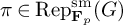 $\pi \in \mathrm {Rep}_{\mathbf {F}_{p}}^{\mathrm {sm}}(G)$
, the derived dual
$\pi \in \mathrm {Rep}_{\mathbf {F}_{p}}^{\mathrm {sm}}(G)$
, the derived dual $\mathcal {S}_{G}^{\dim _G \pi }(\pi )$
is always nonzero. Following [Reference KohlhaaseKoh17], we say
$\mathcal {S}_{G}^{\dim _G \pi }(\pi )$
is always nonzero. Following [Reference KohlhaaseKoh17], we say $\pi $
is Cohen-Macaulay if
$\pi $
is Cohen-Macaulay if $\mathcal {S}_{G}^{i}(\pi )=0$
for all
$\mathcal {S}_{G}^{i}(\pi )=0$
for all $i\neq \dim _G \pi $
.
$i\neq \dim _G \pi $
.
Proposition 4.5. Let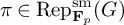 $\pi \in \mathrm {Rep}_{\mathbf {F}_{p}}^{\mathrm {sm}}(G)$
be an admissible representation which is Cohen-Macaulay, and such that there is an integer c with
$\pi \in \mathrm {Rep}_{\mathbf {F}_{p}}^{\mathrm {sm}}(G)$
be an admissible representation which is Cohen-Macaulay, and such that there is an integer c with $\mathcal {J}^i(\pi )=0$
for all
$\mathcal {J}^i(\pi )=0$
for all $i\neq c$
. Then there are isomorphisms
$i\neq c$
. Then there are isomorphisms
 $$\begin{align*}\mathcal{S}_{D^\times}^i(\mathcal{J}^c(\pi)) \simeq \mathcal{J}^{i+2n-2-c-\dim_G \pi}(\check{\pi}) \end{align*}$$
for all i, where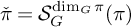 $\check {\pi }=\mathcal {S}_{G}^{\dim _G \pi }(\pi )$
is the unique nonzero derived dual of
$\check {\pi }=\mathcal {S}_{G}^{\dim _G \pi }(\pi )$
is the unique nonzero derived dual of $\pi $
.
$\pi $
.
Proof. Evaluate both sides of the duality isomorphism $\mathcal {S}_{D^\times } \circ \mathcal {J}) \cong (\mathcal {J} \circ \mathcal {S}_G)[2n-2](n-1)$
on
$\mathcal {S}_{D^\times } \circ \mathcal {J}) \cong (\mathcal {J} \circ \mathcal {S}_G)[2n-2](n-1)$
on $\pi $
. Since
$\pi $
. Since $\mathcal {J}(\pi )=\mathcal {J}^{c}(\pi )[-c]$
by assumption, the left-hand side evaluates to
$\mathcal {J}(\pi )=\mathcal {J}^{c}(\pi )[-c]$
by assumption, the left-hand side evaluates to $\mathcal {S}_{D^\times }(\mathcal {J}^{c}(\pi )[-c]) \cong \mathcal {S}_{D^\times }(\mathcal {J}^{c}(\pi ))[c]$
. Next, since
$\mathcal {S}_{D^\times }(\mathcal {J}^{c}(\pi )[-c]) \cong \mathcal {S}_{D^\times }(\mathcal {J}^{c}(\pi ))[c]$
. Next, since $\mathcal {S}_G(\pi )=\check {\pi }[-\dim _G \pi ]$
by assumption, the right-hand side simplifies to
$\mathcal {S}_G(\pi )=\check {\pi }[-\dim _G \pi ]$
by assumption, the right-hand side simplifies to $\mathcal {J}(\check {\pi }[-\dim _G \pi ])[2n-2](n-1) \cong \mathcal {J}(\check {\pi })[2n-2-\dim _G \pi ](n-1)$
. Equating both sides and rearranging the shifts, we get
$\mathcal {J}(\check {\pi }[-\dim _G \pi ])[2n-2](n-1) \cong \mathcal {J}(\check {\pi })[2n-2-\dim _G \pi ](n-1)$
. Equating both sides and rearranging the shifts, we get $\mathcal {S}_{D^\times }(\mathcal {J}^{c}(\pi )) = \mathcal {J}(\check {\pi })[2n-2-\dim _G \pi -c](n-1)$
. Passing to cohomology on both sides (and ignoring the Tate twists), we get the result.
$\mathcal {S}_{D^\times }(\mathcal {J}^{c}(\pi )) = \mathcal {J}(\check {\pi })[2n-2-\dim _G \pi -c](n-1)$
. Passing to cohomology on both sides (and ignoring the Tate twists), we get the result.
Remark 4.6. We explain how to show a variant of our duality isomorphism in the setting of $\mathbf {Z}/p^n$
or
$\mathbf {Z}/p^n$
or $\mathbf {Z}_p$
-coefficients. We explain the first case; the second follows from a limit argument. First some preliminary observations. Let H be any p-adic Lie group. One easily checks that Proposition 3.9 extends to the setting of
$\mathbf {Z}_p$
-coefficients. We explain the first case; the second follows from a limit argument. First some preliminary observations. Let H be any p-adic Lie group. One easily checks that Proposition 3.9 extends to the setting of $\mathbf {Z}/p^n$
-coefficients, yielding a symmetric monoidal equivalence
$\mathbf {Z}/p^n$
-coefficients, yielding a symmetric monoidal equivalence ${\mathcal {D}}^{\mathrm {sm}}(H,\mathbf {Z}/p^n)\cong {\mathcal {D}}_{{\mathrm {\acute {e}t}}}(B\underline {H},\mathbf {Z}/p^n)$
. On these categories we again have a duality functor
${\mathcal {D}}^{\mathrm {sm}}(H,\mathbf {Z}/p^n)\cong {\mathcal {D}}_{{\mathrm {\acute {e}t}}}(B\underline {H},\mathbf {Z}/p^n)$
. On these categories we again have a duality functor $\mathcal {S}_H(-)$
, given by internal hom towards the monoidal unit. We say
$\mathcal {S}_H(-)$
, given by internal hom towards the monoidal unit. We say $A \in {\mathcal {D}}^{\mathrm {sm}}(H,\mathbf {Z}/p^n)$
is admissible if
$A \in {\mathcal {D}}^{\mathrm {sm}}(H,\mathbf {Z}/p^n)$
is admissible if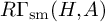 $R\Gamma _{{\mathrm {sm}}}(H,A)$
is a perfect complex of
$R\Gamma _{{\mathrm {sm}}}(H,A)$
is a perfect complex of $\mathbf {Z}/p^n$
-modules for a basis of open subgroups H. Admissible complexes are automatically bounded, and are preserved by duality and
$\mathbf {Z}/p^n$
-modules for a basis of open subgroups H. Admissible complexes are automatically bounded, and are preserved by duality and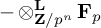 $-\otimes _{\mathbf {Z}/p^n}^{\mathbf {L}} {\mathbf {F}}_p$
, and the latter functor is conservative on admissible complexes. Conversely, if A is given and
$-\otimes _{\mathbf {Z}/p^n}^{\mathbf {L}} {\mathbf {F}}_p$
, and the latter functor is conservative on admissible complexes. Conversely, if A is given and $A\otimes _{\mathbf {Z}/p^n}^{\mathbf {L}} {\mathbf {F}}_p \in {\mathcal {D}}^{\mathrm {sm}}(H,{\mathbf {F}}_p)$
is admissible, then A is necessarily admissible.
$A\otimes _{\mathbf {Z}/p^n}^{\mathbf {L}} {\mathbf {F}}_p \in {\mathcal {D}}^{\mathrm {sm}}(H,{\mathbf {F}}_p)$
is admissible, then A is necessarily admissible.
With this in mind, we define $\mathcal {J}: {\mathcal {D}}^{\mathrm {sm}}(G,\mathbf {Z}/p^n) \to {\mathcal {D}}^{\mathrm {sm}}(D^\times ,\mathbf {Z}/p^n)$
as
$\mathcal {J}: {\mathcal {D}}^{\mathrm {sm}}(G,\mathbf {Z}/p^n) \to {\mathcal {D}}^{\mathrm {sm}}(D^\times ,\mathbf {Z}/p^n)$
as $\mathcal {J} = g_{{\mathrm {\acute {e}t}} \ast }f^{\ast }_{{\mathrm {\acute {e}t}}}$
. This is compatible with the
$\mathcal {J} = g_{{\mathrm {\acute {e}t}} \ast }f^{\ast }_{{\mathrm {\acute {e}t}}}$
. This is compatible with the ${\mathbf {F}}_p$
version of
${\mathbf {F}}_p$
version of $\mathcal {J}$
via
$\mathcal {J}$
via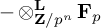 $-\otimes _{\mathbf {Z}/p^n}^{\mathbf {L}} {\mathbf {F}}_p$
. Using this observation and the final statement in the previous paragraph together with the finiteness properties of
$-\otimes _{\mathbf {Z}/p^n}^{\mathbf {L}} {\mathbf {F}}_p$
. Using this observation and the final statement in the previous paragraph together with the finiteness properties of $\mathcal {J}$
with
$\mathcal {J}$
with ${\mathbf {F}}_p$
-coefficients, it is easy to see that
${\mathbf {F}}_p$
-coefficients, it is easy to see that $\mathcal {J}$
preserves admissibility in this setting. Now, the key observation is that there is a natural map
$\mathcal {J}$
preserves admissibility in this setting. Now, the key observation is that there is a natural map $\mathcal {J}(A) \otimes \mathcal {J}(\mathcal {S}_G(A)) \to \mathbf {Z}/p^n[2-2n](1-n)$
, defined as the composition
$\mathcal {J}(A) \otimes \mathcal {J}(\mathcal {S}_G(A)) \to \mathbf {Z}/p^n[2-2n](1-n)$
, defined as the composition
 $$ \begin{align*} \mathcal{J}(A) \otimes \mathcal{J}(\mathcal{S}_G(A)) & \to \mathcal{J}(A \otimes \mathcal{S}_G(A)) \\ &\to \mathcal{J}(\mathbf{Z}/p^n) \\ &\to \tau^{\geq 2n-2} \mathcal{J}(\mathbf{Z}/p^n) \\ &\cong \mathbf{Z}/p^n[2-2n](1-n). \end{align*} $$
Here the first arrow is obtained from the lax monoidal structure of $\mathcal {J}$
, the second arrow is induced by the evaluation map
$\mathcal {J}$
, the second arrow is induced by the evaluation map $A \otimes \mathcal {S}_G(A) \to \mathbf {Z}/p^n$
, and the final isomorphism is induced by the usual computation of the étale cohomology of
$A \otimes \mathcal {S}_G(A) \to \mathbf {Z}/p^n$
, and the final isomorphism is induced by the usual computation of the étale cohomology of $\mathbf {P}^{n-1}$
. By adjunction (and rearranging the shifts and twists), this map induces a map
$\mathbf {P}^{n-1}$
. By adjunction (and rearranging the shifts and twists), this map induces a map $\mathcal {J}(\mathcal {S}_G(A))[2n-2](n-1) \to \mathcal {S}_{D^\times }(\mathcal {J}(A))$
. When A is admissible, the source and target of this map are also admissible, so to see it is an isomorphism, it suffices to show this after applying
$\mathcal {J}(\mathcal {S}_G(A))[2n-2](n-1) \to \mathcal {S}_{D^\times }(\mathcal {J}(A))$
. When A is admissible, the source and target of this map are also admissible, so to see it is an isomorphism, it suffices to show this after applying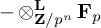 $-\otimes _{\mathbf {Z}/p^n}^{\mathbf {L}} {\mathbf {F}}_p$
. But all operations here are compatible with reduction mod p, so we now conclude by invoking the duality isomorphism with
$-\otimes _{\mathbf {Z}/p^n}^{\mathbf {L}} {\mathbf {F}}_p$
. But all operations here are compatible with reduction mod p, so we now conclude by invoking the duality isomorphism with ${\mathbf {F}}_p$
-coefficients.
${\mathbf {F}}_p$
-coefficients.
4.2 Applications to Gelfand-Kirillov dimension
In this section we prove Theorems 1.6 and 1.7, along with some related results. We will freely use the basic properties of dimension, in particular the results of Propositions 3.7-3.8 and the surrounding discussion.
Proof of Theorem 1.6
Let $d=\dim _{G}(\pi )$
, so
$d=\dim _{G}(\pi )$
, so $\mathcal {S}_{G}(\pi )\in {\mathcal {D}}^{\mathrm {sm}}(G)^{[0,d]}$
. Since
$\mathcal {S}_{G}(\pi )\in {\mathcal {D}}^{\mathrm {sm}}(G)^{[0,d]}$
. Since $\mathcal {J}(-)$
carries
$\mathcal {J}(-)$
carries ${\mathcal {D}}^{\mathrm {sm}}(G)^{[a,b]}$
into
${\mathcal {D}}^{\mathrm {sm}}(G)^{[a,b]}$
into ${\mathcal {D}}^{\mathrm {sm}}(D^\times )^{[a,b+2n-2]}$
, we deduce that
${\mathcal {D}}^{\mathrm {sm}}(D^\times )^{[a,b+2n-2]}$
, we deduce that
 $$\begin{align*}(\mathcal{J}\circ\mathcal{S}_{G})(\pi)[2n-2]\in {\mathcal{D}}^{\mathrm{sm}}(D^\times)^{ \leq d}. \end{align*}$$
By the duality isomorphism $(\mathcal {S}_{D^\times }\circ \mathcal {J})(\pi )\cong (\mathcal {J}\circ \mathcal {S}_{G})(\pi )[2n-2]$
, we get that
$(\mathcal {S}_{D^\times }\circ \mathcal {J})(\pi )\cong (\mathcal {J}\circ \mathcal {S}_{G})(\pi )[2n-2]$
, we get that $M=(\mathcal {S}_{D^\times }\circ \mathcal {J})(\pi )\in {\mathcal {D}}^{\mathrm {sm}}(D^\times )^{ \leq d}$
. Now look at the fourth quadrant spectral sequence
$M=(\mathcal {S}_{D^\times }\circ \mathcal {J})(\pi )\in {\mathcal {D}}^{\mathrm {sm}}(D^\times )^{ \leq d}$
. Now look at the fourth quadrant spectral sequence
 $$\begin{align*}E_{2}^{i,j}=\mathcal{S}_{D^\times}^{i}(\mathcal{J}^{-j}(\pi))\Rightarrow H^{i+j}(M). \end{align*}$$
Let $c=\max _{i}\dim _{D^\times }\mathcal {J}^{i}(\pi )$
, and let
$c=\max _{i}\dim _{D^\times }\mathcal {J}^{i}(\pi )$
, and let $i_{0}$
be the least i realizing this maximum. Then
$i_{0}$
be the least i realizing this maximum. Then $E_{2}^{c,-i_{0}}$
is c-dimensional as an
$E_{2}^{c,-i_{0}}$
is c-dimensional as an $D^\times $
-representation, and as we turn the pages of the spectral sequence it only interacts with representations of dimension
$D^\times $
-representation, and as we turn the pages of the spectral sequence it only interacts with representations of dimension $<c$
via the incoming differentials. Therefore a nonzero subquotient survives to the
$<c$
via the incoming differentials. Therefore a nonzero subquotient survives to the $E_{\infty }$
-page, giving that
$E_{\infty }$
-page, giving that $H^{c-i_{0}}(M)\neq 0$
. But
$H^{c-i_{0}}(M)\neq 0$
. But $M\in {\mathcal {D}}^{\mathrm {sm}}(D^\times )^{ \leq d}$
, so this implies that
$M\in {\mathcal {D}}^{\mathrm {sm}}(D^\times )^{ \leq d}$
, so this implies that $c-i_{0}\leq d$
, and therefore
$c-i_{0}\leq d$
, and therefore $c\leq d+i_{0}\leq d+N_{\pi }$
, as desired.
$c\leq d+i_{0}\leq d+N_{\pi }$
, as desired.
We conjecture the following strengthening of Theorem 1.6.
Conjecture 4.7. For any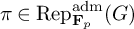 $\pi \in \mathrm {Rep}_{{\mathbf {F}}_p}^{\mathrm {adm}}(G)$
, we have
$\pi \in \mathrm {Rep}_{{\mathbf {F}}_p}^{\mathrm {adm}}(G)$
, we have $\dim _{D^\times } \mathcal {J}^i(\pi ) \leq \dim _{G} \pi $
for all
$\dim _{D^\times } \mathcal {J}^i(\pi ) \leq \dim _{G} \pi $
for all $i\geq 0$
.
$i\geq 0$
.
In many cases, this can be proved. In particular, we have the following result, which can be proved by an easy adaptation of the proof of Theorem 1.6.
Proposition 4.8. Suppose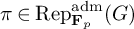 $\pi \in \mathrm {Rep}_{{\mathbf {F}}_p}^{\mathrm {adm}}(G)$
is such that for all
$\pi \in \mathrm {Rep}_{{\mathbf {F}}_p}^{\mathrm {adm}}(G)$
is such that for all $i>n-1$
and all
$i>n-1$
and all $j\geq 0$
,
$j\geq 0$
, $\mathcal {J}^i(\pi )=0$
and
$\mathcal {J}^i(\pi )=0$
and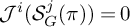 $\mathcal {J}^i(\mathcal {S}_{G}^j(\pi ))=0$
. Then Conjecture 4.7 is true for
$\mathcal {J}^i(\mathcal {S}_{G}^j(\pi ))=0$
. Then Conjecture 4.7 is true for $\pi $
.
$\pi $
.
The hypotheses of this proposition are satisfied for any representation of the form $\pi =\mathrm {Ind}_{P}^G \sigma $
, where P is any parabolic subgroup contained in the standard maximal parabolic
$\pi =\mathrm {Ind}_{P}^G \sigma $
, where P is any parabolic subgroup contained in the standard maximal parabolic $P_{n-1,1}$
and
$P_{n-1,1}$
and $\sigma $
is any admissible smooth representation of the Levi quotient
$\sigma $
is any admissible smooth representation of the Levi quotient $P\twoheadrightarrow M$
. To see this, note that the main theorem of [Reference Johansson, Ludwig and HansenJLH21] shows that
$P\twoheadrightarrow M$
. To see this, note that the main theorem of [Reference Johansson, Ludwig and HansenJLH21] shows that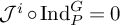 $\mathcal {J}^i \circ \mathrm {Ind}_{P}^G = 0$
for all
$\mathcal {J}^i \circ \mathrm {Ind}_{P}^G = 0$
for all $i>n-1$
. It’s then enough to observe that for all j we have
$i>n-1$
. It’s then enough to observe that for all j we have $\mathcal {S}_G^{j}( \mathrm {Ind}_{P}^G \sigma ) = \mathrm {Ind}_{P}^G \delta _P \mathcal {S}_{M}^{j-d}(\sigma )$
for a certain integer d and smooth character
$\mathcal {S}_G^{j}( \mathrm {Ind}_{P}^G \sigma ) = \mathrm {Ind}_{P}^G \delta _P \mathcal {S}_{M}^{j-d}(\sigma )$
for a certain integer d and smooth character $\delta _P$
(use [Reference KohlhaaseKoh17, Theorem 4.7 and Corollary 5.3]), so the main theorem of [Reference Johansson, Ludwig and HansenJLH21] again applies.
$\delta _P$
(use [Reference KohlhaaseKoh17, Theorem 4.7 and Corollary 5.3]), so the main theorem of [Reference Johansson, Ludwig and HansenJLH21] again applies.
We also observe that Conjecture 4.7 implies that $\mathcal {J}^{2n-2}$
is very small, and can be explicitly computed.
$\mathcal {J}^{2n-2}$
is very small, and can be explicitly computed.
Proposition 4.9. Suppose that Conjecture 4.7 is true. Then for any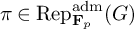 $\pi \in \mathrm {Rep}_{{\mathbf {F}}_p}^{\mathrm {adm}}(G)$
admitting a finite-length filtration whose graded pieces have central characters, we have
$\pi \in \mathrm {Rep}_{{\mathbf {F}}_p}^{\mathrm {adm}}(G)$
admitting a finite-length filtration whose graded pieces have central characters, we have $\dim _{{\mathbf {F}}_p} \mathcal {J}^{2n-2}(\pi ) < \infty $
, and in fact there is an isomorphism
$\dim _{{\mathbf {F}}_p} \mathcal {J}^{2n-2}(\pi ) < \infty $
, and in fact there is an isomorphism
 $$\begin{align*}\mathcal{J}^{2n-2}(\pi) = \mathcal{S}_{D^\times}^{0}(\mathcal{J}^0(\mathcal{S}_{G}^0(\pi))).\end{align*}$$
Note that the slightly strange hypothesis on $\pi $
is satisfied for any irreducible admissible representation. The final isomorphism here implies (assuming Conjecture 4.7) that
$\pi $
is satisfied for any irreducible admissible representation. The final isomorphism here implies (assuming Conjecture 4.7) that $\mathcal {J}^{2n-2}(\pi )$
is nonzero exactly when
$\mathcal {J}^{2n-2}(\pi )$
is nonzero exactly when $\pi $
admits a G-stable quotient
$\pi $
admits a G-stable quotient $\pi \twoheadrightarrow \tau $
such that
$\pi \twoheadrightarrow \tau $
such that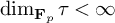 $\dim _{{\mathbf {F}}_p} \tau < \infty $
and
$\dim _{{\mathbf {F}}_p} \tau < \infty $
and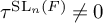 $\tau ^{\mathrm {SL}_n (F)} \neq 0$
. We also note that the following proof shows that
$\tau ^{\mathrm {SL}_n (F)} \neq 0$
. We also note that the following proof shows that $\mathcal {J}^{2n-2}(\pi ) = \mathcal {S}_{D^\times }^{0}(\mathcal {J}^0(\mathcal {S}_{G}^0(\pi )))$
whenever
$\mathcal {J}^{2n-2}(\pi ) = \mathcal {S}_{D^\times }^{0}(\mathcal {J}^0(\mathcal {S}_{G}^0(\pi )))$
whenever $\dim _{D^\times } \mathcal {J}^{2n-2}(\pi ) =0$
, independently of Conjecture 4.7.
$\dim _{D^\times } \mathcal {J}^{2n-2}(\pi ) =0$
, independently of Conjecture 4.7.
Proof. Set $M=(\mathcal {J} \circ \mathcal {S}_G)(\pi )$
. By the duality theorem, we get an
$M=(\mathcal {J} \circ \mathcal {S}_G)(\pi )$
. By the duality theorem, we get an $E_2$
spectral sequence
$E_2$
spectral sequence
 $$\begin{align*}E_2^{i,j}=\mathcal{S}^{i}_{D^\times}(\mathcal{J}^{-j}(\pi)) \Rightarrow H^{i+j+2n-2}(M).\end{align*}$$
Suppose that $\dim _{{\mathbf {F}}_p} \mathcal {J}^{2n-2}(\pi ) = \infty $
, i.e. that
$\dim _{{\mathbf {F}}_p} \mathcal {J}^{2n-2}(\pi ) = \infty $
, i.e. that $c:= \dim _{D^\times } \mathcal {J}^{2n-2}(\pi )> 0$
. Then
$c:= \dim _{D^\times } \mathcal {J}^{2n-2}(\pi )> 0$
. Then $E_{2}^{c,-(2n-2)}$
is nonzero and c-dimensional, and a c-dimensional quotient of it survives to the
$E_{2}^{c,-(2n-2)}$
is nonzero and c-dimensional, and a c-dimensional quotient of it survives to the $E_\infty $
-page, showing that
$E_\infty $
-page, showing that $\dim _{D^\times } H^c(M) \geq c$
. On the other hand, we have a second spectral sequence
$\dim _{D^\times } H^c(M) \geq c$
. On the other hand, we have a second spectral sequence $\mathcal {J}^i(\mathcal {S}_{G}^j(\pi ))\Rightarrow H^{i+j}(M)$
, showing that
$\mathcal {J}^i(\mathcal {S}_{G}^j(\pi ))\Rightarrow H^{i+j}(M)$
, showing that $H^c(M)$
has a finite filtration whose gradeds are subquotients of
$H^c(M)$
has a finite filtration whose gradeds are subquotients of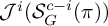 $\mathcal {J}^{i}(\mathcal {S}_{G}^{c-i}(\pi ))$
for varying i. Since
$\mathcal {J}^{i}(\mathcal {S}_{G}^{c-i}(\pi ))$
for varying i. Since $\dim _G \mathcal {S}_{G}^{c-i}(\pi ) \leq c-i$
, Conjecture 4.7 then implies that
$\dim _G \mathcal {S}_{G}^{c-i}(\pi ) \leq c-i$
, Conjecture 4.7 then implies that $\dim _{D^\times } \mathcal {J}^{i}(\mathcal {S}_{G}^{c-i}(\pi )) \leq c-i < c$
for
$\dim _{D^\times } \mathcal {J}^{i}(\mathcal {S}_{G}^{c-i}(\pi )) \leq c-i < c$
for $i>0$
. But when
$i>0$
. But when $i=0$
,
$i=0$
, $\dim _{D^\times } \mathcal {J}^{0}(\mathcal {S}_{G}^{c}(\pi ))=0$
by the explicit calculation of
$\dim _{D^\times } \mathcal {J}^{0}(\mathcal {S}_{G}^{c}(\pi ))=0$
by the explicit calculation of $\mathcal {J}^0$
, using our assumption on
$\mathcal {J}^0$
, using our assumption on $\pi $
to reduce to the case of
$\pi $
to reduce to the case of $\pi $
admitting a central character. Therefore
$\pi $
admitting a central character. Therefore $H^c(M)$
has a finite filtration whose gradeds have dimension
$H^c(M)$
has a finite filtration whose gradeds have dimension $<c$
, so
$<c$
, so $\dim _{D^\times } H^c(M) < c$
. This is a contradiction.
$\dim _{D^\times } H^c(M) < c$
. This is a contradiction.
For the final statement, note that the two spectral sequences show (unconditionally) that
 $$\begin{align*}\mathcal{S}_{D^\times}^0(\mathcal{J}^{2n-2}(\pi)) = \mathcal{J}^0(\mathcal{S}_G^0 (\pi))\end{align*}$$
for all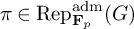 $\pi \in \mathrm {Rep}_{{\mathbf {F}}_p}^{\mathrm {adm}}(G)$
. If
$\pi \in \mathrm {Rep}_{{\mathbf {F}}_p}^{\mathrm {adm}}(G)$
. If $\mathcal {J}^{2n-2}(\pi )$
is zero-dimensional, then
$\mathcal {J}^{2n-2}(\pi )$
is zero-dimensional, then $\mathcal {S}_{D^\times }^0(\mathcal {J}^{2n-2}(\pi )) = \mathcal {S}_{D^\times }(\mathcal {J}^{2n-2}(\pi ))$
is the full derived dual of
$\mathcal {S}_{D^\times }^0(\mathcal {J}^{2n-2}(\pi )) = \mathcal {S}_{D^\times }(\mathcal {J}^{2n-2}(\pi ))$
is the full derived dual of $\mathcal {J}^{2n-2}(\pi )$
, so the result follows from biduality.
$\mathcal {J}^{2n-2}(\pi )$
, so the result follows from biduality.
Proof of Theorem 1.7
Let $\check {\pi }$
be the unique nonzero derived dual of
$\check {\pi }$
be the unique nonzero derived dual of $\pi $
. The duality isomorphism then simplifies to an isomorphism
$\pi $
. The duality isomorphism then simplifies to an isomorphism
 $$\begin{align*}\mathcal{S}_{D^\times}(\mathcal{J}(\pi))\cong \mathcal{J}(\check{\pi})[2n-2-\dim_G \pi]. \end{align*}$$
Since $\mathcal {J}(\check {\pi })$
is concentrated in degrees
$\mathcal {J}(\check {\pi })$
is concentrated in degrees $\geq 0$
, the right-hand side, and then also the left-hand side, is concentrated in degrees
$\geq 0$
, the right-hand side, and then also the left-hand side, is concentrated in degrees $\geq \dim _G \pi -(2n-2)$
.
$\geq \dim _G \pi -(2n-2)$
.
If $\mathcal {J}(\pi )$
is zero, there is nothing to prove. Otherwise, let
$\mathcal {J}(\pi )$
is zero, there is nothing to prove. Otherwise, let $c=\max _{i}\dim _{D^\times }\mathcal {J}^{i}(\pi )$
, and let
$c=\max _{i}\dim _{D^\times }\mathcal {J}^{i}(\pi )$
, and let $i_{0}$
be any i realizing this maximum. Arguing as in the proof of Theorem 1.6, we see that the left-hand side has nonzero cohomology in degree
$i_{0}$
be any i realizing this maximum. Arguing as in the proof of Theorem 1.6, we see that the left-hand side has nonzero cohomology in degree $c-i_0$
. Therefore
$c-i_0$
. Therefore $c\geq \dim _G \pi -(2n-2) + i_0 \geq \dim _G \pi -(2n-2)$
, giving the desired result.
$c\geq \dim _G \pi -(2n-2) + i_0 \geq \dim _G \pi -(2n-2)$
, giving the desired result.
4.3 The case of
$\mathrm {GL}_2$

Now we specialize to the case $n=2$
, with
$n=2$
, with $F/\mathbf {Q}_{p}$
still arbitrary. Set
$F/\mathbf {Q}_{p}$
still arbitrary. Set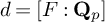 $d=[F:\mathbf {Q}_{p}]$
. Let
$d=[F:\mathbf {Q}_{p}]$
. Let $B\subset G=\mathrm {GL}_{2}(F)$
be the upper-triangular Borel subgroup, with
$B\subset G=\mathrm {GL}_{2}(F)$
be the upper-triangular Borel subgroup, with $T=F^{\times }\times F^{\times }\subset B$
the diagonal maximal torus. Let
$T=F^{\times }\times F^{\times }\subset B$
the diagonal maximal torus. Let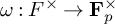 $\omega :F^{\times }\to \mathbf {F}_{p}^{\times }$
be the character defined as the composition
$\omega :F^{\times }\to \mathbf {F}_{p}^{\times }$
be the character defined as the composition
 $$\begin{align*}F^{\times}\overset{\mathrm{Nm}_{F/\mathbf{Q}_{p}}}{\longrightarrow}\mathbf{Q}_{p}^{\times}\overset{x\mapsto x|x|}{\longrightarrow}\mathbf{Z}_{p}^{\times}\overset{\mathrm{red}}{\to}\mathbf{F}_{p}^{\times}. \end{align*}$$
If $\chi _{1}\otimes \chi _{2}:T\to \mathbf {F}_{p}^{\times }$
is any smooth character, we can consider the smooth induction
$\chi _{1}\otimes \chi _{2}:T\to \mathbf {F}_{p}^{\times }$
is any smooth character, we can consider the smooth induction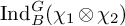 $\mathrm {Ind}_{B}^{G}(\chi _{1}\otimes \chi _{2})$
. This is irreducible iff
$\mathrm {Ind}_{B}^{G}(\chi _{1}\otimes \chi _{2})$
. This is irreducible iff $\chi _{1}\neq \chi _{2}$
. Moreover,
$\chi _{1}\neq \chi _{2}$
. Moreover, $\mathcal {S}_{G}^{i}(\mathrm {Ind}_{B}^{G}(\chi _{1}\otimes \chi _{2}))=0$
for all
$\mathcal {S}_{G}^{i}(\mathrm {Ind}_{B}^{G}(\chi _{1}\otimes \chi _{2}))=0$
for all $i\neq d$
, and
$i\neq d$
, and
 $$\begin{align*}\mathcal{S}_{G}^{d}(\mathrm{Ind}_{B}^{G}(\chi_{1}\otimes\chi_{2}))\cong\mathrm{Ind}_{B}^{G}(\omega\chi_{1}^{-1}\otimes\omega^{-1}\chi_{2}^{-1}). \end{align*}$$
In particular, if we set $\pi (\chi _{1},\chi _{2})=\mathrm {Ind}_{B}^{G}(\omega \chi _{1}\otimes \chi _{2})$
, then
$\pi (\chi _{1},\chi _{2})=\mathrm {Ind}_{B}^{G}(\omega \chi _{1}\otimes \chi _{2})$
, then
 $$\begin{align*}\mathcal{S}_{G}^{d}(\pi(\chi_{1},\chi_{2}))\otimes(\chi_{1}\chi_{2}\omega\circ\det)\cong\pi(\chi_{2},\chi_{1}), \end{align*}$$
and moreover $\pi (\chi _{1},\chi _{2})$
and its dual
$\pi (\chi _{1},\chi _{2})$
and its dual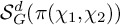 $\mathcal {S}_{G}^{d}(\pi (\chi _{1},\chi _{2}))$
are both irreducible iff
$\mathcal {S}_{G}^{d}(\pi (\chi _{1},\chi _{2}))$
are both irreducible iff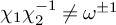 $\chi _{1}\chi _{2}^{-1}\neq \omega ^{\pm 1}$
.
$\chi _{1}\chi _{2}^{-1}\neq \omega ^{\pm 1}$
.
Assume then that $\chi _1,\chi _2$
is a pair of characters such that
$\chi _1,\chi _2$
is a pair of characters such that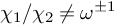 $\chi _1/\chi _2 \neq \omega ^{\pm 1}$
. As noted in the introduction, we then have
$\chi _1/\chi _2 \neq \omega ^{\pm 1}$
. As noted in the introduction, we then have $\mathcal {J}^i(\pi (\chi _1,\chi _2))=0$
for all
$\mathcal {J}^i(\pi (\chi _1,\chi _2))=0$
for all $i\neq 1$
, and likewise with
$i\neq 1$
, and likewise with $\chi _1$
and
$\chi _1$
and $\chi _2$
swapped. With this vanishing in mind, we set
$\chi _2$
swapped. With this vanishing in mind, we set $\tau (\chi _1,\chi _2)=\mathcal {J}^1(\pi (\chi _1,\chi _2))$
.
$\tau (\chi _1,\chi _2)=\mathcal {J}^1(\pi (\chi _1,\chi _2))$
.
Theorem 4.10. Notation and assumptions as above, exactly one of the following is true.
i. $\tau (\chi _1,\chi _2)= \tau (\chi _2,\chi _1)=0.$
ii. Both $\tau (\chi _1,\chi _2)$
and
$\tau (\chi _1,\chi _2)$
and $\tau (\chi _2,\chi _1)$
are nonzero, and are exchanged by the functor
$\tau (\chi _2,\chi _1)$
are nonzero, and are exchanged by the functor $\mathcal {S}_{D^\times }^d(-) \otimes (\chi _1 \chi _2 \omega \circ \mathrm {Nm})$
. Moreover,
$\mathcal {S}_{D^\times }^d(-) \otimes (\chi _1 \chi _2 \omega \circ \mathrm {Nm})$
. Moreover, $\mathcal {S}_{D^\times }^i(-)$
applied to either representation vanishes for all
$\mathcal {S}_{D^\times }^i(-)$
applied to either representation vanishes for all $i\neq d$
.
$i\neq d$
.
Proof. Evaluate the duality isomorphism $(\mathcal {S}_{D^\times }\circ \mathcal {J})\cong (\mathcal {J}\circ \mathcal {S}_{G})[2]$
on the representation
$(\mathcal {S}_{D^\times }\circ \mathcal {J})\cong (\mathcal {J}\circ \mathcal {S}_{G})[2]$
on the representation $\pi (\chi _1,\chi _2)$
. Since
$\pi (\chi _1,\chi _2)$
. Since $\mathcal {J}(\pi (\chi _1,\chi _2)) = \tau (\chi _1,\chi _2)[-1]$
, the left-hand side simplifies to
$\mathcal {J}(\pi (\chi _1,\chi _2)) = \tau (\chi _1,\chi _2)[-1]$
, the left-hand side simplifies to $\mathcal {S}_{D^\times }(\tau (\chi _1,\chi _2))[1]$
by the results recalled above. On the other hand,
$\mathcal {S}_{D^\times }(\tau (\chi _1,\chi _2))[1]$
by the results recalled above. On the other hand, $\mathcal {S}_{G}(\pi (\chi _{1},\chi _{2})) \cong \pi (\chi _{2},\chi _{1}) \otimes (\chi _{1}\chi _{2}\omega \circ \det )^{-1}[-d]$
, so the right-hand side simplifies to
$\mathcal {S}_{G}(\pi (\chi _{1},\chi _{2})) \cong \pi (\chi _{2},\chi _{1}) \otimes (\chi _{1}\chi _{2}\omega \circ \det )^{-1}[-d]$
, so the right-hand side simplifies to $\mathcal {J}(\pi (\chi _{2},\chi _{1}))\otimes (\chi _{1}\chi _{2}\omega \circ \mathrm {Nm})^{-1}[2-d] \cong \tau (\chi _{2},\chi _{1})\otimes (\chi _{1}\chi _{2}\omega \circ \mathrm {Nm})^{-1}[1-d]$
. Thus, canceling the shifts, we get an isomorphism
$\mathcal {J}(\pi (\chi _{2},\chi _{1}))\otimes (\chi _{1}\chi _{2}\omega \circ \mathrm {Nm})^{-1}[2-d] \cong \tau (\chi _{2},\chi _{1})\otimes (\chi _{1}\chi _{2}\omega \circ \mathrm {Nm})^{-1}[1-d]$
. Thus, canceling the shifts, we get an isomorphism
 $$\begin{align*}\mathcal{S}_{D^\times}(\tau(\chi_1,\chi_2)) \cong \tau(\chi_{2},\chi_{1})\otimes(\chi_{1}\chi_{2}\omega\circ\mathrm{Nm})^{-1}[-d], \end{align*}$$
which immediately gives the desired result.
4.3.1 A non-generic case
In this section we sketch some consequences of our duality theorem in the setting of reducible principal series representations of $\mathrm {GL}_2(\mathbf {Q}_p)$
. Maintain the previous notation, but with
$\mathrm {GL}_2(\mathbf {Q}_p)$
. Maintain the previous notation, but with $F=\mathbf {Q}_p$
. The principal series representation
$F=\mathbf {Q}_p$
. The principal series representation $\pi (\omega ^{-1},1)$
is reducible of length two, and sits in a short exact sequence
$\pi (\omega ^{-1},1)$
is reducible of length two, and sits in a short exact sequence
 $$\begin{align*}0 \to \mathbf{1} \to \pi(\omega^{-1},1) \to \mathrm{St} \to 0\;\;\;\;\; (\dagger)\end{align*}$$
where $\mathrm {St}$
is the mod p Steinberg representation of
$\mathrm {St}$
is the mod p Steinberg representation of $\mathrm {GL}_2(\mathbf {Q}_p)$
. To ease notation, set
$\mathrm {GL}_2(\mathbf {Q}_p)$
. To ease notation, set $\kappa =\mathcal {S}^1_{G}(\mathrm {St})$
. Note that
$\kappa =\mathcal {S}^1_{G}(\mathrm {St})$
. Note that $\mathcal {S}_{G}(\mathbf {1})=\mathbf {1}[0]$
and
$\mathcal {S}_{G}(\mathbf {1})=\mathbf {1}[0]$
and $\mathcal {S}_{G}(\pi (\omega ^{-1},1))=\pi (1,\omega ^{-1})[-1]$
, where
$\mathcal {S}_{G}(\pi (\omega ^{-1},1))=\pi (1,\omega ^{-1})[-1]$
, where $\pi (1,\omega ^{-1})$
is an irreducible principal series. The associated long exact sequence for
$\pi (1,\omega ^{-1})$
is an irreducible principal series. The associated long exact sequence for $\mathcal {S}^{i}_{G}(-)$
is now easy to analyze: the embedding
$\mathcal {S}^{i}_{G}(-)$
is now easy to analyze: the embedding $\mathcal {S}^0_{G}(\mathrm {St})\hookrightarrow \mathcal {S}^0_{G}(\pi (\omega ^{-1},1))=0$
implies that the long exact sequence degenerates to a short exact sequence
$\mathcal {S}^0_{G}(\mathrm {St})\hookrightarrow \mathcal {S}^0_{G}(\pi (\omega ^{-1},1))=0$
implies that the long exact sequence degenerates to a short exact sequence
 $$\begin{align*}0 \to \mathbf{1} \to \kappa \to \pi(1,\omega^{-1}) \to 0\;\;\;\;(\ddagger)\end{align*}$$
and that $\mathcal {S}^i_{G}(\mathrm {St})$
for all
$\mathcal {S}^i_{G}(\mathrm {St})$
for all $i\neq 1$
. Biduality then implies that the previous sequence is non-split, since otherwise the nonvanishing of
$i\neq 1$
. Biduality then implies that the previous sequence is non-split, since otherwise the nonvanishing of $\mathcal {S}^0_{G}(-)$
applied to the first term would contradict the vanishing of
$\mathcal {S}^0_{G}(-)$
applied to the first term would contradict the vanishing of $\mathcal {S}^0_{G}(\kappa )$
. Note that
$\mathcal {S}^0_{G}(\kappa )$
. Note that $\kappa $
is the unique non-split extension of
$\kappa $
is the unique non-split extension of $\pi (1,\omega ^{-1})$
by
$\pi (1,\omega ^{-1})$
by $\mathbf {1}$
.
$\mathbf {1}$
.
Using the main result in [Reference LudwigLud17] together with the explicit computation of $\mathcal {J}^0$
, the following vanishing results are clear:
$\mathcal {J}^0$
, the following vanishing results are clear:
-
•
$\mathcal {J}(\mathbf {1})=R\Gamma (\mathbf {P}^1_{C},{\mathbf {F}}_p)=\mathbf {1} \oplus \mathbf {1}[-2]$
-
•
$\mathcal {J}^i(\pi (1,\omega ^{-1}))=0$
for all
$i\neq 1$
. -
•
$\mathcal {J}^i(\pi (\omega ^{-1},1))=0$
for all
$i\neq 0,1$
, and
$\mathcal {J}^0(\pi (\omega ^{-1},1))=\mathbf {1}$
. -
•
$\mathcal {J}^i(\mathrm {St})=0$
for all
$i \neq 1$
.








The long exact sequence in $\mathcal {J}^i$
’s associated with the sequence
$\mathcal {J}^i$
’s associated with the sequence $(\dagger )$
then degenerates to a short exact sequence
$(\dagger )$
then degenerates to a short exact sequence
 $$\begin{align*}0 \to \mathcal{J}^1(\pi(\omega^{-1},1)) \to \mathcal{J}^{1}(\mathrm{St}) \to \mathbf{1} \to 0\;\;\;\;\;(\dagger').\end{align*}$$
Next, observe that $\mathcal {J}^2$
is right-exact, so applying it to the exact sequence
$\mathcal {J}^2$
is right-exact, so applying it to the exact sequence $(\ddagger )$
gives a surjection
$(\ddagger )$
gives a surjection $\mathbf {1}=\mathcal {J}^2(\mathbf {1})\twoheadrightarrow \mathcal {J}^2(\kappa )$
. This shows that
$\mathbf {1}=\mathcal {J}^2(\mathbf {1})\twoheadrightarrow \mathcal {J}^2(\kappa )$
. This shows that $\dim _{D^\times } \mathcal {J}^2(\kappa ) =0$
. Using Proposition 4.9 and the remark immediately afterwards, we then deduce from the vanishing
$\dim _{D^\times } \mathcal {J}^2(\kappa ) =0$
. Using Proposition 4.9 and the remark immediately afterwards, we then deduce from the vanishing $\mathcal {S}^0_{G}(\kappa )=0$
that in fact
$\mathcal {S}^0_{G}(\kappa )=0$
that in fact $\mathcal {J}^2(\kappa )=0$
. Note that Hu-Wang proved the vanishing
$\mathcal {J}^2(\kappa )=0$
. Note that Hu-Wang proved the vanishing $\mathcal {J}^2(\kappa )=0$
by global methods [Reference Hu and WangHW22, Corollary 8.19], while our argument is purely local. With this vanishing in hand, we see that the long exact sequence in
$\mathcal {J}^2(\kappa )=0$
by global methods [Reference Hu and WangHW22, Corollary 8.19], while our argument is purely local. With this vanishing in hand, we see that the long exact sequence in $\mathcal {J}^i$
’s associated with the sequence
$\mathcal {J}^i$
’s associated with the sequence $(\ddagger )$
degenerates to a short exact sequence
$(\ddagger )$
degenerates to a short exact sequence
 $$\begin{align*}0 \to \mathcal{J}^{1}(\kappa) \to \mathcal{J}^1(\pi(1,\omega^{-1})) \to \mathbf{1} \to 0\;\;\;\;\;(\ddagger'). \end{align*}$$
Next, we observe that the representations $\mathrm {St}$
and
$\mathrm {St}$
and $\pi (1,\omega ^{-1})$
both satisfy the conditions of Proposition 4.5, with
$\pi (1,\omega ^{-1})$
both satisfy the conditions of Proposition 4.5, with $c=1$
and
$c=1$
and $\dim _G(-) = 1$
in both cases. Applying that proposition, we get duality isomorphisms
$\dim _G(-) = 1$
in both cases. Applying that proposition, we get duality isomorphisms
 $$\begin{align*}\mathcal{S}^{i}_{D^\times}(\mathcal{J}^{1}(\mathrm{St}))\cong \mathcal{J}^{i}(\kappa)\end{align*}$$
and
 $$\begin{align*}\mathcal{S}^{i}_{D^\times}(\mathcal{J}^{1}(\pi(1,\omega^{-1})))\cong \mathcal{J}^{i}(\pi(\omega^{-1},1)) \end{align*}$$
for all $i\geq 0$
. When
$i\geq 0$
. When $i=0$
these yield no new information. The vanishing of the right-hand sides for
$i=0$
these yield no new information. The vanishing of the right-hand sides for $i \geq 2$
implies that
$i \geq 2$
implies that $\mathcal {J}^{1}(\mathrm {St})$
and
$\mathcal {J}^{1}(\mathrm {St})$
and $\mathcal {J}^{1}(\pi (1,\omega ^{-1}))$
are of dimension
$\mathcal {J}^{1}(\pi (1,\omega ^{-1}))$
are of dimension $\leq 1$
; the exact sequences
$\leq 1$
; the exact sequences $(\dagger ')$
and
$(\dagger ')$
and $(\ddagger ')$
then imply that
$(\ddagger ')$
then imply that $\mathcal {J}^{1}(\kappa )$
and
$\mathcal {J}^{1}(\kappa )$
and $\mathcal {J}^{1}(\pi (\omega ^{-1},1))$
are also of dimension
$\mathcal {J}^{1}(\pi (\omega ^{-1},1))$
are also of dimension $\leq 1$
. Finally, in the case
$\leq 1$
. Finally, in the case $i=1$
, the left-hand side of each isomorphism is either identically zero, or Cohen-Macaulay of dimension one. This yields a dichotomy: either
$i=1$
, the left-hand side of each isomorphism is either identically zero, or Cohen-Macaulay of dimension one. This yields a dichotomy: either
-
(1)
$\mathcal {J}^1(\mathrm {St}) = \mathcal {J}^1(\pi (1,\omega ^{-1}))=\mathbf {1}$
and
$\mathcal {J}^{1}(\pi (\omega ^{-1},1))=\mathcal {J}^{1}(\kappa )=0$
, or -
(2) all four representations
$\mathcal {J}^1(\mathrm {St})$
,
$\mathcal {J}^1(\pi (1,\omega ^{-1}))$
,
$\mathcal {J}^{1}(\pi (\omega ^{-1},1))$
, and
$\mathcal {J}^{1}(\kappa )$
are one-dimensional, and the last two are Cohen-Macaulay.






Just as in the situation of Theorem 1.8, we don’t currently see how to rule out (1) by a purely local argument. However, using [Reference Hu and WangHW22, Proposition 8.18. (i)] and their exact sequence (8.13), it is easy to see that (1) does not occur. We leave the details to the interested reader.
5 A partial Künneth formula
In this section only, we change notation slightly, to emphasize the dependence of the Jacquet-Langlands functor on the integer n. More precisely, we write $\mathcal {J}_n$
for the Jacquet-Langlands functor from
$\mathcal {J}_n$
for the Jacquet-Langlands functor from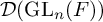 ${\mathcal {D}}(\mathrm {GL}_n(F))$
towards
${\mathcal {D}}(\mathrm {GL}_n(F))$
towards ${\mathcal {D}}(D_{1/n}^{\times })$
.
${\mathcal {D}}(D_{1/n}^{\times })$
.
For any integer $0<d<n$
, let
$0<d<n$
, let $P_{n-d,d}\subset \mathrm {GL}_n(F)$
be the usual upper-triangular parabolic with Levi
$P_{n-d,d}\subset \mathrm {GL}_n(F)$
be the usual upper-triangular parabolic with Levi $\mathrm {GL}_{n-d}(F)\times \mathrm {GL}_d(F)$
. Let
$\mathrm {GL}_{n-d}(F)\times \mathrm {GL}_d(F)$
. Let $\sigma _1 \boxtimes \sigma _2$
be a smooth representation of the Levi, and let
$\sigma _1 \boxtimes \sigma _2$
be a smooth representation of the Levi, and let $\mathrm {Ind}_{P_{n-d,d}}^{\mathrm {GL}_n(F)}(\sigma _1 \boxtimes \sigma _2)$
be the usual parabolic induction to a smooth representation of
$\mathrm {Ind}_{P_{n-d,d}}^{\mathrm {GL}_n(F)}(\sigma _1 \boxtimes \sigma _2)$
be the usual parabolic induction to a smooth representation of $\mathrm {GL}_n(F)$
. The main result in this section is an alternative formula for
$\mathrm {GL}_n(F)$
. The main result in this section is an alternative formula for $\mathcal {J}_n(\mathrm {Ind}_{P_{n-d,d}}^{\mathrm {GL}_n(F)}(\sigma _1 \boxtimes \sigma _2))$
, in terms of the cohomology of an auxiliary space with coefficients in a certain sheaf built from
$\mathcal {J}_n(\mathrm {Ind}_{P_{n-d,d}}^{\mathrm {GL}_n(F)}(\sigma _1 \boxtimes \sigma _2))$
, in terms of the cohomology of an auxiliary space with coefficients in a certain sheaf built from $\sigma _1$
and
$\sigma _1$
and $\mathcal {J}_d(\sigma _2)$
. This builds on the analysis begun by the first author in [Reference Johansson, Ludwig and HansenJLH21, Appendix A]. When
$\mathcal {J}_d(\sigma _2)$
. This builds on the analysis begun by the first author in [Reference Johansson, Ludwig and HansenJLH21, Appendix A]. When $d=1$
, this formula is implicit in [Reference Johansson, Ludwig and HansenJLH21], as explained below.
$d=1$
, this formula is implicit in [Reference Johansson, Ludwig and HansenJLH21], as explained below.
To state the main result, we need to introduce the key auxiliary space. In what follows we will freely use some standard notation related to relative Fargues-Fontaine curves. In particular, for any perfectoid space $S/\operatorname {\mathrm {Spa}} C$
, we have the adic relative Fargues-Fontaine curve
$S/\operatorname {\mathrm {Spa}} C$
, we have the adic relative Fargues-Fontaine curve $\mathcal {X}_{S^\flat }$
, which comes with a canonical closed immersion
$\mathcal {X}_{S^\flat }$
, which comes with a canonical closed immersion $\iota : S \hookrightarrow \mathcal {X}_{S^\flat }$
realizing S as a closed Cartier divisor. We write
$\iota : S \hookrightarrow \mathcal {X}_{S^\flat }$
realizing S as a closed Cartier divisor. We write $\mathcal {O}(1/n)$
for the usual stable vector bundle of rank n and degree
$\mathcal {O}(1/n)$
for the usual stable vector bundle of rank n and degree $1$
, which is defined functorially over any
$1$
, which is defined functorially over any $\mathcal {X}_{S^\flat }$
.
$\mathcal {X}_{S^\flat }$
.
Definition 5.1. Let $W_{n,d}$
denote the moduli space over
$W_{n,d}$
denote the moduli space over $\operatorname {\mathrm {Spd}} C$
parametrizing quotients of
$\operatorname {\mathrm {Spd}} C$
parametrizing quotients of $\mathcal {O}(1/n)$
which are isomorphic to
$\mathcal {O}(1/n)$
which are isomorphic to $\mathcal {O}(1/d)$
after pullback to any geometric point.
$\mathcal {O}(1/d)$
after pullback to any geometric point.
Note that $W_{n,d}$
carries a natural
$W_{n,d}$
carries a natural $\underline {D_{1/n}^\times }$
-action by bundle automorphisms (Recall that the automorphism sheaf
$\underline {D_{1/n}^\times }$
-action by bundle automorphisms (Recall that the automorphism sheaf $S \mapsto \mathrm {Aut}(\mathcal {O}(1/n)^{\oplus m} / \mathcal {X}_{S^\flat })$
is exactly the sheaf
$S \mapsto \mathrm {Aut}(\mathcal {O}(1/n)^{\oplus m} / \mathcal {X}_{S^\flat })$
is exactly the sheaf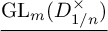 $\underline {\mathrm {GL}_m(D_{1/n}^{\times })}$
.). It is easy to see that
$\underline {\mathrm {GL}_m(D_{1/n}^{\times })}$
.). It is easy to see that $W_{n,d}$
is a spatial diamond, and we will see below that it is proper over
$W_{n,d}$
is a spatial diamond, and we will see below that it is proper over $\operatorname {\mathrm {Spd}} C$
. It is also easy to see that
$\operatorname {\mathrm {Spd}} C$
. It is also easy to see that $W_{n,d}$
can be defined equivalently as the moduli space of subbundles of
$W_{n,d}$
can be defined equivalently as the moduli space of subbundles of $\mathcal {O}(1/n)$
which are isomorphic to
$\mathcal {O}(1/n)$
which are isomorphic to $\mathcal {O}^{n-d}$
after pullback to any geometric point. Trivializing the subbundle in this alternative description gives a canonical
$\mathcal {O}^{n-d}$
after pullback to any geometric point. Trivializing the subbundle in this alternative description gives a canonical $\mathrm {GL}_{n-d}(F)$
-torsor over
$\mathrm {GL}_{n-d}(F)$
-torsor over $W_{n,d}$
, corresponding to a canonical map
$W_{n,d}$
, corresponding to a canonical map $h_1: W_{n,d} \to B \underline {\mathrm {GL}_{n-d}(F)}$
. On the other hand, trivializing the quotient bundle in the original moduli problem gives a canonical
$h_1: W_{n,d} \to B \underline {\mathrm {GL}_{n-d}(F)}$
. On the other hand, trivializing the quotient bundle in the original moduli problem gives a canonical $D_{1/d}^\times $
-torsor over
$D_{1/d}^\times $
-torsor over $W_{n,d}$
, corresponding to a canonical map
$W_{n,d}$
, corresponding to a canonical map $h_2: W_{n,d} \to B \underline {D_{1/d}^\times }$
.
$h_2: W_{n,d} \to B \underline {D_{1/d}^\times }$
.
With these preparations in hand, the main result in this section can be stated as follows.
Theorem 5.2. For any $\sigma _1 \in {\mathcal {D}}(\mathrm {GL}_{n-d}(F))$
and
$\sigma _1 \in {\mathcal {D}}(\mathrm {GL}_{n-d}(F))$
and $\sigma _2 \in {\mathcal {D}}(\mathrm {GL}_{d}(F))$
, there is a natural isomorphism
$\sigma _2 \in {\mathcal {D}}(\mathrm {GL}_{d}(F))$
, there is a natural isomorphism
 $$\begin{align*}\mathcal{J}_n(\mathrm{Ind}_{P_{n-d,d}}^{\mathrm{GL}_n(F)}(\sigma_1 \boxtimes \sigma_2)) \cong R\Gamma(W_{n,d},h_{1,{\mathrm{\acute{e}t}}}^\ast \sigma_1 \otimes h_{2,{\mathrm{\acute{e}t}}}^\ast \mathcal{J}_d(\sigma_2)). \end{align*}$$
When $d=1$
, this specializes to the isomorphism
$d=1$
, this specializes to the isomorphism $\mathcal {J}_{n}(\mathrm {Ind}_{P_{n-1,1}}^{\mathrm {GL}_n(F)}(\sigma _1 \boxtimes \sigma _2)) \cong R\Gamma (\mathcal {M}_{P(F)}, \mathcal {F}_{\sigma _1 \boxtimes \sigma _2})$
implicit in the proof of [Reference Johansson, Ludwig and HansenJLH21, Theorem 5.3.1] (where we freely use some notation from loc. cit.). Indeed,
$\mathcal {J}_{n}(\mathrm {Ind}_{P_{n-1,1}}^{\mathrm {GL}_n(F)}(\sigma _1 \boxtimes \sigma _2)) \cong R\Gamma (\mathcal {M}_{P(F)}, \mathcal {F}_{\sigma _1 \boxtimes \sigma _2})$
implicit in the proof of [Reference Johansson, Ludwig and HansenJLH21, Theorem 5.3.1] (where we freely use some notation from loc. cit.). Indeed, $\mathcal {M}_{P(F)} = X_{n,1} = W_{n,1}$
by the discussion below, and a direct calculation shows that
$\mathcal {M}_{P(F)} = X_{n,1} = W_{n,1}$
by the discussion below, and a direct calculation shows that $\mathcal {F}_{\sigma _1 \boxtimes \sigma _2} \cong h_1^\ast \sigma _1 \otimes h_2^\ast \sigma _2$
, noting that
$\mathcal {F}_{\sigma _1 \boxtimes \sigma _2} \cong h_1^\ast \sigma _1 \otimes h_2^\ast \sigma _2$
, noting that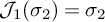 $\mathcal {J}_1(\sigma _2)=\sigma _2$
has no effect.
$\mathcal {J}_1(\sigma _2)=\sigma _2$
has no effect.
The proof relies on several auxiliary spaces, which we find helpful to collect into a large diagram

of small v-stacks, where every square is cartesian. Here $\ast = \operatorname {\mathrm {Spd}} C$
for brevity, and
$\ast = \operatorname {\mathrm {Spd}} C$
for brevity, and $W_{n,d}$
and
$W_{n,d}$
and $h_1,h_2$
are as discussed above. Let us explain the parts of this diagram we have not yet discussed (We will not need every object in this diagram, but the reader might find it helpful to know that they exist.). Let
$h_1,h_2$
are as discussed above. Let us explain the parts of this diagram we have not yet discussed (We will not need every object in this diagram, but the reader might find it helpful to know that they exist.). Let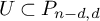 $U\subset P_{n-d,d}$
be the unipotent radical, so
$U\subset P_{n-d,d}$
be the unipotent radical, so $U\cdot \mathrm {GL}_{n-d}(F)$
and
$U\cdot \mathrm {GL}_{n-d}(F)$
and $U\cdot \mathrm {GL}_{d}(F)$
are both closed normal subgroups of
$U\cdot \mathrm {GL}_{d}(F)$
are both closed normal subgroups of $P_{n-d,d}$
with intersection U. Then by definition,
$P_{n-d,d}$
with intersection U. Then by definition, $X=\mathcal {M}_{\infty }/\underline {U}$
,
$X=\mathcal {M}_{\infty }/\underline {U}$
, $X_+ = \mathcal {M}_{\infty }/\underline {U\cdot \mathrm {GL}_{d}(F)}$
,
$X_+ = \mathcal {M}_{\infty }/\underline {U\cdot \mathrm {GL}_{d}(F)}$
, $X_- = \mathcal {M}_{\infty }/\underline {U\cdot \mathrm {GL}_{n-d}(F)}$
, and
$X_- = \mathcal {M}_{\infty }/\underline {U\cdot \mathrm {GL}_{n-d}(F)}$
, and $X_{n,d} = \mathcal {M}_\infty / \underline {P_{n-d,d}}$
, whence the upper left square is cartesian. By [Reference Johansson, Ludwig and HansenJLH21, Proposition A.3.3], the space
$X_{n,d} = \mathcal {M}_\infty / \underline {P_{n-d,d}}$
, whence the upper left square is cartesian. By [Reference Johansson, Ludwig and HansenJLH21, Proposition A.3.3], the space $X_{n,d}$
admits an explicit alternative description: it is the moduli space sending any perfectoid space
$X_{n,d}$
admits an explicit alternative description: it is the moduli space sending any perfectoid space $S/C$
to (isomorphism classes of) diagrams
$S/C$
to (isomorphism classes of) diagrams $\mathcal {O}(1/n)\twoheadrightarrow \mathcal {E} \hookleftarrow \mathcal {F}$
of vector bundles over
$\mathcal {O}(1/n)\twoheadrightarrow \mathcal {E} \hookleftarrow \mathcal {F}$
of vector bundles over $\mathcal {X}_{S^\flat }$
such that
$\mathcal {X}_{S^\flat }$
such that $\mathcal {E} \simeq \mathcal {O}(1/d)$
and
$\mathcal {E} \simeq \mathcal {O}(1/d)$
and $\mathcal {F} \simeq \mathcal {O}^d$
at all geometric points, and such that
$\mathcal {F} \simeq \mathcal {O}^d$
at all geometric points, and such that $\mathrm {coker}(\mathcal {F} \to \mathcal {E}) \simeq \iota _{\ast }W$
for some rank one projective
$\mathrm {coker}(\mathcal {F} \to \mathcal {E}) \simeq \iota _{\ast }W$
for some rank one projective $\mathcal {O}_S$
-module W, where
$\mathcal {O}_S$
-module W, where $\iota :S \to \mathcal {X}_{S^\flat }$
is the usual divisor. The map
$\iota :S \to \mathcal {X}_{S^\flat }$
is the usual divisor. The map $\tilde {h}_2$
corresponds to remembering only
$\tilde {h}_2$
corresponds to remembering only $\mathcal {E} \hookleftarrow \mathcal {F}$
, while
$\mathcal {E} \hookleftarrow \mathcal {F}$
, while $\tilde {g}_d$
corresponds to remembering only
$\tilde {g}_d$
corresponds to remembering only $\mathcal {O}(1/n)\twoheadrightarrow \mathcal {E}$
. The cartesian square spanned by
$\mathcal {O}(1/n)\twoheadrightarrow \mathcal {E}$
. The cartesian square spanned by $g_d$
and
$g_d$
and $h_2$
is then a consequence of [Reference Johansson, Ludwig and HansenJLH21, Proposition A.3.4]. Note that
$h_2$
is then a consequence of [Reference Johansson, Ludwig and HansenJLH21, Proposition A.3.4]. Note that $g_d$
is proper and p-bounded, since it comes from a proper map of rigid analytic spaces pro-étale-locally on the target. Note also that
$g_d$
is proper and p-bounded, since it comes from a proper map of rigid analytic spaces pro-étale-locally on the target. Note also that $X_{n,d} \to W_{n,d}$
is proper and surjective, while
$X_{n,d} \to W_{n,d}$
is proper and surjective, while $X_{n,d} \to \ast $
is proper by [Reference Johansson, Ludwig and HansenJLH21, Proposition A.3.2], so
$X_{n,d} \to \ast $
is proper by [Reference Johansson, Ludwig and HansenJLH21, Proposition A.3.2], so $W_{n,d} \to \ast $
is proper as claimed in the discussion preceding Theorem 5.2.
$W_{n,d} \to \ast $
is proper as claimed in the discussion preceding Theorem 5.2.
Lemma 5.3. For any  and
and  , there is a natural isomorphism

in  .
.
Proof. Consider the commutative diagram

where the square and rectangle are both cartesian. By definition, $\mathrm {Ind}_{P_{n-d,d}}^{\mathrm {GL}_n(F)}(M_1 \boxtimes M_2) = q_{\ast } s^{\ast }(M_1 \boxtimes M_2)$
and
$\mathrm {Ind}_{P_{n-d,d}}^{\mathrm {GL}_n(F)}(M_1 \boxtimes M_2) = q_{\ast } s^{\ast }(M_1 \boxtimes M_2)$
and  , so
, so

which by proper base-change transforms to

where the  on the last line denotes the $D_{1/n}^\times $
-equivariant cohomology. To finish the proof it remains to identify the
$D_{1/n}^\times $
-equivariant cohomology. To finish the proof it remains to identify the $D_{1/n}^\times $
-equivariant sheaf
$D_{1/n}^\times $
-equivariant sheaf $r^* s^* (M_1 \boxtimes M_2)$
on
$r^* s^* (M_1 \boxtimes M_2)$
on $X_{n,d}$
. After forgetting the
$X_{n,d}$
. After forgetting the $D_{1/n}^\times $
-equivariance of the sheaf, i.e. after applying
$D_{1/n}^\times $
-equivariance of the sheaf, i.e. after applying $\tilde {\alpha }^*$
, we get
$\tilde {\alpha }^*$
, we get
 $$ \begin{align*} \tilde{\alpha}^* r^* s^* (M_1 \boxtimes M_2) &= (s \circ r \circ \tilde{\alpha})^* (M_1 \boxtimes M_2) = ((h_1 \circ \tilde{g}_d) \times (f_d \circ \tilde{h}_2))^* (M_1 \boxtimes M_2)\\ &= \tilde{g}_d^\ast h_1^{\ast} M_1 \otimes \tilde{h}_{2}^\ast f_d^{\ast} M_2, \end{align*} $$
using that $s\circ r \circ \tilde {\alpha } = (h_1 \circ \tilde {g}_d) \times (f_d \circ \tilde {h}_2)$
. This gives the result.
$s\circ r \circ \tilde {\alpha } = (h_1 \circ \tilde {g}_d) \times (f_d \circ \tilde {h}_2)$
. This gives the result.
Proof of Theorem 5.2
By some straightforward manipulations with the Riemann-Hilbert correspondence, we easily reduce to proving the solid version of the theorem. In other words, we need to show that for any  and
and  , there is a natural isomorphism

By the previous lemma, we already have a canonical isomorphism

We then compute that

Here the first isomorphism is trivial, the second follows from the projection formula, and the third follows from proper base change. Since  by definition, this gives the desired result.
By work of Johansson-Ludwig [Reference Johansson, Ludwig and HansenJLH21, Theorem A], $W_{n,1}$
is a perfectoid space for all n. The proof of [Reference Johansson, Ludwig and HansenJLH21, Theorem A] is a highly nontrivial argument using the p-adic geometry of global Shimura varieties. In the special case
$W_{n,1}$
is a perfectoid space for all n. The proof of [Reference Johansson, Ludwig and HansenJLH21, Theorem A] is a highly nontrivial argument using the p-adic geometry of global Shimura varieties. In the special case $n=2$
, the first author reproved this result by purely local methods [Reference Johansson, Ludwig and HansenJLH21, §A.4]. However, the arguments in [Reference Johansson, Ludwig and HansenJLH21, §A.4] easily generalize to show that
$n=2$
, the first author reproved this result by purely local methods [Reference Johansson, Ludwig and HansenJLH21, §A.4]. However, the arguments in [Reference Johansson, Ludwig and HansenJLH21, §A.4] easily generalize to show that $W_{n,n-1}$
is also a perfectoid space for all n. It thus seems natural to make the following conjecture.
$W_{n,n-1}$
is also a perfectoid space for all n. It thus seems natural to make the following conjecture.
Conjecture 5.4. For all integers $0<d<n$
,
$0<d<n$
, $W_{n,d}$
is a perfectoid space.
$W_{n,d}$
is a perfectoid space.
This conjecture implies a vanishing result.
Proposition 5.5. Suppose $W_{n,d}$
is a perfectoid space. Then for any admissible smooth representations
$W_{n,d}$
is a perfectoid space. Then for any admissible smooth representations $\sigma _1 \in \mathrm {Rep}_{\mathbf {F}_{p}}^{\mathrm {sm}}(\mathrm {GL}_{n-d}(F))$
and
$\sigma _1 \in \mathrm {Rep}_{\mathbf {F}_{p}}^{\mathrm {sm}}(\mathrm {GL}_{n-d}(F))$
and $\sigma _2 \in \mathrm {Rep}_{\mathbf {F}_{p}}^{\mathrm {sm}}(\mathrm {GL}_{d}(F))$
,
$\sigma _2 \in \mathrm {Rep}_{\mathbf {F}_{p}}^{\mathrm {sm}}(\mathrm {GL}_{d}(F))$
, $\mathcal {J}_{n}^{i}(\mathrm {Ind}_{P_{n-d,d}}^{\mathrm {GL}_n(F)}(\sigma _1 \boxtimes \sigma _2))=0$
for all
$\mathcal {J}_{n}^{i}(\mathrm {Ind}_{P_{n-d,d}}^{\mathrm {GL}_n(F)}(\sigma _1 \boxtimes \sigma _2))=0$
for all $i>d+n-2$
.
$i>d+n-2$
.
Note that $\mathcal {J}_{n}^{i}$
trivially vanishes in degrees
$\mathcal {J}_{n}^{i}$
trivially vanishes in degrees $>2n-2$
, while this result gives vanishing in degrees
$>2n-2$
, while this result gives vanishing in degrees $> d+n-2=2n-2-(n-d)$
, so we improve on the trivial bound by an interval of length
$> d+n-2=2n-2-(n-d)$
, so we improve on the trivial bound by an interval of length $n-d$
. When
$n-d$
. When $d=1$
, this specializes to the main vanishing theorem in [Reference Johansson, Ludwig and HansenJLH21] (using of course the perfectoidness of
$d=1$
, this specializes to the main vanishing theorem in [Reference Johansson, Ludwig and HansenJLH21] (using of course the perfectoidness of $W_{n,1}$
proved in loc. cit.).
$W_{n,1}$
proved in loc. cit.).
Proof. By the primitive comparison theorem plus some small additional arguments, we get an almost isomorphism
 $$\begin{align*}\mathcal{J}_{n}^{i}(\mathrm{Ind}_{P_{n-d,d}}^{\mathrm{GL}_n(F)}(\sigma_1 \boxtimes \sigma_2)) \otimes \mathcal{O}_C / p \cong H^i(W_{n,d}, h_1^{\ast} \sigma_1 \otimes h_{2}^\ast \mathcal{J}_d( \sigma_2) \otimes \mathcal{O}^+/p). \end{align*}$$
It thus suffices to show that $H^i(W_{n,d}, h_1^{\ast } \sigma _1 \otimes h_{2}^\ast \mathcal {J}_d(\sigma _2) \otimes \mathcal {O}^+/p)$
is almost zero in the claimed range of degrees. Recall that
$H^i(W_{n,d}, h_1^{\ast } \sigma _1 \otimes h_{2}^\ast \mathcal {J}_d(\sigma _2) \otimes \mathcal {O}^+/p)$
is almost zero in the claimed range of degrees. Recall that $\mathcal {J}_d(\sigma _2)$
is concentrated in degrees
$\mathcal {J}_d(\sigma _2)$
is concentrated in degrees $\leq 2d-2$
. Note also that
$\leq 2d-2$
. Note also that $W_{n,d}$
is perfectoid by assumption, so the functor
$W_{n,d}$
is perfectoid by assumption, so the functor $H^i(W_{n,d}, - \otimes \mathcal {O}^+/p)$
on overconvergent étale
$H^i(W_{n,d}, - \otimes \mathcal {O}^+/p)$
on overconvergent étale ${\mathbf {F}}_p$
-sheaves is almost zero for all
${\mathbf {F}}_p$
-sheaves is almost zero for all $i> \dim W_{n,d}=n-d$
, by the usual almost equality of étale and analytic cohomology. The evident spectral sequence then gives almost vanishing in degrees
$i> \dim W_{n,d}=n-d$
, by the usual almost equality of étale and analytic cohomology. The evident spectral sequence then gives almost vanishing in degrees $> 2d-2 + n-d=d+n-2$
, whence the claim.
$> 2d-2 + n-d=d+n-2$
, whence the claim.
When $n=3$
,
$n=3$
, $W_{3,1}$
and
$W_{3,1}$
and $W_{3,2}$
are both perfectoid spaces. Combining this observation with the previous proposition, the right-exactness of
$W_{3,2}$
are both perfectoid spaces. Combining this observation with the previous proposition, the right-exactness of $\mathcal {J}_{3}^{4}$
, and the classification of irreducible admissible representations of
$\mathcal {J}_{3}^{4}$
, and the classification of irreducible admissible representations of $\mathrm{GL}_3(F)$
[Reference HerzigHer11, Theorem 1.1], we get the following vanishing result.
$\mathrm{GL}_3(F)$
[Reference HerzigHer11, Theorem 1.1], we get the following vanishing result.
Corollary 5.6. Let $\pi $
be an irreducible admissible representation of
$\pi $
be an irreducible admissible representation of $\mathrm {GL}_3(F)$
which is not supersingular, and whose underlying vector space is infinite-dimensional. Then
$\mathrm {GL}_3(F)$
which is not supersingular, and whose underlying vector space is infinite-dimensional. Then $\mathcal {J}^{4}(\pi )=0$
.
$\mathcal {J}^{4}(\pi )=0$
.
Acknowledgments
The idea that $\mathcal {J}$
should satisfy some form of duality was suggested to DH by Judith Ludwig during a visit to Heidelberg in January 2020. We heartily thank Judith for this key initial suggestion. We also sincerely thank Peter Scholze for some very helpful conversations about this material, and for suggesting that the authors might profitably collaborate. Some of these results were discovered during the Oberwolfach workshop ‘Nonarchimedean geometry and applications’ in February 2022, and we sincerely thank the organizers for the opportunity to participate in this event. We also thank Gabriel Dospinescu, Eugen Hellmann, Yongquan Hu, Christian Johansson, Vytautas Paškūnas, Claus Sorensen, and Bogdan Zavyalov for some helpful conversations.
$\mathcal {J}$
should satisfy some form of duality was suggested to DH by Judith Ludwig during a visit to Heidelberg in January 2020. We heartily thank Judith for this key initial suggestion. We also sincerely thank Peter Scholze for some very helpful conversations about this material, and for suggesting that the authors might profitably collaborate. Some of these results were discovered during the Oberwolfach workshop ‘Nonarchimedean geometry and applications’ in February 2022, and we sincerely thank the organizers for the opportunity to participate in this event. We also thank Gabriel Dospinescu, Eugen Hellmann, Yongquan Hu, Christian Johansson, Vytautas Paškūnas, Claus Sorensen, and Bogdan Zavyalov for some helpful conversations.
Competing interests
The authors confirm that they have no competing interests.
Data availability statement
Not applicable.


 Open access

