


1. Introduction
Transformational AI tools are becoming established within new product development processes, and this is changing design (Reference Verganti, Vendraminelli and IansitiVerganti et al., 2020). We are at a critical point to understand the best practice in using AI tools, not only in terms of the opportunities but also regarding ethical considerations and risks including: data security (Reference Sharma, Shah and PatelSharma et al., 2022), transparency, integrity and bias (Reference Böckle and KourisBöckle & Kouris, 2022). By understanding AI tools better, design teams can embrace them to enable responsible problem solving and innovation (Reference Rosenbaum, David and KrebsRosenbaum et al., 2023). This research explores the use of AI tools during the initial ‘Fuzzy Front End’ (FFE) of the design process (Reference Koen, Ajamian, Burkart, Clamen, Davidson, D’Amore, Elkins, Herald, Incorvia, Johnson, Karol, Seibert, Slavejkov and WagnerKoen et al., 2001). By investigating how AI can assist the discover phase of early research and development projects this empirical study aims to provide insight into contemporary practice and guide appropriate application.
1.1. Design thinking
Design thinking is a framework for human-centred problem solving using an iterative and collaborative approach (Reference BrownBrown, 2008). The standard double diamond model follows 4 phases of divergent and convergent thinking to discover, define, develop, and deliver (Reference LuchsLuchs, 2015). This study focuses on the divergent thinking, discover phase applied in the traditional context of design engineering.
An important aspect of design thinking is the iterative problem solving coupled with experimentation that forms feedback loops to inform progress toward a solution (Reference Micheli, Wilner, Bhatti, Mura and BeverlandMicheli et al., 2019). The design thinking model can use a combination of formal methods and open discussion as best practice to promote debate of ideas, processes and changes with multidisciplinary teams (Reference Seidel and FixsonSeidel & Fixson, 2013).
1.2. The Fuzzy Front End
The front end of innovation also known as the Fuzzy Front End is a chaotic, unstructured process prior to the formal new product development process (Reference Koen, Ajamian, Burkart, Clamen, Davidson, D’Amore, Elkins, Herald, Incorvia, Johnson, Karol, Seibert, Slavejkov and WagnerKoen et al., 2001).
It is well established that design thinking processes are effective at the beginning of new product development projects (Reference LuchsLuchs, 2015). This fuzzy discovery phase is divergent and is characterised by the nature of exploring then defining uncertain and complex intangible factors and concretising them (Reference Belliveau, Griffin and SomermeyerBelliveau et al., 2004). The lack of clarity and loosely defined nature of the FFE lends itself to using AI solutions (Reference Böckle and KourisBöckle & Kouris, 2022).
1.3. AI tools
The landscape of AI applications is developing rapidly; large language models (LLMs) such as Llama and ChatGPT are becoming increasingly sophisticated, and specific AI design applications such as Vizcom allow designers to fine tune AI outputs. It is therefore challenging to navigate the complexities and appropriate level of human-AI interaction. AI tools can offer significant advantages to enable design teams such as: being trained to identify patterns and trends in large data sets (Reference Cautela, Mortati, Dell’Era and GastaldiCautela et al., 2019); analysis of large quantities of data at speed (Reference Rosenbaum, David and KrebsRosenbaum et al., 2023); broadening the scope of insights across traditional boundaries (Reference Verganti, Vendraminelli and IansitiVerganti et al., 2020). However, there are various challenges to using AI such as: reliability of the output - for example the hallucination phenomenon; effectively managing the inputs through prompt engineering and controlling the source data; as well as the transparency and biases within the AI algorithms. A particular limitation for current AI is a lack of intuition and empathy building (Reference Lu, Yang, Zhao, Zhang and LiLu et al., 2024). The pace of AI development means that on a functional level, best practice of AI continues to evolve. More than as an advanced search engine, for simple data processing or generating outputs based on prompts, AI tools can be used as ‘an object to think with’ (Reference Rosenbaum, David and KrebsRosenbaum et al., 2023). In a design context exploring AI tool are both critical to industry practice and as a new research frontier.
1.4. Workflows
The integration of AI into design workflows is a critical area to explore in terms of human-computer interaction (HCI) (Reference Lu, Yang, Zhao, Zhang and LiLu et al., 2024). The opportunities for automation and data analysis within the design process need to align with the principles of human centred design (Reference Verganti, Vendraminelli and IansitiVerganti et al., 2020). Finding the correct balance between human input and generative AI content is a recognised challenge (Reference Lu, Yang, Zhao, Zhang and LiLu et al., 2024). Responsible use of AI tools can augment the critical human decision making in terms of understanding user needs, empathy and creative problem solving (Reference LundLund, 2024). There is evidence to suggest that AI tools are particularly useful during the divergent thinking phases of the design process (Reference Xu, Chao, Fu and RauXu et al., 2020). It has also been acknowledged that AI assisted design workflows need further research (Reference Lu, Yang, Zhao, Zhang and LiLu et al., 2024). This research aims to explore how AI can assist in looking for patterns within the unstructured fuzzy front end of new product development by bringing together a multidisciplinary team to trial a novel HCI workflow.
1.5. Theoretical underpinnings
This research in underpinned and draws on several theoretical frameworks:
-
Where AI acts as both a pattern recognition tool and a collaborator, this research draws on Sensemaking Theory (Reference WeickWeick, 1995) extended with theories of AI-mediated collective intelligence (Reference Malone, Laubacher and DellarocasMalone et al., 2010; Reference Dellermann, Calma, Lipusch, Weber, Weigel and EbelDellermann et al., 2019) to consider how AI assisted participants construct meaning from ambiguous or incomplete data by integrating diverse knowledge sources into actionable insights.
-
Where AI disrupts traditional innovation processes, this research draws on Capabilities Framework (Reference Teece, Peteraf and LeihTeece et al., 2016) to consider how AI supports participants to sense opportunities, seize ideas, and transform knowledge into prototypes by integrating non-design team members into the FFE.
-
Where AI bridges tacit and explicit knowledge and the agency influencing the knowledge creation process, this research draws on Sociomateriality Theory (Reference Orlikowski and ScottOrlikowski & Scott, 2008; Reference LeonardiLeonardi, 2012) to consider how AI facilitated collection of participant data; the structuring of data into insights; iteratively refining outputs collaboratively with participants; and ensuring final design solutions accurately reflected their tacit knowledge.
2. Methodology
This study uses a mixed qualitative approach to understand the use of AI through an empirical study of two cross functional R&D workshops where participants implemented an AI assisted discovery phase R&D process. A combination of observations combined with a post-workshop survey forms an empirical approach to research design thinking, the importance of which was recognised by Micheli et al., Reference Micheli, Wilner, Bhatti, Mura and Beverland(2019).
2.1. Researcher reflexivity
The research team comprised of 4 researchers with expertise in: AI and creative computing; participatory and action research using qualitative methods; User centred design and team dynamics; and design and manufacturing technologies. The broad interests of the team provide prior understanding of participants roles and work culture while providing knowledge of creative technologies including using AI. The research team acknowledge identifying opportunities to use and study AI has an influence on this study.
2.2. Participants and procedures
Participants were selected using purposive sampling (Reference EtikanEtikan, 2016) from a design and manufacturing organisation as experts in current practice. Workshop participants formed a cross functional R&D team consisting of:
-
A Senior Concept Designer
-
A Quality Engineering Manager
-
An Electrical Design Engineer and a Senior Audio Visual and Electronics Systems Designer
-
A Production Engineer and a Production Manager
These participants were all current employees of a large premium yacht manufacturer (referred to in this research as Premier Yachts). Participants were selected on a critical case basis to represent the working practices within Premier yachts. Before conducting the workshop sessions, it was explained that participation was completely voluntary, and consent could be withdrawn at any time without penalty. Participants were informed that audio recordings of the sessions would be transcribed and used for academic research in accordance with the institutions research ethics guidelines. participants were anonymised and data stored securely. All participants were given a participant information sheet covering the research and signed an informed consent form.
2.3. Design thinking workshop
Two collaborative ‘Discover’ workshops were conducted over two full days with the team from Premier Yachts- combining the use of AI in the fuzzy front-end process and discussing the use of AI in design. As a research methodology, the workshops both inform practice while also providing a framework for gathering reliable and valid empirical data (Reference Ørngreen and LevinsenØrngreen & Levinsen, 2017). Participants were introduced to the workshop programme in an initial pre workshop meeting which also outlined the methods used and the use of AI.
2.3.1. AI assisted design tools
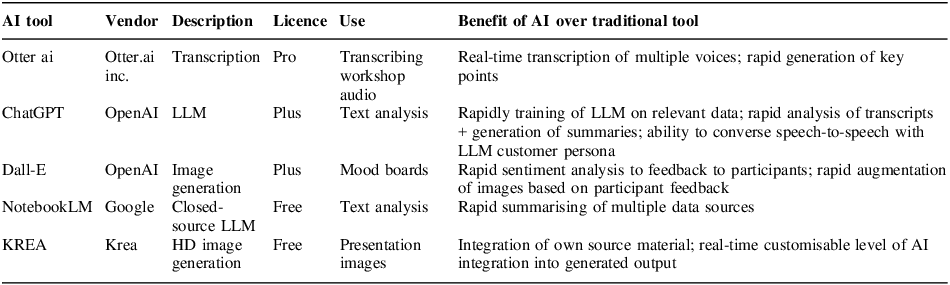
The planning and implementation of the workshops utilised several AI tools to conduct workshop activities and support delivery. Table 1 provides an overview of the AI tools used.
AI tools used and benefits

The AI tools assisted activities conducted over two sequential Discover phase R&D workshops:
Workshop 1
-
Future forecast - discussion of five challenges specific to the marine sector.
-
Future customer profile - customer characterisation and empathy driven discussion
-
Future product profile - group discussion of the design direction based on future challenges and consumer trends
Workshop 2
-
Future Technologies - looking beyond technologies used in the current product.
-
Technology readiness forecast - predictive scoring exercise to map future technologies and discussion.
-
Future manufacturing Technologies - future factory and build plan
2.3.2. Workshop methods
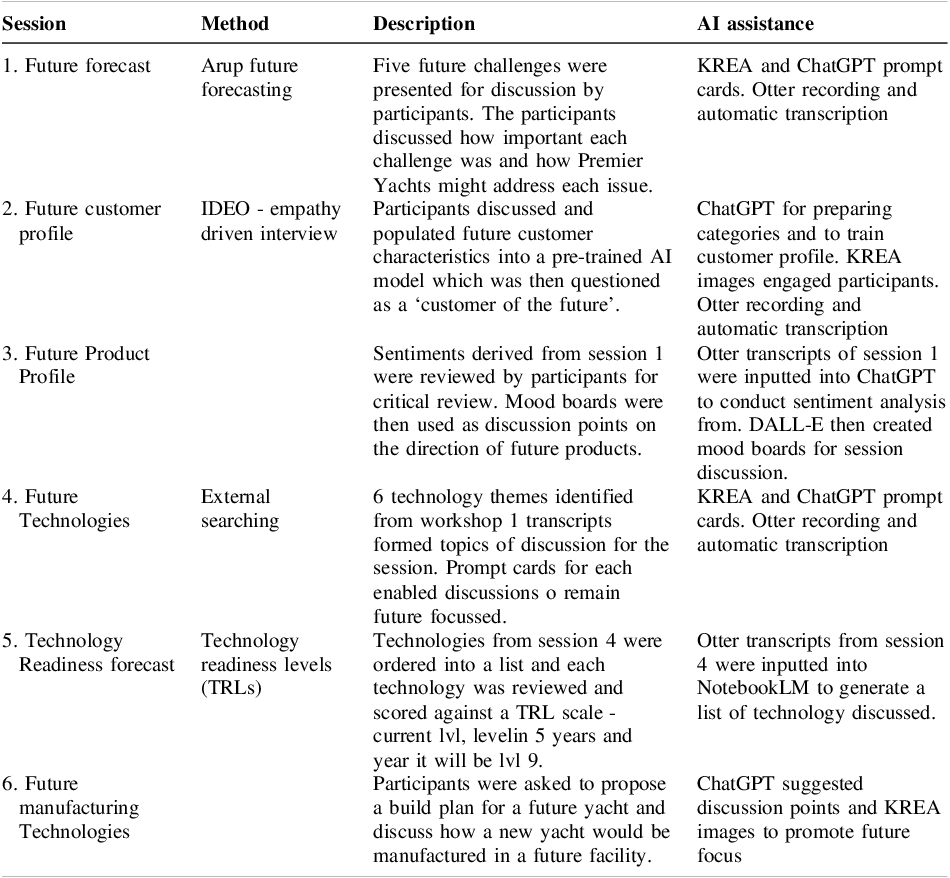
Sessions within the workshops consisted of AI assisted activities. Each activity was designed to promote open discussion within the context of the project. Table 2 outlines the methods used across the workshops.
Workshop methods

2.3.3. Workshop workflow
The participants were taken through the workshop sessions with multiple facilitators and researchers observing in a range of active and passive roles (Reference Ahmed and AsrafAhmed & Asraf, 2018), allowing rigorous recording of observations. The figure 1 workflow diagram explains how AI tools were integrated into workshop sessions
Workshop workflow diagram of participant activities (blue) and AI tools (pink)

ChatGPT was initially used to suggest specific marine industry relevant themes for the future forecast sessions. KREA images provided visual cues to engage the participants and enable topic prompts to be industry specific. Categories for a future customer profile discussion were also aided by ChatGPT, and the user characteristics discussed by the participants were fed into a trained ChatGPT model to enable an ‘empathetic interview’ exercise. Human-AI feedback loops were created during workshop sessions using Otter to record and transcribe the discussions. This iterative process allowed insights to be captured, transcribed and processed at speed and in time for following activities to occur. Discussions from the future forecast sessions provided data for ChatGPT to conduct sentiment analysis and this allowed mood boards generated in Dall-E to be used as prompts and updated live during discussions in the future product profile session. Analysis of transcripts of workshop 1 were used to identify the Future Technologies key topics. Otter transcripts of future technologies conversations were processed by NotebookLM to create a list of technologies for the team to score against a technology readiness level scale. Themes identified by ChatGPT were also used in the final session to aid discussion of manufacturing innovations. A design report based on the workshop transcripts has been provided to the participants and the discussions from these ‘Discover’ workshops will inform the Define stage of the project.
2.4. Workshop data
2.4.1. Observations and field notes
Researcher observations and field notes form a holistic record of the divergent, discover phase of design thinking covered in these two workshops. The research notes provide primary data of participant behaviours and engagement (Reference Ørngreen and LevinsenØrngreen & Levinsen, 2017) while interacting with the AI assisted tasks. The notes are collated from across the three researchers facilitating the study.
2.4.2. Workshop outputs
Workshop materials are presented as evidence of AI assisted design. To provide illustrative examples (Reference Rosner, Kawas, Li, Tilly and SungRosner et al., 2016) and demonstrate the iterative AI outputs that were used to provide critical visual discussion points.
2.4.3. Post-workshop survey
Participants were asked to complete a short satisfaction and engagement survey that included Likert scales and open fields to gather insights directly at the end of each workshop.
3. Results
3.1. Workshop 1 - Discover Product
The ‘Discover Product’ workshop successfully introduced a number of AI tools to engage participants throughout the day. Discussions were in-depth and covered the breadth of customer needs and understanding of the product. The format of the workshop provided all participants with a forum to express views and be heard. AI assisted activities enabled this by ensuring each activity was stimulating and dynamic. The speed of AI data processing allowed iteration to occur quickly and this enabled the workshop to be reactive to points of discussion while progressing through the full program of activities. A satisfaction and engagement survey of workshop 1 showed participants were highly engaged with none of the participants scoring less than 4 out of 5. Participants also reported high levels of satisfaction.
3.1.1. Session 1 - future forecast
Generative AI tools provided visually rich, specific scenario prompts for participants to discuss. Figure 2 displays one of the five scenarios’ participants were asked to consider during the first session.
Session 1 prompt card including a KREA generated image and future focused quote

Participants reported that the scenarios presented were accurate in terms of the main issues facing the luxury marine industry. Participants accepted the AI generated prompts and engaged in discussions to explore future challenges within the industry. The depth of conversation across participants over the duration of the session suggests the AI assistance was a significant factor in stimulating divergent thinking about future issues. A combination of the task, appropriate context and AI tools promoted critical thinking and a full exploration of the topics.
3.1.2. Session 2 - future customer profile
Participants discussed a comprehensive AI generated list of customer characteristics with a range of options available per characteristic. A user centred discussion followed moving through each characteristic with the team whittling down the yacht customer attributes into what they thought would represent a believable future 2030 customer.
Critical review of AI output and quick iteration using rich participant discussions provided essential input into an AI ‘customer of the future’ chat bot model, creating a realistic user persona to interact with using real-time voiced questions and garnering generative spoken AI answers as if in conversation human to human. Participants tried to ‘trip-up’ the AI customer model with questions and were impressed with the realism, accuracy and robustness of the AI tool. A broad range of questions were asked during the interview from practical design questions about interior spaces to questions about lifestyle and purchasing decisions. Participants follow up questions picked up detail from the AI answers, displaying high levels of engagement. As the AI customer was ‘from the future’ it presented a scenario only capable via AI tools, the interaction also provided an environment that enabled probing questions to be asked free of risk. The consistent performance of the persona further increased engagement, as the activity progressed participants became increasingly emotive. The realism of the empathetic interview surprised the participants and provided an enjoyable, highly engaging and interactive human-AI experience.
3.1.3. Session 3 - future product profile
Participants discussed sentiment analysis conducted on transcripts of session 1. Participants confidently engaged in the process and recognised the four themes that had been interpreted from the data. The mood boards in Figure 3 were then generated from data during the workshop and presented back to participants and edited live to enrich the discussion.
Session 3 DALL-E generated mood boards, derived from ChatGPT sentiment analysis of session 1 Otter transcripts

The activity promoted conversation about the vision of future products and how Premier Yachts ‘could’ progress. It also demonstrated the positive attitude in which workshop 1 took place.
3.2. Workshop 2 - discover tech
The second workshop focused on future technologies. This workshop used AI tools to a lesser extent with regard to rapid iteration within the session. Human experts invited to present novel technologies encountered more resistance to ideas than using of AI in workshop 1. Although participants remained engaged it proved more challenging to maintain focus on the future, discussion often returned to the complexities of current challenges. In a satisfaction and engagement survey of workshop 2, participants were engaged and all scored at least 3 out of 5. Participants also reported high levels of satisfaction.
3.2.1. Session 4 - future technologies
Technologies identified from workshop 1 transcripts were categorised into talking points for session 4. Using AI tools in this way provided project continuity, participants were enthusiastic in discussion of the six of future technology topics. One of the six discussion prompts is shown in Figure 4.
Session 4 prompt card presenting technology theme NotebookLM identified from workshop 1 Otter transcripts. Theme is supplemented with KREA image and provocative quotes

3.2.2. Session 5 - technology readiness forecast
The TRL exercise was assisted by NotebookLM by systematically listing all the technologies discussed in session 4. Going through the list allowed participants to discuss technical barriers while remaining future focused to provide a forecast of when different technologies will be ready. Through the course of the exercise participants realised many of the ‘future’ technologies discussed were either already available or were close to maturity.
3.2.3. Session 6 - Future manufacturing Technologies
The session was designed as an opportunity to discuss advanced manufacturing such as 3D printing and potential for automation. Participants discussions centred on troubleshooting future yacht assembly using current production methods. Mindsets were fixed on current production practices. Engagement remained high but focused on nuanced challenges of complex manual assemblies. It was clearly expressed that improvements to the current system were important.
4. Discussion
Paramount to the purpose of the sessions was that participants have successfully understood and engaged with the concept of design thinking in the context of yacht development. The workshops provide insight into how AI tools can be applied to design thinking practices during the fuzzy front end of a development project. The activities successfully demonstrated a critical approach to using AI by ensuring participants were engaged in the task and making key decisions.
4.1. Human-centred AI interaction
The workshop activities provided a framework to enable key design thinking activities to remain human centred and future focused. The AI tools were used as an enabling supplement to increase empathy, creativity and critical thinking (Reference Lu, Yang, Zhao, Zhang and LiLu et al., 2024). AI outputs can be convincing but still need the critical review and contextual understanding by an expert human that is engaged in the task (Reference Sharma, Shah and PatelSharma et al., 2022) to mitigate some of the inherent biases within these AI systems. In this study, all AI output was reviewed by the participants as a sense-check - the mood boards were reviewed and altered based on direct feedback to align the output with the perspective of the participants, and to check for anomalies and known issues such as AI ‘hallucinations’.
The workshops provided the research team with an opportunity to investigate the boundaries between AI tools and human collaboration. The AI tools were predominantly used to augment existing methods and provide fast data processing capabilities to enhance the efficiency and productivity of the design process (Reference Verganti, Vendraminelli and IansitiVerganti et al., 2020). AI tools were most effective when used to supplement exploratory activities. The application of these AI workflows has broader application beyond the yacht industry.
Issues of human-AI interaction relating to blindly accepting output, lack of transparency in the ‘black box’ AI applications (Reference Lu, Yang, Zhao, Zhang and LiLu et al., 2024), and disengagement from the design process (Reference Seidel and FixsonSeidel & Fixson, 2013) were highlighted as challenges. Careful design and management of the AI tools and workflows were used to mitigate these challenges. Additionally, facilitators consistently asked participants to check the relevance and accuracy of AI output. The human-AI interaction needed to be actively managed by the workshop facilitators to respond to team dynamics, address misunderstandings and guide discussion in the group - bridging the Human-AI gap (Reference Xu, Chao, Fu and RauXu et al., 2020). This also allowed the participants to remain focused and engaged on the workshop activities.
4.2. Methodological development
AI assisted ‘Discover’ workshops can be extended to progress through the entire double diamond framework. The workshops in this study combined a collaborative design thinking framework that allowed tasks to remain human centred while incorporating AIs rapid data processing and analysis capabilities.
The workshop demonstrates a number of key factors relevant to successful use of AI in these workshops, these include:
-
a) Ensuring AI is oriented towards supporting human centred activities (Reference Lu, Yang, Zhao, Zhang and LiLu et al., 2024).
-
b) Using AI to tailor (Reference Verganti, Vendraminelli and IansitiVerganti et al., 2020) was successfully applied to all workshop activities to be specific to the marine sector and content tailored specifically to Premier Yachts participants.
-
c) Planning and structuring AI outputs to enrich participant discussions promoting exploration of topics (Reference Xu, Chao, Fu and RauXu et al., 2020)
-
d) Employing AI’s capabilities to rapidly process and analyse vast quantities of data (Reference Rosenbaum, David and KrebsRosenbaum et al., 2023) to create real-time iterative feedback and progress discussion.
-
e) Exploiting generative AI’s ability to create high quality visuals to aid buy-in and engagement (Reference Xu, Chao, Fu and RauXu et al., 2020)
-
f) Ensuring transparency in the use of tools and data (Reference Böckle and KourisBöckle & Kouris, 2022) and maintaining data security by using closed systems when inputting sensitive data (Reference Sharma, Shah and PatelSharma et al., 2022).
The role of the facilitator provides a critical intermediary between the AI and the participants - bridging the human-AI interaction (Reference Rosenbaum, David and KrebsRosenbaum et al., 2023). The facilitator’s role enabled the human participants to actively engage in the tasks, while also processing data across various AI applications and managing the Human-AI interaction. This was achieved effectively by having several facilitators to collect and process data and deliver the workshop sessions.
5. Conclusion
This study establishes how AI can be successfully integrated into the initial fuzzy front end of the design process. The results demonstrate how AI can be used effectively to: augment human creativity to speed up the process; assimilate and analyse vast quantities of data; create provoking and stimulating visuals for discussion; and improve engagement in design thinking. the importance of using AI as an enabling tool to promote human creativity through dynamic iteration demonstrated how purposeful use of AI tools can provide key input into human-centred design tasks.
Maintaining humans at the centre of the design process is a critical aspect both in regard to applying AI and as a principle of design thinking. This research shows how carefully considered human facilitation and a strategic application in the selection and sequencing of AI tools (Reference Bouschery, Blazevic and PillerBouschery et al., 2023) can create highly engaging and purposeful workshops for the benefit of participants and for creating an impressive yield of rapidly generated reviewable data.
5.1. Further work
Continuation of the two workshops presented in this study would encompass the full double diamond process to embed design thinking practices at Premier Yachts. The use of AI in creative and empathy driven activities using the principles discussed in this paper will provide further contribution to empirical research into human-centred AI interaction.
Acknowledgments
This research project was part-funded by InnovateUK as part of a Design Foundations grant.


 Open access

