


Introduction
Identification, or perceived similarity, is a cognitive process by which individuals think of themselves as similar to another person.Reference Fullerton, Ursano, Osuch, Wang, Retterstol and Mortensen1–Reference Wayment2 This can be based on features including demographics, personality, and comparable histories.Reference Westmaas and Silver3 Identification can be conceptualized as a mechanism underlying empathy. This occurs when an individual identifies with and understands another’s emotional state or experience and experiences a similar state. Identification with another as oneself or a close relative or friend may increase emotional involvement, feelings of closeness, and helping behaviors.Reference Westmaas and Silver3
In the context of highly stressful or traumatic events, responses may be influenced by the degree of identification individuals feel with victims, with greater identification associated with psychological distress, including posttraumatic stress (PTS) and grief symptoms.Reference Fullerton, Ursano, Osuch, Wang, Retterstol and Mortensen1, Reference Wayment2, Reference Mash, Ursano, Benevides and Fullerton4, Reference Ursano, Fullerton, Vance and Kao5 During such events, identification can include feelings that the victim could have been themself, their spouse, or a close friend or relative.Reference Ursano, Fullerton, Vance and Kao5 Identification may increase feelings of being vulnerable to a similar experience,Reference Westmaas and Silver3 triggering anxiety and threat. In rescue workers and those responsible for body recovery following natural and human-made disasters, identification was related to greater PTS.Reference Ursano, Fullerton, Vance and Kao5 Individuals may emphasize their dissimilarities to those who experienced the event to establish psychological distance, reduce perceptions of risk, and maintain control.Reference Wayment2
Less is known about the psychological consequences of those not directly exposed to a traumatic event. Identification with disaster victims may be a mechanism influencing adverse psychological responses, even among those without direct trauma exposure. During a 3-week period of sniper attacks in the Washington, D.C., area in October 2002, residents reporting greater identification with victims had higher levels of PTS, although they did not directly witness these events.Reference Mash, Ursano, Benevides and Fullerton4 A primary source of information during widespread traumatic events and associated graphic images is through media exposure. Residents who viewed extensive television coverage of the 9/11 attacks reported higher perceived similarity to the victims.Reference Wayment2
To examine the influence of identification with disaster victims on individuals who were not directly exposed to the event, the current study focuses on experiences of rescue workers from a community close to a major airline crash site. In July 1989, a United Airlines DC-10, carrying 296 passengers and crew, crash-landed after a midair explosion, resulting in 112 deaths and serious injury to 59 passengers. Our original study of this disaster examined 207 exposed disaster workers 2, 7, and 13 months after the crash.Reference Fullerton, Ursano, Osuch, Wang, Retterstol and Mortensen1, Reference Fullerton and Ursano6 This study focuses specifically on a group of disaster and rescue workers from a nearby community to better understand the extent of a disaster’s mental health impact on those who were not directly exposed to the crash, but may have identified with its victims.
Methods
Participants and Procedures
We contacted 700 disaster and rescue workers from a similar-sized community and airport ~90 miles away, 1-month post-disaster. Prospective participants were similar to directly exposed crash site workers in socioeconomic level, geography, and urban/rural residence location, and were considered indirectly exposed. At Time 1 (T1; 2 months post-disaster) and Time 2 (T2; 7 months), 421 and 284 participants, respectively, returned their surveys. Ages ranged from 18 to 60 (M [SD] = 36.2 [9.9]) (Table 1). Most were male (86.4%, n = 370), white (98.3%, n = 414), and married (71.8%, n = 300).
Demographics and Psychological Responses of Indirectly Exposed Rescue Workers

Participation was voluntary and anonymous. Potential participants were informed that surveys included items regarding their work and personal experiences before and since the crash. Surveys were distributed, and individuals indicated agreement to participate by completing and returning de-identified surveys by mail. All stored data were non-identifiable. The study was approved by the Institutional Review Board of the Uniformed Services University in Bethesda, Maryland.
Measures
T1 assessment included demographics (age, gender, marital status, highest education level, race, and previous disaster exposure).
Identification
Identification was assessed (T1) using 5 items from the Trauma Identification Scale.Reference Fullerton, Ursano, Osuch, Wang, Retterstol and Mortensen1 A total score was computed by summing the scores of 3 identification variables: identification with the victim as self, friend, and family member. These categories were assessed with the following items: “It could have been me” (identification-self), “One of the victims reminded me of a close friend or relative” (identification-friend/not immediate family), and an identification-family composite item based on the highest score among: “It could have been my spouse/significant other,” “It could have been my son/daughter,” and “It could have been my father/mother.” Identification-family variable items exhibited good internal consistency (Cronbach’s α = 0.754). Each identification item was scored on a 4-point scale ranging from 0 (not at all) to 3 (very much), with “NA” responses combined with “not at all.” Identification-self, identification-family, and identification-friend items demonstrated adequate internal consistency (Cronbach’s α = 0.649). The total identification score (the sum of identification-self, identification-friend/not immediate family, and identification-family) ranged from 0 to 9.
Acute Stress
The 15-item Impact of Event Scale (IES)Reference Horowitz, Wilner and Alvarez7 (T1) assessed immediate/acute distress symptoms related to the crash (e.g., intrusion, avoidance), directly after the event. Participants rated the extent to which they were distressed/bothered on the day of the airplane crash and the following week, using a scale ranging from 0 (not at all) to 3 (often). Responses were summed to produce symptom severity scores from 0 to 45. A total score of >19 was identified as a high level of acute stress symptoms, indicating clinical concern. The IES exhibits high internal consistency for the total scale (Cronbach’s α = 86; α = .93 in this sample).
Anger/Hostility
Anger/hostility symptoms during the past week were assessed at T1 and T2 using a Symptom Checklist-90-Revised subscale.Reference Derogatis8 Participants rated the extent to which they experienced 6 items on a scale ranging from 0 (not at all) to 4 (extremely), with total scores from 0 to 24. These items demonstrated good internal consistency (Cronbach’s α = .82 in this sample).
Statistical Analysis
Mean levels of identification (T1) and anger/hostility (T1, T2), and rates of high acute stress within 1 week of the crash (collected at T1) were computed using descriptive statistics (Table 1). Risk factors for acute stress were analyzed using logistic regression analyses, and linear regression analyses were conducted to examine the association with anger/hostility. Multivariable models examined the relationships of identification to both outcomes, adjusting for socio-demographics and previous disaster exposure. Logistic regression coefficients were exponentiated to obtain odds ratios (OR) and 95% confidence intervals (CI). Analyses were conducted using SPSS Version 30.
Results
In the total sample, 14.8% (n = 61) of participants had a high level of acute stress within one week of the crash (data collected at T1) (Table 1). Among participants with high identification (top 25%), 30.2% (n = 32) had high acute stress. Total identification scores ranged from 0 to 9 (M [SD] = 3.02 [2.31]). Most participants reported at least some identification with the victims (82.5%; n = 335), with 76.7% (n = 320) identifying the victim as self, 66.2% (n = 272) as family member, and 24.6% (n = 101) as friend. Anger/hostility scores ranged from 0 to 22 (T1) (M [SD] = 1.64 [2.46]) and 0 to 17 (T2) (M [SD] = 1.63 [2.49]). Approximately 12% (n = 51) reported previous disaster exposure.
Acute Stress
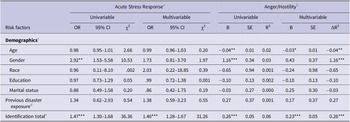
In univariable logistic regressions, women (OR = 2.92 [95% CI = 1.53-5.58], P <.01) and those with greater identification (OR = 1.47 [95% CI = 1.30-1.68]) were more likely to have a high level of acute stress within 1 week of the crash (Table 2). Age, race, education, and marital status were not significantly related to acute stress. In a multivariable model, adjusting for demographics and previous disaster exposure, greater identification continued to be associated with acute stress (OR = 1.46 [95% CI = 1.28-1.67]).
Relationship of Identification to Acute Stress Response and Anger/Hostility in Indirectly Exposed Rescue Workers Following an Airplane Crash

Note. Acute Stress Response univariable models: Age n = 412; Gender n = 412; Race n = 412; Education n = 412; Marital status n = 410; Previous disaster exposure n = 411; Identification total n = 399; Multivariable model n = 396; Anger/Hostility univariable models: Age n = 414; Gender n = 414; Race n = 414; Education n = 414; Marital status n = 411; Previous disaster exposure n = 413; Identification total n = 399; Multivariable model n = 395.
a High acute stress response: Total IES score >19 = Yes (1); ≤19 = No (0)
b Anger/Hostility total score of the SCL-90 subscale (Time 1).
c Gender: Male = 0, Female = 1; Race: Non-white = 0, White =1; Education level: Less than grade 12 = 1; High school = 2; Some college = 3; Bachelor’s degree = 4; Master’s degree = 5; Doctoral degree = 6; Marital status: Unmarried = 0, Married = 1
d Previous disaster exposure: No = 0; Yes = 1
e Identification is the sum score of the Identification_Self, Identification_Friend, and Identification_Family items (range, 0-9).
*P ≤.05, **P ≤.01, ***P ≤.001.
Anger/Hostility
In univariable linear regressions, participants who were younger (T1: B [SE] = −0.04 [0.01]; T2: B [SE] = −0.04[.02]), women (T1: B [SE] = 1.16 [0.34]; T2: B [SE] = 1.09 [0.42]), and had greater identification (T1: B [SE] = 0.26 [0.05]; T2: B [SE] = 0.13 [0.07]) reported more anger/hostility at both time points (Table 2). In a multivariable model, greater identification continued to be associated with anger/hostility at T1 (B [SE] = 0.26 [0.05]), but not T2.
Discussion
Following a major airplane crash, we investigated the role of identification on psychological responses in disaster workers who were not responders to the event, and lived 90 miles away. Identification with victims was commonly reported, even though participants had no direct exposure to the crash, with 82.5% reporting at least some experience of identification. Specifically, 76.7% identified the victim as it could have been themselves and 66.2% as it could have been a family member, with fewer (24.6%) identifying with the victim as a friend.
Despite having no direct exposure to the crash, 14.8% of participants had a high level of disaster-related acute stress in the first week, suggesting the noteworthy impact of a traumatic event, even when not exposed, on psychological response. Women were more likely to report high levels of acute stress early after the crash, corresponding with previous findings of gender differences in PTSD among rescue workers.Reference Martinez and Blanch9 Female and younger participants were also more likely to have greater anger/hostility at two and seven months.
Identification is traditionally considered stress-reducing, fostering interpersonal connections with others.Reference Westmaas and Silver3 It may also be a mechanism associated with the development of empathy, critical for healthy relationships. In the context of the crash, however, identification with victims was associated with increased acute stress during the week post-disaster and anger/hostility at 2 months. At 7 months, however, identification was not associated with anger/hostility, suggesting the significance of attending to particular types of psychological responses, especially in the initial months, among those indirectly exposed to the disaster. It is important to note that there are several factors (e.g., trauma and mental health history, personality characteristics) that may also influence base rates of mental health outcomes, and should be considered in future studies.
Indirect trauma exposure has been defined as witnessing or experiencing the event while performing professional duties (e.g., first responders, medics)10; however, research has supported the substantial psychological toll of traumatic events outside of this context.Reference Lee, Lee and Shin11 In a study of indirect exposure to a ferry accident with primarily high-school-age victims,Reference Lee, Lee and Shin11 parents from a nearby community were at elevated risk for psychological difficulties, suggesting identification with the victims as their own children. Disaster and rescue workers who are trained trauma responders but not directly exposed, such as those in this study, may have received communications regarding the crash, given the similarity in their roles and relative proximity to the site. For these workers, the inability to participate and apply their skills may have increased risk of feelings of helplessness and, consequently, stress and anger/hostility.
Identification resulting from indirect exposure to the crash may be analogous to responses following exposure to media coverage of disasters. As progress in media capabilities has broadened the reach of coverage and real-time information dissemination, accessing and affecting more individuals, it has the potential to influence communities’ mental health responses. High, repetitive media exposure of terrorist attacks and natural disasters has been associated with acute stress symptoms and PTSD ranging from days to months after the events.Reference Marshall, Bryant, Amsel, Suh, Cook and Neria12
This study’s findings emphasize the importance of attention to this population of indirectly exposed disaster workers, who are often overlooked during efforts to provide preventive interventions. For these trained rescue workers, not being called to help or being “left behind” may have affected participants’ psychological responses. Further, limited access to social support resources developed and targeted to help affected individuals may also, in part, explain participants’ elevated distress symptoms during the initial months post-disaster.
Limitations
Interpretation of study findings is limited by design and measurement issues. As with much disaster research, the unexpected nature of traumatic events complicates collection of baseline measures that may be mechanisms influencing identification and mental health responses. Further, lower internal consistency related to identification measures may have affected findings. Generalization of findings is limited by the unavailability of updated versions of well-standardized self-report assessments at the time of data collection. Although this study provides an important examination of acute stress responses, its association with PTSD is complex and requires further investigation in the context of indirect exposure. Approximately 2 months after the airplane crash, participants were asked to reflect retrospectively about acute stress symptoms during the week following the event. Traumatic recall bias has the potential to influence accuracy of, and potentially amplify, reports of past acute stress.Reference Krayem, Hawila and Al Barathie13, Reference Greene, Sznitman and Contractor14 Prospective studies that assess participants during the period immediately following a traumatic event would help address this issue. Although it is expected that news of the crash was televised and shared by those in the rescue worker community, it may underestimate the extent of information dissemination now possible through the internet and increased real-time reporting. Future research focusing on what and how information is shared would be valuable in the context of indirect exposure. Research that further develops the conceptualization and measurement of identification, strengthening its reliability, would help to better understand this important factor and its role following trauma.
Conclusions
Our findings highlight the important role of identification with victims on acute stress and anger/hostility among indirectly exposed disaster workers. High levels of identification were associated with acute stress and anger/hostility only shortly after the event, suggesting that its influence on some mental health outcomes can be strong, but not consistently long-lasting, among indirectly exposed workers. Findings emphasize the importance of monitoring and providing interventions to workers who are indirectly exposed to disasters. Indirect exposure that includes communication among community members and media exposure needs further examination to better understand the role of identification on mental health.
Author contribution
CSF, HHM, AB, and RJU contributed to the study concept and design. CSF, HHM, AB, and RJU were involved in the acquisition and analysis or interpretation of the data. CSF, HHM, AB, and RJU were involved in the drafting of the manuscript, and all authors contributed to critical revision of the manuscript for important intellectual content. All authors read and approved the final manuscript.
Disclaimer
The opinions expressed in the manuscript are those of the authors and, therefore, do not necessarily reflect the views of the Department of Defense, the Uniformed Services University of the Health Sciences, and the Henry M. Jackson Foundation for the Advancement of Military Medicine, Inc.


 Open access

