



Background
Canadian policymakers have struggled to identify optimal approaches to providing timely and quality healthcare to all Canadians. This is particularly a challenge for those who live in rural regions, as they are more likely to have unmet healthcare needs, particularly access to specialist physician services, than those in urban areas (Sibley and Weiner, Reference Sibley and Weiner2011).
An estimated 16.5% of Canadians are 65 years of age or older in 2016, a percentage projected to increase to 23% by 2031 (Statistics Canada, 2015). As people age they tend to develop chronic conditions, so this increasing proportion of older Canadians with growing medical needs is expected to strain healthcare resources. In addition, the increasing complexity of healthcare and rising demand for chronic disease management services have required more physician time than is often available (Virji et al., Reference Virji, Yarnall, Krause, Pollak, Scannell, Gradison and Østbye2006). Efficient communications between primary care providers and patients is one mechanism by which quality of and access to care could be improved. Indeed, the 2012 Physician Services Agreement between the Ontario Medical Association and the province’s Ministry of Health and Long-Term Care stressed the importance of modernising primary care delivery and reducing wait times specifically through e-communications that allow patients to interact with their doctors more readily (Ontario Ministry of Health and Long-Term Care, 2013).
Doctor–patient e-communications has been examined in multiple studies (Couchman et al., Reference Couchman, Forjuoh and Rascoe2001; Baker et al., Reference Baker, Rideout, Gertler and Raube2005; Leong et al., Reference Leong, Gingrich, Lewis, Mauger and George2005; Liederman et al., Reference Liederman, Lee, Baquero and Seites2005; Virji et al., Reference Virji, Yarnall, Krause, Pollak, Scannell, Gradison and Østbye2006; Kummervold and Johnsen, Reference Kummervold and Johnsen2011; Bishop et al., Reference Bishop, Press, Mendelsohn and Casalino2013; Keplinger et al., Reference Keplinger, Koopman, Mehr, Kruse, Wakefield, Wakefield and Canfield2013; Crotty et al., Reference Crotty, Tamrat, Mostaghimi, Safran and Landon2014; de Jong et al., Reference Hobbs, Wald, Jagannath, Kittler, Pizziferri, Volk, Middleton and Bates2014; Garrido et al., Reference de Jong, Ros and Schrijvers2014; Plener et al., Reference Plener, Hayward and Saibil2014; Newhouse et al., Reference Newhouse, Lupiáñez-Villanueva, Codagnone and Atherton2015). Most studies have found that e-communications with patients has been positive, and several have found that e-communications can also improve clinic efficiency and cost-effectiveness (Baker et al., Reference Baker, Rideout, Gertler and Raube2005; Liederman et al., Reference Liederman, Lee, Baquero and Seites2005; Virji et al., Reference Virji, Yarnall, Krause, Pollak, Scannell, Gradison and Østbye2006; Bishop et al., Reference Bishop, Press, Mendelsohn and Casalino2013; Keplinger et al., Reference Keplinger, Koopman, Mehr, Kruse, Wakefield, Wakefield and Canfield2013; Crotty et al., Reference Crotty, Tamrat, Mostaghimi, Safran and Landon2014; de Jong et al., Reference Hobbs, Wald, Jagannath, Kittler, Pizziferri, Volk, Middleton and Bates2014; Plener et al., Reference Plener, Hayward and Saibil2014). Some researchers have also found improved treatment adherence and health outcomes after implementing e-communications (de Jong et al., Reference Hobbs, Wald, Jagannath, Kittler, Pizziferri, Volk, Middleton and Bates2014; Garrido et al., Reference de Jong, Ros and Schrijvers2014; Plener et al., Reference Plener, Hayward and Saibil2014). However, information about the feasibility of implementing e-communications between patients and healthcare providers in rural regions is lacking.
The purpose of this study was to perform an environmental scan of a rural primary care clinic to assess the feasibility of adopting an e-communications system to improve communication between patients and staff.
Methods
The study received ethics approval from the University of Waterloo’s Office of Research Ethics. This study surveyed 131 patients at a family health team clinic, a high-volume medical practice in rural southwestern Ontario (population 6867; Canada 2011 Census) with 10 physicians, 11 nurses, three nurse practitioners, and other allied health professionals. This quantitative survey assessed the technological capabilities of the clinic’s patients and their attitudes towards technology (see Appendix). Over a six-week period, patients were invited to complete the survey by the clinic’s receptionists at the time of the patients’ appointments; however, during busy times the receptionists may have chosen to not disrupt operations by asking patients to complete the survey. Surveys were completed in the waiting room and submitted before leaving the clinic. Patients who completed the survey were invited to participate in qualitative interviews to provide additional depth to their responses. Survey data were entered into a Microsoft Excel spreadsheet and were used to calculate frequencies and percentages.
During a clinic meeting, the study’s authors informed clinic staff and physicians about the study’s purpose. Staff and physicians were then invited to participate in a half-hour semi-structured interview conducted by one of two student researchers in a private room at the clinic. In addition, all three pharmacies in the township were contacted by phone and invited to participate in the study. Three pharmacists were interviewed, one from each pharmacy, by the same student researchers (see Appendix for the qualitative survey questions). All interviews were recorded and transcribed. Transcripts were verified by a second investigator and analysed using thematic coding.
Results
Patient characteristics
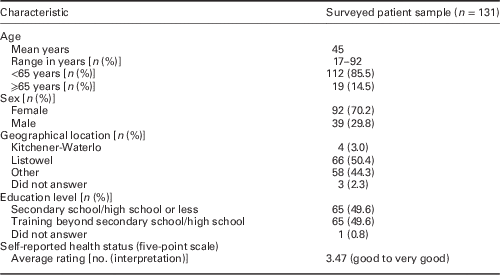
Of the 131 patients surveyed 70% were female. The mean age of respondents was 45 years, with ages ranging from 17 to 92. Half of respondents (50.4%) lived in Listowel, Ontario. Half (49.6%) had educational training beyond secondary school/high school and half (49.6%) had completed that level of education or less. Using a five-point Likert scale ranging from excellent to poor, the average self-reported health status was 3.47, that is, between good and very good health (see Table 1).
Patient characteristics
Current use of technology
A total of 80% of respondents indicated they had access to the internet at home, and 49.6% indicated they had access in other locations such as at work, libraries and via mobile phones. Of those surveyed, 86% had an email account and 70% spent more than an hour a day on average checking email. The most common internet uses were conducting searches (79%), reading and replying to email (62%), using social media (55%) and obtaining news, weather or sports information (50%). Patients also indicated they use the internet to learn about health and medical issues, with 81% indicating they had used it for either purpose at some point.
Attitudes regarding communication
Patients were asked to indicate their likelihood of using email to communicate with family health team staff on a scale from zero to 10 (zero being not likely at all and 10 being very likely). About 28% rated their likelihood between zero and four, 12% rated their likelihood as five, and 60% rated their likelihood as six or greater. Almost half (48%) of patients indicated they would like to use email to communicate with their family doctor, 28% indicated they would not like to use email for this purpose, and 21% were unsure. Patients indicated getting prescription refills (65%), booking appointments (63%), obtaining lab test results (60%), and furthering their education (50%) as potential uses for email communications.
Perspectives of patients and clinic staff
Except for one patient and one nurse, all participants indicated that they use the internet to some extent, mostly for personal communication. Only the physicians and a few of the nurses indicated that they use email professionally for tasks such as scheduling meetings, communicating with individuals at other workplaces, and professional development. None of the phone nurses or office staff had an email address associated with the clinic.
The clinic’s chain and methods of communications appeared to be sources of frustration for most clinic staff. Matters involving patient interaction accounted for a smaller portion of challenges identified by clinic staff. Most issues with patients were attributable to available clinic appointments not meeting patient demand. An inability to communicate with patients who are unable to contact the clinic during the day and timeliness of responses to patient inquiries were identified as obstacles that are likely attributable to internal communications processes.
A lack of dialogue relative to phone conversations, increased staff workload and timeliness of email replies were identified as main concerns. Interviewees indicated that email might go unnoticed if the intended recipient was out of the office, if the message was not seen because it was diverted to the junk email folder, or if the email did not reach its intended recipient.
Most clinic staff indicated that an appropriate response time to email was within seven days of having received it, but a few indicated that one to two days were appropriate. However, patients indicated that their ideal response time was between 30 min to two days, although they would expect a reply in one to two days, with one person indicating seven days. Patients indicated they would follow-up e-communications with phone calls or additional email if they were not replied to within a period they felt was appropriate. Some medical staff thought patients may expect email to be a quicker way to communicate with clinical staff and may rely on having issues resolved by email rather than by an office visit. Most staff members felt that patients should not initiate e-communications. Physicians expressed concern over the potential for abuse of e-communications by patients they find challenging to manage by phone.
Both clinic staff and patients were concerned about maintaining data privacy and confidentiality, the main concern being security of patient health information. Staff members also indicated that system-use guidelines would need to be clear and well defined and that patients should be required to sign a consent indicating they understand how the system works and how their personal health information will be used. Staff members also recommended training patients to realise the full potential of the system.
Several staff members expected they could respond to email messages whenever they had spare time, rather than having to make time to reply. Staff also thought that e-communications would be more successful in reaching patients than would messages left on answering machines.
When asked which activities are best suited to e-communications, the most common responses were scheduling, prescription renewals, general inquiries, and obtaining test results. When asked which activities would be inappropriate for e-communications, the most common responses were replying to urgent matters and conveying positive diagnostic test results.
Some suggested that scheduling and medical inquiries should be separate e-communications functions. A less popular suggestion was to send all inquiries, both scheduling and medical, to receptionists, who would then forward them to appropriate clinic personnel.
Most interviewees noted that older patients might be unreceptive or unable to use email and, conversely, that younger patients might be more eager to have an e-communications system implemented. Some were concerned that the Mennonite patients in this practice, a Christian group in the region that discourages use of technology, might be reluctant to use e-communications. Clinic staff were asked to rate their readiness and willingness to use e-communications on a scale from zero to 10 (zero representing they were not ready/willing at all, and 10 representing they would be ready/willing to use email the next day). The average rating by clinic staff (readiness – 4.83, willingness – 4.88) and by patients (readiness – 4.57, willingness – 5.24) were similar. Most staff compared the implementation of an e-communications system to a previous update to the clinic’s computer system, although one receptionist noted that staff attitudes on the system update were split, potentially posing a barrier to adopting an e-communications system.
Local pharmacists
Three pharmacists, one from each of the three community pharmacies in the region, were interviewed to obtain their opinions on implementing an e-communication system. All communicate from five to 20 times a day with the family health team clinic, mainly to clarify concerns about prescriptions, answer questions, obtain authorisations and make recommendations. Communication is primarily by fax, with occasional phone calls for follow-up and clarification.
Pharmacists were also concerned about maintaining patient privacy and confidentiality, but were not concerned about response timeliness. Two pharmacists indicated that implementing an e-communications system would require significant workflow changes to be successful. All three were concerned about filling prescriptions over the internet because the security and authenticity of the connection might not meet legal requirements of the Ontario College of Pharmacists, the province’s registering and regulating body for pharmacy practice. In spite of these concerns, all pharmacists indicated they would be willing to communicate with clinic staff by email.
Discussion
We surveyed patients as well as interviewed patients, staff and health-care providers at a rural primary care clinic to better understand barriers and facilitators to implementing an e-communications system. This rural Ontario clinic has a large patient call volume, which has overwhelmed staff. Improving patient–clinic communications may increase efficiency, productivity and delivery of healthcare.
Patients at this rural clinic are generally experienced at and comfortable with using email. About 86% have an email account and about 70% spend on average more than an hour a day checking email. Reading and replying to email is a main internet use, second only to conducting searches.
E-communications between patients and clinic staff may offer additional ways for patients to acquire information and become more involved in their health and healthcare. Several studies have demonstrated improved patient involvement as a result of e-communications (de Jong et al., Reference Hobbs, Wald, Jagannath, Kittler, Pizziferri, Volk, Middleton and Bates2014; Garrido et al., Reference de Jong, Ros and Schrijvers2014; Plener et al., Reference Plener, Hayward and Saibil2014; Newhouse et al., Reference Newhouse, Lupiáñez-Villanueva, Codagnone and Atherton2015). Similar to findings of other researchers (Couchman et al., Reference Couchman, Forjuoh and Rascoe2001; Virji et al., Reference Virji, Yarnall, Krause, Pollak, Scannell, Gradison and Østbye2006; Singh et al., Reference Singh, Fox, Petersen, Shethia and Street2009; Lam et al., Reference Lam, Lin, Senelick, Tran, Moore and Koretz2013; Schickedanz et al., Reference Schickedanz, Huang, Lopez, Cheung, Lyles, Bodenheimer and Sarkar2013; Crotty et al., Reference Crotty, Tamrat, Mostaghimi, Safran and Landon2014), the rural patients in our study also indicated a willingness to use e-communications with physicians and clinic staff.
Our findings are consistent with those of earlier studies that examined patient preference for email use, particularly the desire to use email to obtain prescription refills and obtain lab test results (Virji et al., Reference Virji, Yarnall, Krause, Pollak, Scannell, Gradison and Østbye2006; Singh et al., Reference Singh, Fox, Petersen, Shethia and Street2009; Ye et al., Reference Ye, Rust, Fry-Johnson and Strothers2010; Lam et al., Reference Lam, Lin, Senelick, Tran, Moore and Koretz2013; Schickedanz et al., Reference Schickedanz, Huang, Lopez, Cheung, Lyles, Bodenheimer and Sarkar2013; de Jong et al., Reference Hobbs, Wald, Jagannath, Kittler, Pizziferri, Volk, Middleton and Bates2014). Almost half of patients (48%) expressed a desire to use email to communicate with physicians. However, as email is an unstructured form of communication – that is, a medium without standardised input fields – messages from patients might be difficult to understand or interpret. Standardised or closed data fields might help patients to enter crucial health information so physicians have sufficient and appropriate information to respond. Such portals have been implemented successfully in one study (Crotty et al., Reference Crotty, Tamrat, Mostaghimi, Safran and Landon2014).
Both clinic staff and patients expressed concern about security and privacy of e-communications. Security is essential if personal health data are transmitted. Santana et al. (Reference Santana, Lausen, Bujnowska-Fedak, Chronaki, Prokosch and Wynn2011) examined e-communications between doctors and patients in Europe and the solutions adopted to mitigate concerns about using online systems. Danish patients have two ways of communicating with a doctor: using Denmark’s official eHealth portal (www.sundhed.dk), which requires a specific digital signature, and through their doctor’s personal website, which requires a secure login. For both methods, e-communications occurs through an encrypted web interface (Santana et al., Reference Santana, Lausen, Bujnowska-Fedak, Chronaki, Prokosch and Wynn2011). A similar system could be adopted by the family health team clinic to ensure that personal health information is transmitted securely.
Staff were concerned that implementing an e-communication system could increase their workload. However, Kittler et al. (Reference Kittler, Wald, Volk, Pizziferri, Jagannath, Harris, Lippincott, Yu, Hobbs and Bates2004) provide evidence that this may not be so. Staff members at 10 primary care clinics in Boston, Massachusetts were surveyed before and after implementing the Patient Gateway, a system that provides secure electronic communications between patients and clinic staff. Initially, 58% of respondents thought the new system would increase their workload, 10% thought it would decrease it, and 25% were unsure. The post-implementation survey revealed that 63% of respondents found that their workload did not change after introducing the Patient Gateway (Kittler et al., Reference Kittler, Wald, Volk, Pizziferri, Jagannath, Harris, Lippincott, Yu, Hobbs and Bates2004). A smaller, more recent study examined physicians’ attitudes about implementing a secure patient communications system and found that, before implementation, 64% felt it would increase their workload. Post-implementation, 13% of physicians thought their workload had increased (Keplinger et al., Reference Keplinger, Koopman, Mehr, Kruse, Wakefield, Wakefield and Canfield2013). Other studies have found that increase in workload with e-communications adoption is modest and may be offset by reduced clinic visits (Kummervold and Johnsen, Reference Kummervold and Johnsen2011; Garrido et al., Reference de Jong, Ros and Schrijvers2014).
Kummervold and Johnsen (Reference Kummervold and Johnsen2011) analysed the length of time it took physicians to respond to patients over the internet, as well as the correlation between the length of patient questions and subsequent physician responses. Using information from 14 physicians in seven offices, and 1113 messages, they found that physicians spent 2.3 min on average answering patient inquiries. The shortest 25% of messages required 2.1 min on average to answer and the longest 25% took 2.4 min on average to answer. Even questions three times longer than average required only 18% more time for a physician to response (Kummervold and Johnsen, Reference Kummervold and Johnsen2011).
Crotty et al. (Reference Crotty, Tamrat, Mostaghimi, Safran and Landon2014) found substantial variability in email volume for physicians within the same practice. Using the same messaging service, the interquartile range of patient-to-physician messages per physician per year was from 55 to 521. These findings suggest that changes in physician workload associated with implementing e-communications are complex, and each physician’s message volume can vary greatly even within the same clinic. The renegotiation of daily schedules and time for e-consultation may be necessary – the latter being a method already employed by some physicians (Bishop et al., Reference Bishop, Press, Mendelsohn and Casalino2013) – to minimise demand on physicians’ time.
The delay in responding makes e-communications unsuitable for urgent matters, and discussion of positive diagnostic test results generally necessitates a face-to-face conversation between doctors and patients. The timeliness of email replies and determining which matters are considered urgent as reported by the family health team staff have been issues at other clinics. Sibley and Weiner’s study (Reference Sibley and Weiner2011) on smart phone use for clinic communications found that physician and nurse perceptions of urgency differed. Often, physicians who did not perceive an issue to be urgent did not respond to an email despite a response request from a nurse. A possible solution could be deciding which patient or health issues should be dealt with urgently. Nonetheless, Sibley and Weiner (Reference Sibley and Weiner2011) reported a perceived improvement in efficiency with e-communications relative to pagers, the clinic’s previous communications method.
Staff attitudes towards e-communications were divided and willingness to use such a system was reluctant, which could pose barriers to the family health team adopting an e-communications system. One explanation may be the perceived increase in workload for staff, accompanied by significant workflow and operations modifications, whereas benefits, particularly financial, were perceived by staff to be negligible. Reimbursement has been proposed as a possible mechanism to overcome barriers to adopting e-communications (Patt et al., Reference Patt, Houston, Jenckes, Sands and Ford2003; Bishop et al., Reference Bishop, Press, Mendelsohn and Casalino2013; Crotty et al., Reference Crotty, Tamrat, Mostaghimi, Safran and Landon2014). Reimbursing physicians for chronic disease management by e-communications could promote physician–patient communications (Hobbs et al., Reference Garrido, Meng, Wang, Palen and Kanter2003).
Limitations
Patients who chose to complete the quantitative survey may have differed from the clinic’s patients overall, thus introducing self-selection bias. The proportion of older patients and the distribution by gender in our study may not reflect that of the clinic’s population. Moreover, we do not have data on the survey response rate – that is, the number of patients who were asked by receptionists to complete the questionnaire but had declined to do so. Although the receptionists asked patients to complete the survey when they arrived for their appointments, when the office was busy or running behind schedule they may not have asked patients to participate. This latter source of bias may have been more a function of clinic workload than of patient characteristics, but it is a type of selection bias that may have influenced our findings.
Conclusion
We evaluated the feasibility of implementing an e-communications system between patients and staff at a rural primary care clinic. Overall, patients reported they were willing to communicate electronically with their physicians. Clinicians and staff, however, had reservations about e-communications. If the clinic adopted such a system, clinicians and staff felt that clear guidelines and processes would be necessary, along with measures to ensure patient privacy and health data security. Introducing e-communications might improve access to care in this rural primary care clinic, but it is unclear how patient health outcomes or clinic costs might be affected. Further research at this clinic may reveal whether e-communications improves patient health outcomes and delivery of healthcare.
Acknowledgements
The authors thank the physicians, staff and administrators at the family health team clinic for their participation and kind assistance with coordinating study activities; Jenny Seguin and Maral Mirhosseini, University of Waterloo School of Pharmacy students, for their help with data collection and transcription; Dr. Claudio Munoz, Gateway Centre of Excellence in Rural Health, for generous input and guidance; and Joe Petrik for editing and formatting the manuscript.
Financial Support
This research did not receive funding from any agency, commercial or not-for profit sector.
Conflicts of Interest
The authors report no conflicts of interest.
Ethical Standards
The authors assert that all procedures contributing to this work comply with the ethical standards of the relevant national and institutional guidelines on human experimentation adhered to and enforced by the University of Waterloo’s Office of Research Ethics and with those of the Helsinki Declaration of 1975, as revised in 2008.
Appendix: Quantitative and qualitative surveys
Quantitative Client Survey


Qualitative Interview Guide – Clients

Qualitative Interview Guide – Healthcare Providers and Staff

Qualitative Interview Guide – Pharmacists



