

Introduction
The COVID-19 pandemic accelerated the widespread implementation of remote work practices, causing a dramatic surge in work-from-home rates – from 12 % to 50 % globally (Kasemy et al., Reference Kasemy, Sharif, Barakat, Abdelmohsen, Hassan, Hegazy, Sharfeldin, El-Ma’doul, Alsawy, Abo Shereda and Abdelwanees2022). Furthermore, the evolution of digital technologies resulting from the shift of the industrial age has profoundly reshaped organizational operations, culture, and the complexity of work tasks – thereby fostering greater flexibility and ambidexterity among the employees (Battisti et al., Reference Battisti, Alfiero and Leonidou2022; Cetindamar et al., Reference Cetindamar, Abedin and Shirahada2024; Selimović et al., Reference Selimović, Pilav-Velić and Krndžija2021). One of the significant outcomes of this transformation is artificial intelligence (AI). AI has refined workplace dynamics and altered organizational structures, making remote work a dominant and prevalent feature of digital work culture (Aulia & Lin, Reference Aulia and Lin2025). This widespread shift towards remote work due to the dependence on digital tools has become the core feature of modern work arrangements, accelerating ‘individual digitalization’. This refers to leveraging digital resources by integrating and utilizing digital technologies in work and non-work domains (Soga et al., Reference Soga, Bolade-Ogunfodun and De Amicis2024).
Drawing from the ‘International Association of Remote Working’, remote work is a flexible work system characterized by temporal and spatial autonomy. It enables employees to perform their duties outside traditional workplaces while granting them greater control over their personal and professional spheres (Sandoval-Reyes et al., Reference Sandoval-Reyes, Idrovo-Carlier and Duque-Oliva2021). The transition from fixed to flexible work arrangements has minimized employee commuting times. It has also improved employee flexibility by providing them with self-management opportunities and greater autonomy in managing their daily tasks (Yang et al., Reference Yang, Kelly, Kubzansky and Berkman2023; Demerouti, Reference Demerouti2023). Major companies such as Google, Twitter, and Facebook have formalized a shift toward remote work. In contrast, Google approved permanent remote work for 20 % of its workforce, and Twitter and Facebook extended the option to all employees, contingent on their adaptability to the new framework (Aleem et al., Reference Aleem, Sufyan, Ameer and Mustak2023). This increased autonomy enables remote workers to proactively craft their jobs in alignment with their skills, abilities, and interests – a behavior known as ‘job crafting’. Wrzesniewski and Dutton (Reference Wrzesniewski and Dutton2001) emphasized that people who experience more autonomy and flexibility in their work are more inclined to craft their work roles and work environment better (Napier et al., Reference Napier, Slemp and Vella-Brodrick2024). Further, Aplin-Houtz et al. (Reference Aplin-Houtz, Lane, Sharma, Murray, Leahy, Pines, Thomas and Sanders2025) highlighted job crafting as a proactive way to enhance productivity and job satisfaction in work and remote work settings. This proactive behavior enable employees to craft their jobs and work environment better.
According to Dong et al. (Reference Dong, Wang, Liu and Xing2025), working remotely positively and negatively influences workers’ well-being. On one side, it improves employee well-being by reducing commuting time and promoting self-efficacy. In contrast, on the other side, employees experience several remote work challenges such as techno-stress, digital fatigue, emotional exhaustion, burnout, and mental health issues (Wang et al., Reference Wang, Ding and Kong2023; Consiglio et al., Reference Consiglio, Massa, Sommovigo and Fusco2023; Aleem et al., Reference Aleem, Sufyan, Ameer and Mustak2023). Furthermore, coordination difficulties, the expectation of 24/7 connectivity, and work-life imbalance are additional challenges threatening remote workers’ well-being (Aulia & Lin, Reference Aulia and Lin2025; Charalampous et al., Reference Charalampous, Grant, Tramontano and Michailidis2019). Inadequate material or social support from employers further leads employees to amplified psychological and technological disconnection in remote work settings. These overwhelming work-life shifts will significantly impact remote workers’ well-being (Leonardi et al., Reference Leonardi, Parker and Shen2024). Given these dynamics, employees’ well-being at and outside the workplace becomes employers’ priority and has become a key concern for many researchers (Leonardi et al., Reference Leonardi, Parker and Shen2024; Capone et al., Reference Capone, Schettino, Marino, Camerlingo, Smith and Depolo2024). While prior research has examined remote work’s beneficial and adverse impacts on employees’ well-being, the potential adverse impact of digitalization within remote work settings remains underexplored and require further investigation (Han et al., Reference Han, Song, Zhang and Yan2025). There remains a limited understanding of how stressors arising from digitalized settings interact and how their underlying cause-and-effect interrelationship collectively shapes overall well-being of remote workers.
Grounding our investigation through the Job Demands-Resources model, this study seeks to elucidate the key stressors undermining remote workers well-being in digitalized settings. The JD-R model proposed by Demerouti et al. (Reference Demerouti, Bakker, Nachreiner and Schaufeli2001) is a widely applied framework in occupational health psychology. It investigates how the nature of the job influences employee well-being by identifying the possible antecedents of burnout (Lesener et al., Reference Lesener, Gusy and Wolter2019). The JD-R model classifies the work-related factors into job demands and job resources. Job demands refer to work-related challenges that necessitate sustained physical, emotional, or mental efforts that consequently deplete individuals’ personal resources. At the same time, job resources are the supportive aspects of work that not only replenish job demands but also stimulate individual personal growth and development (Dong et al., Reference Dong, Wang, Liu and Xing2025). The JD-R model comprises two causal independent processes – the health impairment process (high job demands that lead to adverse outcomes) and the motivational process (resources that stimulate work engagement and lead to positive outcomes) (Lesener et al., Reference Lesener, Gusy and Wolter2019).
Although research on remote work has expanded significantly after the COVID-19 pandemic, the implications of workplace transformation within technology-driven work environments remain insufficiently unexplored (Hesselbarth et al., Reference Hesselbarth, Alfes and Festing2024). While prior studies have largely investigated remote work challenges in isolation (Nwankpa & Roumani, Reference Nwankpa and Roumani2024), the hierarchical interplay of stressors in and their impact on remote workers has not been systematically explored. As research on remote work within digital and technology-driven economies remains fragmented (Battisti et al., Reference Battisti, Alfiero and Leonidou2022). Our study exclusively focuses on the health impairment process to examine how critical stressors undermining remote workers well-being in such settings. Guided by this research imperative, our study aims to explore the following research questions:
RQ1. What are the major stressors associated with digitalized settings that adversely affect the well-being of remote workers?
RQ2. What are the interrelationships among the key stressors in shaping the well-being of remote workers?
RQ3. How does the fuzzy-TISM approach advance the effectiveness of the group decision-making process?
To address the proposed research questions, a literature review supplemented by insights from domain experts was undertaken to identify the key stressors within digitalized settings. This study employed fuzzy total interpretive structural modeling (TISM) to examine the relationships among the identified stressors and to build a well-interpreted hierarchical structured framework. This study enriches the literature by making several key contributions. First, by integrating digitalization, remote work, and well-being, our study advances the theoretical understanding of how shifts toward digitalization impact employee well-being in a remote work setting. While existing studies have studied remote work challenges in isolation, research exploring their causal interrelationship remains nascent. The study aims to examine the causal-interrelationship lens to understand how the stressors are interlinked through Fuzzy-TISM and MICMAC analysis. Fuzzy-TISM approach provides nuanced understanding of the research problem by capturing the strength of influence among the identified stressors. It incorporates the inherent fuzziness of expert evaluations, critical to address the complex and uncertain problems. While MICMAC analysis has been incorporated to classify the stressors into four categories (autonomous, dependent, linkage, and independent categories) based on their driving and dependence power, allowing a clear understanding of their relative influence. Together these methodologies enable a nuanced exploration of hierarchical relationships and dependencies among factors, offering novel insights into the complexities of digital work environments. Second, by integrating the health impairment process of the JD-R model within highly digitalized settings, we provide theoretical insights into how high job demands in this context undermine the well-being of workers.
Literature review
Review of remote work
The concept of ‘remote work’ is long established, having existed for many years in varied forms; however, its significance and widespread adoption have grown substantially since the onset of the COVID-19 pandemic (Quy & Zhu, Reference Quy and Zhu2024; Leonardi et al., Reference Leonardi, Parker and Shen2024). In literature, remote work is often described alongside related concepts (see Table 1) such as telework and telecommuting and is commonly referred to as ‘working from home’ or ‘flexible work practice’ (Groen et al., Reference Groen, Van Triest, Coers and Wtenweerde2018; Donati et al., Reference Donati, Viola, Toscano and Zappalà2021; Jämsen et al., Reference Jämsen, Sivunen and Blomqvist2022; Soga et al., Reference Soga, Bolade-Ogunfodun and De Amicis2024; Quy & Zhu, Reference Quy and Zhu2024). Remote work encompasses arrangements in which employees work remotely, other than their employer’s primary office, such as a satellite office or remote sites, either full-time or part-time (Jämsen et al., Reference Jämsen, Sivunen and Blomqvist2022). It refers to a flexible work practice enabling employees with temporal and spatial autonomy to permanently or temporarily perform their work at locations other than the office (Sandoval-Reyes et al., Reference Sandoval-Reyes, Idrovo-Carlier and Duque-Oliva2021). Through this practice, employees can execute their duties and job responsibilities beyond their traditional office settings. This empowers employees with more independence in their professional and personal spheres (Sandoval-Reyes et al., Reference Sandoval-Reyes, Idrovo-Carlier and Duque-Oliva2021; Saura et al., Reference Saura, Ribeiro-Soriano and Zegarra Saldaña2022).
Variants of remote work

As noted by Quy and Zhu (Reference Quy and Zhu2024), remote work operates as a double-edged sword; on one hand, it reduces the commuting time of workers, provides spatial flexibility, autonomy, and reduces workload and work-life conflict, while on the other side, it exhibits problems of social isolation and blurred work and personal life boundaries for remote workers. Consequently, the challenge for organizations is to provide remote work options to their employees and effectively support their well-being in distant work settings.
Review of employee well-being
Well-being itself is a multifaceted construct that has been extensively explored within psychology and behavioral sciences and constitutes a critical outcome within organizational behavior (Alvarez-Torres & Schiuma, Reference Alvarez-Torres and Schiuma2024; Wang et al., Reference Wang, Ding and Kong2023). Within the field of positive psychology, well-being is widely examined as the most desirable goal for individuals, which is significant for human existence. From an organizational viewpoint, the concept of well-being has primarily been investigated at the individual level, highlighting its positive influence on both employees and organizations (Demaria & Cavicchioli, Reference Demaria and Cavicchioli2025). Wang et al. (Reference Wang, Ding and Kong2023) highlighted that employees with high positive emotions and heightened life satisfaction are likely to demonstrate higher levels of overall well-being. Accordingly, well-being is considered a multidimensional construct wherein individuals actively work to maintain the balance between their cognitive and emotional states by undertaking behaviors conducive to self-actualization and purposefulness (Pradhan & Hati, Reference Pradhan and Hati2022; Mahomed et al., Reference Mahomed, Oba and Sony2023; Shaikh et al., Reference Shaikh, Afshan, Anwar, Abbas and Chana2023).
The COVID-19 pandemic has profoundly disrupted organizational working culture by transforming traditional work practices, and accelerating the pace of digital transformation. This transition has led to the emergence of a virtually dispersed work environment for both organizations and employees through remote working (Murphy, Reference Murphy2025). While this shift offers several benefits – such as reduced commuting time and greater spatial and temporal flexibility. It also presents substantial challenges to employee well-being – such as high job demands that drain both physical and psychological resources, thereby undermining employee’s well-being and satisfaction in remote work setting (Khorakian et al., Reference Khorakian, Jahangir, Rahi, Eslami and Muterera2024). Thus, the present study primarily focuses on the health impairment process and examines how this process influences remote workers well-being.
Review on impact of digitalized work on remote workers well-being
Remote work has attracted scholarly interest since the onset of globalization; however, advancements in digitalization have made remote work possible and a more feasible mode of working (Jämsen et al., Reference Jämsen, Sivunen and Blomqvist2022; Sahut & Lissillour, Reference Sahut and Lissillour2023). The past few years have witnessed a substantial rise in the adoption of digital technologies, primarily driven by the COVID-19 pandemic (Soga et al., Reference Soga, Bolade-Ogunfodun and De Amicis2024). This brought significant advancements in remote work practices, resulting in broader acceptance of digital platforms to support them (Bhatti et al., Reference Bhatti, Gavurova, Ahmed, Marcone and Santoro2024). According to Bentley et al. (Reference Bentley, Teo, McLeod, Tan, Bosua and Gloet2016), remote work is the prominent outcome of the digital shift in the dynamic world culture – a transition further accelerated by the outbreak of the COVID-19 pandemic (Aulia & Lin, Reference Aulia and Lin2025; Jaiswal & Prabhakaran, Reference Jaiswal and Prabhakaran2024; Kohn et al., Reference Kohn, Frank and Holten2025). Similarly, Battisti et al. (Reference Battisti, Alfiero and Leonidou2022) highlighted that over the past two decades, ICT and digital advancements have significantly facilitated the adoption of remote work arrangements among employees. Moreover, Alvarez-Torres & Schiuma (Reference Alvarez-Torres and Schiuma2024) emphasize that the digital workspace has evolved into a new paradigm, enabling employee engagement across physical and virtual domains. Furthermore, Soga et al. (Reference Soga, Bolade-Ogunfodun and De Amicis2024) note that digitalization has provided time and location flexibility to employees. This leads many organizations to shift toward new remote work practices while enhancing technology acceptance and belief in remote working (Donati et al., Reference Donati, Viola, Toscano and Zappalà2021). Existing literature thereby supports how digitalization has not only transformed organizational structures but has also brought greater flexibility for organizations and employees (Bhatti et al., Reference Bhatti, Gavurova, Ahmed, Marcone and Santoro2024).
However, while technological and digital advancements have facilitated the expansion of remote work settings, they have also introduced significant challenges, including social isolation, exclusion and psychological distress (Soga et al., Reference Soga, Bolade-Ogunfodun and De Amicis2024). For instance, AI technologies such as AI enabled communication tools facilitates more effective coordination and interaction within teams and has improved the flexibility and mobility of remote work (Aulia & Lin, Reference Aulia and Lin2025). However, the overreliance on such technologies can also lead to adverse outcomes such as employee burnout, work life imbalance, and increased fatigue among workers (Aleem et al., Reference Aleem, Sufyan, Ameer and Mustak2023). Although prior studies have examined many of these challenges in isolation, limited attention has been given to understanding the causal interrelationship among the stressors that adversely impact employee’s well-being. To identify the critical stressors, literature review has been done from the perspective of ‘remote work and well-being’ and ‘remote work in the context of digitalization’. Finally, through review of literature and insights from experts, key stressors undermining remote workers well-being in digitalized settings have been finalized and incorporated into this study for further analysis (see Table 2).
Key stressors undermining employee well-being in digitalized remote work settings

2.3.1. Low supervisor support – Supervisor support is recognized as a significant work resource that fosters a positive employee attitude and contributes significantly to workers’ well-being in remote work environments (Penning De Vries & Knies, Reference Penning De Vries and Knies2023; Gan et al., Reference Gan, Zhou, Tang, Ma and Gan2023). McIlroy et al. (Reference McIlroy, Parker and McKimmie2025) highlighted that supervisors provide support in multiple forms – such as emotional support (by providing empathy and care), informational support (providing access to general information), instrumental support (providing practical assistance), and appraisal support (providing information for self-evaluation). However, employees with low supervisor support often experience problems of work-life conflicts, exhaustion, anxiety, and mental health issues. This, in turn, leads to psychological isolation among remote workers, where they feel disconnected from supervisors and deprived of essential support (Boccoli et al., Reference Boccoli, Gastaldi and Corso2024; Xiaolong et al., Reference Xiaolong, Gull, Asghar, Sarfraz and Jianmin2023).
2.3.2. Emotional exhaustion – Remote workers often struggle to carry out their professional tasks effectively, which results in emotional exhaustion – a state of emotional and physical fatigue that occurs when job demands are higher than available resources, depleting the mental and physical resources of workers in remote work settings (Afota et al., Reference Afota, Provost Savard, Léon and Ollier-Malaterre2024; Costin et al., Reference Costin, Roman and Balica2023).
2.3.3. Social isolation – Individuals with lower levels of emotional intelligence particularly experience heightened loneliness and social isolation. The term emotional intelligence means positive and smart use of emotions that enhances employee performance and outcomes (Annamalai et al., Reference Annamalai, Vasunandan and Mehta2025; Koronios et al., Reference Koronios, Dimitropoulos, Kriemadis, Douvis, Papaloukas, Ratten, Leitão, Ratten and Barroca2020). Emotional intelligence is considered as the key solution in remote/hybrid work settings that handle stress, conflict and help employees to manage job demands effectively (Annamalai et al., Reference Annamalai, Vasunandan and Mehta2025; Kaur & Chauhan, Reference Kaur and Chauhan2025) . However, the absence of social support in remote work settings is the key factor contributing to social isolation among remote workers. The limited opportunities for in-person or social interactions with teammates or co-workers create a primary distinction between ordinary work styles and remote work settings, significantly influencing the mental health of remote workers (Toscano & Zappalà, Reference Toscano and Zappalà2020; Korkmaz et al., Reference Korkmaz, Şimşek and Şahin2025).
2.3.4. Digital exhaustion – Vieten et al. (Reference Vieten, Wöhrmann and Michel2022) defined intensive strain as a serious consequence of ‘exhaustion’ – those results in severe mental health concerns for employees. Building on this, the concept of digital exhaustion is given by Parker et al. (Reference Parker, Shen and Leonardi2023), refers to ‘physiological and psychological strain’ associated with digital connectivity (Huusko & Sivunen, Reference Huusko and Sivunen2025). It reflects the strain experienced by employees due to prolonged usage of technology. Arantes and Vicars (Reference Arantes and Vicars2024) highlighted digital exhaustion results in ‘psychosocial risks’ by adversely influencing employee’s well-being. Furthermore, extended periods of online engagement result in a significant risk of ‘digital addiction’, which in turn contributes to digital exhaustion among workers (Choi & Kim, Reference Choi and Kim2024).
2.3.5. Digital overload – Digital overload occurs when individuals struggle to effectively handle and process information that comes from multiple sources simultaneously on the same device – such as phone calls, messages, notifications, and alerts – resulting in loss of focus, low confidence, and heightened stress and anxiety among remote workers (Smith et al., Reference Smith, Fowler, Graham, Jaworski, Firebaugh, Monterubio, Vázquez, DePietro, Sadeh-Sharvit, Balantekin, Topooco, Wilfley, Taylor and Fitzsimmons-Craft2021).
2.3.6. Digital burnout – According to Choi and Kim (Reference Choi and Kim2024), excessive use of digital devices can induce digital exhaustion among employees. When reliance on these digital tools and technologies becomes normalized, employees find it difficult to disconnect themselves from digital devices, which results in digital burnout. In remote settings, burnout is a ‘serious health risk’ that arises when individuals fail to detach from digital life, even during rest. It tends to occur more frequently among those who are already digitally exhausted. Digital burnout refers to that ‘chronic syndrome’ that emerges from the constant and prolonged interaction with the internet and digital devices, leading to, frustration, and adverse physical, psychological, and social outcomes among employees (Da Silva et al., Reference Da Silva, Jerónimo, Henriques and Ribeiro2024; Choi & Kim., Reference Choi and Kim2024).
2.3.7. Digital fatigue – Fatigue is defined as the state of diminished physical or mental energy that impairs an individual to carry out desired tasks or activities. It occurs when individuals experience tiredness, and reduced energy to perform the assigned task (Tang et al., Reference Tang, Lu, Chen, Mok, Ungvari and Wong2010). Digital fatigue is characterized by both ‘physical and mental tiredness’ that occurs from the continuous interactions with digital devices in remote settings, results in symptoms such as eye strain, musculoskeletal discomfort, reduced concentration, emotional stress, and depression. This leave employees overwhelmed due to excessive use of technology (Watkins, Reference Watkins2024; Arantes & Vicars, Reference Arantes and Vicars2024).
2.3.8. Psychological and physical strain – Psychological and physical strain define the harmful and adverse responses employees experience as a consequence of stressful work conditions. Remote work adversely impacts both the physical and psychological health of employees, resulting in muscular disorders, mental stress, fatigue, and exhaustion (Van Zoonen et al., Reference Van Zoonen, Sivunen, Blomqvist, Olsson, Ropponen, Henttonen and Vartiainen2021; Wells et al., Reference Wells, Scheibein, Pais, Rebelo Dos Santos, Dalluege and Berger2023). For instance, social isolation experienced by remote workers leads to psychological strain (Van Zoonen & Sivunen, Reference Van Zoonen, Sivunen, Blomqvist, Olsson, Ropponen, Henttonen and Vartiainen2021), while techno-stress leads to physical strain among the workers (Gualano et al., Reference Gualano, Santoro, Borrelli, Rossi, Amantea, Daniele and Moscato2023).
2.3.9. Unrealistic remote work expectations – Supervisor unrealistic remote work expectations – such as requiring employees to address work-related messages within and beyond official work hours promptly – lead to frustration, anxiety and heightened mental and emotional exhaustion among employees (Barber et al., Reference Barber, Kuykendall and Santuzzi2023; Gillet et al., Reference Gillet, Morin, Austin, Huyghebaert-Zouaghi and Fernet2022).
2.3.10. Constant connectivity – Digitalization driven constant connectivity has eroded the boundaries between work and personal life. The expectations of 24/7 hours accessibility require employees to remain available both during and beyond the formal working hours, thereby blurring the lines between work and non-work activities (Farivar et al., Reference Farivar, Eshraghian, Hafezieh and Cheng2024).
2.3.11. Work-life imbalance – The conceptualization of remote work has significantly changed, as the boundaries between professional responsibilities and personal life become less clearly defined in remote work settings. Employees often struggle to manage household chores and childcare responsibilities alongside their work responsibilities, coupled with the absence of prescribed working hours in remote settings (Kundu et al., Reference Kundu, Tuteja and Chahar2022).
2.3.12. Digital anxiety – Digital anxiety refers to the psychological strain experienced by employees when they lack adequate digital resources or support to cope with the demands of a digitally driven work environment, thereby fostering self-doubt, stress, and anxiety, ultimately diminishing employee well-being (Han et al., Reference Han, Song, Zhang and Yan2025).
Research gaps and highlights
According to Battisti et al. (Reference Battisti, Alfiero and Leonidou2022), existing research on remote work settings remains disjointed and fragmented, particularly within the digital economy. In this regard, Hesselbarth et al. (Reference Hesselbarth, Alfes and Festing2024) emphasize the need to examine the workplace transformation within a technology-driven work environment. While previous studies have extensively explored both the positive and adverse implications of remote work for employee well-being, the potential adverse impact of digitalization within remote work settings requires deeper investigation (Han et al., Reference Han, Song, Zhang and Yan2025). Furthermore, while existing studies have examined these challenges in isolation, there is a call for a more process-oriented perspective on remote work transitions (Nwankpa & Roumani, Reference Nwankpa and Roumani2024).
The present study aims to identify and explore the key stressors undermining employee well-being in digitalized settings. To address the limitation, the study employed a multi-criteria decision-making technique, mainly fuzzy-TISM, to understand the cause-and-effect relationship/influence among the identified stressors, offering a more nuanced and integrative perspective on how key stressors undermining remote workers well-being in digitalized settings.
Research methodology
Participants and procedure
India’s IT sector has witnessed a significant surge in remote work settings due to rapid digitalization (Khan & Nasim, Reference Khan and Nasim2024). To investigate the key stressors undermining employee well-being, data were collected from a panel of experts comprising managers and consultants employed in the IT sector. Each expert possessed at least 6 years of work experience in the IT industry. Initially, 31 participants were invited to participate, of whom 25 agreed. Data collection was carried out using semi-structured questionnaires, wherein each identified stressor was thoroughly explained to the participants to ensure their comprehensive understanding. A summary of the data collection is shown in Table 3.
Summary of data collection

During the interview, all the experts acknowledged the significance of twelve stressors influencing the well-being of remote workers, as identified through the literature review. The participants were subsequently asked to compare each identified stressor with others, based on their relative significance, using a linguistic scale (see Table 4). Owing to professional commitments, a final sample of 23 fully completed questionnaires was achieved and used for analysis.
Linguistic fuzzy values with notations

Fuzzy total interpretive structural modelling
This study employs a multi-criteria decision-making (MCDM) method, namely the fuzzy total interpretive structural model (TISM) approach, to identify and analyze the critical stressors and their implications for remote workers well-being. By capturing the strength of influence among the identified stressors and incorporating the inherent fuzziness into consideration, this approach provides depth understanding of the research problem. Fuzzy-TISM is particularly well-suited for exploratory studies. It deals with complex problems characterized by uncertainty, vagueness, and fuzziness (Bamel et al., Reference Bamel, Pandey, Gupta, Soni and Gupta2022). Fuzzy-TISM extends the conventional TISM method by integrating fuzzy sets with TISM, providing a more nuanced explanation of the relationships/influence among identified stressors (Mohanty & Shankar, Reference Mohanty and Shankar2017; Mundra & Mishra, Reference Mundra and Mishra2023).
TISM builds upon the interpretive structural modelling approach (ISM). Recognized as a well-known MCDM technique, TISM uses binary values (0 and 1) to establish reachability. However, because absolute values lie within 0 to 1, TISM restricts the ability to incorporate the inherent fuzziness into decision-making. To address this limitation, Khatwani (Reference Khatwani, Singh, Trivedi and Chauhan2015) incorporated fuzzy logic into the TISM process, resulting in the fuzzy TISM method (Bamel et al., Reference Bamel, Pandey, Gupta, Soni and Gupta2022). The process of fuzzification involves transforming a precise crisp value into a set of fuzzy linguistic values, where these linguistic values are dependent on fuzzy triangular numbers aligned with linguistic variables (Mohanty & Shankar, Reference Mohanty and Shankar2017). This study applies the Fuzzy-TISM approach to construct hierarchical frameworks of critical stressors identified through literature. The comprehensive seven-step procedure of fuzzy-TISM is presented in the data analysis and results – section 4.
Instrument
The study identified twelve key stressors undermining well-being of remote workers in digitalized settings. To examine the interrelationship among these twelve stressors, a questionnaire was developed. A sample item included: Does low supervisor support influence the emotional exhaustion of workers in digitalized remote work settings? If participants answered yes, they were instructed to specify the strength of influence/relationship between 0 and 1. If the answer is no, they should select 0 or NO. The experts’ responses on the relationship/influence were recorded on a 5-point scale ranging from 0 to 1, where 0 indicates no relationship/influence, 0.25 stands for very low influence (VL), 0.5 low influence (L), 0.75 high influence (H), and 1 stands for very high (VH) influence (Khatwani, Reference Khatwani, Singh, Trivedi and Chauhan2015; Mohanty & Shankar, Reference Mohanty and Shankar2017). For instance, if the (i, j) entry in the SSIM cell is V (H), then (i, j) is written as (0.05, 0.75, 1) and the (j, i) entry is written as (0, 0, 0.25). For other notations (see Table 5).
Fuzzy triangular linguistic values

Data analysis and results
The influence of key stressors undermining remote workers well-being in digitalized settings is examined by employing the Fuzzy-TISM approach (Khatwani, Reference Khatwani, Singh, Trivedi and Chauhan2015).
Fuzzy-TISM
Step 1 – The initial decision-making process regarding digitalized remote work and employee well-being begins with establishing clear objectives and identifying potential stressors that affect the well-being of workers in remote settings. For this study, insights were collected from twenty-three experts in the IT industry to analyze the relationship/influences among the identified stressors.
Step 2 – Through review of the literature and experts’ insights, key stressors undermining employee well-being have been finalized and labeled as S1 to S12, discussed in section 2.2.
Step 3 – For identifying the relationship/influence among the stressors, experts were instructed to examine how each stressor influences others on a five-point scale ranging from 0 to 1 (see Table 4). A value of 0 means there exists no relationship or no influence among the stressors, 0.25 stands for very low influence (VL), 0.5 for low influence (L), 0.75 for high influence (H), and 1 stands for very high influence (VH) (Khatwani, Reference Khatwani, Singh, Trivedi and Chauhan2015). The structural self-interaction matrix (SSIM) is derived from responses collected from all 23 experts.
Step 4 – The aggregated structural self-interaction matrix was achieved using the mode value (most frequently occurring responses) of the collected responses (see Table 6). Furthermore, based on the aggregated matrix, a fuzzy reachability matrix is then computed and is shown in Table 7. Subsequently, for developing the final fuzzy reachability matrix, the linguistic terms in the SSIM matrix are then converted into their corresponding fuzzy triangular linguistic values.
Aggregated SSIM matrix

Fuzzy reachability matrix

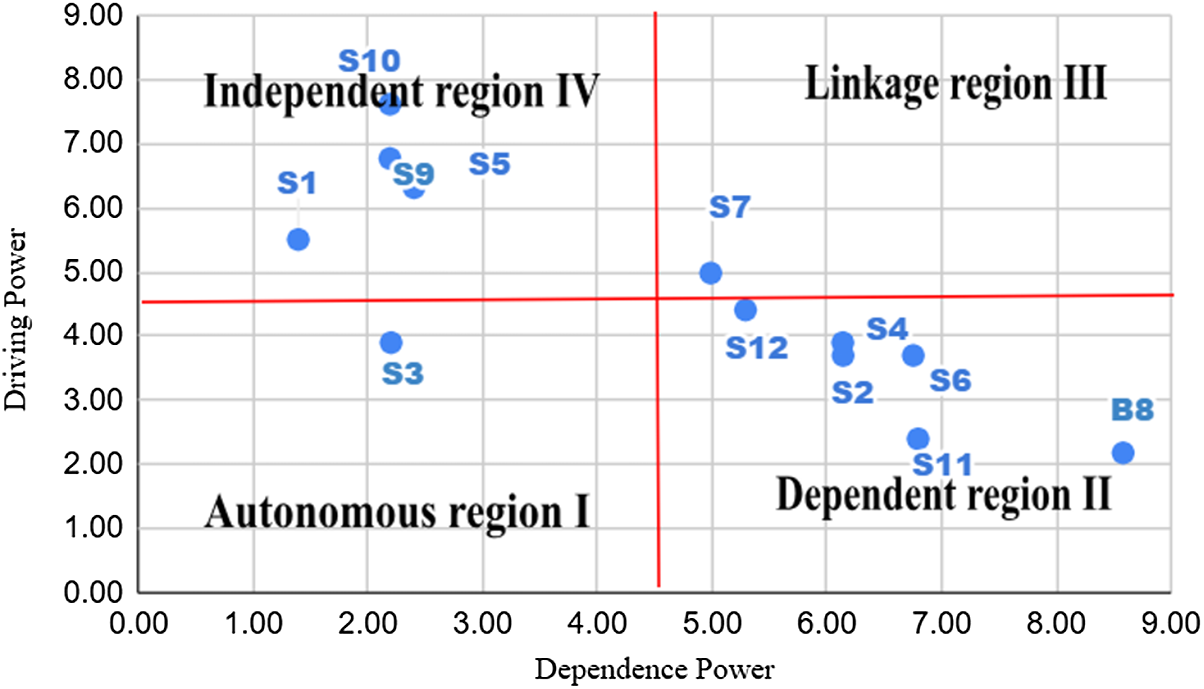
Step 5 – The final fuzzy reachability matrix is developed from the aggregated SSIM matrix (see Table 8). The driving and dependence power of the stressors is determined by calculating the row and column sums of the fuzzy reachability matrix along with their respective crisp values (see Table 8). For performing MICMAC analysis, the crisp values of driving and dependence power are derived using equation (v) below (Khatwani, Reference Khatwani, Singh, Trivedi and Chauhan2015; Mohanty & Shankar, Reference Mohanty and Shankar2017). These computed crisp values are then used to develop the driving and dependence matrix, as shown in Figure 1.
Fuzzified MICMAC analysis.

Final Fuzzy reachability matrix

Normalization
 \begin{equation}{\text{R = ma}}{{\text{x}}_{\text{j}}}{{\text{u}}_{{\text{ij}}}}{\text{, L = mi}}{{\text{n}}_{\text{j}}}{{\text{l}}_{{\text{ij }}}}\,{\text{and}}\, {\Delta} {\text{ = R - L}}\end{equation}
Compute lower, middle and upper values
 \begin{equation}{{\text{X}}_{{\text{lj}}}}{\text{ = }}\left( {{{\text{l}}_{{\text{ij}}}}{\text{-- L}}} \right){\text{ }} {\text{/}}\, {\Delta , }\, {{\text{X}}_{{\text{mj}}}}{\text{ = }}\left( {{{\text{m}}_{{\text{ij}}}}{\text{-- L}}} \right){\text{/}} {\Delta , }\, {{\text{X}}_{{\text{rj}}}}{\text{ = }}\left( {{{\text{r}}_{{\text{ij}}}}{\text{-- L}}} \right) {\text{/ }} {\Delta }\end{equation}
Calculate the left and right score normalized values
 \begin{equation}{\text{lhs = }}{{\text{x}}_{{\text{mj}}}} {\text{/}} { }\left( {{\text{1 + }}{{\text{x}}_{{\text{mj}}}}{\text{-- }}{{\text{x}}_{{\text{ij}}}}} \right){\text{ and rhs = }}{{\text{x}}_{{\text{rj}}}} {\text{/}} \left( {{\text{1 + }}{{\text{x}}_{{\text{rj}}}}{\text{-- }}{{\text{x}}_{{\text{mj}}}}} \right)\end{equation}
Calculate total normalized crisp value
 \begin{equation}{{\text{x}}_{\text{j}}}^{{\text{crisp}}}{\text{ = }}\left( {{\text{lhs}}\left( {{\text{1 - lhs}}} \right){\text{ + rhs*rhs}}} \right){\text{ }} {\text{/}} \left( {{\text{1 - lhs + rhs}}} \right)\end{equation}
Calculate total crisp value
 \begin{equation}{{\text{\~A}}_{\text{i}}}{_{\text{j}}^{{\text{crisp}}}}{\text{ = L + }}{{\text{x}}_{\text{j}}}^{{\text{crisp}}}{\text{*}} {\Delta }\end{equation}
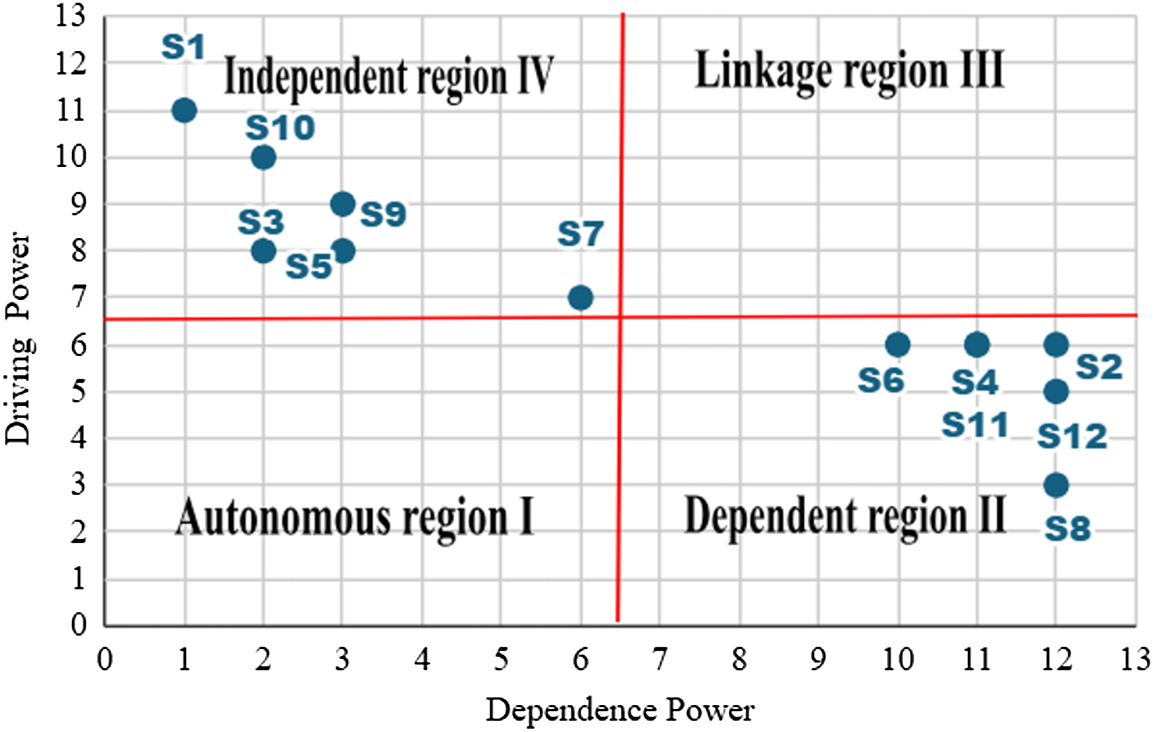
Step 6 – Using the aggregated fuzzy reachability matrix, the defuzzified reachability matrix is formulated. This step considers the relationship’s direction (Khatwani, Reference Khatwani, Singh, Trivedi and Chauhan2015; Mohanty & Shankar, Reference Mohanty and Shankar2017). For instance, VH and H linguistic values are assigned a value of 1, while the remaining terms are considered as 0 (see Table 9). The defuzzified reachability matrix then serves as a basis for conducting MICMAC analysis, where transitivity among stressors is examined, and transitive links are also incorporated (see Fig. 2).
Defuzzified reachability matrix.

Defuzzified reachability matrix

Level partitioning is carried out from the defuzzified reachability matrix to determine the levels of the identified stressors (Mundra & Mishra, Reference Mundra and Mishra2023). It assists in determining the reachability and the antecedent set for each stressor (see Table 10). The reachability set consists of the stressor and all such stressors that help achieve the horizontal row. The antecedent set consists of the stressor and stressors that help achieve the vertical column (Mohanty & Shankar, Reference Mohanty and Shankar2017). Furthermore, these recognized levels are then used to achieve the diagraph and the final TISM model (see Fig. 3). The detailed level partition iterations are presented in Appendix A.
Fuzzy-TISM diagraph.

Level partition

Step 7 – Based on the analysis, the fuzzy TISM digraph (see Fig. 3) was developed that considers both direct and indirect relationships/influences among the identified stressors. In this study, the fuzzy-TISM digraph is depicted in a tree form arrangement, where the parent nodes are connected with child nodes through another branch (Mohanty & Shankar, Reference Mohanty and Shankar2017). Three types of child nodes are found in each branch. A child node characterized by very high linguistic terms is joined to its parent node by thick, bold arrows; a child node with high linguistic terms is attached with a light arrow; and transitivity links are represented with dotted arrows. To keep the digraph elementary and easy to understand, very high (VH) relations, high (H) relations, and transitivity relationships are depicted in the digraph, while low (L) and very low (VL) linguistic terms are excluded from the digraph. Furthermore, each parent node is connected to the parent nodes at the next level by a straight arrow as defined in the hierarchical division derived from the partition of levels. The process is the same for developing the TISM model (Mohanty & Shankar, Reference Mohanty and Shankar2017).
MICMAC analysis
To further identify and analyze the influence/relationship among key stressors undermining well-being of remote workers, this study employed MICMAC analysis (‘Matrice Impact Croisés Multiplication Appliquée à un Classement’). MICMAC analysis is widely incorporated for classifying the critical factors/stressors according to their driving and dependence power, thereby offering a nuanced understanding of their relative influence within the system (Khatwani, Reference Khatwani, Singh, Trivedi and Chauhan2015; Bamel et al., Reference Bamel, Pandey, Gupta, Soni and Gupta2022). In this framework, the analysis considers driving power on the Y-axis – referring to the extent to which a stressor influences other stressors – and dependence power on the X-axis – referring to the extent to which a stressor is ‘influenced by’ other stressors (Bamel et al., Reference Bamel, Pandey, Gupta, Soni and Gupta2022; Sharma, Sohani, and Yadav, Reference Sharma, Sohani and Yadav2023).
In the present study, MICMAC results are derived using the final reachability matrix and the defuzzified reachability matrix. Figure 1 illustrates MICMAC analysis from the fuzzified reachability matrix, whereas Fig. 2 shows MICMAC analysis from the defuzzified matrix. According to their driving and dependence power, stressors are grouped into four distinct clusters outlined below (Mundra & Mishra, Reference Mundra and Mishra2023; Khatwani, Reference Khatwani, Singh, Trivedi and Chauhan2015).
Cluster 1 – Cluster 1 reflects the autonomous region (low driving and dependence power). Social isolation falls under the autonomous region in the fuzzified reachability matrix, while no stressors fall under cluster 1 in the defuzzified reachability matrix.
Cluster 2 – It reflects the dependent region (high dependence and low driving power – as they are significantly affected by other stressors). Emotional exhaustion, digital exhaustion, digital burnout, physical and psychological strain, work-life imbalance, and digital anxiety fall under the fuzzified reachability matrix and defuzzified reachability matrix under the dependent region.
Cluster 3 – It reflects linkage regions (having high dependence and driving power). In the fuzzified reachability matrix, digital fatigue falls under the linkage region, while no stressor falls under cluster 3 in the defuzzified reachability matrix.
Cluster 4 – It reflects an independent region (high driving power with low dependence power). Low supervisor support, unrealistic supervisor expectations, digital overload, and constant connectivity fall under the fuzzified reachability matrix. Low supervisor support, unrealistic supervisor expectations, digital overload, constant connectivity, digital fatigue, and social isolation fall under the defuzzified reachability matrix.
Results and discussions
This study aims to identify and explore the key stressors within digitalized remote settings, emphasizing that the detrimental consequences of digitalization cannot be overlooked. First, through a review of literature and experts’ insights, we identify and analyze twelve significant yet often overlooked stressors, namely low supervisor support (S1), emotional exhaustion (S2), social isolation (S3), digital exhaustion (S4), digital overload (S5), digital burnout (S6), digital fatigue (S7), physical and psychological strain (S8), supervisor unrealistic expectations (S9), constant connectivity (S10), work-life imbalance (S11), and digital anxiety (S12). This comprehensive framework highlights remote workers’ multifaceted challenges in increasingly digitalized work environments. To analyze the interrelationships among these critical stressors, this study employs a fuzzy total interpretive structural modeling (Fuzzy-TISM). This approach offers a nuanced understanding of how these stressors reinforce each other in digitalized settings.
Second, the finding of Fuzzy-TISM shows stressors in seven hierarchical levels with high influence/relationship among each other. As illustrated in Fig. 3, level 7 of the fuzzy-TISM diagram positions low supervisor support at the bottom of the hierarchy, indicating it as the starting point of influence with high driving power compared to the remaining other stressors. Xiaolong et al. (Reference Xiaolong, Gull, Asghar, Sarfraz and Jianmin2023) highlighted that supervisor support is central in defining employees’ work expectations and responsibilities. The finding shows supervisors with low support often fail to understand employees’ availability preferences, personal boundaries, and working styles while disregarding their meeting-related preferences (Barber et al., Reference Barber, Kuykendall and Santuzzi2023), undermining workers’ well-being in remote settings.
Furthermore, at level 6, supervisors’ unrealistic expectations – such as demands for constant connectivity and immediate responsiveness – deteriorate workers’ effectiveness and well-being in a remote work setting. At level 5, digital overload in remote settings is shaped by constant connectivity, with one of its manifestations being a fear of missing out on work-related matters. For instance, employees may fear missing essential emails or notifications during non-working days or weekends, leaving them excluded from meaningful work discussions. This fear compels employees to remain constantly available for work in remote settings (Barber et al., Reference Barber, Kuykendall and Santuzzi2023). Level 4 highlights that the social isolation of workers influences employees’ digital fatigue, as all interactions in remote work settings are mediated through technology, thereby generating psychosocial risks among remote workers. Furthermore, excessive holding of information from multiple digital devices contributes to employees’ digital fatigue in remote work settings. Level 3 highlights digital fatigue, driving digital exhaustion and digital burnout, as constant connectivity and sustained use of digital devices in remote settings lead to psychological and physiological fatigue among workers. Level 2 encompasses digital exhaustion, digital burnout, and digital anxiety. Digital exhaustion drives digital burnout, as prolonged reliance on digital devices and technology in remote work settings leads to chronic syndrome among employees, particularly those who are already digitally exhausted and strained. Further, both digital burnout and digital anxiety exert a bidirectional influence on the well-being of remote workers. These outcomes arise from continuous use of digital devices and insufficient resources in digital remote work settings, leading to psychological and physical strain.
Level 1 encompasses emotional exhaustion, psychological and physical strain, and work-life imbalance at the hierarchy’s apex level. The strain stemming from digital exhaustion, burnout, and anxiety contributes to psychological and physical strain. This strain further contributes to work-life imbalance concerns – employees become dissatisfied with their physical and psychological involvement across both work and non-work roles in the remote setting. Furthermore, work life imbalance drives emotional exhaustion among remote workers, as a lack of resources or support to meet job demands progressively depletes employees’ mental and physical reserves. The findings of the fuzzy-TISM diagram show that low supervisor support is placed at the bottom of the hierarchy, underscoring it as a root cause for shaping other stressors in the digitalized remote work context.
Third, the fuzzified and the defuzzified reachability matrix highlight the sensitivity between the stressors due to fuzziness. The results of the fuzzified MICMAC analysis highlight a strong ability to classify the stressors into four categories: i.e. the independent stressors (low supervisor support, supervisor unrealistic expectations, digital overload, and constant connectivity); the linkage stressors (digital fatigue); the dependent stressors (emotional exhaustion, digital exhaustion, digital burnout, physical and psychological strain, work-life imbalance, and digital anxiety); and the autonomous stressors (social isolation). Notably, the analysis of the fuzzified MICMAC shows low supervisor support, unrealistic supervisor expectations, digital overload, and constant connectivity as the independent stressors, underscoring their significant influence on shaping employee well-being in digitalized settings.
Conclusion, implications, limitations, and directions for future research
Theoretical implications
First, this study addresses the gap identified by Han et al. (Reference Han, Song, Zhang and Yan2025) that emphasizes the need to examine the adverse impacts of digitalization in remote work settings. While prior studies have primarily examined remote work challenges in isolation, the exploration of their causal interrelationship remains unexplored. As there is a need to study the process-oriented perspective on remote work transitions (Nwankpa & Roumani, Reference Nwankpa and Roumani2024), this study investigated the causal-interrelationship influence/relationship among the key stressors. It developed a structured framework that demonstrates how these stressors adversely influence the well-being of remote workers, rather than treating them as independent factors.
Second, by integrating digitalization, remote work practices, and well-being into a unified framework, our study addresses how technological and structural changes (such as digitalization) shape employee experiences and outcomes in remote work settings. Specifically, this study analyzes the influence/relationship of stressors through the fuzzy-TISM approach. Thereby extending theoretical models of work design and occupational well-being. It shows that technological and structural changes cannot be separated from employees’ day-to-day experiences, but instead shape the job demands, resources, and outcomes in remote settings.
Third, this study makes significant theoretical contributions by extending the JD-R model within the context of digitalized settings. This study offers theoretical insights into the impact of high job demands – such as low supervisor support, constant connectivity, unrealistic supervisor expectations, and digital overload – that erode psychological and physical resources, leading to detrimental outcomes such as digital fatigue, digital exhaustion, burnout, and anxiety that have an adverse impact on employees’ well-being. This extension emphasizes that in digitalized settings, excessive demands function as critical stressors that intensify the health impairment process and generate multiple adverse consequences for employee well-being.
Practical implications
First, the outbreak of the COVID-19 pandemic has accelerated the shift towards digitalization of work practices. It has fundamentally transformed organizational behavior, and driven millions of employees towards remote settings. The findings highlight organizations’ need to recognize how digitalized settings affect well-being of remote workers (Willcocks, Reference Willcocks2024). For instance, the absence of social interactions among employees in remote settings leads to worker isolation. To address this, organizations must proactively support remote employees by implementing ongoing virtual team-building activities, structured opportunities for virtual social interactions, fostering a culture of inclusivity, and ensuring that remote workers feel connected to the organization.
Second, our research examined the significant role of supervisor support in remote work settings. By providing timely information, necessary resources, and authority, supervisors can enhance internal motivation, reduce digital stressors – such as digital exhaustion and burnout – and promote the overall well-being of remote workers. This support also mitigates feelings of social and emotional isolation, fostering higher employee engagement, better outcomes, and sustainable remote work practices (Gan et al., Reference Gan, Zhou, Tang, Ma and Gan2023).
Third, the Fuzzy TISM – MICMAC approach proposed in this study offers a comprehensive framework for practitioners and academics to understand better how stressors influence remote workers well-being in digital work practices. Managers should analyze the hierarchy of stressors and their relationships/influence and prioritize actions based on their interdependencies. By doing so, organizations can develop comprehensive and targeted remote policies that foster work-life balance and support the well-being of remote employees.
Limitations and future scope
First, our study identified twelve key stressors undermining well-being of remote workers in digitalized settings. While our findings offer valuable insights, it is acknowledged that several stressors are missing. Therefore, future research should incorporate a more comprehensive set of stressors to better understand the challenges, including how these stressors influence workers’ health, motivation, and happiness in digital environments.
Second, the model was developed using insights from a relatively limited panel of 23 experts, working in the IT sector in India. This focus may pose potential biases and methodological constraints, as expert judgments are inherently subjective. Further the restricted sample size could restrict broader applicability and generalizability of the findings. Future research should seek to overcome this limitation by incorporating a more diverse pool of experts, from different sectors or geographic regions, to extend the proposed model, thereby strengthening the credibility and dependability of the findings.
Third, while our study primarily focused on the health impairment process of the Job Demands-Resources Model, future studies should investigate how the motivational process influences the well-being of workers. Forth, the identified stressors warrant further exploration through alternative MCDM techniques. Future research may employ Fuzzy-set Qualitative Comparative Analysis (FsQCA) to validate and strengthen the proposed framework.
Conclusion
This study advances understanding of digitalized work settings by unraveling the critical stressors that undermine the well-being of workers in remote settings. Drawing upon a review of literature and experts’ insights, twelve critical stressors were identified and analyzed by employing a fuzzy TISM approach – an extension of TISM along with MICMAC analysis. By integrating fuzzy theory, the study analyzed the hierarchical interrelationship among the stressors, thereby strengthening the depth of interpretation and facilitating group decision-making. The findings reveal that low supervisor support, unrealistic supervisor expectations, digital overload, digital fatigue, and constant connectivity are critical drivers within the health impairment process, undermining the well-being of workers in digitalized work practices. By illuminating these stressors, our study not only provided a robust theoretical framework but also offered actionable implications for managers and policymakers to design healthier, sustainable, and more resilient digital work ecosystems for employees.
Supplementary material
The supplementary material for this article can be found at https://doi.org/10.1017/jmo.2025.10059
Declarations
Funding Statement
The authors declare that they have not received any funding to conduct this study.
Competing interests
The authors declare that there are no competing interests.
Conflict of interest
The authors declare that they have no conflict of interest.
Swati Baurai is a research scholar at the Department of Business Administration, National Institute of Technology, Kurukshetra, India. Her research area of interest includes Human Resource Management, Job crafting, Agile work practices, etc.
Chandra Sekhar is an assistant professor at the Department of Business Administration, NIT Kurukshetra. His research interests include strategic HRM, Playful work design, Employee time theft behavior, AI Adoption in HR, human capital, HR flexibility, Career Management, organisational behaviour, and strength-based leadership. He teaches subjects like Organisational Behavior, Human Resource Management Analytics, Compensation Management, Performance Management and Appraisal.
Deepak Kumar is an Associate Lecturer in the Department of Computer Science and Information Technology at La Trobe University. He holds an integrated postgraduate degree in Information Technology (B.Tech) and Finance (MBA) from the Atal Bihari Vajpayee Indian Institute of Information Technology and Management, Gwalior, India. Deepak completed his PhD jointly at the Indian Institute of Technology Kanpur and La Trobe University, Melbourne, focusing on ‘Blockchain-based Decentralized Financing for Small and Medium Enterprises’. His research interests include Blockchain Technology, Artificial Intelligence, Entrepreneurship, SME Finance, Entrepreneurial Finance, Fintech, and SMEs.
Amritesh Raj is a General Manager (Learning & Development) at DCM Shriram Ltd, New Delhi. His area of interest includes Talent Management, Performance Management, and Training and Development.





 Open access

