





Nationwide monitoring of mortality is regularly informed by data on all people in contact with secondary mental healthcare services. 1 However, most research on this tends to focus on groups with specific mental health diagnoses such as bipolar disorder, Reference Biazus, Beraldi, Tokeshi, Rotenberg, Dragioti and Carvalho2 broader groups of psychotic disorders, Reference Lomholt, Andersen, Sejrsgaard-Jacobsen, Øzdemir, Graff and Schjerning3 anxiety disorder Reference Meier, Mattheisen, Mors, Mortensen, Laursen and Penninx4 and opioid use disorder. Reference Bech, Clausen, Waal, Šaltytė Benth and Skeie5 People with mental health diagnoses have been found to have higher mortality Reference Yang, Lantta, Vahlberg, Anttila, Normand and Välimäki6,Reference Walker, McGee and Druss7 and lower life expectancy, Reference Chan, Correll, Wong, Chu, Fung and Wong8 and further research has considered contributory factors such as variation by ethnic group Reference Das-Munshi, Bakolis, Bécares, Dasch, Dyer and Hotopf9 and the role of comorbid conditions. Reference Momen, Plana-Ripoll, Agerbo, Christensen, Iburg and Laursen10
Mental healthcare but no mental health diagnosis
There are a sizeable number of people who access mental health services and receive either an unspecified diagnosis or no diagnosis. Unspecified diagnoses have been associated with increased readmission rates Reference Bensken, Alberti and Koroukian11 and acute general hospital admission rates. Reference Jayatilleke, Hayes, Chang and Stewart12 However, there has been little or no evaluation of mortality in this group. In ICD-10, an unspecified diagnosis is commonly coded under a Z-code (unspecified symptoms). The aims of this study were to calculate standardised mortality ratios (SMRs) for patients receiving mental healthcare with an unspecified (Z-code) diagnosis, or with no assigned diagnosis, alongside those with a mental health (F-code) diagnosis. We additionally estimated life expectancies from observed mortality for the same groups.
Method
Data source
Patient data were extracted from the Clinical Record Interactive Search (CRIS) database at the South London and Maudsley NHS Foundation Trust (SLaM). SLaM is a large provider of secondary mental healthcare services for 1.3 million people across four London Boroughs (Croydon, Lambeth, Lewisham and Southwark. Reference Perera, Broadbent, Callard, Chang, Downs and Dutta13 SLaM has used fully electronic health records since 2006, and CRIS was developed to allow research access to anonymised health record data from this source, with ethical approval (Oxford Research Ethics Committee C, reference no. 23/SC/0257) and a robust governance framework. Reference Fernandes, Cloete, Broadbent, Hayes, Chang and Jackson14
Samples
As part of ongoing monitoring of mortality in people receiving mental healthcare before and after the COVID-19 pandemic, annual cohorts were assembled of people who had past or current mental health service receipt from SLaM at a series of census points between 2015 and 2024. Our cohorts comprised all living patients with a past/previous mental health service record at the start of each year, with SMRs calculated from observed mortality during that year. The index date was defined as one day before the study start period each year, and all patients who were alive on the index date were included in the study. For example, the denominator population for the calculation of SMR in the year 2015 was extracted from all alive patients with a past/current SLaM record as of 31 December 2014; this cohort was then followed until 31 December 2015 for mortality, and the next cohort was defined in the same way on 31 December 2015 for mortality ascertainment during 2016.
Measurements
Data on age at the time of the index date and gender (male or female) were extracted from the CRIS platform. The most recent primary diagnosis up to and including the index date was extracted as follows: for ICD-10 diagnosis chapter F (mental health diagnosis), the first two characters were extracted; for non-F-codes (non-mental health diagnoses), only the first character was used. Cases with no diagnosis were defined as those with missing diagnostic data, e.g. no diagnosis recorded in the SLaM diagnostic field. The objective of our study was to focus on cohorts with Z-codes indicative of no disorder, as well as the absence of a diagnosis, and to compare those with cohorts who had received a defined mental disorder code; we therefore excluded patients who received only physical disorder ICD codes and also those who received F99 (mental disorder, not otherwise specified) or Axis 1 diagnoses (a non-specific code derived from DSM-IV) – which represented groups assigned a diagnosis within the mental disorder grouping but without definition. Patients’ dates and causes of death were extracted from a source linkage between all SLaM records and the National Health Service (NHS) spine, which updates every month. Active patients were defined as those with an accepted referral on the index date.
Statistical analysis
We used an established data linkage to the Office for National Statistics (ONS) to ascertain mortality for each cohort over the time period. We then used this to generate age and gender SMRs via indirect standardisation with 95% confidence intervals. Analyses were performed in Microsoft Excel (2016) on Windows (Microsoft Corporation, Washington, USA; https://office.microsoft.com/excel) and in Stata 18.0 on Windows (StataCorp, Texas, USA; https://www.stata.com).
SMRs were calculated by comparison of observed and expected deaths in the SLaM population. We used the calculation SMR = (observed deaths)/(expected deaths), where observed deaths represent the count of deaths in the SLaM population over a specific year, adjusted for age and gender. Expected deaths represent the number of deaths that would have occurred if the population had experienced the death rate of our reference population. Our reference population for SMRs was the population of our local catchment boroughs (Croydon, Lambeth, Lewisham and Southwark). The numbers of residents and deaths for the reference population were extracted from NOMIS. 15 Dividing the number of deaths in the reference population by the reference population per year provides the reference population death rate. To calculate the expected number of deaths in the SLaM population, the death rate in the reference population was compared with the SLaM population for each age group and gender. The total expected number of deaths was obtained by adding all expected death figures within the age and gender groups. Confidence intervals for SMRs were calculated using a standard formula. Reference Higham, Flowers and Hall16
Standardised mortality ratios were calculated for age groups 0–44, 45–54, 55–64, 65–74, 75–84 and 85+ years. The allocation of each patient’s age group was based on their age at the time of the index date (the first date of each year). For example, if a patient was 44 years old in 2015, they were included within the 0–44 age group but in 2016 they would be included in the 45–54 age group. Mortality in the SLaM cohorts was stratified according to the three diagnosis groups (F-code, Z-code, no diagnosis), and also based on whether each patient was receiving active SLaM care at the start of each follow-up period.
Life expectancy at birth for SLaM patients was additionally calculated from observed 5-year mortality rates for males and females separately from 2015 to 2019 onward until 2019–2023. For this, we used the Public Health England life expectancy calculator 17 for an abridged life table using 5-year age intervals, with a final age interval of 90+ years, Reference Enderlein18,Reference Newell19 a methodology used at both national and local authority levels 20 and generating 95% confidence intervals for all estimates. For ease of communication, these findings are expressed as years of life lost, subtracting estimates and confidence intervals from life expectancy at birth for a London reference population on the public health outcome framework website, 17 although data for local authority-level life expectancy at birth were available only for 3-year periods.
Displays were generated on Excel using multiple stacked area charts to represent results and confidence intervals for each diagnostic cohort. Confidence intervals were input as one result per year, along with SMR or life expectancy results, and therefore can be read at individual points on the timeline.
Finally, we calculated age and gender SMRs (95% CI) for all patients with natural and external causes of death by ICD-10 diagnosis for the recorded underlying cause of death. Initially, reference death data for the SLaM catchment population were extracted by age and gender for each ICD-10 diagnosis chapter from the NOMIS ONS website. 15 External causes were defined as ICD-10 codes U509 and V01–89 (external causes of morbidity and mortality), with the remainder of the ICD-10 codes being defined as natural causes. SLaM deaths by age- and gender-specific mortality by ICD-10 diagnosis were extracted from the SLaM–ONS data linkage. Deaths assigned as null cause were excluded from both the reference and SLaM populations.
To calculate single overall SMRs for specific causes of death and specific age groups, we calculated a reference population from annual estimates from 2015 to 2024, extracted from NOMIS, 15 summing person-years of risk; this provided a summed population estimate of 11,906,153 person-years across 10 years. To generate SMRs, we similarly calculated a summed population of SLaM patients over the 10-year period, with patient age calculated for each person at the beginning of each observation year.
Results
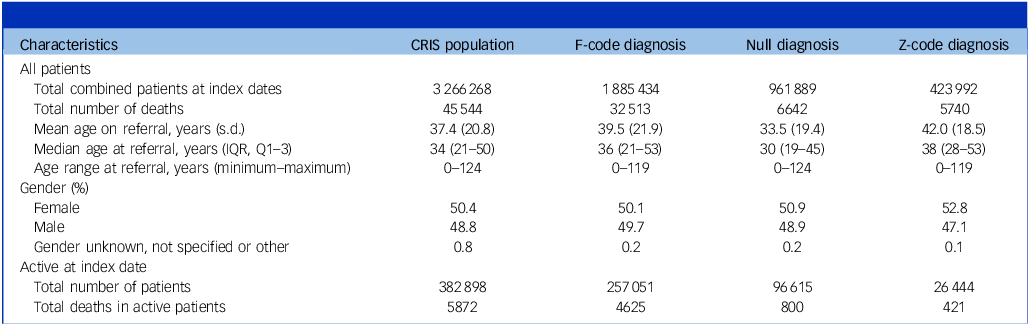
Cohort characteristics are summarised in Table 1. In the combined cohorts, a small majority were female and the mean (s.d.) age was 37.4 (20.8) years; the median (interquartile range Q1–3) age range was 34 (21–50) years. The minimum age was 0 and the maximum age was 124 years; 57.7% had an F-code (mental disorder) diagnosis at inclusion, 13.0% had a Z-code (non-specific) diagnosis and 29.3% had no diagnosis. Age and gender differences were marginal between these groups; however, compared with those with a mental disorder diagnosis, individuals with a Z-code diagnosis were older whereas those with no diagnosis were younger; both were more likely to be female. Of the combined cohorts, 11.7% of patients had an active referral at the index date. In comparison with all patients, active patients were more likely to have an F-code diagnosis (67.1%) or no diagnosis (25.2%) and were less likely to have a Z-code diagnosis (6.9%).
Descriptive table of cohorts by diagnostic group, comparing catchment population, F-codes, Z-codes and no diagnosis

CRIS, Clinical Record Interactive Search; IQR, interquartile range.
SMRs for the full and active cohorts are shown in Figs 1 and 2, respectively, and are listed in Supplementary Tables 1 and 2, respectively available at https://doi.org/10.1192/bjp.2026.10616. Significantly raised SMRs were observed for all diagnostic groups: those for F-code diagnoses ranged from 2.25 to 2.56, those for Z-code diagnoses from 1.88 to 2.18 and those for no diagnoses from 1.59 to 1.87. SMRs for active patients at the index date were also all significantly raised but showed more overlap between the groups, albeit with wider confidence intervals (Fig. 2 and Supplementary Table 2).
Age- and gender-standardised mortality ratios with 95% confidence intervals (represented by shading) for all patients, by ICD-10 diagnosis.

Age- and gender-standardised mortality ratios with 95% confidence intervals (represented by shading) for patients with an active referral at the start date, by ICD-10 diagnosis.

Life expectancy estimates are shown for females and males in Supplementary Figs 1 and 2, respectively (and are detailed in Supplementary Table 3). These were consistently lower than catchment estimates for all cohorts, with Z-code diagnoses occupying an intermediate position between those with no diagnosis and those with an F-code diagnosis. Life expectancy gaps were overall narrower for females than for males. Females with F-code diagnoses had the highest years of life lost (n = 15.1), followed by Z-codes (n = 11.8) and no diagnosis (n = 9.4). Males with F-code diagnoses had the highest years of life lost (n = 16.7), followed by Z-codes (n = 14.4) and no diagnosis (n = 10.6).
SMRs for natural and external causes of death are shown in Fig. 3 and are listed in Supplementary Tables 4 and 5, respectively. Significantly raised SMRs were observed for all diagnostic groups in regard to natural causes of death: those for F-code diagnoses ranged from 2.12 to 2.48, those for Z-code diagnoses ranged from 1.72 to 2.00 and those for no diagnoses ranged from 1.43 to 1.77. SMRs for external causes were higher, with wider confidence intervals due to the smaller sample size. SMRs for external causes of death for F-code diagnoses ranged from 2.93 to 7.52, those for Z-code diagnoses ranged from 3.64 to 6.46 and those for no diagnoses ranged from 2.15 to 6.15.
Age- and gender-standardised mortality ratios (SMRs) for natural and external causes, by ICD-10 diagnosis.

A series of additional analyses were carried out to clarify these findings. Supplementary Table 6 shows SMRs for more specific causes of death. In summary, SMR patterns were observed similar to those described above, with patients who received mental health diagnoses having worse mortality followed by those with Z-code diagnoses and those with no diagnosis, and with mortality rates for all groups and all causes of death significantly worse than those for the general population. In regard to accident mortality, confidence intervals were non-overlapping for each of the three groups; for suicide mortality, confidence intervals were non-overlapping for patients with mental health diagnoses versus those with no diagnosis; however, there was overlap in confidence intervals for SMRs between those with mental health versus Z-code diagnoses.
Supplementary Tables 7 and 8 show further age stratification of SMRs for natural and external causes of death, respectively. For both natural and external causes of death, SMRs were higher in younger age groups and showed the same ranking in all strata between diagnostic groups. For natural causes, significantly raised SMRs were observed for all diagnostic groups in all age strata, whereas for external causes, confidence intervals overlapped the null value for Z-code diagnoses and no diagnosis in the oldest age strata.
Further data were obtained from CRIS on the distribution of Z-codes derived from all those receiving these at the end of a first referral; the ten most common Z-code distributions are shown in Supplementary Table 9. In summary, the majority (77.7%) were coded Z71.1 (person with feared complaint in whom no diagnosis can be made), followed by 14.3% with Z00.4 (general psychiatric examination, not elsewhere classified); proportions were <1% for all other specified codes. Descriptions of referral details for each diagnostic group are shown in Supplementary Table 10. People with a Z-code or no diagnosis following a first referral were more likely to have received emergency department or physical health in-patient care in the 7 days around discharge (however, a Z-code diagnosis was associated with a lower likelihood of mental health in-patient care), and they had shorter referral durations and service contacts. Of those with a Z-code diagnosis, 21.0% (n = 3071) later received a mental health diagnosis over a mean (s.d.) 3.53 (2.97) years of follow-up and, among those with no diagnosis, 22.3% (n = 594) later received a mental health diagnosis over a mean (s.d.) 2.48 (2.31) years of follow-up.
Supplementary Table 11 shows a comparison of total deaths against the total population at risk observed in the four SLaM local catchment boroughs, as well as deaths observed in the 37.2% with another or no recorded borough or residence. In summary, higher mortality was observed in Croydon borough for the group with F-codes (of note, Croydon has substantially higher numbers of older adult care homes than the other three), and slightly higher mortality was observed for those in the other/no borough category for those with a Z-code diagnosis or no diagnosis.
Discussion
In a series of cohorts derived from electronic mental health records data linked to mortality data in a south London catchment, we investigated SMRs for people who access mental health services but who do not receive a mental disorder diagnosis. In summary, people who access mental health services had worse mortality and life expectancy, even if they did not have a diagnosable mental health condition. In general, patients with mental disorder (ICD-10 F-code) diagnoses had the worst outcomes, followed by those with unspecified diagnoses (Z-codes) and those with no diagnosis. Excess mortality in all three groups was found for both natural and external causes of death, and for both accidental and suicide-associated mortality as external causes.
Associations among mental disorders, higher premature mortality and reduced life expectancy have long been described, Reference Chang, Hayes, Broadbent, Fernandes, Lee and Hotopf21,Reference Chang, Hayes, Perera, Broadbent, Fernandes and Lee22 and most studies tend to find that this mortality gap is at least persisting, if not widening. Reference Hoang, Stewart and Goldacre23,Reference Thornicroft24 There is therefore a need to monitor the situation and evaluate interventions to improve it. However, as described previously, policy output has tended to focus on all people using mental health services whereas individual research projects tend to follow cohorts with given diagnoses. As evident in our cohorts, large numbers of people access mental healthcare without a mental disorder diagnosis, but their outcomes are poorly understood. To our knowledge, this is the first study to measure mortality outcomes for patients with unspecified diagnoses and no diagnoses who access mental healthcare. Unspecified Z-code diagnoses from general hospital in-patient care have previously been described as being frequent in people with serious mental illness. Reference Jayatilleke, Hayes, Chang and Stewart12 Also, Z-code diagnoses have been studied in relation to unplanned hospital readmissions in the USA, where there was a high dose–response relationship between the recorded quantity of ‘health-related social needs’ Z-code diagnoses and 30-, 60- and 90-day readmissions. Reference Bensken, Alberti and Koroukian11 Determinants of Z-code use in mental healthcare settings have also been studied in the USA in a scoping review, although this was not focused on primary diagnosis. Reference Hendricks-Sturrup, Yankah and Lu25 These US studies were particularly concerned about patients who may experience social disadvantages; however, the use of Z-codes is potentially a reflection of insurance-funded healthcare systems and may not generalise to NHS models of service provision in the UK. Overall, the allocation of these codes within mental healthcare has received little or no investigation. Further in-depth qualitative review would be helpful, both of the assignment of Z-codes and of situations in mental healthcare where no diagnosis is assigned; in the absence of this, we can only speculate on the clinician justification. We presume the reasoning for Z-code assignment may vary between service types and service providers; however, reasons could include the lack of complete assessment because of loss-to-follow-up (for whatever reason); symptoms that fail to fully meet diagnostic criteria; assessments by professional groups who would not be expected to assign a diagnosis; or specific diagnostic targets set by the service itself (and/or perhaps service provision implications of an assigned diagnosis). Lack of complete assessment as an explanation is supported in part by the lower level of service use in those without a mental disorder diagnosis. The relatively low proportions ending up with a mental health diagnosis in the CRIS system may be explained in part by out-migration from the catchment area served by SLaM as a provider; however, this is unlikely to account for the majority of non-specific or missing diagnoses. Instead, these cohorts are likely to represent people who received mental healthcare input on an occasion but, for some reason, did not present again.
People who receive unspecified diagnoses or no diagnosis at all are likely to fall outside conventional care pathways in mental healthcare and thus may represent potentially vulnerable, less visible, subgroups within the wider population of people receiving mental healthcare known to have higher premature mortality. Supporting this, our findings indicate that having an unspecified or no diagnosis remains a risk factor for higher mortality. Although it is possible that some patients with an unspecified or no assigned diagnosis will receive a mental disorder diagnosis later, the effects were present for both active and non-active cases at the start of follow-up (and, as discussed above, relatively few seem to receive a later diagnosis). Also, it does not appear to be accounted for by people whose clinical teams had neglected to code their diagnosis in the source electronic health record, because those with an assigned Z-code diagnosis had worse outcomes than those who were not assigned any diagnosis. One important consideration is whether those with non-specific or no diagnoses include people with higher-than-average levels of physical health conditions, accounting for the observed association; however, this effect would have to be quite substantial to give rise to the observed differences, given the recognised underdiagnosis of mental health comorbidity in people with physical health conditions. Also, regardless of future diagnoses, it is still important to develop knowledge of those with unspecified diagnoses, because all mental health contacts are frequently used to investigate mortality inequalities. Of note, the observation period included the COVID-19 pandemic and SMRs were not seen to vary substantially. High levels of pandemic-era mortality have been described for cohorts from the SLaM catchment in previous reports; however, raised mortality during this period tended to be confined to particular diagnostic and ethnic groups, Reference Das-Munshi, Chang, Bakolis, Broadbent, Dregan and Hotopf26 which would not necessarily be evident in the combined F-code cohort.
Supplementary analyses investigated the consistency of the observed associations by gender and age group. Diminishing SMRs in all cohorts with increasing age are likely to reflect increased premature mortality associated with mental healthcare contact, associations that become diluted in more advanced age groups when there are more numerous competing causes. Considering gender, lower population-level life expectancy is widely found in men compared with women. Reference Cullen, Baiocchi, Eggleston, Loftus and Fuchs27 Our findings indicate that the reduced life expectancy associated with mental healthcare contact in all three diagnosis cohorts was more marked (by around 1 year) in men compared with women. Previous analyses in CRIS cohorts have described effects that vary by gender and diagnosis – for example, more life-years lost in men compared with women with schizophrenia, more in women compared with men with schizoaffective disorder. Reference Chang, Hayes, Perera, Broadbent, Fernandes and Lee22 The overall male disadvantage in the broader service use populations analysed here is likely to reflect gender differences in associated factors linked to premature mortality (e.g. substance use, comorbid physical health disorders) and/or in severity of illness (e.g. associated suicidality).
Strengths of this study include the large cohorts investigated over a relatively long period of time to check consistency, and the fact that they were drawn from a mental healthcare provider serving a defined geographic catchment and with relatively high levels of structured diagnostic data available in its health record. Mortality ascertainment also should have been near complete, derived from national-level data. Considering limitations, an important factor is that SMRs and life expectancy estimates describe a broad association within which there may be a multitude of causal pathways; furthermore, they seek to consider only age and gender as confounding factors, and hence the importance of further research to investigate other potential factors underlying the associations described, including the extent to which some of the non-specific and no-diagnosis cohorts might contain people with diagnosable mental health conditions. Generalisability of the findings also needs to be established in other catchments. Finally, due to the exclusion of F99 (mental disorder, not otherwise specified), there is likely to be a larger number of people with unspecified diagnoses accessing mental healthcare who were not represented. SLaM catchment population data were extracted from the NOMIS ONS website and, when extracted by ICD-10 diagnosis, a small number of deaths were excluded due to null diagnosis. At the time of publication, death data for 2024 by ICD-10 diagnosis were not yet available and a large number of null-diagnosis deaths were recorded in 2023 and 2022. Therefore, deaths recorded in 2022 are not fully representative because the cause of death remains to be decided; this may well account for the declines in SMRs for external-cause mortality, because at least some of these deaths may have been awaiting coroner reports at the time of data extraction.
Our findings indicate that high premature mortality among people receiving mental healthcare is not confined to those with a mental disorder diagnosis. Furthermore, those without a diagnosis might be at high risk of a range of adverse outcomes, because they are likely to fall outside conventional inclusion criteria for service provision. At the very least, as a large population receiving mental health service contact, there are good reasons to investigate further their characteristics, outcomes and experiences. Future research particularly needs to characterise risk factors and outcomes to the standard of detail available for other diagnostic groups, and it seems reasonable to assume unmet need unless proved otherwise.
Supplementary material
The supplementary material is available online at https://doi.org/10.1192/bjp.2026.10616
Data availability
All relevant aggregate data are found within the article. The data used in this work were obtained from CRIS, a system that has been developed for use within the NIHR Maudsley Biomedical Research Centre at South London and Maudsley NHS Trust. It provides authorised researchers with regulated access to anonymised information extracted from SLaM’s electronic clinical records system. Individual-level data are restricted in accordance with the strict patient-led governance established at SLaM, and by NHS Digital in the case of linked data. Data are available for researchers who meet the criteria for access to these restricted data: (a) SLaM employees or (b) those having an honorary contract or letter of access from the trust. For further details, and to obtain an honorary research contract or a letter of access, contact the CRIS administrator at cris.administrator@kcl.ac.uk. The analytic codes supporting the findings are available to other researchers. Please contact the CRIS administrator at cris.administrator@kcl.ac.uk.
Author contributions
The study was conceived by L.S., R.S. and G.P. with support from C.M. Analyses were carried out by L.S. and G.P. L.S., G.P., C.M. and R.S. interpreted the data. L.S. drafted the manuscript. G.P., C.M. and R.S. reviewed the manuscript for important intellectual content. All authors read and approved the final manuscript.
Funding
L.S., G.P., C.M. and R.S. are part-funded by the NIHR Maudsley Biomedical Research Centre at South London and Maudsley NHS Foundation Trust and King’s College London. C.M. and R.S. are also part-funded by the NIHR HealthTech Research Centre in Brain Health. R.S. is additionally part-funded by the NIHR Applied Research Collaboration South London (NIHR ARC South London) at King’s College Hospital NHS Foundation Trust; the UK Research and Innovation (UKRI) – Medical Research Council through the DATAMIND HDR UK Mental Health Data Hub (MRC references MR/W014386/1 and MR/Z504816/1); and the UK Prevention Research Partnership (Violence, Health and Society; MR-VO49879/1), an initiative funded by the UKRI, the Department of Health and Social Care (England) and the UK devolved administrations and leading health research charities. The views expressed are those of the authors and not necessarily those of the NIHR or the Department of Health and Social Care.
Declaration of interest
None.
Ethical standards
The authors assert that all procedures contributing to this work comply with the ethical standards of the relevant national and institutional committees on human experimentation, and with the Helsinki Declaration of 1975 as revised in 2013. CRIS is approved as a data resource for secondary analysis, including analysis for this project (Oxford Research Ethics Committee C, reference 23/SC/0257). As a deidentified data source, consent is not required under this approval and in accordance with national legislation.
Transparency declaration
L.S. affirms that the manuscript is an honest, accurate and transparent account of the study being reported; that no important aspects of the study have been omitted; and that any discrepancies from the study as planned have been explained.


 Open access


eLetters
No eLetters have been published for this article.