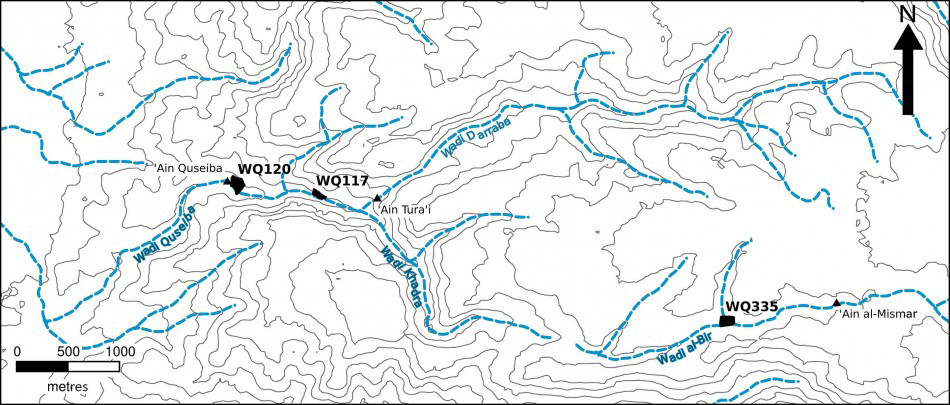


In August 2014, the Wadi Quseiba Project conducted small-scale excavations at three ‘candidate sites’ in north-western Jordan (Figure 1), which were discovered as part of the project’s 2012 and 2013 surveys: Jawafat Shaban (WQ335), ‘Ain Quseiba (WQ120) and site WQ117. These surveys involved an application of predictive modelling and Bayesian allocation of effort to identify those areas, least affected by millennia of erosion, where late prehistoric sites were likely to have survived (Hitchings et al. 2013). The purpose of the 2014 field season was to test the candidate sites identified during the survey to assess whether they contained intact Neolithic deposits associated with settlement activity.
Location of Wadi Quseiba in north-western Jordan, with the locations of WQ120, WQ117 and WQ335.

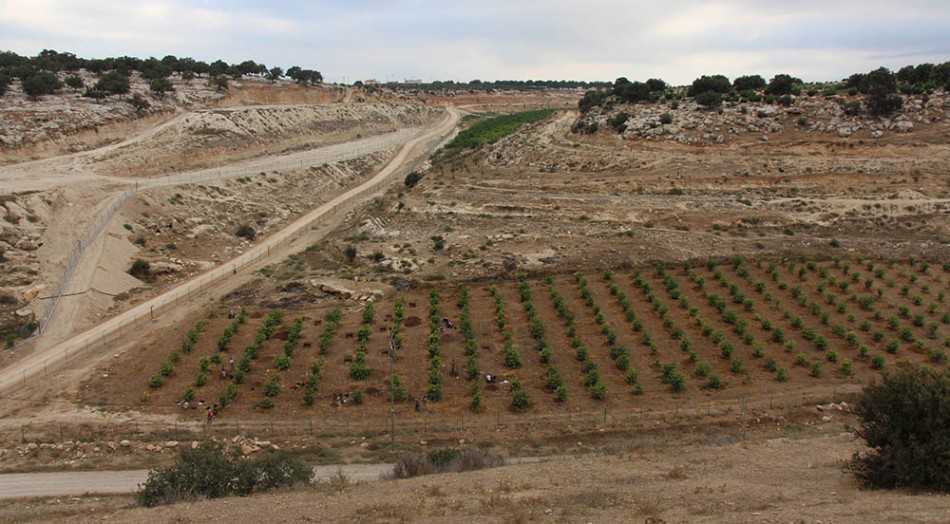
The low terrace of Jawafat Shaban (WQ335) in Wadi al-Bîr, with excavation trenches placed between the rows of guava trees.

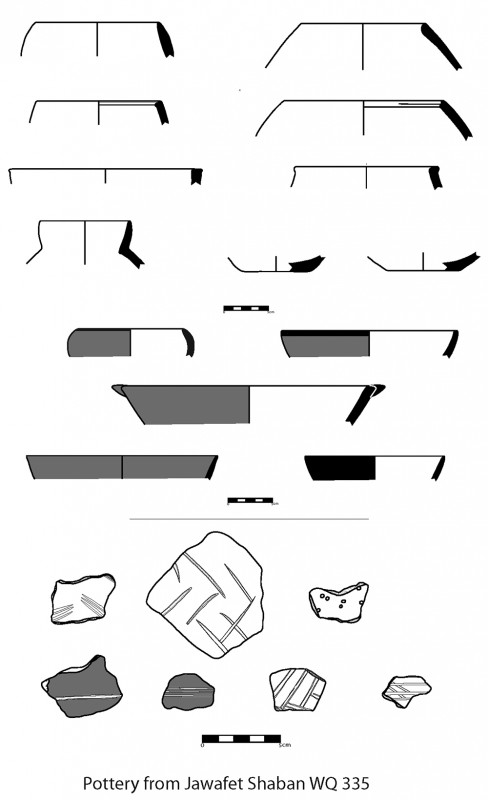
Pottery from Jawafat Shaban (WQ335) with distinctive Wadi Rabah decorative and surface treatments.

Excavations of 1 × 2m trenches between the guava trees at Jawafat Shaban (WQ335; Figure 2) showed that most of this site has been damaged or destroyed by recent farming, but several trenches encountered undisturbed deposits dating to the Wadi Rabah phase of the Late Neolithic (c. 5700–5100 cal BC). No substantial architecture was encountered, but there were pits, rock concentrations and ancient surfaces strewn with flint flakes and sickle elements. Pottery finds included sherds with distinctive Wadi Rabah characteristics, including bow rims, burnished red or black slip, and criss-cross combing (Figure 3). Preliminary faunal analysis indicates the mixed use of wild and domesticated animals at the site. Tortoise, deer and equid were found along with sheep, goat and cattle. It therefore seems likely that the site was a small farming hamlet, broadly similar to Tabaqat al-Bûma in Wadi Ziqlab, a few kilometres to the south (Reference BanningBanning 2001). Although most of the occupation at this site appears to be Wadi Rabah in character, small flint bladelets suggest possible Epipalaeolithic use of the terrace as well.
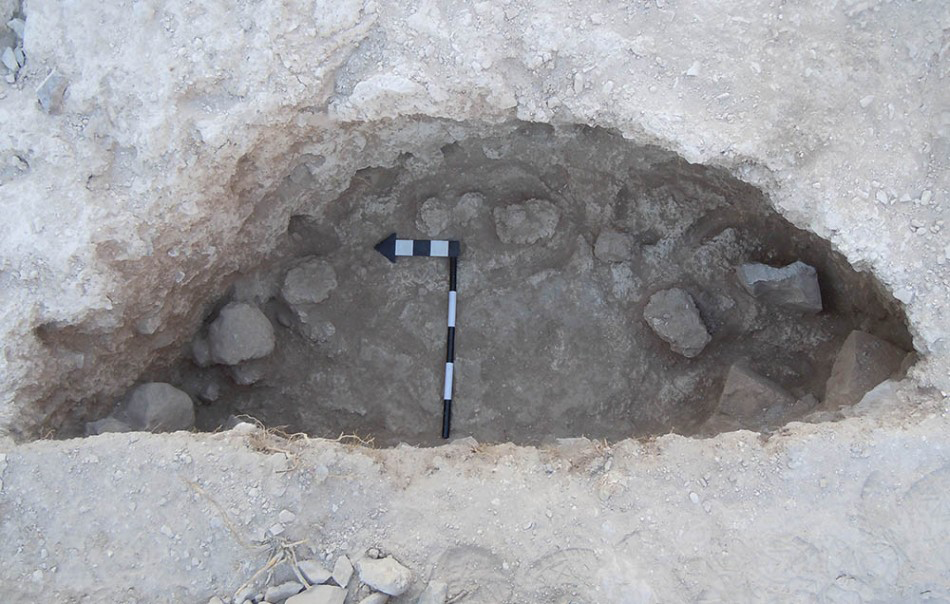
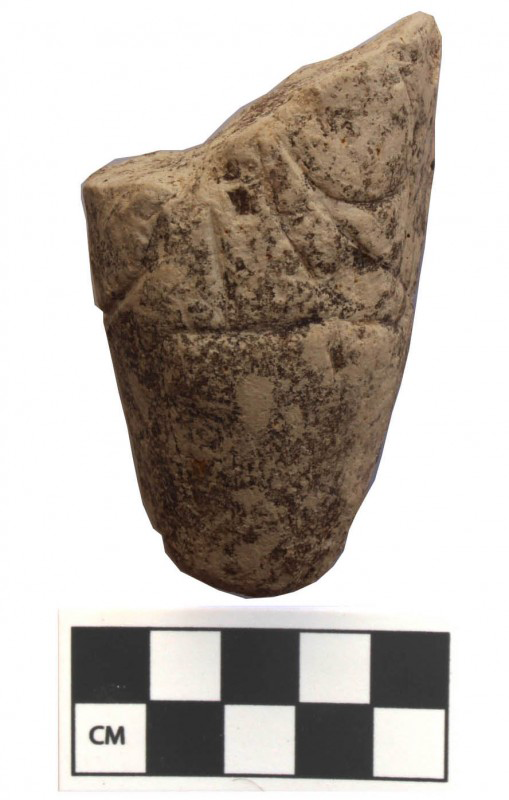
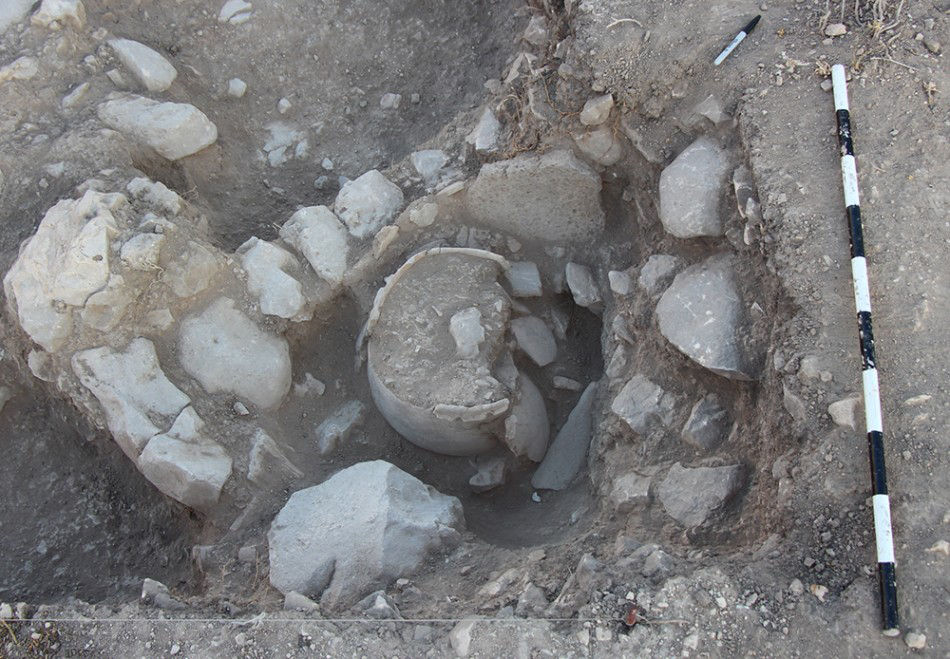
At site WQ117, excavations uncovered abundant flint flakes and pottery of the Yarmoukian phase of the Late Neolithic (c. 6500–5700 cal. BC), including several sherds with typical herringbone incisions. Many of these artefacts came from large, circular pits, one of which had a stonewall built within it, and another with an arrangement of mud bricks (Figure 4). One of the pits contained a large, ashy deposit, as well as a broken pebble figurine (Figure 5). Most of the artefacts, however, came from secondary, colluvial deposits eroded from upslope, and comparison of absolute levels suggests that, except on the edge of the stream terrace where the pits were located, any intact Neolithic deposits and features are deeply buried by colluvium. Recent bulldozing, in addition to erosion, has damaged or destroyed the upper part of the site. The only fauna identified to date are freshwater mussel and crab, suggesting that wetlands around the nearby spring of ‘Ain Tura’i were a major attraction for settlement.
A partially excavated pit at WQ117 with mud bricks arranged at the bottom.

Broken Yarmoukian pebble figurine from WQ117.

The third candidate site, ‘Ain Quseiba (WQ120), had already been identified during earlier survey work as an Iron Age site on the basis of substantial remains of stone buildings visible on the surface. The survey, however, also found high densities of flint flakes and blades, and our goal was to increase the sample of this prehistoric component of the site in order to determine more precisely its date.
We have yet to undertake detailed analysis of the finds from ‘Ain Quseiba, but our preliminary assessment suggests that most or all of the blades come from single-platform cores, and the high blade-to-flake ratio of the lithic assemblage suggests that they probably belong to the Pre-Pottery Neolithic B, and thus would date broadly to 8000–6800 cal. BC. Most of these lithics came from deep colluvial deposits, and our trenches, despite going down over 1m in some cases, were either not deep enough to reach contexts of primary deposition on the excavated portions of the slope, or the early Holocene occupation layers lie farther upslope, perhaps covered by Iron Age deposits.
A bin built up against an Iron Age wall, lined with clay and a recycled grinding stone; the bin contains a large, reconstructable vessel.

These later deposits are also of interest (Figure 6), as most Iron Age excavations in the region have focused on large tell sites. ‘Ain Quseiba has the potential to inform about the nature of smaller settlements, such as farmsteads or villas, in the late Iron Age, when this site was likely part of a settlement hierarchy that included the small village of Tell Quseiba and the much larger Tell Muddawar, a few kilometres away.
Overall, these test excavations indicate that our predictive model works quite well and supports the suggestion that small Neolithic, and especially Late Neolithic, sites are much more common in northern Jordan than previously suspected (Reference BanningBanning 2001, 2014; Kadowaki et al. 2008). With the discovery of these three sites, and a new method for identifying many more, further light can be shed on the livelihoods of the inhabitants of small farmsteads in the Neolithic period of the Levant and their connections both to the landscape and to their neighbouring communities. The results of the targeted survey conducted in Wadi Qusayba, which led to these discoveries, suggest that the current scarcity of these types of sites is more a reflection of the effects of poor visibility and the low probability of detection in highly eroded landscapes—and the failure of traditional surveys to account for these factors—than to their actual abundance in the past. While the examples discussed here are specific to northern Jordan, we believe that the application of these methods in many other geographical contexts could similarly improve the recovery of rare ancient material. This requires enumerating the factors upon which the probabilities of detection most likely depend (Field & Banning 1998; Hitchings et al. 2013) and targeting areas at the higher end of the probability scale in a systematic and iterative manner.