Book contents
- Frontmatter
- Contents
- List of maps
- List of illustrations
- List of tables
- List of figures
- List of contributors
- Acknowledgements
- List of abbreviations
- Introduction
- 1 Kolossourgia. ‘A colossal statue of a work’
- 2 Reflections of philosophy: Strabo and geographical sources
- 3 Who is a barbarian? The barbarians in the ethnological and cultural taxonomies of Strabo
- 4 Gender at the crossroads of empire: locating women in Strabo's Geography
- 5 Strabo and Homer: a chapter in cultural history
- 6 Strabo's use of poetry
- 7 Strabo's sources in the light of a tale
- 8 The foundation of Greek colonies and their main features in Strabo: a portrayal lacking homogeneity?
- 9 Ανδρες ἔνδοξοι or ‘men of high reputation’ in Strabo's Geography
- 10 Comparing Strabo with Pausanias: Greece in context vs. Greece in depth
- 11 The European provinces: Strabo as evidence
- 12 Amasya and Strabo's patria in Pontus
- 13 Cappadocia through Strabo's eyes
- 14 Greek geography and Roman empire: the transformation of tradition in Strabo's Euxine
- 15 Josephus' hidden dialogue with Strabo
- 16 Temporal layers within Strabo's description of Coele Syria, Phoenicia and Judaea
- Bibliography
- Index of geographical names
- Index of personal names
14 - Greek geography and Roman empire: the transformation of tradition in Strabo's Euxine
Published online by Cambridge University Press: 18 December 2009
By

Book contents
- Frontmatter
- Contents
- List of maps
- List of illustrations
- List of tables
- List of figures
- List of contributors
- Acknowledgements
- List of abbreviations
- Introduction
- 1 Kolossourgia. ‘A colossal statue of a work’
- 2 Reflections of philosophy: Strabo and geographical sources
- 3 Who is a barbarian? The barbarians in the ethnological and cultural taxonomies of Strabo
- 4 Gender at the crossroads of empire: locating women in Strabo's Geography
- 5 Strabo and Homer: a chapter in cultural history
- 6 Strabo's use of poetry
- 7 Strabo's sources in the light of a tale
- 8 The foundation of Greek colonies and their main features in Strabo: a portrayal lacking homogeneity?
- 9 Ανδρες ἔνδοξοι or ‘men of high reputation’ in Strabo's Geography
- 10 Comparing Strabo with Pausanias: Greece in context vs. Greece in depth
- 11 The European provinces: Strabo as evidence
- 12 Amasya and Strabo's patria in Pontus
- 13 Cappadocia through Strabo's eyes
- 14 Greek geography and Roman empire: the transformation of tradition in Strabo's Euxine
- 15 Josephus' hidden dialogue with Strabo
- 16 Temporal layers within Strabo's description of Coele Syria, Phoenicia and Judaea
- Bibliography
- Index of geographical names
- Index of personal names
Summary
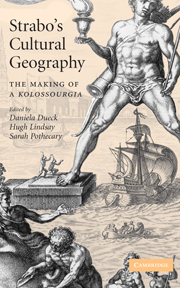
In the seventeen books of Strabo's Geography, the Euxine or Black Sea region receives a lot of attention from the opening chapters onwards. Why so much? The question becomes still sharper when we observe Strabo's awareness of the sheer size of his work. His great text is like a colossal statue, as he puts it. There is an evident authorial pride in its scope and a claim to special quality to match the quantity, but Strabo also shows, sometimes explicitly, a concern to maintain limits: Athens, in particular, cannot be accommodated in all its glories within the work (9.1.16, a nice insight into his criteria for inclusion), while Strabo excuses his extensive treatment of Italy as ‘going into detail on account of the reputation and power of Italy, as far as proper judgement permits (μέχρι τοῦ μετρίου)’ (5.4.11). In approaching Strabo, it may therefore seem perverse to enlarge still further the field of our enquiry. However, for all that, if we are to understand the work in general and Strabo's concern with the Euxine in particular, there is much to be gained from setting the author and his colossus into a still bigger picture.
In what follows I shall first consider the broad context of geography within the tangled issues of Roman and Greek thinking about the Roman empire.
Information
- Type
- Chapter
- Information
- Strabo's Cultural GeographyThe Making of a Kolossourgia, pp. 216 - 234Publisher: Cambridge University PressPrint publication year: 2005
Accessibility standard: Unknown
Why this information is here
This section outlines the accessibility features of this content - including support for screen readers, full keyboard navigation and high-contrast display options. This may not be relevant for you.Accessibility Information
Accessibility compliance for the PDF of this chapter is currently unknown
and may be updated in the future.