





Background
Portable medical equipment (PME) is ubiquitous in healthcare settings. Non-critical PME, including vitals machines (VM), point of care ultrasound machines (POCUS), electrocardiogram machines, blood pressure cuffs, and stethoscopes, present potential for transmission of clinically relevant pathogens in the healthcare environment, with reported contamination rates of PME between 23% and 100%.Reference Livshiz-Riven, Borer, Nativ, Eskira and Larson1–Reference Suwantarat, Supple, Cadnum, Sankar and Donskey4 Cleaning and disinfection are core components of standard precautions, which comprise a series of infection prevention and control (IPC) interventions aimed at reducing the risk of infection for patients and personnel. Compliance with IPC practices, including cleaning and disinfection, varies and can be influenced by clinical experience, workload, a lack of role clarity, availability of supplies, and varied understanding of protocols or their importance.Reference Muniz, Sethi, Zaghi, Ziniel and Sandora5 Limited evidence exists of effective IPC training and educational interventions specific to PME cleaning and disinfection, although interventions that engage muscle memory and visual cues may improve cleaning and disinfecting practices.Reference Bhan, Green and Liang Philpotts6
Virtual reality (VR) is an emerging and promising training modality in healthcare. VR may be effective at improving the confidence and self-efficacy of healthcare personnel (HCP), with some studies demonstrating an increase in knowledge and clinical skills.Reference Huai, Li, Wang, Zhang, Liu and Yang7 Most studies of VR training indicate high levels of participant satisfaction and engagement.Reference Quah, Lau, Ang and Lau8 However, barriers to VR implementation, such as blurry vision, use of unfamiliar equipment, and negative physical sensations, can interfere with user learning, and efforts to address them are critical to the usability and viability of VR for training and education.Reference Barreto, Jerry and García9 There remains limited evidence on the impact of VR training on IPC knowledge, attitudes, and skills.
The aim of this quasi-experimental study was to assess the impact of a VR training module on HCP knowledge and attitudes about cleaning and disinfecting PME. Building on early user experience pilot testing of a VR module for PME cleaning and disinfection,Reference Barreto, Jerry and García9 an updated version of the VR module was assessed in addition to pre- and post-knowledge, attitude, and confidence. VR experience was also assessed. Data collected from head-mounted displays (HMDs) quantified in-module knowledge and performance.
Methods
Virtual reality module and learning content
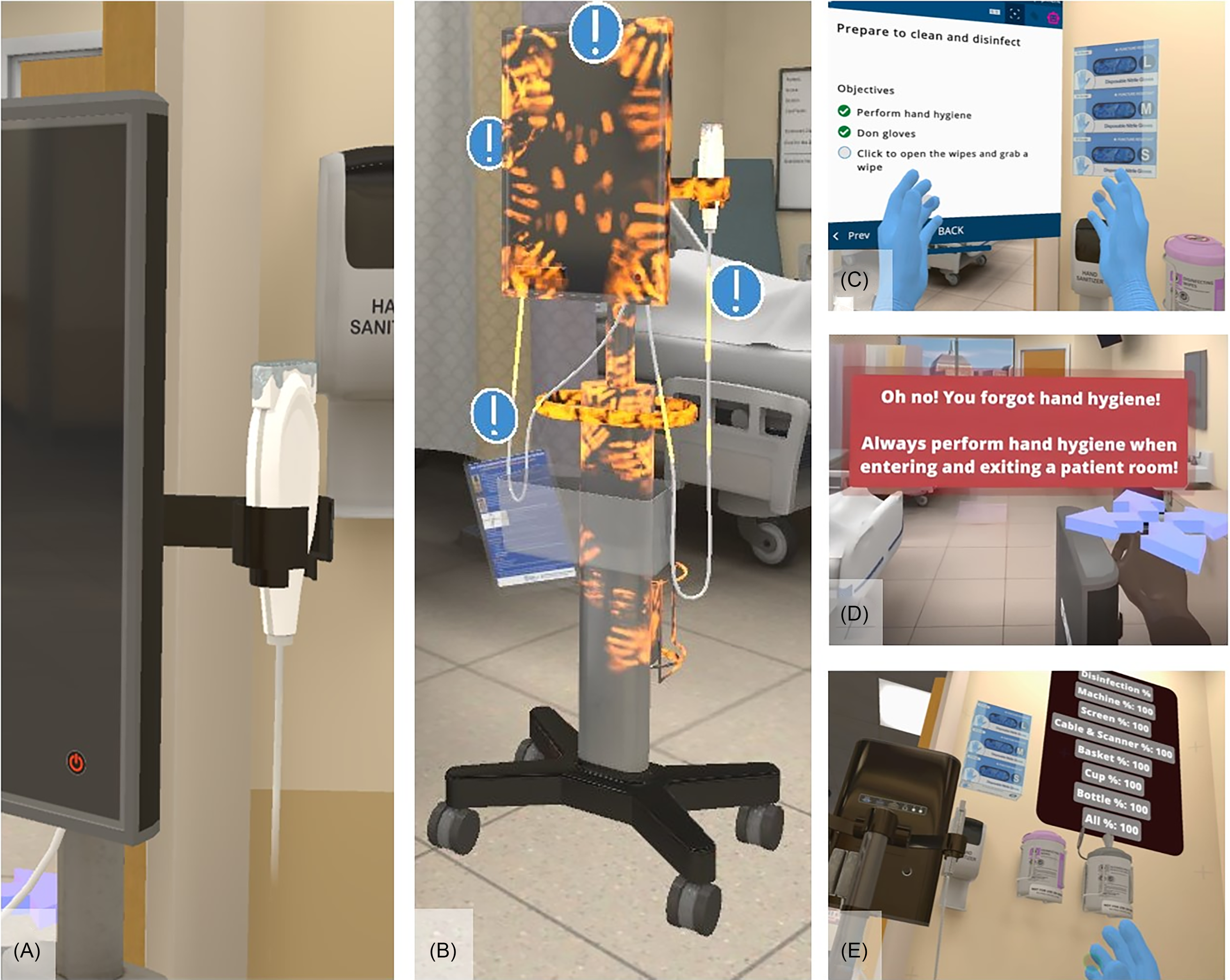
A multidisciplinary team of IPC and infectious diseases (ID) clinicians, instructional designers, and VR developers created a VR module on cleaning and low-level disinfection of PME. The module was developed using the EducationXR application (Heizenrader LLC, Salt Lake City, UT) and used with HMDs (Meta Quest 2 and 3, Meta, Menlo Park, CA). The VR module’s learning objectives include: (1) identifying and describing non-critical PME, (2) identifying appropriate cleaning and disinfection products, (3) distinguishing between cleaning and disinfection, and (4) performing tasks in the correct sequence to clean then disinfect PME, with specific reference to coverage and avoiding recontamination. The module, described in an earlier study focused on user experience,Reference Barreto, Jerry and García9 allows for practice on a VM or a POCUS; the version utilized in this study was revised based on prior piloting, including the addition of a VR tutorial sequence. During the VR module, participants were instructed to complete tasks through an instruction panel (Figure 1).
Inside the HMD: Key learning points and visuals. A. Participant is instructed to remove visible soil on the ultrasound probe, holder, and gel bottle. B. Participant can visualize invisible contamination and explore how different parts of the machine were contaminated. C. Instruction panel where participants can see the tasks (“objectives”) they need to perform during a given part of the training. D. Participant is prompted about a missed hand hygiene opportunity (HHO). E. As participants disinfect the machine, their disinfection % is calculated. | A short video of the module, which includes a demonstration of how participants are reminded of HHOs, can be viewed in the supplementary materials in a previous publication by these authorsReference Barreto, Jerry and García9.

Participant recruitment and training session organization
HCP were recruited from 5 healthcare facilities. Recruitment was conducted by engaging infection preventionists, nurse managers, and educators at sites to distribute templated emails and fliers to staff with roles in direct patient care. Participants signed up for training sessions either during a shift or a day off.
Training sessions were hosted by a member of the research team or by pilot site managers, who had completed training sessions with the research team in December 2023 and March 2025.
Participants were sent an email prior to the training session with a link to the pre-survey. Participants were expected to complete the pre-survey before arrival at the training session. Upon arrival, participants were provided with a verbal introduction and assistance from a training session host to fit the HMD and hold the controllers. Participants then completed a 6-minute VR tutorial inside the HMD designed to orient new users to the controllers and subsequently completed the learning module. Participants were then given the post-survey link to complete. Training sessions were conducted in conference rooms, break rooms, or training rooms.
Participants were provided with a $50 gift card for piloting the VR module and completing both the pre- and post-training survey. Participants could stop the VR training at any time and did not have to finish the module to receive compensation.
Data collection
Data collected from the participants included survey data as well as data from the HMD. A survey was developed and reviewed by subject matter experts to evaluate IPC knowledge, attitudes, and confidence, as well as end-user experience. The pre-VR training survey consisted of two sections: Section 1 was a 10-question knowledge test; Section 2 was an attitude and confidence assessment, consisting of 11 questions on a 5-point Likert scale. Questions were designed to assess completion of module learning objectives, with some questions adapted from the CDC’s Infection Control Assessment and Response (ICAR) Tool for General Infection Prevention and Control (IPC) Across Settings. The post-VR training survey consisted of these two sections plus a third section designed to assess VR user experience; 11 questions on a 5-point Likert scale. Survey data were collected and managed using REDCap (Research Electronic Data Capture) electronic data capture tools hosted at Mass General Brigham.Reference Harris, Taylor, Thielke, Payne, Gonzalez and Conde10,Reference Harris, Taylor and Minor11
Data collected directly from the HMDs included the duration of VR sessions and participant performance, including tasks completed, hand hygiene (HH) performance, percentage of PME disinfected (overall and for individual parts of the PME), and in-module quiz performance. VR session duration was defined as the time a participant entered the VR module to the time the participant exited the module. Task completion was defined as performing the actions assigned on the instruction panel. HH performance was reported as the number of times participants received an HH alert, indicating a missed HH opportunity (HHO), during the module upon entering or leaving the patient’s room. The module was designed such that users could exit or enter patient care areas at will; thus, there were technically infinite opportunities to miss HH. The percentage of PME disinfection refers to the percentage covered by the wipe during disinfection of the PME. Participants received an individual disinfection percentage for each part of the PME, as well as an overall disinfection percentage, as calculated by the HMD analytics engine. Lastly, quiz performance is reported as correct based on the first attempt of the quiz. HMD data reports all answers participants attempted until obtaining a correct quiz response.
Statistical analysis
Survey responses related to participant knowledge were summarized using mean and standard deviation. Statistical significance and effect size of the pre-post change in the scale scores of the survey items were assessed by a paired sample t-test and Cohen’s effect size (R Core Team. (2025). R: A language and environment for statistical computing. R Foundation for Statistical Computing. https://www.R-project.org/). The attitude and confidence assessment survey analysis included each participant’s Likert scale score for 11 questions, summed to give a total attitude and skills score out of 55 points, followed by mean and standard deviation calculations, and a paired sample t-test and Cohen’s d effect size. Further analysis included calculating the mean and standard deviation of Likert scale responses for individual questions, followed by a loop of paired sample t-tests to assess the statistical significance of pre- and post-survey responses for each of the 11 questions in Section 2 of the surveys. The VR user experience analysis included each participant’s Likert scale score for 11 questions, summed to give a total user experience score out of 55, with descriptive statistics reported. HMD data, including HH performance and PME disinfection percentage, are presented as descriptive statistics. HMD data analysis included calculating the mean and standard deviation for PME disinfection percentages for the overall machine and for individual parts. Analysis included calculating the mean number of missed HHOs and mean number of tasks not completed across participants.
The study received Non-Human Subjects Research (NHSR) determination by the MGB Institutional Review Board (2023, ID 863).
Results
Between April and May 2025, 60 participants were recruited from 5 healthcare facilities (2 academic medical centers and 3 long-term care facilities); 54 completed the VR module and pre/post surveys and were included in the analysis.
Participant demographics
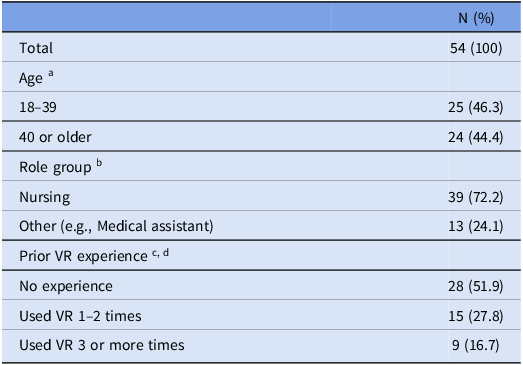
Half of the participants (28/54, 52%) had never used VR, and 28% (15/54) had only tried VR once or twice previously. Participants ranged in age from 19 to 61, and represented a range of job types, with the majority (39/54, 72%) in nursing (Table 1).
Participant demographics

a 5 participants declined to answer.
b 2 participants declined to answer.
c 2 participants declined to answer.
d All participants took part in a 6-minute VR tutorial module before the training module.
Pre-post knowledge assessment
Participant performance on the 10-item knowledge assessment showed a statistically significant increase in scores before and after completing the VR module. The mean (SD) pre-test score was 7.54/10 (1.57), and the mean post-test score was 8.13/10 (1.36) with an effect size of d = 0.43 (p = 0.0024). Question 3, on when non-critical PME should be cleaned, and question 9, on the difference between cleaning and disinfecting, were most frequently answered incorrectly in both the pre- and post-assessments.
Attitude and confidence assessment
Before the VR module, the mean (SD) total score for the attitude and confidence assessment was 45.22/55 (8.07); after the VR module, the total mean (SD) score was 51.74/55 (8.54) with an effect size of d = 1.20 (p < 0.0001). The change in mean Likert scale response pre- and post-VR training for individual questions was statistically significant (p < 0.05) for all but one question (Supplementary Table 1).
Virtual reality user experience
The total mean (SD) score for the VR user experience survey was 50.19/55 (8.50). Participants noted that the VR module was more engaging than other IPC trainings they had taken in the past (mean 4.75/5 (0.68)) (Supplementary Table 2).
Head-mounted display analytics
The mean session duration for the VR module was 22 minutes. Of the 28 tasks in the training, participants did not complete a mean of 2.15 tasks. Over half (30/54, 56%) of participants did not watch one or both educational videos on the Spaulding Classification System and the difference between cleaning and disinfection (each video counted as one task). On average, participants missed 2.56 HHO. Most participants (48/54, 89%) missed at least one HHO, most commonly while entering the patient room for the first time (46/54, 85%). For 20% (11/54) of participants, there were no further missed HHO in the rest of the module after a one-time HH reminder the first time entering the patient room. Only 11% (6/54) of participants completed the entire module without missing a HHO.
Participants could select which PME to complete the module with and were evenly divided between the POCUS and VM. Overall, participants obtained a mean (SD) disinfection percentage of 55% (40.35) for the PME. A quarter (14/54, 26%) of participants skipped the disinfection step during the training. When only considering participants who performed disinfection (40/54), the mean (SD) disinfection percentage was 75% (26.57) for the PME.
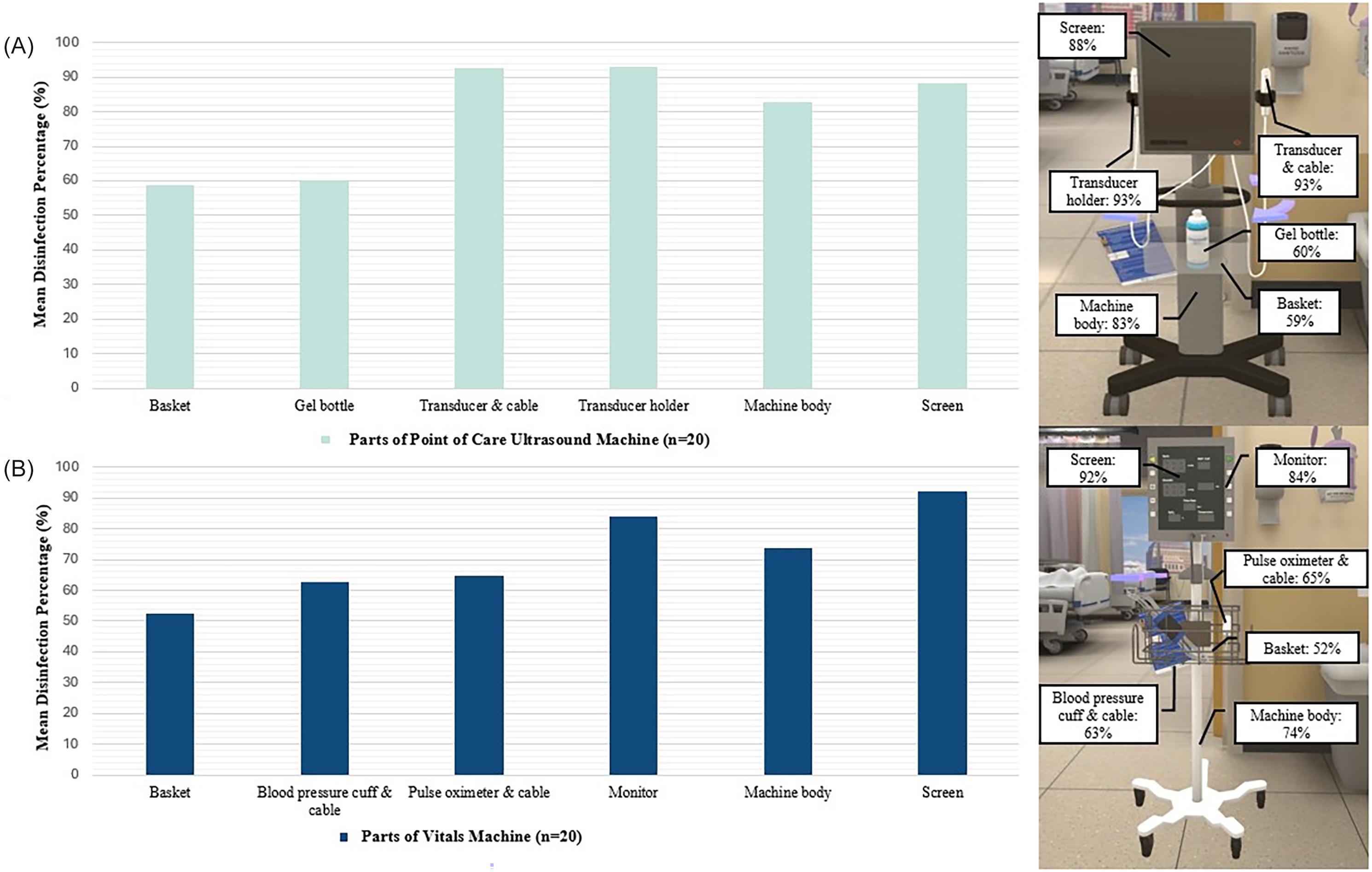
Among participants who performed disinfection (40/54), the parts with the lowest mean (SD) disinfection percentage for the POCUS were the basket, 59% (49.19), and the gel bottle, 60% (50.26). The parts with the lowest mean (SD) disinfection percentage for the VM were the basket, 52% (47.86), and the blood pressure cuff and its cable, 63% (47.93). (Figure 2).
Mean Disinfection Percentages for Parts of the PME. A. Mean disinfection percentages for parts of the Point of Care Ultrasound (POCUS) Machine across participants (n = 20). B. Mean disinfection percentages for parts of the Vitals Machine (VM) across participants (n = 20). Participant-level percentages are calculated by the HMD analytics engine.

For the in-module quizzes, all participants responded correctly on the multiple-choice quiz testing participant knowledge on the correct next steps after using the PME on a patient and most (53/54, 98%) on why the PME is considered non-critical. Less than half (21/54, 39%) of participants responded correctly on their first attempt when selecting the correct disinfecting product for the PME. Most (53/54, 98%) participants responded correctly to a quiz about allowing the PME to dry for the full contact time after disinfecting, yet only 66% (36/54) responded correctly on the following quiz about what action to take after noticing the PME was dry before the end of contact time.
Discussion
In this quasi-experimental pre- and post-study of training using a VR module focused on cleaning and disinfection of PME, participants showed a statistically significant increase in knowledge, attitude, and confidence in IPC procedures. Moreover, participants reported enjoying the VR module. HMD analytics demonstrated that participants completed most in-module tasks; however, it also highlighted missed HHO and incomplete disinfection of PME. Participants performed well on in-module quizzes about the Spaulding Classification System and the steps to clean and disinfect PME, but a majority erred in selecting the appropriate cleaning and disinfection product and identifying product contact time.
Emerging evidence suggests that immersive VR training is effective in enhancing learners’ knowledge, and skill performance. Reference Huai, Li, Wang, Zhang, Liu and Yang7,Reference Quah, Lau, Ang and Lau8 In this study, participation in the VR module improved participants’ understanding of critical, semi-critical, and non-critical equipment from the Spaulding Classification System and knowledge of the correct order of steps to clean and disinfect PME. In addition to the knowledge gains, participants attitude and confidence regarding IPC practices also improved significantly after the VR module, reflecting a moderate to large effect size, highlighting that the VR module positively impacts HCP’s perceived ability to perform IPC practices. All attitude and confidence questions were statistically significant post-VR training module, except for one question which assessed participants’ belief in the importance of performing HH before entering or exiting a patient care area. This may be due to a ceiling effect, given that most participants are expected to have extensive training on the importance of HH. Participants’ initial Likert ratings were high, so there was little room for improvement.
Participant user experience was favorable, with high overall experience scores, despite most participants having limited prior VR exposure. Participants reported finding the VR module more engaging than their prior IPC training. Participants reported that their knowledge was reinforced or expanded after experiencing the VR module, with a majority of users scoring that they would recommend the VR module to other HCP. These results are consistent with recent literature reviews, which demonstrate that learners report high levels of satisfaction, engagement, and acceptance of VR learning. Reference Quah, Lau, Ang and Lau8,Reference Dhar, Upadhyay and Huang12
HMD data provided insight into participant performance. While replicating the mechanics of HH in VR can be limited by hand-held controllers, VR training can emphasize instead the importance of when HH should be performed, and provide real-time feedback when opportunities are missed. HMD-collected data provides a novel opportunity to assess HH performance of participants in the VR module. Despite most participants in this study reporting understanding the importance of HH in their pre-survey, 89% had to be reminded to perform HH during the VR module at least once, most often when first entering the patient room. The VR module simulates realistic scenarios in which the HCP is performing multiple tasks when HH is required (e.g., transporting the PME into the care space), highlighting moments of increased risk for HH failures. These results are consistent with existing literature demonstrating HCP attitudes to HH are positive, yet real-world compliance is subpar. Reference Ceylan, Gunes, Baran, Ozturk and Sahbudak13–Reference Glowicz, Landon and Sickbert-Bennett15 About a fifth of participants, after a single HH reminder, had no further missed HHO, demonstrating the impact of real-time feedback. This is consistent with prior studies demonstrating that reminders or nudges at key moments within the routine course of care may be effective in optimizing HH compliance. Reference Iversen, Hansen, Alsner, Kristensen and Ellermann-Eriksen16
To our knowledge, this study is unique in collecting data on virtual disinfection performance in VR and providing these data as feedback to users. Much like trainings that utilize visualization of contamination, Reference Wolfensberger, Désiron, Domenech-Jakob, Petko and Zingg17,Reference Stuart, Gannon, Dotto, Regina and Mumma18 this VR module provides visual and quantitative feedback on the impact of learners’ actions. HMD data reflected that participants could earn 100% disinfection on one part of the PME, while earning 0% disinfection on another part. Based on the HMD data collected in this study, the most missed parts of the PME during disinfection were the basket, the gel bottle (POCUS), the blood pressure cuff, and its cable (VM). Our study observed a high mean disinfection percentage of 93% for the POCUS transducer and a low mean disinfection percentage of 60% for the POCUS gel bottle. These results are consistent with a prior study among sonography students using a powder that glows under ultraviolet light, which reported that the transducer was consistently cleaned while the gel bottle most frequently remained contaminated. Reference Pessin and Matthews19
This study has limitations. Participants were recruited by self-selection. In this analysis, we did not compare our VR test group to a non-VR comparator group or assess retention of the information during a follow up period. Due to the small sample size, we did not conduct subgroup analyses (e.g. by role). We were unable to assess whether the VR module had any impact on participants’ performance in routine work. Further research is needed to identify the impact of VR training on long-term knowledge, attitude, and skill retention, as well as changes in practice. Due to the design of the module allowing for users to skip the disinfection step by stating “I am done disinfecting” even if they had not performed any disinfection, some users were able to bypass the disinfection step and only learn at the end of the module that they had failed. In our design, we chose to separate cleaning and disinfection into two distinct steps: first cleaning to remove visible contamination, then a disinfection step, consistent with best practice. Thus, participants might have attempted to disinfect during the cleaning step and failed to receive credit for disinfection. In considering revisions of the VR module, the disinfection step may be reprogrammed as required to emphasize the two-step process to learners. All recruited participants were required by their institutions to complete an annual online educational training and assessment on infection control training; required annual training was not assessed for inclusion of topics tested in the VR module.
While VR training is increasingly being used across healthcare, efforts to assess its implementation and effectiveness for training in IPC are sparse. Building upon our previous work exploring VR user experience, Reference Barreto, Jerry and García9 this study provides evidence of the potential of VR training to positively impact knowledge and attitudes, as well as high levels of participant satisfaction, consistent with that reported by other investigators. Reference Huai, Li, Wang, Zhang, Liu and Yang7,Reference Quah, Lau, Ang and Lau8,Reference Omori, Shigemoto and Kitagawa20 Our study demonstrates how HMD-collected data can be used to evaluate user performance and competency. VR warrants ongoing exploration and refinement for use in IPC training. Future efforts should focus on user retention of knowledge and attitudes over time, the impact on real-world performance, assessment of resources required for implementation at scale, and potential return on investment.
Supplementary material
The supplementary material for this article can be found at https://doi.org/10.1017/ice.2025.10360.
Acknowledgements
The authors thank Shawndra Cox, Paolo Villanueva, and Katherine Swanson, RN, CIC for their creative and subject matter expertise contributions to the design of the VR Module described in this article. The authors thank Esteban Barreto, MA, PhD, for his contributions to the development of the VR user experience survey. The authors thank the teams from our pilot sites for their dedication of time and effort to recruiting participants and piloting VR training at their sites.
Financial support
This work was supported by a cooperative agreement from the Centers for Disease Control and Prevention (CK22-2203). The Centers for Disease Control and Prevention were not involved in preparation, submission, or review of the manuscript.
Competing interests
All authors have no conflicts of interest relevant to this article.


 Open access

