

Introduction
The direct and indirect effects of COVID-19 policy measures and pandemic responses, such as unemployment and income loss, disproportionately impacted women (Perry et al., Reference Perry, Aronson and Pescosolido2021; Tribin et al., Reference Tribin, García-Rojas, Herrera-Idarraga, Morales and Ramirez-Bustamante2023). Studies have found that these consequences are associated with the increase in unpaid labour, particularly care work, seen after countries implemented public health measures to mitigate the spread of COVID-19 (Power, Reference Power2020). COVID-19 public health measures, such as physical distancing, isolation, and lockdown policies, increased the volume and intensity of unpaid care work (UCW) across the globe (UNICEF, 2020). UCW includes, but is not limited to, domestic work, childcare, older adult care, and care for persons with a disability. Around the world, UCW is disproportionately done by women (UN Women, 2020), including in South and Central America, where there is a strong cultural value placed on caregiving roles (Salvador, Reference Salvador2007). In Colombia and Costa Rica, for instance, women contribute more than 75% of the country’s total UCW (O’Donnell et al., Reference O’Donnell, Buvinić, Kenny, Bourgault and Yang2021). Further, the increase in UCW continues to have a greater effect on more vulnerable households, including low-income households and those headed by women (O’Donnell et al., Reference O’Donnell, Buvinić, Kenny, Bourgault and Yang2021).
To mitigate the economic repercussions of the COVID-19 pandemic’s public health measures, many countries introduced new or expanded upon existing social protection programmes as part of their pandemic response and recovery efforts (Haldane et al., Reference Haldane, Morales-Vazquez, Jamieson, Veillard, Marchildon and Allin2022). Social protection interventions in Colombia and Costa Rica included social transfers (e.g., cash transfers or childcare and food vouchers), social insurance, efforts to strengthen social services, and labour market interventions such as flexible working conditions (UNICEF, 2020). These measures have the potential to mitigate the impact of crises such as the COVID-19 pandemic on unemployment and income loss for women.
In this paper, we undertake a comparative analysis of the social protection measures introduced in Colombia and Costa Rica during the first two years of the COVID-19 pandemic, drawing on core themes of feminist political economy and Elson’s (Reference Elson2017) Three R Framework to reflect on whether and how these measures incorporate care-sensitive approaches and on potential factors shaping the countries’ diverging policy responses. As our analysis focuses on formal government care policies and programmes, we concentrate on childcare, older adult care, and care for persons with disabilities. Domestic work is not examined, as the policy measures under review do not directly target this domain; accordingly, we use UCW to refer specifically to the areas of care included in our analysis.
The rest of the paper is structured as follows. First, we provide our comparative rationale and relevant background on the two jurisdictions (Colombia and Costa Rica), noting differences and similarities in their pre-pandemic social protection arrangements. We then outline the guiding frameworks that inform our analysis: feminist political economy and Elson’s (Reference Elson2017) Three R Framework. Next, we present our comparison of the care-sensitive social protection measures introduced in both countries during the first two years of the COVID-19 pandemic (March 2020–March 2022), followed by a reflection on factors that could help to explain the differences observed in each country’s policy response. Taken together, these insights can inform future policy action in the context of the increasing demand for care work in Latin America and around the globe, as well as contribute to strengthening pandemic resilience and preparedness, and fostering more gender-responsive approaches to future health crises.
Comparative rationale and context
Selection of the jurisdictions
Colombia and Costa Rica were selected as comparators for this analysis due to similarities around demographics, caregiving, employment, and support from international organizations through the COVID-19 pandemic (Table 1).
Comparison of selected jurisdictions
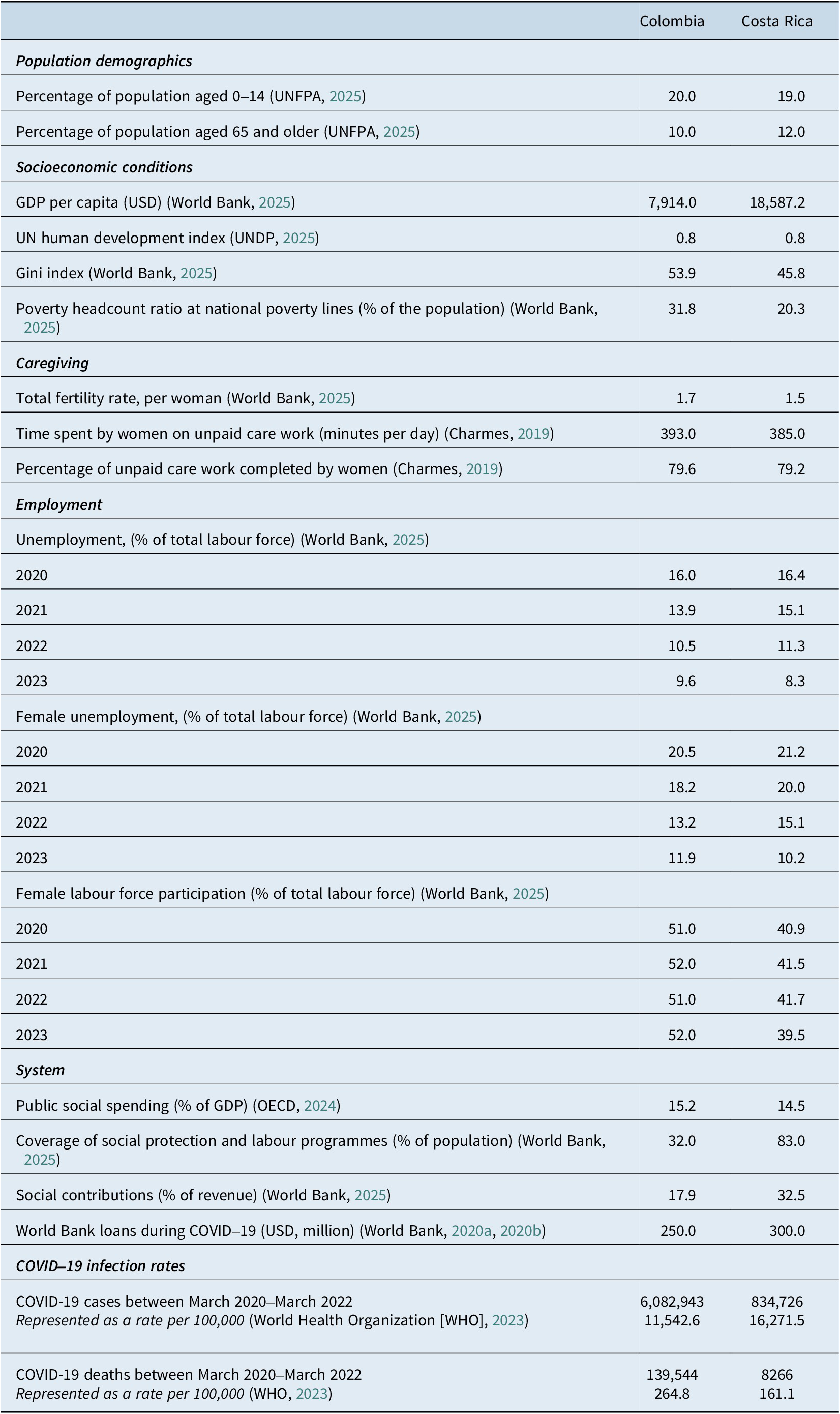
With COVID-19 exacerbating the intensity and inequitable division of UCW and forcing more women to reduce their work hours or to leave the labour force (Petts et al., Reference Petts, Carlson and Pepin2021; Dempere and Grassa, Reference Dempere and Grassa2023), it was important to select similar comparators in terms of their national unpaid care landscape and female labour force participation before the pandemic. High country averages of time spent on UCW, along with the distinctly gendered nature of care responsibilities in both countries, were also important considerations in this analysis. These factors suggest that both countries would benefit from developing and strengthening gender-related social protection measures to mitigate the gendered repercussions of the pandemic.
Colombia and Costa Rica are upper-middle-income countries in Latin America that have, in recent decades, received significant assistance from international organizations in policy financing or loans (Table 1) (World Bank, 2020a, 2020b). Both countries were prioritized by international organizations as infection counts and death rates placed them among the hardest hit countries in Latin America (Bhatia et al., Reference Bhatia, Dutta and McClure2020). This similar level of support from international organizations influences both countries’ level of preparedness and the extent to which the countries could engage in debt financing for any changes in social policies. At the same time, differences in pre-existing system capacities remain evident. Colombia allocates 17.9% of revenue to social contributions and covers 32.0% of its population through social protection and labour programmes, whereas Costa Rica allocates 32.5% of revenue and covers 83.0% of the population (OECD, 2024; World Bank, 2025). These system differences gave Costa Rica a stronger base to provide social support during the pandemic.
The pre-pandemic state of social protection for unpaid caregivers
This section summarizes the pre-pandemic state of care programmes and services in Colombia and Costa Rica across childcare, older adult care, and care for persons with disabilities.
Colombia. In Colombia, care arrangements for children, older adults, and persons with disabilities are shaped by intersecting economic vulnerabilities and entrenched gender disparities. While public care programmes are available for low-income families (Table 2), care needs continue to be met primarily by informal arrangements, with women carrying the vast majority of unpaid care responsibilities (Charmes, Reference Charmes2019).
National organization of care services pre-COVID-19
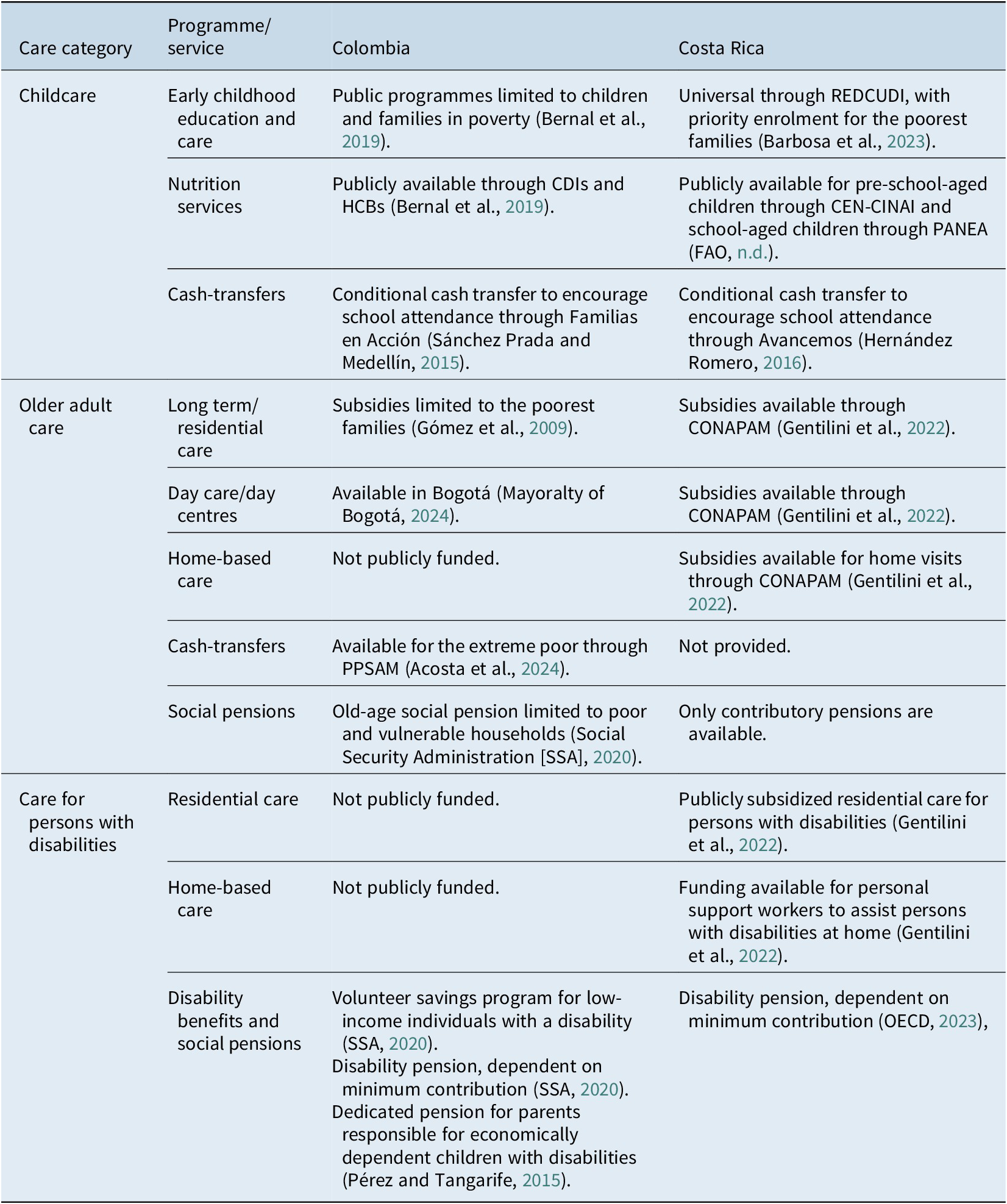
Public early childhood education and care (ECEC) in Colombia is primarily offered through the Colombian Family Welfare Institute (Instituto Colombiano de Bienestar Familiar; ICBF). Since the 1980s, a significant portion of ECEC provision has taken place in Community Welfare Homes (Hogares Comunitarios de Bienestar; HCBs), which provide home-based care and nutrition led by “community mothers.” This model is complemented by centre-based services, such as the Centres for Early Childhood Development (Centros de Desarrollo Infantil, CDIs), which also provide educational and nutritional support for pre-school-aged children (Bernal et al., Reference Bernal, Betancur, Maldonado-Carreño and Votruba-Drzal2019). In 2011, the government launched From Zero to Forever (De Cero a Siempre), a national strategy aimed at expanding access, improving quality, and enhancing the coordination of ECEC, with a focus on children from low-income households (Bernal et al., Reference Bernal, Betancur, Maldonado-Carreño and Votruba-Drzal2019; Rojas Romero et al., Reference Rojas Romero, Moreno Angarita, Guerrero and Prieto Cifuentes2025). While the initiative strengthened the policy framework and increased public investment into ECEC, publicly funded services still face significant gaps in availability and quality, particularly in rural areas (Díaz and Rodriguez-Chamussy, Reference Díaz and Rodriguez-Chamussy2016; Bernal et al., Reference Bernal, Betancur, Maldonado-Carreño and Votruba-Drzal2019; Rojas Romero et al., Reference Rojas Romero, Moreno Angarita, Guerrero and Prieto Cifuentes2025).
Older adult care follows a similar pattern, with limited availability and priority for low-income populations. Publicly funded long-term care is severely limited in Colombia and directed towards the most economically disadvantaged families, primarily through Centres for Older Adults Wellbeing (Centros de Bienestar del Adulto Mayor, CBAM). Additional support for older adults includes day centres (Centros Diurnos) and cash or nutritional aid programmes such as the Social Protection Program for Older Adults (Programa de Protección Social al Adulto Mayor; PPSAM) (Salvador, Reference Salvador2007; Gómez et al., Reference Gómez, Curcio and Duque2009; Acosta et al., Reference Acosta, Taboada-Arango, Otero-Cortés and Bonet-Morón2024).
Support for persons with disabilities is even more constrained. Colombia does not offer a comprehensive disability care infrastructure; rather, a 2003 law provides pensions for parents who provide full-time care to children with disabilities in cases where parents must leave formal employment to manage their unpaid care responsibilities (Pérez and Tangarife, Reference Pérez and Tangarife2015; República de Colombia, 2003). Coverage beyond this is scarce, leaving many individuals with disabilities and their families without structured support (Pinilla-Roncancio and Rodriguez Caicedo, Reference Pinilla-Roncancio and Rodriguez Caicedo2025).
Costa Rica. Costa Rica has made significant progress in expanding social insurance coverage and universal childcare, though challenges remain in developing care infrastructure for older adults and persons with disabilities (OECD, 2017a; Camacho, Reference Camacho2018). The country’s social insurance system, managed by the Costa Rican Social Security Fund (Caja Costarricense de Seguridad Social; CCSS), is widely praised for extending coverage to both formally employed individuals and the informal economy, offering subsidized insurance to workers outside of the formal sector (Lo, Reference Lo2018).
In the decade preceding the pandemic, childcare emerged as a government priority in Costa Rica. Under the National Network for Child Welfare and Development (Red Nacional de Cuido y Desarrollo Infantil; REDCUDI), overall coverage increased, more Child Care and Development Centres (Centros de Cuido y Desarrollo Integral; CECUDI) were established, and access was expanded for Indigenous children (REDCUDI, 2018). Public programmes also deliver nutrition services to pre-school-aged children through Education and Nutrition Centres (Centros de Educación y Nutrición/Centros Infantiles de Atención Integral; CEN-CINAI) and school-aged children through the School Child and Adolescent Food and Nutrition Programme (Programa de Alimentación y Nutrición del Escolar y Adolescente; PANEA) (Barbosa et al., Reference Barbosa, Fabris, Abbas, Caruso, Giusti and Coimbra2023; Food and Agriculture Organization [FAO], n.d.).
Conversely, care for older adults and for persons with disabilities in Costa Rica is not yet fully formalized under national strategies; however, a range of supports is available for both groups. The National Council of the Elderly (Consejo Nacional de la Persona Adulta Mayor; CONAPAM) supports older adults through subsidies for long-term care, day centres, and home-based services (Matus-Lopez et al., Reference Matus-Lopez, Chaverri-Carvajal and Jara-Males2022). Similarly, the National Council of Persons with a Disability (Consejo Nacional de las Personas con Discapacidad; CONAPDIS) administers disability benefits and funds personal support workers to provide home care. Residential care for persons with disabilities is also subsidized, with the 2019 budget allocating 7.8 million USD for these services (Inter American Development Bank [IDB], 2020).
Notably, during the COVID-19 pandemic, Costa Rica announced its National Care Policy 2021–2031 (Política Nacional de Cuido 2021–2031). This policy, which originated from a planning process beginning prior to the pandemic (in 2017), is proposed as the foundation for the construction of a comprehensive care system. The National Care Policy aims to gradually implement coordinated support for people in situations of dependency, including older adults and individuals with disabilities (Silva and Revilla-Solís, Reference Silva and Revilla-Solís2025).
Guiding frameworks
This study draws on core themes of feminist political economy and Elson’s (Reference Elson2017) Three R Framework to compare the social protection measures introduced in Colombia and Costa Rica during the COVID-19 pandemic and to reflect on (1) whether and how these measures incorporated care-sensitive approaches, and (2) the factors shaping the countries’ diverging policy responses.
Feminist political economy
Feminist political economy (FPE) is a critical framework that examines how public policies and economic systems are shaped by, and reinforce, gendered power relations. Emerging from socialist feminist debates and developed through the work of scholars like Diane Elson and Ruth Pearson, FPE challenges mainstream and neoclassical economics that overlooked gender as a key factor in development (Young et al., Reference Young, Wolkowitz and McCullagh1981; Barrett and Hamilton, Reference Barrett and Hamilton1987).
In this analysis, we draw from two central themes of FPE, as developed by Elson, Pearson, and others: (1) understanding policy and economies as gendered structures, where economic crises are simultaneously crises of social reproduction, and (2) making unpaid care work (UCW) visible within policy and economic analysis (Rai and Waylen, Reference Rai and Waylen2014). Central to the first theme is the recognition that production and social reproduction are interdependent, a relationship largely obscured in mainstream economic models. Whereas traditional economic approaches prioritize market growth and capital accumulation while sidelining social welfare, FPE is critical of this narrow focus and advocates for an economic agenda centred on the provisioning of care and the sustaining of human well-being, arguing that these are foundational to the functioning of a healthy economy. FPE scholarship further underscores that failing to recognize these interdependencies becomes especially dangerous during periods of economic crisis. For example, austerity measures that reduce public spending on social services often shift additional care responsibilities onto households, intensifying (women’s invisible) unpaid labour and deepening gender inequities. Elson (Reference Elson, Cook, Roberts and Waylen2000), p.28) warns of the risks inherent in this policy logic:
[If] too much pressure is put upon the domestic sector to provide unpaid care work to make up for deficiencies elsewhere, the result may be a depletion of human capabilities… To maintain and enhance human capabilities, the domestic sector needs adequate inputs from all other sectors. It cannot be treated as a bottomless well, able to provide the care needed regardless of the resources it gets from the other sectors.
These dynamics make clear why FPE scholars have also prioritized ensuring that UCW becomes visible within economic analysis and policy design. Building on Marilyn Waring’s call to recognize the unpaid care economy, FPE scholarship demonstrates that because states rely on women’s unpaid care work as a hidden public subsidy, policy frameworks function to render this labour invisible (Waring, Reference Waring1988; Elson, Reference Elson1995; Elson, Reference Elson, Cook, Roberts and Waylen2000; Pearson, Reference Pearson, Cook, Roberts and Waylen2000a, Reference Pearson2000b). In response, FPE scholars have worked to transform economic analysis by advancing existing tools such as time-use surveys and satellite accounts to capture the scale and economic value of UCW.
Extending this line of analysis, Elson (Reference Elson2017) developed the Three R framework, which calls for recognizing, reducing, and redistributing UCW, effectively summarizing a comprehensive set of strategies for addressing the gendered burden of care and guiding more equitable, care-responsive policymaking.
Three R framework
The Three R Framework (Elson, Reference Elson2017) serves as a guiding tool for reflecting on how policies engage with UCW and contribute to gender-responsive care systems. Under this framework, care-sensitive policies can be categorized as recognizing, reducing, and redistributing unpaid care responsibilities (Elson, Reference Elson2017; Staab et al., Reference Staab, Qayum and Diallo2020). The framework does not assign greater weight to any one of the Three Rs but instead emphasizes the need for a combination of interventions across all Rs that work together (Elson, Reference Elson2017).
Elson (Reference Elson2017) defines recognizing UCW as “understanding how this work underpins all economies and valuing it accordingly” (p. 54). In practice, this involves making care work more visible and better supported through measures such as paid parental leave, as well as cash transfers and tax allowances directed at caregivers (Fälth and Blackden, Reference Fälth and Blackden2009; Elson, Reference Elson2017).
Reducing UCW refers to policies that either shift the provision of care to paid care workers or make it easier to provide care by fostering a more supportive care environment. This includes investments in physical infrastructure, such as improved access to water, energy, and transportation, alongside financial supports like subsidies or tax credits that help households meet basic needs and cover the costs associated with care (Fälth and Blackden, Reference Fälth and Blackden2009; Elson, Reference Elson2017).
Lastly, redistributing UCW refers to achieving a more balanced allocation of care responsibilities, both within households and across society (Elson, Reference Elson2017). This includes policies that encourage men’s participation in care, such as “use-it-or-lose-it” parental leave for fathers, as well as measures that promote women’s participation in paid employment, including flexible working arrangements and paid sick leave. Redistribution also involves expanding the role of the state in care provision through improved access to public care services (Fälth and Blackden, Reference Fälth and Blackden2009).
Methodology
To address our research objective, we drew on feminist political economy scholarship and Elson’s (Reference Elson2017) Three R Framework to analyse social protection measures introduced in Colombia and Costa Rica during the first two years of the COVID-19 pandemic (March 2020–March 2022). Elson’s (Reference Elson2017) Three R Framework (Recognize, Reduce, and Redistribute) serves as the primary analytical tool for identifying care-sensitive social protection measures. As applied in this paper, we follow international organizations and scholars who use the Three Rs to identify policies that address unpaid care work (UCW) and advance gender equality—variously described in this literature as “care-enabling,” “pro-care,” or “care-sensitive” policies (Chopra et al., Reference Chopra, Kelbert and Iyer2013; Alonso et al., Reference Alonso, Brussevich, Dabla-Norris, Kinoshita and Kochhar2019; Camilletti and Nesbitt-Ahmed, Reference Camilletti and Nesbitt-Ahmed2022; Chopra and Krishnan, Reference Chopra and Krishnan2022; Oxfam Canada, 2023). In this paper, we categorized each of the policies as care-sensitive if they captured one or more of the Three Rs (Elson, Reference Elson2017). The assessment of whether a policy aligned with these dimensions was informed by the example care-sensitive policies provided by Elson in outlining the framework (Elson, Reference Elson2017), as well as by subsequent applications of the framework by other practitioners and scholars (Fälth and Blackden, Reference Fälth and Blackden2009 Footnote 1; Chopra et al., Reference Chopra, Kelbert and Iyer2013; Elson, Reference Elson2017; ILO, 2018; Alonso et al., Reference Alonso, Brussevich, Dabla-Norris, Kinoshita and Kochhar2019; Camilletti and Nesbitt-Ahmed, Reference Camilletti and Nesbitt-Ahmed2022; Chopra and Krishnan, Reference Chopra and Krishnan2022; Madurawala, Reference Madurawala, Kottegoda and Peiris2023; Oxfam Canada, 2023). Each policy was independently reviewed by at least two researchers.
To identify relevant policy measures, we conducted a structured review of multiple global databases that documented COVID-19 policy responses. These included the UNDP–UN Women COVID-19 Global Gender Response Tracker (which records policies enacted by national governments), the World Bank’s Open Knowledge Repository on social protection policies, and the International Monetary Fund’s COVID-19 policy response tracker (both of which captured policies enacted by national and sub-national governments).Footnote 2 This was supplemented with a review of grey literature, including evaluation reports, public policy papers, media articles, and government documents. These sources were used to compile a comprehensive inventory of social protection measures introduced in Colombia and Costa Rica between March 2020 and March 2022.
Our analysis proceeded in two stages. First, we summarized and compared the identified measures in each country, assessing whether they could be considered care-sensitive according to the Three R Framework. Second, we reflected on cross-country similarities and differences and offered an exploratory discussion of the factors that may have shaped the divergent approaches to addressing UCW during the pandemic.
Findings and discussion
In this section, we present our comparative summary of the social protection measures introduced in Colombia and Costa Rica between March 2020 and March 2022 that addressed one or more dimensions of the Three R Framework. We interpret these measures through a feminist political economy lens to explore how they engaged with unpaid care work (UCW) and consider factors that may have supported a more care-sensitive approach in Costa Rica, including robust pre-pandemic social protection infrastructure, better integration of the informal economy into social protection measures, and greater representation of women in politics.
Applying the 3R framework: Social protection measures supporting unpaid care
We identified 67 social protection measures across both jurisdictions. Of these, 53 were classified as care-sensitive—policies or programmes that have the potential to recognize, reduce, or redistribute the increased burden of UCW observed during the pandemic (Table 3). Notably, only seven of these 53 measures explicitly stated an objective to address UCW or target unpaid caregivers; these measures are marked with an asterisk in the ‘Three R Framework’ column.
Social protection measures introduced in Colombia and Costa Rica between March 2020 and March 2022 supportive of unpaid care

These 53 UCW-supportive measures spanned three main categories: social assistance, social insurance, and labour market interventions (Table 3). A summary of these measures follows.
Social assistance. This section uses the 3R framework to summarize the 33 social assistance measures (Table 3) introduced during the pandemic that could be categorized as care-sensitive measures in Colombia (15 measures) and Costa Rica (18 measures).
In Colombia, around half of the total social assistance measures identified could be considered as supporting UCW. Most of these measures had the potential to reduce the burden of unpaid care through cash transfers, social pensions, in-kind transfers, and utility waivers. Existing cash-transfer programmes with strict conditions like Families in Action (Familias en Acción) loosened to include households previously excluded due to non-compliance (Herrera, Reference Herrera2022), while new initiatives such as Solidarity Income (Ingreso Solidario) provided monthly payments to those most in need, with a focus on prioritizing women (Republic of Colombia, 2020b). The only measure considered to redistribute UCW was an additional cash payment to participants in the PPSAM programme. Eligibility for the payment included attendance at day care centres for older adults (Centros Diurnos), thereby encouraging redistribution of care for older adults towards the state (ELAC, 2012).
In contrast, nearly all social assistance measures introduced in Costa Rica could serve to support UCW. Cash transfers enabled greater access to existing childcare programmes through REDCUDI and provided immediate financial aid to individuals who lost their jobs or fell below the poverty line. These measures, particularly targeting women, could be considered to reduce and redistribute UCW away from \unpaid caregivers and towards the state (IMAS, 2020; Republic of Costa Rica, 2020c). Costa Rica also offered in-kind transfers through existing support streams, such as through CEN-CINAI (Costa Rica. Ministry of Health, 2020), and introduced emergency benefits for vulnerable groups, including those in extreme poverty, unemployed individuals, persons with disabilities, and rural families (Gentilini et al., Reference Gentilini, Almenfi, Iyengar, Okamura, Downes, Dale, Weber, Newhouse, Rodriguez Alas, Kamran, IVM, Fontenez, Asieduah, VRM, GJR, Demarco, Abels, Zafar, Urteaga, Valleriani, Muhindo and Aziz2022). Additionally, utility waivers ensured continued access to basic services, with women-led households being the largest beneficiaries (Gentilini et al., Reference Gentilini, Almenfi, Iyengar, Okamura, Downes, Dale, Weber, Newhouse, Rodriguez Alas, Kamran, IVM, Fontenez, Asieduah, VRM, GJR, Demarco, Abels, Zafar, Urteaga, Valleriani, Muhindo and Aziz2022; Superintendencia de Telecomunicaciones, 2020; The Instituto Mixto de Ayuda Social [IMAS], 2024).
Social insurance. This section summarizes the 11 social insurance measures in Colombia (5 measures) and Costa Rica (6 measures) categorized as care-sensitive.
Costa Rica contributed towards recognizing and redistributing UCW by extending paid sick leave programmes, where self-employed individuals now qualified for sickness benefits (including in the case of COVID-19 infection), and all formally employed individuals required to quarantine could receive access to temporary disability benefits (OECD, 2020). However, this did not include informal workers, which in 2020 was 36.6% of the total employed population (ILO, n.d.). In efforts that could reduce the burden associated with UCW, Colombia offered individuals employed in the formal economy, whose jobs were impacted by COVID-19, the opportunity to request an advance from their Unemployment Mandatory Savings (Cesantías) (Gentilini et al., Reference Gentilini, Almenfi, Iyengar, Okamura, Downes, Dale, Weber, Newhouse, Rodriguez Alas, Kamran, IVM, Fontenez, Asieduah, VRM, GJR, Demarco, Abels, Zafar, Urteaga, Valleriani, Muhindo and Aziz2022). In addition, both countries allowed for partial withdrawals from pensions. Costa Rica also allowed for a 3-month deferral for social security contributions and allowed formal workers who had to reduce working hours (potentially due to an increase in UCW) to withdraw from their accumulated social security savings (Gentilini et al., Reference Gentilini, Almenfi, Iyengar, Okamura, Downes, Dale, Weber, Newhouse, Rodriguez Alas, Kamran, IVM, Fontenez, Asieduah, VRM, GJR, Demarco, Abels, Zafar, Urteaga, Valleriani, Muhindo and Aziz2022).
Labour market changes. This section summarizes the six labour market changes (Table 3) introduced in Colombia and one in Costa Rica that could be categorized as care-sensitive during the pandemic.
Colombia implemented changes in working conditions to encourage more flexible schedules. These changes could serve to recognize and redistribute the increase in UCW and create working conditions in which employees can better manage unpaid care responsibilities. This included offering the flexibility of a 4-day workweek with a maximum of 12 working hours per day and promoting teleworking to enable flexible working conditions (Gentilini et al., Reference Gentilini, Almenfi, Iyengar, Okamura, Downes, Dale, Weber, Newhouse, Rodriguez Alas, Kamran, IVM, Fontenez, Asieduah, VRM, GJR, Demarco, Abels, Zafar, Urteaga, Valleriani, Muhindo and Aziz2022). Colombia also incentivized job creation, under Law 2155, prioritizing the hiring of young people and women (Gentilini et al., Reference Gentilini, Almenfi, Iyengar, Okamura, Downes, Dale, Weber, Newhouse, Rodriguez Alas, Kamran, IVM, Fontenez, Asieduah, VRM, GJR, Demarco, Abels, Zafar, Urteaga, Valleriani, Muhindo and Aziz2022).
Costa Rica only offered one care-sensitive labour market change, which was to recommend that companies temporarily shift high-risk employees in non-telework roles to remote work (Gentilini et al., Reference Gentilini, Almenfi, Iyengar, Okamura, Downes, Dale, Weber, Newhouse, Rodriguez Alas, Kamran, IVM, Fontenez, Asieduah, VRM, GJR, Demarco, Abels, Zafar, Urteaga, Valleriani, Muhindo and Aziz2022).
Explaining divergent policy responses: A feminist political economy perspective
While both countries introduced a comparable number of care-sensitive social protection measures in response to the pandemic, considering the specific measures introduced together with the strength and orientation of their pre-pandemic social protection systems suggests that Costa Rica’s overall response could be considered more supportive of unpaid care work (UCW). Costa Rica introduced six measures explicitly targeting UCW, whereas Colombia only introduced one, and Costa Rica had at least five measures categorized under each of the Three R’s—recognizing UCW, reducing its drudgery, and redistributing care responsibilities. Additionally, while Costa Rica did introduce some new initiatives (e.g., emergency benefits), its response focused on maintaining or expanding existing social protection programmes, such as preserving access to childcare services, expanding non-contributory social pensions, scaling up the Connected Homes programme, and strengthening food-delivery initiatives in coordination with other social assistance programmes. Notably, most of these social assistance programmes extend to informal workers. In contrast, Colombia introduced fewer measures that maintained or expanded existing programmes (e.g., supplementary food delivered through school feeding programmes) and instead sought to reduce the burden of unpaid care through new, temporary measures (e.g., Solidarity Income and food delivery vouchers).
Colombia did; however, implement more extensive care-sensitive labour market measures compared with Costa Rica, promoting greater flexibility for formal-sector workers and the redistribution of unpaid care. However, the reach of these measures remains limited given the relatively small size of Colombia’s formal economy (less than 40% of the workforce) (OECD, 2021).
Below we offer a discussion of potential factors contributing to Costa Rica’s more care-sensitive approach, including a robust pre-pandemic social protection infrastructure, better integration of the informal economy into social protections, and greater representation of women in politics.
Social systems and supporting infrastructure. Costa Rica’s pre-pandemic social protection infrastructure allowed for a more robust and targeted response to the increased burden of UCW during COVID-19. As discussed earlier in the paper, Costa Rica had made significant strides in expanding access to public childcare and increasing funding for care services for people with disabilities before the pandemic. These efforts were reflected in the country’s pandemic response, which prioritized the recognition, reduction and redistribution of care for children and persons with disabilities across multiple social protection measures. Several of the protection measures introduced in Costa Rica were able to leverage existing programmes and social infrastructure, such as REDCUDI, CEN-CINAI meals, CONAPDIS, to ensure that care needs could be met even during the crisis.
In contrast, Colombia entered the pandemic with a less developed social protection system and programmes that reached only a fraction of those in need. Consequently, the country had to rely on new temporary initiatives, as well as on relaxing conditionalities within existing programmes, to extend support to previously excluded households, such as with Families in Action (Herrera, Reference Herrera2022).
Nevertheless, Colombia has shown a commitment to addressing UCW through new initiatives informed by data from time-use surveys. In 2010, Colombia became the first country in South America to formally recognize the economic contribution of UCW through Law 1413, mandating time-use surveys to gather data on unpaid care work (OECD, 2017b). This initiative increased the visibility of UCW and laid the foundation for future social policies aimed at addressing the issue. A notable example is Bogotá’s District Care System (DCS), launched in May 2020—the first district-level care system in Central and South America explicitly designed to recognize, reduce, and redistribute UCW (Rodríguez Franco, Reference Rodríguez Franco2021; Guevara-Aladino et al., Reference Guevara-Aladino, Sarmiento, Rubio, Gómez-García, Doueiri, Martínez, King, Hurtado-Tarazona, Banchoff, Guzman, Álvarez-Rivadulla and Palencia2024; Cheshmehzangi et al., Reference Cheshmehzangi, You, Allam, He, Cheshmehzangi, You, Allam and He2025). Although Colombia’s pandemic response could be considered as less supportive of UCW in comparison with Costa Rica, initiatives such as the DCS—and other pandemic measures that operated only within Bogotá, such as Bogotá Solidarity at Home— demonstrate that there are districts within the country actively working towards building a more comprehensive social protection system and addressing women’s UCW.
Size and prioritization of the informal economy. The invisibility of UCW in policy design reflects the gendered division of labour, which systematically devalues work traditionally associated with women—a concern highlighted by feminist political economy (FPE) scholarship (Waring, Reference Waring1988; Elson, Reference Elson1995; Elson, Reference Elson, Cook, Roberts and Waylen2000; Pearson, Reference Pearson, Cook, Roberts and Waylen2000a, Reference Pearson2000b; Bergeron, Reference Bergeron, Disch and Hawkesworth2016). This perspective is closely connected to discussions of the informal economy, which shares similar patterns of invisibility and marginalization. FPE scholars have argued that informal work represents a feminization of labour, wherein characteristics of historically feminized occupations (e.g., job insecurity and low pay) are widespread in today’s informal economy, which has also disproportionately absorbed jobs in feminized sectors like domestic work and caregiving (Bergeron, Reference Bergeron, Disch and Hawkesworth2016). Moreover, women are often pushed into informal work to reconcile their care responsibilities with paid employment (Ferrant et al., Reference Ferrant, Pesando and Nowacka2014). These dynamics are particularly relevant to understanding the social protection measures introduced in both contexts, as the extent to which informal workers are supported shapes the strength of care-sensitive measures. In this regard, Costa Rica and Colombia differed substantially.
While several care-sensitive measures introduced in Costa Rica were specific to formal workers, informal workers were still able to access certain social protection benefits through the continuation of existing non-contributory social assistance programmes. Conversely, Colombia’s social protection system predominantly excludes informal workers; prior to the pandemic more than 60% of Colombia’s workforce was informal and lacked access to social security benefits beyond health insurance (OECD, 2022). Colombia’s informal care economy is estimated to be twice the size of Costa Rica’s (ILO, n.d.), contributing to a substantial “missing middle”: families who are not poor enough to qualify for targeted social assistance, yet lack access to contributory schemes tied to formal employment (Tokman, Reference Tokman2007). A well-documented challenge in extending coverage for the “missing middle” is inadequate registration and monitoring mechanisms (Miti et al., Reference Miti, Perkiö, Metteri, Atkins, Schüring and Loewe2021; Ramírez Bustamante, Reference Ramírez Bustamante2021). This is a proven issue in Colombia and points to limitations of the country’s COVID-19 response (Gentilini et al., Reference Gentilini, Almenfi, Iyengar, Okamura, Downes, Dale, Weber, Newhouse, Rodriguez Alas, Kamran, IVM, Fontenez, Asieduah, VRM, GJR, Demarco, Abels, Zafar, Urteaga, Valleriani, Muhindo and Aziz2022; WIEGO, 2021). Conversely, Costa Rica has invested in developing the administrative and financial capacity to enforce mandatory schemes among informal economy workers, including partly subsidized coverage through the CCSS, which continued to support informal workers through the pandemic (Lo, Reference Lo2018; WIEGO, 2021).
Political factors. Feminist political economists and feminist institutionalists have long highlighted the gendered nature of political institutions and policymaking processes, making it crucial to consider who participates in decision making (Krook and Mackay, Reference Krook and Mackay2010; Elson, Reference Elson2025). The level of women’s political representation in Colombia and Costa Rica, therefore, offers important context for understanding differences in each country’s social policy response to the COVID-19 pandemic. Costa Rica’s Legislative Assembly has a gender quota of 50% and is currently nearing this threshold with 28 women and 29 men (Inter‑Parliamentary Union, n.d.). Colombia, by contrast, falls slightly below its gender quota of 30%, with 55 women and 132 men, far from political parity (Colombia House of Representatives, n.d.). Women’s representation on parliamentary committees, focused on social policies, housing, and women’s and family issues, fares similarly, with women making up only 28.5% of the 7th constitutional committee (Government of Colombia, n.d.). Costa Rica’s committee focused on social issues, however, is and has historically had greater representation of women (Funk and Taylor-Robinson, Reference Funk and Taylor-Robinson2014). Greater representation of women in Costa Rica’s political system could offer an explanation for the country’s care-sensitive response to COVID-19. With women making up less than 30% of Colombia’s political system, there is the potential that women members are relegated to “token” status, in which they do not feel that they have enough support to bring up topics of interest to women (Taylor-Robinson and Heath, Reference Taylor-Robinson and Heath2003). This dynamic aligns with Leyva and Olaya’s (Reference Leyva, Olaya, Sanabria-Pulido and Rubaii2020) argument regarding the “truncated” evolution of Colombia’s welfare system, which they partly attribute to the limited political power and representation of marginalized populations targeted by welfare policy, including women, within Congress, the judiciary, and the executive.
Following this discussion on women’s limited political representation and its implications for social policy, it is worthwhile to return to Bogotá’s DCS through this same lens. The DCS was rooted in the advocacy of feminist coalitions, developed with input from the diverse perspectives of unpaid caregivers, and championed by Bogotá’s first woman elected mayor, Claudia López. The DCS exemplifies how women’s political leadership can shape policy agendas, bringing forward the perspectives and efforts of feminist advocacy to address the needs and priorities of caregivers (Alvarez Rivadulla et al., Reference Alvarez Rivadulla, Fleischer and Hurtado-Tarazona2024). As such, it represents a promising initiative to watch for scholars and policymakers interested in the intersection of gender, political representation, and care policy.
Strengths and limitations
The main strength of this paper is the application of a feminist political economy (FPE) lens. FPE scholarship illuminates opportunities to advance understanding of a policy issue by exposing gendered limitations within policy responses (Elson, Reference Elson1993; Rai and Waylen, Reference Rai, Waylen, Rai and Waylen2013). In the case of this analysis, such a focus offers important insight into understanding government responses in times of crisis, particularly crises that result in a sharp increase in the volume and intensity of (women’s) unpaid care work (UCW).
Similarly, Elson’s (Reference Elson2017) Three Rs framework provides a complementary analytical tool for examining how policies engage with UCW by identifying whether they contribute to recognizing, reducing, or redistributing UCW. This is a valuable contribution, as the extent to which UCW and its implications for caregivers are considered in policymaking represents a critical first step towards addressing the vulnerabilities of unpaid caregivers. At the same time, it is important to emphasize that no single policy or intervention can, on its own, fully recognize, reduce, or redistribute UCW. Meaningful progress towards greater care equality depends on the combined and sustained effects of multiple complementary measures that together advance recognition, reduction, and redistribution of women’s care responsibilities. Accordingly, the classification of a policy as care-sensitive in this analysis should not be interpreted as evidence that the policy is sufficient in addressing the burdens of UCW in isolation. For example, while financial transfers may help to reduce some of the economic pressures associated with caregiving, they do not address the social and cultural constraints that limit a woman’s ability to redistribute unpaid care responsibilities to paid services.
A further consideration is that this study does not include an analysis of the impact of the protection measures that were reviewed. The use of the Three R framework was categorical, and as such, whether these measures did in fact, or effectively, recognize, reduce, or redistribute UCW cannot be assumed from this analysis.
In addition, while the paper identifies several potential factors that may help to explain why Costa Rica had a more visible care-sensitive policy response compared with Colombia, the method of analysis does not allow us to evaluate the relative importance of these factors or to establish causal relationships. These factors are therefore presented as possible explanations rather than definitive determinants of the differences observed.
Lastly, it should also be noted that while a substantial number of protection measures were identified by the researchers, it is possible that some relevant policies or programmes may be missing from the analysis.
Conclusion
Our comparative analysis illustrates how Colombia and Costa Rica advanced distinct care-sensitive social protection strategies during the first two years of the COVID-19 pandemic. Costa Rica implemented more expansive and sustained measures, drawing on a well-established pre-pandemic infrastructure and inclusive policies for informal workers to recognize, reduce, and redistribute unpaid care work. Colombia, by contrast, relied more heavily on temporary measures and the relaxation of conditionalities within existing programmes to better reach vulnerable populations, reflecting both a less developed social protection system and the invisibility of care within the broader informal economy. Even so, innovations such as Bogotá’s District Care System signal emerging momentum for more comprehensive care-sensitive policy development in Colombia.
With global care needs on the rise due to demographic shifts and climate impacts, investing in sustainable care systems is more urgent than ever (Roehr, Reference Roehr2002; Rofman and Apella, Reference Rofman and Apella2020). The pandemic presents a unique opportunity for governments to reflect on their policy responses and to translate the lessons learned into sustainable care solutions. Temporary measures such as expanded benefits, cash transfers, and flexible labour regulations, offer valuable starting points for building permanent care-sensitive policies (Ferrant et al., Reference Ferrant, Pesando and Nowacka2014; UN Women and Kaizer, Reference Kaizer2021). Seizing this moment is crucial for advancing gender equity and strengthening resilience in the face of future global challenges.
Acknowledgements
The authors acknowledge contributions from both Daniela Ugarte Villalobos, PhD candidate in sociology at the University of Toronto and Julia Niebles Fernandez, who holds a Masters in Sociology and Development Policy from the University of Toronto. Both researchers were involved in assessing as to whether each of the social protection measures connect to one or more of the Three Rs (reduce, recognize, and redistribute). KAB is a recipient of the Vanier Canada Graduate Scholarship from the Social Sciences and Humanities Research Council.
Competing interests
The authors have no conflicts of interests to declare.
Appendix
List of Abbreviations




 Open access

