








1. Introduction
A transversal $X$
over a collection
$X$
over a collection $\mathcal{F}=\{F_1,\ldots ,F_m\}$
of objects represents an object that intersects every
$\mathcal{F}=\{F_1,\ldots ,F_m\}$
of objects represents an object that intersects every $F_i$
. Here, the object can be any mathematical object, such as sets, spaces, set systems, matroids, and so forth. Several classical theorems, which guarantee the existence of certain objects, have been restated in the context of transversals, illustrating the feasibility or infeasibility of obtaining such an object as a transversal over a certain collection. To name a few, transversals are extensively studied for Carathéodory’s theorem [Reference Bárány4], Helly’s theorem [Reference Kalai and Meshulam22], Erdős-Ko-Rado theorem [Reference Aharoni and Howard2], Rota’s basis conjecture [Reference Huang and Rota20, Reference Pokrovskiy24], and others.
$F_i$
. Here, the object can be any mathematical object, such as sets, spaces, set systems, matroids, and so forth. Several classical theorems, which guarantee the existence of certain objects, have been restated in the context of transversals, illustrating the feasibility or infeasibility of obtaining such an object as a transversal over a certain collection. To name a few, transversals are extensively studied for Carathéodory’s theorem [Reference Bárány4], Helly’s theorem [Reference Kalai and Meshulam22], Erdős-Ko-Rado theorem [Reference Aharoni and Howard2], Rota’s basis conjecture [Reference Huang and Rota20, Reference Pokrovskiy24], and others.
Following this trend, there has been ample research studying transversal generalisations of classical results in graph theory. These generalisations are not only interesting in their own right but also often provide a strengthening of the original results, reflecting the robustness of graph properties to some extent. Transversals over a collection of graphs have been implicitly used in the literature under the name of rainbow colouring and explicitly defined in [Reference Joos and Kim21] as follows.
Definition 1.1.
For a given collection $\mathcal{G}=\{G_1,\ldots ,G_m\}$
of graphs/hypergraphs/digraphs with the same vertex set
$\mathcal{G}=\{G_1,\ldots ,G_m\}$
of graphs/hypergraphs/digraphs with the same vertex set $V$
, an
$V$
, an $m$
-edge graph/hypergraph/digraph
$m$
-edge graph/hypergraph/digraph $H$
with vertices in
$H$
with vertices in $V$
is transversal in
$V$
is transversal in $\mathcal{G}$
if there exists a bijection
$\mathcal{G}$
if there exists a bijection ${\varphi }\,:\,E(H)\to [m]$
such that
${\varphi }\,:\,E(H)\to [m]$
such that $e\in E(G_{{\varphi }(e)})$
for all
$e\in E(G_{{\varphi }(e)})$
for all $e\in E(H).$
By interpreting each $G_i$
as the set of edges coloured with colour
$G_i$
as the set of edges coloured with colour $i$
, the function
$i$
, the function $\varphi$
is often referred to as a colouring. We say that the colouring
$\varphi$
is often referred to as a colouring. We say that the colouring $\varphi$
is rainbow if it is injective, and
$\varphi$
is rainbow if it is injective, and $H$
is a rainbow subgraph if there exists a rainbow colouring on it. Many classical results in extremal graph theory have been extended to such transversal settings, exhibiting interesting phenomena. The central question in studying transversal generalisations can be stated as follows.
$H$
is a rainbow subgraph if there exists a rainbow colouring on it. Many classical results in extremal graph theory have been extended to such transversal settings, exhibiting interesting phenomena. The central question in studying transversal generalisations can be stated as follows.
Problem A ([Reference Joos and Kim21]). Let $H$
be a graph/hypergraph/digraph with
$H$
be a graph/hypergraph/digraph with $m$
edges,
$m$
edges, $\mathcal{G}=\{G_1,G_2,\ldots ,G_m\}$
be a collection of graphs/hypergraphs/digraphs on a common vertex set of size
$\mathcal{G}=\{G_1,G_2,\ldots ,G_m\}$
be a collection of graphs/hypergraphs/digraphs on a common vertex set of size $n$
. Which property
$n$
. Which property $\mathcal{P}$
imposed on
$\mathcal{P}$
imposed on $\mathcal{G}$
will guarantee the existence of a transversal copy of
$\mathcal{G}$
will guarantee the existence of a transversal copy of $H?$
$H?$
Since every object in the family $\mathcal{G}$
can be the same, a necessary condition for a positive answer to the above question is that every
$\mathcal{G}$
can be the same, a necessary condition for a positive answer to the above question is that every $n$
-vertex graph/hypergraph/digraph satisfying the property
$n$
-vertex graph/hypergraph/digraph satisfying the property $\mathcal{P}$
contains a copy of
$\mathcal{P}$
contains a copy of $H$
. However, this alone is not always sufficient. For example, Aharoni, DeVos, de la Maza, Montejano, and Šámal [Reference Aharoni, DeVos, Hermosillo de la Maza, Montejano and Šámal1] proved that if
$H$
. However, this alone is not always sufficient. For example, Aharoni, DeVos, de la Maza, Montejano, and Šámal [Reference Aharoni, DeVos, Hermosillo de la Maza, Montejano and Šámal1] proved that if $\mathcal{G}=\{G_1, G_2,G_3\}$
is a collection of graphs on a common vertex set of size
$\mathcal{G}=\{G_1, G_2,G_3\}$
is a collection of graphs on a common vertex set of size $n$
and
$n$
and $|E(G_i)|\gt (\frac {26-2\sqrt {7}}{81})n^2$
for all
$|E(G_i)|\gt (\frac {26-2\sqrt {7}}{81})n^2$
for all $i\in [3]$
, then
$i\in [3]$
, then $\mathcal{G}$
contains a rainbow triangle. Moreover, the constant
$\mathcal{G}$
contains a rainbow triangle. Moreover, the constant $\frac {26-2\sqrt {7}}{81}$
is optimal, while Mantel’s theorem states that any
$\frac {26-2\sqrt {7}}{81}$
is optimal, while Mantel’s theorem states that any $n$
-vertex graph with more than
$n$
-vertex graph with more than $\lfloor \frac {n^2}{4}\rfloor$
edges must contain a triangle.
$\lfloor \frac {n^2}{4}\rfloor$
edges must contain a triangle.
In 2020, Aharoni [Reference Aharoni, DeVos, Hermosillo de la Maza, Montejano and Šámal1] conjectured that Dirac’s theorem can be extended to a transversal version. Cheng, Wang and Zhao [Reference Cheng, Wang and Zhao12] solved this conjecture asymptotically, and it was completely confirmed by Joos and Kim [Reference Joos and Kim21].
Theorem 1.2 ([Reference Joos and Kim21]). Suppose $\mathcal{G} = \{G_1, \ldots , G_n\}$
is a collection of graphs with the same vertex set of size
$\mathcal{G} = \{G_1, \ldots , G_n\}$
is a collection of graphs with the same vertex set of size $n$
. If
$n$
. If $\delta (G_i)\geq \frac {n}{2}$
for all
$\delta (G_i)\geq \frac {n}{2}$
for all $i\in [n]$
, then
$i\in [n]$
, then $\mathcal{G}$
contains a transversal Hamilton cycle.
$\mathcal{G}$
contains a transversal Hamilton cycle.
There are numerous established results on transversal problems in graph collections. For more results on transversals, we refer the reader to the survey [Reference Sun, Wang and Wei26].
A natural next step is to study the rainbow analogues in digraph collections. Cheng, Han, Wang and Wang [Reference Cheng, Han, Wang and Wang8] studied the transversal version of Hajnal-Szemerédi theorem in digraph collections, which asymptotically generalised the corresponding results by Czygrinow-DeBiasio-Kierstead-Molla [Reference Czygrinow, DeBiasio, Kierstead and Molla15] and Treglown [Reference Treglown30]. It is well-known that every tournament contains a Hamilton path, and every strongly connected tournament contains a Hamilton cycle. Chakraborti, Kim, Lee and Seo [Reference Chakraborti, Kim, Lee and Seo6] proved the existence of a transversal directed Hamilton path and cycle in a family of tournaments. They [Reference Chakraborti, Kim, Lee and Seo7] also proved that in a digraph collection consisting of tournaments, there exist transversal Hamilton cycles of all possible orientations possibly except the consistently oriented one. These results generalised the classical theorem of Thomason [Reference Thomason28]. Babiński, Grzesik and Prorok [Reference Babiński, Grzesik and Prorok3] studied the transversal Mantel’s theorem in digraph and oriented graph collections. Gerbner, Grzesik, Palmer and Prorok [Reference Gerbner, Grzesik, Palmer and Prorok18] determined the minimum number of edges in each colour which guarantees the existence of any rainbow directed star.
1.1 Main result
In this paper, we study the transversal problem in digraph collections. Let $D$
be a digraph with no loops and at most one edge in each direction between every pair of vertices. Denote the set of vertices of
$D$
be a digraph with no loops and at most one edge in each direction between every pair of vertices. Denote the set of vertices of $D$
by
$D$
by $V(D)$
. Define
$V(D)$
. Define $\delta ^{+}(D)$
and
$\delta ^{+}(D)$
and $\delta ^{-}(D)$
as the minimum out-degree and in-degree of
$\delta ^{-}(D)$
as the minimum out-degree and in-degree of $D$
, respectively, and let the minimum semi-degree be
$D$
, respectively, and let the minimum semi-degree be $\delta ^0(D) = \min {\delta ^+(D), \delta ^-(D)}$
. For a collection
$\delta ^0(D) = \min {\delta ^+(D), \delta ^-(D)}$
. For a collection $\mathcal{D} = \{D_1, \ldots , D_m\}$
of digraphs (not necessarily distinct) on a common vertex set
$\mathcal{D} = \{D_1, \ldots , D_m\}$
of digraphs (not necessarily distinct) on a common vertex set $V$
, define
$V$
, define $\delta ^0(\mathcal{D}) =\min \{\delta ^0(D_i)\,:\,i\in [m]\}$
.
$\delta ^0(\mathcal{D}) =\min \{\delta ^0(D_i)\,:\,i\in [m]\}$
.
In 1960, Ghouila-Houri [Reference Ghouila-Houri19] generalised Dirac’s theorem to digraphs.
Theorem
1.3
([Reference Ghouila-Houri19]). For each integer $n\geq 3$
, every
$n\geq 3$
, every $n$
-vertex digraph
$n$
-vertex digraph $D$
with
$D$
with $\delta ^0(D)\geq \frac {n}{2}$
contains a directed Hamilton cycle.
$\delta ^0(D)\geq \frac {n}{2}$
contains a directed Hamilton cycle.
Chakraborti, Kim, Lee, and Seo [Reference Chakraborti, Kim, Lee and Seo6] suggested that it would be interesting to consider a transversal version of Ghouila-Houri’s theorem. Our main result solves this.
Theorem 1.4.
Let $n$
be a sufficiently large integer. Suppose
$n$
be a sufficiently large integer. Suppose $\mathcal{D} = \{D_1, \ldots , D_n\}$
is a collection of digraphs on a common vertex set of size
$\mathcal{D} = \{D_1, \ldots , D_n\}$
is a collection of digraphs on a common vertex set of size $n$
. If
$n$
. If $\delta ^0(\mathcal{D})\geq \frac {n}{2}$
, then
$\delta ^0(\mathcal{D})\geq \frac {n}{2}$
, then $\mathcal{D}$
contains a transversal directed Hamilton cycle.
$\mathcal{D}$
contains a transversal directed Hamilton cycle.
In an undirected graph, one may replace each undirected edge by two arcs with opposite directions. Thus, for sufficiently large $n$
, Theorem1.2 is a direct consequence of Theorem1.4. Furthermore, by setting
$n$
, Theorem1.2 is a direct consequence of Theorem1.4. Furthermore, by setting $D_1 = D_2 = \cdots = D_n$
in Theorem1.4, we immediately obtain Theorem1.3 for all sufficiently large
$D_1 = D_2 = \cdots = D_n$
in Theorem1.4, we immediately obtain Theorem1.3 for all sufficiently large $n$
.
$n$
.
1.2 Notation and organisation
Notation. Throughout the paper, we use standard graph theory notation and terminology. Let $D$
be a digraph with vertex set
$D$
be a digraph with vertex set $V(D)$
and edge set
$V(D)$
and edge set $E(D)$
, and sometimes we write
$E(D)$
, and sometimes we write $e(D)\,:\!=\,|E(D)|$
. For
$e(D)\,:\!=\,|E(D)|$
. For $x,y\in V(D)$
, denote by
$x,y\in V(D)$
, denote by $xy$
the directed edge from
$xy$
the directed edge from $x$
to
$x$
to $y$
and we always write
$y$
and we always write $xy\in D$
. Denote by
$xy\in D$
. Denote by $P_n$
and
$P_n$
and $C_n$
the directed path and directed cycle on
$C_n$
the directed path and directed cycle on $n$
vertices, respectively.
$n$
vertices, respectively.
We use $H\subseteq D$
to denote that
$H\subseteq D$
to denote that $H$
is a sub-digraph of
$H$
is a sub-digraph of $D$
. For
$D$
. For $S\subseteq V(D)$
, we write
$S\subseteq V(D)$
, we write $D[S]$
for the sub-digraph of
$D[S]$
for the sub-digraph of $D$
induced by
$D$
induced by $S$
and
$S$
and $D-S$
for
$D-S$
for $D[V(D)\setminus S]$
. For two not necessarily disjoint vertex subsets
$D[V(D)\setminus S]$
. For two not necessarily disjoint vertex subsets $A,B\subseteq V(D)$
, let
$A,B\subseteq V(D)$
, let $D[A,B]$
be the sub-digraph of
$D[A,B]$
be the sub-digraph of $D$
with vertex set
$D$
with vertex set $A\cup B$
and edge set
$A\cup B$
and edge set $\{xy\in E(D)\,:\,x\in A, y\in B\}$
and let
$\{xy\in E(D)\,:\,x\in A, y\in B\}$
and let $e_{D}(A, B)\,:\!=\,|E(D[A,B])|$
. Denote
$e_{D}(A, B)\,:\!=\,|E(D[A,B])|$
. Denote $D^{\pm }[A,B]=D[A,B]\cup D[B,A]$
. When
$D^{\pm }[A,B]=D[A,B]\cup D[B,A]$
. When $A=B$
, we often abbreviate
$A=B$
, we often abbreviate $D[A,B]$
and
$D[A,B]$
and $e_{D}(A, B)$
as
$e_{D}(A, B)$
as $D[A]$
and
$D[A]$
and $e_D(A)$
respectively.
$e_D(A)$
respectively.
For a digraph $D$
and
$D$
and $v\in V(D)$
, we denote the sets of out-neighbours and in-neighbours of
$v\in V(D)$
, we denote the sets of out-neighbours and in-neighbours of $v$
by
$v$
by $N_D^+(v)$
and
$N_D^+(v)$
and $N_D^-(v)$
, respectively, with the corresponding out- and in-degrees given by
$N_D^-(v)$
, respectively, with the corresponding out- and in-degrees given by $d_D^+(v) \,:\!=\, |N_D^+(v)|$
and
$d_D^+(v) \,:\!=\, |N_D^+(v)|$
and $d_D^-(v) \,:\!=\, |N_D^-(v)|$
. For
$d_D^-(v) \,:\!=\, |N_D^-(v)|$
. For $S\subseteq V(D)$
, we write
$S\subseteq V(D)$
, we write $d_D^+ (v,S)\,:\!=\,|N_D^+(v)\cap S|$
and
$d_D^+ (v,S)\,:\!=\,|N_D^+(v)\cap S|$
and $d_D^- (v,S)\,:\!=\,|N_D^-(v)\cap S|$
. We often omit subscripts when they are clear from the context.
$d_D^- (v,S)\,:\!=\,|N_D^-(v)\cap S|$
. We often omit subscripts when they are clear from the context.
Let $\mathcal{D}=\{D_i\,:\,i\in [m]\}$
be a collection of digraphs on a common vertex set
$\mathcal{D}=\{D_i\,:\,i\in [m]\}$
be a collection of digraphs on a common vertex set $V$
and
$V$
and $H$
be a rainbow digraph inside
$H$
be a rainbow digraph inside $\mathcal{D}$
. For a vertex
$\mathcal{D}$
. For a vertex $v\in V$
and each
$v\in V$
and each $i\in [m]$
, let
$i\in [m]$
, let $N_i^+(v)\,:\!=\,N_{D_i}^+(v)$
,
$N_i^+(v)\,:\!=\,N_{D_i}^+(v)$
, $N_i^-(v)\,:\!=\,N_{D_i}^-(v)$
,
$N_i^-(v)\,:\!=\,N_{D_i}^-(v)$
, $d_i^+(v)\,:\!=\,|N_i^+(v)|$
and
$d_i^+(v)\,:\!=\,|N_i^+(v)|$
and $d_i^-(v)\,:\!=\,|N_i^-(v)|$
. For any two vertex subsets
$d_i^-(v)\,:\!=\,|N_i^-(v)|$
. For any two vertex subsets $X,\,Y \subseteq V$
, define
$X,\,Y \subseteq V$
, define $\mathcal{D}[X]\,:\!=\,\{D_i[X]\,:\,i\in [m]\}$
,
$\mathcal{D}[X]\,:\!=\,\{D_i[X]\,:\,i\in [m]\}$
, $\mathcal{D}[X,Y]\,:\!=\,\{D_i[X,Y]\,:\,i\in [m]\}$
and
$\mathcal{D}[X,Y]\,:\!=\,\{D_i[X,Y]\,:\,i\in [m]\}$
and $\mathcal{D}^{\pm }[X,Y]\,:\!=\,\{D_i^{\pm }[X,Y]\,:\,i\in [m]\}$
. If
$\mathcal{D}^{\pm }[X,Y]\,:\!=\,\{D_i^{\pm }[X,Y]\,:\,i\in [m]\}$
. If $E(D)=\emptyset$
, then we simply write
$E(D)=\emptyset$
, then we simply write $D= \emptyset$
. Similarly, if there is no edge in
$D= \emptyset$
. Similarly, if there is no edge in $D_i$
for all
$D_i$
for all $i \in [m]$
, then we write
$i \in [m]$
, then we write $\mathcal{D}= \emptyset$
. Denote by
$\mathcal{D}= \emptyset$
. Denote by $\textrm {col}(H)$
the set of colours appearing in
$\textrm {col}(H)$
the set of colours appearing in $H$
. Two rainbow graphs
$H$
. Two rainbow graphs $H_1$
and
$H_1$
and $H_2$
are said to be disjoint if
$H_2$
are said to be disjoint if $V(H_1)\cap V(H_2)=\emptyset$
and
$V(H_1)\cap V(H_2)=\emptyset$
and $\textrm {col}(H_1)\cap \textrm {col}(H_2)=\emptyset$
.
$\textrm {col}(H_1)\cap \textrm {col}(H_2)=\emptyset$
.
The notation above extends to undirected graphs in the obvious ways. For $n\in \mathbb{N}$
, we denote the set
$n\in \mathbb{N}$
, we denote the set $\{1,2,\ldots ,n\}$
by
$\{1,2,\ldots ,n\}$
by $[n]$
. For any two constants
$[n]$
. For any two constants $\alpha ,\beta \in (0,1)$
, we write
$\alpha ,\beta \in (0,1)$
, we write $\alpha \ll \beta$
if there exists a function
$\alpha \ll \beta$
if there exists a function $f=f(\beta )$
such that the subsequent arguments hold for all
$f=f(\beta )$
such that the subsequent arguments hold for all $0\lt \alpha \leq f.$
Organisation. We conclude this section with a sketch of the proof of Theorem1.4. In Section 2, we introduce two key techniques that we will need later, i.e., the regularity lemma in digraph collections and a stability result for transversal perfect matchings in bipartite graph collections. For readability, we postpone their proofs to the appendix. The proof of Theorem1.4 will be divided into “stable case” and “extremal case”. Section 3 introduces notions of extremality and stability for digraphs and digraph collections; we prove several results about absorption that will be used in the proof of the stable case. In Section 4, we show that there is always a transversal directed Hamilton cycle in the stable case. Sections 5–7 deal with the extremal case. We finish our paper with some concluding remarks in the final section.
1.3 Discussion of the strategy
Joos and Kim [Reference Joos and Kim21] proved the transversal version of Dirac’s theorem by introducing the auxiliary digraph technique, along with some rotations. However, this technique is not feasible in digraph collections because we cannot extend an existing directed cycle into a longer cycle by using the same rotation. In [Reference Cheng and Staden9], the first author and Staden further developed the absorption method for graph collections, combined with the application of the transversal blow-up lemma, they finally proved a stability version of Joos and Kim’s result [Reference Joos and Kim21]. The absorption technique in [Reference Cheng and Staden9] originates from [Reference Cheng, Wang and Zhao12] and [Reference Cheng, Han, Wang and Wang8], which adapted the absorption technique first introduced in [Reference Rödl, Szemerédi and Ruciński25]. This approach has become a powerful tool for solving various transversal graph embedding problems.
In this paper, we adapt the method developed in [Reference Cheng and Staden9] and generalise their stability from graph collections to digraph collections. By analysing the extremal cases, we proved a tight bound for the transversal Ghouila-Houri’s theorem. We believe that our method could be used to demonstrate stabilities or tight bounds for other transversal graph embedding problems (see the survey [Reference Sun, Wang and Wei26]).
1.4 Sketch of the proof of Theorem 1.4
Our proof utilizes the regularity blow-up method in digraph collections, and is divided into two parts: stable case and extremal case.
Stable case. We first characterise the extremality of a single digraph, which forms the basis of our extremal case distinction. Let $0\lt \frac {1}{n}\ll \epsilon \ll 1$
and
$0\lt \frac {1}{n}\ll \epsilon \ll 1$
and $D$
be an
$D$
be an $n$
-vertex digraph with minimum semi-degree at least
$n$
-vertex digraph with minimum semi-degree at least $(\frac {1}{2}-\epsilon )n$
. Suppose
$(\frac {1}{2}-\epsilon )n$
. Suppose $D$
has no directed Hamilton cycle. Then
$D$
has no directed Hamilton cycle. Then $D$
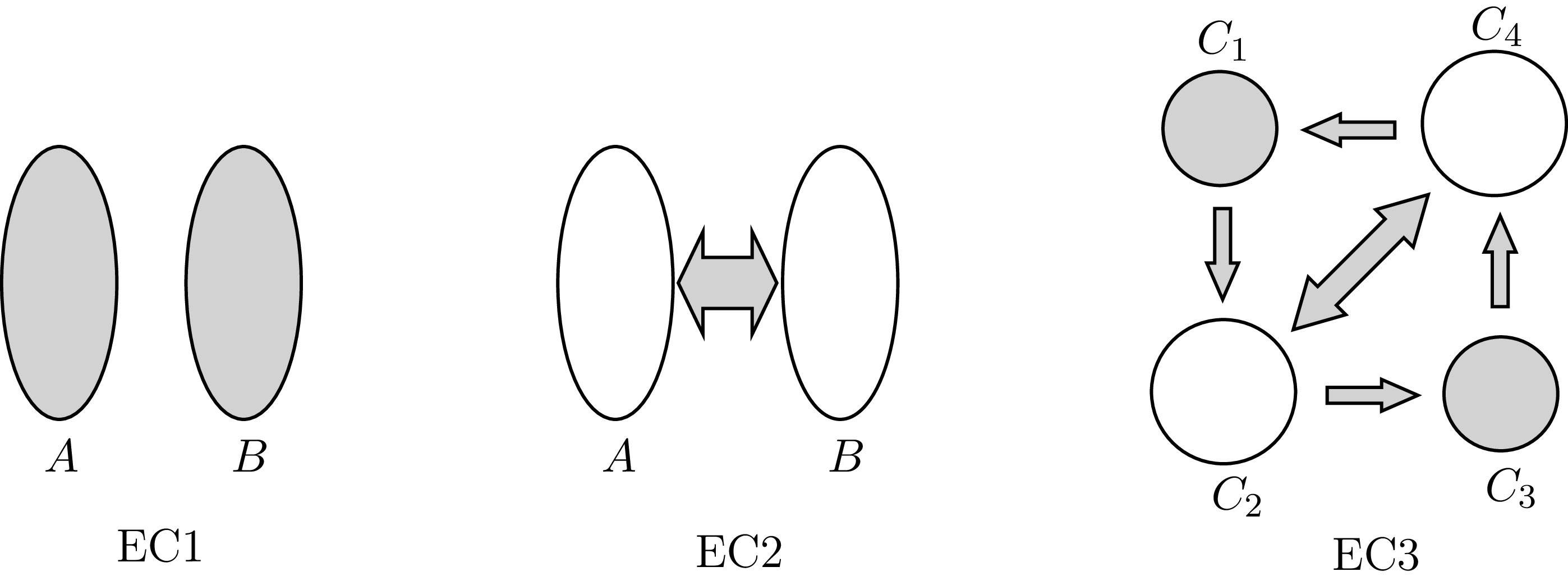
contains a sub-digraph that is close to one of the digraphs in Figure 1. By Lemma 3.2, such a sub-digraph induces a characteristic partition of
$D$
contains a sub-digraph that is close to one of the digraphs in Figure 1. By Lemma 3.2, such a sub-digraph induces a characteristic partition of $D$
; we say that
$D$
; we say that $D$
is
$D$
is $(\epsilon , \mathrm{EC}k)$
-extremal for some
$(\epsilon , \mathrm{EC}k)$
-extremal for some $k \in [3]$
. Furthermore, this
$k \in [3]$
. Furthermore, this $k$
is unique.
$k$
is unique.
Extremal digraphs EC1, EC2, and EC3. The grey shaded elliptical indicates that the digraph induced by this vertex set is complete, the grey shaded arrow between two vertex sets indicates that the induced digraph by them is complete in this direction.

Assume that $\mathcal{D} = \{D_1,\ldots , D_n\}$
is a collection of digraphs with the same vertex set
$\mathcal{D} = \{D_1,\ldots , D_n\}$
is a collection of digraphs with the same vertex set $V$
of size
$V$
of size $n$
. Suppose that
$n$
. Suppose that $\delta ^0(\mathcal{D})\geq (\frac {1}{2}-\epsilon )n$
and
$\delta ^0(\mathcal{D})\geq (\frac {1}{2}-\epsilon )n$
and $\mathcal{D}$
contains no transversal directed Hamilton cycles. We suspect that either almost all digraphs in
$\mathcal{D}$
contains no transversal directed Hamilton cycles. We suspect that either almost all digraphs in $\mathcal{D}$
are
$\mathcal{D}$
are $(\epsilon ,\textrm {EC}k)$
-extremal for some
$(\epsilon ,\textrm {EC}k)$
-extremal for some $k\in [2]$
(allowing
$k\in [2]$
(allowing $k=1$
for some digraphs and
$k=1$
for some digraphs and $k=2$
for others), or almost all digraphs in
$k=2$
for others), or almost all digraphs in $\mathcal{D}$
are
$\mathcal{D}$
are $(\epsilon ,\textrm {EC}3)$
-extremal; moreover those digraphs have similar vertex partitions. Based on this observation, we define two kinds of stability for a digraph collection with minimum degree at least
$(\epsilon ,\textrm {EC}3)$
-extremal; moreover those digraphs have similar vertex partitions. Based on this observation, we define two kinds of stability for a digraph collection with minimum degree at least $(\frac {1}{2}-\epsilon )n$
. We say that
$(\frac {1}{2}-\epsilon )n$
. We say that
-
• $\mathcal{D}$
is strongly stable if
$\mathcal{D}$
contains many digraphs each of which is not
$(\epsilon ,\textrm {EC}k)$
-extremal for any
$k\in [3]$
,
$\mathcal{D}$
is strongly stable if
$\mathcal{D}$
contains many digraphs each of which is not
$(\epsilon ,\textrm {EC}k)$
-extremal for any
$k\in [3]$
, -
•
$\mathcal{D}$
is weakly stable if for almost all colours
$i\in [n]$
, each
$D_i$
is
$(\epsilon ,\textrm { EC}k)$
-extremal for some
$k\in [3]$
, but their vertex partitions are not similar, -
•
$\mathcal{D}$
is stable if it is either strongly stable or weakly stable.


In the stable case, we are to show that if $\mathcal{D}$
is stable, then it contains a transversal directed Hamilton cycle.
$\mathcal{D}$
is stable, then it contains a transversal directed Hamilton cycle.
Step 1. Build an absorbing cycle when $\mathcal{D}$
is stable. (Section 3)
$\mathcal{D}$
is stable. (Section 3)
We build a “directed absorbing rainbow cycle” $C$
for
$C$
for $\mathcal{D}$
with the property that
$\mathcal{D}$
with the property that $C$
is very small and there is a set
$C$
is very small and there is a set $A$
consisting of some colour-vertex-vertex triples
$A$
consisting of some colour-vertex-vertex triples $(c,u,v)$
such that whenever
$(c,u,v)$
such that whenever $A_0\subseteq A$
is sufficiently small compared to
$A_0\subseteq A$
is sufficiently small compared to $|C|$
,
$|C|$
, $C$
can absorb all of its elements. Additionally, we construct an additional auxiliary set
$C$
can absorb all of its elements. Additionally, we construct an additional auxiliary set $\mathcal{Q}$
consisting of colour-colour-vertex-vertex tuples
$\mathcal{Q}$
consisting of colour-colour-vertex-vertex tuples $(c,c',v,v')$
to absorb those colours and vertices which
$(c,c',v,v')$
to absorb those colours and vertices which $C$
cannot. Delete all colours and vertices in
$C$
cannot. Delete all colours and vertices in $C$
and
$C$
and $\mathcal{Q}$
from
$\mathcal{Q}$
from $\mathcal{D}$
.
$\mathcal{D}$
.
Step 2. Use the regularity-blow-up method for transversals in digraph collections to cover almost all vertices and colours with long rainbow directed paths.
We first prove a regularity lemma for digraph collections (Section 2.1), and then apply it to $\mathcal{D}$
, yielding a reduced digraph collection
$\mathcal{D}$
, yielding a reduced digraph collection $\mathcal{R}$
that inherits the minimum degree condition and the stability property of
$\mathcal{R}$
that inherits the minimum degree condition and the stability property of $\mathcal{D}$
. By considering the characteristic bipartite graph of each digraph, we get a bipartite graph collection
$\mathcal{D}$
. By considering the characteristic bipartite graph of each digraph, we get a bipartite graph collection $\mathcal{B_R}$
for the reduced digraph collection
$\mathcal{B_R}$
for the reduced digraph collection $\mathcal{R}$
. Notice that
$\mathcal{R}$
. Notice that $\mathcal{R}$
has a disjoint rainbow directed cycle partition if and only if
$\mathcal{R}$
has a disjoint rainbow directed cycle partition if and only if $\mathcal{B_R}$
has a transversal perfect matching. We establish a stability result for transversal perfect matching in bipartite graph collections (Section 2.2), ensuring that the disjoint rainbow directed cycle partition of
$\mathcal{B_R}$
has a transversal perfect matching. We establish a stability result for transversal perfect matching in bipartite graph collections (Section 2.2), ensuring that the disjoint rainbow directed cycle partition of $\mathcal{R}$
exists. Using the blow-up method, we obtain a set of almost spanning disjoint rainbow directed paths within each directed cycle of
$\mathcal{R}$
exists. Using the blow-up method, we obtain a set of almost spanning disjoint rainbow directed paths within each directed cycle of $\mathcal{R}$
, which covers almost all vertices outside the absorbing cycle
$\mathcal{R}$
, which covers almost all vertices outside the absorbing cycle $C$
and the auxiliary set
$C$
and the auxiliary set $\mathcal{Q}$
(Section 4).
$\mathcal{Q}$
(Section 4).
Step 3. Connect the obtained directed paths and cover the remaining vertices via the absorbing cycle.
In this step, we apply the absorbing property of $C$
as well as the auxiliary set
$C$
as well as the auxiliary set $\mathcal{Q}$
to connect all the directed rainbow paths and to cover the remaining vertices, which ultimately forms a transversal directed Hamilton cycle.
$\mathcal{Q}$
to connect all the directed rainbow paths and to cover the remaining vertices, which ultimately forms a transversal directed Hamilton cycle.
Extremal case (Sections 5–7). Assume that $\delta ^0(\mathcal{D}) \geq \frac {n}{2}$
and
$\delta ^0(\mathcal{D}) \geq \frac {n}{2}$
and $\mathcal{D}$
contains no transversal Hamilton cycles. Let
$\mathcal{D}$
contains no transversal Hamilton cycles. Let $0\lt \frac {1}{n}\ll \epsilon \ll \delta \ll \eta \ll 1$
. Denote
$0\lt \frac {1}{n}\ll \epsilon \ll \delta \ll \eta \ll 1$
. Denote $\mathcal{C}_k\,:\!=\,\{i\in [n]\,:\,D_i\ {\text{is ($\epsilon $,EC$k$)-extremal}}\}$
for
$\mathcal{C}_k\,:\!=\,\{i\in [n]\,:\,D_i\ {\text{is ($\epsilon $,EC$k$)-extremal}}\}$
for $k\in [3]$
and
$k\in [3]$
and $\mathcal{C}_{\textrm {bad}}\,:\!=\,[n]\setminus (\mathcal{C}_1\cup \mathcal{C}_2\cup \mathcal{C}_3)$
. Notice that
$\mathcal{C}_{\textrm {bad}}\,:\!=\,[n]\setminus (\mathcal{C}_1\cup \mathcal{C}_2\cup \mathcal{C}_3)$
. Notice that $\mathcal{C}_i\cap \mathcal{C}_j=\emptyset$
for
$\mathcal{C}_i\cap \mathcal{C}_j=\emptyset$
for $1\leq i\lt j\leq 3$
. By “stable case”, we know that almost all digraphs in
$1\leq i\lt j\leq 3$
. By “stable case”, we know that almost all digraphs in $\mathcal{D}$
are extremal and
$\mathcal{D}$
are extremal and $|\mathcal{C}_1| +|\mathcal{C}_2|\leq 2\sqrt {\delta }n$
if
$|\mathcal{C}_1| +|\mathcal{C}_2|\leq 2\sqrt {\delta }n$
if $|\mathcal{C}_3|\geq 2\sqrt {\delta }n$
. In view of Lemma 3.2, we can fix a characteristic partition
$|\mathcal{C}_3|\geq 2\sqrt {\delta }n$
. In view of Lemma 3.2, we can fix a characteristic partition $({A_i},{B_i},{L_i})$
for each graph
$({A_i},{B_i},{L_i})$
for each graph $D_i$
with
$D_i$
with $i\in \mathcal{C}_1\cup \mathcal{C}_2$
, and a characteristic partition
$i\in \mathcal{C}_1\cup \mathcal{C}_2$
, and a characteristic partition $({C_i^1},C_i^2,C_i^3,C_i^4,L_i)$
for each graph
$({C_i^1},C_i^2,C_i^3,C_i^4,L_i)$
for each graph $D_i$
with
$D_i$
with $i\in \mathcal{C}_3$
. By swapping labels, we know that
$i\in \mathcal{C}_3$
. By swapping labels, we know that $|{A_1}\triangle {A_i}|,|{B_1}\triangle {B_i}|\lt \delta n$
for every
$|{A_1}\triangle {A_i}|,|{B_1}\triangle {B_i}|\lt \delta n$
for every $i\in (\mathcal{C}_1\cup \mathcal{C}_2)\setminus \{1\}$
and
$i\in (\mathcal{C}_1\cup \mathcal{C}_2)\setminus \{1\}$
and $|C_1^k\triangle C_i^k|\lt 2\delta n$
for every
$|C_1^k\triangle C_i^k|\lt 2\delta n$
for every $i\in \mathcal{C}_3\setminus \{1\}$
. We proceed with our proof by considering the sizes of
$i\in \mathcal{C}_3\setminus \{1\}$
. We proceed with our proof by considering the sizes of $|\mathcal{C}_1|$
,
$|\mathcal{C}_1|$
, $|\mathcal{C}_2|$
and
$|\mathcal{C}_2|$
and $|\mathcal{C}_3|$
. We will take the case
$|\mathcal{C}_3|$
. We will take the case $|\mathcal{C}_1|\lt \eta n$
,
$|\mathcal{C}_1|\lt \eta n$
, $|\mathcal{C}_2|\geq \eta n$
and
$|\mathcal{C}_2|\geq \eta n$
and $|\mathcal{C}_3|\leq 2\sqrt {\delta }n$
as an example to illustrate the general idea of our proof.
$|\mathcal{C}_3|\leq 2\sqrt {\delta }n$
as an example to illustrate the general idea of our proof.
Firstly, expand $A_1\cup B_1$
into an equitable partition
$A_1\cup B_1$
into an equitable partition $A\cup B$
of
$A\cup B$
of $V$
. To apply the transversal blow-up lemma (Lemma 6.2) for finding long rainbow directed paths in
$V$
. To apply the transversal blow-up lemma (Lemma 6.2) for finding long rainbow directed paths in $\mathcal{D}$
, we need to ensure most vertices in the partition
$\mathcal{D}$
, we need to ensure most vertices in the partition $A \cup B$
satisfy uniform neighbourhood properties (for example, a vertex
$A \cup B$
satisfy uniform neighbourhood properties (for example, a vertex $v\in A$
should satisfy
$v\in A$
should satisfy $v\in A_i$
for the majority of colours
$v\in A_i$
for the majority of colours $i\in \mathcal{C}_2$
). We identify three vertex types in
$i\in \mathcal{C}_2$
). We identify three vertex types in $A$
(and symmetrically in
$A$
(and symmetrically in $B$
) that may disrupt the desired uniformity:
$B$
) that may disrupt the desired uniformity:
-
Type 1.
$v \in A$
belongs to
$L_i$
for many
$i \in \mathcal{C}_2$
; -
Type 2.
$v \in A$
belongs to
$A_i$
for many
$i \in \mathcal{C}_2$
, and
$v\in B_j$
for many other
$j \in \mathcal{C}_2$
; -
Type 3.
$v \in A$
belongs to nearly all
$B_i$
for
$i \in \mathcal{C}_2$
.


We handle these cases as follows: For Type 3 vertices in $A$
, we move them to
$A$
, we move them to $B$
(and perform the analogous operation for Type 3 vertices in
$B$
(and perform the analogous operation for Type 3 vertices in $B$
). We define
$B$
). We define $V_{\textrm {bad}}$
as the union of vertices of Type 1 and Type 2. After this reallocation, every vertex in
$V_{\textrm {bad}}$
as the union of vertices of Type 1 and Type 2. After this reallocation, every vertex in $A\setminus V_{\textrm {bad}}$
(resp.
$A\setminus V_{\textrm {bad}}$
(resp. $B\setminus V_{\textrm {bad}}$
) lies in
$B\setminus V_{\textrm {bad}}$
) lies in $A_i$
(resp.
$A_i$
(resp. $B_i$
) for the majority of colours
$B_i$
) for the majority of colours $i\in \mathcal{C}_2$
. However, the partition sizes
$i\in \mathcal{C}_2$
. However, the partition sizes $|A|$
and
$|A|$
and $|B|$
may become unbalanced, with their difference bounded by
$|B|$
may become unbalanced, with their difference bounded by $9\delta n$
. To balance them, we require the following four steps.
$9\delta n$
. To balance them, we require the following four steps.
Step 1. Balance the number of vertices in $A$
and
$A$
and $B$
.
$B$
.
If there exists a set of disjoint rainbow paths in $\mathcal{D}[B]$
such that after deleting their vertices, the number of vertices in
$\mathcal{D}[B]$
such that after deleting their vertices, the number of vertices in $A$
and
$A$
and $B$
is balanced, then we are done. Otherwise, we will show that
$B$
is balanced, then we are done. Otherwise, we will show that $\mathcal{D}$
must contain a transversal directed Hamilton cycle (see Lemma 6.5).
$\mathcal{D}$
must contain a transversal directed Hamilton cycle (see Lemma 6.5).
Step 2. Cover vertices in $V_{\textrm {bad}}$
.
$V_{\textrm {bad}}$
.
Using colours in $\mathcal{C}_2$
, we are to find a sequence of disjoint rainbow directed paths
$\mathcal{C}_2$
, we are to find a sequence of disjoint rainbow directed paths $P_3$
such that their centres are all vertices in
$P_3$
such that their centres are all vertices in $V_{\textrm {bad}}$
and endpoints are unused vertices in
$V_{\textrm {bad}}$
and endpoints are unused vertices in $(A\cup B)\setminus V_{\textrm {bad}}$
.
$(A\cup B)\setminus V_{\textrm {bad}}$
.
Step 3. Deal with colours in $\mathcal{C}_{\textrm {bad}}\cup \mathcal{C}_3$
.
$\mathcal{C}_{\textrm {bad}}\cup \mathcal{C}_3$
.
Choose a maximal rainbow matching $M$
using colours in
$M$
using colours in $\mathcal{C}_{\textrm {bad}}$
and avoiding vertices used in Steps 1-2. It is routine to verify that for each
$\mathcal{C}_{\textrm {bad}}$
and avoiding vertices used in Steps 1-2. It is routine to verify that for each $j \in (\mathcal{C}_{\textrm {bad}}\cup \mathcal{C}_3)\setminus \textrm {col}(M)$
, the graph
$j \in (\mathcal{C}_{\textrm {bad}}\cup \mathcal{C}_3)\setminus \textrm {col}(M)$
, the graph $D_{j}$
is EC1-extremal.
$D_{j}$
is EC1-extremal.
Step 4. Deal with colours in $(\mathcal{C}_{1}\cup \mathcal{C}_{\textrm {bad}}\cup \mathcal{C}_3)\setminus \textrm {col}(M)$
.
$(\mathcal{C}_{1}\cup \mathcal{C}_{\textrm {bad}}\cup \mathcal{C}_3)\setminus \textrm {col}(M)$
.
We greedily select two rainbow directed paths using colours from $(\mathcal{C}_{1}\cup \mathcal{C}_{\textrm { bad}}\cup \mathcal{C}_3)\setminus \textrm {col}(M)$
while avoiding the vertices used in the previous three steps.
$(\mathcal{C}_{1}\cup \mathcal{C}_{\textrm { bad}}\cup \mathcal{C}_3)\setminus \textrm {col}(M)$
while avoiding the vertices used in the previous three steps.
Based on the minimum degree condition and the characteristic partition of extremal digraphs, one may use colours in $\mathcal{C}_2$
to connect all rainbow paths obtained in the above four steps into a single short rainbow directed path, say
$\mathcal{C}_2$
to connect all rainbow paths obtained in the above four steps into a single short rainbow directed path, say $P$
, such that
$P$
, such that $V_{\textrm {bad}}\subseteq V(P)$
,
$V_{\textrm {bad}}\subseteq V(P)$
, $\mathcal{C}_1\cup \mathcal{C}_3\cup \mathcal{C}_{\textrm {bad}}\subseteq \textrm {col}(P)$
and
$\mathcal{C}_1\cup \mathcal{C}_3\cup \mathcal{C}_{\textrm {bad}}\subseteq \textrm {col}(P)$
and $|A\setminus V(P)|$
and
$|A\setminus V(P)|$
and $|B\setminus V(P)|$
are nearly equal. By applying the transversal blow-up lemma and some structural analysis, we obtain that
$|B\setminus V(P)|$
are nearly equal. By applying the transversal blow-up lemma and some structural analysis, we obtain that $\mathcal{D}$
contains a transversal directed Hamilton cycle.
$\mathcal{D}$
contains a transversal directed Hamilton cycle.
2. Preliminaries
2.1 Regularity for digraph collections
We use the following version of the regularity lemma for digraph collections, which is obtained by applying the degree version of the weak regularity lemma to the 4-graph of $\mathcal{D}$
. The proofs of Lemmas 2.2 and 2.4 are postponed to the appendix. We begin by defining regularity for digraph collections.
$\mathcal{D}$
. The proofs of Lemmas 2.2 and 2.4 are postponed to the appendix. We begin by defining regularity for digraph collections.
Definition 2.1.
Suppose that $\mathcal{D}=\{D_c\,:\,c\in \mathcal{C}\}$
is a collection of bipartite digraphs on a common vertex partition
$\mathcal{D}=\{D_c\,:\,c\in \mathcal{C}\}$
is a collection of bipartite digraphs on a common vertex partition $V_1\cup V_2$
. We say that
$V_1\cup V_2$
. We say that $\mathcal{D}$
is
$\mathcal{D}$
is $(\epsilon ,d)$
-regular if whenever
$(\epsilon ,d)$
-regular if whenever $V_i'\subseteq V_i$
with
$V_i'\subseteq V_i$
with $|V_i'|\geq \epsilon |V_i|$
for
$|V_i'|\geq \epsilon |V_i|$
for $i\in [2]$
and
$i\in [2]$
and $\mathcal{C}'\subseteq \mathcal{C}$
with
$\mathcal{C}'\subseteq \mathcal{C}$
with $|\mathcal{C}'|\geq \epsilon |\mathcal{C}|$
we have
$|\mathcal{C}'|\geq \epsilon |\mathcal{C}|$
we have
 \begin{equation*} \left |\frac {\sum _{c\in \mathcal{C}'}e_{D_c}(V_1',V_2')}{|\mathcal{C}'||V_1'||V_2'|}-\frac {\sum _{c\in \mathcal{C}}e_{D_c}(V_1,V_2)}{|\mathcal{C}||V_1||V_2|}\right |\lt \epsilon \end{equation*}
and $\sum _{c\in \mathcal{C}}e_{D_c}(V_1,V_2)\geq d|\mathcal{C}||V_1||V_2|$
.
$\sum _{c\in \mathcal{C}}e_{D_c}(V_1,V_2)\geq d|\mathcal{C}||V_1||V_2|$
.
Lemma 2.2 (Regularity lemma for digraph collections). For every integer $L_0\geq 1$
and every
$L_0\geq 1$
and every $\epsilon ,\delta \gt 0$
, there is an integer
$\epsilon ,\delta \gt 0$
, there is an integer $n_0\,:\!=\,n_0(\epsilon ,\delta ,L_0)$
such that for every
$n_0\,:\!=\,n_0(\epsilon ,\delta ,L_0)$
such that for every $d\in [0,1)$
and every digraph collection
$d\in [0,1)$
and every digraph collection $\mathcal{D}=\{D_i\,:\,i\in \mathcal{C}\}$
on vertex set
$\mathcal{D}=\{D_i\,:\,i\in \mathcal{C}\}$
on vertex set $V$
of size
$V$
of size $n\geq n_0$
with
$n\geq n_0$
with $\delta n\leq |\mathcal{C}|\leq \frac {n}{\delta }$
, there exists a partition of
$\delta n\leq |\mathcal{C}|\leq \frac {n}{\delta }$
, there exists a partition of $V$
into
$V$
into $V_0,V_1,\ldots ,V_L$
, of
$V_0,V_1,\ldots ,V_L$
, of $\mathcal{C}$
into
$\mathcal{C}$
into $\mathcal{C}_0,\mathcal{C}_1,\ldots ,\mathcal{C}_M$
and a spanning sub-digraph
$\mathcal{C}_0,\mathcal{C}_1,\ldots ,\mathcal{C}_M$
and a spanning sub-digraph $D_c'$
of
$D_c'$
of $D_c$
for each
$D_c$
for each $c\in \mathcal{C}$
satisfying the following properties:
$c\in \mathcal{C}$
satisfying the following properties:
-
(i)
$L_0\lt L,M\lt n_0$
and
$|V_0|+|\mathcal{C}_0|\leq \epsilon n$
, -
(ii)
$|V_1|=\cdots =|V_L|=|\mathcal{C}_1|=\cdots =|\mathcal{C}_M|\,=\!:\,m$
, -
(iii)
$\sum _{c\in \mathcal{C}}d_{D_c'}^+(v)\geq \sum _{c\in \mathcal{C}}d_{D_c}^+(v)-(\frac {24d}{\delta ^3}+\epsilon )n^2$
and
$\sum _{c\in \mathcal{C}}d_{D_c'}^-(v)\geq \sum _{c\in \mathcal{C}}d_{D_c}^-(v)-(\frac {24d}{\delta ^3}+\epsilon )n^2$
for all
$v\in V$
, and
$e(D_c')\geq e(D_c)-(\frac {24d}{\delta ^3}+\epsilon )n^2$
for all
$c\in \mathcal{C}$
, -
(iv) if for each
$c\in \mathcal{C}$
, the digraph
$D_c'$
has an edge with both end vertices in a single cluster
$V_i$
for some
$i\in [L]$
, then
$c\in \mathcal{C}_0$
, -
(v) for all triples
$\{(h,i),j\}\in \binom {[L]}{2}\times [M]$
, we have either
$D_c'[V_h,V_i]=\emptyset$
for all
$c\in \mathcal{C}_j$
, or
$\mathcal{D}_{hi,j}'\,:\!=\,\{D_c'[V_h,V_i]\,:\,c\in \mathcal{C}_j\}$
is
$(\epsilon ,d)$
-regular.





The sets $V_i$
are called vertex clusters and the sets
$V_i$
are called vertex clusters and the sets $\mathcal{C}_i$
are called colour clusters, while
$\mathcal{C}_i$
are called colour clusters, while $V_0$
and
$V_0$
and $\mathcal{C}_0$
are the exceptional vertex and colour sets respectively. Now, we define the reduced digraph collection.
$\mathcal{C}_0$
are the exceptional vertex and colour sets respectively. Now, we define the reduced digraph collection.
Definition 2.3 (Reduced digraph collection). Given a digraph collection $\mathcal{D}=\{D_i\,:\,i\in \mathcal{C}\}$
on
$\mathcal{D}=\{D_i\,:\,i\in \mathcal{C}\}$
on $V$
and parameters
$V$
and parameters $\epsilon \gt 0$
,
$\epsilon \gt 0$
, $d\in [0,1)$
and
$d\in [0,1)$
and $L_0\geq 1$
, the reduced digraph collection
$L_0\geq 1$
, the reduced digraph collection $\mathcal{R}\,:\!=\,\mathcal{R}(\epsilon ,d,L_0)$
of
$\mathcal{R}\,:\!=\,\mathcal{R}(\epsilon ,d,L_0)$
of $\mathcal{D}$
is defined as follows. Apply Lemma 2.2 to
$\mathcal{D}$
is defined as follows. Apply Lemma 2.2 to $\mathcal{D}$
with parameters
$\mathcal{D}$
with parameters $\epsilon , \delta , d, L_0$
to obtain
$\epsilon , \delta , d, L_0$
to obtain $\mathcal{D}'$
, a partition
$\mathcal{D}'$
, a partition $V_0,V_1,\ldots ,V_L$
of
$V_0,V_1,\ldots ,V_L$
of $V$
, and a partition
$V$
, and a partition $\mathcal{C}_0,\mathcal{C}_1,\ldots ,\mathcal{C}_M$
of
$\mathcal{C}_0,\mathcal{C}_1,\ldots ,\mathcal{C}_M$
of $\mathcal{C}$
, where
$\mathcal{C}$
, where $V_0, \mathcal{C}_0$
are the exceptional sets and
$V_0, \mathcal{C}_0$
are the exceptional sets and $V_1,\ldots ,V_L$
are the vertex clusters and
$V_1,\ldots ,V_L$
are the vertex clusters and $\mathcal{C}_1,\ldots ,\mathcal{C}_M$
are the colour clusters. Then
$\mathcal{C}_1,\ldots ,\mathcal{C}_M$
are the colour clusters. Then $\mathcal{R}\,:\!=\,\{R_1,\ldots ,R_M\}$
is a digraph collection of
$\mathcal{R}\,:\!=\,\{R_1,\ldots ,R_M\}$
is a digraph collection of $M$
digraphs each on the same vertex set
$M$
digraphs each on the same vertex set $[L]$
, where, for
$[L]$
, where, for $\{(h,i),j\}\in \binom {[L]}{2}\times [M]$
, we have
$\{(h,i),j\}\in \binom {[L]}{2}\times [M]$
, we have ${hi}\in R_j$
if and only if
${hi}\in R_j$
if and only if $\mathcal{D}_{hi,j}'$
is
$\mathcal{D}_{hi,j}'$
is $(\epsilon ,d)$
-regular.
$(\epsilon ,d)$
-regular.
The next lemma states that clusters inherit a minimum semi-degree bound in the reduced digraph collection.
Lemma 2.4 (Degree inheritance). Suppose $L_0\geq 1$
and
$L_0\geq 1$
and $0\lt \frac {1}{n}\ll \epsilon \leq d\ll \delta ,\gamma ,p\leq 1$
. Let
$0\lt \frac {1}{n}\ll \epsilon \leq d\ll \delta ,\gamma ,p\leq 1$
. Let $\mathcal{D}=\{D_i\,:\,i\in \mathcal{C}\}$
be a digraph collection on vertex set
$\mathcal{D}=\{D_i\,:\,i\in \mathcal{C}\}$
be a digraph collection on vertex set $V$
of size
$V$
of size $n$
with
$n$
with $\delta ^0(\mathcal{D})\geq (p+\gamma )n$
and
$\delta ^0(\mathcal{D})\geq (p+\gamma )n$
and $\delta n\leq |\mathcal{C}|\leq \frac {n}{\delta }$
. Let
$\delta n\leq |\mathcal{C}|\leq \frac {n}{\delta }$
. Let $\mathcal{R}\,:\!=\,\mathcal{R}(\epsilon ,d,L_0)$
be the reduced digraph collection of
$\mathcal{R}\,:\!=\,\mathcal{R}(\epsilon ,d,L_0)$
be the reduced digraph collection of $\mathcal{D}$
consisting of
$\mathcal{D}$
consisting of $M$
digraphs on a common vertex set
$M$
digraphs on a common vertex set $[L]$
. Then
$[L]$
. Then
-
(i) for every
$i\in [L]$
, there are at least
$(1-d^{\frac {1}{4}})M$
colours
$j\in [M]$
for which
$d_{R_j}^+(i)\geq (p+\frac {\gamma }{2})L$
and
$d_{R_j}^-(i)\geq (p+\frac {\gamma }{2})L$
, -
(ii) for every
$j\in [M]$
, there are at least
$(1-d^{\frac {1}{4}})L$
vertices
$i\in [L]$
for which
$d_{R_j}^+(i)\geq (p+\frac {\gamma }{2})L$
and
$d_{R_j}^-(i)\geq (p+\frac {\gamma }{2})L$
.


Proof. (i) Choose a vertex $v\in V\setminus V_0$
. By Lemma 2.2 (i) and (iii), we have
$v\in V\setminus V_0$
. By Lemma 2.2 (i) and (iii), we have
 \begin{equation*} \sum _{c\in \mathcal{C}}d_{D_c'-V_0}^+(v)\geq \sum _{c\in \mathcal{C}}d_{D_c}^+(v)-\left (\frac {24d}{\delta ^3}+\epsilon \right )n^2-\epsilon n|\mathcal{C}|\geq \sum _{c\in \mathcal{C}}d_{D_c}^+(v)-\frac {26dn^2}{\delta ^3}. \end{equation*}
Let $\mathcal{D}_v\,:\!=\,\left \{c\in \mathcal{C}\setminus \mathcal{C}_0\,:\,d_{D_c'-V_0}^+(v)\geq d_{D_c}^+(v)-\sqrt {d}n\right \}$
. Then
$\mathcal{D}_v\,:\!=\,\left \{c\in \mathcal{C}\setminus \mathcal{C}_0\,:\,d_{D_c'-V_0}^+(v)\geq d_{D_c}^+(v)-\sqrt {d}n\right \}$
. Then
 \begin{equation*} \sum _{c\in \mathcal{C}\setminus \mathcal{C}_0}d_{D_c'-V_0}^+(v)\leq \sum _{c\in \mathcal{C}\setminus \mathcal{C}_0}d_{D_c}^+(v)-\sqrt {d}n |\mathcal{C}\setminus (\mathcal{C}_0\cup \mathcal{D}_v)|. \end{equation*}
Therefore, $|\mathcal{C}\setminus (\mathcal{C}_0\cup \mathcal{D}_v)|\leq \frac {d^{\frac {1}{3}}n}{2}$
since
$|\mathcal{C}\setminus (\mathcal{C}_0\cup \mathcal{D}_v)|\leq \frac {d^{\frac {1}{3}}n}{2}$
since $d\ll \delta$
. It follows that
$d\ll \delta$
. It follows that $|\mathcal{D}_v|\geq |\mathcal{C}|-\frac {d^{\frac {1}{3}}n}{2}-\epsilon n\geq |\mathcal{C}|-d^{\frac {1}{3}}n$
. Recall that
$|\mathcal{D}_v|\geq |\mathcal{C}|-\frac {d^{\frac {1}{3}}n}{2}-\epsilon n\geq |\mathcal{C}|-d^{\frac {1}{3}}n$
. Recall that $mM\leq |\mathcal{C}|\leq mM+\epsilon n$
and
$mM\leq |\mathcal{C}|\leq mM+\epsilon n$
and $mL\leq n\leq mL+\epsilon n$
. Together with
$mL\leq n\leq mL+\epsilon n$
. Together with $\delta n\leq |\mathcal{C}|\leq \frac {n}{\delta }$
, one has
$\delta n\leq |\mathcal{C}|\leq \frac {n}{\delta }$
, one has $\delta L\leq 2(1-\epsilon )M$
. Hence the number of colour clusters
$\delta L\leq 2(1-\epsilon )M$
. Hence the number of colour clusters $\mathcal{C}_j$
containing at least one colour of
$\mathcal{C}_j$
containing at least one colour of $\mathcal{D}_v$
is at least
$\mathcal{D}_v$
is at least
 \begin{equation*} \frac {|\mathcal{D}_v|}{m}\geq M-\frac {d^{\frac {1}{3}}n}{m}\geq M-\frac {d^{\frac {1}{3}}L}{1-\epsilon }\geq M-\frac {2d^{\frac {1}{3}}M}{\delta }\geq \bigg(1-\frac {d^{\frac {1}{4}}}{2}\bigg )M. \end{equation*}
Now let $i\in [L]$
and
$i\in [L]$
and $v\in V_i$
. For each cluster
$v\in V_i$
. For each cluster $\mathcal{C}_j$
as above, choose an arbitrary colour
$\mathcal{C}_j$
as above, choose an arbitrary colour $c_j\in \mathcal{C}_j\cap \mathcal{D}_v$
. Thus, the number of vertex clusters
$c_j\in \mathcal{C}_j\cap \mathcal{D}_v$
. Thus, the number of vertex clusters $V_h$
containing some vertices in
$V_h$
containing some vertices in $N_{D_{c_j}'}^+(v)$
is at least
$N_{D_{c_j}'}^+(v)$
is at least
 \begin{equation*} \frac {d_{D_{c_j}}^+(v)-\sqrt {d}n}{m}\geq \frac {(p+\gamma -\sqrt {d})n}{m}\geq \left (p+\frac {\gamma }{2}\right )L. \end{equation*}
Lemma 2.2 (v) implies that $i$
is adjacent to each such
$i$
is adjacent to each such $V_h$
in
$V_h$
in $R_j$
. Therefore, for every
$R_j$
. Therefore, for every $i\in [L]$
,
$i\in [L]$
,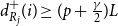 $d_{R_j}^+(i)\geq (p+\frac {\gamma }{2})L$
for at least
$d_{R_j}^+(i)\geq (p+\frac {\gamma }{2})L$
for at least $(1-\frac {d^{\frac {1}{4}}}{2})M$
colours
$(1-\frac {d^{\frac {1}{4}}}{2})M$
colours $j$
. The proofs of other cases are similar and we omit the proof.
$j$
. The proofs of other cases are similar and we omit the proof.
2.2 Transversal perfect matching in bipartite graph collections
In the study of digraphs, a natural approach is to consider their characteristic bipartite graphs. This subsection introduces the corresponding characteristic bipartite graph collection associated with a digraph system, and studies the existence of transversal perfect matchings in this bipartite system.
Let $D$
be a digraph with vertex set
$D$
be a digraph with vertex set $V$
. We define
$V$
. We define $B_D$
to be the characteristic bipartite graph of
$B_D$
to be the characteristic bipartite graph of $D$
with bipartition
$D$
with bipartition $V_1\cup V_2$
where
$V_1\cup V_2$
where $V_1=V_2=V$
; for each
$V_1=V_2=V$
; for each $u\in V_1$
and
$u\in V_1$
and $v\in V_2$
,
$v\in V_2$
, $uv\in E(B_D)$
if and only if
$uv\in E(B_D)$
if and only if $uv\in E(D)$
. Let
$uv\in E(D)$
. Let $\mathcal{D}=\{D_1,\ldots ,D_n\}$
be a collection of digraphs on a common vertex set
$\mathcal{D}=\{D_1,\ldots ,D_n\}$
be a collection of digraphs on a common vertex set $V$
. Define the characteristic bipartite graph collection of
$V$
. Define the characteristic bipartite graph collection of $\mathcal{D}$
to be
$\mathcal{D}$
to be $\mathcal{B_D}=\{B_{D_1},\ldots ,B_{D_n}\}$
. A matching in a (di)graph
$\mathcal{B_D}=\{B_{D_1},\ldots ,B_{D_n}\}$
. A matching in a (di)graph $G$
is a collection of vertex-disjoint edges
$G$
is a collection of vertex-disjoint edges $M\subseteq E(G)$
. We say that
$M\subseteq E(G)$
. We say that $M$
is a perfect matching if
$M$
is a perfect matching if $V(M) = V(G)$
.
$V(M) = V(G)$
.
It is straightforward to check that $\mathcal{B_D}$
contains a transversal perfect matching if and only if the vertex set of
$\mathcal{B_D}$
contains a transversal perfect matching if and only if the vertex set of $\mathcal{D}$
can be covered by a set of disjoint rainbow cycles inside
$\mathcal{D}$
can be covered by a set of disjoint rainbow cycles inside $\mathcal{D}$
. Therefore, in the remainder of this section, we are to find a transversal perfect matching in a bipartite graph collection.
$\mathcal{D}$
. Therefore, in the remainder of this section, we are to find a transversal perfect matching in a bipartite graph collection.
Joos and Kim [Reference Joos and Kim21] established a minimum degree condition that guarantees the existence of transversal perfect matchings in a graph collection. Bradshaw [Reference Bradshaw5] proved the analogue result in bipartite graph collections, which can be stated as follows.
Theorem 2.5 ([Reference Bradshaw5]). Let $\mathcal{G}=\{G_1,\ldots ,G_n\}$
be a collection of bipartite graphs on a common vertex bipartition
$\mathcal{G}=\{G_1,\ldots ,G_n\}$
be a collection of bipartite graphs on a common vertex bipartition $V_1\cup V_2$
with
$V_1\cup V_2$
with $|V_1|=|V_2|=n$
. If for each
$|V_1|=|V_2|=n$
. If for each $i\in [n]$
we have the following hold:
$i\in [n]$
we have the following hold:
-
(i)
$d_{G_i}(v)\gt \frac {n}{2}$
for each
$v\in V_1$
, -
(ii)
$d_{G_i}(v)\geq \frac {n}{2}$
for each
$v\in V_2$
,


then $\mathcal{G}$
contains a transversal perfect matching.
$\mathcal{G}$
contains a transversal perfect matching.
In this subsection, we establish a stability result for transversal perfect matching in bipartite graph collections, that is, the minimum degree required to guarantee a transversal perfect matching can be below that of Theorem2.5, as long as the bipartite graph collection $\{G_1,\ldots ,G_n\}$
is far in edit distance from several extremal cases. For this, we first define the extremality for a single bipartite graph.
$\{G_1,\ldots ,G_n\}$
is far in edit distance from several extremal cases. For this, we first define the extremality for a single bipartite graph.
Definition 2.6 (nice, extremal). Let $\epsilon \gt 0$
and
$\epsilon \gt 0$
and $G$
be a balanced bipartite graph on the vertex set
$G$
be a balanced bipartite graph on the vertex set $V_1\cup V_2$
of size
$V_1\cup V_2$
of size $2n$
. We say that
$2n$
. We say that
-
•
$G$
is
$\epsilon$
-nice if for any two sets
$A\subseteq V_1$
and
$B\subseteq V_2$
of size at least
$(\frac {1}{2}-\epsilon )n$
we have
$e_G(A,B)\geq \epsilon n^2$
; -
•
$G$
is
$\epsilon$
-extremal if it is not
$\epsilon ^5$
-nice.


The following lemma is the basis for our proof.
Lemma 2.7.
Suppose that $0\lt \frac {1}{n}\ll d\ll \epsilon \leq 1$
. Let
$0\lt \frac {1}{n}\ll d\ll \epsilon \leq 1$
. Let $G$
be a balanced bipartite graph on a vertex set
$G$
be a balanced bipartite graph on a vertex set $V=V_1\cup V_2$
of size
$V=V_1\cup V_2$
of size $2n$
with
$2n$
with $d_{G}(x)\geq (\frac {1}{2}-\epsilon ^5)n$
for all but at most
$d_{G}(x)\geq (\frac {1}{2}-\epsilon ^5)n$
for all but at most $dn$
vertices
$dn$
vertices $x\in V$
which is
$x\in V$
which is $\epsilon$
-extremal. Then there is a characteristic partition
$\epsilon$
-extremal. Then there is a characteristic partition $(A_1, B_1, A_2, B_2, C_1, C_2)$
of
$(A_1, B_1, A_2, B_2, C_1, C_2)$
of $G$
such that the following hold:
$G$
such that the following hold:
-
(i)
$A_i, B_i, C_i\subseteq V_i$
,
$|A_i|=|B_i|=(\frac {1}{2}-\epsilon )n$
and
$|C_i|=2\epsilon n$
for each
$i\in [2]$
, -
(ii)
$d_G(v, X_i)\geq (\frac {1}{2}-2\epsilon )n$
for
$X\in \{A, B\}$
and
$v\in X_{3-i}$
with
$i\in [2]$
, -
(iii) either
$e_G(A_1, B_2)\leq \epsilon n^2$
or
$e_G(A_2, B_1)\leq \epsilon n^2$
.


Definition 2.8 (crossing, cross graph). Let $0\lt \frac {1}{n},\epsilon ,\delta \lt 1$
where
$0\lt \frac {1}{n},\epsilon ,\delta \lt 1$
where $n\in \mathbb{N}$
and let
$n\in \mathbb{N}$
and let $\mathcal{G}=\{G_1,\ldots ,G_n\}$
be a balanced bipartite graph collection on a common vertex set
$\mathcal{G}=\{G_1,\ldots ,G_n\}$
be a balanced bipartite graph collection on a common vertex set $V$
of size
$V$
of size $2n$
. Given
$2n$
. Given $i,j\in [n]$
such that
$i,j\in [n]$
such that $G_i$
and
$G_i$
and $G_j$
are both
$G_j$
are both $\epsilon$
-extremal, assume that the characteristic partition corresponding to
$\epsilon$
-extremal, assume that the characteristic partition corresponding to $G_{\ell }$
is
$G_{\ell }$
is $(A_1^{\ell },B_1^{\ell },C_1^{\ell },A_2^{\ell },B_2^{\ell },C_2^{\ell })$
for
$(A_1^{\ell },B_1^{\ell },C_1^{\ell },A_2^{\ell },B_2^{\ell },C_2^{\ell })$
for $\ell \in \{i, j\}$
. We say that they are
$\ell \in \{i, j\}$
. We say that they are $\delta$
-crossing if
$\delta$
-crossing if $|A^i_1\triangle A^j_1|\geq \delta n$
and
$|A^i_1\triangle A^j_1|\geq \delta n$
and $|A^i_1\triangle B^j_1|\geq \delta n$
.
$|A^i_1\triangle B^j_1|\geq \delta n$
.
We define the cross graph $C_{\mathcal{G}}^{\epsilon ,\delta }$
to be the graph with vertex set
$C_{\mathcal{G}}^{\epsilon ,\delta }$
to be the graph with vertex set $[n]$
where
$[n]$
where $i$
is adjacent to
$i$
is adjacent to $j$
if and only if
$j$
if and only if $G_i$
and
$G_i$
and $G_j$
are both
$G_j$
are both $\epsilon$
-extremal and
$\epsilon$
-extremal and $\delta$
-crossing.
$\delta$
-crossing.
Definition 2.9 (strongly stable, weakly stableFootnote
1
). Let $0\lt \gamma ,\alpha ,\epsilon ,\delta \lt 1$
. Suppose that
$0\lt \gamma ,\alpha ,\epsilon ,\delta \lt 1$
. Suppose that $\mathcal{G}=\{G_1,\ldots , G_n\}$
is a collection of bipartite graphs on a common vertex partition
$\mathcal{G}=\{G_1,\ldots , G_n\}$
is a collection of bipartite graphs on a common vertex partition $V_1\cup V_2$
with
$V_1\cup V_2$
with $|V_1|=|V_2|=n$
. We say that
$|V_1|=|V_2|=n$
. We say that
-
•
$\mathcal{G}$
is
$(\gamma ,\alpha )$
-strongly stable if
$G_i$
is
$\alpha$
-nice for at least
$\gamma n$
colours
$i\in [n]$
; -
•
$\mathcal{G}$
is
$(\epsilon ,\delta )$
-weakly stable if
$e(C_{\mathcal{G}}^{\epsilon ,\delta })\geq \delta n^2$
; -
•
$\mathcal{G}$
is
$(\gamma ,\alpha ,\epsilon ,\delta )$
-stable if it is either
$(\gamma ,\alpha )$
-strongly stable or
$(\epsilon ,\delta )$
-weakly stable.


The following is a stability result for transversal perfect matching in bipartite graph collections.
Theorem 2.10.
Let $0\lt \frac {1}{n}\ll d\ll \mu \ll \alpha \ll \gamma ,\epsilon \ll \delta \ll 1$
. Suppose that
$0\lt \frac {1}{n}\ll d\ll \mu \ll \alpha \ll \gamma ,\epsilon \ll \delta \ll 1$
. Suppose that $\mathcal{G}=\{G_1,\ldots ,G_n\}$
is a collection of bipartite graphs on a common vertex partition
$\mathcal{G}=\{G_1,\ldots ,G_n\}$
is a collection of bipartite graphs on a common vertex partition $V=V_1\cup V_2$
with
$V=V_1\cup V_2$
with $|V_1|=|V_2|=n$
. If the following hold:
$|V_1|=|V_2|=n$
. If the following hold:
-
•
$\mathcal{G}$
is
$(\gamma ,\alpha ,\epsilon ,\delta )$
-stable,
-
• for every
$i\in [n]$
,
$d_{G_i}(x)\geq \left (\frac {1}{2}-\mu \right )n$
for all but at most
$dn$
vertices
$x\in V_1\cup V_2$
, -
• for every
$x\in V_1\cup V_2$
,
$d_{G_i}(x)\geq \left (\frac {1}{2}-\mu \right )n$
for all but at most
$dn$
colours
$i\in [n]$
,


then $\mathcal{G}$
contains a transversal perfect matching.
$\mathcal{G}$
contains a transversal perfect matching.
For convenience, we postpone the proofs of Lemma 2.7 and Theorem2.10 to the appendix.
2.3 Probabilistic tool
We use the following version of Chernoff’s bound.
Lemma 2.11.
Let $X$
be a random variable with binomial or hypergeometric distribution, and let
$X$
be a random variable with binomial or hypergeometric distribution, and let $0\lt \epsilon \lt \frac {3}{2}$
. Then
$0\lt \epsilon \lt \frac {3}{2}$
. Then
 \begin{equation*} \mathbb{P}[|X-\mathbb{E}(X)|\geq \epsilon \mathbb{E}(X)]\leq 2e^{-\frac {\epsilon ^2}{3}\mathbb{E}(X)}. \end{equation*}
3. Absorbing
In this section, we first define the extremality for a single digraph and distinguish the characteristic partition of such digraphs. We then introduce our absorbing structure and prove that every digraph collection contains a directed absorbing cycle whenever either a large proportion of its members are non-extremal, or almost all of them are extremal while their characteristic partitions differ significantly.
Definition 3.1 (nice, extremal). Let $\epsilon \gt 0$
and
$\epsilon \gt 0$
and $D$
be a digraph on vertex set
$D$
be a digraph on vertex set $V$
of size
$V$
of size $n$
. We say that
$n$
. We say that
-
•
$D$
is
$\epsilon$
-nice if for any two sets
$A,B\subseteq V$
of size at least
$(\frac {1}{2}-\epsilon )n$
, we have
$e_D(A,B)\geq \epsilon n^2$
; -
•
$D$
is
$\epsilon$
-extremal if it is not
$\epsilon$
-nice.


Cheng, Wang and Yan [Reference Cheng, Wang and Yan13] characterised the structure of $\epsilon$
-extremal digraphs, which forms the basis of our extremal case distinction.
$\epsilon$
-extremal digraphs, which forms the basis of our extremal case distinction.
Lemma 3.2 ([Reference Cheng, Wang and Yan13]). Suppose that $0\lt \frac {1}{n}\ll d\ll \mu \ll \epsilon \leq 1$
. Let
$0\lt \frac {1}{n}\ll d\ll \mu \ll \epsilon \leq 1$
. Let $D$
be an
$D$
be an $\epsilon$
-extremal digraph on vertex set
$\epsilon$
-extremal digraph on vertex set $V$
of size
$V$
of size $n$
with
$n$
with $\min \{d^+(x),d^-(x)\}\geq (\frac {1}{2}-\mu )n$
for all but at most
$\min \{d^+(x),d^-(x)\}\geq (\frac {1}{2}-\mu )n$
for all but at most $dn$
vertices
$dn$
vertices $x\in V$
. Then exactly one of the following holds:
$x\in V$
. Then exactly one of the following holds:
-
(i) there is a partition
$A\cup B\cup L$
of
$V$
such that
$|A|=|B|=(\frac {1}{2}-\epsilon )n$
,
$d^+(a,{A}),d^-(a,{A})\geq (\frac {1}{2}-2\epsilon )n$
for all
$a\in {A}$
,
$d^+(b,{B}),d^-(b,B)\geq (\frac {1}{2}-2\epsilon )n$
for all
$b\in {B}$
and either
$e(A,B)\leq \epsilon n^2$
or
$e(B,A)\leq \epsilon n^2$
; here we say
$D$
is
$(\epsilon ,\textrm {EC}1)$
-extremal,
-
(ii) there is a partition
$A\cup B\cup L$
of
$V$
such that
$|A|=|B|=(\frac {1}{2}-\epsilon )n$
,
$d^+(a,B),d^-(a,B)\geq (\frac {1}{2}-2\epsilon )n$
for all
$a\in {A}$
,
$d^+(b,A),d^-(b,A)\geq (\frac {1}{2}-2\epsilon )n$
for all
$b\in {B}$
and either
$e(A)\leq \epsilon n^2$
or
$e(B)\leq \epsilon n^2$
; here we say
$D$
is
$(\epsilon ,\textrm {EC}2)$
-extremal,
-
(iii) there is a constant
$\zeta$
with
$\epsilon ^{1/3}\leq \zeta \leq \frac {1}{2}-\epsilon -\epsilon ^{1/3}$
and a partition
$C_1\cup C_2\cup C_3\cup C_4\cup L$
of
$V$
such that
$|C_1|=|C_3|=\zeta n$
,
$|C_2|=|C_4|=(\frac {1}{2}-\zeta -\epsilon )n$
, for all
$a\in C_i$
we have
$d^+(a,C_i)\geq (\zeta -\epsilon )n$
if
$i\in \{1,3\}$
,
$d^+(a,C_{6-i})\geq (\frac {1}{2}-\zeta -2\epsilon )n$
if
$i\in \{2,4\}$
, and
$d^+(a,C_{i+1})\geq (|C_{i+1}|-\epsilon )n$
for all
$i\in [4]$
(here we identify
$C_5$
with
$C_1$
), and either
$e(C_1,C_3)\leq \epsilon n^2$
or
$e(C_3,C_1)\leq \epsilon n^2$
, either
$e(C_2)\leq \epsilon n^2$
or
$e(C_4)\leq \epsilon n^2$
; here we say
$D$
is
$(\epsilon ,\textrm {EC}3)$
-extremal, (see Figure 1 for the structures of EC1, EC2 and EC3).





We call the partition obtained in Lemma 3.2 a characteristic partition of $D$
. Assume that
$D$
. Assume that $0\lt \frac {1}{n}\ll \mu \ll \epsilon \leq 1$
and
$0\lt \frac {1}{n}\ll \mu \ll \epsilon \leq 1$
and $\mathcal{D}=\{D_1,\ldots ,D_n\}$
is a collection of digraphs on a common vertex set
$\mathcal{D}=\{D_1,\ldots ,D_n\}$
is a collection of digraphs on a common vertex set $V$
of size
$V$
of size $n$
with
$n$
with $\delta ^0(\mathcal{D})\geq (\frac {1}{2}-\mu )n$
. In view of Lemma 3.2, whenever
$\delta ^0(\mathcal{D})\geq (\frac {1}{2}-\mu )n$
. In view of Lemma 3.2, whenever $D_i$
is
$D_i$
is $\epsilon$
-extremal, one may fix a characteristic partition
$\epsilon$
-extremal, one may fix a characteristic partition $(A_i,B_i,L_i)$
of
$(A_i,B_i,L_i)$
of $D_i$
if it is
$D_i$
if it is $(\epsilon ,\textrm {EC}k)$
-extremal for some
$(\epsilon ,\textrm {EC}k)$
-extremal for some $k\in [2]$
, a characteristic partition
$k\in [2]$
, a characteristic partition $(C_i^1,C_i^2,C_i^3,C_i^4,L_i)$
of
$(C_i^1,C_i^2,C_i^3,C_i^4,L_i)$
of $D_i$
if it is
$D_i$
if it is $(\epsilon ,\textrm {EC}3)$
-extremal. For convenience, define
$(\epsilon ,\textrm {EC}3)$
-extremal. For convenience, define $W_i^j\,:\!=\,C_i^j\cup C_{i}^{j+1}$
for
$W_i^j\,:\!=\,C_i^j\cup C_{i}^{j+1}$
for $j\in [4]$
(here we identify
$j\in [4]$
(here we identify $C_{i}^{5}$
with
$C_{i}^{5}$
with $C_{i}^{1}$
). We say that a vertex
$C_{i}^{1}$
). We say that a vertex $v\in V$
is
$v\in V$
is $D_i$
-good if either
$D_i$
-good if either $D_i$
is not
$D_i$
is not $\epsilon$
-extremal or
$\epsilon$
-extremal or $D_i$
is
$D_i$
is $\epsilon$
-extremal and
$\epsilon$
-extremal and $v\in V\setminus L_i$
. For every pair of distinct vertices
$v\in V\setminus L_i$
. For every pair of distinct vertices $x,y\in V$
, we define
$x,y\in V$
, we define $L({xy})\,:\!=\,\{i\in [n]\,:\,{xy}\in E(D_i)\}$
to be the set of colours appearing on
$L({xy})\,:\!=\,\{i\in [n]\,:\,{xy}\in E(D_i)\}$
to be the set of colours appearing on $xy$
.
$xy$
.
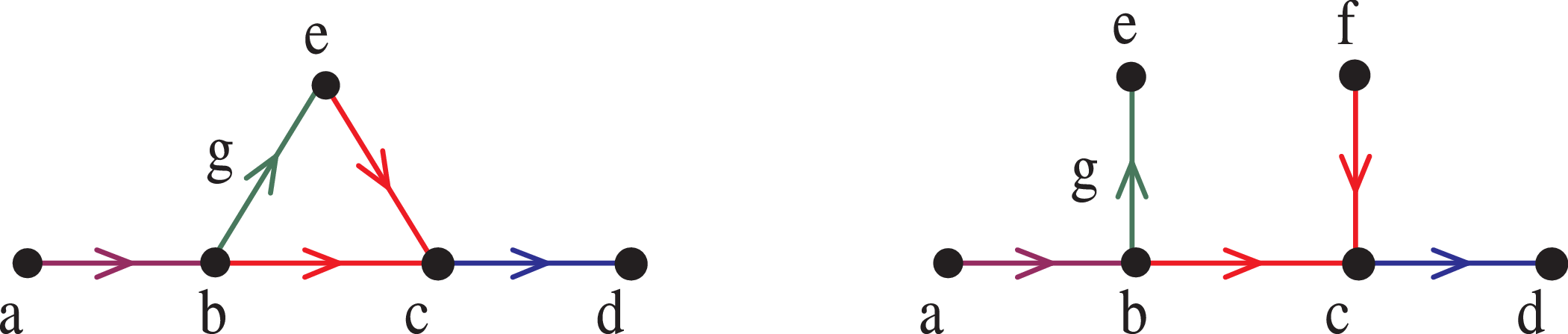
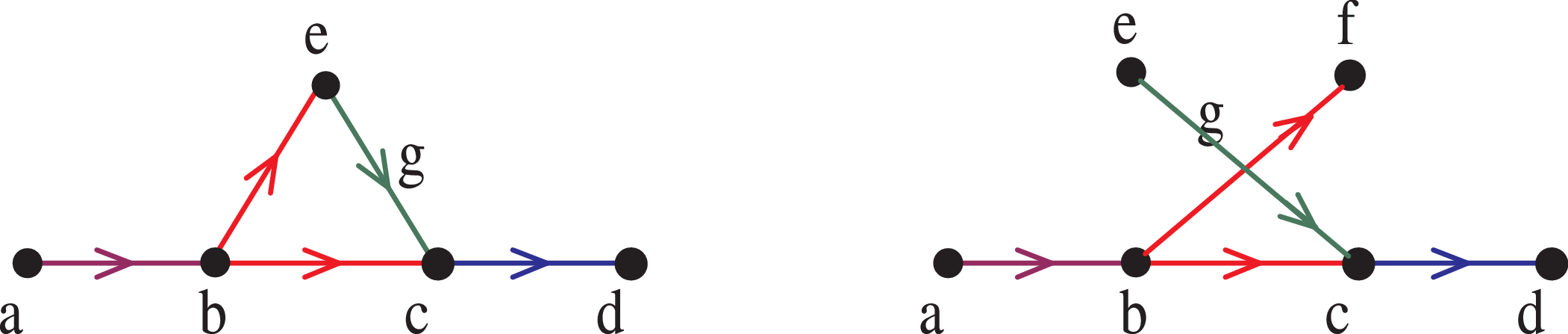
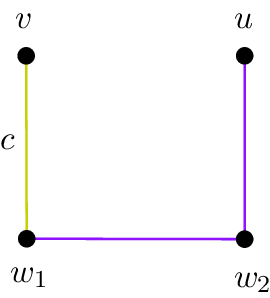
Definition 3.3 (directed absorbing path and directed absorbing cycle). Given any two not necessarily distinct vertices $u,v\in V$
and a rainbow directed path
$u,v\in V$
and a rainbow directed path $P=v_1v_2v_3v_4$
with
$P=v_1v_2v_3v_4$
with $u,v\not \in V(P)$
, we call
$u,v\not \in V(P)$
, we call $P$
a Type-I directed
$P$
a Type-I directed $c$
-absorbing path of
$c$
-absorbing path of $(v,u)$
if
$(v,u)$
if $c\in L({v_2v})$
and
$c\in L({v_2v})$
and $\textrm {col}({v_2v_3})\in L({uv_3})$
(see Figure 2), a Type-II directed
$\textrm {col}({v_2v_3})\in L({uv_3})$
(see Figure 2), a Type-II directed $c$
-absorbing path of
$c$
-absorbing path of $(v,u)$
if
$(v,u)$
if $c\in L({vv_3})$
and
$c\in L({vv_3})$
and $\textrm {col}({v_2v_3})\in L({v_2u})$
(see Figure 3
).
$\textrm {col}({v_2v_3})\in L({v_2u})$
(see Figure 3
).
Given $\delta ,\delta ',\gamma ,\gamma '\gt 0$
and
$\delta ,\delta ',\gamma ,\gamma '\gt 0$
and $\textrm {K}\in \{\textrm {I,II}\}$
, a rainbow directed cycle
$\textrm {K}\in \{\textrm {I,II}\}$
, a rainbow directed cycle $C=v_1v_2\ldots v_tv_1$
is a Type-K directed absorbing cycle with parameters
$C=v_1v_2\ldots v_tv_1$
is a Type-K directed absorbing cycle with parameters $(\delta ,\delta ',\gamma ,\gamma ')$
if
$(\delta ,\delta ',\gamma ,\gamma ')$
if $t\leq \gamma n$
and there exists a colour set
$t\leq \gamma n$
and there exists a colour set $\mathcal{C}$
of size at least
$\mathcal{C}$
of size at least $\delta n$
such that
$\delta n$
such that
-
• given any colour
$c\in \mathcal{C}$
and any
$D_c$
-good vertex
$v$
, for all but at most
$\delta 'n$
vertices
$u\in V$
, there are at least
$\gamma ' n$
disjoint Type-K directed
$c$
-absorbing paths of
$(v,u)$
inside
$C$
, -
• given any colour
$c\in \mathcal{C}$
, for all but at most
$\delta 'n$
$D_c$
-good vertices
$v$
, there are at least
$\gamma ' n$
disjoint Type-K directed
$c$
-absorbing paths of
$(v,v)$
inside
$C$
.


If there is no ambiguity, we typically refer to the Type-I and Type-II directed $c$
-absorbing path (cycle) simply as a directed
$c$
-absorbing path (cycle) simply as a directed $c$
-absorbing path (cycle).
$c$
-absorbing path (cycle).
A type-I directed $c$
-absorbing path of
$c$
-absorbing path of $(v,v)$
and a type-I directed
$(v,v)$
and a type-I directed $c$
-absorbing path of
$c$
-absorbing path of $(v,u)$
with
$(v,u)$
with $v\neq u$
.
$v\neq u$
.

A type-II directed $c$
-absorbing path of
$c$
-absorbing path of $(v,v)$
and a type-II directed
$(v,v)$
and a type-II directed $c$
-absorbing path of
$c$
-absorbing path of $(v,u)$
with
$(v,u)$
with $v\neq u$
.
$v\neq u$
.

Denote by $V^k$
the set of all
$V^k$
the set of all $k$
-tuples of distinct elements of
$k$
-tuples of distinct elements of $V$
. A pair
$V$
. A pair $H=(V,E)$
where
$H=(V,E)$
where $V$
is a set and
$V$
is a set and $E\subseteq V^k$
is called a directed
$E\subseteq V^k$
is called a directed $k$
-graph, while if we allow
$k$
-graph, while if we allow $E$
to be a multiset, it is a directed multi-
$E$
to be a multiset, it is a directed multi- $k$
-graph. We use the same notation for directed
$k$
-graph. We use the same notation for directed $k$
-graphs as for graphs. The following lemma was obtained by Cheng and Staden [Reference Cheng and Staden9], which is the key tool that we will use to build an absorbing structure.
$k$
-graphs as for graphs. The following lemma was obtained by Cheng and Staden [Reference Cheng and Staden9], which is the key tool that we will use to build an absorbing structure.
Lemma 3.4 ([Reference Cheng and Staden9]). Suppose that $k, C, n \in \mathbb{N}$
,
$k, C, n \in \mathbb{N}$
, $0 \lt \frac {1}{n} \ll \gamma \ll \epsilon \ll \frac {1}{k}, \frac {1}{C} \leq 1$
,
$0 \lt \frac {1}{n} \ll \gamma \ll \epsilon \ll \frac {1}{k}, \frac {1}{C} \leq 1$
, $m \in [n^C]$
and
$m \in [n^C]$
and $t \,:\!=\, \gamma n$
. Let
$t \,:\!=\, \gamma n$
. Let $\mathbf{H} = \{H_1, \ldots , H_t\}$
be a collection of directed
$\mathbf{H} = \{H_1, \ldots , H_t\}$
be a collection of directed $k$
-graphs and let
$k$
-graphs and let $\mathbf{Z}= \{Z_1, \ldots , Z_m\}$
be a collection of directed multi-
$\mathbf{Z}= \{Z_1, \ldots , Z_m\}$
be a collection of directed multi- $k$
-graphs all defined on a common vertex set
$k$
-graphs all defined on a common vertex set $V$
of size
$V$
of size $n$
. Suppose that
$n$
. Suppose that $|E(H_i)| \geq \epsilon n^k$
for all
$|E(H_i)| \geq \epsilon n^k$
for all $i \in [t]$
, and for each
$i \in [t]$
, and for each $j \in [m]$
we have
$j \in [m]$
we have $|E(Z_j ) \cap E(H_i)|\geq \epsilon n^k$
for at least
$|E(Z_j ) \cap E(H_i)|\geq \epsilon n^k$
for at least $\epsilon t$
indices
$\epsilon t$
indices $i\in [t]$
. Then there is a rainbow matching
$i\in [t]$
. Then there is a rainbow matching $M$
in
$M$
in $\mathbf{H}$
of size at least
$\mathbf{H}$
of size at least $(1 - \frac {\epsilon ^2}{4})t$
and
$(1 - \frac {\epsilon ^2}{4})t$
and $|E(Z_j ) \cap E(M)| \geq \frac {\epsilon ^2 t}{4}$
for each
$|E(Z_j ) \cap E(M)| \geq \frac {\epsilon ^2 t}{4}$
for each $j \in [m]$
.
$j \in [m]$
.
We first consider the case where a digraph collection contains many non-extremal digraphs; such a collection is said to be strongly stable.
Definition 3.5 (strongly stable). Let $0\lt \gamma ,\alpha \lt 1$
. Suppose that
$0\lt \gamma ,\alpha \lt 1$
. Suppose that $\mathcal{D}=\{D_1,\ldots ,D_n\}$
is a collection of digraphs on a common vertex set
$\mathcal{D}=\{D_1,\ldots ,D_n\}$
is a collection of digraphs on a common vertex set $V$
of size
$V$
of size $n$
. We say that
$n$
. We say that $\mathcal{D}$
is
$\mathcal{D}$
is $(\gamma ,\alpha )$
-strongly stable if
$(\gamma ,\alpha )$
-strongly stable if $D_i$
is
$D_i$
is $\alpha$
-nice for at least
$\alpha$
-nice for at least $\gamma n$
colours
$\gamma n$
colours $i\in [n]$
.
$i\in [n]$
.
By applying Lemma 3.4, we establish the following lemma, which yields a directed absorbing cycle when $\mathcal{D}$
is strongly stable.
$\mathcal{D}$
is strongly stable.
Lemma 3.6.
Let $0\lt \frac {1}{n}\ll \lambda ,\mu \ll \gamma ,\alpha \ll 1$
. Assume that
$0\lt \frac {1}{n}\ll \lambda ,\mu \ll \gamma ,\alpha \ll 1$
. Assume that $\mathcal{D}=\{D_1,\ldots ,D_n\}$
is a collection of digraphs on a common vertex set
$\mathcal{D}=\{D_1,\ldots ,D_n\}$
is a collection of digraphs on a common vertex set $V$
of size
$V$
of size $n$
with
$n$
with $\delta ^0(\mathcal{D})\geq \frac {1-\mu }{2}n$
. If
$\delta ^0(\mathcal{D})\geq \frac {1-\mu }{2}n$
. If $\mathcal{D}$
is
$\mathcal{D}$
is $(\gamma ,\alpha )$
-strongly stable, then there exists a Type- I directed absorbing cycle with parameters
$(\gamma ,\alpha )$
-strongly stable, then there exists a Type- I directed absorbing cycle with parameters $(1,0,\lambda ,\lambda ^2)$
.
$(1,0,\lambda ,\lambda ^2)$
.
Proof. Since $\mathcal{D}$
is
$\mathcal{D}$
is $(\gamma ,\alpha )$
-strongly stable, one may assume that
$(\gamma ,\alpha )$
-strongly stable, one may assume that $D_1,\ldots ,D_{\gamma n}$
are
$D_1,\ldots ,D_{\gamma n}$
are $\alpha$
-nice and
$\alpha$
-nice and $6| \lambda n$
. We divide the colour set
$6| \lambda n$
. We divide the colour set $[\frac {\lambda n}{2}]$
into consecutive sets
$[\frac {\lambda n}{2}]$
into consecutive sets $\{1,2,3\},\{4,5,6\},\ldots ,\{\frac {\lambda n}{2}-2,\frac {\lambda n}{2}-1,\frac {\lambda n}{2}\}$
. For each
$\{1,2,3\},\{4,5,6\},\ldots ,\{\frac {\lambda n}{2}-2,\frac {\lambda n}{2}-1,\frac {\lambda n}{2}\}$
. For each $i\in I\,:\!=\,[\frac {\lambda n}{6}]$
, define
$i\in I\,:\!=\,[\frac {\lambda n}{6}]$
, define $\mathcal{F}_i$
to be a directed
$\mathcal{F}_i$
to be a directed $4$
-graph with vertex
$4$
-graph with vertex $V$
and edge set
$V$
and edge set
 \begin{equation*} \left \{(v_1,v_2,v_3,v_4)\in V^4\,:\,3(i-1)+\ell \in L({v_{\ell }v_{\ell +1}})\ \text{for each}\ \ell \in [3]\right \}. \end{equation*}
The minimum semi-degree condition implies that $e(\mathcal{F}_i)\geq n\left (\frac {1}{2}-\mu \right )^3n^3\geq \frac {n^4}{9}$
.
$e(\mathcal{F}_i)\geq n\left (\frac {1}{2}-\mu \right )^3n^3\geq \frac {n^4}{9}$
.
Given a colour $c\in [n]$
and two not necessarily distinct vertices
$c\in [n]$
and two not necessarily distinct vertices $v,v'\in V$
(which are not required to be
$v,v'\in V$
(which are not required to be $D_c$
-good), let
$D_c$
-good), let $Z_i(c,vv')$
be the collection of
$Z_i(c,vv')$
be the collection of $(v_1,v_2,v_3,v_4)$
for which
$(v_1,v_2,v_3,v_4)$
for which $v_1v_2v_3v_4$
is a Type-I directed
$v_1v_2v_3v_4$
is a Type-I directed $c$
-absorbing path of
$c$
-absorbing path of $(v,v')$
. Since
$(v,v')$
. Since $D_{3i+2}$
is
$D_{3i+2}$
is $\alpha$
-nice, there are at least
$\alpha$
-nice, there are at least $\alpha n^2$
ways to choose
$\alpha n^2$
ways to choose $v_2,v_3$
with
$v_2,v_3$
with $v_2\in N_{c}^-(v), v_3\in N_{{3i+2}}^+(v')$
and
$v_2\in N_{c}^-(v), v_3\in N_{{3i+2}}^+(v')$
and ${v_2v_3}\in E(D_{3i+2})$
. When
${v_2v_3}\in E(D_{3i+2})$
. When $v_2,v_3$
are fixed, there are at least
$v_2,v_3$
are fixed, there are at least $\left (\frac {1}{2}-\mu \right )^2n^2$
ways to choose
$\left (\frac {1}{2}-\mu \right )^2n^2$
ways to choose $v_1$
and
$v_1$
and $v_4$
. Thus
$v_4$
. Thus $|Z_i(c,vv')|\geq \alpha \left (\frac {1}{2}-\mu \right )^2n^4\geq \frac {\alpha n^4}{5}$
.
$|Z_i(c,vv')|\geq \alpha \left (\frac {1}{2}-\mu \right )^2n^4\geq \frac {\alpha n^4}{5}$
.
Applying Lemma 3.4 with
 \begin{align*} &t\,:\!=\,|I|, \epsilon \,:\!=\,\frac {\alpha }{5}, \mathbf{H}\,:\!=\,\{\mathcal{F}_i\,:\,i\in I\},\ \text{and}\\ &\mathbf{Z}\,:\!=\,\left \{Z(c,vv')\,:\!=\,\bigcup _{i\in I}Z_i(c,vv')\,:\,c\in [n],v,v'\in V\right \}, \end{align*}
we obtain a rainbow matching $M$
inside
$M$
inside $\mathbf{H}$
of size at least
$\mathbf{H}$
of size at least $(1-\frac {\alpha ^2}{100})\frac {\lambda n}{6}$
such that
$(1-\frac {\alpha ^2}{100})\frac {\lambda n}{6}$
such that $|E(Z(c,vv'))\cap E(M)|\geq \frac {\alpha ^2\lambda n}{600}$
for all
$|E(Z(c,vv'))\cap E(M)|\geq \frac {\alpha ^2\lambda n}{600}$
for all $c\in [n]$
and
$c\in [n]$
and $v,v'\in V$
. That is, there is a set
$v,v'\in V$
. That is, there is a set $I'\subseteq I$
with
$I'\subseteq I$
with $|I'|\geq (1-\frac {\alpha ^2}{100})\frac {\lambda n}{6}$
such that there is a rainbow directed path
$|I'|\geq (1-\frac {\alpha ^2}{100})\frac {\lambda n}{6}$
such that there is a rainbow directed path $P^i=v_1^iv_2^iv_3^iv_4^i$
with
$P^i=v_1^iv_2^iv_3^iv_4^i$
with $(v_1^i,v_2^i,v_3^i,v_4^i)\in \mathcal{F}_i$
for each
$(v_1^i,v_2^i,v_3^i,v_4^i)\in \mathcal{F}_i$
for each $i\in I'$
, and for every
$i\in I'$
, and for every $c\in [n]$
and
$c\in [n]$
and $v,v'\in V$
, there are at least
$v,v'\in V$
, there are at least $\frac {\alpha ^2\lambda n}{600}$
directed
$\frac {\alpha ^2\lambda n}{600}$
directed $c$
-absorbing paths
$c$
-absorbing paths $P^i$
of
$P^i$
of $(v,v')$
.
$(v,v')$
.
By relabelling indices, one may assume $I'\,=\!:\,[s]$
with
$I'\,=\!:\,[s]$
with $s=(1-\frac {\alpha ^2}{100})\frac {\lambda n}{6}$
. We are to connect the directed paths
$s=(1-\frac {\alpha ^2}{100})\frac {\lambda n}{6}$
. We are to connect the directed paths $P^1,\ldots ,P^s$
one by one into a rainbow directed cycle
$P^1,\ldots ,P^s$
one by one into a rainbow directed cycle $C$
. Firstly, we connect
$C$
. Firstly, we connect $P^1$
and
$P^1$
and $P^2$
into a single rainbow directed path
$P^2$
into a single rainbow directed path $P^1xyP^2$
. For this, choose distinct unused colours
$P^1xyP^2$
. For this, choose distinct unused colours $c_1,c_2\in [\lambda n+1,n]$
and
$c_1,c_2\in [\lambda n+1,n]$
and $c_3\in [\frac {\lambda n}{2}+1,\lambda n]$
. Let
$c_3\in [\frac {\lambda n}{2}+1,\lambda n]$
. Let $U\,:\!=\,V\setminus V(\bigcup _{i\in [s]}P^i)$
. Clearly,
$U\,:\!=\,V\setminus V(\bigcup _{i\in [s]}P^i)$
. Clearly, $|U|\geq n-\lambda n$
. It follows from
$|U|\geq n-\lambda n$
. It follows from $\delta ^0(\mathcal{D})\geq \frac {1-\mu }{2}n$
that
$\delta ^0(\mathcal{D})\geq \frac {1-\mu }{2}n$
that
 \begin{align} d_{{c_1}}^+(v_4^1,U),\,d_{{c_2}}^-(v_1^2,U)\geq \left (\frac {1-\mu }{2}-\lambda \right )n\geq \left (\frac {1}{2}-\alpha \right )n. \end{align}
Notice that $D_{c_3}$
is
$D_{c_3}$
is $\alpha$
-nice. Therefore,
$\alpha$
-nice. Therefore, $|E(D_{c_3}[N_{{c_1}}^+(v_4^1,U),N_{{c_2}}^-(v_1^2,U)])|\geq \alpha n^2$
. Hence, there is an edge
$|E(D_{c_3}[N_{{c_1}}^+(v_4^1,U),N_{{c_2}}^-(v_1^2,U)])|\geq \alpha n^2$
. Hence, there is an edge ${xy}\in E(D_{c_3})$
with
${xy}\in E(D_{c_3})$
with $x\in N_{{c_1}}^+(v_4^1,U)$
and
$x\in N_{{c_1}}^+(v_4^1,U)$
and $y\in N_{{c_2}}^-(v_1^2,U)$
such that
$y\in N_{{c_2}}^-(v_1^2,U)$
such that $P^1xyP^2$
is a rainbow directed path with colour set
$P^1xyP^2$
is a rainbow directed path with colour set $\textrm {col}(P^1\cup P^2)\cup \{c_1, c_2, c_3\}$
.
$\textrm {col}(P^1\cup P^2)\cup \{c_1, c_2, c_3\}$
.
We apply the above process for each pair $(P^i,P^{i+1})$
for each
$(P^i,P^{i+1})$
for each $i\in [s]$
with
$i\in [s]$
with $P^{s+1}\,:\!=\,P^1$
. In each process, we need two unused colours from
$P^{s+1}\,:\!=\,P^1$
. In each process, we need two unused colours from $[\lambda n+1,n]$
and one unused colour from
$[\lambda n+1,n]$
and one unused colour from $[\frac {\lambda n}{2}+1,\lambda n]$
. This is feasible since
$[\frac {\lambda n}{2}+1,\lambda n]$
. This is feasible since $2s\leq \frac {\lambda n}{3}$
. The total number of used vertices at each step is at most
$2s\leq \frac {\lambda n}{3}$
. The total number of used vertices at each step is at most $6s\leq {\lambda n}$
, so we have the same degree bounds as (1). It is straightforward to verify that the resulting directed cycle
$6s\leq {\lambda n}$
, so we have the same degree bounds as (1). It is straightforward to verify that the resulting directed cycle $C$
is a Type-I directed absorbing cycle with parameters
$C$
is a Type-I directed absorbing cycle with parameters $(1,0,\frac {6s}{n},\frac {\alpha ^2\lambda }{600})$
and hence with parameters
$(1,0,\frac {6s}{n},\frac {\alpha ^2\lambda }{600})$
and hence with parameters $(1,0,\lambda ,\lambda ^2)$
since
$(1,0,\lambda ,\lambda ^2)$
since $\lambda \ll \alpha$
.
$\lambda \ll \alpha$
.
The extremality of a digraph collection also depends crucially on the relationships between different digraphs. This leads us to introduce the following definitions.
Definition 3.7 (crossing, cross graph, weakly stable). Let $0\lt \frac {1}{n}\ll \epsilon ,\delta \lt 1$
with
$0\lt \frac {1}{n}\ll \epsilon ,\delta \lt 1$
with $n\in \mathbb{N}$
. Let
$n\in \mathbb{N}$
. Let $\mathcal{D}=\{D_1,\ldots ,D_n\}$
be a collection of digraphs on a common vertex set
$\mathcal{D}=\{D_1,\ldots ,D_n\}$
be a collection of digraphs on a common vertex set $V$
of size
$V$
of size $n$
. Choose
$n$
. Choose $i,j\in [n]$
such that
$i,j\in [n]$
such that $D_i$
is
$D_i$
is $(\epsilon ,\textrm {EC}t)$
-extremal and
$(\epsilon ,\textrm {EC}t)$
-extremal and $D_j$
is
$D_j$
is $(\epsilon ,\textrm {EC}s)$
-extremal with
$(\epsilon ,\textrm {EC}s)$
-extremal with $t,s\in [3]$
. We say that
$t,s\in [3]$
. We say that $D_i$
and
$D_i$
and $D_j$
are
$D_j$
are $\delta$
-crossing if one of the following holds:
$\delta$
-crossing if one of the following holds:
-
(A1)
$t,s\in \{1,2\}$
,
$|A_i\triangle A_j|\geq \delta n$
and
$|A_i\triangle B_j|\geq \delta n$
; -
(A2)
$t=s=3$
, either
$|W_i^1\triangle W_j^1|\geq \delta n$
and
$|W_i^1\triangle W_j^3|\geq \delta n$
, or
$|W_i^2\triangle W_j^2|\geq \delta n$
and
$|W_i^2\triangle W_j^4|\geq \delta n$
; -
(A3)
$t\in \{1,2\},s=3$
, either
$|A_i\triangle W_j^1|\geq \delta n$
and
$|A_i\triangle W_j^3|\geq \delta n$
, or
$|A_i\triangle W_j^2|\geq \delta n$
and
$|A_i\triangle W_j^4|\geq \delta n$
.


For $k\in [3]$
, define the cross graph
$k\in [3]$
, define the cross graph $C_{\mathcal{D},k}^{\epsilon ,\delta }$
to be the graph with vertex set
$C_{\mathcal{D},k}^{\epsilon ,\delta }$
to be the graph with vertex set $[n]$
where
$[n]$
where $i$
and
$i$
and $j$
are adjacent if and only if
$j$
are adjacent if and only if $D_i,D_j$
are satisfying
(Ak)
. We say that
$D_i,D_j$
are satisfying
(Ak)
. We say that $\mathcal{D}$
is
$\mathcal{D}$
is $(\epsilon ,\delta )$
-weakly stable if
$(\epsilon ,\delta )$
-weakly stable if $e(C_{\mathcal{D},k}^{\epsilon ,\delta })\geq \delta n^2$
for some
$e(C_{\mathcal{D},k}^{\epsilon ,\delta })\geq \delta n^2$
for some $k\in [3]$
.
$k\in [3]$
.
The subsequent observation is an immediate consequence of the above definition.
Observation 3.8.
Assume that $0\lt \epsilon \leq \frac {\delta }{8}$
.
$0\lt \epsilon \leq \frac {\delta }{8}$
.
-
• If
$D_i$
and
$D_j$
are satisfying
(A1)
, then
$|X_i\cap Y_j|\geq \frac {\delta n}{4}$
, where
$X,Y\in \{A,B\}$
. -
• If
$D_i$
and
$D_j$
are satisfying
(A2)
, then
$|W_i^x\cap W_j^y|\geq \frac {\delta n}{4}$
, where either
$x,y\in \{1,3\}$
or
$x,y\in \{2,4\}$
. -
• If
$D_i$
and
$D_j$
are satisfying
(A3)
, then
$|X_i\cap W_j^y|\geq \frac {\delta n}{4}$
, where
$X\in \{A,B\}$
and either
$y\in \{1,3\}$
or
$y\in \{2,4\}$
.


Our following lemma finds a directed absorbing cycle when $\mathcal{D}$
is weakly stable.
$\mathcal{D}$
is weakly stable.
Lemma 3.9.
Let $0\lt \frac {1}{n}\ll \lambda ,\mu \ll 8\epsilon ^{1/2}\leq \delta \leq \epsilon ^{1/3}\ll 1$
. Assume that
$0\lt \frac {1}{n}\ll \lambda ,\mu \ll 8\epsilon ^{1/2}\leq \delta \leq \epsilon ^{1/3}\ll 1$
. Assume that $\mathcal{D}=\{D_1,\ldots ,D_n\}$
is a collection of digraphs on a common vertex set
$\mathcal{D}=\{D_1,\ldots ,D_n\}$
is a collection of digraphs on a common vertex set $V$
of size
$V$
of size $n$
with
$n$
with $\delta ^0(\mathcal{D})\geq \frac {1-\mu }{2}n$
. If
$\delta ^0(\mathcal{D})\geq \frac {1-\mu }{2}n$
. If $\mathcal{D}$
is
$\mathcal{D}$
is $(\epsilon ,\delta )$
-weakly stable, then there exists a directed absorbing cycle with parameters
$(\epsilon ,\delta )$
-weakly stable, then there exists a directed absorbing cycle with parameters $(\frac {\delta }{3},\sqrt {\epsilon },\lambda ,\lambda ^2)$
.
$(\frac {\delta }{3},\sqrt {\epsilon },\lambda ,\lambda ^2)$
.
Proof. Since $\mathcal{D}$
is
$\mathcal{D}$
is $(\epsilon ,\delta )$
-weakly stable, one has
$(\epsilon ,\delta )$
-weakly stable, one has $e(C_{\mathcal{D},k}^{\epsilon ,\delta })\geq \delta n^2$
for some
$e(C_{\mathcal{D},k}^{\epsilon ,\delta })\geq \delta n^2$
for some $k\in [3]$
. In particular, if
$k\in [3]$
. In particular, if $k=2$
, then we consider only
$k=2$
, then we consider only $|W_i^1\triangle W_j^1|\geq \delta n$
and
$|W_i^1\triangle W_j^1|\geq \delta n$
and $|W_i^1\triangle W_j^3|\geq \delta n$
for all
$|W_i^1\triangle W_j^3|\geq \delta n$
for all $ij\in E(C_{\mathcal{D},2}^{\epsilon ,\delta })$
; if
$ij\in E(C_{\mathcal{D},2}^{\epsilon ,\delta })$
; if $k=3$
, then we consider only
$k=3$
, then we consider only $|A_i\triangle W_j^1|\geq \delta n$
and
$|A_i\triangle W_j^1|\geq \delta n$
and $|A_i\triangle W_j^3|\geq \delta n$
for all
$|A_i\triangle W_j^3|\geq \delta n$
for all $ij\in E(C_{\mathcal{D},3}^{\epsilon ,\delta })$
(since the other case can be discussed similarly).
$ij\in E(C_{\mathcal{D},3}^{\epsilon ,\delta })$
(since the other case can be discussed similarly).
For each $i\in [\lfloor \frac {n}{3}\rfloor ]$
, define
$i\in [\lfloor \frac {n}{3}\rfloor ]$
, define $\mathcal{F}_i$
to be a directed
$\mathcal{F}_i$
to be a directed $4$
-graph with vertex set
$4$
-graph with vertex set $V$
and edge set
$V$
and edge set
 \begin{equation*} \left \{(v_1,v_2,v_3,v_4)\in V^4\,:\,3(i-1)+\ell \in L(v_{\ell }v_{\ell +1})\ \text{for}\ \ell \in [3]\right \}. \end{equation*}
If follows from $\delta ^0(\mathcal{D})\geq \frac {1-\mu }{2}n$
that
$\delta ^0(\mathcal{D})\geq \frac {1-\mu }{2}n$
that $e(\mathcal{F}_i)\geq n\left (\left (\frac {1}{2}-\mu \right )n\right )^3\geq \frac {n^4}{9}$
.
$e(\mathcal{F}_i)\geq n\left (\left (\frac {1}{2}-\mu \right )n\right )^3\geq \frac {n^4}{9}$
.
In order to apply Lemma 3.4, we first give the following claim, which requires only the minimum semi-degree condition.
Claim 3.10.
Assume that $ij\in E(C_{\mathcal{D},k}^{\epsilon ,\delta })$
for some
$ij\in E(C_{\mathcal{D},k}^{\epsilon ,\delta })$
for some $k\in [3]$
. Let
$k\in [3]$
. Let $u$
be a
$u$
be a $D_j$
-good vertex and
$D_j$
-good vertex and $v$
be a
$v$
be a $D_i$
-good vertex with
$D_i$
-good vertex with $j+1\lt 3n$
. For
$j+1\lt 3n$
. For $\textrm {K}\in \{\textrm {I,II}\}$
, let
$\textrm {K}\in \{\textrm {I,II}\}$
, let $Z_j^{\textrm {K}}(i,vu)$
be the collection of
$Z_j^{\textrm {K}}(i,vu)$
be the collection of $(v_1,v_2,v_3,v_4)\in \mathcal{F}_{\frac {j+1}{3}}$
where
$(v_1,v_2,v_3,v_4)\in \mathcal{F}_{\frac {j+1}{3}}$
where $v_1v_2v_3v_4$
is a Type-K directed
$v_1v_2v_3v_4$
is a Type-K directed $i$
-absorbing path of
$i$
-absorbing path of $(v,u)$
. Then
$(v,u)$
. Then $|Z_j^{\textrm {K}}(i,vu)|\geq 2^{-7}\delta n^4$
.
$|Z_j^{\textrm {K}}(i,vu)|\geq 2^{-7}\delta n^4$
.
Proof of Claim
3.10. Fix any such $i,j,u,v$
. We proceed by considering the following cases.
$i,j,u,v$
. We proceed by considering the following cases.
Case 1. $k=1$
.
$k=1$
.
In this case, we prove $|Z_j^{\textrm {I}}(i,vu)|\geq 2^{-7}\delta n^4$
. By Lemma 3.2 (i) and (ii), we have either
$|Z_j^{\textrm {I}}(i,vu)|\geq 2^{-7}\delta n^4$
. By Lemma 3.2 (i) and (ii), we have either $d_{i}^-(v,A_i)\geq (\frac {1}{2}-2\epsilon )n$
or
$d_{i}^-(v,A_i)\geq (\frac {1}{2}-2\epsilon )n$
or $d_{i}^-(v,B_i)\geq (\frac {1}{2}-2\epsilon )n$
. Without loss of generality, we assume that the former case holds since the latter case can be proved similarly. Note that
$d_{i}^-(v,B_i)\geq (\frac {1}{2}-2\epsilon )n$
. Without loss of generality, we assume that the former case holds since the latter case can be proved similarly. Note that $D_i$
and
$D_i$
and $D_j$
are
$D_j$
are $\delta$
-crossing. Then
$\delta$
-crossing. Then $|A_i\cap A_j|\geq \frac {\delta n}{4}$
and
$|A_i\cap A_j|\geq \frac {\delta n}{4}$
and $|A_i\cap B_j|\geq \frac {\delta n}{4}$
. Therefore,
$|A_i\cap B_j|\geq \frac {\delta n}{4}$
. Therefore,
 \begin{equation*} d_{i}^-(v,A_j)\geq |A_i\cap A_j|-(|A_i|-d_{i}^-(v,A_i))\geq \frac {\delta n}{4}-\epsilon n\geq \frac {\delta n}{5}\ (\text{since}\ \epsilon \leq \delta ^2). \end{equation*}
Similarly, we have $d_{i}^-(v,B_j)\geq \frac {\delta n}{5}$
.
$d_{i}^-(v,B_j)\geq \frac {\delta n}{5}$
.
Since $u$
is
$u$
is $D_j$
-good, one has
$D_j$
-good, one has $u\in Y_j$
for some
$u\in Y_j$
for some $Y\in \{A,B\}$
. Let
$Y\in \{A,B\}$
. Let $Z=Y$
if
$Z=Y$
if $D_j$
is
$D_j$
is $(\epsilon ,\textrm {EC}1)$
-extremal, and let
$(\epsilon ,\textrm {EC}1)$
-extremal, and let $Z\in \{A,B\}\setminus \{Y\}$
if
$Z\in \{A,B\}\setminus \{Y\}$
if $D_j$
is
$D_j$
is $(\epsilon ,\textrm { EC}2)$
-extremal. Notice that
$(\epsilon ,\textrm { EC}2)$
-extremal. Notice that $|N_{j}^+(w,Z_j)|\geq (\frac {1}{2}-2\epsilon )n$
for each vertex
$|N_{j}^+(w,Z_j)|\geq (\frac {1}{2}-2\epsilon )n$
for each vertex $w\in Y_j$
. Choose
$w\in Y_j$
. Choose $x\in N_{i}^-(v,Y_j)$
. Then
$x\in N_{i}^-(v,Y_j)$
. Then
 \begin{equation*}|N_{j}^+(u,Z_j)\cap N_{j}^+(x,Z_j)|\geq |N_{j}^+(u,Z_j)|+|N_{j}^+(x,Z_j)|-|Z_j|\geq \left (\frac {1}{2}-3\epsilon \right )n.\end{equation*}
Any choice of $y\in N_{j}^+(u,Z_j)\cap N_{j}^+(x,Z_j),\ x'\in N_{{j-1}}^-(x)$
and
$y\in N_{j}^+(u,Z_j)\cap N_{j}^+(x,Z_j),\ x'\in N_{{j-1}}^-(x)$
and $y'\in N_{{j+1}}^+(y)$
yields a directed
$y'\in N_{{j+1}}^+(y)$
yields a directed $i$
-absorbing path
$i$
-absorbing path $x'xyy'$
of
$x'xyy'$
of $(v,u)$
in
$(v,u)$
in $\mathcal{F}_{\frac {j+1}{3}}$
. The number of such paths is therefore at least
$\mathcal{F}_{\frac {j+1}{3}}$
. The number of such paths is therefore at least $\frac {\delta n}{5}(\frac {1}{2}-3\epsilon )n\left (\frac {1}{2}-\mu \right )^2n^2\geq 2^{-7}\delta n^4$
.
$\frac {\delta n}{5}(\frac {1}{2}-3\epsilon )n\left (\frac {1}{2}-\mu \right )^2n^2\geq 2^{-7}\delta n^4$
.
Case 2. $k=2$
.
$k=2$
.
In this case, we prove $|Z_j^{\textrm {II}}(i,vu)|\geq 2^{-7}{{\delta }}n^4$
. By Lemma 3.2 (iii), we have either
$|Z_j^{\textrm {II}}(i,vu)|\geq 2^{-7}{{\delta }}n^4$
. By Lemma 3.2 (iii), we have either $d_{D_i}^+(v,W_i^1)\geq (\frac {1}{2}-3\epsilon )n$
or
$d_{D_i}^+(v,W_i^1)\geq (\frac {1}{2}-3\epsilon )n$
or $d_{D_i}^+(v,W_i^3)\geq (\frac {1}{2}-3\epsilon )n$
. Without loss of generality, we assume that the former case holds since the latter case can be proved similarly. Note that
$d_{D_i}^+(v,W_i^3)\geq (\frac {1}{2}-3\epsilon )n$
. Without loss of generality, we assume that the former case holds since the latter case can be proved similarly. Note that $D_i$
and
$D_i$
and $D_j$
are
$D_j$
are $\delta$
-crossing. Then
$\delta$
-crossing. Then $|W_i^1\cap W_j^1|\geq \frac {\delta n}{4}$
and
$|W_i^1\cap W_j^1|\geq \frac {\delta n}{4}$
and $|W_i^1\cap W_j^3|\geq \frac {\delta n}{4}$
. Therefore,
$|W_i^1\cap W_j^3|\geq \frac {\delta n}{4}$
. Therefore,
 \begin{equation*} d_{i}^+(v,W_j^1)\geq |W_i^1\cap W_j^1|-\left (|W_i^1|-d_{i}^+(v,W_i^1)\right )\geq \frac {\delta n}{4}-2\epsilon n\geq \frac {\delta n}{5}\ (\text{since}\ \epsilon \leq \delta ^2). \end{equation*}
Similarly, we have $d_{i}^+(v,W_j^3)\geq \frac {\delta n}{5}$
.
$d_{i}^+(v,W_j^3)\geq \frac {\delta n}{5}$
.
Since $u$
is
$u$
is $D_j$
-good, one has
$D_j$
-good, one has $u\in Y_j$
for some
$u\in Y_j$
for some $Y\in \{W^1,W^3\}$
. Let
$Y\in \{W^1,W^3\}$
. Let $Z=W^4$
if
$Z=W^4$
if $Y=W^1$
, and let
$Y=W^1$
, and let $Z=W^2$
if
$Z=W^2$
if $Y=W^3$
. Note that
$Y=W^3$
. Note that $|N_{j}^-(w,Z_j)|\geq (\frac {1}{2}-3\epsilon )n$
for each vertex
$|N_{j}^-(w,Z_j)|\geq (\frac {1}{2}-3\epsilon )n$
for each vertex $w\in Y_j$
. Choose
$w\in Y_j$
. Choose $x\in N_{i}^+(v,Y_j)$
. Then
$x\in N_{i}^+(v,Y_j)$
. Then
 \begin{equation*} |N_{j}^-(u,Z_j)\cap N_{j}^-(x,Z_j)|\geq |N_{j}^-(u,Z_j)|+|N_{j}^-(x,Z_j)|-|Z_j|\geq \left (\frac {1}{2}-5\epsilon \right )n. \end{equation*}
Any choice of $y\in N_{j}^-(u,Z_j)\cap N_{j}^-(x,Z_j),\ x'\in N_{{j+1}}^+(x)$
and
$y\in N_{j}^-(u,Z_j)\cap N_{j}^-(x,Z_j),\ x'\in N_{{j+1}}^+(x)$
and $y'\in N_{{j-1}}^-(y)$
yields a Type-II directed
$y'\in N_{{j-1}}^-(y)$
yields a Type-II directed $i$
-absorbing path
$i$
-absorbing path $y'yxx'$
of
$y'yxx'$
of $(v,u)$
in
$(v,u)$
in $\mathcal{F}_{\frac {j+1}{3}}$
. Therefore, the number of such paths is at least
$\mathcal{F}_{\frac {j+1}{3}}$
. Therefore, the number of such paths is at least $\frac {\delta n}{5} (\frac {1}{2}-5\epsilon )n\left (\frac {1}{2}-\mu \right )^2n^2\geq 2^{-7}\delta n^4$
.
$\frac {\delta n}{5} (\frac {1}{2}-5\epsilon )n\left (\frac {1}{2}-\mu \right )^2n^2\geq 2^{-7}\delta n^4$
.
Case 3. $k=3$
.
$k=3$
.
This case can be proved by a similar discussion, so we omit the proof.
For each vertex $v$
, let
$v$
, let
 \begin{equation*} \mathcal{C}_v\,:\!=\,\{i\in [n]\,:\,v\ \text{is}\ D_i\text{-good}\}.\end{equation*}
Since $e(C_{\mathcal{D},k}^{\epsilon ,\delta })\geq \delta n^2$
, there is a subgraph
$e(C_{\mathcal{D},k}^{\epsilon ,\delta })\geq \delta n^2$
, there is a subgraph $H$
of
$H$
of $C_{\mathcal{D},k}^{\epsilon ,\delta }$
such that
$C_{\mathcal{D},k}^{\epsilon ,\delta }$
such that $|V(H)|\geq \delta n$
and
$|V(H)|\geq \delta n$
and $\delta (H)\geq \delta n$
. For each
$\delta (H)\geq \delta n$
. For each $i\in V(H)$
, define
$i\in V(H)$
, define
 \begin{equation*} T_i\,:\!=\,\left \{u\in V\,:\, |N_H(i)\setminus \mathcal{C}_u|\geq \frac {\delta n}{2}\right \}. \end{equation*}
Notice that $|L_i|=2\epsilon n$
when
$|L_i|=2\epsilon n$
when $D_i$
is
$D_i$
is $\epsilon$
-extremal. Hence
$\epsilon$
-extremal. Hence $|T_i|\frac {\delta n}{2}\leq 2\epsilon n^2$
, that is,
$|T_i|\frac {\delta n}{2}\leq 2\epsilon n^2$
, that is, $|T_i|\leq \frac {\sqrt {\epsilon }}{2}n$
since
$|T_i|\leq \frac {\sqrt {\epsilon }}{2}n$
since $8\epsilon ^{1/2}\leq \delta$
.
$8\epsilon ^{1/2}\leq \delta$
.
For each $i\in V(H)$
, let
$i\in V(H)$
, let $\overline {T_i}\,:\!=\,V\setminus T_i$
. Then
$\overline {T_i}\,:\!=\,V\setminus T_i$
. Then $|\overline {T_i}|\geq (1-\frac {\sqrt {\epsilon }}{2})n$
. For each
$|\overline {T_i}|\geq (1-\frac {\sqrt {\epsilon }}{2})n$
. For each $u\in \overline {T_i}$
with
$u\in \overline {T_i}$
with $i\in V(H)$
, one has
$i\in V(H)$
, one has $|N_H(i)\cap \mathcal{C}_u|\geq \frac {\delta n}{2}$
. Now we independently and randomly select vertices from
$|N_H(i)\cap \mathcal{C}_u|\geq \frac {\delta n}{2}$
. Now we independently and randomly select vertices from $V(H)$
with probability
$V(H)$
with probability $\kappa \,:\!=\,\frac {\lambda }{14}$
to obtain a colour set
$\kappa \,:\!=\,\frac {\lambda }{14}$
to obtain a colour set $\mathcal{U}$
. Using Chernoff’s bound, with high probability the following hold:
$\mathcal{U}$
. Using Chernoff’s bound, with high probability the following hold:
-
(
$*$
)
$\frac {\kappa |V(H)|}{2}\leq t\,:\!=\,|\mathcal{U}|\leq 2\kappa |V(H)|$
, -
(
$**$
) for every
$i\in V(H)$
and
$u\in \overline {T_i}$
, we have
$|N_H(i,\mathcal{U})\cap \mathcal{C}_u|\geq \frac {\delta \kappa n}{4}$
.


Fix such a colour set $\mathcal{U}$
and one may assume
$\mathcal{U}$
and one may assume $\mathcal{U}=\{3j-1\,:\,j\in [t]\}$
. Let
$\mathcal{U}=\{3j-1\,:\,j\in [t]\}$
. Let $\overline {\mathcal{U}}\,:\!=\,V(H)\cap [3t+1,n]$
. It is easy to see that
$\overline {\mathcal{U}}\,:\!=\,V(H)\cap [3t+1,n]$
. It is easy to see that $\mathcal{U}\cap \overline {\mathcal{U}}=\emptyset$
,
$\mathcal{U}\cap \overline {\mathcal{U}}=\emptyset$
, $|\overline {\mathcal{U}}|\geq \frac {\delta n}{2}$
and
$|\overline {\mathcal{U}}|\geq \frac {\delta n}{2}$
and $\delta (H[\overline {\mathcal{U}}])\geq \frac {\delta n}{2}$
.
$\delta (H[\overline {\mathcal{U}}])\geq \frac {\delta n}{2}$
.
Given $i\in \overline {\mathcal{U}}$
and
$i\in \overline {\mathcal{U}}$
and $u\in \overline {T_i}$
, choose
$u\in \overline {T_i}$
, choose $j\in \mathcal{C}_u\cap N_H(i,\mathcal{U})$
. Then
$j\in \mathcal{C}_u\cap N_H(i,\mathcal{U})$
. Then $\frac {j+1}{3}\in [t]$
and the number of such choices of
$\frac {j+1}{3}\in [t]$
and the number of such choices of $j$
is at least
$j$
is at least $\frac {\delta \kappa n}{4}\geq \frac {\delta t}{8}$
by (
$\frac {\delta \kappa n}{4}\geq \frac {\delta t}{8}$
by ( $**$
). Let
$**$
). Let $v$
be a
$v$
be a $D_i$
-good vertex. It follows from Claim 3.10 that
$D_i$
-good vertex. It follows from Claim 3.10 that $|Z_j^{\textrm {K}}(i,vu)|\geq 2^{-7}\delta n^4$
for some
$|Z_j^{\textrm {K}}(i,vu)|\geq 2^{-7}\delta n^4$
for some $\textrm {K}\in \{\textrm {I,II}\}$
.
$\textrm {K}\in \{\textrm {I,II}\}$
.
By ( $*$
) and the fact that
$*$
) and the fact that $\lambda \ll \delta$
, one has
$\lambda \ll \delta$
, one has $\frac {t}{n}\leq 2\kappa =\frac {\lambda }{7}\ll 2^{-7}\delta$
. Applying Lemma 3.4 with
$\frac {t}{n}\leq 2\kappa =\frac {\lambda }{7}\ll 2^{-7}\delta$
. Applying Lemma 3.4 with
 \begin{align*} &\gamma \,:\!=\,\frac {\lambda }{7}, \epsilon \,:\!=\,2^{-7}\delta , \mathbf{H}\,:\!=\,\{\mathcal{F}_j\,:\,j\in [t]\}\ \ \text{and} \\ & \mathbf{Z}\,:\!=\,\left \{Z(i,vu)\,:\!=\,\bigcup _{j\in \mathcal{C}_u\cap N_H(i,\mathcal{U})}Z_j^{\textrm {K}}(i,vu)\,:\,i\in \overline {\mathcal{U}},\ u\in \overline {T_i}\ \text{and}\ v\ \text{is}\ D_i\text{-good}\right \}, \end{align*}
we obtain that there is a rainbow matching $M$
of
$M$
of $\mathbf{H}$
with size at least
$\mathbf{H}$
with size at least $(1-2^{-16}\delta ^2)t$
such that
$(1-2^{-16}\delta ^2)t$
such that $|E(Z(i,vu))\cap E(M)|\geq 2^{-16}\delta ^2t$
for all
$|E(Z(i,vu))\cap E(M)|\geq 2^{-16}\delta ^2t$
for all $Z(i,vu)\in \mathbf{Z}$
. That is, there is a subset
$Z(i,vu)\in \mathbf{Z}$
. That is, there is a subset $I\subseteq [t]$
with
$I\subseteq [t]$
with $|I|\geq (1-2^{-16}\delta ^2)t$
such that there is a Type-K directed path
$|I|\geq (1-2^{-16}\delta ^2)t$
such that there is a Type-K directed path $P^j=v_1^jv_2^jv_3^jv_4^j\in \mathcal{F}_j$
for each
$P^j=v_1^jv_2^jv_3^jv_4^j\in \mathcal{F}_j$
for each $j\in I$
, and for every
$j\in I$
, and for every $i\in \overline {\mathcal{U}}$
,
$i\in \overline {\mathcal{U}}$
, $u\in \overline {T_i}$
and a
$u\in \overline {T_i}$
and a $D_i$
-good vertex
$D_i$
-good vertex $v$
, there are at least
$v$
, there are at least $2^{-16}\delta ^2 t$
Type-K directed
$2^{-16}\delta ^2 t$
Type-K directed $i$
-absorbing paths
$i$
-absorbing paths $P^j$
of
$P^j$
of $(v,u)$
.
$(v,u)$
.
Relabel indices such that $I\,=\!:\,[s]$
with
$I\,=\!:\,[s]$
with $s\geq (1-2^{-16}\delta ^2)t$
. We are to connect those disjoint rainbow directed paths
$s\geq (1-2^{-16}\delta ^2)t$
. We are to connect those disjoint rainbow directed paths $P^1,\ldots ,P^s$
into a directed absorbing cycle
$P^1,\ldots ,P^s$
into a directed absorbing cycle $C$
. Notice that
$C$
. Notice that $\overline {\mathcal{U}}\cap \textrm {col}(\bigcup _{i\in I}P^i)=\emptyset$
. We first connect
$\overline {\mathcal{U}}\cap \textrm {col}(\bigcup _{i\in I}P^i)=\emptyset$
. We first connect $P^1$
and
$P^1$
and $P^2$
into a single rainbow directed path
$P^2$
into a single rainbow directed path $P^1v_4^1xzyv_1^2P^2$
or
$P^1v_4^1xzyv_1^2P^2$
or $P^1v_4^1xzv_1^2P^2$
. For this, choose distinct colours
$P^1v_4^1xzv_1^2P^2$
. For this, choose distinct colours $c_1,c_2,c_3,c_4\in \overline {\mathcal{U}}$
such that
$c_1,c_2,c_3,c_4\in \overline {\mathcal{U}}$
such that $c_1c_2\in E(H)$
. Clearly, there are at least
$c_1c_2\in E(H)$
. Clearly, there are at least $|\overline {\mathcal{U}}|\geq \frac {\delta n}{2}$
choices for
$|\overline {\mathcal{U}}|\geq \frac {\delta n}{2}$
choices for $c_1$
, and given this at least
$c_1$
, and given this at least $\delta (H[\overline {\mathcal{U}}])\geq \frac {\delta n}{2}$
choices for
$\delta (H[\overline {\mathcal{U}}])\geq \frac {\delta n}{2}$
choices for $c_2$
, and at least
$c_2$
, and at least $|\overline {\mathcal{U}}|-3\gt \frac {\delta n}{3}$
choices for each of
$|\overline {\mathcal{U}}|-3\gt \frac {\delta n}{3}$
choices for each of $c_3,c_4$
. Next, choose an unused
$c_3,c_4$
. Next, choose an unused $D_{c_1}$
-good vertex
$D_{c_1}$
-good vertex $x\in N^+_{{c_3}}(v_4^1)$
and an unused
$x\in N^+_{{c_3}}(v_4^1)$
and an unused $D_{c_2}$
-good vertex
$D_{c_2}$
-good vertex $y\in N^-_{{c_4}}(v_1^2)$
. The following claim considers the number of choices for
$y\in N^-_{{c_4}}(v_1^2)$
. The following claim considers the number of choices for $x,y$
.
$x,y$
.
Claim 3.11. One of the following holds:
-
• there exists a rainbow directed path
$P^1v_4^1xzyv_1^2P^2$
with colours
$\textrm {col}(P^1\cup P^2)\cup \{c_1,c_2,c_3,c_4\}$
and
$z\in N_{{c_1}}^+(x)\cap N_{{c_2}}^-(y)$
, each of
$x,y,z$
has at least
$\frac {\delta n}{10}$
choices;
-
• there exists a rainbow directed path
$P^1v_4^1xyv_1^2P^2$
with colours
$\textrm {col}(P^1\cup P^2)\cup \{c_1,c_3,c_4\}$
and
$y\in N_{{c_1}}^+(x)\cap N_{{c_4}}^-(v_1^2)$
, each of
$x,y$
has at least
$\frac {\delta n}{10}$
choices.


Proof of Claim 3.11. We proceed by considering the following three cases.
Case 1. $k=1$
.
$k=1$
.
In this case, $D_{c_1}$
and
$D_{c_1}$
and $D_{c_2}$
are either
$D_{c_2}$
are either $(\epsilon ,\textrm {EC}1)$
-extremal or
$(\epsilon ,\textrm {EC}1)$
-extremal or $(\epsilon ,\textrm { EC}2)$
-extremal. Then
$(\epsilon ,\textrm { EC}2)$
-extremal. Then $x\in A_{c_1}\cup B_{c_1}$
and
$x\in A_{c_1}\cup B_{c_1}$
and $y\in A_{c_2}\cup B_{c_2}$
. Clearly, each of
$y\in A_{c_2}\cup B_{c_2}$
. Clearly, each of $x,y$
has at least
$x,y$
has at least $\frac {n}{4}$
choices. Recall that
$\frac {n}{4}$
choices. Recall that $D_{c_1}$
and
$D_{c_1}$
and $D_{c_2}$
are
$D_{c_2}$
are $\delta$
-crossing. Then,
$\delta$
-crossing. Then, $|X_{c_1}\cap Y_{c_2}|\geq \frac {\delta n}{4}$
whenever
$|X_{c_1}\cap Y_{c_2}|\geq \frac {\delta n}{4}$
whenever $X,Y\in \{A,B\}$
. By Lemma 3.2, there are
$X,Y\in \{A,B\}$
. By Lemma 3.2, there are $Z,W\in \{A,B\}$
such that
$Z,W\in \{A,B\}$
such that $d_{{c_1}}^+(x,Z_{c_1})\geq |Z_{c_1}|-\epsilon n$
and
$d_{{c_1}}^+(x,Z_{c_1})\geq |Z_{c_1}|-\epsilon n$
and $d_{{c_2}}^-(y,W_{c_2})\geq |W_{c_2}|-\epsilon n$
. Choose
$d_{{c_2}}^-(y,W_{c_2})\geq |W_{c_2}|-\epsilon n$
. Choose $z\in N_{{c_1}}^+(x)\cap N_{{c_2}}^-(y)$
and the number of choices for
$z\in N_{{c_1}}^+(x)\cap N_{{c_2}}^-(y)$
and the number of choices for $z$
is at least
$z$
is at least
 \begin{equation*} |N_{{c_1}}^+(x)\cap N_{{c_2}}^-(y)|-7e(M)\geq |N_{{c_1}}^+(x,Z_{c_1})\cap N_{{c_2}}^-(y,W_{c_2})|-14\kappa n\geq |Z_{c_1}\cap W_{c_2}|-2\epsilon n-12\kappa n\geq \frac {\delta n}{5}, \end{equation*}
as desired.
Case 2. $k=2$
.
$k=2$
.
In this case, both $D_{c_1}$
and
$D_{c_1}$
and $D_{c_2}$
are
$D_{c_2}$
are $(\epsilon ,\textrm {EC}3)$
-extremal. Then
$(\epsilon ,\textrm {EC}3)$
-extremal. Then $|W_{c_1}^i\cap W_{c_2}^j|\geq \frac {\delta n}{4}$
for
$|W_{c_1}^i\cap W_{c_2}^j|\geq \frac {\delta n}{4}$
for $i,j\in \{1,3\}$
. Notice that either
$i,j\in \{1,3\}$
. Notice that either $|W_{c_1}^1\cap W_{c_2}^2|\geq \frac {n}{5}$
or
$|W_{c_1}^1\cap W_{c_2}^2|\geq \frac {n}{5}$
or $|W_{c_1}^3\cap W_{c_2}^2|\geq \frac {n}{5}$
holds. Without loss of generality, assume the latter case hold. Choose
$|W_{c_1}^3\cap W_{c_2}^2|\geq \frac {n}{5}$
holds. Without loss of generality, assume the latter case hold. Choose $z\in N_{{c_1}}^+(x)\cap N_{{c_2}}^-(y)$
. Next, we consider the size of
$z\in N_{{c_1}}^+(x)\cap N_{{c_2}}^-(y)$
. Next, we consider the size of $|N_{{c_1}}^+(x)\cap N_{{c_2}}^-(y)|$
.
$|N_{{c_1}}^+(x)\cap N_{{c_2}}^-(y)|$
.
If $|W_{c_1}^2\cap N^+_{{c_3}}(v_4^1)|\geq \delta n$
and
$|W_{c_1}^2\cap N^+_{{c_3}}(v_4^1)|\geq \delta n$
and $|W_{c_2}^3\cap N^-_{{c_4}}(v_1^2)|\geq \delta n$
, then choose
$|W_{c_2}^3\cap N^-_{{c_4}}(v_1^2)|\geq \delta n$
, then choose $x\in W_{c_1}^2\cap N^+_{{c_3}}(v_4^1)$
and
$x\in W_{c_1}^2\cap N^+_{{c_3}}(v_4^1)$
and $y\in W_{c_2}^3\cap N^-_{{c_4}}(v_1^2)$
. Hence, there are at least
$y\in W_{c_2}^3\cap N^-_{{c_4}}(v_1^2)$
. Hence, there are at least $\frac {\delta n}{2}$
choices for each of
$\frac {\delta n}{2}$
choices for each of $x$
and
$x$
and $y$
. Furthermore,
$y$
. Furthermore, $|N_{{c_1}}^+(x)\cap N_{{c_2}}^-(y)|\geq |W_{c_1}^3\cap W_{c_2}^2|-4\epsilon n\geq \frac {\delta n}{5}$
, as desired.
$|N_{{c_1}}^+(x)\cap N_{{c_2}}^-(y)|\geq |W_{c_1}^3\cap W_{c_2}^2|-4\epsilon n\geq \frac {\delta n}{5}$
, as desired.
If $|W_{c_1}^2\cap N^+_{{c_3}}(v_4^1)|\lt \delta n$
, then
$|W_{c_1}^2\cap N^+_{{c_3}}(v_4^1)|\lt \delta n$
, then $|W_{c_1}^4\cap N^+_{{c_3}}(v_4^1)|\geq (\frac {1}{2}-\mu -\delta -2\epsilon ) n$
. Choose
$|W_{c_1}^4\cap N^+_{{c_3}}(v_4^1)|\geq (\frac {1}{2}-\mu -\delta -2\epsilon ) n$
. Choose $x\in W_{c_1}^4\cap N^+_{{c_3}}(v_4^1)$
. Then
$x\in W_{c_1}^4\cap N^+_{{c_3}}(v_4^1)$
. Then $d_{{c_1}}^+(x,W_{c_1}^1)\geq |W_{c_1}^1|-2\epsilon n$
. Notice that either
$d_{{c_1}}^+(x,W_{c_1}^1)\geq |W_{c_1}^1|-2\epsilon n$
. Notice that either $|W_{c_2}^1\cap N^-_{{c_4}}(v_1^2)|\geq \delta n$
or
$|W_{c_2}^1\cap N^-_{{c_4}}(v_1^2)|\geq \delta n$
or $|W_{c_2}^3\cap N^-_{{c_4}}(v_1^2)|\geq \delta n$
. We may assume the former case holds. Choose
$|W_{c_2}^3\cap N^-_{{c_4}}(v_1^2)|\geq \delta n$
. We may assume the former case holds. Choose $y\in W_{c_2}^1\cap N^-_{{c_4}}(v_1^2)$
. Then
$y\in W_{c_2}^1\cap N^-_{{c_4}}(v_1^2)$
. Then $d_{{c_2}}^-(y,W_{c_2}^4)\geq |W_{c_2}^4|-2\epsilon n$
. If
$d_{{c_2}}^-(y,W_{c_2}^4)\geq |W_{c_2}^4|-2\epsilon n$
. If $|W_{c_1}^1\cap W_{c_2}^4|\geq \delta n$
, then
$|W_{c_1}^1\cap W_{c_2}^4|\geq \delta n$
, then $|N_{{c_1}}^+(x)\cap N_{{c_2}}^-(y)|\geq |W_{c_1}^1\cap W_{c_2}^4|-4\epsilon n\geq \frac {\delta n}{5}$
, as desired. If
$|N_{{c_1}}^+(x)\cap N_{{c_2}}^-(y)|\geq |W_{c_1}^1\cap W_{c_2}^4|-4\epsilon n\geq \frac {\delta n}{5}$
, as desired. If $|W_{c_1}^1\cap W_{c_2}^4|\lt \delta n$
and
$|W_{c_1}^1\cap W_{c_2}^4|\lt \delta n$
and $|W_{c_2}^3\cap N^-_{{c_4}}(v_1^2)|\geq \frac {\delta n}{9}$
, then
$|W_{c_2}^3\cap N^-_{{c_4}}(v_1^2)|\geq \frac {\delta n}{9}$
, then $|W_{c_1}^1\cap W_{c_2}^2|\geq (\frac {1}{2}-\delta -3\epsilon )n$
and choose
$|W_{c_1}^1\cap W_{c_2}^2|\geq (\frac {1}{2}-\delta -3\epsilon )n$
and choose $y\in W_{c_2}^3\cap N^-_{{c_4}}(v_1^2)$
. Similarly,
$y\in W_{c_2}^3\cap N^-_{{c_4}}(v_1^2)$
. Similarly, $|N_{{c_1}}^+(x)\cap N_{{c_2}}^-(y)|\geq |W_{c_1}^1\cap W_{c_2}^2|-4\epsilon n\geq \frac {\delta n}{5}$
, as desired. If
$|N_{{c_1}}^+(x)\cap N_{{c_2}}^-(y)|\geq |W_{c_1}^1\cap W_{c_2}^2|-4\epsilon n\geq \frac {\delta n}{5}$
, as desired. If $|W_{c_1}^1\cap W_{c_2}^4|\lt \delta n$
and
$|W_{c_1}^1\cap W_{c_2}^4|\lt \delta n$
and $|W_{c_2}^3\cap N^-_{{c_4}}(v_1^2)|\lt \frac {\delta n}{9}$
, then
$|W_{c_2}^3\cap N^-_{{c_4}}(v_1^2)|\lt \frac {\delta n}{9}$
, then $d^-_{{c_4}}(v_1^2,W_{c_2}^1)\geq |W_{c_2}^1|-(\mu +2\epsilon +\frac {\delta }{9})n$
. Therefore,
$d^-_{{c_4}}(v_1^2,W_{c_2}^1)\geq |W_{c_2}^1|-(\mu +2\epsilon +\frac {\delta }{9})n$
. Therefore,
 \begin{equation*} |N_{{c_1}}^+(x)\cap N_{{c_4}}^-(v_1^2)|\geq |N_{{c_1}}^+(x,W_{c_1}^1)\cap N_{{c_4}}^-(v_1^2,W_{c_2}^1)|\geq |W_{c_1}^1\cap W_{c_2}^1|-\left (\mu +4\epsilon +\frac {\delta }{9}\right ) n\geq \frac {\delta n}{9}. \end{equation*}
Now, we connect $P^1$
and
$P^1$
and $P^2$
by using a rainbow directed path
$P^2$
by using a rainbow directed path $P^1v_4^1xyv_1^2P^2$
with colours
$P^1v_4^1xyv_1^2P^2$
with colours $\textrm { col}(P^1\cup P^2)\cup \{c_1,c_3,c_4\}$
, as desired.
$\textrm { col}(P^1\cup P^2)\cup \{c_1,c_3,c_4\}$
, as desired.
Case 3. $k=3$
.
$k=3$
.
In this case, $D_{c_1}$
is either
$D_{c_1}$
is either $(\epsilon ,\textrm {EC}1)$
-extremal or
$(\epsilon ,\textrm {EC}1)$
-extremal or $(\epsilon ,\textrm {EC}2)$
-extremal, and
$(\epsilon ,\textrm {EC}2)$
-extremal, and $D_{c_2}$
is
$D_{c_2}$
is $(\epsilon ,\textrm {EC}3)$
-extremal. Hence
$(\epsilon ,\textrm {EC}3)$
-extremal. Hence $x\in A_{c_1}\cup B_{c_1}$
and
$x\in A_{c_1}\cup B_{c_1}$
and $y\in W_{c_2}^1\cup W_{c_2}^3$
. Choose
$y\in W_{c_2}^1\cup W_{c_2}^3$
. Choose $z\in N_{{c_1}}^+(x)\cap N_{{c_2}}^-(y)$
. Note that
$z\in N_{{c_1}}^+(x)\cap N_{{c_2}}^-(y)$
. Note that $D_{c_1}$
and
$D_{c_1}$
and $D_{c_2}$
are
$D_{c_2}$
are $\delta$
-crossing. Then
$\delta$
-crossing. Then $|X_{c_1}\cap Y_{c_2}|\geq \frac {\delta n}{4}$
whenever
$|X_{c_1}\cap Y_{c_2}|\geq \frac {\delta n}{4}$
whenever $X\in \{A,B\}$
and
$X\in \{A,B\}$
and $Y\in \{W^1,W^3\}$
. By Lemma 3.2, there are
$Y\in \{W^1,W^3\}$
. By Lemma 3.2, there are $Z\in \{A,B\}$
and
$Z\in \{A,B\}$
and $W\in \{W^2,W^4\}$
such that
$W\in \{W^2,W^4\}$
such that $d_{{c_1}}^+(x,Z_{c_1})\geq |Z_{c_1}|-\epsilon n$
and
$d_{{c_1}}^+(x,Z_{c_1})\geq |Z_{c_1}|-\epsilon n$
and $d_{{c_2}}^-(y,W_{c_2})\geq |W_{c_2}|-2\epsilon n$
. If
$d_{{c_2}}^-(y,W_{c_2})\geq |W_{c_2}|-2\epsilon n$
. If $|Z_{c_1}\cap W_{c_2}|\geq \frac {\delta n}{4}$
, then
$|Z_{c_1}\cap W_{c_2}|\geq \frac {\delta n}{4}$
, then $|N_{{c_1}}^+(x)\cap N_{{c_2}}^-(y)|\geq |Z_{c_1}\cap W_{c_2}|-3\epsilon n\geq \frac {\delta n}{5}$
, as desired.
$|N_{{c_1}}^+(x)\cap N_{{c_2}}^-(y)|\geq |Z_{c_1}\cap W_{c_2}|-3\epsilon n\geq \frac {\delta n}{5}$
, as desired.
Now, we consider $|Z_{c_1}\cap W_{c_2}|\lt \frac {\delta n}{4}$
. Without loss of generality, assume that
$|Z_{c_1}\cap W_{c_2}|\lt \frac {\delta n}{4}$
. Without loss of generality, assume that $Z=A$
and
$Z=A$
and $W=W^2$
. It follows that
$W=W^2$
. It follows that $|A_{c_1}\cap W_{c_2}^4|\geq |W_{c_2}^4|-(\frac {\delta }{4}+2\epsilon )n$
. This implies
$|A_{c_1}\cap W_{c_2}^4|\geq |W_{c_2}^4|-(\frac {\delta }{4}+2\epsilon )n$
. This implies $|A_{c_1}\cap W_{c_2}^3|\geq |C_{c_2}^4|-(\frac {\delta }{4}+2\epsilon )n\geq \frac {\delta n}{2}$
since
$|A_{c_1}\cap W_{c_2}^3|\geq |C_{c_2}^4|-(\frac {\delta }{4}+2\epsilon )n\geq \frac {\delta n}{2}$
since $|C^2_4|\geq \delta n$
. If
$|C^2_4|\geq \delta n$
. If $|W_{c_2}^1\cap N_{{c_4}}^-(v_2^1)|\geq \frac {\delta n}{9}$
, then choose
$|W_{c_2}^1\cap N_{{c_4}}^-(v_2^1)|\geq \frac {\delta n}{9}$
, then choose $y\in W_{c_2}^1\cap N_{{c_4}}^-(v_2^1)$
. Hence
$y\in W_{c_2}^1\cap N_{{c_4}}^-(v_2^1)$
. Hence $|N_{{c_1}}^+(x)\cap N_{{c_2}}^-(y)|\geq |A_{c_1}\cap W_{c_2}^4|-3\epsilon n\geq \frac {\delta n}{5}$
. If
$|N_{{c_1}}^+(x)\cap N_{{c_2}}^-(y)|\geq |A_{c_1}\cap W_{c_2}^4|-3\epsilon n\geq \frac {\delta n}{5}$
. If $|W_{c_2}^1\cap N_{{c_4}}^-(v_2^1)|\lt \frac {\delta n}{9}$
, then
$|W_{c_2}^1\cap N_{{c_4}}^-(v_2^1)|\lt \frac {\delta n}{9}$
, then $|W_{c_2}^3\cap N_{{c_4}}^-(v_2^1)|\geq |W_{c_2}^3|-(\frac {\delta }{9}+2\epsilon )n$
. Thus,
$|W_{c_2}^3\cap N_{{c_4}}^-(v_2^1)|\geq |W_{c_2}^3|-(\frac {\delta }{9}+2\epsilon )n$
. Thus, $|N_{{c_1}}^+(x)\cap N_{{c_4}}^-(v_2^1)|\geq |A_{c_1}\cap W_{c_2}^3|-(3\epsilon +\frac {\delta }{9}) n\geq \frac {\delta n}{9}$
. Now, we connect
$|N_{{c_1}}^+(x)\cap N_{{c_4}}^-(v_2^1)|\geq |A_{c_1}\cap W_{c_2}^3|-(3\epsilon +\frac {\delta }{9}) n\geq \frac {\delta n}{9}$
. Now, we connect $P^1$
and
$P^1$
and $P^2$
by using a rainbow directed path
$P^2$
by using a rainbow directed path $P^1v_4^1xyv_1^2P^2$
with colours
$P^1v_4^1xyv_1^2P^2$
with colours $\textrm {col}(P^1\cup P^2)\cup \{c_1,c_3,c_4\}$
, as desired.
$\textrm {col}(P^1\cup P^2)\cup \{c_1,c_3,c_4\}$
, as desired.
This completes the proof of Claim 3.11.
In view of Claim 3.11, there are at least $\frac {\delta n}{10}$
choices for each of
$\frac {\delta n}{10}$
choices for each of $c_1,c_2,c_3,c_4,x,y,(z)$
given any previous choices. Thus, we obtain the desired rainbow directed path
$c_1,c_2,c_3,c_4,x,y,(z)$
given any previous choices. Thus, we obtain the desired rainbow directed path $P^1v_4^1xzyv_1^2P^2$
or
$P^1v_4^1xzyv_1^2P^2$
or $P^1v_4^1xyv_1^2P^2$
. Applying the above process for each pair
$P^1v_4^1xyv_1^2P^2$
. Applying the above process for each pair $(P^j,P^{j+1})$
with
$(P^j,P^{j+1})$
with $j\in [s]$
where
$j\in [s]$
where $P^{s+1}\,:\!=\,P^1$
. Every time we use at most four unused colours in
$P^{s+1}\,:\!=\,P^1$
. Every time we use at most four unused colours in $\overline {\mathcal{U}}$
and at most three unused vertices. Therefore, for each choice, at most
$\overline {\mathcal{U}}$
and at most three unused vertices. Therefore, for each choice, at most $4s\leq 4t\leq 8\kappa n\ll \frac {\delta n}{10}$
colours are forbidden and
$4s\leq 4t\leq 8\kappa n\ll \frac {\delta n}{10}$
colours are forbidden and $3s\ll \frac {\delta n}{10}$
vertices are forbidden. Thus we obtain a rainbow directed cycle
$3s\ll \frac {\delta n}{10}$
vertices are forbidden. Thus we obtain a rainbow directed cycle $C$
of length at most
$C$
of length at most $7s$
which contains every
$7s$
which contains every $P^j$
with
$P^j$
with $j\in [s]$
as a segment.
$j\in [s]$
as a segment.
By the construction of $C$
, for every colour
$C$
, for every colour $i\in \overline {\mathcal{U}}$
, any
$i\in \overline {\mathcal{U}}$
, any $D_i$
-good vertex
$D_i$
-good vertex $v$
and for every vertex
$v$
and for every vertex $u\in \overline {T_i}$
, there are at least
$u\in \overline {T_i}$
, there are at least $2^{-16}\delta ^2t\geq 2^{-17}\kappa \delta ^3n$
disjoint directed
$2^{-16}\delta ^2t\geq 2^{-17}\kappa \delta ^3n$
disjoint directed $i$
-absorbing paths of
$i$
-absorbing paths of $(v,u)$
. Moreover, the number of
$(v,u)$
. Moreover, the number of $D_i$
-good vertices inside
$D_i$
-good vertices inside $\overline {T_i}$
is at least
$\overline {T_i}$
is at least $|\overline {T_i}|-2\epsilon n\geq (1-\frac {\sqrt {\epsilon }}{2})n-2\epsilon n\geq (1-{\sqrt {\epsilon }})n$
. Thus
$|\overline {T_i}|-2\epsilon n\geq (1-\frac {\sqrt {\epsilon }}{2})n-2\epsilon n\geq (1-{\sqrt {\epsilon }})n$
. Thus $C$
is a directed absorbing cycle with parameters
$C$
is a directed absorbing cycle with parameters $(\frac {\delta }{3},\sqrt {\epsilon },\lambda ,\lambda ^2)$
.
$(\frac {\delta }{3},\sqrt {\epsilon },\lambda ,\lambda ^2)$
.
4. Stable case
In this section, we employ the regularity-blow-up method for digraph collections $\mathcal{D}$
to prove the existence of a transversal directed Hamilton cycle when
$\mathcal{D}$
to prove the existence of a transversal directed Hamilton cycle when $\mathcal{D}$
is either strongly or weakly stable, combining the results from previous sections. Let
$\mathcal{D}$
is either strongly or weakly stable, combining the results from previous sections. Let $0\lt \gamma ,\alpha ,\epsilon ,\delta \lt 1$
. We say that
$0\lt \gamma ,\alpha ,\epsilon ,\delta \lt 1$
. We say that $\mathcal{D}$
is
$\mathcal{D}$
is $(\gamma ,\alpha ,\epsilon ,\delta )$
-stable if it is either
$(\gamma ,\alpha ,\epsilon ,\delta )$
-stable if it is either $(\gamma ,\alpha )$
-strongly stable or
$(\gamma ,\alpha )$
-strongly stable or $(\epsilon ,\delta )$
-weakly stable. We first show that the reduced digraph collection inherits stability.
$(\epsilon ,\delta )$
-weakly stable. We first show that the reduced digraph collection inherits stability.
Lemma 4.1.
Let ${0\lt }\frac {1}{n}\ll \frac {1}{L_0}\ll \epsilon _0\ll d\ll \mu ,\alpha \ll \gamma ,\epsilon \leq \delta ^2\ll 1$
. Assume that
${0\lt }\frac {1}{n}\ll \frac {1}{L_0}\ll \epsilon _0\ll d\ll \mu ,\alpha \ll \gamma ,\epsilon \leq \delta ^2\ll 1$
. Assume that $\mathcal{D}=\{D_1,\ldots ,D_n\}$
is a collection of digraphs on a common vertex set
$\mathcal{D}=\{D_1,\ldots ,D_n\}$
is a collection of digraphs on a common vertex set $V$
of size
$V$
of size $n$
and
$n$
and $\delta ^0(\mathcal{D})\geq \left (\frac {1}{2}-\mu \right )n$
. Let
$\delta ^0(\mathcal{D})\geq \left (\frac {1}{2}-\mu \right )n$
. Let $\mathcal{R}=\mathcal{R}(\epsilon _0,d,L_0)$
be the reduced digraph collection of
$\mathcal{R}=\mathcal{R}(\epsilon _0,d,L_0)$
be the reduced digraph collection of $\mathcal{D}$
. If
$\mathcal{D}$
. If $\mathcal{D}$
is
$\mathcal{D}$
is $(\gamma ,\alpha ,\epsilon ,\delta )$
-stable, then
$(\gamma ,\alpha ,\epsilon ,\delta )$
-stable, then $\mathcal{R}$
is
$\mathcal{R}$
is $(\frac {\gamma }{2},\alpha ^2,\epsilon ,\frac {\delta }{2})$
-stable.
$(\frac {\gamma }{2},\alpha ^2,\epsilon ,\frac {\delta }{2})$
-stable.
Proof. We may assume that $\frac {1}{n}\le \frac {1}{n_0}$
where
$\frac {1}{n}\le \frac {1}{n_0}$
where $n_0=n_0(\epsilon ,1,L_0)$
is the constant from Lemma 2.2. Write
$n_0=n_0(\epsilon ,1,L_0)$
is the constant from Lemma 2.2. Write $[L]$
for the common vertex set of digraphs in
$[L]$
for the common vertex set of digraphs in $\mathcal{R}$
where
$\mathcal{R}$
where $L_0\leq L\leq n_0$
, and
$L_0\leq L\leq n_0$
, and $[M]$
for the set of colour clusters. Thus there is a partition
$[M]$
for the set of colour clusters. Thus there is a partition $V_0,V_1,\ldots ,V_L$
of
$V_0,V_1,\ldots ,V_L$
of $V$
and
$V$
and $\mathcal{C}_0,\mathcal{C}_1,\ldots ,\mathcal{C}_M$
of
$\mathcal{C}_0,\mathcal{C}_1,\ldots ,\mathcal{C}_M$
of $[n]$
and a digraph collection
$[n]$
and a digraph collection $\mathcal{D}'$
satisfying (i)–(v) of Lemma 2.2. Therefore, for each
$\mathcal{D}'$
satisfying (i)–(v) of Lemma 2.2. Therefore, for each $\{(h,i),j\}\in {\binom{[L]}{2}} \times [M]$
, we have
$\{(h,i),j\}\in {\binom{[L]}{2}} \times [M]$
, we have ${hi}\in R_j$
if and only if
${hi}\in R_j$
if and only if $\mathcal{D}_{hi,j}'\,:\!=\,\{D_c'[V_h,V_i]\,:\,c\in \mathcal{C}_j\}$
is
$\mathcal{D}_{hi,j}'\,:\!=\,\{D_c'[V_h,V_i]\,:\,c\in \mathcal{C}_j\}$
is $(\epsilon _0,d)$
-regular. Furthermore,
$(\epsilon _0,d)$
-regular. Furthermore, $Lm\leq n\leq Mm+\epsilon _0n$
and
$Lm\leq n\leq Mm+\epsilon _0n$
and $Mm\leq n\leq Lm+\epsilon _0n$
, so
$Mm\leq n\leq Lm+\epsilon _0n$
, so $|L-M|\leq \frac {\epsilon _0n}{m}\leq \frac {\epsilon _0L}{1-\epsilon _0}$
. Thus we may assume that
$|L-M|\leq \frac {\epsilon _0n}{m}\leq \frac {\epsilon _0L}{1-\epsilon _0}$
. Thus we may assume that $M=L$
at the expense of assuming the slightly worse bound
$M=L$
at the expense of assuming the slightly worse bound $|V_0|+|\mathcal{C}_0|\leq 3\epsilon _0n$
. Given
$|V_0|+|\mathcal{C}_0|\leq 3\epsilon _0n$
. Given $X\subset [L]$
, we write
$X\subset [L]$
, we write $\hat {X}\,:\!=\,\bigcup _{j\in X}V_j$
. Hence
$\hat {X}\,:\!=\,\bigcup _{j\in X}V_j$
. Hence $|\hat {X}|=m|X|$
.
$|\hat {X}|=m|X|$
.
Claim 4.2.
Let $d\ll \alpha '$
and
$d\ll \alpha '$
and $i\in [M]$
. Assume that there are sets
$i\in [M]$
. Assume that there are sets $A,B\subset [L]$
of size at least
$A,B\subset [L]$
of size at least $(\frac {1}{2}-\alpha ')L$
such that
$(\frac {1}{2}-\alpha ')L$
such that $e_{R_i}(A,B)\leq \alpha ' L^2$
. Then
$e_{R_i}(A,B)\leq \alpha ' L^2$
. Then $e_{D_c}(\hat {A},\hat {B})\leq \sqrt {\alpha '}n^2$
for all but at most
$e_{D_c}(\hat {A},\hat {B})\leq \sqrt {\alpha '}n^2$
for all but at most $2\sqrt {\alpha '}m$
colours
$2\sqrt {\alpha '}m$
colours $c\in \mathcal{C}_i$
.
$c\in \mathcal{C}_i$
.
Proof of Claim
4.2. Let $t$
be the number of colours
$t$
be the number of colours $c\in \mathcal{C}_i$
such that
$c\in \mathcal{C}_i$
such that $e_{D_c}(\hat {A},\hat {B})\gt \sqrt {\alpha '}n^2$
. Since
$e_{D_c}(\hat {A},\hat {B})\gt \sqrt {\alpha '}n^2$
. Since $e(D_c)-e(D_c')\leq (24d+\epsilon _0)n^2$
for all
$e(D_c)-e(D_c')\leq (24d+\epsilon _0)n^2$
for all $c\in [n]$
, we have
$c\in [n]$
, we have
 \begin{align*} \sqrt {\alpha '}n^2 t&\leq \sum _{c\in \mathcal{C}_i}e_{D_c}(\hat {A},\hat {B})\leq \sum _{c\in \mathcal{C}_i}\left (e_{D_c'}(\hat {A},\hat {B})+(24d+\epsilon _0)n^2\right )\\ &\leq |\mathcal{C}_i|e_{R_i}(A,B)m^2+|\mathcal{C}_i|(24d+\epsilon _0)n^2\\ &\leq \alpha 'L^2m^3+25dmn^2\leq 2\alpha 'mn^2. \end{align*}
This implies that $t\leq 2\sqrt {\alpha '}m$
.
$t\leq 2\sqrt {\alpha '}m$
.
We consider the cases where $\mathcal{D}$
is strongly stable and weakly stable, respectively.
$\mathcal{D}$
is strongly stable and weakly stable, respectively.
Case 1. $\mathcal{D}$
is
$\mathcal{D}$
is $(\gamma ,\alpha )$
-strongly stable.
$(\gamma ,\alpha )$
-strongly stable.
We prove that $\mathcal{R}$
is
$\mathcal{R}$
is $(\frac {\gamma }{2},\alpha ^2)$
-strongly stable. Suppose that there exists a subset
$(\frac {\gamma }{2},\alpha ^2)$
-strongly stable. Suppose that there exists a subset $I\subseteq [L]$
with
$I\subseteq [L]$
with $|I|\geq (1-\frac {\gamma }{2})L$
such that
$|I|\geq (1-\frac {\gamma }{2})L$
such that $R_i$
is not
$R_i$
is not $\alpha ^2$
-nice for any
$\alpha ^2$
-nice for any $i\in I$
. By Definition 3.1, for each
$i\in I$
. By Definition 3.1, for each $i\in I$
, there are two sets
$i\in I$
, there are two sets $A^i,B^i\subseteq [L]$
of size at least
$A^i,B^i\subseteq [L]$
of size at least $(\frac {1}{2}-\alpha ^2)L$
such that
$(\frac {1}{2}-\alpha ^2)L$
such that $e_{R_{i}}(A^i,B^i)\lt \alpha ^2 L^2$
. Applying Claim 4.2 with
$e_{R_{i}}(A^i,B^i)\lt \alpha ^2 L^2$
. Applying Claim 4.2 with $\alpha '\,:\!=\,\alpha ^2$
, we get that there are at least
$\alpha '\,:\!=\,\alpha ^2$
, we get that there are at least $(1-2\alpha )m$
colours
$(1-2\alpha )m$
colours $c\in \mathcal{C}_{i}$
such that
$c\in \mathcal{C}_{i}$
such that $e_{D_c}(\hat {A^i},\hat {B^i})\leq \alpha n^2$
. Notice that
$e_{D_c}(\hat {A^i},\hat {B^i})\leq \alpha n^2$
. Notice that $|\hat {A^i}|,|\hat {B^i}|\geq (\frac {1}{2}-\alpha ^2)Lm\gt (\frac {1}{2}-\alpha )n$
. Then there are at least
$|\hat {A^i}|,|\hat {B^i}|\geq (\frac {1}{2}-\alpha ^2)Lm\gt (\frac {1}{2}-\alpha )n$
. Then there are at least $(1-2\alpha )m$
colours
$(1-2\alpha )m$
colours $c\in \mathcal{C}_{i}$
such that
$c\in \mathcal{C}_{i}$
such that $D_c$
is not
$D_c$
is not $\alpha$
-nice. Thus the number of colours
$\alpha$
-nice. Thus the number of colours $c\in [n]$
for which
$c\in [n]$
for which $D_c$
is not
$D_c$
is not $\alpha$
-nice is at least
$\alpha$
-nice is at least $(1-2\alpha )m|I|\gt (1-\gamma )n$
since
$(1-2\alpha )m|I|\gt (1-\gamma )n$
since $\alpha \ll \gamma$
. This contradicts the fact that
$\alpha \ll \gamma$
. This contradicts the fact that $\mathcal{D}$
is
$\mathcal{D}$
is $(\gamma ,\alpha )$
-strongly stable.
$(\gamma ,\alpha )$
-strongly stable.
Case 2. $\mathcal{D}$
is
$\mathcal{D}$
is $(\epsilon ,\delta )$
-weakly stable.
$(\epsilon ,\delta )$
-weakly stable.
Suppose that $\mathcal{R}$
is not
$\mathcal{R}$
is not $(\frac {\gamma }{2},\alpha ^2)$
-strongly stable. Then there is a subset
$(\frac {\gamma }{2},\alpha ^2)$
-strongly stable. Then there is a subset $I\subseteq [L]$
with
$I\subseteq [L]$
with $|I|\geq (1-\frac {\gamma }{2})L$
such that
$|I|\geq (1-\frac {\gamma }{2})L$
such that $R_i$
is not
$R_i$
is not $\alpha ^2$
-nice for any
$\alpha ^2$
-nice for any $i\in I$
. It suffices to show that
$i\in I$
. It suffices to show that $\mathcal{R}$
is
$\mathcal{R}$
is $(\epsilon ,\frac {\delta }{2})$
-weakly stable. Choose
$(\epsilon ,\frac {\delta }{2})$
-weakly stable. Choose $i\in I$
, then
$i\in I$
, then $R_i$
is
$R_i$
is $\alpha ^2$
-extremal. Based on Lemma 2.4 (i), one has
$\alpha ^2$
-extremal. Based on Lemma 2.4 (i), one has $d_{R_i}^+(j),d_{R_i}^-(j)\geq (\frac {1}{2}-2\mu )L$
for all but at most
$d_{R_i}^+(j),d_{R_i}^-(j)\geq (\frac {1}{2}-2\mu )L$
for all but at most $d^{\frac {1}{4}}L$
vertices
$d^{\frac {1}{4}}L$
vertices $j\in [L]$
. Together with Lemma 3.2, we obtain that
$j\in [L]$
. Together with Lemma 3.2, we obtain that
-
• if
$R_i$
is either
$(\alpha ^2,\textrm {EC}1)$
-extremal or
$(\alpha ^2,\textrm {EC}2)$
-extremal, then
$R_i$
has a characteristic partition
$(A_i',B_i',L_i')$
such that there are
$Z,Y\in \{A,B\}$
satisfying
$e_{R_i}(Z_i',Y_i')\leq \alpha ^2L^2$
; -
• if
$R_i$
is
$(\alpha ^2,\textrm {EC}3)$
-extremal, then
$R_i$
has a characteristic partition
$({C_1^i}',{C_2^i}',{C_3^i}',{C_4^i}',L_i')$
such that
$e_{R_i}(Z_i',Y_i')\leq \alpha ^2L^2$
with
$(Z_i',Y_i')\in \{({W_i^4}',{W_i^3}'),({W_i^2}',{W_i^1}')\}$
.


Note that $|\hat {Z}_i'|,|\hat {Y}_i'|=(\frac {1}{2}-\alpha ^2)Lm\geq (\frac {1}{2}-2\alpha )n$
. In view of Claim 4.2, we know that there is a subset
$|\hat {Z}_i'|,|\hat {Y}_i'|=(\frac {1}{2}-\alpha ^2)Lm\geq (\frac {1}{2}-2\alpha )n$
. In view of Claim 4.2, we know that there is a subset $\mathcal{B}_i\subseteq \mathcal{C}_i$
with
$\mathcal{B}_i\subseteq \mathcal{C}_i$
with $|\mathcal{C}_i\setminus \mathcal{B}_i|\leq 2\alpha m$
such that for all
$|\mathcal{C}_i\setminus \mathcal{B}_i|\leq 2\alpha m$
such that for all $c\in \mathcal{B}_i$
, we have
$c\in \mathcal{B}_i$
, we have $e_{D_c}(\hat {Z}_i',\hat {Y}_i')\leq \alpha n^2$
. It follows that
$e_{D_c}(\hat {Z}_i',\hat {Y}_i')\leq \alpha n^2$
. It follows that $D_c$
is
$D_c$
is $2\alpha$
-extremal for each
$2\alpha$
-extremal for each $c\in \mathcal{B}_i$
.
$c\in \mathcal{B}_i$
.
If $R_i$
is either
$R_i$
is either $(\alpha ^2,\textrm {EC}1)$
-extremal or
$(\alpha ^2,\textrm {EC}1)$
-extremal or $(\alpha ^2,\textrm {EC}2)$
-extremal, then each
$(\alpha ^2,\textrm {EC}2)$
-extremal, then each $D_c$
with
$D_c$
with $c\in \mathcal{B}_i$
admits a characteristic partition
$c\in \mathcal{B}_i$
admits a characteristic partition $(A_c,B_c,L_c)$
, and there are
$(A_c,B_c,L_c)$
, and there are $W\in \{A,B\}$
and
$W\in \{A,B\}$
and $\{Z,Y\}=\{A,B\}$
such that
$\{Z,Y\}=\{A,B\}$
such that $e_{D_c}(Z_c,W_c)\leq \sqrt {\alpha }n^2$
and
$e_{D_c}(Z_c,W_c)\leq \sqrt {\alpha }n^2$
and $e_{D_c}(Y_c,W_c)\geq (\frac {1}{4}-\sqrt {\alpha })n^2$
. Hence, we must have either
$e_{D_c}(Y_c,W_c)\geq (\frac {1}{4}-\sqrt {\alpha })n^2$
. Hence, we must have either $|\hat {Z}_i'\triangle Z_c|, |\hat {Y}_i'\triangle Y_c|\leq \epsilon n$
or
$|\hat {Z}_i'\triangle Z_c|, |\hat {Y}_i'\triangle Y_c|\leq \epsilon n$
or $|\hat {Z}_i'\triangle Y_c|, |\hat {Y}_i'\triangle Z_c|\leq \epsilon n$
. So, either
$|\hat {Z}_i'\triangle Y_c|, |\hat {Y}_i'\triangle Z_c|\leq \epsilon n$
. So, either $|\hat {A}_i'\triangle A_c|, |\hat {B}_i'\triangle B_c|\leq \epsilon n$
or
$|\hat {A}_i'\triangle A_c|, |\hat {B}_i'\triangle B_c|\leq \epsilon n$
or $|\hat {A}_i'\triangle B_c|, |\hat {B}_i'\triangle A_c|\leq \epsilon n$
. That is, for all
$|\hat {A}_i'\triangle B_c|, |\hat {B}_i'\triangle A_c|\leq \epsilon n$
. That is, for all $c\in \mathcal{B}_i$
, the characteristic partition of
$c\in \mathcal{B}_i$
, the characteristic partition of $D_c$
is almost the same as the union of clusters corresponding to the characteristic partition of
$D_c$
is almost the same as the union of clusters corresponding to the characteristic partition of $R_i$
.
$R_i$
.
If $R_i$
is
$R_i$
is $(\alpha ^2,\textrm {EC}3)$
-extremal, then each
$(\alpha ^2,\textrm {EC}3)$
-extremal, then each $D_c$
admits a characteristic partition
$D_c$
admits a characteristic partition $(C_c^1, C_c^2, C_c^3, C_c^4, L_c)$
for
$(C_c^1, C_c^2, C_c^3, C_c^4, L_c)$
for $c\in \mathcal{B}_i$
, and it satisfies
$c\in \mathcal{B}_i$
, and it satisfies $e_{D_c}(W_c^2,W_c^1),e_{D_c}(W_c^4,W_c^3)\leq \sqrt {\alpha }n^2$
,
$e_{D_c}(W_c^2,W_c^1),e_{D_c}(W_c^4,W_c^3)\leq \sqrt {\alpha }n^2$
, $e_{D_c}(C_c^1),e_{D_c}(C_c^3)\geq |C_c^1|^2-\sqrt {\alpha }n^2$
and
$e_{D_c}(C_c^1),e_{D_c}(C_c^3)\geq |C_c^1|^2-\sqrt {\alpha }n^2$
and $e_{D_c}(C_c^2, C_c^4),\,e_{D_c}(C_c^4, C_c^2)\geq |C_c^2|^2-\sqrt {\alpha }n^2$
. Therefore, either
$e_{D_c}(C_c^2, C_c^4),\,e_{D_c}(C_c^4, C_c^2)\geq |C_c^2|^2-\sqrt {\alpha }n^2$
. Therefore, either $|\hat {Z}_i'\triangle W_c^2|, |\hat {Y}_i'\triangle W_c^1|\leq \epsilon n$
or
$|\hat {Z}_i'\triangle W_c^2|, |\hat {Y}_i'\triangle W_c^1|\leq \epsilon n$
or $|\hat {Z}_i'\triangle W_c^4|, |\hat {Y}_i'\triangle W_c^3|\leq \epsilon n$
. By relabelling, one may assume that
$|\hat {Z}_i'\triangle W_c^4|, |\hat {Y}_i'\triangle W_c^3|\leq \epsilon n$
. By relabelling, one may assume that $|{\hat {W_i^4}'}\triangle W_c^4|, |{\hat {W_i^3}'}\triangle W_c^3|\leq \epsilon n$
for each
$|{\hat {W_i^4}'}\triangle W_c^4|, |{\hat {W_i^3}'}\triangle W_c^3|\leq \epsilon n$
for each $c\in \mathcal{B}_i$
. That is, for all
$c\in \mathcal{B}_i$
. That is, for all $c\in \mathcal{B}_i$
, the characteristic partition of
$c\in \mathcal{B}_i$
, the characteristic partition of $D_c$
is almost the same as the union of clusters corresponding to the characteristic partition of
$D_c$
is almost the same as the union of clusters corresponding to the characteristic partition of $R_i$
.
$R_i$
.
Choose $c\in \mathcal{B}_i, c'\in \mathcal{B}_j$
for some
$c\in \mathcal{B}_i, c'\in \mathcal{B}_j$
for some $i,j\in [L]$
. Suppose that
$i,j\in [L]$
. Suppose that $D_c$
and
$D_c$
and $D_{c'}$
are
$D_{c'}$
are $\delta$
-crossing. We must have
$\delta$
-crossing. We must have $i\neq j$
. We consider the following possible cases.
$i\neq j$
. We consider the following possible cases. $\bullet$
Suppose that
$\bullet$
Suppose that $R_i$
and
$R_i$
and $R_j$
are either
$R_j$
are either $(\alpha ^2,\textrm {EC}1)$
-extremal or
$(\alpha ^2,\textrm {EC}1)$
-extremal or $(\alpha ^2,\textrm { EC}2)$
-extremal. If
$(\alpha ^2,\textrm { EC}2)$
-extremal. If $|\hat {A}_i'\triangle A_c|\leq \epsilon n$
and
$|\hat {A}_i'\triangle A_c|\leq \epsilon n$
and $|\hat {A}_j'\triangle A_{c'}|\leq \epsilon n$
, then
$|\hat {A}_j'\triangle A_{c'}|\leq \epsilon n$
, then
 \begin{equation*} |A_i'\triangle A_j'|m=|\hat {A}_i'\triangle \hat {A}_j'|\geq |A_c\triangle A_{c'}|-|\hat {A}_i'\triangle A_c|-|\hat {A}_j'\triangle A_{c'}|\geq \delta n-2\epsilon n\geq \frac {\delta n}{2}\geq \frac {\delta mL}{2}. \end{equation*}
The other cases are almost identical. Thus $R_i$
and
$R_i$
and $R_j$
are
$R_j$
are $\frac {\delta }{2}$
-crossing.
$\frac {\delta }{2}$
-crossing. $\bullet$
Suppose that
$\bullet$
Suppose that $R_i$
and
$R_i$
and $R_j$
are
$R_j$
are $(\alpha ^2,\textrm {EC}3)$
-extremal. Recall that
$(\alpha ^2,\textrm {EC}3)$
-extremal. Recall that $|{\hat {W_i^4}'}\triangle W_c^4|, |{\hat {W_i^3}'}\triangle W_c^3|\leq \epsilon n$
. Then
$|{\hat {W_i^4}'}\triangle W_c^4|, |{\hat {W_i^3}'}\triangle W_c^3|\leq \epsilon n$
. Then $|\hat {W_i^1}'\triangle W_c^1|\leq 10\epsilon n$
and
$|\hat {W_i^1}'\triangle W_c^1|\leq 10\epsilon n$
and $|\hat {W_i^2}'\triangle W_c^2|\leq 10\epsilon n$
. Since
$|\hat {W_i^2}'\triangle W_c^2|\leq 10\epsilon n$
. Since $D_c$
and
$D_c$
and $D_{c'}$
are
$D_{c'}$
are $\delta$
-crossing, one may assume, without loss of generality, that
$\delta$
-crossing, one may assume, without loss of generality, that $|W_c^1\triangle W_{c'}^1|\geq \delta n$
and
$|W_c^1\triangle W_{c'}^1|\geq \delta n$
and $|W_c^1\triangle W_{c'}^3|\geq \delta n$
. Hence
$|W_c^1\triangle W_{c'}^3|\geq \delta n$
. Hence
 \begin{align*} |{W_i^1}'\triangle {W_j^1}'|m &=|{\hat {W_i^1}'}\triangle {\hat {W_j^1}'}|\geq |W_c^1\triangle W_{c'}^1|-|{\hat {W_i^1}'}\triangle W_c^1|-|{\hat {W_j^1}'}\triangle W_{c'}^1| \nonumber \\ &\geq \delta n-21\epsilon n \geq \frac {\delta n}{2}\geq \frac {\delta mL}{2}. \end{align*}
and similarly, $|{W_i^1}'\triangle {W_j^3}'|\geq \frac {\delta L}{2}$
. Thus
$|{W_i^1}'\triangle {W_j^3}'|\geq \frac {\delta L}{2}$
. Thus $R_i$
and
$R_i$
and $R_j$
are
$R_j$
are $\frac {\delta }{2}$
-crossing.
$\frac {\delta }{2}$
-crossing. $\bullet$
Suppose that
$\bullet$
Suppose that $R_i$
is either
$R_i$
is either $(\alpha ^2,\textrm {EC}1)$
-extremal or
$(\alpha ^2,\textrm {EC}1)$
-extremal or $(\alpha ^2,\textrm {EC}2)$
-extremal, and
$(\alpha ^2,\textrm {EC}2)$
-extremal, and $R_j$
is
$R_j$
is $(\alpha ^2,\textrm {EC}3)$
-extremal. If
$(\alpha ^2,\textrm {EC}3)$
-extremal. If $|\hat {A}_i'\triangle A_c|\leq \epsilon n$
and
$|\hat {A}_i'\triangle A_c|\leq \epsilon n$
and $|\hat {{W_j^3}'}\triangle W_c^3|\leq \epsilon n$
, then
$|\hat {{W_j^3}'}\triangle W_c^3|\leq \epsilon n$
, then
 \begin{equation*} |A_i'\triangle {W_j^3}'|m= |\hat {A}_i'\triangle \hat {{W_j^3}'}|\geq |A_c\triangle W_{c'}^3|-|\hat {A}_i'\triangle A_c|-|\hat {{W_j^3}'}\triangle W_{c'}^3|\geq \delta n-2\epsilon n\geq \frac {\delta n}{2}\geq \frac {\delta mL}{2}. \end{equation*}
Similarly, $|B_i'\triangle {W_j^3}'|\geq \frac {\delta L}{2}$
. The other cases are almost identical. Thus
$|B_i'\triangle {W_j^3}'|\geq \frac {\delta L}{2}$
. The other cases are almost identical. Thus $R_i$
and
$R_i$
and $R_j$
are
$R_j$
are $\frac {\delta }{2}$
-crossing.
$\frac {\delta }{2}$
-crossing.
Since $\mathcal{D}$
is
$\mathcal{D}$
is $(\epsilon ,\delta )$
-weakly stable, we have
$(\epsilon ,\delta )$
-weakly stable, we have $e(C_{\mathcal{D},k}^{\epsilon ,\delta })\geq \delta n^2$
for some
$e(C_{\mathcal{D},k}^{\epsilon ,\delta })\geq \delta n^2$
for some $k\in [3]$
. The number of pairs
$k\in [3]$
. The number of pairs $i,j\in [L]$
such that
$i,j\in [L]$
such that $R_i$
and
$R_i$
and $R_j$
are
$R_j$
are $\frac {\delta }{2}$
-crossing is at least
$\frac {\delta }{2}$
-crossing is at least $\frac {\delta n^2}{m^2}\geq \frac {\delta L^2}{2}$
. Thus
$\frac {\delta n^2}{m^2}\geq \frac {\delta L^2}{2}$
. Thus $e(C_{\mathcal{R},k}^{\epsilon ,\frac {\delta }{2}})\geq \frac {\delta L^2}{2}$
, and hence
$e(C_{\mathcal{R},k}^{\epsilon ,\frac {\delta }{2}})\geq \frac {\delta L^2}{2}$
, and hence $\mathcal{R}$
is
$\mathcal{R}$
is $(\epsilon ,\frac {\delta }{2})$
-weakly stable.
$(\epsilon ,\frac {\delta }{2})$
-weakly stable.
For a digraph collection $\mathcal{D}$
that is either strongly stable or weakly stable, Lemmas 3.6 and 3.9 guarantee the existence of a directed absorbing cycle in
$\mathcal{D}$
that is either strongly stable or weakly stable, Lemmas 3.6 and 3.9 guarantee the existence of a directed absorbing cycle in $\mathcal{D}$
. We shall then employ this absorbing property to prove that
$\mathcal{D}$
. We shall then employ this absorbing property to prove that $\mathcal{D}$
contains a transversal directed Hamilton cycle.
$\mathcal{D}$
contains a transversal directed Hamilton cycle.
Lemma 4.3.
Let $0\lt \frac {1}{n}\ll \mu \ll \alpha \ll \gamma ,8\epsilon ^{1/2}\leq \delta \leq \epsilon ^{1/3}\ll 1$
. Assume that
$0\lt \frac {1}{n}\ll \mu \ll \alpha \ll \gamma ,8\epsilon ^{1/2}\leq \delta \leq \epsilon ^{1/3}\ll 1$
. Assume that $\mathcal{D}=\{D_1,\ldots ,D_n\}$
is a collection of digraphs on a common vertex set
$\mathcal{D}=\{D_1,\ldots ,D_n\}$
is a collection of digraphs on a common vertex set $V$
of size
$V$
of size $n$
with
$n$
with $\delta ^0(\mathcal{D})\geq \left (\frac {1}{2}-\mu \right )n$
. If
$\delta ^0(\mathcal{D})\geq \left (\frac {1}{2}-\mu \right )n$
. If $\mathcal{D}$
is
$\mathcal{D}$
is $(\gamma ,\alpha ,\epsilon ,\delta )$
-stable, then
$(\gamma ,\alpha ,\epsilon ,\delta )$
-stable, then $\mathcal{D}$
contains a transversal directed Hamilton cycle.
$\mathcal{D}$
contains a transversal directed Hamilton cycle.
Proof. Choose additional parameters $n_0, L_0,\epsilon _0,d,\beta ,\lambda$
, where
$n_0, L_0,\epsilon _0,d,\beta ,\lambda$
, where $n_0=n_0(\epsilon ,1,L_0)$
is obtained from Lemma 2.2, such that
$n_0=n_0(\epsilon ,1,L_0)$
is obtained from Lemma 2.2, such that
 \begin{equation*} 1\lt \frac {1}{n}\ll \frac {1}{n_0}\ll \frac {1}{L_0}\ll \epsilon _0\ll d\ll \mu \ll \beta \ll \lambda \ll \alpha \ll \gamma ,8\epsilon ^{1/2}\leq \delta \leq \epsilon ^{1/3}\ll 1. \end{equation*}
Since $\mathcal{D}$
is
$\mathcal{D}$
is $(\gamma ,\alpha ,\epsilon ,\delta )$
-stable, in view of Lemmas 3.6 and 3.9, we know that
$(\gamma ,\alpha ,\epsilon ,\delta )$
-stable, in view of Lemmas 3.6 and 3.9, we know that $\mathcal{D}$
has a directed absorbing cycle
$\mathcal{D}$
has a directed absorbing cycle $C$
with parameters
$C$
with parameters $(\frac {\delta }{3},\sqrt {\epsilon },\lambda ,\lambda ^2)$
. Fix any two colours
$(\frac {\delta }{3},\sqrt {\epsilon },\lambda ,\lambda ^2)$
. Fix any two colours $c,c'\in [n]$
, two vertices
$c,c'\in [n]$
, two vertices $x,y\in V$
and
$x,y\in V$
and $\rm {K\in \{I,II\}}$
, we say the triple
$\rm {K\in \{I,II\}}$
, we say the triple $(c,x,y)$
is absorbable if there are at least
$(c,x,y)$
is absorbable if there are at least $\lambda ^2n$
disjoint Type-K directed
$\lambda ^2n$
disjoint Type-K directed $c$
-absorbing paths of
$c$
-absorbing paths of $(x,y)$
inside
$(x,y)$
inside $C$
; we say the pair
$C$
; we say the pair $(c,x)$
is absorbable if there are at least
$(c,x)$
is absorbable if there are at least $\lambda ^2n$
disjoint Type-K directed
$\lambda ^2n$
disjoint Type-K directed $c$
-absorbing paths of
$c$
-absorbing paths of $(x,x)$
inside
$(x,x)$
inside $C$
; we say
$C$
; we say $(c,c',x,y)$
is totally absorbable if
$(c,c',x,y)$
is totally absorbable if $(c,x),\ (c',y)$
and
$(c,x),\ (c',y)$
and $(c,x,y)$
are all absorbable.
$(c,x,y)$
are all absorbable.
By Definition 3.3, $C$
has length at most
$C$
has length at most $\lambda n$
, and there exists a colour set
$\lambda n$
, and there exists a colour set $\mathcal{C}\subseteq [n]\setminus \textrm {col}(C)$
of size at least
$\mathcal{C}\subseteq [n]\setminus \textrm {col}(C)$
of size at least $\frac {\delta n}{3}$
such that
$\frac {\delta n}{3}$
such that
-
(a) given any colour
$c\in \mathcal{C}$
and any
$D_c$
-good vertex
$v$
, the triple
$(c,v,u)$
is absorbable for all but at most
$\sqrt {\epsilon }n$
vertices
$u$
, -
(b) given any colour
$c\in \mathcal{C}$
, for all but at most
$\sqrt {\epsilon }n$
$D_c$
-good vertices
$v$
, the pair
$(c,v)$
is absorbable.


Claim 4.4.
There is an integer $r\in [(2-2^{-10})\beta n,2\beta n]$
and for each
$r\in [(2-2^{-10})\beta n,2\beta n]$
and for each $i\in [r]$
, disjoint vertex pairs
$i\in [r]$
, disjoint vertex pairs $(v_i,v_i')\in V^2$
and disjoint colour pairs
$(v_i,v_i')\in V^2$
and disjoint colour pairs $(c_i,c_i')\in \mathcal{C}^2$
such that the family
$(c_i,c_i')\in \mathcal{C}^2$
such that the family $\mathcal{Q}\,:\!=\,\{(c_i,c_i',v_i,v_i')\,:\,i\in [r]\}$
has the following properties:
$\mathcal{Q}\,:\!=\,\{(c_i,c_i',v_i,v_i')\,:\,i\in [r]\}$
has the following properties:
-
(i)
$(c_i,c_i',v_i,v_i')$
is totally absorbable for all
$i\in [r]$
, -
(ii) for every pair
$(u_1,u_2)\in V^2$
and
$c\in [n]$
, there are at least
$2^{-9}\beta n$
values
$i\in [r]$
such that
$c\in L({v_iu_1})$
and
$c_i'\in L({u_2v_i'})$
(see Figure 4).


Absorbing.

Proof of Claim
4.4. For every colour pair $(b_1,b_2)\in \mathcal{C}^2$
, every vertex pair
$(b_1,b_2)\in \mathcal{C}^2$
, every vertex pair $(u_1,u_2)\in V^2$
and colour
$(u_1,u_2)\in V^2$
and colour $c\in \mathcal{C}$
, let
$c\in \mathcal{C}$
, let $S(b_1,b_2,u_1,u_2,c)$
be the collection of pairs
$S(b_1,b_2,u_1,u_2,c)$
be the collection of pairs $(v_1,v_2)\in V^2$
such that
$(v_1,v_2)\in V^2$
such that $c\in L({v_1u_1})$
,
$c\in L({v_1u_1})$
, $b_2\in L({u_2v_2})$
and
$b_2\in L({u_2v_2})$
and $(b_1,b_2,v_1,v_2)$
is totally absorbable. We will prove that
$(b_1,b_2,v_1,v_2)$
is totally absorbable. We will prove that $|S(b_1,b_2,u_1,u_2,c)|\geq 2^{-4}n^2$
.
$|S(b_1,b_2,u_1,u_2,c)|\geq 2^{-4}n^2$
.
For this, we first count the number of choices for $v_1$
. Let
$v_1$
. Let $N_1\,:\!=\,\{x\in N_{{c}}^-(u_1)\,:\,x\ \text{is}\ D_{b_1}\text{-good}\}$
. Hence,
$N_1\,:\!=\,\{x\in N_{{c}}^-(u_1)\,:\,x\ \text{is}\ D_{b_1}\text{-good}\}$
. Hence, $|N_1|\geq \left (\frac {1}{2}-\mu \right )n-2\epsilon n$
. By (b), we know that all but at most
$|N_1|\geq \left (\frac {1}{2}-\mu \right )n-2\epsilon n$
. By (b), we know that all but at most $\sqrt {\epsilon }n$
vertices
$\sqrt {\epsilon }n$
vertices $v_1\in N_1$
satisfying that
$v_1\in N_1$
satisfying that $(b_1,v_1)$
is absorbable. Hence there are at least
$(b_1,v_1)$
is absorbable. Hence there are at least $\frac {n}{4}$
choices of
$\frac {n}{4}$
choices of $v_1$
such that
$v_1$
such that $v_1\in N_1$
and
$v_1\in N_1$
and $(b_1,v_1)$
is absorbable.
$(b_1,v_1)$
is absorbable.
Now fix $v_1$
. Let
$v_1$
. Let $N_2\,:\!=\,\{x\in N_{{b_2}}^+(u_2)\,:\,x\ \text{is}\ D_{b_2}\text{-good}\}$
. Hence,
$N_2\,:\!=\,\{x\in N_{{b_2}}^+(u_2)\,:\,x\ \text{is}\ D_{b_2}\text{-good}\}$
. Hence, $|N_2|\geq \left (\frac {1}{2}-\mu \right )n-2\epsilon n$
. By (a) and (b), we know that all but at most
$|N_2|\geq \left (\frac {1}{2}-\mu \right )n-2\epsilon n$
. By (a) and (b), we know that all but at most $2\sqrt {\epsilon }n+1$
vertices
$2\sqrt {\epsilon }n+1$
vertices $v_2\in N_2$
such that
$v_2\in N_2$
such that $v_2\neq v_1$
and
$v_2\neq v_1$
and $(b_1,b_2,v_1,v_2)$
is totally absorbable. Therefore,
$(b_1,b_2,v_1,v_2)$
is totally absorbable. Therefore, $|S(b_1,b_2,u_1,u_2,c)|\geq 2^{-4}n^2$
, as desired.
$|S(b_1,b_2,u_1,u_2,c)|\geq 2^{-4}n^2$
, as desired.
Let $\{c_i,c_i'\,:\,i\in [2\beta n]\}\subseteq \mathcal{C}$
be a collection of distinct colours. For each
$\{c_i,c_i'\,:\,i\in [2\beta n]\}\subseteq \mathcal{C}$
be a collection of distinct colours. For each $i\in [2\beta n]$
, let
$i\in [2\beta n]$
, let $\mathcal{F}_i$
be the directed 2-graph on
$\mathcal{F}_i$
be the directed 2-graph on $V$
with edge set
$V$
with edge set $\{(v_1,v_2)\in V^2\,:\,(c_i,c_i',v_1,v_2)\ \text{is totally absorbable}\}$
, and define
$\{(v_1,v_2)\in V^2\,:\,(c_i,c_i',v_1,v_2)\ \text{is totally absorbable}\}$
, and define $\mathbf{H}\,:\!=\,\{\mathcal{F}_i\,:\,i\in [2\beta n]\}$
. Define the collection of directed multi-graphs:
$\mathbf{H}\,:\!=\,\{\mathcal{F}_i\,:\,i\in [2\beta n]\}$
. Define the collection of directed multi-graphs:
 \begin{equation*} \mathbf{Z}\,:\!=\,\bigg\{S(u_1,u_2,c)\,:\!=\,\bigcup _{i\in [2\beta n]}S(c_i,c_i',u_1,u_2,c)\,:\,(u_1,u_2)\in V^2,\ c\in [n]\bigg \}. \end{equation*}
For every $S\,:\!=\,S(u_1, u_2, c)\in \mathbf{Z}$
and every
$S\,:\!=\,S(u_1, u_2, c)\in \mathbf{Z}$
and every $i\in [2\beta n]$
, we have
$i\in [2\beta n]$
, we have $|E(S)\cap E(\mathcal{F}_i)|\geq 2^{-4}n^2$
. Applying Lemma 3.4 with
$|E(S)\cap E(\mathcal{F}_i)|\geq 2^{-4}n^2$
. Applying Lemma 3.4 with $t\,:\!=\,2\beta n$
and
$t\,:\!=\,2\beta n$
and $\epsilon \,:\!=\,2^{-4}$
, we obtain that there is a rainbow matching
$\epsilon \,:\!=\,2^{-4}$
, we obtain that there is a rainbow matching $M$
of
$M$
of $\mathbf{H}$
with size at least
$\mathbf{H}$
with size at least $(2-2^{-10})\beta n$
(and at most
$(2-2^{-10})\beta n$
(and at most $2\beta n$
) and
$2\beta n$
) and $|E(S)\cap E(M)|\geq 2^{-9}\beta n$
for all
$|E(S)\cap E(M)|\geq 2^{-9}\beta n$
for all $S\in \mathbf{Z}$
, as desired.
$S\in \mathbf{Z}$
, as desired.
Let
 \begin{align*} &V_{\textrm {abs}}\,:\!=\,\bigcup _{i\in [r]}\{v_i,v_i'\},\ U\,:\!=\,V\setminus (V(C)\cup V_{\textrm {abs}}),\ \mathcal{C}_{\textrm {abs}}\,:\!=\,\bigcup _{i\in [r]}\{c_i,c_i'\},\\ &\mathcal{C}_{\textrm {rem}}=[n]\setminus (\textrm {col}(C)\cup \mathcal{C}_{\textrm {abs}}),\ \mathcal{J}\,:\!=\,\{J_i\,:\,i\in \mathcal{C}_{\textrm {rem}}\}\ \text{where} \ \ J_i=D_i[U]. \end{align*}
Thus, $\big |[n]\setminus \mathcal{C}_{\textrm {rem}}\big |=|V\setminus U|\leq \lambda n+4\beta n\lt 2\lambda n$
since
$\big |[n]\setminus \mathcal{C}_{\textrm {rem}}\big |=|V\setminus U|\leq \lambda n+4\beta n\lt 2\lambda n$
since $\beta \ll \lambda$
, and
$\beta \ll \lambda$
, and $\delta ^0(\mathcal{J})\geq (\frac {1}{2}-\mu -2\lambda )n\geq (\frac {1}{2}-3\lambda )n$
.
$\delta ^0(\mathcal{J})\geq (\frac {1}{2}-\mu -2\lambda )n\geq (\frac {1}{2}-3\lambda )n$
.
Since $\lambda \ll \gamma ,\alpha ,\epsilon ,\delta$
and
$\lambda \ll \gamma ,\alpha ,\epsilon ,\delta$
and $\mathcal{D}$
is
$\mathcal{D}$
is $(\gamma ,\alpha ,\epsilon ,\delta )$
-stable, it is easy to see that
$(\gamma ,\alpha ,\epsilon ,\delta )$
-stable, it is easy to see that $\mathcal{J}$
is
$\mathcal{J}$
is $(\frac {\gamma }{2},\frac {\alpha }{2},2\epsilon ,\frac {\delta }{2})$
-stable. Applying Lemma 2.2 to
$(\frac {\gamma }{2},\frac {\alpha }{2},2\epsilon ,\frac {\delta }{2})$
-stable. Applying Lemma 2.2 to $\mathcal{J}$
with parameters
$\mathcal{J}$
with parameters $(\epsilon _0, 1, d, L_0)$
, we obtain a reduced digraph collection
$(\epsilon _0, 1, d, L_0)$
, we obtain a reduced digraph collection $\mathcal{R}$
. Denote by
$\mathcal{R}$
. Denote by $[L]$
the common vertex set of the digraphs in
$[L]$
the common vertex set of the digraphs in $\mathcal{R}$
, where
$\mathcal{R}$
, where $L_0 \le L \le n_0$
, and by
$L_0 \le L \le n_0$
, and by $[M]$
the set of colour clusters. Thus there is a partition
$[M]$
the set of colour clusters. Thus there is a partition $V_0,V_1,\ldots ,V_L$
of
$V_0,V_1,\ldots ,V_L$
of $U$
and
$U$
and $\mathcal{C}_0,\mathcal{C}_1,\ldots ,\mathcal{C}_M$
of
$\mathcal{C}_0,\mathcal{C}_1,\ldots ,\mathcal{C}_M$
of $\mathcal{C}_{\textrm {rem}}$
and a digraph collection
$\mathcal{C}_{\textrm {rem}}$
and a digraph collection $\mathcal{J}'$
satisfying (i)-(v) of Lemma 2.2. Therefore, for
$\mathcal{J}'$
satisfying (i)-(v) of Lemma 2.2. Therefore, for $\{(h,i),j\}\in {\binom{[L]}{2}}\times [M]$
, we have that
$\{(h,i),j\}\in {\binom{[L]}{2}}\times [M]$
, we have that ${hi}\in R_j$
if and only if
${hi}\in R_j$
if and only if $\mathcal{J}_{hi,j}'\,:\!=\,\{J_c'[V_h,V_i]\,:\,c\in \mathcal{C}_j\}$
is
$\mathcal{J}_{hi,j}'\,:\!=\,\{J_c'[V_h,V_i]\,:\,c\in \mathcal{C}_j\}$
is $(\epsilon _0,d)$
-regular. Furthermore,
$(\epsilon _0,d)$
-regular. Furthermore, $Lm\leq |U|\leq Mm+\epsilon _0n$
and
$Lm\leq |U|\leq Mm+\epsilon _0n$
and $Mm\leq |\mathcal{C}_{\textrm {rem}}|\leq Lm+\epsilon _0n$
, so
$Mm\leq |\mathcal{C}_{\textrm {rem}}|\leq Lm+\epsilon _0n$
, so $|L-M|\leq \frac {\epsilon _0n}{m}\leq \frac {\epsilon _0L}{1-\epsilon _0}$
. Thus, we may assume that
$|L-M|\leq \frac {\epsilon _0n}{m}\leq \frac {\epsilon _0L}{1-\epsilon _0}$
. Thus, we may assume that $M=L$
at the expense of assuming the slightly worse bound
$M=L$
at the expense of assuming the slightly worse bound $|V_0|+|\mathcal{C}_0|\leq 3\epsilon _0n$
. Based on Lemma 2.4, we obtain that, for each vertex
$|V_0|+|\mathcal{C}_0|\leq 3\epsilon _0n$
. Based on Lemma 2.4, we obtain that, for each vertex $i\in [L]$
, there are at least
$i\in [L]$
, there are at least $(1-d^{1/4})M$
colours
$(1-d^{1/4})M$
colours $j\in [M]$
such that
$j\in [M]$
such that $d_{R_j}^+(i),d_{R_j}^-(i)\geq (\frac {1}{2}-4\lambda )L$
; for each colour
$d_{R_j}^+(i),d_{R_j}^-(i)\geq (\frac {1}{2}-4\lambda )L$
; for each colour $j\in [M]$
, there are at least
$j\in [M]$
, there are at least $(1-d^{1/4})L$
vertices
$(1-d^{1/4})L$
vertices $i\in [L]$
such that
$i\in [L]$
such that $d_{R_j}^+(i),d_{R_j}^-(i)\geq (\frac {1}{2}-4\lambda )L$
.
$d_{R_j}^+(i),d_{R_j}^-(i)\geq (\frac {1}{2}-4\lambda )L$
.
It follows from Lemma 4.1 that $\mathcal{R}$
is
$\mathcal{R}$
is $(\frac {\gamma }{4},\frac {\alpha ^2}{4},2\epsilon ,\frac {\delta }{4})$
-stable. It is routine to check that the bipartite graph collection corresponding to
$(\frac {\gamma }{4},\frac {\alpha ^2}{4},2\epsilon ,\frac {\delta }{4})$
-stable. It is routine to check that the bipartite graph collection corresponding to $\mathcal{R}$
, say
$\mathcal{R}$
, say $\mathcal{B_R}$
, is
$\mathcal{B_R}$
, is $(\frac {\gamma }{4},\frac {\alpha ^2}{4},2\epsilon ,\frac {\delta }{4})$
-stable. Together with Theorem2.10, there is a transversal perfect matching inside
$(\frac {\gamma }{4},\frac {\alpha ^2}{4},2\epsilon ,\frac {\delta }{4})$
-stable. Together with Theorem2.10, there is a transversal perfect matching inside $\mathcal{B_R}$
. Therefore, there exists a set of disjoint rainbow directed cycles inside
$\mathcal{B_R}$
. Therefore, there exists a set of disjoint rainbow directed cycles inside $\mathcal{R}$
, say
$\mathcal{R}$
, say $C^1,C^2,\ldots ,C^t$
, such that
$C^1,C^2,\ldots ,C^t$
, such that $|V(C^1)|+\cdots +|V(C^t)|=L$
. For each rainbow directed cycle
$|V(C^1)|+\cdots +|V(C^t)|=L$
. For each rainbow directed cycle $C^i$
in
$C^i$
in $\mathcal{R}$
, by using colours in
$\mathcal{R}$
, by using colours in $\bigcup _{j\in \textrm {col}(C^i)}\mathcal{C}_j$
, we are to find a rainbow directed path
$\bigcup _{j\in \textrm {col}(C^i)}\mathcal{C}_j$
, we are to find a rainbow directed path $P^i$
in
$P^i$
in $\mathcal{J}'$
with length at least
$\mathcal{J}'$
with length at least $(1-\sqrt {\epsilon _0})|C^i|m$
.
$(1-\sqrt {\epsilon _0})|C^i|m$
.
Claim 4.5.
Let $C=v_1v_2\ldots v_sv_1$
be a rainbow directed cycle in
$C=v_1v_2\ldots v_sv_1$
be a rainbow directed cycle in $\mathcal{R}$
with
$\mathcal{R}$
with $v_{s+1}\,:\!=\,v_1$
and
$v_{s+1}\,:\!=\,v_1$
and $v_iv_{i+1}\in E(R_i)$
for each
$v_iv_{i+1}\in E(R_i)$
for each $i\in [s]$
. Then
$i\in [s]$
. Then $\{J_i'[V_1,V_2,\cdots ,V_s]\,:\,i\in \bigcup _{j\in [s]}\mathcal{C}_j\}$
contains a rainbow directed path with order at least
$\{J_i'[V_1,V_2,\cdots ,V_s]\,:\,i\in \bigcup _{j\in [s]}\mathcal{C}_j\}$
contains a rainbow directed path with order at least $(1-\sqrt {\epsilon _0})sm$
.
$(1-\sqrt {\epsilon _0})sm$
.
Proof of Claim
4.5. We construct a rainbow directed path greedily. Assume that we already have a rainbow directed path $P=x_1\ldots x_i$
with
$P=x_1\ldots x_i$
with $x_j\in V_{j_0}$
and
$x_j\in V_{j_0}$
and $j_0\equiv j\pmod {s}$
for each
$j_0\equiv j\pmod {s}$
for each $j\in [i]$
. If
$j\in [i]$
. If $i\geq (1-\sqrt {\epsilon _0})sm$
, then we are done. Otherwise,
$i\geq (1-\sqrt {\epsilon _0})sm$
, then we are done. Otherwise, $|V_j\setminus V(P)|\geq \sqrt {\epsilon _0} m-1$
for each
$|V_j\setminus V(P)|\geq \sqrt {\epsilon _0} m-1$
for each $j\in [s]$
. We claim that
$j\in [s]$
. We claim that $\max \{|N_{J'_{c}}^+(x_i)\cap (V_{i_0+1}\setminus V(P))|\,:\,c\in \mathcal{C}_{i_0}\setminus \textrm {col}(P)\}\geq 2\epsilon _0 m$
. If so, then choose
$\max \{|N_{J'_{c}}^+(x_i)\cap (V_{i_0+1}\setminus V(P))|\,:\,c\in \mathcal{C}_{i_0}\setminus \textrm {col}(P)\}\geq 2\epsilon _0 m$
. If so, then choose $c\in \mathcal{C}_{i_0}\setminus \textrm {col}(P)$
such that
$c\in \mathcal{C}_{i_0}\setminus \textrm {col}(P)$
such that $|N_{J'_{c}}^+(x_i)\cap (V_{i_0+1}\setminus V(P))|$
is maximum and choose
$|N_{J'_{c}}^+(x_i)\cap (V_{i_0+1}\setminus V(P))|$
is maximum and choose $x_{i+1}\in N_{J_{c}'}^+(x_i)\cap (V_{i_0+1}\setminus V(P))$
such that
$x_{i+1}\in N_{J_{c}'}^+(x_i)\cap (V_{i_0+1}\setminus V(P))$
such that $\max \{|N_{J_{c}'}^+(x_{i+1})\cap (V_{i_0+2}\setminus V(P))|\,:\,c\in \mathcal{C}_{i_0+1}\setminus \textrm { col}(P)\}$
is maximum.
$\max \{|N_{J_{c}'}^+(x_{i+1})\cap (V_{i_0+2}\setminus V(P))|\,:\,c\in \mathcal{C}_{i_0+1}\setminus \textrm { col}(P)\}$
is maximum.
Suppose that $\max \{|N_{J_{c}'}^+(x_i)\cap (V_{i_0+1}\setminus V(P))|\,:\,c\in \mathcal{C}_{i_0}\setminus \textrm { col}(P)\}\lt 2\epsilon _0 m$
. Clearly,
$\max \{|N_{J_{c}'}^+(x_i)\cap (V_{i_0+1}\setminus V(P))|\,:\,c\in \mathcal{C}_{i_0}\setminus \textrm { col}(P)\}\lt 2\epsilon _0 m$
. Clearly, $i\geq 2$
. Let
$i\geq 2$
. Let $W_{i_0}\,:\!=\,N_{J'_{c(x_{i-1}x_i)}}^+(x_{i-1})\cap (V_{i_0}\setminus V(P))$
and
$W_{i_0}\,:\!=\,N_{J'_{c(x_{i-1}x_i)}}^+(x_{i-1})\cap (V_{i_0}\setminus V(P))$
and $W_{i_0+1}$
be a subset of
$W_{i_0+1}$
be a subset of $V_{i_0+1}\setminus V(P)$
with
$V_{i_0+1}\setminus V(P)$
with $|W_{i_0+1}|\geq \frac {\sqrt {\epsilon _0}}{2}m$
. By the choice of each
$|W_{i_0+1}|\geq \frac {\sqrt {\epsilon _0}}{2}m$
. By the choice of each $x_{j}$
with
$x_{j}$
with $j\leq i$
, we have
$j\leq i$
, we have $|W_{i_0}|\geq 2\epsilon _0 m$
and each
$|W_{i_0}|\geq 2\epsilon _0 m$
and each $y\in W_{i_0}$
satisfies
$y\in W_{i_0}$
satisfies $|N_{J_c'}^+(y)\cap (V_{i_0+1}\setminus V(P))|\lt 2\epsilon _0 m$
for each colour
$|N_{J_c'}^+(y)\cap (V_{i_0+1}\setminus V(P))|\lt 2\epsilon _0 m$
for each colour $c\in \mathcal{C}_{i_0}\setminus \textrm {col}(P)$
. Then
$c\in \mathcal{C}_{i_0}\setminus \textrm {col}(P)$
. Then
 \begin{equation*} \frac {\sum _{c\in \mathcal{C}_{i_0}\setminus \textrm { col}(P)}e_{J'_c}(W_{i_0},W_{i_0+1})}{|\mathcal{C}_{i_0}\setminus \textrm {col}(P)||W_{i_0}||W_{i_0+1}|}\leq 2\sqrt {\epsilon _0}\ll d, \end{equation*}
which contradicts the fact that $\{J'_i[V_{i_0},V_{i_0+1}]\,:\,i\in \mathcal{C}_{i_0}\}$
is
$\{J'_i[V_{i_0},V_{i_0+1}]\,:\,i\in \mathcal{C}_{i_0}\}$
is $(\epsilon _0,d)$
-regular.
$(\epsilon _0,d)$
-regular.
Based on Claim 4.5, we know that there exists a set of disjoint rainbow directed paths $P^i$
in
$P^i$
in $\mathcal{J}$
with order at least
$\mathcal{J}$
with order at least $(1-\sqrt {\epsilon _0})|C^i|m$
and colours from
$(1-\sqrt {\epsilon _0})|C^i|m$
and colours from $\bigcup _{j\in \textrm { col}(C^i)}\mathcal{C}_j$
for all
$\bigcup _{j\in \textrm { col}(C^i)}\mathcal{C}_j$
for all $i\in [t]$
. The number of vertices or colours not in any
$i\in [t]$
. The number of vertices or colours not in any $P^i$
is at most
$P^i$
is at most $\sqrt {\epsilon _0} n+3\epsilon _0n\leq 2\sqrt {\epsilon _0} n$
. We consider each vertex in
$\sqrt {\epsilon _0} n+3\epsilon _0n\leq 2\sqrt {\epsilon _0} n$
. We consider each vertex in $U$
but not in any
$U$
but not in any $P^i$
to be a single path (of length 0).
$P^i$
to be a single path (of length 0).
Without loss of generality, assume that $P^1,P^2,\ldots ,P^s$
are all the disjoint rainbow directed paths obtained in the above. Then
$P^1,P^2,\ldots ,P^s$
are all the disjoint rainbow directed paths obtained in the above. Then $s\leq 2\sqrt {\epsilon _0} n+L\lt 2^{-10}\beta n$
. Let
$s\leq 2\sqrt {\epsilon _0} n+L\lt 2^{-10}\beta n$
. Let $x_i, y_i$
be the start vertex and end vertex of
$x_i, y_i$
be the start vertex and end vertex of $P^i$
for each
$P^i$
for each $i\in [s]$
(where
$i\in [s]$
(where $x_i = y_i$
if
$x_i = y_i$
if $P^i$
has length 0). Clearly,
$P^i$
has length 0). Clearly, $U=\bigcup _{i\in [s]}V(P^i)$
. It follows that
$U=\bigcup _{i\in [s]}V(P^i)$
. It follows that $\big |\mathcal{C}_{\textrm {rem}}\setminus \textrm {col}(\bigcup _{i\in [s]}P^i)\big |=s$
.
$\big |\mathcal{C}_{\textrm {rem}}\setminus \textrm {col}(\bigcup _{i\in [s]}P^i)\big |=s$
.
Next, we do the following operation for each $i\in [s]$
in turn. Let
$i\in [s]$
in turn. Let $a_i\in \mathcal{C}_{\textrm {rem}}$
be an arbitrary unused colour. Choose an unused 4-tuple
$a_i\in \mathcal{C}_{\textrm {rem}}$
be an arbitrary unused colour. Choose an unused 4-tuple $Q_i\,:\!=\,(c_{j_i},c_{j_i}',v_{j_i},v_{j_i}')\in \mathcal{Q}$
where
$Q_i\,:\!=\,(c_{j_i},c_{j_i}',v_{j_i},v_{j_i}')\in \mathcal{Q}$
where $j_i\in [r]$
,
$j_i\in [r]$
, $a_i\in L({v_{j_i}x_i})$
and
$a_i\in L({v_{j_i}x_i})$
and $c_{j_i}'\in L({y_iv_{j_i}'})$
. This is feasible since Claim 4.4 implies that there are at least
$c_{j_i}'\in L({y_iv_{j_i}'})$
. This is feasible since Claim 4.4 implies that there are at least $2^{-9}\beta n$
choices for
$2^{-9}\beta n$
choices for $Q_i$
, of which at most
$Q_i$
, of which at most $s\leq 2^{-10}\beta n$
have been used. Now,
$s\leq 2^{-10}\beta n$
have been used. Now, $(c_{j_i},c_{j_i}',v_{j_i},v_{j_i}')$
is totally absorbable, so there are at least
$(c_{j_i},c_{j_i}',v_{j_i},v_{j_i}')$
is totally absorbable, so there are at least $\lambda ^2n$
disjoint rainbow directed
$\lambda ^2n$
disjoint rainbow directed $c_{j_i}$
-absorbing path of
$c_{j_i}$
-absorbing path of $(v_{j_i},v_{j_i}')$
inside
$(v_{j_i},v_{j_i}')$
inside $C$
. Then choose one of them, say
$C$
. Then choose one of them, say $S_i\,:\!=\,x_1^ix_2^ix_3^ix_4^i$
, whose vertices have not been previously chosen since
$S_i\,:\!=\,x_1^ix_2^ix_3^ix_4^i$
, whose vertices have not been previously chosen since $s\lt 2^{-10}\beta n\lt 2^{-10}\lambda ^2 n$
, and whose colours are
$s\lt 2^{-10}\beta n\lt 2^{-10}\lambda ^2 n$
, and whose colours are $b_1^i,b_2^i,b_3^i$
in order.
$b_1^i,b_2^i,b_3^i$
in order.
Notice that there remains $I\subseteq [r]$
such that the
$I\subseteq [r]$
such that the $(c_{j},c_{j}',v_{j},v_{j}')\in \mathcal{Q}$
with
$(c_{j},c_{j}',v_{j},v_{j}')\in \mathcal{Q}$
with $j\in I$
are precisely the
$j\in I$
are precisely the $4$
-tuples which were not chosen to be some
$4$
-tuples which were not chosen to be some $Q_i$
. For each one, there are at least
$Q_i$
. For each one, there are at least $\lambda ^2n$
disjoint rainbow directed
$\lambda ^2n$
disjoint rainbow directed $c_j$
-absorbing paths of
$c_j$
-absorbing paths of $(v_j,v_j)$
and disjoint rainbow directed
$(v_j,v_j)$
and disjoint rainbow directed $c_j'$
-absorbing paths of
$c_j'$
-absorbing paths of $(v_j',v_j')$
inside
$(v_j',v_j')$
inside $C$
. Since
$C$
. Since $\beta \lt \lambda ^2$
, there are two such rainbow directed paths
$\beta \lt \lambda ^2$
, there are two such rainbow directed paths $T_i,T_i'$
for each
$T_i,T_i'$
for each $(c_j,v_j)$
and
$(c_j,v_j)$
and $(c_j',v_j')$
, which are disjoint and whose vertices have not previously been chosen.
$(c_j',v_j')$
, which are disjoint and whose vertices have not previously been chosen.
At the end of this process, we have a collection $\{S_i\,:\,i\in [s]\},\ \{T_i\,:\,i\in I\},\ \{T_i'\,:\,i\in I\}$
of disjoint rainbow directed paths inside
$\{S_i\,:\,i\in [s]\},\ \{T_i\,:\,i\in I\},\ \{T_i'\,:\,i\in I\}$
of disjoint rainbow directed paths inside $C$
satisfying
$C$
satisfying
-
• for each
$i\in [s]$
,
$S_i$
is a directed
$c_{j_i}$
-absorbing path of
$(v_{j_i},v_{j_i}')$
, -
• for each
$i\in I$
,
$T_i$
is a directed
$c_i$
-absorbing path of
$(v_i,v_i)$
and
$T_i'$
is a
$c_i'$
-directed absorbing path of
$(v_i',v_i')$
.


For each $i\in [s]$
, we replace
$i\in [s]$
, we replace $S_i$
by
$S_i$
by $x_1^ix_2^iv_{j_i}x_iP^iy_iv_{j_i}'x_3^ix_4^i$
with colours
$x_1^ix_2^iv_{j_i}x_iP^iy_iv_{j_i}'x_3^ix_4^i$
with colours $b_1^i, c_{j_i}, a_i$
followed by the colours inherited from
$b_1^i, c_{j_i}, a_i$
followed by the colours inherited from $P^i$
, followed by
$P^i$
, followed by $c_{j_i}',b_2^i,b_3^i$
. That is, we have replaced
$c_{j_i}',b_2^i,b_3^i$
. That is, we have replaced $S_i$
by a rainbow directed path with the same endpoints, vertices
$S_i$
by a rainbow directed path with the same endpoints, vertices $V(S_i)\cup V(P^i)\cup \{v_{j_i},v_{j_i}'\}$
, and colours
$V(S_i)\cup V(P^i)\cup \{v_{j_i},v_{j_i}'\}$
, and colours $\textrm {col}(S_i)\cup \textrm {col}(P^i)\cup \{c_{j_i},c_{j_i}',a_i\}$
. For each
$\textrm {col}(S_i)\cup \textrm {col}(P^i)\cup \{c_{j_i},c_{j_i}',a_i\}$
. For each $i\in I$
, we replace
$i\in I$
, we replace $T_i\,:\!=\,y_1^iy_2^iy_3^iy_4^i$
by
$T_i\,:\!=\,y_1^iy_2^iy_3^iy_4^i$
by $y_1^iy_2^iv_iy_3^iy_4^i$
where colours are inherited except
$y_1^iy_2^iv_iy_3^iy_4^i$
where colours are inherited except $\textrm {col}(y_2^iv_i)=c_i$
and
$\textrm {col}(y_2^iv_i)=c_i$
and $\textrm { col}(v_iy_3^i)=\textrm {col}(y_2^iy_3^i)$
. We do a similar replacement of
$\textrm { col}(v_iy_3^i)=\textrm {col}(y_2^iy_3^i)$
. We do a similar replacement of $T_i'$
, using new vertex
$T_i'$
, using new vertex $v_i'$
and new colour
$v_i'$
and new colour $c_i'$
. So we have replaced
$c_i'$
. So we have replaced $T_i$
(resp.
$T_i$
(resp. $T_i'$
) by a rainbow directed path with the same endpoints, vertices
$T_i'$
) by a rainbow directed path with the same endpoints, vertices $V(T_i)\cup \{v_i\}$
(resp.
$V(T_i)\cup \{v_i\}$
(resp. $V(T_i')\cup \{v_i'\}$
) and colours
$V(T_i')\cup \{v_i'\}$
) and colours $\textrm {col}(T_i)\cup \{c_i\}$
(resp.
$\textrm {col}(T_i)\cup \{c_i\}$
(resp. $\textrm {col}(T_i')\cup \{c_i'\}$
). Thus we have obtained a rainbow directed cycle using vertices
$\textrm {col}(T_i')\cup \{c_i'\}$
). Thus we have obtained a rainbow directed cycle using vertices $V(C)\cup \bigcup _{i\in [s]}V(P^i)\cup \{v_i,v_i'\,:\,i\in [r]\}=V$
and colours
$V(C)\cup \bigcup _{i\in [s]}V(P^i)\cup \{v_i,v_i'\,:\,i\in [r]\}=V$
and colours $\textrm {col}(C)\cup \bigcup _{i\in [s]}\textrm {col}(P^i)\cup \{c_i,c_i'\,:\,i\in [r]\}=[n]$
where each colour is used at most once (and hence exactly once). That is,
$\textrm {col}(C)\cup \bigcup _{i\in [s]}\textrm {col}(P^i)\cup \{c_i,c_i'\,:\,i\in [r]\}=[n]$
where each colour is used at most once (and hence exactly once). That is, $\mathcal{D}$
contains a transversal directed Hamilton cycle, as desired.
$\mathcal{D}$
contains a transversal directed Hamilton cycle, as desired.
5. Extremal case
In this section, we consider the extremal case, in which most digraphs in the collection are $(\epsilon , \mathrm{ECk})$
-extremal for some
$(\epsilon , \mathrm{ECk})$
-extremal for some $k \in [3]$
. The following result follows directly from Lemma 4.3.
$k \in [3]$
. The following result follows directly from Lemma 4.3.
Lemma 5.1.
Assume that $0\lt \frac {1}{n}\ll 8\epsilon ^{1/2}\leq \delta \leq \epsilon ^{1/3}\ll 1$
and
$0\lt \frac {1}{n}\ll 8\epsilon ^{1/2}\leq \delta \leq \epsilon ^{1/3}\ll 1$
and $m=(1-4\sqrt {\delta })n$
. Let
$m=(1-4\sqrt {\delta })n$
. Let $\mathcal{D}=\{D_1,\ldots , D_n\}$
be a digraph collection on a common vertex set
$\mathcal{D}=\{D_1,\ldots , D_n\}$
be a digraph collection on a common vertex set $V$
of size
$V$
of size $n$
and
$n$
and $\delta ^0(\mathcal{D})\geq \frac {n}{2}$
. If
$\delta ^0(\mathcal{D})\geq \frac {n}{2}$
. If $\mathcal{D}$
contains no transversal directed Hamilton cycles, then by swapping indices if necessary, one of the following holds:
$\mathcal{D}$
contains no transversal directed Hamilton cycles, then by swapping indices if necessary, one of the following holds:
-
(B1) either
$D_i$
is
$(\epsilon ,\textrm {EC1})$
-extremal or
$(\epsilon ,\textrm { EC2})$
-extremal and it admits an
$\epsilon$
-characteristic partition
$(\tilde {A}_i,\tilde {B}_i,\tilde {L}_i)$
for each
$i\in [m]$
, -
(B2) or
$D_i$
is
$(\epsilon ,\textrm {EC3})$
-extremal and it admits an
$\epsilon$
-characteristic partition
$(C_i^1,C_i^2,C_i^3,C_i^4,L_i)$
for each
$i\in [m]$
.


In (B1), for every $i\in [m]$
,
$i\in [m]$
, $D_i$
also admits a partition
$D_i$
also admits a partition $(A_i,B_i,L_i)$
satisfying
$(A_i,B_i,L_i)$
satisfying
-
(C1) if
$i=1$
then
$(A_1,B_1,L_1)\,:\!=\,(\tilde {A}_1,\tilde {B}_1,\tilde {L}_1)$
; for
$i\geq 2$
, -
(C2) if
$D_i$
is
$(\epsilon ,K_{\lceil \frac {n}{2}\rceil }\cup K_{\lfloor \frac {n}{2}\rfloor })$
-extremal, then for
$Y\in \{A,B\}$
we have
$\tilde {Y_i}\subseteq Y_i$
and
$d_{D_i}(v,Y_i)\geq (\frac {1}{2}-3\sqrt {\delta })n$
for each vertex
$v\in Y_i$
, -
(C3) if
$D_i$
is
$(\epsilon ,K_{\lceil \frac {n}{2}\rceil ,\lfloor \frac {n}{2}\rfloor })$
-extremal, then for
$\{Y,Z\}= \{A,B\}$
we have
$\tilde {Y_i}\subseteq Y_i$
and
$d_{D_i}(v,Z_i)\geq (\frac {1}{2}-3\sqrt {\delta })n$
for each vertex
$v\in Y_i$
, -
(C4) subject to (C2)-(C3), the partition
$(A_i,B_i,L_i)$
is chosen such that
$|A_i\cup B_i|$
is maximised for each
$i\in [2,m]$
.


Furthermore, for every $i\in [m]$
and
$i\in [m]$
and $Y\in \{A,B\}$
, we have
$Y\in \{A,B\}$
, we have
 \begin{align*} |L_i|\leq 2\epsilon n\ \text{and}\ |{Y}_1{\triangle } Y_{i}|\lt 2\delta n. \end{align*}
Proof. Choose constants $\alpha ,\gamma ,\epsilon ,\delta$
such that
$\alpha ,\gamma ,\epsilon ,\delta$
such that
 \begin{align*} 0\lt \frac {1}{n}\ll \alpha \ll \gamma ,8\epsilon ^{1/2}\leq \delta \leq \epsilon ^{1/3} \ll 1. \end{align*}
Let $\mathcal{D}=\{D_1,\ldots ,D_n\}$
be a digraph collection on a common vertex set
$\mathcal{D}=\{D_1,\ldots ,D_n\}$
be a digraph collection on a common vertex set $V$
of size
$V$
of size $n$
and
$n$
and $\delta ^0(\mathcal{D})\geq \frac {n}{2}$
. Suppose that
$\delta ^0(\mathcal{D})\geq \frac {n}{2}$
. Suppose that $\mathcal{D}$
does not contain transversal directed Hamilton cycles. By Lemma 4.3, we know that
$\mathcal{D}$
does not contain transversal directed Hamilton cycles. By Lemma 4.3, we know that $\mathcal{D}$
is not
$\mathcal{D}$
is not $(\gamma ,\alpha )$
-strongly stable. Hence, there are at least
$(\gamma ,\alpha )$
-strongly stable. Hence, there are at least $(1-\gamma )n$
digraphs in
$(1-\gamma )n$
digraphs in $\mathcal{D}$
such that each of them is
$\mathcal{D}$
such that each of them is $\alpha$
-extremal. Without loss of generality, assume that
$\alpha$
-extremal. Without loss of generality, assume that $D_i$
is
$D_i$
is $\alpha$
-extremal for each
$\alpha$
-extremal for each $i\in [(1-\gamma )n]$
. Note that every
$i\in [(1-\gamma )n]$
. Note that every $\alpha$
-extremal digraph is also
$\alpha$
-extremal digraph is also $\epsilon$
-extremal, since
$\epsilon$
-extremal, since $\alpha \lt \epsilon$
. Denote
$\alpha \lt \epsilon$
. Denote
 \begin{align*} \tilde {\mathcal{C}}_1 &\,:\!=\,\{i\in [n]\,:\,D_i\ \text{is}\ (\epsilon ,\textrm {EC}1)\text{-extremal}\}, \\[3pt] \tilde {\mathcal{C}}_2 &\,:\!=\,\{i\in [n] \,:\, D_i\ \text{is}\ (\epsilon ,\textrm {EC}2)\text{-extremal}\}, \\[3pt] \tilde {\mathcal{C}}_3 &\,:\!=\,\{i\in [n] \,:\, D_i\ \text{is}\ (\epsilon ,\textrm {EC}3)\text{-extremal}\}. \end{align*}
Hence $|\tilde {\mathcal{C}}_1|+|\tilde {\mathcal{C}}_2|+|\tilde {\mathcal{C}}_3|\geq (1-\gamma )n$
. By Lemma 3.2, we know that
$|\tilde {\mathcal{C}}_1|+|\tilde {\mathcal{C}}_2|+|\tilde {\mathcal{C}}_3|\geq (1-\gamma )n$
. By Lemma 3.2, we know that $D_i$
has a characteristic partition
$D_i$
has a characteristic partition $(\tilde {A_i},\tilde {B_i},\tilde {L_i})$
for each
$(\tilde {A_i},\tilde {B_i},\tilde {L_i})$
for each $i\in \tilde {\mathcal{C}}_1\cup \tilde {\mathcal{C}}_2$
, or a characteristic partition
$i\in \tilde {\mathcal{C}}_1\cup \tilde {\mathcal{C}}_2$
, or a characteristic partition $(C_i^1,C_i^2,C_i^3,C_i^4,L_i)$
for each
$(C_i^1,C_i^2,C_i^3,C_i^4,L_i)$
for each $i\in \tilde {\mathcal{C}}_3$
.
$i\in \tilde {\mathcal{C}}_3$
.
Under the above characteristic partition, applying Lemma 4.3 again yields that $\mathcal{D}$
is not
$\mathcal{D}$
is not $(\epsilon ,\delta )$
-weakly stable. For each
$(\epsilon ,\delta )$
-weakly stable. For each $i\in \tilde {\mathcal{C}}_1\cup \tilde {\mathcal{C}}_2$
, define
$i\in \tilde {\mathcal{C}}_1\cup \tilde {\mathcal{C}}_2$
, define $I^1_i$
to be the set of
$I^1_i$
to be the set of $j\in \tilde {\mathcal{C}}_1\cup \tilde {\mathcal{C}}_2$
such that
$j\in \tilde {\mathcal{C}}_1\cup \tilde {\mathcal{C}}_2$
such that $D_i$
and
$D_i$
and $D_j$
are
$D_j$
are $\delta$
-crossing. For each
$\delta$
-crossing. For each $i\in \tilde {\mathcal{C}}_3$
, define
$i\in \tilde {\mathcal{C}}_3$
, define $I^2_i$
to be the set of
$I^2_i$
to be the set of $j\in \tilde {\mathcal{C}}_3$
such that
$j\in \tilde {\mathcal{C}}_3$
such that $D_i$
and
$D_i$
and $D_j$
are
$D_j$
are $\delta$
-crossing. For each
$\delta$
-crossing. For each $i\in \tilde {\mathcal{C}}_1\cup \tilde {\mathcal{C}}_2$
, define
$i\in \tilde {\mathcal{C}}_1\cup \tilde {\mathcal{C}}_2$
, define $I^3_i$
to be the set of
$I^3_i$
to be the set of $j\in \tilde {\mathcal{C}}_3$
such that
$j\in \tilde {\mathcal{C}}_3$
such that $D_i$
and
$D_i$
and $D_j$
are
$D_j$
are $\delta$
-crossing. Then we have
$\delta$
-crossing. Then we have
 \begin{equation*} \sum _{i\in \tilde {\mathcal{C}}_1\cup \tilde {\mathcal{C}}_2}|I^1_i|\lt 2\delta n^2, \sum _{i\in \tilde {\mathcal{C}}_3}|I^2_i|\lt 2\delta n^2,\ \ \text{and}\ \sum _{i\in \tilde {\mathcal{C}}_1\cup \tilde {\mathcal{C}}_2}|I^3_i|\lt \delta n^2. \end{equation*}
Hence there exists a colour set, say $I^k$
(where
$I^k$
(where $I^k\subseteq \tilde {\mathcal{C}}_1\cup \tilde {\mathcal{C}}_2$
if
$I^k\subseteq \tilde {\mathcal{C}}_1\cup \tilde {\mathcal{C}}_2$
if $k=1$
and
$k=1$
and $I^k\subseteq \tilde {\mathcal{C}}_3$
if
$I^k\subseteq \tilde {\mathcal{C}}_3$
if $k\in \{2,3\}$
), with size at most
$k\in \{2,3\}$
), with size at most $\sqrt {\delta }n$
such that the following hold:
$\sqrt {\delta }n$
such that the following hold:
-
• if
$|\tilde {\mathcal{C}}_1|+|\tilde {\mathcal{C}}_2|\geq 2\sqrt {\delta }n$
, then by swapping labels one has
$|\tilde {A}_1\triangle \tilde {A}_i|\lt \delta n$
and
$|\tilde {B}_1\triangle \tilde {B}_i|\lt \delta n$
for all
$i\in (\tilde {\mathcal{C}}_1\cup \tilde {\mathcal{C}}_2)\setminus I^1$
, -
• if
$|\tilde {\mathcal{C}}_3|\geq 2\sqrt {\delta }n$
, then by swapping labels, for all
$k\in [4]$
and all
$i\in \tilde {\mathcal{C}}_3\setminus I^2$
we have
$|W_1^k\triangle W_i^k|\lt \delta n$
, in particular
$|C_1^k\triangle C_i^k|\lt 2\delta n$
, -
• if
$|\tilde {\mathcal{C}}_1|+|\tilde {\mathcal{C}}_2|\geq 2\sqrt {\delta }n$
and
$|\tilde {\mathcal{C}}_3|\geq 2\sqrt {\delta }n$
, then by swapping labels one has
$|\tilde {A}_1\triangle W_i^1|\lt \delta n$
and either
$|\tilde {A}_1\triangle W_i^2|\lt \delta n$
or
$|\tilde {A}_1\triangle W_i^4|\lt \delta n$
for all
$i\in \tilde {\mathcal{C}}_3\setminus I^3$
.


Note that if last itemise holds, then for each $i\in \tilde {\mathcal{C}}_3\setminus I^3$
, there is an
$i\in \tilde {\mathcal{C}}_3\setminus I^3$
, there is an $i_0\in \{2,4\}$
such that
$i_0\in \{2,4\}$
such that
 \begin{equation*}2\delta n\gt |\tilde {A}_1\triangle W_i^1|+|\tilde {A}_1\triangle W_i^{i_0}|\geq |W_i^1\triangle W_i^{i_0}|\gt 2\delta n,\end{equation*}
a contradiction. This implies that exactly one of $|\tilde {\mathcal{C}}_1|+|\tilde {\mathcal{C}}_2|\geq 2\sqrt {\delta }n$
and
$|\tilde {\mathcal{C}}_1|+|\tilde {\mathcal{C}}_2|\geq 2\sqrt {\delta }n$
and $|\tilde {\mathcal{C}}_3|\geq 2\sqrt {\delta }n$
holds.
$|\tilde {\mathcal{C}}_3|\geq 2\sqrt {\delta }n$
holds.
Suppose that $|\tilde {\mathcal{C}}_1|+|\tilde {\mathcal{C}}_2|\geq 2\sqrt {\delta }n$
. Denote
$|\tilde {\mathcal{C}}_1|+|\tilde {\mathcal{C}}_2|\geq 2\sqrt {\delta }n$
. Denote $[m]\,:\!=\,(\tilde {\mathcal{C}}_1\cup \tilde {\mathcal{C}}_2)\setminus I^1$
and
$[m]\,:\!=\,(\tilde {\mathcal{C}}_1\cup \tilde {\mathcal{C}}_2)\setminus I^1$
and $\mathcal{C}_{\textrm {bad}}\,:\!=\,[m+1,n]$
. By adding colours to
$\mathcal{C}_{\textrm {bad}}\,:\!=\,[m+1,n]$
. By adding colours to $\mathcal{C}_{\textrm {bad}}$
if necessary we may assume
$\mathcal{C}_{\textrm {bad}}$
if necessary we may assume $m=(1-4\sqrt {\delta })n$
. Recall that
$m=(1-4\sqrt {\delta })n$
. Recall that $\epsilon \lt \delta$
and
$\epsilon \lt \delta$
and $D_i$
has a characteristic partition
$D_i$
has a characteristic partition $(\tilde {A_i},\tilde {B_i},\tilde {L_i})$
for each
$(\tilde {A_i},\tilde {B_i},\tilde {L_i})$
for each $i\in [m]$
. Hence for each
$i\in [m]$
. Hence for each $i\in [2,m]$
, there exists a new partition
$i\in [2,m]$
, there exists a new partition $(A_i,B_i,L_i)$
of
$(A_i,B_i,L_i)$
of $D_i$
such that
$D_i$
such that
-
• if
$D_i$
is
$(\epsilon ,\textrm {EC}1)$
-extremal, then for
$Y\in \{A,B\}$
we have
$\tilde {Y_i}\subseteq Y_i$
and
$d_{i}^+(v,Y_i)\geq (\frac {1}{2}-3\sqrt {\delta })n$
for each vertex
$v\in Y_i$
, -
• if
$D_i$
is
$(\epsilon ,\textrm {EC}2)$
-extremal, then for
$Y\in \{A,B\}$
we have
$\tilde {Y_i}\subseteq Y_i$
and
$d_{i}^+(v,Z_i)\geq (\frac {1}{2}-3\sqrt {\delta })n$
for each vertex
$v\in Y_i$
, -
• subject to the above two conditions, the partition
$(A_i,B_i,L_i)$
is chosen such that
$|A_i\cup B_i|$
is maximised for each
$i\in [2,m]$
.


Denote $(A_1,B_1,L_1)\,:\!=\,(\tilde {A}_1,\tilde {B}_1,\tilde {L}_1)$
. Hence for every
$(A_1,B_1,L_1)\,:\!=\,(\tilde {A}_1,\tilde {B}_1,\tilde {L}_1)$
. Hence for every $i\in [m]$
and
$i\in [m]$
and $Y\in \{A,B\}$
, we have
$Y\in \{A,B\}$
, we have $|Y_1\triangle Y_{i}|\leq |\tilde {Y_1}\triangle \tilde {Y_i}|+|\tilde {L}_i|\leq \delta n+2{\epsilon }n\lt 2\delta n$
, as desired.
$|Y_1\triangle Y_{i}|\leq |\tilde {Y_1}\triangle \tilde {Y_i}|+|\tilde {L}_i|\leq \delta n+2{\epsilon }n\lt 2\delta n$
, as desired.
Based on Lemma 5.1, we proceed with the proof by considering the following two theorems.
Theorem 5.2.
Assume that $0\lt \frac {1}{n}\ll \epsilon \leq \delta ^2\ll 1$
and
$0\lt \frac {1}{n}\ll \epsilon \leq \delta ^2\ll 1$
and $m=(1-4\sqrt {\delta })n$
. Let
$m=(1-4\sqrt {\delta })n$
. Let $\mathcal{D}=\{D_1,\ldots ,D_n\}$
be a collection of digraphs on a common vertex set
$\mathcal{D}=\{D_1,\ldots ,D_n\}$
be a collection of digraphs on a common vertex set $V$
of size
$V$
of size $n$
and
$n$
and $\delta ^0(\mathcal{D})\geq \frac {n}{2}$
. If
$\delta ^0(\mathcal{D})\geq \frac {n}{2}$
. If $D_i$
is
$D_i$
is $(\epsilon ,\textrm {EC1})$
-extremal or
$(\epsilon ,\textrm {EC1})$
-extremal or $(\epsilon ,\textrm { EC2})$
-extremal for each
$(\epsilon ,\textrm { EC2})$
-extremal for each $i\in [m]$
, then
$i\in [m]$
, then $\mathcal{D}$
contains a transversal directed Hamilton cycle.
$\mathcal{D}$
contains a transversal directed Hamilton cycle.
Theorem 5.3.
Assume that $0\lt \frac {1}{n}\ll \epsilon \leq \delta ^2\ll 1$
and
$0\lt \frac {1}{n}\ll \epsilon \leq \delta ^2\ll 1$
and $m=(1-4\sqrt {\delta })n$
. Let
$m=(1-4\sqrt {\delta })n$
. Let $\mathcal{D}=\{D_1,\ldots ,D_n\}$
be a collection of digraphs on a common vertex set
$\mathcal{D}=\{D_1,\ldots ,D_n\}$
be a collection of digraphs on a common vertex set $V$
of size
$V$
of size $n$
and
$n$
and $\delta ^0(\mathcal{D})\geq \frac {n}{2}$
. If
$\delta ^0(\mathcal{D})\geq \frac {n}{2}$
. If $D_i$
is
$D_i$
is $(\epsilon ,\textrm {EC3})$
-extremal for each
$(\epsilon ,\textrm {EC3})$
-extremal for each $i\in [m]$
, then
$i\in [m]$
, then $\mathcal{D}$
contains a transversal directed Hamilton cycle.
$\mathcal{D}$
contains a transversal directed Hamilton cycle.
In the following two sections, we prove the above two theorems respectively.
6. Proof of Theorem5.2
In this section we prove Theorem5.2. Following the outline presented in Section 1.4, we first identify several types of “bad” vertices and cover them by short rainbow directed paths whose endpoints possess additional properties. Next we handle the “bad” colours by choosing matchings. We then connect all these short rainbow directed paths via a connecting lemma. Finally, by the transversal blow-up lemma, we construct a long transversal directed path, which can be closed to form the desired transversal directed cycle.
For the sake of clarity in presenting the following lemmas, we summarise some properties of the digraph collection $\mathcal{D}$
.
$\mathcal{D}$
.
-
† Let
$0\lt \frac {1}{n}\ll \epsilon \leq \delta ^2\ll \eta \ll 1$
and
$m=(1-4\sqrt {\delta })n$
. Let
$\mathcal{D}=\{D_1,\ldots ,D_n\}$
be a collection of digraphs on a common vertex set
$V$
of size
$n$
and
$\delta (\mathcal{D})\geq \frac {n}{2}$
. We assume the following conditions hold.-
(a) For every
$i\in [m]$
,
$D_i$
is either
$(\epsilon ,\textrm {EC1})$
-extremal or
$(\epsilon ,\textrm { EC2})$
-extremal and it admits a partition
$({A_i},{B_i},{L_i})$
satisfying (C1)–(C4). We extend
$A_1\cup B_1$
to an equitable partition
$A\cup B$
of
$V$
. -
(b) Define
Let
\begin{align*} &\mathcal{C}_1=\{i\in [m]\,:\,D_i \,\textrm {is}\,(\epsilon ,\textrm {EC1})\textrm {-extremal}\},\\[3pt] &\mathcal{C}_2=\{i\in [m]\,:\,D_i \,\textrm {is}\,(\epsilon ,\textrm {EC2})\textrm {-extremal}\},\ \ \text{and}\ \ \mathcal{C}_{\textrm {bad}}=\mathcal{C}\setminus (\mathcal{C}_1\cup \mathcal{C}_2). \end{align*}
$ \hat {\mathcal{C}}\,:\!=\,\bigcup _{k\in [2]}\psi (\mathcal{C}_k),$
where
$\psi (\mathcal{C}_k)=\mathcal{C}_k$
if
$|\mathcal{C}_k|\geq \eta n$
and
$\psi (\mathcal{C}_k)=\emptyset$
otherwise.
-
(c) After moving at most
$4\delta n$
vertices from
$A$
to
$B$
(resp. from
$B$
to
$A$
) and deleting at most
$\frac {1}{3}\sqrt {\epsilon }n$
vertices in
$A\cup B$
, there exists a set
$V_{\textrm { bad}}\subseteq V$
with size at most
$(\sqrt {\epsilon }+\frac {1}{2}\sqrt {\delta })n$
such that each vertex in
$Y\setminus V_{\textrm {bad}}$
lies in
$Y_i$
for at least
$(1-13\sqrt {\delta })|\hat {\mathcal{C}}|$
colours
$i\in \hat {\mathcal{C}}$
, where
$Y\in \{A,B\}$
. -
(d) Define
Let
\begin{equation*} X\,:\!=\,\{x\in V: x\not \in A_i\cup B_i\, \ \textrm {for at least}\, 6\sqrt {\delta }|\hat {\mathcal{C}}|\,\textrm {colors}\,i\in \hat {\mathcal{C}}\}. \end{equation*}
$X'$
be a subset of
$X$
consisting of vertices
$x$
such that
$d_{i}^{+}(x,Y_i)\geq (1-3\sqrt {\delta })n$
(resp.
$d_{i}^{-}(x,Y_i)\geq (1-3\sqrt {\delta })n$
) for at least
$(1-3\sqrt {\delta })|\hat {\mathcal{C}}|$
colours
$i\in \hat {\mathcal{C}}$
and
$d_{i}^{-}(x,Z_i)\geq \frac {5}{2}\sqrt {\delta }n$
(resp.
$d_{i}^{+}(x,Z_i)\geq \frac {5}{2}\sqrt {\delta }n$
) for at least
$3\sqrt {\delta }|\hat {\mathcal{C}}|$
colours
$i\in \hat {\mathcal{C}}$
.
-


The next lemma shows that any vertex contained in $L_i$
for many colours
$L_i$
for many colours $i\in \mathcal{C}$
can be covered by a rainbow directed path
$i\in \mathcal{C}$
can be covered by a rainbow directed path $P_3$
with endpoints not in
$P_3$
with endpoints not in $V_{\textrm {bad}}$
. To enhance flexibility, we select a rainbow star
$V_{\textrm {bad}}$
. To enhance flexibility, we select a rainbow star $S_5$
(instead of a simple directed
$S_5$
(instead of a simple directed $P_3$
), which allows each endpoint of the resulting path to be replaced by an alternative available vertex when needed.
$P_3$
), which allows each endpoint of the resulting path to be replaced by an alternative available vertex when needed.
Lemma 6.1.
Suppose that $\dagger$
holds and
$\dagger$
holds and $\{Y,Z\}=\{A,B\}$
. Let
$\{Y,Z\}=\{A,B\}$
. Let $P$
be a rainbow directed path in
$P$
be a rainbow directed path in $\mathcal{D}$
with length at most
$\mathcal{D}$
with length at most $\frac {7}{3}\sqrt {\delta }n$
. Assume
$\frac {7}{3}\sqrt {\delta }n$
. Assume $X\setminus (X'\cup V(P))=\{x_1,\ldots ,x_s\}$
with
$X\setminus (X'\cup V(P))=\{x_1,\ldots ,x_s\}$
with $s\leq \sqrt {\epsilon }n$
. If
$s\leq \sqrt {\epsilon }n$
. If $x_i\in X\cap Y$
, then there exist colours
$x_i\in X\cap Y$
, then there exist colours $c_i^1,c_i^2,c_i^3,c_i^4\in \mathcal{C}_j\setminus (\textrm { col}(P)\cup \{c_{\ell }^1,c_{\ell }^2,c_{\ell }^3,c_{\ell }^4:{\ell }\in [i-1]\})$
and vertices
$c_i^1,c_i^2,c_i^3,c_i^4\in \mathcal{C}_j\setminus (\textrm { col}(P)\cup \{c_{\ell }^1,c_{\ell }^2,c_{\ell }^3,c_{\ell }^4:{\ell }\in [i-1]\})$
and vertices $x_i^1,\,x_i^2,\,x_i^3,x_i^4\in W\setminus (V(P)\cup \{x_{\ell }^1,\,x_{\ell }^2,\,x_{\ell }^3,\,x_{\ell }^4:{\ell }\in [i-1]\})$
such that
$x_i^1,\,x_i^2,\,x_i^3,x_i^4\in W\setminus (V(P)\cup \{x_{\ell }^1,\,x_{\ell }^2,\,x_{\ell }^3,\,x_{\ell }^4:{\ell }\in [i-1]\})$
such that ${x_i^kx_i}\in E(D_{c_i^k})$
for
${x_i^kx_i}\in E(D_{c_i^k})$
for $k\in [2]$
and
$k\in [2]$
and ${x_ix_i^k}\in E(D_{c_i^k})$
for
${x_ix_i^k}\in E(D_{c_i^k})$
for $k\in \{3,4\}$
, where
$k\in \{3,4\}$
, where
-
•
$j=2$
and
$W=Z$
if
$|\mathcal{C}_1|\lt \eta n$
, -
•
$j=1$
and
$W=Y$
if
$|\mathcal{C}_2|\lt \eta n$
, -
• either
$j=1$
and
$W=Y$
, or
$j=2$
and
$W=Z$
otherwise.


Proof. We only prove the case that $|\mathcal{C}_1|\lt \eta n$
, and the other cases can be proved by similar arguments. Suppose there exists an
$|\mathcal{C}_1|\lt \eta n$
, and the other cases can be proved by similar arguments. Suppose there exists an $i_0\in [s]$
such that Lemma 6.1 holds for all
$i_0\in [s]$
such that Lemma 6.1 holds for all $i\in [i_0-1]$
but does not hold for
$i\in [i_0-1]$
but does not hold for $i_0$
. Assume for convenience that
$i_0$
. Assume for convenience that $x_{i_0}\in X\cap A$
. Denote
$x_{i_0}\in X\cap A$
. Denote $\mathcal{C}_2'\,:\!=\,\mathcal{C}_2\setminus (\textrm {col}(P)\cup \{c_{\ell }^1,c_{\ell }^2,c_{\ell }^3,c_{\ell }^4:{\ell }\in [i_0-1]\})$
. Let
$\mathcal{C}_2'\,:\!=\,\mathcal{C}_2\setminus (\textrm {col}(P)\cup \{c_{\ell }^1,c_{\ell }^2,c_{\ell }^3,c_{\ell }^4:{\ell }\in [i_0-1]\})$
. Let
 \begin{align*} &\mathcal{C}_2^1\,:\!=\,\big \{j\in \mathcal{C}_2' \,: \,d_{j}^+(x_{i_0},B)\geq 4(i_0-1)+4+|V(P)|\big \}\ \text{and}\\[3pt] &\mathcal{C}_2^2\,:\!=\,\big \{j\in \mathcal{C}_2' \,: \,d_{j}^-(x_{i_0},B)\geq 4(i_0-1)+4+|V(P)|\big \}. \end{align*}
Hence either $|\mathcal{C}_2^1|\leq 3$
or
$|\mathcal{C}_2^1|\leq 3$
or $|\mathcal{C}_2^2|\leq 3$
. Without loss of generality, assume that
$|\mathcal{C}_2^2|\leq 3$
. Without loss of generality, assume that $|\mathcal{C}_2^1|\leq 3$
. Thus, for each
$|\mathcal{C}_2^1|\leq 3$
. Thus, for each $j\in \mathcal{C}_2'\setminus \mathcal{C}_2^1$
, we have
$j\in \mathcal{C}_2'\setminus \mathcal{C}_2^1$
, we have
 \begin{align*} d_{j}^+(x_{i_0},A_j)&\geq d_{j}^+(x_{i_0},A)-|A\setminus A_1|-|A_1\triangle A_j|-|X_A\setminus X_A^2|-|X'|\\[3pt] &\geq \delta ^0(D_j)-d_{j}^+(x_{i_0},B)-|A\setminus A_1|-|A_1\triangle A_j|-|X_A\setminus X_A^2|-|X'| \\[3pt] &\geq \frac {n}{2}-\left (4(i_0-1)+4+|V(P)|\right )-2{\epsilon }n-2\delta n-4\delta n-\sqrt {\epsilon }n\\[3pt] &\geq \left (\frac {1}{2}-3\sqrt {\delta }\right )n. \end{align*}
Furthermore, $|\mathcal{C}_2'\setminus \mathcal{C}_2^1|\geq (1-3\sqrt {\delta })|\mathcal{C}_2|$
.
$|\mathcal{C}_2'\setminus \mathcal{C}_2^1|\geq (1-3\sqrt {\delta })|\mathcal{C}_2|$
.
Notice that $x_{i_0}\notin X'$
. Then, for at least
$x_{i_0}\notin X'$
. Then, for at least $(1-3\sqrt {\delta })|\mathcal{C}_2|$
colours
$(1-3\sqrt {\delta })|\mathcal{C}_2|$
colours $j\in \mathcal{C}_2$
,
$j\in \mathcal{C}_2$
, $d_j^-(x_{i_0},B_j)\lt \frac {5}{2}\sqrt {\delta }n$
, and consequently,
$d_j^-(x_{i_0},B_j)\lt \frac {5}{2}\sqrt {\delta }n$
, and consequently, $d_j^-(x_{i_0},A_j)\geq (\frac {1}{2}-3\sqrt {\delta })n$
for the same set of colours. By (C4), we know that
$d_j^-(x_{i_0},A_j)\geq (\frac {1}{2}-3\sqrt {\delta })n$
for the same set of colours. By (C4), we know that $x_{i_0}\in A_j\cup B_j$
for all but at most
$x_{i_0}\in A_j\cup B_j$
for all but at most $6\sqrt {\delta }|\mathcal{C}_2|$
colours
$6\sqrt {\delta }|\mathcal{C}_2|$
colours $j\in \mathcal{C}_2$
, which leads to
$j\in \mathcal{C}_2$
, which leads to $x_{i_0}\not \in X$
, a contradiction.
$x_{i_0}\not \in X$
, a contradiction.
Next, we give an application of the transversal blow-up lemma (see [Reference Cheng and Staden10]) for embedding transversal undirected Hamilton paths inside very dense bipartite graph collections, which can be proved by minor modifications to the proof of [Reference Cheng and Staden9, Lemma6.1], and we omit the proof here. We say that $P$
is an undirected subgraph of a digraph collection
$P$
is an undirected subgraph of a digraph collection $\mathcal{D}=\{{D_1},\ldots ,D_n\}$
if, for every edge
$\mathcal{D}=\{{D_1},\ldots ,D_n\}$
if, for every edge $uv\in E(P)\cap E(D_i)$
, the reverse arc
$uv\in E(P)\cap E(D_i)$
, the reverse arc $vu\in E(D_i)$
.
$vu\in E(D_i)$
.
Lemma 6.2.
Suppose $\dagger$
holds and
$\dagger$
holds and $\{W,Z\}=\{A,B\}$
. Let
$\{W,Z\}=\{A,B\}$
. Let $W^*\subseteq W\setminus V_{\textrm {bad}}$
and
$W^*\subseteq W\setminus V_{\textrm {bad}}$
and $Z^*\subseteq Z\setminus V_{\textrm {bad}}$
, where
$Z^*\subseteq Z\setminus V_{\textrm {bad}}$
, where $|W^*|,|Z^*|\geq \eta n$
,
$|W^*|,|Z^*|\geq \eta n$
, $W^*\cap Z^*=\emptyset$
and
$W^*\cap Z^*=\emptyset$
and $|W^*|-|Z^*|=t\in \{0,1\}$
. Let
$|W^*|-|Z^*|=t\in \{0,1\}$
. Let $T^*=Z^*$
if
$T^*=Z^*$
if $t=0$
and
$t=0$
and $T^*=W^*$
if
$T^*=W^*$
if $t=1$
. Let
$t=1$
. Let $\mathcal{C^*}\subseteq \mathcal{C}$
satisfy
$\mathcal{C^*}\subseteq \mathcal{C}$
satisfy $|\mathcal{C^*}|=|W^*|+|Z^*|-1$
, where
$|\mathcal{C^*}|=|W^*|+|Z^*|-1$
, where $\mathcal{C^*}\subseteq \mathcal{C}_1$
if
$\mathcal{C^*}\subseteq \mathcal{C}_1$
if $W=Z$
and
$W=Z$
and $\mathcal{C^*}\subseteq \mathcal{C}_2$
if
$\mathcal{C^*}\subseteq \mathcal{C}_2$
if $W\neq Z$
. Let
$W\neq Z$
. Let $W^-\subseteq W^*$
and
$W^-\subseteq W^*$
and $T^+\subseteq T^*$
with
$T^+\subseteq T^*$
with $|W^-|,|T^+|\geq \frac {\eta n}{8}$
. Then there is a transversal undirected Hamilton path in
$|W^-|,|T^+|\geq \frac {\eta n}{8}$
. Then there is a transversal undirected Hamilton path in $\{D_i^{\pm }[W^*,Z^*]:i\in \mathcal{C}^*\}$
starting at
$\{D_i^{\pm }[W^*,Z^*]:i\in \mathcal{C}^*\}$
starting at $W^-$
and ending at
$W^-$
and ending at $T^+$
.
$T^+$
.
The subsequent result can be used to connect two disjoint short rainbow paths into a single short rainbow path.
Lemma 6.3 (Connecting tool). Suppose that $\dagger$
holds and
$\dagger$
holds and $\{Y,Z\}=\{A,B\}$
. Assume
$\{Y,Z\}=\{A,B\}$
. Assume $P=u_1u_2\ldots u_s$
and
$P=u_1u_2\ldots u_s$
and $Q=v_1v_2\ldots v_t$
are two disjoint rainbow directed paths inside
$Q=v_1v_2\ldots v_t$
are two disjoint rainbow directed paths inside $\mathcal{D}$
with
$\mathcal{D}$
with $u_s,v_1\notin V_{\textrm {bad}}\cup X'$
and
$u_s,v_1\notin V_{\textrm {bad}}\cup X'$
and $s+t\leq 5\eta n$
.
$s+t\leq 5\eta n$
.
-
(i) If
$u_s\in Y$
,
$v_1\in Z$
and
$|\mathcal{C}_2\setminus \textrm {col}(P\cup Q)|\geq 14\sqrt {\delta } n$
, then there are three colours
$c_1,c_2,c_3\in \mathcal{C}_2\setminus \textrm {col}(P\cup Q)$
and two vertices
$w_1\in Z\setminus (V(P\cup Q)\cup V_{\textrm {bad}})$
,
$w_1'\in Y\setminus (V(P\cup Q)\cup V_{\textrm {bad}})$
such that
$u_1Pu_sw_1w_1'v_1Qv_t$
is a rainbow directed path with colours
$\textrm {col}(P\cup Q)\cup \{c_1,c_2,c_3\}$
. -
(ii) If
$u_s,v_1\in Y$
and
$|\mathcal{C}_2\setminus \textrm {col}(P\cup Q)|\geq 14\sqrt {\delta }n$
, then there are two colours
$c_1,c_2\in \mathcal{C}_2\setminus \textrm {col}(P\cup Q)$
and a vertex
$w_1\in Z\setminus (V(P\cup Q)\cup V_{\textrm {bad}})$
such that
$u_1Pu_sw_1v_1Qv_t$
is a rainbow directed path with colours
$\textrm {col}(P\cup Q)\cup \{c_1,c_2\}$
. -
(iii) If
$u_s,v_1\in Y$
and
$|\mathcal{C}_1\setminus \textrm {col}(P\cup Q)|\geq 14\sqrt {\delta }n$
, then there are two colours
$c_1,c_2\in \mathcal{C}_1\setminus \textrm { col}(P\cup Q)$
and a vertex
$w_1\in Y\setminus (V(P\cup Q)\cup V_{\textrm {bad}})$
such that
$u_1Pu_sw_1v_1Qv_t$
is a rainbow directed path with colours
$\textrm {col}(P\cup Q)\cup \{c_1,c_2\}$
.



Proof. We only give the proof of (i), the other two statements can be proved by similar discussions, whose procedures are omitted.
Note that $u_s,v_1\not \in V_{\textrm {bad}}\cup X'$
. Then
$u_s,v_1\not \in V_{\textrm {bad}}\cup X'$
. Then $u_s$
(resp.
$u_s$
(resp. $v_1$
) lies in
$v_1$
) lies in $Y_i$
(resp.
$Y_i$
(resp. $Z_i$
) for at least
$Z_i$
) for at least $(1-13\sqrt {\delta })|\hat {\mathcal{C}}|$
colours
$(1-13\sqrt {\delta })|\hat {\mathcal{C}}|$
colours $i\in \hat {\mathcal{C}}$
. Since
$i\in \hat {\mathcal{C}}$
. Since $|\mathcal{C}_2\setminus \textrm {col}(P\cup Q)|\geq 14\sqrt {\delta }n$
, we obtain that
$|\mathcal{C}_2\setminus \textrm {col}(P\cup Q)|\geq 14\sqrt {\delta }n$
, we obtain that $u_s$
(resp.
$u_s$
(resp. $v_1$
) lies in
$v_1$
) lies in $Y_i$
(resp.
$Y_i$
(resp. $Z_i$
) for at least
$Z_i$
) for at least $\sqrt {\delta }n$
colours
$\sqrt {\delta }n$
colours $i\in \mathcal{C}_2\setminus \textrm {col}(P\cup Q)$
. Hence there are two distinct colours
$i\in \mathcal{C}_2\setminus \textrm {col}(P\cup Q)$
. Hence there are two distinct colours $c_1,c_2\in \mathcal{C}_2\setminus \textrm { col}(P\cup Q)$
such that
$c_1,c_2\in \mathcal{C}_2\setminus \textrm { col}(P\cup Q)$
such that $u_s\in Y_{c_1}$
and
$u_s\in Y_{c_1}$
and $v_1\in Z_{c_2}$
. It is routine to check that
$v_1\in Z_{c_2}$
. It is routine to check that
 \begin{align*} |N_{{c_1}}^+(u_s)\cap (Z\setminus (V_{\textrm {bad}}\cup X'))|\geq &|N_{{c_1}}^+(u_s)\cap Z_{c_1}|-|Z_1\triangle Z_{c_1}|-|X\cup X_A\cup X_B|\\[3pt] \geq & \left (\frac {1}{2}-3\sqrt {\delta }\right )n-\left (2\delta +\sqrt {\epsilon }+\frac {1}{2}\sqrt {\delta }\right )n\geq \left (\frac {1}{2}-4\sqrt {\delta }\right )n. \end{align*}
Hence there exists a vertex $w_1\in N_{{c_1}}^+(u_s)\cap Z$
that avoids
$w_1\in N_{{c_1}}^+(u_s)\cap Z$
that avoids $V(P\cup Q)\cup V_{\textrm {bad}}\cup X'$
. Similarly, since
$V(P\cup Q)\cup V_{\textrm {bad}}\cup X'$
. Similarly, since $w_1\notin V_{\textrm {bad}}\cup X'$
, there is a colour
$w_1\notin V_{\textrm {bad}}\cup X'$
, there is a colour $c_3\in \mathcal{C}_2\setminus (\textrm {col}(P\cup Q)\cup \{c_1,c_2\})$
such that
$c_3\in \mathcal{C}_2\setminus (\textrm {col}(P\cup Q)\cup \{c_1,c_2\})$
such that $w_1\in B_{c_3}$
and
$w_1\in B_{c_3}$
and
 \begin{equation*}|N_{{c_2}}^-(v_1)\cap N_{{c_3}}^+(w_1)\cap (Y\setminus (V_{\textrm {bad}}\cup X'))|\geq \left (\frac {1}{2}-10\sqrt {\delta }\right )n.\end{equation*}
Therefore, there is a vertex $w_1'\in N_{{c_2}}^-(v_1)\cap N_{{c_3}}^+(w_1)\cap A$
that avoids
$w_1'\in N_{{c_2}}^-(v_1)\cap N_{{c_3}}^+(w_1)\cap A$
that avoids $V(P\cup Q)\cup V_{\textrm {bad}}\cup X'$
. It follows that
$V(P\cup Q)\cup V_{\textrm {bad}}\cup X'$
. It follows that $u_1Pu_sw_1w_1'v_1Qv_t$
is a rainbow directed path inside
$u_1Pu_sw_1w_1'v_1Qv_t$
is a rainbow directed path inside $\mathcal{D}$
with colours
$\mathcal{D}$
with colours $\textrm {col}(P\cup Q)\cup \{c_1,c_2,c_3\}$
.
$\textrm {col}(P\cup Q)\cup \{c_1,c_2,c_3\}$
.
To prove Theorem5.2, we need the following lemma. This establishes that every digraph collection $\mathcal{D}$
contains a transversal directed Hamilton cycle if it admits an almost balanced partition, with the small parts inducing an empty graph for almost all colours. We first state a preliminary result from [Reference Cheng, Sun, Wang and Wei11].
$\mathcal{D}$
contains a transversal directed Hamilton cycle if it admits an almost balanced partition, with the small parts inducing an empty graph for almost all colours. We first state a preliminary result from [Reference Cheng, Sun, Wang and Wei11].
Lemma 6.4 ([Reference Cheng, Sun, Wang and Wei11]). Let $\mathcal{C}$
be a set of colours, and
$\mathcal{C}$
be a set of colours, and $\mathcal{G}=\{G_i[Y,B]\,:\,i\in \mathcal{C}\}$
be a collection of bipartite graphs with the common bipartition
$\mathcal{G}=\{G_i[Y,B]\,:\,i\in \mathcal{C}\}$
be a collection of bipartite graphs with the common bipartition $Y\cup B$
such that
$Y\cup B$
such that $7|Y|\lt |B|\leq \frac {3}{5}|\mathcal{C}|$
. If
$7|Y|\lt |B|\leq \frac {3}{5}|\mathcal{C}|$
. If $\sum _{i\in \mathcal{C}}|E(D_i[Y,B])|\geq t|B||\mathcal{C}|$
for some integer
$\sum _{i\in \mathcal{C}}|E(D_i[Y,B])|\geq t|B||\mathcal{C}|$
for some integer $t$
with
$t$
with $1\leq t\leq |Y|$
, then
$1\leq t\leq |Y|$
, then $\mathcal{G}$
contains
$\mathcal{G}$
contains $t$
disjoint rainbow stars on
$t$
disjoint rainbow stars on $5$
vertices, and each of them has its centre in
$5$
vertices, and each of them has its centre in $Y$
and other vertices in
$Y$
and other vertices in $B$
.
$B$
.
Lemma 6.5.
Assume $0\lt \frac {1}{n}\ll \delta \ll 1$
and
$0\lt \frac {1}{n}\ll \delta \ll 1$
and $0\leq \gamma \leq 3{\delta }$
. Let
$0\leq \gamma \leq 3{\delta }$
. Let $\mathcal{C}$
be a set of
$\mathcal{C}$
be a set of $n$
colours, and let
$n$
colours, and let $\mathcal{D}=\{D_i \,:\,i\in \mathcal{C}\}$
be a collection of digraphs with the common vertex set
$\mathcal{D}=\{D_i \,:\,i\in \mathcal{C}\}$
be a collection of digraphs with the common vertex set $V$
of size
$V$
of size $n$
such that
$n$
such that $\delta ^0(\mathcal{D})\geq \left \lceil \frac {n}{2}\right \rceil$
. Let
$\delta ^0(\mathcal{D})\geq \left \lceil \frac {n}{2}\right \rceil$
. Let $A\cup B$
be a partition of
$A\cup B$
be a partition of $V$
with
$V$
with $|A|=\left \lceil \frac {n}{2}\right \rceil +\gamma n$
, and let
$|A|=\left \lceil \frac {n}{2}\right \rceil +\gamma n$
, and let $\mathcal{C}'\cup \mathcal{C}''$
be a partition of
$\mathcal{C}'\cup \mathcal{C}''$
be a partition of $\mathcal{C}$
with
$\mathcal{C}$
with $|\mathcal{C}''|\leq \delta n$
. Assume that
$|\mathcal{C}''|\leq \delta n$
. Assume that $D_i[B]=\emptyset$
for all
$D_i[B]=\emptyset$
for all $i\in \mathcal{C}'$
. Then
$i\in \mathcal{C}'$
. Then $\mathcal{D}$
contains a transversal directed Hamilton cycle.
$\mathcal{D}$
contains a transversal directed Hamilton cycle.
Proof. Define $Y_1\,:\!=\,\{v\in A: d_{i}^+(v,B)\leq (1-\delta ^{\frac {1}{4}})|B|\ \textrm {for at least}\ \delta ^{\frac {1}{4}}|\mathcal{C}'|\ \textrm {colors}\ i\in \mathcal{C}'\}$
,
$Y_1\,:\!=\,\{v\in A: d_{i}^+(v,B)\leq (1-\delta ^{\frac {1}{4}})|B|\ \textrm {for at least}\ \delta ^{\frac {1}{4}}|\mathcal{C}'|\ \textrm {colors}\ i\in \mathcal{C}'\}$
, $Y_2\,:\!=\,\{v\in A: d_{i}^-(v,B)\leq (1-\delta ^{\frac {1}{4}})|B|\ \textrm {for at least}\ \delta ^{\frac {1}{4}}|\mathcal{C}'|\ \textrm {colors}\ i\in \mathcal{C}'\}$
. Since
$Y_2\,:\!=\,\{v\in A: d_{i}^-(v,B)\leq (1-\delta ^{\frac {1}{4}})|B|\ \textrm {for at least}\ \delta ^{\frac {1}{4}}|\mathcal{C}'|\ \textrm {colors}\ i\in \mathcal{C}'\}$
. Since $D_i[B]=\emptyset$
for all
$D_i[B]=\emptyset$
for all $i\in \mathcal{C}'$
, it is routine to check that
$i\in \mathcal{C}'$
, it is routine to check that
 \begin{align*} \left \lceil \frac {n}{2}\right \rceil |B||\mathcal{C}'|&\leq \sum _{i\in \mathcal{C}'}|E({D_i}[A,B])|\\[3pt] &\leq |Y_1|(1-\delta ^{\frac {1}{4}})|B|\delta ^{\frac {1}{4}}|\mathcal{C}'|+|Y_1||B|(1-\delta ^{\frac {1}{4}})|\mathcal{C}'|+(|A|-|Y_1|)|B||\mathcal{C}'|\\[3pt] &=(|A|-\delta ^{\frac {1}{2}}|Y_1|)|B||\mathcal{C}'|. \end{align*}
It implies that $|Y_1|\leq \frac {\gamma n}{\sqrt {\delta }}\leq 3\sqrt {\delta }n$
. Similarly,
$|Y_1|\leq \frac {\gamma n}{\sqrt {\delta }}\leq 3\sqrt {\delta }n$
. Similarly, $|Y_2|\leq \frac {\gamma n}{\sqrt {\delta }}\leq 3\sqrt {\delta }n$
. For a vertex
$|Y_2|\leq \frac {\gamma n}{\sqrt {\delta }}\leq 3\sqrt {\delta }n$
. For a vertex $v\in Y_1\setminus Y_2$
(resp.
$v\in Y_1\setminus Y_2$
(resp. $v\in Y_2\setminus Y_1$
), we have
$v\in Y_2\setminus Y_1$
), we have $d_{i}^-(v,B)\gt (1-\delta ^{\frac {1}{4}})|B|$
(resp.
$d_{i}^-(v,B)\gt (1-\delta ^{\frac {1}{4}})|B|$
(resp. $d_{i}^+(v,B)\gt (1-\delta ^{\frac {1}{4}})|B|$
) for at least
$d_{i}^+(v,B)\gt (1-\delta ^{\frac {1}{4}})|B|$
) for at least $(1-\delta ^{\frac {1}{4}})|\mathcal{C}'|$
colours
$(1-\delta ^{\frac {1}{4}})|\mathcal{C}'|$
colours $i\in \mathcal{C}'$
. Notice that Lemma 6.2 and Lemma 6.3 (i)–(ii) hold by setting
$i\in \mathcal{C}'$
. Notice that Lemma 6.2 and Lemma 6.3 (i)–(ii) hold by setting $V_{\textrm {bad}}\,:\!=\,Y_1\cup Y_2$
and
$V_{\textrm {bad}}\,:\!=\,Y_1\cup Y_2$
and $\mathcal{C}_2=\mathcal{C}'$
.
$\mathcal{C}_2=\mathcal{C}'$
.
Since $\delta ^0(\mathcal{D})\geq \left \lceil \frac {n}{2}\right \rceil$
, we have
$\delta ^0(\mathcal{D})\geq \left \lceil \frac {n}{2}\right \rceil$
, we have $|E(D_i[A,B])|,|E(D_i[B,A])| \geq |B|\left \lceil \frac {n}{2}\right \rceil$
for each
$|E(D_i[A,B])|,|E(D_i[B,A])| \geq |B|\left \lceil \frac {n}{2}\right \rceil$
for each $i\in \mathcal{C}'$
, i.e., there are at most
$i\in \mathcal{C}'$
, i.e., there are at most $|B|(\left \lceil \frac {n}{2}\right \rceil +\gamma n)-|B|\left \lceil \frac {n}{2}\right \rceil =|B|\gamma n$
non-edges from
$|B|(\left \lceil \frac {n}{2}\right \rceil +\gamma n)-|B|\left \lceil \frac {n}{2}\right \rceil =|B|\gamma n$
non-edges from $A$
to
$A$
to $B$
(resp., from
$B$
(resp., from $B$
to
$B$
to $A$
) in
$A$
) in $D_i$
. Hence
$D_i$
. Hence
 \begin{equation*} \sum _{i\in \mathcal{C}'}|E(D_i[Y_1,B])|\geq (|Y_1|-\gamma n)|B||\mathcal{C}'|\ \text{and}\ \sum _{i\in \mathcal{C}'}|E(D_i[B,Y_2])|\geq (|Y_2|-\gamma n)|B||\mathcal{C}'|. \end{equation*}
According to the sizes of $|Y_1|$
and
$|Y_1|$
and $|Y_2|$
, we proceed by considering the following three cases.
$|Y_2|$
, we proceed by considering the following three cases.
Case 1. $|Y_1|, |Y_2|\geq \gamma n$
.
$|Y_1|, |Y_2|\geq \gamma n$
.
In view of Lemma 6.4, there exists a subset $Y_1'\subseteq Y_1$
with size
$Y_1'\subseteq Y_1$
with size $\gamma n$
such that vertices in
$\gamma n$
such that vertices in $Y_1\setminus Y_1'$
can be covered by disjoint rainbow
$Y_1\setminus Y_1'$
can be covered by disjoint rainbow $P_3$
copies inside
$P_3$
copies inside $\{D_i[Y_1,B]:i\in \mathcal{C}'\}$
with centres in
$\{D_i[Y_1,B]:i\in \mathcal{C}'\}$
with centres in $Y_1\setminus Y_1'$
; and a subset
$Y_1\setminus Y_1'$
; and a subset $Y_2'\subseteq Y_2$
with size
$Y_2'\subseteq Y_2$
with size $\gamma n$
such that vertices in
$\gamma n$
such that vertices in $Y_2\setminus Y_2'$
can be covered by disjoint rainbow
$Y_2\setminus Y_2'$
can be covered by disjoint rainbow $P_3$
copies inside
$P_3$
copies inside $\{D_i[B,Y_2]:i\in \mathcal{C}'\}$
with centres in
$\{D_i[B,Y_2]:i\in \mathcal{C}'\}$
with centres in $Y_2\setminus Y_2'$
. Recall that each vertex in
$Y_2\setminus Y_2'$
. Recall that each vertex in $Y_1$
(resp.
$Y_1$
(resp. $Y_2$
) has at least
$Y_2$
) has at least $\left \lceil \frac {n}{2}\right \rceil -(1-\delta ^{\frac {1}{4}})|B|\gt 4|Y|$
out-neighbours (resp. in-neighbours) in
$\left \lceil \frac {n}{2}\right \rceil -(1-\delta ^{\frac {1}{4}})|B|\gt 4|Y|$
out-neighbours (resp. in-neighbours) in $A$
for at least
$A$
for at least $\delta ^{\frac {1}{4}}|\mathcal{C}'|\gt \delta ^{\frac {1}{4}}(1-\delta )n\gt 4|Y|$
digraphs
$\delta ^{\frac {1}{4}}|\mathcal{C}'|\gt \delta ^{\frac {1}{4}}(1-\delta )n\gt 4|Y|$
digraphs $D_i$
with
$D_i$
with $i\in \mathcal{C}'$
. Therefore, by using colours in
$i\in \mathcal{C}'$
. Therefore, by using colours in $\mathcal{C}'$
,
$\mathcal{C}'$
,
-
• vertices in
$(Y_1\cup Y_2)\setminus (Y_1'\cup Y_2')$
can be covered by disjoint rainbow directed
$P_3$
copies with centres in
$(Y_1\cup Y_2)\setminus (Y_1'\cup Y_2')$
and endpoints in
$B$
, -
• vertices in
$Y_1'\setminus Y_2'$
can be covered by disjoint rainbow directed
$P_3$
copies starting at
$B$
and ending at
$A$
with centres in
$Y_1'\setminus Y_2'$
, -
• vertices in
$Y_2'\setminus Y_1'$
can be covered by disjoint rainbow directed
$P_3$
copies starting at
$A$
and ending at
$B$
with centres in
$Y_2'\setminus Y_1'$
, -
• vertices in
$Y_1'\cap Y_2'$
can be covered by disjoint rainbow directed
$P_3$
copies with centres in
$Y_1'\cap Y_2'$
and endpoints in
$A$
.


For each $y\in Y_1\cup Y_2$
, let
$y\in Y_1\cup Y_2$
, let $P_y\,:\!=\,y^1yy^2$
denote the rainbow directed
$P_y\,:\!=\,y^1yy^2$
denote the rainbow directed $P_3$
with centre
$P_3$
with centre $y$
, where
$y$
, where $P_y$
has colours
$P_y$
has colours $c_y^1$
and
$c_y^1$
and $c_y^2$
. Let
$c_y^2$
. Let $\mathbf{P}=\{P_y:y\in Y_1\cup Y_2\}$
. By using Lemma 6.3, one may connect all of the above rainbow directed
$\mathbf{P}=\{P_y:y\in Y_1\cup Y_2\}$
. By using Lemma 6.3, one may connect all of the above rainbow directed $P_3$
copies into a single rainbow directed path
$P_3$
copies into a single rainbow directed path $P^1$
that starts at
$P^1$
that starts at $A$
and ends at
$A$
and ends at $B$
. Then
$B$
. Then
 \begin{equation*} |V(P^1)\cap A|-|V(P^1)\cap B|=|Y_1'\setminus Y_2'|+|Y_2'\setminus Y_1'|+2|Y_1'\cap Y_2'|=|Y_1'|+|Y_2'|=2\gamma n. \end{equation*}
Hence, $|A\setminus V(P^1)|=|B\setminus V(P^1)|+\sigma$
, where
$|A\setminus V(P^1)|=|B\setminus V(P^1)|+\sigma$
, where $\sigma =0$
if
$\sigma =0$
if $n$
is odd and
$n$
is odd and $\sigma =1$
otherwise.
$\sigma =1$
otherwise.
It is routine to check that there exists a rainbow matching inside $\{D_i^{\pm }[A\setminus V(P^1),B\setminus V(P^1)]: i\in \mathcal{C}''\}$
, say
$\{D_i^{\pm }[A\setminus V(P^1),B\setminus V(P^1)]: i\in \mathcal{C}''\}$
, say $M$
, such that
$M$
, such that $D_j[A\setminus V(P^1\cup M),B\setminus V(P^1\cup M)]\neq \emptyset$
for each
$D_j[A\setminus V(P^1\cup M),B\setminus V(P^1\cup M)]\neq \emptyset$
for each $j\in \textrm {col}(M)$
. Furthermore,
$j\in \textrm {col}(M)$
. Furthermore, $D_{j}$
is
$D_{j}$
is $(19\sqrt {\delta },\textrm {EC}1)$
-extremal for all
$(19\sqrt {\delta },\textrm {EC}1)$
-extremal for all $j\in \mathcal{C}''\setminus \textrm { col}(M)$
.
$j\in \mathcal{C}''\setminus \textrm { col}(M)$
.
Subcase 1.1. $n$
and
$n$
and $|\mathcal{C}''\setminus \textrm {col}(M)|$
have the same parity.
$|\mathcal{C}''\setminus \textrm {col}(M)|$
have the same parity.
We greedily choose two disjoint rainbow directed paths $P_A$
and
$P_A$
and $P_B$
inside
$P_B$
inside $\{D_i[A\setminus V(P^1\cup M)]\cup D_i[B\setminus V(P^1\cup M)]:i\in \mathcal{C}''\setminus \textrm {col}(M)\}$
with lengths
$\{D_i[A\setminus V(P^1\cup M)]\cup D_i[B\setminus V(P^1\cup M)]:i\in \mathcal{C}''\setminus \textrm {col}(M)\}$
with lengths $\lceil \frac {|\mathcal{C}''\setminus \textrm {col}(M)|}{2}\rceil$
and
$\lceil \frac {|\mathcal{C}''\setminus \textrm {col}(M)|}{2}\rceil$
and $\lfloor \frac {|\mathcal{C}''\setminus \textrm {col}(M)|}{2}\rfloor$
respectively, such that
$\lfloor \frac {|\mathcal{C}''\setminus \textrm {col}(M)|}{2}\rfloor$
respectively, such that $V(P_A)\subseteq A$
and
$V(P_A)\subseteq A$
and $V(P_B)\subseteq B$
. Applying Lemma 6.3 (i), we successively connect
$V(P_B)\subseteq B$
. Applying Lemma 6.3 (i), we successively connect $P^1$
, all rainbow edges in
$P^1$
, all rainbow edges in $M$
,
$M$
, $P_A$
and
$P_A$
and $P_B$
into a single rainbow path
$P_B$
into a single rainbow path $P^2$
whose endpoints lie in different parts. Clearly,
$P^2$
whose endpoints lie in different parts. Clearly, $|A\setminus V(P^2)|=|B\setminus V(P^2)|$
. Together with Lemma 6.2, we know that
$|A\setminus V(P^2)|=|B\setminus V(P^2)|$
. Together with Lemma 6.2, we know that $\mathcal{D}$
contains a transversal directed Hamilton cycle, as desired.
$\mathcal{D}$
contains a transversal directed Hamilton cycle, as desired.
Subcase 1.2. $n$
and
$n$
and $|\mathcal{C}''\setminus \textrm {col}(M)|$
have different parity.
$|\mathcal{C}''\setminus \textrm {col}(M)|$
have different parity.
Notice that $|B|=\lfloor \frac {n}{2}\rfloor -\gamma n$
. Hence for each
$|B|=\lfloor \frac {n}{2}\rfloor -\gamma n$
. Hence for each $D_i$
with
$D_i$
with $i\in \mathcal{C}$
, each vertex in
$i\in \mathcal{C}$
, each vertex in $B$
has at least
$B$
has at least $\gamma n+1$
in-neighbours in
$\gamma n+1$
in-neighbours in $A$
. Therefore, each vertex in
$A$
. Therefore, each vertex in $B$
has at least one in-neighbour outside
$B$
has at least one in-neighbour outside $Y_1'$
.
$Y_1'$
.
We first assume $|\mathcal{C}''\setminus \textrm {col}(M)|\geq 1$
. Choose an unused vertex
$|\mathcal{C}''\setminus \textrm {col}(M)|\geq 1$
. Choose an unused vertex $y\in B$
and a colour
$y\in B$
and a colour $c\in \mathcal{C}''\setminus \textrm {col}(M)$
. Assume that
$c\in \mathcal{C}''\setminus \textrm {col}(M)$
. Assume that ${xy}\in E(D_c[A,B])$
with
${xy}\in E(D_c[A,B])$
with $x\notin Y_2'$
. If
$x\notin Y_2'$
. If $x\in A\setminus (Y_1\cup Y_2)$
, then
$x\in A\setminus (Y_1\cup Y_2)$
, then $x$
can be chosen outside
$x$
can be chosen outside $V(P^1\cup M)$
. Using Lemma 6.3 (i)-(ii), we connect
$V(P^1\cup M)$
. Using Lemma 6.3 (i)-(ii), we connect $xy$
and
$xy$
and $P^1$
into a single rainbow directed path
$P^1$
into a single rainbow directed path $P$
. If
$P$
. If $x\in (Y_1\cup Y_2)\setminus Y_1'$
, then we replace the end vertex of
$x\in (Y_1\cup Y_2)\setminus Y_1'$
, then we replace the end vertex of $P_x$
by
$P_x$
by $y$
. In either situation the problem reduces to Subcase 1.1, yielding a transversal directed Hamilton cycle in
$y$
. In either situation the problem reduces to Subcase 1.1, yielding a transversal directed Hamilton cycle in $\mathcal{D}$
, as desired.
$\mathcal{D}$
, as desired.
Now, we consider that $n$
is odd and
$n$
is odd and $|\mathcal{C}''\setminus \textrm {col}(M)|=0$
. For each
$|\mathcal{C}''\setminus \textrm {col}(M)|=0$
. For each $D_i$
with
$D_i$
with $i\in \mathcal{C}$
, each vertex in
$i\in \mathcal{C}$
, each vertex in $A$
has at least one in-neighbour outside
$A$
has at least one in-neighbour outside $Y_1'$
. Choose an unused vertex
$Y_1'$
. Choose an unused vertex $y\in A\setminus (Y_1\cup Y_2)$
and a colour
$y\in A\setminus (Y_1\cup Y_2)$
and a colour $c\in \mathcal{C}$
. Then there exists a vertex
$c\in \mathcal{C}$
. Then there exists a vertex $x\in A\setminus Y_1'$
such that
$x\in A\setminus Y_1'$
such that ${xy}\in E(D_c[A])$
. By a similar discussion as above, we obtain a transversal directed Hamilton cycle inside
${xy}\in E(D_c[A])$
. By a similar discussion as above, we obtain a transversal directed Hamilton cycle inside $\mathcal{D}$
, as desired.
$\mathcal{D}$
, as desired.
Case 2. At least one of $Y_1$
and
$Y_1$
and $Y_2$
has size less than
$Y_2$
has size less than $\gamma n$
.
$\gamma n$
.
In this case, we consider only $|Y_1|\geq \gamma n$
and
$|Y_1|\geq \gamma n$
and $|Y_2|\lt \gamma n$
; the remaining two cases are analogous. Following the argument of Case 1, we know that all vertices in
$|Y_2|\lt \gamma n$
; the remaining two cases are analogous. Following the argument of Case 1, we know that all vertices in $Y_1$
can be covered by a set of disjoint rainbow directed copies of
$Y_1$
can be covered by a set of disjoint rainbow directed copies of $P_3$
with centres in
$P_3$
with centres in $Y_1$
and endpoints in
$Y_1$
and endpoints in $A\setminus (Y_1\cup Y_2)$
. Furthermore, each vertex in
$A\setminus (Y_1\cup Y_2)$
. Furthermore, each vertex in $Y_2\setminus Y_1$
can be covered by a rainbow directed
$Y_2\setminus Y_1$
can be covered by a rainbow directed $P_3$
with its centre in
$P_3$
with its centre in $Y_2\setminus Y_1$
, starting from
$Y_2\setminus Y_1$
, starting from $A\setminus (Y_1\cup Y_2)$
and using colours in
$A\setminus (Y_1\cup Y_2)$
and using colours in $\mathcal{C}'$
. (In this process, for the choice of the other endpoint of each rainbow directed
$\mathcal{C}'$
. (In this process, for the choice of the other endpoint of each rainbow directed $P_3$
, we prefer using vertices in
$P_3$
, we prefer using vertices in $A$
over vertices in
$A$
over vertices in $B$
.) By using unused colours in
$B$
.) By using unused colours in $\mathcal{C}$
and unused vertices in
$\mathcal{C}$
and unused vertices in $A\setminus Y$
, one may extend those rainbow directed
$A\setminus Y$
, one may extend those rainbow directed $P_3$
as long as possible or choose all other disjoint rainbow directed paths. Let
$P_3$
as long as possible or choose all other disjoint rainbow directed paths. Let $\mathbf{P}=\{Q_1,Q_2,\ldots ,Q_t\}$
be a set consisting of all disjoint rainbow directed paths in the above, where each
$\mathbf{P}=\{Q_1,Q_2,\ldots ,Q_t\}$
be a set consisting of all disjoint rainbow directed paths in the above, where each $Q_i$
has at least one endpoint in
$Q_i$
has at least one endpoint in $A\setminus Y$
and length
$A\setminus Y$
and length $s_i\ (1\leq i\leq t)$
inside
$s_i\ (1\leq i\leq t)$
inside $A$
. We next consider the following two possible cases.
$A$
. We next consider the following two possible cases.
Subcase 2.1. $|B|\geq |A|-(s_1+\cdots +s_t)-\sigma$
.
$|B|\geq |A|-(s_1+\cdots +s_t)-\sigma$
.
In this subcase, there exists a set $\mathbf{P}'=\{Q_1',Q_2',\ldots ,Q_{\ell }'\}$
such that
$\mathbf{P}'=\{Q_1',Q_2',\ldots ,Q_{\ell }'\}$
such that $|B|=|A|-(s_1'+\cdots +s_{\ell }')-\sigma$
, the endpoints of each
$|B|=|A|-(s_1'+\cdots +s_{\ell }')-\sigma$
, the endpoints of each $Q_i'$
lie outside
$Q_i'$
lie outside $Y$
and
$Y$
and $Y_2\cup Y_1'\subseteq V(Q_1'\cup \ldots \cup Q_{\ell }')$
, where
$Y_2\cup Y_1'\subseteq V(Q_1'\cup \ldots \cup Q_{\ell }')$
, where $s_i'=|E(Q_i'[A])|$
for each
$s_i'=|E(Q_i'[A])|$
for each $i\in [\ell ]$
. By Lemma 6.3 (i)–(ii), we connect all rainbow directed paths in
$i\in [\ell ]$
. By Lemma 6.3 (i)–(ii), we connect all rainbow directed paths in $\mathbf{P}'$
into a single rainbow directed path
$\mathbf{P}'$
into a single rainbow directed path $P^1$
, whose endpoints are in different parts. Since
$P^1$
, whose endpoints are in different parts. Since $|A|-|B|=2\gamma n+\sigma$
, we have
$|A|-|B|=2\gamma n+\sigma$
, we have $\ell \leq s_1'+\cdots +s_{\ell }'= 2\gamma n$
. Therefore,
$\ell \leq s_1'+\cdots +s_{\ell }'= 2\gamma n$
. Therefore, $|E(P^1)|\leq 8\gamma n$
and
$|E(P^1)|\leq 8\gamma n$
and $|A\setminus V(P^1)|-\sigma =|B\setminus V(P^1)|$
.
$|A\setminus V(P^1)|-\sigma =|B\setminus V(P^1)|$
.
Recall that all vertices in $Y_1\setminus V(\mathbf{P}')$
can also be covered by a set of disjoint rainbow directed copies of
$Y_1\setminus V(\mathbf{P}')$
can also be covered by a set of disjoint rainbow directed copies of $P_3$
with centres in
$P_3$
with centres in $Y_1\setminus V(\mathbf{P}')$
and both endpoints in
$Y_1\setminus V(\mathbf{P}')$
and both endpoints in $B$
. Applying Lemma 6.3 (i) again to connect those rainbow directed paths with
$B$
. Applying Lemma 6.3 (i) again to connect those rainbow directed paths with $P^1$
, we get a rainbow directed path
$P^1$
, we get a rainbow directed path $P^2$
with length at most
$P^2$
with length at most $8\gamma n+12\sqrt {\delta }n$
, and with endpoints in different parts.
$8\gamma n+12\sqrt {\delta }n$
, and with endpoints in different parts.
Choose a maximum rainbow matching inside $\{D_i^{\pm }[A\setminus V(P^2),B\setminus V(P^2)]: i\in \mathcal{C}''\setminus \textrm {col}(P^2)\}$
, say
$\{D_i^{\pm }[A\setminus V(P^2),B\setminus V(P^2)]: i\in \mathcal{C}''\setminus \textrm {col}(P^2)\}$
, say $M$
, such that
$M$
, such that $D_j^{\pm }[A\setminus V(P^2\cup M),B\setminus V(P^2\cup M)]\neq \emptyset$
for each
$D_j^{\pm }[A\setminus V(P^2\cup M),B\setminus V(P^2\cup M)]\neq \emptyset$
for each $j\in \textrm {col}(M)$
. Clearly,
$j\in \textrm {col}(M)$
. Clearly, $D_{j}$
is
$D_{j}$
is $(13\sqrt {\delta },\textrm {EC}1)$
-extremal for all
$(13\sqrt {\delta },\textrm {EC}1)$
-extremal for all $j\in \mathcal{C}''\setminus \textrm { col}(P^1\cup M)$
. In fact, when constructing
$j\in \mathcal{C}''\setminus \textrm { col}(P^1\cup M)$
. In fact, when constructing $P^1-B-Y$
, we may prioritise the use of colours from
$P^1-B-Y$
, we may prioritise the use of colours from $\mathcal{C}''\setminus \textrm {col}(P^1\cup M)$
over other colours. Hence either
$\mathcal{C}''\setminus \textrm {col}(P^1\cup M)$
over other colours. Hence either $\textrm { col}(P^1-B-Y)\subseteq \mathcal{C}''\setminus \textrm {col}(M)$
or
$\textrm { col}(P^1-B-Y)\subseteq \mathcal{C}''\setminus \textrm {col}(M)$
or $\mathcal{C}''\setminus \textrm {col}(M) \subseteq \textrm {col}(P^1-B-Y)$
.
$\mathcal{C}''\setminus \textrm {col}(M) \subseteq \textrm {col}(P^1-B-Y)$
.
Based on Lemma 6.3 (i), one may connect $P^1$
and all edges of
$P^1$
and all edges of $M$
into a single rainbow directed path
$M$
into a single rainbow directed path $P^2$
, whose endpoints are in different parts and length is at most
$P^2$
, whose endpoints are in different parts and length is at most $8\gamma n+4{\delta } n$
. Next, we are to choose two disjoint rainbow paths
$8\gamma n+4{\delta } n$
. Next, we are to choose two disjoint rainbow paths $P_A$
and
$P_A$
and $P_B$
inside
$P_B$
inside $\{D_i[A\setminus V(P^1\cup M)]\cup D_i[B\setminus V(P^1\cup M)]:i\in \mathcal{C}''\setminus \textrm {col}(P^1\cup M)\}$
such that
$\{D_i[A\setminus V(P^1\cup M)]\cup D_i[B\setminus V(P^1\cup M)]:i\in \mathcal{C}''\setminus \textrm {col}(P^1\cup M)\}$
such that $V(P_A)\subseteq A$
and
$V(P_A)\subseteq A$
and $V(P_B)\subseteq B$
respectively, whose lengths are determined by the parity of
$V(P_B)\subseteq B$
respectively, whose lengths are determined by the parity of $|\mathcal{C}''\setminus \textrm {col}(P^1\cup M)|$
. Clearly, if
$|\mathcal{C}''\setminus \textrm {col}(P^1\cup M)|$
. Clearly, if $n$
and
$n$
and $|\mathcal{C}''\setminus \textrm { col}(P^1\cup M)|$
have the same parity, then by Lemma 6.2, we know that
$|\mathcal{C}''\setminus \textrm { col}(P^1\cup M)|$
have the same parity, then by Lemma 6.2, we know that $\mathcal{D}$
contains a transversal directed Hamilton cycle, as desired. Hence
$\mathcal{D}$
contains a transversal directed Hamilton cycle, as desired. Hence $n$
and
$n$
and $|\mathcal{C}''\setminus \textrm {col}(P^1\cup M)|$
have different parity. By an argument analogous to that in the proof of Step 4 in Case 1, we can obtain the desired transversal Hamilton cycle in
$|\mathcal{C}''\setminus \textrm {col}(P^1\cup M)|$
have different parity. By an argument analogous to that in the proof of Step 4 in Case 1, we can obtain the desired transversal Hamilton cycle in $\mathcal{D}$
.
$\mathcal{D}$
.
Subcase 2.2. $|B|\lt |A|-(s_1+\cdots +s_t)-\sigma$
.
$|B|\lt |A|-(s_1+\cdots +s_t)-\sigma$
.
In this case, $\sum _{i=1}^t s_i\lt 2\gamma n$
. Let
$\sum _{i=1}^t s_i\lt 2\gamma n$
. Let $w$
be an arbitrary vertex in
$w$
be an arbitrary vertex in $A\setminus V(\mathbf{P})$
and
$A\setminus V(\mathbf{P})$
and $c_1,c_2$
be two colours in
$c_1,c_2$
be two colours in $\mathcal{C}\setminus \textrm {col}(\mathbf{P})$
. Clearly, in
$\mathcal{C}\setminus \textrm {col}(\mathbf{P})$
. Clearly, in $D_{c_1}$
and
$D_{c_1}$
and $D_{c_2}$
,
$D_{c_2}$
, $w$
has at least
$w$
has at least $\left \lceil \frac {n}{2}\right \rceil -(\lfloor \frac {n}{2}\rfloor -\gamma n)=\gamma n+\sigma$
out-neighbours (resp. in-neighbours) in
$\left \lceil \frac {n}{2}\right \rceil -(\lfloor \frac {n}{2}\rfloor -\gamma n)=\gamma n+\sigma$
out-neighbours (resp. in-neighbours) in $V(\mathbf{P})$
and it cannot be adjacent to the start vertex of
$V(\mathbf{P})$
and it cannot be adjacent to the start vertex of $Q_i[A]$
(resp. from the end vertex of
$Q_i[A]$
(resp. from the end vertex of $Q_i[A]$
) for all
$Q_i[A]$
) for all $i\in [t]$
(by the maximality of
$i\in [t]$
(by the maximality of $\mathbf{P}$
). For convenience, assume that
$\mathbf{P}$
). For convenience, assume that $s_0=0$
and
$s_0=0$
and $V(Q_i)\cap A\,:\!=\,\{v_{s_1+\cdots +s_{i-1}+i},\ldots ,v_{s_1+\cdots +s_{i}+i}\}$
for each
$V(Q_i)\cap A\,:\!=\,\{v_{s_1+\cdots +s_{i-1}+i},\ldots ,v_{s_1+\cdots +s_{i}+i}\}$
for each $i\in [t]$
. Define
$i\in [t]$
. Define
 \begin{equation*} I_1\,:\!=\,\left \{i\,:\,v_i\in N_{{c_1}}^-(w)\right \}\ \text{and}\ I_2\,:\!=\,\left \{i\,:\,v_{i+1}\in N_{{c_2}}^+(w)\right \}. \end{equation*}
Hence $ I_1,I_2\subseteq \bigcup _{i\in [t]}\left [\sum _{j\in [i-1]}s_{j}+i,\sum _{j\in [i]}s_j+i-1\right ]$
. Therefore,
$ I_1,I_2\subseteq \bigcup _{i\in [t]}\left [\sum _{j\in [i-1]}s_{j}+i,\sum _{j\in [i]}s_j+i-1\right ]$
. Therefore, $I_1\cap I_2\neq \emptyset$
, which contradicts the maximality of
$I_1\cap I_2\neq \emptyset$
, which contradicts the maximality of $\mathbf{P}$
.
$\mathbf{P}$
.
Now, we are ready to give the proof of Theorem 5.2.
Proof of Theorem
5.2. Choose constant $\epsilon ,\delta ,\eta$
such that
$\epsilon ,\delta ,\eta$
such that
 \begin{equation*}\frac {1}{n}\ll \epsilon \leq \delta ^2\ll \eta \ll 1,\end{equation*}
let $\mathcal{D}=\{D_1,\ldots ,D_n\}$
be a collection of digraphs on a common vertex set
$\mathcal{D}=\{D_1,\ldots ,D_n\}$
be a collection of digraphs on a common vertex set $V$
of size
$V$
of size $n$
and
$n$
and $\delta ^0(\mathcal{D})\geq \frac {n}{2}$
. Suppose that
$\delta ^0(\mathcal{D})\geq \frac {n}{2}$
. Suppose that $\mathcal{D}$
does not contain transversal directed Hamilton cycles. By Lemma 5.1, for each
$\mathcal{D}$
does not contain transversal directed Hamilton cycles. By Lemma 5.1, for each $i\in [m]$
,
$i\in [m]$
, $D_i$
has a characteristic partition
$D_i$
has a characteristic partition $({A_i},{B_i},{L_i})$
satisfying (C1)–(C4). Moreover, for every
$({A_i},{B_i},{L_i})$
satisfying (C1)–(C4). Moreover, for every $i\in [m]$
and
$i\in [m]$
and $Y\in \{A,B\}$
, we have
$Y\in \{A,B\}$
, we have
 \begin{align} |L_i|\leq 2\epsilon n\ \text{and}\ |{Y}_1{\triangle } Y_{i}|\lt 2\delta n. \end{align}
Expand $A_1\cup B_1$
to an equitable partition
$A_1\cup B_1$
to an equitable partition $A\cup B$
of
$A\cup B$
of $V$
. For simplicity, we assume
$V$
. For simplicity, we assume $Y\in \{A,B\}$
and
$Y\in \{A,B\}$
and $Z\in \{A,B\}\setminus \{Y\}$
in the following. Let
$Z\in \{A,B\}\setminus \{Y\}$
in the following. Let $\mathcal{C}_1\cup \mathcal{C}_2$
be a partition of
$\mathcal{C}_1\cup \mathcal{C}_2$
be a partition of $[m]$
with
$[m]$
with
 \begin{align*} &\mathcal{C}_1=\{i\in [m] \,:\, D_i \,\textrm {is}\,(\epsilon ,\textrm {EC}1){\text{-extremal}}\},\\[3pt] &\mathcal{C}_2=\{i\in [m]\,:\, D_i \,\textrm {is}\,(\epsilon ,\textrm {EC}2){\text{-extremal}}\}. \end{align*}
Let $ \hat {\mathcal{C}}\,:\!=\,\bigcup _{k\in [2]}\psi (\mathcal{C}_k),$
where
$ \hat {\mathcal{C}}\,:\!=\,\bigcup _{k\in [2]}\psi (\mathcal{C}_k),$
where $\psi (\mathcal{C}_k)=\mathcal{C}_k$
if
$\psi (\mathcal{C}_k)=\mathcal{C}_k$
if $|\mathcal{C}_k|\geq \eta n$
and
$|\mathcal{C}_k|\geq \eta n$
and $\psi (\mathcal{C}_k)=\emptyset$
otherwise. Clearly,
$\psi (\mathcal{C}_k)=\emptyset$
otherwise. Clearly, $|\hat {\mathcal{C}}|\geq (1-4\sqrt {\delta }-\eta )n$
. Define
$|\hat {\mathcal{C}}|\geq (1-4\sqrt {\delta }-\eta )n$
. Define
 \begin{align*} X\,:\!=\,&\{x\in V\,:\, x\not \in A_i\cup B_i\,\textrm {for at least}\, 6\sqrt {\delta }|\hat {\mathcal{C}}|\,\textrm {colors}\,i\in \hat {\mathcal{C}}\}, \\[3pt] X_Y\,:\!=\,&\{x\in Y\setminus X\,:\,x\not \in Y_{i}\,\textrm {for at least}\, 10\sqrt {\delta }|\hat {\mathcal{C}}|\,\textrm {colors}\,i\in \hat {\mathcal{C}}\}. \end{align*}
By (2), one has $6\sqrt {\delta }|\hat {\mathcal{C}}||X|\leq 2{\epsilon }n|\hat {\mathcal{C}}|$
and
$6\sqrt {\delta }|\hat {\mathcal{C}}||X|\leq 2{\epsilon }n|\hat {\mathcal{C}}|$
and
 \begin{equation*} 10\sqrt {\delta }|\hat {\mathcal{C}}||X_Y|\leq \sum _{i\in \hat {\mathcal{C}}}|Y\setminus Y_i|\leq \sum _{i\in \hat {\mathcal{C}}}(|Y\setminus Y_1|+|Y_1\triangle Y_i|)\leq (2\delta +2{\epsilon }) n|\hat {\mathcal{C}}|. \end{equation*}
It follows that $|X|\lt \frac {1}{3}\sqrt {\epsilon }n$
and
$|X|\lt \frac {1}{3}\sqrt {\epsilon }n$
and $|X_Y|\lt \frac {1}{4}\sqrt {\delta } n$
. For
$|X_Y|\lt \frac {1}{4}\sqrt {\delta } n$
. For $k\in [2]$
, define
$k\in [2]$
, define
 \begin{align*} X_Y^k\,\,:\,\!=\, \left \{ \begin{array}{ll} \{x\in X_Y:x\in Y_{i}\,\textrm {for at least}\, 3\sqrt {\delta }n\,\textrm {colors}\,i\in {\mathcal{C}_k}\}, &\textrm {if}\ |\mathcal{C}_k|\geq \eta \textrm {n,}\\[5pt] \emptyset , &\textrm {otherwise.} \end{array} \right . \end{align*}
For a vertex $x\in X_Y\setminus (\bigcup _{k\in [2]}X_Y^k)$
, we know
$x\in X_Y\setminus (\bigcup _{k\in [2]}X_Y^k)$
, we know $x\in Y_{i}$
for at most
$x\in Y_{i}$
for at most $6\sqrt {\delta }n$
colours
$6\sqrt {\delta }n$
colours $i\in \hat {\mathcal{C}}$
and
$i\in \hat {\mathcal{C}}$
and $x\in A_i\cup B_i$
for at least
$x\in A_i\cup B_i$
for at least $(1-6\sqrt {\delta })|\hat {\mathcal{C}}|$
colours
$(1-6\sqrt {\delta })|\hat {\mathcal{C}}|$
colours $i\in \hat {\mathcal{C}}$
. Thus,
$i\in \hat {\mathcal{C}}$
. Thus, $x\in Y\setminus Y_{i}$
for at least
$x\in Y\setminus Y_{i}$
for at least $|\hat {\mathcal{C}}|-6\sqrt {\delta }n$
colours
$|\hat {\mathcal{C}}|-6\sqrt {\delta }n$
colours $i\in \hat {\mathcal{C}}$
and
$i\in \hat {\mathcal{C}}$
and $x\in Z_{i}$
for at least
$x\in Z_{i}$
for at least $(1-6\sqrt {\delta })|\hat {\mathcal{C}}|-6\sqrt {\delta }n\geq (1-13\sqrt {\delta })|\hat {\mathcal{C}}|$
colours
$(1-6\sqrt {\delta })|\hat {\mathcal{C}}|-6\sqrt {\delta }n\geq (1-13\sqrt {\delta })|\hat {\mathcal{C}}|$
colours $i\in \hat {\mathcal{C}}$
. Hence
$i\in \hat {\mathcal{C}}$
. Hence
 \begin{equation*} \Big |X_Y\setminus \Big (\bigcup _{k\in [2]}X_Y^k\Big )\Big |\big (|\hat {\mathcal{C}}|-6\sqrt {\delta }n\big )\leq \sum _{i\in \hat {\mathcal{C}}}|Y\setminus Y_i|\leq (2\delta +2\epsilon )n|\hat {\mathcal{C}}|. \end{equation*}
It follows that $|X_Y\setminus (\bigcup _{k\in [2]}X_Y^k)|\lt 4\delta n$
. Then we move vertices in
$|X_Y\setminus (\bigcup _{k\in [2]}X_Y^k)|\lt 4\delta n$
. Then we move vertices in $X_A\setminus (\bigcup _{k\in [2]}X_A^k)$
to
$X_A\setminus (\bigcup _{k\in [2]}X_A^k)$
to $B$
and vertices in
$B$
and vertices in $X_B\setminus (\bigcup _{k\in [2]}X_B^k)$
to
$X_B\setminus (\bigcup _{k\in [2]}X_B^k)$
to $A$
.
$A$
.
Let $X'$
be a subset of
$X'$
be a subset of $X$
consisting of vertices
$X$
consisting of vertices $x$
such that
$x$
such that $d_{i}^{+}(x,Y_i)\geq (1-3\sqrt {\delta })n$
(resp.
$d_{i}^{+}(x,Y_i)\geq (1-3\sqrt {\delta })n$
(resp. $d_{i}^{-}(x,Y_i)\geq (1-3\sqrt {\delta })n$
) for at least
$d_{i}^{-}(x,Y_i)\geq (1-3\sqrt {\delta })n$
) for at least $(1-3\sqrt {\delta })|\hat {\mathcal{C}}|$
colours
$(1-3\sqrt {\delta })|\hat {\mathcal{C}}|$
colours $i\in \hat {\mathcal{C}}$
and
$i\in \hat {\mathcal{C}}$
and $d_{i}^{-}(x,Z_i)\geq \frac {5}{2}\sqrt {\delta }n$
(resp.
$d_{i}^{-}(x,Z_i)\geq \frac {5}{2}\sqrt {\delta }n$
(resp. $d_{i}^{+}(x,Z_i)\geq \frac {5}{2}\sqrt {\delta }n$
) for at least
$d_{i}^{+}(x,Z_i)\geq \frac {5}{2}\sqrt {\delta }n$
) for at least $3\sqrt {\delta }|\hat {\mathcal{C}}|$
colours
$3\sqrt {\delta }|\hat {\mathcal{C}}|$
colours $i\in \hat {\mathcal{C}}$
. Delete vertices in
$i\in \hat {\mathcal{C}}$
. Delete vertices in $X'$
from
$X'$
from $A\cup B$
. Without loss of generality, assume that
$A\cup B$
. Without loss of generality, assume that $|B|-|A|=r$
with
$|B|-|A|=r$
with $0\leq r\leq 8{\delta }n+\sqrt {\epsilon }n$
. Define
$0\leq r\leq 8{\delta }n+\sqrt {\epsilon }n$
. Define $V_{\textrm {bad}}\,:\!=\,\bigcup _{k\in [2]} (X^k_A\cup X^k_B)\cup (X\setminus X')$
. Obviously,
$V_{\textrm {bad}}\,:\!=\,\bigcup _{k\in [2]} (X^k_A\cup X^k_B)\cup (X\setminus X')$
. Obviously, $|V_{\textrm { bad}}|\lt (\sqrt {\epsilon }+\frac {1}{2}\sqrt {\delta })n$
. Moreover, each vertex in
$|V_{\textrm { bad}}|\lt (\sqrt {\epsilon }+\frac {1}{2}\sqrt {\delta })n$
. Moreover, each vertex in $Y\setminus V_{\textrm {bad}}$
lies in
$Y\setminus V_{\textrm {bad}}$
lies in $Y_i$
for at least
$Y_i$
for at least $(1-13\sqrt {\delta })|\hat {\mathcal{C}}|$
colours
$(1-13\sqrt {\delta })|\hat {\mathcal{C}}|$
colours $i\in \hat {\mathcal{C}}$
.
$i\in \hat {\mathcal{C}}$
.
Next, based on the sizes of $|\mathcal{C}_1|$
and
$|\mathcal{C}_1|$
and $|\mathcal{C}_2|$
, we distinguish our proof into the following three cases.
$|\mathcal{C}_2|$
, we distinguish our proof into the following three cases.
Case 1. $|\mathcal{C}_1|\lt \eta n$
.
$|\mathcal{C}_1|\lt \eta n$
.
In this case, each vertex in $Y\setminus (X\cup X_Y^2)$
belongs to
$Y\setminus (X\cup X_Y^2)$
belongs to $Y_i$
for at least
$Y_i$
for at least $(1-13\sqrt {\delta })|\mathcal{C}_2|$
colours
$(1-13\sqrt {\delta })|\mathcal{C}_2|$
colours $i\in \mathcal{C}_2$
. Recall that
$i\in \mathcal{C}_2$
. Recall that $|B|-|A|=r$
with
$|B|-|A|=r$
with $0\leq r\leq (8{\delta }+\sqrt {\epsilon })n$
. The proof is divided into four steps.
$0\leq r\leq (8{\delta }+\sqrt {\epsilon })n$
. The proof is divided into four steps.
Step 1. Balance the number of vertices in $A$
and
$A$
and $B$
.
$B$
.
In this step, we claim that by moving vertices in $B\cap V_{\textrm {bad}}$
or deleting rainbow directed paths inside
$B\cap V_{\textrm {bad}}$
or deleting rainbow directed paths inside $\mathcal{D}[B]$
, we can make the number of remaining vertices in
$\mathcal{D}[B]$
, we can make the number of remaining vertices in $B$
and
$B$
and $A$
differ by
$A$
differ by $\sigma$
, where
$\sigma$
, where $\sigma =1$
if
$\sigma =1$
if $|A|+|B|$
is odd and
$|A|+|B|$
is odd and $\sigma =0$
otherwise. Denote
$\sigma =0$
otherwise. Denote $s\,:\!=\,|V_{\textrm {bad}}\cap B|$
. If
$s\,:\!=\,|V_{\textrm {bad}}\cap B|$
. If $|B|-|A|-\sigma \leq 2s$
, then move
$|B|-|A|-\sigma \leq 2s$
, then move $\frac {|B|-|A|-\sigma }{2}$
vertices in
$\frac {|B|-|A|-\sigma }{2}$
vertices in $V_{\textrm {bad}}\cap B$
to
$V_{\textrm {bad}}\cap B$
to $A$
, and our desired result holds. Hence, it suffices to consider
$A$
, and our desired result holds. Hence, it suffices to consider $|B|-|A|-\sigma \gt 2s$
. Now, we move all vertices in
$|B|-|A|-\sigma \gt 2s$
. Now, we move all vertices in $V_{\textrm {bad}}\cap B$
to
$V_{\textrm {bad}}\cap B$
to $A$
. Hence,
$A$
. Hence, $B\cap V_{\textrm {bad}}=\emptyset$
. Assume that
$B\cap V_{\textrm {bad}}=\emptyset$
. Assume that $\{Q_1,\ldots ,Q_t\}$
is a set of disjoint maximal rainbow directed paths in
$\{Q_1,\ldots ,Q_t\}$
is a set of disjoint maximal rainbow directed paths in $\mathcal{D}[B]$
.
$\mathcal{D}[B]$
.
On the one hand, suppose that $|E(Q_1)|+\cdots +|E(Q_{t})|\geq |B|-|A|-\sigma$
. Then there must exist a set of disjoint rainbow directed paths, say
$|E(Q_1)|+\cdots +|E(Q_{t})|\geq |B|-|A|-\sigma$
. Then there must exist a set of disjoint rainbow directed paths, say $\{Q_1',\ldots ,Q_{t'}'\}$
, such that
$\{Q_1',\ldots ,Q_{t'}'\}$
, such that $|E(Q_1')|+\cdots +|E(Q_{t'}')|= |B|-|A|-\sigma$
. That is,
$|E(Q_1')|+\cdots +|E(Q_{t'}')|= |B|-|A|-\sigma$
. That is, $|A|-t'=|B|-(|V(Q_1')|+\cdots +|V(Q_{t'}')|)-\sigma$
. Using Lemma 6.3 (ii), we connect
$|A|-t'=|B|-(|V(Q_1')|+\cdots +|V(Q_{t'}')|)-\sigma$
. Using Lemma 6.3 (ii), we connect $Q_1',\ldots ,Q_{t'}'$
into a single rainbow directed path
$Q_1',\ldots ,Q_{t'}'$
into a single rainbow directed path $P^1$
with length at most
$P^1$
with length at most $27\delta n$
, starting at
$27\delta n$
, starting at $A$
and ending at
$A$
and ending at $B$
. (In fact, by using Lemma 6.3 (ii), we only get a rainbow path with two endpoints in
$B$
. (In fact, by using Lemma 6.3 (ii), we only get a rainbow path with two endpoints in $B$
. But we usually want to find a rainbow directed path with endpoints in different parts. Hence one may extend it by using an unused colour of
$B$
. But we usually want to find a rainbow directed path with endpoints in different parts. Hence one may extend it by using an unused colour of $\mathcal{C}_2$
and an unused vertex in
$\mathcal{C}_2$
and an unused vertex in $A$
). Therefore,
$A$
). Therefore, $|A\setminus V(P^1)|=|B\setminus V(P^1)|-\sigma$
, as desired.
$|A\setminus V(P^1)|=|B\setminus V(P^1)|-\sigma$
, as desired.
On the other hand, suppose that $|E(Q_1)|+\cdots +|E(Q_{t})|\lt |B|-|A|-\sigma = r-2s-\sigma$
. In this case, we move all vertices of
$|E(Q_1)|+\cdots +|E(Q_{t})|\lt |B|-|A|-\sigma = r-2s-\sigma$
. In this case, we move all vertices of $Q_1,\ldots ,Q_t$
to
$Q_1,\ldots ,Q_t$
to $A$
. Let
$A$
. Let $\mathcal{C}'\,:\!=\,\mathcal{C}\setminus \textrm {col}(\bigcup _{i\in [t]}Q_i)$
. Hence
$\mathcal{C}'\,:\!=\,\mathcal{C}\setminus \textrm {col}(\bigcup _{i\in [t]}Q_i)$
. Hence
 \begin{align*} |A| &\leq \frac {n-|X'|-r}{2}+s+2(r-2s-\sigma )\leq \frac {n}{2}+18{\delta }n, \\[3pt] |B|&\geq \frac {n-|X'|+r}{2}-s-2(r-2s-\sigma )\geq \frac {n}{2}-18{\delta }n,\\[3pt] |\mathcal{C}'|&=|\mathcal{C}|-(|E(Q_1)|+\cdots +|E(Q_{t})|)\geq (1-9\delta )n. \end{align*}
By the maximality of $\{Q_1,\ldots ,Q_t\}$
, one has
$\{Q_1,\ldots ,Q_t\}$
, one has $D_i[B]=\emptyset$
for all
$D_i[B]=\emptyset$
for all $i\in \mathcal{C}'$
. It follows from
$i\in \mathcal{C}'$
. It follows from $\delta ^0(\mathcal{D})\geq \left \lceil \frac {n}{2}\right \rceil$
that
$\delta ^0(\mathcal{D})\geq \left \lceil \frac {n}{2}\right \rceil$
that $\left \lceil \frac {n}{2}\right \rceil \leq |A|+|X'|\leq \frac {n}{2}+19{\delta }n$
. Now, by Lemma 6.5, we obtain that
$\left \lceil \frac {n}{2}\right \rceil \leq |A|+|X'|\leq \frac {n}{2}+19{\delta }n$
. Now, by Lemma 6.5, we obtain that $\mathcal{D}$
contains a transversal directed Hamilton cycle, a contradiction.
$\mathcal{D}$
contains a transversal directed Hamilton cycle, a contradiction.
In this step, if we only move vertices in $V_{\textrm {bad}}$
from
$V_{\textrm {bad}}$
from $B$
to
$B$
to $A$
, then let
$A$
, then let $P^1$
be a null digraph (i.e., no vertices); otherwise, assume that
$P^1$
be a null digraph (i.e., no vertices); otherwise, assume that $P^1$
is a rainbow directed path obtained in the above, whose length is at most
$P^1$
is a rainbow directed path obtained in the above, whose length is at most $27\delta n$
and endpoints are
$27\delta n$
and endpoints are $u_1\in A\setminus V_{\textrm {bad}},\,v_1\in B\setminus V_{\textrm {bad}}$
. Hence
$u_1\in A\setminus V_{\textrm {bad}},\,v_1\in B\setminus V_{\textrm {bad}}$
. Hence $|A\setminus V(P^1)|=|B\setminus V(P^1)|-\sigma$
.
$|A\setminus V(P^1)|=|B\setminus V(P^1)|-\sigma$
.
Step 2. Construct a sequence of disjoint rainbow directed $P_3$
copies such that all centres of them are exactly all vertices in
$P_3$
copies such that all centres of them are exactly all vertices in $V_{\textrm {bad}}\cup X'$
.
$V_{\textrm {bad}}\cup X'$
.
Recall that $|X_A^2\cup X_B^2|\leq |X_A\cup X_B|\lt \frac {1}{2}\sqrt {\delta }n$
. Let
$|X_A^2\cup X_B^2|\leq |X_A\cup X_B|\lt \frac {1}{2}\sqrt {\delta }n$
. Let $v\in X_Y^2$
. If
$v\in X_Y^2$
. If $v\in Z$
, then
$v\in Z$
, then $v$
is moved from
$v$
is moved from $B$
to
$B$
to $A$
in Step 1, so
$A$
in Step 1, so $v\in X_B$
. Therefore,
$v\in X_B$
. Therefore, $v\in A_i\cup B_i$
for at least
$v\in A_i\cup B_i$
for at least $(1-6\sqrt {\delta })|\mathcal{C}_2|$
colours
$(1-6\sqrt {\delta })|\mathcal{C}_2|$
colours $i\in \mathcal{C}_2$
and
$i\in \mathcal{C}_2$
and $v\not \in B_i$
for at least
$v\not \in B_i$
for at least $10\sqrt {\delta }|\mathcal{C}_2|$
colours
$10\sqrt {\delta }|\mathcal{C}_2|$
colours $i\in \mathcal{C}_2$
. Hence,
$i\in \mathcal{C}_2$
. Hence, $v\in A_i$
for at least
$v\in A_i$
for at least $4\sqrt {\delta }|\mathcal{C}_2|-27\delta n\gt 4|V_{\textrm {bad}}\cup X'|$
colours
$4\sqrt {\delta }|\mathcal{C}_2|-27\delta n\gt 4|V_{\textrm {bad}}\cup X'|$
colours $i\in \mathcal{C}_2\setminus \textrm { col}(P^1)$
. If
$i\in \mathcal{C}_2\setminus \textrm { col}(P^1)$
. If $v\in Y$
, then
$v\in Y$
, then $v$
belongs to
$v$
belongs to $Y_i$
for at least
$Y_i$
for at least $(3\sqrt {\delta }-27\delta )n\gt 4|V_{\textrm { bad}}\cup X'|$
colours
$(3\sqrt {\delta }-27\delta )n\gt 4|V_{\textrm { bad}}\cup X'|$
colours $i\in \mathcal{C}_2\setminus \textrm {col}(P^1)$
. Hence, using colours in
$i\in \mathcal{C}_2\setminus \textrm {col}(P^1)$
. Hence, using colours in $\mathcal{C}_2\setminus \textrm {col}(P^1)$
, we can greedily choose
$\mathcal{C}_2\setminus \textrm {col}(P^1)$
, we can greedily choose $|X_A^2\cup X_B^2|$
disjoint rainbow directed
$|X_A^2\cup X_B^2|$
disjoint rainbow directed $P_3$
copies, such that their centres correspond to all vertices in
$P_3$
copies, such that their centres correspond to all vertices in $X_A^2\cup X_B^2$
. Moreover, if
$X_A^2\cup X_B^2$
. Moreover, if $v\in (X_A^2\cup X_B^2)\cap Y$
, then the rainbow directed
$v\in (X_A^2\cup X_B^2)\cap Y$
, then the rainbow directed $P_3$
with centre
$P_3$
with centre $v$
has endpoints in
$v$
has endpoints in $Z\setminus (V_{\textrm {bad}}\cup X'\cup V(P^1))$
.
$Z\setminus (V_{\textrm {bad}}\cup X'\cup V(P^1))$
.
For vertices in $X'$
, we know from its definition that by avoiding vertices and colours in
$X'$
, we know from its definition that by avoiding vertices and colours in $P^1$
and all rainbow directed paths chosen for vertices in
$P^1$
and all rainbow directed paths chosen for vertices in $X_A^2\cup X_B^2$
, there exists a set of disjoint rainbow directed
$X_A^2\cup X_B^2$
, there exists a set of disjoint rainbow directed $P_3$
copies with centres in
$P_3$
copies with centres in $X'$
and endpoints in different parts.
$X'$
and endpoints in different parts.
By using Lemma 6.3 (i)–(ii), we connect $P^1$
, all rainbow directed
$P^1$
, all rainbow directed $P_3$
copies with centres in
$P_3$
copies with centres in $X_A^2\cup X_B^2\cup X'$
(as obtained above) into a single rainbow directed path. This results in a rainbow directed path
$X_A^2\cup X_B^2\cup X'$
(as obtained above) into a single rainbow directed path. This results in a rainbow directed path $P^2=u_1\ldots v_2$
with
$P^2=u_1\ldots v_2$
with $v_2\in B\setminus V_{\textrm {bad}}$
and length at most
$v_2\in B\setminus V_{\textrm {bad}}$
and length at most
 \begin{equation*} |E(P^1)|+4|X_A^2\cup X_B^2|+5|X'|+6\leq 27\delta n+2\sqrt {\delta }n+5\sqrt {\epsilon }n+6. \end{equation*}
For vertices in $X\setminus X'$
, we consider the following claim. Notice that the position (in
$X\setminus X'$
, we consider the following claim. Notice that the position (in $A$
or
$A$
or $B$
) of vertices in
$B$
) of vertices in $X\setminus X'$
does not affect our proof, so if
$X\setminus X'$
does not affect our proof, so if $v\in X$
is a vertex moved from
$v\in X$
is a vertex moved from $B$
to
$B$
to $A$
, then we only need consider
$A$
, then we only need consider $v\in A$
. By Lemma 6.1, for each
$v\in A$
. By Lemma 6.1, for each $x_i\in (X\setminus X')\cap Y$
, there exists a rainbow directed path
$x_i\in (X\setminus X')\cap Y$
, there exists a rainbow directed path $Q_{x_i}=x_i^1x_ix_i^2$
with
$Q_{x_i}=x_i^1x_ix_i^2$
with $\textrm {col}(Q_{x_i})=\{c_i^1,c_i^2\}\subseteq \mathcal{C}_2$
and
$\textrm {col}(Q_{x_i})=\{c_i^1,c_i^2\}\subseteq \mathcal{C}_2$
and $x_i^1,x_i^2\in Z\setminus V_{\textrm {bad}}$
. Moreover, each colour or endpoint in
$x_i^1,x_i^2\in Z\setminus V_{\textrm {bad}}$
. Moreover, each colour or endpoint in $Q_{x_i}$
can be replaced by an unused colour or vertex (if needed). Using Lemma 6.3 (i)–(ii), one may connect
$Q_{x_i}$
can be replaced by an unused colour or vertex (if needed). Using Lemma 6.3 (i)–(ii), one may connect $P^2$
and all rainbow directed paths in
$P^2$
and all rainbow directed paths in $\{Q_{x_i}\,:\,x_i\in X\setminus X'\}$
into a single rainbow directed path
$\{Q_{x_i}\,:\,x_i\in X\setminus X'\}$
into a single rainbow directed path $P^3$
with endpoints
$P^3$
with endpoints $u_1\in A\setminus V_{\textrm {bad}}$
and
$u_1\in A\setminus V_{\textrm {bad}}$
and $v_3\in B\setminus V_{\textrm {bad}}$
, whose length is at most
$v_3\in B\setminus V_{\textrm {bad}}$
, whose length is at most $27\delta n+2\sqrt {\delta }n+5\sqrt {\epsilon }n+10.$
Step 3. Select a rainbow matching with colours in $\mathcal{C}_{\textrm {bad}}\setminus \textrm { col}(P^3)$
.
$\mathcal{C}_{\textrm {bad}}\setminus \textrm { col}(P^3)$
.
Choose a maximum rainbow matching in $\{D_i^{\pm }[A\setminus V(P^3),B\setminus V(P^3)]\,:\,i\in \mathcal{C}_{\textrm { bad}}\setminus \textrm {col}(P^3)\}$
, say
$\{D_i^{\pm }[A\setminus V(P^3),B\setminus V(P^3)]\,:\,i\in \mathcal{C}_{\textrm { bad}}\setminus \textrm {col}(P^3)\}$
, say $\tilde {M}$
. If there exists an edge with colour
$\tilde {M}$
. If there exists an edge with colour $j$
in
$j$
in $\tilde {M}$
such that
$\tilde {M}$
such that $D_j^{\pm }[A\setminus V(P^3\cup \tilde {M}),B\setminus V(P^3\cup \tilde {M})]$
contains no
$D_j^{\pm }[A\setminus V(P^3\cup \tilde {M}),B\setminus V(P^3\cup \tilde {M})]$
contains no $2$
-matching, then delete all such edges from
$2$
-matching, then delete all such edges from $\tilde {M}$
and denote the resulting rainbow directed matching by
$\tilde {M}$
and denote the resulting rainbow directed matching by $M$
. Connecting
$M$
. Connecting $P^3$
and all rainbow directed edges in
$P^3$
and all rainbow directed edges in $M$
by Lemma 6.3 (i), we obtain a rainbow directed path
$M$
by Lemma 6.3 (i), we obtain a rainbow directed path $P^4$
with endpoints
$P^4$
with endpoints $u_1\in A\setminus V_{\textrm {bad}}$
and
$u_1\in A\setminus V_{\textrm {bad}}$
and $v_4\in B\setminus V_{\textrm {bad}}$
, whose length is at most
$v_4\in B\setminus V_{\textrm {bad}}$
, whose length is at most $|E(P^3)|+16\sqrt {\delta } n\leq 18\sqrt {\delta }n+5\sqrt {\epsilon }n+27\delta n+10$
.
$|E(P^3)|+16\sqrt {\delta } n\leq 18\sqrt {\delta }n+5\sqrt {\epsilon }n+27\delta n+10$
.
Denote $\mathcal{C}_{\textrm {bad}}'\,:\!=\,\mathcal{C}_{\textrm {bad}}\setminus \textrm {col}(P^4)$
and let
$\mathcal{C}_{\textrm {bad}}'\,:\!=\,\mathcal{C}_{\textrm {bad}}\setminus \textrm {col}(P^4)$
and let $j\in \mathcal{C}_{\textrm {bad}}'$
. Hence in
$j\in \mathcal{C}_{\textrm {bad}}'$
. Hence in $D_j$
, all but at most one vertex in
$D_j$
, all but at most one vertex in $Y\setminus V(P^3\cup \tilde {M})$
has at least
$Y\setminus V(P^3\cup \tilde {M})$
has at least $\frac {n}{2}-|V(P^3\cup \tilde {M})|-1\geq (\frac {1}{2}-19\sqrt {\delta })n$
out-neighbours in
$\frac {n}{2}-|V(P^3\cup \tilde {M})|-1\geq (\frac {1}{2}-19\sqrt {\delta })n$
out-neighbours in $Y$
. Therefore,
$Y$
. Therefore, $D_j$
is
$D_j$
is $(19\sqrt {\delta },\textrm {EC}1)$
-extremal for all
$(19\sqrt {\delta },\textrm {EC}1)$
-extremal for all $j\in \mathcal{C}_{\textrm {bad}}'$
.
$j\in \mathcal{C}_{\textrm {bad}}'$
.
Step 4. Construct two rainbow directed paths inside $\mathcal{D}[A\setminus V(P^4)]$
and
$\mathcal{D}[A\setminus V(P^4)]$
and $\mathcal{D}[B\setminus V(P^4)]$
by using unused colours in
$\mathcal{D}[B\setminus V(P^4)]$
by using unused colours in $\mathcal{C}_1\cup \mathcal{C}_{\textrm {bad}}'$
.
$\mathcal{C}_1\cup \mathcal{C}_{\textrm {bad}}'$
.
It is straightforward to check that
 \begin{equation*} |B\setminus V(P^4)|-|A\setminus V(P^4)|=|B\setminus V(P^1)|-|A\setminus V(P^1)|=\sigma . \end{equation*}
By the construction of $P^4$
, we know that if
$P^4$
, we know that if $w\in V(P^4)$
is a vertex not in
$w\in V(P^4)$
is a vertex not in $(V(P^1)\cap B)\cup V_{\textrm { bad}}\cup X$
, then it is possible to avoid
$(V(P^1)\cap B)\cup V_{\textrm { bad}}\cup X$
, then it is possible to avoid $w$
when constructing
$w$
when constructing $P^4$
; if
$P^4$
; if $i\in \textrm {col}(P^4)$
is a colour not in
$i\in \textrm {col}(P^4)$
is a colour not in $\textrm {col}(P^1-A)\cup \textrm {col}(M)$
, then it is possible to avoid
$\textrm {col}(P^1-A)\cup \textrm {col}(M)$
, then it is possible to avoid $i$
when constructing
$i$
when constructing $P^4$
. In other words, we may assume that
$P^4$
. In other words, we may assume that $w\not \in V(P^4)$
unless
$w\not \in V(P^4)$
unless $w\in (V(P^1)\cap B)\cup V_{\textrm {bad}}\cup X'$
, and
$w\in (V(P^1)\cap B)\cup V_{\textrm {bad}}\cup X'$
, and $i\not \in \textrm {col}(P^4)$
unless
$i\not \in \textrm {col}(P^4)$
unless $i\in \textrm {col}(P^1-A)\cup \textrm {col}(M)$
.
$i\in \textrm {col}(P^1-A)\cup \textrm {col}(M)$
.
Furthermore, while selecting rainbow directed paths inside $\mathcal{D}[B]$
(in Step 1), one may give priority to using colours from
$\mathcal{D}[B]$
(in Step 1), one may give priority to using colours from $\mathcal{C}_1\cup \mathcal{C}_{\textrm {bad}}'$
and avoid vertices in
$\mathcal{C}_1\cup \mathcal{C}_{\textrm {bad}}'$
and avoid vertices in $X'\cup V_{\textrm {bad}}\cup V(M)$
. This implies that either
$X'\cup V_{\textrm {bad}}\cup V(M)$
. This implies that either $\mathcal{C}_1\cup \mathcal{C}_{\textrm {bad}}'\subseteq \textrm { col}(P^1)$
or
$\mathcal{C}_1\cup \mathcal{C}_{\textrm {bad}}'\subseteq \textrm { col}(P^1)$
or $\textrm {col}(P^1-A)\subseteq \mathcal{C}_1\cup \mathcal{C}_{\textrm {bad}}'$
. Denote
$\textrm {col}(P^1-A)\subseteq \mathcal{C}_1\cup \mathcal{C}_{\textrm {bad}}'$
. Denote $\tilde {\mathcal{C}}\,:\!=\,(\mathcal{C}_1\cup \mathcal{C}_{\textrm {bad}}')\setminus \textrm {col}(P^1)$
.
$\tilde {\mathcal{C}}\,:\!=\,(\mathcal{C}_1\cup \mathcal{C}_{\textrm {bad}}')\setminus \textrm {col}(P^1)$
.
Notice that for each colour $i\in \mathcal{C}_2\setminus \textrm {col}(P^4)$
, every vertex
$i\in \mathcal{C}_2\setminus \textrm {col}(P^4)$
, every vertex $v\in A\setminus V(P^4)$
has at least
$v\in A\setminus V(P^4)$
has at least $(\frac {1}{2}-3\sqrt {\delta })n-|V(P^4)|-|B\triangle B_i|$
out-neighbours (resp. in-neighbours) in
$(\frac {1}{2}-3\sqrt {\delta })n-|V(P^4)|-|B\triangle B_i|$
out-neighbours (resp. in-neighbours) in $B\setminus V(P^4)$
in
$B\setminus V(P^4)$
in $D_i$
. Hence,
$D_i$
. Hence,
 \begin{equation*} \left |N_{i}^+(v)\cap N_{i}^-(v)\cap (B\setminus V(P^4))\right |\geq \left (\frac {1}{2}-45\sqrt {\delta }\right )n. \end{equation*}
Therefore, by replacing every pair of arcs with the same endpoints and opposite directions by an undirected edge, the digraph $D_i^{\pm }[A\setminus V(P^4),B\setminus V(P^4)]$
can be viewed as an undirected graph
$D_i^{\pm }[A\setminus V(P^4),B\setminus V(P^4)]$
can be viewed as an undirected graph $G_i$
with vertex set
$G_i$
with vertex set $(A\cup B)\setminus V(P^4)$
and minimum degree at least
$(A\cup B)\setminus V(P^4)$
and minimum degree at least $(\frac {1}{2}-45\sqrt {\delta })n$
.
$(\frac {1}{2}-45\sqrt {\delta })n$
.
The next claim employs Lemma 6.2 to construct a transversal directed Hamilton cycle.
Claim 6.6.
Let $Q=x_1\ldots x_s$
be a rainbow directed path inside
$Q=x_1\ldots x_s$
be a rainbow directed path inside $\mathcal{D}$
with
$\mathcal{D}$
with $s\leq 19\sqrt {\delta }n$
,
$s\leq 19\sqrt {\delta }n$
, $V_{\textrm { bad}}\subseteq V(Q)$
,
$V_{\textrm { bad}}\subseteq V(Q)$
, $(\mathcal{C}_1\cup \mathcal{C}_{\textrm {bad}})\setminus \tilde {\mathcal{C}}\subseteq \textrm {col}(Q)$
,
$(\mathcal{C}_1\cup \mathcal{C}_{\textrm {bad}})\setminus \tilde {\mathcal{C}}\subseteq \textrm {col}(Q)$
, $x_1\in A\setminus V_{\textrm {bad}}$
and
$x_1\in A\setminus V_{\textrm {bad}}$
and $x_s\in B\setminus V_{\textrm {bad}}$
. If
$x_s\in B\setminus V_{\textrm {bad}}$
. If $|\tilde {\mathcal{C}}|-\big ||B\setminus V(Q)|-|A\setminus V(Q)|\big |$
is a nonnegative even integer, then
$|\tilde {\mathcal{C}}|-\big ||B\setminus V(Q)|-|A\setminus V(Q)|\big |$
is a nonnegative even integer, then $\mathcal{D}$
has a transversal directed Hamilton cycle.
$\mathcal{D}$
has a transversal directed Hamilton cycle.
Proof of Claim 6.6. Using colours in $\tilde {\mathcal{C}}$
, one may greedily choose two disjoint rainbow directed paths
$\tilde {\mathcal{C}}$
, one may greedily choose two disjoint rainbow directed paths $P^5$
and
$P^5$
and $P^6$
in
$P^6$
in $\mathcal{D}[A\setminus V(Q)]$
and
$\mathcal{D}[A\setminus V(Q)]$
and $\mathcal{D}[B\setminus V(Q)]$
with lengths
$\mathcal{D}[B\setminus V(Q)]$
with lengths
 \begin{equation*}\frac {|\tilde {\mathcal{C}}|-(|B\setminus V(Q)|-|A\setminus V(Q)|)}{2}\ \ \text{and}\ \ \frac {|\tilde {\mathcal{C}}|+(|B\setminus V(Q)|-|A\setminus V(Q)|)}{2}\end{equation*}
respectively, whose endpoints are $u_5,v_5\in A\setminus V_{\textrm {bad}}$
and
$u_5,v_5\in A\setminus V_{\textrm {bad}}$
and $u_6,v_6\in B\setminus V_{\textrm {bad}}$
. (Note that if a rainbow path has length
$u_6,v_6\in B\setminus V_{\textrm {bad}}$
. (Note that if a rainbow path has length $0$
, then it contains one vertex.) Applying Lemma 6.3 (i)-(ii) to connect
$0$
, then it contains one vertex.) Applying Lemma 6.3 (i)-(ii) to connect $Q,P^5$
and
$Q,P^5$
and $P^6$
in turn, we get a rainbow directed path
$P^6$
in turn, we get a rainbow directed path $P$
with endpoints
$P$
with endpoints $x_1\in A\setminus V_{\textrm { bad}}$
and
$x_1\in A\setminus V_{\textrm { bad}}$
and $v_6\in B\setminus V_{\textrm {bad}}$
. Clearly,
$v_6\in B\setminus V_{\textrm {bad}}$
. Clearly, $|V(P)|\leq 19\sqrt {\delta }n+4\sqrt {\delta } n+\eta n+4$
and
$|V(P)|\leq 19\sqrt {\delta }n+4\sqrt {\delta } n+\eta n+4$
and $|A\setminus V(P)|=|B\setminus V(P)|$
.
$|A\setminus V(P)|=|B\setminus V(P)|$
.
Notice that $x_1,v_6\not \in V_{\textrm {bad}}$
. Hence there exist
$x_1,v_6\not \in V_{\textrm {bad}}$
. Hence there exist $i_1,i_2\in \mathcal{C}_2\setminus \textrm { col}(P)$
such that
$i_1,i_2\in \mathcal{C}_2\setminus \textrm { col}(P)$
such that $x_1\in A_{i_1}$
and
$x_1\in A_{i_1}$
and $v_6\in B_{i_2}$
. Let
$v_6\in B_{i_2}$
. Let $W^*\,:\!=\,A\setminus V(P),\,T^*\,:\!=\,B\setminus V(P)$
,
$W^*\,:\!=\,A\setminus V(P),\,T^*\,:\!=\,B\setminus V(P)$
, $\mathcal{C}^*\,:\!=\,\mathcal{C}\setminus (\textrm {col}(P)\cup \{i_1,i_2\})$
,
$\mathcal{C}^*\,:\!=\,\mathcal{C}\setminus (\textrm {col}(P)\cup \{i_1,i_2\})$
, $W^-\,:\!=\,N_{G_{i_2}}(v_6)\cap W^*$
and
$W^-\,:\!=\,N_{G_{i_2}}(v_6)\cap W^*$
and $T^+\,:\!=\,N_{G_{i_1}}(x_1)\cap T^*$
. It is routine to check that
$T^+\,:\!=\,N_{G_{i_1}}(x_1)\cap T^*$
. It is routine to check that $|W^*|=|T^*|$
,
$|W^*|=|T^*|$
, $|\mathcal{C}^*|=|W^*|+|T^*|-1$
,
$|\mathcal{C}^*|=|W^*|+|T^*|-1$
,
 \begin{align*} |W^-|&\geq d_{G_{i_2}}(v_6,A)-|V(P)|\geq d_{G_{i_2}}(v_6,A_{i_2})-|A_1\triangle A_{i_2}|-|X_A\setminus X_A^2|-|X'|-|V(P)|\\[3pt] &\geq \left (\frac {1}{2}-45\sqrt {\delta }\right )n-2\delta n-4{\delta }n-\sqrt {\epsilon }n-|V(P)|\gt \left (\frac {1}{2}-2\eta \right )n, \end{align*}
and similarly $|T^+|\gt \left (\frac {1}{2}-2\eta \right )n$
. Applying Lemma 6.2 yields that
$|T^+|\gt \left (\frac {1}{2}-2\eta \right )n$
. Applying Lemma 6.2 yields that $\{G_i[W^*,T^*]\,:\,i\in \mathcal{C}^*\}$
contains a transversal undirected path
$\{G_i[W^*,T^*]\,:\,i\in \mathcal{C}^*\}$
contains a transversal undirected path $P'$
starting at
$P'$
starting at $v'\in W^-$
and ending at
$v'\in W^-$
and ending at $u'\in T^+$
. Thus,
$u'\in T^+$
. Thus, $x_1Pv_6v'P'u'x_1$
is a transversal directed Hamilton cycle inside
$x_1Pv_6v'P'u'x_1$
is a transversal directed Hamilton cycle inside $\mathcal{D}$
.
$\mathcal{D}$
.
If $n$
and
$n$
and $|\tilde {\mathcal{C}}|$
have the same parity, then by Claim 6.6, there exists a transversal directed Hamilton cycle inside
$|\tilde {\mathcal{C}}|$
have the same parity, then by Claim 6.6, there exists a transversal directed Hamilton cycle inside $\mathcal{D}$
, a contradiction. Hence, it suffices to consider that
$\mathcal{D}$
, a contradiction. Hence, it suffices to consider that $n$
and
$n$
and $|\tilde {\mathcal{C}}|$
have different parity. Therefore, either
$|\tilde {\mathcal{C}}|$
have different parity. Therefore, either $|\tilde {\mathcal{C}}|-(|B\setminus V(P^4)|-|A\setminus V(P^4)|)$
is a positive odd integer or
$|\tilde {\mathcal{C}}|-(|B\setminus V(P^4)|-|A\setminus V(P^4)|)$
is a positive odd integer or $|\tilde {\mathcal{C}}|=0$
and
$|\tilde {\mathcal{C}}|=0$
and $n$
is odd.
$n$
is odd.
Based on the definition of $X'$
, we move vertices in
$X'$
, we move vertices in $X'$
to
$X'$
to $Y$
if it is covered by a rainbow directed path from
$Y$
if it is covered by a rainbow directed path from $Z$
to
$Z$
to $Y$
(in Step 2). The following claim considers the local structure of
$Y$
(in Step 2). The following claim considers the local structure of $D_i$
.
$D_i$
.
Claim 6.7.
-
(i) If
$|\tilde {\mathcal{C}}|=0$
, then
$D_{i}[B\setminus (X'\cup V(P^1))]=\emptyset$
for all
$i\in \mathcal{C}\setminus \textrm {col}(P^1-A)$
. -
(ii) For all
$i\in \tilde {\mathcal{C}}$
,
$D_{i}[A\setminus (V_{\textrm {bad}}\cup X'),B]=\emptyset$
and
$D_{i}[(B\setminus (V_{\textrm {bad}}\cup X'\cup V(P^1)),A]=\emptyset$
.



Proof of Claim 6.7. (i) Suppose that there exists an $i_0\in \mathcal{C}\setminus \textrm {col}(P^1-A)$
such that
$i_0\in \mathcal{C}\setminus \textrm {col}(P^1-A)$
such that $D_{i_0}[B\setminus (X'\cup V(P^1))]\ne \emptyset$
. Choose
$D_{i_0}[B\setminus (X'\cup V(P^1))]\ne \emptyset$
. Choose ${w_1w_2}\in E(D_{i_0}[B\setminus (X'\cup V(P^1))])$
. Recall that each of
${w_1w_2}\in E(D_{i_0}[B\setminus (X'\cup V(P^1))])$
. Recall that each of $w_1$
and
$w_1$
and $w_2$
can be chosen outside
$w_2$
can be chosen outside $V(P^4)$
unless it is in
$V(P^4)$
unless it is in $(V(P^1)\cap B)\cup V_{\textrm {bad}}\cup X'$
, and
$(V(P^1)\cap B)\cup V_{\textrm {bad}}\cup X'$
, and $i_0$
can be chosen outside
$i_0$
can be chosen outside $\textrm {col}(P^4)$
unless
$\textrm {col}(P^4)$
unless $i_0\in \textrm {col}(M)$
. If
$i_0\in \textrm {col}(M)$
. If $i_0\in \textrm {col}(M)$
, then let
$i_0\in \textrm {col}(M)$
, then let $\tilde {P}^4$
be a rainbow directed path obtained by deleting the edge with colour
$\tilde {P}^4$
be a rainbow directed path obtained by deleting the edge with colour $i_0$
from
$i_0$
from $P^4$
and connecting its two endpoints by Lemma 6.3 (i). It is routine to check that
$P^4$
and connecting its two endpoints by Lemma 6.3 (i). It is routine to check that $|B\setminus V(\tilde {P}^4)|-|A\setminus V(\tilde {P}^4)|=|B\setminus V({P}^4)|-|A\setminus V({P}^4)|$
. Let
$|B\setminus V(\tilde {P}^4)|-|A\setminus V(\tilde {P}^4)|=|B\setminus V({P}^4)|-|A\setminus V({P}^4)|$
. Let $P^4\,:\!=\,\tilde {P}^4$
if
$P^4\,:\!=\,\tilde {P}^4$
if $i_0\in \textrm {col}(M)$
, which reduces our proof to the case where
$i_0\in \textrm {col}(M)$
, which reduces our proof to the case where $i_0\not \in \textrm {col}(P^4)$
. We consider the following several cases.
$i_0\not \in \textrm {col}(P^4)$
. We consider the following several cases. $\bullet$
Suppose
$\bullet$
Suppose $w_1,w_2\not \in V_{\textrm {bad}}$
. Then
$w_1,w_2\not \in V_{\textrm {bad}}$
. Then $w_1,w_2\not \in V(P^4)$
. Connect
$w_1,w_2\not \in V(P^4)$
. Connect $w_1$
with the endpoint
$w_1$
with the endpoint $v_4$
of
$v_4$
of $P^4$
by Lemma 6.3 (ii). Denote the resulting rainbow directed path by
$P^4$
by Lemma 6.3 (ii). Denote the resulting rainbow directed path by $Q_1$
.
$Q_1$
. $\bullet$
Suppose
$\bullet$
Suppose $w_1\not \in V_{\textrm {bad}}$
and
$w_1\not \in V_{\textrm {bad}}$
and $w_2\in V_{\textrm {bad}}$
. Hence
$w_2\in V_{\textrm {bad}}$
. Hence $w_1\not \in V(P^4)$
and there exists a rainbow subpath
$w_1\not \in V(P^4)$
and there exists a rainbow subpath $u_1P^4w_2^1w_2^2w_2$
of
$u_1P^4w_2^1w_2^2w_2$
of $P^4$
with
$P^4$
with $w_2^1\in B\setminus (V_{\textrm {bad}}\cup X')$
,
$w_2^1\in B\setminus (V_{\textrm {bad}}\cup X')$
, $w_2^2\in A\setminus (V_{\textrm {bad}}\cup X')$
. Replace
$w_2^2\in A\setminus (V_{\textrm {bad}}\cup X')$
. Replace $w_2^1w_2^2w_2$
with
$w_2^1w_2^2w_2$
with $w_1w_2$
in
$w_1w_2$
in $P^4$
, and connect
$P^4$
, and connect $w_1$
with the vertex in
$w_1$
with the vertex in $N_{P^4}^-(w_2^1)$
by Lemma 6.3 (i). Let
$N_{P^4}^-(w_2^1)$
by Lemma 6.3 (i). Let $Q_2$
be the resulting rainbow directed path. The case for
$Q_2$
be the resulting rainbow directed path. The case for $w_1\in V_{\textrm {bad}}$
and
$w_1\in V_{\textrm {bad}}$
and $w_2\not \in V_{\textrm {bad}}$
is similar.
$w_2\not \in V_{\textrm {bad}}$
is similar. $\bullet$
Suppose
$\bullet$
Suppose $w_1,w_2\in V_{\textrm {bad}}$
. By rearranging, one may assume that
$w_1,w_2\in V_{\textrm {bad}}$
. By rearranging, one may assume that $w_1$
and
$w_1$
and $w_2$
are connected by a rainbow directed path
$w_2$
are connected by a rainbow directed path $w_1w_1^1w_2^1w_2^2w_2$
in
$w_1w_1^1w_2^1w_2^2w_2$
in $P^4$
, where
$P^4$
, where $w_1^1,w_2^2\in A\setminus (V_{\textrm {bad}}\cup X')$
and
$w_1^1,w_2^2\in A\setminus (V_{\textrm {bad}}\cup X')$
and $w_2^1\in B\setminus (V_{\textrm {bad}}\cup X')$
. Replace
$w_2^1\in B\setminus (V_{\textrm {bad}}\cup X')$
. Replace $w_1w_1^1w_2^1w_2^2w_2$
with
$w_1w_1^1w_2^1w_2^2w_2$
with $w_1w_2$
in
$w_1w_2$
in $P^4$
; and denote the resulting rainbow directed path by
$P^4$
; and denote the resulting rainbow directed path by $Q_3$
.
$Q_3$
.
In each of the above cases, we get a rainbow directed path $Q_i$
(
$Q_i$
( $i\in [3]$
) such that
$i\in [3]$
) such that $|\tilde {\mathcal{C}}|-\big ||B\setminus V(Q_i)|-|A\setminus V(Q_i)|\big |$
is a nonnegative even integer. It follows from Claim 6.6 that
$|\tilde {\mathcal{C}}|-\big ||B\setminus V(Q_i)|-|A\setminus V(Q_i)|\big |$
is a nonnegative even integer. It follows from Claim 6.6 that $\mathcal{D}$
contains a transversal directed Hamilton cycle, a contradiction.
$\mathcal{D}$
contains a transversal directed Hamilton cycle, a contradiction.
(ii) We will only prove that $D_{i}[A\setminus (V_{\textrm {bad}}\cup X'),B]=\emptyset$
for all
$D_{i}[A\setminus (V_{\textrm {bad}}\cup X'),B]=\emptyset$
for all $i\in \tilde {\mathcal{C}}$
, the second statement can be proved by a similar discussion. Suppose that
$i\in \tilde {\mathcal{C}}$
, the second statement can be proved by a similar discussion. Suppose that $D_{i_1}[A\setminus (V_{\textrm {bad}}\cup X'),B]\neq \emptyset$
for some
$D_{i_1}[A\setminus (V_{\textrm {bad}}\cup X'),B]\neq \emptyset$
for some $i_1\in \tilde {\mathcal{C}}$
. Choose
$i_1\in \tilde {\mathcal{C}}$
. Choose ${z_1z_2}\in E(D_{i_1}[A\setminus (V_{\textrm {bad}}\cup X'),B])$
. Hence
${z_1z_2}\in E(D_{i_1}[A\setminus (V_{\textrm {bad}}\cup X'),B])$
. Hence $z_1\notin V(P^4)$
. Next, we consider several cases.
$z_1\notin V(P^4)$
. Next, we consider several cases. $\bullet$
Suppose
$\bullet$
Suppose $z_2\not \in (V(P^1)\cap B)\cup V_{\textrm {bad}}\cup X'$
. Then
$z_2\not \in (V(P^1)\cap B)\cup V_{\textrm {bad}}\cup X'$
. Then $z_2\not \in V(P^4)$
. Using Lemma 6.3 (i), connect
$z_2\not \in V(P^4)$
. Using Lemma 6.3 (i), connect $z_2$
to the endpoint
$z_2$
to the endpoint $u_1$
of
$u_1$
of $P^4$
. Denote the resulting rainbow directed path by
$P^4$
. Denote the resulting rainbow directed path by $Q_1$
, and set
$Q_1$
, and set $\tilde {\mathcal{C}}_1\,:\!=\,\tilde {\mathcal{C}}\setminus \{i_1\}$
.
$\tilde {\mathcal{C}}_1\,:\!=\,\tilde {\mathcal{C}}\setminus \{i_1\}$
. $\bullet$
Suppose
$\bullet$
Suppose $z_2\in V(P^1)\cap B$
. Then
$z_2\in V(P^1)\cap B$
. Then $P^4$
can be written as
$P^4$
can be written as $u_1P^4z_2'z_2P^4v_4$
, where
$u_1P^4z_2'z_2P^4v_4$
, where $z_2'z_2\in E(P^1)\cap E(D_{i_2})$
for some
$z_2'z_2\in E(P^1)\cap E(D_{i_2})$
for some $i_2\in \mathcal{C}$
. Clearly,
$i_2\in \mathcal{C}$
. Clearly, $i_2\in \mathcal{C}_2$
if
$i_2\in \mathcal{C}_2$
if $z_2'\in A$
, and
$z_2'\in A$
, and $i_2\in (\mathcal{C}_1\cup \mathcal{C}_{\textrm {bad}}')\setminus \tilde {\mathcal{C}}$
if
$i_2\in (\mathcal{C}_1\cup \mathcal{C}_{\textrm {bad}}')\setminus \tilde {\mathcal{C}}$
if $z_2'\in B$
(since
$z_2'\in B$
(since $\textrm {col}(P^1-A)\subseteq \mathcal{C}_1\cup \mathcal{C}_{\textrm {bad}}'$
). Notice that
$\textrm {col}(P^1-A)\subseteq \mathcal{C}_1\cup \mathcal{C}_{\textrm {bad}}'$
). Notice that $V(P^1)\cap B\cap V_{\textrm {bad}}=\emptyset$
. Hence
$V(P^1)\cap B\cap V_{\textrm {bad}}=\emptyset$
. Hence $z_2'\not \in V_{\textrm {bad}}$
. Apply Lemma 6.3 (i)–(ii) to connect
$z_2'\not \in V_{\textrm {bad}}$
. Apply Lemma 6.3 (i)–(ii) to connect $u_1P^1z_2'$
and
$u_1P^1z_2'$
and $z_1z_2P^4v_4$
into a single rainbow directed path, which we denote by
$z_1z_2P^4v_4$
into a single rainbow directed path, which we denote by $Q_2$
. Let
$Q_2$
. Let $\tilde {\mathcal{C}}_2\,:\!=\,\tilde {\mathcal{C}}\setminus \{i_1\}$
if
$\tilde {\mathcal{C}}_2\,:\!=\,\tilde {\mathcal{C}}\setminus \{i_1\}$
if $z_2'\in A$
, and
$z_2'\in A$
, and $\tilde {\mathcal{C}}_2\,:\!=\,(\tilde {\mathcal{C}}\setminus \{i_1\})\cup \{i_2\}$
if
$\tilde {\mathcal{C}}_2\,:\!=\,(\tilde {\mathcal{C}}\setminus \{i_1\})\cup \{i_2\}$
if $z_2'\in B$
.
$z_2'\in B$
. $\bullet$
Suppose
$\bullet$
Suppose $z_2\in V_{\textrm {bad}}\cup X'$
. Then
$z_2\in V_{\textrm {bad}}\cup X'$
. Then $P^4$
can be written as
$P^4$
can be written as $u_1P^4z_2^1z_2P^4v_4$
, where
$u_1P^4z_2^1z_2P^4v_4$
, where $z_2^1\in A\setminus V_{\textrm {bad}}$
. By Lemma 6.3 (ii), we connect
$z_2^1\in A\setminus V_{\textrm {bad}}$
. By Lemma 6.3 (ii), we connect $u_1P^4z_2^1$
with
$u_1P^4z_2^1$
with $z_1z_2z_2^2P^4v_4$
into a single rainbow directed path, say
$z_1z_2z_2^2P^4v_4$
into a single rainbow directed path, say $Q_3$
. Set
$Q_3$
. Set $\tilde {\mathcal{C}}_3\,:\!=\,\tilde {\mathcal{C}}\setminus \{i_1\}$
.
$\tilde {\mathcal{C}}_3\,:\!=\,\tilde {\mathcal{C}}\setminus \{i_1\}$
.
In each of the above cases, we get a rainbow directed path $Q_i$
(
$Q_i$
( $i\in [3]$
) such that
$i\in [3]$
) such that $|\tilde {\mathcal{C}}|-\big ||B\setminus V(Q_i)|-|A\setminus V(Q_i)|\big |$
is a nonnegative even integer. It follows from Claim 6.6 that
$|\tilde {\mathcal{C}}|-\big ||B\setminus V(Q_i)|-|A\setminus V(Q_i)|\big |$
is a nonnegative even integer. It follows from Claim 6.6 that $\mathcal{D}$
contains a transversal directed Hamilton cycle, a contradiction.
$\mathcal{D}$
contains a transversal directed Hamilton cycle, a contradiction.
If $|\tilde {\mathcal{C}}|=0$
, then
$|\tilde {\mathcal{C}}|=0$
, then $n$
is odd. In view of Claim 6.7 (i), we know
$n$
is odd. In view of Claim 6.7 (i), we know $D_i[B\setminus (X'\cup V(P^1))]=\emptyset$
for all
$D_i[B\setminus (X'\cup V(P^1))]=\emptyset$
for all $i\in \mathcal{C}\setminus \textrm {col}(P^1-A)$
. Notice that
$i\in \mathcal{C}\setminus \textrm {col}(P^1-A)$
. Notice that $|B\setminus (X'\cup V(P^1))|\geq \frac {n}{2}-28\delta n$
and
$|B\setminus (X'\cup V(P^1))|\geq \frac {n}{2}-28\delta n$
and $|\textrm {col}(P^1-A)|\leq 27\delta n$
. Together with Lemma 6.5 (see the end of this subsection), we know that
$|\textrm {col}(P^1-A)|\leq 27\delta n$
. Together with Lemma 6.5 (see the end of this subsection), we know that $\mathcal{D}$
contains a transversal directed Hamilton cycle, a contradiction.
$\mathcal{D}$
contains a transversal directed Hamilton cycle, a contradiction.
If $|\tilde {\mathcal{C}}|\geq 1$
, then based on Claim 6.7 (ii) and the fact that
$|\tilde {\mathcal{C}}|\geq 1$
, then based on Claim 6.7 (ii) and the fact that $\delta ^0(\mathcal{D})\geq \frac {n}{2}$
, we obtain
$\delta ^0(\mathcal{D})\geq \frac {n}{2}$
, we obtain $|A|,|B|\geq \frac {n+1}{2}$
, a contradiction.
$|A|,|B|\geq \frac {n+1}{2}$
, a contradiction.
Case 2. $|\mathcal{C}_2|\lt \eta n$
.
$|\mathcal{C}_2|\lt \eta n$
.
In this case, each vertex in $Y\setminus (X\cup X_Y^1)$
belongs to
$Y\setminus (X\cup X_Y^1)$
belongs to $Y_i$
for at least
$Y_i$
for at least $(1-13\sqrt {\delta })|\mathcal{C}_1|$
colours
$(1-13\sqrt {\delta })|\mathcal{C}_1|$
colours $i\in \mathcal{C}_1$
. Following the argument from Step 2 of Case 1, we know that there are
$i\in \mathcal{C}_1$
. Following the argument from Step 2 of Case 1, we know that there are $|V_{\textrm {bad}}|$
disjoint rainbow directed
$|V_{\textrm {bad}}|$
disjoint rainbow directed $P_3$
copies, each having its centre in
$P_3$
copies, each having its centre in $V_{\textrm {bad}}$
and both endpoints in the same part. We now consider vertices in
$V_{\textrm {bad}}$
and both endpoints in the same part. We now consider vertices in $X'$
. Based on the definition of
$X'$
. Based on the definition of $X'$
, we move a vertex in
$X'$
, we move a vertex in $X'$
to
$X'$
to $Y$
whenever it is covered by a rainbow directed
$Y$
whenever it is covered by a rainbow directed $P_3$
from
$P_3$
from $Z$
to
$Z$
to $Y$
(in Step 2 of Case 1). In order to connect those rainbow directed
$Y$
(in Step 2 of Case 1). In order to connect those rainbow directed $P_3$
with centres in
$P_3$
with centres in $X'$
into a single rainbow directed path, we balance the number of rainbow directed paths from
$X'$
into a single rainbow directed path, we balance the number of rainbow directed paths from $A$
to
$A$
to $B$
and those from
$B$
and those from $B$
to
$B$
to $A$
.
$A$
.
Claim 6.8.
There exists a rainbow directed path $P^0$
with length at most
$P^0$
with length at most $8\sqrt {\epsilon }n$
such that
$8\sqrt {\epsilon }n$
such that $X'\subseteq V(P^0)$
,
$X'\subseteq V(P^0)$
, $\textrm {col}(P^0)\subseteq \mathcal{C}_1$
, and its endpoints lie outside
$\textrm {col}(P^0)\subseteq \mathcal{C}_1$
, and its endpoints lie outside $V_{\textrm {bad}}\cup X'$
. Furthermore,
$V_{\textrm {bad}}\cup X'$
. Furthermore, $P^0$
can be chosen to either start at
$P^0$
can be chosen to either start at $A$
and end at
$A$
and end at $B$
, or have both endpoints in the same part.
$B$
, or have both endpoints in the same part.
Proof of Claim 6.8. If $|X'|=0$
, then by the minimum semi-degree condition, our result holds obviously. Assume therefore that
$|X'|=0$
, then by the minimum semi-degree condition, our result holds obviously. Assume therefore that $|X'|\geq 1$
and, without loss of generality, that
$|X'|\geq 1$
and, without loss of generality, that $|A\cap X'|-|B\cap X'|\geq 0$
. We first select all disjoint non-trivial maximum rainbow directed paths, say
$|A\cap X'|-|B\cap X'|\geq 0$
. We first select all disjoint non-trivial maximum rainbow directed paths, say $Q_1,\ldots ,Q_t$
, inside
$Q_1,\ldots ,Q_t$
, inside $\{D_i[A\cap X']\,:\,i\in \mathcal{C}_1\}$
. Let
$\{D_i[A\cap X']\,:\,i\in \mathcal{C}_1\}$
. Let $t'\,:\!=\,|V(Q_1)|+\cdots +|V(Q_t)|$
and
$t'\,:\!=\,|V(Q_1)|+\cdots +|V(Q_t)|$
and $Q_i\,:\!=\,x_i\ldots y_i$
for each
$Q_i\,:\!=\,x_i\ldots y_i$
for each $i\in [t]$
. Next, we choose a maximum rainbow directed matching, denoted by
$i\in [t]$
. Next, we choose a maximum rainbow directed matching, denoted by $\tilde {M}$
, inside
$\tilde {M}$
, inside $\{D_i[A,B]\,:\,i\in \mathcal{C}_1\setminus \textrm {col}(Q_1\cup Q_2\cup \ldots \cup Q_t)\}$
avoiding vertices in
$\{D_i[A,B]\,:\,i\in \mathcal{C}_1\setminus \textrm {col}(Q_1\cup Q_2\cup \ldots \cup Q_t)\}$
avoiding vertices in $\bigcup _{i\in [t]}V(Q_i-y_i)$
. Partition
$\bigcup _{i\in [t]}V(Q_i-y_i)$
. Partition $\tilde {M}$
into
$\tilde {M}$
into $M_1\cup M_2$
such that
$M_1\cup M_2$
such that $V(M_2)\cap A=V(\tilde {M})\cap A\cap X'$
. Hence, each vertex in
$V(M_2)\cap A=V(\tilde {M})\cap A\cap X'$
. Hence, each vertex in $V(M_2)\cap A$
or each
$V(M_2)\cap A$
or each $Q_i$
with
$Q_i$
with $y_i\in V(M_2)\cap A$
can be covered by a rainbow directed path with length at most
$y_i\in V(M_2)\cap A$
can be covered by a rainbow directed path with length at most $|X'|+2$
and both endpoints in
$|X'|+2$
and both endpoints in $B\setminus (V_{\textrm {bad}}\cup X')$
. Denote
$B\setminus (V_{\textrm {bad}}\cup X')$
. Denote $\hat {X}\,:\!=\,(A\cap X')\setminus V\big (\bigcup _{i\in [t]}(Q_i-y_i)\cup \tilde {M}\big )$
.
$\hat {X}\,:\!=\,(A\cap X')\setminus V\big (\bigcup _{i\in [t]}(Q_i-y_i)\cup \tilde {M}\big )$
.
Assume that $|\hat {X}|\geq 1$
. We are to prove that
$|\hat {X}|\geq 1$
. We are to prove that $|E(M_1)|\geq |\hat {X}|+1$
. Suppose for contradiction that
$|E(M_1)|\geq |\hat {X}|+1$
. Suppose for contradiction that $|E(M_1)|\leq |\hat {X}|\leq \sqrt {\epsilon }n$
. Together with the definition of
$|E(M_1)|\leq |\hat {X}|\leq \sqrt {\epsilon }n$
. Together with the definition of $X'$
, one has
$X'$
, one has $B\cap X'\subseteq V(\tilde {M})\cap B$
and
$B\cap X'\subseteq V(\tilde {M})\cap B$
and $\tilde {M}$
can be chosen such that each matching edge incident to a vertex in
$\tilde {M}$
can be chosen such that each matching edge incident to a vertex in $B\cap X'$
is not incident to vertices in
$B\cap X'$
is not incident to vertices in $A\cap X'$
.
$A\cap X'$
.
Choose $u_1\in \hat {X}$
,
$u_1\in \hat {X}$
, $u_2\in B\setminus V(\tilde {M})$
and two colours
$u_2\in B\setminus V(\tilde {M})$
and two colours $c_1,c_2\in \mathcal{C}_1\setminus \textrm {col}(\tilde {M}\cup Q_1\cup \ldots \cup Q_t)$
. We consider
$c_1,c_2\in \mathcal{C}_1\setminus \textrm {col}(\tilde {M}\cup Q_1\cup \ldots \cup Q_t)$
. We consider $N_{c_1}^+(u_1)$
and
$N_{c_1}^+(u_1)$
and $N_{c_2}^-(u_2)$
respectively. It is easy to see that
$N_{c_2}^-(u_2)$
respectively. It is easy to see that $u_1$
has at most
$u_1$
has at most $t'-t$
out-neighbours inside
$t'-t$
out-neighbours inside $A\cap X'$
and
$A\cap X'$
and $N_{c_1}^+(u_1,B)=N_{c_1}^+(u_1,B\cap V(\tilde {M}))$
. Hence
$N_{c_1}^+(u_1,B)=N_{c_1}^+(u_1,B\cap V(\tilde {M}))$
. Hence
 \begin{align} \left \lceil \frac {n}{2}\right \rceil \leq |N_{c_1}^+(u_1)|\leq |A\setminus X'|+(t'-t)+|N_{c_1}^+(u_1,B\cap V(\tilde {M}))|. \end{align}
Similarly, we have
 \begin{align} \left \lceil \frac {n}{2}\right \rceil \leq |N_{c_2}^-(u_2)|\leq |N_{c_2}^-(u_2,A\cap V(\tilde {M}))|+|B|-1. \end{align}
Therefore,
 \begin{equation*} |N_{c_1}^+(u_1,B\cap V(\tilde {M}))|+|N_{c_2}^-(u_2,A\cap V(\tilde {M}))|\geq |\hat {X}|+|E(M_2)|+1. \end{equation*}
Notice that, if there exists an edge $w_1w_2\in E(\tilde {M})$
such that
$w_1w_2\in E(\tilde {M})$
such that $u_1w_1\in E(D_{c_1})$
and
$u_1w_1\in E(D_{c_1})$
and $w_2u_2\in E(D_{c_2})$
, then we will find a large rainbow matching, a contradiction. Hence
$w_2u_2\in E(D_{c_2})$
, then we will find a large rainbow matching, a contradiction. Hence $|N_{c_1}^+(u_1,B\cap V(\tilde {M}))|+|N_{c_2}^-(u_2,A\cap V(\tilde {M}))|\leq |E(\tilde {M})|$
. It follows that
$|N_{c_1}^+(u_1,B\cap V(\tilde {M}))|+|N_{c_2}^-(u_2,A\cap V(\tilde {M}))|\leq |E(\tilde {M})|$
. It follows that $|E(\tilde {M})|\geq |\hat {X}|+|E(M_2)|+1$
, which implies
$|E(\tilde {M})|\geq |\hat {X}|+|E(M_2)|+1$
, which implies $|E(M_1)|\geq |\hat {X}|+1$
. Thus, together with Lemma 6.3 (iii), the desired rainbow directed path
$|E(M_1)|\geq |\hat {X}|+1$
. Thus, together with Lemma 6.3 (iii), the desired rainbow directed path $P^0$
can be obtained.
$P^0$
can be obtained.
Now, we consider $|\hat {X}|=0$
and
$|\hat {X}|=0$
and $|B\cap X'|=0$
. If
$|B\cap X'|=0$
. If $|E(M_1)|\geq 1$
, then we are done. Otherwise, by the maximality of
$|E(M_1)|\geq 1$
, then we are done. Otherwise, by the maximality of $\tilde {M}$
and the definition of
$\tilde {M}$
and the definition of $X'$
, we deduce that
$X'$
, we deduce that $D_i[A\setminus X',B]=\emptyset$
. Using a similar argument as (3) and (4), there is a vertex in
$D_i[A\setminus X',B]=\emptyset$
. Using a similar argument as (3) and (4), there is a vertex in $A\setminus (V_{\textrm {bad}}\cup X')$
that is adjacent to some vertex in
$A\setminus (V_{\textrm {bad}}\cup X')$
that is adjacent to some vertex in $\{x_1,\ldots ,x_t\}\cup ((A\cap X')\setminus V(Q_1\cup \ldots \cup Q_t))$
. Together with Lemma 6.3 (iii), the desired rainbow directed path can be obtained immediately.
$\{x_1,\ldots ,x_t\}\cup ((A\cap X')\setminus V(Q_1\cup \ldots \cup Q_t))$
. Together with Lemma 6.3 (iii), the desired rainbow directed path can be obtained immediately.
Finally, we consider $|\hat {X}|=0$
and
$|\hat {X}|=0$
and $|B\cap X'|\geq 1$
. In this case, the desired rainbow directed path also follows immediately from part (iii) of Lemma 6.3. (Note that if there is a rainbow directed path with some endpoint in
$|B\cap X'|\geq 1$
. In this case, the desired rainbow directed path also follows immediately from part (iii) of Lemma 6.3. (Note that if there is a rainbow directed path with some endpoint in $V_{\textrm {bad}}$
, then it can be extended by at most two vertices so that both of its endpoints remain in the corresponding part and are no longer in
$V_{\textrm {bad}}$
, then it can be extended by at most two vertices so that both of its endpoints remain in the corresponding part and are no longer in $V_{\textrm {bad}}$
.)
$V_{\textrm {bad}}$
.)
By Lemma 6.1 and a similar discussion as Steps 1–3 in Case 1, the following hold.
-
(D1) In
$\{D_i[A\setminus V(P^0)]\cup D_i[B\setminus V(P^0)]\,:\,i\in \mathcal{C}_1\setminus \textrm {col}(P^0)\}$
, there are
$|V_{\textrm {bad}}\setminus V(P^0)|$
disjoint rainbow directed
$P_3$
copies, each with its centre in
$V_{\textrm {bad}}\setminus V(P^0)$
and both endpoints in the same part. Let
$\mathbf{P}$
be the set of these rainbow directed
$P_3$
copies. -
(D2) For colours in
$\mathcal{C}_{\textrm {bad}}$
, there exists a maximal rainbow matching, say
$M$
, inside
$\{D_i[A\setminus V(\mathbf{P}\cup P^0)]\cup D_i[B\setminus V(\mathbf{P}\cup P^0)]\,:\,i\in \mathcal{C}_{\textrm {bad}}\}$
such that for each edge in
$M[Y]$
with colour
$j$
we have
$D_j[Y\setminus V(\mathbf{P}\cup P^0\cup {M})]$
contains a
$2$
-matching. Denote
$\mathcal{C}_{\textrm {bad}}'\,:\!=\,\mathcal{C}_{\textrm {bad}}\setminus \textrm {col}(M)$
. Then
$D_{j}$
is
$(19\sqrt {\delta },\textrm {EC}2)$
-extremal for all
$j\in \mathcal{C}_{\textrm {bad}}'$
. -
(D3) Let
$q\,:\!=\,|\mathcal{C}_2\cup \mathcal{C}_{\textrm {bad}}'|$
. In the digraph collection
$\{D_i^{\pm }[A,B]\,:\,i\in \mathcal{C}_2\cup \mathcal{C}_{\textrm {bad}}')\}$
, there exists a rainbow directed path
$Q$
of length
$q-1$
or
$q$
that avoids vertices in
$\mathbf{P}\cup P^0\cup M$
. -
(D4) We can assume that a vertex
$v\notin V(\mathbf{P}\cup M\cup Q)$
unless
$v\in V_{\textrm {bad}}$
, and a colour
$c\notin \textrm {col}(\mathbf{P})$
if
$c\in \mathcal{C}_1$
.


Next, we give a claim that will be used later to obtain transversal directed Hamilton cycles.
Claim 6.9.
Assume that $Q_1=z_1\ldots z_s$
and
$Q_1=z_1\ldots z_s$
and $Q_2=z_t'\ldots z_1'$
are two disjoint rainbow directed paths inside
$Q_2=z_t'\ldots z_1'$
are two disjoint rainbow directed paths inside $\mathcal{D}$
such that
$\mathcal{D}$
such that $z_1,z_1'\in A\setminus V_{\textrm {bad}}$
,
$z_1,z_1'\in A\setminus V_{\textrm {bad}}$
, $z_s,z_t'\in B\setminus V_{\textrm { bad}}$
and
$z_s,z_t'\in B\setminus V_{\textrm { bad}}$
and $s+t\lt 4\eta n$
. If
$s+t\lt 4\eta n$
. If $V_{\textrm {bad}}\subseteq V(Q_1\cup Q_2)$
and
$V_{\textrm {bad}}\subseteq V(Q_1\cup Q_2)$
and $\mathcal{C}_2\cup \mathcal{C}_{\textrm {bad}}\subseteq \textrm {col}(Q_1\cup Q_2)$
, then
$\mathcal{C}_2\cup \mathcal{C}_{\textrm {bad}}\subseteq \textrm {col}(Q_1\cup Q_2)$
, then $\mathcal{D}$
contains a transversal directed Hamilton cycle.
$\mathcal{D}$
contains a transversal directed Hamilton cycle.
Proof of Claim 6.9. Note that $z_1,z_1'\in A\setminus V_{\textrm {bad}}$
and
$z_1,z_1'\in A\setminus V_{\textrm {bad}}$
and $z_s,z_t'\in B\setminus V_{\textrm {bad}}$
. There exist
$z_s,z_t'\in B\setminus V_{\textrm {bad}}$
. There exist $i_1,i_2,i_3,i_4\in \mathcal{C}_1\setminus \textrm {col}(Q_1\cup Q_2)$
such that
$i_1,i_2,i_3,i_4\in \mathcal{C}_1\setminus \textrm {col}(Q_1\cup Q_2)$
such that $z_1\in A_{i_1}$
,
$z_1\in A_{i_1}$
, $z_1'\in A_{i_2}$
,
$z_1'\in A_{i_2}$
, $z_s\in B_{i_3}$
and
$z_s\in B_{i_3}$
and $z_t'\in B_{i_4}$
. Split
$z_t'\in B_{i_4}$
. Split $\mathcal{C}_1\setminus (\textrm {col}(Q_1\cup Q_2)\cup \{i_1,i_2,i_3,i_4\})$
into two parts
$\mathcal{C}_1\setminus (\textrm {col}(Q_1\cup Q_2)\cup \{i_1,i_2,i_3,i_4\})$
into two parts $\mathcal{C}_a\cup \mathcal{C}_b$
, where
$\mathcal{C}_a\cup \mathcal{C}_b$
, where $|\mathcal{C}_a|=|A\setminus V(Q_1\cup Q_2)|-1$
and
$|\mathcal{C}_a|=|A\setminus V(Q_1\cup Q_2)|-1$
and $|\mathcal{C}_b|=|B\setminus V(Q_1\cup Q_2)|-1$
. Let
$|\mathcal{C}_b|=|B\setminus V(Q_1\cup Q_2)|-1$
. Let $I_1\cup I_2$
and
$I_1\cup I_2$
and $J_1\cup J_2$
be equitable partitions of
$J_1\cup J_2$
be equitable partitions of $A\setminus V(Q_1\cup Q_2)$
and
$A\setminus V(Q_1\cup Q_2)$
and $B\setminus V(Q_1\cup Q_2)$
with
$B\setminus V(Q_1\cup Q_2)$
with $|I_1|\geq |I_2|$
and
$|I_1|\geq |I_2|$
and $|J_1|\geq |J_2|$
, respectively. Define
$|J_1|\geq |J_2|$
, respectively. Define
 \begin{equation*} \mathcal{D}_a\,:\!=\,\{D_i^{\pm }[I_1,I_2]\,:\,i\in \mathcal{C}_a\}\ \text{and}\ \mathcal{D}_b\,:\!=\,\{D_i^{\pm }[J_1,J_2]\,:\,i\in \mathcal{C}_b\}. \end{equation*}
Notice that
 \begin{equation*} |Y\setminus V(Q_1\cup Q_2)|\geq \frac {n-|X'|-r}{2}-|V(Q_1\cup Q_2)|\gt \frac {n}{2}-5\eta n, \end{equation*}
and for $i\in \mathcal{C}_a\cup \{i_1,i_2\}$
,
$i\in \mathcal{C}_a\cup \{i_1,i_2\}$
, $j\in [2]$
and
$j\in [2]$
and $z\in I_{3-j}\cup \{z_1,z_1'\}$
, we have
$z\in I_{3-j}\cup \{z_1,z_1'\}$
, we have
 \begin{align*} |N_{{i}}^{+}(z,I_j)|&\geq d_{i}^{+}(z,A\setminus V(Q_1\cup Q_2))-|I_{3-j}|\\[3pt] &\geq d_{i}^+(z,A_{i})-|A_1\triangle A_{i}|-|X_A\setminus X_A^1|-|X'|-|V(Q_1\cup Q_2)|-|I_{3-j}|\\[3pt] &\geq \left (\frac {1}{2}-3\sqrt {\delta }\right )n-\left (2\delta +4\delta +4\eta +\sqrt {\epsilon }\right )n-\left \lceil \frac {n+r}{4}\right \rceil \gt \frac {n}{4}-5\eta n. \end{align*}
Similarly, we have $|N_{{i}}^-(z,I_j)|\geq \frac {n}{4}-5\eta n$
. This implies that
$|N_{{i}}^-(z,I_j)|\geq \frac {n}{4}-5\eta n$
. This implies that
 \begin{equation*} |N_{{i}}^{+}(z,I_j)\cap N_{{i}}^-(z,I_j)|\geq 2\left (\frac {n}{4}-5\eta n\right )-|I_j|\geq \frac {n}{4}-10\eta n. \end{equation*}
Hence, for each colour $i\in \mathcal{\mathcal{C}}_a\cup \{i_1,i_2\}$
, one may view
$i\in \mathcal{\mathcal{C}}_a\cup \{i_1,i_2\}$
, one may view $D_i^{\pm }[I_1,I_2]$
as an undirected graph
$D_i^{\pm }[I_1,I_2]$
as an undirected graph $G_i[I_1,I_2]$
with minimum degree at least
$G_i[I_1,I_2]$
with minimum degree at least $\frac {n}{4}-10\eta n$
, where two vertices are adjacent in
$\frac {n}{4}-10\eta n$
, where two vertices are adjacent in $G_i[I_1,I_2]$
if and only if there are two opposite arcs between them. By Lemma 6.2, there exists a transversal undirected path
$G_i[I_1,I_2]$
if and only if there are two opposite arcs between them. By Lemma 6.2, there exists a transversal undirected path $Q_a$
inside
$Q_a$
inside $\mathcal{D}_a$
with two endpoints
$\mathcal{D}_a$
with two endpoints $x_a\in N_{G_{i_1}}(z_1,I_1)$
and
$x_a\in N_{G_{i_1}}(z_1,I_1)$
and $y_a\in N_{G_{i_2}}(z_1',I)$
(here
$y_a\in N_{G_{i_2}}(z_1',I)$
(here $y_a\in I_2$
if and only if
$y_a\in I_2$
if and only if $|I_1|=|I_2|$
).
$|I_1|=|I_2|$
).
Similarly, there exists a transversal undirected path $Q_b$
inside
$Q_b$
inside $\mathcal{D}_b$
with two endpoints
$\mathcal{D}_b$
with two endpoints $x_b\in N_{G_{i_3}}(z_s,J_1)$
and
$x_b\in N_{G_{i_3}}(z_s,J_1)$
and $y_b\in N_{G_{i_4}}(z_t',J)$
(here
$y_b\in N_{G_{i_4}}(z_t',J)$
(here $y_b\in J_2$
if and only if
$y_b\in J_2$
if and only if $|J_1|=|J_2|$
). Thus,
$|J_1|=|J_2|$
). Thus, $\mathcal{D}$
contains a transversal directed Hamilton cycle
$\mathcal{D}$
contains a transversal directed Hamilton cycle $z_1Q_1z_sx_bQ_by_bz_t'Q_2z_1'y_aQ_ax_az_1$
.
$z_1Q_1z_sx_bQ_by_bz_t'Q_2z_1'y_aQ_ax_az_1$
.
Now, we proceed by considering the value of $q$
.
$q$
.
Subcase 2.1. $q$
is even and
$q$
is even and $q\geq 2$
.
$q\geq 2$
.
Using Lemma 6.3 (iii), we connect $P^0$
(with endpoints in the same part), all rainbow directed paths in
$P^0$
(with endpoints in the same part), all rainbow directed paths in $\mathbf{P},$
all edges in
$\mathbf{P},$
all edges in $M$
and
$M$
and $Q$
(from
$Q$
(from $A$
to
$A$
to $B$
with length
$B$
with length $q-1$
) into a single rainbow directed path
$q-1$
) into a single rainbow directed path $P$
, whose length is at most
$P$
, whose length is at most $(8\sqrt {\epsilon }+3\sqrt {\delta }+16\sqrt {\delta } +\eta )n$
and endpoints are
$(8\sqrt {\epsilon }+3\sqrt {\delta }+16\sqrt {\delta } +\eta )n$
and endpoints are $x\in A\setminus (V_{\textrm {bad}}\cup X')$
,
$x\in A\setminus (V_{\textrm {bad}}\cup X')$
, $y\in B\setminus (V_{\textrm {bad}}\cup X')$
. Choose
$y\in B\setminus (V_{\textrm {bad}}\cup X')$
. Choose $c\in (\mathcal{C}_2\cup \mathcal{C}_{\textrm {bad}}')\setminus \textrm {col}(P)$
and let
$c\in (\mathcal{C}_2\cup \mathcal{C}_{\textrm {bad}}')\setminus \textrm {col}(P)$
and let $u_qv_q$
be an edge in
$u_qv_q$
be an edge in $D_c[B\setminus V(P),A\setminus V(P)]$
. Consequently,
$D_c[B\setminus V(P),A\setminus V(P)]$
. Consequently, $P$
and
$P$
and $u_qv_q$
are two disjoint rainbow directed paths satisfying all conditions in Claim 6.9. Thus,
$u_qv_q$
are two disjoint rainbow directed paths satisfying all conditions in Claim 6.9. Thus, $\mathcal{D}$
contains a transversal directed Hamilton cycle, a contradiction.
$\mathcal{D}$
contains a transversal directed Hamilton cycle, a contradiction.
Subcase 2.2. $q$
is odd.
$q$
is odd.
Using Lemma 6.3 (iii), we connect all rainbow paths in $\mathbf{P},$
all edges in
$\mathbf{P},$
all edges in $M$
and
$M$
and $Q$
(from
$Q$
(from $B$
to
$B$
to $A$
with length
$A$
with length $q$
) into a single rainbow directed path
$q$
) into a single rainbow directed path $P$
, whose length is at most
$P$
, whose length is at most $(3\sqrt {\delta }+16\sqrt {\delta } +\eta )n$
and endpoints are
$(3\sqrt {\delta }+16\sqrt {\delta } +\eta )n$
and endpoints are $x\in B\setminus V_{\textrm {bad}}$
,
$x\in B\setminus V_{\textrm {bad}}$
, $y\in A\setminus V_{\textrm {bad}}$
. Therefore,
$y\in A\setminus V_{\textrm {bad}}$
. Therefore, $P$
and
$P$
and $P^0$
(from
$P^0$
(from $A$
to
$A$
to $B$
) are two disjoint rainbow paths satisfying all conditions in Claim 6.9. It follows that
$B$
) are two disjoint rainbow paths satisfying all conditions in Claim 6.9. It follows that $\mathcal{D}$
contains a transversal directed Hamilton cycle, a contradiction.
$\mathcal{D}$
contains a transversal directed Hamilton cycle, a contradiction.
Subcase 2.3. $q=0$
.
$q=0$
.
If $|X'|\geq 2$
, then choose
$|X'|\geq 2$
, then choose $u\in A\cap X'$
if
$u\in A\cap X'$
if $|A\cap X'|\gt |B\cap X'|$
, and choose
$|A\cap X'|\gt |B\cap X'|$
, and choose $u\in B\cap X'$
if
$u\in B\cap X'$
if $|A\cap X'|=|B\cap X'|$
. Delete
$|A\cap X'|=|B\cap X'|$
. Delete $u$
from
$u$
from $X'$
when constructing
$X'$
when constructing $P^0$
. Based on the definition of
$P^0$
. Based on the definition of $X'$
, there exists a rainbow directed copy of
$X'$
, there exists a rainbow directed copy of $P_3$
from
$P_3$
from $B$
to
$B$
to $A$
with centre
$A$
with centre $u$
, whose vertices are disjoint from
$u$
, whose vertices are disjoint from $P^0$
. Applying Lemma 6.3 (iii) again to connect
$P^0$
. Applying Lemma 6.3 (iii) again to connect $P^0$
(from
$P^0$
(from $A$
to
$A$
to $B$
), all rainbow directed paths in
$B$
), all rainbow directed paths in $\mathbf{P}, M$
into a single rainbow path
$\mathbf{P}, M$
into a single rainbow path $P$
, whose length is at most
$P$
, whose length is at most $(8\sqrt {\epsilon }+3\sqrt {\delta }+16\sqrt {\delta } +\eta )n$
, with endpoints in different parts. Thus,
$(8\sqrt {\epsilon }+3\sqrt {\delta }+16\sqrt {\delta } +\eta )n$
, with endpoints in different parts. Thus, $P$
and
$P$
and $P_x$
are two disjoint rainbow paths satisfying all conditions in Claim 6.9. Therefore,
$P_x$
are two disjoint rainbow paths satisfying all conditions in Claim 6.9. Therefore, $\mathcal{D}$
contains a transversal directed Hamilton cycle, a contradiction.
$\mathcal{D}$
contains a transversal directed Hamilton cycle, a contradiction.
If $|X'|\leq 1$
, then together with the condition that
$|X'|\leq 1$
, then together with the condition that $\delta ^0(\mathcal{D})\geq \frac {n}{2}$
, it is easy to find two disjoint rainbow edges with opposite directions between
$\delta ^0(\mathcal{D})\geq \frac {n}{2}$
, it is easy to find two disjoint rainbow edges with opposite directions between $A$
and
$A$
and $B$
. By Claim 6.9 and a similar discussion as above, we know that
$B$
. By Claim 6.9 and a similar discussion as above, we know that $\mathcal{D}$
contains a transversal directed Hamilton cycle, a contradiction.
$\mathcal{D}$
contains a transversal directed Hamilton cycle, a contradiction.
Case 3. $|\mathcal{C}_1|\geq \eta n$
and
$|\mathcal{C}_1|\geq \eta n$
and $|\mathcal{C}_2|\geq \eta n$
.
$|\mathcal{C}_2|\geq \eta n$
.
In this case, each vertex in $Y\setminus V_{\textrm {bad}}$
lies in
$Y\setminus V_{\textrm {bad}}$
lies in $Y_{i}$
for at least
$Y_{i}$
for at least $(1-13\sqrt {\delta })|{\mathcal{C}_1}\cup \mathcal{C}_2|$
colours
$(1-13\sqrt {\delta })|{\mathcal{C}_1}\cup \mathcal{C}_2|$
colours $i\in \mathcal{C}_1\cup {\mathcal{C}_2}$
. Denote
$i\in \mathcal{C}_1\cup {\mathcal{C}_2}$
. Denote $\bigcup _{k\in [2]}(X_A^k\cup X_B^k)\,=\!:\,\{v_1,v_2,\ldots ,v_{t}\}$
. Notice that
$\bigcup _{k\in [2]}(X_A^k\cup X_B^k)\,=\!:\,\{v_1,v_2,\ldots ,v_{t}\}$
. Notice that $t\lt \frac {1}{2}\sqrt {\delta }n$
. By the definition of
$t\lt \frac {1}{2}\sqrt {\delta }n$
. By the definition of $X_Y^k$
, we obtain that for each
$X_Y^k$
, we obtain that for each $i\in [t]$
, there exist
$i\in [t]$
, there exist $c_{4i-3},c_{4i-2},c_{4i-1},c_{4i}\in (\mathcal{C}_1\cup \mathcal{C}_2)\setminus \{c_1,c_2,\ldots ,c_{4i-5},c_{4i-4}\}$
and
$c_{4i-3},c_{4i-2},c_{4i-1},c_{4i}\in (\mathcal{C}_1\cup \mathcal{C}_2)\setminus \{c_1,c_2,\ldots ,c_{4i-5},c_{4i-4}\}$
and $v_i^1,v_i^2,v_i^3,v_i^4\in (A\cup B)\setminus (V_{\textrm {bad}}\cup \{v_{\ell }^1,v_{\ell }^2,v_{\ell }^3,v_{\ell }^4:\ell \in [i-1]\})$
such that
$v_i^1,v_i^2,v_i^3,v_i^4\in (A\cup B)\setminus (V_{\textrm {bad}}\cup \{v_{\ell }^1,v_{\ell }^2,v_{\ell }^3,v_{\ell }^4:\ell \in [i-1]\})$
such that
-
• if
$v_i\in X_Y^1$
, then
$c_{4i-4+j}\in \mathcal{C}_1$
,
$v_i^j\in Y\cap Y_{c_{4i-4+j}}$
,
${v_i^jv_i}\in E(D_{c_{4i-4+j}})$
for all
$j\in [2]$
and
${v_iv_i^j}\in E(D_{c_{4i-4+j}})$
for all
$j\in \{3,4\}$
, -
• if
$v_i\in X_Y^2$
, then
$c_{4i-4+j}\in \mathcal{C}_2$
,
$v_i^j\in Z\cap Z_{c_{4i-4+j}}$
,
${v_i^jv_i}\in E(D_{c_{4i-4+j}})$
for all
$j\in [2]$
and
${v_iv_i^j}\in E(D_{c_{4i-4+j}})$
for all
$j\in \{3,4\}$
.


Therefore, there exists a set of disjoint rainbow directed paths $\mathbf{P}^0=\{v_i^1v_iv_i^2:i\in [t]\}$
with
$\mathbf{P}^0=\{v_i^1v_iv_i^2:i\in [t]\}$
with $\textrm {col}(v_i^1v_iv_i^2)=\{c_{4i-3},c_{4i-2}\}$
for each
$\textrm {col}(v_i^1v_iv_i^2)=\{c_{4i-3},c_{4i-2}\}$
for each $i\in [t]$
.
$i\in [t]$
.
Based on the definition of $X'$
, we move a vertex from
$X'$
, we move a vertex from $X'$
to
$X'$
to $Y$
whenever it is covered by a rainbow directed
$Y$
whenever it is covered by a rainbow directed $P_3$
from
$P_3$
from $Z$
to
$Z$
to $Y$
(in Step 2 of Case 1). Avoiding all vertices and colours appearing in
$Y$
(in Step 2 of Case 1). Avoiding all vertices and colours appearing in $\mathbf{P}^0$
, we then obtain a family of disjoint rainbow directed paths
$\mathbf{P}^0$
, we then obtain a family of disjoint rainbow directed paths $\mathbf{P}^{\mathbf{1}}=\{v^{1}vv^{2}\,:\,v\in X'\}$
, where for each vertex
$\mathbf{P}^{\mathbf{1}}=\{v^{1}vv^{2}\,:\,v\in X'\}$
, where for each vertex $v\in Y\cap X'$
we have
$v\in Y\cap X'$
we have $v^1\in Z\setminus (V_{\textrm {bad}}\cup X')$
and
$v^1\in Z\setminus (V_{\textrm {bad}}\cup X')$
and $v^2\in Y\setminus (V_{\textrm {bad}}\cup X')$
. Furthermore, for every such path at least one of the colours of
$v^2\in Y\setminus (V_{\textrm {bad}}\cup X')$
. Furthermore, for every such path at least one of the colours of $v^1v$
and
$v^1v$
and $vv^2$
can be chosen from both
$vv^2$
can be chosen from both $\mathcal{C}_1$
and
$\mathcal{C}_1$
and $\mathcal{C}_2$
. Without loss of generality, assume that
$\mathcal{C}_2$
. Without loss of generality, assume that $|A|\leq |B|$
.
$|A|\leq |B|$
.
Using colours in $\mathcal{C}_1\cup \mathcal{C}_2$
and applying Lemma 6.3 (i)-(iii), we connect all rainbow directed paths in
$\mathcal{C}_1\cup \mathcal{C}_2$
and applying Lemma 6.3 (i)-(iii), we connect all rainbow directed paths in $\mathbf{P}^0\cup \mathbf{P}^1$
into a single rainbow directed path
$\mathbf{P}^0\cup \mathbf{P}^1$
into a single rainbow directed path $P^1$
with endpoints
$P^1$
with endpoints $u_1\in A\setminus V_{\textrm {bad}}$
and
$u_1\in A\setminus V_{\textrm {bad}}$
and $w_1\in B\setminus V_{\textrm {bad}}$
, whose length is at most
$w_1\in B\setminus V_{\textrm {bad}}$
, whose length is at most $4t+4|X'|\leq 2\sqrt {\delta }n+4|X'|$
.
$4t+4|X'|\leq 2\sqrt {\delta }n+4|X'|$
.
By Lemma 6.1, there exists a set of disjoint rainbow directed paths $\mathbf{P}^2=\{x_i^1x_ix_i^2:i\in [s]\}$
, each of which has colours
$\mathbf{P}^2=\{x_i^1x_ix_i^2:i\in [s]\}$
, each of which has colours $c_i^1,c_i^2$
for
$c_i^1,c_i^2$
for $i\in [s]$
. Applying Lemma 6.3 (i)-(ii), we connect all these rainbow directed paths together with
$i\in [s]$
. Applying Lemma 6.3 (i)-(ii), we connect all these rainbow directed paths together with $P^1$
into a single rainbow directed path
$P^1$
into a single rainbow directed path $P^2$
, which has endpoints
$P^2$
, which has endpoints $u_1\in A\setminus V_{\textrm {bad}}$
and
$u_1\in A\setminus V_{\textrm {bad}}$
and $w_2\in B\setminus V_{\textrm {bad}}$
and length at most
$w_2\in B\setminus V_{\textrm {bad}}$
and length at most $|E(P^1)|+4|X\setminus X'|+2\leq (2\sqrt {\delta }+4\sqrt {\epsilon })n+2$
.
$|E(P^1)|+4|X\setminus X'|+2\leq (2\sqrt {\delta }+4\sqrt {\epsilon })n+2$
.
Choose a maximal rainbow matching, say $M$
, inside
$M$
, inside $\{D_i[A\setminus V(P^2)]\cup D_i[B\setminus V(P^2)]\,:\,i\in \mathcal{C}_{\textrm {bad}}\}$
such that for each edge in
$\{D_i[A\setminus V(P^2)]\cup D_i[B\setminus V(P^2)]\,:\,i\in \mathcal{C}_{\textrm {bad}}\}$
such that for each edge in $M[Y]$
with colour
$M[Y]$
with colour $j$
, we have
$j$
, we have $D_j[Y\setminus V(P^2\cup M)]$
contains a
$D_j[Y\setminus V(P^2\cup M)]$
contains a $2$
-matching. Denote
$2$
-matching. Denote $\mathcal{C}_{\textrm {bad}}'\,:\!=\,\mathcal{C}_{\textrm {bad}}\setminus \textrm {col}(M)$
. Note that
$\mathcal{C}_{\textrm {bad}}'\,:\!=\,\mathcal{C}_{\textrm {bad}}\setminus \textrm {col}(M)$
. Note that $D_{j}$
is
$D_{j}$
is $(19\sqrt {\delta },\textrm {EC}2)$
-extremal for all
$(19\sqrt {\delta },\textrm {EC}2)$
-extremal for all $j\in \mathcal{C}_{\textrm {bad}}'$
. Hence,
$j\in \mathcal{C}_{\textrm {bad}}'$
. Hence, $\{D_i[A\setminus V(P^2\cup M),B\setminus V(P^2\cup M)]\,:\,i\in \mathcal{C}_{\textrm {bad}}'\}$
contains a transversal matching, say
$\{D_i[A\setminus V(P^2\cup M),B\setminus V(P^2\cup M)]\,:\,i\in \mathcal{C}_{\textrm {bad}}'\}$
contains a transversal matching, say $M'$
. By using Lemma 6.3 (i)-(iii) to connect
$M'$
. By using Lemma 6.3 (i)-(iii) to connect $P^2$
and all rainbow edges in
$P^2$
and all rainbow edges in $M\cup M'$
, we obtain a rainbow directed path
$M\cup M'$
, we obtain a rainbow directed path $P^3$
with endpoints
$P^3$
with endpoints $u_1\in A\setminus V_{\textrm {bad}}$
and
$u_1\in A\setminus V_{\textrm {bad}}$
and $w_3\in B\setminus V_{\textrm { bad}}$
, whose length is at most
$w_3\in B\setminus V_{\textrm { bad}}$
, whose length is at most $|E(P^2)|+16\sqrt {\delta } n\leq (18\sqrt {\delta }+4\sqrt {\epsilon })n+2$
.
$|E(P^2)|+16\sqrt {\delta } n\leq (18\sqrt {\delta }+4\sqrt {\epsilon })n+2$
.
Since $u_1,w_3\notin V_{\textrm {bad}}$
, there exist
$u_1,w_3\notin V_{\textrm {bad}}$
, there exist $i_0,i_1\in \mathcal{C}_1\setminus \textrm {col}(P^3)$
such that
$i_0,i_1\in \mathcal{C}_1\setminus \textrm {col}(P^3)$
such that $u_1\in A_{i_0}$
and
$u_1\in A_{i_0}$
and $w_3\in B_{i_1}$
. By the construction of
$w_3\in B_{i_1}$
. By the construction of $P^3$
, one may assume that
$P^3$
, one may assume that $v\not \in V(P^3)$
unless
$v\not \in V(P^3)$
unless $v\in V_{\textrm {bad}}\cup X'$
, and
$v\in V_{\textrm {bad}}\cup X'$
, and $c\not \in \textrm {col}(P^3)$
unless
$c\not \in \textrm {col}(P^3)$
unless $c\in \mathcal{C}_{\textrm { bad}}$
. Similar to the above two cases, we know that each digraph
$c\in \mathcal{C}_{\textrm { bad}}$
. Similar to the above two cases, we know that each digraph $D_i^{\pm }[A\setminus V(P^3), B\setminus V(P^3)]$
with
$D_i^{\pm }[A\setminus V(P^3), B\setminus V(P^3)]$
with $i\in \mathcal{C}_2$
can be viewed as an undirected graph with minimum degree at least
$i\in \mathcal{C}_2$
can be viewed as an undirected graph with minimum degree at least $(\frac {1}{2}-45\sqrt {\delta })n$
; each digraph
$(\frac {1}{2}-45\sqrt {\delta })n$
; each digraph $D_i[A\setminus V(P^3)]\cup D_i[B\setminus V(P^3)]$
with
$D_i[A\setminus V(P^3)]\cup D_i[B\setminus V(P^3)]$
with $i\in \mathcal{C}_1$
can be viewed as the union of two disjoint undirected graphs with minimum degree at least
$i\in \mathcal{C}_1$
can be viewed as the union of two disjoint undirected graphs with minimum degree at least $(\frac {1}{2}-45\sqrt {\delta })n$
. We first prove the following claim.
$(\frac {1}{2}-45\sqrt {\delta })n$
. We first prove the following claim.
Claim 6.10.
Assume that $Q_1=z_1\ldots z_k$
and
$Q_1=z_1\ldots z_k$
and $Q_2=z_t'\ldots z_1'$
are two disjoint rainbow directed paths inside
$Q_2=z_t'\ldots z_1'$
are two disjoint rainbow directed paths inside $\mathcal{D}$
such that
$\mathcal{D}$
such that $z_1,z_1'\in A\setminus V_{\textrm {bad}}$
,
$z_1,z_1'\in A\setminus V_{\textrm {bad}}$
, $z_k,z_t'\in B\setminus V_{\textrm {bad}}$
and each of them has length at most
$z_k,z_t'\in B\setminus V_{\textrm {bad}}$
and each of them has length at most $19\sqrt {\delta } n$
. If
$19\sqrt {\delta } n$
. If $V_{\textrm {bad}}\subseteq V(Q_1\cup Q_2)$
,
$V_{\textrm {bad}}\subseteq V(Q_1\cup Q_2)$
, $\mathcal{C}_{\textrm {bad}}\subseteq \textrm {col}(Q_1\cup Q_2)$
and
$\mathcal{C}_{\textrm {bad}}\subseteq \textrm {col}(Q_1\cup Q_2)$
and $|\mathcal{C}_2\setminus \textrm { col}(Q_1\cup Q_2)|$
is even, then
$|\mathcal{C}_2\setminus \textrm { col}(Q_1\cup Q_2)|$
is even, then $\mathcal{D}$
contains a transversal directed Hamilton cycle.
$\mathcal{D}$
contains a transversal directed Hamilton cycle.
Proof of Claim 6.10. Note that $z_1,z_1'\in A\setminus V_{\textrm {bad}}$
and
$z_1,z_1'\in A\setminus V_{\textrm {bad}}$
and $z_k,z_t'\in B\setminus V_{\textrm {bad}}$
. There exist
$z_k,z_t'\in B\setminus V_{\textrm {bad}}$
. There exist $\ell _1,\ell _2,\ell _3\in \mathcal{C}_1\setminus \textrm {col}(Q_1\cup Q_2)$
and
$\ell _1,\ell _2,\ell _3\in \mathcal{C}_1\setminus \textrm {col}(Q_1\cup Q_2)$
and $\ell _4\in \mathcal{C}_2\setminus \textrm {col}(Q_1\cup Q_2)$
such that
$\ell _4\in \mathcal{C}_2\setminus \textrm {col}(Q_1\cup Q_2)$
such that $z_1\in A_{\ell _1}$
,
$z_1\in A_{\ell _1}$
, $z_k\in B_{\ell _2}$
,
$z_k\in B_{\ell _2}$
, $z_1'\in A_{\ell _4}$
and
$z_1'\in A_{\ell _4}$
and $z_t'\in B_{\ell _3}$
.
$z_t'\in B_{\ell _3}$
.
Split $A\setminus V(Q_1\cup Q_2)$
into
$A\setminus V(Q_1\cup Q_2)$
into $I_1$
and
$I_1$
and $I_2$
such that
$I_2$
such that $|I_1|=\frac {|\mathcal{C}_2\setminus \textrm { col}(Q_1\cup Q_2)|}{2}$
, and split
$|I_1|=\frac {|\mathcal{C}_2\setminus \textrm { col}(Q_1\cup Q_2)|}{2}$
, and split $B\setminus V(Q_1\cup Q_2)$
into
$B\setminus V(Q_1\cup Q_2)$
into $J_1$
and
$J_1$
and $J_2$
such that
$J_2$
such that $|J_1|=\frac {|\mathcal{C}_2\setminus \textrm {col}(Q_1\cup Q_2)|}{2}$
. Let
$|J_1|=\frac {|\mathcal{C}_2\setminus \textrm {col}(Q_1\cup Q_2)|}{2}$
. Let $\mathcal{D}_1\,:\!=\,\{D_i ^{\pm }[I_1,J_1]\,:\,i\in \mathcal{C}_2\setminus (\textrm {col}(Q_1\cup Q_2)\cup \{\ell _4\})\}$
. By Lemma 6.2,
$\mathcal{D}_1\,:\!=\,\{D_i ^{\pm }[I_1,J_1]\,:\,i\in \mathcal{C}_2\setminus (\textrm {col}(Q_1\cup Q_2)\cup \{\ell _4\})\}$
. By Lemma 6.2, $\mathcal{D}_1$
contains a transversal undirected path
$\mathcal{D}_1$
contains a transversal undirected path $Q$
with endpoints
$Q$
with endpoints $z_1''\in N_{{\ell _4}}^+(z_1')\cap J_1$
and
$z_1''\in N_{{\ell _4}}^+(z_1')\cap J_1$
and $y\in I_1$
. Since
$y\in I_1$
. Since $y\not \in V_{\textrm {bad}}$
, there exists
$y\not \in V_{\textrm {bad}}$
, there exists $\ell _5\in \mathcal{C}_1\setminus (\textrm {col}(Q_1\cup Q_2)\cup \{\ell _1,\ell _2,\ell _3\})$
such that
$\ell _5\in \mathcal{C}_1\setminus (\textrm {col}(Q_1\cup Q_2)\cup \{\ell _1,\ell _2,\ell _3\})$
such that $y\in A_{\ell _5}$
.
$y\in A_{\ell _5}$
.
Assume that $|I_2|=k_1$
and
$|I_2|=k_1$
and $|J_2|=k_2$
. We further split
$|J_2|=k_2$
. We further split $I_2$
into
$I_2$
into $I_2'$
and
$I_2'$
and $I_2''$
such that
$I_2''$
such that $|I_2'|=\lceil \frac {k_1}{2}\rceil$
, and split
$|I_2'|=\lceil \frac {k_1}{2}\rceil$
, and split $J_2$
into
$J_2$
into $J_2'$
and
$J_2'$
and $J_2''$
such that
$J_2''$
such that $|J_2'|=\lceil \frac {k_2}{2}\rceil$
. Split the colour set
$|J_2'|=\lceil \frac {k_2}{2}\rceil$
. Split the colour set $\mathcal{C}_1\setminus (\textrm {col}(Q_1\cup Q_2)\cup \{\ell _1,\ell _2,\ell _3,\ell _5\})$
into two subsets
$\mathcal{C}_1\setminus (\textrm {col}(Q_1\cup Q_2)\cup \{\ell _1,\ell _2,\ell _3,\ell _5\})$
into two subsets $\mathcal{C}_a$
and
$\mathcal{C}_a$
and $\mathcal{C}_b$
such that
$\mathcal{C}_b$
such that $|\mathcal{C}_a|=k_1-1$
and
$|\mathcal{C}_a|=k_1-1$
and $|\mathcal{C}_b|=k_2-1$
. Let
$|\mathcal{C}_b|=k_2-1$
. Let
 \begin{equation*}\mathcal{D}_a\,:\!=\,\{D_i^{\pm }[I_2',I_2'']\,:\,i\in \mathcal{C}_a\}\ \text{and}\ \mathcal{D}_b\,:\!=\,\{D_i^{\pm }[J_2',J_2'']\,:\,i\in \mathcal{C}_b\}.\end{equation*}
Applying Lemma 6.2 again yields that
-
•
$\mathcal{D}_a$
contains a transversal undirected path
$Q_a$
with endpoints
$x_a\in N_{{\ell _1}}^-(z_1)\cap I_2',\,y_a\in N_{{\ell _5}}^+(y)\cap I_2$
; -
•
$\mathcal{D}_b$
contains a transversal undirected path
$Q_b$
with endpoints
$x_b\in N_{{\ell _2}}^+(z_k)\cap J_2',\,y_b\in N_{{\ell _3}}^-(z_t')\cap J_2$
.


Hence, $z_1Q_1z_kx_bQ_by_bz_t'Q_2z_1'z_1''Qyy_aQ_ax_az_1$
is a transversal directed Hamilton cycle in
$z_1Q_1z_kx_bQ_by_bz_t'Q_2z_1'z_1''Qyy_aQ_ax_az_1$
is a transversal directed Hamilton cycle in $\mathcal{D}$
.
$\mathcal{D}$
.
Assume that $|\mathcal{C}_2\setminus \textrm {col}(P^3)|$
is odd. Notice that there exists an edge
$|\mathcal{C}_2\setminus \textrm {col}(P^3)|$
is odd. Notice that there exists an edge $z_1'z_2'\in E(D_{i_2}[A\setminus V(P^3),B\setminus V(P^3)])$
for some
$z_1'z_2'\in E(D_{i_2}[A\setminus V(P^3),B\setminus V(P^3)])$
for some $i_2\in \mathcal{C}_2\setminus \textrm { col}(P^3)$
. This edge together with the path
$i_2\in \mathcal{C}_2\setminus \textrm { col}(P^3)$
. This edge together with the path $P^3$
form two rainbow directed paths that satisfy all conditions in Claim 6.10. It follows that
$P^3$
form two rainbow directed paths that satisfy all conditions in Claim 6.10. It follows that $\mathcal{D}$
contains a transversal directed Hamilton cycle, a contradiction. Hence
$\mathcal{D}$
contains a transversal directed Hamilton cycle, a contradiction. Hence $|\mathcal{C}_2\setminus \textrm {col}(P^3)|$
is even.
$|\mathcal{C}_2\setminus \textrm {col}(P^3)|$
is even.
Since $\delta ^0(\mathcal{D})\geq \frac {n}{2}$
and
$\delta ^0(\mathcal{D})\geq \frac {n}{2}$
and $|A|\leq |B|$
, each vertex in
$|A|\leq |B|$
, each vertex in $A$
has an in-neighbour in
$A$
has an in-neighbour in $B$
in each
$B$
in each $D_i$
with
$D_i$
with $i\in \mathcal{C}_1\cup \textrm {col}(M)$
. Suppose that there exists an edge
$i\in \mathcal{C}_1\cup \textrm {col}(M)$
. Suppose that there exists an edge $y_2y_1\in E(D_{i_3}[B,A])$
for some
$y_2y_1\in E(D_{i_3}[B,A])$
for some $i_3\in \mathcal{C}_1\cup \textrm {col}(M)$
, where
$i_3\in \mathcal{C}_1\cup \textrm {col}(M)$
, where $y_1\in A\setminus (V(P^3)\cup V_{\textrm {bad}})$
and
$y_1\in A\setminus (V(P^3)\cup V_{\textrm {bad}})$
and $y_2\in B$
. If
$y_2\in B$
. If $i_3\in \textrm {col}(M)$
, then assume
$i_3\in \textrm {col}(M)$
, then assume ${uv}\in E(M[A])\cap E(D_{i_3})$
. Applying Lemma 6.3 (i)–(ii), we successively connect
${uv}\in E(M[A])\cap E(D_{i_3})$
. Applying Lemma 6.3 (i)–(ii), we successively connect $P^2$
, all rainbow edges in
$P^2$
, all rainbow edges in $M-uv$
and all rainbow edges in
$M-uv$
and all rainbow edges in $M'$
. This results in a rainbow directed path
$M'$
. This results in a rainbow directed path $\tilde {P}^3$
with endpoints
$\tilde {P}^3$
with endpoints $\tilde {u}_1\in A\setminus V_{\textrm {bad}}$
and
$\tilde {u}_1\in A\setminus V_{\textrm {bad}}$
and $\tilde {w}_3\in B\setminus V_{\textrm {bad}}$
. Therefore,
$\tilde {w}_3\in B\setminus V_{\textrm {bad}}$
. Therefore, $P^3$
can be written as
$P^3$
can be written as $uvv'\tilde {u}_1\tilde {P}^3\tilde {w}_3$
, where the colours of
$uvv'\tilde {u}_1\tilde {P}^3\tilde {w}_3$
, where the colours of $vv'$
and
$vv'$
and $v'\tilde {u}_1$
are in
$v'\tilde {u}_1$
are in $\mathcal{C}_2$
. Since
$\mathcal{C}_2$
. Since $|\mathcal{C}_2\setminus \textrm {col}(P^3)|$
is even, one has
$|\mathcal{C}_2\setminus \textrm {col}(P^3)|$
is even, one has $|\mathcal{C}_2\setminus \textrm {col}(\tilde {P}^3)|$
is even. Hence one may let
$|\mathcal{C}_2\setminus \textrm {col}(\tilde {P}^3)|$
is even. Hence one may let $P^3\,:\!=\,\tilde {P}^3$
if
$P^3\,:\!=\,\tilde {P}^3$
if $i_3\in \textrm {col}(M)$
and further assume
$i_3\in \textrm {col}(M)$
and further assume $i_3\not \in \textrm {col}(P^3)$
.
$i_3\not \in \textrm {col}(P^3)$
.
Notice that $y_2\not \in V(P^3)$
unless it is in
$y_2\not \in V(P^3)$
unless it is in $V_{\textrm {bad}}\cup X'$
. If
$V_{\textrm {bad}}\cup X'$
. If $y_2\not \in V_{\textrm {bad}}\cup X'$
, then
$y_2\not \in V_{\textrm {bad}}\cup X'$
, then $P^3$
and
$P^3$
and $y_2y_1$
are two disjoint rainbow directed paths satisfying all conditions in Claim 6.10. Hence,
$y_2y_1$
are two disjoint rainbow directed paths satisfying all conditions in Claim 6.10. Hence, $\mathcal{D}$
contains a transversal Hamilton cycle, a contradiction. Therefore,
$\mathcal{D}$
contains a transversal Hamilton cycle, a contradiction. Therefore, $y_2\in V_{\textrm {bad}}\cup X'$
.
$y_2\in V_{\textrm {bad}}\cup X'$
.
Recall that $y_2^1y_2y_2^2$
is the rainbow directed path that covers
$y_2^1y_2y_2^2$
is the rainbow directed path that covers $y_2$
. Assume
$y_2$
. Assume $y_2^1y_2$
and
$y_2^1y_2$
and $y_2y_2^2$
have colours
$y_2y_2^2$
have colours $j_1$
and
$j_1$
and $j_2$
in
$j_2$
in $P^3$
, respectively. Hence, there exists a rainbow directed
$P^3$
, respectively. Hence, there exists a rainbow directed $\hat {P^3}$
starting at
$\hat {P^3}$
starting at $A$
and ending at
$A$
and ending at $B$
such that
$B$
such that $P^3$
is obtained by connecting
$P^3$
is obtained by connecting $y_2^1y_2y_2^2$
and
$y_2^1y_2y_2^2$
and $\hat {P^3}$
if
$\hat {P^3}$
if $y_2^1\in A$
, and
$y_2^1\in A$
, and $P^3$
is obtained by connecting
$P^3$
is obtained by connecting $\hat {P^3}$
and
$\hat {P^3}$
and $y_2^1y_2y_2^2$
otherwise.
$y_2^1y_2y_2^2$
otherwise.
If $y_2\in X'$
, then by adjusting the selections of
$y_2\in X'$
, then by adjusting the selections of $y_2^1,y_2^2$
and
$y_2^1,y_2^2$
and $j_1,j_2$
, one may get a rainbow directed path
$j_1,j_2$
, one may get a rainbow directed path $P^3$
such that
$P^3$
such that $|\mathcal{C}_2\setminus \textrm {col}({P^3})|$
is odd. This situation therefore reduces to the case where
$|\mathcal{C}_2\setminus \textrm {col}({P^3})|$
is odd. This situation therefore reduces to the case where $|\mathcal{C}_2\setminus \textrm {col}({P^3})|$
is odd.
$|\mathcal{C}_2\setminus \textrm {col}({P^3})|$
is odd.
If $y_2\in V_{\textrm {bad}}$
, then
$y_2\in V_{\textrm {bad}}$
, then $|\mathcal{C}_2\setminus \textrm {col}(\hat {P^3})|$
is even. Let
$|\mathcal{C}_2\setminus \textrm {col}(\hat {P^3})|$
is even. Let $\hat {P}\,:\!=\,y_2^1y_2y_1$
if
$\hat {P}\,:\!=\,y_2^1y_2y_1$
if $y_2^1\in B$
, and let
$y_2^1\in B$
, and let $\hat {P}\,:\!=\,y'y_2^1y_2y_1$
with
$\hat {P}\,:\!=\,y'y_2^1y_2y_1$
with $y'y_2^1\in E(D_{c'})$
for unused colour
$y'y_2^1\in E(D_{c'})$
for unused colour $c'\in \mathcal{C}_2$
and unused vertex
$c'\in \mathcal{C}_2$
and unused vertex $y'\in B$
if
$y'\in B$
if $y_2^1\in A$
. Consequently,
$y_2^1\in A$
. Consequently, $\hat {P^3}$
and
$\hat {P^3}$
and $\hat {P}$
are two rainbow directed paths satisfying all conditions in Claim 6.10. Hence,
$\hat {P}$
are two rainbow directed paths satisfying all conditions in Claim 6.10. Hence, $\mathcal{D}$
contains a transversal directed Hamilton cycle, a contradiction.
$\mathcal{D}$
contains a transversal directed Hamilton cycle, a contradiction.
7. Proof of Theorem5.3
In this section we present the proof of Theorem5.3. Since the overall strategy parallels that of Theorem5.2, the argument itself is relatively short; therefore we do not separate out preliminary claims but instead give a complete, self-contained proof of Theorem5.3.
Proof of Theorem
5.3. Choose constant $\epsilon ,\delta$
such that
$\epsilon ,\delta$
such that $\frac {1}{n}\ll \epsilon \leq \delta ^2\ll 1,$
let
$\frac {1}{n}\ll \epsilon \leq \delta ^2\ll 1,$
let $\mathcal{D}=\{D_1,\ldots ,D_n\}$
be a collection of digraphs on a common vertex set
$\mathcal{D}=\{D_1,\ldots ,D_n\}$
be a collection of digraphs on a common vertex set $V$
of size
$V$
of size $n$
and
$n$
and $\delta ^0(\mathcal{D})\geq \frac {n}{2}$
. Suppose that
$\delta ^0(\mathcal{D})\geq \frac {n}{2}$
. Suppose that $\mathcal{D}$
does not contain transversal directed Hamilton cycles. For each
$\mathcal{D}$
does not contain transversal directed Hamilton cycles. For each $i\in [m]$
, since
$i\in [m]$
, since $D_i$
is
$D_i$
is $(\epsilon ,\textrm {EC3})$
-extremal, one may assume that
$(\epsilon ,\textrm {EC3})$
-extremal, one may assume that $(C_i^1,C_i^2,C_i^3,C_i^4,L_i)$
is a
$(C_i^1,C_i^2,C_i^3,C_i^4,L_i)$
is a $\epsilon$
-characteristic partition of
$\epsilon$
-characteristic partition of $D_i$
. By Lemma 5.1, one has
$D_i$
. By Lemma 5.1, one has $|C_1^k\triangle C_i^k|\leq 2\delta n$
for all
$|C_1^k\triangle C_i^k|\leq 2\delta n$
for all $k\in [4]$
and all
$k\in [4]$
and all $i\in [m]$
. Expand
$i\in [m]$
. Expand $C_1^1\cup C_1^2\cup C_1^3\cup C_1^4$
into a partition
$C_1^1\cup C_1^2\cup C_1^3\cup C_1^4$
into a partition $C^1\cup C^2\cup C^3\cup C^4$
of
$C^1\cup C^2\cup C^3\cup C^4$
of $V$
such that
$V$
such that $|C^1|-|C^3|\leq 1$
and
$|C^1|-|C^3|\leq 1$
and $|C^2|=|C^4|$
. Hence, for
$|C^2|=|C^4|$
. Hence, for $i\in [2,m]$
and
$i\in [2,m]$
and $k\in [4]$
, we have
$k\in [4]$
, we have $|C^k\triangle C_{i}^k| \leq 2\delta n+2{\epsilon }n\lt 3\delta n$
.
$|C^k\triangle C_{i}^k| \leq 2\delta n+2{\epsilon }n\lt 3\delta n$
.
Now, we define the set of bad vertices. Let $(Y,Z)\in \{(C^1,C^3),(C^2,C^4)\}$
. Define
$(Y,Z)\in \{(C^1,C^3),(C^2,C^4)\}$
. Define
 \begin{align*} &X\,:\!=\,\left \{x\in V\,:\, x\in L_i\,\textrm {for at least}\, 3\sqrt {\delta }|\mathcal{C}_3|\,\textrm {colors}\,i\in {\mathcal{C}}_3\right \}, \\[3pt] &X_{YZ}\,:\!=\,\left \{x\in (Y\cup Z)\setminus X\,:\,x\not \in Y_{i}\cup Z_i\,\textrm {for at least}\, 10\sqrt {\delta }|\mathcal{C}_3|\,\textrm {colors}\,i\in {\mathcal{C}}_3\right \},\\[3pt] &X_{YZ}'\,:\!=\,\left \{x\in X_{YZ}\,:\,x\in W_{i}\,\textrm {for some} W\in \{Y,Z\} \textrm {with at least}\, \frac {3}{2}\sqrt {\delta }n\,\textrm {colors}\,i\in {\mathcal{C}_3}\right \}. \end{align*}
Recall that for all $i\in {\mathcal{C}}_3$
, we have
$i\in {\mathcal{C}}_3$
, we have $|L_{i}|\leq 2{\epsilon }n$
and
$|L_{i}|\leq 2{\epsilon }n$
and $|(Y_1\cup Z_1)\triangle (Y_{i}\cup Z_i)|\lt 4\delta n$
. Hence
$|(Y_1\cup Z_1)\triangle (Y_{i}\cup Z_i)|\lt 4\delta n$
. Hence
 \begin{equation*} 3\sqrt {\delta }|{\mathcal{C}}_3||X|\leq 2{\epsilon }n|{\mathcal{C}}_3|\ \ \text{and}\ \ 10\sqrt {\delta }|{\mathcal{C}}_3||X_{YZ}|\leq \sum _{i\in \mathcal{C}_3}|(Y\cup Z)\setminus (Y_i\cup Z_i)|\leq (4\delta +2{\epsilon }) n|{\mathcal{C}}_3|. \end{equation*}
It follows that $|X|\leq \sqrt {\epsilon }n$
and
$|X|\leq \sqrt {\epsilon }n$
and $|X_{YZ}|\leq \frac {9}{20}\sqrt {\delta } n\lt \frac {1}{2}\sqrt {\delta } n$
. For a vertex
$|X_{YZ}|\leq \frac {9}{20}\sqrt {\delta } n\lt \frac {1}{2}\sqrt {\delta } n$
. For a vertex $x\in X_{YZ}\setminus X_{YZ}'$
, we know
$x\in X_{YZ}\setminus X_{YZ}'$
, we know $x\in Y_{i}\cup Z_i$
for at most
$x\in Y_{i}\cup Z_i$
for at most $3\sqrt {\delta }n$
colours
$3\sqrt {\delta }n$
colours $i\in {\mathcal{C}}_3$
and
$i\in {\mathcal{C}}_3$
and $x\in \bigcup _{k\in [4]}C_i^k$
for at least
$x\in \bigcup _{k\in [4]}C_i^k$
for at least $(1-3\sqrt {\delta })|{\mathcal{C}}_3|$
colours
$(1-3\sqrt {\delta })|{\mathcal{C}}_3|$
colours $i\in {\mathcal{C}}_3$
. Thus,
$i\in {\mathcal{C}}_3$
. Thus, $x\in (Y\cup Z)\setminus (Y_{i}\cup Z_i)$
for at least
$x\in (Y\cup Z)\setminus (Y_{i}\cup Z_i)$
for at least $(1-4\sqrt {\delta })|{\mathcal{C}}_3|$
colours
$(1-4\sqrt {\delta })|{\mathcal{C}}_3|$
colours $i\in \mathcal{C}_3$
and
$i\in \mathcal{C}_3$
and $x\in \bigcup _{k\in [4]}C_i^k\setminus (Y_i\cup Z_i)$
for at least
$x\in \bigcup _{k\in [4]}C_i^k\setminus (Y_i\cup Z_i)$
for at least $(1-3\sqrt {\delta })|{\mathcal{C}}_3|-3\sqrt {\delta }n\geq (1-10\sqrt {\delta })|{\mathcal{C}}_3|$
colours
$(1-3\sqrt {\delta })|{\mathcal{C}}_3|-3\sqrt {\delta }n\geq (1-10\sqrt {\delta })|{\mathcal{C}}_3|$
colours $i\in \mathcal{C}_3$
. Hence
$i\in \mathcal{C}_3$
. Hence
 \begin{align*} |X_{YZ}\setminus X_{YZ}'|(1-4\sqrt {\delta })|{\mathcal{C}}_3|\leq &\sum _{i\in {\mathcal{C}}_3}|(Y\cup Z)\setminus (Y_i\cup Z_i)|\\[2pt] \leq &\sum _{i\in \mathcal{C}_3}\left (|(Y\cup Z)\setminus (Y_1\cup Z_1)|+|(Y_1\cup Z_1)\triangle (Y_i\cup Z_i)|\right )\\[2pt] \leq &(4\delta +2\epsilon )n|{\mathcal{C}}_3|. \end{align*}
It follows that $|X_{YZ}\setminus X_{YZ}'|\leq 8\delta n$
. Then move vertices in
$|X_{YZ}\setminus X_{YZ}'|\leq 8\delta n$
. Then move vertices in $X_{YZ}\setminus X_{YZ}'$
to
$X_{YZ}\setminus X_{YZ}'$
to $V\setminus (Y\cup Z)$
. Therefore, each vertex in
$V\setminus (Y\cup Z)$
. Therefore, each vertex in $(Y\cup Z)\setminus (X\cup X_{YZ}')$
lies in
$(Y\cup Z)\setminus (X\cup X_{YZ}')$
lies in $Y_i\cup Z_i$
for at least
$Y_i\cup Z_i$
for at least $(1-10\sqrt {\delta })|\mathcal{C}_3|$
colours
$(1-10\sqrt {\delta })|\mathcal{C}_3|$
colours $i\in \mathcal{C}_3$
.
$i\in \mathcal{C}_3$
.
Let $\{Y,Z\}\in \left \{\{C^1,C^3\},\{C^2,C^4\}\right \}$
. Define
$\{Y,Z\}\in \left \{\{C^1,C^3\},\{C^2,C^4\}\right \}$
. Define
 \begin{align*} X_{Y}\,:\!=\,&\left \{x\in Y\setminus (X\cup X_{YZ}')\,:\,x\not \in Y_{i}\,\textrm {for at least}\, 20\sqrt {\delta }|\mathcal{C}_3|\,\textrm {colors}\,i\in {\mathcal{C}}_3\right \},\\[3pt] X_{Y}'\,:\!=\,&\left \{x\in X_{Y}\,:\,x\in Y_{i}\,\textrm {for at least}\, 6\sqrt {\delta }n\,\textrm {colors}\,i\in {\mathcal{C}_3}\right \}. \end{align*}
By a similar discussion as above, we know that $|X_{Y}|\lt \frac {1}{2}\sqrt {\delta } n$
and each vertex of
$|X_{Y}|\lt \frac {1}{2}\sqrt {\delta } n$
and each vertex of $X_Y\setminus X_Y'$
lies in
$X_Y\setminus X_Y'$
lies in $Z_i$
for at least
$Z_i$
for at least $(1-20\sqrt {\delta })|{\mathcal{C}}_3|$
colours
$(1-20\sqrt {\delta })|{\mathcal{C}}_3|$
colours $i\in \mathcal{C}_3$
. Furthermore,
$i\in \mathcal{C}_3$
. Furthermore, $|X_{Y}\setminus X_{Y}'|\leq 4\delta n$
. We then move vertices in
$|X_{Y}\setminus X_{Y}'|\leq 4\delta n$
. We then move vertices in $X_{Y}\setminus X_{Y}'$
to
$X_{Y}\setminus X_{Y}'$
to $Z$
. Hence
$Z$
. Hence $\left ||C^2|-|C^4|\right |\leq 24\delta n$
.
$\left ||C^2|-|C^4|\right |\leq 24\delta n$
.
Define $V_{\textrm {bad}}\,:\!=\,X\cup \big (\bigcup _{(Y,Z)\in \{(C^1,C^3),(C^2,C^4)\}} X_{YZ}'\big )\cup \big (\bigcup _{k\in [4]}X_{C^k}'\big )$
. Obviously,
$V_{\textrm {bad}}\,:\!=\,X\cup \big (\bigcup _{(Y,Z)\in \{(C^1,C^3),(C^2,C^4)\}} X_{YZ}'\big )\cup \big (\bigcup _{k\in [4]}X_{C^k}'\big )$
. Obviously, $|V_{\textrm {bad}}|\lt (\sqrt {\epsilon }+3\sqrt {\delta })n$
. Moreover, each vertex in
$|V_{\textrm {bad}}|\lt (\sqrt {\epsilon }+3\sqrt {\delta })n$
. Moreover, each vertex in $C^k\setminus V_{\textrm {bad}}$
lies in
$C^k\setminus V_{\textrm {bad}}$
lies in $C_i^k$
for at least
$C_i^k$
for at least $(1-20\sqrt {\delta })|{\mathcal{C}}_3|$
colours
$(1-20\sqrt {\delta })|{\mathcal{C}}_3|$
colours $i\in {\mathcal{C}}_3$
.
$i\in {\mathcal{C}}_3$
.
The subsequent result allows us to connect two disjoint short rainbow directed paths into a single short rainbow directed path. Its proof follows the same lines as that of Lemma 6.3, and is therefore omitted.
Claim 7.1 (Connecting tool). Let $P=u_1u_2\ldots u_s$
and
$P=u_1u_2\ldots u_s$
and $Q=v_1v_2\ldots v_t$
be two disjoint rainbow directed paths inside
$Q=v_1v_2\ldots v_t$
be two disjoint rainbow directed paths inside $\mathcal{D}$
with
$\mathcal{D}$
with $u_s\in Y\setminus V_{\textrm {bad}}$
,
$u_s\in Y\setminus V_{\textrm {bad}}$
, $v_1\in Z\setminus V_{\textrm {bad}}$
, where
$v_1\in Z\setminus V_{\textrm {bad}}$
, where $Y,Z\in \{C^1,C^2,C^3,C^4\}$
. Assume that
$Y,Z\in \{C^1,C^2,C^3,C^4\}$
. Assume that $|\mathcal{C}_3\setminus \textrm {col}(P\cup Q)|\gt 21\sqrt {\delta } n$
, and that for all
$|\mathcal{C}_3\setminus \textrm {col}(P\cup Q)|\gt 21\sqrt {\delta } n$
, and that for all $i\in [4]$
, if
$i\in [4]$
, if $C^i$
is a candidate set for selecting
$C^i$
is a candidate set for selecting $w_1$
or
$w_1$
or $w_1'$
, then
$w_1'$
, then $|C^i\setminus (V(P\cup Q)\cup V_{\textrm {bad}})|\gt 25\delta n$
.
$|C^i\setminus (V(P\cup Q)\cup V_{\textrm {bad}})|\gt 25\delta n$
.
-
(i) If
$(Y,Z)\in \{(C^1,C^2), (C^3,C^4)\}$
, then there are two colours
$c_1,c_2\in \mathcal{C}_3\setminus \textrm {col}(P\cup Q)$
and a vertex
$w_1\in Y\setminus (V(P\cup Q)\cup V_{\textrm {bad}})$
such that
$u_1Pu_sw_1v_1Qv_t$
is a rainbow directed path with colours
$\textrm {col}(P\cup Q)\cup \{c_1,c_2\}$
. A similar result holds for
$(Y,Z)\in \{(C^2,C^3), (C^4,C^1)\}$
. -
(ii) If
$(Y,Z)\in \{(C^1,C^1), (C^3,C^3)\}$
, then there are two colours
$c_1,c_2\in \mathcal{C}_3\setminus \textrm {col}(P\cup Q)$
and one vertex
$w_1\in Y\setminus (V(P\cup Q)\cup V_{\textrm {bad}})$
such that
$u_1Pu_sw_1v_1Qv_t$
is a rainbow directed path with colours
$\textrm { col}(P\cup Q)\cup \{c_1,c_2\}$
. -
(iii) If
$\{Y,Z\}=\{C^2,C^4\}$
, then there are three colours
$c_1,c_2,c_3\in \mathcal{C}_3\setminus \textrm {col}(P\cup Q)$
and two vertices
$w_1\in Z\setminus (V(P\cup Q)\cup V_{\textrm {bad}})$
,
$w_1'\in Y\setminus (V(P\cup Q)\cup V_{\textrm { bad}})$
such that
$u_1Pu_sw_1w_1'v_1Qv_t$
is a rainbow directed path with colours
$\textrm { col}(P\cup Q)\cup \{c_1,c_2,c_3\}$
. -
(iv) If
$(Y,Z)=(C^i,C^j)$
with
$(i,j)\in \{(1,3),(1,4),(4,3)\}$
, then there are two colours
$c_1,c_2\in \mathcal{C}_3\setminus \textrm {col}(P\cup Q)$
and a vertex
$w_1\in C^2\setminus (V(P\cup Q)\cup V_{\textrm {bad}})$
such that
$u_1Pu_sw_1v_1Qv_t$
is a rainbow directed path with colours
$\textrm {col}(P\cup Q)\cup \{c_1,c_2\}$
. A similar result holds for
$(Y,Z)=(C^i,C^j)$
with
$(i,j)\in \{(3,1),(3,2),(2,1)\}$
. -
(v) If
$(Y,Z)=(C^i,C^i)$
with
$i\in \{2,4\}$
, then there are two colours
$c_1,c_2\in \mathcal{C}_3\setminus \textrm {col}(P\cup Q)$
and a vertex
$w_1\in C^{i+2}\setminus (V(P\cup Q)\cup V_{\textrm {bad}})$
such that
$u_1Pu_sw_1v_1Qv_t$
is a rainbow directed path with colours
$\textrm {col}(P\cup Q)\cup \{c_1,c_2\}$
.





Delete vertices in $X$
from
$X$
from $\bigcup _{k\in [4]}C^k$
and choose a vertex
$\bigcup _{k\in [4]}C^k$
and choose a vertex $x\in X$
. Then for some
$x\in X$
. Then for some $j\in [4]$
, we have
$j\in [4]$
, we have $|N_{i}^-(x,C^j\setminus V_{\textrm {bad}})|\geq 200\delta n$
for at least
$|N_{i}^-(x,C^j\setminus V_{\textrm {bad}})|\geq 200\delta n$
for at least $200\delta n$
colours
$200\delta n$
colours $i\in \mathcal{C}_3$
. Recall that
$i\in \mathcal{C}_3$
. Recall that $|X|\leq \sqrt {\epsilon }n$
. We first consider
$|X|\leq \sqrt {\epsilon }n$
. We first consider $j=1$
and do the following operations.
$j=1$
and do the following operations.
-
(a) If
$|N_{i}^+(x,C^1\setminus V_{\textrm {bad}})|\geq 200\delta n$
for at least
$200\delta n$
colours
$i\in \mathcal{C}_3$
, then there is a rainbow directed copy of
$P_3$
centred at
$x$
with both endpoints in
$C^1$
. We then move such
$x$
to
$C^1$
. -
(b) Notice that each vertex in
$C^1\setminus V_{\textrm {bad}}$
has at least
$|C^4\setminus V_{\textrm {bad}}|-16\delta n$
in-neighbours inside
$C^4\setminus V_{\textrm {bad}}$
for all but at most
$20\sqrt {\delta }|\mathcal{C}_3|$
digraphs
$D_{\ell }$
with
${\ell }\in \mathcal{C}_3$
. If
$|N_{i}^+(x,C^2\setminus V_{\textrm {bad}})|\geq 200\delta n$
for at least
$200\delta n$
colours
$i\in \mathcal{C}_3$
, then there is a rainbow directed copy of
$P_4$
centred at
$x$
with endpoints in
$C^4,C^2$
respectively. We then move such
$x$
to
$C^1$
.Suppose (a)-(b) do not hold. Then for at least
$(1-400\delta )|\mathcal{C}_3|$
digraphs
$D_{\ell }$
with
$\ell \in \mathcal{C}_3$
,
$x$
has at least
$|C^3\cup C^4|-400\delta n-|V_{\textrm {bad}}|$
out-neighbours in
$(C^3\cup C^4)\setminus V_{\textrm {bad}}$
. Observe that every vertex in
$C^3\setminus V_{\textrm {bad}}$
has at least
$|C^4\setminus V_{\textrm {bad}}|-16\delta n$
out-neighbours inside
$C^4\setminus V_{\textrm {bad}}$
for all but at most
$20\sqrt {\delta }|\mathcal{C}_3|$
digraphs
$D_{\ell }$
with
${\ell }\in \mathcal{C}_3$
. -
(c) If
$|N_{i}^-(x,C^2\setminus V_{\textrm {bad}})|\geq 200\delta n$
for at least
$200\delta n$
colours
$i\in \mathcal{C}_3$
, then we can find a rainbow directed copy of
$P_3$
or
$P_4$
centred at
$x$
with endpoints in
$C^2,C^4$
respectively; we then move such
$x$
to
$C^3$
. The same conclusion holds when
$|N_{i}^-(x,C^3\setminus V_{\textrm {bad}})|\geq 200\delta n$
for at least
$200\delta n$
colours
$i\in \mathcal{C}_3$
; in that case we also move
$x$
to
$C^3$
. -
(d) Suppose (a)–(c) do not hold. Then in each
$D_{\ell }$
with
$\ell \in \mathcal{C}_3$
,
$x$
has at least
$|(C^1\cup C^4)\setminus V_{\textrm {bad}}|-400\delta n-|V_{\textrm {bad}}|$
in-neighbours inside
$(C^1\cup C^4)\setminus V_{\textrm {bad}}$
for all but at most
$(1-400\delta )|\mathcal{C}_3|$
colours
$i\in \mathcal{C}_3$
. We then move
$x$
to
$C^2$
.


We perform the above operation successively for $j=2,3,4$
. Let
$j=2,3,4$
. Let $X'$
denote the subset of
$X'$
denote the subset of $X$
formed by the vertices described in item (d). Hence, for the vertices in
$X$
formed by the vertices described in item (d). Hence, for the vertices in $X\setminus X'$
, there exists a set of disjoint rainbow directed copies of
$X\setminus X'$
, there exists a set of disjoint rainbow directed copies of $P_3$
or
$P_3$
or $P_4$
centred at those vertices, where each copy either has both endpoints in the same part
$P_4$
centred at those vertices, where each copy either has both endpoints in the same part $C^k$
with
$C^k$
with $k\in \{1,3\}$
, or has one endpoint in
$k\in \{1,3\}$
, or has one endpoint in $C^2$
and the other in
$C^2$
and the other in $C^4$
. Moreover,
$C^4$
. Moreover, $\left ||C^2|-|C^4|\right |\leq 24\delta n+2\sqrt {\epsilon }n$
.
$\left ||C^2|-|C^4|\right |\leq 24\delta n+2\sqrt {\epsilon }n$
.
By the definition of $V_{\textrm {bad}}\setminus X$
, for vertices in
$V_{\textrm {bad}}\setminus X$
, for vertices in $(V_{\textrm {bad}}\setminus X)\cap Y$
, we can find a set of disjoint rainbow directed copies of
$(V_{\textrm {bad}}\setminus X)\cap Y$
, we can find a set of disjoint rainbow directed copies of $P_3$
with centres in
$P_3$
with centres in $(V_{\textrm {bad}}\setminus X)\cap Y$
and endpoints in
$(V_{\textrm {bad}}\setminus X)\cap Y$
and endpoints in $Y\setminus V_{\textrm {bad}}$
(if
$Y\setminus V_{\textrm {bad}}$
(if $Y\in \{C^1,C^3\}$
) or in
$Y\in \{C^1,C^3\}$
) or in $(C^2\cup C^4)\setminus (Y\cup V_{\textrm {bad}})$
(if
$(C^2\cup C^4)\setminus (Y\cup V_{\textrm {bad}})$
(if $Y\in \{C^2,C^4\}$
). Denote the rainbow directed path with centre
$Y\in \{C^2,C^4\}$
). Denote the rainbow directed path with centre $x$
obtained above by
$x$
obtained above by $P_x$
for each
$P_x$
for each $x\in V_{\textrm {bad}}\setminus X'$
.
$x\in V_{\textrm {bad}}\setminus X'$
.
In order to use the transversal blow-up lemma inside $\{D_i[C^2,C^4]\,:\,i\in \mathcal{C}_3\}$
, we need to balance the sizes of
$\{D_i[C^2,C^4]\,:\,i\in \mathcal{C}_3\}$
, we need to balance the sizes of $|C^2|$
and
$|C^2|$
and $|C^4|$
. Without loss of generality, assume that
$|C^4|$
. Without loss of generality, assume that $|C^2|-|C^4|=r$
with
$|C^2|-|C^4|=r$
with $0\leq r\leq 25{\delta } n$
. We now claim that by moving vertices in
$0\leq r\leq 25{\delta } n$
. We now claim that by moving vertices in $C^2\cap V_{\textrm {bad}}$
or deleting rainbow directed paths inside
$C^2\cap V_{\textrm {bad}}$
or deleting rainbow directed paths inside $\mathcal{D}[C^2]$
and
$\mathcal{D}[C^2]$
and $\mathcal{D}[C^2,C^1\cup C^3]$
, we can make the number of remaining vertices in
$\mathcal{D}[C^2,C^1\cup C^3]$
, we can make the number of remaining vertices in $C^2$
and
$C^2$
and $C^4$
differ by
$C^4$
differ by $\sigma$
, where
$\sigma$
, where $\sigma =1$
if
$\sigma =1$
if $|C^2|+|C^4|$
is odd and
$|C^2|+|C^4|$
is odd and $\sigma =0$
otherwise.
$\sigma =0$
otherwise.
Denote $s_1\,:\!=\,|X_{C^2C^4}'\cap C^2|$
and
$s_1\,:\!=\,|X_{C^2C^4}'\cap C^2|$
and $s_2\,:\!=\,|X_{C^2}'|$
. If
$s_2\,:\!=\,|X_{C^2}'|$
. If $|C^2|-|C^4|-\sigma \leq s_1+2s_2$
, then by moving
$|C^2|-|C^4|-\sigma \leq s_1+2s_2$
, then by moving $s_1'$
vertices in
$s_1'$
vertices in $X_{C^2C^4}'\cap C^2$
to
$X_{C^2C^4}'\cap C^2$
to $C^1\cup C^3$
and
$C^1\cup C^3$
and $s_2'$
vertices in
$s_2'$
vertices in $X_{C^2}'$
to
$X_{C^2}'$
to $C^4$
with
$C^4$
with $s_1'+2s_2'=|C^2|-|C^4|-\sigma$
, we can get our desired result. Hence, it suffices to consider
$s_1'+2s_2'=|C^2|-|C^4|-\sigma$
, we can get our desired result. Hence, it suffices to consider $|C^2|-|C^4|-\sigma \gt s_1+2s_2$
. We first move all vertices in
$|C^2|-|C^4|-\sigma \gt s_1+2s_2$
. We first move all vertices in $X_{C^2C^4}'\cap C^2$
to
$X_{C^2C^4}'\cap C^2$
to $C^1\cup C^3$
and all vertices in
$C^1\cup C^3$
and all vertices in $X_{C^2}'$
to
$X_{C^2}'$
to $C^4$
. Then
$C^4$
. Then $(V_{\textrm {bad}}\setminus X)\cap C^2=\emptyset$
. Choose a set of disjoint maximal rainbow directed paths in
$(V_{\textrm {bad}}\setminus X)\cap C^2=\emptyset$
. Choose a set of disjoint maximal rainbow directed paths in $\mathcal{D}[C^2]\cup \mathcal{D}[C^2,C^1]$
, denote such a set by
$\mathcal{D}[C^2]\cup \mathcal{D}[C^2,C^1]$
, denote such a set by $\{Q_1,\ldots ,Q_t\}$
. Assume that
$\{Q_1,\ldots ,Q_t\}$
. Assume that $\{Q_1',\ldots ,Q_k'\}$
is a set of disjoint rainbow directed copies of
$\{Q_1',\ldots ,Q_k'\}$
is a set of disjoint rainbow directed copies of $P_3$
in
$P_3$
in $\mathcal{D}[C^2,C^3]$
with centres in
$\mathcal{D}[C^2,C^3]$
with centres in $C^2$
and endpoints in
$C^2$
and endpoints in $C^3$
.
$C^3$
.
On the one hand, we consider that $|E(Q_1)|+\cdots +|E(Q_{t})|+k\geq |C^2|-|C^4|-\sigma$
. Then there exist an integer
$|E(Q_1)|+\cdots +|E(Q_{t})|+k\geq |C^2|-|C^4|-\sigma$
. Then there exist an integer $k'\in [k]$
and a set of disjoint rainbow directed subpaths of
$k'\in [k]$
and a set of disjoint rainbow directed subpaths of $\{Q_1,\ldots ,Q_t\}$
, say
$\{Q_1,\ldots ,Q_t\}$
, say $\{\tilde {Q}_1,\ldots ,\tilde {Q}_{t'}\}$
, such that
$\{\tilde {Q}_1,\ldots ,\tilde {Q}_{t'}\}$
, such that $|E(\tilde {Q}_1)|+\cdots +|E(\tilde {Q}_{t'})|+k'= |C^2|-|C^4|-\sigma$
. That is,
$|E(\tilde {Q}_1)|+\cdots +|E(\tilde {Q}_{t'})|+k'= |C^2|-|C^4|-\sigma$
. That is, $|C^4|-t'=|C^2|-(|V(Q_1')|+\cdots +|V(Q_{t'}')|)-k'-\sigma$
. If the end vertex of
$|C^4|-t'=|C^2|-(|V(Q_1')|+\cdots +|V(Q_{t'}')|)-k'-\sigma$
. If the end vertex of $\tilde {Q_i}$
with
$\tilde {Q_i}$
with $i\in [t']$
(resp. the start vertex of
$i\in [t']$
(resp. the start vertex of $Q_i'$
with
$Q_i'$
with $i\in [k']$
) lies in
$i\in [k']$
) lies in $V_{\textrm { bad}}\setminus X'$
, then we extend it by a vertex not in
$V_{\textrm { bad}}\setminus X'$
, then we extend it by a vertex not in $V_{\textrm {bad}}$
. Applying Claim 7.1, we then connect the modified paths
$V_{\textrm {bad}}$
. Applying Claim 7.1, we then connect the modified paths $\tilde {Q}_1,\ldots ,\tilde {Q}_{t'},Q_1',\ldots ,Q_{k'}'$
into a single rainbow path
$\tilde {Q}_1,\ldots ,\tilde {Q}_{t'},Q_1',\ldots ,Q_{k'}'$
into a single rainbow path $P^0$
with endpoints in
$P^0$
with endpoints in $C^2$
and
$C^2$
and $C^4$
respectively, whose length is at most
$C^4$
respectively, whose length is at most $190\delta n$
. Therefore,
$190\delta n$
. Therefore, $|C^4\setminus V(P^0)|=|C^2\setminus V(P^0)|-\sigma$
, as desired.
$|C^4\setminus V(P^0)|=|C^2\setminus V(P^0)|-\sigma$
, as desired.
In each of the above cases, that is, either $|C^2|-|C^4|-\sigma \leq s_1+2s_2$
, or
$|C^2|-|C^4|-\sigma \leq s_1+2s_2$
, or $|C^2|-|C^4|-\sigma \gt s_1+2s_2$
and
$|C^2|-|C^4|-\sigma \gt s_1+2s_2$
and $|E(Q_1)|+\cdots +|E(Q_{t})|+k\geq |C^2|-|C^4|-\sigma$
, the number of the remaining vertices in
$|E(Q_1)|+\cdots +|E(Q_{t})|+k\geq |C^2|-|C^4|-\sigma$
, the number of the remaining vertices in $C^2$
and
$C^2$
and $C^4$
are balanced. Since
$C^4$
are balanced. Since $|E(P^0)|\leq 190\delta n$
, by avoiding vertices in
$|E(P^0)|\leq 190\delta n$
, by avoiding vertices in $V(P^0)$
, one may choose a set of disjoint rainbow directed paths
$V(P^0)$
, one may choose a set of disjoint rainbow directed paths $\mathbf{P}^0=\{P_x:x\in V_{\textrm {bad}}\setminus (X'\cup P^0)\}$
. For colours in
$\mathbf{P}^0=\{P_x:x\in V_{\textrm {bad}}\setminus (X'\cup P^0)\}$
. For colours in $\mathcal{C}_{\textrm {bad}}\setminus \textrm {col}(P^0)$
, we select a maximal rainbow matching
$\mathcal{C}_{\textrm {bad}}\setminus \textrm {col}(P^0)$
, we select a maximal rainbow matching $M$
inside
$M$
inside $\mathcal{D}^{\pm }[C^2,C^4]\cup \mathcal{D}[C^1]\cup \mathcal{D}[C^3]\cup (\bigcup _{i\in [4]}\mathcal{D}[C^i,C^{i+1}])$
ensuring it avoids vertices in
$\mathcal{D}^{\pm }[C^2,C^4]\cup \mathcal{D}[C^1]\cup \mathcal{D}[C^3]\cup (\bigcup _{i\in [4]}\mathcal{D}[C^i,C^{i+1}])$
ensuring it avoids vertices in $V(P^0\cup \mathbf{P}^0)$
. Notice that if there exists a colour
$V(P^0\cup \mathbf{P}^0)$
. Notice that if there exists a colour $c\in {\mathcal{C}_{\textrm {bad}}}\setminus (\textrm {col}(P^0\cup M))$
, then
$c\in {\mathcal{C}_{\textrm {bad}}}\setminus (\textrm {col}(P^0\cup M))$
, then $D_c^{\pm }[C^1,C^3]$
is almost an undirected complete bipartite graph and
$D_c^{\pm }[C^1,C^3]$
is almost an undirected complete bipartite graph and $D_c[C^2],D_c[C^4]$
are almost undirected complete graphs. Consequently, for colours in
$D_c[C^2],D_c[C^4]$
are almost undirected complete graphs. Consequently, for colours in ${\mathcal{C}_{\textrm {bad}}}\setminus (\textrm { col}(P^0\cup M))$
, we can choose a set of disjoint rainbow directed paths, say
${\mathcal{C}_{\textrm {bad}}}\setminus (\textrm { col}(P^0\cup M))$
, we can choose a set of disjoint rainbow directed paths, say $\mathbf{P}^1$
, with centres in
$\mathbf{P}^1$
, with centres in $C^1$
and endpoints inside
$C^1$
and endpoints inside $C^3$
, ensuring that at most one colour in
$C^3$
, ensuring that at most one colour in $\mathcal{C}_{\textrm {bad}}$
remains unused.
$\mathcal{C}_{\textrm {bad}}$
remains unused.
Let $\mathbf{P}\,:\!=\,\mathbf{P}^0\cup \mathbf{P}^1\cup M\cup \{P^0\}$
. By Claim 7.1 (ii) and (v), we connect all rainbow directed paths inside
$\mathbf{P}\,:\!=\,\mathbf{P}^0\cup \mathbf{P}^1\cup M\cup \{P^0\}$
. By Claim 7.1 (ii) and (v), we connect all rainbow directed paths inside $\mathbf{P}$
with one endpoints in
$\mathbf{P}$
with one endpoints in $C^2$
and the other in
$C^2$
and the other in $C^4$
into
$C^4$
into $Q_0=u_0\ldots v_0$
, all rainbow directed paths inside
$Q_0=u_0\ldots v_0$
, all rainbow directed paths inside $\mathbf{P}$
with both endpoints inside
$\mathbf{P}$
with both endpoints inside $C^1$
and
$C^1$
and $C^3$
into
$C^3$
into $Q_1=u_1\ldots v_1$
and
$Q_1=u_1\ldots v_1$
and $Q_2=u_2\ldots v_2$
respectively. Since
$Q_2=u_2\ldots v_2$
respectively. Since $u_0,v_0,u_1,v_2\notin V_{\textrm { bad}}$
, there are four distinct colours
$u_0,v_0,u_1,v_2\notin V_{\textrm { bad}}$
, there are four distinct colours $i_1,i_2,i_3,i_4\in \mathcal{C}_3\setminus \textrm {col}(Q_0\cup Q_1\cup Q_3)$
such that
$i_1,i_2,i_3,i_4\in \mathcal{C}_3\setminus \textrm {col}(Q_0\cup Q_1\cup Q_3)$
such that $u_0\in C_{i_1}^2$
,
$u_0\in C_{i_1}^2$
, $v_0\in C_{i_2}^4$
,
$v_0\in C_{i_2}^4$
, $u_1\in C_{i_3}^1$
and
$u_1\in C_{i_3}^1$
and $v_2\in C_{i_4}^3$
. We proceed by considering the following two cases.
$v_2\in C_{i_4}^3$
. We proceed by considering the following two cases. $\bullet$
Suppose that
$\bullet$
Suppose that $\sigma =0$
, i.e.,
$\sigma =0$
, i.e., $|C^4\setminus V(P^0)|=|C^2\setminus V(P^0)|$
. We first assume that
$|C^4\setminus V(P^0)|=|C^2\setminus V(P^0)|$
. We first assume that $\mathcal{C}_{\textrm {bad}}\setminus \textrm {col}(M\cup \mathbf{P}^0)=\emptyset$
. By applying Lemma 6.2 to the digraph collection
$\mathcal{C}_{\textrm {bad}}\setminus \textrm {col}(M\cup \mathbf{P}^0)=\emptyset$
. By applying Lemma 6.2 to the digraph collection $\{D_i[C^1]\cup D_i[C^3]\,:\,i\in \mathcal{C}_3\setminus \{i_1,i_2,i_3,i_4\}\}$
, while avoiding vertices and colours in
$\{D_i[C^1]\cup D_i[C^3]\,:\,i\in \mathcal{C}_3\setminus \{i_1,i_2,i_3,i_4\}\}$
, while avoiding vertices and colours in $Q_0\cup Q_1\cup Q_2$
, we obtain two disjoint rainbow directed paths
$Q_0\cup Q_1\cup Q_2$
, we obtain two disjoint rainbow directed paths $P^1=x_1\ldots y_1$
and
$P^1=x_1\ldots y_1$
and $P^2=x_2\ldots y_2$
. Here
$P^2=x_2\ldots y_2$
. Here $y_1\in N_{i_3}^-(u_1,C^1)$
,
$y_1\in N_{i_3}^-(u_1,C^1)$
, $x_2\in N_{i_4}^+(v_2,C^3)$
,
$x_2\in N_{i_4}^+(v_2,C^3)$
, $x_1\in C_{c_1}^1\setminus V_{\textrm {bad}}$
and
$x_1\in C_{c_1}^1\setminus V_{\textrm {bad}}$
and $y_2\in C_{c_2}^3\setminus V_{\textrm {bad}}$
for two unused colours
$y_2\in C_{c_2}^3\setminus V_{\textrm {bad}}$
for two unused colours $c_1,c_2\in \mathcal{C}_3$
. We then connect
$c_1,c_2\in \mathcal{C}_3$
. We then connect $Q_1,Q_2$
via Claim 7.1 (iv) to form a rainbow directed path
$Q_1,Q_2$
via Claim 7.1 (iv) to form a rainbow directed path $P=x_1\ldots y_2$
, which satisfies
$P=x_1\ldots y_2$
, which satisfies $V_{\textrm {bad}}\setminus X'\subseteq V(P)$
,
$V_{\textrm {bad}}\setminus X'\subseteq V(P)$
, $\mathcal{C}_{\textrm {bad}}\subseteq \textrm {col}(P)$
and
$\mathcal{C}_{\textrm {bad}}\subseteq \textrm {col}(P)$
and $|C^4\setminus V(P)|=|C^2\setminus V(P)|+1$
.
$|C^4\setminus V(P)|=|C^2\setminus V(P)|+1$
.
Applying Lemma 6.2 to the digraph collection $\{D_i^{\pm }[C^2\setminus V(P\cup Q_0),C^4\setminus V(P\cup Q_0)]\,:\,i\in \mathcal{C}_3\setminus (\textrm {col}(P\cup Q_0)\cup \{i_1,i_2,c_1,c_2\})\}$
, we obtain two disjoint rainbow directed paths
$\{D_i^{\pm }[C^2\setminus V(P\cup Q_0),C^4\setminus V(P\cup Q_0)]\,:\,i\in \mathcal{C}_3\setminus (\textrm {col}(P\cup Q_0)\cup \{i_1,i_2,c_1,c_2\})\}$
, we obtain two disjoint rainbow directed paths $P^3=x_3\ldots y_3$
and
$P^3=x_3\ldots y_3$
and $P^4=x_4\ldots y_4$
, where
$P^4=x_4\ldots y_4$
, where $x_3\in N_{{c_1}}^+(y_2,C^4\setminus V_{\textrm {bad}})$
,
$x_3\in N_{{c_1}}^+(y_2,C^4\setminus V_{\textrm {bad}})$
, $y_3\in N_{{i_1}}^-(u_0,C^4\setminus V_{\textrm {bad}})$
,
$y_3\in N_{{i_1}}^-(u_0,C^4\setminus V_{\textrm {bad}})$
, $x_4\in N_{{i_2}}^+(v_0,C^2\setminus V_{\textrm {bad}})$
and
$x_4\in N_{{i_2}}^+(v_0,C^2\setminus V_{\textrm {bad}})$
and $y_4\in N_{{c_2}}^-(x_1,C^4\setminus V_{\textrm {bad}})$
, respectively. Hence
$y_4\in N_{{c_2}}^-(x_1,C^4\setminus V_{\textrm {bad}})$
, respectively. Hence $\mathcal{D}$
contains a transversal directed Hamilton cycle, a contradiction.
$\mathcal{D}$
contains a transversal directed Hamilton cycle, a contradiction.
Now, assume that there exists a colour $c\in \mathcal{C}_{\textrm {bad}}\setminus \textrm {col}(M\cup \mathbf{P}^0)$
. Since
$c\in \mathcal{C}_{\textrm {bad}}\setminus \textrm {col}(M\cup \mathbf{P}^0)$
. Since $\delta ^0(\mathcal{D})\geq \frac {n}{2}$
, there exists an edge
$\delta ^0(\mathcal{D})\geq \frac {n}{2}$
, there exists an edge $uv\in E(D_c[C^2\setminus V(Q_0\cup Q_1\cup Q_2),C^3\cup C^4])$
if
$uv\in E(D_c[C^2\setminus V(Q_0\cup Q_1\cup Q_2),C^3\cup C^4])$
if $|C^1|+|C^2|\leq |C^3|+|C^4|$
, and
$|C^1|+|C^2|\leq |C^3|+|C^4|$
, and $vu\in E(D_c[C^4\setminus V(Q_0\cup Q_1\cup Q_2),C^1\cup C^2])$
otherwise. By an argument analogous to that above, and considering whether
$vu\in E(D_c[C^4\setminus V(Q_0\cup Q_1\cup Q_2),C^1\cup C^2])$
otherwise. By an argument analogous to that above, and considering whether $v\in V_{\textrm {bad}}$
, we obtain that
$v\in V_{\textrm {bad}}$
, we obtain that $\mathcal{D}$
contains a transversal directed Hamilton cycle, a contradiction.
$\mathcal{D}$
contains a transversal directed Hamilton cycle, a contradiction. $\bullet$
Suppose that
$\bullet$
Suppose that $\sigma =1$
, i.e.,
$\sigma =1$
, i.e., $|C^4\setminus V(P^0)|=|C^2\setminus V(P^0)|-1$
. We first consider that there exists a colour
$|C^4\setminus V(P^0)|=|C^2\setminus V(P^0)|-1$
. We first consider that there exists a colour $c\in \mathcal{C}_{\textrm {bad}}\setminus \textrm {col}(M\cup \mathbf{P}^0)$
. Choose a directed edge, say
$c\in \mathcal{C}_{\textrm {bad}}\setminus \textrm {col}(M\cup \mathbf{P}^0)$
. Choose a directed edge, say $xy$
, in
$xy$
, in $E(D_c[C^3\setminus V(Q_0\cup Q_1\cup Q_3),C^1\setminus V(Q_0\cup Q_1\cup Q_3)])$
. By applying Lemma 6.2 to the digraph collection
$E(D_c[C^3\setminus V(Q_0\cup Q_1\cup Q_3),C^1\setminus V(Q_0\cup Q_1\cup Q_3)])$
. By applying Lemma 6.2 to the digraph collection $\{D_i[C^1\setminus (V(Q_0\cup Q_1\cup Q_2)\cup \{x\})]\cup D_i[C^3\setminus (V(Q_0\cup Q_1\cup Q_2)\cup \{y\})]\,:\,i\in \mathcal{C}_3\setminus (\textrm { col}(Q_0\cup Q_1\cup Q_2)\cup \{i_1,i_2,i_3,i_4,c\})\}$
, we obtain two disjoint rainbow directed paths
$\{D_i[C^1\setminus (V(Q_0\cup Q_1\cup Q_2)\cup \{x\})]\cup D_i[C^3\setminus (V(Q_0\cup Q_1\cup Q_2)\cup \{y\})]\,:\,i\in \mathcal{C}_3\setminus (\textrm { col}(Q_0\cup Q_1\cup Q_2)\cup \{i_1,i_2,i_3,i_4,c\})\}$
, we obtain two disjoint rainbow directed paths $P^1=x_1\ldots y_1$
and
$P^1=x_1\ldots y_1$
and $P^2=x_2\ldots y_2$
, where
$P^2=x_2\ldots y_2$
, where $y_1\in N_{i_3}^-(u_1,C^1)$
,
$y_1\in N_{i_3}^-(u_1,C^1)$
, $x_2\in N_{i_4}^+(v_2,C^3)$
,
$x_2\in N_{i_4}^+(v_2,C^3)$
,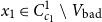 $x_1\in C_{c_1}^1\setminus V_{\textrm {bad}}$
and
$x_1\in C_{c_1}^1\setminus V_{\textrm {bad}}$
and $y_2\in C_{c_2}^3\setminus V_{\textrm {bad}}$
for two unused colours
$y_2\in C_{c_2}^3\setminus V_{\textrm {bad}}$
for two unused colours $c_1,c_2\in \mathcal{C}_3$
. By sequentially connecting
$c_1,c_2\in \mathcal{C}_3$
. By sequentially connecting $Q_1,{xy},Q_3$
via Claim 7.1 (iv), we obtain a rainbow directed path
$Q_1,{xy},Q_3$
via Claim 7.1 (iv), we obtain a rainbow directed path $P=x_1\ldots y_2$
such that
$P=x_1\ldots y_2$
such that $V_{\textrm {bad}}\setminus X'\subseteq V(P)$
,
$V_{\textrm {bad}}\setminus X'\subseteq V(P)$
, $\mathcal{C}_{\textrm {bad}}\subseteq \textrm {col}(P)$
and
$\mathcal{C}_{\textrm {bad}}\subseteq \textrm {col}(P)$
and $|C^4\setminus V(P)|=|C^2\setminus V(P)|+1$
. Similar to the previous discussion,
$|C^4\setminus V(P)|=|C^2\setminus V(P)|+1$
. Similar to the previous discussion, $\mathcal{D}$
contains a transversal directed Hamilton cycle, a contradiction.
$\mathcal{D}$
contains a transversal directed Hamilton cycle, a contradiction.
Now, assume that $\mathcal{C}_{\textrm {bad}}\setminus \textrm {col}(M\cup \mathbf{P}^0)=\emptyset$
. Since
$\mathcal{C}_{\textrm {bad}}\setminus \textrm {col}(M\cup \mathbf{P}^0)=\emptyset$
. Since $|C^2|\geq |C^4|$
, either
$|C^2|\geq |C^4|$
, either $|C^1|+|C^2|\geq |C^3|+|C^4|$
or
$|C^1|+|C^2|\geq |C^3|+|C^4|$
or $|C^3|+|C^2|\geq |C^1|+|C^4|$
. Hence, for each
$|C^3|+|C^2|\geq |C^1|+|C^4|$
. Hence, for each $c\in \mathcal{C}_3$
, there exists an edge
$c\in \mathcal{C}_3$
, there exists an edge $uv\in E(D_c[C^2\setminus V(Q_0\cup Q_1\cup Q_2),C^1\cup C^2])$
or
$uv\in E(D_c[C^2\setminus V(Q_0\cup Q_1\cup Q_2),C^1\cup C^2])$
or $uv\in E(D_c[C^2\cup C^3,C^2\setminus V(Q_0\cup Q_1\cup Q_2)])$
. By a similar argument as above, and considering whether the vertex
$uv\in E(D_c[C^2\cup C^3,C^2\setminus V(Q_0\cup Q_1\cup Q_2)])$
. By a similar argument as above, and considering whether the vertex $v$
belongs to
$v$
belongs to $V_{\textrm {bad}}$
or not, we obtain that
$V_{\textrm {bad}}$
or not, we obtain that $\mathcal{D}$
contains a transversal directed Hamilton cycle, a contradiction.
$\mathcal{D}$
contains a transversal directed Hamilton cycle, a contradiction.
On the other hand, we consider that $|E(Q_1)|+\cdots +|E(Q_{t})|+k\lt |C^2|-|C^4|-\sigma = r-s_1-2s_2-\sigma$
. In this case, we move all vertices inside
$|E(Q_1)|+\cdots +|E(Q_{t})|+k\lt |C^2|-|C^4|-\sigma = r-s_1-2s_2-\sigma$
. In this case, we move all vertices inside $Q_1,\ldots ,Q_t$
, all vertices in
$Q_1,\ldots ,Q_t$
, all vertices in $(V(Q_1')\cup \ldots \cup V(Q_k'))\cap C^2$
along with their in-neighbours in
$(V(Q_1')\cup \ldots \cup V(Q_k'))\cap C^2$
along with their in-neighbours in $C^3$
to
$C^3$
to $C^4$
. Denote the resulting partition by
$C^4$
. Denote the resulting partition by $\tilde {C}^1\cup \tilde {C}^2\cup \tilde {C}^3\cup \tilde {C}^4$
. Let
$\tilde {C}^1\cup \tilde {C}^2\cup \tilde {C}^3\cup \tilde {C}^4$
. Let $\tilde {\mathcal{C}}\,:\!=\,\mathcal{C}\setminus (\textrm {col}(\bigcup _{i\in [t]}Q_i)\cup \textrm { col}(\bigcup _{i\in [k]}Q_i'[C^3,C^2]))$
. Therefore,
$\tilde {\mathcal{C}}\,:\!=\,\mathcal{C}\setminus (\textrm {col}(\bigcup _{i\in [t]}Q_i)\cup \textrm { col}(\bigcup _{i\in [k]}Q_i'[C^3,C^2]))$
. Therefore,
 \begin{align*} &|\tilde {C}^4| \leq \frac {|C^2|+|C^4|-r}{2}+s_2+2(r-s_1-2s_2-\sigma )\leq \frac {|C^2|+|C^4|}{2}+50{\delta }n, \\[3pt] &|\tilde {C}^2|\geq \frac {|C^2|+|C^4|+r}{2}-s_1-s_2-2(r-s_1-2s_2-\sigma )\geq \frac {|C^2|+|C^4|}{2}-50{\delta }n,\\[3pt] &|\tilde {\mathcal{C}}|=|\mathcal{C}|-(|E(Q_1)|+\cdots +|E(Q_{t})|)-k\geq (1-25\delta )n. \end{align*}
By the maximality of $\{Q_1,\ldots ,Q_t\}$
, we know that
$\{Q_1,\ldots ,Q_t\}$
, we know that $D_i[\tilde {C}^2]=D_i[\tilde {C}^2,\tilde {C}^1]=D_i[\tilde {C}^3,\tilde {C}^2]=\emptyset$
for all colour
$D_i[\tilde {C}^2]=D_i[\tilde {C}^2,\tilde {C}^1]=D_i[\tilde {C}^3,\tilde {C}^2]=\emptyset$
for all colour $i\in \tilde {\mathcal{C}}$
. It follows from
$i\in \tilde {\mathcal{C}}$
. It follows from $\delta ^0(\mathcal{D})\geq \left \lceil \frac {n}{2}\right \rceil$
that
$\delta ^0(\mathcal{D})\geq \left \lceil \frac {n}{2}\right \rceil$
that $\left \lceil \frac {n}{2}\right \rceil \leq |\tilde {C}^3|+|\tilde {C}^4|$
and
$\left \lceil \frac {n}{2}\right \rceil \leq |\tilde {C}^3|+|\tilde {C}^4|$
and $\left \lceil \frac {n}{2}\right \rceil \leq |\tilde {C}^1|+|\tilde {C}^4|$
. Therefore,
$\left \lceil \frac {n}{2}\right \rceil \leq |\tilde {C}^1|+|\tilde {C}^4|$
. Therefore,
 \begin{equation*} |\tilde {C}^1|+|\tilde {C}^2|+|\tilde {C}^3|+|\tilde {C}^4|=n\leq \left \lceil \frac {n}{2}\right \rceil +\left \lceil \frac {n}{2}\right \rceil \leq |\tilde {C}^1|+|\tilde {C}^3|+2|\tilde {C}^4|, \end{equation*}
which implies that $|\tilde {C}^2|\leq |\tilde {C}^4|$
. We complete our proof by using the subsequent lemma (i.e., Lemma 7.2), which leads to a contradiction by showing that
$|\tilde {C}^2|\leq |\tilde {C}^4|$
. We complete our proof by using the subsequent lemma (i.e., Lemma 7.2), which leads to a contradiction by showing that $\mathcal{D}$
contains a transversal directed Hamilton cycle.
$\mathcal{D}$
contains a transversal directed Hamilton cycle.
Lemma 7.2.
Suppose $0\lt \frac {1}{n}\ll \delta \ll 1$
and
$0\lt \frac {1}{n}\ll \delta \ll 1$
and $0\leq \gamma \lt \delta$
. Let
$0\leq \gamma \lt \delta$
. Let $\mathcal{C}$
be a set of
$\mathcal{C}$
be a set of $n$
colours, and
$n$
colours, and $\mathcal{D}=\{D_i\,:\,i\in \mathcal{C}\}$
be a collection of digraphs on a common vertex set
$\mathcal{D}=\{D_i\,:\,i\in \mathcal{C}\}$
be a collection of digraphs on a common vertex set $V$
of size
$V$
of size $n$
such that
$n$
such that $\delta ^0(\mathcal{D})\geq \left \lceil \frac {n}{2}\right \rceil$
. Assume that
$\delta ^0(\mathcal{D})\geq \left \lceil \frac {n}{2}\right \rceil$
. Assume that
-
•
$C^1\cup C^2\cup C^3\cup C^4$
is a partition of
$V$
with
$|C^2|\geq 50\delta ^{\frac {1}{4}}$
,
$\min \{|C^3|+|C^4|,|C^1|+|C^4|\}\geq \left \lceil \frac {n}{2}\right \rceil$
and
$|C^4|=\left \lfloor \frac {|C^2|+|C^4|+1}{2}\right \rfloor +\gamma n$
, -
•
$\mathcal{C}'\cup \mathcal{C}''$
is a partition of
$\mathcal{C}$
with
$|\mathcal{C}''|\leq \delta n$
, -
•
$D_i[C^2]=D_i[C^2,C^1]=D_i[C^3,C^2]=\emptyset$
for all
$i\in \mathcal{C}'$
.


Then $\mathcal{D}$
contains a transversal directed Hamilton cycle.
$\mathcal{D}$
contains a transversal directed Hamilton cycle.
Proof. It is easy to see that $|C^3|+|C^4|+|C^1|+|C^4|=n+2\gamma n+\sigma$
and
$|C^3|+|C^4|+|C^1|+|C^4|=n+2\gamma n+\sigma$
and $\max \{|C^3|+|C^4|,|C^1|+|C^4|\}\leq \left \lceil \frac {n}{2}\right \rceil +2\gamma n+\sigma$
, where
$\max \{|C^3|+|C^4|,|C^1|+|C^4|\}\leq \left \lceil \frac {n}{2}\right \rceil +2\gamma n+\sigma$
, where $\sigma =1$
if
$\sigma =1$
if $|C^2|+|C^4|$
is odd and
$|C^2|+|C^4|$
is odd and $\sigma =0$
otherwise. Without loss of generality, assume that
$\sigma =0$
otherwise. Without loss of generality, assume that $|C^3|+|C^4|=\left \lceil \frac {n}{2}\right \rceil +\gamma _1 n$
and
$|C^3|+|C^4|=\left \lceil \frac {n}{2}\right \rceil +\gamma _1 n$
and $|C^1|+|C^4|=\left \lceil \frac {n}{2}\right \rceil +\gamma _2 n$
with
$|C^1|+|C^4|=\left \lceil \frac {n}{2}\right \rceil +\gamma _2 n$
with $2\left \lceil \frac {n}{2}\right \rceil +\gamma _1 n+\gamma _2 n=n+2\gamma n+\sigma$
. Define
$2\left \lceil \frac {n}{2}\right \rceil +\gamma _1 n+\gamma _2 n=n+2\gamma n+\sigma$
. Define $Y_1\,:\!=\,\{v\in C^4 \,: \, d_{i}^{+} (v,C^2) \leq (1-\delta ^{\frac {1}{4}})|C^2| \ \textrm{for}\ \textrm{at}\ \textrm{least} \delta ^{\frac {1}{4}}|\mathcal{C}'|\ \textrm {colors}\ i\in \mathcal{C}'\}$
,
$Y_1\,:\!=\,\{v\in C^4 \,: \, d_{i}^{+} (v,C^2) \leq (1-\delta ^{\frac {1}{4}})|C^2| \ \textrm{for}\ \textrm{at}\ \textrm{least} \delta ^{\frac {1}{4}}|\mathcal{C}'|\ \textrm {colors}\ i\in \mathcal{C}'\}$
, $Y_2\,:\!=\,\{v\in C^4: d_{i}^-(v,C^2) \leq (1-\delta ^{\frac {1}{4}})|C^2|\ \textrm {for at least}\ \delta ^{\frac {1}{4}}|\mathcal{C}'|\ \textrm {colors}\ i\in \mathcal{C}'\}$
, and
$Y_2\,:\!=\,\{v\in C^4: d_{i}^-(v,C^2) \leq (1-\delta ^{\frac {1}{4}})|C^2|\ \textrm {for at least}\ \delta ^{\frac {1}{4}}|\mathcal{C}'|\ \textrm {colors}\ i\in \mathcal{C}'\}$
, and $Y\,:\!=\,Y_1\cup Y_2$
. It is routine to check that
$Y\,:\!=\,Y_1\cup Y_2$
. It is routine to check that
 \begin{align*} \left \lceil \frac {n}{2}\right \rceil |C^2||\mathcal{C}'|&\leq \sum _{i\in \mathcal{C}'}|E({D_i}[C^2,C^3\cup C^4])|=\sum _{i\in \mathcal{C}'}|E({D_i}[C^2,C^3])|+\sum _{i\in \mathcal{C}'}|E({D_i}[C^2,C^4])|\\[4pt] &\leq |C^2||C^3||\mathcal{C}'|+ |Y_2|(1-\delta ^{\frac {1}{4}})|C^2|\delta ^{\frac {1}{4}}|\mathcal{C}'|+|Y_2||C^2|(1-\delta ^{\frac {1}{4}})|\mathcal{C}'| +(|C^4|-|Y_2|)|C^2||\mathcal{C}'|\\[4pt] &=(|C^4|-\delta ^{\frac {1}{2}}|Y_2|+|C^3|)|C^2||\mathcal{C}'|. \end{align*}
Thus, $|Y_2|\leq 3\sqrt {\delta }n$
. Similarly,
$|Y_2|\leq 3\sqrt {\delta }n$
. Similarly, $|Y_1|\leq 3\sqrt {\delta }n$
. Notice that Lemma 6.2 and Claim 7.1 hold by setting
$|Y_1|\leq 3\sqrt {\delta }n$
. Notice that Lemma 6.2 and Claim 7.1 hold by setting $V_{\textrm {bad}}\,:\!=\,Y$
and
$V_{\textrm {bad}}\,:\!=\,Y$
and $\mathcal{C}_3\,:\!=\,\mathcal{C}'$
.
$\mathcal{C}_3\,:\!=\,\mathcal{C}'$
.
For a vertex $v\in Y_1\setminus Y_2$
(resp.
$v\in Y_1\setminus Y_2$
(resp. $v\in Y_2\setminus Y_1$
), we have
$v\in Y_2\setminus Y_1$
), we have $d_{i}^-(v,C^2)\geq (1-\delta ^{\frac {1}{4}})|C^2|$
(resp.
$d_{i}^-(v,C^2)\geq (1-\delta ^{\frac {1}{4}})|C^2|$
(resp. $d_{i}^+(v,C^2)\geq (1-\delta ^{\frac {1}{4}})|C^2|$
) for at least
$d_{i}^+(v,C^2)\geq (1-\delta ^{\frac {1}{4}})|C^2|$
) for at least $(1-\delta ^{\frac {1}{4}})|\mathcal{C}'|$
colours
$(1-\delta ^{\frac {1}{4}})|\mathcal{C}'|$
colours $i\in \mathcal{C}'$
. For a vertex
$i\in \mathcal{C}'$
. For a vertex $y\in Y_2$
, one has
$y\in Y_2$
, one has $d_i^-(y,C^1\cup C^4)\geq 40\sqrt {\delta }n$
for at least
$d_i^-(y,C^1\cup C^4)\geq 40\sqrt {\delta }n$
for at least ${\delta }^{\frac {1}{4}}|\mathcal{C}'|-1$
colours
${\delta }^{\frac {1}{4}}|\mathcal{C}'|-1$
colours $i\in \mathcal{C}'$
. Otherwise, by the definition of
$i\in \mathcal{C}'$
. Otherwise, by the definition of $Y_2$
, there exists a colour
$Y_2$
, there exists a colour $c\in \mathcal{C}'$
such that
$c\in \mathcal{C}'$
such that $d_{c}^-(y,C^2)\leq (1-\delta ^{\frac {1}{4}})|C^2|$
and
$d_{c}^-(y,C^2)\leq (1-\delta ^{\frac {1}{4}})|C^2|$
and $d_{c}^-(y,C^1\cup C^4)\leq 40\sqrt {\delta }n$
. Together with
$d_{c}^-(y,C^1\cup C^4)\leq 40\sqrt {\delta }n$
. Together with $|C^2|\geq 50{\delta }^{\frac {1}{4}}n$
, one has
$|C^2|\geq 50{\delta }^{\frac {1}{4}}n$
, one has
 \begin{equation*} d_{c}^-(y)\leq 40\sqrt {\delta }n+(1-\delta ^{\frac {1}{4}})|C^2|+|C^3|\leq \left \lceil \frac {n}{2}\right \rceil -\delta ^{\frac {1}{4}}|C^2|+40\sqrt {\delta }n\lt \left \lceil \frac {n}{2}\right \rceil , \end{equation*}
a contradiction. Similarly, each vertex in $Y_1$
has at least
$Y_1$
has at least $40\sqrt {\delta }n$
out-neighbours inside
$40\sqrt {\delta }n$
out-neighbours inside $C^3\cup C^4$
for at least
$C^3\cup C^4$
for at least ${\delta }^{\frac {1}{4}}|\mathcal{C}'|-1$
digraphs
${\delta }^{\frac {1}{4}}|\mathcal{C}'|-1$
digraphs $D_i$
with
$D_i$
with $i\in \mathcal{C}'$
.
$i\in \mathcal{C}'$
.
Since $\delta ^0(\mathcal{D})\geq \frac {n}{2}$
, we have
$\delta ^0(\mathcal{D})\geq \frac {n}{2}$
, we have $|E(D_i[C^2,C^3\cup C^4])|,|E(D_i[C^1\cup C^4,C^2])| \geq |C^2|\left \lceil \frac {n}{2}\right \rceil$
for each
$|E(D_i[C^2,C^3\cup C^4])|,|E(D_i[C^1\cup C^4,C^2])| \geq |C^2|\left \lceil \frac {n}{2}\right \rceil$
for each $i\in \mathcal{C}'$
. This implies that for each
$i\in \mathcal{C}'$
. This implies that for each $i\in \mathcal{C}'$
, there are at most
$i\in \mathcal{C}'$
, there are at most $|C^2|(\left \lceil \frac {n}{2}\right \rceil +\gamma _1 n)-|C^2|\left \lceil \frac {n}{2}\right \rceil =|C^2|\gamma _1 n$
non-edges in
$|C^2|(\left \lceil \frac {n}{2}\right \rceil +\gamma _1 n)-|C^2|\left \lceil \frac {n}{2}\right \rceil =|C^2|\gamma _1 n$
non-edges in $D_i[C^2,C^3\cup C^4]$
and at most
$D_i[C^2,C^3\cup C^4]$
and at most $|C^2|\gamma _2 n$
non-edges in
$|C^2|\gamma _2 n$
non-edges in $D_i[C^1\cup C^4,C^2]$
. Therefore,
$D_i[C^1\cup C^4,C^2]$
. Therefore,
 \begin{equation*} \sum _{i\in \mathcal{C}'}|E(D_i[Y_1,C^2])|\geq (|Y_1|-\gamma _1 n)|C^2||\mathcal{C}'|\ \text{and}\ \sum _{i\in \mathcal{C}'}|E(D_i[C^2,Y_2])|\geq (|Y_2|-\gamma _2 n)|C^2||\mathcal{C}'|. \end{equation*}
We proceed with the proof by considering the values of $|Y_1|$
and
$|Y_1|$
and $|Y_2|$
.
$|Y_2|$
.
Case 1. $|Y_1|\geq \gamma _1 n,\ |Y_2|\geq \gamma _2 n$
.
$|Y_1|\geq \gamma _1 n,\ |Y_2|\geq \gamma _2 n$
.
In view of Lemma 6.4, there exists a subset $Y_1'\subseteq Y_1$
with size
$Y_1'\subseteq Y_1$
with size $\gamma _1 n$
such that vertices in
$\gamma _1 n$
such that vertices in $Y_1\setminus Y_1'$
can be covered by disjoint rainbow directed
$Y_1\setminus Y_1'$
can be covered by disjoint rainbow directed $P_3$
copies inside
$P_3$
copies inside $\{D_i[Y_1,C^2]\,:\,i\in \mathcal{C}'\}$
with centres in
$\{D_i[Y_1,C^2]\,:\,i\in \mathcal{C}'\}$
with centres in $Y_1\setminus Y_1'$
; and a subset
$Y_1\setminus Y_1'$
; and a subset $Y_2'\subseteq Y_2$
with size
$Y_2'\subseteq Y_2$
with size $\gamma _2 n$
such that vertices in
$\gamma _2 n$
such that vertices in $Y_2\setminus Y_2'$
can be covered by disjoint rainbow directed
$Y_2\setminus Y_2'$
can be covered by disjoint rainbow directed $P_3$
copies inside
$P_3$
copies inside $\{D_i[C^2,Y_2]\,:\,i\in \mathcal{C}'\}$
with centres in
$\{D_i[C^2,Y_2]\,:\,i\in \mathcal{C}'\}$
with centres in $Y_2\setminus Y_2'$
. Therefore, by using colours in
$Y_2\setminus Y_2'$
. Therefore, by using colours in $\mathcal{C}'$
,
$\mathcal{C}'$
,
-
• vertices in
$(Y_1\cup Y_2)\setminus (Y_1'\cup Y_2')$
can be covered by a set of disjoint rainbow directed
$P_3$
copies with centres in
$(Y_1\cup Y_2)\setminus (Y_1'\cup Y_2')$
and endpoints in
$C^2$
, -
• vertices in
$Y_2'\setminus Y_1'$
can be covered by a set of disjoint rainbow directed
$P_3$
or
$P_4$
copies with centres in
$Y_2'\setminus Y_1'$
, starting at
$C^4$
and ending at
$C^2$
, -
• vertices in
$Y_1'\setminus Y_2'$
can be covered by a set of disjoint rainbow directed
$P_3$
or
$P_4$
copies with centres in
$Y_1'\setminus Y_2'$
, starting at
$C^2$
and ending at
$C^4$
, -
• vertices in
$Y_1'\cap Y_2'$
can be covered by a set of disjoint rainbow directed
$P_3$
,
$P_4$
or
$P_5$
copies with centres in
$Y_1'\cap Y_2'$
and endpoints in
$C^4$
.


For each $y\in Y$
, denote the rainbow directed path with centre
$y\in Y$
, denote the rainbow directed path with centre $y$
by
$y$
by $P_y=y^1*y*y^2$
with colours in
$P_y=y^1*y*y^2$
with colours in $\mathcal{C}_3$
. Let
$\mathcal{C}_3$
. Let $\mathbf{P}\,:\!=\,\{P_y:y\in Y\}$
.
$\mathbf{P}\,:\!=\,\{P_y:y\in Y\}$
.
It is routine to verify that there exists a rainbow matching inside $D_i^{\pm }[C^2\setminus V(\mathbf{P}),C^4\setminus V(\mathbf{P})]\cup D_i[C^1]\cup D_i[C^3]\cup (\bigcup _{k\in [4]}D_i[C^k,C^{k+1}])\,:\, i\in \mathcal{C}''\}$
, say
$D_i^{\pm }[C^2\setminus V(\mathbf{P}),C^4\setminus V(\mathbf{P})]\cup D_i[C^1]\cup D_i[C^3]\cup (\bigcup _{k\in [4]}D_i[C^k,C^{k+1}])\,:\, i\in \mathcal{C}''\}$
, say $M$
. For all but at most one unused colour in
$M$
. For all but at most one unused colour in $\mathcal{C}''$
, we can find a rainbow directed copy of
$\mathcal{C}''$
, we can find a rainbow directed copy of $P_3$
with centre in
$P_3$
with centre in $Y$
and endpoints in
$Y$
and endpoints in $Z$
, where
$Z$
, where $\{Y,Z\}=\{C^1,C^3\}$
. If some colour
$\{Y,Z\}=\{C^1,C^3\}$
. If some colour $c\in \mathcal{C}''$
remains unused, then
$c\in \mathcal{C}''$
remains unused, then $D_c[C^1,C^3]$
is nearly a complete bipartite graph and
$D_c[C^1,C^3]$
is nearly a complete bipartite graph and $D_c[C^2],D_c[C^4]$
are almost complete graphs. Then, by a similar argument to that in Theorem 6.5,
$D_c[C^2],D_c[C^4]$
are almost complete graphs. Then, by a similar argument to that in Theorem 6.5, $\mathcal{D}$
contains a transversal directed Hamilton cycle.
$\mathcal{D}$
contains a transversal directed Hamilton cycle.
Case 2. At most one of $|Y_1|\geq \gamma _1n$
and
$|Y_1|\geq \gamma _1n$
and $|Y_2|\geq \gamma _2n$
holds.
$|Y_2|\geq \gamma _2n$
holds.
We only consider the case that $|Y_1|\geq \gamma _1 n$
and
$|Y_1|\geq \gamma _1 n$
and $|Y_2|\lt \gamma _2 n$
; other cases can be discussed similarly. Notice that vertices in
$|Y_2|\lt \gamma _2 n$
; other cases can be discussed similarly. Notice that vertices in $Y_1$
can be covered by a set of disjoint rainbow directed paths with centres in
$Y_1$
can be covered by a set of disjoint rainbow directed paths with centres in $Y_1$
and ending in
$Y_1$
and ending in $C^4\setminus (Y_1\cup Y_2)$
. In particular, those rainbow directed paths can be chosen such that none of them contains edges inside
$C^4\setminus (Y_1\cup Y_2)$
. In particular, those rainbow directed paths can be chosen such that none of them contains edges inside $\mathcal{D}[C^4,C^3]$
or
$\mathcal{D}[C^4,C^3]$
or $\mathcal{D}[C^1,C^4]$
. Furthermore, vertices in
$\mathcal{D}[C^1,C^4]$
. Furthermore, vertices in $Y_2\setminus Y_1$
can be covered by a set of disjoint rainbow directed
$Y_2\setminus Y_1$
can be covered by a set of disjoint rainbow directed $P_3$
copies with centres in
$P_3$
copies with centres in $Y_2\setminus Y_1$
, starting at
$Y_2\setminus Y_1$
, starting at $C^4\setminus Y$
, and using colours in
$C^4\setminus Y$
, and using colours in $\mathcal{C}'$
.
$\mathcal{C}'$
.
In the digraph collection $\mathcal{D}[C^4\setminus Y]$
, extend those rainbow directed paths or choose other disjoint rainbow directed paths into a set of disjoint maximal rainbow directed paths. Let
$\mathcal{D}[C^4\setminus Y]$
, extend those rainbow directed paths or choose other disjoint rainbow directed paths into a set of disjoint maximal rainbow directed paths. Let $\mathbf{P}\,:\!=\,\{Q_1,Q_2,\ldots ,Q_t\}$
be a set consisting of all disjoint rainbow paths in the above, each of which has at least one endpoint in
$\mathbf{P}\,:\!=\,\{Q_1,Q_2,\ldots ,Q_t\}$
be a set consisting of all disjoint rainbow paths in the above, each of which has at least one endpoint in $C^4\setminus Y$
and length
$C^4\setminus Y$
and length $s_i\ (1\leq i\leq t)$
inside
$s_i\ (1\leq i\leq t)$
inside $C^4$
. Let
$C^4$
. Let $\{e_1,e_2,\ldots ,e_r\}$
be a set consisting of all disjoint rainbow edges in
$\{e_1,e_2,\ldots ,e_r\}$
be a set consisting of all disjoint rainbow edges in $\mathcal{D}[C^4\setminus Y,C^3]$
, and let
$\mathcal{D}[C^4\setminus Y,C^3]$
, and let $\{\tilde {Q}_1,\ldots ,\tilde {Q}_k\}$
be a set of disjoint maximal rainbow directed
$\{\tilde {Q}_1,\ldots ,\tilde {Q}_k\}$
be a set of disjoint maximal rainbow directed $P_3$
in
$P_3$
in $\mathcal{D}^{\pm }[C^4\setminus Y,C^1]$
with centres in
$\mathcal{D}^{\pm }[C^4\setminus Y,C^1]$
with centres in $C^4$
and endpoints in
$C^4$
and endpoints in $C^1$
, each of which is chosen while avoiding previously used vertices and colours.
$C^1$
, each of which is chosen while avoiding previously used vertices and colours.
Subcase 2.1. $|C^2|\geq |C^4|-k-r-(s_1+\cdots +s_t)-\sigma$
.
$|C^2|\geq |C^4|-k-r-(s_1+\cdots +s_t)-\sigma$
.
In this subcase, there exist two integers $r'\in [r]$
,
$r'\in [r]$
, $k'\in [k]$
and a set of disjoint rainbow directed paths
$k'\in [k]$
and a set of disjoint rainbow directed paths $\mathbf{P}'=\{{Q}_1',{Q}_2',\ldots ,{Q}_{\ell }'\}$
such that
$\mathbf{P}'=\{{Q}_1',{Q}_2',\ldots ,{Q}_{\ell }'\}$
such that $|C^4\setminus V(\mathbf{P}')|-r'-k'-\sigma =|C^2|-\ell$
, where
$|C^4\setminus V(\mathbf{P}')|-r'-k'-\sigma =|C^2|-\ell$
, where $Y_1'\cup Y_2\subseteq V(\mathbf{P}')$
and the endpoints of
$Y_1'\cup Y_2\subseteq V(\mathbf{P}')$
and the endpoints of $\tilde {Q}_i$
are not in
$\tilde {Q}_i$
are not in $Y$
for all
$Y$
for all $i\in [\ell ]$
. By Claim 7.1, we connect all the rainbow directed paths in
$i\in [\ell ]$
. By Claim 7.1, we connect all the rainbow directed paths in $\mathbf{P}'$
into a single rainbow path
$\mathbf{P}'$
into a single rainbow path $P^1$
, whose endpoints lie in different parts. Since
$P^1$
, whose endpoints lie in different parts. Since $|C^4|-|C^2|=2\gamma n+\sigma$
, we have
$|C^4|-|C^2|=2\gamma n+\sigma$
, we have $\ell \leq |E(Q_1')|+\cdots +|E(Q_{\ell }')|= 2\gamma n+\sigma$
. Therefore,
$\ell \leq |E(Q_1')|+\cdots +|E(Q_{\ell }')|= 2\gamma n+\sigma$
. Therefore, $|E(P^1)|\leq 6\gamma n+3\sigma$
and
$|E(P^1)|\leq 6\gamma n+3\sigma$
and $|C^4\setminus V(P^1)|-\sigma =|C^2\setminus V(P^1)|$
. By a similar discussion as Subcase 2.1 of Theorem 6.5,
$|C^4\setminus V(P^1)|-\sigma =|C^2\setminus V(P^1)|$
. By a similar discussion as Subcase 2.1 of Theorem 6.5, $\mathcal{D}$
contains a transversal directed Hamilton cycle.
$\mathcal{D}$
contains a transversal directed Hamilton cycle.
Subcase 2.2. $|C^2|\lt |C^4|-k-r-(s_1+\cdots +s_t)-\sigma$
.
$|C^2|\lt |C^4|-k-r-(s_1+\cdots +s_t)-\sigma$
.
In this subcase, $\sum _{i=1}^t s_i+k+r\lt 2\gamma n$
. Assume that
$\sum _{i=1}^t s_i+k+r\lt 2\gamma n$
. Assume that $V(Q_i[C^4])\,:\!=\,\{v_{s_1+\cdots +s_{i-1}+i}, \ldots , v_{s_1+\cdots +s_{i}+i}\}$
for each
$V(Q_i[C^4])\,:\!=\,\{v_{s_1+\cdots +s_{i-1}+i}, \ldots , v_{s_1+\cdots +s_{i}+i}\}$
for each $i\in [t]$
. Let
$i\in [t]$
. Let $w$
be an unused vertex in
$w$
be an unused vertex in $C^4$
and
$C^4$
and $c_1,c_2$
be two unused colours in
$c_1,c_2$
be two unused colours in $\mathcal{C}$
. By the maximality of
$\mathcal{C}$
. By the maximality of $\mathbf{P}$
, in
$\mathbf{P}$
, in $D_{c_1}$
(resp.
$D_{c_1}$
(resp. $D_{c_2}$
),
$D_{c_2}$
), $w$
cannot be adjacent to the starting vertices of
$w$
cannot be adjacent to the starting vertices of $Q_i[C^4]$
(resp. cannot be adjacent from the ending vertices of
$Q_i[C^4]$
(resp. cannot be adjacent from the ending vertices of $Q_i[C^4]$
) for all
$Q_i[C^4]$
) for all $i\in [t]$
.
$i\in [t]$
.
Define
 \begin{equation*} I_1\,:\!=\,\{i:v_i\in N_{{c_1}}^-(w)\}\ \text{and}\ I_2\,:\!=\,\{i:v_{i+1}\in N_{{c_2}}^+(w)\}. \end{equation*}
Hence $I_1,I_2\subseteq \bigcup _{i\in [t]}\left [\sum _{j\in [i-1]}s_{j}+i,\sum _{j\in [i]}s_j+i-1\right ]$
with
$I_1,I_2\subseteq \bigcup _{i\in [t]}\left [\sum _{j\in [i-1]}s_{j}+i,\sum _{j\in [i]}s_j+i-1\right ]$
with $s_0=0$
. By the maximality of
$s_0=0$
. By the maximality of $\mathbf{P}$
, we know that
$\mathbf{P}$
, we know that
-
•
$I_1\cap I_2= \emptyset$
, which implies
$|I_1|+|I_2|\leq s_1+\cdots +s_t$
, -
• each vertex in
$N_{c_1}^+(w,C^3)$
must be an end vertex of some
$e_i$
for
$i\in [r]$
(hence
$|N_{c_1}^+(w,C^3)| \leq r$
), -
• each vertex in
$N_{c_2}^-(w,C^1)$
must be a start vertex of some
$\tilde {Q}_i$
for
$i\in [k]$
(hence
$|N_{c_2}^-(w,C^1)| \leq k$
).


Therefore,
 \begin{align*} n\leq & d_{D_{c_1}}^+(w)+d_{D_{c_2}}^-(w)\leq s_1+\cdots +s_t+r+|C^3|+|C^2|+k+|C^1|+|C^2|\\[3pt] \leq & 2\gamma n-1+n-|C^4|+|C^2|=n+2\gamma n-1-(2\gamma n+\sigma )=n-1-\sigma , \end{align*}
a contradiction.
8. Concluding remarks
In this paper, we establish a transversal analogue of Ghouila-Houri’s theorem [Reference Ghouila-Houri19] (Theorem1.3), thereby resolving a problem proposed by Chakraborti, Kim, Lee, and Seo [Reference Chakraborti, Kim, Lee and Seo6] for all sufficiently large $n$
. As a consequence, we recover the transversal version of Dirac’s theorem, previously obtained by Joos and Kim [Reference Joos and Kim21].
$n$
. As a consequence, we recover the transversal version of Dirac’s theorem, previously obtained by Joos and Kim [Reference Joos and Kim21].
An anti-directed cycle is a digraph in which the underlying graph forms a cycle, and no pair of consecutive edges forms a directed path. DeBiasio and Molla [Reference DeBiasio and Molla17] proved that the anti-directed Hamilton cycle is guaranteed to appear in a digraph $D$
if
$D$
if $\delta ^0(D) \geq \frac {n}{2}+1$
. DeBiasio, Kühn, Molla, Osthus, and Taylor [Reference DeBiasio, Kühn, Molla, Osthus and Taylor16] showed that for sufficiently large
$\delta ^0(D) \geq \frac {n}{2}+1$
. DeBiasio, Kühn, Molla, Osthus, and Taylor [Reference DeBiasio, Kühn, Molla, Osthus and Taylor16] showed that for sufficiently large $n$
, every
$n$
, every $n$
-vertex digraph
$n$
-vertex digraph $D$
with
$D$
with $\delta ^0 (D)\geq \frac {n}{2}$
contains every orientation of a Hamilton cycle except, possibly, the anti-directed one. It would be interesting to generalise the above two results to a transversal version.
$\delta ^0 (D)\geq \frac {n}{2}$
contains every orientation of a Hamilton cycle except, possibly, the anti-directed one. It would be interesting to generalise the above two results to a transversal version.
An oriented graph is a digraph with no cycle of length two. Keevash, Kühn, and Osthus [Reference Keevash, Kühn and Osthus23] proved the oriented version of Dirac’s theorem, which states that every $n$
-vertex digraph with minimum semi-degree at least
$n$
-vertex digraph with minimum semi-degree at least $\frac {3n-4}{8}$
contains a directed Hamilton cycle. It would be interesting to consider a transversal version of this theorem.
$\frac {3n-4}{8}$
contains a directed Hamilton cycle. It would be interesting to consider a transversal version of this theorem.
Question 8.1.
Let $\mathcal{D} = \left \{ D_{1}, \ldots , D_{n}\right \}$
be a collection of oriented graphs with common vertex set
$\mathcal{D} = \left \{ D_{1}, \ldots , D_{n}\right \}$
be a collection of oriented graphs with common vertex set $V$
of size
$V$
of size $n.$
If
$n.$
If $\delta ^0 (\mathcal{D})\geq \lceil \frac {3n-4}{8}\rceil$
, does
$\delta ^0 (\mathcal{D})\geq \lceil \frac {3n-4}{8}\rceil$
, does $\mathcal{D}$
contain a transversal directed Hamilton cycle?
$\mathcal{D}$
contain a transversal directed Hamilton cycle?
We remark that our main technique used in this paper cannot be directly generalised to the above oriented case. This is because the absorbing structure we used does not exist in the above oriented graph collections since their semi-degree is much lower than $\frac {n}{2}$
. To overcome this difficulty, one has to introduce new stable conditions and build an absorption structure using Lemma 3.4. It seems that new ideas are needed to prove the tight bound in Question 8.1.
$\frac {n}{2}$
. To overcome this difficulty, one has to introduce new stable conditions and build an absorption structure using Lemma 3.4. It seems that new ideas are needed to prove the tight bound in Question 8.1.
Acknowledgements
We would like to express our gratitude to the anonymous reviewers for their valuable comments that greatly improved the presentation of this paper.
Funding statement
Yangyang Cheng: Supported by the PhD studentship of ERC Advanced Grant (883810). Heng Li: Supported by National Natural Science Foundation of China (12501487). Wanting Sun: Supported by the National Natural Science Foundation of China (12501488), the China Postdoctoral Science Foundation (2023M742092) and the Natural Science Foundation of Shandong Province (ZR2024QA023). Guanghui Wang: Supported by the National Key Research and Development Program (2023YFA1009603) and the National Natural Science Foundation of China (12231018).
Appendix A. Regularity for digraph collections
In this section, we prove the regularity lemma for digraph collections (i.e., Lemma 2.2). Before proceeding with the proof, we first make some preparations, including some necessary definitions and key theorems.
A $k$
-uniform hypergraph (or
$k$
-uniform hypergraph (or $k$
-graph)
$k$
-graph) $\mathscr{F}=(V,E)$
consists of a vertex set
$\mathscr{F}=(V,E)$
consists of a vertex set $V$
and an edge set
$V$
and an edge set $E$
which is a family of
$E$
which is a family of $k$
-element subsets of
$k$
-element subsets of $V$
, i.e.,
$V$
, i.e., $E\subseteq \binom Vk.$
For a vertex
$E\subseteq \binom Vk.$
For a vertex $v\in V$
, the degree of
$v\in V$
, the degree of $v$
in
$v$
in $\mathscr{F}$
, denoted by
$\mathscr{F}$
, denoted by $\deg _{\mathscr{F}}(v)$
, is the number of edges containing
$\deg _{\mathscr{F}}(v)$
, is the number of edges containing $v$
. Given a
$v$
. Given a $k$
-graph
$k$
-graph $\mathscr{F}$
, and
$\mathscr{F}$
, and $k$
disjoint sets
$k$
disjoint sets $V_1, V_2,\ldots , V_k \subseteq V(\mathscr{F})$
, define
$V_1, V_2,\ldots , V_k \subseteq V(\mathscr{F})$
, define $\mathscr{F}[V_1, V_2,\ldots , V_k]$
to be the subhypergraph of
$\mathscr{F}[V_1, V_2,\ldots , V_k]$
to be the subhypergraph of $\mathscr{F}$
with edge set
$\mathscr{F}$
with edge set $\left \{\{v_1,v_2,\ldots ,v_k\}\in E(\mathscr{F}):v_i\in V_i\ {\text{for all}}\ i\in [k]\right \}$
. We call
$\left \{\{v_1,v_2,\ldots ,v_k\}\in E(\mathscr{F}):v_i\in V_i\ {\text{for all}}\ i\in [k]\right \}$
. We call
 \begin{equation*} d_{\mathscr{F}}(V_1, V_2, \ldots , V_k) \,:\!=\, \frac {e(\mathscr{F}[V_1, V_2,\ldots , V_k])}{|V_1||V_2|\ldots |V_k|} \end{equation*}
the density of the tuple $(V_1, V_2, \ldots , V_k)$
in
$(V_1, V_2, \ldots , V_k)$
in $\mathscr{F}$
. If
$\mathscr{F}$
. If $d_{\mathscr{F}}(V_1, V_2, \ldots , V_k)=0$
, then we say that
$d_{\mathscr{F}}(V_1, V_2, \ldots , V_k)=0$
, then we say that $(V_1, V_2, \ldots , V_k)$
is empty in
$(V_1, V_2, \ldots , V_k)$
is empty in $\mathscr{F}$
. Given
$\mathscr{F}$
. Given $\epsilon \gt 0$
and
$\epsilon \gt 0$
and $d\in [0,1)$
, we say that
$d\in [0,1)$
, we say that $(V_1, V_2, \ldots , V_k)$
is
$(V_1, V_2, \ldots , V_k)$
is $\epsilon$
-regular in
$\epsilon$
-regular in $\mathscr{F}$
if for all
$\mathscr{F}$
if for all $i\in [k]$
, whenever
$i\in [k]$
, whenever $V_i'\subseteq V_i$
with
$V_i'\subseteq V_i$
with $|V_i'|\geq \epsilon |V_i|$
one has
$|V_i'|\geq \epsilon |V_i|$
one has
 \begin{equation*} |d_{\mathscr{F}}(V_1', V_2',\ldots , V_k')-d_{\mathscr{F}}(V_1, V_2,\ldots , V_k)|\leq \epsilon , \end{equation*}
and the tuple is $(\epsilon , d)$
-regular if it is
$(\epsilon , d)$
-regular if it is $\epsilon$
-regular and
$\epsilon$
-regular and $d_{\mathscr{F}}(V_1, V_2, \ldots , V_k)\geq d$
. The following result was proved by Chung [Reference Chung14], and its proof follows the approach of the original Regularity Lemma for graphs [Reference Szemerédi27].
$d_{\mathscr{F}}(V_1, V_2, \ldots , V_k)\geq d$
. The following result was proved by Chung [Reference Chung14], and its proof follows the approach of the original Regularity Lemma for graphs [Reference Szemerédi27].
Theorem
A.1 (Weak hypergraph regularity lemma). For all integers $k\geq 2$
,
$k\geq 2$
, $L_0\geq 1$
, and every
$L_0\geq 1$
, and every $\epsilon \gt 0$
there exists
$\epsilon \gt 0$
there exists $N = N(\epsilon , L_0, k)$
such that if
$N = N(\epsilon , L_0, k)$
such that if $\mathscr{F}$
is a
$\mathscr{F}$
is a $k$
-graph on
$k$
-graph on $n \geq N$
vertices, then
$n \geq N$
vertices, then $V(\mathscr{F})$
has a partition
$V(\mathscr{F})$
has a partition $V_0,V_1,\ldots , V_L$
such that the following hold:
$V_0,V_1,\ldots , V_L$
such that the following hold:
-
•
$L_0\leq L\leq N$
and
$|V_0|\leq \epsilon n$
, -
•
$|V_1|=\cdots =|V_L|$
, -
• for all but at most
$\epsilon \binom {L}{k}$
$k$
-tuples
$\{i_1, \ldots , i_k\}\in \binom {[L]}{k}$
, we have that
$(V_{i_1}, \ldots , V_{i_k})$
is
$\epsilon$
-regular in
$\mathscr{F}$
.


Given two partitions $V_0,V_1,\ldots ,V_k$
and
$V_0,V_1,\ldots ,V_k$
and $U_1,\ldots ,U_{\ell }$
of a vertex set, we say that
$U_1,\ldots ,U_{\ell }$
of a vertex set, we say that $V_0,V_1,\ldots ,V_k$
refines
$V_0,V_1,\ldots ,V_k$
refines $U_1,\ldots ,U_{\ell }$
if for all
$U_1,\ldots ,U_{\ell }$
if for all $V_i$
with
$V_i$
with $i\in [k]$
there is
$i\in [k]$
there is $U_j$
for some
$U_j$
for some $j\in [\ell ]$
that contains
$j\in [\ell ]$
that contains $V_i$
. For some integer
$V_i$
. For some integer $s\gt 0$
, let
$s\gt 0$
, let $\mathscr{F}_1, \mathscr{F}_2,\ldots , \mathscr{F}_s$
be
$\mathscr{F}_1, \mathscr{F}_2,\ldots , \mathscr{F}_s$
be $s$
$s$ $K$
-partite
$K$
-partite $k$
-graphs sharing a common vertex set
$k$
-graphs sharing a common vertex set $V\,:\!=\,V_1\cup \ldots \cup V_K$
. As a consequence of the proof of TheoremA.1, we can deduce the following corollary.
$V\,:\!=\,V_1\cup \ldots \cup V_K$
. As a consequence of the proof of TheoremA.1, we can deduce the following corollary.
Corollary A.2.
For all integers $K\geq k\geq 2$
,
$K\geq k\geq 2$
, $s\geq 1$
,
$s\geq 1$
, $L_0\geq 1$
, and every
$L_0\geq 1$
, and every $\epsilon \gt 0$
, there exists
$\epsilon \gt 0$
, there exists $N = N(\epsilon , s, L_0, K, k)$
such that if
$N = N(\epsilon , s, L_0, K, k)$
such that if $\mathscr{F}_1, \mathscr{F}_2,\ldots , \mathscr{F}_s$
are
$\mathscr{F}_1, \mathscr{F}_2,\ldots , \mathscr{F}_s$
are $s$
$s$ $K$
-partite
$K$
-partite $k$
-graphs sharing a common vertex set
$k$
-graphs sharing a common vertex set $V\,:\!=\,V_1\cup \ldots \cup V_K$
of size
$V\,:\!=\,V_1\cup \ldots \cup V_K$
of size $n \geq N$
, then
$n \geq N$
, then $V$
can be refined into a partition
$V$
can be refined into a partition $U_0,U_1,\ldots , U_L$
satisfying the following properties:
$U_0,U_1,\ldots , U_L$
satisfying the following properties:
-
•
$L_0\leq L\leq N$
and
$|U_0|\leq \epsilon n$
, -
•
$|U_1|=\cdots =|U_L|$
, -
• for each
$i\in [s]$
and for all but at most
$\epsilon \binom {L}{k}$
$k$
-tuples
$\{i_1, \ldots , i_k\}\in \binom {[L]}{k}$
, we have that
$(U_{i_1}, \ldots , U_{i_k})$
is
$\epsilon$
-regular in
$\mathscr{F}_i$
.


The degree form of the weak hypergraph regularity lemma [Reference Townsend29] is proved in the same way as the original degree form of the regularity lemma, which in fact can be derived from TheoremA.1 via some cleaning.
Theorem
A.3. (Degree form of the weak hypergraph regularity lemma, [Reference Townsend29]). For all integers $k\geq 2$
,
$k\geq 2$
, $L_0 \geq 1$
and every
$L_0 \geq 1$
and every $\epsilon \gt 0$
, there exists
$\epsilon \gt 0$
, there exists $N=N(\epsilon , L_0, k)$
such that for every
$N=N(\epsilon , L_0, k)$
such that for every $d \in [0, 1)$
and for every
$d \in [0, 1)$
and for every $k$
-graph
$k$
-graph $\mathscr{F}$
on
$\mathscr{F}$
on $n \geq N$
vertices, there exists a partition of
$n \geq N$
vertices, there exists a partition of $V(\mathscr{F})$
into
$V(\mathscr{F})$
into $V_0, V_1, \ldots , V_L$
and a spanning subhypergraph
$V_0, V_1, \ldots , V_L$
and a spanning subhypergraph $\mathscr{F}'$
of
$\mathscr{F}'$
of $\mathscr{F}$
such that the following properties hold:
$\mathscr{F}$
such that the following properties hold:
-
•
$L_0 \leq L \leq N$
and
$|V_0| \leq \epsilon n$
, -
•
$|V_1| = \cdots = |V_L|$
, -
•
$\textrm {deg}_{\mathscr{F}'}(v) \ge \textrm {deg}_{\mathscr{F}}(v) - (d + \epsilon )n^{k-1}$
for all
$v\in V(\mathscr{F})$
, -
• every edge of
$\mathscr{F}'$
with more than one vertex in a single cluster
$V_i$
for some
$i \in [L]$
has at least one vertex in
$V_0$
, -
• for all
$k$
-tuples
$\{i_1,i_2,\ldots ,i_k\}\in \binom {[L]}{k}$
, we have that
$(V_{i_1}, V_{i_2},\ldots , V_{i_k})$
is either empty or
$(\epsilon , d)$
-regular in
$\mathscr{F}'$
.


In fact, from the proof of TheoremA.3 in [Reference Townsend29] and Corollary A.2 we can derive the following stronger version of the conclusion.
Theorem
A.4. For all integers $K\geq k\geq 2$
,
$K\geq k\geq 2$
, $s\geq 1$
,
$s\geq 1$
, $L_0\geq 1$
, and every
$L_0\geq 1$
, and every $\epsilon \gt 0$
, there exists
$\epsilon \gt 0$
, there exists $N = N(\epsilon , s, L_0, K, k)$
such that, for any
$N = N(\epsilon , s, L_0, K, k)$
such that, for any $s$
$s$ $K$
-partite
$K$
-partite $k$
-graphs
$k$
-graphs $\mathscr{F}_1, \mathscr{F}_2,\ldots , \mathscr{F}_s$
sharing a common vertex set
$\mathscr{F}_1, \mathscr{F}_2,\ldots , \mathscr{F}_s$
sharing a common vertex set $V\,:\!=\,V_1\cup \ldots \cup V_K$
of size
$V\,:\!=\,V_1\cup \ldots \cup V_K$
of size $n \geq N$
, we can find a refinement partition
$n \geq N$
, we can find a refinement partition $U_0,U_1,\ldots , U_L$
of
$U_0,U_1,\ldots , U_L$
of $V$
, and a spanning subhypergraph
$V$
, and a spanning subhypergraph $\mathscr{F}_i'\subseteq \mathscr{F}_i$
for each
$\mathscr{F}_i'\subseteq \mathscr{F}_i$
for each $i\in [s]$
such that the following properties hold:
$i\in [s]$
such that the following properties hold:
-
•
$L_0 \leq L \leq N$
and
$|U_0| \leq \epsilon n$
, -
•
$|U_1| = \cdots = |U_L|$
, -
• for each
$i\in [s]$
and each
$v\in V$
,
$\textrm {deg}_{\mathscr{F}'_i}(v) \ge \textrm { deg}_{\mathscr{F}_i}(v) - (d + \epsilon )n^{k-1}$
, -
• for each
$i\in [s]$
, every edge of
$\mathscr{F}_i'$
with more than one vertex in a single cluster
$V_j$
for some
$j \in [L]$
has at least one vertex in
$V_0$
, -
• for each
$i\in [s]$
and all
$k$
-tuples
$\{i_1,i_2,\ldots ,i_k\}\in \binom {[L]}{k}$
, we have that
$(U_{i_1}, U_{i_2},\ldots , U_{i_k})$
is either empty or
$(\epsilon , d)$
-regular in
$\mathscr{F}'_i$
.


Since the proof of TheoremA.4 closely follows that of TheoremA.3, requiring only a repeated application of the cleaning operation on $s$
hypergraphs, we omit it here for brevity.
$s$
hypergraphs, we omit it here for brevity.
Let $\mathcal{D}=\{D_i\,:\,i\in \mathcal{C}\}$
be a collection of digraphs on a common vertex set
$\mathcal{D}=\{D_i\,:\,i\in \mathcal{C}\}$
be a collection of digraphs on a common vertex set $[n]$
. Based on
$[n]$
. Based on $\mathcal{D}$
, we construct the auxiliary
$\mathcal{D}$
, we construct the auxiliary $4$
-graph
$4$
-graph $\mathscr{H}$
as follows. The vertex set is
$\mathscr{H}$
as follows. The vertex set is $V(\mathscr{H}\ )=[n]\cup \mathcal{C} \cup S_1\cup S_2$
, where
$V(\mathscr{H}\ )=[n]\cup \mathcal{C} \cup S_1\cup S_2$
, where $S_1$
and
$S_1$
and $S_2$
are new sets with
$S_2$
are new sets with $|S_1|=|S_2|=n$
, and the four sets
$|S_1|=|S_2|=n$
, and the four sets $[n]$
,
$[n]$
, $\mathcal{C}$
,
$\mathcal{C}$
, $S_1$
,
$S_1$
, $S_2$
are pairwise disjoint. The edge set of
$S_2$
are pairwise disjoint. The edge set of $\mathscr{H}$
is defined by
$\mathscr{H}$
is defined by
 \begin{align*} &{E(\mathscr{H}\ )=\left \{\{i,j,c,x\}\,:\,i,j\in [n],\ c\in \mathcal{C},\ ij\in E(D_c);\ x\in S_1 \text{if}\ i\lt j\ \text{and}\ x\in S_2\ \text{otherwise}\right \}}. \end{align*}
Now, we prove Lemma 2.2.
Proof of Lemma.
2.2
By increasing $L_0$
and decreasing
$L_0$
and decreasing $\epsilon$
,
$\epsilon$
, $\delta$
as necessary, we may assume that
$\delta$
as necessary, we may assume that $0\lt \frac {1}{L_0} \ll \epsilon \ll \delta \ll 1$
. Let
$0\lt \frac {1}{L_0} \ll \epsilon \ll \delta \ll 1$
. Let $L_1\,:\!=\,\frac {24L_0}{\delta }$
. Choose further positive constants
$L_1\,:\!=\,\frac {24L_0}{\delta }$
. Choose further positive constants $\epsilon ', \alpha$
satisfying
$\epsilon ', \alpha$
satisfying $\frac {1}{L_1}\ll \epsilon ' \ll \alpha \ll \epsilon \ll \delta \ll 1$
. Let
$\frac {1}{L_1}\ll \epsilon ' \ll \alpha \ll \epsilon \ll \delta \ll 1$
. Let $n_1$
be derived from TheoremA.3 by applying it with the parameters
$n_1$
be derived from TheoremA.3 by applying it with the parameters $(\epsilon ', L_1, 4)$
. Next, let
$(\epsilon ', L_1, 4)$
. Next, let $n_2$
be obtained from TheoremA.4 using the parameters
$n_2$
be obtained from TheoremA.4 using the parameters $(\epsilon ', 2, L_0, n_1, 3)$
. Define
$(\epsilon ', 2, L_0, n_1, 3)$
. Define $n_0\,:\!=\,\frac {4n_2}{\alpha }$
. By increasing
$n_0\,:\!=\,\frac {4n_2}{\alpha }$
. By increasing $n_0$
if necessary, we may assume that
$n_0$
if necessary, we may assume that $ L_1\ll n_1\ll n_2\ll n_0$
. Altogether,
$ L_1\ll n_1\ll n_2\ll n_0$
. Altogether,
 \begin{equation*} 0\lt \frac {1}{n_0}\ll \frac {1}{n_2}\ll \frac {1}{n_1}\ll \frac {1}{L_1}\ll \epsilon ' \ll \alpha \ll \epsilon \ll \delta \ll 1. \end{equation*}
Let $n \geq n_0$
be an integer and
$n \geq n_0$
be an integer and $\mathcal{D}$
be a digraph collection on vertex set
$\mathcal{D}$
be a digraph collection on vertex set $V\,:\!=\,[n]$
and with colour set
$V\,:\!=\,[n]$
and with colour set $\mathcal{C}$
, where
$\mathcal{C}$
, where $\delta n\leq |\mathcal{C}|\leq \frac {n}{\delta }$
. Let
$\delta n\leq |\mathcal{C}|\leq \frac {n}{\delta }$
. Let $d \in [0, 1)$
and let
$d \in [0, 1)$
and let $\mathscr{H}$
be the auxiliary
$\mathscr{H}$
be the auxiliary $4$
-graph obtained from
$4$
-graph obtained from $\mathcal{D}$
with vertex set
$\mathcal{D}$
with vertex set $U\,:\!=\,V\cup \mathcal{C}\cup S_1\cup S_2$
. TheoremA.3 implies that there is a partition
$U\,:\!=\,V\cup \mathcal{C}\cup S_1\cup S_2$
. TheoremA.3 implies that there is a partition $U_0, U_1, \ldots , U_K$
of
$U_0, U_1, \ldots , U_K$
of $U$
and a spanning subhypergraph
$U$
and a spanning subhypergraph $\mathscr{H}_0$
of
$\mathscr{H}_0$
of $\mathscr{H}$
such that
$\mathscr{H}$
such that
-
(a)
$L_1 \leq K \leq n_1$
and
$|U_0| \leq \epsilon ' |U|$
, -
(b)
$|U_1| = \cdots = |U_K| \,=\!:\, m'$
, -
(c)
$\textrm {deg}_{\mathscr{H}_0}(v) \ge \textrm {deg}_{\mathscr{H}}\ (v) - (d + \epsilon ')|U|^3$
for all
$v\in U$
, -
(d) every edge of
$\mathscr{H}_0$
with more than one vertex in a single cluster
$U_i$
for some
$i \in [K]$
has at least one vertex in
$U_0$
, -
(e) for all
$4$
-tuples
$\{i_1, i_2, i_3, i_4\}\in \binom {[K]}{4}$
, we have that
$(U_{i_1}, U_{i_2}, U_{i_3}, U_{i_4})$
is either empty or
$(\epsilon ', d)$
-regular in
$\mathscr{H}_0$
.


Delete all edges $e\in E(\mathscr{H}_0)$
satisfying
$e\in E(\mathscr{H}_0)$
satisfying $|e\cap U_i|\geq 2$
for some
$|e\cap U_i|\geq 2$
for some $i\in [K]$
and
$i\in [K]$
and $e\cap (\mathcal{C}\cap U_0)=\emptyset$
. Denote the resulting spanning subhypergraph by
$e\cap (\mathcal{C}\cap U_0)=\emptyset$
. Denote the resulting spanning subhypergraph by $\mathscr{H}\ '$
. Note that for every
$\mathscr{H}\ '$
. Note that for every $v \in U$
, the number of edges incident to
$v \in U$
, the number of edges incident to $v$
that are deleted is fewer than
$v$
that are deleted is fewer than
 \begin{equation*} \epsilon '|U|^3+Km'^2|U|\leq \epsilon '|U|^3+m'|U|^2\leq \epsilon '|U|^3+\frac {|U|^3}{L_1}\leq 2\epsilon ' |U|^3. \end{equation*}
Combining $(c)$
, for each
$(c)$
, for each $v\in U$
we have
$v\in U$
we have
 \begin{align*} \textrm {deg}_{\mathscr{H}\ '}(v) \ge \textrm {deg}_{\mathscr{H}}\ (v) - (d +3 \epsilon ')|U|^3. \end{align*}
Partition each cluster $U_i$
,
$U_i$
, $i\in [K]$
, into
$i\in [K]$
, into $\frac {1}{\alpha }$
subclusters of size at most
$\frac {1}{\alpha }$
subclusters of size at most $m_0$
so that all but at most
$m_0$
so that all but at most $4$
subclusters of
$4$
subclusters of $U_i$
have size exactly
$U_i$
have size exactly $m_0$
and the property that they lie entirely within one of
$m_0$
and the property that they lie entirely within one of $V$
,
$V$
, $\mathcal{C}$
,
$\mathcal{C}$
, $S_1$
and
$S_1$
and $S_2$
. If a subcluster does not have this property, then add it to
$S_2$
. If a subcluster does not have this property, then add it to $U_0$
. The new exceptional set has size at most
$U_0$
. The new exceptional set has size at most $|U_0| + 4\alpha m'K$
, and let
$|U_0| + 4\alpha m'K$
, and let $V_0$
be its intersection with
$V_0$
be its intersection with $V$
,
$V$
, $\mathcal{C}_0$
be its intersection with
$\mathcal{C}_0$
be its intersection with $\mathcal{C}$
. Relabel the subclusters so that those which are subsets of
$\mathcal{C}$
. Relabel the subclusters so that those which are subsets of $V$
are
$V$
are $V_1,\ldots , V_L$
and those which are subsets of
$V_1,\ldots , V_L$
and those which are subsets of $\mathcal{C}$
are
$\mathcal{C}$
are $\mathcal{C}_1,\ldots ,\mathcal{C}_M$
. For each
$\mathcal{C}_1,\ldots ,\mathcal{C}_M$
. For each $c\in \mathcal{C}$
, let
$c\in \mathcal{C}$
, let $D_c'$
be the spanning sub-digraph of
$D_c'$
be the spanning sub-digraph of $D_c$
with vertex set
$D_c$
with vertex set $V\,=\!:\,[n]$
and edge set
$V\,=\!:\,[n]$
and edge set
 \begin{equation*} \left \{uv\,:\,u \lt v,\ x\in S_1\ \text{and}\ \{u,v,c,x\} \in \mathscr{H}\ ' \right \}\cup \left \{vu\,:\,u \lt v,\ y\in S_2\ \text{and}\ \{u,v,c,y\} \in \mathscr{H}\ ' \right \}. \end{equation*}
We claim that the properties of Lemma 2.2 (i)-(iv) are satisfied.
Property (i). Note that $m' K\leq |U|$
. Since
$m' K\leq |U|$
. Since $\epsilon '\ll \epsilon$
, one has
$\epsilon '\ll \epsilon$
, one has
 \begin{align} |V_0|+|\mathcal{C}_0|\leq |U_0|+4\alpha m' K\leq (\epsilon '+4\alpha )|U|= (\epsilon '+4\alpha )\left (3n+\frac {n}{\delta }\right )\leq \frac {\epsilon n}{2}. \end{align}
Also,
 \begin{align*} L+M\leq \frac {2K}{\alpha }\leq \frac {2n_1}{\alpha }\leq \frac {n_0}{2}, \end{align*}
proving the required upper bound for both $L$
and
$L$
and $M$
. Furthermore,
$M$
. Furthermore, $m_0(L+M)\leq n+|\mathcal{C}|$
and
$m_0(L+M)\leq n+|\mathcal{C}|$
and
 \begin{equation*} \frac {L_1}{6}\leq \frac {3n+|\mathcal{C}|}{6m_0}\leq \frac {n+|\mathcal{C}|}{2m_0}\leq \frac {n+|\mathcal{C}|-\epsilon n}{m_0}\leq L+M, \end{equation*}
so
 \begin{align} L= \frac {n-|V_0|}{m_0}\geq \frac {(n-|V_0|)(L+M)}{n+|\mathcal{C}|}\geq \frac {(n-|V_0|)L_1}{6(n+\frac {n}{\delta })}\geq \frac {\delta L_1}{24}=L_0, \end{align}
and similarly for $M$
.
$M$
.
Property (ii). It follows by construction.
Property (iii). By the construction of $\mathscr{H}\ '$
, for all
$\mathscr{H}\ '$
, for all $v\in V$
we have
$v\in V$
we have
 \begin{equation*}\sum _{c\in \mathcal{C}}\left (d^+_{D_c'}(v)+ d^-_{D_c'}(v) \right )\geq \frac {\textrm { deg}_{\mathscr{H}\ '}(v)}{n},\end{equation*}
and $e(D_c')\geq \frac {\textrm {deg}_{\mathscr{H}\ '}(c)}{n}$
for all
$e(D_c')\geq \frac {\textrm {deg}_{\mathscr{H}\ '}(c)}{n}$
for all $c\in \mathcal{C}$
. Furthermore,
$c\in \mathcal{C}$
. Furthermore,
 \begin{align} (d+3\epsilon ')(3n+|\mathcal{C}|)^3\leq \left (\frac {8d}{\delta ^3}+\frac {24\epsilon '}{\delta ^3}\right )n^3\leq \left (\frac {8d}{\delta ^3} +\frac {\epsilon }{4}\right )n^3. \end{align}
Notice that $\sum _{c\in \mathcal{C}}\left (d^+_{D_c}(v)+ d^-_{D_c}(v) \right )= \frac {\textrm { deg}_{\mathscr{H}}\ (v)}{n}$
for all
$\sum _{c\in \mathcal{C}}\left (d^+_{D_c}(v)+ d^-_{D_c}(v) \right )= \frac {\textrm { deg}_{\mathscr{H}}\ (v)}{n}$
for all $v\in V$
. Thus,
$v\in V$
. Thus,
 \begin{align} \sum _{c\in \mathcal{C}}d^+_{D_c'}(v)\geq & \frac {\textrm {deg}_{\mathscr{H}\ '}(v)}{n}-\sum _{c\in \mathcal{C}}d^-_{D_c'}(v) \notag \\[3pt] \geq & \frac {\textrm {deg}_{\mathscr{H}}\ (v)}{n}-\sum _{c\in \mathcal{C}}d^-_{D_c}(v)-\left (\frac {8d}{\delta ^3} +\frac {\epsilon }{4}\right )n^2 \notag \\[3pt] =& \sum _{c\in \mathcal{C}}d^+_{D_c}(v)-\left (\frac {8d}{\delta ^3} +\frac {\epsilon }{4}\right )n^2 \end{align}
for all $v\in V$
, and similarly for
$v\in V$
, and similarly for $\sum _{c\in \mathcal{C}}d^-_{D_c'}(v)$
. Additionally, observe that
$\sum _{c\in \mathcal{C}}d^-_{D_c'}(v)$
. Additionally, observe that $e(D_c)= \frac {\textrm {deg}_{\mathscr{H}}\ (c)}{n}$
for each
$e(D_c)= \frac {\textrm {deg}_{\mathscr{H}}\ (c)}{n}$
for each $c\in \mathcal{C}$
. It follows that for each
$c\in \mathcal{C}$
. It follows that for each $c\in \mathcal{C}$
,
$c\in \mathcal{C}$
,
 \begin{align} e(D_c')\geq \frac {\textrm {deg}_{\mathscr{H}\ '}(c)}{n}\geq \frac {\textrm { deg}_{\mathscr{H}}\ (c)}{n}-\left (\frac {8d}{\delta ^3} +\frac {\epsilon }{4}\right )n^2= e(D_c)-\left (\frac {8d}{\delta ^3} +\frac {\epsilon }{4}\right )n^2. \end{align}
Property (iv). It follows by construction.
Property (v). Suppose that $(V_0\cup \mathcal{C}_0, V_1, \ldots , V_L, \mathcal{C}_1,\ldots , \mathcal{C}_M)$
does not satisfy property (v), we are to refine it and get a desired partition. Now, define the following auxiliary
$(V_0\cup \mathcal{C}_0, V_1, \ldots , V_L, \mathcal{C}_1,\ldots , \mathcal{C}_M)$
does not satisfy property (v), we are to refine it and get a desired partition. Now, define the following auxiliary $3$
-graphs
$3$
-graphs $\mathscr{H}_1$
and
$\mathscr{H}_1$
and $\mathscr{H}_2$
on the common vertex set
$\mathscr{H}_2$
on the common vertex set $U'\,:\!=\,([n]\cup \mathcal{C})\setminus (V_0\cup \mathcal{C}_0)$
and
$U'\,:\!=\,([n]\cup \mathcal{C})\setminus (V_0\cup \mathcal{C}_0)$
and
 \begin{align*} E(\mathscr{H}_1)= \left \{\{u, v, c\}\,:\,uv\in D'_c[V_i, V_j], u, v \in V\setminus V_0, c\in \mathcal{C}\setminus \mathcal{C}_0, 1\leq i\lt j\leq L \right \},\\[3pt] E(\mathscr{H}_2)= \left \{\{u, v, c\}\,:\,uv\in D'_c[V_j, V_i], u, v \in V\setminus V_0, c\in \mathcal{C}\setminus \mathcal{C}_0, 1\leq i\lt j\leq L \right \}. \end{align*}
Notice that the partition $P=(V_1, \ldots , V_L, \mathcal{C}_1, \ldots , \mathcal{C}_M)$
can be viewed as two distinct partitions
$P=(V_1, \ldots , V_L, \mathcal{C}_1, \ldots , \mathcal{C}_M)$
can be viewed as two distinct partitions $P_1$
,
$P_1$
, $P_2$
for the hypergraphs
$P_2$
for the hypergraphs $\mathscr{H}_1$
,
$\mathscr{H}_1$
, $\mathscr{H}_2$
(both partitions divide
$\mathscr{H}_2$
(both partitions divide $V$
and
$V$
and $\mathcal{C}$
in the same way, but the sets of edges among the partition sets are different). By increasing
$\mathcal{C}$
in the same way, but the sets of edges among the partition sets are different). By increasing $n_2$
, we may assume that
$n_2$
, we may assume that $n_2\gg N(\epsilon ', 2, L_0, L+M, 3)$
(which is defined in TheoremA.4). Consequently,
$n_2\gg N(\epsilon ', 2, L_0, L+M, 3)$
(which is defined in TheoremA.4). Consequently, $n_0\gg N(\epsilon ', 2, L_0, L+M, 3)$
as well. Applying TheoremA.4, we obtain a refinement
$n_0\gg N(\epsilon ', 2, L_0, L+M, 3)$
as well. Applying TheoremA.4, we obtain a refinement $U_0',U_1',\ldots ,U_{K'}'$
of the partition
$U_0',U_1',\ldots ,U_{K'}'$
of the partition $P$
together with spanning subhypergraphs
$P$
together with spanning subhypergraphs $\mathscr{H}_1^{{\kern3pt} \prime}\subseteq \mathscr{H}_1$
and
$\mathscr{H}_1^{{\kern3pt} \prime}\subseteq \mathscr{H}_1$
and $\mathscr{H}_2^{{\kern3pt} \prime}\subseteq \mathscr{H}_2$
that satisfy the following:
$\mathscr{H}_2^{{\kern3pt} \prime}\subseteq \mathscr{H}_2$
that satisfy the following:
-
(a′)
$L_0 \leq K' \leq n_2$
and
$|U_0'| \leq \epsilon ' |U'|$
, -
(b′)
$|U'_1| = \cdots = |U'_{K'}|$
, -
(c′) for each
$i\in [2]$
and each
$v\in V\setminus V_0$
,
$\textrm {deg}_{\mathscr{H}_i^{{\kern3pt} \prime}}(v) \ge \textrm {deg}_{\mathscr{H}_i}(v) - (d + \epsilon ')|U'|^{2}$
, -
(d′) for each
$i\in [2]$
, every edge of
$\mathscr{H}_i^{{\kern3pt} \prime}$
with more than one vertex in a single cluster
$U'_j$
for some
$j \in [K']$
has at least one vertex in
$U'_0$
, -
(e′) for each
$i\in [2]$
and all
$3$
-tuples
$\{i_1,i_2, i_3\}\in \binom {[K']}{3}$
, we have that
$(U_{i_1}', U_{i_2}',U_{i_3}')$
is either empty or
$(\epsilon ', d)$
-regular in
$\mathscr{H}_i^{{\kern3pt} \prime}$
.


Following the same operation as earlier, let $V'_0\,:\!=\,V\cap U_0'$
and
$V'_0\,:\!=\,V\cap U_0'$
and $\mathcal{C}'_0\,:\!=\,\mathcal{C}\cap U_0'$
. Relabel the subclusters such that those which are subsets of
$\mathcal{C}'_0\,:\!=\,\mathcal{C}\cap U_0'$
. Relabel the subclusters such that those which are subsets of $V$
are
$V$
are $V'_1,\ldots , V'_{L'}$
and those which are subsets of
$V'_1,\ldots , V'_{L'}$
and those which are subsets of $\mathcal{C}$
are
$\mathcal{C}$
are $\mathcal{C}_1',\ldots ,\mathcal{C}_{M'}'$
. For each
$\mathcal{C}_1',\ldots ,\mathcal{C}_{M'}'$
. For each $c\in \mathcal{C}\setminus (\mathcal{C}_0\cup \mathcal{C}_0')$
, let
$c\in \mathcal{C}\setminus (\mathcal{C}_0\cup \mathcal{C}_0')$
, let $D_c''$
be the spanning sub-digraph of
$D_c''$
be the spanning sub-digraph of $D_c$
with vertex set
$D_c$
with vertex set $V$
and edge set
$V$
and edge set
 \begin{equation*} \left \{uv\,:\,\{u,v,c\} \in \mathscr{H}_1^{{\kern3pt} \prime}\,\,\text{or}\,\,\{u,v,c\} \in \mathscr{H}_2^{{\kern3pt} \prime} \right \}\cup E(D_c'^{\pm }[V_0,V\setminus (V_0\cup V_0')]). \end{equation*}
Let $D_i^*\,:\!=\,D_i'$
for
$D_i^*\,:\!=\,D_i'$
for $i\in \mathcal{C}_0\cup \mathcal{C}_0'$
and
$i\in \mathcal{C}_0\cup \mathcal{C}_0'$
and $D_i^*\,:\!=\,D_i''$
for
$D_i^*\,:\!=\,D_i''$
for $i\in \mathcal{C}\setminus (\mathcal{C}_0\cup \mathcal{C}_0')$
. Let
$i\in \mathcal{C}\setminus (\mathcal{C}_0\cup \mathcal{C}_0')$
. Let
 \begin{equation*}P^*\,:\!=\,(V_0\cup \mathcal{C}_0\cup V_0'\cup \mathcal{C}_0', V_1',\ldots , V_{L'}', \mathcal{C}_1'\ldots , \mathcal{C}_{M'}')\end{equation*}
be a partition of $V\cup \mathcal{C}$
. Next, we will re-verify that
$V\cup \mathcal{C}$
. Next, we will re-verify that $P^*$
and digraph collection
$P^*$
and digraph collection $\mathcal{D}^*\,:\!=\,\{D_i^* \,:\, i\in \mathcal{C}\}$
satisfies (i)–(v) of Lemma 2.2. By the construction of
$\mathcal{D}^*\,:\!=\,\{D_i^* \,:\, i\in \mathcal{C}\}$
satisfies (i)–(v) of Lemma 2.2. By the construction of $\mathscr{H}_1$
and
$\mathscr{H}_1$
and $\mathscr{H}_2$
, it is easy to see that
$\mathscr{H}_2$
, it is easy to see that $P^*$
and
$P^*$
and $\mathcal{D^*}$
satisfy the property (v). Thus, we only need to re-verify properties (i)-(iv).
$\mathcal{D^*}$
satisfy the property (v). Thus, we only need to re-verify properties (i)-(iv).
Property (i). By (5), (6) and (a′), we have
 \begin{equation*}|V_0|+|\mathcal{C}_0|+|V_0'|+|\mathcal{C}_0'|\leq \frac {\epsilon n}{2}+\epsilon ' |U'|\leq \epsilon n,\end{equation*}
and
 \begin{equation*} L_0\leq L \leq L' \leq n_2 \leq n_0\ \ \text{and}\ \ L_0\leq M \leq M' \leq n_2 \leq n_0. \end{equation*}
Property (ii). It follows from (b’) that $|V_1'|=\cdots =|V_{L'}'|=|\mathcal{C}_1'|=\cdots =|\mathcal{C}_{M'}'|$
, as required.
$|V_1'|=\cdots =|V_{L'}'|=|\mathcal{C}_1'|=\cdots =|\mathcal{C}_{M'}'|$
, as required.
Property (iii). For each vertex $v\in V$
and each colour
$v\in V$
and each colour $c\in \mathcal{C}$
, by the construction of
$c\in \mathcal{C}$
, by the construction of $D_{c}^*$
, (c’), (7), (8) and (9), we have
$D_{c}^*$
, (c’), (7), (8) and (9), we have
 \begin{equation*} e(D_c^*)\geq e(D_c)-\left (\frac {8d}{\delta ^3} +\frac {\epsilon }{4}\right )n^2-2\left (\frac {8d}{\delta ^3} +\frac {\epsilon }{4}\right )n^2-\frac {4\epsilon ' n^2}{\delta }\geq e(D_c)-\left (\frac {24d}{\delta ^3} +\epsilon \right )n^2 \end{equation*}
and
 \begin{equation*} \sum _{c\in \mathcal{C}}d^+_{D_c^*}(v)\geq \sum _{c\in \mathcal{C}}d^+_{D_c}(v)-\!\left (\frac {8d}{\delta ^3} +\frac {\epsilon }{4}\right )\!n^2-2\! \left (\frac {8d}{\delta ^3}\! \!\ +\frac {\epsilon }\!{4}\right )\!n^2-\frac {2\epsilon ' n^2}{\delta ^2}\geq \sum _{c\in \mathcal{C}}d^+_{D_c}(v)-\left (\frac {24d}{\delta^3} +\epsilon \right) n^2. \end{equation*}
Analogously, the same inequality holds for $\sum _{c\in \mathcal{C}}d^-_{D_c^*}(v)$
.
$\sum _{c\in \mathcal{C}}d^-_{D_c^*}(v)$
.
Property (iv). Notice that $\mathscr{H}_1$
and
$\mathscr{H}_1$
and $\mathscr{H}_2$
are
$\mathscr{H}_2$
are $(L+M)$
-partite hypergraphs. Thus, there is no edge of
$(L+M)$
-partite hypergraphs. Thus, there is no edge of $\mathscr{H}_i^{{\kern3pt} \prime}$
with more than one vertex in a single cluster
$\mathscr{H}_i^{{\kern3pt} \prime}$
with more than one vertex in a single cluster $U'_j$
for some
$U'_j$
for some $j\in [K']$
. This implies that
$j\in [K']$
. This implies that $P^*$
and
$P^*$
and $\mathcal{D}^*$
satisfy (iv).
$\mathcal{D}^*$
satisfy (iv).
This completes the proof of Lemma 2.2.
Appendix B. Transversal perfect matching in bipartite graph collections
B.1 Proof of Lemma 2.7
In this subsection we prove Lemma 2.7, which provides a characteristic partition of each balanced bipartite graph whose minimum degree is just below $\frac {n}{2}$
, allowing a tiny fraction of vertices that may have even smaller degrees.
$\frac {n}{2}$
, allowing a tiny fraction of vertices that may have even smaller degrees.
Proof of Lemma
2.7
. We first add vertices with degree at most $\left (\frac {1}{2}-\epsilon ^5\right )n$
to
$\left (\frac {1}{2}-\epsilon ^5\right )n$
to $C_1\cup C_2$
. Let
$C_1\cup C_2$
. Let $\mu =\epsilon ^5$
. Since
$\mu =\epsilon ^5$
. Since $G$
is
$G$
is $\epsilon$
-extremal, there are
$\epsilon$
-extremal, there are $X\subseteq V_1,\,Y\subseteq V_2$
each of size at least
$X\subseteq V_1,\,Y\subseteq V_2$
each of size at least $\left (\frac {1}{2}-\mu \right )n$
such that
$\left (\frac {1}{2}-\mu \right )n$
such that $e_G(X, Y) \leq \mu n^2$
. Thus, it is easy to see that for all but at most
$e_G(X, Y) \leq \mu n^2$
. Thus, it is easy to see that for all but at most $\sqrt {\mu }n$
vertices
$\sqrt {\mu }n$
vertices $v$
in
$v$
in $X$
we have
$X$
we have $d_G(v, Y) \leq \sqrt {\mu }n$
. Similarly, for all but at most
$d_G(v, Y) \leq \sqrt {\mu }n$
. Similarly, for all but at most $\sqrt {\mu }n$
vertices
$\sqrt {\mu }n$
vertices $v$
in
$v$
in $Y$
we have
$Y$
we have $d_G(v, X) \leq \sqrt {\mu }n$
. We add these exceptional vertices from
$d_G(v, X) \leq \sqrt {\mu }n$
. We add these exceptional vertices from $X$
and from
$X$
and from $Y$
to
$Y$
to $C_1$
and
$C_1$
and $C_2$
, respectively. Now, the new sets
$C_2$
, respectively. Now, the new sets $X$
and
$X$
and $Y$
each has size at least
$Y$
each has size at least $\left (\frac {1}{2}-\mu \right )n-\sqrt {\mu }n\geq \left (\frac {1}{2}-2\sqrt {\mu }\right )n.$
Choose
$\left (\frac {1}{2}-\mu \right )n-\sqrt {\mu }n\geq \left (\frac {1}{2}-2\sqrt {\mu }\right )n.$
Choose $X_1\subseteq X, Y_1\subseteq Y$
such that
$X_1\subseteq X, Y_1\subseteq Y$
such that $|X_1|=|Y_1|=\left (\frac {1}{2}-2\sqrt {\mu }\right )n$
.
$|X_1|=|Y_1|=\left (\frac {1}{2}-2\sqrt {\mu }\right )n$
.
Notice that $|C_i|\leq (d+\sqrt {\mu })n\leq 2\sqrt {\mu }n$
by
$|C_i|\leq (d+\sqrt {\mu })n\leq 2\sqrt {\mu }n$
by $d\ll \epsilon$
. Thus, we can choose
$d\ll \epsilon$
. Thus, we can choose $Z_1\subseteq V_1\setminus (X_1\cup C_1)$
and
$Z_1\subseteq V_1\setminus (X_1\cup C_1)$
and $Z_2\subseteq V_2\setminus (Y_1\cup C_2)$
such that
$Z_2\subseteq V_2\setminus (Y_1\cup C_2)$
such that $|Z_1|=|Z_2|=(\frac {1}{2}-2\sqrt {\mu })n$
. Recall that
$|Z_1|=|Z_2|=(\frac {1}{2}-2\sqrt {\mu })n$
. Recall that $d_G(v, Y_1)\leq \sqrt {\mu }n$
for each vertex
$d_G(v, Y_1)\leq \sqrt {\mu }n$
for each vertex $v\in X_1$
. This implies that for each
$v\in X_1$
. This implies that for each $v\in X_1$
, one has
$v\in X_1$
, one has
 \begin{equation*}d_G(v, Z_2)\geq \left (\frac {1}{2}-\mu -5\sqrt {\mu }\right )n-|C_2| \geq \left (\frac {1}{2}-8\sqrt {\mu }\right )n.\end{equation*}
Similarly, $d_G(v, Z_1) \geq \left (\frac {1}{2}-8\sqrt {\mu }\right )n$
for each
$d_G(v, Z_1) \geq \left (\frac {1}{2}-8\sqrt {\mu }\right )n$
for each $v \in Y_1$
.
$v \in Y_1$
.
Since the number of edges between $X_1$
and
$X_1$
and $Z_2$
is at least
$Z_2$
is at least $(\frac {1}{2}-2\sqrt {\mu })n\times \left (\frac {1}{2}-8\sqrt {\mu }\right )n$
and
$(\frac {1}{2}-2\sqrt {\mu })n\times \left (\frac {1}{2}-8\sqrt {\mu }\right )n$
and $|Z_2|=(\frac {1}{2}-2\sqrt {\mu })n$
, there are at most
$|Z_2|=(\frac {1}{2}-2\sqrt {\mu })n$
, there are at most $50\mu ^{\frac {1}{4}}n$
vertices
$50\mu ^{\frac {1}{4}}n$
vertices $v$
in
$v$
in $Z_2$
such that
$Z_2$
such that $d_G(v, X_1)\leq (\frac {1}{2}-10\mu ^{\frac {1}{4}})n$
. Similarly, for all but at most
$d_G(v, X_1)\leq (\frac {1}{2}-10\mu ^{\frac {1}{4}})n$
. Similarly, for all but at most $50\mu ^{\frac {1}{4}}n$
vertices
$50\mu ^{\frac {1}{4}}n$
vertices $v$
in
$v$
in $Z_1$
we have
$Z_1$
we have $d_G(v, Y_1) \geq (\frac {1}{2}-10\mu ^{\frac {1}{4}})n$
. Thus, we can choose
$d_G(v, Y_1) \geq (\frac {1}{2}-10\mu ^{\frac {1}{4}})n$
. Thus, we can choose $A_1\subseteq X_1$
,
$A_1\subseteq X_1$
, $B_1\subseteq Z_1$
,
$B_1\subseteq Z_1$
, $A_2\subseteq Y_1$
,
$A_2\subseteq Y_1$
, $B_2\subseteq Z_2$
such that
$B_2\subseteq Z_2$
such that $|A_1|=|B_1|=|A_2|=|B_2|=(\frac {1}{2}-\epsilon )n$
and
$|A_1|=|B_1|=|A_2|=|B_2|=(\frac {1}{2}-\epsilon )n$
and $d_G(v, X_i)\geq (\frac {1}{2}-2\epsilon )n$
for
$d_G(v, X_i)\geq (\frac {1}{2}-2\epsilon )n$
for $v\in X_{3-i}$
and
$v\in X_{3-i}$
and $X\in \{A, B\}$
,
$X\in \{A, B\}$
, $i\in [2]$
. Let
$i\in [2]$
. Let $C_1=V_1\setminus (A_1\cup B_1)$
and
$C_1=V_1\setminus (A_1\cup B_1)$
and $C_2=V_2\setminus (A_2\cup B_2)$
. Hence,
$C_2=V_2\setminus (A_2\cup B_2)$
. Hence, $(A_1, B_1, C_1, A_2, B_2, C_2)$
is the desired partition of
$(A_1, B_1, C_1, A_2, B_2, C_2)$
is the desired partition of $G$
.
$G$
.
B.2 Proof of Theorem 2.10
In this subsection we prove Theorem2.10, giving a sufficient condition for the existence of a transversal perfect matching in bipartite graph collections. Before proceeding with the proof, we first present some key lemmas that will be used in the proof.
Assume that $\mathcal{G}=\{G_1,\ldots ,G_n\}$
is a collection of bipartite graphs on a common vertex partition
$\mathcal{G}=\{G_1,\ldots ,G_n\}$
is a collection of bipartite graphs on a common vertex partition $V_1\cup V_2$
with
$V_1\cup V_2$
with $|V_1|=|V_2|=n$
. For
$|V_1|=|V_2|=n$
. For $\mu \gt 0$
, we say that
$\mu \gt 0$
, we say that $\mathcal{G}$
is
$\mathcal{G}$
is $\mu$
-nice if for every
$\mu$
-nice if for every $A\subseteq V_1$
and
$A\subseteq V_1$
and $B\subseteq V_2$
of size
$B\subseteq V_2$
of size $\lfloor \frac {n}{2} \rfloor$
, we have
$\lfloor \frac {n}{2} \rfloor$
, we have $e_{\mathcal{G}}(A, B)\,:\!=\,\sum _{i\in [n]}e_{G_i}(A,B) \geq \mu n^3$
.
$e_{\mathcal{G}}(A, B)\,:\!=\,\sum _{i\in [n]}e_{G_i}(A,B) \geq \mu n^3$
.
Lemma B.1.
Suppose that $0\lt \frac {1}{n}\ll \mu '\ll \alpha \ll \gamma , {\epsilon }\ll \delta \ll 1$
. Let
$0\lt \frac {1}{n}\ll \mu '\ll \alpha \ll \gamma , {\epsilon }\ll \delta \ll 1$
. Let $\mathcal{G}=\{G_1,\ldots ,G_n\}$
be a collection of bipartite graphs on a common vertex partition
$\mathcal{G}=\{G_1,\ldots ,G_n\}$
be a collection of bipartite graphs on a common vertex partition $V=V_1\cup V_2$
with
$V=V_1\cup V_2$
with $|V_1|=|V_2|=n$
. If
$|V_1|=|V_2|=n$
. If $\mathcal{G}$
is
$\mathcal{G}$
is $(\gamma , \alpha , \epsilon , \delta )$
-stable, then
$(\gamma , \alpha , \epsilon , \delta )$
-stable, then $\mathcal{G}$
is
$\mathcal{G}$
is $\mu '$
-nice.
$\mu '$
-nice.
Proof. For the sake of contradiction, suppose that $\mathcal{G}$
is not
$\mathcal{G}$
is not $\mu '$
-nice. Then there are sets
$\mu '$
-nice. Then there are sets $A\subseteq V_1$
and
$A\subseteq V_1$
and $B\subseteq V_2$
, each of size
$B\subseteq V_2$
, each of size $\lfloor \frac {n}{2} \rfloor$
, such that
$\lfloor \frac {n}{2} \rfloor$
, such that $e_{\mathcal{G}}(A, B)\leq \mu ' n^3$
. Therefore, for all but at most
$e_{\mathcal{G}}(A, B)\leq \mu ' n^3$
. Therefore, for all but at most $\sqrt {\mu '}n$
colours
$\sqrt {\mu '}n$
colours $i\in [n]$
, we have
$i\in [n]$
, we have $e_{G_i}(A, B)\lt \sqrt {\mu '} n^2$
, implying that such
$e_{G_i}(A, B)\lt \sqrt {\mu '} n^2$
, implying that such $G_i$
is not
$G_i$
is not $\sqrt {\mu '}$
-nice. This further implies that
$\sqrt {\mu '}$
-nice. This further implies that $\mathcal{G}$
is not
$\mathcal{G}$
is not $(1-\sqrt {\mu '}, \sqrt {\mu '})$
-strongly stable and hence not
$(1-\sqrt {\mu '}, \sqrt {\mu '})$
-strongly stable and hence not $(\gamma , \alpha )$
-strongly stable, since
$(\gamma , \alpha )$
-strongly stable, since $\mu '\ll \gamma , \alpha$
.
$\mu '\ll \gamma , \alpha$
.
Without loss of generality, assume that for each $i\in [(1-\sqrt {\mu '})n]$
,
$i\in [(1-\sqrt {\mu '})n]$
, $G_i$
is not
$G_i$
is not $\sqrt {\mu '}$
-nice. Since
$\sqrt {\mu '}$
-nice. Since $\epsilon \gt \mu '^{1/10}$
,
$\epsilon \gt \mu '^{1/10}$
, $G_i$
is
$G_i$
is $\epsilon$
-extremal for all
$\epsilon$
-extremal for all $i\in [(1-\sqrt {\mu '})n]$
. By Lemma 2.7, the graph
$i\in [(1-\sqrt {\mu '})n]$
. By Lemma 2.7, the graph $G_i$
has a characteristic partition, denoted as
$G_i$
has a characteristic partition, denoted as $(A_1^i, B_1^i, C_1^i, A_2^i, B_2^i, C_2^i)$
. It follows that, after possible relabelling
$(A_1^i, B_1^i, C_1^i, A_2^i, B_2^i, C_2^i)$
. It follows that, after possible relabelling $A_1^i, B_1^i, A_2^i, B_2^i$
, for all but at most
$A_1^i, B_1^i, A_2^i, B_2^i$
, for all but at most $\delta ^2 n$
colours
$\delta ^2 n$
colours $i\in [(1-\sqrt {\mu '})n]$
we have
$i\in [(1-\sqrt {\mu '})n]$
we have
 \begin{equation*}|A\triangle A_1^i|\leq \frac {\delta n}{2}\ \text{and}\ |B\triangle B_2^i|\leq \frac {\delta n}{2}.\end{equation*}
Otherwise, $e_{\mathcal{G}}(A,B)\geq \frac {\delta ^3 n^3}{8}\gt \mu ' n^3$
by
$e_{\mathcal{G}}(A,B)\geq \frac {\delta ^3 n^3}{8}\gt \mu ' n^3$
by $\mu '\ll \epsilon \ll \delta$
, a contradiction. Delete such colours from
$\mu '\ll \epsilon \ll \delta$
, a contradiction. Delete such colours from $[(1-\sqrt {\mu '})n]$
and let
$[(1-\sqrt {\mu '})n]$
and let $\mathcal{C}$
be the remaining colour set. Thus, for every
$\mathcal{C}$
be the remaining colour set. Thus, for every $i, j\in \mathcal{C}$
the graphs
$i, j\in \mathcal{C}$
the graphs $G_i$
and
$G_i$
and $G_j$
are not
$G_j$
are not $\delta$
-crossing. Therefore,
$\delta$
-crossing. Therefore,
 \begin{equation*} e(C_{\mathcal{G}}^{\epsilon , \delta })\leq \sqrt {\mu '}n^2+\delta ^2 n^2\lt \delta n^2\ \text{since}\ \mu '\ll \delta . \end{equation*}
Thus, $\mathcal{G}$
is not
$\mathcal{G}$
is not $(\epsilon , \delta )$
-weakly stable, which contradicts the assumption that
$(\epsilon , \delta )$
-weakly stable, which contradicts the assumption that $\mathcal{G}$
is
$\mathcal{G}$
is $(\gamma , \alpha , \epsilon , \delta )$
-stable.
$(\gamma , \alpha , \epsilon , \delta )$
-stable.
The following result shows that if a bipartite graph collection $\mathcal{G}$
is
$\mathcal{G}$
is $\mu$
-nice under the minimum degree constraint, then we can find a large rainbow matching in
$\mu$
-nice under the minimum degree constraint, then we can find a large rainbow matching in $\mathcal{G}$
.
$\mathcal{G}$
.
Lemma B.2.
Let $0 \lt \frac {1}{n} \ll d \ll \mu \ll 1$
. Suppose that
$0 \lt \frac {1}{n} \ll d \ll \mu \ll 1$
. Suppose that $\mathcal{G}=\{G_1,\ldots ,G_n\}$
is a collection of bipartite graphs on a common vertex partition
$\mathcal{G}=\{G_1,\ldots ,G_n\}$
is a collection of bipartite graphs on a common vertex partition $V=V_1\cup V_2$
with
$V=V_1\cup V_2$
with $|V_1|=|V_2|=n$
, and for each vertex
$|V_1|=|V_2|=n$
, and for each vertex $v \in V$
we have
$v \in V$
we have $d_{G_i}(v)\geq \left (\frac {1}{2}-\mu \right )n$
for all but at most
$d_{G_i}(v)\geq \left (\frac {1}{2}-\mu \right )n$
for all but at most $dn$
colours
$dn$
colours $i \in [n]$
. If
$i \in [n]$
. If $\mathcal{G}$
is
$\mathcal{G}$
is $6\mu$
-nice, then
$6\mu$
-nice, then $\mathcal{G}$
contains a rainbow matching
$\mathcal{G}$
contains a rainbow matching $\mathcal{M}$
with
$\mathcal{M}$
with $e(\mathcal{M}) \geq n-dn-2$
.
$e(\mathcal{M}) \geq n-dn-2$
.
Proof. Let $\mathcal{M}$
be a maximum rainbow matching in
$\mathcal{M}$
be a maximum rainbow matching in $\mathcal{G}$
, and suppose for a contradiction that
$\mathcal{G}$
, and suppose for a contradiction that $e(\mathcal{M})\leq n-dn-3$
. Since for each vertex
$e(\mathcal{M})\leq n-dn-3$
. Since for each vertex $v \in V$
we have
$v \in V$
we have $d_{G_i}(v)\geq \left (\frac {1}{2}-\mu \right )n$
for all but at most
$d_{G_i}(v)\geq \left (\frac {1}{2}-\mu \right )n$
for all but at most $dn$
colours
$dn$
colours $i \in [n]$
, there are vertices
$i \in [n]$
, there are vertices $v_1\in V_1\setminus V(\mathcal{M}), v_2\in V_2\setminus V(\mathcal{M})$
and distinct colours
$v_1\in V_1\setminus V(\mathcal{M}), v_2\in V_2\setminus V(\mathcal{M})$
and distinct colours $c_1, c_2\notin \textrm { col}(\mathcal{M})$
such that
$c_1, c_2\notin \textrm { col}(\mathcal{M})$
such that $d_{G_{c_{\ell }}}(v_{\ell })\geq \left (\frac {1}{2}-\mu \right )n$
for
$d_{G_{c_{\ell }}}(v_{\ell })\geq \left (\frac {1}{2}-\mu \right )n$
for $\ell \in \{1, 2\}$
. Put
$\ell \in \{1, 2\}$
. Put $N_{\ell }\,:\!=\,N_{G_{c_{\ell }}}(v_{\ell })$
. Thus,
$N_{\ell }\,:\!=\,N_{G_{c_{\ell }}}(v_{\ell })$
. Thus, $|N_{\ell }|\geq \left (\frac {1}{2}-\mu \right )n$
. Let
$|N_{\ell }|\geq \left (\frac {1}{2}-\mu \right )n$
. Let $\mathcal{C} \,:\!=\, [n] \setminus (\textrm {col}(\mathcal{M}) \cup \{c_1, c_2\})$
. For
$\mathcal{C} \,:\!=\, [n] \setminus (\textrm {col}(\mathcal{M}) \cup \{c_1, c_2\})$
. For $x \in V(\mathcal{M})$
, let
$x \in V(\mathcal{M})$
, let $x^+$
denote the unique neighbour of
$x^+$
denote the unique neighbour of $x$
in
$x$
in $\mathcal{M}$
, and for
$\mathcal{M}$
, and for $A \subseteq V(\mathcal{M})$
, let
$A \subseteq V(\mathcal{M})$
, let $A^+ \,:\!=\, \{x^+ : x \in A\}$
.
$A^+ \,:\!=\, \{x^+ : x \in A\}$
.
By the maximality of $\mathcal{M}$
, we have
$\mathcal{M}$
, we have $N_1\cap N_2^+=\emptyset ,\, N_2\cap N_1^+=\emptyset$
and
$N_1\cap N_2^+=\emptyset ,\, N_2\cap N_1^+=\emptyset$
and $N_1,N_2\subseteq V(\mathcal{M})$
. This implies that
$N_1,N_2\subseteq V(\mathcal{M})$
. This implies that
 \begin{equation*}e(\mathcal{M})\geq |N_1|+|N_2|\geq 2\left (\frac {1}{2}-\mu \right )n=n-2\mu n.\end{equation*}
Moreover, for each $c\in \mathcal{C}$
, we have
$c\in \mathcal{C}$
, we have $e_{G_c}(N_1^+, N_2^+)=0$
by the maximality of
$e_{G_c}(N_1^+, N_2^+)=0$
by the maximality of $\mathcal{M}$
. Thus, it suffices to show that for all
$\mathcal{M}$
. Thus, it suffices to show that for all $c\in \textrm {col}(\mathcal{M}[N_1, N_1^+]\cup \mathcal{M}[N_2, N_2^+])$
, we have
$c\in \textrm {col}(\mathcal{M}[N_1, N_1^+]\cup \mathcal{M}[N_2, N_2^+])$
, we have $e_{G_c}(N_1^+, N_2^+)\leq 4\mu n^2$
. If this holds, then
$e_{G_c}(N_1^+, N_2^+)\leq 4\mu n^2$
. If this holds, then
 \begin{equation*}e_{\mathcal{G}}(N_1^+, N_2^+)\leq 4\mu n^2(n-2\mu n)+2\mu n^3 \lt 6\mu n^3,\end{equation*}
contradicting the assumption that $\mathcal{G}$
is
$\mathcal{G}$
is $6\mu$
-nice. Next, we consider the case
$6\mu$
-nice. Next, we consider the case $c\in \textrm { col}(\mathcal{M}[N_1, N_1^+])$
; the proof for the case
$c\in \textrm { col}(\mathcal{M}[N_1, N_1^+])$
; the proof for the case $c\in \textrm {col}(\mathcal{M}[N_2, N_2^+])$
is similar and is omitted.
$c\in \textrm {col}(\mathcal{M}[N_2, N_2^+])$
is similar and is omitted.
Let $c\in \textrm {col}(\mathcal{M}[N_1, N_1^+])$
and
$c\in \textrm {col}(\mathcal{M}[N_1, N_1^+])$
and $w\in N_1$
such that
$w\in N_1$
such that $\textrm {col}(ww^+)=c$
. Now let
$\textrm {col}(ww^+)=c$
. Now let $\mathcal{M}' = \mathcal{M} - w w^+ + v_1w$
be a rainbow matching with
$\mathcal{M}' = \mathcal{M} - w w^+ + v_1w$
be a rainbow matching with $\textrm {col}(\mathcal{M}') = (\textrm { col}(\mathcal{M}) \setminus \{c\})\cup \{c_1\}$
. Clearly,
$\textrm {col}(\mathcal{M}') = (\textrm { col}(\mathcal{M}) \setminus \{c\})\cup \{c_1\}$
. Clearly, $\mathcal{M}'$
is a maximum rainbow matching. Notice that there exists a colour
$\mathcal{M}'$
is a maximum rainbow matching. Notice that there exists a colour $c_3\in \mathcal{C}\setminus \{c_1,c_2\}$
such that
$c_3\in \mathcal{C}\setminus \{c_1,c_2\}$
such that $d_{G_{c_3}}(w^+)\geq \left (\frac {1}{2}-\mu \right )n$
. Let
$d_{G_{c_3}}(w^+)\geq \left (\frac {1}{2}-\mu \right )n$
. Let $N_3\,:\!=\,N_{G_{c_3}}(w^+)$
. Consider the new vertex pair
$N_3\,:\!=\,N_{G_{c_3}}(w^+)$
. Consider the new vertex pair $(w^+, v_2)$
and colour pair
$(w^+, v_2)$
and colour pair $(c_3, c_2)$
. By the maximality of
$(c_3, c_2)$
. By the maximality of $\mathcal{M}'$
, we have
$\mathcal{M}'$
, we have $N_3^+\cap N_2=\emptyset$
. Recall that
$N_3^+\cap N_2=\emptyset$
. Recall that $N_1^+\cap N_2=\emptyset$
and
$N_1^+\cap N_2=\emptyset$
and $|N_i|\geq \left (\frac {1}{2}-\mu \right )n$
for each
$|N_i|\geq \left (\frac {1}{2}-\mu \right )n$
for each $i\in [3]$
. Thus,
$i\in [3]$
. Thus,
 \begin{equation} |N_3^+\triangle N_1^+|= |N_3^+\cup N_1^+|-|N_3^+\cap N_1^+|\leq (n-|N_2|)-(|N_1|+|N_3|-(n-|N_2|))\leq 4\mu n. \end{equation}
On the other hand, by the maximality of $\mathcal{M}'$
, we have
$\mathcal{M}'$
, we have $e_{G_c}(N_3^+, N_2^+)=0$
. Thus, together with (10), we have
$e_{G_c}(N_3^+, N_2^+)=0$
. Thus, together with (10), we have $e_{G_{c}}(N_1^+, N_2^+)\leq 4\mu n^2$
, as desired.
$e_{G_{c}}(N_1^+, N_2^+)\leq 4\mu n^2$
, as desired.
Let $n$
be a positive integer and let
$n$
be a positive integer and let $d, \epsilon \gt 0$
such that
$d, \epsilon \gt 0$
such that $0\lt \frac {1}{n}\ll d\ll \epsilon \leq 1$
. Consider a bipartite graph collection
$0\lt \frac {1}{n}\ll d\ll \epsilon \leq 1$
. Consider a bipartite graph collection $\mathcal{G}=\{G_1,\ldots ,G_n\}$
on a common vertex partition
$\mathcal{G}=\{G_1,\ldots ,G_n\}$
on a common vertex partition $V=V_1\cup V_2$
with
$V=V_1\cup V_2$
with $|V_1|=|V_2|=n$
such that
$|V_1|=|V_2|=n$
such that $d_{G}(x)\geq (\frac {1}{2}-\epsilon ^5)n$
for all but at most
$d_{G}(x)\geq (\frac {1}{2}-\epsilon ^5)n$
for all but at most $dn$
vertices
$dn$
vertices $x\in V$
. Lemma 2.7 implies that for each
$x\in V$
. Lemma 2.7 implies that for each $i\in [n]$
if
$i\in [n]$
if $G_i$
is
$G_i$
is $\epsilon$
-extremal, then we can fix a characteristic partition
$\epsilon$
-extremal, then we can fix a characteristic partition
 \begin{equation*}(A_1^i,B_1^i,C_1^i,A_2^i,B_2^i,C_2^i) \text{of} G_i. \end{equation*}
A vertex $v\in V$
is called
$v\in V$
is called $i$
-good if either
$i$
-good if either $G_i$
is
$G_i$
is $\epsilon$
-extremal and
$\epsilon$
-extremal and $v\in V\setminus (C^1_i\cup C^2_i)$
or
$v\in V\setminus (C^1_i\cup C^2_i)$
or $G_i$
is not
$G_i$
is not $\epsilon$
-extremal and
$\epsilon$
-extremal and $d_{G_i}(v)\geq (\frac {1}{2}-\epsilon ^3)n$
. Note that for each
$d_{G_i}(v)\geq (\frac {1}{2}-\epsilon ^3)n$
. Note that for each $i\in [n]$
and
$i\in [n]$
and $j\in \{1,2\}$
, there are at most
$j\in \{1,2\}$
, there are at most $2\epsilon n$
vertices in
$2\epsilon n$
vertices in $V_j$
that are not
$V_j$
that are not $i$
-good.
$i$
-good. $w_1w_2$
is a
$w_1w_2$
is a $c$
-absorbing edge of
$c$
-absorbing edge of $(u, v)$
.
$(u, v)$
.

Definition B.3 (absorbing edge, absorbing matching). Let $\mathcal{G}=\{G_1,\ldots ,G_n\}$
be a collection of bipartite graphs on a common vertex partition
$\mathcal{G}=\{G_1,\ldots ,G_n\}$
be a collection of bipartite graphs on a common vertex partition $V=V_1\cup V_2$
with
$V=V_1\cup V_2$
with $|V_1|=|V_2|=n$
. Given two vertices
$|V_1|=|V_2|=n$
. Given two vertices $u\in V_1$
and
$u\in V_1$
and $v\in V_2$
, an edge
$v\in V_2$
, an edge $ e=w_1w_2$
with
$ e=w_1w_2$
with $u, v \not \in \{w_1,w_2\}$
is called a
$u, v \not \in \{w_1,w_2\}$
is called a $c$
-absorbing edge of
$c$
-absorbing edge of $(u, v)$
if
$(u, v)$
if $c \in L(w_1v)$
and
$c \in L(w_1v)$
and $\textrm {col}(w_1w_2) \in L(uw_2)$
(see Figure
5
).
$\textrm {col}(w_1w_2) \in L(uw_2)$
(see Figure
5
).
Given $\delta , \delta ', \gamma , \gamma '\ge 0$
, a rainbow matching
$\delta , \delta ', \gamma , \gamma '\ge 0$
, a rainbow matching $\mathcal{M}$
is an absorbing matching with parameters
$\mathcal{M}$
is an absorbing matching with parameters $(\delta , \delta ', \gamma , \gamma ')$
if
$(\delta , \delta ', \gamma , \gamma ')$
if $|E(\mathcal{M})| \leq \gamma n$
and there exists a colour set
$|E(\mathcal{M})| \leq \gamma n$
and there exists a colour set $\mathcal{C}$
of size at least
$\mathcal{C}$
of size at least $\delta n$
such that given any colour
$\delta n$
such that given any colour $c \in \mathcal{C}$
and any
$c \in \mathcal{C}$
and any $c$
-good vertex
$c$
-good vertex $v\in V_2$
, for all but at most
$v\in V_2$
, for all but at most $\delta ' n$
vertices
$\delta ' n$
vertices $u \in V_1$
, there are at least
$u \in V_1$
, there are at least $\gamma ' n$ $c$
-absorbing edges of
$c$
-absorbing edges of $(u, v)$
within
$(u, v)$
within $\mathcal{M}$
.
$\mathcal{M}$
.
The following two lemmas establish the existence of absorbing matchings when $\mathcal{G}$
is stable. We first consider the case that
$\mathcal{G}$
is stable. We first consider the case that $\mathcal{G}$
is strongly stable.
$\mathcal{G}$
is strongly stable.
Lemma B.4.
Let $0\lt \frac {1}{n}\ll d\ll \lambda ,\mu \ll \gamma ,\alpha \ll 1$
. Suppose that
$0\lt \frac {1}{n}\ll d\ll \lambda ,\mu \ll \gamma ,\alpha \ll 1$
. Suppose that $\mathcal{G}=\{G_1,\ldots ,G_n\}$
is a collection of bipartite graphs on a common vertex partition
$\mathcal{G}=\{G_1,\ldots ,G_n\}$
is a collection of bipartite graphs on a common vertex partition $V=V_1\cup V_2$
with
$V=V_1\cup V_2$
with $|V_1|=|V_2|=n$
, satisfying the following conditions:
$|V_1|=|V_2|=n$
, satisfying the following conditions:
-
• for every
$i\in [n]$
,
$d_{G_i}(x)\geq \left (\frac {1}{2}-\mu \right )n$
for all but at most
$dn$
vertices
$x\in V_1\cup V_2$
, -
• for every
$x\in V_1\cup V_2$
,
$d_{G_i}(x)\geq \left (\frac {1}{2}-\mu \right )n$
for all but at most
$dn$
colours
$i\in [n]$
.


If $\mathcal{G}$
is
$\mathcal{G}$
is $(\gamma ,\alpha )$
-strongly stable, then there exists an absorbing matching with parameters
$(\gamma ,\alpha )$
-strongly stable, then there exists an absorbing matching with parameters $(1,0,\lambda ,\lambda ^2)$
.
$(1,0,\lambda ,\lambda ^2)$
.
Proof. Without loss of generality, assume that $G_1,\ldots ,G_{\gamma n}$
are
$G_1,\ldots ,G_{\gamma n}$
are $\alpha$
-nice. For each
$\alpha$
-nice. For each $i\in [\lambda n]$
, define
$i\in [\lambda n]$
, define
 \begin{equation*} \mathcal{F}_i\,:\!=\,\left \{(u,v)\in V_1\times V_2\,:\,i\in L(uv)\right \}. \end{equation*}
The degree condition of $G_i$
implies that
$G_i$
implies that $|\mathcal{F}_i|=e(G_i)\geq (n-dn) \left (\frac {1}{2}-\mu \right )n\gt \frac {1}{4}n^2.$
Fix a colour
$|\mathcal{F}_i|=e(G_i)\geq (n-dn) \left (\frac {1}{2}-\mu \right )n\gt \frac {1}{4}n^2.$
Fix a colour $c\in [n]$
and two vertices
$c\in [n]$
and two vertices $u\in V_1, v\in V_2$
such that
$u\in V_1, v\in V_2$
such that $v$
is
$v$
is $c$
-good, let
$c$
-good, let
 \begin{equation*}Z_i(c, uv)\,:\!=\,\big \{ (w,w')\in \mathcal{F}_i\,:\,ww' \,\, \text{is a}\,\,c\text{-absorbing edge of}\,\, (u, v)\big \}\ \ \text{and}\ \ Z(c,uv)\,:\!=\,\bigcup _{i\in [\lambda n]}Z_i(c,uv).\end{equation*}
Since $G_{i}$
is
$G_{i}$
is $\alpha$
-nice,
$\alpha$
-nice, $e(G_i[N_{G_i}(u), N_{G_c}(v)])\geq \frac {\alpha n^2}{2}$
for all but at most
$e(G_i[N_{G_i}(u), N_{G_c}(v)])\geq \frac {\alpha n^2}{2}$
for all but at most $dn$
indices
$dn$
indices $i \in [\gamma n]$
. This means that for all but at most
$i \in [\gamma n]$
. This means that for all but at most $dn$
indices
$dn$
indices $i\in [\gamma n]$
, we have
$i\in [\gamma n]$
, we have $|Z_i(c,uv)|\geq \frac {\alpha n^2}{2}$
. Thus, we have
$|Z_i(c,uv)|\geq \frac {\alpha n^2}{2}$
. Thus, we have $|Z(c,uv)\cap \mathcal{F}_i|\geq \frac {\alpha n^2}{2}$
for at least
$|Z(c,uv)\cap \mathcal{F}_i|\geq \frac {\alpha n^2}{2}$
for at least $(\lambda -2d)n$
indices
$(\lambda -2d)n$
indices $i\in [\lambda n]$
. Applying Lemma 3.4 with
$i\in [\lambda n]$
. Applying Lemma 3.4 with
 \begin{equation*}\mathbf{H}\,:\!=\,\{\mathcal{F}_i\,:\,i\in [\lambda n]\},\,\,\, \mathbf{Z}\,:\!=\,\{Z(c,uv)\,:\,c\in [n],(u, v)\in V_1\times V_2\,\,\text{and}\,\, v\,\,\text{is}\,\,c\textrm {-good}\},\end{equation*}
and parameters $t\,:\!=\,\lambda n$
,
$t\,:\!=\,\lambda n$
, $\epsilon \,:\!=\,\frac {\alpha }{2}$
, to obtain a rainbow matching
$\epsilon \,:\!=\,\frac {\alpha }{2}$
, to obtain a rainbow matching $\mathcal{M}$
inside
$\mathcal{M}$
inside $\mathbf{H}$
of size at least
$\mathbf{H}$
of size at least $(1-\frac {\alpha ^2}{16})\lambda n$
such that
$(1-\frac {\alpha ^2}{16})\lambda n$
such that $|E(Z(c,uv))\cap E(\mathcal{M})|\geq \frac {\alpha ^2\lambda n}{16}$
for all
$|E(Z(c,uv))\cap E(\mathcal{M})|\geq \frac {\alpha ^2\lambda n}{16}$
for all $Z(c,uv)\in \mathbf{Z}$
. Therefore, there exists a subset
$Z(c,uv)\in \mathbf{Z}$
. Therefore, there exists a subset $I\subseteq [\lambda n]$
of size at least
$I\subseteq [\lambda n]$
of size at least $(1-\frac {\alpha ^2}{16})\lambda n$
such that for each
$(1-\frac {\alpha ^2}{16})\lambda n$
such that for each $i\in I$
, there is an edge
$i\in I$
, there is an edge $w_iw'_i$
in
$w_iw'_i$
in $\mathcal{M}$
with
$\mathcal{M}$
with $i\in L(w_iw'_i)$
. For every
$i\in L(w_iw'_i)$
. For every $c\in [n]$
and
$c\in [n]$
and $(u, v)\in V_1\times V_2$
satisfying
$(u, v)\in V_1\times V_2$
satisfying $v$
is
$v$
is $c$
-good, there are at least
$c$
-good, there are at least $\frac {\alpha ^2\lambda n}{16}$
matching edges in
$\frac {\alpha ^2\lambda n}{16}$
matching edges in $\mathcal{M}$
which are
$\mathcal{M}$
which are $c$
-absorbing edges of
$c$
-absorbing edges of $(u,v)$
. By construction,
$(u,v)$
. By construction, $\mathcal{M}$
is an absorbing matching with parameters
$\mathcal{M}$
is an absorbing matching with parameters $(1,0,\lambda ,\frac {\alpha ^2\lambda }{16})$
and hence with parameters
$(1,0,\lambda ,\frac {\alpha ^2\lambda }{16})$
and hence with parameters $(1,0,\lambda ,\lambda ^2)$
since
$(1,0,\lambda ,\lambda ^2)$
since $\lambda \ll \alpha$
.
$\lambda \ll \alpha$
.
Next, we demonstrate that an absorbing matching can be found when $\mathcal{G}$
is weakly stable.
$\mathcal{G}$
is weakly stable.
Lemma B.5.
Let $0\lt \frac {1}{n}\ll d\ll \lambda ,\mu \ll \epsilon \ll \delta \lt 1$
. Suppose that
$0\lt \frac {1}{n}\ll d\ll \lambda ,\mu \ll \epsilon \ll \delta \lt 1$
. Suppose that $\mathcal{G}=\{G_1,\ldots ,G_n\}$
is a collection of bipartite graphs on a common vertex partition
$\mathcal{G}=\{G_1,\ldots ,G_n\}$
is a collection of bipartite graphs on a common vertex partition $V=V_1\cup V_2$
with
$V=V_1\cup V_2$
with $|V_1|=|V_2|=n$
such that the following conditions hold:
$|V_1|=|V_2|=n$
such that the following conditions hold:
-
• for every
$i\in [n]$
,
$d_{G_i}(x)\geq \left (\frac {1}{2}-\mu \right )n$
for all but at most
$dn$
vertices
$x\in V_1\cup V_2$
, -
• for every
$x\in V_1\cup V_2$
,
$d_{G_i}(x)\geq \left (\frac {1}{2}-\mu \right )n$
for all but at most
$dn$
colours
$i\in [n]$
.


If $\mathcal{G}$
is
$\mathcal{G}$
is $(\epsilon ,\delta )$
-weakly stable, then there exists an absorbing matching with parameters
$(\epsilon ,\delta )$
-weakly stable, then there exists an absorbing matching with parameters $(\frac {\delta }{2},\sqrt {\epsilon },\lambda ,\lambda ^2)$
.
$(\frac {\delta }{2},\sqrt {\epsilon },\lambda ,\lambda ^2)$
.
Proof. For each $i\in [n]$
, we define
$i\in [n]$
, we define
 \begin{equation*} \mathcal{F}_i\,:\!=\,\{(u,v)\in V_1\times V_2\,:\,i\in L(uv)\}. \end{equation*}
Then $|\mathcal{F}_i|\gt \frac {n^2}{4}$
. We first prove the following claim, which only requires the degree condition on
$|\mathcal{F}_i|\gt \frac {n^2}{4}$
. We first prove the following claim, which only requires the degree condition on $\mathcal{G}$
.
$\mathcal{G}$
.
Claim B.6.
Assume $ij\in E(C_{\mathcal{G}}^{\epsilon , \delta })$
. Let
$ij\in E(C_{\mathcal{G}}^{\epsilon , \delta })$
. Let $u\in V_1$
be a
$u\in V_1$
be a $j$
-good vertex and
$j$
-good vertex and $v\in V_2$
be an
$v\in V_2$
be an $i$
-good vertex. Define
$i$
-good vertex. Define
 \begin{equation*}Z_j(i,uv)\,:\!=\,\{(w,w')\in \mathcal{F}_{j}\,:\,ww'\,\, \text{is an}\,\, i\text{-absorbing edge of}\,\, (u,v)\}.\end{equation*}
Then $|Z_j(i,uv)|\geq 2^{-4}\delta n^2$
.
$|Z_j(i,uv)|\geq 2^{-4}\delta n^2$
.
Proof of Claim B.6. For each $\ell \in [n]$
, if
$\ell \in [n]$
, if $G_{\ell }$
is
$G_{\ell }$
is $\epsilon$
-extremal, then by Lemma 2.7, there is a characteristic partition
$\epsilon$
-extremal, then by Lemma 2.7, there is a characteristic partition $(A_1^{\ell },B_1^{\ell },C_1^{\ell },A_2^{\ell },B_2^{\ell },C_2^{\ell })$
corresponding to
$(A_1^{\ell },B_1^{\ell },C_1^{\ell },A_2^{\ell },B_2^{\ell },C_2^{\ell })$
corresponding to $G_{\ell }$
. Fix any such indices
$G_{\ell }$
. Fix any such indices $i,j$
and vertices
$i,j$
and vertices $u,v$
. Since
$u,v$
. Since $v$
is
$v$
is $i$
-good, we have
$i$
-good, we have
 \begin{equation*}d_{G_i}(v,A^i_1)\geq \left (\frac {1}{2}-2\epsilon \right )n\ \text{or}\ d_{G_i}(v,B^i_1)\geq \left (\frac {1}{2}-2\epsilon \right )n.\end{equation*}
Assume, without loss of generality, that the former case holds (the latter case is analogous). Since $G_i$
and
$G_i$
and $G_j$
are
$G_j$
are $\delta$
-crossing and
$\delta$
-crossing and $\epsilon \ll \delta$
, one has
$\epsilon \ll \delta$
, one has
 \begin{equation*}|A^i_1\cap A^j_1|\geq \frac {\delta n}{2}, |A^i_1\cap B^j_1|\geq \frac {\delta n}{2}, |A_1^j\cap B_1^i|\geq \frac {\delta n}{2},\ \text{and}\ |B_1^i\cap B_1^j|\geq \frac {\delta n}{2}.\end{equation*}
Combining $|A^i_1\cap A^j_1|\geq \frac {\delta n}{2}$
with
$|A^i_1\cap A^j_1|\geq \frac {\delta n}{2}$
with $d_{G_i}(v,A^i_1)\geq (\frac {1}{2}-2\epsilon )n$
, we obtain
$d_{G_i}(v,A^i_1)\geq (\frac {1}{2}-2\epsilon )n$
, we obtain
 \begin{equation*}d_{G_i}(v,A^j_1)\geq |A^i_1\cap A^j_1|-\left (|A^i_1|-d_{G_i}(v,A^i_1)\right )\geq \frac {\delta n}{2}-\epsilon n\geq \frac {\delta n}{3}.\end{equation*}
Similarly, we have $d_{G_i}(v,B^j_1)\geq \frac {\delta n}{3}$
. Recall that
$d_{G_i}(v,B^j_1)\geq \frac {\delta n}{3}$
. Recall that $u\in V_1$
and
$u\in V_1$
and $u$
is
$u$
is $j$
-good, which implies that
$j$
-good, which implies that $u\in X^j_1$
for some
$u\in X^j_1$
for some $X\in \{A,B\}$
. Since
$X\in \{A,B\}$
. Since $d_{G_j}(u, X_2^j)\geq (\frac {1}{2}-2\epsilon )n$
, there are at least
$d_{G_j}(u, X_2^j)\geq (\frac {1}{2}-2\epsilon )n$
, there are at least $(\frac {1}{2}-2\epsilon )n$
choices for
$(\frac {1}{2}-2\epsilon )n$
choices for $w'\in X_2^j$
. Notice that in
$w'\in X_2^j$
. Notice that in $G_j$
, every vertex in
$G_j$
, every vertex in $X^j_2$
is adjacent to all but at most
$X^j_2$
is adjacent to all but at most $\epsilon n$
vertices in
$\epsilon n$
vertices in $X^j_1$
. Fixing
$X^j_1$
. Fixing $w'\in X_2^j$
, and using
$w'\in X_2^j$
, and using $d_{G_i}(v,X^j_1)\geq \frac {\delta n}{3}$
, we conclude that there are at least
$d_{G_i}(v,X^j_1)\geq \frac {\delta n}{3}$
, we conclude that there are at least $\frac {\delta n}{4}$
choices for
$\frac {\delta n}{4}$
choices for $w\in X^j_1$
. Thus,
$w\in X^j_1$
. Thus,
 \begin{equation*}|Z_j(i, uv)|\geq \frac {\delta n}{4}\left (\frac {1}{2}-2\epsilon \right )n\geq 2^{-4}\delta n^2,\end{equation*}
as desired.
For any vertex $v\in V$
, let
$v\in V$
, let
 \begin{equation*} \mathcal{C}_v\,:\!=\,\{i\in [n]\,:\,v\ \text{is}\ i\text{-good}\}. \end{equation*}
Since $e(C_{\mathcal{G}}^{\epsilon ,\delta })\geq \delta n^2$
, there exists a subgraph
$e(C_{\mathcal{G}}^{\epsilon ,\delta })\geq \delta n^2$
, there exists a subgraph $H$
of
$H$
of $C_{\mathcal{G}}^{\epsilon ,\delta }$
such that
$C_{\mathcal{G}}^{\epsilon ,\delta }$
such that $|V(H)|\geq \delta n$
and
$|V(H)|\geq \delta n$
and $\delta (H)\geq \delta n$
. For each
$\delta (H)\geq \delta n$
. For each $i\in V(H)$
, define the set
$i\in V(H)$
, define the set
 \begin{equation*} T_i\,:\!=\,\left \{v\in V\,:\, |N_H(i)\setminus \mathcal{C}_v|\geq \frac {\delta n}{2}\right \}. \end{equation*}
Observe that there are at most $4\epsilon n^2$
pairs
$4\epsilon n^2$
pairs $(u, i)\in V\times [n]$
such that
$(u, i)\in V\times [n]$
such that $u$
is not
$u$
is not $i$
-good. This implies that
$i$
-good. This implies that $\frac {\delta n}{2}|T_i|\leq 4\epsilon n^2$
. Hence, by
$\frac {\delta n}{2}|T_i|\leq 4\epsilon n^2$
. Hence, by $\epsilon \ll \delta$
, we have
$\epsilon \ll \delta$
, we have $|T_i|\leq \frac {\sqrt {\epsilon }n}{2}$
.
$|T_i|\leq \frac {\sqrt {\epsilon }n}{2}$
.
Let $\overline {T_i}\,:\!=\,V\setminus T_i$
. Clearly,
$\overline {T_i}\,:\!=\,V\setminus T_i$
. Clearly, $|\overline {T_i}|\geq 2n-\frac {\sqrt {\epsilon }n}{2}$
. For each
$|\overline {T_i}|\geq 2n-\frac {\sqrt {\epsilon }n}{2}$
. For each $i\in V(H)$
and
$i\in V(H)$
and $u\in \overline {T_i}$
, we have
$u\in \overline {T_i}$
, we have $|\mathcal{C}_u\cap N_H(i)|\geq \frac {\delta n}{2}$
. Now we independently and randomly select vertices from
$|\mathcal{C}_u\cap N_H(i)|\geq \frac {\delta n}{2}$
. Now we independently and randomly select vertices from $V(H)$
with probability
$V(H)$
with probability $\kappa \,:\!=\,\frac {\lambda }{14}$
to obtain a set
$\kappa \,:\!=\,\frac {\lambda }{14}$
to obtain a set $\mathcal{U}$
of colours. A Chernoff bound implies that, with high probability,
$\mathcal{U}$
of colours. A Chernoff bound implies that, with high probability,
-
(i)
$\frac {\kappa |V(H)|}{2}\leq t\,:\!=\,|\mathcal{U}|\leq 2\kappa |V(H)|$
, -
(ii) for every
$i\in V(H)$
and
$u\in \overline {T_i}$
, we have
$|\mathcal{C}_u\cap N_H(i,\mathcal{U})|\geq \frac {\delta \kappa n}{4}$
.


Fix such a set $\mathcal{U}$
and let
$\mathcal{U}$
and let $\overline {\mathcal{U}}\,:\!=\,V(H)\setminus \mathcal{U}$
. By relabelling colours, one may assume
$\overline {\mathcal{U}}\,:\!=\,V(H)\setminus \mathcal{U}$
. By relabelling colours, one may assume $\mathcal{U}\,=\!:\,[t]$
. Clearly,
$\mathcal{U}\,=\!:\,[t]$
. Clearly,
 \begin{equation*}|\overline {\mathcal{U}}|=|V(H)|-|\mathcal{U}|\geq \frac {\delta n}{2},\ \text{and}\ \delta (H[\overline {\mathcal{U}}])\geq \delta (H)-|\mathcal{U}|\geq \frac {\delta n}{2}.\end{equation*}
Define the multi-graph collection
 \begin{equation*} \mathbf{Z}\,:\!=\,\left \{Z(i,uv)\,:\!=\,\bigcup _{j\in \mathcal{C}_u\cap N_H(i,\mathcal{U})}Z_j(i,uv)\,:\,i\in \overline {\mathcal{U}}, u\in \overline {T_i}\ \text{and}\ v\ \text{is}\ i\text{-good}\right \}. \end{equation*}
Given $i$
and
$i$
and $u$
, the number of choices for
$u$
, the number of choices for $j$
is at least
$j$
is at least $\frac {\delta \kappa n}{4}$
by (ii). Since
$\frac {\delta \kappa n}{4}$
by (ii). Since $ij\in E(H)$
,
$ij\in E(H)$
, $u$
is
$u$
is $j$
-good and
$j$
-good and $v$
is
$v$
is $i$
-good, Claim B.6 implies that there are at least
$i$
-good, Claim B.6 implies that there are at least $2^{-4}\delta n^2$ $i$
-absorbing edges of
$i$
-absorbing edges of $(u,v)$
whose ordered vertex set is in
$(u,v)$
whose ordered vertex set is in $\mathcal{F}_{j}$
. Thus,
$\mathcal{F}_{j}$
. Thus, $|Z(i, uv)\cap \mathcal{F}_j|\geq 2^{-4}\delta n^2$
for at least
$|Z(i, uv)\cap \mathcal{F}_j|\geq 2^{-4}\delta n^2$
for at least $\frac {\delta \kappa n}{4}\geq 2^{-3}t$
indices
$\frac {\delta \kappa n}{4}\geq 2^{-3}t$
indices $j\in [t]$
. Applying Lemma 3.4 with
$j\in [t]$
. Applying Lemma 3.4 with
 \begin{equation*}\mathbf{H}\,:\!=\,\{\mathcal{F}_j \,:\, j\in [t]\}, \mathbf{Z} \ \text{and} \ \epsilon \,:\!=\,2^{-4}\delta ,\end{equation*}
we can find a rainbow matching $\mathcal{M}$
in
$\mathcal{M}$
in $\mathbf{H}$
of size at least
$\mathbf{H}$
of size at least $(1-2^{-10}\delta ^2)t$
such that
$(1-2^{-10}\delta ^2)t$
such that $|E(Z(i,uv))\cap E(\mathcal{M})|\geq 2^{-10}\delta ^2t$
for all
$|E(Z(i,uv))\cap E(\mathcal{M})|\geq 2^{-10}\delta ^2t$
for all $Z(i,uv)\in \mathbf{Z}$
. That is, there is
$Z(i,uv)\in \mathbf{Z}$
. That is, there is $I\subseteq [t]$
with
$I\subseteq [t]$
with $|I|\geq (1-2^{-10}\delta ^2)t$
such that for each
$|I|\geq (1-2^{-10}\delta ^2)t$
such that for each $j\in I$
there is an edge
$j\in I$
there is an edge $e_j\in E(\mathcal{M})$
with
$e_j\in E(\mathcal{M})$
with $j\in L(e_j)$
. For every
$j\in L(e_j)$
. For every $i\in \overline {\mathcal{U}}$
,
$i\in \overline {\mathcal{U}}$
, $u\in \overline {T_i}$
and
$u\in \overline {T_i}$
and $v\in V_2$
is
$v\in V_2$
is $i$
-good, there are at least
$i$
-good, there are at least $2^{-10}\delta ^2 t$
indices
$2^{-10}\delta ^2 t$
indices $j\in I$
such that
$j\in I$
such that $e_j$
is an
$e_j$
is an $i$
-absorbing edge of
$i$
-absorbing edge of $(u,v)$
. Thus,
$(u,v)$
. Thus, $\mathcal{M}$
is an absorbing matching with parameters
$\mathcal{M}$
is an absorbing matching with parameters $(\frac {\delta }{2}, \sqrt {\epsilon }, (1-2^{-10}\delta ^2)t, 2^{-10}\delta ^2 t)$
and hence with
$(\frac {\delta }{2}, \sqrt {\epsilon }, (1-2^{-10}\delta ^2)t, 2^{-10}\delta ^2 t)$
and hence with $(\frac {\delta }{2},\sqrt {\epsilon },\lambda ,\lambda ^2)$
.
$(\frac {\delta }{2},\sqrt {\epsilon },\lambda ,\lambda ^2)$
.
Now, we are ready to prove Theorem2.10.
Proof of Theorem
2.10. Choose additional parameters $\beta ,\lambda$
and
$\beta ,\lambda$
and $\mu '$
such that
$\mu '$
such that
 \begin{equation*} 1\lt \frac {1}{n}\ll d\ll \mu \ll \beta \ll \lambda \ll \mu '\ll \alpha \ll \gamma ,\epsilon \ll \delta \ll 1, \end{equation*}
where the previous lemmas in this section hold with these suitable parameters.
By Lemmas B.4 and B.5, $\mathcal{G}$
contains an absorbing matching
$\mathcal{G}$
contains an absorbing matching $\mathcal{M}$
with parameters
$\mathcal{M}$
with parameters $(\frac {\delta }{2},\sqrt {\epsilon },$ $\lambda ,\lambda ^2)$
. For any colour
$\lambda ,\lambda ^2)$
. For any colour $c\in [n]$
and vertices
$c\in [n]$
and vertices $u \in V_1$
,
$u \in V_1$
, $v\in V_2$
, we define the triple
$v\in V_2$
, we define the triple $(c,u,v)$
as absorbable if there are at least
$(c,u,v)$
as absorbable if there are at least $\lambda ^2n$
disjoint
$\lambda ^2n$
disjoint $c$
-absorbing edges of
$c$
-absorbing edges of $(u,v)$
inside
$(u,v)$
inside $\mathcal{M}$
. By the definition of absorbing matching, one has
$\mathcal{M}$
. By the definition of absorbing matching, one has $|\mathcal{M}|\leq \lambda n$
. Furthermore, there exists a colour set
$|\mathcal{M}|\leq \lambda n$
. Furthermore, there exists a colour set $\mathcal{C}\subseteq [n]\setminus \textrm {col}(\mathcal{M})$
of size at least
$\mathcal{C}\subseteq [n]\setminus \textrm {col}(\mathcal{M})$
of size at least $\frac {\delta n}{2}$
such that, for any given colour
$\frac {\delta n}{2}$
such that, for any given colour $c\in \mathcal{C}$
and
$c\in \mathcal{C}$
and $c$
-good vertex
$c$
-good vertex $v\in V_2$
, the triple
$v\in V_2$
, the triple $(c,u,v)$
is absorbable for all but at most
$(c,u,v)$
is absorbable for all but at most $\sqrt {\epsilon }n$
vertices
$\sqrt {\epsilon }n$
vertices $u\in V_1$
.
$u\in V_1$
.
Claim B.7.
There exists an integer $r$
with
$r$
with $(2-2^{-10})\beta n \leq r \leq 2\beta n$
. For each
$(2-2^{-10})\beta n \leq r \leq 2\beta n$
. For each $i \in [r]$
, there is a tuple
$i \in [r]$
, there is a tuple $q_i\,:\!=\,(c_i^1, c_i^2, w_i^1, w_i^{1'}, w_i^2, w_i^{2'})$
where
$q_i\,:\!=\,(c_i^1, c_i^2, w_i^1, w_i^{1'}, w_i^2, w_i^{2'})$
where $c_i^1, c_i^2 \in \mathcal{C}$
are distinct colours,
$c_i^1, c_i^2 \in \mathcal{C}$
are distinct colours, $w_i^1, w_i^{2} \in V_1$
and
$w_i^1, w_i^{2} \in V_1$
and $w_i^{1'}, w_i^{2'} \in V_2$
are distinct vertices, satisfying the following properties:
$w_i^{1'}, w_i^{2'} \in V_2$
are distinct vertices, satisfying the following properties:
-
(i)
$(c_i^1, w_i^1, w_i^{1'})$
and
$(c_i^2, w_i^2, w_i^{2'})$
are absorbable for all
$i \in [r]$
, -
(ii) for every pair
$(u, v) \in V_1 \times V_2$
and every colour
$c \in [n]$
, there are at least
$2^{-20}\beta n$
indices
$i \in [r]$
such that
$c_i^1 \in L(uw_i^{1'})$
,
$c_i^2 \in L(vw_i^{2})$
and
$c \in L(w_i^1w_i^{2'})$
.


Proof of Claim B.7. For every two distinct colours $c_i^1, c_i^2\in \mathcal{C}$
, and vertex pair
$c_i^1, c_i^2\in \mathcal{C}$
, and vertex pair $(u, v)\in V_1\times V_2$
such that
$(u, v)\in V_1\times V_2$
such that $d_{G_{c_i^1}}(u)\geq \left (\frac {1}{2}-\mu \right ) n$
and
$d_{G_{c_i^1}}(u)\geq \left (\frac {1}{2}-\mu \right ) n$
and $d_{G_{c_i^2}}(v)\geq \left (\frac {1}{2}-\mu \right ) n$
, and for every colour
$d_{G_{c_i^2}}(v)\geq \left (\frac {1}{2}-\mu \right ) n$
, and for every colour $c\in [n]$
, let
$c\in [n]$
, let $S(c_i^1, c_i^2, u, v, c)$
be the collection of tuples
$S(c_i^1, c_i^2, u, v, c)$
be the collection of tuples
 \begin{equation*}(w_i^1, w_i^{1'}, w_i^2, w_i^{2'})\in V_1\times V_2 \times V_1\times V_2\end{equation*}
that satisfy the following properties: $(c_i^1, w_i^1, w_i^{1'})$
and
$(c_i^1, w_i^1, w_i^{1'})$
and $(c_i^2, w_i^2, w_i^{2'})$
are absorbable,
$(c_i^2, w_i^2, w_i^{2'})$
are absorbable, $c_i^1 \in L(uw_i^{1'})$
,
$c_i^1 \in L(uw_i^{1'})$
, $c_i^2 \in L(vw_i^{2})$
, and
$c_i^2 \in L(vw_i^{2})$
, and $c \in L(w_i^1w_i^{2'})$
. We will prove that
$c \in L(w_i^1w_i^{2'})$
. We will prove that $|S(c_i^1,c_i^2,u,v,c)|\geq 2^{-7}n^4$
. For this, we count the number of possible choices for
$|S(c_i^1,c_i^2,u,v,c)|\geq 2^{-7}n^4$
. For this, we count the number of possible choices for $w_i^{1'},\,w_i^{2'},\,w_i^1$
and
$w_i^{1'},\,w_i^{2'},\,w_i^1$
and $w_i^2$
in turn.
$w_i^2$
in turn. $\bullet$
Recall that all but at most
$\bullet$
Recall that all but at most $2\epsilon n$
vertices in
$2\epsilon n$
vertices in $V_2$
are
$V_2$
are $c_i^1$
-good and
$c_i^1$
-good and $d_{G_{c_i^1}}(u)\geq \left (\frac {1}{2}-\mu \right )n$
. Therefore, there are at least
$d_{G_{c_i^1}}(u)\geq \left (\frac {1}{2}-\mu \right )n$
. Therefore, there are at least $ \left (\frac {1}{2}-\mu \right ) n-2\epsilon n-1\geq \frac {n}{3}$
choices for
$ \left (\frac {1}{2}-\mu \right ) n-2\epsilon n-1\geq \frac {n}{3}$
choices for $w_i^{1'}$
such that
$w_i^{1'}$
such that $w_i^{1'}$
is
$w_i^{1'}$
is $c_i^1$
-good and
$c_i^1$
-good and $c_i^1\in L(uw_i^{1'})$
.
$c_i^1\in L(uw_i^{1'})$
. $\bullet$
For vertices in
$\bullet$
For vertices in $V_2$
, there are at most
$V_2$
, there are at most $2\epsilon n+dn$
vertices
$2\epsilon n+dn$
vertices $w$
that are either not
$w$
that are either not $c_i^2$
-good or
$c_i^2$
-good or $d_{G_c}(w)\lt \left (\frac {1}{2}-\mu \right )n$
. Thus, we have at least
$d_{G_c}(w)\lt \left (\frac {1}{2}-\mu \right )n$
. Thus, we have at least $ n-2\epsilon n-dn-2\geq \frac {n}{2}$
choices for
$ n-2\epsilon n-dn-2\geq \frac {n}{2}$
choices for $w_i^{2'}$
such that
$w_i^{2'}$
such that $w_i^{2'}$
is
$w_i^{2'}$
is $c_i^2$
-good and
$c_i^2$
-good and $d_{G_c}(w_i^{2'})\geq \left (\frac {1}{2}-\mu \right )n$
.
$d_{G_c}(w_i^{2'})\geq \left (\frac {1}{2}-\mu \right )n$
. $\bullet$
Fix
$\bullet$
Fix $w_i^{1'}$
and
$w_i^{1'}$
and $w_i^{2'}$
. Since
$w_i^{2'}$
. Since $w_i^{1'}$
is
$w_i^{1'}$
is $c_i^1$
-good and
$c_i^1$
-good and $c_i^1\in \mathcal{C}$
, we obtain that
$c_i^1\in \mathcal{C}$
, we obtain that $(c_i^1, w, w_i^{1'})$
is absorbable for all but at most
$(c_i^1, w, w_i^{1'})$
is absorbable for all but at most $\sqrt {\epsilon }n$
vertices
$\sqrt {\epsilon }n$
vertices $w\in V_1$
. Recall that
$w\in V_1$
. Recall that $d_{G_c}(w_i^{2'})\geq \left (\frac {1}{2}-\mu \right )n$
. Therefore, there are at least
$d_{G_c}(w_i^{2'})\geq \left (\frac {1}{2}-\mu \right )n$
. Therefore, there are at least $ \left (\frac {1}{2}-\mu \right ) n- \sqrt {\epsilon }n-1\geq \frac {n}{3}$
choices for
$ \left (\frac {1}{2}-\mu \right ) n- \sqrt {\epsilon }n-1\geq \frac {n}{3}$
choices for $w_i^{1}$
such that
$w_i^{1}$
such that $(c_i^1, w_i^1, w_i^{1'})$
is absorbable and
$(c_i^1, w_i^1, w_i^{1'})$
is absorbable and $c\in L(w_i^1w_i^{2'})$
.
$c\in L(w_i^1w_i^{2'})$
. $\bullet$
Similarly, since
$\bullet$
Similarly, since $d_{G_{c_i^2}}(v)\geq \left (\frac {1}{2}-\mu \right )n$
,
$d_{G_{c_i^2}}(v)\geq \left (\frac {1}{2}-\mu \right )n$
, $c_i^2\in \mathcal{C}$
and
$c_i^2\in \mathcal{C}$
and $w_i^{2'}$
is
$w_i^{2'}$
is $c_i^2$
-good, there are at least
$c_i^2$
-good, there are at least $ \left (\frac {1}{2}-\mu \right ) n-\sqrt {\epsilon }n-2\geq \frac {n}{3}$
choices for
$ \left (\frac {1}{2}-\mu \right ) n-\sqrt {\epsilon }n-2\geq \frac {n}{3}$
choices for $w_i^{2}$
such that
$w_i^{2}$
such that $c_i^2\in L(vw_i^2)$
and
$c_i^2\in L(vw_i^2)$
and $(c_i^2, w_i^2, w_i^{2'})$
is absorbable.
$(c_i^2, w_i^2, w_i^{2'})$
is absorbable.
Therefore, $|S(c_i^1, c_i^2, u, v, c)|\geq 2^{-7}n^4$
, as desired.
$|S(c_i^1, c_i^2, u, v, c)|\geq 2^{-7}n^4$
, as desired.
Let $\{c_i^1,c_i^2:i\in [2\beta n]\}\subseteq \mathcal{C}$
be a set of distinct colours. Define
$\{c_i^1,c_i^2:i\in [2\beta n]\}\subseteq \mathcal{C}$
be a set of distinct colours. Define
 \begin{equation*}\mathcal{F}_i\,:\!=\,\{(w_i^1, w_i^{1'}, w_i^2, w_i^{2'})\in V_1\times V_2 \times V_1\times V_2\,:\,(c_i^1, w_i^1, w_i^{1'})\, \text{and}\,(c_i^2, w_i^2, w_i^{2'})\,\text{are absorbable}\}.\end{equation*}
Since for each colour $c\in \mathcal{C}$
, there are at most
$c\in \mathcal{C}$
, there are at most $2\epsilon n$
vertices in each part that are not
$2\epsilon n$
vertices in each part that are not $c$
-good. Hence, there exist at least
$c$
-good. Hence, there exist at least $(n-2\epsilon n)(n-\sqrt {\epsilon }n)\geq \frac {n^2}{2}$
vertex pairs
$(n-2\epsilon n)(n-\sqrt {\epsilon }n)\geq \frac {n^2}{2}$
vertex pairs $(x, y)\in V_1\times V_2$
such that
$(x, y)\in V_1\times V_2$
such that $(c, x, y)$
is absorbable. Thus,
$(c, x, y)$
is absorbable. Thus, $|\mathcal{F}_i|\geq 2^{-4}n^4$
. Let
$|\mathcal{F}_i|\geq 2^{-4}n^4$
. Let $\mathbf{H}\,:\!=\,\{\mathcal{F}_i\,:\,i\in [2\beta n]\}$
be the collection of directed 4-graphs.
$\mathbf{H}\,:\!=\,\{\mathcal{F}_i\,:\,i\in [2\beta n]\}$
be the collection of directed 4-graphs.
For a vertex pair $(u, v)\in V_1\times V_2$
, let
$(u, v)\in V_1\times V_2$
, let
 \begin{equation*}I_{u,v}\,:\!=\,\left \{i\in [2\beta n]\, :\, d_{G_{c_i^1}}(u)\geq \left (\frac {1}{2}-\mu \right ) n\ \ \text{and}\ \ d_{G_{c_i^2}}(v)\geq \left (\frac {1}{2}-\mu \right ) n\right \}.\end{equation*}
Define the collection of directed multi-4-graphs as follows:
 \begin{equation*} \mathbf{Z}\,:\!=\,\left \{S(u,v,c)\,:\!=\,\bigcup _{i\in I_{u, v}}S(c_i^1, c_i^2, u, v, c)\, : \,(u,v)\in V_1\times V_2,\, c\in [n]\right \}. \end{equation*}
Since for each vertex $w\in V$
, there are at most
$w\in V$
, there are at most $dn$
indices
$dn$
indices $i\in [n]$
such that
$i\in [n]$
such that $d_{G_i}(w)\lt \left (\frac {1}{2}-\mu \right ) n$
. Hence for every
$d_{G_i}(w)\lt \left (\frac {1}{2}-\mu \right ) n$
. Hence for every $S\,:\!=\,S(u, v, c)\in \mathbf{Z}$
, we have
$S\,:\!=\,S(u, v, c)\in \mathbf{Z}$
, we have $|E(S)\cap E(\mathcal{F}_i)|\geq 2^{-7}n^4$
for all but at most
$|E(S)\cap E(\mathcal{F}_i)|\geq 2^{-7}n^4$
for all but at most $2dn$
indices
$2dn$
indices $i\in [2\beta n]$
. By applying Lemma 3.4 with
$i\in [2\beta n]$
. By applying Lemma 3.4 with $t\,:\!=\,2\beta n$
and
$t\,:\!=\,2\beta n$
and $\epsilon \,:\!=\,2^{-7}$
, we deduce that there is a rainbow matching
$\epsilon \,:\!=\,2^{-7}$
, we deduce that there is a rainbow matching $M$
in
$M$
in $\mathbf{H}$
of size at least
$\mathbf{H}$
of size at least $(2-2^{-10})\beta n$
(and at most
$(2-2^{-10})\beta n$
(and at most $2\beta n$
) and
$2\beta n$
) and $|E(S)\cap E(M)|\geq 2^{-20}\beta n$
for all
$|E(S)\cap E(M)|\geq 2^{-20}\beta n$
for all $S\in \mathbf{Z}$
.
$S\in \mathbf{Z}$
.
Let
 \begin{align*} &V_{\textrm {abs}}\,:\!=\,\bigcup _{i\in [r]}\{w_i^1,w_i^{1'}, w_i^2, w_i^{2'}\},\ \mathcal{C}_{\textrm { abs}}\,:\!=\,\bigcup _{i\in [r]}\{c_i^1, c_i^2\},\ \ \mathcal{C}_{\textrm {rem}}\,:\!=\,[n]\setminus (\textrm {col}(\mathcal{M})\cup \mathcal{C}_{\textrm {abs}}), \\ &U\,:\!=\,V\setminus (V(\mathcal{M})\cup V_{\textrm {abs}}),\ \mathcal{J}\,:\!=\,\{J_i:i\in \mathcal{C}_{\textrm {rem}}\}\ \text{where} \ J_i=G_i[U]. \end{align*}
Note that $|[n]\setminus \mathcal{C}_{\textrm {rem}}|=\frac {|V\setminus U|}{2}\leq \lambda n+4\beta n$
. For each vertex
$|[n]\setminus \mathcal{C}_{\textrm {rem}}|=\frac {|V\setminus U|}{2}\leq \lambda n+4\beta n$
. For each vertex $v\in U$
, for all but at most
$v\in U$
, for all but at most $dn$
colours
$dn$
colours $c\in \mathcal{C}_{\textrm {rem}}$
we have
$c\in \mathcal{C}_{\textrm {rem}}$
we have
 \begin{equation*}d_{J_c}(v)\geq \left (\frac {1}{2}-\mu \right ) n-\lambda n-4\beta n\geq \frac {|U|}{4}-\mu ' \frac {|U|}{12}.\end{equation*}
Since $\beta ,\lambda , \mu '\ll \gamma , \alpha , \epsilon , \delta$
, it is easy to see that
$\beta ,\lambda , \mu '\ll \gamma , \alpha , \epsilon , \delta$
, it is easy to see that $\mathcal{J}$
is
$\mathcal{J}$
is $(\frac {\gamma }{2}, \frac {\alpha }{2}, 2\epsilon , \frac {\delta }{2})$
-stable. By Lemmas B.1 and B.2, we deduce that
$(\frac {\gamma }{2}, \frac {\alpha }{2}, 2\epsilon , \frac {\delta }{2})$
-stable. By Lemmas B.1 and B.2, we deduce that $\mathcal{J}$
is
$\mathcal{J}$
is $\mu '$
-nice and there exists a rainbow matching
$\mu '$
-nice and there exists a rainbow matching $\mathcal{M}_1$
in
$\mathcal{M}_1$
in $\mathcal{J}$
with size at least
$\mathcal{J}$
with size at least $|\mathcal{C}_{\textrm { rem}}|-dn-2$
. Assume that
$|\mathcal{C}_{\textrm { rem}}|-dn-2$
. Assume that
 \begin{equation*}(U\setminus \! V(\mathcal{M}_1))\cap V_1=\{u_1,\ldots ,u_t\}, (U\setminus V(\mathcal{M}_1))\cap V_2=\{v_1,\ldots ,v_t\}, \mathcal{C}_{\textrm {rem}}\setminus \! \textrm {col}(\mathcal{M}_1)=\{c_1,\ldots , c_t\}.\end{equation*}
Do the following for each $(u_i,v_i,c_i)$
with
$(u_i,v_i,c_i)$
with $i=1,2,\ldots ,t$
in turn. Choose an unused 6-tuple
$i=1,2,\ldots ,t$
in turn. Choose an unused 6-tuple $q_{j_i}=(c_{j_i}^1, c_{j_i}^2, w_{j_i}^1, w_{j_i}^{1'}, w_{j_i}^2, w_{j_i}^{2'})$
for some
$q_{j_i}=(c_{j_i}^1, c_{j_i}^2, w_{j_i}^1, w_{j_i}^{1'}, w_{j_i}^2, w_{j_i}^{2'})$
for some $j_i \in [r]$
, such that
$j_i \in [r]$
, such that $c_{j_i}^1 \in L(u_i w_{j_i}^{1'})$
,
$c_{j_i}^1 \in L(u_i w_{j_i}^{1'})$
, $c_{j_i}^2 \in L(v_i w_{j_i}^{2})$
, and
$c_{j_i}^2 \in L(v_i w_{j_i}^{2})$
, and $c_i \in L(w_{j_i}^1 w_{j_i}^{2'})$
. This is possible since Claim B.7 implies that there are at least
$c_i \in L(w_{j_i}^1 w_{j_i}^{2'})$
. This is possible since Claim B.7 implies that there are at least $2^{-20}\beta n$
choices for
$2^{-20}\beta n$
choices for $q_{j_i}$
, of which at most
$q_{j_i}$
, of which at most $dn+2$
have been used. Thus, all vertices in
$dn+2$
have been used. Thus, all vertices in $U\setminus V(\mathcal{M}_1)$
and all colours in
$U\setminus V(\mathcal{M}_1)$
and all colours in $\mathcal{C}_{\textrm {rem}}\setminus \textrm {col}(\mathcal{M}_1)$
are contained in a rainbow matching of
$\mathcal{C}_{\textrm {rem}}\setminus \textrm {col}(\mathcal{M}_1)$
are contained in a rainbow matching of $\mathcal{G}$
.
$\mathcal{G}$
.
At the end of this process, there remains a set $I\subseteq [r]$
such that the
$I\subseteq [r]$
such that the $q_i$
with
$q_i$
with $i\in I$
are precisely the 6-tuples that were not chosen. Recall that
$i\in I$
are precisely the 6-tuples that were not chosen. Recall that $(c_i^1, w_i^1, w_i^{1'})$
and
$(c_i^1, w_i^1, w_i^{1'})$
and $(c_i^2, w_i^2, w_i^{2'})$
are absorbable for each
$(c_i^2, w_i^2, w_i^{2'})$
are absorbable for each $i\in I$
. It follows that there are at least
$i\in I$
. It follows that there are at least $\lambda ^2n$
disjoint
$\lambda ^2n$
disjoint $c_i^j$
-absorbing edges of
$c_i^j$
-absorbing edges of $(w_i^j, w_i^{j'})$
inside
$(w_i^j, w_i^{j'})$
inside $\mathcal{M}$
for
$\mathcal{M}$
for $i\in I$
and
$i\in I$
and $j\in [2]$
. Together with
$j\in [2]$
. Together with $\beta \ll \lambda$
, we obtain a transversal perfect matching inside
$\beta \ll \lambda$
, we obtain a transversal perfect matching inside $\mathcal{G}$
.
$\mathcal{G}$
.